VOLUME XIII SLICE VI Home, Daniel to Hortensius, Quintus (continued 5)
Reading edition
Bibliography.—The list of Hood’s separately published works is as follows: Odes and Addresses to Great People (1825); Whims and Oddities (two series, 1826 and 1827); The Plea of the Midsummer Fairies, Hero and Leander, Lycus the Centaur and other Poems (1827), his only collection of serious verse; The Dream of Eugene Aram, the Murderer (1831); Tylney Hall, a novel (3 vols., 1834); The Comic Annual (1830-1842); Hood’s Own; or, Laughter from Year to Year (1838, second series, 1861); Up the Rhine (1840); Hood’s Magazine and Comic Miscellany (1844-1848); National Tales (2 vols., 1837), a collection of short novelettes; Whimsicalities (1844), with illustrations from Leech’s designs; and many contributions to contemporary periodicals.
The chief sources of his biography are: Memorials of Thomas Hood, collected, arranged and edited by his daughter (1860); his “Literary Reminiscences” in Hood’s Own; Alexander Elliot, Hood in Scotland (1885). See also the memoir of Hood’s friend C. W. Dilke, by his grandson Sir Charles Dilke, prefixed to Papers of a Critic; and M. H. Spielmann’s History of Punch. There is an excellent edition of the Poems of Thomas Hood (2 vols., 1897), with a biographical introduction of great interest by Canon Alfred Ainger.
HOOD, TOM (1835-1874), English humorist, son of the poet Thomas Hood, was born at Lake House, Wanstead, Essex, on the 19th of January 1835. After attending University College School and Louth Grammar School he entered Pembroke College, Oxford, in 1853, where he passed all the examinations for the degree of B.A., but did not graduate. At Oxford he wrote his Farewell to the Swallows (1853) and Pen and Pencil Pictures (1857). He began to write for the Liskeard Gazette in 1856, and edited that paper in 1858-1859. He then obtained a position in the War Office, which he filled for five years, leaving in 1865 to become editor of Fun, the comic paper, which became very popular under his direction. In 1867 he first issued Tom Hood’s Comic Annual. In 1861 had appeared The Daughters of King Daker, and other Poems, after which he published in conjunction with his sister, Frances Freeling Broderip, a number of amusing books for children. His serious novels, of which Captain Masters’s Children (1865) is the best, were not so successful. Hood drew with considerable facility, among his illustrations being those of several of his father’s comic verses. In private life his geniality and sincere friendliness secured him the affection and esteem of a wide circle of acquaintance. He died on the 20th of November 1874.
A memoir by his sister, F. F. Broderip, is prefixed to the edition of his poems published in 1877.
HOOD OF AVALON, ARTHUR WILLIAM ACLAND HOOD, Baron (1824-1901), English admiral, born on the 14th of July 1824, was the younger son of Sir Alexander Hood of St Andries, Somerset, 2nd baronet, and grandson of Captain Alexander Hood, R.N., who, when in command of the “Mars,” fell in action with the French 74-gun ship “Hercule,” 21st of April 1798. At the age of twelve Hood entered the navy, and whilst still a boy saw active service on the north coast of Spain, and afterwards on the coast of Syria. After passing through the established course of gunnery on board the “Excellent” in 1844-1845, he went out to the Cape of Good Hope as gunnery mate of the “President,” the flagship of Rear-Admiral Dacres, by whom, on the 9th of January 1846, he was promoted to be lieutenant. As gunnery lieutenant he continued in the “President” till 1849; and in the following year he was appointed to the “Arethusa” frigate, then commissioned for the Mediterranean by Captain Symonds, afterwards the well-known admiral of the fleet. The outbreak of the Russian war made the commission a very long one; and on the 27th of November 1854 Hood was promoted to be commander in recognition of his service with the naval brigade before Sebastopol. In 1855 he married Fanny Henrietta, daughter of Sir C. F. Maclean. In 1856 he commissioned the “Acorn” brig for the China station, and arrived in time to take part in the destruction of the junks in Fatshan creek on the 1st of June 1857, and in the capture of Canton in the following December, for which, in February 1858, he received a post-captain’s commission. From 1862 to 1866 he commanded, the “Pylades” on the North American station, and was then appointed to the command of the “Excellent” and the government of the Royal Naval College at Portsmouth. This was essentially a gunnery appointment, and on the expiration of three years Hood was made Director of Naval Ordnance. He was thoroughly acquainted with the routine work of the office and the established armament of the navy, but he had not the power of adapting himself to the changes which were being called for, and still less of initiating them; so that during his period of office the armament of the ships remained sadly behind the general advance. In June 1874 he was appointed to the command of the “Monarch” in the Channel Fleet, from which he was relieved in March 1876 by his promotion to flag rank. From 1877 to 1879 he was a junior lord of the Admiralty, and from 1880 to 1882 he commanded the Channel Fleet, becoming vice-admiral on 23rd July 1880. In June 1885 he was appointed first sea lord of the Admiralty. The intense conservatism of his character, however, and his antagonistic attitude towards every change, regardless of whether it was necessary or not, had much to do with the alarming state of the navy towards 1889. In that year, on attaining the age of sixty-five, he was placed on the retired list and resigned his post at the Admiralty. After two years of continued ill-health, he died on the 15th of November 1901, and was buried at Butleigh on the 23rd. He had been promoted to the rank of admiral on the 18th of January 1886; was made K.C.B, in December 1885; G.C.B. in September 1889; and in February 1892 was raised to the peerage as Lord Hood of Avalon, but on his death the title became extinct.
(J. K. L.)
HOOD, a covering for the head. The word is in O. Eng. hod, cognate with Dutch hoed and Ger. Hut, hat, both masculine; “hood” and “hat” are distantly related; they may be connected with the feminine hoed or Hut, meaning charge, care, Eng. “heed.” Some form of hood as a loose covering easily drawn on or off the head has formed a natural part of outdoor costume both for men and women at all times and in all quarters of the globe where climatic conditions called for it. In the middle ages and later both men and women are found wearing it, but with men it tended to be superseded by the hat before it became merely an occasional and additional head-covering in time of bad weather or in particularly rigorous climates. For illustrations and examples of the hood as worn by men and women in medieval and later times see the article Costume; for the hood or cowl as part of the dress of a religious see Cowl, and as forming a distinctive mark of degree in academic costume see Robes. The word is applied to many objects resembling a hood in function or shape, such as a folding cover for a carriage to protect the occupants from rain or wind, the belled covering for the head of a hawk trained for falconry, the endmost planks in a ship’s bottom at bow or stern, and, in botany and zoology, certain parts of a flower or of the neck of an animal which in arrangement of structure or of colour recall this article of dress.
In architecture a “hood-mould” is a projecting moulding carried outside the arch of a door or window; it is weathered underneath, and when continued horizontally is better known as a dripstone. The ends of the hood-mould are generally stopped on a corbel, plain or carved with heads in European churches, but in those of central Syria terminating in scrolls. Although in its origin the object of the projecting and weathered hood-mould was to protect the face of the wall below from rain, it gives more importance to, and emphasizes, the arch-moulds, so that it is often employed decoratively inside churches.
The suffix “-hood,” like the cognate “-head,” was originally a substantive meaning rank, status or quality, and was constantly used in combination with other substantives; cf. in O. Eng. cild-hod, child-hood; later it ceased to be used separately and became a mere suffix denoting condition added to adjectives; cf. “falsehood,” as well as to substantives.
HOOFT, PIETER CORNELISSEN (1581-1647), Dutch poet and historian, was born at Amsterdam on the 16th of March 1581. His father was one of the leading citizens of Holland, both in politics and in the patronage of letters, and for some time burgomaster of Amsterdam. As early as 1598 the young man was made a member of the chamber of rhetoric In Liefde bloeiende, and produced before that body his tragedy of Achilles and Polyxena, not printed until 1614. In June 1598 he left Holland and proceeded to Paris, where on the 10th of April 1599 he saw the body of Gabrielle d’Estrées lying in state. He went a few months later to Venice, Florence and Rome, and in 1600 to Naples. During his Italian sojourn he made a deep and fruitful study of the best literature of Italy. In July 1600 he sent home to the In Liefde bloeiende a very fine letter in verse, expressing his aspirations for the development of Dutch poetry. He returned through Germany, and after an absence of three years and a half found himself in Amsterdam again on the 8th of May 1601. In 1602 he brought out his second tragedy, Theseus and Ariadne, printed at Amsterdam in 1614. In 1605 he completed his beautiful pastoral drama Granida, not published until 1615. He studied law and history at Leiden from 1606 to 1609, and in June of the latter year received from Prince Maurice of Orange the appointment of steward of Muiden, bailiff of Gooiland, and lord of Weesp, a joint office of great emolument. He occupied himself with repairing and adorning the decayed castle of Muiden, which was his residence during the remainder of his life. There he entertained the poet Vondel, the scholar Barlaeus,1 Constantin Huygens, Vossius, Laurens Reael and others. Hooft had been a suitor for the hand of Anna Roemer Visscher, and after the death of Roemer Visscher both the sisters visited Muiden. Anna’s sympathies were in time diverted to the school of Jacob Cats, but Marie Tesselschade maintained close ties with Hooft, who revised her translation of Tasso. In August 1610 he married Christina van Erp, an accomplished lady who died in 1623, and four years later he married Eleonora Hellemans. In 1612 Hooft produced his national tragedy of Geeraerdt van Velzen (pr. 1613), a story of the reign of Count Floris V. In 1614 was performed at Coster’s academy Hooft’s comedy of Ware-nar, an adaptation of the Aulularia of Plautus, first printed in 1617. In 1616 he wrote another tragedy, Baeto, or the Origin of the Dutch, not printed until 1626. It was in 1618 that he abandoned poetry for history, and in 1626 he published the first of his great prose works, the History of Henry the Great (Henry IV. of France). His next production was his Miseries of the Princes of the House of Medici (Amsterdam, 1638). In 1642 he published at Amsterdam a folio comprising the first twenty books of his Dutch History, embracing the period from 1555 to 1585, a magnificent performance, to the perfecting of which he had given fifteen years of labour. The seven concluding books were published posthumously in 1654. His idea of history was gained from Tacitus, whose works he translated. Hooft died on a visit to the Hague, whither he had gone to attend the funeral of Prince Frederick Henry, on the 21st of May 1647, and was buried in the New Church at Amsterdam.
Hooft is one of the most brilliant figures that adorn Dutch literature at its best period. He was the first writer to introduce a modern and European tone into belles lettres, and the first to refresh the sources of native thought from the springs of antique and Renaissance poetry. His lyrics and his pastoral of Granida are strongly marked by the influence of Tasso and Sannazaro; his later tragedies belong more exactly to the familiar tone of his native country. But high as Hooft stands among the Dutch poets, he stands higher—he holds perhaps the highest place—among writers of Dutch prose. His historical style has won the warmest eulogy from so temperate a critic as Motley, and his letters are the most charming ever published in the Dutch language. After Vondel, he may on the whole be considered the most considerable author that Holland has produced.
Hooft’s poetical and dramatic works were collected in two volumes (1871, 1875) by P. Leendertz. His letters were edited by B. Huydecoper (Leiden, 1738) and by van Vloten (Leiden, 4 vols., 1855). The best original account of Hooft is given by G. Bradt in his Leven van P. C. Hooft (1677), and his funeral address (1647), edited together by J. C. Matthes (Groningen, 1874). There is an account of the Muiden circle in Edmund Gosse’s Literatures of Northern Europe. Many editions exist of his prose works.
1 Kaspar van Baerle (1584-1648), professor of rhetoric at Amsterdam, and famous as a Latin poet.
HOOGSTRATEN, SAMUEL DIRKSZ VAN, Dutch painter, was born, it is said, in 1627 at the Hague, and died at Dort on the 19th of October 1678. This artist, who was first a pupil of his father, lived at the Hague and at Dort till about 1640, when on the death of Dirk Hoogstraten he changed his residence to Amsterdam and entered the school of Rembrandt. A short time afterwards he started as a master and painter of portraits, set out on a round of travels which took him (1651) to Vienna, Rome and London, and finally retired to Dort, where he married in 1656, and held an appointment as “provost of the mint.” Hoogstraten’s works are scarce; but a sufficient number of them has been preserved to show that he strove to imitate different styles at different times. In a portrait dated 1645 in the Lichtenstein collection at Vienna he imitates Rembrandt; and he continues in this vein as late as 1653, when he produced that wonderful figure of a Jew looking out of a casement, which is one of the most characteristic examples of his manner in the Belvedere at Vienna. A view of the Vienna Hofburg, dated 1652, in the same gallery displays his skill as a painter of architecture, whilst in a piece at the Hague representing a Lady Reading a Letter as she crosses a Courtyard, or a Lady Consulting a Doctor, in the Van der Hoop Museum at Amsterdam, he imitates de Hooch. One of his latest works is a portrait of Mathys van den Brouck, dated 1670, in the gallery of Amsterdam. The scarcity of Hoogstraten’s pictures is probably due to his versatility. Besides directing a mint, he devoted some time to literary labours, wrote a book on the theory of painting (1678) and composed sonnets and a tragedy. We are indebted to him for some of the familiar sayings of Rembrandt. He was an etcher too, and some of his plates are still preserved. His portrait, engraved by himself at the age of fifty, still exists.
HOOK, JAMES CLARKE (1819-1907), English painter, was born in London on the 21st of November 1819. His father, James Hook, a Northumbrian by descent, Judge Arbitrator of Sierra Leone, married the second daughter of Dr Adam Clarke, the commentator on the Bible, who gave to the painter his second name. Young Hook’s first taste of the sea was on board the Berwick smacks which took him on his way to Wooler. He drew with rare facility, and determined to become an artist; and accordingly, without any supervision, he set to work for more than a year in the sculpture galleries of the British Museum. In 1836 he was admitted a student of the Royal Academy, where he worked for three years, and elsewhere learned a good deal of the scientific technique of painting from a nephew of Opie. His first picture, called “The Hard Task,” was exhibited in 1837, and represented a girl helping her sister with a lesson. Unusual facility in portraiture and a desire to earn his own living took the student into Ireland to paint likenesses of the Waterford family and others; here he produced landscapes of the Vale of Avoca, and much developed his taste for pastoral art; later, he was similarly engaged in Kent and Somersetshire. In 1842 his second exhibited work was a portrait of “Master J. Finch Smith”: in this year he gained silver medals at the Royal Academy, and in 1843 he was one of the competitors in the exhibition of cartoons in Westminster Hall, with a 10 by 7 ft. design of “Satan in Paradise.” In 1844 the Academy contained a picture of a kind with which his name was long associated, an illustration of the Decameron, called “Pamphilius relating his Story,” a meadow scene in bright light, with sumptuous ladies, richly clad, reclining on the grass. The British Institution, 1844 and 1845, set forth two of Hook’s idylls, subjects taken from Shakespeare and Burns, which, with the above, showed him to be cultivating those veins of romantic sentiment and the picturesque which were then in vogue, but in a characteristically fresh and vigorous manner. “The Song of Olden Times” (Royal Academy, 1845) marked the artist’s future path distinctly in most technical respects. It was in this year Hook won the Academy gold medal for an oil picture of “The Finding the Body of Harold.” The travelling studentship in painting was awarded to him for “Rizpah watching the Dead Sons of Saul” in 1846; and he went for three years to Italy, having married Miss Rosalie Burton before he left England. Hook passed through Paris, worked diligently for some time in the Louvre, traversed Switzerland, and, though he stayed only part of three years in Italy, gained much from studies of Titian, Tintoret, Carpaccio, Mansueti and other Venetians. Their influence thenceforth dominated the coloration of his pictures, and enabled him to apply the principles to which they had attained to the representation (as Bonington before him had done) of romantic subjects and to those English themes of the land and sea with which the name of the artist is inseparably associated. “A Dream of Ancient Venice” (R.A., 1848)—the first fruit of these Italian studies—“Bayard of Brescia” (R.A., 1849), “Venice” (B.I., 1849) and other works assured for Hook the Associateship of the Royal Academy in 1851. Soon afterwards an incomparable series of English subjects was begun, in many pastorals and fine brilliant idylls of the sea and rocks. “A Rest by the Wayside” and “A Few Minutes to Wait before Twelve o’clock” proved his title to appear, in 1854, as a new and original painter. After these came “A Signal on the Horizon” (1857), “A Widow’s Son going to Sea,” “The Ship-boy’s Letter,” “Children’s Children are the Crown of Old Men,” “A Coast-boy gathering Eggs,” a scene at Lundy; the perfect “Luff, Boy!” (1859), about which Ruskin broke into a dithyrambic chant, “The Brook,” “Stand Clear!” “O Well for the Fisherman’s Boy!” (1860), “Leaving Cornwall for the Whitby Fishing,” “Sea Urchins,” and a score more as fine as these. The artist was elected a full Academician on the 6th of March 1860, in the place of James Ward. He died on the 14th of April 1907.
See A. H. Palmer, “J. C. Hook, R.A.,” Portfolio (1888); F. G. Stephens, “J. C. Hook, Royal Academician: His Life and Work,” Art Annual (London, 1888); P. G. Hamerton, Etching and Etchers (London, 1877).
HOOK, THEODORE EDWARD (1788-1841), English author, was born in London on the 22nd of September 1788. He spent a year at Harrow, and subsequently matriculated at Oxford, but he never actually resided at the university. His father, James Hook (1746-1827), the composer of numerous popular songs, took great delight in exhibiting the boy’s extraordinary musical and metrical gifts, and the precocious Theodore became “the little pet lion of the green room.” At the age of sixteen, in conjunction with his father, he scored a dramatic success with The Soldier’s Return, a comic opera, and this he rapidly followed up with a series of over a dozen sparkling ventures, the instant popularity of which was hardly dependent on the inimitable acting of John Liston and Charles Mathews. But Hook gave himself up for some ten of the best years of his life to the pleasures of the town, winning a foremost place in the world of fashion by his matchless powers of improvisation and mimicry, and startling the public by the audacity of his practical jokes. His unique gift of improvising the words and the music of songs eventually charmed the prince Regent into a declaration that “something must be done for Hook.” The prince was as good as his word, and Hook, in spite of a total ignorance of accounts, was appointed accountant-general and treasurer of the Mauritius with a salary of £2000 a year. For five delightful years he was the life and soul of the island, but in 1817, a serious deficiency having been discovered in the treasury accounts, he was arrested and brought to England on a criminal charge. A sum of about £12,000 had been abstracted by a deputy official, and for this amount Hook was held responsible.
During the tardy scrutiny of the audit board he lived obscurely and maintained himself by writing for magazines and newspapers. In 1820 he launched the newspaper John Bull, the champion of high Toryism and the virulent detractor of Queen Caroline. Witty, incisive criticism and pitiless invective secured it a large circulation, and from this source alone Hook derived, for the first year at least, an income of £2000. He was, however, arrested for the second time on account of his debt to the state, which he made no effort to defray. In a sponging-house, where he was confined for two years, he wrote the nine volumes of stories afterwards collected under the title of Sayings and Doings (1826-1829). In the remaining twenty-three years of his life he poured forth no fewer than thirty-eight volumes, besides numberless articles, squibs and sketches. His novels are not works of enduring interest, but they are saved from mediocrity by frequent passages of racy narrative and vivid portraiture. The best are Maxwell (1830), Love and Pride (1833), the autobiographic Gilbert Gurney (1836), Jack Brag (1837), Gurney Married (1838), and Peregrine Bunce (1842). Incessant work had already begun to tell on his health, when Hook returned to his old social habits, and a prolonged attempt to combine industry and dissipation resulted in the confession that he was “done up in purse, in mind and in body too at last.” He died on the 24th of August 1841. His writings in great part are of a purely ephemeral character; and the greatest triumphs of the improvisatore may be said to have been writ in wine. Putting aside, however, his claim to literary greatness, Hook will be remembered as one of the most brilliant, genial and original figures of Georgian times.
See the Rev. R. H. D. Barham’s Life and Remains of Hook (3rd ed., 1877); and an article by J. G. Lockhart in the Quarterly Review (May 1843).
HOOK, WALTER FARQUHAR (1798-1875), English divine, nephew of the witty Theodore, was born in London on the 13th of March 1798. Educated at Tiverton and Winchester, he graduated at Oxford (Christ Church) in 1821, and after holding an incumbency in Coventry, 1829-1837, and in Leeds, 1837-1859, was nominated dean of Chichester by Lord Derby. He received the degree of D.D. in 1837. His friendship towards the Tractarians exposed him to considerable persecution, but his simple manly character and zealous devotion to parochial work gained him the support of widely divergent classes. His stay in Leeds was marked by vigorous and far-reaching church extension, and his views on education were far in advance of his time. Among his many writings are An Ecclesiastical Biography, containing the Lives of Ancient Fathers and Modern Divines (8 vols., 1845-1852), A Church Dictionary, The Means of Rendering more Effectual the Education of the People, The Cross of Christ (1873), The Church and its Ordinances (sermons, 4 vols., 1876), and Lives of the Archbishops of Canterbury (12 vols., 1860-1876). He died on the 20th of October 1875.
See Life and Letters of Dean Hook, by his son-in-law, W. R. W. Stephens (2 vols., 1878).
HOOKAH (the English spelling of the Persian and Hindustani huqqu, an adaptation of the Arabic huqqah, a vase or casket, and by transference a pipe for smoking, probably derived from the Arabie huqq, a hollow place), a pipe with a long flexible tube attached to a large bowl containing water, often scented, and resting upon a tripod or stand. The smoke of the tobacco is made to pass through the water in the bowl, and is thus cooled before reaching the smoker. The narghile of India is in principle the same as that of the hookah; the word is derived from nargil, an Indian name for the coco-nut tree, as when the narghile was first made the water was placed in a coco-nut. This receptacle is now often made of porcelain, glass or metal. In the hubble-bubble the pipe is so contrived that the water in the bowl makes a bubbling noise while the pipe is being smoked. This pipe is common in India, Egypt and the East generally.
HOOKE, ROBERT (1635-1703), English experimental philosopher, was born on the 18th of July 1635 at Freshwater, in the Isle of Wight, where his father, John Hooke, was minister of the parish. After working for a short time with Sir Peter Lely, he went to Westminster school; and in 1653 he entered Christ Church, Oxford, as servitor. After 1655 he was employed and patronized by the Hon. Robert Boyle, who turned his skill to account in the construction of his air-pump. On the 12th of November 1662 he was appointed curator of experiments to the Royal Society, of which he was elected a fellow in 1663, and filled the office during the remainder of his life. In 1664 Sir John Cutler instituted for his benefit a mechanical lectureship of £50 a year, and in the following year he was nominated professor of geometry in Gresham College, where he subsequently resided. After the Great Fire of 1666 he constructed a model for the rebuilding of this city, which was highly approved, although the design of Sir C. Wren was preferred. During the progress of the works, however, he acted as surveyor, and accumulated in that lucrative employment a sum of several thousand pounds, discovered after his death in an old iron chest, which had evidently lain unopened for above thirty years. He fulfilled the duties of secretary to the Royal Society during five years after the death of Henry Oldenburg in 1677, publishing in 1681-1682 the papers read before that body under the title of Philosophical Collections. A protracted controversy with Johann Hevelius, in which Hooke urged the advantages of telescopic over plain sights, brought him little but discredit. His reasons were good; but his offensive style of argument rendered them unpalatable and himself unpopular. Many circumstances concurred to embitter the latter years of his life. The death, in 1687, of his niece, Mrs Grace Hooke, who had lived with him for many years, caused him deep affliction; a law-suit with Sir John Cutler about his salary (decided, however, in his favour in 1696) occasioned him prolonged anxiety; and the repeated anticipation of his discoveries inspired him with a morbid jealousy. Marks of public respect were not indeed wanting to him. A degree of M.D. was conferred on him at Doctors’ Commons in 1691, and the Royal Society made him, in 1696, a grant to enable him to complete his philosophical inventions. While engaged on this task he died, worn out with disease, on the 3rd of March 1703 in London, and was buried in St Helen’s Church, Bishopsgate Street.
In personal appearance Hooke made but a sorry show. His figure was crooked, his limbs shrunken; his hair hung in dishevelled locks over his haggard countenance. His temper was irritable, his habits penurious and solitary. He was, however, blameless in morals and reverent in religion. His scientific achievements would probably have been more striking if they had been less varied. He originated much, but perfected little. His optical investigations led him to adopt in an imperfect form the undulatory theory of light, to anticipate the doctrine of interference, and to observe, independently of though subsequently to F. M. Grimaldi (1618-1663), the phenomenon of diffraction. He was the first to state clearly that the motions of the heavenly bodies must be regarded as a mechanical problem, and he approached in a remarkable manner the discovery of universal gravitation. He invented the wheel barometer, discussed the application of barometrical indications to meteorological forecasting, suggested a system of optical telegraphy, anticipated E. F. F. Chladni’s experiment of strewing a vibrating bell with flour, investigated the nature of sound and the function of the air in respiration and combustion, and originated the idea of using the pendulum as a measure of gravity. He is credited with the invention of the anchor escapement for clocks, and also with the application of spiral springs to the balances of watches, together with the explanation of their action by the principle Ut tensio sic vis (1676).
His principal writings are Micrographia (1664); Lectiones Cutlerianae (1674-1679); and Posthumous Works, containing a sketch of his “Philosophical Algebra,” published by R. Waller in 1705.
HOOKER, JOSEPH (1814-1879), American general, was born in Hadley, Massachusetts, on the 13th of November 1814. He was educated at the military academy at West Point (1833-1837), and on graduating entered the 1st U.S. Artillery. In the war with Mexico (1846-48) he served as a staff officer, and rose by successive brevets for meritorious services to the rank of lieutenant-colonel. In 1853 he left the service and bought a large farm near Sonoma, Cal., which he managed successfully till 1858, when he was made superintendent of military roads in Oregon. Upon the opening of hostilities in the Civil War of 1861-65, he sacrificed his fine estate and offered his sword to the Federal Government. He was commissioned brigadier-general of volunteers on the 17th of May 1861 and major-general on the 5th of May 1862. The engagement of Williamsburg (May 5th) brought him and his subordinate Hancock into prominence, and Hooker received the soubriquet of “Fighting Joe.” He was engaged at the battle of Fair Oaks, and did splendid service to the Union army during the “Seven Days.” In the campaign of Northern Virginia, under General Pope (August 1862), he led his division with fiery energy at Bristoe Station, Manassas and Chantilly. In the Maryland campaign (September) he was at the head of the I. corps, Army of the Potomac, forced the defile of South Mountain and opened the way for the advance of the army. The I. corps opened the great battle of the Antietam, and sustained a sanguinary fight with the Confederates under Stonewall Jackson. Hooker himself was severely wounded. He was commissioned brigadier-general in the United States army on the 20th of September 1862, and in the battle of Fredericksburg (q.v.), under Burnside, he commanded the centre grand division (III. and V. corps). He had protested against the useless slaughter of his men on that disastrous field, and when Burnside resigned the command Hooker succeeded him. The new leader effected a much-needed re-organization in the army, which had fought many battles without success. In this task, as in subordinate commands in battle, Hooker was excelled by few. But his grave defects as a commander-in-chief were soon to be obvious. By a well-planned and well-executed flanking movement, he placed himself on the enemy’s flank, but at the decisive moment he checked the advance of his troops. Lee turned upon him, Jackson surprised and destroyed a whole army corps, and the battle of Chancellorsville (see Wilderness), in which Hooker was himself disabled, ended in a retreat to the old position. Yet Hooker had not entirely forfeited the confidence of his men, to whom he was still “Fighting Joe.” The second advance of Lee into Union territory, which led to the battle of Gettysburg, was strenuously resisted by Hooker, who would have inflicted a heavy blow on Lee’s scattered forces had he not been condemned to inaction by orders from Washington. Even then Hooker followed the Confederates a day only behind them, until, finding himself distrusted and forbidden to control the movements of troops within the sphere of operations, he resigned the command on the eve of the battle (June 28, 1863). Faults of temper and an excessive sense of responsibility made his continued occupation of the command impossible, but when after a signal defeat Rosecrans was besieged in Chattanooga, and Grant with all the forces of the West was hurried to the rescue, two corps of the Army of the Potomac were sent over by rail, and Hooker, who was at least one of the finest fighting generals of the service, went with them in command. He fought and won the “Battle above the Clouds” on Lookout Mountain which cleared the way for the crowning victory of the army of the Cumberland on Missionary Ridge (see Chattanooga). And in command of the same corps (consolidated as the XX. corps) he took part in all the battles and combats of the Atlanta campaign of 1864. When General McPherson was killed before Atlanta, the command of Grant’s old Army of the Tennessee fell vacant. Hooker, who, though only a corps commander, was senior to the other army commanders, Thomas and Schofield, was normally entitled to receive it, but General Sherman feared to commit a whole army to the guidance of a man of Hooker’s peculiar temperament, and the place was given to Howard. Hooker thereupon left the army. He was commissioned brevet-major-general in the United States army on the 13th of March 1865, and retired from active service with the full rank of major-general on the 15th of October 1868, in consequence of a paralytic seizure. The last years of his life were passed in the neighbourhood of New York. He died at Garden City, Long Island, on the 31st of October 1879.
HOOKER, SIR JOSEPH DALTON (1817- ), English botanist and traveller, second son of the famous botanist Sir W. J. Hooker, was born on the 30th of June 1817, at Halesworth, Suffolk. He was educated at Glasgow University, and almost immediately after taking his M.D. degree there in 1839 joined Sir James Ross’s Antarctic expedition, receiving a commission as assistant-surgeon on the “Erebus.” The botanical fruits of the three years he thus spent in the Southern Seas were the Flora Antarctica, Flora Novae Zelandiae and Flora Tasmanica, which he published on his return. His next expedition was to the northern frontiers of India (1847-1851), and the expenses in this case also were partially defrayed by the government. The party had its full share of adventure. Hooker and his friend Dr Campbell were detained in prison for some time by the raja of Sikkim, but nevertheless they were able to bring back important results, both geographical and botanical. Their survey of hitherto unexplored regions was published by the Calcutta Trigonometrical Survey Office, and their botanical observations formed the basis of elaborate works on the rhododendrons of the Sikkim Himalaya and on the flora of India. Among other journeys undertaken by Hooker may be mentioned those to Palestine (1860), Morocco (1871), and the United States (1877), all yielding valuable scientific information. In the midst of all this travelling in foreign countries he quickly built up for himself a high scientific reputation at home. In 1855 he was appointed assistant-director of Kew Gardens, and in 1865 he succeeded his father as full director, holding the post for twenty years. At the early age of thirty he was elected a fellow of the Royal Society, and in 1873 he was chosen its president; he received three of its medals—a Royal in 1854, the Copley in 1887 and the Darwin in 1892. He acted as president of the British Association at its Norwich meeting of 1868, when his address was remarkable for its championship of Darwinian theories. Of Darwin, indeed, he was an early friend and supporter: it was he who, with Lyell, first induced Darwin to make his views public, and the author of The Origin of Species has recorded his indebtedness to Hooker’s wide knowledge and balanced judgment. Sir Joseph Hooker is the author of numerous scientific papers and monographs, and his larger books include, in addition to those already mentioned, a standard Student’s Flora of the British Isles and a monumental work, the Genera plantarum, based on the collections at Kew, in which he had the assistance of Bentham. On the publication of the last part of his Flora of British India in 1897 he was created G.C.S.I., of which order he had been made a knight commander twenty years before; and twenty years later, on attaining the age of ninety, he was awarded the Order of Merit.
HOOKER, RICHARD (1553-1600), English writer, author of the Laws of Ecclesiastical Polity, son of Richard Vowell or Hooker, was born at Heavitree, near the city of Exeter, about the end of 1553 or beginning of 1554. Vowell was the original name of the family, but was gradually dropped, and in the 15th century its members were known as Vowell alias Hooker. At school, not only his facility in mastering his tasks, but his intellectual inquisitiveness and his fine moral qualities, attracted the special notice of his teacher, who strongly recommended his parents to educate him for the church. Though well connected, they were, however, somewhat straitened in their worldly circumstances, and Hooker was indebted for admission to the university to his uncle, John Hooker alias Vowell, chamberlain of Exeter, and in his day a man of some literary repute, who induced Bishop Jewel to become his patron and to bestow on him a clerk’s place in Corpus Christi College, Oxford. To this Hooker was admitted in 1568. Bishop Jewel died in September 1571, but Dr William Cole, president of the college, from the strong interest he felt in the young man, on account at once of his character and his abilities, spontaneously offered to take the bishop’s place as his patron; and shortly afterwards Hooker, by his own labours as a tutor, became independent of gratuitous aid. Two of his pupils, and these his favourite ones, were Edwin Sandys, afterwards author of Europae speculum, and George Cranmer, grand-nephew of the archbishop. Hooker’s reputation as a tutor soon became very high, for he had employed his five years at the university to such good purpose as not only to have acquired great proficiency in the learned languages, but to have joined to this a wide and varied culture which had delivered him from the bondage of learned pedantry; in addition to which he is said to have possessed a remarkable talent for communicating knowledge in a clear and interesting manner, and to have exercised a special influence over his pupils’ intellectual and moral tendencies. In December 1573 he was elected scholar of his college; in July 1577 he proceeded to M.A., and in September of the same year he was admitted a fellow. In 1579 he was appointed by the chancellor of the university to read the public Hebrew lecture, a duty which he continued to discharge till he left Oxford. Not long after his admission into holy orders, about 1581, he was appointed to preach at St Paul’s Cross; and, according to Walton, he was so kindly entertained by Mrs Churchman, who kept the Shunamite’s house where the preachers were boarded, that he permitted her to choose him a wife, “promising upon a fair summons to return to London and accept of her choice.” The lady selected by her was “her daughter Joan,” who, says the same authority, “found him neither beauty nor portion; and for her conditions they were too like that wife’s which is by Solomon compared to a dripping house.” It is probable that Walton has exaggerated the simplicity and passiveness of Hooker in the matter, but though, as Keble observes with justice, his writings betray uncommon shrewdness and quickness of observation, as well as a vein of keenest humour, it would appear that either gratitude or some other impulse had on this occasion led his judgment astray. After his marriage he was, about the end of 1584, presented to the living of Drayton Beauchamp in Buckinghamshire. In the following year he received a visit from his two pupils, Edwin Sandys and George Cranmer, who found him with the Odes of Horace in his hand, tending the sheep while the servant was at dinner, after which, when they on the return of the servant accompanied him to his house, “Richard was called to rock the cradle.” Finding him so engrossed by worldly and domestic cares, “they stayed but till the next morning,” and, greatly grieved at his narrow circumstances and unhappy domestic condition, “left him to the company of his wife Joan.”
The visit had, however, results of the highest moment, not only in regard to the career of Hooker, but in regard to English literature and English philosophical thought. Sandys prevailed on his father, the archbishop of York, to recommend Hooker for presentation to the mastership of the Temple, and Hooker, though his “wish was rather to gain a better country living,” having agreed after some hesitation to become a candidate, the patent conferring upon him the mastership was granted on the 17th of March 1584/5. The rival candidate was Walter Travers, a Presbyterian and evening lecturer in the same church. Being continued in the lectureship after the appointment of Hooker, Travers was in the habit of attempting a refutation in the evening of what Hooker had spoken in the morning, Hooker again replying on the following Sunday; so it was said “the forenoon sermon spake Canterbury, the afternoon Geneva.” On account of the keen feeling displayed by the partisans of both, Archbishop Whitgift deemed it prudent to prohibit the preaching of Travers, whereupon he presented a petition to the council to have the prohibition recalled. Hooker published an Answer to the Petition of Mr Travers, and also printed several sermons bearing on special points of the controversy; but, feeling strongly the unsatisfactory nature of such an isolated and fragmentary discussion of separate points, he resolved to compose an elaborate and exhaustive treatise, exhibiting the fundamental principles by which the question in dispute must be decided. It is probable that the work was begun in the latter half of 1586, and he had made considerable progress with it before, with a view to its completion, he petitioned Whitgift to be removed to a country parsonage, in order that, as he said, “I may keep myself in peace and privacy, and behold God’s blessing spring out of my mother earth, and eat my own bread without oppositions.” His desire was granted in 1591 by a presentation to the rectory of Boscombe near Salisbury. There he completed the volume containing the first four of the proposed Eight Books of the Laws of Ecclesiastical Polity. It was entered at Stationers’ Hall on the 9th of March 1592, but was not published till 1593 or 1594. In July 1595 he was promoted by the crown to the rectory of Bishopsbourne near Canterbury, where he lived to see the completion of the fifth book in 1597. In the passage from London to Gravesend some time in 1600 he caught a severe cold from which he never recovered; but, notwithstanding great weakness and constant suffering, he “was solicitous in his study,” his one desire being “to live to finish the three remaining books of Polity.” His death took place on the 2nd of November of the same year. A volume professing to contain the sixth and eighth books of the Polity was published at London in 1648, but the bulk of the sixth book, as has been shown by Keble, is an entire deviation from the subject on which Hooker proposed to treat, and doubtless the genuine copy, known to have been completed, has been lost. The seventh book, which was published in a new edition of the work by Gauden in 1662, and the eighth book, may be regarded as in substance the composition of Hooker; but, as, in addition to wanting his final revision, they have been very unskilfully edited, if they have not been manipulated for theological purposes, their statements in regard to doubtful matters must be received with due reserve, and no reliance can be placed on their testimony where their meaning contradicts that of other portions of the Polity.
The conception of Hooker in his later years, which we form from the various accessible sources, is that of a person of low stature and not immediately impressive appearance, much bent by the influence of sedentary and meditative habits, of quiet and retiring manners, and discoloured in complexion and worn and marked in feature from the hard mental toil which he had expended on his great work. There seems, however, exaggeration in Walton’s statement as to the meanness of his dress; and Walton certainly misreads his character when he portrays him as a kind of ascetic mystic. Though he was unworldly and simple in his desires, and engrossed in the purpose to which he had devoted his life—the “completion of the Polity”—his writings indicate that he possessed a cheerful and healthy disposition, and that he was capable of discovering enjoyment in everyday pleasures, and of appreciating human life and character in a wide variety of aspects. He seems to have had a special delight in outward nature—as he expressed it, he loved “to see God’s blessing spring out of his mother earth”; and he spent much of his spare time in visiting his parishioners, his deference towards them, if excessive, being yet mingled with a grave dignity which rendered unwarrantable liberties impossible. As a preacher, though singularly devoid of the qualities which win the applause of the multitude, he always excited the interest of the more intelligent, the breadth and finely balanced wisdom of his thoughts and the fascination of his composition greatly modifying the impression produced by his weak voice and ineffective manner. Partly, doubtless, on account of his dim-sightedness, he never removed his eye from his manuscript, and, according to Fuller, “he may be said to have made good music with his fiddle and stick alone, having neither pronunciation nor gesture to grace his matter.”
To accede without explanation to the claim put forth for the Ecclesiastical Polity of Hooker, that it marks an epoch in English prose literature and English thought, would both be to do some injustice to writers previous to him, and, if not to overestimate his influence, to misinterpret its character. By no means can his excursions in English prose be regarded as chiefly those of a pioneer; and not only is his intellectual position inferior to that of Shakespeare, Spenser and Bacon,1 who alone can be properly reckoned as the master spirits of the age, but in reality what effect he may have had upon the thought of his contemporaries was soon disregarded and swept out of sight in the hand-to-hand struggle with Puritanism, and his influence, so far from being immediate and confined to one particular era, has since the reaction against Puritanism been slowly and imperceptibly permeating and colouring English thought. His work is, however, the earliest in English prose with enough of the preserving salt of excellence to adapt it to the mental palate of modern readers. Attempts more elaborate than those of the old chroniclers had been made two centuries previously to employ English prose both for narrative and for discussion; and, a few years before him, Roger Ascham, Sir Thomas More, Latimer, Sir Philip Sidney, the compilers of the prayer book, and various translators of the Bible, had in widely different departments of literature brought to light many samples of the rich wealth of expression that was latent in the language; but Hooker’s is the first independent work in English prose of notable power and genius, and the vigour and grasp of its thought are not more remarkable than the felicity of its literary style. Its more usual and obvious excellences are clearness of expression, notwithstanding occasionally complicated methods; great aptness and conciseness in the formation of individual clauses, and such a fine sense of proportion and rhythm in their arrangement as almost conceals the difficulties of syntax by which he was hampered; finished simplicity, notwithstanding a stateliness too uniform and unbroken; a nice discrimination in the choice of words and phrases, so as both to portray the exact shade of his meaning, and to express each of his thoughts with that degree of emphasis appropriate to its place in his composition. In regard to qualities more relating to the matter than the manner we may note the subtle and partly hidden humour; the strong enthusiasm underlying that seemingly calm and passionless exposition of principles which continually led him away from the minutiae of temporary disputes, and has earned for him the somewhat misleading epithet of “judicious;” the solidity of learning, not ostentatiously displayed, but indicated in the character and variety of his illustrations and his comprehensive mastery of all that relates to his subject; the breadth of his conceptions, and the sweep and ease of his movements in the highest regions of thought; the fine poetical descriptions occasionally introduced, in which his eloquence attains a grave, rich and massive harmony that compares not unfavourably with the finest prose of Milton. His manner is, of course, defective in the flexibility and variety characteristic of the best models of English prose literature after the language had been enriched and perfected by long use, and his sentences, constructed too much according to Latin usages, are often tautological and too protracted into long concatenations of clauses; but if, when regarded superficially, his style presents in some respects a stiff and antiquated aspect, it yet possesses an original and innate charm that has retained its freshness after the lapse of nearly three centuries.
The direct interest in the Ecclesiastical Polity is now philosophical and political rather than theological, for what theological importance it possessed was rather in regard to the spirit and method in which theology should be discussed than in regard to the decision of strictly theological points. Hooker bases his reasoning on principles which he discovered in Augustine and Thomas Aquinas, but the intellectual atmosphere of his age was different from that which surrounded them; he was acted upon by new and more various impulses enabling him to imbibe more thoroughly the spirit of Greek thought which was the source of their inspiration, and thus to reach a higher and freer region than scholasticism, and in a sense to inaugurate modern philosophy in England. It may be admitted that his principles are only partially and in some degree capriciously wrought out—that if he is not under the dominion of intellectual tendencies leading to opposite results there are occasional blanks and gaps in his argument where he seems sometimes to be groping after a meaning which he cannot fully grasp; but he is often charged with obscurity simply because readers of various theological schools, beholding in his principles what seem the outline and justification of their own ideas, are disappointed when they find that these outlines instead of acquiring as they narrowly examine them the full and definite form of their anticipations, widen out into a region beyond their notions and sympathies, and therefore from their point of view enveloped in mist and shade. It is the exposition of philosophical principles in the first and second books of the Polity, and not the application of these principles in the remaining books that gives the work its standard place in English literature. It was intended to be an answer to the attacks of the Presbyterians on the Episcopalian polity and customs, but no attempt is made directly to oust Presbyterianism from the place it then held in the Church of England. The work must rather be regarded as a remonstrance against the narrow ground chosen by the Presbyterians for their basis of attack, Hooker’s exact position being that “a necessity of polity and regiment may be held in all churches without holding any form to be necessary.”
The general purpose of his reasoning is to vindicate Episcopacy from objections that had been urged against it, but he attains a result which has other and wider consequences than this. The fundamental principle on which he bases his reasoning is the unity and all-embracing character of law—law “whose seat,” he beautifully says, “is the bosom of God, whose voice the harmony of the world.” Law—as operative in nature, as regulating each man’s individual character and actions, as seen in the formations of societies and governments—is equally a manifestation and development of the divine order according to which God Himself acts, is the expression in various forms of the divine reason. He makes a distinction between natural and positive laws, the one being eternal and immutable, the other varying according to external necessity and expediency; and he includes all the forms of government under laws that are positive and therefore alterable according to circumstances. Their application is to be determined by reason, reason enlightened and strengthened by every variety of knowledge, discipline and experience. The leading feature in his system is the high place assigned to reason, for, though affirming that certain truths necessary to salvation could be made known only by special divine revelation, he yet elevates reason into the criterion by which these truths are to be judged, and the standard to determine what in revelation is temporal and what eternal. “It is not the word of God itself,” he says, “which doth or possibly can assure us that we do well to think it His word.” At the same time he saves himself from the dangers of abstract and rash theorizing by a deep and absolute regard for facts, the diligent and accurate study of which he makes of the first importance to the proper use of reason. “The general and perpetual voice of men is,” he says, “as the sentence of God Himself. For that which all men have at all times learned, nature herself must needs have taught; and, God being the author of nature, her voice is but His instrument.” Applying his principles to man individually, the foundation of morality is, according to Hooker, immutable, and rests “on that law which God from the beginning hath set Himself to do all things by”; this law is to be discovered by reason; and the perfection which reason teaches us to strive after is stated, with characteristic breadth of conception and regard to the facts of human nature, to be “a triple perfection: first a sensual, consisting in those things which very life itself requireth, either as necessary supplements, or as beauties or ornaments thereof; then an intellectual, consisting in those things which none underneath man is either capable of or acquainted with; lastly, a spiritual or divine, consisting in those things whereunto we tend by supernatural means here, but cannot here attain unto them.” Applying his principles to man as a member of a community, he assigns practically the same origin and sanctions to ecclesiastical as to civil government. His theory of government forms the basis of the Treatise on Civil Government by Locke, although Locke developed the theory in a way that Hooker would not have sanctioned. The force and justification of government Hooker derives from public approbation, either given directly by the parties immediately concerned, or indirectly through inheritance from their ancestors. “Sith men,” he says, “naturally have no full and perfect power to command whole politic multitudes of men, therefore utterly without our consent we could in such sort be at no man’s commandment living. And to be commanded we do consent, when that society whereof we are part hath at any time before consented, without revoking the same after, by the like universal agreement.” His theory as he stated it is in various of its aspects and applications liable to objection; but taken as a whole it is the first philosophical statement of the principles which, though disregarded in the succeeding age, have since regulated political progress in England and gradually modified its constitution. One of the corollaries of his principles is his theory of the relation of church and state, according to which, with the qualifications implied in his theory of government, he asserts the royal supremacy in matters of religion, and identifies the church and commonwealth as but different aspects of the same government.
Bibliography.—A life of Hooker by Dr Gauden was published in his edition of Hooker’s works (London, 1662). To correct the errors in this life Walton wrote another, which was published in the 2nd edition of Hooker’s works in 1666. The standard modern edition of Hooker’s works is that by Keble, which first appeared in 1836, and has since been several times reprinted (1888 edition, revised by Dean Church and Bishop Paget). The first book of the Laws of Ecclesiastical Polity was edited for the Clarendon Press by Dean R. W. Church (1868-1876).
(T. F. H.)
1 If Bacon was the author of The Christian Paradoxes, his philosophical standpoint in reference to religion was not only less advanced than that of Hooker, but in a sense directly opposed to it.
HOOKER, THOMAS (1586-1647), New England theologian, was born, probably on the 7th of July 1586, at Marfield, in the parish of Tilton, County of Leicester, England. He graduated B.A. in 1608 and M.A. in 1611 at Emmanuel College, Cambridge, the intellectual centre of Puritanism, remained there as a fellow for a few years, and then preached in the parish of Esher in Surrey. About 1626 he became lecturer to the church of St Mary at Chelmsford, Essex, delivering on market days and Sunday afternoons evangelical addresses which were notable for their moral fervour. In 1629 Archbishop Laud took measures to suppress church lectureships, which were an innovation of Puritanism. Hooker was placed under bond and retired to Little Baddow, 4 m. from Chelmsford. In 1630 he was cited to appear before the Court of High Commission, but he forfeited his bond and fled to Holland, whence in 1633 he emigrated to the Colony of Massachusetts Bay in America, and became pastor at Newtowne (now Cambridge), Mass., of a company of Puritans who had arrived from England in the previous year and in expectation of his joining them were called “Mr Hooker’s Company.” Hooker seems to have been a leader in the formation of that sentiment of discontent with the Massachusetts government which resulted in the founding of Connecticut. He publicly criticized the limitation of suffrage to church members, and, according to a contemporary historian, William Hubbard (General History of New England), “after Mr Hooker’s coming over it was observed that many of the freemen grew to be very jealous of their liberties.” He was a leader of the emigrants who in 1636 founded Hartford, Connecticut. In a sermon before the Connecticut General Court of 1638, he declared that “the choice of public magistrates belongs unto the people by God’s own allowance” and that “they who have the power to appoint officers and magistrates, it is in their power, also, to set the bounds and limitations of the power and place unto which they call them.” Though this theory was in advance of the age, Hooker had no idea of the separation of church and state—“the privilege of election, which belongs to the people,” he said, must be exercised “according to the blessed will and law of God.” He also defended the right of magistrates to convene synods, and in the Fundamental Orders of Connecticut (1639), which he probably framed, the union of church and state is presupposed. Hooker was pastor of the Hartford church until his death on the 7th of July 1647. He was active in the negotiations which preceded the formation of the New England Confederation in 1643. In the same year he attended the meeting of Puritan ministers at Boston, whose object was to defend Congregationalism, and he wrote a Survey of the Summe of Church Discipline (1648) in justification of the New England church system. His other works deal chiefly with the experimental phases of religion, especially the experience precedent to conversion. In The Soule’s Humiliation (1637), he assigns as a test of conversion a willingness of the convert to be damned if that be God’s will, thus anticipating the doctrine of Samuel Hopkins in the following century.
See George L. Walker’s Thomas Hooker (New York, 1891); the appendix of which contains a bibliography of Hooker’s published works.
HOOKER, SIR WILLIAM JACKSON (1785-1865), English botanist, was born at Norwich on the 6th of July 1785. His father, Joseph Hooker of Exeter, a member of the same family as the celebrated Richard Hooker, devoted much of his time to the study of German literature and the cultivation of curious plants. The son was educated at the high school of Norwich, on leaving which his independent means enabled him to travel and to take up as a recreation the study of natural history, especially ornithology and entomology. He subsequently confined his attention to botany, on the recommendation of Sir James E. Smith, whom he had consulted respecting a rare moss. His first botanical expedition was made in Iceland, in the summer of 1809, at the suggestion of Sir Joseph Banks; but the natural history specimens which he collected, with his notes and drawings, were lost on the homeward voyage through the burning of the ship, and the young botanist himself had a narrow escape with his life. A good memory, however, aided him to publish an account of the island, and of its inhabitants and flora (Tour in Iceland, 1809), privately circulated in 1811, and reprinted in 1813. In 1810-1811 he made extensive preparations, and sacrifices which proved financially serious, with a view to accompany Sir R. Brownrigg to Ceylon, but the disturbed state of the island led to the abandonment of the projected expedition. In 1814 he spent nine months in botanizing excursions in France, Switzerland and northern Italy, and in the following year he married the eldest daughter of Mr Dawson Turner, banker, of Yarmouth. Settling at Halesworth, Suffolk, he devoted himself to the formation of his herbarium, which became of world-wide renown among botanists. In 1816 appeared the British Jungermanniae, his first scientific work, which was succeeded by a new edition of William Curtis’s Flora Londinensis, for which he wrote the descriptions (1817-1828); by a description of the Plantae cryptogamicae of A. von Humboldt and A. Bonpland; by the Muscologia Britannica, a very complete account of the mosses of Great Britain and Ireland, prepared in conjunction with Dr T. Taylor (1818); and by his Musci exotici (2 vols., 1818-1820), devoted to new foreign mosses and other cryptogamic plants. In 1820 he accepted the regius professorship of botany in Glasgow University where he soon became popular as a lecturer, his style being both clear and ready. The following year he brought out the Flora Scotica, in which the natural method of arrangement of British plants was given with the artificial. Subsequently he prepared or edited many works, the more important being the following:—
Botanical Illustrations (1822); Exotic Flora, indicating such of the specimens as are deserving cultivation (3 vols., 1822-1827); Account of Sabine’s Arctic Plants (1824); Catalogue of Plants in the Glasgow Botanic Garden (1825); the Botany of Parry’s Third Voyage (1826); The Botanical Magazine (38 vols., 1827-1865); Icones Filicum, in concert with Dr R. K. Greville (2 vols., 1829-1831); British Flora, of which several editions appeared, undertaken with Dr G. A. W. Arnott, &c. (1830); British Flora Cryptogamia (1833); Characters of Genera from the British Flora (1830); Flora Boreali-Americana (2 vols., 1840), being the botany of British North America collected in Sir J. Franklin’s voyage; The Journal of Botany (4 vols., 1830-1842); Companion to the Botanical Magazine (2 vols., 1835-1836); Icones plantarum (10 vols., 1837-1854); the Botany of Beechey’s Voyage to the Pacific and Behring’s Straits (with Dr Arnott, 1841); the Genera Filicum (1842), from the original coloured drawings of F. Bauer, with additions and descriptive letterpress; The London Journal of Botany (7 vols., 1842-1848); Notes on the Botany of the Antarctic Voyage of the Erebus and Terror (1843); Species filicum (5 vols., 1846-1864), the standard work on this subject; A Century of Orchideae (1846); Journal of Botany and Kew Garden Miscellany (9 vols., 1849-1857); Niger Flora (1849); Victoria Regia (1851); Museums of Economic Botany at Kew (1855); Filices exoticae (1857-1859); The British Ferns (1861-1862); A Century of Ferns (1854); A Second Century of Ferns (1860-1861).
It was mainly by Hooker’s exertions that botanists were appointed to the government expeditions. While his works were in progress his herbarium received large and valuable additions from all parts of the globe, and his position as a botanist was thus vastly improved. He was made a knight of Hanover in 1836 and in 1841 he was appointed director of the Royal Botanical Gardens at Kew, on the resignation of W. T. Aiton. Under his direction the gardens expanded from 11 to 75 acres, with an arboretum of 270 acres, many new glass-houses were erected, and a museum of economic botany was established. He was engaged on the Synopsis filicum with J. G. Baker when he was attacked by a throat disease then epidemic at Kew, where he died on the 12th of August 1865.
HOOLE, JOHN (1727-1803), English translator and dramatist, son of a watchmaker and machinist, Samuel Hoole, was born at Moorfields, London, in December 1727. He was educated at a private school at Hoddesdon, Hertfordshire, kept by James Bennet, who edited Ascham’s English works. At the age of seventeen he became a clerk in the accountants’ department of the East India House, and before 1767 became one of the auditors of Indian accounts. His leisure hours he devoted to the study of Latin and especially Italian, and began writing translations of the chief works of the Italian poets. He published translations of the Jerusalem Delivered of Tasso in 1763, the Orlando Furioso of Ariosto in 1773-1783, the Dramas of Metastasio in 1767, and Rinaldo, an early work of Tasso, in 1792. Among his plays are: Cyrus (1768), Timanthes (1770) and Cleonice, Princess of Bithynia (1775), none of which achieved success. The verses of Hoole were praised by Johnson, with whom he was on terms of intimacy, but, though correct, smooth and flowing, they cannot be commended for any other merit. His translation of the Orlando Furioso was superseded by the version (1823-1831) of W. S. Rose. Hoole was also the friend of the Quaker poet John Scott of Amwell (1730-1783), whose life he wrote; it was prefixed to Scott’s Critical Essays (1785). In 1773 he was promoted to be chief auditor of Indian accounts, an office which he resigned in 1785. In 1786 he retired to the parsonage of Abinger, Surrey; and afterwards lived at Tenterden, Kent, dying at Dorking on the 2nd of April 1803.
See Anecdotes of the Life of the late Mr John Hoole, by his surviving brother, Samuel Hoole (London, 1803). Some of his plays are reprinted in J. Bell’s British Theatre (1797).
HOOLIGAN, the generally accepted modern term for a young street ruffian or rowdy. It seems to have been first applied to the young street ruffians of the South-East of London about 1890, but though popular in the district, did not attract general attention till later, when authentic information of its origin was lost, but it appears that the most probable source was a comic song which was popular in the lower-class music-hall in the late ’eighties or early ’nineties, which described the doings of a rowdy family named Hooligan (i.e. Irish Houlihan). A comic character with the same name also appears to have been the central figure in a series of adventures running through an obscure English comic paper of about the same date, and also in a similar New York paper, where his confrère in the adventures is a German named Schneider (see Notes and Queries, 9th series, vol. ii. pp. 227 and 316, 1898, and 10th series, vol. vii. p. 115, 1901). In other countries the “hooligan” finds his counterpart. The Parisian Apache, so self-styled after the North American Indian tribe, is a much more dangerous character; mere rowdyism, the characteristic of the English “hooligan,” is replaced by murder, robbery and outrage. An equally dangerous class of young street ruffian is the “hoodlum” of the United States of America; this term arose in San Francisco in 1870, and thence spread. Many fanciful origins of the name have been given, for some of which see Manchester (N.H.) Notes and Queries, September 1883 (cited in the New English Dictionary). The “plug-ugly” of Baltimore is another name for the same class. More familiar is the Australian “larrikin,” which apparently came into use about 1870 in Melbourne. The story that the word represents an Irish policeman’s pronunciation of “larking” is a mere invention. It is probably only an adaptation of the Irish “Larry,” short for Lawrence. Others suggest that it is a corruption of the slang Leary Kinchen, i.e. knowing, wide-awake child.
HOOPER, JOHN (d. 1555), bishop of Gloucester and Worcester and martyr, was born in Somerset about the end of the 15th century and graduated B.A. at Oxford in 1519. He is said to have then entered the Cistercian monastery at Gloucester; but in 1538 a John Hooper appears among the names of the Black friars at Gloucester and also among the White friars at Bristol who surrendered their houses to the king. A John Hooper was likewise canon of Wormesley priory in Herefordshire; but identification of any of these with the future bishop is doubtful. The Greyfriars’ Chronicle says that Hooper was “sometime a white monk”; and in the sentence pronounced against him by Gardiner he is described as “olim monachus de Cliva Ordinis Cisterciensis,” i.e. of the Cistercian house at Cleeve in Somerset. On the other hand, at his deprivation he was not accused, like the other married bishops who had been monks or friars, of infidelity to the vow of chastity; and his own letters to Bullinger are curiously reticent on this part of his history. He there speaks of himself as being the only son and heir of his father and as fearing to be deprived of his inheritance if he adopted the reformed religion. Before 1546 he had secured employment in the household of Sir Thomas Arundell, a man of influential connexions. Hooper speaks of himself at this period as being “a courtier and living too much of a court life in the palace of our king.” But he chanced upon some of Zwingli’s works and Bullinger’s commentaries on St Paul’s epistles; and after some molestation in England and some correspondence with Bullinger on the lawfulness of complying against his conscience with the established religion, he determined to secure what property he could and take refuge on the continent. He had an adventurous journey, being twice imprisoned, driven about for three months on the sea, and reaching Strassburg in the midst of the Schmalkaldic war. There he married Anne de Tserclaes, and later on he proceeded by way of Basle to Zürich, where his Zwinglian convictions were confirmed by constant intercourse with Zwingli’s successor, Bullinger.
It was not until May 1549, after he had published various works at Zürich, that Hooper again arrived in England. He at once became the principal champion of Swiss Protestantism against the Lutherans as well as the Catholics, and was appointed chaplain to Protector Somerset. Somerset’s fall in the following October endangered Hooper’s position, and for a time he was in hourly dread of imprisonment and martyrdom, more especially as he had taken a prominent part against Gardiner and Bonner, whose restoration to their sees was now anticipated. Warwick, afterwards duke of Northumberland, however, overcame the reactionaries in the Council, and early in 1550 the Reformation resumed its course. Hooper became Warwick’s chaplain, and after a course of Lent lectures before the king he was offered the bishopric of Gloucester. This led to a prolonged controversy; Hooper had already denounced the “Aaronic vestments” and the oath by the saints prescribed in the new Ordinal; and he refused to be consecrated according to its rites. Cranmer, Ridley, Bucer and others urged him to submit in vain; confinement to his house by order of the Council proved equally ineffectual; and it was not until he had spent some weeks in the Fleet prison that the “father of nonconformity” consented to conform, and Hooper submitted to consecration with the legal ceremonies (March 8, 1551).
Once seated in his bishopric Hooper set about his episcopal duties with exemplary vigour. His visitation of his diocese (printed in English Hist. Rev. Jan. 1904, pp. 98-121) revealed a condition of almost incredible ignorance among his clergy. Fewer than half could say the Ten Commandments; some could not even repeat the Lord’s Prayer in English. Hooper did his best in the time at his disposal; but in less than a year the bishopric of Gloucester was reduced to an archdeaconry and added to Worcester, of which Hooper was made bishop in succession to Nicholas Heath (q.v.). He was opposed to Northumberland’s plot for the exclusion of Mary from the throne; but this did not save him from speedy imprisonment. He was sent to the Fleet on the 1st of September 1553 on a doubtful charge of debt to the queen; but the real cause was his stanchness to a religion which was still by law established. Edward VI.’s legislation was, however, repealed in the following month, and in March 1554 Hooper was deprived of his bishopric as a married man. There was still no statute by which he could be condemned to the stake, but Hooper was kept in prison; and the revival of the heresy acts in December 1554 was swiftly followed by execution. On the 29th of January 1555, Hooper, Rogers, Rowland Taylor and others were condemned by Gardiner and degraded by Bonner. Hooper was sent down to suffer at Gloucester, where he was burnt on the 9th of February, meeting his fate with steadfast courage and unshaken conviction.
Hooper was the first of the bishops to suffer because his Zwinglian views placed him further beyond the pale than Cranmer, Ridley and Latimer. He represented the extreme reforming party in England. While he expressed dissatisfaction with some of Calvin’s earlier writings, he approved of the Consensus Tigurinus negotiated in 1549 between the Zwinglians and Calvinists of Switzerland; and it was this form of religion that he laboured to spread in England against the wishes of Cranmer, Ridley, Bucer, Peter Martyr and other more conservative theologians. He would have reduced episcopacy to narrow limits; and his views had considerable influence on the Puritans of Elizabeth’s reign, when many editions of Hooper’s various works were published.
Two volumes of Hooper’s writings are included in the Parker Society’s publications and another edition appeared at Oxford in 1855. See also Gough’s General Index to Parker Soc. Publ.; Strype’s Works (General Index); Foxe’s Acts and Monuments, ed. Townsend; Acts of the Privy Council; Cal. State Papers, “Domestic” Series; Nichols’s Lit. Remains of Edward VI.; Burner, Collier, Dixon, Froude and Gairdner’s histories; Pollard’s Cranmer; Dict. Nat. Biogr.
(A. F. P.)
HOOPOE (Fr. Huppe, Lat. Upupa, Gr. ἔποψ—all names bestowed apparently from its cry), a bird long celebrated in literature, and conspicuous by its variegated plumage and its large erectile crest,1 the Upupa epops of naturalists, which is the type of the very peculiar family Upupidae, placed by Huxley in his group Coccygomorphae, but considered by Dr Murie (Ibis, 1873, p. 208) to deserve separate rank as Epopomorphae. This species has an exceedingly wide range in the Old World, being a regular summer-visitant to the whole of Europe, in some parts of which it is abundant, as well as to Siberia, mostly retiring southwards in autumn to winter in equatorial Africa and India, though it would seem to be resident throughout the year in north-eastern Africa and in China. Its power of wing ordinarily seems to be feeble; but it is capable of very extended flight, as is testified by its wandering habits (for it occasionally makes its appearance in places very far removed from its usual haunts), and also by the fact that when pursued by a falcon it will rapidly mount to an extreme height and frequently effect its escape from the enemy. About the size of a thrush, with a long, pointed and slightly arched bill, its head and neck are of a golden-buff—the former adorned by the crest already mentioned, which begins to rise from the forehead and consists of broad feathers, gradually increasing in length, tipped with black and having a subterminal bar of yellowish-white. The upper part of the back is of a vinous-grey, and the scapulars and flight-feathers are black, broadly barred with white tinged in the former with buff. The tail is black with a white chevron, marking off about the distal third part of its length. The legs and feet are as well adapted for running or walking as for perching, and the scutellations are continued round the whole of the tarsi. Chiefly on account of this character, which is also possessed by the larks, Sundevall (Tentamen, pp. 53-55) united the Upupidae and Alaudidae in the same “cohors” Holaspideae. Comparative anatomy, however, forbids its being taken to signify any real affinity between these groups, and the resemblance on this point, which is by no means so striking as that displayed by the form of the bill and the coloration in certain larks (of the genus Certhilauda, for instance), must be ascribed to analogy merely.
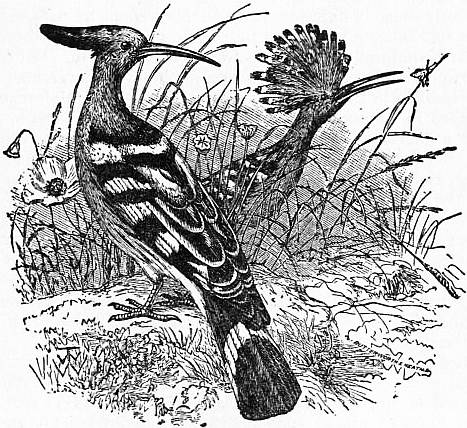
Hoopoe.
Pleasing as is the appearance of the hoopoe as it fearlessly parades its showy plumage, some of its habits are much the reverse. All observers agree in stating that it delights to find its food among filth of the most abominable description, and this especially in its winter-quarters. But where it breeds, its nest, usually in the hole of a tree or of a wall, is not only partly composed of the foulest material, but its condition becomes worse as incubation proceeds, for the hen scarcely ever leaves her eggs, being assiduously fed by the cock as she sits; and when the young are hatched, their faeces are not removed by their parents,2 as is the case with most birds, but are discharged in the immediate neighbourhood of the nest, the unsanitary condition of which can readily be imagined. Worms, grubs, and insects generally form the hoopoes’ food, and upon it they get so fat in autumn that they are esteemed a delicate morsel in some of the countries of southern Europe, and especially by the Christian population of Constantinople.3
Not a year passes but the hoopoe makes its appearance in some part or other of the British Islands, most often in spring, and if unmolested would doubtless stop to breed in them, and a few instances are known in which it has done so. But its remarkable plumage always attracts attention, and it is generally shot down so soon as it is seen, and before it has time to begin a nest. Eight or nine so-called species of the genus have been described, but of them the existence of five only has been recognized by Sharpe and Dresser (Birds of Europe, pt. vii.). Besides the Upupa epops above treated, these are U. indica, resident in India and Ceylon; U. longirostris, which seems to be the form of the Indo-Chinese countries; U. marginata, peculiar to Madagascar; and U. africana or U. minor of some writers, which inhabits South Africa to the Zambesi on the east and Benguela on the west coast. In habits and appearance they all resemble the best-known and most widely-spread species.4
(A. N.)
1 Hence the secondary meaning of the French word huppe—a crest or tuft (cf. Littré, Dict. français, i. 2067).
2 This indeed is denied by Naumann, but by him alone, and the statement in the text is confirmed by many eye-witnesses.
3 Under the name of Dukipath, in the authorized version of the Bible translated “lapwing” (Lev. xi. 19, Deut. xiv. 18), the hoopoe was accounted unclean by the Jewish law. Arabs have a great reverence for the bird, imparting to it marvellous medicinal and other qualities, and making use of its head in all their charms (cf. Tristram, Nat. Hist. of the Bible, pp. 208, 209).
4 The genera Rhinopomastus and Irrisor are generally placed in the Family Upupidae, but Dr Murie, after an exhaustive examination of their osteology, regards them as forming a group of equal value.
HOORN, a seaport in the province of North Holland, Holland, on a bay of the Zuider Zee called the Hoornerhop, and a junction station 23½ m. by rail N. by E. of Amsterdam, on the railway to Enkhuizen, with which it is also connected by steam tramway. Pop. (1900) 10,647. Hoorn is distinguished by its old-world air and the beauty and interest of its numerous gabled houses of the 16th and 17th centuries. Many of these are decorated with inscriptions and bas-reliefs, some of which commemorate the battle on the Zuider Zee in 1573, in which the Beggars defeated the Spaniards under Count Bossu. Walks and gardens now surround the town in the place of the old city walls, but a few towers and gateways adorned with various old coats of arms are still standing. The fine Gothic bastion tower overlooking the harbour was built in 1532; the East gate not later than 1578. Among the public buildings of special interest are the picturesque St John’s hospital (1563), now used for military purposes; the old mint; the hospital for aged men and women (beginning of 17th century); the weigh-house (1609); the town hall, in which the states of West Friesland formerly met; and the old court-house, which dates from the beginning of the 17th century, though parts of it are older, containing a modern museum and some early portraits. There are also various charitable and educational institutions, Protestant and Roman Catholic churches and a synagogue. The extensive foreign commerce which Hoorn carried on in the 16th and 17th centuries has almost entirely vanished, but there is still a considerable trade with other parts of the Netherlands, especially in cheese and cattle. The chief industries include gold and silver work, and there are also tobacco factories, saw-mills and some small boat-building yards, a considerable number of vessels being engaged in the Zuider Zee fisheries.
Hoorn, latinized as Horna or Hornum, has existed at least from the first part of the 14th century, as it is mentioned in a document of the year 1311, five years earlier than the date usually assigned for its foundation. In 1356 it received municipal privileges from Count William V. of Holland, and in 1426 it was surrounded with walls. It was at Hoorn in 1416 that the first great net was made for the herring fishery, an industry which long proved an abundant source of wealth to the town. During the 15th century Hoorn shared in the troubles occasioned by the different contending factions; in 1569 the Spanish forces entered the town; but in 1572 it cast in its lot with the states of the Netherlands. In the 16th century it was a commercial centre, important for its trade, fisheries and breweries. A company of commerce and navigation was formed at Hoorn in 1720, and the admiralty offices and storehouses remained here until their removal to Medemblik in 1795. The English under Sir Ralph Abercromby took possession of the town in 1799, and in 1811 it suffered severely from the French. Among the celebrities of Hoorn are William Schouten, who discovered in 1616 the passage round Cape Horn, or Hoorn, as he named it in honour of his birthplace; Abel Janszoon Tasman, whose fame is associated with Tasmania; and Jan Pietersz Coen, governor-general of the Dutch East Indies.
HOOSICK FALLS, a village of Rensselaer county, New York, U.S.A., in the township of Hoosick, 27 m. N.E. of Troy, on the Hoosick river. Pop. of the village (1890) 7014; (1900) 5671, of whom 1092 were foreign-born; (1905) 5251; (1910) 5532; of the township (1900) 8631; (1910) 8315. Hoosick Falls is served by the Boston & Maine Railroad, and is connected by electric railway with Bennington, Vermont, about 8 m. E. The falls of the Hoosick river furnish water-power for the manufacture of agricultural machinery by the Walter A. Wood Mowing and Reaping Machine Co., which dates from 1866, the business having been started in 1852 by Walter Abbott Wood (1815-1892), who was a Republican representative in Congress in 1879-1883. Other manufactures are knit goods, shirts and collars and paper-making machinery. Hoosick Falls was settled about 1688 by Dutch settlers—settlers from Connecticut and Massachusetts came after 1763—and it was first incorporated in 1827. Three miles N.E. of the village, at Walloomsac, in the township of Hoosick, the battle of Bennington was fought, on the 16th of August 1777.
HOP (Ger. Hopfen, Fr. houblon), Humulus Lupulus, L., an herbaceous twining plant, belonging to the natural order Cannabinaceae, which is by some botanists included in the larger group called Urticaceae by Endlicher. It is of common occurrence in hedges and thickets in the southern counties of England, but is believed not to be native in Scotland. On the European continent it is distributed from Greece to Scandinavia, and extends through the Caucasus and Central Asia to the Altai Mountains. It is common, but doubtfully indigenous, in the northern and western states of North America, and has been introduced into Brazil, Australia and the Himalayas.
It is a perennial plant, producing annually several long twining roughish striated stems, which twist from left to right, are often 15 to 20 ft. long and climb freely over hedges and bushes. The roughness of stem and leaves is due to lines of strong hooked hairs, which help the plant to cling to its support. The leaves are stalked, opposite, 3-5 lobed, and coarsely serrate, and bear a general resemblance to those of the vine, but are, as well as the whole plant, rough to the touch; the upper leaves are sometimes scarcely divided, or quite entire. The stipules are between the leaf-stalks, each consisting of two lateral ones united, or rarely with the tips free. The male and female flowers are produced on distinct plants. The male inflorescence (fig. 1, A) forms a panicle; the flowers consist of a small greenish five-parted perianth (a) enclosing five stamens, whose anthers (b) open by terminal slits. The female inflorescence (fig. 1, B) is less conspicuous in the young state. The catkin or strobile consists of a number of small acute bracts, with two sessile ovaries at their base, each subtended by a rounded bractlet (c). Both the bracts and bractlets enlarge greatly during the development of the ovary, and form, when fully grown, the membranous scales of the strobile (fig. 2, a); they are known as “petals” by hop-growers. The bracts can then only be distinguished from the bractlets by being rather more acute and more strongly veined. The perianth (fig. 1, d) is short, cup-shaped, undivided and closely applied to the ovary, which it ultimately encloses. In the young strobile the two purple hairy styles (e) of each ovary project beyond the bracts. The ovary contains a single ovule (fig. 1. f) which becomes in the fruit an exalbuminous seed, containing a spirally-coiled embryo (fig. 2, b). The light dusty pollen is carried by the wind from the male to the female flowers.
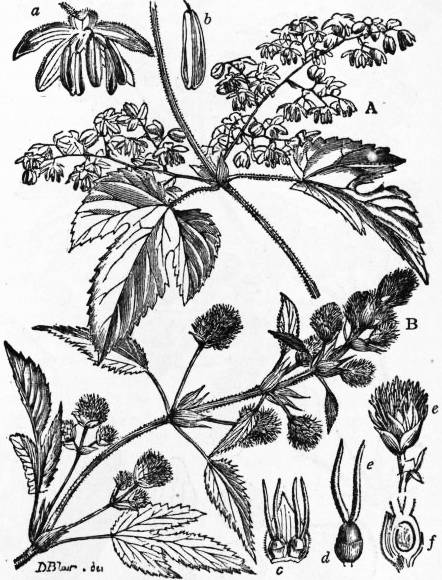
Fig. 1.—Male (A) and Female (B) Inflorescence of the Hop.
The ovary and the base of the bracts are covered with a yellowish powder, consisting of minute sessile grains, called lupulin or lupulinic glands. These glands (fig. 2, c) are from 1⁄260 to 1⁄140 in. in diameter, like flattened subovate little saucers in shape, and attached to a short pedicel. The upper or hemispherical portion bears a delicate continuous membrane, the cuticle, which becomes raised by the secretion beneath it of the yellowish lupulin. The stalk is not perceptible in the gland as found in commerce. When fresh the gland is seen to be filled with a yellowish or dark brown liquid; this on drying contracts in bulk and forms a central mass. It is to these lupulinic glands that the medicinal properties of the hop are chiefly due. By careful sifting about 1 oz. may be obtained from 1 ℔ of hops, but the East Kent variety is said to yield more than the Sussex hops.
In hop gardens a few male plants, usually three or four to an acre, are sometimes planted, that number being deemed sufficient to fertilize the female flowers. The blossoms are produced in August, and the strobiles are fit for gathering from the beginning of September to the middle of October, according to the weather.
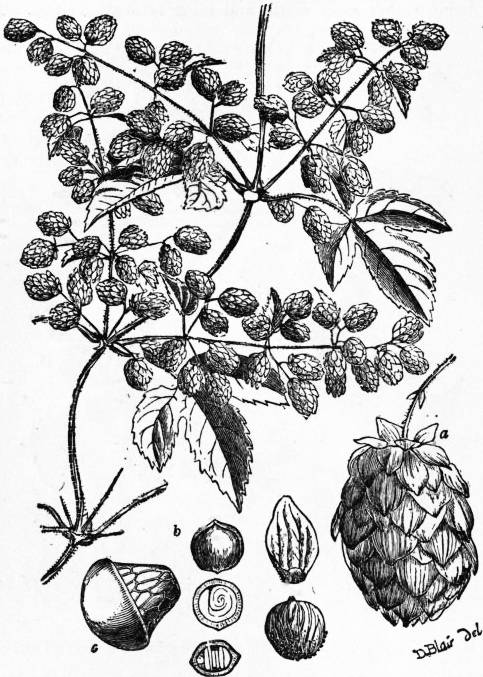
Fig. 2.—Fruit of Hop.
The cultivation of hops for use in the manufacture of beer dates from an early period. In the 8th and 9th centuries hop gardens, called “humularia” or “humuleta,” existed in France and Germany. Until the 16th century, however, hops appear to have been grown in a very fitful manner, and to a limited extent, generally only for private consumption; but after the beginning of the 17th century the cultivation increased rapidly. The plant was introduced into England from Flanders in 1525; and in America its cultivation was encouraged by legislative enactments in 1657. Formerly several plants were used as well as hops to season ale, hence the name “alehoof” for Nepeta Glechoma, and “alecost” for Balsamita vulgaris. The sweet gale, Myrica Gale, and the sage, Salvia officinalis, were also similarly employed. Various hop substitutes, in the form of powder, have been offered in commerce of late years, most of which appear to have quassia as a chief ingredient. The young tender tops of the hop are in Belgium cut off in spring and eaten like asparagus, and are forced from December to February.
Medical Use.—The principal constituents of the strobiles are lupulin, one of the few liquid alkaloids; lupulinic acid, a bitter crystalline body, soluble in ether, which is without any other pharmacological action than that common to bitter substances; Valerol, a volatile oil which in old hops undergoes a change to the malodorous body valerianic acid; resin; trimethylamine; a peculiar modification of tannin known as humulotannic acid; and a sesqui-terpene. The British pharmacopoeia contains two preparations of the strobiles,—an infusion (dose, 1-2 oz.) and a tincture (dose, ½-1 drachm). The glands obtained from the strobiles are known in pharmacy as lupulin, a name which tends to confusion with that of the alkaloid. They occur in commerce as a bright yellow-brown powder, seen under a lens to consist of minute glandular particles. The dose of this so-called lupulin is 2-5 grains. From it there is prepared the Tinctura Lupulinae of the United States pharmacopoeia, which is given in doses of 10-60 minims. Furthermore, there are prepared hop pillows, designed to procure sleep; but these act, when at all, mainly by suggestion. The pharmacological action of hops is determined first by the volatile oil they contain, which has the actions of its class. Similarly the lupulinic acid may act as a bitter tonic. The preparations of hops, when taken internally, are frequently hypnotic, though unfortunately different specimens vary considerably in composition, none of the preparations being standardized. It is by no means certain whether the hypnotic action of hops is due to the alkaloid lupulin or possibly to the volatile oil which they contain. Medical practice, however, is acquainted with many more trustworthy and equally safe hypnotics. The bitter acid of hops may endow beer containing it with a certain value in cases of impaired gastric digestion, and to the hypnotic principle of hops may partly be ascribed—as well as to the alcohol—the soporific action of beer in the case of some individuals.
Hop Production in England1
The cultivation of hops in the British Isles is restricted to England, where it is practically confined to half-a-dozen counties—four in the south-eastern and two in the west-midland districts. In 1901 the English crop was reported by the Board of Agriculture to occupy 51,127 acres. The official returns as to acreage do not extend back beyond 1868, in which year the total area was reported to be 64,488 acres. The largest area recorded since then was 71,789 acres in 1878; the smallest was 44,938 acres in 1907. The extent to which the areas of hops in the chief hop-growing counties vary from year to year is sufficiently indicated in Table I., which shows the annual acreages over a period of thirteen years, 1895 to 1907. The proportions in which the acres of hops are distributed amongst the counties concerned vary but little year by year, and as a rule over 60% belongs to Kent.
Table I.—Hop Areas of England 1895 to 1907. Acres.
Kent. Hereford. Sussex. Worcester. Hants. Surrey.
1895 35,018 7553 7489 4024 2875 1783
1896 33,300 6895 5908 3800 2494 1623
1897 31,661 6542 5174 3591 2306 1416
1898 30,941 6651 4829 3567 2263 1313
1899 31,988 7227 4949 3788 2319 1388
1900 31,514 7287 4823 3964 2231 1300
1901 31,242 7497 4800 4029 2133 1232
1902 29,649 6915 4541 3779 2003 969
1903 29,933 6851 4454 3697 1920 901
1904 29,841 6767 4474 3752 1900 877
1905 30,655 6851 4647 3807 1978 843
1906 29,296 6481 4379 3672 1939 777
1907 28,169 6143 4243 3622 1842 744
Less than 200 acres in all are annually grown in the other hop-growing counties of England, these being Shropshire, Gloucestershire and Suffolk.
The average yield per acre in cwt. in the six counties during the decade 1897 to 1906 was as follows:—
Table II.
Kent. Hereford. Sussex. Worcester. Hants. Surrey.
9.31 7.14 9.41 7.79 8.78 7.23
Table III. shows the average acreage, yield and total home produce of England during the decades 1888-1897 and 1898-1907.
Table III.
Periods. Average Annual Acreage. Average Annual Yield per acre (cwt.). Average Annual Home Produce (cwt.).
1888-1897 56,370 7.76 438,215
1898-1907 48,841 8.84 434,567
The wide fluctuations in the home production of hops are worthy of note, as they exercise a powerful influence upon market prices. The largest crop between 1885, the first year in which figures relating to production were collected, and 1907 was that of 776,144 cwt. in 1886, and the smallest that of 281,291 cwt. in 1888, the former being more than 2½ times the size of the latter. The crop of 1899, estimated at 661,373 cwt., was so large that prices receded to an extent such as to leave no margin of profit to the great body of growers, whilst some planters were able to market the crop only at a loss. The calculated annual average yields per acre over the years 1885 to 1907 ranged between 12.76 cwt. in 1899 and 4.81 cwt. in 1888. No other staple crop of British agriculture undergoes such wide fluctuations in yield as are here indicated, the size of the crop produced bearing no relation to the acreage under cultivation. For example, the 71,327 acres in 1885 produced only 509,170 cwt., whereas the 51,843 acres in 1899 produced 661,373 cwt.—19,484 acres less under crop yielded 152,203 cwt. more produce.