VOLUME XIII SLICE VI Home, Daniel to Hortensius, Quintus (continued 7)
Reading edition
“Nos, ubi decidimus Quo pius Aeneas, quo dives Tullus et Ancus, Pulvis et umbra sumus.”
Horace is so much of a moralist in all his writings that, in order to enter into the spirit both of his familiar and of his lyrical poetry, it is essential to realize what were his views of life and the influences under which they were formed. He is, though in a different sense from Lucretius, eminently a philosophical and reflective poet. He is also, like all the other poets of the Augustan age, a poet in whose composition culture and criticism were as conspicuous elements as spontaneous inspiration. In the judgment he passes on the older poetry of Rome and on that of his contemporaries, he seems to attach more importance to the critical and artistic than to the creative and inventive functions of genius. It is on the labour and judgment with which he has cultivated his gift that he rests his hopes of fame. The whole poetry of the Augustan age was based on the works of older poets, Roman as well as Greek. Its aim was to perfect the more immature workmanship of the former, and to adapt the forms, manners and metres of the latter to subjects of immediate and national interest. As Virgil performed for his generation the same kind of office which Ennius performed for an older generation, so Horace in his Satires, and to a more limited extent in his Epistles, brought to perfection for the amusement and instruction of his contemporaries the rude but vigorous designs of Lucilius.
It was the example of Lucilius which induced Horace to commit all his private thoughts, feelings and experience “to his books as to trusty companions,” and also to comment freely on the characters and lives of other men. Many of the subjects of particular satires of Horace were immediately suggested by those treated by Lucilius. Thus the “Journey to Brundusium” (Sat. i. 5) reproduced the outlines of Lucilius’s “Journey to the Sicilian Straits.” The discourse of Ofella on luxury (Sat. ii. 2) was founded on a similar discourse of Laelius on gluttony, and the “Banquet of Nasidienus” (Sat. ii. 8) may have been suggested by the description by the older poet of a rustic entertainment. There was more of moral censure and personal aggressiveness in the satire of the older poet. The ironical temper of Horace induced him to treat the follies of society in the spirit of a humorist and man of the world, rather than to assail vice with the severity of a censor; and the greater urbanity of his age or of his disposition restrained in him the direct personality of satire. The names introduced by him to mark types of character such as Nomentanus, Maenius, Pantolabus, &c., are reproduced from the writings of the older poet. Horace also followed Lucilius in the variety of forms which his satire assumes, and especially in the frequent adoption of the form of dialogue, derived from the “dramatic medley” which was the original character of the Roman Satura. This form suited the spirit in which Horace regarded the world, and also the dramatic quality of his genius, just as the direct denunciation and elaborate painting of character suited the “saeva indignatio” and the oratorical genius of Juvenal.
Horace’s satire is accordingly to a great extent a reproduction in form, manner, substance and tone of the satire of Lucilius; or rather it is a casting in the mould of Lucilius of his own observation and experience. But a comparison of the fragments of Lucilius with the finished compositions of Horace brings out in the strongest light the artistic originality and skill of the latter poet in his management of metre and style. Nothing can be rougher and harsher than the hexameters of Lucilius, or cruder than his expression. In his management of the more natural trochaic metre, he has shown much greater ease and simplicity. It is one great triumph of Horace’s genius that he was the first and indeed the only Latin writer who could bend the stately hexameter to the uses of natural and easy, and at the same time terse and happy, conversational style. Catullus, in his hendecasyllabics, had shown the vivacity with which that light and graceful metre could be employed in telling some short story or describing some trivial situation dramatically. But no one before Horace had succeeded in applying the metre of heroic verse to the uses of common life. But he had one great native model in the mastery of a terse, refined, ironical and natural conversational style, Terence; and the Satires show, not only in allusions to incidents and personages, but in many happy turns of expression very frequent traces of Horace’s familiarity with the works of the Roman Menander.
The Epistles are more original in form, more philosophic in spirit, more finished and charming in style than the Satires. The form of composition may have been suggested by that of some of the satires of Lucilius, which were composed as letters to his personal friends. But letter-writing in prose, and occasionally also in verse, had been common among the Romans from the time of the siege of Corinth; and a practice originating in the wants and convenience of friends temporarily separated from one another by the public service was ultimately cultivated as a literary accomplishment. It was a happy idea of Horace to adopt this form for his didactic writings on life and literature. It suited him as an eclectic and not a systematic thinker, and as a friendly counsellor rather than a formal teacher of his age. It suited his circumstances in the latter years of his life, when his tastes inclined him more to retirement and study, while he yet wished to retain his hold on society and to extend his relations with younger men who were rising into eminence. It suited the class who cared for literature—a limited circle of educated men, intimate with one another, and sharing the same tastes and pursuits. While giving expression to lessons applicable to all men, he in this way seems to address each reader individually, with the urbanity of a friend rather than the solemnity of a preacher. In spirit the Epistles are more ethical and meditative than the Satires. Like the Odes they exhibit the twofold aspects of his philosophy, that of temperate Epicureanism and that of more serious and elevated conviction. In the actual maxims which he lays down, in his apparent belief in the efficacy of addressing philosophical texts to the mind, he exemplifies the triteness and limitation of all Roman thought. But the spirit and sentiment of his practical philosophy is quite genuine and original. The individuality of the great Roman moralists, such as Lucretius and Horace, appears not in any difference in the results at which they have arrived, but in the difference of spirit with which they regard the spectacle of human life. In reading Lucretius we are impressed by his earnestness, his pathos, his elevation of feeling; in Horace we are charmed by the serenity of his temper and the flavour of a delicate and subtle wisdom. We note also in the Epistles the presence of a more philosophic spirit, not only in the expression of his personal convictions and aims, but also in his comments on society. In the Satires he paints the outward effects of the passions of the age. He shows us prominent types of character—the miser, the parasite, the legacy-hunter, the parvenu, &c., but he does not try to trace these different manifestations of life to their source. In the Epistles he finds the secret spring of the social vices of the age in the desire, as marked in other times as in those of Horace, to become rich too fast, and in the tendency to value men according to their wealth, and to sacrifice the ends of life to a superfluous care for the means of living. The cause of all this aimless restlessness and unreasonable desire is summed up in the words “Strenua nos exercet inertia.”
In his Satires and Epistles Horace shows himself a genuine moralist, a subtle observer and true painter of life, and an admirable writer. But for both of these works he himself disclaims the title of poetry. He rests his claims as a poet on his Odes. They reveal an entirely different aspect of his genius, his spirit and his culture. He is one among the few great writers of the world who have attained high excellence in two widely separated provinces of literature. Through all his life he was probably conscious of the “ingeni benigna vena,” which in his youth made him the sympathetic student and imitator of the older lyrical poetry of Greece, and directed his latest efforts to poetic criticism. But it was in the years that intervened between the publication of his Satires and Epistles that his lyrical genius asserted itself as his predominant faculty. At that time he had outlived the coarser pleasures and risen above the harassing cares of his earlier career; a fresh source of happiness and inspiration had been opened up to him in his beautiful Sabine retreat; he had become not only reconciled to the rule of Augustus, but a thoroughly convinced and, so far as his temperament admitted to enthusiasm, an enthusiastic believer in its beneficence. But it was only after much labour that his original vein of genius obtained a free and abundant outlet. He lays no claim to the “profuse strains of unpremeditated art,” with which other great lyrical poets of ancient and modern times have charmed the world. His first efforts were apparently imitative, and were directed to the attainment of perfect mastery over form, metre and rhythm. The first nine Odes of the first book are experiments in different kinds of metre. They and all the other metres employed by him are based on those employed by the older poets of Greece—Alcaeus, Sappho, Archilochus, Alcman, &c. He has built the structure of his lighter Odes also on their model, while in some of those in which the matter is more weighty, as in that in which he calls on Calliope “to dictate a long continuous strain,” he has endeavoured to reproduce something of the intricate movement, the abrupt transitions, the interpenetration of narrative and reflection, which characterize the art of Pindar. He frequently reproduces the language and some of the thoughts of his masters, but he gives them new application, or stamps them with the impress of his own experience. He brought the metres which he has employed to such perfection that the art perished with him. A great proof of his mastery over rhythm is the skill with which he has varied his metres according to the sentiment which he wishes to express. Thus his great metre, the Alcaic, has a character of stateliness and majesty in addition to the energy and impetus originally imparted to it by Alcaeus. The Sapphic metre he employs with a peculiar lightness and vivacity which harmonize admirably with his gayer moods.
Again in regard to his diction, if Horace has learned his subtlety and moderation from his Greek masters, he has tempered those qualities with the masculine characteristics of his race. No writer is more Roman in the stateliness and dignity, the terseness, occasionally even in the sobriety and bare literalness, of his diction.
While it is mainly owing to the extreme care which Horace gave to form, rhythm and diction that his own prophecy
“Usque ego postera Crescam laude recens”
has been so amply fulfilled, yet no greater injustice could be done to him than to rank him either as poet or critic with those who consider form everything in literature. With Horace the mastery over the vehicle of expression was merely an essential preliminary to making a worthy and serious use of that vehicle. The poet, from Horace’s point of view, was intended not merely to give refined pleasure to a few, but above all things, to be “utilis urbi.” Yet he is saved, in his practice, from the abuse of this theory by his admirable sense, his ironical humour, his intolerance of pretension and pedantry. Opinions will differ as to whether he or Catullus is to be regarded as the greater lyrical poet. Those who assign the palm to Horace will do so, certainly not because they recognize in him richer or equally rich gifts of feeling, conception and expression, but because the subjects to which his art has been devoted have a fuller, more varied, more mature and permanent interest for the world.
Authorities.—For the life of Horace the chief authorities are his own works and a short ancient biography which is attributed to Suetonius. The apparatus criticus is most fully described in O. Keller’s preface to vol. i. of the 2nd ed. (1899) of Keller and Holder’s recension of Horace’s works. This edition also gives by far the largest collection of variants and emendations to the text and of the testimonia of ancient writers.
What might have proved the most important manuscript of Horace, the so-called vetustissimus Blandinius, is now lost, and we know it only from the account of J. Cruquius who saw it in 1565. The relations of the extant MSS. to each other and the presumed archetype present an intricate problem; and Keller’s solution has not proved generally acceptable. See a résumé of the controversy Horazkritik seit 1880 by J. Bick (Leipzig, 1906) and F. Vollmer in Philologus. Supp. x. 2, pp. 261-322. Many MSS. of Horace contain ancient scholia which are copied or taken with abridgment from the commentaries of Porphyrio, who lived about A.D. 200, and Helenius Aero, a still earlier grammarian. These scholia also have been collected and edited—the Porphyrio scholia by A. Holder (1902) and the “Acronian” (or pseudo-Acronian) by O. Keller (1902-1904). R. Bentley’s epoch-making edition (1711) has been reprinted with an index by Zangemeister (1869). Of the modern commentaries the most useful are those of J. C. Orelli (4th ed., revised by O. Hirschfelder and J. Mewes, 1886-1890, with index verborum), and of A. Kiessling (revised by R. Heinze, Odes, 1901, 1908, Satires, 1906, Epistles, 1898). The best complete English commentary is that of E. C. Wickham (2 vols., 1874-1896). Other editions with English notes are those of T. E. Page (Odes, 1883), A. Palmer (Satires, 1883), A. S. Wilkins (Epistles, 1885), J. Gow (Odes and Epodes, 1896, Satires, i., 1901), P. Shorey (Odes and Epodes, 1898, Boston, U.S.A.). L. Müller’s elaborate edition of the Odes and Epodes was published posthumously (1900). Of the critical editions Keller and Holder’s still holds the field: to this Keller’s Epilegomena zu Horaz (1879) is a necessary adjunct. F. Vollmer’s text (1907) uses Keller’s materials on a new principle. Of illustrated editions H. H. Milman’s (1867) and C. W. King’s (1869, with text revised by H. A. J. Munro) deserve mention. The best verse translation is that of J. Conington lately reprinted with the Latin text from the recension in Postgate’s new Corpus poetarum. For further information see Teuffel’s Geschichte der römischen Litteratur (Eng. trans. by G. C. Warr), §§ 234-240, and M. Schanz’s excellent account in his Geschichte der römischen Litteratur, vol. ii. §§ 251-266.
(W. Y. S.; J. G*.)
1 The date is determined by the poem on the death of Quintilius Varus (who died 24 B.C.), and by the reference in Ode i. 12 to the young Marcellus (died in autumn 23 B.C.) as still alive. Cf. Wickham’s Introduction to the Odes.
HORAE (Lat. hora, hour), the Hours, in Greek mythology Ὡραι, originally the personification of a series of natural phenomena. In the Iliad (v. 749) they are the custodians of the gates of Olympus, which they open or shut by scattering or condensing the clouds; that is, they are weather goddesses, who send down or withhold the fertilizing dews and rain. In the Odyssey, where they are represented as bringing round the seasons in regular order, they are an abstraction rather than a concrete personification. The brief notice in Hesiod (Theog. 901), where they are called the children of Zeus and Themis, who superintend the operations of agriculture, indicates by the names assigned to them (Eunomia, Dikē, Eirenē, i.e. Good Order, Justice, Peace) the extension of their functions as goddesses of order from nature to the events of human life, and at the same time invests them with moral attributes. Like the Moerae (Fates), they regulate the destinies of man, watch over the newly born, secure good laws and the administration of justice. The selection of three as their number has been supposed to refer to the most ancient division of the year into spring, summer and winter, but it is probably only another instance of the Greek liking for that particular number or its multiples in such connexions (three Moerae, Charites, Gorgons, nine Muses). Order and regularity being indispensable conditions of beauty, it was easy to conceive of the Horae as the goddesses of youthful bloom and grace, inseparably associated with the idea of springtime. As such they are companions of the Nymphs and Graces, with whom they are often confounded, and of other superior deities connected with the spring growth of vegetation (Demeter, Dionysus). At Athens they were two (or three) in number: Thallo and Carpo, the goddesses of the flowers of spring and of the fruits of summer, to whom Auxo, the goddess of the growth of plants, may be added, although some authorities make her only one of the Graces. In honour of the Horae a yearly festival (Horaea) was celebrated, at which protection was sought against the scorching heat and drought, and offerings were made of boiled meat as less insipid and more nutritious than roast. In later mythology, under Alexandrian influence, the Horae become the four seasons, daughters of Helios and Selene, each represented with the conventional attributes. Subsequently, when the day was divided into twelve equal parts, each of them took the name of Hora. Ovid (Metam. ii. 26) describes them as placed at equal intervals on the throne of Phoebus, with whom are also associated the four seasons. Nonnus (5th century A.D.) in the Dionysiaca also unites the twelve Horae as representing the day and the four Horae as the seasons in the palace of Helios.
See C. Lehrs, Populäre Aufsätze (1856); J. H. Krause, Die Musen, Grazien, Horen, und Nymphen (1871); and the articles in Daremberg and Saglio’s Dictionnaire des antiquités, J. A. Hild; and in Roscher’s Lexikon der Mythologie, W. Rapp.
HORAPOLLON, of Phaenebythis in the nome of Panopolis in Egypt, Greek grammarian, flourished in the 4th century A.D. during the reign of Theodosius I. According to Suidas, he wrote commentaries on Sophocles, Alcaeus and Homer, and a work (Τεμενικά) on places consecrated to the gods. Photius (cod. 279), who calls him a dramatist as well as a grammarian, ascribes to him a history of the foundation and antiquities of Alexandria (unless this is by an Egyptian of the same name, who lived In the reign of Zeno, 474-491). Under the name of Horapollon two books on Hieroglyphics are extant, which profess to be a translation from an Egyptian original into Greek by a certain Philippus, of whom nothing is known. The inferior Greek of the translation, and the character of the additions in the second book point to its being of late date; some have even assigned it to the 15th century. Though a very large proportion of the statements seem absurd and cannot be accounted for by anything known in the latest and most fanciful usage, yet there is ample evidence in both the books, in individual cases, that the tradition of the values of the hieroglyphic signs was not yet extinct in the days of their author.
Bibliography.—Editions by C. Leemans (1835) and A. T. Cory (1840) with English translation and notes; see also G. Rathgeber in Ersch and Gruber’s Allgemeine Encyclopädie; H. Schäfer, Zeitschrift für ägyptische Sprache (1905), p. 72.
HORATII and CURIATII, in Roman legend, two sets of three brothers born at one birth on the same day—the former Roman, the latter Alban—the mothers being twin sisters. During the war between Rome and Alba Longa it was agreed that the issue should depend on a combat between the two families. Two of the Horatii were soon slain; the third brother feigned flight, and when the Curiatii, who were all wounded, pursued him without concert he slew them one by one. When he entered Rome in triumph, his sister recognized a cloak which he was wearing as a trophy as one she had herself made for her lover, one of the Curiatii. She thereupon invoked a curse upon her brother, who slew her on the spot. Horatius was condemned to be scourged to death, but on his appealing to the people his life was spared (Livy i. 25, 26; Dion. Halic. iii. 13-22). Monuments of the tragic story were shown by the Romans in the time of Livy (the altar of Janus Curiatius near the sororium tigillum, the “sister’s beam,” or yoke under which Horatius had to pass; and the altar of Juno Sororia). The legend was probably invented to account for the origin of the provocatio (right of appeal to the people), while at the same time it points to the close connexion and final struggle for supremacy between the older city on the mountain and the younger city on the plain. Their relationship and origin from three tribes are symbolically represented by the twin sisters and the two sets of three brothers.
For a critical examination of the story, see Schwegler, Römische Geschichte, bk. xii. 11. 14; Sir G. Cornewall Lewis, Credibility of Early Roman History, ch. xi. 15; W. Ihne, Hist. of Rome, i.; E. Pais, Storia di Roma, i. ch. 3 (1898), and Ancient Legends of Roman History (Eng. trans., 1906), where the story is connected with the ceremonies performed in honour of Jupiter Tigillus and Juno Sororia; C. Pascal, Fatti e legende di Roma antica (Florence, 1903); O. Gilbert, Geschichte und Topographie der Stadt Rom im Altertum (1883-1885).
HORATIUS COCLES, a legendary hero of ancient Rome. With two companions he defended the Sublician bridge against Lars Porsena and the whole army of the Etruscans, while the Romans cut down the bridge behind. Then Horatius threw himself into the Tiber and swam in safety to the shore. A statue was erected in his honour in the temple of Vulcan, and he received as much land as he could plough round in a single day. According to another version, Horatius alone defended the bridge, and was drowned in the Tiber.
There is an obvious resemblance between the legend of Horatius Codes and that of the Horatii and Curiatii. In both cases three Romans come forward as the champions of Rome at a critical moment of her fortunes, and only one successfully holds his ground. In the one case, the locality is the land frontier, in the other, the boundary stream of Roman territory. E. Pais finds the origin of the story in the worship of Vulcan, and identifies Cocles (the “one-eyed”) with one of the Cyclopes, who in mythology were connected with Hephaestus, and later with Vulcan. He concludes that the supposed statue of Cocles was really that of Vulcan, who, as one of the most ancient Roman divinities and, in fact, the protecting deity of the state, would naturally be confounded with the hero who saved it by holding the bridge against the invaders. He suggests that the legend arose from some religious ceremony, possibly the practice of throwing the stuffed figures called Argei into the Tiber from the Pons Sublicius on the ides of May. The conspicuous part played in Roman history by members of the Horatian family, who were connected with the worship of Jupiter Vulcanus, will explain the attribution of the name Horatius to Vulcan-Cocles.
See Livy ii. 10; Dion. Halic. v. 23-25; Polybius vi. 55; Plutarch, Poplicola, 16. For a critical examination of the legend, see Schwegler, Römische Geschichte, bk. xxi. 18; W. Ihne, History of Rome, i.; E. Pais, Storia di Roma, i. ch. 4 (1898), and Ancient Legends of Roman History (Eng. trans., 1906).
HORDE, a manufacturing town of Germany, in the Prussian province of Westphalia, is 2 m. S.E. from Dortmund on the railway to Soest. Pop. (1905) 28,461. It has a Roman Catholic and an Evangelical church, a synagogue and an old castle dating from about 1300. There are large smelting-works, foundries, puddling-works, rolling-mills and manufactures of iron and plated wares. In the neighbourhood there are large iron and coal mines. A tramway connects the town with Dortmund.
HOREB, the ancient seat of Yahweh, the tribal god of the Kenites, adopted by His covenant by Israel. This is the name preferred by the Elohistic writer (E) whose work is interwoven into the Old Testament narrative, and he is followed by the Deuteronomist school (D). The Yahwistic writer (J), on the other hand, prefers to call the mountain Sinai (q.v.), and so do the priestly writers (P). This latter form became the more usual. There is no ground for distinguishing between Horeb as the range and Sinai as the single mountain, or between Horeb and Sinai as respectively the N. and S. parts of the range.
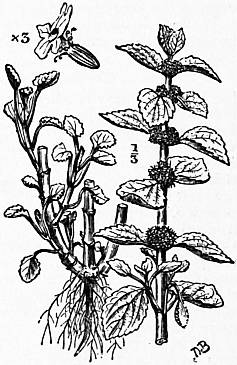
Horehound.
HOREHOUND (O. Eng. harhune, Ger. Andorn, Fr. marrube). Common or white horehound, Marrubium vulgare, of the natural order Labiatae, is a perennial herb with a short stout rootstock, and thick stems, about 1 ft. in height, which, as well as their numerous branches, are coated with a white or hoary felt—whence the popular name of the plant. The leaves have long petioles, and are roundish or rhombic-ovate, with a bluntly toothed margin, much wrinkled, white and woolly below and pale green and downy above; the flowers are sessile, in dense whorls or clusters, small and dull-white, with a 10-toothed calyx and the upper lobe of the corolla long and bifid. The plant occurs in Europe, North Africa and West Asia to North-West India, and has been naturalized in parts of America. In Britain, where it is found generally on sandy or dry chalky ground, it is far from common. White horehound contains a volatile oil, resin, a crystallizable bitter principle termed marrubiin and other substances, and has a not unpleasant aromatic odour, and a persistent bitter taste. Formerly it was official in British pharmacopoeias; and the infusion, syrup or confection of horehound has long been in popular repute for the treatment of a host of dissimilar affections. Black horehound, Ballota nigra, is a hairy perennial herb, belonging to the same order, of foetid odour, is 2 to 3 ft. in height, and has stalked, roundish-ovate, toothed leaves and numerous flowers, in dense axillary clusters, with a green or purplish calyx, and a pale red-purple corolla. It occurs in Europe, North Africa and West Asia, and in Britain south of the Forth and Clyde, and has been introduced into North America.
HORGEN, a small town in the Swiss canton of Zürich, situated on the left or west shore of the Lake of Zürich, and by rail 10½ m. S.E. of the town of Zürich. Pop. (1900) 6883, mostly German-speaking and Protestants. It possesses many industrial establishments of various kinds, and is a centre of the Zürich silk manufacture. It came in 1406 into the possession of Zürich, with which it communicates by means of steamers on the lake, as well as by rail.
HORIZON (Gr. ὁρίζων, dividing), the apparent circle around which the sky and earth seem to meet. At sea this circle is well defined, the line being called the sea horizon, which divides the visible surface of the ocean from the sky. In astronomy the horizon is that great circle of the sphere the plane of which is at right angles to the direction of the plumb line. Sometimes a distinction is made between the rational and the apparent horizon, the former being the horizon as determined by a plane through the centre of the earth, parallel to that through the station of an observer. But on the celestial sphere the great circles of these two planes are coincident, so that this distinction is not necessary (see Astronomy: Spherical). The Dip of the horizon at sea is the angular depression of the apparent sea horizon, or circle bounding the visible ocean, below the apparent celestial horizon as above defined. It is due to the rotundity of the earth, and the height of the observer’s eye above the water. The dip of the horizon and its distance in sea-miles when the height of the observer’s eye above the sea-level is h feet, are approximately given by the formulae: Dip = 0′.97 √h; Distance = 1m·17 √h. The difference between the coefficients 0.97 and 1.17 arises from the refraction of the ray, but for which they would be equal.
HORMAYR, JOSEPH, Baron von (1782-1848), German statesman and historian, was born at Innsbruck on the 20th of January 1782. After studying law in his native town, and attaining the rank of captain in the Tirolese Landwehr, the young man, who had the advantage of being the grandson of Joseph von Hormayr (1705-1778), chancellor of Tirol, obtained a post in the foreign office at Vienna (1801), from which he rose in 1803 to be court secretary and, being a near friend of the Archduke John, director of the secret archives of the state and court for thirteen months. In 1803 he married Therese Anderler von Hohenwald. During the insurrection of 1809, by which the Tirolese sought to throw off the Bavarian supremacy confirmed by the treaty of Pressburg, Hormayr was the mainstay of the Austrian party, and assumed the administration of everything (especially the composition of proclamations and pamphlets); but, returning home without the prestige of success, he fell, in spite of the help of the Archduke John, into disfavour both with the emperor Francis I. and with Prince Metternich, and at length, when in 1813 he tried to stir up a new insurrection in Tirol, he was arrested and imprisoned at Munkatt. In 1816 some amends were made to him by his appointment as imperial historiographer; but so little was he satisfied with the general policy and conduct of the Austrian court that in 1828 he accepted an invitation of King Louis I. to the Bavarian capital, where he became ministerial councillor in the department of foreign affairs. In 1832 he was appointed Bavarian minister-resident at Hanover, and from 1837 to 1846 he held the same position at Bremen. Together with Count Johann Friedrich von der Decken (1769-1840) he founded the Historical Society of Lower Saxony (Historischer Verein für Niedersachsen). The last two years of his life were spent at Munich as superintendent of the national archives. He died on the 5th of October 1848.
Hormayr’s literary activity was closely conditioned by the circumstances of his political career and by the fact that Johannes von Müller (d. 1611) was his teacher: while his access to original documents gave value to his treatment of the past, his record or criticism of contemporary events received authority and interest from his personal experience. But his history of the Tirolese rebellion is far from being impartial; for he always liked to put himself into the first place, and the merits of Andreas Hofer and of other leaders are not sufficiently acknowledged. In his later writings he appears as a keen opponent of the policy of the court of Vienna.
The following are among Hormayr’s more important works: Geschichte des Grafen von Andechs (1796); Lexikon für Reisenden in Tirol (1796); Kritisch-diplomatische Beiträge zur Geschichte Tirols im Mittelalter (2 vols., Innsbruck, 1802-1803, new ed., 1805); Gesch. der gefürst. Grafschaft Tirol (2 vols., Tübingen, 1806-1808); Österreichischer Plutarch, 20 vols., collection of portraits and biographies of the most celebrated administrators, commanders and statesmen of Austria (Vienna, 1807); an edition of Beauchamp’s Histoire de la guerre en Vendée (1809); Geschichte Hofers (1817, 2nd ed., 2 vols., 1845) and other pamphlets; Archiv für Gesch., Stat., Lit. und Kunst (20 vols., 1809-1828); Allgemeine Geschichte der neuesten Zeit vom Tod Friedricks des Grossen bis zum zweiten Pariser Frieden (3 vols., Vienna, 1814-1819, 2nd ed., 1891); Wien, seine Gesch. und Denkwürdigkeiten (5 vols., Vienna, 1823-1824); together with Fragmente über Deutschland, in Sonderheit Bayerns Welthandel; Lebensbilder aus dem Befreiungskriege (3 vols., Jena, 1841-1844, 2nd ed., 1845); Die goldene Chronik von Hohenschwangau (Munich, 1842); Anemonen aus dem Tagebuch eines alten Pilgersmanns (4 vols., Jena, 1845-1847). Together with Mednyanski (1784-1844) he founded the Taschenbuch für die Vaterland. Gesch. (Vienna, 1811-1848).
See T. H. Merdau, Biographische Züge aus dem Leben deutscher Männer (Leipzig, 1815); Gräffer, Österreichische National-Encyclopädie, ii. (1835); Taschenbuch für vaterländische Geschichte (1836 and 1847); Neuer Nekrolog der Deutschen (1848); Blätter für literarische Unterhaltung (1849); Wurzbach, Österreichisches biographisches Lexikon, ix. (1863); K. Th. von Heigel in the Allgemeine deutsche Biographie (1881) and F. X. Wegele, Geschichte der deutschen Historiographie (Munich and Leipzig, 1885); F. v. Krones, Aus Österreichs stillen und bewegten Jahren 1810-1815; Biographie und Briefe an Erzhz. Johann (Innsbruck, 1892); Hirn, Tiroler Aufstand (1909).
(J. Hn.)
HORMISDAS, pope from 514 to 523 in succession to Symmachus, was a native of Campania. He is known as having succeeded in obtaining the reunion of the Eastern and Western Churches, which had been separated since the excommunication of Acacius in 484. After two unsuccessful attempts under the emperor Anastasius I., Hormisdas had no difficulty in coming to an understanding in 518 with his successor Justin. Legates were despatched to Constantinople; the memorial of the schismatic patriarchs was condemned; and union was resumed with the Holy See.
Details of this transaction have come down to us in the Collectio Avellana (Corpus script. eccl. Vindobon., vol. xxv., Nos. 105-203; cf. Andreas Thiel, Epp. Rom. Pont. i. 741 seq.).
HORMIZD, or Hormizdas, the name of five kings of the Sassanid dynasty (see Persia: Ancient History). The name is another form of Ahuramazda or Ormuzd (Ormazd), which under the Sassanids became a common personal name and was borne not only by many generals and officials of their time (it therefore occurs very often on Persian seals), but even by the pope of Rome noticed above. It is strictly an abbreviation of Hormuzd-dad, “given by Ormuzd,” which form is preserved by Agathias iv. 24-25 as name of King Hormizd I. and II. (Ὁρμισδάτης).
1. Hormizd I. (272-273) was the son of Shapur I., under whom he was governor of Khorasan, and appears in his wars against Rome (Trebellius Pollio, Trig. Tyr. 2, where Nöldeke has corrected the name Odomastes into Oromastes, i.e. Hormizd). In the Persian tradition of the history of Ardashir I., preserved in a Pahlavi text (Nöldeke, Geschichte des Artachsir I. Pāpakān), he is made the son of a daughter of Mithrak, a Persian dynast, whose family Ardashir had extirpated because the magians had predicted that from his blood would come the restorer of the empire of Iran. Only this daughter is preserved by a peasant; Shapur sees her and makes her his wife, and her son Hormizd is afterwards recognized and acknowledged by Ardashir. In this legend, which has been partially preserved also in Tabari, the great conquests of Shapur are transferred to Hormizd. In reality he reigned only one year and ten days.
2. Hormizd II., son of Narseh, reigned for seven years five months, 302-309. Of his reign nothing is known. After his death his son Adarnases was killed by the grandees after a very short reign, as he showed a cruel disposition; another son, Hormizd, was kept a prisoner, and the throne reserved for the child with which a concubine of Hormizd II. was pregnant and which received the name Shapur II. Hormizd escaped from prison by the help of his wife in 323, and found refuge at the court of Constantine the Great (Zosim. ii. 27; John of Antioch, fr. 178; Zonar. 13.5), In 363 Hormizd served in the army of Julian against Persia; his son, with the same name, became consul in 366 (Ammian. Marc. 26. 8. 12).
3. Hormizd III., son of Yazdegerd I., succeeded his father in 457. He had continually to fight with his brothers and with the Ephthalites in Bactria, and was killed by Peroz in 459.
4. Hormizd IV., son of Chosroes I., reigned 578-590. He seems to have been imperious and violent, but not without some kindness of heart. Some very characteristic stories are told of him by Ṭabari (Nöldeke, Geschichte d. Perser und Araber unter den Sasaniden, 264 ff.). His father’s sympathies had been with the nobles and the priests. Hormizd protected the common people and introduced a severe discipline in his army and court. When the priests demanded a persecution of the Christians, he declined on the ground that the throne and the government could only be safe if it gained the goodwill of both concurring religions. The consequence was that he raised a strong opposition in the ruling classes, which led to many executions and confiscations. When he came to the throne he killed his brothers, according to the oriental fashion. From his father he had inherited a war against the Byzantine empire and against the Turks in the east, and negotiations of peace had just begun with the emperor Tiberius, but Hormizd haughtily declined to cede anything of the conquests of his father. Therefore the accounts given of him by the Byzantine authors, Theophylact, Simocatta (iii. 16 ff.), Menander Protector and John of Ephesus (vi. 22), who give a full account of these negotiations, are far from favourable. In 588 his general, Bahram Chobin, defeated the Turks, but in the next year was beaten by the Romans; and when the king superseded him he rebelled with his army. This was the signal for a general insurrection. The magnates deposed and blinded Hormizd and proclaimed his son Chosroes II. king. In the war which now followed between Bahram Chobin and Chosroes II. Hormizd was killed by some partisans of his son (590).
5. Hormizd V. was one of the many pretenders who rose after the murder of Chosroes II. (628). He maintained himself about two years (631, 632) in the district of Nisibis.
(Ed. M.)
HORMUZ (Hurmuz, Ormuz, Ormus), a famous city on the shores of the Persian Gulf, which occupied more than one position in the course of history, and has now long practically ceased to exist. The earliest mention of the name occurs in the voyage of Nearchus (325 B.C.). When that admiral beached his fleet at the mouth of the river Anamis on the shore of Harmozia, a coast district of Carmania, he found the country to be kindly, rich in every product except the olive. The Anamis appears to be the river now known as the Minab, discharging into the Persian Gulf near the entrance of the latter. The name Hormuz is derived by some from that of the Persian god Hormuzd (Ormazd), but it is more likely that the original etymology was connected with khurma, “a date”; for the meaning of Moghistan the modern name of the territory Harmozia is “the region of date-palms.” The foundation of the city of Hormuz in this territory is ascribed by one Persian writer to the Sassanian Ardashir Babegan (c. 230 A.D.). But it must have existed at an earlier date, for Ptolemy takes note of Ἅρμονζα πόλις (vi. 8).
Hormuz is mentioned by Idrisi, who wrote c. 1150, under the title of Hormuz-al-sāhilīah, “Hormuz of the shore” (to distinguish it from inland cities of the same name then existing), as a large and well-built city, the chief mart of Kirman. Siraf and Kish (Ḳais), farther up the gulf, had preceded it as ports of trade with India, but in the 13th century Hormuz had become the chief seat of this traffic. It was at this time the seat also of a petty dynasty of kings, of which there is a history by one of their number (Turan Shah); an abstract of it is given by the Jesuit Teixeira. According to this history the founder of the dynasty was Shah Mohammed Dirhem-Kub (“the Drachma-coiner”), an Arab chief who crossed the gulf and established himself here. The date is not given, but it must have been before 1100 A.D., as Ruḳnuddīn Mahmūd, who succeeded in 1246, was the twelfth of the line. These princes appear to have been at times in dependence necessarily on the atabegs of Fars and on the princes of Kirman. About the year 1300 Hormuz was so severely and repeatedly harassed by raids of Tatar horsemen that the king and his people abandoned their city on the mainland and transferred themselves to the island of Jerun (Organa of Nearchus), about 12 m. westward and 4 m. from the nearest shore.
The site of the continental or ancient Hormuz was first traced in modern times by Colonel (Sir Lewis) Pelly when resident at Bushire. It stands in the present district of Minab, several miles from the sea, and on a creek which communicates with the Minab river, but is partially silted up and not now accessible for vessels. There remain traces of a long wharf and extensive ruins. The new city occupied a triangular plain forming the northern part of the island, the southern wall, as its remains still show, being about 2 m. in extent from east to west. A suburb with a wharf or pier, called Turan Bagh (garden of Turan) after one of the kings, a name now corrupted to Trumpak, stood about 3 m. from the town to the south-east.
Odoric gives the earliest notice we have of the new city (c. 1320). He calls it Ormes, a city strongly fortified and abounding in costly wares, situated on an island 5 m. distant from the main, having no trees and no fresh water, unhealthy and (as all evidence confirms) incredibly hot. Some years later it was visited more than once by Ibn Batuta, who seems to speak of the old city as likewise still standing. The new Hormuz, called also Jerun (i.e. still retaining the original name of the island), was a great and fine city rising out of the sea, and serving as a mart for all the products of India, which were distributed hence over all Persia. The hills on the island were of rock-salt, from which vases and pedestals for lamps were carved. Near the gate of the chief mosque stood an enormous skull, apparently that of a sperm-whale. The king at this time was Kutbuddīn Tahamtan, and the traveller gives a curious description of him, seated on the throne, in patched and dirty raiment, holding a rosary of enormous pearls, procured from the Bahrein fisheries, which at one time or another belonged, with other islands in the gulf and on the Oman shores from Rās-el-had (C. Rosalgat of the Portuguese) on the ocean round to Julfar on the gulf, to the princes of Hormuz. Abdurazzāk, the envoy of Shah Rukh on his way to the Hindu court of Vijayanagar, was in Hormuz in 1442, and speaks of it as a mart which had no equal, frequented by the merchants of all the countries of Asia, among which he enumerates China, Java, Bengal, Tenasserim, Shahr-ī-nao (i.e. Siam) and the Maldives. Nikitin, the Russian (c. 1470), gives a similar account; he calls it “a vast emporium of all the world.”
In September 1507 the king of Hormuz, after for some time hearing of the terrible foe who was carrying fire and sword along the shores of Arabia, saw the squadron of Alphonso d’Albuquerque appear before his city, an appearance speedily followed by extravagant demands, by refusal of these from the ministers of the young king, and by deeds of matchless daring and cruelty on the part of the Portuguese, which speedily broke down resistance. The king acknowledged himself tributary to Portugal, and gave leave to the Portuguese to build a castle, which was at once commenced on the northern part of the island, commanding the city and the anchorage on both sides. But the mutinous conduct and desertion of several of Albuquerque’s captains compelled him suddenly to abandon the enterprise; and it was not till 1514, after the great leader had captured Goa and Malacca, and had for five years been viceroy, that he returned to Hormuz (or Ormuz, as the Portuguese called it), and without encountering resistance to a name now so terrible, laid his grasp again on the island and completed his castle. For more than a century Hormuz remained practically in the dominions of Portugal, though the hereditary prince, paying from his revenues a tribute to Portugal (in lieu of which eventually the latter took the whole of the customs collections), continued to be the instrument of government. The position of things during the Portuguese rule may be understood from the description of Cesare de’ Federici, a Venetian merchant who was at Hormuz about 1565. After speaking of the great trade in spices, drugs, silk and silk stuffs, and pearls of Bahrein, and in horses for export to India, he says the king was a Moor (i.e. Mahommedan), chosen by and subordinate to the Portuguese. “At the election of the king I was there and saw the ceremonies that they use.... The old king being dead, the captain of the Portugals chooseth another of the blood-royal, and makes this election in the castle with great ceremony. And when he is elected the captain sweareth him to be true ... to the K. of Portugal as his lord and governor, and then he giveth him the sceptre regal. After this ... with great pomp ... he is brought into the royal palace in the city. The king keeps a good train and hath sufficient revenues, ... because the captain of the castle doth maintain and defend his right ... he is honoured as a king, yet he cannot ride abroad with his train, without the consent of the captain first had” (in Hakluyt).1
The rise of the English trade and factories in the Indian seas in the beginning of the 17th century led to constant jealousies and broils with the Portuguese, and the successful efforts of the English company to open traffic with Persia especially embittered their rivals, to whom the possession of Hormuz had long given a monopoly of that trade. The officers of Shāh Abbās, who looked with a covetous and resentful eye on the Portuguese occupation of such a position, were strongly desirous of the aid of English ships in attacking Hormuz. During 1620 and 1621 the ships of Portugal and of the English company had more than once come to action in the Indian seas, and in November of the latter year the council at Surat had resolved on what was practically maritime war with the Portuguese flag. There was hardly a step between this and the decision come to in the following month to join with “the duke of Shirāz” (Imām Kūlī Khān, the governor of Fars) in the desired expedition against Hormuz. There was some pretext of being forced into the alliance by a Persian threat to lay embargo on the English goods at Jashk; but this seems to have been only brought forward by the English agents when, at a later date, their proceedings were called in question. The English crews were at first unwilling to take part in what they justly said was “no merchandizing business, nor were they engaged for the like,” but they were persuaded, and five English vessels aided, first, in the attack of Kishm, where (at the east end of the large island so called) the Portuguese had lately built a fort,2 and afterwards in that of Hormuz itself. The latter siege was opened on the 18th of February 1622, and continued to the 1st of May, when the Portuguese, after a gallant defence of ten weeks, surrendered. It is to be recollected that Portugal was at this time subject to the crown of Spain, with which England was at peace; indeed, it was but a year later that the prince of Wales went on his wooing adventure to the Spanish court. The irritation there was naturally great, though it is surprising how little came of it. The company were supposed (apparently without foundation) to have profited largely by the Hormuz booty; and both the duke of Buckingham and the king claimed to be “sweetened,” as the record phrases it, from this supposed treasure. The former certainly received a large bribe (£10,000). The conclusion of the transaction with the king was formerly considered doubtful; but entries in the calendar of East India papers seem to show that James received an equal sum.3
Hormuz never recovered from this blow. The Persians transferred their establishments to Gombroon on the mainland, about 12 m. to the north-west, which the king had lately set up as a royal port under the name of Bander Abbāsi. The English stipulations for aid had embraced an equal division of the customs duties. This division was apparently recognized by the Persians as applying to the new Bander, and, though the trade with Persia was constantly decaying and precarious, the company held to their factory at Gombroon for the sake of this claim to revenue, which of course was most irregularly paid. In 1683-1684 the amount of debt due to the company in Persia, including their proportion of customs duties, was reckoned at a million sterling. As late as 1690-1691 their right seems to have been admitted, and a payment of 3495 sequins was received by them on this account. The factory at Gombroon lingered on till 1759, when it was seized by two French ships of war under Comte d’Estaing. It was re-established, but at the time of Niebuhr’s visit to the gulf a few years later no European remained. Niebuhr mentions that in his time (c. 1765) Mulla ’Ali Shāh, formerly admiral of Nādir Shāh, was established on the island of Hormuz and part of Kishm as an independent chief.
See also Barros, Asia; Commentaries of Albuquerque, trans. by Birch (Hak. Society); Relaciones de Pedro Teixeira (Antwerp, 1610); Narratives in Hakluyt’s Collection (reprint in 1809, vol. ii.) and in Purchas’s Pilgrims, vol. ii.; Pietro della Valle, Persia, lett. xii.-xvii.; Calendar of E. I. Papers, by Sainsbury, vol. iii.; Ritter, Erdkunde, xii.; Jour. Roy. Geog. Soc., Kempthorne in vol. v., White-locke in vol. viii., Pelly in vol. xxxiv.; Fraser, Narrative of a Journey into Khorasan (1825); Constable and Stifle, Persian Gulf Pilot (1864); Bruce, Annals of the E. I. Company, &c. (1810).
(H. Y.)
The island has a circumference of 16 m. and its longest axis measures 4½ m. The village is in 27° 6′ N., 56° 29′ E. The Portuguese fort still stands, but is sadly out of repair and much of its western wall has been undermined and washed away by the action of the sea. It is a bastioned fort with orillons and loopholed casemates under the ramparts and was separated from the town by a deep moat, now silted up, cut E.-W. across the isthmus and crossed by a bridge. It has three cisterns for collecting rainwater; two are 17-18 ft. deep, have a capacity of about 60,000 gallons and are covered by arched roofs supported on six stone pillars. The third cistern is smaller and has no roof. Five rusty old iron guns are lying prone on the roof; six others on the strand before the village are used for fastening boats, another serves as a socket for a flagstaff before the representative of the government. The island is under the jurisdiction of the governor of the Persian Gulf ports who resides at Bushire. Of the old city hardly anything stands except a minaret, 70 ft. high, with a winding staircase inside and much worn away at the base, part of a former mosque used by the Portuguese as a lighthouse, but the traces of buildings, massive foundations constructed of stone quarried in the hills on the island, of many cisterns (some say 300), &c., are numerous and extensive. The modern settlement, situated south of the fort on the eastern shore, has a population of about 1000 during the cool season, but less in the hot season, when many people go over to Minab on the mainland to the east. Most of the people live in huts constructed of the branches and leaves of the date palm. They own about sixty small sailing vessels trading to Muscat and other ports and also do some pearl-fishing. At Turan Bagh on the east coast 4½ m. S.E. of the fort are some considerable ruins, irrigation canals, an extensive burial ground and some huts occupied by a few families who cultivate a small garden on a terrace supported by old retaining walls. On a hill near the shore 1½ m. S.E. of the fort is the ruin of a small chapel called “Santa Lucia” on an old map in Astley’s Collection of Voyages, and on the summit of a salt hill 1½ m. south of the fort are the remains of another chapel called “N.S. de la Pena” on the same map, and a “Monastery” in a sketch of Hormuz made by David Davies, a mate on board the East India Company’s ship “Discovery” in 1627. With the exception of the northern part, where the old city stood, and the little patch at Turan Bagh, the island is covered with reddish brown hills with sharp serrated ridges composed of gypsum, rock-salt and clay. These hills, which do not exceed 300 ft. in height, are broken through in four places by conical, whitish peaks of volcanic rocks (greenstone, trachyte); the highest of these peaks with an altitude of 690 ft. is situated almost in the centre of the island.
The island has extensive beds of red ochre in which nodules of very pure hematite are often found. The ochre, here called gīlek, has been an important article of export for centuries4 and great quantities of it are exported at the present time to England (in 1906-1907, 10,000 tons; local price 27s. the ton). The climate of Hormuz, although hot, is, according to medical experts, the best in the Persian Gulf. Rain falls in January, February and March, and the annual rainfall is said to be about the same as that of Bushire, 12 to 13 in.
Capt. A. W. Stiffe in Geogr. Mag. (April 1874); William Foster in Geogr. Journal (Aug. 1894); writer’s notes taken on island.
(A. H.-S.)
1 In Barros, Dec. II. book x. c. 7, there is a curious detail of the revenue and expenditure of the kingdom of Ormuz, which would seem to exhibit the former as not more than £100,000.
2 The attack on Kishm was notable in that one of the two Englishmen killed there was the great navigator Baffin.
3 Colonial Series, E. Indies, by Sainsbury, vol. iii. passim, especially see pp. 296 and 329.
4 “Reddle or Red Ochre from the Forest of Dean in Gloucestershire is very little inferior to the Sort brought from the Island of Ormuz in the Persian Gulph and so much valued and used by our Painters under the name of Indian Red” (Sir John Hill, Theophrastus’s History of Stones, London, 1774).
HORN, ARVID BERNHARD, Count (1664-1742), Swedish statesman, was born at Vuorentaka in Finland on the 6th of April 1664, of a noble but indigent family. After completing his studies at Åbo, he entered the army and served for several years in the Netherlands, in Hungary under Prince Eugene, and in Flanders under Waldeck (1690-1695). He stood high in the favour of the young Charles XII. and was one of his foremost generals in the earlier part of the great Northern War. In 1704 he was entrusted with his first diplomatic mission, the deposition of Augustus II. of Poland and the election of Stanislaus I., a mission which he accomplished with distinguished ability but absolute unscrupulousness. Shortly afterwards he was besieged by Augustus in Warsaw and compelled to surrender. In 1705 he was made a senator, in 1706 a count and in 1707 governor of Charles XII.’s nephew, the young duke Charles Frederick of Holstein-Gottorp. In 1710 he succeeded Nils Gyldenstolpe as prime minister. Transferred to the central point of the administration, he had ample opportunity of regarding with other eyes the situation of the kingdom, and in consequence of his remonstrances he fell rapidly in the favour of Charles XII. Both in 1710 and 1713 Horn was in favour of summoning the estates, but when in 1714 the diet adopted an anti-monarchical attitude, he gravely warned and ultimately dissolved it. In Charles XII.’s later years Horn had little to do with the administration. After the death of Charles XII. (1718) it was Horn who persuaded the princess Ulrica Leonora to relinquish her hereditary claims and submit to be elected queen of Sweden. He protested against the queen’s autocratic behaviour, and resigned both the premiership and his senatorship. He was elected landtmarskalk at the diet of 1720, and contributed, on the resignation of Ulrica Leonora, to the election of Frederick of Hesse as king of Sweden, whose first act was to restore to him the office of prime minister. For the next eighteen years he so absolutely controlled both the foreign and the domestic affairs of Sweden that the period between 1720 and 1738 has well been called the Horn period. His services to his country were indeed inestimable. His strong hand kept the inevitable strife of the parliamentary factions within due limits, and it was entirely owing to his provident care that Sweden so rapidly recovered from the wretched condition in which the wars of Charles XII. had plunged her. In his foreign policy Horn was extremely wary and cautious, yet without compromising either the independence or the self-respect of his country. He was, however, the promoter of a new principle of administration which in later days proved very dangerous to Sweden under ministers less capable than he was. This was to increase the influence of the diet and its secret committees in the solution of purely diplomatic questions, which should have been left entirely to the executive, thus weakening the central government and at the same time facilitating the interference of foreign Powers in Sweden’s domestic affairs. Not till 1731 was there any appearance of opposition in the diet to Horn’s “system”; but Horn, piqued by the growing coolness of the king, the same year offered his resignation, which was not accepted. In 1734, however, the opposition was bold enough to denounce his neutrality on the occasion of the war of the Polish Succession, when Stanislaus I. again appeared upon the scene as a candidate for the Polish throne; but Horn was still strong enough to prevent a rupture with Russia. Henceforth he was bitterly but unjustly accused of want of patriotism, and in 1738 was compelled at last to retire before the impetuous onslaught of the triumphant young Hat party. For the rest of his life he lived in retirement at his estate at Ekebyholm, where he died on the 17th of April 1742. Horn in many respects greatly resembled his contemporary Walpole. The peculiar situation of Sweden, and the circumstances of his time, made his policy necessarily opportunist, but it was an opportunism based on excellent common sense.
See V. E. Svedelius, Arvid Bernard Horn (Stockholm, 1879); R. N. Bain, Gustavus III., vol. i. (London, 1894), and Charles XII. (1895); C. F. Horn, A. B. Horn: hans lefnad (Stockholm, 1852).
(R. N. B.)
HORN, PHILIP DE MONTMORENCY, Count of (1518-1568), a man of illustrious descent and great possessions in the Netherlands, became in succession under Charles V. and Philip II. stadtholder of Gelderland, admiral of Flanders and knight of the Golden Fleece. In 1559 he commanded the stately fleet which conveyed Philip II. from the Netherlands to Spain, and he remained at the Spanish court till 1563. On his return he placed himself with the prince of Orange and Count Egmont at the head of the party which opposed the policy of Cardinal Granvella. When Granvella retired the three great nobles continued to resist the introduction of the Spanish Inquisition and of Spanish despotic rule into the Netherlands. But though Philip appeared for a time to give way, he had made up his mind to visit the opponents of his policy with ruthless punishment. The regent, Margaret, duchess of Parma, was replaced by the duke of Alva, who entered the Netherlands at the head of a veteran army and at once began to crush all opposition with a merciless hand. Orange fled from the country, but Egmont and Horn, despite his warning, decided to remain and face the storm. They were both seized, tried and condemned as traitors, and were executed on the 5th of June 1568 in the great square before the town hall at Brussels.
See biographical notices in A. J. van der Aa, Biographisch Woordenboek der Nederlanden (Haarlem, 1851-1879); J. Kok, Vaderlandsch Woordenboek (Amsterdam, 1785-1799); also bibliography to chaps. vi. vii. and xix. in Cambridge Modern History, vol. iii. pp. 798-809 (1904).
HORN, English hero of romance. King Horn is a heroic poem or gest of 1546 lines dating from the 13th century. Murry (or Allof), king of Sudenne1 (Surrey and Sussex?) is slain by Saracen pirates who turn his son Horn adrift with twelve other children. The boat drifts to Westernesse2 (Cornwall?), where the children are received by King Aylmer (Aethelmaer). Presently Horn is denounced by one of his companions as the lover of the king’s daughter Rymenhild (Rimel) and is banished, taking with him a ring, the gift of his bride and a talisman against danger. In Ireland, under the name of Godmod, he serves for seven years, and slays in battle the Saracens who had killed his father. Learning that Rymenhild is to be married against her will to King Mody, he returns to Westernesse disguised as a palmer, and makes himself known to the bride by dropping the ring into the cup she offers him, with the words “Drink to Horn of Horn.” He then reconquers his father’s kingdom and marries Rymenhild.
The other versions of the story, which are founded on a common tradition, but are not immediately dependent on one another, are: (1) the longer French romance of Horn et Rimenhild by “mestre Thomas,” describing more complex social conditions than those of the English poem; (2) a slightly shorter Middle English poem, Horn Childe and Maiden Rimnild; (3) the Scottish ballad of “Hind Horn;” (4) a prose romance founded on the French Horn, entitled Pontus et Sidoine (Lyons, 1480, Eng. trans. pr. by Wynkyn de Worde, 1511; German trans. Augsburg, 1483).
There is a marked resemblance between the story of Horn and the legend of Havelok the Dane, and it is interesting to note how closely Richard of Ely followed the Horn tradition in the 12th century De gestis Herewardi Saxonis. Hereward also loves an Irish princess, flees to Ireland, and returns in time for the bridal feast, where he is presented with a cup by the princess. The orphaned prince who recovers his father’s kingdom and avenges his murder, and the maid or wife who waits years for an absent lover or husband, and is rescued on the eve of a forced marriage, are common characters in romance. The second of these motives, with almost identical incidents, occurs in the legend of Henry the Lion, duke of Brunswick; it is the subject of ballads in Swedish, Danish, German, Bohemian, &c., and of a Historia by Hans Sachs, though some magic elements are added; it also occurs in the ballad of Der edle Moringer (14th century), well known in Sir Walter Scott’s translation; in the story of Torello in the Decameron of Boccaccio (10th day, 9th tale); and with some variation in the Russian tale of Dobrynya and Nastasya.
King Horn was re-edited for the Early English Text Soc. by G. H. McKnight in 1901; Horn et Rimenhild was edited with the English versions for the Bannatyne Club by F. Michel (Paris, 1845); Horn Childe and Maiden Rimnild in J. Ritson’s Metrical Romances, vol. iii.; and “Hind Horn” in F. J. Child’s English and Scottish Popular Ballads (vol. i., 1882), with an introductory note on similar legends. See also H. L. Ward, Catalogue of Romances, vol. i., where the relation between Havelok and Horn is discussed; Hist. litt. de la France (vol. xxii., 1852); W. Söderhjelm, Sur l’identité du Thomas auteur de Tristan et du Thomas auteur de Horn (Romania, xv., 1886); T. Wissmann, “King Horn” (1876) and “Das Lied von King Horn” (1881) in Nos. 16 and 45 of Quellen und Forschungen zur Spr. und Culturgesch. d. german. Völker (Strassburg and London); Reinfrid von Braunschweig, a version of the legend of Henry the Lion, edited by K. Bartsch (Stuttgart, 1871); and a further bibliography in O. Hartenstein, Studien zur Hornsage (Heidelberg, 1902).
1 There was a barrow in the Isle of Purbeck, Dorsetshire, called Hornesbeorh; and there are other indications which point to a possible connexion between Horn and Dorset (see H. L. Ward, Cat. of Romances, i. 451).
2 Sudenne and Westernesse are tentatively identified also with Isle of Man and Wirral (Cambridge Hist. of Eng Lit., i. 304).
HORN (a common Teutonic word, cognate with Lat. cornu; cf. Gr. κέρας). The weapons which project from the heads of various species of animals, constituting what are known as horns, embrace substances which are, in their anatomical structure and chemical composition, quite distinct from each other; and although in commerce also they are known indiscriminately as horn, their uses are altogether dissimilar. These differences in structure and properties were thus indicated by Sir R. Owen:—“The weapons to which the term horn is properly or technically applied consist of very different substances, and belong to two organic systems, as distinct from each other as both are from the teeth. Thus the horns of deer consist of bone, and are processes of the frontal bone; those of the giraffe are independent bones or ‘epiphyses’ covered by hairy skin; those of oxen, sheep and antelopes are ‘apophyses’ of the frontal bone, covered by the corium and by a sheath of true horny material; those of the prong-horned antelope consist at their basis of bony processes covered by hairy skin, and are covered by horny sheaths in the rest of their extent. They thus combine the character of those of the giraffe and ordinary antelope, together with the expanded and branched form of the antlers of deer. Only the horns of the rhinoceros are composed wholly of horny matter, and this is disposed in longitudinal fibres, so that the horns seem rather to consist of coarse bristles compactly matted together in the form of a more or less elongated sub-compressed cone.” True horny matter is really a modified form of epidermic tissue, and consists of the albuminoid “keratin.” It forms, not only the horns of the ox tribe, but also the hoofs, claws or nails of animals generally, the carapace of the tortoises and the armadilloes, the scales of the pangolin, porcupine quills, and birds’ feathers, &c.
Horn is employed in the manufacture of combs, buttons, the handles of walking-sticks, umbrellas, and knives, drinking-cups, spoons of various kinds, snuff-boxes, &c. In former times it was applied to several uses for which it is no longer required, although such applications have left their traces in the language. Thus the musical instruments and fog signals known as horns indicate their descent from earlier and simpler forms of apparatus made from horn. In the same way powder-horns were spoken of long after they ceased to be made of that substance; to a small extent lanterns still continue to be “glazed” with thin transparent plates of horn.
HORN (Lat. cornu; corresponding terms being Fr. cor, trompe; Ger. Horn; Ital. corno), a class of wind instruments primarily derived from natural animal horns (see above), and having the common characteristics of a conical bore and the absence of lateral holes. The word “horn” when used by modern English musicians always refers to the French horn.
Modern horns may be divided into three classes: (1) the short horns with wide bore, such as the bugles (q.v.) and the post-horn. (2) The saxhorns (q.v.), a family of hybrid instruments designed by Adolphe Sax, and resulting from the adaptation of valves and of a cup-shaped mouthpiece to instruments of the calibre of the bugle. The Flügelhorn family is the German equivalent of the saxhorns. The natural scale of instruments of this class comprises the harmonics from the second to the eighth only. (3) The French horn (Fr. cor de chasse or trompe de chasse, cor à pistons; Ger. Waldhorn, Ventilhorn; Ital. corno or corno di caccia), one of the most valuable and difficult wind instruments of the orchestra, having a very slender conical tube wound round in coils upon itself. It consists of four principal parts—the body, the crooks, the slide and the mouthpiece.
(a) The body is the main tube, having a bore of the form known as trunco-conical, measuring approximately 7 ft. 4 in. in length, in which the increase in the diameter of the bore is very gradual in proportion to the length, the cone becoming accentuated only near the bell. In the valve horn the bore is only theoretically conical, the extra lengths of tubing attached to the valves being practically cylindrical. The body is coiled spirally, and has at one end a wide-mouthed bell from 11 to 12 in. in diameter having a parabolic curve, and at the other a conical ferrule into which fit the crooks.
(b) The crooks (Fr. corps or tons de rechange; Ger. Krummbogen, Stimmbogen, Einsetzbogen) are interchangeable, spiral tubes, tapering to a diameter of a quarter of an inch at the mouthpiece end and varying in length from 16 in. for the B♭ alto crook to 125 in. for the B♭ basso. Each crook is named according to the fundamental tone which it produces on being added to the body. By lengthening the tube at will the crook lowers the pitch of the instrument, and consequently changes the key in which it stands. Although the harmonic series remains the same for all the crooks, the actual sounds produced by overblowing are lower, the tube being longer, and they now belong to the key of the crook. The principle of the crook was known early in the 17th century; it had been applied to the trumpet, trombone and Jägertrummet1 before being adapted to the horn. Crooks are merely transposing agents; they are powerless to fill up the gaps in the scale of the horn in order to make it a chromatic or even a diatonic instrument, for they require time for adjustment. The principle of the crook doubtless suggested to Stölzel the system of valves, which is but an instantaneous application of the general principle to the individual notes of the harmonic series, each of which is thereby lowered a semitone, a tone or a tone and a half, as long as the valve remains in operation. The body of the horn without crooks is of the length to produce 8 ft. C., and forms the standard, being known as the alto horn in C, which is the highest key in which the horn is pitched. The notes are sounded as written.
(c) The mouthpiece of the horn differs substantially from that of the trumpet.2 There is, strictly speaking, no cup, the inside of the mouthpiece being, like the bore of the instrument itself, in the form of a truncated cone or funnel. Like the other parts of this difficult and complex instrument, the proportions of the mouthpiece must bear a certain undefined relation to the length and diameter of the column of air. The choice of a suitable mouthpiece is in fact a test of skill; the shape of the lip of the performer and the more special use he may wish to make of either the higher or the lower harmonics have to be taken into consideration. In orchestral music the part for first horns naturally calls for the use of the higher harmonics, which are more easily obtained by means of a somewhat smaller and shallower mouthpiece3 than that used upon the second horn, which is called upon to dwell more on the lower harmonics.
(d) The tuning slides (Fr. coulisses; Ger. Stimmbogen) consist of a pair of sliding U-shaped tubes fitting tightly into each other, by means of which the instrument can be brought strictly into tune, and which also act as compensators with the crooks. On these tuning slides, placed across the ring formed by the coils of the valve-horn, are fixed the pistons with their extra lengths of tubing; as the connexion of the pistons with the body of the horn is made through the slides, the value of the latter as compensators will be readily understood. Those accustomed to deal with instruments having fixed notes, such as the piano and harp, hardly realize the extreme difficulties which confront both maker and performer in intricate wind instruments such as the horn, on which no sounds can be produced without conscious adjustment of lips and breath, and but few without the additional use of some such contrivance as slide, crook, piston of of the hand in the bell, in the case of the natural or hand horn.
The production of sound in wind instruments has a fourfold object: (1) pitch; (2) range or scale of available notes; (3) quality of tone or timbre; (4) dynamic variation, or crescendo and diminuendo. The pitch of the horn, Acoustics. as of other wind instruments, depends almost exclusively on the length of the air-column set in vibration, and remains practically uninfluenced by the diameter of the bore. In the case of conical tubes in which the difference in diameter at the two extremities, mouthpiece and bell, is very great, as in the horn, the pitch of the tube will be slightly higher than its theoretical length would warrant.4 When, for instance, three tubes of the same length are sounded—No. 1, conical diverging; No. 2, conical converging in the direction from mouthpiece to bell; No. 3, cylindrical—No. 1 gives a fundamental tone somewhat higher, No. 2 somewhat lower, than No. 3. Victor Mahillon5 adds that the rate of vibration in such conical tubes as the horn is slightly less than the rate of vibration in ambient air; therefore, as the rate of vibration (i.e. the number of vibrations per second) varies in the inverse ratio with the length of the tube, it follows that the practical length of the horn is slightly less than the theoretical, the difference for the horn in B♭ normal pitch amounting to 13.9 cm. (approximately 5½ in.).
The tube of the horn behaves as an open pipe. E. F. F. Chladni6 states that the mouthpiece end is to be considered as open in all wind instruments (excepting reed instruments), even when, as in horns and trumpets, it would seem to be closed by the lips. Victor Mahillon, although apparently holding the opposite view, and considering as closed the tubes of all wind instruments played by means of reeds, whether single or double, or by the lips acting as reeds, gives a new and practical explanation of the phenomenon.7 The result is the same in both cases, for the closed pipe of trunco-conical bore, whose diameter at the bell is at least four times greater than the diameter at the mouthpiece, behaves in the same manner, when set in vibration by a reed, as an open pipe, and gives the consecutive scale of harmonics.8
In order to produce sound from the horn, the performer, stretching his lips across the funnel-shaped mouthpiece from rim to rim, blows into the cavity. The lips, vibrating as the breath passes through the aperture between them, communicate pulsations or series of intermittent shocks to the thin stream of air, known as the exciting current, which, issuing from them, strikes the column of air in the tube, already in a state of stationary vibration.9 The effect of this series of shocks, without which there can be no sound, upon the column of air confined within the walls of the tube is to produce sound-waves, travelling longitudinally through the tube. Each sound-wave consists of two half-lengths, one in which the air has been compressed or condensed by the impulse or push, the second in which, the push being spent, the air again dilates or becomes rarefied. In an open pipe, the wave-length is theoretically equal to the length of the tube. The pitch of the note depends on the frequency per second with which each vibration or complete sound-wave reaches the drum of the ear. The longer the wave the lower the frequency. The velocity of the wave is independent of its length, being solely conditioned by the rate of vibration of the particles composing the conveying medium: while one individual particle performs one complete vibration, the wave advances one wave-length.10 The rate of particle vibration or frequency is therefore inversely proportional to the corresponding wave-length.11 Sound-waves generated by the same exciting current travel with the same velocity whatever their length, the difference being the frequency number and therefore the pitch of the note. As long as the performer blows with normal force, the same length of tube produces the same wave-length and therefore the same frequency and pitch. By “blowing with normal force” is understood the proper relative proportions to be maintained between the wind-pressure and the lip-tension—a ratio which is found instinctively by the performer but was only suspected by the older writers.12 If the shocks or vibrations initiated by the lips through the medium of the exciting current be sharper owing to the increased tension of the lips, and at the same time succeed each other with greater velocity, the wave-length breaks up, and two, three or more proportionally shorter complete waves form instead of one, and traverse the pipe within the same space of time, producing sounds proportionally higher by an octave, a twelfth, &c., according to the character of the initiatory disturbance. We may therefore add this proposition: the rate of vibration of a tube varies as the number of segments into which the vibrating column of air within it is divided. In order to obtain the fundamental, the performer’s lips must be loose and the wind-pressure gentle but steady, so that the exciting current may issue forth in a broad, slow stream. To set in vibration a column of air some 16 or 17 ft. long is a feat of extreme difficulty; that is why it is quite exceptional to find a horn-player who can sound the fundamental on the low C or B♭ basso horns. In the organ, where even a 32 ft. tone is obtained, the wind-pressure and the lip-opening controlling the exciting current are mechanically regulated for each length of pipe—only one note being required from each. In order, therefore, to induce the column of air within the tube to break up and vibrate in aliquot parts, the exciting current must be compressed into an ever finer, tenser and more incisive stream. There is in fact a certain minimum pressure for each degree of tension of the lips below which no harmonic can be produced.
It is often stated that the harmonics are obtained by increasing the tension of the lips and a crescendo by increasing the pressure of the breath.13 Victor Mahillon14 accounts for the harmonics by increased wind-pressure only. It is evident that the greater the tension of the lips, the greater the force of wind required to set them vibrating; therefore the force and velocity of the air must vary with the tension of the lips in order to produce a steady or musical sound. D. J. Blaikley considers that the ratio of increase in lips and breath follows that of the harmonic series. The tension of the lips has the effect of reducing the width of the slit or aperture between them and the width of the exciting current. While increasing its density the energy of the wind must, therefore, either expend itself in increasing the rate of vibration, or frequency of the pulses, which influences the pitch of the note; or else in increasing the extent of excursion or amplitude of the vibrations, which influences the dynamic force of the sound or loudness.15 If the aperture be narrowed without providing a proportional increase of wind-pressure, the harmonic overtone may be heard, but either the intonation will suffer or the intensity of the tone will be reduced, because the force required, to set the tenser membrane in vibration is insufficient to give the vibrations the requisite amplitude as well as the frequency. If the force expended be excessive, i.e. more than the maximum required to ensure the increased frequency proportional to the increased tension, the superfluous energy must expend itself in increasing the amplitude of the vibrations so that a note of a greater degree of loudness as well as of higher pitch will be produced. The converse is equally true; the lower the pitch of the note the slower the pulses or vibrations and therefore the looser the lip and the gentler the force of current required to set them vibrating. To draw a parallel from organ-pipes: as long as even wind-pressure is maintained, the mouthpiece being fixed proportional to the length of tube, the pipe gives out one note of unvarying dynamic intensity; increase the pressure of the wind and harmonics are heard, but it is impossible to obtain a crescendo unless the mouthpiece be dispensed with and a free reed (q.v.) adapted.
Reference has already been made above to the difficulty of obtaining the fundamental on tubes of great length and narrow bore like the horn. The useful compass of the horn, therefore, begins with the note that an open pipe half its length would give; the Germans term instruments of such small calibre half instruments, and those of wide calibre, such as bugles and tubas, whole instruments,16 since in them the whole of the length of the tube is available in practice.
The harmonic series of the horn, or the open notes obtainable without using valves or crooks, is written as for the alto horn in C of 8 ft. tone, which forms the standard of notation. Notes written in the bass clef are generally, for some unexplained reason, placed an octave lower than the real sounds.
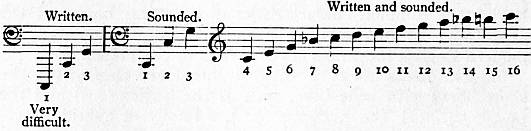
All the crooks, a list of the principal of which is appended, therefore necessarily give real sounds lower than the above series according to their individual length.
Table of Principal Crooks now in Use.17
Key of Crook. Actual Sounds of Range of Useful Harmonics. Length of Crook in Inches. Transposes to
B♭ alto 2nd to 10th 16 major 2nd lower
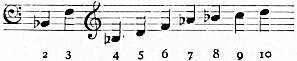
A♮ 2nd to 10th 22½ minor 3rd lower
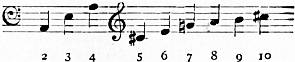
A♭ 2nd to 10th 29½ major 3rd lower
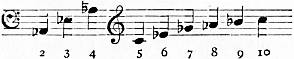
G 2nd to 12th 36¾ perfect 4th lower

F 2nd to 16th 52½ perfect 5th lower

E 2nd to 16th 61 minor 6th lower

E♭ 2nd to 16th 70¼ major 6th lower

D 2nd to 16th 80 minor 7th lower

C basso 3rd to 16th 101 8ve lower

B♭ basso 3rd to 16th 125 major 9th lower

The practical aggregate compass of the natural horns from B♭ basso at the service of composers therefore ranges (actual sounds) from or with 3 valves from By means of hand-stopping, i.e. the practice of thrusting the hand into the bell in order to lower the sound by a tone or a semitone, or by the adaptation of valves to the horn, this compass may be rendered chromatic almost throughout the range.
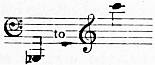
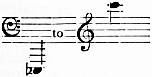
The principle of the valve as applied to wind instruments differs entirely from that of keys. The latter necessitate lateral holes bored through the tube, and when the keys are raised the vibrating column of air within the tube and the ambient air without are set in communication, with the result that the vibrating column is shortened and the pitch of the note raised. The valve system consists of valves or pistons attached to additional lengths of tubing, the effect of which is invariably to lower the pitch, except in the case of valve systems specified as “ascending” tried by John Shaw and Adolphe Sax. Insuperable practical difficulties led to the abandonment of these systems, which in any case were the exception and not the rule. The valves, placed upon the U-shaped slides in the centre of the horn, are worked by means of pistons or levers, opening or closing the wind-ways at will, so that when they are in operation the vibrating column of air no longer takes its normal course along the main tube and directly through the slides, but makes a détour through the extra length of tubing before completing its course. Thus the valves, unlike the keys, do not open any communication with the ambient air. Even authoritative writers18 have confused the two principles, believing them to be one and the same.
French horns are made with either two or three valves. To the first valve is attached sufficient length of tubing to lower the pitch of the instrument a tone, so that any note played upon the horn in F while the first valve is depressed takes effect a tone lower, or as though the horn were in E♭. The second valve opens a passage into a shorter length of tubing sufficient to lower the pitch of the instrument a semitone, as though the instrument were for the time being in E. The third valve similarly lowers the pitch a tone and a half. It will thus be seen that the principle applied in the crook and the valve is in the main the same, but the practical value of the valve is immeasurably superior. Thanks to the valve system the performer is able to have the extra lengths of tubing necessary to give the horn a chromatic compass permanently incorporated with the instrument, and at will to connect one or a combination of these lengths with the main tube of the instrument during any interval of time, however short. The three devices, crooks, valves and slides, are in fact all based upon the same principle, that of providing additional length of tubing in order to deepen the pitch of the whole instrument at will and to transpose it into a different key. Valves and slides, being instantaneous in operation, give to the instrument a chromatic compass, whereas crooks merely enable the performer to play in many keys upon one instrument instead of requiring a different instrument for each key. The slide is the oldest of these devices, and probably suggested the crook as a substitute on instruments of conical bore such as the horn.
The invention of the valve, although a substantial improvement, was found to fall short of perfection in its operation on the tubes of wind instruments so soon as the possibility of using the three valves in combination to produce six different positions or series of harmonics was realized, and for the following reason. In order to deepen the pitch one tone by means of valve 1, a length of tubing exactly proportional to the length of the main tube must be thrown into communication with the latter. If, in addition to valve 1, valve 3 be depressed, a further drop in pitch of 1½ tone should be effected; but as the length of tubing added by depressing valve 3 is calculated in proportion to the main tube, and the latter has already been lengthened by depressing valve 1, therefore the additional length supplied by opening valve 3 is now too short to produce a drop of a minor third strictly in tune, and all notes played while valves 1 and 3 are depressed will be too sharp. Means of compensating slight errors in intonation are provided in the U-shaped slides mentioned above.
The timbre of the natural horn is mellow, sonorous and rich in harmonics; it is quite distinctive and bears but little resemblance to that of the other members of the brass wind. In listening to its sustained notes one receives the impression of the tone being breathed out as by a voice, whereas the trumpet and trombone produce the effect of a rapid series of concussions, and in the tuba and cornet the concussions, although still striking, are softened as by padding. The timbre of the hand-stopped notes is veiled and suggestive of mystery; so characteristic is the timbre that passages in the Rheingold heard when the magic power of the Tarnhelm reveals itself sound meaningless if the weird chords are played by means of the valves instead of by hand-stopping. The timbre of the piston notes is more resonant than that of the open notes, partaking a little of the character of the trombone, which is probably due to the fact that the strictly conical bore of the natural horn has been replaced by a mixed cylindrical and conical as in trumpet and trombone.
The form of the mouthpiece (q.v.) at the point where it joins the main bore of the tube must also exercise a certain influence on the form of vibration, which it helps to modify in conjunction with the conformation of each individual horn-player’s lip. In the horn the cup of the mouthpiece is shaped like a funnel, the bore converging insensibly into the narrow end of the main conical bore without break or sharp edges as in the mouthpieces, more properly known as cup-shaped, of trumpet and bombardon.
The brilliant sonorousness and roundness of the timbre of the horn are due to the strength and predominance of the partial tones up to the 7th or 8th. The prevalence of the higher harmonics from the 10th to the 16th, in which the partial tones lie very close together, determines the harsh quality of the trumpet timbre, which may be easily imitated on the horn by forcing the sound production and using a trumpet mouthpiece, and by raising the bell, an effect which is indicated by composers by the words “Raise the Bells.”19
The origin of the horn must be sought in remote prehistoric times, when, by breaking off the tip of a short animal horn, one or at best two notes, powerful, rough, unsteady, only barely approximating to definite musical sounds, History. were obtained. This was undoubtedly the archetype of the modern families of brass wind instruments, and from it evolved the trumpet, the bugle and the tuba no less than the horn. The common characteristics which link together these widely different modern families of instruments are: (1) the more or less pronounced conical bore, and (2) the property possessed in a greater or lesser degree of producing the natural sounds by what has been termed overblowing the harmonic overtones. If we follow the evolution of the animal horn throughout the centuries, the ultimate development leads us not to the French horn but to the bugle and tuba.
Before civilization had dawned in classic Greece, Egypt, Assyria and the Semitic races were using wind instruments of wood and metal which had left the primitive ram or bugle horn far behind. Even in northern Europe, during the Bronze age (c. 1000 B.C.), prehistoric man had evolved for himself the prototype of the Roman cornu, a bronze horn of wide conical bore, bent in the shape of a G. One of these instruments, known among the modern Scandinavian races as luurs or lurs, found in the peat beds of Denmark and now preserved in the Museum of Northern Antiquities in Copenhagen, has a length of 1.91 m. (about 6 ft. 4 in.). The U-shaped mouthpiece joint is neatly joined to the remainder of the crescent-tube by means of a bronze ring; the bell, which must have rested on the shoulder, consists merely of a flat rim set round the end of the tube. There is therefore no graceful curve in the bell as in the French horn. An exact facsimile of this prehistoric horn has been made by Victor Mahillon of Brussels, who finds that it was in the key of E♭ and easily produces the first eight harmonics of that key. It stands, therefore, an octave higher than the modern horn in E♭ (which measures some 13 ft.), but on the lur the fundamental E♭ can be reached owing to the wider calibre of the bore.20
Among the Romans the wind instruments derived from the horn were well represented, and included well-developed types which do not differ materially from the natural instruments of modern times. The buccina developed directly into the trumpet and trombone during the middle ages, losing no characteristic of importance but the bent form, which was perforce abandoned when the art of bending hollow tubes was lost after the fall of the Roman Empire. The name clung through all the changes in form and locality to the one type, and still remains at the present day in the German Posaune (trombone). There were four instruments known by the name of cornu among the Romans: (1) the short animal horn used by shepherds; (2) the longer, semicircular horn, used for signals; and (3) the still longer cornu, bent and carried like the buccina, which had the wide bore of the modern tuba. But whereas on the buccina the higher harmonics were easily obtained, on the cornu the natural scale consisted of the first eight harmonics only. The cornu, although shorter than the buccina, had a deeper pitch and more sonorous tone, for, owing to the wider calibre of the bore, the fundamental was easily reached. In the reliefs on Trajan’s Column, where the two instruments may be compared, the wider curve of the buccina forms a ready means of identification. In addition to these was (4) the small instrument like the medieval hunting-horn or post-horn, with the single spiral turn similar to one which figures as service badge in many British infantry regiments,21 such as the first battalion of the King’s Own Light Infantry. A terra-cotta model, slightly broken, but with the spiral intact, was excavated at Ventoux in France and is at present preserved in the department of Greek and Roman antiquities at the British Museum, having been acquired from the collection of M. Morel.
The lituus, or cavalry trumpet of the Romans, consisted of a cylindrical tube, to which was attached a bent horn or conical bell, the whole in the shape of a J. The long, straight Roman tuba was similar to the large, bent cornu so far as bore and capabilities were concerned, but more unwieldy. All these wind instruments seem to have been used during the classic Greek and Roman periods merely to sound fanfares, and therefore, in spite of the high degree of perfection to which they attained as instruments, they scarcely possess any claim to be considered within the domain of music. They were signalling instruments, mainly used in war, in hunting and in state or civic ceremonial. Vegetius (A.D. 386) describes these instruments, and gives detailed instructions for the special traditional uses of tuba, buccina and cornu in the military camp: “Semivocalia sunt, quae per tubam, aut cornua, aut buccinam dantur. Tuba quae directa est appellatur buccina, quae in semet ipsam aereo circulo flectitur. Cornu quod ex uris agrestibus, argento nexum, temperatum arte, et spiritu, quem canentis flatus emittit auditur.”22 It will be seen that Vegetius demands a skilled horn-player. These service instruments may all be identified in the celebrated bas-reliefs of Trajan’s Column23 (fig. 1) and of the Triumphal arch of Augustus at Susa.24
Interesting evidence of a collegium cornicinum (gild of horn-players) is furnished by an altar stone in the Roman catacombs, erected to the memory of one “M. Julius victor ex Collegio Liticinum Cornicinum,” on which are carved a lituus, a cornu and a pan’s pipe, the cornu being similar to those on Trajan’s Column.