VOLUME XIII SLICE VI Home, Daniel to Hortensius, Quintus (continued 11)
Reading edition
Of late years American horses—bred, it must always be remembered, from stock imported from England—have won many races in England. Australian horses have also been sent to the mother country, with results remunerative Foreign horses. to their owners, and the intermixture of blood which will necessarily result should have beneficial consequences. French horses—i.e. horses bred in France from immediate or from more or less remote English parentage—have also on various occasions distinguished themselves on English race-courses. That coveted trophy, the Ascot Cup, was won by a French horse, Elf II., in 1898, it having fallen also to the French-bred Verneuil in 1878, to Boiard in 1874, to Henry in 1872 and to Mortemer in 1871. In the Cesarewitch Plaisanterie (3 yrs., 7 st. 8 ℔) and Ténébreuse (4 yrs., 8 st. 12 ℔) were successful in 1885 and 1888; and Plaisanterie also carried off the Cambridgeshire as a three-year-old with the heavy weight of 8 st. 12 ℔ in a field of 27 runners. In most respects racing in France is conducted with praiseworthy discrimination. There are scarcely any of the five- and six-furlong scrambles for horses over two years old which are such common features of English programmes.
That the horses who have covered various distances in the shortest times on record must have been exceptionally speedy animals is obvious. The times of races, however, frequently form a most deceptive basis in any attempt Time. to gauge the relative capacity of horses. A good animal will often win a race in bad time, for the reason that his opponents are unable to make him exert himself to the utmost. Not seldom a race is described as having been “won in a canter,” and this necessarily signifies that if the winner had been harder pressed he would have completed the course more quickly. The following figures show the shortest times that had been occupied in winning over various distances up to the spring of 1910:—
M. S.
Five furlongs Mirida (2 years), Epsom, 1905 Le Buff (aged), Epsom, 1903 Master Willie (aged), Epsom, 1903 0 562⁄5
Six furlongs Master Willie (5 years), Epsom, 1901 1 71⁄5
Seven furlongs Vav (4 years), Epsom, 1907 1 203⁄5
Mile Caiman (4 years), Lingfield, 1900 1 331⁄5
Mile and a quarter Housewife (3 years), Brighton, 1904 2 14⁄5
Mile and a half Zinfandel (3 years), Manchester, 1903 2 284⁄5
Mile and three quarters Golden Measure (4 years), York, 1906 2 574⁄5
Two miles Pradella (aged), Ascot, 1906 3 192⁄5
Two miles and a half Bachelor’s Button, Ascot, 1906 4 231⁄5
Three miles Corrie Roy, Ascot, 1884 5 9
It may be noted that, as compared with similar records in 1901, only three of these latter held good in 1910, i.e. the mile, the six furlongs and the three miles. The fastest times over a mile and a half (the Derby and Oaks distance) up to 1901 may be repeated here as of some interest: Avidity, 2 min. 304⁄5 secs., in September 1901 at Doncaster; Santoi, 2 min. 31 secs., in May 1901 at Hurst Park; King’s Courier, 2 min. 31 secs., in 1900 at Hurst Park; Landrail, 2 min. 34 secs., in September 1899 at Doncaster; Carbiston, 2 min. 372⁄5 secs., in August 1899 at York; Bend Or, 2 min. 40 secs., in 1881 at Epsom (gold cup): Volodyovski won the Derby in 1901, and Memoir the Oaks in 1890, in 2 min. 404⁄5 secs.
As regards time in famous races, Ormonde, perhaps the best horse of the 19th century—one, at any rate, that can scarcely have had a superior—occupied 2 minutes 453⁄5 seconds in winning the Derby; and Lonely, one of the worst mares that have won the Oaks, galloped the same mile and a half in 2 seconds less. Ormonde’s St Leger time was 3 m. 212⁄5 s., and Sir Visto, one of the poorest specimens of a winner of the great Doncaster race, took 3 m. 182⁄5 s. The regulation of the weight to be carried serves to “bring the horses together,” as the popular sporting phrase runs—that is to say, it equalizes their chances of winning; hence handicaps, the carrying of penalties by winners of previous races, and the granting of “maiden allowances.” A horse that has never won a race, and is therefore known as a “maiden,” often has an allowance of as much as 7 ℔ made in its favour.
Sport is carried on under the auspices of the Jockey Club, a self-elected body of the highest standing, whose powers are absolute and whose sway is judicious and beneficent. Three stewards, one of whom retires each year, when a The Jockey Club. successor is nominated, govern the active—and extremely arduous—work of the club. They grant licences to trainers and jockeys and all officials, and supervise the whole business of racing. The stewards of the Jockey Club are ex officio stewards of Ascot, Epsom, Goodwood and Doncaster. All other meetings are controlled by stewards, usually well-known patrons of the Turf invited to act by the projectors of the fixture, who settle disputed points, hear and adjudicate on objections, &c., and, if special difficulties arise, report to the stewards of the Jockey Club, whose decision is final.
Steeplechasing has altered entirely since the first introduction of this essentially British sport. In early days men were accustomed to match their hunters against each other and ride across country to a fixed point near to some Steeplechasing. steeple which guided them on their way; and this is no doubt, in several respects, a class of sport superior to that now practised under the name of steeplechasing; for it tested the capacity of the horse to jump fences of all descriptions, and provided the rider with opportunities of showing his readiness and skill in picking the best line of country. But racing of this kind afforded spectators a very small chance of watching the struggle; and made-up steeplechase courses, the whole circuit of which could be viewed from the enclosures, came into existence. The steeplechase horse has also changed. The speed of the thoroughbred is so much greater than that of all other breeds that if one were in the field, if he only stood up and could jump a little, his success was certain; consequently, except in “point-to-point” races, organized by various hunts, where a qualification is that all starters must have been regularly ridden with hounds, few other than thoroughbred horses are nowadays ever found in races run under the rules of the National Hunt Committee, the body which governs the sport of steeplechasing. A considerable proportion of existing steeplechase horses have done duty on the flat. Members of certain equine families display a special aptitude for jumping; thus the descendants of Hermit, who won the Derby in 1867, are very frequently successful in steeplechases—Hermit’s son Ascetic, the sire of Cloister, Hidden Mystery and other good winners, is a notable case in point. The sons and daughters of Timothy and of several other Hermit horses often jump well. When a flat-race horse appears to have comparatively poor prospects of winning under Jockey Club rules, he is frequently, if he “looks like jumping,” schooled for steeplechasing, generally in the first place over hurdles, and subsequently over what is technically called “a country,” beginning with small fences, over which he canters, led by some steady animal who is to be depended on to show the way. A great many steeplechase horses also come from Ireland. They are usually recognizable as thoroughbred, though it is possible that in some cases the name of an ancestor may be missing from the Stud Book. Irish horse-masters are for the most part particularly skilful in schooling jumpers, and the grass and climate of Ireland appear to have beneficial effects on young stock; but, as a rule, the imported Irish horse improves considerably in an English training-stable, where he is better fed and groomed than in most Irish establishments. All steeplechase courses must at the present time contain certain regulation jumps, the nature of which is specified in the National Hunt rules:—
44. In all steeplechase courses there shall be at least twelve fences (exclusive of hurdles) in the first 2 m., and at least six fences in each succeeding m. There shall be a water jump at least 12 ft. wide and 2 ft. deep, to be left open, or guarded only by a perpendicular fence not exceeding 2 ft. in height. There shall be in each m. at least one ditch 6 ft. wide and 3 ft. deep on the taking-off side of the fence, which ditch may be guarded by a single rail, or left open, and which fence must be 4 ft. 6 in. in height, and, if of dead brushwood or gorse, 2 ft. in width.
45. In all hurdle-race courses there shall be not less than eight flights of hurdles in the first 2 m., with an additional flight of hurdles for every quarter of a m. or part of one beyond that distance, the height of the hurdles being not less than 3 ft. 6 in. from the bottom bar to the top bar.
Natural fences would no doubt be desirable if they could be utilized; but it is obvious that fences must be made up, because when the same hedge is jumped frequently, and for the most part in the same place—as it is the object of riders to go the shortest way round—gaps would necessarily be made. The use of these made courses naturally renders the sport somewhat artificial, but under existing conditions this is unavoidable; and as a matter of fact, by reason of the conformation of the ground, the arrangement and make of the fences, courses do vary in no small degree. The steeplechase horse differs from the hunter in his method of jumping. In riding to hounds a man usually steadies his horse at a fence, and in almost every case the animal “dwells” more or less after the leap. In a steeplechase, where speed is everything, horses must be taught to dash resolutely at their jumps without hesitation, and to get away with no pause on the other side; as a rule, therefore, an old steeplechase horse who is employed as a hunter is rarely a pleasant mount for any but a bold rider. It has been remarked that steeplechase horses are usually in the first place schooled over hurdles, and many animals remain hurdle racers till the end. More speed is required for hurdles than for a steeplechase course, and there is more money to be won over hurdles than over “a country.” No hurdle race is worth so much as the Grand National or the Lancashire Handicap Steeplechase, the two richest prizes now offered; but, with the exception of these, hurdle-race stakes are as a rule of greater value. Except as a spectacle, there is little to be said in defence of this mongrel business, which is neither one thing nor the other; but hurdle races are popular and are therefore likely to continue. A few years ago an attempt was made to discriminate between what were called “hunters” and handicap steeplechase horses, and certain races were only open to the former class. It proved, however, to be a distinction without a difference; thoroughbred horses crept into the ranks of the so-called hunters, and when nominal hunters began to be entered for, and in some cases to win, the Grand National and other important steeplechases, for which they could be nominated by abandoning their qualification of hunter, the meaningless title was relinquished. Still more absurd were the hunters’ flat races of a former day. In order to compete in these the rule was that an owner must produce a certificate from a master of hounds to the effect that his horse had been hunted. Thoroughbreds who lacked speed to win under Jockey Club rules used to be ridden to a meet, perhaps cantered across a field or two, and were then supposed to have become hunters. Animals who were genuinely and regularly utilized for the pursuit of foxes had of course no chance against these race-horses in shallow disguise. What are called National Hunt flat races still exist, the qualification being that a horse must have been placed first, second or third in a steeplechase in Great Britain or Ireland, after having jumped all the fences and completed the whole distance of the race to the satisfaction of at least two of the stewards, to whom previous notice must have been given in writing. There are no handicaps for such animals, and none is allowed to carry less than 11 stone. No race under National Hunt rules can be of a shorter distance than 2 m., except for three-year-olds, who sometimes run a mile and a half over hurdles; and the lowest weight carried can never be less than 10 stone except in a handicap steeplechase of 3½ m. or upwards, when it may be 9 st. 7 ℔.
Horses are ridden in these races either by gentlemen, or qualified riders or jockeys. The first of these classes comprises officers on full pay in the army or navy, persons holding commissions under the Crown, bearing titles either in their own right or by courtesy, or members of certain social and racing clubs. Qualified riders may be farmers holding at least a hundred acres of land, their sons if following the same occupation, and persons elected by members of the National Hunt Committee, a proviso being that they must never have ridden for hire; but it is feared that this rule is in not a few cases evaded. Professional jockeys are paid £5 for each mount or £10 if they win. The sport is governed by the National Hunt Committee, a body which receives delegated powers from the Jockey Club, and six stewards are elected every year to supervise the business of the various meetings. Steeplechases and hurdle races are either handicaps or weight-for-age races according to the following scale:—
For Steeplechases of 3 miles and upwards.
From the 1st of January to the 30th of June, both inclusive:—
4 yrs. 5 yrs. 6 and aged
10 st. 3 ℔ 11 st. 8 ℔ 12 st. 3 ℔
From the 1st of July to the 31st of December, both inclusive:—
4 yrs. 5 yrs. 6 and aged
11 st. 11 st. 12 ℔ 12 st. 3 ℔
For Steeplechases of less than 3 miles.
From the 1st of January to the 30th of June, both inclusive:—
4 yrs. 5 yrs. 6 and aged
10 st. 10 ℔ 11 st. 10 lb 12 st. 3 ℔
From the 1st of July to the 31st of December, both inclusive:—
4 yrs. 5 yrs. 6 and aged
11 st. 6 ℔ 12 st. 12 st. 3 ℔
For Hurdle Races.
From the 1st of January to the 31st of August, inclusive:—
4 yrs. 5 yrs. 6 and aged
11 st. 6 ℔ 11 st. 10 ℔ 12 st. 0 ℔
From the 1st of September to the 31st of December, inclusive:—
3 yrs. 4 yrs. 5, 6, and aged
10 st. 7 ℔ 11 st. 12 ℔ 12 st. 3 ℔
The great test of merit in a steeplechase horse is success in the Grand National, which is always run at Liverpool during the first week of the flat-racing season. The course is 4½ m., and includes thirty jumps, the fences being for The Grand National. the most part larger than are found elsewhere. The average time occupied is well under ten minutes. The stake has varied in value since the race was originated in 1839; it now amounts to close on £2500. Only a very small percentage of steeplechase horses possess the speed and staying power to give them a chance in this race, and the number of entries year by year falls considerably short of a hundred, the prospects of many of these usually appearing hopeless to all but unduly sanguine owners. The average number of starters during the period 1860-1901 was rather over twenty. As many as thirty-two competed in 1909, when the French-bred Latteur III. won; in 1883, when Zoedone, ridden by her owner, Count Kinsky, was successful, only ten went to the post. Mishaps are almost invariably numerous; in most years about one-third complete the course. So severe is the task that for a long time many good judges of steeplechasing believed that no horse with more than 12 stone on his back could possibly win. In 1893, however, Cloister won in a canter by forty lengths carrying 12 st. 7 ℔, and with the same weight Manifesto also won in 1899. The race which most nearly approaches the Grand National in importance is the Lancashire Handicap Steeplechase, run at Manchester over 3½ m. early in April. The stake is worth about £1750. An interesting steeplechase called the Grand Sefton takes place at Liverpool about the middle of November; the distance is 3 m. During the winter, and extending into the spring, steeplechasing and hurdle racing are carried on at Sandown, Kempton, Gatwick, Lingfield, Newbury and Hurst Park; at Ludlow, Newmarket, Aldershot, Birmingham, Manchester, Windsor and other places. A race called the National Hunt Steeplechase, under the immediate patronage of the National Hunt Committee, is run annually over a 4-mile course, the stake being £1000. Managers of various courses bid for the privilege of having the race on their ground, and it is therefore found in different localities. A condition is that no horse who has ever won a race can compete; and, as few owners are willing to keep their animals with a view to success in this event, the field consists either of unknown horses or of those that have been beaten.
Australia
Racing in Australia has its headquarters at Sydney, under the government of the Australian Jockey Club, the principal course being at Ranwick; and at Melbourne, where the Victoria Jockey Club is supreme, the principal course being at Flemington. In New Zealand sport is carried on under the authority of delegates from the chief racing clubs, who meet in conference. There is a Sydney Derby and a Victoria Derby, and a notable event at Flemington is the Champion Race, weight-for-age, for three-year-olds and upwards, which usually attracts the best horses in training, as the fee at which a sire stands depends in a great measure on his success in this contest. This race is over a distance of 3 m., and to ensure a good pace there is a regulation that the time in which it is run must not exceed 5 minutes 40 seconds, though the stewards have power to extend this in case the ground should be made exceptionally heavy by rainy weather. The Melbourne Cup is regarded as one of the most important races in the state. This is a handicap, and in comparison with English races may perhaps be ranked with the Cesarewitch. The birth of horses dates from the 1st of August, which corresponds as nearly as possible to the 1st of February in England, so that the Australian horses are practically seven months younger than the English—a matter of some importance in the case of those sent to run in England. There are few races which close long before the date of decision, and practically all the good animals run in handicaps. The five- and six-furlong races for other than two-year-olds, so common in Great Britain, are extremely rare; and it is asserted by colonial sportsmen that their horses stay better than those bred in England, a circumstance which is largely attributed to the fact that mares and foals have much more liberty and exercise than is the case in the mother country.
United States
Horse-racing was indulged in to a limited extent in Maryland and Virginia as early as the middle of the 17th century, particularly in the latter colony. Most of the inhabitants of both were either from the British Isles or were descended from parents who had immigrated from them, and they inherited a taste for the sport. The animals used for this purpose, however, were not highly prized at the time, and the pedigree of not even one of them has been preserved. A horse called Bully Rock by the Darley Arabian out of a mare by the Byerly Turk, granddam by the Lister Turk, great-granddam a royal mare, foaled 1718, is the first recorded importation of a thoroughbred horse into America. He was imported into Virginia in 1730. In 1723 the duke of Bolton bred a mare named Bonny Lass by his celebrated horse Bay Bolton out of a daughter of the Darley Arabian. She became celebrated in England as a brood mare, and was the first thoroughbred mare, according to the records, that was carried to America. This is supposed to have been in or after 1740, as the Stud-Book shows she produced in England after 1739 a filly by Lord Lonsdale’s Arabian, and subsequently became familiar to the public as the granddam of Zamora. The importations increased very rapidly from this period, and many valuable shipments were made before the war which resulted in a separation of the colonies from the mother country. This acquisition of thoroughbred stock increased the number and value of racing prizes, and extended the area of operations into the Carolinas in the South, and New Jersey and New York in the North. The first race run in South Carolina was in February 1734 for £20. It took place over “the Green,” on Charleston Neck. This shows that the earlier races in America were actually on the turf, as they have always been in England. The next year a Jockey Club was organized at Charleston (1735), and a course was prepared, such as those which came later into general use throughout the states, the turf being removed and the ground made as level as possible.
After 1776, when the United States declared their independence of Great Britain, the importation of thoroughbred horses from England became quite common, and selections were made from the best stocks in the United Kingdom. This continued and even increased as the country became developed, down to 1840. The following Derby winners were among those carried into the states: Diomed, who won the first Derby in 1780; Saltram, winner in 1783; John Bull, winner in 1792; Spread Eagle, winner in 1795; Sir Harry, winner in 1798; Archduke, winner in 1799; and Priam, who won in 1830. The most important and valuable importations, however, proved to be Jolly Roger, Fearnought, Medley, Traveller, Diomed, Glencoe, Leviathan, Tranby, Lexington, Margrave, Yorkshire Buzzard, Albion and Leamington. The best results were obtained from Diomed and Glencoe. Diomed sired one horse, Sir Archy, who founded a family to which nearly all the blood horses of America trace back. He was foaled in 1805, in Virginia, and became celebrated as a sire. The superiority of his progeny was so generally conceded that they were greatly sought after. From this period, too, the number and value of races increased; still they were comparatively few in number, and could not compare in value with those of Great Britain. Up to 1860 the value of racing prizes was quite inadequate to develop large breeding establishments, or to sustain extensive training stables. Then the civil war between the North and the South broke out, which raged for four years. Breeding establishments were broken up during that time; the horses were taken by the armies for cavalry purposes, for which service they were highly prized; and racing was completely paralysed. It took some time to regain its strength; but an era of prosperity set in about 1870, and since then the progress in interest has been continuous.
In the United States interest in trotting races more than rivals that felt in the contests of thoroughbred horses. This interest dates back to the importation to Philadelphia from England, in 1788, of the thoroughbred horse Messenger, a grey stallion, by Mambrino, 1st dam by Turf, 2nd dam by Regulus, 3rd dam by Starling, 4th dam by Fox, 5th dam Gipsey, by Bay Bolton, 6th dam by duke of Newcastle’s Turk, 7th dam by Byerly Turk, 8th dam by Taffolet Barb, 9th dam by Place’s White Turk. He was eight years old when imported to the United States. He was at the stud for twenty years, in the vicinity of Philadelphia and New York, serving a number of thoroughbred mares, but a far greater number of cold-blooded mares, and in the progeny of the latter the trotting instinct was almost invariably developed, while his thoroughbred sons, who became scattered over the country, were also noted for transmitting the trotting instinct. The first public trotting race of which there is any account in the United States was in 1818, when the grey gelding Boston Blue was matched to trot a mile in 3 minutes, a feat deemed impossible; but he won, though the time of his performance has not been preserved. From about that date interest in this gait began to increase; breeders of trotters sprang up, and horses were trained for trotting contests. The problem of breeding trotters has been necessarily found to be a much more complex one than that of breeding the thoroughbred, as in the latter case pure blood lines of long recognized value could be relied upon, while in the former the best results were constantly being obtained from most unexpected sources. Among the leading families came to be the Hambletonian, of which the modern head was Rysdyk’s Hambletonian, a bay horse foaled in 1849, got by Abdallah (traced to imp. Messenger on the side of both sire and dam) out of the Charles Kent mare, by imp. (i.e. imported) Bellfounder, with two crosses to imp. Messenger on her dam’s side; the Mambrinos, whose modern head was Mambrino Chief, foaled 1844, by Mambrino Paymaster, a grandson of imp. Messenger; the Bashaws, founded by Young Bashaw, foaled 1822, by Grand Bashaw, an Arabian horse, dam Pearl, by First Consul; the Clays, springing from Henry Clay, a grandson of Young Bashaw through Andrew Jackson; the Stars, springing from Stockholm’s American Star, by Duroc, son of imp. Diomed; the Morgans, whose founder was Justin Morgan, foaled 1793, by a horse called True Briton, or Beautiful Bay, who was probably thoroughbred; the Black Hawks, a branch of the Morgan family; the Blue Bulls, descended from Doyle’s Blue Bull, foaled 1855, a pacer, sired by a pacer of the same name, dam by Blacknose, son of Medoc; the Canadians, whose best representatives were St Lawrence and pacing Pilot, horses of unknown pedigree; the Gold Dusts, another branch of the Morgan family; and the Royal Georges, springing from Tippoo, a horse who was probably by Ogden’s Messenger, son of imp. Messenger. But trotters of great speed have been produced which do not trace to any of the sources mentioned. Very large prices are paid. Steinway, a three-year-old colt, was sold in 1879, to go to California, for $13,000; and in 1878 $21,000 was paid for the four-year-old filly Maud S., after she had trotted a mile in public in 2 m. 17½ s. Much larger sums have been paid, however, for matured trotters, such as $40,000 for the stallion Smuggler, $38,000 for Pocahontas, $35,000 for Dexter, $36,000 for Rarus, and long prices for many others; St Julien, the trotter with the fastest record at the close of 1879, was held at $50,000, while Rysdyk’s Hambletonian, Messenger Duroc and Volunteer were valued, in their prime, at $100,000 each.
Compared with the early days of American trotting, the advance has been rapid and the changes marked. After the performance of Boston Blue, mentioned above, more attention was paid to the gait, but for a long time the races were generally under saddle, and at long distances, 3 m. being rather the favourite. The best of the old time trotters were Edwin Forrest, who trotted a mile in 2 m. 31½ s. in 1834; Dutchman, who did 3 m. under saddle in 7 m. 32½ s.; Ripton; Lady Suffolk, who trotted a mile in 2 m. 26½ s. in 1843, and headed the list of performers; Mac, Tacony, &c. After 1850, however, the taste of the people settled upon the style of race called “mile heats, best three out of five, in harness” as the favourite. By “in harness” is meant that the horse draws a sulky, a light two-wheeled vehicle in which the driver sits close to the horse, with his legs on each side of his flanks. These sulkies often weigh less than 40 ℔. The driver is required to weigh, with the blanket on which he sits, 150 ℔, while for saddle races the regulation weight is 145 ℔, or 10 st. 5 ℔. Each heat of a mile is a separate race; 20 minutes is allowed between heats; and the horse that first places three heats to his credit wins the race. There are various penalties imposed upon a horse that breaks into a run in a trotting race. The driver is required to pull him to a trot as quickly as possible; if the horse gains by running, the judges set him back at the finish twice the distance he has gained, in their estimation, by running; and for repeated “breaks” they can declare him distanced. The first-class tracks are of oval shape, with long stretches and easy curves, measuring 1 m. at 3 ft. distance from the “pole,” as the inner railing of the track is called. The time in which the leading horse trots each heat is accurately kept, placed on a blackboard in front of the judges’ stand for the information of the public, and also placed in the book of the course. The fastest time that any trotter has is thus entered as his “record.” This is one of the distinctive features of trotting in America.
Prior to 1866 purses for trotters were small; match races were more in vogue, and the trotting turf was in bad odour. In that year an association was formed at Buffalo, N.Y., which inaugurated its efforts by offering the then unprecedented sum of $10,500 for a trotting meeting of four days’ duration. The experiment was successful; other cities followed the example of Buffalo; larger and larger purses were given; and at Buffalo in 1872 the prizes amounted to $70,000. Since then the amount offered in the United States and Canada, during a single year, has reached $1,500,000. Individual trotters, in the course of a long turf career, earn enormous amounts. A remarkable instance of this was the mare Goldsmith Maid, by Alexander’s Abdallah (a son of Rysdyk’s Hambletonian), out of an Abdallah mare. She began trotting in 1866, and left the turf in 1878, when twenty-one years old, and her winnings amounted to over $200,000.
In 1869 the National Trotting Association was formed, under which an elaborate code of rules has been published.
In trotting races, it will be noted, the time test is supreme, differing from running races, in which time is of comparatively little consequence. The animal which has the fastest record for 1 mile in harness is, until deposed, the king or queen of the trotting turf. Lady Suffolk, with her record of 2 m. 26½ s., in 1843, held this honour until 1853, when Tacony trotted in 2 m. 25½ s. under saddle; Flora Temple wrested it from him in 1856 by trotting in 2 m. 24½ s. in harness. This latter mare, in 1859, trotted a mile in 2 m. 19¾ s., a feat which the best horsemen thought would never be repeated, but since that time forty-two trotters have beaten 2 m. 20 s. Dexter’s record was 2 m. 17¼ s. in 1867, and Goldsmith Maid’s in 1871 was 2 m. 17 s., which she reduced, by successive efforts, to 2 m. 16¾ s., 2 m. 16 s., 2 m. 15 s., 2 m. 14¾ s., and finally, in 1874, to 2 m. 14 s. In 1878 Rarus trotted a mile in 2 m. 13¼ s., and in October 1879 the bay gelding St Julien, by Volunteer, son of Rysdyk’s Hambletonian, dam by Henry Clay, trotted a mile in California in 2 m. 12¾ s. Other notable performances reducing the record were Maud S. in 1881, 2 m. 10¼ s.; Maud S. in 1885, 2 m. 8¾ s.; Sunol in 1891, 2 m. 8¼ s.; Nancy Hanks in 1892, 2 m. 4 s.; Alix in 1894, 2 m. 3¾ s.; Cresceus in 1901, 2 m. 2¼ s.; Lou Dillon in 1905, 1 m. 58½ s. Improved times have doubtless been the result of improved methods, as well as of care in the breeding of the trotter. Some very severe training rules used to be sedulously observed; about 1870, for instance, a horse never had water the night before a race, and the system generally appears to have overtaxed the animal’s strength. A prominent consideration in trotting races is the adjustment of toe-weights, which are fastened on to the horses’ feet to equalize their action, and it is found that horses improve their time to the extent of several seconds when properly shod.
Pacing races are also frequent in the United States. In trotting the action may be described as diagonal; the pacer moves both legs on the same side at the same time, and both feet stride as one. A similar “gait,” to employ the American term, was called in England some centuries ago an “amble.” The pacer moves more easily and with apparently less exertion than the trotter, and the mile record (made by Prince Alert in 1903) stands at 1 m. 57 s.
Owing to the vast size of the country there are various centres of sport, which can be classified with reasonable accuracy as follows: the Eastern States, dominated by the Jockey Club, founded in New York in 1894, and recognized by a state law in 1895; the Middle Western States, under the control of the Western Jockey Club, whose headquarters are in Chicago; the Pacific Coast, with San Francisco for its centre; and the Southern and South-Western States, with Louisville as the most important centre. The passage of the racing law in New York State marked the opening of a new era. Supreme even over the Jockey Club is a State Racing Commission of three, appointed by the governor of the state. While the Jockey Club is only recognized by law in its native state, it has assumed and maintains control of all racing on the eastern seaboard, within certain lines of latitude and longitude, extending as far north as the Canadian border and south to Georgia. There is small question that other states, both east and west, will follow suit and enact similar laws. The Western Jockey Club, though not recognized by law, controls practically all the racing through the middle west, south-west and south; but the racing associations of the Pacific Coast have maintained a position of independence.
What New York is to the east, Chicago is to the middle west, and a very large proportion of American racing is conducted close to these centres. In New York State the Coney Island Jockey Club, at Sheepshead Bay; the Brooklyn Jockey Club, at Gravesend; the Westchester Racing Association, at Morris Park; the Brighton Beach Racing Association, at Brighton Beach; the Queen’s County Jockey Club, at Aqueduct; and the Saratoga Racing Association, at Saratoga, are the leading organizations; and all these race-courses, with the exception of Saratoga, are within a radius of 20 miles of the city. The Empire City Jockey Club, near Yonkers, and another club with headquarters near Jamaica, Long Island, have also become prominent institutions. The Washington Park Club, at Chicago, is the leading Turf body of the west, and the only one on an equal footing with the prominent associations of New York State. With this single exception the most important and valuable stakes of the American Turf are given in the east; and so great has the prosperity of the Turf been since the Jockey Club came into existence that the list of rich prizes is growing at a surprising rate. In this respect the principal fault is the undue encouragement given to the racing of two-year-olds. At the winter meetings held at New Orleans and San Francisco, two-year-olds are raced from the very beginning of the year; and under the rules of the Jockey Club of New York they run as early as March. The Westchester Racing Association, with which are closely identified some of the principal members of the Jockey Club, gives valuable two-year-old stakes in May. The Futurity Stakes, the richest event of the year—on one occasion it reached a value of $67,675—is for two-year-olds, and is run at Sheepshead Bay in the autumn. The institution of races, either absolutely or practically at weight-for-age, and over long courses, has engaged much attention. The Coney Island Jockey Club has the leading three-year-old stake in the Lawrence Realization, over 1 mile 5 furlongs, with an average value of about $30,000. The Westchester Racing Association’s two principal three-year-old stakes, the Withers, over a mile, run in May, and the Belmont, 1 mile and 3 furlongs, run later in the same month, are of less value, but are much older-established and have a species of “classic” prestige, dating from the old Jerome Park race-course in the ’sixties. The Coney Island Jockey Club’s Century and the Annual Champion Stakes, both for three-year-olds and upwards, over a mile and a half and two miles and a quarter respectively, are fair specimens of the races the associations have founded. At Saratoga a stake of $50,000 for three-year-olds and upwards, distance a mile and a quarter, was opened, and run for first in 1904. The hope is to wean owners from the practice of overtaxing their two-year-olds, which has resulted practically in a positive dearth, almost a total absence, of good four-year-olds and upwards of late years. Handicaps play a more important part than in England. The principal events of this character, such as the Brooklyn Handicap at Gravesend and the Suburban at Sheepshead Bay, have for years drawn the largest attendances of the racing season.
Practically all flat racing in the United States is held on “dirt-tracks,” i.e. courses with soil specially prepared for racing, instead of turf courses. At Sheepshead Bay there is a turf course, but it is only used for a minority of races. Dirt-tracks, which are, like many other things in American racing, a legacy from the once hugely popular harness-racing, are conducive to great speed, but are costly in the extreme strain on horses’ legs. Steeplechases are run on turf. This branch of the sport in the east is now flourishing under the administration of the National Steeplechase and Hunt Association, a sister body of the Jockey Club. Comparatively few races are, however, run under these rules, as the weather conditions render it impossible to have a separate season for cross-country sport and steeplechases, and hurdle races are incorporated in programmes of flat racing held through the spring, summer and autumn, though the ground is frequently so hard as to be unsafe. Since the National Steeplechase and Hunt Association assumed control, regulation courses, practically similar in every respect to those used in England, have been insisted upon in the east, the “open ditch” figuring under the name of the “Liverpool.” In the west and south there is not the same uniformity, and so far the sport has not flourished.
France
Racing in France as conducted on modern lines may be said to date from the year 1833, when the French Stud-Book was originated, and a body formed, somewhat after the model of the English Jockey Club, under the title of the Société d’Encouragement pour l’Amélioration des Races de Chevaux en France. Races took place in the Champs de Mars, and an unsuccessful attempt was made in 1834 to arrange for a course, or “hippodrome,” as it is termed in France, at Maisons Laffitte. Chantilly was, however, fixed upon as the principal racing centre; on the 22nd April 1836 the first meeting was held there, with five races on the card, the principal being the Prix d’Orléans, a stake of 3500 francs, named after the due d’Orléans, one of the chief promoters of the fixture. Next day the first race for the Prix du Jockey Club was run, and won by Frank, the property of Lord Henry Seymour, who was at the time taking a very active part in French sport. The Prix du Jockey Club was then worth 5000 francs; the value has since increased to 200,000 francs. This race occupies in France the place of the English Derby. The Prix de Diane, which corresponds to the English Oaks, was first run in 1843. Chantilly still continues an important centre of the French Turf, and a great many horses are trained in the district. Attempts had been made to popularize racing at Longchamps prior to the year 1856, when the Société d’Encouragement obtained a lease, erected stands, laid out the course, and held their first meeting on the 27th August 1857. Next season two meetings were held, one of four days in the spring and another of three in the autumn; at the present time the sport is vigorously carried on from March to the end of October, except during a summer recess. In 1857 meetings under the auspices of the Société d’Encouragement began to take place at Amiens, Caen, Nantes, Versailles, Moulins and other towns; and there were stakes for two-year-olds in the spring, though of late years the appearance of the young horses has been postponed to the 1st of August. Progress was rapid, and in 1863 two important events were contested for the first time, the Prix du Prince Impérial, which was designed to balance the English St Leger, but for obvious reasons faded out of the programme, and the Grand Prix de Paris, an international race for three-year-olds, run at Longchamps over a distance of 1 mile 7 furlongs, and now the most valuable stake in Europe. In 1909 the prize was £14,071. The first Grand Prix fell to an English horse, Mr Savile’s The Ranger; two years later it was won by Gladiateur, winner of the English Derby and the property of the comte de Lagrange, who raced equally in France and in England; the duke of Beaufort’s Ceylon was successful in 1866, and the marquis of Hastings’ Earl in 1868. Mr Savile’s Cremorne followed up his Derby victory by a victory at Longchamps in 1872, as did Mr Baltazzi’s Kisber four years later. English horses were also victorious in 1874 (Mr W. R. Marshall’s Trent), in 1878 (Prince Soltykoff’s Thurio), in 1880 (Mr C. Brewer’s Robert the Devil), in 1881 (Mr Keene’s Foxhall, who, however, should rather rank as an American horse), in 1882 (Mr Rymill’s Bruce), in 1885 (Mr Cloete’s Paradox), in 1886 (Mr Vyner’s Minting); and in 1906 Major Eustace Loder’s Derby winner Spearmint. During the first 23 years of the Grand Prix (owing to the war the race did not take place in 1871) the stake fell to English horses—if Kisber and Foxhall be included—on twelve occasions, and generally to English jockeys. In recent years, however, French owners have held their own. In not a few respects racing is managed more judiciously than in England. The courses, for one thing, are better tended and maintained. The five- and six-furlong races for others than two-year-olds, which are so common at English meetings, are comparatively rare in France, and the value of the prizes in an average day’s racing is considerably higher across the Channel than in England. A very large percentage of trainers and jockeys are English, and the former are, as a rule, quite as expert as at Newmarket and elsewhere. Transatlantic methods have been introduced by American jockeys since 1899. From the middle of February until the middle of December a race meeting within easy reach of Paris takes place almost every day, except during August, when the sport is carried on in the provinces, notably at Deauville. Near Paris, the chief centre after Longchamps is Maisons Laffitte. At Longchamps, early in October, a race called the Prix du Conseil Municipal, worth £4000, for three-year-olds and upwards, over a mile and a half, was organized in 1893, and has usually attracted English horses, Mr Wallace Johnstone’s Best Man having been successful in 1894, and Mr Sullivan’s Winkfield’s Pride the following year. Except when the Whip is challenged for and the challenge decided over the Beacon Course at Newmarket, no race is run in England over a longer distance than two miles and 6 furlongs; but in France the Prix Gladiateur, of £1200 and a work of art value £100, 3 miles 7 furlongs, creates considerable interest at Longchamps in the autumn.
The first recognized steeplechase in France took place at Croix de Berny, and was won by the comte de Vaublanc’s May-fly, all the horses at that time being ridden by gentlemen. Sport does not seem to have been Steeplechasing. carried on with much spirit, for it is said that the death of an animal called Barcha, in 1839, nearly led to the abandonment of the meeting; and it was not till 1863, when the Société des Steeplechases de France was founded, that the business was resolutely taken in hand. Gravelle and Vincennes were the principal centres until 1873, when the Société obtained possession of the ground at Auteuil, where the excellent course now in use was laid out. In 1874 twelve days’ racing took place here, the card each day including three steeplechases and a hurdle race, the “hurdles,” however, being small fences, as they are at present. The Grand Steeplechase d’Auteuil was then for a stake of 30,000 francs, at the time the most valuable offered in any country; but, as in racing on the flat, the stakes have enormously increased in value, and in 1901 the Paris Grand Steeplechase, as the chief event is now called, credited the winner with £6020, the hurdle race being worth rather more than half as much. In England there is scarcely any steeplechasing between March and November, except at hunt meetings, but in Paris cross-country sport is pursued almost all through the year, the chief races at Auteuil taking place in June, about the time of the Grand Prix, which is usually run for between the English Epsom and Ascot meetings. The Auteuil course is laid out in the shape of the figure 8, with varied fences, several of which really test a horse’s jumping capacity; and variety is further obtained by starting the fields in different places and traversing the course in different ways. St Ouen, a meeting within half an hour’s drive of the Louvre, is entirely devoted to steeplechasing; and jumping is also carried on at Vincennes, Colombes, Enghien, and elsewhere near Paris, as also at Nice in the winter, at Dieppe and other places in August. As a rule, the stakes run for, especially at Auteuil, are very much larger than in England. There are none of the clubs and special enclosures such as at Sandown, Kempton, Hurst, Lingfield, Gatwick, &c., though portions of the stand are set apart for privileged persons. A fee of 20 francs is charged for admission to the chief French race-courses, with half as much for a lady’s voucher, and the tickets give access everywhere but to the very few reserved portions. At Vincennes, St Cloud, and some other courses trotting races are also contested.
Other Countries.—Racing in Germany is mainly conducted under the authority of the Union Club of Berlin, the principal course being the Hoppegarten. Two-year-olds do not run until the 1st of June, except in Saxony, where they appear a month earlier. During the month of August there are several days’ racing at Baden-Baden, steeplechases as well as flat races being run. Some of the more valuable stakes are usually contested by a proportion of horses from France and other countries, a few being occasionally sent from England. For years past blood-stock has been imported from England. In Austria the two centres of racing are Vienna and Budapest, each of which has its Jockey Club. Racing in Belgium derives no little support from the contiguity of the country to France. The headquarters of the Belgium Jockey Club are in the Bois de la Cambre at Boisfort, and meetings are held at Ostend, Antwerp, Spa, Bruges and elsewhere. Steeplechases take place at Groenenval and on other Belgian courses, but are not of high class. Racing has not reached a great degree of excellence in Italy, though attempts have been made to improve competitors by the purchase of Melton, who won the Derby of 1885, and of other notable animals. Meetings take place at Florence, Padua, Bologna and other places, but the stakes are usually small.
(A. E. T. W.)
HORSERADISH (Ger. Meerrettig; Fr. raifort = racine forte, cran de Bretagne; Swed. Peppar-rot; Russ. chren), known botanically as Cochlearia Armoracia, a perennial plant of the natural order Cruciferae, having a stout cylindrical rootstock from the crown of which spring large radical leaves on long stalks, 4 to 6 in. broad, and about a foot in length with a deeply crenate margin, and coarsely veined; the stem-leaves are short-stalked or sessile, elongated and tapering to their attachment, the lower ones often deeply toothed. The flowers, which appear in May and June, are 3⁄8 in. in width, in flat-topped panicles, with purplish sepals and white petals; the fruit is a small silicula, which does not ripen in the climate of England. The horseradish is indigenous to eastern Europe. Into western Europe and Great Britain, where it is to be met with on waste ground, it was probably introduced. It was wild in various parts of England in Gerard’s time.
The root, the armoraciae radix of pharmacy, is ½ to 2 in. or more in diameter, and commonly 1 ft., sometimes 3 ft. in length; the upper part is enlarged into a crown, which is annulated with the scars of fallen leaves; and from the numerous irregular lateral branches are produced vertical stolons, and also adventitious buds, which latter render the plant very difficult of extirpation. From the root of Aconite (q.v.), which has occasionally been mistaken for it, horseradish root differs in being more or less cylindrical from a little below the crown, and in its pale yellowish (or brownish) white hue externally, acrid and penetrating odour when scraped or bruised, and pungent and either sweetish or bitter taste. Under the influence of a ferment which it contains, the fresh root yields on distillation with water about .05% of a volatile oil, butyl sulphocyanide, C4H9CNS. After drying, the root has been found to afford 11.15% of ash. Horseradish root is an ingredient in the spiritus armoraciae compositus (dose 1-2 drachms) of the British Pharmacopoeia. It is an agreeable flavouring agent. In common with other species of Cochlearia, the horseradish was formerly in high repute as an antiscorbutic. The root was, as well as the leaves, taken with food by the Germans in the middle ages, whence the old French name for it, moutarde des Allemands; and Coles, writing in 1657, mentions its use with meat in England, where it is still chiefly employed as a condiment with beef.
For the successful cultivation of the horseradish, a light and friable damp soil is the most suitable; this having been trenched 3 ft. deep in autumn, and the surface turned down with a liberal supply of farm-yard manure, a second dressing of decomposed manure should in the ensuing spring be dug in 2 ft. deep, and pieces of the root 6 in. in length may then be planted a foot apart in narrow trenches. During summer the ground requires to be kept free of weeds; and the application of liquid manure twice or thrice in sufficient quantity to reach the lowest roots is an advantage. When dug the root may be long preserved in good condition by placing it in sand.
See Gerard, Herball, p. 240, ed. Johnson (1636); Flückiger and Hanbury, Pharmacographia, p. 71 (2nd ed., 1879); Bentley and Trimen, Med. Pl., i. 21 (1880).
HORSE-SHOES. The horny casing of the foot of the horse and other Solidungulates, while quite sufficient to protect the extremity of the limb under natural conditions, is found to wear away and break, especially in moist climates, when the animal is subjected to hard work of any kind. This, however, can be obviated by the simple device of attaching to the hoof a rim of iron, adjusted to the shape of the hoof. The animal itself has been in a very marked manner modified by shoeing, for without this we could have had neither the fleet racers nor the heavy and powerful cart-horses of the present day. Though the ancients were sufficiently impressed by the damage done to horses’ hoofs to devise certain forms of covering for them (in the shape of socks or sandals), the practice of nailing iron plates or rim-shoes to the hoof does not appear to have been introduced earlier than the 2nd century B.C., and was not commonly known till the close of the 5th century A.D., or in regular use till the middle ages. The evidence for the earlier date depends on the doubtful interpretations of designs on coins, &c. As time went on, however, the profession of the farrier and the art of the shoesmith gradually grew in importance. It was only in the 19th century that horse-shoeing was introduced in Japan, where the former practice was to attach to the horse’s feet slippers of straw, which were renewed when necessary, a custom which may indicate the usage of early peoples. In modern times much attention has been devoted to horse-shoeing by veterinary science, with the result of showing that methods formerly adopted caused cruel injury to horses and serious loss to their owners. The evils resulted from (1) paring the sole and frog; (2) applying shoes too heavy and of faulty shape; (3) employing too many and too large nails; (4) applying shoes too small and removing the wall of the hoof to make the feet fit the shoes, and (5) rasping the front of the hoof. In rural districts, where the art of the farrier is combined with general blacksmith work, too little attention is apt to be given to considerations which have an important bearing on the comfort, usefulness and life of the horse. According to modern principles (1) shoes should be as light as compatible with the wear demanded of them; (2) the ground face of the shoe should be concave, and the face applied to the foot plain; (3) heavy draught horses alone should have toe and heel calks on their shoes to increase foothold; (4) the excess growth of the wall or outer portion of horny matter should only be removed in re-shoeing, care being taken to keep both sides of the hoof of equal height; (5) the shoe should fit accurately to the circumference of the hoof, and project slightly beyond the heel; (6) the shoes should be fixed with as few nails as possible, six or seven in fore-shoes and eight in hind-shoes, and (7) the nails should take a short thick hold of the wall, so that old nail-holes may be removed with the natural growth and paring of the horny matter. Horse-shoes and nails are now made with great economy by machinery, and special forms of shoe or plate are made for race-horses and trotters, or to suit abnormalities of the hoof.
HORSETAIL (Equisetum), the sole genus of the botanical natural order Equisetaceae, consisting of a group of vascular cryptogamous plants (see Pteridophyta) remarkable for the vegetative structure which resembles in general appearance the genera of flowering plants Casuarina and Ephedra. They are herbaceous plants growing from an underground much-branched rootstock from which spring slender aerial shoots which are green, ribbed, and bear at each node a whorl of leaves reduced to a toothed sheath. From the nodes spring whorls of similar but more slender branches. Some shoots are sterile while others are fertile, bearing at the apex the so-called fructification—a dense oval, oblong conical or cylindrical spike, consisting of a number of shortly-stalked peltate scales, each of which has attached to its under surface a circle of spore-cases (sporangia) which open by a longitudinal slit on their inner side. The spores differ from those of ferns in their outer coat (exospore) being split up into four club-shaped hygroscopic threads (elaters) which are curled when moist, but become straightened when dry. In most species the fertile and sterile shoots are alike, both being green and leaf-bearing, but in a few species the fertile are more or less different, e.g. in E. arvense the fertile shoots appear first, in the spring, and are unbranched and not green. Any portion of the underground rhizome when broken off is capable of producing a new plant; hence the difficulty of eradicating them when once established. There are 24 known species of the genus which is universally distributed.
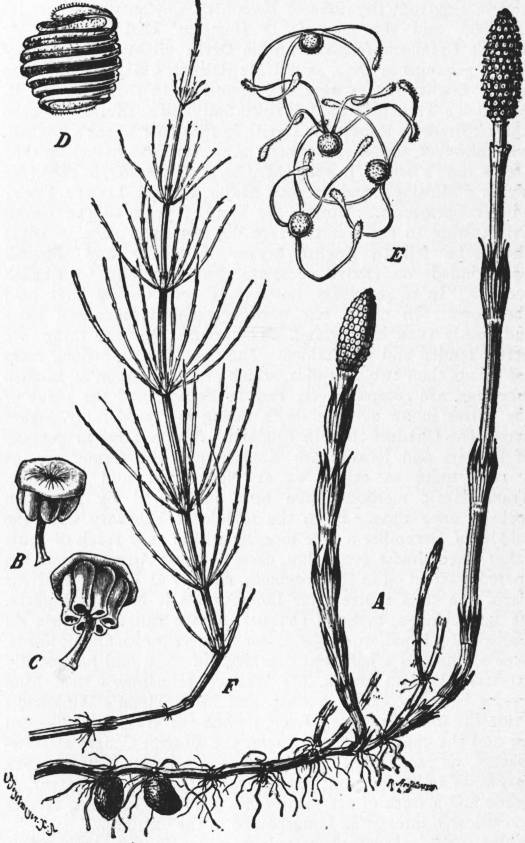
From Strasburger’s Lehrbuch der Botanik, by permission of Gustav Fischer.
Equisetum arvense.
A, Fertile shoot, springing from the rhizome, which also bears tubers; the vegetative shoots have not yet unfolded. F, Sterile vegetative shoot. B, C, Sporophylls bearing sporangia, which in C have opened. D, Spore showing the two spiral bands of the perinium. E, Dry spores showing the expanded spiral bands.
(A, F, reduced. B, C, D, E, enlarged.)
The corn horsetail E. arvense, one of the commonest species, is a troublesome weed in clayey cornfields (see fig.). The fructification appears in March and April, terminating in short unbranched stems. It is said to produce diarrhoea in such cattle as eat it. The bog horsetail, E. palustre, is said to possess similar properties. It grows in marshes, ditches, pools and drains in meadows, and sometimes obstructs the flow of water with its dense matted roots. The fructification in this species is cylindrical, and in that of E. limosum, which grows in similar situations, it is ovate in outline. The largest British species, E. maximum, grows in wet sandy declivities by railway embankments or streams, &c., and is remarkable for its beauty, due to the abundance of its elegant branches and the alternately green and white appearance of the stem. In this species the fructification is conical or lanceolate, and is found in April on short, stout, unbranched stems which have large loose sheaths. Horses appear to be fond of this species, and in Sweden it is stored for use as winter fodder. E. hyemale, commonly known as the Dutch rush, is much more abundant in Holland than in Britain; it is used for polishing purposes. E. variegatum grows on wet sandy ground, and serves by means of its fibrous roots to bind the sand together. The horsetails are remarkable for the large quantity of silica they contain in the cuticle (hence their value in polishing), which often amounts to half the weight of the ash yielded by burning them; the roots contain a quantity of starch.
HORSHAM, a market town in the Horsham parliamentary division of Sussex, England, 38 m. S. by W. from London by the London, Brighton and South Coast railway. Pop. of urban district (1901) 9446. It is pleasantly situated in the midst of a fertile country near the source of the Arun. A picturesque avenue leads to the church of St Mary, principally Early English and Perpendicular, with remains of Norman work, having a lofty tower surmounted by a spire, and containing several fine monuments, tombs and brasses. Other buildings include the grammar school, founded in 1532 and rebuilt in 1893, a town hall and corn exchange, erected in 1866 in Italian style, with an assembly room. In the vicinity are several fine mansions. The buildings of Christ’s Hospital (q.v.) at West Horsham were opened in 1902, the school being removed hither from London. The town has industries of tanning, founding, carriage-building and flour-milling.
Some neolithic remains have been found at Horsham. The town is not mentioned in Domesday Book, but the Rape of Bramber, in which it lies, belonged at that time to William de Braose. His descendants held the borough and the manor of Horsham, and through them they passed to the family of Mowbray, afterwards dukes of Norfolk. There are traces of burgage tenure at Horsham in 1210, and it was called a borough in 1236. It has no charter of incorporation. Horsham sent two representatives to parliament from 1295 until 1832, when the number was reduced to one. In 1885 it was disfranchised. In 1233 Henry III. granted William de Braose a yearly three-days’ fair at his manor of Horsham. In the reign of Edward I. William de Braose claimed to have a free market on Wednesdays and Saturdays. Fairs are held on the 5th of April, 18th of July, 17th of November and 27th of November. Market days are Monday and Wednesday. “Glovers” of Horsham are mentioned in a patent roll of 1485, and a brewery existed here in the time of Queen Anne.
HORSLEY, JOHN (c. 1685-1732), British archaeologist. John Hodgson (1779-1845), the historian of Northumberland, in a short memoir published in 1831, held that he was born in 1685, at Pinkie House, in the parish of Inveresk, Midlothian, and that his father was a Northumberland Nonconformist, who had migrated to Scotland, but returned to England soon after the Revolution of 1688. J. H. Hinde, in the Archaeologia Aeliana (Feb. 1865), held that he was a native of Newcastle-on-Tyne, the son of Charles Horsley, a member of the Tailors’ Company of that town. He was educated at Newcastle, and at Edinburgh University, where he graduated M.A. on the 29th of April 1701. There is evidence that he “was settled in Morpeth as a Presbyterian minister as early as 1709.” Hodgson, however, thought that up to 1721, at which time he was residing at Widdrington, “he had not received ordination, but preached as a licentiate.” Even if he was ordained then, his stay at the latter place was probably prolonged beyond that date; for he communicated to the Philosophical Transactions (xxxii. 328) notes on the rainfall there in the years 1722 and 1723. Hinde shows that during these years “he certainly followed a secular employment as agent to the York Buildings Company, who had contracted to purchase and were then in possession of the Widdrington estates.” At Morpeth Horsley opened a private school. Respect for his character and abilities attracted pupils irrespective of religious connexion, among them Newton Ogle, afterwards dean of Westminster. He gave lectures on mechanics and hydrostatics in Morpeth, Alnwick and Newcastle, and was elected F.R.S. on the 23rd of April 1730. It is as an archaeologist that Horsley is now known. His great work, Britannia Romana, or the Roman Antiquities of Britain (London, 1732), one of the scarcest and most valuable of its class, contains the result of patient labour. There is in the British Museum a copy with notes by John Ward (c. 1679-1758), biographer of the Gresham professors. Horsley died of apoplexy on the 12th of January 1732, on the eve of the publication of the Britannia Romana. He also published two sermons and a handbook to his lectures on mechanics, &c., and projected a history of Northumberland and Durham, collections for which were found among his papers.
J. P. Wood (d. 1838) (Parish of Cramond, 1794, and Anecdotes of Bowyer, 1782, p. 371) says that his wife was a daughter of William Hamilton, D.D., minister of Cramond, afterwards professor of divinity in Edinburgh University, but probably the John Horsley in question was another, the father of Samuel Horsley (q.v.).
HORSLEY, JOHN CALLCOTT (1817-1903), English painter, son of William Horsley, the musician, and grand-nephew of Sir Augustus Callcott, was born in London, on the 29th of January 1817. He studied painting in the Academy schools, and in 1836 exhibited “The Pride of the Village” (Vernon Gallery) at the Royal Academy. This was followed by numerous genre pictures at subsequent exhibitions up to 1893, the best known of these being “Malvolio,” “L’Allegro and il Penseroso” (painted for the Prince Consort), “Le Jour des Morts,” “A Scene from Don Quixote,” &c. In 1843 his cartoon of “St Augustine Preaching” won a prize in the Westminster Hall competition, and in 1844 he was selected as one of the six painters commissioned to execute frescoes for the Houses of Parliament, his “Religion” (1845) being put in the House of Lords; he also painted the “Henry V. assuming the Crown” and “Satan surprised at the Ear of Eve.” In 1864 he became R.A., and in 1882 was elected treasurer, a post which he held till 1897, when he resigned and became a “retired Academician.” Mr Horsley had much to do with organizing the winter exhibitions of “Old Masters” at Burlington House after 1870. When, during the ’eighties, the example of the French Salon began to affect the Academy exhibitors, and paintings of the nude became the fashion, he protested against the innovation, and his attitude caused Punch to give him the punning sobriquet of “Mr J. C(lothes) Horsley.” He died on the 18th of October 1903. His son, Sir Victor Horsley (b. 1857), became famous as a surgeon and neuropathologist, and a prominent supporter of the cause of experimental research.
HORSLEY, SAMUEL (1733-1806), English divine, was born in London on the 15th of September 1733. Entering Trinity College, Cambridge, he became LL.B. in 1758 without graduating in arts, and in the following year succeeded his father in the living of Newington Butts in Surrey. Horsley was elected a Fellow of the Royal Society in 1767; and secretary in 1773, but, in consequence of a difference with the president (Sir Joseph Banks) he withdrew in 1784. In 1768 he attended the eldest son of the 4th earl of Aylesford to Oxford as private tutor; and, after receiving through the earl and Bishop Lowth various minor preferments, which by dispensations he combined with his first living, he was installed in 1781 as archdeacon of St Albans. Horsley now entered in earnest upon his famous controversy with Joseph Priestley, who denied that the early Christians held the doctrine of the Trinity. In this controversy, conducted on both sides in the fiercest polemical spirit, Horsley showed the superior learning and ability. His aim was to lessen the influence which the prestige of Priestley’s name gave to his views, by indicating inaccuracies in his scholarship and undue haste in his conclusions. For the energy displayed in the contest Horsley was rewarded by Lord Chancellor Thurlow with a prebendal stall at Gloucester; and in 1788 the same patron procured his promotion to the see of St David’s. As a bishop, Horsley was energetic both in his diocese, where he strove to better the position of his clergy, and in parliament. The efficient support which he afforded the government was acknowledged by his successive translations to Rochester in 1793, and to St Asaph in 1802. With the bishopric of Rochester he held the deanery of Westminster. He died at Brighton on the 4th of October 1806.
Besides the controversial Tracts, which appeared in 1783-1784-1786, and were republished in 1789 and 1812, Horsley’s more important works are:—Apollonii Pergaei inclinationum libri duo (1770); Remarks on the Observation ... for determining the acceleration of the Pendulum in Lat. 70° 51′ (1774); Isaaci Newtoni Opera quae extant Omnia, with a commentary (5 vols. 4to, 1779-1785); On the Prosodies of the Greek and Latin Languages (1796); Disquisitions on Isaiah xviii. (1796); Hosea, translated ... with Notes (1801); Elementary Treatises on ... Mathematics (1801); Euclidis elementorum libri priores XII. (1802); Euclidis datorum liber (1803); Virgil’s Two Seasons of Honey, &c. (1805); and papers in the Philosophical Transactions from 1767 to 1776. After his death there appeared—Sermons (1810-1812); Speeches in Parliament (1813); Book of Psalms, translated with Notes (1815); Biblical Criticism (1820); Collected Theological Works (6 vols. 8vo, 1845).
HORSLEY, WILLIAM (1774-1858), English musician, was born on the 15th of November 1774. He became in 1790 the pupil of Theodore Smith, an indifferent musician of the time, who, however, taught him sufficient to obtain in 1794 the position of organist at Ely Chapel, Holborn. This post he resigned in 1798, to become organist at the Asylum for Female Orphans, as assistant to Dr Callcott, with whom he had long been on terms of personal and artistic intimacy, and whose eldest daughter he married. In 1802 he became his friend’s successor upon the latter’s resignation. Besides holding this appointment he became in 1812 organist of Belgrave Chapel, Halkin Street, and in 1838 of the Charter House. He died on the 12th of June 1858. Horsley’s compositions are numerous, and include amongst other instrumental pieces three symphonies for full orchestra. Infinitely more important are his glees, of which he published five books (1801-1807) besides contributing many detached glees and part songs to various collections. His glees, “By Celia’s arbour,” “O nightingale,” “Now the storm begins to lower,” and others, are amongst the finest specimens of this peculiarly English class of compositions. Horsley’s son Charles Edward (1822-1876), also enjoyed a certain reputation as a musician. He studied in Germany under Hauptmann and Mendelssohn, and on his return to England composed several oratorios and other pieces, none of which had permanent success. In 1808 he emigrated to Australia, and in 1872 went to America; he died in New York.
HORSMAN, EDWARD (1807-1876), English politician, was the son of a well-to-do gentleman of Stirling, and connected on the mother’s side with the earls of Stair. He was educated at Rugby and Cambridge, and was called to the Scotch bar in 1832, but then took to politics. He was elected to parliament as a Liberal for Cockermouth in 1836, and represented that constituency till 1852, when he was defeated; in 1853 he was returned for Stroud, and sat there till 1868; and from 1869 till he died he was member for Liskeard. He was a junior lord of the treasury in Lord Melbourne’s administration for a few months during 1841, and became prominent for attacking Lord John Russell’s ecclesiastical policy in 1847 and subsequent years. In 1855, under Lord Palmerston, he was made chief secretary for Ireland, but resigned in 1857. He gradually took up a position as an independent Liberal, and was well known for his attacks on the Church, and his exposures of various “jobs.” But his name is principally connected with his influence over Robert Lowe (Lord Sherbrooke) in 1866 at the time of Mr Gladstone’s Reform Bill, to which he and Lowe were hostile; and it was in describing the Lowe-Horsman combination that John Bright spoke of the “Cave of Adullam.” Horsman died at Biarritz on the 30th of November 1876.
HORST, the term used In physical geography and geology for a block of the earth’s crust that has remained stationary while the land has sunk on either side of it, or has been crushed in a mountain range against it. The Vosges and Black Forest are examples of the former, the Table, Jura and the Dôle of the latter result. The word is also applied to those larger areas, such as the Russian plain, Arabia, India and Central South Africa, where the continent remains stable, with horizontal table-land stratification, in distinction to folded regions such as the Eurasian chains.
HORT, FENTON JOHN ANTHONY (1828-1892), English theologian, was born in Dublin on the 23rd of April 1828, the great-grandson of Josiah Hort, archbishop of Tuam in the 18th century. In 1846 he passed from Rugby to Trinity College, Cambridge, where he was the contemporary of E. W. Benson, B. F. Westcott and J. B. Lightfoot. The four men became lifelong friends and fellow-workers. In 1850 Hort took his degree, being third in the classical tripos, and in 1852 he became fellow of his college. In 1854, in conjunction with J. E. B. Mayor and Lightfoot, he established the Journal of Classical and Sacred Philology, and plunged eagerly into theological and patristic study. He had been brought up in the strictest principles of the Evangelical school, but at Rugby he fell under the influence of Arnold and Tait, and his acquaintance with Maurice and Kingsley finally gave his opinions a direction towards Liberalism. In 1857 he married, and accepted the college living of St Ippolyts, near Hitchin, in Hertfordshire, where he remained for fifteen years. During his residence there he took some part in the discussions on university reform, continued his studies, and wrote essays for various periodicals. In 1870 he was appointed a member of the committee for revising the translation of the New Testament, and in 1871 he delivered the Hulsean lectures before the university. Their title was The Way, the Truth, and the Life, but they were not prepared for publication until many years after their delivery. In 1872 he accepted a fellowship and lectureship at Emmanuel College; in 1878 he was made Hulsean professor of divinity, and in 1887 Lady Margaret reader in divinity. In the meantime he had published, with his friend Westcott, an edition of the text of the New Testament. The Revision Committee had very largely accepted this text, even before its publication, as a basis for their translation of the New Testament. The work on its appearance created an immense sensation among scholars, and was vehemently attacked in many quarters, but on the whole it was received as being much the nearest approximation yet made to the original text of the New Testament (see Bible: New Testament, “Textual Criticism”). The introduction was the work of Hort, and its depth and fulness convinced all who read it that they were under the guidance of a master. Hort died on the 30th of November 1892, worn out by intense mental labour. Next to his Greek Testament his best-known work is The Christian Ecclesia (1897). Other publications are: Judaistic Christianity (1894); Village Sermons (two series); Cambridge and other Sermons; Prolegomena to ... Romans and Ephesians (1895); The Ante-Nicene Fathers (1895); and two Dissertations, on the reading μονογενὴς θεός in John i. 18, and on The Constantinopolitan and other Eastern Creeds in the Fourth Century. All are models of exact scholarship and skilful use of materials.
His Life and Letters was edited by his son, Sir Arthur Hort, Bart. (1896).
HORTA, the capital of an administrative district comprising the islands of Pico, Fayal, Flores and Corvo, in the Portuguese archipelago of the Azores. Pop. (1900) 6574. Horta is a seaport on the south-east coast of Fayal. It is defended by two castles and a wall, but these fortifications are obsolete. The harbour, a bay 2 m. long and nearly 1 m. broad, affords good anchorage in 5 to 20 fathoms of water, but is dangerous in south-westerly and south-easterly winds. It is the headquarters of profitable whale, tunny, bonito and mullet fisheries. Its exports include sperm-oil, fruit, wine and grain. Between 1897 and 1904 the port annually accommodated about 140 vessels of 220,000 tons, mostly of British or Portuguese nationality.
HORTEN, a seaport of Norway, in Jarlsberg-Laurvik amt (county), beautifully situated on the west bank of the Christiania Fjord, opposite Moss, 38 m. by water and 66 by rail S. of Christiania. Pop. (1900) 8460. It is practically united with Karl-Johansvaern, which is defended by strong fortifications, is the headquarters of the Norwegian fleet, and possesses an arsenal and shipbuilding yards. There are also an observatory and a nautical museum.
HORTENSIUS, QUINTUS (114-50 B.C.), surnamed Hortalus, Roman orator and advocate. At the age of nineteen he made his first speech at the bar, and shortly afterwards successfully defended Nicomedes III. of Bithynia, one of Rome’s dependants in the East, who had been deprived of his throne by his brother. From that time his reputation as an advocate was established. As the son-in-law of Q. Lutatius Catulus he was attached to the aristocratic party. During Sulla’s ascendancy the courts of law were under the control of the senate, the judges being themselves senators. To this circumstance perhaps, as well as to his own merits, Hortensius may have been indebted for much of his success. Many of his clients were the governors of provinces which they were accused of having plundered. Such men were sure to find themselves brought before a friendly, not to say a corrupt, tribunal, and Hortensius, according to Cicero (Div. in Caecil. 7), was not ashamed to avail himself of this advantage. Having served during two campaigns (90-89) in the Social War, he became quaestor in 81, aedile in 75, praetor in 72, and consul in 69. In the year before his consulship he came into collision with Cicero in the case of Verres, and from that time his supremacy at the bar was lost. After 63 Cicero was himself drawn towards the party to which Hortensius belonged. Consequently, in political cases, the two men were often engaged on the same side (e.g. in defence of Rabirius, Murena, Publius Cornelius Sulla, and Milo). After Pompey’s return from the East in 61, Hortensius withdrew from public life and devoted himself to his profession. In 50, the year of his death, he successfully defended Appius Claudius Pulcher when accused of treason and corrupt practices by P. Cornelius Dolabella, afterwards Cicero’s son-in-law.
Hortensius’s speeches are not extant. His oratory, according to Cicero, was of the Asiatic style, a florid rhetoric, better to hear than to read. He had a wonderfully tenacious memory (Cicero, Brutus, 88, 95), and could retain every single point in his opponent’s argument. His action was highly artificial, and his manner of folding his toga was noted by tragic actors of the day (Macrobius, Sat. iii. 13. 4). He also possessed a fine musical voice, which he could skilfully command. The vast wealth he had accumulated he spent on splendid villas, parks, fish-ponds and costly entertainments. He was the first to introduce peacocks as a table delicacy at Rome. He was a great buyer of wine, pictures and works of art. He wrote a treatise on general questions of oratory, erotic poems (Ovid, Tristia, ii. 441), and an Annales, which gained him considerable reputation as an historian (Vell. Pat. ii. 16. 3).
His daughter Hortensia was also a successful orator. In 42 she spoke against the imposition of a special tax on wealthy Roman matrons with such success that part of it was remitted (Quint. Instit. i. 1. 6; Val. Max. viii. 3. 3).
In addition to Cicero (passim), see Dio Cassius xxxviii. 16, xxxix. 37; Pliny, Nat. Hist. ix. 81, x. 23, xiv. 17, xxxv. 40; Varro, R.R. iii. 13. 17.
HORTENSIUS, QUINTUS, dictator of Rome 286 B.C. When the people, pressed by their patrician creditors, “seceded” to the Janiculum, he was commissioned to put an end to the strife. He passed a law whereby the resolutions of the multitude (plebiscita) were made binding on all the citizens, without the approval of the senate being necessary. This was not a mere re-enactment of previous laws. Another law, passed about the same time, which declared the nundinae (market days) to be dies fasti (days on which legal business might be transacted), is also attributed to him. He is said to have died while still dictator.
Aulus Gellius xv. 27; Pliny, Nat. Hist. xvi. 15; Macrobius, Saturnalia i. 16; Livy, Epit. ii.