VOLUME XIII SLICE II Hearing to Helmond (continued 9)
Reading edition
HEGESIPPUS, the supposed author of a free Latin adaptation of the Jewish War of Josephus under the title De bello Judaico et excidio urbis Hierosolymitanae. The seven books of Josephus are compressed into five, but much has been added from the Antiquities and from the works of Roman historians, while several entirely new speeches are introduced to suit the occasion. Internal evidence shows that the work could not have been written before the 4th century A.D. The author, who is undoubtedly a Christian, describes it in his preface as a kind of revised edition of Josephus. Some authorities attribute it to Ambrose, bishop of Milan (340-397), but there is nothing to settle the authorship definitely. The name Hegesippus itself appears to be a corruption of Josephus, through the stages Ἰώσηπος, Iosippus, Egesippus, Hegesippus, unless it was purposely adopted as reminiscent of Hegesippus, the father of ecclesiastical history (2nd century).
Best edition by C. F. Weber and J. Caesar (1864); authorities in E. Schürer, History of the Jewish People (Eng. trans.), i. 99 seq.; F. Vogel, De Hegesippo, qui dicitur, Josephi interprete (Erlangen, 1881).
HEGIUS [VON HEEK], ALEXANDER (c. 1433-1498), German humanist, so called from his birthplace Heek in Westphalia. In his youth he was a pupil of Thomas à Kempis, at that time canon of the convent of St Agnes at Zwolle. In 1474 he settled down at Deventer in Holland, where he either founded or succeeded to the headship of a school, which became famous for the number of its distinguished alumni. First and foremost of these was Erasmus; others were Hermann von dem Busche, the missionary of humanism, Conrad Goclenius (Gockelen), Conrad Mutianus (Muth von Mudt) and pope Adrian VI. Hegius died at Deventer on the 7th of December 1498. His writings, consisting of short poems, philosophical essays, grammatical notes and letters, were published after his death by his pupil Jacob Faber. They display considerable knowledge of Latin, but less of Greek, on the value of which he strongly insisted. Hegius’s chief claim to be remembered rests not upon his published works, but upon his services in the cause of humanism. He succeeded in abolishing the old-fashioned medieval textbooks and methods of instruction, and led his pupils to the study of the classical authors themselves. His generosity in assisting poor students exhausted a considerable fortune, and at his death he left nothing but his books and clothes.
See D. Reichling, “Beiträge zur Charakteristik des Alex. Hegius,” in the Monatsschrift für Westdeutschland (1877); H. Hamelmann, Opera genealogico-historica (1711); H. A. Erhard, Geschichte des Wiederaufblühens wissenschaftlicher Bildung (1826); C. Krafft and W. Crecelius, “Alexander Hegius und seine Schüler,” from the works of Johannes Butzbach, one of Hegius’s pupils, in Zeitschrift des bergischen Geschichtsvereins, vii. (Bonn, 1871).
HEIBERG, JOHAN LUDVIG (1791-1860), Danish poet and critic, son of the political writer Peter Andreas Heiberg (1758-1841), and of the famous novelist, afterwards the Baroness Gyllembourg-Ehrensvärd, was born at Copenhagen on the 14th of December 1791. In 1800 his father was exiled and settled in Paris, where he was employed in the French foreign office, retiring in 1817 with a pension. His political and satirical writings continued to exercise great influence over his fellow-countrymen. Johan Ludvig Heiberg was taken by K. L. Rahbek and his wife into their house at Bakkehuset. He was educated at the university of Copenhagen, and his first publication, entitled The Theatre for Marionettes (1814), included two romantic dramas. This was followed by Christmas Jokes and New Year’s Tricks (1816), The Initiation of Psyche (1817), and The Prophecy of Tycho Brahé, a satire on the eccentricities of the Romantic writers, especially on the sentimentality of Ingemann. These works attracted attention at a time when Baggesen, Öhlenschläger and Ingemann possessed the popular ear, and were understood at once to be the opening of a great career. In 1817 Heiberg took his degree, and in 1819 went abroad with a grant from government. He proceeded to Paris, and spent the next three years there with his father. In 1822 he published his drama of Nina, and was made professor of the Danish language at the university of Kiel, where he delivered a course of lectures, comparing the Scandinavian mythology as found in the Edda with the poems of Öhlenschläger. These lectures were published in German in 1827.
In 1825 Heiberg came back to Copenhagen for the purpose of introducing the vaudeville on the Danish stage. He composed a great number of these vaudevilles, of which the best known are King Solomon and George the Hatmaker (1825); April Fools (1826); A Story in Rosenborg Garden (1827); Kjöge Huskors (1831); The Danes in Paris (1833); No (1836); and Yes (1839). He took his models from the French theatre, but showed extraordinary skill in blending the words and the music; but the subjects and the humour were essentially Danish and even topical. Meanwhile he was producing dramatic work of a more serious kind; in 1828 he brought out the national drama of Elverhöi; in 1830 The Inseparables; in 1835 the fairy comedy of The Elves, a dramatic version of Tieck’s Elfin; and in 1838 Fata Morgana. In 1841 Heiberg published a volume of New Poems containing “A Soul after Death,” a comedy which is perhaps his masterpiece, “The Newly Wedded Pair,” and other pieces. He edited from 1827 to 1830 the famous weekly, the Flyvende Post (The Flying Post), and subsequently the Interimsblade (1834-1837) and the Intelligensblade (1842-1843). In his journalism he carried on his warfare against the excessive pretensions of the Romanticists, and produced much valuable and penetrating criticism of art and literature. In 1831 he married the actress Johanne Louise Paetges (1812-1890), herself the author of some popular vaudevilles. Heiberg’s scathing satires, however, made him very unpopular; and this antagonism reached its height when, in 1845, he published his malicious little drama of The Nut Crackers. Nevertheless he became in 1847 director of the national theatre. He filled the post for seven years, working with great zeal and conscientiousness, but was forced by intrigues from without to resign it in 1854. Heiberg died at Bonderup, near Ringsted, on the 25th of August 1860. His influence upon taste and critical opinion was greater than that of any writer of his time, and can only be compared with that of Holberg in the 18th century. Most of the poets of the Romantic movement in Denmark were very grave and serious; Heiberg added the element of humour, elegance and irony. He had the genius of good taste, and his witty and delicate productions stand almost unique in the literature of his country.
The poetical works of Heiberg were collected, in 11 vols., in 1861-1862, and his prose writings (11 vols.) in the same year. The last volume of his prose works contains some fragments of autobiography. See also G. Brandes, Essays (1889). For the elder Heiberg see monographs by Thaarup (1883) and by Schwanenflügel (1891).
HEIDE, a town of Germany, in the Prussian province of Schleswig-Holstein, on a small plateau which stands between the marshes and moors bordering the North Sea, 35 m. N.N.W. of Glückstadt, at the junction of the railways Elmshorn-Hvidding and Neumünster-Tönning. Pop. (1905), 8758. It has an Evangelical and a Roman Catholic church, a high-grade school, and tobacco and cigar manufactories and breweries. Heide in 1447 became the capital of the Ditmarsh peasant republic, but on the 13th of June 1559 it was the scene of the complete defeat of the peasant forces by the Danes.
HEIDEGGER, JOHANN HEINRICH (1633-1698), Swiss theologian, was born at Bärentschweil, in the canton of Zürich, Switzerland, on the 1st of July 1633. He studied at Marburg and at Heidelberg, where he became the friend of J. L. Fabricius (1632-1696), and was appointed professor extraordinarius of Hebrew and later of philosophy. In 1659 he was called to Steinfurt to fill the chair of dogmatics and ecclesiastical history, and in the same year he became doctor of theology of Heidelberg. In 1660 he revisited Switzerland; and, after marrying, he travelled in the following year to Holland, where he made the acquaintance of Johannes Cocceius. He returned in 1665 to Zürich, where he was elected professor of moral philosophy. Two years later he succeeded J. H. Hottinger (1620-1667) in the chair of theology, which he occupied till his death on the 18th of January 1698, having declined an invitation in 1669 to succeed J. Cocceius at Leiden, as well as a call to Groningen. Heidegger was the principal author of the Formula Consensus Helvetica in 1675, which was designed to unite the Swiss Reformed churches, but had an opposite effect. W. Gass describes him as the most notable of the Swiss theologians of the time.
His writings are largely controversial, though without being bitter, and are in great part levelled against the Roman Catholic Church. The chief are De historia sacra patriarcharum exercitationes selectae (1667-1671); Dissertatio de Peregrinationibus religiosis (1670); De ratione studiorum, opuscula aurea, &c. (1670); Historia papatus (1684; under the name Nicander von Hohenegg); Manuductio in viam concordiae Protestantium ecclesiasticae (1686); Tumulus concilii Tridentini (1690); Exercitationes biblicae (1700), with a life of the author prefixed; Corpus theologiae Christianae (1700, edited by J. H. Schweizer); Ethicae Christianae elementa (1711); and lives of J. H. Hottinger (1667) and J. L. Fabricius (1698). His autobiography appeared in 1698, under the title Historia vitae J. H. Heideggeri.
See the articles in Herzog-Hauck’s Realencyklopädie and the Allgemeine deutsche Biographie; and cf. W. Gass, Geschichte der protestantischen Dogmatik, ii. 353 ff.
HEIDELBERG, a town of Germany, on the south bank of the Neckar, 12 m. above its confluence with the Rhine, 13 m. S.E. from Mannheim and 54 m. from Frankfort-on-Main by rail. The situation of the town, lying between lofty hills covered with vineyards and forests, at the spot where the rapid Neckar leaves the gorge and enters the plain of the Rhine, is one of great natural beauty. The town itself consists practically of one long, narrow street—the Hauptstrasse—running parallel to the river, from the railway station on the west to the Karlstor on the east (where there is also a local station) for a distance of 2 m. To the south of this is the Anlage, a pleasant promenade flanked by handsome villas and gardens, leading directly to the centre of the place. A number of smaller streets intersect the Hauptstrasse at right angles and run down to the river, which is crossed by two fine bridges. Of these, the old bridge on the east, built in 1788, has a fine gateway and is adorned with statues of Minerva and the elector Charles Theodore of the Palatinate; the other, the lower bridge, on the west, built in 1877, connects Heidelberg with the important suburbs of Neuenheim and Handschuchsheim. Of recent years the town has grown largely towards the west on both sides of the river; but the additions have been almost entirely of the better class of residences. Heidelberg is an important railway centre, and is connected by trunk lines with Frankfort, Mannheim, Karlsruhe, Spires and Würzburg. Electric trams provide for local traffic, and there are also several light railways joining it with the neighbouring villages. Of the churches the chief are the Protestant Peterskirche dating from the 15th century and restored in 1873, to the door of which Jerome of Prague in 1460 nailed his theses; the Heilige Geist Kirche (Church of the Holy Ghost), an imposing Gothic edifice of the 15th century; the Jesuitenkirche (Roman Catholic), with a sumptuously decorated interior, and the new Evangelical Christuskirche. The town hall and the university buildings, dating from 1712 and restored in 1886, are commonplace erections; but to the south of the Ludwigsplatz, upon which most of the academical buildings lie, stands the new university library, a handsome structure of pink sandstone in German Renaissance style. In addition to the Ludwigsplatz with its equestrian statue of the emperor William I. there are other squares in the town, among them being the Bismarckplatz with a statue of Bismarck, and the Jubiläumsplatz.
The chief attraction of Heidelberg is the castle, which overhangs the east part of the town. It stands on the Jettenbühl, a spur of the Königsstuhl (1800 ft.), at a height of 330 ft. above the Neckar. Though now a ruin, yet its extent, its magnificence, its beautiful situation and its interesting history render it by far the most noteworthy, as it certainly is the grandest and largest, of the old castles of Germany. The building was begun early in the 13th century. The elector palatine and German king Rupert III. (d. 1410) greatly improved it, and built the wing, Ruprechtsbau or Rupert’s building, that bears his name. Succeeding electors further extended and embellished it (see Architecture, Plate VII., figs. 78-80); notably Otto Henry “the Magnanimous” (d. 1559), who built the beautiful early Renaissance wing known as the Otto-Heinrichsbau (1556-1559); Frederick IV., for whom the fine late Renaissance wing called the Friedrichsbau was built (1601-1607); and Frederick V., the unfortunate “winter king” of Bohemia, who on the west side added the Elisabethenbau or Englischebau (1618), named after his wife, the daughter of James I. of Great Britain and ancestress of the present English reigning family. In 1648, at the peace of Westphalia, Heidelberg was given back to Frederick V.’s son, Charles Louis, who restored the castle to its former splendour. In 1688, during Louis XIV.’s invasion of the Palatinate, the castle was taken, after a long siege, by the French, who blew part of it up when they found they could not hope to hold it (March 2, 1689). In 1693 it was again captured by them and still further wrecked. Finally, in 1764, it was struck by lightning and reduced to its present ruinous condition.
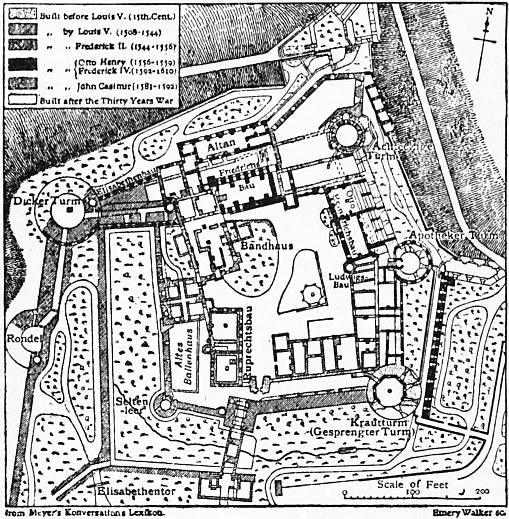
Apart from the outworks, the castle forms an irregular square with round towers at the angles, the principal buildings being grouped round a central courtyard, the entrance to which is from the south through a series of gateways. In this courtyard, besides the buildings already mentioned, are the oldest parts of the castle, the so-called Alte Bau (old building) and the Bandhaus. The Friedrichsbau, which is decorated with statues of the rulers of the Palatinate, was elaborately restored and rendered habitable between 1897 and 1903. Other noteworthy objects in the castle are the fountain in the courtyard, decorated with four granite columns from Charlemagne’s palace at Ingelheim; the Elisabethentor, a beautiful gateway named after the English princess; the beautiful octagonal bell-tower at the N.E. angle; the ruins of the Krautturm, now known as the Gesprengte Turm, or blown-up tower, and the castle chapel and the museum of antiquities in the Friedrichsbau. In a cellar entered from the courtyard is the famous Great Tun of Heidelberg. This vast vat was built in 1751, but has only been used on one or two occasions. Its capacity is 49,000 gallons, and it is 20 ft. high and 31 ft. long. Behind the Friedrichsbau is the Altan (1610), or castle balcony, from which is obtained a view of great beauty, extending from the town beneath to the heights across the Neckar and over the broad luxuriant plain of the Rhine to Mannheim and the dim contours of the Hardt Mountains behind. On the terrace of the beautiful grounds is a statue of Victor von Scheffel, the poet of Heidelberg.
The university of Heidelberg was founded by the elector Rupert I., in 1385, the bull of foundation being issued by Pope Urban VI. in that year. It was constructed after the type of Paris, had four faculties, and possessed numerous privileges. Marselius von Inghen was its first rector. The electors Frederick I., the Victorious, Philip the Upright and Louis V. respectively cherished it. Otto Henry gave it a new organization, further endowed it and founded the library. At the Reformation it became a stronghold of Protestant learning, the Heidelberg catechism being drawn up by its theologians. Then the tide turned. Damaged by the Thirty Years’ War, it led a struggling existence for a century and a half. A large portion of its remaining endowments was cut off by the peace of Lunéville (1801). In 1803, however, Charles Frederick, grand-duke of Baden, raised it anew and reconstituted it under the name of “Ruperto-Carola.” The number of professors and teachers is at present about 150 and of students 1700. The library was first kept in the choir of the Heilige Geist Kirche, and then consisted of 3500 MSS. In 1623 it was sent to Rome by Maximilian I., duke of Bavaria, and stored as the Bibliotheca Palatina in the Vatican. It was afterwards taken to Paris, and in 1815 was restored to Heidelberg. It has more than 500,000 volumes, besides 4000 MSS. Among the other university institutions are the academic hospital, the maternity hospital, the physiological institution, the chemical laboratory, the zoological museum, the botanical garden and the observatory on the Königsstuhl.
The other educational foundations are a gymnasium, a modern and a technical school. There is a small theatre, an art and several other scientific societies. The manufactures of Heidelberg include cigars, leather, cement, surgical instruments and beer, but the inhabitants chiefly support themselves by supplying the wants of a large and increasing body of foreign permanent residents, of the considerable number of tourists who during the summer pass through the town, and of the university students. A funicular railway runs from the Korn-Markt up to the level of the castle and thence to the Molkenkur (700 ft. above the town). The town is well lighted and is supplied with excellent water from the Wolfsbrunnen. Pop. (1885), 29,304; (1905), 49,527.
At an early period Heidelberg was a fief of the bishop of Worms, who entrusted it about 1225 to the count palatine of the Rhine, Louis I. It soon became a town and the chief residence of the counts palatine. Heidelberg was one of the great centres of the reformed teaching and was the headquarters of the Calvinists. On this account it suffered much during the Thirty Years’ War, being captured and plundered by Count Tilly in 1622, by the Swedes in 1633 and again by the imperialists in 1635. By the peace of Westphalia it was restored to the elector Charles Louis. In 1688 and again in 1693 Heidelberg was sacked by the French. On the latter occasion the work of destruction was carried out so thoroughly that only one house escaped; this being a quaintly decorated erection in the Marktplatz, which is now the Hôtel zum Ritter. In 1720 the elector Charles II. removed his court to Mannheim, and in 1803 the town became part of the grand-duchy of Baden. On the 5th of March 1848 the Heidelberg assembly was held here, and at this meeting the steps were taken which led to the revolution in Germany in that year.
See Oncken, Stadt, Schloss und Hochschule Heidelberg; Bilder aus ihrer Vergangenheit (Heidelberg, 1885); Öchelhäuser, Das Heidelberger Schloss, bau- und kunstgeschichtlicher Führer (Heidelberg, 1902); Pfaff, Heidelberg und Umgebung (Heidelberg, 1902); Lorentzen, Heidelberg und Umgebung (Stuttgart, 1902); Durm, Das Heidelberger Schloss, eine Studie (Berlin, 1884); Koch and Seitz, Das Heidelberger Schloss (Darmstadt, 1887-1891); J. F. Hautz, Geschickte der Universität Heidelberg (1863-1864); A. Thorbecke, Geschichte der Universität Heidelberg (Stuttgart, 1886); the Urkundenbuch der Universität Heidelberg, edited by Winkelmann (Heidelberg, 1886); Bähr, Die Entführung der Heidelberger Bibliothek nach Rom (Leipzig, 1845); and G. Weber, Heidelberger Erinnerungen (Stuttgart, 1886).
HEIDELBERG, a town and district of the Transvaal. The district is bounded S. by the Vaal river and includes the south-eastern part of the Witwatersrand gold-fields. The town of Heidelberg is 42 m. S.E. of Johannesburg and 441 m. N.W. of Durban by rail. Pop. (1904), 3220, of whom 1837 were white. It was founded in 1865, is built on the slopes of the Rand at an elevation of 5029 ft., and is reputed the best sanatorium in the colony. It is the centre of the eastern Rand goldmines.
HEIDELBERG CATECHISM, THE, the most attractive of all the catechisms of the Reformation, was drawn up at the bidding of Frederick III., elector of the Palatinate, and published on Tuesday the 19th of January 1563. The new religion in the Palatinate had been largely under the guidance of Philip Melanchthon, who had revived the old university of Heidelberg and staffed it with sympathetic teachers. One of these, Tillemann, Heshusius, who became general superintendent in 1558, held extreme Lutheran views on the Real Presence, and in his desire to force the community into his own position excommunicated his colleague Klebitz, who held Zwinglian views. When the breach was widening Frederick, “der fromme Kurfürst,” came to the succession, dismissed the two chief combatants and referred the trouble to Melanchthon, whose guarded verdict was distinctly Swiss rather than Lutheran. In a decree of August 1560 the elector declared for Calvin and Zwingli, and soon after he resolved to issue a new and unambiguous catechism of the evangelical faith. He entrusted the task to two young men who have won deserved remembrance by their learning and their character alike. Zacharias Ursinus was born at Breslau in July 1534 and attained high honour in the university of Wittenberg. In 1558 he was made rector of the gymnasium in his native town, but the incessant strife with the extreme Lutherans drove him to Zürich, whence Frederick, on the advice of Peter Martyr, summoned him to be professor of theology at Heidelberg and superintendent of the Sapientiae Collegium. He was a man of modest and gentle spirit, not endowed with great preaching gifts, but unwearied in study and consummately able to impart his learning to others. Deposed from his chair by the elector Louis in 1576, he lived with John Casimir at Neustadt and found a congenial sphere in the new seminary there, dying in his 49th year, in March 1583.
Caspar Olevianus was born at Treves in 1536. He gave up law for theology, studied under Calvin in Geneva, Peter Martyr in Zürich, and Beza in Lausanne. Urged by William Farel he preached the new faith in his native city, and when banished therefrom found a home with Frederick of Heidelberg, where he gained high renown as preacher and administrator. His ardour and enthusiasm made him the happy complement of Ursinus. When the reaction came under Louis he was befriended by Ludwig von Sain, prince of Wittgenstein, and John, count of Nassau, in whose city of Herborn he did notable work at the high school until his death on the 15th of March 1587. The elector could have chosen no better men, young as they were, for the task in hand. As a first step each drew up a catechism of his own composition, that of Ursinus being naturally of a more grave and academic turn than the freer production of Olevianus, while each made full use of the earlier catechisms already in use. But when the union was effected it was found that the spirits of the two authors were most happily and harmoniously wedded, the exactness and erudition of the one being blended with the fervency and grace of the other. Thus the Heidelberg Catechism, which was completed within a year of its inception, has an individuality that marks it out from all its predecessors and successors. The Heidelberg synod unanimously approved of it, it was published in January 1563, and in the same year officially turned into Latin by Jos. Lagus and Lambert Pithopoeus.
The ultra-Lutherans attacked the catechism with great bitterness, the assault being led by Heshusius and Flacius Illyricus. Maximilian II. remonstrated against it as an infringement of the peace of Augsburg. A conference was held at Maulbronn in April 1564, and a personal attack was made on the elector at the diet of Augsburg in 1566, but the defence was well sustained, and the Heidelberg book rapidly passed beyond the bounds of the Palatinate (where indeed it suffered eclipse from 1576 to 1583, during the electorate of Louis), and gained an abundant success not only in Germany (Hesse, Anhalt, Brandenburg and Bremen) but also in the Netherlands (1588), and in the Reformed churches of Hungary, Transylvania and Poland. It was officially recognized by the synod of Dort in 1619, passed into France, Britain and America, and probably shares with the De imitatione Christi and The Pilgrim’s Progress the honour of coming next to the Bible in the number of tongues into which it has been translated.
This wide acceptance and high esteem are due largely to an avoidance of polemical and controversial subjects, and even more to an absence of the controversial spirit. There is no mistake about its Protestantism, even when we omit the unhappy addition made to answer 80 by Frederick himself (in indignant reply to the ban pronounced by the Council of Trent), in which the Mass is described as “nothing else than a denial of the one sacrifice and passion of Jesus Christ, and an accursed idolatry”—an addition which is the one blot on the ἐπιείκεια of the catechism. The work is the product of the best qualities of head and heart, and its prose is frequently marked by all the beauty of a lyric. It follows the plan of the epistle to the Romans (excepting chapters ix.-xi.) and falls into three parts: Sin, Redemption and the New Life. This arrangement alone would mark it out from the normal reformation catechism, which runs along the stereotyped lines of Decalogue, Creed, Lord’s Prayer, Church and Sacraments. These themes are included, but are shown as organically related. The Commandments, e.g. “belong to the first part so far as they are a mirror of our sin and misery, but also to the third part, as being the rule of our new obedience and Christian life.” The Creed—a panorama of the sublime facts of redemption—and the sacraments find their place in the second part; the Lord’s Prayer (with the Decalogue) in the third.
See The Heidelberg Catechism, the German Text, with a Revised Translation and Introduction, edited by A. Smellie (London, 1900).
HEIDELOFF, KARL ALEXANDER VON (1788-1865), German architect, the son of Victor Peter Heideloff, a painter, was born at Stuttgart. He studied at the art academy of his native town, and after following the profession of an architect for some time at Coburg was in 1818 appointed city architect at Nuremberg. In 1822 he became professor at the polytechnic school, holding his post until 1854, and some years later he was chosen conservator of the monuments of art. Heideloff devoted his chief attention to the Gothic style of architecture, and the buildings restored and erected by him at Nuremberg and in its neighbourhood attest both his original skill and his purity of taste. He also achieved some success as a painter in watercolour. He died at Hassfurt on the 28th of September 1865. Among his architectural works should be mentioned the castle of Reinhardsbrunn, the Hall of the Knights in the fortress at Coburg, the castle of Landsberg, the mortuary chapel in Meiningen, the little castle of Rosenburg near Bonn, the chapel of the castle of Rheinstein near Bingen, and the Catholic church in Leipzig. His powers in restoration are shown in the castle of Lichtenstein, the cathedral of Bamberg, and the Knights’ Chapel (Ritter Kapelle) at Hassfurt.
Among his writings on architecture are Die Lehre von den Säulenordnungen (1827); Der Kleine Vignola (1832); Nürnbergs Baudenkmäler der Vorzeit (1838-1843, complete edition 1854); and Die Ornamentik des Mittelalters (1838-1842).
HEIDENHEIM, a town of Germany, in the kingdom of Württemberg, 31 m. by rail north by east of Ulm. Pop. (1905), 12,173. It has an Evangelical and a Roman Catholic church, and several schools. Its industrial establishments include cotton, woollen, tobacco, machinery and chemical factories, bleach-works, dye-works and breweries, and corn and cattle markets. The town, which received municipal privileges in 1356, is overlooked by the ruins of the castle of Hellenstein, standing on a hill 1985 ft. high. Heidenheim is also the name of a small place in Bavaria famous on account of the Benedictine abbey which formerly stood therein. Founded in 748 by Wilibald, bishop of Eichstätt, this was plundered by the peasantry in 1525 and was closed in 1537.
HEIFER, a young cow that has not calved. The O. Eng. heahfore or heafru, from which the word is derived, is of obscure origin. It is found in Bede’s History (A.D. 900) as heahfore, and has passed through many forms. It is possibly derived from heah, high, and faren (fare), to go, meaning “high-stepper.” It has also been suggested that the derivation is from hea, a stall, and fore, a cow.
HEIGEL, KARL AUGUST VON (1835-1905), German novelist, was born, the son of a régisseur or stage-manager of the court theatre, on the 25th of March 1835 at Munich. In this city he received his early schooling and studied (1854-1858) philosophy at the university. He was then appointed librarian to Prince Heinrich zu Carolath-Beuthen in Lower Silesia, and accompanied the nephew of the prince on travels. In 1863 he settled in Berlin, where from 1865 to 1875 he was engaged in journalism. He next resided at Munich, employed in literary work for the king, Ludwig II., who in 1881 conferred upon him a title of nobility. On the death of the king in 1886 he removed to Riva on the Lago di Garda, where he died on the 6th of September 1905. Karl von Heigel attained some popularity with his novels: Wohin? (1873), Die Dame ohne Herz (1873), Das Geheimnis des Königs (1891), Der Roman einer Stadt (1898), Der Maharadschah (1900), Die nervöse Frau (1900), Die neuen Heiligen (1901), and Brömels Glück und Ende (1902). He also wrote some plays, notably Josephine Bonaparte (1892) and Die Zarin (1883); and several collections of short stories, Neue Erzählungen (1876), Neueste Novellen (1878), and Heitere Erzählungen (1893).
HEIJERMANS, HERMANN (1864- ) , Dutch writer, of Jewish origin, was born on the 3rd of December 1864 at Rotterdam. In the Amsterdam Handelsblad he published a series of sketches of Jewish family life under the pseudonym of “Samuel Falkland,” which were collected in volume form. His novels and tales include Trinette (1892), Fles (1893), Kamertjeszonde (2 vols., 1896), Intérieurs (1897), Diamantstadt (2 vols., 1903). He created great interest by his play Op Hoop van Zegen (1900), represented at the Théâtre Antoine in Paris, and in English by the Stage Society as The Good Hope. His other plays are: Dora Kremer (1893), Ghetto (1898), Het zevende Gebot (1899), Het Pantser (1901), Ora et labora (1901), and numerous one-act pieces. A Case of Arson, an English version of the one-act play Brand in de Jonge Jan, was notable for the impersonation (1904 and 1905) by Henri de Vries of all the seven witnesses who appear as characters.
HEILBRONN, a town of Germany, in the kingdom of Württemberg, situated in a pleasant and fruitful valley on the Neckar, 33 m. by rail N. of Stuttgart, and at the junction of lines to Jagdsfeld, Crailsheim and Eppingen. Pop. (1905), 40,026. In the older part of the town the streets are narrow, and contain a number of high turreted houses with quaintly adorned gables. The old fortifications have now been demolished, and their site is occupied by promenades, outside of which are the more modern parts of the town with wide streets and many handsome buildings. The principal public buildings are the church of St Kilian (restored 1886-1895) in the Gothic and Renaissance styles, begun about 1019 and completed in 1529, with an elegant tower 210 ft. high, a beautiful choir, and a finely carved altar; the town hall (Rathaus), founded in 1540, and possessing a curious clock made in 1580, and a collection of interesting letters and other documents; the house of the Teutonic knights (Deutsches Haus), now used as a court of law; the Roman Catholic church of St Joseph, formerly the church of the Teutonic Order; the tower (Diebsturm or Götzens Turm) on the Neckar, in which Götz von Berlichingen was confined in 1519; a fine synagogue; an historical museum and several monuments, among them those to the emperors William I. and Frederick I., to Bismarck, to Schiller and to Robert von Mayer (1814-1878), a native of the town, famous for his discoveries concerning heat. The educational establishments include a gymnasium, a commercial school and an agricultural academy. The town in a commercial point of view is the most important in Württemberg, and possesses an immense variety of manufactures, of which the principal are gold, silver, steel and iron wares, machines, sugar of lead, white lead, vinegar, beer, sugar, tobacco, soap, oil, cement, chemicals, artificial manure, glue, soda, tapestry, paper and cloth. Grapes, fruit, vegetables and flowering shrubs are largely grown in the neighbourhood, and there are large quarries for sandstone and gypsum and extensive salt-works. By means of the Neckar a considerable trade is carried on in wood, bark, leather, agricultural produce, fruit and cattle.
Heilbronn occupies the site of an old Roman settlement; it is first mentioned in 741, and the Carolingian princes had a palace here. It owes its name—originally Heiligbronn, or holy spring—to a spring of water which until 1857 was to be seen issuing from under the high altar of the church of St Kilian. Heilbronn obtained privileges from Henry IV. and from Rudolph I. and became a free imperial city in 1360. It was frequently besieged during the middle ages, and it suffered greatly during the Peasants’ War, the Thirty Years’ War, and the various wars with France. In April 1633 a convention was entered into here between Oxenstierna, the Swabian and Frankish estates and the French, English and Dutch ambassadors, as a result of which the Heilbronn treaty, for the prosecution of the Thirty Years’ War, was concluded. In 1802 Heilbronn was annexed by Württemberg.
See Jäger, Geschichte von Heilbronn (Heilbronn, 1828); Kuttler, Heilbronn, seine Umgebungen und seine Geschichte (Heilbronn, 1859); Dürr, Heilbronner Chronik (Halle, 1896); Schliz, Die Entstehung der Stadtgemeinde Heilbronn (Leipzig, 1903); and A. Küsel, Der Heilbrunner Konvent (Halle, 1878).
HEILIGENSTADT, a town of Germany, in Prussian Saxony, on the Leine, 32 m. E.N.E. of Cassel, on the railway to Halle. Pop. (1905), 7955. It possesses an old castle, formerly belonging to the electors of Mainz, one Evangelical and two Roman Catholic churches, several educational establishments, and an infirmary. The principal manufactures are cotton goods, cigars, paper, cement and needles. Heiligenstadt is said to have been built by the Frankish king Dagobert and was formerly the capital of the principality of Eichsfeld. In 1022 it was acquired by the archbishop of Mainz, and in 1103 it came into the possession of Henry the Proud, duke of Saxony, but when his son Henry the Lion was placed under the ban of the Empire, it again came to Mainz. It was destroyed by fire in 1333, and was captured in 1525 by Duke Henry of Brunswick. In 1803 it came into possession of Prussia. The Jesuits had a celebrated college here from 1581 to 1773.
HEILSBERG, a town of Germany, in the province of East Prussia, at the junction of the Simser and Alle, 38 m. S. of Königsberg. Pop. (1905), 6042. It has an Evangelical and a Roman Catholic church, and an old castle formerly the seat of the prince-bishops of Ermeland, but now used as an infirmary. The principal industries are tanning, dyeing and brewing, and there is considerable trade in grain. The castle founded at Heilsberg by the Teutonic order in 1240 became in 1306 the seat of the bishops of Ermeland, an honour which it retained for 500 years. On the 10th of June 1807 a battle took place at Heilsberg between the French under Soult and Murat, and the Russians and Prussians under Bennigsen.
HEILSBRONN (or Kloster-Heilsbronn), a village of Germany, in the Bavarian province of Middle Franconia, with a station on the railway between Nuremberg and Ansbach, has 1200 inhabitants. In the middle ages it was the seat of one of the great monasteries of Germany. This foundation, which belonged to the Cistercian order, owed its origin to Bishop Otto of Bamberg in 1132, and continued to exist till 1555. Its sepulchral monuments, many of which are figured by Hocker, Heilsbronnischer Antiquitätenschatz (Ansbach, 1731-1740), are of exceptionally high artistic interest. It was the hereditary burial-place of the Hohenzollern family and ten burgraves of Nuremberg, five margraves and three electors of Brandenburg, and many other persons of note are buried within its walls. The buildings of the monastery have mostly disappeared, with the exception of the fine church, a Romanesque basilica, restored between 1851 and 1866, and possessing paintings by Albert Dürer. The “Monk of Heilsbronn” is the ordinary appellation of a didactic poet of the 14th century, whose Sieben Graden, Tochter Syon and Leben des heiligen Alexius were published by J. F. L. T. Merzdorf at Berlin in 1870.
See Rehm, Ein Gang durch und um die Münster-Kirche zu Kloster-Heilsbronn (Ansbach, 1875); Stillfried, Kloster-Heilsbronn, ein Beitrag zu den Hohenzollernschen Forschungen (Berlin, 1877); Muck, Geschichte von Kloster-Heilsbronn (Nördlingen, 1879-1880); J. Meyer, Die Hohenzollerndenkmale in Heilsbronn (Ansbach, 1891); and A. Wagner, Über den Mönch von Heilsbronn (Strassburg, 1876).
HEIM, ALBERT VON ST GALLEN (1849- ) , Swiss geologist, was born at Zürich on the 12th of April 1849. He was educated at Zürich and Berlin universities. Very early in life he became interested in the physical features of the Alps, and at the age of sixteen he made a model of the Tödi group. This came under the notice of Arnold Escher von der Linth, to whom Heim was indebted for much encouragement and geological instruction in the field. In 1873 he became professor of geology in the polytechnic school at Zürich, and in 1875 professor of geology in the university. In 1882 he was appointed director of the Geological Survey of Switzerland, and in 1884 the hon. degree of Ph.D. was conferred upon him at Berne. He is especially distinguished for his researches on the structure of the Alps and for the light thereby thrown on the structure of mountain masses in general. He traced the plications from minor to major stages, and illustrated the remarkable foldings and overthrust faultings in numerous sections and with the aid of pictorial drawings. His magnificent work, Mechanismus der Gebirgsbildung (1878), is now regarded as a classic, and it served to inspire Professor C. Lapworth in his brilliant researches on the Scottish Highlands (see Geol. Mag. 1883). Heim also devoted considerable attention to the glacial phenomena of the Alpine regions. The Wollaston medal was awarded to him in 1904 by the Geological Society of London.
HEIM, FRANÇOIS JOSEPH (1787-1865), French painter, was born at Belfort on the 16th of December 1787. He early distinguished himself at the École Centrale of Strassburg, and in 1803 entered the studio of Vincent at Paris. In 1807 he obtained the first prize, and in 1812 his picture of “The Return of Jacob” (Musée de Bordeaux) won for him a gold medal of the first class, which he again obtained in 1817, when he exhibited, together with other works, a St John—bought by Vivant Denon. In 1819 the “Resurrection of Lazarus” (Cathédral Autun), the “Martyrdom of St Cyr” (St Gervais), and two scenes from the life of Vespasian (ordered by the king) attracted attention. In 1823 the “Re-erection of the Royal Tombs at St Denis,” the “Martyrdom of St Laurence” (Notre Dame) and several full-length portraits increased the painter’s popularity; and in 1824, when he exhibited his great canvas, the “Massacre of the Jews” (Louvre), Heim was rewarded with the legion of honour. In 1827 appeared the “King giving away Prizes at the Salon of 1824” (Louvre—engraved by Jazet)—the picture by which Heim is best known—and “Saint Hyacinthe.” Heim was now commissioned to decorate the Gallery Charles X. (Louvre). Though ridiculed by the romantists, Heim succeeded Regnault at the Institute in 1834, shortly after which he commenced a series of drawings of the celebrities of his day, which are of much interest. His decorations of the Conference room of the Chamber of Deputies were completed in 1844; and in 1847 his works at the Salon—“Champ de Mai” and “Reading a Play at the Théâtre Français”—were the signal for violent criticisms. Yet something like a turn of opinion in his favour took place at the exhibition of 1851; his powers as a draughtsman and the occasional merits of his composition were recognized, and toleration extended even to his colour. Heim was awarded the great gold medal, and in 1855—having sent to the Salon no less than sixteen portraits, amongst which may be cited those of “Cuvier,” “Geoffroy de St Hilaire,” and “Madame Hersent”—he was made officer of the legion of honour. In 1859 he again exhibited a curious collection of portraits, sixty-four members of the Institute arranged in groups of four. He died on the 29th of September 1865. Besides the paintings already mentioned, there is to be seen in Notre Dame de Lorette (Paris) a work executed on the spot; and the museum of Strassburg contains an excellent example of his easel pictures, the subject of which is a “Shepherd Drinking from a Spring.”
HEIMDAL, or Heimdall, in Scandinavian mythology, the keeper of the gates of Heaven and the guardian of the rainbow bridge Bifrost. He is the son of Odin by nine virgins, all sisters. He is called “the god with the golden teeth.” He lives in the stronghold of Himinsbiorg at the end of Bifrost. His chief attribute is a vigilance which nothing can escape. He sleeps less than a bird; sees at night and even in his sleep; can hear the grass, and even the wool on a lamb’s back grow. He is armed with Gjallar, the magic horn, with which he will summon the gods on the day of judgment.
HEINE, HEINRICH, (1797-1856), German poet and journalist, was born at Düsseldorf, of Jewish parents, on the 13th of December 1797. His father, after various vicissitudes in business, had finally settled in Düsseldorf, and his mother, who possessed much energy of character, was the daughter of a physician of the same place. Heinrich (or, more exactly, Harry) was the eldest of four children, and received his education, first in private schools, then in the Lyceum of his native town; although not an especially apt or diligent pupil, he acquired a knowledge of French and English, as well as some tincture of the classics and Hebrew. His early years coincided with the most brilliant period of Napoleon’s career, and the boundless veneration which he is never tired of expressing for the emperor throughout his writings shows that his true schoolmasters were rather the drummers and troopers of a victorious army than the masters of the Lyceum. By freeing the Jews from many of the political disabilities under which they had hitherto suffered, Napoleon became, it may be noted, the object of particular enthusiasm in the circles amidst which Heine grew up. When he left school in 1815, an attempt was made to engage him in business in Frankfort, but without success. In the following year his uncle, Solomon Heine, a wealthy banker in Hamburg, took him into his office. A passion for his cousin Amalie Heine seems to have made the young man more contented with his lot in Hamburg, and his success was such that his uncle decided to set him up in business for himself. This, however, proved too bold a step; in a very few months the firm of “Harry Heine & Co.” was insolvent. His uncle now generously provided him with money to enable him to study at a university, with the view to entering the legal profession, and in the spring of 1819 Heine became a student of the university of Bonn. During his stay there he devoted himself rather to the study of literature and history than to that of law; amongst his teachers A. W. von Schlegel, who took a kindly interest in Heine’s poetic essays, exerted the most lasting influence on him. In the autumn of 1820 Heine left Bonn for Göttingen, where he proposed to devote himself more assiduously to professional studies, but in February of the following year he challenged to a pistol duel a fellow-student who had insulted him, and was, in consequence, rusticated for six months. The pedantic atmosphere of the university of Göttingen was, however, little to his taste; the news of his cousin’s marriage unsettled him still more; and he was glad of the opportunity to seek distraction in Berlin.
In the Prussian capital a new world opened up to him; a very different life from that of Göttingen was stirring in the new university there, and Heine, like all his contemporaries, sat at the feet of Hegel and imbibed from him, doubtless, those views which in later years made the poet the apostle of an outlook upon life more modern than that of his romantic predecessors. Heine was also fortunate in having access to the chief literary circles of the capital; he was on terms of intimacy with Varnhagen von Ense and his wife, the celebrated Rahel, at whose house he frequently met such men as the Humboldts, Hegel himself and Schleiermacher; he made the acquaintance of leading men of letters like Fouqué and Chamisso, and was on a still more familiar footing with the most distinguished of his co-religionists in Berlin. Under such favourable circumstances his own gifts were soon displayed. He contributed poems to the Berliner Gesellschafter, many of which were subsequently incorporated in the Buch der Lieder, and in December 1821 a little volume came from the press entitled Gedichte, his first avowed act of authorship. He was also employed at this time as correspondent of a Rhenish newspaper, as well as in completing his tragedies Almansor and William Ratcliff, which were published in 1823 with small success. In that same year Heine, not in the most hopeful spirits, returned to his family, who had meanwhile moved to Lüneburg. He had plans of settling in Paris, but as he was still dependent on his uncle, the latter’s consent had to be obtained. As was to be expected, Solomon Heine did not favour the new plan, but promised to continue his support on the condition that Harry completed his course of legal study. He sent the young student for a six weeks’ holiday at Cuxhaven, which opened the poet’s eyes to the wonders of the sea; and three weeks spent subsequently at his uncle’s county seat near Hamburg were sufficient to awaken a new passion in Heine’s breast—this time for Amalie’s sister, Therese. In January 1824 Heine returned to Göttingen, where, with the exception of a visit to Berlin and the excursion to the Hartz mountains in the autumn of 1824, which is immortalized in the first volume of the Reisebilder, he remained until his graduation in the summer of the following year. It was on the latter of these journeys that he had the interview with Goethe which was so amusingly described by him in later years. A few weeks before obtaining his degree, he took a step which he had long meditated; he formally embraced Christianity. This “act of apostasy,” which has been dwelt upon at unnecessary length both by Heine’s enemies and admirers, was actuated wholly by practical considerations, and did not arise from any wish on the poet’s part to deny his race. The summer months which followed his examination Heine spent by his beloved sea in the island of Norderney, his uncle having again generously supplied the means for this purpose. The question of his future now became pressing, and for a time he seriously considered the plan of settling as a solicitor in Hamburg, a plan which was associated in his mind with the hope of marrying his cousin Therese. Meanwhile he had made arrangements for the publication of the Reisebilder, the first volume of which, Die Harzreise, appeared in May 1826. The success of the book was instantaneous. Its lyric outbursts and flashes of wit; its rapid changes from grave to gay; its flexibility of thought and style, came as a revelation to a generation which had grown weary of the lumbering literary methods of the later Romanticists.
In the spring of the following year Heine paid a long planned visit to England, where he was deeply impressed by the free and vigorous public life, by the size and bustle of London; above all, he was filled with admiration for Canning, whose policy had realized many a dream of the young German idealists of that age. But the picture had also its reverse; the sordidly commercial spirit of English life, and brutal egotism of the ordinary Englishman, grated on Heine’s sensitive nature; he missed the finer literary and artistic tastes of the continent and was repelled by the austerity of English religious sentiment and observance. Unfortunately the latter aspects of English life left a deeper mark on his memory than the bright side. In October Baron Cotta, the well-known publisher, offered Heine—the second volume of whose Reisebilder and the Buch der Lieder had meanwhile appeared and won him fresh laurels—the joint-editorship of the Neue allgemeine politische Annalen. He gladly accepted the offer and betook himself to Munich. Heine did his best to adapt himself and his political opinions to the new surroundings, in the hope of coming in for a share of the good things which Ludwig I. of Bavaria was so generously distributing among artists and men of letters. But the stings of the Reisebilder were not so easily forgotten; the clerical party in particular did not leave him long in peace. In July 1828, the professorship on which he had set his hopes being still not forthcoming, he left Munich for Italy, where he remained until the following November, a holiday which provided material for the third and part of the fourth volumes of the Reisebilder. A blow more serious than the Bavarian king’s refusal to establish him in Munich awaited him on his return to Germany—the death of his father. In the beginning of 1829 Heine took up his abode in Berlin, where he resumed old acquaintanceships; in summer he was again at the sea, and in autumn he returned to the city he now loathed above all others, Hamburg, where he virtually remained until May 1831. These years were not a happy period of the poet’s life; his efforts to obtain a position, apart from that which he owed to his literary work, met with rebuffs on every side; his relations with his uncle were unsatisfactory and disturbed by constant friction, and for a time he was even seriously ill. His only consolation in these months of discontent was the completion and publication of the Reisebilder. When in 1830 the news of the July Revolution in the streets of Paris reached him, Heine hailed it as the beginning of a new era of freedom, and his thoughts reverted once more to his early plan of settling in Paris. All through the following winter the plan ripened, and in May 1831 he finally said farewell to his native land.
Heine’s first impressions of the “New Jerusalem of Liberalism” were jubilantly favourable; Paris, he proclaimed, was the capital of the civilized world, to be a citizen of Paris the highest of honours. He was soon on friendly terms with many of the notabilities of the capital, and there was every prospect of a congenial and lucrative journalistic activity as correspondent for German newspapers. Two series of his articles were subsequently collected and published under the titles Französische Zustände (1832) and Lutezia (written 1840-1843, published in the Vermischte Schriften, 1854). In December 1835, however, the German Bund, incited by W. Menzel’s attacks on “Young Germany,” issued its notorious decree, forbidding the publication of any writings by the members of that coterie; the name of Heine, who had been stigmatized as the leader of the movement headed the list. This was the beginning of a series of literary feuds in which Heine was, from now on, involved; but a more serious and immediate effect of the decree was to curtail considerably his sources of income. His uncle, it is true, had allowed him 4000 francs a year when he settled in Paris, but at this moment he was not on the best of terms with his Hamburg relatives. Under these circumstances he was induced to take a step which his fellow-countrymen have found it hard to forgive; he applied to the French government for support from a secret fund formed for the benefit of “political refugees” who were willing to place themselves at the service of France. From 1836 or 1837 until the Revolution of 1848 Heine was in receipt of 4800 francs annually from this source.
In October 1834 Heine made the acquaintance of a young Frenchwoman, Eugénie Mirat, a saleswoman in a boot-shop in Paris, and before long had fallen passionately in love with her. Although ill-educated, vain and extravagant, she inspired the poet with a deep and lasting affection, and in 1841, on the eve of a duel in which he had become involved, he made her his wife. “Mathilde,” as Heine called her, was not the comrade to help the poet in days of adversity, or to raise him to better things, but, in spite of passing storms, he seems to have been happy with her, and she nursed him faithfully in his last illness. Her death occurred in 1883. His relations with Mathilde undoubtedly helped to weaken his ties with Germany; and notwithstanding the affection he professed to cherish for his native land, he only revisited it twice, in the autumn of 1843 and the summer of 1847. In 1845 appeared the first unmistakable signs of the terrible spinal disease, which, for eight years, from the spring of 1848 till his death, condemned him to a “mattress grave.” These years of suffering—suffering which left his intellect as clear and vivacious as ever—seem to have effected what might be called a spiritual purification in Heine’s nature, and to have brought out all the good sides of his character, whereas adversity in earlier years only intensified his cynicism. The lyrics of the Romanzero (1851) and the collection of Neueste Gedichte (1853-1854) surpass in imaginative depth and sincerity of purpose the poetry of the Buch der Lieder. Most wonderful of all are the poems inspired by Heine’s strange mystic passion for the lady he called Die Mouche, a countrywoman of his own—her real name was Elise von Krienitz, but she had written in French under the nom de plume of Camille Selden—who helped to brighten the last months of the poet’s life. He died on the 17th of February 1856, and lies buried in the cemetery of Montmartre.
Besides the purely journalistic work of Heine’s Paris years, to which reference has already been made, he published a collection of more serious prose writings under the title Der Salon (1833-1839). In this collection will be found, besides papers on French art and the French stage, the essays “Zur Geschichte der Religion und Philosophie in Deutschland,” which he had written for the Revue des deux mondes. Here, too, are the more characteristic productions of Heine’s genius, Aus den Memoiren des Herrn von Schnabelewopski, Der Rabbi von Bacherach and Florentinische Nächte. Die romantische Schule (1836), with its unpardonable personal attack on the elder Schlegel, is a less creditable essay in literary criticism. In 1839 appeared Shakespeares Mädchen und Frauen, which, however, was merely the text to a series of illustrations; and in 1840, the witty and trenchant satire on a writer, who, in spite of many personal disagreements, had been Heine’s fellow-fighter in the liberal cause, Ludwig Börne. Of Heine’s poetical work in these years, his most important publications were, besides the Romanzero, the two admirable satires, Deutschland, ein Wintermärchen (1844), the result of his visit to Germany, and Atta Troll, ein Sommernachtstraum (1876), an attack on the political Tendenzliteratur of the ’forties.
In the case of no other of the greater German poets is it so hard to arrive at a final judgment as in that of Heinrich Heine. In his Buch der Lieder he unquestionably struck a new lyric note, not merely for Germany but for Europe. No singer before him had been so daring in the use of nature-symbolism as he, none had given such concrete and plastic expression to the spiritual forces of heart and soul; in this respect Heine was clearly the descendant of the Hebrew poets of the Old Testament. At times, it is true, his imagery is exaggerated to the degree of absurdity, but it exercised, none the less, a fascination over his generation. Heine combined with a spiritual delicacy, a fineness of perception, that firm hold on reality which is so essential to the satirist. His lyric appealed with particular force to foreign peoples, who had little understanding for the intangible, undefinable spirituality which the German people regard as an indispensable element in their national lyric poetry. Thus his fame has always stood higher in England and France than in Germany itself, where his lyric method, his self-consciousness, his cynicism in season and out of season, were little in harmony with the literary traditions. As far, indeed, as the development of the German lyric is concerned, Heine’s influence has been of questionable value. But he introduced at least one new and refreshing element into German poetry with his lyrics of the North Sea; no other German poet has felt and expressed so well as Heine the charm of sea and coast.
As a prose writer, Heine’s merits were very great. His work was, in the main, journalism, but it was journalism of a high order, and, after all, the best literature of the “Young German” school to which he belonged was of this character. Heine’s light fancy, his agile intellect, his straightforward, clear style stood him here in excellent stead. The prose writings of his French period mark, together with Börne’s Briefe aus Paris, the beginning of a new era in German journalism and a healthy revolt against the unwieldy prose of the Romantic period. Above all things, Heine was great as a wit and a satirist. His lyric may not be able to assert itself beside that of the very greatest German singers, but as a satirist he had powers of the highest order. He combined the holy zeal and passionate earnestness of the “soldier of humanity” with the withering scorn and ineradicable sense of justice common to the leaders of the Jewish race. It was Heine’s real mission to be a reformer, to restore with instruments of war rather than of peace “the interrupted order of the world.” The more’s the pity that his magnificent Aristophanic genius should have had so little room for its exercise, and have been frittered away in the petty squabbles of an exiled journalist.
The first collected edition of Heine’s works was edited by A. Strodtmann in 21 vols. (1861-1866), the best critical edition is the Sämtliche Werke, edited by E. Elster (7 vols., 1887-1890). Heine has been more translated into other tongues than any other German writer of his time. Mention may here be made of the French translation of his Œuvres complètes (14 vols., 1852-1868), and the English translation (by C. G. Leland and others) recently completed, The Works of Heinrich Heine (13 vols., 1892-1905). For biography and criticism see the following works: A. Strodtmann, Heines Leben und Werke (3rd ed., 1884); H. Hueffer, Aus dem Leben H. Heines (1878); and by the same author, H. Heine: Gesammelte Aufsätze (1906); G. Karpeles, H. Heine und seine Zeitgenossen (1888), and by the same author, H. Heine: aus seinem Leben und aus seiner Zeit (1900); W. Bölsche, H. Heine: Versuch einer ästhetischkritischen Analyse seiner Werke und seiner Weltanschauung (1888); G. Brandes, Det unge Tyskland (1890; Eng. trans., 1905). An English biography by W. Stigand, Life, Works and Opinions of Heinrich Heine, appeared in 1875, but it has little value; there is also a short life by W. Sharp (1888). The essays on Heine by George Eliot and Matthew Arnold are well known. The best French contributions to Heine criticism are J. Legras, H. Heine, poète (1897), and H. Lichtenberger, H. Heine, penseur (1905). See also L.P. Betz, Heine in Frankreich (1895).
(J. W. F.; J. G. R.)
HEINECCIUS, JOHANN GOTTLIEB (1681-1741), German jurist, was born on the 11th of September 1681 at Eisenberg, Altenburg. He studied theology at Leipzig, and law at Halle; and at the latter university he was appointed in 1713 professor of philosophy, and in 1718 professor of jurisprudence. He subsequently filled legal chairs at Franeker in Holland and at Frankfort, but finally returned to Halle in 1733 as professor of philosophy and jurisprudence. He died there on the 31st of August 1741. Heineccius belonged to the school of philosophical jurists. He endeavoured to treat law as a rational science, and not merely as an empirical art whose rules had no deeper source than expediency. Thus he continually refers to first principles, and he develops his legal doctrines as a system of philosophy.
His chief works were Antiquitatum Romanarum jurisprudentiam illustrantium syntagma (1718), Historia juris civilis Romani ac Germanici (1733), Elementa juris Germanici (1735), Elementa juris naturae et gentium (1737; Eng. trans. by Turnbull, 2 vols., London, 1763). Besides these works he wrote on purely philosophical subjects, and edited the works of several of the classical jurists. His Opera omnia (9 vols., Geneva, 1771, &c.) were edited by his son Johann Christian Gottlieb Heineccius (1718-1791).
Heineccius’s brother, Johann Michael Heineccius (1674-1722), was a well-known preacher and theologian, but is remembered more from the fact that he was the first to make a systematic study of seals, concerning which he left a book, De veteribus Germanorum aliarumque nationum sigillis (Leipzig, 1710; 2nd ed., 1719).
HEINECKEN, CHRISTIAN HEINRICH (1721-1725), a child remarkable for precocity of intellect, was born on the 6th of February 1721 at Lübeck, where his father was a painter. Able to speak at the age of ten months, by the time he was one year old he knew by heart the principal incidents in the Pentateuch. At two years of age he had mastered sacred history; at three he was intimately acquainted with history and geography, ancient and modern, sacred and profane, besides being able to speak French and Latin; and in his fourth year he devoted himself to the study of religion and church history. This wonderful precocity was no mere feat of memory, for the youthful savant could reason on and discuss the knowledge he had acquired. Crowds of people flocked to Lübeck to see the wonderful child; and in 1724 he was taken to Copenhagen at the desire of the king of Denmark. On his return to Lübeck he began to learn writing, but his sickly constitution gave way, and he died on the 22nd of June 1725.
The Life, Deeds, Travels and Death of the Child of Lübeck were published in the following year by his tutor Schöneich. See also Teutsche Bibliothek, xvii., and Mémoires de Trévoux (Jan. 1731).
HEINICKE, SAMUEL (1727-1790), the originator in Germany of systematic education for the deaf and dumb, was born on the 10th of April 1727, at Nautschütz, Germany. Entering the electoral bodyguard at Dresden, he subsequently supported himself by teaching. About 1754 his first deaf and dumb pupil was brought him. His success in teaching this pupil was so great that he determined to devote himself entirely to this work. The outbreak of the Seven Years’ War upset his plans for a time. Taken prisoner at Pirna, he was brought to Dresden, but soon made his escape. In 1768, when living in Hamburg, he successfully taught a deaf and dumb boy to talk, following the methods prescribed by Amman in his book Surdus loquens, but improving on them. Recalled to his own country by the elector of Saxony, he opened in Leipzig, in 1778, the first deaf and dumb institution in Germany. This school he directed till his death, which took place on the 30th of April 1790. He was the author of a variety of books on the instruction of the deaf and dumb.
HEINSE, JOHANN JAKOB WILHELM (1749-1803), German author, was born at Langewiesen near Ilmenau in Thuringia on the 16th of February 1749. After attending the gymnasium at Schleusingen he studied law at Jena and Erfurt. In Erfurt he became acquainted with Wieland and through him with “Father” Gleim who in 1772 procured him the post of tutor in a family at Quedlinburg. In 1774 he went to Düsseldorf, where he assisted the poet J. G. Jacobi to edit the periodical Iris. Here the famous picture gallery inspired him with a passion for art, to the study of which he devoted himself with so much zeal and insight that Jacobi furnished him with funds for a stay in Italy, where he remained for three years (1780-1783), He returned to Düsseldorf in 1784, and in 1786 was appointed reader to the elector Frederick Charles Joseph, archbishop of Mainz, who subsequently made him his librarian at Aschaffenburg, where he died on the 22nd of June 1803.
The work upon which Heinse’s fame mainly rests is Ardinghello und die glückseligen Inseln (1787), a novel which forms the framework for the exposition of his views on art and life, the plot being laid in the Italy of the 16th century. This and his other novels Laidion, oder die eleusinischen Geheimnisse (1774) and Hildegard von Hohenthal (1796) combine the frank voluptuousness of Wieland with the enthusiasm of the “Sturm und Drang.” Both as novelist and art critic, Heinse had considerable influence on the romantic school.
Heinse’s complete works (Sämtliche Schriften) were published by H. Laube in 10 vols. (Leipzig, 1838). A new edition by C. Schüddekopf is in course of publication (Leipzig, 1901 sqq.). See H. Pröhle, Lessing, Wieland, Heinse (Berlin, 1877), and J. Schober, Johann Jacob Wilhelm Heinse, sein Leben und seine Werke (Leipzig, 1882); also K. D. Jessen, Heinses Stellung zur bildenden Kunst (Berlin, 1903).
HEINSIUS (or Heins) DANIEL (1580-1655), one of the most famous scholars of the Dutch Renaissance, was born at Ghent on the 9th of June 1580. The troubles of the Spanish war drove his parents to settle first at Veere in Zeeland, then in England, next at Ryswick and lastly at Flushing. In 1594, being already remarkable for his attainments, he was sent to the university of Franeker to perfect himself in Greek under Henricus Schotanus. He stayed at Franeker half a year, and then settled at Leiden for the remaining sixty years of his life. There he studied under Joseph Scaliger, and there he found Marnix de St Aldegonde, Janus Douza, Paulus Merula and others, and was soon taken into the society of these celebrated men as their equal. His proficiency in the classic languages won the praise of all the best scholars of Europe, and offers were made to him, but in vain, to accept honourable positions outside Holland. He soon rose in dignity at the university of Leiden. In 1602 he was made professor of Latin, in 1605 professor of Greek, and at the death of Merula in 1607 he succeeded that illustrious scholar as librarian to the university. The remainder of his life is recorded in a list of his productions. He died at the Hague on the 25th of February 1655. The Dutch poetry of Heinsius is of the school of Roemer Visscher, but attains no very high excellence. It was, however, greatly admired by Martin Opitz, who was the pupil of Heinsius, and who, in translating the poetry of the latter, introduced the German public to the use of the rhyming alexandrine.
He published his original Latin poems in three volumes—Iambi (1602), Elegiae (1603) and Poëmata (1605); his Emblemata amatoria, poems in Dutch and Latin, were first printed in 1604. In the same year he edited Theocritus, Bion and Moschus, having edited Hesiod in 1603. In 1609 he printed his Latin Orations. In 1610 he edited Horace, and in 1611 Aristotle and Seneca. In 1613 appeared in Dutch his tragedy of The Massacre of the Innocents; and in 1614 his treatise De politico sapientia. In 1616 he collected his original Dutch poems into a volume. He edited Terence in 1618, Livy in 1620, published his oration De contemptu mortis in 1621, and brought out the Epistles of Joseph Scaliger in 1627.
HEINSIUS, NIKOLAES (1620-1681), Dutch scholar, son of Daniel Heinsius, was born at Leiden on the 20th of July 1620. His boyish Latin poem of Breda expugnata was printed in 1637, and attracted much attention. In 1642 he began his wanderings with a visit to England in search of MSS. of the classics; but he met with little courtesy from the English scholars. In 1644 he was sent to Spa to drink the waters; his health restored, he set out once more in search of codices, passing through Louvain, Brussels, Mechlin, Antwerp and so back to Leiden, everywhere collating MSS. and taking philological and textual notes. Almost immediately he set out again, and arriving in Paris was welcomed with open arms by the French savants. After investigating all the classical texts he could lay hands on, he proceeded southwards, and visited on the same quest Lyons, Marseilles, Pisa, Florence (where he paused to issue a new edition of Ovid) and Rome. Next year, 1647, found him in Naples, from which he fled during the reign of Masaniello; he pursued his labours in Leghorn, Bologna, Venice and Padua, at which latter city he published in 1648 his volume of original Latin verse entitled Italica. He proceeded to Milan, and worked for a considerable time in the Ambrosian library; he was preparing to explore Switzerland in the same patient manner, when the news of his father’s illness recalled him hurriedly to Leiden. He was soon called away to Stockholm at the invitation of Queen Christina, at whose court he waged war with Salmasius, who accused him of having supplied Milton with facts from the life of that great but irritable scholar. Heinsius paid a flying visit to Leiden in 1650, but immediately returned to Stockholm. In 1651 he once more visited Italy; the remainder of his life was divided between Upsala and Holland. He collected his Latin poems into a volume in 1653. His latest labours were the editing of Velleius Paterculus in 1678, and of Valerius Flaccus in 1680. He died at the Hague on the 7th of October 1681. Nikolaes Heinsius was one of the purest and most elegant of Latinists, and if his scholarship was not quite so perfect as that of his father, he displayed higher gifts as an original writer.
His illegitimate son, Nikolaes Heinsius (b. 1655), was the author of The Delightful Adventures and Wonderful Life of Mirandor (1675), the single Dutch romance of the 17th century. He had to flee the country in 1677 for committing a murder in the streets of the Hague, and died in obscurity.
HEIR (Lat. heres, from a root meaning to grasp, seen in herus or erus, master of a house, Gr. χείρ, hand, Sans, harana, hand), in law, technically one who succeeds, by descent, to an estate of inheritance, in contradistinction to one who succeeds to personal property, i.e. next of kin. The word is now used generally to denote the person who is entitled by law to inherit property, titles, &c., of another. The rules regulating the descent of property to an heir will be found in the articles Inheritance, Succession, &c.
An heir apparent (Lat. apparens, manifest) is he whose right of inheritance is indefeasible, provided he outlives the ancestor, e.g. an eldest or only son.
Heir by custom, or customary heir, he who inherits by a particular and local custom, as in borough-English, whereby the youngest son inherits, or in gavelkind, whereby all the sons inherit as parceners, and made but one heir.
Heir general, or heir at law, he who after the death of his ancestor has, by law, the right to the inheritance.
Heir presumptive, one who is next in succession, but whose right is defeasible by the birth of a nearer heir, e.g. a brother or nephew, whose presumptive right may be destroyed by the birth of a child, or a daughter, whose right may be defeated by the birth of a son.
Special heir, one not heir at law (i.e. at common law), but by special custom.
Ultimate heir, he to whom lands come by escheat on failure of proper heirs. In Scots law the technical use of the word “heir” is not confined to the succession to real property, but includes succession to personal property as well.
HEIRLOOM, strictly so called in English law, a chattel (“loom” meaning originally a tool) which by immemorial usage is regarded as annexed by inheritance to a family estate. Any owner of such heirloom may dispose of it during his lifetime, but he cannot bequeath it by will away from the estate. If he dies intestate it goes to his heir-at-law, and if he devises the estate it goes to the devisee. At the present time such heirlooms are almost unknown, and the word has acquired a secondary and popular meaning and is applied to furniture, pictures, &c., vested in trustees to hold on trust for the person for the time being entitled to the possession of a settled house. Such things are more properly called settled chattels. An heirloom in the strict sense is made by family custom, not by settlement. A settled chattel may, under the Settled Land Act 1882, be sold under the direction of the court, and the money arising under such sale is capital money. The court will only sanction such a sale if it be shown that it is to the benefit of all parties concerned; and if the article proposed to be sold is of unique or historical character, it will have regard to the intention of the settlor and the wishes of the remainder men (Re Hope, De Cetto v. Hope, 1899, 2 ch. 679).
HEJAZ (Hijaz), a Turkish vilayet and a province of Western Arabia, extending along the Red Sea coast from the head of the Gulf of Akaba in 29° 30′ N. to the south of Taif in 20° N. It is bounded N. by Syria, E. by the Nafud desert and by Nejd and S. by Asir. Its length is about 750 m. and its greatest breadth from the Harra east of Khaibar to the coast is 200 m. The name Hejaz, which signifies “separating,” is sometimes limited to the region extending from Medina in the north to Taif in the south, which separates the island province Nejd from the Tehama (Tihama) or coastal district, but most authorities, both Arab and European, define it in the wider sense. Though physically the most desolate and uninviting province in Arabia, it has a special interest and importance as containing the two sacred cities of Islam, Mecca and Medina (q.v.), respectively the birthplace and burial-place of Mahomet, which are visited yearly by large numbers of Moslem pilgrims from all parts of the world.
Hejaz is divided longitudinally by the Tehama range of mountains into two zones, a narrow littoral and a broader upland. This range attains its greatest height in Jebel Shar, the Mount Seir of scripture, overlooking the Midian coast, which probably reaches 7000 ft., and Jebel Radhwa a little N.E. of Yambu rising to 6000 ft. It is broken through by several valleys which carry off the drainage of the inland zone; the principal of these is the Wadi Hamd, the main source of which is on the Harra east of Khaibar. Its northern tributary the Wadi Jizil drains the Harrat el Awerid and a southern branch comes from the neighbourhood of Medina. Farther south the Wadi es Safra cuts through the mountains and affords the principal access to the valley of Medina from Yambu or Jidda. None of the Hejaz Wadis has a perennial stream, but they are liable to heavy floods after the winter rains, and thick groves of date-palms and occasional settlements are met with along their courses wherever permanent springs are found. The northern part of Hejaz contains but few inhabited sites. Muwela, Damgha and El Wijh are small ports used by coasting craft. The last named was formerly an important station on the Egyptian pilgrim route, and in ancient days was a Roman settlement, and the port of the Nabataean towns of el Hajr 150 m. to the east. Inland the sandstone desert of El Hisma reaches from the Syrian border at Ma’an to Jebel Awerid, where the volcanic tracts known as harra begin, and extend southwards along the western borders of the Nejd plateau as far as the latitude of Mecca. East of Jebel Awerid lies the oasis of Tema, identified with the Biblical Teman, which belongs to the Shammar tribe; its fertility depends on the famous well, known as Bir el Hudaj. Farther south and on the main pilgrim route is El ‘Ala, the principal settlement of El Hajr, the Egra of Ptolemy, to whom it was known as an oasis town on the gold and frankincense road. Higher up the same valley are the rock-cut tombs of Medina Salih, similar to those at Petra and shown by the Nabataean coins and inscriptions discovered there by Doughty and Huber to date from the beginning of the Christian era. To the south-east again is the oasis of Khaibar, with some 2500 inhabitants, chiefly negroes, the remnants of an earlier slave population. The citadel, known as the Kasr el Yahudi, preserves the tradition of its former Jewish ownership. With these exceptions there are no settled villages between Ma’an and Medina, the stations on the pilgrim road being merely small fortified posts with reservoirs, at intervals of 30 or 40 m., which are kept up by the Turkish government for the protection of the yearly caravan.
The southern part of the province is more favoured by nature. Medina is a city of 25,000 to 30,000 inhabitants, situated in a broad plain between the coast range and the low hills across which lies the road to Nejd. Its altitude above the sea is about 2500 ft. It is well supplied with water and is surrounded by gardens and plantations; barley and wheat are grown, but the staple produce, as in all the cultivated districts of Hejaz, is dates, of which 100 different sorts are said to grow. Yambu’ has a certain importance as the port for Medina. The route follows for part of the way along the Wadi es Safra, which contains several small settlements with abundant date groves; from Badr Hunen, the last of these, the route usually taken from Medina to Mecca runs near the coast, passing villages with some cultivation at each stage. The eastern route though more direct is less used; it passes through a barren country described by Burton as a succession of low plains and basins surrounded by rolling hills and intersected by torrent beds; the predominant formation is basalt. Suwerikiya and Es Safina are the only villages of importance on this route.
Mecca and the holy places in its vicinity are described in a separate article; it is about 48 m. from the port of Jidda, the most important trade centre of the Hejaz province. The great majority of pilgrims for Mecca arrive by sea at Jidda. Their transport and the supply of their wants is therefore the chief business of the place; in 1904 the number was 66,500, and the imports amounted in value to £1,400,000.
From the hot lowland in which Mecca is situated the country rises steeply up to the Taif plateau, some 6000 ft. above sea-level, a district resembling in climate and physical character the highlands of Asir and Yemen. Jebel el Kura at the northern edge of the plateau is a fertile well-watered district, producing wheat and barley and fruit. Taif, a day’s journey farther south, lies in a sandy plain, surrounded by low mountains. The houses, though small, are well built of stone; the gardens for which it is celebrated lie at a distance of a mile or more to the S.W. at the foot of the mountains.
Hejaz, together with the other provinces of Arabia which on the overthrow of the Bagdad Caliphate in 1258 had fallen under Egyptian domination, became by the conquest of Egypt in 1517 a dependency of the Ottoman empire. Beyond assuming the title of Caliph, neither Salim I. nor his successors interfered much in the government, which remained in the hands of the sharifs of Mecca until the religious upheaval which culminated at the beginning of the 19th century in the pillage of the holy cities by the Wahhabi fanatics. Mehemet Ali, viceroy of Egypt, was entrusted by the sultan with the task of establishing order, and after several arduous campaigns the Wahhabis were routed and their capital Deraiya in Nejd taken by Ibrahim Pasha in 1817. Hejaz remained in Egyptian occupation until 1845, when its administration was taken over directly by Constantinople, and it was constituted a vilayet under a vali or governor-general. The population is estimated at 300,000, about half of which are inhabitants of the towns and the remainder Bedouin, leading a nomad or pastoral life. The principal tribes are the Sherarat, Beni Atiya and Huwetat in the north; the Juhena between Yambu’ and Medina, and the various sections of the Harb throughout the centre and south; the Ateba also touch the Mecca border on the south-east. All these tribes receive surra or money payments of large amount from the Turkish government to ensure the safe conduct of the annual pilgrimage, otherwise they are practically independent of the Turkish administration, which is limited to the large towns and garrisons. The troops occupying these latter belong to the 16th (Hejaz) division of the Turkish army.
The difficulties of communication with his Arabian provinces, and of relieving or reinforcing the garrisons there, induced the sultan Abdul Hamid in 1900 to undertake the construction of a railway directly connecting the Hejaz The Hejaz railway. cities with Damascus without the necessity of leaving Turkish territory at any point, as hitherto required by the Suez Canal. Actual construction was begun in May 1901 and on the 1st of September 1904 the section Damascus-Ma’an (285 m.) was officially opened. The line has a narrow gauge of 1.05 metre = 41 in., the same gauge as that of the Damascus-Beirut line; it has a ruling gradient of 1 in 50 and follows generally the pilgrim track, through a desert country presenting no serious engineering difficulties. The graver difficulties due to the scarcity of water, and the lack of fuel, supplies and labour were successfully overcome; in 1906 the line was completed to El Akhdar, 470 m. from Damascus and 350 from Medina, In time to be used by the pilgrim caravan of that year; and the section to Medina was opened in 1908. Its military value was shown in the previous year, when it conveyed 28 battalions from Damascus to Ma’an, from which station the troops marched to Akaba for embarkation en route to Hodeda. The length of the line from Damascus to Medina is approximately 820 m., and from Medina to Mecca 280 m.; the highest level attained is about 4000 ft. at Dar el Hamra in the section Ma‘an-Medina.
Authorities.—J. L. Burckhardt, Travels in Arabia (London, 1829); ‘Ali Bey, Travels (London, 1816); R. F. Burton, Pilgrimage to Medinah and Mecca (1893); Land of Midian (London, 1879); J. S. Hurgronje, Mekka (Hague, 1888); C. M. Doughty, Arabia Deserta (Cambridge, 1888); Auler Pasha, Die Hedschasbahn (Gotha, 1906).
(R. A. W.)
HEJIRA,1 or Hegira (Arab. hijra, flight, departure from one’s country, from hajara, to go away), the name of the Mahommedan era. It dates from 622, the year in which Mahomet “fled” from Mecca to Medina to escape the persecution of his kinsmen of the Koreish tribe. The years of this era are distinguished by the initials “A.H.” (anno hegirae). The Mahommedan year is a lunar one, about 11 days shorter than the Christian; allowance must be made for this in translating Hegira dates into Christian dates; thus A.H. 1321 corresponds roughly to A.D. 1903. The actual date of the “flight” is fixed as 8 Rabia I., i.e. 20th of September 622, by the tradition that Mahomet arrived at Kufa on the Hebrew Day of Atonement. Although Mahomet himself appears to have dated events by his flight, it was not till seventeen years later that the actual era was systematized by Omar, the second caliph (see Caliphate), as beginning from the 1st day of Muharram (the first lunar month of the year) which in that year (639) corresponded to July 16. The term hejira is also applied in its more general sense to other “emigrations” of the faithful, e.g. to that to Abyssinia (see Mahomet), and to that of Mahomet’s followers to Medina before the capture of Mecca. These latter are known as Muhajirun.
For the problems of Moslem chronology and comparative tables of dates see (beside the articles Calendar, Chronology and Mahomet), Wüstenfeld, Vergleichungstabellen der muhammedanischen und christlichen Zeitrechnung (2nd ed., Leipzig, 1903); Mas Latrie, Trésor de chronologie (Paris, 1889); Durbaneh, Universal Calendar (Cairo, 1896); Winckler, Altorientalische Forschungen, ii. 326-350; D. Nielson, Die altarabische Mondreligion (Strassburg, 1904); Hughes, Dictionary of Islam, s.v. “Hijrah.”
1 The i in the second syllable is short.
HEL, or Hela, in Scandinavian mythology, the goddess of the dead. She was a child of Loki and the giantess Angurboda, and dwelt beneath the roots of the sacred ash, Yggdrasil. She was given dominion over the nine worlds of Helheim. In early myth all the dead went to her: in later legend only those who died of old age or sickness, and she then became synonymous with suffering and horror. Her dwelling was Elvidnir (dark clouds), her dish Hungr (hunger), her knife Sullt (starvation), her servants Ganglate (tardy feet), her bed Kör (sickness), and her bed-curtains Blikiandabol (splendid misery).
HELDENBUCH, DAS, the title under which a large body of German epic poetry of the 13th century has come down to us. The subjects of the individual poems are taken from national German sagas which originated in the epoch of the Migrations (Völkerwanderung), although doubtless here, as in all purely popular sagas, motives borrowed from the forces and phenomena of nature were, in course of time, woven into events originally historical. While the saga of the Nibelungs crystallized in the 13th century into the Nibelungenlied (q.v.), and the Low German Hilde-saga into the epic of Gudrun (q.v.) the poems of the Heldenbuch, in the more restricted use of that term, belong almost exclusively to two cycles, (1) the Ostrogothic saga of Ermanrich, Dietrich von Bern (i.e. Dietrich of Verona, Theodorich the Great) and Etzel (Attila), and (2) the cycle of Hugdietrich, Wolfdietrich and Ortnit, which like the Nibelungen saga, was probably of Franconian origin. The romances of the Heldenbuch are of varying poetic value; only occasionally do they rise to the height of the two chief epics, the Nibelungenlied and Gudrun. Dietrich von Bern, the central figure of the first and more important group, was the ideal type of German medieval hero, and, under more favourable literary conditions, he might have become the centre of an epic more nationally German than even the Nibelungenlied itself. Of the romances of this group, the chief are Biterolf und Dietlieb, evidently the work of an Austrian poet, who introduced many elements from the court epic of chivalry into a milieu and amongst characters familiar to us from the Nibelungenlied. Der Rosengarten tells of the conflicts which took place round Kriemhild’s “rose garden” in Worms—conflicts from which Dietrich always emerges victor, even when he is confronted by Siegfried himself. In Laurin und der kleine Rosengarten, the Heldensage is mingled with elements of popular fairy-lore; it deals with the adventures of Dietrich and his henchman Witege with the wily dwarf Laurin, who watches over another rose garden, that of the Tyrol. Similar in character are the adventures of Dietrich with the giants Ecke (Eckenlied) and Sigenot, with the dwarf Goldemar, and the deeds of chivalry he performs for queen Virginal (Dietrichs erste Ausfahrt)—all of these romances being written in the fresh and popular tone characteristic of the wandering singers or Spielleute. Other elements of the Dietrich saga are represented by the poems Alpharts Tod, Dietrichs Flucht and Die Rabenschlacht (“Battle of Ravenna”). Of these, the first is much the finest poem of the entire cycle and worthy of a place beside the best popular poetry of the Middle High German epoch. Alphart, a young hero in Dietrich’s army, goes out to fight single-handed with Witege and Heime, who had deserted to Ermanrich, and he falls, not in fair battle, but by the treachery of Witege whose life he had spared. The other two Dietrich epics belong to a later period, the end of the 13th century—the author being an Austrian, Heinrich der Vogler—and show only too plainly the decay that had by this time set in in Middle High German poetry.
The second cycle of sagas is represented by several long romances, all of them unmistakably “popular” in tone—conflicts with dragons, supernatural adventures, the wonderland of the East providing the chief features of interest. The epics of this group are Ortnit, Hugdietrich, Wolfdietrich, the latter with its pathetic episode of the unswerving loyalty of Wolfdietrich’s vassal Duke Berchtung and his ten sons. Although many of the incidents and motives of this cycle are drawn from the best traditions of the Heldensage, its literary value is not very high.
This collection of popular romances was one of the first German books to be printed. The date of the first edition is unknown, but the second edition appeared in the year 1491 and was followed by later reprints in 1509, 1545, 1560 and 1590. The last of these forms the basis of the text edited by A. von Keller for the Stuttgart Literarische Verein in 1867. In 1472 the Heldenbuch was adapted to the popular tastes of the time by being remodelled in rough Knittelvers or doggerel; the author, or at least copyist, of the MS. was a certain Kaspar von dor Roen, of Münnerstadt in Franconia. This version was printed by F. von der Hagen and S. Primisser in their Heldenbuch (1820-1825). Das Heldenbuch, which F. von der Hagen published in 2 vols, in 1855, was the first attempt to reproduce the original text by collating the MSS. A critical edition, based not merely on the oldest printed text—the only one which has any value for this purpose, as the others are all copies of it—but also on the MSS., was published in 5 vols. by O. Jänicke, E. Martin, A. Amelung and J. Zupitza at Berlin (1866-1873). A selection, edited by E. Henrici, will be found in Kürschner’s Deutsche Nationalliteratur, vol. 7 (1887). Recent editions have appeared of Der Rosengarten and Laurin, by G. Holz (1893 and 1897). All the poems have been translated into modern German by K. Simrock and others. See F. E. Sandbach, The Heroic Saga-Cycle of Dietrich of Bern (1906). The literature of the Heldensage is very extensive. See especially W. Grimm, Die deutsche Heldensage (3rd ed., 1889); L. Uhland, “Geschichte der deutschen Poesie im Mittelalter,” Schriften, vol. i. (1866); O. L. Jiriczek, Deutsche Heldensage, vol. i. (1898); and especially B. Symons, “Germanische Heldensage,” in Paul’s Grundriss der germanischen Philologie (2nd ed., 1898).
HELDER, a seaport town at the northern extremity of the province of North Holland, in the kingdom of Holland, 51 m. by rail N.N.W. of Amsterdam. Pop. (1900) 25,842. It is situated on the Marsdiep, the channel separating the island of Texel from the mainland, and the main entrance to the Zuider Zee, and besides being the terminus of the North Holland canal from Amsterdam, it is an important naval and military station. On the east side of the town, called the Nieuwe Diep, is situated the fine harbour, which formerly served, as Ymuiden now does, as the outer port of Amsterdam. In this neighbourhood are the naval wharves and magazines, wet and dry docks, and the naval cadet school of Holland, the name Willemsoord being given to the whole naval establishment. From Nieuwe Diep to Fort Erfprins on the west side of the town, a distance of about 5 m., stretches the great sea-dike which here takes the place of the dunes. This dike descends at an angle of 40° for a distance of 200 ft. into the sea, and is composed of Norwegian granite and Belgian limestone, strengthened at intervals by projecting jetties of piles and fascines. A circle of forts and batteries defends the town and coast, and there is a permanent garrison of 7000 to 9000 men, while 30,000 men can be accommodated within the lines, and the province flooded from this point. Besides several churches and a synagogue, there are a town hall (1836), a hospital, an orphan asylum, the “palace” of the board of marine, a meteorological observatory, a zoological station and a lighthouse. The industries of the town are sustained by the garrison and marine establishments.
HELEN, or Helena (Gr. Ἑλένη),in Greek mythology, daughter of Zeus by Leda (wife of Tyndareus, king of Sparta), sister of Castor, Pollux and Clytaemnestra, and wife of Menelaus. Other accounts make her the daughter of Zeus and Nemesis, or of Oceanus and Tethys. She was the most beautiful woman in Greece, and indirectly the cause of the Trojan war. When a child she was carried off from Sparta by Theseus to Attica, but was recovered and taken back by her brothers. When she grew up, the most famous of the princes of Greece sought her hand in marriage, and her father’s choice fell upon Menelaus. During her husband’s absence she was induced by Paris, son of Priam, with the connivance of Aphrodite, to flee with him to Troy. After the death of Paris she married his brother Deïphobus, whom she is said to have betrayed into the hands of Menelaus at the capture of the city (Aeneid, vi. 517 ff.). Menelaus thereupon took her back, and they returned together to Sparta, where they lived happily till their death, and were buried at Therapnae in Laconia. According to another story, Helen survived her husband, and was driven out by her stepsons. She fled to Rhodes, where she was hanged on a tree by her former friend Polyxo, to avenge the loss of her husband Tlepolemus in the Trojan War (Pausanias iii. 19). After death, Helen was said to have married Achilles in his home in the island of Leukē. In another version, Paris, on his voyage to Troy with Helen, was driven ashore on the coast of Egypt, where King Proteus, upon learning the facts of the case, detained the real Helen in Egypt, while a phantom Helen was carried off to Troy. Menelaus on his way home was also driven by stress of winds to Egypt, where he found his wife and took her home (Herodotus ii. 112-120; Euripides, Helena). Helen was worshipped as the goddess of beauty at Therapnae in Laconia, where a festival was held in her honour. At Rhodes she was worshipped under the name of Dendritis (the tree goddess), where the inhabitants built a temple in her honour to expiate the crime of Polyxo. The Rhodian story probably contains a reference to the worship connected with her name (cf. Theocritus xviii. 48 σέβου μ᾽, Ἑλένας φυτὸν εἰμί). She was the subject of a tragedy by Euripides and an epic by Colluthus. Originally, Helen was perhaps a goddess of light, a moon-goddess, who was gradually transformed into the beautiful heroine round whom the action of the Iliad revolves. Like her brothers, the Dioscuri, she was a patron deity of sailors.
See E. Oswald, The Legend of Fair Helen (1905); J. A. Symonds, Studies of the Greek Poets, i. (1893); F. Decker, Die griechische Helena in Mythos und Epos (1894); Andrew Lang, Helen of Troy (1883); P. Paris in Daremberg and Saglio’s Dictionnaire des antiquités; the exhaustive article by R. Engelmann in Roscher’s Lexikon der Mythologie; and O. Gruppe, Griechische Mythologie, i. 163, according to whom Helen originally represented, in the Helenephoria (a mystic festival of Artemis, Iphigeneia or Tauropolos), the sacred basket (ἑλένη) in which the holy objects were carried; and hence, as the personification of the initiation ceremony, she was connected with or identified with the moon, the first appearance of which probably marked the beginning of the festivity.