VOLUME XIII SLICE II Hearing to Helmond (continued 4)
Reading edition
41. Relation between Radiation and Temperature.—Assuming, in accordance with the reasoning of Balfour Stewart and Kirchhoff, that the radiation stream inside an impervious enclosure at a uniform temperature is independent of the nature of the walls of the enclosure, and is the same for all substances at the same temperature, it follows that the full stream of radiation in such an enclosure, or the radiation emitted by an ideal black body or full radiator, is a function of the temperature only. The form of this function may be determined experimentally by observing the radiation between two black bodies at different temperatures, which will be proportional to the difference of the full radiation streams corresponding to their several temperatures. The law now generally accepted was first proposed by Stefan as an empirical relation. Tyndall had found that the radiation from a white hot platinum wire at 1200° C. was 11.7 times its radiation when dull red at 525° C. Stefan (Wien. Akad. Ber., 1879, 79, p. 421) noticed that the ratio 11.7 is nearly that of the fourth power of the absolute temperatures as estimated by Tyndall. On making the somewhat different assumption that the radiation between two bodies varied as the difference of the fourth powers of their absolute temperatures, he found that it satisfied approximately the experiments of Dulong and Petit and other observers. According to this law the radiation between a black body at a temperature θ and a black enclosure or a black radiometer at a temperature θ0 should be proportional to (θ4 − θ04). The law was very simple and convenient in form, but it rested so far on very insecure foundations. The temperatures given by Tyndall were merely estimated from the colour of the light emitted, and might have been some hundred degrees in error. We now know that the radiation from polished platinum is of a highly selective character, and varies more nearly as the fifth power of the absolute temperature. The agreement of the fourth power law with Tyndall’s experiment appears therefore to be due to a purely accidental error in estimating the temperatures of the wire. Stefan also found a very fair agreement with Draper’s observations of the intensity of radiation from a platinum wire, in which the temperature of the wire was deduced from the expansion. Here again the apparent agreement was largely due to errors in estimating the temperature, arising from the fact that the coefficient of expansion of platinum increases considerably with rise of temperature. So far as the experimental results available at that time were concerned, Stefan’s law could be regarded only as an empirical expression of doubtful significance. But it received a much greater importance from theoretical investigations which were even then in progress. James Clerk Maxwell (Electricity and Magnetism, 1873) had shown that a directed beam of electromagnetic radiation or light incident normally on an absorbing surface should produce a mechanical pressure equal to the energy of the radiation per unit volume. A. G. Bartoli (1875) took up this idea and made it the basis of a thermodynamic treatment of radiation. P. N. Lebedew in 1900, and E. F. Nichols and G. F. Hull in 1901, proved the existence of this pressure by direct experiments. L. Boltzmann (1884) employing radiation as the working substance in a Carnot cycle, showed that the energy of full radiation at any temperature per unit volume should be proportional to the fourth power of the absolute temperature. This law was first verified in a satisfactory manner by Heinrich Schneebeli (Wied. Ann., 1884, 22, p. 30). He observed the radiation from the bulb of an air thermometer heated to known temperatures through a small aperture in the walls of the furnace. With this arrangement the radiation was very nearly that of a black body. Measurements by J. T. Bottomley, August Schleiermacher, L. C. H. F. Paschen and others of the radiation from electrically heated platinum, failed to give concordant results on account of differences in the quality of the radiation, the importance of which was not fully realized at first. Later researches by Paschen with improved methods verified the law, and greatly extended our knowledge of radiation in other directions. One of the most complete series of experiments on the relation between full radiation and temperature is that of O. R. Lummer and Ernst Pringsheim (Ann. Phys., 1897, 63, p. 395). They employed an aperture in the side of an enclosure at uniform temperature as the source of radiation, and compared the intensities at different temperatures by means of a bolometer. The fourth power law was well satisfied throughout the whole range of their experiments from −190° C. to 2300° C. According to this law, the rate of loss of heat by radiation R from a body of emissive power E and surface S at a temperature θ in an enclosure at θ0 is given by the formula
R = σES (θ4 − θ04),
where σ is the radiation constant. The absolute value of σ was determined by F. Kurlbaum using an electric compensation method (Wied. Ann., 1898, 65, p. 746), in which the radiation received by a bolometer from a black body at a known temperature was measured by finding the electric current required to produce the same rise of temperature in the bolometer. K. Ångstrom employed a similar method for solar radiation. Kurlbaum gives the value σ = 5.32 × 10⁻⁵ ergs per sq. cm. per sec. C. Christiansen (Wied. Ann., 1883, 19, p. 267) had previously found a value about 5% smaller, by observing the rate of cooling of a copper plate of known thermal capacity, which is probably a less accurate method.
42. Theoretical Proof of the Fourth Power Law.—The proof given by Boltzmann may be somewhat simplified if we observe that full radiation in an enclosure at constant temperature behaves exactly like a saturated vapour, and must therefore obey Carnot’s or Clapeyron’s equation given in section 17. The energy of radiation per unit volume, and the radiation-pressure at any temperature, are functions of the temperature only, like the pressure of a saturated vapour. If the volume of the enclosure is increased by any finite amount, the temperature remaining the same, radiation is given off from the walls so as to fill the space to the same pressure as before. The heat absorbed when the volume is increased corresponds with the latent heat of vaporization. In the case of radiation, as in the case of a vapour, the latent heat consists partly of internal energy of formation and partly of external work of expansion at constant pressure. Since in the case of full or undirected radiation the pressure is one-third of the energy per unit volume, the external work for any expansion is one-third of the internal energy added. The latent heat absorbed is, therefore, four times the external work of expansion. Since the external work is the product of the pressure P and the increase of volume V, the latent heat per unit increase of volume is four times the pressure. But by Carnot’s equation the latent heat of a saturated vapour per unit increase of volume is equal to the rate of increase of saturation-pressure per degree divided by Carnot’s function or multiplied by the absolute temperature. Expressed in symbols we have,
θ (dP/dθ) = L/V = 4P,
where (dP/dθ) represents the rate of increase of pressure. This equation shows that the percentage rate of increase of pressure is four times the percentage rate of increase of temperature, or that if the temperature is increased by 1%, the pressure is increased by 4%. This is equivalent to the statement that the pressure varies as the fourth power of the temperature, a result which is mathematically deduced by integrating the equation.
43. Wien’s Displacement Law.—Assuming that the fourth power law gives the quantity of full radiation at any temperature, it remains to determine how the quality of the radiation varies with the temperature, since as we have seen both quantity and quality are determinate. This question may be regarded as consisting of two parts. (1) How is the wave-length or frequency of any given kind of radiation changed when its temperature is altered? (2) What is the form of the curve expressing the distribution of energy between the various wave-lengths in the spectrum of full radiation, or what is the distribution of heat in the spectrum? The researches of Tyndall, Draper, Langley and other investigators had shown that while the energy of radiation of each frequency increased with rise of temperature, the maximum of intensity was shifted or displaced along the spectrum in the direction of shorter wave-lengths or higher frequencies. W. Wien (Ann. Phys., 1898, 58, p. 662), applying Doppler’s principle to the adiabatic compression of radiation in a perfectly reflecting enclosure, deduced that the wave-length of each constituent of the radiation should be shortened in proportion to the rise of temperature produced by the compression, in such a manner that the product λθ of wave-length and the absolute temperature should remain constant. According to this relation, which is known as Wien’s Displacement Law, the frequency corresponding to the maximum ordinate of the energy curve of the normal spectrum of full radiation should vary directly (or the wave-length inversely) as the absolute temperature, a result previously obtained by H. F. Weber (1888). Paschen, and Lummer and Pringsheim verified this relation by observing with a bolometer the intensity at different points in the spectrum produced by a fluorite prism. The intensities were corrected and reduced to a wave-length scale with the aid of Paschen’s results on the dispersion formula of fluorite (Wied. Ann., 1894, 53, p. 301). The curves in fig. 7 illustrate results obtained by Lummer and Pringsheim (Ber. deut. phys. Ges., 1899, 1, p. 34) at three different temperatures, namely 1377°, 1087° and 836° absolute, plotted on a wave-length base with a scale of microns (μ) or millionths of a metre. The wave-lengths Oa, Ob, Oc, corresponding to the maximum ordinates of each curve, vary inversely as the absolute temperatures given. The constant value of the product λθ at the maximum point is found to be 2920. Thus for a temperature of 1000° Abs. the maximum is at wave-length 2.92 μ; at 2000° the maximum is at 1.46 μ.
44. Form of the Curve representing the Distribution of Energy in the Spectrum.—Assuming Wien’s displacement law, it follows that the form of the curve representing the distribution of energy in the spectrum of full radiation should be the same for different temperatures with the maximum displaced in proportion to the absolute temperature, and with the total area increased in proportion to the fourth power of the absolute temperature. Observations taken with a bolometer along the length of a normal or wave-length spectrum, would give the form of the curve plotted on a wave-length base. The height of the ordinate at each point would represent the energy included between given limits of wave-length, depending on the width of the bolometer strip and the slit. Supposing that the bolometer strip had a width corresponding to .01 μ, and were placed at 1.0 μ in the spectrum of radiation at 2000° Abs., it would receive the energy corresponding to wave-lengths between 1.00 and 1.01 μ. At a temperature of 1000° Abs. the corresponding part of the energy, by Wien’s displacement law, would lie between the limits 2.00 and 2.02 μ, and the total energy between these limits would be 16 times smaller. But the bolometer strip placed at 2.0 μ would now receive only half of the energy, or the energy in a band .01 μ wide, and the deflection would be 32 times less. Corresponding ordinates of the curves at different temperatures will therefore vary as the fifth power of the temperature, when the curves are plotted on a wave-length base. The maximum ordinates in the curves already given are found to vary as the fifth powers of the corresponding temperatures. The equation representing the distribution of energy on a wave-length base must be of the form
E = Cλ−5F (λθ) = Cθ5 (λθ)−5F (λθ)
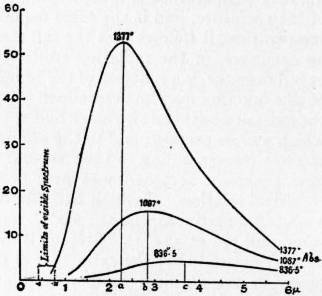
Fig. 7.—Distribution of energy in the spectrum of a black body.
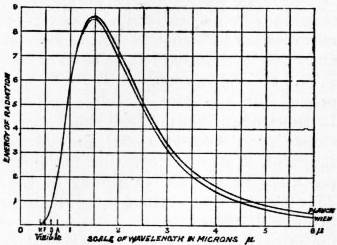
Fig. 8.—Distribution of energy in the spectrum of full radiation at 2000° Abs. according to formulae of Planck & Wien.
where F (λθ) represents some function of the product of the wave-length and temperature, which remains constant for corresponding wave-lengths when θ is changed. If the curves were plotted on a frequency base, owing to the change of scale, the maximum ordinates would vary as the cube of the temperature instead of the fifth power, but the form of the function F would remain unaltered. Reasoning on the analogy of the distribution of velocities among the particles of a gas on the kinetic theory, which is a very similar problem, Wien was led to assume that the function F should be of the form e−c/λθ, where e is the base of Napierian logarithms, and c is a constant having the value 14,600 if the wave-length is measured in microns μ. This expression was found by Paschen to give a very good approximation to the form of the curve obtained experimentally for those portions of the visible and infra-red spectrum where observations could be most accurately made. The formula was tested in two ways: (1) by plotting the curves of distribution of energy in the spectrum for constant temperatures as illustrated in fig. 7; (2) by plotting the energy corresponding to a given wave-length as a function of the temperature. Both methods gave very good agreement with Wien’s formula for values of the product λθ not much exceeding 3000. A method of isolating rays of great wave-length by successive reflection was devised by H. Rubens and E. F. Nichols (Wied. Ann., 1897, 60, p. 418). They found that quartz and fluorite possessed the property of selective reflection for rays of wave-length 8.8μ and 24μ to 32μ respectively, so that after four to six reflections these rays could be isolated from a source at any temperature in a state of considerable purity. The residual impurity at any stage could be estimated by interposing a thin plate of quartz or fluorite which completely reflected or absorbed the residual rays, but allowed the impurity to pass. H. Beckmann, under the direction of Rubens, investigated the variation with temperature of the residual rays reflected from fluorite employing sources from −80° to 600° C., and found the results could not be represented by Wien’s formula unless the constant c were taken as 26,000 in place of 14,600. In their first series of observations extending to 6μ O. R. Lummer and E. Pringsheim (Deut. phys. Ges., 1899, 1, p. 34) found systematic deviations indicating an increase in the value of the constant c for long waves and high temperatures. In a theoretical discussion of the subject, Lord Rayleigh (Phil. Mag., 1900, 49, p. 539) pointed out that Wien’s law would lead to a limiting value Cλ−5, of the radiation corresponding to any particular wave-length when the temperature increased to infinity, whereas according to his view the radiation of great wave-length should ultimately increase in direct proportion to the temperature. Lummer and Pringsheim (Deut. phys. Ges., 1900, 2, p. 163) extended the range of their observations to 18 μ by employing a prism of sylvine in place of fluorite. They found deviations from Wien’s formula increasing to nearly 50% at 18μ, where, however, the observations were very difficult on account of the smallness of the energy to be measured. Rubens and F. Kurlbaum (Ann. Phys., 1901, 4, p. 649) extended the residual reflection method to a temperature range from −190° to 1500° C., and employed the rays reflected from quartz 8.8μ, and rocksalt 51μ, in addition to those from fluorite. It appeared from these researches that the rays of great wave-length from a source at a high temperature tended to vary in the limit directly as the absolute temperature of the source, as suggested by Lord Rayleigh, and could not be represented by Wien’s formula with any value of the constant c. The simplest type of formula satisfying the required conditions is that proposed by Max Planck (Ann. Phys., 1901, 4, p. 553) namely,
E = Cλ−5 (ec/λθ − 1)−1,
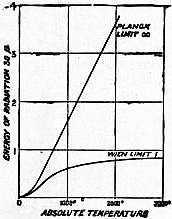
Fig. 9.—Variation of energy of radiation corresponding to wave-length 30μ, with temperature of source.
which agrees with Wien’s formula when θ is small, where Wien’s formula is known to be satisfactory, but approaches the limiting form E = Cλ−4θ/c, when θ is large, thus satisfying the condition proposed by Lord Rayleigh. The theoretical interpretation of this formula remains to some extent a matter of future investigation, but it appears to satisfy experiment within the limits of observational error. In order to compare Planck’s formula graphically with Wien’s, the distribution curves corresponding to both formulae are plotted in fig. 8 for a temperature of 2000° abs., taking the value of the constant c = 14,600 with a scale of wave-length in microns μ. The curves in fig. 9 illustrate the difference between the two formulae for the variation of the intensity of radiation corresponding to a fixed wave-length 30μ. Assuming Wien’s displacement law, the curves may be applied to find the energy for any other wave-length or temperature, by simply altering the wave-length scale in inverse ratio to the temperature, or vice versa. Thus to find the distribution curve for 1000° abs., it is only necessary to multiply all the numbers in the wave-length scale of fig. 8 by 2; or to find the variation curve for wave-length 60μ, the numbers on the temperature scale of fig. 9 should be divided by 2. The ordinate scales must be increased in proportion to the fifth power of the temperature, or inversely as the fifth power of the wave-length respectively in figs. 8 and 9 if comparative results are required for different temperatures or wave-lengths. The results hitherto obtained for cases other than full radiation are not sufficiently simple and definite to admit of profitable discussion in the present article.
Bibliography.—It would not be possible, within the limits of an article like the present, to give tables of the specific thermal properties of different substances so far as they have been ascertained by experiment. To be of any use, such tables require to be extremely detailed, with very full references and explanations with regard to the value of the experimental evidence, and the limits within which the results may be relied on. The quantity of material available is so enormous and its value so varied, that the most elaborate tables still require reference to the original authorities. Much information will be found collected in Landolt and Bornstein’s Physical and Chemical Tables (Berlin, 1905). Shorter tables, such as Everett’s Units and Physical Constants, are useful as illustrations of a system, but are not sufficiently complete for use in scientific investigations. Some of the larger works of reference, such as A. A. Winkelmann’s Handbuch der Physik, contain fairly complete tables of specific properties, but these tables occupy so much space, and are so misleading if incomplete, that they are generally omitted in theoretical textbooks.
Among older textbooks on heat, Tyndall’s Heat may be recommended for its vivid popular interest, and Balfour Stewart’s Heat for early theories of radiation. Maxwell’s Theory of Heat and Tait’s Heat give a broad and philosophical survey of the subject. Among modern textbooks, Preston’s Theory of Heat and Poynting and Thomson’s Heat are the best known, and have been brought well up to date. Sections on heat are included in all the general textbooks of Physics, such as those of Deschanel (translated by Everett), Ganot (translated by Atkinson), Daniell, Watson, &c. Of the original investigations on the subject, the most important have already been cited. Others will be found in the collected papers of Joule, Kelvin and Maxwell. Treatises on special branches of the subject, such as Fourier’s Conduction of Heat, are referred to in the separate articles in this encyclopaedia dealing with recent progress, of which the following is a list: Calorimetry, Condensation of Gases, Conduction of Heat, Diffusion, Energetics, Fusion, Liquid Gases, Radiation, Radiometer, Solution, Thermodynamics, Thermoelectricity, Thermometry, Vaporization. For the practical aspects of heating see Heating.
(H. L. C.)
1 Units of Work, Energy and Power.—In English-speaking countries work is generally measured in foot-pounds. Elsewhere it is generally measured in kilogrammetres, or in terms of the work done in raising 1 kilogramme weight through the height of 1 metre. In the middle of the 19th century the terms “force” and “motive power” were commonly employed in the sense of “power of doing work.” The term “energy” is now employed in this sense. A quantity of energy is measured by the work it is capable of performing. A body may possess energy in virtue of its state (gas or steam under pressure), or in virtue of its position (a raised weight), or in various other ways, when at rest. In these cases it is said to possess potential energy. It may also possess energy in virtue of its motion or rotation (as a fly-wheel or a cannon-ball). In this case it is said to possess kinetic energy, or energy of motion. In many cases the energy (as in the case of a vibrating body, like a pendulum) is partly kinetic and partly potential, and changes continually from one to the other throughout the motion. For instance, the energy of a pendulum is wholly potential when it is momentarily at rest at the top of its swing, but is wholly kinetic when the pendulum is moving with its maximum velocity at the lowest point of its swing. The whole energy at any moment is the sum of the potential and kinetic energy, and this sum remains constant so long as the amplitude of the vibration remains the same. The potential energy of a weight W ℔ raised to a height h ft. above the earth, is Wh foot-pounds. If allowed to fall freely, without doing work, its kinetic energy on reaching the earth would be Wh foot-pounds, and its velocity of motion would be such that if projected upwards with the same velocity it would rise to the height h from which it fell. We have here a simple and familiar case of the conversion of one kind of energy into a different kind. But the two kinds of energy are mechanically equivalent, and they can both be measured in terms of the same units. The units already considered, namely foot-pounds or kilogrammetres, are gravitational units, depending on the force of gravity. This is the most obvious and natural method of measuring the potential energy of a raised weight, but it has the disadvantage of varying with the force of gravity at different places. The natural measure of the kinetic energy of a moving body is the product of its mass by half the square of its velocity, which gives a measure in kinetic or absolute units independent of the force of gravity. Kinetic and gravitational units are merely different ways of measuring the same thing. Just as foot-pounds may be reduced to kilogrammetres by dividing by the number of foot-pounds in one kilogrammetre, so kinetic may be reduced to gravitational units by dividing by the kinetic measure of the intensity of gravity, namely, the work in kinetic units done by the weight of unit mass acting through unit distance. For scientific purposes, it is necessary to take account of the variation of gravity. The scientific unit of energy is called the erg. The erg is the kinetic energy of a mass of 2 gm. moving with a velocity of 1 cm. per sec. The work in ergs done by a force acting through a distance of 1 cm. is the absolute measure of the force. A force equal to the weight of 1 gm. (in England) acting through a distance of 1 cm. does 981 ergs of work. A force equal to the weight of 1000 gm. (1 kilogramme) acting through a distance of 1 metre (100 cm.) does 98.1 million ergs of work. As the erg is a very small unit, for many purposes, a unit equal to 10 million ergs, called a joule, is employed. In England, where the weight of 1 gm. is 981 ergs per cm., a foot-pound is equal to 1.356 joules, and a kilogrammetre is equal to 9.81 joules.
The term power is now generally restricted to mean “rate of working.” Watt estimated that an average horse was capable of raising 550 ℔ 1 ft. in each second, or doing work at the rate of 550 foot-pounds per second, or 33,000 foot-pounds per minute. This conventional horse-power is the unit commonly employed for estimating the power of engines. The horse-power-hour, or the work done by one horse-power in one hour, is nearly 2 million foot-pounds. For electrical and scientific purposes the unit of power employed is called the watt. The watt is the work per second done by an electromotive force of 1 volt in driving a current of 1 ampere, and is equal to 10 million ergs or 1 joule per second. One horse-power is 746 watts or nearly ¾ of a kilowatt. The kilowatt-hour, which is the unit by which electrical energy is sold, is 3.6 million joules or 2.65 million foot-pounds, or 366,000 kilogrammetres, and is capable of raising nearly 19 ℔ of water from the freezing to the boiling point.
2 In an essay on “Heat, Light, and Combinations of Light,” republished in Sir H. Davy’s Collected Works, ii. (London, 1836).
3 For instance a mass of compressed air, if allowed to expand in a cylinder at the ordinary temperature, will do work, and will at the same time absorb a quantity of heat which, as we now know, is the thermal equivalent of the work done. But this work cannot be said to have been produced solely from the heat absorbed in the process, because the air at the end of the process is in a changed condition, and could not be restored to its original state at the same temperature without having work done upon it precisely equal to that obtained by its expansion. The process could not be repeated indefinitely without a continual supply of compressed air. The source of the work in this case is work previously done in compressing the air, and no part of the work is really generated at the expense of heat alone, unless the compression is effected at a lower temperature than the expansion.
4 Clausius (Pogg. Ann. 79, p. 369) and others have misinterpreted this assumption, and have taken it to mean that the quantity of heat required to produce any given change of state is independent of the manner in which the change is effected, which Carnot does not here assume.
5 Carnot’s description of his cycle and statement of his principle have been given as nearly as possible in his own words, because some injustice has been done him by erroneous descriptions and statements.
6 It was for this reason that Professor W. Thomson (Lord Kelvin) stated (Phil. Mag., 1852, 4) that “Carnot’s original demonstration utterly fails,” and that he introduced the “corrections” attributed to James Thomson and Clerk Maxwell respectively. In reality Carnot’s original demonstration requires no correction.
7 In reference to this objection, Tyndall remarks (Phil. Mag., 1862, p. 422; Heat, p. 385); “In the first place the plate of salt nearest the source of heat is never moistened, unless the experiments are of the roughest character. Its proximity to the source enables the heat to chase away every trace of humidity from its surface.” He therefore took precautions to dry only the circumferential portions of the plate nearest the pile, assuming that the flux of heat through the central portions would suffice to keep them dry. This reasoning is not at all satisfactory, because rocksalt is very hygroscopic and becomes wet, even in unsaturated air, if the vapour pressure is greater than that of a saturated solution of salt at the temperature of the plate. Assuming that the vapour pressure of the saturated salt solution is only half that of pure water, it would require an elevation of temperature of 10° C. to dry the rocksalt plates in saturated air at 15° C. It is only fair to say that the laws of the vapour pressures of solutions were unknown in Tyndall’s time, and that it was usual to assume that the plates would not become wetted until the dew-point was reached. The writer has repeated Tyndall’s experiments with a facsimile of one of Tyndall’s tubes in the possession of the Royal College of Science, fitted with plates of rocksalt cut from the same block as Tyndall’s, and therefore of the same hygroscopic quality. Employing a reflecting galvanometer in conjunction with a differential bolometer, which is quicker in its action than Tyndall’s pile, there appears to be hardly any difference between dry and moist air, provided that the latter is not more than half saturated. Using saturated air with a Leslie cube as source of heat, both rocksalt plates invariably become wet in a minute or two and the absorption rises to 10 or 20% according to the thickness of the film of deposited moisture. Employing the open tube method as described by Tyndall, without the rocksalt plates, the absorption is certainly less than 1% in 3 ft. of air saturated at 20° C., unless condensation is induced on the walls of the tube. It is possible that the walls of Tyndall’s tube may have become covered with a very hygroscopic film from the powder of the calcium chloride which he was in the habit of introducing near one end. Such a film would be exceedingly difficult to remove, and would account for the excessive precautions which he found necessary in drying the air in order to obtain the same transmitting power as a vacuum. It is probable that Tyndall’s experiments on aqueous vapour were effected by experimental errors of this character.
HEATH, BENJAMIN (1704-1766), English classical scholar and bibliophile, was born at Exeter on the 20th of April 1704. He was the son of a wealthy merchant, and was thus able to devote himself mainly to travel and book-collecting. He became town clerk of his native city in 1752, and held the office till his death on the 13th of September 1766. In 1763 he had published a pamphlet advocating the repeal of the cider tax in Devonshire, and his endeavours led to success three years later. As a classical scholar he made his reputation by his critical and metrical notes on the Greek tragedians, which procured him an honorary D.C.L. from Oxford (31st of March 1752). He also left MS. notes on Burmann’s and Martyn’s editions of Virgil, on Euripides, Catullus, Tibullus, and the greater part of Hesiod. In some of these he adopts the whimsical name Dexiades Ericius. His Revisal of Shakespear’s Text (1765) was an answer to the “insolent dogmatism” of Bishop Warburton. The Essay towards a Demonstrative Proof of the Divine Existence, Unity and Attributes (1740) was intended to combat the opinions of Voltaire, Rousseau and Hume. Two of his sons (among a family of thirteen) were Benjamin, headmaster of Harrow (1771-1785), and George, headmaster of Eton (1796). His collection of rare classical works formed the nucleus of his son Benjamin’s famous library (Bibliotheca Heathiana).
An account of the Heath family will be found in Sir W. R. Drake’s Heathiana (1882).
HEATH, NICHOLAS (c. 1501-1578), archbishop of York and lord chancellor, was born in London about 1501 and graduated B.A. at Oxford in 1519. He then migrated to Christ’s College, Cambridge, where he graduated B.A. in 1520, M.A. in 1522, and was elected fellow in 1524. After holding minor preferments he was appointed archdeacon of Stafford in 1534 and graduated D.D. in 1535. He then accompanied Edward Fox (q.v.), bishop of Hereford, on his mission to promote a theological and political understanding with the Lutheran princes of Germany. His selection for this duty implies a readiness on Heath’s part to proceed some distance along the path of reform; but his dealings with the Lutherans did not confirm this tendency, and Heath’s subsequent career was closely associated with the cause of reaction. In 1539, the year of the Six Articles, he was made bishop of Rochester, and in 1543 he succeeded Latimer at Worcester. His Catholicism, however, was of a less rigid type than Gardiner’s and Bonner’s; he felt something of the force of the national antipathy to foreign influence, whether ecclesiastical or secular, and was always impressed by the necessity of national unity, so far as was possible, in matters of faith. Apparently he made no difficulty about carrying out the earlier reforms of Edward VI., and he accepted the first book of common prayer after it had been modified by the House of Lords in a Catholic direction.
His definite breach with the Reformation occurred on the grounds, on which four centuries later Leo XIII. denied the Catholicity of the reformed English Church, namely, on the question of the Ordinal drawn up in February 1550. Heath refused to accept it, was imprisoned, and in 1551 deprived of his bishopric. On Mary’s accession he was released and restored, and made president of the council of the Marches and Wales. In 1555 he was promoted to the archbishopric of York, which he did much to enrich after the Protestant spoliation; he built York House in the Strand. After Gardiner’s death he was appointed lord chancellor, probably on Pole’s recommendation; for Heath, like Pole himself, disliked the Spanish party in England. Unlike Pole, however, he seems to have been averse from the excessive persecution of Mary’s reign, and no Protestants were burnt in his diocese. He exercised, however, little influence on Mary’s secular or ecclesiastical policy.
On Mary’s death Heath as chancellor at once proclaimed Elizabeth. Like Sir Thomas More he held that it was entirely within the competence of the national state, represented by parliament, to determine questions of the succession to the throne; and although Elizabeth did not renew his commission as lord chancellor, he continued to sit in the privy council for two months until the government had determined to complete the breach with the Roman Catholic Church; and as late as April 1559 he assisted the government by helping to arrange the Westminster Conference, and reproving his more truculent co-religionists. He refused to crown Elizabeth because she would not have the coronation service accompanied with the elevation of the Host; and ecclesiastical ceremonies and doctrine could not, in Heath’s view, be altered or abrogated by any mere national authority. Hence he steadily resisted Elizabeth’s acts of supremacy and uniformity, although he had acquiesced in the acts of 1534 and 1549. Like others of Henry’s bishops, he had been convinced by the events of Edward VI.’s reign that Sir Thomas More was right and Henry VIII. was wrong in their attitude towards the claims of the papacy and the Catholic Church. He was therefore necessarily deprived of his archbishopric in 1559, but he remained loyal to Elizabeth; and after a temporary confinement he was suffered to pass the remaining nineteen years of his life in peace and quiet, never attending public worship and sometimes hearing mass in private. The queen visited him more than once at his house at Chobham, Surrey; he died and was buried there at the end of 1578.
Authorities.—Letters and Papers of Henry VIII.; Acts of the Privy Council; Cal. State Papers, Domestic, Addenda, Spanish and Venetian; Kemp’s Loseley MSS.; Froude’s History; Burnet, Collier, Dixon and Frere’s Church Histories; Strype’s Works (General Index); Parker Soc. Publications (Gough’s Index); Birt’s Elizabethan Settlement.
(A. F. P.)
HEATH, WILLIAM (1737-1814), American soldier, was born in Roxbury, Massachusetts, on the 2nd of March 1737 (old style). He was brought up as a farmer and had a passion for military exercises. In 1765 he entered the Ancient and Honourable Artillery Company of Boston, of which he became commander in 1770. In the same year he wrote to the Boston Gazette letters signed “A Military Countryman,” urging the necessity of military training. He was a member of the Massachusetts General Court from 1770 to 1774, of the provincial committee of safety, and in 1774-1775 of the provincial congress. He was commissioned a provincial brig.-general in December 1774, directed the pursuit of the British from Concord (April 19, 1775), was promoted to be provincial major-general on the 20th of June 1775, and two days later was commissioned fourth brig.-general in the Continental Army. He became major-general on the 9th of August 1776, and was in active service around New York until early the next year. In January 1777 he attempted to take Fort Independence, near Spuyten Duyvil, then garrisoned by about 2000 Hessians, but at the first sally of the garrison his troops became panic-stricken and a few days later he withdrew. Washington reprimanded him and never again entrusted to him any important operation in the field. Throughout the war, however, Heath was very efficient in muster service and in the barracks. From March 1777 to October 1778 he was in command of the Eastern Department with headquarters at Boston, and had charge (Nov. 1777-Oct. 1778) of the prisoners of war from Burgoyne’s army held at Cambridge, Massachusetts. In May 1779 he was appointed a commissioner of the Board of War. He was placed in command of the troops on the E. side of the Hudson in June 1779, and of other troops and posts on the Hudson in November of the same year. In July 1780 he met the French allies under Rochambeau on their arrival in Rhode Island; in October of the same year he succeeded Arnold in command of West Point and its dependencies; and in August 1781, when Washington went south to meet Cornwallis, Heath was left in command of the Army of the Hudson to watch Clinton. After the war he retired to his farm at Roxbury, was a member of the state House of Representatives in 1788, of the Massachusetts convention which ratified the Federal Constitution in the same year, and of the governor’s council in 1789-1790, was a state senator (1791-1793), and in 1806 was elected lieutenant-governor of Massachusetts but declined to serve. He died at Roxbury on the 24th of January 1814, the last of the major-generals of the War of American Independence.
See Memoirs of Major-General Heath, containing Anecdotes, Details of Skirmishes, Battles and other Military Events during the American War, written by Himself (Boston, 1798; frequently reprinted, perhaps the best edition being that published in New York in 1901 by William Abbatt), particularly valuable for the descriptions of Lexington and Bunker Hill, of the fighting around New York, of the controversies with Burgoyne and his officers during their stay in Boston, and of relations with Rochambeau; and his correspondence, The Heath Papers, vols. iv.-v., seventh series, Massachusetts Historical Society Collections (Boston, 1904-1905).
HEATH, the English form of a name given in most Teutonic dialects to the common ling or heather (Calluna vulgaris), but now applied to all species of Erica, an extensive genus of monopetalous plants, belonging to the order Ericaceae. The heaths are evergreen shrubs, with small narrow leaves, in whorls usually set rather thickly on the shoots; the persistent flowers have 4 sepals, and a 4-cleft campanulate or tubular corolla, in many species more or less ventricose or inflated; the dry capsule is 4-celled, and opens, in the true Ericae, in 4 segments, to the middle of which the partitions adhere, though in the ling the valves separate at the dissepiments. The plants are mostly of low growth, but several African kinds reach the size of large bushes, and a common South European species, E. arborea, occasionally attains almost the aspect and dimensions of a tree.
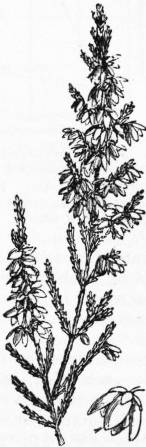
Fig. 1.
Calluna vulgaris.
One of the best known and most interesting of the family is the common heath, heather or ling, Calluna vulgaris (fig. 1), placed by most botanists in a separate genus on account of the peculiar dehiscence of the fruit, and from the coloured calyx, which extends beyond the corolla, having a whorl of sepal-like bracts beneath. This shrub derives some economic importance from its forming the chief vegetation on many of those extensive wastes that occupy so large a portion of the more sterile lands of northern and western Europe, the usually desolate appearance of which is enlivened in the latter part of summer by its abundant pink blossoms. When growing erect to the height of 3 ft. or more, as it often does in sheltered places, its purple stems, close-leaved green shoots and feathery spikes of bell-shaped flowers render it one of the handsomest of the heaths; but on the bleaker elevations and more arid slopes it frequently rises only a few inches above the ground. In all moorland countries the ling is applied to many rural purposes; the larger stems are made into brooms, the shorter tied up into bundles that serve as brushes, while the long trailing shoots are woven into baskets. Pared up with the peat about its roots it forms a good fuel, often the only one obtainable on the drier moors. The shielings of the Scottish Highlanders were formerly constructed of heath stems, cemented together with peat-mud, worked into a kind of mortar with dry grass or straw; hovels and sheds for temporary purposes are still sometimes built in a similar way, and roofed in with ling. Laid on the ground, with the flowers above, it forms a soft springy bed, the luxurious couch of the ancient Gael, still gladly resorted to at times by the hill shepherd or hardy deer-stalker. The young shoots were in former days employed as a substitute for hops in brewing, while their astringency rendered them valuable as a tanning material in Ireland and the Western Isles. They are said also to have been used by the Highlanders for dyeing woollen yarn yellow, and other colours are asserted to have been obtained from them, but some writers appear to confuse the dyer’s-weed, Genista tinctoria, with the heather. The young juicy shoots and the seeds, which remain long in the capsules, furnish the red grouse of Scotland with the larger portion of its sustenance; the ripe seeds are eaten by many birds. The tops of the ling afford a considerable part of the winter fodder of the hill flocks, and are popularly supposed to communicate the fine flavour to Welsh and Highland mutton, but sheep seldom crop heather while the mountain grasses and rushes are sweet and accessible. Ling has been suggested as a material for paper, but the stems are hardly sufficiently fibrous for that purpose. The purple or fine-leaved heath, E. cinerea (fig. 2), one of the most beautiful of the genus, abounds on the lower moors and commons of Great Britain and western Europe, in such situations being sometimes more prevalent than the ling. The flowers of both these species yield much honey, furnishing a plentiful supply to the bees in moorland districts; from this heath honey the Picts probably brewed the mead said by Boetius to have been made from the flowers themselves.
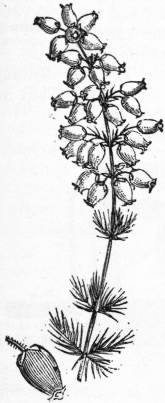
Fig. 2.
Erica cinerea.
The genus contains about 420 known species, by far the greater part being indigenous to the western districts of South Africa, but it is also a characteristic genus of the Mediterranean region, while several species extend into northern Europe. No species is native in America, but ling occurs as an introduced plant on the Atlantic side from Newfoundland to New Jersey. Five species occur in Britain: E. cinerea, E. tetralix (cross-leaved heath), both abundant on heaths and commons, E. vagans, Cornish heath, found only in West Cornwall, E. ciliaris in the west of England and Ireland and E. mediterranea in Ireland. The three last are south-west European species which reach the northern limit of their distribution in the west of England and Ireland. E. scoparia is a common heath in the centre of France and elsewhere in the Mediterranean region, forming a spreading bush several feet high. It is known as bruyère, and its stout underground rootstocks yield the briar-wood used for pipes.
The Cape heaths have long been favourite objects of horticulture. In the warmer parts of Britain several will bear exposure to the cold of ordinary winters in a sheltered border, but most need the protection of the conservatory. They are sometimes raised from seed, but are chiefly multiplied by cuttings “struck” in sand, and afterwards transferred to pots filled with a mixture of black peat and sand; the peat should be dry and free from sourness. Much attention is requisite in watering heaths, as they seldom recover if once allowed to droop, while they will not bear much water about their roots: the heath-house should be light and well ventilated, the plants requiring sun, and soon perishing in a close or permanently damp atmosphere; in England little or no heat is needed in ordinary seasons. The European heaths succeed well in English gardens, only requiring a peaty soil and sunny situation to thrive as well as in their native localities: E. carnea, mediterranea, ciliaris, vagans, and the pretty cross-leaved heath of boggy moors, E. Tetralix, are among those most worthy of cultivation. The beautiful large-flowered St Dabeoc’s heath, belonging to the closely allied genus Dabeocia, is likewise often seen in gardens. It is found in boggy heaths in Connemara and Mayo, and is also native in West France, Spain and the Azores.
A beautiful work on heaths is that by H. C. Andrews, containing coloured engravings of nearly 300 species and varieties, with descriptions in English and Latin (4 vols., 1802-1805).
HEATHCOAT, JOHN (1783-1861), English inventor, was born at Duffield near Derby on the 7th of August 1783. During his apprenticeship to a framesmith near Loughborough, he made an improvement in the construction of the warp-loom, so as to produce mitts of a lace-like appearance by means of it. He began business on his own account at Nottingham, but finding himself subjected to the intrusion of competing inventors he removed to Hathern. There in 1808 he constructed a machine capable of producing an exact imitation of real pillow-lace. This was by far the most expensive and complex textile apparatus till then existing; and in describing the process of his invention Heathcoat said in 1836, “The single difficulty of getting the diagonal threads to twist in the allotted space was so great that, if now to be done, I should probably not attempt its accomplishment.” Some time before perfecting his invention, which he patented in 1809, he removed to Loughborough, where he entered into partnership with Charles Lacy, a Nottingham manufacturer; but in 1816 their factory was attacked by the Luddites and their 55 lace frames destroyed. The damages were assessed in the King’s Bench at £10,000; but as Heathcoat declined to expend the money in the county of Leicester he never received any part of it. Undaunted by his loss, he began at once to construct new and greatly improved machines in an unoccupied factory at Tiverton, Devon, propelling them by water-power and afterwards by steam. His claim to the invention of the twisting and traversing lace machine was disputed, and a patent was taken out by a clever workman for a similar machine, which was decided at a trial in 1816 to be an infringement of Heathcoat’s patent. He followed his great invention by others of much ability, as, for instance, contrivances for ornamenting net while in course of manufacture and for making ribbons and platted and twisted net upon his machines, improved yarn spinning-frames, and methods for winding raw silk from cocoons. He also patented an improved process for extracting and purifying salt. An offer of £10,000 was made to him in 1833 for the use of his processes in dressing and finishing silk nets, but he allowed the highly profitable secret to remain undivulged. In 1832 he patented a steam plough. Heathcoat was elected member of parliament for Tiverton in 1832. Though he seldom spoke in the House he was constantly engaged on committees, where his thorough knowledge of business and sound judgment were highly valued. He retained his seat until 1859, and after two years of declining health he died on the 18th of January 1861 at Bolham House, near Tiverton.
HEATHCOTE, SIR GILBERT (c. 1651-1733), lord mayor of London, belonged to an old Derbyshire family and was educated at Christ’s College, Cambridge, afterwards becoming a merchant in London. His trading ventures were very successful; he was one of the promoters of the new East India company and he emerged victorious from a contest between himself and the old East India company in 1693; he was also one of the founders and first directors of the bank of England. In 1702 he became an alderman of the city of London and was knighted; he served as lord mayor in 1711, being the last lord mayor to ride on horseback in his procession. In 1700 Heathcote was sent to parliament as member for the city of London, but he was soon expelled for his share in the circulation of some exchequer bills; however, he was again elected for the city later in the same year, and he retained his seat until 1710. In 1714 he was member for Helston, in 1722 for New Lymington, and in 1727 for St Germans. He was a consistent Whig, and was made a baronet eight days before his death. Although extremely rich, Heathcote’s meanness is referred to by Pope; and it was this trait that accounts largely for his unpopularity with the lower classes. He died in London on the 25th of January 1733 and was buried at Normanton, Rutland, a residence which he had purchased from the Mackworths.
A descendant, Sir Gilbert John Heathcote, Bart. (1795-1867), was created Baron Aveland in 1856; and his son Gilbert Henry, who in 1888 inherited from his mother the barony of Willoughby de Eresby, became 1st earl of Ancaster in 1892.
HEATHEN, a term originally applied to all persons or races who did not hold the Jewish or Christian belief, thus including Mahommedans. It is now more usually given to polytheistic races, thus excluding Mahommedans. The derivation of the word has been much debated. It is common to all Germanic languages; cf. German Heide, Dutch heiden. It is usually ascribed to a Gothic haiþi, heath. In Ulfilas’ Gothic version of the Bible, the earliest extant literary monument of the Germanic languages, the Syrophoenician woman (Mark vii. 26) is called haiþno, where the Vulgate has gentilis. “Heathen,” i.e. the people of the heath or open country, would thus be a translation of the Latin paganus, pagan, i.e. the people of the pagus or village, applied to the dwellers in the country where the worship of the old gods still lingered, when the people of the towns were Christians (but see Pagan for a more tenable explanation of that term). On the other hand it has been suggested (Prof. S. Bugge, Indo-German. Forschungen, v. 178, quoted in the New English Dictionary) that Ulfilas may have adopted the word from the Armenian hetanos, i.e. Greek ἔθνη, tribes, races, the word used for the “Gentiles” in the New Testament. Gentilis in Latin, properly meaning “tribesman,” came to be used of foreigners and non-Roman peoples, and was adopted in ecclesiastical usage for the non-Christian nations and in the Old Testament for non-Jewish races.
HEATHFIELD, GEORGE AUGUSTUS ELIOTT, Baron (1717-1790), British general, a younger son of Sir Gilbert Eliott, Bart., of Stobs, Roxburghshire, was born on the 25th of December 1717, and educated abroad for the military profession. As a volunteer he fought with the Prussian army in 1735 and 1736, and then entered the Grenadier Guards. He went through the war of the Austrian Succession, and was wounded at Dettingen, rising to be lieutenant-colonel in 1754. In 1759 he became colonel of a new regiment of light horse (afterwards the 15th Hussars) and became well known for the efficiency which it displayed in the subsequent campaigns. He became lieutenant-general in 1765. In 1775 he was selected to be governor of Gibraltar (q.v.), and it is in connexion with his magnificent defence in the great siege of 1779 that his name is famous. His portrait by Sir Joshua Reynolds is in the National Gallery. In 1787 he was created Baron Heathfield of Gibraltar, but died on the 6th of July 1790. He had married in 1748 the heiress of the Drake family, to which Sir Francis Drake belonged. His son, the 2nd baron, died in 1813 and the peerage became extinct, but the estates went to the family of Eliott-Drake (baronetcy of 1821) through his sister.
HEATING. In temperate latitudes the climate is generally such as to necessitate in dwellings during a great portion of the year a temperature warmer than that out of doors. The object of the art of heating is to secure this required warmth with the greatest economy and efficiency. For reasons of health it may be assumed that no system of heating is advisable which does not provide for a constant renewal of the air in the locality warmed, and on this account there is a difficulty in treating as separate matters the subjects of heating and ventilation, which in practical schemes should be considered conjointly. (See Ventilation).
The object of all heating apparatus is the transference of heat from the fire to the various parts of the building it is intended to warm, and this transfer may be effected by radiation, by conduction or by convection. An open fire acts by radiation; it warms the air in a room by first warming the walls, floor, ceiling and articles in the room, and these in turn warm the air. Therefore in a room with an open fire the air is, as a rule, less heated than the walls. In many forms of fireplaces fresh air is brought in and passed around the back and sides of the stove before being admitted into the room. A closed stove acts mainly by convection; though when heated to a high temperature it gives out radiant heat. Windows have a chilling effect on a room, and in calculations extra allowance should be made for window areas.
There are a number of methods available for adoption in the heating of buildings, but it is a matter of considerable difficulty to suit the method of warming to the class of building to be warmed. Heating may be effected by one of the following systems, or installations may be so arranged as to combine the advantages of more than one method: open fires, closed stoves, hot-air apparatus, hot water circulating in pipes at low or at high pressure, or steam at high or low pressure.
The open grate still holds favour in England, though in America and on the continent of Europe it has been superseded by the closed stove. The old form of open fire is certainly wasteful of fuel, and the loss of heat up the Open fires. chimney and by conduction into the brickwork backing of the stove is considerable. Great improvements, however, have been effected in the design of open fireplaces, and many ingenious contrivances of this nature are now in the market which combine efficiency of heating with economy of fuel. Unless suitable fresh air inlets are provided, this form of stove will cause the room to be draughty, the strong current of warm air up the flue drawing cold air in through the crevices in the doors and windows. The best form of open fireplace is the ventilating stove, in which fresh air is passed around the back and sides of the stove before being admitted through convenient openings into the room. This has immense advantages over the ordinary type of fireplace. The illustrations show two forms of ventilating fireplace, one (fig. 1) similar in appearance to the ordinary domestic grate, the other (fig. 2) with descending smoke flue suitable for hospitals and public rooms, where it might be fixed in the middle of the apartment. The fixing of stoves of this kind entails the laying of pipes or ducts from the open to convey fresh air to the back of the stove.
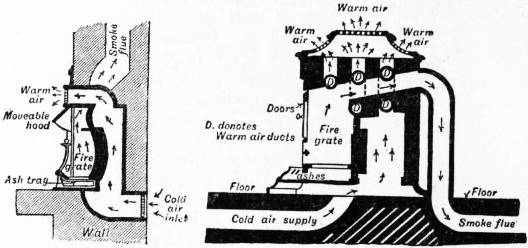
Fig. 1. Fig. 2.
With closed stoves much less heat is wasted, and consequently less fuel is burned, than with open grates, but they often cause an unpleasant sensation of dryness in the air, and the products of combustion also escape to some extent, Closed stoves. rendering this method of heating not only unpleasant but sometimes even dangerous. The method in Great Britain is almost entirely confined to places of public assembly, but in America and on the continent of Europe it is much used for domestic heating. If the flue pipe be carried up a considerable distance inside the apartment to be warmed before being turned into the external air, practically the whole of the heat generated will be utilized. Charcoal, coke or anthracite coal are the fuels generally used in slow combustion heating stoves.
Gas fires, as a substitute for the open coal fire, have many points in their favour, for they are conducive to cleanliness, they need but little attention, and the heat is easily controlled. On the other hand, they may give off unhealthy Gas fires. fumes and produce unpleasant odours. They usually take the form of cast iron open stoves fitted with a number of Bunsen burners which heat perforated lumps of asbestos. The best form of stove is that with which perfect combustion is most nearly attained, and to which a pan of water is affixed to supply a desirable humidity to the air, the gas having the effect of drying the atmosphere. With another form of gas stove coke is used in place of the perforated asbestos; the fire is started with the gas, which, when the coke is well alight, may be dispensed with, and the fire kept up with coke in the usual way.
Electrical heating appliances have only recently passed the experimental stage; there is, however, undoubtedly a great future for electric heating, and the perfecting of the Electrical heating. stove, together with the cheapening of the electric current, may be expected to result in many of the other stoves and convectors being superseded. Hitherto the large bill for electric energy has debarred the general use of electrical heating, in spite of its numerous advantages.
Oils are powerful fuels, but the high price of refined petroleum, the oil generally preferred, precludes its widespread use for many purposes for which it is suitable. In small stoves for warming and for cooking, petroleum presents Oil stoves. some advantages over other fuels, in that there is no chimney to sweep, and if well managed no unpleasant fumes, and the stoves are easily portable. On the other hand, these stoves need a considerable amount of attention in filling, trimming and cleaning, and there is some risk of explosion and damage by accidental leaking and smoking. Crude or unrefined petroleum needs a special air-spray pressure burner for its use, and this suffers from the disadvantage of being noisy. Gas and oil radiators would be more properly termed “convectors,” since they warm mainly by converted currents. They are similar in appearance to a hot-water or steam radiator, and, indeed, some are designed to be filled with water and used as such. They should always be fitted with a pan of water to supply the necessary humidity to the warmed air, and a flue to carry off any disagreeable fumes.
Heating by warmed air, one of the oldest methods in use, has been much improved by attention to the construction of the apparatus, and if properly installed will give as good effects as it is possible to obtain. The system Warm air. is especially suitable for churches, assembly halls and large rooms. A stove of special design is placed in a chamber in the basement or cellar, and cold fresh air is passed through it, and led by means of flues to the various apartments for distribution by means of easily regulated inlet valves. To prevent the atmosphere from becoming unduly dry a pan of water is fitted to the stove; this serves to moisten the air before it passes into the distributing flues. If each distributing flue is connected by means of a mixing valve with a cold-air flue, the warmth of the incoming air can be regulated to a nicety (see Ventilation).
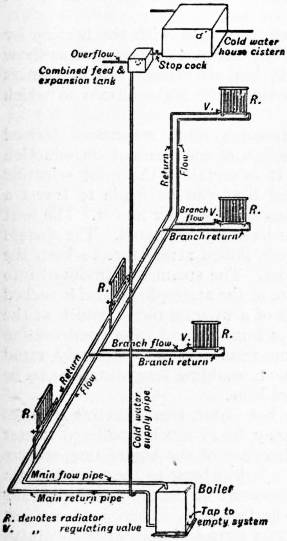
Fig. 3.
There are many different systems of heating by hot water circulating in pipes. The oldest and best known is the “two pipe” system, others being the “one pipe” or “simple circuit,” and the “drop” or “overhead.” The high Low pressure hot water. pressure system is of later invention, having been first put to practical use by A. M. Perkins in 1845. All these methods warm chiefly by means of convected heat, the amount of true radiation from the pipes being small. The manner in which the circulation of hot water takes place in the tubes is as follows. Fire heats the water in a boiler from the top of which a “flow” pipe communicates with the rooms to be warmed (fig. 3). As the water is heated it becomes lighter, rises to the top of the boiler, and passes along the flow pipe. It is followed by more and more hot water, and so travels along the flow pipe, which is rising all the time, to the farthest point of the circuit, by which time it has in all probability cooled considerably. From this point the “return” pipe drops, usually at the same rate as the flow pipe rises; and in due course the water reaches its starting point, the boiler, and is again heated and again circulated through the system. The connexion of the return pipe is made with the lower part of the boiler. Branches may be made from the main pipes by means of smaller pipes arranged in the same manner as the mains, the branch flow pipe being connected with the main flow pipe and returning into the main return. To obtain a larger heating surface than a pipe affords, radiators are connected with the pipes where desired, and the water passing through them warms the surrounding air.
The “one pipe” system (fig. 4) acts on precisely the same principle, but in place of two pipes being placed in adjacent positions one large main makes a complete circuit of the area to be warmed, starting from and returning to the boiler, and from this main flow and return branches are taken and connected with radiators and other heating appliances.
In the “drop” or “overhead” system (fig. 5) a rising main is taken directly from the boiler to the topmost floor of the building, and from this branches are dropped to the lower floors, and connected by means of smaller branches to radiators or coils. The vertical branches descend to the basement and generally merge in a single return pipe which is connected to the lower part of the boiler.
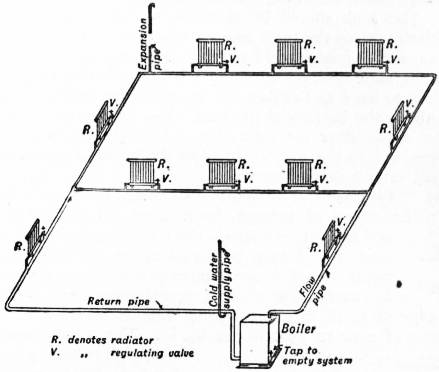
Fig. 4.
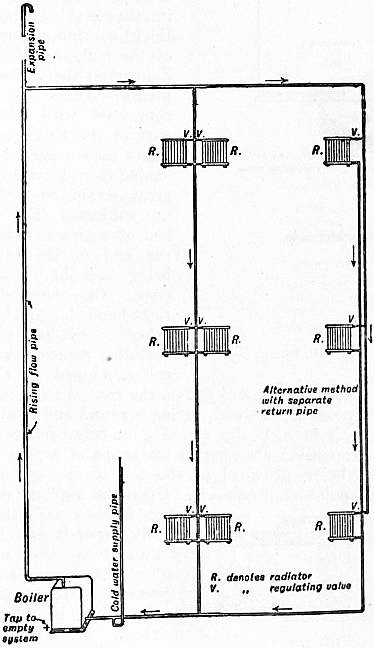
Fig. 5.
The rate of circulation in the ordinary low pressure hot-water system may be considerably accelerated by means of steam injections. The water after being heated passes into a circulating tank into which steam is introduced; this, mixing with the hot water, gives it additional motive power, resulting in a faster circulation. This steam condensing adds to the water in the pipe and naturally causes an overflow, which is led back to the boiler and re-used. In districts where the water is hard, this arrangement considerably lengthens the life of the boiler, as the same water is used over and over again, and no fresh deposit of fur occurs. Owing to the very rapid movement and the consequent increased rate of transmission of heat, the pipes and radiators may be reduced in size, in many circumstances a very desirable thing to achieve. With this system the temperature can be quickly raised and easily controlled. If the weather is mild, a moderate heat may be obtained by using the apparatus as an ordinary hot water system, and shutting off the steam injectors.
The cold-water supply and expansion tank (fig. 3) are often combined in one tank placed at a point above the level of circulation. The tank should be of a size to hold not less than a twentieth part of the total amount of water held in the system. The automatic inlet of cold water to the hot water system from the main house tank or other source is controlled by a ball valve, which is so fixed as to allow the water to rise no more than an inch above the bottom of the tank, thus leaving the remainder of the space clear for expansion. An overflow is provided, discharging into the open air to allow the water to escape should the ball valve become defective.
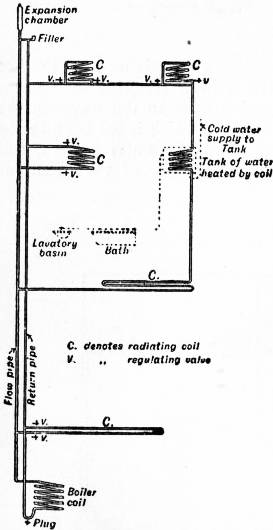
Fig. 6.
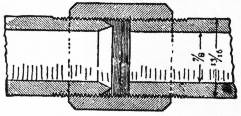
Fig. 7.
The “Perkins” or “small bore high pressure” system (fig. 6) has many advantages, for it is safe, the boiler is small and is easily managed, the temperature is well under control and may be regulated to suit the changing High pressure hot water. weather, and the small pipes present a neat appearance in a room. The whole system is constructed of wrought iron pipe of small diameter, strong enough to resist a testing pressure of 2000 to 2500 ℔ per sq. in. The boiler consists of similar pipe coiled up to form a fire-box, inside which the furnace is lighted. The coil is encased with firebricks and brickwork, and the smoke from the fire is carried off by a flue in the ordinary way. The flow pipe of similar section (usually having an internal diameter of about 1 in., the metal being nearly ¼ in. thick) continues from the top of the coil, and after travelling round the various apartments returns to, and is connected with, the lowest part of the boiler coil. The joints take a special form to enable them to withstand the great strain to which they are subjected (fig. 7). One end of a pipe is finished flat, the end of the other pipe being brought to a conical edge. On one end also a right-handed, and on the other a left-handed, screw-thread is turned. A coupling collar, tapped in the same manner, is screwed on, and causes the conical edge to impress itself tightly on the flat end, giving a sound and lasting joint. The system is hermetically sealed after being pumped full of water, an expansion chamber in the shape of a pipe of larger dimensions being provided at the top of the system above the highest point of circulation. Upon the application of heat to the fire-box coil the water naturally expands and forces its way up into the expansion chamber; but there it encounters the pressure of the confined air, and ebullition is consequently prevented. Thus at no time can steam form in the system. This system is trustworthy and safe in working. The smallness of the pipes renders it liable to damage by frost, but this accident may be prevented by always keeping in frosty weather a small fire in the furnace. If this course is inconvenient, some liquid of low freezing-point, such as glycerine, may be mixed with the water.
For large public buildings, factories, &c., heating by steam is generally adopted on account of the rapidity with which heat is available, and the great distance from the boiler at which warming is effected. In the case of factories Steam heating. the exhaust steam from the engines used for driving the working machinery is made use of and forms the most economical method of heating possible. There are several different systems of heating by steam—low pressure, high pressure and minus pressure.
In the low pressure two pipe system the flow pipe is carried to a sufficient height directly above the boiler to allow of its gradual fall to a little beyond the most distant point at which connexion is to be made with the return pipe, which thence slopes towards the boiler. Branches are taken off the flow pipe, and after circulating through coils or radiators are connected with the return pipe. In a well-proportioned system the pressure need not exceed 2 or 3 ℔ per sq. in. for excellent results to be obtained. The one-pipe system is similar in principle, the pipe rising to its greatest height above the boiler and being then carried around as a single pipe falling all the while. It resembles in many points the one-pipe low pressure hot-water system. Radiators are fed directly from the main. Where, as in factories or workshops, there are already installed engines working at a high steam pressure, say 120 to 180 ℔ per sq. in., a portion of the steam generated in the boilers may be utilized for heating by the aid of a reducing valve. The steam is passed through the valve and emerges at the pressure required generally from 3 ℔ upwards. It is then used for one of the systems described above.
High-pressure steam-heating, compared with the heating by low pressure, is little used. The principles are the same as those applied to low-pressure work, but all fittings and appliances must, of course, be made to stand the higher strain to which they are subjected.
The “minus pressure” steam system, sometimes termed “atmospheric” or “vacuum,” is of more recent introduction than those just described. It is certainly the most scientific method of steam-heating, and heat can be made to travel a greater distance by its aid than by any other means. The heat of the pipes is great, but can be easily regulated. The system is economical in fuel, but needs skilled attendance to keep the appliances and fittings in order. The steam is introduced into the pipes at about the pressure of the atmosphere, and is sucked through the system by means of a vacuum pump, which at the same operation frees the pipes from air and from condensation water. This pumping action results in an extremely rapid circulation of the heating agent, enabling long distances to be traversed without much loss of heat.
Compared with heating by hot water, steam-heating requires less piping, which, further, may be of much smaller diameter to attain a similar result, because of the higher temperature of the heat yielding surface. A drawback to the use of steam is the fact that the high temperature of the pipes and radiators attracts and spreads a great deal of dust. There is also a risk that woodwork near the pipes may warp and split. The apparatus needs constant attention, since neglect in stoking would result in stopping the generation of steam, and the whole system would almost immediately cool. To regulate the heat it is necessary either to instal a number of small radiators or to divide the radiators into sections, each section controlled by distinct valves; steam may then be admitted to all the sections of the radiator or to any less number of sections as desired. In a hot-water system the heat is given off at a lower temperature and is consequently more agreeable than that yielded by a steam-heating apparatus. The joint most commonly used for hot-water pipes is termed the “rust” joint, which is cheap to make, but unfortunately is inefficient. The materials required are iron borings, sal-ammoniac and sulphur; these are mixed together, moistened with water, and rammed into the socket, which is previously half filled with yarn, well caulked. The materials mixed with the iron borings cause them to rust into a solid mass, and in doing so a slight expansion takes place. On this account it is necessary to exercise some skill in forming the joint, or the socket of the pipe will be split; numbers of pipes are undoubtedly spoilt in this way. Suitable proportions of materials to form a rust joint are 90 parts by weight of iron borings well mixed with 2 parts of flowers of sulphur, and 1 part of powdered sal-ammoniac. Another joint, less rigid but sound and durable, is made with yarn and white and red lead. The white and red lead are mixed together to form a putty, and are filled into the socket alternately with layers of well-caulked yarn, starting with yarn and finishing off with the lead mixture.
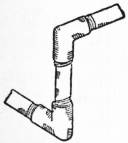
Fig. 8.
Iron expands when heated to the temperature of boiling water (212° F.) about 1 part in 900, that is to say, a pipe 100 ft. long would expand or increase in length when heated to this temperature about 1½ in., an amount Joints for pipes. which seems small but which would be quite sufficient to destroy one or more of the joints if provision were not made to prevent damage. The amount of expansion increases as the temperature is raised; at 340° F. it is 2½ in. in 100 ft. With wrought iron pipes bends may be arranged, as shown in fig. 8, to take up this expansion. With cast iron pipe this cannot be done, and no length of piping over 40 ft. should be without a proper expansion joint. The pipes are best supported on rollers which allow of movement without straining the joints.
There are several joints in general use for the best class of work which are formed with the aid of india-rubber rings or collars, any expansion being divided amongst the whole number of joints. In the rubber ring joint an india-rubber ring is used; slightly less in diameter than the pipe. The rubber is circular in section, and about ½ in. thick, and is stretched on the extreme end of a pipe which is then forced into the next socket. This joint is durable, secure and easily made; it allows for expansion and by its use the risk of pipe sockets being cracked is avoided. It is much used for greenhouse heating works. Richardson’s patent joint (fig. 9) is a good form of this class of joint. The pipes have specially shaped ends between which a rubber collar is placed, the joint being held together by clips. The result is very satisfactory and will stand heavy water pressure. Messenger’s joint (fig. 10) is designed to allow more freedom of expansion and at the same time to withstand considerable pressure; one loose cast iron collar is used, and another is formed as a socket on the end of the pipe itself. One end of each pipe is plain, so that it may be cut to any desired length; pipes with shaped ends obviously must be obtained in the exact lengths required. Jones’s expansion joint (fig. 11) is somewhat similar to Messenger’s but it is not capable of withstanding so great a pressure. In this case both collars of cast iron are loose.
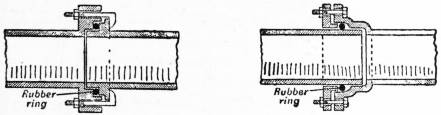
Fig. 9. Fig. 10.
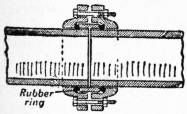
Fig. 11.
Radiators (really convectors) were in their primitive design coils of pipe, used to give a larger heating area than the single pipe would afford. They are now usually of special design, and may be divided into three classes—indirect Radiators. radiators, direct radiators and direct ventilating radiators. Indirect radiators are placed beneath the floor of the apartment to be heated and give off heat through a grating. This method is frequently adopted in combined schemes of heating and ventilating; the fresh air is warmed by being passed over their surfaces previously to being admitted through the gratings into the room. Direct radiators are a development of the early coil of pipe; they are made in various types and designs and are usually of cast iron. Ventilating radiators are similar, but have an inlet arrangement at the base to allow external air to pass over the heating surface before passing out through the perforations. Radiators should not be fixed directly on to the main heating pipe, but always on branches of smaller diameter leading from the flow pipe to one end of the radiator and back to the main return pipe from the other end; they may then be easily controlled by a valve placed on the branch from the flow pipe. To each radiator should be fitted an air tap, which when opened will permit the escape of any air that has accumulated in the coil; otherwise free circulation is impossible, and the full benefit of the heat is not obtained.
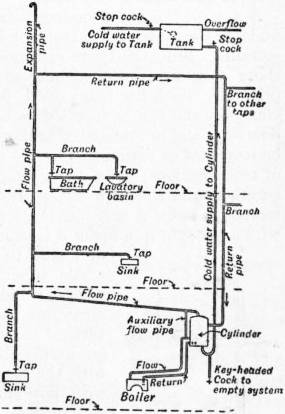
Fig. 12.
A plentiful supply of hot water is a necessity in every house for domestic and hygienic purposes. In small houses all requirements may be satisfied with a boiler heated by the kitchen fire. For large buildings where large quantities Hot-water supply. of hot water are used an independent boiler of suitable size should be installed. Every installation is made up of a boiler or other water heater, a tank or cylinder to contain the water when heated, and a cistern of cold water, the supply from which to the system is regulated automatically by a ball valve. These containers, proportioned to the required supply of hot water, are connected with each other by means of pipes, a “flow” and a “return” connecting the boiler with the cylinder or tank (fig. 12). The flow pipe starts from the top of the boiler and is connected near the top of the cylinder, the return pipe joining the lower portions of the cylinder and boiler. The supply from the cold water cistern enters the bottom of the cylinder, and thence travels by way of the return pipe to the boiler, where it is heated, and back through the flow pipe to the cylinder, which is thus soon filled with hot water. A flow pipe which serves also for expansion is taken from the top of the cylinder to a point above the cold-water supply and turned down to prevent the ingress of dirt. From this pipe at various points are taken the supply pipes to baths, lavatories, sinks and other appliances. It will be observed that in fig. 12 the cylinder is placed in proximity to the boiler; this is the usual and most effective method, but it may be placed some distance away if desired. The tank system is of much earlier date than this cylinder system, and although the two resemble each other in many respects, the tank system is in practice the less effective. The tank is placed above the level of the topmost draw off, and often in a cupboard which it will warm sufficiently to permit of its being used as a linen airing closet. An expansion pipe is taken from the top of the tank to a point above the roof. All draw off services are taken off from the flow pipe which connects the boiler with the tank. This method differs from that adopted in the cylinder system, where all services are led from the top of the cylinder. A suitable proportion between the size of the tank or cylinder and that of the boiler is 8 or 10 to 1. Water may also be heated by placing a coil of steam or high-pressure hot-water pipes in a water tank (fig. 6), the water heated in this way circulating in the manner already described. An alternative plan is to pass the water through pipes placed in a steam chest.
Cylinders, tanks and independent boilers should be encased in a non-conducting material such as silicate cotton, thick felt or asbestos composition. The two first mentioned are affixed by means of bands or straps or stitched on; the asbestos is laid on in the form of a plaster from 2 to 6 in. thick.
Taps to baths and lavatories should be connected to the main services by a flow and return pipe so that hot water is constantly flowing past the tap, thus enabling hot water to be obtained immediately. Frequently a single pipe is led to the tap, but the water in this branch cools and must therefore be drawn off before hot water can be obtained.
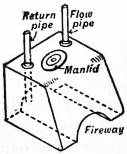
Fig. 13.
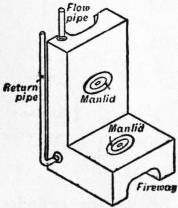
Fig. 14.
Two classes of boilers are chiefly used in hot-water heating installations, viz. those heated by the fire of the kitchen range, and those heated separately or independently. Of the first class there are two varieties in common use—a Boilers. form of “saddle” boiler (fig. 13) and the “boot” boiler (fig. 14). Independent boilers are made in every conceivable size and form of construction, and many of them are capable of doing excellent work. In the choice of a boiler of this description it should be remembered that rapid heating, economical combustion of fuel, and facilities for cleaning, are requisites, the absence of any of which considerably lowers the efficiency of the apparatus. Boilers set in brickwork are sometimes used in domestic work, although they are more favoured for horticultural heating. The shape mostly used is the “saddle” boiler, or some variation upon this very old pattern. The coiled pipe fire-box of the high-pressure hot-water system previously described may be also classed with boilers.
A notable feature of modern boiler construction is the mode of building the apparatus of cast iron in either horizontal or vertical sections. Both the types intended to be set in brickwork and those working independently are formed on the sectional principle, which has many good points. The parts are easy of transport and can be handled without difficulty through narrow doorways and in confined situations. The size of the boiler may be increased or diminished by the addition or subtraction of one or more sections; these, being simple in design, are easily fitted together, and should a section become defective it is a simple matter to insert a new one in its place. Should a defect occur with a wrought iron boiler it is usually necessary for the purpose of repair to disconnect and remove the whole apparatus, the heating system of which it forms a part being in the meantime useless. In a type built with vertical sections each division is complete in itself, and is not directly connected with the next section, but communicates with flow and return drums. A defective section may thus be left in position and stopped off by means of plugs from the drums until it is convenient to fit a new one in its place. A boiler with horizontal sections is shown in fig. 15; it will be seen that each of the upper sections has a number of cross waterways which form a series of gratings over the fire-box and intercept most of the heat generated, effecting great economy of fuel.
In the ordinary working of a hot-water apparatus the expansion pipe already referred to will prevent any overdue pressure occurring in the boiler; should, however, the pipes become blocked in any way while the apparatus is Safety valves. in use, or the water in them become frozen, the lighting of the fire would cause the water to expand, and having no outlet it would in all probability burst the boiler. To prevent this a safety valve should be fitted on the top of the boiler, or be connected thereto with a large pipe so as to be visible. The valve may be of the dead weight (fig. 16), lever weight, spring (fig. 17) or diaphragm variety. The three first named are largely used. In the diaphragm valve a thin piece of metal is fixed to an outlet from the boiler, and when a moderate pressure is exceeded this gives way, allowing the water and steam to escape.
Fusible plugs are little used; they consist of pieces of softer metal inserted on the side of the boiler, which melt should the heat of the water rise above a certain temperature.
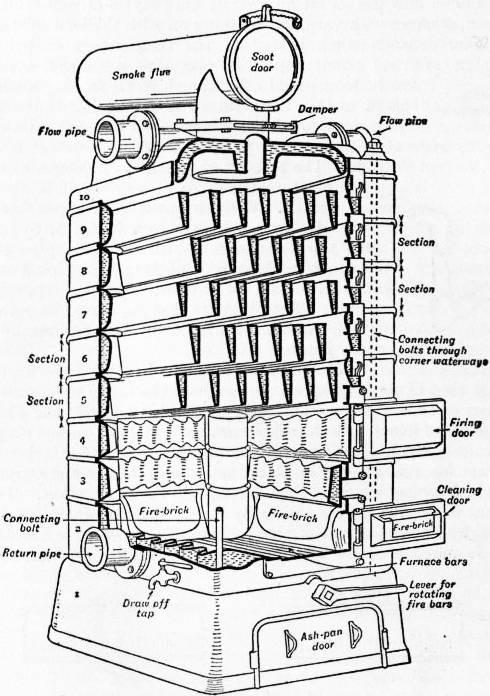
Fig. 15.
A “Geyser” is a very convenient form of apparatus for heating a quantity of water in a short time. A water pipe of copper or wrought iron is passed through a cylinder in which gas or oil heating burners are placed. The piping Geysers. takes a winding or zigzag course, and by the time the outlet is reached, the water it contains has reached a high temperature. By this means a continuous stream of hot water is obtained, greater or smaller in proportion to the size and power of the apparatus. The improved types of gas geysers are provided with a single control to both gas and water supplies, with a small “pilot” burner to ignite the gas. A flue should in all cases be provided to carry off the fumes of the fuel.
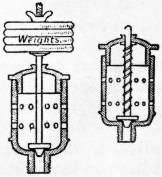
Fig. 16. Fig. 17.
In districts where the water is of a “hard nature,” that is, contains bicarbonate of lime in solution, the interior of the boiler, cylinders, tanks and pipes of a hot water system will become incrusted with a deposit of lime Incrustation. which is gradually precipitated as the water is heated to boiling point. With “very hard” water this deposit may require removal every three months; in London it is usual to clean out the boiler every six months and the cylinders and tanks at longer intervals. For this purpose manlids must be provided (figs. 13 and 14), and pipes should be fitted with removable caps at the bends to allow for periodical cleaning. The lime deposit or “fur” is a poor conductor of heat, and it is therefore most detrimental to the efficiency of the system to allow the interior of the boiler or any other portion to become furred up. Further, if not removed, the fur will in a short time bring about a fracture in the boiler. The use of soft water entails a disadvantage of another character—that of corroding iron and lead work, soft water exercising a very vigorous chemical action upon these metals. In districts supplied with soft water, copper should be employed to as large an extent as possible.
The table given below will be useful in calculating the size of the radiating surface necessary to raise the temperature to the extent required when the external air is at freezing point (32° Fahr.):—
Description of Building to be heated. Temperature required. Cubic Feet of Air heated by 1 sq. ft. of Radiator or Pipe Surface.
Low Pressure Water. Low Pressure Steam.
Dwelling rooms 55°-60° 85-90 115-125
Schools 60° 90-100 120-130
Churches and chapels 55°-60° 100-120 135-160
Offices and shops 55°-60° 120-125 160-170
Public halls, workshops, waiting-rooms 55° 130-150 175-200
Warehouses, stores 50°-55° 140-160 190-220
In closing this account of heating and the practical methods of application of heat, an example may be mentioned to show the great capabilities of a carefully planned system. At the city of Lockport in New York state, America, Steam supply at Lockport. an interesting example of the direct application of steam-heating on a large scale has been carried out under the direction of Mr Birdsill Holly of that city. Houses within a radius of 3 m. from the boiler house are supplied with superheated steam at a pressure of 35 ℔ to the in. The mains, the largest of which are 4 in. in diameter, and the smallest 2 in., are wrapped in asbestos, felt and other non-conducting materials, and are placed in wooden tubes laid under ground like water and gas pipes. The house branches pipes are 1½ in. in diameter, and ¾-in. pipes are used inside the houses. The steam is employed for warming apartments by means of pipe radiators, for heating water by steam injections, and for all cooking purposes. The steam mains to the houses are laid by the supply company; the internal pipes and fittings are paid for or rented by the occupier, costing for an installation from £30 for an ordinary eight-roomed house to £100 or more for larger buildings. With the success of this undertaking in view it is a matter of wonder that the example set in this instance has not been adopted to a much greater extent elsewhere.
The principal publications on heating are: Hood, Practical Treatise on Warming Buildings by Hot Water; Baldwin, Hot Water Heating and Fittings; Baldwin, Steam Heating for Buildings; Billings, Ventilation and Heating; Carpenter, Heating and Ventilating Buildings; Jones, Heating by Hot Water, Ventilation and Hot Water Supply; Dye, Hot Water Supply.
(J. Bt.)
HEAVEN (O. Eng. hefen, heofon, heofone; this word appears in O.S. hevan; the High. Ger. word appears in Ger. Himmel, Dutch hemel; there does not seem to be any connexion between the two words, and the ultimate derivation of the word is unknown; the suggestion that it is connected with “to heave,” in the sense of something “lifted up,” is erroneous), properly the expanse, taking the appearance of a domed vault above the earth, in which the sun, moon, planets and stars seem to be placed, the firmament; hence also used, generally in the plural, of the space immediately above the earth, the atmospheric region of winds, rain, clouds, and of the birds of the air. The heaven and the earth together, therefore, to the ancient cosmographers, and still in poetical language, make up the universe. In the cosmogonies of many ancient peoples there was a plurality of heavens, probably among the earlier Hebrews, the idea being elaborated in rabbinical literature, among the Babylonians and in Zoroastrianism. The number of these heavens, the higher transcending the lower in glory, varied from three to seven. Heaven, as in the Hebrew shamayim, the Greek οὐρανός, the Latin caelum, is the abode of God, and as such in Christian eschatology is the place of the blessed in the next world (see Eschatology and Paradise).
HEBBEL, CHRISTIAN FRIEDRICH (1813-1863), German poet and dramatist, was born at Wesselburen in Ditmarschen, Holstein, on the 18th of March 1813. Though only the son of a poor bricklayer, he early showed a talent for poetry, which was first displayed to the world by the publication, in the Hamburg Modezeitung, of verses which he had sent to Amalie Schoppe (1791-1858), a then popular journalist and author of nursery tales. Through the kindness of this lady, who interested several of her friends on his behalf, he was enabled to go to Hamburg and there prepare himself for the university. A year later he went to Heidelberg to study law, but finding this uncongenial he passed on to the university of Munich, where he devoted himself to philosophy, history and literature. In 1839 Hebbel left Munich and wandered back to Hamburg on foot, where he resumed his relations with Elsie Lensing, whose self-sacrificing assistance had helped him over the darkest days in Munich. In the same year he wrote his first tragedy Judith (published 1841), which in the following year was performed in Hamburg and Berlin and made his name known throughout Germany. In 1840 he wrote the tragedy Genoveva, and the following year finished a comedy, Der Diamant, which he had begun at Munich. In 1842 he visited Copenhagen, where he obtained from the king of Denmark a small travelling studentship, which enabled him to spend some time in Paris and two years (1844-1846) in Italy. In Paris he wrote his fine “tragedy of common life,” Maria Magdalene (1844). On his return from Italy Hebbel met at Vienna two Polish noblemen, the brothers Zerboni di Sposetti, who in their enthusiasm for his genius urged him to remain, and supplied him with the means to mingle in the best intellectual society of the Austrian capital. The unwonted life of ease had its effect. The old precarious existence became a horror to him, he made a deliberate breach with it by marrying (in 1846) the beautiful and wealthy actress Christine Enghaus, ruthlessly sacrificing the girl who had given up all for him and who remained faithful till her death, on the ground that “a man’s first duty is to the most powerful force within him, that which alone can give him happiness and be of service to the world”: in his case the poetical faculty, which would have perished “in the miserable struggle for existence.” This “deadly sin,” which, “if peace of conscience be the test of action,” was, he considered, the best act of his life, established his fortunes. Elise, however, still provided useful inspiration for his art. As late as 1855, shortly after her death, he wrote the little epic Mutter und Kind, intended to show that the relation of parent and child is the essential factor which makes the quality of happiness among all classes and under all conditions equal. Long before this Hebbel had become famous. German sovereigns bestowed decorations upon him; and in foreign capitals he was fêted as the greatest of living German dramatists. From the grand-duke of Saxe-Weimar he received a flattering invitation to take up his residence at Weimar, where several of his plays were first performed. He remained, however, at Vienna until his death on the 13th of December 1863.
Besides the works already mentioned, Hebbel’s principal tragedies are Herodes und Mariamne (1850); Julia (1851); Michel Angelo (1851); Agnes Bernauer (1855); Gyges und sein Ring (1856), and the magnificently conceived trilogy Die Nibelungen (1862), his last work (consisting of a prologue, Der gehörnte Siegfried, and the tragedies, Siegfrieds Tod and Kriemhilds Rache), which won for the author the Schiller prize. Of his comedies Der Diamant (1847), Der Rubin (1850), and the tragi-comedy Ein Trauerspiel in Sizilien (1845), are the more important, but they are heavy and hardly rise above mediocrity. All his dramatic productions, however, exhibit skill in characterization, great glow of passion, and a true feeling for dramatic situation; but their poetic effect is frequently marred by extravagances which border on the grotesque, and by the introduction of incidents the unpleasant character of which is not sufficiently relieved. In many of his lyric poems, and especially in Mutter und Kind, published in 1859, Hebbel showed that his poetic gifts were not restricted to the drama.
His collected works were first published by E. Kuh (12 vols., Hamburg, 1866-1868); revised by H. Krumm (12 vols., Hamburg, 1892). The best critical edition is that by R. M. Werner (12 vols., 1901-1903), to which have been added Hebbel’s Diaries (4 vols.) and Correspondence (6 vols.). Hebbel’s Briefwechsel mit Freunden und berühmten Zeitgenossen was issued by F. Bamberg (1890-1892). The chief biographies of Hebbel are those by E. Kuh (1877) and R. M. Werner (1905). See also L. A. Frankl, Zur Biographie F. Hebbels (1884); T. Poppe, F. Hebbel und sein Drama (1900); A. Scheunert, Der Pantragismus als System der Weltanschauung und Ästhetik Hebbels (1903); E. A. Georgy, Die Tragödie F. Hebbels nach ihrem Ideengehalt (1904).
HEBBURN, an urban district in the Jarrow parliamentary division of Durham, England, on the right bank of the Tyne, 4½ m. below Newcastle, and on a branch of the North-Eastern railway. Pop. (1881), 11,802; (1901), 20,901. It has extensive shipbuilding and engineering works, rope and sail factories, chemical, colour and cement works, and collieries.
HEBDEN BRIDGE, an urban district in the Sowerby parliamentary division of the West Riding of Yorkshire, England, on the Calder and Hebden rivers, 7 m. W. by N. of Halifax by the Lancashire and Yorkshire railway. Pop. (1901), 7536. The town has cotton factories, dye-works, foundries and manufactories of shuttles. The upper Calder valley, between Halifax and Todmorden, is walled with bold hills, the summits of which consist of wild moorland. The vale itself is densely populated, but its beauty is not destroyed, and the contrast with its desolate surroundings is remarkable.
HEBE, in Greek mythology, daughter of Zeus and Hera, the goddess of youth. In the Homeric poems she is the female counterpart of Ganymede, and acts as cupbearer to the gods (Iliad, iv. 2). She was the special attendant of her mother, whose horses she harnessed (Iliad, v. 722). When Heracles was received amongst the gods, Hebe was bestowed upon him in marriage (Odyssey, xi. 603). When the custom of the heroic age, which permitted female cupbearers, fell into disuse, Hebe was replaced by Ganymede in the popular mythology. To account for her retirement from her office, it was said that she fell down in the presence of the gods while handing the wine, and was so ashamed that she refused to appear before them again. Hebe exhibits many striking points of resemblance with the pure Greek goddess Aphrodite. She is the daughter of Zeus and Hera, Aphrodite of Zeus and Dione; but Dione and Hera are often identified. Hebe is called Dia, a regular epithet of Aphrodite; at Phlius, a festival called Κισσοτόμοι (the days of ivy-cutting) was annually celebrated in her honour (Pausanias, ii. 13); and ivy was sacred also to Aphrodite. The apotheosis of Heracles and his marriage with Hebe became a favourite subject with poets and painters, and many instances occur on vases. In later art she is often represented, like Ganymede, caressing the eagle.