VOLUME XIII SLICE II Hearing to Helmond (continued 11)
Reading edition
See Strabo xvii. cap. 1. 27-28; Baedeker’s Egypt.
(F. Ll. G.)
HELIOSTAT (from Gr. ἥλιος, the sun, στατός, fixed, set up), an instrument which will reflect the rays of the sun in a fixed direction notwithstanding the motion of the sun. The optical apparatus generally consists of a mirror mounted on an axis parallel to the axis of the earth, and rotated with the same angular velocity as the sun. This construction assumes that the sun describes daily a small circle about the pole of the celestial sphere, and ignores any diurnal variation in the declination. This variation is, however, so small that it can be neglected for most purposes.
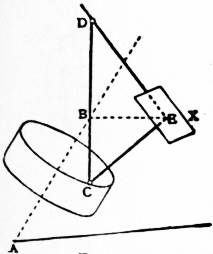
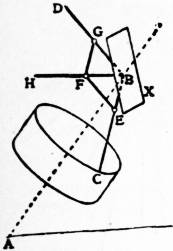
Fig. 1. Fig. 2.
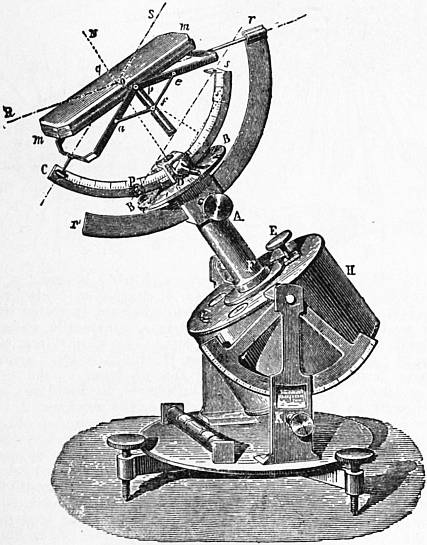
From Jamin and Bouty, Cours de physique, Gauthier-Villars.
Fig. 3.—Silbermann’s Heliostat.
Many forms of heliostats have been devised, the earliest having been described by Wilhelm Jacob s’ Gravesande in the 3rd edition of his Physices elementa (1742). One of the simplest consists of a plane mirror rigidly connected with a revolving axis so that the angle between the normal to the mirror and the axis of the instrument equals half the sun’s polar distance, the mirror being adjusted so that the normal has the same right ascension as the sun. It is easily seen that if the mirror be rotated at the same angular velocity as the sun the right ascensions will remain equal throughout the day, and therefore this device reflects the rays in the direction of the earth’s axis; a second fixed mirror reflects them in any other fixed direction. Foucault’s heliostat reflects the rays horizontally in any required direction. The principle of the apparatus may be explained by reference to fig. 1. The axis of rotation AB bears a rigidly attached rod DBC inclined to it at an angle equal to the sun’s polar distance. By adjusting the right ascension of the plane ABC and rotating the axis with the angular velocity of the sun, it follows that BC will be the direction of the solar rays throughout the day. X is the mirror rotating about the point E, and placed so that (if EB is the horizontal direction in which the rays are to be reflected) (1) the normal CE to the mirror is jointed to BC at C and is equal in length to BE, (2) the rod DBC passes through a slot in a rod ED fixed to, and in the plane of, the mirror. Since CE equals BE these directions are equally inclined to, and coplanar with, the normal to the mirror. Hence light incident along the direction BC will be reflected along CE. Silbermann’s heliostat reflects the rays in any direction. The principle may be explained by means of fig. 2. AB is the axis of rotation, BC an adjustable rod as in Foucault’s construction, and BD is another rod which can be set to the direction in which the rays are to be reflected. The rods BC and DB carry two small rods EF, GF jointed at F; at this joint there is a pin which slides in a slot on the rod BH, which is normal to the mirror X. The rods EF, GF are such that BEFG is a rhombus. It is easy to show that rays falling on the mirror in the direction BC will be reflected along BD. One construction of the instrument, described in Jamin’s Cours de physique, is shown in fig. 3. The mirror mm is attached to the framework pafe, the members of which are parallel to the incident and reflected rays SO, OR, and the diagonal pf is perpendicular to the mirror. The framework is attached to two independent circular arcs Cs and rr′ having their centres at O and provided with clamps D and A on the axis F of the instrument. The arc Cs is graduated, and is set so that the angle COD equals the complement of the sun’s declination. This can be effected (after setting the axis) by rotating Cs until a needle indicates true time on the hour dial B. The arc rr′ is set so as to reflect the rays in the required direction. The axis F of the instrument is set at an angle equal to the latitude of the place of observation and in the meridian by means of the screw K, and rotated by clockwork contained in the barrel H. The setting in the meridian is effected by turning the instrument after setting for latitude until a pin-hole aperture s and a small screen P, placed so that Ps is parallel to CO, are in a line with the sun.
Many other forms of heliostats have been designed, the chief difference consisting in the mechanical devices for maintaining the constant direction of the reflecting ray. One of the most important applications of the heliostat is as an adjunct to the newer forms of horizontal telescopes (q.v.) and in conjunction with spectroscopic telescopes in observations of eclipses.
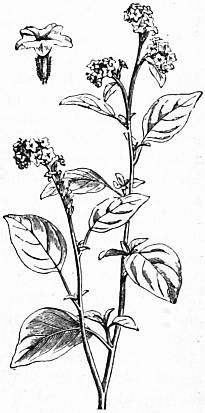
Heliotropium suaveolens.
HELIOTROPE, or Turnsole, Heliotropium (Gr. ἡλιοτρόπιον, i.e. a plant which follows the sun with its flowers or leaves, or, according to Theophrastus (Hist, plant, vii. 15), which flowers at the summer solstice), a genus of usually more or less hairy herbs or undershrubs of the tribe Heliotropieae of the natural order Boraginaceae, having alternate, rarely almost opposite leaves; small white, lilac or blue flowers, in terminal or lateral one-sided simple or once or twice forked spikes, with a calyx of five deeply divided segments, a salver-shaped, hypogynous, 5-lobed corolla, and entire 4-celled ovary; fruit 2- to 4-sulcate or lobed, at length separable into four 1-seeded nutlets or into two hard 2-celled carpels. The genus contains 220 species indigenous in the temperate and warmer parts of both hemispheres. A few species are natives of Europe, as H. europaeum, which is also a naturalized species in the southern parts of North America.
The common heliotrope of English hothouses, H. peruvianum, popularly known as “cherry-pie,” is on account of the delicious odour of its flowers a great favourite with florists. It was introduced into Europe by the younger Jussieu, who sent seed of it from Peru to the royal garden at Paris. About the year 1757 it was grown in England by Philip Miller from seed obtained from St Germains. H. corymbosum (also a native of Peru), which was grown in Hammersmith nurseries as early as 1812, has larger but less fragant flowers than H. peruvianum. The species commonly grown in Russian gardens is H. suaveolens, which has white, highly fragrant flowers.
Heliotropes may be propagated either from seed, or, as commonly, by means of cuttings of young growths taken an inch or two in length. Cuttings when sufficiently ripened, are struck in spring or during the summer months; when rooted they should be potted singly into small pots, using as a compost fibry loam, sandy peat and well-decomposed stable manure from an old hotbed. The plants soon require to be shifted into a pot a size larger. To secure early-flowering plants, cuttings should be struck in August, potted off before winter sets in, and kept in a warm greenhouse. In the spring larger pots should be given, and the plants shortened back to make them bushy. They require frequent shiftings during the summer, to induce them to bloom freely.
The heliotrope makes an elegant standard. The plants must in this case be allowed to send up a central shoot, and all the side growths must be pinched off until the necessary height is reached, when the shoot must be stopped and lateral growths will be produced to form the head. During winter they should be kept somewhat dry, and in spring the ball of soil should be reduced and the plants repotted, the shoots being slightly pruned, so as to maintain a symmetrical head. When they are planted out against the walls and pillars of the greenhouse or conservatory an abundance of highly perfumed blossoms will be supplied all the year round. From the end of May till October heliotropes are excellent for massing in beds in the open air by themselves or with other plants. Many florists’ varieties of the common heliotrope are known in cultivation.
Pliny (Nat. hist. xxii. 29) distinguishes two kinds of “heliotropium,” the tricoccum, and a somewhat taller plant, the helioscopium; the former, it has been supposed, is Croton tinctorium, and the latter the ἡλιοτρόπιον μικρόν of Dioscorides or Heliotropium europaeum. The helioscopium, according to Pliny, was variously employed in medicine; thus the juice of the leaves with salt served for the removal of warts, whence the term herba verrucaria applied to the plant. What, from the perfume of its flowers, is sometimes called winter heliotrope, is the fragrant butterbur, or sweet-scented coltsfoot, Petasites (Tussilago) fragrans, a perennial Composite plant.
Heliotrope, in mineralogy, is the mineral commonly called “bloodstone” (q.v.), and sometimes termed girasol—a name applied also to fire-opal. The name, like those of many ancient names of minerals, seems to have had a fanciful origin. According to Pliny the stone was so called because when thrown into the water it turned the sun’s light falling upon it into a reflection like that of blood.
HELIOZOA, in zoology, a group of the Sarcodina (q.v.) so named by E. Haeckel, 1866. They are characterized by the radiate pseudopods, finely tapering at the apex, springing abruptly from the superficial protoplasm, containing a denser, rather permanent axial rod (figs. 1 (1), 2 (2)); protoplasm without a clear ectoplasm or pellicle, often frothy with large vacuoles, like the alveoli of Radiolaria; nucleus 1 or numerous; skeleton absent, gelatinous or of separate siliceous fibres, plates or spicules, rarely complete and latticed; reproduction by simple fission or by brood-formation, often syngamous; form usually nearly spherical, rarely changing slowly. This group was formerly included with the Rhizopoda; but was separated from it by Haeckel on account of the character of its pseudopods, and its general adaptation to a semipelagic existence correlated with the frothy cytoplasm (fig. 1 (1)). Actinophrys sol and Actinosphaerium eichhornii (fig. 2), known as sun animalcules to the older microscopists, float freely in stagnant or slow-flowing waters, and Myriophrys is able by an investment of long flagelliform cilia to swim freely. The majority, however, lurk among confervae or the light débris of the bottom ooze; and come under the head of “sapropelic” rather than pelagic organisms. The body is usually of constant spherical form in relation to the floating habit. Nuclearia, however, shows amoeboid changes of general outline. The pseudopods are retractile, the axial filament being absorbed as the filament grows shorter and thicker and disappearing when the pseudopod merges into the ectoplasm, to be reformed at the same time with the pseudopod. There is often a distinction, clear, but never sharp, between the richly vacuolate, almost frothy ectoplasm and the denser endoplasm. One or more contractile vacuoles may protrude from the ectoplasm. The endoplasm contains the nucleus or nuclei. The nucleus when single may be central or excentric: in the latter case, the endoplasm contains a clear central sphere (“centrosome”) on which abut the axial filaments of the pseudopods. The ectoplasm contains, in some species, constantly (Raphidiophrys viridis) or occasionally (Actinosphaerium), green cells belonging to the genera Zoochlorella and Sphaerocystis, both probably—the latter certainly—vegetative stages of a Chlamydomonad (Flagellata, q.v.) and of symbiotic significance.
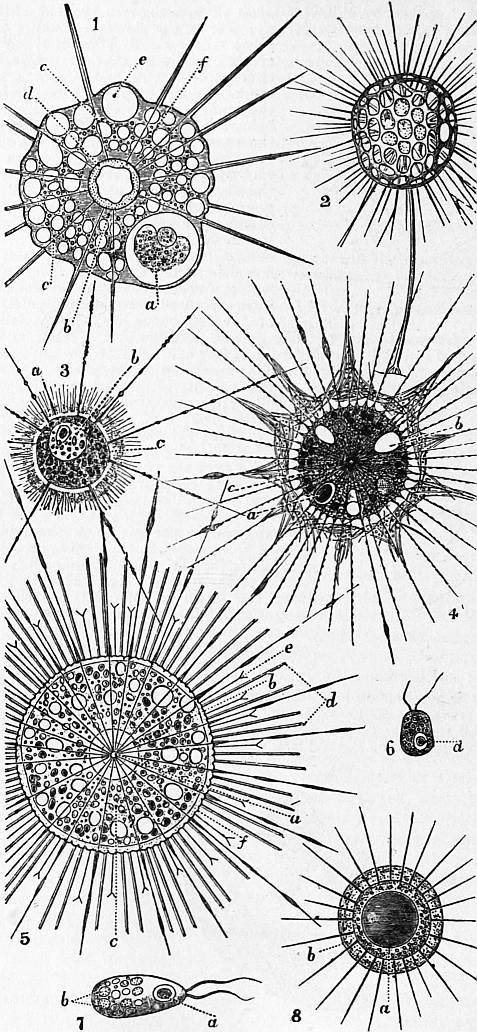
Fig. 1.—Heliozoa. 1. Actinophrys sol, Ehrb. a, food-particle lying in a large food-vacuole; b, deep-lying finely granular protoplasm; c, axial filament of a pseudopodium extended inwards to the nucleus; d, the central nucleus; e, contractile vacuole; f, superficial much vacuolated protoplasm. 2. Clathrulina elegans, Cienk. 3. Heterophrys marina, H. and L. a, nucleus; b, clearer protoplasm surrounding the nucleus; c, the peculiar felted envelope. 4. Raphidiophrys pallida, F. E. Schultze. a, food-particle; b, contractile vacuole; c, the nucleus; d, central granule in which all the axis-filaments of the pseudopodia meet. The tangentially disposed spicules are seen arranged in masses on the surface. 5. Acanthocystis turfacea, Carter. a, probably the central nucleus; b, clear protoplasm around the nucleus; c, more superficial protoplasm with vacuoles and chlorophyll corpuscles; d, coarser siliceous spicules; e, finer forked siliceous spicules; f, finely granular layer of protoplasm. The long pseudopodia reaching beyond the spicules are not lettered. 6. Bi-flagellate “flagellula” of Acanthocystis aculeata. a, nucleus. 7. Id. of Clathrulina elegans. a, nucleus; b, granules. 8. Astrodisculus ruber, Greeff. a, red-coloured central sphere (? nucleus); b, peripheral homogeneous envelope.
The Heliozoa can move by rolling over on their extended pseudopods; Acanthocystis ludibunda traversing a path of as much as twenty times its diameter in a minute, according to Penard. Several species (e.g. Raphidiophrys elegans) remain associated by the union of their pseudopods, whether into social aggregates (due to approximation) or “colonies” due to lack of separation after fission, is not accurately known. The multinuclear species Actinosphaerium eichhornii (fig. 2), normally apocytial (i.e. the nuclei divide repeatedly without division of the cytoplasm), may increase in size by the fusion (“plastogamic”) of small individuals. If a large specimen be cut up or fragment itself under irritation, the small ones so produced soon approach one another and fuse completely.
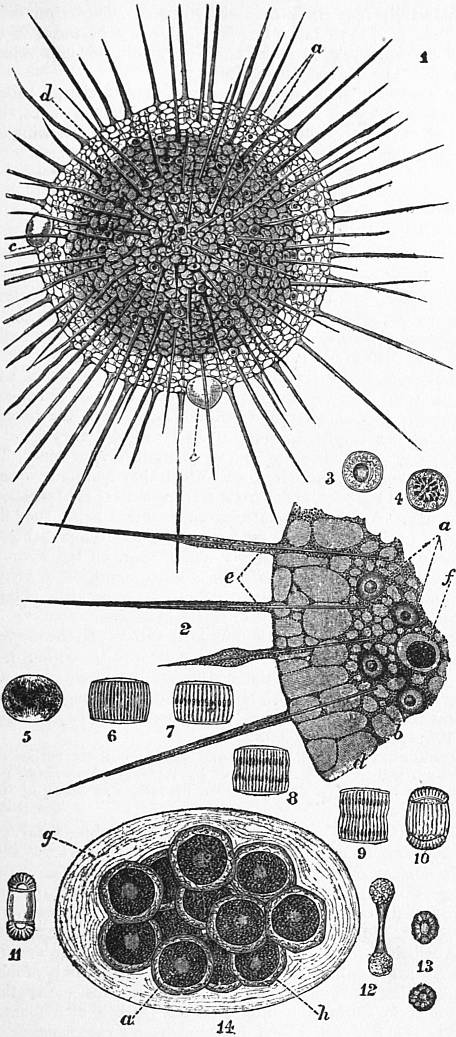
Fig. 2.—Heliozoa. 1. Actinosphaerium eichhornii, Ehr.; a, nuclei; b, deeper protoplasm with smaller vacuoles and numerous nuclei; c, contractile vacuoles; d, peripheral protoplasm with larger vacuoles. 2. A portion of the same specimen more highly magnified and seen in optical section. a, Nuclei; b, deeper protoplasm (so-called endosarc); d, peripheral protoplasm (so-called ectosarc); e, pseudopodia showing the granular protoplasm streaming over the stiff axial filament: f, food-particle in a good-vacuole. 3, 4. Nuclei of Actinosphaerium in the resting condition. 5-13. Successive stages in the division of a nucleus of Actinosphaerium, showing fibrillation, and in 7 and 8 formation of an equatorial plate of chromatin substance (after Hertwig). 14. Cyst-phase of Actinosphaerium eichhornii, showing the protoplasm divided into twelve chlamydospores, each of which has a siliceous coat; a, nucleus of the spore; g, gelatinous wall of the cyst; h, siliceous coat of the spore.
Reproduction.—Binary fission has been repeatedly observed; in some cases one or both of the daughter cells may swim for a time as a biflagellate zoospore (fig. 1 (6, 7)). The process may take place when the cell is naked or after preliminary encystment. Budding has been well studied in Acanthocystis; the cell nucleus divides repeatedly and most of the daughter nuclei pass to the periphery, aggregate part of the cytoplasm, and with it are constricted off as independent cells; one nucleus remains central and the process may be repeated. The detached bud may assume the typical character after a short amoeboid (lobose) stage, sometimes preceded by rest, or it may develop 2 flagella and swim off (fig. 1 (6)).
Brood formation is only known here in relation to a syngamic process; this is a sharp contrast to Proteomyxa (q.v.) where brood formation is the commonest mode of reproduction, and plasmodium-formation, rare indeed, is the nearest approach to syngamy observed. Indeed, if we knew the life-history of all the species this difference in the life cycle would be a convenient critical character.
Equal conjugation was demonstrated fully by F. Schaudinn in Actinophrys; two individuals approach and enter into close contact, and are surrounded by a common cyst wall. The nucleus of either male divides; and one nucleus passes to the surface at either side, and is budded off with a small portion of the cytoplasm as an abortive cell; the two remaining nuclei which are “first cousins” in cellular relationship now fuse, as is the case with the cytoplasts. The resulting coupled cell or zygote divides into two, which again encyst.
Actinosphaerium (fig. 2) shows a still more remarkable process, fully studied by R. Hertwig. The large multinucleate animal withdraws its pseudopods, its vacuoles disappear, it encysts and its nuclei diminish in number to about 1⁄20th partly by fusion, 2 and 2, probably by digestion of the majority. Within the primary cyst the body is now resolved into nuclear cells, which again surround themselves with secondary cysts. The cell in each secondary cyst divides (by karyokinesis), and these sister cells, or rather their offspring, pair in much the same way as the individual cells of Actinophrys—the chief difference is that after the first division and budding off of a rudimentary cell, a second division of the same character takes place, with the formation of a second rudimentary cell, which is the niece of the first, absolutely in the same way as the 1st and 2nd polar bodies are formed in the maturation of the ovum in Metazoa. The actual pairing cells are thus second cousins, great-granddaughters of the original cell of the secondary cysts. Complete fusion now takes place to form the coupled cell, which is now contracted and forms a gelatinous wall within the siliceous secondary cyst wall (fig. 2 (14)), During a resting stage nuclear divisions occur and finally a brood of young 1-nuclear Actinosphaerium leave the cyst.
Classification.
Aphrothoraca. Body naked. Actinophrys Ehrb. (fig. 1 (1)) (nucleate), Actinosphaerium Stein plurinucleate (fig. 2 (1)), Camptonema (plurinucleate) Schaud., Dimorpha Gruber (sometimes 2 flagellate).
I. Chlamydophora. Investment gelatinous. Astrodiscus.
II. Chalarothoraca. Body protected by an investment of spicules or fibre scattered or approximated, never fused into a continuous skeleton.
§ 1. Spicules netted or free in the protoplasm. Heterophrys Arch. (fig. 1 (3)), Raphidiophrys Arch. (fig. 1 (4)), Pinacodocystis, Hertw. and Less.
§ 2. Spicules approximated radially. Pinaciophora Greeff, Pompholyxophrys Arch., Lithocolla F. E. Schultze, Elaeorhanis Greeff (in the two foregoing genera the spicules represented by sand granules), Acanthocystis Carter (fig. 1 (5)), Pinacocystis (?) Hertw. and Less, Myriophrys Penard. (Astrodisculus).
III. Desmothoraca. § 1 attached by a stalk. Clathrulina Cienk. (fig. 1 (2, 7)), Hedriocystis, Hertw. and Less.
§ 2. Free Elaster, Grimin, Choanocystis.
Literature.—The most important English original papers on this group are those by W. Archer, “On some Freshwater Rhizopoda, new, or little known,” Quarterly Journal of Microscopic Science, N.S. ix.-xi. (1869-1871), and “Résumé of Recent Contributions to the Knowledge of Freshwater Rhizopods,” ibid. xvi., xvii. (1876-1877). See also R. Hertwig and Lesser, “Über Rhizopoda und denselben nahestehenden Organismen,” in Archiv für mikroscopische Anatomie, x. (1874), p. 35; R. Schaudinn, “Heliozoa” in Tierreich (1896); E. Penard, Les Héliozoaires d’eau douce (1904); the two last named contain full bibliographies.
(M. Ha.)
HELIUM (from Gr. ἥλιος, the sun), a gaseous chemical element, the modern discovery of which followed closely on that of argon (q.v.). The Investigations of Lord Rayleigh and Sir William Ramsay had shown that indifference to chemical reagents did not sufficiently characterize an unknown gas as nitrogen, and it became necessary to reinvestigate other cases of the occurrence of “nitrogen” in nature. H. Miers drew Ramsay’s attention to the work of W. F. Hillebrand, who had noticed, in examining the mineral uraninite, that an inert gas was evolved when the mineral was decomposed with acid. Ramsay, repeating these experiments, found that the inert gas emitted refused to oxidize when sparked with oxygen, and on examining it spectroscopically he saw that the spectrum was not that of argon, but was characterized by a bright yellow line near to, but not identical with, the D line of sodium. This was afterwards identified with the D3 line of the solar chromosphere, observed in 1868 by Sir J. Norman Lockyer, and ascribed by him to a hypothetical element helium. This name was adopted for the new gas.
Helium is relatively abundant in many minerals, all of which are radioactive, and contain uranium or thorium as important constituents. (For the significance of this fact see Radioactivity.) The richest known source is thorianite, which consists mainly of thorium oxide, and contains 9.5 cc. of helium per gram. Monazite, a phosphate of thorium and other rare earths, contains on the average about 1 cc. per gram. Cleveite, samarskite and fergusonite contain a little more than monazite. The gas also occurs in minute quantities in the common minerals of the earth’s crust. In this case too it is associated with radioactive matter, which is almost ubiquitous. In two cases, however, it has been found in the absence of appreciable quantities of uranium and thorium compounds, namely in beryl, and in sylvine (potassium chloride). Helium is contained almost universally in the gases which bubble up with the water of thermal springs. The proportion varies greatly. In the hot springs of Bath it amounts to about one-thousandth part of the gas evolved. Much larger percentages have been recorded in some French springs (Compt. rend., 1906, 143, p. 795, and 146, p. 435), and considerable quantities occur in some natural gas (Journ. Amer. Chem. Soc. 29, p. 1524). R. J. Strutt has suggested that helium in hot springs may be derived from the disintegration of common rocks at great depths.
Helium is present in the atmosphere, of which it constitutes four parts in a million. It is conspicuous by its absorption spectrum in many of the white stars. Certain stars and nebulae show a bright line helium spectrum.
Much the best practical source of helium is thorianite, a mineral imported from Ceylon for the manufacture of thoria. It dissolves readily in strong nitric acid, and the helium contained is thus liberated. The gas contains a certain amount of hydrogen and oxides of carbon, also traces of nitrogen. In order to get rid of hydrogen, some oxygen is added to the helium, and the mixture exploded by an electric spark. All remaining impurities, including the excess of oxygen, can then be taken out of the gas by Sir James Dewar’s ingenious method of absorption with charcoal cooled in liquid air. Helium alone refuses to be absorbed, and it can be pumped off from the charcoal in a state of absolute purity. In the absence of liquid air the helium must be purified by the methods employed for argon (q.v.). If thorianite cannot be obtained, monazite, which is more abundant, may be utilized. A part of the helium contained in minerals can be extracted by heat or by grinding (J. A. Gray, Proc. Roy. Soc., 1909, 82A, p. 301).
Properties.—All attempts to make helium enter into stable chemical union have hitherto proved unsuccessful. The gas is in all probability only mechanically retained in the minerals in which it is found. Jacquerod and Perrot have found that quartz-glass is freely permeable to helium below a red-heat (Compt. rend., 1904, 139, p. 789). The effect is even perceptible at a temperature as low as 220° C. Hydrogen, and, in a much less degree, oxygen and nitrogen, will also permeate silica, but only at higher temperatures. They have made this observation the basis of a practical method of separating helium from the other inert gases. M. Travers has suggested that it may explain the liberation of helium from minerals by heat, the gas being enabled to permeate the siliceous materials in which it is enclosed. Thorianite, however, contains no silica, and until it is shown that metallic oxides behave in the same way this explanation must be accepted with reserve.
The density of helium has been determined by Ramsay and Travers as 1.98. Its ratio of specific heats has very nearly the ideal value 1.666, appropriate to a monatomic molecule. The accepted atomic weight is accordingly double the density, i.e. approximately four times that of hydrogen. The refractivity of helium is 0.1238 (air = 1). The solubility in water is the lowest known, being, at 18.2°, only .0073 vols. per unit volume of water. The viscosity is .96 (air = 1).
The spectrum of helium as observed in a discharge tube is distinguished by a moderate number of brilliant lines, distributed over the whole visual spectrum. The following are the approximate wave-lengths of the most brilliant lines:
Red 7066
Red 6678
Yellow 5876
Green 4922
Blue 4472
Violet 4026
When the discharge passes through helium at a pressure of several millimetres, the yellow line 5876 is prominent. At lower pressures the green line 4922 becomes more conspicuous. At atmospheric pressure the discharge is able to pass through a far greater distance in helium than in the common gases.
M. Travers, G. Senter and A. Jacquerod (Phil. Trans. A. 1903, 200, p. 105) carefully examined the behaviour of a constant volume gas thermometer filled with helium. For the pressure coefficient per degree, between 0° and 100° C., they give the value .00366255, when the initial pressure is 700 mm. This value is indistinguishable from that which they find for hydrogen. Thus at high temperatures a helium thermometer is of no special advantage. At low temperatures, on the other hand, they find, using an initial pressure of 1000 mm., that the temperatures on the helium scale are measurably higher than on the hydrogen scale, owing to the more perfectly gaseous condition of helium. This difference amounts to about 1⁄10° at the temperature of liquid oxygen, and about 1⁄5° at that of liquid hydrogen.
The liquefaction of helium was achieved by H. Kamerlingh Onnes at Leiden in 1908. According to him its boiling point is 4.3° abs. (−268.7° C.), the density of the liquid 0.154, the critical temperature 5° abs., and the critical pressure 2.3 atmospheres (Communications from the Physical Laboratory at Leiden, No. 108; see also Liquid Gases).
References.—A bibliography and summary of the earlier work on helium will be found in a paper by Ramsay, Ann. chim. phys. (1898) [7], 13, p. 433. See also M. Travers, The Study of Gases (1901).
(R. J. S.)
HELIX (Gr. ἕλιξ, a spiral or twist), an architectural term for the spiral tendril which is carried up to support the angles of the abacus of the Corinthian capital; from the same stalk springs a second helix rising to the centre of the capital, its junction with one on the opposite side being sometimes marked by a flower. Sometimes the term “volute” is given to the angle helix, which is incorrect, as it is of a different design and rises from the same stalk as the central helices. Its origin is probably metallic, that is to say, it was copied from the conventional treatment in Corinthian bronze of the tendrils of a plant.
HELL (O. Eng. hel, a Teutonic word from a root meaning “to cover,” cf. Ger. Hölle, Dutch hel), the word used in English both of the place of departed spirits and of the place of torment of the wicked after death. It is used in the Old Testament to translate the Hebrew Sheol, and in the New Testament the Greek ᾃδης, Hades, and γεέννα, Hebrew Gehenna (see Eschatology).
HELLANICUS of Lesbos, Greek logographer, flourished during the latter half of the 5th century B.C. According to Suidas, he lived for some time at the court of one of the kings of Macedon, and died at Perperene, a town on the gulf of Adramyttium opposite Lesbos. Some thirty works are attributed to him—chronological, historical and episodical. Mention may be made of: The Priestesses of Hera at Argos, a chronological compilation, arranged according to the order of succession of these functionaries; the Carneonikae, a list of the victors in the Carnean games (the chief Spartan musical festival), including notices of literary events; an Atthis, giving the history of Attica from 683 to the end of the Peloponnesian War (404), which is referred to by Thucydides (i. 97), who says that he treated the events of the years 480-431 briefly and superficially, and with little regard to chronological sequence: Phoronis, chiefly genealogical, with short notices of events from the times of Phoroneus the Argive “first man” to the return of the Heraclidae; Troica and Persica, histories of Troy and Persia.
Hellanicus marks a real step in the development of historiography. He transcended the narrow local limits of the older logographers, and was not content to repeat the traditions that had gained general acceptation through the poets. He tried to give the traditions as they were locally current, and availed himself of the few national or priestly registers that presented something like contemporary registration. He endeavoured to lay the foundations of a scientific chronology, based primarily on the list of the Argive priestesses of Hera, and secondarily on genealogies, lists of magistrates (e.g. the archons at Athens), and Oriental dates, in place of the old reckoning by generations. But his materials were insufficient and he often had recourse to the older methods. On account of his deviations from common tradition, Hellanicus is often called an untrustworthy writer by the ancients themselves, and it is a curious fact that he appears to have made no systematic use of the many inscriptions which were ready to hand. Dionysius of Halicarnassus censures him for arranging his history, not according to the natural connexion of events, but according to the locality or the nation he was describing; and undoubtedly he never, like his contemporary Herodotus, rose to the conception of a single current of events wider than the local distinction of race. His style, like that of the older logographers, was dry and bald.
Fragments in Müller, Fragmenta historicorum Graecorum, i. and iv.; see among older works L. Preller, De Hellanico Lesbio historico (1840); Mure, History of Greek Literature, iv.; late criticism in H. Kullmer, “Hellanikos” in Jahrbücher für klass. Philologie (Supplementband, xxvii. 455 sqq.) (1902), which contains new edition and arrangement of fragments; C. F. Lehmann-Haupt, “Hellanikos, Herodot, Thukydides,” in Klio vi. 127 sqq. (1906); J. B. Bury, Ancient Greek Historians (1909), pp. 27 sqq.
HELLEBORE (Gr. ἑλλέβορος: mod. Gr. also σκάφη: Ger. Nieswurz, Christwurz; Fr. hellébore, and in the district of Avranche, herbe enragée), a genus (Helleborus) of plants of the natural order Ranunculaceae, natives of Europe and western Asia. They are coarse perennial herbs with palmately or pedately lobed leaves. The flowers have five persistent petaloid sepals, within the circle of which are placed the minute honey-containing tubular petals of the form of a horn with an irregular opening. The stamens are very numerous, and are spirally arranged; and the carpels are variable in number, sessile or stipitate and slightly united at the base and dehisce by ventral suture.
Helleborus niger, black hellebore, or, as from blooming in mid-winter it is termed the Christmas rose (Ger. Schwarze Nieswurz; Fr., rose de Noël or rose d’hiver), is found in southern and central Europe, and with other species was cultivated in the time of Gerard (see Herball, p. 977, ed. Johnson, 1633) in English gardens. Its knotty root-stock is blackish-brown externally, and, as with other species, gives origin to numerous straight roots. The leaves spring from the top of the root-stock, and are smooth, distinctly pedate, dark-green above, and lighter below, with 7 to 9 segments and long petioles. The scapes, which end the branches of the rhizome, have a loose entire bract at the base, and terminate in a single flower, with two bracts, from the axis of one of which a second flower may be developed. The flowers have 5 white or pale-rose, eventually greenish sepals, 15 to 18 lines in breadth; 8 to 13 tubular green petals containing honey; and 5 to 10 free carpels. There are several forms, the best being maximus. The Christmas rose is extensively grown in many market gardens to provide white flowers forced in gentle heat about Christmas time for decorations, emblems, &c.
H. orientalis, the Lenten rose, has given rise to several fine hybrids with H. niger, some of the best forms being clear in colour and distinctly spotted. H. foetidus, stinking hellebore, is a native of England, where like H. viridis, it is confined chiefly to limestone districts; it is common in France and the south of Europe. Its leaves have 7- to 11-toothed divisions, and the flowers are in panicles, numerous, cup-shaped and drooping, with many bracts, and green sepals tinged with purple, alternating with the five petals.
H. viridis, or green hellebore proper, is probably indigenous in some of the southern and eastern counties of England, and occurs also in central and southern Europe. It has bright yellowish-green flowers, 2 to 4 on a stem, with large leaf-like bracts. O. Brunfels and H. Bock (16th century) regarded the plant as the black hellebore of the Greeks.
H. lividus, holly-leaved hellebore, found in the Balearic Islands, and in Corsica and Sardinia, is remarkable for the handsomeness of its foliage. White hellebore is Veratrum album (see Veratrum), a liliaceous plant.
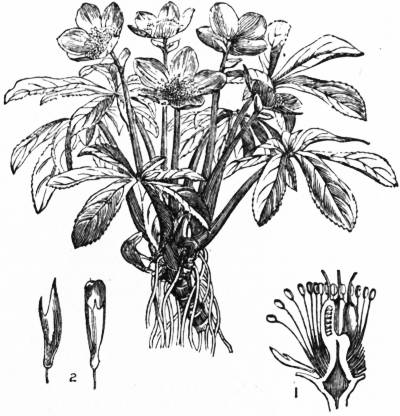
Helleborus niger. 1, Vertical section of flower; 2, Nectary, side and front view.
Hellebores may be grown in any ordinary light garden mould, but thrive best in a soil of about equal parts of turfy loam and well-rotted manure, with half a part each of fibrous peat and coarse sand, and in moist but thoroughly-drained situations, more especially where, as at the margins of shrubberies, the plants can receive partial shade in summer. For propagation cuttings of the rhizome may be taken in August, and placed in pans of light soil, with a bottom heat of 60° to 70° Fahr.; hellebores can also be grown from seed, which must be sown as soon as ripe, since it quickly loses its vitality. The seedlings usually blossom in their third year. The exclusion of frost favours the production of flowers; but the plants, if forced, must be gradually inured to a warm atmosphere, and a free supply of air must be afforded, without which they are apt to become much affected by greenfly. For potting, H. niger and its varieties, and H. orientalis, atrorubens and olympicus have been found well suited. After lifting, preferably in September, the plants should receive plenty of light, with abundance of water, and once a week liquid manure, not over-strong. The flowers are improved in delicacy of hue, and are brought well up among the leaves, by preventing access of light except to the upper part of the plants. Of the numerous species of hellebore now grown, the deep-purple-flowered H. colchicus is one of the handsomest; by crossing with H. guttatus and other species several valuable garden forms have been produced, having variously coloured spreading or bell-shaped flowers, spotted with crimson, red or purple.
The rhizome of H. niger occurs in commerce in irregular and nodular pieces, from about 1 to 3 in. in length, white and of a horny texture within. Cut transversely it presents internally a circle of 8 to 12 cuneiform ligneous bundles, surrounded by a thick bark. It emits a faint odour when cut or broken, and has a bitter and slightly acrid taste. The drug is sometimes adulterated with the rhizome of baneberry, Actaea spicata, which, however, may be recognized by the distinctly cruciate appearance of the central portion of the attached roots when cut across, and by its decoction giving the chemical reactions for tannin.1 The rhizome is darker in colour in proportion to its degree of dryness, age and richness in oil. A specimen dried by Schroff lost in eleven days 65% of water.
H. niger, orientalis, viridis, foetidus, and several other species of hellebore contain the glucosides helleborin, C36H42O6, and helleboreïn, C23H20O15, the former yielding glucose and helleboresin, C30H38O4, and the latter glucose and a violet-coloured substance helleboretin, C14H20O3. Helleborin is most abundant in H. viridis. A third and volatile principle is probably present in H. foetidus. Both helleborin and helleboreïn act poisonously on animals, but their decomposition-products helleboresin and helleboretin seem to be devoid of any injurious qualities. Helleborin produces excitement and restlessness, followed by paralysis of the lower extremities or whole body, quickened respiration, swelling and injection of the mucous membranes, dilatation of the pupil, and, as with helleboreïn, salivation, vomiting and diarrhoea. Helleboreïn exercises on the heart an action similar to that of digitalis, but more powerful, accompanied by at first quickened and then slow and laboured respiration; it irritates the conjunctiva, and acts as a sternutatory, but less violently than veratrine. Pliny states that horses, oxen and swine are killed by eating “black hellebore”; and Christison (On Poisons, p. 876, 11th ed., 1845) writes: “I have known severe griping produced by merely tasting the fresh root in January.” Poisonous doses of hellebore occasion in man singing in the ears, vertigo, stupor, thirst, with a feeling of suffocation, swelling of the tongue and fauces, emesis and catharsis, slowing of the pulse, and finally collapse and death from cardiac paralysis. Inspection after death reveals much inflammation of the stomach and intestines, more especially the rectum. The drug has been observed to exercise a cumulative action. Its extract was an ingredient in Bacher’s pills, an empirical remedy once in great repute in France. In British medicine the rhizome was formerly official. H. foetidus was in past times much extolled as an anthelmintic, and is recommended by Bisset (Med. Ess., pp. 169 and 195, 1766) as the best vermifuge for children; J. Cook, however, remarks of it (Oxford Mag., March 1769, p. 99): “Where it killed not the patient, it would certainly kill the worms; but the worst of it is, it will sometimes kill both.” This plant, of old termed by farriers ox-heel, setter-wort and setter-grass, as well as H. viridis (Fr. Herbe à séton), is employed in veterinary surgery, to which also the use of H. niger is now chiefly confined in Britain.
In the early days of medicine two kinds of hellebore were recognized, the white or Veratrum album (see Veratrum), and the black, including the various species of Helleborus. The former, according to Codronchius (Comm.... de elleb., 1610), Castellus (De helleb. epist., 1622), and others, is the drug usually signified in the writings of Hippocrates. Among the hellebores indigenous to Greece and Asia Minor, H. orientalis, the rhizome of which differs from that of H. niger and of H. viridis in the bark being readily separable from the woody axis, is the species found by Schroff to answer best to the descriptions given by the ancients of black hellebore, the ἑλλέβορος μέλας of Dioscorides. The rhizome of this plant, if identical, as would appear, with that obtained by Tournefort at Prusa in Asia Minor (Rel. d’un voy. du Levant, ii. 189, 1718), must be a remedy of no small toxic properties. According to an early tradition, black hellebore administered by the soothsayer and physician Melampus (whence its name Melampodium), was the means of curing the madness of the daughters of Proetus, king of Argos. The drug was used by the ancients in paralysis, gout and other diseases, more particularly in insanity, a fact frequently alluded to by classical writers, e.g. Horace (Sat. ii. 3. 80-83, Ep. ad Pis. 300). Various superstitions were in olden times connected with the cutting of black hellebore. The best is said by Pliny (Nat. hist. xxv. 21) to grow on Mt Helicon. Of the three Anticyras that in Phocis was the most famed for its hellebore, which, being there used combined with “sesamoides,” was, according to Pliny, taken with more safety than elsewhere.
The British Pharmaceutical Conference has recommended the preparation which it terms the tinctura veratri viridis, as the best form in which to administer this drug. It may be given in doses of 5-15 minims. The tincture is prepared from the dried rhizome and rootlets of green hellebore, containing the alkaloids jervine, veratrine and veratroidine. It is recommended as a cardiac and nervous sedative in cerebral haemorrhage and puerperal eclampsia. Black hellebore is a purgative and uterine stimulant.
1 For the microscopical characters and for figures of transverse sections of the rhizome, see Lanessan, Hist. des drogues, i. 6 (1878).
HELLENISM (from Gr. ἑλληνίζειν, to imitate the Greeks, who were known as Ἕλληνες, after Ἕλλην, the son of Deucalion). The term “Hellenism” is ambiguous. It may be used to denote ancient Greek culture in all its phases, and even those elements in modern civilization which are Greek in origin or in spirit; but, while Matthew Arnold made the term popular in the latter connexion as the antithesis of “Hebraism,” the German historian J. G. Droysen introduced the fashion (1836) of using it to describe particularly the latter phases of Greek culture from the conquests of Alexander to the end of the ancient world, when those over whom this culture extended were largely not Greek in blood, i.e. Hellenes, but peoples who had adopted the Greek speech and way of life, Hellenistai. Greek culture had, however, both in “Hellenic” and “Hellenistic” times, a common essence, just as light is light whether in the original luminous body or in a reflection, and to describe this by the term Hellenism seems most natural. But whilst using the term in the larger sense, this article, in deference to the associations which have come to be specially connected with it, will devote its principal attention to Hellenism as it appeared in the world after the Macedonian conquests. But it will be first necessary to indicate briefly what Hellenism in itself implied.
No verbal formula can really enclose the life of a people or an age, but we can best understand the significance of the old Greek cities and the life they developed, when, looking at the history of mankind as a whole, we see the part played by reason, active and critical, in breaking down the barriers by which custom hinders movement, in guiding movement to definite ends, in dissipating groundless beliefs and leading onwards to fresh scientific conquests—when we see this and then take note that among the ancient Greeks such an activity of reason began in an entirely novel degree and that its activity in Europe ever since is due to their impulsion. When Hellenism came to stand in the world for something concrete and organic, it was, of course, no mere abstract principle, but embodied in a language, a literature, an artistic tradition. In the earliest existing monument of the Hellenic genius, the Homeric poems, one may already observe that regulative sense of form and proportion, which shaped the later achievements of the race in the intellectual and artistic spheres. It was not till the great colonizing epoch of the 8th and 7th centuries B.C., when the name “Hellene” came into use as the antithesis of “barbarian,” that the Greek race came to be conscious of itself as a peculiar people; it was yet some three centuries more before Hellenism stood fully declared in art and literature, in politics and in thought. There was now a new thing in the world, and to see how the world was affected by it is our immediate concern.
I. The Expansion of Hellenism before Alexander.—In the 5th century B.C. Greek cities dotted the coasts of the Mediterranean and the Black Sea from Spain to Egypt and the Caucasus, and already Greek culture was beginning to pass beyond the limits of the Greek race. Already in the 7th century B.C., when Hellenism was still in a rudimentary stage, the citizens of the Greek city-states had been known to the courts of Babylon and Egypt as admirable soldiers, combining hardihood with discipline, and Greek mercenaries came to be in request throughout the Nearer East. But as Hellenism developed, its social and intellectual life began to exercise a power of attraction. The proud old civilizations of the Euphrates and the Nile might ignore it, but the ruder barbarian peoples in East and West, on whose coasts the Greek colonies had been planted, came in various degrees under its spell. In some cases an outlying colony would coalesce with a native population, and a fusion of Hellenism with barbarian customs take place, as at Emporium in Spain (Strabo iii. p. 160) and at Locri in S. Italy (Polyb. xii. 5. 10). Perinthus included a Thracian phyle. The stories of Anacharsis and Scylas (Herod, iv. 76-80) show how the leading men of the tribes in contact with the Greek colonies in the Black Sea might be fascinated by the appeal which the exotic culture made to mind and to eye.
The great developments of the century and a half before Alexander set the Greek people in a very different light before the world. In the sphere of material power the repulse of Xerxes and the extension of Athenian or Spartan supremacy in the eastern Mediterranean were large facts patent to the most obtuse. The kings of the East leant more than ever upon Greek mercenaries, whose superiority to barbarian levies was sensibly brought home to them by the expedition of Cyrus. But the developments within the Hellenic sphere itself were also of great consequence for its expansion outwards. The political disunion of the Greeks was to some extent neutralized by the rise of Athens to a leading position in art, in literature and in philosophy. In Athens the Hellenic genius was focussed, its tendencies drawn together and combined; nor was it a circumstance of small moment that the Attic dialect attained, for prose, a classical authority; for if Hellenism was to be propagated in the world at large, it was obviously convenient that it should have some one definite form of speech to be its medium.
1. The Persians.—The ruling race of the East, the Persian, was but little open to the influences of the new culture. The military qualities of the Greeks were appreciated, and so, too, was Greek science, where it touched the immediately useful; a Greek captain was entrusted by Darius with the exploration of the Indus; a Greek architect bridged the Bosporus for him; Greek physicians (e.g. Democedes, Ctesias) were retained for enormous fees at the Persian court. The brisk diplomatic intercourse between the Great King and the Greek states in the 4th century may have produced effects that were not merely political. We certainly find among those members of the Persian aristocracy, who came by residence in Asia Minor into closer contact with the Greeks, some traces of interest in the more ideal side of Hellenism. A man like the younger Cyrus invited Greek captains to his friendship for something more than their utility in war, and procured Greek hetaerae for something more than sensual pleasure. There is the Mithradates who presented the Academy with a statue of Plato by Silanion, not improbably identical (though the supposition implies a correction in the text of Diogenes Laërtius) with that Mithradates who, together with his father Ariobarzanes, received the citizenship of Athens (Dem. xxiii. 141, 202). Exactly how far Greek influence can be traced in the remains of Persian art, such as the royal palaces of Persepolis and Susa may be doubtful (see Gayet, L’Art persan; R. Phené Spiers, Architecture East and West, p. 245 f.), but it is certain that the engraved gems for which there was a demand in the Persian empire were largely the work of Greek artists (Furtwängler, Antike Gemmen, iii. p. 116 f.).
2. The Phoenicians.—As early as the first half of the 4th century we find communities of Phoenician traders established in the Peiraeus (C.I.A. ii. 86). In Cyprus, on the frontier between the Greek and Semitic worlds, a struggle for ascendancy went on. The Phoenician element seems to have been dominant in the island when Evagoras made himself king of Salamis in 412, and restored Hellenism with a strong hand. The words of Isocrates (even allowing for their rhetorical colour) give us a vivid insight into what such a process meant. “Before Evagoras established his rule, they were so hostile and exclusive, that those of their rulers were actually held to be the best who were the fiercest adversaries of the Greeks; but now such a change has taken place, that it is a matter of emulation who shall show himself the most ardent phil-hellen, that for the mothers of their children most of them choose wives from amongst us, and that they take pride in having Greek things about rather than native, in following the Greek fashion of life, whilst our masters of the fine arts and other branches of culture now resort to them in greater numbers than were once to be found in those quarters they specially frequented” (Isoc. 199 = Evag. §§ 49, 50). Even into the original seats of the Phoenicians Hellenism began to intrude. Evagoras at one time (about 386) made himself master of Tyre (Isoc. Evag. § 62; Diod. xv. 2, 4). His grandson Evagoras II. is found as governor of Sidon for the Persian king 349-346. (Babelon, Perses Achéménides, p. cxxii.; cf. Diod. xvi. 46, 3).
Abdashtart, king of Sidon (374-362 B.C.), called Straton by the Greeks, had already entered into close relations with the Greek states, and imitated the Hellenic princes of Cyprus (Athen. xii. 531; C.I.A. ii. 86; Corp. inscr. Semit. i. 114). The Phoenician colonists in Sardinia purchased or imitated the work of Greek artists (Furtwängler, Antike Gemmen, iii. 109).
3. The Carians and Lycians.—The seats of the Greeks in the East touched peoples more or less nearly related to the Hellenic stock, with native traditions not so far remote from those of the Greeks in a more primitive age, the Carians and the Lycians. It came about in the last century preceding Alexander that the first of these peoples was organized as a strong state under native princes, the line founded by Hecatomnus of Mylasa. Hecatomnus made himself master of Caria in the first decade of the 4th century, but it was under his son Mausolus, who succeeded him in 377-376 that the house rose to its zenith. These Carian princes ruled as satraps for the Great King, but they modelled themselves upon the pattern of the Greek tyrant. The capital of Mausolus was a Greek city, Halicarnassus, and all that we can still trace of his great works of construction and adornment shows conformity to the pure Hellenic type. His famous sepulchre, the Mausoleum (the remains of it are now in the British Museum), was a monument upon which the most eminent Greek sculptors of the time worked in rivalry (Plin. N.H. xxxvi. 5, § 30; Vitruv. vii. 13). His court gave a welcome to the vagrant Greek philosopher (Diog. Laërt. viii. 8, § 87). Even the Carian town of Mylasa now shows the forms of a Greek city and records its public decrees in Greek (C.I.G. 2691 c, d, e = Michel 471). In Lycia, which in spite of “the son of Harpagus” and King Pericles, had never been brought under one man’s rule, the Greek influence is more limited. Here, for the most part in the inscriptions, the native language maintains itself against Greek. The proper names are (if not native) mainly Persian. But the Greek language makes an occasional appearance; Greek names are borne by others beside Pericles. The coins are Greek in type. And above all the monumental remains of Lycia show strong Greek influence, especially the well-known “Nereid Monument” in the British Museum, whose date is held to go back to the 5th century (Gardner, Handbook of Gk. Sculp. p. 344).
4. South Russia.—Hellenic influences continued to penetrate the Scythian peoples from the Greek colonies of the Black Sea, at any rate in the matter of artistic fabrication. Our evidence is the actual objects recovered from the soil. (See Scythia.)
5. Egypt.—From the time of Psammetichus (d. 610 B.C.) Greek mercenaries had been used to prop Pharaoh’s throne. At the same time Greek merchants had begun to find their way up the Nile and even to the Oases. A Greek city Naucratis (q.v.) was allowed to arise at the Bolbitinic mouth of the Nile. But the racial repugnance to the Greek, which forbade an Egyptian even to eat an animal which had been carved with a Greek’s knife (Hdt. ii. 41), probably kept the soul of the people more shut against Hellenic influences than was that of the other races of the East.
6. Macedonia.—In Macedonia the native chiefs had been attracted by the rich Hellenic life at any rate from the beginning of the 5th century, when Alexander I., surnamed “Phil-hellen,” persuaded the judges at Olympia that the Temenid house was of good Argive descent (Hdt. v. 22). And, although their enemies might stigmatize them as barbarians, the Macedonian kings maintained that they were not Macedonians, but Greeks (cf. ἀνὴρ Ἕλλην Μακεδόνων ὕπαρχος, Hdt. v. 20). It was not probably till the reorganization of the kingdom by Archelaus (413-399) that Greek culture found any abundant entrance into Macedonia. Now all that was most brilliant in Greek literature and Greek art was concentrated in the court of Aegae; the palace was decorated by Zeuxis; Euripides spent there the end of his days. From that time, no doubt, a certain degree of literary culture was general among the Macedonian nobility; their names in the days of Philip are largely Greek; the Macedonian service was full of men from the Greek cities within Philip’s dominions. The values recognized at the court would naturally be recognized in noble families generally, and Philip chose Aristotle to be the educator of his son. How far the country generally may be regarded as Hellenized is a problem which involves the vexed question what right the Macedonian people itself has to be classed among the Hellenes, and Macedonian to be considered a dialect of Greek.1 As the literary and official language, Greek alone would seem to have had any status.
7. In the West: the Native Races of Sicily.—Italy and the south of Gaul had not remained unaffected by the neighbourhood of the Greek colonies. Under the rule of the elder and younger Dionysius in the 4th century, the hellenization of the Sicels in the interior of Sicily seems to have become complete (Freeman, History of Sicily, ii. 387, 388, 422-424; Beloch, Griech. Gesch. iii. [i.] 261).
The alphabets used by the various Italian races from the 5th century were directly or indirectly learnt from the Greeks. The peoples of the south (Lucanians, Bruttians, Mamertines) show a Greek principle of nomenclature (Mommsen, Unterital. Dialekt, p. 240 f.). The Pythagorean philosophy, whose seat was in southern Italy, won adherents among the native chiefs (Cic. De senec. 12, cf. Dio Chrys. Orat. Cor. 37, § 24). From the Greeks of southern Gaul Hellenic influences penetrated the Celtic races so far that imitations of Greek coins were struck even on the coasts of the Atlantic.
II. After Alexander the Great.—When we review generally the extent to which Hellenism had penetrated the outer world in the middle of the 4th century B.C., it must be admitted that it had not seriously affected any but the more primitive races which dwelt upon the borders of the Hellenic lands, and here it would seem, with the doubtful exception of the Macedonians, to have been an affair rather of the courts than of the life of the people. On the other hand it must be taken into account that Hellenism had as yet only been a very short while in the world. What would have happened had it continued to depend upon its spiritual force only for propagation we cannot say. Everything was changed when by the conquests of Alexander (334-323) it suddenly rose to material supremacy in all the East as far as India, and when cities of Greek speech and constitution were planted by the might of kings at all the cardinal points of intercourse within those lands. The values honoured by the rulers of the world must naturally impress themselves upon the subject multitudes. The Macedonian chiefs found their pride in being champions of Hellenism. Of Alexander there is no need to speak. The courts of his successors in Asia Minor, Syria and Egypt were Greek in language and atmosphere. All kings liked to win the good word of the Greeks by munificence bestowed upon Greek cities and Greek institutions. All of them in some degree patronized Greek art and letters, and some sought fame for themselves as authors. Even the barbarian courts, their neighbours or vassals, were swayed by the dominant fashion to imitation. But by the courts alone Hellenism could never have been propagated far. Greek culture had been the product of the city-state, and Hellenism could not be dissevered from the city. It was upon the system of Greek and Macedonian cities, planted by Alexander and his successors, that their work rested, and though their dynasties crumbled, their work remained. Rome, when it stepped into their place, did no more than safeguard its continuance; in the East Rome acted as a Hellenistic power, and if, when the legions had thundered past, the brooding East “plunged in thought again,” that thought was largely directed by the Greek schoolmaster who followed in the legions’ train. From our present point of view we may therefore regard this work of Hellenism as one continuous process, initiated by the Macedonians and carried on under Roman protection, and ask in the first place what the institution of a Greek city implied.
The Character of the New Greek Cities.—The citizen bodies at the outset were really of Greek or Macedonian blood—soldiers who had served in the royal armies, or men attracted from the older Greek cities to the new lands thrown open to commerce. To fix their European soldiery upon the new soil was an obvious necessity for the Macedonian chiefs who had set up kingdoms among the barbarians, and the lots of the veterans (except in Egypt) were naturally attached to various urban centres. The cities, of course, drew in numbers beside of the people of the land; Alexander is specially said to have incorporated large bodies of natives in some of the new cities of the Eastern provinces (Arr. iv. 4, 1; Diod. xvii. 83, 2; Curtius ix. 10, 7). It may generally be taken for granted that the lower strata of the city-populations was mainly native; to be included in the city population was not, however, to be included in the citizen body, and it remains a question how far the latter admitted members of other than European origin (Beloch iii. [i.] 414). The statements, for instance, of Josephus that the Jews were given full citizen rights in the new foundations are probably false (Willrich, Juden und Griechen vor der makkabäischen Erhebung, 1895, p. 19 f.). The social organization of the citizen-body conformed to the regular Hellenic type with a division into phylae and, in Egypt, at any rate, into demi (Liban. Or. xix. 62; Satyrus, frag. 21 = F.H.G. iii. 164; Sir W. M. Ramsay, Cities and Bishoprics, i. 60; Kenyon, Archiv f. Papyr. ii. 74; Jonguet, Bull. corr. hell. xxi., 1897, 184 f.; Liebenam, Städteverwaltung, 220 f.). The cities appear equally Hellenic in their political organs and functions with boulē and demos and popularly elected magistrates. Life was filled with the universal Hellenic interests, which centred in the gymnasium and the religious festivals, these last including, of course, not only athletic contests but performances of the classical dramas or later imitations of them. The wandering sophist and rhetorician would find a hearing no less than the musical artist. The language of the upper classes was Greek; and the material background of building and decoration, of dress and furniture, was of Greek design. A greater regularity in the street-plans seems to have distinguished the new cities from the older slowly grown cities of the Greek lands, just as it distinguishes the cities of the New World to-day from those of Europe. Alexandria and Antioch were both traversed from end to end by one long straight street, crossed by shorter ones at right angles; Nicaea was a square from the centre of which all the four gates could be seen at the ends of the intersecting thoroughfares (Strabo xii. 565); similar characteristics are noted in the rebuilt Smyrna (ib. xiv. 646).
Sometimes the Greek city was not an absolutely new foundation, but an old Oriental city, re-colonized and transformed. And in such cases the old name was often replaced by a Greek one. Thus Celaenae in Phrygia became Apamea; Haleb (Aleppo) in Syria became Beroea; Nisibis in Mesopotamia, Antioch; Rhagae (Rai) in Media, Europus. In some cases the old name was left unchallenged, e.g. Thyatira, Damascus and Samaria. Even where there was no new foundation the older cities of Phoenicia and Syria became transformed from the overwhelming prestige of Hellenic culture. In Tyre and Sidon, no less than in Antioch or Alexandria, Greek literature and philosophy were seriously cultivated, as we may see by the great names which they contributed. The process by which Hellenism thus leavened an older city we may trace with peculiar vividness in the case of Jerusalem; we see there the younger generation captivated by its ideals, the appearance of gymnasium and theatre, the eager adoption of Greek political forms (1 Macc. i. 13 f.; 2 Macc. 4., 10 f.).
A. Characteristics of Hellenism after Alexander.—To the number of Greek city-states existing before Alexander were now therefore added those which extended Hellas as far as India. With the enormous extension of Greek territory a great shifting took place in the old centres of gravity. What changes in the character of Greek culture did the new conditions of the world bring about?
Hellenism had been the product of the free life of the Greek city-state, and after Chaeronea the great days of the city-state were past. Not that all liberty was everywhere extinguished. Under Alexander himself the Greek Government. states were restive, and Aetolia unsubdued; and, with the break-up of the empire at Alexander’s death, there was once more scope for the action of the individual cities among the rival great powers. In the history of the next two or three centuries the cities are by no means ciphers. Rhodes takes a great part in Weltpolitik, as a sovereign ally of one or other of the royal courts. In Greece itself the overlordship to which the Macedonian king aspires is imperfect in extent and only maintained to that extent by continual wars. The Greek states on their side show that they are capable even of progressive political development, the needs of the time being met by the federal system, by larger unions of equal members than the leading cities of the past would have tolerated, with their extreme unwillingness to forego the least shred of sovereign independence. The Achaean and Aetolian Leagues are independent powers, which the Macedonian can indeed check by garrisons in Corinth, Chalcis and elsewhere, but which keep a field clear for Hellenic freedom within their borders. Sparta also is a power which can cross swords with the Macedonian king, and Cleomenes III. aspires to unite the Peloponnesus under his headship. As to the cities outside Greece, within or around the royal realms, Seleucid, Ptolemaic or Attalid, their degree of freedom probably differed widely according to circumstances. At one end of the scale, cities of old renown, e.g. Lampsacus or Smyrna, could still make good their independence against Antiochus III. at the beginning of the 2nd century B.C. At the other end of the scale the cities which were royal capitals, e.g. Alexandria, Antioch and Pergamum, were normally controlled altogether by royal nominees. At Pergamum indeed and (at any rate after Antiochus IV.) at Antioch, forms of self-government subsisted upon which, of course, the court had its hand, whilst at Alexandria even such forms were wanting. Between the two extremes there was variation not only between city and city, but, no doubt, in one and the same city at different times. In Syria the independent action of the cities greatly increased during the last weakness of the Seleucid monarchy. With the extension of the single strong rule of Rome over this Hellenistic world, the conditions were changed. Just as the Macedonian conquest, whilst increasing the domain of Greek culture, had straitened Greek liberty, so Rome, whilst bringing Hellenism finally into secure possession of the nearer East, extinguished Greek freedom altogether. Even now the old forms were long religiously respected. Formally, the most illustrious Greek states, Athens, for instance, or Marseilles, or Rhodes, were not subjects of Rome, but free allies. Even in the case of civitates stipendiariae (tribute-paying states), municipal autonomy, subject indeed to interference on the part of the Roman governor, was allowed to go on. Boulē and demos long continued to function. The old catchword, “autonomy of the Hellens,” was still heard and indeed was solemnly proclaimed by Nero at the Isthmian games of A.D. 67. But during the first centuries of the Christian era, this municipal autonomy, by a process which can only be imperfectly traced in detail, decayed. The demos first sank into political annihilation and the council, no longer popularly elected but an aristocratic order, concentrated the whole administration in its hands. By the end of the 2nd century A.D., claims made by the imperial government upon the municipal senate are more and more changing membership of the order from an honour into an intolerable burden, and financial disorganization is calling on imperial officials in one place after another to undertake the business of government. After Diocletian and under the Eastern Empire the Greek world is organized on the principles of a vast bureaucracy.
With this long process of political decline from Alexander to Diocletian correspond the inner changes in the temper of the Hellenic and Hellenistic peoples. There were, of course, marked differences between one region and another. Social changes. But certain general characteristics distinguished at once Greek society after the Macedonian conquests from the society of the earlier age. When the vast field of the East was opened to Hellenic enterprise and the bullion of its treasuries flung abroad, fortunes were made on a scale before unparalleled. A new standard of sumptuousness and splendour was set up in the richest stratum of society. This material elaboration of life was furthered by the existence of Hellenistic courts, where the great ministers amassed fabulous riches (e.g. Dionysius, the state secretary of Antiochus IV., Polyb. xxxi. 3, 16; Hermias, the chief minister of Seleucus III., and Antiochus III., Polyb. v. 50. 2; cf. Plutarch, Agis 9), and of huge cities like Alexandria, Antioch and the enlarged Ephesus. It is significant that whereas the earlier Greeks had used precious stones only as a medium for the engraver’s art, unengraven gems, valuable for their mere material, now came to be used in profusion for adornment. Already before Alexander pan-hellenic feeling had in various ways overridden the internal divisions of the Greek race, but now, with the vast mingling of Greeks of all sorts in the newly-conquered lands, a generalized Greek culture in which the old local characteristics were merged, came to overspread the world. The gradual supersession of the old dialects by the Koinē the common speech of the Greeks, a modification of the Attic idiom coloured by Ionic, was one obvious sign of the new order of things (see Greek Language).
In its artistic, its literary, its spiritual products the age after Alexander gave evidence of the change. In no department did activity immediately stop; but the old freshness and creative exuberance was gone. Artistic pleasure, Art and literature. grown less delicate, required the stimulus of a more sensational effect or a more striking realism, as we may see by the Pergamene and Rhodian schools of sculpture, by the bas-reliefs with the genre subjects drawn from the life of the countryside, or, in literature by the sort of historical writing which became popular with Cleitarchus and Duris, by the studied emotional or rhetorical point of Callimachus, and by the portrayal of country life in Theocritus. At the same time, artists and men of letters were now addressing themselves in most cases, not to their fellow-citizens in a free city, but to kings and courtiers, or the educated class generally of the Greek world. In those departments of intellectual activity which demand no high ideal faculty, in the study of the world of fact, the centuries immediately following Alexander witnessed notable advance. Scientific research might prosper, just as poetry withered, under the patronage of kings, and such research had now a vast amount of new material at its disposal and could profit by the old Babylonian and Egyptian traditions. The medical schools, especially that of Alexandria, really enlarged knowledge of the animal frame. Knowledge of the earth gained immensely by the Macedonian conquests. The literary schools of Alexandria and Pergamum built up grammatical science, and brought literary and artistic criticism to a fine point. If indeed the earlier ages had been those of creative and spontaneous life, the Hellenistic age was that of conscious criticism and book-learning. The classical products were registered, studied, assorted and commented upon. Men travelled and read more. Books were in demand and were multiplied. Libraries became a feature of the age, the kings leading the way as collectors, of books, especially the rival dynasties of Egypt and Pergamum. The library attached to the Museum at Alexandria is said to have contained at the time of its destruction in 47 B.C. as many as 700,000 rolls (Aul. Gell. vi. 17. 3). Even smaller cities, like Aphrodisias in Caria, had public libraries for the instruction of their youth (Le Bas, III. No. 1618).
With the general decay of ancient civilization under the Roman empire, even scientific research ceased, and though there were literary revivals, like that connected with the new Atticism under the Antonine emperors, these were mainly imitative and artificial, and even learning became at last under the Byzantine emperors a jejune and formal tradition (see Greek Literature).
The diffusion of the Greek race far from the former centres of its life, the mingling of citizens of many cities, the close contact between Greek and barbarian in the conquered lands—all this had made the old sanctions of civic religion Religion and philosophy. and civic morality of less account than ever. New guides of life were needed. The Stoic philosophy, with its cosmopolitan note, its fixed dogmas and plain ethical precepts, came into the world at the time of the Macedonian conquests to meet the needs of the new age. Its ideas became popular among ordinary men as the older philosophies had never been. The Stoic or Cynic preacher, attacking the ways of society, in pungent, often coarse, phrase, became a familiar figure of the Greek market-place (P. Wendland, Beiträge zur Gesch. d. griech. Philosophie, 1895).
Although the cults of the old Greek deities in the new cities, with their splendid apparatus of festivals and sacrifice might still hold the multitude, men turned ever in large numbers to alien religions, felt as more potent because strange, and the various gods of Egypt and the East began to find larger entrance in the Greek world. Even in the old Greek religion before Alexander there had been large elements of foreign origin, and that the Greeks should now do honour to the gods of the lands into which they came, as we find the Cilician and Syrian Greeks doing to Baal-tars and Baal-marcod and the Egyptian Greeks to the gods of Egypt, was only in accordance with the primitive way of thinking. But it was a sign of the times when Serapis and Isis, Osiris and Anubis began to take place among the popular deities in the old Greek lands. The origin of the cult of Serapis, which Ptolemy I. found, or established, in Egypt is disputed; the familiar type of the god is the invention of a Greek artist, but the name and religion came from somewhere in the East (see discussion under Serapis). Before the end of the 2nd century B.C. there were temples of Serapis in Athens, Rhodes, Delos and Orchomenos in Boeotia. Under the Roman empire the cult of Isis, now furnished with an official priesthood and elaborate ritual, became really popular in the Hellenistic world. King Asoka in the 3rd century B.C. sent Buddhist missionaries from India to the Mediterranean lands; their preaching has, it is true, left little or no trace in our Western records. But other religions of Oriental origin penetrated far, the worship of the Phrygian Great Mother, and in the 2nd century A.D. the religion of the Mithras (Lafaye, Culte des divinités alexandrines, 1884; Roscher, articles “Anubis,” “Isis,” &c.; F. Cumont, Mystères de Mithra, Eng. trans., 1903; Les Religions orientales dans le paganisme romain, 1906).
The Jews, too, by the time of Christ were finding in many quarters an open door. Besides those who were ready to go the whole length and accept circumcision, numbers adopted particular Jewish practices, observing the Sabbath, for instance, or turned from polytheism to the doctrine of the One God. The synagogues in the Gentile cities had generally attached to them, in more or less close connexion a multitude of those “who feared God” and frequented the services (Schürer, Gesch. d. jüd. Volks, iii. 102-135).
Among the religions which penetrated the Hellenistic world from an Eastern source, one ultimately overpowered all the rest and made that world its own. The inter-action of Christianity and Hellenism opens large fields of inquiry. Christianity. The teaching of Christ Himself contained, as it is given to us, no Hellenic element; so far as He built with older material, that material was exclusively the sacred tradition of Israel. So soon, however, as the Gospel was carried in Greek to Greeks, Hellenic elements began to enter into it, in the writings, for instance, of St Paul, the appeal to what “nature” teaches would be generally admitted to be the adoption of a Greek mode of thought. It was, of course, impossible that speaking in Greek and living among Greeks, Christians should not to some extent use current conceptions for the expression of their faith. There was, at the same time, in the early Church a powerful current of feeling hostile to Greek culture, to the wisdom of the world. What the attitude of the New People should be to it, whether it was all bad, or whether there were good things in it which Christians should appropriate, was a vital question that always confronted them. The great Christian School of Alexandria represented by Clement and Origen effected a durable alliance between Greek education and Christian doctrine. In proportion as the Christian Church had to go deeper into metaphysics in the formulation of its belief as to God, as to Christ, as to the soul, the Greek philosophical terminology, which was the only vehicle then available for precise thought, had to become more and more an essential part of Christianity. At the same time Christian ethics incorporated much of the current popular philosophy, especially large Stoical elements. In this way the Church itself, as we shall see, became a propagator of Hellenism (see Hatch, Hibbert Lectures, 1888; Wendland, “Christentum u. Hellenismus” in Neue Jahrb. f. kl. Alt. ix. 1902, p. 1 f.; and Die hellenistisch-römische Kultur in ihren Beziehungen zu Judentum u. Christentum, 1907).
B. Effect upon non-Hellenic Peoples.—Hellenism secured by the Macedonian conquest points d’appui from the Mediterranean to India, and brought the system of commerce and intercourse into Greek hands. What effect did it produce in these various countries? What effect again in the lands of the West which fell under the sway of Rome?
(i.) India.—In India (including the valleys of the Kabul and its northern tributaries, then inhabited by an Indian, not, as now, by an Iranian, population) Alexander planted a number of Greek towns. Alexandria “under the Greek cities. Caucasus” commanded the road from Bactria over the Hindu-Kush; it lay somewhere among the hills to the north of Kabul, perhaps at Opian near Charikar (MacCrindle, Ancient India, p. 87, note 4); that it is the city meant by “Alasadda the capital of the Yona (Greek) country” in the Buddhist Mahavanso, as is generally affirmed, seems doubtful (Tarn, loc. cit. below, p. 269, note 7). We hear of a Nicaea in the Kabul valley itself (near Jalalabad?), another Nicaea on the Hydaspes (Jhelum) where Alexander crossed it, with Bucephala (see Bucephalus) opposite, a city (unnamed) on the Acesines (Chenab) (Arr. vi. 29, 3), and a series of foundations strung along the Indus to the sea. Soon after 321, Macedonian supremacy beyond the Indus collapsed before the advance of the native Maurya dynasty, and about 303 even large districts west of the Indus were ceded by Seleucus. But the chapter of Greek rule in India was not yet closed. The Maurya dynasty broke up about 180 B.C., and at the same time the Greek rulers of Bactria began to lead expeditions across the Hindu-Kush. Menander in the middle of the 2nd century B.C. extended his rule from the Hindu-Kush to the Ganges. Then “Scythian” peoples from central Asia, Sakas and Yue-chi, having conquered Bactria, gradually squeezed within ever-narrowing limits the Greek power in India. The last Greek prince, Hermaeus, seems to have succumbed about 30 B.C. It was just at this time that the Graeco-Roman world of the West was consolidated as the Roman Empire, and, though Greek rule in India had disappeared, active commercial intercourse went on between India and the Hellenistic lands. How far, through these changes, did the Greek population settled by Alexander or his successors in India maintain their distinctive character? What influence did Hellenism during the centuries in which it was in contact with India exert upon the native mind? Only extremely qualified answers can be given to these questions. Capital data are possibly waiting there under ground—the Kabul valley for instance is almost virgin soil for the archaeologist—and any conclusion we can arrive at is merely provisional. If certain statements of classical authors were true, Hellenism in India flourished exceedingly. But the phil-hellenic Brahmins in Philostratus’ life of Apollonius had no existence outside the world of romance, and the statement of Dio Chrysostom that the Indians were familiar with Homer in their own tongue (Or. liii. 6) is a traveller’s tale. India, the sceptical observe, has yielded no Greek inscription, except, of course, on the coins of the Greek kings and their Scythian rivals and successors. To what extent can it be inferred from legends on coins that Greek was a living speech in India? Perhaps to no large extent outside the Greek courts. The fact, however, that the Greek character was still used on coins for two centuries after the last Greek dynasty had come to an end shows that the language had a prestige in India which any theory, to be plausible, must account for. If we argue by probability from what we know of the conditions, we have to consider that the Greek rule in India was all through fighting for existence, and can have had “little time or energy left for such things as art, science and literature” (Tarn, loc. cit. p. 292), and it is pointed out that a casual reference to the Greeks in an Indian work contemporary with Menander characterizes them as “viciously valiant Yonas.” How long is it probable that Greek colonies planted in the midst of alien races would have remained distinct? Mr Tarn builds much upon the fact that the descendants of the Greek Branchidae settled by Xerxes in central Asia had become bilingual in six generations (Curt. vii. 5, 29). But the Greek race before Alexander had not its later prestige, and we must consider such a sentiment as leads the Eurasian to-day to cling to his Western parentage, so that the instance of the Branchidae cannot be used straight away for the time after Alexander. Certainly, had the Greek colonies in India been active political bodies, we could hardly have failed to find some trace of them, in civic architecture or in inscriptions, by this time. Perhaps we should rather think of them as resembling the Greeks found to-day dispersed over the nearer East with interests mainly commercial, easily assimilating themselves to their environment. A notice derived from Agatharchides (about 140 B.C.) possibly refers to the activity of these Indian Greeks in the sea-borne trade of the Indian Ocean (Müller, Geog. Graeci min. i. p. 191; cf. Diod. iii. 47. 9). As to what India derived from Greece there has been a good deal of erudite debate. That the Indian drama took its origin from the Greek is still maintained by some scholars, though hardly proved. There is no doubt that Indian astronomy shows marked Hellenic features, including actual Greek words borrowed. But by far the most signal borrowing is in the sphere Greek art. of art. The stream of Buddhist art which went out eastwards across Asia had its rise in North-West India, and the remains of architecture and sculpture unearthed in this region enable us to trace its development back to pure Greek types. It remains, of course, a question whether the tradition was transmitted by the Greek dynasties from Bactria or by intercourse with the Roman empire; the latter seems now almost certain; but the fact of the influence is equally striking on either theory. How far to the east the distinctive influence of Greece went is shown by the seal-impressions with Athena and Eros types found by Dr Stein in the buried cities of Khotan (Sand-buried Ruins of Khotan, p. 396), and according to Mr E. B. Havell, there exist “paintings treasured as the most precious relics and rarely shown to Europeans, which closely resemble the Graeco-Buddhist art of India” in some of the oldest temples of Japan (Studio, vol. xxvii. 1903, p. 26).
See A. A. Macdonell, History of Sanskrit Literature (1900) p. 411 f., and the references on p. 452; V. A. Smith, Early History of India (1904); Grünwedel, Buddhist Art in India (Eng. trans., edited by Dr Burgess, 1901); W. W. Tarn, “Notes on Hellenism in Bactria and India” in Journ. of Hell. Studies, xxii. (1902); Foucher, L’Art gréco-bouddhique du Gandhâra (1905).
(ii.) Iran and Babylonia.—The colonizing activity of Alexander and his successors found a large field in Iran where, up till his time, hardly any walled towns seem to have existed. Cities now arose in all its provinces, superseding in Greek cities. many cases native market places and villages, and holding the vantage-points of commerce. Media, Polybius says, was defended by a chain of Greek cities from barbarian incursion (x. 27. 3); in the neighbourhood of Teheran seem to have stood Heraclea and Europus. In Eastern Iran the cities which are its chief places to-day then bore Greek names, and looked upon Alexander or some other Hellenic prince as their founder. Khojend, Herat, Kandahar were Alexandrias, Merv was an Alexandria till it changed that name for Antioch. When the farther provinces broke away under independent Greek kings, a Eucratidēa and a Demetrias attested their glory. Even in a town definitely barbarian like Syrinca in 209 B.C. there was a resident mercantile community of Greeks (Polyb. x. 31). The bulk of Greek historical literature having perished, and in the absence of both archaeological data from Iran, we can only speculate on the inner life of these Greek cities under a strange sky. One precious document is the decree of Antioch in Persis (about 206 B.C.) cited in a recently discovered inscription (Kern, Inschr. v. Magnesia, No. 61; Dittenberger, Orient. gr. Inscr. i. No. 233). This shows us the normal organs of a Greek city, boulē, ecclesia, prytaneis, &c., in full working, with the annual election of magistrates, and ordinary forms of public action. But more than this, it throws a remarkable light upon the solidarity of the Hellenic Dispersion. The citizen body had been increased some generations before by colonists from Magnesia-on-Meander sent at the invitation of Antiochus I. The Magnesians are instigated by pan-hellenic enthusiasm. And we see a brisk diplomatic intercourse between the scattered Greek cities going on. It is especially the local religious festivals which bind them together. Antioch in Persis, of course, sends athletes to the great games of Greece, but in this decree it determines to take part in the new festival being started in honour of Artemis at Magnesia. The loyalty, too, expressed towards the Seleucid king implies a predominant interest in pan-hellenic unity, natural in colonies isolated among barbarians. A list is given (fragmentary) of other Greek cities in Babylonia and beyond from which similar decrees had come.
In the middle of the 3rd century B.C. Bactria and Sogdiana broke away from the Seleucid empire; independent Greek kings reigned there till the country was conquered by nomads from Central Asia (Sacae and Yue-chi) a Greek kingdoms. century later. Alexander had settled large masses of Greeks in these regions (Greeks, it would seem, not Macedonians), whose attempts to return home in 325 and 323 had been frustrated, and it may well be that a racial antagonism quickened the revolt against Macedonian rule in 250. The history of these Greek dynasties is for us almost a blank, and for estimating the amount and quality of Hellenism in Bactria during the 180 years or so of Macedonian and Greek rule, we are reduced to building hypotheses upon the scantiest data. Probably nothing important bearing on the subject has been left out of view in W. W. Tarn’s learned discussion (Journ. of Hell. Stud. xxii., 1902, p. 268 f.), and his result is mainly negative, that palpable evidences of an active Hellenism have not been found; he inclines to think that the Greek kingdoms mainly took on the native Iranian colour. The coins, of course, are adduced on the other side, being not only Greek in type and legend, but (in many cases) of a peculiarly fine and vigorous execution; and excellence in one branch of art is thought to imply that other branches flourished in the same milieu. Tarn suggests that they may be a “sport,” a spasmodic outbreak of genius (see Bactria and works there quoted). In these outlying provinces the national Iranian sentiment seems to have been most intense, and it is interesting to see that under Alexander Hellenism appeared as “belligerent civilization,” in the attempt to suppress practices like the exposure of the dying to the dogs (an exaggeration of Zoroastrianism) and, possibly also, abhorrent forms of marriage (Strabo xi. 517; Porphyr. De abstin. 4. 21; Plut. De fort. Al. 5).
The west of Iran slipped from the Seleucids in the course of the 2nd century B.C. to be joined to the Parthian kingdom, or fall under petty native dynasties. Soon after 130 Babylonia too was conquered by the Parthian, and Mesopotamia before 88. Then the reconquest of the nearer East by Oriental dynasties was checked by the advance of Rome. Asia Minor and Syria remained substantial parts of the Roman Empire till the Mahommedan conquests of the 7th century A.D. began a new process of recoil on the part of the Hellenistic power. In Babylonia, also, in Susiana and Mesopotamia, Hellenism had been established in a system of cities for 200 years before the coming of the Parthian. The greatest of all of them stood here—almost on the site of Bagdad—Seleucia on the Tigris. It superseded Babylon as the industrial focus of Babylonia and counted some 600,000 inhabitants (plebs urbana) according to Pliny, N.H. vi. § 122 (cf. Joseph. Arch. xviii. § 372, 374; for coins, probably of Seleucia, with the type of Tychē issued in the years A.D. 43-44 see Wroth, Coins of Parthia, p. xlvi.). The list of other Greek cities known to us in these regions is too long to give here (see Droysen, loc. cit., and E. Schwartz in Kern’s Inschr. v. Magnesia, p. 171 f.). In Mesopotamia, Pliny especially notes how the character of the country was changed when the old village life was broken in upon by new centres of population in the cities of Macedonian foundation (Pliny, N.H. vi. § 117; cf. K. Regling, “Histor. geog. d. mesopot. Parallelograms,” in Lehmann’s Beiträge, i. p. 442 f.).
We do not look in vain for notable names in Hellenistic literature and philosophy produced on an Asiatic soil. Diogenes, the Stoic philosopher (head of the school in 156 B.C.), was a “Babylonian,” i.e. a citizen of Seleucia on the Hellenic-Iranian culture. Tigris; so too was Seleucus, the mathematician and astronomer, being possibly a native Babylonian; Berossus, who wrote a Babylonian history in Greek (before 261 B.C.) was a Hellenized native. Apollodorus, Strabo’s authority for Parthian history (c. 80 B.C.?), was from the Greek city of Artemita in Assyria. When the Parthians rent away provinces from the Seleucid empire, the Greek cities did not cease to exist by passing under barbarian rule. Gradually no doubt the Greek colonies were absorbed, but the process was a long one. In 140 and 130 B.C. those of Iran were ready to rise in support of the Seleucid invader (Joseph. Arch. xiii. § 184; Justin xxxviii. 10.6-8). Just so, Crassus in 53 B.C. found a welcome in the Greek cities of Mesopotamia. Seleucia on the Tigris is spoken of by Tacitus as being in A.D. 36 “proof against barbarian influences and mindful of its founder Seleucus” (Ann. vi. 42). How important an element the Greek population of their realm seemed to the Parthian kings we can see by the fact that they claimed to be themselves champions of Hellenism. From the reign of Artabanus I. (128/7-123 B.C.) they bear the epithet of “Phil-hellen” as a regular part of their title upon the coins. Under the later reigns the Tychē figure (the personification of a Greek city) becomes common as a coin type (Wroth, Coins of Parthia, pp. liii., lxxiv.). The coinage may, of course, give a somewhat one-sided representation of the Parthian kingdom, being specially designed for the commercial class, in which the population of the Greek cities was, we may guess, predominant. The state of things which prevails in modern Afghanistan, where trade is in the hands of a class distinct in race and speech (Persian in this case) from the ruling race of fighters is very probably analogous to that which we should have found in Iran under the Parthians.2 That the Parthian court itself was to some extent Hellenized is shown by the story, often adduced, that a Greek company of actors was performing the Bacchae before the king when the head of Crassus was brought in. This single instance need not, it is true, show a Hellenism of any profundity; still it does show that certain parts of Hellenism had become so essential to the lustre of a court that even an Arsacid could not be without them. Artavasdes, king of Armenia (54?-34 B.C.) composed Greek tragedies and histories (Plut. Crass. 33). Then the prestige of the Roman Empire, with its prevailingly Hellenistic culture, must have told powerfully. The Parthian princes were in many cases the children of Greek mothers who had been taken into the royal harems (Plut. Crass. 32). Musa, the queen-mother, whose head appears on the coins of Phraataces (3/2 B.C.-A.D. 4) had been an Italian slave-girl. Many of the Parthian princes resided temporarily, as hostages or refugees, in the Roman Empire; but one notes that the nation at large looked with anything but favour upon too liberal an introduction of foreign manners at the court (Tac. Ann. ii. 2).
Such slight notices in Western literature do not give us any penetrating view into the operation of Hellenism among the Iranians. As an expression of the Iranian mind we have the Avesta and the Pehlevi theological literature. Unfortunately in a question of this kind the dating of our documents is the first matter of importance, and it seems that we can only assign dates to the different parts of the Avesta by processes of fine-drawn conjecture. And even if we could date the Avesta securely, we could only prove borrowing by more or less close coincidences of idea, a tempting but uncertain method of inquiry. Taking an opinion based on such data for what it is worth, we may note that Darmesteter believed in the influence of the later Greek philosophy (Philonian and Neo-platonic) as one of those which shaped the Avesta as we have it (Sacred Books of the East, iv. 54 f.), but we must also note that such an influence is emphatically denied by Dr L. Mills (Zarathushtra and the Greeks, Leipzig, 1906). Outside literature, we have to look to the artistic remains offered by the region to determine Hellenic influence. But here, too, the preliminary classification of the documents is beset with doubt. In the case of small objects like gems the place of manufacture may be far from the place of discovery. The architectural remains are solidly in situ, but we may have such vast disagreement as to date as that between Dieulafoy and M. de Morgan with respect to domed buildings of Susa, a disagreement of at least five centuries. It is enough then here to observe that Iran and Babylonia do, as a matter of fact, continually yield the explorer objects of workmanship either Greek or influenced by Greek models, belonging to the age after Alexander, and that we may hence infer at any rate such an influence of Hellenism upon the tastes of the richer classes as would create a demand for these things.
For gems see “Gobineau” in the Rev. archéol., vols. xxvii., xxviii. (1874); Ménant, Recherches sur la glyptique orientale, ii. 189 f.; E. Babelon, Catalogue des camées de la Bibl. Nat. (1897), p. 56; A. Furtwängler, Die antiken Gemmen, pp. 165, 369 ff.; Figurines: Heuzey, Fig. ant. du Louvre (1883) p. 3; J. P. Peters, Nippur, ii. 128; Military standard: Heuzey, Comptes rendus de l’Acad. d. Inscr. (1895) p. 16; Rev. d’Assyr. v. (1903), p. 103 f. Alabaster vase: Sykes, Ten Thousand Miles in Persia, p. 445. In the case of the architectural remains, the Greek tradition is obvious at Hatra (Jacquerel, Rev. archéol., 1897 [ii.], 343 f.), and in the relics of the temple at Kingavar (Dieulafoy, L’Art antique de la Perse, v. p. 10 f.).
If any vestige of Hellenism still survived under the Sassanian kings, our records do not show it. The spirit of the Sassanian monarchy was more jealously national than that of the Arsacid, and alien grafts could hardly have flourished Sassanian empire. under it. Of course, if Darmesteter was right in seeing a Greek element in Zoroastrianism, Greek influence must still have operated under the new dynasty, which recognized the national religion. But, as we saw, the Greek influence has been authoritatively denied. At the court a limited recognition might be given, as fashion veered, to the values prevalent in the Hellenistic world. The story of Hormisdas in Zosimus is suggestive in this connexion (Zosim. Hist. nov. ii. 27). Chosroes I. interested himself in Greek philosophy and received its professors from the West with open arms (Agath. ii. 28 f.); according to one account, he had his palace at Ctesiphon built by Greeks (Theophylact. Simocat. v. 6).
But the account of Chosroes’ mode of action makes it plain that the Hellenism once planted in Iran had withered away; representatives of Greek learning and skill have all to be imported from across the frontier.
For Hellenism in Babylonia and Iran, see the useful article of M. Victor Chapot in the Bull. et mémoires de la Soc. Nat. des Antiquaires de France for 1902 (published 1904), p. 206 f., which gives a conspectus of the relevant literature.
(iii.) Asia Minor.—Very different were the fortunes of Hellenism in those lands which became annexed to the Roman Empire.
In Asia Minor, we have seen how, even before Alexander, Hellenism had begun to affect the native races and Persian nobility. During Alexander’s own reign, we cannot trace any progress in the Hellenization of the interior, Greek cities of the Diadochi. nor can we prove here his activity as a builder of cities. But under the dynasties of his successors a great work of city-building and colonization went on. Antigonus fixed his capital at the old Phrygian town of Celaenae, and the famous cities of Nicaea and Alexandria Troas owed to him their first foundation, each as an Antigonia; they were refounded and renamed by Lysimachus (301-281 B.C.). Then we have the great system of Seleucid foundations. Sardis, the Seleucid capital in Asia Minor, had become a Greek city before the end of the 3rd century B.C. The main high road between the Aegean coast and the East was held by a series of new cities. Going west from the Cilician Gates we have Laodicea Catacecaumene, Apamea, the Phrygian capital which absorbed Celaenae, Laodicea on the Lycus, Antioch-on-Meander, Antioch-Nysa, Antioch-Tralles. To the south of this high road we have among the Seleucid foundations Antioch in Pisidia (colonized with Magnesians from the Meander) and Stratonicea in Caria; in the region to the north of it the most famous Seleucid colony was Thyatira. Along the southern coast, where the houses of Seleucus and Ptolemy strove for predominance, we find the names of Berenice, Arsinoë and Ptolemais confronting those of Antioch and Seleucia. With the rise of the Attalid dynasty of Pergamum, a system of Pergamene foundation begins to oppose the Seleucid in the interior, bearing such names as Attalia, Philetaeria, Eumenia, Apollonis. Of these, one may note for their later celebrity Philadelphia in Lydia and Attalia on the Pamphylian coast. The native Bithynian dynasty became Hellenized in the course of the 3rd century, and in the matter of city building Prusias (the old Cius), Apamea (the old Myrlea), probably Prusa, and above all Nicomedia attested its activity. While new Greek cities were rising in the interior, the older Hellenism of the western coast grew in material splendour under the munificence of Hellenistic kings. Its centres of gravity to some extent shifted. There was a tendency towards concentration in large cities of the new type, which caused many of the lesser towns, like Lebedus, Myus or Colophon, to sink to insignificance, while Ephesus grew in greatness and wealth, and Smyrna rose again after an extinction of four centuries. The great importance of Rhodes belongs to the days after Alexander, when it received the riches of the East from the trade-routes which debouched into the Mediterranean at Alexandria and Antioch. In Aeolis, of course, the centre of gravity moved to the Attalid capital, Pergamum. It was the irruption of the Celts, beginning in 278-277 B.C., which checked the Hellenization of the interior. Not only did the Galatian tribes take large tracts towards the north of the plateau in possession, but they were an element of perpetual unrest, which hampered and distracted the Hellenistic monarchies. The wars, therefore, in which the Pergamene kings in the latter part of the 3rd century stemmed their aggressions, had the glory of a Hellenic crusade.