VOLUME XIII SLICE II Hearing to Helmond (continued 7)
Reading edition
10 The tablet is neo-Babylonian and published by Dr Pinches in the Transactions of the Victoria Institute, and is cited by Professor Fried. Delitzsch in the notes appended to his first lecture Babel u. Bibel (5th German ed., p. 81 ad fin. and p. 82). On this subject of Babylonian influence over Israel see Jeremias, Monotheistische Strömungen innerhalb der babylonischen Religion, and E. Baentsch, Altorientalischer u. israelitischer Monotheismus. The text and rendering of the passage are doubtful in the cuneiform letter discovered by Sellin in Ta’annek (biblical Ta’anach, near Megiddo) addressed by Aḥi-jawi (? Aḥijah) to Ishtar-wasur, in which the following remarkable phrases are read: “May the Lord of the gods protect thy life.... Above thy head is one who is above the towns. See now whether he will show thee good. When he reveals his face, then will they be put to shame and the victory will be complete.” The letter appears to belong to about 1400 B.C. See A. Jeremias, Das A.T. im Lichte des alten Orients (2nd ed.), pp. 315, 316, 323. Sellin, Ertrag der Ausgrabungen im Orient.
11 The allusion in Amos ii. 7; Hos. iv. 13, 14 is sufficiently explicit; cf. Jer. ii. 20-23, iii. 6-11, v. 7, 8. The practice is prohibited in Deut. xxiii. 17.
12 Column i. 15, 16, 42, 43, ii. 128, iii. 30, 31, iv. 47, 48, &c. Probably we should regard them as differentiated hypostases.
13 Hence the ’Ashtārōth or offspring of flocks in Deut. vii. 13, xxviii. 18. A like function belonged to the Babylonian Ishtar. See “Descent of Ishtar to Hades,” Rev. lines 6-10, where universal non-intercourse of sexes follows Ishtar’s departure from earth to Hades.
14 Proleg. Gesch. Israels (2nd ed.), p. 240 foll., cf. p. 258.
15 Internat. Crit. Commentary, Judges, Introd. p. xxx., also p. 367 foll.
16 לוא “priest,” לואת “priestess”; see Hommel, Süd-arabische Chrestomathie, p. 127; Ancient Hebrew Tradition, p. 278 foll.
17 Moore regards this verse as belonging to the J or older document, op. cit. p. 367.
18 Similarly in ancient Greece. See the instructive passage in Aristotle, Nic. Eth. viii. 9 (4, 5), on the relation of Greek sacrifices and festivals to κοινωνίαι and politics: αἱ γὰρ ἀρχαῖαι θυσίαι καὶ σύνοδοι φαίνονται γίγνεσθαι μετὰ τὰς τῶν καρπῶν συγκομιδὰς οἷον ἀπαρχαί; cf. Grote on Pan-Hellenic festivals, History of Greece, vol. iii., ch. 28.
19 Wellhausen, Reste arabischen Heidentums (2nd ed.), p. 89.
20 Though this be an interpolated gloss (Thenius, Budde), it states a significant truth as Kautzsch clearly shows, op. cit. p. 672. In Micah iii. 7 the ḥōzeh is mentioned in a sense analogous to the rō’ēh or “seer,” and coupled with the qōsēm or “soothsayer,” viz. as spurious; cf. Deut. xviii. 10.
21 No better derivation is forthcoming of the word nabhi’, “prophet,” than that it is a Kāṭīl form of the root nābā = Assyr. nabū, “speak.”
22 In Isa. iii. 2 the soothsayer is placed on a level with the judge, prophet and elder.
23 Kautzsch, in his profoundly learned article on the “Religion of Israel,” to which frequent reference has been made, exhibits (pp. 669-671) an excess of scepticism, in our opinion, towards the views propounded by Gunkel in 1895 (Schöpfung und Chaos) respecting the intimate connexion between the early Hebrew cosmogonic ideas and those of Babylonia. Stade indeed (Z.A.T.W., 1903, pp. 176-178) maintained that the conception of Yahweh as creator of the world could not have arisen till after the middle of the 8th century as the result of prophetic teaching, and that it was not till the time of Ezekiel that Babylonian conceptions entered the world of Hebrew thought in any fulness. Such a theory appears to ignore the remarkable results of archaeology since 1887. At that time Stade’s position might have appeared reasonable. It was the conclusion to which Wellhausen’s brilliant literary analysis, when not supplemented by the discoveries at Tell el-Amarna and Tell el-Hesi, appeared to many scholars (by no means all) inevitably to conduct us. But the years 1887 to 1891 opened many eyes to the fact that the Hebrews lived their life on the great highways of intercourse between Egypt on the one hand, and Babylonia, Assyria and the N. Palestinian states on the other, and that they could scarcely have escaped the all-pervading Babylonian influences of 2000-1400 B.C. It is now becoming clearer every day, especially since the discovery of the laws of Khammurabi, that, if we are to think sanely about Hebrew history before as well as after the exile, we can only think of Israel as part of the great complex of Semitic and especially Canaanite humanity that lived its life in western Asia between 2000 and 600 B.C.; and that while the Hebrew race maintained by the aid of prophetism its own individual and exalted place, it was not less susceptible then, than it has been since, to the moulding influences of great adjacent civilizations and ideas. Cf. C. H. W. Johns in Interpreter, pp. 300-304 (in April 1906), on prophetism in Babylonia.
24 There is some danger in too strictly construing the language of the prophets and also the psalmists. It is not to be supposed that either Amos or Isaiah would have countenanced the total suppression of all sacrificial observance. It was the existing ceremonial observance divorced from the ethical piety that they denounced. The speech of prophecy is poetical and rhetorical, not strictly defined and logical like that of a modern essayist. See Moore in Encyc. Bibl., “Sacrifice,” col. 4222.
25 Viz. Budde in Die so-genannten Ebed-Jahweh Lieder u. die Bedeutung des Knechtes Jahwehs in Jes. xl.-lv. (Giessen, 1900); Karl Marti in his well-known commentary on Isaiah, and F. Giesebrecht, Der Knecht Jahwes des Deuterojesaja. The special servant-songs which Duhm asserts can be readily detached from the texture of the Deutero-Isaiah without disturbance to its integrity are Isa. xlii. 1-4, xlix. 1-6, l. 4-9, lii. 13-liii. 12.
26 We have here followed Dillmann’s construction of a difficult passage which Duhm attempts to simplify by omission of the complicating clause without altering the general sense.
27: Thus in comparison with the “book of the covenant,” Deuteronomy adds the stipulation in reference to the release of the slave; that his master was to provide him liberally from his flocks, his corn and his wine (Deut. xv. 13, 14). See Hastings’s D.B., arts. “Servant,” “Slave,” p. 464, where other examples may be found. In war fruit-trees are to be spared (Deut. xx. 19 foll.), whereas the old universal practice is the barbarous custom Elisha commended (2 Kings iii. 19) of ruthlessly destroying them.
28 Driver, Internat. Commentary on Deuteronomy, Introd. p. xxx.
29 It should be noted that in P (Code of Holiness) Lev. xvii. 15 foll. the resident alien (gēr) is placed on an equality with the Jew.
30 We shall have to note the emergence of the doctrine of the resurrection of the righteous in later Judaism, which is obviously a fresh contribution of permanent value to Hebrew doctrine. On the other hand, the doctrine of pre-existence is speculative rather than religious, and applies to institutions rather than persons.
31 The legislative portions are mainly comprised in Ex. xxxv.-end, Leviticus entire and Num. i.-x.
32 But this term (literally the chief priest) was already in use during the regal period to designate the head priest of an important sanctuary such as Jerusalem (2 Kings xii. 11).
33 Cf. the Phoenician parallel of “Face of Baal,” worshipped as Tanit, “queen of Heaven” (Bäthgen, Beiträge zur Semit. Religionsgeschichte, p. 55 foll.); also the place Penuel (face of God).
34 Deut. xxxii. 17; Ps. cvi. 37. Baal Zebūb of the Philistine Ekron became the Beelzebub who was equivalent to Satan.
HEBREWS, EPISTLE TO THE, one of the books of the New Testament. In the oldest MSS. it bears no other title than “To Hebrews.” This brief heading embraces all that on which Christian tradition from the end of the 2nd century was unanimous; and it says no more than that the readers addressed were Christians of Jewish extraction. This would be no sufficient address for an epistolary writing (xiii. 22) directed to a definite circle of readers, to whose history repeated reference is made, and with whom the author had personal relations (xiii. 19, 23). Probably, then, the original and limited address, or rather salutation, was never copied when this treatise in letter form, like the epistle to the Romans, passed into the wider circulation which its contents merited. In any case the Roman Church, where the first traces of the epistle occur, about A.D. 96 (1 Clement), had nothing to contribute to the question of authorship except the negative opinion that it was not by Paul (Euseb. Eccl. Hist. iii. 3): yet this central church was in constant connexion with provincial churches.
The earliest positive traditions belong to Alexandria and N. Africa. The Alexandrine tradition can be traced back as far as a teacher of Clement, presumably Pantaenus (Euseb. Eccl. Hist. vi. 14), who sought to explain why Paul did not name himself as usual at the head of the epistle. Clement himself, taking it for granted that an epistle to Hebrews must have been written in Hebrew, supposes that Luke translated it for the Greeks. Origen implies that “the men of old” regarded it as Paul’s, and that some churches at least in his own day shared this opinion. But he feels that the language is un-Pauline, though the “admirable” thoughts are not second to those of Paul’s unquestioned writings. Thus he is led to the view that the ideas were orally set forth by Paul, but that the language and composition were due to some one giving from memory a sort of free interpretation of his teacher’s mind. According to some this disciple was Clement of Rome; others name Luke; but the truth, says Origen, is known to God alone (Euseb. vi. 25, cf. iii. 38). Still from the time of Origen the opinion that Paul wrote the epistle became prevalent in the East. The earliest African tradition, on the other hand, preserved by Tertullian1 (De pudicitia, c. 20), but certainly not invented by him, ascribed the epistle to Barnabas. Yet it was perhaps, like those named by Origen, only an inference from the epistle itself, as if a “word of exhortation” (xiii. 22) by the Son of Exhortation (Acts iv. 36; see Barnabas). On the whole, then, the earliest traditions in East and West alike agree in effect, viz. that our epistle was not by Paul, but by one of his associates.
This is also the twofold result reached by modern scholarship with growing clearness. The vacillation of tradition and the dissimilarity of the epistle from those of Paul were brought out with great force by Erasmus. Luther (who suggests Apollos) and Calvin (who thinks of Luke or Clement) followed with the decisive argument that Paul, who lays such stress on the fact that his gospel was not taught him by man (Gal. i.), could not have written Heb. ii. 3. Yet the wave of reaction which soon overwhelmed the freer tendencies of the first reformers, brought back the old view until the revival of biblical criticism more than a century ago. Since then the current of opinion has set irrevocably against any form of Pauline authorship. Its type of thought is quite unique. The Jewish Law is viewed not as a code of ethics or “works of righteousness,” as by Paul, but as a system of religious rites (vii. 11) shadowing forth the way of access to God in worship, of which the Gospel reveals the archetypal realities (ix. 1, 11, 15, 23 f., x. 1 ff., 19 ff.). The Old and the New Covenants are related to one another as imperfect (earthly) and perfect (heavenly) forms of the same method of salvation, each with its own type of sacrifice and priesthood. Thus the conception of Christ as High Priest emerges, for the first time, as a central point in the author’s conception of Christianity. The Old Testament is cited after the Alexandrian version more exclusively than by Paul, even where the Hebrew is divergent. Nor is this accidental. There is every appearance that the author was a Hellenist who lacked knowledge of the Hebrew text, and derived his metaphysic and his allegorical method from the Alexandrian rather than the Palestinian schools. Yet the epistle has manifest Pauline affinities, and can hardly have originated beyond the Pauline circle, to which it is referred not only by the author’s friendship with Timothy (xiii. 23), but by many echoes of the Pauline theology and even, it seems, of passages in Paul’s epistles (see Holtzmann, Einleitung in das N. T., 1892, p. 298). These features early suggested Paul as the author of a book which stood in MSS. immediately after the epistles of that apostle, and contained nothing in its title to distinguish it from the preceding books with like headings, “To the Romans,” “To the Corinthians,” and the like. A similar history attaches to the so-called Second Epistle of Clement (see Clementine Literature).
Everything turns, then, on internal criticism of the epistle, working on the distinctive features already noticed, together with such personal allusions as it affords. As to its first readers, with whom the author stood in close relations (xiii. 19, 23, cf. vi. 10, x. 32-34), it used generally to be agreed that they were “Hebrews” or Christians of Jewish birth. But, for a generation or so, it has been denied that this can be inferred simply from the fact that the epistle approaches all Christian truth through Old Testament forms. This, it is said, was the common method of proof, since the Jewish scriptures were the Word of God to all Christians alike. Still it remains true that the exclusive use of the argument from Mosaism, as itself implying the Gospel of Jesus the Christ as final cause (τέλος), does favour the view that the readers were of Jewish origin. Further there is no allusion to the incorporation of “strangers and foreigners” (Eph. ii. 19) with the people of God. Yet the readers are not to be sought in Jerusalem (see e.g. ii. 3), nor anywhere in Judaea proper. The whole Hellenistic culture of the epistle (let alone its language), and the personal references in it, notably that to Timothy in xiii. 23, are against any such view: while the doubly emphatic “all” in xiii. 24 suggests that those addressed were but part of a community composed of both Jews and Gentiles. Caesarea, indeed, as a city of mixed population and lying just outside Judaea proper—a place, moreover, where Timothy might have become known during Paul’s two years’ detention there—would satisfy many conditions of the problem. Yet these very conditions are no more than might exist among intensely Jewish members of the Dispersion, like “the Jews of Asia” (cf. Sir W. M. Ramsay, The Letters to the Seven Churches, 155 f.), whose zeal for the Temple and the Mosaic ritual customs led to Paul’s arrest in Jerusalem (Acts xix. 27 f., cf. 20 f.), in keeping both with his former experiences at their hands and with his forebodings resulting therefrom (xx. 19, 22-24). Our “Hebrews” had obviously high regard for the ordinances of Temple worship. But this was the case with the dispersed Jews generally, who kept in touch with the Temple, and its intercessory worship for all Israel, in every possible way; in token of this they sent with great care their annual contribution to its services, the Temple tribute. This bond was doubtless preserved by Christian Hellenists, and must have tended to continue their reliance on the Temple services for the forgiveness of their recurring “sins of ignorance”—subsequent to the great initial Messianic forgiveness coming with faith in Jesus. Accordingly many of them, while placing their hope for the future upon Messiah and His eagerly expected return in power, might seek assurance of present forgiveness of daily offences and cleansing of conscience in the old mediatorial system. In particular the annual Day of Atonement would be relied on, and that in proportion as the expected Parousia tarried, and the first enthusiasm of a faith that was largely eschatological died away, while ever-present temptation pressed the harder as disappointment and perplexity increased.
Such was the general situation of the readers of this epistle, men who rested partly on the Gospel and partly on Judaism. For lack of a true theory as to the relation between the two, they were now drifting away (ii. 1) from effective faith in the Gospel, as being mainly future in its application, while Judaism was a very present, concrete, and impressive system of religious aids—to which also their sacred scriptures gave constant witness. The points at which it chiefly touched them may be inferred from the author’s counter-argument, with its emphasis in the spiritual ineffectiveness of the whole Temple-system, its high-priesthood and its supreme sacrifice on the Day of Atonement. With passionate earnestness he sets over against these his constructive theory as to the efficacy, the heavenly yet unseen reality, of the definitive “purification of sins” (i. 3) and perfected access to God’s inmost presence, secured for Christians as such by Jesus the Son of God (x. 9-22), and traces their moral feebleness and slackened zeal to want of progressive insight into the essential nature of the Gospel as a “new covenant,” moving on a totally different plane of religious reality from the now antiquated covenant given by Moses (viii. 13).
The following plan of the epistle may help to make apparent the writer’s theory of Christianity as distinct from Judaism, which is related to it as “shadow” to reality:
Thesis: The finality of the form of religion mediated in God’s Son, i. 1-4.
i. The supreme excellence of the Son’s Person (i. 5-iii. 6), as compared with (a) angels, (b) Moses.
Practical exhortation, iii. 7-iv. 13, leading up to:
ii. The corresponding efficacy of the Son’s High-priesthood (iv. 14-ix.).
(1) The Son has the qualifications of all priesthood, especially sympathy.
Exhortation, raising the reader’s thought to the height of the topic reached (v. 11-vi. 20).
(2) The Son as absolute high priest, in an order transcending the Aaronic (vii.) and relative to a Tabernacle of ministry and a Covenant higher than the Mosaic in point of reality and finality (viii., ix.).
(3) His Sacrifice, then, is definitive in its effects (τετελείωκε), and supersedes all others (x. 1-18).
iii. Appropriation of the benefits of the Son’s high-priesthood, by steadfast faith, the paramount duty (x. 19-xii.). More personal epilogue (xiii.).
As lack of insight lay at the root of their troubles, it was not enough simply to enjoin the moral fidelity to conviction which is three parts of faith to the writer, who has but little sense of the mystical side of faith, so marked in Paul. There was need of a positive theory based on real insight, in order to inspire faith for more strenuous conflict with the influences tending to produce the apostasy from Christ, and so from “the living God,” which already threatened some of them (iii. 12). Such “apostasy” was not a formal abjuring of Jesus as Messiah, but the subtler lapse involved in ceasing to rely on relation to Him for daily moral and religious needs, summed up in purity of conscience and peace before God (x. 19-23, xiii. 20 f.). This “falling aside” (vi. 5, cf. xii. 12 f.), rather than conscious “turning back,” is what is implied in the repeated exhortations which show the intensely practical spirit of the whole argument. These exhortations are directed chiefly against the dullness of spirit which hinders progressive moral insight into the genius of the New Covenant (v. 11-vi. 8), and which, in its blindness to the full work of Jesus, amounts to counting His blood as devoid of divine efficacy to consecrate the life (x. 26, 29), and so to a personal “crucifying anew” of the Son of God (vi. 6). The antidote to such “profane” negligence (ii. 1, 3, xii. 12 f., 15-17) is an earnestness animated by a fully-assured hope, and sustained by a “faith” marked by patient waiting (μακροθυμία) for the inheritance guaranteed by divine promise (x. ii f.). The outward expression of such a spirit is “bold confession,” a glorying in that Hope, and mutual encouragement therein (iii. 6, 12 f.); while the sign of its decay is neglect to assemble together for mutual stimulus, as if it were not worth the odium and opposition from fellow Jews called forth by a marked Christian confession (x. 23-25, xii. 3)—a very different estimate of the new bond from that shown by readiness in days gone by to suffer for it (x. 32 ff.). Their special danger, then, the sin which deceived (iii. 13) the more easily that it represented the line of least resistance (perhaps the best paraphrase of εὐπερίστατος ἁμαρτία in xii. i), was the exact opposite of “faith” as the author uses it, especially in the chapter devoted to its illustration by Old Testament examples. His readers needed most the moral heroism of fidelity to the Unseen, which made men “despise shame” due to aught that sinners in their unbelief might do to them (xii. 2-11, xiii. 5 f.)—and of which Jesus Himself was at once the example and the inspiration. To quicken this by awakening deeper insight into the real objects of “faith,” as these bore on their actual life, he develops his high argument on the lines already indicated.
Their situation was so dangerous just because it combined inward debility and outward pressure, both tending to the same result, viz. practical disuse of the distinctively Christian means of grace, as compared with those recognized by Judaism, and such conformity to the latter as would make the reproach of the Cross to cease (xiii. 13, cf. xi. 26). This might, indeed, relieve the external strain of the contest (ἀγών xii. 1), which had become well-nigh intolerable to them. But the practical surrender of what was distinctive in their new faith meant a theoretic surrender of the value once placed on that element, when it was matter of a living religious experience far in advance of what Judaism had given them (vi. 4 [ff]., x. 26-29). This twofold infidelity, in thought and deed, God, the “living” God of progress from the “shadow” to the substance, would require at their hands (x. 30 f., xii. 22-29). For it meant turning away from an appeal that had been known as “heavenly,” for something inferior and earthly (xii. 25); from a call sanctioned by the incomparable authority of Him in whom it had reached men, a greater than Moses and all media of the Old Covenant, even the Son of God. Thus the key of the whole exhortation is struck in the opening words, which contrast the piecemeal revelation “to the fathers” in the past, with the complete and final revelation to themselves in the last stage of the existing order of the world’s history, in a Son of transcendent dignity (i. 1 ff., cf. ii. 1 ff., x. 28 f., xii. 18 ff.). This goes to the root of their difficulty, ambiguity as to the relation of the old and the new elements in Judaeo-Christian piety, so that there was constant danger of the old overshadowing the new, since national Judaism remained hostile. At a stroke the author separates the new from the old, as belonging to a new “covenant” or order of God’s revealed will. It is a confusion, resulting in loss, not in gain, as regards spiritual power, to try to combine the two types of piety, as his readers were more and more apt to do. There is no use, religiously, in falling back upon the old forms, in order to avoid the social penalties of a sectarian position within Judaism, when the secret of religious “perfection” or maturity (vi. 1, cf. the frequent use of the kindred verb) lies elsewhere. Hence the moral of his whole argument as to the two covenants, though it is formulated only incidentally amid final detailed counsels (xiii. 13 f.) is to leave Judaism, and adopt a frankly Christian standing, on the same footing with their non-Jewish brethren in the local church. For this the time was now ripe; and in it lay the true path of safety—eternal safety as before God, whatever man might say or do (xiii. 5 f.).
The obscure section, xiii. 9 f., is to be taken as “only a symptom of the general retrogression of religious energy” (Jülicher), and not as bearing directly on the main danger of these “Hebrews.” The “foods” in question probably refer neither to temple sacrifices nor to the Levitical laws of clean and unclean foods, nor yet to ascetic scruples (as in Rom. xiv., Col. ii. 20 ff.), but rather to some form of the idea, found also among the Essenes, that food might so be partaken of as to have the value of a sacrifice (see verse 15 foll.) and thus ensure divine favour. Over against this view, which might well grow up among the Jews of the Dispersion as a sort of substitute for the possibility of offering sacrifices in the Temple—but which would be a lame addition to the Christianity of their own former leaders (xiii. 7 f.)—the author first points his readers to its refutation from experience, and then to the fact that the Christian’s “altar” or sacrifice (i.e. the supreme sin-offering) is of the kind which the Law itself forbids to be associated with “eating.” If Christians wish to offer any special sacrifice to God, let it be that of grateful praise or deeds of beneficence (15 f.).
In trying further to define the readers addressed in the epistle, one must note the stress laid on suffering as part of the divinely appointed discipline of sonship (ii. 10, v. 8, xii. 7 f.), and the way in which the analogy in this respect between Jesus, as Messianic Son, and those united to Him by faith, is set in relief. He is not only the inspiring example for heroic faith in the face of opposition due to unbelievers (xii. 3 ff.), but also the mediator qualified by his very experience of suffering to sympathize with His tried followers, and so to afford them moral aid (ii. 17 f., v. 8 f., cf. iv. 15). This means that suffering for Christianity, at least in respect of possessions (xiii. 5 f., cf. x. 34) and social standing, was imminent for those addressed: and it seems as if they were mostly men of wealth and position (xiii. 1-6, vi. 10 f., x. 34), who would feel this sort of trial acutely (cf. Jas. i. 10). Such men would also possess a superior mental culture (cf. v. 11 f.), capable of appreciating the form of an epistle “far too learned for the average Christian” (Jülicher), yet for which its author apologizes to them as inadequate (xiii. 22). It was now long since they themselves had suffered seriously for their faith (x. 32 f.); but others had recently been harassed even to the point of imprisonment (xiii. 3); and the writer’s very impatience to hurry to their side implies that the crisis was both sudden and urgent. The finished form of the epistle’s argument is sometimes urged to prove that it was not originally an epistle at all, written more or less on the spur of the moment, but a literary composition, half treatise and half homily, to which its author—as an afterthought—gave the suggestion of being a Pauline epistle by adding the personal matter in ch. xiii. (so W. Wrede, Das literarische Rätsel des Hebräerbriefs, 1906, pp. 70-73). The latter part of this theory fails to explain why the Pauline origin was not made more obvious, e.g. in an opening address. But even the first part of it overlooks the probability that our author was here only fusing into a fresh form materials often used before in his oral ministry of Christian instruction.
Many attempts have been made to identify the home of the Hellenistic Christians addressed in this epistle. For Alexandria little can be urged save a certain strain of “Alexandrine” idealism and allegorism, mingling with the more Palestinian realism which marks the references to Christ’s sufferings, as well as the eschatology, and recalling many a passage in Philo. But Alexandrinism was a mode of thought diffused throughout the Eastern Mediterranean, and the divergences from Philo’s spirit are as notable as the affinities (cf. Milligan, ut infra, 203 ff.). For Rome there is more to be said, in view of the references to Timothy and to “them of Italy” (xiii. 23 f.); and the theory has found many supporters. It usually contemplates a special Jewish-Christian house-church (so Zahn), like those which Paul salutes at the end of Romans, e.g. that meeting in the house of Prisca and Aquila (xvi. 5); and Harnack has gone so far as to suggest that they, and especially Prisca, actually wrote our epistle. There is, however, really little that points to Rome in particular, and a good deal that points away from it. The words in xii. 4, “Not yet unto blood have ye resisted,” would ill suit Rome after the Neronian “bath of blood” in A.D. 64 (as is usually held), save at a date too late to suit the reference to Timothy. Nor does early currency in Rome prove that the epistle was written to Rome, any more than do the words “they of Italy salute you.” This clause must in fact be read in the light of the reference to Timothy, which suggests that he had been in prison in Rome and was about to return, possibly in the writer’s company, to the region which was apparently the headquarters of both. Now this in Timothy’s case, as far as we can trace his steps, was Ephesus; and it is natural to ask whether it will not suit all the conditions of the problem. It suits those of the readers,2 as analysed above; and it has the merit of suggesting to us as author the very person of all those described in the New Testament who seems most capable of the task, Apollos, the learned Alexandrian (Acts xviii. 24 ff.), connected with Ephesus and with Paul and his circle (cf. 1 Cor. xvi. 12), yet having his own distinctive manner of presenting the Gospel (1 Cor. iv. 6). That Apollos visited Italy at any rate once during Paul’s imprisonment in Rome is a reasonable inference from Titus iii. 13 (see Paul); and if so, it is quite natural that he should be there again about the time of Paul’s martyrdom. With that event it is again natural to connect Timothy’s imprisonment, his release from which our author records in closing; while the news of Jewish success in Paul’s case would enhance any tendency among Asian Jewish Christians to shirk “boldness” of confession (x. 23, 35, 38 f.), in fear of further aggression from their compatriots. On the chronology adopted in the article Paul, this would yield as probable date for the epistle A.D. 61-62. The place of writing would be some spot in Italy (“they of Italy salute you”) outside Rome, probably a port of embarkation for Asia, such as Brundisium.
Be this as it may, the epistle is of great historical importance, as reflecting a crisis inevitable in the development of the Jewish-Christian consciousness, when a definite choice between the old and the new form of Israel’s religion had to be made, both for internal and external reasons. It seems to follow directly on the situation implied by the appeal of James to Israel in dispersion, in view of Messiah’s winnowing-fan in their midst (i. 1-4, ii. 1-7, v. 1-6, and especially v. 7-11). It may well be the immediate antecedent of that revealed in 1 Peter, an epistle which perhaps shows traces of its influence (e.g. in i. 2, “sprinkling of the blood of Jesus Christ,” cf. Heb. ix. 13 f., x. 22, xii. 24). It is also of high interest theologically, as exhibiting, along with affinities to several types of New Testament teaching (see Stephen), a type all its own, and one which has had much influence on later Christian thought (cf. Milligan, ut infra, ch. ix.). Indeed, it shares with Romans the right to be styled “the first treatise of Christian theology.”
Literature.—The older literature may be seen in the great work of F. Bleek, Der Brief an die Hebräer (1828-1840), still a valuable storehouse of material, while Bleek’s later views are to be found in a posthumous work (Elberfeld, 1868); also in Franz Delitzsch’s Commentary (Edinburgh, 1868). The more recent literature is given in G. Milligan, The Theology of the Epistle of the Hebrews (1899), a useful summary of all bearing on the epistle, and in the large New Testament Introductions and Biblical Theologies. See also Hastings’s Dict. of the Bible, the Encycl. Biblica and T. Zahn’s article in Hauck’s Realencyklopädie.
(J. V. B.)
1 Also in Codex Claromontanus, the Tractatus de libris (x.), Philastrius of Brescia (c. A.D. 380), and a prologue to the Catholic Epistles (Revue bénédictine, xxiii. 82 ff.). It is defended in a monograph by H. H. B. Ayles (Cambridge, 1899).
2 i.e. a house-church of upper-class Jewish Christians, not fully in touch with the attitude even of their own past and present “leaders” (xiii. 7, 17), as distinct from the local church generally (xiii. 24). The Gospel had reached them, as also the writer himself (cf. Acts xviii. 25), through certain hearers of the Lord (ii. 3), not necessarily apostles.
HEBRIDES, THE, or Western Isles, a group of islands off the west coast of Scotland. They are situated between 55° 35′ and 58° 30′ N. and 5° 26′ and 8° 40′ W. Formerly the term was held to embrace not only all the islands off the Scottish western coast, including the islands in the Firth of Clyde, but also the peninsula of Kintyre, the Isle of Man and the Isle of Rathlin, off the coast of Antrim. They have been broadly classified into the Outer Hebrides and the Inner Hebrides, the Minch and Little Minch dividing the one group from the other. Geologically, they have also been differentiated as the Gneiss Islands and the Trap Islands. The Outer Hebrides being almost entirely composed of gneiss the epithet suitably serves them, but, strictly speaking, only the more northerly of the Inner Hebrides may be distinguished as Trap Islands. The chief islands of the Outer Hebrides are Lewis-with-Harris (or Long Island), North Uist, Benbecula, South Uist, Barra, the Shiants, St Kilda and the Flannan Isles, or Seven Hunters, an uninhabited group, about 20 m. N.W. of Gallon Head in Lewis. Of these the Lewis portion of Long Island, the Shiants and the Flannan belong to the county of Ross and Cromarty, and the remainder to Inverness-shire. The total length of this group, from Barra Head to the Butt of Lewis, is 130 m., the breadth varying from less than 1 m. to 30 m. The Inner Hebrides are much more scattered and principally include Skye, Small Isles (Canna, Sanday, Rum, Eigg and Muck), Coll, Tyree, Lismore, Mull, Ulva, Staffa, Iona, Kerrera, the Slate Islands (Seil, Easdale, Luing, Shuna, Torsay), Colonsay, Oronsay, Scarba, Jura, Islay and Gigha. Of these Skye and Small Isles belong to Inverness-shire, and the rest to Argyllshire. The Hebridean islands exceed 500 in number, of which one-fifth are inhabited. Of the inhabited islands 11 belong to Ross and Cromarty, 47 to Inverness-shire, and 44 to Argyllshire, but of this total of 102 islands, one-third have a population of only 10 souls, or fewer, each. The population of the Hebrides in 1901 numbered 78,947 (or 28 to the sq. m.), of whom 41,031 were females, who thus exceeded the males by 10%, and 22,733 spoke Gaelic only and 47,666 Gaelic and English. The most populous island is Lewis-with-Harris (32,160), and next to it are Skye (13,883), Islay (6857) and Mull (4334).
Of the total area of 1,800,000 acres, or 2812 sq. m., only one-ninth is cultivated, most of the surface being moorland and mountain. The annual rainfall, particularly in the Inner Hebrides, is heavy (42.6 in. at Stornoway) but the temperature is high, averaging for the year 47° F. Potatoes and turnips are the only root crops that succeed, and barley and oats are grown in some of the islands. Sheep-farming and cattle-raising are carried on very generally, and, with the fisheries, provide the main occupation of the inhabitants, though they profit not a little from the tourists who flock to many of the islands throughout the summer. The principal industries include distilling, slate-quarrying and the manufacture of tweeds, tartans and other woollens. There are extensive deer forests in Lewis-with-Harris, Skye, Mull and Jura. On many of the islands there are prehistoric remains and antiquities within the Christian period. The more populous islands are in regular communication with certain points of the mainland by means of steamers from Glasgow, Oban and Mallaig. The United Free Church has a strong hold on the people, but in a few of the islands the Roman Catholics have a great following. In the larger inhabited islands board schools have been established. The islands unite with the counties to which they belong in returning members to parliament (one for each shire).
History.—The Hebrides are mentioned by Ptolemy under the name of Ἔβουδαι and by Pliny under that of Hebudes, the modern spelling having, it is said, originated in a misprint. By the Norwegians they were called Sudreyjar or Southern Islands. The Latinized form was Sodorenses, preserved to modern times in the title of the bishop of Sodor and Man. The original inhabitants seem to have been of the same Celtic race as those settled on the mainland. In the 6th century Scandinavian hordes poured in with their northern idolatry and lust of plunder, but in time they adopted the language and faith of the islanders. Mention is made of incursions of the vikings as early as 793, but the principal immigration took place towards the end of the 9th century in the early part of the reign of Harald Fairhair, king of Norway, and consisted of persons driven to the Hebrides, as well as to Orkney and Shetland, to escape from his tyrannous rule. Soon afterwards they began to make incursions against their mother-country, and on this account Harald fitted out an expedition against them, and placed Orkney, Shetland, the Hebrides and the Isle of Man under Norwegian government. The chief seat of the Norwegian sovereignty was Colonsay. About the year 1095 Godred Crovan, king of Dublin, Man and the Hebrides, died in Islay. His third son, Olaf, succeeded to the government about 1103, and the daughter of Olaf was married to Somerled, who became the founder of the dynasty known as Lords of the Isles. Many efforts were made by the Scottish monarchs to displace the Norwegians. Alexander II. led a fleet and army to the shores of Argyllshire in 1249, but he died on the island of Kerrera. On the other hand, Haakon IV., king of Norway, at once to restrain the independence of his jarls and to keep in check the ambition of the Scottish kings, set sail in 1263 on a great expedition, which, however, ended disastrously at Largs. Magnus, son of Haakon, concluded in 1266 a peace with the Scots, renouncing all claim to the Hebrides and other islands except Orkney and Shetland, and Alexander III. agreed to give him a sum of 4000 merks in four yearly payments. It was also stipulated that Margaret, daughter of Alexander, should be betrothed to Eric, the son of Magnus, whom she married in 1281. She died two years later, leaving an only daughter afterwards known as the Maid of Norway.
The race of Somerled continued to rule the islands, and from a younger son of the same potentate sprang the lords of Lorne, who took the patronymic of Macdougall. John Macdonald of Islay, who died about 1386, was the first to adopt the title of Lord of the Isles. He was one of the most potent of the island princes, and was married to a daughter of the earl of Strathearn, afterwards Robert II. His son, Donald of the Isles, was memorable for his rebellion in support of his claim to the earldom of Ross, in which, however, he was unsuccessful. Alexander, son of Donald, resumed the hereditary warfare against the Scottish crown; and in 1462 a treaty was concluded between Alexander’s son and successor John and Edward IV. of England, by which John, his son John, and his cousin Donald Balloch, became bound to assist King Edward and James, earl of Douglas, in subduing the kingdom of Scotland. The alliance seems to have led to no active operations. In the reign of James V. another John of Islay resumed the title of Lord of the Isles, but was compelled to surrender the dignity. The glory of the lordship of the isles—the insular sovereignty—had departed. From the time of Bruce the Campbells had been gaining the ascendancy in Argyll. The Macleans, Macnaughtons, Maclachlans, Lamonts, and other ancient races had sunk before this favoured family. The lordship of Lorne was wrested from the Macdougalls by Robert Bruce, and their extensive possessions, with Dunstaffnage Castle, bestowed on the king’s relative, Stewart, and his descendants, afterwards lords of Lorne. The Macdonalds of Sleat, the direct representatives of Somerled, though driven from Islay and deprived of supreme power by James V., still kept a sort of insular state in Skye. There were also the Macdonalds of Clanranald and Glengarry (descendants of Somerled), with the powerful houses of Macleod of Dunvegan and Macleod of Harris, M‘Neill of Barra and Maclean of Mull. Sanguinary feuds continued throughout the 16th and 17th centuries among these rival clans and their dependent tribes, and the turbulent spirit was not subdued till a comparatively recent period. James VI. made an abortive endeavour to colonize Lewis. William III. and Queen Anne attempted to subsidize the chiefs in order to preserve tranquillity, but the wars of Montrose and Dundee, and the Jacobite insurrections of 1715 and 1745, showed how futile were all such efforts. It was not till 1748, when a decisive blow was struck at the power of the chiefs by the abolition of heritable jurisdictions, and the appointment of sheriffs in the different districts, that the arts of peace and social improvement made way in these remote regions. The change was great, and at first not unmixed with evil. A new system of management and high rents was imposed, in consequence of which numbers of the tacksmen, or large tenants, emigrated to North America. The exodus continued for many years. Sheep-farming on a large scale was next introduced, and the crofters were thrust into villages or barren corners of the land. The result was that, despite the numbers who entered the army or emigrated to Canada, the standard of civilization sank lower, and the population multiplied in the islands. The people came to subsist almost entirely on potatoes and herrings; and in 1846, when the potato blight began its ravages, nearly universal destitution ensued—embracing, over the islands generally, 70% of the inhabitants. Temporary relief was administered in the shape of employment on roads and other works; and an emigration fund being raised, from 4000 to 5000 of the people in the most crowded districts were removed to Australia. Matters, however, were not really mended, and in 1884 a royal commission reported upon the condition of the crofters of the islands and mainland. As a result of their inquiry the Crofters’ Holdings Act was passed in 1886, and in the course of a few years some improvement was evident and has since been sustained.
Authorities.—Martin Martin’s Description of the Western Islands of Scotland (1703); T. Pennant’s Tour in Scotland and Voyage to the Hebrides (1774); James Boswell’s Tour to the Hebrides with Samuel Johnson, LL.D. (1898); John Macculloch’s Geological Account of the Hebrides (1819); Hugh Miller’s Cruise of the “Betsy” (1858); W. A. Smith’s Lewisiana, or Life in the Outer Hebrides (1874); Alexander Smith, A Summer in Skye (1865); Robert Buchanan, The Hebrid Isles (1883); C. F. Gordon-Cumming, In the Hebrides (1883); Report of the Crofters’ Commission (1884); A. Goodrich-Freer, Outer Isles (1902); and W. C. Mackenzie, History of the Outer Hebrides (1903). Their history under Norwegian rule is given in the Chronica regum Manniae et insularum, edited, with learned notes, from the MS. in the British Museum by Professor P. A. Münch of Christiania (1860).
HEBRON (mod. Khulīl er-Rahmān, i.e. “the friend of the Merciful One”—an allusion to Abraham), a city of Palestine some 20 m. S. by S.W. of Jerusalem. The city, which lies 3040 ft. above the sea, is of extreme antiquity (see Num. xiii. 22, and Josephus, War, iv. 9, 7) and until taken by the Calebites (Josh. xv. 13) bore the name Kirjath-Arba. Biblical traditions connect it closely with the patriarch Abraham and make it a “city of refuge.” The town figures prominently under David as the headquarters of his early rule, the scene of Abner’s murder and the centre of Absalom’s rebellion. In later days the Edomites held it for a time, but Judas Maccabaeus recovered it. It was destroyed in the great war under Vespasian. In A.D. 1167 Hebron became the see of a Latin bishop, and it was taken in 1187 by Saladin. In 1834 it joined the rebellion against Ibrahim Pasha, who took the town and pillaged it. Modern Hebron rises on the east slope of a shallow valley—a long narrow town of stone houses, the flat roofs having small stone domes. The main quarter is about 700 yds. long, and two smaller groups of houses exist north and south of this. The hill behind is terraced, and luxuriant vineyards and fruit plantations surround the place, which is well watered on the north by three principal springs, including the Well Sirah, now ‘Ain Sāra (2 Sam. iii. 26). Three conspicuous minarets rise, two from the Haram, the other in the north quarter. The population (10,000) includes Moslems and about 500 Jews. The Bedouins bring wool and camel’s hair to the market; and glass bracelets, lamps and leather water-skins are manufactured in the town. The most conspicuous building is the Haram built over the supposed site of the cave of Machpelah. It is an enclosure measuring 112 ft. east and west by 198 north and south, surrounded with high rampart walls of masonry similar in size and dressing to that of the Jerusalem Haram walls. These ramparts are ascribed by architectural authorities to the Herodian period. The interior area is partly occupied by a 12th-century Gothic church, and contains six modern cenotaphs of Abraham, Isaac, Jacob, Sarah, Rebecca and Leah. The cave beneath the platform has probably not been entered for at least 600 years. The numerous traditional sites now shown round Hebron are traceable generally to medieval legendary topography; they include the Oak of Mamre (Gen. xiii. 18 R.V.) which has at various times been shown in different positions from ¾ to 2 m. from the town.
There are a British medical mission, a German Protestant mission with church and schools, and, near Abraham’s Oak, a Russian mission. Since 1880 several notices of the Haram, within which are the tombs of the Patriarchs, have appeared.
See C. R. Conder, Pal. Exp. Fund, Memoirs, iii. 333, &c.; Riant, Archives de l’orient latin, ii. 411, &c.; Dalton and Chaplin, P.E.F. Quarterly Statement (1897); Goldziher, “Das Patriarchengrab in Hebron,” in Zeitschrift d. Dn. Pal. Vereins, xvii.
(R. A. S. M.)
HECATAEUS OF ABDERA (or of Teos), Greek historian and Sceptic philosopher, flourished in the 4th century B.C. He accompanied Ptolemy I. Soter in an expedition to Syria, and sailed up the Nile with him as far as Thebes (Diogenes Laërtius ix. 61). The result of his travels was set down by him in two works—Αἰγυπτιακά and Περὶ Ὑπερβορέων, which were used by Diodorus Siculus. According to Suidas, he also wrote a treatise on the poetry of Hesiod and Homer. Regarding his authorship of a work on the Jews (utilized by Josephus in Contra Apionem), it is conjectured that portions of the Αἰγυπτιακά were revised by a Hellenistic Jew from his point of view and published as a special work.
Fragments in C. W. Müller’s Fragmenta historicorum Graecorum.
HECATAEUS OF MILETUS (6th-5th century B.C.), Greek historian, son of Hegesander, flourished during the time of the Persian invasion. After having travelled extensively, he settled in his native city, where he occupied a high position, and devoted his time to the composition of geographical and historical works. When Aristagoras held a council of the leading Ionians at Miletus, to organize a revolt against the Persian rule, Hecataeus in vain tried to dissuade his countrymen from the undertaking (Herodotus v. 36, 125). In 494, when the defeated Ionians were obliged to sue for terms, he was one of the ambassadors to the Persian satrap Artaphernes, whom he persuaded to restore the constitution of the Ionic cities (Diod. Sic. x. 25). He is by some credited with a work entitled Γῆς περίοδος (“Travels round the Earth”), in two books, one on Europe, the other on Asia, in which were described the countries and inhabitants of the known world, the account of Egypt being especially comprehensive; the descriptive matter was accompanied by a map, based upon Anaximander’s map of the earth, which he corrected and enlarged. The authenticity of the work is, however, strongly attacked by J. Wells in the Journal of Hellenic Studies, xxix. pt. i. 1909. The only certainly genuine work of Hecataeus was the Γενεηλογίαι or Ἱστορίαι, a systematic account of the traditions and mythology of the Greeks. He was probably the first to attempt a serious prose history and to employ critical method to distinguish myth from historical fact, though he accepts Homer and the other poets as trustworthy authority. Herodotus, though he once at least controverts his statements, is indebted to Hecataeus not only for facts, but also in regard of method and general scheme, but the extent of the debt depends on the genuineness of the Γῆς περίοδος.
See fragments in C. W. Müller, Fragmenta historicorum Graecorum, i.; H. Berger, Geschichte der wissenschaftlichen Erdkunde der Griechen (1903); E. H. Bunbury, History of Ancient Geography, i.; W. Mure, History of Greek Literature, iv.; especially J. V. Prašek, Hekataios als Herodots Quelle zur Geschichte Vorderasiens. Beiträge zur alten Geschichte (Klio), iv. 193 seq. (1904), and J. Wells in Journ. Hell. Stud., as above.
HECATE (Gr. Ἑκατή, “she who works from afar”1), a goddess in Greek mythology. According to the generally accepted view, she is of Hellenic origin, but Farnell regards her as a foreign importation from Thrace, the home of Bendis, with whom Hecate has many points in common. She is not mentioned in the Iliad or the Odyssey, but in Hesiod (Theogony, 409) she is the daughter of the Titan Perses and Asterie, in a passage which may be a later interpolation by the Orphists (for other genealogies see Steuding in Roscher’s Lexikon). She is there represented as a mighty goddess, having power over heaven, earth and sea; hence she is the bestower of wealth and all the blessings of daily life. The range of her influence is most varied, extending to war, athletic games, the tending of cattle, hunting, the assembly of the people and the law-courts. Hecate is frequently identified with Artemis, an identification usually justified by the assumption that both were moon-goddesses. Farnell, who regards Artemis as originally an earth-goddess, while recognizing a “genuine lunar element” in Hecate from the 5th century, considers her a chthonian rather than a lunar divinity (see also Warr in Classical Review, ix. 390). He is of opinion that neither borrowed much from, nor exercised much influence on, the cult and character of the other.
Hecate is the chief goddess who presides over magic arts and spells, and in this connexion she is the mother of the sorceresses Circe and Medea. She is constantly invoked, in the well-known idyll (ii.) of Theocritus, in the incantation to bring back a woman’s faithless lover. As a chthonian power, she is worshipped at the Samothracian mysteries, and is closely connected with Demeter. Alone of the gods besides Helios, she witnessed the abduction of Persephone, and, torch in hand (a natural symbol for the moon’s light, but see Farnell), assisted Demeter in her search for her daughter. On moonlight nights she is seen at the cross-roads (hence her name τριοδῖτις, Lat. Trivia) accompanied by the dogs of the Styx and crowds of the dead. Here, on the last day of the month, eggs and fish were offered to her. Black puppies and she-lambs (black victims being offered to chthonian deities) were also sacrificed (Schol. on Theocritus ii. 12). Pillars like the Hermae, called Hecataea, stood, especially in Athens, at cross-roads and doorways, perhaps to keep away the spirits of evil. Like Artemis, Hecate is also a goddess of fertility, presiding especially over the birth and the youth of wild animals, and over human birth and marriage. She also attends when the soul leaves the body at death, and is found near graves, and on the hearth, where the master of the house was formerly buried. It is to be noted that Hecate plays little or no part in mythological legend. Her worship seems to have flourished especially in the wilder parts of Greece, such as Samothrace and Thessaly, in Caria and on the coasts of Asia Minor. In Greece proper it prevailed on the east coast and especially in Aegina, where her aid was invoked against madness.
In older times Hecate is represented as single-formed, clad in a long robe, holding burning torches; later she becomes triformis, “triple-formed,” with three bodies standing back to back—corresponding, according to those who regard her as a moon-goddess, to the new, the full and the waning moon. In her six hands are torches, sometimes a snake, a key (as wardress of the lower world), a whip or a dagger; her favourite animal was the dog, which was sacrificed to her—an indication of her non-Hellenic origin, since this animal very rarely fills this part in genuine Greek ritual.
See H. Steuding in Roscher’s Lexikon, where the functions of Hecate are systematically derived from the conception of her as a moon-goddess; L. R. Farnell, Cults of the Greek States, ii., where this view is examined; P. Paris in Daremberg and Saglio’s Dictionnaire des antiquités; O. Gruppe, Griechische Mythologie, ii. (1906) p. 1288.
1 J. B. Bury, in Classical Review, iii. p. 416, suggests that the name means “dog,” against which see J. H. Vince, ib. iv. p. 47. G. C. Warr, ib. ix. 390, takes the Hesiodic Hecate to be a moon-goddess, daughter of the sun-god Perseus.
HECATOMB (Gr. ἑκατόμβη from ἑκατόν, a hundred, and βοῦς, an ox), originally the sacrifice of a hundred oxen in the religious ceremonies of the Greeks and Romans; later a large number of any kind of animals devoted for sacrifice. Figuratively, “hecatomb” is used to describe the sacrifice or destruction by fire, tempest, disease or the sword of any large number of persons or animals; and also of the wholesale destruction of inanimate objects, and even of mental and moral attributes.
HECATO OF RHODES, Greek Stoic philosopher and disciple of Panaetius (Cicero, De officiis, iii. 15). Nothing else is known of his life, but it is clear that he was eminent amongst the Stoics of the period. He was a voluminous writer, but nothing remains. A list is preserved by Diogenes, who mentions works on Duty, Good, Virtues, Ends. The first, dedicated to Tubero, is eulogized by Cicero in the De officiis, and Seneca refers to him frequently in the De beneficiis. According to Diogenes Laërtius, he divided the virtues into two kinds, those founded on scientific intellectual principles (i.e. wisdom and justice), and those which have no such basis (e.g. temperance and the resultant health and vigour). Cicero shows that he was much interested in casuistical questions, as, for example, whether a good man who had received a coin which he knew to be bad was justified in passing it on to another. On the whole, his moral attitude is cynical, and he is inclined to regard self-interest as the best criterion. This he modifies by explaining that self-interest is based on the relationships of life; a man needs money for the sake of his children, his friends and the state whose general prosperity depends on the wealth of its citizens. Like the earlier Stoics, Cleanthes and Chrysippus, he held that virtue may be taught. (See Stoics and Panaetius.)
HECKER, FRIEDRICH FRANZ KARL (1811-1881), German revolutionist, was born at Eichtersheim in the Palatinate on the 28th of September 1811, his father being a revenue official. He studied law with the intention of becoming an advocate, but soon became absorbed in politics. On entering the Second Chamber of Baden in 1842, he at once began to take part in the opposition against the government, which assumed a more and more openly Radical character, and in the course of which his talents as an agitator and his personal charm won him wide popularity and influence. A speech, denouncing the projected incorporation of Schleswig and Holstein with Denmark, delivered in the Chamber of Baden on the 6th of February 1845, spread his fame beyond the limits of his own state, and his popularity was increased by his expulsion from Prussia on the occasion of a journey to Stettin. After the death of his more moderate-minded friend Adolf Sander (March 9th, 1845), Hecker’s tone towards the government became more and more bitter. In spite of the shallowness and his culture and his extremely weak character, he enjoyed an ever-increasing popularity. Even before the outbreak of the revolution he included Socialistic claims in his programme. In 1847 he was temporarily occupied with ideas of emigration, and with this object made a journey to Algiers, but returned to Baden and resumed his former position as the Radical champion of popular rights, later becoming president of the Volksverein, where he was destined to fall still further under the influence of the agitator Gustav von Struve. In conjunction with Struve he drew up the Radical programme carried at the great Liberal meeting held at Offenburg on the 12th of September 1847 (entitled “Thirteen Claims put forward by the People of Baden”). In addition to the Offenburg programme, the Sturmpetition of the 1st of March 1848 attempted to extort from the government the most far-reaching concessions. But it was in vain that on becoming a deputy Hecker endeavoured to carry out its impracticable provisions. He had to yield to the more moderate majority, but on this account was driven still further towards the Left. The proof lies in the new Offenburg demands of the 19th of March, and in the resolution moved by Hecker in the preliminary parliament of Frankfort that Germany should be declared a republic. But neither in Baden nor Frankfort did he at any time gain his point.
This double failure, combined with various energetic measures of the government, which were indirectly aimed at him (e.g. the arrest of the editor of the Constanzer Seeblatt, a friend of Hecker’s, in Karlsruhe station on the 8th of April), inspired Hecker with the idea of an armed rising under pretext of the foundation of the German republic. The 9th to the 11th of April was secretly spent in preliminaries. On the 12th of April Hecker and Struve sent a proclamation to the inhabitants of the Seekreis and of the Black Forest “to summon the people who can bear arms to Donaueschingen at mid-day on the 14th, with arms, ammunition and provisions for six days.” They expected 70,000 men, but only a few thousand appeared. The grand-ducal government of the Seekreis was dissolved, and Hecker gradually gained reinforcements. But friendly advisers also joined him, pointing out the risks of his undertaking. Hecker, however, was not at all ready to listen to them; on the contrary, he added to violence an absurd defiance, and offered an amnesty to the German princes on condition of their retiring within fourteen days into private life. The troops of Baden and Hesse marched against him, under the command of General Friedrich von Gagern, and on the 20th of April they met near Kandern, where Gagern was killed, it is true, but Hecker was completely defeated.
Like many of the revolutionaries of that period, Hecker retired to Switzerland. He was, it is true, again elected to the Chamber of Baden by the circle of Thiengen, but the government, no longer willing to respect his immunity as a deputy, refused its ratification. On this account Hecker resolved in September 1848 to emigrate to North America, and obtained possession of a farm near Belleville in the state of Illinois.
During the second rising in Baden in the spring of 1849 he again made efforts to obtain a footing in his own state, but without success. He only came as far as Strassburg, but had to retreat before the victories of the Prussian troops over the Baden insurgents.
On his return to America he won some distinction during the Civil War as colonel of a regiment which he had himself got together on the Federal side in 1861 and 1864. It was with great joy that he heard of the union of Germany brought about by the victory over France in 1870-71. It was then that he made his famous festival speech at St Louis, in which he gave an animated expression to the enthusiasm of the German Americans for their newly-united fatherland. He received a less favourable impression during a journey he made in Germany in 1873. He died at St Louis on the 24th of March 1881.
Hecker was always very much beloved of all the German democrats. The song and the hat named after him (the latter a broad slouch hat with a feather) became famous as the symbols of the middle-classes in revolt. In America, too, he had won great esteem, not only on political grounds but also for his personal qualities.
See F. Hecker, Die Erhebung des Volkes in Baden für die deutsche Republik (Baden, 1848); F. Hecker, Reden und Vorlesungen (Neerstadt a. d. H., 1872); F. v. Weech, Badische Biographien, iv. (1891); L. Mathy, Aus dem Nachlasse von K. Matty, Briefe aus den Jahren 1846-1848 (Leipzig, 1898).
(J. Hn.)
HECKER, ISAAC THOMAS (1819-1888), American Roman Catholic priest, the founder of the “Paulist Fathers,” was born in New York City, of German immigrant parents, on the 18th of December 1819. When barely twelve years of age, he had to go to work, and pushed a baker’s cart for his elder brothers, who had a bakery in Rutgers Street. But he studied at every possible opportunity, becoming immersed in Kant’s Critique of Pure Reason, and while still a lad took part in certain politico-social movements which aimed at the elevation of the working man. It was at this juncture that he met Orestes Brownson, who exercised a marked influence over him. Isaac was deeply religious, a characteristic for which he gave much credit to his prayerful mother, and remained so amid all the reading and agitating in which he engaged. Having grown into young manhood, he joined the Brook Farm movement, and in that colony he tarried some six months. Shortly after leaving it (in 1844) he was baptized into the Roman Catholic Church by Bishop McCloskey of New York. One year later he was entered in the novitiate of the Redemptorists in Belgium, and there he cultivated to a high degree the spirit of lofty mystical piety which marked him through life.
Ordained a priest in London by Wiseman in 1849, he returned to America, and worked until 1857 as a Redemptorist missionary. With all his mysticism, Isaac Hecker had the wide-awake mind of the typical American, and he perceived that the missionary activity of the Catholic Church in the United States must remain to a large extent ineffective unless it adopted methods suited to the country and the age. In this he had the sympathy of four fellow Redemptorists, who like himself were of American birth and converts from Protestantism. Acting as their agent, and with the consent of his local superiors, Hecker went to Rome to beg of the Rector Major of his Order that a Redemptorist novitiate might be opened in the United States, in order thus to attract American youths to the missionary life. In furtherance of this request, he took with him the strong approval of some members of the American hierarchy. The Rector Major, instead of listening to Father Hecker, expelled him from the Order for having made the journey to Rome without sufficient authorization. The outcome of the trouble was that Hecker and the other four American Redemptorists were permitted by Pius IX. in 1858 to form the separate religious community of the Paulists. Hecker trained and governed this community in spiritual exercises and mission-preaching until his death in New York City, after seventeen years of suffering, on the 22nd of December 1888. He founded and was the director of the Catholic Publication Society, was the founder, and from 1865 until his death the editor, of the Catholic World, and wrote Questions of the Soul (1855), Aspirations of Nature (1857), Catholicity in the United States (1879) and The Church and the Age (1888).
The name of Hecker is closely associated with that of “Americanism.” To understand this movement it is necessary to comprehend the tendency of events in Catholic Europe rather than in America itself. The steady decline in the power and influence of French Catholicism since shortly after 1870 is the most remarkable feature of the history of the Third Republic. Not only did the French State pass laws bearing more and more stringently on the Church, under each succeeding ministry, but the bulk of the people acquiesced in the policy of its legislators. The clergy, if not Catholicism, was rapidly losing its hold over the once Catholic nation. Observing this fact, and encouraged by the action of Leo XIII., who, in 1892 called on French Catholics loyally to accept the Republic, a body of vigorous young French priests set themselves to check the disaster. They studied the causes which produced it. These causes, they considered to be, first, the clergy’s predominant sympathy with the monarchists, and in its undisguised hostility to the Republic; secondly, the Church’s aloofness from modern men, methods and thought. The progressive party believed that there was too little cultivation of individual, independent character, while too much stress was laid upon what might be called the mechanical or routine side of religion. The party perceived, too, that Catholicism was making scarcely any use of modern aggressive modes of propaganda; that, for example, the Church took but an insignificant part in social movements, in the organization of clubs for social study, in the establishing of settlements and similar philanthropic endeavour. Lack of adaptability to modern needs expresses in short the deficiencies in Catholicism which these men endeavoured to correct. They began a domestic apostolate which had for one of its rallying cries, “Allons au peuple,”—“Let us go to the people.” They agitated for the inauguration of social works, for a more intimate mingling of priests with the people, and for general cultivation of personal initiative, both in clergy and in laity.
Not unnaturally, they looked for inspiration to America. There they saw a vigorous Church among a free people, with priests publicly respected, and with a note of aggressive zeal in every project of Catholic enterprise. From the American priesthood, Father Hecker stood out conspicuous for sturdy courage, deep interior piety, an assertive self-initiative and immense love of modern times and modern liberty. So they took Father Hecker for a kind of patron saint. His biography (New York, 1891), written in English by the Paulist Father Elliott, was translated into French (1897), and speedily became the book of the hour. Under the inspiration of Father Hecker’s life and character, the more spirited section of the French clergy undertook the task of persuading their fellow-priests loyally to accept the actual political establishment, and then, breaking out of their isolation, to put themselves in touch with the intellectual life of the country, and take an active part in the work of social amelioration.
In 1897 the movement received an impetus—and a warning—when Mgr O’Connell, former Rector of the American College in Rome, spoke on behalf of Father Hecker’s ideas at the Catholic Congress in Friburg. The conservatives took alarm at what they considered to be symptoms of pernicious modernism or “Liberalism.” Did not the watchword “Allons au peuple” savour of heresy? Did it not tend toward breaking down the divinely established distinction between the priest and the layman, and conceding something to the laity in the management of the Church? The insistence upon individual initiative was judged to be incompatible with the fundamental principle of Catholicism, obedience to authority. Moreover, the conservatives were, almost to a man, anti-republicans who distrusted and disliked the democratic abbés. Complaints were sent to Rome. A violent polemic against the new movement was launched in Abbé Maignan’s Le père Hecker, est-il un saint? (1898). Repugnance to American tendencies and influences had a strong representation in the Curia and in powerful circles in Rome. Leo XIII. was extremely reluctant to pronounce any strictures upon American Catholics, of whose loyalty to the Roman See, and to their faith, he had often spoken in terms of high approbation. But he yielded, in a measure, to the pressure brought to bear upon him, and, early in February 1899, addressed to Cardinal Gibbons the Brief Testem Benevolentiae. This document contained a condemnation of the following doctrines or tendencies: (a) undue insistence on interior initiative in the spiritual life, as leading to disobedience; (b) attacks on religious vows, and disparagement of the value in the present age, of religious orders; (c) minimizing Catholic doctrine; (d) minimizing the importance of spiritual direction. The brief did not assert that any unsound doctrine on the above points had been held by Hecker or existed among Americans. Its tenour was, that if such opinions did exist, the Pope called upon the hierarchy to eradicate the evil. Cardinal Gibbons and many other prelates replied to Rome. With all but unanimity, they declared that the incriminated opinions had no existence among American Catholics. It was well known that Hecker never had countenanced the slightest departure from Catholic principles in their fullest and most strict application. The disturbance caused by the condemnation was slight; almost the entire laity, and a considerable part of the clergy, never understood what the noise was about. The affair was soon forgotten, but the result was to strengthen the hands of the conservatives in France.
(J. J. F.)
HECKMONDWIKE, an urban district in the Spen Valley parliamentary division of the West Riding of Yorkshire, England, 8 m. S.S.E. of Bradford, on the Lancashire & Yorkshire, Great Northern, and London & North-Western railways. Pop. (1901), 9459. Like the town of Dewsbury, on the south-east, it is an important centre of the blanket and carpet manufactures, and there are also machine works, dye works and iron foundries. Coal is extensively wrought in the vicinity.
HECTOR, in Greek mythology, son of Priam and Hecuba, the husband of Andromache. Like Paris and other Trojans, he had an Oriental name, Darius. In Homer he is represented as an ideal warrior, the champion of the Trojans and the mainstay of the city. His character, is drawn in most favourable colours as a good son, a loving husband and father, and a trusty friend. His leave-taking of Andromache in the sixth book of the Iliad, and his departure to meet Achilles for the last time, are most touchingly described. He is an especial favourite of Apollo; and later poets even describe him as son of that god. His chief exploits during the war were his defence of the wounded Sarpedon, his fight with Ajax, son of Telamon (his particular enemy), and the storming of the Greek ramparts. When Achilles, enraged with Agamemnon, deserted the Greeks, Hector drove them back to their ships, which he almost succeeded in burning. Patroclus, the friend of Achilles, who came to the help of the Greeks, was slain by Hector with the help of Apollo. Then Achilles, to revenge his friend’s death, returned to the war, slew Hector, dragged his body behind his chariot to the camp, and afterwards round the tomb of Patroclus. Aphrodite and Apollo preserved it from corruption and mutilation. Priam, guarded by Hermes, went to Achilles and prevailed on him to give back the body, which was buried with great honour. Hector was afterwards worshipped in the Troad by the Boeotian tribe Gephyraei, who offered sacrifices at his grave.
HECUBA (Gr. Ἑκάβη), wife of Priam, daughter of the Phrygian king Dymas (or of Cisseus, or of the river-god Sangarius). According to Homer she was the mother of nineteen of Priam’s fifty sons. When Troy was captured and Priam slain, she was made prisoner by the Greeks. Her fate is told in various ways, most of which connect her with the promontory Cynossema, on the Thracian shore of the Hellespont. According to Euripides (in the Hecuba), her youngest son Polydorus had been placed during the siege of Troy under the care of Polymestor, king of Thrace. When the Greeks reached the Thracian Chersonese on their way home Hecuba discovered that her son had been murdered, and in revenge put out the eyes of Polymestor and murdered his two sons. She was acquitted by Agamemnon; but, as Polymestor foretold, she was turned into a dog, and her grave became a mark for ships (Ovid, Metam. xiii. 399-575; Juvenal x. 271 and Mayor’s note). According to another story, she fell to the lot of Odysseus, as a slave, and in despair threw herself into the Hellespont; or, she used such insulting language towards her captors that they put her to death (Dictys Cretensis v. 13. 16). It is obvious from the tales of Hecuba’s transformation and death that she is a form of some goddess to whom dogs were sacred; and the analogy with Scylla is striking.
HEDA, WILLEM CLAASZ (c. 1504-c. 1670), Dutch painter, born at Haarlem, was one of the earliest Dutchmen who devoted himself exclusively to the painting of still life. He was the contemporary and comrade of Dirk Hals, with whom he had in common pictorial touch and technical execution. But Heda was more careful and finished than Hals, and showed considerable skill and not a little taste in arranging and colouring chased cups and beakers and tankards of precious and inferior metals. Nothing is so appetizing as his “luncheon,” with rare comestibles set out upon rich plate, oysters—seldom without the cut lemon—bread, champagne, olives and pastry. Even the commoner “refection” is also not without charm, as it comprises a cut ham, bread, walnuts and beer. One of Heda’s early masterpieces, dated 1623, in the Munich Pinakothek is as homely as a later one of 1651 in the Liechtenstein Gallery at Vienna. A more luxurious repast is a “Luncheon in the Augsburg Gallery,” dated 1644. Most of Heda’s pictures are on the European continent, notably in the galleries of Paris, Parma, Ghent, Darmstadt, Gotha, Munich and Vienna. He was a man of repute in his native city, and filled all the offices of dignity and trust in the gild of Haarlem. He seems to have had considerable influence in forming the younger Frans Hals.
HEDDLE, MATTHEW FORSTER (1828-1897), Scottish mineralogist, was born at Hoy in Orkney on the 28th of April 1828. After receiving his early education at the Edinburgh academy, he entered as a medical student at the university in that city, and subsequently studied chemistry and mineralogy at Klausthal and Freiburg. In 1851 he took his degree of M.D. at Edinburgh, and for about five years practised there. Medical work, however, possessed for him little attraction; he became assistant to Prof. Connell, who held the chair of chemistry at St Andrews, and in 1862 succeeded him as professor. This post he held until in 1880 he was invited to report on some gold mines in South Africa. On his return he devoted himself with great assiduity to mineralogy, and formed one of the finest collections by means of personal exploration in almost every part of Scotland. His specimens are now in the Royal Scottish Museum at Edinburgh. It had been his intention to publish a comprehensive work on the mineralogy of Scotland. This he did not live to complete, but the MSS. fell into able hands, and The Mineralogy of Scotland, in 2 vols., edited by J. G. Goodchild, was issued in 1901. Heddle was one of the founders of the Mineralogical Society, and he contributed many articles on Scottish minerals, and on the geology of the northern parts of Scotland, to the Mineralogical Magazine, as well as to the Transactions of the Royal Society of Edinburgh. He died on the 19th of November 1897.
See Dr Heddle and his Geological Work (with portrait), by J. G. Goodchild, Trans. Edin. Geol. Soc. (1898) vii. 317.
HEDGEHOG, or Urchin, a member of the mammalian order Insectivora, remarkable for its dentition, its armature of spines and its short tail. The upper jaw is longer than the lower, the snout is long and flexible, with the nostrils narrow, and the claws are long but weak. The animal is about 10 in. long, its eyes are small, and the lower surface covered with hairs of the ordinary character. The brain is remarkable for its low development, the cerebral hemispheres being small, and marked with but one groove, and that a shallow one, on each side. The hedgehog has the power of rolling itself up into a ball, from which the spines stand out in every direction. The spines are sharp, hard and elastic, and form so efficient a defence that there are few animals able to effect a successful attack on this creature. The moment it is touched, or even hears the report of a gun, it rolls itself up by the action of the muscles beneath the skin, while this contraction effects the erection of the spines. The most important muscle is the orbicularis panniculi, which extends over the anterior region of the skull, as far down the body as the ventral hairy region, and on to the tail, but three other muscles aid in the contraction.
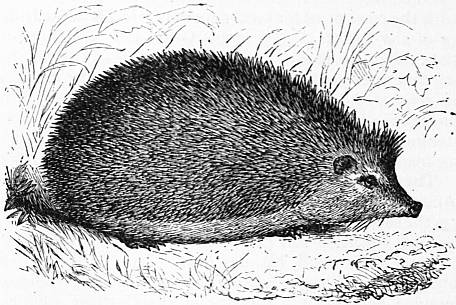
The Hedgehog (Erinaceus europaeus).
Though insectivorous, the hedgehog is reported to have a liking for mice, while frogs and toads, as well as plants and fruits, all seem to be acceptable. It will also eat snakes, and its fondness for eggs has caused it to meet with the enmity of game-preservers; and there is no doubt it occasionally attacks leverets and game-chicks. In a state of nature it does not emerge from its retreat during daylight, unless urged by hunger or by the necessities of its young. During winter it passes into a state of hibernation, when its temperature falls considerably; having provided itself with a nest of dry leaves, it is well protected from the influences of the rain, and rolling itself up, remains undisturbed till warmer weather returns. In July or August the female brings forth four to eight young, or, according to others, two to four at a somewhat earlier period; at birth the spines, which in the adult are black in the middle, are white and soft, but soon harden, though they do not attain their full size until the succeeding spring.
The hedgehog, which is known scientifically as Erinaceus europaeus, and is the type of the family Erinaceidae, is found in woods and gardens, and extends over nearly the whole of Europe; and has been found at 6000 to 8000 ft. above the level of the sea. The adult is provided with thirty-six teeth; in the upper jaw are 6 incisors, 2 canines and 12 cheek-teeth, and in the lower jaw 4 incisors, 2 canines and 10 cheek-teeth. The genus is represented by about a score of species, ranging over Europe, Asia, except the Malay countries, and Africa.
(R. L.*)
HEDGES AND FENCES. The object of the hedge1 or fence (abbreviation of “defence”) is to mark a boundary or to enclose an area of land on which stock is kept. The hedge, i.e. a row of bushes or small trees, forms a characteristic feature of the scenery of England, especially in the midlands and south; it is more rarely found in other countries. Its disadvantages as a fence are that it is not portable, that it requires cutting and training while young, that it harbours weeds and vermin and that it occupies together with the ditch which usually borders it a considerable space of ground, the margins of which cannot be cultivated. For these reasons it is to some extent superseded by the fence proper, especially where shelter for cattle is not required. In Great Britain the hawthorn (q.v.) is by far the most important of hedge plants. Holly resembles the hawthorn in its amenability to pruning and in its prickly nature and closeness of growth, which make it an effective barrier to, and shelter for, stock, but it is less hardy and more slow-growing than the hawthorn. Hornbeam, beech, myrobalan or cherry plum and blackthorn also have their advantages, hornbeam being proof against great exposure, blackthorn thriving on poor land and possessing great impenetrability and so on. Box, yew, privet and many other plants are used for ornamental hedging; in the United States the osage orange and honey locust are favourite hedge plants. As fences, wooden posts and rails and stone walls may be conveniently used in districts where the requisite materials are plentiful. But the most modern form of fence is formed of wire strands either smooth or barbed (see Barbed Wire), strained between iron standards or wooden or concrete posts. The wire may be interwoven with vertical strands or, if necessary, may be kept apart by iron droppers between the standards. Fences of a lighter description are machine-made with pickets of split chestnut or other wood closely set, woven with a few strands of wire; they are braced by posts at intervals.
From the fact that tramps and vagabonds frequently sleep under hedges the word has come to be used as a term of contempt, as in “hedge-priest,” an inferior and illiterate kind of parson at one time existing in England and Ireland, and in “hedge-school,” a low class school held in the open air, formerly very common in Ireland. From the sense of “hedge” as an enclosure or barrier the verb “to hedge” means to enclose, to form a barrier or defence, to bound or limit. As a sporting term the word is used in betting to mean protection from loss, by betting on both sides, by “laying off” on one side, after laying odds on another or vice versa. The word was early used figuratively in the sense of to avoid committing oneself.
See articles in the Cyclopaedia of American Agriculture, vol. i., ed. by L. H. Bailey (New York, 1907); in the Standard Cyclopaedia of Modern Agriculture, ed. by R. P. Wright (London, 1908-1909); and in the Encyclopaedia of Agriculture, vol. ii., ed. by C. E. Green and D. Young (Edinburgh, 1908).
1 Hedge is a Teutonic word, cf. Dutch heg, Ger. Hecke; the root appears in other English words, e.g. “haw,” as in “hawthorn.”
HEDON, a municipal borough in the Holderness parliamentary division of the East Riding of Yorkshire, England, 8 m. E. of Hull by a branch of the North-Eastern railway. Pop. (1901), 1010. It stands in a low-lying, flat district bordering the Humber. It is 2 m. from the river, but was formerly reached by a navigable inlet, now dry, and was a considerable port. There is a small harbour, but the prosperity of the port has passed to Hull. The church of St Augustine is a splendid cruciform building with central tower. It is Early English, Decorated and Perpendicular, the tower being of the last period. The west front is particularly fine, and the church, with its noble proportions and lofty clerestories, resembles a cathedral in miniature. There are a manufacture of bricks and an agricultural trade. The corporation consists of a mayor, 3 aldermen and 9 councillors; and possesses a remarkable ancient mace, of 15th-century workmanship. Area, 321 acres.
According to tradition the men of Hedon received a charter of liberties from King Æthelstan, but there is no evidence to prove this or indeed to prove any settlement in the town until after the Conquest. The manor is not mentioned in the Domesday Survey, but formed part of the lordship of Holderness which William the Conqueror granted to Odo, count of Albemarle. A charter of Henry II., which is undated, contains the first certain evidence of settlement. By it the king granted to William, count of Albemarle, free borough rights in Hedon so that his burgesses there might hold of him as freely and quietly as the burgesses of York or Lincoln held of the king. An earlier charter granted to the inhabitants of York shows that these rights included a trade gild and freedom from many dues not only in England but also in France. King John in 1200 granted a confirmation of these liberties to Baldwin, count of Albemarle, and Hawisia his wife and for this second charter the burgesses themselves paid 70 marks. In 1272 Henry III. granted to Edmund, earl of Lancaster, and Avelina his wife, then lord and lady of the manor, the right of holding a fair at Hedon on the eve, day, and morrow of the feast of St Augustine and for five following days. After the countess’s death the manor came to the hands of Edward I. In 1280 it was found by an inquisition that the men of Hedon “were few and poor” and that if the town were demised at a fee-farm rent the town might improve. The grant, however, does not appear to have been made until 1346. Besides this charter Edward III. also granted the burgesses the privilege of electing a mayor and bailiffs every year. At that time Hedon was one of the chief ports in the Humber, but its place was gradually taken by Hull after that town came into the hands of the king. Hedon was incorporated by Charles II. in 1661, and James II. in 1680 gave the burgesses another charter granting among other privileges that of holding two extra fairs, but of this they never appear to have taken advantage. The burgesses returned two members to parliament in 1295, and from 1547 to 1832 when the borough was disfranchised.
See Victoria County History, Yorkshire; J. R. Boyle, The Early History of the Town and Port of Hedon (Hull and York, 1895); G. H. Park, History of the Ancient Borough of Hedon (Hull, 1895).
HEDONISM (Gr. ἡδονή, pleasure, from ἡδύς, sweet, pleasant), in ethics, a general term for all theories of conduct in which the criterion is pleasure of one kind or another. Hedonistic theories of conduct have been held from the earliest times, though they have been by no means of the same character. Moreover, hedonism has, especially by its critics, been very much misrepresented owing mainly to two simple misconceptions. In the first place hedonism may confine itself to the view that, as a matter of observed fact, all men do in practice make pleasure the criterion of action, or it may go further and assert that men ought to seek pleasure as the sole human good. The former statement takes no view as to whether or not there is any absolute good: if merely denies that men aim at anything more than pleasure. The latter statement admits an ideal, summum bonum—namely, pleasure. The second confusion is the tacit assumption that the pleasure of the hedonist is necessarily or characteristically of a purely physical kind; this assumption is in the case of some hedonistic theories a pure perversion of the facts. Practically all hedonists have argued that what are known as the “lower” pleasures are not only ephemeral in themselves but also productive of so great an amount of consequent pain that the wise man cannot regard them as truly pleasurable; the sane hedonist will, therefore, seek those so-called “higher” pleasures which are at once more lasting and less likely to be discounted by consequent pain. It should be observed, however, that this choice of pleasures by a hedonist is conditioned not by “moral” (absolute) but by prudential (relative) considerations.
The earliest and the most extreme type of hedonism is that of the Cyrenaic School as stated by Aristippus, who argued that the only good for man is the sentient pleasure of the moment. Since (following Protagoras) knowledge is solely of momentary sensations, it is useless to try, as Socrates recommended, to make calculations as to future pleasures, and to balance present enjoyment with disagreeable consequences. The true art of life is to crowd as much enjoyment as possible into every moment. This extreme or “pure” hedonism regarded as a definite philosophic theory practically died with the Cyrenaics, though the same spirit has frequently found expression in ancient and modern, especially poetical, literature.
The confusion already alluded to between “pure” and “rational” hedonism is nowhere more clearly exemplified than in the misconceptions which have arisen as to the doctrine of the Epicureans. To identify Epicureanism with Cyrenaicism is a complete misunderstanding. It is true that pleasure is the summum bonum of Epicurus, but his conception of that pleasure is profoundly modified by the Socratic doctrine of prudence and the eudaemonism of Aristotle. The true hedonist will aim at a life of enduring rational happiness; pleasure is the end of life, but true pleasure can be obtained only under the guidance of reason. Self-control in the choice of pleasures with a view to reducing pain to a minimum is indispensable. “Of all this, the beginning, and the greatest good, is prudence.” The negative side of Epicurean hedonism was developed to such an extent by some members of the school (see Hegesias) that the ideal life is held to be rather indifference to pain than positive enjoyment. This pessimistic attitude is far removed from the positive hedonism of Aristippus.
Between the hedonism of the ancients and that of modern philosophers there lies a great gulf. Practically speaking ancient hedonism advocated the happiness of the individual: the modern hedonism of Hume, Bentham and Mill is based on a wider conception of life. The only real happiness is the happiness of the community, or at least of the majority: the criterion is society, not the individual. Thus we pass from Egoistic to Universalistic hedonism, Utilitarianism, Social Ethics, more especially in relation to the still broader theories of evolution. These theories are confronted by the problem of reconciling and adjusting the claims of the individual with those of society. One of the most important contributions to the discussion is that of Sir Leslie Stephen (Science of Ethics), who elaborated a theory of the “social organism” in relation to the individual. The end of the evolution process is the production of a “social tissue” which will be “vitally efficient.” Instead, therefore, of the criterion of “the greatest happiness of the greatest number,” Stephen has that of the “health of the organism.” Life is not “a series of detached acts, in each of which a man can calculate the sum of happiness or misery attainable by different courses.” Each action must be regarded as directly bearing upon the structure of society.
A criticism of the various hedonistic theories will be found in the article Ethics (ad fin.). See also, beside works quoted under Cyrenaics, Epicurus, &c., and the general histories of philosophy, J. S. Mackenzie, Manual of Ethics (3rd ed., 1897); J. H. Muirhead, Elements of Ethics (1892); J. Watson, Hedonistic Theories (1895); J. Martineau, Types of Ethical Theory (2nd ed., 1886); F. H. Bradley, Ethical Studies (1876); H. Sidgwick, Methods of Ethics (6th ed., 1901); Jas. Seth, Ethical Principles (3rd ed., 1898); other works quoted under Ethics.
HEEL. (1) (O. Eng. héla, cf. Dutch hiel; a derivative of O. Eng. hóh, hough, hock), that part of the foot in man which is situated below and behind the ankle; by analogy, the calcaneal part of the tarsus in other vertebrates. The heel proper in digitigrades and ungulates is raised off the ground and is commonly known as the “knee” or “hock,” while the term “heel” is applied to the hind hoofs. (2) (A variant of the earlier hield; cf. Dutch hellen, for helden), to turn over to one side, especially of a ship. It is this word probably, in the sense of “tip-up,” used particularly of the tilting or tipping of a cask or barrel of liquor, that explains the origin of the expression “no heel-taps,” a direction to the drinkers of a toast to drain their glasses and leave no dregs remaining. “Tap” is a common word for liquor, and a cask is said to be “heeled” when it is tipped and only dregs or muddy liquor are left. This suits the actual sense of the phrase better than the explanations which connect it with tapping the “heel” or bottom of the glass (see Notes and Queries, 4th series, vols. xi.-xii., and 5th series, vol. i.).
HEEM, JAN DAVIDSZ VAN (or Johannes de), (c.1600-c.1683), Dutch painter. He was, if not the first, certainly the greatest painter of still life in Holland; no artist of his class combined more successfully perfect reality of form and colour with brilliancy and harmony of tints. No object of stone or silver, no flower humble or gorgeous, no fruit of Europe or the tropics, no twig or leaf, with which he was not familiar. Sometimes he merely represented a festoon or a nosegay. More frequently he worked with a purpose to point a moral or illustrate a motto. Here the snake lies coiled under the grass, there a skull rests on blooming plants. Gold and silver tankards or cups suggest the vanity of earthly possessions; salvation is allegorized in a chalice amidst blossoms, death as a crucifix inside a wreath. Sometimes de Heem painted alone, sometimes in company with men of his school, Madonnas or portraits surrounded by festoons of fruit or flowers. At one time he signed with initials, at others with Johannes, at others again with the name of his father joined to his own. At rare intervals he condescended to a date, and when he did the work was certainly of the best. De Heem entered the gild of Antwerp in 1635-1636, and became a burgher of that city in 1637. He steadily maintained his residence till 1667, when he moved to Utrecht, where traces of his presence are preserved in records of 1668, 1669 and 1670. It is not known when he finally returned to Antwerp, but his death is recorded in the gild books of that place. A very early picture, dated 1628, in the gallery of Gotha, bearing the signature of Johannes in full, shows that de Heem at that time was familiar with the technical habits of execution peculiar to the youth of Albert Cuyp. In later years he completely shook off dependence, and appears in all the vigour of his own originality.
Out of 100 pictures or more to be met with in European galleries scarcely eighteen are dated. The earliest after that of Gotha is a chased tankard, with a bottle, a silver cup, and a lemon on a marble table, dated 1640, in the museum of Amsterdam. A similar work of 1645, with the addition of fruit and flowers and a distant landscape, is in Lord Radnor’s collection at Longford. A chalice in a wreath, with the radiant host amidst wheatsheaves, grapes and flowers, is a masterpiece of 1648 in the Belvedere of Vienna. A wreath round a Madonna of life size, dated 1650, in the museum of Berlin, shows that de Heem could paint brightly and harmoniously on a large scale. In the Pinakothek at Munich is the celebrated composition of 1653, in which creepers, beautifully commingled with gourds and blackberries, twigs of orange, myrtle and peach, are enlivened by butterflies, moths and beetles. A landscape with a blooming rose tree, a jug of strawberries, a selection of fruit, and a marble bust of Pan, dated 1655, is in the Hermitage at St Petersburg; an allegory of abundance in a medallion wreathed with fruit and flowers, in the gallery of Brussels, is inscribed with de Heem’s monogram, the date of 1668, and the name of an obscure artist called Lambrechts. All these pieces exhibit the master in full possession of his artistic faculties.