VOLUME XIII SLICE II Hearing to Helmond (continued 2)
Reading edition
When the heart gives way under the strain, compensation is said to break down, and dropsy, shortness of breath, cough and cyanosis, are among the distressing symptoms which may set in. The mere existence of a valvular lesion does not call for any special treatment so long as compensation is efficient, and a large number of people with slight valvular lesions are living lives indistinguishable from those of their neighbours. It will, however, be readily understood that in the case of the more serious lesions certain precautions should be observed in regard to over-exertion, excitement, over-indulgence in tobacco or alcohol, &c., as the balance is more readily upset and any undue strain on the heart may cause a breakdown of compensation. When this occurs treatment is required. A period of rest in bed is often sufficient to enable the heart to recover, and this may be supplemented as required by the administration of mercurial and saline purgatives to relieve the embarrassed circulation, and of suitable cardiac tonics, such as digitalis and strychnin, to reinforce and strengthen the heart’s action.
2. Affections of the Muscular Wall of the Heart.—Dilatation of the heart, or stretching of the walls of the heart, is an incident, as has already been stated, in pericarditis and in the earlier stages of valvular disease antecedent to hypertrophy. Temporary over-distension or dilatation of the cavities of the heart occurs in violent and protracted exertion, but rapidly subsides and is in no wise harmful to the sound and vigorous heart of the young. It is otherwise if the heart is weak and flabby from a too sedentary life or degenerative changes in its walls or during convalescence from a severe illness, when the same circumstances which will not injure a healthy heart, may give rise to serious dilatation from which recovery may be very protracted.
Influenza is a common cause of cardiac dilatation, and is liable to be a source of trouble after the acute illness has subsided, if the patient goes about and resumes his ordinary avocations too soon.
Fatty or fibroid degeneration of the heart wall may occur in later life from impaired nutrition of the muscle, due to partial obstruction of the blood-vessels supplying it, when they are the seat of the degenerative changes known as arteriosclerosis or atheroma. The affection known as angina pectoris (q.v.) may be a further consequence of this defective blood-supply.
The treatment will vary according to the nature of the case. In serious cases of dilatation, rest in bed, purgatives and cardiac tonics may be required.
In commencing degenerative change the Oertel treatment, consisting of graduated exercise up a gentle slope, limitation of fluids and a special diet, may be indicated.
In cases of slight dilatation after influenza or recent illness, the Schott treatment by baths and exercises as carried out at Nauheim may be sometimes beneficial. The change of air and scene, the enforced rest, the placid life, together with freedom from excitement and worry, are among the most important factors which contribute to success in this class of case.
Disorders of Rhythm of the Heart’s Action.—Under this heading may be grouped a number of conditions to which the name “functional affections of the heart” has sometimes been applied, inasmuch as the disturbances in question cannot usually be attributed to definite organic disease of the heart. We must, of course, exclude from this category the irregularity in the force and frequency of the pulse, which is commonly associated with incompetence of the mitral valve.
The heart is a muscular organ possessing certain properties, rhythmicity, excitability, contractility, conductivity and tonicity, as pointed out by Gaskell, in virtue of which it is able to maintain a regular automatic beat independently of nerve stimulation. It is, however, intimately connected with the brain, blood-vessels and the abdominal and thoracic viscera, by innumerable nerves, through which impulses or messages are being constantly sent to and received from these various portions of the body. Such messages may give rise to disturbances of rhythm with which we are all familiar. For instance, sudden fright or emotion may cause a momentary arrest of the heart’s action, and excitement or apprehension may set up a rapid action of the heart or palpitation. Palpitation, again, is often the result of digestive disorders, the message in this case being received from the stomach, instead of the brain as in emotional disturbances. It may also result from over-indulgence in tobacco and alcohol.
Tachycardia is the name applied to a more or less permanent increase in the rate of the heart-beat. It is usually a prominent feature in the affection known as Graves’ disease or exophthalmic goitre. It may also result from chronic alcoholism. In the condition known as paroxysmal tachycardia there appears to be no adequate explanation for its onset.
Bradycardia or abnormal slowness of the heart-beat, is the converse of tachycardia. An abnormally slow pulse is met with in melancholia, cerebral tumour, jaundice and certain toxic conditions, or may follow an attack of influenza. There is, however, a peculiar affection characterized by abnormal slowness of pulse (often ranging as low as 30), and the onset, from time to time, of epileptiform or syncopal attacks. To this the name “Stokes-Adams disease” has been applied, as it was first called attention to by Adams in 1827, and subsequently fully described by Stokes in 1836. It is usually associated with senile degenerative change of the heart and vascular system, and is held to be due to impairment of conductivity in the muscular fibres (bundle of His) which transmit the wave of contraction from the auricle to the ventricle. It is of serious significance in view of the symptoms associated with it.
Intermittency of the Pulse.—By this is understood a pulse in which a beat is dropped from time to time. The dropping of a beat may occur at regular intervals every two, four or six beats, &c., or occasionally at irregular intervals after a series of normal beats. On examining the heart, it is found, as a rule, that the cause of the intermission at the wrist is not actual omission of a heart-beat, but the occurrence of a hurried imperfect cardiac contraction which does not transmit a pulse-wave to the wrist. It is not characteristic of any special form of heart affection, and is rarely of serious import. It may be due to reflex digestive disturbances, or be associated with conditions of nervous breakdown and irritability, or with an atonic and relaxed condition of the heart muscle. The treatment of these disorders of rhythm of the heart will vary greatly according to the cause and is often a matter of considerable difficulty.
(J. F. H. B.)
Surgery of Heart and Pericardium.—As the result of acute or chronic inflammation of the lining membrane of the fibrous sac which surrounds the heart and the neighbouring parts of the large blood-vessels, a dropsical or a purulent collection may form in it, or the sac may be quietly distended by a thin watery fluid. In either case, but especially in the latter, the heart may be so embarrassed in its work that death seems imminent. The condition is generally due to the cultivation in the pericardium of the germs of rheumatism, influenza or gonorrhoea, or of those of ordinary suppuration. Respiration as well as circulation is embarrassed, and there is a marked fulness and dulness of the front wall of the chest to the left of the breast-bone. In that region also pain and tenderness are complained of. By using the slender, hollow needle of an aspirator great relief may be afforded, but the tapping may have to be repeated from time to time. If the fluid drawn off is found to be purulent, it may be necessary to make a trap-door opening into the chest by cutting across the 4th and 5th ribs, incising and evacuating the pericardium and providing for drainage. In short, an abscess in the pericardium must be treated like an abscess in the pleura.
Wounds of the heart are apt to be quickly fatal. If the probability is that the enfeebled action of the heart is due to pressure from blood which is leaking into, and is locked up in the pericardium, the proper treatment will be to open the pericardium, as described above, and, if possible, to close the opening in the auricle, ventricle or large vessel, by sutures.
(E. O.*)
1 In O. Eng. heorte; this is a common Teut. word, cf. Dut. hart, Ger. Herz, Goth. hairto; related by root are Lat. cor and Gr. καρδία; the ultimate root is kard-, to quiver, shake.
2 This is often called bulbus arteriosus, but it will be seen that the term is used rather differently in comparative anatomy.
HEART-BURIAL, the burial of the heart apart from the body. This is a very ancient practice, the special reverence shown towards the heart being doubtless due to its early association with the soul of man, his affections, courage and conscience. In medieval Europe heart-burial was fairly common. Some of the more notable cases are those of Richard I., whose heart, preserved in a casket, was placed in Rouen cathedral; Henry III., buried in Normandy; Eleanor, queen of Edward I., at Lincoln; Edward I., at Jerusalem; Louis IX., Philip III., Louis XIII. and Louis XIV., in Paris. Since the 17th century the hearts of deceased members of the house of Habsburg have been buried apart from the body in the Loretto chapel in the Augustiner Kirche, Vienna. The most romantic story of heart-burial is that of Robert Bruce. He wished his heart to rest at Jerusalem in the church of the Holy Sepulchre, and on his deathbed entrusted the fulfilment of his wish to Douglas. The latter broke his journey to join the Spaniards in their war with the Moorish king of Granada, and was killed in battle, the heart of Bruce enclosed in a silver casket hanging round his neck. Subsequently the heart was buried at Melrose Abbey. The heart of James, marquess of Montrose, executed by the Scottish Covenanters in 1650, was recovered from his body, which had been buried by the roadside outside Edinburgh, and, enclosed in a steel box, was sent to the duke of Montrose, then in exile. It was lost on its journey, and years afterwards was discovered in a curiosity shop in Flanders. Taken by a member of the Montrose family to India, it was stolen as an amulet by a native chief, was once more regained, and finally lost in France during the Revolution. Of notable 17th-century cases there is that of James II., whose heart was buried in the church of the convent of the Visitation at Chaillot near Paris, and that of Sir William Temple, at Moor Park, Farnham. The last ceremonial burial of a heart in England was that of Paul Whitehead, secretary to the Monks of Medmenham club, in 1775, the interment taking place in the Le Despenser mausoleum at High Wycombe, Bucks. Of later cases the most notable are those of Daniel O’Connell, whose heart is at Rome, Shelley at Bournemouth, Louis XVII. at Venice, Kosciusko at the Polish museum at Rapperschwyll, Lake Zürich, and the marquess of Bute, taken by his widow to Jerusalem for burial in 1900. Sometimes other parts of the body, removed in the process of embalming, are given separate and solemn burial. Thus the viscera of the popes from Sixtus V. (1590) onward have been preserved in the parish church of the Quirinal. The custom of heart-burial was forbidden by Pope Boniface VIII. (1294-1303), but Benedict XI. withdrew the prohibition.
See Pettigrew, Chronicles of the Tombs (1857).
HEARTH (a word which appears in various forms in several Teutonic languages, cf. Dutch haard, German Herd, in the sense of “floor”), the part of a room where a fire is made, usually constructed of stone, bricks, tiles or earth, beaten hard and having a chimney above; the fire being lighted either on the hearth itself, or in a receptacle placed there for the purpose. Like the Latin focus, especially in the phrase for “hearth and home” answering to pro aris et focis, the word is used as equivalent to the home or household. The word is also applied to the fire and cooking apparatus on board ship; the floor of a smith’s forge; the floor of a reverberatory furnace on which the ore is exposed to the flame; the lower part of a blast furnace through which the metal goes down into the crucible; in soldering, a portable brazier or chafing dish, and an iron box sunk in the middle of a flat iron plate or table. An “open-hearth furnace” is a regenerative furnace of the reverberatory type used in making steel, hence “open-hearth steel” (see Iron and Steel).
Hearth-money, hearth tax or chimney-money, was a tax imposed in England on all houses except cottages at a rate of two shillings for every hearth. It was first levied in 1662, but owing to its unpopularity, chiefly caused by the domiciliary visits of the collectors, it was repealed in 1689, although it was producing £170,000 a year. The principle of the tax was not new in the history of taxation, for in Anglo-Saxon times the king derived a part of his revenue from a fumage or tax of smoke farthings levied on all hearths except those of the poor. It appears also in the hearth-penny or tax of a penny on every hearth, which as early as the 10th century was paid annually to the pope (see Peter’s Pence).
HEARTS, a game of cards of recent origin, though founded upon the same principle as many old games, such as Slobberhannes, Four Jacks and Enflé, namely, that of losing instead of winning as many tricks as possible. Hearts is played with a full pack, ace counting highest and deuce lowest. In the four-handed game, which is usually played, the entire pack is dealt out as at whist (but without turning up the last card, since there are no trumps), and the player at the dealer’s left begins by leading any card he chooses, the trick being taken by the highest card of the suit led. Each player must follow suit if he can; if he has no cards of the suit led he is privileged to throw away any card he likes, thus having an opportunity of getting rid of his hearts, which is the object of the game. When all thirteen tricks have been played each player counts the hearts he has taken in and pays into the pool a certain number of counters for them, according to an arrangement made before beginning play. In the four-handed, or sweepstake, game the method of settling called “Howell’s,” from the name of the inventor, has been generally adopted, according to which each player begins with an equal number of chips, say 100, and, after the hand has been played, pays into the pool as many chips for each heart he had taken as there are players besides himself. Then each player takes out of the pool one chip for every heart he did not win. The pool is thus exhausted with every deal. Hearts may be played by two, three, four or even more players, each playing for himself.
Spot Hearts.—In this variation the hearts count according to the number of spots on the cards, excepting that the ace counts 14, the king 13, queen 12 and knave 11, the combined score of the thirteen hearts being thus 104.
Auction Hearts.—In this the eldest hand examines his hand and bids a certain number of counters for the privilege of naming the suit to be got rid of, but without naming the suit. The other players in succession have the privilege of outbidding him, and whoever bids most declares the suit and pays the amount of his bid into the pool, the winner taking it.
Joker Hearts.—Here the deuce of hearts is discarded, and an extra card, called the joker, takes its place, ranking in value between ten and knave. It cannot be thrown away, excepting when hearts are led and an ace or court card is played, though if an opponent discards the ace or a court card of hearts, then the holder of the joker may discard it. The joker is usually considered worth five chips, which are either paid into the pool or to the player who succeeds in discarding the joker.
Heartsette.—In this variation the deuce of spades is deleted and the three cards left after dealing twelve cards to each player are called the widow (or kitty), and are left face downward on the table. The winner of the first trick must take the widow without showing it to his opponents.
Slobberhannes.—The object of this older form of Hearts is to avoid taking either the first or last trick or a trick containing the queen of clubs. A euchre pack (thirty two-cards, lacking all below the 7) is used, and each player is given 10 counters, one being forfeited to the pool if a player takes the first or last trick, or that containing the club queen. If he takes all three he forfeits four points.
Four Jacks (Polignac or Quatre-Valets) is usually played with a piquet pack, the cards ranking in France as at écarté, but in Great Britain and America as at piquet. There is no trump suit. Counters are used, and the object of the game is to avoid taking any trick containing a knave, especially the knave of spades, called Polignac. The player taking such a trick forfeits one counter to the pool.
Enflé (or Schwellen) is usually played by four persons with a piquet pack and for a pool. The cards rank as at Hearts, and there is no trump suit. A player must follow suit if he can, but if he cannot he may not discard, but must take up all tricks already won and add them to his hand. Play is continued until one player gets rid of all his cards and thus wins.
HEAT (O. E. haétu, which like “hot,” Old Eng. hát, is from the Teutonic type haita, hit, to be hot; cf. Ger. hitze, heiss; Dutch, hitte, heet, &c.), a general term applied to that branch of physical science which deals with the effects produced by heat on material bodies, with the laws of transference of heat, and with the transformations of heat into other kinds of energy. The object of the present article is to give a brief sketch of the historical development of the science of heat, and to indicate the relation of the different branches of the subject, which are discussed in greater detail with reference to the latest progress in separate articles.
1. Meanings of the Term Heat.—The term heat is employed in ordinary language in a number of different senses. This makes it a convenient term to employ for the general title of the science, but the different meanings must be carefully distinguished in scientific reasoning. For the present purpose, omitting metaphorical significations, we may distinguish four principal uses of the term: (a) Sensation of heat; (b) Temperature, or degree of hotness; (c) Quantity of thermal energy; (d) Radiant heat, or energy of radiation.
(a) From the sense of heat, aided in the case of very hot bodies by the sense of sight, we obtain our first rough notions of heat as a physical entity, which alters the state of a body and its condition in respect of warmth, and is capable of passing from one body to another. By touching a body we can tell whether it is warmer or colder than the hand, and, by touching two similar bodies in succession, we can form a rough estimate, by the acuteness of the sensation experienced, of their difference in hotness or coldness over a limited range. If a hot iron is placed on a cold iron plate, we may observe that the plate is heated and the iron cooled until both attain appreciably the same degree of warmth; and we infer from similar cases that something which we call “heat” tends to pass from hot to cold bodies, and to attain finally a state of equable diffusion when all the bodies concerned are equally warm or cold. Ideas such as these derived entirely from the sense of heat, are, so to speak, embedded in the language of every nation from the earliest times.
(b) From the sense of heat, again, we naturally derive the idea of a continuous scale or order, expressed by such terms as summer heat, blood heat, fever heat, red heat, white heat, in which all bodies may be placed with regard to their degrees of hotness, and we speak of the temperature of a body as denoting its place in the scale, in contradistinction to the quantity of heat it may contain.
(c) The quantity of heat contained in a body obviously depends on the size of the body considered. Thus a large kettleful of boiling water will evidently contain more heat than a teacupful, though both may be at the same temperature. The temperature does not depend on the size of the body, but on the degree of concentration of the heat in it, i.e. on the quantity of heat per unit mass, other things being equal. We may regard it as axiomatic that a given body (say a pound of water) in a given state (say boiling under a given pressure) must always contain the same quantity of heat, and conversely that, if it contains a given quantity of heat, and if it is under conditions in other respects, it must be at a definite temperature, which will always be the same for the same given conditions.
(d) It is a matter of common observation that rays of the sun or of a fire falling on a body warm it, and it was in the first instance natural to suppose that heat itself somehow travelled across the intervening space from the sun or fire to the body warmed, in much the same way as heat may be carried by a current of hot air or water. But we now know that energy of radiation is not the same thing as heat, though it is converted into heat when the rays strike an absorbing substance. The term “radiant heat,” however, is generally retained, because radiation is commonly measured in terms of the heat it produces, and because the transference of energy by radiation and absorption is the most important agency in the diffusion of heat.
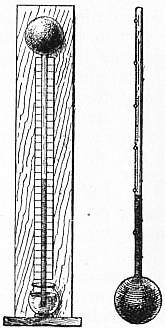
Fig. 1. Fig. 2.
2. Evolution of the Thermometer.—The first step in the development of the science of heat was necessarily the invention of a thermometer, an instrument for indicating temperature and measuring its changes. The first requisite in the case of such an instrument is that it should always give, at least approximately the same indication at the same temperature. The air-thermoscope of Galileo, illustrated in fig. 1, which consisted of a glass bulb containing air, connected to a glass tube of small bore dipping into a coloured liquid, though very sensitive to variations of temperature, was not satisfactory as a measuring instrument, because it was also affected by variations of atmospheric pressure. The invention of the type of thermometer familiar at the present day, containing a liquid hermetically sealed in a glass bulb with a fine tube attached, is also generally attributed to Galileo at a slightly later date, about 1612. Alcohol was the liquid first employed, and the degrees, intended to represent thousandths of the volume of the bulb, were marked with small beads of enamel fused on the stem, as shown in fig. 2. In order to render the readings of such instruments comparable with each other, it was necessary to select a fixed point or standard temperature as the zero or starting-point of the graduations. Instead of making each degree a given fraction of the volume of the bulb, which would be difficult in practice, and would give different values for the degree with different liquids, it was soon found to be preferable to take two fixed points, and to divide the interval between them into the same number of degrees. It was natural in the first instance to take the temperature of the human body as one of the fixed points. In 1701 Sir Isaac Newton proposed a scale in which the freezing-point of water was taken as zero, and the temperature of the human body as 12°. About the same date (1714) Gabriel Daniel Fahrenheit proposed to take as zero the lowest temperature obtainable with a freezing mixture of ice and salt, and to divide the interval between this temperature and that of the human body into 12°. To obtain finer graduations the number was subsequently increased to 96°. The freezing-point of water was at that time supposed to be somewhat variable, because as a matter of fact it is possible to cool water several degrees below its freezing-point in the absence of ice. Fahrenheit showed, however, that as soon as ice began to form the temperature always rose to the same point, and that a mixture of ice or snow with pure water always gave the same temperature. At a later period he also showed that the temperature of boiling water varied with the barometric pressure, but that it was always the same at the same pressure, and might therefore be used as the second fixed point (as Edmund Halley and others had suggested) provided that a definite pressure, such as the average atmospheric pressure, were specified. The freezing and boiling-points on one of his thermometers, graduated as already explained, with the temperature of the body as 96°, came out in the neighbourhood of 32° and 212° respectively, giving an interval of 180° between these points. Shortly after Fahrenheit’s death (1736) the freezing and boiling-points of water were generally recognized as the most convenient fixed points to adopt, but different systems of subdivision were employed. Fahrenheit’s scale, with its small degrees and its zero below the freezing-point, possesses undoubted advantages for meteorological work, and is still retained in most English-speaking countries. But for general scientific purposes, the centigrade system, in which the freezing-point is marked 0° and the boiling-point 100°, is now almost universally employed, on account of its greater simplicity from an arithmetical point of view. For work of precision the fixed points have been more exactly defined (see Thermometry), but no change has been made in the fundamental principle of graduation.
3. Comparison of Scales based on Expansion.—Thermometers constructed in the manner already described will give strictly comparable readings, provided that the tubes be of uniform bore, and that the same liquid and glass be employed in their construction. But they possess one obvious defect from a theoretical point of view, namely, that the subdivision of the temperature scale depends on the expansion of the particular liquid selected as the standard. A liquid such as water, which, when continuously heated at a uniform rate from its freezing-point, first contracts and then expands, at a rapidly increasing rate, would obviously be unsuitable. But there is no a priori reason why other liquids should not behave to some extent in a similar way. As a matter of fact, it was soon observed that thermometers carefully constructed with different liquids, such as alcohol, oil and mercury, did not agree precisely in their indications at points of the scale intermediate between the fixed points, and diverged even more widely outside these limits. Another possible method, proposed in 1694 by Carlo Renaldeni (1615-1698), professor of mathematics and philosophy at Pisa, would be to determine the intermediate points of the scale by observing the temperatures of mixtures of ice-cold and boiling water in varying proportions. On this method, the temperature of 50° C. would be defined as that obtained by mixing equal weights of water at 0° C. and 100° C.; 20° C., that obtained by mixing 80 parts of water at 0° C. with 20 parts of water at 100° C. and so on. Each degree rise of temperature in a mass of water would then represent the addition of the same quantity of heat. The scale thus obtained would, as a matter of fact, agree very closely with that of a mercury thermometer, but the method would be very difficult to put in practice, and would still have the disadvantage of depending on the properties of a particular liquid, namely, water, which is known to behave in an anomalous manner in other respects. At a later date, the researches of Gay-Lussac (1802) and Regnault (1847) showed that the laws of the expansion of gases are much simpler than those of liquids. Whereas the expansion of alcohol between 0° C. and 100° C. is nearly seven times as great as that of mercury, all gases (excluding easily condensible vapours) expand equally, or so nearly equally that the differences between them cannot be detected without the most refined observations. This equality of expansion affords a strong a priori argument for selecting the scale given by the expansion of a gas as the standard scale of temperature, but there are still stronger theoretical grounds for this choice, which will be indicated in discussing the absolute scale (§ 21). Among liquids mercury is found to agree most nearly with the gas scale, and is generally employed in thermometers for scientific purposes on account of its high boiling-point and for other reasons. The differences of the mercurial scale from the gas scale having been carefully determined, the mercury thermometer can be used as a secondary standard to replace the gas thermometer within certain limits, as the gas thermometer would be very troublesome to employ directly in ordinary investigations. For certain purposes, and especially at temperatures beyond the range of mercury thermometers, electrical thermometers, also standardized by reference to the gas thermometer, have been very generally employed in recent years, while for still higher temperatures beyond the range of the gas thermometer, thermometers based on the recently established laws of radiation are the only instruments available. For a further discussion of the theory and practice of the measurement of temperature, the reader is referred to the article Thermometry.
4. Change of State.—Among the most important effects of heat is that of changing the state of a substance from solid to liquid, or from liquid to vapour. With very few exceptions, all substances, whether simple or compound, are known to be capable of existing in each of the three states under suitable conditions of temperature and pressure. The transition of any substance, from the state of liquid to that of solid or vapour under the ordinary atmospheric pressure, takes place at fixed temperatures, the freezing and boiling-points, which are very sharply defined for pure crystalline substances, and serve in fact as fixed points of the thermometric scale. A change of state cannot, however, be effected in any case without the addition or subtraction of a certain definite quantity of heat. If a piece of ice below the freezing-point is gradually heated at a uniform rate, its temperature may be observed to rise regularly till the freezing-point is reached. At this point it begins to melt, and its temperature ceases to rise. The melting takes a considerable time, during the whole of which heat is being continuously supplied without producing any rise of temperature, although if the same quantity of heat were supplied to an equal mass of water, the temperature of the water would be raised nearly 80° C. Heat thus absorbed in producing a change of state without rise of temperature is called “Latent Heat,” a term introduced by Joseph Black, who was one of the first to study the subject of change of state from the point of view of heat absorbed, and who in many cases actually adopted the comparatively rough method described above of estimating quantities of heat by observing the time required to produce a given change when the substance was receiving heat at a steady rate from its surroundings. For every change of state a definite quantity of heat is required, without which the change cannot take place. Heat must be added to melt a solid, or to vaporize a solid or a liquid, and conversely, heat must be subtracted to reverse the change, i.e. to condense a vapour or freeze a liquid. The quantity required for any given change depends on the nature of the substance and the change considered, and varies to some extent with the conditions (as to pressure, &c.) under which the change is made, but is always the same for the same change under the same conditions. A rough measurement of the latent heat of steam was made as early as 1764 by James Watt, who found that steam at 212° F., when passed from a kettle into a jar of cold water, was capable of raising nearly six times its weight of water to the boiling point. He gives the volume of the steam as about 1800 times that of an equal weight of water.
The phenomena which accompany change of state, and the physical laws by which such changes are governed, are discussed in a series of special articles dealing with particular cases. The articles on Fusion and Alloys deal with the change from the solid to the liquid state, and the analogous case of solution is discussed in the article on Solution. The articles on Condensation of Gases, Liquid Gases and Vaporization deal with the theory of the change of state from liquid to vapour, and with the important applications of liquid gases to other researches. The methods of measuring the latent heat of fusion or vaporization are described in the article Calorimetry, and need not be further discussed here except as an introduction to the history of the evolution of knowledge with regard to the nature of heat.
5. Calorimetry by Latent Heat.—In principle, the simplest and most direct method of measuring quantities of heat consists in observing the effects produced in melting a solid or vaporizing a liquid. It was, in fact, by the fusion of ice that quantities of heat were first measured. If a hot body is placed in a cavity in a block of ice at 0° C., and is covered by a closely fitting slab of ice, the quantity of ice melted will be directly proportional to the quantity of heat lost by the body in cooling to 0° C. None of the heat can possibly escape through the ice, and conversely no heat can possibly get in from outside. The body must cool exactly to 0° C., and every fraction of the heat it loses must melt an equivalent quantity of ice. Apart from heat lost in transferring the heated body to the ice block, the method is theoretically perfect. The only difficulty consists in the practical measurement of the quantity of ice melted. Black estimated this quantity by mopping out the cavity with a sponge before and after the operation. But there is a variable film of water adhering to the walls of the cavity, which gives trouble in accurate work. In 1780 Laplace and Lavoisier used a double-walled metallic vessel containing broken ice, which was in many respects more convenient than the block, but aggravated the difficulty of the film of water adhering to the ice. In spite of this practical difficulty, the quantity of heat required to melt unit weight of ice was for a long time taken as the unit of heat. This unit possesses the great advantage that it is independent of the scale of temperature adopted. At a much later date R. Bunsen (Phil. Mag., 1871), adopting a suggestion of Sir John Herschel’s, devised an ice-calorimeter suitable for measuring small quantities of heat, in which the difficulty of the water film was overcome by measuring the change in volume due to the melting of the ice. The volume of unit mass of ice is approximately 1.0920 times that of unit mass of water, so that the diminution of volume is 0.092 a cubic centimetre for each gramme of ice melted. The method requires careful attention to details of manipulation, which are more fully discussed in the article on Calorimetry.
For measuring large quantities of heat, such as those produced by the combustion of fuel in a boiler, the most convenient method is the evaporation of water, which is commonly employed by engineers for the purpose. The natural unit in this case is the quantity of heat required to evaporate unit mass of water at the boiling point under atmospheric pressure. In boilers working at a higher pressure, or supplied with water at a lower temperature, appropriate corrections are applied to deduce the quantity evaporated in terms of this unit.
For laboratory work on a small scale the converse method of condensation has been successfully applied by John Joly, in whose steam-calorimeter the quantity of heat required to raise the temperature of a body from the atmospheric temperature to that of steam condensing at atmospheric pressure is observed by weighing the mass of steam condensed on it. (See Calorimetry.)
6. Thermometric Calorimetry.—For the majority of purposes the most convenient and the most readily applicable method of measuring quantities of heat, is to observe the rise of temperature produced in a known mass of water contained in a suitable vessel or calorimeter. This method was employed from a very early date by Count Rumford and other investigators, and was brought to a high pitch of perfection by Regnault in his extensive calorimetric researches (Mémoires de l’Institut de Paris, 1847); but it is only within comparatively recent years that it has really been placed on a satisfactory basis by the accurate definition of the units involved. The theoretical objections to the method, as compared with latent heat calorimetry, are that some heat is necessarily lost by the calorimeter when its temperature is raised above that of the surroundings, and that some heat is used in heating the vessel containing the water. These are small corrections, which can be estimated with considerable accuracy in practice. A more serious difficulty, which has impaired the value of much careful work by this method, is that the quantity of heat required to raise the temperature of a given mass of water 1° C. depends on the temperature at which the water is taken, and also on the scale of the thermometer employed. It is for this reason, in many cases, impossible to say, at the present time, what was the precise value, within ½ or even 1% of the heat unit, in terms of which many of the older results, such as those of Regnault, were expressed. For many purposes this would not be a serious matter, but for work of scientific precision such a limitation of accuracy would constitute a very serious bar to progress. The unit generally adopted for scientific purposes is the quantity of heat required to raise 1 gram (or kilogram) of water 1° C., and is called the calorie (or kilo-calorie). English engineers usually state results in terms of the British Thermal Unit (B.Th.U.), which is the quantity of heat required to raise 1 ℔ of water 1° F.
7. Watt’s Indicator Diagram; Work of Expansion.—The rapid development of the steam-engine (q.v.) in England during the latter part of the 18th century had a marked effect on the progress of the science of heat. In the first steam-engines the working cylinder served both as boiler and condenser, a very wasteful method, as most of the heat was transferred directly from the fire to the condensing water without useful effect. The first improvement (about 1700) was to use a separate boiler, but the greater part of the steam supplied was still wasted in reheating the cylinder, which had been cooled by the injection of cold water to condense the steam after the previous stroke. In 1769 James Watt showed how to avoid this waste by using a separate condenser and keeping the cylinder as hot as possible. In his earlier engines the steam at full boiler pressure was allowed to raise the piston through nearly the whole of its stroke. Connexion with the boiler was then cut off, and the steam at full pressure was discharged into the condenser. Here again there was unnecessary waste, as the steam was still capable of doing useful work. He subsequently introduced “expansive working,” which effected still further economy. The connexion with the boiler was cut off when a fraction only, say ¼, of the stroke had been completed, the remainder of the stroke being effected by the expansion of the steam already in the cylinder with continually diminishing pressure. By the end of the stroke, when connexion was made to the condenser, the pressure was so reduced that there was comparatively little waste from this cause. Watt also devised an instrument called an indicator (see Steam Engine), in which a pencil, moved up and down vertically by the steam pressure, recorded the pressure in the cylinder at every point of the stroke on a sheet of paper moving horizontally in time with the stroke of the piston. The diagram thus obtained made it possible to study what was happening inside the cylinder, and to deduce the work done by the steam in each stroke. The method of the indicator diagram has since proved of great utility in physics in studying the properties of gases and vapours. The work done, or the useful effect obtained from an engine or any kind of machine, is measured by the product of the resistance overcome and the distance through which it is overcome. The result is generally expressed in terms of the equivalent weight raised through a certain height against the force of gravity.1 If, for instance, the pressure on a piston is 50 ℔ per sq. in., and the area of the piston is 100 sq. in., the force on the piston is 5000 ℔ weight. If the stroke of the piston is 1 ft., the work done per stroke is capable of raising a weight of 5000 ℔ through a height of 1 ft., or 50 ℔ through a height of 100 ft. and so on.
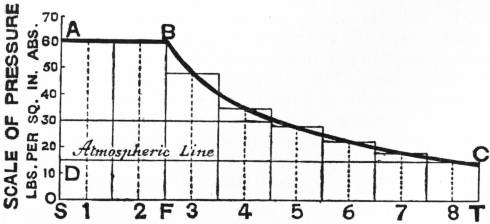
Fig. 3.—Watt’s Indicator Diagram. Patent of 1782.
Fig. 3 represents an imaginary indicator diagram for a steam-engine, taken from one of Watt’s patents. Steam is admitted to the cylinder when the piston is at the beginning of its stroke, at S. ST represents the length of the stroke or the limit of horizontal movement of the paper on which the diagram is drawn. The indicating pencil rises to the point A, representing the absolute pressure of 60 ℔ per sq. in. As the piston moves outwards the pencil traces the horizontal line AB, the pressure remaining constant till the point B is reached, at which connexion to the boiler is cut off. The work done so far is represented by the area of the rectangle ABSF, namely AS × SF, multiplied by the area of the piston in sq. in. The result is in foot-pounds if the fraction of the stroke SF is taken in feet. After cut-off at B the steam expands under diminishing pressure, and the pencil falls gradually from B to C, following the steam pressure until the exhaust valve opens at the end of the stroke. The pressure then falls rapidly to that of the condenser, which for an ideal case may be taken as zero, following Watt. The work done during expansion is found by dividing the remainder of the stroke FT into a number of equal parts (say 8, Watt takes 20) and measuring the pressure at the points 1, 2, 3, 4, &c., corresponding to the middle of each. We thus obtain a number of small rectangles, the sum of which is evidently very nearly equal to the whole area BCTF under the expansion curve, or to the remainder of the stroke FT multiplied by the average or mean value of the pressure. The whole work done in the forward stroke is represented by the area ABCTSA, or by the average value of the pressure P over the whole stroke multiplied by the stroke L. This area must be multiplied by the area of the piston A in sq. in. as before, to get the work done per stroke in foot-pounds, which is PLA. If the engine repeats this cycle N times per minute, the work done per minute is PLAN foot-pounds, which is reduced to horse-power by dividing by 33,000. If the steam is ejected by the piston at atmospheric pressure (15 ℔ per sq. in.) instead of being condensed at zero pressure, the area CDST under the atmospheric line CD, representing work done against back-pressure on the return stroke must be subtracted. If the engine repeats the same cycle or series of operations continuously, the indicator diagram will be a closed curve, and the nett work done per cycle will be represented by the included area, whatever the form of the curve.
8. Thermal Efficiency.—The thermal efficiency of an engine is the ratio of the work done by the engine to the heat supplied to it. According to Watt’s observations, confirmed later by Clément and Désormes, the total heat required to produce 1 ℔ of saturated steam at any temperature from water at 0° C. was approximately 650 times the quantity of heat required to raise 1 ℔ of water 1° C. Since 1 ℔ of steam represented on this assumption a certain quantity of heat, the efficiency could be measured naturally in foot-pounds of work obtainable per ℔ of steam, or conversely in pounds of steam consumed per horse-power-hour.
In his patent of 1782 Watt gives the following example of the improvement in thermal efficiency obtained by expansive working. Taking the diagram already given, if the quantity of steam represented by AB, or 300 cub. in. at 60 ℔ pressure, were employed without expansion, the work realized, represented by the area ABSF, would be 6000/4 = 1500 foot-pounds. With expansion to 4 times its original volume, as shown in the diagram by the whole area ABCTSA, the mean pressure (as calculated by Watt, assuming Boyle’s law) would be 0.58 of the original pressure, and the work done would be 6000 × 0.58 = 3480 foot-pounds for the same quantity of steam, or the thermal efficiency would be 2.32 times greater. The advantage actually obtained would not be so great as this, on account of losses by condensation, back-pressure, &c., which are neglected in Watt’s calculation, but the margin would still be very considerable. Three hundred cub. in. of steam at 60 ℔ pressure would represent about .0245 of 1 ℔ of steam, or 28.7 B.Th.U., so that, neglecting all losses, the possible thermal efficiency attainable with steam at this pressure and four expansions (¼ cut-off) would be 3480/28.7, or 121 foot-pounds per B.Th.U. At a later date, about 1820, it was usual to include the efficiency of the boiler with that of the engine, and to reckon the efficiency or “duty” in foot-pounds per bushel or cwt. of coal. The best Cornish pumping-engines of that date achieved about 70 million foot-pounds per cwt., or consumed about 3.2 ℔ per horse-power-hour, which is roughly equivalent to 43 foot-pounds per B.Th.U. The efficiency gradually increased as higher pressures were used, with more complete expansion, but the conditions upon which the efficiency depended were not fully worked out till a much later date. Much additional knowledge with regard to the nature of heat, and the properties of gases and vapours, was required before the problem could be attacked theoretically.
9. Of the Nature of Heat.—In the early days of the science it was natural to ascribe the manifestations of heat to the action of a subtle imponderable fluid called “caloric,” with the power of penetrating, expanding and dissolving bodies, or dissipating them in vapour. The fluid was imponderable, because the most careful experiments failed to show that heat produced any increase in weight. The opposite property of levitation was often ascribed to heat, but it was shown by more cautious investigators that the apparent loss of weight due to heating was to be attributed to evaporation or to upward air currents. The fundamental idea of an imaginary fluid to represent heat was useful as helping the mind to a conception of something remaining invariable in quantity through many transformations, but in some respects the analogy was misleading, and tended greatly to retard the progress of science. The caloric theory was very simple in its application to the majority of calorimetric experiments, and gave a fair account of the elementary phenomena of change of state, but it encountered serious difficulties in explaining the production of heat by friction, or the changes of temperature accompanying the compression or expansion of a gas. The explanation which the calorists offered of the production of heat by friction or compression was that some of the latent caloric was squeezed or ground out of the bodies concerned and became “sensible.” In the case of heat developed by friction, they supposed that the abraded portions of the material were capable of holding a smaller quantity of heat, or had less “capacity for heat,” than the original material. From a logical point of view, this was a perfectly tenable hypothesis, and one difficult to refute. It was easy to account in this way for the heat produced in boring cannon and similar operations, where the amount of abraded material was large. To refute this explanation, Rumford (Phil. Trans., 1798) made his celebrated experiments with a blunt borer, in one of which he succeeded in boiling by friction 26.5 ℔ of cold water in 2½ hours, with the production of only 4145 grains of metallic powder. He then showed by experiment that the metallic powder required the same amount of heat to raise its temperature 1°, as an equal weight of the original metal, or that its “capacity for heat” (in this sense) was unaltered by reducing it to powder; and he argued that “in any case so small a quantity of powder could not possibly account for all the heat generated, that the supply of heat appeared to be inexhaustible, and that heat could not be a material substance, but must be something of the nature of motion.” Unfortunately Rumford’s argument was not quite conclusive. The supporters of the caloric theory appear, whether consciously or unconsciously, to have used the phrase “capacity for heat” in two entirely distinct senses without any clear definition of the difference. The phrase “capacity for heat” might very naturally denote the total quantity of heat contained in a body, which we have no means of measuring, but it was generally used to signify the quantity of heat required to raise the temperature of a body one degree, which is quite a different thing, and has no necessary relation to the total heat. In proving that the powder and the solid metal required the same quantity of heat to raise the temperature of equal masses of either one degree, Rumford did not prove that they contained equal quantities of heat, which was the real point at issue in this instance. The metal tin actually changes into powder below a certain temperature, and in so doing evolves a measurable quantity of heat. A mixture of the gases oxygen and hydrogen, in the proportions in which they combine to form water, evolves when burnt sufficient heat to raise more than thirty times its weight of water from the freezing to the boiling point; and the mixture of gases may, in this sense, be said to contain so much more heat than the water, although its capacity for heat in the ordinary sense is only about half that of the water produced. To complete the refutation of the calorists’ explanation of the heat produced by friction, it would have been necessary for Rumford to show that the powder when reconverted into the same state as the solid metal did not absorb a quantity of heat equivalent to that evolved in the grinding; in other words that the heat produced by friction was not simply that due to the change of state of the metal from solid to powder.
Shortly afterwards, in 1799, Davy2 described an experiment in which he melted ice by rubbing two blocks together. This experiment afforded a very direct refutation of the calorists’ view, because it was a well-known fact that ice required to have a quantity of heat added to it to convert it into water, so that the water produced by the friction contained more heat than the ice. In stating as the conclusion to be drawn from this experiment that “friction consequently does not diminish the capacity of bodies for heat,” Davy apparently uses the phrase capacity for heat in the sense of total heat contained in a body, because in a later section of the same essay he definitely gives the phrase this meaning, and uses the term “capability of temperature” to denote what we now term capacity for heat.
The delay in the overthrow of the caloric theory, and in the acceptance of the view that heat is a mode of motion, was no doubt partly due to some fundamental confusion of ideas in the use of the term “capacity for heat” and similar phrases. A still greater obstacle lay in the comparative vagueness of the motion or vibration theory. Davy speaks of heat as being “repulsive motion,” and distinguishes it from light, which is “projective motion”; though heat is certainly not a substance—according to Davy in the essay under discussion—and may not even be treated as an imponderable fluid, light as certainly is a material substance, and is capable of forming chemical compounds with ordinary matter, such as oxygen gas, which is not a simple substance, but a compound, termed phosoxygen, of light and oxygen. Accepting the conclusions of Davy and Rumford that heat is not a material substance but a mode of motion, there still remains the question, what definite conception is to be attached to a quantity of heat? What do we mean by a quantity of vibratory motion, how is the quantity of motion to be estimated, and why should it remain invariable in many transformations? The idea that heat was a “mode of motion” was applicable as a qualitative explanation of many of the effects of heat, but it lacked the quantitative precision of a scientific statement, and could not be applied to the calculation and prediction of definite results. The state of science at the time of Rumford’s and Davy’s experiments did not admit of a more exact generalization. The way was paved in the first instance by a more complete study of the laws of gases, to which Laplace, Dalton, Gay-Lussac, Dulong and many others contributed both on the experimental and theoretical side. Although the development proceeded simultaneously along many parallel lines, it is interesting and instructive to take the investigation of the properties of gases, and to endeavour to trace the steps by which the true theory was finally attained.
10. Thermal Properties of Gases.—The most characteristic property of a gaseous or elastic fluid, namely, the elasticity, or resistance to compression, was first investigated scientifically by Robert Boyle (1662), who showed that the pressure p of a given mass of gas varied inversely as the volume v, provided that the temperature remained constant. This is generally expressed by the formula pv = C, where C is a constant for any given temperature, and v is taken to represent the specific volume, or the volume of unit mass, of the gas at the given pressure and temperature. Boyle was well aware of the effect of heat in expanding a gas, but he was unable to investigate this properly as no thermometric scale had been defined at that date. According to Boyle’s law, when a mass of gas is compressed by a small amount at constant temperature, the percentage increase of pressure is equal to the percentage diminution of volume (if the compression is v/100, the increase of pressure is very nearly p/100). Adopting this law, Newton showed, by a most ingenious piece of reasoning (Principia, ii., sect. 8), that the velocity of sound in air should be equal to the velocity acquired by a body falling under gravity through a distance equal to half the height of the atmosphere, considered as being of uniform density equal to that at the surface of the earth. This gave the result 918 ft. per sec. (280 metres per sec.) for the velocity at the freezing point. Newton was aware that the actual velocity of sound was somewhat greater than this, but supposed that the difference might be due in some way to the size of the air particles, of which no account could be taken in the calculation. The first accurate measurement of the velocity of sound by the French Académie des Sciences in 1738 gave the value 332 metres per sec. as the velocity at 0° C. The true explanation of the discrepancy was not discovered till nearly 100 years later.
The law of expansion of gases with change of temperature was investigated by Dalton and Gay-Lussac (1802), who found that the volume of a gas under constant pressure increased by 1/267th part of its volume at 0° C. for each 1° C. rise in temperature. This value was generally assumed in all calculations for nearly 50 years. More exact researches, especially those of Regnault, at a later date, showed that the law was very nearly correct for all permanent gases, but that the value of the coefficient should be 1⁄173rd. According to this law the volume of a gas at any temperature t° C. should be proportional to 273 + t, i.e. to the temperature reckoned from a zero 273° below that of the Centigrade scale, which was called the absolute zero of the gas thermometer. If T = 273 + t, denotes the temperature measured from this zero, the law of expansion of a gas may be combined with Boyle’s law in the simple formula
pv = RT
(1)
which is generally taken as the expression of the gaseous laws. If equal volumes of different gases are taken at the same temperature and pressure, it follows that the constant R is the same for all gases. If equal masses are taken, the value of the constant R for different gases varies inversely as the molecular weight or as the density relative to hydrogen.
Dalton also investigated the laws of vapours, and of mixtures of gases and vapours. He found that condensible vapours approximately followed Boyle’s law when compressed, until the condensation pressure was reached, at which the vapour liquefied without further increase of pressure. He found that when a liquid was introduced into a closed space, and allowed to evaporate until the space was saturated with the vapour and evaporation ceased, the increase of pressure in the space was equal to the condensation pressure of the vapour, and did not depend on the volume of the space or the presence of any other gas or vapour provided that there was no solution or chemical action. He showed that the condensation or saturation-pressure of a vapour depended only on the temperature, and increased by nearly the same fraction of itself per degree rise of temperature, and that the pressures of different vapours were nearly the same at equal distances from their boiling points. The increase of pressure per degree C. at the boiling point was about 1⁄28th of 760 mm. or 27.2 mm., but increased in geometrical progression with rise of temperature. These results of Dalton’s were confirmed, and in part corrected, as regards increase of vapour-pressure, by Gay-Lussac, Dulong, Regnault and other investigators, but were found to be as close an approximation to the truth as could be obtained with such simple expressions. More accurate empirical expressions for the increase of vapour-pressure of a liquid with temperature were soon obtained by Thomas Young, J. P. L. A. Roche and others, but the explanation of the relation was not arrived at until a much later date (see Vaporization).
11. Specific Heats of Gases.—In order to estimate the quantities of heat concerned in experiments with gases, it was necessary in the first instance to measure their specific heats, which presented formidable difficulties. The earlier attempts by Lavoisier and others, employing the ordinary methods of calorimetry, gave very uncertain and discordant results, which were not regarded with any confidence even by the experimentalists themselves. Gay-Lussac (Mémoires d’Arcueil, 1807) devised an ingenious experiment, which, though misinterpreted at the time, is very interesting and instructive. With the object of comparing the specific heats of different gases, he took two equal globes A and B connected by a tube with a stop-cock. The globe B was exhausted, the other A being filled with gas. On opening the tap between the vessels, the gas flowed from A to B and the pressure was rapidly equalized. He observed that the fall of temperature in A was nearly equal to the rise of temperature in B, and that for the same initial pressure the change of temperature was very nearly the same for all the gases he tried, except hydrogen, which showed greater changes of temperature than other gases. He concluded from this experiment that equal volumes of gases had the same capacity for heat, except hydrogen, which he supposed to have a larger capacity, because it showed a greater effect. The method does not in reality afford any direct information with regard to the specific heats, and the conclusion with regard to hydrogen is evidently wrong. At a later date (Ann. de Chim., 1812, 81, p. 98) Gay-Lussac adopted A. Crawford’s method of mixture, allowing two equal streams of different gases, one heated and the other cooled about 20° C., to mix in a tube containing a thermometer. The resulting temperature was in all cases nearly the mean of the two, from which he concluded that equal volumes of all the gases tried, namely, hydrogen, carbon dioxide, air, oxygen and nitrogen, had the same thermal capacity. This was correct, except as regards carbon dioxide, but did not give any information as to the actual specific heats referred to water or any known substance. About the same time, F. Delaroche and J. E. Bérard (Ann. de chim., 1813, 85, p. 72) made direct determinations of the specific heats of air, oxygen, hydrogen, carbon monoxide, carbon dioxide, nitrous oxide and ethylene, by passing a stream of gas heated to nearly 100° C. through a spiral tube in a calorimeter containing water. Their work was a great advance on previous attempts, and gave the first trustworthy results. With the exception of hydrogen, which presents peculiar difficulties, they found that equal volumes of the permanent gases, air, oxygen and carbon monoxide, had nearly the same thermal capacity, but that the compound condensible gases, carbon dioxide, nitrous oxide and ethylene, had larger thermal capacities in the order given. They were unable to state whether the specific heats of the gases increased or diminished with temperature, but from experiments on air at pressures of 740 mm. and 1000 mm., they found the specific heats to be .269 and .245 respectively, and concluded that the specific heat diminished with increase of pressure. The difference they observed was really due to errors of experiment, but they regarded it as proving beyond doubt the truth of the calorists’ contention that the heat disengaged on the compression of a gas was due to the diminution of its thermal capacity.
Dalton and others had endeavoured to measure directly the rise of temperature produced by the compression of a gas. Dalton had observed a rise of 50° F. in a gas when suddenly compressed to half its volume, but no thermometers at that time were sufficiently sensitive to indicate more than a fraction of the change of temperature. Laplace was the first to see in this phenomenon the probable explanation of the discrepancy between Newton’s calculation of the velocity of sound and the observed value. The increase of pressure due to a sudden compression, in which no heat was allowed to escape, or as we now call it an “adiabatic” compression, would necessarily be greater than the increase of pressure in a slow isothermal compression, on account of the rise of temperature. As the rapid compressions and rarefactions occurring in the propagation of a sound wave were perfectly adiabatic, it was necessary to take account of the rise of temperature due to compression in calculating the velocity. To reconcile the observed and calculated values of the velocity, the increase of pressure in adiabatic compression must be 1.410 times greater than in isothermal compression. This is the ratio of the adiabatic elasticity of air to the isothermal elasticity. It was a long time, however, before Laplace saw his way to any direct experimental verification of the value of this ratio. At a later date (Ann. de chim., 1816, 3, p. 238) he stated that he had succeeded in proving that the ratio in question must be the same as the ratio of the specific heat of air at constant pressure to the specific heat at constant volume.
In the method of measuring the specific heat adopted by Delaroche and Bérard, the gas under experiment, while passing through a tube at practically constant pressure, contracts in cooling, as it gives up its heat to the calorimeter. Part of the heat surrendered to the calorimeter is due to the contraction of volume. If a gramme of gas at pressure p, volume v and temperature T abs. is heated 1° C. at constant pressure p, it absorbs a quantity of heat S = .238 calorie (according to Regnault) the specific heat at constant pressure. At the same time the gas expands by a fraction 1/T of v, which is the same as 1/273 of its volume at 0° C. If now the air is suddenly compressed by an amount v/T, it will be restored to its original volume, and its temperature will be raised by the liberation of a quantity of heat R′, the latent heat of expansion for an increase of volume v/T. If no heat has been allowed to escape, the air will now be in the same state as if a quantity of heat S had been communicated to it at its original volume v without expansion. The rise of temperature above the original temperature T will be S/s degrees, where s is the specific heat at constant volume, which is obviously equal to S − R′. Since p/T is the increase of pressure for 1° C. rise of temperature at constant volume, the increase of pressure for a rise of S/s degrees will be γp/T, where γ is the ratio S/s. But this is the rise of pressure produced by a sudden compression v/T, and is seen to be γ times the rise of pressure p/T produced by the same compression at constant temperature. The ratio of the adiabatic to the isothermal elasticity, required for calculating the velocity of sound, is therefore the same as the ratio of the specific heat at constant pressure to that at constant volume.
12. Experimental Verification of the Ratio of Specific Heats.—This was a most interesting and important theoretical relation to discover, but unfortunately it did not help much in the determination of the ratio required, because it was not practically possible at that time to measure the specific heat of air at constant volume in a closed vessel. Attempts had been made to do this, but they had signally failed, on account of the small heat capacity of the gas as compared with the containing vessel. Laplace endeavoured to extract some confirmation of his views from the values given by Delaroche and Bérard for the specific heat of air at 1000 and 740 mm. pressure. On the assumption that the quantities of heat contained in a given mass of air increased in direct proportion to its volume when heated at constant pressure, he deduced, by some rather obscure reasoning, that the ratio of the specific heats S and s should be about 1.5 to 1, which he regarded as a fairly satisfactory agreement with the value γ = 1.41 deduced from the velocity of sound.
The ratio of the specific heats could not be directly measured, but a few years later, Clément and Désormes (Journ. de Phys., Nov. 1819) succeeded in making a direct measurement of the ratio of the elasticities in a very simple manner. They took a large globe containing air at atmospheric pressure and temperature, and removed a small quantity of air. They then observed the defect of pressure p0 when the air had regained its original temperature. By suddenly opening the globe, and immediately closing it, the pressure was restored almost instantaneously to the atmospheric, the rise of pressure p0 corresponding to the sudden compression produced. The air, having been heated by the compression, was allowed to regain its original temperature, the tap remaining closed, and the final defect of pressure p1 was noted. The change of pressure for the same compression performed isothermally is then p0 − p1. The ratio p0/(p0 − p1) is the ratio of the adiabatic and isothermal elasticities, provided that p0 is small compared with the whole atmospheric pressure. In this way they found the ratio 1.354, which is not much smaller than the value 1.410 required to reconcile the observed and calculated values of the velocity of sound. Gay-Lussac and J. J. Welter (Ann. de chim., 1822) repeated the experiment with slight improvements, using expansion instead of compression, and found the ratio 1.375. The experiment has often been repeated since that time, and there is no doubt that the value of the ratio deduced from the velocity of sound is correct, the defect of the value obtained by direct experiment being due to the fact that the compression or expansion is not perfectly adiabatic. Gay-Lussac and Welter found the ratio practically constant for a range of pressure 144 to 1460 mm., and for a range of temperature from −20° to +40° C. The velocity of sound at Quito, at a pressure of 544 mm. was found to be the same as at Paris at 760 mm. at the same temperature. Assuming on this evidence the constancy of the ratio of the specific heats of air, Laplace (Mécanique céleste, v. 143) showed that, if the specific heat at constant pressure was independent of the temperature, the specific heat per unit volume at a pressure p must vary as p1/γ, according to the caloric theory. The specific heat per unit mass must then vary as p1/γ−1 which he found agreed precisely with the experiment of Delaroche and Bérard already cited. This was undoubtedly a strong confirmation of the caloric theory. Poisson by the same assumptions (Ann. de chim., 1823, 23, p. 337) obtained the same results, and also showed that the relation between the pressure and the volume of a gas in adiabatic compression or expansion must be of the form pvγ = constant.
P. L. Dulong (Ann. de chim., 1829, 41, p. 156), adopting a method due to E. F. F. Chladni, compared the velocities of sound in different gases by observing the pitch of the note given by the same tube when filled with the gases in question. He thus obtained the values of the ratios of the elasticities or of the specific heats for the gases employed. For oxygen, hydrogen and carbonic oxide, these ratios were the same as for air. But for carbonic acid, nitrous oxide and olefiant gas, the values were much smaller, showing that these gases experienced a smaller change of temperature in compression. On comparing his results with the values of the specific heats for the same gases found by Delaroche and Bérard, Dulong observed that the changes of temperature for the same compression were in the inverse ratio of the specific heats at constant volume, and deduced the important conclusion that “Equal volumes of all gases under the same conditions evolve on compression the same quantity of heat.” This is equivalent to the statement that the difference of the specific heats, or the latent heat of expansion R′ per 1°, is the same for all gases if equal volumes are taken. Assuming the ratio γ = 1.410, and taking Delaroche and Bérard’s value for the specific heat of air at constant pressure S = .267, we have s = S/1.41 = .189, and the difference of the specific heats per unit mass of air S − s = R′ = .078. Adopting Regnault’s value of the specific heat of air, namely, S = .238, we should have S − s = .069. This quantity represents the heat absorbed by unit mass of air in expanding at constant temperature T by a fraction 1/T of its volume v, or by 1⁄273rd of its volume 0° C.
If, instead of taking unit mass, we take a volume v0 = 22.30 litres at 0° C. and 760 mm. being the volume of the molecular weight of the gas in grammes, the quantity of heat evolved by a compression equal to v/T will be approximately 2 calories, and is the same for all gases. The work done in this compression is pv/T = R, and is also the same for all gases, namely, 8.3 joules. Dulong’s experimental result, therefore, shows that the heat evolved in the compression of a gas is proportional to the work done. This result had previously been deduced theoretically by Carnot (1824). At a later date it was assumed by Mayer, Clausius and others, on the evidence of these experiments, that the heat evolved was not merely proportional to the work done, but was equivalent to it. The further experimental evidence required to justify this assumption was first supplied by Joule.
Latent heat of expansion R′ = .069 calorie per gramme of air, per 1° C.
= 2.0 calories per gramme-molecule of any gas.
Work done in expansion R = .287 joule per gramme of air per 1° C.
= 8.3 joules per gramme-molecule of any gas.
13. Carnot: On the Motive Power of Heat.—A practical and theoretical question of the greatest importance was first answered by Sadi Carnot about this time in his Reflections on the Motive Power of Heat (1824). How much motive power (defined by Carnot as weight lifted through a certain height) can be obtained from heat alone by means of an engine repeating a regular succession or “cycle” of operations continuously? Is the efficiency limited, and, if so, how is it limited? Are other agents preferable to steam for developing motive power from heat? In discussing this problem, we cannot do better than follow Carnot’s reasoning which, in its main features could hardly be improved at the present day.
Carnot points out that in order to obtain an answer to this question, it is necessary to consider the essential conditions of the process, apart from the mechanism of the engine and the working substance or agent employed. Work cannot be said to be produced from heat alone unless nothing but heat is supplied, and the working substance and all parts of the engine are at the end of the process in precisely the same state as at the beginning.3
Carnot’s Axiom.—Carnot here, and throughout his reasoning, makes a fundamental assumption, which he states as follows: “When a body has undergone any changes and after a certain number of transformations is brought back identically to its original state, considered relatively to density, temperature and mode of aggregation, it must contain the same quantity of heat as it contained originally.”4
Heat, according to Carnot, in the type of engine we are considering, can evidently be a cause of motive power only by virtue of changes of volume or form produced by alternate heating and cooling. This involves the existence of cold and hot bodies to act as boiler and condenser, or source and sink of heat, respectively. Wherever there exists a difference of temperature, it is possible to have the production of motive power from heat; and conversely, production of motive power, from heat alone, is impossible without difference of temperature. In other words the production of motive power from heat is not merely a question of the consumption of heat, but always requires transference of heat from hot to cold. What then are the conditions which enable the difference of temperature to be most advantageously employed in the production of motive power, and how much motive power can be obtained with a given difference of temperature from a given quantity of heat?
Carnot’s Rule for Maximum Effect.—In order to realize the maximum effect, it is necessary that, in the process employed, there should not be any direct interchange of heat between bodies at different temperatures. Direct transference of heat by conduction or radiation between bodies at different temperatures is equivalent to wasting a difference of temperature which might have been utilized to produce motive power. The working substance must throughout every stage of the process be in equilibrium with itself (i.e. at uniform temperature and pressure) and also with external bodies, such as the boiler and condenser, at such times as it is put in communication with them. In the actual engine there is always some interchange of heat between the steam and the cylinder, and some loss of heat to external bodies. There may also be some difference of temperature between the boiler steam and the cylinder on admission, or between the waste steam and the condenser at release. These differences represent losses of efficiency which may be reduced indefinitely, at least in imagination, by suitable means, and designers had even at that date been very successful in reducing them. All such losses are supposed to be absent in deducing the ideal limit of efficiency, beyond which it would be impossible to go.
14. Carnot’s Description of his Ideal Cycle.—Carnot first gives a rough illustration of an incomplete cycle, using steam much in the same way as it is employed in an ordinary steam-engine. After expansion down to condenser pressure the steam is completely condensed to water, and is then returned as cold water to the hot boiler. He points out that the last step does not conform exactly to the condition he laid down, because although the water is restored to its initial state, there is direct passage of heat from a hot body to a cold body in the last process. He points out that this difficulty might be overcome by supposing the difference of temperature small, and by employing a series of engines, each working through a small range, to cover a finite interval of temperature. Having established the general notions of a perfect cycle, he proceeds to give a more exact illustration, employing a gas as the working substance. He takes as the basis of his demonstration the well-established experimental fact that a gas is heated by rapid compression and cooled by rapid expansion, and that if compressed or expanded slowly in contact with conducting bodies, the gas will give out heat in compression or absorb heat in expansion while its temperature remains constant. He then goes on to say:—
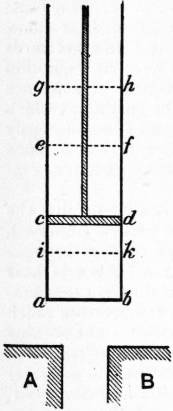
Fig 4.
Carnot’s Cylinder.
“This preliminary notion being settled, let us imagine an elastic fluid, atmospheric air for example, enclosed in a cylinder abcd, fig. 4, fitted with a movable diaphragm or piston cd. Let there also be two bodies A, B, each maintained at a constant temperature, that of A being more elevated than that of B. Let us now suppose the following series of operations to be performed:
“1. Contact of the body A with the air contained in the space abcd, or with the bottom of the cylinder, which we will suppose to transmit heat easily. The air is now at the temperature of the body A, and cd is the actual position of the piston.
“2. The piston is gradually raised, and takes the position ef. The air remains in contact with the body A, and is thereby maintained at a constant temperature during the expansion. The body A furnishes the heat necessary to maintain the constancy of temperature.
“3. The body A is removed, and the air no longer being in contact with any body capable of giving it heat, the piston continues nevertheless to rise, and passes from the position ef to gh. The air expands without receiving heat and its temperature falls. Let us imagine that it falls until it is just equal to that of the body B. At this moment the piston is stopped and occupies the position gh.
“4. The air is placed in contact with the body B; it is compressed by the return of the piston, which is brought from the position gh to the position cd. The air remains meanwhile at a constant temperature, because of its contact with the body B to which it gives up its heat.
“5. The body B is removed, and the compression of the air is continued. The air being now isolated, rises in temperature. The compression is continued until the air has acquired the temperature of the body A. The piston passes meanwhile from the position cd to the position ik.
“6. The air is replaced in contact with the body A, and the piston returns from the position ik to the position ef, the temperature remaining invariable.
“7. The period described under (3) is repeated, then successively the periods (4), (5), (6); (3), (4), (5), (6); (3), (4), (5), (6); and so on.
“During these operations the air enclosed in the cylinder exerts an effort more or less great on the piston. The pressure of the air varies both on account of changes of volume and on account of changes of temperature; but it should be observed that for equal volumes, that is to say, for like positions of the piston, the temperature is higher during the dilatation than during the compression. Since the pressure is greater during the expansion, the quantity of motive power produced by the dilatation is greater than that consumed by the compression. We shall thus obtain a balance of motive power, which may be employed for any purpose. The air has served as working substance in a heat-engine; it has also been employed in the most advantageous manner possible, since no useless re-establishment of the equilibrium of heat has been allowed to occur.
“All the operations above described may be executed in the reverse order and direction. Let us imagine that after the sixth period, that is to say, when the piston has reached the position ef, we make it return to the position ik, and that at the same time we keep the air in contact with the hot body A; the heat furnished by this body during the sixth period will return to its source, that is, to the body A, and everything will be as it was at the end of the fifth period. If now we remove the body A, and if we make the piston move from ik to cd, the temperature of the air will decrease by just as many degrees as it increased during the fifth period, and will become that of the body B. We can evidently continue in this way a series of operations the exact reverse of those which were previously described; it suffices to place oneself in the same circumstances and to execute for each period a movement of expansion in place of a movement of compression, and vice versa.
“The result of the first series of operations was the production of a certain quantity of motive power, and the transport of heat from the body A to the body B; the result of the reverse operations is the consumption of the motive power produced in the first case, and the return of heat from the body B to the body A, in such sort that these two series of operations annul and neutralize each other.
“The impossibility of producing by the agency of heat alone a quantity of motive power greater than that which we have obtained in our first series of operations is now easy to prove. It is demonstrated by reasoning exactly similar to that which we have already given. The reasoning will have in this case a greater degree of exactitude; the air of which we made use to develop the motive power is brought back at the end of each cycle of operations precisely to its initial state, whereas this was not quite exactly the case for the vapour of water, as we have already remarked.”
15. Proof of Carnot’s Principle.—Carnot considered the proof too obvious to be worth repeating, but, unfortunately, his previous demonstration, referring to an incomplete cycle, is not so exactly worded that exception cannot be taken to it. We will therefore repeat his proof in a slightly more definite and exact form. Suppose that a reversible engine R, working in the cycle above described, takes a quantity of heat H from the source in each cycle, and performs a quantity of useful work Wr. If it were possible for any other engine S, working with the same two bodies A and B as source and refrigerator, to perform a greater amount of useful work Ws per cycle for the same quantity of heat H taken from the source, it would suffice to take a portion Wr of this motive power (since Ws is by hypothesis greater than Wr) to drive the engine R backwards, and return a quantity of heat H to the source in each cycle. The process might be repeated indefinitely, and we should obtain at each repetition a balance of useful work Ws − Wr, without taking any heat from the source, which is contrary to experience. Whether the quantity of heat taken from the condenser by R is equal to that given to the condenser by S is immaterial. The hot body A might be a comparatively small boiler, since no heat is taken from it. The cold body B might be the ocean, or the whole earth. We might thus obtain without any consumption of fuel a practically unlimited supply of motive power. Which is absurd.
Carnot’s Statement of his Principle.5—If the above reasoning be admitted, we must conclude with Carnot that the motive power obtainable from heat is independent of the agents employed to realize it. The efficiency is fixed solely by the temperatures of the bodies between which, in the last resort, the transfer of heat is effected. “We must understand here that each of the methods of developing motive power attains the perfection of which it is susceptible. This condition is fulfilled if, according to our rule, there is produced in the body no change of temperature that is not due to change of volume, or in other words, if there is no direct interchange of heat between bodies of sensibly different temperatures.”
It is characteristic of a state of frictionless mechanical equilibrium that an indefinitely small difference of pressure suffices to upset the equilibrium and reverse the motion. Similarly in thermal equilibrium between bodies at the same temperature, an indefinitely small difference of temperature suffices to reverse the transfer of heat. Carnot’s rule is therefore the criterion of the reversibility of a cycle of operations as regards transfer of heat. It is assumed that the ideal engine is mechanically reversible, that there is not, for instance, any communication between reservoirs of gas or vapour at sensibly different pressures, and that there is no waste of power in friction. If there is equilibrium both mechanical and thermal at every stage of the cycle, the ideal engine will be perfectly reversible. That is to say, all its operations will be exactly reversed as regards transfer of heat and work, when the operations are performed in the reverse order and direction. On this understanding Carnot’s principle may be put in a different way, which is often adopted, but is really only the same thing put in different words: The efficiency of a perfectly reversible engine is the maximum possible, and is a function solely of the limits of temperature between which it works. This result depends essentially on the existence of a state of thermal equilibrium defined by equality of temperature, and independent, in the majority of cases, of the state of a body in other respects. In order to apply the principle to the calculation and prediction of results, it is sufficient to determine the manner in which the efficiency depends on the temperature for one particular case, since the efficiency must be the same for all reversible engines.
16. Experimental Verification of Carnot’s Principle.—Carnot endeavoured to test his result by the following simple calculations. Suppose that we have a cylinder fitted with a frictionless piston, containing 1 gram of water at 100° C., and that the pressure of the steam, namely 760 mm., is in equilibrium with the external pressure on the piston at this temperature. Place the cylinder in connexion with a boiler or hot body at 101° C. The water will then acquire the temperature of 101° C., and will absorb 1 gram-calorie of heat. Some waste of motive power occurs here because heat is allowed to pass from one body to another at a different temperature, but the waste in this case is so small as to be immaterial. Keep the cylinder in contact with the hot body at 101° C. and allow the piston to rise. It may be made to perform useful work as the pressure is now 27.7 mm. (or 37.7 grams per sq. cm.) in excess of the external pressure. Continue the process till all the water is converted into steam. The heat absorbed from the hot body will be nearly 540 gram-calories, the latent heat of steam at this temperature. The increase of volume will be approximately 1620 c.c., the volume of 1 gram of steam at this pressure and temperature. The work done by the excess pressure will be 37.7 × 1620 = 61,000 gram-centimetres or 0.61 of a kilogrammetre. Remove the hot body, and allow the steam to expand further till its pressure is 760 mm. and its temperature has fallen to 100° C. The work which might be done in this expansion is less than 1⁄1000th part of a kilogrammetre, and may be neglected for the present purpose. Place the cylinder in contact with the cold body at 100° C., and allow the steam to condense at this temperature. No work is done on the piston, because there is equilibrium of pressure, but a quantity of heat equal to the latent heat of steam at 100° C. is given to the cold body. The water is now in its initial condition, and the result of the process has been to gain 0.61 of a kilogrammetre of work by allowing 540 gram-calories of heat to pass from a body at 101° C. to a body at 100° C. by means of an ideally simple steam-engine. The work obtainable in this way from 1000 gram-calories of heat, or 1 kilo-calorie, would evidently be 1.13 kilogrammetre (= 0.61 × 1000⁄540).
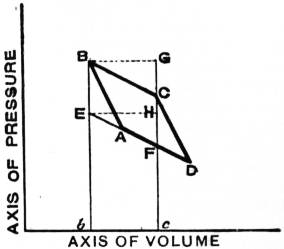
Fig. 5.—Elementary Carnot Cycle for Gas.
Taking the same range of temperature, namely 101° to 100° C., we may perform a similar series of operations with air in the cylinder, instead of water and steam. Suppose the cylinder to contain 1 gramme of air at 100° C. and 760 mm. pressure instead of water. Compress it without loss of heat (adiabatically), so as to raise its temperature to 101° C. Place it in contact with the hot body at 101° C., and allow it to expand at this temperature, absorbing heat from the hot body, until its volume is increased by 1⁄374th part (the expansion per degree at constant pressure). The quantity of heat absorbed in this expansion, as explained in § 14, will be the difference of the specific heats or the latent heat of expansion R′ = .069 calorie. Remove the hot body, and allow the gas to expand further without gain of heat till its temperature falls to 100° C. Compress it at 100° C. to its original volume, abstracting the heat of compression by contact with the cold body at 100° C. The air is now in its original state, and the process has been carried out in strict accordance with Carnot’s rule. The quantity of external work done in the cycle is easily obtained by the aid of the indicator diagram ABCD (fig. 5), which is approximately a parallelogram in this instance. The area of the diagram is equal to that of the rectangle BEHG, being the product of the vertical height BE, namely, the increase of pressure per 1° at constant volume, by the increase of volume BG, which is 1⁄273rd of the volume at 0° C. and 760 mm., or 2.83 c.c. The increase of pressure BE is 760⁄373, or 2.03 mm., which is equivalent to 2.76 gm. per sq. cm. The work done in the cycle is 2.76 × 2.83 = 7.82 gm. cm., or .0782 gram-metre. The heat absorbed at 101° C. was .069 gram-calorie, so that the work obtained is .0782/.069 or 1.13 gram-metre per gram-calorie, or 1.13 kilogrammetre per kilogram-calorie. This result is precisely the same as that obtained by using steam with the same range of temperature, but a very different kind of cycle. Carnot in making the same calculation did not obtain quite so good an agreement, because the experimental data at that time available were not so accurate. He used the value 1⁄267 for the coefficient of expansion, and .267 for the specific heat of air. Moreover, he did not feel justified in assuming, as above, that the difference of the specific heats was the same at 100° C. as at the ordinary temperature of 15° to 20° C., at which it had been experimentally determined. He made similar calculations for the vapour of alcohol, which differed slightly from the vapour of water. But the agreement he found was close enough to satisfy him that his theoretical deductions were correct, and that the resulting ratio of work to heat should be the same for all substances at the same temperature.
17. Carnot’s Function. Variation of Efficiency with Temperature.—By means of calculations, similar to those given above, Carnot endeavoured to find the amount of motive power obtainable from one unit of heat per degree fall at various temperatures with various substances. The value found above, namely 1.13 kilogrammetre per kilo-calorie per 1° fall, is the value of the efficiency per 1° fall at 100° C. He was able to show that the efficiency per degree fall probably diminished with rise of temperature, but the experimental data at that time were too inconsistent to suggest the true relation. He took as the analytical expression of his principle that the efficiency W/H of a perfect engine taking in heat H at a temperature t° C., and rejecting heat at the temperature 0° C., must be some function Ft of the temperature t, which would be the same for all substances. The efficiency per degree fall at a temperature t he represented by F′t, the derived function of Ft. The function F′t would be the same for all substances at the same temperature, but would have different values at different temperatures. In terms of this function, which is generally known as Carnot’s function, the results obtained in the previous section might be expressed as follows:—
“The increase of volume of a mixture of liquid and vapour per unit-mass vaporized at any temperature, multiplied by the increase of vapour-pressure per degree, is equal to the product of the function F′t by the latent heat of vaporization.