VOLUME XIII SLICE I Harmony to Heanor (continued 6)
Reading edition
With somewhat indecent haste (the appeal had not been heard) he was now summoned by the elector of Hesse once more to the head of the government, and he immediately threw himself again with zeal into the struggle against the constitution. He soon found, however, that the opinion of all classes, including the army, was solidly against him, and he decided to risk all on an alliance with the reviving fortunes of Austria, which was steadily working for the restoration of the status quo overthrown by the revolution of 1848. On his advice the elector seceded from the Northern Union established by Prussia and, on the 13th of September, committed the folly of flying secretly from Hesse with his minister. They went to Frankfort, where the federal diet had been re-established, and on the 21st persuaded the diet to decree an armed intervention in Hesse. This decree, carried out by Austrian troops, all but led to war with Prussia, but the unreadiness of the Berlin government led to the triumph of Austria and of Hassenpflug, who at the end of the year was once more installed in power at Cassel as minister of finance. His position was, however, not enviable; he was loathed and despised by all, and disliked even by his master. The climax came in November 1853, when he was publicly horse-whipped by the count of Isenburg-Wächtersbach, the elector’s son-in-law. The count was pronounced insane; but Hassenpflug was conscious of the method in his madness, and tendered his resignation. This was, however, not accepted; and it was not till the 16th of October 1855 that he was finally relieved of his offices. He retired to Marburg, where he died on the 15th of October 1862. He lived just long enough to hear of the restoration of the Hesse constitution of 1831 (June 21, 1862), which it had been his life’s mission to destroy. Of his publications the most important is Actenstücke, die landständischen Anklagen wider den Kurfürstlichen hessischen Staatsminister Hassenpflug. Ein Beitrag zur Zeitgeschichte und zum neueren deutschen Staatsrechte, anonym. (Stuttgart and Tübingen, 1836). He was twice married, his first wife being the sister of the brothers Grimm. His son Karl Hassenpflug (1824-1890) was a distinguished sculptor.
See the biography by Wippermann in Allgemeine deutsche Biographie, with authorities.
HASTINAPUR, an ancient city of British India, in the Meerut district of the United Provinces, lying on the bank of a former bed of the Ganges, 22 m. N.E. of Meerut. It formed the capital of the great Pandava kingdom, celebrated in the Mahābhārata, and probably one of the earliest Aryan settlements outside the Punjab. Tradition points to a group of shapeless mounds as the residence of the Lunar princes of the house of Bharata whose deeds are commemorated in the great national epic. After the conclusion of the famous war which forms the central episode of that poem, Hastinapur remained for some time the metropolis of the descendants of Parikshit, but the town was finally swept away by a flood of the Ganges, and the capital was transferred to Kausambi.
HASTINGS, a famous English family. John, Baron Hastings (c. 1262-c. 1313), was a son of Sir Henry de Hastings (d. 1268), who was summoned to parliament as a baron by Simon de Montfort in 1264. Having joined Montfort’s party Sir Henry led the Londoners at the battle of Lewes and was taken prisoner at Evesham. After his release he continued his opposition to Henry III.; he was among those who resisted the king at Kenilworth, and after the issue of the Dictum de Kenilworth he commanded the remnants of the baronial party when they made their last stand in the isle of Ely, submitting to Henry in July 1267. His younger son, Edmund, was specially noted for his military services in Scotland during the reign of Edward I. John Hastings married Isabella (d. 1305), daughter of William de Valence, earl of Pembroke, a half-brother of Henry III., and fought in Scotland and in Wales. Through his mother, Joanna de Cantilupe, he inherited the extensive lordship of Abergavenny, hence he is sometimes referred to as lord of Bergavenny, and in 1295 he was summoned to parliament as a baron. Before this date, however, he had come somewhat prominently to the front. His paternal grandmother, Ada, was a younger daughter of David, earl of Huntingdon, and a niece of the Scottish king, William the Lion; and in 1290 when Margaret, the maid of Norway, died, Hastings came forward as a claimant for the vacant throne. Although unsuccessful in the matter he did not swerve from his loyalty to Edward I. He fought constantly either in France or in Scotland; he led the bishop of Durham’s men at the celebrated siege of Carlaverock castle in 1300; and with his brother Edmund he signed the letter which in 1301 the English barons sent to Pope Boniface VIII. repudiating papal interference in the affairs of Scotland; on two occasions he represented the king in Aquitaine. Hastings died in 1312 or 1313. His second wife was Isabella, daughter of the elder Hugh le Despenser. Hastings, who was one of the most wealthy and powerful nobles of his time, stood high in the regard of the king and is lauded by the chroniclers.
His eldest son John (d. 1325), who succeeded to the barony, was the father of Laurence Hastings, who was created earl of Pembroke in 1339, the earls of Pembroke retaining the barony of Hastings until 1389. A younger son by a second marriage, Sir Hugh Hastings (c. 1307-1347), saw a good deal of military service in France; his portrait and also that of his wife may still be seen on the east window of Elsing church, which contains a beautiful brass to his memory.
On the death of John, the third and last earl of Pembroke of the Hastings family, in 1389, Sir Hugh’s son John had, according to a decision of the House of Lords in 1840, a title to the barony of Hastings, but he did not prosecute his claim and he died without sons in 1393. However his grand-nephew and heir, Hugh (d. 1396), claimed the barony, which was also claimed by Reginald, Lord Grey of Ruthyn. Like the earls of Pembroke, Grey was descended through his grandmother, Elizabeth Hastings, from John, Lord Hastings, by his first wife; Hugh, on the other hand, was descended from John’s second wife. After Hugh’s death his brother, Sir Edward Hastings (c. 1382-1438), claimed the barony, and the case as to who should bear the arms of the Hastings family came before the court of chivalry. In 1410 it was decided in favour of Grey, who thereupon assumed the arms. Both disputants still claimed the barony, but the view seems to have prevailed that it had fallen into abeyance in 1389. Sir Edward was imprisoned for refusing to pay his rival’s costs, and he was probably still in prison when he died in January 1438. After his death the Hastings family, which became extinct during the 16th century, tacitly abandoned the claim to the barony. Then in 1840 the title was revived in favour of Sir Jacob Astley, Bart. (1797-1859), who derived his claim from a daughter of Sir Hugh Hastings who died in 1540. Sir Jacob’s descendant, Albert Edward (b. 1882), became 21st Baron Hastings in 1904.
A distant relative of the same family was William, Baron Hastings (c. 1430-1483), a son of Sir Leonard Hastings (d. 1455). He became attached to Edward IV., whom he served before his accession to the throne, and after this event he became master of the mint, chamberlain of the royal household and one of the king’s most trusted advisers. Having been made a baron in 1461, he married Catherine, daughter of Richard Neville, earl of Salisbury, and was frequently sent on diplomatic errands to Burgundy and elsewhere. He was faithful to Edward IV. during the king’s exile in the winter of 1470-1471, and after his return he fought for him at Barnet and at Tewkesbury; he has been accused of taking part in the murder of Henry VI.’s son, prince Edward, after the latter battle. Hastings succeeded his sovereign in the favour of Jane Shore. He was made captain of Calais in 1471, and was with Edward IV. when he met Louis XI. of France at Picquigny in 1475, on which occasion he received gifts from Louis and from Charles the Bold of Burgundy. After Edward IV.’s death Hastings behaved in a somewhat undecided manner. He disliked the queen, Elizabeth Woodville, but he refused to ally himself with Richard, duke of Gloucester, afterwards King Richard III. Suddenly Richard decided to get rid of him, and during a meeting of the council on the 13th of June 1483 he was seized and at once put to death. This dramatic incident is related by Sir Thomas More in his History of Richard III., and has been worked by Shakespeare into his play Richard III. Hastings is highly praised by his friend Philippe de Commines, and also by More. He left a son, Edward (d. 1508), the father of George, Baron Hastings (c. 1488-1545), who was created earl of Huntingdon (q.v.) in 1529.
When Francis, 10th earl of Huntingdon, died in October 1789, the barony of Hastings passed to his sister Elizabeth (1731-1808), wife of John Rawdon, earl of Moira, and from her it came to her son Francis Rawdon-Hastings (see below), who was created marquess of Hastings in 1817.
HASTINGS, FRANCIS RAWDON-HASTINGS, 1st Marquess of (1754-1826), British soldier and governor-general of India, born on the 9th of December 1754, was the son of Sir John Rawdon of Moira in the county of Down, 4th baronet, who was created Baron Rawdon of Moira, and afterwards earl of Moira, in the Irish peerage. His mother was the Lady Elizabeth Hastings, daughter of Theophilus, 9th earl of Huntingdon. Lord Rawdon, as he was then called, was educated at Harrow and Oxford, and joined the army in 1771 as ensign in the 15th foot. His life henceforth was entirely spent in the service of his country, and may be divided into four periods: from 1775 to 1782 he was engaged with much distinction in the American war; from 1783 to 1813 he held various high appointments at home, and took an active part in the business of the House of Lords; from 1813 to 1823 was the period of his labours in India; after retiring from which, in the last years of his life (1824-1826), he was governor of Malta.
In America Rawdon served at the battles of Bunker Hill, Brooklyn, White Plains, Monmouth and Camden, at the attacks on Forts Washington and Clinton, and at the siege of Charleston. In fact he was engaged in many important operations of the war. Perhaps his most noted achievements were the raising of a corps at Philadelphia, called the Irish Volunteers, who under him became famous for their fighting qualities, and the victory of Hobkirk’s Hill, which, in command of only a small force, he gained by superior military skill and determination against a much larger body of Americans. In 1781 he was invalided. The vessel in which he returned to England was captured and carried into Brest. He was speedily released, and on his arrival in England was much honoured by George III., who created him an English peer (Baron Rawdon) in March 1783. In 1789 his mother succeeded to the barony of Hastings, and Rawdon added the surname of Hastings to his own.
In 1793 Rawdon succeeded his father as earl of Moira. In 1794 he was sent with 7000 men to Ostend to reinforce the duke of York and the allies in Flanders. The march by which he effected a junction was considered extraordinary. In 1803 he was appointed commander-in-chief in Scotland, and in 1804 he married Flora Mure Campbell, countess of Loudoun in her own right. When Fox and Grenville came into power in 1806, Lord Moira, who had always voted with them, received the place of master-general of the ordnance. He was now enabled to carry a philanthropic measure, of which from his first entry into the House of Lords he had been a great promoter, namely, the Debtor and Creditor Bill for relief of poor debtors. Ireland was another subject to which he had given particular attention: in 1797 there was published a Speech by Lord Moira on the Dreadful and Alarming State of Ireland. Lord Moira’s sound judgment on public affairs, combined with his military reputation and the uprightness of his character, won for him a high position among the statesmen of the day, and he gained an additional prestige from his intimate relations with the prince of Wales. As a mark of the regent’s regard Lord Moira received the order of the Garter in 1812, and in the same year was appointed governor-general of Bengal and commander-in-chief of the forces in India. He landed at Calcutta, and assumed office in succession to Lord Minto in October 1813. One of the chief questions which awaited him was that of relations with the Gurkha state of Nepal. The Gurkhas, a brave and warlike little nation, failing to extend their conquests in the direction of China, had begun to encroach on territories held or protected by the East India Company; especially they had seized the districts of Batwal and Seoraj, in the northern part of Oudh, and when called upon to relinquish these, they deliberately elected (April 1814) to go to war rather than do so. Lord Moira, having travelled through the northern provinces and fully studied the question, declared war against Nepal (November 1814). The enemy’s frontier was 600 m. long, and Lord Moira, who directed the plan of the campaign, resolved to act offensively along the whole line. It was an anxious undertaking, because the native states of India were all watching the issue and waiting for any serious reverse to the English to join against them. At first all seemed to go badly, as the British officers despised the enemy, and the sepoys were unaccustomed to mountain warfare, and thus alternate extremes of rashness and despondency were exhibited. But this rectified itself in time, especially through the achievements of General (afterwards Sir David) Ochterlony, who before the end of 1815 had taken all the Gurkha posts to the west, and early in 1816 was advancing victoriously within 50 m. of Khatmandu, the capital. The Gurkhas now made peace; they abandoned the disputed districts, ceded some territory to the British, and agreed to receive a British resident. For his masterly conduct of these affairs Lord Moira was created marquess of Hastings in February 1817.
He had now to deal with internal dangers. A combination of Mahratta powers was constantly threatening the continuance of British rule, under the guise of plausible assurances severally given by the peshwa, Sindhia, Holkar and other princes. At the same time the existence of the Pindari state was not only dangerous to the British, as being a warlike power always ready to turn against them, but it was a scourge to India itself. In 1816, however, the Pindaris entered British territory in the Northern Circars, where they destroyed 339 villages. On this, permission was obtained to act for their suppression. Before the end of 1817 the preparations of Lord Hastings were completed, when the peshwa suddenly broke into war, and the British were opposed at once to the Mahratta and Pindari powers, estimated at 200,000 men and 500 guns. Both were utterly shattered in a brief campaign of four months (1817-18). The peshwa’s dominions were annexed, and those of Sindhia, Holkar, and the raja of Berar lay at the mercy of the governor-general, and were saved only by his moderation. Thus, after sixty years from the battle of Plassey, the supremacy of British power in India was effectively established. The Pindaris had ceased to exist, and peace and security had been substituted for misery and terror.
“It is a proud phrase to use,” said Lord Hastings, “but it is a true one, that we have bestowed blessings upon millions. Nothing can be more delightful than the reports I receive of the sensibility manifested by the inhabitants to this change in their circumstances. The smallest detachment of our troops cannot pass through that district without meeting everywhere eager and exulting gratulations, the tone of which proves them to come from glowing hearts. Multitudes of people have, even in this short interval, come from the hills and fastnesses in which they had sought refuge for years, and have reoccupied their ancient deserted villages. The ploughshare is again in every quarter turning up a soil which had for many seasons never been stirred, except by the hoofs of predatory cavalry.”
While the natives of India appreciated the results of Lord Hastings’s achievements, the court of directors grumbled at his having extended British territory. They also disliked and opposed his measures for introducing education among the natives and his encouraging the freedom of the press. In 1819 he obtained the cession by purchase of the island of Singapore. In finance his administration was very successful, as notwithstanding the expenses of his wars he showed an annual surplus of two millions sterling. Brilliant and beneficent as his career had been, Lord Hastings did not escape unjust detraction. His last years of office were embittered by the discussions on a matter notorious at the time, namely, the affairs of the banking-house of W. Palmer and Company. The whole affair was mixed up with insinuations against Lord Hastings, especially charging him with having been actuated by favouritism towards one of the partners in the firm. From imputations which were inconsistent with his whole character he has subsequently been exonerated. But while smarting under them he tendered his resignation in 1821, though he did not leave India till the first day of 1823. He was much exhausted by the arduous labours which for more than nine years he had sustained. Among his characteristics it is mentioned that “his ample fortune absolutely sank under the benevolence of his nature”; and, far from having enriched himself in the appointment of governor-general, he returned to England in circumstances which obliged him still to seek public employment. In 1824 he received the comparatively small post of governor of Malta, in which island he introduced many reforms and endeared himself to the inhabitants. He died on the 28th of November 1826, leaving a request that his right hand should be cut off and preserved till the death of the marchioness of Hastings, and then be interred in her coffin.
Hastings was succeeded by his son, Francis George Augustus (1808-1844), who in 1840 succeeded through his mother to the earldom of Loudoun. When his second son, Henry Weysford, the 4th marquess, died childless on the 10th of November 1868 the marquessate became extinct; the earldom of Loudoun devolved upon his sister, Edith Mary (d. 1874), wife of Charles Frederick Abney-Hastings, afterwards Baron Donington; the barony of Hastings, which fell into abeyance, was also revived in 1871 in her favour.
See Ross-of-Bladensburg, The Marquess of Hastings (“Rulers of India” series) (1893); and Private Journal of the Marquess of Hastings, edited by his daughter, the marchioness of Bute (1858).
HASTINGS, FRANK ABNEY (1794-1828), British naval officer and Philhellene, was the son of Lieut.-general Sir Charles Hastings, a natural son of Francis Hastings, tenth earl of Huntingdon. He entered the navy in 1805, and was in the “Neptune” (100) at the battle of Trafalgar; but in 1820 a quarrel with his flag captain led to his leaving the service. The revolutionary troubles of the time offered chances of foreign employment. Hastings spent a year on the continent to learn French, and sailed for Greece on the 12th of March 1822 from Marseilles. On the 3rd of April he reached Hydra. For two years he took part in the naval operations of the Greeks in the Gulf of Smyrna and elsewhere. He saw that the light squadrons of the Greeks must in the end be overpowered by the heavier Turkish navy, clumsy as it was; and in 1823 he drew up and presented to Lord Byron a very able memorandum which he laid before the Greek government in 1824. This paper is of peculiar interest apart from its importance in the Greek insurrection, for it contains the germs of the great revolution which has since been effected in naval gunnery and tactics. In substance the memorandum advocated the use of steamers in preference to sailing ships, and of direct fire with shells and hot shot, as a more trustworthy means of destroying the Turkish fleet than fire-ships. It will be found in Finlay’s History of the Greek Revolution, vol. ii. appendix i. The application of Hastings’s ideas led necessarily to the disuse of sailing ships, and the introduction of armour. The incompetence of the Greek government and the corrupt waste of its resources prevented the full application of Hastings’s bold and far-seeing plans. But largely by the use of his own money, of which he is said to have spent £7000, he was able to some extent to carry them out. In 1824 he came to England to obtain a steamer, and in 1825 he had fitted out a small steamer named the “Karteria” (Perseverance), manned by Englishmen, Swedes and Greeks, and provided with apparatus for the discharge of shell and hot shot. He did enough to show that if his advice had been vigorously followed the Turks would have been driven off the sea long before the date of the battle of Navarino. The great effect produced by his shells in an attack on the sea-line of communication of the Turkish army, then besieging Athens at Oropus and Volo in March and April 1827, was a clear proof that much more could have been done. Military mismanagement caused the defeat of the Greeks round Athens. But Hastings, in co-operation with General Sir R. Church (q.v.), shifted the scene of the attack to western Greece. Here his destruction of a small Turkish squadron at Salona Bay in the Gulf of Corinth (29th of September 1827) provoked Ibrahim Pasha into the aggressive movements which led to the destruction of his fleet by the allies at Navarino (q.v.) on the 20th of October 1827. On the 25th of May 1828 he was wounded in an attack on Anatolikon, and he died in the harbour of Zante on the 1st of June. General Gordon, who served in the war and wrote its history, says of him: “If ever there was a disinterested and really useful Philhellene it was Hastings. He received no pay, and had expended most of his slender fortune in keeping the ‘Karteria’ afloat for the last six months. His ship, too, was the only one in the Greek navy where regular discipline was maintained.”
See Thomas Gordon, History of the Greek Revolution (London, 1832); George Finlay, History of the Greek Revolution (Edinburgh, 1861).
HASTINGS, WARREN (1732-1818), the first governor-general of British India, was born on the 6th of December 1732 in the little hamlet of Churchill in Oxfordshire. He came of a family which had been settled for many generations in the adjoining village of Daylesford; but his great-grandfather had sold the ancestral manor-house, and his grandfather had been unable to maintain himself in possession of the family living. His mother died a few days after giving him birth; his father, Pynaston Hastings, drifted away to perish obscurely in the West Indies. Thus unfortunate in his birth, young Hastings received the elements of education at a charity school in his native village. At the age of eight he was taken in charge by an elder brother of his father, Howard Hastings, who held a post in the customs. After spending two years at a private school at Newington Butts, he was moved to Westminster, where among his contemporaries occur the names of Lord Thurlow and Lord Shelburne, Sir Elijah Impey, and the poets Cowper and Churchill. In 1749, when his headmaster Dr Nichols was already anticipating for him a successful career at the university, his uncle died, leaving him to the care of a distant kinsman, Mr Creswicke, who was afterwards in the direction of the East India Company; and he determined to send his ward to seek his fortune as a “writer” in Bengal.
When Hastings landed at Calcutta in October 1750 the affairs of the East India Company were at a low ebb. Throughout the entire south of the peninsula French influence was predominant. The settlement of Fort St George or Madras, captured by force of arms, had only recently been restored in accordance with a clause of the peace of Aix-la-Chapelle. The organizing genius of Dupleix everywhere overshadowed the native imagination, and the star of Clive had scarcely yet risen above the horizon. The rivalry between the English and the French, which had already convulsed the south, did not penetrate to Bengal. That province was under the able government of Ali Vardi Khan, who peremptorily forbade the foreign settlers at Calcutta and Chandernagore to introduce feuds from Europe. The duties of a young “writer” were then such as are implied in the name. At an early date Hastings was placed in charge of an aurang or factory in the interior, where his duties would be to superintend the weaving of silk and cotton goods under a system of money advances. In 1753 he was transferred to Cossimbazar, the river-port of the native capital of Murshidabad. In 1756 the old nawab died, and was succeeded by his grandson Surajud-Dowlah, a young madman of 19, whose name is indelibly associated with the tragedy of the Black Hole. When that passionate young prince, in revenge for a fancied wrong, resolved to drive the English out of Bengal, his first step was to occupy the fortified factory at Cossimbazar, and make prisoners of Hastings and his companions. Hastings was soon released at the intercession of the Dutch resident, and made use of his position at Murshidabad to open negotiations with the English fugitives at Falta, the site of a Dutch factory near the mouth of the Hugli. In later days he used to refer with pride to his services on this occasion, when he was first initiated into the wiles of Oriental diplomacy. After a while he found it necessary to fly from the Mahommedan court and join the main body of the English at Falta. When the relieving force arrived from Madras under Colonel Clive and Admiral Watson, Hastings enrolled himself as a volunteer, and took part in the action which led to the recovery of Calcutta. Clive showed his appreciation of Hastings’s merits by appointing him in 1758 to the important post of resident at the court of Murshidabad. It was there that he first came into collision with the Bengali Brahman, Nuncomar, whose subsequent fate has supplied more material for controversy than any other episode in his career. During his three years of office as resident he was able to render not a few valuable services to the Company; but it is more important to observe that his name nowhere occurs in the official lists of those who derived pecuniary profit from the necessities and weakness of the native court. In 1761 he was promoted to be member of council, under the presidency of Mr Vansittart, who had been introduced by Clive from Madras. The period of Vansittart’s government has been truly described as “the most revolting page of our Indian history.” The entire duties of administration were suffered to remain in the hands of the nawab, while a few irresponsible English traders had drawn to themselves all real power. The members of council, the commanders of the troops, and the commercial residents plundered on a grand scale. The youngest servant of the Company claimed the right of trading on his own account, free from taxation and from local jurisdiction, not only for himself but also for every native subordinate whom he might permit to use his name. It was this exemption, threatening the very foundations of the Mussulman government, that finally led to a rupture with the nawab. Macaulay, in his celebrated essay, has said that “of the conduct of Hastings at this time little is known.” As a matter of fact, the book which Macaulay was professing to review describes at length the honourable part consistently taken by Hastings in opposition to the great majority of the council. Sometimes in conjunction only with Vansittart, sometimes absolutely alone, he protested unceasingly against the policy and practices of his colleagues. On one occasion he was stigmatized in a minute by Mr Batson with “having espoused the nawab’s cause, and as a hired solicitor defended all his actions, however dishonourable and detrimental to the Company.” An altercation ensued. Batson gave him the lie and struck him in the council chamber. When war was actually begun, Hastings officially recorded his previous resolution to have resigned, in order to repudiate responsibility for measures which he had always opposed. Waiting only for the decisive victory of Buxar over the allied forces of Bengal and Oudh, he resigned his seat and sailed for England in November 1764.
After fourteen years’ residence in Bengal Hastings did not return home a rich man, estimated by the opportunities of his position. According to the custom of the time he had augmented his slender salary by private trade. At a later date he was charged by Burke with having taken up profitable contracts for supplying bullocks for the use of the Company’s troops. It is admitted that he conducted by means of agents a large business in timber in the Gangetic Sundarbans. When at Falta he had married Mrs Buchanan, the widow of an officer. She bore him two children, of whom one died in infancy at Murshidabad, and was shortly followed to the grave by her mother. Their common gravestone is in existence at the present day, bearing date July 11, 1759. The other child, a son, was sent to England, and also died shortly before his father’s return. While at home Hastings is said to have attached himself to literary society; and it may be inferred from his own letters that he now made the personal acquaintance of Samuel Johnson and Lord Mansfield. In 1766 he was called upon to give evidence before a committee of the House of Commons upon the affairs of Bengal. The good sense and clearness of the views which he expressed caused attention to be paid to his desire to be again employed in India. His pecuniary affairs were embarrassed, partly from the liberality with which he had endowed his few surviving relatives. The great influence of Lord Clive was also exercised on his behalf. At last, in the winter of 1768, he received the appointment of second in council at Madras. Among his companions on his voyage round the Cape were the Baron Imhoff, a speculative portrait-painter, and his wife, a lady of some personal attractions and great social charm, who was destined henceforth to be Hastings’s lifelong companion. Of his two years’ work at Madras it is needless to speak in detail. He won the good-will of his employers by devoting himself to the improvement of their manufacturing business, and he kept his hands clean from the prevalent taint of pecuniary transactions with the nawab of the Carnatic. One fact of some interest is not generally known. He drew up a scheme for the construction of a pier at Madras, to avoid the dangers of landing through the surf, and instructed his brother-in-law in England to obtain estimates from the engineers Brindley and Smeaton.
In the beginning of 1772 his ambition was stimulated by the nomination to the second place in council in Bengal with a promise of the reversion of the governorship when Mr Cartier should retire. Since his departure from Bengal in 1764 the situation of affairs in that settlement had scarcely improved. The second governorship of Clive was marked by the transfer of the dīwānī or financial administration from the Mogul emperor to the Company, and by the enforcement of stringent regulations against the besetting sin of peculation. But Clive was followed by two inefficient successors; and in 1770 occurred the most terrible Indian famine on record, which is credibly estimated to have swept away one-third of the population. In April 1772 Warren Hastings took his seat as president of the council at Fort William. His first care was to carry out the instructions received from home, and effect a radical reform in the system of government. Clive’s plan of governing through the agency of the native court had proved a failure. The directors were determined “to stand forth as dīwān, and take upon themselves by their own servants the entire management of the revenues.” All the officers of administration were transferred from Murshidabad to Calcutta, which Hastings boasted at this early date that he would make the first city in Asia. This reform involved the ruin of many native reputations, and for a second time brought Hastings into collision with the wily Brahman, Nuncomar. At the same time a settlement of the land revenue on leases for five years was begun, and the police and military systems of the country were placed upon a new footing. Hastings was a man of immense industry, with an insatiable appetite for detail. The whole of this large series of reforms was conducted under his own personal supervision, and upon no part of his multifarious labours did he dwell in his letters home with greater pride. As an independent measure of economy, the stipend paid to the titular nawab of Bengal, who was then a minor, was reduced by one-half—to sixteen lakhs a year (say £160,000). Macaulay imputes this reduction to Hastings as a characteristic act of financial immorality; but in truth it had been expressly enjoined by the court of directors, in a despatch dated six months before he took up office. His pecuniary bargains with Shuja-ud-Dowlah, the nawab wazīr of Oudh, stand on a different basis. Hastings himself always regarded them as incidents in his general scheme of foreign policy. The Mahrattas at this time had got possession of the person of the Mogul emperor, Shah Alam, from whom Clive obtained the grant of Bengal in 1765, and to whom he assigned in return the districts of Allahabad and Kora and a tribute of £300,000. With the emperor in their camp, the Mahrattas were threatening the province of Oudh, and causing a large British force to be cantoned along the frontier for its defence. Warren Hastings, as a deliberate measure of policy, withheld the tribute due to the emperor, and resold Allahabad and Kora to the wazīr of Oudh. The Mahrattas retreated, and all danger for the time was dissipated by the death of their principal leader. The wazīr now bethought him that he had a good opportunity for satisfying an old quarrel against the adjoining tribe of Rohillas, who had played fast and loose with him while the Mahratta army was at hand. The Rohillas were a race of Afghan origin, who had established themselves for some generations in a fertile tract west of Oudh, between the Himalayas and the Ganges, which still bears the name of Rohilkhand. They were not so much the occupiers of the soil as a dominant caste of warriors and freebooters. But in those troubled days their title was as good as any to be found in India. After not a little hesitation, Hastings consented to allow the Company’s troops to be used to further the ambitious designs of his Oudh ally, in consideration of a sum of money which relieved the ever-pressing wants of the Bengal treasury. The Rohillas were defeated in fair fight. Some of them fled the country, and so far as possible Hastings obtained terms for those who remained. The fighting, no doubt, on the part of the wazīr was conducted with all the savagery of Oriental warfare; but there is no evidence that it was a war of extermination.
Meanwhile, the affairs of the East India Company had come under the consideration of parliament. The Regulating Act, passed by Lord North’s ministry in 1773, effected considerable changes in the constitution of the Bengal government. The council was reduced to four members with a governor-general, who were to exercise certain indefinite powers of control over the presidencies of Madras and Bombay. Hastings was named in the act as governor-general for a term of five years. The council consisted of General Clavering and the Hon. Colonel Monson, two third-rate politicians of considerable parliamentary influence; Philip Francis (q.v.), then only known as an able permanent official; and Barwell, of the Bengal Civil Service. At the same time a supreme court of judicature was appointed, composed of a chief and three puisne judges, to exercise an indeterminate jurisdiction at Calcutta. The chief-justice was Sir Elijah Impey, already mentioned as a schoolfellow of Hastings at Westminster. The whole tendency of the Regulating Act was to establish for the first time the influence of the crown, or rather of parliament, in Indian affairs. The new members of council disembarked at Calcutta on the 19th of October 1774; and on the following day commenced the long feud which scarcely terminated twenty-one years later with the acquittal of Warren Hastings by the House of Lords. Macaulay states that the members of council were put in ill-humour because their salute of guns was not proportionate to their dignity. In a contemporary letter Francis thus expresses the same petty feeling: “Surely Mr H. might have put on a ruffled shirt.” Taking advantage of an ambiguous clause in their commission, the majority of the council (for Barwell uniformly sided with Hastings) forthwith proceeded to pass in review the recent measures of the governor-general. All that he had done they condemned; all that they could they reversed. Hastings was reduced to the position of a cipher at their meetings. After a time they lent a ready ear to detailed allegations of corruption brought against him by his old enemy Nuncomar. To charges from such a source, and brought in such a manner, Hastings disdained to reply, and referred his accuser to the supreme court. The majority of the council, in their executive capacity, resolved that the governor-general had been guilty of peculation, and ordered him to refund. A few days later Nuncomar was thrown into prison on a charge of forgery preferred by a private prosecutor, tried before the supreme court sitting in bar, found guilty by a jury of Englishmen and sentenced to be hanged. Hastings always maintained that he did not cause the charge to be instituted, and the legality of Nuncomar’s trial is thoroughly proved by Sir James Stephen. The majority of the council abandoned their supporter, who was executed in due course. He had forwarded a petition for reprieve to the council, which Clavering took care should not be presented in time, and which was subsequently burnt by the common hangman on the motion of Francis. While the strife was at its hottest, Hastings had sent an agent to England with a general authority to place his resignation in the hands of the Company under certain conditions. The agent thought fit to exercise that authority. The resignation was promptly accepted, and one of the directors was appointed to the vacancy. But in the meantime Colonel Monson had died, and Hastings was thus restored, by virtue of his casting vote, to the supreme management of affairs. He refused to ratify his resignation; and when Clavering attempted to seize on the governor-generalship, he judiciously obtained an opinion from the judges of the supreme court in his favour. From that time forth, though he could not always command an absolute majority in council, Hastings was never again subjected to gross insult, and his general policy was able to prevail.
A crisis was now approaching in foreign affairs which demanded all the experience and all the genius of Hastings for its solution. Bengal was prosperous, and free from external enemies on every quarter. But the government of Bombay had hurried on a rupture with the Mahratta confederacy at a time when France was on the point of declaring war against England, and when the mother-country found herself unable to subdue her rebellious colonists in America. Hastings did not hesitate to take upon his own shoulders the whole responsibility of military affairs. All the French settlements in India were promptly occupied. On the part of Bombay, the Mahratta war was conducted with procrastination and disgrace. But Hastings amply avenged the capitulation of Wargaon by the complete success of his own plan of operations. Colonel Goddard with a Bengal army marched across the breadth of the peninsula from the valley of the Ganges to the western sea, and achieved almost without a blow the conquest of Gujarat. Captain Popham, with a small detachment, stormed the rock fortress of Gwalior, then deemed impregnable and the key of central India; and by this feat held in check Sindhia, the most formidable of the Mahratta chiefs. The Bhonsla Mahratta raja of Nagpur, whose dominions bordered on Bengal, was won over by the diplomacy of an emissary of Hastings. But while these events were taking place, a new source of embarrassment had arisen at Calcutta. The supreme court, whether rightly or wrongly, assumed a jurisdiction of first instance over the entire province of Bengal. The English common law, with all the absurdities and rigours of that day, was arbitrarily extended to an alien system of society. Zamíndárs, or government renters, were arrested on mesne process; the sanctity of the zenána, or women’s chamber, as dear to Hindus as to Mahommedans, was violated by the sheriff’s officer; the deepest feelings of the people and the entire fabric of revenue administration were alike disregarded. On this point the entire council acted in harmony. Hastings and Francis went joint-bail for imprisoned natives of distinction. At last, after the dispute between the judges and the executive threatened to become a trial of armed force, Hastings set it at rest by a characteristic stroke of policy. A new judicial office was created in the name of the Company, to which Sir Elijah Impey was appointed, though he never consented to draw the additional salary offered to him. The understanding between Hastings and Francis, originating in this state of affairs, was for a short period extended to general policy. An agreement was come to by which Francis received patronage for his circle of friends, while Hastings was to be unimpeded in the control of foreign affairs. But a difference of interpretation arose. Hastings recorded in an official minute that he had found Francis’s private and public conduct to be “void of truth and honour.” They met as duellists. Francis fell wounded, and soon afterwards returned to England.
The Mahratta war was not yet terminated, but a far more formidable danger now threatened the English in India. The imprudent conduct of the Madras authorities had irritated beyond endurance the two greatest Mussulman powers in the peninsula, the nizam of the Deccan and Hyder Ali, the usurper of Mysore, who began to negotiate an alliance with the Mahrattas. A second time the genius of Hastings saved the British empire in the east. On the arrival of the news that Hyder had descended from the highlands of Mysore, cut to pieces the only British army in the field, and swept the Carnatic up to the gates of Madras, he at once adopted a policy of extraordinary boldness. He signed a blank treaty of peace with the Mahrattas, who were still in arms, reversed the action of the Madras government towards the nizam, and concentrated all the resources of Bengal against Hyder Ali. Sir Eyre Coote, a general of renown in former Carnatic wars, was sent by sea to Madras with all the troops and treasure that could be got together; and a strong body of reinforcements subsequently marched southwards under Colonel Pearse along the coast line of Orissa. The landing of Coote preserved Madras from destruction, though the war lasted through many campaigns and only terminated with the death of Hyder. Pearse’s detachment was decimated by an epidemic of cholera (perhaps the first mention of this disease by name in Indian history); but the survivors penetrated to Madras, and not only held in check Bhonsla and the nizam, but also corroborated the lesson taught by Goddard—that the Company’s sepoys could march anywhere, when boldly led. Hastings’s personal task was to provide the ways and means for this exhausting war. A considerable economy was effected by a reform in the establishment for collecting the land tax. The government monopolies of opium and salt were then for the first time placed upon a remunerative basis. But these reforms were of necessity slow in their beneficial operation. The pressing demands of the military chest had to be satisfied by loans, and in at least one case from the private purse of the governor-general. Ready cash could alone fill up the void; and it was to the hoards of native princes that Hastings’s fertile mind at once turned. Chait Sing, raja of Benares, the greatest of the vassal chiefs who had grown rich under the protection of the British rule, lay under the suspicion of disloyalty. The wazir of Oudh had fallen into arrears in the payment due for the maintenance of the Company’s garrison posted in his dominions, and his administration was in great disorder. In his case the ancestral hoards were under the control of his mother, the begum of Oudh, into whose hands they had been allowed to pass at the time when Hastings was powerless in council. Hastings resolved to make a progress up country in order to arrange the affairs of both provinces, and bring back all the treasure that could be squeezed out of its holders by his personal intervention. When he reached Benares and presented his demands, the raja rose in insurrection, and the governor-general barely escaped with his life. But the faithful Popham rapidly rallied a force for his defence. The insurgents were defeated again and again; Chait Sing took to flight, and an augmented permanent tribute was imposed upon his successor. The Oudh business was managed with less risk. The wazir consented to everything demanded of him. The begum was charged with having abetted Chait Sing in his rebellion; and after the severest pressure applied to herself and her attendant eunuchs, a fine of more than a million sterling was exacted from her. Hastings appears to have been not altogether satisfied with the incidents of this expedition, and to have anticipated the censure which it received in England. As a measure of precaution, he procured documentary evidence of the rebellious intentions of the raja and the begum, to the validity of which Impey obligingly lent his extra-judicial sanction.
The remainder of Hastings’s term of office in India was passed in comparative tranquillity, both from internal opposition and foreign war. The centre of interest now shifts to the India House and to the British parliament. The long struggle between the Company and the ministers of the crown for the supreme control of Indian affairs and the attendant patronage had reached its climax. The decisive success of Hastings’s administration alone postponed the inevitable solution. His original term of five years would have expired in 1778; but it was annually prolonged by special act of parliament until his voluntary resignation. Though Hastings was thus irremovable, his policy did not escape censure. Ministers were naturally anxious to obtain the reversion to his vacant post, and Indian affairs formed at this time the hinge on which party politics turned. On one occasion Dundas carried a motion in the House of Commons, censuring Hastings and demanding his recall. The directors of the Company were disposed to act upon this resolution; but in the court of proprietors, with whom the decision ultimately lay, Hastings always possessed a sufficient majority. Fox’s India Bill led to the downfall of the Coalition ministry in 1783. The act which Pitt successfully carried in the following year introduced a new constitution, in which Hastings felt that he had no place. In February 1785 he finally sailed from Calcutta, after a dignified ceremony of resignation, and amid enthusiastic farewells from all classes.
On his arrival in England, after a second absence of sixteen years, he was not displeased with the reception he met with at court and in the country. A peerage was openly talked of as his due, while his own ambition pointed to some responsible office at home. Pitt had never taken a side against him, while Lord Chancellor Thurlow was his pronounced friend. But he was now destined to learn that his enemy Francis, whom he had discomfited in the council chamber at Calcutta, was more than his match in the parliamentary arena. Edmund Burke had taken the subject races of India under the protection of his eloquence. Francis, who had been the early friend of Burke, supplied him with the personal animus against Hastings, and with the knowledge of detail, which he might otherwise have lacked. The Whig party on this occasion unanimously followed Burke’s lead. Dundas, Pitt’s favourite subordinate, had already committed himself by his earlier resolution of censure; and Pitt was induced by motives which are still obscure to incline the ministerial majority to the same side. To meet the oratory of Burke and Sheridan and Fox, Hastings wrote an elaborate minute with which he wearied the ears of the House for two successive nights, and he subsidized a swarm of pamphleteers. The impeachment was decided upon in 1786, but the actual trial did not commence until 1788. For seven long years Hastings was upon his defence on the charge of “high crimes and misdemeanours.” During this anxious period he appears to have borne himself with characteristic dignity, such as is consistent with no other hypothesis than the consciousness of innocence. At last, in 1795, the House of Lords gave a verdict of not guilty on all charges laid against him; and he left the bar at which he had so frequently appeared, with his reputation clear, but ruined in fortune. However large the wealth he brought back from India, all was swallowed up in defraying the expenses of his trial. Continuing the line of conduct which in most other men would be called hypocrisy, he forwarded a petition to Pitt praying that he might be reimbursed his costs from the public funds. This petition, of course, was rejected. At last, when he was reduced to actual destitution, it was arranged that the East India Company should grant him an annuity of £4000 for a term of years, with £90,000 paid down in advance. This annuity expired before his death; and he was compelled to make more than one fresh appeal to the bounty of the Company, which was never withheld. Shortly before his acquittal he had been able to satisfy the dream of his childhood, by buying back the ancestral manor of Daylesford, where the remainder of his life was passed in honourable retirement. In 1813 he was called on to give evidence upon Indian affairs before the two houses of parliament, which received him with exceptional marks of respect. The university of Oxford conferred on him the honorary degree of D.C.L.; and in the following year he was sworn of the privy council, and took a prominent part in the reception given to the duke of Wellington and the allied sovereigns. He died on the 22nd of August 1818, in his 86th year, and lies buried behind the chancel of the parish church, which he had recently restored at his own charges.
In physical appearance, Hastings “looked like a great man, and not like a bad man.” The body was wholly subjugated to the mind. A frame naturally slight had been further attenuated by rigorous habits of temperance, and thus rendered proof against the diseases of the tropics. Against his private character not even calumny has breathed a reproach. As brother, as husband and as friend, his affections were as steadfast as they were warm. By the public he was always regarded as reserved, but within his own inner circle he gave and received perfect confidence. In his dealings with money, he was characterized rather by liberality of expenditure than by carefulness of acquisition. A classical education and the instincts of family pride saved him from both the greed and the vulgar display which marked the typical “nabob,” the self-made man of those days. He could support the position of a governor-general and of a country gentleman with equal credit. Concerning his second marriage, it suffices to say that the Baroness Imhoff was nearly forty years of age, with a family of grown-up children, when the complaisant law of her native land allowed her to become Mrs Hastings. She survived her husband, who cherished towards her to the last the sentiments of a lover. Her children he adopted as his own; and it was chiefly for her sake that he desired the peerage which was twice held out to him.
Hastings’s public career will probably never cease to be a subject of controversy. It was his misfortune to be the scapegoat upon whose head parliament laid the accumulated sins, real and imaginary, of the East India Company. If the acquisition of the Indian empire can be supported on ethical grounds, Hastings needs no defence. No one who reads his private correspondence will admit that even his least defensible acts were dictated by dishonourable motives. It is more pleasing to point out certain of his public measures upon which no difference of opinion can arise. He was the first to attempt to open a trade route with Tibet, and to organize a survey of Bengal and of the eastern seas. It was he who persuaded the pundits of Bengal to disclose the treasures of Sanskrit to European scholars. He founded the Madrasa or college for Mahommedan education at Calcutta, primarily out of his own funds; and he projected the foundation of an Indian institute in England. The Bengal Asiatic Society was established under his auspices, though he yielded the post of president to Sir W. Jones. No Englishman ever understood the native character so well as Hastings; none ever devoted himself more heartily to the promotion of every scheme, great and small, that could advance the prosperity of India. Natives and Anglo-Indians alike venerate his name, the former as their first beneficent administrator, the latter as the most able and the most enlightened of their own class. If Clive’s sword conquered the Indian empire, it was the brain of Hastings that planned the system of civil administration, and his genius that saved the empire in its darkest hour.
See G. B. Malleson, Life of Warren Hastings (1894); G. W. Forrest, The Administration of Warren Hastings (Calcutta, 1892); Sir Charles Lawson, The Private Life of Warren Hastings (1895); L. J. Trotter, Warren Hastings (“Rulers of India” series) (1890); Sir Alfred Lyall, Warren Hastings (“English Men of Action” series) (1889); F. M. Holmes, Four Heroes of India (1892); G. W. Hastings, A Vindication of Warren Hastings (1909). Macaulay’s famous essay, though a classic, is very partial and inaccurate; and Burke’s speech, on the impeachment of Warren Hastings, is magnificent rhetoric. The true historical view has been restored by Sir James Stephen’s Story of Nuncomar (1885) and by Sir John Strachey’s Hastings and the Rohilla War (1892), and it is enforced in some detail in Sydney C. Grier’s Letters of Warren Hastings to his Wife (1905), material for which existed in a mass of documents relating to Hastings, acquired by the British Museum.
(J. S. Co.)
HASTINGS, a municipal, county and parliamentary borough and watering-place of Sussex, England, one of the Cinque Ports, 62 m. S.E. by S. from London, on the South Eastern & Chatham and the London, Brighton & South Coast railways. Pop. (1901), 65,528. It is picturesquely situated at the mouth of two narrow valleys, and, being sheltered by considerable hills on the north and east, has an especially mild climate. Eastward along the coast towards Fairlight, and inland, the country is beautiful. A parade fronts the English Channel, and connects the town on the west with St Leonard’s, which is included within the borough. This is mainly a residential quarter, and has four railway stations on the lines serving Hastings. Both Hastings and St Leonard’s have fine piers; there is a covered parade known as the Marina, and the Alexandra Park of 75 acres was opened in 1891. There are also numerous public gardens. The sandy beach is extensive, and affords excellent bathing. On the brink of the West Cliff stand a square and a circular tower and other fragments of the castle, probably erected soon after the time of William the Conqueror; together with the ruins, opened up by excavation in 1824, of the castle chapel, a transitional Norman structure 110 ft. long, with a nave, chancel and aisles. Besides the chapel there was formerly a college, both being under the control of a dean and secular canons. The deanery was held by Thomas Becket, and one of the canonries by William of Wykeham. The principal public buildings are the old parish churches of All Saints and St Clements, the first containing in its register for 1619 the baptism of Titus Oates, whose father was rector of the parish; numerous modern churches, the town hall (1880); theatre, music hall and assembly rooms. The Brassey Institute contains a public library, museum and art school. The Albert Memorial clock-tower was erected in 1864. Educational institutions include the grammar school (1883), school of science and art (1878) and technical schools. At the west end of the town are several hospitals and convalescent homes. The prosperity of the town depends almost wholly on its reputation as a watering-place, but there is a small fishing and boat-building industry. In 1890 an act of parliament authorized the construction of a harbour, but the work, begun in 1896, was not completed. The fish-market beneath the castle cliff is picturesque. The parliamentary borough, returning one member, falls within the Rye division of the county. The county borough was created in 1888. The municipal borough is under a mayor, 10 aldermen and 30 councillors. Area, 4857 acres.
Rock shelters on Castle Hill and numerous flint instruments which have been discovered at Hastings point to an extensive neolithic population, and there are ancient earthworks and a promontory camp of unknown date. There is no evidence that Hastings was a Roman settlement, but it was a place of some note in the Anglo-Saxon period. In 795 land at Hastings (Haestingaceaster, Haestingas, Haestingaport) is included in a grant, which may possibly be a forgery, of a South Saxon chieftain to the abbey of St Denis in France; and a royal mint was established at the town by Æthelstan. The battle of Hastings in 1066 described below was the first and decisive act of the Norman Conquest. It was fought near the present Battle Abbey, about 6 m. inland. After the Conquest William I. erected the earthworks of the existing castle. By 1086 Hastings was a borough and had given its name to the rape of Sussex in which it lay. The town at that time had a harbour and a market. Whether Hastings was one of the towns afterwards known as the Cinque Ports at the time when they received their first charter from Edward the Confessor is uncertain, but in the reign of William I. it was undoubtedly among them. These combined towns, of which Hastings was the head, had special liberties and a separate jurisdiction under a warden. The only charter peculiar to Hastings was granted in 1589 by Elizabeth, and incorporated the borough under the name of “mayor, jurats and commonalty,” instead of the former title of “bailiff, jurats and commonalty.” Hastings returned two members to parliament probably from 1322, and certainly from 1366, until 1885, when the number was reduced to one.
Battle of Hastings.—On the 28th of September 1066, William of Normandy, bent on asserting by arms his right to the English crown, landed at Pevensey. King Harold, who had destroyed the invaders of northern England at the battle of Stamford Bridge in Yorkshire, on hearing the news hurried southward, gathering what forces he could on the way. He took up his position, athwart the road from Hastings to London, on a hill1 some 6 m. inland from Hastings, with his back to the great forest of Anderida (the Weald) and in front of him a long glacis-like slope, at the bottom of which began the opposing slope of Telham Hill. The English army was composed almost entirely of infantry. The shire levies, for the most part destitute of body armour and with miscellaneous and even improvised weapons, were arranged on either flank of Harold’s guards (huscarles), picked men armed principally with the Danish axe and shield.
Before this position Duke William appeared on the morning of the 14th of October. His host, composed not only of his Norman vassals but of barons, knights and adventurers from all quarters, was arranged in a centre and two wings, each corps having its archers and arblasters in the front line, the rest of the infantry in the second and the heavy armoured cavalry in the third. Neither the arrows nor the charge of the second line of foot-men, who, unlike the English, wore defensive mail, made any impression on the English standing in a serried mass behind their interlocked shields.2
Then the heavy cavalry came on, led by the duke and his brother Odo, and encouraged by the example of the minstrel Taillefer, who rode forward, tossing and catching his sword, into the midst of the English line before he was pulled down and killed. All along the front the cavalry came to close quarters with the defenders, but the long powerful Danish axes were as formidable as the halbert and the bill proved to be in battles of later centuries, and they lopped off the arms of the assailants and cut down their horses. The fire of the attack died out and the left wing (Bretons) fled in rout. But as the fyrd levies broke out of the line and pursued the Bretons down the hill in a wild, formless mob, William’s cavalry swung round and destroyed them, and this suggested to the duke to repeat deliberately what the Bretons had done from fear. Another advance, followed by a feigned retreat, drew down a second large body of the English from the crest, and these in turn, once in the open, were ridden over and slaughtered by the men-at-arms. Lastly, these two disasters having weakened the defenders both materially and morally, William subjected the huscarles, who had stood fast when the fyrd broke its ranks, to a constant rain of arrows, varied from time to time by cavalry charges. These magnificent soldiers endured the trial for many hours, from noon till close on nightfall; but at last, when the Norman archers raised their bows so as to pitch the arrows at a steep angle of descent in the midst of the huscarles, the strain became too great. While some rushed forward alone or in twos and threes to die in the midst of the enemy, the remainder stood fast, too closely crowded almost for the wounded to drop. At last Harold received a mortal wound, the English began to waver, and the knights forced their way in. Only a remnant of the defenders made its way back to the forest; and William, after resting for a night on the hardly-won ground, began the work of the Norman Conquest.
1 Freeman called this hill Senlac and introduced the fashion of describing the battle as “the battle of Senlac.” Mr J. H. Round, however, proved conclusively that this name, being French (Senlecque), could not have been in use at the time of the Conquest, that the battlefield had in fact no name, pointing out that in William of Malmesbury and in Domesday Book the battle is called “of Hastings” (Bellum Hastingense), while only one writer, Ordericus Vitalis, describes it two hundred years after the event as Bellum Senlacium. See Round, Feudal England (London, 1895), p. 333 et seq.
2 There is still a difference of opinion as to whether the English were, or were not, defended by any other rampart than that of the customary “shield-wall.” Freeman, apparently as a result of a misunderstanding of a passage in Henry of Huntingdon and the slightly ambiguous verse of Wace in the Roman du Rou (ll. 6991-6994 and ll. 7815-7826), affirms that Harold turned “the battle as far as possible into the likeness of a siege,” by building round his troops a “palisade” of solid timber (Norman Conquest, iii. 444). This was proved to be a fable by J. H. Round, in the course of a general attack on Freeman’s historical method, which provoked the professor’s defenders to take up the cudgels on his behalf in a very long and lively controversy. The result of this was that Freeman’s account was wholly discredited, though Round’s view—that there was no wall of any kind save the shield-wall—is not generally accepted. Professor Oman (Academy, June 9, 1894), for instance, holds that there was “an abattis of some sort” set to hamper the advance of cavalry (see also English History, vol. ix., p. 474). Mr Round sums up the controversy, from his point of view, in his Feudal England, p. 340 et seq., where references to other monographs on the subject will be found.
HASTINGS, a city and the county-seat of Adams county, Nebraska, U.S.A., about 95 m. W. by S. of Lincoln. Pop. (1890) 13,584; (1900) 7188 (1253 foreign-born); (1910) 9338. Hastings is served by the Chicago, Burlington & Quincy, the Chicago & North-western, the Missouri Pacific and the St Joseph & Grand Island railways. It is the seat of Hastings College (Presbyterian, coeducational), opened in 1882, and having 286 students in 1908, and of the state asylum for the chronic insane. The city carries on a considerable jobbing business for the farming region of which it is the centre and produce market. There are a large foundry and several large brickyards here. Hastings was settled in 1872, was incorporated in 1874 and was chartered as a city in the same year.
HAT, a covering for the head worn by both sexes, and distinguished from the cap or bonnet by the possession of a brim. The word in O.E. is hœt, which is cognate with O. Frisian hatt, O.N. hotte, &c., meaning head-covering, hood; it is distantly related to the O.E. hod, hood, which is cognate with the German for “hat,” Hut. The history of the hat as part of the apparel of both sexes, with the various changes in shape which it has undergone, is treated in the article Costume.
Hats were originally made by the process of felting, and as tradition ascribed the discovery of that very ancient operation to St Clement, he was assumed as the patron saint of the craft. At the present day the trade is divided into two distinct classes. The first and most ancient is concerned with the manufacture of felt hats, and the second has to do with the recent but now most extensive and important manufacture of silk or dress hats. In addition to these there is the important manufacture of straw or plaited hats (see Straw and Straw Manufactures); and hats are occasionally manufactured of materials and by processes not included under any of these heads, but such manufactures do not take a large or permanent position in the industry.
Felt Hats.—There is a great range in the quality of felt hats: the finer and more expensive qualities are made entirely of fur; for commoner qualities a mixture of fur and wool is used; and for the cheapest kinds wool alone is employed. The processes and apparatus necessary for making hats of fur differ also from those required in the case of woollen bodies; and in large manufactories machinery is now generally employed for operations which at no distant date were entirely manual. An outline of the operations by which the old beaver hat was made will give an idea of the manual processes in making a fur napped hat, and the apparatus and mechanical processes employed in making ordinary hard and soft felts will afterwards be noticed.
Hatters’ fur consists principally of the hair of rabbits (technically called coneys) and hares, with some proportion of nutria, musquash and beavers’ hair; and generally any parings and cuttings from furriers are also used. Furs intended for felting are deprived of their long coarse hairs, after which they are treated with a solution of nitrate of mercury, an operation called carroting or secretage, whereby the felting properties of the fur are greatly increased. The fur is then cut by hand or machine from the skin, and in this state it is delivered to the hat maker.

Fig. 1.
The old process of making a beaver hat was as follows. The materials of a proper beaver consisted, for the body or foundation, of rabbits’ fur, and for the nap, of beaver fur, although the beaver was often mixed with or supplanted by a more common fur. In preparing the fur plate, the hatter weighed out a sufficient quantity of rabbit fur for a single hat, and spread it out and combined it by the operation of bowing. The bow or stang ABC (fig. 1) was about 7 ft. long, and it stretched a single cord of catgut D, which the workman vibrated by means of a wooden pin E, furnished with a half knob at each end. Holding the bow in his left hand, and the pin in his right, he caused the vibrating string to come in contact with the heap of tangled fur, which did not cover a space greater than that of the hand. At each vibration some of the filaments started up to the height of a few inches, and fell away from the mass, a little to the right of the bow, their excursions being restrained by a concave frame of wicker work called the basket. One half of the material was first operated on, and by bowing and gathering, or a patting use of the basket, the stuff was loosely matted into a triangular figure, about 50 by 36 in., called a bat. In this formation care was taken to work about two-thirds of the fur down towards what was intended for the brim, and this having been effected, greater density was induced by gentle pressure with the basket. It was then covered with a wettish linen cloth, upon which was laid the hardening skin, a piece of dry half-tanned horse hide. On this the workman pressed until the stuff adhered closely to the damp cloth, in which it was then doubled up, freely pressed with the hand, and laid aside. By this process, called basoning, the bat became compactly felted and thinned toward the sides and point. The other half of the fur was next subjected to precisely the same processes, after which a cone-shaped slip of stiff paper was laid on its surface, and the sides of the bat were folded over its edges to its form and size. It was then laid paper-side downward upon the first bat, which was now replaced on the hurdle, and its edges were transversely doubled over the introverted side-lays of the second bat, thus giving equal thickness to the whole body. In this condition it was reintroduced between folds of damp linen cloth, and again hardened, so as to unite the two halves, the knitting together of which was quickly effected. The paper was then withdrawn, and the body in the form of a large cone removed to the plank or battery room.
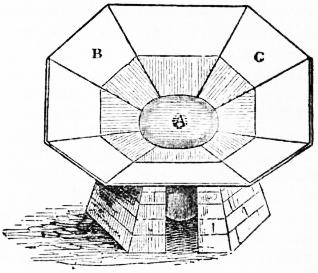
Fig. 2.
The battery consisted of an open iron boiler or kettle A (fig. 2), filled with scalding hot water, with shelves, B, C, partly of mahogany and partly of lead, sloping down to it. Here the body was first dipped in the water, and then withdrawn to the plank to cool and drain, when it was unfolded, rolled gently with a pin tapering towards the ends, turned, and worked in every direction, to toughen and shrink it, and at the same time prevent adhesion of its sides. Stopping or thickening any thin spots seen on looking through the body, was carefully performed by dabbing on additional stuff in successive supplies from the hot liquor with a brush frequently dipped into the kettle, until the body was shrunk sufficiently (about one-half) and thoroughly equalized. When quite dried, stiffening was effected with a brush dipped into a thin varnish of shellac, and rubbed into the body, the surface intended for the inside having much more laid on it than the outer, while the brim was made to absorb many times the quantity applied to any other part.
On being again dried, the body was ready to be covered with a nap of beaver hair. For this, in inferior qualities, the hair of the otter, nutria or other fine fur was sometimes substituted. The requisite quantity of one or other of these was taken and mixed with a proportion of cotton, and the whole was bowed up into a thin uniform lap. The cotton merely served to give sufficient body to the material to enable the workman to handle the lap. The body of the hat being damped, the workman spread over it a covering of this lap, and by moistening and gentle patting with a brush the cut ends of the hair penetrated and fixed themselves in the felt body. The hat was then put into a coarse hair cloth, dipped and rolled in the hot liquor until the fur was quite worked in, the cotton being left on the surface loose and ready for removal. The blocking, dyeing and finishing processes in the case of beaver hats were similar to those employed for ordinary felts, except that greater care and dexterity were required on the part of the workmen, and further that the coarse hairs or kemps which might be in the fur were cut off by shaving the surface with a razor. The nap also had to be laid in one direction, smoothed and rendered glossy by repeated wettings, ironings and brushings. A hat so finished was very durable and much more light, cool and easy-fitting to the head than the silk hat which has now so largely superseded it.
The first efficient machinery for making felt hats was devised in America, and from the United States the machine-making processes were introduced into England about the year 1858; and now in all large establishments machinery such as that alluded to below is employed. For the forming of hat bodies two kinds of machine are used, according as the material employed is fur or wool. In the case of fur, the essential portion of the apparatus is a “former,” consisting of a metal cone of the size and form of the body or bat to be made, perforated all over with small holes. The cone is made to revolve on its axis slowly over an orifice under which there is a powerful fan, which maintains a strong inward draught of air through the holes in the cone. At the side of the cone, and with an opening towards it, is a trunk or box from which the fur to be made into a hat is thrown out by the rapid revolution of a brushlike cylinder, and as the cloud of separate hairs is expelled from the trunk, the current of air being sucked through the cone carries the fibres to it and causes them to cling closely to its surface. Thus a coating of loose fibres is accumulated on the copper cone, and these are kept in position only by the exhaust at work under it. When sufficient for a hat body has been deposited, it is damped and a cloth is wrapped round it; then an outer cone is slipped over it and the whole is removed for felting, while another copper cone is placed in position for continuing the work. The fur is next felted by being rolled and pressed, these operations being performed partly by hand and partly by machine.
In the case of wool hats the hat or body is prepared by first carding in a modified form of carding machine. The wool is divided into two separate slivers as delivered from the cards, and these are wound simultaneously on a double conical block of wood mounted and geared to revolve slowly with a reciprocating horizontal motion, so that there is a continual crossing and recrossing of the wool as the sliver is wound around the cone. This diagonal arrangement of the sliver is an essential feature in the apparatus, as thereby the strength of the finished felt is made equal in every direction; and when strained in the blocking the texture yields in a uniform manner without rupture. The wool wound on the double block forms the material of two hats, which are separated by cutting around the median or base line, and slipping each half off at its own end. Into each cone of wool or bat an “inlayer” is now placed to prevent the inside from matting, after which they are folded in cloths, and placed over a perforated iron plate through which steam is blown. When well moistened and heated, they are placed between boards, and subjected to a rubbing action sufficient to harden them for bearing the subsequent strong planking or felting operations. The planking of wool hats is generally done by machine, in some cases a form of fulling mill being used; but in all forms the agencies are heat, moisture, pressure, rubbing and turning.
When by thorough felting the hat bodies of any kind have been reduced to dense leathery cones about one-half the size of the original bat, they are dried, and, if hard felts are to be made, the bodies are at this stage hardened or stiffened with a varnish of shellac. Next follows the operations of blocking, in which the felt for the first time assumes approximately the form it is ultimately to possess. For this purpose the conical body is softened in boiling water, and forcibly drawn over and over a hat-shaped wooden block. The operation of dyeing next follows, and the finishing processes include shaping on a block, over which crown and brim receive ultimately their accurate form, and pouncing or pumicing, which consists of smoothing the surface with fine emery paper, the hat being for this purpose mounted on a rapidly revolving block. The trimmer finally binds the outer brim and inserts the lining, after which the brim may be given more or less of a curl or turn over according to prevailing fashion.
Silk Hats.—The silk hat, which has now become co-extensive with civilization, is an article of comparatively recent introduction. It was invented in Florence about 1760, but it was more than half a century before it was worn to any great extent.
A silk hat consists of a light stiff body covered with a plush of silk, the manufacture of which in a brilliant glossy condition is the most important element in the industry. Originally the bodies were made of felt and various other materials, but now calico is chiefly used. The calico is first stiffened with a varnish of shellac, and then cut into pieces sufficient for crown, side and brim. The side-piece is wound round a wooden hat block, and its edges are joined by hot ironing, and the crown-piece is put on and similarly attached to the side. The brim, consisting of three thicknesses of calico cemented together, is now slipped over and brought to its position, and thereafter a second side-piece and another crown are cemented on. The whole of the body, thus prepared, now receives a coat of size, and subsequently it is varnished over, and thus it is ready for the operation of covering. In covering this body, the under brim, generally of merino, is first attached, then the upper brim, and lastly the crown and side sewn together are drawn over. All these by hot ironing and stretching are drawn smooth and tight, and as the varnish of the body softens with the heat, body and cover adhere all over to each other without wrinkle or pucker. Dressing and polishing by means of damping, brushing and ironing, come next, after which the hat is “velured” in a revolving machine by the application of haircloth and velvet velures, which cleans the nap and gives it a smooth and glossy surface. The brim has only then to be bound, the linings inserted, and the brim finally curled, when the hat is ready for use.
HATCH, EDWIN (1835-1889), English theologian, was born at Derby on the 14th of September 1835, and was educated at King Edward’s school, Birmingham, under James Prince Lee, afterwards bishop of Manchester. He had many struggles to pass through in early life, which tended to discipline his character and to form the habits of severe study and the mental independence for which he came to be distinguished. Hatch became scholar of Pembroke College, Oxford, took a second-class in classics in 1857, and won the Ellerton prize in 1858. He was professor of classics in Trinity College, Toronto, from 1859 to 1862, when he became rector of the high school at Quebec. In 1867 he returned to Oxford, and was made vice-principal of St Mary Hall, a post which he held until 1885. In 1883 he was presented to the living of Purleigh in Essex, and in 1884 was appointed university reader in ecclesiastical history. In 1880 he was Bampton lecturer, and from 1880 to 1884 Grinfield lecturer on the Septuagint. In 1883 the university of Edinburgh conferred on him the D.D. degree. He was the first editor of the university official Gazette (1870), and of the Student’s Handbook to the University. A reputation acquired through certain contributions to the Dictionary of Christian Antiquities was confirmed by his treatises On the Organization of the Early Christian Churches (1881, his Bampton lectures), and on The Influence of Greek Ideas and Usages on the Christian Church (the Hibbert lectures for 1888). These works provoked no little criticism on account of the challenge they threw down to the high-church party, but the research and fairness displayed were admitted on all hands. The Bampton lectures were translated into German by Harnack. Among his other works are The Growth of Church Institutions (1887); Essays in Biblical Greek (1889); A Concordance to the Septuagint (in collaboration with H. A. Redpath); Towards Fields of Light (verse, 1889); The God of Hope (sermons with memoir, 1890). Hatch died on the 10th of November 1889.
An appreciation by W. Sanday appeared in The Expositor for February 1890.
HATCH. 1. (In Mid. Eng. hacche; the word is of obscure origin, but cognate forms appear in Swed. häcka, and Dan. hackke; it has been connected with “hatch,” grating, with possible reference to a coop, and with “hack” in the sense “to peck,” of chickens coming out of the shell), to bring out young from the egg, by incubation or other process, natural or artificial. The word is also used as a substantive of a brood of chickens brought out from the eggs. “Hatchery” is particularly applied to a place for the hatching of fish spawn, where the natural process is aided by artificial means. In a figurative sense “to hatch” is often used of the development or contrivance of a plot or conspiracy.
2. (From the Fr. hacher, to cut, hache, hatchet), to engrave or draw by means of cutting lines on wood, metal, &c., or to ornament by inlaying with strips of some other substance as gold or silver. Engraved lines, especially those used in shading, are called “hatches” or “hachures” (see Hachure).
3. (O.E. hæc, a gate, rack in a stable; found in various Teutonic languages; cf. Dutch hek, Dan. hekke; the ultimate origin is obscure; Skeat suggests a connexion with the root seen in “hook”), the name given to the lower half of a divided door, as in “buttery-hatch,” the half-door leading from the buttery or kitchen, through which the dishes could be passed into the dining-hall. It was used formerly as another name for a ship’s deck, and thus the phrase “under hatches” meant properly below deck; the word is now applied to the doors of grated framework covering the openings (the “hatchways”) which lead from one deck to another into the hold through which the cargo is lowered. In Cornwall the word is used to denote certain dams or mounds used to prevent the tin-washes and the water coming from the stream-works from flowing into the fresh rivers.
HATCHET (adapted from the Fr. hachette, diminutive of hache, axe, hacher, to cut, hack), a small, light form of axe with a short handle (see Tool); for the war-hatchet of the North American Indians and the symbolical ceremonies connected with it see Tomahawk.
HATCHETTITE, sometimes termed Mountain Tallow, Mineral Adipocire, or Adipocerite, a mineral hydrocarbon occurring in the Coal-measures of Belgium and elsewhere, occupying in some cases the interior of hollow concretions of iron-ore, but more generally the cavities of fossil shells or crevices in the rocks. It is of yellow colour, and translucent, but darkens and becomes opaque on exposure. It has no odour, is greasy to the touch, and has a slightly glistening lustre. Its hardness is that of soft wax. The melting point is 46° to 47° C., and the composition is C. 85.55, H. 14.45.
HATCHMENT, properly, in heraldry, an escutcheon or armorial shield granted for some act of distinction or “achievement,” of which word it is a corruption through such forms as atcheament, achement, hachement, &c. “Achievement” is an adaptation of the Fr. achèvement, from achever, à chef venir, Lat. ad caput venire, to come to a head, or conclusion, hence accomplish, achieve. The term “hatchment” is now usually applied to funeral escutcheons or armorial shields enclosed in a black lozenge-shaped frame suspended against the wall of a deceased person’s house. It is usually placed over the entrance at the level of the second floor, and remains for from six to twelve months, when it is removed to the parish church. This custom is falling into disuse, though still not uncommon. It is usual to hang the hatchment of a deceased head of a house at the universities of Oxford and Cambridge over the entrance to his lodge or residence.
If for a bachelor the hatchment bears upon a shield his arms, crest, and other appendages, the whole on a black ground. If for a single woman, her arms are represented upon a lozenge, bordered with knotted ribbons, also on a black ground. If the hatchment be for a married man (as in the illustration), his arms upon a shield impale those of his surviving wife; or if she be an heiress they are placed upon a scutcheon of pretence, and crest and other appendages are added. The dexter half of the ground is black, the sinister white. For a wife whose husband is alive the same arrangement is used, but the sinister ground only is black. For a widower the same is used as for a married man, but the whole ground is black; for a widow the husband’s arms are given with her own, but upon a lozenge, with ribbons, without crest or appendages, and the whole ground is black. When there have been two wives or two husbands the ground is divided into three parts per pale, and the division behind the arms of the survivor is white. Colours and military or naval emblems are sometimes placed behind the arms of military or naval officers. It is thus easy to discern from the hatchment the sex, condition and quality, and possibly the name of the deceased.
In Scottish hatchments it is not unusual to place the arms of the father and mother of the deceased in the two lateral angles of the lozenge, and sometimes the 4, 8 or 16 genealogical escutcheons are ranged along the margin.
HATFIELD, a town in the Mid or St Albans parliamentary division of Hertfordshire, England, 17½ m. N. of London by the Great Northern railway. Pop. (1901), 4754. It lies picturesquely on the flank of a wooded hill, and about its foot, past which runs the Great North Road. The church of St Etheldreda, well situated towards the top of the hill, contains an Early English round arch with the dog-tooth moulding, but for the rest is Decorated and Perpendicular, and largely restored. The chapel north of the chancel is known as the Salisbury chapel, and was erected by Robert Cecil, first earl of Salisbury (d. 1612), who was buried here. It is in a mixture of classic and Gothic styles. In a private portion of the churchyard is buried, among others of the family, the third marquess of Salisbury (d. 1903). In the vicinity is Hatfield House, close to the site of a palace of the bishops of Ely, which was erected about the beginning of the 12th century. From this palace comes the proper form of the name of the town, Bishop’s Hatfield. In 1538 the manor was resigned to Henry VIII. by Bishop Thomas Goodrich of Ely, in exchange for certain lands in Cambridge, Essex and Norfolk; and after that monarch the palace was successively the residence of Edward VI. immediately before his accession, of Queen Elizabeth during the reign of her sister Mary, and of James I. The last-named exchanged it in 1607 for Theobalds, near Cheshunt, in the same county, an estate of Robert Cecil, earl of Salisbury, in whose family Hatfield House has since remained. The west wing of the present mansion, built for Cecil in 1608-1611, was destroyed by fire in November 1835, the dowager marchioness of Salisbury, widow of the 1st marquess, perishing in the flames. Hatfield House was built, and has been restored and maintained, in the richest style of its period, both without and within. The buildings of mellowed red brick now used as stables and offices are, however, of a period far anterior to Cecil’s time, and are probably part of the erection of John Morton, bishop of Ely in 1478-1486. The park measures some 10 m. in circumference. From the eminence on which the mansion stands the ground falls towards the river Lea, which here expands into a small lake. Beyond this is a rare example of a monks’ walled vineyard. In the park is also an ancient oak under which Elizabeth is said to have been seated when the news of her sister’s death was brought to her. Brocket Park is another fine demesne, at the neighbouring village of Lemsford, and the Brocket chapel in Hatfield church contains memorials of the families who have held this seat.
HATHERLEY, WILLIAM PAGE WOOD, 1st Baron (1801-1881), lord chancellor of Great Britain, son of Sir Matthew Wood, a London alderman and lord mayor who became famous for befriending Queen Caroline and braving George IV., was born in London on the 29th of November 1801. He was educated at Winchester, Geneva University, and Trinity College, Cambridge, where he became a fellow after being 24th wrangler in 1824. He entered Lincoln’s Inn, and was called to the bar in 1824, studying conveyancing in Mr John Tyrrell’s chambers. He soon obtained a good practice as an equity draughtsman and before parliamentary committees, and in 1830 married Miss Charlotte Moor. In 1845 he became Q.C., and in 1847 was elected to parliament for the city of Oxford as a Liberal. In 1849 he was appointed vice-chancellor of the county palatine of Lancaster, and in 1851 was made solicitor-general and knighted, vacating that position in 1852. When his party returned to power in 1853, he was raised to the bench as a vice-chancellor. In 1868 he was made a lord justice of appeal, but before the end of the year was selected by Mr Gladstone to be lord chancellor, and was raised to the peerage as Lord Hatherley of Down Hatherley. He retired in 1872 owing to failing eyesight, but sat occasionally as a law lord. His wife’s death in 1878 was a great blow, from which he never recovered, and he died in London on the 10th of July 1881. Dean Hook said that Lord Hatherley—who was a sound and benevolent supporter of the Church of England—was the best man he had ever known. He was a particularly clear-headed lawyer, and his judgments—always delivered extempore—commanded the greatest confidence both with the public and the legal profession. He left no issue and the title became extinct on his death.
HATHERTON, EDWARD JOHN LITTLETON, 1st Baron (1791-1863), was born on the 18th of March 1791 and was educated at Rugby school and at Brasenose College, Oxford. He was the only son of Moreton Walhouse of Hatherton, Staffordshire; but in 1812, in accordance with the will of his great-uncle Sir Edward Littleton, Bart. (d. 1812), he took the name of Littleton. From 1812 to 1832 he was member of parliament for Staffordshire and from 1832 to 1835 for the southern division of that county, being specially prominent in the House of Commons as an advocate of Roman Catholic emancipation. In January 1833, against his own wish, he was put forward by the Radicals as a candidate for the office of speaker, but he was not elected and in May 1833 he became chief secretary to the lord-lieutenant of Ireland in the ministry of Earl Grey. His duties in this capacity brought him frequently into conflict with O’Connell, but he was obviously unequal to the great Irishman, although he told his colleagues to “leave me to manage Dan.” He had to deal with the vexed and difficult question of the Irish tithes on which the government was divided, and with his colleagues had to face the problem of a new coercion act. Rather hastily he made a compact with O’Connell on the assumption that the new act could not contain certain clauses which were part of the old act. The clauses, however, were inserted; O’Connell charged Littleton with deception; and in July 1834 Grey, Althorp (afterwards Earl Spencer) and the Irish secretary resigned. The two latter were induced to serve under the new premier, Lord Melbourne, and they remained in office until Melbourne was dismissed in November 1834. In 1835 Littleton was created Baron Hatherton, and he died at his Staffordshire residence, Teddesley Hall, on the 4th of May 1863. In 1888 his grandson, Edward George Littleton (b. 1842), became 3rd Baron Hatherton.
See Hatherton’s Memoirs and Correspondence relating to Political Occurrences, June-July 1834, edited by H. Reeve (1872); and Sir S. Walpole, History of England, vol. iii. (1890).
HATHRAS, a town of British India, in the Aligarh district of the United Provinces, 29 m. N. of Agra. Pop. (1901), 42,578. At the end of the 18th century it was held by a Jat chieftain, whose ruined fort still stands at the east end of the town, and was annexed by the British in 1803, but insubordination on the part of the chief necessitated the siege of the fort in 1817. Since it came under British rule, Hathras has rapidly risen to commercial importance, and now ranks second to Cawnpore among the trading centres of the Doab. The chief articles of commerce are sugar and grain, there are also factories for ginning and pressing cotton, and a cotton spinning-mill. Hathras is connected by a light railway with Muttra, and by a branch with Hathras junction, on the East Indian main line.