VOLUME XIII SLICE I Harmony to Heanor (continued 10)
Reading edition
HAWK (O. Eng. hafoc or heafoc, a common Teutonic word, cf. Dutch havik, Ger. Habicht; the root is hab-, haf-, to hold, cf. Lat. accipiter, from capere), a word of somewhat indefinite meaning, being often used to signify all diurnal birds-of-prey which are neither vultures nor eagles, and again more exclusively for those of the remainder which are not buzzards, falcons, harriers or kites. Even with this restriction it is comprehensive enough, and will include more than a hundred species, which have been arrayed in genera varying in number from a dozen to above a score, according to the fancy of the systematizer. Speaking generally, hawks may be characterized by possessing comparatively short wings and long legs, a bill which begins to decurve directly from the cere (or soft bare skin that covers its base), and has the cutting edges of its maxilla (or upper mandible) sinuated1 but never notched. To these may be added as characters, structurally perhaps of less value, but in other respects quite as important, that the sexes differ very greatly in size, that in most species the irides are yellow, deepening with age into orange or even red, and that the immature plumage is almost invariably more or less striped or mottled with heart-shaped spots beneath, while that of the adults is generally much barred, though the old males have in many instances the breast and belly quite free from markings. Nearly all are of small or moderate size—the largest among them being the gos-hawk (q.v.) and its immediate allies, and the male of the smallest, Accipiter tinus, is not bigger than a song-thrush. They are all birds of great boldness in attacking a quarry, but if foiled in the first attempts they are apt to leave the pursuit. Thoroughly arboreal in their habits, they seek their prey, chiefly consisting of birds (though reptiles and small mammals are also taken), among trees or bushes, patiently waiting for a victim to shew itself, and gliding upon it when it appears to be unwary with a rapid swoop, clutching it in their talons, and bearing it away to eat it in some convenient spot.
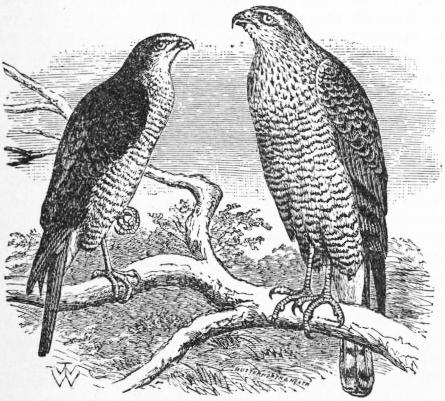
European Sparrow-Hawk (Male and Female).
Systematic ornithologists differ as to the groups into which the numerous forms known as hawks should be divided. There is at the outset a difference of opinion as to the scientific name which the largest and best known of these groups should bear—some authors terming it Nisus, and others, who seem to have the most justice on their side, Accipiter. In Europe there are two species—first, A. nisus, the common sparrow-hawk, which has a wide distribution from Ireland to Japan, extending also to northern India, Egypt and Algeria, and secondly, A. brevipes (by some placed in the group Micronisus and by others called an Astur), which only appears in the south-east and the adjoining parts of Asia Minor and Persia. In North America the place of the former is taken by two very distinct species, a small one, A. fuscus, usually known in Canada and the United States as the sharp-shinned hawk, and Stanley’s or Cooper’s hawk, A. cooperi (by some placed in another genus, Cooperastur), which is larger and has not so northerly a range. In South America there are four or five more, including A. tinus, before mentioned as the smallest of all, while a species not much larger, A. minullus, together with several others of greater size, inhabits South Africa. Madagascar and its neighbouring islands have three or four species sufficiently distinct, and India has A. badlus. A good many more forms are found in south-eastern Asia, in the Indo-Malay Archipelago, and in Australia three or four species, of which A. cirrhocephalus most nearly represents the sparrow-hawk of Europe and northern Asia, while A. radiatus and A. approximans show some affinity to the gos-hawks (Astur) with which they are often classed. The differences between all the forms above named and the much larger number here unnamed are such as can be only appreciated by the specialist. The so-called “sparrow-hawk” of New Zealand (Hieracidea) does not belong to this group of birds at all, and by many authors has been deemed akin to the falcons. For hawking see Falconry.
(A. N.)
1 In one form, Nisoides, which on that account has been generically separated, they are said to be perfectly straight.
HAWKE, EDWARD HAWKE, Baron (1705-1781), British admiral, was the only son of Edward Hawke, a barrister. On his mother’s side he was the nephew of Colonel Martin Bladen (1680-1746), a politician of some note, and was connected with the family of Fairfax. Edward Hawke entered the navy on the 20th of February 1720 and served the time required to qualify him to hold a lieutenant’s commission on the North American and West Indian stations. Though he passed his examination on the 2nd of June 1725, he was not appointed to a ship to act in that rank till 1729, when he was named third lieutenant of the “Portland” in the Channel. The continuance of peace allowed him no opportunities of distinction, but he was fortunate in obtaining promotion as commander of the “Wolf” sloop in 1733, and as post captain of the “Flamborough” (20) in 1734. When war began with Spain in 1739, he served as captain of the “Portland” (50) in the West Indies. His ship was old and rotten. She nearly drowned her captain and crew, and was broken up after she was paid off in 1742. In the following year Hawke was appointed to the “Berwick” (70), a fine new vessel, and was attached to the Mediterranean fleet then under the command of Thomas Mathews. The “Berwick” was manned badly, and suffered severely from sickness, but in the ill-managed battle of Toulon on the 11th of January 1744 Hawke gained great distinction by the spirit with which he fought his ship. The only prize taken by the British fleet, the Spanish “Poder” (74), surrendered to him, and though she was not kept by the admiral, Hawke was not in any degree to blame for the loss of the only trophy of the fight. His gallantry attracted the attention of the king. There is a story that he was dismissed from the service for having left the line to engage the “Poder,” and was restored by the king’s order. The legend grew not unnaturally out of the confusing series of courts martial which arose out of the battle, but it has no foundation. There is better reason to believe that when at a later period the Admiralty intended to pass over Hawke’s name in a promotion of admirals, the king, George II., did insist that he should not be put on the retired list.
He had no further chance of making his energy and ability known out of the ranks of his own profession, where they were fully realized, till 1747. In July of that year he attained flag rank, and was named second in command of the Channel fleet. Owing to the ill health of his superior he was sent in command of the fourteen ships detached to intercept a French convoy on its way to the West Indies. On the 14th of October 1747 he fell in with it in the Bay of Biscay. The French force, under M. Desherbiers de l’Étenduère, consisted of nine ships, which were, however, on the average larger than Hawke’s. He attacked at once. The French admiral sent one of his liners to escort the merchant ships on their way to the West Indies, and with the other eight fought a very gallant action with the British squadron. Six of the eight French ships were taken. The French admiral did for a time succeed in saving the trading vessels under his charge, but most of them fell into the hands of the British cruisers in the West Indies. Hawke was made a knight of the Bath for this timely piece of service, a reward which cannot be said to have been lavish.
In 1747 Hawke had been elected M.P. for Portsmouth, which he continued to represent for thirty years, though he can seldom have been in his place, and it does not appear that he often spoke. A seat in parliament was always valuable to a naval officer at that time, since it enabled him to be useful to ministers, and increased his chances of obtaining employment. Hawke had married a lady of fortune in Yorkshire, Catherine Brook, in 1737, and was able to meet the expenses entailed by a seat in parliament, which were considerable at a time when votes were openly paid for by money down. In the interval between the war of the Austrian Succession and the Seven Years’ War, Hawke was almost always on active service. From 1748 till 1752 be was in command at home, and he rehoisted his flag in 1755 as admiral in command of the Western Squadron. Although war was not declared for some time, England and France were on very hostile terms, and conflicts between the officers of the two powers in America had already taken place. Neither government was scrupulous in abstaining from the use of force while peace was still nominally unbroken. Hawke was sent to sea to intercept a French squadron which had been cruising near Gibraltar, but a restriction was put on the limits within which he might cruise, and he failed to meet the French. The fleet was much weakened by ill-health. In June 1756 the news of John Byng’s retreat from Minorca reached England and aroused the utmost indignation. Hawke was at once sent out to relieve him in the Mediterranean command, and to send him home for trial. He sailed in the “Antelope,” carrying, as the wits of the day put it, “a cargo of courage” to supply deficiencies in that respect among the officers then in the Mediterranean. Minorca had fallen, from want of resources rather than the attacks of the French, before he could do anything for the assistance of the garrison of Fort St Philip. In winter he was recalled to England, and he reached home on the 14th of January 1757. On the 24th of February following he was promoted full admiral.
It is said, but on no very good authority, that he was not on good terms with Pitt (afterwards earl of Chatham), and it is certain that when Pitt’s great ministry was formed in June 1757, he was not included in the Board of Admiralty. Yet as he was continued in command of important forces in the Channel, it is obvious that his great capacity was fully recognized. In the late summer of 1757 he was entrusted with the naval side of an expedition to the coast of France. These operations, which were scoffingly described at the time as breaking windows with guineas, were a favourite device of Pitt’s for weakening the French and raising the confidence of the country. The expedition of 1757 was directed against Rochefort, and it effected nothing. Hawke, who probably expected very little good from it, did his own work as admiral punctually, but he cannot be said to have shown zeal, or any wish to inspirit the military officers into making greater efforts than they were disposed naturally to make. The expedition returned to Spithead by the 6th of October. No part of the disappointment of the public, which was acute, was visited on Hawke. During the end of 1757 and the beginning of 1758 be continued cruising in the Channel in search of the French naval forces, without any striking success. In May of that year he was ordered to detach a squadron under the command of Howe to carry out further combined operations. Hawke considered himself as treated with a want of due respect, and was at the time in bad humour with the Admiralty. He somewhat pettishly threw up his command, but was induced to resume it by the board, which knew his value, and was not wanting in flattery. He retired in June for a time on the ground of health, but happily for his own glory and the service of the country he was able to hoist his flag in May 1759, the “wonderful year” of Garrick’s song.
France was then elaborating a scheme of invasion which bears much resemblance to the plan afterwards formed by Napoleon. An army of invasion was collected at the Morbihan in Brittany, and the intention was to transport it under the protection of a powerful fleet which was to be made up by uniting the squadron at Brest with the ships at Toulon. The plan, like Napoleon’s, had slight chance of success, since the naval part of the invading force must necessarily be brought together from distant points at the risk of interruption by the British squadrons. The naval forces of England were amply sufficient to provide whatever was needed to upset the plans of the French government. But the country was not so confident in the capacity of the navy to serve as a defence as it was taught to be in later generations. It had been seized by a most shameful panic at the beginning of the war in face of a mere threat of invasion. Therefore the anxiety of Pitt to baffle the schemes of the French decisively was great, and the country looked on at the development of the naval campaign with nervous attention. The proposed combination of the French fleet was defeated by the annihilation of the Toulon squadron on the coast of Portugal by Boscawen in May, but the Brest fleet was still untouched and the troops were still at Morbihan. It was the duty of Hawke to prevent attack from this quarter. The manner in which he discharged his task marks an epoch in the history of the navy. Until his time, or very nearly so, it was still believed that there was rashness in keeping the great ships out after September. Hawke maintained his blockade of Brest till far into November. Long cruises had always entailed much bad health on the crews, but by the care he took to obtain fresh food, and the energy he showed in pressing the Admiralty for stores, he was able to keep his men healthy. Early in November a series of severe gales forced him off the French coast, and he was compelled to anchor in Torbay. His absence was brief, but it allowed the French admiral, M. de Conflans (1690?-1777), time to put to sea, and to steer for the Morbihan. Hawke, who had left Torbay on the 13th of November, learnt of the departure of the French at sea on the 17th from a look-out ship, and as the French admiral could have done nothing but steer for the Morbihan, he followed him thither. The news that M. de Conflans had got to sea spread a panic through the country, and for some days Hawke was the object of abuse of the most irrational kind. There was in fact no danger, for behind Hawke’s fleet there were ample reserves in the straits of Dover, and in the North Sea. Following his enemy as fast as the bad weather, a mixture of calms and head winds would allow, the admiral sighted the French about 40 m. to the west of Belleisle on the morning of the 20th of November. The British fleet was of twenty-one sail, the French of twenty. There was also a small squadron of British ships engaged in watching the Morbihan as an inshore squadron, which was in danger of being cut off. M. de Conflans had a sufficient force to fight in the open sea without rashness, but after making a motion to give battle, he changed his mind and gave the signal to his fleet to steer for the anchorage at Quiberon. He did not believe that the British admiral would dare to follow him, for the coast is one of the most dangerous in the world, and the wind was blowing hard from the west and rising to a storm. Hawke, however, pursued without hesitation, though it was well on in the afternoon before he caught up the rear of the French fleet, and dark by the time the two fleets were in the bay. The action, which was more a test of seamanship than of gunnery, or capacity to manœuvre in order, ended in the destruction of the French. Five ships only were taken or destroyed, but others ran ashore, and the French navy as a whole lost all confidence. Two British vessels were lost, but the price was little to pay for such a victory. No more fighting remained to be done. The fleet in Quiberon Bay suffered from want of food, and its distress is recorded in the lines:—
“Ere Hawke did bang Mounseer Conflang You sent us beef and beer; Now Mounseer’s beat We’ve nought to eat, Since you have nought to fear.”
Hawke returned to England in January 1760 and had no further service at sea. He was not made a peer till the 20th of May 1776, and then only as Baron Hawke of Towton. From 1776 to 1771 he was first lord of the Admiralty. His administration was much criticized, perhaps more from party spirit than because of its real defects. Whatever his relations with Lord Chatham may have been he was no favourite with Chatham’s partizans. It is very credible that, having spent all his life at sea, his faculty did not show in the uncongenial life of the shore. As an admiral at sea and on his own element Hawke has had no superior. It is true that he was not put to the test of having to meet opponents of equal strength and efficiency, but then neither has any other British admiral since the Dutch wars of the 17th century. On his death on the 17th of October 1781 his title passed to his son, Martin Bladen (1744-1805), and it is still held by his descendants, the 7th Baron (b. 1860) being best known as a great Yorkshire cricketer.
There is a portrait of Hawke in the Painted Hall at Greenwich. His Life by Montagu Burrows (1883) has superseded all other authorities; it is supplemented in a few early particulars by Sir J. K. Laughton’s article in the Dict. Nat. Biog. (1891).
HAWKER, ROBERT STEPHEN (1803-1874), English antiquary and poet, was born at Stoke Damerel, Devonshire, on the 3rd of December 1803. His father, Jacob Stephen Hawker, was at that time a doctor, but afterwards curate and vicar of Stratton, Cornwall. Robert was sent to Liskeard grammar school, and when he was about sixteen was apprenticed to a solicitor. He was soon removed to Cheltenham grammar school, and in April 1823 matriculated at Pembroke College, Oxford. In the same year he married Charlotte I’Ans, a lady much older than himself. On returning to Oxford he migrated to Magdalen Hall, where he graduated in 1828, having already won the Newdigate prize for poetry in 1827. He became vicar of Morwenstow, a village on the north Cornish coast, in 1834. Hawker described the bulk of his parishioners as a “mixed multitude of smugglers, wreckers and dissenters of various hues.” He was himself a high churchman, and carried things with a high hand in his parish, but was much beloved by his people. He was a man of great originality, and numerous stories were told of his striking sayings and eccentric conduct. He was the original of Mortimer Collins’s Canon Tremaine in Sweet and Twenty. His first wife died in 1863, and in 1864 he married Pauline Kuczynski, daughter of a Polish exile. He died in Plymouth on the 15th of August 1875. Before his death he was formally received into the Roman Catholic Church, a proceeding which aroused a bitter newspaper controversy. The best of his poems is The Quest of the Sangraal: Chant the First (Exeter, 1864). Among his Cornish Ballads (1869) the most famous is on “Trelawny,” the refrain of which, “And shall Trelawny die,” &c., he declared to be an old Cornish saying.
See The Vicar of Morwenstow (1875; later and corrected editions, 1876 and 1886), by the Rev. S. Baring-Gould, which was severely criticized by Hawker’s friend, W. Maskell, in the Athenaeum (March 26, 1876); Memorials of the late Robert Stephen Hawker (1876), by the late Dr F. G. Lee. These were superseded in 1905 by The Life and Letters of R. S. Hawker, by his son-in-law, C. E. Byles, which contains a bibliography of his works, now very valuable to collectors. See also Boase and Courtney, Bibliotheca Cornubiensis. His Poetical Works (1879) and his Prose Works (1893) were edited by J. G. Godwin. Another edition of his Poetical Works (1899) has a preface and bibliography by Alfred Wallis, and a complete edition of his poems by C. E. Byles, with the title Cornish Ballads and other Poems, appeared in 1904.
HAWKERS and PEDLARS, the designation of itinerant dealers who convey their goods from place to place to sell. The word “hawker” seems to have come into English from the Ger. Höker or Dutch heuker in the early 16th century. In an act of 1533 (25 Henry VIII. c. 9, § 6) we find “Sundry evill disposed persons which commonly beane called haukers ... buying and selling of Brasse and Pewter.” The earlier word for such an itinerant dealer is “huckster,” which is found in 1200. “For that they have turned God’s house intill hucksteress bothe” (Ormulum, 15,817). The base of the two words is the same, and is probably to be referred to German hocken, to squat, crouch; cf. “hucklebone,” the hip-bone; and the hawkers or hucksters were so called either because they stooped under their packs, or squatted at booths in markets, &c. Another derivation finds the origin in the Dutch hock, a hole, corner. It may be noticed that the termination of “huckster” is feminine; though there are examples of its application to women it was always applied indiscriminately to either sex.
“Pedlar” occurs much earlier than the verbal form “to peddle,” which is therefore a derivative from the substantive. The origin is to be found in the still older word “pedder,” one who carries about goods for sale in a “ped,” a basket or hamper. This is now only used dialectically and in Scotland. In the Ancren Riwle (c. 1225), peoddare is found with the meaning of “pedlar,” though the Promptorium parvulorum (c. 1440) defines it as calathasius, i.e. a maker of panniers or baskets.
The French term for a hawker or pedlar of books, colporteur (col, neck, porter, to carry), has been adopted by the Bible Society and other English religious bodies as a name for itinerant vendors and distributors of Bibles and other religious literature.
The occupation of hawkers and pedlars has been regulated in the United Kingdom, and the two classes have also been technically distinguished. The Pedlars Act 1871 defines a pedlar as “any hawker, pedlar, petty chapman, tinker, caster of metals, mender of chairs, or other person who, without any horse or other beast bearing or drawing burden, travels and trades on foot and goes from town to town or to other men’s houses, carrying to sell or exposing for sale any goods, wares or merchandise ... or selling or offering for sale his skill in handicraft.” Any person who acts as a pedlar must have a certificate, which is to be obtained from the chief officer of police of the police district in which the person applying for the certificate has resided during one month previous to his application. He must satisfy the officer that he is above seventeen years of age, is of good character, and in good faith intends to carry on the trade of a pedlar. The fee for a pedlar’s certificate is five shillings, and the certificate remains in force for a year from the date of issue. The act requires a register of certificates to be kept in each district, and imposes a penalty for the assigning, borrowing or forging of any certificate. It does not exempt any one from vagrant law, and requires the pedlar to show his certificate on demand to certain persons. It empowers the police to inspect a pedlar’s pack, and provides for the arrest of an uncertificated pedlar or one refusing to show his certificate. A pedlar’s certificate is not required by commercial travellers, sellers of vegetables, fish, fruit or victuals, or sellers in fairs. The Hawkers Act 1888 defines a hawker as “any one who travels with a horse or other beast of burden, selling goods,” &c. An excise licence (expiring on the 31st of March in each year) must be taken out by every hawker in the United Kingdom. The duty imposed upon such licence is £2. A hawker’s licence is not granted, otherwise than by way of licence, except on production of a certificate signed by a clergyman and two householders of the parish or place wherein the applicant resides, or by a justice of the county or place, or a superintendent or inspector of police for the district, attesting that the person is of good character and a proper person to be licenced as a hawker. There are certain exemptions from taking out a licence—commercial travellers, sellers of fish, coal, &c., sellers in fairs, and the real worker or maker of any goods. The act also lays down certain provisions to be observed by hawkers and others, and imposes penalties for infringements. In the United States hawkers and pedlars must take out licences under State laws and Federal laws.
HAWKESWORTH, JOHN (c. 1715-1773), English miscellaneous writer, was born in London about 1715. He is said to have been clerk to an attorney, and was certainly self-educated. In 1744 he succeeded Samuel Johnson as compiler of the parliamentary debates for the Gentleman’s Magazine, and from 1746 to 1749 he contributed poems signed Greville, or H. Greville, to that journal. In company with Johnson and others he started a periodical called The Adventurer, which ran to 140 numbers, of which 70 were from the pen of Hawkesworth himself. On account of what was regarded as its powerful defence of morality and religion, Hawkesworth was rewarded by the archbishop of Canterbury with the degree of LL.D. In 1754-1755 he published an edition (12 vols.) of Swift’s works, with a life prefixed which Johnson praised in his Lives of the Poets. A larger edition (27 vols.) appeared in 1766-1779. He adapted Dryden’s Amphitryon for the Drury Lane stage in 1756, and Southerne’s Oronooko in 1759. He wrote the libretto of an oratorio Zimri in 1760, and the next year Edgar and Emmeline: a Fairy Tale, was produced at Drury Lane. His Almoran and Hamet (2 vols., 1761) was first of all drafted as a play, and a tragedy founded on it by S. J. Pratt, The Fair Circassian (1781), met with some success. He was commissioned by the admiralty to edit Captain Cook’s papers relative to his first voyage. For this work, An Account of the Voyages undertaken ... for making discoveries in the Southern Hemisphere and performed by Commodore Byrone, Captain Wallis, Captain Carteret and Captain Cook (from 1764 to 1771) drawn up from the Journals ... (3 vols., 1773), Hawkesworth is said to have received from the publishers the sum of £6000. His descriptions of the manners and customs of the South Seas were, however, regarded by many critics as inexact and hurtful to the interests of morality, and the severity of their strictures is said to have hastened his death, which took place on the 16th of November 1773. He was buried at Bromley, Kent, where he and his wife had kept a school. Hawkesworth was a close imitator of Johnson both in style and thought, and was at one time on very friendly terms with him. It is said that he presumed on his success, and lost Johnson’s friendship as early as 1756.
HAWKHURST, a town in the southern parliamentary division of Kent, England, 47 m. S.E. of London, on a branch of the South-Eastern & Chatham railway. Pop. (1901), 3136. It lies mainly on a ridge above the valley of the Kent Ditch, a tributary of the Rother. The neighbouring country is hilly, rich and well wooded, and the pleasant and healthy situation has led to the considerable extension of the old village as a residential locality. The Kent Sanatorium and one of the Barnardo homes are established here. The church of St Lawrence, founded from Battle Abbey in Sussex, is Decorated and Perpendicular and its east window, of the earlier period, is specially beautiful.
HAWKINS, CAESAR HENRY (1798-1884), British surgeon, son of the Rev. E. Hawkins and grandson of the Sir Caesar Hawkins (1711-1786), who was serjeant-surgeon to Kings George II. and George III., was born at Bisley, Gloucestershire, on the 19th of September 1798, was educated at Christ’s Hospital, and entered St George’s Hospital, London, in 1818. He was surgeon to the hospital from 1829 to 1861, and in 1862 was made serjeant-surgeon to Queen Victoria. He was president of the College of Surgeons in 1852, and again in 1861; and he delivered the Hunterian oration in 1849. His success in complex surgical cases gave him a great reputation. For long he was noted as the only surgeon who had succeeded in the operation of ovariotomy in a London hospital. This occurred in 1846, when anaesthetics were unknown. He did much to popularize colotomy. A successful operator, he nevertheless was attached to conservative surgery, and was always more anxious to teach his pupils how to save a limb than how to remove it. He reprinted his contributions to the medical journals in two volumes, 1874, the more valuable papers being on Tumours, Excision of the Ovarium, Hydrophobia and Snake-bites, Stricture of the Colon, and The Relative Claims of Sir Charles Bell and Magendie to the Discovery of the Functions of the Spinal Nerves. He died on the 20th of July 1884. His brother, Edward Hawkins (1789-1882), was the well-known provost of Oriel, Oxford, who played so great a part in the Tractarian movement.
HAWKINS, or Hawkyns, SIR JOHN (1532-1595), British admiral, was born at Plymouth in 1532, and belonged to a family of Devonshire shipowners and skippers—occupations then more closely connected than is now usual. His father, William Hawkins (d. 1553), was a prosperous freeman of Plymouth, who thrice represented that town in parliament, and is described by Hakluyt as one of the principal sea-captains in the west parts of England; his elder brother, also called William (d. 1589), was closely associated with him in his Spanish expeditions, and took an active part in fitting out ships to meet the Armada; and his nephew, the eldest son of the last named and of the same name, sailed with Sir Francis Drake to the South Sea in 1577, and served as lieutenant under Edward Fenton (q.v.) in the expedition which started for the East Indies and China in 1582. His son, Sir Richard Hawkins, is separately noticed.
Sir John Hawkins was bred to the sea in the ships of his family. When the great epoch of Elizabethan maritime adventure began, he took an active part by sailing to the Guinea coast, where he robbed the Portuguese slavers, and then smuggled the negroes he had captured into the Spanish possessions in the New World. After a first successful voyage in 1562-1563, two vessels which he had rashly sent to Seville were confiscated by the Spanish government. With the help of friends, and the open approval of the queen, who hired one of her vessels to him, he sailed again in 1564, and repeated his voyage with success, trading with the Creoles by force when the officials of the king endeavoured to prevent him. These two voyages brought him reputation, and he was granted a coat of arms with a demi-Moor, or negro, chained, as his crest. The rivalry with Spain was now becoming very acute, and when Hawkins sailed for the third time in 1567, he went in fact, though not technically, on a national venture. Again he kidnapped negroes, and forced his goods on the Spanish colonies. Encouraged by his discovery that these settlements were small and unfortified, he on this occasion ventured to enter Vera Cruz, the port of Mexico, after capturing some Spaniards at sea to be held as hostages. He alleged that he had been driven in by bad weather. The falsity of the story was glaring, but the Spanish officers on the spot were too weak to offer resistance. Hawkins was allowed to enter the harbour, and to refit at the small rocky island of San Juan de Ulloa by which it is formed. Unfortunately for him, and for a French corsair whom he had in his company, a strong Spanish force arrived, bringing the new viceroy. The Spaniards, who were no more scrupulous of the truth than himself, pretended to accept the arrangement made before their arrival, and then when they thought he was off his guard attacked him on the 24th of September. Only two vessels escaped, his own, the “Minion,” and the “Judith,” a small vessel belonging to his cousin Francis Drake. The voyage home was miserable, and the sufferings of all were great.
For some years Hawkins did not return to the sea, though he continued to be interested in privateering voyages as a capitalist. In the course of 1572 he recovered part of his loss by pretending to betray the queen for a bribe to Spain. He acted with the knowledge of Lord Burleigh. In 1573 he became treasurer of the navy in succession to his father-in-law Benjamin Gonson. The office of comptroller was conferred on him soon after, and for the rest of his life he remained the principal administrative officer of the navy. Burleigh noted that he was suspected of fraud in his office, but the queen’s ships were kept by him in good condition. In 1588 he served as rear-admiral against the Spanish Armada and was knighted. In 1590 he was sent to the coast of Portugal to intercept the Spanish treasure fleet, but did not meet it. In giving an account of his failure to the queen he quoted the text “Paul doth plant, Apollo doth water, but God giveth the increase,” which exhibition of piety is said to have provoked the queen into exclaiming, “God’s death! This fool went out a soldier, and has come home a divine.” In 1595 he accompanied Drake on another treasure-hunting voyage to the West Indies, which was even less successful, and he died at sea off Porto Rico on the 12th of November 1595.
Hawkins was twice married, first to Katharine Gonson and then to Margaret Vaughan. He was counted a puritan when puritanism meant little beyond hatred of Spain and popery, and when these principles were an ever-ready excuse for voyages in search of slaves and plunder. In the course of one of his voyages, when he was becalmed and his negroes were dying, he consoled himself by the reflection that God would not suffer His elect to perish. Contemporary evidence can be produced to show that he was greedy, unscrupulous and rude. But if he had been a more delicate man he would not have risked the gallows by making piratical attacks on the Portuguese and by appearing in the West Indies as an armed smuggler; and in that case he would not have played an important part in history by setting the example of breaking down the pretension of the Spaniards to exclude all comers from the New World. His morality was that of the average stirring man of his time, whether in England or elsewhere.
See R. A. J. Walling, A Sea-dog of Devon (1907); and Southey in his British Admirals, vol. iii. The original accounts of his voyages compiled by Hakluyt have been reprinted by the Hakluyt Society, with a preface by Sir C. R. Markham.
HAWKINS, SIR JOHN (1719-1789), English writer on music, was born on the 30th of March 1719, in London, the son of an architect who destined him for his own profession. Ultimately, however, Hawkins took to the law, devoting his leisure hours to his favourite study of music. A wealthy marriage in 1753 enabled him to indulge his passion for acquiring rare works of music, and he bought, for example, the collection formed by Dr Pepusch, and subsequently presented by Hawkins to the British Museum. It was on such materials that Hawkins founded his celebrated work on the General History of the Science and Practice of Music, in 5 vols. (republished in 2 vols., 1876). It was brought out in 1776, the same year which witnessed the appearance of the first volume of Burney’s work on the same subject. The relative merits of the two works were eagerly discussed by contemporary critics. Burney no doubt is infinitely superior as a literary man, and his work accordingly comes much nearer the idea of a systematic treatise on the subject than Hawkins’s, which is essentially a collection of rare and valuable pieces of music with a more or less continuous commentary. But by rescuing these from oblivion Hawkins has given a permanent value to his work. Of Hawkins’s literary efforts apart from music it will be sufficient to mention his occasional contributions to the Gentleman’s Magazine, his edition (1760) of the Complete Angler (1787) and his biography of Dr Johnson, with whom he was intimately acquainted. He was one of the original members of the Ivy Lane Club, and ultimately became one of Dr Johnson’s executors. If there were any doubt as to his intimacy with Johnson, it would be settled by the slighting way in which Boswell refers to him. Speaking of the Ivy Lane Club, he mentions amongst the members “Mr John Hawkins, an attorney,” and adds the following footnote, which at the same time may serve as a summary of the remaining facts of Hawkins’s life: “He was for several years chairman of the Middlesex justices, and upon presenting an address to the king accepted the usual offer of knighthood (1772). He is the author of a History of Music in five volumes in quarto. By assiduous attendance upon Johnson in his last illness he obtained the office of one of his executors—in consequence of which the booksellers of London employed him to publish an edition of Dr Johnson’s works and to write his life.” Sir John Hawkins died on the 21st of May 1789, and was buried in the cloisters of Westminster Abbey.
HAWKINS, or Hawkyns, SIR RICHARD (c. 1562-1622), British seaman, was the only son of Admiral Sir John Hawkins (q.v.) by his first marriage. He was from his earliest days familiar with ships and the sea, and in 1582 he accompanied his uncle, William Hawkins, to the West Indies. In 1585 he was captain of a galliot in Drake’s expedition to the Spanish main, in 1588 he commanded a queen’s ship against the Armada, and in 1590 served with his father’s expedition to the coast of Portugal. In 1593 he purchased the “Dainty,” a ship originally built for his father and used by him in his expeditions, and sailed for the West Indies, the Spanish main and the South Seas. It seems clear that his project was to prey on the oversea possessions of the king of Spain. Hawkins, however, in an account of the voyage written thirty years afterwards, maintained, and by that time perhaps had really persuaded himself, that his expedition was undertaken purely for the purpose of geographical discovery. After visiting the coast of Brazil, the “Dainty” passed through the Straits of Magellan, and in due course reached Valparaiso. Having plundered the town, Hawkins pushed north, and in June 1594, a year after leaving Plymouth, arrived in the bay of San Mateo. Here the “Dainty” was attacked by two Spanish ships. Hawkins was hopelessly outmatched, but defended himself with great courage. At last, when he himself had been severely wounded, many of his men killed, and the “Dainty” was nearly sinking, he surrendered on the promise of a safe-conduct out of the country for himself and his crew. Through no fault of the Spanish commander this promise was not kept. In 1597 Hawkins was sent to Spain, and imprisoned first at Seville and subsequently at Madrid. He was released in 1602, and, returning to England, was knighted in 1603. In 1604 he became member of parliament for Plymouth and vice-admiral of Devon, a post which, as the coast was swarming with pirates, was no sinecure. In 1620-1621 he was vice-admiral, under Sir Robert Mansell, of the fleet sent into the Mediterranean to reduce the Algerian corsairs. He died in London on the 17th of April 1622.
See his Observations in his Voiage into the South Sea (1622), republished by the Hakluyt Society.
HAWKS, FRANCIS LISTER (1798-1866), American clergyman, was born at Newbern, North Carolina, on the 10th of June 1798, and graduated at the university of his native state in 1815. After practising law with some distinction he entered the Episcopalian ministry in 1827 and proved a brilliant and impressive preacher, holding livings in New Haven, Philadelphia, New York and New Orleans, and declining several bishoprics. On his appointment as historiographer of his church in 1835, he went to England, and collected the abundant materials afterwards utilized in his Contributions to the Ecclesiastical History of U.S.A. (New York, 1836-1839). These two volumes dealt with Maryland and Virginia, while two later ones (1863-1864) were devoted to Connecticut. He was the first president of the university of Louisiana (now merged in Tulane). He died in New York on the 26th of September 1866.
HAWKSHAW, SIR JOHN (1811-1891), English engineer, was born in Yorkshire in 1811, and was educated at Leeds grammar school. Before he was twenty-one he had been engaged for six or seven years in railway engineering and the construction of roads in his native county, and in the year of his majority he obtained an appointment as engineer to the Bolivar Mining Association in Venezuela. But the climate there was more than his health could stand, and in 1834 he was obliged to return to England. He soon obtained employment under Jesse Hartley at the Liverpool docks, and subsequently was made engineer in charge of the railway and navigation works of the Manchester, Bury and Bolton Canal Company. In 1845 he became chief engineer to the Manchester & Leeds railway, and in 1847 to its successor, the Lancashire & Yorkshire railway, for which he constructed a large number of branch lines. In 1850 he removed to London and began to practise as a consulting engineer, at first alone, but subsequently in partnership with Harrison Hayter. In that capacity his work was of an extremely varied nature, embracing almost every branch of engineering. He retained his connexion with the Lancashire & Yorkshire Company until his retirement from professional work in 1888, and was consulted on all the important engineering points that affected it in that long period. In London he was responsible for the Charing Cross and Cannon Street railways, together with the two bridges which carried them over the Thames; he was engineer of the East London railway, which passes under the Thames through Sir M. I. Brunel’s well-known tunnel; and jointly with Sir J. Wolfe Barry he constructed the section of the Underground railway which completed the “inner circle” between the Aldgate and Mansion House stations. In addition, many railway works claimed his attention in all parts of the world—Germany, Russia, India, Mauritius, &c. One noteworthy point in his railway practice was his advocacy, in opposition to Robert Stephenson, of steeper gradients than had previously been thought desirable or possible, and so far back as 1838 he expressed decided disapproval of the maintenance of the broad gauge on the Great Western, because of the troubles he foresaw it would lead to in connexion with future railway extension, and because he objected in general to breaks of gauge in the lines of a country. The construction of canals was another branch of engineering in which he was actively engaged. In 1862 he became engineer of the Amsterdam ship-canal, and in the succeeding year he may fairly be said to have been the saviour of the Suez Canal. About that time the scheme was in very bad odour, and the khedive determined to get the opinion of an English engineer as to its practicability, having made up his mind to stop the works if that opinion was unfavourable. Hawkshaw was chosen to make the inquiry, and it was because his report was entirely favourable that M. de Lesseps was able to say at the opening ceremony that to him he owed the canal. As a member of the International Congress which considered the construction of an interoceanic canal across central America, he thought best of the Nicaraguan route, and privately he regarded the Panama scheme as impracticable at a reasonable cost, although publicly he expressed no opinion on the matter and left the Congress without voting. Sir John Hawkshaw also had a wide experience in constructing harbours (e.g. Holyhead) and docks (e.g. Penarth, the Albert Dock at Hull, and the south dock of the East and West India Docks in London), in river-engineering, in drainage and sewerage, in water-supply, &c. He was engineer, with Sir James Brunlees, of the original Channel Tunnel Company from 1872, but many years previously he had investigated for himself the question of a tunnel under the Strait of Dover from an engineering point of view, and had come to a belief in its feasibility, so far as that could be determined from borings and surveys. Subsequently, however, he became convinced that the tunnel would not be to the advantage of Great Britain, and thereafter would have nothing to do with the project. He was also engineer of the Severn Tunnel, which, from its magnitude and the difficulties encountered in its construction, must rank as one of the most notable engineering undertakings of the 19th century. He died in London on the 2nd of June 1891.
HAWKSLEY, THOMAS (1807-1893), English engineer, was born on the 12th of July 1807, at Arnold, near Nottingham. He was at Nottingham grammar school till the age of fifteen, but was indebted to his private studies for his knowledge of mathematics, chemistry and geology. In 1822 he was articled to an architect in Nottingham, subsequently becoming a partner in the firm, which also undertook engineering work; and in 1852 he removed to London, where he continued in active practice till he was well past eighty. His work was chiefly concerned with water and gas supply and with main-drainage. Of waterworks he used to say that he had constructed 150, and a long list might be drawn up of important towns that owe their water to his skill, including Liverpool, Sheffield, Leicester, Leeds, Derby, Darlington, Oxford, Cambridge and Northampton in England, and Stockholm, Altona and Bridgetown (Barbados) in other countries. To his native town of Nottingham he was water engineer for fifty years, and the system he designed for it was noteworthy from the fact that the principle of constant supply was adopted for the first time. The gas-works at Nottingham, and at many other towns for which he provided water supplies were also constructed by him. He designed main-drainage systems for Birmingham, Worcester and Windsor among other places, and in 1857 he was called in, together with G. P. Bidder and Sir J. Bazalgette, to report on the best solution of the vexed question of a main-drainage scheme for London. In 1872 he was president of the Institution of Civil Engineers—an office in which his son Charles followed him in 1901. He died in London on the 23rd of September 1893.
HAWKSMOOR, NICHOLAS (1661-1736), English architect, of Nottinghamshire birth, became a pupil of Sir Christopher Wren at the age of eighteen, and his name is intimately associated with those of Wren and Sir J. Vanbrugh in the English architecture of his time. Through Wren’s influence he obtained various official posts, as deputy-surveyor at Chelsea hospital, clerk of the works and deputy-surveyor at Greenwich hospital, clerk of the works at Whitehall, St James’s and Westminster, and he succeeded Wren as surveyor-general of Westminster Abbey. He took part in much of the work done by Wren and Vanbrugh, and it is difficult often to assign among them the credit for the designs of various features. Hawksmoor appears, however, to have been responsible for the early Gothic designs of the two towers of All Souls’ (Oxford) north quadrangle, and the library and other features at Queen’s College (Oxford). At the close of Queen Anne’s reign he had a principal part in the scheme for building fifty new churches in London, and himself designed five or six of them, including St Mary Woolnoth (1716-1719) and St George’s, Bloomsbury (1720-1730). A number of his drawings have been preserved. He died in London on the 25th of March 1736.
HAWKWOOD, SIR JOHN (d. 1394), an English adventurer who attained great wealth and renown as a condottiere in the Italian wars of the 14th century. His name is variously spelt as Haccoude, Aucud, Aguto, &c., by contemporaries. It is said that he was the son of a tanner of Hedingham Sibil in Essex, and was apprenticed in London, whence he went, in the English army, to France under Edward III. and the Black Prince. It is said also that he obtained the favour of the Black Prince, and received knighthood from King Edward III., but though it is certain that he was of knightly rank, there is no evidence as to the time or place at which he won it. On the peace of Bretigny in 1360, he collected a band of men-at-arms, and moved southward to Italy, where we find the White Company, as his men were called, assisting the marquis of Monferrato against Milan in 1362-63, and the Pisans against Florence in 1364. After several campaigns in various parts of central Italy, Hawkwood in 1368 entered the service of Bernabò Visconti. In 1369 he fought for Perugia against the pope, and in 1370 for the Visconti against Pisa, Florence and other enemies. In 1372 he defeated the marquis of Monferrato, but soon afterwards, resenting the interference of a council of war with his plans, Hawkwood resigned his command, and the White Company passed into the papal service, in which he fought against the Visconti in 1373-1375. In 1375 the Florentines entered into an agreement with him, by which they were to pay him and his companion 130,000 gold florins in three months on condition that he undertook no engagement against them; and in the same year the priors of the arts and the gonfalonier decided to give him a pension of 1200 florins per annum for as long as he should remain in Italy. In 1377, under the orders of the cardinal Robert of Geneva, legate of Bologna, he massacred the inhabitants of Cesena, but in May of the same year, disliking the executioner’s work put upon him by the legate, he joined the anti-papal league, and married, at Milan, Donnina, an illegitimate daughter of Bernabò Visconti. In 1378 and 1379 Hawkwood was constantly in the field; he quarrelled with Bernabò in 1378, and entered the service of Florence, receiving, as in 1375, 130,000 gold florins. He rendered good service to the republic up to 1382, when for a time he was one of the English ambassadors at the papal court. He engaged in a brief campaign in Naples in 1383, fought for the marquis of Padua against Verona in 1386, and in 1388 made an unsuccessful effort against Gian Galeazzo Visconti, who had murdered Bernabò. In 1390 the Florentines took up the war against Gian Galeazzo in earnest, and appointed Hawkwood commander-in-chief. His campaign against the Milanese army in the Veronese and the Bergamask was reckoned a triumph of generalship, and in 1392 Florence exacted a satisfactory peace from Gian Galeazzo. His latter years were spent in a villa in the neighbourhood of Florence. On his death in 1394 the republic gave him a public funeral of great magnificence, and decreed the erection of a marble monument in the cathedral. This, however, was never executed; but Paolo Uccelli painted his portrait in terre-verte on the inner façade of the building, where it still remains, though damaged by removal from the plaster to canvas. Richard II. of England, probably at the instigation of Hawkwood’s sons, who returned to their native country, requested the Florentines to let him remove the good knight’s bones, and the Florentine government signified its consent.
Of his children by Donnina Visconti, who appears to have been his second wife, the eldest daughter married Count Brezaglia of Porciglia, podestá of Ferrara, who succeeded him as Florentine commander-in-chief, and another a German condottiere named Conrad Prospergh. His son, John, returned to England and settled at Hedingham Sibil, where, it is supposed, Sir John Hawkwood was buried. The children of the first marriage were two sons and three daughters, and of the latter the youngest married John Shelley, an ancestor of the poet.
Authorities.—Muratori, Rerum Italicarum scriptores, and supplement by Tartinius and Manni; Archivio storico italiano; Temple-Leader and Marcotti, Giovanni Acuto (Florence, 1889; Eng. transl., Leader Scott, London, 1889); Nichol, Bibliotheca topographica Britannica, vol. vi.; J. G. Alger in Register and Magazine of Biography, v. 1.; and article in Dict. Nat. Biog.
HAWLEY, HENRY (c. 1679-1759), British lieut.-general, entered the army, it is said, in 1694. He saw service in the War of Spanish Succession as a captain of Erle’s (the 19th) foot. After Almanza he returned to England, and a few years later had become lieut.-colonel of the 19th. With this regiment he served at Sheriffmuir in 1715, where he was wounded. After this for some years he served in the United Kingdom, obtaining promotion in the usual course, and in 1739 he arrived at the grade of major general. Four years later he accompanied George II. and Stair to Germany, and, as a general officer of cavalry under Sir John Cope, was present at Dettingen. Becoming lieut.-general somewhat later, he was second-in-command of the cavalry at Fontenoy, and on the 20th of December 1745 became commander-in-chief in Scotland. Less than a month later Hawley suffered a severe defeat at Falkirk at the hands of the Highland insurgents. This, however, did not cost him his command, for the duke of Cumberland, who was soon afterwards sent north, was captain-general. Under Cumberland’s orders Hawley led the cavalry in the campaign of Culloden, and at that battle his dragoons distinguished themselves by their ruthless butchery of the fugitive rebels. After the end of the “Forty-Five” he accompanied Cumberland to the Low Countries and led the allied cavalry at Lauffeld (Val). He ended his career as governor of Portsmouth and died at that place in 1759. James Wolfe, his brigade-major, wrote of General Hawley in no flattering terms. “The troops dread his severity, hate the man and hold his military knowledge in contempt,” he wrote. But, whether it be true or false that he was the natural son of George II., Hawley was always treated with the greatest favour by that king and by his son the duke of Cumberland.
HAWLEY, JOSEPH ROSWELL (1826-1905), American political leader, was born on the 31st of October at Stewartsville, Richmond county, North Carolina, where his father, a native of Connecticut, was pastor of a Baptist church. The father returned to Connecticut in 1837 and the son graduated at Hamilton College (Clinton, N.Y.) in 1847. He was admitted to the bar in 1850, and practised at Hartford, Conn., for six years. An ardent opponent of slavery, he became a Free Soiler, was a delegate to the National Convention which nominated John P. Hale for the presidency in 1852, and subsequently served as chairman of the State Committee, having at the same time editorial control of the Charter Oak, the party organ. In 1856 he took a leading part in organizing the Republican party in Connecticut, and in 1857 became editor of the Hartford Evening Press, a newly established Republican newspaper. He served in the Federal army throughout the Civil War, rising from the rank of captain (April 22, 1861) to that of brigadier-general of volunteers (Sept. 1864); took part in the Port Royal Expedition, in the capture of Fort Pulaski (April 1862), in the siege of Charleston and the capture of Fort Wagner (Sept. 1863), in the battle of Olustee (Feb. 20, 1864), in the siege operations about Petersburg, and in General W. T. Sherman’s campaign in the Carolinas; and in September 1865 received the brevet of major-general of volunteers. From April 1866 to April 1867 he was governor of Connecticut, and in 1867 he bought the Hartford Courant, with which he combined the Press, and which became under his editorship the most influential newspaper in Connecticut and one of the leading Republican papers in the country. He was the permanent chairman of the Republican National Convention in 1868, was a delegate to the conventions of 1872, 1876 and 1880, was a member of Congress from December 1872 until March 1875 and again in 1879-1881, and was a United States senator from 1881 until the 3rd of March 1905, being one of the Republican leaders both in the House and the Senate. From 1873 to 1876 he was president of the United States Centennial Commission, the great success of the Centennial Exhibition being largely due to him. He died at Washington, D.C., on the 17th of March 1905.
HAWORTH, an urban district in the Keighley parliamentary division of the West Riding of Yorkshire, England, 10 m. N.W. of Bradford, on a branch of the Midland railway. Pop. (1901), 7492. It is picturesquely situated on a steep slope, lying high, and surrounded by moorland. The Rev. Patrick Brontë (d. 1861) was incumbent here for forty-one years, and a memorial near the west window of St Michael’s church bears his name and the names of his gifted daughters upon it. The grave of Charlotte and Emily Brontë is also marked by a brass. In 1895 a museum was opened by the Brontë society. There is a large worsted industry.
HAWSER (in sense and form as if from “hawse,” which, from the 16th-century form halse, is derived from Teutonic hals, neck, of which there is a Scandinavian use in the sense of the forepart of a ship; the two words are not etymologically connected; “hawser” is from an O. Fr. haucier, hausser, to raise, tow, hoist, from the Late Lat. altiare, to lift, altus, high), a small cable or thick rope used at sea for the purposes of mooring or warping, in the case of large vessels made of steel. When a cable or tow line is made of three or more small ropes it is said to be “hawser-laid.” The “hawse” of a ship is that part of the bows where the “hawse-holes” are made. These are two holes cut in the bows of a vessel for the cables to pass through, having small cast-iron pipes, called “hawse-pipes,” fitted into them to prevent abrasion. In bad weather at sea these holes are plugged up with “hawse-plugs” to prevent the water entering. The phrase to enter the service by the “hawse-holes” is used of those who have risen from before the mast to commissioned rank in the navy. When the ship is at anchor the space between her head and the anchor is called “hawse,” as in the phrase “athwart the hawse.” The term also applies to the position of the ship’s anchors when moored; when they are laid out in a line at right angles to the wind it is said to be moored with an “open hawse”; when both cables are laid out straight to their anchors without crossing, it is a “clear hawse.”
HAWTHORN, a city of Bourke county, Victoria, Australia, 4½ m. by rail E. of and suburban to Melbourne. Pop. (1901), 21,339. It is the seat of the important Methodist Ladies’ College. The majority of the inhabitants are professional and business men engaged in Melbourne and their residences are numerous at Hawthorn.
HAWTHORN (O. Eng. haga-, hæg-, or hege-thorn, i.e. “hedge-thorn”), the common name for Crataegus, in botany, a genus of shrubs or small trees belonging to the natural order Rosaceae, native of the north temperate regions, especially America. It is represented in the British Isles by the hawthorn, white-thorn or may (Ger. Hagedorn and Christdorn; Fr. aubépine), C. Oxyacantha, a small, round-headed, much-branched tree, 10 to 20 ft. high, the branches often ending in single sharp spines. The leaves, which are deeply cut, are 1 to 2 in. long and very variable in shape. The flowers are sweet-scented, in flat-topped clusters, and ½ to ¾ in. in diameter, with five spreading white petals alternating with five persistent green sepals, a large number of stamens with pinkish-brown anthers, and one to three carpels sunk in the cup-shaped floral axis. The fruit, or haw, as in the apple, consists of the swollen floral axis, which is usually scarlet, and forms a fleshy envelope surrounding the hard stone.
The common hawthorn is a native of Europe as far north as 60½° in Sweden, and of North Africa, western Asia and Siberia, and has been naturalized in North America and Australia. It thrives best in dry soils, and in height varies from 4 or 5 to 12, 15 or, in exceptional cases, as much as between 20 and 30 ft. It may be propagated from seed or from cuttings. The seeds must be from ripe fruit, and if fresh gathered should be freed from pulp by maceration in water. They germinate only in the second year after sowing; in the course of their first year the seedlings attain a height of 6 to 12 in. Hawthorn has been for many centuries a favourite park and hedge plant in Europe, and numerous varieties have been developed by cultivation; these differ in the form of the leaf, the white, pink or red, single or double flowers, and the yellow, orange or red fruit. In England the hawthorn, owing to its hardiness and closeness of growth, has been employed for enclosure of land since the Roman occupation, but for ordinary field hedges it is believed it was generally in use till about the end of the 17th century. James I. of Scotland, in his Quair, ii. 14 (early 15th century), mentions the “hawthorn hedges knet” of Windsor Castle. The first hawthorn hedges in Scotland are said to have been planted by soldiers of Cromwell at Inch Buckling Brae in East Lothian and Finlarig in Perthshire. Annual pruning, to which the hawthorn is particularly amenable, is necessary if the hedge is to maintain its compactness and sturdiness. When the lower part shows a tendency to go bare the strong stems may be “plashed,” i.e. split, bent over and pegged to the ground so that new growths may start. The wood of the hawthorn is white in colour, with a yellowish tinge. Fresh cut it weighs 68 ℔ 12 oz. per cubic foot, and dry 57 ℔ 3 oz. It can seldom be obtained in large portions, and has the disadvantage of being apt to warp; its great hardness, however, renders it valuable for the manufacture of various articles, such as the cogs of mill-wheels, flails and mallets, and handles of hammers. Both green and dry it forms excellent fuel. The bark possesses tanning properties, and in Scotland in past times yielded with ferrous sulphate a black dye for wool. The leaves are eaten by cattle, and have been employed as a substitute for tea. Birds and deer feed upon the haws, which are used in the preparation of a fermented and highly intoxicating liquor. The hawthorn serves as a stock for grafting other trees. As an ornamental feature in landscapes, it is worthy of notice; and the pleasing shelter it affords and the beauty of its blossoms have frequently been alluded to by poets. The custom of employing the flowering branches for decorative purposes on the 1st of May is of very early origin; but since the alteration in the calendar the tree has rarely been in full bloom in England before the second week of that month. In the Scottish Highlands the flowers may be seen as late as the middle of June. The hawthorn has been regarded as the emblem of hope, and its branches are stated to have been carried by the ancient Greeks in wedding processions, and to have been used by them to deck the altar of Hymen. The supposition that the tree was the source of Christ’s crown of thorns gave rise doubtless to the tradition current among the French peasantry that it utters groans and cries on Good Friday, and probably also to the old popular superstition in Great Britain and Ireland that ill-luck attended the uprooting of hawthorns. Branches of the Glastonbury thorn, C. Oxyacantha, var. praecox, which flowers both in December and in spring, were formerly highly valued in England, on account of the legend that the tree was originally the staff of Joseph of Arimathea.
The number of species in the genus is from fifty to seventy, according to the view taken as to whether or not some of the forms, especially of those occurring in the United States, represent distinct species. C. coccinea, a native of Canada and the eastern United States, with bright scarlet fruits, was introduced into English gardens towards the end of the 17th century. C. Crus-Galli, with a somewhat similar distribution and introduced about the same time, is a very decorative species with showy, bright red fruit, often remaining on the branches till spring, and leaves assuming a brilliant scarlet and orange in the autumn; numerous varieties are in cultivation. C. Pyracantha, known in gardens as pyracantha, is evergreen and has white flowers, appearing in May, and fine scarlet fruits of the size of a pea which remain on the tree nearly all the winter. It is a native of south Europe and was introduced into Britain early in the 17th century.
HAWTHORNE, NATHANIEL (1804-1864), American writer, son of Nathaniel Hathorne (1776-1808), was born at Salem, Massachusetts, on the 4th of July 1804. The head of the American branch of the family, William Hathorne of Wilton, Wiltshire, England, emigrated with Winthrop and his company, and arrived at Salem Bay, Mass., on the 12th of June 1630. He had grants of land at Dorchester, where he resided for upwards of six years, when he was persuaded to remove to Salem by the tender of further grants of land there, it being considered a public benefit that he should become an inhabitant of that town. He represented his fellow-townsmen in the legislature, and served them in a military capacity as a captain in the first regular troop organized in Salem, which he led to victory through an Indian campaign in Maine. Originally a determined “Separatist,” and opposed to compulsion for conscience, he signalized himself when a magistrate by the active part which he took in the Quaker persecutions of the time (1657-1662), going so far on one occasion as to order the whipping of Anne Coleman and four other Friends through Salem, Boston and Dedham. He died, an old man, in the odour of sanctity, and left a good property to his son John, who inherited his father’s capacity and intolerance, and was in turn a legislator, a magistrate, a soldier and a bitter persecutor of witches. Before the death of Justice Hathorne in 1717, the destiny of the family suffered a sea-change, and they began to be noted as mariners. One of these seafaring Hathornes figured in the Revolution as a privateer, who had the good fortune to escape from a British prison-ship; and another, Captain Daniel Hathorne, has left his mark on early American ballad-lore. He too was a privateer, commander of the brig “Fair American,” which, cruising off the coast of Portugal, fell in with a British scow laden with troops for General Howe, which scow the bold Hathorne and his valiant crew at once engaged and fought for over an hour, until the vanquished enemy was glad to cut the Yankee grapplings and quickly bear away. The last of the Hathornes with whom we are concerned was a son of this sturdy old privateer, Nathaniel Hathorne. He was born in 1776, and about the beginning of the 19th century married Miss Elizabeth Clarke Manning, a daughter of Richard Manning of Salem, whose ancestors emigrated to America about fifty years after the arrival of William Hathorne. Young Nathaniel took his hereditary place before the mast, passed from the forecastle to the cabin, made voyages to the East and West Indies, Brazil and Africa, and finally died of fever at Surinam, in the spring of 1808. He was the father of three children, the second of whom was the subject of this article. The form of the family name was changed by the latter to “Hawthorne” in his early manhood.
After the death of her husband Mrs Hawthorne removed to the house of her father with her little family of children. Of the boyhood of Nathaniel no particulars have reached us, except that he was fond of taking long walks alone, and that he used to declare to his mother that he would go to sea some time and would never return. Among the books that he is known to have read as a child were Shakespeare, Milton, Pope and Thomson, The Castle of Indolence being an especial favourite. In the autumn of 1818 bis mother removed to Raymond, a town in Cumberland county, Maine, where his uncle, Richard Manning, had built a large and ambitious dwelling. Here the lad resumed his solitary walks, exchanging the narrow streets of Salem for the boundless, primeval wilderness, and its sluggish harbour for the fresh bright waters of Sebago lake. He roamed the woods by day, with his gun and rod, and in the moonlight nights of winter skated upon the lake alone till midnight. When he found himself away from home, and wearied with his exercise, he took refuge in a log cabin where half a tree would be burning upon the hearth. He had by this time acquired a taste for writing, that showed itself in a little blank-book, in which he jotted down his woodland adventures and feelings, and which was remarkable for minute observation and nice perception of nature.
After a year’s residence at Raymond, Nathaniel returned to Salem in order to prepare for college. He amused himself by publishing a manuscript periodical, which he called the Spectator, and which displayed considerable vivacity and talent. He speculated upon the profession that he would follow, with a sort of prophetic insight into his future. “I do not want to be a doctor and live by men’s diseases,” he wrote to his mother, “nor a minister to live by their sins, nor a lawyer and live by their quarrels. So I don’t see that there is anything left for me but to be an author. How would you like some day to see a whole shelf full of books, written by your son, with ‘Hawthorne’s Works’ printed on their backs?”
Nathaniel entered Bowdoin College, Brunswick, Maine, in the autumn of 1821, where he became acquainted with two students who were destined to distinction—Henry W. Longfellow and Franklin Pierce. He was an excellent classical scholar, his Latin compositions, even in his freshman year, being remarkable for their elegance, while his Greek (which was less) was good. He made graceful translations from the Roman poets, and wrote several English poems which were creditable to him. After graduation three years later (1825) he returned to Salem, and to a life of isolation. He devoted his mornings to study, his afternoons to writing, and his evenings to long walks along the rocky coast. He was scarcely known by sight to his townsmen, and he held so little communication with the members of his own family that his meals were frequently left at his locked door. He wrote largely, but destroyed many of his manuscripts, his taste was so difficult to please. He thought well enough, however, of one of his compositions to print it anonymously in 1828. A crude melodramatic story, entitled Fanshawe, it was unworthy even of his immature powers, and should never have been rescued from the oblivion which speedily overtook it. The name of Nathaniel Hawthorne finally became known to his countrymen as a writer in The Token, a holiday annual which was commenced in 1828 by Mr S. G. Goodrich (better known as “Peter Parley”), by whom it was conducted for fourteen years. This forgotten publication numbered among its contributors most of the prominent American writers of the time, none of whom appear to have added to their reputation in its pages, except the least popular of all—Hawthorne, who was for years the obscurest man of letters in America, though he gradually made admirers in a quiet way. His first public recognition came from England, where his genius was discovered in 1835 by Henry F. Chorley, one of the editors of the Athenaeum, in which he copied three of Hawthorne’s most characteristic papers from The Token. He had but little encouragement to continue in literature, for Mr Goodrich was so much more a publisher than an author that he paid him wretchedly for his contributions, and still more wretchedly for his work upon an American Magazine of Useful and Entertaining Knowledge, which he persuaded him to edit. This author-publisher consented, however, at a later period (1837) to bring out a collection of Hawthorne’s writings under the title of Twice-told Tales. A moderate edition was got rid of, but the great body of the reading public ignored the book altogether. It was generously reviewed in the North American Review by his college friend Longfellow, who said it came from the hand of a man of genius, and praised it for the exceeding beauty of its style, which was as clear as running waters.
The want of pecuniary success which had so far attended his authorship led Hawthorne to accept a situation which was tendered him by George Bancroft, the historian, collector of the port of Boston under the Democratic rule of President Van Buren. He was appointed a weigher in the custom-house at a salary of about $1200 a year, and entered upon the duties of his office, which consisted for the most part in measuring coal, salt and other bulky commodities on foreign vessels. It was irksome employment, but faithfully performed for two years, when he was superseded through a change in the national administration. Master of himself once more, he returned to Salem, where he remained until the spring of 1841, when he wrote a collection of children’s stories entitled Grandfather’s Chair, and joined an industrial association at West Roxbury, Mass. Brook Farm, as it was called, was a social Utopia, composed of a number of advanced thinkers, whose object was so to distribute manual labour as to give its members time for intellectual culture. The scheme worked admirably—on paper; but it was suited neither to the temperament nor the taste of Hawthorne, and after trying it patiently for nearly a year he returned to the everyday life of mankind.
One of Hawthorne’s earliest admirers was Miss Sophia Peabody, a lady of Salem, whom he married in the summer of 1842. He made himself a new home in an old manse, at Concord, Mass., situated on historic ground, in sight of an old revolutionary battlefield, and devoted himself diligently to literature. He was known to the few by his Twice-told Tales, and to the many by his papers in the Democratic Review. He published in 1842 a further portion of Grandfather’s Chair, and also a second volume of Twice-told Tales. He also edited, during 1845, the African Journals of Horatio Bridge, an officer of the navy, who had been at college with him; and in the following year he published in two volumes a collection of his later writings, under the title of Mosses from an Old Manse.
After a residence of nearly four years at Concord, Hawthorne returned to Salem, having been appointed surveyor of the custom-house of that port by a new Democratic administration. He filled the duties of this position until the incoming of the Whig administration again led to his retirement. He seems to have written little during his official term, but, as he had leisure enough and to spare, he read much, and pondered over subjects for future stories. His next work, The Scarlet Letter, which was begun after his removal from the custom-house, was published in 1850. If there had been any doubt of his genius before, it was settled for ever by this powerful romance.
Shortly after the publication of The Scarlet Letter Hawthorne removed from Salem to Lenox, Berkshire, Mass., where he wrote The House of the Seven Gables (1851) and The Wonder-Book (1851). From Lenox he removed to West Newton, near Boston, Mass., where he wrote The Blithedale Romance (1852) and The Snow Image and other Twice-told Tales (1852). In the spring of 1852 he removed back to Concord, where he purchased an old house which he called The Wayside, and where he wrote a Life of Franklin Pierce (1852) and Tanglewood Tales (1853). Mr Pierce was the Democratic candidate for the presidency, and it was only at his urgent solicitation that Hawthorne consented to become his biographer. He declared that he would accept no office in case he were elected, lest it might compromise him; but his friends gave him such weighty reasons for reconsidering his decision that he accepted the consulate at Liverpool, which was understood to be one of the best gifts at the disposal of the president.
Hawthorne departed for Europe in the summer of 1853, and returned to the United States in the summer of 1860. Of the seven years which he passed in Europe five were spent in attending to the duties of his consulate at Liverpool, and in little journeys to Scotland, the Lakes and elsewhere, and the remaining two in France and Italy. They were quiet and uneventful, coloured by observation and reflection, as his note-books show, but productive of only one elaborate work, Transformation, or The Marble Faun, which he sketched out during his residence in Italy, and prepared for the press at Leamington, England, whence it was despatched to America and published in 1860.
Hawthorne took up his abode at The Wayside, not much richer than when he left it, and sat down at his desk once more with a heavy heart. He was surrounded by the throes of a great civil war, and the political party with which he had always acted was under a cloud. His friend ex-President Pierce was stigmatized as a traitor, and when Hawthorne dedicated his next book to him—a volume of English impressions entitled Our Old Home (1863)—it was at the risk of his own popularity. His pen was soon to be laid aside for ever; for, with the exception of the unfinished story of Septimius Felton, which was published after his death by his daughter Una (1872), and the fragment of The Dolliver Romance, the beginning of which was published in the Atlantic Monthly in July 1864, he wrote no more. His health gradually declined, his hair grew white as snow, and the once stalwart figure that in early manhood flashed along the airy cliffs and glittering sands sauntered idly on the little hill behind his house. In the beginning of April 1864 he made a short southern tour with his publisher Mr William D. Ticknor, and was benefited by the change of scene until he reached Philadelphia, where he was shocked by the sudden death of Mr Ticknor. He returned to The Wayside, and after a short season of rest joined his friend ex-President Pierce. He died at Plymouth, New Hampshire, on the 19th of May 1864, and five days later was buried at Sleepy Hollow, a beautiful cemetery at Concord, where he used to walk under the pines when he was living at the Old Manse, and where his ashes moulder under a simple stone, inscribed with the single word “Hawthorne.”
The writings of Hawthorne are marked by subtle imagination, curious power of analysis and exquisite purity of diction. He studied exceptional developments of character, and was fond of exploring secret crypts of emotion. His shorter stories are remarkable for originality and suggestiveness, and his larger ones are as absolute creations as Hamlet or Undine. Lacking the accomplishment of verse, he was in the highest sense a poet. His work is pervaded by a manly personality, and by an almost feminine delicacy and gentleness. He inherited the gravity of his Puritan ancestors without their superstition, and learned in his solitary meditations a knowledge of the night-side of life which would have filled them with suspicion. A profound anatomist of the heart, he was singularly free from morbidness, and in his darkest speculations concerning evil was robustly right-minded. He worshipped conscience with his intellectual as well as his moral nature; it is supreme in all he wrote. Besides these mental traits, he possessed the literary quality of style—a grace, a charm, a perfection of language which no other American writer ever possessed in the same degree, and which places him among the great masters of English prose.
His Complete Writings (22 vols., Boston, 1901) were edited, with introduction, including a bibliography, by H. S. Scudder. The standard authority for Hawthorne’s biography is Nathaniel Hawthorne and his Wife (2 vols., Boston, 1884), by his son Julian Hawthorne (b. 1846), himself a novelist and critic of distinction. See also Henry James, Hawthorne (London, 1879), in the “English Men of Letters” series; Julian Hawthorne, Hawthorne and his Circle (New York, 1903); a paper in R. H. Hutton’s Essays Theological and Literary (London, 1871); George B. Smith, Poets and Novelists (London, 1875); Moncure D. Conway, Life of Nathaniel Hawthorne (London, 1890, in the “Great Writers” series); Horatio Bridge, Personal Recollections of Nathaniel Hawthorne (New York, 1893); Rose Hawthorne Lathrop, Memories of Hawthorne (Boston, 1897); W. C. Lawton, The New England Poets (New York, 1898); Sir L. Stephen, Hours in a Library (1874); Annie Fields, Nathaniel Hawthorne (Boston, 1899); G. E. Woodberry, Life of Hawthorne (1902); and bibliography by N. E. Browne (1905).
(R. H. S.)
HAWTREY, CHARLES HENRY (1858- ), English actor, was born at Eton, where his father was master of the lower school, and educated at Rugby and Oxford. He took to the stage in 1881, and in 1883 adapted von Moser’s Bibliothekar as The Private Secretary, which had an enormous success. He then appeared in London in a number of modern plays, in which he was conspicuous as a comedian. He was unapproachable for parts in which cool imperturbable lying constituted the leading characteristic. Among his later successes A Message from Mars was particularly popular in London and in America.
HAWTREY, EDWARD CRAVEN (1789-1862), English educationalist, was born at Burnham on the 7th of May 1789, the son of the vicar of the parish. He was educated at Eton and King’s College, Cambridge, and in 1814 was appointed assistant master at Eton under Dr Keate. In 1834 he became headmaster of the college, and his administration was a vigorous one. New buildings were erected, including the school library and the sanatorium, the college chapel was restored, the Old Christopher Inn was closed, and the custom of “Montem,” the collection by street begging of funds for the university expenses of the captain of the school, was suppressed. He is supposed to have suggested the prince consort’s modern language prizes, while the prize for English essay he founded himself. In 1852 he became provost of Eton, and in 1854 vicar of Mapledurham. He died on the 27th of January 1862, and was buried in the Eton College chapel. On account of his command of languages ancient and modern, he was known in London as “the English Mezzofanti,” and he was a book collector of the finest taste. Among his own books are some excellent translations from the English into Italian, German and Greek. He had a considerable reputation as a writer of English hexameters and as a judge of Homeric translation.
HAXO, FRANÇOIS NICOLAS BENOÎT, Baron (1774-1838), French general and military engineer, was born at Lunéville on the 24th of June 1774, and entered the Engineers in 1793. He remained unknown, doing duty as a regimental officer for many years, until, as major, he had his first chance of distinction in the second siege of Saragossa in 1809, after which Napoleon made him a colonel. Haxo took part in the campaign of Wagram, and then returned to the Peninsula to direct the siege operations of Suchet’s army in Catalonia and Valencia. In 1810 he was made general of brigade, in 1811 a baron, and in the same year he was employed in preparing the occupied fortresses of Germany against a possible Russian invasion. In 1812 he was chief engineer of Davout’s I. corps, and after the retreat from Moscow he was made general of division. In 1813 he constructed the works around Hamburg which made possible the famous defence of that fortress by Davout, and commanded the Guard Engineers until he fell into the enemy’s hands at Kulm. After the Restoration Louis XVIII. wished to give Haxo a command in the Royal Guards, but the general remained faithful to Napoleon, and in the Hundred Days laid out the provisional fortifications of Paris and fought at Waterloo. It was, however, after the second Restoration that the best work of his career as a military engineer was done. As inspector-general he managed, though not without meeting considerable opposition, to reconstruct in accordance with the requirements of the time, and the designs which he had evolved to meet them, the old Vauban and Cormontaigne fortresses which had failed to check the invasions of 1814 and 1815. For his services he was made a peer of France by Louis Philippe (1832). Soon after this came the French intervention in Belgium and the famous scientific siege of Antwerp citadel. Under Marshal Gérard Haxo directed the besiegers and completely outmatched the opposing engineers, the fortress being reduced to surrender after a siege of a little more than three weeks (December 23, 1832). He was after this regarded as the first engineer in Europe, and his latter years were spent in urging upon the government and the French people the fortification of Paris and Lyons, a project which was partly realized in his time and after his death fully carried out. General Haxo died at Paris on the 25th of June 1838. He wrote Mémoire sur le figuré du terrain dans les cartes topographiques (Paris, N.D.), and a memoir of General Dejean (1824).
HAXTHAUSEN, AUGUST FRANZ LUDWIG MARIA, Freiherr von (1792-1866), German political economist, was born near Paderborn in Westphalia on the 3rd of February 1792. Having studied at the school of mining at Klausthal, and having served in the Hanoverian army, he entered the university of Göttingen in 1815. Finishing his course there in 1818 he was engaged in managing his estates and in studying the land laws. The result of his studies appeared in 1829 when he published Über die Agrarverfassung in den Fürstentümern Paderborn und Corvey, a work which attracted much attention and which procured for its author a commission to investigate and report upon the land laws of the Prussian provinces with a view to a new code. After nine years of labour he published in 1839 an exhaustive treatise, Die ländliche Verfassung in der Provinz Preussen, and in 1843, at the request of the emperor Nicholas, he undertook a similar work for Russia, the fruits of his investigations in that country being contained in his Studien über die innern Zustände des Volkslebens, und insbesondere die ländlichen Einrichtungen Russlands (Hanover, 1847-1852). He received various honours, was a member of the combined diet in Berlin in 1847 and 1848, and afterwards of the Prussian upper house. Haxthausen died at Hanover on the 31st of December 1866.
In addition to the works already mentioned he wrote Die ländliche Verfassung Russlands (Leipzig, 1866). His Studien has been translated into French and into English by R. Farie as The Russian Empire (1856). Other works of his which have appeared in English are: Transcaucasia; Sketches of the Nations and Races between the Black Sea and the Caspian (1854), and The Tribes of the Caucasus (1855). Haxthausen edited Das konstitutionelle Prinzip (Leipzig, 1864), a collection of political writings by various authors, which has been translated into French (1865).
HAY, GEORGE (1729-1811), Scottish Roman Catholic divine, was born at Edinburgh on the 24th of August 1729. He was accused of sympathizing with the rebellion of 1745 and served a term of imprisonment 1746-1747. He then entered the Roman Catholic Church, studied in the Scots College at Rome, and in 1759 accompanied John Geddes (1735-1799), afterwards bishop of Morocco, on a Scottish mission. Ten years later he was appointed bishop of Daulis in partibus and coadjutor to Bishop James Grant (1706-1778). In 1778 he became vicar apostolic of the lowland district. During the Protestant riots in Edinburgh in 1779 his furniture and library were destroyed by fire. From 1788 to 1793 he was in charge of the Scalan seminary; in 1802 he retired to that of Aquhorties near Inverury which he had founded in 1799. He died there on the 15th of October 1811.
His theological works, including The Sincere Christian, The Devout Christian, The Pious Christian and The Scripture Doctrine of Miracles, were edited by Bishop Strain in 1871-1873.
HAY, GILBERT, or “Sir Gilbert the Haye” (fl. 1450), Scottish poet and translator, was perhaps a kinsman of the house of Errol. If he be the student named in the registers of the university of St Andrews in 1418-1419, his birth may be fixed about 1403. He was in France in 1432, perhaps some years earlier, for a “Gilbert de la Haye” is mentioned as present at Reims, in July 1430, at the coronation of Charles VII. He has left it on record, in the Prologue to his Buke of the Law of Armys, that he was “chaumerlayn umquhyle to the maist worthy King Charles of France.” In 1456 he was back in Scotland, in the service of the chancellor, William, earl of Orkney and Caithness, “in his castell of Rosselyn,” south of Edinburgh. The date of his death is unknown.
Hay is named by Dunbar (q.v.) in his Lament for the Makaris, and by Sir David Lyndsay (q.v.) in his Testament and Complaynt of the Papyngo. His only political work is The Buik of Alexander the Conquerour, of which a portion, in copy, remains at Taymouth Castle. He has left three translations, extant in one volume (in old binding) in the collection of Abbotsford: (a) The Buke of the Law of Armys or The Buke of Bataillis, a translation of Honoré Bonet’s Arbre des batailles; (b) The Buke of the Order of Knichthood from the Livre de l’ordre de chevalerie; and (c) The Buke of the Governaunce of Princes, from a French version of the pseudo-Aristotelian Secreta secretorum. The second of these precedes Caxton’s independent translation by at least ten years.
For the Buik of Alexander see Albert Herrmann’s The Taymouth Castle MS. of Sir Gilbert Hay’s Buik, &c. (Berlin, 1898). The complete Abbotsford MS. has been reprinted by the Scottish Text Society (ed. J. H. Stevenson). The first volume, containing The Buke of the Law of Armys, appeared in 1901. The Order of Knichthood was printed by David Laing for the Abbotsford Club (1847). See also S.T.S. edition (u.s.) “Introduction” and Gregory Smith’s Specimens of Middle Scots, in which annotated extracts are given from the Abbotsford MS., the oldest known example of literary Scots prose.
HAY, JOHN (1838-1905), American statesman and author, was born at Salem, Indiana, on the 8th of October 1838. He graduated from Brown University in 1858, studied law in the office of Abraham Lincoln, was admitted to the bar in Springfield, Illinois, in 1861, and soon afterwards was selected by President Lincoln as assistant private secretary, in which capacity he served till the president’s death, being associated with John George Nicolay (1832-1901). Hay was secretary of the U.S. legation at Paris in 1865-1867, at Vienna in 1867-1869 and at Madrid in 1869-1870. After his return he was for five years an editorial writer on the New York Tribune; in 1879-1881 he was first assistant secretary of state to W. M. Evarts; and in 1881 was a delegate to the International Sanitary Conference, which met in Washington, D.C., and of which he was chosen president. Upon the inauguration of President McKinley in 1897 Hay was appointed ambassador to Great Britain, from which post he was transferred in 1898 to that of secretary of state, succeeding W. R. Day, who was sent to Paris as a member of the Peace Conference. He remained in this office until his death at Newburg, New Hampshire, on the 1st of July 1905. He directed the peace negotiations with Spain after the war of 1898, and not only secured American interests in the imbroglio caused by the Boxers in China, but grasped the opportunity to insist on “the administrative entity” of China; influenced the powers to declare publicly for the “open door” in China; challenged Russia as to her intentions in Manchuria, securing a promise to evacuate the country on the 8th of October 1903; and in 1904 again urged “the administrative entity” of China and took the initiative in inducing Russia and Japan to “localize and limit” the area of hostilities. It was largely due to his tact and good management, in concert with Lord Pauncefote, the British ambassador, that negotiations for abrogating the Clayton-Bulwer Treaty and for making a new treaty with Great Britain regarding the Isthmian Canal were successfully concluded at the end of 1901; subsequently he negotiated treaties with Colombia and with Panama, looking towards the construction by the United States of a trans-isthmian canal. He also arranged the settlement of difficulties with Germany over Samoa in December 1899, and the settlement, by joint commission, of the question concerning the disputed Alaskan boundary in 1903. John Hay was a man of quiet and unassuming disposition, whose training in diplomacy gave a cool and judicious character to his statesmanship. As secretary of state under Presidents McKinley and Roosevelt his guidance was invaluable during a rather critical period in foreign affairs, and no man of his time did more to create confidence in the increased interest taken by the United States in international matters. He also represented, in another capacity, the best American traditions—namely in literature. He published Pike County Ballads (1871)—the most famous being “Little Breeches”—a volume worthy to rank with Bret Harte, if not with the Lowell of the Biglow Papers; Castilian Days (1871), recording his observations in Spain; and a volume of Poems (1890); with John G. Nicolay he wrote Abraham Lincoln: A History (10 vols., 1890), a monumental work indispensable to the student of the Civil War period in America, and published an edition of Lincoln’s Complete Works (2 vols., 1894). The authorship of the brilliant novel The Breadwinners (1883) is now certainly attributed to him. Hay was an excellent public speaker: some of his best addresses are In Praise of Omar; On the Unveiling of the Bust of Sir Walter Scott in Westminster Abbey, May 21, 1897; and a memorial address in honour of President McKinley.
The best of his previously unpublished speeches appeared in Addresses of John Hay (1906).
HAY, a town of Waradgery county, New South Wales, Australia, on the Murrumbidgee river, 454 m. by rail W.S.W. of Sydney. Pop. (1901), 3012. It is the cathedral town of the Anglican diocese of Riverina, the terminus of the South Western railway, and the principal depot for the wool produced at the numerous stations on the banks of the Murrumbidgee and Lachlan rivers.