VOLUME XIII SLICE I Harmony to Heanor (continued 4)
Reading edition
HART, SIR ROBERT, Bart. (1835- ), Anglo-Chinese statesman, was born at Milltown, Co. Armagh, on the 20th of February 1835. He was educated at Taunton, Dublin and Belfast, and graduated at Queen’s College, Belfast, in 1853. In the following year he received an appointment as student-interpreter in the China consular service, and after serving for a short time at the Ningpo vice-consulate, he was transferred to Canton, where after acting as secretary to the allied commissioners governing the city, he was appointed the local inspector of customs. There he first gained an insight into custom-house work. One effect of the Taiping rebellion was to close the native custom-house at Shanghai; and as the corrupt alternatives proposed by the Chinese were worse than useless, it was arranged by Sir Rutherford Alcock, the British consul, with his French and American colleagues, that they should undertake to collect the duties on goods owned by foreigners entering and leaving the port. Sir T. Wade was appointed to the post of collector in the first instance, and after a short tenure of office was succeeded by Mr H. N. Lay, who held the post until 1863, when he resigned owing to a disagreement with the Chinese government in connexion with the Lay-Osborn fleet. During his tenancy of office the system adopted at Shanghai was applied to the other treaty ports, so that when on Mr Lay’s resignation Mr Hart was appointed inspector-general of foreign customs, he found himself at the head of an organization which collected a revenue of upwards of eight million taels per annum at fourteen treaty ports. From the date when Mr Hart took up his duties at Peking, in 1863, he unceasingly devoted the whole of his energies to the work of the department, with the result that the revenue grew from upwards of eight million taels to nearly twenty-seven million, collected at the thirty-two treaty ports, and the customs staff, which in 1864 numbered 200, reached in 1901 a total of 5704. From the first Mr Hart gained the entire confidence of the members of the Chinese government, who were wise enough to recognize his loyal and able assistance. Of all their numerous sources of revenue, the money furnished by Mr Hart was the only certain asset which could be offered as security for Chinese loans. For many years, moreover, it was customary for the British minister, as well as the ministers of other powers, to consult him in every difficulty; and such complete confidence had Lord Granville in his ability and loyalty, that on the retirement of Sir T. Wade he appointed him minister plenipotentiary at Peking (1885). Sir Robert Hart, however—who was made a K.C.M.G. in 1882—recognized the anomalous position in which he would have been placed had he accepted the proposal, and declined the proffered honour. On all disputed points, whether commercial, religious or political, his advice was invariably sought by the foreign ministers and the Chinese alike. Thrice only did he visit Europe between 1863 and 1902, the result of this long comparative isolation, and of his constant intercourse with the Peking officials, being that he learnt to look at events through Chinese spectacles; and his work, These from the Land of Sinim, shows how far this affected his outlook. The faith which he put in the Chinese made him turn a deaf ear to the warnings which he received of the threatening Boxer movement in 1900. To the last he believed that the attacking force would at least have spared his house, which contained official records of priceless value, but he was doomed to see his faith falsified. The building was burnt to the ground with all that it contained, including his private diary for forty years. When the stress came, and he retreated to the British legation, he took an active part in the defence, and spared neither risk nor toil in his exertions. In addition to the administration of the foreign customs service, the establishment of a postal service in the provinces devolved upon him, and after the signing of the protocol of 1901 he was called upon to organize a native customs service at the treaty ports.
The appointment of Sir Robert Hart as inspector-general of the imperial maritime customs secured the interests of European investors in Chinese securities, and helped to place Chinese finance generally on a solid footing. When, therefore, in May 1906 the Chinese government appointed a Chinese administrator and assistant administrator of the entire customs of China, who would control Sir Robert Hart and his staff, great anxiety was aroused. The Chinese government had bound itself in 1896 and 1898 that the imperial maritime customs services should remain as then constituted during the currency of the loan. The British government obtained no satisfactory answer to its remonstrances, and Sir Robert Hart, finding himself placed in a subordinate position after his long service, retired in July 1907. He received formal leave of absence in January 1908, when he received the title of president of the board of customs. Both the Chinese and the British governments from time to time conferred honours upon Sir Robert Hart. By giving him a Red Button, or button of the highest rank, a Peacock’s Feather, the order of the Double Dragon, a patent of nobility to his ancestors for three generations, and the title of Junior Guardian of the heir apparent, the Chinese showed their appreciation of his manifold and great services; while under the seal of the British government there were bestowed upon him the orders of C.M.G.(1880), K.C.M.G.(1882), G.C.M.G. (1889), and a baronetcy (1893). He has also been the recipient of many foreign orders. Sir Robert Hart married in 1886 Hester, the daughter of Alexander Bredon, Esq., M.D., of Portadown.
See his life by Julia Bredon (Sir Robert Hart, 1909).
HART, WILLIAM (1823-1894), American landscape and cattle painter, was born in Paisley, Scotland, on the 31st of March 1823, and was taken to America in early youth. He was apprenticed to a carriage painter at Albany, New York, and his first efforts in art were in making landscape decorations for the panels of coaches. Subsequently he returned to Scotland, where he studied for three years. He opened a studio in New York in 1853, and was elected an associate of the National Academy of Design in 1857 and an academician in the following year. He was also a member of the American Water Colour Society, and was its president from 1870 to 1873. As one of the group of the Hudson River School he enjoyed considerable popularity, his pictures being in many well-known American collections. He died at Mount Vernon, New York, on the 17th of June 1894.
His brother, James McDougal Hart (1828-1901), born in Kilmarnock, Scotland, was also a landscape and cattle painter. He was a pupil of Schirmer in Düsseldorf, and became an associate of the National Academy of Design in 1857 and a full member in 1859. He was survived by two daughters, both figure painters, Letitia B. Hart (b. 1867) and Mary Theresa Hart (b. 1872).
HARTE, FRANCIS BRET (1839-1902), American author, was born at Albany, New York, on the 25th of August 1839. His father, a professor of Greek at the Albany College, died during his boyhood. After a common-school education he went with his mother to California at the age of seventeen, afterwards working in that state as a teacher, miner, printer, express-messenger, secretary of the San Francisco mint, and editor. His first literary venture was a series of Condensed Novels (travesties of well-known works of fiction, somewhat in the style of Thackeray), published weekly in The Californian, of which he was editor, and reissued in book form in 1867. The Overland Monthly, the earliest considerable literary magazine on the Pacific coast, was established in 1868, with Harte as editor. His sketches and poems, which appeared in its pages during the next few years, attracted wide attention in the eastern states and in Europe.
Bret Harte was an early master of the short story, and his Californian tales were regarded as introducing a new genre into fiction. “The Luck of Roaring Camp” (1868), “The Outcasts of Poker Flat” (1869), the later sketch “How Santa Claus came to Simpson’s Bar,” and the verses entitled “Plain Language from Truthful James,” combined humour, pathos and power of character portrayal in a manner that indicated that the new land of mining-gulches, gamblers, unassimilated Asiatics, and picturesque and varied landscape had found its best delineator; so that Harte became, in his pioneer pictures, a sort of later Fenimore Cooper. Forty-four volumes were published by him between 1867 and 1898. After a year as professor in the university of California, Harte lived in New York, 1871-1878; was United States consul at Crefeld, Germany, 1878-1880; consul at Glasgow, 1880-1885; and after 1885 resided in London, engaged in literary work. He died at Camberley, England, on the 5th of May 1902.
A library edition of his Writings (16 vols.) was issued in 1900, and increased to 19 vols. in 1904. See also H. W. Boynton, Bret Harte (1905) in the Contemporary Men of Letters series; T. E. Pemberton, Life of Bret Harte (1903), which contains a list of his poems, tales, &c.
HARTEBEEST, the Boer name for a large South African antelope (also known as caama) characterized by its red colour, long face with naked muzzle and sharply angulated lyrate horns, which are present in both sexes. This antelope is the Bubalis cama or Alcelaphus cama of naturalists; but the name hartebeest has been extended to include all the numerous members of the same genus, some of which are to be found in every part of Africa, while one or two extend into Syria. Some of the species of the allied genus Damaliscus, such as Hunter’s antelope (D. hunteri), are also often called hartebeests. (See Antelope).
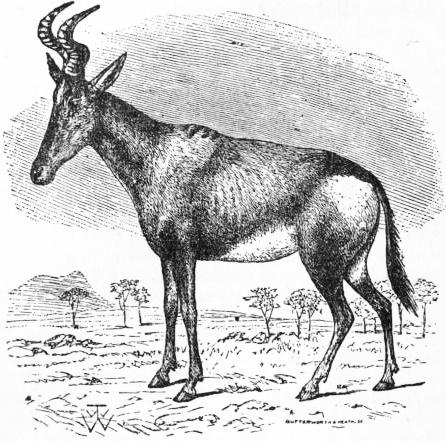
Cape Hartebeest (Bubalis cama).
HARTFORD, a city and the capital of Connecticut, U.S.A., the county-seat of Hartford county, and a port of entry, coterminous with the township of Hartford, in the west central part of the state, on the W. bank of the Connecticut river, and about 35 m. from Long Island Sound. Pop. (1890), 53,230; (1900), 79,850, of whom 23,758 were foreign-born (including 8076 Irish, 2700 Germans, 2260 Russians, 1952 Italians, 1714 Swedes, 1634 English and 1309 English Canadians); (1910 census) 98,915. Of the total population in 1900, 43,872 were of foreign parentage (both parents foreign-born), and of these 18,410 were of Irish parentage. Hartford is served by two divisions of the New York, New Haven & Hartford railway, by the Central New England railway, by the several electric lines of the Connecticut Company which radiate to the surrounding towns, and by the steamboats of the Hartford & New York Transportation Co., all of which are controlled by the N.Y., N.H. & H. The river, which is navigable to this point, is usually closed from the middle of December to the middle of March.
The city covers an area of 17.7 sq. m.; it is well laid out and compactly built, and streets, parks, &c., are under a city-plan commission authorized in 1907. It is intersected by the sluggish Park river, which is spanned by ten bridges. A stone arch bridge, with nine arches, built of granite at a cost of $1,700,000 and dedicated in 1908, spans the Connecticut (replacing the old Connecticut river bridge built in 1818 and burned in 1895), and connects Hartford with the village of East Hartford in the township of East Hartford (pop. 1900, 6406), which has important paper-manufacturing and tobacco-growing interests. The park system of Hartford is the largest in any city of the United States in proportion to the city’s population. In 1908 there were 21 public parks, aggregating more than 1335 acres. In the extreme S. of the city is Goodwin Park (about 200 acres); in the S.E. is Colt Park (106 acres), the gift of Mrs Elizabeth Colt, the widow of Samuel Colt, inventor of the Colt revolver; in the S.W. is Pope Park (about 90 acres); in the W. is Elizabeth (100 acres); in the E., along the Connecticut river front, is Riverside (about 80 acres); and in the extreme N. is Keney Park (680 acres), the gift of Henry Keney, and, next to the Metropolitan Reservations near Boston, the largest park in the New England states. Near the centre of the city are the Capitol Grounds (27 acres; until 1872 the campus of Trinity College) and Bushnell Park (41 acres), adjoining Capitol Park. Bushnell Park, named in honour of Horace Bushnell, contains the Corning Memorial Fountain, erected in 1899 and designed by J. Massey Rhind, and three bronze statues, one, by J. Q. A. Ward, of General Israel Putnam; one, by Truman H. Bartlett, of Dr Horace Wells (1815-1848), the discoverer of anaesthesia; and one, by E. S. Woods, of Colonel Thomas Knowlton (1749-1776), a patriot soldier of the War of Independence, killed at the battle of Harlem Heights. On the Capitol Grounds is the state capitol (Richard M. Upjohn, architect), a magnificent white marble building, which was completed in 1880 at a cost of $2,534,000. Its exterior is adorned with statues and busts of Connecticut statesmen and carvings of scenes in the history of the state. Within the building are regimental flags of the Civil War, a bronze statue by Olin L. Warner of Governor William A. Buckingham, a bronze statue by Karl Gerhardt of Nathan Hale, a bronze tablet (also by Karl Gerhardt) in memory of John Fitch (1743-1798), the inventor; a portrait of Washington, purchased by the state in 1800 from the artist, Gilbert Stuart; and a series of oil portraits of the colonial and state governors. The elaborately carved chair of the lieutenant-governor in the senate chamber, made of wood from the historic Charter Oak, and the original charter of 1662 (or its duplicate of the same date) are preserved in a special vault in the Connecticut state library. A new state library and supreme court building and a new state armoury and arsenal, both of granite, have been (1910) erected upon lands recently added to the Capitol Grounds, thus forming a group of state buildings with the Capitol as the centre. Near the Capitol, at the approach of the memorial bridge across the Park river, is the Soldiers’ and Sailors’ memorial arch, designed by George Keller and erected by the city in 1885 in memory of the Hartford soldiers and sailors who served in the American Civil War.
Near the centre of the city is the old town square (now known as the City Hall Square), laid off in 1637. Here, facing Main Street, stands the city hall, a beautiful example of Colonial architecture, which was designed by Charles Bulfinch, completed in 1796, and until 1879 used as a state capitol; it has subsequently been restored. In Main Street is the present edifice of the First Church of Christ, known as the Centre Congregational Church, which was organized in Cambridge, Massachusetts, in 1632, and removed to Hartford, under the leadership of Thomas Hooker and Samuel Stone, in 1636. In the adjoining cemetery are the graves of Thomas Hooker, Governor William Leete (1603-1683), and Governor John Haynes, and a monument in memory of 100 early residents of Hartford. In the same thoroughfare is the Wadsworth Atheneum (built in 1842; enlarged in 1892-1893 and 1907) and its companion buildings, the Colt memorial (built in 1908 to accommodate the Elizabeth Colt art collection) and the Morgan art gallery (built in 1908 by J. Pierpont Morgan in memory of his father, Junius Morgan, a native of Hartford). In this group of buildings are the Hartford public library (containing 90,000 volumes in 1908), the Watkinson library of reference (70,000 volumes in 1908), the library of the Connecticut historical society (25,000 volumes in 1908) and a public art gallery. Other institutions of importance in Hartford are the American school for the deaf (formerly the American asylum for the deaf and dumb), founded in 1816 by Thomas H. Gallaudet; the retreat for the insane (opened for patients in 1824); the Hartford hospital; St Francis hospital; St Thomas’s seminary (Roman Catholic); La Salette Missionary college (R.C.; 1898); Trinity college (founded by members of the Protestant Episcopal church, and now non-sectarian), which was chartered as Washington College in 1823, opened in 1824, renamed Trinity College in 1845, and in 1907-1908 had 27 instructors and 208 students; the Hartford Theological seminary, a Congregational institution, which was founded at East Windsor Hill in 1834 as the Theological Institute of Connecticut, was removed to Hartford in 1865, and adopted its present name in 1885; and, affiliated with the last mentioned institution, the Hartford School of Religious Pedagogy. The Hartford grammar school, founded in 1638, long managed by the town and in 1847 merged with the classical department of the Hartford public high school, is the oldest educational institution in the state. In Farmington Avenue is St Joseph’s cathedral (Roman Catholic), the city being the seat of the diocese of Hartford.
During the 18th century Hartford enjoyed a large and lucrative commerce, but the railway development of the 19th century centralized commerce in New York and Boston, and consequently the principal source of the city’s wealth has come to be manufacturing and insurance. In 1905 the total value of the “factory” product was $25,975,651. The principal industries are the manufacture of small arms (by the Colt’s Patent Fire-Arms Manufacturing Co., makers of the Colt revolver and the Gatling gun), typewriters (Royal and Underwood), automobiles, bicycles, cyclometers, carriages and wagons, belting, cigars, harness, machinists’ tools and instruments of precision, coil-piping, church organs, horse-shoe nails, electric equipment, machine screws, drop forgings, hydrants and valves, and engines and boilers. In 1788 the first woollen mill in New England was opened in Hartford; and here, too, about 1846, the Rogers process of electro-silver plating was invented. The city is one of the most important insurance centres in the United States. As early as 1794 policies were issued by the Hartford Fire Insurance Company (chartered in 1810). In 1909 Hartford was the home city of six fire insurance and six life insurance companies, the principal ones being the Aetna (fire), Aetna Life, Phoenix Mutual Life, Phoenix Fire, Travelers (Life and Accident), Hartford Fire, Hartford Life, National Fire, Connecticut Fire, Connecticut General Life and Connecticut Mutual Life. In 1906 the six fire insurance companies had an aggregate capital of more than $10,000,000; on the 1st January 1906 they reported assets of about $59,000,000 and an aggregate surplus of $30,000,000. In the San Francisco disaster of that year they paid more than $15,000,000 of losses. Since the fire insurance business began in Hartford, the companies of that city now doing business there have paid about $340,000,000 in losses. Several large and successful foreign companies have made Hartford their American headquarters. The life insurance companies have assets to the value of about $225,000,000. The Aetna (fire), Aetna Life, Connecticut Fire, Connecticut Mutual Life, Connecticut General Life, Hartford Fire, Hartford Life, Hartford Steam Boiler Inspection and Insurance Co., National Fire, Orient Fire, Phoenix Mutual Life and Travelers companies have their own homes, some of these being among the finest buildings in Hartford. The city has also large banking interests.
The first settlement on the site of Hartford was made by the Dutch from New Amsterdam, who in 1633 established on the bank of the Connecticut river, at the mouth of the Park river, a fort which they held until 1654. The township of Hartford was one of the first three original townships of Connecticut. The first English settlement was made in 1635 by sixty immigrants, mostly from New Town (now Cambridge), Massachusetts; but the main immigration was in 1636, when practically all the New Town congregation led by Thomas Hooker and Samuel Stone joined those who had preceded them. Their settlement was called Newtown until 1637, when the present name was adopted from Hertford, England, the birthplace of Stone. In 1636 Hartford was the meeting-place of the first general court of the Connecticut colony; the Fundamental Orders, the first written constitution, were adopted at Hartford in 1639; and after the union of the colonies of New Haven and Connecticut, accomplished by the charter of 1662, Hartford became the sole capital: but from 1701 until 1873 that honour was shared with New Haven. At Hartford occurred in 1687 the meeting of Edmund Andros and the Connecticut officials (see Connecticut). Hartford was first chartered in 1784, was rechartered in 1856 (the charter of that date has been subsequently revised), and in 1881 was made coterminous with the township of Hartford. The city was the literary centre of Federalist ideas in the latter part of the 18th century, being the home of Lemuel Hopkins, John Trumbull, Joel Barlow and David Humphreys, the leading members of a group of authors known as the “Hartford Wits”; and in 1814-1815 the city was the meeting-place of the famous Hartford Convention, an event of great importance in the history of the Federalist party. The War of 1812, with the Embargo Acts (1807-1813), which were so destructive of New England’s commerce, thoroughly aroused the Federalist leaders in this part of the country against the National government as administered by the Democrats, and in 1814, when the British were not only threatening a general invasion of their territory but had actually occupied a part of the Maine coast, and the National government promised no protection, the legislature of Massachusetts invited the other New England states to join with her in sending delegates to a convention which should meet at Hartford to consider their grievances, means of preserving their resources, measures of protection against the British, and the advisability of taking measures to bring about a convention of delegates from all the United States for the purpose of revising the Federal constitution. The legislatures of Connecticut and Rhode Island, and town meetings in Cheshire and Grafton counties (New Hampshire) and in Windham county (Vermont) accepted the invitation, and the convention, composed of 12 delegates from Massachusetts, 7 from Connecticut, 4 from Rhode Island, 2 from New Hampshire and 1 from Vermont, all Federalists, met on the 15th of December 1814, chose George Cabot of Massachusetts president and Theodore Dwight of Connecticut secretary, and remained in secret session until the 5th of January 1815, when it adjourned sine die. At the conclusion of its work it recommended greater military control for each of the several states and that the Federal constitution be so amended that representatives and direct taxes should be apportioned among the several states “according to their respective numbers of free persons,” that no new state should be admitted to the Union without the concurrence of two-thirds of both Houses of Congress, that Congress should not have the power to lay an embargo for more than sixty days, that the concurrence of two-thirds of the members of both Houses of Congress should be necessary to pass an act “to interdict the commercial intercourse between the United States and any foreign nation or the dependencies thereof” or to declare war against any foreign nation except in case of actual invasion, that “no person who shall hereafter be naturalized shall be eligible as a member of the Senate or House of Representatives of the United States, nor capable of holding any civil office under the authority of the United States,” and that “the same person shall not be elected president of the United States a second time; nor shall the president be elected from the same state two terms in succession.” After making these recommendations concerning amendments the Convention resolved: “That if the application of these states to the government of the United States, recommended in a foregoing resolution, should be unsuccessful, and peace should not be concluded, and the defence of these states should be neglected, as it has been since the commencement of the war, it will, in the opinion of this convention, be expedient for the legislatures of the several states to appoint delegates to another convention, to meet at Boston in the state of Massachusetts on the third Thursday of June next, with such powers and instructions as the exigency of a crisis so momentous may require.” The legislatures of Massachusetts and Connecticut approved of these proposed amendments and sent commissioners to Washington to urge their adoption, but before their arrival the war had closed, and not only did the amendments fail to receive the approval of any other state, but the legislatures of nine states expressed their disapproval of the Hartford Convention itself, some charging it with sowing “seeds of dissension and disunion.” The cessation of the war brought increased popularity to the Democratic administration, and the Hartford Convention was vigorously attacked throughout the country.
Hartford was the birthplace of Noah Webster, who here published his Grammatical Institute of the English Language (1783-1785), and of Henry Barnard, John Fiske and Frederick Law Olmsted, and has been the home of Samuel P. Goodrich (Peter Parley), George D. Prentice, Harriet Beecher Stowe, Charles Dudley Warner, Samuel L. Clemens (Mark Twain) and Horace Bushnell. More than 100 periodicals have been established in Hartford, of which the oldest is the Hartford Courant (1764), the oldest newspaper in the United States. This paper was very influential in shaping public opinion in the years preceding the War of Independence; after the war it was successively Federalist, Whig and Republican. The Times (semi-weekly 1817; daily 1841) was one of the most powerful Democratic organs in the period before the middle of the 19th century, and had Gideon Wells for editor 1826-1836. The Congregationalist (afterwards published in Boston) and the Churchman (afterwards published in New York) were also founded at Hartford.
See Scaeva, Hartford in the Olden Times: Its First Thirty Years (Hartford, 1853), edited by W. M. B. Hartley; and J. H. Trumbull, Memorial History of Hartford County (Boston, 1886). For the Hartford Convention see History of the Hartford Convention (Boston, 1833), published by its secretary, Theodore Dwight; H. C. Lodge, Life and Letters of George Cabot (Boston, 1877); and Henry Adams, Documents Relating to New England Federalism (Boston, 1877).
HARTFORD CITY, a city and the county-seat of Blackford county, Indiana, U.S.A., 62 m. N.E. of Indianapolis. Pop. (1890) 2287; (1900) 5912 (572 foreign-born); (1910) 6187. The city is served by the Fort Wayne, Cincinnati & Louisville, and the Pittsburg, Cincinnati, Chicago & St Louis railways, and the Indiana Union Traction line (electric). There are oil and natural gas wells in the vicinity, and the city has pulp and paper mills, glass and tile works, and manufactories of woodenware, and nitro-glycerine and powder. The municipality owns and operates its water-works system. The first settlement in the vicinity was made in 1832. Hartford City became the county-seat of Blackford county when that county was erected in 1837; it was laid out in 1839 and was first incorporated as a town in 1867.
HARTIG, GEORG LUDWIG (1764-1837), German agriculturist and writer on forestry, was born at Gladenbach, near Marburg, on the 2nd of September 1764. After obtaining a practical knowledge of forestry at Harzburg, he studied from 1781 to 1783 at the university of Giessen. In 1786 he became manager of forests to the prince of Solms-Braunfels at Hungen in the Wetterau, where he founded a school for the teaching of forestry. After obtaining in 1797 the appointment of inspector of forests to the prince of Orange-Nassau, he continued his school of forestry at Dillenburg, where the attendance thereat increased considerably. On the dissolution of the principality by Napoleon I. in 1805 he lost his position, but in 1806 he went as chief inspector of forests to Stuttgart, whence in 1811 he was called to Berlin in a like capacity. There he continued his school of forestry, and succeeded in connecting it with the university of Berlin, where in 1830 he was appointed an honorary professor. He died at Berlin on the 2nd of February 1837. His son Theodor (1805-1880), and grandson Robert (1839-1901), were also distinguished for their contributions to the study of forestry.
G. L. Hartig was the author of a number of valuable works: Lehrbuch für Jäger (Stuttgart, 1810); Lehrbuch für Förster (3 vols., Stuttgart, 1808); Kubiktabellen für geschnittene, beschlagene, und runde Hölzer (1815, 10th ed. Berlin, 1871); and Lexikon für Jäger und Jagdfreunde (1836, 2nd ed. Berlin, 1859-1861). Theodor Hartig and his son Robert also published numerous works dealing with forestry, one of the latter’s books being translated into English by W. Somerville and H. Marshall Ward as Diseases of Trees (1894).
HARTLEPOOL, a parliamentary borough of Durham, England, embracing the municipal borough of Hartlepool or East Hartlepool and the municipal and county borough of West Hartlepool. Pop. (1901) of Hartlepool, 22,723; of West Hartlepool, 62,627. The towns are on the coast of the North Sea separated by Hartlepool Bay, with a harbour, and both have stations on branches of the North Eastern railway, 247 m. N. by W. from London. The surrounding country is bleak, and the coast is low. Caves occur in the slight cliffs, and protection against the attacks of the waves has been found necessary. The ancient market town of Hartlepool lies on a peninsula which forms the termination of a south-eastward sweep of the coast and embraces the bay. Its naturally strong position was formerly fortified, and part of the walls, serving as a promenade, remain. The parish church of St Hilda, standing on an eminence above the sea, is late Norman and Early English, with a massive tower, heavily buttressed. There is a handsome borough hall in Italian style. West Hartlepool, a wholly modern town, has several handsome modern churches, municipal buildings, exchange, market hall, Athenaeum and public library. The municipal area embraces the three townships of Seaton Carew, a seaside resort with good bathing, and golf links; Stranton, with its church of All Saints, of the 14th century, on a very early site; and Throston.
The two Hartlepools are officially considered as one port. The harbour, which embraces two tidal basins and six docks aggregating 83½ acres, in addition to timber docks of 57 acres, covers altogether 350 acres. There are five graving docks, admitting vessels of 550 ft. length and 10 to 21 ft. draught. The depth of water on the dock sills varies from 17½ ft. at neap tides to 25 ft. at spring tides. A breakwater three-quarters of a mile long protects the entrance to the harbour. An important trade is carried on in the export of coal, ships, machinery, iron and other metallic ores, woollens and cottons, and in the import of timber, sugar, iron and copper ores, and eggs. Timber makes up 59% of the imports, and coal and ships each about 30% of the exports. The principal industries are shipbuilding (iron), boiler and engineering works, iron and brass foundries, steam saw and planing mills, flour-mills, paper and paint factories, and soapworks.
The parliamentary borough (falling within the south-east county division) returns one member. The municipal borough of Hartlepool is under a mayor, 6 aldermen and 18 councillors, and has an area of 972 acres. The municipal borough of West Hartlepool is under a mayor, 8 aldermen and 24 councillors, and has an area of 2684 acres.
Built on the horns of a sheltered bay, Hartlepool (Hertepull, Hertipol), grew up round the monastery founded there in 640, but was destroyed by the Danes in 800 and rebuilt by Ecgred, bishop of Lindisfarne. In 1173 Bishop Hugh de Puiset allowed French and Flemish troops to land at Hartlepool to aid the Scots. It is not mentioned in Boldon Book as, being part of the royal manor of Sadberg held at this time by the family of Bruce, it did not become the property of the see of Durham until the purchase of that manor in 1189. The bishops did not obtain possession until the reign of John, who during the interval in 1201 gave Hartlepool a charter granting the burgesses the same privileges that the burgesses of Newcastle enjoyed; in 1230 Bishop Richard Poor granted further liberties, including a gild merchant. Edward II. seized the borough as a possession of Robert Bruce, but he could control it very slightly owing to the bishop’s powers. In 1328 Edward III. granted the borough 100 marks towards the town-wall and Richard II. granted murage for seven years, the term being extended in 1400. In 1383 Bishop Fordham gave the burgesses licence to receive tolls within the borough for the maintenance of the walls, while Bishop Neville granted a commission for the construction of a pier or mole. In the 16th century Hartlepool was less prosperous; in 1523 the haven was said to be ruined, the fortifications decayed. An act of 1535 declared Hartlepool to be in Yorkshire, but in 1554 it was reinstated in the county of Durham. It fell into the hands of the northern earls in 1563, and a garrison was maintained there after the rebellion was crushed. In 1593 Elizabeth incorporated it, and gave the burgesses a town hall and court of pie powder. During the civil wars Hartlepool, which a few years before was said to be the only port town in the country, was taken by the Scots, who maintained a garrison there until 1647. As a borough of the Palatinate Hartlepool was not represented in parliament until the 19th century, though strong arguments in its favour were advanced in the Commons in 1614. The markets of Hartlepool were important throughout the middle ages. In 1216 John confirmed to Robert Bruce the market on Wednesday granted to his father and the fair on the feast of St Lawrence; this fair was extended to fifteen days by the grant of 1230, while the charter of 1595 also granted a fair and market. During the 14th century trade was carried on with Germany, Spain and Holland, and in 1346 Hartlepool provided five ships for the French war, being considered one of the chief seaports in the kingdom. The markets were still considerable in Camden’s day, but declined during the 18th century, when Hartlepool became fashionable as a watering-place.
HARTLEY, SIR CHARLES AUGUSTUS (1825- ), English engineer, was born in 1825 at Heworth, Durham. Like most engineers of his generation he was engaged in railway work in the early part of his career, but subsequently he devoted himself to hydraulic engineering and the improvement of estuaries and harbours for the purposes of navigation. He was employed in connexion with some of the largest and most important waterways of the world. After serving in the Crimea as a captain of engineers in the Anglo-Turkish contingent, he was in 1856 appointed engineer-in-chief for the works carried out by the European Commission of the Danube for improving the navigation at the mouths of that river, and that position he retained till 1872, when he became consulting engineer to the Commission (see Danube). In 1875 he was one of the committee appointed by the authority of the U.S.A. Congress to report on the works necessary to form and maintain a deep channel through the south pass of the Mississippi delta; and in 1884 the British government nominated him a member of the international technical commission for widening the Suez Canal. In addition he was consulted by the British and other governments in connexion with many other river and harbour works, including the improvement of the navigation of the Scheldt, Hugli, Don and Dnieper, and of the ports of Odessa, Trieste, Kustendjie, Burgas, Varna and Durban. He was knighted in 1862, and became K.C.M.G. in 1884.
HARTLEY, DAVID (1705-1757), English philosopher, and founder of the Associationist school of psychologists, was born on the 30th of August 1705. He was educated at Bradford grammar school and Jesus College, Cambridge, of which society he became a fellow in 1727. Originally intended for the Church, he was deterred from taking orders by certain scruples as to signing the Thirty-nine Articles, and took up the study of medicine. Nevertheless, he remained in the communion of the English Church, living on intimate terms with the most distinguished churchmen of his day. Indeed he asserted it to be a duty to obey ecclesiastical as well as civil authorities. The doctrine to which he most strongly objected was that of eternal punishment. Hartley practised as a physician at Newark, Bury St Edmunds, London, and lastly at Bath, where he died on the 28th of August 1757. His Observations on Man was published in 1749, three years after Condillac’s Essai sur l’origine des connaissances humaines, in which theories essentially similar to his were expounded. It is in two parts—the first dealing with the frame of the human body and mind, and their mutual connexions and influences, the second with the duty and expectations of mankind. His two main theories are the doctrine of vibrations and the doctrine of associations. His physical theory, he tells us, was drawn from certain speculations as to nervous action which Newton had published in his Principia. His psychological theory was suggested by the Dissertation concerning the Fundamental Principles of Virtue or Morality, which was written by a clergyman named John Gay (1699-1745), and prefixed by Bishop Law to his translation1 of Archbishop King’s Latin work on the Origin of Evil, its chief object being to show that sympathy and conscience are developments by means of association from the selfish feelings.
The outlines of Hartley’s theory are as follows. With Locke he asserted that, prior to sensation, the human mind is a blank. By a growth from simple sensations those states of consciousness which appear most remote from sensation come into being. And the one law of growth of which Hartley took account was the law of contiguity, synchronous and successive. By this law he sought to explain, not only the phenomena of memory, which others had similarly explained before him, but also the phenomena of emotion, of reasoning, and of voluntary and involuntary action (see Association of Ideas).
By his physical theory Hartley gave the first strong impulse to the modern study of the intimate connexion of physiological and psychical facts which has proved so fruitful, though his physical theory in itself is inadequate, and has not been largely adopted. He held that sensation is the result of a vibration of the minute particles of the medullary substance of the nerves, to account for which he postulated, with Newton, a subtle elastic ether, rare in the interstices of solid bodies and in their close neighbourhood, and denser as it recedes from them. Pleasure is the result of moderate vibrations, pain of vibrations so violent as to break the continuity of the nerves. These vibrations leave behind them in the brain a tendency to fainter vibrations or “vibratiuncles” of a similar kind, which correspond to “ideas of sensation.” Thus memory is accounted for. The course of reminiscence and of the thoughts generally, when not immediately dependent upon external sensation, is accounted for on the ground that there are always vibrations in the brain on account of its heat and the pulsation of its arteries. What these vibrations shall be is determined by the nature of each man’s past experience, and by the influence of the circumstances of the moment, which causes now one now another tendency to prevail over the rest. Sensations which are often associated together become each associated with the ideas corresponding to the others; and the ideas corresponding to the associated sensations become associated together, sometimes so intimately that they form what appears to be a new simple idea, not without careful analysis resolvable into its component parts.
Starting, like the modern Associationists, from a detailed account of the phenomena of the senses, Hartley tries to show how, by the above laws, all the emotions, which he analyses with considerable skill, may be explained. Locke’s phrase “association of ideas” is employed throughout, “idea” being taken as including every mental state but sensation. He emphatically asserts the existence of pure disinterested sentiment, while declaring it to be a growth from the self-regarding feelings. Voluntary action is explained as the result of a firm connexion between a motion and a sensation or “idea,” and, on the physical side, between an “ideal” and a motory vibration. Therefore in the Freewill controversy Hartley took his place as a determinist. It is singular that, as he tells us, it was only with reluctance, and when his speculations were nearly complete, that he came to a conclusion on this subject in accordance with his theory.
See life of Hartley by his son in the 1801 edition of the Observations, which also contains notes and additions translated from the German of H. A. Pistorius; Sir Leslie Stephen, History of English Thought in the Eighteenth Century (3rd ed., 1902), and article in the Dictionary of National Biography; G. S. Bower, Hartley and James Mill (1881); B. Schönlank, Hartley und Priestley die Begründer des Assoziationismus in England (1882). See also the histories of philosophy and bibliography in J. M. Baldwin’s Dictionary of Philosophy and Psychology (1905), vol. iii.
1 Anonymously in the 1731 ed., with acknowledgment in the 1758 ed.
HARTLEY, JONATHAN SCOTT (1845- ), American sculptor, was born at Albany, New York, on the 23rd of September 1845. He was a pupil of E. D. Palmer, New York, and of the schools of the Royal Academy, London; he later studied for a year in Berlin and for a year in Paris. His first important work (1882) was a statue of Miles Morgan, the Puritan, for Springfield, Mass. Among his other works are the Daguerre monument in Washington; “Thomas K. Beecher,” Elmira, New York, and “Alfred the Great,” Appellate Court House, New York. He devoted himself particularly to the making of portrait busts, in which he attained high rank. In 1891 he became a member of the National Academy of Design.
HARTLIB, SAMUEL (c. 1599-c. 1670), English writer on education and agriculturist, was born towards the close of the 16th century at Elbing in Prussia, his father being a refugee merchant from Poland. His mother was the daughter of a rich English merchant at Danzig. About 1628 Hartlib went to England, where he carried on a mercantile agency, and at the same time found leisure to enter with interest into the public questions of the day. An enthusiastic admirer of Comenius, he published in 1637 his Conatuum Comenianorum praeludia, and in 1639 Comenii pansophiae prodromus et didactica dissertatio. In 1641 appeared his Relation of that which hath been lately attempted to procure Ecclesiastical Peace among Protestants, and A Description of Macaria, containing his ideas of what a model state should be. During the civil war Hartlib occupied himself with the peaceful study of agriculture, publishing various works by himself, and printing at his own expense several treatises by others on the subject. In 1652 he issued a second edition of the Discourse of Flanders Husbandry by Sir Richard Weston (1645); and in 1651 Samuel Hartlib, his Legacy, or an Enlargement of the Discourse of Husbandry used in Brabant and Flanders, by Robert Child. For his various labours Hartlib received from Cromwell a pension of £100, afterwards increased to £300, as he had spent all his fortune on his experiments. He planned a school for the sons of gentlemen, to be conducted on new principles, and this probably was the occasion of his friend Milton’s Tractate on Education, addressed to him in 1644, and of Sir William Petty’s Two Letters on the same subject, in 1647 and 1648. At the Restoration Hartlib lost his pension, which had already fallen into arrears; he petitioned parliament for a new grant of it, but what success he met with is unknown, as his latter years and death are wrapped in obscurity. A letter from him is known to have been written in February 1661-1662, and apparently he is referred to by Andrew Marvell as alive in 1670 and fleeing to Holland from his creditors.
A Biographical Memoir of Samuel Hartlib, by H. Dircks, appeared in 1865.
HARTMANN, KARL ROBERT EDUARD VON (1842-1906), German philosopher, was born in Berlin on the 23rd of February 1842. He was educated for the army, and entered the artillery of the Guards as an officer in 1860, but a malady of the knee, which crippled him, forced him to quit the service in 1865. After some hesitation between music and philosophy, he decided to make the latter the serious work of his life, and in 1867 the university of Rostock conferred on him the degree of doctor of philosophy. He subsequently returned to Berlin, and died at Grosslichterfelde on the 5th of June 1906. His reputation as a philosopher was established by his first book, The Philosophy of the Unconscious (1869; 10th ed. 1890). This success was largely due to the originality of its title, the diversity of its contents (von Hartmann professing to obtain his speculative results by the methods of inductive science, and making plentiful use of concrete illustrations), the fashionableness of its pessimism and the vigour and lucidity of its style. The conception of the Unconscious, by which von Hartmann describes his ultimate metaphysical principle, is not at bottom as paradoxical as it sounds, being merely a new and mysterious designation for the Absolute of German metaphysicians. The Unconscious appears as a combination of the metaphysic of Hegel with that of Schopenhauer. The Unconscious is both Will and Reason and the absolute all-embracing ground of all existence. Von Hartmann thus combines “pantheism” with “panlogism” in a manner adumbrated by Schelling in his “positive philosophy.” Nevertheless Will and not Reason is the primary aspect of the Unconscious, whose melancholy career is determined by the primacy of the Will and the subservience of the Reason. Precosmically the Will is potential and the Reason latent, and the Will is void of reason when it passes from potentiality to actual willing. This latter is absolute misery, and to cure it the Unconscious evokes its Reason and with its aid creates the best of all possible worlds, which contains the promise of its redemption from actual existence by the emancipation of the Reason from its subjugation to the Will in the conscious reason of the enlightened pessimist. When the greater part of the Will in existence is so far enlightened by reason as to perceive the inevitable misery of existence, a collective effort to will non-existence will be made, and the world will relapse into nothingness, the Unconscious into quiescence. Although von Hartmann is a pessimist, his pessimism is by no means unmitigated. The individual’s happiness is indeed unattainable either here and now or hereafter and in the future, but he does not despair of ultimately releasing the Unconscious from its sufferings. He differs from Schopenhauer in making salvation by the “negation of the Will-to-live” depend on a collective social effort and not on individualistic asceticism. The conception of a redemption of the Unconscious also supplies the ultimate basis of von Hartmann’s ethics. We must provisionally affirm life and devote ourselves to social evolution, instead of striving after a happiness which is impossible; in so doing we shall find that morality renders life less unhappy than it would otherwise be. Suicide, and all other forms of selfishness, are highly reprehensible. Epistemologically von Hartmann is a transcendental realist, who ably defends his views and acutely criticizes those of his opponents. His realism enables him to maintain the reality of Time, and so of the process of the world’s redemption.
Von Hartmann’s numerous works extend to more than 12,000 pages. They may be classified into—A. Systematical, including Grundprobleme der Erkenntnistheorie; Kategorienlehre; Das sittliche Bewusstsein; Die Philosophie des Schönen; Die Religion des Geistes; Die Philosophie des Unbewussten (3 vols., which now include his, originally anonymous, self-criticism, Das Unbewusste vom Standpunkte der Physiologie und Descendenztheorie, and its refutation, Eng. trs. by W. C. Coupland, 1884); System der Philosophie im Grundriss, i.; Grundriss der Erkenntnislehre. B. Historical and critical—Das religiöse Bewusstsein der Menschheit; Geschichte der Metaphysik (2 vols.); Kant’s Erkenntnistheorie; Kritische Grundlegung des transcendentalen Realismus; Über die dialektische Methode; studies of Schelling, Lotze, von Kirchmann; Zur Geschichte des Pessimismus; Neukantianismus, Schopenhauerismus, Hegelianismus; Geschichte der deutschen Ästhetik seit Kant; Die Krisis des Christentums in der modernen Theologie; Philosophische Fragen der Gegenwart; Ethische Studien; Moderne Psychologie; Das Christentum des neuen Testaments; Die Weltanschauung der modernen Physik, C. Popular—Soziale Kernfragen; Moderne Probleme; Tagesfragen; Zwei Jahrzehnte deutscher Politik; Das Judentum in Gegenwart und Zukunft; Die Selbstzersetzung des Christentums; Gesammelte Studien; Der Spiritismus and Die Geisterhypothese des Spiritismus; Zur Zeitgeschichte. His select works have been published in 10 volumes (2nd ed., 1885-1896). On his philosophy see R. Köber, Das philosophische System Eduard von Hartmanns (1884); O. Plümacher, Der Kampf ums Unbewusste (2nd ed., 1890), with a chronological table of the Hartmann literature from 1868 to 1890; A. Drews, E. von Hartmanns Philosophie und der Materialismus in der modernen Kultur (1890) and E. von Hartmanns philosophisches System im Grundriss (1902), with biographical introduction; and for further authorities, J. M. Baldwin, Dictionary of Philosophy and Psychology (1901-1905).
HARTMANN, MORITZ (1821-1872), German poet and author, was born of Jewish parentage at Duschnik in Bohemia on the 15th of October 1821. Having studied philosophy at Prague and Vienna, he travelled in south Germany, Switzerland and Italy, and became tutor in a family at Vienna. In 1845 he proceeded to Leipzig and there published a volume of patriotic poems, Kelch und Schwert (1845). Fearing in consequence prosecution at the hands of the authorities, he abided events in France and Belgium, and after issuing in Leipzig Neuere Gedichte (1846) returned home, suffered a short term of imprisonment, and in 1848 was elected member for Leitmeritz in the short-lived German parliament at Frankfort-on-Main, in which he sided with the extreme Radical party. He took part with Robert Blum (1807-1848) in the revolution of that year in Vienna, but contrived to escape to London and Paris. In 1849 he published Reimchronik des Pfaffen Mauritius, a satirical political poem in the style of Heine. During the Crimean War (1854-56) Hartmann was correspondent of the Kölnische Zeitung, settled in 1860 in Geneva as a teacher of German literature and history, became in 1865 editor of the Freya in Stuttgart and in 1868 a member of the staff of the Neue Freie Presse in Vienna. He died at Oberdöbling near Vienna on the 13th of May 1872.
Among Hartmann’s numerous works may be especially mentioned Der Krieg um den Wald (1850), a novel, the scene of which is laid in Bohemia; Tagebuch aus Languedoc und Provence (1852); Erzählungen eines Unsteten (1858); and Die letzten Tage eines Königs (1867). His idyll, Adam und Eva (1851), and his collection of poetical tales, Schatten (1851), show that the author possessed but little talent for epic narrative. Hartmann’s poems are often lacking in genuine poetical feeling, but the love of liberty which inspired them, and the fervour, ease and clearness of their style compensated for these shortcomings and gained for him a wide circle of admirers.
His Gesammelte Werke were published in 10 vols, in 1873-1874, and a selection of his Gedichte in the latter year. The first two volumes of a new edition of his works contain a biography of Hartmann by O. Wittner. See also E. Ziel, “Moritz Hartmann” (in Unsere Zeit, 1872); A. Marchand, Les Poètes lyriques de l’Autriche (1892); Brandes, Das junge Deutschland (Charlottenburg, 1899).
HARTMANN VON AUE (c. 1170-c. 1210), one of the chief Middle High German poets. He belonged to the lower nobility of Swabia, where he was born about 1170. After receiving a monastic education, he became retainer (dienstman) of a nobleman whose domain, Aue, has been identified with Obernau on the Neckar. He also took part in the Crusade of 1196-97. The date of his death is as uncertain as that of his birth; he is mentioned by Gottfried von Strassburg (c. 1210) as still alive, and in the Krone of Heinrich von dem Türlin, written about 1220, he is mourned for as dead. Hartmann was the author of four narrative poems which are of importance for the evolution of the Middle High German court epic. The oldest of these, Erec, which may have been written as early as 1191 or 1192, and the latest and ripest, Iwein, belong to the Arthurian cycle and are based on epics by Chrétien de Troyes (q.v.); between them lie the romance, Gregorius, also an adaptation of a French epic, and Der arme Heinrich, one of the most charming specimens of medieval German poetry. The theme of the latter—the cure of the leper, Heinrich, by a young girl who is willing to sacrifice her life for him—Hartmann had evidently found in the annals of the family in whose service he stood. Hartmann’s most conspicuous merit as a poet lies in his style; his language is carefully chosen, his narrative lucid, flowing and characterized by a sense of balance and proportion which is rarely to be found in German medieval poetry. Gregorius, Der arme Heinrich and his lyrics, which are all fervidly religious in tone, imply a tendency towards asceticism, but, on the whole, Hartmann’s striving seems rather to have been to reconcile the extremes of life; to establish a middle way of human conduct between the worldly pursuits of knighthood and the ascetic ideals of medieval religion.
Erec has been edited by M. Haupt (2nd ed., Leipzig, 1871); Gregorius, by H. Paul (2nd ed., Halle, 1900); Der arme Heinrich, by W. Wackernagel and W. Toischer (Basel, 1885) and by H. Paul (2nd ed., Halle, 1893); by J. G. Robertson (London, 1895), with English notes; Iwein, by G. F. Benecke and K. Lachmann (4th ed., Berlin, 1877) and E. Henrici (Halle, 1891-1893). A convenient edition of all Hartmann’s poems by F. Bech, 3 vols. (3rd ed., Leipzig, 1891-1893, vol. 3 in 4th ed., 1902).
The literature on Hartmann is extensive. See especially L. Schmid, Des Minnesingers Hartmann von Aue Stand, Heimat und Geschlecht (Tübingen, 1874); H. Rötteken, Die epische Kunst Heinrichs von Veldeke und Hartmanns von Aue (Halle, 1887); F. Saran, Hartmann von Aue als Lyriker (Halle, 1889); A. E. Schönbach, Über Hartmann von Aue (Graz, 1894); F. Piquet, Étude sur Hartmann d’Aue (Paris, 1898). Translations have been made into modern German of all Hartmann’s poems, while Der arme Heinrich has repeatedly attracted the attention of modern poets, both English (Longfellow, Rossetti) and German (notably, Gerhart Hauptmann). See H. Tardel, Der arme Heinrich in der neueren Dichtung (Berlin, 1905).
HARTSHORN, SPIRITS OF, a name signifying originally the ammoniacal liquor obtained by the distillation of horn shavings, afterwards applied to the partially purified similar products of the action of heat on nitrogenous animal matter generally, and now popularly used to designate the aqueous solution of ammonia (q.v.).
HARTZENBUSCH, JUAN EUGENIO (1806-1880), Spanish dramatist, was born at Madrid on the 6th of September 1806. The son of a German carpenter, he was educated for the priesthood, but he had no religious vocation and, on leaving school, followed his father’s trade till 1830, when he learned shorthand and joined the staff of the Gaceta. His earliest dramatic essays were translations from Molière, Voltaire and the elder Dumas; he next recast old Spanish plays, and in 1837 produced his first original play, Los Amantes de Teruel, the subject of which had been used by Rey de Artieda, Tirso de Molina and Perez de Montalbán. Los Amantes de Teruel at once made the author’s reputation, which was scarcely maintained by Doña Mencia (1839) and Alfonso el Casto (1841); it was not till 1845 that he approached his former success with La Jura en Santa Gadea. Hartzenbusch was chief of the National Library from 1862 to 1875, and was an indefatigable—though not very judicious—editor of many national classics. Inferior in inspiration to other contemporary Spanish dramatists, Hartzenbusch excels his rivals in versatility and in conscientious workmanship.
HĀRŪN AL-RASHĪD (763 or 766-809), i.e. “Hārūn the Orthodox,” the fifth of the ‘Abbasid caliphs of Bagdad, and the second son of the third caliph Mahdi. His full name was Hārūn ibn Muhammad ibn ‘Abdallah ibn Muḥammad ibn ‘Ali ibn ‘Abdallah ibn ‘Abbās. He was born at Rai (Rhagae) on the 20th of March A.D. 763, according to some accounts, and according to others on the 15th of February A.D. 766. Hārūn al-Rashīd was twenty-two years old when he ascended the throne. His father Mahdi just before his death conceived the idea of superseding his elder son Mūsa (afterwards known as Hādī, the fourth caliph) by Hārūn. But on Mahdi’s death Hārūn gave way to his brother. For the campaigns in which he took part prior to his accession see Caliphate, section C, The Abbasids, §§ 3 and 4.
Rashīd owed his succession to the throne to the prudence and sagacity of Yahyā b. Khālid the Barmecide, his secretary, whom on his accession he appointed his lieutenant and grand vizier (see Barmecides). Under his guidance the empire flourished on the whole, in spite of several revolts in the provinces by members of the old Alid family. Successful wars were waged with the rulers of Byzantium and the Khazars. In 803, however, Hārūn became suspicious of the Barmecides, whom with only a single exception he caused to be executed. Henceforward the chief power was exercised by Fadl b. Rabi’, who had been chamberlain not only under Hārūn himself but under his predecessors, Mansūr, Madhi and Hādī. In the later years of Hārūn’s reign troubles arose in the eastern parts of the empire. These troubles assumed proportions so serious that Hārūn himself decided to go to Khorasan. He died, however, at Tus in March 809.
The reign of Hārūn (see Caliphate, section C, § 5) was one of the most brilliant in the annals of the caliphate, in spite of losses in north-west Africa and Transoxiana. His fame spread to the West, and Charlemagne and he exchanged gifts and compliments as masters respectively of the West and the East. No caliph ever gathered round him so great a number of learned men, poets, jurists, grammarians, cadis and scribes, to say nothing of the wits and musicians who enjoyed his patronage. Hārūn himself was a scholar and poet, and was well versed in history, tradition and poetry. He possessed taste and discernment, and his dignified demeanour is extolled by the historians. In religion he was extremely strict; he prostrated himself a hundred times daily, and nine or ten times made the pilgrimage to Mecca. At the same time he cannot be regarded as a great administrator. He seems to have left everything to his viziers Yahyā and Fadl, to the former of whom especially was due the prosperous condition of the empire. Hārūn is best known to Western readers as the hero of many of the stories in the Arabian Nights; and in Arabic literature he is the central figure of numberless anecdotes and humorous stories. Of his incognito walks through Bagdad, however, the authentic histories say nothing. His Arabic biographers are unanimous in describing him as noble and generous, but there is little doubt that he was in fact a man of little force of character, suspicious, untrustworthy and on occasions cruel.
See the Arabic histories of Ibn al-Athir and Ibn Khaldūn. Among modern works see Sir W. Muir, The Caliphate (London, 1891); R. D. Osborn, Islam under the Khalifs of Bagdad (London, 1878); Gustav Weil, Geschichte der Chalifen (Mannheim and Stuttgart, 1846-1862); G. le Strange, Baghdad during the Abbasid Caliphate (Oxford, 1900); A. Müller, Der Islam, vol. i. (Berlin, 1885); E. H. Palmer, The Caliph Haroun Alraschid (London, 1880); J. B. Bury’s edition of Gibbon’s Decline and Fall (London, 1898), vol. vi. pp. 34 foll.
HARUSPICES, or Aruspices (perhaps “entrail observers,” cf. Skt. hira, Gr. χορδή), a class of soothsayers in Rome. Their art (disciplina) consisted especially in deducing the will of the gods from the appearance presented by the entrails of the slain victim. They also interpreted all portents or unusual phenomena of nature, especially thunder and lightning, and prescribed the expiatory ceremonies after such events. To please the god, the victim must be without spot or blemish, and the practice of observing whether the entrails presented any abnormal appearance, and thence deducing the will of heaven, was also very important in Greek religion. This art, however, appears not to have been, as some other modes of ascertaining the will of the gods undoubtedly were, of genuine Aryan growth. It is foreign to the Homeric poems, and must have been introduced into Greece after their composition. In like manner, as the Romans themselves believed, the art was not indigenous in Rome, but derived from Etruria.1 The Etruscans were said to have learned it from a being named Tages, grandson of Jupiter, who had suddenly sprung from the ground near Tarquinii. Instructions were contained in certain books called libri haruspicini, fulgurales, rituales. The art was practised in Rome chiefly by Etruscans, occasionally by native-born Romans who had studied in the priestly schools of Etruria. From the regal period to the end of the republic, haruspices were summoned from Etruria to deal with prodigies not mentioned in the pontifical and Sibylline books, and the Roman priests carried out their instructions as to the offering necessary to appease the anger of the deity concerned. Though the art was of great importance under the early republic, it never became a part of the state religion. In this respect the haruspices ranked lower than the augurs, as is shown by the fact that they received a salary; the augurs were a more ancient and purely Roman institution, and were a most important element in the political organization of the city. In later times the art fell into disrepute, and the saying of Cato the Censor is well known, that he wondered how one haruspex could look another in the face without laughing (Cic. De div. ii. 24). Under the empire, however, we hear of a regular collegium of sixty haruspices; and Claudius is said to have tried to restore the art and put it under the control of the pontifices. This collegium continued to exist till the time of Alaric.
See A. Bouché-Leclercq, Histoire de la divination dans l’antiquité (1879-1881); Marquardt, Römische Staatsverwaltung, iii. (1885), pp. 410-415; G. Schmeisser, Die etruskische Disciplin vom Bundesgenossenkriege bis zum Untergang des Heidentums (1881), and Quaestionum de Etrusca disciplina particula (1872); P. Clairin, De haruspicibus apud Romanos (1880). Also Omen.
1 The statement of Dionysius of Halicarnassus (ii. 22) that the haruspices were instituted by Romulus is due to his confusing them with the augurs.
HARVARD UNIVERSITY, the oldest of American educational institutions, established at Cambridge, Massachusetts. In 1636 the General Court of the colony voted £400 towards “a schoale or colledge,” which in the next year was ordered to be at “New Towne.” In memory of the English university where many (probably some seventy) of the leading men of the colony had been educated, the township was named Cambridge in 1638. In the same year John Harvard (1607-1638), a Puritan minister lately come to America, a bachelor and master of Emmanuel college, Cambridge, dying in Charlestown (Mass.), bequeathed to the wilderness seminary half his estate (£780) and some three hundred books; and the college, until then unorganized, was named Harvard College (1639) in his honour. Its history is unbroken from 1640, and its first commencement was held in 1642. The spirit of the founders is beautifully expressed in the words of a contemporary letter which are carved on the college gates: “After God had carried us safe to New-England, and wee had builded our houses, provided necessaries for our liveli-hood, rear’d convenient places for Gods worship, and setled the Civill Government; One of the next things we longed for, and looked after was to advance Learning, and perpetuate it to Posterity; dreading to leave an illiterate Ministry to the Churches, when our present Ministers shall lie in the Dust.” The college charter of 1650 dedicated it to “the advancement of all good literature, arts, and sciences,” and “the education of the English and Indian youth ... in knowledge and godlynes.” The second building (1654) on the college grounds was called “the Indian College.” In it was set up the College press, which since 1638 had been in the president’s house, and here, it is believed, was printed the translation of the Bible (1661-1663) by John Eliot into the language of the natives, with primer, catechisms, grammars, tracts, &c. A fair number of Indians were students, but only one, Caleb Cheeshahteaumuck, took a bachelor’s degree (1665). By generous aid received from abroad for this special object, the college was greatly helped in its infancy.
The charter of 1650 has been in the main, and uninterruptedly since 1707, the fundamental source of authority in the administration of the university. It created a co-optating corporation consisting of the president, treasurer and five fellows, who formally initiate administrative measures, control the college funds, and appoint officers of instruction and government; subject, however, to confirmation by the Board of Overseers (established in 1642), which has a revisory power over all acts of the corporation. Circumstances gradually necessitated ordinary government by the resident teachers; and to-day the various faculties, elaborately organized, exercise immediate government and discipline over all the students, and individually or in the general university council consider questions of policy. The Board of Overseers was at first jointly representative of state and church. The former, as founder and patron, long regarded Harvard as a state institution, controlling or aiding it through the legislature and the overseers; but the controversies and embarrassments incident to legislative action proved prejudicial to the best interests of the college, and its organic connexion with the state was wholly severed in 1866. Financial aid and practical dependence had ceased some time earlier; indeed, from the very beginning, and with steadily increasing preponderance, Harvard has been sustained and fostered by private munificence rather than by public money. The last direct subsidy from the state determined in 1824, although state aid was afterwards given to the Agassiz museum, later united with the university. The church was naturally sponsor for the early college. The changing composition of its Board of Overseers marked its liberation first from clerical and later from political control; since 1865 the board has been chosen by the alumni (non-residents of Massachusetts being eligible since 1880), who therefore really control the university. When the state ceased to repress effectually the rife speculation characteristic of the first half of the seventeenth century, in religion as in politics, and in America as in England, the unity of Puritanism gave way to a variety of intense sectarianisms, and this, as also the incoming of Anglican churchmen, made the old faith of the college insecure. President Henry Dunster (c. 1612-1659), the first president, was censured by the magistrates and removed from office for questioning infant baptism. The conservatives, who clung to pristine and undiluted Calvinism, sought to intrench themselves in Harvard, especially in the Board of Overseers. The history of the college from about 1673 to 1725 was exceedingly troubled. Increase and Cotton Mather, forceful but bigoted, were the bulwarks of reaction and fomenters of discord. One episode in the struggle was the foundation and encouragement of Yale College by the reactionaries of New England as a truer “school of the prophets” (Cotton Mather being particularly zealous in its interests), after they had failed to secure control of the government of Harvard. It represented conservative secession. In 1792 the first layman was chosen to the corporation; in 1805 a Unitarian became professor of theology; in 1843 the board of overseers was opened to clergymen of all denominations; in 1886 attendance on prayers by the students ceased to be compulsory. Thus Harvard, in response to changing ideas and conditions, grew away from the ideas of its founders.
Harvard, her alumni, and her faculty have been very closely connected with American letters, not only in the colonial period, when the Mathers, Samuel Sewall and Thomas Prince were important names, or in the revolutionary and early national epoch with the Adamses, Fisher Ames, Joseph Dennie and Robert Treat Paine, but especially in the second third of the 19th century, when the great New England movements of Unitarianism and Transcendentalism were led by Harvard graduates. In 1805 Henry Ware (1764-1845) was elected the first anti-Trinitarian to be Hollis professor of divinity, and this marked Harvard’s close connexion with Unitarianism, in the later history of which Ware, his son Henry (1794-1843), and Andrews Norton (1786-1852), all Harvard alumni and professors, and Joseph Buckminster (1751-1812) and William Ellery Channing were leaders of the conservative Unitarians, and Joseph Stevens Buckminster (1784-1812), James Freeman Clarke, and Theodore Parker were liberal leaders. Of the “Transcendentalists,” Emerson, Francis Henry Hedge (1805-1890), Clarke, Convers Francis (1795-1863), Parker, Thoreau and Christopher Pearse Cranch (1813-1892) were Harvard graduates. Longfellow’s professorship at Harvard identified him with it rather than with Bowdoin; Oliver Wendell Holmes was professor of anatomy and physiology at Harvard in 1847-1882; and Lowell, a Harvard alumnus, was Longfellow’s successor in 1855-1886 as Smith Professor of the French and Spanish languages and literatures. Ticknor and Charles Eliot Norton are other important names in American literary criticism. The historians Sparks, Bancroft, Hildreth, Palfrey, Prescott, Motley and Parkman were graduates of Harvard, as were Edward Everett, Charles Sumner and Wendell Phillips.
In organization and scope of effort Harvard has grown, especially after 1869, under the direction of President Charles W. Eliot, to be in the highest sense a university; but the “college” proper, whose end is the liberal culture of undergraduates, continues to be in many ways the centre of university life, as it is the embodiment of university traditions. The medical school (in Boston) dates from 1782, the law school from 1817, the divinity school1 (though instruction in theology was of course given from the foundation of the college) from 1819, and the dental school (in Boston) from 1867. The Bussey Institution at Jamaica Plain was established in 1871 as an undergraduate school of agriculture, and reorganized in 1908 for advanced instruction and research in subjects relating to agriculture and horticulture. The Graduate School of Arts and Sciences dates from 1872, the Graduate School of Applied Science (growing out of the Lawrence Scientific School) from 1906, and the Graduate School of Business Administration (which applies to commerce the professional methods used in post-graduate schools of medicine, law, &c.) from 1908. The Lawrence Scientific School, established in 1847, was practically abolished in 1907-1908, when its courses were divided between the College (which thereafter granted a degree of S.B.) and the Graduate School of Applied Science, which was established in 1906 and gives professional degrees in civil, mechanical and electrical engineering, mining, metallurgy, architecture, landscape architecture, forestry, applied physics, applied chemistry, applied zoology and applied geology. A school of veterinary medicine, established in 1882, was discontinued in 1901. The university institutions comprise the botanic garden (1807) and the (Asa) Gray herbarium (1864); the Arnold arboretum (1872), at Jamaica Plain, for the study of arboriculture, forestry and dendrology; the university museum of natural history, founded in 1859 by Louis Agassiz as a museum of comparative zoology, enormously developed by his son, Alexander Agassiz, and transferred to the university in 1876, though under an independent faculty; the Peabody museum of American archaeology and ethnology, founded in 1866 by George Peabody; the William Hayes Fogg art museum (1895); the Semitic museum (1889); the Germanic Museum (1902), containing rich gifts from Kaiser Wilhelm II., the Swiss government, and individuals and societies of Germanic lands; the social museum (1906); and the astronomical observatory (1843; location 42° 22′ 48″ N. lat., 71° 8′ W. long.), which since 1891 has maintained a station near Arequipa, Peru. A permanent summer engineering camp is maintained at Squam Lake, New Hampshire. In Petersham, Massachusetts, is the Harvard Forest, about 2000 acres of hilly wooded country with a stand in 1908 of 10,000,000 ft. B.M. of merchantable timber (mostly white pine); this forest was given to the university in 1907, and is an important part of the equipment of the division of forestry. The university library is the largest college library in the country, and from its slow and competent selection is of exceptional value. In 1908 it numbered, including the various special libraries, 803,800 bound volumes, about 496,600 pamphlets, and 27,450 maps. Some of its collections are of great value from associations or special richness, such as Thomas Carlyle’s collection on Cromwell and Frederick the Great; the collection on folk-lore and medieval romances, supposed to be the largest in existence and including the material used by Bishop Percy in preparing his Reliques; and that on the Ottoman empire. The law library has been described by Professor A. V. Dicey of Oxford as “the most perfect collection of the legal records of the English people to be found in any part of the English-speaking world.” There are department libraries at the Arnold arboretum, the Gray herbarium, the Bussey Institution, the astronomical observatory, the dental school, the medical school, the law school, the divinity school, the Peabody museum, and the museum of comparative zoology. In 1878 the library published the first of a valuable series of Bibliographical Contributions. Other publications of the university (apart from annual reports of various departments) are: the Harvard Oriental Series (started 1891), Harvard Studies in Classical Philology (1890), Harvard Theological Review (1907), the Harvard Law Review (1889), Harvard Historical Studies (1897), Harvard Economic Studies (1906), Harvard Psychological Studies (1903), the Harvard Engineering Journal (1902), the Bulletin (1874) of the Bussey Institution, the Archaeological and Ethnological Papers (1888) of the Peabody museum, and the Bulletin (1863), Contributions and Memoirs (1865) of the museum of comparative zoology. The students’ publications include the Crimson (1873), a daily newspaper; the Advocate (1831), a literary bi-weekly; the Lampoon (1876), a comic bi-weekly; and the Harvard Monthly (1885), a literary monthly. The Harvard Bulletin, a weekly, and the Harvard Graduates’ Magazine (1892), a quarterly, are published chiefly for the alumni.
In 1908-1909 there were 743 officers of instruction and administration (including those for Radcliffe) and 5250 students (1059 in 1869), the latter including 2238 in the college, 1641 in the graduate and professional schools, and 1332 in the summer school. Radcliffe College, for women, had 449 additional students. The whole number of degrees conferred up to 1905 was 31,805 (doctors of science and of philosophy by examination, 408; masters of arts and of science by examination, 1759). The conditions of the time when Harvard was a theological seminary for boys, governed like a higher boarding school, have left traces still discernible in the organization and discipline, though no longer in the aims of the college. The average age of students at entrance, only 14 years so late as 1820, had risen by 1890 to 19 years, making possible the transition to the present régime of almost entire liberty of life and studies without detriment, but with positive improvement, to the morals of the student body. A strong development toward the university ideal marked the opening of the 19th century, especially in the widening of courses, the betterment of instruction, and the suggestions of quickening ideas of university freedom, whose realization, along with others, has come since 1870. The elimination of the last vestiges of sectarianism and churchly discipline, a lessening of parietal oversight, a lopping off of various outgrown colonial customs, a complete reconstruction of professional standards and methods, the development of a great graduate school in arts and sciences based on and organically connected with the undergraduate college, a great improvement in the college standard of scholarship, the allowance of almost absolute freedom to students in the shaping of their college course (the “elective” system), and very remarkable material prosperity marked the administration (1860-1909) of President Eliot. In the readjustment in the curricula of American colleges of the elements of professional training and liberal culture Harvard has been bold in experiment and innovation. With Johns Hopkins University she has led the movement that has transformed university education, and her influence upon secondary education in America has been incomparably greater than that of any other university. Her entrance requirements to the college and to the schools of medicine, law, dentistry and divinity have been higher than those of any other American university. A bachelor’s degree is requisite for entrance to the professional schools (except that of dentistry), and the master’s degree (since 1872) is given to students only for graduate work in residence, and rarely to other persons as an honorary degree. In scholarship and in growth of academic freedom Germany has given the quickening impulse. This influence began with George Ticknor and Edward Everett, who were trained in Germany, and was continued by a number of eminent German scholars, some driven into exile for their liberalism, who became professors in the second half of the 19th century, and above all by the many members of the faculty still later trained in German universities. The ideas of recognizing special students and introducing the elective system were suggested in 1824, attaining establishment even for freshmen by 1885, the movement characterizing particularly the years 1865-1885. The basis of the elective system (as in force in 1910) is freedom in choice of studies within liberal limits; and, as regards admission to college2 (completely established 1891), the idea that the admission is of minds for the quality of their training and not for their knowledge of particular subjects, and that any subject may be acceptable for such training if followed with requisite devotion and under proper methods. Except for one course in English in the Freshman year, and one course in French or German for those who do not on entrance present both of these languages, no study is prescribed, but the student is compelled to select a certain number of courses in some one department or field of learning, and to distribute the remainder among other departments, the object being to secure a systematic education, based on the principle of knowing a little of everything and something well.
The material equipment of Harvard is very rich. In 1909 it included invested funds of $22,716,760 ($2,257,990 in 1869) and lands and buildings valued at $12,000,000 at least. In 1908-1909 an income of more than $130,000 was distributed in scholarships, fellowships, prizes and other aids to students. The yearly income available for immediate use from all sources in 1899-1904 averaged $1,074,229, of which $452,760 yearly represented gifts. The total gifts, for funds and for current use, in the same years aggregated $6,152,988. The income in 1907-1908 was $1,846,976; $241,924 was given for immediate use, and $449,822 was given for capital. The medical school is well endowed and is housed in buildings (1906) on Longwood Avenue, Boston; the gifts for its buildings and endowments made in 1901-1902 aggregate $5,000,000. Among the university buildings are two dining-balls accommodating some 2500 students, a theatre for public ceremonies, a chapel, a home for religious societies, a club-home (the Harvard Union) for graduates and undergraduates, an infirmary, gymnasium, boat houses and large playgrounds, with a concrete stadium capable of seating 27,000 spectators. Massachusetts Hall (1720) is the oldest building. University Hall (1815), the administration building, dignified, of excellent proportions and simple lines, is a good example of the work of Charles Bulfinch. Memorial Hall (1874), an ambitious building of cathedral suggestion, commemorates the Harvard men who fell in the Civil War, and near it is an ideal statue (1884) of John Harvard by Daniel C. French. The medical and dental schools are in Boston, and the Bussey Institution and Arnold Arboretum are at Jamaica Plain.
Radcliffe College, essentially a part of Harvard, dates from the beginning of systematic instruction of women by members of the Harvard faculty in 1879, the Society for the Collegiate Instruction of Women being formally organized in 1882. The present name was adopted in 1894 in honour of Ann Radcliffe, Lady Mowlson (ob. c. 1661), widow of Sir Thomas Mowlson, alderman and (1634) lord mayor of London, who in 1643 founded the first scholarship in Harvard College. From 1894 also dates the present official connexion of Radcliffe with Harvard. The requirements for admission and for degrees are the same as in Harvard (whose president countersigns all diplomas), and the president and fellows of Harvard control absolutely the administration of the college, although it has for immediate administration a separate government. Instruction is given by members of the university teaching force, who repeat in Radcliffe many of the Harvard courses. Many advanced courses in Harvard, and to a certain extent laboratory facilities, are directly accessible to Radcliffe students, and they have unrestricted access to the library.
The presidents of Harvard have been: Henry Dunster (1640-1654); Charles Chauncy (1654-1672); Leonard Hoar (1672-1675); Urian Oakes (1675-1681); John Rogers (1682-1684); Increase Mather (1685-1701); Charles Morton (vice-president) (1697-1698); Samuel Willard (1700-1707); John Leverett (1708-1724); Benjamin Wadsworth (1725-1737); Edward Holyoke (1737-1769); Samuel Locke (1770-1773); Samuel Langdon (1774-1780); Joseph Willard (1781-1804); Samuel Webber (1806-1810); John Thornton Kirkland (1810-1828); Josiah Quincy (1829-1845); Edward Everett (1846-1849); Jared Sparks (1849-1853); James Walker (1853-1860); Cornelius Conway Felton (1860-1862); Thomas Hill (1862-1868); Charles William Eliot (1869-1909); Abbott Lawrence Lowell (appointed 1909).
Authorities.—Benjamin Peirce, A History of Harvard University 1636-1775 (Boston, 1883); Josiah Quincy, A History of Harvard University (2 vols., Boston, 1840); Samuel A. Eliot, Harvard College and its Benefactors (Boston, 1848); H. C. Shelley, John Harvard and his Times (Boston, 1907); The Harvard Book (2 vols., Cambridge, 1874); G. Birkbeck Hill, Harvard College, by an Oxonian (New York, 1894); William R. Thayer, “History and Customs of Harvard University,” in Universities and their Sons, vol. i. (Boston, 1898); Official Guide to Harvard, and the various other publications of the university; also the Harvard Graduates’ Magazine (1892 sqq.).
1 Affiliated with the university, but autonomous and independent, is the Andover Theological Seminary, which in 1908 removed from Andover to Cambridge.
2 The requirements for admission as changed in 1908 are based on the “unit system”; satisfactory marks must be got in subjects aggregating 26 units, the unit being a measure of preparatory study. Of these 26 units, English (4 units), algebra (2), plane geometry (2), some science or sciences (2), history (2; either Greek and Roman, or American and English), a modern language (2; French and German) are prescribed; prospective candidates for the degree of A.B. are required to take examinations for 4 additional units in Greek or Latin, and for the other 8 points have large range of choice; and candidates for the degree of S.B. must take additional examinations in French or German (2 units) and have a similar freedom of choice in making up the remaining 10 units.
HARVEST (A.S. hærfest “autumn,” O.H. Ger. herbist, possibly through an old Teutonic root representing Lat. carpere, “to pluck”), the season of the ingathering of crops. Harvest has been a season of rejoicing from the remotest ages. The ancient Jews celebrated the Feast of Pentecost as their harvest festival, the wheat ripening earlier in Palestine. The Romans had their Cerealia or feasts in honour of Ceres. The Druids celebrated their harvest on the 1st of November. In pre-reformation England Lammas Day (Aug. 1st, O.S.) was observed at the beginning of the harvest festival, every member of the church presenting a loaf made of new wheat. Throughout the world harvest has always been the occasion for many queer customs which all have their origin in the animistic belief in the Corn-Spirit or Corn-Mother. This personification of the crops has left its impress upon the harvest customs of modern Europe. In west Russia, for example, the figure made out of the last sheaf of corn is called the Bastard, and a boy is wrapped up in it. The woman who binds this sheaf represents the “Cornmother,” and an elaborate simulation of childbirth takes place, the boy in the sheaf squalling like a new-born child, and being, on his liberation, wrapped in swaddling bands. Even in England vestiges of sympathetic magic can be detected. In Northumberland, where the harvest rejoicing takes place at the close of the reaping and not at the ingathering, as soon as the last sheaf is set on end the reapers shout that they have “got the kern.” An image formed of a wheatsheaf, and dressed in a white frock and coloured ribbons, is hoisted on a pole. This is the “kern-baby” or harvest-queen, and it is carried back in triumph with music and shouting and set up in a prominent place during the harvest supper. In Scotland the last sheaf if cut before Hallowmas is called the “maiden,” and the youngest girl in the harvest-field is given the privilege of cutting it. If the reaping finishes after Hallowmas the last corn cut is called the Cailleach (old woman). In some parts of Scotland this last sheaf is kept till Christmas morning and then divided among the cattle “to make them thrive all the year round,” or is kept till the first mare foals and is then given to her as her first food. Throughout the world, as J. G. Frazer shows, the semi-worship of the last sheaf is or has been the great feature of the harvest-home. Among harvest customs none is more interesting than harvest cries. The cry of the Egyptian reapers announcing the death of the corn-spirit, the rustic prototype of Osiris, has found its echo on the world’s harvest-fields, and to this day, to take an English example, the Devonshire reapers utter cries of the same sort and go through a ceremony which in its main features is an exact counterpart of pagan worship. “After the wheat is cut they ‘cry the neck.’ ... An old man goes round to the shocks and picks out a bundle of the best ears be can find ... this bundle is called ‘the neck’; the harvest hands then stand round in a ring, the old man holding ‘the neck’ in the centre. At a signal from him they take off their hats, stooping and holding them with both hands towards the ground. Then all together they utter in a prolonged cry ‘the neck!’ three times, raising themselves upright with their hats held above their heads. Then they change their cry to ‘Wee yen! way yen!’ or, as some report, ‘we haven!’” On a fine still autumn evening “crying the neck” has a wonderful effect at a distance. In East Anglia there still survives the custom known as “Hallering Largess.” The harvesters beg largess from passers, and when they have received money they shout thrice “Halloo, largess,” having first formed a circle, bowed their heads low crying “Hoo-Hoo-Hoo,” and then jerked their heads backwards and uttered a shrill shriek of “Ah! Ah!”
For a very full discussion of harvest customs see J. G. Frazer, The Golden Bough, and Brand’s Antiquities of Great Britain (Hazlitt’s edit., 1905).
HARVEST-BUG, the familiar name for mites of the family Trombidiidae, belonging to the order Acari of the class Arachnida. Although at one time regarded as constituting a distinct species, described as Leptus autumnalis, harvest-bugs are now known to be the six-legged larval forms of several British species of mites of the genus Trombidium. They are minute, rusty-brown organisms, barely visible to the naked eye, which swarm in grass and low herbage in the summer and early autumn, and cause considerable, sometimes intense, irritation by piercing and adhering to the skin of the leg, usually lodging themselves in some part where the clothing is tight, such as the knee when covered with gartered stockings. They may be readily destroyed, and the irritation allayed, by rubbing the affected area with some insecticide like turpentine or benzine. They are not permanently parasitic, and if left alone will leave their temporary host to resume the active life characteristic of the adult mite, which is predatory in habits, preying upon minute living animal organisms.
HARVESTER, Harvest-Spider, or Harvest-Man, names given to Arachnids of the order Opiliones, referable to various species of the family Phalangiidae. Harvest-spiders or harvest-men, so-called on account of their abundance in the late summer and early autumn, may be at once distinguished from all true spiders by the extreme length and thinness of their legs, and by the small size and spherical or oval shape of the body, which is not divided by a waist or constriction into an anterior and a posterior region. They may be met with in houses, back yards, fields, woods and heaths; either climbing on walls, running over the grass, or lurking under stones and fallen tree trunks. They are predaceous, feeding upon small insects, mites and spiders. The males are smaller than the females, and often differ from them in certain well-marked secondary sexual characters, such as the mandibular protuberance from which one of the common English spiders, Phalangium cornutum, takes its scientific name. The male is also furnished with a long and protrusible penis, and the female with an equally long and protrusible ovipositor. The sexes pair in the autumn, and the female, by means of her ovipositor, lays her eggs in some cleft or hole in the soil and leaves them to their fate. After breeding, the parents die with the autumn cold; but the eggs retain their vitality through the winter and hatch with the warmth of spring and early summer, the young gradually attaining maturity as the latter season progresses. Hence the prevalence of adult individuals in the late summer and autumn, and at no other time of the year. They are provided with a pair of glands, situated one on each side of the carapace, which secrete an evil-smelling fluid believed to be protective in nature. Harvest-men are very widely distributed and are especially abundant in temperate countries of the northern hemisphere. They are also, however, common in India, where they are well known for their habit of adhering together in great masses, comparable to a swarm of bees, and of swaying gently backwards and forwards. The long legs of harvest-men serve them not only as organs of rapid locomotion, but also as props to raise the body well off the ground, thus enabling the animals to stalk unmolested from the midst of an army of raiding ants.
(R. I. P.)
Fig. 1.—Harvest-man (Phalangium cornutum, Linn.); profile of male, with legs and palpi truncated.
a, Ocular tubercle. b, Mandible. c, Labrum (upper lip). d, Sheath of penis protruded. e, Penis. f, The glans.
HARVEY, GABRIEL (c. 1545-1630), English writer, eldest son of a ropemaker of Saffron-Walden, Essex, was born about 1545. He matriculated at Christ’s College, Cambridge, in 1566, and in 1570 was elected fellow of Pembroke Hall. Here he formed a lasting friendship with Edmund Spenser, and it has been suggested (Athen. Cantab., ii. 258) that he may have been the poet’s tutor. Harvey was a scholar of considerable weight, who has perhaps been judged too exclusively from the brilliant invectives directed against him by Thomas Nashe. Henry Morley, writing in the Fortnightly Review (March 1869), brought evidence from Harvey’s Latin writings which shows that he was distinguished by quite other qualities than the pedantry and conceit usually associated with his name. He desired to be “epitaphed as the Inventour of the English Hexameter,” and was the prime mover in the literary clique that desired to impose on English verse the Latin rules of quantity. In a “gallant, familiar letter” to M. Immerito (Edmund Spenser) he says that Sir Edward Dyer and Sir Philip Sidney were helping forward “our new famous enterprise for the exchanging of Barbarous and Balductum Rymes with Artificial Verses.” The document includes a tepid appreciation of the Faerie Queene which had been sent to him for his opinion, and he gives examples of English hexameters illustrative of the principles enunciated in the correspondence. The opening lines—
“What might I call this Tree? A Laurell? O bonny Laurell Needes to thy bowes will I bow this knee, and vayle my bonetto”—
afford a fair sample of the success of Harvey’s metrical experiments, which presented a fair mark for the wit of Thomas Nashe. “He (Harvey) goes twitching and hopping in our language like a man running upon quagmires, up the hill in one syllable, and down the dale in another,” says Nashe in Strange Newes, and he mimics him in the mocking couplet:
“But eh! what news do you hear of that good Gabriel Huffe-Snuffe, Known to the world for a foole, and clapt in the Fleete for a Runner?”
Harvey exercised great influence over Spenser for a short time, and the friendship lasted even though Spenser’s genius refused to be bound by the laws of the new prosody. Harvey is the Hobbinoll of his friend’s Shepheards Calender, and into his mouth is put the beautiful song in the fourth eclogue in praise of Eliza. If he was really the author of the verses “To the Learned Shepheard” signed “Hobynoll” and prefixed to the Faerie Queene, he was a good poet spoiled. But Harvey’s genuine friendship for Spenser shows the best side of a disposition uncompromising and quarrelsome towards the world in general. In 1573 ill-will against him in his college was so strong that there was a delay of three months before the fellows would agree to grant him the necessary grace for his M.A. degree. He became reader in rhetoric about 1576, and in 1578, on the occasion of Queen Elizabeth’s visit to Sir Thomas Smith at Audley End, he was appointed to dispute publicly before her. In the next year he wrote to Spenser complaining of the unauthorized publication of satirical verses of his which were supposed to reflect on high personages, and threatened seriously to injure Harvey’s career. In 1583 he became junior proctor of the university, and in 1585 he was elected master of Trinity Hall, of which he had been a fellow from 1578, but the appointment appears to have been quashed at court. He was a protégé of the Earl of Leicester, to whom he introduced Spenser, and this connexion may account for his friendship with Sir Philip Sidney. But in spite of patronage, a second application for the mastership of Trinity Hall failed in 1598. In 1585 he received the degree of D.C.L. from the university of Oxford, and is found practising at the bar in London. Gabriel’s brother, Richard, had taken part in the Marprelate controversy, and had given offence to Robert Greene by contemptuous references to him and his fellow wits. Greene retorted in his Quip for an Upstart Courtier with some scathing remarks on the Harveys, the worst of which were expunged in later editions, drawing attention among other things to Harvey’s modest parentage. In 1599 Archbishop Whitgift made a raid on contemporary satire in general, and among other books the tracts of Harvey and Nashe were destroyed, and it was forbidden to reprint them. Harvey spent the last years of his life in retirement at his native place, dying in 1630.
His extant Latin works are: Ciceronianus (1577); G. Harveii rhetor, sive 2 dierum oratio de natura, arte et exercitatione rhetorica (1577); Smithus, vel Musarum lachrymae (1578), in honour of Sir Thomas Smith; and G. Harveii gratulationum Valdensium libri quatuour (sic), written on the occasion of the queen’s visit to Audley End (1578). The Letter-Book of Gabriel Harvey, A.D. 1573-80 (1884, ed. E. J. L. Scott, Camden Society), contains rough drafts of the correspondence between Spenser and Harvey, letters relative to the disputes at Pembroke Hall, and an extraordinary correspondence dealing with the pursuit of his sister Mercy by a young nobleman. A copy of Quintilian (1542), in the British Museum, is extensively annotated by Gabriel Harvey. After Greene’s death Harvey published Foure Letters and certaine Sonnets (1592), in which in a spirit of righteous superiority he laid bare with spiteful fulness the miserable details of Greene’s later years. Thomas Nashe, who in power of invective and merciless wit was far superior to Harvey, took upon himself to avenge Greene’s memory, and at the same time settle his personal account with the Harveys, in Strange Newes (1593). Harvey refuted the personal charges made by Nashe in Pierce’s Supererogation, or a New Prayse Of the Old Asse ... (1593). In Christes Teares over Jerusalem (1593) Nashe made a full apology to Harvey, who refused to be appeased, and resumed what had become a very scurrilous controversy in a New Letter of Notable Contents (1593). Nashe thereupon withdrew his apology in a new edition (1594) of Christes Teares, and hearing that Harvey had boasted of victory he produced the most biting satire of the series in Have with you to Saffron Walden (1596). Harvey retorted in The Trimming of Thomas Nashe Gentleman, by the high-tituled patron Don Richardo de Medico campo ... (1597).