VOLUME XIII SLICE I Harmony to Heanor (continued 2)
Reading edition
Now it frequently happens that discords or artificial chords are not merely obscure in their intonation, whether ideally or practically, but as produced in practice they are capable of two sharply distinct interpretations. And it is possible for music to take advantage of this and to approach a chord in one significance and quit it with another. Where this happens in just intonation (in so far as that represents a real musical conception) such chords will, so to speak, quiver from one meaning into the other. And even in the tempered scale the ear will interpret the change of meaning as involving a minute difference of intonation. The chord of the diminished 7th has in this way four different meanings—

Ex. 11.
and the chord of the augmented 6th, when accompanied by the fifth, may become a dominant 7th or vice versa, as in the passage already cited in the coda of the slow movement of Beethoven’s B♭ Trio, Op. 97. Such modulations are called enharmonic. We have seen that all the more complex musical phenomena involve distinctions enharmonic in the sense of intervals smaller than a semitone, as, for instance, whenever the progression D E in the scale of C, which is a minor tone, is identified with the progression of D E in the scale of D, which is a major tone (differing from the former as 8⁄9 from 9⁄10). But the special musical meaning of the word “enharmonic” is restricted to the difference between such pairs of sharps with flats or naturals as can be represented on a keyboard by the same note, this difference being the most impressive to the ear in “just intonation” and to the imagination in the tempered scale.
Not every progression of chords which is, so to speak, spelt enharmonically is an enharmonic modulation in itself. Thus a modulation from D flat to E major looks violently enharmonic on paper, as in the first movement of Beethoven’s Sonata, Op. 110. But E major with four sharps is merely the most convenient way of expressing F flat, a key which would need six flats and a double flat. The reality of an enharmonic modulation can be easily tested by transporting the passage a semitone. Thus, the passage just cited, put a semitone lower, becomes a perfectly diatonic modulation from C to E flat. But no transposition of the sixteen bars before the return of the main theme in the scherzo of Beethoven’s Sonata in E♭, Op. 31, No. 3, will get rid of the fact that the diminished 7th (G B♭ D♭ E♮), on the dominant of F minor, must have changed into G B♭ D♭ F♭ (although Beethoven does not take the trouble to alter the spelling) before it could resolve, as it does, upon the dominant of A♭. But though there is thus a distinction between real and apparent enharmonic modulations, it frequently happens that a series of modulations perfectly diatonic in themselves returns to the original key by a process which can only be called an enharmonic circle. Thus the whole series of keys now in practical use can be arranged in what is called the circle of fifths (C G D A E B F♯ [= G♭] D♭ A♭ B♭ F C, from which series we now see the meaning of what was said in the discussion of key-relationships as to the ambiguity of the relationships between keys a tritone fourth apart). Now no human memory is capable of distinguishing the difference of pitch between the keys of C and B♯ after a wide series of modulations. The difference would be perceptible enough in immediate juxtaposition, but after some interval of time the memory will certainly accept two keys so near in pitch as identical, whether in “just intonation” or not. And hence the enharmonic circle of fifths is a conception of musical harmony by which infinity is at once rationalized and avoided, just as some modern mathematicians are trying to rationalize the infinity of space by a non-Euclidian space so curved in the fourth dimension as to return upon itself. A similar enharmonic circle progressing in major 3rds is of frequent occurrence and of very rich effect. For example, the keys of the movements of Brahms’s C Minor Symphony are C minor, E major, A♭ major (= G♯), and C (= B♯). And the same circle occurs in the opposite direction in the first movement of his Third Symphony, where the first subject is in F, the transition passes directly to D♭ and thence by exactly the same step to A (= B♭♭). The exposition is repeated, which of course means that in “just intonation” the first subject would begin in G♭♭ and then pass through a transition in E♭♭♭ to the second subject in C♭♭♭. As the development contains another spurious enharmonic modulation, and the recapitulation repeats in another position the first spurious enharmonic modulation of the exposition, it would follow that Brahms’s movement began in F and ended in C sextuple-flat! So much, then, for the application of bad metaphysics and circle-squaring mathematics to the art of music. Neither in mathematics nor in art is an approximation to be confused with an imperfection. Brahms’s movement begins and ends in F much more exactly than any wooden diagonal fits a wooden square.
The following series of musical illustrations show the genesis of typical harmonic resources of classical and modern music.
Ex. 12.—Three concords (ionic, first inversion of subdominant, and dominant of A minor, a possible 16th-century cadence in the Phrygian mode).
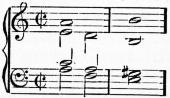
Ex. 13.—The same chords varied by a suspension (*).
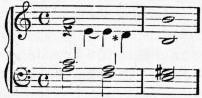
Ex. 14.—Ditto, with the further addition of a double suspension (*) and two passing notes (††).
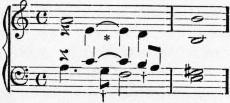
Ex. 15.—Ditto, with a chromatic alteration of the second chord (*) and an “essential” discord (dominant 7th) at (†).
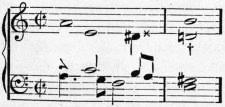
Ex. 16.—Ditto, with chromatic passing notes (**) and appoggiaturas (††).
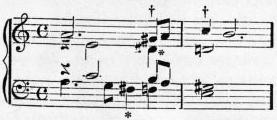
Ex. 17.—The last two chords of Ex. 16 attacked unexpectedly, the first appoggiatura (*) prolonged till it seems to make a strange foreign chord before it resolves on the short note at ‡, while the second appoggiatura (†) is chromatic.
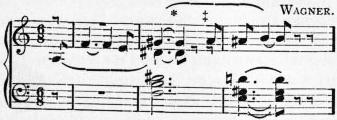
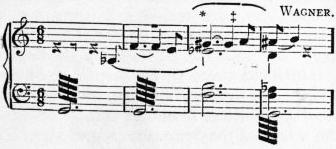
Ex. 18.—The same enharmonically transformed so as to become a variation of the “dominant ninth” of C minor. The G♯ at * is really A♭, and ‡ is no longer a note of resolution, but a chromatic passing-note.
Definitions.
(Intended to comprise the general conceptions set forth in the above article.)
1. Musical sounds, or notes, are sensations produced by regular periodical vibrations in the air, sufficiently rapid to coalesce in a single continuous sensation, and not too rapid for the mechanism of the human ear to respond.
2. The pitch of a note is the sensation corresponding to the degree of rapidity of its vibrations; being low or grave where these are slow, and high or acute where they are rapid.
3. An interval is the difference in pitch between two notes.
4. Rhythm is the organization, in a musical scheme, of sounds in respect of time.
5. Melody is the organization, in a musical scheme, of rhythmic notes in respect of pitch.
6. Harmony is the organization, in a musical scheme, of simultaneous combinations of notes on principles whereby their acoustic properties interact with laws of rhythm and melody.
7. The harmonic series is an infinite series of notes produced by the subdivision of a vibrating body or column of air into aliquot parts, such notes being generally inaudible except in the form of the timbre which their presence in various proportions imparts to the fundamental note produced by the whole vibrating body or air-column.
8. A concord is a combination which, both by its acoustic smoothness and by its logical origin and purpose in a musical scheme, can form a point of repose.
9. A discord is a combination in which both its logical origin in a musical scheme and its acoustic roughness show that it cannot form a point of repose.
10. The perfect concords and perfect intervals are those comprised within the first four members of the harmonic series, namely, the octave, as between numbers 1 and 2 of the series (see Ex. 1 above); the 5th, as between Nos. 2 and 3; and the 4th, as between Nos. 3 and 4.
11. All notes exactly one or more octaves apart are regarded as harmonically identical.
12. The root of a chord is that note from which the whole or the most important parts of the chord appear (if distributed in the right octaves) as members of the harmonic series.
13. A chord is inverted when its lowest note is not its root.
14. The major triad is a concord containing three different notes which (octaves being disregarded) are identical with the first, third and fifth members of the harmonic series (the second and fourth members being negligible as octaves).
15. The minor triad is a concord containing the same intervals as the major triad in a different order; in consequence it is artificial, as one of its notes is not derivable from the harmonic series.
16. Unessential discords are those that are treated purely as the phenomena of transition, delay or ornament, in an otherwise concordant harmony.
17. Essential discords are those which are so treated that the mind tends to regard them as definite chords possessing roots.
18. A key is an harmonic system in which there is never any doubt as to which note or triad shall be the final note of music in that system, nor of the relations between that note or chord and the other notes or chords. (In this sense the church modes are either not keys or else they are subtle mixtures of keys.)
19. This final note of a key is called its tonic.
20. The major mode is that of keys in which the tonic triad and the two other cardinal triads are major.
21. The minor mode is that of keys in which the tonic triad and one other cardinal triad are minor.
22. A diatonic scale is a series of the notes essential to one major or minor key, arranged in order of pitch and repeating itself in other octaves on reaching the limit of an octave.
23. Modulation is the passing from one key to another.
24. Chromatic notes and chords are those which do not belong to the diatonic scale of the passage in which they occur, but which are not so used as to cause modulation.
25. Enharmonic intervals are minute intervals which never occur in music as directly measured quantities, though they exist as differences between approximately equal ordinary intervals, diatonic or chromatic. In an enharmonic modulation, two chords differing by an enharmonic quantity are treated as identical.
26. Pedal or organ point is the sustaining of a single note in the bass (or, in the case of an inverted pedal, in an upper part) while the harmonies move independently. Unless the harmonies are sometimes foreign to the sustained note, it does not constitute a pedal. In modern music pedals take place on either the tonic or the dominant, other pedal-notes being rare and of complex meaning. Double pedals (of tonic and dominant, with tonic below) are not unusual. The device is capable of very free treatment, and has produced many very bold and rich harmonic effects in music since the earlier works of Beethoven. It probably accounts for many so-called “essential discords.”
In the form of drones the pedal is the only real harmonic device of ancient and primitive music. The ancient Greeks sometimes used a reiterated instrumental note as an accompaniment above the melody. These primitive devices, though harmonic in the true modern sense of the word, are out of the line of harmonic development, and did not help it in any definite way.
27. The fundamental bass of a harmonic passage is an imaginary bass consisting of the roots of the chords.
28. A figured bass, or continuo, is the bass of a composition supplied with numerals indicating the chords to be filled in by the accompanist. Thorough-bass (Ger. Generalbass) is the art of interpreting such figures.
(D. F. T.)
1 Musical intervals are reckoned numerically upwards along the degrees of the diatonic scales (described below). Intervals greater than an octave are called compound, and are referred to their simple forms, e.g. the 12th is a compound 5th.
2 It is at least probable that this is one of the several rather obscure reasons for the peculiar instability of the 4th in modern harmony, which is not yet satisfactorily explained.
3 The perfect concords are the octave, unison, 5th and 4th. Other diatonic combinations, whether concords or discords, are called imperfect.
4 See Plain Song.
5 Until Beethoven developed the resources for a wider scheme of key-contrasts, the only keys for second subjects of sonata-movements were the dominant (when the tonic was major) and the “relative” major or dominant minor (when the tonic was minor). A wider range was possible only in the irresponsible style of D. Scarlatti.
6 Many theorists mistake the usual extreme emphasis on the dominant chord of the dominant key, in preparation for second subjects, for a modulation to the major supertonic, but this can deceive no one with any sense of tonality. A good practical test is to see what becomes of such passages when translated into the minor mode. Illusory modulation to the flat 7th frequently occurs as a bold method of throwing strong emphasis on to the subdominant at the outset of a movement, as in Beethoven’s Sonata, Op. 31, No. 1.
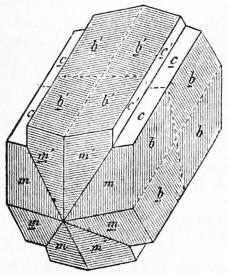
HARMOTOME, a mineral of the zeolite group, consisting of hydrous barium and aluminium silicate, H2BaAl2(SiO3)5 + 5H2O. Usually a small amount of potassium is present replacing part of the barium. The system of crystallization is monoclinic; only complex twinned crystals are known. A common and characteristic form of twinned crystal, such as is represented in the figure, consists of four intercrossing individuals twinned together according to two twin-laws; the compound group resembles a tetragonal crystal with prism and pyramid, but may be distinguished from this by the grooves along the edges of the pseudo-prism. The faces of the crystals are marked by characteristic striations, as indicated in the figure. Twinned crystals of exactly the same kind are also frequent in phillipsite (q.v.). Crystals are usually white and translucent, with a vitreous lustre. The hardness is 4½, and the specific gravity 2.5.
The name harmotome (from ἁρμός, “a joint,” and τέμνειν, “to cut”) was given by R. J. Haüy in 1801, and has a crystallographic signification. Earlier names are cross-stone (Ger. Kreuzstein), ercinite, andreasbergolite and andreolite, the two last being derived from the locality, Andreasberg in the Harz. Morvenite (from Morven in Argyllshire) is the name given to small transparent crystals formerly referred to as phillipsite.
Like other zeolites, harmotome occurs with calcite in the amygdaloidal cavities of volcanic rocks, for example, in the dolerites of Dumbartonshire, and as fine crystals in the agate-lined cavities in the melaphyre of Oberstein in Germany. It also occurs in gneiss, and sometimes in metalliferous veins. At Andreasberg in the Harz it is found in the lead and silver veins; and at Strontian in Argyllshire in lead veins, associated with brewsterite (a strontium and barium zeolite), barytes and calcite.
(L. J. S.)
HARMS, CLAUS (1778-1855), German divine, was born at Fahrstedt in Schleswig-Holstein on the 25th of May 1778, and in his youth worked in his father’s mill. At the university of Kiel he repudiated the prevailing rationalism and under the influence of Schleiermacher became a fervent Evangelical preacher, first at Lunden (1806), and then at Kiel (1816). His trenchant style made him very popular, and he did great service for his cause especially in 1817, when, on the 300th anniversary of the Reformation, he published side by side with Luther’s theses, ninety-five of his own, attacking reason as “the pope of our time” who “dismisses Christ from the altar and throws God’s word from the pulpit.” He also had some fame as a hymn-writer, and besides volumes of sermons published a good book on Pastoraltheologie (1830). He resigned his pastorate on account of blindness in 1849, and died on the 1st of February 1855.
See Autobiography (2nd ed., Kiel, 1852); M. Baumgarten, Ein Denkmal für C. Harms (Brunswick, 1855).
HARNACK, ADOLF (1851- ), German theologian, was born on the 7th of May 1851 at Dorpat, in Russia, where his father, Theodosius Harnack (1817-1889), held a professorship of pastoral theology.
Theodosius Harnack was a staunch Lutheran and a prolific writer on theological subjects; his chief field of work was practical theology, and his important book on that subject, summing up his long experience and teaching, appeared at Erlangen (1877-1878, 2 vols.). The liturgy of the Lutheran church of Russia has, since 1898, been based on his Liturgische Formulare (1872).
The son pursued his studies at Dorpat (1869-1872) and at Leipzig, where he took his degree; and soon afterwards (1874) began lecturing as a Privatdozent. These lectures, which dealt with such special subjects as Gnosticism and the Apocalypse, attracted considerable attention, and in 1876 he was appointed professor extraordinarius. In the same year he began the publication, in conjunction with O. L. von Gebhardt and T. Zahn, of an edition of the works of the Apostolic Fathers, Patrum apostolicorum opera, a smaller edition of which appeared in 1877. Three years later he was called to Giessen as professor ordinarius of church history. There he collaborated with Oscar Leopold von Gebhardt in Texte und Untersuchungen zur Geschithte der altchristlichen Litteratur (1882 sqq.), an irregular periodical, containing only essays in New Testament and patristic fields. In 1881 he published a work on monasticism, Das Mönchtum, seine Ideale und seine Geschichte (5th ed., 1900; English translation, 1901), and became joint-editor with Emil Schürer of the Theologische Literaturzeitung. In 1885 he published the first volume of his epoch-making work, Lehrbuch der Dogmengeschichte (3rd ed. in three volumes, 1894-1898; English translation in seven volumes, 1894-1899). In this work Harnack traces the rise of dogma, by which he understands the authoritative doctrinal system of the 4th century and its development down to the Reformation. He considers that in its earliest origins Christian faith and the methods of Greek thought were so closely intermingled that much that is not essential to Christianity found its way into the resultant system. Therefore Protestants are not only free, but bound, to criticize it; indeed, for a Protestant Christian, dogma cannot be said to exist. An abridgment of this appeared in 1889 with the title Grundriss der Dogmengeschichte (3rd ed., 1898). In 1886 Harnack was called to Marburg; and in 1888, in spite of violent opposition from the conservative section of the church authorities, to Berlin. In 1890 he became a member of the Academy of Sciences. At Berlin, somewhat against his will, he was drawn into a controversy on the Apostles’ Creed, in which the party antagonisms within the Prussian Church had found expression. Harnack’s view is that the creed contains both too much and too little to be a satisfactory test for candidates for ordination, and he would prefer a briefer symbol which could be rigorously exacted from all (cf. his Das apostolische Glaubensbekenntnis. Ein geschichtlicher Bericht nebst einem Nachworte, 1892; 27th ed., 1896). At Berlin Harnack continued his literary labours. In 1893 he published a history of early Christian literature down to Eusebius, Geschichte der altchristl. Litteratur bis Eusebius (part 2 of vol. i., 1897); and in 1900 appeared his popular lectures, Das Wesen des Christentums (5th ed., 1901; English translation, What is Christianity? 1901; 3rd ed., 1904). One of his more recent historical works is Die Mission und Ausbreitung des Christentums in den ersten drei Jahrhunderten (1902; English translation in two volumes, 1904-1905). It has been followed by some very interesting and important New Testament studies (Beiträge zur Einleitung in das neue Testament, 1906 sqq.; Engl. trans.: Luke the Physician, 1907; The Sayings of Jesus, 1908). Harnack, both as lecturer and writer, was one of the most prolific and most stimulating of modern critical scholars, and trained up in his “Seminar” a whole generation of teachers, who carried his ideas and methods throughout the whole of Germany and even beyond its borders. His distinctive characteristics are his claim for absolute freedom in the study of church history and the New Testament; his distrust of speculative theology, whether orthodox or liberal; his interest in practical Christianity as a religious life and not a system of theology. Some of his addresses on social matters have been published under the heading “Essays on the Social Gospel” (1907).
HARNESS (from O. Fr. harneis or harnois; the ultimate origin is obscure; the Celtic origin which connects it with the Welsh haiarn, iron, has phonetic and other difficulties; the French is the origin of the Span. arnes, and Ger. Harnisch), probably, in origin, gear, tackle, equipment in general, but early applied particularly to the body armour of a soldier, including the trappings of the horse; now the general term for the gear of an animal used for draft purposes, traces, collar, bridle, girth, breeching, &c. It is usually not applied to the saddle or bridle of a riding animal. The word, in its original meaning of tackle or working apparatus, is still found in weaving, for the mechanism which shifts the warp-threads to form the “shed,” and in bell-hanging, for the apparatus by which a large bell is hung. The New English Dictionary quotes an early use of the word for the lines, rod and hooks of an angler (Fysshing with an Angle, c. 1450).
HARO, CLAMEUR DE, the ancient Norman custom of “crying for justice,” still surviving in the Channel Islands. The wronged party must on his knees and before witnesses cry: “Haro! Haro! Haro! à l’aide, mon prince, on me fait tort.” This appeal has to be respected, and the alleged trespass or tort must cease till the matter has been thrashed out in the courts. The “cry” thus acts as an interim injunction, and no inhabitant of the Channel Islands would think of resisting it. The custom is undoubtedly very ancient, dating from times when there were no courts and no justice except such as was meted out by princes personally. The popular derivation for the name is that which explains “Haro” as an abbreviation of “Ha! Rollo,” a direct appeal to Rollo, first duke of Normandy. It is far more probable that haro is simply an exclamation to call attention (O.H.G. hero, hara, “here”!). Indeed it is clear that the “cry for justice” was in no sense an institution of Rollo, but was a method of appeal recognized in many countries. It is said to be identical with the “Legatro of the Bavarians and the Thuringians,” and the first mention of it in France is to be found in the “Grand coutumier de Normandie.” A similar custom, only observed in criminal charges, was recognized by the Saxon laws under the name of “Clamor Violentiae.” Thus there is reason to think that William the Conqueror on his arrival in England found the “cry” fully established as far as criminal matters were concerned. Later the “cry” was made applicable to civil wrongs, and, when the administration of justice became systematized, disappeared altogether in criminal cases. It naturally tended to become obsolete as the administration of justice became systematized, but it was long retained in north-western France in cases of disputed possession, and was not actually repealed until the close of the 18th century. A survival of the English form of haro is possibly to be found in the “Ara,” a cry at fairs when “settling time” arrived.
HAROLD I. (d. 1040), surnamed Harefoot, the illegitimate son of Canute, king of England, and Ælfgifu of Northampton. On the death of his father in 1035, he claimed the crown of England in opposition to Canute’s legitimate son, Hardicanute. His claims were supported by Leofric, earl of Mercia, and the north; those of Hardicanute by his mother, Queen Emma, Godwine, earl of the West-Saxons and the south. Eventually Harold was temporarily elected regent, pending a final settlement on Hardicanute’s return from Denmark. Hardicanute, however, tarried, and meanwhile Harold’s party increased rapidly. In 1037 he was definitely elected king, and banished Emma from the kingdom. The only events of his brief reign are ineffectual inroads of the Welsh and Scots. Hardicanute was preparing to invade England in support of his claims when Harold died at Oxford on the 10th of March 1040.
HAROLD II. (c. 1022-1066), king of the English, the second son of Earl Godwine, was born about 1022. While still very young (before 1045) he was appointed to the earldom of the East-Angles. He shared his father’s outlawry and banishment in 1051; but while Godwine went to Flanders, Harold with his brother Leofwine took refuge in Ireland. In 1052 Harold and Leofwine returned. Having plundered in the west of England, they joined their father, and were with him at the assembly which decreed the restoration of the whole family. Harold was now restored to his earldom of the East-Angles, and on his father’s death in 1053 he succeeded him in the greater earldom of the West-Saxons. He was now the chief man in the kingdom, and when the older earls Leofric and Siward died his power increased yet more, and the latter part of Edward’s reign was virtually the reign of Harold. In 1055 he drove back the Welsh, who had burned Hereford. In 1063 came the great Welsh war, in which Harold, with the help of his brother Tostig, crushed the power of Gruffyd, who was killed by his own people. But in spite of his power and his prowess, Harold was the minister of the king rather than his personal favourite. This latter position rather belonged to Tostig, who on the death of Siward in 1055 received the earldom of Northumberland. Here, however, his harshness soon provoked enmity, and in 1065 the Northumbrians revolted against him, choosing Morkere in his place. Harold acted as mediator between the king and the insurgents, and at length agreed to the choice of Morkere, and the banishment of his brother. At the beginning of 1066 Edward died, with his last breath recommending Harold as his successor. He was accordingly elected at once and crowned. The men of Northumberland at first refused to acknowledge him, but Harold won them over. The rest of his brief reign was taken up with preparations against the attacks which threatened him on both sides at once. William challenged the crown, alleging both a bequest of Edward in bis favour and a personal engagement which Harold had contracted towards him—probably in 1064; and prepared for the invasion of England. Meanwhile Tostig was trying all means to bring about his own restoration. He first attacked the Isle of Wight, then Lindesey, but was compelled to take shelter in Scotland. From May to September the king kept the coast with a great force by sea and land, but at last provisions failed and the land army was dispersed. Harold then came to London, ready to meet whichever enemy came first. By this time Tostig had engaged Harold Hardrada of Norway to invade England. Together they sailed up the Humber, defeated Edwin and Morkere, and received the submission of York. Harold hurried northwards; and on the 25th of September he came on the Northmen at Stamford Bridge and won a complete victory, in which Tostig and Harold Hardrada were slain. But two days later William landed at Pevensey. Harold marched southward as fast as possible. He gathered his army in London from all southern and eastern England, but Edwin and Morkere kept back the forces of the north. The king then marched into Sussex and engaged the Normans on the hill of Senlac near Battle (see Hastings). After a fight which lasted from morning till evening, the Normans had the victory, and Harold and his two brothers lay dead on the field (14th of October 1066).
HARP (Fr. harpe; Ger. Harfe; Ital. arpa), a member of the class of stringed instruments of which the strings are twanged or vibrated by the fingers. The harp is an instrument of beautiful proportions, approximating to a triangular form, the strings diminishing in length as they ascend in pitch. The mechanism is concealed within the different parts of which the instrument is composed, (1) the pedestal or pedal-box, on which rest (2) the vertical pillar, and (3) the inclined convex body in which the soundboard is fixed, (4) the curved neck, with (5) the comb concealing the mechanism for stopping the strings, supported by the pillar and the body.
(1) The pedestal or pedal-box forms the base of the harp and contains seven pedals both in single and double action harps, the difference being that in the single action the pedals are only capable of raising the strings one semitone by means of a drop into a notch, whereas with the double action the pedals, after a first drop, can by a further drop into a second and lower notch shorten the string a second semitone, whereby each string is made to serve in turn for flat, natural and sharp. The harp is normally in the key of C flat major, and each of the seven pedals acts upon one of the notes of this diatonic scale throughout the compass. The choice of this method of tuning was imposed by the construction of the harp with double action. The pedals remain in the notches until released by the foot, when the pedal returns to its normal position through the action of a spiral spring, which may be seen under each of the pedals by turning the harp up.
(2) The vertical pillar is a kind of tunnel in which are placed the seven rods worked by the pedals, which set in motion the mechanism situated in the neck of the instrument. Although the pillar apparently rests on the pedestal, it is really supported by a brass shoulder firmly screwed to the beam which forms the lowest part of the body, a connexion which remains undisturbed when the pedal box and its cover are removed.
(3) The body or sound-chest of the harp is in shape like the longitudinal section of a cone. It was formerly composed of staves joined together as in the lute and mandoline. Erard was the first to make it in two pieces of wood, generally sycamore, with the addition of a flat soundboard of Swiss pine. The body is strengthened on the inside, in order to resist the tension of the strings, by means of ribs; there are five soundholes in the back, which in the older models were furnished with swell shutters opened at will by the swell pedal, the fourth from the left worked by the left foot. As the increase of sound obtained by means of the swell was infinitesimal, the device has now been discarded. The harp is strung by knotting the end of the string and passing it through its hole in the centre of the soundboard, where it is kept in position by means of a grooved peg which grips the string.
(4) The neck consists of a curved piece of wood resting on the body at the treble end of the instrument and joining the pillar at the bass end. In the neck are set the tuning pins round which are wound the strings.
(5) The comb is the name given to two brass plates or covers which fit over both sides of the neck, concealing part of the mechanism for shortening the strings and raising their pitch a semitone when actuated by the pedals. On the front plate of the comb, to the left of the player, is a row of brass bridges against which the strings rest below the tuning pins, and which determine the vibrating length of the string reckoned from the peg in the soundboard. Below the bridges are two rows of brass disks, known as forks, connected by steel levers; each disk is equipped with two studs for grasping the string and shortening it. The mechanism is ingenious. When a pedal is depressed to the first notch, the corresponding lower disk turns a little way on a mandrel keeping the studs clear of the string. The upper disk, set in motion by the steel levers connecting the disks, revolves simultaneously till the string is caught by the two studs which thus form a new bridge, shortening the vibrating length of the string by just the length necessary to raise the pitch a semitone. If the same pedal be depressed to the second notch, another movement causes the lower disk to revolve again till the string is a second time seized and shortened, the upper disk remaining stationary. The hidden mechanism meanwhile has gone through a series of movements; the pedal is really a lever set upon a spring, and when depressed it draws down the connecting rod in the pillar which sets in motion chains governing the mandrels of the disks.
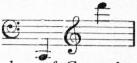
The harp usually has forty-six strings, of gut in the middle and upper registers, and of covered steel wire in the bass; the C strings are red and the F strings blue. The compass thus has a range of 6½ octaves from . The double stave is used as for the pianoforte. The single action harp used to be tuned to the key of E♭ major.
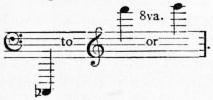
The modern harp with double action is the only instrument with fixed tones, not determined by the ear or touch of the performer, which has separate notes for naturals, sharps and flats, giving it an enharmonic compass. On the harp the appreciable interval between D♯ and E♭ can be played. The harp in its normal condition is tuned to C♭ major; it rests with the performer to transpose it at will in a few seconds into any other key by means of the pedals. Each of the pedals influences one note of the scale throughout the compass, beginning at the left with D, C, and B worked by the left foot. Missing the fourth or forte pedal, and continuing towards the right we get the E, F, G and A pedals worked by the right foot. By lowering the D pedal into the first notch the D♭ becomes D♮, and into the second notch D♯, and so on for all the pedals. If, for example, a piece be written in the key of E major, the harp is transposed into that key by depressing the E, A, and B pedals to the first notch, and those for F, G, C and D to the second or sharp notch and so on through all the keys. Accidentals and modulations are readily played by means of the pedals, provided the transitions be not too rapid. The harp is the instrument upon which transposition presents the least difficulty, for the fingering is the same for all keys. The strings are twanged with the thumbs and the first three fingers.
The quality of tone does not vary much in the different registers, but it has the greatest brilliancy in keys with many flats, for the strings are then open and not shortened by the forks. Various effects can be obtained on the harp: (1) by harmonics, (2) by damping, (3) by guitar tones, (4) by the glissando. (1) Harmonics are produced by resting the ball of the hand on the middle of the string and setting it in vibration by the thumb or the first two fingers of the same hand, whereby a mysterious and beautiful tone is obtained. Two or three harmonics can be played together with the left hand, and by using both hands at once as many as four are possible. (2) Damping is effected by laying the palm against the string in the bass and the back of the finger in the treble. (3) Guitar or pizzicato notes are obtained by twanging the strings sharply at the lower end near the soundboard with the nails. (4) The glissando effect is produced, as on the pianoforte, by sliding the thumb or finger along the strings in quick succession; this does not necessarily give the diatonic scale, for by means of the pedals the harp can be tuned beforehand to chords. It is possible to play on the harp all kinds of diatonic and arpeggio passages, but no chromatic, except in very slow tempo, on account of the time required by the mechanism of the pedals; and chords of three or four notes in each hand, shakes, turns, successions of double notes can be easily acquired. The same note can also be repeated slowly or quickly, the next string being tuned to a duplicate note, and the two strings plucked alternately in order to give the string time to vibrate.
Pleyel’s chromatic harp, patented in 1894 and improved in 1903 by Gustave Lyon, manager of the firm of Pleyel, Wolff & Co., is an instrument practically without mechanism which has already won great favour in France and Belgium, notably in the orchestra. It has been constructed on the familiar lines of the pianoforte. Henry Pape, a piano manufacturer, had in 1845 conceived the idea of a chromatic harp of which the strings crossed in the centre as in the piano, and a report on the construction was published at the time; the instrument, however, was not considered successful, and was relegated to oblivion until Mr Lyon revised the matter and brought out a successful and practical instrument. The advantages claimed for this harp are the abandonment of the whole pedal mechanism, a metal framing which insures the strings keeping in tune as long as those of a piano, and an easily acquired technique. The chromatic harp consists of (1) a pedestal on castors, (2) a steel pillar without internal mechanism, (3) a wide neck containing two brass wrest-planks in which are fixed two rows of tuning pins, and (4) a soundchest in which is firmly riveted the steel plate to which the strings are fastened, and the soundboard pierced with eyelet holes through which the strings are drawn to the string plate. There is a string for every chromatic semitone of the scale of C major, the white strings representing the white keys of the piano keyboard, and the black strings corresponding to the black keys. The tuning pins for the black strings are set in the left side of the neck in alternate groups of twos and threes, and those for the white in the right side in alternate groups of threes and fours. The strings cross half-way between neck and soundboard, this being the point where they are plucked; the left hand finds the black notes above, and the right hand below the crossing. There is besides in the neck a set of twelve tuning buttons, each one of which on being pressed gives out one note of the chromatic scale tuned to the pitch of the diapason normal. It is obvious that the répertoire for this harp is very extensive, including many compositions written for the piano, which however cannot be played with any legato effects, these being still impossible on this chromatic harp.
History.—While the instrument is of great antiquity, it is yet from northern Europe that the modern harp and its name are derived. The Greeks and Romans preferred to it the lyre in its different varieties, and a Latin writer, Venantius Fortunatus,1 describes it in the 7th century of our era as an instrument of the barbarians—“Romanusque lyra, plaudat tibi barbarus harpa.” This is believed to be the earliest mention of the name, which is clearly Teutonic,—O.H.Ger. harapha, A.-S. hearpe, Old Norse harpa. The modern Fr. harpe retains the aspirate; in the Spanish and Italian arpa it is dropped.
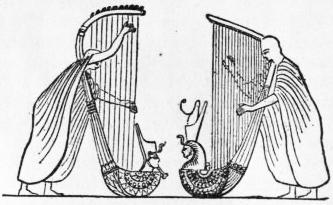
Fig. 1.
The earliest delineations of the harp in Egypt give no indication that it had not existed long before. There are, indeed, representations in Egyptian paintings of stringed instruments of a bow-form having affinities with both primitive harp and nefer (a kind of oval guitar) that support the idea of the invention of the harp from the tense string of the warrior’s or hunter’s bow. This primitive-looking instrument, called nanga, had a boat-shaped sound-chest with a parchment or skin soundboard, down the centre of which one end of the string was fastened to a strip of wood, whilst the other was wound round pegs in the upper part of the bow. The nanga was played horizontally, being borne upon the performer’s shoulder.2 Between it and the grand vertical harps in the frescos of the time of Rameses III., more than 3000 years old, discovered by the traveller Bruce3 (fig. 1), there are varieties that permit us to bind the whole, from the simplest bow-form to the almost triangular harp, into one family (see fig. 2).
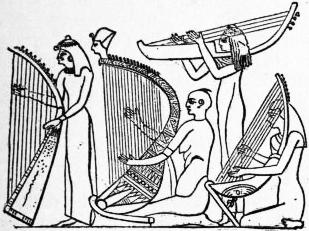
Fig. 2.
The Egyptian harp had no front pillar, and as it was strung with catgut the tension and pitch must necessarily have been low. The harps above-mentioned depicted in the tomb at Thebes, assumed from the players to be more than 6 ft. high, have not many strings, the one having ten, the other thirteen. What the accordance of these strings was it would be hard to recover. We must be content with the knowledge that the old Egyptians possessed harps in principle like our own, the largest having pedestals upon which they bestowed a wealth of decoration, as if to show how much they prized them.
The ancient Assyrians had harps like those of Egypt in being without a front pillar, but differing from them in having the sound-body uppermost, in which we find the early use of soundholes; while the lower portion was a bar to which the strings were tied and by means of which the tuning was apparently effected.4 What the Hebrew harp was, whether it followed the Egyptian or the Assyrian, we do not know. That King David played upon the harp as commonly depicted is rather a modern idea. Medieval artists frequently gave King David the psaltery, a horizontal stringed instrument from which has gradually developed the modern piano. The Hebrew “kinnor” may have been a kind of trigonon, a triangular stringed instrument between a small harp and a psaltery, sounded by a plectrum, or more probably, as advocated by Dr Stainer in his essay on the music of the Bible, a kind of lyre.
The earliest records that we possess of the Celtic race, whether Gaelic or Cymric, give the harp a prominent place and harpists peculiar veneration and distinction. The names for the harp are, however, quite different from the Teutonic. The Irish “clairseach,” the Highland Scottish “clarsach,” the Welsh, Cornish, Breton “telyn,” “telein,” “télen,” show no etymological kinship to the other European names. The first syllable in clairseach or clarsach is derived from the Gaelic “clar,” a board or table (soundboard), while the first syllable of telyn is distinctly Old Welsh, and has a tensile meaning; thus resonance supplies the one idea, tension the other.
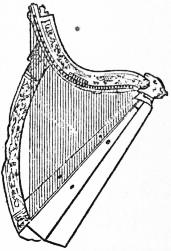
Fig. 3. Irish (Dalway) Harp.
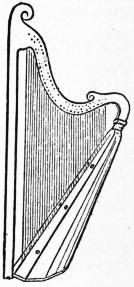
Fig. 4. Welsh Triple Harp.
The literature of these Celtic harps may be most directly found in Bunting’s Ancient Music of Ireland (Dublin, 1840), Gunn’s Historical Enquiry respecting the Performance on the Harp in the Highlands of Scotland (Edinburgh, 1807), and E. Jones’s Musical and Poetical Memoirs of the Welsh Bards (London, 1784). The treatises of Walker, Dalyell, and others may also be consulted; but in all these authorities due care must be taken of the bias of patriotism, and the delusive aim to reconstruct much that we must be content to receive as only vaguely indicated in records and old monuments. There is, however, one early Irish monument about which there can be no mistake, the harp upon a cross belonging to the ancient church of Ullard near Kilkenny, the date of which cannot be later than 830; the sculpture is rude, but the instrument is clearly shown by the drawing in Bunting’s work to have no front pillar. This remarkable structural likeness to the old harps of Egypt and Assyria may be accidental, but permits the plausible hypothesis of Eastern descent. The oldest specimen of the beautiful form by which the Irish harp is now recognized, with gracefully curved front pillar and sweep of neck (the latter known as the harmonic curve), is the famous harp in Trinity College, Dublin, the possession of which has been attributed to King Brian Boiroimhe. From this mythic ownership Dr Petrie (see essay in Bunting) has delivered it; but he can only deduce the age from the ornamentation and heraldry, which fix its date in the 14th century or a little later. There is a cast of it in the Victoria and Albert Museum. The next oldest is in the Highlands of Scotland, the Clarsach Lumanach, or Lamont’s Clarschoe, belonging, with another of later date, to the old Perthshire family of Robertson of Lude. Both are described in detail by Gunn. This Lamont harp was taken by a lady of that family from Argyleshire about 1460, on her marriage into the family of Lude. It had about thirty strings tuned singly, but the scale was sometimes doubled in pairs of unisons like lutes and other contemporary instruments. The Dalway harp in Ireland (fig. 3) inscribed “Ego sum Regina Cithararum,” and dated 1621, appears to have had pairs of strings in the centre only. These were of brass wire, and played with the pointed finger-nails. The Italian contemporary “Arpa Doppia” was entirely upon the duplex principle, but with gut strings played by the fleshy ends of the fingers. When E. Bunting met at Belfast in 1792 as many Irish harpers as could be at that late date assembled, he found the compass of their harps to comprise thirty notes which were tuned diatonically in the key of G, under certain circumstances transposable to C and rarely to D, the scales being the major of these keys. The harp first appeared in the coat of arms of Ireland in the reign of Henry VIII.; and some years after in a map of 1567 preserved in a volume of state papers, we find it truly drawn according to the outlines of the national Irish instrument.5 References to the Highlands of Scotland are of necessity included with Ireland; and in both we find another name erroneously applied by lexicographers to the harp, viz. “cruit.” Bunting particularly mentions the “cinnard cruit” (harp with a high head) and the “crom cruit” (the curved harp). In the Ossianic MSS. of the Dean of Lismore (1512) the word “crwt” occurs several times, and in Neill M’Alpine’s Gaelic Dictionary (1832), which gives the dialect of Islay, closely related to that of Ulster, the word “cruit” is rendered “harp.” The confusion doubtless arose from the fact that from the 11th century cithara is glossed hearpan in Anglo-Saxon MSS., a word which, like citharisare in medieval Latin, referred to plucking or twanging of strings in contradistinction to those instruments vibrated by means of the bow. In Irish of the 8th and 9th centuries (Zeuss) cithara is always glossed by “crot.” The modern Welsh “crwth” is not a harp but a “rotta” (see Crowd). An old Welsh harp, not triple strung, exists, which bears a great resemblance to the Irish harp in neck, soundboard and soundholes. But this does not imply derivation of the harp of Wales from that of Ireland or the reverse. There is really no good historical evidence, and there may have been a common or distinct origin on which ethnology only can throw light.6 The Welsh like the Irish harp was often an hereditary instrument to be preserved with great care and veneration, and used by the bards of the family, who were alike the poet-musicians and historians. A slave was not allowed to touch a harp, and it was exempted by the Welsh laws from seizure for debt. The old Welsh harp appears to have been at one time strung with horse-hair, and by the Eisteddfod laws the pupil spent his noviciate of three years in the practice of a harp with that stringing. The comparatively modern Welsh triple harp (fig. 4) is always strung with gut. It has a rising neck as before stated, and three rows of strings,—the outer rows tuned diatonic, the centre one chromatic for the sharps and flats. Jones gives it 98 strings and a compass of 5 octaves and one note, from violoncello C. As in all Celtic harps, the left is the treble hand, and in the triple harps there are 27 strings on that side, the right or bass hand having 37, and the middle or chromatic row 34.
The first pattern of the modern harp is discovered in German and Anglo-Saxon illuminated MSS. as far back as the 9th century.7 A diatonic instrument, it must have been common throughout Europe, as Orcagna, Fra Angelico, and other famous Italian painters depict it over and over again in their masterpieces. No accidental semitones were possible with this instrument, unless the strings were shortened by the player’s fingers. This lasted until the 17th century, when a Tirolese maker adapted hooks8 (perhaps suggested by the fretted or bonded clavichord) that, screwed into the neck, could be turned downwards to fix the desired semitone at pleasure. At last, somewhere about 1720, Hochbrucker, a Bavarian, invented pedals that, acting through the pedestal of the instrument, governed by mechanism the stopping, and thus left the player’s hands free, an indisputable advantage; and it became possible at once to play in no less than eight major scales. By a sequence of improvements, in which two Frenchmen named Cousineau took an important part, the various defects inherent in Hochbrucker’s plan became ameliorated. The pedals were doubled, and, the tuning of the instrument being changed from the key of E♭ to C♭, it became possible to play in fifteen keys, thus exceeding the power of the keyboard instruments, over which the harp has another important advantage in the simplicity of the fingering, which is the same for every key.
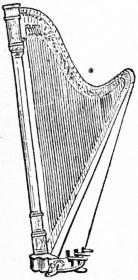
Fig. 5. Modern Erard Harp.
It is to Sebastian Erard we owe the perfecting of the pedal harp (fig. 5), a triumph he gained in Paris by unremitting studies begun when he adopted a “fork” mechanism in 1786 and ended in 1810 when he had attained complete success with the double action pedal mechanism already described above. Erard’s merit was not confined to this improvement only; he modified the structure of the comb that conceals the mechanism, and constructed the sound-body of the instrument upon a modern principle more advantageous to the tone.
Notwithstanding these improvements and the great beauty of tone the harp possesses, the domestic use of it in modern times has almost disappeared. The great cost of a good harp, and the trouble to many amateurs of tuning, may have led to the supplanting of the harp by the more convenient and useful pianoforte. With this comes naturally a diminution in the number of solo-players on the instrument. Were it not for the increasing use of the harp in the orchestra, the colour of its tone having attracted the masters of instrumentation, so that the great scores of Meyerbeer and Gounod, of Berlioz, Liszt and Wagner are not complete without it, we should perhaps know little more of the harp than of the dulcimer, in spite of the efforts of distinguished virtuosi whose devotion to their instrument maintains its technique on an equality with that of any other, even the most in public favour. The first record of the use of harps in the orchestra occurs in the account of the Ballet comique de la royne performed at the château de Moutiers on the occasion of the marriage of Mary of Lorraine with the duc de Joyeuse in 1581, when harps formed part of the concert de musique.
See in addition to the works already referred to, Engel’s Musical Instruments in the South Kensington Museum (1874); and the articles “Harp,” in Rees’s Cyclopaedia, written by Dr Burney, in Stainer and Barrett’s Dictionary of Musical Terms (1876), and in Grove’s Dictionary of Music and Musicians. On the origins of the instrument see Proceedings of British Association (1904) (address of president of anthropological section).
(K. S.; A. J. H.)
1 Poemata, lib. vii. cap. 8, p. 245, Migne’s Patrologiae cursus completus (Paris, 1857-1866, vol. 88).
2 A few nangas (c. 1500 B.C.) are preserved among the Egyptian antiquities at the British Museum, fourth Egyptian room.
3 Bruce’s harps are reproduced by Champollion, tome iii. p. 261.
4 Representations of these may be seen among the musical scenes in the Nimrod Gallery at the British Museum.
5 See also a woodcut in John Derrick’s Image of Ireland (1581), pl. iii. (Edinburgh ed. 1883).
6 See the fine volume Musical Instruments on the Irish and Scottish harps by Robert Bruce Armstrong (1904), vol. i. Vol. ii., which deals with the Welsh harp, has unfortunately been withdrawn from sale.
7 See for the medieval harp a careful article by Hortense Panum, “Harfe und Lyra im alten Nord-Europa,” in Intern. Mus. Ges. vol. vii. pt. 1 (Leipzig, 1905); and for references as to illuminated MSS., early woodcuts, paintings, &c. see Hugo Leichtentritt, “Was lehren uns die Bildwerke des 14-17 Jahrhunderts über die Instrumentalmusik ihrer Zeit?” ibid. vol. vii. p. 3 (Leipzig, 1906).
8 See Nauwerk, “Die Hakenharfe, Die Vervollkommnung des Mechanismus an der deutschen Harfe.” in Allg. musik. Ztg. (Leipzig, 1815), p. 545 seq.
HARPENDEN, an urban district in the Mid or St Albans parliamentary division of Hertfordshire, England, 25 m. N.W. by N. from London by the Midland railway, served also by a branch of the Great Northern railway. Pop. (1901) 4725. It is a favourite outlying residential district for those whose work lies in London. The church of St Nicholas is a modern reconstruction with the exception of the Perpendicular tower. In the Lawes Testimonial Laboratory there is a vast collection of samples of experimentally grown produce, annual products, ashes and soils. Sir John Bennet Lawes (d. 1900) provided an endowment of £100,000 for the perpetuation of the agricultural experiments which he inaugurated here at his seat of Rothamsted Park. The success of his association of chemistry with botany is shown by the fact that soil has been made to bear wheat without intermission for upwards of half a century without manure. The country neighbouring to Harpenden is very pleasant, including the gorse-covered Harpenden Common and the narrow well-wooded valley of the upper Lea.
HARPER’S FERRY, a town of Jefferson county, West Virginia, U.S.A., finely situated at the confluence of the Potomac and Shenandoah rivers (which here pass through a beautiful gorge in the Blue Ridge), 55 m. N.W. of Washington. Pop. (1900) 896; (1910) 766. It is served by the Baltimore & Ohio railway, which crosses the Potomac here, by the Winchester & Potomac railway (Baltimore & Ohio) of which it is a terminus, and by boats on the Chesapeake & Ohio Canal, which passes along the Maryland side of the Potomac. Across the Potomac on the north rise the Maryland Heights; across the Shenandoah, on the West Virginia side, the Virginia or Loudoun Heights; and behind the town to the W. the Bolivar Heights. A United States arsenal and armoury were established at Harper’s Ferry in 1796, the site being chosen because of the good water-power; these were seized on the 16th of October 1859 by John Brown (q.v.), the abolitionist, and some 21 of his followers. For four months before the raid Brown and his men lived on the Kennedy Farm, in Washington county, Maryland, about 4 m. N.W. of Harper’s Ferry. The engine-house in which Brown was captured was exhibited at the Columbian Exposition at Chicago and was later rebuilt on Bolivar Heights; a marble pillar, marked “John Brown’s Fort,” has been erected on its original site. On Camp Hill is Storer College (state-aided), a normal school for negroes, which was established under Free Baptist control in 1867, and has academic, normal, biblical, musical and industrial departments.
The first settlement here was made about 1747 by Robert Harper, who ran a ferry across the Potomac. The position of Harper’s Ferry at the lower end of the Shenandoah Valley rendered it a place of strategic importance during the Civil War. On the 18th of April 1861, the day after Virginia passed her ordinance of secession, when a considerable force of Virginia militia under General Kenton Harper approached the town—an attack having been planned in Richmond two days before—the Federal garrison of 45 men under Lieutenant Roger Jones set fire to the arsenal and fled. Within the next few days large numbers of Confederate volunteers assembled here; and Harper was succeeded in command (27th April) by “Stonewall” Jackson, who was in turn succeeded by Brigadier-General Joseph E. Johnston on the 23rd of May. Johnston thought that the place was unimportant, and withdrew when (15th June) the Federal forces under General Robert Patterson and Colonel Lew Wallace approached, and Harper’s Ferry was again occupied by a Federal garrison. In September 1862, during General Lee’s first invasion of the North, General McClellan advised that the place be abandoned in order that the 10,000 men defending it might be added to his fighting force, but General Halleck would not consent, so that when Lee needed supplies from the Shenandoah Valley he was blocked by the garrison, then under the command of Colonel Dixon S. Miles. On Jackson’s approach they were distributed as follows: about 7000 men on Bolivar Heights, about 2000 on Maryland Heights, and about 1800 on the lower ground. On the 13th of September General Lafayette McLaws carried Maryland Heights and General John G. Walker planted a battery on Loudoun Heights. On the 14th there was some fighting, but early on the 15th, as Jackson was about to make an assault on Bolivar Heights, the garrison, surrounded by a superior force, surrendered. The total Federal loss (including the garrisons at Winchester and Martinsburg) amounted to 44 killed (the commander was mortally wounded), 12,520 prisoners, and 13,000 small arms. For this terrible loss to the Union army the responsibility seems to have been General Halleck’s, though the blame was officially put on Colonel Miles, who died immediately after the surrender. Jackson rejoined Lee on the following day in time to take part in the battle of Antietam, and after the battle General McClellan placed a strong garrison (the 12th Corps) at Harper’s Ferry. In June 1863 the place was again abandoned to the Confederates on their march to Pennsylvania. After their defeat at Gettysburg, the town again fell into the hands of the Federal troops, and it remained in their possession until the end of the war. On the 4th of July 1864 General Franz Sigel, who was then in command here, withdrew his troops to Maryland Heights, and from there resisted Early’s attempt to enter the town and to drive the Federal garrison from Maryland Heights. Harper’s Ferry was seriously damaged by a flood in the Shenandoah in October 1878.
HARPIES (Gr. Ἅρπυιαι, older form Ἀρέπυιαι, “swift robbers”), in ancient mythology, the personification of the sweeping storm-winds. In Homer, where they appear indifferently under the name of ἄρπυιαι and θύελλαι, their function is to carry off those whose sudden disappearance is desired by the gods. Only one of them is there mentioned (Iliad, xvi. 150) by name, Podargē, the mother of the coursers of Achilles by Zephyrus, the generative wind. According to Hesiod (Theog. 265) they are two in number, Aëllo and Ocypetē, daughters of Thaumas and Electra, winged goddesses with beautiful locks, swifter than winds and birds in their flight, and their domain is the air. In later times their number was increased (Celaeno being a frequent addition and their leader in Virgil), and they were described as hateful and repulsive creatures, birds with the faces of old women, the ears of bears, crooked talons and hanging breasts; even in Aeschylus (Eumenides, 50) they appear as ugly and misshapen monsters. Their function of snatching away mortals to the other world brings them into connexion with the Erinyes, with whom they are often confounded. On the so-called Harpy monument from Lycia, now in the British Museum, the Harpies appear carrying off some small figures, supposed to be the daughters of Pandareus, unless they are intended to represent departed souls. The repulsive character of the Harpies is more especially seen in the legend of Phineus, king of Salmydessus in Thrace (Apollodorus i. 9, 21; see also Diod. Sic. iv. 43). Having been deprived of his sight by the gods for his ill-treatment of his sons by his first wife (or for having revealed the future to mortals), he was condemned to be tormented by two Harpies, who carried off whatever food was placed before him. On the arrival of the Argonauts, Phineus promised to give them particulars of the course they should pursue and of the dangers that lay before them, if they would deliver him from his tormentors. Accordingly, when the Harpies appeared as usual to carry off the food from Phineus’s table, they were driven off and pursued by Calaïs and Zetes, the sons of Boreas, as far as the Strophades islands in the Aegean. On promising to cease from molesting Phineus, their lives were spared. Their place of abode is variously placed in the Strophades, the entrance to the under-world, or a cave in Crete. According to Cecil Smith, Journal of Hellenic Studies, xiii. (1892-1893), the Harpies are the hostile spirits of the scorching south wind; E. Rohde (Rheinisches Museum, i., 1895) regards them as spirits of the storm, which at the bidding of the gods carry off human beings alive to the under-world or some spot beyond human ken.
See articles in Roscher’s Lexikon der Mythologie and Daremberg and Saglio’s Dictionnaire des antiquités. In the article Greek Art, fig. 14 gives a representation of the winged Harpies.
HARPIGNIES, HENRI (1819- ), French landscape painter, born at Valenciennes in 1819, was intended by his parents for a business career, but his determination to become an artist was so strong that it conquered all obstacles, and he was allowed at the age of twenty-seven to enter Achard’s atelier in Paris. From this painter he acquired a groundwork of sound constructive draughtsmanship, which is so marked a feature of his landscape painting. After two years under this exacting teacher he went to Italy, whence he returned in 1850. During the next few years he devoted himself to the painting of children in landscape setting, and fell in with Corot and the other Barbizon masters, whose principles and methods are to a certain extent reflected in his own personal art. To Corot he was united by a bond of warm friendship, and the two artists went together to Italy in 1860. On his return, he scored his first great success at the Salon, in 1861, with his “Lisière de bois sur les bords de l’Allier.” After that year he was a regular exhibitor at the old Salon; in 1886 he received his first medal for “Le Soir dans la campagne de Rome,” which was acquired for the Luxembourg Gallery. Many of his best works were painted at Hérisson in the Bourbonnais, as well as in the Nivernais and the Auvergne. Among his chief pictures are “Soir sur les bords de la Loire” (1861), “Les Corbeaux” (1865), “Le Soir” (1866), “Le Saut-du-Loup” (1873), “La Loire” (1882), and “Vue de Saint-Privé” (1883). He also did some decorative work for the Paris Opéra—the “Vallée d’Egérie” panel, which he showed at the Salon of 1870.
HARP-LUTE, or Dital Harp, one of the many attempts to revive the popularity of the guitar and to increase its compass, invented in 1798 by Edward Light. The harp-lute owes the first part of its name to the characteristic mechanism for shortening the effective length of the strings; its second name—dital harp—emphasizes the nature of the stops, which are worked by the thumb in contradistinction to the pedals of the harp worked by the feet. It consists of a pear-shaped body, to which is added a curved neck supported on a front pillar or arm springing from the body, and therefore reminiscent of the harp. There are 12 catgut strings. The curved fingerboard, almost parallel with the neck, is provided with frets, and has in addition a thumb-key for each string, by means of which the accordance of the string is mechanically raised a semitone at will. The dital or key, on being depressed, acts upon a stop-ring or eye, which draws the string down against the fret, and thus shortens its effective length. The fingers then stop the strings as usual over the remaining frets. A further improvement was patented in 1816 as the British harp-lute. Other attempts possessing less practical merit than the dital harp were the lyra-guitarre, which appeared in Germany at the beginning of the 19th century; the accord-guitarre, towards the middle of the same century; and the keyed guitar.
(K. S.)
HARPOCRATES, originally an Egyptian deity, adopted by the Greeks, and worshipped in later times both by Greeks and Romans. In Egypt, Harpa-khruti, Horus the child, was one of the forms of Horus, the sun-god, the child of Osiris. He was supposed to carry on war against the powers of darkness, and hence Herodotus (ii. 144) considers him the same as the Greek Apollo. He was represented in statues with his finger on his mouth, a symbol of childhood. The Greeks and Romans, not understanding the meaning of this attitude, made him the god of silence (Ovid, Metam. ix. 691), and as such he became a favourite deity with the later mystic schools of philosophy.
See articles by G. Lafaye in Daremberg and Saglio’s Dictionnaire des antiquités, and by E. Meyer (s.v. “Horos”) in Roscher’s Lexikon der Mythologie.
HARPOCRATION, VALERIUS, Greek grammarian of Alexandria. He is possibly the Harpocration mentioned by Julius Capitolinus (Life of Verus, 2) as the Greek tutor of Antoninus Verus (2nd century A.D.); some authorities place him much later, on the ground that he borrowed from Athenaeus. He is the author of a Λεξικὸν (or Περὶ τῶν λέξεων) τῶν δέκα ῥητόρων, which has come down to us in an incomplete form. The work contains, in more or less alphabetical order, notes on well-known events and persons mentioned by the orators, and explanations of legal and commercial expressions. As nearly all the lexicons to the Greek orators have been lost, Harpocration’s work is especially valuable. Amongst his authorities were the writers of Atthides (histories of Attica), the grammarian Didymus, Dionysius of Halicarnassus, and the lexicographer Dionysius, son of Tryphon. The book also contains contributions to the history of Attic oratory and Greek literature generally. Nothing is known of an Ἀνθηρῶν συναγωγή, a sort of anthology or chrestomathy attributed to him by Suidas. A series of articles in the margin of a Cambridge MS. of the lexicon forms the basis of the Lexicon rhetoricum Cantabrigiense (see Dobree, P. P.).
The best edition is by W. Dindorf (1853); see also J. E. Sandys, History of Classical Scholarship, i. (1906), p. 325; C. Boysen, De Harpocrationis fontibus (Kiel, 1876).
HARPOON (from Fr. harpon, a grappling-iron, O. Fr. harpe, a dog’s claw, an iron clamp for fastening stones together; the source of these words is the Lat. harpago, harpa, &c., formed from Gr. ἁρπαγή, hook, ἁρπάζειν, to snatch, tear away, cf. “harpy”), barbed spear, particularly one used for spearing whales or other large fish, and either thrown by hand or fired from a gun (see Whale-Fishery).
HARPSICHORD, Harpsicon, double virginals (Fr. clavecin; Ger. Clavicymbel, Kiel-Flügel; Ital. arpicordo, cembalo, clavicembalo, gravecembalo; Dutch, clavisinbal), a large keyboard instrument (see Pianoforte), belonging to the same family as the virginal and spinet, but having 2, 3, or even 4 strings to each note, and a case of the harp or wing shape, afterwards adopted for the grand pianoforte. J. S. Bach’s harpsichord, preserved in the museum of the Hochschule für Musik at Charlottenburg, has two manuals and 4 strings to each note, one 16 ft., two 8 ft. and one 4 ft. By means of stops the performer has within his power a number of combinations for varying the tone and dynamic power. In all instruments of the harpsichord family the strings, instead of being struck by tangents as in the clavichord, or by hammers as in the pianoforte, are plucked by means of a quill firmly embedded in the centred tongue of a jack or upright placed on the back end of the key-lever. When the finger depresses a key, the jack is thrown up, and in passing the crow-quill catches the string and twangs it. It is this twanging of the string which produces the brilliant incisive tone peculiar to the harpsichord family. What these instruments gain in brilliancy of tone, however, they lose in power of expression and of accent. The impossibility of commanding any emphasis necessarily created for the harpsichord an individual technique which influenced the music composed for it to so great an extent that it cannot be adequately rendered upon the pianoforte.
The harpsichord assumed a position of great importance during the 16th and 17th centuries, more especially in the orchestra, which was under the leadership of the harpsichord player. The most famous of all harpsichord makers, whose names form a guarantee for excellence, were the Ruckers, established at Antwerp from the last quarter of the 16th century.
(K. S.)
HARPY, a large diurnal bird of prey, so named after the mythological monster of the classical poets (see Harpies),—the Thrasaëtus harpyia of modern ornithologists—an inhabitant of the warmer parts of America from Southern Mexico to Brazil. Though known since the middle of the 17th century, its habits have come very little under the notice of naturalists, and what is said of them by the older writers must be received with some suspicion. A cursory inspection of the bird, which is not unfrequently brought alive to Europe, its size, and its enormous bill and talons, at once suggest the vast powers of destruction imputed to it, and are enough to account for the stories told of its ravages on mammals—sloths, fawns, peccaries and spider-monkeys. It has even been asserted to attack the human race. How much of this is fabulous there seems no means at present of determining, but some of the statements are made by veracious travellers—D’Orbigny and Tschudi. It is not uncommon in the forests of the isthmus of Panama, and Salvin says (Proc. Zool. Society, 1864, p. 368) that its flight is slow and heavy. Indeed its owl-like visage, its short wings and soft plumage, do not indicate a bird of very active habits, but the weapons of offence with which it is armed show that it must be able to cope with vigorous prey. Its appearance is sufficiently striking—the head and lower parts, except a pectoral band, white, the former adorned with an erectile crest, the upper parts dark grey banded with black, the wings dusky, and the tail barred; but the huge bill and powerful scutellated legs most of all impress the beholder. The precise affinities of the harpy cannot be said to have been determined. By some authors it is referred to the eagles, by others to the buzzards, and by others again to the hawks; but possibly the first of these alliances is the most likely to be true.
(A. N.)
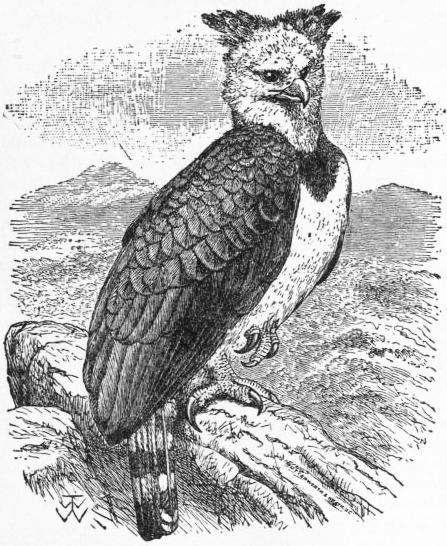
Harpy.
HARRAN, Haran or Charran (Sept. Χαῤῥάν or Χαῤῥά: Strabo, Κάῤῥαι: Pliny, Carrae or Carrhae; Arab. Harrān), in biblical history the place where Terah halted after leaving Ur, and apparently the birthplace of Abraham, a town on the stream Jullab, some nine hours’ journey from Edessa in Syria. At this point the road from Damascus joins the highway between Nineveh and Carchemish, and Haran had thus considerable military and commercial value. As a strategic position it is mentioned in inscriptions as early as the time of Tiglath Pileser I., about 1100 B.C., and subsequently by Sargon II., who restored the privileges lost at the rebellion which led to the conquest referred to in 2 Kings xix. 12 (= Isa. xxxvii. 12). It was the centre of a considerable commerce (Ezek. xxvii. 23), and one of its specialities was the odoriferous gum derived from the strobus (Pliny, H.N. xii. 40). It was here that Crassus in his eastern expedition was attacked and slain by the Parthians (53 B.C.); and here also the emperor Caracalla was murdered at the instigation of Macrinus (A.D. 217). Haran was the chief home of the moon-god Sin, whose temple was rebuilt by several kings, among them Assur-bani-pal and Nabunidus and Herodian (iv. 13, 7) mentions the town as possessing in his day a temple of the moon. In the middle ages it is mentioned as having been the seat of a particular heathen sect, that of the Haranite Sabeans. It retained its importance down to the period of the Arab ascendancy; but by Abulfeda it is mentioned as having before his time fallen into decay. It is now wholly in ruins. The Yahwistic writer (Gen. xxvii. 43) makes it the home of Laban and connects it with Isaac and Jacob. But we cannot thus put Haran in Aramnaharaim; the home of the Labanites is rather to be looked for in the very similar word Hauran.
HARRAR (or Harar), a city of N.E. Africa, in 8° 45′ N., 42° 36′ E., capital of a province of Abyssinia and 220 m. S.S.W. of the ports of Zaila (British) and Jibuti (French) on the Gulf of Aden. With Jibuti it is connected by a railway (188 m. long) and carriage-road. Harrar is built on the slopes of a hill at an elevation of over 5000 ft. A lofty stone wall, pierced by five gates and flanked by twenty-four towers, encloses the city, which has a population of about 40,000. The streets are steep, narrow, dirty and unpaved, the roadways consisting of rough boulders. The houses are in general made of undressed stone and mud and are flat-topped, the general aspect of the city being Oriental and un-Abyssinian. A few houses, including the palace of the governor and the foreign consulates, are of more elaborate and solid construction than the majority of the buildings. There are several mosques and an Abyssinian church (of the usual circular construction) built of stone. Harrar is a city of considerable commercial importance, through it passing all the merchandise of southern Abyssinia, Kaffa and Galla land. The chief traders are Abyssinians, Armenians and Greeks. The principal article of export is coffee, which is grown extensively in the neighbouring hills and is of the finest quality. Besides coffee there is a large trade in durra, the kat plant (used by the Mahommedans as a drug), ghee, cattle, mules and camels, skins and hides, ivory and gums. The import trade is largely in cotton goods, but every kind of merchandise is included.
Harrar is believed to owe its foundation to Arab immigrants from the Yemen in the 7th century of the Christian era. In the region of Somaliland, now the western part of the British protectorate of that name, the Arabs established the Moslem state of Adel or Zaila, with their capital at Zaila on the Gulf of Aden. In the 13th century the sultans of Adel enjoyed great power. In 1521 the then sultan Abubekr transferred the seat of government to Harrar, probably regarding Zaila as too exposed to the attacks of the Turkish and Portuguese navies then contending for the mastery of the Red Sea and Gulf of Aden. Abubekr’s successor was Mahommed III., Ahmed ibn Ibrahim el-Ghazi (1507-1543), surnamed Gran (Granyé), the left-handed. He was not an Arab but, probably, of Somali origin. The son of a noted warrior, he quickly rose to supreme power, becoming sultan or amir in 1525. He is famous for his invasion of Abyssinia, of which country he was virtual master for several years. From the beginning of the 17th century Adel suffered greatly from the ravages of pagan Galla tribes, and Harrar sank to the position of an amirate of little importance. It was first visited by a European in 1854 when (Sir) Richard Burton spent ten days there in the guise of an Arab. In 1875 Harrar was occupied by an Egyptian force under Raouf Pasha, by whose orders the amir was strangled. The town remained in the possession of Egypt until 1885, when the garrison was withdrawn in consequence of the rising of the Mahdi in the Sudan. The Egyptian garrison and many Egyptian civilians, in all 6500 persons, left Harrar between November 1884 and the 25th of April 1885, when a son of the ruler who had been deposed by Egypt was installed as amir, the arrangement being carried out under the superintendence of British officers. The new amir held power until January 1887, in which month Harrar was conquered by Menelek II., king of Shoa (afterwards emperor of Abyssinia). The governorship of Harrar was by Menelek entrusted to Ras Makonnen, who held the post until his death in 1906.
The Harrari proper are of a distinct stock from the neighbouring peoples, and speak a special language. Harrarese is “a Semitic graft inserted into an indigenous stock” (Sir R. Burton, First Footsteps in East Africa). The Harrari are Mahommedans of the Shafa’i or Persian sect, and they employ the solar year and the Persian calendar. Besides the native population there are in Harrar colonies of Abyssinians, Somalis and Gallas. By the Somalis the place is called Adari, by the Gallas Adaray.
See Abyssinia; Somaliland. Also P. Paulitschke, Harar: Forschungsreise nach den Somâl- und Galla-Ländern Ost-Afrikas (Leipzig, 1888).
HARRATIN, black Berbers, dwelling in Tidikelt and other Saharan oases. Many of them are blacker than the average negro. In physique, however, they are true to the Berber type, being of handsome appearance with European features and well-proportioned bodies. They are the result of an early crossing with the Sudanese negro races, though to-day they have all the pride of the Berbers (q.v.), and do not live with or intermarry among negroes.
HARRIER, or Hen-Harrier, name given to certain birds of prey which were formerly very abundant in parts of the British Islands, from their habit of harrying poultry. The first of these names has now become used in a generic sense for all the species ranked under the genus Circus of Lacépède, and the second confined to the particular species which is the Falco cyaneus of Linnaeus and the Circus cyaneus of modern ornithologists.
One European species, C. aeruginosus, though called in books the marsh-harrier, is far more commonly known in England and Ireland as the moor-buzzard. But harriers are not, like buzzards, arboreal in their habits, and always affect open country, generally, though not invariably, preferring marshy or fenny districts, for snakes and frogs form a great part of their ordinary food. On the ground their carriage is utterly unlike that of a buzzard, and their long wings and legs render it easy to distinguish the two groups when taken in the hand. All the species also have a more or less well-developed ruff or frill of small thickset feathers surrounding the lower part of the head, nearly like that seen in owls, and accordingly many systematists consider that the genus Circus, though undoubtedly belonging to the Falconidae, connects that family with the Striges. No osteological affinity, however, can be established between the harriers and any section of the owls, and the superficial resemblance will have to be explained in some other way. Harriers are found almost all over the world,1 and fifteen species are recognized by Bowdler Sharpe (Cat. Birds Brit. Museum, i. pp. 50-73). In most if not all the harriers the sexes differ greatly in colour, so much so that for a long while the males and females of one of the commonest and best known, the C. cyaneus above mentioned, were thought to be distinct species, and were or still are called in various European languages by different names. The error was maintained with the greater persistency since the young males, far more abundant than the adults, wear much the same plumage as their mother, and it was not until after Montagu’s observations were published at the beginning of the 19th century that the “ringtail,” as she was called (the Falco pygargus of Linnaeus), was generally admitted to be the female of the “hen-harrier.” But this was not Montagu’s only good service as regards this genus. He proved the hitherto unexpected existence of a second species,2 subject to the same diversity of plumage. This was called by him the ash-coloured falcon, but it now generally bears his name, and is known as Montagu’s harrier, C. cineraceus. In habits it is very similar to the hen-harrier, but it has longer wings, and its range is not so northerly, for while the hen-harrier extends to Lapland, Montagu’s is but very rare in Scotland, though in the south of England it is the most common species. Harriers indeed in the British Islands are rapidly becoming things of the past. Their nests are easily found, and the birds when nesting are easily destroyed. In the south-east of Europe, reaching also to the Cape of Good Hope and to India, there is a fourth species, the C. swainsoni of some writers, the C. pallidus of others. In North America C. cyaneus is represented by a kindred form, C. hudsonius, usually regarded as a good species, the adult male of which is always to be recognized by its rufous markings beneath, in which character it rather resembles C. cineraceus, but it has not the long wings of that species. South America has in C. cinereus another representative form, while China, India and Australia possess more of this type. Thus there is a section in which the males have a strongly contrasted black and grey plumage, and finally there is a group of larger forms allied to the European C. aeruginosus, wherein a grey dress is less often attained, of which the South African C. ranivorus and the New Zealand C. gouldi are examples.
(A. N.)
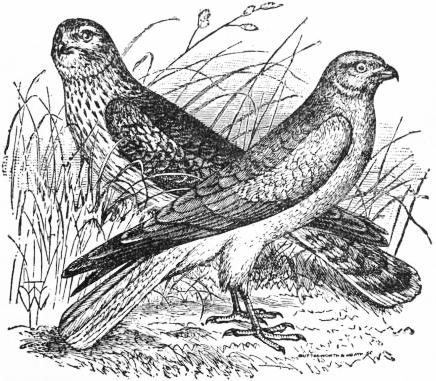
Hen-Harrier (Male and Female).
1 The distribution of the different species is rather curious, while the range of some is exceedingly wide,—one, C. maillardi, seems to be limited to the island of Réunion (Bourbon).
2 A singular mistake, which has been productive of further error, was made by Albin, who drew his figure (Hist. Birds, ii. pi. 5) from a specimen of one species, and coloured it from a specimen of the other.
HARRIGAN, EDWARD (1845- ), American actor, was born in New York of Irish parents on the 26th of October 1845. He made his first appearance in San Francisco in 1867, and soon afterwards formed a stage partnership with Tony Hart, whose real name was Anthony Cannon. As “Harrigan and Hart,” they had a great success in the presentation of types of low life in New York. Beginning as simple sketches, these were gradually worked up into plays, with occasional songs, set to popular music by David Braham. The titles of these plays indicate their character, The Mulligan Guards, Squatter Sovereignty, A Leather Patch, The O’Regans. The partnership with Hart lasted from 1871-1884. Subsequently Harrigan played in different cities of the United States, one of his favourite parts being George Coggswell in Old Lavender.
HARRIMAN, EDWARD HENRY (1848-1909), American financier and railroad magnate, son of the Rev. Orlando Harriman, rector of St George’s Episcopal church, Hempstead, L.I., was born at Hempstead on the 25th of February 1848. He became a broker’s clerk in New York at an early age, and in 1870 was able to buy a seat on the New York Stock Exchange on his own account. For a good many years there was nothing sensational in his success, but he built up a considerable business connexion and prospered in his financial operations. Meanwhile he carefully mastered the situation affecting American railways. In this respect he was assisted by his friendship with Mr Stuyvesant Fish, who, on becoming vice-president of the Illinois Central in 1883, brought Harriman upon the directorate, and in 1887, being then president, made Harriman vice-president; twenty years later it was Harriman who dominated the finance of the Illinois Central, and Fish, having become his opponent, was dropped from the board. It was not till 1898, however, that his career as a great railway organizer began with his formation, by the aid of the bankers, Kuhn, Loeb & Co., of a syndicate to acquire the Union Pacific line, which was then in the hands of a receiver and was generally regarded as a hopeless failure. It was soon found that a new power had arisen in the railway world. Having brought the Union Pacific out of bankruptcy into prosperity, and made it an efficient instead of a decaying line, he utilized his position to draw other lines within his control, notably the Southern Pacific in 1901. These extensions of his power were not made without friction, and his abortive contest in 1901 with James J. Hill for the control of the Northern Pacific led to one of the most serious financial crises ever known on Wall Street. But in the result he became the dominant factor in American railway matters. At his death, on the 9th of September 1909, his influence was estimated to extend over 60,000 m. of track, with an annual earning power of $700,000,000 or over. Astute and unscrupulous manipulation of the stock markets, and a capacity for the hardest of bargaining and the most determined warfare against his rivals, had their place in this success, and Harriman’s methods excited the bitterest criticism, culminating in a stern denunciation from President Roosevelt himself in 1907. Nevertheless, besides acquiring colossal wealth for himself, he helped to create for the American public a vastly improved railway service, the benefit of which survived all controversy as to the means by which he triumphed over the obstacles in his way.
HARRIMAN, a city of Roane county, Tennessee, U.S.A., on the Emory river, about 35 m. W. by S. of Knoxville. Pop. (1900) 3442 (516 being negroes); (1910) 3061. Harriman is served by the Harriman & North Eastern, the Tennessee Central, and the Southern railways. It is the seat of the East Tennessee Normal and Industrial Institute, for negroes, and of the American University of Harriman (Christian Church, coeducational; 1893), which comprises primary, preparatory, collegiate, Bible school, civic research, commercial, music and art departments, and in 1907-1908 had 12 instructors and 317 students. Near the city are large deposits of iron and an abundance of coal and timber. Among manufactures are cotton products, farming tools, leather, tannic acid, furniture and flour. Harriman was founded in 1890 by a land company. A clause in this company’s by-laws requires that every conveyance of real estate by the company “shall contain a provision forbidding the use of the property or any building thereon, for the purpose of making, storing or selling intoxicating beverages as such.” Harriman was chartered as a city in 1891, and its charter was revised in 1899.
HARRINGTON, EARLS OF. The first earl of Harrington was the diplomatist and politician, William Stanhope (c. 1690-1756), a younger son of John Stanhope of Elvaston, Derbyshire, and a brother of Charles Stanhope (1673-1760), an active politician during the reign of George I. His ancestor, Sir John Stanhope (d. 1638), was a half-brother of Philip Stanhope, 1st earl of Chesterfield. Educated at Eton, William Stanhope entered the army and served in Spain, but soon he turned his attention to more peaceful pursuits, went on a mission to Madrid and represented his country at Turin. When peace was made between England and Spain in 1720 Stanhope became British ambassador to the latter country, and he retained this position until March 1727, having built up his reputation as a diplomatist during a difficult period. In 1729 he had some part in arranging the treaty of Seville between England, France and Spain, and for his services in this matter he was created Baron Harrington in January 1730. Later in the same year he was appointed secretary of state for the northern department under Sir Robert Walpole, but, like George II., he was anxious to assist the emperor Charles VI. in his war with France, while Walpole favoured a policy of peace. Although the latter had his way Harrington remained secretary until the great minister’s fall in 1742, when he was transferred to the office of president of the council and was created earl of Harrington and Viscount Petersham. In 1744, owing to the influence of his political allies, the Pelhams, he returned to his former post of secretary of state, but he soon lost the favour of the king, and this was the principal cause why he left office in October 1746. He was lord lieutenant of Ireland from 1747 to 1751, and he died in London on the 8th of December 1756.
The earl’s successor was his son, William (1719-1779), who entered the army, was wounded at Fontenoy and became a general in 1770. He was a member of parliament for about ten years and he died on the 1st of April 1779. This earl’s wife Caroline (1722-1784), daughter of Charles Fitzroy, 2nd duke of Grafton, was a noted beauty, but was also famous for her eccentricities. Their elder son, Charles (1753-1829), who became the 3rd earl, was a distinguished soldier. He served with the British army during the American War of Independence and attained the rank of general in 1802. From 1805 to 1812 he was commander-in-chief in Ireland; he was sent on diplomatic errands to Vienna and to Berlin, and he died at Brighton on the 15th of September 1829.
Charles Stanhope, 4th earl of Harrington (1780-1851), the eldest son of the 3rd earl, was known as Lord Petersham until he succeeded to the earldom in 1829. He was very well known in society owing partly to his eccentric habits; he dressed like the French king Henry IV., and had other personal peculiarities. He married the actress, Maria Foote, but when he died in March 1851 he left no sons, and his brother Leicester Fitzgerald Charles (1784-1862) became the 5th earl. This nobleman was a soldier and a politician of advanced views, who is best known as a worker with Lord Byron in the cause of Greek independence. He was in Greece in 1823 and 1824, where his relations with Byron were not altogether harmonious. He wrote A Sketch of the History and Influence of the Press in British India (1823); and Greece in 1821 and 1824 (English edition 1824, American edition 1825). His son Sydney Seymour Hyde, 6th earl (1845-1866), dying unmarried, was succeeded by a cousin, Charles Wyndham Stanhope (1809-1881), as 7th earl, and in 1881 the latter’s son Charles Augustus Stanhope (b. 1844) became 8th earl of Harrington.
Before the time of the first earl of Harrington the Stanhope family had held the barony of Stanhope of Harrington, which was created in 1605 in favour of Sir John Stanhope (c. 1550-1621) of Harrington, Northamptonshire. Sir John was a younger son of Sir Michael Stanhope (d. 1552) of Shelford, Nottinghamshire, who was a brother-in-law of the protector Somerset. Sir Michael’s support of Somerset cost him his life, as he was beheaded on the 26th of February 1552. Sir John was treasurer of the chamber from 1596 to 1616 and was a member of parliament for several years. He died on the 9th of March 1621, and when his only son Charles, 2nd baron (c. 1595-1675), died without issue in 1675 the barony became extinct.
HARRINGTON, or Harington, JAMES (1611-1677), English political philosopher, was born in January 1611 of an old Rutlandshire family. He was son of Sir Sapcotes Harrington of Rand, Lincolnshire, and great-nephew of the first Lord Harington of Exton (d. 1615). In 1629 he entered Trinity College, Oxford, as a gentleman commoner. One of his tutors was the famous Chillingworth. After several years spent in travel, and as a soldier in the Dutch army, he returned to England and lived in retirement till 1646, when he was appointed to the suite of Charles I., at that time being conveyed from Newcastle as prisoner. Though republican in his ideas, Harrington won the king’s regard and esteem, and accompanied him to the Isle of Wight. He roused, however, the suspicion of the parliamentarians and was dismissed: it is said that he was for a short time put in confinement because he would not swear to refuse assistance to the king should he attempt to escape. After Charles’s death Harrington devoted his time to the composition of his Oceana, a work which pleased neither party. By order of Cromwell it was seized when passing through the press. Harrington, however managed to secure the favour of the Protector’s favourite daughter, Mrs Claypole; the work was restored to him, and appeared in 1656, dedicated to Cromwell. The views embodied in Oceana, particularly that bearing on vote by ballot and rotation of magistrates and legislators, Harrington and others (who in 1659 formed a club called the “Rota”) endeavoured to push practically, but with no success. In November 1661, by order of Charles II., Harrington was arrested, apparently without sufficient cause, on a charge of conspiracy, and was thrown into the Tower. Despite his repeated request no public trial could be obtained, and when at length his sisters obtained a writ of habeas corpus he was secretly removed to St Nicholas Island off Plymouth. There his health gave way owing to his drinking guaiacum on medical advice, and his mind appeared to be affected. Careful treatment restored him to bodily vigour, but his mind never wholly recovered. After his release he married,—at what date does not seem to be precisely known. He died on the 11th of September 1677, and was buried next to Sir Walter Raleigh in St Margaret’s, Westminster.
Harrington’s writings consist of the Oceana, and of papers, pamphlets, aphorisms, even treatises, in defence of the Oceana. The Oceana is a hard, prolix, and in many respects heavy exposition of an ideal constitution, “Oceana” being England, and the lawgiver Olphaus Megaletor, Oliver Cromwell. The details are elaborated with infinite care, even the salaries of officials being computed, but the main ideas are two in number, each with a practical corollary. The first is that the determining element of power in a state is property generally, property in land in particular; the second is that the executive power ought not to be vested for any considerable time in the same men or class of men. In accordance with the first of these, Harrington recommends an agrarian law, limiting the portion of land held to that yielding a revenue of £3000, and consequently insisting on particular modes of distributing landed property. As a practical issue of the second he lays down the rule of rotation by ballot. A third part of the executive or senate are voted out by ballot every year (not being capable of being elected again for three years). Harrington explains very carefully how the state and its governing parts are to be constituted by his scheme. Oceana contains many valuable ideas, but it is irretrievably dull.
His Works were edited with biography by John Toland in 1700; Toland’s edition, with additions by Birch, appeared in 1747, and again in 1771. Oceana was reprinted by Henry Morley in 1887. See Dwight in Political Science Quarterly (March, 1887). Harrington has often been confused with his cousin Sir James Harrington, a member of the commission which tried Charles I., and afterwards excluded from the acts of pardon.
HARRIOT, or Harriott, THOMAS (1560-1621), English mathematician and astronomer, was born at Oxford in 1560. After studying at St Mary Hall, Oxford, he became tutor to Sir Walter Raleigh, who appointed him in 1585 to the office of geographer to the second expedition to Virginia. Harriot published an account of this expedition in 1588, which was afterwards reprinted in Hakluyt’s Voyages. On his return to England, after an absence of two years, he resumed his mathematical studies, and having made the acquaintance of Henry Percy, earl of Northumberland, distinguished for his patronage of men of science, he received from him a yearly pension of £120. He died at London on the 2nd of July 1621. A manuscript of Harriot’s entitled Ephemeris chrysometria is preserved in Sion College; and his Artis analyticae praxis ad aequaliones algebraicas resolvendas was published at London in 1631. His contributions to algebra are treated in the article Algebra; Wallis’s History of Algebra (1685) may also be consulted. From some papers of Harriot’s, discovered in 1784, it would appear that he had either procured a telescope from Holland, or divined the construction of that instrument, and that he coincided in point of time with Galileo in discovering the spots on the sun’s disk.