VOLUME XIII SLICE I Harmony to Heanor (continued 3)
Reading edition
See Charles Hutton, Mathematical and Philosophical Dictionary (1815), and J. E. Montucla, Histoire des mathématiques (1758).
HARRIS, GEORGE, 1st Baron (1746-1829), British general, was the son of the Rev George Harris, curate of Brasted, Kent, and was born on the 18th of March 1746. Educated at Westminster school and at the Royal Military Academy, Woolwich, he was commissioned to the Royal Artillery in 1760, transferring to an ensigncy in the 5th foot (Northumberland Fusiliers) in 1762. Three years later he became lieutenant, and in 1771 captain. His first active service was in the American War of Independence, in which he served at Lexington, Bunker Hill (severely wounded) and in every engagement of Howe’s army except one up to November 1778. By this time he had obtained his majority, and his next service was under Major-General Medows at Santa Lucia in 1778-1779, after which his regiment served as marines in Rodney’s fleet. Later in 1779 he was for a time a prisoner of war. Shortly before his promotion to lieutenant-colonel in his regiment (1780) he married. After commanding the 5th in Ireland for some years, he exchanged and went with General Medows to Bombay, and served with that officer in India until 1792, taking part in various battles and engagements, notably Lord Cornwallis’s attack on Seringapatam. In 1794, after a short period of home service, he was again in India. In the same year he became major-general, and in 1796 local lieutenant-general in Madras. Up to 1800 he commanded the troops in the presidency, and for a short time he exercised the civil government as well. In December 1798 he was appointed by Lord Wellesley, the governor-general, to command the field army which was intended to attack Tipu Sahib, and in a few months Harris reduced the Mysore country and stormed the great stronghold of Seringapatam. His success established his reputation as a capable and experienced commander, and its political importance led to his being offered the reward (which he declined) of an Irish peerage. He returned home in 1800, became lieutenant-general in the army the following year, and attained the rank of full general in 1812. In 1815 he was made a peer of the United Kingdom under the title Baron Harris of Seringapatam and Mysore, and of Belmont, Kent. In 1820 he received the G.C.B., and in 1824 the governorship of Dumbarton Castle. Lord Harris died at Belmont in May 1829. He had been colonel of the 73rd Highlanders since 1800.
His descendant, the 4th Baron Harris (b. 1851), best known as a cricketer, was under-secretary for India (1885-1886), under-secretary for war (1886-1889) and governor of Bombay (1890-1895).
See Rt. Hon. S. Lushington, Life of Lord Harris (London, 1840), and the regimental histories of the 5th Northumberland Fusiliers and 73rd Highlanders.
HARRIS, JAMES (1709-1780), English grammarian, was born at Salisbury on the 20th of July 1709. He was educated at the grammar school in the Close at Salisbury, and at Wadham College, Oxford. On leaving the university he was entered at Lincoln’s Inn as a student of law, though not intended for the bar. The death of his father in 1733 placed him in possession of an independent fortune and of the house in Salisbury Close. He became a county magistrate, and represented Christchurch in parliament from 1761 till his death, and was comptroller to the queen from 1774 to 1780. He held office under Lord Grenville, retiring with him in 1765. The decided bent of his mind had always been towards the Greek and Latin classics; and to the study of these, especially of Aristotle, he applied himself with unremitting assiduity during a period of fourteen or fifteen years. He published in 1744 three treatises—on art; on music, painting and poetry; and on happiness. In 1751 appeared the work by which he became best known, Hermes, a philosophical inquiry concerning universal grammar. He also published Philosophical Arrangements and Philosophical Inquiries. Harris was a great lover of music, and adapted the words for a selection from Italian and German composers, published by the cathedral organist, James Corfe. He died on the 22nd of December 1780.
His works were collected and published in 1801, by his son, the first earl of Malmesbury, who prefixed a brief biography.
HARRIS, JOEL CHANDLER (1848-1908), American author, was born in Eatonton, Putnam county, Georgia, on the 8th of December 1848. He started as an apprentice to the printer’s trade in the office of the Countryman, a weekly paper published on a plantation not far from his home. He then studied law, and practised for a short time in Forsyth, Ga., but soon took to journalism. He joined the staff of the Savannah Daily News in 1871, and in 1876 that of the Atlanta Constitution, of which he was an editor from 1890 to 1901, and in this capacity did much to further the cause of the New South. But his most distinctive contribution to this paper, and to American literature, consisted of his dialect pieces dealing with negro life and folk-lore. His stories are characterized by quaint humour, poetic feeling and homely philosophy; and “Uncle Remus,” the principal character of most of them, is a remarkably vivid and real creation. The first collection of his stories was published in 1880 as Uncle Remus: his Songs and his Sayings. Among his later works are Nights with Uncle Remus (1883), Mingo and Other Sketches in Black and White (1884), Free Joe and Other Georgian Sketches (1887), Balaam and His Master and Other Sketches and Stories (1891), Uncle Remus and His Friends (1892), On the Plantation (1892), which is partly autobiographic, Sister Jane (1896), The Chronicles of Aunt Minervy Ann (1899), and The Tar-Baby and Other Rhymes of Uncle Remus (1904). More purely juvenile are Daddy Jake the Runaway and Other Stories (1889), Little Mr Thimblefinger and his Queer Country (1894) and its sequel Mr Rabbit at Home (1895), Aaron in the Wildwoods (1897), Plantation Pageants (1899), Told by Uncle Remus (1905), and Uncle Remus and Br’er Rabbit (1907). He was one of the compilers of the Life of Henry W. Grady, including his Writings and Speeches (1890) and wrote Stories of Georgia (1896), and Georgia from the Invasion of De Soto to Recent Times (1899). He died in Atlanta on the 3rd of July 1908.
HARRIS, JOHN (c. 1666-1719), English writer. He is best known as the editor of the Lexicon technicum, or Dictionary of the Arts and Sciences (1704), which ranks as the earliest of the long line of English encyclopaedias, and as the compiler of the Collection of Voyages and Travels which passes under his name. He was born about 1666, probably in Shropshire, and was a scholar of Trinity College, Oxford, from 1684 to 1688. He was presented to the vicarage of Icklesham in Sussex, and subsequently to the rectory of St Thomas, Winchelsea. In 1698 he was entrusted with the delivery of the seventh series of the Boyle lectures—Atheistical Objections against the Being of God and His Attributes fairly considered and fully refuted. Between 1702 and 1704 he delivered at the Marine Coffee House in Birchin Lane the mathematical lectures founded by Sir Charles Cox, and advertised himself as a mathematical tutor at Amen Corner. The friendship of Sir William Cowper, afterwards lord chancellor, secured for him the office of private chaplain, a prebend in Rochester cathedral (1708), and the rectory of the united parishes of St Mildred, Bread Street and St Margaret Moses, in addition to other preferments. He showed himself an ardent supporter of the government, and engaged in a bitter quarrel with the Rev. Charles Humphreys, who afterwards was chaplain to Dr Sacheverel. Harris was one of the early members of the Royal Society, and for a time acted as vice-president. At his death on the 7th of September 1719, he was busy completing an elaborate History of Kent. He is said to have died in poverty brought on by his own bad management of his affairs.
HARRIS, THOMAS LAKE (1823-1906), American spiritualistic “prophet,” was born at Fenny Stratford in Buckinghamshire, England, on the 15th of May 1823. His parents were Calvinistic Baptists, and very poor. They settled at Utica, New York, when Harris was five years old. When he was about twenty Harris became a Universalist preacher, and then a Swedenborgian. He became associated about 1847 with a spiritualist of indifferent character named Davis. After Davis had been publicly exposed, Harris established a congregation in New York. About 1850 he professed to receive inspirations, and published some long poems. He had the gift of improvisation in a very high degree. About 1859 he preached in London, and is described as a man “with low, black eyebrows, black beard, and sallow countenance.” He was an effective speaker, and his poetry was admired by many; Alfred Austin in his book The Poetry of the Period even devoted a chapter to Harris. He founded in 1861 a community at Wassaic, New York, and opened a bank and a mill, which he superintended. There he was joined by about sixty converts, including five orthodox clergymen, some Japanese people, some American ladies of position, and especially by Laurence Oliphant (q.v.) with his wife and mother. The community—the Brotherhood of the New Life—decided to settle at the village of Brocton on the shore of Lake Erie. Harris established there a wine-making industry. In reply to the objections of teetotallers he said that the wine prepared by himself was filled with the divine breath so that all noxious influences were neutralized. Harris also built a tavern and strongly advocated the use of tobacco. He exacted complete surrender from his disciples—even the surrender of moral judgment. He taught that God was bi-sexual, and apparently, though not in reality, that the rule of society should be one of married celibacy. He professed to teach his community a change in the mode of respiration which was to be the visible sign of possession by Christ and the seal of immortality. The Oliphants broke away from the restraint about 1881, charging him with robbery and succeeding in getting back from him many thousands of pounds by legal proceedings. But while losing faith in Harris himself, they did not abandon his main teaching. In Laurence Oliphant’s novel Masollam his view of Harris will be found. Briefly, he held that Harris was originally honest, greatly gifted, and possessed of certain psychical powers. But in the end he came to practise unbridled licence under the loftiest pretensions, made the profession of extreme disinterestedness a cloak to conceal his avarice, and demanded from his followers a blind and supple obedience. Harris in 1876 discontinued for a time public activities, but issued to a secret circle books of verse dwelling mainly on sexual questions. On these his mind ran from the first. In 1891 he announced that his body had been renewed, and that he had discovered the secret of the resuscitation of humanity. He published a book, Lyra triumphalis, dedicated to A. C. Swinburne. He also made a third marriage, and visited England intending to remain there. He was called back by a fire which destroyed large stocks of his wine, and remained in New York till 1903, when he visited Glasgow. His followers believed that he had attained the secret of immortal life on earth, and after his death on the 23rd of March 1906 declared that he was only sleeping. It was three months before it was acknowledged publicly that he was really dead. There can be little or no doubt as to the real character of Harris. His teaching was esoteric in form, but is a thinly veiled attempt to alter the ordering of sexual relations.
The authoritative biography from the side of his disciples is the Life by A. A. Cuthbert, published in Glasgow in 1908. It is full of the jargon of Harris’s sect, but contains some biographical facts as well as many quotations. Mrs Oliphant’s Life of Laurence Oliphant (1891) has not been shaken in any important particular, and Oliphant’s own portrait of Harris in Masollam is apparently unexaggerated. But Harris had much personal magnetism, unbounded self-confidence, along with endless fluency, and to the last was believed in by some disciples of character and influence.
(W. R. Ni.)
HARRIS, SIR WILLIAM SNOW (1791-1867), English electrician, was descended from an old family of solicitors at Plymouth, where he was born on the 1st of April 1791. He received his early education at the Plymouth grammar-school, and completed a course of medical studies at the university of Edinburgh, after which he established himself as a general medical practitioner in Plymouth. On his marriage in 1824 he resolved to abandon his profession on account of its duties interfering too much with his favourite study of electricity. As early as 1820 he had invented a new method of arranging the lightning conductors of ships, the peculiarity of which was that the metal was permanently fixed in the masts and extended throughout the hull; but it was only with great difficulty, and not till nearly thirty years afterwards, that his invention was adopted by the government for the royal navy. In 1826 he read a paper before the Royal Society “On the Relative Powers of various Metallic Substances as Conductors of Electricity,” which led to his being elected a fellow of the society in 1831. Subsequently, in 1834, 1836 and 1839, he read before the society several valuable papers on the elementary laws of electricity, and he also communicated to the Royal Society of Edinburgh various interesting accounts of his experiments and discoveries in the same field of inquiry. In 1835 he received the Copley gold medal from the Royal Society for his papers on the laws of electricity of high tension, and in 1839 he was chosen to deliver the Bakerian lecture. Meanwhile, although a government commission had recommended the general adoption of his conductors in the royal navy, and the government had granted him an annuity of £300 “in consideration of services in the cultivation of science,” the naval authorities continued to offer various objections to his invention; to aid in removing these he in 1843 published his work on Thunderstorms, and also about the same time contributed a number of papers to the Nautical Magazine illustrative of damage by lightning. His system was actually adopted in the Russian navy before he succeeded in removing the prejudices against it in England, and in 1845 the emperor of Russia, in acknowledgment of his services, presented him with a valuable ring and vase. At length, the efficiency of his system being acknowledged, he received in 1847 the honour of knighthood, and subsequently a grant of £5000. After succeeding in introducing his invention into general use Harris resumed his labours in the field of original research, but as he failed to realize the advances that had been made by the new school of science his application resulted in no discoveries of much value. His manuals of Electricity, Galvanism and Magnetism, published between 1848 and 1856, were, however, written with great clearness, and passed through several editions. He died at Plymouth on the 22nd of January 1867, while having in preparation a Treatise on Frictional Electricity, which was published posthumously in the same year, with a memoir of the author by Charles Tomlinson.
HARRIS, WILLIAM TORREY (1835-1909), American educationist, was born in North Killingly, Connecticut, on the 10th of September 1835. He studied at Phillips Andover Academy, Andover, Massachusetts, and entered Yale, but left in his junior year (1857) to accept a position as a teacher of shorthand in the St Louis, Missouri, public schools. Advancing through the grades of principal and assistant superintendent, he was city superintendent of schools from 1867 until 1880. In 1858, under the stimulus of Henry C. Brockmeyer, Harris became interested in modern German philosophy in general, and in particular in Hegel, whose works a small group, gathering about Harris and Brockmeyer, began to study in 1859. From 1867 to 1893 Harris edited The Journal of Speculative Philosophy (22 vols.), which was the quarterly organ of the Philosophical Society founded in 1866. The Philosophical Society died out before 1874, when Harris founded in St Louis a Kant Club, which lived for fifteen years. In 1873, with Miss Susan E. Blow, he established in St Louis the first permanent public-school kindergarten in America. He represented the United States Bureau of Education at the International Congress of Educators at Brussels in 1880. In 1889 he represented the United States Bureau of Education at the Paris Exposition, and from 1889 to 1906 was United States commissioner of education. In 1899 the university of Jena gave him the honorary degree of Doctor of Philosophy for his work on Hegel. In 1906 the Carnegie Foundation for the Advancement of Teaching conferred upon him “as the first man to whom such recognition for meritorious service is given, the highest retiring allowance which our rules will allow, an annual income of $3000.” Besides being a contributor to the magazines and encyclopedias on educational and philosophical subjects, he wrote An Introduction to the Study of Philosophy (1889); The Spiritual Sense of Dante’s Divina Commedia (1889); Hegel’s Logic (1890); and Psychologic Foundations of Education (1898); and edited Appleton’s International Education Series and Webster’s International Dictionary. He died on the 5th of November 1909.
See Henry R. Evans, “A List of the Writings of William Torrey Harris” in the Report of the Commissioner of Education for 1907, vol. i. (Washington, 1908).
HARRISBURG, the capital of Pennsylvania, U.S.A., and the county-seat of Dauphin county, on the E. bank of the Susquehanna river, about 105 m. W. by N. of Philadelphia. Pop. (1890), 39,385; (1900), 50,167, of whom 2493 were foreign-born and 4107 were negroes; (1910 census) 64,186. It is served by the Pennsylvania, the Philadelphia & Reading, the Northern Central and the Cumberland Valley railways; and the Pennsylvania canal gives it water communication with the ocean. The river here is a mile wide, and is ordinarily very shallow and dotted with islets, but rises from 4 to 6 ft. after a moderate rain; it is spanned by several bridges.
The city lies for the most part on the E. slope of a hill extending from the river bank, several feet in height, across the Pennsylvania canal to Paxton Creek. Front Street, along the river, is part of a parkway connecting the park system with which the city is encircled. Overlooking it are the finest residences, among them the governor’s mansion. State Street, 120 ft. in width, runs at right angles with Front Street through the business centre of the city, being interrupted by the Capitol Park (about 16 acres). The Capitol,1 dedicated in 1906, was erected to replace one burned in 1897; it is a fine building, with a dome modelled after St Peter’s at Rome. At the main entrance are bronze doors, decorated in relief with scenes from the state’s history; the floor of the rotunda is of tiles made at Doylestown, in the style of the pottery made by early Moravian settlers, and illustrating the state’s resources; the Senate Chamber and the House Chamber have stained-glass windows by W. B. van Ingen and mural paintings by Edwin A. Abbey, who painted a series, “The Development of the Law,” for the Supreme Court room in the eastern wing and decorated the rotunda. The mural decorations of the south corridor, by W. B. van Ingen, portray the state’s religious sects; those in the north corridor, by John W. Alexander, represent the changes in the physical and material character of the state; and there is a frieze by Miss Violet Oakley, “The Founding of the State of Liberty Spiritual,” in the governor’s reception room. Two heroic groups of statuary for the building were designed by George Grey Barnard. The state library in the Capitol contains about 150,000 volumes. In the same park is also a monument 105 ft. high erected in 1868 to the memory of the soldiers who fell in the Mexican War; it has a column of Maryland marble 76 ft. high, which is surmounted by an Italian marble statue of Victory, executed in Rome. At the base of the monument are muskets used by United States soldiers in that war and guns captured at Cerro Gordo. In State Street is the Dauphin County Soldiers’ monument, a shaft 10 ft. sq. at the base and 110 ft. high, with a pyramidal top.
For several years prior to 1902 Harrisburg suffered much from impure water, a bad sewerage system, and poorly paved and dirty streets. In that year, however, a League for Municipal Improvements was formed; in February 1902 a loan of $1,000,000 for municipal improvements was voted, landscape gardeners and sewage engineers were consulted, and a non-partisan mayor was elected, under whom great advances were made in street cleaning and street paving, a new filtration plant was completed, the river front was beautified and protected from flood, sewage was diverted from Paxton Creek, and the development of an extensive park system was undertaken.
Harrisburg’s charitable institutions include a city hospital, a home for the friendless, a children’s industrial home, and a state lunatic hospital (1845). The city is the seat of a Roman Catholic bishopric. Both coal and iron ore abound in the vicinity, and the city has numerous manufacturing establishments. The value of its factory products in 1905 was $17,146,338 (14.3% more than in 1900), the more important being those of steel works and rolling mills ($4,528,907), blast furnaces, steam railway repair shops, cigar and cigarette factories ($1,258,498), foundries and machine shops ($953,617), boot and shoe factories ($922,568), flouring and grist mills, slaughtering and meat-packing establishments and silk mills.
Harrisburg was named in honour of John Harris, who, upon coming into this region to trade early in the 18th century, was attracted to the site as an easy place at which to ford the Susquehanna, and about 1726 settled here. He was buried in what is now Harris Park, where he erected the first building, a small hut, within the present limits of Harrisburg. In 1753 his son established a ferry over the river, and the place was called Harris’s Ferry until 1785, when the younger Harris laid out the town and named it Harrisburg. In the same year it was made the county-seat of the newly constituted county of Dauphin, and its name was changed to Louisburg; but when, in 1791, it was incorporated as a borough, the present name was again adopted. In 1812, after an effort begun twenty-five years before, it was made the capital of the state; and in 1860 it was chartered as a city. In the summer of 1827, through the persistent efforts of persons most interested in the woollen manufactures of Massachusetts and other New England states to secure legislative aid for that industry, a convention of about 100 delegates—manufacturers, newspaper men and politicians—was held in Harrisburg, and the programme adopted by the convention did much to bring about the passage of the famous high tariff act of 1828.
1 For this building the legislature in 1901 appropriated $4,000,000, stipulating that it should be completed before the 1st of January 1907. It was completed by that time, the net expenditure of the building commission being about $3,970,000. Although the legislature had made no provision for furniture and decoration, the state Board of Public Grounds and Buildings (governor, auditor-general and treasurer) undertook to complete the furnishing and decoration of the building within the stipulated time, and paid out for that purpose more than $8,600,000. In May 1906 a new treasurer entered office, who discovered that many items for furniture and decoration were charged twice, once at a normal and again at a remarkably high figure. In 1907 the legislature appointed a committee to investigate the charge of fraud. The committee’s decision was that the Board of Grounds and Buildings was not authorized to let the decorating and furnishing of the state house; that it had illegally authorized certain expenditures; and that architect and contractors had made fraudulent invoices and certificates. Various indictments were found: in the first trial for conspiracy in the making and delivering of furniture the contractor and the former auditor-general, state treasurer and superintendent of public grounds and buildings were convicted and in December 1908 were sentenced to two years’ imprisonment and fined $500 each; in 1910 a suit was brought for the recovery of about $5,000,000 from those responsible.
HARRISMITH, a town in the Orange Free State, 60 m. N.W. by rail of Ladysmith, Natal, and 240 m. N.E. of Bloemfontein via Bethlehem. Pop. (1904) 8300 (including troops 1921). It is built on the banks of the Wilge, 5250 ft. above the sea and some 20 m. W. of the Drakensberg. Three miles N. is the Platberg, a table-shaped mountain rising 2000 ft. above the town, whence an excellent supply of water is derived. The town is well laid out and several of the streets are lined with trees. Most of the houses are built of white stone quarried in the neighbourhood. The Kaffirs, who numbered in 1904 3483, live in a separate location. Harrismith has a dry, bracing climate and enjoys a high reputation in South Africa as a health resort. It serves one of the best-watered and most fertile agricultural and pastoral districts of the province, of which it is the chief eastern trading centre. Wool and hides are the principal exports.
Harrismith was founded in 1849, the site first chosen being on the Elands river, where the small town of Aberfeldig now is; but the advantages of the present site soon became apparent and the settlement was removed. The founders were Sir Harry Smith (after whom the town is named), then governor of Cape Colony, and Major Henry D. Warden, at that time British resident at Bloemfontein, whose name is perpetuated in that of the principal street. In a cave about 2 m. from the town are well-preserved Bushman paintings.
HARRISON, BENJAMIN (1833-1901), the twenty-third president of the United States, was born at North Bend, near Cincinnati, Ohio, on the 20th of August 1833. His great-grandfather, Benjamin Harrison of Virginia (c. 1740-1791), was a signer of the Declaration of Independence. His grandfather, William Henry Harrison (1773-1841), was ninth president of the United States. His father, John Scott Harrison (1804-1878), represented his district in the national House of Representatives in 1853-1857. Benjamin’s youth was passed upon the ancestral farm, and as opportunity afforded he attended school in the log school-house near his home. He was prepared for college by a private tutor, studied for two years at the Farmers’ College, near Cincinnati, and in 1852 graduated from Miami University, at that time the leading educational institution in the State of Ohio. From his youth he was diligent in his studies and a great reader, and during his college life showed a marked talent for extemporaneous speaking. He pursued the study of law, partly in the office of Bellamy Storer (1798-1875), a leading lawyer and judge of Cincinnati, and in 1853 he was admitted to the bar. At the age of twenty-one he removed to Indianapolis. He had but one acquaintance in the place, the clerk of the federal court, who permitted him to occupy a desk in his office and place at the door his sign as a lawyer. Waiting for professional business, he was content to act as court crier for two dollars and a half a day; but he soon gave indications of his talent, and his studious habits and attention to his cases rapidly brought him clients. Within a few years he took rank among the leading members of the profession at a bar which included some of the ablest lawyers of the country. His legal career was early interrupted by the Civil War. His whole heart was enlisted in the anti-slavery cause, and during the second year of the war he accepted a commission from the governor of the state as second-lieutenant and speedily raised a regiment. He became its colonel, and as such continued in the Union Army until the close of the war, and on the 23rd of January 1865 was breveted a brigadier-general of volunteers for “ability and manifest energy and gallantry in command of brigade.” He participated with his regiment in various engagements during General Don Carlos Buell’s campaigns in Kentucky and Tennessee in 1862 and 1863; took part in General W. T. Sherman’s march on Atlanta in 1864 and in the Nashville campaign of the same year; and was transferred early in 1865 to Sherman’s army in its march through the Carolinas. As the commander of a brigade he served with particular distinction in the battles of Kenesaw Mountain (June 29-July 3, 1864), Peach Tree Creek (20th of July 1864) and Nashville (15th-16th of December 1864).
Allowing for this interval of military service, he applied himself exclusively for twenty-four years to his legal work. The only office he held was that of reporter of the supreme court of Indiana for two terms (1860-1862 and 1864-1868), and this was strictly in the line of his profession. He was a devoted member of the Republican party, but not a politician in the strict sense. Once he became a candidate for governor, in 1876, but his candidature was a forlorn hope, undertaken from a sense of duty after the regular nominee had withdrawn. He took a deep interest in the campaign which resulted in the election of James A. Garfield as president, and was offered by him a place in his cabinet; but this he declined, having been elected a member of the United States Senate, in which he took his seat on the 4th of March 1881. He was chairman of the committee on territories, and took an active part in urging the admission as states of North Dakota, South Dakota, Washington, Idaho and Montana, which finally came into the Union during his presidency. He served also on the committee of military and Indian affairs, the committee on foreign relations and others, was prominent in the discussion of matters brought before the Senate from these committees, advocated the enlargement of the navy and the reform of the civil service, and opposed the pension veto messages of President Cleveland. Having failed to secure a re-election to the Senate in 1887, Harrison was nominated by the Republican party for the presidency in 1888, and defeated Grover Cleveland, the candidate of the Democratic party, receiving 233 electoral votes to Cleveland’s 168. Among the measures and events distinguishing his term as president were the following: The meeting of the Pan-American Congress at Washington; the passage of the McKinley Tariff Bill and of the Sherman Silver Bill of 1890; the suppressing of the Louisiana Lottery; the enlargement of the navy; further advance in civil service reform; the convocation by the United States of an international monetary conference; the establishment of commercial reciprocity with many countries of America and Europe; the peaceful settlement of a controversy with Chile; the negotiation of a Hawaiian Annexation Treaty, which, however, before its ratification, his successor withdrew from the Senate; the settlement of difficulties with Germany concerning the Samoan Islands, and the adjustment by arbitration with Great Britain of the Bering Sea fur-seal question. His administration was marked by a revival of American industries and a reduction of the public debt, and at its conclusion the country was left in a condition of prosperity and on friendly terms with foreign nations. He was nominated by his party in 1892 for re-election, but was defeated by Cleveland, this result being due, at least in part, to the labour strikes which occurred during the presidential campaign and arrayed the labour unions against the tariff party.
After leaving public life he resumed the practice of the law, and in 1898 was retained by the government of Venezuela as its leading counsel in the arbitration of its boundary dispute with Great Britain. In this capacity he appeared before the international tribunal of arbitration at Paris in 1899, worthily maintaining the reputation of the American bar. After the Spanish-American War he strongly disapproved of the colonial policy of his party, which, however, he continued to support. He occupied a portion of his leisure in writing a book, entitled This Country of Ours (1897), treating of the organization and administration of the government of the United States, and a collection of essays by him was published posthumously, in 1901, under the title Views of an Ex-President. He died at Indianapolis on the 13th of March 1901. Harrison’s distinguishing trait of character, to which his success is to be most largely attributed, was his thoroughness. He was somewhat reserved in manner, and this led to the charge in political circles that he was cold and unsympathetic; but no one gathered around him more devoted and loyal friends, and his dignified bearing in and out of office commanded the hearty respect of his countrymen.
President Harrison was twice married; in 1853 to Miss Caroline Lavinia Scott, by whom he had a son and a daughter, and in 1896 to Mrs Mary Scott Lord Dimmock, by whom he had a daughter.
A “campaign” biography was published by Lew Wallace (Philadelphia, 1888), and a sketch of his life may be found in Presidents of the United States (New York, 1894), edited by James Grant Wilson.
(J. W. Fo.)
HARRISON, FREDERIC (1831- ), English jurist and historian, was born in London on the 18th of October 1831. Members of his family (originally Leicestershire yeomen) had been lessees of Sutton Place, Guildford, of which he wrote an interesting account (Annals of an Old Manor House, 1893). He was educated at King’s College school and at Wadham College, Oxford, where, after taking a first-class in Literae Humaniores in 1853, he became fellow and tutor. He was called to the bar in 1858, and, in addition to his practice in equity cases, soon began to distinguish himself as an effective contributor to the higher-class reviews. Two articles in the Westminster Review, one on the Italian question, which procured him the special thanks of Cavour, the other on Essays and Reviews, which had the probably undesigned effect of stimulating the attack on the book, attracted especial notice. A few years later Mr Harrison worked at the codification of the law with Lord Westbury, of whom he contributed an interesting notice to Nash’s biography of the chancellor. His special interest in legislation for the working classes led him to be placed upon the Trades Union Commission of 1867-1869; he was secretary to the commission for the digest of the law, 1869-1870; and was from 1877 to 1889 professor of jurisprudence and international law under the council of legal education. A follower of the positive philosophy, but in conflict with Richard Congreve (q.v.) as to details, he led the Positivists who split off and founded Newton Hall in 1881, and he was president of the English Positivist Committee from 1880 to 1905; he was also editor and part author of the Positivist New Calendar of Great Men (1892), and wrote much on Comte and Positivism. Of his separate publications, the most important are his lives of Cromwell (1888), William the Silent (1897), Ruskin (1902), and Chatham (1905); his Meaning of History (1862; enlarged 1894) and Byzantine History in the Early Middle Ages (1900); and his essays on Early Victorian Literature (1896) and The Choice of Books (1886) are remarkable alike for generous admiration and good sense. In 1904 he published a “romantic monograph” of the 10th century, Theophano, and in 1906 a verse tragedy, Nicephorus. An advanced and vehement Radical in politics and Progressive in municipal affairs, Mr Harrison in 1886 stood unsuccessfully for parliament against Sir John Lubbock for London University. In 1889 he was elected an alderman of the London County Council, but resigned in 1893. In 1870 he married Ethel Berta, daughter of Mr William Harrison, by whom he had four sons. George Gissing, the novelist, was at one time their tutor; and in 1905 Mr Harrison wrote a preface to Gissing’s Veranilda (see also Mr Austin Harrison’s article on Gissing in the Nineteenth Century, September 1906). As a religious teacher, literary critic, historian and jurist, Mr Harrison took a prominent part in the life of his time, and his writings, though often violently controversial on political and social subjects, and in their judgment and historical perspective characterized by a modern Radical point of view, are those of an accomplished scholar, and of one whose wide knowledge of literature was combined with independence of thought and admirable vigour of style. In 1907 he published The Creed of a Layman, Apologia pro fide mea, in explanation of his religious position.
HARRISON, JOHN (1693-1776), English horologist, was the son of a carpenter, and was born at Faulby, near Pontefract in Yorkshire, in the year 1693. Thence his father and family removed in 1700 to Barrow in Lincolnshire. Young Harrison at first learned his father’s trade, and worked at it for several years, at the same time occasionally making a little money by land-measuring and surveying. The bent of his mind, however, was towards mechanical pursuits. In 1715 he made a clock with wooden wheels, which is in the patent museum at South Kensington, and in 1726 he devised his ingenious “gridiron pendulum,” which maintains its length unaltered in spite of variations of temperature (see Clock). Another invention of his was a recoil clock escapement in which friction was reduced to a minimum, and he was the first to employ the commonly used and effective form of “going ratchet,” which is a spring arrangement for keeping the timepiece going at its usual rate during the interval of being wound up.
In Harrison’s time the British government had become fully alive to the necessity of determining more accurately the longitude at sea. For this purpose they passed an act in 1713 offering rewards of £10,000, £15,000 and £20,000 to any who should construct chronometers that would determine the longitude within 60, 40 and 30 m. respectively. Harrison applied himself vigorously to the task, and in 1735 went to the Board of Longitude with a watch which he also showed to Edmund Halley, George Graham and others. Through their influence he was allowed to proceed in a king’s ship to Lisbon to test it; and the result was so satisfactory that he was paid £500 to carry out further improvements. Harrison worked at the subject with the utmost perseverance, and, after making several watches, went up to London in 1761 with one which he considered almost perfect. His son William was sent on a voyage to Jamaica to test it; and, on his return to Portsmouth in 1762, it was found to have lost only 1 minute 54½ seconds. This was surprisingly accurate, as it determined the longitude within 18 m., and Harrison claimed the full reward of £20,000; but though from time to time he received sums on account, it was not till 1773 that he was paid in full. In these watches compensation for changes of temperature was applied for the first time by means of a “compensation-curb,” designed to alter the effective length of the balance-spring in proportion to the expansion or contraction caused by variations of temperature. Harrison died in London on the 24th of March 1776. His want of early education was felt by him greatly throughout life. He was unfortunately never able to express his ideas clearly in writing, although in conversation he could give a very precise and exact account of his many intricate mechanical contrivances.
Among his writings were a Description concerning such Mechanism as will afford a Nice or True Mensuration of Time (1775), and The Principles of Mr Harrison’s Timekeeper, published by order of the Commissioners of Longitude (1767).
HARRISON, THOMAS (1606-1660), English parliamentarian, a native of Newcastle-under-Lyme in Staffordshire, the son of a butcher and mayor of that town, was baptized in 1606. He was placed with an attorney of Clifford’s Inn, but at the beginning of the war in 1642 he enlisted in Essex’s lifeguards, became major in Fleetwood’s regiment of horse under the earl of Manchester, was present at Marston Moor, at Naseby, Langport and at the taking of Winchester and Basing, as well as at the siege of Oxford. At Basing Harrison was accused of having killed a prisoner in cold blood. In 1646 he was returned to parliament for Wendover, and served in Ireland in 1647 under Lord Lisle, returning to England in May, when he took the side of the army in the dispute with the parliament and obtained from Fairfax a regiment of horse. In November he opposed the negotiations with the king, whom he styled “a man of blood” to be called to account, and he declaimed against the House of Lords. At the surprise of Lambert’s quarters at Appleby on the 18th of July 1648, in the second civil war, he distinguished himself by his extraordinary daring and was severely wounded. He showed a special zeal in bringing about the trial of the king. Charles was entrusted to his care on being brought up from Hurst Castle to London, and believed that Harrison intended his assassination, but was at once favourably impressed by bis bearing and reassured by his disclaiming any such design. Harrison was assiduous in his attendance at the trial, and signed the death-warrant with the fullest conviction that it was his duty. He took part in suppressing the royalist rising in the midlands in May 1649, and in July was appointed to the chief command in South Wales, where he is said to have exercised his powers with exceptional severity. On the 20th of February 1651 he became a member of the council of state, and during Cromwell’s absence in Scotland held the supreme military command in England. He failed in stopping the march of the royalists into England at Knutsford on the 16th of August 1651, but after the battle of Worcester he rendered great service in pursuing and capturing the fugitives. Later he pressed on Cromwell the necessity of dismissing the Long Parliament, and it was he who at Cromwell’s bidding, on the 20th of April 1653, laid hands on Speaker Lenthall and compelled him to vacate the chair. He was president of the council of thirteen which now exercised authority, and his idea of government appears to have been an assembly nominated by the congregations, on a strictly religious basis, such as Barebone’s Parliament which now assembled, of which he was a member and a ruling spirit. Harrison belonged to the faction of Fifth Monarchy men, whose political ideals were entirely destroyed by Cromwell’s assumption of the protectorate. He went immediately into violent opposition, was deprived of his commission on the 22nd of December 1653, and on the 3rd of February 1654 was ordered to confine himself to his father’s house in Staffordshire. Suspected of complicity in the plots of the anabaptists, he was imprisoned for a short time in September, and on that occasion was sent for by Cromwell, who endeavoured in a friendly manner to persuade him to desist. He, however, incurred the suspicions of the administration afresh, and on the 15th of February 1655 he was imprisoned in Carisbrooke Castle, being liberated in March 1656 when he took up his residence at Highgate with his family. In April 1657 he was arrested for supposed complicity in Venner’s conspiracy, and again once more in February 1658, when he was imprisoned in the Tower. At the Restoration, Harrison, who was excepted from the Act of Indemnity, refused to take any steps to save his life, to give any undertaking not to conspire against the government or to flee. “Being so clear in the thing,” he declared, “I durst not turn my back nor step a foot out of the way by reason I had been engaged in the service of so glorious and great a God.” He was arrested in Staffordshire in May 1660 and brought to trial on the 11th of October. He made a manly and straightforward defence, pleading the authority of parliament and adding, “May be I might be a little mistaken, but I did it all according to the best of my understanding, desiring to make the revealed will of God in His holy scriptures a guide to me.” At his execution, which took place at Charing Cross on the 13th of October 1660, he behaved with great fortitude.
Richard Baxter, who was acquainted with him, describes Harrison as “a man of excellent natural parts for affection and oratory, but not well seen in the principles of his religion of a sanguine complexion, naturally of such a vivacity, hilarity and alacrity as another man hath when he hath drunken a cup too much, but naturally also so far from humble thoughts of himself that it was his ruin.” Cromwell also complained of his excessive eagerness. “Harrison is an honest man and aims at good things, yet from the impatience of his spirit will not wait the Lord’s leisure but hurries me on to that which he and all honest men will have cause to repent.” Harrison was an eloquent and fluent expounder of the scriptures, and his “raptures” on the field of victory are recorded by Baxter. He was of the chief of those “fiery spirits” whose ardent and emotional religion inspired their political action, and who did wonders during the period of struggle and combat, but who later, in the more sober and difficult sphere of constructive statesmanship, showed themselves perfectly incapable.
Harrison married about 1648 Katherine, daughter and heiress of Ralph Harrison of Highgate in Middlesex, by whom he had several children, all of whom, however, appear to have died in infancy.
See the article on Harrison by C. H. Firth in the Dict. of Nat. Biog.; Life of Harrison by C. H. Simpkinson (1905); Notes and Queries, 9 series, xi. 211.
HARRISON, THOMAS ALEXANDER (1853- ), American artist, was born in Philadelphia on the 17th of January 1853. He was a pupil of the Pennsylvania Academy of Fine Arts and of the École des Beaux-Arts, Paris, whither he went in 1878, having previously been with a United States government survey expedition on the Pacific coast. Chafing under the restraints of the schools, he went into Brittany, and at Pont Aven and Concarneau turned his attention to marine painting and landscape. In 1882 he sent a figure-piece to the Salon, a fisher boy on the beach, which he called “Châteaux en Espagne.” This attracted attention, and in 1885 he received an honourable mention, the first of many awards conferred upon him, including the Temple gold medal (Pennsylvania Academy of Fine Arts, Philadelphia, 1887), first medal, Paris Exhibition (1889), and medals in Munich, Brussels, Ghent, Vienna and elsewhere. He became a member of the Legion of Honour and officier of Public Instruction, Paris; a member of the Société Nationale des Beaux-Arts, Paris; of the Royal Institute of Painters in Oil Colours, London; of the Secession societies of Munich, Vienna and Berlin; of the National Academy of Design, the Society of American Artists, New York, and other art bodies. In the Salon of 1885 he had a large canvas of several nude women, called “In Arcady,” a remarkable study of flesh tones in light and shade which had a strong influence on the younger men of the day. But his reputation rests rather on his marine pictures, long waves rolling in on the beach, and great stretches of open sea under poetic conditions of light and colour.
His brother, Birge Harrison (1854- ), also a painter, particularly successful in snow scenes, was a pupil of the École des Beaux Arts, Paris, under Cabanel and Carolus Duran; his “November” (honourable mention, 1882) was purchased by the French government. Another brother, Butler Harrison (d. 1886), was a figure painter.
HARRISON, WILLIAM (1534-1593), English topographer and antiquary, was born in London on the 18th of April 1534. He was educated, according to his own account, at St Paul’s school and at Westminster under Alexander Nowell. In 1551 he was at Cambridge, but he took his B.A. degree from Christ Church, Oxford, in 1560. He was inducted early in 1559 to the rectory of Radwinter, Essex, on the presentation of Sir William Brooke, Lord Cobham, to whom he had formerly acted as chaplain; and from 1571 to 1581 he held from another patron, Francis de la Wood, the living of Wimbish in the same county. He became canon of Windsor in 1586, and his death and burial are noted in the chapter book of St George’s chapel on the 24th of April 1593.
His famous and amusing Description of England was undertaken for the queen’s printer, Reginald Wolfe, who designed the publication of “an universall cosmographie of the whole world ... with particular histories of every knowne nation.” After Wolfe’s death in 1576 this comprehensive plan was reduced to descriptions and histories of England, Scotland and Ireland. The historical section was to be supplied by Raphael Holinshed, the topographical by Harrison. The work was eventually published as The Chronicles of England, Scotland and Ireland ... by Raphael Holinshed and others, and was printed in two black-letter folio volumes in 1577. Harrison’s Description of England, humbly described as his “foule frizeled treatise,” and dedicated to his patron Cobham, is an invaluable survey of the condition of England under Elizabeth, in all its political, religious and social aspects. Harrison is a minute and careful observer of men and things, and his descriptions are enlivened with many examples of a lively and caustic humour which makes the book excellent reading. In spite of his Puritan prejudices, which lead him to regret that the churches had not been cleared of their “pictures in glass” (“by reason of the extreme cost thereof”), and to exhaust his wit on the effeminate Italian fashions of the younger generation, he had an eye for beauty and is loud in his praise of such architectural gems as Henry VII.’s chapel at Westminster. He is properly contemptuous of the snobbery that was even then characteristic of English society; but his account of “how gentlemen are made in England” must be read in full to be appreciated. He is especially instructive on the condition and services of the Church immediately after the Reformation; notably in the fact that, though an ardent Protestant, he is quite unconscious of any breach of continuity in the life and organization of the Church of England.
Harrison also contributed the translation from Scots into English of Bellenden’s version of Hector Boëce’s Latin Description of Scotland. His other works include a “Chronologie,” giving an account of events from the creation to the year 1593, which is of some value for the period covered by the writer’s lifetime. This, with an elaborate treatise on weights and measures, remains in MS. in the diocesan library of Londonderry.
For the later editions of the Chronicles of England ... see Holinshed. The second and third books of Harrison’s Description were edited by Dr F. J. Furnivall for the New Shakspere Society, with extracts from his “Chronologie” and from other contemporary writers, as Shakspere’s England (2 vols., 1877-1878).
HARRISON, WILLIAM HENRY (1773-1841), ninth president of the United States, was born at Berkeley, Charles City county, Virginia, on the 9th of February 1773, the third son of Benjamin Harrison (c. 1740-1791). His father was long prominent in Virginia politics, and became a member of the Virginia House of Burgesses in 1764, opposing Patrick Henry’s Stamp Act resolutions in the following year; he was a member of the Continental Congress in 1774-1777, signing the Declaration of Independence and serving for a time as president of the Board of War; speaker of the Virginia House of Delegates in 1777-1782; governor of Virginia in 1781-1784; and in 1788 as a member of the Virginia Convention he actively opposed the ratification of the Federal Constitution by his state. William Henry Harrison received a classical education at Hampden-Sidney College, where he was a student in 1787-1790, and began a medical course in Philadelphia, but the death of his father caused him to discontinue his studies, and in November 1791 he entered the army as ensign in the Tenth Regiment at Fort Washington, Cincinnati. In the following year he became a lieutenant, and subsequently acted as aide-de-camp to General Anthony Wayne in the campaign which ended in the battle of Fallen Timbers on the 10th of August 1794. He was promoted to a captaincy in 1797 and for a brief period served as commander of Fort Washington, but resigned from the army in June 1798. Soon afterwards he succeeded Winthrop Sargent as secretary of the North-west Territory. In 1799 he was chosen by the Jeffersonian party of this territory as the delegate of the territory in Congress. While serving in this capacity he devised a plan for disposing of the public lands upon favourable terms to actual settlers, and also assisted in the division of the North-west Territory. It was his ambition to become governor of the more populous eastern portion, which retained the original name, but instead, in January 1800, President John Adams appointed him governor of the newly created Indiana Territory, which comprised until 1809 a much larger area than the present state of the same name. (See Indiana: History.) He was not sworn into office until the 10th of January 1801, and was governor until September 1812. Among the legislative measures of his administration may be mentioned the attempted modification of the slavery clause of the ordinance of 1787 by means of an indenture law—a policy which Harrison favoured; more effective land laws; and legislation for the more equitable treatment of the Indians and for preventing the sale of liquor to them. In 1803 Harrison also became a special commissioner to treat with the Indians “on the subject of boundary or lands,” and as such negotiated various treaties—at Fort Wayne (1803 and 1809), Vincennes (1804 and 1809) and Grouseland (1805)—by which the southern part of the present state of Indiana and portions of the present states of Illinois, Wisconsin and Missouri were opened to settlement. For a few months after the division in 1804 of the Louisiana Purchase into the Orleans Territory and the Louisiana Territory he also acted as governor of the Louisiana Territory—all of the Louisiana Purchase N. of the thirty-third parallel, his jurisdiction then being the greatest in extent ever exercised by a territorial official in the United States.
The Indian cessions of 1809, along the Wabash river, aroused the hostility of Tecumseh (q.v.) and his brother, familiarly known as “The Prophet,” who were attempting to combine the tribes between the Ohio and the Great Lakes in opposition to the encroachment of the whites. Several fruitless conferences between the governor and the Indian chiefs, who were believed to be encouraged by the British, resulted in Harrison’s advance with a force of militia and regulars to the Tippecanoe river, where (near the present Lafayette, Ind.) on the 7th of November 1811 he won over the Indians a victory which established his military reputation and was largely responsible for his subsequent nomination and election to the presidency of the United States. From one point of view the battle of Tippecanoe may be regarded as the opening skirmish of the war of 1812. When in the summer of 1812 open hostilities with Great Britain began, Harrison was appointed by Governor Charles Scott of Kentucky major-general in the militia of that state. A few weeks later (22nd August 1812) he was made brigadier-general in the regular U.S. army, and soon afterwards was put in command of all the troops in the north-west, and on the 2nd of March 1813 he was promoted to the rank of major-general. General James Winchester, whom Harrison had ordered to prepare to cross Lake Erie on the ice and surprise Fort Malden, turned back to rescue the threatened American settlement at Frenchtown (now Monroe), on the Raisin river, and there on the 22nd of January 1813 was forced to surrender to Colonel Henry A. Proctor. Harrison’s offensive operations being thus checked, he accomplished nothing that summer except to hold in check Proctor, who (May 1-5) besieged him at Fort Meigs, the American advanced post after the disaster of the river Raisin. After Lieutenant O. H. Perry’s naval victory on the 10th of September 1813, Harrison no longer had to remain on the defensive; he advanced to Detroit, re-occupied the territory surrendered by General William Hull, and on the 5th of October administered a crushing defeat to Proctor at the battle of the Thames.
In 1814 Harrison received no active assignments to service, and on this account and because the secretary of war (John Armstrong) issued an order to one of Harrison’s subordinates without consulting him, he resigned his commission. Armstrong accepted the resignation without consulting President Madison, but the president later utilized Harrison in negotiating with the north-western Indians, the greater part of whom agreed (22nd July 1814) to a second treaty of Greenville, by which they were to become active allies of the United States, should hostilities with Great Britain continue. This treaty publicly marked an American policy of alliance with these Indians and caused the British peace negotiators at Ghent to abandon them. In the following year Harrison held another conference at Detroit with these tribes in order to settle their future territorial relations with the United States.
From 1816 to 1819 Harrison was a representative in Congress, and as such worked in behalf of more liberal pension laws and a better militia organization, including a system of general military education, of improvements in the navigation of the Ohio, and of relief for purchasers of public lands, and for the strict construction of the power of Congress over the Territories, particularly in regard to slavery. In accordance with this view in 1819 he voted against Tallmadge’s amendment (restricting the extension of slavery) to the enabling act for the admission of Missouri. He also delivered forcible speeches upon the death of Kosciusko and upon General Andrew Jackson’s course in the Floridas, favouring a partial censure of the latter.
Harrison was a member of the Ohio senate in 1819-1821, and was an unsuccessful candidate for the National House of Representatives in 1822, when his Missouri vote helped to cause his defeat; he was a presidential elector in 1824, supporting Henry Clay, and from 1825 to 1828 was a member of the United States Senate. In 1828 after unsuccessful efforts to secure for him the command of the army, upon the death of Major-General Jacob Brown, and the nomination for the vice-president, on the ticket with John Quincy Adams, his friends succeeded in getting Harrison appointed as the first minister of the United States to Colombia. He became, however, an early sacrifice to Jackson’s spoils system, being recalled within less than a year, but not until he had involved himself in some awkward diplomatic complications with Bolivar’s autocratic government.
For some years after his return from Colombia he lived in retirement at North Bend, Ohio. He was occasionally “mentioned” for governor, senator or representative, by the anti-Jackson forces, and delivered a few addresses on agricultural or political topics. Later he became clerk of the court of common pleas of Hamilton county—a lucrative position that was then most acceptable to him. Early in 1835 Harrison began to be mentioned as a suitable presidential candidate, and later in the year he was nominated for the presidency at large public meetings in Pennsylvania, New York and Maryland. In the election of the following year he attracted a large part of the Whig and Anti-Masonic vote of the Middle and Western states and led among the candidates opposing Van Buren, but received only 73 electoral votes while Van Buren received 170. His unexpected strength, due largely to his clear, if non-committal, political record, rendered him the most “available” candidate for the Whig party for the campaign of 1840, and he was nominated by the Whig convention at Harrisburg, Pa., in December 1839, his most formidable opponent being Henry Clay, who, though generally regarded as the real leader of his party, was less “available” because as a mason he would alienate former members of the old Anti-Masonic party, and as an advocate of a protective tariff would repel many Southern voters. The convention adjourned without adopting any “platform” of principles, the party shrewdly deciding to make its campaign merely on the issue of whether the Van Buren administration should be continued in power and thus to take full advantage of the popular discontent with the administration, to which was attributed the responsibility for the panic of 1837 and the subsequent business depression. Largely to attract the votes of Democratic malcontents the Whig convention nominated for the vice-presidency John Tyler, who had previously been identified with the Democratic party. The campaign was marked by the extraordinary enthusiasm exhibited by the Whigs, and by their skill in attacking Van Buren without binding themselves to any definite policy. Because of his fame as a frontier hero, of the circumstance that a part of his home at North Bend, Ohio, had formerly been a log cabin, and of the story that cider, not wine, was served on his table, Harrison was derisively called by bis opponents the “log cabin and hard cider” candidate; the term was eagerly accepted by the Whigs, in whose processions miniature log cabins were carried and at whose meetings hard cider was served, and the campaign itself has become known in history as the “log cabin and hard cider campaign.” Harrison’s canvass was conspicuous for the immense Whig processions and mass meetings, the numerous “stump” speeches (Harrison himself addressing meetings at Dayton, Chillicothe, Columbus and other places), and the use of campaign songs, of party insignia, and of campaign cries (such as “Tippecanoe and Tyler too”); and in the election he won by an overwhelming majority of 234 electoral votes to 60 cast for Van Buren.
President Harrison was inaugurated on the 4th of March 1841. He chose for his cabinet Daniel Webster as secretary of state, Thomas Ewing as secretary of the treasury, John Bell as secretary of war, George E. Badger as secretary of the navy, Francis Granger as postmaster-general, and John J. Crittenden as attorney-general. He survived his inauguration only one month, dying on the 4th of April 1841, and being succeeded by the vice-president, John Tyler. The immediate cause of his death was an attack of pneumonia, but the disease was aggravated by the excitement attending his sudden change in circumstances and the incessant demands of office seekers. After temporary interment at Washington, his body was removed to the tomb at North Bend, Ohio, where it now lies. A few of Harrison’s public addresses survive, the most notable being A Discourse on the Aborigines of the Ohio. It has been said of him: “He was not a great man, but he had lived in a great time, and he had been a leader in great things.” He was the first territorial delegate in the Congress of the United States and was the author of the first step in the development of the country’s later homestead policy; the first presidential candidate to be selected upon the ground of “expediency” alone; and the first president to die in office. In 1795 he married Anna Symmes (1775-1864), daughter of John Cleves Symmes. Their grandson, Benjamin Harrison, was the twenty-third president of the United States.
Authorities.—In 1824 Moses Dawson published at Cincinnati the Historical Narrative of the Civil and Military Services of Major-General William H. Harrison. This is a combined defence and political pamphlet, but it is the source of all the subsequent “lives” that have appeared. There are several “campaign” biographies, including one by Richard Hildreth (1839) and one by Caleb Cushing (1840); and there is a good sketch in Presidents of the United States (New York, 1894), edited by J. G. Wilson. An excellent study of Harrison’s career in Indiana appears in vol. 4 of the Indiana Historical Society Publications. Selections from his scanty correspondence appear in vols. ii. and iii. of the Quarterly Publications of the Historical and Philosophical Society of Ohio.
HARRISON, a town of Hudson county, New Jersey, U.S.A., on the Passaic river, opposite Newark (with which it is connected by bridges and electric railways), and 7 m. W. of Jersey City. Pop. (1890) 8338; (1900) 10,596, of whom 3633 were foreign-born; (1910 census) 14,498. It is served by the Pennsylvania, the Erie, and the Delaware, Lackawanna & Western railways. Harrison was chosen as the eastern terminal of the Pennsylvania railroad for steam locomotive service, transportation thence to New York being by electric power through the railway’s Hudson river tunnels. The town has an extensive river-front, along which are many of its manufactories; among their products are steam-pumps, steel, iron, machinery, roller bearings, brass tubing, iron and brass castings, marine engines, hoisting engines, metal novelties, dry batteries, electric lamps, concrete blocks, cotton thread, wire cloth, leather, trunks, beer, barrels, lumber, inks and cutlery. The factory product in 1905 was valued at $8,408,924. The town is governed by a mayor and a common council. Harrison was settled toward the close of the 17th century, and for many years constituted the S. portion of the township of Lodi. In 1840, however, it was set off from Lodi and named in honour of President William Henry Harrison, and in 1873 it was incorporated. Harrison originally included what is now the town of Kearny (q.v.).
HARRODSBURG, a city and the county-seat of Mercer county, Kentucky, U.S.A., 32 m. S. of Frankfort, on the Southern railway. Pop. (1890) 3230; (1900) 2876, of whom 1150 were negroes; (1910 U.S. census) 3147. On account of its sulphur springs Harrodsburg became early in the 19th century a fashionable resort, and continues to attract a considerable number of visitors. The city is the seat of Harrodsburg Academy, Beaumont College for women (1894; founded as Daughters’ College in 1856); and Wayman College (African M.E.) for negroes. Among its manufactures are flour, whisky, dressed lumber and ice. About 7 m. E. of Harrodsburg is Pleasant Hill, or Union Village, a summer resort and the home, since early in the 19th century, of a Shaker community. Harrodsburg was founded on the 16th of June 1774 by James Harrod (1746-1793) and a few followers, and is the oldest permanent settlement in the state. It was incorporated in 1875. Harrodsburg was formerly the seat of Bacon College (see Lexington, Kentucky).
HARROGATE, a municipal borough and watering-place in the Ripon parliamentary division of the West Riding of Yorkshire, England, 203 m. N. by W. from London, on the North-Eastern railway. Pop. (1891) 16,316; (1901) 28,423. It is indebted for its rise and importance to its medicinal springs, and is the principal inland watering-place in the north of England. It consists of two scattered townships, Low Harrogate and High Harrogate, which have gradually been connected by a continuous range of handsome houses and villas. A common called the Stray, of 200 acres, secured by act of parliament from ever being built upon, stretches in front of the main line of houses, and on this account Harrogate, notwithstanding its rapid increase, has retained much of its rural charm. As regards climate a choice is offered between the more bracing atmosphere of High Harrogate and the sheltered and warm climate of the low town. The waters are chalybeate, sulphureous and saline, and some of the springs possess all these qualities to a greater or less extent. The principal chalybeate springs are the Tewitt well, called by Dr Bright, who wrote the first account of it, the “English Spa,” discovered by Captain William Slingsby of Bilton Hall near the close of the 16th century; the Royal Chalybeate Spa, more commonly known as John’s Well, discovered in 1631 by Dr Stanhope of York; Muspratt’s chalybeate or chloride of iron spring discovered in 1819, but first properly analysed by Dr Sheridan Muspratt in 1865; and the Starbeck springs midway between High Harrogate and Knaresborough. The principal sulphur springs are the old sulphur well in the centre of Low Harrogate, discovered about the year 1656; the Montpellier springs, the principal well of which was discovered in 1822, situated in the grounds of the Crown Hotel and surmounted by a handsome building in the Chinese style, containing pump-room, baths and reading-room; and the Harlow Car springs, situated in a wooded glen about a mile west from Low Harrogate. Near Harlow Car is Harlow observatory, a square tower 100 ft. in height, standing on elevated ground and commanding a very extensive view. A saline spring situated in Low Harrogate was discovered in 1783. Some eighty springs in all have been discovered. The principal bath establishments are the Victoria Baths (1871) and the Royal Baths (1897). There are also a handsome kursaal (1903), a grand opera house, numerous modern churches, and several hospitals and benevolent institutions, including the Royal Bath hospital. The corporation owns the Stray, and also the Spa concert rooms and grounds, Harlow Moor, Crescent Gardens, Royal Bath gardens and other large open spaces, as well as Royal Baths, Victoria Baths and Starbeck Baths. The mineral springs are vested in the corporation. The high-lying moorland of the surrounding district is diversified by picturesque dales; and Harrogate is not far from many towns and sites of great interest, such as Ripon, Knaresborough and Fountains Abbey. The town was incorporated in 1884, and the corporation consists of a mayor, 8 aldermen and 24 councillors. Area, 3276 acres.
HARROW,1 an agricultural implement used for (1) levelling ridges left by the plough and preparing a smooth surface for the reception of seeds; (2) covering in seeds after sowing; (3) tearing up and gathering weeds; (4) disintegrating and levelling the soil of meadows and pastures; (5) forming a surface tilth by pulverizing the top soil and so conserving moisture.
The harrow rivals the plough in antiquity. In its simplest form it consists of the boughs of trees interlaced into a wooden frame, and this form survives in the “bush-harrow.” Another old type, found in the middle ages and still in use, consists of a wooden framework in which iron pegs or “tines” are set. This is now generally superseded by the “zig-zag” harrow patented by Armstrong in 1839, built of iron bars in which the tines are so arranged that each follows its own track and has a separate line of action. This harrow is usually made in two or three sections which fold over one another and are thus easily portable, the arrangement at the same time giving a flexibility on uneven ground. Additional flexibility may be imparted to the implement by jointing the stays of the frame which are in the line of draught. The liability that the tines may snap off is the chief weakness of this type, and improvements have consisted chiefly in alterations in their shape and the method of fixing them to the frame.
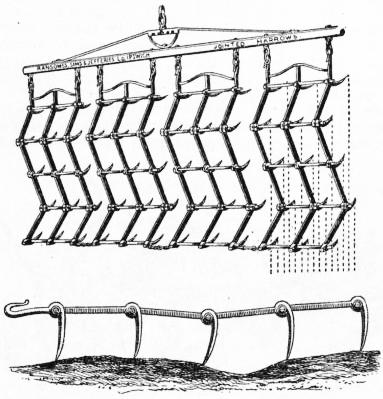
Fig. 1.—Jointed Zig-zag Harrow. (Ransomes, Sims & Jefferies, Ltd.)
The other type of harrow most used is the chain harrow, consisting of a number of square-link chains connected by cross links and attached to a draught-bar, the whole being kept expanded by stretchers and trailing weights. It is used for levelling and spreading manure over grass-land, from which it at the same time tears up moss and coarse herbage. Mention may also be made of the drag-harrow, a heavy implement with long tines, approximating closely to the cultivator, and of the Norwegian harrow with its revolving rows of spikes.
A few variations and developments of the ordinary harrow require notice. In the adjustable harrow (fig. 2) the teeth are secured to bars pivoted at their ends in the side bars of the frame, and provided with crank arms connected to a common link bar, which may be moved horizontally by means of a lever for the purpose of adjusting the angle which the teeth make with the ground, and thus convert the machine from a pulverizer to a smoothing harrow. The small figure illustrates a spring connexion between the adjusting lever and its locking bar, which allows the teeth to yield upon striking an obstruction. As the briskness of the operation adds to its effectiveness, the harrow is often made with a seat from which the operator can hasten the team without fatiguing himself.
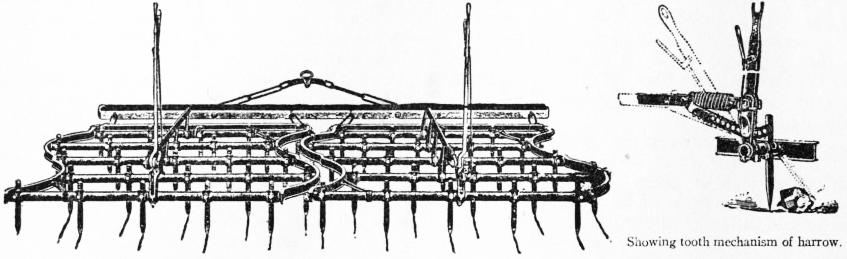
Fig. 2.—Adjustable Harrow.
Fig. 3 illustrates a spring-tooth harrow. In this harrow the independent frames are carried upon wheels, and a seat for the operator is mounted upon standards supported by the two frames. The teeth consist of flat steel springs of scroll form, which yield to rigid obstructions and are mounted on rock shafts in the same manner as in the walking harrow before described. The levers enable the operator to raise the teeth more or less, and thus free them from rubbish and also regulate the depth of action.
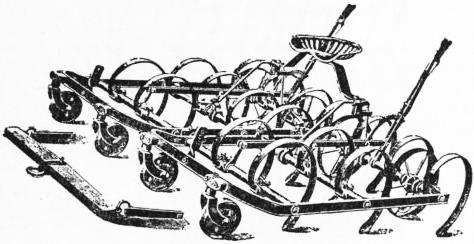
Fig. 3.—Spring-tooth Harrow.
Another variation of the harrow with great pulverizing and loosening capabilities consists of a main frame, having a pole and whipple-trees attached: to this frame are pivoted two supplemental frames, each of which has mounted on it a shaft carrying a series of concavo-convex disks. The supplemental frames may be swung by the adjusting levers to any angle with relation to the line of draught, and the disks then act like that of the disk plough (see PLOUGH), throwing the soil outward with more or less force, according to the angle at which they are set, and thus thoroughly breaking up and pulverizing the clods. Above the disks is a bar to which are pivoted a series of scrapers, one for each disk, which are held to their work with a yielding action, being thrown out of operation when desired by the levers shown in connexion with the operating bar. Pans on the main frame are used to carry weights to hold the disks down to their work. The cut away disk harrow differs from the ordinary disk harrow in that its disks are notched and so have greater penetrating power. The curved knife-tooth harrow consists of a frame to which a row of curved blades is attached. Other forms of the implement are illustrated and discussed in Farm Machinery and Farm Motors by J. B. Davidson and L. W. Chase (New York, 1908).
1 In Mid. Eng. harwe; the O. Eng. appears to have been hearge; the word is cognate with the Dutch hark, Swed. harke, Ger. Harke, rake, and with Danish harv, and Swed. harf, harrow, but the ultimate origin is unknown; the Fr. herse is a different word, cf. Hearse.
HARROWBY, DUDLEY RYDER, 1st Earl OF (1762-1847), the eldest son of Nathaniel Ryder, 1st Baron Harrowby (1735-1803), was born in London on the 22nd of December 1762. His grandfather Sir Dudley Ryder (1691-1756) became a member of parliament and solicitor-general owing to the favour of Sir Robert Walpole in 1733; in 1737 he was appointed attorney-general and three years later he was knighted; in 1754 he was made lord chief justice of the king’s bench and a privy councillor, the patent creating him a peer having been just signed by the king, but not passed, when he died on the 25th of May 1756. His only son Nathaniel, who was member of parliament for Tiverton for twenty years, was created Baron Harrowby in 1776. Educated at St John’s College, Cambridge, Dudley Ryder became member of parliament for Tiverton in 1784 and under-secretary for foreign affairs in 1789. In 1791 he was appointed paymaster of the forces and vice-president of the board of trade, but he resigned the positions and also that of treasurer of the navy when he succeeded to his father’s barony in June 1803. In 1804 he was secretary of state for foreign affairs and in 1805 chancellor of the duchy of Lancaster under his intimate friend William Pitt; in the latter year he was sent on a special and important mission to the emperors of Austria and Russia and the king of Prussia, and for the long period between 1812 and 1827 he was lord president of the council. After Canning’s death in 1827 he refused to serve George IV. as prime minister and he never held office again, although he continued to take part in politics, being especially prominent during the deadlock which preceded the passing of the Reform Bill in 1832. Harrowby’s long association with the Tories did not prevent him from assisting to remove the disabilities of Roman Catholics and Protestant dissenters, or from supporting the movement for electoral reform; he was also in favour of the emancipation of the slaves. The earl died at his Staffordshire residence, Sandon Hall, on the 26th of December 1847, being, as Charles Greville says, “the last of his generation and of the colleagues of Mr Pitt, the sole survivor of those stirring times and mighty contests.”
Harrowby’s eldest son, Dudley Ryder, 2nd earl (1798-1882), was born in London on the 19th of May 1798, his mother being Susan (d. 1838), daughter of Granville Leveson-Gower, marquess of Stafford, a lady of exceptional attainments. As Viscount Sandon he became member of parliament for Tiverton in 1819, in 1827 he was appointed a lord of the admiralty, and in 1830 secretary to the India board. From 1831 to 1847 Sandon represented Liverpool in the House of Commons. For a long time he was out of office, but in 1855, eight years after he had become earl of Harrowby, he was appointed chancellor of the duchy of Lancaster by Lord Palmerston; in a few months he was transferred to the office of lord privy seal, a position which he resigned in 1857. He was chairman of the Maynooth commission and a member of other important royal commissions, and was among the most stalwart and prominent defenders of the established church. He died at Sandon on the 19th of November 1882. His successor was his eldest son, Dudley Francis Stuart Ryder (1831-1900), vice-president of the council from 1874 to 1878, president of the board of trade from 1878 to 1880, and lord privy seal in 1885 and 1886. He died without sons on the 26th of March 1900, and was succeeded by his brother, Henry Dudley Ryder (1836-1900), whose son, John Herbert Dudley Ryder (b. 1864), became 5th earl of Harrowby.
HARROWING OF HELL, an English poem in dialogue, dating from the end of the 13th century. It is written in the East Midland dialect, and is generally cited as the earliest dramatic work of any kind preserved in the language, though it was in reality probably intended for recitation rather than performance; It is closely allied to the kind of poem known as a débat, and the opening words—“Alle herkneth to me nou A strif wille I tellen ou Of Jesu and of Satan”—seem to indicate that the piece was delivered by a single performer. The subject—the descent of Christ into Hades to succour the souls of the just, as related in the apocryphal gospel of Nicodemus—is introduced in a kind of prologue; then follows the dispute between “Dominus” and “Satan” at the gate of Hell; the gatekeeper runs away, and the just are set free, while Adam, Eve, Habraham, David, Johannes and Moyses do homage to the deliverer. The poem ends with a short prayer: “God, for his moder loue Let ous never thider come.” Metrically, the poem is characterized by frequent alliteration imposed upon the rhymed octosyllabic couplet:—
Welcome, louerd, god of londe Godes sone and godes sonde (ii. 149-150).
The piece is obviously connected with the Easter cycle of liturgical drama, and the subject is treated in the York and Townley plays.
MSS. are: Brit. Mus., Harl. MS. 2253; Edinburgh, Auchinleck MS., W 41; Oxford, Bodleian, Digby 86. It was privately printed by J. P. Collier and by J. O. Halliwell, but is available in Appendix III. of A. W. Pollard’s English Miracle Plays ... (4th ed., 1904) K. Böddeker, Altengl. Dichtungen des MS. Harl. 2253 (Berlin, 1878); and E. Mall, The Harrowing of Hell (Breslau, 1871). See also E. K. Chambers, The Medieval Stage (2 vols., 1903).
HARROW-ON-THE-HILL, an urban district in the Harrow parliamentary division of Middlesex, England, 12 m. W.N.W. of St Paul’s cathedral, London, served by the London and North Western, Metropolitan and District railways. Pop. (1901), 10,220. It takes its name from its position on an isolated hill rising to a height of 345 ft. On the summit, and forming a conspicuous landmark, is the church of St Mary, said to have been founded by Lanfranc, archbishop of Canterbury, in the reign of William I., and Norman work appears at the base of the tower. The remainder of the church is of various later dates, and there are several ancient monuments and brasses.
Harrow is celebrated for its public school, founded in 1571 by John Lyon, whose brass is in the church, a yeoman of the neighbouring village of Preston who had yearly during his life set aside 20 marks for the education of poor children of Harrow; though a school existed before his time. Though the charter was granted by Queen Elizabeth in 1571, and the statutes drawn up by the founder in 1590, two years before his death, it was not till 1611 that the first building was opened for scholars. Lyon originally settled about two-thirds of his property on the school, leaving the remainder for the maintenance of the highway between London and Harrow, but in the course of time the values of the respective endowments have changed so far that the benefit accruing to the school is a small proportion of the whole. About 1660 the headmaster, taking advantage of a concession in Lyon’s statutes, began to receive “foreigners,” i.e. boys from other parishes, who were to pay for their education. From this time the prosperity of the school may be dated. In 1809 the parishioners of Harrow appealed to the court of chancery against the manner in which the school was conducted, but the decision, while it recognized their privileges, confirmed the right of admission to foreigners. The government of the school was originally vested in six persons of standing in the parish who had the power of filling vacancies in their number by election among themselves; but under the Public Schools Act of 1868 the governing body now consists of the surviving members of the old board, besides six new members who are elected respectively by the lord chancellor, the universities of Oxford, Cambridge and London, the Royal Society, and the assistant masters of the school. There are several scholarships in connexion with the school to Oxford and Cambridge Universities. Harrow was originally an exclusively classical school, but mathematics became a compulsory study in 1837; modern languages, made compulsory in the upper forms In 1851, were extended to the whole school in 1855; while English history and literature began to be especially studied about 1869. The number of boys is about 600. The principal buildings are modern, including the chapel (1857), the library (1863), named after the eminent headmaster Dr Charles John Vaughan, and the speech-room (1877), the scene of the brilliant ceremony on “Speech Day” each summer term. The fourth form room, however, dates from 1611, and on its panels are cut the names of many eminent alumni, such as Byron, Robert Peel, R. B. Sheridan and Temple (Lord Palmerston). Several of the buildings were erected out of the Lyon Tercentenary Fund, subscribed after the tercentenary celebration in 1871.
A considerable extension of Harrow as an outer residential suburb of London has taken place north of the hill, where is the urban district of Wealdstone (pop. 5901), and there are also important printing and photographic works.
HARRY THE MINSTREL, or Blind Harry (fl. 1470-1492), author of the Scots historical poem The Actis and Deidis of the Illustere and Vailzeand Campioun Schir William Wallace, Knicht of Ellerslie, flourished in the latter half of the 15th century. The details of his personal history are of the scantiest. He appears to have been a blind Lothian man, in humble circumstances, who had some reputation as a story-teller, and who received, on five occasions, in 1490 and 1491, gifts from James IV. The entries of these, in the Accounts of the Lord High Treasurer, occur among others to harpers and singers. He is alluded to by Dunbar (q.v.) in the fragmentary Interlude of the Droichis Part of the Play, where a “droich,” or dwarf, personates
“the nakit blynd Harry That lang has bene in the fary Farleis to find;”
and again in Dunbar’s Lament for the Makaris. John Major (q.v.) in his Latin History speaks of “one Henry, blind from his birth, who, in the time of my childhood, fashioned a whole book about William Wallace, and therein wrote down in our popular verse—and this was a kind of composition in which he had much skill—all that passed current among the people in his day. I, however, can give but partial credence to these writings. This Henry used to recite his tales before nobles, and thus received food and clothing as his reward” (Bk. iv. ch. xv.).
The poem (preserved in a unique MS., dated 1488, in the Advocates’ library, Edinburgh) is divided into eleven books and runs to 11,853 lines. Its poetic merits are few, and its historical accuracy is easily impugned. It has the formal interest of being one of the earliest, certainly one of the most extensive verse-documents in Scots written in five-accent, or heroic, couplets. It is also the earliest outstanding work which discloses that habit of Scotticism which took such strong hold of the popular Northern literature during the coming years of conflict with England. In this respect it is in marked contrast with all the patriotic verse of preceding and contemporary literature. This attitude of the Wallace may perhaps be accepted as corroborative evidence of the humble milieu and popular sentiment of its author. The poem owed its subsequent widespread reputation to its appeal to this sentiment rather than to its literary quality. On the other hand, there are elements in the poem which show that it is not entirely the work of a poor crowder; and these (notably references to historical and literary authorities, and occasional reminiscences of the literary tricks of the Scots Chaucerian school) have inclined some to the view that the text, as we have it, is an edited version of the minstrel’s rough song-story. It has been argued, though by no means conclusively, that the “editor” was John Ramsay, the scribe of the Edinburgh MS. and of the companion Edinburgh MS. of the Brus by John Barbour (q.v.).
The poem appears, on the authority of Laing, to have been printed at the press of Chepman & Myllar about 1508, but the fragments which Laing saw are not extant. The first complete edition, now available, was printed by Lekprevik for Henry Charteris in 1570 (Brit. Museum). It was reprinted by Charteris in 1594 and 1601, and by Andro Hart in 1611 and 1620. At least six other editions appeared in the 17th century. There are many later reprints, including some of William Hamilton of Gilbertfield’s modern Scots version of 1722. The first critical edition was prepared by Dr. Jamieson and published in 1820. In 1889 the Scottish Text Society completed their edition of the text, with prolegomena and notes by James Moir.
See, in addition to Jamieson’s and Moir’s volumes (u.s.), J. T. T. Brown’s The Wallace and the Bruce Restudied (Bonner, Beiträge zur Anglistik, vi., 1900), a plea for Ramsay’s authorship of the known text; also W. A. Craigie’s article in The Scottish Review (July 1903), a comparative estimate of the Brus and Wallace, in favour of the latter.
HARSDÖRFFER, GEORG PHILIPP (1607-1658), German poet, was born at Nuremberg on the 1st of November 1607. He studied law at Altdorf and Strassburg, and subsequently travelled through Holland, England, France and Italy. His knowledge of languages gained for him the appellation “the learned,” though he was as little a learned man as he was a poet. As a member of the Fruchtbringende Gesellschaft he was called der Spielende (the player). Jointly with Johann Klaj (q.v.) he founded in 1644 at Nuremberg the order of the Pegnitzschäfer, a literary society, and among the members thereof he was known by the name of Strephon. He died at Nuremberg on the 22nd of September 1658. His writings in German and Latin fill fifty volumes, and a selection of his poems, interesting mostly for their form, is to be found in Müller’s Bibliothek deutscher Dichter des 17ten Jahrhunderts, vol. ix. (Leipzig, 1826).
His life was written by Widmann (Altdorf, 1707). See also Tittmann, Die Nürnberger Dichterschule (Göttingen, 1847); Hodermann, Eine vornehme Gesellschaft, nach Harsdörffers “Gesprächspielen” (Paderborn, 1890); T. Bischoff, “Georg Philipp Harsdörffer” in the Festschrift zur 250 jährigen Jubelfeier des Pegnesischen Blumenordens (Nuremberg, 1894); and Krapp, Die ästhetischen Tendenzen Harsdörffers (Berlin, 1904).
HARSHA, or Harshavardhana (fl. A.D. 606-648), an Indian king who ruled northern India as paramount monarch for over forty years. The events of his reign are related by Hsüan Tsang, the Chinese pilgrim, and by Bana, a Brahman author. He was the son of a raja of Thanesar, who gained prominence by successful wars against the Huns, and came to the throne in A.D. 606, though he was only crowned in 612. He devoted himself to a scheme of conquering the whole of India, and carried on wars for thirty years with success, until (A.D. 620) he came in contact with Pulakesin II., the greatest of the Chalukya dynasty, who made himself lord of the south, as Harsha was lord of the north. The Nerbudda river formed the boundary between the two empires. In the latter years of his reign Harsha’s sway over the whole basin of the Ganges from the Himalayas to the Nerbudda was undisputed. After thirty-seven years of war he set himself to emulate Asoka and became a patron of art and literature. He was the last native monarch who held paramount power in the north prior to the Mahommedan conquest; and was succeeded by an era of petty states.
See Bana, Sri-harsha-charita, trans. Cowell and Thomas (1897); Ettinghausen, Harsha Vardhana (Louvain, 1906).
HARSNETT, SAMUEL (1561-1631), English divine, archbishop of York, was born at Colchester in June 1561, and was educated at Pembroke Hall, Cambridge, where he was successively scholar, fellow and master (1605-1616). He was also vice-chancellor of the university in 1606 and 1614. His ecclesiastical career began somewhat unpromisingly, for he was censured by Archbishop Whitgift for Romanist tendencies in a sermon which he preached against predestination in 1584. After holding the living of Chigwell (1597-1605) he became chaplain to Bancroft (then bishop of London), and afterwards archdeacon of Essex (1603-1609), rector of Stisted and bishop of Chichester (1609-1619) and archbishop of York (1629). He died on the 25th of May 1631. Harsnett was no favourite with the Puritan community, and Charles I. ordered his Considerations for the better Settling of Church Government (1629) to be circulated among the bishops. His Declaration of Egregious Popish Impostures (1603) furnished Shakespeare with the names of the spirits mentioned by Edgar in King Lear.
HART, ALBERT BUSHNELL (1854- ), American historian, was born at Clarksville, Mercer county, Pennsylvania, on the 1st of July 1854. He graduated at Harvard College in 1880, studied at Paris, Berlin and Freiburg, and received the degree of Ph.D. at Freiburg in 1883. He was instructor in history at Harvard in 1883-1887, assistant professor in 1887-1897, and became professor in 1897. Among his writings are: Introduction to the Study of Federal Government (1890), Formation of the Union (1892, in the Epochs of American History series), Practical Essays on American Government (1893), Studies in American Education (1895), Guide to the Study of American History (with Edward Channing, 1897), Salmon Portland Chase (1899, in the American Statesman series), Foundations of American Foreign Policy (1901), Actual Government (1903), Slavery and Abolition (1906, the volume in the American Nation series dealing with the period 1831-1841), National Ideals Historically Traced (1907), the 26th volume of the American Nation series, and many historical pamphlets and articles. In addition he edited American History told by Contemporaries (4 vols., 1898-1901), and Source Readers in American History (4 vols., 1901-1903), and two co-operative histories of the United States, the Epochs of American History series (3 small text-books), and, on a much larger scale, the American Nation series (27 vols., 1903-1907); he also edited the American Citizen series.
HART, CHARLES (d. 1683), English actor, grandson of Shakespeare’s sister Joan, is first heard of as playing women’s parts at the Blackfriars’ theatre as an apprentice of Richard Robinson. In the Civil War he was a lieutenant of horse in Prince Rupert’s regiment, and after the king’s defeat he played surreptitiously at the Cockpit and at Holland House and other noblemen’s residences. After the Restoration he is known to have been in 1660 the original Dorante in The Mistaken Beauty, adapted from Corneille’s Le Menteur. In 1663 he went to the Theatre Royal in Killigrew’s company, with which he remained until 1682, taking leading parts in Dryden’s, Jonson’s and Beaumont and Fletcher’s plays. He is highly spoken of by contemporaries in such Shakespearian parts as Othello and Brutus. He is often mentioned by Pepys. Betterton praised him, and would not himself play the part of Hotspur until after Hart’s retirement. He died in 1683 and was buried on the 20th of August. Hart is said to have been the first lover of Nell Gwyn, and to have trained her for the stage.
HART, ERNEST ABRAHAM (1835-1898), English medical journalist, was born in London on the 26th of June 1835, the son of a Jewish dentist. He was educated at the City of London school, and became a student at St George’s hospital. In 1856 he became a member of the Royal College of Surgeons, making a specialty of diseases of the eye. He was appointed ophthalmic surgeon at St Mary’s hospital at the age of 28, and occupied various other posts, introducing into ophthalmic practice some modifications since widely adopted. His name, too, is associated with a method of treating popliteal aneurism, which he was the first to use in Great Britain. His real life-work, however, was as a medical journalist, beginning with the Lancet in 1857. He was appointed editor of the British Medical Journal in 1866. He took a leading part in the exposures which led to the inquiry into the state of London workhouse infirmaries, and to the reform of the treatment of sick poor throughout England, and the Infant Life Protection Act of 1872, aimed at the evils of baby-farming, was largely due to his efforts. The record of his public work covers nearly the whole field of sanitary legislation during the last thirty years of his life. He had a hand in the amendments of the Public Health and of the Medical Acts; in the measures relating to notification of infectious disease, to vaccination, to the registration of plumbers; in the improvement of factory legislation; in the remedy of legitimate grievances of Army and Navy medical officers; in the removal of abuses and deficiencies in crowded barrack schools; in denouncing the sanitary shortcomings of the Indian government, particularly in regard to the prevention of cholera. His work on behalf of the British Medical Association is shown by the increase from 2000 to 19,000 in the number of members, and the growth of the British Medical Journal from 20 to 64 pages, during his editorship. From 1872 to 1897 he was chairman of the Association’s Parliamentary Bill Committee. He died on the 7th of January 1898. For his second wife he married Alice Marion Rowland, who had herself studied medicine in London and Paris, and was no less interested than her husband in philanthropic reform. She was most active in her encouragement of Irish cottage industries, and was the founder of the Donegal Industrial Fund.