VOLUME XII SLICE VI Groups, Theory of to Gwyniad (continued 9)
Reading edition
Declension.—Gujarati agrees with Marathi (an outer language) as against Hindostani in retaining the neuter gender of Sanskrit and Prakrit. Moreover, the neuter gender is often employed to indicate living beings of which the sex is uncertain, as in the case of dikarũ, a child, compared with dikarō, a son, and dikarī, a daughter. In R. there are only sporadic instances of the neuter, which grow more and more rare as we approach the Midland. Nouns in both G. and R. may be weak or strong as is fully explained in the article Hindostani. We have there seen that the strong form of masculine nouns in Western Hindi generally ends in au, the ā of words like the Hindostani ghōṛā, a horse, being an accident due to the fact that the Hindostani dialect of Western Hindi borrows this termination from Panjabi. G. and R. follow Western Hindi, for their masculine strong forms end in ō. Feminine strong forms end in ī as elsewhere. Neuter strong forms in G. end in ũ, derived as follows: Skr, svarṇakam, Ap. soṇṇaũ, G. sōnũ, gold. As an example of the three genders of the same word we may take G. chōkarō (masc.), a boy; chōkarī (fem.), a girl; chōkarũ (neut.), a child. Long forms corresponding to the Eastern Hindi ghoṛawā, a horse, are not much used, but we not infrequently meet another long form made by suffixing the pleonastic termination ḍō or ṛō (fem. ḍī or ṛī; G. neut. ḍũ or ṛũ) which is directly descended from the Ap. pleonastic termination ḍaü, ḍaī, ḍaũ. We come across this most often in R., where it is used contemptuously, as in Turuk-ṛō, a Turk.
In the article Hindostani it is shown that all the oblique cases of each number in Sanskrit and Prakrit became melted down in the modern languages into one general oblique case, which, in the Midland, is derived in the singular from the Ap. termination -hi or -hĩ, and that even this has survived only in the case of strong masculine nouns; thus, ghōṛā, obl. ghōṛē. In G. and R. this same termination has also survived, but for all nouns as the case sign of the agent and locative cases. The general oblique case is the same as the nominative, except in the case of strong masculine and neuter nouns in ō and ũ respectively, where it ends in ā, not ē. This ā-termination is characteristic of the outer band of languages, and is one of the survivals already referred to. It is derived from the Apabhraṁśa genitive form in -aha, corresponding to the Māgadhī Pr. (an outer Prakrit) termination -āha. Thus, G. chōkarō, a son; chōkarũ, a child; obl. sing. chōkarā.
In G. the nominative and oblique plural for all nouns are formed by adding ō to the oblique form singular, but in the neuter strong forms the oblique singular is nasalized. The real plural is the same in form as the oblique singular in the case of masculines, and as a nasalized oblique singular in the case of neuter strong forms, as in other modern Indo-Aryan vernaculars, and the added ō is a further plural termination (making a double plural, exactly as it does in the Ardhamāgadhī Prakrit puttā-ō, sons) which is often dropped. The nasalization of the strong neuter plurals is inherited from Ap., in which the neuter nom. plural of such nouns ended in -aāĩ In R. the nominative plural of masculine nouns is the same in form as the oblique case singular, and the oblique plural ends in ẫ. The feminine has ẫ both in the nominative and in the oblique plural. These are all explained in the article Hindostani. We thus get the following paradigms of the declension of nouns.
Apabhraṁśa. Gujarati. Rajasthani.
Strong Noun Masc.—
”A horse.” Sing. Nom. ghōḍaũ ghōḍō ghōḍō
Obl. ghōḍaaha ghōḍā ghōḍā
Ag.-Loc. ghōḍaahi ghōḍē, ghōḍāē ghōḍai
Plur. Nom. ghōḍaā ghōḍā-ō ghōḍā
Obl. ghōḍaāhā ghōḍā-ō ghōḍẫ
Ag.-Loc. ghōḍaahĩ ghōḍā-ō-ē ghōḍẫ
Strong Noun Neut.—
”Gold.” Sing. Nom. soṇṇaũ sōnũ ..
Obl. soṇṇaaha sōnā ..
Ag.-Loc. soṇṇaahi sōnē, sōnāē ..
Plur. Nom. soṇṇaāĩ sōnē ..
Obl. soṇṇaāhā sōnẫ-ō ..
Ag.-Loc. soṇṇaahĩ sōnẫ-ō-ē ..
Strong Noun Fem.—
”A mare.” Sing. Nom. ghōḍiā ghōḍī ghōḍī
Obl. ghōḍiahi ghōḍī ghōḍī
Ag.-Loc. ghōḍiae ghōḍīē ghōḍī
Plur. Nom. ghōḍiā-ō ghōḍī-ō ghōḍyẫ
Obl. ghōḍiahu ghōḍī-ō ghōḍyẫ
Ag.-Loc. ghōḍiahĩ ghōḍī-ō-ē ghōḍyẫ
Weak Noun Masc. or Neut.—
”A house.” Sing. Nom. gharu (neut.) ghar ghar
Obl. gharaha ghar ghar
Ag.-Loc. gharahi gharē gharai
Plur. Nom. gharāĩ ghar-ō ghar
Obl. gharāhā ghar-ō gharẫ
Ag.-Loc. gharahĩ ghar-ō-ē gharẫ
Weak Noun Fem.—
”A word.” Sing. Nom. vattā wāt bāt
Obl. vattahi wāt bāt
Ag.-Loc. vattae wātē bāt
Plur. Nom. vattā-ō wāt-ō bātẫ
Obl. vattahu wāt-ō bātẫ
Ag.-Loc. vattahĩ wāt-ō-ē bātẫ
The general oblique case can be employed for any case except the nominative, but, in order to define the meaning, it is customary to add postpositions as in Hindostani. These are:
Genitive. Dative. Ablative. Locative.
Gujarati nō nē thī mẫ
Rajasthani rō, kō nai, rai, kai sũ maī
The suffix nō of the genitive is believed to be a contraction of taṇō, which is found in old Gujarati poetry, and which, under the form tanas in Sanskrit and taṇaü in Apabhraṁśa, mean “belonging to.” It is an adjective, and agrees in gender, number and case with the thing possessed. Thus, rājā-nō dikarō, the king’s son; rājā-nī dikarī, the king’s daughter; rājā-nũ ghar, the king’s house; rājā-nā dikarā-nē, to the king’s son (nā is in the oblique case masculine to agree with dikarā); rājā-nē gharē, in the king’s house. The rō and kō of R. are similarly treated, but, of course, have no neuter. The dative postpositions are simply locatives of the genitive ones, as in all modern Indo-Aryan languages (see Hindostani). Thī, the postposition of the G. ablative, is connected with thawũ, to be, one of the verbs substantive in that language. The ablative suffix is made in this way in many modern Indo-Aryan languages (e.g. Bengali, q.v.). It means literally “having been” and is to be ultimately referred to the Sanskrit root, sthā, stand. The derivation of the other postpositions is discussed in the article Hindostani.
Strong adjectives agree with the nouns they qualify in gender, number and case, as in the examples of the genitive above. Weak adjectives are immutable.
Pronouns closely agree with those found in Hindostani. In the table on following page we give the first two personal pronouns, and the demonstrative pronoun “this.”
Similarly are formed the remaining pronouns, viz. G. ā, R. ũ, he, that; G. tē, R. sō (obl. sing. tĩ), that; G. jē, R. jō, who; G. kảṇ (obl. kảṇ, kō, or kē), R. kuṇ (obl. kuṇ), who?; G. śũ, R. kẵĩ, what?; G., R. kōī, anyone, someone, kāĩ anything, something. G. has two other demonstratives, pēlō and ōlyō, both meaning “that.” The derivation of these and of śũ has been discussed without any decisive result. The rest are explained in the article Hindostani. The reflexive pronoun is G. āpaṇē, R. āpẫ. It is generally employed as a plural of the first personal pronoun including the person addressed; thus G. āpaṇē, we (including you), but amē, we (excluding you). In G. pōtē, obl. pōtā, is used to mean “self.”
Apabhraṁśa. Gujarati. Rajasthani.
i Nom. haũ hũ hũ, mhũ, maī
Obl. maĩ, mahu, majjhu ma, maj ma, mha, mũ
my mahāraü mārō mārō, mhārō
we Nom. amhē amē mhē
Obl. amhahã am-ō mhẫ
our amhāraü amārō mhẫ-rō, mhẫ-kō
thou Nom. tuhũ tũ tũ
Obl. taĩ, tuha, tujjhu ta, tuj ta, tha, tũ
thy tuhāraü tārō thārō
you Nom. tumhē tamē thē, tamē
Obl. tumhahã tam-ō thẫ, tamẫ
your tumhāraü tamārō thẫ-rō, thẫ-kō
this, he Nom. ēho ē yō
Obl. (?) ēhaha, imaha ē ĩ
these, they Nom. ēi ē-ō ē, yē
Obl. ēammi, ēhāṇa em iṇẫ, yẫ.
Conjugation.—The old present has survived as in Hindostani and other Indian languages. Taking the base call or caḷ, go, as our model, we have:
Apabhraṁśa. Gujarati. Rajasthani.
Sing. 1 callaũ cālũ caḷũ
2 callahi cālē caḷai
3 callai cālē caḷai
Plur. 1 callahũ cālīē caḷẫ
2 callahu cālō caḷō
3 callahĩ cālē caḷai
The derivation of the G. 1 plural is unknown. That of the other G. and R. forms is manifest. The imperative closely follows this, but as usual has no termination in the second person singular.
In R. the future may be formed by adding gō (cf. Hindostani gā), lō, or lā to the old present. Thus, caḷũ-gō, caḷũ-lo or calũ-lā I shall go. The gō and lō agree in gender and number with the subject, but lā is immutable. The termination with l is also found in Bhojpuri (see Bihari), in Marathi and in Nepali. For gō see Hindostani. Another form of the future has s or h for its characteristic letter, and is the only one employed in G. Thus, Ap. callisaũ or callihaũ, G. cālīś, R. (Jaipuri) caḷasyũ, (Marwari) caḷahũ. The other personal terminations differ considerably from those of the old present, and closely follow Ap. Thus, Ap. 3 sing. callisai or callihi, G. cālaśē, Marwari caḷahī.
The participles and infinitive are as follows:
Apabhraṁśa. Gujarati. Rajasthani.
Pres. Part. Active callantau cālatō caḷatō
Past. Part. Passive calliau cālyō caḷyō
Future Part. Passive calliavvau cālavō caḷabō
Infinitive .. cālavũ caḷabō
In G. the infinitive is simply the neuter of the future passive participle. The participles are employed to form finite tenses; thus G. hũ cālatō, I used to go; hũ cālyō, I went. If the verb is transitive (see Hindostani) the passive meaning of the past participle comes into force. The subject is put into the case of the agent, and the participle inflects to agree with the object, or, if there is no object, is employed impersonally in the neuter (in G.) or in the masculine (in R.). In Hindostani, if the object is expressed in the dative, the participle is also employed impersonally, in the masculine; thus rājā-nē shērnī-kō mārā (masc.), not mārī, (fem.), by-the-king, with reference-to-the-tigress, it-(impersonal)-was-killed, i.e. the king killed the tigress. But in G. and R., even if the object is in the dative, the past participle agrees with it; thus, G. rājāē wāghaṇ-nē mārī, by-the-king, with-reference-to-the-tigress, she-was-killed. Other examples from G. of this passive construction are mẽ kahyũ, by me it was said, I said; tēṇē ciṭṭhī lakhī, by him a letter was written, he wrote a letter; ē bāīē vagaḍā-mẫ, dahāḍā kāḍyā, by this lady, in the wilderness, days were passed, i.e. she passed her days in the wilderness; rājāē vicāryũ, the king considered. The idiom of R. is exactly the same in these cases, except that the masculine must be used where G. has the neuter; thus, rājāai vicāryo. The future passive participle is construed in much the same way, but (as in Latin) the subject may be put into the dative. Thus, mārē ā cåpaḍī vẫcavī, mihi ille liber (est) legendus, I must read that book, but also tēṇē (agent case) ē kām karavũ, by him this business is to be done.
G. also forms a past participle in ēlō (cālēlō), which is one of the many survivals of the outer language. This -l- participle is typical of most of the languages of the outer band, including Marathi, Oriya, Bengali, Bihari and Assamese. It is formed by the addition of the Prakrit pleonastic suffix -illa-, which was not used by the Prakrit of the Midland, but was common elsewhere. Compare, for instance, the Ardhamāgadhī past participle passive āṇ-illia-, brought.
The usual verbs substantive are as follows: G. chũ, R. hũ or chũ, I am, which are conjugated regularly as old presents, and G. hatō, R. hō or chō, was, which is a past participle, like the Hindostani (q.v.) thā. Hũ, hatō and hō are explained in the article on that language. Chũ is for Skr. ṙcchāmi, Ap. acchaũ. The use of this base is one of the outer band survivals. Even in Prakrit, it is not found (so far as the present writer is aware) in the Śaurasēnī of the Midland. Using these as auxiliaries the finite verb makes a whole series of periphrastic tenses. A present definite is formed by conjugating the old present tense (not the present participle) with the present tense of the verb substantive. Thus, G. cālũ chũ, I am going. A similar idiom is found in some Western Hindi dialects, but Hindostani employs the present participle; thus, caltā hũ. In G. and R., however, the imperfect is formed with the present participle as in H. Thus, G. hũ cālatō hatō, I was going. So, as in H., we have a perfect hũ cālyō (or cālēlō) chũ, I have gone, and a pluperfect hũ cālyō (or cālēlō) hatō, I had gone. The R. periphrastic tenses are made on the same principles. With the genitive of the G. future passive participle, cālavā-nō, we have a kind of gerundive, as in hũ cālavānō chũ, I am to be gone, i.e. I am about to go; hũ cālavānō hatō, I was about to go.
The same series of derivative verbs occurs in G. and R. as in H. Thus, we have a potential passive (a simple passive in G.) formed by adding ā to the base, as in G. lakhavũ, to write, lakhāvũ, to be written; and a causal by adding āv or āḍ, as in lakhāvavũ, to cause to write; besavũ, to sit, besāḍavũ, to seat. A new passive may be formed in G. from the causal, as in tapavũ, to be hot; tapāvavũ, to cause to be hot; to heat; tapāvāvũ, to be heated.
Several verbs have irregular past participles. These must be learnt from the grammars. So also the numerous compound verbs, such as (G.) cālī śakavũ, to be able to go; cālī cukavũ, to have completed going; cālyā karavũ, to be in the habit of going, and so on.
Very little is known about the literature of Rajputana, except that it is of large extent. It includes a number of bardic chronicles of which only one has been partially edited, but the contents of which have been described by Tod in his admired Rajasthan. It also includes a considerable religious Literature. literature, but the whole mass of this is still in MS. From those specimens which the present writer has examined, it would appear that most of the authors wrote in Braj Bhasha, the Hindu literary dialect of Hindostani (q.v.) In Marwar it is an acknowledged fact that the literature falls into two branches, one called Pingal and couched in Braj Bhasha, and the other called Ḍingal and couched in Rajasthani. The most admired work in Ḍingal is the Raghunāth Rũpak written by Mansā Rām in the beginning of the 19th century. It is nominally a treatise on prosody, but, like many other works of the same kind, it contrives to pay a double debt, for the examples of the metres are so arranged as to form a complete epic poem celebrating the deeds of the hero Rāma.
The earliest writer of importance in Gujarati, and its most admired poet, was Narsingh Mētā, who lived in the 15th century A.D. Before him there were writers on Sanskrit grammar, rhetoric and the like, who employed an old form of Gujarati for their explanations. Narsingh does not appear to have written any considerable work, his reputation depending on his short songs, many of which exhibit much felicity of diction. He had several successors, all admittedly his inferiors. Perhaps the most noteworthy of these was Rēwā Śankar, the translator of the Mahābhārata (see Sanskrit: Literature). A more important side of Gujarati literature is its bardic chronicles, the contents of which have been utilized by Forbes in his Rās Mālā. Modern Gujarati literature mostly consists of translations or imitations of English works.
Authorities.—Volume ix. of the Linguistic Survey of India contains a full and complete account of Gujarati and Rajasthani, including their various dialectic forms.
For Rajasthani, see S. H. Kellogg, Grammar of the Hindi Language (2nd ed., London, 1893). In this are described several dialects of Rajasthani. See also Rām Karṇ Śarmā, Mārwāṛi Vyākaraṇa (Jodhpur, 1901) (a Marwari grammar written in that language), and G. Macalister, Specimens of the Dialects spoken in the State of Jaipur (contains specimens, vocabularies and grammars) (Allahabad, 1898).
For Gujarati, there are numerous grammars, amongst which we may note W. St C. Tisdall, Simplified Grammar of the Gujarati Language (London, 1892) and (the most complete) G. P. Taylor, The Student’s Gujarati Grammar (2nd ed., Bombay, 1908). As for dictionaries, the most authoritative is the Narma-kōś of Narmadā Śankar (Bhaunagar and Surat, 1873), in Gujarati throughout. For English readers we may mention Shahpurji Edalji’s (2nd ed., Bombay, 1868), the introduction to which contains an account of Gujarati literature by J. Glasgow, Belsare’s (Ahmedabad, 1895), and Karbhari’s (Ahmedabad, 1899).
(G. A. Gr.)
GUJRANWALA, a town and district of British India, in the Lahore division of the Punjab. The town is situated 40 m. N. of Lahore by rail. It is of modern growth, and owes its importance to the father and grandfather of Maharaja Ranjit Singh, whose capital it formed during the early period of the Sikh power. Pop. (1901) 29,224. There are manufactures of brass-ware, jewellery, and silk and cotton scarves.
The District comprises an area of 3198 sq. m. In 1901 the population was 756,797, showing an increase of 29% in the decade. The district is divided between a low alluvial tract along the rivers Chenab and Degh and the upland between them, which forms the central portion of the Rechna Doab, intermediate between the fertile submontane plains of Sialkot and the desert expanses of Jhang. Part of the upland tract has been brought under cultivation by the Chenab canal. The country is very bare of trees, and the scenery throughout is tame and in the central plateau becomes monotonous. It seems likely that the district once contained the capital of the Punjab, at an epoch when Lahore had not begun to exist. We learn from the Chinese Buddhist pilgrim, Hsuan Tsang, that about the year 630 he visited a town known as Tse-kia (or Taki), the metropolis of the whole country of the five rivers. A mound near the modern village of Asarur has been identified as the site of the ancient capital. Until the Mahommedan invasions little is known of Gujranwala, except that Taki had fallen into oblivion and Lahore had become the chief city. Under Mahommedan rule the district flourished for a time; but a mysterious depopulation fell upon the tract, and the whole region seems to have been almost entirely abandoned. On the rise of Sikh power, the waste plains of Gujranwala were seized by various military adventurers. Charat Singh took-possession of the village of Gujranwala, and here his grandson the great Maharaja Ranjit Singh was born. The Sikh rule, which was elsewhere so disastrous, appears to have been an unmitigated benefit to this district. Ranjit Singh settled large colonies in the various villages, and encouraged cultivation throughout the depopulated plain. In 1847 the district came under British influence in connexion with the regency at Lahore; and in 1849 it was included in the territory annexed after the second Sikh war. A large export trade is carried on in cotton, wheat and other grains. The district is served by the main line and branches of the North-Western railway.
GUJRAT, a town and district of British India, in the Rawalpindi division of the Punjab, lying on the south-western border of Kashmir. The town stands about 5 m. from the right bank of the river Chenab, 70 m. N. of Lahore by rail. Pop. (1901) 19,410. It is built upon an ancient site, formerly occupied, according to tradition, by two successive cities, the second of which is supposed to have been destroyed in 1303, the year of a Mongol invasion. More than 200 years later either Sher Shah or Akbar founded the existing town. Though standing in the midst of a Jat neighbourhood, the fort was first garrisoned by Gujars, and took the name of Gujrat. Akbar’s fort, largely improved by Gujar Singh, stands in the centre of the town. The neighbouring shrine of the saint Shah Daula serves as a kind of native asylum for lunatics. The town has manufactures of furniture, inlaid work in gold and iron, brass-ware, boots, cotton goods and shawls.
The District of Gujrat comprises a narrow wedge of sub-Himalayan plain country, possessing few natural advantages. From the basin of the Chenab on the south the general level rises rapidly towards the interior, which, owing to the great distance of the water beneath the surface, assumes a dreary and desert aspect. A range of low hills, known as the Pabbi, traverses the northern angle of Gujrat. They are composed of a friable Tertiary sandstone and conglomerate, destitute of vegetation, and presenting a mere barren chaos of naked rock, deeply scored with precipitous ravines. Immediately below the Pabbi stretches a high plateau, terminating abruptly in a precipitous bluff some 200 ft. in height. At the foot of this plateau is a plain, which forms the actual valley of the Chenab and participates in the irrigation from the river bed.
Numerous relics of antiquity stud the surface of the district. Mounds of ancient construction yield early coins, and bricks are found whose size and type prove them to belong to the prehistoric period. A mound now occupied by the village of Moga or Mong has been identified as the site of Nicaea, the city built by Alexander the Great on the field of his victory over Porus. The Delhi empire established its authority in this district under Bahlol Lodi (1451-1489). A century later it was visited by Akbar, who founded Gujrat as the seat of government. During the decay of the Mogul power, the Ghakkars of Rawalpindi overran this portion of the Punjab and established themselves in Gujrat about 1741. Meanwhile the Sikh power had been asserting itself in the eastern Punjab, and in 1765 the Ghakkar chief was defeated by Sirdar Gujar Singh, chief of the Bhangi confederacy. On his death, his son succeeded him, but after a few months’ warfare, in 1798, he submitted himself as vassal to the Maharaja Ranjit Singh. In 1846 Gujrat first came under the supervision of British officials. Two years later the district became the theatre for the important engagements which decided the event of the second Sikh war. After several bloody battles in which the British were unsuccessful, the Sikh power was irretrievably broken at the engagement which took place at Gujrat on the 22nd of February 1849. The Punjab then passed by annexation under British rule.
The district comprises an area of 2051 sq. m. In 1901 the population was 750,548, showing a decrease of 1%, compared with an increase of 10% in the previous decade. The district has a large export trade in wheat and other grains, oil, wool, cotton and hides. The main line and the Sind-Sagar branch of the North-Western railway traverse it.
GULA, a Babylonian goddess, the consort of Ninib. She is identical with another goddess, known as Bau, though it would seem that the two were originally independent. The name Bau is more common in the oldest period and gives way in the post-Khammurabic age to Gula. Since it is probable that Ninib (q.v.) has absorbed the cults of minor sun-deities, the two names may represent consorts of different gods. However this may be, the qualities of both are alike, and the two occur as synonymous designations of Ninib’s female consort. Other names borne by this goddess are Nin-Karrak, Ga-tum-dug and Nin-din-dug, the latter signifying “the lady who restores to life.” The designation well emphasizes the chief trait of Bau-Gula which is that of healer. She is often spoken of as “the great physician,” and accordingly plays a specially prominent rôle in incantations and incantation rituals intended to relieve those suffering from disease. She is, however, also invoked to curse those who trample upon the rights of rulers or those who do wrong with poisonous potions. As in the case of Ninib, the cult of Bau-Gula is prominent in Shirgulla and in Nippur. While generally in close association with her consort, she is also invoked by herself, and thus retains a larger measure of independence than most of the goddesses of Babylonia and Assyria. She appears in a prominent position on the designs accompanying the Kudurrus boundary-stone monuments of Babylonia, being represented by a statue, when other gods and goddesses are merely pictured by their shrines, by sacred animals or by weapons. In neo-Babylonian days her cult continues to occupy a prominent position, and Nebuchadrezzar II. speaks of no less than three chapels or shrines within the sacred precincts of E-Zida in the city of Borsippa, besides a temple in her honour at Babylon.
(M. Ja.)
GULBARGA, an ancient city of India, situated in the Nizam’s dominions, 70 m. S.E. of Sholapur. Pop. (1901) 29,228. Originally a Hindu city, it was made the capital of the Bahmani kings when that dynasty established their independence in the Deccan in 1347, and it remained such until 1422. The palaces, mosques and tombs of these kings still stand half-ruined. The most notable building is a mosque modelled after that of Cordova in Spain, covering an area of 38,000 sq. ft., which is almost unique in India as being entirely covered in. Since the opening of a station on the Great India Peninsula railway, Gulbarga has become a centre of trade, with cotton-spinning and weaving mills. It is also the headquarters of a district and division of the same name. The district, as recently reconstituted, has an area of 6004 sq. m.; pop. (1901), 1,041,067.
GULF STREAM,1 the name properly applied to the stream current which issues from the Gulf of Mexico and flows north-eastward, following the eastern coast of North America, and separated from it by a narrow strip of cold water (the Cold Wall), to a point east of the Grand Banks off Newfoundland. The Gulf Stream is a narrow, deep current, and its velocity is estimated at about 80 m. a day. It is joined by, and often indistinguishable from, a large body of water which comes from outside the West Indies and follows the same course. The term was formerly applied to the drift current which carries the mixed waters of the Gulf Stream and the Labrador current eastwards across the Atlantic. This is now usually known as the “Gulf Stream drift,” although the name is not altogether appropriate. See Atlantic.
1 The word “gulf,” a portion of the sea partially enclosed by the coast-line, and usually taken as referring to a tract of water larger than a bay and smaller than a sea, is derived through the Fr. golfe, from Late Gr. κόλφος, class. Gr. κόλπος, bosom, hence bay, cf. Lat. sinus. In University slang, the term is used of the position of those who fail to obtain a place in the honours list at a public examination, but are allowed a “pass.”
GULFWEED, in botany, a popular name for the seaweed Sargassum bacciferum, one of the brown seaweeds (Phaeophyceae), large quantities of which are found floating in the Gulf of Mexico, whence it is carried northwards by the Gulf Stream, small portions sometimes being borne as far as the coasts of the British Isles. It was observed by Columbus, and is remarkable among seaweeds for its form, which resembles branches bearing leaves and berries; the latter, to which the species-name bacciferum refers, are hollow floats answering the same purpose as the bladders in another brown seaweed, Fucus vesiculosus, which is common round the British Isles between high and low water.
GULL, SIR WILLIAM WITHEY, 1st Bart. (1816-1890), English physician, was the youngest son of John Gull, a barge-owner and wharfinger of Thorpe-le-Soken, Essex, and was born on the 31st of December 1816 at Colchester. He began life as a schoolmaster, but in 1837 Benjamin Harrison, the treasurer of Guy’s Hospital, who had noticed his ability, brought him up to London from the school at Lewes where he was usher, and gave him employment at the hospital, where he also gained permission to attend the lectures. In 1843 he was made a lecturer in the medical school of the hospital, in 1851 he was chosen an assistant physician, and in 1856 he became full physician. In 1847 he was elected Fullerian professor of physiology in the Royal Institution, retaining the post for the usual three years, and in 1848 he delivered the Gulstonian Lectures at the College of Physicians, where he filled every office of honour but that of president. He died in London on the 29th of January 1890 after a series of paralytic strokes, the first of which had occurred nearly three years previously. He was created a baronet in 1872, in recognition of the skill and care he had shown in attending the prince of Wales during his attack of typhoid in 1871. Sir William Gull’s fame rested mainly on his success as a clinical practitioner; as he said himself, he was “a clinical physician or nothing.” This success must be largely ascribed to his remarkable powers of observation, and to the great opportunities he enjoyed for gaining experience of disease. He was sometimes accused of being a disbeliever in drugs. That was not the case, for he prescribed drugs like other physicians when he considered them likely to be beneficial. He felt, however, that their administration was only a part of the physician’s duties, and his mental honesty and outspokenness prevented him from deluding either himself or his patients with unwarranted notions of what they can do. But though he regarded medicine as primarily an art for the relief of physical suffering, he was far from disregarding the scientific side of his profession, and he made some real contributions to medical science. His papers were printed chiefly in Guy’s Hospital Reports and in the proceedings of learned societies: among the subjects he wrote about were cholera, rheumatic fever, taenia, paraplegia and abscess of the brain, while he distinguished for the first time (1873) the disease now known as myxoedema, describing it as a “cretinoid state in adults.”
GULL (Welsh gwylan, Breton, goelann, whence Fr. goêland), the name commonly adopted, to the almost entire exclusion of the O. Eng. Mew (Icel. máfur, Dan. maage, Swedish måse, Ger. Meve, Dutch meeuw, Fr. mouette), for a group of sea-birds widely and commonly known, all belonging to the genus Larus of Linnaeus, which subsequent systematists have broken up in a very arbitrary and often absurd fashion. The family Laridae is composed of two chief groups, Larinae and Sterninae—the gulls and the terns, though two other subfamilies are frequently counted, the skuas (Stercorariinae), and that formed by the single genus Rhynchops, the skimmers; but there seems no strong reason why the former should not be referred to the Larinae and the latter to the Sterninae.
Taking the gulls in their restricted sense, Howard Saunders, who has subjected the group to a rigorous revision (Proc. Zool. Society, 1878, pp. 155-211), admits forty-nine species of them, which he places in five genera instead of the many which some prior investigators had sought to establish. Of the genera recognized by him, Pagophila and Rhodostethia have but one species each, Rissa and Xema two, while the rest belong to Larus. The Pagophila is the so-called ivory-gull, P. eburnea, names which hardly do justice to the extreme whiteness of its plumage, to which its jet-black legs offer a strong contrast. The young, however, are spotted with black. An inhabitant of the most northern seas, examples, most commonly young birds of the year, find their way in winter to more temperate shores. Its breeding-place has seldom been discovered, and the first of its eggs ever seen by ornithologists was brought home by Sir L. M’Clintock in 1853 from Cape Krabbe (Journ. R. Dubl. Society, i. 60, pl. 1); others were subsequently obtained by Dr Malmgren in Spitsbergen. Of the species of Rissa, one is the abundant and well-known kittiwake, R. tridactyla, of circumpolar range, breeding, however, also in comparatively low latitudes, as on the coasts of Britain, and in winter frequenting southern waters. The other is R. brevirostris, limited to the North Pacific, between Alaska and Kamchatka. The singular fact requires to be noticed that in both these species the hind toe is generally deficient, but that examples of each are occasionally found in which this functionless member has not wholly disappeared. We have then the genus Larus, which ornithologists have attempted most unsuccessfully to subdivide. It contains the largest as well as the smallest of gulls. In some species the adults assume a dark-coloured head every breeding-season, in others any trace of dark colour is the mark of immaturity. The larger species prey fiercely on other kinds of birds, while the smaller content themselves with a diet of small animals, often insects and worms. But however diverse be the appearance, structure or habits of the extremities of the series of species, they are so closely connected by intermediate forms that it is hard to find a gap between them that would justify a generic division. Forty-three species of this genus are recognized by Saunders. About fifteen belong to Europe and fourteen to North America, of which (excluding stragglers) some five only are common to both countries. Our knowledge of the geographical distribution of several of them is still incomplete. Some have a very wide range, others very much the reverse, as witness L. fuliginosus, believed to be confined to the Galapagos, and L. scopulinus and L. bulleri to New Zealand,—the last indeed perhaps only to the South Island. The largest species of the group are the glaucous gull and greater black-backed gull, L. glaucus and L. marinus, of which the former is circumpolar, and the latter nearly so—not being hitherto found between Labrador and Japan. The smallest species is the European L. minutus, though the North American L. Philadelphia does not much exceed it in size. Many of the gulls congregate in vast numbers to breed, whether on rocky cliffs of the sea-coast or on healthy islands in inland waters. Some of the settlements of the black-headed or “peewit” gull, L. ridibundus, are a source of no small profit to their proprietors,—the eggs, which are rightly accounted a great delicacy, being taken on an orderly system up to a certain day, and the birds carefully protected. Ross’s or the roseate gull, Rhodostethia rosea, forms a well-marked genus, distinguished not so much by the pink tint of its plumage (for that is found in other species) but by its small dove-like bill and wedge-shaped tail. It is an exceedingly scarce bird, and beyond its having an Arctic habitat, little has yet been ascertained about it. More rare still is one of the species of Xema, X. furcatum, of which only two specimens, both believed to have come from the Galapagos, have been seen. Its smaller congener Sabine’s gull, X. sabinii, is more common, and has been found breeding both in Arctic America and in Siberia, and several examples, chiefly immature birds, have been obtained in the British islands. Both species of Xema are readily distinguished from all other gulls by their forked tails.
(A. N.)
GULLY, JOHN (1783-1863), English sportsman and politician, was born at Wick, near Bath, on the 21st of August 1783, the son of an innkeeper. He came into prominence as a boxer, and in 1805 he was matched against Henry Pearce, the “Game Chicken,” before the duke of Clarence (afterwards William IV.) and numerous other spectators, and after fighting sixty-four rounds, which occupied an hour and seventeen minutes, was beaten. In 1807 he twice fought Bob Gregson, the Lancashire giant, for two hundred guineas a side, winning on both occasions. As the landlord of the “Plough” tavern in Carey Street, London, be retired from the ring in 1808, and took to horse-racing. In 1827 he lost £40,000 by backing his horse “Mameluke” (for which he had paid four thousand guineas) for the St Leger. In partnership with Robert Ridskale, in 1832, he made £85,000 by winning the Derby and St Leger with “St Giles” and “Margrave.” In partnership with John Day he won the Two Thousand Guineas with “Ugly Buck” in 1844, and two years later he took the Derby and the Oaks with “Pyrrhus the First” and “Mendicant,” in 1854 the Two Thousand Guineas with “Hermit,” and in the same year, in partnership with Henry Padwick, the Derby with “Andover.” Having bought Ackworth Park near Pontefract he was M.P. from December 1832 to July 1837. In 1862 he purchased the Wingate Grange estate and collieries. Gully was twice married and had twelve children by each wife. He died at Durham on the 9th of March 1863. He appears to have been no relation of the subsequent Speaker, Lord Selby.
GULPÁÏGÁN (Jerbádegán of the Arab geographers), a district and city in Central Persia, situated N.W. of Isfahán and S.E. of Irák. Together with Khunsár it forms a small province, paying a yearly revenue of about £6000. The city of Gulpáïgán is situated 87 m. N.W. of Isfahán, at an elevation of 5875 ft. in 33° 24′ N. and 50° 20′ E., and has a population of about 5000. The district is fertile and produces much grain and some opium. Sometimes it is under the governor-general of the Isfahán province, at others it forms part of the province of Irák, and at times, as in 1906, is under a governor appointed from Teheran.
GUM (Fr. gomme, Lat. gommi, Gr. κόμμι, possibly a Coptic word; distinguish “gum,” the fleshy covering of the base of a tooth, in O. Eng. góma, palate, cf. Ger. Gaumen, roof of the mouth; the ultimate origin is probably the root gha, to open wide, seen in Gr. χαίνειν, to gape, cf. “yawn”), the generic name given to a group of amorphous carbo-hydrates of the general formula (C6H10O5)n, which exist in the juices of almost all plants, and also occur as exudations from stems, branches and fruits of plants. They are entirely soluble or soften in water, and form with it a thick glutinous liquid or mucilage. They yield mucic and oxalic acids when treated with nitric acid. In structure the gums are quite amorphous, being neither organized like starch nor crystallized like sugar. They are odourless and tasteless, and some yield clear aqueous solutions—the real gums—while others swell up and will not percolate filter paper—the vegetable mucilages. The acacias and the Rosaceae yield their gums most abundantly when sickly and in an abnormal state, caused by a fulness of sap in the young tissues, whereby the new cells are softened and finally disorganized; the cavities thus formed fill with liquid, which exudes, dries and constitutes the gum.
Gum arabic may be taken as the type of the gums entirely soluble in water. Another variety, obtained from the Prosopis dulcis, a leguminous plant, is called gum mesquite or mezquite; it comes from western Texas and Mexico, and is yellowish in colour, very brittle and quite soluble in water.
Gum arabic occurs in pieces of varying size, and some kinds are full of minute cracks. The specific gravity of Turkey picked gum (the purest variety) is 1.487, or, when dried at 100° C., 1.525. It is soluble in water to an indefinite extent; boiled with dilute sulphuric acid it is converted into the sugar galactose. Moderately strong nitric acid changes it into mucic, saccharic, tartaric and oxalic acids. Under the influence of yeast it does not enter into the alcoholic fermentation, but M. P. E. Berthelot, by digesting with chalk and cheese, obtained from it 12% of its weight of alcohol, along with calcium lactate, but no appreciable quantity of sugar. Gum arabic may be regarded as a potassium and calcium salt of gummic or arabic acid. T. Graham (Chemical and Physical Researches) recommended dialysis as the best mode of preparing gummic acid, and stated that the power of gum to penetrate the parchment septum is 400 times less than that of sodium chloride, and, further, that by mixing the gum with substances of the crystalloid class the diffusibility is lowered, and may be even reduced to nothing. The mucilage must be acidulated with hydrochloric acid before dialysing, to set free the gummic acid. By adding alcohol to the solution, the acid is precipitated as a white amorphous mass, which becomes glassy at 100°. Its formula is (C6H10O5)2H2O, and it forms compounds with nearly all bases which are easily soluble in water. Gummic acid reddens litmus, its reaction being about equal to carbonic acid. When solutions of gum arabic and gelatin are mixed, oily drops of a compound of the two are precipitated, which on standing form a nearly colourless jelly, melting at 25° C., or by the heat of the hand. This substance can be washed without decomposition. Gummic acid is soluble in water; when well dried at 100° C., it becomes transformed into metagummic acid, which is insoluble, but swells up in water like gum tragacanth.
Gum arabic, when heated to 150° C. with two parts of acetic anhydride, swells up to a mass which, when washed with boiling water, and then with alcohol, gives a white amorphous insoluble powder called acetyl arabin C6H8(C2H3O)2O5. It is saponified by alkalies, with reproduction of soluble gum. Gum arabic is not precipitated from solution by alum, stannous chloride, sulphate or nitrate of copper, or neutral lead acetate; with basic lead acetate it forms a white jelly, with ferric chloride it yields a stiff clear gelatinoid mass, and its solutions are also precipitated by borax.
The finer varieties are used as an emollient and demulcent in medicine, and in the manufacture of confectionery; the commoner qualities are used as an adhesive paste, for giving lustre to crape, silk, &c., in cloth finishing to stiffen the fibres, and in calico-printing. For labels, &c., it is usual to mix sugar or glycerin with it to prevent it from cracking.
Gum senegal, a variety of gum arabic produced by Acacia Verek, occurs in pieces generally rounded, of the size of a pigeon’s egg, and of a reddish or yellow colour, and specific gravity 1.436. It gives with water a somewhat stronger mucilage than gum arabic, from which it is distinguished by its clear interior, fewer cracks and greater toughness. It is imported from the river Gambia, and from Senegal and Bathurst.
Chagual gum, a variety brought from Santiago, Chile, resembles gum senegal. About 75% is soluble in water. Its solution is not thickened by borax, and is precipitated by neutral lead acetate; and dilute sulphuric acid converts it into d-glucose.
Gum tragacanth, familiarly called gum dragon, exudes from the stem, the lower part especially, of the various species of Astragalus, especially A. gummifer, and is collected in Asia Minor, the chief port of shipment being Smyrna. Formerly only what exuded spontaneously was gathered; this was often of a brownish colour; but now the flow of the gum is aided by incisions cut near the root, and the product is the fine, white, flaky variety so much valued in commerce. The chief flow of gum takes place during the night, and hot and dry weather is the most favourable for its production.
In colour gum tragacanth is of a dull white; it occurs in horny, flexible and tough, thin, twisted flakes, translucent, and with peculiar wavy lines on the surface. When dried at temperatures under 100° C. it loses about 14% of water, and is then easily powdered. Its specific gravity is 1.384. With water it swells by absorption, and with even fifty times its weight of that liquid forms a thick mucilage. Part of it only is soluble in water, and that resembles gummic acid in being precipitated by alcohol and ammonium oxalate, but differs from it in giving a precipitate with neutral lead acetate and none with borax. The insoluble part of the gum is a calcium salt of bassorin (C12H20O10), which is devoid of taste and smell, forms a gelatinoid mass with water, but by continued boiling is rendered soluble.
Gum tragacanth is used in calico-printing as a thickener of colours and mordants; in medicine as a demulcent and vehicle for insoluble powders, and as an excipient in pills; and for setting and mending beetles and other insect specimens. It is medicinally superior to gum acacia, as it does not undergo acetous fermentation. The best pharmacopeial preparation is the Mucilago Tragacanthae. The compound powder is a useless preparation, as the starch it contains is very liable to ferment.
Gum kuteera resembles in appearance gum tragacanth, for which the attempt has occasionally been made to substitute it. It is said to be the product of Sterculia urens, a plant of the natural order Sterculiaceae.
Cherry tree gum is an exudation from trees of the genera Prunus and Cerasus. It occurs in shiny reddish lumps, resembling the commoner kinds of gum arabic. With water, in which it is only partially soluble, it forms a thick mucilage. Sulphuric acid converts it into l-arabinose; and nitric acid oxidizes it to oxalic acid (without the intermediate formation of mucic acid as in the case of gum arabic).
Gum of Bassora, from Bassora or Bussorah in Asia, is sometimes imported into the London market under the name of the hog tragacanth. It is insipid, crackles between the teeth, occurs in variable-sized pieces, is tough, of a yellowish-white colour, and opaque, and has properties similar to gum tragacanth. Its specific gravity is 1.36. It contains only 1% of soluble gum or arabin. Under the name of Caramania gum it is mixed with inferior kinds of gum tragacanth before exportation.
Mucilage.—Very many seeds, roots, &c., when infused in boiling water, yield mucilages which, for the most part, consist of bassorin. Linseed, quince seed and marshmallow root yield it in large quantity. In their reactions the different kinds of mucilage present differences; e.g. quince seed yields only oxalic acid when treated with nitric acid, and with a solution of iodine in zinc iodide it gives, after some time, a beautiful red tint. Linseed does not give the latter reaction; by treatment with boiling nitric acid it yields mucic and oxalic acids.
Gum Resins.—This term is applied to the inspissated milky juices of certain plants, which consist of gum soluble in water, resin and essential oil soluble in alcohol, other vegetable matter and a small amount of mineral matter. They are generally opaque and solid, and often brittle. When finely powdered and rubbed down with water they form emulsions, the undissolved resin being suspended in the gum solution. Their chief uses are in medicine. Examples are ammoniacum, asafetida, bdellium, euphorbium, gamboge, myrrh, sagapanum and scammony.
GÜMBEL, KARL WILHELM VON, Baron (1823-1898), German geologist, was born at Dannenfels, in the Palatinate of the Rhine, on the 11th of February 1823, and is known chiefly by his researches on the geology of Bavaria. He received a practical and scientific education in mining at Munich and Heidelberg, taking the degree of Ph.D. at Munich in 1862; and he was engaged for a time at the colliery of St Ingbert and as a surveyor in that district. In 1851, when the Geological Survey of Bavaria was instituted, Gümbel was appointed chief geologist; in 1863 he was made honorary professor of geognosy and surveying at the university of Munich, and in 1879, Oberberg director of the Bavarian mining department with which the Geological Survey was incorporated. His geological map of Bavaria appeared in 1858, and the official memoir descriptive of the detailed work, entitled Geognostische Beschreibung des Königreichs Bayern was issued in three parts (1861, 1868 and 1879). He subsequently published his Geologie von Bayern in 2 vols. (1884-1894), an elaborate treatise on geology, with special reference to the geology of Bavaria. In the course of his long and active career he engaged in much palaeontological work: he studied the fauna of the Trias, and in 1861 introduced the term Rhaetic for the uppermost division of that system; he supported at first the view of the organic nature of Eozoon (1866 and 1876), he devoted special attention to Foraminifera, and described those of the Eocene strata of the northern Alps (1868); he dealt also with Receptaculites (1875) which he regarded as a genus belonging to the Foraminifera. He died on the 18th of June 1898.
GUMBINNEN, a town of Germany, in the Prussian province of East Prussia, on the Pissa, an affluent of the Pregel, 22 m. by rail S.W. of Eydtkuhnen on the line to Königsberg. Pop. (1905), 14,194. The surrounding country is pleasant and fruitful, and the town has spacious and regular streets shaded by linden trees. It has a Roman Catholic and three Evangelical churches, a synagogue, a gymnasium, two public schools, a public library, a hospital and an infirmary. In the market square there is a statue of the king of Prussia Frederick William I., who in 1724 raised Gumbinnen to the rank of a town, and in 1732 brought to it a number of persons who had been driven from Salzburg by religious persecution. On the bridge over the Pissa a monument has been erected to the soldiers from the neighbourhood who fell in the Franco-German war of 1870-71. Iron founding and the manufacture of machinery, wool, cotton, and linen weaving, stocking-making, tanning, brewing and distilling are the principal industries. There are horse and cattle markets, and some trade in corn and linseed.
See J. Schneider, Aus Gumbinnens Vergangenheit (Gumbinnen, 1904).
GUMBO, or Okra, termed also Okro, Ochro, Ketmia, Gubbo and Syrian mallow (Sans. Tindisa, Bengali Dheras, Pers. Bámiyah—the Bammia of Prosper Alpinus; Fr. Gombaut, or better Gombo, and Ketmie comestible), Hibiscus esculentus, a herbaceous hairy annual plant of the natural order Malvaceae, probably of African origin, and now naturalized or cultivated in all tropical countries. The leaves are cordate, and 3 to 5-lobed, and the flowers yellow, with a crimson centre; the fruit or pod, the Bendi-Kai of the Europeans of southern India, is a tapering, 10-angled capsule, 4 to 10 in. in length, except in the dwarf varieties of the plant, and contains numerous oval dark-coloured seeds, hairy at the base. Three distinct varieties of the gumbo (Quiabo and Quimgombo) in Brazil have been described by Pacheco. The unripe fruit is eaten either pickled or prepared like asparagus. It is also an ingredient in various dishes, e.g. the gumbo of the Southern United States and the calalou of Jamaica; and on account of the large amount of mucilage it contains, it is extensively consumed, both fresh and in the form of the prepared powder, for the thickening of broths and soups. For winter use it is salted or sliced and dried. The fruit is grown on a very large scale in the vicinity of Constantinople. It was one of the esculents of Egypt in the time of Abul-Abbas el-Nebāti, who journeyed to Alexandria in 1216 (Wüstenfeld, Gesch. d. arab. Ärzte, p. 118, Gött., 1840), and is still cultivated by the Egyptians, who called it Bammgé.
The seeds of the gumbo are used as a substitute for coffee. From their demulcent and emollient properties, the leaves and immature fruit have long been in repute in the East for the preparation of poultices and fomentations. Alpinus (1592) mentions the employment of their decoction in Egypt in ophthalmia and in uterine and other complaints.
The musk okra (Sans., Latákasturiká, cf. the Gr. κάστωρ; Bengali, Latákasturi; Ger. Bisamkörnerstrauch; Fr. Ketmie musquée), Hibiscus Abelmoschus (Abelmoschus moschatus), indigenous to India, and cultivated in most warm regions of the globe, is a suffruticose plant, bearing a conical 5-ridged pod about 3 in. in length, within which are numerous brown reniform seeds, smaller than those of H. esculentus. The seeds possess a musky odour, due to an oleo-resin present in the integument, and are known to perfumers under the name of ambrette as a substitute for musk. They are said to be used by the Arabs for scenting coffee. The seeds (in the Fantee language, Incromahom) are used in Africa as beads; and powdered and steeped in rum they are valued in the West Indies as a remedy for snakebites. The plant yields an excellent fibre, and, being rich in mucilage, is employed in Upper India for the clarifying of sugar. The best-perfumed seeds are reported to come from Martinique.
See P. Alpinus, De plantis Aegypti, cap. xxvii. p. 38 (Venice, 1592); J. Sontheimer’s Abd Allah ibn Ahmad, &c., i. 118 (Stuttgart, 1840-1842); P. P. Pacheco, “La Ketmie potagère ou comestible,” La Belgique horticole, iv. 63 (1853); Della Sudda, “De l’emploi à Constantinople de la racine de l’Hibiscus esculentus,” Répert. de pharm., January 1860, p. 229; E. J. Waring, Pharm. of India, p. 35 (1868); O. Popp, “Über die Aschenbestandteile der Samen von Acacia nilotica und Hibiscus esculentus in Ägypten,” Arch. der Pharm. cxcv. p. 140 (1871); Drury, The Useful Plants of India, pp. 1, 2 (2nd ed., 1873); U. C. Dutt, The Mat. Med. of the Hindus, pp. 123, 321 (1877); Lanessan, Hist. des drogues, i. 181-184 (1878); G. Watt, Dictionary of the Economic Products of India (1890).
GUMTI, a river of northern India. It rises in a depression in the Pilibhit district of the United Provinces, and after a sinuous but generally south-easterly course of 500 m. past Lucknow and Jaunpur joins the Ganges in Ghazipar district. At Jaunpur it is a fine stream, spanned by a 16th-century bridge of sixteen arches, and is navigable by vessels of 17 tons burden. There is also a small river of the same name in the Tippera district of eastern Bengal and Assam.
GUMULJINA, or Gumurdjina, a town of European Turkey, in the vilayet of Adrianople. Pop. (1905), about 8000, of whom three-fourths are Turks and the remainder Greeks, Jews or Armenians. Gumuljina is situated on the river Karaja-Su, south of the eastern extremity of the Rhodope range of mountains and 13 m. inland from the Aegean Sea. It has a station on the railway between Salonica and Dédéagatch. The district produces wheat, maize, barley and tobacco; sericulture and viticulture are both practised on a limited scale. A cattle fair is held annually on Greek Palm Sunday. Copper and antimony are found in the neighbourhood.
GUMUS, or Gumz, Negroes of the Shangalla group of tribes, dwelling in the mountainous district of Fazogli on the Sudan-Abyssinian frontier. They live in independent groups, some being mountaineers while others are settled on the banks of the Blue Nile. Gumz in the native tongue signifies “people,” and the sub-tribes have distinctive names. The Gumus are nature-worshippers, God and the sun being synonymous. On ceremonial occasions they carry parasols of honour (see Shangalla).
GÜMÜSH-KHANEH, the chief town of a sanjak of the same name in the Trebizond vilayet of Asiatic Turkey, situated on high ground (4400 ft.) in the valley of the Kharshut Su, about ½ m. to south of the Trebizond-Erzerum chaussée. The silver mines from which the place takes its name were noted in ancient times and are mentioned by Marco Polo. Pop. about 3000, chiefly Greeks, who are in the habit of emigrating to great distances to work in mines. They practically supply the whole lead and silver-mining labour in Asiatic Turkey, and in consequence the Greek bishop of Gümüsh-Khaneh has under his jurisdiction all the communities engaged in this particular class of mines.
GUN, a general term for a weapon, tubular in form, from which a projectile is discharged by means of an explosive. When applied to artillery the word is confined to those pieces of ordnance which have a direct as opposed to a high-angle fire, in which case the terms “howitzer” and “mortar” are used (see Ordnance and Machine-Gun). “Gun” as applied to firearms which are carried in the hand and fired from the shoulder, the old “hand gun,” is now chiefly used of the sporting shot-gun, with which this article mainly deals; in military usage this type of weapon, whether rifle, carbine, &c., is known collectively as “small arms” (see Rifle and Pistol). The origin of the word, which in Mid. Eng. is gonne or gunne, is obscure, but it has been suggested by Professor W. W. Skeat that it conceals a female name, Gunnilde or Gunhilda. The names, e.g. Mons Meg at Edinburgh Castle and faule Grete (heavy Peg), known to readers of Carlyle’s Frederick the Great, will be familiar parallelisms. “Gunne” would be a shortened “pet name” of Gunnhilde. The New English Dictionary finds support for the suggestion in the fact that in Old Norwegian gunne and hilde both mean “war,” and quotes an inventory of war material at Windsor Castle in 1330-1331, where is mentioned “una magna balista de cornu quae vocatur Domina Gunilda.” Another suggestion for the origin of the word is that the word represents a shortened form, gonne, of a supposed French mangonne, a mangonel, but the French word is mangonneau.
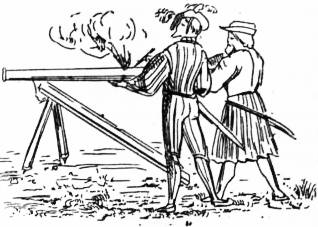
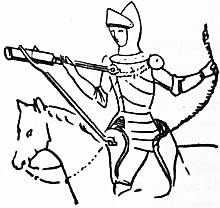
Fig. 1.—Hand Gun. Fig. 2.—Mounted Man with Hand Gun.
Firearms are said to have been first used in European warfare in the 14th century. The hand gun (see fig. 1) came into practical use in 1446 and was of very rude construction. It consisted of a simple iron or brass tube with a touch-hole at the top fixed in a straight stock of wood, the end of which passed under the right armpit when the “gonne” was about to be fired. A similar weapon (see fig. 2) was also used by the horse-soldier, with a ring at the end of the stock, by which it was suspended by a cord round the neck; a forked rest, fitted by a ring to the saddlebow, served to steady the gun. This rest, when not in use, hung down in front of the right leg. A match was made of cotton or hemp spun slack, and boiled in a strong solution of saltpetre or in the lees of wine. The touch-hole was first placed on the top of the barrel, but afterwards at the side, with a small pan underneath to hold the priming, and guarded by a cover moving on a pivot.
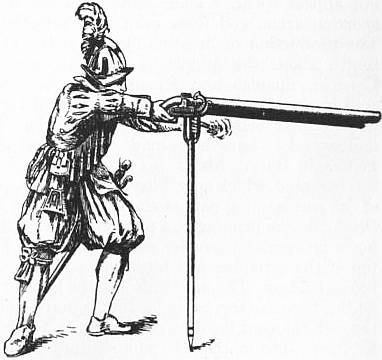
From General Hardÿ de Périnï’s Turenne et Condé 1626-1675.
Fig. 3.—Musketeer, 1626.
An improvement in firearms took place in the first year of the reign of Henry VII., or at the close of Edward IV., by fixing a cock (Fr. serpentine) on the hand gun to hold the match, which was brought down to the priming by a trigger, whence the term matchlock. This weapon is still in use among the Chinese, Tatars, Sikhs, Persians and Turks. An improvement in the stock was also made during this period by forming it with a wide butt end to be placed against the right breast. Subsequently the stock was bent, a German invention, and the arm was called a hackbutt or hagbut, and the smaller variety a demihague. The arquebus and hackbutt were about a yard in length, including barrel and stock, and the demihague was about half the size and weight, the forerunner of the pistol. The arquebus was the standard infantry firearm in Europe from the battle of Pavia to the introduction of the heavier and more powerful musket. It did not as a rule require a rest, as did the musket. The wheel-lock, an improvement on the matchlock, was invented in Nuremberg in 1517; was first used at the siege of Parma in 1521; was brought to England in 1530, and continued in partial use there until the time of Charles II. This wheel-lock consisted of a fluted or grooved steel wheel which protruded into the priming pan, and was connected with a strong spring. The cock, also regulated by a spring, was fitted with a piece of iron pyrites. In order to discharge the gun the lock was wound up by a key, the cock was let down on the priming pan, the pyrites resting on the wheel; on the trigger being pressed the wheel was released and rapidly revolved, emitting sparks, which ignited the powder in the pan. The complicated and expensive nature of this lock, with its liability to injury, no doubt prevented its general adoption.
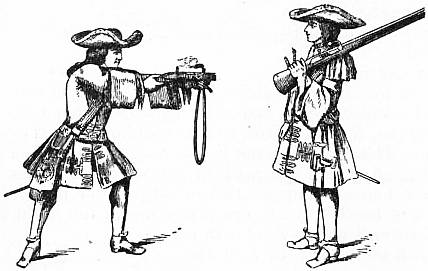
From General Hardÿ de Périnï’s Turenne et Condé, 1626-1675.
Figs. 4 and 5.—Musketeers, 1675.
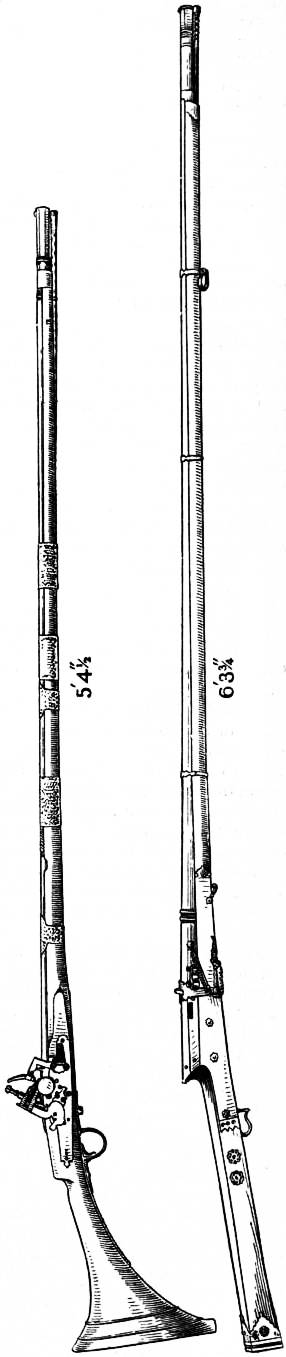
Fig. 6. (left)—Moorish Flint-lock.
Fig. 7. (right)—Indian Matchlock.
About 1540 the Spaniards constructed a larger and heavier firearm (matchlock), carrying a ball of 10 to the pound, called a musket. This weapon was introduced into England before the middle of the 16th century, and soon came into general use throughout Europe. The snaphance was invented about this period in Germany, and from its comparative cheapness was much used in England, France and Holland. It held a flint instead of the pyrites of the wheel or firelock, which ignited the powder in the pan by striking on a piece of furrowed steel, when released by the trigger, and emitting sparks.
As a sporting weapon the gun may be said to date from the invention of the wheel-lock in the beginning of the 16th century, though firearms were used for sporting purposes in Italy, Spain, Germany, and to some extent in France, in the 15th century. Before that period the longbow in England and the crossbow on the Continent were the usual weapons of the chase. In Great Britain little use appears to have been made of firearms for game shooting until the latter half of the 17th century, and the arms then used for the purpose were entirely of foreign make.
The French gunmakers of St-Étienne claim for their town that it is the oldest centre of the firearms industry. They do not appear to have made more than the barrels of the finest sporting arms, and these even were sometimes made in Paris. The production of firearms by the artists of Paris reached its zenith about the middle of the 17th century. The Italian, German, Spanish and Russian gunsmiths also showed great skill in the elegance and design of their firearms, the Spaniards in particular being makers of fine barrels. The pistol (q.v.) is understood to have been made for the first time about 1540 at Pistoia in Italy. About 1635 the modern firelock or flint-lock was invented, which only differed from the snaphance by the cover of the pan forming part of the furrowed steel struck by the flint. Originally the priming was put into the pan from a flask containing a fine-grained powder called serpentine powder. Later the top of the cartridge was bitten off and the pan filled therefrom before loading. The mechanism of the flint-lock musket rendered all this unnecessary, as, in loading, a portion of the charge passed through the vent into the pan, where it was held by the cover or hammer. The matchlock, as a military weapon, gradually gave way to the firelock, which came into general use in the last half of the 17th century, and was the weapon of Marlborough’s and Wellington’s armies. This was the famous “Brown Bess” of the British army. The highest development of the flint-lock is found in the fowling-pieces of the end of the 18th and beginning of the 19th centuries, particularly those made by Joseph Manton, the celebrated English gunsmith and inventor. The Napoleonic wars afforded English gunmakers an opportunity, which they fully utilized, of gaining the supremacy over their foreign competitors in the gunmaking trade. English gunmakers reduced the weight, improved the shooting powers, and perfected the lock mechanism of the sporting gun, and increased the range and efficiency of the rifle. This transference of the gunmaking craft from the Continent to England was also assisted by the tyranny of the foreign gunmaking gilds. In 1637 the London gunmakers obtained their charter of incorporation. The important gunmaking industry of Birmingham dates from 1603, and soon rivalled that of London. Double shot-guns do not appear to have been generally used until the 19th century. The first successful double guns were built with the barrels over and under, and not side by side, and were invented about 1616 by one Guilliano Bossi of Rome. In 1784 double shot guns were described as a novelty. Joseph Manton patented the elevated rib which rested on the barrels. The general success of the double gun was eventually due to the light weight which the better material and workmanship of the best gunmakers made possible, and to the quickness and certainty of ignition of the modern cartridge.
The objections to the flint-lock were that it did not entirely preserve the priming from wet, and that the flint sparks sometimes failed to ignite the charge. In 1807 the Rev. Alexander John Forsyth obtained a patent for priming with a fulminating powder made of chlorate of potash, sulphur and charcoal, which exploded by concussion. This important improvement in firearms was not recognized and adopted by the military authorities until more than thirty years later. In the meantime it was gradually developed, and the copper percussion cap invented, by various gunmakers and private individuals. Thomas Shaw of Philadelphia first used fulminate in a steel cap in 1814, which he changed to a copper cap in 1816. It was not until the introduction of the copper cap that the percussion gun could be considered in every way superior to the flint. In 1834, in the reign of William IV., Forsyth’s invention was tested at Woolwich by firing 6000 rounds from six flint-lock muskets, and a similar number from six percussion muskets, in all weathers. This trial established the percussion principle. The shooting was found to be more accurate, the recoil less, the charge of powder having been reduced from 6 to 4½ drs., the rapidity of firing greater and the number of miss-fires much reduced, being as 1 to 26 nearly in favour of the percussion system. In consequence of this successful trial the military flint-lock in 1839 was altered to suit the percussion principle. This was easily accomplished by replacing the hammer and pan by a nipple with a hole through its centre to the vent or touch-hole, and by replacing the cock which held the flint by a smaller cock or hammer with a hollow to fit on the nipple when released by the trigger. On the nipple was placed the copper cap containing the detonating composition, now made of three parts of chlorate of potash, two of fulminate of mercury and one of powdered glass.
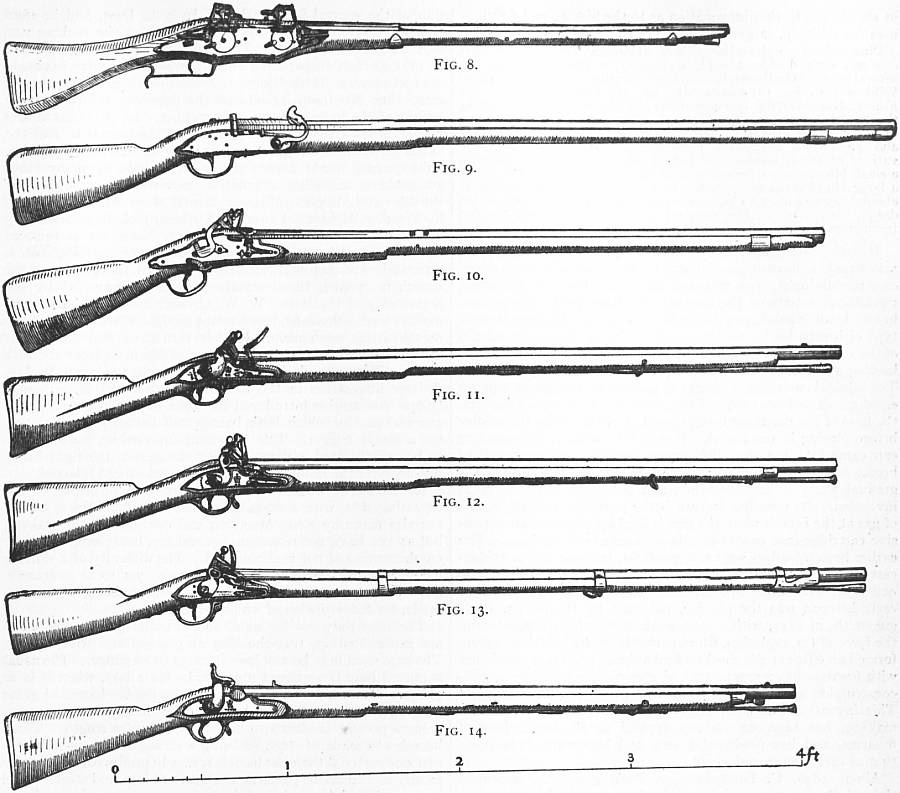
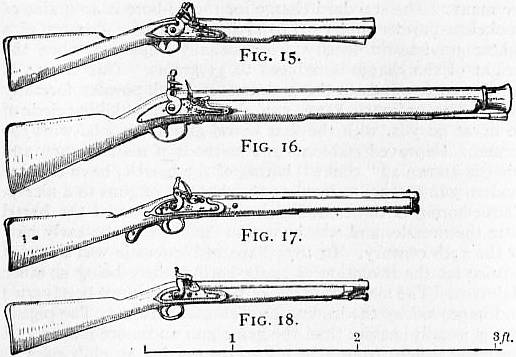
In 1840 the Austrian army was supplied with the percussion musket, and in 1842 a new model percussion musket with a block or back-sight for 150 yds. was issued to the British army, 11 ℔ 6 oz. in weight, 4 ft. 6¾ in. in length without bayonet, 6 ft. with bayonet and with a barrel 3 ft. 3 in. in length, firing a bullet of 14½ to the ℔ with 4½ drs. of powder. This musket was larger in bore than that of France, Belgium, Russia and Austria, and thus had the advantage of being able to fire their balls, while the English balls could not be fired from their barrels. But the greater weight and momentum of the English ball was counteracted by the excess of windage. This percussion musket of 1842, the latest development of the renowned Brown Bess, continued in use in the British army until partially superseded in 1851 by the Minié rifle, and altogether by the Enfield rifle in 1855. For further information as to the history and development of military, target and sporting rifles see Rifle.
Illustrations are given herewith of a German carbine of the 16th century, with double wheel-lock (fig. 8); a snaphance (fig. 9); several forms of the Brown Bess or flint-lock military musket (English, William III., fig. 10; George II., fig. 11; George III., fig. 12; French, Napoleon, fig. 13); and of the percussion musket adopted in the British service in 1839 (fig. 14). Examples of non-European firearms are shown in figs. 6 and 7, representing a Moorish flint-lock and an Indian matchlock respectively. Figs. 15-18 represent various carbines, musketoons and blunderbusses, fig. 15 showing a small blunderbuss or musketoon of the early 18th century, fig. 16 a large blunderbuss of 1750, fig. 17 a flint-lock cavalry carbine of about 1825 and fig. 18 a percussion carbine of 1830. All these are drawn from arms in the museum of the Royal United Service Institution, London.
Modern Shot Guns.—The modern sporting breech-loaders may be said to have originated with the invention of the cartridge-case containing its own means of ignition. The breech-loading mechanism antedated the cartridge by many years, the earliest breech-loading hand guns dating back to 1537. Another distinct type of breech-loader was invented in France about the middle of the 17th century. During the 17th and 18th centuries breech-loading arms were very numerous and of considerable variety. The original cartridge, a charge of powder and bullet in a paper envelope, dates from 1586. These were used with muzzle-loaders, the base of the cartridge being ripped or bitten off by the soldier before placing in the barrel. It was only when the detonating cap came into use that the paper cartridge answered well in breech-loaders. The modern breech-loader has resulted from a gradual series of improvements, and not from any one great invention. Its essential feature is the prevention of all escape of gas at the breech when the gun is fired by means of an expansive cartridge-case containing its own means of ignition. The earlier breech-loaders were not gas-tight, because the cartridge-cases were either consumable or the load was placed in a strong non-expansive breech-plug. The earliest efficient modern cartridge-case was the pin-fire, patented by Houiller, a Paris gunsmith, in 1847, with a thin weak shell which expanded by the force of the explosion, fitted perfectly in the barrel, and thus formed an efficient gas check. Probably no invention connected with firearms has wrought such changes in the principle of gun-construction as those effected by the expansive cartridge-case. This invention has completely revolutionized the art of gunmaking, has been successfully applied to all descriptions of firearms, and has produced a new and important industry—that of cartridge manufacture.
About 1836, C. Lefaucheux, a Paris gunsmith, improved the old Pauly system of breech-loading, but its breech action was a crude mechanism, with single grip worked by a bottom lever. The double grip for the barrels was the subsequent invention of a Birmingham gunmaker. The central-fire cartridge, practically as now in use, was introduced into England in 1861 by Daw. It is said to have been the invention of Pottet, of Paris, improved upon by Schneider, and gave rise to considerable litigation in respect of its patent rights. Daw, who controlled the English patents, was the only exhibitor of central-fire guns and cartridges at the International Exhibition of 1862. In his system the barrels work on a hinge joint, the bottom lever withdraws the holding-down bolt; the cartridge is of the modern type, the cap being detonated by a striker passing through the standing breech to the inner face. The cartridge-case is withdrawn by a sliding extractor fitted to the breech ends of the barrels. Daw was subsequently defeated in his control of the patents by Eley Bros., owing to the patent not having been kept in force in France. The modern breech-loading gun has been gradually and steadily improved since 1860. Westley Richards adopted and improved Matthews’ top-lever mechanism. About 1866 the rebounding lock was introduced, and improved in 1869. The treble wedge-fast mechanism for holding down the barrels was originated by W. W. Greener in 1865, and perfected in 1873. A very important improvement was the introduction of the hammerless gun, in which the mechanism for firing is placed entirely within the gun. This was made possible by the introduction of the central-fire cartridge. In 1862 Daw, and in 1866 Green, introduced hammerless guns in which the cocking was effected by the under lever. These guns did not attain popularity. In 1871 T. Murcott patented a hammerless gun, the first to obtain distinct success. This also was a lever-cocking gun. About the same time Needham introduced the principle of utilizing the weight of the barrels to assist in cocking. In 1875 Anson and Deeley utilized the fore-end attached to the barrels to cock the locks. From this date hammerless guns became really popular. Subsequently minor improvements were made by many other gun-makers, including alternative movements introduced by Purdey and Rogers. Improvements were also introduced by Westley Richards, Purdey and others, including cocking by means of the mainspring. In 1874 J. Needham introduced the ejector mechanism, by which each empty cartridge-case is separately and automatically thrown out of the gun when the breech is opened, the necessary force being provided by the mainspring of the lock. W. W. Greener and some other gunmakers have since introduced minor modifications and improvements of this mechanism. Next in turn came Perks and other inventors, who separated the ejector mechanism from the lock work. This very decided improvement is universal to-day. A later innovation in the modern breech-loader is the single trigger mechanism introduced by some of the leading English gun-makers, by which both barrels can be fired in succession by a single trigger. This improvement enables both barrels to be rapidly fired without altering the grip of the right hand, but deprives the shooter of the power of selecting his barrel.
Repeating or magazine shot-guns on the principle of the repeating rifle, with a magazine below the single firing barrel, are also made by some American and continental gun-makers, but as yet have not come into general use, being comparatively cumbersome and not well balanced. The difficulty of a shifting balance as each cartridge is fired has also yet to be overcome. Several varieties of a combination rifle and shot-gun are also made, for a description of which see Rifle.
The chief purposes for which modern shot-guns are required are game-shooting, trap-shooting at pigeons and wild-fowling. The game gun may be any bore from 32 to 10 gauge. The usual standard bore is 12 gauge unless it be for a boy, when it is 20 gauge. The usual weight of the 12-bore double-barrelled game gun is from 6 to 7 ℔ with barrels 30 in. long, there, however, being a present tendency to barrels of a shorter length. These barrels are made of steel, as being a stronger and more homogeneous material than the barrels formerly produced, which were mostly of Damascus pattern, a mixture of iron and steel. Steel barrels, drilled from the solid block, were originally produced by Whitworth. To-day the makers of steel for this purpose are many. The standard charge for the 12-bore is 42 grains of smokeless powder and 1 oz. to 11⁄8th oz. of shot. Powder of a lighter gravimetric density is occasionally employed, when the weight of the charge is reduced to 33 grains. This charge of powder corresponds to the 3 drams of black powder formerly used. The ordinary game gun should have a killing circle of 30 in. at 30 yds. with the first barrel and at 40 yds. with the second. Improved materials and methods of manufacture, and what is known as “choke” boring of the barrels, have enabled modern gun-makers to regulate the shooting of guns to a nicety. Choke-boring is the constriction of the diameter of the barrel near the muzzle, and was known in America in the early part of the 19th century. In 1875 Pape of Newcastle was awarded a prize for the invention of choke-boring, there being no other claimant. The methods of choke-boring have since been varied and improved by the leading English gun-makers. The pigeon gun is usually heavier than the game gun and more choked. It generally weighs from 7 to 8 ℔. Its weight, by club rules, is frequently restricted to 7½ ℔ and its bore to 12 gauge. The standard wild-fowling gun is a double 8-bore with 30-in. barrels weighing 15 ℔ and firing a charge of 7 drams of powder and 2¾ to 3 oz. of shot. These guns are also made in both smaller and larger varieties, including a single barrel 4-bore, which is the largest gun that can be used from the shoulder, and single barrel punt guns of 1½-in. bore, weighing 100 ℔. While no conspicuous advance in improved gun-mechanism and invention has been made during the last few years, the materials and methods of manufacture, and the quality and exactitude of the gun-maker’s work, have continued gradually and steadily to improve. English, and particularly London-made, guns stand pre-eminent all over the world.
(H. S.-K.)
GUNA, a town and military station in Central India, in the state of Gwalior. Pop. (1901) 11,452. After the Mutiny, it became the headquarters of the Central India Horse, whose commanding officer acts as ex-officio assistant to the resident of Gwalior; and its trade has developed rapidly since the opening of a station on a branch of the Great Indian Peninsula railway in 1899.
GUNCOTTON, an explosive substance produced by the action of strong nitric acid on cellulose at the ordinary temperature; chemically it is a nitrate of cellulose, or a mixture of nitrates, according to some authorities. The first step in the history of guncotton was made by T. J. Pelouze in 1838, who observed that when paper or cotton was immersed in cold concentrated nitric acid the materials, though not altered in physical appearance, became heavier, and after washing and drying were possessed of self-explosive properties. At the time these products were thought to be related to the nitrated starch obtained a little previously by Henri Braconnot and called xyloidin; they are only related in so far as they are nitrates. C. F. Schönbein of Basel published his discovery of guncotton in 1846 (Phil. Mag. [3], 31, p. 7), and this was shortly after followed by investigations by R. R. Böttger of Frankfort and Otto and Knop, all of whom added to our knowledge of the subject, the last-named introducing the use of sulphuric along with nitric acid in the nitration process. The chemical composition and constitution of guncotton has been studied by a considerable number of chemists and many divergent views have been put forward on the subject. W. Crum was probably the first to recognize that some hydrogen atoms of the cellulose had been replaced by an oxide of nitrogen, and this view was supported more or less by other workers, especially Hadow, who appears to have distinctly recognized that at least three compounds were present, the most violently explosive of which constituted the main bulk of the product commonly obtained and known as guncotton. This particular product was insoluble in a mixture of ether and alcohol, and its composition could be expressed by the term tri-nitrocellulose. Other products were soluble in the ether-alcohol mixture: they were less highly nitrated, and constituted the so-called collodion guncotton.
The smallest empirical formula for cellulose (q.v.) may certainly be written C6H10O5. How much of the hydrogen and oxygen are in the hydroxylic (OH) form cannot be absolutely stated, but from the study of the acetates at least three hydroxyl groups may be assumed. The oldest and perhaps most reasonable idea represents guncotton as cellulose trinitrate, but this has been much disputed, and various formulae, some based on cellulose as C12H20O10, others on a still more complex molecule, have been proposed. The constitution of guncotton is a difficult matter to investigate, primarily on account of the very insoluble nature of cellulose itself, and also from the fact that comparatively slight variations in the concentration and temperature of the acids used produce considerable differences in the products. The nitrates are also very insoluble substances, all the so-called solvents merely converting them into jelly. No method has yet been devised by which the molecular weight can be ascertained.1 The products of the action of nitric acid on cellulose are not nitro compounds in the sense that picric acid is, but are nitrates or nitric esters.
Guncotton is made by immersing cleaned and dried cotton waste in a mixture of strong nitric and sulphuric acids. The relative amounts of the acids in the mixture and the time of duration of treatment of the cotton varies somewhat in different works, but the underlying idea is the same, viz. employing such an excess of sulphuric over nitric that the latter will be rendered anhydrous or concentrated and maintained as such in solution in the sulphuric acid, and that the sulphuric acid shall still be sufficiently strong to absorb and combine with the water produced during the actual formation of the guncotton. In the recent methods the cotton remains in contact with the acids for two to four hours at the ordinary air temperature (15° C.), in which time it is almost fully nitrated, the main portion, say 90%, having a composition represented by the formula2 C6H7O2(NO3)3, the remainder consisting of lower nitrated products, some oxidation products and traces of unchanged cellulose and cellulose sulphates. The acid is then slowly run out by an opening in the bottom of the pan in which the operation is conducted, and water distributed carefully over its surface displaces it in the interstices of the cotton, which is finally subjected to a course of boiling and washing with water. This washing is a most important part of the process. On its thoroughness depends the removal of small quantities of products other than the nitrates, for instance, some sulphates and products from impurities contained in the original cellulose. Cellulose sulphates are one, and possibly the main, cause of instability in guncotton, and it is highly desirable that they should be completely hydrolysed and removed in the washing process. The nitrated product retains the outward form of the original cellulose. In the course of the washing, according to a method introduced by Sir F. Abel, the cotton is ground into a pulp, a process which greatly facilitates the complete removal of acids, &c. This pulp is finally drained, and is then either compressed, while still moist, into slabs or blocks when required for blasting purposes, or it is dried when required for the manufacture of propellants. Sometimes a small quantity of an alkali (e.g. sodium carbonate) is added to the final washing water, so that quantities of this alkaline substance ranging from 0.5% to a little over 1% are retained by the guncotton. The idea is that any traces of acid not washed away by the washing process or produced later by a slow decomposition of the substance will be thereby neutralized and rendered harmless. Guncotton in an air-dry state, whether in the original form or after grinding to pulp and compressing, burns with very great rapidity but does not detonate unless confined.
Immediately after the discovery of guncotton Schönbein proposed its employment as a substitute for gunpowder, and General von Lenk carried out a lengthy and laborious series of experiments intending to adapt it especially for artillery use. All these and many subsequent attempts to utilize it, either loose or mechanically compressed in any way, signally failed. However much compressed by mechanical means it is still a porous mass, and when it is confined as in a gun the flame and hot gases from the portion first ignited permeate the remainder, generally causing it actually to detonate, or to burn so rapidly that its action approaches detonation. The more closely it is confined the greater is the pressure set up by a small part of the charge burning, and the more completely will the explosion of the remainder assume the detonating form. The employment of guncotton as a propellant was possible only after the discovery that it could be gelatinized or made into a colloid by the action of so-called solvents, e.g. ethylacetate and other esters, acetone and a number of like substances (see Cordite).
When quite dry guncotton is easily detonated by a blow on an anvil or hard surface. If dry and warm it is much more sensitive to percussion or friction, and also becomes electrified by friction under those conditions. The amount of contained moisture exerts a considerable effect on its sensitiveness. With about 2% of moisture it can still be detonated on an anvil, but the action is generally confined to the piece struck. As the quantity of contained water increases it becomes difficult or even impossible to detonate by an ordinary blow. Compressed dry guncotton is easily detonated by an initiative detonator such as mercuric fulminate. Guncotton containing more than 15% of water is uninflammable, may be compressed or worked without danger and is much more difficult to detonate by a fulminate detonator than when dry.3 A small charge of dry guncotton will, however, detonate the wet material, and this peculiarity is made use of in the employment of guncotton for blasting purposes. A charge of compressed wet guncotton may be exploded, even under water, by the detonation of a small primer of the dry and waterproofed material, which in turn can be started by a small fulminate detonator. The explosive wave from the dry guncotton primer is in fact better responded to by the wet compressed material than the dry, and its detonation is somewhat sharper than that of the dry. It is not necessary for the blocks of wet guncotton to be actually in contact if they be under water, and the peculiar explosive wave can also be conveyed a little distance by a piece of metal such as a railway rail. The more nearly the composition of guncotton approaches that represented by C6H7O2(NO3)3, the more stable is it as regards storing at ordinary temperatures, and the higher the igniting temperature. Carefully prepared guncotton after washing with alcohol-ether until nothing more dissolves may require to be heated to 180-185° C. before inflaming. Ordinary commercial guncottons, containing from 10 to 15% of lower nitrated products, will ignite as a rule some 20-25° lower.
Assuming the above formula to represent guncotton, there is sufficient oxygen for internal combustion without any carbon being left. The gaseous mixture obtained by burning guncotton in a vacuum vessel contains steam, carbon monoxide, carbon dioxide, nitrogen, nitric oxide, and methane. When slowly heated in a vacuum vessel until ignition takes place, some nitrogen dioxide, NO2, is also produced. When kept for some weeks at a temperature of 100° in steam, a considerable number of fatty acids, some bases, and glucose-like substances result. Under different pressures the relative amounts of the combustion products vary considerably. Under very great pressures carbon monoxide, steam and nitrogen are the main products, but nitric oxide never quite disappears.
Dilute mineral acids have little or no action on guncotton. Strong sulphuric acid in contact with it liberates first nitric acid and later oxides of nitrogen, leaving a charred residue or a brown solution according to the quantity of acid. It sometimes fires on contact with strong sulphuric acid, especially when slightly warmed. The alkali hydroxides (e.g. sodium hydroxide) will in a solid state fire it on contact. Strong or weak solutions of these substances also decompose it, producing some alkali nitrate and nitrite, the cellulose molecule being only partially restored, some quantity undergoing oxidation. Ammonia is also active, but not quite in the same manner as the alkali hydroxides. Dry guncotton heated in ammonia gas detonates at about 70°, and ammonium hydroxide solutions of all strengths slowly decompose it, yielding somewhat complex products. Alkali sulphohydrates reduce guncotton, or other nitrated celluloses, completely to cellulose. The production of the so-called “artificial silk” depends on this action.
A characteristic difference between guncotton and collodion cotton is the insolubility of the former in ether or alcohol or a mixture of these liquids. The so-called collodion cottons are nitrated celluloses, but of a lower degree of nitration (as a rule) than guncotton. They are sometimes spoken of as “lower” or “soluble” cottons or nitrates. The solubility in ether-alcohol may be owing to a lower degree of nitration, or to the temperature conditions under which the process of manufacture has been carried on. If guncotton be correctly represented by the formula C6H7O2(NO3)3, it should contain a little more than 14% of nitrogen. Guncottons are examined for degree of nitration by the nitrometer, in which apparatus they are decomposed by sulphuric acid in contact with mercury, and all the nitrogen is evolved as nitric oxide, NO, which is measured and the weight of its contained nitrogen calculated. Ordinary guncottons seldom contain more than 13% of nitrogen, and in most cases the amount does not exceed 12.5%. Generally speaking, the lower the nitrogen content of a guncotton, as found by the nitrometer, the higher the percentage of matters soluble in a mixture of ether-alcohol. These soluble matters are usually considered as “lower” nitrates.
Guncottons are usually tested by the Abel heat test for stability (see Cordite). Another heat test, that of Will, consists in heating a weighed quantity of the guncotton in a stream of carbon dioxide to 130° C., passing the evolved gases over some red-hot copper, and finally collecting them over a solution of potassium hydroxide which retains the carbon dioxide and allows the nitrogen, arising from the guncotton decomposition, to be measured. This is done at definite time intervals so that the rate of decomposition can be followed. The relative stability is then judged by the amount of nitrogen gas collected in a certain time. Several modifications of this and of the Abel heat test are also in use. (See Explosives.)
(W. R. E. H.)
1 The composition of the cellulose nitrates was reviewed by G. Lunge (Jour. Amer. Chem. Soc., 1901, 23, p. 527), who, assuming the formula C24H40O20 for cellulose, showed how the nitrocelluloses described by different chemists may be expressed by the formula C24H{46-x}O20(NO2)x, where x has the values 4, 5, 6, ... 12.
2 This formula is retained mainly on account of its simplicity. It also expresses all that is necessary in this connexion.
3 Air-dried guncotton will contain 2% or less of moisture.
GUNDULICH, IVAN (1588-1638), known also as Giovanni Gondola, Servian poet, was born at Ragusa on the 8th of January 1588. His father, Franco Gundulich, once the Ragusan envoy to Constantinople and councillor of the republic, gave him an excellent education. He studied the “humanities” with the Jesuit, Father Muzzi, and philosophy with Father Ricasoli. After that he studied Roman law and jurisprudence in general. He was member of the Lower Council and once served as the chief magistrate of the republic. He died on the 8th of December 1638. A born poet, he admired much the Italian poets of his time, from whom he made many translations into Servian. It is believed that he so translated Tasso’s Gerusalemme liberata. He is known to have written eighteen works, of which eleven were dramas, but of these only three have been fully preserved, others having perished during the great earthquake and fire in 1667. Most of those dramas were translations from the Italian, and were played, seemingly with great success, by the amateurs furnished by the noble families of Ragusa. But his greatest and justly celebrated work is an epic, entitled Osman, in twenty cantos. It is the first political epic on the Eastern Question, glorifying the victory of the Poles over Turks and Tatars in the campaign of 1621, and encouraging a league of the Christian nations, under the guidance of Vladislaus, the king of Poland, for the purpose of driving away the Turks from Europe. The fourteenth and fifteenth cantos are lost. It is generally believed that the Ragusan government suppressed them from consideration for the Sultan, the protector of the republic, those two cantos having been violently anti-Turkish.
Osman was printed for the first time in Ragusa in 1826, the two missing cantos being replaced by songs written by Pietro Sorgo (or Sorkochevich). From this edition the learned Italian, Francesco Appendini, made an Italian translation published in 1827. Since that time several other editions have been made. The best are considered to be the edition of the South Slavonic Academy in Agram (1877) and the edition published in Semlin (1889) by Professor Yovan Boshkovich. In the edition of 1844 (Agram) the last cantos, fourteen and fifteen, were replaced by very fine compositions of the Serbo-Croatian poet, Mazhuranich (Mažuranić). The complete works of Gundulich have been published in Agram, 1847, by V. Babukich and by the South Slavonic Academy of Agram in 1889.
(C. Mi.)
GUNG’L, JOSEF (1810-1889), Hungarian composer and conductor, was born on the 1st of December 1810, at Zsámbék, in Hungary. After starting life as a school-teacher, and learning the elements of music from Ofen, the school-choirmaster, he became first oboist at Graz, and, at twenty-five, bandmaster of the 4th regiment of Austrian artillery. His first composition, a Hungarian march, written in 1836, attracted some notice, and in 1843 he was able to establish an orchestra in Berlin. With this band he travelled far, even (in 1849) to America. It is worth recording that Mendelssohn’s complete Midsummer Night’s Dream music is said to have been first played by Gung’l’s band. In 1853 he became bandmaster to the 23rd Infantry Regiment at Brünn, but in 1864 he lived at Munich, and in 1876 at Frankfort, after (in 1873) having conducted with great success a series of promenade concerts at Covent Garden, London. From Frankfort Gung’l went to Weimar to live with his daughter, a well-known German opera singer and local prima donna. There he died, on the 31st of January 1889. Gung’l’s dances number over 300, perhaps the most popular being the “Amoretten,” “Hydropaten,” “Casino,” “Dreams on the Ocean” waltzes; “In Stiller Mitternacht” polka, and “Blue Violets” mazurka. His Hungarian march was transcribed by Liszt. His music is characterized by the same easy flowing melodies and well-marked rhythm that distinguish the dances of Strauss, to whom alone he can be ranked second in this kind of composition.
GUNNER, or Master Gunner, in the navy, the warrant officer who has charge of the ordnance and ammunition, and of the training of the men at gun drill. His functions in this respect are of less relative importance than they were in former times, when specially trained corps of seamen gunners had not been formed.
GUNNING, PETER (1614-1684), English divine, was born at Hoo, in Kent, and educated at the King’s School, Canterbury, and Clare College, Cambridge, where he became a fellow in 1633. Having taken orders, he advocated the royalist cause from the pulpit with much eloquence. In 1644 he retired to Oxford, and held a chaplaincy at New College until the city surrendered to the parliamentary forces in 1646. Subsequently he was chaplain, first to the royalist Sir Robert Shirley of Eatington (1629-1656), and then at the Exeter House chapel. After the Restoration in 1660 he returned to Clare College as master, and was appointed Lady Margaret professor of divinity. He also received the livings of Cottesmore, Rutlandshire, and Stoke Bruerne, Northamptonshire. In 1661 he became head of St John’s College, Cambridge, and was elected Regius professor of divinity. He was consecrated bishop of Chichester in 1669, and was translated to the see of Ely in 1674-1675. Holding moderate religious views, he deprecated alike the extremes represented by Puritanism and Roman Catholicism.
His works are chiefly reports of his disputations, such as that which appears in the Scisme Unmask’t (Paris, 1658), in which the definition of a schism is discussed with two Romanist opponents.
GUNNY, a sort of cloth, the name of which is supposed to be derived from ganga or gania of Rumphius, or from gonia, a vernacular name of the Crotolaria juncea—a plant common in Madras. One of the first notices of the term itself is to be found in Knox’s Ceylon, in which he says: “The filaments at the bottom of the stem (coir from the coco-nut husk, Cocos nucifera) may be made into a coarse cloth called gunny, which is used for bags and similar purposes.”
Warden, in The Linen Trade, says:
“A very large proportion of the jute grown in Bengal is made into cloth in the districts where it is cultivated, and this industry forms the grand domestic manufacture of all the populous eastern districts of Bengal. It pervades all classes, and penetrates into every household, almost every one, man, woman and child, being in some way engaged in it. Boatmen, husbandmen, palankeen carriers, domestic servants, everyone, in fact, being Hindu—for Mussulmans spin cotton only—pass their leisure moments, distaff in hand, spinning gunny twist. It is spun by the takur and dhara, the former being a kind of spindle, which is turned upon the thigh or the sole of the foot, and the latter a reel, on which the thread, when sufficiently twisted, is wound up. Another kind of spinning machine, called a ghurghurea, is occasionally used. A bunch of the raw material is hung up in every farmer’s house, or on the protruding stick of a thatched roof, and every one who has leisure forms with these spindles some coarse pack-thread, of which ropes are twisted for the use of the farm. The lower Hindu castes, from this pack-thread, spin a finer thread for being made into cloth, and, there being a loom in nearly every house, very much of it is woven by the women of the lower class of people. It is especially the employment of the Hindu widow, as it enables her to earn her bread without being a burden on her family. The cloth thus made is of various qualities, such as clothing for the family (especially the women, a great proportion of whom on all the eastern frontier wear almost nothing else), coarse fabrics, bedding, rice and sugar bags, sacking, pack-sheet, &c. Much of it is woven into short lengths and very narrow widths, two or three of which are sometimes sewed into one piece before they are sold. That intended for rice and sugar bags is made about 6 feet long, and from 24 to 27 inches wide, and doubled. A considerable quantity of jute yarn is dyed and woven into cloth for various local purposes, and some of it is also sent out of the district. The principal places where chotee, or jute cloth for gunny bags, is made are within a radius of perhaps 150 to 200 miles around Dacca, and there both labour and land are remarkably cheap. The short, staple, common jute is generally consumed in the local manufacture, the finer and long stapled being reserved for the export trade. These causes enable gunny cloth and bags to be sold almost as cheaply as the raw material, which creates an immense demand for them in nearly every market of the world.”