VOLUME XII SLICE VI Groups, Theory of to Gwyniad (continued 8)
Reading edition
He had been supported in all his undertakings and intrigues by his brother John, cardinal of Lorraine (1498-1550), who had been made coadjutor of Metz at the age of three. The cardinal was archbishop of Reims, Lyons and Narbonne, bishop of Metz, Toul, Verdun, Thérouanne, Luçon, Albi, Valence, Nantes and Agen, and before he died had squandered most of the wealth which he had derived from these and other benefices. Part of his ecclesiastical preferments he gave up in favour of his nephews. He became a member of the royal council in 1530, and in 1536 was entrusted with an embassy to Charles V. Although a complaisant helper in Francis I.’s pleasures, he was disgraced in 1542, and retired to Rome. He died at Nogent-sur-Yonne on the 18th of May 1550. He was extremely dissolute, but as an open-handed patron of art and learning, as the protector and friend of Erasmus, Marot and Rabelais he did something to counter-balance the general unpopularity of his calculating and avaricious brother.
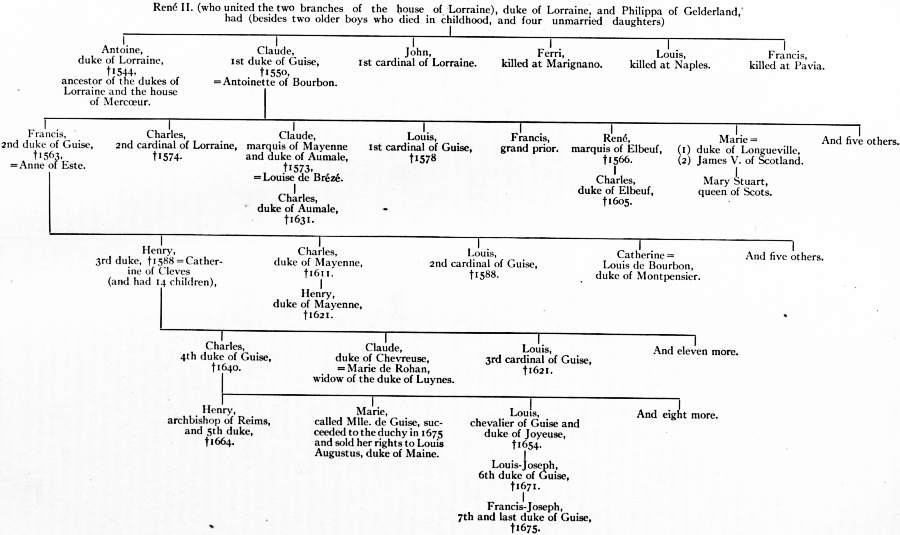
Claude of Guise had twelve children, among them Francis, 2nd duke of Guise; Charles, 2nd cardinal of Lorraine (1524-1574), who became archbishop of Reims in 1538 and cardinal in 1547; Claude, marquis of Mayenne, duke of Aumale (1526-1573), governor of Burgundy, who married Louise de Brézé, daughter of Diane de Poitiers, thus securing a powerful ally for the family; Louis (1527-1578), bishop of Troyes, archbishop of Sens and cardinal of Guise; René, marquis of Elbeuf (1536-1566), from whom descended the families of Harcourt, Armagnac, Marsan and Lillebonne; Mary of Lorraine (q.v.), generally known as Mary of Guise, who after the death of her second husband, James V. of Scotland, acted as regent of Scotland for her daughter Mary, queen of Scots; and Francis (1534-1563), grand prior of the order of the Knights of Malta. The solidarity of this family, all the members of which through three generations cheerfully submitted to the authority of the head of the house, made it a formidable factor in French politics.
Francis of Lorraine, 2nd duke of Guise (1519-1563), “le grand Guise,” was born at Bar on the 17th of February 1519. As count of Aumale he served in the French army, and was nearly killed at the siege of Boulogne in 1545 by a wound which brought him the name of “Balafré.” Aumale was made (1547) a peerage-duchy in his favour, and on the accession of Henry II. the young duke, who had paid assiduous court to Diane de Poitiers, shared the chief honours of the kingdom with the constable Anne de Montmorency. Both cherished ambitions for their families, but the Guises were more unscrupulous in subordinating the interests of France to their own. Montmorency’s brutal manners, however, made enemies where Guise’s grace and courtesy won him friends. Guise was a suitor for the hand of Jeanne d’Albret, princess of Navarre, who refused, however, to become a sister-in-law of a daughter of Diane de Poitiers and remained one of the most dangerous and persistent enemies of the Guises. He married in December 1548 Anne of Este, daughter of Ercole II., duke of Ferrara, and through her mother Renée, a granddaughter of Louis XII. of France. In the same year he had put down a peasant rising in Saintonge with a humanity that compared very favourably with the cruelty shown by Montmorency to the town of Bordeaux. He made preparations in Lorraine for the king’s German campaign of 1551-52. He was already governor of Dauphiné, and now became grand chamberlain, prince of Joinville, and hereditary seneschal of Champagne, with large additions to his already considerable revenues. He was charged with the defence of Metz, which Henry II. had entered in 1551. He reached the city in August 1552, and rapidly gave proof of his great powers as a soldier and organizer by the skill with which the place, badly fortified and unprovided with artillery, was put in a state of defence. Metz was invested by the duke of Alva in October with an army of 60,000 men, and the emperor joined his forces in November. An army of brigands commanded by Albert of Brandenburg had also to be reckoned with. Charles was obliged to raise the siege on the 2nd of January 1553, having lost, it is said, 30,000 men before the walls. Guise used his victory with rare moderation and humanity, providing medical care for the sick and wounded left behind in the besiegers’ camp. The subsequent operations were paralysed by the king’s suspicion and carelessness, and the constable’s inactivity, and a year later Guise was removed from the command. He followed the constable’s army as a volunteer, and routed the army of Charles V. at the siege of Renty on the 12th of August 1554. Montmorency’s inaction rendered the victory fruitless, and a bitter controversy followed between Guise and the constable’s nephew Coligny, admiral of France, which widened a breach already existing.
The conclusion of a six years’ truce at Vaucelles (1556) disappointed Guise’s ambitions, and he was the main mover in the breach of the treaty in 1558, when he was sent at the head of a French army to Italy to the assistance of Pope Paul IV. against Spain. Guise, who perhaps had in view the restoration to his family of the Angevin dominion of Naples and Sicily, crossed the Alps early in 1557 and after a month’s delay in Rome, where he failed to receive the promised support, marched on the kingdom of Naples, then occupied by the Spanish troops under Alva. He seized and sacked Campli (April 17th), but was compelled to raise the siege of Civitella. Meanwhile the pope had veered round to a Spanish alliance, and Guise, seeing that no honour was to be gained in the campaign, wisely spared his troops, so that his army was almost intact when, in August, he was hastily summoned home to repel the Spanish army which had invaded France from the north, and had taken St Quentin. On reaching Paris in October Guise was made lieutenant-general of the kingdom, and proceeded to prepare for the siege of Calais. The town was taken, after six days’ fighting, on the 6th of January 1558, and this success was followed up by the capture of Guînes, Thionville and Arlon, when the war was ended by the treaty of Câteau Cambrésis (1559). Although his brother, the cardinal of Lorraine, was one of the negotiators, this peace was concluded against the wishes of Guise, and was regarded as a triumph of the constable’s party. The Guises were provided with a weapon against Montmorency by the bishop of Arras (afterwards Cardinal Granvella), who gave to the cardinal of Lorraine at an interview at Péronne in 1558 an intercepted letter proving the Huguenot leanings of the constable’s nephews.
On the accession in 1559 of Francis II., their nephew by marriage with Mary Stuart, the royal authority was practically delegated to Guise and the cardinal, who found themselves beyond rivalry for the time being. They had, however, to cope with a new and dangerous force in Catherine de’ Medici, who was now for the first time free to use her political ability. The incapacity, suspicion and cruelty of the cardinal, who controlled the internal administration, roused the smaller nobility against the Lorraine princes. A conspiracy to overturn their government was formed at Nantes, with a needy Périgord nobleman named La Renaudie as its nominal head, though the agitation had in the first instance been fostered by the agents of Louis I., prince of Condé. The Guises were warned of the conspiracy while the court was at Blois, and for greater security removed the king to Amboise. La Renaudie, nothing daunted, merely postponed his plans; and the conspirators assembled in small parties in the woods round Amboise. They had, however, been again betrayed and many of them were surrounded and taken before the coup could be delivered; one party, which had seized the château of Noizay, surrendered on a promise of amnesty given “on his faith as a prince” by James of Savoy, duke of Nemours, a promise which, in spite of the duke’s protest, was disregarded. On the 19th of March 1560, La Renaudie and the rest of the conspirators openly attacked the château of Amboise. They were repelled; their leader was killed; and a large number were taken prisoners. The merciless vengeance of the Guises was the measure of their previous fears. For a whole week the torturings, quarterings and hangings went on, the bodies being cast into the Loire, the young king and queen witnessing the bloody spectacle day by day from a balcony of the château.
The cruel repression of this “conspiracy of Amboise” inspired bitter hatred of the Guises, since they were avenging a rising rather against their own than the royal authority. They now entrenched themselves with the king at Orleans, and the Bourbon princes, Anthony, king of Navarre, and his brother Condé, were summoned to court. The Guises convened a special commission to try Condé, who was condemned to death; but the affair was postponed by the chancellor, and the death of Francis II. in December saved Condé. Guise then made common cause with his old rival Montmorency and with the Marshal de Saint André against Catherine, the Bourbons and Coligny. This alliance, constituted on the 6th of April 1561, and known as the triumvirate, aimed at the annulment of the concessions made by Catherine to the Huguenots. The cardinal of Lorraine fomented the discord which appeared between the clergy of the two religions when they met at the colloquy of Poissy in 1561, but in spite of the extreme Catholic views he there professed, he was at the time in communication with the Lutheran princes of Germany, and in February 1562 met the duke of Württemberg at Zabern to discuss the possibility of a religious compromise.
The signal for civil war was given by an attack of Guise’s escort on a Huguenot congregation at Vassy (1st of March 1562). Although Guise did not initiate the massacre, and although, when he learned what was going on, he even tried to restrain his soldiers, he did not disavow their action. When Catherine de’ Medici forbade his entry into Paris, he accepted the challenge, and on the 16th of March he entered the city, where he was a popular hero, at the head of 2000 armed nobles. The provost of the merchants offered to put 20,000 men and two million livres at his disposal. In September he joined Montmorency in besieging Rouen, which was sacked as if it had been a foreign city, in spite of Guise’s efforts to save it from the worst horrors. At the battle of Dreux (19th of December 1562) he commanded a reserve army, with which he saved Montmorency’s forces from destruction and inflicted a crushing defeat on the Huguenots. The prince of Condé was his prisoner, while the capture of Montmorency by the Huguenots and the assassination of the Marshal de Saint-André after the battle left Guise the undisputed head of the Catholic party. He was appointed lieutenant-general of the kingdom, and on the 5th of February 1563 he appeared with his army before Orleans. On the 19th, however, he was shot by the Huguenot Jean Poltrot de Méré as he was returning to his quarters, and died on the 24th of the effects of the wound. Guise’s splendid presence, his generosity and humanity and his almost unvarying success on the battlefield made him the idol of his soldiers. He attended personally to the minutest details, and Monluc complains that he even wrote out his own orders. The mistakes and cruelties associated with his name were partly due to the evil counsels of his brother Charles, the cardinal, whose cowardice and insincerity were the scorn of his contemporaries. The negotiations of the Guises with Spain dated from the interview with Granvella at Péronne, in 1558, and after the death of his brother the cardinal of Lorraine was constantly in communication with the Spanish court, offering, in the event of the failure of direct heirs to the Valois kings, to deliver up the frontier fortresses and to acknowledge Philip II. as king of France. His death in 1574 temporarily weakened the extreme Catholic party.
Of the children of Francis “le Balafré” five survived him: Henry, 3rd duke of Guise; Charles, duke of Mayenne (1554-1611) (q.v.), who consolidated the League; Catherine (1552-1596), who married Louis of Bourbon, duke of Montpensier, and encouraged the fanaticism of the Parisian leaguers; Louis, second cardinal of Guise, afterwards of Lorraine (1555-1588), who was assassinated with his brother Henry; and Francis (1558-1573).
Henry of Lorraine, 3rd duke of Guise (1550-1588), born on the 31st of December 1550, was thirteen years old at the time of his father’s death, and grew up under the domination of a passionate desire for revenge. Catherine de’ Medici refused to take steps against Coligny, who was formally accused by the duchess of Guise and her brothers-in-law of having incited the murder. In 1566 she insisted on a formal reconciliation at Moulins between the Guises and Coligny, at which, however, none of the sons of the murdered man was present. Henry and his brothers were, however, compelled in 1572 to sign an ambiguous assent to this agreement. Guise’s widow married James of Savoy, duke of Nemours, and the young duke at sixteen went to fight against the Turks in Hungary. On the fresh outbreak of civil war in 1567 he returned to France and served under his uncle Aumale. In the autumn of 1568 he received a considerable command, and speedily came into rivalry with Henry of Valois, duke of Anjou. He had not inherited his father’s generalship, and his rashness and headstrong valour more than once brought disaster on his troops, but the showy quality of his fighting brought him great popularity in the army. In the defence of Poitiers in 1569 with his brother, the duke of Mayenne, he showed more solid abilities as a soldier. On the conclusion of peace in 1570 he returned to court, where he made no secret of his attachment to Margaret of Valois. His pretensions were violently resented by her brothers, who threatened his life, and he saved himself by a precipitate marriage with Catherine of Cleves (daughter of Francis of Cleves, duke of Nevers, and Margaret of Bourbon), the widow of a Huguenot nobleman, Antoine de Crog, prince of Porcien. Presently he ended his disgrace by an apparent reconciliation with Henry of Valois and an alliance with Catherine de’ Medici. He was an accomplice in the first attack on Coligny’s life, and when permission for the massacre of Saint Bartholomew had been extorted from Charles IX. he roused Paris against the Huguenots, and satisfied his personal vengeance by superintending the murder of Coligny. He was now the acknowledged chief of the Catholic party, and the power of his family was further increased by the marriage (1575) of Henry III. with Louise of Vaudémont, who belonged to the elder branch of the house of Lorraine. In a fight at Dormans (10th of October 1575), the only Catholic victory in a disastrous campaign, Guise received a face wound which won for him his father’s name of Balafré and helped to secure the passionate attachment of the Parisians. He refused to acquiesce in the treaty of Beaulieu (5th of May 1576), and with the support of the Jesuits proceeded to form a “holy league” for the defence of the Roman Catholic Church. The terms of enrolment enjoined offensive action against all who refused to join. This association had been preceded by various provincial leagues among the Catholics, notably one at Péronne. Condé had been imposed on this town as governor by the terms of the peace, and the local nobility banded together to resist him. This, like the Holy League itself, was political as well as religious in its aims, and was partly inspired by revolt against the royal authority. In the direction of the League Guise was hampered by Philip of Spain, who subsidized the movement, while he also had to submit to the dictation of the Parisian democracy. Ulterior ambitions were freely ascribed to him. It was asserted that papers seized from his envoy to Rome, Jean David, revealed a definite design of substituting the Lorraines, who represented themselves as the successors of Charlemagne, for the Valois; but these papers were probably a Huguenot forgery. Henry III. eventually placed himself at the head of the League, and resumed the war against the Huguenots; but on the conclusion of peace (September 1577) he seized the opportunity of disbanding the Catholic associations. The king’s jealousy of Guise increased with the duke’s popularity, but he did not venture on an open attack, nor did he dare to avenge the murder by Guise’s partisans of one of his personal favourites, Saint-Mégrin, who had been set on by the court to compromise the reputation of the duchess of Guise.1
Meanwhile the duke had entered on an equivocal alliance with Don John of Austria. He was also in constant correspondence with Mary of Lorraine, and meditated a descent on Scotland in support of the Catholic cause. But the great riches of the Guises were being rapidly dissipated, and in 1578 the duke became a pensioner of Philip II. When in 1584 the death of the duke of Anjou made Henry of Navarre the next heir to the throne, the prospect of a Huguenot dynasty roused the Catholics to forget their differences, and led to the formation of a new league of the Catholic nobles. At the end of the same year Guise and his brother, the duke of Mayenne, with the assent of other Catholic nobles, signed a treaty at Joinville with Philip II., fixing the succession to the crown on Charles, cardinal of Bourbon, to the exclusion of the Protestant princes of his house. In March 1585 the chiefs of the League issued the Declaration of Péronne, exposing their grievances against the government and announcing their intention to restore the dignity of religion by force of arms. On the refusal of Henry III. to accept Spanish help against his Huguenot subjects, war broke out. The chief cities of France declared for the League, and Guise, who had recruited his forces in Germany and Switzerland, took up his headquarters at Châlons, while Mayenne occupied Dijon, and his relatives, the dukes of Elbeuf, Aumale and Mercœur,2 roused Normandy and Brittany. Henry III. accepted, or feigned to accept, the terms imposed by the Guises at Nemours (7th of July 1585). The edicts in favour of the Huguenots were immediately revoked. Guise added to his reputation as the Catholic champion by defeating the German auxiliaries of the Huguenots at Vimory (October 1587) and Auneau (November 1587). The protestations of loyalty to Henry III. which had marked the earlier manifestoes of the League were modified. Obedience to the king was now stated to depend on his giving proof of Catholic zeal and showing no favour to heresy. In April 1588 Guise arrived in Paris, where he put himself at the head of the Parisian mob, and on the 12th of May, known as the Day of the Barricades, he actually had the crown within his grasp. He refused to treat with Catherine de’ Medici, who was prepared to make peace at any cost, but restrained the populace from revolution and permitted Henry to escape from Paris. Henry came to terms with the League in May, and made Guise lieutenant-general of the royal armies. The estates-general, which were assembled at Blois, were devoted to the Guise interest, and alarmed the king by giving voice to the political as well as the religious aspirations of the League. Guise remained at the court of Blois after receiving repeated warnings that Henry meditated treason. On the 25th of December he was summoned to the king’s chamber during a sitting of the royal council, and was murdered by assassins carefully posted by Henry III. himself. The cardinal of Lorraine was murdered in prison on the next day. The history of the Guises thenceforward centres in the duke of Mayenne (q.v.).
By his wife, Catherine of Cleves, the third duke had fourteen children: among them Charles, 4th duke of Guise (1571-1640); Claude, duke of Chevreuse (1578-1657), whose wife, Marie de Rohan, duchess of Chevreuse, became famous for her intrigues; Louis (1585-1621), 3rd cardinal of Guise, archbishop of Reims, remembered for his liaison with Charlotte des Essarts, mistress of Henry IV.
Charles, 4th duke of Guise (1571-1640), was imprisoned for three years after his father’s death. He married Henriette Catherine de Joyeuse, widow of the duke of Montpensier. His eldest son predeceased him, and he was succeeded by his second son Henry (1614-1664), who had been archbishop of Reims, but renounced the ecclesiastical estate and became 5th duke. He made an attempt (1647) on the crown of Naples, and was a prisoner in Spain from 1648 to 1652. A second expedition to Naples in 1654 was a fiasco. He was succeeded by his nephew, Louis Joseph (1650-1671), as 6th duke. With his son, Francis Joseph (1670-1675), the line failed; and the title and estates passed to his great-aunt, Marie of Lorraine, duchess of Guise (1615-1688), daughter of the 4th duke, and with her the title became extinct. The title is now vested in the family of the Bourbon-Orleans princes.
GENEALOGICAL TABLE OF THE HOUSE OF GUISE
Authorities.—A number of contemporary documents relating to the Guises are included by L. Cimber and F. Danjou in their Archives curieuses de l’histoire de France (Paris, 1834, &c.). Vol. iii. contains a soldier’s diary of the siege of Metz, first published in Italian (Lyons, 1553), accounts of the sieges of Calais (Tours, 1558). of Thionville (Paris, 1558); vol. iv. an account of the tumult of Amboise from the Mémoires of Condé, and four accounts of the affair of Vassy; vol. v. four accounts of the battle of Dreux, one dictated by Guise, and accounts of the murder of Guise; vol. xi. accounts of the Parisian revolution of 1558; and vol. xii. numerous pamphlets and pieces dealing with the murder of Henry of Guise and his brother. An account of the murder of Guise and of the subsequent measures taken by Mayenne, which was supplied by the Venetian ambassador, G. Mocenigo, to his government, is printed by H. Brown in the Eng. Hist. Rev. (April 1895). For the foreign policy of the Guises, and especially their relations with Scotland, there is abundant material in the English Calendar of State Papers of Queen Elizabeth (Foreign Series) and in the correspondence of Cardinal Granvella. The memoirs of Francis, duke of Guise, covering the years 1547 to 1563, were published by Michel and Poujoulat in series 1, vol. iv. of their Coll. de mémoires. Among contemporary memoirs see especially those of the prince of Condé, of Blaise de Monluc and of Gaspard de Saulx-Tavannes. See also La Vie de F. de Lorraine, duc de Guise (Paris, 1681), by J. B. H. du Trousset de Valincourt; A. de Ruble, L’Assassinat de F. de Lorraine, duc de Guise (1897), where there is a list of the MS. sources available for a history of the house; R. de Bouillé, Hist. des ducs de Guise (4 vols., 1849); H. Forneron, Les Guise et leur époque (2 vols., 1887).
1 This incident supplied Alexandre Dumas père with the subject of his Henri III et sa cour (1829).
2 Philippe-Emmanuel of Lorraine, duke of Mercœur, a cadet of Lorraine and brother of Louise de Vaudémont, Henry III.’s queen. His wife, Mary of Luxemburg, descended from the dukes of Brittany, and he was made governor of the province in 1582. He aspired to separate sovereignty, and called his son prince and duke of Brittany.
GUITAR (Fr. guitarre, Ger. Guitarre, Ital. chitarra, Span. guitarra), a musical instrument strung with gut strings twanged by the fingers, having a body with a flat back and graceful incurvations in complete contrast to the members of the family of lute (i.e.), whose back is vaulted. The construction of the instrument is of paramount importance in assigning to the guitar its true position in the history of musical instruments, midway between the cithara (i.e.) and the violin. The medieval stringed instruments with neck fall into two classes, characterized mainly by the construction of the body: (1) Those which, like their archetype the cithara, had a body composed of a flat or delicately arched back and soundboard joined by ribs. (2) Those which, like the lyre, had a body consisting of a vaulted back over which was glued a flat soundboard without the intermediary of ribs; this method of construction predominates among Oriental Instruments and is greatly inferior to the first. A striking proof of this inferiority is afforded by the fact that instruments with vaulted backs, such as the rebab or rebec, although extensively represented during the middle ages in all parts of Europe by numerous types, have shown but little or no development during the course of some twelve centuries, and have dropped out one by one from the realm of practical music without leaving a single survivor. The guitar must be referred to the first of these classes.
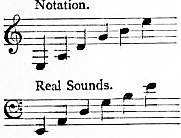
The back and ribs of the guitar are of maple, ash or cherry-wood, frequently inlaid with rose-wood, mother-of-pearl, tortoise-shell, &c., while the soundboard is of pine and has one large ornamental rose sound hole. The bridge, to which the strings are fastened, is of ebony with an ivory nut which determines the one end of the vibrating strings, while the nut at the end of the fingerboard determines the other. The neck and fingerboard are made of hard wood, such as ebony, beech or pear. The head, bent back from the neck at an obtuse angle contains two parallel barrels or long holes through which the pegs or metal screws pass, three on each side of the head. The correct positions for stopping the intervals are marked on the fingerboard by little metal ridges called frets. The modern guitar has six strings, three of gut and three of silk covered with silver wire, tuned as shown. To the thumb are assigned the three deepest strings, while the first, second and third fingers are used to twang the highest strings. It is generally stated that the sixth or lowest string was added in 1790 by Jacob August Otto of Jena, who was the first in Germany to take up the construction of guitars after their introduction from Italy in 1788 by the duchess Amalie of Weimar. Otto1 states that it was Capellmeister Naumann of Dresden who requested him to make him a guitar with six strings by adding the low E, a spun wire string. The original guitar brought from Italy by the duchess Amalie had five strings,2 the lowest A being the only one covered with wire. Otto also covered the D in order to increase the fulness of the tone. In Spain six-stringed guitars and vihuelas were known in the 16th century; they are described by Juan Bermudo3 and others.4 The lowest string was tuned to G. Other Spanish guitars of the same period had four, five or seven strings or courses of strings in pairs of unisons. They were always twanged by the fingers.
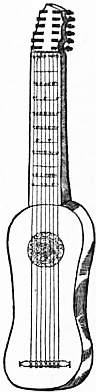
From Juan Bermudo.
Fig. 1.—Spanish Guitar with seven Strings. 1555. Vihuela da Mano.
The guitar is derived from the cithara5 both structurally and etymologically. It is usually asserted that the guitar was introduced into Spain by the Arabs, but this statement is open to the gravest doubts. There is no trace among the instruments of the Arabs known to us of any similar to the guitar in construction or shape, although a guitar (fig. 2) with slight incurvations was known to the ancient Egyptians.6 There is also extant a fine example of the guitar, with ribs and incurvations and a long neck provided with numerous frets, on a Hittite bas-relief on the dromos at Euyuk (c. 1000 B.C.) in Cappadocia.7 Unless other monuments of much later date should come to light showing guitars with ribs, we shall be justified in assuming that the instrument, which required skill in construction, died out in Egypt and in Asia before the days of classic Greece, and had to be evolved anew from the cithara by the Greeks of Asia Minor. That the evolution should take place within the Byzantine Empire or in Syria would be quite consistent with the traditions of the Greeks and their veneration for the cithara, which would lead them to adapt the neck and other improvements to it, rather than adopt the rebab, the tanbur or the barbiton from the Persians or Arabians. This is, in fact, what seems to have taken place. It is true that in the 14th century in an enumeration of musical instruments by the Archipreste de Hita, a guitarra morisca is mentioned and unfavourably compared with the guitarra latina; moreover, the Arabs of the present day still use an instrument called kuitra (which in N. Africa would be guithara), but it has a vaulted back, the body being like half a pear with a long neck; the strings are twanged by means of a quill. The Arab instrument therefore belongs to a different class, and to admit the instrument as the ancestor of the Spanish guitar would be tantamount to deriving the guitar from the lute.8
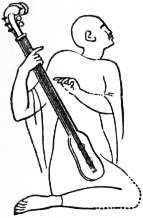
From Denon’s Voyage in Egypt.
Fig. 2.—Ancient Egyptian Guitar. 1700 to 1200 B.C.
By piecing together various indications given by Spanish writers, we obtain a clue to the identity of the medieval instruments, which, in the absence of absolute proof, is entitled to serious consideration. From Bermudo’s work, quoted above, we learn that the guitar and the vihuela da mano were practically identical, differing only in accordance and occasionally in the number of strings.9 Three kinds of vihuelas were known in Spain during the middle ages, distinguished by the qualifying phrases da arco (with bow), da mano (by hand), da penola (with quill). Spanish scholars10 who have inquired into this question of identity state that the guitarra latina was afterwards known as the vihuela da mano, a statement fully supported by other evidence. As the Arab kuitra was known to be played by means of a quill, we shall not be far wrong in identifying it with the vihuela da penola. The word vihuela or vigola is connected with the Latin fidicula or fides, a stringed instrument mentioned by Cicero11 as being made from the wood of the plane-tree and having many strings. The remaining link in the chain of identification is afforded by St Isidore, bishop of Seville in the 7th century, who states that fidicula was another name for cithara, “Veteres aut citharas fidicula vel fidice nominaverunt.”12 The fidicula therefore was the cithara, either in its original classical form or in one of the transitions which transformed it into the guitar. The existence of a superior guitarra latina side by side with the guitarra morisca is thus explained. It was derived directly from the classical cithara introduced by the Romans into Spain, the archetype of the structural beauty which formed the basis of the perfect proportions and delicate structure of the violin. In an inventory13 made by Philip van Wilder of the musical instruments which had belonged to Henry VIII. is the following item bearing on the question: “foure gitterons with iiii. cases they are called Spanishe Vialles.” Vial or viol was the English equivalent of vihuela. The transitions whereby the cithara acquired a neck and became a guitar are shown in the miniatures (fig. 3) of a single MS., the celebrated Utrecht Psalter, which gave rise to so many discussions. The Utrecht Psalter was executed in the diocese of Reims in the 9th century, and the miniatures, drawn by an Anglo-Saxon artist attached to the Reims school, are unique, and illustrate the Psalter, psalm by psalm. It is evident that the Anglo-Saxon artist, while endowed with extraordinary talent and vivid imagination, drew his inspiration from an older Greek illustrated Psalter from the Christian East,14 where the evolution of the guitar took place.
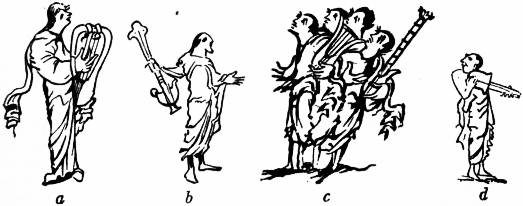
Fig. 3.—Instrumentalists from the Utrecht Psalter, 9th century: (a) The bass rotta, first transition of cithara in (C); (b, c, d), Transitions showing the addition of neck to the body of the cithara.
From Dr H. Janitschek’s Geschichte der deutschen Malerei.
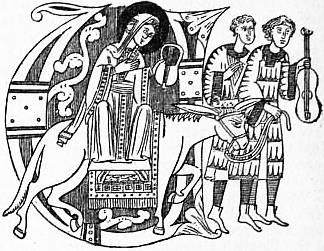
Fig. 4.—Representation of a European Guitar. A.D. 1180.
One of the earliest representations (fig. 4) of a guitar in Western Europe occurs in a Passionale from Zwifalten A.D. 1180, now in the Royal Library at Stuttgart.15 St Pelagia seated on an ass holds a rotta, or cithara in transition, while one of the men-servants leading her ass holds her guitar. Both instruments have three strings and the characteristic guitar outline with incurvations, the rotta differing in having no neck. Mersenne16 writing early in the 17th century describes and figures two Spanish guitars, one with four, the other with five strings; the former had a cittern head, the latter the straight head bent back at an obtuse angle from the neck, as in the modern instrument; he gives the Italian, French and Spanish tablatures which would seem to show that the guitar already enjoyed a certain vogue in France and Italy as well as in Spain. Mersenne states that the proportions of the guitar demand that the length of the neck from shoulder to nut shall be equal to the length of the body from the centre of the rose to the tail end. From this time until the middle of the 19th century the guitar enjoyed great popularity on the continent, and became the fashionable instrument in England after the Peninsular War, mainly through the virtuosity of Ferdinand Sor, who also wrote compositions for it. This popularity of the guitar was due less to its merits as a solo instrument than to the ease with which it could be mastered sufficiently to accompany the voice. The advent of the Spanish guitar in England led to the wane in the popularity of the cittern, also known at that time in contradistinction as the English or wire-strung guitar, although the two instruments differed in many particulars. As further evidence of the great popularity of the guitar all over Europe may be instanced the extraordinary number of books extant on the instrument, giving instructions how to play the guitar and read the tablature.17
(K. S.)
1 Über den Bau der Bogeninstrumente (Jena, 1828), pp. 94 and 95.
2 See Pietro Millioni, Vero e facil modo d’ imparare a sonare et accordare da se medesimo la chitarra spagnola, with illustration (Rome, 1637).
3 Declaracion de instrumentos musicales (Ossuna, 1555), fol. xciii. b and fol. xci. a. See also illustration of vihuela da mano.
4 See also G. G. Kapsperger, Libro primo di Villanelle con l’ infavolutura del chitarone et alfabeto per la chitarra spagnola (three books, Rome, 1610-1623).
5 See Kathleen Schlesinger, The Instruments of the Orchestra, part ii. “Precursors of the Violin Family,” pp. 230-248.
6 See Denon’s Voyage in Egypt (London, 1807, pl. 55).
7 Illustrated from a drawing in Perrot and Chipiez, “Judée Sardaigne, Syrie, Cappadoce.” Vol. iv. of Hist. de l’art dans l’antiquité, Paris, 1887, p. 670. Also see plate from a photograph by Prof. John Garstang, in Kathleen Schlesinger, op. cit.
8 See Biernath, Die Guitarre (1908).
9 See also Luys Milan, Libro de musica de vihuela da mano, Intitulado Il Maestro, where the accordance is D, G, C, E, A, D from bass to treble.
10 Mariano Soriano, Fuertes Historia de la musica española (Madrid, 1855), i. 105, and iv. 208, &c.
11 De natura deorum, ii. 8, 22.
12 See Etymologiarium, lib. iii., cap. 21.
13 See British Museum, Harleian MS. 1419, fol. 200.
14 The literature of the Utrecht Psalter embraces a large number of books and pamphlets in many languages of which the principal are here given: Professor J. O. Westwood, Facsimiles of the Miniatures and Ornaments of Anglo-Saxon and Irish MSS. (London, 1868); Sir Thos. Duffus-Hardy, Report on the Athanasian Creed in connection with the Utrecht Psalter (London, 1872); Report on the Utrecht Psalter, addressed to the Trustees of the British Museum (London, 1874); Sir Thomas Duffus-Hardy, Further Report on the Utrecht Psalter (London, 1874); Walter de Gray Birch, The History, Art and Palaeography of the MS. styled the Utrecht Psalter (London, 1876); Anton Springer, “Die Psalterillustrationen im frühen Mittelalter mit besonderer Rücksicht auf den Utrecht Psalter,” Abhandlungen der kgl. sächs. Ges. d. Wissenschaften, phil.-hist. Klasse, Bd. viii. pp. 187-296, with 10 facsimile plates in autotype from the MS.; Adolf Goldschmidt, “Der Utrecht Psalter,” in Repertorium für Kunstwissenschaft, Bd. xv. (Stuttgart, 1892), pp. 156-166; Franz Friedrich Leitschuh, Geschichte der karolingischen Malerei, ihr Bilderkreis und seine Quellen (Berlin, 1894), pp. 321-330; Adolf Goldschmidt, Der Albani Psalter in Hildesheim, &c. (Berlin, 1895); Paul Durrieu, L’Origine du MS. célèbre dit le Psaultier d’Utrecht (Paris, 1895); Hans Graeven, “Die Vorlage des Utrecht Psalters,” paper read before the XI. International Oriental Congress, Paris, 1897. See also Repertorium für Kunstwissenschaft (Stuttgart, 1898), Bd. xxi. pp. 28-35; J. J. Tikkanen, Abendländische Psalter-Illustration im Mittelalter, part iii. “Der Utrecht Psalter” (Helsingfors, 1900), 320 pp. and 77 ills. (Professor Tikkanen now accepts the Greek or Syrian origin of the Utrecht Psalter); Georg Swarzenski, “Die karolingische Malerei und Plastik in Reims.” in Jahrbuch d. kgl. preussischen Kunstsammlungen, Bd. xxiii. (Berlin, 1902), pp. 81-100; Ormonde M. Dalton, “The Crystal of Lothair,” in Archäologie, vol. lix. (1904); Kathleen Schlesinger, The Instruments of the Orchestra, part ii. “The Precursors of the Violin Family,” chap. viii. “The Question of the Origin of the Utrecht Psalter,” pp. 352-382 (with illustrations), where all the foregoing are summarized.
15 Reproduced in Hubert Janitschek’s Geschichte der deutschen Malerei, Bd. iii. of Gesch. der deutschen Kunst (Berlin, 1890), p. 118.
16 Harmonie universelle (Paris, 1636), livre ii. prop. xiv.
17 See C. F. Becker, Darstellung der musik. Literatur (Leipzig, 1836); and Wilhelm Tappert, “Zur Geschichte der Guitarre,” in Monatshefte für Musikgeschichte (Berlin, 1882), No. 5. pp. 77-85.
From Ruhlmann’s Geschichte der Bogeninstrumente.
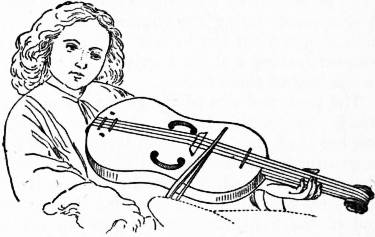
Fig. 1.—Typical Alto Guitar Fiddle, 15th century (Pinakothek, Munich).
GUITAR FIDDLE (Troubadour Fiddle), a modern name bestowed retrospectively upon certain precursors of the violin possessing characteristics of both guitar and fiddle. The name “guitar fiddle” is intended to emphasize the fact that the instrument in the shape of the guitar, which during the middle ages represented the most perfect principle of construction for stringed instruments with necks, adopted at a certain period the use of the bow from instruments of a less perfect type, the rebab and its hybrids. The use of the bow with the guitar entailed certain constructive changes in the instrument: the large central rose sound-hole was replaced by lateral holes of various shapes; the flat bridge, suitable for instruments whose strings were plucked, gave place to the arched bridge required in order to enable the bow to vibrate each string separately; the arched bridge, by raising the strings higher above the soundboard, made the stopping of strings on the neck extremely difficult if not impossible; this matter was adjusted by the addition of a finger-board of suitable shape and dimensions (fig. 1). At this stage the guitar fiddle possesses the essential features of the violin, and may justly claim to be its immediate predecessor1 not so much through the viols which were the outcome of the Minnesinger fiddle with sloping shoulders, as through the intermediary of the Italian lyra, a guitar-shaped bowed instrument with from 7 to 12 strings.
From a Byzantine MS. in the British Museum.
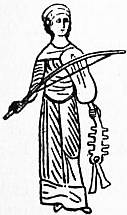
Fig. 2.—Earliest example of the Guitar Fiddle. A.D. 1066.
From such evidence as we now possess, it would seem that the evolution of the early guitar with a neck from the Greek cithara took place under Greek influence in the Christian East. The various stages of this transition have been definitely established by the remarkable miniatures of the Utrecht Psalter.2 Two kinds of citharas are shown: the antique rectangular,3 and the later design with rounded body having at the point where the arms are added indications of the waist or incurvations characteristic of the outline of the Spanish guitar.4 The first stage in the transition is shown by a cithara or rotta5 in which arms and transverse bar are replaced by a kind of frame repeating the outline of the body and thus completing the second lobe of the Spanish guitar. The next stages in the transition are concerned with the addition of a neck6 and of frets.7 All these instruments are twanged by the fingers. One may conclude that the use of the bow was either unknown at this time (c. 6th century A.D.), or that it was still confined to instruments of the rebab type. The earliest known representation of a guitar fiddle complete with bow8 (fig. 2) occurs in a Greek Psalter written and illuminated in Caesarea by the archpriest Theodorus in 1066 (British Museum, Add. MS. 19352). Instances of perfect guitar fiddles abound in the 13th century MSS. and monuments, as for instance in a picture by Cimabue (1240-1302). in the Pitti Gallery in Florence.9
An evolution on parallel lines appears also to have taken place from the antique rectangular cithara10 of the citharoedes, which was a favourite in Romano-Christian art.11 In this case examples illustrative of the transitions are found represented in great variety in Europe. The old German rotta12 of the 6th century preserved in the Völker Museum, Berlin, and the instruments played by King David in two early Anglo-Saxon illuminated MSS., one a Psalter (Cotton MS. Vesp. A. i. British Museum) finished in A.D. 700, the other “A Commentary on the Psalms by Cassiodorus manu Bedae” of the 8th century preserved in the Cathedral Library at Durham13 form examples of the first stage of transition. From such types as these the rectangular crwth or crowd was evolved by the addition of a finger-board and the reduction in the number of strings, which follows as a natural consequence as soon as an extended compass can be obtained by stopping the strings. By the addition of a neck we obtain the clue to the origin of rectangular citterns with rounded corners and of certain instruments played with the bow whose bodies or sound-chests have an outline based upon the rectangle with various modifications. We may not look upon this type of guitar fiddle as due entirely to western or southern European initiative; its origin like that of the type approximating to the violin is evidently Byzantine. It is found among the frescoes which cover walls and barrel vaults in the palace of Kosseir ‘Amra,14 believed to be that of Caliph Walid II. (A.D. 744) of the Omayyad dynasty, or of Prince Ahmad, the Abbasid (862-866). The instrument, a cittern with four strings, is being played by a bear. Other examples occur in the Stuttgart Carolingian Psalter15 (10th century); in MS. 1260 (Bibl. Imp. Paris) Tristan and Yseult; as guitar fiddle in the Liber Regalis preserved in Westminster Abbey (14th century); in the Sforza Book16 (1444-1476), the Book of Hours executed for Bona of Savoy, wife of Galeazzo Maria Sforza; on one of the carvings of the 13th century in the Cathedral of Amiens. It has also been painted by Italian artists of the 15th and 16th centuries.
(K. S.)
1 See “The Precursors of the Violin Family,” by Kathleen Schlesinger, part ii. of An Illustrated Handbook on the Instruments of the Orchestra (London, 1908), chs. ii. and x.
2 See Kathleen Schlesinger, op. cit. part ii., the “Utrecht Psalter,” pp. 127-135, and the “Question of the Origin of the Utrecht Psalter,” pp. 136-166, where the subject is discussed and illustrated.
3 Idem, see pl. vi. (2) to the right centre.
4 Idem, see pl. iii. centre and figs. 118 and 119.
5 Idem, see fig. 117, p. 341, and figs. 172 and 116.
6 Idem, see fig. 121, p. 246, figs. 122, 123, 125 and 126 pl. iii. vi. (1) and (2).
7 Idem, see fig. 126, p. 350, and pl. iii. right centre.
8 Idem, see fig. 173, p. 448.
9 Idem, see fig. 205, p. 480.
10 See Museo Pio Clementino, by Visconti (Milan, 1818).
11 See for example Georgics, iv. 471-475 in the Vatican Virgil (Cod. 3225), in facsimile (Rome, 1899) (British Museum press-mark 8, tab. f. vol. ii.).
12 This rotta was found in an Alamannic tomb of the 4th to the 7th centuries at Oberflacht in the Black Forest. A facsimile is preserved in the collection of the Kgl. Hochschule, Berlin, illustrations in “Grabfunde am Berge Lupfen bei Oberflacht, 1846,” Jahresberichte d. Württemb. Altertums-Vereins, iii. (Stuttgart, 1846), tab. viii. also Kathleen Schlesinger, op. cit. part ii. fig. 168 (drawing from the facsimile).
13 Reproductions of both miniatures are to be found in Professor J. O. Westwood’s Facsimiles of the Miniatures and Ornaments of Anglo-Saxon and Irish MSS. (London, 1868).
14 An illustration occurs in the fine publication of the Austrian Academy of Sciences, Kusejr ‘Amra (Vienna, 1907, pl. xxxiv.).
15 See reproduction of some of the miniatures in Jacob and H. von Hefner-Alteneck, Trachten des christlichen Mittelalters (Darmstadt. 1840-1854, 3 vols.), and in Trachten, Kunstwerke und Gerätschaften vom frühen Mittelalter (Frankfort-on-Main, 1879-1890),
16 Add. MS. 34294, British Museum, vol. ii. fol. 83, 161, vol. iii. fol. 402, vol. iv. fols. 534 and 667.
GUITRY, LUCIEN GERMAIN (1860- ), French actor, was born in Paris. He became prominent on the French stage at the Porte Saint-Martin theatre in 1900, and the Variétés in 1901, and then became a member of the Comédie Française, but he resigned very soon in order to become director of the Renaissance, where he was principally associated with the actress Marthe Brandès, who had also left the Comédie. Here he established his reputation, in a number of plays, as the greatest contemporary French actor in the drama of modern reality.
GUIZOT, FRANÇOIS PIERRE GUILLAUME (1787-1874), historian, orator and statesman, was born at Nîmes on the 4th of October 1787, of an honourable Protestant family belonging to the bourgeoisie of that city. It is characteristic of the cruel disabilities which still weighed upon the Protestants of France before the Revolution, that his parents, at the time of their union, could not be publicly or legally married by their own pastors, and that the ceremony was clandestine. The liberal opinions of his family did not, however, save it from the sanguinary intolerance of the Reign of Terror, and on the 8th April 1794 his father perished at Nîmes upon the scaffold. Thenceforth the education of the future minister devolved entirely upon his mother, a woman of slight appearance and of homely manners, but endowed with great strength of character and clearness of judgment. Madame Guizot was a living type of the Huguenots of the 16th century, stern in her principles and her faith, immovable in her convictions and her sense of duty. She formed the character of her illustrious son and shared every vicissitude of his life. In the days of his power her simple figure, always clad in deep mourning for her martyred husband, was not absent from the splendid circle of his political friends. In the days of his exile in 1848 she followed him to London, and there at a very advanced age closed her life and was buried at Kensal Green. Driven from Nîmes by the Revolution, Madame Guizot and her son repaired to Geneva, where he received his education. In spite of her decided Calvinistic opinions, the theories of Rousseau, then much in fashion, were not without their influence on Madame Guizot. She was a strong Liberal, and she even adopted the notion inculcated in the Émile that every man ought to learn a manual trade or craft. Young Guizot was taught to be a carpenter, and he so far succeeded in his work that he made a table with his own hands, which is still preserved. Of the progress of his graver studies little is known, for in the work which he entitled Memoirs of my own Times Guizot omitted all personal details of his earlier life. But his literary attainments must have been precocious and considerable, for when he arrived in Paris in 1805 to pursue his studies in the faculty of laws, he entered at eighteen as tutor into the family of M. Stapfer, formerly Swiss minister in France, and he soon began to write in a journal edited by M. Suard, the Publiciste. This connexion introduced him to the literary society of Paris. In October 1809, being then twenty-two, he wrote a review of M. de Chateaubriand’s Martyrs, which procured for him the approbation and cordial thanks of that eminent person, and he continued to contribute largely to the periodical press. At Suard’s he had made the acquaintance of Pauline Meulan, an accomplished lady of good family, some fourteen years older than himself, who had been forced by the hardships of the Revolution to earn her living by literature, and who also was engaged to contribute a series of articles to Suard’s journal. These contributions were interrupted by her illness, but immediately resumed and continued by an unknown hand. It was discovered that François Guizot had quietly supplied the deficiency on her behalf. The acquaintance thus begun ripened into friendship and love, and in 1812 Mademoiselle de Meulan consented to marry her youthful ally. She died in 1827; she was the author of many esteemed works on female education. An only son, born in 1819, died in 1837 of consumption. In 1828 Guizot married Elisa Dillon, niece of his first wife, and also an author. She died in 1833, leaving a son, Maurice Guillaume (1833-1892), who attained some reputation as a scholar and writer.
During the empire, Guizot, entirely devoted to literary pursuits, published a collection of French synonyms (1809), an essay on the fine arts (1811), and a translation of Gibbon with additional notes in 1812. These works recommended him to the notice of M. de Fontanes, then grand-master of the university of France, who selected Guizot for the chair of modern history at the Sorbonne in 1812. His first lecture (which is reprinted in his Memoirs) was delivered on the 11th of December of that year. The customary compliment to the all-powerful emperor he declined to insert in it, in spite of the hints given him by his patron, but the course which followed marks the beginning of the great revival of historical research in France in the 19th century. He had now acquired a considerable position in the society of Paris, and the friendship of Royer-Collard and the leading members of the liberal party, including the young duc de Broglie. Absent from Paris at the moment of the fall of Napoleon in 1814, he was at once selected, on the recommendation of Royer-Collard, to serve the government of Louis XVIII. in the capacity of secretary-general of the ministry of the interior, under the abbé de Montesquiou. Upon the return of Napoleon from Elba he immediately resigned, on the 25th of March 1815 (the statement that he retained office under General Carnot is incorrect), and returned to his literary pursuits. After the Hundred Days, he repaired to Ghent, where he saw Louis XVIII., and in the name of the liberal party pointed out to his majesty that a frank adoption of a liberal policy could alone secure the duration of the restored monarchy—advice which was ill-received by M. de Blacas and the king’s confidential advisers. This visit to Ghent, at the time when France was a prey to a second invasion, was made a subject of bitter reproach to Guizot in after life by his political opponents, as an unpatriotic action. “The Man of Ghent” was one of the terms of insult frequently hurled against him in the days of his power. But the reproach appears to be wholly unfounded. The true interests of France were not in the defence of the falling empire, but in establishing a liberal policy on a monarchical basis and in combating the reactionary tendencies of the ultra-royalists. It is at any rate a remarkable circumstance that a young professor of twenty-seven, with none of the advantages of birth or political experience, should have been selected to convey so important a message to the ears of the king of France, and a proof, if any were wanting, that the Revolution had, as Guizot said, “done its work.”
On the second restoration, Guizot was appointed secretary-general of the ministry of justice under M. de Barbé-Marbois, but resigned with his chief in 1816. Again in 1819 he was appointed general director of communes and departments in the ministry of the interior, but lost his office with the fall of Decazes in February 1820. During these years Guizot was one of the leaders of the Doctrinaires, a small party strongly attached to the charter and the crown, and advocating a policy which has become associated (especially by Faguet) with the name of Guizot, that of the juste milieu, a via media between absolutism and popular government. Their opinions had more of the rigour of a sect than the elasticity of a political party. Adhering to the great principles of liberty and toleration, they were sternly opposed to the anarchical traditions of the Revolution. They knew that the elements of anarchy were still fermenting in the country; these they hoped to subdue, not by reactionary measures, but by the firm application of the power of a limited constitution, based on the suffrages of the middle class and defended by the highest literary talent of the times. Their motives were honourable. Their views were philosophical. But they were opposed alike to the democratical spirit of the age, to the military traditions of the empire, and to the bigotry and absolutism of the court. The fate of such a party might be foreseen. They lived by a policy of resistance; they perished by another revolution (1830). They are remembered more for their constant opposition to popular demands than by the services they undoubtedly rendered to the cause of temperate freedom.
In 1820, when the reaction was at its height after the murder of the duc de Berri, and the fall of the ministry of the duc Decazes, Guizot was deprived of his offices, and in 1822 even his course of lectures were interdicted. During the succeeding years he played an important part among the leaders of the liberal opposition to the government of Charles X., although he had not yet entered parliament, and this was also the time of his greatest literary activity. In 1822 he had published his lectures on representative government (Histoire des origines du gouvernement représentatif, 1821-1822, 2 vols.; Eng. trans. 1852); also a work on capital punishment for political offences and several important political pamphlets. From 1822 to 1830 he published two important collections of historical sources, the memoirs of the history of England in 26 volumes, and the memoirs of the history of France in 31 volumes, and a revised translation of Shakespeare, and a volume of essays on the history of France. The most remarkable work from his own pen was the first part of his Histoire de la révolution d’Angleterre depuis Charles Ier à Charles II. (2 vols., 1826-1827; Eng. trans., 2 vols., Oxford, 1838), a book of great merit and impartiality, which he resumed and completed during his exile in England after 1848. The Martignac administration restored Guizot in 1828 to his professor’s chair and to the council of state. Then it was that he delivered the celebrated courses of lectures which raised his reputation as an historian to the highest point of fame, and placed him amongst the best writers of France and of Europe. These lectures formed the basis of his general Histoire de la civilisation en Europe (1828; Eng. trans, by W. Hazlitt, 3 vols., 1846), and of his Histoire de la civilisation en France (4 vols., 1830), works which must ever be regarded as classics of modern historical research.
Hitherto Guizot’s fame rested on his merits as a writer on public affairs and as a lecturer on modern history. He had attained the age of forty-three before he entered upon the full display of his oratorical strength. In January 1830 he was elected for the first time by the town of Lisieux to the chamber of deputies, and he retained that seat during the whole of his political life. Guizot immediately assumed an important position in the representative assembly, and the first speech he delivered was in defence of the celebrated address of the 221, in answer to the menacing speech from the throne, which was followed by the dissolution of the chamber, and was the precursor of another revolution. On his returning to Paris from Nîmes on the 27th of July, the fall of Charles X. was already imminent. Guizot was called upon by his friends Casimir-Périer, Laffitte, Villemain and Dupin to draw up the protest of the liberal deputies against the royal ordinances of July, whilst he applied himself with them to control the revolutionary character of the late contest. Personally, Guizot was always of opinion that it was a great misfortune for the cause of parliamentary government in France that the infatuation and ineptitude of Charles X. and Prince Polignac rendered a change in the hereditary line of succession inevitable. But, though convinced that it was inevitable, he became one of the most ardent supporters of Louis-Philippe. In August 1830 Guizot was made minister of the interior, but resigned in November. He had now passed into the ranks of the conservatives, and for the next eighteen years was the most determined foe of democracy, the unyielding champion of “a monarchy limited by a limited number of bourgeois.”
In 1831 Casimir-Périer formed a more vigorous and compact administration, which was terminated in May 1832 by his death; the summer of that year was marked by a formidable republican rising in Paris, and it was not till the 11th of October 1832 that a stable government was formed, in which Marshal Soult was first minister, the duc de Broglie took the foreign office, Thiers the home department, and Guizot the department of public instruction. This ministry, which lasted for nearly four years, was by far the ablest that ever served Louis Philippe. Guizot, however, was already marked with the stigma of unpopularity by the more advanced liberal party. He remained unpopular all his life, “not,” said he, “that I court unpopularity, but that I think nothing about it.” Yet never were his great abilities more useful to his country than whilst he filled this office of secondary rank but of primary importance in the department of public instruction. The duties it imposed on him were entirely congenial to his literary tastes, and he was master of the subjects they concerned. He applied himself in the first instance to carry the law of the 28th of June 1833, and then for the next three years to put it into execution. In establishing and organizing primary education in France, this law marked a distinct epoch in French history. In fifteen years, under its influence, the number of primary schools rose from ten to twenty-three thousand; normal schools for teachers, and a general system of inspection, were introduced; and boards of education, under mixed lay and clerical authority, were created. The secondary class of schools and the university of France were equally the subject of his enlightened protection and care, and a prodigious impulse was given to philosophical study and historical research. The branch of the Institute of France known as the “Académie des Sciences Morales et Politiques,” which had been suppressed by Napoleon, was revived by Guizot. Some of the old members of this learned body—Talleyrand, Siéyès, Roederer and Lakanal—again took their seats there, and a host of more recent celebrities were added by election for the free discussion of the great problems of political and social science. The “Société de l’Histoire de France” was founded for the publication of historical works; and a vast publication of medieval chronicles and diplomatic papers was undertaken at the expense of the state (see History; and France, History, section Sources).
The object of the cabinet of October 1832 was to organize a conservative party, and to carry on a policy of resistance to the republican faction which threatened the existence of the monarchy. It was their pride and their boast that their measures never exceeded the limits of the law, and by the exercise of legal power alone they put down an insurrection amounting to civil war in Lyons and a sanguinary revolt in Paris. The real strength of the ministry lay not in its nominal heads, but in the fact that in this government and this alone Guizot and Thiers acted in cordial co-operation. The two great rivals in French parliamentary eloquence followed for a time the same path; but neither of them could submit to the supremacy of the other, and circumstances threw Thiers almost continuously on a course of opposition, whilst Guizot bore the graver responsibilities of power.
Once again indeed, in 1839, they were united, but it was in opposition to M. Molé, who had formed an intermediate government, and this coalition between Guizot and the leaders of the left centre and the left, Thiers and Odilon Barrot, due to his ambition and jealousy of Molé, is justly regarded as one of the chief inconsistencies of his life. Victory was secured at the expense of principle, and Guizot’s attack upon the government gave rise to a crisis and a republican insurrection. None of the three chiefs of that alliance took ministerial office, however, and Guizot was not sorry to accept the post of ambassador in London, which withdrew him for a time from parliamentary contests. This was in the spring of 1840, and Thiers succeeded shortly afterwards to the ministry of foreign affairs.
Guizot was received with marked distinction by the queen and by the society of London. His literary works were highly esteemed, his character was respected, and France was never more worthily represented abroad than by one of her greatest orators. He was known to be well versed in the history and the literature of England, and sincerely attached to the alliance of the two nations and the cause of peace. But, as he himself remarked, he was a stranger to England and a novice in diplomacy; and unhappily the embroiled state of the Syrian question, on which the French government had separated itself from the joint policy of Europe, and possibly the absence of entire confidence between the ambassador and the minister of foreign affairs, placed him in an embarrassing and even false position. The warnings he transmitted to Thiers were not believed. The warlike policy of Thiers was opposed to his own convictions. The treaty of the 15th of July was signed without his knowledge and executed in the teeth of his remonstrances. For some weeks Europe seemed to be on the brink of war, until the king put an end to the crisis by refusing his assent to the military preparations of Thiers, and by summoning Guizot from London to form a ministry and to aid his Majesty in what he termed “ma lutte tenace contre l’anarchie.” Thus began, under dark and adverse circumstances, on the 29th of October 1840, the important administration in which Guizot remained the master-spirit for nearly eight years. He himself took the office of minister for foreign affairs, to which he added some years later, on the retirement of Marshal Soult, the ostensible rank of prime minister. His first care was the maintenance of peace and the restoration of amicable relations with the other powers of Europe. If he succeeded, as he did succeed, in calming the troubled elements and healing the wounded pride of France, the result was due mainly to the indomitable courage and splendid eloquence with which he faced a raging opposition, gave unity and strength to the conservative party, who now felt that they had a great leader at their head, and appealed to the thrift and prudence of the nation rather than to their vanity and their ambition. In his pacific task he was fortunately seconded by the formation of Sir Robert Peel’s administration in England, in the autumn of 1841. Between Lord Palmerston and Guizot there existed an incompatibility of character exceedingly dangerous in the foreign ministers of two great and in some respects rival countries. With Lord Palmerston in office, Guizot felt that he had a bitter and active antagonist in every British agent throughout the world; the combative element was strong in his own disposition; and the result was a system of perpetual conflict and counter-intrigues. Lord Palmerston held (as it appears from his own letters) that war between England and France was, sooner or later, inevitable. Guizot held that such a war would be the greatest of all calamities, and certainly never contemplated it. In Lord Aberdeen, the foreign secretary of Sir Robert Peel, Guizot found a friend and an ally perfectly congenial to himself. Their acquaintance in London had been slight, but it soon ripened into mutual regard and confidence. They were both men of high principles and honour; the Scotch Presbyterianism which had moulded the faith of Lord Aberdeen was reflected in the Huguenot minister of France; both were men of extreme simplicity of taste, joined to the refinement of scholarship and culture; both had an intense aversion to war and felt themselves ill-qualified to carry on those adventurous operations which inflamed the imagination of their respective opponents. In the eyes of Lord Palmerston and Thiers their policy was mean and pitiful; but it was a policy which secured peace to the world, and united the two great and free nations of the West in what was termed the entente cordiale. Neither of them would have stooped to snatch an advantage at the expense of the other; they held the common interest of peace and friendship to be paramount; and when differences arose, as they did arise, in remote parts of the world,—in Tahiti, in Morocco, on the Gold Coast,—they were reduced by this principle to their proper insignificance. The opposition in France denounced Guizot’s foreign policy as basely subservient to England. He replied in terms of unmeasured contempt,—“You may raise the pile of calumny as high as you will; vous n’arriverez jamais à la hauteur de mon dédain!” The opposition in England attacked Lord Aberdeen with the same reproaches, but in vain. King Louis Philippe visited Windsor. The queen of England (in 1843) stayed at the Château d’Eu. In 1845 British and French troops fought side by side for the first time in an expedition to the River Plate.
The fall of Sir Robert Peel’s government in 1846 changed these intimate relations; and the return of Lord Palmerston to the foreign office led Guizot to believe that he was again exposed to the passionate rivalry of the British cabinet. A friendly understanding had been established at Eu between the two courts with reference to the future marriage of the young queen of Spain. The language of Lord Palmerston and the conduct of Sir Henry Bulwer (afterwards Lord Dalling) at Madrid led Guizot to believe that this understanding was broken, and that it was intended to place a Coburg on the throne of Spain. Determined to resist any such intrigue, Guizot and the king plunged headlong into a counter-intrigue, wholly inconsistent with their previous engagements to England, and fatal to the happiness of the queen of Spain. By their influence she was urged into a marriage with a despicable offset of the house of Bourbon, and her sister was at the same time married to the youngest son of the French king, in direct violation of Louis Philippe’s promises. This transaction, although it was hailed at the time as a triumph of the policy of France, was in truth as fatal to the monarch as it was discreditable to the minister. It was accomplished by a mixture of secrecy and violence. It was defended by subterfuges. By the dispassionate judgment of history it has been universally condemned. Its immediate effect was to destroy the Anglo-French alliance, and to throw Guizot into closer relations with the reactionary policy of Metternich and the Northern courts.
The history of Guizot’s administration, the longest and the last which existed under the constitutional monarchy of France, bears the stamp of the great qualities and the great defects of his political character, for he was throughout the master-spirit of that government. His first object was to unite and discipline the conservative party, which had been broken up by previous dissensions and ministerial changes. In this he entirely succeeded by his courage and eloquence as a parliamentary leader, and by the use of all those means of influence which France too liberally supplies to a dominant minister. No one ever doubted the purity and disinterestedness of Guizot’s own conduct. He despised money; he lived and died poor; and though he encouraged the fever of money-getting in the French nation, his own habits retained their primitive simplicity. But he did not disdain to use in others the baser passions from which he was himself free. Some of his instruments were mean; he employed them to deal with meanness after its kind. Gross abuses and breaches of trust came to light even in the ranks of the government, and under an incorruptible minister the administration was denounced as corrupt. Licet uti alieno vitio is a proposition as false in politics as it is in divinity.
Of his parliamentary eloquence it is impossible to speak too highly. It was terse, austere, demonstrative and commanding,—not persuasive, not humorous, seldom adorned, but condensed with the force of a supreme authority in the fewest words. He was essentially a ministerial speaker, far more powerful in defence than in opposition. Like Pitt he was the type of authority and resistance, unmoved by the brilliant charges, the wit, the gaiety, the irony and the discursive power of his great rival. Nor was he less a master of parliamentary tactics and of those sudden changes and movements in debate which, as in a battle, sometimes change the fortune of the day. His confidence in himself, and in the majority of the chamber which he had moulded to his will, was unbounded; and long success and the habit of authority led him to forget that in a country like France there was a people outside the chamber elected by a small constituency, to which the minister and the king himself were held responsible.
A government based on the principle of resistance and repression and marked by dread and distrust of popular power, a system of diplomacy which sought to revive the traditions of the old French monarchy, a sovereign who largely exceeded the bounds of constitutional power and whose obstinacy augmented with years, a minister who, though far removed from the servility of the courtier, was too obsequious to the personal influence of the king, were all singularly at variance with the promises of the Revolution of July, and they narrowed the policy of the administration. Guizot’s view of politics was essentially historical and philosophical. His tastes and his acquirements gave him little insight into the practical business of administrative government. Of finance he knew nothing; trade and commerce were strange to him; military and naval affairs were unfamiliar to him; all these subjects he dealt with by second hand through his friends, P. S. Dumon (1797-1870), Charles Marie Tanneguy, Comte Duchâtel (1803-1867), or Marshal Bugeaud. The consequence was that few measures of practical improvement were carried by his administration. Still less did the government lend an ear to the cry for parliamentary reform. On this subject the king’s prejudices were insurmountable, and his ministers had the weakness to give way to them. It was impossible to defend a system which confined the suffrage to 200,000 citizens, and returned a chamber of whom half were placemen. Nothing would have been easier than to strengthen the conservative party by attaching the suffrage to the possession of land in France, but blank resistance was the sole answer of the government to the just and moderate demands of the opposition. Warning after warning was addressed to them in vain by friends and by foes alike; and they remained profoundly unconscious of their danger till the moment when it overwhelmed them. Strange to say, Guizot never acknowledged either at the time or to his dying day the nature of this error; and he speaks of himself in his memoirs as the much-enduring champion of liberal government and constitutional law. He utterly fails to perceive that a more enlarged view of the liberal destinies of France and a less intense confidence in his own specific theory might have preserved the constitutional monarchy and averted a vast series of calamities, which were in the end fatal to every principle he most cherished. But with the stubborn conviction of absolute truth he dauntlessly adhered to his own doctrines to the end.
The last scene of his political life was singularly characteristic of his inflexible adherence to a lost cause. In the afternoon oí the 23rd of February 1848 the king summoned his minister from the chamber, which was then sitting, and informed him that the aspect of Paris and the country during the banquet agitation for reform, and the alarm and division of opinion in the royal family, led him to doubt whether he could retain his ministry. That doubt, replied Guizot, is decisive of the question, and instantly resigned, returning to the chamber only to announce that the administration was at an end and that Molé had been sent for by the king. Molé failed in the attempt to form a government, and between midnight and one in the morning Guizot, who had according to his custom retired early to rest, was again sent for to the Tuileries. The king asked his advice. “We are no longer the ministers of your Majesty,” replied Guizot; “it rests with others to decide on the course to be pursued. But one thing appears to be evident: this street riot must be put down; these barricades must be taken; and for this purpose my opinion is that Marshal Bugeaud should be invested with full power, and ordered to take the necessary military measures, and as your Majesty has at this moment no minister, I am ready to draw up and countersign such an order.” The marshal, who was present, undertook the task, saying, “I have never been beaten yet, and I shall not begin to-morrow. The barricades shall be carried before dawn.” After this display of energy the king hesitated, and soon added: “I ought to tell you that M. Thiers and his friends are in the next room forming a government!” Upon this Guizot rejoined, “Then it rests with them to do what they think fit,” and left the palace. Thiers and Barrot decided to withdraw the troops. The king and Guizot next met at Claremont. This was the most perilous conjuncture of Guizot’s life, but fortunately he found a safe refuge in Paris for some days in the lodging of a humble miniature painter whom he had befriended, and shortly afterwards effected his escape across the Belgian frontier and thence to London, where he arrived on the 3rd of March. His mother and daughters had preceded him, and he was speedily installed in a modest habitation in Pelham Crescent, Brompton.
The society of England, though many persons disapproved of much of his recent policy, received the fallen statesman with as much distinction and respect as they had shown eight years before to the king’s ambassador. Sums of money were placed at his disposal, which he declined. A professorship at Oxford was spoken of, which he was unable to accept. He stayed in England about a year, devoting himself again to history. He published two more volumes on the English revolution, and in 1854 his Histoire de la république d’Angleterre et de Cromwell (2 vols., 1854), then his Histoire du protectorat de Cromwell et du rétablissement des Stuarts (2 vols., 1856). He also published an essay on Peel, and amid many essays on religion, during the ten years 1858-1868, appeared the extensive Mémoires pour servir à l’histoire de mon temps, in nine volumes. His speeches were included in 1863 in his Histoire parlementaire de la France (5 vols. of parliamentary speeches, 1863).
Guizot survived the fall of the monarchy and the government he had served twenty-six years. He passed abruptly from the condition of one of the most powerful and active statesmen in Europe to the condition of a philosophical and patriotic spectator of human affairs. He was aware that the link between himself and public life was broken for ever; and he never made the slightest attempt to renew it. He was of no party, a member of no political body; no murmur of disappointed ambition, no language of asperity, ever passed his lips; it seemed as if the fever of oratorical debate and ministerial power had passed from him and left him a greater man than he had been before, in the pursuit of letters, in the conversation of his friends, and as head of the patriarchal circle of those he loved. The greater part of the year he spent at his residence at Val Richer, an Augustine monastery near Lisieux in Normandy, which had been sold at the time of the first Revolution. His two daughters, who married two descendants of the illustrious Dutch family of De Witt, so congenial in faith and manners to the Huguenots of France, kept his house. One of his sons-in-law farmed the estate. And here Guizot devoted his later years with undiminished energy to literary labour, which was in fact his chief means of subsistence. Proud, independent, simple and contented he remained to the last; and these years of retirement were perhaps the happiest and most serene portion of his life.
Two institutions may be said even under the second empire to have retained their freedom—the Institute of France and the Protestant Consistory. In both of these Guizot continued to the last to take an active part. He was a member of three of the five academies into which the Institute of France is divided. The Academy of Moral and Political Science owed its restoration to him, and he became in 1832 one of its first associates. The Academy of Inscriptions and Belles Lettres elected him in 1833 as the successor to M. Dacier; and in 1836 he was chosen a member of the French Academy, the highest literary distinction of the country. In these learned bodies Guizot continued for nearly forty years to take a lively interest and to exercise a powerful influence. He was the jealous champion of their independence. His voice had the greatest weight in the choice of new candidates; the younger generation of French writers never looked in vain to him for encouragement; and his constant aim was to maintain the dignity and purity of the profession of letters.
In the consistory of the Protestant church in Paris Guizot exercised a similar influence. His early education and his experience of life conspired to strengthen the convictions of a religious temperament. He remained through life a firm believer in the truths of revelation, and a volume of Meditations on the Christian Religion was one of his latest works. But though he adhered inflexibly to the church of his fathers and combated the rationalist tendencies of the age, which seemed to threaten it with destruction, he retained not a tinge of the intolerance or asperity of the Calvinistic creed. He respected in the Church of Rome the faith of the majority of his countrymen; and the writings of the great Catholic prelates, Bossuet and Bourdaloue, were as familiar and as dear to him as those of his own persuasion, and were commonly used by him in the daily exercises of family worship.
In these literary pursuits and in the retirement of Val Richer years passed smoothly and rapidly away; and as his grandchildren grew up around him, he began to direct their attention to the history of their country. From these lessons sprang his last and not his least work, the Histoire de France racontée à mes petits enfants, for although this publication assumed a popular form, it is not less complete and profound than it is simple and attractive. The history came down to 1789, and was continued to 1870 by his daughter Madame Guizot de Witt from her father’s notes.
Down to the summer of 1874 Guizot’s mental vigour and activity were unimpaired. His frame, temperate in all things, was blessed with a singular immunity from infirmity and disease; but the vital power ebbed away, and he passed gently away on the 12th of September 1874, reciting now and then a verse of Corneille or a text of Scripture.
Bibliography.—See his own Mémoires pour servir à l’histoire de mon temps (8 vols., 1858-1861); Lettres de M. Guizot à sa famille et à ses amis (1884); C. A. Sainte-Beuve, Causeries du lundi (vol. i., 1857) and Nouveaux Lundis (vols. i. and ix., 1863-1872); E. Scherer, Études critiques sur la littérature contemporaine (vol. iv., 1873); Mme de Witt, Guizot dans sa famille (1880); Jules Simon, Thiers, Guizot et Rémusat (1885); E. Faguet, Politiques et moralistes au XIXe siècle (1891); G. Bardoux, Guizot (1894) in the series of “Les Grands Écrivains français”; Maurice Guizot, Les Années de retraite de M. Guizot (1901); and for a long list of books and articles on Guizot in periodicals see H. P. Thieme, Guide bibliographique de la littérature française de 1800 à 1906 (s.v. Guizot, Paris, 1907). For a notice of his first wife see C. A. Sainte-Beuve, Portraits de femmes (1884), and Ch. de Rémusat, Critiques et études littéraires (vol. ii., 1847).
(H. R.; J. T. S.*)
GUJARAT or Guzerat, a region of India, in the Bombay Presidency. In the widest sense of the name it includes the whole of the country where the Gujarati language is spoken, i.e. the northern districts and states of the Presidency from Palanpur to Damaun, with Kathiawar and Cutch. But it is more properly confined to the country north of the Nerbudda and east of the Rann of Cutch and Kathiawar. In this sense it has an area of 29,071 sq. m., with a population in 1901 of 4,798,504. It includes the states distributed among the agencies of Palanpur, Mahi Kantha, Rewa Kantha and Cambay, with most of Baroda and the British districts of Ahmedabad, Kaira, Panch Mahals and Broach. Less than one-fourth is British territory. The region takes its name from the Gujars, a tribe who passed into India from the north-west, established a kingdom in Rajputana, and spread south in A.D. 400-600. The ancient Hindu capital was Anhilvada; the Mahommedan dynasty, which ruled from 1396 to 1572, founded Ahmedabad, which is still the largest city; but Gujarat owed much of its historical importance to the seaports of Broach, Cambay and Surat. Its fertile plain, with a regular rainfall and numerous rivers, has caused it to be styled the “garden of India.” It suffered, however, severely from the famine of 1899-1901. For an account of the history, geography, &c., of Gujarat see the articles on the various states and districts. Gujarat gives its name to the vernacular of northern Bombay, viz. Gujarati, one of the three great languages of that Presidency, spoken by more than 9 millions. It has an ancient literature and a peculiar character. As the language of the Parsis it is prominent in the Bombay press; and it is also the commercial language of Bombay city, which lies outside the territorial area of Gujarat.
See J. Campbell, History of Gujarat (Bombay, 1896); Sir E. C. Bayley, The Muhammedan Kingdom of Gujarat (1886); A. K. Forbes, Ras Mala (1856).
GUJARATI and RAJASTHANI, the names of two members of the western sub-group of the Intermediate Group of Indo-Aryan languages (q.v.). The remaining member of this sub-group is Panjabi or Punjabi (see Hindostani). In 1901 the speakers of those now dealt with numbered: Gujarati, 9,439,925, and Rajasthani, 10,917,712. The two languages are closely connected and might almost be termed co-dialects of the same form of speech. Together they occupy an almost square block of country, some 400 m. broad, reaching from near Agra and Delhi on the river Jumna to the Arabian Sea. Gujarati (properly Gujarātī) is spoken in Gujarat, the northern maritime province of the Bombay Presidency, and also in Baroda and the native states adjoining. Rajasthani (properly Rājasthānī, from “Rājasthān,” the native name for Rajputana) is spoken in Rajputana and the adjoining parts of Central India.
In the articles Indo-Aryan Languages and Prakrit the history of the earlier stages of the Indo-Aryan vernaculars is given at some length. It is there shown that, from the most ancient times, there were two main groups of these forms of speech—one, the language of the Midland, spoken in the country near the Gangetic Doab, and the other, the so-called “Outer Band,” containing the Midland on three sides, west, north and south. The country to the west and south-west of the Midland, in which this outer group of languages was spoken, included the modern Punjab, Rajputana and Gujarat. In process of time the population of the Midland expanded and carried its language to its new homes. It occupied the eastern and central Punjab, and the mixed (or “intermediate”) language which there grew up became the modern Panjabi. To the west it spread into Rajputana, till its progress was stopped by the Indian desert, and in Rajputana another intermediate language took rise and became Rajasthani. As elsewhere explained, the language-wave of the Midland exercised less and less influence as it travelled farther from its home, so that, while in eastern Rajputana the local dialect is now almost a pure midland speech, in the west there are many evident traces of the old outer language still surviving. To the south-west of Rajputana there was no desert to stop the wave of Midland expansion, which therefore rolled on unobstructed into Gujarat, where it reached the sea. Here the survivals of the old outer language are stronger still. The old outer Prakrit of north Gujarat was known as “Saurāṣṭrī,” while the Prakrit of the Midland invaders was called “Śaurasēnī,” and we may therefore describe Gujarati as being an intermediate language derived (as explained in the articles Prakrit) from a mixture of the Apabhramśa forms of Saurāṣṭrī and Śaurasēnī, in which the latter predominated.
It will be observed that, at the present day, Gujarati breaks the continuity of the outer band of Indo-Aryan languages. To its north it has Sindhi and to its south Marathi, both outer languages with which it has only a slight connexion. On the other hand, on the east and north-east it has Rajasthani, into which it merges so gradually and imperceptibly that at the conventional border-line, in the state of Palanpur, the inhabitants of Rajputana say that the local dialect is a form of Gujarati, while the inhabitants of Gujarat say that it is Rajasthani.
Gujarati has no important local dialects, but there is considerable variation in the speeches of different classes of the community. Parsees and Mussulmans (when the latter use the language—as a rule the Gujarat Mussulmans speak Hindostani) have some striking peculiarities of pronunciation, Language. the most noticeable of which is the disregard by the latter of the distinction between cerebral and dental letters. The uneducated Hindus do not pronounce the language in the same way as their betters, and this difference is accentuated in northern Gujarat, where the lower classes substitute ē for ī, c for k, ch for kh, s for c and ch, h for s, and drop h as readily as any cockney. There is also (as in the case of the Mussulmans) a tendency to confuse cerebral and dental consonants, to substitute r for ḍ and l, to double medial consonants, and to pronounce the letter ā as å, something like the a in “all.” The Bhils of the hills east of Gujarat also speak a rude Gujarati, with special dialectic peculiarities of their own, probably due to the fact that the tribes are of Dravidian origin. These Bhil peculiarities are further mixed with corruptions of Marathi idioms in Nimar and Khandesh, where we have almost a new language.
Rajasthani has numerous dialects, each state claiming one or more of its own. Thus, in the state of Jaipur there have been catalogued no less than ten dialects among about 1,688,000 people. All Rajasthani dialects can, however, be easily classed in four well-defined groups, a north-eastern, a southern, a western and an east-central. The north-eastern (Mēwātī) is that form of Rajasthani which is merging into the Western Hindi of the Midland. It is a mixed form of speech, and need not detain us further. Similarly, the southern (Mālvī) is much mixed with the neighbouring Bundēlī form of Western Hindi. The western (Mārwāṛī) spoken in Marwar and its neighbourhood, and the east-central (Jaipurī) spoken in Jaipur and its neighbourhood, may be taken as the typical Rajasthani dialects. In the following paragraphs we shall therefore confine ourselves to Gujarati, Marwari and Jaipuri.
We know more about the ancient history of Gujarati than we do about that of any other Indo-Aryan language. The one native grammar of Apabhraṁśa Prakrit which we possess in a printed edition, was written by Hēmacandra (12th century A.D.), who lived in what is now north Gujarat, and who naturally described most fully the particular vernacular with which he was personally familiar. It was known as the Nāgara Apabhraṁśa, closely connected (as above explained) with Śaurasēnī, and was so named after the Nāgara Brahmans of the locality. These men carried on the tradition of learning inherited from Hēmacandra, and we see Gujarati almost in the act of taking birth in a work called the Mugdhāvabōdhamauktika, written by one of them only two hundred years after his death. Formal Gujarati literature is said to commence with the poet Narsingh Mētā in the 15th century. Rajasthani literature has received but small attention from European or native scholars, and we are as yet unable to say how far back the language goes.
Both Gujarati and Rajasthani are usually written in current scripts related to the well-known Nāgarī alphabet (see Sanskrit). The form employed in Rajputana is known all over northern India as the “Mahājanī” alphabet, being used by bankers or Mahājans, most of whom are Marwaris. It is noteworthy as possessing two distinct characters for ḍ and ṛ. The Gujarati character closely resembles the Kaithī character of northern India (see Bihari). The Nāgarī character is also freely used in Rajputana, and to a less extent in Gujarat, where it is employed by the Nāgara Brahmans, who claim that their tribe has given the alphabet its name.
In the following description of the main features of our two languages, the reader is presumed to be familiar with the leading facts stated in the articles Indo-Aryan Languages and Prakrit. The article Hindostani may also be perused with advantage.
(Abbreviations. Skr. = Sanskrit. Pr. = Prakrit. Ap. = Apabhraṁśa. G. = Gujarātī. R. = Rājasthānī. H. = Hindōstāanī.)
Vocabulary.—The vocabulary of both Gujarat and Rajasthani is very free from tatsama words. The great mass of both vocabularies is tadbhava (see Indo-Aryan Languages). Rajputana was from an early period brought into close contact with the Mogul court at Agra and Delhi, and even in the 13th century A.D. official documents of the Rajput princes contained many borrowed Persian and Arabic words. Gujarati, under the influence of the learned Nāgara Brahmans, has perhaps more tatsama words than Rajasthani, but their employment is not excessive. On the other hand, Parsees and Mussulmans employ Persian and Arabic words with great freedom; while, owing to its maritime connexions, the language has also borrowed occasional words from other parts of Asia and from Europe. This is specially marked in the strange dialect of the Kathiawar boatmen who travel all over the world as lascars on the great steamships. Their language is a mixture of Hindostani and Gujarati with a heterogeneous vocabulary.
Phonetics.—With a few exceptions to be mentioned below, the sound-system of the two languages is the same as that of Sanskrit, and is represented in the same manner in the Roman character (see Sanskrit). The simplest method for considering the subject in regard to Gujarati is to compare it with the phonetical system of Hindostani (q.v.). As a rule, Rajasthani closely follows Gujarati and need not be referred to except in special cases. G. invariably simplifies a medial Pr. double consonant, lengthening the preceding vowel in compensation. Thus Skr. mrakṣaṇam, Ap. makkhaṇu, H. makkhan, but G. mākhaṇ, butter. In H. this rule is generally observed, but in G. it is universal, while, on the other hand, in Panjabi the double consonant is never simplified, but is retained as in Ap. In G. (and sometimes in R.) when a is followed by h it is changed to e, as in H. shahr, G. śeher, a city. As in other outer languages H. ai and au are usually represented by a short e and by å (sounded like the a in “all”) respectively. Thus H. baiṭhā. G. beṭhō, seated; H. cauthā, G. cåthō (written cōthō), fourth. In R. this e is often further weakened to the sound of a in “man,” a change which is also common in Bengali. Many words which have i in H. have a in G. and R., thus, H. likhē, G. lakhē, he writes; H. din, G. and R. dan, a day. Similarly we have a for u, as in H. tum, G., R. tamē, you. In colloquial G. ā often becomes ả, and ī becomes ē; thus, pảṇī for pāṇī, water; mārēs for mārīs, I shall strike. As in most Indo-Aryan vernaculars an a after an accented syllable is very lightly pronounced, and is here represented by a small a above the line.
The Vedic cerebral l and the cerebral ṇ are very common as medial letters in both G. and R. (both being unknown to literary H.). The rule is, as elsewhere in western and southern intermediate and outer languages, that when n and l represent a double ṇṇ (or nn) or a double ll in Pr. they are dental, but when they represent single medial letters they are cerebralized. Thus Ap. soṇṇaũ, G. sōnũ, gold; Ap. ghaṇaũ, G. ghaṇũ, dense; Ap. callai, G. cālē, he goes; Ap. calai, G. caḷē, he moves. In northern G. and in some caste dialects dental and cerebral letters are absolutely interchangeable, as in ḍāhadō or dahāḍō, a day; tũ or ṭũ, thou; dīdhō or dīḍhō, given. In G. and R. medial ḍ is pronounced as a rough cerebral ṛ, and is then so transcribed. We have seen that in the Marwari alphabet there are actually distinct letters for these two sounds. In colloquial G. c and ch are pronounced s, especially in the north, as in pẵs for pẵc, five; pusyō for puchyō, he asked. Similarly, in the north, j and jh become z, as in zāḍ for jhāḍ, a tree. In some localities (as in Marathi) we have ts and dz for these sounds, as in Tsarōtar (name of a tract of country) for Carōtar. On the other hand, k, kh and g, especially when preceded or followed by i, e or y, become in the north c, ch and j respectively; thus, dicarō for dikarō, a son; chētar for khētar, a field; lājyō for lāgyō, begun. A similar change is found in dialectic Marathi, and is, of course, one of the commonplaces of the philology of the Romance languages. The sibilants s and ś are colloquially pronounced h (as in several outer languages), especially in the north. Thus dēh for dēś, a country; hũ for śũ, what; hamajāvyō for samajāvyō, he explained. An original aspirate is, however, often dropped, as in ’ũ for hũ, I; ’ātē for hāthē, on the hand. Standard G. is at the same time fond of pronouncing an h where it is not written, as in amē, we, pronounced ahmē. In other respects both G. and R. closely agree in their phonetical systems with the Apabhraṁśa form of Śaurasēnī Prakrit from which the Midland language is derived.