VOLUME XII SLICE VI Groups, Theory of to Gwyniad (continued 2)
Reading edition
A subgroup of a group G, which is transformed into itself by every isomorphism of G, is called a characteristic subgroup. A series of groups G, G1, G2, ..., 1, such that each is a maximum characteristic subgroup of G contained in the preceding, may be shown to have the same invariant properties as the subgroups of a composition series. A group which has no characteristic subgroup must be either a simple group or the direct product of a number of simply isomorphic simple groups.
It has been seen that every group of finite order can be represented as a group of permutations performed on a set of symbols whose number is equal to the order of the group. In general such Permutation-groups. a representation is possible with a smaller number of symbols. Let H be a subgroup of G, and let the operations of G be divided, in respect of H, into the sets H, S2H, S3H, ..., SmH. If S is any operation of G, the sets SH, SS2H, SS3H, ..., SSmH differ from the previous sets only in the sequence in which they occur. In fact, if SSp belong to the set SqH, then since H is a group, the set SSpH is identical with the set SqH. Hence, to each operation S of the group will correspond a permutation performed on the symbols of the m sets, and to the product of two operations corresponds the product of the two analogous permutations. The set of permutations, therefore, forms a group isomorphic with the given group. Moreover, the isomorphism is simple unless for one or more operations, other than identity, the sets all remain unaltered. This can only be the case for S, when every operation conjugate to S belongs to H. In this case H would contain a self-conjugate subgroup, and the isomorphism is multiple.
The fact that every group of finite order can be represented, generally in several ways, as a group of permutations, gives special importance to such groups. The number of symbols involved in such a representation is called the degree of the group. In accordance with the general definitions already given, a permutation-group is called transitive or intransitive according as it does or does not contain permutations changing any one of the symbols into any other. It is called imprimitive or primitive according as the symbols can or cannot be arranged in sets, such that every permutation of the group changes the symbols of any one set either among themselves or into the symbols of another set. When a group is imprimitive the number of symbols in each set must clearly be the same.
The total number of permutations that can be performed on n symbols is n!, and these necessarily constitute a group. It is known as the symmetric group of degree n, the only rational functions of the symbols which are unaltered by all possible permutations being the symmetric functions. When any permutation is carried out on the product of the n(n − 1)/2, differences of the n symbols, it must either remain unaltered or its sign must be changed. Those permutations which leave the product unaltered constitute a group of order n!/2, which is called the alternating group of degree n; it is a self-conjugate subgroup of the symmetric group. Except when n = 4 the alternating group is a simple group. A group of degree n, which is not contained in the alternating group, must necessarily have a self-conjugate subgroup of index 2, consisting of those of its permutations which belong to the alternating group.
Among the various concrete forms in which a group of finite order can be presented the most important is that of a group of linear Groups of linear substitutions. substitutions. Such groups have already been referred to in connexion with discontinuous groups. Here the number of distinct substitutions is necessarily finite; and to each operation S of a group G of finite order there will correspond a linear substitution s, viz.
xi = Σj=mj=1 sij xj (i, j = 1, 2, ..., m),
on a set of m variables, such that if ST = U, then st = u. The linear substitutions s, t, u, ... then constitute a group g with which G is isomorphic; and whether the isomorphism is simple or multiple g is said to give a “representation” of G as a group of linear substitutions. If all the substitutions of g are transformed by the same substitution on the m variables, the (in general) new group of linear substitutions so constituted is said to be “equivalent” with g as a representation of G; and two representations are called “non-equivalent,” or “distinct,” when one is not capable of being transformed into the other.
A group of linear substitutions on m variables is said to be “reducible” when it is possible to choose m′ (< m) linear functions of the variables which are transformed among themselves by every substitution of the group. When this cannot be done the group is called “irreducible.” It can be shown that a group of linear substitutions, of finite order, is always either irreducible, or such that the variables, when suitably chosen, may be divided into sets, each set being irreducibly transformed among themselves. This being so, it is clear that when the irreducible representations of a group of finite order are known, all representations may be built up.
It has been seen at the beginning of this section that every group of finite order N can be presented as a group of permutations (i.e. linear substitutions in a limited sense) on N symbols. This group is obviously reducible; in fact, the sum of the symbols remain unaltered by every substitution of the group. The fundamental theorem in connexion with the representations, as an irreducible group of linear substitutions, of a group of finite order N is the following.
If r is the number of different sets of conjugate operations in the group, then, when the group of N permutations is completely reduced,
(i.) just r distinct irreducible representations occur:
(ii.) each of these occurs a number of times equal to the number of symbols on which it operates:
(iii.) these irreducible representations exhaust all the distinct irreducible representations of the group.
Among these representations what is called the “identical” representation necessarily occurs, i.e. that in which each operation of the group corresponds to leaving a single symbol unchanged. If these representations are denoted by Γ1, Γ2, ..., Γr, then any representation of the group as a group of linear substitutions, or in particular as a group of permutations, may be uniquely represented by a symbol ΣαiΓi, in the sense that the representation when completely reduced will contain the representation Γi just αi times for each suffix i.
A representation of a group of finite order as an irreducible group Group characteristics. of linear substitutions may be presented in an infinite number of equivalent forms. If
x′i = Σsij xj (i, j = 1, 2, ..., m),
is the linear substitution which, in a given irreducible representation of a group of finite order G, corresponds to the operation S, the determinant
s11 − λ s12 ... s1m
s21 s22 − λ ... s2m
. . ... .
. . ... .
. . ... .
sm1 s2m ... smm − λ
is invariant for all equivalent representations, when written as a polynomial in λ. Moreover, it has the same value for S and S′, if these are two conjugate operations in G. Of the various invariants that thus arise the most important is s11 + s22 + ... + smm, which is called the “characteristic” of S. If S is an operation of order p, its characteristic is the sum of m pth roots of unity; and in particular, if S is the identical operation its characteristic is m. If r is the number of sets of conjugate operations in G, there is, for each representation of G as an irreducible group, a set of r characteristics: X1, X2, ... Xr, one corresponding to each conjugate set; so that for the r irreducible representations just r such sets of characteristics arise. These are distinct, in the sense that if Ψ1, Ψ2, ..., Ψr are the characteristics for a distinct representation from the above, then Xi and Ψi are not equal for all values of the suffix i. It may be the case that the r characteristics for a given representation are all real. If this is so the representation is said to be self-inverse. In the contrary case there is always another representation, called the “inverse” representation, for which each characteristic is the conjugate imaginary of the corresponding one in the original representation. The characteristics are subject to certain remarkable relations. If hp denotes the number of operations in the pth conjugate set, while Xip, and Xjp are the characteristics of the pth conjugate set in Γi and Γj, then
Σp=rp=1 hp Xip Xjp = 0 or n,
according to Γi and Γj are not or are inverse representations, n being the order of G.
Again
Σi=ri=1 Xip Xiq = 0 or n/hp
according as the pth and qth conjugate sets are not or are inverse; the qth set being called the inverse of the pth if it consists of the inverses of the operations constituting the pth.
Another form in which every group of finite order can be represented Linear homogeneous groups. is that known as a linear homogeneous group. If in the equations
x′r = ar1x1 + ar2x2 + ... + armxm, (r = 1, 2, ..., m),
which define a linear homogeneous substitution, the coefficients are integers, and if the equations are replaced by congruences to a finite modulus n, the system of congruences will give a definite operation, provided that the determinant of the coefficients is relatively prime to n. The product of two such operations is another operation of the same kind; and the total number of distinct operations is finite, since there is only a limited number of choices for the coefficients. The totality of these operations, therefore, constitutes a group of finite order; and such a group is known as a linear homogeneous group. If n is a prime the order of the group is
(nm − 1) (nm − n) ... (nm − nm−1).
The totality of the operations of the linear homogeneous group for which the determinant of the coefficients is congruent to unity forms a subgroup. Other subgroups arise by considering those operations which leave a function of the variables unchanged (mod. n). All such subgroups are known as linear homogeneous groups.
When the ratios only of the variables are considered, there arises a linear fractional group, with which the corresponding linear homogeneous group is isomorphic. Thus, if p is a prime the totality of the congruences
z′ ≡ az + b , ad − bc ≠ 0, (mod. p)
cz + d
constitutes a group of order p(p2 − 1). This class of groups for various values of p is almost the only one which has been as yet exhaustively analysed. For all values of p except 3 it contains a simple self-conjugate subgroup of index 2.
A great extension of the theory of linear homogeneous groups has been made in recent years by considering systems of congruences of the form
x′r ≡ ar1x1 + ar2x2 + ... + armxm, (r = 1, 2, ..., m),
in which the coefficients ars, are integral functions with real integral coefficients of a root of an irreducible congruence to a prime modulus. Such a system of congruences is obviously limited in numbers and defines a group which contains as a subgroup the group defined by the same congruences with ordinary integral coefficients.
The chief application of the theory of groups of finite order is to the theory of algebraic equations. The analogy of equations of the second, third and fourth degrees would give rise to the Applications. expectation that a root of an equation of any finite degree could be expressed in terms of the coefficients by a finite number of the operations of addition, subtraction, multiplication, division, and the extraction of roots; in other words, that the equation could be solved by radicals. This, however, as proved by Abel and Galois, is not the case: an equation of a higher degree than the fourth in general defines an algebraic irrationality which cannot be expressed by means of radicals, and the cases in which such an equation can be solved by radicals must be regarded as exceptional. The theory of groups gives the means of determining whether an equation comes under this exceptional case, and of solving the equation when it does. When it does not, the theory provides the means of reducing the problem presented by the equation to a normal form. From this point of view the theory of equations of the fifth degree has been exhaustively treated, and the problems presented by certain equations of the sixth and seventh degrees have actually been reduced to normal form.
Galois (see Equation) showed that, corresponding to every irreducible equation of the nth degree, there exists a transitive substitution-group of degree n, such that every function of the roots, the numerical value of which is unaltered by all the substitutions of the group can be expressed rationally in terms of the coefficients, while conversely every function of the roots which is expressible rationally in terms of the coefficients is unaltered by the substitutions of the group. This group is called the group of the equation. In general, if the equation is given arbitrarily, the group will be the symmetric group. The necessary and sufficient condition that the equation may be soluble by radicals is that its group should be a soluble group. When the coefficients in an equation are rational integers, the determination of its group may be made by a finite number of processes each of which involves only rational arithmetical operations. These processes consist in forming resolvents of the equation corresponding to each distinct type of subgroup of the symmetric group whose degree is that of the equation. Each of the resolvents so formed is then examined to find whether it has rational roots. The group corresponding to any resolvent which has a rational root contains the group of the equation; and the least of the groups so found is the group of the equation. Thus, for an equation of the fifth degree the various transitive subgroups of the symmetric group of degree five have to be considered. These are (i.) the alternating group; (ii.) a soluble group of order 20; (iii.) a group of order 10, self-conjugate in the preceding; (iv.) a cyclical group of order 5, self-conjugate in both the preceding. If x0, x1, x2, x3, x4 are the roots of the equation, the corresponding resolvents may be taken to be those which have for roots (i.) the square root of the discriminant; (ii.) the function (x0x1 + x1x2 + x2x3 + x3x4 + x4x0) (x0x2 + x2x4 + x4x1 + x1x3 + x3x0); (iii.) the function x0x1 + x1x2 + x2x3 + x3x4 + x4x0; and (iv.) the function x02x1 + x12x2 + x22x3 + x32x4 + x42x0. Since the groups for which (iii.) and (iv.) are invariant are contained in that for which (ii.) is invariant, and since these are the only soluble groups of the set, the equation will be soluble by radicals only when the function (ii.) can be expressed rationally in terms of the coefficients. If
(x0x1 + x1x2 + x2x3 + x3x4 + x4x0) (x0x2 + x2x4 + x4x1 + x1x3 + x3x0)
is known, then clearly x0x1 + x1x2 + x2x3 + x3x4 + x4x0 can be determined by the solution of a quadratic equation. Moreover, the sum and product (x0 + εx1 + ε2x2 + ε3x3 + ε4x4)5 and (x0 + ε4x1 + ε3x2 + ε2x3 + εx4)5 can be expressed rationally in terms of x0x1 + x1x2 + x2x3 + x3x4 + x4x0, ε, and the symmetric functions; ε being a fifth root of unity. Hence (x0 + εx1 + ε2x2 + ε3x3 + ε4X4)5 can be determined by the solution of a quadratic equation. The roots of the original equation are then finally determined by the extraction of a fifth root. The problem of reducing an equation of the fifth degree, when not soluble by radicals, to a normal form, forms the subject of Klein’s Vorlesungen über das Ikosaeder. Another application of groups of finite order is to the theory of linear differential equations whose integrals are algebraic functions. It has been already seen, in the discussion of discontinuous groups in general, that the groups of such equations must be groups of finite order. To every group of finite order which can be represented as an irreducible group of linear substitutions on n variables will correspond a class of irreducible linear differential equations of the nth order whose integrals are algebraic. The complete determination of the class of linear differential equations of the second order with all their integrals algebraic, whose group has the greatest possible order, viz. 120, has been carried out by Klein.
Authorities.—Continuous groups: Lie and Engel, Theorie der Transformationsgruppen (Leipzig, vol. i., 1888; vol. ii., 1890; vol. iii., 1893); Lie and Scheffers, Vorlesungen über gewöhnliche Differentialgleichungen mit bekannten infinitesimalen Transformationen (Leipzig, 1891); Idem, Vorlesungen über continuierliche Gruppen (Leipzig, 1893); Idem, Geometrie der Berührungstransformationen (Leipzig, 1896); Klein and Schilling, Höhere Geometrie, vol. ii. (lithographed) (Göttingen, 1893, for both continuous and discontinuous groups). Campbell, Introductory Treatise on Lie’s Theory of Finite Continuous Transformation Groups (Oxford, 1903). Discontinuous groups: Klein and Fricke, Vorlesungen über die Theorie der elliptischen Modulfunktionen (vol. i., Leipzig, 1890) (for a full discussion of the modular group); Idem, Vorlesungen über die Theorie der automorphen Funktionen (vol. i., Leipzig, 1897; vol. ii. pt. i., 1901) (for the general theory of discontinuous groups); Schoenflies, Krystallsysteme und Krystallstruktur (Leipzig, 1891) (for discontinuous groups of motions); Groups of finite order: Galois, Œuvres mathématiques (Paris, 1897, reprint); Jordan, Traité des substitutions et des équations algébriques (Paris, 1870); Netto, Substitutionentheorie und ihre Anwendung auf die Algebra (Leipzig, 1882; Eng. trans. by Cole, Ann Arbor, U.S.A., 1892); Klein, Vorlesungen über das Ikosaeder (Leipzig, 1884; Eng. trans. by Morrice, London, 1888); H. Vogt, Leçons sur la résolution algébrique des équations (Paris, 1895); Weber, Lehrbuch der Algebra (Braunschweig, vol. i., 1895; vol. ii., 1896; a second edition appeared in 1898); Burnside, Theory of Groups of Finite Order (Cambridge, 1897); Bianchi, Teoria dei gruppi di sostituzioni e delle equazioni algebriche (Pisa, 1899); Dickson, Linear Groups with an Exposition of the Galois Field Theory (Leipzig, 1901); De Séguier, Éléments de la théorie des groupes abstraits (Paris, 1904), A summary with many references will be found in the Encyklopädie der mathematischen Wissenschaften (Leipzig, vol. i., 1898, 1899).
(W. Bu.)
1 The word “group,” which appears first in English in the sense of an assemblage of figures in an artistic design, picture, &c., is adapted from the Fr. groupe, which is to be referred to the Teutonic word meaning “knot,” “mass,” “bunch,” represented in English by “crop” (q.v.). The technical mathematical sense is not older than 1870.
GROUSE, a word of uncertain origin,1 now used generally by ornithologists to include all the “rough-footed” Gallinaceous birds, but in common speech applied almost exclusively, when used alone, to the Tetrao scoticus of Linnaeus, the Lagopus scoticus of modern systematists—more particularly called in English the red grouse, but till the end of the 18th century almost invariably spoken of as the Moor-fowl or Moor-game. The effect which this species is supposed to have had on the British legislature, and therefore on history, is well known, for it was the common belief that parliament always rose when the season for grouse-shooting began (August 12th); while according to the Orkneyinga Saga (ed. Jonaeus, p. 356; ed. Anderson, p. 168) events of some importance in the annals of North Britain followed from its pursuit in Caithness in the year 1157.
The red grouse is found on moors from Monmouthshire and Derbyshire northward to the Orkneys, as well as in most of the Hebrides. It inhabits similar situations throughout Wales and Ireland, but it does not naturally occur beyond the limits of the British Islands,2 and is the only species among birds peculiar to them. The word “species” may in this case be used advisedly (since the red grouse invariably “breeds true,” it admits of an easy diagnosis, and it has a definite geographical range); but scarcely any zoologist can doubt of its common origin with the willow-grouse, Lagopus albus (L. subalpinus or L. saliceti of some authors), that inhabits a subarctic zone from Norway across the continents of Europe and Asia, as well as North America from the Aleutian Islands to Newfoundland. The red grouse indeed is rarely or never found away from the heather on which chiefly it subsists; while the willow-grouse in many parts of the Old World seems to prefer the shrubby growth of berry-bearing plants (Vaccinium and others) that, often thickly interspersed with willows and birches, clothes the higher levels or the lower mountain-slopes, and it flourishes in the New World where heather scarcely exists, and a “heath” in its strict sense is unknown. It is true that the willow-grouse always becomes white in winter, which the red grouse never does; but in summer there is a considerable resemblance between the two species, the cock willow-grouse having his head, neck and breast of nearly the same rich chestnut-brown as his British representative, and, though his back be lighter in colour, as is also the whole plumage of his mate, than is found in the red grouse, in other respects the two species are precisely alike. No distinction can be discovered in their voice, their eggs, their build, nor in their anatomical details, so far as these have been investigated and compared.3 Moreover, the red grouse, restricted as is its range, varies in colour not inconsiderably according to locality.
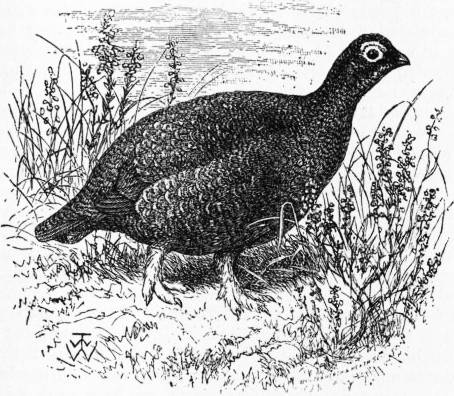
Red Grouse.
Though the red grouse does not, after the manner of other members of the genus Lagopus, become white in winter, Scotland possesses a species of the genus which does. This is the ptarmigan, L. mutus or L. alpinus, which differs far more in structure, station and habits from the red grouse than that does from the willow-grouse, and in Scotland is far less abundant, haunting only the highest and most barren mountains. It is said to have formerly inhabited both Wales and England, but there is no evidence of its appearance in Ireland. On the continent of Europe it is found most numerously in Norway, but at an elevation far above the growth of trees, and it occurs on the Pyrenees and on the Alps. It also inhabits northern Russia. In North America, Greenland and Iceland it is represented by a very nearly allied form—so much so indeed that it is only at certain seasons that the slight difference between them can be detected. This form is the L. rupestris of authors, and it would appear to be found also in Siberia (Ibis, 1879, p. 148). Spitzbergen is inhabited by a large form which has received recognition as L. hemileucurus, and the northern end of the chain of the Rocky Mountains is tenanted by a very distinct species, the smallest and perhaps the most beautiful of the genus, L. leucurus, which has all the feathers of the tail white.
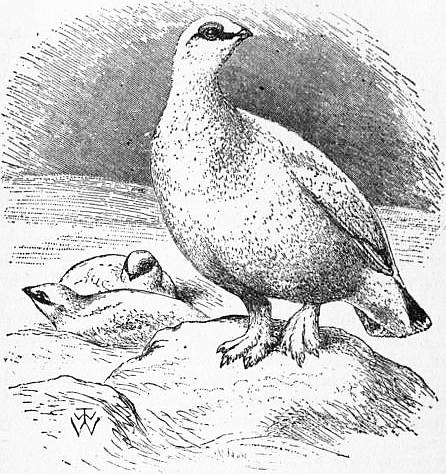
Ptarmigan.
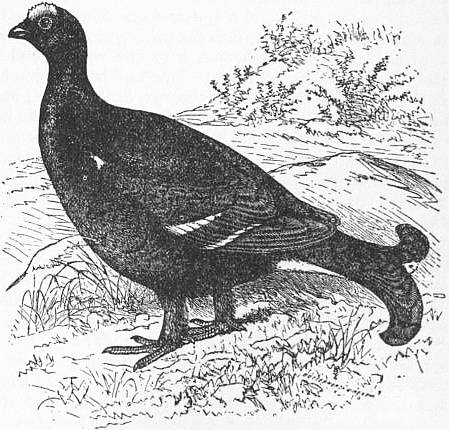
Blackcock.
The bird, however, to which the name of grouse in all strictness belongs is probably the Tetrao tetrix of Linnaeus—the blackcock and greyhen, as the sexes are respectively called. It is distributed over most of the heath-country of England, except in East Anglia, where attempts to introduce it have been only partially successful. It also occurs in North Wales and very generally throughout Scotland, though not in Orkney, Shetland or the Outer Hebrides, nor in Ireland. On the continent of Europe it has a very wide range, and it extends into Siberia. In Georgia its place is taken by a distinct species, on which a Polish naturalist (Proc. Zool. Society, 1875, p. 267) has conferred the name of T. mlokosiewiczi. Both these birds have much in common with their larger congener the capercally and its eastern representative.
The species of the genus Bonasa, of which the European B. sylvestris is the type, does not inhabit the British Islands. It is perhaps the most delicate game-bird that comes to table. It is the gelinotte of the French, the Haselhuhn of Germans, and Hjerpe of Scandinavians. Like its transatlantic congener B. umbellus, the ruffed grouse or birch-partridge (of which there are two other local forms, B. umbelloides and B. sabinii), it is purely a forest-bird. The same may be said of the species of Canace, of which two forms are found in America, C. canadensis, the spruce-partridge, and C. franklini, and also of the Siberian C. falcipennis. Nearly allied to these birds is the group known as Dendragapus, containing three large and fine forms D. obscurus, D. fuliginosus, and D. richardsoni—all peculiar to North America. Then there are Centrocercus urophasianus, the sage-cock of the plains of Columbia and California, and Pedioecetes, the sharp-tailed grouse, with its two forms, P. phasianellus and P. columbianus, while finally Cupidonia, the prairie-hen, also with two local forms, C. cupido and C. pallidicincta, is a bird that in the United States of America possesses considerable economic value, enormous numbers being consumed there, and also exported to Europe.
The various sorts of grouse are nearly all figured in Elliot’s Monograph of the Tetraoninae, and an excellent account of the American species is given in Baird, Brewer and Ridgway’s North American Birds (iii. 414-465). See also Shooting.
(A. N.)
1 It seems first to occur (O. Salusbury Brereton, Archaeologia, iii. 157) as “grows” in an ordinance for the regulation of the royal household dated “apud Eltham, mens. Jan. 22 Hen. VIII.,” i.e. 1531, and considering the locality must refer to black game. It is found in an Act of Parliament 1 Jac. I. cap. 27, § 2, i.e. 1603, and, as reprinted in the Statutes at Large, stands as now commonly spelt, but by many writers or printers the final e was omitted in the 17th and 18th centuries. In 1611 Cotgrave had “Poule griesche. A Moore-henne; the henne of the Grice [in ed. 1673 “Griece”] or Mooregame” (Dictionarie of the French and English Tongues, s.v. Poule). The most likely derivation seems to be from the old French word griesche, greoche or griais (meaning speckled, and cognate with griseus, grisly or grey), which was applied to some kind of partridge, or according to Brunetto Latini (Trés. p. 211) to a quail, “porce que ele fu premiers trovée en Grece.” The Oxford Dictionary repudiates the possibility of “grouse” being a spurious singular of an alleged plural “grice,” and, with regard to the possibility of “grows” being a plural of “grow,” refers to Giraldus Cambrensis (c. 1210), Topogr. Hib. opera (Rolls) v. 47: “gallinae campestres, quas vulgariter grutas vocant.”
2 It was successfully, though with much trouble, introduced by Mr Oscar Dickson on a tract of land near Gottenburg in Sweden (Svenska Jägarförbundets Nya Tidskrift, 1868, p. 64 et alibi).
3 A very interesting subject for discussion would be whether Lagopus scoticus or L. albus has varied most from the common stock of both. Looking to the fact that the former is the only species of the genus which does not assume white clothing in winter, an evolutionist might at first deem the variation greatest in its case; but then it must be borne in mind that the species of Lagopus which turn white differ in that respect from all other groups of the family Tetraonidae. Furthermore every species of Lagopus (even L. leucurus, the whitest of all) has its first set of remiges coloured brown. These are dropped when the bird is about half-grown, and in all the species but L. scoticus white remiges are then produced. If therefore the successive phases assumed by any animal in the course of its progress to maturity indicate the phases through which the species has passed, there may have been a time when all the species of Lagopus wore a brown livery even when adult, and the white dress donned in winter has been imposed upon the wearers by causes that can be easily suggested. The white plumage of the birds of this group protects them from danger during the snows of a protracted winter. But the red grouse, instead of perpetuating directly the more ancient properties of an original Lagopus that underwent no great seasonal change of plumage, may derive its ancestry from the widely-ranging willow-grouse, which in an epoch comparatively recent (in the geological sense) may have stocked Britain, and left descendants that, under conditions in which the assumption of a white garb would be almost fatal to the preservation of the species, have reverted (though doubtless with some modifications) to a comparative immutability essentially the same as that of the primal Lagopus.
GROVE, SIR GEORGE (1820-1900), English writer on music, was born at Clapham on the 13th of August 1820. He was articled to a civil engineer, and worked for two years in a factory near Glasgow. In 1841 and 1845 he was employed in the West Indies, erecting lighthouses in Jamaica and Bermuda. In 1849 he became secretary to the Society of Arts, and in 1852 to the Crystal Palace. In this capacity his natural love of music and enthusiasm for the art found a splendid opening, and he threw all the weight of his influence into the task of promoting the best music of all schools in connexion with the weekly and daily concerts at Sydenham, which had a long and honourable career under the direction of Mr (afterwards Sir) August Manns. Without Sir George Grove that eminent conductor would hardly have succeeded in doing what he did to encourage young composers and to educate the British public in music. Grove’s analyses of the Beethoven symphonies, and the other works presented at the concerts, set the pattern of what such things should be; and it was as a result of these, and of the fact that he was editor of Macmillan’s Magazine from 1868 to 1883, that the scheme of his famous Dictionary of Music and Musicians, published from 1878 to 1889 (new edition, edited by J. A. Fuller Maitland, 1904-1907), was conceived and executed. His own articles in that work on Beethoven, Mendelssohn and Schubert are monuments of a special kind of learning, and that the rest of the book is a little thrown out of balance owing to their great length is hardly to be regretted. Long before this he had contributed to the Dictionary of the Bible, and had promoted the foundation of the Palestine Exploration Fund. On a journey to Vienna, undertaken in the company of his lifelong friend, Sir Arthur Sullivan, the important discovery of a large number of compositions by Schubert was made, including the music to Rosamunde. When the Royal College of Music was founded in 1882 he was appointed its first director, receiving the honour of knighthood. He brought the new institution into line with the most useful European conservatoriums. On the completion of the new buildings in 1894 he resigned the directorship, but retained an active interest in the institution to the end of his life. He died at Sydenham on the 28th of May 1900.
His life, a most interesting one, was written by Mr Charles Graves.
(J. A. F. M.)
GROVE, SIR WILLIAM ROBERT (1811-1896), English judge and man of science, was born on the 11th of July 1811 at Swansea, South Wales. After being educated by private tutors, he went to Brasenose College, Oxford, where he took an ordinary degree in 1832. Three years later he was called to the bar at Lincoln’s Inn. His health, however, did not allow him to devote himself strenuously to practice, and he occupied his leisure with scientific studies. About 1839 he constructed the platinum-zinc voltaic cell that bears his name, and with the aid of a number of these exhibited the electric arc light in the London Institution, Finsbury Circus. The result was that in 1840 the managers appointed him to the professorship of experimental philosophy, an office which he held for seven years. His researches dealt very largely with electro-chemistry and with the voltaic cell, of which he invented several varieties. One of these, the Grove gas-battery, which is of special interest both intrinsically and as the forerunner of the secondary batteries now in use for the “storage” of electricity, was based on his observation that a current is produced by a couple of platinum plates standing in acidulated water and immersed, the one in hydrogen, the other in oxygen. At one of his lectures at the Institution he anticipated the electric lighting of to-day by illuminating the theatre with incandescent electric lamps, the filaments being of platinum and the current supplied by a battery of his nitric acid cells. In 1846 he published his famous book on The Correlation of Physical Forces, the leading ideas of which he had already put forward in his lectures: its fundamental conception was that each of the forces of nature—light, heat, electricity, &c.—is definitely and equivalently convertible into any other, and that where experiment does not give the full equivalent, it is because the initial force has been dissipated, not lost, by conversion into other unrecognized forces. In the same year he received a Royal medal from the Royal Society for his Bakerian lecture on “Certain phenomena of voltaic ignition and the decomposition of water into its constituent gases.” In 1866 he presided over the British Association at its Nottingham meeting and delivered an address on the continuity of natural phenomena. But while he was thus engaged in scientific research, his legal work was not neglected, and his practice increased so greatly that in 1853 he became a Q.C. One of the best-known cases in which he appeared as an advocate was that of William Palmer, the Rugeley poisoner, whom he defended. In 1871 he was made a judge of the Common Pleas in succession to Sir Robert Collier, and remained on the bench till 1887. He died in London on the 1st of August 1896.
A selection of his scientific papers is given in the sixth edition of The Correlation of Physical Forces, published in 1874.
GROVE (O.E. graf, cf. O.E. græfa, brushwood, later “greave”; the word does not appear in any other Teutonic language, and the New English Dictionary finds no Indo-European root to which it can be referred; Skeat considers it connected with “grave,” to cut, and finds the original meaning to be a glade cut through a wood), a small group or cluster of trees, growing naturally and forming something smaller than a wood, or planted in particular shapes or for particular purposes, in a park, &c. Groves have been connected with religious worship from the earliest times, and in many parts of India every village has its sacred group of trees. For the connexion of religion with sacred groves see Tree-Worship.
The word “grove” was used by the authors of the Authorized Version of the Bible to translate two Hebrew words: (1) ’ēshel, as in Gen. xxi. 33, and 1 Sam. xxii. 6; this is rightly given in the Revised Version as “tamarisk”; (2) asherah in many places throughout the Old Testament. Here the translators followed the Septuagint ἄλσος and the Vulgate lucus. The ’ăshéráh was a wooden post erected at the Canaanitish places of worship, and also by the altars of Yahweh. It may have represented a tree.
GROZNYI, a fortress and town of Russia, North Caucasia, in the province of Terek, on the Zunzha river, 82 m. by rail N.E. of Vladikavkaz, on the railway to Petrovsk. There are naphtha wells close by. The fortifications were constructed in 1819. Pop. (1897) 15,599.
GRUB, the larva of an insect, a caterpillar, maggot. The word is formed from the verb “to grub,” to dig, break up the surface of the ground, and clear of stumps, roots, weeds, &c. According to the New English Dictionary, “grub” may be referred to an ablaut variant of the Old Teutonic grab-, to dig, cf. “grave.” Skeat (Etym. Dict. 1898) refers it rather to the root seen in “grope,” “grab,” &c., the original meaning “to search for.” The earliest quotation of the slang use of the word in the sense of food in the New English Dictionary is dated 1659 from Ancient Poems, Ballads, &c., Percy Society Publications. “Grub-street,” as a collective term for needy hack-writers, dates from the 17th century and is due to the name of a street near Moorfields, London, now Milton Street, which was as Johnson says “much inhabited by writers of small histories, dictionaries and temporary poems.”
GRUBER, JOHANN GOTTFRIED (1774-1851), German critic and literary historian, was born at Naumburg on the Saale, on the 29th of November 1774. He received his education at the town school of Naumburg and the university of Leipzig, after which he resided successively at Göttingen, Leipzig, Jena and Weimar, occupying himself partly in teaching and partly in various literary enterprises, and enjoying in Weimar the friendship of Herder, Wieland and Goethe. In 1811 he was appointed professor at the university of Wittenberg, and after the division of Saxony he was sent by the senate to Berlin to negotiate the union of the university of Wittenberg with that of Halle. After the union was effected he became in 1815 professor of philosophy at Halle. He was associated with Johann Samuel Ersch in the editorship of the great work Allgemeine Encyklopädie der Wissenschaften und Künste; and after the death of Ersch he continued the first section from vol. xviii. to vol. liv. He also succeeded Ersch in the editorship of the Allgemeine Literaturzeitung. He died on the 7th of August 1851.
Gruber was the author of a large number of works, the principal of which are Charakteristik Herders (Leipzig, 1805), in conjunction with Johann T. L. Danz (1769-1851), afterwards professor of theology at Jena; Geschichte des menschlichen Geschlechts (2 vols., Leipzig, 1806); Wörterbuch der altklassischen Mythologie (3 vols., Weimar, 1810-1815); Wielands Leben (2 parts, Weimar, 1815-1816), and Klopstocks Leben (Weimar, 1832). He also edited Wieland’s Sämtliche Werke (Leipzig, 1818-1828).
GRUMBACH, WILHELM VON (1503-1567), German adventurer, chiefly known through his connexion with the so-called “Grumbach feuds” (Grumbachsche Händel), the last attempt of the German knights to destroy the power of the territorial princes. A member of an old Franconian family, he was born on the 1st of June 1503, and having passed some time at the court of Casimir, prince of Bayreuth (d. 1527), fought against the peasants during the rising in 1524 and 1525. About 1540 Grumbach became associated with Albert Alcibiades, the turbulent prince of Bayreuth, whom he served both in peace and war. After the conclusion of the peace of Passau in 1552, Grumbach assisted Albert in his career of plunder in Franconia and was thus able to take some revenge upon his enemy, Melchior von Zobel, bishop of Würzburg. As a landholder Grumbach was a vassal of the bishops of Würzburg, and had held office at the court of Conrad of Bibra, who was bishop from 1540 to 1544. When, however, Zobel was chosen to succeed Conrad the harmonious relations between lord and vassal were quickly disturbed. Unable to free himself and his associates from the suzerainty of the bishop by appealing to the imperial courts he decided to adopt more violent measures, and his friendship with Albert was very serviceable in this connexion. Albert’s career, however, was checked by his defeat at Sievershausen in July 1553 and his subsequent flight into France, and the bishop took advantage of this state of affairs to seize Grumbach’s lands. The knight obtained an order of restitution from the imperial court of justice (Reichskammergericht), but he was unable to carry this into effect; and in April 1558 some of his partisans seized and killed the bishop. Grumbach declared he was innocent of this crime, but his story was not believed, and he fled to France. Returning to Germany he pleaded his cause in person before the diet at Augsburg in 1559, but without success. Meanwhile he had found a new patron in John Frederick, duke of Saxony, whose father, John Frederick, had been obliged to surrender the electoral dignity to the Albertine branch of his family. Chafing under this deprivation the duke listened readily to Grumbach’s plans for recovering the lost dignity, including a general rising of the German knights and the deposition of Frederick II., king of Denmark. Magical charms were employed against the duke’s enemies, and communications from angels were invented which helped to stir up the zeal of the people. In 1563 Grumbach attacked Würzburg, seized and plundered the city and compelled the chapter and the bishop to restore his lands. He was consequently placed under the imperial ban, but John Frederick refused to obey the order of the emperor Maximilian II. to withdraw his protection from him. Meanwhile Grumbach sought to compass the assassination of the Saxon elector, Augustus; proclamations were issued calling for assistance; and alliances both without and within Germany were concluded. In November 1566 John Frederick was placed under the ban, which had been renewed against Grumbach earlier in the year, and Augustus marched against Gotha. Assistance was not forthcoming, and a mutiny led to the capitulation of the town. Grumbach was delivered to his foes, and, after being tortured, was executed at Gotha on the 18th of April 1567.
See F. Ortloff, Geschichte der Grumbachschen Händel (Jena, 1868-1870), and J. Voigt, Wilhelm von Grumbach und seine Händel (Leipzig, 1846-1847).
GRUMENTUM, an ancient town in the centre of Lucania, 33 m. S. of Potentia by the direct road through Anxia, and 52 m. by the Via Herculia, at the point of divergence of a road eastward to Heraclea. It seems to have been a native Lucanian town, not a Greek settlement. In 215 B.C. the Carthaginian general Hanno was defeated under its walls, and in 207 B.C. Hannibal made it his headquarters. In the Social War it appears as a strong fortress, and seems to have been held by both sides at different times. It became a colony, perhaps in the time of Sulla, at latest under Augustus, and seems to have been of some importance. Its site, identified by Holste from the description of the martyrdom of St Laverius, is a ridge on the right bank of the Aciris (Agri) about 1960 ft. above sea-level, ½ m. below the modern Saponara, which lies much higher (2533 ft.). Its ruins (all of the Roman period) include those of a large amphitheatre (arena 205 by 197 ft.), the only one in Lucania, except that at Paestum. There are also remains of a theatre. Inscriptions record the repair of its town walls and the construction of thermae (of which remains were found) in 57-51 B.C., the construction in 43 B.C., of a portico, remains of which may be seen along an ancient road, at right angles to the main road, which traversed Grumentum from S. to N.
See F. P. Caputi in Notizie degli scavi (1877), 129, and G. Patroni, ibid. (1897) 180.
(T. As.)
GRÜN. Hans Baldung (c. 1470-1545), commonly called Grün, a German painter of the age of Dürer, was born at Gmünd in Swabia, and spent the greater part of his life at Strassburg and Freiburg in Breisgau. The earliest pictures assigned to him are altarpieces with the monogram H. B. interlaced, and the date of 1496, in the monastery chapel of Lichtenthal near Baden. Another early work is a portrait of the emperor Maximilian, drawn in 1501 on a leaf of a sketch-book now in the print-room at Carlsruhe. The “Martyrdom of St Sebastian” and the “Epiphany” (Berlin Museum), fruits of his labour in 1507, were painted for the market-church of Halle in Saxony. In 1509 Grün purchased the freedom of the city of Strassburg, and resided there till 1513, when he moved to Freiburg in Breisgau. There he began a series of large compositions, which he finished in 1516, and placed on the high altar of the Freiburg cathedral. He purchased anew the freedom of Strassburg in 1517, resided in that city as his domicile, and died a member of its great town council 1545.
Though nothing is known of Grün’s youth and education, it may be inferred from his style that he was no stranger to the school of which Dürer was the chief. Gmünd is but 50 m. distant on either side from Augsburg and Nuremberg. Grün prints were often mistaken for those of Dürer; and Dürer himself was well acquainted with Grün’s woodcuts and copper-plates in which he traded during his trip to the Netherlands (1520). But Grün’s prints, though Düreresque, are far below Dürer, and his paintings are below his prints. Without absolute correctness as a draughtsman, his conception of human form is often very unpleasant, whilst a questionable taste is shown in ornament equally profuse and “baroque.” Nothing is more remarkable in his pictures than the pug-like shape of the faces, unless we except the coarseness of the extremities. No trace is apparent of any feeling for atmosphere or light and shade. Though Grün has been commonly called the Correggio of the north, his compositions are a curious medley of glaring and heterogeneous colours, in which pure black is contrasted with pale yellow, dirty grey, impure red and glowing green. Flesh is a mere glaze under which the features are indicated by lines. His works are mainly interesting because of the wild and fantastic strength which some of them display. We may pass lightly over the “Epiphany” of 1507, the “Crucifixion” of 1512, or the “Stoning of Stephen” of 1522, in the Berlin Museum. There is some force in the “Dance of Death” of 1517, in the museum of Basel, or the “Madonna” of 1530, in the Liechtenstein Gallery at Vienna. Grün’s best effort is the altarpiece of Freiburg, where the “Coronation of the Virgin,” and the “Twelve Apostles,” the “Annunciation, Visitation, Nativity and Flight into Egypt,” and the “Crucifixion,” with portraits of donors, are executed with some of that fanciful power which Martin Schön bequeathed to the Swabian school. As a portrait painter he is well known. He drew the likeness of Charles V., as well as that of Maximilian; and his bust of Margrave Philip in the Munich Gallery tells us that he was connected with the reigning family of Baden as early as 1514. At a later period he had sittings from Margrave Christopher of Baden, Ottilia his wife, and all their children, and the picture containing these portraits is still in the grand-ducal gallery at Carlsruhe. Like Dürer and Cranach, Grün became a hearty supporter of the Reformation. He was present at the diet of Augsburg in 1518, and one of his woodcuts represents Luther under the protection of the Holy Ghost, which hovers over him in the shape of a dove.
GRÜNBERG, a town of Germany, in Prussian Silesia, beautifully situated between two hills on an affluent of the Oder, and on the railway from Breslau to Stettin via Küstrin, 36 m. N.N.W. of Glogau. Pop. (1905) 20,987. It has a Roman Catholic and two Evangelical churches, a modern school and a technical (textiles) school. There are manufactures of cloth, paper, machinery, straw hats, leather and tobacco. The prosperity of the town depends chiefly on the vine culture in the neighbourhood, from which, besides the exportation of a large quantity of grapes, about 700,000 gallons of wine are manufactured annually.
GRUNDTVIG, NIKOLAI FREDERIK SEVERIN (1783-1872), Danish poet, statesman and divine, was born at the parsonage of Udby in Zealand on the 8th of September 1783. In 1791 he was sent to live at the house of a priest in Jutland, and studied at the free school of Aarhuus until he went up to the university of Copenhagen in 1800. At the close of his university life he made Icelandic his special study, until in 1805 he took the position of tutor in a house on the island of Langeland. The next three years were spent in the study of Shakespeare, Schiller and Fichte. His cousin, the philosopher Henrik Steffens, had returned to Copenhagen in 1802 full of the teaching of Schelling and his lectures and the early poetry of Öhlenschläger opened the eyes of Grundtvig to the new era in literature. His first work, On the Songs in the Edda, attracted no attention. Returning to Copenhagen in 1808 he achieved greater success with his Northern Mythology, and again in 1809-1811 with a long epic poem, the Decline of the Heroic Life in the North. The boldness of the theological views expressed in his first sermon in 1810 offended the ecclesiastical authorities, and he retired to a country parish as his father’s assistant for a while. From 1812 to 1817 he published five or six works, of which the Rhyme of Roskilde is the most remarkable. From 1816 to 1819 he was editor of a polemical journal entitled Dannevirke, and in 1818 to 1822 appeared his Danish paraphrases (6 vols.) of Saxo Grammaticus and Snorri. During these years he was preaching against rationalism to an enthusiastic congregation in Copenhagen, but he accepted in 1821 the country living of Praestö, only to return to the metropolis the year after. In 1825 he published a pamphlet, The Church’s Reply, against H. N. Clausen, who was professor of theology in the university of Copenhagen. Grundtvig was publicly prosecuted and fined, and for seven years he was forbidden to preach, years which he spent in publishing a collection of his theological works, in paying two visits to England, and in studying Anglo-Saxon. In 1832 he obtained permission to preach again, and in 1839 he became priest of the workhouse church of Vartov hospital, Copenhagen, a post he continued to hold until his death. In 1837-1841 he published Songs for the Danish Church, a rich collection of sacred poetry; in 1838 he brought out a selection of early Scandinavian verse; in 1840 he edited the Anglo-Saxon poem of the Phoenix, with a Danish translation. He visited England a third time in 1843. From 1844 until after the first German war Grundtvig took a very prominent part in politics. In 1861 he received the titular rank of bishop, but without a see. He went on writing occasional poems till 1866, and preached in the Vartov every Sunday until a month before his death. His preaching attracted large congregations, and he soon had a following. His hymn-book effected a great change in Danish church services, substituting the hymns of the national poets for the slow measures of the orthodox Lutherans. The chief characteristic of his theology was the substitution of the authority of the “living word” for the apostolic commentaries, and he desired to see each congregation a practically independent community. His patriotism was almost a part of his religion, and he established popular schools where the national poetry and history should form an essential part of the instruction. His followers are known as Grundtvigians. He was married three times, the last time in his seventy-sixth year. He died on the 2nd of September 1872. Grundtvig holds a unique position in the literature of his country; he has been styled the Danish Carlyle. He was above all things a man of action, not an artist; and the formless vehemence of his writings, which have had a great influence over his own countrymen, is hardly agreeable or intelligible to a foreigner. The best of his poetical works were published in a selection (7 vols., 1880-1889) by his eldest son, Svend Hersleb Grundtvig (1824-1883), who was an authority on Scandinavian antiquities, and made an admirable collection of old Danish poetry (Danmarks gamle Folkeviser, 1853-1883, 5 vols.; completed in 1891 by A. Olrik).
His correspondence with Ingemann was edited by S. Grundtvig (1882); his correspondence with Christian Molbech by L. Schröder (1888); see also F. Winkel Horn, Grundtvigs Liv og Gjerning (1883); and an article by F. Nielsen in Bricka’s Dansk Biografisk Lexikon.
GRUNDY, SYDNEY (1848- ), English dramatist, was born at Manchester on the 23rd of March 1848, son of Alderman Charles Sydney Grundy. He was educated at Owens College, Manchester, and was called to the bar in 1869, practising in Manchester until 1876. His farce, A Little Change, was produced at the Haymarket Theatre in 1872. He became well known as an adapter of plays, among his early successes in this direction being The Snowball (Strand Theatre, 1879) from Oscar, ou le mari qui trompe sa femme by MM. Scribe and Duvergne, and In Honour Bound (1880) from Scribe’s Une Chaîne. In 1887 he made a popular success with The Bells of Haslemere, written with Mr H. Pettitt and produced at the Adelphi. In 1889-1890 he produced two ingenious original comedies, A White Lie (Court Theatre) and A Fool’s Paradise (Gaiety Theatre), which had been played two years earlier at Greenwich as The Mouse-Trap. These were followed by Sowing the Wind (Comedy, 1893), An Old Jew (Garrick, 1894), and by an adaptation of Octave Feuillet’s Montjoye as A Bunch of Violets (Haymarket, 1894). In 1894 he produced The New Woman and The Slaves of the Ring; in 1895, The Greatest of These, played by Mr and Mrs Kendal at the Garrick Theatre; The Degenerates (Haymarket, 1899), and A Debt of Honour (St James’s 1900). Among Mr Grundy’s most successful adaptations were the charming Pair of Spectacles (Garrick, 1890) from Les Petits Oiseaux of MM. Labiche and Delacour. Others were A Village Priest (Haymarket, 1890) from Le Secret de la terreuse, a melodrama by MM. Busnach and Cauvin; A Marriage of Convenience (Haymarket, 1897) from Un Mariage de Louis XV, by Alex. Dumas, père, The Silver Key (Her Majesty’s, 1897) from his Mlle de Belle-isle, and The Musqueteers (1899) from the same author’s novel; Frocks and Frills (Haymarket, 1902) from the Doigts de fées of MM. Scribe and Legouvé; The Garden of Lies (St James’s Theatre, 1904) from Mr Justus Miles Forman’s novel; Business is Business (His Majesty’s Theatre, 1905), a rather free adaptation from Octave Mirbeau’s Les Affaires sont les affaires; and The Diplomatists (Royalty Theatre, 1905) from La Poudre aux yeux, by Labiche.
GRUNDY, MRS, the name of an imaginary English character, who typifies the disciplinary control of the conventional “proprieties” of society over conduct, the tyrannical pressure of the opinion of neighbours on the acts of others. The name appears in a play of Thomas Morton, Speed the Plough (1798), in which one of the characters, Dame Ashfield, continually refers to what her neighbour Mrs Grundy will say as the criterion of respectability. Mrs Grundy is not a character in the play, but is a kind of “Mrs Harris” to Dame Ashfield.
GRUNER, GOTTLIEB SIGMUND (1717-1778), the author of the first connected attempt to describe in detail the snowy mountains of Switzerland. His father, Johann Rudolf Gruner (1680-1761), was pastor of Trachselwald, in the Bernese Emmenthal (1705), and later (1725) of Burgdorf, and a great collector of information relating to historical and scientific matters; his great Thesaurus topographico-historicus totius ditionis Bernensis (4 vols. folio, 1729-1730) still remains in MS., but in 1732 he published a small work entitled Deliciae urbis Bernae, while he possessed an extensive cabinet of natural history objects. Naturally such tastes had a great influence on the mind of his son, who was born at Trachselwald, and educated by his father and at the Latin school at Burgdorf, not going to Berne much before 1736, when he published a dissertation on the use of fire by the heathen. In 1739 he qualified as a notary, in 1741 became the archivist of Hesse-Homburg, and in 1743 accompanied Prince Christian of Anhalt-Schaumburg to Silesia and the university of Halle. He returned to his native land before 1749, when he obtained a post at Thorberg, being transferred in 1764 to Landshut and Fraubrunnen. It was in 1760 that he published in 3 vols. at Berne his chief work, Die Eisgebirge des Schweizerlandes (bad French translation by M. de Kéralio, Paris, 1770). The first two volumes are filled by a detailed description of the snowy Swiss mountains, based not so much on personal experience as on older works, and a very large number of communications received by Gruner from numerous friends; the third volume deals with glaciers in general, and their various properties. Though in many respects imperfect, Gruner’s book sums up all that was known on the subject in his day, and forms the starting-point for later writers. The illustrations are very curious and interesting. In 1778 he republished (nominally in London, really at Berne) much of the information contained in his larger work, but thrown into the form of letters, supposed to be written in 1776 from various spots, under the title of Reisen durch die merkwürdigsten Gegenden Helvetiens (2 vols.).
(W. A. B. C.)
GRÜNEWALD, MATHIAS. The accounts which are given of this German painter, a native of Aschaffenburg, are curiously contradictory. Between 1518 and 1530, according to statements adopted by Waagen and Passavant, he was commissioned by Albert of Brandenburg, elector and archbishop of Mainz, to produce an altarpiece for the collegiate church of St Maurice and Mary Magdalen at Halle on the Saale; and he acquitted himself of this duty with such cleverness that the prelate in after years caused the picture to be rescued from the Reformers and brought back to Aschaffenburg. From one of the churches of that city it was taken to the Pinakothek of Munich in 1836. It represents St Maurice and Mary Magdalen between four saints, and displays a style so markedly characteristic, and so like that of Lucas Cranach, that Waagen was induced to call Grünewald Cranach’s master. He also traced the same hand and technical execution in the great altarpieces of Annaberg and Heilbronn, and in various panels exhibited in the museums of Mainz, Darmstadt, Aschaffenburg, Vienna and Berlin. A later race of critics, declining to accept the statements of Waagen and Passavant, affirm that there is no documentary evidence to connect Grünewald with the pictures of Halle and Annaberg, and they quote Sandrart and Bernhard Jobin of Strassburg to show that Grünewald is the painter of pictures of a different class. They prove that he finished before 1516 the large altarpiece of Issenheim, at present in the museum of Colmar, and starting from these premises they connect the artist with Altdorfer and Dürer to the exclusion of Cranach. That a native of the Palatinate should have been asked to execute pictures for a church in Saxony can scarcely be accounted strange, since we observe that Hans Baldung (Grün) was entrusted with a commission of this kind. But that a painter of Aschaffenburg should display the style of Cranach is strange and indeed incredible, unless vouched for by first-class evidence. In this case documents are altogether wanting, whilst on the other hand it is beyond the possibility of doubt, even according to Waagen, that the altarpiece of Issenheim is the creation of a man whose teaching was altogether different from that of the painter of the pictures of Halle and Annaberg. The altarpiece of Issenheim is a fine and powerful work, completed as local records show before 1516 by a Swabian, whose distinguishing mark is that he followed the traditions of Martin Schongauer, and came under the influence of Altdorfer and Dürer. As a work of art the altarpiece is important, being a poliptych of eleven panels, a carved central shrine covered with a double set of wings, and two side pieces containing the Temptation of St Anthony, the hermits Anthony and Paul in converse, the Virgin adored by Angels, the Resurrection, the Annunciation, the Crucifixion, St Sebastian, St Anthony, and the Marys wailing over the dead body of Christ. The author of these compositions is also the painter of a series of monochromes described by Sandrart in the Dominican convent, and now in part in the Saalhof at Frankfort, and a Resurrection in the museum of Basel, registered in Amerbach’s inventory as the work of Grünewald.
GRUTER (or Gruytère), JAN (1560-1627), a critic and scholar of Dutch parentage by his father’s side and English by his mother’s, was born at Antwerp on the 3rd of December 1560. To avoid religious persecution his parents while he was still young came to England; and for some years he prosecuted his studies at Cambridge, after which he went to Leiden, where he graduated M. A. In 1586 he was appointed professor of history at Wittenberg, but as he refused to subscribe the formula concordiae he was unable to retain his office. From 1589 to 1592 he taught at Rostock, after which he went to Heidelberg, where in 1602 he was appointed librarian to the university. He died at Heidelberg on the 20th of September 1627.
Gruter’s chief works were his Inscriptiones antiquae totius orbis Romani (2 vols., Heidelberg, 1603), and Lampas, sive fax artium liberalium (7 vols., Frankfort, 1602-1634).
GRUYÈRE (Ger. Greyerz), a district in the south-eastern portion of the Swiss canton of Fribourg, famed for its cattle and its cheese, and the original home of the “Ranz des Vaches,” the melody by which the herdsmen call their cows home at milking time. It is composed of the middle reach (from Montbovon to beyond Bulle) of the Sarine or Saane valley, with its tributary glens of the Hongrin (left), the Jogne (right) and the Trême (left), and is a delightful pastoral region (in 1901 it contained 17,364 cattle). It forms an administrative district of the canton of Fribourg, its population in 1900 being 23,111, mainly French-speaking and Romanists. From Montbovon (11 m. by rail from Bulle) there are mountain railways leading S.W. past Les Avants to Montreux (14 m.), and E. up the Sarine valley past Château d’Oex to Saanen or Gessenay (14 m.), and by a tunnel below a low pass to the Simme valley and Spiez on the Lake of Thun. The modern capital of the district is the small town of Bulle [Ger. Boll], with a 13th-century castle and in 1900 3330 inhabitants, French-speaking and Romanists. But the historical capital is the very picturesque little town of Gruyères (which keeps its final “s” in order to distinguish it from the district), perched on a steep hill (S.E. of Bulle) above the left bank of the Sarine, and at a height of 2713 ft. above the sea-level. It is only accessible by a rough carriage road, and boasts of a very fine old castle, at the foot of which is the solitary street of the town, which in 1900 had 1389 inhabitants.
The castle was the seat of the counts of the Gruyère, who are first mentioned in 1073. The name is said to come from the word gruyer, meaning the officer of woods and forests, but the counts bore the canting arms of a crane (grue), which are seen all over the castle and the town. That valiant family ended (in the legitimate line) with Count Michel (d. 1575) whose extravagance and consequent indebtedness compelled him in 1555 to sell his domains to Bern and Fribourg. Bern took the upper Sarine valley (it still keeps Saanen at its head, but in 1798 lost the Pays d’En-Haut to the canton du Léman, which in 1803 became the canton of Vaud). Fribourg took the rest of the county, which it added to Bulle and Albeuve (taken in 1537 from the bishop of Lausanne), and to the lordship of Jaun in the Jaun or Jogne valley (bought in 1502-1504 from its lords), in order to form the present administrative district of Gruyère, which is not co-extensive with the historical county of that name.
See the materials collected by J. J. Hisely and published in successive vols. of the Mémoires et documents de la suisse romande ... introa. à l’hist. (1851); Histoire (2 vols., 1855-1857); and Monuments de l’histoire (2 vols., 1867-1869); K. V. von Bonstetten, Briefe über ein schweiz. Hirtenland (1781) (Eng. trans., 1784); J. Reichlen, La Gruyère illustrée (1890), seq.; H. Raemy, La Gruyère (1867); and Les Alpes fribourgeoises, by many authors (Lausanne, 1908).
(W. A. B. C.)
GRYNAEUS (or Gryner), JOHANN JAKOB (1540-1617), Swiss Protestant divine, was born on the 1st of October 1540 at Bern. His father, Thomas (1512-1564), was for a time professor of ancient languages at Basel and Bern, but afterwards became pastor of Röteln in Baden. He was nephew of the more eminent Simon Grynaeus (q.v.). Johann was educated at Basel, and in 1559 received an appointment as curate to his father. In 1563 he proceeded to Tübingen for the purpose of completing his theological studies, and in 1565 he returned to Röteln as successor to his father. Here he felt compelled to abjure the Lutheran doctrine of the Lord’s Supper, and to renounce the formula concordiae. Called in 1575 to the chair of Old Testament exegesis at Basel, he became involved in unpleasant controversy with Simon Sulzer and other champions of Lutheran orthodoxy; and in 1584 he was glad to accept an invitation to assist in the restoration of the university of Heidelberg. Returning to Basel in 1586, after Simon Sulzer’s death, as antistes or superintendent of the church there and as professor of the New Testament, he exerted for upwards of twenty-five years a considerable influence upon both the church and the state affairs of that community, and acquired a wide reputation as a skilful theologian of the school of Ulrich Zwingli. Amongst other labours he helped to reorganize the gymnasium in 1588. Five years before his death he became totally blind, but continued to preach and lecture till his death on the 13th of August 1617.
His many works include commentaries on various books of the Old and New Testament, Theologica theoremata el problemata (1588), and a collection of patristic literature entitled Monumenta S. patrum orthodoxographa (2 vols., fol., 1569).
GRYNAEUS, SIMON (1493-1541), German scholar and theologian of the Reformation, son of Jacob Gryner, a Swabian peasant, was born in 1493 at Vehringen, in Hohenzollern-Sigmaringen. He adopted the name Grynaeus from the epithet of Apollo in Virgil. He was a schoolfellow with Melanchthon at Pforzheim, whence he went to the university of Vienna, distinguishing himself there as a Latinist and Grecian. His appointment as rector of a school at Buda was of no long continuance; his views excited the zeal of the Dominicans and he was thrown into prison. Gaining his freedom at the instance of Hungarian magnates, he visited Melanchthon at Wittenberg, and in 1524 became professor of Greek at the university of Heidelberg, being in addition professor of Latin from 1526. His Zwinglian view of the Eucharist disturbed his relations with his Catholic colleagues. From 1526 he had corresponded with Oecolampadius, who in 1529 invited him to Basel, which Erasmus had just left. The university being disorganized, Grynaeus pursued his studies, and in 1531 visited England for research in libraries. A commendatory letter from Erasmus gained him the good offices of Sir Thomas More. He returned to Basel charged with the task of collecting the opinions of continental reformers on the subject of Henry VIII.’s divorce, and was present at the death of Oecolampadius (Nov. 24, 1531). He now, while holding the chair of Greek, was appointed extraordinary professor of theology, and gave exegetical lectures on the New Testament. In 1534 Duke Ulrich called him to Württemberg in aid of the reformation there, as well as for the reconstitution of the university of Tübingen, which he carried out in concert with Ambrosius Blarer of Constanz. Two years later he had an active hand in the so-called First Helvetic Confession (the work of Swiss divines at Basel in January 1536); also in the conferences which urged the Swiss acceptance of the Wittenberg Concord (1536). At the Worms conference (1540) between Catholics and Protestants he was the sole representative of the Swiss churches, being deputed by the authorities of Basel. He was carried off suddenly in his prime by the plague at Basel on the 1st of August 1541. A brilliant scholar, a mediating theologian, and personally of lovable temperament, his influence was great and wisely exercised. Erasmus and Calvin were among his correspondents. His chief works were Latin versions of Plutarch, Aristotle and Chrysostom.
His son Samuel (1539-1599) was professor of jurisprudence at Basel. His nephew Thomas (1512?-1564) was professor at Basel and minister in Baden, and left four distinguished sons of whom Johann Jakob (1540-1617) was a leader in the religious affairs of Basel. The last of the direct descendants of Simon Grynaeus was his namesake Simon (1725-1799), translator into German of French and English anti-deistical works, and author of a version of the Bible in modern German (1776).
See Bayle’s Dictionnaire; W. T. Streuber in Hauck’s Realencyklopädie (1899); and for bibliography, Streuber’s S. Grynaei epistolae (1847).
(A. Go.*)
GRYPHIUS, ANDREAS (1616-1664), German lyric poet and dramatist, was born on the 11th of October 1616, at Grossglogau in Silesia, where his father was a clergyman. The family name was Greif, latinized, according to the prevailing fashion, as Gryphius. Left early an orphan and driven from his native town by the troubles of the Thirty Years’ War, he received his schooling in various places, but notably at Fraustadt, where he enjoyed an excellent classical education. In 1634 he became tutor to the sons of the eminent jurist Georg von Schönborn (1579-1637), a man of wide culture and considerable wealth, who, after filling various administrative posts and writing many erudite volumes on law, had been rewarded by the emperor Ferdinand II. with the title and office of imperial count-palatine (Pfalzgraf). Schönborn, who recognized Gryphius’s genius, crowned him poëta laureatus, gave him the diploma of master of philosophy, and bestowed on him a patent of nobility, though Gryphius never used the title. A month later, on the 23rd of December 1637, Schönborn died; and next year Gryphius went to continue his studies at Leiden, where he remained six years, both hearing and delivering lectures. Here he fell under the influence of the great Dutch dramatists, Pieter Cornelissen Hooft (1581-1647) and Joost van den Vondel (1587-1679), who largely determined the character of his later dramatic works. After travelling in France, Italy and South Germany, Gryphius settled in 1647 at Fraustadt, where he began his dramatic work, and in 1650 was appointed syndic of Glogau, a post he held until his death on the 16th of July 1664. A short time previously he had been admitted under the title of “The Immortal” into the Fruchtbringende Gesellschaft, a literary society, founded in 1617 by Ludwig, prince of Anhalt-Köthen on the model of the Italian academies.
Gryphius was a man of morbid disposition, and his melancholy temperament, fostered by the misfortunes of his childhood, is largely reflected in his lyrics, of which the most famous are the Kirchhofsgedanken (1656). His best works are his comedies, one of which, Absurda Comica, oder Herr Peter Squentz (1663), is evidently based on the comic episode of Pyramus and Thisbe in The Midsummer Night’s Dream. Die geliebte Dornrose (1660), which is written in a Silesian dialect, contains many touches of natural simplicity and grace, and ranks high among the comparatively small number of German dramas of the 17th century. Horribilicribrifax (1663), founded on the Miles gloriosus of Plautus, is a rather laboured attack on pedantry. Besides these three comedies, Gryphius wrote five tragedies. In all of them his tendency is to become wild and bombastic, but he had the merit of at least attempting to work out artistically conceived plans, and there are occasional flashes both of passion and of imagination. His models seem to have been Seneca and Vondel. He had the courage, in Carolus Stuardus (1649) to deal with events of his own day; his other tragedies are Leo Armenius (1646); Katharina von Georgien (1657), Cardenio und Celinde (1657) and Papinianus (1663). No German dramatic writer before him had risen to so high a level, nor had he worthy successors until about the middle of the 18th century.
A complete edition of Gryphius’s dramas and lyric poetry has been published by H. Palm in the series of the Stuttgart Literarische Verein (3 vols., 1878, 1882, 1884). Volumes of selected works will be found in W. Muller’s Bibliothek der deutschen Dichter des 17ten Jahrhunderts (1822) and in J. Tittmann’s Deutsche Dichter des 17ten Jahrhunderts (1870). There is also a good selection by H. Palm in Kürschner’s Deutsche Nationalliteratur.
See O. Klopp, Andreas Gryphius als Dramatiker (1851); J. Hermann, Über Andreas Gryphius (1851); T. Wissowa, Beiträge zur Kenntnis von Andreas Gryphius’ Leben und Schriften (1876); J. Wysocki, Andreas Gryphius et la tragédie allemande au XVIIe siècle; and V. Mannheimer, Die Lyrik des Andreas Gryphius (1904).
GUACHARO (said to be an obsolete Spanish word signifying one that cries, moans or laments loudly), the Spanish-American name of what English writers call the oil-bird, the Steatornis caripensis of ornithologists, a very remarkable bird, first described by Alexander von Humboldt (Voy. aux rég. équinoxiales i. 413, Eng. trans. iii. 119; Obs. Zoologie ii. 141, pl. xliv.) from his own observation and from examples obtained by Aimé J. A. Bonpland, on the visit of those two travellers, in September 1799, to a cave near Caripé (at that time a monastery of Aragonese Capuchins) some forty miles S.E. of Cumaná on the northern coast of South America. A few years later it was discovered, says Latham (Gen. Hist. Birds, 1823, vii. 365), to inhabit Trinidad, where it appears to bear the name of Diablotin;1 but by the receipt of specimens procured at Sarayacu in Peru, Cajamarca in the Peruvian Andes, and Antioquia in Colombia (Proc. Zool. Society, 1878, pp. 139, 140; 1879, p. 532), its range has been shown to be much greater than had been supposed. The singularity of its structure, its curious habits, and its peculiar economical value have naturally attracted no little attention from zoologists. First referring it to the genus Caprimulgus, its original describer soon saw that it was no true goatsucker. It was subsequently separated as forming a subfamily, and has at last been regarded as the type of a distinct family, Steatornithidae—a view which, though not put forth till 1870 (Zool. Record, vi. 67), seems now to be generally deemed correct. Its systematic position, however, can scarcely be considered settled, for though on the whole its predominating alliance may be with the Caprimulgidae, nearly as much affinity may be traced to the Strigidae, while it possesses some characters in which it differs from both (Proc. Zool. Society, 1873, pp. 526-535). About as big as a crow, its plumage exhibits the blended tints of chocolate-colour and grey, barred and pencilled with dark-brown or black, and spotted in places with white, that prevail in the two families just named. The beak is hard, strong and deeply notched, the nostrils are prominent, and the gape is furnished with twelve long hairs on each side. The legs and toes are comparatively feeble, but the wings are large. In habits the guacharo is wholly nocturnal, slumbering by day in deep and dark caverns which it frequents in vast numbers. Towards evening it arouses itself, and, with croaking and clattering which has been likened to that of castanets, it approaches the exit of its retreat, whence at nightfall it issues in search of its food, which, so far as is known, consists entirely of oily nuts or fruits, belonging especially to the genera Achras, Aiphanas, Laurus and Psichotria, some of them sought, it would seem, at a very great distance, for Funck (Bull. Acad. Sc. Bruxelles xi. pt. 2, pp. 371-377) states that in the stomach of one he obtained at Caripé he found the seed of a tree which he believed did not grow nearer than 80 leagues. The hard, indigestible seed swallowed by the guacharo are found in quantities on the floor and the ledges of the caverns it frequents, where many of them for a time vegetate, the plants thus growing being etiolated from want of light, and, according to travellers, forming a singular feature of the gloomy scene which these places present. The guacharo is said to build a bowl-like nest of clay, in which it lays from two to four white eggs, with a smooth but lustreless surface, resembling those of some owls. The young soon after they are hatched become a perfect mass of fat, and while yet in the nest are sought by the Indians, who at Caripé, and perhaps elsewhere, make a special business of taking them and extracting the oil they contain. This is done about midsummer, when by the aid of torches and long poles many thousands of the young birds are slaughtered, while their parents in alarm and rage hover over the destroyers’ heads, uttering harsh and deafening cries. The grease is melted over fires kindled at the cavern’s mouth, run into earthen pots, and preserved for use in cooking as well as for the lighting of lamps. It is said to be pure and limpid, free from any disagreeable taste or smell, and capable of being kept for a year without turning rancid. In Trinidad the young are esteemed s great delicacy for the table by many, though some persons object to their peculiar scent, which resembles that of a cockroach (Blatta), and consequently refuse to eat them. The old birds also, according to E. C. Taylor (Ibis, 1864, p. 90), have a strong crow-like odour. But one species of the genus Steatornis is known.
In addition to the works above quoted valuable information about this curious bird may be found under the following references: L’Herminier, Ann. Sc. Nat. (1836), p. 60, and Nouv. Ann. Mus. (1838), p. 321; Hautessier, Rev. Zool. (1838), p. 164; J. Müller, Monatsb. Berl. Acad. (1841), p. 172, and Archiv für Anat. (1862), pp. 1-11; des Murs, Rev. zool. (1843), p. 32, and Ool. Orn. pp. 260-263; Blanchard, Ann. Mus. (1859), xi. pl. 4, fig. 30; König-Warthausen, Journ. für Orn. (1868), pp. 384-387; Goering, Vargasia (1869), pp. 124-128; Murie, Ibis (1873), pp. 81-86.
(A. N.)
1 Not to be confounded with the bird so called in the French Antilles, which is a petrel (Oestrelata).
GUACO, Huaco or Guao, also Vejuco and Bejuco, terms applied to various Central and South American and West Indian plants, in repute for curative virtues. The Indians and negroes of Colombia believe the plants known to them as guaco to have been so named after a species of kite, thus designated in imitation of its cry, which they say attracts to it the snakes that serve it principally for food; they further hold the tradition that their antidotal qualities were discovered through the observation that the bird eats of their leaves, and even spreads the juice of the same on its wings, during contests with its prey. The disputes that have arisen as to what is “the true guaco” are to be attributed mainly to the fact that the names of the American Indians for all natural objects are generic, and their genera not always in coincidence with those of naturalists. Thus any twining plant with a heart-shaped leaf, white and green above and purple beneath, is called by them guaco (R. Spruce, in Howard’s Neueva Quinologia, “Cinchona succirubra,” p. 22, note). What is most commonly recognized in Colombia as guaco, or Vejuco del guaco, would appear to be Mikania Guaco (Humboldt and Bonpland, Pl. équinox, ii. 84, pl. 105, 1809), a climbing Composite plant of the tribe Eupatoriaceae, affecting moist and shady situations, and having a much-branched and deep-growing root, variegated, serrate, opposite leaves and dull-white flowers, in axillary clusters. The whole plant emits a disagreeable odour. It is stated that the Indians of Central America, after having “guaconized” themselves, i.e. taken guaco, catch with impunity the most dangerous snakes, which writhe in their hands as though touched by a hot iron (B. Seemann, Hooker’s Journ. of Bot. v. 76, 1853). The odour alone of guaco has been said to cause in snakes a state of stupor and torpidity; and Humboldt, who observed that the near approach of a rod steeped in guaco-juice was obnoxious to the venomous Coluber corallinus, was of opinion that inoculation with it imparts to the perspiration an odour which makes reptiles unwilling to bite. The drug is not used in modern therapeutics.
GUADALAJARA, an inland city of Mexico and capital of the state of Jalisco, 275 m. (direct) W.N.W. of the Federal capital, in lat. 20° 41′ 10″ N., long. 103° 21′ 15″ W. Pop. (1895) 83,934; (1900) 101,208. Guadalajara is served by a short branch of the Mexican Central railway from Irapuato. The city is in the Antemarac valley near the Rio Grande de Santiago, 5092 ft. above sea-level. Its climate is dry, mild and healthy, though subject to sudden changes. The city is well built, with straight and well-paved streets, numerous plazas, public gardens and shady promenades. Its public services include tramways and electric lighting, the Juanacatlán falls of the Rio Grande near the city furnishing the electric power. Guadalajara is an episcopal see, and its cathedral, built between 1571 and 1618, is one of the largest and most elaborately decorated churches in Mexico. The government palace, which like the cathedral faces upon the plaza mayor, is generally considered one of the finest specimens of Spanish architecture in Mexico. Other important edifices and institutions are the university, with its schools of law and medicine, the mint, built in 1811, the modern national college and high schools, a public library of over 28,000 volumes, an episcopal seminary, an academy of fine arts, the Teatro Degollado, and the large modern granite building of the penitentiary. There are many interesting churches and eleven conventual establishments in the city. Charitable institutions of a high character are also prominent, among which are the Hospicio, which includes an asylum for the aged, infirm, blind, deaf and dumb, foundlings and orphans, a primary school for both sexes, and a girls’ training school, and the Hospital de San Miguel de Belen, which is a hospital, an insane asylum, and a school for little children. One of the most popular public resorts of the city is the Paseo, a beautiful drive and promenade extending along both banks of the Rio San Juan de Dios for 1¼ m. and terminating in the alameda, or public garden. The city has a good water-supply, derived from springs and brought in through an aqueduct 8 m. long. Guadalajara is surrounded by a fertile agricultural district and is an important commercial town, but the city is chiefly distinguished as the centre of the iron, steel and glass industries of Mexico. It is also widely known for the artistic pottery manufactured by the Indians of the city and of its suburb, San Pedro. Among other prominent industries are the manufacture of cotton and woollen goods, leather, furniture, hats and sweetmeats. Guadalajara was founded in 1531 by Nuño de Guzman, and became the seat of a bishop in 1549. The Calderon bridge near the city was the scene of a serious defeat of the revolutionists under Hidalgo in January 1811. The severe earthquake of the 31st of May 1818 partially destroyed the two cathedral steeples; and that of the 11th of March 1875 damaged many of the larger buildings. The population includes large Indian and mestizo elements.
GUADALAJARA, a province of central Spain, formed in 1833 of districts taken from New Castile; bounded on the N. by Segovia, Soria and Saragossa, E. by Saragossa and Teruel, S. by Cuenca and W. by Madrid. Pop. (1900) 200,186; area, 4676 sq. m. Along the northern frontier of Guadalajara rise the lofty Guadarrama mountains, culminating in the peaks of La Cebollera (6955 ft.) and Ocejon (6775 ft.); the rest of the province, apart from several lower ranges in the east, belongs to the elevated plateau of New Castile, and has a level or slightly undulating surface, which forms the upper basin of the river Tagus, and is watered by its tributaries the Tajuña, Henares, Jarama and Gallo. The climate of this region, as of Castile generally, is marked by the extreme severity of its winter cold and summer heat; the soil varies very much in quality, but is fertile enough in many districts, notably the cornlands of the Alcarria, towards the south. Few of the cork and oak forests which formerly covered the mountains have escaped destruction; and the higher tracts of land are mainly pasture for the sheep and goats which form the principal wealth of the peasantry. Grain, olive oil, wine, saffron, silk and flax are produced, but agriculture makes little progress, owing to defective communications and unscientific farming. In 1903, the only minerals worked were common salt and silver, and the total output of the mines was valued at £25,000. Deposits of iron, lead and gold also exist and were worked by the Romans; but their exploitation proved unprofitable when renewed in the 19th century. Trade is stagnant and the local industries are those common to almost all Spanish towns and villages, such as the manufacture of coarse cloth and pottery. The Madrid-Saragossa railway traverses the province for 70 m.; the roads are ill-kept and insufficient. Guadalajara (11,144) is the capital, and the only town with more than 5000 inhabitants; Molina de Aragon, a fortified town built at the foot of the Parameras de Molina (2500-3500 ft.), and on the right bank of the Gallo, a tributary of the Tagus, is of some importance as an agricultural centre. Siguënza, on the railway, is an episcopal city, with a fine Romanesque cathedral dating from the 11th century. It is probably the ancient Segontia, founded in 218 B.C. by refugees from Saguntum. The population of the province, which numbers only 42 per sq. m., decreased slightly between 1870 and 1900, and extreme poverty compels many families to emigrate (see also Castile).
GUADALAJARA, the capital of the Spanish province of Guadalajara, on the left bank of the river Henares, and on the Madrid-Saragossa railway, 35 m. E.N.E. of Madrid. Pop. (1900) 11,144. Guadalajara is a picturesque town, occupying a somewhat sterile plain, 2100 ft. above the sea. A Roman aqueduct and the Roman foundations of the bridge built in 1758 across the Henares bear witness to its antiquity. Under Roman and Visigothic rule it was known as Arriaca or Caraca; its present name, which sometimes appears in medieval chronicles as Godelfare, represents the Wad-al-hajarah, or “Valley of Stones,” of the Moors, who occupied the town from 714 until 1081, when it was captured by Alvar Yañez de Minaya, a comrade of the more famous Cid. The church of Santa Maria contains the image of the “Virgin of Battles,” which accompanied Alphonso VI. of Castile (1072-1109) on his campaigns against the Moors; and there are several other ancient and interesting churches in Guadalajara, besides two palaces, dating from the 15th century, and built with that blend of Christian and Moorish architecture which Spaniards call the Mudéjar style. The more important of these is the palace of the ducal house del Infantado, formerly owned by the Mendoza family, whose panteon, or mausoleum, added between 1696 and 1720 to the 13th-century church of San Francisco, is remarkable for the rich sculpture of its tombs. The town and provincial halls date from 1585, and the college of engineers was originally built by Philip V., early in the 18th century, as a cloth factory. Manufactures of soap, leather, woollen fabrics and bricks have superseded the original cloth-weaving industry for which Guadalajara was long celebrated; there is also a considerable trade in agricultural produce.
GUADALQUIVIR (ancient Baetis, Moorish Wadi al Kebir, “the Great River”), a river of southern Spain. What is regarded as the main stream rises 4475 ft. above sea-level between the Sierra de Cazorla and Sierra del Pozo, in the province of Jaen. It does not become a large river until it is joined by the Guadiana Menor (Guadianamenor) on the left, and the Guadalimar on the right. Lower down it receives many tributaries, the chief being the Genil or Jenil, from the left. The general direction of the river is west by south, but a few miles above Seville it changes to south by west. Below Coria it traverses the series of broad fens known as Las Marismas, the greatest area of swamp in the Iberian Peninsula. Here it forms two subsidiary channels, the western 31 m., the eastern 12 m. long, which rejoin the main stream on the borders of the province of Cadiz. Below Sanlúcar the river enters the Atlantic after a total course of 360 m. It drains an area of 21,865 sq. m. Though the shortest of the great rivers of the peninsula, it is the only one which flows at all seasons with a full stream, being fed in winter by the rains, in summer by the melted snows of the Sierra Nevada. In the time of the Moors it was navigable up to Cordova, but owing to the accumulation of silt in its lower reaches it is now only navigable up to Seville by vessels of 1200 to 1500 tons.
GUADELOUPE, a French colony in the West Indies, lying between the British islands of Montserrat on the N., and Dominica on the S., between 15° 59′ and 16° 20′ N. and 61° 31′ and 61° 50′ W. It consists of two entirely distinct islands, separated by a narrow arm of the sea, Rivière Salée (Salt river), varying from 100 ft. to 400 ft. in width and navigable for small vessels. The western island, a rugged mass of ridges, peaks and lofty uplands, is called Basse-Terre, while the eastern and smaller island, the real low-land, is known as Grande-Terre. A sinuous ridge runs through Basse-Terre from N. to S. In the north-west rises the peak of Grosse Montagne (2370 ft.), from which sharp spurs radiate in all directions; near the middle of the west coast are the twin heights of Les Mamelles (2536 ft. and 2368 ft.). Farther south the highest elevation is attained in La Soufrière (4900 ft.). In 1797 this volcano was active, and in 1843 its convulsions laid several towns in ruins; but a few thermal springs and solfataras emitting vapour are now its only signs of activity. The range terminates in the extreme south in the jagged peak of Caraibe (2300 ft.). Basse-Terre is supremely beautiful, its cloud-capped mountains being clothed with a mantle of luxuriant vegetation. On Grande-Terre the highest elevation is only 450 ft., and this island is the seat of extensive sugar plantations. It consists of a plain composed mainly of limestone and a conglomerate of sand and broken shells known as maconne de bon dieu, much used for building. The bay between the two sections of Guadeloupe on the north is called Grand Cul-de-Sac Marin, that on the south being Petit Cul-de-Sac Marin. Basse-Terre (364 sq. m.) is 28 m. long by 12 m. to 15 m. wide; Grande-Terre (255 sq. m.) is 22 m. long from N. to S., of irregular shape, with a long peninsula, Chateaux Point, stretching from the south-eastern extremity. Basse-Terre is watered by a considerable number of streams, most of which in the rainy season are liable to sudden floods (locally called galions), but Grande-Terre is practically destitute of springs, and the water-supply is derived almost entirely from ponds and cisterns.
The west half of the island consists of a foundation of old eruptive rocks upon which rest the recent accumulations of the great volcanic cones, together with mechanical deposits derived from the denudation of the older rocks. Grande-Terre on the other hand, consists chiefly of nearly horizontal limestones lying conformably upon a series of fine tuffs and ashes, the whole belonging to the early part of the Tertiary system (probably Eocene and Oligocene). Occasional deposits of marl and limestone of late Pliocene age rest unconformably upon these older beds; and near the coast there are raised coral reefs of modern date.
The mean annual temperature is 78° F., and the minimum 61° F., and the maximum 101° F. From July to November heavy rains fall, the annual average on the coast being 86 in., while in the interior it is much greater. Guadeloupe is subject to terrible storms. In 1825 a hurricane destroyed the town of Basse-Terre, and Grand Bourg in Marie Galante suffered a like fate in 1865. The soil is rich and fruitful, sugar having long been its staple product. The other crops include cereals, cocoa, cotton, manioc, yams and rubber; tobacco, vanilla, coffee and bananas are grown, but in smaller quantities. Over 30% of the total area is under cultivation, and of this more than 50% is under sugar. The centres of this industry are St Anne, Pointe-à-Pitre and Le Moule, where there are well-equipped usines, and there is also a large usine at Basse-Terre. The forests, confined to the island of Basse-Terre, are extensive and rich in valuable woods, but, being difficult of access, are not worked. Salt and sulphur are the only minerals extracted, and in addition to the sugar usines, there are factories for the making of rum, liqueurs, chocolate, besides fruit-canning works and tanneries. France takes most of the exports; and next to France, the United States, Great Britain and India are the countries most interested in the import trade.
The inhabitants of Guadeloupe consist of a few white officials and planters, a few East Indian immigrants from the French possessions in India, and the rest negroes and mulattoes. These mulattoes are famous for their grace and beauty of both form and feature. The women greatly outnumber the men, and there is a very large percentage of illegitimate births. Pop. (1900) 182,112.
The governor is assisted by a privy council, a director of the interior, a procurator-general and a paymaster, and there is also an elected legislative council of 30 members. The colony forms a department of France and is represented in the French parliament by a senator and two deputies. Political elections are very eagerly contested, the mulatto element always striving to gain the preponderance of power.
The seat of government, of the Apostolic administration and of the court of appeal is at Basse-Terre (7762), which is situated on the south-west coast of the island of that name. It is a picturesque, healthy town standing on an open roadstead. Pointe-à-Pitre (17,242), the largest town, lies in Grande-Terre near the mouth of the Rivière Salée. Its excellent harbour has made it the chief port and commercial capital of the colony. Le Moule (10,378) on the east coast of Grande-Terre does a considerable export trade in sugar, despite its poor harbour. Of the other towns, St Anne (9497), Morne à l’Eau (8442), Petit Canal (6748), St François (5265), Petit Bourg (5110) and Trois Rivières (5016), are the most important.
Round Guadeloupe are grouped its dependencies, namely, La Desirade, 6 m. E., a narrow rugged island 10 sq. m. in area; Marie Galante 16 m. S.E. Les Saintes, a group of seven small islands, 7 m. S., one of the strategic points of the Antilles, with a magnificent and strongly fortified naval harbour; St Martin, 142 m. N.N.W.; and St Bartholomew, 130 m. N.N.W.
History.—Guadeloupe was discovered by Columbus in 1493, and received its name in honour of the monastery of S. Maria de Guadalupe at Estremadura in Spain. In 1635 l’Olive and Duplessis took possession of it in the name of the French Company of the Islands of America, and l’Olive exterminated the Caribs with great cruelty. Four chartered companies were ruined in their attempts to colonize the island, and in 1674 it passed into the possession of the French crown and long remained a dependency of Martinique. After unsuccessful attempts in 1666, 1691 and 1703, the British captured the island in 1759, and held it for four years. Guadeloupe was finally separated from Martinique in 1775, but it remained under the governor of the French Windward Islands. In 1782 Rodney defeated the French fleet near the island, and the British again obtained possession in April 1794, but in the following summer they were driven out by Victor Hugues with the assistance of the slaves whom he had liberated for the purpose. In 1802 Bonaparte, then first consul, sent an expedition to the island in order to re-establish slavery, but, after a heroic defence, many of the negroes preferred suicide to submission. During the Hundred Days in 1810, the British once more occupied the island, but, in spite of its cession to Sweden by the treaty of 1813 and a French invasion in 1814, they did not withdraw till 1816. Between 1816 and 1825 the code of laws peculiar to the island was introduced. Municipal institutions were established in 1837; and slavery was finally abolished in 1848.