VOLUME XII SLICE VI Groups, Theory of to Gwyniad (continued 10)
Reading edition
Such appeared to be the definition of gunny cloth at the time the above was written—between 1850 and 1860. Most of the Indian cloth for gunny bags is now made by power, and within about 20 m. of Calcutta. In many respects the term gunny cloth is still applied to all and sundry, but there is no doubt that the original name was intended for cloth which was similar to what is now known as “cotton bagging.” This particular type of cloth is still largely made in the hand loom, even in Dundee, this method of manufacture being considered, for certain reasons, more satisfactory than the power loom method (see Jute and Bagging).
GUNPOWDER, an explosive composed of saltpetre, charcoal and sulphur. Very few substances have had a greater effect on civilization than gunpowder. Its employment altered the whole art of war, and its influence gradually and indirectly permeated and affected the whole fabric of society. Its direct effect on the arts of peace was but slight, and had but a limited range, which could not be compared to the modern extended employment of high explosives for blasting in mining and engineering work.
It is probably quite incorrect to speak of the discovery of gunpowder. From modern researches it seems more likely and more just to think of it as a thing that has developed, passing through many stages—mainly of improvement, but some undoubtedly retrograde. There really is not sufficient solid evidence on which to pin down its invention to one man. As Lieutenant-Colonel H. W. L. Hime (Gunpowder and Ammunition, 1904) says, the invention of gunpowder was impossible until the properties of nearly pure saltpetre had become known. The honour, however, has been associated with two names in particular, Berthold Schwartz, a German monk, and Friar Roger Bacon. Of the former Oscar Guttmann writes (Monumenta pulveris pyrii, 1904, p. 6): “Berthold Schwartz was generally considered to be the inventor of gunpowder, and only in England has Roger Bacon’s claim been upheld, though there are English writers who have pleaded in favour of Schwartz. Most writers are agreed that Schwartz invented the first firearms, and as nothing was known of an inventor of gunpowder, it was perhaps considered justifiable to give Schwartz the credit thereof. There is some ambiguity as to when Schwartz lived. The year 1354 is sometimes mentioned as the date of his invention of powder, and this is also to be inferred from an inscription on the monument to him in Freiburg. But considering there can be no doubt as to the manufacture in England of gunpowder and cannon in 1344, that we have authentic information of guns in France in 1338 and in Florence in 1326, and that the Oxford MS. De officiis regum of 1325 gives an illustration of a gun, Berthold Schwartz must have lived long before 1354 to have been the inventor of gunpowder or guns.” In Germany also there were powder-works at Augsburg in 1340, in Spandau in 1344, and Liegnitz in 1348.
Roger Bacon, in his De mirabili potestate artis et naturae (1242), makes the most important communication on the history of gunpowder. Reference is made to an explosive mixture as known before his time and employed for “diversion, producing a noise like thunder and flashes like lightning.” In one passage Bacon speaks of saltpetre as a violent explosive, but there is no doubt that he knew it was not a self-explosive substance, but only so when mixed with other substances, as appears from the statement in De secretis operibus artis et naturae, printed at Hamburg in 1618, that “from saltpetre and other ingredients we are able to make a fire that shall burn at any distance we please.” A great part of his three chapters, 9, 10, 11, long appeared without meaning until the anagrammatic nature of the sentences was realized. The words of this anagram are (chap. 11): “Item ponderis totum 30 sed tamen salis petrae luru vopo vir can utri1 et sulphuris; et sic facies tonitruum et coruscationem, si scias artificium. Videas tamen utrum loquar aenigmate aut secundum veritatem.” Hime, in his chapter on the origin of gunpowder, discusses these chapters at length, and gives, omitting the anagram, the translation: “Let the total weight of the ingredients be 30, however, of saltpetre ... of sulphur; and with such a mixture you will produce a bright flash and a thundering noise, if you know the trick. You may find (by actual experiment) whether I am writing riddles to you or the plain truth.” The anagram reads, according to Hime, “salis petrae r(ecipe) vii part(es), v nov(ellae) corul(i), v et sulphuris” (take seven parts of saltpetre, five of young hazel-wood, and five of sulphur). Hime then goes on to show that Bacon was in possession of an explosive which was a considerable advance on mere incendiary compositions. Bacon does not appear to have been aware of the projecting power of gunpowder. He knew that it exploded and that perhaps people might be blown up or frightened by it; more cannot be said. The behaviour of small quantities of any explosive is hardly ever indicative of its behaviour in large quantities and especially when under confinement. Hime is of opinion that Bacon blundered upon gunpowder whilst playing with some incendiary composition, such as those mentioned by Marcus Graecus and others, in which he employed his comparatively pure saltpetre instead of crude nitrum. It has been suggested that Bacon derived his knowledge of these fiery mixtures from the MS. Liber ignium, ascribed to Marcus Graecus, in the National Library in Paris (Dutens, Enquiry into Origin of Discoveries attributed to Moderns). Certainly this Marcus Graecus appears to have known of some incendiary composition containing the gunpowder ingredients, but it was not gunpowder. Hime seems to doubt the existence of any such person as Marcus Graecus, as he says: “The Liber ignium was written from first to last in the period of literary forgeries and pseudographs ... and we may reasonably conclude that Marcus Graecus is as unreal as the imaginary Greek original of the tract which bears his name.” Albertus Magnus in the De mirabilibus mundi repeats some of the receipts given in Marcus Graecus, and several other writers give receipts for Greek fire, rockets, &c. Dutens gives many passages in his work, above-named, from old authors in support of his view that a composition of the nature of gunpowder was not unknown to the ancients. Hime’s elaborate arguments go to show that these compositions could only have been of the incendiary type and not real explosives. His arguments seem to hold good as regards not only the Greeks but also the Arabs, Hindus and Chinese (see also Fireworks).
There seems no doubt that incendiary compositions, some perhaps containing nitre, mostly, however, simply combustible substances as sulphur, naphtha, resins, &c., were employed and projected both for defence and offence, but they were projected or blown by engines and not by themselves. It is quite inconceivable that a real propelling explosive should have been known in the time of Alexander or much later, and not have immediately taken its proper place. In a chapter discussing this question of explosives amongst the Hindus, Hime says: “It is needless to enlarge the list of quotations: incendiaries pursued much the same course in Upper India as in Greece and Arabia.” No trustworthy evidence of an explosive in India is to be found until the 21st of April 1526, the date of the decisive battle of Panipat, in which Ibrahim, sultan of Delhi, was killed and his army routed by Baber the Mogul, who possessed both great and small firearms.
As regards also the crusader period (1097-1291), so strange and deadly an agent of destruction as gunpowder could not possibly have been employed in the field without the full knowledge of both parties, yet no historian, Christian or Moslem, alludes to an explosive of any kind, while all of them carefully record the use of incendiaries. The employment of rockets and “wildfire” incendiary composition seems undoubtedly of very old date in India, but the names given to pieces of artillery under the Mogul conqueror of Hindustan point to a European, or at least to a Turkish origin, and it is quite certain that Europeans were retained in the service of Akbar and Aurangzeb. The composition of present day Chinese gunpowder is almost identical with that employed in Europe, so that in all probability the knowledge of it was obtained from Western sources.
In the writings of Bacon there is no mention of guns or the use of powder as a propellant, but merely as an explosive and destructive power. Owing perhaps to this obscurity hanging over the early history of gunpowder, its employment as a propelling agent has been ascribed to the Moors or Saracens. J. A. Conde (Historia de la dominacion de los Arabes en España) states that Ismail Ben Firaz, king of Granada, who in 1325 besieged Boza, had among his machines “some that cast globes of fire,” but there is not the least evidence that these were guns. The first trustworthy document relative to the use of gunpowder in Europe, a document still in existence, and bearing date February 11, 1326, gives authority to the council of twelve of Florence and others to appoint persons to superintend the manufacture of cannons of brass and iron balls, for the defence of the territory, &c., of the republic. John Barbour, archdeacon of Aberdeen, writing in 1375, states that cannons (crakys of war) were employed in Edward III.’s invasion of Scotland in 1327. An indenture first published by Sir N. H. Nicolas in his History of the Royal Navy (London, 1846), and again by Lieutenant-Colonel H. Brackenbury (Proc. R.A. Inst., 1865), stated to be 1338, contains references to small cannon as among the stores of the Tower, and also mentions “un petit barrell de gonpoudre le quart’ plein.” If authentic, this is possibly the first mention of gunpowder as such in England, but some doubts have been thrown upon the date of this MS. From a contemporary document in the National Library in Paris it seems that in the same year (1338) there existed in the marine arsenal at Rouen an iron weapon called pot de feu, for propelling bolts, together with some saltpetre and sulphur to make powder for the same. Preserved in the Record Office in London are trustworthy accounts from the year 1345 of the purchase of ingredients for making powder, and of the shipping of cannon to France. In 1346 Edward III. appears to have ordered all available saltpetre and sulphur to be bought up for him. In the first year of Richard II. (1377) Thomas Norbury was ordered to buy, amongst other munitions, sulphur, saltpetre and charcoal, to be sent to the castle of Brest. In 1414 Henry V. ordered that no gunpowder should be taken out of the kingdom without special licence, and in the same year ordered twenty pipes of willow charcoal and other articles for the use of the guns.
The manufacture of gunpowder seems to have been carried on as a crown monopoly about the time of Elizabeth, and regulations respecting gunpowder and nitre were made about 1623 (James I.). Powder-mills were probably in existence at Waltham Abbey about the middle or towards the end of the 16th century.
Ingredients and their Action.—Roger Bacon in his anagram gives the first real recipe for gunpowder, viz. (according to Hime, ch. xii.) saltpetre 41.2, charcoal 29.4, sulphur 29.4. Dr John Arderne of Newark, who began to practise about 1350 and was later surgeon to Henry IV., gives a recipe (Sloane MSS. 335, 795), saltpetre 66.6, charcoal 22.2, sulphur 11.1, “which are to be thoroughly mixed on a marble and then sifted through a cloth.” This powder is nominally of the same composition as one given in a MS. of Marcus Graecus, but the saltpetre of this formula by Marcus Graecus was undoubtedly answerable for the difference in behaviour of the two compositions. Roger Bacon had not only refined and obtained pure nitre, but had appreciated the importance of thoroughly mixing the components of the powder. Most if not all the early powder was a “loose” mixture of the three ingredients, and the most important step in connexion with the development of gunpowder was undoubtedly the introduction of wet mixing or “incorporating.” Whenever this was done, the improvement in the product must have been immediately evident. In the damp or wetted state pressure could be applied with comparative safety during the mixing. The loose powder mixture came to be called “serpentine”; after wet mixing it was more or less granulated or corned and was known as “corned” powder. Corned powder seems to have been gradually introduced. It is mentioned in the Fire Book of Conrad von Schöngau (in 1429), and was used for hand-guns in England long before 1560. It would seem that corned powder was used for hand-guns or small arms in the 15th century, but cannon were not made strong enough to withstand its explosion for quite another century (Hime). According to the same writer, in the period 1250-1450, when serpentine only was used, one powder could differ from another in the proportions of the ingredients; in the modern period—say 1700-1886—the powders in use (in each state) differed only as a general rule in the size of the grain, whilst during the transition period—1450-1700—they generally differed both in composition and size of grain.
Corned or grained powder was adopted in France in 1525, and in 1540 the French utilized an observation that large-grained powder was the best for cannon, and restricted the manufacture to three sizes of grain or corn, possibly of the same composition. Early in the 18th century two or three sizes of grain and powder of one composition appear to have become common. The composition of English powder seems to have settled down to 75 nitre, 15 charcoal, and 10 sulphur, somewhere about the middle of the 18th century.
The composition of gunpowders used in different countries at different times is illustrated in the following tables:—
English Powders (Hime).
1250. 1350. 1560. 1647. 1670. 1742. 1781.
Saltpetre 41.2 66.6 50.0 66.6 71.4 75.0 75.0
Charcoal 29.4 22.2 33.3 16.6 14.3 12.5 15.0
Sulphur 29.4 11.1 16.6 16.6 14.3 12.5 10.02
Foreign Powders (Hime).
France. Sweden. Germany. Denmark. France. Sweden. Germany.
1338. 1560. 1595. 1608. 1650. 1697. 1882.
Saltpetre 50 66.6 52.2 68.3 75.6 73 78
Charcoal ? 16.6 26.1 23.2 13.6 17 19
Sulphur 25 16.6 21.7 8.5 10.8 10 33
When reasonably pure, none of the ingredients of gunpowder absorbs any material quantity of moisture from the atmosphere, and the nitre only is a soluble substance. It seems extremely probable that for a long period the three substances were simply mixed dry, indeed sometimes kept separate and mixed just before being required; the consequence must have been that, with every care as to weighing out, the proportions of any given quantity would alter on carriage. Saltpetre is considerably heavier than sulphur or charcoal, and would tend to separate out towards the bottom of the containing vessel if subjected to jolting or vibration. When pure there can only be one kind of saltpetre or sulphur, because they are chemical individuals, but charcoal is not. Its composition, rate of burning, &c., depend not only on the nature of the woody material from which it is made, but quite as much on the temperature and time of heating employed in the making. The woods from which it is made contain carbon, hydrogen and oxygen, and the two latter are never thoroughly expelled in charcoal-making. If they were, the resulting substance would be of no use for gunpowder. 1-3% of hydrogen and 8-15% of oxygen generally remain in charcoals suitable for gunpowder. A good deal of the fieriness and violence of explosion of a gunpowder depends on the mode of burning of the charcoal as well as on the wood from which it is made.
Properties of Ingredients.—Charcoal is the chief combustible in powder. It must burn freely, leaving as little ash or residue as possible; it must be friable, and grind into a non-gritty powder. The sources from which powder charcoal is made are dogwood (Rhamnus frangula), willow (Salix alba), and alder (Betula alnus). Dogwood is mainly used for small-arm powders. Powders made from dogwood charcoal burn more rapidly than those from willow, &c. The wood after cutting is stripped of bark and allowed to season for two or three years. It is then picked to uniform size and charred in cylindrical iron cases or slips, which can be introduced into slightly larger cylinders set in a furnace. The slips are provided with openings for the escape of gases. The rate of heating as well as the absolute temperature attained have an effect on the product, a slow rate of heating yielding more charcoal, and a high temperature reducing the hydrogen and oxygen in the final product. When heated for seven hours to about 800° C. to 900° C. the remaining hydrogen and oxygen amount to about 2% and 12% respectively. The time of charring is as a rule from 5 to 7 hours. The slips are then removed from the furnace and placed in a larger iron vessel, where they are kept comparatively air-tight until quite cold. The charcoal is then sorted, and stored for some time before grinding. The charcoal is ground, and the powder sifted on a rotating reel or cylinder of fine mesh copper-wire gauze. The sifted powder is again stored for some time before use in closed iron vessels.
Sicilian sulphur is most generally employed for gunpowder, and for complete purification is first distilled and then melted and cast into moulds. It is afterwards ground into a fine powder and sifted as in the case of the charcoal.
Potassium nitrate is eminently suitable as an oxygen-provider, not being deliquescent. Nitrates are continually being produced in surface soils, &c., by the oxidation of nitrogenous substances. Nitric and nitrous acids are also produced by electric discharges through the atmosphere, and these are found eventually as nitrates in soils, &c. Nitre is soluble in water, and much more so in hot than in cold. Crude nitre, obtained from soils or other sources, is purified by recrystallization. The crude material is dissolved almost to saturation in boiling water: on filtering and then cooling this liquor to about 30° C. almost pure nitre crystallizes out, most of the usual impurities still remaining in solution. By rapidly cooling and agitating the nitre solution crystals are obtained of sufficient fineness for the manufacture of powder without special grinding. Nitre contains nearly 48% of oxygen by weight, five-sixths of which is available for combustion purposes. Nearly all the gases of the powder explosion are derived from the nitre. The specific gravity of nitre is 2.2 : 200 grams will therefore occupy about 100 cubic centimetres volume. This quantity on its decomposition by heat alone yields 28 grams or 22,400 c.c. of nitrogen, and 80 grams or 56,000 c.c. of oxygen as gases, and 94 grams of potassium oxide, a fusible solid which vaporizes at a very high temperature.
Incorporation.—The materials are weighed out separately, mixed by passing through a sieve, and then uniformly moistened with a certain quantity of water, whilst on the bed of the incorporating mill. This consists of two heavy iron wheels mounted so as to run in a circular bed. The incorporation requires about four hours. The mechanical action of rollers on the powder paste is a double one: not only crushing but mixing by pushing forwards and twisting sideways. The pasty mass is deflected so that it repeatedly comes under first one roller and then the next by scrapers, set at an angle to the bed, which follow each wheel.
Although the charge is wet it is possible for it to be fired either by the heat developed by the roller friction, by sparks from foreign matters, as bits of stone, &c., or possibly by heat generated by oxidation of the materials. The mills are provided with a drenching apparatus so arranged that in case of one mill firing it and its neighbours will be drowned by water from a cistern or tank immediately above the mill. The product from the incorporation is termed “mill-cake.”
After this incorporation in the damp state the ingredients never completely separate on drying, however much shaken, because each particle of nitre is surrounded by a thin layer of water containing nitre in solution in which the particles of charcoal and sulphur are entangled and retained. After due incorporation, powders are pressed to a certain extent whilst still moist. The density to which a powder is pressed is an important matter in regard to the rate of burning. The effect of high density is to slow down the initial rate of burning. Less dense powders burn more rapidly from the first and tend to put a great strain on the gun. Fouling is usually less with denser powders; and, as would be expected, such powders bear transport better and give less dust than light powders. Up to a certain pressure, hardness, density, and size of grain of a powder have an effect on the rate of burning and therefore on pressure. Glazing or polishing powder grains, also exerts a slight retarding action on burning and enables the powders to resist atmospheric moisture better. Excess of moisture in gunpowder has a marked effect in reducing the explosiveness. All powders are liable to absorb moisture, the quality and kind of charcoal being the main determinant in this respect; hard burnt black charcoal is least absorbent. The material employed in brown powders absorbs moisture somewhat readily. Powder kept in a very damp atmosphere, and especially in a changeable one, spoils rapidly, the saltpetre coming to the surface in solution and then crystallizing out. The pieces also break up owing to the formation of large crystals of nitre in the mass. After the pressing of the incorporated powder into a “press-cake,” it is broken up or granulated by suitable machines, and the resulting grains separated and sorted by sifting through sieves of determined sizes of mesh. Some dust is formed in this operation, which is sifted away and again worked up under the rollers (for sizes of grains see fig. 1). These grains, cubes, &c., are then either polished by rotating in drums alone or with graphite, which adheres to and coats the surfaces of the grains. This process is generally followed with powders intended for small-arms or moderately small ordnance.
Shaped Powders.—Prisms or prismatic powder are made by breaking up the press-cake into a moderately fine state, whilst still moist, and pressing a certain quantity in a mould. The moulds generally employed consist of a thick plate of bronze in which are a number of hexagonal perforations. Accurately fitting plungers are so applied to these that one can enter at the top and the other at the bottom. The lower plunger being withdrawn to the bottom of the plate the hexagonal hole is charged with the powder and the two plungers set in motion, thus compressing the powder between them. After the desired pressure has been applied the top plunger is withdrawn, and the lower one pushed upward to eject the prism of powder. The axial perforations in prism powders are made by small bronze rods which pass through the lower plunger and fit into corresponding holes in the upper one. If these prisms are made by a steadily applied pressure a density throughout of about 1.78 may be obtained. Further to regulate the rate of burning so that it shall be slow at first and more rapid as the powder is consumed, another form of machine was devised, the cam press, in which the pressure is applied very rapidly to the powder. It receives in fact one blow, which compresses the powder to the same dimensions, but the density of the outer layers of substance of the prism is much greater than in the interior.
The leading idea in connexion with all shaped powder grains, and with the very large sizes, was to regulate the rate of burning so as to avoid extreme pressure when first ignited and to keep up the pressure in the gun as more space was provided in the chamber or tube by the movement of the shot towards the muzzle. In the perforated prismatic powder the ignition is intended to proceed through the perforations; since in a charge the faces of the prisms fit pretty closely together, it was thought that this arrangement would prevent unburnt cores or pieces of powder from being blown out. These larger grain powders necessitated a lengthened bore to take advantage of the slower production of gases and complete combustion of the powder. General T. J. Rodman first suggested and employed the perforated cake cartridge in 1860, the cake having nearly the diameter of the bore and a thickness of 1 to 2 in. with perforations running parallel with the gun axis. The burning would then start from the comparatively small surfaces of the perforations, which would become larger as the powder burnt away. Experiments bore out this theory perfectly. It was found that small prisms were more convenient to make than large disks, and as the prisms practically fit together into a disk the same result was obtained. This effect of mechanical density on rate of burning is good only up to a certain pressure, above which the gases are driven through the densest form of granular material. After granulating or pressing into shapes, all powders must be dried. This is done by heating in specially ventilated rooms heated by steam pipes. As a rule this drying is followed by the finishing or polishing process. Powders are finally blended, i.e. products from different batches or “makes” are mixed so that identical proof results are obtained.
Sizes and Shapes of Powders.—In fig. 1, a to k show the relative sizes and shapes of grain as formerly employed for military purposes, except that the three largest powders, e-f-g and h are figured half-size to save space, whereas the remainder indicate the actual dimensions of the grains. a is for small-arms, all the others are for cannon of various sizes.
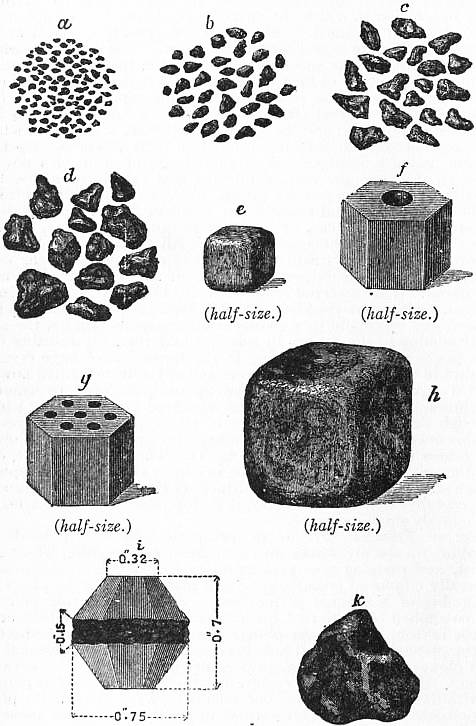
Fig. 1.
Proof of Powder.—In addition to chemical examination powder is passed through certain mechanical tests:—
1. For colour, glaze, texture and freedom from dust.
2. For proper incorporation.
3. For shape, size and proportion of the grains.—The first is judged by eye, and grains of the size required are obtained by the use of sieves of different sizes.
4. Density.—The density is generally obtained in some form of mercury densimeter, the powder being weighed in air and then under mercury. In some forms of the instrument the air can be pumped out so that the weighing takes place in vacuo.
5. Moisture and absorption of moisture.—The moisture and hygroscopic test consists in weighing a sample, drying at 100° C. for a certain time, weighing again, &c., until constant. The dried weighed sample can then be exposed to an artificial atmosphere of known moisture and temperature, and the gain in weight per hour similarly ascertained by periodic weighings.
6. Firing proof.—The nature of this depends upon the purpose for which the powder is intended. For sporting powders it consists in the “pattern” given by the shot upon a target at a given distance, or, if fired with a bullet, upon the “figure of merit,” or mean radial deviation of a certain number of rounds; also upon the penetrative power. For military purposes the “muzzle” velocity produced by a powder is ascertained by a chronograph which measures the exact time the bullet or other projectile takes to traverse a known distance between two wire screens. By means of “crusher gauges” the exact pressure per square inch upon certain points in the interior of the bore can be found.
In the chemical examination of gunpowder the points to be ascertained are, in addition to moisture, freedom from chlorides or sulphates, and correct proportion of nitre and sulphur to charcoal.
Products of Fired Powder and Changes taking place on Explosion.—With a mixture of the complexity of gunpowder it is quite impossible to say beforehand what will be the relative amounts of products. The desired products are nitrogen and carbon dioxide as gases, and potassium sulphate and carbonate as solids. But the ingredients of the mixture are not in any simple chemical proportion. Burning in contact with air under one atmosphere pressure, and burning in a closed or partially closed vessel under a considerable number of atmospheres pressure, may produce quite different results. The temperature of a reaction always rises with increased pressure. Although the main function of the nitre is to give up oxygen and nitrogen, of the charcoal to produce carbon dioxide and most of the heat, and of the sulphur by vaporizing to accelerate the rate of burning, it is quite impossible to represent the actions taking place on explosion by any simple or single chemical equation. Roughly speaking, the gases from black powder burnt in a closed vessel have a volume at 0° C. and 760 mm. pressure of about 280 times that of the original powder. The temperature produced under one atmosphere is above 2000° C., and under greater pressures considerably higher.
Experiments have been made by Benjamin Robins (1743), Charles Hutton (1778), Count Rumford (1797), Gay-Lussac (1823), R. Bunsen and L. Schiskoff (1857), T. J. Rodman (1861), C. Karolyi (1863), and later many researches by Sir Andrew Noble and Sir F. A. Abel, and by H. Debus and others, all with the idea of getting at the precise mechanism of the explosion. Debus (Ann., 1882, vols. 212, 213; 1891, vol. 265) discussed at great length the results of researches by Bunsen, Karolyi, Noble and Abel, and others on the combustion of powder in closed vessels in such manner that all the products could be collected and examined and the pressures registered. A Waltham Abbey powder, according to an experiment by Noble and Abel, gave when fired in a closed vessel the following quantities of products calculated from one gram of powder:—
Fractions of a gram. Fractions of a molecule or atom.
Potassium carbonate .2615 .00189 molecule
Potassium sulphate .1268 .00072 ”
Potassium thiosulphate .1666 .00087 ”
Potassium sulphide .0252 .00017 ”
Sulphur .0012 .00004 atom
Carbon dioxide .2678 .00608 molecule
Carbon monoxide .0339 .00121 ”
Nitrogen .1071 .00765 atom
Hydrogen .0008 .0008 ”
Hydrogen sulphide .0080 .00023 molecule
Potassium thiocyanate .0004
Nitre .0005
Ammonium carbonate .0002
From this, and other results, Debus concluded that Waltham Abbey powder could be represented by the formula 16KNO3 + 21.18C + 6.63S and that on combustion in a closed vessel the end results could be fairly expressed (rounding off fractions) by 16KNO3 + 21C + 5S = 5K2CO3 + K2SO4 + 2K2S2 + 13CO2 + 3CO + 8N2. Some of the sulphur is lost, part combining with the metal of the apparatus and part with hydrogen in the charcoal. The military powders of most nations can be represented by the formula 16KNO3 + 21.2C + 6.6S, proportions which are reasonably near to a theoretical mixture, that is one giving most complete combustion, greatest gas volume and temperature. The combustion of powder consists of two processes: (i.) oxidation, during which potassium carbonate and sulphate, carbon dioxide and nitrogen are mainly formed, and (ii.) a reduction process in which free carbon acts on the potassium sulphate and free sulphur on the potassium carbonate, producing potassium sulphide and carbon monoxide respectively. Most powders contain more carbon and sulphur than necessary, hence the second stage. In this second stage heat is lost. The potassium sulphide is also the most objectionable constituent as regards fouling.
The energy of a powder is given, according to Berthelot, by multiplying the gas volume by the heat (in calories) produced during burning; Debus shows that a powder composed of 16KNO3 to 8C and 8S would have the least, and one of composition 16KNO3 + 24C + 16S the greatest, when completely burnt. The greatest capability with the lowest proportion of carbon and sulphur to nitre would be obtained from the mixture ÷ 16KNO3 + 22C + 8S.
Smokeless and even noiseless powders seem to have been sought for during the whole gunpowder period. In 1756 one was experimented with in France, but was abandoned owing to difficulties in manufacture. Modern smokeless powders are certainly less noisy than the black powders, mainly because of the absence of metallic salts which although they may be gaseous whilst in the gun are certainly ejected as solids or become solids at the moment of contact with air.
Brown Powders.—About the middle of the 19th century guns and projectiles were made much larger and heavier than previously, and it was soon found that the ordinary black powders of the most dense form burnt much too rapidly, straining or bursting the pieces. Powders were introduced containing about 3% sulphur and 17-19% of a special form of charcoal made from slightly charred straw, or similar material. This “brown charcoal” contains a considerable amount of the hydrogen and oxygen of the original plant substance. The mechanical processes of manufacture of these brown powders is the same as for black. They, however, differ from black by burning very slowly, even under considerable pressure. This comparative slowness is caused by (1) the presence of a small amount of water even when air-dry; (2) the fact that the brown charcoal is practically very slightly altered cellulosic material, which before it can burn completely must undergo a little further resolution or charring at the expense of some heat from the portion of charge first ignited; and (3) the lower content of sulphur. An increase of a few per cent in the sulphur of black powder accelerates its rate of burning, and it may become almost a blasting powder. A decrease in sulphur has the reverse effect. It is really the sulphur vapour that in the early period of combustion spreads the flame through the charge.
Many other powders have been made or proposed in which nitrates or chlorates of the alkalis or of barium, &c., are the oxygen providers and substances as sugar, starch, and many other organic compounds as the combustible elements. Some of these compositions have found employment for blasting or even as sporting powders, but in most cases their objectionable properties of fouling, smoke and mode of exploding have prevented their use for military purposes. The adoption by the French government of the comparatively smokeless nitrocellulose explosive of Paul Vieille in 1887 practically put an end to the old forms of gunpowders. The first smokeless powder was made in 1865 by Colonel E. Schultze (Ding. Pol. Jour. 174, p. 323; 175, p. 453) by nitrating wood meal and adding potassium and barium nitrates. It is somewhat similar in composition to the E. C. sporting powder. F. Uchatius, in Austria, proposed a smokeless powder made from nitrated starch, but it was not adopted owing to its hygroscopic nature and also its tendency to detonate.
Bibliography.—Vanucchio Biringuccio, De la pirotechnia (Venice, 1540); Tartaglia, Quesiti e invenzioni diversi (lib. iii.) (Venice, 1546); Peter Whitehorne, How to make Saltpetre, Gunpowder, &c. (London, 1573); Nic. Macchiavelli, The Arte of Warre, trans. by Whitehorne (London, 1588); Hanzelet, Recueil de plusiers machines militaires (Paris, 1620); Boillet Langrois, Modelles artifices de feu (1620); Kruger, Chemical Meditations on the Explosion of Gunpowder (in Latin) (1636); Collado, On the Invention of Gunpowder (Spanish) (1641); The True Way to make all Sorts of Gunpowder and Matches (1647); Hawksbee, On Gunpowder (1686); Winter, On Gunpowder (in Latin); Robins, New Principles of Gunnery (London, 1742) (new ed. by Hutton, 1805); D’Antoni, Essame della polvere (Turin, 1765) (trans. by Captain Thomson, R. A., London, 1787); Count Rumford, “Experiments on Fired Gunpowder,” Phil. Trans. Roy. Soc. (1797); Charles Hutton, Mathematical Tracts, vol. iii. (1812); Sir W. Congreve, A Short Account of Improvements in Gunpowder made by (London, 1818); Bunsen and Schiskoff, “On the Chemical Theory of Gunpowder,” Pogg. Ann., 1857, vol. cii.; General Rodman, Experiments on Metal for Cannon, and Qualities of Cannon Powder (Boston, 1861); Napoleon III., Études sur le passé et l’avenir de l’artillerie, vol. iii. (Paris, 1862); Von Karolyi, “On the Products of the Combustion of Gun Cotton and Gunpowder,” Phil. Mag. (October 1863); Captain F. M. Smith, Handbook of the Manufacture and Proof of Gunpowder at Waltham Abbey (London, 1870); Noble and Abel, Fired Gunpowder (London, 1875, 1880); Noble, Artillery and Explosives (1906); H. W. L. Hime, Gunpowder and Ammunition, their Origin and Progress (1904); O. Guttmann, The Manufacture of Explosives (1895), Monumenta pulveris pyrii (1906); Notes on Gunpowder and Gun Cotton, published by order of the secretary of state for war (London, 1907). (See also Explosives.)
(W. R. E. H.)
1 These words were emended by some authors to read luru mope can ubre, the letters of which can be arranged to give pulvere carbonum.
2 This represents the composition of English powder at present, and no doubt it has remained the same for a longer time than the above date indicates.
3 Brown or coco-powder for large charges in guns. The charcoal is not burnt black but roasted until brown, and is made from some variety of straw, not wood.
GUNPOWDER PLOT, the name given to a conspiracy for blowing up King James I. and the parliament on the 5th of November 1605.
To understand clearly the nature and origin of the famous conspiracy, it is necessary to recall the political situation and the attitude of the Roman Catholics towards the government at the accession of James I. The Elizabethan administration had successfully defended its own existence and the Protestant faith against able and powerful antagonists, but this had not been accomplished without enforcing severe measures of repression and punishment upon those of the opposite faith. The beginning of a happier era, however, was expected with the opening of the new reign. The right of James to the crown could be more readily acknowledged by the Romanists than that of Elizabeth: Pope Clement VIII. appeared willing to meet the king half-way. James himself was by nature favourable to the Roman Catholics and had treated the Roman Catholic lords in Scotland with great leniency, in spite of their constant plots and rebellions. Writing to Cecil before his accession he maintained, “I am so far from any intention of persecution as I protest to God I reverence their church as our mother church, although clogged with many infirmities and corruptions, besides that I did ever hold persecution as one of the infallible notes of a false church.” He declared to Northumberland, the kinsman and master of Thomas Percy, the conspirator, “as for the Catholics, I will neither persecute any that will be quiet and give but an outward obedience to the law, neither will I spare to advance any of them that will be of good service and worthily deserved.” It is probable that these small but practical concessions would have satisfied the lay Roman Catholics and the secular priests, but they were very far from contenting the Jesuits, by whom the results of such leniency were especially feared: “What rigour of laws would not compass in so many years,” wrote Henry Tichborne, the Jesuit, in 1598, “this liberty and lenity will effectuate in 20 days, to wit the disfurnishing of the seminaries, the disanimating of men to come and others to return, the expulsion of the society and confusion as in Germany, extinction of zeal and favour, disanimation of princes from the hot pursuit of the enterprise.... We shall be left as a prey to the wolves that will besides drive our greatest patron [the king of Spain] to stoop to a peace which will be the utter ruin of our edifice, this many years in building.” Unfortunately, about this time the Jesuits, who thus thrived on political intrigue, and who were deeply implicated in treasonable correspondence with Spain, had obtained a complete ascendancy over the secular priests, who were for obeying the civil government as far as possible and keeping free from politics. The time, therefore, as far as the Roman Catholics themselves were concerned, was not a propitious one for introducing the moderate concessions which alone James had promised: James, too, on his side, found that religious toleration, though clearly sound in principle, was difficult in practice. During the first few months of the reign all went well. In July 1603 the fines for recusancy were remitted. In January 1604 peaceable Roman Catholics could live unmolested and “serve God according to their consciences without any danger.” But James’s expectations that the pope would prevent dangerous and seditious persons from entering the country were unfulfilled and the numbers of the Jesuits and the Roman Catholics greatly increased. Rumours of plots came to hand. Cecil, though like his master naturally in favour of toleration, with his experience gained in the reign of Elizabeth, was alarmed at the policy pursued and its results, and great anxiety was aroused in the government and nation, which was in the end shared by the king. It was determined finally to return to the earlier policy of repression. On the 22nd of February 1604 a proclamation was issued banishing priests; on the 28th of November 1604, recusancy fines were demanded from 13 wealthy persons, and on the 10th of February 1605 the penal laws were ordered to be executed. The plot, however, could not have been occasioned by these measures, for it had been already conceived in the mind of Robert Catesby. It was aimed at the repeal of the whole Elizabethan legislation against the Roman Catholics and perhaps derived some impulse at first from the leniency lately shown by the administration, afterwards gaining support from the opposite cause, the return of the government to the policy of repression.
It was in May 1603 that Catesby told Percy, in reply to the latter’s declaration of his intention to kill the king, that he was “thinking of a most sure way.” Subsequently, about the 1st of November 1603, Catesby sent a message to his cousin Robert Winter at Huddington, near Worcester, to come to London, which the latter refused. On the arrival of a second urgent summons shortly afterwards he obeyed, and was then at a house at Lambeth, probably in January 1604, initiated by Catesby together with John Wright into the plot to blow up the parliament house. Before putting this plan into execution, however, it was decided to try a “quiet way”; and Winter was sent over to Flanders to obtain the good offices of Juan de Velasco, duke of Frias and constable of Castile, who had arrived there to conduct the negotiations for a peace between England and Spain, in order to obtain the repeal of the penal laws. Winter, having secured nothing but vain promises from the constable, returned to England about the end of April, bringing with him Guy Fawkes, a man devoted to the Roman Catholic cause and recommended for undertaking perilous adventures. Subsequently the three and Thomas Percy, who joined the conspiracy in May, met in a house behind St Clement’s and, having taken an oath of secrecy together, heard Mass and received the Sacrament in an adjoining apartment from a priest stated by Fawkes to have been Father Gerard. Later several other persons were included in the plot, viz. Winter’s brother Thomas, John Grant, Ambrose Rokewood, Robert Keyes, Sir Everard Digby, Francis Tresham, a cousin of Catesby and Thomas Bates Catesby’s servant, all, with the exception of the last, being men of good family and all Roman Catholics. Father Greenway and Father Garnet, the Jesuits, were both cognisant of the plot (see Garnet, Henry). On the 24th of May 1604 a house was hired in Percy’s name adjoining the House of Lords, from the cellar of which they proposed to work a mine. They began on the 11th of December 1604, and by about March had got half-way through the wall. They then discovered that a vault immediately under the House of Lords was available. This was at once hired by Percy, and 36 barrels of gunpowder, amounting to about 1 ton and 12 cwt., were brought in and concealed under coal and faggots. The preparations being completed in May the conspirators separated. Fawkes was despatched to Flanders, where he imparted the plot to Hugh Owen, a zealous Romanist intriguer. Sir Edmund Baynham was sent on a mission to Rome to be at hand when the news came to gain over the pope to the cause of the successful conspirators. An understanding was arrived at with several officers levied for the service of the archduke, that they should return at once to England when occasion arose of defending the Roman Catholic cause. A great hunting match was organized at Danchurch in Warwickshire by Digby, to which large numbers of the Roman Catholic gentry were invited, who were to join the plot after the successful accomplishment of the explosion of the 5th of November, the day fixed for the opening of parliament, and get possession of the princess Elizabeth, then residing in the neighbourhood; while Percy was to seize the infant prince Charles and bring him on horseback to their meeting-place. Guy Fawkes himself was to take ship immediately for Flanders, spread the news on the continent and get supporters. The conspirators imagined that a terrorized and helpless government would readily agree to all their demands. Hitherto the secret had been well kept and the preparations had been completed with extraordinary success and without a single drawback; but a very serious difficulty now confronted the conspirators as the time for action arrived, and disturbed their consciences. The feelings of ordinary humanity shrunk from the destruction of so many persons guiltless of any offence. But in addition, among the peers to be assassinated were included many Roman Catholics and some lords nearly connected in kinship or friendship with the plotters themselves. Several appeals, however, made to Catesby to allow warning to be given to certain individuals were firmly rejected.
On the 26th of October Lord Monteagle, a brother-in-law of Francis Tresham, who had formerly been closely connected with some of the other conspirators and had engaged in Romanist plots against the government, but who had given his support to the new king, unexpectedly ordered supper to be prepared at his house at Haxton, from which he had been absent for more than a year. While at supper about 6 o’clock an anonymous letter was brought by an unknown messenger which, having glanced at, he handed to Ward, a gentleman of his service and an intimate friend of Winter, the conspirator, to be read aloud. The celebrated letter ran as follows:—
“My lord, out of the love I bear to some of your friends, I have a care for your preservation. Therefore I would advise you, as you tender your life, to devise some excuse to shift of your attendance of this Parliament, for God and man hath concurred to punish the wickedness of this time. And think not slightly of this advertisement, but retire yourself into your country, where you may expect the event in safety, for though there be no appearance of any stir, yet I say they shall receive a terrible blow the Parliament, and yet they shall not see who hurts them. This counsel is not to be contemned, because it may do you good and can do you no harm, for the danger is past as soon as you have burnt the letter: and I hope God will give you the grace to make good use of it, to whose holy protection I commend you.”
The authorship of the letter has never been disclosed or proved, but all evidence seems to point to Tresham, and to the probability that he had some days before warned Monteagle and agreed with him as to the best means of making known the plot and preventing its execution, and at the same time of giving the conspirators time to escape (see Tresham, Francis).
Monteagle at once started for Whitehall, found Salisbury and other ministers about to sit down to supper, and showed the letter, whereupon it was decided to search the cellar under the House of Lords before the meeting of parliament, but not too soon, so that the plot might be ripe and be fully disclosed. Meanwhile Ward, on the 27th of October, as had evidently been intended, informed Winter that the plot was known, and on the 28th Winter informed Catesby and begged him to give up the whole project. Catesby, however, after some hesitation, finding from Fawkes that nothing had been touched in the cellar, and prevailed upon by Percy, determined to stand firm, hoping that the government had put no credence in Monteagle’s letter, and Fawkes returned to the cellar to keep guard as before. On the 4th the king, having been shown the letter, ordered the earl of Suffolk, as lord chamberlain, to examine the buildings. He was accompanied by Monteagle. On arriving at the cellar, the door was opened to him by Fawkes. Seeing the enormous piles of faggots he asked the name of their owner, to which Fawkes replied that they belonged to Percy. His name immediately aroused suspicions, and accordingly it was ordered that a further search should be made by Thomas Knyvett, a Westminster magistrate who, coming with his men at night, discovered the gunpowder and arrested Fawkes on the threshold.
The opinion that the whole plot was the work of Salisbury, that he acted as an agent provocateur and lured on his victims to destruction, repeated by some contemporary and later writers and recently formulated and urged with great ability, has no solid foundation. Nor is it even probable that he was aware of its existence till he received Monteagle’s letter. Even after its reception complete belief was not placed in the warning. A search was made only to make sure that nothing was wrong and guided only by Monteagle’s letter, while no attempt was made to seize the conspirators. The steps taken by Salisbury after the discovery of the gunpowder do not show the possession of any information of the plot or of the persons who were its chief agents outside Fawkes’s first statement, and his knowledge is seen to develop according to the successive disclosures and confessions of the latter. Thus on the 7th of November he had no knowledge of the mine, and it is only after Fawkes’s examination by torture on the 9th, when the names of the conspirators were drawn from him, that the government was able to classify them according to their guilt and extent of their participation. The inquiry was not conducted by Salisbury alone, but by several commissioners, some of whom were Roman Catholics, and many rivals and secret enemies. To conceal his intrigue from all these would have been impossible, and that he should have put himself in their power to such an extent is highly improbable. Again, the plan agreed upon for disclosing the plot was especially designed to allow the conspirators to escape, and therefore scarcely a method which would have been arranged with Salisbury. Not one of the conspirators, even when all hope of saving life was gone, made any accusation against Salisbury or the government and all died expressing contrition for their crime. Lastly Salisbury had no conceivable motive in concocting a plot of this description. His political power and position in the new reign had been already secured and by very different methods. He was now at the height of his influence, having been created Viscount Cranborne in August 1604 and earl of Salisbury in May 1605; and James had already, more than 16 months before the discovery of the plot, consented to return to the repressive measures against the Romanists. The success with which the conspirators concealed their plot from Salisbury’s spies is indeed astonishing, but is probably explained by its very audacity and by the absence of incriminating correspondence, the medium through which the minister chiefly obtained his knowledge of the plans of his enemies.
On the arrest of Fawkes the other conspirators, except Tresham, fled in parties by different ways, rejoining each other in Warwickshire, as had been agreed in case the plot had been successful. Catesby, who with some others had covered the distance of 80 m. between London and his mother’s house at Ashby St Legers in eight hours, informed his friends in Warwickshire, who had been awaiting the issue of the plot, of its failure, but succeeded in persuading Sir Everard Digby, by an unscrupulous falsehood, to further implicate himself in his hopeless cause by assuring him that both James and Salisbury were dead; and, according to Father Garnet, this was not the first time that Catesby had been guilty of lies in order to draw men into the plot. He pushed on the same day with his companions in the direction of Wales, where, it was hoped, they would be joined by bands of insurgents. They arrived at Huddington at 2 in the afternoon. On the morning of the 7th the band, numbering about 36 persons, confessed and heard Mass, and then rode away to Holbeche, 2 m. from Stourbridge, in Staffordshire, the house of Stephen Littleton, who had been present at the hunting at Danchurch (see Digby, Everard), where they arrived at 10 o’clock at night, having on their way broken into Lord Windsor’s house at Hewell Grange and taken all the armour they found there. Their case was now desperate. None had joined them: “Not one came to take our part,” said Sir Everard Digby, “though we had expected so many.” They were being followed by the sheriff and all the forces of the county. All spurned them from their doors when they applied for succour. One by one their followers fled from the house in which the last scene was to be played out. They now began to feel themselves abandoned not only by man but by God; for an explosion of some of their gunpowder, on the morning of the 8th, by which Catesby and some others were scorched, struck terror into their hearts as a judgment from heaven. The assurance of innocence and of a just cause which till now had alone supported them was taken away. The greatness of their crime, its true nature, now struck home to them, and the few moments which remained to them of life were spent in prayer and in repentance. The supreme hour had now arrived. About 11 o’clock the sheriff and his men came up and immediately began firing into the house. Catesby, Percy and the two Wrights were killed, Winter and Rokewood wounded and taken prisoners with the men who still adhered to them. In all eight of the conspirators, including the two Winters, Digby, Fawkes, Rokewood, Keyes and Bates, were executed, while Tresham died in the Tower. Of the priests involved, Garnet was tried and executed, while Greenway and Gerard succeeded in escaping.
So ended the strange and famous Gunpowder Plot. However atrocious its conception and its aims, it is impossible not to feel, together with horror for the deed, some pity and admiration for the guilty persons who took part in it. “Theirs was a crime which it would never have entered into the heart of any man to commit who was not raised above the lowness of the ordinary criminal.” They sinned not against the light but in the dark. They erred from ignorance, from a perverted moral sense rather than from any mean or selfish motive, and exhibited extraordinary courage and self-sacrifice in the pursuit of what seemed to them the cause of God and of their country. Their punishment was terrible. Not only had they risked and lost all in the attempt and drawn upon themselves the frightful vengeance of the state, but they saw themselves the means of injuring irretrievably the cause for which they felt such devotion. Nothing could have been more disastrous to the cause of the Roman Catholics than their crime. The laws against them were immediately increased in severity, and the gradual advance towards religious toleration was put back for centuries. In addition a new, increased and long-enduring hostility was aroused in the country against the adherents of the old faith, not unnatural in the circumstances, but unjust and undiscriminating, because while some of the Jesuits were no doubt implicated, the secular priests and Roman Catholic laity as a whole had taken no part in the conspiracy.
Bibliography.—The recent controversy concerning the nature and origin of the plot can be followed in What was the Gunpowder Plot? by John Gerard, S.J. (1897); What Gunpowder Plot was, by S. R. Gardiner (a rejoinder) (1897); The Gunpowder Plot ... in reply to Professor Gardiner, by John Gerard, S.J. (1897); Thomas Winter’s Confession and the Gunpowder Plot, by John Gerard, S.J. (with facsimiles of his writing) (1898); Eng. Hist. Rev. iii. 510 and xii. 791; Edinburgh Review, clxxxv. 183; Athenaeum 1897, ii. 149, 785, 855; 1898, i. 23, ii. 352, 420; Academy, vol. 52 p. 84; The Nation, vol. 65 p. 400. A considerable portion of the controversy centres round the question of the authenticity of Thomas Winter’s confession, the MS. of which is at Hatfield, supported by Professor Gardiner, but denied by Father Gerard principally on account of the document having been signed “Winter” instead of “Wintour,” the latter apparently being the conspirator’s usual style of signature. The document was deposited by the 3rd Marquess of Salisbury for inspection at the Record Office, and was pronounced by two experts, one from the British Museum and another from the Record Office, to be undoubtedly genuine. The cause of the variation in the signature still remains unexplained, but ceases to have therefore any great historical importance. The bibliography of the contemporary controversy is given in the article on Henry Garnet in the Dictionary of National Biography and in The Gunpowder Plot by David Jardine (1857), the latter work still remaining the principal authority on the subject; add to these Gardiner’s Hist. of England, i., where an excellent account is given; History of the Jesuits in England, by Father Ethelred Taunton (1901); Father Gerard’s Narrative in Condition of the Catholics under James I. (1872), and Father Greenway’s Narrative in Troubles of our Catholic Forefathers, 1st series (1872), interesting as contemporary accounts, but not to be taken as complete or infallible authorities, of the same nature being Historia Provinciae Anglicanae Societatis Jesu, by Henry More, S.J. (1660), pp. 309 et seq.; also History of Great Britain, by John Speed (1611), pp. 839 et seq.; Archaeologia, xii. 200, xxviii. 422, xxix. 80; Harleian Miscellany (1809), iii. 119-135, or Somers Tracts (1809), ii. 97-117; M. A. Tierney’s ed. of Dodd’s Church History, vol. iv. (1841); Treason and Plot, by Martin Hume (1901); Notes and Queries, 7 ser. vi., 8 ser. iv. 408, 497, v. 55, xii. 505, 9 ser. xi. 115; Add. MSS. Brit. Mus. 6178; State Trials, ii.; Calendar of State Pap. Dom. (1603-1610), and the official account, A True and Perfect Relation of the Whole Proceedings against the late most Barbarous Traitors (1606), a neither true nor complete narrative however, now superseded as an authority, reprinted as The Gunpowder Treason ... with additions in 1679 by Thomas Barlow, bishop of Lincoln. A large number of letters and papers in the State Paper Office relating to the plot were collected in one volume in 1819, called the Gunpowder Plot Book; these are noted in their proper place in the printed calendars of State Papers, Domestic Series; see also articles on Fawkes, Guy; Tresham, Francis; Monteagle, William Parker, 4th Baron; Percy, Thomas; Catesby, Robert; Garnet, Henry; Digby, Sir Everard.
(P. C. Y.)
GUN-ROOM, a ship cabin occupied by the officers below the rank of lieutenant, but who are not warrant officers of the class of the boatswain, gunner or carpenter. In the wooden sailing ships it was on the lower deck, and was originally the quarters of the gunner.
GUNTER, EDMUND (1581-1626), English mathematician, of Welsh extraction, was born in Hertfordshire in 1581. He was educated at Westminster school, and in 1599 was elected a student of Christ Church, Oxford. He took orders, became a preacher in 1614, and in 1615 proceeded to the degree of bachelor in divinity. Mathematics, however, which had been his favourite study in youth, continued to engross his attention, and on the 6th of March 1619 he was appointed professor of astronomy in Gresham College, London. This post he held till his death on the 10th of December 1626. With Gunter’s name are associated several useful inventions, descriptions of which are given in his treatises on the Sector, Cross-staff, Bow, Quadrant and other Instruments. He contrived his sector about the year 1606, and wrote a description of it in Latin, but it was more than sixteen years afterwards before he allowed the book to appear in English. In 1620 he published his Canon triangulorum (see Logarithms). There is reason to believe that Gunter was the first to discover (in 1622 or 1625) that the magnetic needle does not retain the same declination in the same place at all times. By desire of James I. he published in 1624 The Description and Use of His Majestie’s Dials in Whitehall Garden, the only one of his works which has not been reprinted. He introduced the words cosine and cotangent, and he suggested to Henry Briggs, his friend and colleague, the use of the arithmetical complement (see Brigg’s Arithmetica Logarithmica, cap. xv.). His practical inventions are briefly noticed below:
Gunter’s Chain, the chain in common use for surveying, is 22 yds. long and is divided into 100 links. Its usefulness arises from its decimal or centesimal division, and the fact that 10 square chains make an acre.
Gunter’s Line, a logarithmic line, usually laid down upon scales, sectors, &c. It is also called the line of lines and the line of numbers, being only the logarithms graduated upon a ruler, which therefore serves to solve problems instrumentally in the same manner as logarithms do arithmetically.
Gunter’s Quadrant, an instrument made of wood, brass or other substance, containing a kind of stereographic projection of the sphere on the plane of the equinoctial, the eye being supposed to be placed in one of the poles, so that the tropic, ecliptic, and horizon form the arcs of circles, but the hour circles are other curves, drawn by means of several altitudes of the sun for some particular latitude every year. This instrument is used to find the hour of the day, the sun’s azimuth, &c., and other common problems of the sphere or globe, and also to take the altitude of an object in degrees.
Gunter’s Scale (generally called by seamen the Gunter) is a large plane scale, usually 2 ft. long by about 1½ in. broad, and engraved with various lines of numbers. On one side are placed the natural lines (as the line of chords, the line of sines, tangents, rhumbs, &c.), and on the other side the corresponding artificial or logarithmic ones. By means of this instrument questions in navigation, trigonometry, &c., are solved with the aid of a pair of compasses.
GÜNTHER, JOHANN CHRISTIAN (1695-1723), German poet, was born at Striegau in Lower Silesia on the 8th of April 1695. After attending the gymnasium at Schweidnitz, he was sent in 1715 by his father, a country doctor, to study medicine at Wittenberg; but he was idle and dissipated, had no taste for the profession chosen for him, and came to a complete rupture with his family. In 1717 he went to Leipzig, where he was befriended by J. B. Mencke (1674-1732), who recognized his genius; and there he published a poem on the peace of Passarowitz (concluded between the German emperor and the Porte in 1718) which acquired him reputation. A recommendation from Mencke to Frederick Augustus II. of Saxony, king of Poland, proved worse than useless, as Günther appeared at the audience drunk. From that time he led an unsettled and dissipated life, sinking ever deeper into the slough of misery, until he died at Jena on the 15th of March 1723, when only in his 28th year. Goethe pronounces Günther to have been a poet in the fullest sense of the term. His lyric poems as a whole give evidence of deep and lively sensibility, fine imagination, clever wit, and a true ear for melody and rhythm; but an air of cynicism is more or less present in most of them, and dull or vulgar witticisms are not infrequently found side by side with the purest inspirations of his genius.
Günther’s collected poems were published in four volumes (Breslau, 1723-1735). They are also included in vol. vi. of Tittmann’s Deutsche Dichter des 17ten Jahrh. (Leipzig, 1874), and vol. xxxviii. of Kürschner’s Deutsche Nationalliteratur (1883). A pretended autobiography of Günther appeared at Schweidnitz in 1732, and a life of him by Siebrand at Leipzig in 1738. See Hoffmann von Fallersleben, J. Ch. Günther (Breslau, 1833); O. Roquette, Leben und Dichten J. Ch. Günthers (Stuttgart, 1860); M. Kalbeck, Neue Beiträge zur Biographie des Dichters C. Günther (Breslau, 1879).
GÜNTHER OF SCHWARZBURG (1304-1349), German king, was a descendant of the counts of Schwarzburg and the younger son of Henry VII., count of Blankenburg. He distinguished himself as a soldier, and rendered good service to the emperor Louis IV., on whose death in 1347 he was offered the German throne, after it had been refused by Edward III., king of England. He was elected German king at Frankfort on the 30th of January 1349 by four of the electors, who were partisans of the house of Wittelsbach and opponents of Charles of Luxemburg, afterwards the emperor Charles IV. Charles, however, won over many of Günther’s adherents, defeated him at Eltville, and Günther, who was now seriously ill, renounced his claims for the sum of 20,000 marks of silver. He died three weeks afterwards at Frankfort, and was buried in the cathedral of that city, where a statue was erected to his memory in 1352.
See Graf L. Ütterodt zu Scharffenberg, Günther, Graf von Schwarzburg, erwählter deutscher König (Leipzig, 1862); and K. Janson, Das Königtum Günthers von Schwarzburg (Leipzig, 1880).
GUNTRAM, or Gontran (561-592), king of Burgundy, was one of the sons of Clotaire I. On the death of his father (561) he and his three brothers divided the Frankish realm between them, Guntram receiving as his share the valleys of the Saône and Rhone, together with Berry and the town of Orleans, which he made his capital. On the death of Charibert (567), he further obtained the civitates of Saintes, Angoulême and Périgueux. During the civil war which broke out between the kings of Neustria and Austrasia, his policy was to try to maintain a state of equilibrium. After the assassination of Sigebert (575), he took the youthful Childebert II. under his protection, and, thanks to his assistance against the intrigues of the great lords, the latter was able to maintain his position in Austrasia. After the death of Chilperic (584) he protected the young Clotaire II. in the same way, and prevented Childebert from seizing his dominions. His course was rendered easier by the fact that his own sons had died; consequently, having an inheritance at his disposal, he was able to offer it to whichever of his nephews he wished. The danger to the Frankish realm caused by the expedition of Gundobald (585), and the anxiety which was caused him by the revolts of the great lords in Austrasia finally decided him in favour of Childebert. He adopted him as his son, and recognized him as his heir at the treaty of Andelot (587); he also helped him to crush the great lords, especially Ursion and Berthefried, who were conquered in la Woëvre. From this time on he ceased to play a prominent part in the affairs of Austrasia. He died in 592, and Childebert received his inheritance without opposition. Gregory of Tours is very indulgent to Guntram, who showed himself on occasions generous towards the church; he almost always calls him “good king Guntram,” and in his writings are to be found such phrases as “good king Guntram took as his servant a concubine Veneranda” (iv. 25); but Guntram was really no better than the other kings of his age; he was cruel and licentious, putting his cubicularius Condo to death, for instance, because he was suspected of having killed a buffalo in the Vosges. He was moreover a coward, and went in such constant terror of assassination that he always surrounded himself with a regular bodyguard.
See Krusch, “Zur Chronologie der merowingischen Könige,” in the Forschungen zur deutschen Geschichte, xxii. 451-490; Ulysse Chevalier, Bio-bibliographie (2nd ed.), s.v. “Guntram.”
(C. Pf.)
GUNTUR, a town and district of British India, in the Madras presidency. The town (pop. in 1901, 30,833) has a station on the Bellary-Bezwada branch of the Southern Mahratta railway. It is situated east of the Kondavid hills, and is very healthy. It appears to have been founded in the 18th century by the French. At the time of the cession of the Circars to the English in 1765, Guntur was specially exempted during the life of Basalat Jang, whose personal jagir it was. In 1788 it came into British possession, the cession being finally confirmed in 1823. It has an important trade in cotton, with presses and ginning factories. There is a second-grade college supported by the American Lutheran Mission. Until 1859, Guntur was the headquarters of a district of the same name, and in 1904 a new District of Guntur was constituted, covering territory which till then had been divided between Kistna and Nellore. Area, 5733 sq. m. The population on this area in 1901 was 1,490,635. The district is bounded on the E. and N. by the river Kistna; in the W. a considerable part of the boundary is formed by the Gundlakamma river. The greater part consists of a fertile plain irrigated by canals from the Kistna, and producing cotton, rice and other crops.
GUPTA, an empire and dynasty of northern India, which lasted from about A.D. 320 to 480. The dynasty was founded by Chandragupta I., who must not be confounded with his famous predecessor Chandragupta Maurya. He gave his name to the Gupta era, which continued in use for several centuries, dating from the 26th of February, A.D. 320. Chandragupta was succeeded by Samudragupta (c. A.D. 326-375), one of the greatest of Indian kings, who conquered nearly the whole of India, and whose alliances extended from the Oxus to Ceylon; but his name was at one time entirely lost to history, and has only been recovered of recent years from coins and inscriptions. His empire rivalled that of Asoka, extending from the Hugli on the east to the Jumna and Chambal on the west, and from the foot of the Himalayas on the north to the Nerbudda on the south. His son Chandragupta II. (c. A.D. 375-413) was also known as Vikra-Maditya (q.v.), and seems to have been the original of the mythical Hindu king of that name. About 388 he conquered the Saka satrap of Surashtra (Kathiawar) and penetrated to the Arabian Sea. His administration is described in the work of Fa-hien, the earliest Chinese pilgrim, who visited India in A.D. 405-411. Pataliputra was the capital of the dynasty, but Ajodhya seems to have been sometimes used by both Samudragupta and Chandragupta II. as the headquarters of government. The Gupta dynasty appears to have fostered a revival of Brahmanism at the expense of Buddhism, and to have given an impulse to art and literature. The golden age of the empire lasted from A.D. 330 to 455, beginning to decline after the latter date. When Skandagupta came to the throne in 455, India was threatened with an irruption of the White Huns, on whom he inflicted a severe defeat, thus saving his kingdom for a time; but about 470 the White Huns (see Ephthalites) returned to the attack, and the empire was gradually destroyed by their repeated inroads. When Skandagupta died about 480, the Gupta empire came to an end, but the dynasty continued to rule in the eastern provinces for several generations. The last known prince of the imperial line of Guptas was Kamaragupta II. (c. 535), after whom it passed “by an obscure transition” into a dynasty of eleven Gupta princes, known as “the later Guptas of Magadha,” who seem for the most part to have been merely local rulers of Magadha. One of them, however, Adityasena, after the death of the paramount sovereign in 648, asserted his independence. The last known Gupta king was Jivitagupta II., who reigned early in the 8th century. About the middle of the century Magadha passed under the sway of the Pal kings of Bengal.
See J. F. Fleet, Gupta Inscriptions (1888); and Vincent A. Smith, The Early History of India (2nd ed., Oxford, 1908), pp. 264-295.
GURA, EUGEN (1842-1906), German singer, was born near Saatz in Bohemia, and educated at first for the career of a painter at Vienna and Munich; but later, developing a fine baritone voice, he took up singing and studied it at the Munich Conservatorium. In 1865 he made his début at the Munich opera, and in the following years he gained the highest reputation in Germany, being engaged principally at Leipzig till 1876 and then at Hamburg till 1883. He sang in 1876 in the Ring at Bayreuth, and was famous for his Wagnerian rôles; and his Hans Sachs in Meistersinger, as performed in London in 1882, was magnificent. In later years he showed the perfection of art in his singing of German Lieder. He died in Bavaria on the 26th of August 1906.
GURDASPUR, a town and district of British India, in the Lahore division of the Punjab. The town had a population in 1901 of 5764. It has a fort (now containing a Brahman monastery) which was famous for the siege it sustained in 1712 from the Moguls. The Sikh leader, Banda, was only reduced by starvation, when he and his men were tortured to death after capitulating.
The District comprises an area of 1889 sq. m. It is bounded on the N. by the native states of Kashmir and Chamba, on the E. by Kangra district and the river Beas, on the S.W. by Amritsar district, and on the W. by Sialkot, and occupies the submontane portion of the Bari Doab, or tract between the Beas and the Ravi. An intrusive spur of the British dominions runs northward into the lower Himalayan ranges, to include the mountain sanatorium of Dalhousie, 7687 ft. above sea-level. This station, which has a large fluctuating population during the warmer months, crowns the most westerly shoulder of a magnificent snowy range, the Dhaoladhar, between which and the plain two minor ranges intervene. Below the hills stretches a picturesque and undulating plateau covered with abundant timber, made green by a copious rainfall, and watered by the streams of the Bari Doab, which, diverted by dams and embankments, now empty their waters into the Beas directly, in order that their channels may not interfere with the Bari Doab canal. The district contains several large jhils or swampy lakes, and is famous for its snipe-shooting. It is historically important in connexion with the rise of the Sikh confederacy. The whole of the Punjab was then distributed among the Sikh chiefs who triumphed over the imperial governors. In the course of a few years, however, the maharaja Ranjit Singh acquired all the territory which those chiefs had held. Pathankot and the neighbouring villages in the plain, together with the whole hill portion of the district, formed part of the area ceded by the Sikhs to the British after the first Sikh war in 1846. In 1862, after receiving one or two additions, the district was brought into its present shape. In 1901 the population was 940,334, showing a slight decrease, compared with an increase of 15% in the previous decade. A branch of the North-Western railway runs through the district. The largest town and chief commercial centre is Batala. There are important woollen mills at Dhariwal, and besides their products the district exports cotton, sugar, grain and oil-seeds.
GURGAON, a town and district of British India, in the Delhi division of the Punjab. The town (pop. in 1901, 4765) is the headquarters of the district, but is otherwise unimportant. The district has an area of 1984 sq. m. It is bounded on the N. by Rohtak, on the W. and S.W. by portions of the Alwar, Nabha and Jind native states, on the S. by the Muttra district of the United Provinces, on the E. by the river Jumna and on the N.E. by Delhi. It comprises the southernmost corner of the Punjab province, stretching away from the level plain towards the hills of Rajputana. Two low rocky ranges enter its borders from the south and run northward in a bare and unshaded mass toward the plain country. East of the western ridge the valley is wide and open, extending to the banks of the Jumna. To the west lies the subdivision of Rewari, consisting of a sandy plain dotted with isolated hills. Numerous torrents carry off the drainage from the upland ranges, and the most important among them empty themselves at last into the Najafgarh jhil. This swampy lake lies to the east of the civil station of Gurgaon, and stretches long arms into the neighbouring districts of Delhi and Rohtak. Salt is manufactured in wells at several villages. The mineral products are iron ore, copper ore, plumbago and ochre.
In 1803 Gurgaon district passed into the hands of the British after Lord Lake’s conquests. On the outbreak of the Mutiny in May 1857, the nawab of Farukhnagar, the principal feudatory of the district, rose in rebellion. The Meos and many Rajput families followed his example. A faithful native officer preserved the public buildings and records at Rewari from destruction; but with this exception, British authority became extinguished for a time throughout Gurgaon. After the fall of the rebel capital, a force marched into the district and either captured or dispersed the leaders of rebellion. The territory of the nawab was confiscated on account of his participation in the Mutiny. Civil administration was resumed under orders from the Punjab government, to which province the district was formally annexed on the final pacification of the country. The population in 1901 was 746,208, showing an increase of 11% in the decade. The largest town and chief trade centre is Rewari. The district is now traversed by several lines of railway, and irrigation is provided by the Agra canal. The chief trade is in cereals, but hardware is also exported.
GURKHA (pronounced góorka; from Sans. gāu, a cow, and raks, to protect), the ruling Hindu race in Nepal (q.v.). The Gurkhas, or Gurkhalis, claim descent from the rajas of Chitor in Rajputana. When driven out of their own country by the Mahommedan invasion, they took refuge in the hilly districts about Kumaon, whence they gradually invaded the country to the eastward as far as Gurkha, Noakote and ultimately to the valley of Nepal and even Sikkim. They were stopped by the English in an attempt to push south, and the treaty of Segauli, which ended the Gurkha War of 1814, definitely limited their territorial growth. The Gurkhas of the present day remain Hindus by religion, but show in their appearance a strong admixture of Mongolian blood. They make splendid infantry soldiers, and by agreement with their government about 20,000 have been recruited for the Gurkha regiments of the Indian army. As a rule they are bold, enduring, faithful, frank, independent and self-reliant. They despise other Orientals, but admire and fraternize with Europeans, whose tastes in sport and war they share. They strongly resemble the Japanese, but are of a sturdier build. Their national weapon is the kukri, a heavy curved knife, which they use for every possible purpose.
See Capt. Eden Vansittart, Notes on the Gurkhas (1898); and P. D. Bonarjee, The Fighting Races of India (1899).
GURNALL, WILLIAM (1617-1679), English author, was born in 1617 at King’s Lynn, Norfolk. He was educated at the free grammar school of his native town, and in 1631 was nominated to the Lynn scholarship in Emmanuel College, Cambridge, where he graduated B.A. in 1635 and M.A. in 1639. He was made rector of Lavenham in Suffolk in 1644; and before he received that appointment he seems to have officiated, perhaps as curate, at Sudbury. At the Restoration he signed the declaration required by the Act of Uniformity, and on this account he was the subject of a libellous attack, published in 1665, entitled Covenant-Renouncers Desperate Apostates. He died on the 12th of October 1679. Gurnall is known by his Christian in Complete Armour, published in three volumes, dated 1655, 1658 and 1662. It consists of a series of sermons on the latter portion of the 6th chapter of Ephesians, and is described as a “magazine from whence the Christian is furnished with spiritual arms for the battle, helped on with his armour, and taught the use of his weapon; together with the happy issue of the whole war.” The work is more practical than theological; and its quaint fancy, graphic and pointed style, and its fervent religious tone render it still popular with some readers.
See also An Inquiry into the Life of the Rev. W. Gurnall, by H. M’Keon (1830), and a biographical introduction by Bishop Ryle to the Christian in Complete Armour (1865).
GURNARD (Trigla), a genus of fishes forming a group of the family of “mailed cheeks” (Triglidae), and easily recognized by three detached finger-like appendages in front of the pectoral fins, and by their large, angular, bony head, the sides of which are protected by strong, hard and rough bones. The pectoral appendages are provided with strong nerves, and serve not only as organs of locomotion when the fish moves on the bottom, but also as organs of touch, by which it detects small animals on which it feeds. Gurnards are coast-fishes, generally distributed over the tropical and temperate areas; of the forty species known six occur on the coast of Great Britain, viz. the red gurnard (T. pini), the streaked gurnard (T. lineata), the sapphirine gurnard (T. hirundo), the grey gurnard (T. gurnardus), the piper (T. lyra) and the long-finned gurnard (T. obscura or T. lucerna). Although never found very far from the coast, gurnards descend to depths of several hundred fathoms; and as they are bottom-fish they are caught chiefly by means of the trawl. Not rarely, however, they may be seen floating on the surface of the water, with their broad, finely coloured pectoral fins spread out like fans. In very young fishes, which abound in certain localities on the coast in the months of August and September, the pectorals are comparatively much longer than in the adult, extending to the end of the body; they are beautifully coloured and kept expanded, the little fishes looking like butterflies. When caught and taken out of the water, gurnards emit a grunting noise, which is produced by the vibrations of a diaphragm situated transversely across the cavity of the bladder and perforated in the centre. This grunting noise gave rise to the name “gurnard,” which is probably an adaptation or variation of the Fr. grognard, grumbler, cf. the Fr. grondin, gurnard, from gronder, and Ger. Knurrfisch. Their flesh is very white, firm and wholesome.
Trigla pleuracanthica.
GURNEY, the name of a philanthropic English family of bankers and merchants, direct descendants of Hugh de Gournay, lord of Gournay, one of the Norman noblemen who accompanied William the Conqueror to England. Large grants of land were made to Hugh de Gournay in Norfolk and Suffolk, and Norwich has since that time been the headquarters of the family, the majority of whom were Quakers. Here in 1770 the brothers John and Henry Gurney founded a banking-house, the business passing in 1779 to Henry’s son, Bartlett Gurney. On the death of Bartlett Gurney in 1802 the bank became the property of his three cousins, of whom John Gurney (1750-1809) was the most remarkable. One of his daughters was Elizabeth Fry; another married Sir Thomas Fowell Buxton. Of his sons one was Joseph John Gurney (1788-1847), a well-known philanthropist of the day; another, Samuel Gurney (1786-1856) assumed on his father’s death the control of the Norwich bank. Samuel Gurney also took over about the same time the control of the London bill-broking business of Richardson, Overend & Company, in which he was already a partner. This business had been founded in 1800 by Thomas Richardson, clerk to a London bill-discounter, and John Overend, chief clerk in the bank of Smith, Payne & Company at Nottingham, the Gurneys supplying the capital. At that time bill-discounting was carried on in a spasmodic fashion by the ordinary merchant in addition to his regular business, but Richardson considered that there was room for a London house which should devote itself entirely to the trade in bills. This, at that time, novel idea proved an instant success. The title of the firm was subsequently changed to Overend, Gurney & Company, and for forty years it was the greatest discounting-house in the world. During the financial crisis of 1825 Overend, Gurney & Company were able to make short loans to many other bankers. The house indeed became known as “the bankers’ banker,” and secured many of the previous clients of the Bank of England. Samuel Gurney died in 1856. He was a man of very charitable disposition, and during the latter years of his life charitable and philanthropic undertakings almost monopolized his attention. In 1865 the business of Overend, Gurney & Company, which had come under less competent control, was converted into a joint stock company, but in 1866 the firm suspended payment with liabilities amounting to eleven millions sterling.
GURNEY, EDMUND (1847-1888), English psychologist, was born at Hersham, near Walton-on-Thames, on the 23rd of March 1847. He was educated at Blackheath and at Trinity College, Cambridge, where he took a high place in the classical tripos and obtained a fellowship. His work for the schools was done, says his friend F. W. H. Myers, “in the intervals of his practice on the piano.” Dissatisfied with his own executive skill as a musician, he wrote The Power of Sound (1880), an essay on the philosophy of music. He then studied medicine with no intention of practising, devoting himself to physics, chemistry and physiology. In 1880 he passed the second M.B. Cambridge examination in the science of the healing profession. These studies, and his great logical powers and patience in the investigation of evidence, he devoted to that outlying field of psychology which is called “Psychical Research.” He asked whether, as universal tradition declares, there is an unexplored region of human faculty transcending the normal limitations of sensible knowledge. That there is such a region it was part of the system of Hegel to declare, and the subject had been metaphysically treated by Hartmann, Schopenhauer, Du Prel, Hamilton and others, as the philosophy of the Unconscious or Subconscious. But Gurney’s purpose was to approach the subject by observation and experiment, especially in the hypnotic field, whereas vague and ill-attested anecdotes had hitherto been the staple of the evidence of metaphysicians. The tendency of his mind was to investigate whatever facts may give a colour of truth to the ancient belief in the persistence of the conscious human personality after the death of the body. Like Joseph Glanvill’s, the natural bent of Gurney’s mind was sceptical. Both thought the current and traditional reports of supernormal occurrences suggestive and worth investigating by the ordinary methods of scientific observation, and inquisition into evidence at first hand. But the method of Gurney was, of course, much more strict than that of the author of Sadducismus Triumphatus, and it included hypnotic and other experiments unknown to Glanvill. Gurney began at what he later saw was the wrong end by studying, with Myers, the “séances” of professed spiritualistic “mediums” (1874-1878). Little but detection of imposture came of this, but an impression was left that the subject ought not to be abandoned. In 1882 the Society for Psychical Research was founded. (See Psychical Research.) Paid mediums were discarded, at least for the time, and experiments were made in “thought-transference” and hypnotism. Personal evidence as to uninduced hallucinations was also collected. The first results are embodied in the volumes of Phantasms of the Living, a vast collection (Podmore, Myers and Gurney), and in Gurney’s remarkable essay, Hallucinations. The chief consequence was to furnish evidence for the process called “telepathy,” involving the provisional hypothesis that one human mind can affect another through no recognized channel of sense. The fact was supposed to be established by the experiments chronicled in the Proceedings of the Society for Psychical Research, and it was argued that similar experiences occurred spontaneously, as, for example, in the many recorded instances of “deathbed wraiths” among civilized and savage races. (Tylor, Primitive Culture, i. chapter xi., especially pp. 449-450, 1873. Lang, Making of Religion, pp. 120-124, 1898.) The dying man is supposed to convey the hallucination of his presence as one living person experimentally conveys his thought to another, by “thought-transference.” Gurney’s hypnotic experiments, marked by great exactness, patience and ingenuity, were undertaken in 1885-1888. Their tendency was, in Myers’s words, “to prove—so far as any one operator’s experience in this protean subject can be held to prove anything—that there is sometimes, in the induction of hypnotic phenomena, some agency at work which is neither ordinary nervous stimulation (monotonous or sudden) nor suggestion conveyed by any ordinary channel to the subject’s mind.” These results, if accepted, of course corroborate the idea of telepathy. (See Gurney, “Hypnotism and Telepathy,” Proceedings S. P. R. vol. iv.) Experiments by MM. Gibert, Janet, Richet, Héricourt and others are cited as tending in the same direction. Other experiments dealt with “the relation of the memory in the hypnotic state to the memory in another hypnotic state, and of both to the normal or waking memory.” The result of Gurney’s labours, cut short by his early death, was to raise and strengthen the presumption that there exists an unexplored region of human faculty which ought not to be neglected by science as if the belief in it were a mere survival of savage superstition. Rather, it appears to have furnished the experiences which, misinterpreted, are expressed in traditional beliefs. That Gurney was credulous and easily imposed upon those who knew him, and knew his penetrating humour, cannot admit; nor is the theory likely to be maintained by those whom bias does not prevent from studying with care his writings. In controversy “he delighted in replying with easy courtesy to attacks envenomed with that odium plus quam theologicum which the very allusion to a ghost or the human soul seems in some philosophers to inspire.” In discussion of themes unpopular and obscure Gurney displayed the highest tact, patience, good temper, humour and acuteness. There never was a more disinterested student. In addition to his work on music and his psychological writings, he was the author of Tertium Quid (1887), a collection of essays, on the whole a protest against one-sided ideas and methods of discussion. He died at Brighton on 23rd June 1888, from the effects of an overdose of narcotic medicine.
(A. L.)
GURWOOD, JOHN (1790-1845), British soldier, began his career in a merchant’s office, but soon obtained an ensigncy in the 52nd (1808). With his regiment he served in the “Light Division” of Wellington’s army throughout the earlier Peninsular campaigns, and at Ciudad Rodrigo (19th Jan. 1812) he led one of the forlorn hopes and was severely wounded. For his gallant conduct on this occasion Wellington presented Gurwood with the sword of the French governor of Ciudad Rodrigo. A little later, transferring to the 9th Light Dragoons, he was made brigade-major to the Guards’ cavalry which had just arrived in the Peninsula. In the latter part of the war he served as brigade-major to Lambert’s brigade of the sixth infantry division, and was present at the various actions in which that division played a conspicuous part—the Nivelle, the Nive, Orthes and Toulouse. At Waterloo Captain Gurwood was for the third time severely wounded. In the first twelve years of the peace he was promoted up to the grade of lieut.-colonel, and in 1841 became brevet-colonel. He was for many years the duke of Wellington’s private secretary, and was entrusted by him with the collection and editing of the Wellington Despatches, which occupied Gurwood from 1837 to the end of his life. This work is a monument of industrious skill, and earned its author a Civil List Pension of £200. But overwork and the effects of his wounds had broken his health, and he committed suicide on Christmas day 1845. He was a C.B. and deputy-lieutenant of the Tower.
GUSLA, or Gusli, an ancient stringed instrument still in use among the Slavonic races. The modern Servian gusla is a kind of tanbur (see Pandura), consisting of a round, concave body covered with a parchment soundboard; there is but one horse-hair string, and the peg for tuning it is inserted in oriental fashion in the back of the head. The gusla is played with a primitive bow called goudalo. The gouslars or blind bards of Servia and Croatia use it to accompany their chants. C. G. Anton1 mentions an instrument of that name in the shape of a half-moon strung with eighteen strings in use among the Tatars. Prosper Merimée2 has taken the gusla as the title for a book of Servian poems, which are supposed to have been collected by him among the peasants, but which are thought to have been inspired by the Viaggio in Dalmazia of Albarto Fortis.
Among the Russians, the gusli is an instrument of a different type, a kind of psaltery having five or more strings stretched across a flat, shallow sound-chest in the shape of a wing. In the gusli the strings, of graduated length, are attached to little nails or pins at one end, and at the other they are wound over a rod having screw attachments for increasing and slackening the tension. There is no bridge to determine the vibrating length of the strings. The body of the instrument is shaped roughly like the tail of the grand piano, following the line of the strings; the longest being at the left of the instrument. Matthew Guthrie gives an illustration of the gusli.3
(K. S.)
1 Erste Linien eines Versuchs über den Ursprung der alten Slaven (Leipzig, 1783-1789), p. 145.
2 La Guzla, ou choix de poésies lyriques recueillies dans la Dalmatie, la Bosnie, la Croatie, &c. (Paris, 1827).
3 Dissertations sur les antiquités de Russie (St Petersburg, 1795), pl. ii. No. 9, p. 31.
GUSTAVUS I. ERIKSSON (1496-1560), king of Sweden, was born at his mother’s estate at Lindholm on Ascension Day 1496. He came of a family which had shone conspicuously in 15th-century politics, though it generally took the anti-national side. His father, Erik Johansson of Rydboholm, “a merry and jocose gentleman,” but, like all the Swedish Vasas, liable to sudden fierce gusts of temper, was one of the senators who voted for the deposition of Archbishop Trolle, at the riksdag of 1517 (see Sweden, History), for which act of patriotism he lost his head. Gustavus’s mother, Cecilia Månsdåtter, was closely connected by marriage with the great Sture family. Gustavus’s youthful experiences impressed him with a life-long distrust of everything Danish. In his eighteenth year he was sent to the court of his cousin Sten Sture. At the battle of Brännkyrka, when Sture defeated Christian II. of Denmark, the young Gustavus bore the governor’s standard, and in the same year (1518) he was delivered with five other noble youths as a hostage to King Christian, who treacherously carried him prisoner to Denmark. He was detained for twelve months in the island fortress of Kalö, on the east coast of Jutland, but contrived to escape to Lübeck in September 1519. There he found an asylum till the 20th of May 1520, when he chartered a ship to Kalmar, one of the few Swedish fortresses which held out against Christian II.