VOLUME XII SLICE VI Groups, Theory of to Gwyniad (continued 3)
Reading edition
GUADET, MARGUERITE ÉLIE (1758-1794), French Revolutionist, was born at St Émilion near Bordeaux on the 20th of July 1758. When the Revolution broke out he had already gained a reputation as a brilliant advocate at Bordeaux. In 1790 he was made administrator of the Gironde and in 1791 president of the criminal tribunal. In this year he was elected to the Legislative Assembly as one of the brilliant group of deputies known subsequently as Girondins or Girondists. As a supporter of the constitution of 1791 he joined the Jacobin club, and here and in the Assembly became an eloquent advocate of all the measures directed against real or supposed traitors to the constitution. He bitterly attacked the ministers of Louis XVI., and was largely instrumental in forcing the king to accept the Girondist ministry of the 15th of March 1792. He was an ardent advocate of the policy of forcing Louis XVI. into harmony with the Revolution; moved (May 3) for the dismissal of the king’s non-juring confessor, for the banishment of all non-juring priests (May 16), for the disbandment of the royal guard (May 30), and the formation in Paris of a camp of fédérés (June 4). He remained a royalist, however, and with Gensonné and Vergniaud even addressed a letter to the king soliciting a private interview. Whatever negotiations may have resulted, however, were cut short by the insurrection of the 10th of August. Guadet, who presided over the Assembly during part of this fateful day, put himself into vigorous opposition to the insurrectionary Commune of Paris, and it was on his motion that on the 30th of August the Assembly voted its dissolution—a decision reversed on the following day. In September Guadet was returned by a large majority as deputy to the Convention. At the trial of Louis XVI. he voted for an appeal to the people and for the death sentence, but with a respite pending appeal. In March 1793 he had several conferences with Danton, who was anxious to bring about a rapprochement between the Girondists and the Mountain during the war in La Vendée, but he unconditionally refused to join hands with the man whom he held responsible for the massacres of September. Involved in the fall of the Girondists, and his arrest being decreed on the 2nd of June 1793, he fled to Caen, and afterwards hid in his father’s house at St Émilion. He was discovered and taken to Bordeaux, where, after his identity had been established, he was guillotined on the 17th of June 1794.
See J. Guadet, Les Girondins (Paris, 1889); and F. A. Aulard, Les Orateurs de la législative et de la convention (Paris, 2nd ed., 1906).
GUADIANA (anc. Anas, Moorish Wadi Ana), a river of Spain and Portugal. The Guadiana was long believed to rise in the lowland known as the Campo de Montiel, where a chain of small lakes, the Lagunas de Ruidera (partly in Ciudad Real, partly in Albacete), are linked together by the Guadiana Alto or Upper Guadiana. This stream flows north-westward from the last lake and vanishes underground within 3 m. of the river Zancara or Giguela. About 22 m. S.W. of the point of disappearance, the Guadiana Alto was believed to re-emerge in the form of several large springs, which form numerous lakes near the Zancara and are known as the “eyes of the Guadiana” (los ojos de Guadiana). The stream which connects them with the Zancara is called the Guadiana Bajo or Lower Guadiana. It is now known that the Guadiana Alto has no such course, but flows underground to the Zancara itself, which is the true “Upper Guadiana.” The Zancara rises near the source of the Júcar, in the east of the tableland of La Mancha; thence it flows westward, assuming the name of Guadiana near Ciudad Real, and reaching the Portuguese frontier 6 m. S.W. of Badajoz. In piercing the Sierra Morena it forms a series of foaming rapids, and only begins to be navigable at Mertola, 42 m. from its mouth. From the neighbourhood of Badajoz it forms the boundary between Spain and Portugal as far as a point near Monsaraz, where it receives the small river Priega Muñoz on the left, and passes into Portuguese territory, with a southerly direction. At Pomarão it again becomes a frontier stream and forms a broad estuary 25 m. long. It enters the Gulf of Cadiz between the Portuguese town of Villa Real de Santo Antonio and the Spanish Ayamonte, after a total course of 510 m. Its mouth is divided by sandbanks into many channels. The Guadiana drains an area of 31,940 sq. m. Its principal tributaries are the Zujar, Jabalón, Matachel and Ardila from the left; the Bullaque, Ruecas, Botoa, Degebe and Cobres from the right.
The Guadiana Menor (or Guadianamenor, i.e. “Lesser Guadiana”) rises in the Sierra Nevada, receives two large tributaries, the Fardes from the right and Barbata from the left, and enters the Guadalquivir near Ubeda, after a course of 95 m.
GUADIX, a city of southern Spain, in the province of Granada; on the left bank of the river Guadix, a subtributary of the Guadiana Menor, and on the Madrid-Valdepeñas-Almería railway. Pop. (1900) 12,652. Guadix occupies part of an elevated plateau among the northern foothills of the Sierra Nevada. It is surrounded by ancient walls, and was formerly dominated by a Moorish castle, now in ruins. It is an episcopal see of great antiquity, but its cathedral, built in the 18th century on the site of a mosque, possesses little architectural merit. The city was once famous for its cutlery; but its modern manufactures (chiefly earthenware, hempen goods, and hats) are inconsiderable. It has some trade in wool, cotton, flax, corn and liqueurs. The warm mineral springs of Graena, much frequented during the summer, are 6 m. W. Guadix el Viejo, 5 m. N.W., was the Roman Acci, and, according to tradition, the seat of the first Iberian bishopric, in the 2nd century. After 711 it rose to some importance as a Moorish fortress and trading station, and was renamed Wad Ash, “Water of Life.” It was surrendered without a siege to the Spaniards, under Ferdinand and Isabella, in 1489.
GUADUAS, a town of the department of Cundinamarca, Colombia, 53 m. N.W. of Bogotá on the old road between that city and the Magdalena river port of Honda. Pop. (1900, estimate) 9000, chiefly Indians or of mixed blood. It stands in a narrow and picturesque valley formed by spurs of the Eastern Cordillera, and on a small stream bearing the same name, which is that of the South American bamboo (guaduas), found in great abundance along its banks. Sugar-cane and coffee are cultivated in the vicinity, and fruits of various kinds are produced in great abundance. The elevation of the town is 3353 ft. above the sea, and it has a remarkably uniform temperature throughout the whole year. Guaduas has a pretty church facing upon its plaza, and an old monastery now used for secular purposes. The importance of the town sprang from its position on the old camino real between Bogotá and Honda, an importance that has passed away with the completion of the railway from Girardot to the Bogotá plateau. Guaduas was founded in 1614.
GUAIACUM, a genus of trees of the natural order Zygophyllaceae. The guaiacum or lignum-vitae tree (Ger. Guajakbaum, Franzosenbaum, Pockenholzbaum; Fr. Gayac, Gaïac), G. officinale, is a native of the West Indies and the north coast of South America, where it attains a height of 20 to 30 ft. Its branches are numerous, flexuous and knotted; the leaves opposite and pinnate, with caducous (falling early) stipules, and entire, glabrous, obovate or oval leaflets, arranged in 2 or, more rarely, 3 pairs; the flowers are in axillary clusters (cymes), and have 5 oval pubescent sepals, 5 distinct pale-blue petals three times the length of the sepals, 10 stamens, and a 2-celled superior ovary. The fruit is about ¾ in. long, with a leathery pericarp, and contains in each of its two cells a single seed (see fig.). G. sanctum grows in the Bahamas and Cuba, and at Key West in Florida. It is distinguished from G. officinale by its smaller and narrow leaflets, which are in 4 to 5 pairs, by its shorter and glabrous sepals, and 5-celled and 5-winged fruit. G. arboreum, the guaiacum tree of Colombia, is found in the valley of the Magdalena up to altitudes 800 metres (2625 ft.) above sea-level, and reaches considerable dimensions. Its wood is of a yellow colour merging into green, and has an almost pulverulent fracture; the flowers are yellow and conspicuous; and the fruit is dry and 4-winged.
The lignum vitae of commerce, so named on account of its high repute as a medicinal agent in past times, when also it was known as lignum sanctum and lignum Indicum, lignum guaycanum, or simply guayacan, is procured from G. officinale, and in smaller amount from G. sanctum. It is exported in large logs or blocks, generally divested of bark, and presents in transverse section very slightly marked concentric rings of growth, and scarcely any traces of pith; with the aid of a magnifying glass the medullary rays are seen to be equidistant and very numerous. The outer wood, the sapwood or alburnum, is of a pale yellow hue, and devoid of resin; the inner, the heartwood or duramen, which is by far the larger proportion, is of a dark greenish-brown, contains in its pores 26% of resin, and has a specific gravity of 1.333, and therefore sinks in water on which the alburnum floats. Owing to the diagonal and oblique arrangement of the successive layers of its fibres, the wood cannot be split; and on account of its hardness, density and durability it is much valued for the manufacture of ships’ pulleys, rulers, skittle-balls, mallets and other articles.
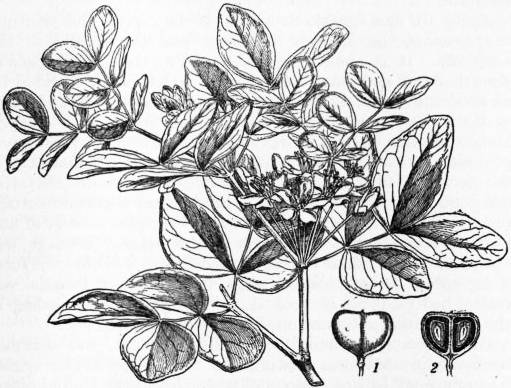
From Bentley & Trimen’s Medicinal Plants, by permission of J. & A. Churchill.
Guaiacum or Lignum Vitae, Guaiacum officinale shoot-bearing leaves and flowers. 1, Fruit; 2, Vertical section of fruit, showing the solitary pendulous seed in each chamber. All about ½ natural size.
Chips or turnings of the heartwood of G. officinale (guaiaci lignum) are employed in the preparation of the liquor sarsae compositus concentratus of British pharmacy. They may be recognized by being either yellow of greenish-brown in colour, and by turning bluish-green when treated with nitric acid, or when heated with corrosive sublimate, and green with solution of chloride of lime. They are occasionally adulterated with boxwood shavings. Lignum vitae is imported chiefly from St Domingo, the Bahamas and Jamaica.
The bark was formerly used in medicine; it contains much calcium oxalate, and yields on incineration 23% of ash. Guaiacum resin, the guaiaci resina of pharmacopoeias, is obtained from the wood as an exudation from natural fissures or from incisions; by heating billets about 3 ft. in length, bored to permit of the outflow of the resin; or by boiling chips and raspings in water to which salt has been added to raise the temperature of ebullition. It occurs in rounded or oval tears, commonly coated with a greyish-green dust, and supposed to be the produce of G. sanctum, or in large brownish or greenish-brown masses, translucent at the edges; fuses at 85° C.; is brittle, and has a vitreous fracture, and a slightly balsamic odour, increased by pulverization and by heat; and is at first tasteless when chewed, but produces subsequently a sense of heat in the throat. It is readily soluble in alcohol, ether, chloroform, creosote, oil of cloves and solutions of caustic alkalies; and its solution gives a blue colour with gluten, raw potato parings and the roots of horse-radish, carrot and various other plants. The alcoholic tincture becomes green with sodium hypochlorite, and with nitric acid turns in succession green, blue and brown. With glycerin it gives a clear solution, and with nitrous ether a bluish-green gelatinous mass. It is blued by various oxidizing agents, e.g. ozone, and, as Schönbein discovered, by the juice of certain fungi. The chief constituents are three distinct resins, guaiaconic acid, C19H20O5 (70%), guaiac acid, which is closely allied to benzoic acid, and guaiaretic acid. Like all resins, these are insoluble in water, soluble in alkalies, but precipitated on neutralization of the alkaline solution.
Guaiacum wood was first introduced into Europe by the Spaniards in 1508, and Nicolaus Poll, writing in 1517 (see Luisinus, De morbo gallico, p. 210, Ven., 1566), states that some three thousand persons in Spain had already been restored to health by it. The virtues of the resin, however, were not known until a later period, and in Thomas Paynel’s translation (Of the Wood called Guaiacum, &c., p. 9, ed. of 1540) of Ulrich von Hutten’s treatise De morbi gallici curatione per administrationem ligni guaiaci (1519) we read of the wood: “There followeth fro it, whan it bourneth a gomme, which we yet knowe not, for what pourpose it serueth.” Flückiger and Hanbury (Pharmacographia, p. 95) state that the first edition of the London Pharmacopoeia in which they find the resin mentioned is that of 1677. The decoction of the wood was administered in gout, the stone, palsy, leprosy, dropsy, epilepsy, and other diseases, but principally in the “morbus gallicus,” or syphilis, for which it was reckoned a certain specific, insomuch that at first “the physitions wolde not allowe it, perceyuynge that theyr profite wolde decay therby” (Paynel, op. cit. p. 8). Minute instructions are given in old works as to the mode of administering guaiacum. The patient was confined in a closed and heated chamber, was placed on the lowest possible diet, and, after liberal purgation, was made twice a day to drink a milk-warm decoction of the wood. The use of salt was specially to be avoided. A decoction of 1 ℔ of guaiacum was held to be sufficient for the four first days of the treatment. The earlier opinions as to the efficacy of guaiacum came to be much modified in the course of time, and Dr Pearson (Observations on the Effects of Various Articles of the Mat. Med. in the Cure of Lues Venerea, c. i., 2nd ed., 1807) says:—“I never saw one single instance in which the powers of this medicine eradicated the venereal virus.” He found its beneficial effects to be most marked in cases of secondary symptoms. Guaiacum resin is given medicinally in doses of 5-15 grains. Its important preparations in the British Pharmacopoeia are the mistura guiaci (dose ½-1 oz.), the ammoniated tincture of guaiacum (dose ½-1 drachm), in which the resin is dissolved by means of ammonia, and the trochiscus or lozenge, containing 3 grains of the resin. This lozenge is undoubtedly of value when given early in cases of sore throat, especially of rheumatic origin. Powdered guaiacum is also used.
Guaiacum resin differs pharmacologically from other resins in being less irritant, so that it is absorbed from the bowel and exerts remote stimulant actions, notably upon the skin and kidneys. It affects the bronchi but slightly, since it contains no volatile oil.
The drug is useful both in acute and chronic sore throat, the mixture, according to Sir Lauder Brunton, being more effective than the tincture. The aperient action, which it exerts less markedly than other members of its class, renders it useful in the treatment of chronic constipation. Sir Alfred Garrod has urged the claims of this drug in the treatment of chronic gout. Both in this disease and in other forms of chronic arthritis guaiacum may be given in combination with iodides, which it often enables the patient to tolerate. Guaiacum is not now used in the treatment of syphilis.
The tincture of guaiacum is universally used as a test for the presence of blood, or rather of haemoglobin, the red colouring matter of the blood, in urine or other secretions. This test was first suggested by Dr John Day of Geelong, Australia. A single drop of the tincture should be added to, say, an inch of urine in a test-tube. The resin is at once precipitated, yielding a milky fluid. If “ozonic ether”—an ethereal solution of hydrogen peroxide—be now poured gently into the test-tube, a deep blue coloration is produced along the line of contact if haemoglobin be present. The reaction is due to the oxidation of the resin by the peroxide of hydrogen—such oxidation occurring only if haemoglobin be present to act as an oxygen-carrier.
GUALDO TADINO (anc. Tadinum, 1 m. to the W.), a town and episcopal see of Umbria, Italy, 1755 ft. above sea-level, in the province of Perugia, 22 m. N. of Foligno by rail. Pop. (1901), town, 4440; commune, 10,756. The suffix Tadino distinguishes it from Gualdo in the province of Macerata, and Gualdo Cattaneo, S.W. of Foligno. The cathedral has a good rose-window and possesses, like several of the other churches, 15th-century paintings by Umbrian artists, especially works by Niccolò Alunno. The town is still surrounded by walls. The ancient Tadinum lay 1 m. to the W. of the modern town. It is mentioned in the Eugubine tablets (see Iguvium) as a hostile city against which imprecations are directed. In its neighbourhood Narses defeated and slew Totila in 552. No ruins are now visible, though they seem to have been extant in the 17th century. The new town seems to have been founded in 1237. It was at first independent, but passed under Perugia in 1292, and later became dependent on the duchy of Spoleto.
GUALEGUAY, a flourishing town and river port of the province of Entre Rios, Argentine Republic, on the Gualeguay river, 32 m. above its confluence with the Ibicuy branch of the Paraná, and about 120 m. N.N.W. of Buenos Aires. Pop. (1895) 7810. The Gualeguay is the largest of the Entre Rios rivers, traversing almost the whole length of the province from N. to S., but it is of but slight service in the transportation of produce except the few miles below Gualeguay, whose port, known as Puerto Ruiz, is 7 m. lower down stream. A steam tramway connects the town and port, and a branch line connects with Entre Rios railways at the station of Tala. The principal industry in this region is that of stock-raising, and there is a large exportation of cattle, jerked beef, hides, tallow, mutton, wool and sheep-skins. Wood and charcoal are also exported to Buenos Aires. The town was founded in 1783.
GUALEGUAYCHÚ, a prosperous commercial and industrial town and port of the province of Entre Rios, Argentine Republic, on the left bank of the Gualeguaychú river, 11 m. above its confluence with the Uruguay, and 120 m. N. of Buenos Aires. Pop. (1892, est.) 14,000. It is the chief town of a department of the same name, the largest in the province. A bar at the mouth of the river prevents the entrance of larger vessels and compels the transfer of cargoes to and from lighters. The town is surrounded by a rich grazing country, and exports cattle, jerked beef, mutton, hides, pelts, tallow, wool and various by-products. A branch line running N. connects with the Entre Rios railways at Basavilbaso. The town was founded in 1783.
GUALO, CARDINAL (fl. 1216), was sent to England by Pope Innocent III. in 1216. He supported John with all the weight of papal authority. After John’s death he crowned the infant Henry III. and played an active part in organizing resistance to the rebels led by Louis of France, afterwards king Louis VIII. As representing the pope, the suzerain of Henry, he claimed the regency and actually divided the chief power with William Marshal, earl of Pembroke. He proclaimed a crusade against Louis and the French, and, after the peace of Lambeth, he forced Louis to make a public and humiliating profession of penitence (1217). He punished the rebellious clergy severely, and ruled the church with an absolute hand till his departure from England in 1218. Gualo’s character has been severely criticized by English writers; but his chief offence seems to have been that of representing unpopular papal claims.
GUAM (Span. Guajan; Guahan, in the native Chamorro), the largest and most populous of the Ladrone or Mariana Islands, in the North Pacific, in 13° 26′ N. lat. and 144° 39′ E. long., about 1823 m. E. by S. of Hong Kong, and about 1450 m. E. of Manila. Pop. (1908) about 11,360, of whom 363 were foreigners, 140 being members of the U.S. naval force. Guam extends about 30 m. from N.N.E. to S.S.W., has an average width of about 6½ m., and has an area of 207 sq. m. The N. portion is a plateau from 300 to 600 ft. above the sea, lowest in the interior and highest along the E. and W. coast, where it terminates abruptly in bluffs and headlands; Mt Santa Rosa, toward the N. extremity, has an elevation of 840 ft. A range of hills from 700 to nearly 1300 ft. in height traverses the S. portion from N. to S. a little W. of the middle—Mt Jumullong Mangloc, the highest peak, has an elevation of 1274 ft. Between the foot of the steep W. slope of these hills and the sea is a belt of rolling lowlands and to the E. the surface is broken by the valleys of five rivers with a number of tributaries, has a general slope toward the sea, and terminates in a coast-line of bluffs. Apra (formerly San Luis d’Apra) on the middle W. coast is the only good harbour; it is about 3½ m. across, has a depth of 4-27 fathoms, and is divided into an inner and an outer harbour by a peninsula and an island. It serves as a naval station and as a port of transit between America and the Philippines, at which army transports call monthly. Deer, wild hog, duck, curlew, snipe and pigeon are abundant game, and several varieties of fish are caught. Some of the highest points of the island are nearly bare of vegetation, and the more elevated plateau surface is covered with sword grass, but in the valleys and on the lower portions of the plateaus there is valuable timber. The lowlands have a rich soil; in lower parts of the highlands raised coralliferous limestone with a light covering of soil appears, and in the higher parts the soil is entirely of clay and silt. The climate is agreeable and healthy. From December to June the N.E. trade winds prevail and the rainfall is relatively light; during the other six months the monsoon blows and produces the rainy season. Destructive typhoons and earthquakes sometimes visit Guam. The island is thought to possess little if any mineral wealth, with the possible exception of coal. Only a small part of Guam is under cultivation, and most of this lies along the S.W. coast, its chief products being cocoanuts, rice, sugar, coffee and cacao. A United States Agricultural Experiment Station in Guam (at Agaña) was provided for in 1908.
The inhabitants are of the Chamorro (Indonesian) stock, strongly intermixed with Philippine Tagals and Spaniards; their speech is a dialect of Malay, corrupted by Tagal and Spanish. There are very few full-blood Chamorros. The aboriginal native was of a very dark mahogany or chocolate colour. A majority of the total number of natives live in Agaña. The natives are nearly all farmers, and most of them are poor, but their condition has been improved under American rule. Public schools have been established; in 1908 the enrolment was 1700. On the island there is a small colony of lepers, segregated only after American occupation. Gangrosa is a disease said to be peculiar to Guam and the neighbouring islands; it is due to a specific bacillus and usually destroys the nasal septum. The victims of this disease also are segregated. There is a good general hospital.
Agaña (or San Ignacio de Agaña) is the capital and principal town; under the Spanish régime it was the capital of the Ladrones. It is about 5 m. N.E. of Piti, the landing-place of Apra harbour and port of entry, with which it is connected by an excellent road. Agaña has paved streets and sewer and water systems. Other villages, all small, are Asan, Piti, Sumay, Umata, Merizo and Inarajan. Guam is governed by a “naval governor,” an officer of the U.S. navy who is commandant of the naval station. The island is divided into four administrative districts, each with an executive head called a gobernadorcillo (commissioner), and there are a court of appeals, a court of first instance and courts of justices of the peace. Peonage was abolished in the island by the United States in February 1900. Telegraphic communication with the Caroline Islands was established in 1905; in 1908 there were four cables ending at the relay station at Sumay on the Shore of Apra harbour.
Guam was discovered by Magellan in 1521, was occupied by Spain in 1688, was captured by the United States cruiser “Charleston” in June 1899, and was ceded to the United States by the Treaty of Paris on the 10th of December 1898.
See A List of Books (with References to Periodicals) on Samoa and Guam (1901; issued by the Library of Congress); L. M. Cox, “The Island of Guam,” in Bulletin of the American Geographical Society, vol. 36 (New York, 1904); Gen. Joseph Wheeler, Report on the Island of Guam, June 1900 (War Department, Document No. 123); F. W. Christian, The Caroline Islands (London, 1899); an account of the flora of Guam by W. E. Safford in the publications of the National Herbarium (Smithsonian Institution); and the reports of the naval governor.
GUAN, a word apparently first introduced into the ornithologist’s vocabulary about 1743 by Edwards,1 who said that a bird he figured (Nat. Hist. Uncommon Birds, pl. xiii.) was “so called in the West Indies,” and the name has hence been generally applied to all the members of the subfamily Penelopinae, which are distinguished from the kindred subfamily Cracinae or curassows by the broad postacetabular area of the pelvis as pointed out by Huxley (Proc. Zool. Society, 1868, p. 297) as well as by their maxilla being wider than it is high, with its culmen depressed, the crown feathered, and the nostrils bare—the last two characters separating the Penelopinae from the Oreophasinae, which form the third subfamily of the Cracidae,2 a family belonging to that taxonomer’s division Peristeropodes of the order Gallinae.
The Penelopinae have been separated into seven genera, of which Penelope and Ortalis, containing respectively about sixteen and nineteen species, are the largest, the others numbering from one to three only. Into their minute differences it would be useless to enter: nearly all have the throat bare of feathers, and from that of many of them hangs a wattle; but one form, Chamaepetes, has neither of these features, and Stegnolaema, though wattled, has the throat clothed. With few exceptions the guans are confined to the South-American continent; one species of Penelope is however found in Mexico (e.g. at Mazatlan), Pipile cumanensis inhabits Trinidad as well as the mainland, while three species of Ortalis occur in Mexico or Texas, and one, which is also common to Venezuela, in Tobago. Like curassows, guans are in great measure of arboreal habit. They also readily become tame, but all attempts to domesticate them in the full sense of the word have wholly failed, and the cases in which they have even been induced to breed and the young have been reared in confinement are very few. Yet it would seem that guans and curassows will interbreed with poultry (Ibis, 1866, p. 24; Bull. Soc. Imp. d’Acclimatation, 1868, p. 559; 1869, p. 357), and what is more extraordinary is that in Texas the hybrids between the chiacalacca (Ortalis vetula) and the domestic fowl are asserted to be far superior to ordinary game-cocks for fighting purposes.
(A. N.)
1 Edwards also gives “quan” as an alternative spelling, and this may be nearer the original form, since we find Dampier in 1676 writing (Voy. ii. pt. 2, p. 66) of what was doubtless an allied if not the same bird as the “quam.” The species represented by Edwards does not seem to have been identified.
2 See the excellent Synopsis by Sclater and Salvin in the Proceedings of the Zoological Society for 1870 (pp. 504-544), while further information on the Cracinae was given by Sclater in the Transactions of the same society (ix. pp. 273-288, pls. xl.-liii.). Some additions have since been made to the knowledge of the family, but none of very great importance.
GUANABACOA (an Indian name meaning “site of the waters”), a town of Cuba, in Havana province, about 6 m. E. of Havana. Pop. (1907) 14,368. Guanabacoa is served by railway to Havana, with which it is connected by the Regla ferry across the bay. It is picturesquely situated amid woods, on high hills which furnish a fine view. There are medicinal springs in the town, and deposits of liquid bitumen in the neighbouring hills. The town is essentially a residence suburb of the capital, and has some rather pretty streets and squares and some old and interesting churches (including Nuestra Señora de la Asuncion, 1714-1721). Just outside the city is the church of Potosi with a famous “wonder-working” shrine and image. An Indian pueblo of the same name existed here before 1555, and a church was established in 1576. Already at the end of the 17th century Guanabacoa was the fashionable summer residence of Havana. It enjoyed its greatest popularity in this respect from the end of the 18th to the middle of the 19th century. It was created a villa with an ayuntamiento (city council) in 1743. In 1762 its fort, the Little Morro, on the N. shore near Cojimar (a bathing beach, where the Key West cable now lands), was taken by the English.
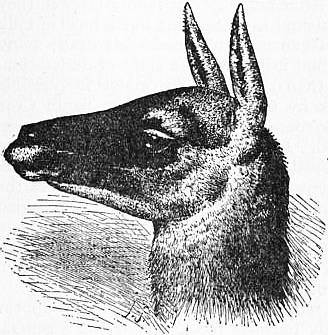
Head of Guanaco.
GUANACO, sometimes spelt Huanaca, the larger of the two wild representatives in South America of the camel tribe; the other being the vicugña. The guanaco (Lama huanacus), which stands nearly 4 ft. at the shoulder, is an elegant creature, with gracefully curved neck and long slender legs, the hind-pair of the latter bearing two naked patches or callosities. The head and body are covered with long soft hair of a fawn colour above and almost pure white beneath. Guanaco are found throughout the southern half of South America, from Peru in the north to Cape Horn in the south, but occur in greatest abundance in Patagonia. They live in herds usually of from six to thirty, although these occasionally contain several hundreds, while solitary individuals are sometimes met. They are exceedingly timid, and therefore wary and difficult of approach; like many other ruminants, however, their curiosity sometimes overcomes their timidity, so as to bring them within range of the hunter’s rifle. Their cry is peculiar, being something between the belling of a deer and the neigh of a horse. The chief enemies of the guanaco are the Patagonian Indians and the puma, as it forms the principal food of both. Its flesh is palatable although wanting in fat, while its skin forms the chief clothing material of the Patagonians. Guanaco are readily domesticated, and in this state become very bold and will attack man, striking him from behind with both knees. In the wild state they never defend themselves, and if approached from different points, according to the Indian fashion of hunting, get completely bewildered and fall an easy prey. They take readily to the water, and have been observed swimming from one island to another, while they have been seen drinking salt-water. They have a habit of depositing their droppings during successive days on the same spot—a habit appreciated by the Peruvian Indians, who use those deposits for fuel. Guanaco also have favourite localities in which to die, as appears from the great heaps of their bones found in particular spots.
GUANAJAY, a town of western Cuba, in Pinar del Rio province, about 36 m. (by rail) S.W. of Havana. Pop. (1907) 6400. Guanajay is served by the W. branch of the United railways of Havana, of which it is the W. terminus. The town lies among hills, has an excellent climate, and in colonial times was (like Holguín) an acclimatization station for troops fresh from Spain; it now has considerable repute as a health resort. The surrounding country is a fertile sugar and tobacco region. Guanajay has always been important as a distributing point in the commerce of the western end of the island. It was an ancient pueblo, of considerable size and importance as early as the end of the 18th century.
GUANAJUATO, or Guanaxuato, an inland state of Mexico, bounded N. by Zacatecas and San Luis Potosi, E. by Querétaro, S. by Michoacan and W. by Jalisco. Area, 11,370 sq. m. It is one of the most densely populated states of the republic; pop. (1895) 1,047,817; (1900) 1,061,724. The state lies wholly within the limits of the great central plateau of Mexico, and has an average elevation of about 6000 ft. The surface of its northern half is broken by the Sierra Gorda and Sierra de Guanajuato, but its southern half is covered by fertile plains largely devoted to agriculture. It is drained by the Rio Grande de Lerma and its tributaries, which in places flow through deeply eroded valleys. The climate is semi-tropical and healthy, and the rainfall is sufficient to insure good results in agriculture and stock-raising. In the warm valleys sugar-cane is grown, and at higher elevations Indian corn, beans, barley and wheat. The southern plains are largely devoted to stock-raising. Guanajuato has suffered much from the destruction of its forests, but there remain some small areas on the higher elevations of the north. The principal industry of the state is mining, the mineral wealth of the mountain ranges of the north being enormous. Among its mineral products are silver, gold, tin, lead, mercury, copper and opals. Silver has been extracted since the early days of the Spanish conquest, over $800,000,000 having been taken from the mines during the subsequent three and a half centuries. Some of the more productive of these mines, or groups of mines, are the Veta Madre (mother lode), the San Bernabé lode, and the Rayas mines of Guanajuato, and the La Valenciana mine, the output of which is said to have been $226,000,000 between 1766 and 1826. The manufacturing establishments include flour mills, tanneries and manufactories of leather, cotton and woollen mills, distilleries, foundries and potteries. The Mexican Central and the Mexican National railway lines cross the state from N. to S., and the former operates a short branch from Silao to the state capital and another westward from Irapuato to Guadalajara. The capital is Guanajuato, and other important cities and towns are León, or León de las Aldamas; Celaya (pop. 25,565 in 1900), an important railway junction 22 m. by rail W. from Querétaro, and known for its manufactures of broadcloth, saddlery, soap and sweetmeats; Irapuato (18,593 in 1900), a railway junction and commercial centre, 21 m. S. by W. of Guanajuato; Silao (15,355), a railway junction and manufacturing town (woollens and cottons), 14 m. S.W. of Guanajuato; Salamanca (13,583). on the Mexican Central railway and Lerma river, 25 m. S. by E. of Guanajuato, with manufactures of cottons and porcelain; Allende (10,547), a commercial town 30 m. E. by S. of Guanajuato, with mineral springs; Valle de Santiago (12,660). 50 m. W. by S. of Querétaro; Salvatierra (10,393), 60 m. S.E. of Guanajuato; Cortazar (8633); La Luz (8318), in a rich mining district; Pénjamo (8262); Santa Cruz (7239); San Francisco del Rincón (10,904), 39 m. W. of Guanajuato in a rich mining district; and Acambaro (8345), a prosperous town of the plain, 76 m. S.S.E. of Guanajuato.
GUANAJUATO, or Santa Fé de Guanajuato, a city of Mexico and capital of the above state, 155 m. (direct) N.W. of the Federal capital, on a small tributary of the Rio Grande de Lerma or Santiago. Pop. (1895) 39,404; (1900) 41,486. The city is built in the Cañada de Marfil at the junction of three ravines about 6500 ft. above the sea, and its narrow, tortuous streets rise steeply as they follow the ravines upward to the mining villages clustered about the opening of the mines in the hillsides. Guanajuato is sometimes described as a collection of mining villages; but in addition there is the central city with its crowded winding streets, its substantial old Spanish buildings, its fifty ore-crushing mills and busy factories and its bustling commercial life. Enclosing the city are the steep, barren mountain sides honeycombed with mines. The climate is semi-tropical and is considered healthy. The noteworthy public buildings and institutions are an interesting old Jesuit church with arches of pink stone and delicate carving, eight monasteries, the government palace, a mint dating from 1812, a national college, the fine Teatro Juárez, and the Pantheon, or public cemetery, with catacombs below. The Alhóndiga de Granaditas, originally a public granary, was used as a fort during the War of Independence, and is celebrated as the scene of the first battle (1810) in that long struggle. Among the manufactures are cottons, prints, soaps, chemicals, pottery and silverware, but mining is the principal interest and occupation of the population. The silver mines of the vicinity were long considered the richest in Mexico, the celebrated Veta Madre (mother lode) even being described as the richest in the world; and Guanajuato has the largest reduction works in Mexico. The railway outlet for the city consists of a short branch of the Mexican Central, which joins the trunk line at Silao. Guanajuato was founded in 1554. It attained the dignity of a city in 1741. It was celebrated for its vigorous resistance to the invaders at the time of the Spanish conquest, and was repeatedly sacked during that war.
GUANCHES, Guanchis or Guanchos (native Guanchinet; Guan = person, Chinet = Teneriffe,—“man of Teneriffe,” corrupted, according to Nuñez de la Peña, by Spaniards into Guanchos), the aboriginal inhabitants of the Canary Islands. Strictly the Guanches were the primitive inhabitants of Teneriffe, where they seem to have preserved racial purity to the time of the Spanish conquest, but the name came to be applied to the indigenous populations of all the islands. The Guanches, now extinct as a distinct people, appear, from the study of skulls and bones discovered, to have resembled the Cro-Magnon race of the Quaternary age, and no real doubt is now entertained that they were an offshoot of the great race of Berbers which from the dawn of history has occupied northern Africa from Egypt to the Atlantic. Pliny the Elder, deriving his knowledge from the accounts of Juba, king of Mauretania, states that when visited by the Carthaginians under Hanno the archipelago was found by them to be uninhabited, but that they saw ruins of great buildings. This would suggest that the Guanches were not the first inhabitants, and from the absence of any trace of Mahommedanism among the peoples found in the archipelago by the Spaniards it would seem that this extreme westerly migration of Berbers took place between the time of which Pliny wrote and the conquest of northern Africa by the Arabs. Many of the Guanches fell in resisting the Spaniards, many were sold as slaves, and many conformed to the Roman Catholic faith and married Spaniards.
Such remains as there are of their language, a few expressions and the proper names of ancient chieftains still borne by certain families, connect it with the Berber dialects. In many of the islands signs are engraved on rocks. Domingo Vandewalle, a military governor of Las Palmas, was the first, in 1752, to investigate these; and it is due to the perseverance of D. Aquilino Padran, a priest of Las Palmas, that anything about the inscription on the island Hierro has been brought to light. In 1878 Dr R. Verneau discovered in the ravines of Las Balos some genuine Libyan inscriptions. Without exception the rock inscriptions have proved to be Numidic. In two of the islands (Teneriffe and Gomera) the Guanche type has been retained with more purity than in the others. No inscriptions have been found in these two islands, and therefore it would seem that the true Guanches did not know how to write. In the other islands numerous Semitic traces are found, and in all of them are the rock-signs. From these facts it would seem that the Numidians, travelling from the neighbourhood of Carthage and intermixing with the dominant Semitic race, landed in the Canary Islands, and that it is they who have written the inscriptions at Hierro and Grand Canary.
The political and social institutions of the Guanches varied. In some islands hereditary autocracy prevailed; in others the government was elective. In Teneriffe all the land belonged to the chiefs who leased it to their subjects. In Grand Canary suicide was regarded as honourable, and on a chief inheriting, one of his subjects willingly honoured the occasion by throwing himself over a precipice. In some islands polyandry was practised; in others the natives were monogamous. But everywhere the women appear to have been respected, an insult offered any woman by an armed man being a capital offence. Almost all the Guanches used to wear garments of goat-skins, and others of vegetable fibres, which have been found in the tombs of Grand Canary. They had a taste for ornaments, necklaces of wood, bone and shells, worked in different designs. Beads of baked earth, cylindrical and of all shapes, with smooth or polished surfaces, mostly black and red in colour, were chiefly in use. They painted their bodies; the pintaderas, baked clay objects like seals in shape, have been explained by Dr Verneau as having been used solely for painting the body in various colours. They manufactured rough pottery, mostly without decorations, or ornamented by means of the finger-nail. The Guanches’ weapons were those of the ancient races of south Europe. The polished battle-axe was more used in Grand Canary, while stone and obsidian, roughly cut, were commoner in Teneriffe. They had, besides, the lance, the club, sometimes studded with pebbles, and the javelin, and they seem to have known the shield. They lived in natural or artificial caves in their mountains. In districts where cave-dwellings were impossible, they built small round houses and, according to the Spaniards, they even practised rude fortification. In Palma the old people were at their own wish left to die alone. After bidding their family farewell they were carried to the sepulchral cave, nothing but a bowl of milk being left them. The Guanches embalmed their dead; many mummies have been found in an extreme state of desiccation, each weighing not more than 6 or 7 ℔. Two almost inaccessible caves in a vertical rock by the shore 3 m. from Santa Cruz (Teneriffe) are said still to contain bones. The process of embalming seems to have varied. In Teneriffe and Grand Canary the corpse was simply wrapped up in goat and sheep skins, while in other islands a resinous substance was used to preserve the body, which was then placed in a cave difficult of access, or buried under a tumulus. The work of embalming was reserved for a special class, women for female corpses, men for male. Embalming seems not to have been universal, and bodies were often simply hidden in caves or buried.
Little is known of the religion of the Guanches. They appear to have been a distinctly religious race. There was a general belief in a supreme being, called Acoran, in Grand Canary, Achihuran in Teneriffe, Eraoranhan in Hierro, and Abora in Palma. The women of Hierro worshipped a goddess called Moneiba. According to tradition the male and female gods lived in mountains whence they descended to hear the prayers of the people. In other islands the natives venerated the sun, moon, earth and stars. A belief in an evil spirit was general. The demon of Teneriffe was called Guayota and lived in the peak of Teyde, which was the hell called Echeyde. In times of drought the Guanches drove their flocks to consecrated grounds, where the lambs were separated from their mothers in the belief that their plaintive bleatings would melt the heart of the Great Spirit. During the religious feasts all war and even personal quarrels were stayed.
Bibliography.—S. Berthelot, Antiquités canariennes (Paris, 1839); Baker Webb and S. Berthelot, Histoire naturelle des îles Canaries (Paris, 1839); Paul Broca, Revue d’anthropologie, iv. (1874); General L. L. C. Faidherbe, Quelque mots sur l’ethnologie de l’archipel canarien (Paris, 1875); Chil y Naranjo, Estudios historicos, climatologicos y Patologicos de las Islas Canarias (Las Palmas, 1876-1889); “De la pluralité des races humaines de l’archipel canarien,” Bull. Soc. Anthrop. Paris, 1878; “Habitations et sépultures des anciens habitants des îles Canaries,” Revue d’anthrop., 1879; R. Verneau, “Sur les Sémites aux îles Canaries,” and “Sur les anciens habitants de la Isleta, Grande Canarie,” Bull. Soc. Anthrop. Paris, 1881; Rapport sur une mission scientifique dans l’archipel canarien (Paris, 1887); Cinq années de séjour aux îles Canaries (Paris, 1891); H. Meyer, Die Insel Tenerife (Leipzig, 1896), “Über die Urbewohner der canarischen Inseln,” in Adolf Bastian Festschrift (Berlin, 1896); F. von Luschan, Anhang über eine Schädelsammlung von den canarischen Inseln; R. Virchow, “Schädel mit Carionecrosis der Sagittalgegend,” Verhandlungen der Berliner Anthrop. Gesellschaft (1896); G. Sergi, The Mediterranean Race (London, 1901); The Guanches of Tenerife ..., by Alonso de Espinosa, translated by Sir Clements Markham, with bibliography (Hakluyt Society, 1907).
GUANIDINE, CN3H5 or HN:C(NH2)2, the amidine of amidocarbonic acid. It occurs in beet juice. It was first prepared in 1861 by A. Strecker, who oxidized guanine with hydrochloric acid and potassium chlorate. It may be obtained synthetically by the action of ammonium iodide on cyanamide, CN·NH2 + NH4I = CN3H5·HI·; by heating ortho-carbonic esters with ammonia to 150° C.; but best by heating ammonium thiocyanate to 180°-190° C., when the thiourea first formed is converted into guanidine thiocyanate, 2CS(NH2)2 = HN:C(NH2)2·HCNS + H2S. It is a colourless crystalline solid, readily soluble in water and alcohol; it deliquesces on exposure to air. It has strong basic properties, absorbs carbon dioxide readily, and forms well-defined crystalline salts. Baryta water hydrolyses it to urea. By direct union with glycocoll acid, it yields glycocyamine, NH2·(HN):C·NH·CH2·CO2H, whilst with methyl glycocoll (sarcosine) it forms creatine, NH2·(NH):C·N(CH3)·CH2·CO2H.
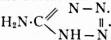
Many derivatives of guanidine were obtained by J. Thiele (Ann., 1892, 270, p. 1; 1893, 273, p. 133; Ber., 1893, 26, pp. 2598, 2645). By the action of nitric acid on guanidine in the presence of sulphuric acid, nitroguanidine, HN:C(NH2)·NH·NO2 (a substance possessing acid properties) is obtained; from which, by reduction with zinc dust, amidoguanidine, HN:C(NH2)·NH·NH2, is formed. This amidoguanidine decomposes on hydrolysis with the formation of semicarbazide, NH2·CO·NH·NH2, which, in its turn, breaks down into carbon dioxide, ammonia and hydrazine. Amidoguanidine is a body of hydrazine type, for it reduces gold and silver salts and yields a benzylidine derivative. On oxidation with potassium permanganate, it gives azodicarbondiamidine nitrate, NH2·(HN):C·N:N·C:(NH)·NH2·2HNO3, which, when reduced by sulphuretted hydrogen, is converted into the corresponding hydrazodicarbondiamidine, NH2·(HN):C·NH·NH·C:(NH)·NH2. By the action of nitrous acid on a nitric acid solution of amidoguanidine, diazoguanidine nitrate, NH2·(HN):C·NH·N2·NO3, is obtained. This diazo compound is decomposed by caustic alkalis with the formation of cyanamide and hydrazoic acid, CH4N5·NO3 = N3H + CN·NH2 + HNO3, whilst acetates and carbonates convert it into amidotetrazotic acid, Amidotetrazotic acid yields addition compounds with amines, and by the further action of nitrous acid yields a very explosive derivative, diazotetrazol, CN6. By fusing guanidine with urea, dicyandiamidine H2N·(HN):C·NH·CO·NH2, is formed.
GUANO (a Spanish word from the Peruvian huanu, dung), the excrement of birds, found as large deposits on certain islands off the coast of Peru, and on others situated in the Southern ocean and off the west coast of Africa. The large proportions of phosphorus in the form of phosphates and of nitrogen as ammonium oxalate and urate renders it a valuable fertilizer. Bat’s guano, composed of the excrement of bats, is found in certain caves in New Zealand and elsewhere; it is similar in composition to Peruvian guano. (See Manures and Manuring.)
GUANTA, a port on the Caribbean coast of the state of Bermúdez, Venezuela, 12 m. N.E. of Barcelona, with which it is connected by rail. It dates from the completion of the railway to the coal mines of Naricual and Capiricual nearly 12 m. beyond Barcelona, and was created for the shipment of coal. The harbour is horseshoe-shaped, with its entrance, 1998 ft. wide, protected by an island less than 1 m. off the shore. The entrance is easy and safe, and the harbour affords secure anchorage for large vessels, with deep water alongside the iron railway wharf. These advantages have made Guanta the best port on this part of the coast, and the trade of Barcelona and that of a large inland district have been transferred to it. A prominent feature in its trade is the shipment of live cattle. Among its exports are sugar, coffee, cacáo, tobacco and fruit.
GUANTÁNAMO, the easternmost important town of the S. coast of Cuba, in the province of Santiago, about 40 m. E. of Santiago. Pop. (1907) 14,559. It is situated by the Guazo (or Guaso) river, on a little open plain between the mountains. The beautiful, land-locked harbour, 10 m. long from N. to S. and 4 m. wide in places, has an outer and an inner basin. The latter has a very narrow entrance, and 2 to 2.5 fathoms depth of water. From the port of Caimanera to the city of Guantánamo, 13 m. N., there is a railway, and the city has railway connexion with Santiago. Guantánamo is one of the two ports leased by Cuba to the United States for a naval station. It is the shipping-port and centre of a surrounding coffee-, sugar- and lime-growing district. In 1741 an English force under Admiral Edward Vernon and General Thomas Wentworth landed here to attack Santiago. They named the harbour Cumberland bay. After their retreat fortifications were begun. The history of the region practically dates, however, from the end of the 18th century, when it gained prosperity from the settlement of French refugees from Santo Domingo; the town, as such, dates only from 1822. Almost all the old families are of French descent, and French was the language locally most used as late as the last third of the 19th century. In recent years, especially since the Spanish-American War of 1898, the region has greatly changed socially and economically. Guantánamo was once a fashionable summer residence resort for wealthy Cubans.
GUARANA (so called from the Guaranis, an aboriginal American tribe), the plant Paullinia Cupana (or P. sorbilis) of the natural order Sapindaceae, indigenous to the north and west of Brazil. It has a smooth erect stem; large pinnate alternate leaves, composed of 5 oblong-oval leaflets; narrow panicles of short-stalked flowers; and ovoid or pyriform fruit about as large as a grape, and containing usually one seed only, which is shaped like a minute horse-chestnut. What is commonly known as guarana, guarana bread or Brazilian cocoa, is prepared from the seeds as follows. In October and November, at which time they become ripe, the seeds are removed from their capsules and sun-dried, so as to admit of the ready removal by hand of the white aril; they are next ground in a stone mortar or deep dish of hard sandstone; the powder, moistened by the addition of a small quantity of water, or by exposure to the dews, is then made into a paste with a certain proportion of whole or broken seeds, and worked up sometimes into balls, but usually into rolls not unlike German sausages, 5 to 8 in. in length, and 12 to 16 oz. in weight. After drying by artificial or solar heat, the guarana is packed between broad leaves in sacks or baskets. Thus prepared, it is of extreme hardness, and has a brown hue, a bitter astringent taste, and an odour faintly resembling that of roasted coffee. An inferior kind, softer and of a lighter colour, is manufactured by admixture of cocoa or cassava. Rasped or grated into sugar and water, guarana forms a beverage largely consumed in S. America. Its manufacture, originally confined to the Mauhés Indians, has spread into various parts of Brazil.
The properties of guarana as a nervous stimulant and restorative are due to the presence of what was originally described as a new principle and termed guaranine, but is now known to be identical with caffeine or theine. Besides this substance, which is stated to exist in it in the form of tannate, guarana yields on analysis the glucoside saponin, with tannin, starch, gum, three volatile oils, and an acrid green fixed oil (Fournier, Journ. de Pharm. vol. xxxix., 1861, p. 291).
GUARANIS, a tribe and stock of South American Indians, having their home in Paraguay, Uruguay and on the Brazilian coast. The Guaranis had developed some civilization before the arrival of the Spaniards, and being a peaceable people quickly submitted. They form to-day the chief element in the populations of Paraguay and Uruguay. Owing to its patronage by the Jesuit missionaries the Guarani language became a widespread medium of communication, and in a corrupted form is still the common language in Paraguay.
GUARANTEE (sometimes spelt “guarantie” or “guaranty”; an O. Fr. form of “warrant,” from the Teutonic word which appears in German as wahren, to defend or make safe and binding), a term more comprehensive and of higher import than either “warrant” or “security,” and designating either some international treaty whereby claims, rights or possessions are secured, or more commonly a mere private transaction, by means of which one person, to obtain some trust, confidence or credit for another, engages to be answerable for him.
In English law, a guarantee is a contract to answer for the payment of some debt, or the performance of some duty, by a third person who is primarily liable to such payment or performance. It is a collateral contract, which does not extinguish the original liability or obligation to which it is accessory, but on the contrary is itself rendered null and void should the latter fail, as without a principal there can be no accessory. The liabilities of a surety are in law dependent upon those of the principal debtor, and when the latter cease the former do so likewise (per Collins, L.J., in Stacey v. Hill, 1901, 1 K.B., at p. 666; see per Willes, J., in Bateson v. Gosling, 1871, L.R. 7 C.P., at p. 14), except in certain cases where the discharge of the principal debtor is by operation of law (see In re Fitzgeorge—ex parte Robson, 1905, 1 K.B. p. 462). If, therefore, persons wrongly suppose that a third person is liable to one of them, and a guarantee is given on that erroneous supposition, it is invalid ab initio, by virtue of the lex contractûs, because its foundation (which was that another was taken to be liable) has failed (per Willes, J., in Mountstephen v. Lakeman, L.R. 7 Q.B. p. 202). According to various existing codes civil, a suretyship, in respect of an obligation “non-valable,” is null and void save where the invalidity is the result of personal incapacity of the principal debtor (Codes Civil, France and Belgium, 2012; Spain, 1824; Portugal, 822; Italy, 1899; Holland, 1858; Lower Canada, 1932). In some countries, however, the mere personal incapacity of a son under age to borrow suffices to vitiate the guarantee of a loan made to him (Spain, 1824; Portugal, 822, s. 2, 1535, 1536). The Egyptian codes sanction guarantees expressly entered into “in view of debtor’s want of legal capacity” to contract a valid principal obligation (Egyptian Codes, Mixed Suits, 605; Native Tribunals, 496). The Portuguese code (art. 822, s. 1) retains the surety’s liability, in respect of an invalid principal obligation, until the latter has been legally rescinded.
The giver of a guarantee is called “the surety,” or “the guarantor”; the person to whom it is given “the creditor,” or “the guarantee”; while the person whose payment or performance is secured thereby is termed “the principal debtor,” or simply “the principal.” In America, but not apparently elsewhere, there is a recognized distinction between “a surety” and “a guarantor”; the former being usually bound with the principal, at the same time and on the same consideration, while the contract of the latter is his own separate undertaking, in which the principal does not join, and in respect of which he is not to be held liable, until due diligence has been exerted to compel the principal debtor to make good his default. There is no privity of contract between the surety and the principal debtor, for the surety contracts with the creditor, and they do not constitute in law one person, and are not jointly liable to the creditor (per Baron Parke in Bain v. Cooper, 1 Dowl. R. (N.S.) 11, 14).
No special phraseology is necessary to the formation of a guarantee; and what really distinguishes such a contract from one of insurance is not any essential difference between the two forms of words insurance and guarantee, but the substance of the contract entered into by the parties in each particular case (per Romer, L.J., in Seaton v. Heath—Seaton v. Burnand, 1899, 1 Q.B. 782, 792, C.A.; per Vaughan Williams, L.J., in In re Denton’s Estate Licenses Insurance Corporation and Guarantee Fund Ltd. v. Denton, 1904, 2 Ch., at p. 188; and see Dane v. Mortgage Insurance Corporation, 1894, 1 Q.B. 54 C.A.) In this connexion it may be mentioned that the different kinds of suretyships have been classified as follows: (1) Those in which there is an agreement to constitute, for a particular purpose, the relation of principal and surety, to which agreement the creditor thereby secured is a party; (2) those in which there is a similar agreement between the principal and surety only, to which the creditor is a stranger; and (3) those in which, without any such contract of suretyship, there is a primary and a secondary liability of two persons for one and the same debt, the debt being, as between the two, that of one of those persons only, and not equally of both, so that the other, if he should be compelled to pay it, would be entitled to reimbursement from the person by whom (as between the two) it ought to have been paid (per Earl of Selborne, L.C., in Duncan Fox and Co. v. North and South Wales Bank, 6 App. Cas., at p. 11). According to several codes civil sureties are made divisible into conventional, legal and judicial (Fr. and Bel., 2015, 2040 et seq.; Spain, 1823; Lower Canada, 1930), while the Spanish code further divides them into gratuitous and for valuable consideration (art. 1, 823).
In England the common-law requisites of a guarantee in no way differ from those essential to the formation of any other contract. That is to say, they comprise the mutual assent of two or more parties, competency to contract, and, unless the guarantee be under seal, valuable consideration. An offer to guarantee is not binding until it has been accepted, being revocable till then by the party making it. Unless, however, as sometimes happens, the offer contemplates an express acceptance, one may be implied, and it may be a question for a jury whether an offer of guarantee has in fact been accepted. Where the surety’s assent to a guarantee has been procured by fraud of the person to whom it is given, there is no binding contract. Such fraud may consist of suppression or concealment or misrepresentation. There is some conflict of authorities as to what facts must be spontaneously disclosed to the surety by the creditor, but it may be taken that the rule on the subject is less stringent than that governing insurances upon marine, life and other risks (The North British Insurance Co. v. Lloyd, 10 Exch. 523), though formerly this was denied (Owen v. Homan, 3 Mac. & G. 378, 397). Moreover, even where the contract relied upon is in the form of a policy guaranteeing the solvency of a surety for another’s debt, and is therefore governed by the doctrine of uberrima fides, only such facts as are really material to the risk undertaken need be spontaneously disclosed (Seaton v. Burnand—Burnand v. Seaton, 1900, A.C. 135). As regards the competency of the parties to enter into a contract of guarantee, this may be affected by insanity or intoxication of the surety, if known to the creditor, or by disability of any kind. The ordinary disabilities are those of infants and married women—now in England greatly mitigated as regards the latter by the Married Women’s Property Acts, 1870 to 1893, which enable a married woman to contract, as a feme sole, to the extent of her separate property. Every guarantee not under seal must according to English law have a consideration to support it, though the least spark of one suffices (per Wilmot, J., in Pillan v. van Mierop and Hopkins, 3 Burr., at p. 1666; Haigh v. Brooks, 10 A. & E. 309; Barrell v. Trussell, 4 Taunt. 117), which, as in other cases, may consist either of some right, interest, profit or benefit accruing to the one party, or some forbearance, detriment, loss or responsibility given, suffered or undertaken by the other. In some guarantees the consideration is entire—as where, in consideration of a lease being granted, the surety becomes answerable for the performance of the covenants; in other cases it is fragmentary, i.e. supplied from time to time—as where a guarantee is given to secure the balance of a running account at a banker’s, or a balance of a running account for goods supplied (per Lush, L.J., in Lloyd’s v. Harper, 16 Ch. Div., at p. 319). In the former case, the moment the lease is granted there is nothing more for the lessor to do, and such a guarantee as that of necessity runs on throughout the duration of the lease and is irrevocable. In the latter case, however, unless the guarantee stipulates to the contrary, the surety may at any time terminate his liability under the guarantee as to future advances, &c. The consideration for a guarantee must not be past or executed, but on the other hand it need not comprise a direct benefit or advantage to either the surety or the creditor, but may solely consist of anything done, or any promise made, for the benefit of the principal debtor. It is more frequently executory than concurrent, taking the form either of forbearance to sue the principal debtor, or of a future advance of money or supply of goods to him.
By the Indian Contract Act 1872, sect. 127, it is provided that the consideration for a guarantee may consist of anything done or any promise made for the benefit of the principal debtor by the creditor. Total failure of the consideration stipulated for by the party giving a guarantee will prevent its being enforced, as will also the existence of an illegal consideration. Though in all countries the mutual assent of two or more parties is essential to the formation of any contract (see e.g. Codes Civil, Fr. and Bel. 1108; Port. 643, 647 et seq.; Spain, 1258, 1261; Italy, 1104; Holl. 1356; Lower Canada, 984), a consideration is not everywhere regarded as a necessary element (see Pothier’s Law of Obligations, Evans’s edition, vol. ii. p. 19). Thus in Scotland a contract may be binding without a consideration to support it (Stair i. 10. 7).
The statutory requisites of a guarantee are, in England, prescribed by (1) the Statute of Frauds, which, with reference to guarantees, provides that “no action shall be brought whereby to charge the defendant upon any special promise to answer for the debt, default or miscarriages of another person, unless the agreement upon which such action shall be brought, or some memorandum or note thereof, shall be in writing and signed by the party to be charged therewith, or some other person thereunto by him lawfully authorized,” and (2) Lord Tenterden’s Act (9 Geo. IV. c. 14), which by § 6 enacts that “no action shall be brought whereby to charge any person upon or by reason of any representation or assurance made or given concerning or relating to the character, conduct, credit, ability, trade or dealings of any other person, to the intent or purpose that such other person may obtain credit, money or goods upon” (i.e. “upon credit,” see per Parke, B., in Lyde v. Barnard, 1 M. & W., at p. 104), “unless such representation or assurance be made in writing signed by the party to be charged therewith.” This latter enactment, which applies to incorporated companies as well as to individual persons (Hirst v. West Riding Union Banking Co., 1901, 2 K.B. 560 C.A.), was rendered necessary by an evasion of the 4th section of the Statute of Frauds, accomplished by treating the special promise to answer for another’s debt, default or miscarriage, when not in writing, as required by that section, as a false and fraudulent representation concerning another’s credit, solvency or honesty, in respect of which damages, as for a tort, were held to be recoverable (Pasley v. Freeman, 3 T.R. 51). In Scotland, where, it should be stated, a guarantee is called a “cautionary obligation,” similar enactments to those just specified are contained in § 6 of the Mercantile Law Amendment Act (Scotland) 1856, while in the Irish Statute of Frauds (7 Will. III. c. 12) there is a provision (§ 2) identical with that found in the English Statute of Frauds. In India a guarantee may be either oral or written (Indian Contract Act, § 126), while in the Australian colonies, Jamaica and Ceylon it must be in writing. The German code civil requires the surety’s promise to be verified by writing where he has not executed the principal obligation (art. 766), and the Portuguese code renders a guarantee provable by all the modes established by law for the proof of the principal contract (art. 826). According to most codes civil now in force a guarantee like any other contract can usually be made verbally in the presence of witnesses and in certain cases (where for instance considerable sums of money are involved) sous signature privée or else by judicial or notarial instrument (see Codes Civil, Fr. and Bel. 1341; Spain, 1244; Port. 2506, 2513; Italy, 1341 et seq.; Pothier’s Law of Obligations, Evans’s ed. i. 257; Burge on Suretyship, p. 19; van der Linden’s Institutes of Holland, p. 120); the French and Belgian Codes, moreover, provide that suretyship is not to be presumed but must always be expressed (art. 2015).
The Statute of Frauds does not invalidate a verbal guarantee, but renders it unenforceable by action. It may therefore be available in support of a defence to an action, and money paid under it cannot be recovered. An indemnity is not a guarantee within the statute, unless it contemplates the primary liability of a third person. It need not, therefore, be in writing when it is a mere promise to become liable for a debt, whenever the person to whom the promise is made should become liable (Wildes v. Dudlow, L.R. 19 Eq. 198; per Vaughan Williams, L.J. in Harburg India-Rubber Co. v. Martin, 1902, 1 K.B. p. 786; Guild v. Conrad, 1894, 2 Q.B. 885 C.A.). Neither does the statute apply to the promise of a del credere agent, which binds him, in consideration of the higher commission he receives, to make no sales on behalf of his principal except to persons who are absolutely solvent, and renders him liable for any loss that may result from the non-fulfilment of his promise. A promise to give a guarantee is, however, within the statute, though not one to procure a guarantee.
The general principles which determine what are guarantees within the Statute of Frauds, as deduced from a multitude of decided cases, are briefly as follows: (1) the primary liability of a third person must exist or be contemplated as the foundation of the contract (Birkmyr v. Darnell, 1 Sm. L.C. 11th ed. p. 299; Mountstephen v. Lakeman, L.R. 7 Q.B. 196; L.R. 7 H.L. 17); (2) the promise must be made to the creditor; (3) there must be an absence of all liability on the part of the surety independently of his express promise of guarantee; (4) the main object of the transaction between the parties to the guarantee must be the fulfilment of a third party’s obligation (see Harburg India-rubber Comb Co. v. Martin, 1902, 1 K.B. 778, 786); and (5) the contract entered into must not amount to a sale by the creditor to the promiser of a security for a debt or of the debt itself (see de Colyar’s Law of Guarantees and of Principal and Surety, 3rd ed. pp. 65-161, where these principles are discussed in detail by the light of decided cases there cited).
As regards the kind of note or memorandum of the guarantee that will satisfy the Statute of Frauds, it is now provided by § 3 of the Mercantile Law Amendment Act 1856, that “no special promise to be made, by any person after the passing of this act, to answer for the debt, default or miscarriage of another person, being in writing and signed by the party to be charged therewith, or some other person by him thereunto lawfully authorized, shall be deemed invalid to support an action, suit or other proceeding, to charge the person by whom such promise shall have been made, by reason only that the consideration for such promise does not appear in writing or by necessary inference from a written document.” Prior to this enactment, which is not retrospective in its operation, it was held in many cases that as the Statute of Frauds requires “the agreement” to be in writing, all parts thereof were required so to be, including the consideration moving to, as well as the promise by, the party to be charged (Wain v. Walters, 5 East, 10; Sounders v. Wakefield, 4 B. & Ald. 595). These decisions, however, proved to be burdensome to the mercantile community, especially in Scotland and the north of England, and ultimately led to the alteration of the law, so far as guarantees are concerned, by means of the enactment already specified. Any writing embodying the terms of the agreement between the parties, and signed by the party to be charged, is sufficient; and the idea of agreement need not be present to the mind of the person signing (per Lindley, L.J., in In re Hoyle—Hoyle v. Hoyle, 1893, 1 Ch., at p. 98). It is, however, necessary that the names of the contracting parties should appear somewhere in writing; that the party to be charged, or his agent, should sign the memorandum or note of agreement, or else should sign another paper referring thereto; and that, when the note or memorandum is made, a complete agreement shall exist. Moreover, the memorandum must have been made before action brought, though it need not be contemporaneous with the agreement itself. As regards the stamping of the memorandum or note of agreement, a guarantee cannot, in England, be given in evidence unless properly stamped (Stamp Act 1891). A guarantee for the payment of goods, however, requires no stamp, being within the exception contained in the first schedule of the act. Nor is it necessary to stamp a written representation or assurance as to character within 9 Geo. IV. c. 14, supra. If under seal, a guarantee requires sometimes an ad valorem stamp and sometimes a ten-shilling stamp; in other cases a sixpenny stamp generally suffices; and, on certain prescribed terms, the stamps can be affixed any time after execution (Stamp Act 1891, § 15, amended by § 15 of the Finance Act 1895).
The liability incurred by a surety under his guarantee depends upon its terms, and is not necessarily co-extensive with that of the principal debtor. It is, however, obvious that as Extent of surety’s liability. the surety’s obligation is merely accessory to that of the principal it cannot as such exceed it (de Colyar, Law of Guarantees, 3rd ed. p. 233; Burge, Suretyship, p. 5). By the Roman law, if there were any such excess the surety’s obligation was rendered wholly void and not merely void pro tanto. By many existing codes civil, however, a guarantee which imposes on the surety a greater liability than that of the principal is not thereby invalidated, but the liability is merely reducible to that of the principal (Fr. and Bel. 2013; Port. 823; Spain, 1826; Italy, 1900; Holland, 1859; Lower Canada, 1933). By sec. 128 of the Indian Contract Act 1872 the liability of the surety is, unless otherwise provided by contract, coextensive with that of the principal. Where the liability of the surety is less extensive in amount than that of the principal debtor, difficult questions have arisen in England and America as to whether the surety is liable only for part of the debt equal to the limit of his liability, or, up to such limit, for the whole debt (Ellis v. Emmanuel, 1 Ex. Div. 157; Hobson v. Bass, 6 Ch. App. 792; Brandt, Suretyship, sec. 219). The surety cannot be made liable except for a loss sustained by reason of the default guaranteed against. Moreover, in the case of a joint and several guarantee by several sureties, unless all sign it none are liable thereunder (National Pro. Bk. of England v. Brackenbury, 1906, 22 Times L.R. 797). It was formerly considered in England to be the duty of the party taking a guarantee to see that it was couched in language enabling the party giving it to understand clearly to what extent he was binding himself (Nicholson v. Paget, 1 C. & M. 48, 52). This view, however, can no longer be sustained, it being now recognized that a guarantee, like any other contract, must, in cases of ambiguity, be construed against the party bound thereby and in favour of the party receiving it (Mayer v. Isaac, 6 M. & W. 605, 612; Wood v. Priestner, L.R. 2 Exch. 66, 71). The surety is not to be changed beyond the limits prescribed by his contract, which must be construed so as to give effect to what may fairly be inferred to have been the intention of the parties, from what they themselves have expressed in writing. In cases of doubtful import, recourse to parol evidence is permissible, to explain, but not to contradict, the written evidence of the guarantee. As a general rule, the surety is not liable if the principal debt cannot be enforced, because, as already explained, the obligation of the surety is merely accessory to that of the principal debtor. It has never been actually decided in England whether this rule holds good in cases where the principal debtor is an infant, and on that account is not liable to the creditor. Probably in such a case the surety might be held liable by estoppel (see Kimball v. Newell, 7 Hill (N.Y.) 116). When directors guarantee the performance by their company of a contract which is ultra vires, and therefore not binding on the latter, the directors’ suretyship liability is, nevertheless, enforceable against them (Yorkshire Railway Waggon Co. v. Maclure, 21 Ch. D. 309 C.A.).
It is not always easy to determine for how long a time liability under a guarantee endures. Sometimes a guarantee is limited to a single transaction, and is obviously intended to be security against one specific default only. On the other hand, it as often happens that it is not exhausted by one transaction on the faith of it, but extends to a series of transactions, and remains a standing security until it is revoked, either by the act of the parties or else by the death of the surety. It is then termed a continuing guarantee. No fixed rules of interpretation determine whether a guarantee is a continuing one or not, but each case must be judged on its individual merits; and frequently, in order to achieve a correct construction, it becomes necessary to examine the surrounding circumstances, which often reveal what was the subject-matter which the parties contemplated when the guarantee was given, and likewise what was the scope and object of the transaction between them. Most continuing guarantees are either ordinary mercantile securities, in respect of advances made or goods supplied to the principal debtor or else bonds for the good behaviour of persons in public or private offices or employments. With regard to the latter class of continuing guarantees, the surety’s liability is, generally speaking, revoked by any change in the constitution of the persons to or for whom the guarantee is given. On this subject it is now provided by section 18 of the Partnership Act 1890, which applies to Scotland as well as England, that “a continuing guarantee or cautionary obligation given either to a firm or to a third person in respect of the transactions of a firm, is, in the absence of agreement to the contrary, revoked as to future transactions by any change in the constitution of the firm to which, or of the firm in respect of the transactions of which the guaranty or obligation was given.” This section, like the enactment it replaces, namely, sec. 4 of the Mercantile Law Amendment Act 1856, is mainly declaratory of the English common law, as embodied in decided cases, which indicate that the changes in the persons to or for whom a guarantee is given may consist either of an increase in their number, of a diminution thereof caused by death or retirement from business, or of the incorporation or consolidation of the persons to whom the guarantee is given. In this connexion it may be stated that the Government Offices (Security) Act 1875, which has been amended by the Statute Law Revision Act 1883, contains certain provisions with regard to the acceptance by the heads of public departments of guarantees given by companies for the due performance of the duties of an office or employment in the public service, and enables the Commissioners of His Majesty’s Treasury to vary the character of any security, for good behaviour by public servants, given after the passing of the act.
Before the surety can be rendered liable on his guarantee, the principal debtor must have made default. When, however, this has occurred, the creditor, in the absence of express agreement to the contrary, may sue the surety, without even informing him of such default having taken place, or requiring him to pay, and before proceeding against the principal debtor or resorting to securities for the debt received from the latter. In those countries where the municipal law is based on the Roman civil law, sureties usually possess the right (which may, however, be renounced by them) originally conferred by the Roman law, of compelling the creditor to insist on the goods, &c. (if any) of the principal debtor being first “discussed,” i.e. appraised and sold, and appropriated to the liquidation of the debt guaranteed (see Codes Civil, Fr. and Bel. 2021 et seq.; Spain, 1830, 1831; Port. 830; Germany, 771, 772, 773; Holland, 1868; Italy, 1907; Lower Canada, 1941-1942; Egypt [mixed suits] 612; ibid. [native tribunals] 502), before having recourse to the sureties. This right, according to a great American jurist (Chancellor Kent in Hayes v. Ward, 4 Johns. New York, Ch. Cas. p. 132), “accords with a common sense of justice and the natural equity of mankind.” In England this right has never been fully recognized. Neither does it prevail in America nor, since the passing of the Mercantile Law Amendment Act (Scotland) 1856, s. 8, is it any longer available in Scotland where, prior to the last-named enactment, the benefit of discussion, as it is termed, existed. In England, however, before any demand for payment has been made by the creditor on the surety, the latter can, as soon as the principal debtor has made default, compel the creditor, on giving him an indemnity against costs and expenses, to sue the principal debtor if the latter be solvent and able to pay (per A. L. Smith, L.J., in Rouse v. Bradford Banking Company, 1894, 2 Ch. 75; per Lord Eldon in Wright v. Simpson, 6 Ves., at p. 733), and a similar remedy is also open to the surety in America (see Brandt on Suretyship, par. 205, p. 290) though in neither of these countries nor in Scotland can one of several sureties, when sued for the whole guaranteed debt by the creditor, compel the latter to divide his claim amongst all the solvent sureties, and reduce it to the share and proportion of each surety. However, this beneficium divisionis, as it is called in Roman law, is recognized by many existing codes (Fr. and Bel. 2025-2027; Spain, 1837; Portugal, 835-836; Germany, 426; Holland, 1873-1874; Italy, 1911-1912; Lower Canada, 1946; Egypt [mixed suits], 615, 616).
The usual mode in England of enforcing liability under a guarantee is by action in the High Court or in the county court. It is also permissible for the creditor to obtain redress by means of a set-off or counter-claim, in an action brought against him by the surety. On the other hand, the surety may now, in any court in which the action on the guarantee is pending, avail himself of any set-off which may exist between the principal debtor and the creditor. Moreover, if one of several sureties for the same debt is sued by the creditor or his guarantee, he can, by means of a proceeding termed a third-party notice, claim contribution from his co-surety towards the common liability. Independent proof of the surety’s liability under his guarantee must always be given at the trial; as the creditor cannot rely either on admissions made by the principal debtor, or on a judgment or award obtained against him (Ex parte Young In re Kitchin, 17 Ch. Div. 668). Should the surety become bankrupt either before or after default has been made by the principal debtor, the creditor will have to prove against his estate. This right of proof is now in England regulated by the 37th section of the Bankruptcy Act, 1883, which is most comprehensive in its terms.
A person liable as a surety for another under a guarantee possesses various rights against him, against the person to whom the guarantee is given, and also against those Rights of sureties. who may have become co-sureties in respect of the same debt, default or miscarriage. As regards the surety’s rights against the principal debtor, the latter may, where the guarantee was made with his consent but not otherwise (see Hodgson v. Shaw, 3 Myl. & K. at p. 190), after he has made default, be compelled by the surety to exonerate him from liability by payment of the guaranteed debt (per Sir W. Grant, M.R., in Antrobus v. Davidson, 3 Meriv. 569, 579; per Lindley, L.J., in Johnston v. Salvage Association, 19 Q.B.D. 460, 461; and see Wolmershausen v. Gullick, 1893, 2 Ch. 514). The moment, moreover, the surety has himself paid any portion of the guaranteed debt, he is entitled to rank as a creditor for the amount so paid, and to compel repayment thereof. In the event of the principal debtor’s bankruptcy, the surety can in England, if the creditor has not already proved in respect of the guaranteed debt, prove against the bankrupt’s estate, not only in respect of payments made before the bankruptcy of the principal debtor, but also, it seems, in respect of the contingent liability to pay under the guarantee (see Ex parte Delmar re Herepath, 1889, 38 W.R. 752), while if the creditor has already proved, the surety who has paid the guaranteed debt has a right to all dividends received by the creditor from the bankrupt in respect thereof, and to stand in the creditor’s place as to future dividends. This right is, however, often waived by the guarantee stipulating that, until the creditor has received full payment of all sums over and above the guaranteed debt, due to him from the principal debtor, the surety shall not participate in any dividends distributed from the bankrupt’s estate amongst his creditors. As regards the rights of the surety against the creditor, they are in England exercisable even by one who in the first instance was a principal debtor, but has since become a surety, by arrangement with his creditor, duly notified to the creditor, though not even sanctioned by him. This was decided by the House of Lords in the case of Rouse v. The Bradford Banking Co., 1894, A.C. 586, removing a doubt created by the previous case of Swire v. Redman, 1 Q.B.D. 536, which must now be treated as overruled. The surety’s principal right against the creditor entitles him, after payment of the guaranteed debt, to the benefit of all securities, whether known to him (the surety) or not, which the creditor held against the principal debtor; and where, by default or laches of the creditor, such securities have been lost, or rendered otherwise unavailable, the surety is discharged pro tanto. This right, which is not in abeyance till the surety is called on to pay (Dixon v. Steel, 1901, 2 Ch. 602), extends to all securities, whether satisfied or not, given before or after the contract of suretyship was entered into. On this subject the Mercantile Law Amendment Act, 1856, § 5, provides that “every person who being surety for the debt or duty of another, or being liable with another for any debt or duty, shall pay such debt or perform such duty, shall be entitled to have assigned to him, or to a trustee for him, every judgment, specialty, or other security, which shall be held by the creditor in respect of such debt or duty, whether such judgment, specialty, or other security shall or shall not be deemed at law to have been satisfied by the payment of the debt or performance of the duty, and such person shall be entitled to stand in the place of the creditor, and to use all the remedies, and, if need be, and upon a proper indemnity, to use the name of the creditor, in any action or other proceeding at law or in equity, in order to obtain from the principal debtor, or any co-surety, co-contractor, or co-debtor, as the case may be, indemnification for the advances made and loss sustained by the person who shall have so paid such debt or performed such duty; and such payment or performance so made by such surety shall not be pleadable in bar of any such action or other proceeding by him, provided always that no co-surety, co-contractor, or co-debtor shall be entitled to recover from any other co-surety, co-contractor, or co-debtor, by the means aforesaid, more than the just proportion to which, as between those parties themselves, such last-mentioned person shall be justly liable.” This enactment is so far retrospective that it applies to a contract made before the act, where the breach thereof, and the payment by the surety, have taken place subsequently. The right of the surety to be subrogated, on payment by him of the guaranteed debt, to all the rights of the creditor against the principal debtor is recognized in America (Tobin v. Kirk, 80 New York S.C.R. 229), and many other countries (Codes Civil, Fr. and Bel. 2029; Spain, 1839; Port. 839; Germany, 774; Holland, 1877; Italy, 1916; Lower Canada, 2959; Egypt [mixed suits], 617; ibid. [native tribunals], 505).
As regards the rights of the surety against a co-surety, he is entitled to contribution from him in respect of their common liability. This particular right is not the result of any contract, but is derived from a general equity, on the ground of equality of burden and benefit, and exists whether the sureties be bound jointly, or jointly and severally, and by the same, or different, instruments. There is, however, no right of contribution where each surety is severally bound for a given portion only of the guaranteed debt; nor in the case of a surety for a surety; (see In re Denton’s Estate, 1904, 2 Ch. 178 C.A.); nor where a person becomes a surety jointly with another and at the latter’s request. Contribution may be enforced, either before payment, or as soon as the surety has paid more than his share of the common debt (Wolmershausen v. Gullick, 1803, 2 Ch. 514); and the amount recoverable is now always regulated by the number of solvent sureties, though formerly this rule only prevailed in equity. In the event of the bankruptcy of a surety, proof can be made against his estate by a co-surety for any excess over the latter’s contributive share. The right of contribution is not the only right possessed by co-sureties against each other, but they are also entitled to the benefit of all securities which have been taken by any one of them as an indemnity against the liability incurred for the principal debtor. The Roman law did not recognize the right of contribution amongst sureties. It is, however, sanctioned by many existing codes (Fr. and Bel. 2033; Germany, 426, 474; Italy, 1920; Holland, 1881; Spain, 1844; Port. 845; Lower Canada, 1955; Egypt [mixed suits], 618, ibid. [native tribunals], 506), and also by the Indian Contract Act 1872, ss. 146-147.
The discharge of a surety from liability under his guarantee may be accomplished In various ways, he being regarded, especially in England and America, as a “favoured debtor” (per Turner, L.J., in Wheatley v. Bastow, 7 De G. M. & G. 279, 280; per Earl of Selborne, L.C., in In re Sherry—London and County Banking Co. v. Terry, 25 Ch. D., at p. 703; and see Brandt on Suretyship, secs. 79, 80). Thus, fraud subsequent to the execution of the guarantee (as where, for example, the creditor connives at the principal debtor’s default) will certainly discharge the surety. Again, a material alteration made by the creditor in the instrument of guarantee after its execution may also have this effect. The most prolific ground of discharge, however, is usually traceable to causes originating in the creditor’s laches or conduct, the governing principle being that if the creditor violates any rights which the surety possessed when he entered into the suretyship, even though the damage be nominal only, the guarantee cannot be enforced. On this subject it suffices to state that the surety’s discharge may be accomplished (1) by a variation of the terms of the contract between the creditor and the principal debtor, or of that subsisting between the creditor and the surety (see Rickaby v. Lewis, 22 T.L.R. 130); (2) by the creditor taking a new security from the principal debtor in lieu of the original one; (3) by the creditor discharging the principal debtor from liability; (4) by the creditor binding himself to give time to the principal debtor for payment of the guaranteed debt; or (5) by loss of securities received by the creditor in respect of the guaranteed debt.
In this connexion It may be stated in general terms that whatever extinguishes the principal obligation necessarily determines that of the surety (which is accessory thereto), not only in England but elsewhere also (Codes Civil, Fr. and Bel. 2034, 2038; Spain, 1847; Port. 848; Lower Canada, 1956; 1960; Egypt [mixed suits], 622, ibid. [native tribunals], 509; Indian Contract Act 1872, sec. 134), and that, by most of the codes civil now in force, the surety is discharged by laches or conduct of the creditor inconsistent with the surety’s rights (see Fr. and Bel. 2037; Spain, 1852; Port. 853; Germany, 776; Italy, 1928; Egypt [mixed suits], 623), though it may be mentioned that the rule prevailing in England, Scotland, America and India which releases the surety from liability where the creditor, by binding contract with the principal, extends without the surety’s consent the time for fulfilling the principal obligation, while recognized by two existing codes civil (Spain, 1851; Port. 852), is rejected by the majority of them (Fr. and Bel. 2039; Holland, 1887; Italy, 1930; Lower Canada, 1961; Egypt [mixed suits], 613; ib. [native tribunals], 503); (and see Morice, English and Dutch Law, p. 96; van der Linden, Institutes of Holland, pp. 120-121). A revocation of the contract of suretyship by act of the parties, or in certain cases by the death of the surety, may also operate to discharge the surety. The death of a surety does not per se determine the guarantee, but, save where from its nature the guarantee is irrevocable by the surety himself, it can be revoked by express notice after his death, or, it would appear, by the creditor becoming affected with constructive notice thereof; except where, under the testator’s will, the executor has the option of continuing the guarantee, in which case the executor should, it seems, specifically withdraw the guarantee in order to determine it. Where one of a number of joint and several sureties dies, the future liability of the survivors under the guarantee continues, at all events until it has been determined by express notice. Moreover, when three persons joined in a guarantee to a bank, and their liability thereunder was not expressed to be several, it was held that the death of one surety did not determine the liability of the survivors. In such a case, however, the estate of the deceased surety would be relieved from liability.
The Statutes of Limitation bar the right of action on guarantees under seal after twenty years, and on other guarantees after six years, from the date when the creditor might have sued the surety.
Authorities.—De Colyar, Law of Guarantees and of Principal and Surety (3rd ed., 1897); American edition, by J. A. Morgan (1875); Throop, Validity of Verbal Agreements; Fell, Guarantees (2nd ed.); Theobald, Law of Principal and Surety; Brandt, Law of Suretyships and Guarantee; article by de Colyar in Journal of Comparative Legislation (1905), on “Suretyship from the Standpoint of Comparative Jurisprudence.”
(H. A. de C.)
GUARATINGUETÁ, a city of Brazil In the eastern part of the state of São Paulo, 124 m. N.E. of the city of São Paulo. Pop. (1890) of the municipality, which includes a large rural district and the villages of Apparecida and Roseira, 30,690. The city, which was founded in 1651, stands on a fertile plain 3 m. from the Parahyba river, and is the commercial centre of one of the oldest agricultural districts of the state. The district produces large quantities of coffee, and some sugar, Indian corn and beans. Cattle and pigs are raised. The city dwellings are for the most part constructed of rough wooden frames covered with mud, called taipa by the natives, and roofed with curved tiles. The São Paulo branch of the Brazilian Central railway passes through the city, by which it is connected with Rio de Janeiro on one side and São Paulo and Santos on the other.
GUARDA, an episcopal city and the capital of an administrative district bearing the same name, and formerly in the province of Beira, Portugal; on the Guarda-Abrantes and Lisbon-Villar Formoso railways. Pop. (1900) 6124. Guarda is situated 3370 ft. above sea-level, at the north-eastern extremity of the Serra da Estrella, overlooking the fertile valley of the river Côa. It is surrounded by ancient walls, and contains a ruined castle, a fine 16th-century cathedral and a sanatorium for consumptives. Its industries comprise the manufacture of coarse cloth and the sale of grain, wine and live stock. In 1199 Guarda was founded, on the site of the Roman Lencia Oppidana, by Sancho I. of Portugal, who intended it, as its name implies, to be a “guard” against Moorish invasion. The administrative district of Guarda coincides with north-eastern Beira; pop. (1900), 261,630; area, 1065 sq. m.