VOLUME XII SLICE VI Groups, Theory of to Gwyniad (continued 5)
Reading edition
Gubbio was the birthplace of Oderisio, a famous miniature painter (1240-1299), mentioned by Dante as the honour of his native town (Purg. xi. 80 “l’onor d’Agobbio”), but no authentic works by him exist. In the 14th and 15th centuries a branch of the Umbrian school of painting flourished here, the most famous masters of which were Guido Palmerucci (1280-1345?) and several members of the Nelli family, particularly Ottaviano (d. 1444), whose best work is the “Madonna del Belvedere” in S. Maria Nuova at Gubbio (1404), extremely well preserved, with bright colouring and fine details. Another work by him is the group of frescoes including a large “Last Judgment,” and scenes from the life of St Augustine, in the church of S. Agostino, discovered in 1902 under a coating of whitewash. These painters seem to have been influenced by the contemporary masters of the Sienese school.
Gubbio occupies a far more important place in the history of majolica. In a decree of 1438 a vasarius vasorum pictorum is mentioned, who probably was not the first of his trade. The art was brought to perfection by Giorgio Andreoli, whose father had emigrated hither from Pavia, and who in 1498 became a citizen of Gubbio. The works by his hand are remarkable for their ruby tint, with a beautiful metallic lustre; but only one small tazza remains in Gubbio itself. His art was carried on by his sons, Cencio and Ubaldo, but was afterwards lost, and only recovered in 1853 by Angelico Fabbri and Luigi Carocci.
Two miles outside Porta Metauro to the N.E. is the Bottaccione, a large water reservoir, constructed in the 12th or 14th century; the water is collected in the bed of a stream by a massive dam.
See A. Colasanti, Gubbio (Bergamo, 1905); L. McCracken, Gubbio (London, 1905).
(T. As.)
GUBEN, a town of Germany, in the kingdom of Prussia, at the confluence of the Lubis with the Neisse, 28 m. S.S.E. of Frankfort-on-Oder, at the junction of railways to Breslau, Halle and Forst. Pop. (1875) 23,704; (1905) 36,666. It possesses three Evangelical churches, a Roman Catholic church, a synagogue, a gymnasium, a modern school, a museum and a theatre. The principal industries are the spinning and weaving of wool, dyeing, tanning, and the manufacture of pottery ware, hats, cloth, paper and machinery. The vine is cultivated in the neighbourhood to some extent, and there is also some trade in fruit and vegetables. Guben is of Wendish origin. It is mentioned in 1207 and received civic rights in 1235. It was surrounded by walls in 1311, about which time it came into the possession of the margrave of Brandenburg, from whom it passed to Bohemia in 1368. It was twice devastated by the Hussites, and in 1631 and 1642 it was occupied by the Swedes. By the peace of Prague in 1635 it came into the possession of the elector of Saxony, and in 1815 it was, with the rest of Lower Lusatia, united to Prussia.
GUBERNATIS, ANGELO DE, Count (1840- ), Italian man of letters, was born at Turin and educated there and at Berlin, where he studied philology. In 1862 he was appointed professor of Sanskrit at Florence, but having married a cousin of the Socialist Bakunin and become interested in his views he resigned his appointment and spent some years in travel. He was reappointed, however, in 1867; and in 1891 he was transferred to the university of Rome. He became prominent both as an orientalist, a publicist and a poet. He founded the Italia letteraria (1862), the Rivista orientale (1867), the Civitta italiana and Rivista europea (1869), the Bollettino italiano degli studii orientali (1876) and the Revue internationale (1883), and in 1887 became director of the Giornale della società asiatica. In 1878 he started the Dizionario biografico degli scrittori contemporanei. His Oriental and mythological works include the Piccola enciclopedia indiana (1867), the Fonti vediche (1868), a famous work on zoological mythology (1872), and another on plant mythology (1878). He also edited the encyclopaedic Storia universale della letteratura (1882-1885). His work in verse includes the dramas Cato, Romolo, Il re Nala, Don Rodrigo, Savitri, &c.
GUDBRANDSDAL, a district in the midlands of southern Norway, comprising the upper course of the river Lougen or Laagen from Lillehammer at the head of Lake Mjösen to its source in Lake Lesjekogen and tributary valleys. Lillehammer, the centre of a rich timber district, is 114 m. N. of Christiania by rail. The railway continues through the well-wooded and cultivated valley to Otta (70 m.). Several tracks run westward into the wild district of the Jotunheim. From Otto good driving routes run across the watershed and descend the western slope, where the scenery is incomparably finer than in Gudbrandsdal itself—(a) past Sörum, with the 13th-century churches of Vaagen and Lom (a fine specimen of the Stavekirke or timber-built church), Aanstad and Polfos, with beautiful falls of the Otta river, to Grotlid, whence roads diverge to Stryn on the Nordfjord, and to Marok on the Geirangerfjord; (b) past Domaas (with branch road north to Stören near Trondhjem, skirting the Dovrefjeld), over the watershed formed by Lesjekogen Lake, which drains in both directions, and down through the magnificent Romsdal.
GUDE (Gudius), MARQUARD (1635-1689), German archaeologist and classical scholar, was born at Rendsburg in Holstein on the 1st of February 1635. He was originally intended for the law, but from an early age showed a decided preference for classical studies. In 1658 he went to Holland in the hope of finding work as a teacher of classics, and in the following year, through the influence of J. F. Gronovius, he obtained the post of tutor and travelling companion to a wealthy young Dutchman, Samuel Schars. During his travels Gude seized the opportunity of copying inscriptions and MSS. At the earnest request of his pupil, who had become greatly attached to him, Gude refused more than one professional appointment, and it was not until 1671 that he accepted the post of librarian to Duke Christian Albert of Holstein-Gottorp. Schars, who had accompanied Gude, died in 1675, and left him the greater part of his property. In 1678 Gude, having quarrelled with the duke, retired into private life; but in 1682 he entered the service of Christian V. of Denmark as counsellor of the Schleswig-Holstein chancellery, and remained in it almost to the time of his death on the 26th of November 1689. Gude’s great life-work, the collection of Greek and Latin inscriptions, was not published till 1731. Mention may also be made of his editio princeps (1661) of the treatise of Hippolytus the Martyr on Antichrist, and of his notes on Phaedrus (with four new fables discovered by him) published in P. Burmann’s edition (1698).
His correspondence (ed. P. Burmann, 1697) is the most important authority for the events of Gude’s life, besides containing valuable information on the learning of the times. See also J. Moller, Cimbria literata, iii., and C. Bursian in Allgemeine deutsche Biographie, x.
GUDEMAN, ALFRED (1862- ), American classical scholar, was born in Atlanta, Georgia, on the 26th of August 1862. He graduated at Columbia University in 1883 and studied under Hermann Diels at the University of Berlin. From 1890 to 1893 he was reader in classical philology at Johns Hopkins University, from 1893 to 1902 professor in the University of Pennsylvania, and from 1902 to 1904 professor in Cornell University. In 1904 he became a member of the corps of scholars preparing the Wölfflin Thesaurus linguae Latinae—a unique distinction for an American Latinist, as was the publication of his critical edition, with German commentary, of Tacitus’ Agricola in 1902 by the Weidmannsche Buchhandlung of Berlin. He wrote Latin Literature of the Empire (2 vols., Prose and Poetry, 1898-1899), a History of Classical Philology (1902) and Sources of Plutarch’s Life of Cicero (1902); and edited Tacitus’ Dialogus de oratoribus (text with commentary, 1894 and 1898) and Agricola (1899; with Germania, 1900), and Sallust’s Catiline (1903).
GUDGEON (Gobio fluviatilis), a small fish of the Cyprinid family. It is nearly related to the barbel, and has a small barbel or fleshy appendage at each corner of the mouth. It is the gobione of Italy, goujon of France (whence adapted in M. English as gojon), and Grässling or Gründling of Germany. Gudgeons thrive in streams and lakes, keeping to the bottom, and seldom exceeding 8 in. in length. In China and Japan there are varieties differing only slightly from the common European type.
GUDRUN (Kudrun), a Middle High German epic, written probably in the early years of the 13th century, not long after the Nibelungenlied, the influence of which may be traced upon it. It is preserved in a single MS. which was prepared at the command of Maximilian I., and was discovered as late as 1820 in the Castle of Ambras in Tirol. The author was an unnamed Austrian poet, but the story itself belongs to the cycle of sagas, which originated on the shores of the North Sea. The epic falls into three easily distinguishable parts—the adventures of King Hagen of Ireland, the romance of Hettel, king of the Hegelingen, who woos and wins Hagen’s daughter Hilde, and lastly, the more or less parallel story of how Herwig, king of Seeland, wins, in opposition to her father’s wishes, Gudrun, the daughter of Hettel and Hilde. Gudrun is carried off by a king of Normandy, and her kinsfolk, who are in pursuit, are defeated in a great battle on the island of Wülpensand off the Dutch coast. The finest parts of the epic are those in which Gudrun, a prisoner in the Norman castle, refuses to become the wife of her captor, and is condemned to do the most menial work of the household. Here, thirteen years later, Herwig and her brother Ortwin find her washing clothes by the sea; on the following day they attack the Norman castle with their army and carry out the long-delayed retribution.
The epic of Gudrun is not unworthy to stand beside the greater Nibelungenlied, and it has been aptly compared with it as the Odyssey to the Iliad. Like the Odyssey, Gudrun is an epic of the sea, a story of adventure; it does not turn solely round the conflict of human passions; nor is it built up round one all-absorbing, all-dominating idea like the Nibelungenlied. Scenery and incident are more varied, and the poet has an opportunity for a more lyric interpretation of motive and character. Gudrun is composed in stanzas similar to those of the Nibelungenlied, but with the essential difference that the last line of each stanza is identical with the others, and does not contain the extra accented syllable characteristic of the Nibelungen metre.
Gudrun was first edited by von der Hagen in vol. i. of his Heldenbuch (1820). Subsequent editions by A. Ziemann and A. J. Vollmer followed in 1837 and 1845. The best editions are those by K. Bartsch (4th ed., 1880), who has also edited the poem for Kürschner’s Deutsche Nationalliteratur (vol. 6, 1885), by B. Symons (1883) and by E. Martin (2nd ed., 1901). L. Ettmüller first applied Lachmann’s ballad-theory to the poem (1841), and K. Müllenhoff (Kudrun, die echten Teile des Gedichts, 1845) rejected more than three-quarters of the whole as “not genuine.” There are many translations of the epic into modern German, the best known being that of K. Simrock (15th ed., 1884). A translation into English by M. P. Nichols appeared at Boston, U.S.A., in 1889.
See K. Bartsch, Beiträge zur Geschichte und Kritik der Kudrun (1865); H. Keck, Die Gudrunsage (1867); W. Wilmanns, Die Entwickelung der Kudrundichtung (1873); A. Fécamp, Le Poème de Gudrun, ses origines, sa formation et son histoire (1892); F. Panzer, Hilde-Gudrun (1901). For later versions and adaptations of the saga see O. Benedict, Die Gudrunsage in der neueren Literatur (1902.)
GUÉBRIANT, JEAN BAPTISTE BUDES, Comte de (1602-1643), marshal of France, was born at Plessis-Budes, near St Brieuc, of an old Breton family. He served first in Holland, and in the Thirty Years’ War he commanded from 1638 to 1639 the French contingent in the army of his friend Bernard of Saxe-Weimar, distinguishing himself particularly at the siege of Breisach in 1638. Upon the death of Bernard he received the command of his army, and tried, in conjunction with J. Baner (1596-1641), the Swedish general, a bold attack upon Regensburg (1640). His victories of Wolfenbüttel on the 29th of June 1641 and of Kempen in 1642 won for him the marshal’s bâton. Having failed in an attempt to invade Bavaria in concert with Torstensson he seized Rottweil, but was mortally wounded there on the 17th of November 1643.
A biography was published by Le Laboureur, Histoire du mareschal de Guébriant, in 1656. See A. Brinzinger in Württembergische Vierteljahrschrift für Landesgeschichte (1902).
GUELDER ROSE, so called from Guelderland, its supposed source, termed also marsh elder, rose elder, water elder (Ger. Wasserholder, Schneeball; Fr. viorne-obier, l’obier d’Europe), known botanically as Viburnum Opulus, a shrub or small tree of the natural order Caprifoliaceae, a native of Britain, and widely distributed in the temperate and colder parts of Europe, Asia and North America. It is common in Ireland, but rare in Scotland. In height it is from 6 to 12 ft., and it thrives best in moist situations. The leaves are smooth, 2 to 3 in. broad, with 3 to 5 unequal serrate lobes, and glandular stipules adnate to the stalk. In autumn the leaves change their normal bright green for a pink or crimson hue. The flowers, which appear in June and July, are small, white, and arranged in cymes 2 to 4 in. in diameter. The outer blossoms in the wild plant have an enlarged corolla, ¾ in. in diameter, and are devoid of stamens or pistils; in the common cultivated variety all the flowers are sterile and the inflorescence is globular, hence the term “snowball tree” applied to the plant, the appearance of which at the time of flowering has been prettily described by Cowper in his Winter Walk at Noon. The guelder rose bears juicy, red, elliptical berries, 1⁄3 in. long, which ripen in September, and contain each a single compressed seed. In northern Europe these are eaten, and in Siberia, after fermentation with flour, they are distilled for spirit. The plant has, however, emetic, purgative and narcotic properties; and Taylor (Med. Jurisp. i. 448, 2nd ed., 1873) has recorded an instance of the fatal poisoning of a child by the berries. Both they and the bark contain valerianic acid. The woody shoots of the guelder rose are manufactured into various small articles in Sweden and Russia. Another member of the genus, Viburnum, Lantana, wayfaring tree, is found in dry copses and hedges in England, except in the north.
GUELPH, a city of Ontario, Canada, 45 m. W. of Toronto, on the river Speed and the Grand Trunk and Canadian Pacific railways. Pop. (1901) 11,496. It is the centre of a fine agricultural district, and exports grain, fruit and live-stock in large quantities. It contains, in addition to the county and municipal buildings, the Ontario Agricultural College, which draws students from all parts of North and South America. The river affords abundant water-power for flour-mills, saw-mills, woollen-mills and numerous factories, of which agricultural implements, sewing machines and musical instruments are the chief.
GUELPHS AND GHIBELLINES. These names are doubtless Italianized forms of the German words Welf and Waiblingen, although one tradition says that they are derived from Guelph and Gibel, two rival brothers of Pistoia. Another theory derives Ghibelline from Gibello, a word used by the Sicilian Arabs to translate Hohenstaufen. However, a more popular story tells how, during a fight around Weinsberg in December 1140 between the German king Conrad III. and Welf, count of Bavaria, a member of the powerful family to which Henry the Lion, duke of Saxony and Bavaria, belonged, the soldiers of the latter raised the cry “Hie Welf!” to which the king’s troops replied with “Hie Waiblingen!” this being the name of one of Conrad’s castles. But the rivalry between Welf and Hohenstaufen, of which family Conrad was a member, was anterior to this event, and had been for some years a prominent fact in the history of Swabia and Bavaria, although its introduction into Italy—in a slightly modified form, however—only dates from the time of the Italian expeditions of the emperor Frederick I. It is about this time that the German chronicler, Otto of Freising, says, “Duae in Romano orbe apud Galliae Germaniaeve fines famosae familiae actenus fuere, una Heinricorum de Gueibelinga, alia Guelforum de Aldorfo, altera imperatores, altera magnos duces producere solita.” Chosen German king in 1152, Frederick was not only the nephew and the heir of Conrad, he was related also to the Welfs; yet, although his election abated to some extent the rivalry between Welf and Hohenstaufen in Germany, it opened it upon a larger and fiercer scale in Italy.
During the long and interesting period covered by Frederick’s Italian campaigns, his enemies, prominent among whom were the cities of the Lombard League, became known as Welfs, or Guelphs, while his partisans seized upon the rival term of Waiblingen, or Ghibelline, and the contest between these two parties was carried on with a ferocity unknown even to the inhabitants of southern Germany. The distracted state of northern Italy, the jealousies between various pairs of towns, the savage hatred between family and family, were some of the causes which fed this feud, and it reached its height during the momentous struggle between Frederick II. and the Papacy in the 13th century. The story of the contest between Guelph and Ghibelline, however, is little less than the history of Italy in the middle ages. At the opening of the 13th century it was intensified by the fight for the German and imperial thrones between Philip, duke of Swabia, a son of Frederick I., and the Welf, Otto of Brunswick, afterwards the emperor Otto IV., a fight waged in Italy as well as in Germany. Then, as the heir of Philip of Swabia and the rival of Otto of Brunswick, Frederick II. was forced to throw himself into the arms of the Ghibellines, while his enemies, the popes, ranged themselves definitely among the Guelphs, and soon Guelph and Ghibelline became synonymous with supporter of pope and emperor.
After the death of Frederick II. in 1250 the Ghibellines looked for leadership to his son and successor, the German king, Conrad IV., and then to his natural son, Manfred, while the Guelphs called the French prince, Charles of Anjou, to their aid. But the combatants were nearing exhaustion, and after the execution of Conradin, the last of the Hohenstaufen, in 1268, this great struggle began to lose force and interest. Guelph and Ghibelline were soon found representing local and family rather than papal and imperial interests; the names were taken with little or no regard for their original significance, and in the 15th century they began to die out of current politics. However, when Louis XII. of France conquered Milan at the beginning of the 16th century the old names were revived; the French king’s supporters were called Guelphs and the friends of the emperor Maximilian I. were referred to as Ghibellines.
The feud of Guelph and Ghibelline penetrated within the walls of almost every city of northern Italy, and the contest between the parties, which practically makes the history of Florence during the 13th century, is specially noteworthy. First one side and then the other was driven into exile; the Guelph defeat at the battle of Monte Aperto in 1260 was followed by the expulsion of the Ghibellines by Charles of Anjou in 1266, and on a smaller scale a similar story may be told of many other cities (see Florence).
The Guelph cause was buttressed by an idea, yet very nebulous, of Italian patriotism. Dislike of the German and the foreigner rather than any strong affection for the Papacy was the feeling which bound the Guelph to the pope, and so enabled the latter to defy the arms of Frederick II. The Ghibelline cause, on the other hand, was aided by the dislike of the temporal power of the pope and the desire for a strong central authority. This made Dante a Ghibelline, but the hopes of this party, kindled anew by the journey of Henry VII. to Italy in 1310, were extinguished by his departure. J. A. Symonds thus describes the constituents of the two parties: “The Guelph party meant the burghers of the consular Communes, the men of industry and commerce, the upholders of civil liberty, the friends of democratic expansion. The Ghibelline party included the naturalized nobles, the men of arms and idleness, the advocates of feudalism, the politicians who regarded constitutional progress with disfavour. That the banner of the church floated over the one camp, while the standard of the empire rallied to itself the hostile party, was a matter of comparatively superficial moment.” In another passage the same writer thus describes the sharp and universal division between Guelph and Ghibelline: “Ghibellines wore the feathers in their caps upon one side, Guelphs upon the other. Ghibellines cut fruit at table crosswise, Guelphs straight down ... Ghibellines drank out of smooth and Guelphs out of chased goblets. Ghibellines wore white and Guelphs red roses.” It is interesting to note that while Dante was a Ghibelline, Petrarch was a Guelph.
See J. A. Symonds, The Renaissance in Italy, vol. i. (1875).
GUENEVERE (Lat. Guanhumara; Welsh, Gwenhwyfar; O. Eng. Gaynore), in Arthurian romance the wife of King Arthur. Geoffrey of Monmouth, who calls her Guanhumara, makes her a Roman lady, but the general tradition is that she was of Cornish birth and daughter to King Leodegrance. Wace, who, while translating Geoffrey, evidently knew, and used, popular tradition, combines these two, asserting that she was of Roman parentage on the mother’s side, but cousin to Cador of Cornwall by whom she was brought up. The tradition relating to Guenevere is decidedly confused and demands further study. The Welsh triads know no fewer than three Gwenhwyfars; Giraldus Cambrensis, relating the discovery of the royal tombs at Glastonbury, speaks of the body found as that of Arthur’s second wife; the prose Merlin gives Guenevere a bastard half-sister of the same name, who strongly resembles her; and the Lancelot relates how this lady, trading on the likeness, persuaded Arthur that she was the true daughter of Leodegrance, and the queen the bastard interloper. This episode of the false Guenevere is very perplexing.
To the majority of English readers Guenevere is best known in connexion with her liaison with Lancelot, a story which, in the hands of Malory and Tennyson, has assumed a form widely different from the original conception, and at once more picturesque and more convincing. In the French romances Lancelot is a late addition to the Arthurian cycle, his birth is not recorded till long after the marriage of Arthur and Guenevere, and he is at least twenty years the junior of the queen. The relations between them are of the most conventional and courtly character, and are entirely lacking in the genuine dramatic passion which marks the love story of Tristan and Iseult. The Lancelot-Guenevere romance took form and shape in the artificial atmosphere encouraged by such patronesses of literature as Eleanor of Aquitaine and her daughter Marie, Comtesse de Champagne (for whom Chrétien de Troyes wrote his Chevalier de la Charrette), and reflects the low social morality of a time when love between husband and wife was declared impossible. But though Guenevere has changed her lover, the tradition of her infidelity is of much earlier date and formed a part of the primitive Arthurian legend. Who the original lover was is doubtful; the Vita Gildae relates how she was carried off by Melwas, king of Aestiva Regis, to Glastonbury, whither Arthur, at the head of an army, pursued the ravisher. A fragment of a Welsh poem seems to confirm this tradition, which certainly lies at the root of her later abduction by Meleagaunt. In the Lanzelet of Ulrich von Zatzikhoven the abductor is Falerîn. The story in these forms represents an other-world abduction. A curious fragment of Welsh dialogues, printed by Professor Rhys in his Studies on the Arthurian Legend, appears to represent Kay as the abductor. In the pseudo-Chronicles and the romances based upon them the abductor is Mordred, and in the chronicles there is no doubt that the lady was no unwilling victim. On the final defeat of Mordred she retires to a nunnery, takes the veil, and is no more heard of. Wace says emphatically—
Ne fu oie ne véue, Ne fu trovée, ne séue Por la vergogne del mesfait Et del pecié qu ele avoit fait (11. 13627-30).
Layamon, who in his translation of Wace treats his original much as Wace treated Geoffrey, says that there was a tradition that she had drowned herself, and that her memory and that of Mordred were hateful in every land, so that none would offer prayer for their souls. On the other hand certain romances, e.g. the Perceval, give her an excellent character. The truth is probably that the tradition of his wife’s adultery and treachery was a genuine part of the Arthurian story, which, neglected for a time, was brought again into prominence by the social conditions of the courts for which the later romances were composed; and it is in this later and conventionalized form that the tale has become familiar to us (see also Lancelot).
See Studies on the Arthurian Legend by Professor Rhys; The Legend of Sir Lancelot, Grimm Library, xii., Jessie L. Weston; Der Karrenritter, ed. Professor Foerster.
(J. L. W.)
GUENON (from the French, = one who grimaces, hence an ape), the name applied by naturalists to the monkeys of the African genus Cercopithecus, the Ethiopian representative of the Asiatic macaques, from which they differ by the absence of a posterior heel to the last molar in the lower jaw.
GUÉRET, a town of central France, capital of the department of Creuse, situated on a mountain declivity 48 m. N.E. of Limoges on the Orleans railway. Pop. (1906), town, 6042; commune (including troops, &c.), 8058. Apart from the Hôtel des Monneyroux (used as prefecture), a picturesque mansion of the 15th and 16th centuries, with mansard roofs and mullioned windows, Guéret has little architectural interest. It is the seat of a prefect and a court of assizes, and has a tribunal of first instance, a chamber of commerce and lycées and training colleges, for both sexes. The industries include brewing, saw-milling, leather-making and the manufacture of basket-work and wooden shoes, and there is trade in agricultural produce and cattle. Guéret grew up round an abbey founded in the 7th century, and in later times became the capital of the district of Marche.
GUEREZA, the native name of a long-tailed, black and white Abyssinian monkey, Colobus guereza (or C. abyssinicus), characterized by the white hairs forming a long pendent mantle. Other east African monkeys with a similar type of colouring, which, together with the wholly black west African C. satanas, collectively constitute the subgenus Guereza, may be included under the same title; and the name may be further extended to embrace all the African thumbless monkeys of the genus Colobus. These monkeys are the African representatives of the Indo-Malay langurs (Semnopithecus), with which they agree in their slender build, long limbs and tail, and complex stomachs, although differing by the rudimentary thumb. The members of the subgenus Guereza present a transition from a wholly black animal (C. satanas) to one (C. caudatus) in which the sides of the face are white, and the whole flanks, as well as the tail, clothed with a long fringe of pure white hairs.
GUERICKE, HEINRICH ERNST FERDINAND (1803-1878), German theologian, was born at Wettin in Saxony on the 25th of February 1803 and studied theology at Halle, where he was appointed professor in 1829. He greatly disliked the union between the Lutheran and the Reformed churches, which had been accomplished by the Prussian government in 1817, and in 1833 he definitely threw in his lot with the Old Lutherans. In 1835 he lost his professorship, but he regained it in 1840. Among his works were a Life of August Hermann Francke (1827, Eng. trans. 1837), Church History (1833, Eng. trans. by W. T. Shedd, New York, 1857-1863), Allgemeine christliche Symbolik (1839). In 1840 he helped to found the Zeitschrift für die gesammte lutherische Theologie und Kirche, and he died at Halle on the 4th of February 1878.
GUERICKE, OTTO VON (1602-1686), German experimental philosopher, was born at Magdeburg, in Prussian Saxony, on the 20th of November 1602. Having studied law at Leipzig, Helmstadt and Jena, and mathematics, especially geometry and mechanics, at Leiden, he visited France and England, and in 1636 became engineer-in-chief at Erfurt. In 1627 he was elected alderman of Magdeburg, and in 1646 mayor of that city and a magistrate of Brandenburg. His leisure was devoted to scientific pursuits, especially in pneumatics. Incited by the discoveries of Galileo, Pascal and Torricelli, he attempted the creation of a vacuum. He began by experimenting with a pump on water placed in a barrel, but found that when the water was drawn off the air permeated the wood. He then took a globe of copper fitted with pump and stopcock, and discovered that he could pump out air as well as water. Thus he became the inventor of the air-pump (1650). He illustrated his discovery before the emperor Ferdinand III. at the imperial diet which assembled at Regensburg in 1654, by the experiment of the “Magdeburg hemispheres.” Taking two hollow hemispheres of copper, the edges of which fitted nicely together, he exhausted the air from between them by means of his pump, and it is recorded that thirty horses, fifteen back to back, were unable to pull them asunder until the air was readmitted. Besides investigating other phenomena connected with a vacuum, he constructed an electrical machine which depended on the excitation of a rotating ball of sulphur; and he made successful researches in astronomy, predicting the periodicity of the return of comets. In 1681 he gave up office, and retired to Hamburg, where he died on the 11th of May 1686.
His principal observations are given in his work, Experimenta nova, ut vocant, Magdeburgica de vacuo spatio (Amsterdam, 1672). He is also the author of a Geschichte der Belagerung und Eroberung von Magdeburg. See F. W. Hoffmann, Otto von Guericke (Magdeburg, 1874).
GUÉRIDON, a small table to hold a lamp or vase, supported by a tall column or a human or mythological figure. This piece of furniture, often very graceful and elegant, originated in France towards the middle of the 17th century. In the beginning the table was supported by a negro or other exotic figure, and there is some reason to believe that it took its name from the generic appellation of the young African groom or “tiger,” who was generally called “Guéridon,” or as we should say in English “Sambo.” The swarthy figure and brilliant costume of the “Moor” when reproduced in wood and picked out in colours produced a very striking effect, and when a small table was supported on the head by the upraised hands the idea of passive service was suggested with completeness. The guéridon is still occasionally seen in something approaching its original form; but it had no sooner been introduced than the artistic instinct of the French designer and artificer converted it into a far worthier object. By the death of Louis XIV. there were several hundreds of them at Versailles, and within a generation or two they had taken an infinity of forms—columns, tripods, termini and mythological figures. Some of the simpler and more artistic forms were of wood carved with familiar decorative motives and gilded. Silver, enamel, and indeed almost any material from which furniture can be made, have been used for their construction. A variety of small “occasional” tables are now called in French guéridons.
GUÉRIN, JEAN BAPTISTE PAULIN (1783-1855), French painter, was born at Toulon, on the 25th of March 1783, of poor parents. He learnt, as a lad, his father’s trade of a locksmith, whilst at the same time he followed the classes of the free school of art. Having sold some copies to a local amateur, Guérin started for Paris, where he came under the notice of Vincent, whose counsels were of material service. In 1810 Guérin made his first appearance at the Salon with some portraits, which had a certain success. In 1812 he exhibited “Cain after the murder of Abel” (formerly in Luxembourg), and, on the return of the Bourbons, was much employed in works of restoration and decoration at Versailles. His “Dead Christ” (Cathedral, Baltimore) obtained a medal in 1817, and this success was followed up by a long series of works, of which the following are the more noteworthy: “Christ on the knees of the Virgin” (1819); “Anchises and Venus” (1822) (formerly in Luxembourg); “Ulysses and Minerva” (1824) (Musée de Rennes); “the Holy Family” (1829) (Cathedral, Toulon); and “Saint Catherine” (1838) (St Roch). In his treatment of subject, Guérin attempted to realize rococo graces of conception, the liveliness of which was lost in the strenuous effort to be correct. His chief successes were attained by portraits, and those of Charles Nodier and the Abbé Lamennais became widely popular. He died on the 19th of January 1855.
GUÉRIN, PIERRE NARCISSE, Baron (1774-1833), French painter, was born at Paris on the 13th of May 1774. Becoming a pupil of Jean Baptiste Regnault, he carried off one of the three “grands prix” offered in 1796, in consequence of the competition not having taken place since 1793. The pension was not indeed re-established, but Guérin fulfilled at Paris the conditions imposed upon a pensionnaire, and produced various works, one of which brought him prominently before the public. This work, “Marcus Sextus” (Louvre), exhibited at the Salon of 1799, excited wild enthusiasm, partly due to the subject,—a victim of Sulla’s proscription returning to Rome to find his wife dead and his house in mourning—in which an allusion was found to the actual situation of the émigrés. Guérin on this occasion was publicly crowned by the president of the Institute, and before his departure for Rome (on the re-establishment of the École under Suvée) a banquet was given to him by the most distinguished artists of Paris. In 1800, unable to remain in Rome on account of his health, he went to Naples, where he painted the “Grave of Amyntas.” In 1802 Guérin produced “Phaedra and Hippolytus” (Louvre); in 1810, after his return to Paris, he again achieved a great success with “Andromache and Pyrrhus” (Louvre); and in the same year also exhibited “Cephalus and Aurora” (Collection Sommariva) and “Bonaparte and the Rebels of Cairo” (Versailles). The Restoration brought to Guérin fresh honours; he had received from the first consul in 1803 the cross of the Legion of Honour, and in 1815 Louis XVIII. named him Academician. The success of Guérin’s “Hippolytus” of “Andromache,” of “Phaedra” and of “Clytaemnestra” (Louvre) had been ensured by the skilful selection of highly melodramatic situations, treated with the strained and pompous dignity proper to the art of the first empire; in “Aeneas relating to Dido the disasters of Troy” (Louvre), which appeared side by side with “Clytaemnestra” at the Salon of 1817, the influence of the Restoration is plainly to be traced. In this work Guérin sought to captivate the public by an appeal to those sensuous charms which he had previously rejected, and by the introduction of picturesque elements of interest. But with this work Guérin’s public successes came to a close. He was, indeed, commissioned to paint for the Madeleine a scene from the history of St Louis, but his health prevented him from accomplishing what he had begun, and in 1822 he accepted the post of director of the École de Rome, which in 1816 he had refused. On returning to Paris in 1828, Guérin, who had previously been made chevalier of the order of St Michel, was ennobled. He now attempted to complete “Pyrrhus and Priam,” a work which he had begun at Rome, but in vain; his health had finally broken down, and in the hope of improvement he returned to Italy with Horace Vernet. Shortly after his arrival at Rome Baron Guérin died, on the 6th of July 1833, and was buried in the church of La Trinità de’ Monti by the side of Claude Lorraine.
A careful analysis and criticism of his principal works will be found in Meyer’s Geschichte der französischen Malerei.
GUÉRIN DU CAYLA, GEORGES MAURICE DE (1810-1839), French poet, descended from a noble but poor family, was born at the chateau of Le Cayla in Languedoc, on the 4th of August 1810. He was educated for the church at a religious seminary at Toulouse, and then at the Collège Stanislas, Paris, after which he entered the society at La Chesnaye in Brittany, founded by Lamennais. It was only after great hesitation, and without being satisfied as to his religious vocation, that under the influence of Lamennais he joined the new religious order in the autumn of 1832; and when, in September of the next year, Lamennais, who had come under the displeasure of Rome, severed connexion with the society, Maurice de Guérin soon followed his example. Early in the following year he went to Paris, where he was for a short time a teacher at the College Stanislas. In November 1838 he married a Creole lady of some fortune; but a few months afterwards he was attacked by consumption and died on the 19th of July 1839. In the Revue des deux mondes for May 15th, 1840, there appeared a notice of Maurice de Guérin by George Sand, to which she added two fragments of his writings—one a composition in prose entitled the Centaur, and the other a short poem. His Reliquiae (2 vols., 1861), including the Centaur, his journal, a number of his letters and several poems, was edited by G. S. Trébutien, and accompanied with a biographical and critical notice by Sainte-Beuve; a new edition, with the title Journal, lettres et poèmes, followed in 1862; and an English translation of it was published at New York in 1867. Though he was essentially a poet, his prose is more striking and original than his poetry. Its peculiar and unique charm arises from his strong and absorbing passion for nature, a passion whose intensity reached almost to adoration and worship, but in which the pagan was more prominent than the moral element. According to Sainte-Beuve, “no French poet or painter has rendered so well the feeling for nature—the feeling not so much for details as for the ensemble and the divine universality, the feeling for the origin of things and the sovereign principle of life.”
The name of Eugénie de Guérin (1805-1848), the sister of Maurice, cannot be omitted from any notice of him. Her Journals (1861, Eng. trans., 1865) and her Lettres (1864, Eng. trans., 1865) indicated the possession of gifts of as rare an order as those of her brother, though of a somewhat different kind. In her case mysticism assumed a form more strictly religious, and she continued to mourn her brother’s loss of his early Catholic faith. Five years older than he, she cherished a love for him which was blended with a somewhat motherly anxiety. After his death she began the collection and publication of the scattered fragments of his writings. She died, however, on the 31st of May 1848, before her task was completed.
See the notices by George Sand and Sainte-Beuve referred to above; Sainte-Beuve, Causeries du lundi (vol. xii.) and Nouveaux Lundis (vol. iii.); G. Merlet, Causeries sur les femmes et les livres (Paris, 1865); Selden, L’Esprit des femmes de notre temps (Paris, 1864); Marelle, Eugénie et Maurice de Guérin (Berlin, 1869); Harriet Parr, M. and E. de Guérin, a monograph (London, 1870); and Matthew Arnold’s essays on Maurice and Eugénie de Guérin, in his Essays in Criticism.
GUERNIERI, or Werner, a celebrated mercenary captain who lived about the middle of the 14th century. He was a member of the family of the dukes of Urslingen, and probably a descendant of the dukes of Spoleto. From 1340 to 1343 he was in the service of the citizens of Pisa, but afterwards he collected a troop of adventurers which he called the Great Company, and with which he plundered Tuscany and Lombardy. He then entered the service of Louis I. the Great, king of Hungary and Poland, whom he assisted to obtain possession of Naples; but when dismissed from this service his ravages became more terrible than ever, culminating in the dreadful sack of Anagni in 1358, shortly after which Guernieri disappeared from history. He is said to have worn a breastplate with the inscription, “The enemy of God, of pity and of mercy.”
GUERNSEY (Fr. Guernesey), one of the Channel Islands, belonging to Britain, the second in size and westernmost of the important members of the group. Its chief town, St Peter Port, on the east coast, is in 2° 33′ W., 49° 27′ N., 74 m. S. of Portland Bill on the English coast, and 30 m. from the nearest French coast to the east. The island, roughly triangular in form, is 9¼ m. long from N.E. to S.W. and has an extreme breadth of 5¼ m. and an area of 15,691 acres or 24.5 sq. m. Pop. (1901), 40,446, the density being thus 162 per sq. m.
The surface of the island rises gradually from north to south, and reaches its greatest elevation at Haut Nez (349 ft.) above Point Icart on the south coast. The coast scenery, which forms one of the principal attractions to the numerous summer visitors to the island, is finest on the south. This coast, between Jerbourg and Pleinmont Points, respectively at the south-eastern and south-western corners of the island, is bold, rocky and indented with many exquisite little bays. Of these the most notable are Moulin Huet, Saint’s, and Petit Bot, all in the eastern half of the south coast. The cliffs, however, culminate in the neighbourhood of Pleinmont. Picturesque caves occur at several points, such as the Creux Mahie. On the west coast there is a succession of larger bays—Rocquaine Perelle, Vazon, and Cobo. Off the first lies Lihou Island, the Hanois and other islets, and all three bays are sown with rocks. The coast, however, diminishes in height, until at the north-eastern extremity of the island the land is so low across the Vale or Braye du Val, from shore to shore, that the projection of L’Ancresse is within a few feet of being isolated. The east coast, on which, besides the town and harbour of St Peter Port, is that of St Sampson, presents no physical feature of note. The interior of the island is generally undulating, and gains in beauty from its rich vegetation. Picturesque glens descend upon some of the southern bays (the two converging upon Petit Bot are notable), and the high-banked paths, arched with foliage, which follow the small rills down to Moulin Huet Bay, are much admired under the name of water-lanes.
The soil is generally light sandy loam, overlying an angular gravel which rests upon the weathered granite. This soil requires much manure, and a large proportion of the total area (about three-fifths) is under careful cultivation, producing a considerable amount of grain, but more famous for market-gardening. Vegetables and potatoes are exported, with much fruit, including grapes and flowers. Granite is quarried and exported from St Sampson, and the fisheries form an important industry.
For administrative purposes Guernsey is united with Alderney, Sark, Herm and the adjacent islets to form the bailiwick of Guernsey, separate from Jersey. The peculiar constitution, machinery of administration and justice, finance, &c., are considered under the heading Channel Islands. Guernsey is divided into the ten parishes of St Peter Port, St Sampson, Vale, Câtel, St Saviour, St Andrew, St Martin, Forest, St Peter du Bois and Torteval. The population of St Peter Port in 1901 was 18,264; of the other parishes that of St Sampson was 5614 and that of Vale 5082. The population of the bailiwick of Guernsey nearly doubled between 1821 and 1901, and that of the island increased from 35,243 in 1891 to 40,446 in 1901. The island roads are excellent, Guernsey owing much in this respect to Sir John Doyle (d. 1834), the governor whose monument stands on the promontory of Jerbourg. Like Jersey and the neighbouring part of France, Guernsey retains considerable traces of early habitation in cromlechs and menhirs, of which the most notable is the cromlech in the north at L’Ancresse. As regards ecclesiastical architecture, all the parish churches retain some archaeological interest. There is good Norman work in the church of St Michael, Vale, and the church of St Peter Port is a notable building of various periods from the early 14th century. Small remains of monastic buildings are seen at Vale and on Lihou Island.
GUERRAZZI, FRANCESCO DOMENICO (1804-1873), Italian publicist, born at Leghorn, was educated for the law at Pisa, and began to practise in his native place. But he soon took to politics and literature, under the influence of Byron, and his novel, the Battagli di Benevento (1827), brought him into notice. Mazzini made his acquaintance, and with Carlo Bini they started a paper, the Indicatore, at Leghorn in 1829, which was quickly suppressed. Guerrazzi himself had to endure several terms of imprisonment for his activity in the cause of Young Italy, and it was in Portoferrato in 1834 that he wrote his most famous novel Assidio di Firenze. He was the most powerful Liberal leader at Leghorn, and in 1848 became a minister, with some idea of exercising a moderating influence in the difficulties with the grand-duke of Tuscany. In 1849, when the latter fled, he was first one of the triumvirate with Mazzini and Montanelli, and then dictator, but on the restoration he was arrested and imprisoned for three years. His Apologia was published in 1852. Released from prison, he was exiled to Corsica, but subsequently was restored and was for some time a deputy at Turin (1862-1870), dying of apoplexy at Leghorn on the 25th of September 1873. He wrote a number of other works besides the novels already mentioned, notably Isabella Orsini (1845) and Beatrice Cenci (1854), and his Opere were collected at Milan (1868).
See the Life and Works by Bosio (1877), and Carducci’s edition of his letters (1880).
GUERRERO, a Pacific coast state of Mexico, bounded N.W. by Michoacan, N. by Mexico (state) and Morelos, N.E. and E. by Puebla and Oaxaca, and S. and W. by the Pacific. Area, 24,996 sq. m. Pop., largely composed of Indians and mestizos (1895), 417,886; (1900) 479,205. The state is roughly broken by the Sierra Madre and its spurs, which cover its entire surface with the exception of the low coastal plain (averaging about 20 m. in width) on the Pacific. The valleys are usually narrow, fertile and heavily forested, but difficult of access. The state is divided into two distinct zones—the tierras calientes of the coast and lower river courses where tropical conditions prevail, and the tierras templadas of the mountain region where the conditions are subtropical. The latter is celebrated for its agreeable and healthy climate, and for the variety and character of its products. The principal river of the state is the Rio de las Balsas or Mescala, which, having its source in Tlaxcala, flows entirely across the state from W. to E., and then southward to the Pacific on the frontier of Michoacan. This river is 429 m. long and receives many affluents from the mountainous region through which it passes, but its course is very precipitous and its mouth obstructed by sand bars. The agricultural products include cotton, coffee, tobacco and cereals, and the forests produce rubber, vanilla and various textile fibres. Mining is undeveloped, although the mineral resources of the state include silver, gold, mercury, lead, iron, coal, sulphur and precious stones. The capital, Chilpancingo, or Chilpancingo de los Bravos (pop. 7497 in 1900), is a small town in the Sierra Madre about 110 m. from the coast and 200 m. S. of the Federal capital. It is a healthy well-built town on the old Acapulco road, is lighted by electricity and is temporarily the western terminus of the Interoceanic railway from Vera Cruz. It is celebrated in the history of Mexico as the meeting-place of the revolutionary congress of 1813, which issued a declaration of independence. Chilpancingo was badly damaged by an earthquake in January 1902, and again on the 16th of April 1907. Other important towns of the state are Tixtla, or Tixtla de Guerrero, formerly the capital (pop. 6316 in 1900), 3 m. N.E. of Chilpancingo; Chilapa (8256 in 1895), the most populous town of the state, partially destroyed by a hurricane in 1889, and again by the earthquake of 1907; Iguala (6631 in 1895); and Acapulco. Guerrero was organized as a state in 1849, its territory being taken from the states of Mexico, Michoacan and Puebla.
GUERRILLA (erroneously written “guerilla,” being the diminutive of the Span. guerra, war), a term currently used to denote war carried on by bands in any irregular and unorganized manner. At the Hague Conference of 1899 the position of irregular combatants was one of the subjects dealt with, and the rules there adopted were reaffirmed at the Conference of 1907. They provide that irregular bands in order to enjoy recognition as belligerent forces shall (a) have at their head a person responsible for his subordinates, (b) wear some fixed distinctive badge recognizable at a distance, (c) carry arms openly, and (d) conform in their operations to the laws and customs of war. The rules, however, also provide that in case of invasion the inhabitants of a territory who on the approach of the invading enemy spontaneously take up arms to resist it, shall be regarded as belligerent troops if they carry arms openly and respect the laws and customs of war, although they may not have had time to become organized in accordance with the above provisions. These rules were borrowed almost word for word from the project drawn up at the Brussels international conference of 1874, which, though never ratified, was practically incorporated in the army regulations issued by the Russian government in connexion with the war of 1877-78.
(T. Ba.)
GUERRINI, OLINDO (1845- ), Italian poet, was born at Sant’ Alberto, Ravenna, and after studying law took to a life of letters, becoming eventually librarian at Bologna University. In 1877 he published Postuma, a volume of canzoniere, under the name of Lorenzo Stechetti, following this with Polemica (1878), Canti popolari romagnoli (1880) and other poetical works, and becoming known as the leader of the “verist” school among Italian lyrical writers.
GUESDE, JULES BASILE (1845- ), French socialist, was born in Paris on the 11th of November 1845. He had begun his career as a clerk in the French Home Office, but at the outbreak of the Franco-German War he was editing Les Droits de l’homme at Montpellier, and had to take refuge at Geneva in 1871 from a prosecution instituted on account of articles which had appeared in his paper in defence of the Commune. In 1876 he returned to France to become one of the chief French apostles of Marxian collectivism, and was imprisoned for six months in 1878 for taking part in the first Parisian International Congress. He edited at different times Les Droits de l’homme, Le Cri du peuple, Le Socialiste, but his best-known organ was the weekly Égalité. He had been in close association with Paul Lafargue, and through him with Karl Marx, whose daughter he married. It was in conjunction with Marx and Lafargue that he drew up the programme accepted by the national congress of the Labour party at Havre in 1880, which laid stress on the formation of an international labour party working by revolutionary methods. Next year at the Reims congress the orthodox Marxian programme of Guesde was opposed by the “possibilists,” who rejected the intransigeant attitude of Guesde for the opportunist policy of Benoît Malon. At the congress of St-Étienne the difference developed into separation, those who refused all compromise with a capitalist government following Guesde, while the opportunists formed several groups. Guesde took his full share in the consequent discussion between the Guesdists, the Blanquists, the possibilists, &c. In 1893 he was returned to the Chamber of Deputies for Lille (7th circonscription) with a large majority over the Christian Socialist and Radical candidates. He brought forward various proposals in social legislation forming the programme of the Labour party, without reference to the divisions among the Socialists, and on the 20th of November 1894 succeeded in raising a two days’ discussion of the collectivist principle in the Chamber. In 1902 he was not re-elected, but resumed his seat in 1906. In 1903 there was a formal reconciliation at the Reims congress of the sections of the party, which then took the name of the Socialist party of France. Guesde, nevertheless, continued to oppose the opportunist policy of Jaurès, whom he denounced for supporting one bourgeois party against another. His defence of the principle of freedom of association led him, incongruously enough, to support the religious Congregations against Émile Combes. Besides his numerous political and socialist pamphlets he published in 1901 two volumes of his speeches in the Chamber of Deputies entitled Quatre ans de lutte de classe 1893-1898.
GUEST, EDWIN (1800-1880), English antiquary, was born in 1800. He was educated at King Edward’s school, Birmingham, and at Caius College, Cambridge, where he graduated as eleventh wrangler, subsequently becoming a fellow of his college. Called to the bar in 1828, he devoted himself, after some years of legal practice, to antiquarian and literary research. In 1838 he published his exhaustive History of English Rhythms. He also wrote a very large number of papers on Roman-British history, which, together with a mass of fresh material for a history of early Britain, were published posthumously under the editorship of Dr Stubbs under the title Origines Celticae (1883). In 1852 Guest was elected master of Caius College, becoming LL.D. in the following year, and in 1854-1855 he was vice-chancellor of Cambridge University. Guest was a fellow of the Royal Society, and an honorary member of the Society of Antiquaries. He died on the 23rd of November 1880.
GUEST (a word common to Teutonic languages; cf. Ger. Gast, and Swed. gäst; cognate with Lat. hostis, originally a stranger, hence enemy; cf. “host”), one who receives hospitality in the house of another, his “host”; hence applied to a parasite.
GUETTARD, JEAN ÉTIENNE (1715-1786), French naturalist and mineralogist, was born at Étampes, on the 22nd of September 1715. In boyhood he gained a knowledge of plants from his grandfather, who was an apothecary, and later he qualified as a doctor in medicine. Pursuing the study of botany in various parts of France and other countries, he began to take notice of the relation between the distribution of plants and the soils and subsoils. In this way his attention came to be directed to minerals and rocks. In 1746 he communicated to the Academy of Sciences in Paris a memoir on the distribution of minerals and rocks, and this was accompanied by a map on which he had recorded his observations. He thus, as remarked by W. D. Conybeare, “first carried into execution the idea, proposed by [Martin] Lister years before, of geological maps.” In the course of his journeys he made a large collection of fossils and figured many of them, but he had no clear ideas about the sequence of strata. He made observations also on the degradation of mountains by rain, rivers and sea; and he was the first to ascertain the existence of former volcanoes in the district of Auvergne. He died in Paris on the 7th of January 1786.
His publications include: Observations sur les plantes (2 vols., 1747); Histoire de la découverte faite en France de matières semblables à celles dont la porcelaine de la Chine est composée (1765); Mémoires sur différentes parties des sciences et arts (5 vols., 1768-1783); Mémoire sur la minéralogie du Dauphiné (2 vols., 1779). See The Founders of Geology, by Sir A. Geikie (1897).
GUEUX, LES, or “The Beggars,” a name assumed by the confederacy of nobles and other malcontents, who in 1566 opposed Spanish tyranny in the Netherlands. The leaders of the nobles, who signed a solemn league known as “the Compromise,” by which they bound themselves to assist in defending the rights and liberties of the Netherlands against the civil and religious despotism of Philip II., were Louis, count of Nassau, and Henry, count of Brederode. On the 5th of April 1566 permission was obtained for the confederates to present a petition of grievances, called “the Request,” to the regent, Margaret, duchess of Parma. About 250 nobles marched to the palace accompanied by Louis of Nassau and Brederode. The regent was at first alarmed at the appearance of so large a body, but one of her councillors, Berlaymont by name, was heard to exclaim, “What, madam, is your highness afraid of these beggars (ces gueux)?” The appellation was not forgotten. At a great feast held by some 300 confederates at the Hôtel Culemburg three days later, Brederode in a speech declared that if need be they were all ready to become “beggars” in their country’s cause. The words caught on, and the hall resounded with loud cries of “Vivent les gueux!” The name became henceforward a party appellation. The patriot party adopted the emblems of beggarhood, the wallet and the bowl, as trinkets to be worn on their hats or their girdles, and a medal was struck having on one side the head of Philip II., on the other two clasped hands with the motto “Fidèle au roy, jusques à porter la besace.” The original league of “Beggars” was short-lived, crushed by the iron hand of Alva, but its principles survived and were to be ultimately triumphant.
In the year 1569 the prince of Orange, who had now openly placed himself at the head of the party of revolt, granted letters of marque to a number of vessels manned by crews of desperadoes drawn from all nationalities. These fierce corsairs under the command of a succession of daring and reckless leaders—the best-known of whom is William de la Marek, lord of Lumey—were called “Gueux de mer,” or “Sea Beggars.” At first they were content with plundering both by sea and land and carrying their booty to the English ports where they were able to refit and replenish their stores. This went on till 1572, when Queen Elizabeth suddenly refused to admit them to her harbours. Having no longer any refuge, the Sea Beggars in desperation made an attack upon Brill, which they seized by surprise in the absence of the Spanish garrison on the 1st of April 1572. Encouraged by their unhoped-for success, they now sailed to Flushing, which was also taken by a coup de main. The capture of these two towns gave the signal for a general revolt of the northern Netherlands, and is regarded as the real beginning oí the War of Dutch Independence.
GUEVARA, ANTONIO DE (c. 1490-1544), Spanish chronicler and moralist, was a native of the province of Alava, and passed some of his earlier years at the court of Isabella, queen of Castile. In 1528 he entered the Franciscan order, and afterwards accompanied the emperor Charles V. during his journeys to Italy and other parts of Europe. After having held successively the offices of court preacher, court historiographer, bishop of Guadix and bishop of Mondoñedo, he died in 1544. His earliest work, entitled Reloj de principes, published at Valladolid in 1529, and, according to its author, the fruit of eleven years’ labour, is a didactic novel, designed, after the manner of Xenophon’s Cyropaedia, to delineate, in a somewhat ideal way for the benefit of modern sovereigns, the life and character of an ancient prince, Marcus Aurelius, distinguished for wisdom and virtue. It was often reprinted in Spanish; and before the close of the century had also been translated into Latin, Italian, French and English, an English translation being by J. Bourchier (London, 1546) and another being by T. North. It is difficult now to account for its extraordinary popularity, its thought being neither just nor profound, while its style is stiff and affected. It gave rise to a literary controversy, however, of great bitterness and violence, the author having ventured without warrant to claim for it an historical character, appealing to an imaginary “manuscript in Florence.” Other works of Guevara are the Decada de los Césares (Valladolid, 1539), or “Lives of the Ten Roman Emperors,” in imitation of the manner of Plutarch and Suetonius; and the Epistolas familiares (Valladolid, 1539-1545), sometimes called “The Golden Letters,” often printed in Spain, and translated into all the principal languages of Europe. They are in reality a collection of stiff and formal essays which have long ago fallen into merited oblivion. Guevara, whose influence upon the Spanish prose of the 16th century was considerable, also wrote Libro de los inventores del arte de marear (Valladolid, 1539, and Madrid, 1895).
GUEVARA, LUIS VELEZ DE (1579-1644), Spanish dramatist and novelist, was born at Écija on the 1st of August 1579. After graduating as a sizar at the university of Osuna in 1596, he joined the household of Rodrigo de Castro, cardinal-archbishop of Seville, and celebrated the marriage of Philip II. in a poem signed “Velez de Santander,” a name which he continued to use till some years later. He appears to have served as a soldier in Italy and Algiers, returning to Spain in 1602 when he entered the service of the count de Saldaña, and dedicated himself to writing for the stage. He died at Madrid on the 10th of November 1644. He was the author of over four hundred plays, of which the best are Reinar despues de morir, Más pesa el rey que la sangre, La Luna de la Sierra and El Diablo está en Cantillana; but he is most widely known as the author of El Diablo cojuelo (1641), a fantastic novel which suggested to Le Sage the idea of his Diable boiteux.
GUGLIELMI, PIETRO (1727-1804), Italian composer, was born at Massa Carrara in May 1727, and died in Rome on the 19th of November 1804. He received his first musical education from his father, and afterwards studied under Durante at the Conservatorio di Santa Maria di Loreto at Naples. His first operatic work, produced at Turin in 1755, established his reputation, and soon his fame spread beyond the limits of his own country, so that in 1762 he was called to Dresden to conduct the opera there. He remained for some years in Germany, where his works met with much success, but the greatest triumphs were reserved for him in England. He went to London, according to Burney, in 1768, but according to Florimo in 1772, returning to Naples in 1777. He still continued to produce operas at an astounding rate, but was unable to compete successfully with the younger masters of the day. In 1793 he became maestro di cappella at St Peter’s, Rome. He was a very prolific composer of Italian comic opera, and there is in most of his scores a vein of humour and natural gaiety not surpassed by Cimarosa himself. In serious opera he was less successful. But here also he shows at least the qualities of a competent musician. Considering the enormous number of his works, his unequal workmanship and the frequent instances of mechanical and slip-shod writing in his music need not surprise us. The following are among the most celebrated of his operas: I Due Gemelli, La Serva inamorata, La Pastorella nobile, La Bella Peccatrice, Rinaldo, Artaserse, Didone and Enea e Lavinia. He also wrote oratorios and miscellaneous pieces of orchestral and chamber music. Of his eight sons two at least acquired fame as musicians—Pietro Carlo (1763-1827), a successful imitator of his father’s operatic style, and Giacomo, an excellent singer.
GUIANA (Guyana, Guayana1), the general name given in its widest acceptation to the part of South America lying to the north-east from 8° 40′ N. to 3° 30′ S. and from 50° W. to 68° 30′ W. Its greatest length, from Cabo do Norte to the confluence of the Rio Xie and Rio Negro, is about 1250 m., its greatest breadth, from Barima Point in the mouth of the Orinoco to the confluence of the Rio Negro and Amazon, 800 m. Its area is roughly 690,000 sq. m. Comprised in this vast territory are Venezuelan (formerly Spanish) Guiana, lying on both sides of the Orinoco and extending S. and S.W. to the Rio Negro and Brazilian settlements; British Guiana, extending from Venezuela to the left bank of the Corentyn river; Dutch Guiana (or Surinam), from the Corentyn to the Maroni river; French Guiana (or Cayenne), from the Maroni to the Oyapock river;2 Brazilian (formerly Portuguese) Guiana, extending from the southern boundaries of French, Dutch, British and part of Venezuelan Guiana, to the Amazon and the Negro. Of these divisions the first and last are now included in Venezuela and Brazil respectively; British, Dutch and French Guiana are described in order below, and are alone considered here.
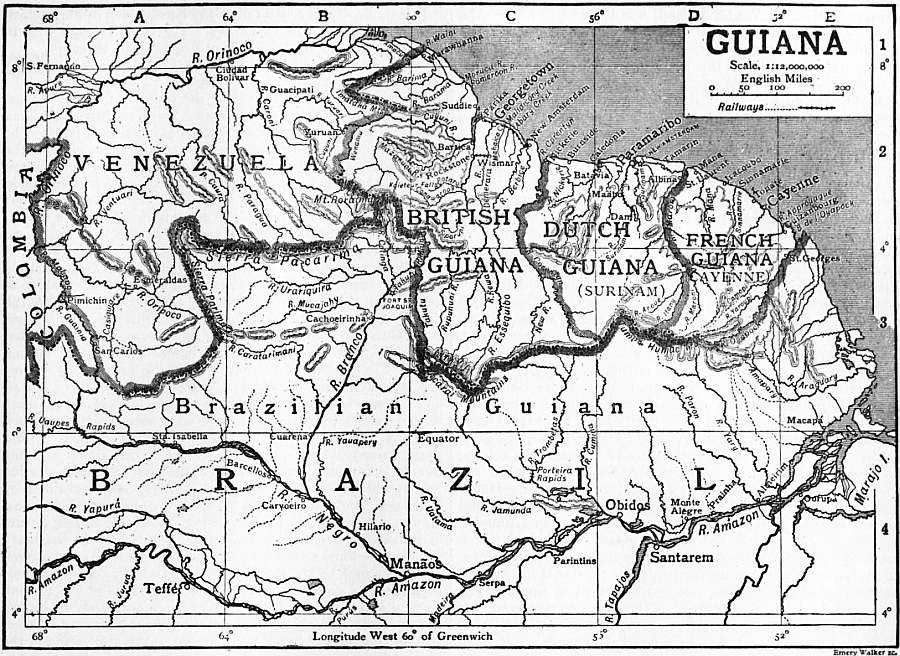
In their physical geography the three Guianas present certain common characteristics. In each the principal features are the rivers and their branch streams. In each colony the northern portion consists of a fluviomarine deposit extending inland and gradually rising to a height of 10 to 15 ft. above the sea. This alluvial plain varies in width from 50 m. to 18 m. and is traversed by ridges of sand and shells, roughly parallel to what is now the coast, indicating the trend of former shore lines. By the draining and diking of these lands the plantations have been formed along the coast and up the rivers. These low lands are attached to a somewhat higher plateau, which towards the coast is traversed by numerous huge sand-dunes and inland by ranges of hills rising in places to as much as 2000 ft. The greater part of this belt of country, in which the auriferous districts principally occur, is covered with a dense growth of jungle and high forest, but savannahs, growing only a long wiry grass and poor shrubs, intrude here and there, being in the S.E. much nearer to the coast than in the N.W. The hinterlands consist of undulating open savannahs rising into hills and mountains, some grass-covered, some in dense forest.
Geology3.—Guiana is formed almost entirely of gneiss and crystalline schists penetrated by numerous dikes of diorite, diabase, &c. The gold of the placer deposits appears to be derived, not from quartz reefs, but from the schists and intrusive rocks, the selvages of the diabase dikes sometimes containing as much as 5 oz. of gold to the ton. In British Guiana a series of conglomerates, red and white sandstone and red shale, rests upon the gneiss and forms the remarkable table-topped mountains Roraima, Kukenaam, &c. The beds are horizontal, and according to Brown and Sawkins, three layers of greenstone, partly intrusive and partly contemporaneous, are interstratified with the sedimentary deposits. The age of these beds is uncertain, but they evidently correspond with the similar series which occurs in Brazil, partly Palaeozoic and partly Cretaceous. In Dutch Guiana there are a few small patches supposed to belong to the Cretaceous period. Along the coast, and in the lower parts of the river valleys, are deposits which are mainly Quaternary but may also include beds of Tertiary age.
History.—The coast of Guiana was sighted by Columbus in 1498 when he discovered the island of Trinidad and the peninsula of Paria, and in the following year by Alonzo de Ojeda and Amerigo Vespucci; and in 1500 Vincente Yañez Pinzon ventured south of the equator, and sailing north-west along the coast discovered the Amazon; he is believed to have also entered some of the other rivers of Guiana, one of which, now called Oyapock, is marked on early maps as Rio Pinzon. Little, however, was known of Guiana until the fame of the fabled golden city Manoa or El Dorado tempted adventurers to explore its rivers and forests. From letters of these explorers found in captured ships, Sir Walter Raleigh was induced to ascend the Orinoco in search of El Dorado in 1595, to send Lawrence Keymis on the same quest in the following year, and in 1617 to try once again, with the same intrepid lieutenant, an expedition fraught with disaster for both of them. As early as 1580 the Dutch had established a systematic trade with the Spanish main, but so far as is known their first voyage to Guiana was in 1598. By 1613 they had three or four settlements on the coast of Demerara and Essequibo, and in about 1616 some Zeelanders settled on a small island, called by them Kyk ober al (“see over all”), in the confluence of the Cuyuni and Mazaruni rivers. While the Dutch traders were struggling for a footing in Essequibo and Demerara, English and French traders were endeavouring to form settlements on the Oyapock river, in Cayenne and in Surinam, and by 1652 the English had large interests in the latter and the French in Cayenne. In 1663 Charles II. issued letters patent to Lord Willoughby of Parham and Lawrence Hyde, second son of the earl of Clarendon, granting them the district between the Copenam and Maroni rivers, a province described as extending from E. to W. some 120 m. This colony was, however, formally ceded to the Netherlands in 1667 by the peace of Breda, Great Britain taking possession of New York. Meanwhile the Dutch West India Company, formed in 1621, had taken possession of Essequibo, over which colony it exercised sovereign rights until 1791. In 1624 a Dutch settlement was effected in the Berbice river, and from this grew Berbice, for a long time a separate and independent colony. In 1657 the Zeelanders firmly established themselves in the Pomeroon, Moruca and Demerara rivers, and by 1674 the Dutch were colonizing all the territory now known as British and Dutch Guiana. The New Dutch West Indian Company, founded in that year to replace the older company which had failed, received Guiana by charter from the states-general in 1682. In the following year the company sold one-third of their territory to the city of Amsterdam, and another third to Cornelis van Aerssens, lord of Sommelsdijk. The new owners and the company incorporated themselves as the Chartered Society of Surinam, and Sommelsdijk agreed to fill the post of governor of the colony at his own expense. The lucrative trade in slaves was retained by the West Indian Company, but the society could import them on its own account by paying a fine to the company. Sommelsdijk’s rule was wise and energetic. He repressed and pacified the Indian tribes, erected forts and disciplined the soldiery, constructed the canal which bears his name, established a high court of justice and introduced the valuable cultivation of the cocoa-nut. But on the 17th of June 1688 he was massacred in a mutiny of the soldiers. The “third” which Sommelsdijk possessed was offered by his widow to William III. of England, but it was ultimately purchased by the city of Amsterdam for 700,000 fl. The settlements in Essequibo progressed somewhat slowly, and it was not until immigration was attracted in 1740 by offers to newcomers of free land and immunity for a decade from taxation that anything like a colony could be said to exist there. In 1732 Berbice placed itself under the protection of the states-general of Holland and was granted a constitution, and in 1773 Demerara, till then a dependency of Essequibo, was constituted as a separate colony. In 1781 the three colonies, Demerara, Essequibo and Berbice, were captured by British privateers, and were placed by Rodney under the governor of Barbados, but in 1782 they were taken by France, then an ally of the Netherlands, and retained until the peace of 1783, when they were restored to Holland. In 1784 Essequibo and Demerara were placed under one governor, and Georgetown—then called Stabroek—was fixed on as the seat of government. The next decade saw a series of struggles between the colonies and the Dutch West India company, which ended in the company being wound up and in the three colonies being governed directly by the states-general. In 1796 the British again took possession, and retained the three colonies until the peace of Amiens in 1802, when they were once again restored to Holland, only to be recaptured by Great Britain in 1803, in which year the history proper of British Guiana began.
I. British Guiana, the only British possession in S. America, was formally ceded in 1814-1815. The three colonies were in 1831 consolidated into one colony divided into three British Guiana. counties, Berbice extending from the Corentyn river to the Abary creek, Demerara from the Abary to the Boerasirie creek, Essequibo from the Boerasirie to the Venezuelan frontier. This boundary-line between British Guiana and Venezuela was for many years the subject of dispute. The Dutch, while British Guiana was in their possession, claimed the whole watershed of the Essequibo river, while the Venezuelans asserted that the Spanish province of Guayana had extended up to the left bank of the Essequibo. In 1840 Sir Robert Schomburgk had suggested a demarcation, afterwards known as the “Schomburgk line”; and subsequently, though no agreement was arrived at, certain modifications were made in this British claim. In 1886 the government of Great Britain declared that it would thenceforward exercise jurisdiction up to and within a boundary known as “the modified Schomburgk line.” Outposts were located at points on this line, and for some years Guianese police and Venezuelan soldiers faced one another across the Amacura creek in the Orinoco mouth and at Yuruan up the Cuyuni river. In 1897 the dispute formed the subject of a message to congress from the president of the United States, and in consequence of this intervention the matter was submitted to an international commission, whose award was issued at Paris in 1899 (see Venezuela). By this decision neither party gained its extreme claim, the line laid down differing but little from the original Schomburgk line. The demarcation was at once undertaken by a joint commission appointed by Venezuela and British Guiana and was completed in 1904. It was not found practicable, owing to the impassable nature of the country, to lay down on earth that part of the boundary fixed by the Paris award between the head of the Wenamu creek and the summit of Mt. Roraima, and the boundary commissioners suggested a deviation to follow the watersheds of the Caroni, Cuyuni and Mazaruni rivers, a suggestion accepted by the two governments. In 1902 the delimitation of the boundary between British Guiana and Brazil was referred to the arbitration of the king of Italy, and by his reward, issued in June 1904, the substantial area in dispute was conceded to British Guiana. The work of demarcation has since been carried out.
Towns, &c.—The capital of British Guiana is Georgetown, at the mouth of the Demerara river, on its right bank, with a population of about 50,000. New Amsterdam, on the right bank of the Berbice river, has a population of about 7500. Each possesses a mayor and town council, with statutory powers to impose rates. There are nineteen incorporated villages, and ten other locally governed areas known as country districts, the affairs of which are controlled by local authorities, known as village councils and country authorities respectively.
Population.—The census of 1891 gave the population of British Guiana as 278,328. There was no census taken in 1901. By official estimates the population at the end of 1904 was 301,923. Of these some 120,000 were negroes and 124,000 East Indians; 4300 were Europeans, other than Portuguese, estimated at about 11,600, and some 30,000 of mixed race. The aborigines—Arawaks, Caribs, Wapisianas, Warraws, &c.—who numbered about 10,000 in 1891, are now estimated at about 6500. In 1904 the birth-rate for the whole colony was 30.3 per 1000 and the death-rate 28.8.
Physical Geography.—The surface features of British Guiana may be divided roughly into four regions: first, the alluvial seaboard, flat and below the level of high-water; secondly, the forest belt, swampy along the rivers but rising into undulating lands and hills between them; thirdly, the savannahs in and inland of the forest belt, elevated table-lands, grass-covered and practically treeless; and fourthly, the mountain ranges. The eastern portion of the colony, from the source of its two largest rivers, the Corentyn and Essequibo, is a rough inclined plain, starting at some 900 ft. above sea-level at the source of the Takutu in the west, but only some 400 at that of the Corentyn in the west, and sloping down gradually to the low alluvial flats about 3 ft. below high-water line. The eastern part is generally forested; the western is an almost level savannah, with woodlands along the rivers. The northern portion of British Guiana, the alluvial flats alluded to already, consists of a fluviomarine deposit extending inland from 25 m. to 30 m., gradually rising to about 12 ft. above high-water mark and ending against beds of sandy clay, the residua of igneous rocks decomposed in situ, which form an extensive undulating region rising to 150 ft. above the sea and stretching back to the forest-covered hills. Roughly parallel to the existing coast-line are narrow reefs of sand and sea-shells, which are dunes indicating the trend of former limits of the sea, and still farther back are the higher “sand hills,” hills of granite or diabase with a thick stratum of coarse white sand superimposed. From the coast-line seawards the ocean deepens very gradually, and at low tide extensive flats of sand and of mixed clay and sand (called locally “caddy”) are left bare, these flats being at times covered with a deposit of thin drift mud.
Two great parallel mountain systems cross the colony from W. to E., the greater being that of the Pacaraima and Merumé Mts., and the lesser including the Kanuku Mts. (2000 ft.), while the Acarai Mts., a densely-wooded range rising to 2500 ft., form the southern boundary of British Guiana and the watershed between the Essequibo and the Amazon. These mountains rise generally in a succession of terraces and broad plateaus, with steep or even sheer sandstone escarpments. They are mostly flat-topped, and their average height is about 3500 ft. The Pacaraima Mts., however, reach 8635 ft. at Roraima, and the latter remarkable mountain rises as a perpendicular wall of red rock 1500 ft. in height springing out of the forest-clad slopes below the summit, and was considered inaccessible until in December 1884 Messrs im Thurn and Perkins found a ledge by which the top could be reached. The summit is a table-land some 12 sq. m. in area. Mt. Kukenaam is of similar structure and also rises above 8500 ft. Other conspicuous summits (about 7000 ft.) are Iwalkarima, Eluwarima, Ilutipu and Waiakapiapu. The southern portion of the Pacaraima range comprises rugged hills and rock-strewn valleys, but to the N., where the sandstone assumes the table-shaped form, there are dense forests, and the scenery is of extraordinary grandeur. Waterfalls frequently descend the cliffs from a great height (nearly 2000 ft. sheer at Roraima and Kukenaam). The sandstone formation can be traced from the northern Pacaraima range on the N.W. to the Corentyn in the S.E. It is traversed in places by dikes and sills of diabase or dolerite, while bosses of more or less altered gabbro rise through it. The surface of a large part of the colony is composed of gneiss, and of gneissose granite, which is seen in large water-worn bosses in the river beds. Intrusive granite is of somewhat rare occurrence; where found, it gives rise to long low rolls of hilly country and to cataracts in the rivers. Extensive areas of the country consist of quartz-porphyry, porphyrites and felstone, and of more or less schistose rocks derived from them. These rocks are closely connected with the gneissose granites and gneiss, and there are reasons for believing that the latter are the deep-seated portions of them and are only visible where they have been exposed by denudation. Long ranges of hills, varying in elevation from a few hundreds to from 2000 ft. to 3000 ft., traverse the plains of the gneissose districts. These are caused either by old intrusions of diabase and gabbro which have undergone modifications, or by later ones of dolerite. These ranges are of high importance, as the rocks comprising them are the main source of gold in British Guiana.
Rivers.—The principal physical features of British Guiana are its rivers and their branches, which form one vast network of waterways all over it, and are the principal, indeed practically the only, highways inland from the coast. Chief among them are the Waini, the Essequibo, and its tributaries the Mazaruni and Cuyuni, the Demerara, the Berbice and the Corentyn. The Essequibo rises in the Acarai Mts., in 0° 41′ N. and about 850 ft. above the sea, and flows northwards for about 600 m. until it discharges itself into the ocean by an estuary nearly 15 m. in width. In this estuary are several large and fertile islands, on four of which sugar used to be grown. Now but one, Wakenaam, can boast of a factory. The Essequibo can be entered only by craft drawing less than 20 ft. and is navigable for these vessels for not more than 50 m., its subsequent course upwards being frequently broken by cataracts and rapids. Some 7 m. below the first series of rapids it is joined by the Mazaruni, itself joined by the Cuyuni some 4 m. farther up. It has a remarkable course from its source in the Merume Mountains, about 2400 ft. above the sea. It flows first south, then west, north-west, north, and finally south-east to within 20 m. of its own source, forming many fine falls, and its course thereafter is still very tortuous. In 4° N. and 58° W., the Essequibo is joined by the Rupununi, which, rising in a savannah at the foot of the Karawaimento Mts., has a northerly and easterly course of fully 200 m. In 3° 37′ N. the Awaricura joins the Rupununi, and by this tributary the Pirara, a tributary of the Amazon, may be reached,—an example of the interesting series of itabos connecting nearly all S. American rivers with one another. Another large tributary of the Essequibo is the Potaro, on which, at 1130 ft. above sea-level and in 5° 8′ N. and 59° 19′ W., is the celebrated Kaieteur fall, discovered in 1870 by Mr C. Barrington Brown while engaged on a geological survey. This fall is produced by the river flowing from a tableland of sandstone and conglomerate into a deep valley 822 ft. below. For the first 741 ft. the water falls as a perpendicular column, thence as a sloping cataract to the still reach below. The river 200 yds. above the fall is about 400 ft. wide, while the actual waterway of the fall itself varies from 120 ft. in dry weather to nearly 400 ft. in rainy seasons. The Kaieteur, which it took Mr Brown a fortnight to reach from the coast, can now be reached on the fifth day from Georgetown. Among other considerable tributaries of the Essequibo are the Siparuni, Burro-Burro, Rewa, Kuyuwini and Kassi-Kudji. The Demerara river, the head-waters of which are known only to Indians, rises probably near 5° N., and after a winding northerly course of some 200 m. enters the ocean in 6° 50′ N. and 58° 20′ W. A bar of mud and sand prevents the entrance of vessels drawing more than 19 ft. The river is from its mouth, which is nearly 2 m. wide, navigable for 70 m. to all vessels which can enter. The Berbice river rises in about 3° 40′ N., and in 3° 53′ N. is within 9 m. of the Essequibo. At its mouth it is about 2½ m. wide, and is navigable for vessels drawing not more than 12 ft. for about 105 m. and for vessels drawing not more than 7 ft. for fully 175 m. Thence upwards it is broken by great cataracts. The Canje creek joins the Berbice river close to the sea. The Corentyn river rises in 1° 48′ 30″ N., about 140 m. E. of the Essequibo, and flowing northwards enters the Atlantic by an estuary some 14 m. wide. The divide between its head-waters and those of streams belonging to the Amazon system is only some 400 ft. in elevation. It is navigable for about 150 m., some of the reaches being of great width and beauty. The upper reaches are broken by a series of great cataracts, some of which, until the discovery of Kaieteur, were believed to be the grandest in British Guiana. Among other rivers are the Pomeroon, Moruca and Barima, while several large streams or creeks fall directly into the Atlantic, the largest being the Abary, Mahaicony and Mahaica, between Berbice and Demerara, and the Boerasirie between Demerara and Essequibo. The colour of the water of the rivers and creeks is in general a dark brown, caused by the infusion of vegetable matter, but where the streams run for a long distance through savannahs they are of a milky colour.
Climate.—The climate is, as tropical countries go, not unhealthy. Malarial fevers are common but preventible; and phthisis is prevalent, not because the climate is unsuitable to sufferers from pulmonary complaints, but because of the ignorance of the common people of the elementary principles of hygiene, an ignorance which the state is endeavouring to lessen by including the teaching of hygiene in the syllabus of the primary schools. The temperature is uniform on the coast for the ten months from October to July, the regular N.E. trade winds keeping it down to an average of 80° F. In August and September the trades die away and the heat becomes oppressive. In the interior the nights are cold and damp. Hurricanes, indeed even strong gales, are unknown; a tidal wave is an impossibility; and the nature of the soil of the coast lands renders earthquakes practically harmless. Occasionally there are severe droughts, and the rains are sometimes unduly prolonged, but usually the year is clearly divided into two wet and two dry seasons. The long wet season begins in mid-April and lasts until mid-August. The long dry season is from September to the last week in November. December and January constitute the short rainy season, and February and March the short dry season. The rainfall varies greatly in different parts of the colony; on the coast it averages about 80 in. annually.
Flora.—The vegetation is most luxuriant and its growth perpetual. Indigenous trees and plants abound in the utmost variety, while many exotics have readily adapted themselves to local conditions. Along the coast is a belt of courida and mangrove—the bark of the latter being used for tanning—forming a natural barrier to the inroads of the sea, but one which—very unwisely—has been in parts almost ruined to allow of direct drainage. The vast forests afford an almost inexhaustible supply of valuable timbers; greenheart and mora, largely used in shipbuilding and for wharves and dock and lock gates; silverbally, yielding magnificent planks for all kinds of boats; and cabinet woods, such as cedar and crabwood. There may be seen great trees, struggling for life one with the other, covered with orchids—some of great beauty and value—and draped with falling lianas and vines. Giant palms fringe the river-banks and break the monotony of the mass of smaller foliage. Many of the trees yield gums, oils and febrifuges, the bullet tree being bled extensively for balata, a gum used largely in the manufacture of belting. Valuable varieties of rubber have also been found in several districts, and since early in 1905 have attracted the attention of experts from abroad. On the coast plantains, bananas and mangoes grow readily and are largely used for food, while several districts are admirably adapted to the growth of limes. Oranges, pineapples, star-apples, granadillas, guavas are among the fruits; Indian corn, cassava, yams, eddoes, tannias, sweet potatoes and ochroes are among the vegetables, while innumerable varieties of peppers are grown and used in large quantities by all classes. The dainty avocado pear, purple and green, grows readily. In the lagoons and trenches many varieties of water-lilies grow wild, the largest being the famous Victoria regia.
Fauna.—Guiana is full of wild animals, birds, insects and reptiles. Among the wild animals, one and all nocturnal, are the mipourrie or tapir, manatee, acouri and labba (both excellent eating), sloth, ant-eater, armadillo, several kinds of deer, baboons, monkeys and the puma and jaguar. The last is seen frequently down on the coast, attracted from the forest by the cattle grazing on the front and back pasture lands of the estates. Among the birds may be mentioned the carrion crow (an invaluable scavenger), vicissi and muscovy ducks, snipe, teal, plover, pigeon, the ubiquitous kiskadee or qu’est que dit, a species of shrike—his name derived from his shrill call—the canary and the twa-twa, both charming whistlers. These are all found on the coast. In the forest are maam (partridge), maroudi (wild turkey), the beautiful bell-bird with note like a silver gong, the quadrille bird with its tuneful oft-repeated bar, great flocks of macaws and parrots, and other birds of plumage of almost indescribable richness and variety. On the coast the trenches and canals are full of alligators, but the great cayman is found only in the rivers of the interior. Among the many varieties of snakes are huge constricting camoudies, deadly bushmasters, labarrias and rattlesnakes. Among other reptiles are the two large lizards, the salumpenta (an active enemy of the barn-door fowl), and the iguana, whose flesh when cooked resembles tender chicken. The rivers, streams and trenches abound with fishes, crabs and shrimps, the amount of the latter consumed being enormous, running into tons weekly as the coolies use them in their curries and the blacks in their foo-foo.
Government and Administration.—Executive power is vested in a governor, who is advised in all administrative matters by an executive council, consisting of five official and three unofficial members nominated by the crown. Legislative authority is vested in the Court of Policy, consisting of the governor, who presides and without whose permission no legislation can be initiated, seven other official members and eight elected members. This body has, however, no financial authority, all taxation and expenditure being dealt with by the Combined Court, consisting of the Court of Policy combined with six financial representatives. The elected members of the Court of Policy and the financial representatives are elected by their several constituencies for five years. Qualification for the Court of Policy is the ownership, or possession under lease for a term of twenty-one years, of eighty acres of land, of which at least forty acres are under cultivation, or of house property to the value of $7500. A financial representative must be similarly qualified or be in receipt of a clear income of not less than £300 per annum. Every male is entitled to be registered as a voter who (in addition to the usual formal qualifications) owns (during six months prior to registration) three acres of land in cultivation or a house of the annual rental or value of £20; or is a secured tenant for not less than three years of six acres of land in cultivation or for one year of a house of £40 rental; or has an income of not less than £100 per annum; or has during the previous twelve months paid £4, 3s. 4d. in direct taxation. Residence in the electoral district for six months prior to registration is coupled with the last two alternative qualifications. Plural voting is legal but no plumping is allowed. The combined court is by this constitution, which was granted in 1891, allowed the use of all revenues due to the crown in return for a civil list voted for a term now fixed at three years. English is the official and common language. The Roman-Dutch law, modified by orders-in-council and local statutes, governs actions in the civil courts, but the criminal law is founded on that of England. Magistrates have in civil cases jurisdiction up to £20, while an appeal lies from their decisions in any criminal or civil case. The supreme court consists of a chief justice and two puisne judges, and has various jurisdictions. The full court, consisting of the three judges or any two of them, has jurisdiction over all civil matters, but an appeal lies to His Majesty in privy council in cases involving £500 and upwards. A single judge sits in insolvency, in actions involving not over £520, and in appeals from magistrates’ decisions. The appeal full court, consisting of three judges, sits to hear appeals from decisions of a single judge in the limited civil, appellate and insolvency courts. Criminal courts are held four times a year in each county, a single judge presiding in each court. A court of crown cases reserved is formed by the three judges, of whom two form a quorum provided the chief-justice is one of the two. There are no imperial troops now stationed in British Guiana, but there is a semi-military police force, a small militia and two companies of volunteers. The Church of England and the Church of Scotland are both established, and grants-in-aid are also given to the Roman Catholic and Wesleyan churches and to several other denominations.
The revenue and expenditure now each amount annually to an average of a little over £500,000. About one-half of the revenue is produced by import duties, and about £90,000 by excise. The public debt on the 31st of March 1905 stood at £989,620.
The system of primary education is denominational and is mainly supported from the general revenue. During 1904-1905, 213 schools received grants-in-aid amounting to £23,500, the average cost per scholar being a little over £1. These grants are calculated on the results of examinations held annually, an allowance varying from 4s. 4½d. to 1s. 0½d. being made for each pass in reading, writing, arithmetic, school-garden work, nature study, singing and drill, English, geography, elementary hygiene and sewing. Secondary education is provided in Georgetown at some private establishments, and for boys at Queen’s College, an undenominational government institution where the course of instruction is the same as at a public school in England, and the boys are prepared for the Cambridge local examinations, on the result of which annually depend the Guiana scholarship—open to boys and girls, and carrying a university or professional training in England—and two scholarships at Queen’s College.
Industries and Trade.—At the end of the third decade of the 19th century the principal exports were sugar, rum, molasses, cotton and coffee. In 1830, 9,500,000 ℔ of coffee were sent abroad, but after the emancipation of the slaves it almost ceased as an export, and the little that is now grown is practically entirely consumed in the colony. The cultivation of cotton ceased in 1844, and, but for a short revival during the American civil war, has never prospered since. Efforts have been made to resuscitate its growth, but the experiments of the Board of Agriculture have only shown that Sea Island cotton is not adaptable to local conditions, and that no other known variety can as yet be recommended. To-day the principal exports are sugar, rum, molasses, molascuit—a cattle food made from molasses—gold, timber, balata, shingles and cattle. The annual value of the total exports is just under £2,000,000, of which about two-thirds go to Great Britain and British possessions. The cultivation of rice has made great strides in recent years, and, where difficulties of drainage and irrigation can be economically overcome, promises to increase rapidly. In 1873, 32,000,000 ℔ of rice were imported, whereas in 1904-1905, the quantity imported having fallen to 20,500,000 ℔, there were over 18,000 acres under rice cultivation, and exportation, principally to the British West Indies, had commenced. The cultivation of the sugar-cane, and its manufacture into sugar and its by-products, still remains, in spite of numerous fluctuations, the staple industry. The provision of a trustworthy labour supply for the estates is of great importance, and local scarcity has made it necessary since 1840 to import it under a system of indenture. In that year and until 1867, liberated Africans were brought from Rio de Janeiro, Havana, Sierra Leone and St Helena, and in 1845 systematic immigration from India commenced and has since been carried on annually—save in 1849-1850. In 1853 immigration from China was tried, and was carried on by the government from 1859 to 1866, when it ceased owing to a convention arranged at Peking, stipulating that all immigrants should on the expiry of their term of indenture be entitled to be sent back at the expense of the colony, a liability it could not afford to incur. To reduce the cost of supervision and kindred expenses, and consequently of the cane and its manufacture into sugar, the policy of centralization has been universally adopted, and forty-six estates now produce as much sugar as three times that number did in 1875. During recent years Canada has come forward as a large buyer of Guiana’s sugar, and in 1904-1905 the same amount went there as to the United States, in each case over 44,000 tons, whereas in 1901-1902 the United States took 85,000 tons and Canada under 8000 tons. Practically all the rum and molascuit go to England, and the molasses to Holland and Portuguese possessions. The lands on the coast and on the river banks up to the sand hills are of marked fertility, and can produce almost any tropical vegetable or fruit. Cultivation, however, save on the sugar, coffee and cocoa estates, and by a few exceptional small farmers, is carried on in a haphazard and half-hearted manner, and the problem of agricultural development is one of great difficulty for the government. Much of the privately-owned land is not beneficially occupied, and in many cases it is not possible even to learn to whom it belongs, and though there are vast tracts of uncultivated crown land where a large farm or a small homestead can be easily and cheaply acquired, the difficulties involved in clearing, draining, and in some cases of protecting it by dams, are prohibitive to all but the exceptionally determined.