VOLUME XII SLICE III Gordon, Lord George to Grasses (continued 8)
Reading edition
Gender is the product partly of analogy, partly of phonetic decay. In many languages, such as Eskimo and Choctaw, its place is taken by a division of objects into animate and inanimate, while in other languages they are separated into rational and irrational. There are many indications that the parent Indo-European in an early stage of its existence had no signs of gender at all. The terminations of the names of father and mother, pater and mater, for example, are exactly the same, and in Latin and Greek many diphthongal stems, as well as stems in i or ya and u (like ναῦς and νέκυς, πόλις and λῖς), may be indifferently masculine and feminine. Even stems in o and a (of the second and first declensions), though the first are generally masculine and the second generally feminine, by no means invariably maintain the rule; and feminines like humus and ὁδός, or masculines like advena and πολίτης, show that there was a time when these stems also indicated no particular gender, but owed their subsequent adaptation, the one to mark the masculine and the other to mark the feminine, to the influence of analogy. The idea of gender was first suggested by the difference between man and woman, male and female, and, as in so many languages at the present day, was represented not by any outward sign but by the meaning of the words themselves. When once arrived at, the conception of gender was extended to other objects besides those to which it properly belonged. The primitive Indo-European did not distinguish between subject and object, but personified objects by ascribing to them the motives and powers of living beings. Accordingly they were referred to by different pronouns, one class denoting the masculine and another class the feminine, and the distinction that existed between these two classes of pronouns was after a time transferred to the nouns. As soon as the preponderant number of stems in o in daily use had come to be regarded as masculine on account of their meaning, other stems in o, whatever might be their signification, were made to follow the general analogy and were similarly classed as masculines. In the same way, the suffix i or ya acquired a feminine sense, and was set apart to represent the feminine gender. Unlike the Semites, the Indo-Europeans were not satisfied with these two genders, masculine and feminine. As soon as object and subject, patient and agent, were clearly distinguished from each other, there arose a need for a third gender, which should be neither masculine nor feminine, but denote things without life. This third gender was fittingly expressed either by the objective case used as a nominative (e.g. regnum), or by a stem without any case ending at all (e.g. virus).
The adverbial meaning of so many of the cases explains the readiness with which they became crystallized into adverbs and prepositions. An adverb is the attribute of an attribute—“the rose smells sweetly,” for example, being resolvable into “the rose has the attribute of scent with the further attribute of sweetness.” In our own language once, twice, needs, are all genitives; seldom is a dative. The Latin and Greek humi and χαμαί are locatives, facillime (facillumed) and εὐτυχῶς ablatives, πάντη and ἄμα instrumentals, πάρος, ἑξῆς and τηλοῦ genitives. The frequency with which particular cases of particular nouns were used in a specifically attributive sense caused them to become, as it were, petrified, the other cases of the nouns in question passing out of use, and the original force of those that were retained being gradually forgotten. Prepositions are adverbs employed to define nouns instead of verbs and adjectives. Their appearance in the Indo-European languages is comparatively late, and the Homeric poems allow us to trace their growth in Greek. The adverb, originally intended to define the verb, came to be construed with the noun, and the government of the case with which it was construed was accordingly transferred from the verb to the noun. Thus when we read in the Odyssey(iv. 43), αὐτοὺς δ᾽ εἰσῆγον θεῖον δόμον, we see that εἰς is still an adverb, and that the accusative is governed by the verb; it is quite otherwise, however, with a line like Ἀτρείδης δὲ γέροντας ἀολλέας ἦγεν Ἀχαιῶν ἐς κλισίην (Il. i. 89) where the adverb has passed into a preposition. The same process of transformation is still going on in English, where we can say indifferently, “What are you looking at?” using “at” as an adverb, and governing the pronoun by the verb, and “At what are you looking?” where “at” has become a preposition. With the growth and increase of prepositions the need of the case-endings diminished, and in some languages the latter disappeared altogether.
Like prepositions, conjunctions also are primarily adverbs used in a demonstrative and relative sense. Hence most of the conjunctions are petrified cases of pronouns. The relation between two sentences was originally expressed by simply setting them side by side, afterwards by employing a demonstrative at the beginning of the second clause to refer to the whole preceding one. The relative pronoun can be shown to have been in the first instance a demonstrative; indeed, we can still use that in English in a relative sense. Since the demonstrative at the beginning of the second clause represented the first clause, and was consequently an attribute of the second, it had to stand in some case, and this case became a conjunction. How closely allied the adverb and the conjunction are may be seen from Greek and Latin, where ὡς or quum can be used as either the one or the other. Our own and, it may be observed, has probably the same root as the Greek locative adverb ἔτι, and originally signified “going further.”
Another form of adverb is the infinitive, the adverbial force of which appears clearly in such a phrase as “A wonderful thing to see.” Various cases, such as the locative, the dative or the instrumental, are employed in Vedic Sanskrit in the sense of the infinitive, besides the bare stem or neuter formed by the suffixes man and van. In Greek the neuter stem and the dative case were alone retained for the purpose. The first is found in infinitives like δόμεν and φέρειν (for an earlier φερε-ϝεν), the second in the infinitives in -αι. Thus the Gr. δοῦναι answers letter for letter to the Vedic dative dāvāne, “to give,” and the form ψεύδεσθαι is explained by the Vedic vayodhai, for vayās-dhai, literally “to do living,” dhai being the dative of a noun from the root dhā, “to place” or “do.” When the form ψεύδεσθαι had once come into existence, analogy was ready to create such false imitations as γράψασθαι or γραφθήσεσθαι. The Latin infinitive in -re for -se has the same origin, amare, for instance, being the dative of an old stem amas. In fieri for fierei or fiesei, from the same root as our English be, the original length of the final syllable is preserved. The suffix in -um is an accusative, like the corresponding infinitive of classical Sanskrit. This origin of the infinitive explains the Latin construction of the accusative and infinitive. When the Roman said, “Miror te ad me nihil scribere,” all that he meant at first was, “I wonder at you for writing nothing to me,” where the infinitive was merely a dative case used adverbially.
The history of the infinitive makes it clear how little distinction must have been felt at the outset between the noun and the verb. Indeed, the growth of the verb was a slow process. There was a time in the history of Indo-European speech when it had not as yet risen to the consciousness of the speaker, and in the period when the noun did not possess a plural there was as yet also no verb. The attachment of the first and second personal pronouns, or of suffixes resembling them, to certain stems, was the first stage in the development of the latter. Like the Semitic verb, the Indo-European verb seems primarily to have denoted relation only, and to have been attached as an attribute to the subject. The idea of time, however, was soon put into it, and two tenses were created, the one expressing a present or continuous action, the other an aoristic or momentary one. The distinction of sense was symbolized by a distinction of pronunciation, the root-syllable of the aorist being an abbreviated form of that of the present. This abbreviation was due to a change in the position of the accent (which was shifted from the stem-syllable to the termination), and this change again was probably occasioned by the prefixing of the so-called augment to the aorist, which survived into historical times only in Sanskrit, Zend and Greek, and the origin of which is still a mystery. The weight of the first syllable in the aorist further caused the person-endings to be shortened, and so two sets of person-endings, usually termed primary and secondary, sprang into existence. By reduplicating the root-syllable of the present tense a perfect was formed; but originally no distinction was made between present and perfect, and Greek verbs like δίδωμι and ἣκω are memorials of a time when the difference between “I am come” and “I have come” was not yet felt. Reduplication was further adapted to the expression of intensity and desire (in the so-called intensive and desiderative forms). By the side of the aorist stood the imperfect, which differed from the aorist, so far as outward form was concerned, only in possessing the longer and more original stem of the present. Indeed, as Benfey first saw, the aorist itself was primitively an imperfect, and the distinction between aorist and imperfect is not older than the period when the stem-syllables of certain imperfects were shortened through the influence of the accent, and this differentiation of forms appropriated to denote a difference between the sense of the aorist and the imperfect which was beginning to be felt. After the analogy of the imperfect, a pluperfect was created out of the perfect by prefixing the augment (of which the Greek ἐμέμηκον is an illustration); though the pluperfect, too, was originally an imperfect formed from the reduplicated present.
Besides time, mood was also expressed by the primitive Indo-European verb, recourse being had to symbolization for the purpose. The imperative was represented by the bare stem, like the vocative, the accent being drawn back to the first syllable, though other modes of denoting it soon came into vogue. Possibility was symbolized by the attachment of the suffix -ya to the stem, probability by the attachment of -a and -ā, and in this way the optative and conjunctive moods first arose. The creation of a future by the help of the suffix -sya seems to belong to the same period in the history of the verb. This suffix is probably identical with that used to form a large class of adjectives and genitives (like the Greek ἵπποιο for ἱπποσιο); in this case future time will have been regarded as an attribute of the subject, no distinction being drawn, for instance, between “rising sun” and “the sun will rise.” It is possible, however, that the auxiliary verb as, “to be,” enters into the composition of the future; if so, the future will be the product of the second stage in the development of the Indo-European verb when new forms were created by means of composition. The sigmatic or first aorist is in favour of this view, as it certainly belongs to the age of Indo-European unity, and may be a compound of the verbal stem with the auxiliary as.
After the separation of the Indo-European languages, composition was largely employed in the formation of new tenses. Thus in Latin we have perfects like scrip-si and ama-vi, formed by the help of the auxiliaries as (sum) and fuo, while such forms as amaveram (amavi-eram) or amarem (ama-sem) bear their origin on their face. So, too, the future in Latin and Old Celtic (amabo, Irish carub) is based upon the substantive verb fuo, “to be,” and the English preterite in -ed goes back to a suffixed did, the reduplicated perfect of do. New tenses and moods, however, were created by the aid of suffixes as well as by the aid of composition, or rather were formed from nouns whose stems terminated in the suffixes in question. Thus in Greek we have aorists and perfects in -κα, and the characteristics of the two passive aorists, ye and the, are more probably the suffixes of nominal stems than the roots of the two verbs ya, “to go,” and dhâ, “to place,” as Bopp supposed. How late some of these new formations were may be seen in Greek, where the Homeric poems are still ignorant of the weak future passive, the optative future, and the aspirated perfect, and where the strong future passive occurs but once and the desiderative but twice. On the other hand, many of the older tenses were disused and lost. In classical Sanskrit, for instance, of the modal aorist forms the precative and benedictive almost alone remain, while the pluperfect, of which Delbrück has found traces in the Veda, has wholly disappeared.
The passive voice did not exist in the parent Indo-European speech. No need for it had arisen, since such a sentence as “I am pleased” could be as well represented by “This pleases me,” or “I please myself.” It was long before the speaker was able to imagine an action without an object, and when he did so, it was a neuter or substantival rather than a passive verb that he formed. The passive, in fact, grew out of the middle or reflexive, and, except in the two aorists, continued to be represented by the middle in Greek. So, too, in Latin the second person plural is really the middle participle with estis understood, and the whole class of deponent or reflexive verbs proves that the characteristic r which Latin shares with Celtic could have had at the outset no passive force.
Much light has been thrown on the character and construction of the primitive Indo-European sentence by comparative syntax. In contradistinction to Semitic, where the defining word follows that which is defined, the Indo-European languages place that which is defined after that which defines it; and Bergaigne has made it clear that the original order of the sentence was (1) object, (2) verb, and (3) subject. Greater complication of thought and its expression, the connexion of sentences by the aid of conjunctions, and rhetorical inversion caused that dislocation of the original order of the sentence which reaches its culminating point in the involved periods of Latin literature. Our own language still remains true, however, to the syntax of the parent Indo-European when it sets both adjective and genitive before the nouns which they define. In course of time a distinction came to be made between an attribute used as a mere qualificative and an attribute used predicatively, and this distinction was expressed by placing the predicate in opposition to the subject and accordingly after it. The opposition was of itself sufficient to indicate the logical copula or substantive verb; indeed, the word which afterwards commonly stood for the latter at first signified “existence,” and it was only through the wear and tear of time that a phrase like Deus bonus est, “God exists as good,” came to mean simply “God is good.” It is needless to observe that neither of the two articles was known to the parent Indo-European; indeed, the definite article, which is merely a decayed demonstrative pronoun, has not yet been developed in several of the languages of the Indo-European family.
We must now glance briefly at the results of a scientific investigation of English grammar and the modifications they necessitate in our conception of it. The idea that the free use of speech is tied down by the rules of Investigation of English grammar. the grammarian must first be given up; all that the grammarian can do is to formulate the current uses of his time, which are determined by habit and custom, and are accordingly in a perpetual state of flux. We must next get rid of the notion that English grammar should be modelled after that of ancient Rome; until we do so we shall never understand even the elementary principles upon which it is based. We cannot speak of declensions, since English has no genders except in the pronouns of the third person, and no cases except the genitive and a few faint traces of an old dative. Its verbal conjugation is essentially different from that of an inflexional language like Latin, and cannot be compressed into the same categories. In English the syntax has been enlarged at the expense of the accidence; position has taken the place of forms. To speak of an adjective “agreeing” with its substantive is as misleading as to speak of a verb “governing” a case. In fact, the distinction between noun and adjective is inapplicable to English grammar, and should be replaced by a distinction between objective and attributive words. In a phrase like “this is a cannon,” cannon is objective; in a phrase like “a cannon-ball,” it is attributive; and to call it a substantive in the one case and an adjective in the other is only to introduce confusion. With the exception of the nominative, the various forms of the noun are all attributive; there is no difference, for example, between “doing a thing” and “doing badly.” Apart from the personal pronouns, the accusative of the classical languages can be represented only by position; but if we were to say that a noun which follows a verb is in the accusative case we should have to define “king” as an accusative in such sentences as “he became king” or “he is king.” In conversational English “it is me” is as correct as “c’est moi” in French, or “det er mig” in Danish; the literary “it is I” is due to the influence of classical grammar. The combination of noun or pronoun and preposition results in a compound attribute. As for the verb, Sweet has well said that “the really characteristic feature of the English finite verb is its inability to stand alone without a pronominal prefix.” Thus “dream” by itself is a noun; “I dream” is a verb. The place of the pronominal prefix may be taken by a noun, though both poetry and vulgar English frequently insert the pronoun even when the noun precedes. The number of inflected verbal forms is but small, being confined to the third person singular and the special forms of the preterite and past participle, though the latter may with more justice be regarded as belonging to the province of the lexicographer rather than to that of the grammarian. The inflected subjunctive (be, were, save in “God save the King,” &c.) is rapidly disappearing. New inflected forms, however, are coming into existence; at all events, we have as good a right to consider wont, shant, cant new inflected forms as the French aimerai (amare habeo), aimerais (amare habebam). If the ordinary grammars are correct in treating forms like “I am loving,” “I was loving,” “I did love,” as separate tenses, they are strangely inconsistent in omitting to notice the equally important emphatic form “I do love” or the negative form “I do not love” (“I don’t love”), as well as the semi-inflexional “I’ll love,” “he’s loving.” It is true that these latter contracted forms are heard only in conversation and not seen in books; but the grammar of a language, it must be remembered, is made by those who speak it and not by the printers.
Our school grammars are the inheritance we have received from Greece and Rome. The necessities of rhetoric obliged the Sophists to investigate the structure of the Greek language, and to them was accordingly due the first History of formal grammar. analysis of Greek grammar. Protagoras distinguished the three genders and the verbal moods, while Prodicus busied himself with the definition of synonyms. Aristotle, taking the side of Democritus, who had held that the meaning of words is put into them by the speaker, and that there is no necessary connexion between sound and sense, laid down that words “symbolize” objects according to the will of those who use them, and added to the ὄνομα or “noun,” and the ῥῆμα or “verb,” the σύνδεσμος or “particle.” He also introduced the term πτῶσις, “case,” to denote any flexion whatsoever. He further divided nouns into simple and compound, invented for the neuter another name than that given by Protagoras, and starting from the termination of the nominative singular, endeavoured to ascertain the rules for indicating a difference of gender. Aristotle was followed by the Stoics, who separated the ἄρθρον or “article” from the particles, determined a fifth part of speech, πανδέκτης or “adverb,” confined the term “case” to the flexions of the nouns, distinguishing the four principal cases by names, and divided the verb into its tenses, moods and classes. Meanwhile the Alexandrian critics were studying the language of Homer and the Attic writers, and comparing it with the language of their own day, the result being a minute examination of the facts and rules of grammar. Two schools of grammarians sprang up—the Analogists, headed by Aristarchus, who held that a strict law of analogy existed between idea and word, and refused to admit exceptions to the grammatical rules they laid down, and the Anomalists, who denied general rules of any kind, except in so far as they were consecrated by custom. Foremost among the Anomalists was Crates of Mallos, the leader of the Pergamenian school, to whom we owe the first formal Greek grammar and collection of the grammatical facts obtained by the labours of the Alexandrian critics, as well as an attempt to reform Greek orthography. The immediate cause of this grammar seems to have been a comparison of Latin with Greek, Crates having lectured on the subject while ambassador of Attalus at Rome in 159 B.C. The zeal with which the Romans threw themselves into the study of Greek resulted in the school grammar of Dionysius Thrax, a pupil of Aristarchus, which he published at Rome in the time of Pompey and which is still in existence. Latin grammars were soon modelled upon it, and the attempt to translate the technical terms of the Greek grammarians into Latin was productive of numerous blunders which have been perpetuated to our own day. Thus tenues is a mistranslation of the ψιλά, “unaspirated”; genetivus of γενική, the case “of the genus”; accusativus of αἰτιατική, the case “of the object”; infinitivus of ἀπαρέμφατος, “without a secondary meaning” of tense or person. New names were coined to denote forms possessed by Latin and not by Greek; ablative, for instance, was invented by Julius Caesar, who also wrote a treatise De analogia. By the 2nd century of the Christian era the dispute between the Anomalists and the Analogists was finally settled, analogy being recognized as the principle that underlies language, though every rule admits of exceptions. Two eminent grammarians of Alexandria, Apollonius Dyscolus and his son Herodian, summed up the labours and controversies of their predecessors, and upon their works were based the Latin grammar composed by Aelius Donatus in the 4th century, and the eighteen books on grammar compiled by Priscian in the age of Justinian. The grammar of Donatus dominated the schools of the middle ages, and, along with the productions of Priscian, formed the type and source of the Latin and Greek school-grammars of modern Europe.
A few words remain to be said, in conclusion, on the bearing of a scientific study of grammar upon the practical task of teaching and learning foreign languages. The grammar of a language is not to be confined within the rules Learning of grammar of foreign languages. laid down by grammarians, much less is it the creation of grammarians, and consequently the usual mode of making the pupil learn by heart certain fixed rules and paradigms not only gives a false idea of what grammar really is, but also throws obstacles in the way of acquiring it. The unit of speech is the sentence; and it is with the sentence therefore, and not with lists of words and forms, that the pupil should begin. When once a sufficient number of sentences has been, so to speak, assimilated, it will be easy to analyse them into their component parts, to show the relations that these bear to one another, and to indicate the nature and varieties of the latter. In this way the learner will be prevented from regarding grammar as a piece of dead mechanism or a Chinese puzzle, of which the parts must be fitted together in accordance with certain artificial rules, and will realize that it is a living organism which has a history and a reason of its own. The method of nature and science alike is analytic; and if we would learn a foreign language properly we must learn it as we did our mother-tongue, by first mastering the expression of a complete thought and then breaking up this expression into its several elements.
(A. H. S.)
See Philology, and articles on the various languages. Also Steinthal, Charakteristik der hauptsächlichsten Typen des Sprachbaues (Berlin, 1860); Schleicher, Compendium of the Comparative Grammar of the Indo-European Languages, translated by H. Bendall (London, 1874); Pezzi, Aryan Philology according to the most recent Researches, translated by E. S. Roberts (London, 1879); Sayce, Introduction to the Science of Language (London, 1879); Lersch, Die Sprachphilosophie der Alten (Bonn, 1838-1841); Steinthal, Geschichte der Sprachwissenschaft bei den Griechen und Römern mit besonderer Rücksicht auf die Logik (Berlin, 1863, 2nd ed. 1890); Delbrück, Ablativ localis instrumentalis im Altindischen, Lateinischen, Griechischen, und Deutschen (Berlin, 1864); Jolly, Ein Kapitel vergleichender Syntax (Munich, 1873); Hübschmann, Zur Casuslehre (Munich, 1875); Holzweissig, Wahrheit und Irrthum der localistischen Casustheorie (Leipzig, 1877); Draeger, Historische Syntax der lateinischen Sprache (Leipzig, 1874-1876); Sweet, Words, Logic, and Grammar (London, 1876); P. Giles, Manual of Comp. Philology (1901); C. Abel, Ägypt.-indo-eur. Sprachverwandschaft (1903); Brugmann and Delbrück, Grundriss d. vergl. Gram. d. indogerm. Spr. (1886-1900); Fritz Mauthner, Beiträge zu einer Kritik der Sprache vol. iii. (1902); T. G. Tucker, Introd. to a Nat. Hist. of Language (1908).
GRAMMICHELE, a town of Sicily, in the province of Catania, 55 m. S.W. of it by rail and 31 m. direct. Pop. (1901) 15,075. It was built in 1693, after the destruction by an earthquake of the old town of Occhialà to the north; the latter, on account of the similarity of name, is generally identified with Echetla, a frontier city between Syracusan and Carthaginian territory in the time of Hiero II., which appears to have been originally a Sicel city in which Greek civilization prevailed from the 5th century onwards. To the east of Grammichele a cave shrine of Demeter, with fine votive terra-cottas, has been discovered.
See Mon. Lincei, vii. (1897), 201; Not. degli scavi (1902), 223.
GRAMMONT (the Flemish name Gheeraardsbergen more clearly reveals its etymology Gerardi-mons), a town in East Flanders, Belgium, near the meeting point with the provinces of Brabant and Hainaut. It is on the Dender almost due south of Alost, and is chiefly famous because the charter of Grammont given by Baldwin VI., count of Flanders, in A.D. 1068 was the first of its kind. This charter has been styled “the most ancient written monument of civil and criminal laws in Flanders.” The modern town is a busy industrial centre. Pop. (1904) 12,835.
GRAMONT, ANTOINE AGÉNOR ALFRED, Duc de, Duc de Guiche, Prince de Bidache (1819-1880), French diplomatist and statesman, was born at Paris on the 14th of August 1819, of one of the most illustrious families of the old noblesse, a cadet branch of the viscounts of Aure, which took its name from the seigniory of Gramont in Navarre. His grandfather, Antoine Louis Marie, duc de Gramont (1755-1836), had emigrated during the Revolution, and his father, Antoine Héraclius Geneviève Agénor (1789-1855), duc de Gramont and de Guiche, fought under the British flag in the Peninsular War, became a lieutenant-general in the French army in 1823, and in 1830 accompanied Charles X. to Scotland. The younger generation, however, were Bonapartist in sympathy; Gramont’s cousin Antoine Louis Raymond, comte de Gramont (1787-1825), though also the son of an émigré, served with distinction in Napoleon’s armies, while Antoine Agénor, duc de Gramont, owed his career to his early friendship for Louis Napoleon.
Educated at the École Polytechnique, Gramont early gave up the army for diplomacy. It was not, however, till after the coup d’état of the 2nd of December 1851, which made Louis Napoleon supreme in France, that he became conspicuous as a diplomat. He was successively minister plenipotentiary at Cassel and Stuttgart (1852), at Turin (1853), ambassador at Rome (1857) and at Vienna (1861). On the 15th of May 1870 he was appointed minister of foreign affairs in the Ollivier cabinet, and was thus largely, though not entirely, responsible for the bungling of the negotiations between France and Prussia arising out of the candidature of Prince Leopold of Hohenzollern for the throne of Spain, which led to the disastrous war of 1870-71. The exact share of Gramont in this responsibility has been the subject of much controversy. The last word may be said to have been uttered by M. Émile Ollivier himself in his L’Empire libéral (tome xii., 1909, passim). The famous declaration read by Gramont in the Chamber on the 6th of July, the “threat with the hand on the sword-hilt,” as Bismarck called it, was the joint work of the whole cabinet; the original draft presented by Gramont was judged to be too “elliptical” in its conclusion and not sufficiently vigorous; the reference to a revival of the empire of Charles V. was suggested by Ollivier; the paragraph asserting that France would not allow a foreign power to disturb to her own detriment the actual equilibrium of Europe was inserted by the emperor. So far, then, as this declaration is concerned, it is clear that Gramont’s responsibility must be shared with his sovereign and his colleagues (Ollivier op. cit. xii. 107; see also the two projets de déclaration given on p. 570). It is clear, however that he did not share the “passion” of his colleagues for “peace with honour,” clear also that he wholly misread the intentions of the European powers in the event of war. That he reckoned upon the active alliance of Austria was due, according to M. Ollivier, to the fact that for nine years he had been a persona grata in the aristocratic society of Vienna, where the necessity for revenging the humiliation of 1866 was an article of faith. This confidence made him less disposed than many of his colleagues to make the best of the renunciation of the candidature made, on behalf of his son, by the prince of Hohenzollern-Sigmaringen. It was Gramont who pointed out to the emperor, on the evening of the 12th, the dubious circumstances of the act of renunciation, and on the same night, without informing M. Ollivier, despatched to Benedetti at Ems the fatal telegram demanding the king of Prussia’s guarantee that the candidature would not be revived. The supreme responsibility for this act must rest with the emperor, “who imposed it by an exercise of personal power on the only one of his ministers who could have lent himself to such a forgetfulness of the safeguards of a parliamentary régime.” As for Gramont, he had “no conception of the exigencies of this régime; he remained an ambassador accustomed to obey the orders of his sovereign; in all good faith he had no idea that this was not correct, and that, himself a parliamentary minister, he had associated himself with an act destructive of the authority of parliament.”1 “On his part,” adds M. Ollivier, “it was the result only of obedience, not of warlike premeditation” (op. cit. p. 262). The apology may be taken for what it is worth. To France and to the world Gramont was responsible for the policy which put his country definitely into the wrong in the eyes of Europe, and enabled Bismarck to administer to her the “slap in the face” (soufflet)—as Gramont called it in the Chamber—by means of the mutilated “Ems telegram,” which was the immediate cause of the French declaration of war on the 15th.
After the defeat of Weissenburg (August 4) Gramont resigned office with the rest of the Ollivier ministry (August 9), and after the revolution of September he went to England, returning after the war to Paris, where he died on the 18th of January 1880. His marriage in 1848 with Miss Mackinnon, a Scottish lady, remained without issue. During his retirement he published various apologies for his policy in 1870, notably La France et la Prusse avant la guerre (Paris, 1872).
Besides M. Ollivier’s work quoted in the text, see L. Thouvenel, Le Secret de l’empereur, correspondance ... échangée entre M. Thouvenel, le duc de Gramont, et le général comte de Flahaut 1860-1863 (2nd ed., 2 vols., 1889). A small pamphlet containing his Souvenirs 1848-1850 was published in 1901 by his brother Antoine Léon Philibert Auguste de Gramont, duc de Lesparre.
1 Compare with this Bismarck’s remarks to Hohenlohe (Hohenlohe, Denkwürdigkeiten, ii. 71): “When Gramont was made minister, Bismarck said to Benedetti that this indicated that the emperor was meditating something evil, otherwise he would not have made so stupid a person minister. Benedetti replied that the emperor knew too little of him, whereupon Bismarck said that the emperor had once described Gramont to him as ‘un ancien bellâtre.’”
GRAMONT, PHILIBERT, Comte de (1621-1707), the subject of the famous Memoirs, came of a noble Gascón family, said to have been of Basque origin. His grandmother, Diane d’Andouins, comtesse de Gramont, was “la belle Corisande,” one of the mistresses of Henry IV. The grandson assumed that his father Antoine II. de Gramont, viceroy of Navarre, was the son of Henry IV., and regretted that he had not claimed the privileges of royal birth. Philibert de Gramont was the son of Antoine II. by his second marriage with Claude de Montmorency, and was born in 1621, probably at the family seat of Bidache. He was destined for the church, and was educated at the collège of Pau, in Béarn. He refused the ecclesiastical life, however, and joined the army of Prince Thomas of Savoy, then besieging Trino in Piedmont. He afterwards served under his elder half-brother, Antoine, marshal de Gramont, and the prince of Condé. He was present at Fribourg and Nordlingen, and also served with distinction in Spain and Flanders in 1647 and 1648. He favoured Condé’s party at the beginning of the Fronde, but changed sides before he was too severely compromised. In spite of his record in the army he never received any important commission either military or diplomatic, perhaps because of an incurable levity in his outlook, He was, however, made a governor of the Pays d’Aunis and lieutenant of Béarn. During the Commonwealth he visited England, and in 1662 he was exiled from Paris for paying court to Mademoiselle de la Motte Houdancourt, one of the king’s mistresses. He went to London, where he found at the court of Charles II. an atmosphere congenial to his talents for intrigue, gallantry and pleasure. He married in London, under pressure from her two brothers, Elizabeth Hamilton, the sister of his future biographer. She was one of the great beauties of the English court, and was, according to her brother’s optimistic account, able to fix the count’s affections. She was a woman of considerable wit, and held her own at the court of Louis XIV., but her husband pursued his gallant exploits to the close of a long life, being, said Ninon de l’Enclos, the only old man who could affect the follies of youth without being ridiculous. In 1664 he was allowed to return to France. He revisited England in 1670 in connexion with the sale of Dunkirk, and again in 1671 and 1676. In 1688 he was sent by Louis XIV. to congratulate James II. on the birth of an heir. From all these small diplomatic missions he succeeded in obtaining considerable profits, being destitute of scruples whenever money was in question. At the age of seventy-five he had a dangerous illness, during which he became reconciled to the church. His penitence does not seem to have survived his recovery. He was eighty years old when he supplied his brother-in-law, Anthony Hamilton (q.v.), with the materials for his Mémoires. Hamilton said that they had been dictated to him, but there is no doubt that he was the real author. The account of Gramont’s early career was doubtless provided by himself, but Hamilton was probably more familiar with the history of the court of Charles II., which forms the most interesting section of the book. Moreover Gramont, though he had a reputation for wit, was no writer, and there is no reason to suppose that he was capable of producing a work which remains a masterpiece of style and of witty portraiture. When the Mémoires were finished it is said that Gramont sold the MS. for 1500 francs, and kept most of the money himself. Fontenelle, then censor of the press, refused to license the book from considerations of respect to the strange old man, whose gambling, cheating and meannesses were so ruthlessly exposed. But Gramont himself appealed to the chancellor and the prohibition was removed. He died on the 10th of January 1707, and the Mémoires appeared six years later.
Hamilton was far superior to the comte de Gramont, but he relates the story of his hero without comment, and no condemnation of the prevalent code of morals is allowed to appear, unless in an occasional touch of irony. The portrait is drawn with such skill that the count, in spite of his biographer’s candour, imposes by his grand air on the reader much as he appears to have done on his contemporaries. The book is the most entertaining of contemporary memoirs, and in no other book is there a description so vivid, truthful, and graceful of the licentious court of Charles II. There are other and less flattering accounts of the count. His scandalous tongue knew no restraint, and he was a privileged person who was allowed to state even the most unpleasing truths to Louis XIV. Saint-Simon in his memoirs describes the relief that was felt at court when the old man’s death was announced.
Mémoires de la vie du comte de Grammont contenant particulièrement l’histoire amoureuse de la cour d’Angleterre sous le règne de Charles II was printed in Holland with the inscription Cologne, 1713. Other editions followed in 1715 and 1716. Memoirs of the Life of Count de Grammont ... translated out of the French by Mr [Abel] Boyer (1714), was supplemented by a “compleat key” in 1719. The Mémoires “augmentées de notes et d’éclaircissemens” was edited by Horace Walpole in 1772. In 1793 appeared in London an edition adorned with portraits engraved after originals in the royal collection. An English edition by Sir Walter Scott was published by H. G. Bohn (1846), and this with additions was reprinted in 1889, 1890, 1896, &c. Among other modern editions are an excellent one in the Bibliothèque Charpentier edited by M. Gustave Brunet (1859); Mémoires ... (Paris, 1888) with etchings by L. Boisson after C. Delort and an introduction by H. Gausseron; Memoirs ... (1889), edited by Mr H. Vizetelly; and Memoirs ... (1903), edited by Mr Gordon Goodwin.
GRAMOPHONE (an invented word, formed on an inversion of “phonogram”; φωνή, sound, γράμμα, letter), an instrument for recording and reproducing sounds. It depends on the same general principles as the phonograph (q.v.), but it differs in certain details of construction, especially in having the sound-record cut spirally on a flat disk instead of round a cylinder.
GRAMPIANS, THE, a mass of mountains in central Scotland. Owing to the number of ramifications and ridges it is difficult to assign their precise limits, but they may be described as occupying the area between a line drawn from Dumbartonshire to the North Sea at Stonehaven, and the valley of the Spey or even Glenmore (the Caledonian Canal). Their trend is from south-west to north-east, the southern face forming the natural division between the Lowlands and Highlands. They lie in the shires of Argyll, Dumbarton, Stirling, Perth, Forfar, Kincardine, Aberdeen, Banff and Inverness. Among the highest summits are Ben Nevis, Ben Macdhui, and Cairngorms, Ben Lawers, Ben More, Ben Alder, Ben Cruachan and Ben Lomond. The principal rivers flowing from the watershed northward are the Findhorn, Spey, Don, Dee and their tributaries, and southward the South Esk, Tay and Forth with their affluents. On the north the mass is wild and rugged; on the south the slope is often gentle, affording excellent pasture in many places, but both sections contain some of the finest deer-forests in Scotland. They are crossed by the Highland, West Highland and Callander to Oban railways, and present some of the finest scenery in the kingdom. The rocks consist chiefly of granite, gneiss, schists, quartzite, porphyry and diorite. Their fastnesses were originally inhabited by the northern Picts, the Caledonians who, under Galgacus, were defeated by Agricola in A.D. 84 at Mons Graupius—the false reading of which, Grampius, has been perpetuated in the name of the mountains—the site of which has not been ascertained. Some authorities place it at Ardoch; others near the junction of the Tay and Isla, or at Dalginross near Comrie; while some, contending for a position nearer the east coast, refer it to a site in west Forfarshire or to Raedykes near Stonehaven.
GRAMPOUND, a small market town in the mid-parliamentary division of Cornwall, England, 9 m. E.N.E. of Truro, and 2 m. from its station (Grampound Road) on the Great Western railway. It is situated on the river Fal, and has some industry in tanning. It retains an ancient town hall; there is a good market cross; and in the neighbourhood, along the Fal, are several early earthworks.
Grampound (Ponsmure, Graundpont, Grauntpount, Graundpond) and the hundred, manor and vill of Tibeste were formerly so closely associated that in 1400 the former is found styled the vill of Grauntpond called Tibeste. At the time of the Domesday Survey Tibeste was amongst the most valuable of the manors granted to the count of Mortain. The burgensic character of Ponsmure first appears in 1299. Thirty-five years later John of Eltham granted to the burgesses the whole town of Grauntpount. This grant was confirmed in 1378 when its extent and jurisdiction were defined. It was provided that the hundred court of Powdershire should always be held there and two fairs at the feasts of St Peter in Cathedra and St Barnabas, both of which are still held, and a Tuesday market (now held on Friday) and that it should be a free borough rendering a yearly rent to the earl of Cornwall. Two members were summoned to parliament by Edward VI. in 1553. The electors consisted of an indefinite number of freemen, about 50 in all, indirectly nominated by the mayor and corporation, which existed by prescription. The venality of the electors became notorious. In 1780 £3000 was paid for a seat: in 1812 each supporter of one of the candidates received £100. The defeat of this candidate in 1818 led to a parliamentary inquiry which disclosed a system of wholesale corruption, and in 1821 the borough was disfranchised. A former woollen trade is extinct.
GRAMPUS (Orca gladiator, or Orca orca), a cetacean belonging to the Delphinidae or dolphin family, characterized by its rounded head without distinct beak, high dorsal fin and large conical teeth. The upper parts are nearly uniform glossy black, and the under parts white, with a strip of the same colour over each eye. The O. Fr. word was grapois, graspeis or craspeis, from Med. Lat. crassus piscis, fat fish. This was adapted into English as grapeys, graspeys, &c., and in the 16th century becomes grannie pose as if from grand poisson. The final corruption to “grampus” appears in the 18th century and was probably nautical in origin. The animal is also known as the “killer,” in allusion to its ferocity in attacking its prey, which consists largely of seals, porpoises and the smaller dolphins. Its fierceness is only equalled by its voracity, which is such that in a specimen measuring 21 ft. in length, the remains of thirteen seals and thirteen porpoises were found, in a more or less digested state, while the animal appeared to have been choked in the endeavour to swallow another seal, the skin of which was found entangled in its teeth. These cetaceans sometimes hunt in packs or schools, and commit great havoc among the belugas or white whales, which occasionally throw themselves ashore to escape their persecutors. The grampus is an inhabitant of northern seas, occurring on the shores of Greenland, and having been caught, although rarely, as far south as the Mediterranean. There are numerous instances of its capture on the British coasts. (See Cetacea.)
GRANADA, LUIS DE (1504-1588), Spanish preacher and ascetic writer, born of poor parents named Sarriá at Granada. He lost his father at an early age and his widowed mother was supported by the charity of the Dominicans. A child of the Alhambra, he entered the service of the alcalde as page, and, his ability being discovered, received his education with the sons of the house. When nineteen he entered the Dominican convent and in 1525 took the vows; and, with the leave of his prior, shared his daily allowance of food with his mother. He was sent to Valladolid to continue his studies and then was appointed procurator at Granada. Seven years after he was elected prior of the convent of Scala Caeli in the mountains of Cordova, which after eight years he succeeded in restoring from its ruinous state, and there he began his work as a zealous reformer. His preaching gifts were developed by the orator Juan de Avila, and he became one of the most famous of Spanish preachers. He was invited to Portugal in 1555 and became provincial of his order, declining the offer of the archbishopric of Braga but accepting the position of confessor and counsellor to Catherine, the queen regent. At the expiration of his tenure of the provincialship, he retired to the Dominican convent at Lisbon, where he lived till his death on the last day of 1588. Aiming, both in his sermons and ascetical writings, at development of the religious view, the danger of the times as he saw it was not so much in the Protestant reformation, which was an outside influence, but in the direction that religion had taken among the masses. He held that in Spain the Catholic faith was not understood by the people, and that their ignorance was the pressing danger. He fell under the suspicion of the Inquisition; his mystical teaching was said to be heretical, and his most famous book, the Guia de Peccadores, still a favourite treatise and one that has been translated into nearly every European tongue, was put on the Index of the Spanish Inquisition, together with his book on prayer, in 1559. His great opponent was the restless and ambitious Melchior Cano, who stigmatized the second book as containing grave errors smacking of the heresy of the Alumbrados and manifestly contradicting Catholic faith and teaching. But in 1576 the prohibition was removed and the works of Luis de Granada, so prized by St Francis de Sales, have never lost their value. The friend of St Teresa, St Peter of Alcantara, and of all the noble minds of Spain of his day, no one among the three hundred Spanish mystics excels Luis de Granada in the beauty of a didactic style, variety of illustration and soberness of statement.
The last collected edition of his works is that published in 9 vols. at Antwerp in 1578. A biography by L. Monoz, La Vida y virtudes de Luis de Granada (Madrid, 1639); a study of his system by P. Rousselot in Mystiques espagnoles (Paris, 1867); Ticknor, History of Spanish Literature (vol. iii.), and Fitzmaurice Kelly, History of Spanish Literature, pp. 200-202 (London, 1898), may also be consulted.
GRANADA, the capital of the department of Granada, Nicaragua; 32 m. by rail S.E. of Managua, the capital of the republic. Pop. (1900) about 25,000. Granada is built on the north-western shore of Lake Nicaragua, of which it is the principal port. Its houses are of the usual central American type, constructed of adobe, rarely more than one storey high, and surrounded by courtyards with ornamental gateways. The suburbs, scattered over a large area, consist chiefly of cane huts occupied by Indians and half-castes. There are several ancient churches and convents, in one of which the interior of the chancel roof is inlaid with mother-of-pearl. An electric tramway connects the railway station and the adjacent wharves with the market, about 1 m. distant. Ice, cigars, hats, boots and shoes are manufactured, but the characteristic local industry is the production of “Panama chains,” ornaments made of thin gold wire. In the neighbourhood there are large cocoa plantations; and the city has a thriving trade in cocoa, coffee, hides, cotton, native tobacco and indigo.
Granada was founded in 1523 by Francisco Fernandez de Córdoba. It became one of the wealthiest of central American cities, although it had always a keen commercial rival in Leon, which now surpasses it in size and importance. In the 17th century it was often raided by buccaneers, notably in 1606, when it was completely sacked. In 1855 it was captured and partly burned by the adventurer William Walker (see Central America: History).
GRANADA, a maritime province of southern Spain, formed in 1833 of districts belonging to Andalusia, and coinciding with the central parts of the ancient kingdom of Granada. Pop. (1900) 492,460; area, 4928 sq. m. Granada is bounded on the N. by Cordova, Jaen and Albacete, E. by Murcia and Almería, S. by the Mediterranean Sea, and W. by Malaga. It includes the western and loftier portion of the Sierra Nevada (q.v.), a vast ridge rising parallel to the sea and attaining its greatest altitudes in the Cerro de Mulhacen (11,421 ft.) and Picacho de la Veleta (11,148), which overlook the city of Granada. Lesser ranges, such as the Sierras of Parapanda, Alhama, Almijara or Harana, adjoin the main ridge. From this central watershed the three principal rivers of the province take their rise, viz.: the Guadiana Menor, which, flowing past Guadix in a northerly direction, falls into the Guadalquivir in the neighbourhood of Ubeda; the Genil which, after traversing the Vega, or Plain of Granada, leaves the province a little to the westward of Loja and joins the Guadalquivir between Cordova and Seville; and the Rio Grande or Guadalféo, which falls into the Mediterranean at Motril. The coast is little indented and none of its three harbours, Almuñécar, Albuñol and Motril, ranks high in commercial importance. The climate in the lower valleys and the narrow fringe along the coast is warm, but on the higher grounds of the interior is somewhat severe; and the vegetation varies accordingly from the subtropical to the alpine. The soil of the plains is very productive, and that of the Vega of Granada is considered the richest in the whole peninsula; from the days of the Moors it has been systematically irrigated, and it continues to yield in great abundance and in good quality wheat, barley, maize, wine, oil, sugar, flax, cotton, silk and almost every variety of fruit. In the mountains immediately surrounding the city of Granada occur many kinds of alabaster, some very fine; there are also quantities of jasper and other precious stones. Mineral waters chiefly chalybeate and sulphurous, are abundant, the most important springs being those of Alhama, which have a temperature of 112° F. There are valuable iron mines, and small quantities of zinc, lead and mercury are obtained. The cane and beet sugar industries, for which there are factories at Loja, at Motril, and in the Vega, developed rapidly after the loss of the Spanish West Indies and the Philippine Islands in 1898, with the consequent decrease in competition. There are also tanneries, foundries and manufactories of woollen, linen, cotton, and rough frieze stuffs, cards, soap, spirits, gunpowder and machinery. Apart from the great highways traversing the province, which are excellent, the roads are few and ill-kept. The railway from Madrid enters the province on the north and bifurcates north-west of Guadix; one branch going eastward to Almería, the other westward to Loja, Malaga and Algeciras. Baza is the terminus of a railway from Lorca. The chief towns include Granada, the capital (pop. 1900, 75,900) with Alhama de Granada (7697), Baza (12,770), Guadix (12,652), Loja (19,143), Montefrío (10,725), and Motril (18,528). These are described in separate articles. Other towns with upwards of 7000 inhabitants are Albuñol (8646), Almuñécar (8022), Cúllar de Baza (8007), Huéscar (7763), Illora (9496) and Puebla de Don Fadrique (7420). The history of the ancient kingdom is inseparable from that of the city of Granada (q.v.).
GRANADA, the capital of the province, and formerly of the kingdom of Granada, in southern Spain; on the Madrid-Granada-Algeciras railway. Pop. (1900) 75,900. Granada is magnificently situated, 2195 ft. above the sea, on the north-western slope of the Sierra Nevada, overlooking the fertile lowlands known as the Vega de Granada on the west and overshadowed by the peaks of Veleta (11,148 ft.) and Mulhacen (11,421 ft.) on the south-east. The southern limit of the city is the river Genil, the Roman Singilis and Moorish Shenil, a swift stream flowing westward from the Sierra Nevada, with a considerable volume of water in summer, when the snows have thawed. Its tributary the Darro, the Roman Salon and Moorish Hadarro, enters Granada on the east, flows for upwards of a mile from east to west, and then turns sharply southward to join the main river, which is spanned by a bridge just above the point of confluence. The waters of the Darro are much reduced by irrigation works along its lower course, and within the city it has been canalized and partly covered with a roof.
Granada comprises three main divisions, the Antequeruela, the Albaicin (or Albaycin), and Granada properly so-called. The first division, founded by refugees from Antequera in 1410, consists of the districts enclosed by the Darro, besides a small area on its right, or western bank. It is bounded on the east by the gardens and hill of the Alhambra (q.v.), the most celebrated of all the monuments left by the Moors. The Albaicin (Moorish Rabad al Bayazin, “Falconers’ Quarter”) lies north-west of the Antequeruela. Its name is sometimes associated with that of Baeza, since, according to one tradition, it was colonized by citizens of Baeza, who fled hither in 1246, after the capture of their town by the Christians. It was long the favourite abode of the Moorish nobles, but is now mainly inhabited by gipsies and artisans. Granada, properly so-called, is north of the Antequeruela, and west of the Albaicin. The origin of its name is obscure; it has been sometimes, though with little probability, derived from granada, a pomegranate, in allusion to the abundance of pomegranate trees in the neighbourhood. A pomegranate appears on the city arms. The Moors, however, called Granada Karnattah or Karnattah-al-Yahud, and possibly the name is composed of the Arabic words kurn, “a hill,” and nattah, “stranger,”—the “city” or “hill of strangers.”
Although the city has been to some extent modernized, the architecture of its more ancient quarters has many Moorish characteristics. The streets are, as a rule, ill-lighted, ill-paved and irregular; but there are several fine squares and avenues, such as the Bibarrambla, where tournaments were held by the Moors; the spacious Plaza del Trionfo, adjoining the bull-ring, on the north; the Alameda, planted with plane trees, and the Paseo del Salon. The business centre of the city is the Puerta Real, a square named after a gate now demolished.
Granada is the see of an archbishop. Its cathedral, which commemorates the reconquest of southern Spain from the Moors, is a somewhat heavy classical building, begun in 1529 by Diego de Siloe, and only finished in 1703. It is profusely ornamented with jasper and coloured marbles, and surmounted by a dome. The interior contains many paintings and sculptures by Alonso Cano (1601-1667), the architect of the fine west façade, and other artists. In one of the numerous chapels, known as the Chapel Royal (Capilla Real), is the monument of Philip I. of Castile (1478-1506), and his queen Joanna; with the tomb of Ferdinand and Isabella, the first rulers of united Spain (1452-1516). The church of Santa Maria (1705-1759), which may be regarded as an annexe of the cathedral, occupies the site of the chief mosque of Granada. This was used as a church until 1661. Santa Ana (1541) also replaced a mosque; Nuestra Señora de las Angustias (1664-1671) is noteworthy for its fine towers, and the rich decoration of its high altar. The convent of San Geronimo (or Jeronimo), founded in 1492 by Ferdinand and Isabella, was converted into barracks in 1810; its church contains the tomb of the famous captain Gonsalvo or Gonzalo de Cordova (1453-1515). The Cartuja, or Carthusian monastery north of the city, was built in 1516 on Gonzalo’s estate, and in his memory. It contains several fine paintings, and an interesting church of the 17th and 18th centuries.
After the Alhambra, and such adjacent buildings as the Generalife and Torres Bermejas, which are more fitly described in connexion with it, the principal Moorish antiquities of Granada are the 13th-century villa known as the Cuarto Real de San Domingo, admirably preserved, and surrounded by beautiful gardens; the Alcázar de Genil, built in the middle of the 14th century as a palace for the Moorish queens; and the Casa del Cabildo, a university of the same period, converted into a warehouse in the 19th century. Few Spanish cities possess a greater number of educational and charitable establishments. The university was founded by Charles V. in 1531, and transferred to its present buildings in 1769. It is attended by about 600 students. In 1900, the primary schools of Granada numbered 22, in addition to an ecclesiastical seminary, a training-school for teachers, schools of art and jurisprudence, and museums of art and archaeology. There were twelve hospitals and orphanages for both sexes, including a leper hospital in one of the convents. Granada has an active trade in the agricultural produce of the Vega, and manufactures liqueurs, soap, paper and coarse linen and woollen fabrics. Silk-weaving was once extensively carried on, and large quantities of silk were exported to Italy, France, Germany and even America, but this industry died during the 19th century.
History.—The identity of Granada with the Iberian city of Iliberris or Iliberri, which afterwards became a flourishing Roman colony, has never been fully established; but Roman tombs, coins, inscriptions, &c., have been discovered in the neighbourhood. With the rest of Andalusia, as a result of the great invasion from the north in the 5th century, Granada fell to the lot of the Vandals. Under the caliphs of Cordova, onwards from the 8th century, it rapidly gained in importance, and ultimately became the seat of a provincial government, which, after the fall of the Omayyad dynasty in 1031, or, according to some authorities, 1038, ranked with Seville, Jaen and others as an independent principality. The family of the Zeri, Ziri or Zeiri maintained itself as the ruling dynasty until 1090; it was then displaced by the Almohades, who were in turn overthrown by the Almoravides, in 1154. The dominion of the Almoravides continued unbroken, save for an interval of one year (1160-1161), until 1229. From 1229 to 1238 Granada formed part of the kingdom of Murcia; but in the last-named year it passed into the hands of Abu Abdullah Mahommed Ibn Al Ahmar, prince of Jaen and founder of the dynasty of the Nasrides. Al Ahmar was deprived of Jaen in 1246, but united Granada, Almería and Malaga under his sceptre, and, as the fervour of the Christian crusade against the Moors had temporarily abated, he made peace with Castile, and even aided the Christians to vanquish the Moslem princes of Seville. At the same time he offered asylum to refugees from Valencia, Murcia and other territories in which the Moors had been overcome. Al Ahmar and his successors ruled over Granada until 1492, in an unbroken line of twenty-five sovereigns who maintained their independence partly by force, and partly by payment of tribute to their stronger neighbours. Their encouragement of commerce—notably the silk trade with Italy—rendered Granada the wealthiest of Spanish cities; their patronage of art, literature and science attracted many learned Moslems, such as the historian Ibn Khaldun and the geographer Ibn Batuta, to their court, and resulted in a brilliant civilization, of which the Alhambra is the supreme monument.
The kingdom of Granada, which outlasted all the other Moorish states in Spain, fell at last through dynastic rivalries and a harem intrigue. The two noble families of the Zegri and the Beni Serraj (better known in history and legend as the Abencerrages) encroached greatly upon the royal prerogatives during the middle years of the 15th century. A crisis arose in 1462, when an endeavour to control the Abencerrages resulted in the dethronement of Abu Nasr Saad, and the accession of his son, Muley Abu’l Hassan, whose name is preserved in that of Mulhacen, the loftiest peak of the Sierra Nevada, and in a score of legends. Muley Hassan weakened his position by resigning Malaga to his brother Ez Zagal, and incurred the enmity of his first wife Aisha by marrying a beautiful Spanish slave, Isabella de Solis, who had adopted the creed of Islam and taken the name of Zorayah, “morning star.” Aisha or Ayesha, who thus saw her sons Abu Abdullah Mahommed (Boabdil) and Yusuf in danger of being supplanted, appealed to the Abencerrages, whose leaders, according to tradition, paid for their sympathy with their lives (see Alhambra). In 1482 Boabdil succeeded in deposing his father, who fled to Malaga, but the gradual advance of the Christians under Ferdinand and Isabella forced him to resign the task of defence into the more warlike hands of Muley Hassan and Ez Zagal (1483-1486). In 1491 after the loss of these leaders, the Moors were decisively beaten; Boabdil, who had already been twice captured and liberated by the Spaniards, was compelled to sign away his kingdom; and on the 2nd of January 1492 the Spanish army entered Granada, and the Moorish power in Spain was ended. The campaign had aroused intense interest throughout Christendom; when the news reached London a special thanksgiving service was held in St Paul’s Cathedral by order of Henry VII.
GRANADILLA, the name applied to Passiflora quadrangularis, Linn., a plant of the natural order Passifloreae, a native of tropical America, having smooth, cordate, ovate or acuminate leaves; petioles bearing from 4 to 6 glands; an emetic and narcotic root; scented flowers; and a large, oblong fruit, containing numerous seeds, imbedded in a subacid edible pulp. The granadilla is sometimes grown in British hothouses. The fruits of several other species of Passiflora are eaten. P. laurifolia is the “water lemon,” and P. maliformis the “sweet calabash” of the West Indies.
GRANARIES. From ancient times grain has been stored in greater or lesser bulk. The ancient Egyptians made a practice of preserving grain in years of plenty against years of scarcity, and probably Joseph only carried out on a large scale an habitual practice. The climate of Egypt being very dry, grain could be stored in pits for a long time without sensible loss of quality. The silo pit, as it has been termed, has been a favourite way of storing grain from time immemorial in all oriental lands. In Turkey and Persia usurers used to buy up wheat or barley when comparatively cheap, and store it in hidden pits against seasons of dearth. Probably that custom is not yet dead. In Malta a relatively large stock of wheat is always preserved in some hundreds of pits (silos) cut in the rock. A single silo will store from 60 to 80 tons of wheat, which, with proper precautions, will keep in good condition for four years or more. The silos are shaped like a cylinder resting on a truncated cone, and surmounted by the same figure. The mouth of the pit is round and small and covered by a stone slab, and the inside is lined with barley straw and kept very dry. Samples are occasionally taken from the wheat as from the hold of a ship, and at any signs of fermentation the granary is cleared and the wheat turned over, but such is the dryness of these silos that little trouble of this kind is experienced.
Towards the close of the 19th century warehouses specially intended for holding grain began to multiply in Great Britain, but America is the home of great granaries, known there as elevators. There are climatic difficulties in the way of storing grain in Great Britain on a large scale, but these difficulties have been largely overcome. To preserve grain in good condition it must be kept as much as possible from moisture and heat. New grain when brought into a warehouse has a tendency to sweat, and in this condition will easily heat. If the heating is allowed to continue the quality of the grain suffers. An effectual remedy is to turn out the grain in layers, not too thick, on a floor, and to keep turning it over so as to aerate it thoroughly. Grain can thus be conditioned for storage in silos. There is reason to think that grain in a sound and dry condition can be better stored in bins or dry pits than in the open air; from a series of experiments carried out on behalf of the French government it would seem that grain exposed to the air is decomposed at 3½ times the rate of grain stored in silo or other bins.
In comparing the grain-storage system of Great Britain with that of North America it must be borne in mind that whereas Great Britain raises a comparatively small amount of grain, which is more or less rapidly consumed, grain-growing is one of the greatest industries of the United States and of Canada. The enormous surplus of wheat and maize produced in America can only be profitably dealt with by such a system of storage as has grown up there since the middle of the 19th century. The American farmer can store his wheat or maize at a moderate rate, and can get an advance on his warrant if he is in need of money. A holder of wheat in Chicago can withdraw a similar grade of wheat from a New York elevator.
Modern granaries are all built on much the same plan. The mechanical equipment for receiving and discharging grain is very similar in all modern warehouses. A granary is usually erected on a quay at which large vessels can lie and discharge. On the land side railway sidings connect the warehouse with the chief lines in its district; accessibility to a canal is an advantage. Ships are usually cleared by bucket elevators which are dipped into the cargo, though in some cases pneumatic elevators are substituted (see Conveyors). A travelling band with throw-off carriage will speedily distribute a heavy load of grain. Band conveyors serve equally well for charging or discharging the bins. Bins are invariably provided with hopper bottoms, and any bin can be effectively cleared by the band, which runs underneath, either in a cellar or in a specially constructed tunnel. All granaries should be provided with a sufficient plant of cleaning machinery to take from the grain impurities as would be likely to be detrimental to its storing qualities. Chief among such machines are the warehouse separators which work by sieves and air currents (see Flour and Flour Manufacture).
The typical grain warehouse is furnished with a number of chambers for grain storage which are known as silos, and may be built of wood, brick, iron or ferro-concrete. Wood silos are usually square, made of flat strips of wood nailed one on top of the other, and so overlapping each other at the corners that alternately a longitudinal and a transverse batten extends past the corner. The gaps are filled by short pieces of timber securely nailed, and the whole silo wall is thus solid. This type of bin was formerly in great favour, but it has certain drawbacks, such as the possibility of dry rot, while weevils are apt to harbour in the interstices unless lime washing is practised. Bricks and cement are good materials for constructing silos of hexagonal form, but necessitate deep foundations and substantial walls. Iron silos of circular form are used to some extent in Great Britain, but are more common in North and South America. In their case the walls are much thinner than with any other material, but the condensation against the inner wall in wet weather is a drawback in damp climates. Cylindrical tank silos have also been made of fire-proof tiles. Ferro-concrete silos have been built on both the Monier and the Hennebique systems. In the earlier type the bin was made of an iron or steel framework filled in with concrete, but more recent structures are composed entirely of steel rods embedded in cement. Granaries built of this material have the great advantage, if properly constructed, of being free from any risk of failure even in case of uneven expansion of the material. With brick silos collapses through pressure of the stored material are not unknown.
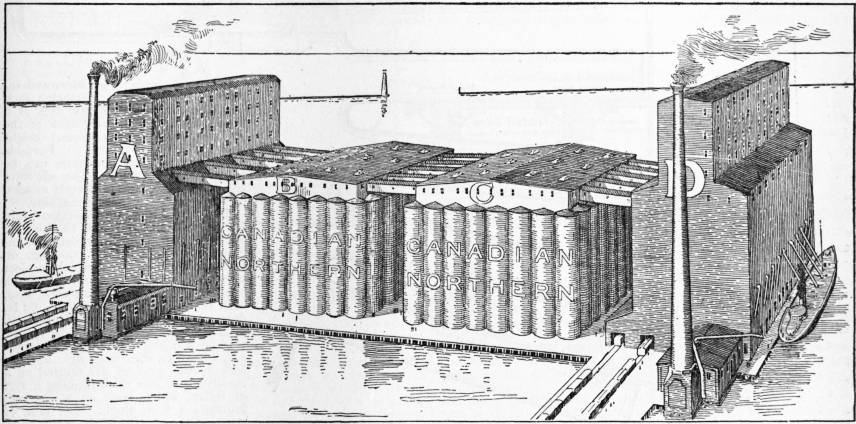
Fig. 1.
One of the largest and most complete grain elevators or warehouses in the world belongs to the Canadian Northern Railway Company, and was erected at Port Arthur, Canada, in 1901-1904. It has a total storage capacity of 7,000,000 Port Arthur, Canada. bushels, or 875,000 qrs. of 480 ℔. The range of buildings and bins forms an oblong, and consists of two storage houses, B and C, placed between two working or receiving houses A and D (fig. 1). The receiving houses are fed by railway sidings. House A, for example, has two sidings, one running through it and the other beside it. Each siding serves five receiving pits, and a receiving elevator of 10,000 ℔ capacity per minute, or 60,000 bushels per hour, can draw grain from either of two pits. Five elevators of 12,000 bushels per hour on the other side of the house serve five warehouse separators, and all the grain received or discharged is weighed, there being ten sets of automatic scales in the upper part of the house, known as the cupola. The hopper of each weigher can take a charge of 1400 bushels (84,000 ℔). Grain can be conveyed either vertically or horizontally to any part of the house, into any of the bins in the annex B, or into any truck or lake steamer. This house is constructed of timber and roofed with corrugated iron. The conveyor belts are 36 in. wide; those at the top of the house are provided with throw-off carriages. The dust from the cleaning machinery is carefully collected and spouted to the furnace under the boiler house, where it is consumed. The cylindrical silo bins in the storage houses consist of hollow tiles of burned clay which, it is claimed, are fire-proof. The tiles are laid on end and are about 12 in. by 12 in. and from 4 in. to 6 in. in thickness according to the size of the bin. Each alternate course consists of grooved blocks of channel tile forming a continuous groove or belt round the bin. This groove receives a steel band acting as a tension member and resisting the lateral pressure of the grain. The steel bands once in position, the groove is completely filled with cement grout by which the steel is encased and protected. Usually the bottoms of the bins are furnished with self-discharging hoppers of weak cinder or gravel concrete finished with cement mortar. For the foundation or supporting floor reinforced concrete is frequently used. The tiles already described are faced with tiles ½ to 1 in. thick, which are laid solid in cement mortar covering the whole exterior of the bin. Any damage to the facing tiles can easily be repaired since they can be removed and replaced without affecting the main bin walls. It is claimed that these facers constitute the best possible protection against fire. A steel framework, covered with tiles, crowns these circular bins and contains the conveyors and spouts which are used to fill the bins. Five tunnels in the concrete bedding that supports the bins carry the belt conveyors which bring back the grain to the working house for cleaning or shipment. There are altogether in each of the storage houses 80 circular bins, each 21 ft. in diameter, and so grouped as to form 63 smaller interspace bins, or 143 bins in all. Each bin will store grain in a column 85 ft. deep, and the whole group has a capacity of 2,500,000 bushels. These bins were all constructed by the Barnett & Record Company of Minneapolis, Minnesota, U.S.A., in accordance with the Johnson & Record patent system of fire-proof tile grain storage construction. In case one of the working houses is attacked by fire the fire-proof storage houses protect not only their own contents but also the other working house, and in the event of its disablement or destruction the remaining one can be easily connected with both the storage houses and handle their contents.
Circular tank silos have not been extensively adopted in Great Britain, but a typical silo tank installation exists at the Walmsley & Smith flour mills which stand beside the Devonshire dock at Barrow-in-Furness. There four circular bins, built of riveted steel Barrow-in-Furness. plates, stand in a group on a quadrangle close to the mill warehouse. A covered gantry, through which passes a band conveyor, runs from the mill warehouse to the working silo house which stands in the central space amid the four steel tanks. The tanks are 70 ft. high, with a diameter of 45 ft., and rest on foundations of concrete and steel. Each has a separate conical roof and they are flat-bottomed, the grain resting directly on the steel and concrete foundation bed. As the load of the full tank is very heavy its even distribution on the bed is considered a point of importance. Each tank can hold about 2500 tons of wheat, which gives a total storage capacity for the four bins of over 45,000 qrs. of 480 ℔. Attached to the mill warehouse is a skip elevator with a discharging capacity of 75 tons an hour. The grain is cleared by this elevator from the hold or holds of the vessel to be unloaded, and is delivered to the basement of the warehouse. Thence it is elevated to an upper storey and passed through an automatic weigher capable of taking a charge of 1 ton. From the weighing machine it can be taken, with or without a preliminary cleaning, to any floor of the warehouse, which has a total storing capacity of 8000 tons, or it can be carried by the band conveyor through the gantry to the working house of the silo installation and distributed to any one of the four tank silos. There is also a connexion by a band conveyor running through a covered gantry into the mill, which stands immediately in the rear. It is perfectly easy to turn over the contents of any tank into any other tank. The whole intake and wheat handling plant is moved by two electro-motors of 35 H.P. each, one installed in the warehouse and the other in the silo working house. Steel silo tanks have the advantage of storing a heavy stock of wheat at comparatively small capital outlay. On an average an ordinary silo bin will not hold more than 500 to 1000 qrs., but each of the bins at Barrow will contain 2500 tons or over 1100 qrs. The steel construction also reduces the risk of fire and consequently lessens the fire premium.
The important granaries at the Liverpool docks date from 1868, but have since been brought up to modern requirements. The Liverpool. warehouses on the Waterloo docks have an aggregate storage area of 11¾ acres, while the sister warehouses on the Birkenhead side, which stand on the margin of the great float, have an area of 11 acres. The total capacity of these warehouses is about 200,000 qrs.
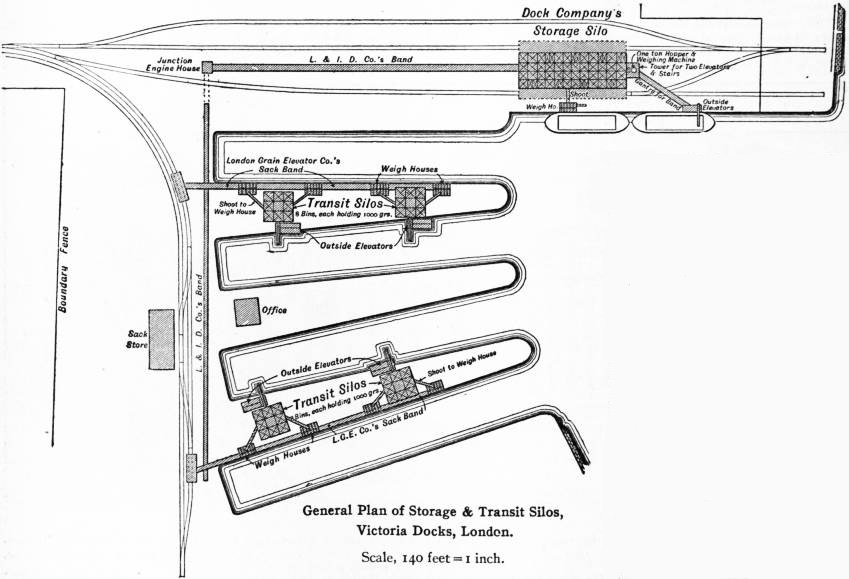
Fig. 2.
The grain warehouse of the Manchester docks at Trafford wharf is locally known as the grain elevator, because it was built to a great extent on the model of an American elevator. Some of the mechanical equipment was supplied by a Manchester. Chicago firm. The total capacity is 1,500,000 bushels or 40,000 tons of grain, which is stored in 226 separate bins. The granary proper stands about 340 ft. from the side of the dock, but is directly connected with the receiving tower, which rises at the water’s edge, by a band conveyor protected by a gantry. The main building is 448 ft. long by 80 ft. wide; the whole of the superstructure was constructed of wood with an external casing of brickwork and tiles. The receiving tower is fitted with a bucket elevator capable, within fairly wide limits, of adjustment to the level of the hold to be unloaded. The elevator has the large unloading capacity of 350 tons per hour, assuming it to be working in a full hold. It is supplemented by a pneumatic elevator (Duckham system) which can raise 200 tons per hour and is used chiefly in dealing with parcels of grain or in clearing grain out of holds which the ordinary elevator cannot reach. The power required to work the large elevator as well as the various band conveyors is supplied by two sets of horizontal Corliss compound engines of 500 H.P. jointly, which are fed by two Galloway boilers working at 100 ℔ pressure. The pneumatic elevator is driven by two sets of triple expansion vertical engines of 600 H.P. fed by three boilers working at a pressure of 160 ℔. The grain received in the tower is automatically weighed. From the receiving tower the grain is conveyed into the warehouse where it is at once elevated to the top of a central tower, and is thence distributed to any of the bins by band conveyors in the usual way. The mechanical equipment of this warehouse is very complete, and the following several operations can be simultaneously effected: discharging grain from vessels in the dock at the rate of 350 tons per hour; weighing in the tower; conveying grain into the warehouse and distributing it into any of the 226 bins; moving grain from bin to bin either for aerating or delivery, and simultaneously weighing in bulk at the rate of 500 tons per hour; sacking grain, weighing and loading the sacks into 40 railway trucks and 10 carts simultaneously; loading grain from the warehouse into barges or coasting craft at the rate of 150 tons per hour in bulk or of 250 sacks per hour. This warehouse is equipped with a dryer of American construction, which can deal with 50 tons of damp grain at one time, and is connected with the whole bin system so that grain can be readily moved from any bin to the dryer or conversely.
A grain warehouse at the Victoria docks, London, belonging to the London and India Docks Company (fig. 2) has a storing capacity of about 25,000 qrs. or 200,000 bushels. It is over 100 ft. high, and is built on the American plan of interlaced London. timbers resting on iron columns. The walls are externally cased with steel plates. The grain is stored in 56 silos, most of which are about 10 ft. square by 50 ft. deep. The intake plant has a capacity of 100 tons of wheat an hour, and includes six automatic grain scales, each of which can weigh off one sack at a time. The main delivery floor of the warehouse is at a convenient height above the ground level. Portable automatic weighing machines can be placed under any bin. The whole of the plant is driven by electric motors, one being allotted to each machine.
The transit silos of the London Grain Elevator Company, also at the Victoria docks, consist of four complete and independent installations standing on three tongues of land which project into the water (figs. 2 and 3). Each silo house is furnished with eight bins, each of which, 12 ft. square by 80 ft. deep, has a capacity of 1000 qrs. of grain. A kind of well in the middle of each silo house contains the necessary elevators, staircases, &c. The silo bins in each granary are erected on a massive cast iron tank forming a sort of cellar, which rests on a concrete foundation 6 ft. thick. The base of the tank is 30 ft. below the water level. The silos are formed of wooden battens nailed one on top of the other, the pieces interlacing. Rolled steel girders resting on cast iron columns support the silos. To ensure a clean discharge the hopper bottoms were designed so as to avoid joints and thus to be free from rivets or similar protuberances. The exterior of each silo house is covered with corrugated iron, and the same material is used for the roofing. No conveyors serve the silo bins, as the elevators which rise above the tops of the silos can feed any one of them by gravity. There are three delivery elevators to each granary, one with a capacity of 120 tons and the other two of 100 tons each an hour. Each silo house is served by a large elevator with a capacity of 120 tons per hour, which discharges into the elevator well inside the house. The delivery elevators discharge into a receiving shed in which there is a large hopper feeding six automatic weighing machines. Each charge as it is weighed empties itself automatically into sacks, which are then ready for loading. Each pair of warehouses is provided with a conveyor band 308 ft. long, used either for carrying sacks from the weighing sheds to railway trucks or for carrying grain in bulk to barges or trucks. Each silo house has an identical mechanical equipment apart from the delivery band it shares with its fellow warehouse. All operations in connexion with the silo houses are effected under cover. The silos are normally fed by a fleet of twenty-six of Philip’s patent self-discharging lighters. These craft are hopper-bottomed and fitted with band conveyors of the ordinary type, running between the double keelson of the lighter and delivering into an elevator erected at the stern of the lighter. By this means little trimming is required after the barge, which holds about 200 tons of grain, has been cleared. Ocean steamers of such draft as to preclude their entry into any of the up river docks are cleared at Tilbury by these lighters. It is said that grain loaded at Tilbury into these lighters can be delivered from the transit silos to railway trucks or barges in about six hours. The total storage capacity of the silos amounts to 32,000 qrs. The motive power is furnished by 14 gas engines of a total capacity of 366 H.P.
Two of the largest granaries on the continent of Europe are situated at the mouth of the Danube, at Braila and Galatz, in Rumania, and serve for both the reception and discharge of grain. At the edge of the quay on which these warehouses Rumania. are built there are rails with a gauge of 11½ ft., upon which run two mechanical loading and unloading appliances. The first consists of a telescopic elevator which raises the grain and delivers it to one of the two band conveyors at the head of the apparatus. Each of these bands feeds automatic weighing machines with an hourly capacity of 75 tons. From these weighers the grain is either discharged through a manhole in the ground to a band conveyor running in a tunnel parallel to the quay wall, or it is raised by a second elevator (part of the same unloading apparatus), set at an inclined angle, which delivers at a sufficient height to load railway trucks on the siding running parallel to the quay. A turning gear is provided so as to reverse, if required, the operation of the whole apparatus, that the portion overhanging the water can be turned to the land side. The unloading capacity is 150 tons of grain per hour. If it be desired to load a ship the telescopic elevator has only to be turned round and dipped into any one of 15 wells, which can be filled up with grain from the land side. The capacity of each granary is 233,333 qrs.
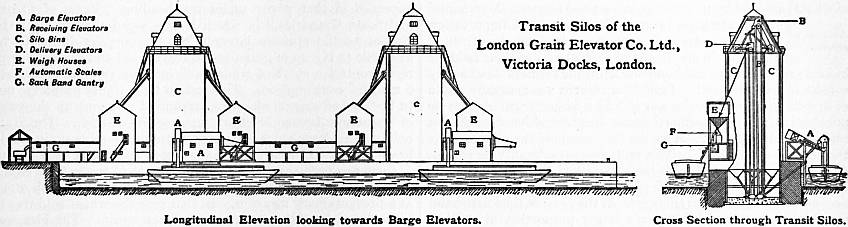
Fig. 3.
Many large granaries have been built, in which grain is stored on open floors, in bulk or in sacks. A notable instance is the warehouse of the city of Stuttgart. This is a structure of seven floors, including a basement and entresol. An Stuttgart. engine house accommodates two gas engines as well as an hydraulic installation for the lifts. The grain is received by an elevator from the railway trucks, and is delivered to a weighing machine from which it is carried by a second elevator to the top storey, where it is fed to a band running the length of the building. A system of pipes runs from floor to floor, and by means of the band conveyor with its movable throw-off carriage grain can be shot to any floor. A second band conveyor is installed in the entresol floor, and serves to convey grain either to the elevator, if it is desired to elevate it to the top floor, or to the loading shed. A second elevator runs through the centre of the building, and is provided with a spout by means of which grain can be delivered into the hopper feeding the cleaning machine, whence the grain passes into a second hopper under which is an automatic weigher; directly under this weigher the grain is sacked.
A good example of a grain warehouse on the combined silo bin and floor storage system is afforded by the granary at Mannheim on the Rhine, which has the storage capacity of 2100 tons. The building is 370 ft. in length, 78 ft. wide and Mannheim. 78 ft. high, and by means of transverse walls it is divided into three sections; of these one contains silos, in another section grain is stored on open floors, while the third, which is situated between the other two, is the grain-cleaning department. This granary stands by the quay side, and a ship elevator of great capacity, which serves the cleaning department, can rapidly clear any ship or barge beneath. The central or screening house section contains machinery specially designed for cleaning barley as well as wheat. The barley plant has a capacity of 5 tons per hour. There are four main elevators in this warehouse, while two more serve the screen house. The usual band conveyors fitted with throw-off carriages are provided, and are supplemented by an elaborate system of pipes which receive grain from the elevators and bands and distribute it at any required point. The plant is operated by electric motors. If desired the floors of the non-silo section can be utilized for storing other goods than grain, and to this end a lift with a capacity of 1 ton runs from the basement to the top storey. The combined capacity of the elevators and conveyors is 100 tons of grain per hour. The mechanical equipment is so complete that four distinct operations are claimed as possible. A ship may be unloaded into silos or into the granary floors, and may simultaneously be loaded either from silos or floors with different kinds of grain. Again, a cargo may be discharged either into silos or upon the floors, and simultaneously the grain may be cleaned. Grain may also be cleared from a vessel, mixed with other grain already received, and then distributed to any desired point. With equal facility grain may be cleaned, blended with other varieties, re-stored in any section of the granary, and transferred from one ship to another.
A granary with special features of interest, erected on the quay at Dortmund, Germany, by a co-operative society, is built of brick on a base of hewn stone, with beams and supports of timber. It is 78 ft. high and consists of seven floors, Dortmund. including basement and attic. Here again there are two sections, the larger being devoted to the storage of grain in low bins, while the smaller section consists of an ordinary silo house. Grain in sacks may be stored in the basement of the larger section which has a capacity of 1675 tons as compared with 825 tons in the silo department. Thus the total storage capacity is 2500 tons. In the silo house the bins, constructed of planks nailed one over the other, are of varying size and are capable of storing grain to a depth of 42 to 47 ft. Some of the bins have been specially adapted for receiving damp grain by being provided internally with transverse wooden arms which form square or lozenge-shaped sections. The object of this arrangement is to break up and aerate the stored grain. The arms are of triangular section and are slightly hollowed at the base so as to bring a current of air into direct contact with the grain. The air can be warmed if necessary. The other and larger section of the granary is provided with 105 bins of moderate height arranged in groups of 21 on the five floors between the basement and attic. On the intermediate floors and the bottom floor each bin lies exactly under the bin above. Grain is not stored in these bins to a greater depth than 5 ft. The bins are fitted with removable side walls, and damp grain is only stored in certain bins aerated for half the area of their side walls through a wire mesh. The arrangements for distributing grain in this warehouse are very complete. The uncleaned grain is taken by the receiving elevator, with a lifting capacity of 20 tons per hour, to a warehouse separator, whence it is passed through an automatic weigher and is then either sacked or spouted to the main elevator (capacity 25 tons per hour) and elevated to the attic. From the head of this main elevator the grain can either be fed to a bin in one or other of the main granary floors, or shot to one of the bins in the silo house. In the attic the grain is carried by a spout and belt conveyor to one or other of the turntables, as the appliances may be termed, which serve to distribute through spouts the grain to any one of the floor or silo bins. Alternatively, the grain may be shot into the basement and there fed back into the main elevator by a band conveyor. In this way the grain may be turned over as often as it is deemed necessary. At the bottom of each bin are four apertures connected by spouts, both with the bin below and with the central vertical pipe which passes down through the centre of each group of bins. To regulate the course of the grain from bin to bin or from bin to central pipe, the connecting spouts are fitted with valves of ingenious yet simple construction which deflect the grain in any desired direction, so that the contents of two or more bins may be blended, or grain may be transferred from a bin on one floor to a bin on a lower floor, missing the bin on the floor between. The valves are controlled by chains from the basement.
With reference to the floor bins used at Dortmund, it may be observed that there are granaries built on a similar principle in the United Kingdom. It is probable that bins of moderate height are more suitable for storing grain containing a considerable amount of moisture than deep silos, whether made of wood, ferro-concrete or other material. For one thing floor bins of the Dortmund pattern can be more effectually aerated than deep silos. German wheat has many characteristics in common with British, and, especially in north Germany, is not infrequently harvested in a more or less damp condition. In the United Kingdom, Messrs Spencer & Co., of Melksham, have erected several granaries on the floor-bin principle, and have adopted an ingenious system of “telescopic” spouting, by means of which grain may be discharged from one bin to another or at any desired point. This spouting can be applied to bins either with level floors or with hoppered bottoms, if they are arranged one above the other on the different floors, and is so constructed that an opening can be effected at certain points by simply sliding upwards a section of the spout.
National Granaries.—Wheat forms the staple food of a large proportion of the population of the British Isles, and of the total amount consumed about four-fifths is sea-borne. The stocks normally held in the country being limited, serious consequences might result from any interruption of the supply, such as might occur were Great Britain involved in war with a power or powers commanding a strong fleet. To meet this contingency it has been suggested that the State should establish granaries containing a national reserve of wheat for use in emergency, or should adopt measures calculated to induce merchants, millers, &c., to hold larger stocks than at present and to stimulate the production of home-grown wheat.
Stocks of wheat (and of flour expressed in its equivalent weight of wheat) are held by merchants, millers and farmers. Merchants’ stocks are kept in granaries at ports of importation and are known as first-hand stocks. Stocks of wheat Amount of stocks. and flour in the hands of millers and of flour held by bakers are termed second-hand stocks, while farmers’ stocks only consist of native wheat. Periodical returns are generally made of first-hand or port stocks, nor should a wide margin of error be possible in the case of farmers’ stocks, but second-hand stocks are more difficult to gauge. Since the last decade of the 19th century the storage capacity of British mills has considerably increased. As the number of small mills has diminished the capacity of the bigger ones has increased, and proportionately their warehousing accommodation has been enlarged. At the present time first-hand stocks tend to diminish because a larger proportion of millers’ holdings are in mill granaries and silo houses. The immense preponderance of steamers over sailing vessels in the grain trade has also had the effect of greatly diminishing stocks. With his cargo or parcel on a steamer a corn merchant can tell almost to a day when it will be due. In fact foreign wheat owned by British merchants is to a great extent stored in foreign granaries in preference to British warehouses. The merchant’s risk is thereby lessened to a certain extent. When his wheat has been brought into a British port, to send it farther afield means extra expense. But wheat in an American or Argentine elevator may be ordered wherever the best price can be obtained for it. Options or “futures,” too, have helped to restrict the size of wheat stocks in the United Kingdom. A merchant buys a cargo of wheat on passage for arrival at a definite time, and, lest the market value of grain should have depreciated by the time it arrives, he sells an option against it. In this way he hedges his deal, the option serving as insurance against loss. This is why the British corn trade finds it less risky to limit purchases to bare needs, protecting itself by option deals, than to store large quantities which may depreciate and involve their owners in loss.