VOLUME XII SLICE III Gordon, Lord George to Grasses (continued 2)
Reading edition
In educational subjects Goschen had always taken the greatest interest, his best known, but by no means his only, contribution to popular culture being his participation in the University Extension Movement; and his first efforts in parliament were devoted to advocating the abolition of religious tests and the admission of Dissenters to the universities. His published works indicate how ably he combined the wise study of economics with a practical instinct for business-like progress, without neglecting the more ideal aspects of human life. In addition to his well-known work on The Theory of the Foreign Exchanges, he published several financial and political pamphlets and addresses on educational and social subjects, among them being that on Cultivation of the Imagination, Liverpool, 1877, and that on Intellectual Interest, Aberdeen, 1888. He also wrote The Life and Times of Georg Joachim Goschen, publisher and printer of Leipzig (1903).
(H. Ch.)
GOS-HAWK, i.e. goose-hawk, the Astur palumbarius of ornithologists, and the largest of the short-winged hawks used in falconry. Its English name, however, has possibly been transferred to this species from one of the long-winged hawks or true falcons, since there is no tradition of the gos-hawk, now so called, having ever been used in Europe to take geese or other large and powerful birds. The genus Astur may be readily distinguished from Falco by the smooth edges of its beak, its short wings (not reaching beyond about the middle of the tail), and its long legs and toes—though these last are stout and comparatively shorter than in the sparrow-hawks (Accipiter). In plumage the gos-hawk has a general resemblance to the peregrine falcon, and it undergoes a corresponding change as it advances from youth to maturity—the young being longitudinally streaked beneath, while the adults are transversely barred. The irides, however, are always yellow, or in old birds orange, while those of the falcons are dark brown. The sexes differ greatly in size. There can be little doubt that the gos-hawk, nowadays very rare in Britain, was once common in England, and even towards the end of the 18th century Thornton obtained a nestling in Scotland, while Irish gos-hawks were of old highly celebrated. Being strictly a woodland-bird, its disappearance may be safely connected with the disappearance of the ancient forests in Great Britain, though its destructiveness to poultry and pigeons has doubtless contributed to its present scarcity. In many parts of the continent of Europe it still abounds. It ranges eastward to China and is much valued in India. In North America it is represented by a very nearly allied species, A. atricapillus, chiefly distinguished by the closer barring of the breast. Three or four examples corresponding with this form have been obtained in Britain. A good many other species of Astur (some of them passing into Accipiter) are found in various parts of the world, but the only one that need here be mentioned is the A. novae-hollandiae of Australia, which is remarkable for its dimorphism—one form possessing the normal dark-coloured plumage of the genus and the other being perfectly white, with crimson irides. Some writers hold these two forms to be distinct species and call the dark-coloured one A. cinereus or A. raii.
(A. N.)
GOSHEN, a division of Egypt settled by the Israelites between Jacob’s immigration and the Exodus. Its exact delimitation is a difficult problem. The name may possibly be of Semitic, or at least non-Egyptian origin, as in Palestine we meet with a district (Josh. x. 41) and a city (ib. xv. 51) of the same name. The Septuagint reads Γέσεμ Ἀραβίας in Gen. xlv. 10, and xlvi. 34, elsewhere simply Γέσεμ. In xlvi. 28 “Goshen ... the land of Goshen” are translated respectively “Heroopolis ... the land of Rameses.” This represents a late Jewish identification. Ptolemy defines “Arabia” as an Egyptian nome on the eastern border of the delta, with capital Phacussa, corresponding to the Egyptian nome Sopt and town Kesem. It is doubtful whether Phacussa be situated at the mounds of Fākūs, or at another place, Saft-el-Henneh, which suits Strabo’s description of its locality rather better. The extent of Goshen, according to the apocryphal book of Judith (i. 9, 10), included Tanis and Memphis; this is probably an overstatement. It is indeed impossible to say more than that it was a place of good pasture, on the frontier of Palestine, and fruitful in edible vegetables and in fish (Numbers xi. 5).
(R. A. S. M.)
GOSHEN, a city and the county-seat of Elkhart county, Indiana, U.S.A., on the Elkhart river, about 95 m. E. by S. of Chicago, at an altitude of about 800 ft. Pop. (1890) 6033; (1900) 7810 (462 foreign-born); (1910) 8514. Goshen is served by the Cleveland, Cincinnati, Chicago & St Louis, and the Lake Shore & Michigan Southern railways, and is connected by electric railway with Warsaw and South Bend. The city has a Carnegie library, and is the seat of Goshen College (under Mennonite control), chartered as Elkhart Institute, at Elkhart, Ind., in 1895, and removed to Goshen and opened under its present name in 1903. The college includes a collegiate department, an academy, a Bible school, a normal school, a summer school and correspondence courses, and schools of business, of music and of oratory, and in 1908-1909 had 331 students, 73 of whom were in the Academy. Goshen is situated in a good farming region and is an important lumber market. There is a good water-power. Among the city’s manufactures are wagons and carriages, furniture, wooden-ware, veneering, sash and doors, ladders, lawn swings, rubber goods, flour, foundry products and agricultural machinery. The municipality owns its water works and its electric-lighting system. Goshen was first settled in 1828 and was first chartered as a city in 1868.
GOSLAR, a town of Germany, in the Prussian province of Hanover, romantically situated on the Gose, an affluent of the Oker, at the north foot of the Harz, 24 m. S.E. of Hildesheim and 31 m. S.W. from Brunswick, by rail. Pop. (1905) 17,817. It is surrounded by walls and is of antique appearance. Among the noteworthy buildings are the “Zwinger,” a tower with walls 23 ft. thick; the market church, in the Romanesque style, restored since its partial destruction by fire in 1844, and containing the town archives and a library in which are some of Luther’s manuscripts; the old town hall (Rathaus), possessing many interesting antiquities; the Kaiserworth (formerly the hall of the tailors’ gild and now an inn) with the statues of eight of the German emperors; and the Kaiserhaus, the oldest secular building in Germany, built by the emperor Henry III. before 1050 and often the residence of his successors. This was restored in 1867-1878 at the cost of the Prussian government, and was adorned with frescoes portraying events in German history. Other buildings of interest are:—the small chapel which is all that remains since 1820 of the old and famous cathedral of St Simon and St Jude founded by Henry III. about 1040, containing among other relics of the cathedral an old altar supposed to be that of the idol Krodo which formerly stood on the Burgberg near Neustadt-Harzburg; the church of the former Benedictine monastery of St Mary, or Neuwerk, of the 12th century, in the Romanesque style, with wall-paintings of considerable merit; and the house of the bakers’ gild now an hotel, the birthplace of Marshal Saxe. There are four Evangelical churches, a Roman Catholic church, a synagogue, several schools, a natural science museum, containing a collection of Harz minerals, the Fenkner museum of antiquities and a number of small foundations. The town has equestrian statues of the emperor Frederick I. and of the German emperor William I. The population is chiefly occupied in connexion with the sulphur, copper, silver and other mines in the neighbourhood. The town has also been long noted for its beer, and possesses some small manufactures and a considerable trade in fruit.
Goslar is believed to have been founded by Henry the Fowler about 920, and when in the time of Otto the Great the mineral treasures in the neighbourhood were discovered it increased rapidly in prosperity. It was often the meeting-place of German diets, twenty-three of which are said to have been held here, and was frequently the residence of the emperors. About 1350 it joined the Hanseatic League. In the middle of the 14th century the famous Goslar statutes, a code of laws, which was adopted by many other towns, was published. The town was unsuccessfully besieged in 1625, during the Thirty Years’ War, but was taken by the Swedes in 1632 and nearly destroyed by fire. Further conflagrations in 1728 and 1780 gave a severe blow to its prosperity. It was a free town till 1802, when it came into the possession of Prussia. In 1807 it was joined to Westphalia, in 1816 to Hanover and in 1866 it was, along with Hanover, re-united to Prussia.
See T. Erdmann, Die alte Kaiserstadt Goslar und ihre Umgebung in Geschichte, Sage und Bild (Goslar, 1892); Crusius, Geschichte der vormals kaiserlichen freien Reichstadt Goslar (1842-1843); A. Wolfstieg, Verfassungsgeschichte von Goslar (Berlin, 1885); T. Asche, Die Kaiserpfalz zu Goslar (1892); Neuburg, Goslars Bergbau bis 1552 (Hanover, 1892); and the Urkundenbuch der Stadt Goslar, edited by G. Bode (Halle, 1893-1900). For the Goslarische Statuten see the edition published by Göschen (Berlin, 1840).
GOSLICKI, WAWRZYNIEC (? 1533-1607), Polish bishop, better known under his Latinized name of Laurentius Grimalius Goslicius, was born about 1533. After having studied at Cracow and Padua, he entered the church, and was successively appointed bishop of Kaminietz and of Posen. Goslicki was an active man of business, was held in high estimation by his contemporaries and was frequently engaged in political affairs. It was chiefly through his influence, and through the letter he wrote to the pope against the Jesuits, that they were prevented from establishing their schools at Cracow. He was also a strenuous advocate of religious toleration in Poland. He died on the 31st of October 1607.
His principal work is De Optimo senatore, &c. (Venice, 1568). There are two English translations published respectively under the titles A commonwealth of good counsaile, &c. (1607), and The Accomplished Senator, done into English by Mr Oldisworth (1733).
GOSLIN, or Gauzlinus (d. c. 886), bishop of Paris and defender of the city against the Northmen (885), was, according to some authorities, the son of Roricon II., count of Maine, according to others the natural son of the emperor Louis I. In 848 he became a monk, and entered a monastery at Reims, later he became abbot of St Denis. Like most of the prelates of his time he took a prominent part in the struggle against the Northmen, by whom he and his brother Louis were taken prisoners (858), and he was released only after paying a heavy ransom (Prudentii Trecensis episcopi Annales, ann. 858). From 855 to 867 he held intermittently, and from 867 to 881 regularly, the office of chancellor to Charles the Bald and his successors. In 883 or 884 he was elected bishop of Paris, and foreseeing the dangers to which the city was to be exposed from the attacks of the Northmen, he planned and directed the strengthening of the defences, though he also relied for security on the merits of the relics of St Germain and St Geneviève. When the attack finally came (885), the defence of the city was entrusted to him and to Odo, count of Paris, and Hugh, abbot of St Germain l’Auxerrois. The city was attacked on the 26th of November, and the struggle for the possession of the bridge (now the Pont-au-Change) lasted for two days; but Goslin repaired the destruction of the wooden tower overnight, and the Normans were obliged to give up the attempt to take the city by storm. The siege lasted for about a year longer, while the emperor Charles the Fat was in Italy. Goslin died soon after the preliminaries of the peace had been agreed on, worn out by his exertions, or killed by a pestilence which raged in the city.
See Amaury Duval, L’Évêque Gozlin ou le siège de Paris par les Normands, chronique du IXe siècle (2 vols., Paris, 1832, 3rd ed. ib. 1835).
GOSNOLD, BARTHOLOMEW (d. 1607), English navigator. Nothing is known of his birth, parentage or early life. In 1602, in command of the “Concord,” chartered by Sir Walter Raleigh and others, he crossed the Atlantic; coasted from what is now Maine to Martha’s Vineyard, landing at and naming Cape Cod and Elizabeth Island (now Cuttyhunk) and giving the name Martha’s Vineyard to the island now called No Man’s Land; and returned to England with a cargo of furs, sassafras and other commodities obtained in trade with the Indians about Buzzard’s Bay. In London he actively promoted the colonization of the regions he had visited and, by arousing the interest of Sir Ferdinando Gorges and other influential persons, contributed toward securing the grants of the charters to the London and Plymouth Companies in 1606. In 1606-1607 he was associated with Christopher Newport in command of the three vessels by which the first Jamestown colonists were carried to Virginia. As a member of the council he took an active share in the affairs of the colony, ably seconding the efforts of John Smith to introduce order, industry and system among the motley array of adventurers and idle “gentlemen” of which the little band was composed. He died from swamp fever on the 22nd of August 1607.
See The Works of John Smith (Arber’s Edition, London, 1884); and J. M. Brereton, Brief and True Relation of the North Part of Virginia (reprinted by B. F. Stevens, London, 1901), an account of Gosnold’s voyage of 1602.
GOSPATRIC (fl. 1067), earl of Northumberland, belonged to a family which had connexions with the royal houses both of Wessex and Scotland. Before the Conquest he accompanied Tostig on a pilgrimage to Rome (1061); and at that time was a landholder in Cumberland. About 1067 he bought the earldom of Northumberland from William the Conqueror; but, repenting of his submission, fled with other Englishmen to the court of Scotland (1068). He joined the Danish army of invasion in the next year; but was afterwards able, from his possession of Bamburgh castle, to make terms with the conqueror, who left him undisturbed till 1072. The peace concluded in that year with Scotland left him at William’s mercy. He lost his earldom and took refuge in Scotland, where Malcolm seems to have provided for him.
See E. A. Freeman, Norman Conquest, vol. i. (Oxford, 1877), and the English Hist. Review, vol. xix. (London, 1904).
GOSPEL (O. Eng. godspel, i.e. good news, a translation of Lat. bona annuntiatio, or evangelium, Gr. εὐαγγέλιον; cf. Goth. iu spillon, “to announce good news,” Ulfilas’ translation of the Greek, from iu, that which is good, and spellon to announce), primarily the “glad tidings” announced to the world by Jesus Christ. The word thus came to be applied to the whole body of doctrine taught by Christ and his disciples, and so to the Christian revelation generally (see Christianity); by analogy the term “gospel” is also used in other connexions as equivalent to “authoritative teaching.” In a narrower sense each of the records of the life and teaching of Christ preserved in the writings of the four “evangelists” is described as a Gospel. The many more or less imaginative lives of Christ which are not accepted by the Christian Church as canonical are known as “apocryphal gospels” (see Apocryphal Literature). The present article is concerned solely with general considerations affecting the four canonical Gospels; see for details of each, the articles under Matthew, Mark, Luke and John.
The Four Gospels.—The disciples of Jesus proclaimed the Gospel that He was the Christ. Those to whom this message was first delivered in Jerusalem and Palestine had seen and heard Jesus, or had heard much about Him. They did not require to be told who He was. But more and more as the work of preaching and teaching extended to such as had not this knowledge, it became necessary to include in the Gospel delivered some account of the ministry of Jesus. Moreover, alike those who had followed Him during His life on earth, and all who joined themselves to them, must have felt the need of dwelling on His precepts, so that these must have been often repeated, and also in all probability from an early time grouped together according to their subjects, and so taught. For some time, probably for upwards of thirty years, both the facts of the life of Jesus and His words were only related orally. This would be in accordance with the habits of mind of the early preachers of the Gospel. Moreover, they were so absorbed in the expectation of the speedy return of Christ that they did not feel called to make provision for the instruction of subsequent generations. The Epistles of the New Testament contain no indications of the existence of any written record of the life and teaching of Christ. Tradition indicates A.D. 60-70 as the period when written accounts of the life and teaching of Jesus began to be made (see Mark, Gospel of, and Matthew, Gospel of). This may be accepted as highly probable. We cannot but suppose that at a time when the number of the original band of disciples of Jesus who survived must have been becoming noticeably smaller, and all these were advanced in life, the importance of writing down that which had been orally delivered concerning the Gospel-history must have been realized. We also gather from Luke’s preface (i. 1-4) that the work of writing was undertaken in these circumstances and under the influence of this feeling, and that various records had already in consequence been made.
But do our Gospels, or any of them, in the form in which we actually have them, belong to the number of those earliest records? Or, if not, what are the relations in which they severally stand to them? These are questions which in modern criticism have been greatly debated. With a view to obtaining answers to them, it is necessary to consider the reception of the Gospels in the early Church, and also to examine and compare the Gospels themselves. Some account of the evidence supplied in these two ways must be given in the present article, so far as it is common to all four Gospels, or to three or two of them, and in the articles on the several Gospels so far as it is especial to each.
1. The Reception of the Gospels in the Early Church.—The question of the use of the Gospels and of the manner in which they were regarded during the period extending from the latter years of the 1st century to the beginning of the last quarter of the 2nd is a difficult one. There is a lack of explicit references to the Gospels;1 and many of the quotations which may be taken from them are not exact. At the same time these facts can be more or less satisfactorily accounted for by various circumstances. In the first place, it would be natural that the habits of thought of the period when the Gospel was delivered orally should have continued to exert influence even after the tradition had been committed to writing. Although documents might be known and used, they would not be regarded as the authorities for that which was independently remembered, and would not, therefore, necessarily be mentioned. Consequently, it is not strange that citations of sayings of Christ—and these are the only express citations in writings of the Subapostolic Age—should be made without the source whence they were derived being named, and (with a single exception) without any clear indication that the source was a document. The exception is in the little treatise commonly called the Epistle of Barnabas, probably composed about A.D. 130, where (c. iv. 14) the words “many are called but few chosen” are introduced by the formula “as it is written.”
For the identification, therefore, of the source or sources used we have to rely upon the amount of correspondence with our Gospels in the quotations made, and in respect to other parallelisms of statement and of expression, in these early Christian writers. The correspondence is in the main full and true as regards spirit and substance, but it is rarely complete in form. The existence of some differences of language may, however, be too readily taken to disprove derivation. Various forms of the same saying occurring in different documents, or remembered from oral tradition and through catechetical instruction, would sometimes be purposely combined. Or, again, the memory might be confused by this variety, and the verification of quotations, especially of brief ones, was difficult, not only from the comparative scarcity of the copies of books, but also because ancient books were not provided with ready means of reference to particular passages. On the whole there is clearly a presumption that where we have striking expressions which are known to us besides only in one of our Gospel-records, that particular record has been the source of it. And where there are several such coincidences the ground for the supposition that the writing in question has been used may become very strong. There is evidence of this kind, more or less clear in the several cases, that all the four Gospels were known in the first two or three decades of the 2nd century. It is fullest as to our first Gospel and, next to this one, as to our third.
After this time it becomes manifest that, as we should expect, documents were the recognized authorities for the Gospel history; but there is still some uncertainty as to the documents upon which reliance was placed, and the precise estimation in which they were severally held. This is in part at least due to the circumstance that nearly all the writings which have remained of the Christian literature belonging to the period circa A.D. 130-180 are addressed to non-Christians, and that for the most part they give only summaries of the teaching of Christ and of the facts of the Gospel, while terms that would not be understood by, and names that would not carry weight with, others than Christians are to a large extent avoided. The most important of the writings now in question are two by Justin Martyr (circa A.D. 145-160), viz. his Apology and his Dialogue with Trypho. In the former of these works he shows plainly his intention of adapting his language and reasoning to Gentile, and in the latter to Jewish, readers. In both his name for the Gospel-records is “Memoirs of the Apostles.” After a great deal of controversy there has come to be very wide agreement that he reckoned the first three Gospels among these Memoirs. In the case of the second and third there are indications, though slight ones, that he held the view of their composition and authorship which was common from the last quarter of the century onwards (see Mark, Gospel of, and Luke, Gospel of), but he has made the largest use of our first Gospel. It is also generally allowed that he was acquainted with the fourth Gospel, though some think that he used it with a certain reserve. Evidence may, however, be adduced which goes far to show that he regarded it, also, as of apostolic authority. There is a good deal of difference of opinion still as to whether Justin reckoned other sources for the Gospel-history besides our Gospels among the Apostolic Memoirs. In this connexion, however, as well as on other grounds, it is a significant fact that within twenty years or so after the death of Justin, which probably occurred circa A.D. 160, Tatian, who had been a hearer of Justin, produced a continuous narrative of the Gospel-history which received the name Diatessaron (“through four”), in the main a compilation from our four Gospels.2
Before the close of the 2nd century the four Gospels had attained a position of unique authority throughout the greater part of the Church, not different from that which they have held since, as is evident from the treatise of Irenaeus Against Heresies (c. A.D. 180; see esp. iii. i. 1 f. and x., xi.) and from other evidence only a few years later. The struggle against Gnosticism, which had been going on during the middle part of the century, had compelled the Church both to define her creed and to draw a sharper line of demarcation than heretofore between those writings whose authority she regarded as absolute and all others. The effect of this was no doubt to enhance the sense generally entertained of the value of the four Gospels. At the same time in the formal statements now made it is plainly implied that the belief expressed is no new one. And it is, indeed, difficult to suppose that agreement on this subject between different portions of the Church could have manifested itself at this time in the spontaneous manner that it does, except as the consequence of traditional feelings and convictions, which went back to the early part of the century, and which could hardly have arisen without good foundation, with respect to the special value of these works as embodiments of apostolic testimony, although all that came to be supposed in regard to their actual authorship cannot be considered proved.
2. The Internal Criticism of the Gospels.—In the middle of the 19th century an able school of critics, known as the Tübingen school, sought to show from indications in the several Gospels that they were composed well on in the 2nd century in the interests of various strongly marked parties into which the Church was supposed to have been divided by differences in regard to the Judaic and Pauline forms of Christianity. These theories are now discredited. It may on the contrary be confidently asserted with regard to the first three Gospels that the local colouring in them is predominantly Palestinian, and that they show no signs of acquaintance with the questions and the circumstances of the 2nd century; and that the character even of the Fourth Gospel is not such as to justify its being placed, at furthest, much after the beginning of that century.
We turn to the literary criticism of the Gospels, where solid results have been obtained. The first three Gospels have in consequence of the large amount of similarity between them in contents, arrangement, and even in words and the forms of sentences and paragraphs, been called Synoptic Gospels. It has long been seen that, to account for this similarity, relations of interdependence between them, or of common derivation, must be supposed. And the question as to the true theory of these relations is known as the Synoptic Problem. Reference has already been made to the fact that during the greater part of the Apostolic age the Gospel history was taught orally. Now some have held that the form of this oral teaching was to a great extent a fixed one, and that it was the common source of our first three Gospels. This oral theory was for a long time the favourite one in England; it was never widely held in Germany, and in recent years the majority of English students of the Synoptic Problem have come to feel that it does not satisfactorily explain the phenomena. Not only are the resemblances too close, and their character in part not of a kind, to be thus accounted for, but even many of the differences between parallel contexts are rather such as would arise through the revision of a document than through the freedom of oral delivery.
It is now and has for many years been widely held that a document which is most nearly represented by the Gospel of Mark, or which (as some would say) was virtually identical with it, has been used in the composition of our first and third Gospels. This source has supplied the Synoptic Outline, and in the main also the narratives common to all three. Questions connected with the history of this document are treated in the article on Mark, Gospel of.
There is also a considerable amount of matter common to Matthew and Luke, but not found in Mark. It is introduced into the Synoptic Outline very differently in those two Gospels, which clearly suggests that it existed in a separate form, and was independently combined by the first and third evangelists with their other document. This common matter has also a character of its own; it consists mainly of pieces of discourse. The form in which it is given in the two Gospels is in several passages so nearly identical that we must suppose these pieces at least to have been derived immediately or ultimately from the same Greek document. In other cases there is more divergence, but in some of them this is accounted for by the consideration that in Matthew passages from the source now in question have been interwoven with parallels in the other chief common source before mentioned. There are, however, instances in which no such explanation will serve, and it is possible that our first and third evangelists may have used two documents which were not in all respects identical, but which corresponded very closely on the whole. The ultimate source of the subject matter in question, or of the most distinctive and larger part of it, was in all probability an Aramaic one, and in some parts different translations may have been used.
This second source used in the composition of Matthew and Luke has frequently been called “The Logia” in order to signify that it was a collection of the sayings and discourses of Jesus. This name has been suggested by Schleiermacher’s interpretation of Papias’ fragment on Matthew (see Matthew, Gospel of). But some have maintained that the source in question also contained a good many narratives, and in order to avoid any premature assumption as to its contents and character several recent critics have named it “Q.” It may, however, fairly be called “the Logian document,” as a convenient way of indicating the character of the greater part of the matter which our first and third evangelists have taken from it, and this designation is used in the articles on the Gospels of Luke and Matthew. The reconstruction of this document has been attempted by several critics. The arrangement of its contents can, it seems, best be learned from Luke.
3. One or two remarks may here be added as to the bearing of the results of literary criticism upon the use of the Gospels. Their effect is to lead us, especially when engaged in historical inquiries, to look beyond our Gospels to their sources, instead of treating the testimony of the Gospels severally as independent and ultimate. Nevertheless it will still appear that each Gospel has its distinct value, both historically and in regard to the moral and spiritual instruction afforded. And the fruits of much of that older study of the Gospels, which was largely employed in pointing out the special characteristics of each, will still prove serviceable.
Authorities.—1. German Books: Introductions to the New Testament—H. J. Holtzmann (3rd ed., 1892), B. Weiss (Eng. trans., 1887), Th. Zahn (2nd ed., 1900), G. A. Jülicher (6th ed., 1906; Eng. trans., 1904); H. v. Soden, Urchristliche Literaturgeschichte, vol. i. (1905; Eng. trans., 1906). Books on the Synoptic Gospels, especially the Synoptic Problem: H. J. Holtzmann, Die synoptischen Evangelien (1863); Weizsäcker, Untersuchungen über die evangelische Geschichte (1864); B. Weiss, Das Marcus-Evangelium und seine synoptischen Parallelen (1872); Das Matthäus-Evangelium und seine Lucas-Parallelen (1876); H. H. Wendt, Die Lehre Jesu (1886); A. Resch, Agrapha (1889); &c.; P. Wernle, Die synoptische Frage (1899); W. Soltau, Unsere Evangelien, ihre Quellen und ihr Quellenwert (1901); H. J. Holtzmann, Hand-Commentar zum N.T., vol. i. (1889); J. Wellhausen, Das Evangelium Marci, Das Evangelium Matthäi, Das Evangelium Lucas (1904), Einleitung in die drei ersten Evangelien (1905); A. Harnack, Sprüche und Reden Jesu, die zweite Quelle des Matthäus und Lukas (1907).
2. French Books: A. Loisy, Les Évangiles synoptiques (1907-1908).
3. English Books: G. Salmon, Introduction to the New Testament (1st ed., 1885; 9th ed., 1904); W. Sanday, Inspiration (Lect. vi., 3rd ed., 1903); B. F. Westcott, An Introduction to the Study of the Gospels (1st ed., 1851; 8th ed., 1895); A. Wright, The Composition of the Four Gospels (1890); J. E. Carpenter, The First Three Gospels, their Origin and Relations (1890); A. J. Jolley, The Synoptic Problem (1893); J. C. Hawkins, Horae synopticae (1899); W. Alexander, Leading Ideas of the Gospels (new ed., 1892); E. A. Abbott, Clue (1900); J. A. Robinson, The Study of the Gospels (1902); F. C. Burkitt, The Gospel History and its Transmission (1906); G. Salmon, The Human Element in the Gospels (1907); V. H. Stanton, The Gospels as Historical Documents: Pt. I., The Early Use of the Gospels (1903); Pt. II., The Synoptic Gospels (1908).
4. Synopses.—W. G. Rushbrooke, Synopticon, An Exposition of the Common Matter of the Synoptic Gospels (1880); A. Wright, The Synopsis of the Gospels in Greek (2nd ed., 1903).
See also the articles on each Gospel, and the article Bible, section New Testament.
(V. H. S.)
1 For the only two that can be held to be such in the first half of the 2nd century, and the doubts whether they refer to our present Gospels, see Mark, Gospel of, and Matthew, Gospel of.
2 The character of Tatian’s Diatessaron has been much disputed in the past, but there can no longer be any reasonable doubt on the subject after recent discoveries and investigations. (An account of these may be seen most conveniently in The Diatessaron of Tatian, by S. Hemphill; see under Tatian.)
GOSPORT, a seaport in the Fareham parliamentary division of Hampshire, England, facing Portsmouth across Portsmouth harbour, 81 m. S.W. from London by the London & Southwestern railway. Pop. of urban district of Gosport and Alverstoke (1901), 28,884. A ferry and a floating bridge connect it with Portsmouth. It is enclosed within a double line of fortifications, consisting of the old Gosport lines, and, about 3000 yds. to the east, a series of forts connected by strong lines with occasional batteries, forming part of the defence works of Portsmouth harbour. The principal buildings are the town hall and market hall, and the church of Holy Trinity, erected in the time of William III. To the south at Haslar there is a magnificent naval hospital, capable of containing 2000 patients, and adjoining it a gunboat slipway and large barracks. To the north is the Royal Clarence victualling yard, with brewery, cooperage, powder magazines, biscuit-making establishment, and storehouses for various kinds of provisions for the royal navy.
Gosport (Goseporte, Gozeport, Gosberg, Godsport) was originally included in Alverstoke manor, held in 1086 by the bishop and monks of Winchester under whom villeins farmed the land. In 1284 the monks agreed to give up Alverstoke with Gosport to the bishop, whose successors continued to hold them until the lands were taken over by the ecclesiastical commissioners. After the confiscation of the bishop’s lands in 1641, however, the manor of Alverstoke with Gosport was granted to George Withers, but reverted to the bishop at the Restoration. In the 16th century Gosport was “a little village of fishermen.” It was called a borough in 1461, when there are also traces of burgage tenure. From 1462 one bailiff was elected annually in the borough court, and government by a bailiff continued until 1682, when Gosport was included in Portsmouth borough under the charter of Charles II. to that town. This was annulled in 1688, since which time there is no evidence of the election of bailiffs. With this exception no charter of incorporation is known, although by the 16th century the inhabitants held common property in the shape of tolls of the ferry. The importance of Gosport increased during the 16th and 17th centuries owing to its position at the mouth of Portsmouth harbour, and its convenience as a victualling station. For this reason also the town was particularly prosperous during the American and Peninsular Wars. About 1540 fortifications were built there for the defence of the harbour, and in the 17th century it was a garrison town under a lord-lieutenant.
GOSS, SIR JOHN (1800-1880), English composer, was born at Fareham, Hampshire, on the 27th of December 1800. He was elected a chorister of the Chapel Royal in 1811, and in 1816, on the breaking of his voice, became a pupil of Attwood. A few early compositions, some for the theatre, exist, and some glees were published before 1825. He was appointed organist of St Luke’s, Chelsea, in 1824, and in 1838 became organist of St Paul’s in succession to Attwood; he kept the post until 1872, when he resigned and was knighted. His position in the London musical world of the time was an influential one, and he did much by his teaching and criticism to encourage the study and appreciation of good music. In 1876 he was given the degree of Mus.D. at Cambridge. Though his few orchestral works have very small importance, his church music includes some fine compositions, such as the anthems “O taste and see,” “O Saviour of the world” and others. He was the last of the great English school of church composers who devoted themselves almost exclusively to church music; and in the history of the glee his is an honoured name, if only on account of his finest work in that form, the five-part glee, Ossian’s “Hymn to the sun.” He died at Brixton, London, on the 10th of May 1880.
GOSSAMER, a fine, thread like and filmy substance spun by small spiders, which is seen covering stubble fields and gorse bushes, and floating in the air in clear weather; especially in the autumn. By transference anything light, unsubstantial or flimsy is known as “gossamer.” A thin gauzy material used for trimming and millinery, resembling the “chiffon” of to-day, was formerly known as gossamer; and in the early Victorian period it was a term used in the hat trade, for silk hats of very light weight.
The word is obscure in origin, it is found in numerous forms in English, and is apparently taken from gose, goose and somere, summer. The Germans have Mädchensommer, maidens’ summer, and Altweibersommer, old women’s summer, as well as Sommerfäden, summer-threads, as equivalent to the English gossamer, the connexion apparently being that gossamer is seen most frequently in the warm days of late autumn (St Martin’s summer) when geese are also in season. Another suggestion is that the word is a corruption of gaze à Marie (gauze of Mary) through the legend that gossamer was originally the threads which fell away from the Virgin’s shroud on her assumption.
GOSSE, EDMUND (1849- ), English poet and critic, was born in London on the 21st of September 1849, son of the zoologist P. H. Gosse. In 1867 he became an assistant in the department of printed books in the British Museum, where he remained until he became in 1875 translator to the Board of Trade. In 1904 he was appointed librarian to the House of Lords. In 1884-1890 he was Clark Lecturer in English literature at Trinity College, Cambridge. Himself a writer of literary verse of much grace, and master of a prose style admirably expressive of a wide and appreciative culture, he was conspicuous for his valuable work in bringing foreign literature home to English readers. Northern Studies (1879), a collection of essays on the literature of Holland and Scandinavia, was the outcome of a prolonged visit to those countries, and was followed by later work in the same direction. He translated Ibsen’s Hedda Gabler (1891), and, with W. Archer, The Master-Builder (1893), and in 1907 he wrote a life of Ibsen for the “Literary Lives” series. He also edited the English translation of the works of Björnson. His services to Scandinavian letters were acknowledged in 1901, when he was made a knight of the Norwegian order of St Olaf of the first class. Mr Gosse’s published volumes of verse include On Viol and Flute (1873), King Erik (1876), New Poems (1879), Firdausi in Exile (1885), In Russet and Silver (1894), Collected Poems (1896). Hypolympia, or the Gods on the Island (1901), an “ironic phantasy,” the scene of which is laid in the 20th century, though the personages are Greek gods, is written in prose, with some blank verse. His Seventeenth Century Studies (1883), Life of William Congreve (1888), The Jacobean Poets (1894), Life and Letters of Dr John Donne, Dean of St Paul’s (1899), Jeremy Taylor (1904, “English Men of Letters”), and Life of Sir Thomas Browne (1905) form a very considerable body of critical work on the English 17th-century writers. He also wrote a life of Thomas Gray, whose works he edited (4 vols., 1884); A History of Eighteenth Century Literature (1889); a History of Modern English Literature (1897), and vols. iii. and iv. of an Illustrated Record of English Literature (1903-1904) undertaken in connexion with Dr Richard Garnett. Mr Gosse was always a sympathetic student of the younger school of French and Belgian writers, some of his papers on the subject being collected as French Profiles (1905). Critical Kit-Kats (1896) contains an admirable criticism of J. M. de Heredia, reminiscences of Lord de Tabley and others. He edited Heinemann’s series of “Literature of the World” and the same publisher’s “International Library.” To the 9th edition of the Encyclopaedia Britannica he contributed numerous articles, and his services as chief literary adviser in the preparation of the 10th and 11th editions incidentally testify to the high position held by him in the contemporary world of letters. In 1905 he was entertained in Paris by the leading littérateurs as a representative of English literary culture. In 1907 Mr Gosse published anonymously Father and Son, an intimate study of his own early family life. He married Ellen, daughter of Dr G. W. Epps, and had a son and two daughters.
GOSSE, PHILIP HENRY (1810-1888), English naturalist, was born at Worcester on the 6th of April 1810, his father, Thomas Gosse (1765-1844) being a miniature painter. In his youth the family settled at Poole, where Gosse’s turn for natural history was noticed and encouraged by his aunt, Mrs Bell, the mother of the zoologist, Thomas Bell (1792-1880). He had, however, little opportunity for developing it until, in 1827, he found himself clerk in a whaler’s office at Carbonear, in Newfoundland, where he beguiled the tedium of his life by observations, chiefly with the microscope. After a brief and unsuccessful interlude of farming in Canada, during which he wrote an unpublished work on the entomology of Newfoundland, he travelled in the United States, was received and noticed by men of science, was employed as a teacher for some time in Alabama, and returned to England in 1839. His Canadian Naturalist (1840), written on the voyage home, was followed in 1843 by his Introduction to Zoology. His first widely popular book was The Ocean (1844). In 1844 Gosse, who had meanwhile been teaching in London, was sent by the British Museum to collect specimens of natural history in Jamaica. He spent nearly two years on that island, and after his return published his Birds of Jamaica (1847) and his Naturalist’s Sojourn in Jamaica (1851). He also wrote about this time several zoological works for the S.P.C.K., and laboured to such an extent as to impair his health. While recovering at Ilfracombe, he was attracted by the forms of marine life so abundant on that shore, and in 1853 published A Naturalist’s Rambles on the Devonshire Coast, accompanied by a description of the marine aquarium invented by him, by means of which he succeeded in preserving zoophytes and other marine animals of the humbler grades alive and in good condition away from the sea. This arrangement was more fully set forth and illustrated in his Aquarium (1854), succeeded in 1855-1856 by A Manual of Marine Zoology, in two volumes, illustrated by nearly 700 wood engravings after the author’s drawings. A volume on the marine fauna of Tenby succeeded in 1856. In June of the same year he was elected F.R.S. Gosse, who was a most careful observer, but who lacked the philosophical spirit, was now tempted to essay work of a more ambitious order, publishing in 1857 two books, Life and Omphalos, embodying his speculations on the appearance of life on the earth, which he considered to have been instantaneous, at least as regarded its higher forms. His views met with no favour from scientific men, and he returned to the field of observation, which he was better qualified to cultivate. Taking up his residence at St Marychurch, in South Devon, he produced from 1858 to 1860 his standard work on sea-anemones, the Actinologia Britannica. The Romance of Natural History and other popular works followed. In 1865 he abandoned authorship, and chiefly devoted himself to the cultivation of orchids. Study of the Rotifera, however, also engaged his attention, and his results were embodied in a monograph by Dr C. T. Hudson (1886). He died at St Marychurch on the 23rd of August 1888.
His life was written by his son, Edmund Gosse.
GOSSEC, FRANÇOIS JOSEPH (1734-1829), French musical composer, son of a small farmer, was born at the village of Vergnies, in Belgian Hainaut, and showing early a taste for music became a choir-boy at Antwerp. He went to Paris in 1751 and was taken up by Rameau. He became conductor of a private band kept by La Popelinière, a wealthy amateur, and gradually determined to do something to revive the study of instrumental music in France. He had his own first symphony performed in 1754, and as conductor to the Prince de Condé’s orchestra he produced several operas and other compositions of his own. He imposed his influence upon French music with remarkable success, founded the Concert des Amateurs in 1770, organized the École de Chant in 1784, was conductor of the band of the Garde Nationale at the Revolution, and was appointed (with Méhul and Cherubini) inspector of the Conservatoire de Musique when this institution was created in 1795. He was an original member of the Institute and a chevalier of the legion of honour. Outside France he was but little known, and his own numerous compositions, sacred and secular, were thrown into the shade by those of men of greater genius; but he has a place in history as the inspirer of others, and as having powerfully stimulated the revival of instrumental music. He died at Passy on the 16th of February 1829.
See the Lives by P. Hédouin (1852) and E. G. J. Gregoir (1878).
GOSSIP (from the O. E. godsibb, i.e. God, and sib, akin, standing in relation to), originally a god-parent, i.e. one who by taking a sponsor’s vows at a baptism stands in a spiritual relationship to the child baptized. The common modern meaning is of light personal or social conversation, or, with an invidious sense, of idle tale-bearing. “Gossip” was early used with the sense of a friend or acquaintance, either of the parent of the child baptized or of the other god-parents, and thus came to be used, with little reference to the position of sponsor, for women friends of the mother present at a birth; the transition of meaning to an idle chatterer or talker for talking’s sake is easy. The application to the idle talk of such persons does not appear to be an early one.
GOSSNER, JOHANNES EVANGELISTA (1773-1858), German divine and philanthropist, was born at Hausen near Augsburg on the 14th of December 1773, and educated at the university of Dillingen. Here like Martin Boos and others he came under the spell of the Evangelical movement promoted by Johann Michael Sailer, the professor of pastoral theology. After taking priest’s orders, Gossner held livings at Dirlewang (1804-1811) and Munich (1811-1817), but his evangelical tendencies brought about his dismissal and in 1826 he formally left the Roman Catholic for the Protestant communion. As minister of the Bethlehem church in Berlin (1829-1846) he was conspicuous not only for practical and effective preaching, but for the founding of schools, asylums and missionary agencies. He died on the 20th of March 1858.
Lives by Bethmann-Hollweg (Berlin, 1858) and H. Dalton (Berlin, 1878).
GOSSON, STEPHEN (1554-1624), English satirist, was baptized at St George’s, Canterbury, on the 17th of April 1554. He entered Corpus Christi College, Oxford, 1572, and on leaving the university in 1576 he went to London. In 1598 Francis Meres in his Palladis Tamia mentions him with Sidney, Spenser, Abraham Fraunce and others among the “best for pastorall,” but no pastorals of his are extant. He is said to have been an actor, and by his own confession he wrote plays, for he speaks of Catilines Conspiracies as a “Pig of mine own Sowe.” To this play and some others, on account of their moral intention, he extends indulgence in the general condemnation of stage plays contained in his Schoole of Abuse, containing a pleasant invective against Poets, Pipers, Plaiers, Jesters and such like Caterpillars of the Commonwealth (1579). The euphuistic style of this pamphlet and its ostentatious display of learning were in the taste of the time, and do not necessarily imply insincerity. Gosson justified his attack by considerations of the disorder which the love of melodrama and of vulgar comedy was introducing into the social life of London. It was not only by extremists like Gosson that these abuses were recognized. Spenser, in his Teares of the Muses (1591), laments the same evils, although only in general terms. The tract was dedicated to Sir Philip Sidney, who seems not unnaturally to have resented being connected with a pamphlet which opened with a comprehensive denunciation of poets, for Spenser, writing to Gabriel Harvey (Oct. 16, 1579) of the dedication, says the author “was for hys labor scorned.” He dedicated, however, a second tract, The Ephemerides of Phialo ... and A Short Apologie of the Schoole of Abuse, to Sidney on Oct. 28th, 1579. Gosson’s abuse of poets seems to have had a large share in inducing Sidney to write his Apologie for Poetrie, which probably dates from 1581. After the publication of the Schoole of Abuse Gosson retired into the country, where he acted as tutor to the sons of a gentleman (Plays Confuted. “To the Reader,” 1582). Anthony à Wood places this earlier and assigns the termination of his tutorship indirectly to his animosity against the stage, which apparently wearied his patron of his company. The publication of his polemic provoked many retorts, the most formidable of which was Thomas Lodge’s Defence of Playes (1580). The players themselves retaliated by reviving Gosson’s own plays. Gosson replied to his various opponents in 1582 by his Playes Confuted in Five Actions, dedicated to Sir Francis Walsingham. Meanwhile he had taken orders, was made lecturer of the parish church at Stepney (1585), and was presented by the queen to the rectory of Great Wigborough, Essex, which he exchanged in 1600 for St Botolph’s, Bishopsgate. He died on the 13th of February 1624. Pleasant Quippes for Upstart New-fangled Gentlewomen (1595), a coarse satiric poem, is also ascribed to Gosson.
The Schoole of Abuse and Apologie were edited (1868) by Prof. E. Arber in his English Reprints. Two poems of Gosson’s are included.
GOT, FRANÇOIS JULES EDMOND (1822-1901), French actor, was born at Lignerolles on the 1st of October 1822, and entered the Conservatoire in 1841, winning the second prize for comedy that year and the first in 1842. After a year of military service he made his début at the Comédie Française on the 17th of July 1844, as Alexis in Les Héritiers and Mascarelles in Les Précieuses ridicules. He was immediately admitted pensionnaire, and became sociétaire in 1850. By special permission of the emperor in 1866 he played at the Odéon in Emile Augier’s Contagion. His golden jubilee at the Théâtre Français was celebrated in 1894, and he made his final appearance the year after. Got was a fine representative of the grand style of French acting, and was much admired in England as well as in Paris. He wrote the libretto of the opera François Villon (1857) and also of L’Esclave (1874). In 1881 he was decorated with the cross of the Legion of Honour.
GÖTA, a river of Sweden, draining the great Lake Vener. The name, however, is more familiar in its application to the canal which affords communication between Gothenburg and Stockholm. The river flows out of the southern extremity of the lake almost due south to the Cattegat, which it enters by two arms enclosing the island of Hisingen, the eastern forming the harbour and bearing the heavy sea-traffic of the port of Gothenburg. The Göta river is 50 m. in length, and is navigable for large vessels, a series of locks surmounting the famous falls of Trollhättan (q.v.). Passing the abrupt wooded Halleberg and Hunneberg (royal shooting preserves) Lake Vener is reached at Venersborg. Several important ports lie on the north, east and south shores (see Vener). From Sjötorp, midway on the eastern shore, the western Göta canal leads S.E. to Karlsborg. Its course necessitates over twenty locks to raise it from the Vener level (144 ft.) to its extreme height of 300 ft., and lower it over the subsequent fall through the small lakes Viken and Botten to Lake Vetter (q.v.; 289 ft.), which the route crosses to Motala. The eastern canal continues eastward from this point, and a descent is followed through five locks to Lake Boren, after which the canal, carried still at a considerable elevation, overlooks a rich and beautiful plain. The picturesque Lake Roxen with its ruined castle of Stjernarp is next traversed. At Norsholm a branch canal connects Lake Glan to the north, giving access to the important manufacturing centre of Norrköping. Passing Lake Asplången, the canal follows a cut through steep rocks, and then resumes an elevated course to the old town of Söderköping, after which the Baltic is reached at Mem. Vessels plying to Stockholm run N.E. among the coastal island-fringe (skärgård), and then follow the Södertelge canal into Lake Mälar. The whole distance from Gothenburg to Stockholm is about 360 m., and the voyage takes about 2½ days. The length of artificial work on the Göta canal proper is 54 m., and there are 58 locks. The scenery is not such as will bear adverse weather conditions; that of the western canal is without any interest save in the remarkable engineering work. The idea of a canal dates from 1516, but the construction was organized by Baron von Platten and engineered by Thomas Telford in 1810-1832. The falls of Trollhättan had already been locked successfully in 1800.
GOTARZES, or Goterzes, king of Parthia (c. A.D. 42-51). In an inscription at the foot of the rock of Behistun1 he is called Γωτάρζης Γεόποθρος, i.e. “son of Gēw,” and seems to be designated as “satrap of satrap.” This inscription therefore probably dates from the reign of Artabanus II. (A.D. 10-40), to whose family Gotarzes must have belonged. From a very barbarous coin of Gotarzes with the inscription βασιλεως βασιλεων Αρσανοζ υος κεκαλουμενος Αρταβανου Γωτερζης (Wroth, Catalogue of the Coins of Parthia, p. 165; Numism. Chron., 1900, p. 95; the earlier readings of this inscription are wrong), which must be translated “king of kings Arsakes, named son of Artabanos, Gotarzes,” it appears that he was adopted by Artabanus. When the troublesome reign of Artabanus II. ended in A.D. 39 or 40, he was succeeded by Vardanes, probably his son; but against him in 41 rose Gotarzes (the dates are fixed by the coins). He soon made himself detested by his cruelty—among many other murders he even slew his brother Artabanus and his whole family (Tac. Ann. xi. 8)—and Vardanes regained the throne in 42; Gotarzes fled to Hyrcania and gathered an army from the Dahan nomads. The war between the two kings was at last ended by a treaty, as both were afraid of the conspiracies of their nobles. Gotarzes returned to Hyrcania. But when Vardanes was assassinated in 45, Gotarzes was acknowledged in the whole empire (Tac. Ann. xi. 9 ff.; Joseph. Antiq. xx. 3, 4, where Gotarzes is called Kotardes). He now takes on his coins the usual Parthian titles, “king of kings Arsaces the benefactor, the just, the illustrious (Epiphanes), the friend of the Greeks (Philhellen),” without mentioning his proper name. The discontent excited by his cruelty and luxury induced the hostile party to apply to the emperor Claudius and fetch from Rome an Arsacid prince Meherdates (i.e. Mithradates), who lived there as hostage. He crossed the Euphrates in 49, but was beaten and taken prisoner by Gotarzes, who cut off his ears (Tac. Ann. xii. 10 ff.). Soon after Gotarzes died, according to Tacitus, of an illness; Josephus says that he was murdered. His last coin is dated from June 51.
An earlier “Arsakes with the name Gotarzes,” mentioned on some astronomical tablets from Babylon (Strassmaier in Zeitschr. für Assyriologie, vi. 216; Mahler in Wiener Zeitschr. für Kunde des Morgenlands, xv. 63 ff.), appears to have reigned for some time in Babylonia about 87 B.C.
(Ed. M.)
1 Rawlinson, Journ. Roy. Geog. Soc. ix. 114; Flandin and Coste, La Perse ancienne, i. tab. 19; Dittenberger, Orientis Graeci inscr. 431.
GOTHA, a town of Germany, alternately with Coburg the residence of the dukes of Saxe-Coburg-Gotha, in a pleasant situation on the Leine canal, 6 m. N. of the slope of the Thuringian forest, 17 m. W. from Erfurt, on the railway to Bebra-Cassel. Pop. (1905) 36,906. It consists of an old inner town and encircling suburbs, and is dominated by the castle of Friedenstein, lying on the Schlossberg at an elevation of 1100 ft. With the exception of those in the older portion of the town, the streets are handsome and spacious, and the beautiful gardens and promenades between the suburbs and the castle add greatly to the town’s attractiveness. To the south of the castle there is an extensive and finely adorned park. To the north-west of the town the Galberg—on which there is a public pleasure garden—and to the south-west the Seeberg rise to a height of over 1300 ft. and afford extensive views. The castle of Friedenstein, begun by Ernest the Pious, duke of Saxe-Coburg-Gotha, in 1643 and completed in 1654, occupies the site of the old fortress of Grimmenstein. It is a huge square building flanked with two wings, having towers rising to the height of about 140 ft. It contains the ducal cabinet of coins and the ducal library of nearly 200,000 volumes, among which are several rare editions and about 6900 manuscripts. The picture gallery, the cabinet of engravings, the natural history museum, the Chinese museum, and the cabinet of art, which includes a collection of Egyptian, Etruscan, Roman and German antiquities, are now included in the new museum, completed in 1878, which stands on a terrace to the south of the castle. The principal other public buildings are the church of St Margaret with a beautiful portal and a lofty tower, founded in the 12th century, twice burnt down, and rebuilt in its present form in 1652; the church of the Augustinian convent, with an altar-piece by the painter Simon Jacobs; the theatre; the fire insurance bank and the life insurance bank; the ducal palace, in the Italian villa style, with a winter garden and picture gallery; the buildings of the ducal legislature; the hospital; the old town-hall, dating from the 11th century; the old residence of the painter Lucas Cranach, now used as a girls’ school; the ducal stable; and the Friedrichsthal palace, now used as public offices. The educational establishments include a gymnasium (founded in 1524, one of the most famous in Germany), two training schools for teachers, conservatoires of music and several scientific institutions. Gotha is remarkable for its insurance societies and for the support it has given to cremation. The crematorium was long regarded as a model for such establishments.
Gotha is one of the most active commercial towns of Thuringia, its manufactures including sausages, for which it has a great reputation, porcelain, tobacco, sugar, machinery, mechanical and surgical instruments, musical instruments, shoes, lamps and toys. There are also a number of nurseries and market gardens. The book trade is represented by about a dozen firms, including that of the great geographical house of Justus Perthes, founded in 1785.
Gotha (in old chronicles called Gotegewe and later Gotaha) existed as a village in the time of Charlemagne. In 930 its lord Gothard abbot of Hersfeld surrounded it with walls. It was known as a town as early as 1200, about which time it came into the possession of the landgraves of Thuringia. On the extinction of that line Gotha came into the possession of the electors of Saxony, and it fell later to the Ernestine line of dukes. After the battle of Mühlberg in 1547 the castle of Grimmenstein was partly destroyed, but it was again restored in 1554. In 1567 the town was taken from Duke John Frederick by the elector Augustus of Saxony. After the death of John Frederick’s sons, it came into the possession of Duke Ernest the Pious, the founder of the line of the dukes of Gotha; and on the extinction of this family it was united in 1825 along with the dukedom to Coburg.
See Gotha und seine Umgebung (Gotha, 1851); Kühne, Beiträge zur Geschichte der Entwicklung der socialen Zustände der Stadt und des Herzogtums Gotha (Gotha, 1862); Humbert, Les Villes de la Thuringe (Paris, 1869), and Beck, Geschichte der Stadt Gotha (Gotha, 1870).
GOTHAM, WISE MEN OF, the early name given to the people of the village of Gotham, Nottingham, in allusion to their reputed simplicity. But if tradition is to be believed the Gothamites were not so very simple. The story is that King John intended to live in the neighbourhood, but that the villagers, foreseeing ruin as the cost of supporting the court, feigned imbecility when the royal messengers arrived. Wherever the latter went they saw the rustics engaged in some absurd task. John, on this report, determined to have his hunting lodge elsewhere, and the “wise men” boasted, “we ween there are more fools pass through Gotham than remain in it.” The “foles of Gotham” are mentioned as early as the 15th century in the Towneley Mysteries; and a collection of their “jests” was published in the 16th century under the title Merrie Tales of the Mad Men of Gotham, gathered together by A.B., of Phisicke Doctour. The “A.B.” was supposed to represent Andrew Borde or Boorde (1490?-1549), famous among other things for his wit, but he probably had nothing to do with the compilation. As typical of the Gothamite folly is usually quoted the story of the villagers joining hands round a thornbush to shut in a cuckoo so that it would sing all the year. The localizing of fools is common to most countries, and there are many other reputed “imbecile” centres in England besides Gotham. Thus there are the people of Coggeshall, Essex, the “carles of Austwick,” Yorkshire, “the gowks of Gordon,” Berwickshire, and for many centuries the charge of folly has been made against “silly” Suffolk and Norfolk (Descriptio Norfolciensium about 12th century, printed in Wright’s Early Mysteries and other Latin Poems). In Germany there are the Schildburgers, in Holland the people of Kampen. Among the ancient Greeks Boeotia was the home of fools; among the Thracians, Abdera; among the ancient Jews, Nazareth.
See W. A. Clouston, Book of Noodles (London, 1888); R. H. Cunningham, Amusing Prose Chap-books (1889).
GOTHENBURG (Swed. Göteborg), a city and seaport of Sweden, on the river Göta, 5 m. above its mouth in the Cattegat, 285 m. S.W. of Stockholm by rail, and 360 by the Göta canal-route. Pop. (1900) 130,619. It is the chief town of the district (län) of Göteborg och Bohus, and the seat of a bishop. It lies on the east or left bank of the river, which is here lined with quays on both sides, those on the west belonging to the large island of Hisingen, contained between arms of the Göta. On this island are situated the considerable suburbs of Lindholmen and Lundby.
The city itself stretches east and south from the river, with extensive and pleasant residential suburbs, over a wooded plain enclosed by low hills. The inner city, including the business quarter, is contained almost entirely between the river and the Rosenlunds canal, continued in the Vallgraf, the moat of the old fortifications; and is crossed by the Storahamn, Östrahamn and Vestrahamn canals. The Storahamn is flanked by the handsome tree-planted quays, Norra and Södra Hamngatan. The first of these, starting from the Stora Bommenshamn, where the sea-going passenger-steamers lie, leads past the museum to the Gustaf-Adolfs-Torg. The museum, in the old East India Company’s house, has fine collections in natural history, entomology, botany, anatomy, archaeology and ethnography, a picture and sculpture gallery, and exhibits of coins and industrial art. Gustaf-Adolfs-Torg is the business centre, and contains the town-hail (1670) and exchange (1849). Here are statues by B. E. Fogelberg of Gustavus Adolphus and of Odin, and of Oscar I. by J. P. Molin. Among several churches in this quarter of the city is the cathedral (Gustavii Domkyrka), a cruciform church founded in 1633 and rebuilt after fires in 1742 and 1815. Here are also the customs-house and residence of the governor of the län. On the north side, closely adjacent, are the Lilla Bommenshamn, where the Göta canal steamers lie, and the two principal railway stations, Statens and Bergslafs Bangård. Above the Rosenlunds canal rises a low, rocky eminence, Lilla Otterhälleberg. The inner city is girdled on the south and east by the Kungspark, which contains Molin’s famous group of statuary, the Belt-bucklers (Bältespännare), and by the beautiful gardens of the Horticultural Society (Trädgårdsforeningen). These grounds are traversed by the broad Nya Allé, a favourite promenade, and beyond them lies the best residential quarter, the first houses facing Vasa Street, Vasa Park and Kungsport Avenue. At the north end of the last are the university and the New theatre. At the west end of Vasa Street is the city library, the most important in the country except the royal library at Stockholm and the university libraries at Upsala and Lund. The suburbs are extensive. To the south-west are Majorna and Masthugget, with numerous factories. Beyond these lie the fine Slottskog Park, planted with oaks, and picturesquely broken by rocky hills commanding views of the busy river and the city. The suburb of Annedal is the workmen’s quarter; others are Landala, Garda and Stampen. All are connected with the city by electric tramways. Six railways leave the city from four stations. The principal lines, from the Statens and Bergslafs stations, run N. to Trollhättan, and into Norway (Christiania); N.E. between Lakes Vener and Vetter to Stockholm, Falun and the north; E. to Borås and beyond, and S. by the coast to Helsingborg, &c. From the Vestgöta station a narrow-gauge line runs N.E. to Skara and the southern shores of Vener, and from Sarö station near Slottskog Park a line serves Sarö, a seaside watering-place on an island 20 m. S. of Gothenburg.
The city has numerous important educational establishments. The university (Högskola) was a private foundation (1891), but is governed by a board, the members of which are nominated by the state, the town council, Royal Society of Science and Literature, directors of the museum, and the staffs of the various local colleges. There are several boys’ schools, a college for girls, a scientific college, a commercial college (1826), a school of navigation, and Chalmers’ Polytechnical College, founded by William Chalmers (1748-1811), a native of Gothenburg of English parentage. He bequeathed half his fortune to this institution, and the remainder to the Sahlgrenska hospital. A people’s library was founded by members of the family of Dickson, several of whom have taken a prominent part in philanthropical works in the city. The connexion of the family with Gothenburg dates from 1802, when Robert Dickson, a native of Montrose in Scotland, founded the business in which he was joined in 1807 by his brother James.
In respect of industry and commerce as a whole Gothenburg ranks as second to Stockholm in the kingdom; but it is actually the principal centre of export trade and port of register; and as a manufacturing town it is slightly inferior to Malmö. Its principal industrial establishments are mechanical works (both in the city and at Lundby), saw-mills, dealing with the timber which is brought down the Göta, flour-mills, margarine factories, breweries and distilleries, tobacco works, cotton mills, dyeing and bleaching works (at Levanten in the vicinity), furniture factories, paper and leather works, and shipbuilding yards. The vessels registered at the port in 1901 were 247 of 120,488 tons. There are about 3 m. of quays approachable by vessels drawing 20 ft., and slips for the accommodation of large vessels. Gothenburg is the principal port of embarkation of Swedish emigrants for America.
The city is governed by a council including two mayors, and returns nine members to the second chamber of the Riksdag (parliament).
Founded by Gustavus Adolphus in 1619, Gothenburg was from the first designed to be fortified, a town of the same name founded on Hisingen in 1603 having been destroyed by the Danes during the Calmar war. From 1621, when it was first chartered, it steadily increased, though it suffered greatly in the Danish wars of the last half of the 17th and the beginning of the 18th centuries, and from several extensive conflagrations (the last in 1813), which have destroyed important records of its history. The great development of its herring fishery in the latter part of the 18th century gave a new impulse to the city’s trade, which was kept up by the influence of the “Continental System,” under which Gothenburg became a depot for the colonial merchandise of England. After the fall of Napoleon it began to decline, but after its closer connexion with the interior of the country by the Göta canal (opened 1832) and Western railway it rapidly advanced both in population and trade. Since the demolition of its fortifications in 1807, it has been defended only by some small forts. Gothenburg was the birthplace of the poet Bengt Lidner (1757-1793) and two of Sweden’s greatest sculptors, Bengt Erland Fogelberg (1786-1854) and Johann Peter Molin (1814-1873). After the French Revolution Gothenburg was for a time the residence of the Bourbon family. The name of this city is associated with the municipal licensing system known as the Gothenburg System (see Liquor Laws).
See W. Berg, Samlingar till Göteborgs historia (Gothenburg, 1893); Lagerberg, Göteborg i äldre och nyare tid (Gothenburg, 1902); Fröding, Det forna Göteborg (Stockholm, 1903).
GOTHIC, the term generally applied to medieval architecture, and more especially to that in which the pointed arch appears. The style was at one time supposed to have originated with the warlike people known as the Goths, some of whom (the East Goths, or Ostrogoths) settled in the eastern portion of Europe, and others (the West Goths, or Visigoths) in the Asturias of Spain; but as no buildings or remains of any description have ever been found, in which there are any traces of an independent construction in either brick or stone, the title is misleading; since, however, it is now so generally accepted it would be difficult to change it. The term when first employed was one of reproach, as Evelyn (1702) when speaking of the faultless building (i.e. classic) says, “they were demolished by the Goths or Vandals, who introduced their own licentious style now called modern or Gothic.” The employment of the pointed arch in Syria, Egypt and Sicily from the 8th century onwards by the Mahommedans for their mosques and gateways, some four centuries before it made its appearance in Europe, also makes it advisable to adhere to the old term Gothic in preference to Pointed Architecture. (See Architecture)
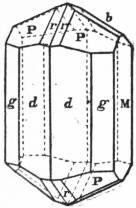
GÖTHITE, or Goethite, a mineral composed of an iron hydrate, Fe2O3·H2O, crystallizing in the orthorhombic system and isomorphous with diaspore and manganite (q.v.). It was first noticed in 1789, and in 1806 was named after the poet Goethe. Crystals are prismatic, acicular or scaly in habit; they have a perfect cleavage parallel to the brachypinacoid (M in the figure). Reniform and stalactitic masses with a radiated fibrous structure also occur. The colour varies from yellowish or reddish to blackish-brown, and by transmitted light it is often blood-red; the streak is brownish-yellow; hardness, 5; specific gravity, 4.3. The best crystals are the brilliant, blackish-brown prisms with terminal pyramidal planes (fig.) from the Restormel iron mines at Lostwithiel, and the Botallack mine at St Just in Cornwall. A variety occurring as thin red scales at Siegen in Westphalia is known as Rubinglimmer or pyrrhosiderite (from Gr. πυρρός, flame-coloured, and σίδηρος, iron): a scaly-fibrous variety from the same locality is called lepidocrocite (from λεπίς, scale, and κροκίς, fibre). Sammetblende or przibramite is a variety, from Przibram in Bohemia, consisting of delicate acicular or capillary crystals arranged in radiating groups with a velvety surface and yellow colour.
Göthite occurs with other iron oxides, especially limonite and hematite, and when found in sufficient quantity is mined with these as an ore of iron. It often occurs also as an enclosure in other minerals. Acicular crystals, resembling rutile in appearance, sometimes penetrate crystals of pale-coloured amethyst, for instance, at Wolf’s Island in Lake Onega in Russia: this form of the mineral has long been known as onegite, and the crystals enclosing it are cut for ornamental purposes under the name of “Cupid’s darts” (flèches d’amour). The metallic glitter of avanturine or sun-stone (q.v.) is due to the enclosed scales of göthite and certain other minerals.
(L. J. S.)
GOTHS (Gotones, later Gothis), a Teutonic people who in the 1st century of the Christian era appear to have inhabited the middle part of the basin of the Vistula. They were probably the easternmost of the Teutonic peoples. Early history. According to their own traditions as recorded by Jordanes, they had come originally from the island Scandza, i.e. Skåne or Sweden, under the leadership of a king named Berig, and landed first in a region called Gothiscandza. Thence they invaded the territories of the Ulmerugi (the Holmryge of Anglo-Saxon tradition), probably in the neighbourhood of Rügenwalde in eastern Pomerania, and conquered both them and the neighbouring Vandals. Under their sixth king Filimer they migrated into Scythia and settled in a district which they called Oium. The rest of their early history, as it is given by Jordanes following Cassiodorus, is due to an erroneous identification of the Goths with the Getae, and ancient Thracian people.
The credibility of the story of the migration from Sweden has been much discussed by modern authors. The legend was not peculiar to the Goths, similar traditions being current among the Langobardi, the Burgundians, and apparently several other Teutonic nations. It has been observed with truth that so many populous nations can hardly have sprung from the Scandinavian peninsula; on the other hand, the existence of these traditions certainly requires some explanation. Possibly, however, many of the royal families may have contained an element of Scandinavian blood, a hypothesis which would well accord with the social conditions of the migration period, as illustrated, e.g., in Völsunga Saga and in Hervarar Saga ok Heiðreks Konungs. In the case of the Goths a connexion with Gotland is not unlikely, since it is clear from archaeological evidence that this island had an extensive trade with the coasts about the mouth of the Vistula in early times. If, however, there was any migration at all, one would rather have expected it to have taken place in the reverse direction. For the origin of the Goths can hardly be separated from that of the Vandals, whom according to Procopius they resembled in language and in all other respects. Moreover the Gepidae, another Teutonic people, who are said to have formerly inhabited the delta of the Vistula, also appear to have been closely connected with the Goths. According to Jordanes they participated in the migration from Scandza.
Apart from a doubtful reference by Pliny to a statement of the early traveller Pytheas, the first notices we have of the Goths go back to the first years of the Christian era, at which time they seem to have been subject to the Marcomannic king Maroboduus. They do not enter into Roman history, however, until after the beginning of the 3rd century, at which time they appear to have come in conflict with the emperor Caracalla. During this century their frontier seems to have been advanced considerably farther south, and the whole country as far as the lower Danube was frequently ravaged by them. The emperor Gordianus is called “victor Gothorum” by Capitolinus, though we have no record of the ground for the claim, and further conflicts are recorded with his successors, one of whom, Decius, was slain by the Goths in Moesia. According to Jordanes the kings of the Goths during these campaigns were Ostrogotha and afterwards Cniva, the former of whom is praised also in the Anglo-Saxon poem Widsith. The emperor Gallus was forced to pay tribute to the Goths. By this time they had reached the coasts of the Black Sea, and during the next twenty years they frequently ravaged the maritime regions of Asia Minor and Greece. Aurelian is said to have won a victory over them, but the province of Dacia had to be given up. In the time of Constantine the Great Thrace and Moesia were again plundered by the Goths, A.D. 321. Constantine drove them back and concluded peace with their king Ariaric in 336. From the end of the 3rd century we hear of subdivisions of the nation called Greutungi, Teruingi, Austrogothi (Ostrogothi), Visigothi, Taifali, though it is not clear whether these were all distinct.
Though by this time the Goths had extended their territories far to the south and east, it must not be assumed that they had evacuated their old lands on the Vistula. Jordanes records several traditions of their conflicts with other Teutonic tribes, in particular a victory won by Ostrogotha over Fastida, king of the Gepidae, and another by Geberic over Visimar, king of the Vandals, about the end of Constantine’s reign, in consequence of which the Vandals sought and obtained permission to settle in Pannonia. Geberic was succeeded by the most famous of the Gothic kings, Hermanaric (Eormenric, Iörmunrekr), whose deeds are recorded in the traditions of all Teutonic nations. According to Jordanes he conquered the Heruli, the Aestii, the Venedi, and a number of other tribes who seem to have been settled in the southern part of Russia. From Anglo-Saxon sources it seems probable that his supremacy reached westwards as far as Holstein. He was of a cruel disposition, and is said to have killed his nephews Embrica (Emerca) and Fritla (Fridla) in order to obtain the great treasure which they possessed. Still more famous is the story of Suanihilda (Svanhildr), who according to Northern tradition was his wife and was cruelly put to death on a false charge of unfaithfulness. An attempt to avenge her death was made by her brothers Ammius (Hamðir) and Sarus (Sörli) by whom Hermanaric was severely wounded. To his time belong a number of other heroes whose exploits are recorded in English and Northern tradition, amongst whom we may mention Wudga (Vidigoia), Hama and several others, who in Widsith are represented as defending their country against the Huns in the forest of the Vistula. Hermanaric committed suicide in his distress at an invasion of the Huns about A.D. 370, and the portion of the nation called Ostrogoths then came under Hunnish supremacy. The Visigoths obtained permission to cross the Danube and settle in Moesia. A large part of the nation became Christian about this time (see below). The exactions of the Roman governors, however, soon led to a quarrel, which ended in the total defeat and death of Valens at Adrianople in the year 378.
(F. G. M. B.)
From about 370 the history of the East and West Goths parts asunder, to be joined together again only incidentally and for a season. The great mass of the East Goths stayed north of the Danube, and passed under the Later history. overlordship of the Hun. They do not for the present play any important part in the affairs of the Empire. The great mass of the West Goths crossed the Danube into the Roman provinces, and there played a most important part in various characters of alliance and enmity. The great migration was in 376, when they were allowed to pass as peaceful settlers under their chief Frithigern. His rival Athanaric seems to have tried to maintain his party for a while north of the Danube in defiance of the Huns; but he had presently to follow the example of the great mass of the nation. The peaceful designs of Frithigern were meanwhile thwarted by the ill-treatment which the Goths suffered from the Roman officials, which led first to disputes and then to open war. In 378 the Goths won the great battle of Adrianople, and after this Theodosius the Great, the successor of Valens, made terms with them in 381, and the mass of the Gothic warriors entered the Roman service as foederati. Many of their chiefs were in high favour; but it seems that the orthodox Theodosius showed more favour to the still remaining heathen party among the Goths than to the larger part of them who had embraced Arian Christianity. Athanaric himself came to Constantinople in 381; he was received with high honours, and had a solemn funeral when he died. His saying is worth recording, as an example of the effect which Roman civilization had on the Teutonic mind. “The emperor,” he said, “was a god upon earth, and he who resisted him would have his blood on his own head.”
The death of Theodosius in 395 broke up the union between the West Goths and the Empire. Dissensions arose between them and the ministers of Arcadius; the Goths threw off their allegiance, and chose Alaric as their king. This was a restoration alike of national unity and of national independence. The royal title had not been borne by their leaders in the Roman service. Alaric’s position is quite different from that of several Goths in the Roman service, who appear as simple rebels. He was of the great West Gothic house of the Balthi, or Bold-men, a house second in nobility only to that of the Amali. His whole career was taken up with marchings to and fro within the lands, first of the Eastern, then of the Western empire. The Goths are under him an independent people under a national king; their independence is in no way interfered with if the Gothic king, in a moment of peace, accepts the office and titles of a Roman general. But under Alaric the Goths make no lasting settlement. In the long tale of intrigue and warfare between the Goths and the two imperial courts which fills up this whole time, cessions of territory are offered to the Goths, provinces are occupied by them, but as yet they do not take root anywhere; no Western land as yet becomes Gothia. Alaric’s designs of settlement seem in his first stage to have still kept east of the Adriatic, in Illyricum, possibly in Greece. Towards the end of his career his eyes seem fixed on Africa.
Greece was the scene of his great campaign in 395-96, the second Gothic invasion of that country. In this campaign the religious position of the Goths is strongly marked. The Arian appeared as an enemy alike to the pagan majority and the Catholic minority; but he came surrounded by monks, and his chief wrath was directed against the heathen temples (vide G. F. Hertzberg, Geschichte Griechenlands, iii. 391). His Italian campaigns fall into two great divisions, that of 402-3, when he was driven back by Stilicho, and that of 408-10, after Stilicho’s death. In this second war he thrice besieged Rome (408, 409, 410). The second time it suited a momentary policy to set up a puppet emperor of his own, and even to accept a military commission from him. The third time he sacked the city, the first time since Brennus that Rome had been taken by an army of utter foreigners. The intricate political and military details of these campaigns are of less importance in the history of the Gothic nation than the stage which Alaric’s reign marks in the history of that nation. It stands between two periods of settlement within the Empire and of service under the Empire. Under Alaric there is no settlement, and service is quite secondary and precarious; after his death in 410 the two begin again in new shapes.
Contemporary with the campaigns of Alaric was a barbarian invasion of Italy, which, according to one view, again brings the East and West Goths together. The great mass of the East Goths, as has been already said, became one of the many nations which were under vassalage to the Huns; but their relation was one merely of vassalage. They remained a distinct people under kings of their own, kings of the house of the Amali and of the kindred of Ermanaric (Jordanes, 48). They had to follow the lead of the Huns in war, but they were also able to carry on wars of their own; and it has been held that among these separate East Gothic enterprises we are to place the invasion of Italy in 405 by Radagaisus (whom R. Pallmann1 writes Ratiger, and takes him for the chief of the heathen part of the East Goths). One chronicler, Prosper, makes this invasion preceded by another in 400, in which Alaric and Radagaisus appear as partners. The paganism of Radagaisus is certain. The presence of Goths in his army is certain, but it seems dangerous to infer that his invasion was a national Gothic enterprise.
Under Ataulphus, the brother-in-law and successor of Alaric, another era opens, the beginning of enterprises which did in the end lead to the establishment of a settled Gothic monarchy in the West. The position of Ataulphus is well marked by the speech put into his mouth by Orosius. He had at one time dreamed of destroying the Roman power, of turning Romania into Gothia, and putting Ataulphus in the stead of Augustus; but he had learned that the world could be governed only by the laws of Rome and he had determined to use the Gothic arms for the support of the Roman power. And in the confused and contradictory accounts of his actions (for the story in Jordanes cannot be reconciled with the accounts in Olympiodorus and the chroniclers), we can see something of this principle at work throughout. Gaul and Spain were overrun both by barbarian invaders and by rival emperors. The sword of the Goth was to win back the last lands for Rome. And, amid many shiftings of allegiance, Ataulphus seems never to have wholly given up the position of an ally of the Empire. His marriage with Placidia, the daughter of the great Theodosius, was taken as the seal of the union between Goth and Roman, and, had their son Theodosius lived, a dynasty might have arisen uniting both claims. But the career of Ataulphus was cut short at Barcelona in 415, by his murder at the hands of another faction of the Goths. The reign of Sigeric was momentary. Under Wallia in 418 a more settled state of things was established. The Empire received again, as the prize of Gothic victories, the Tarraconensis in Spain, and Novempopulana and the Narbonensis in Gaul. The “second Aquitaine,” with the sea-coast from the mouth of the Garonne to the mouth of the Loire, became the West Gothic kingdom of Toulouse. The dominion of the Goths was now strictly Gaulish; their lasting Spanish dominion does not yet begin.
The reign of the first West Gothic Theodoric (419-451) shows a shifting state of relations between the Roman and Gothic powers; but, after defeats and successes both ways, the older relation of alliance against common enemies was again established. At last Goth and Roman had to join together against the common enemy of Europe and Christendom, Attila the Hun. But they met Gothic warriors in his army. By the terms of their subjection to the Huns, the East Goths came to fight for Attila against Christendom at Châlons, just as the Servians came to fight for Bajazet against Christendom at Nicopolis. Theodoric fell in the battle (451). After this momentary meeting, the history of the East and West Goths again separates for a while. The kingdom of Toulouse grew within Gaul at the expense of the Empire, and in Spain at the expense of the Suevi. Under Euric (466-485) the West Gothic power again became largely a Spanish power. The kingdom of Toulouse took in nearly all Gaul south of the Loire and west of the Rhône, with all Spain, except the north-west corner, which was still held by the Suevi. Provence alone remained to the Empire. The West Gothic kings largely adopted Roman manners and culture; but, as they still kept to their original Arian creed, their rule never became thoroughly acceptable to their Catholic subjects. They stood, therefore, at a great disadvantage when a new and aggressive Catholic power appeared in Gaul through the conversion of the Frank Clovis or Chlodwig. Toulouse was, as in days long after, the seat of an heretical power, against which the forces of northern Gaul marched as on a crusade. In 507 the West Gothic king Alaric II. fell before the Frankish arms at Campus Vogladensis, near Poitiers, and his kingdom, as a great power north of the Alps, fell with him. That Spain and a fragment of Gaul still remained to form a West Gothic kingdom was owing to the intervention of the East Goths under the rule of the greatest man in Gothic history.
When the Hunnish power broke in pieces on the death of Attila, the East Goths recovered their full independence. They now entered into relations with the Empire, and were settled on lands in Pannonia. During the greater part of the latter half of the 5th century, the East Goths play in south-eastern Europe nearly the same part which the West Goths played in the century before. They are seen going to and fro, in every conceivable relation of friendship and enmity with the Eastern Roman power, till, just as the West Goths had done before them, they pass from the East to the West. They are still ruled by kings of the house of the Amali, and from that house there now steps forward a great figure, famous alike in history and in romance, in the person of Theodoric, son of Theodemir. Born about 454, his childhood was spent at Constantinople as a hostage, where he was carefully educated. The early part of his life is taken up with various disputes, intrigues and wars within the Eastern empire, in which he has as his rival another Theodoric, son of Triarius, and surnamed Strabo. This older but lesser Theodoric seems to have been the chief, not the king, of that branch of the East Goths which had settled within the Empire at an earlier time. Theodoric the Great, as he is sometimes distinguished, is sometimes the friend, sometimes the enemy, of the Empire. In the former case he is clothed with various Roman titles and offices, as patrician and consul; but in all cases alike he remains the national East Gothic king. It was in both characters together that he set out in 488, by commission from the emperor Zeno, to recover Italy from Odoacer. By 493 Ravenna was taken; Odoacer was killed by Theodoric’s own hand; and the East Gothic power was fully established over Italy, Sicily, Dalmatia and the lands to the north of Italy. In this war the history of the East and West Goths begins again to unite, if we may accept the witness of one writer that Theodoric was helped by West Gothic auxiliaries. The two branches of the nation were soon brought much more closely together, when, through the overthrow of the West Gothic kingdom of Toulouse, the power of Theodoric was practically extended over a large part of Gaul and over nearly the whole of Spain. A time of confusion followed the fall of Alaric II., and, as that prince was the son-in-law of Theodoric, the East Gothic king stepped in as the guardian of his grandson Amalaric, and preserved for him all his Spanish and a fragment of his Gaulish dominion. Toulouse passed away to the Frank; but the Goth kept Narbonne and its district, the land of Septimania—the land which, as the last part of Gaul held by the Goths, kept the name of Gothia for many ages. While Theodoric lived, the West Gothic kingdom was practically united to his own dominion. He seems also to have claimed a kind of protectorate over the Teutonic powers generally, and indeed to have practically exercised it, except in the case of the Franks.
The East Gothic dominion was now again as great in extent and far more splendid than it could have been in the time of Ermanaric. But it was now of a wholly different character. The dominion of Theodoric was not a barbarian but a civilized power. His twofold position ran through everything. He was at once national king of the Goths, and successor, though without any imperial titles, of the Roman emperors of the West. The two nations, differing in manners, language and religion, lived side by side on the soil of Italy; each was ruled according to its own law, by the prince who was, in his two separate characters, the common sovereign of both. The picture of Theodoric’s rule is drawn for us in the state papers drawn up in his name and in the names of his successors by his Roman minister Cassiodorus. The Goths seem to have been thick on the ground in northern Italy; in the south they formed little more than garrisons. In Theodoric’s theory the Goth was the armed protector of the peaceful Roman; the Gothic king had the toil of government, while the Roman consul had the honour. All the forms of the Roman administration went on, and the Roman polity and Roman culture had great influence on the Goths themselves. The rule of the prince over two distinct nations in the same land was necessarily despotic; the old Teutonic freedom was necessarily lost. Such a system as that which Theodoric established needed a Theodoric to carry it on. It broke in pieces after his death.
On the death of Theodoric (526) the East and West Goths were again separated. The few instances in which they are found acting together after this time are as scattered and incidental as they were before. Amalaric succeeded to the West Gothic kingdom in Spain and Septimania. Provence was added to the dominion of the new East Gothic king Athalaric, the grandson of Theodoric through his daughter Amalasuntha. The weakness of the East Gothic position in Italy now showed itself. The long wars of Justinian’s reign (535-555) recovered Italy for the Empire, and the Gothic name died out on Italian soil. The chance of forming a national state in Italy by the union of Roman and Teutonic elements, such as those which arose in Gaul, in Spain, and in parts of Italy under Lombard rule, was thus lost. The East Gothic kingdom was destroyed before Goths and Italians had at all mingled together. The war of course made the distinction stronger; under the kings who were chosen for the purposes of the war national Gothic feeling had revived. The Goths were now again, if not a wandering people, yet an armed host, no longer the protectors but the enemies of the Roman people of Italy. The East Gothic dominion and the East Gothic name wholly passed away. The nation had followed Theodoric. It is only once or twice after his expedition that we hear of Goths, or even of Gothic leaders, m the eastern provinces. From the soil of Italy the nation passed away almost without a trace, while the next Teutonic conquerors stamped their name on the two ends of the land, one of which keeps it to this day.