VOLUME XII SLICE III Gordon, Lord George to Grasses (continued 6)
Reading edition
See Livy, Epit. 58; Appian, Bell. civ. i. 9-17; Plutarch, Tiberius Gracchus; Vell. Pat. ii. 2, 3.
5. Gaius Sempronius Gracchus (153-121 B.C.), younger brother of (4), was a man of greater abilities, bolder and more passionate, although possessed of considerable powers of self-control, and a vigorous and impressive orator. When twenty years of age he was appointed one of the commissioners to carry out the distribution of land under the provisions of his brother’s agrarian law. At the time of Tiberius’s death, Gaius was serving under his brother-in-law Scipio in Spain, but probably returned to Rome in the following year (132). In 131 he supported the bill of C. Papirius Carbo, the object of which was to make it legal for a tribune to offer himself as candidate for the office in two consecutive years, and thus to remove one of the chief obstacles that had hampered Tiberius. The bill was then rejected, but appears to have subsequently passed in a modified form, as Gaius himself was re-elected without any disturbance. Possibly, however, his re-election was illegal, and he had only succeeded where his brother had failed. For the next few years nothing is heard of Gaius. Public opinion pointed him out as the man to avenge his brother’s death and carry out his plans, and the aristocratic party, warned by the example of Tiberius, were anxious to keep him away from Rome. In 126 Gaius accompanied the consul L. Aurelius Orestes as quaestor to Sardinia, then in a state of revolt. Here he made himself so popular that the senate in alarm prolonged the command of Orestes, in order that Gaius might be obliged to remain there in his capacity of quaestor. But he returned to Rome without the permission of the senate, and, when called to account by the censors, defended himself so successfully that he was acquitted of having acted illegally. The disappointed aristocrats then brought him to trial on the charge of being implicated in the revolt of Fregellae, and in other ways unsuccessfully endeavoured to undermine his influence. Gaius then decided to act; against the wishes of his mother he became a candidate for the tribuneship, and, in spite of the determined opposition of the aristocracy, he was elected for the year 123, although only fourth on the list. The legislative proposals1 brought forward by him had for their object:—the punishment of his brother’s enemies; the relief of distress and the attachment to himself of the city populace; the diminution of the power of the senate and the increase of that of the equites; the amelioration of the political status of the Italians and provincials.
A law was passed that no Roman citizen should be tried in a matter affecting his life or political status unless the people had previously given its assent. This was specially aimed at Popilius Laenas, who had taken an active part in the prosecution of the adherents of Tiberius. Another law enacted that any magistrate who had been deprived of office by decree of the people should be incapacitated from holding office again. This was directed against M. Octavius, who had been illegally deprived of his tribunate through Tiberius. This unfair and vindictive measure was withdrawn at the earnest request of Cornelia.
He revived his brother’s agrarian law, which, although it had not been repealed, had fallen into abeyance. By his Lex Frumentaria every citizen resident in Rome was entitled to a certain amount of corn at about half the usual price; as the distribution only applied to those living in the capital, the natural result was that the poorer country citizens flocked into Rome and swelled the number of Gaius’s supporters. No citizen was to be obliged to serve in the army before the commencement of his eighteenth year, and his military outfit was to be supplied by the state, instead of being deducted from his pay. Gaius also proposed the establishment of colonies in Italy (at Tarentum and Capua), and sent out to the site of Carthage 6000 colonists to found the new city of Junonia, the inhabitants of which were to possess the rights of Roman citizens; this was the first attempt at over-sea colonization. A new system of roads was constructed which afforded easier access to Rome. Having thus gained over the city proletariat, in order to secure a majority in the comitia by its aid, Gaius did away with the system of voting in the comitia centuriata, whereby the five property classes in each tribe gave their votes one after another, and introduced promiscuous voting in an order fixed by lot.
The judices in the standing commissions for the trial of particular offences (the most important of which was that dealing with the trial of provincial magistrates for extortion, de repetundis) were in future to be chosen from the equites (q.v.), not as hitherto from the senate. The taxes of the new province of Asia were to be let out by the censors to Roman publicani (who belonged to the equestrian order), who paid down a lump sum for the right of collecting them. It is obvious that this afforded the equites extensive opportunities for money-making and extortion, while the alteration in the appointment of the judices gave them the same practical immunity and perpetuated the old abuses, with the difference that it was no longer senators, but equites, who could look forward with confidence to being leniently dealt with by men belonging to their own order; Gaius also expected that this moneyed aristocracy, which had taken the part of the senate against Tiberius, would now support him against it. It was enacted that the provinces to be assigned to the consuls, should be determined before, instead of after their election; and the consuls themselves had to settle, by lot or other arrangement, which province each of them would take.2
These measures raised Gaius to the height of his popularity, and during the year of his first tribuneship he may be considered the absolute ruler of Rome. He was chosen tribune for the second time for the year 122. To this period is probably to be assigned his proposal that the franchise should be given to all the Latin communities and that the status of the Latins should be conferred upon the Italian allies. In 125 M. Fulvius Flaccus had brought forward a similar measure, but he was got out of the way by the senate, who sent him to fight in Gaul. This proposal, more statesmanlike than any of the others, was naturally opposed by the aristocratic party, and lessened Gaius’s popularity amongst his own supporters, who viewed with disfavour the prospect of an increase in the number of Roman citizens. The senate put up M. Livius Drusus to outbid him, and his absence from Rome while superintending the organization of the newly-founded colony, Junonia-Carthago, was taken advantage of by his enemies to weaken his influence. On his return he found his popularity diminished. He failed to secure the tribuneship for the third time, and his bitter enemy L. Opimius was elected consul. The latter at once decided to propose the abandonment of the new colony, which was to occupy the site cursed by Scipio, while its foundation had been attended by unmistakable manifestations of the wrath of the gods. On the day when the matter was to be put to the vote, a lictor named Antyllius, who had insulted the supporters of Gaius, was stabbed to death. This gave his opponents the desired opportunity. Gaius was declared a public enemy, and the consuls were invested with dictatorial powers. The Gracchans, who had taken up their position in the temple of Diana on the Aventine, offered little resistance to the attack ordered by Opimius. Gaius managed to escape across the Tiber, where his dead body was found on the following day in the grove of Furrina by the side of that of a slave, who had probably slain his master and then himself. The property of the Gracchans was confiscated, and a temple of Concord erected in the Forum from the proceeds. Beneath the inscription recording the occasion on which the temple had been built some one during the night wrote the words: “The work of Discord makes the temple of Concord.”
Bibliography.—See Livy, Epit. 60; Appian, Bell. Civ. i. 21; Plutarch, Gaius Gracchus; Orosius v. 12; Aulus Gellius x. 3, xi. 10. For an account of the two tribunes see Mommsen, Hist. of Rome (Eng. trans.), bk. iv., chs. 2 and 3; C. Neumann, Geschichte Roms während des Verfalles der Republik (1881); A. H. J. Greenidge, History of Rome (1904); E. Meyer, Untersuchungen zur Geschichte der Gracchen (1894); G. E. Underhill, Plutarch’s Lives of the Gracchi (1892); W. Warde Fowler in English Historical Review (1905), pp. 209 and 417; Long, Decline of the Roman Republic, chs. 10-13, 17-19, containing a careful examination of the ancient authorities; G. F. Hertzberg in Ersch and Gruber’s Allgemeine Encyclopädie; C. W. Oman, Seven Roman Statesmen of the later Republic (1902); T. Lau, Die Gracchen und ihre Zeit (1854). The exhaustive monograph by C. W. Nitzsch, Die Gracchen und ihre nächsten Vorgänger (1847), also contains an account of the other members of the family, with full references to ancient authorities in the notes.
(J. H. F.)
1 These measures cannot be arranged in any definite chronological order, nor can it be decided which belong to his first, which to his second tribuneship. See W. Warde Fowler in Eng. Hist. Review, 1905. pp. 209 sqq., 417 sqq.
2 It is suggested by W. Warde Fowler that Gracchus proposed to add a certain number of equites to the senate, thereby increasing it to 900, but the plan was never carried out.
GRACE, WILLIAM GILBERT (1848- ), English cricketer, was born at Downend, Gloucestershire, on the 18th of July 1848. He found himself in an atmosphere charged with cricket, his father (Henry Mills Grace) and his uncle (Alfred Pocock) being as enthusiastic over the game as his elder brothers, Henry, Alfred and Edward Mills; indeed, in E. M. Grace the family name first became famous. A younger brother, George Frederick, also added to the cricket reputation of the family. “W. G.” witnessed his first great match when he was hardly six years old, the occasion being a game between W. Clarke’s All-England Eleven and twenty-two of West Gloucestershire. He was endowed by nature with a splendid physique as well as with powers of self-restraint and determination. At the acme of his career he stood full 6 ft. 2 in., being powerfully proportioned, loose yet strong of limb. A non-smoker, and very moderate in all matters, he kept himself in condition all the year round, shooting, hunting or running with the beagles as soon as the cricket season was over. He was also a fine runner, 440 yds. over 20 hurdles being his best distance; and it may be quoted as proof of his stamina that on the 30th of July 1866 he scored 224 not out for England v. Surrey, and two days later won a race in the National and Olympian Association meeting at the Crystal Palace. The title of “champion” was well earned by one who for thirty-six years (1865-1900 inclusive) was actively engaged in first-class cricket. In each of these years he was invited to represent the Gentlemen in their matches against the Players, and, when an Australian eleven visited England, to play for the mother country. As late as 1899 he played in the first of the five international contests; in 1900 he played against the players at the Oval, scoring 58 and 3. At fifty-three he scored nearly 1300 runs in first-class cricket, made 100 runs and over on three different occasions and could claim an average of 42 runs. Moreover, his greatest triumphs were achieved when only the very best cricket grounds received serious attention; when, as some consider, bowling was maintained at a higher standard and when all hits had to be run out. He, with his two brothers, E. M. and G. F., assisted by some fine amateurs, made Gloucestershire in one season a first-class county; and it was he who first enabled the amateurs of England to meet the paid players on equal terms and to beat them. There was hardly a “record” connected with the game which did not stand to his credit. Grace was one of the finest fieldsmen in England, in his earlier days generally taking long-leg and cover-point, in later times generally standing point. He was, at his best, a fine thrower, fast runner and safe “catch.” As a bowler he was long in the first flight, originally bowling fast, but in later times adopting a slower and more tricky style, frequently very effective. By profession he was a medical man. In later years he became secretary and manager of the London County Cricket Club. He was married in 1873 to Miss Agnes Day, and one of his sons played for two years in the Cambridge eleven. He was the recipient of two national testimonials: the first, amounting to £1500, being presented to him in the form of a clock and a cheque at Lord’s ground by Lord Charles Russell on the 22nd of July 1879; the second, collected by the M.C.C., the county of Gloucestershire, the Daily Telegraph and the Sportsman, amounted to about £10,000, and was presented to him in 1896. He visited Australia in 1873-1874 (captain), and in 1891-1892 with Lord Sheffield’s Eleven (captain); the United States and Canada in 1872, with R. A. Fitzgerald’s team.
Dr Grace played his first great match in 1863, when, being only fifteen years of age, he scored 32 against the All-England Eleven and the bowling of Jackson, Tarrant and Tinley; but the scores which first made his name prominent were made in 1864, viz. 170 and 56 not out for the South Wales Club against the Gentlemen of Sussex. It was in 1865 that he first took an active part in first-class cricket, being then 6 ft. in height, and 11 stone in weight, and playing twice for the Gentlemen v. the Players, but his selection was mainly due to his bowling powers, the best exposition of which was his aggregate of 13 wickets for 84 runs for the Gentlemen of the South v. the Players of the South. His highest score was 400 not out, made in July 1876 against twenty-two of Grimsby; but on three occasions he was twice dismissed without scoring in matches against odds, a fate that never befell him in important cricket. In first-class matches his highest score was 344, made for the M.C.C. v. Kent at Canterbury, in August 1876; two days later he made 177 for Gloucestershire v. Notts, and two days after this 318 not out for Gloucestershire v. Yorkshire, the two last-named opposing counties being possessed of exceptionally strong bowling; thus in three consecutive innings Grace scored 839 runs, and was only got out twice. His 344 was the third highest individual score made in a big match in England up to the end of 1901. He also scored 301 for Gloucestershire v. Sussex at Bristol, in August 1896. He made over 200 runs on ten occasions, the most notable perhaps being in 1871, when he performed the feat twice, each time in benefit matches, and each time in the second innings, having been each time got out in the first over of the first innings. He scored over 100 runs on 121 occasions, the hundredth score being 288, made at Bristol for Gloucestershire v. Somersetshire in 1895. He made every figure from 0 to 100, on one occasion “closing” the innings when he had made 93, the only total he had never made between these limits. In 1871 he made ten “centuries,” ranging from 268 to 116. In the matches between the Gentlemen and Players he scored “three figures” fifteen times, and at every place where these matches have been played. He made over 100 in each of his “first appearances” at Oxford and Cambridge. Three times he made over 100 in each innings of the same match, viz. at Canterbury, in 1868, for South v. North of the Thames, 130 and 102 not out; at Clifton, in 1887, for Gloucestershire v. Kent, 101 and 103 not out; and at Clifton, in 1888, for Gloucestershire v. Yorkshire, 148 and 153. In 1869, playing at the Oval for the Gentlemen of the South v. the Players of the South, Grace and B. B. Cooper put on 283 runs for the first wicket, Grace scoring 180 and Cooper 101. In 1886 Grace and Scotton put on 170 runs for the first wicket of England v. Australia; this occurred at the Oval in August, and Grace’s total score was 170. In consecutive innings against the Players from 1871 to 1873 he scored 217, 77 and 112, 117, 163, 158 and 70. He only twice scored over 100 in a big match in Australia, nor did he ever make 200 at Lord’s, his highest being 196 for the M.C.C. v. Cambridge University in 1894. His highest aggregates were 2739 (1871), 2622 (1876), 2346 (1895), 2139 (1873), 2135 (1896) and 2062 (1887). He scored three successive centuries in first-class cricket in 1871, 1872, 1873, 1874 and 1876. Playing against Kent at Gravesend in 1895, he was batting, bowling or fielding during the whole time the game was in progress, his scores being 257 and 73 not out. He scored over 1000 runs and took over 100 wickets in seven different seasons, viz. in 1874, 1665 runs and 129 wickets; in 1875, 1498 runs, 192 wickets; in 1876, 2622 runs, 124 wickets; in 1877, 1474 runs, 179 wickets; in 1878, 1151 runs, 153 wickets; in 1885, 1688 runs, 118 wickets; in 1886, 1846 runs, 122 wickets. He never captured 200 wickets in a season, his highest record being 192 in 1875. Playing against Oxford University in 1886, he took all the wickets in the first innings, at a cost of 49 runs. In 1895 he not only made his hundredth century, but actually scored 1000 runs in the month of May alone, his chief scores in that month being 103, 288, 256, 73 and 169, he being then forty-seven years old. He also made during that year scores of 125, 119, 118, 104 and 103 not out, his aggregate for the year being 2346 and his average 51; his innings of 118 was made against the Players (at Lord’s), the chief bowlers being Richardson, Mold, Peel and Attewell; he scored level with his partner, A. E. Stoddart (his junior by fifteen years), the pair making 151 before a wicket fell, Grace making in all 118 out of 241. This may fairly be considered one of his most wonderful years. In 1898 the match between Gentlemen v. Players was, as a special compliment, arranged by the M.C.C. committee to take place on his birthday, and he celebrated the event by scoring 43 and 31 not out, though handicapped by lameness and an injured hand. In twenty-six different seasons he scored over 1000 runs, in three of these years being the only man to do so and five times being one out of two.
During the thirty-six years up to and including 1900 he scored nearly 51,000 runs, with an average of 43; and in bowling he took more than 2800 wickets, at an average cost of about 20 runs per wicket. He made his highest aggregate (2739 runs) and had his highest average (78) in 1871; his average for the decade 1868-1877 was 57 runs. His style as a batsman was more commanding than graceful, but as to its soundness and efficacy there were never two opinions; the severest criticism ever passed upon his powers was to the effect that he did not play slow bowling quite as well as fast.
(W. J. F.)
GRACE (Fr. grâce, Lat. gratia, from gratus, beloved, pleasing; formed from the root cra-, Gr. χασ- cf. χαίρω, χάρμα, χάρις), a word of many shades of meaning, but always connoting the idea of favour, whether that in which one stands to others or that which one shows to others. The New English Dictionary groups the meanings of the word under three main heads: (1) Pleasing quality, gracefulness, (2) favour, goodwill, (3) gratitude, thanks.
It is in the second general sense of “favour bestowed” that the word has its most important connotations. In this sense it means something given by superior authority as a concession made of favour and goodwill, not as an obligation or of right. Thus, a concession may be made by a sovereign or other public authority “by way of grace.” Previous to the Revolution of 1688 such concessions on the part of the crown were known in constitutional law as “Graces.” “Letters of Grace” (gratiae, gratiosa rescripta) is the name given to papal rescripts granting special privileges, indulgences, exemptions and the like. In the language of the universities the word still survives in a shadow of this sense. The word “grace” was originally a dispensation granted by the congregation of the university, or by one of the faculties, from some statutable conditions required for a degree. In the English universities these conditions ceased to be enforced, and the “grace” thus became an essential preliminary to any degree; so that the word has acquired the meaning of (a) the licence granted by congregation to take a degree, (b) other decrees of the governing body (originally dispensations from statutes), all such degrees being called “graces” at Cambridge, (c) the permission which a candidate for a degree must obtain from his college or hall.
To this general sense of exceptional favour belong the uses of the word in such phrases as “do me this grace,” “to be in some one’s good graces” and certain meanings of “the grace of God.” The style “by the grace of God,” borne by the king of Great Britain and Ireland among other sovereigns, though, as implying the principle of “legitimacy,” it has been since the Revolution sometimes qualified on the continent by the addition of “and the will of the people,” means in effect no more than the “by Divine Providence,” which is the style borne by archbishops. To the same general sense of exceptional favour belong the phrases implying the concession of a right to delay in fulfilling certain obligations, e.g. “a fortnight’s grace.” In law the “days of grace” are the period allowed for the payment of a bill of exchange, after the term for which it has been drawn (in England three days), or for the payment of an insurance premium, &c. In religious language the “Day of Grace” is the period still open to the sinner in which to repent. In the sense of clemency or mercy, too, “grace” is still, though rarely used: “an Act of Grace” is a formal pardon or a free and general pardon granted by act of parliament. Since to grant favours is the prerogative of the great, “Your Grace,” “His Grace,” &c., became dutiful paraphrases for the simple “you” and “he.” Formerly used in the royal address (“the King’s Grace,” &c.), the style is in England now confined to dukes and archbishops, though the style of “his most gracious majesty” is still used. In Germany the equivalent, Euer Gnaden, is the style of princes who are not Durchlaucht (i.e. Serene Highness), and is often used as a polite address to any superior.
In the language of theology, though in the English Bible the word is used in several of the above senses, “grace” (Gr. χάρις) has special meanings. Above all, it signifies the spontaneous, unmerited activity of the Divine Love in the salvation of sinners, and the Divine influence operating in man for his regeneration and sanctification. Those thus regenerated and sanctified are said to be in a “state of grace.” In the New Testament grace is the forgiving mercy of God, as opposed to any human merit (Rom. xi. 6; Eph. ii. 5; Col. i. 6, &c.); it is applied also to certain gifts of God freely bestowed, e.g. miracles, tongues, &c. (Rom. xv. 15; 1 Cor. xv. 10; Eph. iii. 8, &c.), to the Christian virtues, gifts of God also, e.g. charity, holiness, &c. (2 Cor. viii. 7; 2 Pet. iii. 18). It is also used of the Gospel generally, as opposed to the Law (John i. 17; Rom. vi. 14; 1 Pet. v. 12, &c.); connected with this is the use of the term “year of grace” for a year of the Christian era.
The word “grace” is the central subject of three great theological controversies: (1) that of the nature of human depravity and regeneration (see Pelagius), (2) that of the relation between grace and free-will (see Calvin, John, and Arminius, Jacobus), (3) that of the “means of grace” between Catholics and Protestants, i.e. whether the efficacy of the sacraments as channels of the Divine grace is ex opere operato or dependent on the faith of the recipient.
In the third general sense, of thanks for favours bestowed, “grace” survives as the name for the thanksgiving before or after meals. The word was originally used in the plural, and “to do, give, render, yield graces” was said, in the general sense of the French rendre grâces or Latin gratias agere, of any giving thanks. The close, and finally exclusive, association of the phrase “to say grace” with thanksgiving at meals was possibly due to the formula “Gratias Deo agamus” (“let us give thanks to God”) with which the ceremony began in monastic refectories. The custom of saying grace, which obtained in pre-Christian times among the Jews, Greeks and Romans, and was adopted universally by Christian peoples, is probably less widespread in private houses than it used to be. It is, however, still maintained at public dinners and also in schools, colleges and institutions generally. Such graces are generally in Latin and of great antiquity: they are sometimes short, e.g. “Laus Deo,” “Benedictus benedicat,” and sometimes, as at the Oxford and Cambridge colleges, of considerable length. In some countries grace has sunk to a polite formula; in Germany, e.g. it is usual before and after meals to bow to one’s neighbours and say “Gesegnete Malzeit!” (May your meal be blessed), a phrase often reduced in practice to “Malzeit” simply.
GRACES, THE, (Gr. Χάριτες, Lat. Gratiae), in Greek mythology, the personification of grace and charm, both in nature and in moral action. The transition from a single goddess, Charis, to a number or group of Charites, is marked in Homer. In the Iliad one Charis is the wife of Hephaestus, another the promised wife of Sleep, while the plural Charites often occurs. The Charites are usually described as three in number—Aglaia (brightness), Euphrosyne (joyfulness), Thalia (bloom)—daughters of Zeus and Hera (or Eurynome, daughter of Oceanus), or of Helios and Aegle; in Sparta, however, only two were known, Cleta (noise) and Phaënna (light), as at Athens Auxo (increase) and Hegemone (queen). They are the friends of the Muses, with whom they live on Mount Olympus, and the companions of Aphrodite, of Peitho, the goddess of persuasion, and of Hermes, the god of eloquence, to each of whom charm is an indispensable adjunct. The need of their assistance to the artist is indicated by the union of Hephaestus and Charis. The most ancient seat of their cult was Orchomenus in Boeotia, where their oldest images, in the form of stones fallen from heaven, were set up in their temple. Their worship was said to have been instituted by Eteocles, whose three daughters fell into a well while dancing in their honour. At Orchomenus nightly dances took place, and the festival Charitesia, accompanied by musical contests, was celebrated; in Paros their worship was celebrated without music or garlands, since it was there that Minos, while sacrificing to the Charites, received the news of the death of his son Androgeus; at Messene they were revered together with the Eumenides; at Athens, their rites, kept secret from the profane, were held at the entrance to the Acropolis. It was by Auxo, Hegemone and Agraulos, the daughter of Cecrops, that young Athenians, on first receiving their spear and shield, took the oath to defend their country. In works of art the Charites were represented in early times as beautiful maidens of slender form, hand in hand or embracing one another and wearing drapery; later, the conception predominated of three naked figures gracefully intertwined. Their attributes were the myrtle, the rose and musical instruments. In Rome the Graces were never the objects of special religious reverence, but were described and represented by poets and artists in accordance with Greek models.
See F. H. Krause, Musen, Gratien, Horen, und Nymphen (1871), and the articles by Stoll and Furtwängler in Roscher’s Lexikon der Mythologie, and by S. Gsell in Daremberg and Saglio’s Dictionnaire des antiquités, with the bibliography.
GRACIÁN Y MORALES, BALTASAR (1601-1658), Spanish prose writer, was born at Calatayud (Aragon) on the 8th of January 1601. Little is known of his personal history except that on May 14, 1619, he entered the Society of Jesus, and that ultimately he became rector of the Jesuit college at Tarazona, where he died on the 6th of December, 1658. His principal works are El Héroe (1630), which describes in apophthegmatic phrases the qualities of the ideal man; the Arte de ingenio, tratado de la Agudeza (1642), republished six years afterwards under the title of Agudeza, y arte de ingenio (1648), a system of rhetoric in which the principles of conceptismo as opposed to culteranismo are inculcated; El Discreto (1645), a delineation of the typical courtier; El Oráculo manual y arte de prudencia (1647), a system of rules for the conduct of life; and El Criticón (1651-1653-1657), an ingenious philosophical allegory of human existence. The only publication which bears Gracián’s name is El Comulgatorio (1655); his more important books were issued under the pseudonym of Lorenzo Gracián (possibly a brother of the writer) or under the anagram of Gracian de Marlones. Gracián was punished for publishing without his superior’s permission El Criticón (in which Defoe is alleged to have found the germ of Robinson Crusoe); but no objection was taken to its substance. He has been excessively praised by Schopenhauer, whose appreciation of the author induced him to translate the Oráculo manual, and he has been unduly depreciated by Ticknor and others. He is an acute thinker and observer, misled by his systematic misanthropy and by his fantastic literary theories.
See Karl Borinski, Baltasar Gracián und die Hoflitteratur in Deutschland (Halle, 1894); Benedetto Croce, I Trattatisti italiani del “concettismo” e Baltasar Gracián (Napoli, 1899); Narciso José Liñán y Heredia, Baltasar Gracián (Madrid, 1902). Schopenhauer and Joseph Jacobs have respectively translated the Oráculo manual into German and English.
GRACKLE (Lat. Gracculus or Graculus), a word much used in ornithology, generally in a vague sense, though restricted to members of the families Sturnidae belonging to the Old World and Icteridae belonging to the New. Of the former those to which it has been most commonly applied are the species known as mynas, mainas, and minors of India and the adjacent countries, and especially the Gracula religiosa of Linnaeus, who, according to Jerdon and others, was probably led to confer this epithet upon it by confounding it with the Sturnus or Acridotheres tristis,1 which is regarded by the Hindus as sacred to Ram Deo, one of their deities, while the true Gracula religiosa does not seem to be anywhere held in veneration. This last is about 10 in. in length, clothed in a plumage of glossy black, with purple and green reflections, and a conspicuous patch of white on the quill-feathers of the wings. The bill is orange and the legs yellow, but the bird’s most characteristic feature is afforded by the curious wattles of bright yellow, which, beginning behind the eyes, run backwards in form of a lappet on each side, and then return in a narrow stripe to the top of the head. Beneath each eye also is a bare patch of the same colour. This species is common in southern India, and is represented farther to the north, in Ceylon, Burma, and some of the Malay Islands by cognate forms. They are all frugivorous, and, being easily tamed and learning to pronounce words very distinctly, are favourite cage-birds.2
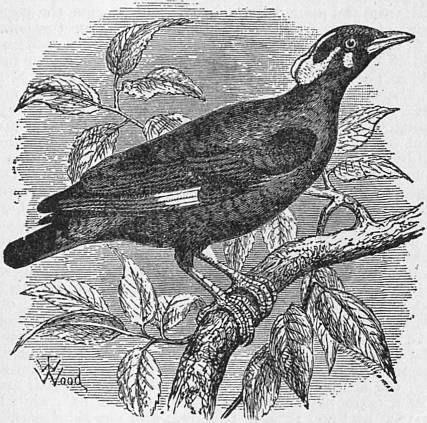
Gracula religiosa.
In America the name Grackle has been applied to several species of the genera Scolecophagus and Quiscalus, though these are more commonly called in the United States and Canada “blackbirds,” and some of them “boat-tails.” They all belong to the family Icteridae. The best known of these are the rusty grackle, S. ferrugineus, which is found in almost the whole of North America, and Q. purpureus, the purple grackle or crow-blackbird, of more limited range, for though abundant in most parts to the east of the Rocky Mountains, it seems not to appear on the Pacific side. There is also Brewer’s or the blue-headed grackle, S. cyanocephalus, which has a more western range, not occurring to the eastward of Kansas and Minnesota. A fourth species, Q. major, inhabits the Atlantic States as far north as North Carolina. All these birds are of exceedingly omnivorous habit, and though destroying large numbers of pernicious insects are in many places held in bad repute from the mischief they do to the corn-crops.
(A. N.)
1 By some writers the birds of the genera Acridotheres and Temenuchus are considered to be the true mynas, and the species of Gracula are called “hill mynas” by way of distinction.
2 For a valuable monograph on the various species of Gracula and its allies see Professor Schlegel’s “Bijdrage tot de Kennis von het Geschlacht Beo’” (Nederlandsch Tijdschrift voor de Dierkunde i. 1-9).
GRADISCA, a town of Austria, in the province of Görz and Gradisca, 10 m. S.W. of Görz by rail. Pop. (1900) 3843, mostly Italians. It is situated on the right bank of the Isonzo and was formerly a strongly fortified place. Its principal industry is silk spinning. Gradisca originally formed part of the margraviate of Friuli, came under the patriarchate of Aquileia in 1028, and in 1420 to Venice. Between 1471 and 1481 Gradisca was fortified by the Venetians, but in 1511 they surrendered it to the emperor Maximilian I. In 1647 Gradisca and its territory, including Aquileia and forty-three smaller places, were erected into a separate countship in favour of Johann Anton von Eggenberg, duke of Krumau. On the extinction of his line in 1717, it reverted to Austria, and was completely incorporated with Görz in 1754. The name was revived by the constitution of 1861, which established the crownland of Görz and Gradisca.
GRADO, a town of northern Spain, in the province of Oviedo; 11 m. W. by N. of the city of Oviedo, on the river Cubia, a left-hand tributary of the Nalon. Pop. (1900) 17,125. Grado is built in the midst of a mountainous, well-wooded and fertile region. It has some trade in timber, live stock, cider and agricultural produce. The nearest railway station is that of the Fabrica de Trubia, a royal cannon-foundry and small-arms factory, 5 m. S.E.
GRADUAL (Med. Lat. gradualis, of or belonging to steps or degrees; gradus, step), advancing or taking place by degrees or step by step; hence used of a slow progress or a gentle declivity or slope, opposed to steep or precipitous. As a substantive, “gradual” (Med. Lat. graduale or gradale) is used of a service book or antiphonal of the Roman Catholic Church containing certain antiphons, called “graduals,” sung at the service of the Mass after the reading or singing of the Epistle. This antiphon received the name either because it was sung on the steps of the altar or while the deacon was mounting the steps of the ambo for the reading or singing of the Gospel. For the so-called Gradual Psalms, cxx.-cxxxiv., the “songs of degrees,” LXX. ᾠδὴ ἀνὰ βαθμῶν, see Psalms, Book of.
GRADUATE (Med. Lat. graduare, to admit to an academical degree, gradus), in Great Britain a verb now only used in the academical sense intransitively, i.e. “to take or proceed to a university degree,” and figuratively of acquiring knowledge of, or proficiency in, anything. The original transitive sense of “to confer or admit to a degree” is, however, still preserved in America, where the word is, moreover, not strictly confined to university degrees, but is used also of those successfully completing a course of study at any educational establishment. As a substantive, a “graduate” (Med. Lat. graduatus) is one who has taken a degree in a university. Those who have matriculated at a university, but not yet taken a degree, are known as “undergraduates.” The word “student,” used of undergraduates e.g. in Scottish universities, is never applied generally to those of the English and Irish universities. At Oxford the only “students” are the “senior students” (i.e. fellows) and “junior students” (i.e. undergraduates on the foundation, or “scholars”) of Christ Church. The verb “to graduate” is also used of dividing anything into degrees or parts in accordance with a given scale. For the scientific application see Graduation below. It may also mean “to arrange in gradations” or “to adjust or apportion according to a given scale.” Thus by “a graduated income-tax” is meant the system by which the percentage paid differs according to the amount of income on a pre-arranged scale.
GRADUATION (see also Graduate), the art of dividing straight scales, circular arcs or whole circumferences into any required number of equal parts. It is the most important and difficult part of the work of the mathematical instrument maker, and is required in the construction of most physical, astronomical, nautical and surveying instruments.
The art was first practised by clockmakers for cutting the teeth of their wheels at regular intervals; but so long as it was confined to them no particular delicacy or accurate nicety in its performance was required. This only arose when astronomy began to be seriously studied, and the exact position of the heavenly bodies to be determined, which created the necessity for strictly accurate means of measuring linear and angular magnitudes. Then it was seen that graduation was an art which required special talents and training, and the best artists gave great attention to the perfecting of astronomical instruments. Of these may be named Abraham Sharp (1651-1742), John Bird (1709-1776), John Smeaton (1724-1792), Jesse Ramsden (1735-1800), John Troughton, Edward Troughton (1753-1835), William Simms (1793-1860) and Andrew Ross.
The first graduated instrument must have been done by the hand and eye alone, whether it was in the form of a straight-edge with equal divisions, or a screw or a divided plate; but, once in the possession of one such divided instrument, it was a comparatively easy matter to employ it as a standard. Hence graduation divides itself into two distinct branches, original graduation and copying, which latter may be done either by the hand or by a machine called a dividing engine. Graduation may therefore be treated under the three heads of original graduation, copying and machine graduation.
Original Graduation.—In regard to the graduation of straight scales elementary geometry provides the means of dividing a straight line into any number of equal parts by the method of continual bisection; but the practical realization of the geometrical construction is so difficult as to render the method untrustworthy. This method, which employs the common diagonal scale, was used in dividing a quadrant of 3 ft. radius, which belonged to Napier of Merchiston, and which only read to minutes—a result, according to Thomson and Tait (Nat. Phil.), “giving no greater accuracy than is now attainable by the pocket sextants of Troughton and Simms, the radius of whose arc is little more than an inch.”
The original graduation of a straight line is done either by the method of continual bisection or by stepping. In continual bisection the entire length of the line is first laid down. Then, as nearly as possible, half that distance is taken in the beam-compass and marked off by faint arcs from each end of the line. Should these marks coincide the exact middle point of the line is obtained. If not, as will almost always be the case, the distance between the marks is carefully bisected by hand with the aid of a magnifying glass. The same process is again applied to the halves thus obtained, and so on in succession, dividing the line into parts represented by 2, 4, 8, 16, &c. till the desired divisions are reached. In the method of stepping the smallest division required is first taken, as accurately as possible, by spring dividers, and that distance is then laid off, by successive steps, from one end of the line. In this method, any error at starting will be multiplied at each division by the number of that division. Errors so made are usually adjusted by the dots being put either back or forward a little by means of the dividing punch guided by a magnifying glass. This is an extremely tedious process, as the dots, when so altered several times, are apt to get insufferably large and shapeless.
The division of circular arcs is essentially the same in principle as the graduation of straight lines.
The first example of note is the 8-ft. mural circle which was graduated by George Graham (1673-1751) for Greenwich Observatory in 1725. In this two concentric arcs of radii 96.85 and 95.8 in. respectively were first described by the beam-compass. On the inner of these the arc of 90° was to be divided into degrees and 12th parts of a degree, while the same on the outer was to be divided into 96 equal parts and these again into 16th parts. The reason for adopting the latter was that, 96 and 16 being both powers of 2, the divisions could be got at by continual bisection alone, which, in Graham’s opinion, who first employed it, is the only accurate method, and would thus serve as a check upon the accuracy of the divisions of the outer arc. With the same distance on the beam-compass as was used to describe the inner arc, laid off from 0°, the point 60° was at once determined. With the points 0° and 60° as centres successively, and a distance on the beam-compass very nearly bisecting the arc of 60°, two slight marks were made on the arc; the distance between these marks was divided by the hand aided by a lens, and this gave the point 30°. The chord of 60° laid off from the point 30° gave the point 90°, and the quadrant was now divided into three equal parts. Each of these parts was similarly bisected, and the resulting divisions again trisected, giving 18 parts of 5° each. Each of these quinquesected gave degrees, the 12th parts of which were arrived at by bisecting and trisecting as before. The outer arc was divided by continual bisection alone, and a table was constructed by which the readings of the one arc could be converted into those of the other. After the dots indicating the required divisions were obtained, either straight strokes all directed towards the centre were drawn through them by the dividing knife, or sometimes small arcs were drawn through them by the beam-compass having its fixed point somewhere on the line which was a tangent to the quadrantal arc at the point where a division was to be marked.
The next important example of graduation was done by Bird in 1767. His quadrant, which was also 8-ft. radius, was divided into degrees and 12th parts of a degree. He employed the method of continual bisection aided by chords taken from an exact scale of equal parts, which could read to .001 of an inch, and which he had previously graduated by continual bisections. With the beam-compass an arc of radius 95.938 in. was first drawn. From this radius the chords of 30°, 15°, 10° 20′, 4° 40′ and 42° 40′ were computed, and each of them by means of the scale of equal parts laid off on a separate beam-compass to be ready. The radius laid off from 0° gave the point 60°; by the chord of 30° the arc of 60° was bisected; from the point 30° the radius laid off gave the point 90°; the chord of 15° laid off backwards from 90° gave the point 75°; from 75° was laid off forwards the chord of 10° 20′; and from 90° was laid off backwards the chord of 4° 40′; and these were found to coincide in the point 85° 20′. Now 85° 20′ being = 5′ × 1024 = 5′ × 210, the final divisions of 85° 20′ were found by continual bisections. For the remainder of the quadrant beyond 85° 20’, containing 56 divisions of 5′ each, the chord of 64 such divisions was laid off from the point 85° 40′, and the corresponding arc divided by continual bisections as before. There was thus a severe check upon the accuracy of the points already found, viz. 15°, 30°, 60°, 75°, 90°, which, however, were found to coincide with the corresponding points obtained by continual bisections. The short lines through the dots were drawn in the way already mentioned.
The next eminent artists in original graduation are the brothers John and Edward Troughton. The former was the first to devise a means of graduating the quadrant by continual bisection without the aid of such a scale of equal parts as was used by Bird. His method was as follows: The radius of the quadrant laid off from 0° gave the point 60°. This arc bisected and the half laid off from 60° gave the point 90°. The arc between 60° and 90° bisected gave 75°; the arc between 75° and 90° bisected gave the point 82° 30’, and the arc between 82° 30′ and 90° bisected gave the point 86° 15’. Further, the arc between 82° 30′ and 86° 15′ trisected, and two-thirds of it taken beyond 82° 30′, gave the point 85°, while the arc between 85° and 86° 15′ also trisected, and one-third part laid off beyond 85°, gave the point 85° 25′. Lastly, the arc between 85° and 85° 25′ being quinquesected, and four-fifths taken beyond 85°, gave 85° 20′, which as before is = 5′ × 210, and so can be finally divided by continual bisection.
The method of original graduation discovered by Edward Troughton is fully described in the Philosophical Transactions for 1809, as employed by himself to divide a meridian circle of 4 ft. radius. The circle was first accurately turned both on its face and its inner and outer edges. A roller was next provided, of such diameter that it revolved 16 times on its own axis while made to roll once round the outer edge of the circle. This roller, made movable on pivots, was attached to a frame-work, which could be slid freely, yet tightly, along the circle, the roller meanwhile revolving, by means of frictional contact, on the outer edge. The roller was also, after having been properly adjusted as to size, divided as accurately as possible into 16 equal parts by lines parallel to its axis. While the frame carrying the roller was moved once round along the circle, the points of contact of the roller-divisions with the circle were accurately observed by two microscopes attached to the frame, one of which (which we shall call H) commanded the ring on the circle near its edge, which was to receive the divisions and the other viewed the roller-divisions. The points of contact thus ascertained were marked with faint dots, and the meridian circle thereby divided into 256 very nearly equal parts.
The next part of the operation was to find out and tabulate the errors of these dots, which are called apparent errors, in consequence of the error of each dot being ascertained on the supposition that its neighbours are all correct. For this purpose two microscopes (which we shall call A and B) were taken, with cross wires and micrometer adjustments, consisting of a screw and head divided into 100 divisions, 50 of which read in the one and 50 in the opposite direction. These microscopes were fixed so that their cross-wires respectively bisected the dots 0 and 128, which were supposed to be diametrically opposite. The circle was now turned half-way round on its axis, so that dot 128 coincided with the wire of A, and, should dot 0 be found to coincide with B, then the two dots were 180° apart. If not, the cross wire of B was moved till it coincided with dot 0, and the number of divisions of the micrometer head noted. Half this number gave clearly the error of dot 128, and it was tabulated + or − according as the arcual distance between 0 and 128 was found to exceed or fall short of the remaining part of the circumference. The microscope B was now shifted, A remaining opposite dot 0 as before, till its wire bisected dot 64, and, by giving the circle one quarter of a turn on its axis, the difference of the arcs between dots 0 and 64 and between 64 and 128 was obtained. The half of this difference gave the apparent error of dot 64, which was tabulated with its proper sign. With the microscope A still in the same position the error of dot 192 was obtained, and in the same way by shifting B to dot 32 the errors of dots 32, 96, 160 and 224 were successively ascertained. In this way the apparent errors of all the 256 dots were tabulated.
From this table of apparent errors a table of real errors was drawn up by employing the following formula:—
½ (xa + xc) + z = the real error of dot b,
where xa is the real error of dot a, xc the real error of dot c, and z the apparent error of dot b midway between a and c. Having got the real errors of any two dots, the table of apparent errors gives the means of finding the real errors of all the other dots.
The last part of Troughton’s process was to employ them to cut the final divisions of the circle, which were to be spaces of 5′ each. Now the mean interval between any two dots is 360°/256 = 5′ × 167⁄8, and hence, in the final division, this interval must be divided into 167⁄8 equal parts. To accomplish this a small instrument, called a subdividing sector, was provided. It was formed of thin brass and had a radius about four times that of the roller, but made adjustable as to length. The sector was placed concentrically on the axis, and rested on the upper end of the roller. It turned by frictional adhesion along with the roller, but was sufficiently loose to allow of its being moved back by hand to any position without affecting the roller. While the roller passes over an angular space equal to the mean interval between two dots, any point of the sector must pass over 16 times that interval, that is to say, over an angle represented by 360° × 16/256 = 22° 30′. This interval was therefore divided by 167⁄8, and a space equal to 16 of the parts taken. This was laid off on the arc of the sector and divided into 16 equal parts, each equal to 1° 20′; and, to provide for the necessary 7⁄8ths of a division, there was laid off at each end of the sector, and beyond the 16 equal parts, two of these parts each subdivided into 8 equal parts. A microscope with cross wires, which we shall call I, was placed on the main frame, so as to command a view of the sector divisions, just as the microscope H viewed the final divisions of the circle. Before the first or zero mark was cut, the zero of the sector was brought under I and then the division cut at the point on the circle indicated by H, which also coincided with the dot 0. The frame was then slipped along the circle by the slow screw motion provided for the purpose, till the first sector-division, by the action of the roller, was brought under I. The second mark was then cut on the circle at the point indicated by H. That the marks thus obtained are 5′ apart is evident when we reflect that the distance between them must be 1⁄16th of a division on the section which by construction is 1° 20′. In this way the first 16 divisions were cut; but before cutting the 17th it was necessary to adjust the micrometer wires of H to the real error of dot 1, as indicated by the table, and bring back the sector, not to zero, but to 1⁄8th short of zero. Starting from this position the divisions between dots 1 and 2 were filled in, and then H was adjusted to the real error of dot 2, and the sector brought back to its proper division before commencing the third course. Proceeding in this manner through the whole circle, the microscope H was finally found with its wire at zero, and the sector with its 16th division under its microscope indicating that the circle had been accurately divided.
Copying.—In graduation by copying the pattern must be either an accurately divided straight scale, or an accurately divided circle, commonly called a dividing plate.
In copying a straight scale the pattern and scale to be divided, usually called the work, are first fixed side by side, with their upper faces in the same plane. The dividing square, which closely resembles an ordinary joiner’s square, is then laid across both, and the point of the dividing knife dropped into the zero division of the pattern. The square is now moved up close to the point of the knife; and, while it is held firmly in this position by the left hand, the first division on the work is made by drawing the knife along the edge of the square with the right hand.
It frequently happens that the divisions required on a scale are either greater or less than those on the pattern. To meet this case, and still use the same pattern, the work must be fixed at a certain angle of inclination with the pattern. This angle is found in the following way. Take the exact ratio of a division on the pattern to the required division on the scale. Call this ratio α. Then, if the required divisions are longer than those of the pattern, the angle is cos−1 α, but, if shorter, the angle is sec−1 α. In the former case two operations are required before the divisions are cut: first, the square is laid on the pattern, and the corresponding divisions merely notched very faintly on the edge of the work; and, secondly, the square is applied to the work and the final divisions drawn opposite each faint notch. In the second case, that is, when the angle is sec−1 α, the dividing square is applied to the work, and the divisions cut when the edge of the square coincides with the end of each division on the pattern.
In copying circles use is made of the dividing plate. This is a circular plate of brass, of 36 in. or more in diameter, carefully graduated near its outer edge. It is turned quite flat, and has a steel pin fixed in its centre, and at right angles to its plane. For guiding the dividing knife an instrument called an index is employed. This is a straight bar of thin steel of length equal to the radius of the plate. A piece of metal, having a V notch with its angle a right angle, is riveted to one end of the bar in such a position that the vertex of the notch is exactly in a line with the edge of the steel bar. In this way, when the index is laid on the plate, with the notch grasping the central pin, the straight edge of the steel bar lies exactly along a radius. The work to be graduated is laid flat on the dividing plate, and fixed by two clamps in a position exactly concentric with it. The index is now laid on, with its edge coinciding with any required division on the dividing plate, and the corresponding division on the work is cut by drawing the dividing knife along the straight edge of the index.
Machine Graduation.—The first dividing engine was probably that of Henry Hindley of York, constructed in 1740, and chiefly used by him for cutting the teeth of clock wheels. This was followed shortly after by an engine devised by the duc de Chaulnes; but the first notable engine was that made by Ramsden, of which an account was published by the Board of Longitude in 1777. He was rewarded by that board with a sum of £300, and a further sum of £315 was given to him on condition that he would divide, at a certain fixed rate, the instruments of other makers. The essential principles of Ramsden’s machine have been repeated in almost all succeeding engines for dividing circles.
Ramsden’s machine consisted of a large brass prate 45 in. in diameter, carefully turned and movable on a vertical axis. The edge of the plate was ratched with 2160 teeth, into which a tangent screw worked, by means of which the plate could be made to turn through any required angle. Thus six turns of the screw moved the plate through 1°, and 1⁄60th of a turn through 1⁄360th of a degree. On the axis of the tangent screw was placed a cylinder having a spiral groove cut on its surface. A ratchet-wheel containing 60 teeth was attached to this cylinder, and was so arranged that, when the cylinder moved in one direction, it carried the tangent screw with it, and so turned the plate, but when it moved in the opposite direction, it left the tangent screw, and with it the plate, stationary. Round the spiral groove of the cylinder a catgut band was wound, one end of which was attached to a treadle and the other to a counterpoise weight. When the treadle was depressed the tangent screw turned round, and when the pressure was removed it returned, in obedience to the weight, to its former position without affecting the screw. Provision was also made whereby certain stops could be placed in the way of the screw, which only allowed it the requisite amount of turning. The work to be divided was firmly fixed on the plate, and made concentric with it. The divisions were cut, while the screw was stationary, by means of a dividing knife attached to a swing frame, which allowed it to have only a radial motion. In this way the artist could divide very rapidly by alternately depressing the treadle and working the dividing knife.
Ramsden also constructed a linear dividing engine on essentially the same principle. If we imagine the rim of the circular plate with its notches stretched out into a straight line and made movable in a straight slot, the screw, treadle, &c., remaining as before, we get a very good idea of the linear engine.
In 1793 Edward Troughton finished a circular dividing engine, of which the plate was smaller than in Ramsden’s, and which differed considerably in simplifying matters of detail. The plate was originally divided by Troughton’s own method, already described, and the divisions so obtained were employed to ratch the edge of the plate for receiving the tangent screw with great accuracy. Andrew Ross (Trans. Soc. Arts, 1830-1831) constructed a dividing machine which differs considerably from those of Ramsden and Troughton.
The essential point of difference is that, in Ross’s engine, the tangent screw does not turn the engine plate; that is done by an independent apparatus, and the function of the tangent screw is only to stop the plate after it has passed through the required angular interval between two divisions on the work to be graduated. Round the circumference of the plate are fixed 48 projections which just look as if the circumference had been divided into as many deep and somewhat peculiarly shaped notches or teeth. Through each of these teeth a hole is bored parallel to the plane of the plate and also to a tangent to its circumference. Into these holes are screwed steel screws with capstan heads and flat ends. The tangent screw consists only of a single turn of a large square thread which works in the teeth or notches of the plate. This thread is pierced by 90 equally distant holes, all parallel to the axis of the screw, and at the same distance from it. Into each of these holes is inserted a steel screw exactly similar to those in the teeth, but with its end rounded. It is the rounded and flat ends of these sets of screws coming together that stop the engine plate at the desired position, and the exact point can be nicely adjusted by suitably turning the screws.
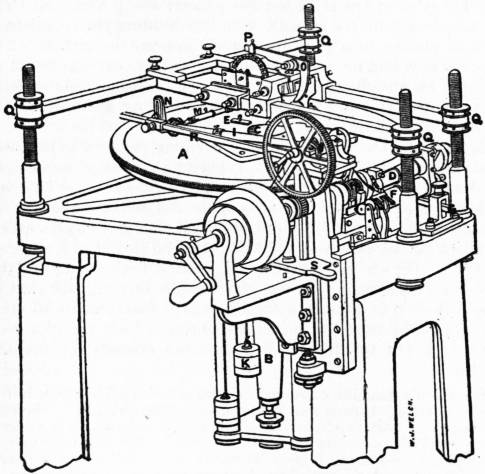
Dividing Engine.
A description is given of a dividing engine made by William Simms in the Memoirs of the Astronomical Society, 1843. Simms became convinced that to copy upon smaller circles the divisions which had been put upon a large plate with very great accuracy was not only more expeditious but more exact than original graduation. His machine involved essentially the same principle as Troughton’s. The accompanying figure is taken by permission.
The plate A is 46 in. in diameter, and is composed of gun-metal cast in one solid piece. It has two sets of 5’ divisions—one very faint on an inlaid ring of silver, and the other stronger on the gun-metal. These were put on by original graduation, mainly on the plan of Edward Troughton. One very great improvement in this engine is that the axis B is tubular, as seen at C. The object of this hollow is to receive the axis of the circle to be divided, so that it can be fixed flat to the plate by the clamps E, without having first to be detached from the axis and other parts to which it has already been carefully fitted. This obviates the necessity for resetting, which can hardly be done without some error. D is the tangent screw, and F the frame carrying it, which turns on carefully polished steel pivots. The screw is pressed against the edge of the plate by a spiral spring acting under the end of the lever G, and by screwing the lever down the screw can be altogether removed from contact with the plate. The edge of the plate is ratched by 4320 teeth which were cut opposite the original division by a circular cutter attached to the screw frame. H is the spiral barrel round which the catgut band is wound, one end of which is attached to the crank L on the end of the axis J and the other to a counterpoise weight not seen. On the other end of J is another crank inclined to L and carrying a band and counterpoise weight seen at K. The object of this weight is to balance the former and give steadiness to the motion. On the axis J is seen a pair of bevelled wheels which move the rod I, which, by another pair of bevelled wheels attached to the box N, gives motion to the axis M, on the end of which is an eccentric for moving the bent lever O, which actuates the bar carrying the cutter. Between the eccentric and the point of the screw P is an undulating plate by which long divisions can be cut. The cutting apparatus is supported upon the two parallel rails which can be elevated or depressed at pleasure by the nuts Q. Also the cutting apparatus can be moved forward or backward upon these rails to suit circles of different diameters. The box N is movable upon the bar R, and the rod I is adjustable as to length by having a kind of telescope joint. The engine is self-acting, and can be driven either by hand or by a steam-engine or other motive power. It can be thrown in or out of gear at once by a handle seen at S.
Mention may be made of Donkin’s linear dividing engine, in which a compensating arrangement is employed whereby great accuracy is obtained notwithstanding the inequalities of the screw used to advance the cutting tool. Dividing engines have also been made by Reichenbach, Repsold and others in Germany, Gambey in Paris and by several other astronomical instrument-makers. A machine constructed by E. R. Watts & Son is described by G. T. McCaw, in the Monthly Not. R. A. S., January 1909.
References.—Bird, Method of dividing Astronomical Instruments (London, 1767); Duc de Chaulnes, Nouvelle Méthode pour diviser les instruments de mathématique et d’astronomie (1768); Ramsden, Description of an Engine for dividing Mathematical Instruments (London, 1777); Troughton’s memoir, Phil. Trans. (1809); Memoirs of the Royal Astronomical Society, v. 325, viii. 141, ix. 17, 35. See also J. E. Watkins, “On the Ramsden Machine,” Smithsonian Rep. (1890), p. 721; and L. Ambronn, Astronomische Instrumentenkunde (1899).
(J. Bl.)
GRADUS, or Gradus ad Parnassum (a step to Parnassus), a Latin (or Greek) dictionary, in which the quantities of the vowels of the words are marked. Synonyms, epithets and poetical expressions and extracts are also included under the more important headings, the whole being intended as an aid for students in Greek and Latin verse composition. The first Latin gradus was compiled in 1702 by the Jesuit Paul Aler (1656-1727), a famous schoolmaster. There is a Latin gradus by C. D. Yonge (1850); English-Latin by A. C. Ainger and H. G. Wintle (1890); Greek by J. Brasse (1828) and E. Maltby (1815), bishop of Durham.
GRAETZ, HEINRICH (1817-1891), the foremost Jewish historian of modern times, was born in Posen in 1817 and died at Munich in 1891. He received a desultory education, and was largely self-taught. An important stage in his development was the period of three years that he spent at Oldenburg as assistant and pupil of S. R. Hirsch, whose enlightened orthodoxy was for a time very attractive to Graetz. Later on Graetz proceeded to Breslau, where he matriculated in 1842. Breslau was then becoming the headquarters of Abraham Geiger, the leader of Jewish reform. Graetz was repelled by Geiger’s attitude, and though he subsequently took radical views of the Bible and tradition (which made him an opponent of Hirsch), Graetz remained a life-long foe to reform. He contended for freedom of thought; he had no desire to fight for freedom of ritual practice. He momentarily thought of entering the rabbinate, but he was unsuited to that career. For some years he supported himself as a tutor. He had previously won repute by his published essays, but in 1853 the publication of the fourth volume of his history of the Jews made him famous. This fourth volume (the first to be published) dealt with the Talmud. It was a brilliant resuscitation of the past. Graetz’s skill in piecing together detached fragments of information, his vast learning and extraordinary critical acumen, were equalled by his vivid power of presenting personalities. No Jewish book of the 19th century produced such a sensation as this, and Graetz won at a bound the position he still occupies as recognized master of Jewish history. His Geschichte der Juden, begun in 1853, was completed in 1875; new editions of the several volumes were frequent. The work has been translated into many languages; it appeared in English in five volumes in 1891-1895. The History is defective in its lack of objectivity; Graetz’s judgments are sometimes biassed, and in particular he lacks sympathy with mysticism. But the history is a work of genius. Simultaneously with the publication of vol. iv. Graetz was appointed on the staff of the new Breslau Seminary, of which the first director was Z. Frankel. Graetz passed the remainder of his life in this office; in 1869 he was created professor by the government, and also lectured at the Breslau University. Graetz attained considerable repute as a biblical critic. He was the author of many bold conjectures as to the date of Ruth, Ecclesiastes, Esther and other biblical books. His critical edition of the Psalms (1882-1883) was his chief contribution to biblical exegesis, but after his death Professor Bacher edited Graetz’s Emendationes to many parts of the Hebrew scriptures.
A full bibliography of Graetz’s works is given in the Jewish Quarterly Review, iv. 194; a memoir of Graetz is also to be found there. Another full memoir was prefixed to the “index” volume of the History in the American re-issue of the English translation in six volumes (Philadelphia, 1898).
(I. A.)
GRAEVIUS (properly Gräve or Greffe), JOHANN GEORG (1632-1703). German classical scholar and critic, was born at Naumburg, Saxony, on the 29th of January 1632. He was originally intended for the law, but having made the acquaintance of J. F. Gronovius during a casual visit to Deventer, under his influence he abandoned jurisprudence for philology. He completed his studies under D. Heinsius at Leiden, and under the Protestant theologians A. Morus and D. Blondel at Amsterdam. During his residence in Amsterdam, under Blondel’s influence he abandoned Lutheranism and joined the Reformed Church; and in 1656 he was called by the elector of Brandenburg to the chair of rhetoric in the university of Duisburg. Two years afterwards, on the recommendation of Gronovius, he was chosen to succeed that scholar at Deventer; in 1662 he was translated to the university of Utrecht, where he occupied first the chair of rhetoric, and from 1667 until his death (January 11th, 1703) that of history and politics. Graevius enjoyed a very high reputation as a teacher, and his lecture-room was crowded by pupils, many of them of distinguished rank, from all parts of the civilized world. He was honoured with special recognition by Louis XIV., and was a particular favourite of William III. of England, who made him historiographer royal.
His two most important works are the Thesaurus antiquitatum Romanarum (1694-1699, in 12 volumes), and the Thesaurus antiquitatum et historiarum Italiae published after his death, and continued by the elder Burmann (1704-1725). His editions of the classics, although they marked a distinct advance in scholarship, arc now for the most part superseded. They include Hesiod (1667), Lucian, Pseudosophista (1668), Justin, Historiae Philippicae (1669), Suetonius (1672), Catullus, Tibullus et Propertius (1680), and several of the works of Cicero (his best production). He also edited many of the writings of contemporary scholars. The Oratio funebris by P. Burmann (1703) contains an exhaustive list of the works of this scholar; see also P. H. Külb in Ersch and Gruber’s Allgemeine Encyklopädie, and J. E. Sandys, History of Classical Scholarship, ii. (1908).
GRAF, ARTURO (1848- ), Italian poet, of German extraction, was born at Athens. He was educated at Naples University and became a lecturer on Italian literature in Rome, till in 1882 he was appointed professor at Turin. He was one of the founders of the Giornale della letteratura italiana, and his publications include valuable prose criticism; but he is best known as a poet. His various volumes of verse—Poesie e novelle (1874), Dopo il tramonto versi (1893), &c.—give him a high place among the recent lyrical writers of his country.
GRAF, KARL HEINRICH (1815-1869), German Old Testament scholar and orientalist, was born at Mülhausen in Alsace on the 28th of February 1815. He studied Biblical exegesis and oriental languages at the university of Strassburg under E. Reuss, and, after holding various teaching posts, was made instructor in French and Hebrew at the Landesschule of Meissen, receiving in 1852 the title of professor. He died on the 16th of July 1869. Graf was one of the chief founders of Old Testament criticism. In his principal work, Die geschichtlichen Bücher des Alten Testaments (1866), he sought to show that the priestly legislation of Exodus, Leviticus and Numbers is of later origin than the book of Deuteronomy. He still, however, held the accepted view, that the Elohistic narratives formed part of the Grundschrift and therefore belonged to the oldest portions of the Pentateuch. The reasons urged against the contention that the priestly legislation and the Elohistic narratives were separated by a space of 500 years were so strong as to induce Graf, in an essay, “Die sogenannte Grundschrift des Pentateuchs,” published shortly before his death, to regard the whole Grundschrift as post-exilic and as the latest portion of the Pentateuch. The idea had already been expressed by E. Reuss, but since Graf was the first to introduce it into Germany, the theory, as developed by Julius Wellhausen, has been called the Graf-Wellhausen hypothesis.
Graf also wrote, Der Segen Moses Deut. 33 (1857) and Der Prophet Jeremia erklärt (1862). See T. K. Cheyne, Founders of Old Testament Criticism (1893); and Otto Pfleiderer’s book translated into English by J. F. Smith as Development of Theology (1890).
GRÄFE, ALBRECHT VON (1828-1870), German oculist, son of Karl Ferdinand von Gräfe, was born at Berlin on the 22nd of May 1828. At an early age he manifested a preference for the study of mathematics, but this was gradually superseded by an interest in natural science, which led him ultimately to the study of medicine. After prosecuting his studies at Berlin, Vienna, Prague, Paris, London, Dublin and Edinburgh, and devoting special attention to ophthalmology he, in 1850, began practice as an oculist in Berlin, where he founded a private institution for the treatment of the eyes, which became the model of many similar ones in Germany and Switzerland. In 1853 he was appointed teacher of ophthalmology in Berlin university; in 1858 he became extraordinary professor, and in 1866 ordinary professor. Gräfe contributed largely to the progress of the science of ophthalmology, especially by the establishment in 1855 of his Archiv für Ophthalmologie, in which he had Ferdinand Arlt (1812-1887) and F. C. Donders (1818-1889) as collaborators. Perhaps his two most important discoveries were his method of treating glaucoma and his new operation for cataract. He was also regarded as an authority in diseases of the nerves and brain. He died at Berlin on the 20th of July 1870.
See Ein Wort der Erinnerung an Albrecht von Gräfe (Halle, 1870) by his cousin, Alfred Gräfe (1830-1899), also a distinguished ophthalmologist, and the author of Das Sehen der Schielenden (Wiesbaden, 1897); and E. Michaelis, Albrecht von Gräfe. Sein Leben und Wirken (Berlin, 1877).
GRAFE, HEINRICH (1802-1868), German educationist, was born at Buttstädt in Saxe-Weimar on the 3rd of May 1802. He studied mathematics and theology at Jena, and in 1823 obtained a curacy in the town church of Weimar. He was transferred to Jena as rector of the town school in 1825; in 1840 he was also appointed extraordinary professor of the science of education (Pädagogik) in that university; and in 1842 he became head of the Bürgerschule (middle class school) in Cassel. After reorganizing the schools of the town, he became director of the new Realschule in 1843; and, devoting himself to the interests of educational reform in electoral Hesse, he became in 1849 a member of the school commission, and also entered the house of representatives, where he made himself somewhat formidable as an agitator. In 1852 for having been implicated in the September riots and in the movement against the unpopular minister Hassenpflug, who had dissolved the school commission, he was condemned to three years’ imprisonment, a sentence afterwards reduced to one of twelve months. On his release he withdrew to Geneva, where he engaged in educational work till 1855, when he was appointed director of the school of industry at Bremen. He died in that city on the 21st of July 1868.
Besides being the author of many text-books and occasional papers on educational subjects, he wrote Das Rechisverhältnis der Volksschule von innen und aussen (1829); Die Schulreform (1834); Schule und Unterricht (1839); Allgemeine Pädagogik (1845); Die deutsche Volksschule (1847). Together with Naumann, he also edited the Archiv für das praktische Volksschulwesen (1828-1835).
GRÄFE, KARL FERDINAND VON (1787-1840), German surgeon, was born at Warsaw on the 8th of March 1787. He studied medicine at Halle and Leipzig, and after obtaining licence from the Leipzig university, he was in 1807 appointed private physician to Duke Alexius of Anhalt-Bernburg. In 1811 he became professor of surgery and director of the surgical clinic at Berlin, and during the war with Napoleon he was superintendent of the military hospitals. When peace was concluded in 1815, he resumed his professorial duties. He was also appointed physician to the general staff of the army, and he became a director of the Friedrich Wilhelm Institute and of the Medico-Chirurgical Academy. He died suddenly on the 4th of July 1840 at Hanover, whither he had been called to operate on the eyes of the crown prince. Gräfe did much to advance the practice of surgery in Germany, especially in the treatment of wounds. He improved the rhinoplastic process, and its revival was chiefly due to him. His lectures at the university of Berlin attracted students from all parts of Europe.
The following are his principal works: Normen für die Ablösung grosser Gliedmassen (Berlin, 1812); Rhinoplastik (1818); Neue Beiträge zur Kunst Theile des Angesichts organisch zu ersetzen (1821); Die epidemisch-kontagiöse Augenblennorrhoë Ägyptens in den europäischen Befreiungsheeren (1824); and Jahresberichte über das klinisch-chirurgisch-augenärztliche Institut der Universität zu Berlin (1817-1834). He also edited, with Ph. von Walther, the Journal für Chirurgie und Augenheilkunde. See E. Michaelis, Karl Ferdinand von Gräfe in seiner 30 jährigen Wirken für Staat und Wissenschaft (Berlin, 1840).
GRAFFITO, plural graffiti, the Italian word meaning “scribbling” or “scratchings” (graffiare, to scribble, Gr. γράφειν), adopted by archaeologists as a general term for the casual writings, rude drawings and markings on ancient buildings, in distinction from the more formal or deliberate writings known as “inscriptions.” These “graffiti,” either scratched on stone or plaster by a sharp instrument such as a nail, or, more rarely, written in red chalk or black charcoal, are found in great abundance, e.g. on the monuments of ancient Egypt. The best-known “graffiti” are those in Pompeii and in the catacombs and elsewhere in Rome. They have been collected by R. Garrucci (Graffiti di Pompei, Paris, 1856), and L. Correra (“Graffiti di Roma” in Bolletino della commissione municipale archaeologica, Rome, 1893; see also Corp. Ins. Lat. iv., Berlin, 1871). The subject matter of these scribblings is much the same as that of the similar scrawls made to-day by boys, street idlers and the casual “tripper.” The schoolboy of Pompeii wrote out lists of nouns and verbs, alphabets and lines from Virgil for memorizing, lovers wrote the names of their beloved, “sportsmen” scribbled the names of horses they had been “tipped,” and wrote those of their favourite gladiators. Personal abuse is frequent, and rude caricatures are found, such as that of one Peregrinus with an enormous nose, or of Naso or Nasso with hardly any. Aulus Vettius Firmus writes up his election address and appeals to the pilicrepi or ball-players for their votes for him as aedile. Lines of poetry, chiefly suited for lovers in dejection or triumph, are popular, and Ovid and Propertius appear to be favourites. Apparently private owners of property felt the nuisance of the defacement of their walls, and at Rome near the Porta Portuensis has been found an inscription begging people not to scribble (scariphare) on the walls.
Graffiti are of some importance to the palaeographer and to the philologist as illustrating the forms and corruptions of the various alphabets and languages used by the people, and occasionally guide the archaeologist to the date of the building on which they appear, but they are chiefly valuable for the light they throw on the everyday life of the “man in the street” of the period, and for the intimate details of customs and institutions which no literature or formal inscriptions can give. The graffiti dealing with the gladiatorial shows at Pompeii are in this respect particularly noteworthy; the rude drawings such as that of the secutor caught in the net of the retiarius and lying entirely at his mercy, give a more vivid picture of what the incidents of these shows were like than any account in words (see Garrucci, op. cit., Pls. x.-xiv.; A. Mau, Pompeii in Leben und Kunst, 2nd ed., 1908, ch. xxx.). In 1866 in the Trastevere quarter of Rome, near the church of S. Crisogono, was discovered the guardhouse (excubitorium) of the seventh cohort of the city police (vigiles), the walls being covered by the scribblings of the guards, illustrating in detail the daily routine, the hardships and dangers, and the feelings of the men towards their officers (W. Henzen, “L’ Escubitorio della Settima coorte dei Vigili” in Bull. Inst. 1867, and Annali Inst., 1874; see also R. Lanciani, Ancient Rome in the Light of Recent Discoveries, 230, and Ruins and Excavations of Ancient Rome, 1897, 548). The most famous graffito yet discovered is that generally accepted as representing a caricature of Christ upon the cross, found on the walls of the Domus Gelotiana on the Palatine in 1857, and now preserved in the Kircherian Museum of the Collegio Romano. Deeply scratched in the wall is a figure of a man clad in the short tunica with one hand upraised in salutation to another figure, with the head of an ass, or possibly a horse, hanging on a cross; beneath is written in rude Greek letters “Anaxamenos worships (his) god.” It has been suggested that this represents an adherent of some Gnostic sect worshipping one of the animal-headed deities of Egypt (see Ferd. Becker, Das Spottcrucifix der römischen Kaiserpaläste, Breslau, 1866; F. X. Kraus, Das Spottcrucifix vom Palatin, Freiburg in Breisgau, 1872; and Visconti and Lanciani, Guida del Palatino).
There is an interesting article, with many quotations of graffiti, in the Edinburgh Review, October 1859, vol. cx.
(C. We.)
GRAFLY, CHARLES (1862- ), American sculptor, was born at Philadelphia, Pennsylvania, on the 3rd of December 1862. He was a pupil of the schools of the Pennsylvania Academy of the Fine Arts, Philadelphia, and of Henri M. Chapu and Jean Dampt, and the École des Beaux Arts, Paris. He received an Honorable Mention in the Paris Salon of 1891 for his “Mauvais Présage,” now at the Detroit Museum of Fine Arts, a gold medal at the Paris Exposition, in 1900, and medals at Chicago, 1893, Atlanta, 1895, and Philadelphia (the gold Medal of Honor, Pennsylvania Academy of the Fine Arts), 1899. In 1892 he became instructor in sculpture at the Pennsylvania Academy of the Fine Arts, also filling the same chair at the Drexel Institute, Philadelphia. He was elected a full member of the National Academy of Design in 1905. His better-known works include: “General Reynolds,” Fairmount Park, Philadelphia; “Fountain of Man” (made for the Pan-American Exposition at Buffalo); “From Generation to Generation”; “Symbol of Life”; “Vulture of War,” and many portrait busts.
GRÄFRATH, a town in Rhenish Prussia, on the Itterbach, 14 m. E. of Düsseldorf on the railway Hilden-Vohwinkel. Pop. (1905) 9030. It has a Roman Catholic and two Evangelical churches, and there was an abbey here from 1185 to 1803. The principal industries are iron and steel, while weaving is carried on in the town.
GRAFT (a modified form of the earlier “graff,” through the French from the Late Lat. graphium, a stylus or pencil), a small branch, shoot or “scion,” transferred from one plant or tree to another, the “stock,” and inserted in it so that the two unite (see Horticulture). The name was adopted from the resemblance in shape of the “graft” to a pencil. The transfer of living tissue from one portion of an organism to another part of the same or different organism where it adheres and grows is also known as “grafting,” and is frequently practised in modern surgery. The word is applied, in carpentry, to an attachment of the ends of timbers, and, as a nautical term, to the “whipping” or “pointing” of a rope’s end with fine twine to prevent unravelling. “Graft” is used as a slang term, in England, for a “piece of hard work.” In American usage Webster’s Dictionary (ed. 1904) defines the word as “the act of any one, especially an official or public employé, by which he procures money surreptitiously by virtue of his office or position; also the surreptitious gain thus procured.” It is thus a word embracing blackmail and illicit commission. The origin of the English use of the word is probably an obsolete word “graft,” a portion of earth thrown up by a spade, from the Teutonic root meaning “to dig,” seen in German graben, and English “grave.”
GRAFTON, DUKES OF. The English dukes of Grafton are descended from Henry Fitzroy (1663-1690), the natural son of Charles II. by Barbara Villiers (countess of Castlemaine and duchess of Cleveland). In 1672 he was married to the daughter and heiress of the earl of Arlington and created earl of Euston; in 1675 he was created duke of Grafton. He was brought up as a sailor, and saw military service at the siege of Luxemburg in 1684. At James II.’s coronation he was lord high constable. In the rebellion of the duke of Monmouth he commanded the royal troops in Somersetshire; but later he acted with Churchill (duke of Marlborough), and joined William of Orange against the king. He died of a wound received at the storming of Cork, while leading William’s forces, being succeeded as 2nd duke by his son Charles (1682-1757).
Augustus Henry Fitzroy, 3rd duke of Grafton (1735-1811), one of the leading politicians of his time, was the grandson of the 2nd duke, and was educated at Westminster and Cambridge. He first became known in politics as an opponent of Lord Bute; in 1765 he was secretary of state under the marquis of Rockingham; but he retired next year, and Pitt (becoming earl of Chatham) formed a ministry in which Grafton was first lord of the treasury (1766) but only nominally prime minister. Chatham’s illness at the end of 1767 resulted in Grafton becoming the effective leader, but political differences and the attacks of “Junius” led to his resignation in January 1770. He became lord privy seal in Lord North’s ministry (1771) but resigned in 1775, being in favour of conciliatory action towards the American colonists. In the Rockingham ministry of 1782 he was again lord privy seal. In later years he was a prominent Unitarian.
Besides his successor, the 4th duke (1760-1844), and numerous other children, he was the father of General Lord Charles Fitzroy (1764-1829), whose sons Sir Charles Fitzroy (1798-1858), governor of New South Wales, and Robert Fitzroy (q.v.), the hydrographer, were notable men. The 4th duke’s son, who succeeded as 5th duke, was father of the 6th and 7th dukes.
The 3rd duke left in manuscript a Memoir of his public career, of which extracts have been printed in Stanhope’s History, Walpole’s Memories of George III. (Appendix, vol. iv.), and Campbell’s Lives of the Chancellors.
GRAFTON, RICHARD (d. 1572). English printer and chronicler, was probably born about 1513. He received the freedom of the Grocers’ Company in 1534. Miles Coverdale’s version of the Bible had first been printed in 1535. Grafton was early brought into touch with the leaders of religious reform, and in 1537 he undertook, in conjunction with Edward Whitchurch, to produce a modified version of Coverdale’s text, generally known as Matthew’s Bible (Antwerp, 1537). He went to Paris to reprint Coverdale’s revised edition (1538). There Whitchurch and he began to print the folio known as the Great Bible by special licence obtained by Henry VIII. from the French government. Suddenly, however, the work was officially stopped and the presses seized. Grafton fled, but Thomas Cromwell eventually bought the presses and type, and the printing was completed in England. The Great Bible was reprinted several times under his direction, the last occasion being 1553. In 1544 Grafton and Whitchurch secured the exclusive right of printing church service books, and on the accession of Edward VI. he was appointed king’s printer, an office which he retained throughout the reign. In this capacity he produced The Booke of the Common Praier and Administracion of the Sacramentes, and other Rites and Ceremonies of the Churche: after the Use of the Churche of Englande (1549 fol.), and Actes of Parliament (1552 and 1553). In 1553 he printed Lady Jane Grey’s proclamation and signed himself the queen’s printer. For this he was imprisoned for a short time, and he seems thereafter to have retired from active business. His historical works include a continuation (1543) of Hardyng’s Chronicle from the beginning of the reign of Edward IV. down to Grafton’s own times. He is said to have taken considerable liberties with the original, and may practically be regarded as responsible for the whole work. He printed in 1548 Edward Hall’s Union of the ... Families of Lancastre and Yorke, adding the history of the years from 1532 to 1547. After he retired from the printing business he published An Abridgement of the Chronicles of England (1562), Manuell of the Chronicles of England (1565), Chronicle at large and meere Historye of the Affayres of England (1568). In these books he chiefly adapted the work of his predecessors, but in some cases he gives detailed accounts of contemporary events. His name frequently appears in the records of St Bartholomew’s and Christ’s hospitals, and in 1553 he was treasurer-general of the hospitals of King Edward’s foundation. In 1553-1554 and 1556-1557 he represented the City in Parliament, and in 1562-1563 he sat for Coventry.
An elaborate account of Grafton was written in 1901 by Mr J. A. Kingdon under the auspices of the Grocers’ Company, with the title Richard Grafton, Citizen and Grocer of London, &c., in continuation of Incidents in the Lives of T. Poyntz and R. Grafton (1895). His Chronicle at large was reprinted by Sir Henry Ellis in 1809.
GRAFTON, a city of Clarence county, New South Wales, lying on both sides of the Clarence river, at a distance of 45 m. from its mouth, 342 m. N.E. of Sydney by sea. Pop. (1901) 4174, South Grafton, 976. The two sections, North Grafton and South Grafton, form separate municipalities. The river is navigable from the sea to the town for ships of moderate burden, and for small vessels to a point 35 m. beyond it. The entrance to the river has been artificially improved. Grafton is the seat of the Anglican joint-bishopric of Grafton and Armidale, and of a Roman Catholic bishopric created in 1888, both of which have fine cathedrals. Dairy-farming and sugar-growing are important industries, and there are several sugar-mills in the neighbourhood; great numbers of horses, also, are bred for the Indian and colonial markets. Tobacco, cereals and fruits are also grown. Grafton has a large shipping trade with Sydney. There is rail-connexion with Brisbane, &c. The city became a municipality in 1859.
GRAFTON, a township in the S.E. part of Worcester county, Massachusetts, U.S.A. Pop. (1905) 5052; (1910) 5705. It is served by the New York, New Haven & Hartford, and the Boston & Albany railways, and by interurban electric lines. The township contains several villages (including Grafton, North Grafton, Saundersville, Fisherville and Farnumsville); the principal village, Grafton, is about 7 m. S.E. of Worcester. The villages are residential suburbs of Worcester, and attract many summer residents. In the village of Grafton there is a public library. There is ample water power from the Blackstone river and its tributaries, and among the manufactures of Grafton are cotton-goods, boots and shoes, &c. Within what is now Grafton stood the Nipmuck Indian village of Hassanamesit. John Eliot, the “apostle to the Indians,” visited it soon after 1651, and organized the third of his bands of “praying Indians” there; in 1671 he established a church for them, the second of the kind in New England, and also a school. In 1654 the Massachusetts General Court granted to the Indians, for their exclusive use, a tract of about 4 sq. m., of which they remained the sole proprietors until 1718, when they sold a small farm to Elisha Johnson, the first permanent white settler in the neighbourhood. In 1728 a group of residents of Marlboro, Sudbury, Concord and Stowe, with the permission of the General Court, bought from the Indians 7500 acres of their lands, and agreed to establish forty English families on the tract within three years, and to maintain a church and school of which the Indians should have free use. The township was incorporated in 1735, and was named in honour of the 2nd duke of Grafton. The last of the pure-blooded Indians died about 1825.
GRAFTON, a city and the county-seat of Taylor county, West Virginia, U.S.A., on Tygart river, about 100 m. by rail S.E. of Wheeling. Pop. (1890) 3159; (1900) 5650, including 226 foreign-born and 162 negroes; (1910) 7563. It is served by four divisions of the Baltimore & Ohio railway, which maintains extensive car shops here. The city is about 1000 ft. above sea-level. It has a small national cemetery, and about 4 m. W., at Pruntytown, is the West Virginia Reform School. Grafton is situated near large coal-fields, and is supplied with natural gas. Among its manufactures are machine-shop and foundry products, window glass and pressed glass ware, and grist mill and planing-mill products. The first settlement was made about 1852, and Grafton was incorporated in 1856 and chartered as a city in 1899. In 1903 the population and area of the city were increased by the annexation of the town of Fetterman (pop. in 1900, 796), of Beaumont (unincorporated), and of other territory.
GRAHAM, SIR GERALD (1831-1899), British general, was born on the 27th of June 1831 at Acton, Middlesex. He was educated at Dresden and Woolwich Academy, and entered the Royal Engineers in 1850. He served with distinction through the Russian War of 1854 to 1856, was present at the battles of the Alma and Inkerman, was twice wounded in the trenches before Sevastopol, and was awarded the Victoria Cross for gallantry at the attack on the Redan and for devoted heroism on numerous occasions. He also received the Legion of Honour, and was promoted to a brevet majority. In the China War of 1860 he took part in the actions of Sin-ho and Tang-ku, the storming of the Taku Forts, where he was severely wounded, and the entry into Peking (brevet lieutenant-colonelcy and C.B.). Promoted colonel in 1869, he was employed in routine duties until 1877, when he was appointed assistant-director of works for barracks at the war office, a position he held until his promotion to major-general in 1881. In command of the advanced force in Egypt in 1882, he bore the brunt of the fighting, was present at the action of Magfar, commanded at the first battle of Kassassin, took part in the second, and led his brigade at Tell-el-Kebir. For his services in the campaign he received the K.C.B. and thanks of parliament. In 1884 he commanded the expedition to the eastern Sudan, and fought the successful battles of El Teb and Tamai. On his return home he received the thanks of parliament and was made a lieutenant-general for distinguished service in the field. In 1885 he commanded the Suakin expedition, defeated the Arabs at Hashin and Tamai, and advanced the railway from Suakin to Otao, when the expedition was withdrawn (thanks of parliament and G.C.M.G.). In 1896 he was made G.C.B., and in 1899 colonel-commandant Royal Engineers. He died on the 17th of December 1899. He published in 1875 a translation of Goetze’s Operations of the German Engineers in 1870-1871, and in 1887 Last Words with Gordon.