VOLUME XII SLICE III Gordon, Lord George to Grasses (continued 11)
Reading edition
The life of Lord Granville (1905), by Lord Fitzmaurice, is full of interesting material for the history of the period, but being written by a Liberal, himself an under-secretary for foreign affairs, it explains rather than criticizes Lord Granville’s work in that department.
(H. Ch.)
GRANVILLE, JOHN CARTERET, Earl (1690-1763), English statesman, commonly known by his earlier title as Lord Carteret, born on the 22nd of April 1690, was the son of George, 1st Lord Carteret, by his marriage with Grace Granville, daughter of Sir John Granville, 1st earl of Bath, and great grandson of the Elizabethan admiral, Sir Richard Grenville, famous for his death in the “Revenge.” The family of Carteret was settled in the Channel Islands, and was of Norman descent. John Carteret was educated at Westminster, and at Christ Church, Oxford. Swift says that “with a singularity scarce to be justified he carried away more Greek, Latin and philosophy than properly became a person of his rank.” Throughout life Carteret not only showed a keen love of the classics, but a taste for, and a knowledge of, modern languages and literatures. He was almost the only Englishman of his time who knew German. Harte, the author of the Life of Gustavus Adolphus, acknowledged the aid which Carteret had given him. On the 17th of October 1710 he married at Longleat Lady Frances Worsley, grand-daughter of the first Viscount Weymouth. He took his seat in the Lords on the 25th of May 1711. Though his family, on both sides, had been devoted to the house of Stuart, Carteret was a steady adherent of the Hanoverian dynasty. He was a friend of the Whig leaders Stanhope and Sunderland, took a share in defeating the Jacobite conspiracy of Bolingbroke on the death of Queen Anne, and supported the passing of the Septennial Act. Carteret’s interests were however in foreign, and not in domestic policy. His serious work in public life began with his appointment, early in 1719, as ambassador to Sweden. During this and the following year he was employed in saving Sweden from the attacks of Peter the Great, and in arranging the pacification of the north. His efforts were finally successful. During this period of diplomatic work he acquired an exceptional knowledge of the affairs of Europe, and in particular of Germany, and displayed great tact and temper in dealing with the Swedish senate, with Queen Ulrica, with the king of Denmark and Frederick William I. of Prussia. But he was not qualified to hold his own in the intrigues of court and parliament in London. Named secretary of state for the southern department on his return home, he soon became helplessly in conflict with the intrigues of Townshend and Sir Robert Walpole. To Walpole, who looked upon every able colleague, or subordinate, as an enemy to be removed, Carteret was exceptionally odious. His capacity to speak German with the king would alone have made Sir Robert detest him. When, therefore, the violent agitation in Ireland against Wood’s halfpence (see Swift, Jonathan) made it necessary to replace the duke of Grafton as lord lieutenant, Carteret was sent to Dublin. He landed in Dublin on the 23rd of October 1724, and remained there till 1730. In the first months of his tenure of office he had to deal with the furious opposition to Wood’s halfpence, and to counteract the effect of Swift’s Draper’s Letters. The lord lieutenant had a strong personal liking for Swift, who was also a friend of Lady Carteret’s family. It is highly doubtful whether Carteret could have reconciled his duty to the crown with his private friendships, if government had persisted in endeavouring to force the detested coinage on the Irish people. Wood’s patent was however withdrawn, and Ireland settled down. Carteret was a profuse and popular lord lieutenant who pleased both the “English interest” and the native Irish. He was at all times addicted to lavish hospitality, and according to the testimony of contemporaries was too fond of burgundy. When he returned to London in 1730, Walpole was firmly established as master of the House of Commons, and as the trusted minister of King George II. He had the full confidence of Queen Caroline, whom he prejudiced against Carteret. Till the fall of Walpole in 1742, Carteret could take no share in public affairs except as a leader of opposition of the Lords. His brilliant parts were somewhat obscured by his rather erratic conduct, and a certain contempt, partly aristocratic and partly intellectual, for commonplace men and ways. He endeavoured to please Queen Caroline, who loved literature, and he has the credit, on good grounds, of having paid the expenses of the first handsome edition of Don Quixote to please her. But he reluctantly, and most unwisely, allowed himself to be entangled in the scandalous family quarrel between Frederick, prince of Wales, and his parents. Queen Caroline was provoked into classing him and Bolingbroke, as “the two most worthless men of parts in the country.” Carteret took the popular side in the outcry against Walpole for not making war on Spain. When the War of the Austrian Succession approached, his sympathies were entirely with Maria Theresa—mainly on the ground that the fall of the house of Austria would dangerously increase the power of France, even if she gained no accession of territory. These views made him welcome to George II., who gladly accepted him as secretary of state in 1742. In 1743 he accompanied the king of Germany, and was present at the battle of Dettingen on the 27th of June. He held the secretaryship till November 1744. He succeeded in promoting an agreement between Maria Theresa and Frederick. He understood the relations of the European states, and the interests of Great Britain among them. But the defects which had rendered him unable to baffle the intrigues of Walpole made him equally unable to contend with the Pelhams. His support of the king’s policy was denounced as subservience to Hanover. Pitt called him “an execrable, a sole minister who had renounced the British nation.” A few years later Pitt adopted an identical policy, and professed that whatever he knew he had learnt from Carteret. On the 18th of October 1744 Carteret became Earl Granville on the death of his mother. His first wife died in June 1743 at Aschaffenburg, and in April 1744 he married Lady Sophia Fermor, daughter of Lord Pomfret—a fashionable beauty and “reigning toast” of London society, who was younger than his daughters. “The nuptials of our great Quixote and the fair Sophia,” and Granville’s ostentatious performance of the part of lover, were ridiculed by Horace Walpole. The countess Granville died on the 7th of October 1745, leaving one daughter Sophia, who married Lord Shelburne, 1st marquis of Lansdowne. This marriage may have done something to increase Granville’s reputation for eccentricity. In February 1746 he allowed himself to be entrapped by the intrigues of the Pelhams into accepting the secretaryship, but resigned in forty-eight hours. In June 1751 he became president of the council, and was still liked and trusted by the king, but his share in government did not go beyond giving advice, and endeavouring to forward ministerial arrangements. In 1756 he was asked by Newcastle to become prime minister as the alternative to Pitt, but Granville, who perfectly understood why the offer was made, declined and supported Pitt. When in October 1761 Pitt, who had information of the signing of the “Family Compact” wished to declare war on Spain, and declared his intention to resign unless his advice was accepted, Granville replied that “the opinion of the majority (of the Cabinet) must decide.” He spoke in complimentary terms of Pitt, but resisted his claim to be considered as a “sole minister” or, in the modern phrase, “a prime minister.” Whether he used the words attributed to him in the Annual Register for 1761 is more than doubtful, but the minutes of council show that they express his meaning. Granville remained in office as president till his death. His last act was to listen while on his death-bed to the reading of the preliminaries of the treaty of Paris. He was so weak that the under-secretary, Robert Wood, author of an essay on The Original Genius of Homer, would have postponed the business, but Granville said that it “could not prolong his life to neglect his duty,” and quoted the speech of Sarpedon from Iliad xii. 322-328, repeating the last word (ἴομεν) “with a calm and determined resignation.” He died in his house in Arlington Street, London, on the 22nd of January 1763. The title of Granville descended to his son Robert, who died without issue in 1776, when the earldom of this creation became extinct.
A somewhat partisan life of Granville was published in 1887, by Archibald Ballantyne, under the title of Lord Carteret, a Political Biography.
GRANVILLE, a town of Cumberland county, New South Wales, 13 m. by rail W. of Sydney. Pop. (1901) 5094. It is an important railway junction and manufacturing town, producing agricultural implements, tweed, pipes, tiles and bricks; there are also tanneries, flour-mills, and kerosene and meat export works. It became a municipality in 1885.
GRANVILLE, a fortified sea-port and bathing-resort of north-western France, in the department of Manche, at the mouth of the Bosq, 85 m. S. by W. of Cherbourg by rail. Pop. (1906) 10,530. Granville consists of two quarters, the upper town built on a promontory jutting into the sea and surrounded by ramparts, and the lower town and harbour lying below it. The barracks and the church of Notre-Dame, a low building of granite, partly Romanesque, partly late Gothic in style, are in the upper town. The port consists of a tidal harbour, two floating basins and a dry dock. Its fleets take an active part in deep sea fishing, including the cod-fishing off Newfoundland, and oyster-fishing is carried on. It has regular communication with Guernsey and Jersey, and with the islands of St Pierre and Miquelon. The principal exports are eggs, vegetables and fish; coal, timber and chemical manures are imported. The industries include ship-building, fish-salting, the manufacture of cod-liver oil, the preserving of vegetables, dyeing, metal-founding, rope-making and the manufacture of chemical manures. Among the public institutions are a tribunal and a chamber of commerce. In the commune are included the Iles Chausey about 7½ m. N.W. of Granville (see Channel Islands). Granville, before an insignificant village, was fortified by the English in 1437, taken by the French in 1441, bombarded and burned by the English in 1695, and unsuccessfully besieged by the Vendean troops in 1793. It was again bombarded by the English in 1803.
GRANVILLE, a village in Licking county, Ohio, U.S.A., in the township of Granville, about 6 m. W. of Newark and 27 m. E. by N. of Columbus. Pop. of the village (1910) 1394; of the township (1910) 2442. Granville is served by the Toledo & Ohio Central and the Ohio Electric railways, the latter reaching Newark (where it connects with the Pittsburg, Cincinnati, Chicago & St Louis and the Baltimore & Ohio railways), Columbus, Dayton, Zanesville and Springfield. Granville is the seat of Denison University, founded in 1831 by the Ohio Baptist Education Society and opened as a manual labour school, called the Granville Literary and Theological Institution. It was renamed Granville College in 1845, and took its present name in 1854 in honour of William S. Denison of Adamsville, Ohio, who had given $10,000 to the college. The university comprised in 1907-1908 five departments: Granville College (229 students), the collegiate department for men; Shepardson College (246 students, including 82 in the preparatory department), the collegiate department for women, founded as the Young Ladies’ Institute of Granville in 1859, given to the Baptist denomination in 1887 by Dr Daniel Shepardson, its principal and owner, and closely affiliated for scholastic purposes, since 1900, with the university, though legally it is still a distinct institution; Doane Academy (137 students), the preparatory department for boys, established in 1831, named Granville Academy in 1887, and renamed in 1895 in honour of William H. Doane of Cincinnati, who gave to it its building; a conservatory of music (137 students); and a school of art (38 students).
In 1805 the Licking Land Company, organized in the preceding year in Granville, Massachusetts, bought 29,040 acres of land in Ohio, including the site of Granville; the town was laid out, and in the last months of that year settlers from Granville, Mass., began to arrive. By January 1806 the colony numbered 234 persons; the township was incorporated in 1806 and the village was incorporated in 1831. There are several remarkable Indian mounds near Granville, notably one shaped like an alligator.
See Henry Bushnell, History of Granville, Ohio (Columbus, O., 1889).
GRAPE, the fruit of the vine (q.v.). The word is adopted from the O. Fr. grape, mod. grappe, bunch or cluster of flowers or fruit, grappes de raisin, bunch of grapes. The French word meant properly a hook; cf. M.H.G. krapfe, Eng. “grapnel,” and “cramp.” The development of meaning seems to be vine-hook, cluster of grapes cut with a hook, and thence in English a single grape of a cluster. The projectile called “grape” or “grape-shot,” formerly used with smooth-bore ordnance, took its name from its general resemblance to a bunch of grapes. It consisted of a number of spherical bullets (heavier than those of the contemporary musket) arranged in layers separated by thin iron plates, a bolt passing through the centre of the plates binding the whole together. On being discharged the projectile delivered the bullets in a shower somewhat after the fashion of case-shot.
GRAPHICAL METHODS, devices for representing by geometrical figures the numerical data which result from the quantitative investigation of phenomena. The simplest application is met with in the representation of tabular data such as occur in statistics. Such tables are usually of single entry, i.e. to a certain value of one variable there corresponds one, and only one, value of the other variable. To construct the graph, as it is called, of such a table, Cartesian co-ordinates are usually employed. Two lines or axes at right angles to each other are chosen, intersecting at a point called the origin; the horizontal axis is the axis of abscissae, the vertical one the axis of ordinates. Along one, say the axis of abscissae, distances are taken from the origin corresponding to the values of one of the variables; at these points perpendiculars are erected, and along these ordinates distances are taken corresponding to the related values of the other variable. The curve drawn through these points is the graph. A general inspection of the graph shows in bold relief the essential characters of the table. For example, if the world’s production of corn over a number of years be plotted, a poor yield is represented by a depression, a rich one by a peak, a uniform one over several years by a horizontal line and so on. Moreover, such graphs permit a convenient comparison of two or more different phenomena, and the curves render apparent at first sight similarities or differences which can be made out from the tables only after close examination. In making graphs for comparison, the scales chosen must give a similar range of variation, otherwise the correspondence may not be discerned. For example, the scales adopted for the average consumption of tea and sugar must be ounces for the former and pounds for the latter. Cartesian graphs are almost always yielded by automatic recording instruments, such as the barograph, meteorograph, seismometer, &c. The method of polar co-ordinates is more rarely used, being only specially applicable when one of the variables is a direction or recorded as an angle. A simple case is the representation of photometric data, i.e. the value of the intensity of the light emitted in different directions from a luminous source (see Lighting).
The geometrical solution of arithmetical and algebraical problems is usually termed graphical analysis; the application to problems in mechanics is treated in Mechanics, § 5, Graphic Statics, and Diagram. A special phase is presented in Vector Analysis.
GRAPHITE, a mineral species consisting of the element carbon crystallized in the rhombohedral system. Chemically, it is thus indentical with the cubic mineral diamond, but between the two there are very wide differences in physical characters. Graphite is black and opaque, whilst diamond is colourless and transparent; it is one of the softest (H = 1) of minerals, and diamond the hardest of all; it is a good conductor of electricity, whilst diamond is a bad conductor. The specific gravity is 2.2, that of diamond is 3.5. Further, unlike diamond, it never occurs as distinctly developed crystals, but only as imperfect six-sided plates and scales. There is a perfect cleavage parallel to the surface of the scales, and the cleavage flakes are flexible but not elastic. The material is greasy to the touch, and soils everything with which it comes into contact. The lustre is bright and metallic. In its external characters graphite is thus strikingly similar to molybdenite (q.v.).
The name graphite, given by A. G. Werner in 1789, is from the Greek γράφειν, “to write,” because the mineral is used for making pencils. Earlier names, still in common use, are plumbago and black-lead, but since the mineral contains no lead these names are singularly inappropriate. Plumbago (Lat. plumbum, lead) was originally used for an artificial product obtained from lead ore, and afterwards for the ore (galena) itself; it was confused both with graphite and with molybdenite. The true chemical nature of graphite was determined by K. W. Scheele in 1779.
Graphite occurs mainly in the older crystalline rocks—gneiss, granulite, schist and crystalline limestone—and also sometimes in granite: it is found as isolated scales embedded in these rocks, or as large irregular masses or filling veins. It has also been observed as a product of contact-metamorphism in carbonaceous clay-slates near their contact with granite, and where igneous rocks have been intruded into beds of coal; in these cases the mineral has clearly been derived from organic matter. The graphite found in granite and in veins in gneiss, as well as that contained in meteoric irons, cannot have had such an origin. As an artificial product, graphite is well known as dark lustrous scales in grey pig-iron, and in the “kish” of iron furnaces: it is also produced artificially on a large scale, together with carborundum, in the electric furnace (see below). The graphite veins in the older crystalline rocks are probably akin to metalliferous veins and the material derived from deep-seated sources; the decomposition of metallic carbides by water and the reduction of hydrocarbon vapours have been suggested as possible modes of origin. Such veins often attain a thickness of several feet, and sometimes possess a columnar structure perpendicular to the enclosing walls; they are met with in the crystalline limestones and other Laurentian rocks of New York and Canada, in the gneisses of the Austrian Alps and the granulites of Ceylon. Other localities which have yielded the mineral in large amount are the Alibert mine in Irkutsk, Siberia and the Borrowdale mine in Cumberland. The Santa Maria mines of Sonora, Mexico, probably the richest deposits in the world, supply the American lead pencil manufacturers. The graphite of New York, Pennsylvania and Alabama is “flake” and unsuitable for this purpose.
Graphite is used for the manufacture of pencils, dry lubricants, grate polish, paints, crucibles and for foundry facings. The material as mined usually does not contain more than 20 to 50% of graphite: the ore has therefore to be crushed and the graphite floated off in water from the heavier impurities. Even the purest forms contain a small percentage of volatile matter and ash. The Cumberland graphite, which is especially suitable for pencils, contains about 12% of impurities.
(L. J. S.)
Artificial Manufacture.—The alteration of carbon at high temperatures into a material resembling graphite has long been known. In 1893 Girard and Street patented a furnace and a process by which this transformation could be effected. Carbon powder compressed into a rod was slowly passed through a tube in which it was subjected to the action of one or more electric arcs. E. G. Acheson, in 1896, patented an application of his carborundum process to graphite manufacture, and in 1899 the International Acheson Graphite Co. was formed, employing electric current from the Niagara Falls. Two procedures are adopted: (1) graphitization of moulded carbons; (2) graphitization of anthracite en masse. The former includes electrodes, lamp carbons, &c. Coke, or some other form of amorphous carbon, is mixed with a little tar, and the required article moulded in a press or by a die. The articles are stacked transversely in a furnace, each being packed in granular coke and covered with carborundum. At first the current is 3000 amperes at 220 volts, increasing to 9000 amperes at 20 volts after 20 hours. In graphitizing en masse large lumps of anthracite are treated in the electric furnace. A soft, unctuous form results on treating carbon with ash or silica in special furnaces, and this gives the so-called “deflocculated” variety when treated with gallotannic acid. These two modifications are valuable lubricants. The massive graphite is very easily machined and is widely used for electrodes, dynamo brushes, lead pencils and the like.
See “Graphite and its Uses,” Bull. Imperial Institute, (1906) P. 353. (1907) p. 70; F. Cirkel, Graphite (Ottawa, 1907).
(W. G. M.)
GRAPTOLITES, an assemblage of extinct zoophytes whose skeletal remains are found in the Palaeozoic rocks, occasionally in great abundance. They are usually preserved as branching or unbranching carbonized bodies, tree-like, leaf-like or rod-like in shape, their edges regularly toothed or denticulated. Most frequently they occur lying on the bedding planes of black shales; less commonly they are met with in many other kinds of sediment, and when in limestone they may retain much of their original relief and admit of a detailed microscopic study.
Each Graptolite represents the common horny or chitinous investment or supporting structure of a colony of zooids, each tooth-like projection marking the position of the sheath or theca of an individual zooid. Some of the branching forms have a distinct outward resemblance to the polyparies of Sertularia and Plumularia among the recent Hydroida (Calyptoblastea); in none of the unbranching forms, however, is the similarity by any means close.
The Graptolite polyparies vary considerably in size: the majority range from 1 in. to about 6 in. in length; few examples have been met with having a length or more than 30 in.
Very different views have been held as to the systematic place and rank of the Graptolites. Linnaeus included them in his group of false fossils (Graptolithus = written stone). At one time they were referred by some to the Polyzoa (Bryozoa), and later, by almost general consent, to the Hydroida (Calyptoblastea) among the Hydrozoa (Hydromedusae). Of late years an opinion is gaining ground that they may be regarded as constituting collectively an independent phylum of their own (Graptolithina).
There are two main groups, or sub-phyla: the Graptoloidea or Graptolites proper, and the Dendroidea or tree-like Graptolites; the former is typified by the unbranched genus Monograptus and the latter by the many-branched genus Dendrograptus.
A Monograptus makes its first appearance as a minute dagger-like body (the sicula), which represents the flattened covering of the primary or embryonic zooid of the colony. This sicula, which had originally the shape of a hollow cone, is formed of two portions or regions—an upper and smaller (apical or embryonic) portion, marked by delicate longitudinal lines, and having a fine tabular thread (the nema) proceeding from its apex; and a lower (thecal or apertural) portion, marked by transverse lines of growth and widening in the direction of the mouth, the lip or apertural margin of which forms the broad end of the sicula. This margin is normally furnished with a perpendicular spine (virgella) and occasionally with two shorter lateral spines or lobes.
A bud is given off from the sicula at a variable distance along its length. From this bud is developed the first zooid and first serial theca of the colony. This theca grows in the direction of the apex of the sicula, to which it adheres by its dorsal wall. Thus while the mouth of the sicula is directed downwards, that of the first serial theca is pointed upwards, making a theoretical angle of about 180° with the direction of that of the sicula.
From this first theca originates a second, opening in the same direction, and from the second a third, and soon, in a continuous linear series until the polypary is complete. Each zooid buds from the one immediately preceding it in the series, and intercommunication is effected by all the budding orifices (including that in the wall of the sicula) remaining permanently open. The sicula itself ceases to grow soon after the earliest theca have been developed; it remains permanently attached to the dorsal wall of the polypary, of which it forms the proximal end, its apex rarely reaching beyond the third or fourth theca.
A fine cylindrical rod or fibre (the so-called solid axis or virgula) becomes developed in a median groove in the dorsal wall of the polypary, and is sometimes continued distally as a naked rod. It was formerly supposed that a virgula was present in all the Graptoloidea; hence the term Rhabdophora sometimes employed for the Graptoloidea in general, and rhabdosome for the individual polypary; but while the virgula is present in many (Axonophora) it is absent as such in others (Axonolipa).
The Graptoloidea are arranged in eight families, each named after a characteristic genus: (1) Dichograptidae; (2) Leptograptidae; (3) Dicranograptidae; (4) Diplograptidae; (5) Glossograptidae (sub-family, Lasiograptidae); (6) Retiolitidae; (7) Dimorphograptidae; (8) Monograptidae.
In all these families the polypary originates as in Monograptus from a nema-bearing sicula, which invariably opens downwards and gives off only a single bud, such branching as may take place occurring at subsequent stages in the growth of the polypary. In some species young examples have been met with in which the nema ends above in a small membranous disk, which has been interpreted as an organ of attachment to the underside of floating bodies, probably sea weeds, from which the young polypary hung suspended.
Broadly speaking, these families make their first appearance in time in the order given above, and show a progressive morphological evolution along certain special lines. There is a tendency for the branches to become reduced in number, and for the serial thecae to become directed more and more upwards towards the line of the nema. In the oldest family—Dichograptidae—in which the branching polypary is bilaterally symmetrical and the thecae uniserial (monoprionidian)—there is a gradation from earlier groups with many branches to later groups with only two; and from species in which all the branches and their thecae are directed downwards, through species in which the branches become bent back more and more outwards and upwards, until in some the terminal thecae open almost vertically. In the genus Phyllograptus the branches have become reduced to four and these coalesce by their dorsal walls along the line of the nema, and the sicula becomes embedded in the base of the polypary. In the family of the Diplograptidae the branches are reduced to two; these also coalesce similarly by their dorsal walls, and the polypary thus becomes biserial (diprionidian), and the line of the nema is taken by a long axial tube-like structure, the nemacaulus or virgular tube. Finally, in the latest family, the Monograptidae, the branches are theoretically reduced to one, the polypary is uniserial throughout, and all the thecae are directed outwards and upwards.
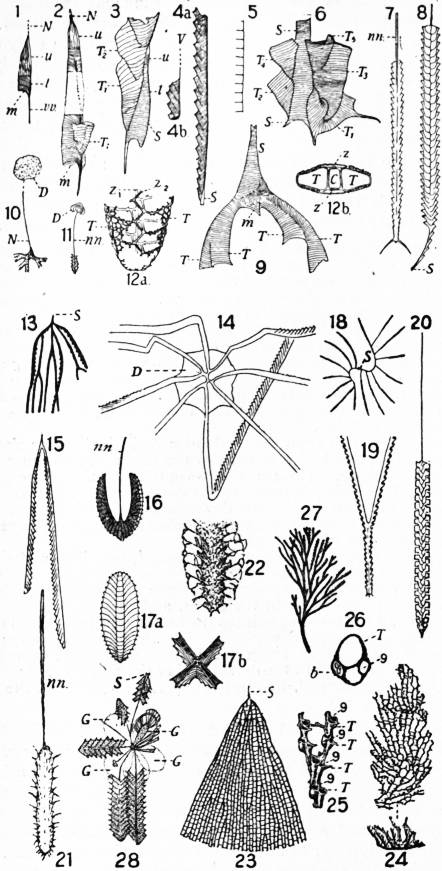
1, Diptograptus, young sicula. 2, Monograptus dubius, sicula and first serial theca (partly restored). 3, Young form (all above after Wiman). 4a, Older form. 4b, Showing virgula (after Holm). 5, Rastrites distans. 6, Base of Diptograptus (after Wiman). 7, D. calcaratus. 8, Dimorphograptus. 9, Base of Didymograptus minulus (after Holm). 10, Young Dictyograptus, with primary disk. 11, Ibid. Diptograptus (after Ruedemann). 12 a-b, Base and transverse section, Retiolites Geinitzianus (after Holm). 13, Bryograptus Kjerulfi. 14, Dichograptus octobrachiatus, with central disk. 15, Didymograptus Murchisoni. 16, D. gibberulus. 17 a-b, Phyllograptus and transverse section. 18, Nemagraptus gracilis. 19, Dicranograptus ramosus. 20, Climacograptus Scharenbergi. 21, Glossograptus Hincksii. 22, Lasiograptus costatus (after Elles and Wood). 23, Dictyonema (-graptus) flabelliforme (-is). 24, Dictyonema (-dendron) peltatum with base of attachment. 25, D. cervicorne, branches (after Holm). 26, D. rarum (section after Wiman). 27, Dendrograptus Hallianus. 28, Synrhabdosome of Diptograptus (after Ruedemann). S, Sicula. u, Upper or apical portion. l, Lower or apertural. m, Mouth. N, Nema. nn, Nemacaulus or virgular tube. V, Virgula. vv, Virgella. zz, Septal strands. T, Theca. C, Common canal (in Retiolites). G, Gonangium. g, Gonotheca. b, Budding theca.
The thecae in the earliest family—Dichograptidae—are so similar in form to the sicula itself that the polypary has been compared to a colony of siculae; there is the greatest variation in shape in those of the latest family—Monograptidae—in some species of which the terminal portion of each theca becomes isolated (Rastrites) and in some coiled into a rounded lobe. The thecae in several of the families are occasionally provided with spines or lateral processes: the spines are especially conspicuous at the base in some biserial forms: in the Lasiograptidae the lateral processes originate a marginal meshwork surrounding the polypary.
Histologically, the perisarc or test in the Graptoloidea appears to be composed of three layers, a middle layer of variable structure, and an overlying and an underlying layer of remarkable tenuity. The central layer is usually thick and marked by lines of growth; but in Glossograptus and Lasiograptus it is thinned down to a fine membrane stretched upon a skeleton framework of lists and fibres, and in Retiolites this membrane is reduced to a delicate network. The groups typified by these three genera are sometimes referred to, collectively, as the Retioloidea, and the structure as retioloid.
It is the general practice of palaeontologists to regard each graptolite polypary (rhabdosome) developed from a single sicula as an individual of the highest order. Certain American forms, however, which are preserved as stellate groups, have been interpreted as complex umbrella-shaped colonial stocks, individuals of a still higher order (synrhabdosomes), composed of a number of biserial polyparies (each having a sicula at its outer extremity) attached by their nemacauli to a common centre of origin, which is provided with two disks, a swimming bladder and a ring of capsules.
In the Dendroidea, as a rule, the polypary is non-symmetrical in shape and tree-like or shrub-like in habit, with numerous branches irregularly disposed, and with a distinct stem-like or short basal portion ending below in root-like fibres or in a membranous disk or sheet of attachment. An exception, however, is constituted by the comprehensive genus Dictyonema, which embraces species composed of a large number of divergent and sub-parallel branches, united by transverse dissepiments into a symmetrical cone-like or funnel-shaped polypary, and includes some forms (Dictyograptus) which originate from a nema-bearing sicula and have been claimed as belonging to the Graptoloidea.
Of the early development of the polypary in the Dendroidea little is known, but the more mature stages have been fully worked out. In Dictyonema the branches show thecae of two kinds: (1) the ordinary tubular thecae answering to those of the Graptoloidea and occupied by the nourishing zooids; and (2) the so-called bithecae, birdnest-like cups (regarded by their discoverers as gonothecae) opening alternately right and left of the ordinary thecae. Internally, there existed a third set of thecae, held to have been inhabited by the budding individuals. In the genus Dendrograptus the gonothecae open within the walls of the ordinary thecae, and the branches present an outward resemblance to those of the uniserial Graptoloidea. But in striking contrast to what obtains among the Graptoloidea in general, the budding orifices in the Dendroidea become closed, and all the various cells shut off from each other.
The classification of the Dendroidea is as yet unsatisfactory: the families most conspicuous are those typified by the genera Dendrograptus, Dictyonema, Inocaulis and Thamnograptus.
As regards the modes of reproduction among the Graptolites little is known. In the Dendroidea, as already pointed out, the bithecae were possibly gonothecae, but they have been interpreted by some as nematophores. In the Graptoloidea certain lateral and vesicular appendages of the polypary in the Lasiograptidae have been looked upon as connected with the reproductive system; and in the umbrella-shaped synrhabdosomes already referred to, the common centre is surrounded by a ring of what have been regarded as ovarian capsules. The theory of the gonangial nature of the vesicular bodies in the Graptoloidea is, however, disputed by some authorities, and it has been suggested that the zooid of the sicula itself is not the product of the normal or sexual mode of propagation in the group, but owes its origin to a peculiar type of budding or non-sexual reproduction, in which, as temporary resting or protecting structures, the vesicular bodies may have had a share.
As respects the mode of life of the Graptolites there can be little doubt that the Dendroidea were, with some exceptions, sessile or benthonic animals, their polyparies, like those of the recent Calyptoblastea, growing upwards, their bases remaining attached to the sea floor or to foreign bodies, usually fixed. The Graptoloidea have also been regarded by some as benthonic organisms. A more prevalent view, however, is that the majority were pseudo-planktonic or drifting colonies, hanging from the underside of floating seaweeds; their polyparies being each suspended by the nema in the earliest stages of growth, and, in later stages, some by the nemacaulus, while others became adherent above by means of a central disk or by parts of their dorsal walls. Some of these ancient seaweeds may have remained permanently rooted in the littoral regions, while others may have become broken off and drifted, like the recent Sargassum, at the mercy of the winds and currents, carrying the attached Graptolites into all latitudes. The more complex umbrella-shaped colonies of colonies (synrhabdosomes) described as provided with a common swimming bladder (pneumatophore?) may have attained a holo-planktonic or free-swimming mode of existence.
The range of the Graptolites in time extends from the Cambrian to the Carboniferous. The Dendroidea alone, however, have this extended range, the Graptoloidea becoming extinct at the close of Silurian time. Both groups make their first appearance together near the end of the Cambrian; but while in the succeeding Ordovician and Silurian the Dendroidea are comparatively rare, the Graptoloidea become the most characteristic and, locally, the most abundant fossils of these systems.
The species of the Graptoloidea have individually a remarkably short range in geological time; but the geographical distribution of the group as a whole, and that of many of its species, is almost world-wide. This combination of circumstances has given the Graptoloidea a paramount stratigraphical importance as palaeontological indices of the detailed sequence and correlation of the Lower Palaeozoic rocks in general. Many Graptolite zones, showing a constant uniformity of succession, paralleled in this respect only by the longer known Ammonite zones of the Jurassic, have been distinguished in Britain and northern Europe, each marked by a characteristic species. Many British species and associations of genera and species, occurring on corresponding horizons to those on which they are found in Britain, have been met with in the graptolite-bearing Lower Palaeozoic formations of other parts of Europe, in America, Australia, New Zealand and elsewhere.
Bibliography.—Linnaeus, Systema naturae (12th ed. 1768); Hall, Graptolites of the Quebec Group (1865); Barrande, Graptolites de Bohème (1850); Carruthers, Revision of the British Graptolites (1868); H. A. Nicholson, Monograph of British Graptolites, pt. 1 (1872); id. and J. E. Marr, Phylogeny of the Graptolites (1895); Hopkinson, On British Graptolites (1869); Allman, Monograph of Gymnoblastic Hydroids (1872); Lapworth, An Improved Classification of the Rhabdophora (1873); The Geological Distribution of the Rhabdophora (1879, 1880); Walther, Lebensweise fossiler Meerestiere (1897); Tullberg, Skånes Grapioliter (1882, 1883); Törnquist, Graptolites Scanian Rastrites Beds (1899); Wiman, Die Graptolithen (1895); Holm, Gotlands Graptoliter (1890); Perner, Graptolites de Bohème (1894-1899); R. Ruedemann, Development and Mode of Growth of Diplograptus (1895-1896); Graptolites of New York, vol. i. (1904), vol. ii. (1908); Frech, Lethaea palaeozoica, Graptolithiden (1897); Elles and Wood, Monograph of British Graptolites (1901-1909).
(C. L.*)
GRASLITZ (Czech, Kraslice), a town of Bohemia, on the Zwodau, 145 m. N.W. of Prague by rail. Pop. (1900) 11,803, exclusively German. Graslitz is one of the most important industrial towns of Bohemia, its specialities being the manufacture of musical instruments, carried on both as a factory and a domestic industry, and lace-making. Next in importance are cotton-spinning and weaving, machine embroidery, brewing, and the mother-of-pearl industry.
GRASMERE, a village and lake of Westmorland, in the heart of the English Lake District. The village (pop. of urban district in 1901, 781) lies near the head of the lake, on the small river Rothay and the Keswick-Ambleside road, 12½ m. from Keswick and 4 from Ambleside. The scenery is very beautiful; the valley about the lakes of Grasmere and Rydal Water is in great part wooded, while on its eastern flank there rises boldly the range of hills which includes Rydal Fell, Fairfield and Seat Sandal, and, farther north, Helvellyn. On the west side are Loughrigg Fell and Silver How. The village has become a favourite centre for tourists, but preserves its picturesque and sequestered appearance. In a house still standing William Wordsworth lived from 1799 to 1808, and it was subsequently occupied by Thomas de Quincey and by Hartley Coleridge. Wordsworth’s tomb, and also that of Coleridge, are in the churchyard of the ancient church of St Oswald, which contains a memorial to Wordsworth with an inscription by John Keble. A festival called the Rushbearing takes place on the Saturday within the octave of St Oswald’s day (August 5th), when a holiday is observed and the church decorated with rushes, heather and flowers. The festival is of early origin, and has been derived by some from the Roman Floralia, but appears also to have been made the occasion for carpeting the floors of churches, unpaved in early times, with rushes. Moreover, in a procession which forms part of the festivities at Grasmere, certain Biblical stories are symbolized, and in this a connexion with the ancient miracle plays may be found (see H. D. Rawnsley, A Rambler’s Note-Book at the English Lakes, Glasgow, 1902). Grasmere is also noted for an athletic meeting in August.
The lake of Grasmere is just under 1 m. in length, and has an extreme breadth of 766 yds. A ridge divides the basin from north to south, and rises so high as to form an island about the middle. The greatest depth of the lake (75 ft.) lies to the east of this ridge.
GRASS AND GRASSLAND, in agriculture. The natural vegetable covering of the soil in most countries is “grass” (for derivation see Grasses) of various kinds. Even where dense forest or other growth exists, if a little daylight penetrates to the ground grass of some sort or another will grow. On ordinary farms, or wherever farming of any kind is carried out, the proportion of the land not actually cultivated will either be in grass or will revert naturally to grass in time if left alone, after having been cultivated.
Pasture land has always been an important part of the farm, but since the “era of cheap corn” set in its importance has been increased, and much more attention has been given to the study of the different species of grass, their characteristics, the improvement of a pasture generally, and the “laying down” of arable land into grass where tillage farming has not paid. Most farmers desire a proportion of grass-land on their farms—from a third to a half of the area—and even on wholly arable farms there are usually certain courses in the rotation of crops devoted to grass (or clover). Thus the Norfolk 4-course rotation is corn, roots, corn, clover; the Berwick 5-course is corn, roots, corn, grass, grass; the Ulster 8-course, corn, flax, roots, corn, flax, grass, grass, grass; and so on, to the point where the grass remains down for 5 years, or is left indefinitely.
Permanent grass may be grazed by live-stock and classed as pasture pure and simple, or it may be cut for hay. In the latter case it is usually classed as “meadow” land, and often forms an alluvial tract alongside a stream, but as grass is often grazed and hayed in alternate years, the distinction is not a hard and fast one.
There are two classes of pasturage, temporary and permanent. The latter again consists of two kinds, the permanent grass natural to land that has never been cultivated, and the pasture that has been laid down artificially on land previously arable and allowed to remain and improve itself in the course of time. The existence of ridge and furrow on many old pastures in Great Britain shows that they were cultivated at one time, though perhaps more than a century ago. Often a newly laid down pasture will decline markedly in thickness and quality about the fifth and sixth year, and then begin to thicken and improve year by year afterwards. This is usually attributed to the fact that the unsuitable varieties die out, and the “naturally” suitable varieties only come in gradually. This trouble can be largely prevented, however, by a judicious selection of seed, and by subsequently manuring with phosphatic manures, with farmyard or other bulky “topdressings,” or by feeding sheep with cake and corn over the field.
All the grasses proper belong to the natural order Gramineae (see Grasses), to which order also belong all the “corn” plants cultivated throughout the world, also many others, such as bamboo, sugar-cane, millet, rice, &c. &c., which yield food for mankind. Of the grasses which constitute pastures and hay-fields over a hundred species are classified by botanists in Great Britain, with many varieties in addition, but the majority of these, though often forming a part of natural pastures, are worthless or inferior for farming purposes. The grasses of good quality which should form a “sole” in an old pasture and provide the bulk of the forage on a newly laid down piece of grass are only about a dozen in number (see below), and of these there are only some six species of the very first importance and indispensable in a “prescription” of grass seeds intended for laying away land in temporary or permanent pasture. Dr W. Fream caused a botanical examination to be made of several of the most celebrated pastures of England, and, contrary to expectation, found that their chief constituents were ordinary perennial ryegrass and white clover. Many other grasses and legumes were present, but these two formed an overwhelming proportion of the plants.
In ordinary usage the term grass, pasturage, hay, &c., includes many varieties of clover and other members of the natural order Leguminosae as well as other “herbs of the field,” which, though not strictly “grasses,” are always found in a grass field, and are included in mixtures of seeds for pasture and meadows. The following is a list of the most desirable or valuable agricultural grasses and clovers, which are either actually sown or, in the case of old pastures, encouraged to grow by draining, liming, manuring, and so on:—
Grasses.
Alopecurus pratensis Meadow foxtail.
Anthoxanthum odoratum Sweet vernal grass.
Avena elatior Tall oat-grass.
Avena flavescens Golden oat-grass.
Cynosurus cristatus Crested dogstail.
Dactylis glomerata Cocksfoot.
Festuca duriuscula Hard fescue.
Festuca elatior Tall fescue.
Festuca ovina Sheep’s fescue.
Festuca pratensis Meadow fescue.
Lolium italicum Italian ryegrass.
Phleum pratense Timothy or catstail.
Poa nemoralis Wood meadow-grass.
Poa pratensis Smooth meadow-grass.
Poa trivialis Rough meadow-grass.
Clovers, &c.
Medicago lupulina Trefoil or “Nonsuch.”
Medicago sativa Lucerne (Alfalfa).
Trifolium hybridum Alsike clover.
Trifolium pratense Broad red clover.
Trifolium pratense Perennial clover.
Trifolium perennne
Trifolium incarnatum Crimson clover or “Trifolium.”
Trifolium procumbens Yellow Hop-trefoil.
Trifolium repens White or Dutch clover.
Achillea Millefolium Yarrow or Milfoil.
Anthyllis vulneraria Kidney-vetch.
Lotus major Greater Birdsfoot Trefoil.
Lotus corniculatus Lesser Birdsfoot Trefoil.
Carum petroselinum Field parsley.
Plantago lanceolata Plantain.
Cichorium intybus Chicory.
Poterium officinale Burnet.
The predominance of any particular species is largely determined by climatic circumstances, the nature of the soil and the treatment it receives. In limestone regions sheep’s fescue has been found to predominate; on wet clay soil the dog’s bent (Agrostis canina) is common; continuous manuring with nitrogenous manures kills out the leguminous plants and stimulates such grasses as cocksfoot; manuring with phosphates stimulates the clovers and other legumes; and so on. Manuring with basic slag at the rate of from 5 to 10 cwt. per acre has been found to give excellent results on poor clays and peaty soils. Basic slag is a by-product of the Bessemer steel process, and is rich in a soluble form of phosphate of lime (tetra-phosphate) which specially stimulates the growth of clovers and other legumes, and has renovated many inferior pastures.
In the Rothamsted experiments continuous manuring with “mineral manures” (no nitrogen) on an old meadow has reduced the grasses from 71 to 64% of the whole, while at the same time it has increased the Leguminosae from 7% to 24%. On the other hand, continuous use of nitrogenous manure in addition to “minerals” has raised the grasses to 94% of the total and reduced the legumes to less than 1%.
As to the best kinds of grasses, &c., to sow in making a pasture out of arable land, experiments at Cambridge, England, have demonstrated that of the many varieties offered by seedsmen only a very few are of any permanent value. A complex mixture of tested seeds was sown, and after five years an examination of the pasture showed that only a few varieties survived and made the “sole” for either grazing or forage. These varieties in the order of their importance were:—
Cocksfoot 26
Perennial rye grass 16
Meadow fescue 13
Hard fescue 9
Crested dogstail 8
Timothy 6
White clover 4
Meadow foxtail 2
The figures represent approximate percentages.
Before laying down grass it is well to examine the species already growing round the hedges and adjacent fields. An inspection of this sort will show that the Cambridge experiments are very conclusive, and that the above species are the only ones to be depended on. Occasionally some other variety will be prominent, but if so there will be a special local reason for this.
On the other hand, many farmers when sowing down to grass like to have a good bulk of forage for the first year or two, and therefore include several of the clovers, lucerne, Italian ryegrass, evergreen ryegrass, &c., knowing that these will die out in the course of years and leave the ground to the more permanent species.
There are also several mixtures of “seeds” (the technical name given on the farm to grass-seeds) which have been adopted with success in laying down permanent pasture in some localities.
Young. De Laune. Leicester. Elliot. Cambridge average. General purpose mixture.
Cocksfoot .. 8 4 8 8 4
Perennial ryegrass .. .. 2 6 10 10
Meadow fescue .. 6 2 .. 5 ..
Hard fescue .. 1 1 2 3 ..
Crested dogstail 3 2 .. 1 3 ..
Timothy .. 3 1 .. 2 2
Meadow foxtail .. 10 .. .. 1 1
Tall fescue .. 3 1 3½ .. 2
Tall oat grass .. .. 1 3 .. ..
Italian ryegrass .. .. 2 .. .. 5
Smooth meadow grass .. .. .. 1 .. ..
Rough meadow grass .. 1 .. 1 .. ..
Golden oat grass .. .. ¼ 1 .. ..
Sheep’s fescue .. 1 .. .. .. ..
Broad red clover .. 1 .. .. .. 2
Perennial red clover .. 1 .. 1½ .. 2
Alsike .. 1 1½ 1 .. 2
Lucerne (Alfalfa) .. .. .. .. .. 8
White clover 4 1 1 2 2 2
Kidney vetch 6 .. .. 2½ .. ..
Sheep’s parsley .. .. .. 1 .. ..
Yarrow 1 1 ¼ 1 .. ..
Burnet 8 .. .. 8 .. ..
Chicory 4 .. .. 2½ .. ..
Plantain 4 .. .. .. .. ..
Total ℔ per acre 30 40 17 40 30 40
Arthur Young more than 100 years ago made out one to suit chalky hillsides; Mr Faunce de Laune (Sussex) in our days was the first to study grasses and advocated leaving out ryegrass of all kinds; Lord Leicester adopted a cheap mixture suitable for poor land with success; Mr Elliot (Kelso) has introduced many deep-rooted “herbs” in his mixture with good results. Typical examples of such mixtures are given on preceding page.
Temporary pastures are commonly resorted to for rotation purposes, and in these the bulky fast-growing and short-lived grasses and clovers are given the preference. Three examples of temporary mixtures are given below.
One year. Two years. Three or four years.
Italian ryegrass 14 10 6
Cocksfoot 2 4 6
Timothy .. 2 3
Broad red clover 8 5 3
Alsike 3 2 2
Trefoil 3 2 2
Perennial ryegrass .. 5 10
Meadow fescue .. 2 2
Perennial red clover .. 2 2
White clover .. 1 2
Meadow foxtail .. 1 2
Total ℔ per acre 30 36 40
Where only a one-year hay is required, broad red clover is often grown, either alone or mixed with a little Italian ryegrass, while other forage crops, like trefoil and trifolium, are often grown alone.
In Great Britain a heavy clay soil is usually preferred for pasture, both because it takes most kindly to grass and because the expense of cultivating it makes it unprofitable as arable land when the price of corn is low. On light soil the plant frequently suffers from drought in summer, the want of moisture preventing it from obtaining proper root-hold. On such soil the use of a heavy roller is advantageous, and indeed on any soil excepting heavy clay frequent rolling is beneficial to the grass, as it promotes the capillary action of the soil-particles and the consequent ascension of ground-water.
In addition, the grass on the surface helps to keep the moisture from being wasted by the sun’s heat.
The graminaceous crops of western Europe generally are similar to those enumerated. Elsewhere in Europe are found certain grasses, such as Hungarian brome, which are suitable for introduction into the British Isles. The grasses of the American prairies also include many plants not met with in Great Britain. Some half-dozen species are common to both countries: Kentucky “blue-grass” is the British Poa pratensis; couch grass (Triticum repens) grows plentifully without its underground runners; bent (Agrostis vulgaris) forms the famous “red-top,” and so on. But the American buffalo-grass, the Canadian buffalo-grass, the “bunch” grasses, “squirrel-tail” and many others which have no equivalents in the British Islands, form a large part of the prairie pasturage. There is not a single species of true clover found on the prairies, though cultivated varieties can be introduced.
(P. McC.)
GRASSE, FRANÇOIS JOSEPH PAUL, Marquis de Grassetilly, Comte de (1722-1788), French sailor, was born at Bar, in the present department of the Alpes Maritimes. In 1734 he took service on the galleys of the order of Malta, and in 1740 entered the service of France, being promoted to chief of squadron in 1779. He took part in the naval operations of the American War of Independence, and distinguished himself in the battles of Dominica and Saint Lucia (1780), and of Tobago (1781). He was less fortunate at St Kitts, where he was defeated by Admiral Hood. Shortly afterwards, in April 1782, he was defeated and taken prisoner by Admiral Rodney. Some months later he returned to France, published a Mémoire justificatif, and was acquitted by a court-martial (1784). He died at Paris in January 1788.
His son Alexandre de Grasse, published a Notice bibliographique sur l’amiral comte de Grasse d’après les documents inédits in 1840. See G. Lacour-Gayet, La Marine militaire de la France sous le règne de Louis XV (Paris, 1902).
GRASSE, a town in the French department of the Alpes Maritimes (till 1860 in that of the Var), 12½ m. by rail N. of Cannes. Pop. (1906) town, 13,958; commune, 20,305. It is built in a picturesque situation, in the form of an amphitheatre and at a height o£ 1066 ft. above the sea, on the southern slope of a hill, facing the Mediterranean. In the older (eastern) part of the town the streets are narrow, steep and winding, but the new portion (western) is laid out in accordance with modern French ideas. It possesses a remarkably mild and salubrious climate, and is well supplied with water. That used for the purpose of the factories comes from the fine spring of Foux. But the drinking water used in the higher portions of the town flows, by means of a conduit, from the Foulon stream, one of the sources of the Loup. Grasse was from 1244 (when the see was transferred hither from Antibes) to 1790 an episcopal see, but was then included in the diocese of Fréjus till 1860, when politically as well as ecclesiastically, the region was annexed to the newly-formed department of the Alpes Maritimes. It still possesses a 12th-century cathedral, now a simple parish church; while an ancient tower, of uncertain date, rises close by near the town hall, which was formerly the bishop’s palace (13th century). There is a good town library, containing the muniments of the abbey of Lérins, on the island of St Honorat opposite Cannes. In the chapel of the old hospital are three pictures by Rubens. The painter J. H. Fragonard (1732-1806) was a native of Grasse, and some of his best works were formerly to be seen here (now in America). Grasse is particularly celebrated for its perfumery. Oranges and roses are cultivated abundantly in the neighbourhood. It is stated that the preparation of attar of roses (which costs nearly £100 per 2 ℔) requires alone nearly 7,000,000 roses a year. The finest quality of olive oil is also manufactured at Grasse.
(W. A. B. C.)
GRASSES,1 a group of plants possessing certain characters in common and constituting a family (Gramineae) of the class Monocotyledons. It is one of the largest and most widespread and, from an economic point of view, the most important family of flowering plants. No plant is correctly termed a grass which is not a member of this family, but the word is in common language also used, generally in combination, for many plants of widely different affinities which possess some resemblance (often slight) in foliage to true grasses; e.g. knot-grass (Polygonum aviculare), cotton-grass (Eriophorum), rib-grass (Plantago), scorpion-grass (Myosotis), blue-eyed grass (Sisyrinchium), sea-grass (Zostera). The grass-tree of Australia (Xanthorrhoea) is a remarkable plant, allied to the rushes in the form of its flower, but with a tall, unbranched, soft-woody, palm-like trunk bearing a crown of long, narrow, grass-like leaves and stalked heads of small, densely-crowded flowers. In agriculture the word has an extended signification to include the various fodder-plants, chiefly leguminous, often called “artificial grasses.” Indeed, formerly grass (also spelt gwrs, gres, gyrs in the old herbals) meant any green herbaceous plant of small size.
Yet the first attempts at a classification of plants recognized and separated a group of Gramina, and this, though bounded by nothing more definite than habit and general appearance, contained the Gramineae of modern botanists. The older group, however, even with such systematists as Ray (1703), Scheuchzer (1719), and Micheli (1729), embraced in addition the Cyperaceae (Sedge family), Juncaceae (Rush family), and some other monocotyledons with inconspicuous flowers. Singularly enough, the sexual system of Linnaeus (1735) served to mark off more distinctly the true grasses from these allies, since very nearly all of the former then known fell under his Triandria Digynia, whilst the latter found themselves under his other classes and orders.
I. Structure.—The general type of true grasses is familiar in the cultivated cereals of temperate climates—wheat, barley, rye, oats, and in the smaller plants which make up pastures and meadows and form a principal factor of the turf of natural downs. Less familiar are the grains of warmer climates—rice, maize, millet and sorgho, or the sugar-cane. Still farther removed are the bamboos of the tropics, the columnar stems of which reach to the height of forest trees. All are, however, formed on a common plan.
Root.—Most cereals and many other grasses are annual, and possess a tuft of very numerous slender root-fibres, much branched and of great length. The majority of the members of the family are of longer duration, and have the roots also fibrous, but fewer, thicker and less branched. In such cases they are very generally given off from just above each node (often in a circle) of the lower part of the stem or rhizome, perforating the leaf-sheaths. In some bamboos they are very numerous from the lower nodes of the erect culms, and pass downwards to the soil, whilst those from the upper nodes shrivel up and form circles of spiny fibres.
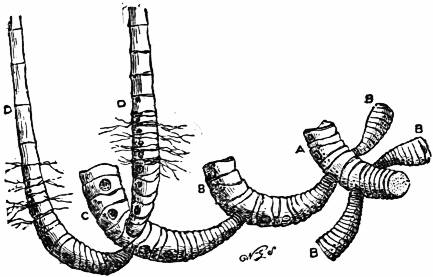
Fig. 1.—Rhizome of Bamboo. A, B, C, D, successive series of axes, the last bearing aerial culms. Much reduced.
Stem.—The underground stem or rootstock (rhizome) of perennial grasses is usually well developed, and often forms very long creeping or subterranean rhizomes, with elongated internodes and sheathing scales; the widely-creeping, slender rhizomes in Marram-grass (Psamma), Agropyrum junceum, Elymus arenarius, and other sand-loving plants render them useful as sand-binders. It is also frequently short, with the nodes crowded. The turf-formation, which is characteristic of open situations in cool temperate climates, results from an extensive production of short stolons, the branches and the fibrous roots developed from their nodes forming the dense “sod.” The very large rhizome of the bamboos (fig. 1) is also a striking example of “definite” growth; it is much branched, the short, thick, curved branches being given off below the apex of the older ones and at right angles to them, the whole forming a series of connected arched axes, truncate at their ends, which were formerly continued into leafy culms. The rhizome is always solid, and has the usual internal structure of the monocotyledonous stem. In the cases of branching just cited the branches break directly through the sheath of the leaf in connexion with which they arise. In other cases the branches grow upwards through the sheaths which they ultimately split from above, and emerging as aerial shoots give a tufted habit to the plant. Good examples are the oat, cock’s-foot (Dactylis) and other British grasses. This mode of growth is the cause of the “tillering” of cereals, or the production of a large number of erect growing branches from the lower nodes of the young stem. Isolated tufts or tussocks are also characteristic of steppe—and savanna—vegetation and open places generally in the warmer parts of the earth.
The aerial leaf-bearing branches (culms) are a characteristic feature of grasses. They are generally numerous, erect, cylindrical (rarely flattened) and conspicuously jointed with evident nodes. The nodes are solid, a strong plate of tissue passing across the stem, but the internodes are commonly hollow, although examples of completely solid stems are not uncommon (e.g. maize, many Andropogons, sugar-cane). The swollen nodes are a characteristic feature. In wheat, barley and most of the British native grasses they are a development, not of the culm, but of the base of the leaf-sheath. The function of the nodes is to raise again culms which have become bent down; they are composed of highly turgescent tissue, the cells of which elongate on the side next the earth when the culm is placed in a horizontal or oblique position, and thus raise the culm again to an erect position. The internodes continue to grow in length, especially the upper ones, for some time; the increase takes place in a zone at the extreme base, just above the node. The exterior of the culms is more or less concealed by the leaf-sheaths; it is usually smooth and often highly polished, the epidermal cells containing an amount of silica sufficient to leave after burning a distinct skeleton of their structure. Tabasheer is a white substance mainly composed of silica, found in the joints of several bamboos. A few of the lower internodes may become enlarged and sub-globular, forming nutriment-stores, and grasses so characterized are termed “bulbous” (Arrhenatherum, Poa bulbosa, &c.). In internal structure grass-culms, save in being hollow, conform to that usual in monocotyledons; the vascular bundles run parallel in the internodes, but a horizontal interlacement occurs at the nodes. In grasses of temperate climates branching is rare at the upper nodes of the culm, but it is characteristic of the bamboos and many tropical grasses. The branches are strictly distichous. In many bamboos they are long and spreading or drooping and copiously ramified, in others they are reduced to hooked spines. One genus (Dinochloa, a native of the Malay archipelago) is scandent, and climbs over trees 100 ft. or more in height, Olyra latifolia, a widely-spread tropical species, is also a climber on a humbler scale.
Grass-culms grow with great rapidity, as is most strikingly seen in bamboos, where a height of over 100 ft. is attained in from two to three months, and many species grow two, three or even more feet in twenty-four hours. Silicic hardening does not begin till the full height is nearly attained. The largest bamboo recorded is 170 ft., and the diameter is usually reckoned at about 4 in. to each 50 ft.
Leaves.—These present special characters usually sufficient for ordinal determination. They are solitary at each node and arranged in two rows, the lower often crowded, forming a basal tuft. They consist of two distinct portions, the sheath and the blade. The sheath is often of great length, and generally completely surrounds the culm, forming a firm protection for the internode, the younger basal portion of which, including the zone of growth, remains tender for some time. As a rule it is split down its whole length, thus differing from that of Cyperaceae which is almost invariably (Eriospora is an exception) a complete tube; in some grasses, however (species of Poa, Bromus and others), the edges are united. The sheaths are much dilated in Alopecurus vaginatus and in a species of Potamochloa, in the latter, an East Indian aquatic grass, serving as floats. At the summit of the sheath, above the origin of the blade, is the ligule, a usually membranous process of small size (occasionally reaching 1 in. in length) erect and pressed around the culm. It is rarely quite absent, but may be represented by a tuft of hairs (very conspicuous in Pariana). It serves to prevent rain-water, which has run down the blade, from entering the sheath. Melica uniflora has in addition to the ligule, a green erect tongue-like process, from the line of junction of the edges of the sheath.
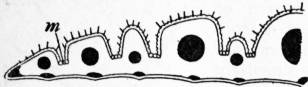
Fig. 2.—Magnified transverse section of one-half of a leaf-blade of Festuca rubra. The dark portions represent supporting and conducting tissue; the upper face bears furrows, at the bottom of each of which are seen the motor cells m.
The blade is frequently wanting or small and imperfect in the basal leaves, but in the rest is long and set on to the sheath at an angle. The usual form is familiar—sessile, more or less ribbon-shaped, tapering to a point, and entire at the edge. The chief modifications are the articulation of the deciduous blade on to the sheath, which occurs in all the Bambuseae (except Planotia) and in Spartina stricta; and the interposition of a petiole between the sheath and the blade, as in bamboos, Leptaspis, Pharus, Pariana, Lophatherum and others. In the latter case the leaf usually becomes oval, ovate or even cordate or sagittate, but these forms are found in sessile leaves also (Olyra, Panicum). The venation is strictly parallel, the midrib usually strong, and the other ribs more slender. In Anomochloa there are several nearly equal ribs and in some broad-leaved grasses (Bambuseae, Pharus, Leptaspis) the venation becomes tesselated by transverse connecting veins. The tissue is often raised above the veins, forming longitudinal ridges, generally on the upper face; the stomata are in lines in the intervening furrows. The thick prominent veins in Agropyrum occupy the whole upper surface of the leaf. Epidermal appendages are rare, the most frequent being marginal, saw-like, cartilaginous teeth, usually minute, but occasionally (Danthonia scabra, Panicum serratum) so large as to give the margin a serrate appearance. The leaves are occasionally woolly, as in Alopecurus lanatus and one or two Panicums. The blade is often twisted, frequently so much so that the upper and under faces become reversed. In dry-country grasses the blades are often folded on the midrib, or rolled up. The rolling is effected by bands of large wedge-shaped cells—motor-cells—between the nerves, the loss of turgescence by which, as the air dries, causes the blade to curl towards the face on which they occur. The rolling up acts as a protection from too great loss of water, the exposed surface being specially protected to this end by a strong cuticle, the majority or all of the stomata occurring on the protected surface. The stiffness of the blade, which becomes very marked in dry-country grasses, is due to the development of girders of thick-walled mechanical tissue which follow the course of all or the principal veins (fig. 2).
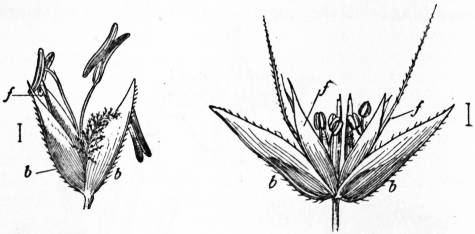
Fig. 3.—One-flowered spikelet of Agrostis. Fig. 4.—Two-flowered spikelet of Aira.
b, Barren glumes; f, flowering glumes. (Both Enlarged.)
Inflorescence.—This possesses an exceptional importance in grasses, since, their floral envelopes being much reduced and the sexual organs of very great uniformity, the characters employed for classification are mainly derived from the arrangement of the flowers and their investing bracts. Various interpretations have been given to these glumaceous organs and different terms employed for them by various writers. It may, however, be considered as settled that the whole of the bodies known as glumes and paleae, and distichously arranged externally to the flower, form no part of the floral envelopes, but are of the nature of bracts. These are arranged so as to form spikelets (locustae), and each spikelet may contain one, as in Agrostis (fig. 3) two, as in Aira (fig. 4) three, or a great number of flowers, as in Briza (fig. 5) Triticum (fig. 6); in some species of Eragrostis there are nearly 60. The flowers are, as a rule, placed laterally on the axis (rachilla) of the spikelet, but in one-flowered spikelets they appear to be terminal, and are probably really so in Anthoxanthum (fig. 7) and in two anomalous genera, Anomochloa and Streptochaeta.
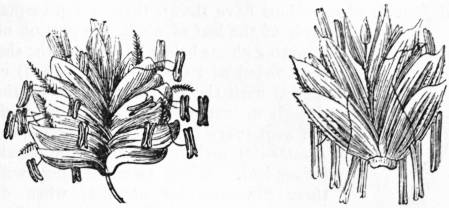
Fig. 5.—Spikelet of Briza. Fig. 6.—Spikelet of Triticum.
(Both enlarged.)
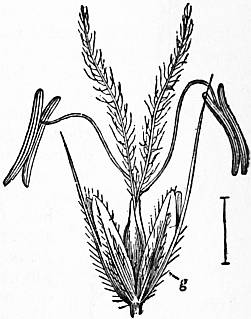
Fig. 7.—Spikelet of Anthoxanthum (enlarged) without the two lower barren glumes, showing the two upper awned barren glumes (g) and the flower.
In immediate relation with the flower itself, and often entirely concealing it, is the palea or pale (“upper pale” of most systematic agrostologists). This organ (fig. 13, 1) is peculiar to grasses among Glumiflorae (the series to which belong the two families Gramineae and Cyperaceae), and is almost always present, certain Oryzeae and Phalarideae being the only exceptions. It is of thin membranous consistence, usually obtuse, often bifid, and possesses no central rib or nerve, but has two lateral ones, one on either side; the margins are frequently folded in at the ribs, which thus become placed at the sharp angles. This structure was formerly regarded as pointing to the fusion of two organs, and the pale was considered by Robert Brown to represent two portions soldered together of a trimerous perianth-whorl, the third portion being the “lower pale.” The pale is now generally considered to represent the single bracteole, characteristic of Monocotyledons, the binerved structure being the result of the pressure of the axis of the spikelet during the development of the pale, as in Iris and others.
The flower with its pale is sessile, and is placed in the axis of another bract in such a way that the pale is exactly opposed to it, though at a slightly higher level. It is this second bract or flowering glume which has been generally called by systematists the “lower pale,” and with the “upper pale” was formerly considered to form an outer floral envelope (“calyx,” Jussieu; “perianthium,” Brown). The two bracts are, however, on different axes, one secondary to the other, and cannot therefore be parts of one whorl of organs. They are usually quite unlike one another, but in some genera (e.g. most Festuceae) are very similar in shape and appearance.

Fig. 8.—Spikelet of Stipa pennata. The pair of barren glumes (b) are separated from the flowering glume, which bears a long awn, twisted below the knee and feathery above. About ¾ nat. size.
The flowering glume has generally a more or less boat-shaped form, is of firm consistence, and possesses a well-marked central midrib and frequently several lateral ones. The midrib in a large proportion of genera extends into an appendage termed the awn (fig. 4), and the lateral veins more rarely extend beyond the glume as sharp points (e.g. Pappophorum). The form of the flowering glume is very various, this organ being plastic and extensively modified in different genera. It frequently extends downwards a little on the rachilla, forming with the latter a swollen callus, which is separated from the free portion by a furrow. In Leptaspis it is formed into a closed cavity by the union of its edges, and encloses the flower, the styles projecting through the pervious summit. Valuable characters for distinguishing genera are obtained from the awn. This presents itself variously developed from a mere subulate point to an organ several inches in length, and when complete (as in Andropogoneae, Aveneae and Stipeae) consists of two well-marked portions, a lower twisted part and a terminal straight portion, usually set in at an angle with the former, sometimes trifid and occasionally beautifully feathery (fig. 8). The lower part is most often suppressed, and in the large group of the Paniceae awns of any sort are very rarely seen. The awn may be either terminal or may come off from the back of the flowering glume, and Duval Jouve’s observations have shown that it represents the blade of the leaf of which the portion of the flowering glume below its origin is the sheath; the twisted part (so often suppressed) corresponds with the petiole, and the portion of the glume extending beyond the origin of the awn (very long in some species, e.g. of Danthonia) with the ligule of the developed foliage-leaf. When terminal the awn has three fibro-vascular bundles, when dorsal only one; it is covered with stomate-bearing epidermis.
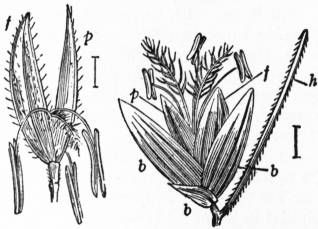
Fig. 9 (left).—Spikelet of Leersia. f, Flowering glume; p, pale.
Fig. 10 (right).—Spikelet of Setaria, with an abortive branch (h) beneath it. b, Barren glumes; f, flowering glume; p, pale.
The flower with its palea is thus sessile in the axil of a floriferous glume, and in a few grasses (Leersia (fig. 9), Coleanthus, Nardus) the spikelet consists of nothing more, but usually (even in uniflorous spikelets) other glumes are present. Of these the two placed distichously opposite each other at the base of the spikelet never bear any flower in their axils, and are called the empty or barren glumes (figs. 3, 8). They are the “glumes” of most writers, and together form what was called the “gluma” by R. Brown. They rarely differ much from one another, but one may be smaller or quite absent (Panicum, Setaria (fig. 10), Paspalum, Lolium), or both be altogether suppressed, as above noticed. They are commonly firm and strong, often enclose the spikelet, and are rarely provided with long points or imperfect awns. Generally speaking they do not share in the special modifications of the flowering glumes, and rarely themselves undergo modification, chiefly in hardening of portions (Sclerachne, Manisuris, Anthephora, Peltophorum), so as to afford greater protection to the flowers or fruit. But it is usual to find, besides the basal glumes, a few other empty ones, and these are in two- or more-flowered spikelets (see Triticum, fig. 6) at the top of the rhachilla (numerous in Lophatherum), or in uniflorous ones (fig. 10) below and interposed between the floral glume and the basal pair.
The axis of the spikelet is frequently jointed and breaks up into articulations above each flower. Tufts or borders of hairs are frequently present (Calamagrostis, Phragmites, Andropogon), and are often so long as to surround and conceal the flowers (fig. 11). The axis is often continued beyond the last flower or glume as a bristle or stalk.
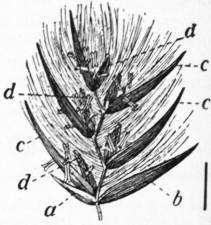
Fig. 11.—Spikelet of Reed (Phragmites communis) opened out.
a, b, Barren glumes. c, c, Fertile glumes, each enclosing one flower with its pale d. Note the zigzag axis (rhachilla) bearing long silky hairs.
Involucres or organs outside the spikelets also occur, and are formed in various ways. Thus in Setaria (fig. 10), Pennisetum, &c., the one or more circles of simple or feathery hairs represent abortive branches of the inflorescence; in Cenchrus (fig. 12) these become consolidated, and the inner ones flattened so as to form a very hard globular spiny case to the spikelets. The cup-shaped involucre of Cornucopia is a dilatation of the axis into a hollow receptacle with a raised border. In Cynosurus (Dog’s tail) the pectinate involucre which conceals the spikelet is a barren or abortive spikelet. Bracts of a more general character subtending branches of the inflorescence are singularly rare in Gramineae, in marked contrast with Cyperaceae, where they are so conspicuous. They however occur in a whole section of Andropogon, in Anomochloa, and at the base of the spike in Sesleria. The remarkable ovoid involucre of Coix, which becomes of stony hardness, white and polished (then known as “Job’s tears,” q.v.), is also a modified bract or leaf-sheath. It is closed except at the apex, and contains the female spikelet, the stalks of the male inflorescence and the long styles emerging through the small apical orifice.
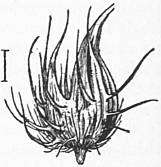
Fig. 12.—Spikelet of Cenchrus echinatus enclosed in a bristly involucre.
Any number of spikelets may compose the inflorescence, and their arrangement is very various. In the spicate forms, with sessile spikelets on the main axis, the latter is often dilated and flattened (Paspalum), or is more or less thickened and hollowed out (Stenotaphrum, Rottboellia, Tripsacum), when the spikelets are sunk and buried within the cavities. Every variety of racemose and paniculate inflorescence obtains, and the number of spikelets composing those of the large kinds is often immense. Rarely the inflorescence consists of very few flowers; thus Lygeum Spartum, the most anomalous of European grasses, has but two or three large uniflorous spikelets, which are fused together at the base, and have no basal glumes, but are enveloped in a large, hooded, spathe-like bract.
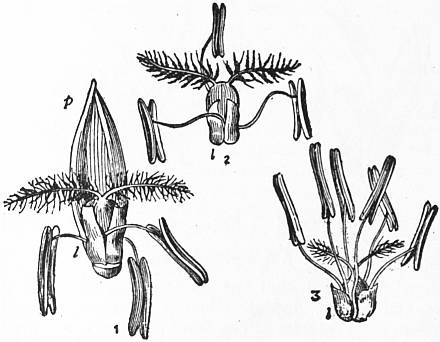
Fig. 13.—Flowers of Grasses (enlarged). 1, Piptatherum, with the palea p; 2, Poa; 3, Oryza; l, Lodicule.
Flower.—This is characterized by remarkable uniformity. The perianth is represented by very rudimentary, small, fleshy scales arising below the ovary, called lodicules; they are elongated or truncate, sometimes fringed with hairs, and are in contact with the ovary. Their usual number is two, and they are placed collaterally at the anterior side of the flower (fig. 13,) that is, within the flowering glume. They are generally considered to represent the inner whorl of the ordinary monocotyledonous (liliaceous) perianth, the outer whorl of these being suppressed as well as the posterior member of the inner whorl. This latter is present almost constantly in Stipeae and Bambuseae, which have three lodicules, and in the latter group they are occasionally more numerous. In Anomochloa they are represented by hairs. In Streptochaeta there are six lodicules, alternately arranged in two whorls. Sometimes, as in Anthoxanthum, they are absent. In Melica there is one large anterior lodicule resulting presumably from the union of the two which are present in allied genera. Professor E. Hackel, however, regards this as an undivided second pale, which in the majority of the grasses is split in halves, and the posterior lodicule, when present, as a third pale. On this view the grass-flower has no perianth. The function of the lodicules is the separation of the pale and glume to allow the protrusion of stamens and stigmas; they effect this by swelling and thus exerting pressure on the base of these two structures. Where, as in Anthoxanthum, there are no lodicules, pale and glume do not become laterally separated, and the stamens and stigmas protrude only at the apex of the floret (fig. 7). Grass-flowers are usually hermaphrodite, but there are very many exceptions. Thus it is common to find one or more imperfect (usually male) flowers in the same spikelet with bisexual ones, and their relative position is important in classification. Holcus and Arrhenatherum are examples in English grasses; and as a rule in species of temperate regions separation of the sexes is not carried further. In warmer countries monoecious and dioecious grasses are more frequent. In such cases the male and female spikelets and inflorescence may be very dissimilar, as in maize, Job’s tears, Euchlaena, Spinifex, &c.; and in some dioecious species this dissimilarity has led to the two sexes being referred to different genera (e.g. Anthephora axilliflora is the female of Buchloe dactyloides, and Neurachne paradoxa of a species of Spinifex). In other grasses, however, with the sexes in different plants (e.g. Brizopyrum, Distichlis, Eragrostis capitala, Gynerium), no such dimorphism obtains. Amphicarpum is remarkable in having cleistogamic flowers borne on long radical subterranean peduncles which are fertile, whilst the conspicuous upper paniculate ones, though apparently perfect, never produce fruit. Something similar occurs in Leersia oryzoides, where the fertile spikelets are concealed within the leaf-sheaths.
Androecium.—In the vast majority there are three stamens alternating with the lodicules, and therefore one anterior, i.e. opposite the flowering glume, the other two being posterior and in contact with the palea (fig. 13, 1 and 2). They are hypogynous, and have long and very delicate filaments, and large, linear or oblong two-celled anthers, dorsifixed and ultimately very versatile, deeply indented at each end, and commonly exserted and pendulous. Suppression of the anterior stamen sometimes occurs (e.g. Anthoxanthum, fig. 7), or the two posterior ones may be absent (Uniola, Cinna, Phippsia, Festuca bromoides). There is in some genera (Oryza, most Bambuseae) another row of three stamens, making six in all (fig. 13, 3); and Anomochloa and Tetrarrhena possess four. The stamens become numerous (ten to forty) in the male flowers of a few monoecious genera (Pariana, Luziola). In Ochlandra they vary from seven to thirty, and in Gigantochloa they are monadelphous.
Gynoecium.—The pistil consists of a single carpel, opposite the pale in the median plane of the spikelet. The ovary is small, rounded to elliptical, and one-celled, and contains a single slightly bent ovule sessile on the ventral suture (that is, springing from the back of the ovary); the micropyle points downwards. It bears usually two lateral styles which are quite distinct or connate at the base, sometimes for a greater length (fig. 14, 1), each ends in a densely hairy or feathery stigma (fig. 14). Occasionally there is but a single style, as in Nardus (fig. 14, 7), which corresponds to the midrib of the carpel. The very long and apparently simple stigma of maize arises from the union of two. Many of the bamboos have a third, anterior, style.
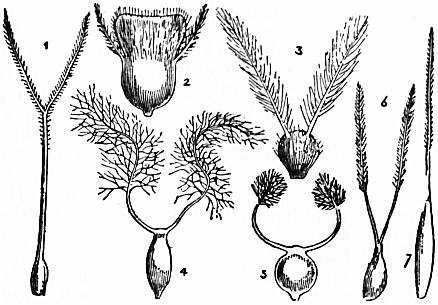
Fig. 14.—Pistils of grasses (much enlarged). 1, Alopecurus; 2, Bromus; 3, Arrhenatherum; 4, Glyceria; 5, Melica; 6, Mibora; 7, Nardus.
Comparing the flower of Gramineae with the general monocotyledonous plan as represented by Liliaceae and other families (fig. 15), it will be seen to differ in the absence of the outer row and the posterior member of the inner row of the perianth-leaves, of the whole inner row of stamens, and of the two lateral carpels, whilst the remaining members of the perianth are in a rudimentary condition. But each or any of the usually missing organs are to be found normally in different genera, or as occasional developments.
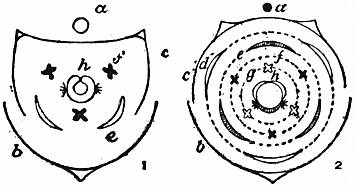
Fig. 15.—Diagrams of the ordinary Grass-flower.
1, Actual condition; 2, Theoretical, with the suppressed organs supplied. a, Axis. b, Flowering glume. c, Palea. d, Outer row of perianth leaves. e, Inner row. f, Outer row of stamens. g, Inner row. h, Pistil.
Pollination.—Grasses are generally wind-pollinated, though self-fertilization sometimes occurs. A few species, as we have seen, are monoecious or dioecious, while many are polygamous (having unisexual as well as bisexual flowers as in many members of the tribes Andropogoneae, fig. 18, and Paniceae), and in these the male flower of a spikelet always blooms later than the hermaphrodite, so that its pollen can only effect cross-fertilization upon other spikelets in the same or another plant. Of those with only bisexual flowers, many are strongly protogynous (the stigmas protruding before the anthers are ripe), such as Alopecurus and Anthoxanthum (fig. 7), but generally the anthers protrude first and discharge the greater part of their pollen before the stigmas appear. The filaments elongate rapidly at flowering-time, and the lightly versatile anthers empty an abundance of finely granular smooth pollen through a longitudinal slit. Some flowers, such as rye, have lost the power of effective self-fertilization, but in most cases both forms, self- and cross-fertilization, seem to be possible. Thus the species of wheat are usually self-fertilized, but cross-fertilization is possible since the glumes are open above, the stigmas project laterally, and the anthers empty only about one-third of their pollen in their own flower and the rest into the air. In some cultivated races of barley, cross-fertilization is precluded, as the flowers never open. Reference has already been made to cleistogamic species which occur in several genera.
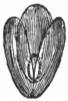
Fig. 16.—Fruit of Sporobolus, showing the dehiscent pericarp and seed.
Fruit and Seed.—The ovary ripens into a usually small ovoid or rounded fruit, which is entirely occupied by the single large seed, from which it is not to be distinguished, the thin pericarp being completely united to its surface. To this peculiar fruit the term caryopsis has been applied (more familiarly “grain”); it is commonly furrowed longitudinally down one side (usually the inner, but in Coix and its allies, the outer), and an additional covering is not unfrequently provided by the adherence of the persistent palea, or even also of the flowering glume (“chaff” of cereals). From this type are a few deviations; thus in Sporobolus, &c. (fig. 16), the pericarp is not united with the seed but is quite distinct, dehisces, and allows the loose seed to escape. Sometimes the pericarp is membranous, sometimes hard, forming a nut, as in some genera of Bambuseae, while in other Bambuseae it becomes thick and fleshy, forming a berry often as large as an apple. In Melocanna the berry forms an edible fruit 3 or 4 in. long, with a pointed beak of 2 in. more; it is indehiscent, and the small seed germinates whilst the fruit is still attached to the tree, putting out a tuft of roots and a shoot, and not falling till the latter is 6 in. long. The position of the embryo is plainly visible on the front side at the base of the grain. On the other, posterior, side of the grain is a more or less evident, sometimes punctiform, sometimes elongated or linear mark, the hilum, the place where the ovule was fastened to the wall of the ovary. The form of the hilum is constant throughout a genus, and sometimes also in whole tribes.
The testa is thin and membranous but occasionally coloured, and the embryo small, the great bulk of the seed being occupied by the hard farinaceous endosperm (albumen) on which the nutritive value of the grain depends. The outermost layer of endosperm, the aleuron-layer, consists of regular cells filled with small proteid granules; the rest is made up of large polygonal cells containing numerous starch-grains in a matrix of proteid which may be continuous (horny endosperm) or granular (mealy endosperm). The embryo presents many points of interest. Its position is remarkable, closely applied to the surface of the endosperm at the base of its outer side. This character is absolute for the whole order, and effectually separates Gramineae from Cyperaceae. The part in contact with the endosperm is plate-like, and is known as the scutellum; the surface in contact with the endosperm forms an absorptive epithelium. In some grasses there is a small scale-like appendage opposite the scutellum, the epiblast. There is some difference of opinion as to which structure or structures represent the cotyledon. Three must be considered: (1) the scutellum, connected by vascular tissue with the vascular cylinder of the main axis of the embryo which it more or less envelops; it never leaves the seed, serving merely to prepare and absorb the food-stuff in the endosperm; (2) the cellular outgrowth of the axis, the epiblast, small and inconspicuous as in wheat, or larger as in Stipa; (3) the pileole or germ-sheath, arising on the same side of the axis and above the scutellum, enveloping the plumule in the seed and appearing above ground as a generally colourless sheath from the apex of which the plumule ultimately breaks (fig. 17, 4, b). The development of these structures (which was investigated by van Tieghem), especially in relation to the origin of the vascular bundles which supply them, favours the view that the scutellum and pileole are highly differentiated parts of a single cotyledon, and this view is in accord with a comparative study of the seedling of grasses and of other monocotyledons. The epiblast has been regarded as representing a second cotyledon, but this is a very doubtful interpretation.
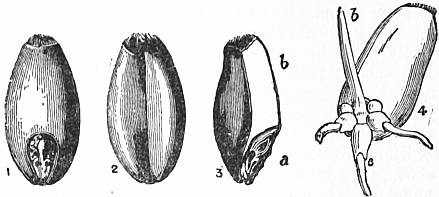
Fig. 17.—A Grain of Wheat. 1, back, and 2, front view; 3, vertical section, showing (b) the endosperm, and (a) embryo; 4, beginning of germination, showing (b) the pileole and (c) the radicle and secondary rootlets surrounded by their coleorrhizae.
Germination.—In germination the coleorhiza lengthens, ruptures the pericarp, and fixes the grain to the ground by developing numerous hairs. The radicle then breaks through the coleorhiza, as do also the secondary rootlets where, as in the case of many cereals, these have been formed in the embryo (fig. 17, 4). The germ-sheath grows vertically upwards, its stiff apex pushing through the soil, while the plumule is hidden in its hollow interior. Finally the plumule escapes, its leaves successively breaking through at the tip of the germ-sheath. The scutellum meanwhile feeds the developing embryo from the endosperm. The growth of the primary root is limited; sooner or later adventitious roots develop from the axis above the radicle which they ultimately exceed in growth.
Means of Distribution.—Various methods of scattering the grain have been adopted, in which parts of the spikelet or inflorescence are concerned. Short spikes may fall from the culm as a whole; or the axis of a spike or raceme is jointed so that one spikelet falls with each joint as in many Andropogoneae and Hordeae. In many-flowered spikelets the rachilla is often jointed and breaks into as many pieces as there are fruits, each piece bearing a glume and pale. One-flowered spikelets may fall as a whole (as in the tribes Paniceae and Andropogoneae), or the axis is jointed above the barren glumes so that only the flowering glume and pale fall with the fruit. These arrangements are, with few exceptions, lacking in cultivated cereals though present in their wild forms, so far as these are known. Such arrangements are disadvantageous for the complete gathering of the fruit, and therefore varieties in which they are not present would be preferred for cultivation. The persistent bracts (glume and pale) afford an additional protection to the fruit; they protect the embryo, which is near the surface, from too rapid wetting and, when once soaked, from drying up again. They also decrease the specific gravity, so that the grain is more readily carried by the wind, especially when, as in Briza, the glume has a large surface compared with the size of the grain, or when, as in Holcus, empty glumes also take part; in Canary grass (Phalaris) the large empty glumes bear a membranous wing on the keel. In the sugar-cane (Saccharum) and several allied genera the separating joints of the axis bear long hairs below the spikelets; in others, as in Arundo (a reed-grass), the flowering glumes are enveloped in long hairs. The awn which is frequently borne on the flowering glume is also a very efficient means of distribution, catching into fur of animals or plumage of birds, or as often in Stipa (fig. 8) forming a long feather for wind-carriage. In Tragus the glumes bear numerous short hooked bristles. The fleshy berries of some Bambuseae favour distribution by animals.
The awn is also of use in burying the fruit in the soil. Thus in Stipa, species of Avena, Heteropogon and others the base of the glume forms a sharp point which will easily penetrate the ground; above the point are short stiff upwardly pointing hairs which oppose its withdrawal. The long awn, which is bent and closely twisted below the bend, acts as a driving organ; it is very hygroscopic, the coils untwisting when damp and twisting up when dry. The repeated twisting and untwisting, especially when the upper part of the awn has become fixed in the earth or caught in surrounding vegetation, drives the point deeper and deeper into the ground. Such grasses often cause harm to sheep by catching in the wool and boring through the skin.
A peculiar method of distribution occurs in some alpine and arctic grasses, which grow under conditions where ripening of the fruit is often uncertain. The entire spikelet, or single flowers, are transformed into small-leaved shoots which fall from the axes and readily root in the ground. Some species, such as Poa stricta, are known only in this viviparous condition; others, like our British species Festuca ovina and Poa alpina, become viviparous under the special climatic conditions.
II. Classification.—Gramineae are sharply defined from all other plants, and there are no genera as to which it is possible to feel a doubt whether they should be referred to it or not. The only family closely allied is Cyperaceae, and the points of difference between the two may be here brought together. The best distinctions are found in the position of the embryo in relation to the endosperm—lateral in grasses, basal in Cyperaceae—and in the possession by Gramineae of the 2-nerved palea below each flower. Less absolute characters, but generally trustworthy and more easily observed, are the feathery stigmas, the always distichous arrangement of the glumes, the usual absence of more general bracts in the inflorescence, the split leaf-sheaths, and the hollow, cylindrical, jointed culms—some or all of which are wanting in all Cyperaceae. The same characters will distinguish grasses from the other glumiferous orders, Restiaceae, and Eriocaulonaceae, which are besides further removed by their capsular fruit and pendulous ovules. To other monocotyledonous families the resemblances are merely of adaptive or vegetative characters. Some Commelinaceae and Marantaceae approach grasses in foliage; the leaves of Allium, &c., possess a ligule; the habit of some palms reminds one of the bamboos; and Juncaceae and a few Liliaceae possess an inconspicuous scarious perianth. There are about 300 genera containing about 3500 well-defined species.
The great uniformity among the very numerous species of this vast family renders its classification very difficult. The difficulty has been increased by the confusion resulting from the multiplication of genera founded on slight characters, and from the description (in consequence of their wide distribution) of identical plants under several different genera.
No characters for main divisions can be obtained from the flower proper or fruit (with the exception of the character of the hilum), and it has therefore been found necessary to trust to characters derived from the usually less important inflorescence and bracts.
Robert Brown suggested two primary divisions—Paniceae and Poaceae, according to the position of the most perfect flower in the spikelet; this is the upper (apparently) terminal one in the first, whilst in the second it occupies the lower position, the more imperfect ones (if any) being above it. Munro supplemented this by another character easier of verification, and of even greater constancy, in the articulation of the pedicel in the Paniceae immediately below the glumes; whilst in Poaceae this does not occur, but the axis of the spikelet frequently articulates above the pair of empty basal glumes. Neither of these great divisions will well accommodate certain genera allied to Phalaris, for which Brown proposed tentatively a third group (since named Phalarideae); this, or at least the greater part of it, is placed by Bentham under the Poaceae.
The following arrangement has been proposed by Professor Eduard Hackel in his recent monograph on the order.
A. Spikelets one-flowered, rarely two-flowered as in Zea, falling from the pedicel entire or with certain joints of the rachis at maturity. Rachilla not produced beyond the flowers.
a. Hilum a point; spikelets not laterally compressed.
α Fertile glume and pale hyaline; empty glumes thick, membranous to coriaceous or cartilaginous, the lowest the largest. Rachis generally jointed and breaking up when mature.
1. Spikelets unisexual, male and female in separate inflorescences or on different parts of the same inflorescence.
1. Maydeae.
2. Spikelets bisexual, or male and bisexual, each male standing close to a bisexual.
2. Andropogoneae.
β Fertile glume and pale cartilaginous, coriaceous or papery; empty glumes more delicate, usually herbaceous, the lowest usually smallest. Spikelets falling singly from the unjointed rachis of the spike or the ultimate branches of the panicle.
3. Paniceae.
b. Hilum a line; spikelets laterally compressed.
4. Oryzeae.
B. Spikelets one- to indefinite-flowered; in the one-flowered the rachilla frequently produced beyond the flower; rachilla generally jointed above the empty glumes, which remain after the fruiting glumes have fallen. When more than one-flowered, distinct internodes are developed between the flowers.
a. Culm herbaceous, annual; leaf-blade sessile, and not jointed to the sheath.
α Spikelets upon distinct pedicels and arranged in panicles or racemes.
I. Spikelets one-flowered.
i. Empty glumes 4. 5. Phalarideae.
ii. Empty glumes 2. 6. Agrostideae.
II. Spikelets more than one-flowered.
i. Fertile glumes generally shorter than the empty glumes, usually with a bent awn on the back.
7. Aveneae.
ii. Fertile glumes generally longer than the empty, unawned or with a straight, terminal awn.
9. Festuceae.
β Spikelets crowded in two close rows, forming a one-sided spike or raceme with a continuous (not jointed) rachis.
8. Chlorideae.
γ Spikelets in two opposite rows forming an equal-sided spike.
10. Hordeae.
b. Culm woody, at any rate at the base, leaf-blade jointed to the sheath, often with a short, slender petiole.
11. Bambuseae.
Tribe 1. Maydeae (7 genera in the warmer parts of the earth). Zea Mays (maize, q.v., or Indian corn) (q.v.). Tripsacum, 2 or 3 species in subtropical America north of the equator; Tr. dactyloides (gama grass) extends northwards to Illinois and Connecticut; it is used for fodder and as an ornamental plant. Coix Lacryma-Jobi (Job’s tears) q.v.
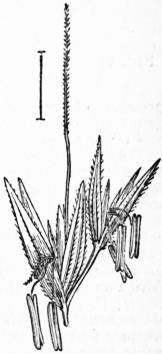
Fig. 18.—A pair of spikelets of Andropogon.
Tribe 2. Andropogoneae (25 genera, mainly tropical). The spikelets are arranged in spike-like racemes, generally in pairs consisting of a sessile and stalked spikelet at each joint of the rachis (fig. 18). Many are savanna grasses, in various parts of the tropics, for instance the large genus Andropogon, Elionurus and others. Saccharum officinarum (sugar-cane) (q.v.). Sorghum, an important tropical cereal known as black millet or durra (q.v.). Miscanthus and Erianthus, nearly allied to Saccharum, are tall reed-like grasses, with large silky flower-panicles, which are grown for ornament. Imperata, another ally, is a widespread tropical genus; one species I. arundinacea is the principal grass of the alang-alang fields in the Malay Archipelago; it is used for thatch. Vossia, an aquatic grass, often floating, is found in western India and tropical Africa. In the swampy lands of the upper Nile it forms, along with a species of Saccharum, huge floating grass barriers. Elionurus, a widespread savanna grass in tropical and subtropical America, and also in the tropics of the old world, is rejected by cattle probably on account of its aromatic character, the spikelets having a strong balsam-like smell. Other aromatic members are Andropogon Nardus, a native of India, but also cultivated, the rhizome, leaves and especially the spikelets of which contain a volatile oil, which on distillation yields the citronella oil of commerce. A closely allied species, A. Schoenanthus (lemon-grass), yields lemon-grass oil; a variety is used by the negroes in western Africa for haemorrhage. Other species of the same genus are used as stimulants and cosmetics in various parts of the tropics. The species of Heteropogon, a cosmopolitan genus in the warmer parts of the world, have strongly awned spikelets. Themeda Forskalii, which occurs from the Mediterranean region to South Africa and Tasmania, is the kangaroo grass of Australia, where, as in South Africa, it often covers wide tracts.