VOLUME XII SLICE III Gordon, Lord George to Grasses (continued 4)
Reading edition
Animated with the desire to give a pendant to his Faust, Gounod now sought for inspiration from Shakespeare, and turned his attention to Romeo and Juliet. Here, indeed, was a subject particularly well calculated to appeal to a composer who had so eminently qualified himself to be considered the musician of the tender passion. The operatic version of the Shakespearean tragedy was produced at the Théâtre Lyrique on the 27th of April 1867. It is generally considered as being the composer’s second best opera. Some people have even placed it on the same level as Faust, but this verdict has not found general acceptance. Gounod himself is stated to have expressed his opinion of the relative value of the two operas enigmatically by saying, “Faust is the oldest, but I was younger; Roméo is the youngest, but I was older.” The luscious strains wedded to the love scenes, if at times somewhat cloying, are generally in accord with the situations, often irresistibly fascinating, while always absolutely individual. The success of Roméo in Paris was great from the outset, and eventually this work was transferred to the Grand Opéra, after having for some time formed part of the répertoire of the Opéra Comique. In London it was not until the part of Romeo was sung by Jean de Reszke that this opera obtained any real hold upon the English public.
After having so successfully sought for inspiration from Molière, Goethe and Shakespeare, Gounod now turned to another famous dramatist, and selected Pierre Corneille’s Polyeucte as the subject of his next opera. Some years were, however, to elapse before this work was given to the public. The Franco-German War had broken out, and Gounod was compelled to take refuge in London, where he composed the “biblical elegy” Gallia for the inauguration of the Royal Albert Hall. During his stay in London Gounod composed a great deal and wrote a number of songs to English words, many of which have attained an enduring popularity, such as “Maid of Athens,” “There is a green hill far away,” “Oh that we two were maying,” “The fountain mingles with the river.” His sojourn in London was not altogether pleasant, as he was embroiled in lawsuits with publishers. On Gounod’s return to Paris he hurriedly set to music an operatic version of Alfred de Vigny’s Cinq-Mars, which was given at the Opéra Comique on the 5th of April 1877 (and in London in 1900), without obtaining much success. Polyeucte, his much-cherished work, appeared at the Grand Opéra the following year on the 7th of October, and did not meet with a better fate. Neither was Gounod more fortunate with Le Tribut de Zamora, his last opera, which, given on the same stage in 1881, speedily vanished, never to reappear. In his later dramatic works he had, unfortunately, made no attempt to keep up with the times, preferring to revert to old-fashioned methods.
The genius of the great composer was, however, destined to assert itself in another field—that of sacred music. His friend Camille Saint-Saëns, in a volume entitled Portraits et Souvenirs, writes:
Gounod did not cease all his life to write for the church, to accumulate masses and motetts; but it was at the commencement of his career, in the Messe de Sainte Cécile, and at the end, in the oratorios The Redemption and Mors et vita, that he rose highest.
Saint-Saëns, indeed, has formulated the opinion that the three above-mentioned works will survive all the master’s operas. Among the many masses composed by Gounod at the outset of his career, the best is the Messe de Sainte Cécile, written in 1855. He also wrote the Messe du Sacré Cœur (1876) and the Messe à la mémoire de Jeanne d’Arc (1887). This last work offers certain peculiarities, being written for solos, chorus, organ, eight trumpets, three trombones, and harps. In style it has a certain affinity with Palestrina. The Redemption, which seems to have acquired a permanent footing in Great Britain, was produced at the Birmingham Festival of 1882. It was styled a sacred trilogy, and was dedicated to Queen Victoria. The score is prefixed by a commentary written by the composer, in which the scope of the oratorio is explained. It cannot be said that Gounod has altogether risen to the magnitude of his task. The music of The Redemption bears the unmistakable imprint of the composer’s hand, and contains many beautiful thoughts, but the work in its entirety is not exempt from monotony. Mors et vita, a sacred trilogy dedicated to Pope Leo XIII., was also produced for the first time in Birmingham at the Festival of 1885. This work is divided into three parts, “Mors,” “Judicium,” “Vita.” The first consists of a Requiem, the second depicts the Judgment, the third Eternal Life. Although quite equal, if not superior to The Redemption, Mors et vita has not obtained similar success.
Gounod was a great worker, an indefatigable writer, and it would occupy too much space to attempt even an incomplete catalogue of his compositions. Besides the works already mentioned may be named two symphonies which were played during the ’fifties, but have long since fallen into neglect. Symphonic music was not Gounod’s forte, and the French master evidently recognized the fact, for he made no further attempts in this style. The incidental music he wrote to the dramas Les Deux Reines and Jeanne d’Arc must not be forgotten. He also attempted to set Molière’s comedy, Georges Dandin, to music, keeping to the original prose. This work has never been brought out. Gounod composed a large number of songs, many of which are very beautiful. One of the vocal pieces that have contributed most to his popularity is the celebrated Meditation on the First Prelude of Bach, more widely known as the Ave Maria. The idea of fitting a melody to the Prelude of Bach was original, and it must be admitted that in this case the experiment was successful.
Gounod died at St Cloud on the 18th of October 1893. His influence on French music was immense, though during the last years of the 19th century it was rather counterbalanced by that of Wagner. Whatever may be the verdict of posterity, it is unlikely that the quality of individuality will be denied to Gounod. To be the composer of Faust is alone a sufficient title to lasting fame.
(A. He.)
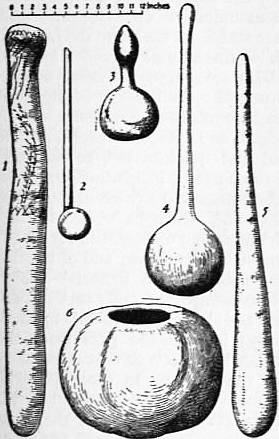
Photographed from specimens in the British Museum.
Group of Gourds.
1-5. Various forms of bottle gourd, Lagenaria vulgaris. 6. Giant gourd, Cucurbita maxima.
GOURD, a name given to various plants of the order Cucurbitaceae, especially those belonging to the genus Cucurbita, monoecious trailing herbs of annual duration, with long succulent stems furnished with tendrils, and large, rough, palmately-lobed leaves; the flowers are generally large and of a bright yellow or orange colour, the barren ones with the stamens united; the fertile are followed by the large succulent fruit that gives the gourds their chief economic value. Many varieties of Cucurbita are under cultivation in tropical and temperate climates, especially in southern Asia; but it is extremely difficult to refer them to definite specific groups, on account of the facility with which they hybridize; while it is very doubtful whether any of the original forms now exist in the wild state. Charles Naudin, who made a careful and interesting series of observations upon this genus, came to the conclusion that all varieties known in European gardens might be referred to six original species; probably three, or at most four, have furnished the edible kinds in ordinary cultivation. Adopting the specific names usually given to the more familiar forms, the most important of the gourds, from an economic point of view, is perhaps C. maxima, the Potiron Jaune of the French, the red and yellow gourd of British gardeners (fig. 6), the spheroidal fruit of which is remarkable for its enormous size: the colour of the somewhat rough rind varies from white to bright yellow, while in some kinds it remains green; the fleshy interior is of a deep yellow or orange tint. This valuable gourd is grown extensively in southern Asia and Europe. In Turkey and Asia Minor it yields, at some periods of the year, an important article of diet to the people; immense quantities are sold in the markets of Constantinople, where in the winter the heaps of one variety with a white rind are described as resembling mounds of snowballs. The yellow kind attains occasionally a weight of upwards of 240 ℔. It grows well in Central Europe and the United States, while in the south of England it will produce its gigantic fruit in perfection in hot summers. The yellow flesh of this gourd and its numerous varieties yields a considerable amount of nutriment, and is the more valuable as the fruit can be kept, even in warm climates, for a long time. In France and in the East it is much used in soups and ragouts, while simply boiled it forms a substitute for other table vegetables; the taste has been compared to that of a young carrot. In some countries the larger kinds are employed as cattle food. The seeds yield by expression a large quantity of a bland oil, which is used for the same purposes as that of the poppy and olive. The “mammoth” gourds of English and American gardeners (known in America as squashes) belong to this species. The pumpkin (summer squash of America) is Cucurbita Pepo. Some of the varieties of C. maxima and Pepo contain a considerable quantity of sugar, amounting in the sweetest kinds to 4 or 5%, and in the hot plains of Hungary efforts have been made to make use of them as a commercial source of sugar. The young shoots of both these large gourds may be given to cattle, and admit of being eaten as a green vegetable when boiled. The vegetable marrow is a variety (ovifera) of C. Pepo. Many smaller gourds are cultivated in India and other hot climates, and some have been introduced into English gardens, rather for the beauty of their fruit and foliage than for their esculent qualities. Among these is C. Pepo var. aurantia, the orange gourd, bearing a spheroidal fruit, like a large orange in form and colour; in Britain it is generally too bitter to be palatable, though applied to culinary purposes in Turkey and the Levant. C. Pepo var. pyriformis and var. verrucosa, the warted gourds, are likewise occasionally eaten, especially in the immature state; and C. moschata (musk melon) is very extensively cultivated throughout India by the natives, the yellow flesh being cooked and eaten.
The bottle-gourds are placed in a separate genus, Lagenaria, chiefly differing from Cucurbita in the anthers being free instead of adherent. The bottle-gourd properly so-called, L. vulgaris, is a climbing plant with downy, heart-shaped leaves and beautiful white flowers: the remarkable fruit (figs. 1-5) first begins to grow in the form of an elongated cylinder, but gradually widens towards the extremity, until, when ripe, it resembles a flask with a narrow neck and large rounded bulb; it sometimes attains a length of 7 ft. When ripe, the pulp is removed from the neck, and the interior cleared by leaving water standing in it; the woody rind that remains is used as a bottle: or the lower part is cut off and cleared out, forming a basin-like vessel applied to the same domestic purposes as the calabash (Crescentia) of the West Indies: the smaller varieties, divided lengthwise, form spoons. The ripe fruit is apt to be bitter and cathartic, but while immature it is eaten by the Arabs and Turks. When about the size of a small cucumber, it is stuffed with rice and minced meat, flavoured with pepper, onions, &c., and then boiled, forming a favourite dish with Eastern epicures. The elongated snake-gourds of India and China (Trichosanthes) are used in curries and stews.
All the true gourds have a tendency to secrete the cathartic principle colocynthin, and in many varieties of Cucurbita and the allied genera it is often elaborated to such an extent as to render them unwholesome, or even poisonous. The seeds of several species therefore possess some anthelmintic properties; those of the common pumpkin are frequently administered in America as a vermifuge.
The cultivation of gourds began far beyond the dawn of history, and the esculent species have become so modified by culture that the original plants from which they have descended can no longer be traced. The abundance of varieties in India would seem to indicate that part of Asia as the birthplace of the present edible forms; but some appear to have been cultivated in all the hotter regions of that continent, and in North Africa, from the earliest ages, while the Romans were familiar with at least certain kinds of Cucurbita, and with the bottle-gourd. Cucurbita Pepo, the source of many of the American forms, is probably a native of that continent.
Most of the annual gourds may be grown successfully in Britain. They are usually raised in hotbeds or under frames, and planted out in rich soil in the early summer as soon as the nights become warm. The more ornamental kinds may be trained over trellis-work, a favourite mode of displaying them in the East; but the situation must be sheltered and sunny. Even Lagenaria will sometimes produce fine fruit when so treated in the southern counties.
For an account of these cultivations in England see paper by Mr J. W. Odell, “Gourds and Cucurbits,” in Journ. Royal Hort. Soc. xxix. 450 (1904).
GOURGAUD, GASPAR, Baron (1783-1852), French soldier, was born at Versailles on the 14th of September 1783; his father was a musician of the royal chapel. At school he showed talent in mathematical studies and accordingly entered the artillery. In 1802 he became junior lieutenant, and thereafter served with credit in the campaigns of 1803-1805, being wounded at Austerlitz. He was present at the siege of Saragossa in 1808, but returned to service in Central Europe and took part in nearly all the battles of the Danubian campaign of 1809. In 1811 he was chosen to inspect and report on the fortifications of Danzig. Thereafter he became one of the ordnance officers attached to the emperor, whom he followed closely through the Russian campaign of 1812; he was one of the first to enter the Kremlin and discovered there a quantity of gunpowder which might have been used for the destruction of Napoleon. For his services in this campaign he received the title of baron, and became first ordnance officer. In the campaign of 1813 in Saxony he further evinced his courage and prowess, especially at Leipzig and Hanau; but it was in the first battle of 1814, near to Brienne, that he rendered the most signal service by killing the leader of a small band of Cossacks who were riding furiously towards Napoleon’s tent. Wounded at the battle of Montmirail, he yet recovered in time to share in several of the conflicts which followed, distinguishing himself especially at Laon and Reims. Though enrolled among the royal guards of Louis XVIII. in the summer of 1814, he yet embraced the cause of Napoleon during the Hundred Days (1815), was named general and aide-de-camp by the emperor, and fought at Waterloo.
After the second abdication of the emperor (June 22nd, 1815) Gourgaud retired with him and a few other companions to Rochefort. It was to him that Napoleon entrusted the letter of appeal to the prince regent for an asylum in England. Gourgaud set off in H.M.S. “Slaney,” but was not allowed to land in England. He determined to share Napoleon’s exile and sailed with him on H.M.S. “Northumberland” to St Helena. The ship’s secretary, John R. Glover, has left an entertaining account of some of Gourgaud’s gasconnades at table. His extreme sensitiveness and vanity soon brought him into collision with Las Cases and Montholon at Longwood. The former he styles in his journal a “Jesuit” and a scribbler who went thither in order to become famous. With Montholon, his senior in rank, the friction became so acute that he challenged him to a duel, for which he suffered a sharp rebuke from Napoleon. Tiring of the life at Longwood and the many slights which he suffered from Napoleon, he desired to depart, but before he could sail he spent two months with Colonel Basil Jackson, whose account of him throws much light on his character, as also on the “policy” adopted by the exiles at Longwood. In England he was gained over by members of the Opposition and thereafter made common cause with O’Meara and other detractors of Sir Hudson Lowe, for whose character he had expressed high esteem to Basil Jackson. He soon published his Campagne de 1815, in the preparation of which he had had some help from Napoleon; but Gourgaud’s Journal de Ste-Hélène was not destined to be published till the year 1899. Entering the arena of letters, he wrote, or collaborated in, two well-known critiques. The first was a censure of Count P. de Ségur’s work on the campaign of 1812, with the result that he fought a duel with that officer and wounded him. He also sharply criticized Sir Walter Scott’s Life of Napoleon. He returned to active service in the army in 1830; and in 1840 proceeded with others to St Helena to bring back the remains of Napoleon to France. He became a deputy to the Legislative Assembly in 1849; he died in 1852.
Gourgaud’s works are La Campagne de 1815 (London and Paris, 1818); Napoléon et la Grande Armée en Russie; examen critique de l’ouvrage de M. le comte P. de Ségur (Paris, 1824); Réfutation de la vie de Napoléon par Sir Walter Scott (Paris, 1827). He collaborated with Montholon in the work entitled Mémoires pour servir à l’histoire de France sous Napoléon (Paris, 1822-1823), and with Belliard and others in the work entitled Bourrienne et ses erreurs (2 vols., Paris, 1830); but his most important work is the Journal inédit de Ste-Hélène (2 vols., Paris, 1899), which is a remarkably naïf and life-like record of the life at Longwood. See, too, Notes and Reminiscences of a Staff Officer, by Basil Jackson (London, 1904), and the bibliography to the article Lowe, Sir Hudson.
(J. Hl. R.)
GOURKO, JOSEPH VLADIMIROVICH, Count (1828-1901), Russian general, was born, of Lithuanian extraction, on the 15th of November 1828. He was educated in the imperial corps of pages, entered the hussars of the imperial bodyguard as sub-lieutenant in 1846, became captain in 1857, adjutant to the emperor in 1860, colonel in 1861, commander of the 4th Hussar regiment of Mariupol in 1866, and major-general of the emperor’s suite in 1867. He subsequently commanded the grenadier regiment, and in 1873 the 1st brigade, 2nd division, of the cavalry of the guard. Although he took part in the Crimean War, being stationed at Belbek, his claim to distinction is due to his services in the Turkish war of 1877. He led the van of the Russian invasion, took Trnovo on the 7th July, crossed the Balkans by the Hain Bogaz pass, debouching near Hainkioi, and, notwithstanding considerable resistance, captured Uflani, Maglish and Kazanlyk; on the 18th of July he attacked Shipka, which was evacuated by the Turks on the following day. Thus within sixteen days of crossing the Danube Gourko had secured three Balkan passes and created a panic at Constantinople. He then made a series of successful reconnaissances of the Tunja valley, cut the railway in two places, occupied Stara Zagora (Turkish, Eski Zagra) and Nova Zagora (Yeni Zagra), checked the advance of Suleiman’s army, and returned again over the Balkans. In October he was appointed commander of the allied cavalry, and attacked the Plevna line of communication to Orkhanie with a large mixed force, captured Gorni-Dubnik, Telische and Vratza, and, in the middle of November, Orkhanie itself. Plevna was isolated, and after its fall in December Gourko led the way amidst snow and ice over the Balkans to the fertile valley beyond, totally defeated Suleiman, and occupied Sophia, Philippopolis and Adrianople, the armistice at the end of January 1878 stopping further operations (see Russo-Turkish Wars). Gourko was made a count, and decorated with the 2nd class of St George and other orders. In 1879-1880 he was governor of St Petersburg, and from 1883 to 1894 governor-general of Poland. He died on the 29th of January 1901.
GOURMET, a French term for one who takes a refined and critical, or even merely theoretical pleasure in good cooking and the delights of the table. The word has not the disparaging sense attached to the Fr. gourmand, to whom the practical pleasure of good eating is the chief end. The O. Fr. groumet or gromet meant a servant, or shop-boy, especially one employed in a wine-seller’s shop, hence an expert taster of wines, from which the modern usage has developed. The etymology of gourmet is obscure; it may be ultimately connected with the English “groom” (q.v.). The origin of gourmand is unknown. In English, in the form “grummet,” the word was early applied to a cabin or ship’s boy. Ships of the Cinque Ports were obliged to carry one “grummet”; thus in a charter of 1229 (quoted in the New English Dictionary) it is laid down servitia inde debita Domino Regi, xxi. naves, et in qualibet nave xxi. homines, cum uno gartione qui dicitur gromet.
GOUROCK, a police burgh and watering-place of Renfrewshire, Scotland, on the southern shore of the Firth of Clyde, 3¼ m. W. by N. of Greenock by the Caledonian railway. Pop. (1901) 5261. It is partly situated on a fine bay affording good anchorage, for which it is largely resorted to by the numerous yacht clubs of the Clyde. The extension of the railway from Greenock (in 1889) to the commodious pier, with a tunnel 11⁄3 m. long, the longest in Scotland, affords great facilities for travel to the ports of the Firth, the sea lochs on the southern Highland coast and the Crinan Canal. The eminence called Barrhill (480 ft. high) divides the town into two parts, the eastern known as Kempoch, the western as Ashton. Near Kempoch point is a monolith of mica-schist, 6 ft. high, called “Granny Kempoch,” which the superstitious of other days regarded as possessing influence over the winds, and which was the scene, in 1662, of certain rites that led to the celebrants being burned as witches. Gamble Institute (named after the founder) contains halls, recreation rooms, a public library and baths. It is said that Gourock was the first place on the Clyde where herrings were cured. There is tramway communication with Greenock and Ashton. About 3 m. S.W. there stands on the shore the familiar beacon of the Cloch. Gourock became a burgh of barony in 1694.
GOURVILLE, JEAN HERAULD (1625-1703), French adventurer, was born at La Rochefoucauld. At the age of eighteen he entered the house of La Rochefoucauld as a servant, and in 1646 became secretary to François de la Rochefoucauld, author of the Maximes. Resourceful and quick-witted, he rendered services to his master during the Fronde, in his intrigues with the parliament, the court or the princes. In these negotiations he made the acquaintance of Condé, whom he wished to help to escape from the château of Vincennes; of Mazarin, for whom he negotiated the reconciliation with the princes; and of Nicolas Fouquet. After the Fronde he engaged in financial affairs, thanks to Fouquet. In 1658 he farmed the taille in Guienne. He bought depreciated rentes and had them raised to their nominal value by the treasury; he extorted gifts from the financiers for his protection, being Fouquet’s confidant in many operations of which he shared the profits. In three years he accumulated an enormous fortune, still further increased by his unfailing good fortune at cards, playing even with the king. He was involved in the trial of Fouquet, and in April 1663 was condemned to death for peculation and embezzlement of public funds; but escaping, was executed in effigy. He sent a valet one night to take the effigy down from the gallows in the court of the Palais de Justice, and then fled the country. He remained five years abroad, being excepted in 1665 from the amnesty accorded by Louis XIV. to the condemned financiers. Having returned secretly to France, he entered the service of Condé, who, unable to meet his creditors, had need of a clever manager to put his affairs in order. In this way he was able to reappear at court, to assist at the campaigns of the war with Holland, and to offer himself for all the delicate negotiations for his master or the king. He received diplomatic missions in Germany, in Holland, and especially in Spain, though it was only in 1694, that he was freed from the condemnation pronounced against him by the chamber of justice. From 1696 he fell ill and withdrew to his estate, where he dictated to his secretary, in four months and a half, his Mémoires, an important source for the history of his time. In spite of several errors, introduced purposely, they give a clear idea of the life and morals of a financier of the age of Fouquet, and throw light on certain points of the diplomatic history. They were first published in 1724.
There is a modern edition, with notes, an introduction and appendix, by Lecestre (Paris, 1894-1895, 2 vols.).
GOUT, the name rather vaguely given, in medicine, to a constitutional disorder which manifests itself by inflammation of the joints, with sometimes deposition of urates of soda, and also by morbid changes in various important organs. The term gout, which was first used about the end of the 13th century, is derived through the Fr. goutte from the Lat. gutta, a drop, in allusion to the old pathological doctrine of the dropping of a morbid material from the blood within the joints. The disease was known and described by the ancient Greek physicians under various terms, which, however, appear to have been applied by them alike to rheumatism and gout. The general term arthritis (ἄρθρον, a joint) was employed when many joints were the seat of inflammation; while in those instances where the disease was limited to one part the terms used bore reference to such locality; hence podagra (ποδάγρα, from πούς, the foot, and ἅγρα, a seizure), chiragra (χείρ, the hand), gonagra (γόνυ, the knee), &c.
Hippocrates in his Aphorisms speaks of gout as occurring most commonly in spring and autumn, and mentions the fact that women are less liable to it than men. He also gives directions as to treatment. Celsus gives a similar account of the disease. Galen regarded gout as an unnatural accumulation of humours in a part, and the chalk-stones as the concretions of these, and he attributed the disease to over-indulgence and luxury. Gout is alluded to in the works of Ovid and Pliny, and Seneca, in his 95th epistle, mentions the prevalence of gout among the Roman ladies of his day as one of the results of their high living and debauchery. Lucian, in his Tragopodagra, gives an amusing account of the remedies employed for the cure of gout.
In all times this disease has engaged a large share of the attention of physicians, from its wide prevalence and from the amount of suffering which it entails. Sydenham, the famous English physician of the 17th century, wrote an important treatise on the subject, and his description of the gouty paroxysm, all the more vivid from his having himself been afflicted with the disease for thirty-four years, is still quoted by writers as the most graphic and exhaustive account of the symptomatology of gout. Subsequently Cullen, recognizing gout as capable of manifesting itself in various ways, divided the disease into regular gout, which affects the joints only, and irregular gout, where the gouty disposition exhibits itself in other forms; and the latter variety he subdivided into atonic gout, where the most prominent symptoms are throughout referable to the stomach and alimentary canal; retrocedent gout, where the inflammatory attack suddenly disappears from an affected joint and serious disturbance takes place in some internal organ, generally the stomach or heart; and misplaced gout, where from the first the disease does not appear externally, but reveals itself by an inflammatory attack of some internal part. Dr Garrod, one of the most eminent authorities on gout, adopted a division somewhat similar to, though simpler than that of Cullen, namely, regular gout, which affects the joints alone, and is either acute or chronic, and irregular gout, affecting non-articular tissues, or disturbing the functions of various organs.
It is often stated that the attack of gout comes on without any previous warning; but, while this is true in many instances, the reverse is probably as frequently the case, and the premonitory symptoms, especially in those who have previously suffered from the disease, may be sufficiently precise to indicate the impending seizure. Among the more common of these may be mentioned marked disorders of the digestive organs, with a feeble and capricious appetite, flatulence and pain after eating, and uneasiness in the right side in the region of the liver. A remarkable tendency to gnashing of the teeth is sometimes observed. This symptom was first noticed by Dr Graves, who connected it with irritation in the urinary organs, which also is present as one of the premonitory indications of the gouty attack. Various forms of nervous disturbance also present themselves in the form of general discomfort, extreme irritability of temper, and various perverted sensations, such as that of numbness and coldness in the limbs. These symptoms may persist for many days and then undergo amelioration immediately before the impending paroxysm. On the night of the attack the patient retires to rest apparently well, but about two or three o’clock in the morning awakes with a painful feeling in the foot, most commonly in the ball of the great toe, but it may be in the instep or heel, or in the thumb. With the pain there often occurs a distinct shivering followed by feverishness. The pain soon becomes of the most agonizing character: in the words of Sydenham, “now it is a violent stretching and tearing of the ligaments, now it is a gnawing pain, and now a pressure and tightening; so exquisite and lively meanwhile is the part affected that it cannot bear the weight of the bedclothes, nor the jar of a person walking in the room.”
When the affected part is examined it is found to be swollen and of a deep red hue. The superjacent skin is tense and glistening, and the surrounding veins are more or less distended. After a few hours there is a remission of the pain, slight perspiration takes place, and the patient may fall asleep. The pain may continue moderate during the day but returns as night advances, and the patient goes through a similar experience of suffering to that of the previous night, followed with a like abatement towards morning. These nocturnal exacerbations occur with greater or less severity during the continuance of the attack, which generally lasts for a week or ten days. As the symptoms decline the swelling and tenderness of the affected joint abate, but the skin over it pits on pressure for a time, and with this there is often associated slight desquamation of the cuticle. During the attacks there is much constitutional disturbance. The patient is restless and extremely irritable, and suffers from cramp in the limbs and from dyspepsia, thirst and constipation. The urine is scanty and high-coloured, with a copious deposit, consisting chiefly of urates. During the continuance of the symptoms the inflammation may leave the one foot and affect the other, or both may suffer at the same time. After the attack is over the patient feels quite well and fancies himself better than he had been for a long time before; hence the once popular notion that a fit of the gout was capable of removing all other ailments. Any such idea, however, is sadly belied in the experience of most sufferers from this disease. It is rare that the first is the only attack of gout, and another is apt to occur within a year, although by care and treatment it may be warded off. The disease, however, undoubtedly tends to take a firmer hold on the constitution and to return. In the earlier recurrences the same joints as were formerly the seat of the gouty inflammation suffer again, but in course of time others become implicated, until in advanced cases scarcely any articulation escapes, and the disease thus becomes chronic. It is to be noticed that when gout assumes this form the frequently recurring attacks are usually attended with less pain than the earlier ones, but their disastrous effects are evidenced alike by the disturbance of various important organs, especially the stomach, liver, kidneys and heart, and by the remarkable changes which take place in the joints from the formation of the so-called chalk-stones or tophi. These deposits, which are highly characteristic of gout, appear at first to take place in the form of a semifluid material, consisting for the most part of urate of soda, which gradually becomes more dense, and ultimately quite hard. When any quantity of this is deposited in the structures of a joint the effect is to produce stiffening, and, as deposits appear to take place to a greater or less amount in connexion with every attack, permanent thickening and deformity of the parts is apt to be the consequence. The extent of this depends, of course, on the amount of the deposits, which, however, would seem to be in no necessary relation to the severity of the attack, being in some cases even of chronic gout so slight as to be barely appreciable externally, but on the other hand occasionally causing great enlargement of the joints, and fixing them in a flexed or extended position which renders them entirely useless. Dr Garrod describes the appearance of a hand in an extreme case of this kind, and likens its shape to a bundle of French carrots with their heads forward, the nails corresponding to the stalks. Any of the joints may be thus affected, but most commonly those of the hands and feet. The deposits take place in other structures besides those of joints, such as along the course of tendons, underneath the skin and periosteum, in the sclerotic coat of the eye, and especially on the cartilages of the external ear. When largely deposited in joints an abscess sometimes forms, the skin gives way, and the concretion is exposed. Sir Thomas Watson quotes a case of this kind where the patient when playing at cards was accustomed to chalk the score of the game upon the table with his gouty knuckles.
The recognition of what is termed irregular gout is less easy than that form above described, where the disease gives abundant external evidence of its presence; but that other parts than joints suffer from gouty attacks is beyond question. The diagnosis may often be made in cases where in an attack of ordinary gout the disease suddenly leaves the affected joints and some new series of symptoms arises. It has been often observed when cold has been applied to an inflamed joint that the pain and inflammation in the part ceased, but that some sudden and alarming seizure referable to the stomach, brain, heart or lungs supervened. Such attacks, which correspond to what is termed by Cullen retrocedent gout, often terminate favourably, more especially if the disease again returns to the joints. Further, the gouty nature of some long-continued internal or cutaneous disorder may be rendered apparent by its disappearance on the outbreak of the paroxysm in the joints. Gout, when of long standing, is often found associated with degenerative changes in the heart and large arteries, the liver, and especially the kidneys, which are apt to assume the contracted granular condition characteristic of one of the forms of Bright’s disease. A variety of urinary calculus—the uric acid—formed by concretions of this substance in the kidneys is a not unfrequent occurrence in connexion with gout; hence the well-known association of this disease and gravel.
The pathology of gout is discussed in the article on Metabolic Diseases. Many points, however, still remain unexplained. As remarked by Trousseau, “the production in excess of uric acid and urates is a pathological phenomenon inherent like all others in the disease; and like all the others it is dominated by a specific cause, which we know only by its effects, and which we term the gouty diathesis.” This subject of diathesis (habit, or organic predisposition of individuals), which is regarded as an essential element in the pathology of gout, naturally suggests the question as to whether, besides being inherited, such a peculiarity may also be acquired, and this leads to a consideration of the causes which are recognized as influential in favouring the occurrence of this disease.
It is beyond dispute that gout is in a marked degree hereditary, fully more than half the number of cases being, according to Sir C. Scudamore and Dr Garrod, of this character. But it is no less certain that there are habits and modes of life the observance of which may induce the disease even where no hereditary tendencies can be traced, and the avoidance of which may, on the other hand, go far towards weakening or neutralizing the influence of inherited liability. Gout is said to affect the sedentary more readily than the active. If, however, inadequate exercise be combined with a luxurious manner of living, with habitual over-indulgence in animal food and rich dishes, and especially in alcoholic beverages, then undoubtedly the chief factors in the production of the disease are present.
Much has been written upon the relative influence of various forms of alcoholic drinks in promoting the development of gout. It is generally stated that fermented are more injurious than distilled liquors, and that, in particular, the stronger wines, such as port, sherry and madeira, are much more potent in their gout-producing action than the lighter class of wines, such as hock, moselle, &c., while malt liquors are fully as hurtful as strong wines. It seems quite as probable, however, that over-indulgence in any form of alcohol, when associated with the other conditions already adverted to, will have very much the same effect in developing gout. The comparative absence of gout in countries where spirituous liquors are chiefly used, such as Scotland, is cited as showing their relatively slight effect in encouraging that disease; but it is to be noticed that in such countries there is on the whole a less marked tendency to excess in the other pleasures of the table, which in no degree less than alcohol are chargeable with inducing the gouty habit. Gout is not a common disease among the poor and labouring classes, and when it does occur may often be connected even in them with errors in living. It is not very rare to meet gout in butlers, coachmen, &c., who are apt to live luxuriously while leading comparatively easy lives.
Gout, it must ever be borne in mind, may also affect persons who observe the strictest temperance in living, and whose only excesses are in the direction of over-work, either physical or intellectual. Many of the great names in history in all times have had their existence embittered by this malady, and have died from its effects. The influence of hereditary tendency may often be traced in such instances, and is doubtless called into activity by the depressing consequences of over-work. It may, notwithstanding, be affirmed as generally true that those who lead regular lives, and are moderate in the use of animal food and alcoholic drinks, or still better abstain from the latter altogether, are less likely to be the victims of gout even where an undoubted inherited tendency exists.
Gout is more common in mature age than in the earlier years of life, the greatest number of cases in one decennial period being between the ages of thirty and forty, next between twenty and thirty, and thirdly between forty and fifty. It may occasionally affect very young persons; such cases are generally regarded as hereditary, but, so far as diet is concerned, it has to be remembered that their home life has probably been a predisposing cause. After middle life gout rarely appears for the first time. Women are much less the subjects of gout than men, apparently from their less exposure to the influences (excepting, of course, that of heredity) which tend to develop the disease, and doubtless also from the differing circumstances of their physical constitution. It most frequently appears in females after the cessation of the menses. Persons exposed to the influence of lead poisoning, such as plumbers, painters, &c., are apt to suffer from gout; and it would seem that impregnation of the system with this metal markedly interferes with the uric acid excreting function of the kidneys.
Attacks of gout are readily excited in those predisposed to the disease. Exposure to cold, disorders of digestion, fatigue, and irritation or injuries of particular joints will often precipitate the gouty paroxysm.
With respect to the treatment of gout the greatest variety of opinion has prevailed and practice been pursued, from the numerous quaint nostrums detailed by Lucian to the “expectant” or do-nothing system recommended by Sydenham. But gout, although, as has been shown, a malady of a most severe and intractable character, may nevertheless be successfully dealt with by appropriate medicinal and hygienic measures. The general plan of treatment can be here only briefly indicated. During the acute attack the affected part should be kept at perfect rest, and have applied to it warm opiate fomentations or poultices, or, what answers quite as well, be enveloped in cotton wool covered in with oil silk. The diet of the patient should be light, without animal food or stimulants. The administration of some simple laxative will be of service, as well as the free use of alkaline diuretics, such as the bicarbonate or acetate of potash. The medicinal agent most relied on for the relief of pain is colchicum, which manifestly exercises a powerful action on the disease. This drug (Colchicum autumnale), which is believed to correspond to the hermodactyl of the ancients, has proved of such efficacy in modifying the attacks that, as observed by Dr Garrod, “we may safely assert that colchicum possesses as specific a control over the gouty inflammation as cinchona barks or their alkaloids over intermittent fever.” It is usually administered in the form of the wine in doses of 10 to 30 drops every four or six hours, or in pill as the acetous extract (gr. ½-gr. i.). The effect of colchicum in subduing the pain of gout is generally so prompt and marked that it is unnecessary to have recourse to opiates; but its action requires to be carefully watched by the physician from its well-known nauseating and depressing consequences, which, should they appear, render the suspension of the drug necessary. Otherwise the remedy may be continued in gradually diminishing doses for some days after the disappearance of the gouty inflammation. Should gout give evidence of its presence in an irregular form by attacking internal organs, besides the medicinal treatment above mentioned, the use of frictions and mustard applications to the joints is indicated with the view of exciting its appearance there. When gout has become chronic, colchicum, although of less service than in acute gout, is yet valuable, particularly when the inflammatory attacks recur. More benefit, however, appears to be derived from potassium iodide, guaiacum, the alkalis potash and lithia, and from the administration of aspirin and sodium salicylate. Salicylate of menthol is an effective local application, painted on and covered with a gutta-percha bandage. Lithia was strongly recommended by Dr Garrod from its solvent action upon the urates. It is usually administered in the form of the carbonate (gr. v., freely diluted).
The treatment and regimen to be employed in the intervals of the gouty attacks are of the highest importance. These bear reference for the most part to the habits and mode of life of the patient. Restriction must be laid upon the amount and quality of the food, and equally, or still more, upon the alcoholic stimulants. “The instances,” says Sir Thomas Watson, “are not few of men of good sense, and masters of themselves, who, being warned by one visitation of the gout, have thenceforward resolutely abstained from rich living and from wine and strong drinks of all kinds, and who have been rewarded for their prudence and self-denial by complete immunity from any return of the disease, or upon whom, at any rate, its future assaults have been few and feeble.” The same eminent authority adds: “I am sure it is worth any young man’s while, who has had the gout, to become a teetotaller.” By those more advanced in life who, from long continued habit, are unable entirely to relinquish the use of stimulants, the strictest possible temperance must be observed. Regular but moderate exercise in the form of walking or riding, in the case of those who lead sedentary lives, is of great advantage, and all over-work, either physical or mental, should be avoided. Fatiguez la bête, et reposez la tête is the maxim of an experienced French doctor (Dr Debout d’Estrées of Contrexéville). Unfortunately the complete carrying out of such directions, even by those who feel their importance, is too often rendered difficult or impossible by circumstances of occupation and otherwise, and at most only an approximation can be made. Certain mineral waters and baths (such as those of Vichy, Royat, Contrexéville, &c.) are of undoubted value in cases of gout and arthritis. The particular place must in each case be determined by the physician, and special caution must be observed in recommending this plan of treatment in persons whose gout is complicated by organic disease of any kind.
Dr Alexander Haig’s “uric acid free diet” has found many adherents. His view as regards the pathology is that in gouty persons the blood is less alkaline than in normal, and therefore less able to hold in solution uric acid or its salts, which are retained in the joints. Assuming gout to be a poisoning by animal food (meat, fish, eggs), and by tea, coffee, cocoa and other vegetable alkaloid-containing substances, he recommends an average daily diet excluding these, and containing 24 oz. of breadstuffs (toast, bread, biscuits and puddings) together with 24 oz. of fruit and vegetables (excluding peas, beans, lentils, mushrooms and asparagus); 8 oz. of the breadstuffs may be replaced by 21 oz. of milk or 2 oz. of cheese, butter and oil being taken as required, so that it is not strictly a vegetarian diet.
Precisely the opposite view as to diet has recently been put forward by Professor A. Robin of the Hôpital Beaujon, who says serious mistakes are made in ordering patients to abstain from red meats and take light food, fish, eggs, &c. The common object in view is the diminished output of uric acid. This output is chiefly obtained from food rich in nucleins and in collagenous matters, i.e. young white meats, eggs, &c. Consequently the gouty subject ought to restrict himself to the consumption of red meat, beef and mutton, and leave out of his dietary all white meat and internal organs. He should take little hydrocarbons and sugars, and be moderate in fats. Vegetarian diet he regards as a mistake, likewise milk diet, as they tend to weaken the patient. To prevent the formation of uric acid Robin prescribes quinic acid combined with formine or urotropine.
GOUTHIÈRE, PIERRE (1740-1806), French metal worker, was born at Troyes and went to Paris at an early age as the pupil of Martin Cour. During his brilliant career he executed a vast quantity of metal work of the utmost variety, the best of which was unsurpassed by any of his rivals in that great art period. It was long believed that he received many commissions for furniture from the court of Louis XVI., and especially from Marie Antoinette, but recent searches suggest that his work for the queen was confined to bronzes. Gouthière can, however, well bear this loss, nor will his reputation suffer should those critics ultimately be justified who believe that many of the furniture mounts attributed to him were from the hand of Thomire. But if he did not work for the court he unquestionably produced many of the most splendid belongings of the duc d’Aumont, the duchesse de Mazarin and Mme du Barry. Indeed the custom of the beautiful mistress of Louis XV. brought about the financial ruin of the great artist, who accomplished more than any other man for the fame of her château of Louveciennes. When the collection of the duc d’Aumont was sold by auction in Paris in 1782 so many objects mounted by Gouthière were bought for Louis XVI. and Marie Antoinette that it is not difficult to perceive the basis of the belief that they were actually made for the court. The duc’s sale catalogue is, however, in existence, with the names of the purchasers and the prices realized. The auction was almost an apotheosis of Gouthière. The precious lacquer cabinets, the chandeliers and candelabra, the tables and cabinets in marquetry, the columns and vases in porphyry, jasper and choice marbles, the porcelains of China and Japan were nearly all mounted in bronze by him. More than fifty of these pieces bore Gouthière’s signature. The duc d’Aumont’s cabinet represented the high-water mark of the chaser’s art, and the great prices which were paid for Gouthière’s work at this sale are the most conclusive criterion of the value set upon his achievement in his own day. Thus Marie Antoinette paid 12,000 livres for a red jasper bowl or brûle-parfums mounted by him, which was then already famous. Curiously enough it commanded only one-tenth of that price at the Fournier sale in 1831; but in 1865, when the marquis of Hertford bought it at the prince de Beauvais’s sale, it fetched 31,900 francs. It is now in the Wallace Collection, which contains the finest and most representative gathering of Gouthière’s undoubted work. The mounts of gilt bronze, cast and elaborately chased, show satyrs’ heads, from which hang festoons of vine leaves, while within the feet a serpent is coiled to spring. A smaller cup is one of the treasures of the Louvre. There too is a bronze clock, signed by “Gouthière, cizileur et doreur du Roy à Paris,” dated 1771, with a river god, a water nymph symbolizing the Rhône and its tributary the Durance, and a female figure typifying the city of Avignon. Not all of Gouthière’s work is of the highest quality, and much of what he executed was from the designs of others. At his best his delicacy, refinement and finish are exceedingly delightful—in his great moments he ranks with the highest alike as artist and as craftsman. The tone of soft dead gold which is found on some of his mounts he is believed to have invented, but indeed the gilding of all his superlative work possesses a remarkable quality. This charm of tone is admirably seen in the bronzes and candelabra which he executed for the chimney-piece of Marie Antoinette’s boudoir at Fontainebleau. He continued to embellish Louveciennes for Madame du Barry until the Revolution, and then the guillotine came for her and absolute ruin for him. When her property was seized she owed him 756,000 livres, of which he never received a sol, despite repeated applications to the administrators. “Réduit à solliciter une place à l’hospice, il mourut dans la misère.” So it was stated in a lawsuit brought by his sons against du Barry’s heirs.
GOUVION SAINT-CYR, LAURENT, Marquis de (1764-1830), French marshal, was born at Toul on the 13th of April 1764. At the age of eighteen he went to Rome with the view of prosecuting the study of painting, but although he continued his artistic studies after his return to Paris in 1784 he never definitely adopted the profession of a painter. In 1792 he was chosen a captain in a volunteer battalion, and served on the staff of General Custine. Promotion rapidly followed, and in the course of two years he had become a general of division. In 1796 he commanded the centre division of Moreau’s army in the campaign of the Rhine, and by coolness and sagacity greatly aided him in the celebrated retreat from Bavaria to the Rhine. In 1798 he succeeded Masséna in the command of the army of Italy. In the following year he commanded the left wing of Jourdan’s army in Germany; but when Jourdan was succeeded by Masséna, he joined the army of Moreau in Italy, where he distinguished himself in face of the great difficulties that followed the defeat of Novi. When Moreau, in 1800, was appointed to the command of the army of the Rhine, Gouvion St-Cyr was named his principal lieutenant, and on the 9th of May gained a victory over General Kray at Biberach. He was not, however, on good terms with his commander and retired to France after the first operations of the campaign. In 1801 he was sent to Spain to command the army intended for the invasion of Portugal, and was named grand officer of the Legion of Honour. When a treaty of peace was shortly afterwards concluded with Portugal, he succeeded Lucien Bonaparte as ambassador at Madrid. In 1803 he was appointed to the command of an army corps in Italy, in 1805 he served with distinction under Masséna, and in 1806 was engaged in the campaign in southern Italy. He took part in the Prussian and Polish campaigns of 1807, and in 1808, in which year he was made a count, he commanded an army corps in Catalonia; but, not wishing to comply with certain orders he received from Paris (for which see Oman, Peninsular War, vol. iii.), he resigned his command and remained in disgrace till 1811. He was still a general of division, having been excluded from the first list of marshals owing to his action in refusing to influence the troops in favour of the establishment of the Empire. On the opening of the Russian campaign he received command of an army corps, and on the 18th of August 1812 obtained a victory over the Russians at Polotsk, in recognition of which he was created a marshal of France. He received a severe wound in one of the actions during the general retreat. St-Cyr distinguished himself at the battle of Dresden (August 26-27, 1813), and in the defence of that place against the Allies after the battle of Leipzig, capitulating only on the 11th of November, when Napoleon had retreated to the Rhine. On the restoration of the Bourbons he was created a peer of France, and in July 1815 was appointed war minister, but resigned his office in the November following. In June 1817 he was appointed minister of marine, and in September following again resumed the duties of war minister, which he continued to discharge till November 1819. During this time he effected many reforms, particularly in respect of measures tending to make the army a national rather than a dynastic force. He exerted himself also to safeguard the rights of the old soldiers of the Empire, organized the general staff and revised the code of military law and the pension regulations. He was made a marquess in 1817. He died at Hyères (Var) on the 17th of March 1830. Gouvion St-Cyr would doubtless have obtained better opportunities of acquiring distinction had he shown himself more blindly devoted to the interests of Napoleon, but Napoleon paid him the high compliment of referring to his “military genius,” and entrusted him with independent commands in secondary theatres of war. It is doubtful, however, if he possessed energy commensurate with his skill, and in Napoleon’s modern conception of war, as three parts moral to one technical, there was more need for the services of a bold leader of troops whose “doctrine”—to use the modern phrase—predisposed him to self-sacrificing and vigorous action, than for a savant in the art of war of the type of St-Cyr. Contemporary opinion, as reflected by Marbot, did justice to his “commanding talents,” but remarked the indolence which was the outward sign of the vague complexity of a mind that had passed beyond the simplicity of mediocrity without attaining the simplicity of genius.
He was the author of the following works, all of the highest value: Journal des opérations de l’armée de Catalogne en 1808 et 1809 (Paris, 1821); Mémoires sur les campagnes des armées de Rhin et de Rhin-et-Moselle de 1794 à 1797 (Paris, 1829); and Mémoires pour servir à l’histoire militaire sous le Directoire, le Consulat, et l’Empire (1831).
See Gay de Vernon’s Vie de Gouvion Saint-Cyr (1857).
GOVAN, a municipal and police burgh of Lanarkshire, Scotland. It lies on the south bank of the Clyde in actual contact with Glasgow, and in a parish of the same name which includes a large part of the city on both sides of the river. Pop. (1891) 61,589; (1901) 76,532. Govan remained little more than a village till 1860, when the growth of shipbuilding and allied trades gave its development an enormous impetus. Among its public buildings are the municipal chambers, combination fever hospital, Samaritan hospital and reception houses for the poor. Elder Park (40 acres) presented to the burgh in 1885 contains a statue of John Elder (1824-1869), the pioneer shipbuilder, the husband of the donor. A statue of Sir William Pearce (1833-1888), another well-known Govan shipbuilder, once M.P. for the burgh, stands at Govan Cross. The Govan lunacy board opened in 1896 an asylum near Paisley. Govan is supplied with Glasgow gas and water, and its tramways are leased by the Glasgow corporation; but it has an electric light installation of its own, and performs all other municipal functions quite independently of the city, annexation to which it has always strenuously resisted. Prince’s Dock lies within its bounds and the shipbuilding yards have turned out many famous ironclads and liners. Besides shipbuilding its other industries are match-making, silk-weaving, hair-working, copper-working, tube-making, weaving, and the manufacture of locomotives and electrical apparatus. The town forms the greater part of the Govan division of Lanarkshire, which returns one member to parliament.
GOVERNMENT (O. Fr. governement, mod. gouvernement, O. Fr. governer, mod. gouverner, from Lat. gubernare, to steer a ship, guide, rule; cf. Gr. κυβερνᾶν), in its widest sense, the ruling power in a political society. In every society of men there is a determinate body (whether consisting of one individual or a few or many individuals) whose commands the rest of the community are bound to obey. This sovereign body is what in more popular phrase is termed the government of the country, and the varieties which may exist in its constitution are known as forms of government. For the opposite theory of a community with “no government,” see Anarchism.
How did government come into existence? Various answers to this question have at times been given, which may be distinguished broadly into three classes. The first class would comprehend the legendary accounts which nations have given in primitive times of their own forms of government. These are always attributed to the mind of a single lawgiver. The government of Sparta was the invention of Lycurgus. Solon, Moses, Numa and Alfred in like manner shaped the government of their respective nations. There was no curiosity about the institutions of other nations—about the origin of governments in general; and each nation was perfectly ready to accept the traditional νομοθέται of any other.
The second may be called the logical or metaphysical account of the origin of government. It contained no overt reference to any particular form of government, whatever its covert references may have been. It answered the question, how government in general came into existence; and it answered it by a logical analysis of the elements of society. The phenomenon to be accounted for being government and laws, it abstracted government and laws, and contemplated mankind as existing without them. The characteristic feature of this kind of speculation is that it reflects how contemporary men would behave if all government were removed, and infers that men must have behaved so before government came into existence. Society without government resolves itself into a number of individuals each following his own aims, and therefore, in the days before government, each man followed his own aims. It is easy to see how this kind of reasoning should lead to very different views of the nature of the supposed original state. With Hobbes, it is a state of war, and government is the result of an agreement among men to keep the peace. With Locke, it is a state of liberty and equality,—it is not a state of war; it is governed by its own law,—the law of nature, which is the same thing as the law of reason. The state of nature is brought to an end by the voluntary agreement of individuals to surrender their natural liberty and submit themselves to one supreme government. In the words of Locke, “Men being by nature all free, equal and independent, no one can be put out of this estate and subjected to the political power of another without his own consent. The only way whereby any one divests himself of his natural liberty, and puts on the bonds of civil society, is by agreeing with other men to join and unite into a community” (On Civil Government, c. viii.). Locke boldly defends his theory as founded on historical fact, and it is amusing to compare his demonstration of the baselessness of Sir R. Filmer’s speculations with the scanty and doubtful examples which he accepts as the foundation of his own. But in general the various forms of the hypothesis eliminate the question of time altogether. The original contract from which government sprang is likewise the subsisting contract on which civil society continues to be based. The historical weakness of the theory was probably always recognized. Its logical inadequacy was conclusively demonstrated by John Austin. But it still clings to speculations on the principles of government.
The “social compact” (see Rousseau) is the most famous of the metaphysical explanations of government. It has had the largest history, the widest influence and the most complete development. To the same class belong the various forms of the theory that governments exist by divine appointment. Of all that has been written about the divine right of kings, a great deal must be set down to the mere flatteries of courtiers and ecclesiastics. But there remains a genuine belief that men are bound to obey their rulers because their rulers have been appointed by God. Like the social compact, the theory of divine appointment avoided the question of historical fact.
The application of the historical method to the phenomena of society has changed the aspect of the question and robbed it of its political interest. The student of the history of society has no formula to express the law by which government is born. All that he can do is to trace governmental forms through various stages of social development. The more complex and the larger the society, the more distinct is the separation between the governing part and the rest, and the more elaborate is the subdivision of functions in the government. The primitive type of ruler is king, judge, priest and general. At the same time, his way of life differs little from that of his followers and subjects. The metaphysical theories were so far right in imputing greater equality of social conditions to more primitive times. Increase of bulk brings with it a more complex social organization. War tends to develop the strength of the governmental organization; peace relaxes it. All societies of men exhibit the germs of government; but there would appear to be races of men so low that they cannot be said to live together in society at all. Modern investigations have illustrated very fully the importance of the family (q.v.) in primitive societies, and the belief in a common descent has much to do with the social cohesion of a tribe. The government of a tribe resembles the government of a household; the head of the family is the ruler. But we cannot affirm that political government has its origin in family government, or that there may not have been states of society in which government of some sort existed while the family did not.
I. Forms of Government
Three Standard Forms.—Political writers from the time of Aristotle have been singularly unanimous in their classification of the forms of government. There are three ways in which states may be governed. They may be governed by one man, or by a number of men, small in proportion to the whole number of men in the state, or by a number large in proportion to the whole number of men in the state. The government may be a monarchy, an aristocracy or a democracy. The same terms are used by John Austin as were used by Aristotle, and in very nearly the same sense. The determining quality in governments in both writers, and it may safely be said in all intermediate writers, is the numerical relation between the constituent members of the government and the population of the state. There were, of course, enormous differences between the state-systems present to the mind of the Greek philosopher and the English jurist. Aristotle was thinking of the small independent states of Greece, Austin of the great peoples of modern Europe. The unit of government in the one case was a city, in the other a nation. This difference is of itself enough to invalidate all generalization founded on the common terminology. But on one point there is a complete parallel between the politics of Aristotle and the politics of Austin. The Greek cities were to the rest of the world very much what European nations and European colonies are to the rest of the world now. They were the only communities in which the governed visibly took some share in the work of government. Outside the European system, as outside the Greek system, we have only the stereotyped uniformity of despotism, whether savage or civilized. The question of forms of government, therefore, belongs characteristically to the European races. The virtues and defects of monarchy, aristocracy and democracy are the virtues and defects manifested by the historical governments of Europe. The generality of the language used by political writers must not blind us to the fact that they are thinking only of a comparatively small portion of mankind.
Greek Politics.—Aristotle divides governments according to two principles. In all states the governing power seeks either its own advantage or the advantage of the whole state, and the government is bad or good accordingly. In all states the governing power is one man, or a few men or many men. Hence six varieties of government, three of which are bad and three good. Each excellent form has a corresponding depraved form, thus:—
The good government of one (Monarchy) corresponds to the depraved form (Tyranny).
The good government of few (Aristocracy) corresponds to the depraved form (Oligarchy).
The good government of many (Commonwealth) corresponds to the depraved form (Democracy).
The fault of the depraved forms is that the governors act unjustly where their own interests are concerned. The worst of the depraved forms is tyranny, the next oligarchy and the least bad democracy.1 Each of the three leading types exhibits a number of varieties. Thus in monarchy we have the heroic, the barbaric, the elective dictatorship, the Lacedemonian (hereditary generalship, στρατηγία), and absolute monarchy. So democracy and oligarchy exhibit four corresponding varieties. The best type of democracy is that of a community mainly agricultural, whose citizens, therefore, have not leisure for political affairs, and allow the law to rule. The best oligarchy is that in which a considerable number of small proprietors have the power; here, too, the laws prevail. The worst democracy consists of a larger citizen class having leisure for politics; and the worst oligarchy is that of a small number of very rich and influential men. In both the sphere of law is reduced to a minimum. A good government is one in which as much as possible is left to the laws, and as little as possible to the will of the governor.
The Politics of Aristotle, from which these principles are taken, presents a striking picture of the variety and activity of political life in the free communities of Greece. The king and council of heroic times had disappeared, and self-government in some form or other was the general rule. It is to be noticed, however, that the governments of Greece were essentially unstable. The political philosophers could lay down the law of development by which one form of government gives birth to another. Aristotle devotes a large portion of his work to the consideration of the causes of revolutions. The dread of tyranny was kept alive by the facility with which an over-powerful and unscrupulous citizen could seize the whole machinery of government. Communities oscillated between some form of oligarchy and some form of democracy. The security of each was constantly imperilled by the conspiracies of the opposing factions. Hence, although political life exhibits that exuberant variety of form and expression which characterizes all the intellectual products of Greece, it lacks the quality of persistent progress. Then there was no approximation to a national government, even of the federal type. The varying confederacies and hegemonies are the nearest approach to anything of the kind. What kind of national government would ultimately have arisen if Greece had not been crushed it is needless to conjecture; the true interest of Greek politics lies in the fact that the free citizens were, in the strictest sense of the word, self-governed. Each citizen took his turn at the common business of the state. He spoke his own views in the agora, and from time to time in his own person acted as magistrate or judge. Citizenship in Athens was a liberal education, such as it never can be made under any representative system.
The Government of Rome.—During the whole period of freedom the government of Rome was, in theory at least, municipal self-government. Each citizen had a right to vote laws in his own person in the comitia of the centuries or the tribes. The administrative powers of government were, however, in the hands of a bureaucratic assembly, recruited from the holders of high public office. The senate represented capacity and experience rather than rank and wealth. Without some such instrument the city government of Rome could never have made the conquest of the world. The gradual extension of the citizenship to other Italians changed the character of Roman government. The distant citizens could not come to the voting booths; the device of representation was not discovered; and the comitia fell into the power of the town voters. In the last stage of the Roman republic, the inhabitants of one town wielded the resources of a world-wide empire. We can imagine what would be the effect of leaving to the people of London or Paris the supreme control of the British empire or of France,—irresistible temptation, inevitable corruption. The rabble of the capital learn to live on the rest of the empire.2 The favour of the effeminate masters of the world is purchased by panem et circenses. That capable officers and victorious armies should long be content to serve such masters was impossible. A conspiracy of generals placed itself at the head of affairs, and the most capable of them made himself sole master. Under Caesar, Augustus and Tiberius, the Roman people became habituated to a new form of government, which is best described by the name of Caesarism. The outward forms of republican government remained, but one man united in his own person all the leading offices, and used them to give a seemingly legal title to what was essentially military despotism. There is no more interesting constitutional study than the chapters in which Tacitus traces the growth of the new system under the subtle and dissimulating intellect of Tiberius. The new Roman empire was as full of fictions as the English constitution of the present day. The master of the world posed as the humble servant of a menial senate. Deprecating the outward symbols of sovereignty, he was satisfied with the modest powers of a consul or a tribunus plebis. The reign of Tiberius, little capable as he was by personal character of captivating the favour of the multitude, did more for imperialism than was done by his more famous predecessors. Henceforward free government all over the world lay crushed beneath the military despotism of Rome. Caesarism remained true to the character imposed upon it by its origin. The Caesar was an elective not an hereditary king. The real foundation of his power was the army, and the army in course of time openly assumed the right of nominating the sovereign. The characteristic weakness of the Roman empire was the uncertainty of the succession. The nomination of a Caesar in the lifetime of the emperor was an ineffective remedy. Rival emperors were elected by different armies; and nothing less than the force of arms could decide the question between them.
Modern Governments.—Feudalism.—The Roman empire bequeathed to modern Europe the theory of universal dominion. The nationalities which grew up after its fall arranged themselves on the basis of territorial sovereignty. Leaving out of account the free municipalities of the middle ages, the problem of government had now to be solved, not for small urban communities, but for large territorial nations. The medieval form of government was feudal. One common type pervaded all the relations of life. The relation of king and lord was like the relation between lord and vassal (see Feudalism). The bond between them was the tenure of land. In England there had been, before the Norman Conquest, an approximation to a feudal system. In the earlier English constitution, the most striking features were the power of the witan, and the common property of the nation in a large portion of the soil. The steady development of the power of the king kept pace with the aggregation of the English tribes under one king. The conception that the land belonged primarily to the people gave way to the conception that everything belonged primarily to the king.3 The Norman Conquest imposed on England the already highly developed feudalism of France, and out of this feudalism the free governments of modern Europe have grown. One or two of the leading steps in this process may be indicated here. The first, and perhaps the most important, was the device of representation. For an account of its origin, and for instances of its use in England before its application to politics, we must be content to refer to Stubbs’s Constitutional History, vol. ii. The problem of combining a large area of sovereignty with some degree of self-government, which had proved fatal to ancient commonwealths, was henceforward solved. From that time some form of representation has been deemed essential to every constitution professing, however remotely, to be free.
The connexion between representation and the feudal system of estates must be shortly noticed. The feudal theory gave the king a limited right to military service and to certain aids, both of which were utterly inadequate to meet the expenses of the government, especially in time of war. The king therefore had to get contributions from his people, and he consulted them in their respective orders. The three estates were simply the three natural divisions of the people, and Stubbs has pointed out that, in the occasional treaties between a necessitous king and the order of merchants or lawyers, we have examples of inchoate estates or sub-estates of the realm. The right of representation was thus in its origin a right to consent to taxation. The pure theory of feudalism had from the beginning been broken by William the Conqueror causing all free-holders to take an oath of direct allegiance to himself. The institution of parliaments, and the association of the king’s smaller tenants in capite with other commoners, still further removed the government from the purely feudal type in which the mesne lord stands between the inferior vassal and the king.
Parliamentary Government.—The English System.—The right of the commons to share the power of the king and lords in legislation, the exclusive right of the commons to impose taxes, the disappearance of the clergy as a separate order, were all important steps in the movement towards popular government. The extinction of the old feudal nobility in the dynastic wars of the 15th century simplified the question by leaving the crown face to face with parliament. The immediate result was no doubt an increase in the power of the crown, which probably never stood higher than it did in the reigns of Henry VIII. and Elizabeth; but even these powerful monarchs were studious in their regard for parliamentary conventionalities. After a long period of speculative controversy and civil war, the settlement of 1688 established limited monarchy as the government of England. Since that time the external form of government has remained unchanged, and, so far as legal description goes, the constitution of William III. might be taken for the same system as that which still exists. The silent changes have, however, been enormous. The most striking of these, and that which has produced the most salient features of the English system, is the growth of cabinet government. Intimately connected with this is the rise of the two great historical parties of English politics. The normal state of government in England is that the cabinet of the day shall represent that which is, for the time, the stronger of the two. Before the Revolution the king’s ministers had begun to act as a united body; but even after the Revolution the union was still feeble and fluctuating, and each individual minister was bound to the others only by the tie of common service to the king. Under the Hanoverian sovereigns the ministry became consolidated, the position of the cabinet became definite, and its dependence on parliament, and more particularly on the House of Commons, was established. Ministers were chosen exclusively from one house or the other, and they assumed complete responsibility for every act done in the name of the crown. The simplicity of English politics has divided parliament into the representatives of two parties, and the party in opposition has been steadied by the consciousness that it, too, has constitutional functions of high importance, because at any moment it may be called to provide a ministry. Criticism is sobered by being made responsible. Along with this movement went the withdrawal of the personal action of the sovereign in politics. No king has attempted to veto a bill since the Scottish Militia Bill was vetoed by Queen Anne. No ministry has been dismissed by the sovereign since 1834. Whatever the power of the sovereign may be, it is unquestionably limited to his personal influence over his ministers. And it must be remembered that since the Reform Act of 1832 ministers have become, in practice, responsible ultimately, not to parliament, but to the House of Commons. Apart, therefore, from democratic changes due to a wider suffrage, we find that the House of Commons, as a body, gradually made itself the centre of the government. Since the area of the constitution has been enlarged, it may be doubted whether the orthodox descriptions of the government any longer apply. The earlier constitutional writers, such as Blackstone and J. L. Delolme, regard it as a wonderful compound of the three standard forms,—monarchy, aristocracy and democracy. Each has its place, and each acts as a check upon the others. Hume, discussing the question “Whether the British government inclines more to absolute monarchy or to a republic,” decides in favour of the former alternative. “The tide has run long and with some rapidity to the side of popular government, and is just beginning to turn toward monarchy.” And he gives it as his own opinion that absolute monarchy would be the easiest death, the true euthanasia of the British constitution. These views of the English government in the 18th century may be contrasted with Bagehot’s sketch of the modern government as a working instrument.4
Leading Features of Parliamentary Government.—The parliamentary government developed by England out of feudal materials has been deliberately accepted as the type of constitutional government all over the world. Its leading features are popular representation more or less extensive, a bicameral legislature, and a cabinet or consolidated ministry. In connexion with all of these, numberless questions of the highest practical importance have arisen, the bare enumeration of which would surpass the limits of our space. We shall confine ourselves to a few very general considerations.
The Two Chambers.—First, as to the double chamber. This, which is perhaps more accidental than any other portion of the British system, has been the most widely imitated. In most European countries, in the British colonies, in the United States Congress, and in the separate states of the Union,5 there are two houses of legislature. This result has been brought about partly by natural imitation of the accepted type of free government, partly from a conviction that the second chamber will moderate the democratic tendencies of the first. But the elements of the British original cannot be reproduced to order under different conditions. There have, indeed, been a few attempts to imitate the special character of hereditary nobility attaching to the British House of Lords. In some countries, where the feudal tradition is still strong (e.g. Prussia, Austria, Hungary), the hereditary element in the upper chambers has survived as truly representative of actual social and economic relations. But where these social conditions do not obtain (e.g. in France after the Revolution) the attempt to establish an hereditary peerage on the British model has always failed. For the peculiar solidarity between the British nobility and the general mass of the people, the outcome of special conditions and tendencies, is a result beyond the power of constitution-makers to attain. The British system too, after its own way, has for a long period worked without any serious collision between the Houses,—the standing and obvious danger of the bicameral system. The actual ministers of the day must possess the confidence of the House of Commons; they need not—in fact they often do not—possess the confidence of the House of Lords. It is only in legislation that the Lower House really shares its powers with the Upper; and (apart from any such change in the constitution as was suggested in 1907 by Sir H. Campbell-Bannerman) the constitution possesses, in the unlimited power of nominating peers, a well-understood last resource should the House of Lords persist in refusing important measures demanded by the representatives of the people. In the United Kingdom it is well understood that the real sovereignty lies with the people (the electorate), and the House of Lords recognizes the principle that it must accept a measure when the popular will has been clearly expressed. In all but measures of first-class importance, however, the House of Lords is a real second chamber, and in these there is little danger of a collision between the Houses. There is the widest possible difference between the British and any other second chamber. In the United States the Senate (constituted on the system of equal representation of states) is the more important of the two Houses, and the only one whose control of the executive can be compared to that exercised by the British House of Commons.
The real strength of popular government in England lies in the ultimate supremacy of the House of Commons. That supremacy had been acquired, perhaps to its full extent, before the extension of the suffrage made the constituencies democratic. Foreign imitators, it may be observed, have been more ready to accept a wide basis of representation than to confer real power on the representative body. In all the monarchical countries of Europe, however unrestricted the right of suffrage may be, the real victory of constitutional government has yet to be won. Where the suffrage means little or nothing, there is little or no reason for guarding it against abuse. The independence of the executive in the United States brings that country, from one point of view, more near to the state system of the continent of Europe than to that of the United Kingdom. The people make a more complete surrender of power to the government (State or Federal) than is done in England.
Cabinet Government.—The peculiar functions of the English cabinet are not easily matched in any foreign system. They are a mystery even to most educated Englishmen. The cabinet (q.v.) is much more than a body consisting of chiefs of departments. It is the inner council of the empire, the arbiter of national policy, foreign or domestic, the sovereign in commission. The whole power of the House of Commons is concentrated in its hands. At the same time, it has no place whatever in the legal constitution. Its numbers and its constitution are not fixed even by any rule of practice. It keeps no record of its proceedings. The relations of an individual minister to the cabinet, and of the cabinet to its head and creator, the premier, are things known only to the initiated. With the doubtful exception of France, no other system of government presents us with anything like its equivalent. In the United States, as in the European monarchies, we have a council of ministers surrounding the chief of the state.
Change of Power in the English System.—One of the most difficult problems of government is how to provide for the devolution of political power, and perhaps no other question is so generally and justly applied as the test of a working constitution. If the transmission works smoothly, the constitution, whatever may be its other defects, may at least be pronounced stable. It would be tedious to enumerate all the contrivances which this problem has suggested to political societies. Here, as usual, oriental despotism stands at the bottom of the scale. When sovereign power is imputed to one family, and the law of succession fails to designate exclusively the individual entitled to succeed, assassination becomes almost a necessary measure of precaution. The prince whom chance or intrigue has promoted to the throne of a father or an uncle must make himself safe from his relatives and competitors. Hence the scenes which shock the European conscience when “Amurath an Amurath succeeds.” The strong monarchical governments of Europe have been saved from this evil by an indisputable law of succession, which marks out from his infancy the next successor to the throne. The king names his ministers, and the law names the king. In popular or constitutional governments far more elaborate precautions are required. It is one of the real merits of the English constitution that it has solved this problem—in a roundabout way perhaps, after its fashion—but with perfect success. The ostensible seat of power is the throne, and down to a time not long distant the demise of the crown suspended all the other powers of the state. In point of fact, however, the real change of power occurs on a change of ministry. The constitutional practice of the 19th century settled, beyond the reach of controversy, the occasions on which a ministry is bound to retire. It must resign or dissolve when it is defeated6 in the House of Commons, and if after a dissolution it is beaten again, it must resign without alternative. It may resign if it thinks its majority in the House of Commons not sufficiently large. The dormant functions of the crown now come into existence. It receives back political power from the old ministry in order to transmit it to the new. When the new ministry is to be formed, and how it is to be formed, is also clearly settled by established practice. The outgoing premier names his successor by recommending the king to consult him; and that successor must be the recognized leader of his successful rivals. All this is a matter of custom, not of law; and it is doubtful if any two authorities could agree in describing the custom in language of precision. In theory the monarch may send for any one he pleases, and charge him with the formation of a government; but the ability to form a government restricts this liberty to the recognized head of a party, subject to there being such an individual. It is certain that the intervention of the crown facilitates the transfer of power from one party to another, by giving it the appearance of a mere change of servants. The real disturbance is that caused by the appeal to the electors. A general election is always a struggle between the great political parties for the possession of the powers of government. It may be noted that modern practice goes far to establish the rule that a ministry beaten at the hustings should resign at once without waiting for a formal defeat in the House of Commons.
The English custom makes the ministry dependent on the will of the House of Commons; and, on the other hand, the House of Commons itself is dependent on the will of the ministry. In the last result both depend on the will of the constituencies, as expressed at the general election. There is no fixity in either direction in the tenure of a ministry. It may be challenged at any moment, and it lasts until it is challenged and beaten. And that there should be a ministry and a House of Commons in harmony with each other but out of harmony with the people is rendered all but impossible by the law and the practice as to the duration of parliaments.
Change of Power in the United States.—The United States offers a very different solution of the problem. The American president is at once king and prime minister; and there is no titular superior to act as a conduit-pipe between him and his successor. His crown is rigidly fixed; he can be removed only by the difficult method of impeachment. No hostile vote on matters of legislation can affect his position. But the end of his term is known from the first day of his government; and almost before he begins to reign the political forces of the country are shaping out a new struggle for the succession. Further, a change of government in America means a considerable change in the administrative staff (see Civil Service). The commotion caused by a presidential election in the United States is thus infinitely greater and more prolonged than that caused by a general election in England. A change of power in England affects comparatively few personal interests, and absorbs the attention of the country for a comparatively short space of time. In the United States it is long foreseen and elaborately prepared for, and when it comes it involves the personal fortunes of large numbers of citizens. And yet the British constitution is more democratic than the American, in the sense that the popular will can more speedily be brought to bear upon the government.
Change of Power in France.—The established practice of England and America may be compared with the constitutionalism of France. Here the problem presents different conditions. The head of the state is neither a premier of the English, nor a president of the American type. He is served by a prime minister and a cabinet, who, like an English ministry, hold office on the condition of parliamentary confidence; but he holds office himself on the same terms, and is, in fact, a minister like the others. So far as the transmission of power from cabinet to cabinet is concerned, he discharges the functions of an English king. But the transmission of power between himself and his successor is protected by no constitutional devices whatever, and experience would seem to show that no such devices are really necessary. Other European countries professing constitutional government appear to follow the English practice. The Swiss republic is so peculiarly situated that it is hardly fair to compare it with any other. But it is interesting to note that, while the rulers of the states are elected annually, the same persons are generally re-elected.
The Relation between Government and Laws.—It might be supposed that, if any general proposition could be established about government, it would be one establishing some constant relation between the form of a government and the character of the laws which it enforces. The technical language of the English school of jurists is certainly of a kind to encourage such a supposition. The entire body of law in force in a country at any moment is regarded as existing solely by the fiat of the governing power. There is no maxim more entirely in the spirit of this jurisprudence than the following:—“The real legislator is not he by whom the law was first ordained, but he by whose will it continues to be law.” The whole of the vast repertory of rules which make up the law of England—the rules of practice in the courts, the local customs of a county or a manor, the principles formulated by the sagacity of generations of judges, equally with the statutes for the year, are conceived of by the school of Austin as created by the will of the sovereign and the two Houses of Parliament, or so much of them as would now satisfy the definition of sovereignty. It would be out of place to examine here the difficulties which embarrass this definition, but the statement we have made carries on its face a demonstration of its own falsity in fact. There is probably no government in the world of which it could be said that it might change at will the substantive laws of the country and still remain a government. However well it may suit the purposes of analytical jurisprudence to define a law as a command set by sovereign to subject, we must not forget that this is only a definition, and that the assumption it rests upon is, to the student of society, anything but a universal fact. From his point of view the cause of a particular law is not one but many, and of the many the deliberate will of a legislator may not be one. Sir Henry Maine has illustrated this point by the case of the great tax-gathering empires of the east, in which the absolute master of millions of men never dreams of making anything in the nature of a law at all. This view is no doubt as strange to the English statesman as to the English jurist. The most conspicuous work of government in his view is that of parliamentary legislation. For a large portion of the year the attention of the whole people is bent on the operations of a body of men who are constantly engaged in making new laws. It is natural, therefore, to think of law as a factitious thing, made and unmade by the people who happen for the time being to constitute parliament. It is forgotten how small a proportion the laws actually devised by parliament are of the law actually prevailing in the land. No European country has undergone so many changes in the form of government as France. It is surprising how little effect these political revolutions have had on the body of French law. The change from empire to republic is not marked by greater legislative effects than the change from a Conservative to a Liberal ministry in England would be.