VOLUME IX SLICE VII Equation to Ethics (continued 6)
Reading edition
There is a bewildering variety in the views of the future life and world held by different peoples. The future life may be conceived as simply a continuation of the present life in its essential features, although under conditions more or less favourable. It may also be thought of as retributive, as a reversal of present conditions so that the miserable are comforted, and the prosperous laid low, or as a reward or punishment for good or evil desert here. Personal identity may be absorbed, as in the transmigration of souls, or it may even be denied, while the good or bad result of one life is held to determine the weal or woe of another. The scene of the future life may be thought of on earth, in some distant part of it, or above the earth, in the sky, sun, moon or stars, or beneath the earth. The abodes of bliss and the places of torment may be distinguished, or one last dwelling-place may be affirmed for all the dead. Sometimes the good find their abiding home with the gods; sometimes a number of heavens of varying degrees of blessedness is recognized (see F.B. Jevons, An Introduction to the History of Religion, chs. xxi. and xxii., 1902; and J.A. MacCulloch’s Comparative Theology, xiv., 1902).
(1) Confucius, though unwilling to discuss any questions concerning the dead, by approving ancestor-worship recognized a future life. (2) Taoism promises immortality as the reward of merit. (3) The Book of the Dead—a guide-book for the departed Eastern Religions. on his long journey in the unseen world to the abode of the blessed—shows the attention the Egyptian religion gave to the state of the dead. (4) Although the Babylonian religion presents a very gloomy view of the world of the dead, it is not without a few faint glimpses of a hope that a few mortals at least may gain deliverance from the dread doom. (5) A characteristic feature of Indian thought is the transmigration of the soul from one mode of life to another, the physical condition of each being determined by the moral and religious character of the preceding. But deliverance from this cycle of existences, which is conceived as misery, is promised by means of speculation and asceticism. Denying the continuance of the soul, Buddhism affirmed a continuity of moral consequences (Karma), each successive life being determined by the total moral result of the preceding life. Its doctrine of salvation was a guide to, if not absolute non-existence, yet cessation of all consciousness of existence (Nirvana). Later Buddhism has, however, a doctrine of many heavens and hells. (6) In Zoroastrianism not only was continuance of life recognized, but a strict retribution was taught. Heaven and hell were very clearly distinguished, and each soul according to its works passed to the one or to the other. But this faith did not concern itself only with the future lot of the individual soul. It was also interested in the close of the world’s history, and taught a decisive, final victory of Ormuzd over Ahriman, of the forces of good over the forces of evil. It is not at all improbable that Jewish eschatology in its later developments was powerfully influenced by the Persian faith. (7) Mahommedanism reproduces and exaggerates the lower features of popular Jewish and Christian eschatology (see the separate articles on these religions).
In the Old Testament we can trace the gradual development of an ever more definite doctrine of “the final condition of man and the world.” This is regarded as the last stage in a moral process, a redemptive purpose of God. The Old Testament. eschatology of the Old Testament is thus closely connected with, but not limited by, Messianic hope, as there are eschatological teachings that are not Messianic. As the Old Testament revelation is concerned primarily with the elect nation, and only secondarily (in the later writings) with the individual persons composing it, we follow the order of importance as well as of time in dealing first with the people. The universalism which marks the promise to the seed of the woman (Gen. iii. 15) appears also in the blessing of Noah (ix. 25). In the promise to Abraham (xii. 3) this universal good is directly related to God’s particular purpose for His chosen people; so also in the blessing of Jacob (xlix.) and of Moses (Deut. xxxiii.). David’s last words (2 Sam. xxiii.) blend together his desire that his family should retain the kingship, and his aspiration for a kingdom of righteousness on earth. The conception of the “Day of the Lord” is frequent and prominent in the prophets, and the sense given to the phrase by the people and by the prophets throws into bold relief the contrast between popular beliefs and the prophetic faith. The people simply expected deliverance from their miseries and burdens by the intervention of Yahweh, because He had chosen Israel for His people. The prophets had an ethical conception of Yahweh; the sin of His own people and of other nations called for His intervention in judgment as the moral ruler of the world. But judgment they conceived as preparing for redemption. The day of the Lord is always an eschatological conception, as the term is applied to the final and universal judgment, and not to any less decisive intervention of God in the course of human history. In the pre-exilic prophets the judgment of God is “primarily on Israel, although it also embraces the nations”; during the Exile and at the Restoration the judgment is represented as falling on the nations while redemption is being wrought for God’s people; after the Restoration the people of God is again threatened, but still the warning of judgment is mainly directed towards the nations and deliverance is promised to Israel. As the manifestation of God in grace as well as judgment, the day of the Lord will bring joy to Israel and even to the world. As a day of judgment it is accompanied by terrible convulsions of nature (not to be taken figuratively, but probably intended literally by the prophets in accordance with their view of the absolute subordination of nature to the divine purpose for man). It ushers in the Messianic age. While the moral issues are finally determined by this day, yet the world of the Messianic age is painted with the colours of the prophet’s own surroundings. Israel is restored to its own land, and to it the other nations are brought into subjugation, by force or persuasion. The contributions of the Old Testament to Christian eschatology embrace these features: “(1) The manifestation or advent of God; (2) the universal judgment; (3) behind the judgment the coming of the perfect kingdom of the Lord, when all Israel shall be saved and when the nations shall be partakers of their salvation; and (4) the finality and eternity of this condition, that which constitutes the blessedness of the saved people being the Presence of God in the midst of them—this last point corresponding to the Christian idea of heaven” (A.B. Davidson, in Hastings’s Bible Dictionary, i. p. 738). This hope is for the people on this earth though transfigured.
To the individual it would seem at first only old age is promised (Is. lxv. 20; Zech. viii. 4), but the abolition of death itself is also declared (Is. xxv. 8). The resurrection, which appears at first as a revival of the dead nation (Hos. vi. 2; Ez. xxxvii. 12-14), is afterwards promised for the pious individuals (Is. xxvi. 19), so that they too may share in the national restoration. Only in Daniel xii. 2 is taught a resurrection of the wicked “to shame and everlasting contempt” as well as of the righteous to “everlasting life.” It was only at the Exile, when the nation ceased to be, that the worth of the individual came to be recognized, and the hopes given to the nation were claimed for the individual. In dealing with the individual eschatology we must carefully distinguish the popular ideas regarding death and the hereafter which Israel shared with the other Semitic peoples, from the intuitions, inferences, aspirations evoked in the pious by the divine revelation itself. The former have not the moral significance or the religious value of the latter. The starting-point of the development was the common belief that the dead continued to exist in an unsubstantial mode of life, but cut off from fellowship with God and man; but faith left this far behind. Sheol is the common abode of the righteous and the ungodly: life there is shadowy and feeble, but seems to continue in a wavering and dim reflection features of this life. As the present life is, however, determined by moral issues, and as death does not change man’s relation to God, moral considerations could not be absolutely excluded from the future life. A forward step had to be taken. Pious men, in fellowship with God, when they faced the fact of death, were led either to challenge its right, or to give a new meaning to it. Either there was a protest against death itself, and a demand for immortality (Ps. xvi. 9-11), or death was conceived as something different for the saint and for the sinner; fellowship with God would not and could not be interrupted (Ps. xlix. 14, 15, lxxiii. 17-28). The vision of God is anticipated after death’s sleep (Ps. xvii. 15; Job xix. 25-27). This belief in individual immortality is expressed poetically and obscurely: it is later than the eschatology of the people. It assumes the moral distinction of the righteous and the ungodly, and seeks a solution for the problem of the lack of harmony of present character and condition. Its deepest motive, however, is religious. The soul once in fellowship with God cannot even by death be separated from God. The individual hoped that he would live to share the nation’s good, and thus the two streams of Old Testament eschatology at last flow together.
It is in the apocryphal and apocalyptic literature of Judaism that the fullest development of eschatology can be traced. Four words may serve to express the difference of the doctrine of these writings and the teaching of the Old Apocryphal and Apocalyptic books. Testament. Eschatology was universalized (God was recognized as the creator and moral governor of all the world), individualized (God’s judgment was directed, not to nations in a future age, but to individuals in a future life), transcendentalized (the future age was more and more contrasted with the present, and the transition from the one to the other was not expected as the result of historical movements, but of miraculous divine acts), and dogmatized (the attempt was made to systematize in some measure the vague and varied prophetic anticipations). Only a very brief summary of the conceptions current in these writings can be given. The coming of the Messiah will be preceded by the Last Woes. The Messiah is very variously conceived: (1) “a passive, though supreme member of the Messianic Kingdom”; (2) “an active warrior who slays his enemies with his own hand”; (3) “one who slays his enemies by the word of his mouth, and rules by virtue of his justice, faith and holiness”; (4) a supernatural person, “eternal Ruler and Judge of Mankind” (R.H. Charles in Hastings’s Bible Dictionary, i. p. 748). In some of the writings no Messianic kingdom is looked for; in others only a temporal duration on earth is assigned to it; in others still it abides for ever either on earth as it is, or on earth transformed. The dispersion among the nations is to return home. Sometimes the Resurrection is narrowed down to the resurrection of the righteous, at others widened out to the resurrection of all mankind for the last judgment. A blessed immortality after judgment, or even after death itself, is sometimes taught without reference to any resurrection. Retribution in human history is recognized, but attention is specially concentrated on the final judgment, which is usually conceived as taking place in two stages. (1) The Messianic is executed by the Messiah or the saints by victory in war, or by judicial sentence. (2) The final remains in God’s hands; but in one writing (the Ethiopic Enoch) is represented as Messiah’s function. This judgment either closes the Messianic age, if thought of as temporal, or ushers it in, if conceived as eternal, or closes the world’s history, if no Messianic age is expected. The place of torment for the wicked was called Gehenna (the valley of Hinnom or the Sons of Hinnom, where the bodies of criminals were cast out, is described in Is. lxvi. 24). Here corporal as well as spiritual punishment was endured; it was inflicted on apostate Jews or the wicked generally; the righteous witnessed its initial stages but not its final form. In later Judaism it was the purgatory of faithless Jews, who at last reached Paradise, but it remained the place of eternal torment for the Gentiles. Paradise was sometimes regarded as the division of Sheol to which the righteous passed after death, but at others it was conceived as the heavenly abode of Moses, Enoch and Elijah, to which other saints would pass after the last judgment.
The eschatology of the New Testament attaches itself not only to that of the Old Testament but also to that of contemporary Judaism, but it avoids the extravagances of the latter. Not at all systematic, it is occasional, practical, New Testament. poetical and dominantly evangelical, laying stress on the hope of the righteous rather than the doom of the wicked. The teaching of Jesus centres, according to the Synoptists, in the great idea of the “Kingdom of God,” which is already present in the teacher Himself, but also future as regards its completion. In some parables a gradual realization of the kingdom is indicated (Matt. xiii.); in other utterances its consummation is connected with Christ’s own return, His Parousia (Matt. xxiv. 3, 37, 39), the time of which, however, is unknown even to Himself (Mark xiii. 32). In this eschatological discourse (Matt. xxiv., xxv.) He speaks of the destruction of Jerusalem and of the end of the world as near, and seemingly as one. This is in accordance with the characteristic of prophecy, which sees in “timeless sequence” events which are historically separated from one another. While the Return is represented in the Synoptists as an external event, it is conceived in the fourth gospel as an internal experience in the operation of the Spirit on the believer (John xiv. 16-21); nevertheless here also the Parousia in the synoptic sense is looked for (John xxi. 22; cf. 1 John ii. 28). The object of the Second Coming is the execution of judgment by Christ (Matt. xxv. 31), both individual (xxii. 1-14) and universal (xiii. 36-42). The present subjective judgment, in which men determine their destiny by their attitude to Christ, on which the fourth gospel lays stress (John iii. 17-21, ix. 39), is not inconsistent with the anticipation of a final judgment (John xii. 48, v. 27). This judgment presupposes the resurrection, Pharisees and Sadducees. belief in which was rejected by the Sadducees, but accepted by the Pharisees and the majority of the Jewish people, and confirmed by Christ, not only as an individual spiritual renovation (John v. 25, 26), but as a universal physical resuscitation (28 and 29; Matt. xxii. 30). This resurrection is of the unjust as well as the just (Matt. v. 29, 30, x. 28; Luke xiv. 14). On the Intermediate State Jesus does not speak clearly. He uses the term Hades twice metaphorically (Matt. xi. 23, xvi. 18), and once in a parable, the “Rich Man and Lazarus” (Luke xvi. 23), in which he employs the current phrases such as “Abraham’s bosom” (verse 22), without any definite doctrinal intention, to unveil the secrets of the hereafter by confirming with His authority the common beliefs of His time. The term Paradise (Luke xxiii. 43) seems to be used “in a large and general sense as a word of hope and comfort,” and we need not attach to it any of the more definite associations which it had in Jewish eschatology. When he speaks of death as “sleep” (Luke viii. 52; John xi. 11) it is to give men gentler and sweeter thoughts of it, not to inculcate the doctrine of an intermediate state as an unconscious condition. There are words which suggest rather the hope of an immediate entrance of the just into the Father’s house and glory (John xiv. 2, 3, xvii. 24). He spoke frequently and distinctly both of final reward for the righteous and final penalty for the wicked. “The recompense of the righteous is described as an inheritance, entrance into the kingdom, treasure in heaven, an existence like the angelic, a place prepared, the Father’s house, the joy of the Lord, life, eternal life and the like; and there is no intimation that the reward is capable of change, that the condition is a terminable one. The retribution of the wicked is described as death, outer darkness, weeping and wailing and gnashing of teeth, the undying worm, the quenchless fire, exclusion from the kingdom, eternal punishment and the like” (S.D.J. Salmond in Hastings’s Bible Dictionary, p. 752). Degrees of award are recognized (Luke xii. 47, 48). Gehenna is applied to the condition of the lost (Matt. xviii. 9). Two sayings are held to point to a terminable penalty (Matt. v. 25, 26, xii. 31, 32), but the one is so figurative and the other so obscure, that we are not warranted in drawing any such definite conclusion from either of them. The finality of destiny seems to be unmistakably expressed (Matt. vii. 23, x. 33, xiii. 30, xxv. 46, xxvi. 24; Mark ix. 43-48, viii. 36; Luke ix. 26; John iii. 16, viii. 21, 24). No second opportunity for deciding the issue of life or death is recognized by Jesus.
The apostolic eschatology presents resemblance amid difference. Jude (v. 6), as well as 2 Peter (ii. 4), refers to the judgment of the fallen angels. 2 Peter describes the place of their detention as Tartarus, and teaches that Christ’s Parousia is to bring the whole present system of things to its conclusion, and the world itself to an end (iii. 10, 13). After the destruction of the existing order by fire, “a new heaven and a new earth” will appear as the abode of righteousness. The question of greatest interest in 1 Peter is the relation of two passages in it, the preaching to the spirits in prison (iii. 18-22) and the preaching of the Gospel to the dead (iv. 6) to the “larger hope.” Peter’s discourse also contains a phrase which suggests the belief of a descent of Christ into Hades in the interval between His death and His resurrection (Acts ii. 31). No certainty has been reached in the interpretation of these passages, but they may suggest to the Christian mind the expectation that the final destiny of no soul can be fixed until in some way or other, in this life or the next, the opportunity of decision for or against Christ has been given. The phrase “the times of restoration of all things” (iii. 21) is too vague in itself, and is too isolated in its context to warrant the dogmatic teaching of universalism, although there are other passages which seem to point towards the same goal. While John’s Apocalypse is distinctly eschatological, the Epistles and the Gospels often give these conceptions an ethical and spiritual import, without, however, excluding the eschatological. Life is present while eternal (1 John v. 12, 13), but it is also future (ii. 25). There is expected a future manifestation of Christ as He is, and what the believer himself will be does not yet appear (iii. 2). The writer speaks of the last hour (ii. 18), the Antichrist that cometh (ii. 22, iv. 3), and the Christian’s full reward (2 John v. 8) as well as the Parousia (1 John ii. 28). The Apocalypse reproduces much of the current Jewish eschatology. A millennial reign of Christ on earth is interposed between the first resurrection, confined to the saints and especially the martyrs, and the second resurrection for the rest of the dead. A final outburst of Satan’s power is followed by his overthrow and the Last Judgment.
Although Paul sometimes describes the Kingdom of God as present (Rom. xiv. 17; 1 Cor. iv. 20; Col. i. 13), it is usually represented as future. The Parousia fills a large place in his thought, and, if more prominent in his earlier writings, is not altogether absent from his later, although the expectation of personal survival does seem to grow less confident (cf. 1 Cor. xv. 51 and Phil. i. 20-24). The doctrines of the Resurrection, the Last Judgment, the Reward of the Righteous and the Punishment of the Wicked are not less distinctly expressed than in the other apostolic writings. Peculiar elements in Paul’s eschatology are the doctrines of the Rapture of the Saints (1 Thess. iv. 17) and the Man of Sin (2 Thess. ii. 3-6), but these have affinities elsewhere. A reference to the millennial reign of Christ in the period between the two resurrections is sometimes sought in 1 Cor. xv. 22-24; but it is not a chronology of the last things Paul is here giving. So also a justification for the doctrine of purgatory is sought in iii. 12-15; but the day and the fire are of the last judgment. A descent of Christ into Hades, implying an extension of the opportunity of grace such as is supposed to be taught in 1 Peter, is also discovered in the obscure statements in Rom. x. 7 (where Paul is freely quoting Deut. xxx. 11-14), and Eph. iv. 10 (where he is commenting on Ps. lxviii. 18). Universal restoration is inferred from 1 Cor. xv. 24-28, “God all in all,” Phil. ii. 10-11, every knee bowing to, and every tongue confessing Jesus Christ, Eph. i. 9, 10, the summing up of all things in Christ, Col. i. 20, God reconciling all things unto Himself in Christ. These passages inspire a hope, but do not sustain a certainty. Paul’s shrinking from the disembodied state and longing to be clothed upon at death in 2 Cor. v. 1-8, cannot be regarded as a proof of an interim body prior to and preparatory for the resurrection body. Paul links the human resurrection with a universal renovation (Rom. viii. 19-23). Paul’s eschatology is not free of obscurities and ambiguities; and in the New Testament eschatology generally we are forced to recognize a mixture of inherited Jewish and original Christian elements (see Antichrist).
During the first century of the existence of the Gentile Christian Church, “the hope of the approaching end of the world and the glorious kingdom of Christ” was dominant, although warnings had to be given against doubt and indifference. Redemption was thought of as still future, as the power of the devil had not been broken but rather increased by the First Advent, and the Second Advent was necessary to his complete overthrow. The expectations were often grossly materialistic, as is evidenced by Papias’s quotation as the words of the Lord of a group of sayings from the Apocalypse of Baruch, setting forth the amazing fruitfulness of the earth in the Messianic time.
The Gnostics rejected this eschatology as in their view the enlightened spirit already possessed immortality. Marcion expected that the Church would be assailed by Antichrist; a visible return of Christ he did not teach, but Gnostics. Montanism. he recognized that human history would issue in a separation of the good from the bad. Montanism sought to form a new Christian commonwealth which, separated from the world, should prepare itself for the descent of the Jerusalem from above, and its establishment in the spot which by the direction of the Spirit had been chosen in Phrygia. While Irenaeus held fast the traditional eschatological beliefs, yet his conception of the Christian salvation as a deification of man tended to weaken their hold on Christian thought. The Alogi in the 2nd century rejected the Apocalypse on account of its chiliasm, its teaching of a visible reign of Christ on earth for a thousand years. Montanism also brought these apocalyptic expectations into discredit in orthodox ecclesiastical circles. The Alexandrian theology strengthened this movement against chiliasm. Clement of Alexandria taught that justice is not merely retributive, that punishment is remedial, that probation continues after death till the final judgment, that Christ and the apostles preached the Gospel in Hades to those who lacked knowledge, but whose heart was right, that a spiritual body will be raised. Origen taught that a germ of the spiritual body is in the present body, and its development depends on the character, that perfect bliss is reached only by stages, that the evil are purified by pain, conscience being symbolized by fire, and that all, even the devil himself, will at last be saved. Both regarded chiliasm with aversion. But in the 5th century there were rejected as heretical (1) “the doctrine of universalism, and the possibility of the redemption of the devil; (2) the doctrine of the complete annihilation of evil; (3) the conception of the penalties of hell as tortures of conscience; (4) the spiritualizing version of the resurrection of the body; (5) the idea of the continued creation of new worlds” (A. Harnack, History of Dogma, iii. p. 186).
Epiphanius, following Methodius, insisted on the most perfect identity between the resurrection body and the material body; and this belief, enforced in the West by Jerome, soon established itself as alone orthodox. Augustine made experiments on the flesh of a peacock in order to find physical evidence for the doctrine. He held fast to eternal punishment, but allowed the possibility of mitigations. Some believers, he taught, may pass through purgatorial fires; and this middle class may be helped by the sacraments and the alms of the living. “There are many souls not good enough to dispense with this provision, and not bad enough to be benefited by it” (op. cit. v. 233). This doctrine was sanctioned and developed by Gregory the Great. “After God has changed eternal punishments into temporary, the justified must expiate these temporary penalties for sin in purgatory” (p. 268). This view was inferred indirectly from Matt. xii. 31, and directly from 1 Cor. iii. 12-15. Afterwards purgatory took more and more the place of hell, and was subject to the control of the church. As regards the saints, different degrees of blessedness were recognized; they were supposed to wait in Hades for the return of Christ, but gradually the belief gained ground, especially in regard to the martyrs, that their souls at once entered Paradise. The primitive Christian eschatology was preserved in the West as it was not in the East, and in times of exceptional distress the expectation of Antichrist emerged again and again. In the middle ages there was an extravagance of speculation on this subject, which may be seen in the last division of Aquinas’ Summa Theologiae. He proposes thirty questions on these matters, among which are the following: “whether souls are conducted to heaven or hell immediately after death”; “whether the limbus of hell is the same as Abraham’s bosom”; “whether the sun and moon will be really obscured at the day of judgment”; “whether all the members of the human body will rise with it”; “whether the hair and nails will reappear”; could thought become “more lawless and uncertain”?
While rejecting purgatory, Protestantism took over this eschatology. Souls passed at once to heaven or to hell; a doctrine even less adequate to the complex quality of human life. Luther himself looked for the passing In Protestant Theology. away of the present evil world. Socinianism taught a new spiritual body, an intermediate state in which the soul is near non-existence, an annihilation of the wicked, as immortality is the gift of God. Swedenborg discards a physical resurrection, as at death the eyes of men are opened to the spiritual world in which we exist now, and they continue to live essentially as they lived here, until by their affinities they are drawn to heaven or hell. The doctrine of eternal punishment has been opposed on many grounds, such as the disproportion between the offence and the penalty, the moral and religious immaturity of the majority of men at death, the diminution of the happiness of heaven involved in the knowledge of the endless suffering of others (Schleiermacher), the defeat of the divine purpose of righteousness and grace that the continued antagonism of any of God’s creatures would imply, the dissatisfaction God as Father must feel until His whole family is restored. It has been argued that the term “eternal” has reference not to duration of time but quality of being (Maurice); but it does seem certain that the writers in the Holy Scriptures who used it did not foresee an end either to the life or to the death to which they applied the term. The contention should not be based on the meaning of a single word, but on such broader considerations as have been indicated above. The doctrine of conditional immortality taught by Socinianism was accepted by Archbishop Whately, and has been most persistently advocated by Edward White, who “maintains that immortality is a truth, not of reason, but of revelation, a gift of God” bestowed only on believers in Christ; but he admits a continued probation after death for such as have not hardened their hearts by a rejection of Christ. According to Albrecht Ritschl “the wrath of God means the resolve of God to annihilate those men who finally oppose themselves to redemption, and the final purpose of the kingdom of God.” He thus makes immortality conditional on inclusion in the kingdom of God. The doctrine of universal restoration was maintained by Thomas Erskine of Linlathen on the ground of the Fatherhood of God, and Archdeacon Wilson anticipates such discipline after death as will restore all souls to God. C.I. Nitzsch argues against the doctrine of the annihilation of the wicked, regards the teaching of Scripture about eternal damnation as hypothetical, and thinks it possible that Paul reached the hope of universal restoration. I.A. Dorner maintains that hopeless perdition can be the penalty only of the deliberate rejection of the Gospel, that those who have not had the opportunity of choice fairly and fully in this life will get it hereafter, but that the right choice will in all cases be made we cannot be confident. The attitude of theologians generally regarding individual destiny is well expressed by Dr James Orr, “The conclusion I arrive at is that we have not the elements of a complete solution, and we ought not to attempt it. What visions beyond there may be, what larger hopes, what ultimate harmonies, if such there are in store, will come in God’s good time; it is not for us to anticipate them, or lift the veil where God has left it down” (The Christian View of God and the World, 1893, p. 397).
Although in recent theological thought attention has been mainly directed to individual destiny, yet the other elements of Christian eschatology must not be altogether passed over. History has offered the authoritative commentary on the prophecy of the Parousia of Christ. The presence and power of His Spirit, the spread of His Gospel, the progress of His kingdom have been as much a fulfilment of the eschatological teaching of the New Testament as His life and work on earth were a fulfilment of Messianic prophecy, for fulfilment always transcends prophecy. Even if the common beliefs of the apostolic age have not modified the evangelist’s reports of Jesus’ teaching, it must be remembered that He used the common prophetic phraseology, the literal fulfilment of which is not to be looked for. Some parables (the leaven, the mustard seed) suggest a gradual progressive realization of His kingdom. The Fourth Gospel interprets both judgment and resurrection spiritually. Accordingly the general resurrection and the last judgment may be regarded as the temporal and local forms of thought to express the universal permanent truths that life survives death in the completeness of its necessary organs and essential functions, and that the character of that continued life is determined by personal choice of submission or antagonism to God’s purpose of grace in Christ, the perfect realization of which is the Christian’s hope for himself, mankind and the world.
Bibliography.—In addition to the works referred to above the following will be found useful: S.D.F. Salmond, The Christian Doctrine of Immortality (4th ed., 1901); R.H. Charles, A Critical History of the Doctrine of a Future Life in Israel, in Judaism, and in Christianity (1899); L.N. Dahle, Life after Death and the Future of the Kingdom of God (Eng. tr. by J. Beveridge, 1895); J.A. Beet, The Last Things (new ed., 1905); W.G.T. Shedd, Doctrine of Endless Punishment (New York, 1886); F.W. Farrar, The Eternal Hope (1892); E. Pétavel, The Problem of Immortality (Eng. tr. by F.A. Freer, 1892); E. White, Life in Christ (3rd ed., 1878); also the relevant sections in books on biblical and systematic theology.
(A. E. G.*)
ESCHEAT (O. Fr. eschete, from escheoir, to fall to one’s share; Lat. excidere, to fall out), in English law, the reversion of lands to the next lord on the failure of heirs of the tenant. “When the tenant of an estate in fee simple dies without having alienated his estate in his lifetime or by his will, and without leaving any heirs either lineal or collateral, the lands in which he held his estate escheat, as it is called, to the lord of whom he held them” (Williams on the Law of Real Property). This rule is explained by the conception of a freehold estate as an interest in lands held by the freeholder from some lord, the king being lord paramount. (See Estate.) The granter retains an interest in the land similar to that of the donor of an estate for life, to whom the land reverts after the life estate is ended. As there are now few freehold estates traceable to any mesne or intermediate lord, escheats, when they do occur, fall to the king as lord paramount. Besides escheat for defect of heirs, there was formerly also escheat propter delictum tenentis, or by the corruption of the blood of the tenant through attainder consequent on conviction and sentence for treason or felony. The blood of the tenant becoming corrupt by attainder was decreed no longer inheritable, and the effect was the same as if the tenant had died without heirs. The land, therefore, escheated to the next heir, subject to the superior right of the crown to the forfeiture of the lands,—in the case of treason for ever, in the case of felony for a year and a day. All this was abolished by the Felony Act 1870, which provided for the appointment of an administrator to the property of the convict. Escheat is also an incident of copyhold tenure. Trust estates were not subject to escheat until the Intestates’ Estates Act 1884, but now by that act the law of escheat applies in the same manner as if the estate or interest were a legal estate in corporeal hereditaments.
ESCHENBURG, JOHANN JOACHIM (1743-1820), German critic and literary historian, was born at Hamburg on the 7th of December 1743. After receiving his early education in his native town, he studied at Leipzig and Göttingen. In 1767 he was appointed tutor, and subsequently professor, at the Collegium Carolinum in Brunswick. The title of “Hofrat” was conferred on him in 1786, and in 1814 he was made one of the directors of the Carolinum. He is best known by his efforts to familiarize his countrymen with English literature. He published a series of German translations of the principal English writers on aesthetics, such as J. Brown, D. Webb, Charles Burney, Joseph Priestley and R. Hurd; and Germany owes also to him the first complete translation (in prose) of Shakespeare’s plays (William Shakespear’s Schauspiele, 13 vols., Zürich, 1775-1782). This is virtually a revised edition of the incomplete translation published by Wieland between 1762 and 1766. Eschenburg died at Brunswick on the 29th of February 1820.
Besides editing, with memoirs, the works of Hagedorn, Zachariä and other German poets, he was the author of a Handbuch der klassischen Literatur (1783); Entwurf einer Theorie und Literatur der schönen Wissenschaften (1783); Beispielsammlung zur Theorie und Literatur der schönen Wissenschaften (8 vols., 1788-1795); Lehrbuch der Wissenschaftskunde (1792); and Denkmäler altdeutscher Dichtkunst (1799). Most of these works have passed through several editions. Eschenburg was also a poet of some pretensions, and some of his religious hymns, e.g. Ich will dich noch im Tod erheben and Dir trau’ ich, Gott, und wanke nicht, are contained in many hymnals to this day.
ESCHENMAYER, ADAM KARL AUGUST VON (1768-1852), German philosopher and physicist, was born at Neuenburg in Württemberg in July 1768. After receiving his early education at the Caroline academy of Stuttgart, he entered the university of Tübingen, where he received the degree of doctor of medicine. He practised for some time as a physician at Sulz, and then at Kirchheim, and in 1811 he was chosen extraordinary professor of philosophy and medicine at Tübingen. In 1818 he became ordinary professor of practical philosophy, but in 1836 he resigned and took up his residence at Kirchheim, where he devoted his whole attention to philosophical studies. Eschenmayer’s views are largely identical with those of Schelling, but he differed from him in regard to the knowledge of the absolute. He believed that in order to complete the arc of truth philosophy must be supplemented by what he called “non-philosophy,” a kind of mystical illumination by which was obtained a belief in God that could not be reached by mere intellectual effort (see Höffding, Hist. of Mod. Phil., Eng. trans. vol. 2, p. 170). He carried this tendency to mysticism into his physical researches, and was led by it to take a deep interest in the phenomena of animal magnetism. He ultimately became a devout believer in demoniacal and spiritual possession; and his later writings are all strongly impregnated with the lower supernaturalism.
His principal works are—Die Philosophie in ihrem Übergange zur Nichtphilosophie (1803); Versuch die scheinbare Magie des thierischen Magnetismus aus physiol. und psychischen Gesetzen zu erklären (1816); System der Moralphilosophie (1818); Psychologie in drei Theilen, als empirische, reine, angewandte (1817, 2nd ed. 1822); Religionsphilosophie (3 vols., 1818-1824); Die Hegel’sche Religionsphilosophie verglichen mit dem christl. Princip (1834); Der Ischariotismus unserer Tage (1835) (directed against Strauss’s Life of Jesus); Konflikt zwischen Himmel und Hölle, an dem Dämon eines besessenen Mädchens beobachtet (1837); Grundriss der Naturphilosophie (1832); Grundzüge der christl. Philosophie (1840); and Betrachtungen über den physischen Weltbau (1852).
ESCHER VON DER LINTH, ARNOLD (1807-1872), Swiss geologist, the son of Hans Conrad Escher (1767-1823), was born at Zürich on the 8th of June 1807. In 1856 he became professor of geology at the École Polytechnique at Zürich. His researches led him to be regarded as one of the founders of Swiss geology. With B. Studer he produced (1852-1853) the first elaborate geological map of Switzerland. He was the author also of Geologische Bemerkungen über das nördliche Vorarlberg und einige angrenzenden Gegenden, published at Zürich in 1853. He died on the 12th of July 1872.
ESCHSCHOLTZ, JOHANN FRIEDRICH (1793-1831), Russian traveller and naturalist, was born in November 1793, at Dorpat, where he died in May 1831. He was naturalist and physician to Otto von Kotzebue’s exploring expedition during 1815-1818. On his return he was appointed extraordinary professor of anatomy (1819) and director of the zoological museum of the university at Dorpat (1822), and in 1823-1826 he accompanied Kotzebue on his second voyage of discovery. He became ordinary professor of anatomy at Dorpat in 1828. Among his publications were the System der Akalephen (1829), and the Zoologischer Atlas (1829-1833). The botanical genus Eschscholtzia was named by Adelbert von Chamisso in his honour.
ESCHWEGE, a town of Germany, in the Prussian province of Hesse-Nassau, on the Werra, and the railway Treysa-Leinefelde, 28 m. S.E. of Cassel. Pop. (1905) 11,113. It consists of the old town on the left, the new town on the right, bank of the Werra, and Brückenhausen on a small island connected with the old and new town by bridges. It is a thriving manufacturing town, its chief industries being leather-making, yarn-spinning, cotton- and linen-weaving, the manufactures of cigars, brushes, liquors and oil, and glue- and soap-boiling. It has two ancient buildings, the Nikolai-turm, built in 1455, and the old castle. After being part of Thuringia, Eschwege passed to Hesse in 1263. It was recovered by the landgrave of Thuringia in 1388, but soon reverted to Hesse, and it became the residence of one of the branches of the Hessian royal house, a branch which died out in 1655.
ESCHWEILER, a town of Germany, in the Prussian Rhine province, on the Inde, and the railways Cologne-Herbesthal and Munich-Gladbach-Stolberg, about 8 m. E.N.E. from Aix-la-Chapelle. Pop. (1905) 20,643. The town has an Evangelical and four Roman Catholic churches, a gymnasium and an orphanage. The manufacture of iron and steel goods is carried on; other industries include the manufacture of zinc wares, tanning, distilling and brewing. In the neighbourhood there are valuable coal mines.
See Koch, Geschichte der Stadt Eschweiler (Frankfort, 1890).
ESCOBAR Y MENDOZA, ANTONIO (1589-1669), Spanish churchman of illustrious descent, was born at Valladolid in 1589. He was educated by the Jesuits, and at the age of fifteen took the habit of that order. He soon became a famous preacher, and his facility was so great that for fifty years he preached daily, and sometimes twice a day. In addition he was a voluminous writer, and his works fill eighty-three volumes. His first literary efforts were Latin verses in praise of Ignatius Loyola (1613) and the Virgin Mary (1618); but he is best known as a writer on casuistry. His principal works belong to the fields of exegesis and moral theology. Of the latter the best known are Summula casuum conscientiae (1627); Liber theologiae moralis (1644), and Universae theologiae moralis problemata (1652-1666). The first mentioned of these was severely criticised by Pascal in the fifth and sixth of his Provincial Letters, as tending to inculcate a loose system of morality. It contains the famous maxim that purity of intention may be a justification of actions which are contrary to the moral code and to human laws; and its general tendency is to find excuses for the majority of human frailties. His doctrines were disapproved of by many Catholics, and were mildly condemned by Rome. They were also ridiculed in witty verses by Molière, Boileau and La Fontaine, and gradually the name Escobar came to be used in France as a synonym for a person who is adroit in making the rules of morality harmonize with his own interests. Escobar himself is said to have been simple in his habits, a strict observer of the rules of his order, and unweariedly zealous in his efforts to reform the lives of those with whom he had to deal. It has been said of him that “he purchased heaven dearly for himself, but gave it away cheap to others.” He died on the 4th of July 1669.
ESCOIQUIZ, JUAN (1762-1820), Spanish ecclesiastic, politician and writer, was born in Navarre in 1762. His father was a general officer and he began life as a page in the court of King Charles III. He entered the church and was provided for by a prebend at Saragossa. Godoy in his memoirs asserts that Escoiquiz sought to gain his favour by flattery. There is every reason to believe that this is an accurate statement of the case. The mere fact that he was selected to be the tutor of the heir-apparent, Ferdinand, afterwards King Ferdinand VII., is of itself a proof that he exerted himself to gain the goodwill of the reigning favourite. In 1797 he published a translation of Young’s Night Thoughts, which does not of itself show that he was well acquainted with English, for the version may have been made with the help of the French. In 1798 he published a long and worthless so-called epic on the conquest of Mexico. Escoiquiz was in fact a busy and pushing member of the literary clique which looked up to Godoy as its patron. But his position as tutor to the heir to the throne excited his ambition. He began to hope that he might play the part of those court ecclesiastics who had often had an active share in the government of Spain. As Ferdinand grew up, and after his marriage with a Neapolitan princess, he became the centre of a court opposition to Godoy and to his policy of alliance with France. Escoiquiz was the brains, as far as there were any brains, of the intrigue. His activity was so notorious that he was exiled from court, but was consoled by a canonry at Toledo. This half measure was as ineffective as was to have been expected. Escoiquiz continued to be in constant communication with the prince. Toledo is close to Madrid, and the correspondence was easily maintained. He had a large share in the conspiracy of the Escorial which was detected on the 28th of October 1807. He was imprisoned and sent for trial with other conspirators. But as they had appealed to Napoleon, who would not suffer his name to be mentioned, the government had to allow the matter to be hushed up, and the prisoners were acquitted. After the outbreak at Aranjuez on the 17th of March 1808, in which he had a share, he became one of the most trusted advisers of Ferdinand. The new king’s decision to go to meet Napoleon at Bayonne was largely inspired by him. In 1814 Escoiquiz published at Madrid his Idea Sencilla de las razones que motivaron el viage del Rey Fernando VII. à Bayona (Honest representation of the causes which inspired the journey of King Ferdinand VII. to Bayonne). It is a valuable historical document, and contains a singularly vivid account of an interview with Napoleon. Escoiquiz was far too firmly convinced of his ingenuity and merits to conceal the delusions and follies of himself and his associates. He displays his own vanity, frivolity and futile cleverness with much unconscious humour, but, it is only fair to allow, with some literary dexterity. When the Spanish royal family was imprisoned by Napoleon, Escoiquiz remained with Ferdinand at Valençay. In 1813 he published at Bourges a translation of Milton’s Paradise Lost. When Ferdinand was released in 1814 he came back to Madrid in the hope that his ambition would now be satisfied, but the king was tired of him, and was moreover resolved never to be subjected by any favourite. After a very brief period of office in 1815 he was sent as a prisoner to Murcia. Though he was afterwards recalled, he was again exiled to Ronda, where he died on the 27th of November 1820.
ESCOMBE, HARRY (1838-1899), South African statesman, a member of a Somersetshire family, was born at Notting Hill, London, on the 25th of July 1838, and was educated at St Paul’s school. After four years in a stockbroker’s office, he emigrated, in 1859, to the Cape. The following year he moved to Natal, and, after trying other occupations, qualified as an attorney. He became recognized as the ablest pleader in the colony, and, in 1872, was elected for Durban as a member of the legislative council, and subsequently was also placed on the executive council. In 1880 he secured the appointment of a harbour board for Natal, and was himself made chairman. The transformation of the port of Durban into a harbour available for ocean liners was due entirely to his energy. In 1888-1889 he defended Dinizulu and other Zulu chiefs against a charge of high treason. For several years he opposed the grant of responsible government to Natal, but by 1890 had become convinced of its desirability, and on its conferment in 1893 he joined the first ministry formed, serving under Sir John Robinson as attorney-general. In February 1897, on Sir John’s retirement, Escombe became premier, remaining attorney-general and also holding the office of minister of education and minister of defence. In the summer of that year he was in London with the other colonial premiers at the celebration of the Diamond Jubilee of Queen Victoria, and was made a member of the privy council. Cambridge University conferred upon him the honorary degree of LL.D. The election that followed his return to Natal proved unfavourable to his policy, and he resigned office (October 1897). Throughout his life he took an active interest in national defence. He had served in the Zulu War of 1879, was commander of the Natal Naval Volunteers and received the volunteer long service decoration. In October 1899 he went to the northern confines of the colony to take part in preparing measures of defence against the invasion by the Boers. He died on the 27th of December 1899.
The Speeches of the late Right Hon. Harry Escombe (Maritzburg, 1903), edited by J.T. Henderson, contains brief biographical notes by Sir John Robinson and the editor.
ESCORIAL, or Escurial, in Spain, one of the most remarkable buildings in Europe, comprising at once a convent, a church, a palace and a mausoleum. The Escorial is situated 3432 ft. above the sea, on the south-western slopes of the Sierra de Guadarrama, and thus within the borders of the province of Madrid and the kingdom of New Castile. By the Madrid-Ávila railway it is 31 m. N.W. of Madrid. The surrounding country is a sterile and gloomy wilderness exposed to the cold and blighting blasts of the Sierra.
According to the usual tradition, which there seems no sufficient reason to reject, the Escorial owes its existence to a vow made by Philip II. of Spain (1556-1598), shortly after the battle of St Quentin, in which his forces succeeded in routing the army of France. The day of the victory, the 10th of August 1557, was sacred to St Laurence; and accordingly the building was dedicated to that saint, and received the title of El real monasterio de San Lorenzo del Escorial. The last distinctive epithet was derived from the little hamlet in the vicinity which furnished shelter, not only to the workmen, but to the monks of St Jerome who were afterwards to be in possession of the monastery; and the hamlet itself is generally but perhaps erroneously supposed to be indebted for its name to the scoriae or dross of certain old iron mines. The preparation of the plans and the superintendence of the work were entrusted by the king to Juan Bautista de Toledo, a Spanish architect who had received most of his professional education in Italy. The first stone was laid in April 1563; and under the king’s personal inspection the work rapidly advanced. Abundant supplies of berroqueña, a granite-like stone, were obtained in the neighbourhood, and for rarer materials the resources of both the Old and the New World were put under contribution. The death of Toledo in 1567 threatened a fatal blow at the satisfactory completion of the enterprise, but a worthy successor was found in Juan Herrera, Toledo’s favourite pupil, who adhered in the main to his master’s designs. On the 13th of September 1584 the last stone of the masonry was laid, and the works were brought to a termination in 1593. Each successive occupant of the Spanish throne has done something, however slight, to the restoration or adornment of Philip’s convent-palace, and Ferdinand VII. (1808-1833) did so much in this way that he has been called a second founder. In all its principal features, however, the Escorial remains what it was made by the genius of Toledo and Herrera working out the grand, if abnormal, desires of their master.
The ground plan of the building is estimated to occupy an area of 396,782 sq. ft., and the total area of all the storeys would form a causeway 1 metre in breadth and 95 m. in length. There are seven towers, fifteen gateways and, according to Los Santos, no fewer than 12,000 windows and doors. The general arrangement is shown by the accompanying plan. Entering by the main entrance the visitor finds himself in an atrium, called the Court of the Kings (Patio de los reyes), from the 16th-century statues of the kings of Judah, by Juan Bautista Monegro, which adorn the façade of the church. The sides of the atrium are unfortunately occupied by plain ungainly buildings five storeys in height, awkwardly accommodating themselves to the upward slope of the ground. Of the grandeur of the church itself, however, there can be no question: it is the finest portion of the whole Escorial, and, according to Fergusson, deserves to rank as one of the great Renaissance churches of Europe. It is about 340 ft. from east to west by 200 from north to south, and thus occupies an area of about 70,000 sq. ft. The dome is 60 ft. in diameter, and its height at the centre is about 320 ft. In glaring contrast to the bold and simple forms of the architecture, which belongs to the Doric style, were the bronze and marbles and pictures of the high altar, the masterpiece of the Milanese Giacomo Trezzo, almost ruined by the French in 1808. Directly under the altar is situated the pantheon or royal mausoleum, a richly decorated octagonal chamber with upwards of twenty niches, occupied by black marble urnas or sarcophagi, kept sacred for the dust of kings or mothers of kings. There are the remains of Charles V. (1516-1556), of Philip II., and of all their successors on the Spanish throne down to Ferdinand VII., with the exception of Philip V. (1700-1746) and Ferdinand VI. (1746-1759). Several of the sarcophagi are still empty. For the other members of the royal family there is a separate vault, known as the Panteon de los Infantes, or more familiarly by the dreadfully suggestive name of El Pudridero. The most interesting room in the palace is Philip II.’s cell, from which through an opening in the wall he could see the celebration of mass while too ill to leave his bed.
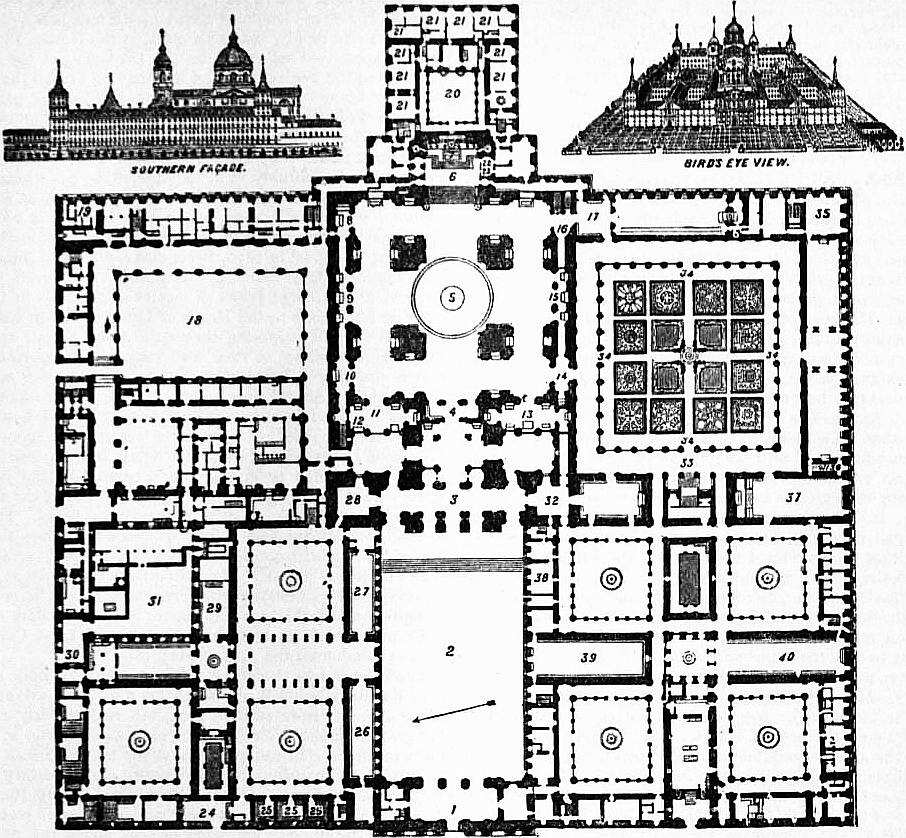
Views and Plan of the Escorial.1
Church 1. Principal entrance and portico. 2. Court of the kings (Patio de los reyes). 3. Vestibule of the church. 4. Choir of the seminarists. 5. Centre of the church and projection of the dome. 6. Greater chapel. 7. High altar. 8. Chapel of St John. 9. Chapel of St Michael. 10. Chapel of St Maurice. 11. Chapel of the Rosary. 12. Tomb of Louisa Carlota. 13. Chapel of the Patrocinio. 14. Chapel of the Cristo de la buena muerte. 15. Chapel of the Eleven Thousand Virgins. 16. Former Chapel of the Patrocinio. 17. Sacristy. Palace 18. Principal court of the palace. 19. Ladies’ tower. 20. Court of the masks. 21. Apartments of the royal children. 22. Royal oratory. 23. Oratory where Philip II. died. Seminary 24. Entrance to seminary. 25. Classrooms. 26. Old philosophical hall. 27. Old theological hall. 28. Chamber of secrets. 29. Old refectory. 30. Entrance to the college. 31. College yard. Convent 32. Clock tower. 33. Principal cloister. 34. Court of the evangelists. 35. Prior’s cell. 36. Archives. 37. Old church. 38. Visitors’ hall. 39. Manuscript library. 40. Convent refectory.
The library, situated above the principal portico, was at one time one of the richest in Europe, comprising the king’s own collection, the extensive bequest of Diego de Mendoza, Philip’s ambassador to Rome, the spoils of the emperor of Morocco, Muley Zidan (1603-1628) and various contributions from convents, churches and cities. It suffered greatly in the fire of 1671, and has since been impoverished by plunder and neglect. Among its curiosities still extant are two New Testament Codices of the 10th century and two of the 11th; various works by Alphonso the Wise (1252-1284), a Virgil of the 14th century, a Koran of the 15th, &c. Of the Arabic manuscripts which it contained in the 17th century a catalogue was given in J.H. Hottinger’s Promptuarium sive bibliotheca orientalis, published at Heidelberg in 1658, and another in the 18th, in M. Casiri’s Bibliotheca Arabico-Hispanica (2 vols., Madrid, 1760-1770). Of the artistic treasures with which the Escorial was gradually enriched, it is sufficient to mention the frescoes of Peregrin or Pellagrino Tibaldi, Luis de Carbajal, Bartolommeo Carducci or Carducho, and Luca Giordano, and the pictures of Titian, Tintoretto and Velasquez. These paintings all date from the 15th or the 17th century. Many of those that are movable have been transferred to Madrid, and many others have perished by fire or sack. The conflagration of 1671, already mentioned, raged for fifteen days, and only the church, a part of the palace, and two towers escaped uninjured. In 1808 the whole building was exposed to the ravages of the French soldiers under General La Houssaye. On the night of the 1st of October 1872, the college and seminary, a part of the palace and the upper library were devastated by fire; but the damage was subsequently repaired. In 1885 the conventual buildings were occupied by Augustinian monks.
The reader will find a remarkable description of the emotional influence of the Escorial in E. Quinet’s Vacances en Espagne (Paris, 1846), and for historical and architectural details he may consult the following works:—Fray Juan de San Geronimo, Memorias sobre la fundacion del Escorial y su fabrica, in the Coleccion de documentos ineditos para la historia de España, vol. vii.; Y. de Herrera, Sumario y breve declaracion de los diseños y estampas de la fab. de S. Lorencio el Real del Escurial (Madrid, 1589); José de Siguenza, Historia de la orden de San Geronyno, &c. (Madrid, 1590). L. de Cabrera de Cordova, Felipe Segundo (Madrid, 1619); James Wadsworth, Further Observations of the English Spanish Pilgrime (London, 1629, 1630); Ilario Mazzorali de Cremona, Le Reali Grandezze del Escuriale (Bologna, 1648); De los Santos, Descripcion del real monasterio, &c. (Madrid, 1657); Andres Ximenes, Descripcion, &c. (Madrid, 1764); Y. Quevedo, Historia del Real Monasterio, &c. (Madrid, 1849); A. Rotondo, Hist. artistica, ... del monasterio de San Lorenzo (Madrid, 1856-1861); W.H. Prescott, Life of Philip II. (London, 1887); J. Fergusson, History of the Modern Styles of Architecture (London, 1891-1893); Sir W. Stirling-Maxwell, Annals of the Artists of Spain (London, 1891).
1 Reduced from a large plan of the Escorial in the British Museum, Monasterio del Escorial, published at Madrid in 1876.
ESCOVEDO, JUAN DE (d. 1578), Spanish politician, secretary of Don John of Austria, and chiefly notable as having been the victim of one of the mysteries of the 16th century, began life in the household of Ruy Gomez de Silva, prince of Eboli, the most trusted minister of the early years of the reign of Philip II. By the will of the prince he was endowed for life with the post of Regidor, or legal representative of the king in the municipality of Madrid. He was also associated with Antonio Perez as one of the secretaries who acted as the agents of the king in all dealings with the various governing boards which formed the Spanish administration. When Don John of Austria, after the battle of Lepanto in 1571, began to launch on a policy of self-seeking adventure, Escovedo was appointed as his secretary with the intention that he should act as a check on these follies. Unhappily for himself and for Don John he went heart and soul into all the prince’s schemes. He began to disobey orders from Madrid and became entangled in intrigues to manage or even to coerce the king. In July 1577, and contrary to the king’s orders, he came to Spain from Flanders, where Don John was then governor. It is said that he discovered the love intrigue between Antonio Perez and the widowed princess of Eboli, Ana Mendoza de la Cerda. This is, however, mere gossip and supposition. There can be no doubt that he was a busy intriguer, or that the king, acting on the then very generally accepted doctrine that the sovereign has a right to act for the public interest without regard to forms of law, gave orders to Antonio Perez that he was to be put out of the way. After two clumsy attempts had been made to poison him at Perez’s table, he was killed by bravos on the night of Easter Monday, the 31st of March 1578. According to an old tradition the murder took place outside the church of St Maria in Madrid, which was pulled down in 1868.
See Gaspar Muro, La Princesse d’Eboli (Paris, 1878); and W.H. Prescott, Reign of Philip II. (1855-59).
ESCUINTLA, the capital of the department of Escuintla, Guatemala; on the southern slope of the Sierra Madre, 45 m. S.W. of Guatemala city. Pop. (1905) about 12,000. Escuintla is locally celebrated for its hot mineral springs. It is the commercial centre of a fertile district, which produces coffee, cane-sugar and cocoa; it has also a brisk transit trade in most of the products of Guatemala, owing to its position on the interoceanic railway between Puerto Barrios on the Atlantic and San José (30 m. S.) on the Pacific. A branch railway which goes westward to San Augustin meets this line at Escuintla.
ESCUTCHEON (O. Fr. escucheon, escusson, modern écusson, through a Late Lat. form from Lat. scutum, shield), an heraldic term for a shield with armorial bearings displayed (see Heraldry). The word is also applied to the shields used on tombs, in the spandrils of doors or in string-courses, and to the ornamented plates from the centre of which door-rings, knockers, &c., are suspended, or which protect the wood of the key-hole from the wear of the key. In medieval times these were often worked in a very beautiful manner.
ESHER, WILLIAM BALIOL BRETT, 1st Viscount (1817-1899), English lawyer and master of the rolls, was a son of the Rev. Joseph G. Brett, of Chelsea, and was born on the 13th of August 1817. He was educated at Westminster and at Caius College, Cambridge. Called to the bar in 1840, he went the northern circuit, and became a Q.C. in 1861. On the death of Richard Cobden he unsuccessfully contested Rochdale as a Conservative, but in 1866 was returned for Helston in unique circumstances. He and his opponent polled exactly the same number of votes, whereupon the mayor, as returning officer, gave his casting vote for the Liberal candidate. As this vote was given after four o’clock, however, an appeal was lodged, and the House of Commons allowed both members to take their seats. Brett rapidly made his mark in the House, and in 1868 he was appointed solicitor-general. On behalf of the crown he prosecuted the Fenians charged with having caused the Clerkenwell explosion. In parliament he took a leading part in the promotion of bills connected with the administration of law and justice. He was (August 1868) appointed a justice in the court of common pleas. Some of his sentences in this capacity excited much criticism, notably so in the case of the gas stokers’ strike, when he sentenced the defendants to imprisonment for twelve months, with hard labour, which was afterwards reduced by the home secretary to four months. On the reconstitution of the court of appeal in 1876, Brett was elevated to the rank of a lord justice. After holding this position for seven years, he succeeded Sir George Jessel as master of the rolls in 1883. In 1885 he was raised to the House of Lords as Baron Esher. He opposed the bill proposing that an accused person or his wife might give evidence in their own case, and supported the bill which empowered lords of appeal to sit and vote after their retirement. The Solicitors Act of 1888, which increased the powers of the Incorporated Law Society, owed much to his influence. In 1880 he delivered a remarkable speech in the House of Lords, deprecating the delay and expense of trials, which he regarded as having been increased by the Judicature Acts. Lord Esher suffered, perhaps, as master of the rolls from succeeding a lawyer of such eminence as Jessel. He had a caustic tongue, but also a fund of shrewd common sense, and one of his favourite considerations was whether a certain course was “business” or not. He retired from the bench at the close of 1897, and a viscounty was conferred upon him on his retirement, a dignity never given to any judge, lord chancellors excepted, “for mere legal conduct since the time of Lord Coke.” He died in London on the 24th of May 1899.
Lord Esher was succeeded in the title by his only surviving son, Reginald Baliol Brett (b. 1852), who was secretary to the office of works from 1895 to 1902, but subsequently came into far greater public prominence in 1904 as Chairman of the war office reconstitution committee after the South African War.
ESHER, a township in the Epsom parliamentary division of Surrey, England, 14½ m. S.W. of London by the London & South Western railway (Esher and Claremont station). It is pleasantly situated on rising ground above the river Mole, 3 m. from its junction with the Thames. To the north-west lie the grounds of Esher Place. Of the mansion-house founded by William of Waynflete, bishop of Winchester (c. 1450), in which Cardinal Wolsey resided for three or four weeks after his sudden fall from power in 1529, only the gatehouse remains. It is known as Wolsey’s Tower, but is apparently part of Waynflete’s foundation. A new mansion was erected in 1803. To the south is Claremont Palace, built by the great Lord Clive (1769) on the site of a mansion of Sir John Vanbrugh. In 1816 it was the residence of Princess Charlotte, wife of Prince (afterwards King) Leopold. She died here in 1817, and on the death of her husband in 1865 the property passed to the crown. Louis Philippe, ex-king of the French, resided here from 1848 until his death in 1850. In 1882 Claremont became the private property of Queen Victoria. Christ Church, Esher, contains fine memorials of King Leopold and others, and one of its three bells is said to have been brought from San Domingo by Sir Francis Drake. To the north near the railway station is Sandown Park, where important race meetings are held. Esher is included in the urban district of Esher and The Dittons, of which Thames Ditton is a favourite riverside resort. The whole district is largely residential. Pop. (1901) 9489.
ESKER (O. Irish eiscir), a local name for long mounds of glacial gravel frequently met with in Ireland. Eskers (the Swedish åsar) are among the occasionally puzzling relics of the British glacial period. They wind from side to side across glaciated country and have evidently been formed by channels upon or under the ice. “Where streams of considerable size form tunnels under or in the ice these may become more or less filled with wash, and when the ice melts the aggraded channels appear as long ridges of gravel and sand known as eskers. It has been thought that similar ridges are sometimes formed in valleys cut in the ice from top to bottom, and even that they rise from gravel and sand lodged in super-glacial channels. The latter at least is probably rare, as the surface streams have usually high gradients, swift currents and smooth bottoms, and hence give little opportunity for lodgment. In the case of ice-sheets, too, in which eskers are chiefly developed, there is usually no surface material except at the immediate edge, where the ice is thin and its layers upturned” (T.C. Chamberlin and R.D. Salisbury, Geology, Processes and their Results). Eskers are to be distinguished from kames (q.v.).
ESKILSTUNA, a town of Sweden in the district (län) of Södermanland, on the Hjelmar river, which unites lakes Hjelmar and Mälar, 65 m. W. of Stockholm by rail. Pop. (1900) 13,663. The place is mentioned in the 13th century, and is said to derive its name from Eskil, an English missionary who suffered martyrdom on the spot. It rose into importance in the reign of Charles X., who bestowed on it considerable privileges, and gave the first impulse to its manufacturing activity. It is the chief seat in Sweden of the iron and steel industries, its cutlery being especially noted, while damascened work is a specialty. There is a technical school for the metal industries. There are, in the town or its neighbourhood, great engineering, gun-making, and rolling and polishing works and breweries. The largest mechanical works are those of Munktell and Tunafors. The Karl Gustaf Stads rifle factory was established in 1814.
ESKIMO, Eskimos or Esquimaux (a corruption of the Abnaki Indian Eskimantsic or the Ojibway Ashkimeq, both terms meaning “those who eat raw flesh”: they call themselves “Innuit,” “the people”), a North American Indian people, inhabiting the arctic coast of America from Greenland to Alaska, and a small portion of the Asiatic shore of Bering Strait. On the American shores they are found, in broken tribes, from East Greenland to the western shores of Alaska—never far inland, or south of the region where the winter ice allows seals to congregate. Even on hunting expeditions they never travel more than 30 m. from the coast. Save a slight admixture of European settlers, they are the only inhabitants of both sides of Davis Strait and Baffin Bay. They extend as far south as about 50° N. lat. on the eastern side of America, and in the west to 60° on the eastern shore of Bering Strait, while 55° to 60° are their southern limits on the shore of Hudson Bay. Throughout all this range there are no other tribes save where the Kennayan and Ugalenze Indians (of western America) come down to the shore to fish. The Aleutians are closely allied to the Eskimo in habits and language. H.J. Rink divides the Eskimo into the following groups, the most eastern of which would have to travel nearly 5000 m. to reach the most western: (1) The East Greenland Eskimo, few in number, every year advancing farther south, and coming into contact with the next section. (2) The West Greenlanders, civilized, living under the Danish crown, and extending from Cape Farewell to 74° N. lat. (3) The Northern-most Greenlanders—the Arctic Highlanders of Sir John Ross—confined to Smith, Whale, Murchison and Wolstenholme Sounds, north of the Melville Bay glaciers. These—the most isolated and uncivilized of all the Eskimo—had no boats or bows and arrows until about 1868. (4) The Labrador Eskimo, mostly civilized. (5) The Eskimo of the middle regions, occupying the coasts from Hudson Bay to Barter Island, beyond Mackenzie river, inhabiting a stretch of country 2000 m. in length and 800 in breadth. (6) The Western Eskimo, from Barter Island to the western limits in America. (7) The Asiatic Eskimo.
The Eskimo are not a tall race, their height varying from 5 ft. 4 in. to 5 ft. 10 in., but men of 6 ft. are met. Both men and women are muscular and active, the former often inclining to fat. The faces of both have a pleasing, good-humoured expression, and not infrequently are even handsome. The typical face is broadly oval, flat, with fat cheeks; forehead not high, and rather retreating; teeth good, though, owing to the character of the food, worn down to the gums in old age; nose very flat; eyes rather obliquely set, small, black and bright; head largish, and covered with coarse black hair, which the women fasten up into a knot on the top, and the men clip in front and allow to hang loose and unkempt behind. Their skulls are of the mesocephalic type, the height being greater than the breadth; according to Davis, 75 is the index of the latter and 77 of the former. Some of the tribes slightly compress the skulls of their new-born children laterally (Hall), but this practice is a very local one. The men have usually a slight moustache, but no whiskers, and rarely any beard. The skin has generally a “bacony” feel, and when cleaned of the smoke, grease and other dirt—the accumulation of which varies according to the age of the individual—is only so slightly brown that red shows in the cheeks of the children and young women. The hands and feet are small and well formed. The Eskimo dress entirely in skins of the seal, reindeer, bear, dog, or even fox, the first two being, however, the most common. The men’s and women’s dress is much the same, a jacket suit, the trousers tucked into seal-skin boots. The jacket has a hood, which in cold weather is used to cover the head, leaving only the face exposed. The women’s jacket has a large hood for carrying a child and an absurd-looking tail behind, which is, however, usually tucked up. The women’s trousers are usually ornamented with eider-duck neck feathers or embroidery of native dyed leather; their boots, which are of white leather, or (in Greenland) dyed of various colours, reach over the knees, and in some tribes are very wide at the top, thus giving them an awkward appearance and a clumsy waddling walk. In winter two suits are worn, one with the hair inside, the other with it outside. They also sometimes wear shirts of bird-skins, and stockings of dog or young reindeer skins. Their clothes are very neatly made, fit beautifully, and are sewn with “sinew-thread,” with a bone needle if a steel one cannot be had. In person the Eskimo are usually filthy, and never wash. Infants are, however, sometimes cleaned by being licked by their mother before being put into the bag of feathers which serves as their bed, cradle and blankets.
In summer the Eskimo live in conical skin tents, and in winter usually in half-underground huts of stone, turf, earth and bones, entered by a long tunnel-like passage, which can only be traversed on all fours. Sometimes, if residing temporarily at a place, they will erect neat round huts of blocks of snow with a sheet of ice for a window. In the roof are deposited their spare harpoons, &c; and from it is suspended the steatite basin-like lamp, the flame of which, the wick being of moss, serves as fire and light. On one side of the hut is the bench which is used as sofa, seats and common sleeping place. The floor is usually very filthy, a pool of blood or a dead seal being often to be seen there. Ventilation is almost non-existent; and after the lamp has blazed for some time, the heat is all but unbearable. In the summer the wolfish-looking dogs lie outside on the roof of the huts, in the winter in the tunnel-like passage just outside the family apartment. The Western Eskimo build their houses chiefly of planks, merely covered on the outside with green turf. The same Eskimo have, in the more populous places, a public room for meetings. “Council chambers” are also said to exist in Labrador, but are only known in Greenland by tradition. Sometimes in south Greenland and in the Western Eskimo country the houses are made to accommodate several families, but as a rule each family has a house to itself.
The Eskimo are solely hunters and fishers, and derive most of their food from the sea. Their country allows of no cultivation; and beyond a few berries, roots, &c., they use no vegetable food. The seal, the reindeer and the whale supply the bulk of their food, as well as their clothing, light, fuel, and frequently also, when driftwood is scarce or unavailable, the material for various articles of domestic economy. Thus the Eskimo canoe is made of seal-skin stretched on a wooden or whalebone frame, with a hole in the centre for the paddler. It is driven by a bone-tipped double-bladed paddle. A waterproof skin or entrail dress is tightly fastened round the mouth of the hole so that, should the canoe overturn, no water can enter. A skilful paddler can turn a complete somersault, boat and all, through the water. The Eskimo women use a flat-bottomed skin luggage-boat. The Eskimo sledge is made of two runners of wood or bone—even, in one case on record, of frozen salmon (Maclure)—united by cross bars tied to the runners by hide thongs, and drawn by from 4 to 8 dogs harnessed abreast. Some of their weapons are ingenious—in particular, the harpoon, with its detachable point to which an inflated sealskin is fastened. When the quarry is struck, the floating skin serves to tire it out, marks its course, and buoys it up when dead. The bird-spears, too, have a bladder attached, and points at the sides which strike the creature should the spear-head fail to wound. An effective bow is made out of whale’s rib. Altogether, with meagre material the Eskimo show great skill in the manufacture of their weapons. Meat is sometimes boiled, but, when it is frozen, it is often eaten raw. Blood, and the half-digested contents of the reindeer’s paunch, are also eaten; and sometimes, but not habitually, blubber. As a rule this latter is too precious: it must be kept for winter fuel and light. The Eskimo are enormous eaters; two will easily dispose of a seal at a sitting; and in Greenland, for instance, each individual has for his daily consumption, on an average, 2½ ℔ of flesh with blubber, and 1 ℔ of fish, besides mussels, berries, sea-weed, &c., to which in the Danish settlements may be added 2 oz. of imported food. Ten pounds of flesh, in addition to other food, is not uncommonly consumed in a day in time of plenty. A man will lie on his back and allow his wife to feed him with tit-bits of blubber and flesh until he is unable to move.
The Eskimo cannot be strictly called a wandering race. They are nomadic only in so far that they have to move about from place to place during the fishing and shooting season, following the game in its migrations. They have, however, no regular property. They possess only the most necessary utensils and furniture, with a stock of provisions for less than one year; and these possessions never exceed certain limits fixed upon by tradition or custom. Long habit and the necessities of their life have also compelled those having food to share with those having none—a custom which, with others, has conduced to the stagnant conditions of Eskimo society and to their utter improvidence.
Their intelligence is considerable, as their implements and folk-tales abundantly prove. They display a taste for music, cartography and drawing, display no small amount of humour, are quick at picking up peculiar traits in strangers, and are painfully acute in detecting the weak points or ludicrous sides of their character. They are excellent mimics and easily learn the dances and songs of the Europeans, as well as their games, such as chess and draughts. They gamble a little—but in moderation, for the Eskimo, though keen traders, have a deep-rooted antipathy to speculation. When they offer anything for sale—say at a Danish settlement in Greenland—they always leave it to the buyer to settle the price. They have also a dislike to bind themselves by contract. Hence it was long before the Eskimo in Greenland could be induced to enter into European service, though when they do they pass to almost the opposite extreme—they have no will of their own. Public licentiousness or indecency is rare among them. In their private life their morality is, however, not high. The women are especially erring; and in Greenland, at places where strangers visit, their extreme laxity of morals, and their utter want of shame, are not more remarkable than the entire absence of jealousy or self-respect on the part of their countrymen and relatives. Theft in Greenland is almost unknown; but the wild Eskimo make very free with strangers’ goods—though it must be allowed that the value they attach to the articles stolen is some excuse for the thieves. Among themselves, on the other hand, they are very honest—a result of their being so much under the control of public opinion. Lying is said to be as common a trait of the Eskimo as of other savages in their dealings with Europeans. They have naturally not made any figure in literature. Their folk-lore is, however, extensive, and that collected by Dr Rink shows considerable imagination and no mean talent on the part of the story-tellers. In Greenland and Labrador most of the natives have been taught by the missionaries to read and write in their own language. Altogether, the literature published in the Eskimo tongue is considerable. Most of it has been printed in Denmark, but some has been “set up” in a small printing-office in Greenland, from which about 280 sheets have issued, beside many lithographic prints. A journal (Atuagagldliutit nalinginarmik tusaruminásassumik univkat, i.e. “something for reading, accounts of all entertaining subjects”) has been published since 1861.
The Eskimo in Greenland and Labrador are, with few exceptions, nominally at least, Christians. The native religion is a vague animism, and consists of a belief in good and evil spirits, limited each to its own sphere; in a Heaven and Hell; and a childish faith is placed in the native wizards, who are regarded as intermediaries between mankind and the spirit-powers. The worship of the whale-spirit, so important a factor in their daily economy, is prevalent.
As regards language, the idiom spoken from Greenland to north-eastern Siberia is, with a few exceptions, the same; any difference is only that of dialect. It differs from the whole group of European languages, not merely in the sound of the words, but more especially, according to Rink, in the construction. Its most remarkable feature is that a sentence of a European language is expressed in Eskimo by a single word constructed out of certain elements, each of which corresponds in some degree to one of our words. One specimen commonly given to visitors to Greenland may suffice: Savigiksiniariartokasuaromaryotittogog, which is equivalent to “He says that you also will go away quickly in like manner and buy a pretty knife.” Here is one word serving in the place of 17. It is made up as follows: Savig a knife, ik pretty, sini buy, ariartok go away, asuar hasten, omar wilt, y in like manner, otit thou, tog also, og he says.
The Eskimo have no chiefs or political and military rulers. Fabricius concisely described them in his day: “Sine Deo, domino, reguntur consuetudine.” The government is mainly a family one, though a man distinguished for skill in the chase, and for strength and shrewdness, often has considerable power in the village. No political or social tie is recognized between the villages, though general good-fellowship seems to mark their relations. They never go to war with each other; and though revengeful and apt to injure an enemy secretly, they rarely come to blows, and are morbidly anxious not to give offence. Indeed, in their intercourse with each other, all Eskimo indulge in much hyperbolical compliment. But they are not without courage. On the Coppermine and Mackenzie rivers, where they sometimes come into collision with their American-Indian kinsmen, they fight fiercely. Polygamy is rare, but the rights of divorce and re-marriage are unrestricted. The Eskimo have intricate rules governing the ownership of property and the rights of the hunter. As a race they are singularly undemonstrative. When they met each other they used to rub noses together, but this, though a common custom still among the wild Eskimo, is entirely abandoned in Greenland except for the petting of children. There is, in Greenland at least, no national mode of salutation, either on meeting or parting. When a guest enters a house, commonly not the least sign is made either by him or his host. On leaving a place they sometimes say “inûvdluaritse,” i.e. live well, and to a European “aporniakinatit,” i.e. do not hurt thy head, viz. against the upper part of the doorway. The Eskimo, excluding the few on the Asiatic coast, are estimated at about 29,000.
Bibliography.—Dr H.J. Rink, Tales and Traditions of the Eskimo (1875); Danish Greenland; its People and its Products (1877); Eskimo Tribes (1887); J. Richardson, Polar Regions (1861), pp. 298-331; Sir Clements Markham, Arctic Papers of the R. G. S. (1875), pp. 163-232; Simpson, ibid. pp. 233-275; “Hans Hendriks the Eskimo’s Memoirs,” Geographical Magazine (Feb. 1878, et seq.); Fridtjof Nansen, Eskimo Life (1894); R.E. Peary, Northward over the Great Ice, vol. i. appendix ii.; F. Boas, “The Central Eskimo,” Sixth Annual Report of Bureau of Ethnology (1884-1885); J. Murdoch, “The Point Barrow Eskimo,” Ninth Annual Report (1887-1888); E.W. Nelson, “The Eskimo about Bering Strait,” Eighteenth Annual Report, part 1 (1896-1897).
ESKI-SHEHR, a town of Asia Minor, in the Kutaiah sanjak of the Brusa (Khudavendikiar) vilayet. It is a station on the Haidar Pasha-Angora railway, 194½ m. from the former and 164 m. from Angora, and the junction for Konia; and is situated on the right bank of the Pursak Su (Tembris), a tributary of the Sakaria, at the foot of the hills that border the broad treeless valley. Pop. 20,000 (Moslems 15,000, Christians 5000). Eski-Shehr, i.e. “the old town,” lies about a mile from the ruins of the ancient Phrygian Dorylaeum. The latter is mentioned in connexion with the wars of Lysimachus and Antigonus (about 302 B.C.), and frequently figures in Byzantine history as an imperial residence and military rendezvous. It was the scene of the defeat of the Turks under Kilij-Arslan by the crusaders in 1097, and fell finally to the Turks of Konia in 1176. The town is divided by a small stream into a commercial quarter on low ground, in which are the bazaars, khans and the hot sulphur springs (122° F.) which are mentioned as early as the 3rd century by Athenaeus; and a residential quarter on the higher ground. The town is noted for its good climate, the Pursak Su for the abundance of its fish, and the plain for its fertility. About 18 m. to the E. are extensive deposits of meerschaum. The clay is partly manufactured into pipes in the town, but the greater proportion finds its way to Europe and especially to Germany. The annual output is valued at £272,000.
See Murray’s Hdbk. to Asia Minor (1893); V. Cuinet, Turquie d’Asie (Paris, 1894).
ESMARCH, JOHANNES FRIEDRICH AUGUST VON (1823-1908), German surgeon, was born at Tönning, in Schleswig-Holstein, on the 9th of January 1823. He studied at Kiel and Göttingen, and in 1846 became B.R.K. von Langenbeck’s assistant at the Kiel surgical hospital. He served in the Schleswig-Holstein War of 1848 as junior surgeon, and this directed his attention to the subject of military surgery. He was taken prisoner, but afterwards exchanged, and was then appointed as surgeon to a field hospital. During the truce of 1849 he qualified as Privatdocent at Kiel, but on the fresh outbreak of war he returned to the troops and was promoted to the rank of senior surgeon. In 1854 he became director of the surgical clinic at Kiel, and in 1857 head of the general hospital and professor at the university. During the Schleswig-Holstein War of 1864 Esmarch rendered good service to the field hospitals of Flensburg, Sundewitt and Kiel. In 1866 he was called to Berlin as member of the hospital commission, and also to take the superintendence of the surgical work in the hospitals there. When the Franco-German War broke out in 1870 he was appointed surgeon-general to the army, and afterwards consulting surgeon at the great military hospital near Berlin. In 1872 he married Princess Henrietta of Schleswig-Holstein-Sonderburg-Augustenburg, aunt of the Empress Auguste Victoria. In 1887 a patent of nobility was conferred on him. He died at Kiel on the 23rd of February 1908. Esmarch was one of the greatest authorities on hospital management and military surgery. His Handbuch der kriegschirurgischen Technik was written for a prize offered by the empress Augusta, on the occasion of the Vienna Exhibition of 1877, for the best handbook for the battlefield of surgical appliances and operations. This book is illustrated by admirable diagrams, showing the different methods of bandaging and dressing, as well as the surgical operations as they occur on the battlefield. Esmarch himself invented an apparatus, which bears his name, for keeping a limb nearly bloodless during amputation. No part of Esmarch’s work is more widely known than that which deals with “First Aid,” his First Aid on the Battlefield and First Aid to the Injured being popular manuals on the subject. The latter is the substance of a course of lectures delivered by him in 1881 to a “Samaritan School,” the first of the kind in Germany, founded by Esmarch in 1881, in imitation of the St John’s Ambulance classes which had been organized in England in 1878. These lectures were very generally adopted as a manual for first aid students, edition after edition having been called for, and they have been translated into numerous languages, the English version being the work of H.R.H. Princess Christian. No ambulance course would be complete without a demonstration of the Esmarch bandage. It is a three-sided piece of linen or cotton, of which the base measures 4 ft. and the sides 2 ft. 10 in. It can be used folded or open, and applied in thirty-two different ways. It answers every purpose for temporary dressing and field-work, while its great recommendation is that the means for making it are always at hand.
ESNA, or Esneh, a town of Upper Egypt on the W. bank of the Nile, 454 m. S.S.E. of Cairo by rail, the railway station being on the opposite side of the river. Pop. (1897) 16,000, mostly Copts. Esna, one of the healthiest towns in Egypt, is noted for its manufactures of pottery and its large grain and live stock markets. It formerly had a large trade with the Sudan. A caravan road to the south goes through the oasis of Kurkur. The trade, almost stopped by the Mahdist Wars, is now largely diverted by railway and steamboat routes. There is, however, considerable traffic with the oasis of Kharga, which lies almost due west of the town. Nearly in the centre of the town is the Ptolemaic and Roman temple of the ram-headed Khnūm, almost buried in rubbish and houses. The interior of the pronaos is accessible to tourists, and contains the latest known hieroglyphic inscription, dating from the reign of Decius (A.D. 249-251). With Khnūm are associated the goddesses Sati and Neith. In the neighbourhood are remains of Coptic buildings, including a subterranean church (discovered 1895) in the desert half a mile beyond the limits of cultivation. The name Esna is from the Coptic Sne. By the Greeks the place was called Latopolis, from the worship here of the latus fish. In the persecutions under Diocletian A.D. 303, the Christians of Esna, a numerous body, suffered severely. In later times the town frequently served as a place of refuge for political exiles. The so-called Esna barrage across the Nile (built 1906-1908) is 30 m. higher up stream at Edfu.
ESOTERIC, having an inner or secret meaning. This term, and its correlative “exoteric,” were first applied in the ancient Greek mysteries to those who were initiated (ἔσω, within) and to those who were not (ἔξω, outside), respectively. It was then transferred to a supposed distinction drawn by certain philosophers between the teaching given to the whole circle of their pupils and that containing a higher and secret philosophy which was reserved for a select number of specially advanced or privileged disciples. This distinction was ascribed by Lucian (Vit. Auct. 26) to Aristotle (q.v.), who, however, uses ἐξωτερικοὶ λόγοι (Nic. Ethics) merely of “popular treatises.” It was probably adopted by the Pythagoreans and was also attributed to Plato. In the sense of mystic it is used of a secret doctrine of theosophy, supposed to have been traditional among certain disciples of Buddhism.
ESPAGNOLS SUR MER, LES, the name given to the naval victory gained by King Edward III. of England over a Spanish fleet off Winchelsea, on the 29th of August 1350. Spanish ships had fought against England as the allies or mercenaries of France, and there had been instances of piratical violence between the trading ships of both nations. A Spanish merchant fleet was loading cargoes in the Flemish ports to be carried to the Basque coast. The ships were armed and had warships with them. They were all under the command of Don Carlos de la Cerda, a soldier of fortune who belonged to a branch of the Castilian royal family. On its way to Flanders the Spanish fleet had captured a number of English trading ships, and had thrown the crews overboard. Piratical violence and massacre of this kind was then universal on the sea. On the 10th of August, when the king was at Rotherhithe, he announced his intention of attacking the Spaniards on their way home. The rendezvous of his fleet was at Winchelsea, and thither the king went by land, accompanied by his wife and her ladies, by his sons, the Black Prince and John of Gaunt, as well as by many nobles. The ladies were placed in a convent and the king embarked on his flagship, the “Cog Thomas,” on the 28th of August. The English fleet did not put to sea but remained at anchor, waiting for the appearance of the Spaniards. Its strength is not known with certainty, but Stow puts it at 50 ships and pinnaces. Carlos de la Cerda was obviously well disposed to give the king a meeting. He might easily have avoided the English if he had kept well out in the Channel. But he relied on the size and strength of his 40 large ships, and in expectation of an encounter had recruited a body of mercenaries—mostly crossbowmen—in the Flemish ports. In the afternoon of the 29th of August he bore down boldly on King Edward’s ships at anchor at Winchelsea. When the Spaniards hove in sight, the king was sitting on the deck of his ship, with his knights and nobles, listening to his minstrels who played German airs, and to the singing of Sir John Chandos. When the look-out in the tops reported the enemy in sight, the king and his company drank to one another’s health, the trumpet was sounded, and the whole line stood out. All battles at that time, whether on land or sea, were finally settled by stroke of sword. The English steered to board the Spaniards. The king’s own ship was run into by one of the enemy with such violence that both were damaged, and she began to sink. The Spaniard stood on, and the “Cog Thomas” was laid alongside another, which was carried by boarding. It was high time, for the king and his following had barely reached the deck of the Spaniard before the “Cog Thomas” went to the bottom. Other Spaniards were taken, but the fight was hot. La Cerda’s crossbowmen did much execution, and the higher-built Spaniards were able to drop bars of iron or other weights on the lighter English vessels, by which they were damaged. The conflict was continued till twilight. At the close the large English vessel called “La Salle du Roi,” which carried the king’s household, and was commanded by the Fleming, Robert of Namur, afterwards a knight of the Garter, was grappled by a big Spaniard, and was being dragged off by him. The crew called loudly for a rescue, but were either not heard or, if heard, could not be helped. The “Salle du Roi” would have been taken if a Flemish squire of Robert of Namur, named Hannequin, had not performed a great feat of arms. He boarded the Spaniard and cut the halyards of her mainsail with his sword. The Spanish ship was taken. King Edward is said to have captured 14 of the enemy. What his own loss was is not stated, but as his own vessel, and also the vessel carrying the Black Prince, were sunk, and from the peril of “La Salle du Roi,” we may conclude that the English fleet suffered heavily. There was no pursuit, and a truce was made with the Basque towns the next year.