VOLUME IX SLICE VII Equation to Ethics (continued 3)
Reading edition
But his ardent spirit could not long be content with monastic life. He brought his attainments somehow to the notice of Henry of Bergen, bishop of Cambrai, the leading prelate at the court of Brussels; and about 1494 permission was obtained for him to leave Steyn and become Latin secretary to the bishop, who was then preparing for a visit to Rome. But the journey was abandoned, and after some months Erasmus found that even with occasional chances to read at Groenendael, the life of a court was hardly more favourable to study than that of Steyn. At the suggestion of a friend, James Batt, he applied to his patron for leave to go to Paris University. The bishop consented and promised a small pension; and in August 1495 Erasmus entered the “domus pauperum” of the college of Montaigu, which was then under the somewhat rigid rule of the reformer Jan Standonck. He at once introduced himself to the distinguished French historian and diplomatist Robert Gaguin (1425-1502) and published a small volume of poems; and he became intimate with Johann Mauburnus (Mombaer), the leader of a mission summoned from Windesheim in 1496 to reform the abbey of Château-Landon. But the life at Montaigu was too hard for him. Every Lent he fell ill and had to return to Holland to recover. He continued to read nevertheless for a degree in theology, and at some time completed the requirements for the B.D. After a year or two he left Montaigu and eked out his money from the bishop by taking pupils. One of these, a young Englishman, William Blount, 4th Baron Mountjoy (d. 1534), persuaded him to visit England in the spring of 1499.
Being without a benefice, he had no settled income to look to, and apart from the precarious profits of teaching and writing books, could only wait on the generosity of patrons to supply him with the leisure he craved. The faithful Batt had sought a pension for him from his own patroness, Anne of Borsselen, the Lady of Veere, who resided at the castle of Tournehem near Calais, and whose son Batt was now teaching. But as nothing promised at once, Erasmus accepted Mountjoy’s offer, and thus a tie was formed which led Mountjoy then or a few years later to grant him a pension of £20 for life. Otherwise the visit to England gave no hope of preferment; and in the summer Erasmus prepared to leave. He was delayed, and used the interval to spend two or three months at Oxford, where he found John Colet lecturing on the Epistle to the Romans. Discussions between them on theological questions soon convinced Colet of Erasmus’ worth, and he sought to persuade him to stay and teach at Oxford. But Erasmus could not be content with the Bible in Latin. Oxford could teach him no Greek, so away he must go.
In January 1500 he returned to Paris, which though it could offer no Greek teacher better than George Hermonymus, was at least a better centre for buying and for printing books. The next few years were spent still in preparation, supported by pupils’ fees and the dedications of books; the Collectanea adagiorum in June 1500 to Mountjoy, and some devotional and moral compositions to Batt’s patroness and her son. When the plague drove him from Paris, he went to Orleans or Tournehem or St Omer, as the way opened. From 1502 to 1504 he was at Louvain, still declining to teach publicly; among his friends being the future Pope Adrian VI. In January 1504 the archduke Philip gave him fifty livres for the Panegyric which “ung religieux de l’ordre de St Augustin” had composed on his Spanish journey; and in October, ten more, for the maintenance of his studies.
He had been working hard at Greek, of which he now felt himself master, at the Fathers (above all at Jerome), and at the Epistles of St Paul, fulfilling the promise made to Colet in Oxford, to give himself to sacred learning. But the bent of his reading is shown by the manuscript with which he returned to Paris at the close of 1504—Valla’s Annotations on the New Testament, which Badius printed for him in 1505.
Shortly afterwards Lord Mountjoy invited him again to England, and this visit was more successful. He found in London a circle of learned friends through whom he was introduced to William Warham, archbishop of Canterbury, Richard Foxe, bishop of Winchester and other dignitaries. John Fisher (bishop of Rochester), who was then superintending the foundation of Christ’s College for the Lady Margaret, took him down to Cambridge for the king’s visit; and at length the opportunity came to fulfil his dream of seeing Italy. Baptista Boerio, the king’s physician, engaged him to accompany his two sons thither as supervisor of their studies. In September 1506 he set foot on that sacred soil, and took his D.D. at Turin. For a year he remained with his pupils at Bologna, and then, his engagement completed, negotiated with Aldus Manutius for a new edition of his Adagia upon a very different scale. The volume of 1500 had been jejune, written when he knew nothing of Greek; 800 adages put together with scanty elucidations. In 1508 he had conceived a work on lines more to the taste of the learned world, full of apt and recondite learning, and now and again relieved by telling comments or lively anecdotes. Three thousand and more collected justified a new title—Chiliades adagiorum; and the author’s reputation was now established. So secure in public favour did the book in time become, that the council of Trent, unable to suppress it and not daring to overlook it, ordered the preparation of a castrated edition.
To print the Adagia he had gone to Venice, where he lived with Andrea Torresano of Asola (Asulanus) and did the work of two men, writing and correcting proof at the same time. When it was finished, with an ample re-dedication to Mountjoy, a new pupil presented himself, Alexander Stewart, natural son of James IV. of Scotland—perhaps through a connexion formed in early days at Paris. They went together to Siena and Rome and then on to Campania, thirsty under the summer sun. When they returned to Rome, his pupil departed to Scotland, to fall a few years later by his father’s side at Flodden; Erasmus also found a summons to call him northwards.
On the death of Henry VII. Lord Mountjoy, who had been companion to Prince Henry in his studies, had become a person of influence. He wrote to Erasmus of a land flowing with milk and honey under the “divine” young king, and with Warham sent him £10 for journey money. At first Erasmus hesitated. He had been disappointed in Italy, to find that he had not much to learn from its famed scholarship; but he had made many friends in Aldus’s circle—Marcus Musurus, John Lascaris, Baptista Egnatius, Paul Bombasius, Scipio Carteromachus; and his reception had been flattering, especially in Rome, where cardinals had delighted to honour him. But to remain in Rome was to sell himself. He might have the leisure which was so indispensable, but at price of the freedom to read, think, write what he liked. He decided, therefore, to go, though with regrets; which returned upon him sometimes in after years, when the English hopes had not borne fruit.
In the autumn he reached London, and in Thomas More’s house in Bucklersbury wrote the witty satire which Milton found “in every one’s hands” at Cambridge in 1628, and which is read to this day. The Moriae encomium was a sign of his decision. In it kings and princes, bishops and popes alike are shown to be in bondage to Folly; and no class of men is spared. Its author was willing to be beholden to any one for leisure; but he would be no man’s slave. For the next eighteen months he is entirely lost to view; when he reappears in April 1511, he is leaving More’s house and taking the Moria to be printed privily in Paris. Wherever they were spent, these must have been months of hard work, as were the years that followed. His time was now come. The long preparation and training, bought by privation and uncongenial toil, was over, and he was ready to apply himself to the scientific study of sacred letters. His English patrons were liberal. Fisher sent him in August 1511 to teach in Cambridge; Warham gave him a benefice, Aldington in Kent, worth £33, 6s. 8d. a year, and in violation of his own rule commuted it for a pension of £20 charged on the living; and the dedications of his books were fruitful. In Cambridge he completed his work on the New Testament, the Letters of Jerome, and Seneca; and then in 1514, when there seemed no prospect of ampler preferment, he determined to transfer himself to Basel and give the results of his labours to the world.
The origin of Erasmus’s connexion with Johann Froben is not clear. In 1511 he was preparing to reprint his Adagia with Jodocus Badius, who in the following year was to have also Seneca and Jerome. But in 1513 Froben, who had just reprinted the Aldine Adagia, acquired through a bookseller-agent Erasmus’ amended copy which had been destined for Badius. That the agent was acting entirely on his own responsibility may be doubted; for within a few months Erasmus had decided to betake himself to Basel, bearing with him Seneca and Jerome, the latter to be incorporated in the great edition which Johannes Amerbach and Froben had had in hand since 1510. In Germany he was widely welcomed. The Strassburg Literary Society fêted him, and Johannes Sapidus, headmaster of the Latin school at Schlettstadt, rode with him into Basel. Froben received him with open arms, and the presses were soon busy with his books. Through the winter of 1514-1515 Erasmus worked with the strength of ten; and after a brief visit to England in the spring, the New Testament was set up. Around him was a circle of students, some young, some already distinguished—the three sons of Froben’s partner, Johannes Amerbach, who was now dead, Beatus Rhenanus, Wilhelm Nesen, Ludwig Ber, Heinrich Glareanus, Nikolaus Gerbell, Johannes Oecolampadius—who looked to him as their head and were proud to do him service.
Though from this time forward Basel became the centre of occupation and interest for Erasmus, yet for the next few years he was mainly in the Netherlands. On the completion of the New Testament in 1516 he returned to his friends in England; but his appointment, then recent, as councillor to the young king Charles, brought him back to Brussels in the autumn. In the spring of 1517 he went for the last time to England, about a dispensation from wearing his canonical dress, obtained originally from Julius II. and recently confirmed by Leo X., and in May 1518 he journeyed to Basel for three months to set the second edition of the New Testament in progress. But with these exceptions he remained in proximity to the court, living much at Louvain, where he took great interest in the foundation of Hieronymus Busleiden’s Collegium Trilingue. His circumstances had improved so much, by pensions, the presents which were showered upon him, and the sale of his books, that he was now in a position to refuse all proposals which would have interfered with his cherished independence. The general ardour for the restoration of the arts and of learning created an aristocratic public, of which Erasmus was supreme pontiff. Luther spoke to the people and the ignorant; Erasmus had the ear of the educated class. His friends and admirers were distributed over all the countries of Europe, and presents were continually arriving from small as well as great, from a donation of 200 florins, made by Pope Clement VII., down to sweetmeats and comfits contributed by the nuns of Cologne (Ep. 666). From England, in particular, he continued to receive supplies of money. In the last year of his life Thomas Cromwell sent him 20 angels, and Archbishop Cranmer 18. Though Erasmus led a very hard-working and far from luxurious life, and had no extravagant habits, yet he could not live upon little. The excessive delicacy of his constitution, not pampered appetite, exacted some unusual indulgences. He could not bear the stoves of Germany, and required an open fireplace in the room in which he worked. He was afflicted with the stone, and obliged to be particular as to what he drank. Beer he could not touch. The white wines of Baden or the Rhine did not suit him; he could only drink those of Burgundy or Franche-Comté. He could neither eat, nor bear the smell of, fish. “His heart,” he said, “was Catholic, but his stomach was Lutheran.” For his constant journeys he required two horses, one for himself and one for his attendant. And though he was almost always found in horse-flesh by his friends, the keep had to be paid for. For his literary labours and his extensive correspondence he required one or more amanuenses. He often had occasion, on his own business, or on that of Froben’s press, to send special couriers to a distance, employing them by the way in collecting the free gifts of his tributaries.
Precarious as these means of subsistence seem, he preferred the independence thus obtained to an assured position which would have involved obligations to a patron or professional duties which his weak health would have made onerous. The duke of Bavaria offered to dispense with teaching, if he would only reside, and would have named him on these terms to a chair in his new university of Ingolstadt, with a salary of 200 ducats, and the reversion of one or more prebendal stalls. The archduke Ferdinand offered a pension of 400 florins, if he would only come to reside at Vienna. Adrian VI. offered him a deanery, but the offer seems to have been of a possible and not an actual deanery. Offers, flattering but equally vague, were made from France, on the part of the bishop of Bayeux, and even of Francis I. “Invitor amplissimis conditionibus; offeruntur dignitates et episcopatus; plane rex essem, si juvenis essem” (Ep. xix. 106; 735). Erasmus declined all, and in November 1521 settled permanently at Basel, in the capacity of general editor and literary adviser of Froben’s press. As a subject of the emperor, and attached to his court by a pension, it would have been convenient to him to have fixed his residence in Louvain. But the bigotry of the Flemish clergy, and the monkish atmosphere of the university of Louvain, overrun with Dominicans and Franciscans, united for once in their enmity to the new classical learning, inclined Erasmus to seek a more congenial home in Basel. To Froben his arrival was the advent of the very man whom he had long wanted. Froben’s enterprise, united with Erasmus’s editorial skill, raised the press of Basel, for a time, to be the most important in Europe. The death of Froben in 1527, the final separation of Basel from the Empire, the wreck of learning in the religious disputes, and the cheap paper and scamped work of the Frankfort presses, gradually withdrew the trade from Basel. But during the years of Erasmus’s co-operation the Froben press took the lead of all the presses in Europe, both in the standard value of the works published and in style of typographical execution. Like some other publishers who preferred reputation to returns in money, Froben died poor, and his impressions never reached the splendour afterwards attained by those of the Estiennes, or of Plantin. The series of the Fathers alone contains Jerome (1516), Cyprian (1520), Pseudo-Arnobius (1522), Hilarius (1523), Irenaeus (Latin, 1526), Ambrose (1527), Augustine (1528), Chrysostom (Latin, 1530), Basil (Greek, 1532, the first Greek author printed in Germany), and Origen (Latin, 1536). In these editions, partly texts, partly translations, it is impossible to determine the respective shares of Erasmus and his many helpers. The prefaces and dedications are all written by him, and some of them, as that to the Hilarius, are of importance for the history as well of the times as of Erasmus himself. Of his most important edition, that of the Greek text of the New Testament, something will be said farther on.
In this “mill,” as he calls it, Erasmus continued to grind incessantly for eight years. Besides his work as editor, he was always writing himself some book or pamphlet called for by the event of the day, some general fray in which he was compelled to mingle, or some personal assault which it was necessary to repel. But though painfully conscious how much his reputation as a writer was damaged by this extempore production, he was unable to resist the fatal facility of print. He was the object of those solicitations which always beset the author whose name upon the title page assures the sale of a book. He was besieged for dedications, and as every dedication meant a present proportioned to the circumstances of the dedicatee, there was a natural temptation to be lavish of them. Add to this a correspondence so extensive as to require him at times to write forty letters in one day. “I receive daily,” he writes, “letters from remote parts, from kings, princes, prelates and men of learning, and even from persons of whose existence I was ignorant.” His day was thus one of incessant mental activity; but hard work was so far from breeding a distaste for his occupation, that reading and writing grew ever more delightful to him (literarum assiduitas non modo mihi fastidium non parit, sed voluptatem; crescit scribendo scribendi studium).
Shortly after Froben’s death the disturbances at Basel, occasioned by the zealots for the religious revolution which was in progress throughout Switzerland, began to make Erasmus desirous of changing his residence. He selected Freiburg in the Breisgau, as a city which was still in the dominion of the emperor, and was free from religious dissension. Thither he removed in April 1529. He was received with public marks of respect by the authorities, who granted him the use of an unfinished residence which had been begun to be built for the late emperor Maximilian. Erasmus proposed only to remain at Freiburg for a few months, but found the place so suited to his habits that he bought a house of his own, and remained there six years. A desire for change of air—he fancied Freiburg was damp—rumours of a new war with France, and the necessity of seeing his Ecclesiastes through the press, took him back to Basel in 1535. He lived now a very retired life, and saw only a small circle of intimate friends. A last attempt was made by the papal court to enlist him in some public way against the Reformation. On the election of Paul III. in 1534, he had, as usual, sent the new pope a congratulatory letter. After his arrival in Basel, he received a complimentary answer, together with the nomination to the deanery of Deventer, the income of which was reckoned at 600 ducats. This nomination was accompanied with an intimation that more was in store for him, and that steps would be taken to provide for him the income, viz., 3000 ducats, which was necessary to qualify for the cardinal’s hat. But Erasmus was even less disposed now than he had been before to barter his reputation for honours. His health had been for some years gradually declining, and disease in the shape of gout gaining upon him. In the winter of 1535-1536 he was confined entirely to his chamber, many days to his bed. Though thus afflicted he never ceased his literary activity, dictating his tract On the Purity of the Church, and revising the sheets of a translation of Origen which was passing through the Froben press. His last letter is dated the 28th of June 1536, and subscribed “Eras. Rot. aegra manu.” “I have never been so ill in my life before as I am now,—for many days unable even to read.” Dysentery setting in carried him off on the 12th of July 1536, in his 70th year.
By his will, made on the 12th of February 1536, he left what he had to leave, with the exception of some legacies, to Bonifazius Amerbach, partly for himself, partly in trust for the benefit of the aged and the infirm, or to be spent in portioning young girls, and in educating young men of promise. He left none of the usual legacies for masses or other clerical purposes, and was not attended by any priest or confessor in his last moments.
Erasmus’s features are familiar to all, from Holbein’s many portraits or their copies. Beatus Rhenanus, “summus Erasmi observator,” as he is called by de Thou, describes his person thus: “In stature not tall, but not noticeably short; in figure well built and graceful; of an extremely delicate constitution, sensitive to the slightest changes of climate, food or drink. After middle life he suffered from the stone, not to mention the common plague of studious men, an irritable mucous membrane. His complexion was fair; light blue eyes, and yellowish hair. Though his voice was weak, his enunciation was distinct; the expression of his face cheerful; his manner and conversation polished, affable, even charming.” His highly nervous organization made his feelings acute, and his brain incessantly active. Through his ready sympathy with all forms of life and character, his attention was always alive. The active movement of his spirit spent itself, not in following out its own trains of thought, but in outward observation. No man was ever less introspective, and though he talks much of himself, his egotism is the genial egotism which takes the world into its confidence, not the selfish egotism which feels no interest but in its own woes. He says of himself, and justly, “that he was incapable of dissimulation” (Ep. xxvi. 19; 1152). There is nothing behind, no pose, no scenic effect. It may be said of his letters that in them “tota patet vita senis.” His nature was flexible without being faultily weak. He has many moods and each mood imprints itself in turn on his words. Hence, on a superficial view, Erasmus is set down as the most inconsistent of men. Further acquaintance makes us feel a unity of character underlying this susceptibility to the impressions of the moment. His seeming inconsistencies are reconciled to apprehension, not by a formula of the intellect, but by the many-sidedness of a highly impressible nature. In the words of J. Nisard, Erasmus was one of those “dont la gloire a été de beaucoup comprendre et d’affirmer peu.”
This equal openness to every vibration of his environment is the key to all Erasmus’s acts and words, and among them to the middle attitude which he took up towards the great religious conflict of his time. The reproaches of party assailed him in his lifetime, and have continued to be heaped upon his memory. He was loudly accused by the Catholics of collusion with the enemies of the faith. His powerful friends, the pope, Wolsey, Henry VIII., the emperor, called upon him to declare against Luther. Theological historians from that time forward have perpetuated the indictment that Erasmus sided with neither party in the struggle for religious truth. The most moderate form of the censure presents him in the odious light of a trimmer; the vulgar and venomous assailant is sure that Erasmus was a Protestant at heart, but withheld the avowal that he might not forfeit the worldly advantages he enjoyed as a Catholic. When by study of his writings we come to know Erasmus intimately, there is revealed to us one of those natures to which partisanship is an impossibility. It was not timidity or weakness which kept Erasmus neutral, but the reasonableness of his nature. It was not only that his intellect revolted against the narrowness of party, his whole being repudiated its clamorous and vulgar excesses. As he loathed fish, so he loathed clerical fanaticism. Himself a Catholic priest—“the glory of the priesthood and the shame”—the tone of the orthodox clergy was distasteful to him; the ignorant hostility to classical learning which reigned in their colleges and convents disgusted him. In common with all the learned men of his age, he wished to see the power of the clergy broken, as that of an obscurantist army arrayed against light. He had employed all his resources of wit and satire against the priests and monks, and the superstitions in which they traded, long before Luther’s name was heard of. The motto which was already current in his lifetime, “that Erasmus laid the egg and Luther hatched it,” is so far true, and no more. Erasmus would have suppressed the monasteries, put an end to the domination of the clergy, and swept away scandalous and profitable abuses, but to attack the church or re-mould received theology was far from his thoughts. And when out of Luther’s revolt there arose a new fanaticism—that of evangelism, Erasmus recoiled from the violence of the new preachers. “Is it for this,” he writes to Melanchthon (Ep. xix. 113; 703), “that we have shaken off bishops and popes, that we may come under the yoke of such madmen as Otto and Farel?” Passages have been collected, and it is an easy task, from the writings of Erasmus to prove that he shared the doctrines of the Reformers. Passages equally strong might be culled to show that he repudiated them. The truth is that theological questions in themselves had no attraction for him. And when a theological position was emphasized by party passion it became odious to him. In the words of Drummond: “Erasmus was in his own age the apostle of common sense and of rational religion. He did not care for dogma, and accordingly the dogmas of Rome, which had the consent of the Christian world, were in his eyes preferable to the dogmas of Protestantism.... From the beginning to the end of his career he remained true to the purpose of his life, which was to fight the battle of sound learning and plain common sense against the powers of ignorance and superstition, and amid all the convulsions of that period he never once lost his mental balance.”
Erasmus is accused of indifference. But he was far from indifferent to the progress of the revolution. He was keenly alive to its pernicious influence on the cherished interest of his life, the cause of learning. “I abhor the evangelics, because it is through them that literature is everywhere declining, and upon the point of perishing.” He had been born with the hopes of the Renaissance, with its anticipation of a new Augustan age, and had seen this fair promise blighted by the irruption of a new horde of theological polemics, worse than the old scholastics, inasmuch as they were revolutionary instead of conservative. Erasmus never flouted at religion nor even at theology as such, but only at blind and intemperate theologians.
In the mind of Erasmus there was no metaphysical inclination; he was a man of letters, with a general tendency to rational views on every subject which came under his pen. His was not the mind to originate, like Calvin, a new scheme of Christian thought. He is at his weakest in defending free will against Luther, and indeed he can hardly be said to enter on the metaphysical question. He treats the dispute entirely from the outside. It is impossible in reading Erasmus not to be reminded of the rationalist of the 18th century. Erasmus has been called the “Voltaire of the Renaissance.” But there is a vast difference in the relations in which they respectively stood to the church and to Christianity. Voltaire, though he did not originate, yet adopted a moral and religious scheme which he sought to substitute for the church tradition. He waged war, not only against the clergy, but against the church and its sovereigns. Erasmus drew the line at the first of these. He was not an anticipation of the 18th century; he was the man of his age, as Voltaire of his; though Erasmus did not intend it, he undoubtedly shook the ecclesiastical edifice in all its parts; and, as Melchior Adam says of him, “pontifici Romano plus nocuit jocando quam Lutherus stomachando.”
But if Erasmus was unlike the 18th century rationalist in that he did not declare war against the church, but remained a Catholic and mourned the disruption, he was yet a true rationalist in principle. The principle that reason is the one only guide of life, the supreme arbiter of all questions, politics and religion included, has its earliest and most complete exemplar in Erasmus. He does not dogmatically denounce the rights of reason, but he practically exercises them. Along with the charm of style, the great attraction of the writings of Erasmus is this unconscious freedom by which they are pervaded.
It must excite our surprise that one who used his pen so freely should have escaped the pains and penalties which invariably overtook minor offenders in the same kind. For it was not only against the clergy and the monks that he kept up a ceaseless stream of satiric raillery; he treated nobles, princes and kings with equal freedom. No 18th century republican has used stronger language than has this pensioner of Charles V. “The people build cities, princes pull them down; the industry of the citizens creates wealth for rapacious lords to plunder; plebeian magistrates pass good laws for kings to violate; the people love peace, and their rulers stir up war.” Such outbursts are frequent in the Adagia. These freedoms are part cause of Erasmus’s popularity. He was here in sympathy with the secret sore of his age, and gave utterance to what all felt but none dared to whisper but he. It marks the difference between 1513 and 1669 that, in a reprint of the Julius Exclusus published in 1669 at Oxford, it was thought necessary to leave out a sentence in which the writer of that dialogue, supposed by the editor to be Erasmus, asserts the right of states to deprive and punish bad kings. It is difficult to say to what we are to ascribe his immunity from painful consequences. We have to remember that he was removed from the scene early in the reaction, before force was fully organized for the suppression of the revolution. And his popular works, the Adagia, and the Colloquia (1524), had established themselves as standard books in the more easy going age, when power, secure in its unchallenged strength, could afford to laugh with the laughers at itself. At the date of his death the Catholic revival, with its fell antipathy to art and letters, was only in its infancy; and when times became dangerous, Erasmus cautiously declined to venture out of the protection of the Empire, refusing repeated invitations to Italy and to France. “I had thought of going to Besançon,” he said, “ne non essem in ditione Caesaris” (Ep. xxx. 74; 1299). In Italy a Bembo and a Sadoleto wrote a purer Latin than Erasmus, but contented themselves with pretty phrases, and were careful to touch no living chord of feeling. In France it was necessary for a Rabelais to hide his free-thinking under a disguise of revolting and unintelligible jargon. It was only in the Empire that such liberty of speech as Erasmus used was practicable, and in the Empire Erasmus passed for a moderate man. Upon the strength of an established character for moderation he enjoyed an exceptional licence for the utterance of unwelcome truths; and in spite of his flings at the rich and powerful, he remained through life a privileged person with them.
But though the men of the keys and the sword let him go his way unmolested, it was otherwise with his brethren of the pen. A man who is always launching opinions must expect to be retorted on. And when these judgments were winged by epigram, and weighted by the name of Erasmus, who stood at the head of letters, a widespread exasperation was the consequence. Disraeli has not noticed Erasmus in his Quarrels of Authors, perhaps because Erasmus’s quarrels would require a volume to themselves. “So thin-skinned that a fly would draw blood,” as the prince of Carpi expressed it, he could not himself restrain his pen from sarcasm. He forgot that though it is safe to lash the dunces, he could not with equal impunity sneer at those who, though they might not have the ear of the public as he had, could yet contradict and call names. And when literary jealousy was complicated with theological differences, as in the case of the free-thinkers, or with French vanity, as in that of Budaeus, the cause of the enemy was espoused by a party and a nation. The quarrel with Budaeus was strictly a national one. Cosmopolitan as Erasmus was, to the French literati he was still the Teuton. Étienne Dolet calls him “enemy of Cicero, and jealous detractor of the French name.” The only contemporary name which could approach to a rivalry with his was that of Budaeus (Budé), who was exactly contemporary, having been born in the same year as Erasmus. Rivals in fame, they were unlike in accomplishment, each having the quality which the other wanted. Budaeus, though a Frenchman, knew Greek well; Erasmus, though a Dutchman, very imperfectly. But the Frenchman Budaeus wrote an execrable Latin style, unreadable then as now, while the Teuton Erasmus charmed the reading world with a style which, though far from good Latin, is the most delightful which the Renaissance has left us.
The style of Erasmus is, considered as Latin, incorrect, sometimes even barbarous, and far removed from any classical model. But it has qualities far above purity. The best Italian Latin is but an echo and an imitation; like the painted glass which we put in our churches, it is an anachronism. Bembo, Sadoleto and the rest write purely in a dead language. Erasmus’s Latin was a living and spoken tongue. Though Erasmus had passed nearly all his life in England, France and Germany, his conversation was Latin; and the language in which he talked about common things he wrote. Hence the spontaneity and naturalness of his page, its flavour of life and not of books. He writes from himself, and not out of Cicero. Hence, too, he spoiled nothing by anxious revision in terror lest some phrase not of the golden age should escape from his pen. He confesses apologetically to Christopher Longolius (Ep. iii. 63; 402) that it was his habit to extemporize all he wrote, and that this habit was incorrigible; “effundo verius quam scribo omnia.” He complains that much reading of the works of St Jerome had spoiled his Latin; but, as Scaliger says (Scaliga 2a), “Erasmus’s language is better than St Jerome’s.” The same critic, however, thought Erasmus would have done better “if he had kept more closely to the classical models.”
In the annals of classical learning Erasmus may be regarded as constituting an intermediate stage between the humanists of the Latin Renaissance and the learned men of the age of Greek scholarship, between Angelo Poliziano and Joseph Scaliger. Erasmus, though justly styled by Muretus (Varr. Lectt. 7, 15) “eruditus sane vir, ac multae lectionis,” was not a “learned” man in the special sense of the word—not an “érudit.” He was more than this; he was the “man of letters”—the first who had appeared in Europe since the fall of the Roman empire. His acquirements were vast, and they were all brought to bear upon the life of his day. He did not make a study apart of antiquity for its own sake, but used it as an instrument of culture. He did not worship, imitate and reproduce the classics, like the Latin humanists who preceded him; he did not master them and reduce them to a special science, as did the French Hellenists who succeeded him. He edited many authors, it is true, but he had neither the means of forming a text, nor did he attempt to do so. In editing a father, or a classic, he had in view the practical utility of the general reader, not the accuracy required by the gild of scholars. “His Jerome,” says J. Scaliger, “is full of sad blunders” (Scaliga 2a). Even Julien Garnier could discover that Erasmus “falls in his haste into grievous error in his Latin version of St Basil, though his Latinity is superior to that of the other translators” (Pref. in Opp. St. Bas., 1721). It must be remembered that the commercial interests of Froben’s press led to the introduction of Erasmus’s name on many a title page when he had little to do with the book, e.g. the Latin Josephus of 1524 to which Erasmus only contributed one translation of 14 pages; or the Aristotle of 1531, of which Simon Grynaeus was the real editor. Where Erasmus excelled was in prefaces—not philological introductions to each author, but spirited appeals to the interest of the general reader, showing how an ancient book might be made to minister to modern spiritual demands.
Of Erasmus’s works the Greek Testament is the most memorable. It has no title to be considered as a work of learning or scholarship, yet its influence upon opinion was profound and durable. It contributed more to the liberation of the human mind from the thraldom of the clergy than all the uproar and rage of Luther’s many pamphlets. As an edition of the Greek Testament it has no critical value. But it was the first, and it revealed the fact that the Vulgate, the Bible of the church, was not only a second-hand document, but in places an erroneous document. A shock was thus given to the credit of the clergy in the province of literature, equal to that which was given in the province of science by the astronomical discoveries of the 17th century. Even if Erasmus had had at his disposal the MSS. subsidia for forming a text, he had not the critical skill required to use them. He had at hand a few late Basel MSS., one of which he sent straight to press, correcting them in places by collations of others which had been sent to him by Colet in England. In four reprints, 1519, 1522, 1527, 1535, Erasmus gradually weeded out many of the typographical errors of his first edition, but the text remained essentially such as he had first printed it. The Greek text indeed was only a part of his scheme. An important feature of the volume was the new Latin version, the original being placed alongside as a guarantee of the translator’s good faith. This translation, with the justificatory notes which accompanied it, though not itself a work of critical scholarship, became the starting-point of modern exegetical science. Erasmus did nothing to solve the problem, but to him belongs the honour of having first propounded it.
Besides translating and editing the New Testament, Erasmus paraphrased the whole, except the Apocalypse, between 1517 and 1524. The paraphrases were received with great applause, even by those who had little appreciation for Erasmus. In England a translation of them made in 1548 was ordered to be placed in all parish churches beside the Bible. His correspondence is perhaps the part of his works which has the most permanent value; it comprises about 3000 letters, which form an important source for the history of that period. For the same purpose his Colloquia may be consulted. They are a series of dialogues, written first for pupils in the early Paris days as formulae of polite address, but afterwards expanded into lively conversations, in which many of the topics of the day are discussed. Later in the century they were read in schools, and some of Shakespeare’s lines are direct reminiscences of Erasmus.
His complete works have been printed twice; by the Froben firm under the direction of his literary executors (9 vols., Basel, 1540); and by Leclerc at Leiden (11 vols., 1703-1706). For his life the chief contemporary sources are a Compendium vitae written by himself in 1524, and a sketch prefixed by Beatus Rhenanus to the Basel edition of 1540. Of his writings he gives an account in his Catalogus lucubrationum, composed first in January 1523 and enlarged in September 1524; and also in a letter to Hector Boece of Aberdeen, written in 1530. An elaborate bibliography, entitled Bibliotheca Erasmiana, was undertaken by the officials of the Ghent University Library; it is divided into three sections, for Erasmus’s writings, the books he edited, and the literature about him. Listes sommaires were issued in 1893; and since 1897 the completed volumes have been appearing at intervals. There is an excellent sketch of Erasmus’s life down to 1519 in F. Seebohm’s Oxford Reformers (3rd ed., 1887); and of the many biographies those by S. Knight (1726), J. Jortin (2 vols., 1758-1760) and R.B. Drummond (2 vols., 1873) may be mentioned. There are also two volumes (1901-1904) of translations by F.M. Nichols from Erasmus’s letters down to 1517, with an ample commentary which amounts almost to a biography; and an edition of the letters, in Latin, was begun by the Oxford University Press in 1906 (vol. ii., 1910).
(M. P.; P. S. A.)
ERASTUS, THOMAS (1524-1583), German-Swiss theologian, whose surname was Lüber, Lieber, or Liebler, was born of poor parents on the 7th of September 1524, probably at Baden, canton of Aargau, Switzerland. In 1540 he was studying theology at Basel. The plague of 1544 drove him to Bologna and thence to Padua as student of philosophy and medicine. In 1553 he became physician to the count of Henneberg, Saxe-Meiningen, and in 1558 held the same post with the elector-palatine, Otto Heinrich, being at the same time professor of medicine at Heidelberg. His patron’s successor, Frederick III., made him (1559) a privy councillor and member of the church consistory. In theology he followed Zwingli, and at the sacramentarian conferences of Heidelberg (1560) and Maulbronn (1564) he advocated by voice and pen the Zwinglian doctrine of the Lord’s Supper, replying (1565) to the counter arguments of the Lutheran Johann Marbach, of Strassburg. He ineffectually resisted the efforts of the Calvinists, led by Caspar Olevianus, to introduce the Presbyterian polity and discipline, which were established at Heidelberg in 1570, on the Genevan model. One of the first acts of the new church system was to excommunicate Erastus on a charge of Socinianism, founded on his correspondence with Transylvania. The ban was not removed till 1575, Erastus declaring his firm adhesion to the doctrine of the Trinity. His position, however, was uncomfortable, and in 1580 he returned to Basel, where in 1583 he was made professor of ethics. He died on the 31st of December 1583. He published several pieces bearing on medicine, astrology and alchemy, and attacking the system of Paracelsus. His name is permanently associated with a posthumous publication, written in 1568. Its immediate occasion was the disputation at Heidelberg (1568) for the doctorate of theology by George Wither or Withers, an English Puritan (subsequently archdeacon of Colchester), silenced (1565) at Bury St Edmunds by Archbishop Parker. Withers had proposed a disputation against vestments, which the university would not allow; his thesis affirming the excommunicating power of the presbytery was sustained. Hence the treatise of Erastus. It was published (1589) by Giacomo Castelvetri, who had married his widow, with the title Explicatio gravissimae quaestionis utrum excommunicatio, quatenus religionem intelligentes et amplexantes, a sacramentorum usu, propter admissum facinus arcet, mandato nitatur divino, an excogitata sit ab hominibus. The work bears the imprint Pesclavii (i.e. Poschiavo in the Grisons) but was printed by John Wolfe in London, where Castelvetri was staying; the name of the alleged printer is an anagram of Jacobum Castelvetrum. In the Stationers’ Register (June 20, 1589) the printing is said to have been “alowed” by Archbishop Whitgift. It consists of seventy-five Theses, followed by a Confirmatio in six books, and an appendix of letters to Erastus by Bullinger and Gualther, showing that his Theses, written in 1568, had been circulated in manuscript. An English translation of the Theses, with brief life of Erastus (based on Melchior Adam’s account), was issued in 1659, entitled The Nullity of Church Censures; it was reprinted as A Treatise of Excommunication (1682), and, as revised by Robert Lee, D.D., in 1844. The aim of the work is to show, on Scriptural grounds, that sins of professing Christians are to be punished by civil authority, and not by withholding of sacraments on the part of the clergy. In the Westminster Assembly a party holding this view included Selden, Lightfoot, Coleman and Whitelocke, whose speech (1645) is appended to Lee’s version of the Theses; but the opposite view, after much controversy, was carried, Lightfoot alone dissenting. The consequent chapter of the Westminster Confession (“Of Church Censures”) was, however, not ratified by the English parliament. “Erastianism,” as a by-word, is used to denote the doctrine of the supremacy of the state in ecclesiastical causes; but the problem of the relations between church and state is one on which Erastus nowhere enters. What is known as “Erastianism” would be better connected with the name of Grotius. The only direct reply made to the Explicatio was the Tractatus de vera excommunicatione (1590) by Theodore Beza, who found himself rather savagely attacked in the Confirmatio thesium; e.g. “Apostolum et Mosen adeoque Deum ipsum audes corrigere.”
See A. Bonnard, Thomas Éraste et la discipline ecclésiastique (1894); Gass, in Allgemeine deutsche Biog. (1877); G.V. Lechler and R. Stähelin, in A. Hauck’s Realencyklop. für prot. Theol. u. Kirche (1898).
(A. Go.*)
ERATOSTHENES OF ALEXANDRIA (c. 276-c. 194 B.C.), Greek scientific writer, was born at Cyrene. He studied grammar under Callimachus at Alexandria, and philosophy under the Stoic Ariston and the Academic Arcesilaus at Athens. He returned to Alexandria at the summons of Ptolemy III. Euergetes, by whom he was appointed chief librarian in place of Callimachus. He is said to have died of voluntary starvation, being threatened with total blindness. Eratosthenes was one of the most learned men of antiquity, and wrote on a great number of subjects. He was the first to call himself Philologos (in the sense of the “friend of learning”), and the name Pentathlos was bestowed upon him in honour of his varied accomplishments. He was also called Beta as being second in all branches of learning, though not actually first in any. In mathematics he wrote two books On means (Περὶ μεσοτήτων) which are lost, but appear, from a remark of Pappus, to have dealt with “loci with reference to means.” He devised a mechanical construction for two mean proportionals, reproduced by Pappus and Eutocius (Comm. on Archimedes). His κόσκινον or sieve (cribrum Eratosthenis) was a device for discovering all prime numbers. He laid the foundation of mathematical geography in his Geographica, in three books. His greatest achievement was his measurement of the earth. Being informed that at Syene (Assuan), on the day of the summer solstice at noon, a well was lit up through all its depth, so that Syene lay on the tropic, he measured, at the same hour, the zenith distance of the sun at Alexandria. He thus found the distance between Syene and Alexandria (known to be 5000 stadia) to correspond to 1⁄50th of a great circle, and so arrived at 250,000 stadia (which he seems subsequently to have corrected to 252,000) as the circumference of the earth. He is credited by Ptolemy and his commentator Theon with having found the distance between the tropics to be 11⁄83 rds. of the meridian circle, which gives 23° 51’ 20″ for the obliquity of the ecliptic. His astronomical poem Hermes began apparently with the birth and exploits of Hermes, then passed to the legend of his having ordered the heavens, the zones and the stars, and gave a history of the latter. His Erigone, of which a few fragments are also preserved, is sometimes spoken of as a separate poem, but it may have belonged to the Hermes, which appears also to have been known by other names such as Catalogi. The still extant Catasterismi, containing the story of certain stars in prose, is probably not by Eratosthenes.
Eratosthenes was the founder of scientific chronology in his χρονογραφία in which he endeavoured to fix the dates of the chief literary and political events from the conquest of Troy. An important work was his treatise on the old comedy, dealing with theatres and theatrical apparatus generally, and discussing the works of the principal comic poets themselves. Works on moral philosophy, history, and a number of letters were also attributed to him.
There is a complete edition of the fragments of Eratosthenes by Bernhardy (1822); poetical fragments, Hillier (1872); geographical, Seidel (1799) and Berger (1880); καταστερισμοι, Schaubach (1795) and Robert (1878). See Sandys, Hist. Class. Schol. i. (1906).
(T. L. H.)
ERBACH, a town of Germany, in the grand-duchy of Hesse-Darmstadt, on the Mümling, 22 m. S.E. of Darmstadt. It has cloth mills and ivory-turning, for which last branch it possesses a technical school. Wool and cattle fairs are held twice a year. Pop. 2800. The castle contains an interesting collection of weapons and pictures, and in the chapel are the coffins of Einhard, the friend and biographer of Charlemagne, and his wife, Emma.
Erbach has long been the residence of the counts of Erbach, who trace their descent back to the 12th century, and who held the office of cupbearer to the electors palatine of the Rhine until 1806. In 1532 the emperor Charles V. made the county a direct fief of the Empire, on account of the services rendered by Count Eberhard during the Peasants’ War. Since 1717 the family has been divided into the three lines of Erbach-Fürstenau, Erbach-Erbach and Erbach-Schönberg, who rank for precedence, not according to the age of their descent, but according to the age of the chief of their line. In 1818 the counts of Erbach-Erbach inherited the county of Wartenberg-Roth, and in 1903 the count of Erbach-Schönberg was granted the title of prince. The county was mediatized in 1806, and is now incorporated with the duchy of Hesse-Darmstadt.
See Simon, Die Geschichte der Dynasten und Grafen zu Erbach (Frankfort, 1858).
ERBIUM (symbol, Er; atomic weight, 165-166), one of the metals of the rare earths. The first of the rare earth minerals was discovered in 1794 by J. Gadolin and was named gadolinite from its discoverer. In 1797 Ekeberg showed that gadolinite contained another rare earth, which was given the name yttria. Yttria is an exceedingly complex mixture, which has been decomposed, yielding as an intermediate product terbia. This latter substance in its turn has been split by J.L. Soret, P.T. Cleve, Lecoq de Boisbaudran and others into erbia, holmia, thulia and dysprosia, but it is still doubtful whether any one of these four splitting products is a single substance. The rare earth metals are found in the minerals gadolinite, samarskite, fergusonite, euxenite and cerite. They are separated from the minerals by converting them into oxalates, which by ignition give the corresponding oxides. The oxides are then converted into double sulphates which are separated from each other by repeated fractional crystallization or by fractional precipitation with ammonia or some other base. Erbium forms rose-coloured salts and a rose-coloured oxide. The oxide dissolves slowly in acids; it is not reduced by hydrogen and is infusible. The salts show a characteristic absorption spectrum.
See J.F. Bahr and R. Bunsen (Ann., 1866, 137, p. 1); A. v. Welsbach (Monats., 1883, 4, p. 641; 1884, 5, p. 508; 1885, 6, p. 477); P.T. Cleve (Comptes rendus, 1879, 89, p. 478; 1880, 91, pp. 328, 381; 1882, 95, p. 1225; Bull. de la soc. chim., 1874, 21, p. 196; 1883, 39, p. 287); C. Marignac (Ann. Chim. phys., 1849 [3] 27, p. 226); B. Brauner (Monats., 1882, 3, p. 13); W. Crookes (Proc. Roy. Soc., 1886, 40, p. 502); Lecoq de Boisbaudran (Comptes rendus, 1886, 102, p. 1005); A. Bettendorf (Ann., 1892, 270, p. 376); M. Muthmann (Ber., 1898, 31, p. 1718; 1900, 33, p. 42); G. Krüss (Zeit. f. anorg. Chem., 1893, 3, p. 108).
ERCILLA Y ZÚNIGA, ALONSO DE (1533-1595), Spanish soldier and poet, was born in Madrid on the 7th of August 1533. In 1548 he was appointed page to the heir-apparent, afterwards Philip II. In this capacity Ercilla visited Italy, Germany and the Netherlands, and was present in 1554 at the marriage of his master to Mary of England. Hearing that an expedition was preparing to subdue the Araucanians of Chile, he joined the adventurers. He distinguished himself in the ensuing campaign; but, having quarrelled with a comrade, he was condemned to death in 1558 by his general, Garcia Hurtado de Mendoza. The sentence was commuted to imprisonment, but Ercilla was speedily released and fought at the battle of Quipeo (14th of December 1558). He returned to Spain in 1562, visited Italy, France, Germany, Bohemia, and in 1570 married Maria de Bazán, a lady distantly connected with the Santa Cruz family; in 1571 he was made knight of the order of Santiago, and in 1578 he was employed by Philip II. on a mission to Saragossa. He complained of living in poverty but left a modest fortune, and was obviously disappointed at not being offered the post of secretary of state. His principal work is La Araucana, a poem based on the events of the wars in which he had been engaged. It consists of three parts, of which the first, composed in Chile and published in 1569, is a versified narrative adhering strictly to historic fact; the second, published in 1578, is encumbered with visions and other romantic machinery; and the third, which appeared in 1589-1590, contains, in addition to the subject proper, a variety of episodes mostly irrelevant. This so-called epic lacks symmetry, and has been over-praised by Cervantes and Voltaire; but it is written in excellent Spanish, and is full of vivid rhetorical passages. An analysis of the poem was given by Hayley in his Essay on Epic Poetry (1782).
A good biography precedes the Morceaux choisis (Paris, 1900) by Jean Ducamin.
ERCKMANN-CHATRIAN, the joint names of two French writers whose collaboration made their work that of, so to speak, one personality. Émile Erckmann (1822-1899) was born on the 20th of May 1822 at Phalsbourg, and Louis Gratien Charles Alexandre Chatrian (1826-1890) on the 18th of December 1826 at Soldatenthal, Lorraine. In 1847 they began to write together, and continued doing so till 1889. Chatrian died in 1890 at Villemomble near Paris, and Erckmann at Lunéville in 1899. The list of their publications is a long one, ranging from the Histoires et contes fantastiques (1849; reprinted from the Démocrate du Rhin), L’Illustre Docteur Mathéus (1859), Madame Thérèse (1863), L’Ami Fritz (1864), Histoire d’un conscrit de 1813 (1864), Waterloo (1865), Le Blocus (1867), Histoire d’un paysan (4 vols., 1868-1870), L’Histoire du plébiscite (1872), to Le Grand-père Lebigue (1880); besides dramas like Le Juif polonais (1869) and Les Rantzau (1882). Without any special literary claim, their stories are distinguished by simplicity and genuine descriptive power, particularly in the battle scenes and in connexion with Alsatian peasant life. They are marked by a genuine democratic spirit, and by real patriotism, which developed after 1870 into hatred of the Germans. The authors attacked militarism by depicting the horrors of war in the plainest terms.
See also J. Claretie, Erckmann-Chatrian (1883), in the series of “Célébrités contemporaines.”
ERDÉLYI, JÁNOS (1814-1868), Hungarian poet and author, was born in 1814 at Kapos, in the county of Ungvár, and educated at the Protestant college of Sárospatak. In 1833 he removed to Pest, where he was, in 1839, elected member of the Hungarian Academy of Sciences. His literary fame was made by his collection of Hungarian national poems and folk-tales, Magyar Népköltési Gyüjtemény, Népdalok és Mondák (Pest, 1846-1847). This work, published by the Kisfaludy Society, was supplemented by a dissertation upon Hungarian national poetry, afterwards partially translated into German by Stier (Berlin, 1851). Erdélyi also compiled for the Kisfaludy Society an extensive collection of Hungarian proverbs—Magyar Közmondások könyve (Pest, 1851),—and was for some time editor of the Szépirodalmi Szemle (Review of Polite Literature). In 1848 he was appointed director of the national theatre at Pest; but after 1849 he resided at his native town. He died on the 23rd of January 1868. A collection of folklore was published the year after his death, entitled A Nép Koltészete népdalok, népmesék és közmondások (Pest, 1869). This work contains 300 national songs, 19 folk-tales and 7362 Hungarian proverbs.
ERDMANN, JOHANN EDUARD (1805-1892), German philosophical writer, was born at Wolmar in Livonia on the 13th of June 1805. He studied theology at Dorpat and afterwards at Berlin, where he fell under the influence of Hegel. From 1829 to 1832 he was a minister of religion in his native town. Afterwards he devoted himself to philosophy, and qualified in that subject at Berlin in 1834. In 1836 he was professor-extraordinary at Halle, became full professor in 1839, and died there on the 12th of June 1892. He published many philosophical text-books and treatises, and a number of sermons; but his chief claim to remembrance rests on his elaborate Grundriss der Geschichte der Philosophie (2 vols., 1866), the 3rd edition of which has been translated into English. Erdmann’s special merit is that he does not rest content with being a mere summarizer of opinions, but tries to exhibit the history of human thought as a continuous and ever-developing effort to solve the great speculative problems with which man has been confronted in all ages. His chief other works were: Leib und Seele (1837), Grundriss der Psychologie (1840), Grundriss der Logik und Metaphysik (1841), and Psychologische Briefe (1851).
ERDMANN, OTTO LINNÉ (1804-1869), German chemist, son of Karl Gottfried Erdmann (1774-1835), the physician who introduced vaccination into Saxony, was born at Dresden on the 11th of April 1804. In 1820 he began to attend the medico-chirurgical academy of his native place, and in 1822 he entered the university of Leipzig where in 1827 he became extraordinary professor, and in 1830 ordinary professor of chemistry. This office he held until his death, which happened at Leipzig on the 9th of October 1869. He was particularly successful as a teacher, and the laboratory established at Leipzig under his direction in 1843 was long regarded as a model institution. As an investigator he is best known for his work on nickel and indigo and other dye-stuffs. With R.F. Marchand (1813-1850) he also carried out a number of determinations of atomic weights. In 1828, in conjunction with A.F.G. Werther (1815-1869), he founded the Journal für technische und ökonomische Chemie, which became in 1834 the Journal für praktische Chemie. He was also the author of Über das Nickel (1827), Lehrbuch der Chemie (1828), Grundriss der Waarenkunde (1833), and Über das Studium der Chemie (1861).
EREBUS, in Greek mythology, son (according to Hesiod, Theog. 123) of Chaos, and father of Aether (upper air) and Hemera (day) by his sister Nyx (night). The word, which signifies darkness, is in Homer the gloomy subterranean region through which the departed shades pass into Hades. The entrance to it was in the extreme west, on the borders of Ocean, in the mythical land of the Cimmerians. It is to be distinguished from Tartarus, the place of punishment for the wicked.
ERECH (Uruk in the Babylonian inscriptions; Gr. Orchoë), the Biblical name of an ancient city of Babylonia, situated E. of the present bed of the Euphrates, on the line of the ancient Nil canal, in a region of marshes, about 140 m. S.S.E. from Bagdad. It was one of the oldest and most important cities of Babylonia, and the site of a famous temple, called E-Anna, dedicated to the worship of Nana, or Ishtar. Erech played a very important part in the political history of the country from an early time, exercising hegemony in Babylonia at a period before the time of Sargon. Later it was prominent in the national struggles of the Babylonians against Elam (2000 B.C. and earlier), in which it suffered severely; recollections of these conflicts are embodied in the Gilgamesh epic, as it has come down to us through the library of Assur-bani-pal. Erech enjoyed much distinction in the later times, as a seat of learning and of the worship of Ishtar, and Assur-bani-pal drew largely on its literary stores for his library at Nineveh, from which we derive our principal information concerning ancient Babylonian literature. The inscriptions found here show that it continued in existence through the Persian and Seleucid periods. The ruins of the ancient site, known as Warka, which are among the largest in all Babylonia, forming an irregular circle nearly 6 m. in circumference, bounded by a wall, still standing in some places to the height of 40 ft., were explored and partially excavated by W.K. Loftus in 1850 and 1854. The most conspicuous ruin, now called Abu-Berdi, “Father of Marsh Grass,” or Buwariye, “reed matting,” because of the layers of reeds between each twelve courses of unbaked brick, is the ziggurat (tower) of the ancient temple of E-Anna. It is about 100 ft. in height, and strikingly resembles in general appearance the ruins of the ziggurat of the temple of Enlil at Nippur. Second to this in size was the ruin called Wuswas, a walled quadrangle, including an area of more than seven and a half acres, within which was an edifice 246 ft. long and 174 ft. wide, elevated on an artificial platform 50 ft. in height. The south-west façade, still standing in some places to the height of 23 ft., exhibited an interesting use of half columns, and stepped recesses for purposes of decoration. In another ruin Loftus found a wall, 30 ft. long, composed entirely of small yellow terra-cotta nail-headed cones, such as have been discovered in great numbers, inscribed and uninscribed, used for votive purposes in connexion with walls at Tello and elsewhere in Babylonia. His excavations being superficial, the Babylonian inscriptions found by him, about one hundred in all, exclusive of the ancient Ur-Gur bricks from the temple, belong in general to the neo-Babylonian, Persian and Seleucid periods. The older remains are buried deep beneath the huge mass of later debris. Loftus also discovered at Erech, almost everywhere within and without the walls, great numbers of clay coffins, piled one above another, to the height of over 30 ft., forming a vast and, on the whole, well-ordered cemetery belonging to the Persian, Parthian and later occupations of Babylonia, during which period Erech, like other cities of the south, evidently became a necropolis for a large extent of country. After Loftus’s time the mounds were visited by various travellers, but no further excavations have been conducted. Work on this important part of the site is attended with very great difficulties, owing to the inaccessible position of the ruins, the unsettled character of the country, the frequent sand-storms, and above all, the immense mass of material of later periods which must be removed before a systematic excavation of the more ancient and interesting ruins could be undertaken. A curious feature of the Warka neighbourhood is the existence of conical sand-hills, rising to a considerable height, so compact as to be almost like stone. These hills extend from Warka northward as far as Tel Ede.
See W.K. Loftus, Chaldaea and Susiana (1857); J.P. Peters, Nippur (1897); E. Sachau, Am Euphrat und Tigris (1900). Cf. also Nippur and authorities there quoted.
(J. P. Pe.)
ERECHTHEUM, a temple (commonly called after Erechtheus, to whom a portion of it was dedicated) on the acropolis at Athens, unique in plan, and in its execution the most refined example of the Ionic order. There is no clear evidence as to when the building was begun, some placing it among the temples projected by Pericles, others assigning it to the time after the peace of Nicias in 421 B.C. The work was interrupted by the stress of the Peloponnesian War, but in 409 B.C. a commission was appointed to make a report on the state of the building and to undertake its completion, which was carried out in the following year.
The peculiar plan of the Erechtheum has given rise to much speculation. It may be due partly to the natural conformation of the rock and the differences of level, partly to the necessity of enclosing within a single building several objects of ancient sanctity, such as the mark of Poseidon’s trident and the spring that arose from it, the sacred olive tree of Athena, and the tomb of Cecrops. But there are some features which cannot be so explained, and which have led Professor W. Dörpfeld and others to believe that the plan, as we now have it, is a modification or abridgment of the original design, due to the same conservative influences as led to the curtailment of the plan of the Propylaea (q.v.).
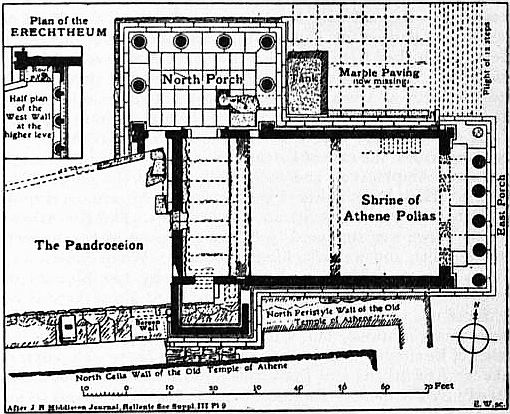
The building as completed consisted of a temple of the ordinary type, opening by a door and two windows to the east front, before which stood a portico of six Ionic columns. This part was the temple of Athena Polias. Adjoining it on the west was the central chamber, on a lower level; this chamber was separated by a partition, originally of wood and later of marble, from the western compartment of the temple, which was of peculiar construction. The west end was formed by a wall, on which stood four columns between antae; but the main entrance to this western compartment was through a large and very ornate doorway on the north; and a large Ionic portico, consisting of four columns in the front, and one in the return on each side, was placed in front of this door. At the south end of the western compartment was a smaller door, with steps leading up to the higher level, within a projecting space enclosed by a low wall and covered with a projecting porch carried by six “maidens” or caryatides. The construction of the building at this south-western corner shows that there was some sacred object that had to be bridged over by a huge block of marble; this we know from inscriptions to have been the Cecropeum or tomb of Cecrops. In the north portico a square hole in the floor, with a corresponding hole in the roof above it, must have given access to another sacred object, the mark of Poseidon’s trident in the rock. The sacred olive tree probably stood just outside the temple to the west in the Pandroseion. The Ionic order, as used in this temple, is of the most ornate Attic type. The bases of the columns are either reeded or decorated with a plait-pattern; the capital has the broad channel between the volutes subdivided by a carefully-profiled incision; and the top of the shafts is ornamented by a broad band of palmette or honeysuckle pattern. A similar band of ornament runs round the top of the walls outside, and at their base is a reeded torus. The frieze consisted of white marble figures in relief, affixed to a background of black Eleusinian stone.
The contents of the Erechtheum are described by Pausanias. It contained the ancient image of Athena Polias, and three altars, one to Poseidon and Erechtheus, one to Butes and one to Hephaestus; there were portraits of the family of the Butadae on the walls. Within it was also the gold lamp of Callimachus, which burnt for a year without refilling, and had a chimney in the form of a palm-tree.
The Erechtheum was damaged by a fire, soon after its completion, in 406 B.C., but was repaired early in the following century. The west end appears to have been damaged in Roman times and to have been replaced by the attached columns with windows between them which appear in old drawings and are still partially extant. It was used as a church in Christian times, and under Turkish rule as the harem of the governor of Athens. Lord Elgin carried off to London, about 1801-1803, one of the columns of the east portico and one of the caryatides; these were replaced later by terra-cotta casts. During the siege of the Acropolis in 1827, the roof of the north portico was thrown down and the building was otherwise much damaged. It was partially rebuilt between 1838 and 1846; the west front was blown down in a storm in 1852. Since 1900 the project of rebuilding the Erechtheum as far as possible with the original blocks has again been undertaken.
See Stuart, Antiquities of Athens; Inwood, The Erechtheum; H. Forster in Papers of American School at Athens, i. (1882-1883); J.H. Middleton, Plans and Drawings of Athenian Buildings (1900), pls. xiv.-xxii.; E.A. Gardner, Ancient Athens, chap. viii.; W. Dörpfeld, “Der ursprungliche Plan des Erechtheion” in Mitteil. Athen., 1904, p. 101, taf. 6; G.P. Stevens, “The East Wall of the Erechtheum,” in American Journ. Arch., 1906, pls. vi.-ix.
(E. Gr.)
ERECHTHEUS, in Greek legend, a mythical king of Athens, originally identified with Erichthonius, but in later times distinguished from him. According to Homer, who knows nothing of Erichthonius, he was the son of Aroura (Earth), brought up by Athena, with whom his story is closely connected. In the later story, Erichthonius (son of Hephaestus and Atthis or Athena herself) was handed over by Athena to the three daughters of Cecrops—Aglauros (or Agraulos), Herse and Pandrosos—in a chest, which they were forbidden to open. Aglauros and Herse disobeyed the injunction, and when they saw the child (which had the form of a snake, or round which a snake was coiled) they went mad with fright, and threw themselves from the rock of the Acropolis (or were killed by the snake). Athena herself then undertook the care of Erichthonius, who, when he grew up, drove out Amphictyon and took possession of the kingdom of Athens. Here he established the worship of Athena, instituted the Panathenaea, and built an Erechtheum. The Erechtheus of later times was supposed to be the grandson of Erechtheus-Erichthonius, and was also king of Athens. When Athens was attacked by the Thracian Eumolpus (or by the Eleusinians assisted by Eumolpus) victory was promised Erechtheus if he sacrificed one of his daughters. Eumolpus was slain and Erechtheus was victorious, but was himself killed by Poseidon, the father of Eumolpus, or by a thunderbolt from Zeus. The contest between Erechtheus and Eumolpus formed the subject of a lost tragedy by Euripides; Swinburne has utilized the legend in his Erechtheus. The scene of the opening of the chest is represented on a Greek vase in the British Museum. The name Erichthonius is connected with χθών (“earth”) and the representation of him as half-snake, like Cecrops, indicates that he was regarded as one of the autochthones, the ancestors of the Athenians who sprung from the soil.
See Apollodorus iii. 14. 15; Euripides, Ion; Ovid, Metam. ii. 553; Hyginus, Poët. astron. ii. 13; Pausanias i. 2. 5. 8; E. Ermatinger, Die attische Autochthonensage (1897); article by J.A. Hild in Daremberg and Saglio’s Dictionnaire des antiquités; B. Powell in Cornell Studies, xvii. (1906), who identifies Erechtheus, Erichthonius, Poseidon and Cecrops, all denoting the sacred serpent of Athena, whose cult she first contested, but then amalgamated with her own. The birth of Erichthonius (as a corn-spirit) is interpreted by Mannhardt as a mythical way of describing the growth of the corn, and by J.E. Harrison (Myths and Monuments of Ancient Athens, xxvii.-xxxvi.) as a fiction to explain the ceremony performed by the two maidens called Arrephori. See also Farnell, Cults of the Greek States, i. 270; and Frazer’s Pausanias, ii. 169.
ERESHKIGAL, also known as Allatu, the name of the chief Babylonian goddess of the nether-world where the dead are gathered. Her name signifies “lady of the nether-world.” She is known to us chiefly through two myths, both symbolizing the change of seasons, but intended also to illustrate certain doctrines developed in the temple-schools of Babylonia. One of these myths is the famous story of Ishtar’s descent to Irkalla or Arālu, as the lower world was called, and her reception by her sister who presides over it; the other is the story of Nergal’s offence against Ereshkigal, his banishment to the kingdom controlled by the goddess and the reconciliation between Nergal and Ereshkigal through the latter’s offer to have Nergal share the honours of the rule over Irkalla. The story of Ishtar’s descent is told to illustrate the possibility of an escape from Irkalla, while the other myth is intended to reconcile the existence of two rulers of Irkalla—a goddess and a god.
It is evident that it was originally a goddess who was supposed to be in control of Irkalla, corresponding to Ishtar in control of fertility and vegetation on earth. Ereshkigal is therefore the sister of Ishtar and from one point of view her counterpart, the symbol of nature during the non-productive season of the year. As the doctrine of two kingdoms, one of this world and one of the world of the dead, becomes crystallized, the dominions of the two sisters are sharply differentiated from one another. The addition of Nergal represents the harmonizing tendency to unite with Ereshkigal as the queen of the nether-world the god who, in his character as god of war and of pestilence, conveys the living to Irkalla and thus becomes the one who presides over the dead.
(M. Ja.)
ERETRIA (mod. Aletria), an ancient coast town of Euboea about 15 m. S.E. of Chalcis, opposite to Oropus. Eretria, like its neighbour Chalcis (q.v.), early entered upon a commercial and colonizing career. Besides founding townships in the west and north of Greece, it acquired dependencies among the Cyclades and joined the great mercantile alliance of Miletus and Aegina. Since the so-called Lelantine War (7th century B.C.) against the coming league of Chalcis, it began to be overshadowed by its rivals. The interference of Eretria in the Ionian revolt (498) brought upon it the vengeance of the Persians, who captured and destroyed it shortly before the battle of Marathon (490). The city was soon rebuilt, and as a member of both the Delian Leagues attached itself by numerous treaties to the Athenians. The latter, through their general Phocion, rescued it from the tyrants suborned by Philip of Macedon (354 and 341). Under Macedonian and Roman rule Eretria fell into insignificance; for a short period under Mark Antony, the triumvir, it became a possession of Athens. Eretria was the birthplace of the tragedian Achaeus and of the “Megarian” philosopher Menedemus.
The modern village, which is sometimes called Nea Psará because the inhabitants of Psará were transferred there in 1821, is on unhealthy low-lying ground near the sea. The excavation of the site was carried out by the American School of Athens (1890-1895). At the foot of the Acropolis Hill, where the ground begins to rise, the theatre lies; and though the material of which this was built is rough, and only seven imperfect rows of seats remain, a good part of the scena and of the chambers behind it is preserved, and beneath these there runs a tunnel, which, together with other peculiar features, has raised interesting questions in connexion with the arrangement of the Greek theatre, the orchestra being at present on a level about 12 ft. below that of the rooms in the scena. Near by are the substructions of a temple of Dionysus and a large altar, and also a gymnasium with arrangements for bathing. Besides these, in 1900 the substructions of a temple of Apollo Daphnephoros were unearthed. Both the northern and the southern side of the hill are flanked by walls, which seem to have reached the sea, where there was a mole and a harbour; and the wall of the acropolis itself remains in one part to the height of eight courses.
Authorities.—Strabo x. 447 f.; Herodotus v. 99, vi. 101; Corpus Inscr. Atticarum, i. 339, iv. (2), pp. 5, 10, 22; H. Heinze, De rebus Eretriensium (Göttingen, 1869); W.M. Leake, Travels in Northern Greece (London, 1835), ii. 266, 443; B.V. Head, Historia numorum (Oxford, 1887), pp. 305-308; Papers of the American School at Athens, vol. vi.
(E. Gr.)
ERETRIAN SCHOOL OF PHILOSOPHY. This Greek school was the continuation of the Elian school, which was transferred to Eretria by Menedemus. It was of small importance, and in the absence of certain knowledge must be supposed to have adhered to the doctrines of Socrates. (See Menedemus.)
ERFURT, a city of Germany, in Prussian Saxony, on the Gera, and the railway Halle-Bebra, about midway between Gotha and Weimar, which are 14 m. distant. Pop. (1875) 48,025; (1905) 100,065. The city, which is dominated on the west by the two citadels of Petersberg and Cyriaxburg, is irregularly built, the only feature in its plan, or want of plan, being the Friedrich Wilhelmsplatz, a broad open space of irregular shape abutting on the Petersberg. On the south-western side of this square, which contains a monument to the elector Frederick Charles Joseph of Mainz (1719-1802), is the Domberg, an eminence on which stand, side by side, the cathedral and the great church of St Severus with its three spires (14th century). The churches are approached by a flight of forty-eight stone steps, the grouping of the whole mass of buildings being exceedingly impressive. The cathedral (Beatae Mariae Virginis) is one of the finest churches in Germany. It was begun in the 12th century, but the nave was rebuilt in the 13th in the Gothic style. The magnificent chancel (1349-1372), with the 14th-century crypt below, rests on massive substructures, known as the Cavate. The twin towers are set between the chancel and nave. The cathedral contains, besides fine 15th-century glass, some very rich portal sculptures and bronze castings, among others the coronation of the Virgin by Peter Vischer. In one of its towers is the famous bell, called Maria Gloriosa, which bears the date 1497, and weighs 270 cwt. Besides the cathedral and St Severus, which are Roman Catholic, Erfurt possesses several very interesting medieval churches, now Evangelical. Among these may be mentioned the Predigerkirche, dating from the latter half of the 12th century; the Reglerkirche, a Romanesque building (restored in 1859) with a 12th-century tower; and the Barfüsserkirche, a Gothic building containing fine 14th-century monuments. All these were originally monastic churches. Of the former religious houses there survive a Franciscan convent, with a girls’ school attached, and an Ursuline convent. The Augustinian monastery, in which Luther lived as a friar, is now used as an orphanage, under the name of the Martinsstift. The cell of Luther was destroyed by fire in 1872. A bronze statue of the reformer was erected in the Anger, the chief street of the town, in 1890. At one time Erfurt had a university, of which the charter dated from 1392; but it was suppressed in 1816, and its funds devoted to other purposes, among these being the endowment of an institution founded in 1758 and now called the royal academy of sciences, and the support of the royal library, which now contains 60,000 volumes and over 1000 manuscripts. On the W. and S.W. extensive new quarters have grown up within recent years, e.g. Hirschbrühl. The interior of the town hall (1869-1875) is adorned with legendary and historical frescoes by Kämpfer and Peter Janssen. Erfurt possesses also a picture gallery and an antiquarian collection.
The educational establishments of the town include a gymnasium, a realgymnasium, a realschule, technical schools for building and handicrafts, a high-class commercial school, a school of agriculture, and an academy of music. The most notable industry of Erfurt is the culture of flowers and of vegetables, which is very extensively carried on. This industry had its origin in the large gardens attached to the monasteries. It has also important and growing manufactures of ladies’ mantles, boots and shoes, machines, furniture, woollen goods, musical instruments, agricultural machinery and implements, leather, tobacco, chemicals, &c. Brewing, bleaching and dyeing are also carried on on a large scale, and there are extensive railway works and a government rifle factory.
Erfurt (Med. Erpesfurt, Erphorde, Lat. Erfordia) is a town of great antiquity. Its origin is obscure, but in 741 it was sufficiently important for St Boniface to found a bishopric here, which was, however, after the martyrdom of the first bishop, Adolar, in 755, reabsorbed in that of Mainz. In 805 the place received certain market rights from the emperor Charlemagne. Later the overlordship was claimed by the archbishops of Mainz, on the strength of charters granted by the emperor Otto I., and their authority in Erfurt was maintained by a burgrave and an advocatus, the office of the latter becoming in the 12th century hereditary in the family of the counts of Gleichen. In spite of many vicissitudes (from 1109 to 1137, for instance, the town was subject to the landgraves of Thuringia), and of a charter granted in 1242 by the emperor Frederick II., the archbishops succeeded in upholding their claims. In 1255, however, Archbishop Gerhard I. had to grant the city municipal rights, the burgraviate disappeared, and Erfurt became practically a free town. Its power was at its height early in the 15th century, when it joined the Hanseatic League. It had acquired by force or purchase various countships and other fiefs in the neighbourhood, and ruled a considerable territory; and its wealth was so great that in 1378 it established a university, the first in Europe that embraced the four faculties. By the end of the century, however, its prosperity had sunk owing to the perpetual feud with Mainz, the internecine war in Saxony, and the consequent dwindling of trade. By the convention of Amorbach in 1483 the overlordship of Erfurt was ultimately transferred by the electors of Mainz to Saxony. The political and religious quarrels of the 16th century still further depressed the city, in which the reformed religion was established in 1521. Then came the Thirty Years’ War, during which Erfurt was for a while occupied by the Swedes. After the peace of Westphalia (1648) the city was assigned by the emperor to the elector of Mainz, and, on its refusal to submit, it was placed under the ban of the Empire (1660). In 1664 it was captured by the troops of the archbishop of Mainz, and remained in the possession of the electorate till 1802, when it came into the possession of Prussia. In 1808 it was the scene of the memorable interview between Napoleon and the emperor Alexander I. of Russia, at which the kings of Bavaria, Saxony, Westphalia and Württemberg also assisted, which is known as the congress of Erfurt. Here in 1850 the parliament of the short-lived Prussian Northern Union (known as the Erfurt parliament) held its sittings. In 1902 the 100th anniversary of the city’s incorporation with Prussia was celebrated.
See W.J.A. von Tettau, Erfurt in seiner Vergangenheit und Gegenwart (Erfurt, 1880); C. Beyer, Geschichte der Stadt Erfurt (Erfurt, 1900); and F.W. Kampschulte, Die Universität Erfurt in ihrem Verhältnisse zu dem Humanismus und der Reformation (1856-1858). For a detailed bibliography see U. Chevalier, Répertoire des sources. Topo-bibliographie (Montebéliard, 1894-1899), s.v.
ERGOT, or Spurred Rye, the drug ergota or Secale cornutum (Ger. Mutterkorn; Fr. seigle ergoté), consisting of the sclerotium (or hard resting condition) of a fungus, Claviceps purpurea, parasitic on the pistils of many members of the Grass family, but obtained almost exclusively from rye, Secale cereale. In the ear of rye that is infected with ergot a species of fermentation takes place, and there exudes from it a sweet yellowish mucus, which after a time disappears. The ear loses its starch, and ceases to grow, and its ovaries become penetrated with the white spongy tissue of the mycelium of the fungus which towards the end of the season forms the sclerotium, in which state the fungus lies dormant through the winter.
The drug consists of grains, usually curved (hence the name, from the O. Fr. argot, a cock’s spur), which are violet-black or dark-purple externally, and whitish with a tinge of pink within, are between 1⁄3 and 1½ in. long, and from 1 to 4 lines broad, and have two lateral furrows, a close fracture, a disagreeable rancid taste, and a faint, fishy odour, which last becomes more perceptible when the powder of the drug is mixed with potash solution. Ergot should be kept in stoppered bottles in order to preserve it from the attacks of a species of mite, and to prevent the oxidation of its fatty oil.
The extremely complex composition of this drug has been studied in great detail, and with such important results that instead of giving ergot itself by the mouth in doses of 20 to 60 grains, it is now possible to obtain much more rapid and certain results by giving one three-hundredth of a grain of one of its constituents hypodermically. This constituent is the alkaloid cornutine, which is the valuable ingredient of the drug. Other ingredients are a fixed oil, present to the extent of 30%, ergotinic acid, a glucoside, trimethylamine, which gives the drug its unpleasant odour, and sphacelinic acid, a non-nitrogenous resinoid body. Of the numerous preparations only two need be mentioned—the liquid extract (dose 10 minims to 2 drachms or more), and the hypodermic injection. The latter does not keep well, and the best way of using ergot is to dissolve tablets obtained from a reputable maker, and containing some of the active principles, in pure water, the solution being injected subcutaneously.
Ergot has no external action. Given internally it stimulates the intestinal muscles and may cause diarrhoea. After absorption it slows the pulse by stimulation of the vagus nerves. It has indeed been asserted that the slow pulse characteristic of the puerperal period is really due to the common administration of ergot at that time. This is probably an exaggeration. The important actions of ergot are on the blood-vessels and the uterus. The drug greatly raises the blood-pressure by causing extreme contraction of the arteries. This is mainly due to a direct action on the muscular coats of the vessels, but is also partly of central origin, since the drug also stimulates the vaso-motor centre in the medulla oblongata. This action on the vessels is so marked as to constitute the drug a haemostatic, not only locally but also remotely. It may arrest bleeding from the nose, for instance, when injected hypodermically. Nearly all the constituents share in causing this action, but the sphacelinic acid is probably the most potent. Ergot is the most powerful known stimulant of the pregnant uterus. The action is a double one. At least four of its constituents act directly on the muscular fibre of the uterus, whilst the cornutine acts through the nerves. Of great practical importance is the fact that the cornutine causes rhythmic contractions such as naturally occur, whilst the sphacelinic acid produces a tonic contraction of the uterus, which is unnatural and highly inimical to the life of the foetus. Ergot is used in therapeutics as a haemostatic, and is very valuable in haemoptysis and sometimes in haematemesis. But its great use is in obstetrics. The drug should regularly be given hypodermically, and it is important to note that if the injection be made immediately under the skin, an abscess, or considerable discomfort, may ensue. The injection should be intra-muscular, the needle being boldly plunged into a muscular mass, such as that of the deltoid or the gluteal region. The indications for the use of ergot in obstetrics are highly complex and demand detailed treatment. It can only be said here that the drug should only in the rarest possible cases be given whilst the child is still in utero. This rule is necessitated by the sphacelinic acid, which causes an unnatural state of the organ. When it is possible to obtain pure cornutine, which is unfortunately very expensive, the precautions necessary in other cases may be abrogated.
Chronic poisoning, or ergotism, used frequently to occur amongst the poor fed on rye infected with the Claviceps. As it is practically impossible to reproduce the symptoms of ergotism nowadays, whether experimentally in the lower animals, or when the drug is being administered to a human being for some therapeutic purpose, it is believed that the symptoms of ergotism were rendered possible only by the semi-starvation which must have ensued from the use of such rye-bread; for the grain disappears as the fungus develops. There were two types of ergotism. In the gangrenous form various parts of the body underwent gangrene as a consequence of the arrest of blood-supply produced by the action of sphacelinic acid on the arteries. In the spasmodic form the symptoms were of a nervous character. The initial indications of the disease were cutaneous itching, tingling and formication, which gave place to actual loss of cutaneous sensation, first observed in the extremities. Amblyopia and some loss of hearing also occurred, as well as mental failure. With weakness of the voluntary muscles went intermittent spasms which weakened the patient and ultimately led to death by implication of the respiratory muscles. The last-known “epidemic” of ergotism occurred in Lorraine and Burgundy in the year 1816.
ERIC XIV. (1533-1577), king of Sweden, was the only son of Gustavus Vasa and Catherine of Saxe-Lauenburg. The news of his father’s death reached Eric as he was on the point of embarking for England to press in person his suit for the hand of Queen Elizabeth. He hastened back to Stockholm, after burying his father, summoned a Riksdag, which met at Arboga on the 15th of April 1561, and adopted the royal propositions known as the Arboga articles, considerably curtailing the authority of the royal dukes, John and Charles, in their respective provinces. Two months later Eric was crowned at Upsala, on which occasion he first introduced the titles of baron and count into Sweden, by way of attaching to the crown the higher nobility, these new counts and barons receiving lucrative fiefs adequate to the maintenance of their new dignities.
From the very beginning of his reign Eric’s morbid fear of the upper classes drove him to give his absolute confidence to a man of base origin and bad character, though, it must be admitted, of superior ability. This was Göran Persson, born about 1530, who had been educated abroad in Lutheran principles, and after narrowly escaping hanging at the hands of Gustavus Vasa for some vile action entered the service of his son. This powerful upstart was the natural enemy of the nobility, who suffered much at his hands, though it is very difficult to determine whether the initiative in these prosecutions proceeded from him or his master. Göran was also a determined opponent of Duke John, with whom Eric in 1563 openly quarrelled, because John, contrary to the royal orders, had married (Oct. 4, 1562) Catherine, daughter of Sigismund I. of Poland, engaging at the same time to assist the Polish king to conquer Livonia. This act was a flagrant breach of that paragraph of the Arboga articles which forbade the royal dukes to contract any political treaty without the royal assent. An army of 10,000 men was immediately sent by Eric to John’s duchy of Finland, and John and his consort were seized, brought over to Sweden and detained as prisoners of state in Gripsholm Castle. But Eric did not stop here. His suspicion suggested to him that, if his own brother failed him, the loyalty of the great nobles, especially the members of the ancient Sture family, who had been notable in Sweden when the Vasas were unknown, could not be depended upon. The head of the Sture family at this time was Count Svante, who had married a sister of Gustavus Vasa’s second wife, and had by her a numerous family, of whom two sons, Nils and Eric, still survived. The dark tragedy, known as the Sture murders, began with Eric XIV.’s strange treatment of young Count Nils. In 1566 he was summoned before a newly erected tribunal and condemned to death for gross neglect of duty, though not one of the frivolous charges brought against him could be substantiated. The death penalty was commuted into a punishment worse because more shameful than death. On the 15th of June 1566 the unfortunate youth, bruised and bleeding from shocking ill-treatment, was placed upon a wretched hack, with a crown of straw on his head, and led in derision through the streets of Stockholm. The following night he was sent a prisoner to the fortress of Örbyhus. A few days later he was appointed ambassador extraordinary, and despatched to Lorraine to resume the negotiations for Eric’s marriage with the princess Renata. Before he returned, however, Eric had resolved to marry Karin, or Kitty Månsdatter, the daughter of a common soldier, who had been his mistress since 1565. In January 1567 Eric extorted a declaration from two of his senators that they would assist him to punish all who should try to prevent his projected marriage; and, in the middle of May, a Riksdag was summoned to Upsala to judge between the king and those of the aristocracy whom he regarded as his personal enemies. Eric himself arrived at Upsala on the 16th in a condition of incipient insanity. On the 19th he opened parliament in a speech which, as he explained, he had to deliver extempore owing to “the treachery” of his secretary. Two days later Nils Sture arrived at Upsala fresh from his embassy to Lorraine, and was at once thrown into prison, where other members of the nobility were already detained. On the following day Eric murdered Nils in his cell with his own hand, and by his order the other prisoners were despatched by the royal provost marshal forthwith. These murders were committed so promptly and secretly that it is doubtful whether the estates, actually in session at the same place, knew what had been done when, on the 26th of May, under violent pressure from Göran Persson, they signed a document declaring that all the accused gentlemen under detention had acted like traitors, and confirming all sentences already passed or that might be passed upon them.
During the greater part of 1567 Eric was so deranged that a committee of senators was appointed to govern the kingdom. One of his illusions was that not he was king but his brother John, whom he now set at liberty. When, at the beginning of 1568, Eric recovered his reason, a reconciliation was effected between the king and the duke, on condition that John recognized the legality of his brother’s marriage with Karin Månsdatter, and her children as the successors to the throne. A month later, on the 4th of July, he was solemnly married to Karin at Stockholm by the primate. The next day Karin was crowned queen of Sweden and her infant son Gustavus proclaimed prince-royal. Shortly after his marriage Eric issued a circular ordering a general thanksgiving for his delivery from the assaults of the devil. This document, in every line of which madness is legible, convinced most thinking people that Eric was unfit to reign. The royal dukes, John and Charles, had already taken measures to depose him; and in July the rebellion broke out in Östergötland. Eric at first offered a stout resistance and won two victories; but on the 17th of September the dukes stood before Stockholm, and Eric, after surrendering Göran Persson to the horrible vengeance of his enemies, himself submitted, and resigned the crown. On the 30th of September 1568 John III. was proclaimed king by the army and the nobility; and a Riksdag, summoned to Stockholm, confirmed the choice and formally deposed Eric on the 25th of January 1569. For the next seven years the ex-king was a source of the utmost anxiety to the new government. No fewer than three rebellions, with the object of releasing and reinstating him, had to be suppressed, and his prison was changed half a dozen times. On the 10th of March 1575, an assembly of notables, lay and clerical, at John’s request, pronounced a formal sentence of death upon him. Two years later, on the 24th of February 1577, he died suddenly in his new prison at Örbyhus, poisoned, it is said, by his governor, Johan Henriksen.