VOLUME IX SLICE VII Equation to Ethics (continued 2)
Reading edition
So in the cubic equation x³ − px² + qx − r = 0, if the roots are a, b, c, and if ω is used to denote an imaginary cube root of unity, ω² + ω + 1 = 0, then writing for shortness p = a + b + c, L = a + ωb + ω²c, M = a + ω²b + ωc, it is at once seen that LM, L³ + M³, and therefore also (L³ − M³)² are symmetrical functions of the roots, and consequently rational functions of the coefficients; hence
½ {L³ + M³ + √(L³ − M³)²}
is a rational function of the coefficients, which when these are replaced by their values as functions of the roots becomes, according to the sign given to the quadric radical, = L³ or M³; taking it = L³, the cube root of the expression has the three values L, ωL, ω²L; and LM divided by the same cube root has therefore the values M, ω²M, ωM; whence finally the expression
1⁄3 [p + 3√{½ (L³ + M³ + √(L³ − M³)²) } + LM ÷ 3√{½ L³ + M³ + √(L³ − M³)²) }]
has the three values
1⁄3 (p + L + M), 1⁄3 (p + ωL + ω²M), 1⁄3 (p + ω²L + ωM);
that is, these are = a, b, c respectively. If the value M³ had been taken instead of L³, then the expression would have had the same three values a, b, c. Comparing the solution given for the cubic x³ + qx − r = 0, it will readily be seen that the two solutions are identical, and that the function r² − 4⁄27 q³ under the radical sign must (by aid of the relation p = 0 which subsists in this case) reduce itself to (L³ − M³)²; it is only by each radical being equal to a rational function of the roots that the final expression can become equal to the roots a, b, c respectively.
20. The formulae for the cubic were obtained by J.L. Lagrange (1770-1771) from a different point of view. Upon examining and comparing the principal known methods for the solution of algebraical equations, he found that they all ultimately depended upon finding a “resolvent” equation of which the root is a + ωb + ω²c + ω³d + ..., ω being an imaginary root of unity, of the same order as the equation; e.g. for the cubic the root is a + ωb + ω²c, ω an imaginary cube root of unity. Evidently the method gives for L³ a quadric equation, which is the “resolvent” equation in this particular case.
For a quartic the formulae present themselves in a somewhat different form, by reason that 4 is not a prime number. Attempting to apply it to a quintic, we seek for the equation of which the root is (a + ωb + ω²c + ω³d + ω4e), ω an imaginary fifth root of unity, or rather the fifth power thereof (a + ωb + ω²c + ω³d + ω4e)5; this is a 24-valued function, but if we consider the four values corresponding to the roots of unity ω, ω², ω³, ω4, viz. the values
(a + ω b + ω²c + ω³d + ω4e)5, (a + ω²b + ω4c + ω d + ω³e)5, (a + ω³b + ω c + ω4d + ω²e)5, (a + ω4b + ω³c + ω²d + ω e)5,
any symmetrical function of these, for instance their sum, is a 6-valued function of the roots, and may therefore be determined by means of a sextic equation, the coefficients whereof are rational functions of the coefficients of the original quintic equation; the conclusion being that the solution of an equation of the fifth order is made to depend upon that of an equation of the sixth order. This is, of course, useless for the solution of the quintic equation, which, as already mentioned, does not admit of solution by radicals; but the equation of the sixth order, Lagrange’s resolvent sextic, is very important, and is intimately connected with all the later investigations in the theory.
21. It is to be remarked, in regard to the question of solvability by radicals, that not only the coefficients are taken to be arbitrary, but it is assumed that they are represented each by a single letter, or say rather that they are not so expressed in terms of other arbitrary quantities as to make a solution possible. If the coefficients are not all arbitrary, for instance, if some of them are zero, a sextic equation might be of the form x6 + bx4 + cx² + d = 0, and so be solvable as a cubic; or if the coefficients of the sextic are given functions of the six arbitrary quantities a, b, c, d, e, f, such that the sextic is really of the form (x² + ax + b)(x4 + cx³ + dx² + ex + f) = 0, then it breaks up into the equations x² + ax + b = 0, x4 + cx³ + dx² + ex + f = 0, and is consequently solvable by radicals; so also if the form is (x − a) (x − b) (x − c) (x − d) (x − e) (x − f) = 0, then the equation is solvable by radicals,—in this extreme case rationally. Such cases of solvability are self-evident; but they are enough to show that the general theorem of the non-solvability by radicals of an equation of the fifth or any higher order does not in any wise exclude for such orders the existence of particular equations solvable by radicals, and there are, in fact, extensive classes of equations which are thus solvable; the binomial equations xn − 1 = 0 present an instance.
22. It has already been shown how the several roots of the equation xn − 1 = 0 can be expressed in the form cos 2sπ/n + i sin 2sπ/n, but the question is now that of the algebraical solution (or solution by radicals) of this equation. There is always a root = 1; if ω be any other root, then obviously ω, ω², ... ωn−1 are all of them roots; xn − 1 contains the factor x − 1, and it thus appears that ω, ω², ... ωn−1 are the n-1 roots of the equation
xn−1 + xn−2 + ... x + 1 = 0;
we have, of course, ωn−1 + ωn−2 + ... + ω + 1 = 0.
It is proper to distinguish the cases n prime and n composite; and in the latter case there is a distinction according as the prime factors of n are simple or multiple. By way of illustration, suppose successively n = 15 and n = 9; in the former case, if α be an imaginary root of x³ − 1 = 0 (or root of x² + x + 1 = 0), and β an imaginary root of x5 − 1 = 0 (or root of x4 + x³ + x² + x + 1 = 0), then ω may be taken = αβ; the successive powers thereof, αβ, α²β², β³, αβ4, α², β, αβ², α²β³, β4, α, α²β, β², αβ³, α²β4, are the roots of x14 + x13 + ... + x + 1 = 0; the solution thus depends on the solution of the equations x³ − 1 = 0 and x5 − 1 = 0. In the latter case, if α be an imaginary root of x³ − 1 = 0 (or root of x² + x + 1 = 0), then the equation x9 − 1 = 0 gives x³ = 1, α, or α²; x³ = 1 gives x = 1, α, or α²; and the solution thus depends on the solution of the equations x³ − 1 = 0, x³ − α = 0, x³ − α² = 0. The first equation has the roots 1, α, α²; if β be a root of either of the others, say if β³ = α, then assuming ω = β, the successive powers are β, β², α, αβ, αβ², α², α²β, α²β², which are the roots of the equation x8 + x7 + ... + x + 1 = 0.
It thus appears that the only case which need be considered is that of n a prime number, and writing (as is more usual) r in place of ω, we have r, r², r³,...rn−1 as the (n − 1) roots of the reduced equation
xn−1 + xn−2 + ... + x + 1 = 0;
then not only rn − 1 = 0, but also rn−1 + rn−2 + ... + r + 1 = 0.
23. The process of solution due to Karl Friedrich Gauss (1801) depends essentially on the arrangement of the roots in a certain order, viz. not as above, with the indices of r in arithmetical progression, but with their indices in geometrical progression; the prime number n has a certain number of prime roots g, which are such that gn−1 is the lowest power of g, which is ≡ 1 to the modulus n; or, what is the same thing, that the series of powers 1, g, g², ... gn−2, each divided by n, leave (in a different order) the remainders 1, 2, 3, ... n − 1; hence giving to r in succession the indices 1, g, g²,...gn−2, we have, in a different order, the whole series of roots r, r², r³,...rn−1.
In the most simple case, n = 5, the equation to be solved is x4 + x³ + x² + x + 1 = 0; here 2 is a prime root of 5, and the order of the roots is r, r², r4, r³. The Gaussian process consists in forming an equation for determining the periods P1, P2, = r + r4 and r² + r³ respectively;—these being such that the symmetrical functions P1 + P2, P1P2 are rationally determinable: in fact P1 + P2 = −1, P1P2 = (r + r4) (r² + r³), = r³ + r4 + r6 + r7, = r³ + r4 + r + r², = −1. P1, P2 are thus the roots of u² + u − 1 = 0; and taking them to be known, they are themselves broken up into subperiods, in the present case single terms, r and r4 for P1, r² and r³ for P2; the symmetrical functions of these are then rationally determined in terms of P1 and P2; thus r + r4 = P1, r·r4 = 1, or r, r4 are the roots of u² − P1u + 1 = 0. The mode of division is more clearly seen for a larger value of n; thus, for n = 7 a prime root is = 3, and the arrangement of the roots is r, r³, r², r6, r4, r5. We may form either 3 periods each of 2 terms, P1, P2, P3 = r + r6, r³ + r4, r² + r5 respectively; or else 2 periods each of 3 terms, P1, P2 = r + r² + r4, r³ + r6 + r5 respectively; in each ease the symmetrical functions of the periods are rationally determinable: thus in the case of the two periods P1 + P2 = −1, P1P2 = 3 + r + r² + r³ + r4 + r5 + r6, = 2; and the periods being known the symmetrical functions of the several terms of each period are rationally determined in terms of the periods, thus r + r² + r4 = P1, r·r² + r·r4 + r²·r4 = P2, r·r²·r4 = 1.
The theory was further developed by Lagrange (1808), who, applying his general process to the equation in question, xn−1 + xn−2 + ... + x + 1 = 0 (the roots a, b, c... being the several powers of r, the indices in geometrical progression as above), showed that the function (a + ωb + ω²c + ...)n−1 was in this case a given function of ω with integer coefficients.
Reverting to the before-mentioned particular equation x4 + x³ + x² + x + 1 = 0, it is very interesting to compare the process of solution with that for the solution of the general quartic the roots whereof are a, b, c, d.
Take ω, a root of the equation ω4 − 1 = 0 (whence ω is = 1, −1, i, or −i, at pleasure), and consider the expression
(a + ωb + ω²c + ω³d)4,
the developed value of this is
= a4 + b4 + c4 + d4 + 6 (a²c² + b²d²) + 12 (a²bd + b²ca + c²db + d²ac)
+ω {4 (a³b + b³c + c³ + d³a) + 12 (a²cd + b²da + c²ab + d²bc) }
+ω² {6 (a²b² + b²c² + c²d² + d²a²) + 4 (a³c + b³d + c³a + d³b) + 24abcd}
+ω³ {4 (a³d + b³a + c³b + d³c) + 12 (a²bc + b²cd + c²da + d²ab) }
that is, this is a 6-valued function of a, b, c, d, the root of a sextic (which is, in fact, solvable by radicals; but this is not here material).
If, however, a, b, c, d denote the roots r, r², r4, r³ of the special equation, then the expression becomes
r4 + r³ + r + r² + 6 (1 + 1) + 12 (r² + r4 + r³ + r)
+ ω {4 (1 + 1 + 1 + 1) + 12 (r4 + r³ + r + r²) }
+ ω²{6 (r + r² + r4 + r³) + 4 (r² + r4 + r³ + r) }
+ ω³{4 (r + r² + r4 + r³) + 12 (r³ + r + r² + r4) }
viz. this is
= −1 + 4ω + 14ω² − 16ω³,
a completely determined value. That is, we have
(r + ωr² + ω²r4 + ω³r³) = −1 + 4ω + 14ω² − 16ω³,
which result contains the solution of the equation. If ω = 1, we have (r + r² + r4 + r³)4 = 1, which is right; if ω = −1, then (r + r4 − r² − r³)4 = 25; if ω = i, then we have {r − r4 + i(r² − r³) }4 = −15 + 20i; and if ω = −i, then {r − r4 − i (r² − r³) }4 = −15 − 20i; the solution may be completed without difficulty.
The result is perfectly general, thus:—n being a prime number, r a root of the equation xn−1 + xn−2 + ... + x + 1 = 0, ω a root of ωn−1 − 1 = 0, and g a prime root of gn−1 ≡ 1 (mod. n), then
(r + ωr g + ... + ωn − 2r g n−2) n−1
is a given function M0 + M1ω ... + Mn−2ωn−2 with integer coefficients, and by the extraction of (n − 1)th roots of this and similar expressions we ultimately obtain r in terms of ω, which is taken to be known; the equation xn − 1 = 0, n a prime number, is thus solvable by radicals. In particular, if n − 1 be a power of 2, the solution (by either process) requires the extraction of square roots only; and it was thus that Gauss discovered that it was possible to construct geometrically the regular polygons of 17 sides and 257 sides respectively. Some interesting developments in regard to the theory were obtained by C.G.J. Jacobi (1837); see the memoir “Ueber die Kreistheilung, u.s.w.,” Crelle, t. xxx. (1846).
The equation xn−1 + ... + x + 1 = 0 has been considered for its own sake, but it also serves as a specimen of a class of equations solvable by radicals, considered by N.H. Abel (1828), and since called Abelian equations, viz. for the Abelian equation of the order n, if x be any root, the roots are x, θx, θ²x, ... θn−1x (θx being a rational function of x, and θnx = x); the theory is, in fact, very analogous to that of the above particular case.
A more general theorem obtained by Abel is as follows:—If the roots of an equation of any order are connected together in such wise that all the roots can be expressed rationally in terms of any one of them, say x; if, moreover, θx, θ1x being any two of the roots, we have θθ1x = θ1θx, the equation will be solvable algebraically. It is proper to refer also to Abel’s definition of an irreducible equation:—an equation φx = 0, the coefficients of which are rational functions of a certain number of known quantities a, b, c ..., is called irreducible when it is impossible to express its roots by an equation of an inferior degree, the coefficients of which are also rational functions of a, b, c ... (or, what is the same thing, when φx does not break up into factors which are rational functions of a, b, c ...). Abel applied his theory to the equations which present themselves in the division of the elliptic functions, but not to the modular equations.
24. But the theory of the algebraical solution of equations in its most complete form was established by Evariste Galois (born October 1811, killed in a duel May 1832; see his collected works, Liouville, t. xl., 1846). The definition of an irreducible equation resembles Abel’s,—an equation is reducible when it admits of a rational divisor, irreducible in the contrary case; only the word rational is used in this extended sense that, in connexion with the coefficients of the given equation, or with the irrational quantities (if any) whereof these are composed, he considers any number of other irrational quantities called “adjoint radicals,” and he terms rational any rational function of the coefficients (or the irrationals whereof they are composed) and of these adjoint radicals; the epithet irreducible is thus taken either absolutely or in a relative sense, according to the system of adjoint radicals which are taken into account. For instance, the equation x4 + x³ + x² + x + 1 = 0; the left hand side has here no rational divisor, and the equation is irreducible; but this function is = (x² + ½ x + 1)² − 5⁄4 x², and it has thus the irrational divisors x² + ½ (1 + √5)x + 1, x² + ½ (1 − √5)x + 1; and these, if we adjoin the radical √5, are rational, and the equation is no longer irreducible. In the case of a given equation, assumed to be irreducible, the problem to solve the equation is, in fact, that of finding radicals by the adjunction of which the equation becomes reducible; for instance, the general quadric equation x² + px + q = 0 is irreducible, but it becomes reducible, breaking up into rational linear factors, when we adjoin the radical √(¼ p² − q).
The fundamental theorem is the Proposition I. of the “Mémoire sur les conditions de résolubilité des équations par radicaux”; viz. given an equation of which a, b, c ... are the m roots, there is always a group of permutations of the letters a, b, c ... possessed of the following properties:—
1. Every function of the roots invariable by the substitutions of the group is rationally known.
2. Reciprocally every rationally determinable function of the roots is invariable by the substitutions of the group.
Here by an invariable function is meant not only a function of which the form is invariable by the substitutions of the group, but further, one of which the value is invariable by these substitutions: for instance, if the equation be φ(x) = 0, then φ(x) is a function of the roots invariable by any substitution whatever. And in saying that a function is rationally known, it is meant that its value is expressible rationally in terms of the coefficients and of the adjoint quantities.
For instance in the case of a general equation, the group is simply the system of the 1.2.3 ... n permutations of all the roots, since, in this case, the only rationally determinable functions are the symmetric functions of the roots.
In the case of the equation xn−1 ... + x + 1 = 0, n a prime number, a, b, c ... k = r, r g, r g² ... r g n−2, where g is a prime root of n, then the group is the cyclical group abc ... k, bc ... ka, ... kab ... j, that is, in this particular case the number of the permutations of the group is equal to the order of the equation.
This notion of the group of the original equation, or of the group of the equation as varied by the adjunction of a series of radicals, seems to be the fundamental one in Galois’s theory. But the problem of solution by radicals, instead of being the sole object of the theory, appears as the first link of a long chain of questions relating to the transformation and classification of irrationals.
Returning to the question of solution by radicals, it will be readily understood that by the adjunction of a radical the group may be diminished; for instance, in the case of the general cubic, where the group is that of the six permutations, by the adjunction of the square root which enters into the solution, the group is reduced to abc, bca, cab; that is, it becomes possible to express rationally, in terms of the coefficients and of the adjoint square root, any function such as a²b + b²c + c²a which is not altered by the cyclical substitution a into b, b into c, c into a. And hence, to determine whether an equation of a given form is solvable by radicals, the course of investigation is to inquire whether, by the successive adjunction of radicals, it is possible to reduce the original group of the equation so as to make it ultimately consist of a single permutation.
The condition in order that an equation of a given prime order n may be solvable by radicals was in this way obtained—in the first instance in the form (scarcely intelligible without further explanation) that every function of the roots x1, x2 ... xn, invariable by the substitutions xak + b for xk, must be rationally known; and then in the equivalent form that the resolvent equation of the order 1.2 ... (n − 2) must have a rational root. In particular, the condition in order that a quintic equation may be solvable is that Lagrange’s resolvent of the order 6 may have a rational factor, a result obtained from a direct investigation in a valuable memoir by E. Luther, Crelle, t. xxxiv. (1847).
Among other results demonstrated or announced by Galois may be mentioned those relating to the modular equations in the theory of elliptic functions; for the transformations of the orders 5, 7, 11, the modular equations of the orders 6, 8, 12 are depressible to the orders 5, 7, 11 respectively; but for the transformation, n a prime number greater than 11, the depression is impossible.
The general theory of Galois in regard to the solution of equations was completed, and some of the demonstrations supplied by E. Betti (1852). See also J.A. Serret’s Cours d’algèbre supérieure, 2nd ed. (1854); 4th ed. (1877-1878).
25. Returning to quintic equations, George Birch Jerrard (1835) established the theorem that the general quintic equation is by the extraction of only square and cubic roots reducible to the form x5 + ax + b = 0, or what is the same thing, to x5 + x + b = 0. The actual reduction by means of Tschirnhausen’s theorem was effected by Charles Hermite in connexion with his elliptic-function solution of the quintic equation (1858) in a very elegant manner. It was shown by Sir James Cockle and Robert Harley (1858-1859) in connexion with the Jerrardian form, and by Arthur Cayley (1861), that Lagrange’s resolvent equation of the sixth order can be replaced by a more simple sextic equation occupying a like place in the theory.
The theory of the modular equations, more particularly for the case n = 5, has been studied by C. Hermite, L. Kronecker and F. Brioschi. In the case n = 5, the modular equation of the order 6 depends, as already mentioned, on an equation of the order 5; and conversely the general quintic equation may be made to depend upon this modular equation of the order 6; that is, assuming the solution of this modular equation, we can solve (not by radicals) the general quintic equation; this is Hermite’s solution of the general quintic equation by elliptic functions (1858); it is analogous to the before-mentioned trigonometrical solution of the cubic equation. The theory is reproduced and developed in Brioschi’s memoir, “Über die Auflösung der Gleichungen vom fünften Grade,” Math. Annalen, t. xiii. (1877-1878).
26. The modern work, reproducing the theories of Galois, and exhibiting the theory of algebraic equations as a whole, is C. Jordan’s Traité des substitutions et des équations algébriques (Paris, 1870). The work is divided into four books—book i., preliminary, relating to the theory of congruences; book ii. is in two chapters, the first relating to substitutions in general, the second to substitutions defined analytically, and chiefly to linear substitutions; book iii. has four chapters, the first discussing the principles of the general theory, the other three containing applications to algebra, geometry, and the theory of transcendents; lastly, book iv., divided into seven chapters, contains a determination of the general types of equations solvable by radicals, and a complete system of classification of these types. A glance through the index will show the vast extent which the theory has assumed, and the form of general conclusions arrived at; thus, in book iii., the algebraical applications comprise Abelian equations, equations of Galois; the geometrical ones comprise Q. Hesse’s equation, R.F.A. Clebsch’s equations, lines on a quartic surface having a nodal line, singular points of E.E. Kummer’s surface, lines on a cubic surface, problems of contact; the applications to the theory of transcendents comprise circular functions, elliptic functions (including division and the modular equation), hyperelliptic functions, solution of equations by transcendents. And on this last subject, solution of equations by transcendents, we may quote the result—“the solution of the general equation of an order superior to five cannot be made to depend upon that of the equations for the division of the circular or elliptic functions”; and again (but with a reference to a possible case of exception), “the general equation cannot be solved by aid of the equations which give the division of the hyperelliptic functions into an odd number of parts.” (See also Groups, Theory of.)
(A. Ca.)
Bibliography.—For the general theory see W.S. Burnside and A.W. Panton, The Theory of Equations (4th ed., 1899-1901); the Galoisian theory is treated in G.B. Matthews, Algebraic Equations (1907). See also the Ency. d. math. Wiss. vol. ii.
1 The coefficients were selected so that the roots might be nearly 1, 2, 3.
2 The third edition (1826) is a reproduction of that of 1808; the first edition has the date 1798, but a large part of the contents is taken from memoirs of 1767-1768 and 1770-1771.
3 The earlier demonstrations by Euler, Lagrange, &c, relate to the case of a numerical equation with real coefficients; and they consist in showing that such equation has always a real quadratic divisor, furnishing two roots, which are either real or else conjugate imaginaries α + βi (see Lagrange’s Équations numériques).
4 The square root of α + βi can be determined by the extraction of square roots of positive real numbers, without the trigonometrical tables.
EQUATION OF THE CENTRE, in astronomy, the angular distance, measured around the centre of motion, by which a planet moving in an ellipse deviates from the mean position which it would occupy if it moved uniformly. Its amount is the correction which must be applied positively or negatively to the mean anomaly in order to obtain the true anomaly. It arises from the ellipticity of the orbit, is zero at pericentre and apocentre, and reaches its greatest amount nearly midway between these points. (See Anomaly and Orbit.)
EQUATION OF TIME, the difference between apparent time, determined by the meridian passage of the real sun, and mean time, determined by the passage of the mean sun. It goes through a double period in the course of a year. Its amount varies a fraction of a minute for the same date, from year to year and from one longitude to another, on the same day. The following table shows an average value for any date and for the Greenwich meridian for a number of years, from which the actual value will seldom deviate more than 20 seconds until after 1950. The + sign indicates that the real sun reaches the meridian after mean noon; the − sign before mean noon.
Table of the Equation of Time.
m. s. m. s. m. s.
Jan. 1 +3 26 Mar. 1 +12 39 May 1 −2 55
6 5 45 6 11 35 6 −3 27
11 7 51 11 10 20 11 −3 46
16 9 43 16 8 58 16 −3 51
21 11 19 21 7 30 21 −3 40
26 12 36 26 5 59 26 −3 16
Feb. 1 +13 42 Apr. 1 +4 9 June 1 −2 32
6 14 14 6 2 40 6 −1 44
11 14 25 11 +1 15 11 −0 48
16 14 17 16 −0 3 16 +0 14
21 13 52 21 −1 12 21 1 19
26 13 11 26 −2 10 26 2 24
July 1 +3 26 Sept. 1 +0 9 Nov. 1 −16 18
6 4 21 6 −1 28 6 −16 19
11 5 8 11 −3 10 11 −15 58
16 5 44 16 −4 55 16 −15 15
21 6 8 21 −6 41 21 −14 12
26 6 18 26 −8 25 26 −12 49
Aug. 1 +6 10 Oct. 1 −10 5 Dec. 1 −11 7
6 5 47 6 −11 38 6 −9 9
11 5 9 11 −13 2 11 −6 57
16 4 17 16 −14 14 16 −4 35
21 3 12 21 −15 11 21 −2 7
26 1 55 26 −15 52 26 +0 23
EQUATOR (Late Lat. aequator, from aequare, to make equal), in geography, that great circle of the earth, equidistant from the two poles, which divides the northern from the southern hemisphere and lies in a plane perpendicular to the axis of the earth; this is termed the “geographical” or “terrestrial equator.” In astronomy, the “celestial equator” is the name given to the great circle in which the plane of the terrestrial equator intersects the celestial sphere; it is consequently equidistant from the celestial poles. The “magnetic equator” is an imaginary line encircling the earth, along which the vertical component of the earth’s magnetic force is zero; it nearly coincides with the terrestrial equator.
EQUERRY (from the Fr. écurie, a stable, through its older form escurie, from the Med. Lat. scuria, a word of Teutonic origin for a stable or shed, cf. Ger. Scheuer; the modern spelling has confused the word with the Lat. equus, a horse), a contracted form of “gentleman of the equerry,” an officer in charge of the stables of a royal household. At the British court, equerries are officers attached to the department of the master of the horse, the first of whom is called chief equerry (see Household, Royal).
EQUIDAE, the family of perissodactyle ungulate mammals typified by the horse (Equus caballus); see Horse. According to the older classification this family was taken to include only the forms with tall-crowned teeth, more or less closely allied to the typical genus Equus. There is, however, such an almost complete graduation from the former to earlier and more primitive mammals with short-crowned cheek-teeth, at one time included in the family Lophiodontidae (see Perissodactyla), that it has now become a very general practice to include the whole “phylum” in the family Equidae. The Equidae, in this extended sense, together with the extinct Palaeotheriidae, are indeed now regarded as forming one of four main groups into which the Perissodactyla are divided, the other groups being the Tapiroidea, Rhinocerotoidea and Titanotheriide. For the horse-group the name Hippoidea is employed. All four groups were closely connected in the Lower Eocene, so that exact definition is almost impossible.
In the Hippoidea there is generally the full series of 44 teeth, but the first premolar is often deciduous or wanting in the lower or in both jaws. The incisors are chisel-shaped, and the canines tend to become isolated so as in the now specialized forms to occupy nearly the middle of a longer or shorter gap between the incisors and premolars. In the upper molars the two outer columns of the primitive tubercular molar coalesce to form an outer wall, from which proceed two crescentic transverse crests; the connexion between the crests and the wall being imperfect or slight, and the crests themselves sometimes tubercular. Each of the lower molars carries two crescentic ridges. The number of toes ranges from four to one in the fore-foot, and from three to one in the hind-foot. The paroccipital, postglenoid and post-tympanic processes of the skull are large, and the latter always distinct. Normally there are no traces of horn-cores. The calcaneum lacks the facet for the fibula found in the Titanotheroidea.
In the earlier Equidae the teeth were short-crowned, with the premolars simpler than the molars; but there is a gradual tendency to an increase in the height of the crowns of the teeth, accompanied by increasing complexity of structure and the filling up of the hollows with cement. Similarly the gap on each side of the canine tooth in each jaw continues to increase in length; while in all the later forms the orbit is surrounded by a ring of bone. A third modification is the increasing length of limb (as well as in general bodily size), accompanied by a gradual reduction in the number of toes from three or four to one.
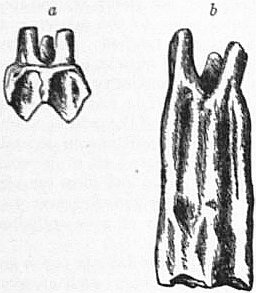
Fig. 1.—a, Side view of second upper molar tooth of Anchitherium (brachyodont form); b, corresponding tooth of horse (hypsidont form).
All the existing members of the family, such as the domesticated horse (Equus caballus) and its wild or half-wild relatives, the asses and the zebras, are included in the typical genus. In all these the crowns of the cheek-teeth are very tall (fig. 1, b) and only develop roots late in life; while their grinding-surfaces (fig. 2, b and c) are very complicated and have all the hollows filled with cement. The summits of the incisors are infolded, producing, when partially worn, the “mark.” In the skull the orbit is surrounded by bone, and there is no distinct depression in front of the same. Each limb terminates in one large toe; the lateral digits being represented by the splint-bones, corresponding to the lateral metacarpals and metatarsals of Hipparion. Not unfrequently, however, the lower ends of the splint-bones carry a small expansion, representing the phalanges.
Remains of horses indistinguishable from E. caballus occur in the Pleistocene deposits of Europe and Asia; and it is from them that the dun-coloured small horses of northern Europe and Asia are probably derived. The ancestor of these Pleistocene horses is probably E. stenonis, of the Upper Pliocene of Europe, which has a small depression in front of the orbit, while the skull is relatively larger, the feet are rather shorter, and the splint-bones somewhat more developed. In India a nearly allied species (E. sivalensis), occurs in the Lower Pliocene, and may have been the ancestor of the Arab stock, which shows traces of the depression in front of the orbit characteristic of the earlier forms. In North America species of Equus occur in the Pleistocene and from that continent others reached South America during the same epoch. In the latter country occurs Hippidium, in which the cheek-teeth are shorter and simpler, and the nasal bones very long and slender, with elongated slits at the side. The limbs, especially the cannon-bones, are relatively short, and the splint-bones large. The allied Argentine Onohippidium, which is also Pleistocene, has still longer nasal bones and slits, and a deep double cavity in front of the orbit, part of which probably contained a gland. Onohippidium is certainly off the direct line of descent of the modern horses, and, on account of the length of the nasals and their slits, the same probably holds good for Hippidium.
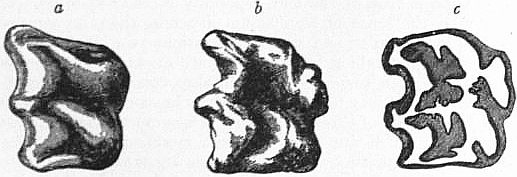
Fig. 2.—a, Grinding surface of unworn right upper molar tooth of Anchitherium; b, corresponding surface of unworn molar of young horse; c, the same tooth after it has been some time in use. The uncoloured portions are the dentine or ivory, the shaded parts the cement filling the cavities and surrounding the exterior. The black line separating these two structures is the enamel or hardest constituent of the tooth.
Species from the Pliocene of Texas and the Upper Miocene (Loup Fork) of Oregon were at one time assigned to Hippidium, but this is incorrect, that genus being exclusively South American. The name Pliohippus has been applied to species from the same two formations on the supposition that the foot-structure was similar to that of Hippidium, but Mr J.W. Gidley is of opinion that the lateral digits may have been fully developed.
Apparently there is here some gap in the line of descent of the horse, and it may be suggested that the evolution took place, not as commonly supposed, in North America, but in eastern central Asia, of which the palaeontology is practically unknown; some support is given to this theory by the fact that the earliest species with which we are acquainted occur in northern India.
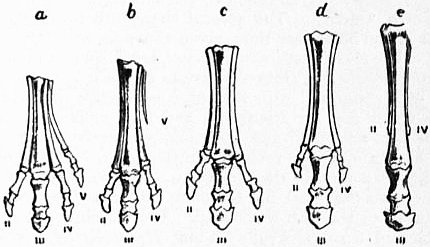
Fig. 3.—Successive stages of modification of the left fore-feet of extinct forms of horse-like animals, showing gradual reduction of the outer and enlargement of the middle toe (III).
a, Hyracotherium (Eocene). b, Mesohippus (Oligocene). c, Anchitherium (Miocene). d, Hipparion (Pliocene). e, Equus (Pleistocene).
Be this as it may, the next North American representatives of the family constitute the genera Protohippus and Merychippus of the Miocene, in both of which the lateral digits are fully developed and terminate in small though perfect hoofs. In both the cheek-teeth have moderately tall crowns, and in the first named of the two those of the milk-series are nearly similar to their permanent successors. In Merychippus, on the other hand, the milk-molars have short crowns, without any cement in the hollows, thus resembling the permanent molars of the under-mentioned genus Anchitherium. From the well-known Hipparion, or Hippotherium, typically from the Lower Pliocene of Europe, but also occurring in the corresponding formation in North Africa, Persia, India and China, and represented in the Upper Miocene Loup Fork beds of the United States by species which it has been proposed to separate generically as Neohipparion, we reach small horses which are now generally regarded as a lateral offshoot from the Merychippus type. The cheek-teeth, which have crowns of moderate height, differ from those of all the foregoing in that the postero-internal pillar (the projection on the right-hand top corner of c in fig. 2) is isolated in place of being attached by a narrow neck to the adjacent crescent. The skull, which is relatively short, has a large depression in front of the orbit, commonly supposed to have contained a gland, but this may be doubtful. In the typical, and also in the North American forms these were complete, although small, lateral toes in both feet (fig. 3, d), but it is possible that in H. antilopinum of India the lateral toes had disappeared. If this be so, we have the development of a monodactyle foot in this genus independently of Equus.
The foregoing genera constitute the subfamily Equinae, or the Equidae as restricted by the older writers. In all the dentition is of the hypsodont type, with the hollows of the cheek-teeth filled by cement, the premolars molariform, and the first small and generally deciduous. The orbit is surrounded by a bony ring; the ulna and radius in the fore, and the tibia and fibula in the hind-limb are united, and the feet are of the types described above. Between this subfamily and the second subfamily, Hyracotheriinae, a partial connexion is formed by the North American Upper Miocene genera Desmatippus and Anchippus or Parahippus. The characteristics of the group will be gathered from the remarks on the leading genera; but it may be mentioned that the orbit is open behind, the cheek-teeth are short-crowned and without cement (fig. 1, a), the gap between the canine and the outermost incisor is short, the bones of the middle part of the leg are separate, and there are at least three toes to each foot.
The longest-known genus and the one containing the largest species is Anchitherium, typically from the Middle Miocene of Europe, but also represented by one species from the Upper Miocene of North America. The European A. aurelianense was of the size of an ordinary donkey. The cheek-teeth are of the type shown in a of figs. 1 and 2; the premolars, with the exception of the small first one, being molar-like; and the lateral toes (fig. 3, c) were to some extent functional. The summits of the incisors were infolded to a small extent. Nearly allied is the American Mesohippus, ranging from the Lower Miocene to the Lower Oligocene of the United States, of which the earliest species stood only about 18 in. at the shoulder. The incisors were scarcely, if at all, infolded, and there is a rudiment of the fifth metacarpal (fig. 3, b). By some writers all the species of Mesohippus are included in the genus Miohippus, but others consider that the two genera are distinct.
Mesohippus and Miohippus are connected with the earliest and most primitive mammal which it is possible to include in the family Equidae by means of Epihippus of the Uinta or Upper Eocene of North America, and Pachynolophus, or Orohippus, of the Middle and Lower Eocene of both halves of the northern hemisphere. The final stage, or rather the initial stage, in the series is presented by Hyracotherium (Protorohippus), a mammal no larger than a fox, common to the Lower Eocene of Europe and North America. The general characteristics of this progenitor of the horses are those given above as distinctive of the group. The cheek-teeth are, however, much simpler than those of Anchitherium; the transverse crests of the upper molars not being fully connected with the outer wall, while the premolars in the upper jaw are triangular, and thus unlike the molars. The incisors are small and the canines scarcely enlarged; the latter having a gap on each side in the lower, but only one on their hinder aspect in the upper jaw. The fore-feet have four complete toes (fig. 3, a), but there are only three hind-toes, with a rudiment of the fifth metatarsal. The vertebrae are simpler in structure than in Equus. From Hyracotherium, which is closely related to the Eocene representatives of the ancestral stocks of the other three branches of the Perissodactyla, the transition is easy to Phenacodus, the representative of the common ancestor of all the Ungulata.
See also H.F. Osborn, “New Oligocene Horses,” Bull. Amer. Mus. vol. xx. p. 167 (1904); J.W. Gidley, Proper Generic Names of Miocene Horses, p. 191; and the article Palaeontology.
(R. L.*)
EQUILIBRIUM (from the Lat. aequus, equal, and libra, a balance), a condition of equal balance between opposite or counteracting forces. By the “sense of equilibrium” is meant the sense, or sensations, by which we have a feeling of security in standing, walking, and indeed in all the movements by which the body is carried through space. Such a feeling of security is necessary both for maintaining any posture, such as standing, or for performing any movement. If this feeling is absent or uncertain, or if there are contradictory sensations, then definite muscular movements are inefficiently or irregularly performed, and the body may stagger or fall. When we stand erect on a firm surface, like a floor, there is a feeling of resistance, due to nervous impulses reaching the brain from the soles of the feet and from the muscles of the limbs and trunk. In walking or running, these feelings of resistance seem to precede and guide the muscular movements necessary for the next step. If these are absent or perverted or deficient, as is the case in the disease known as locomotor ataxia, then, although there is no loss of the power of voluntary movement, the patient staggers in walking, especially if he is not allowed to look at his feet, or if he is blind-folded. He misses the guiding sensations that come from the limbs; and with a feeling that he is walking on a soft substance, offering little or no resistance, he staggers, and his muscular movements become irregular. Such a condition maybe artificially brought about by washing the soles of the feet with chloroform or ether. And it has been observed to exist partially after extensive destruction of the skin of the soles of the feet by burns or scalds. This shows that tactile impulses from the skin take a share in generating the guiding sensation. In the disease above mentioned, however, tactile impressions may be nearly normal, but the guiding sensation is weak and inefficient, owing to the absence of impulses from the muscles. The disease is known to depend on morbid changes in the posterior columns of the spinal cord, by which impulses are not freely transmitted upwards to the brain. These facts point to the existence of impulses coming from the muscles and tendons. It is now known that there exist peculiar spindles, in muscle, and rosettes or coils or loops of nerve fibres in close proximity to tendons. These are the end organs of the sense. The transmission of impulses gives rise to the muscular sense, and the guiding sensation which precedes co-ordinated muscular movements depends on these impulses. Thus from the limbs streams of nervous impulses pass to the sensorium from the skin and from muscles and tendons; these may or may not arouse consciousness, but they guide or evoke muscular movements of a co-ordinated character, more especially of the limbs.
In animals whose limbs are not adapted for delicate touch nor for the performance of complicated movements, such as some mammals and birds and fishes, the guiding sensations depend largely on the sense of vision. This sense in man, instead of assisting, sometimes disturbs the guiding sensation. It is true that in locomotor ataxia visual sensations may take the place of the tactile and muscular sensations that are inefficient, and the man can walk without staggering if he is allowed to look at the floor, and especially if he is guided by transverse straight lines. On the other hand, the acrobat on the wire-rope dare not trust his visual sensations in the maintenance of his equilibrium. He keeps his eyes fixed on one point instead of allowing them to wander to objects below him, and his muscular movements are regulated by the impulses that come from the skin and muscles of his limbs. The feeling of insecurity probably arises from a conception of height, and also from the knowledge that by no muscular movements can a man avoid a catastrophe if he should fall. A bird, on the other hand, depends largely on visual impressions, and it knows by experience that if launched into the air from a height it can fly. Here, probably, is an explanation of the large size of the eyes of birds. Cover the head, as in hooding a falcon, and the bird seems to be deprived of the power of voluntary movement. Little effect will be produced if we attempt to restrain the movements of a cat by covering its eyes. A fish also is deprived of the power of motion if its eyes are covered. But both in the bird and in the fish tactile and muscular impressions, especially the latter, come into play in the mechanism of equilibrium. In flight the large-winged birds, especially in soaring, can feel the most delicate wind-pressures, both as regards direction and force, and they adapt the position of their body so as to catch the pressure at the most efficient angle. The same is true of the fish, especially of the flat-fishes. In mammals the sense of equilibrium depends, then, on streams of tactile, muscular and visual impressions pouring in on the sensorium, and calling forth appropriate muscular movements. It has also been suggested that impulses coming from the abdominal viscera may take part in the mechanism. The presence in the mesentery of felines (cats, &c.) of large numbers of Pacinian corpuscles, which are believed to be modified tactile bodies, favours this supposition. Such animals are remarkable for the delicacy of such muscular movements, as balancing and leaping.
There is another channel by which nervous impulses reach the sensorium and play their part in the sense of equilibrium, namely, from the semicircular canals, a portion of the internal ear. It is pointed out in the article Hearing that the appreciation of sound is in reality an appreciation of variations of pressure. The labyrinth consists of the vestibule, the cochlea and the semicircular canals. The cochlea receives the sound-waves (variations of pressure) that constitute musical tones. This it accomplishes by the structures in the ductus cochlearis. In the vestibule we find two sacs, the saccule next to and communicating with the ductus cochlearis, and the utricle communicating with the semicircular canals. The base of the stapes communicates pressures to the utricle. The membranous portion of the semicircular canals consists of a tube, dilated at one end into a swelling or pouch, termed the ampulla, and each end communicates freely with the utricle. On the posterior wall of both the saccule and of the utricle there is a ridge, termed in each case the macula acustica, bearing a highly specialized epithelium. A similar structure exists in each ampulla. This would suggest that all three structures have to do with hearing; but, on the other hand, there is experimental evidence that the utricle and the canals may transmit impressions that have to do with equilibrium. Pressure of the base of the stapes is exerted on the utricle. This will compress the fluid in that cavity, and tend to drive the fluid into the semicircular canals that communicate with that cavity by five openings. Each canal is surrounded by a thin layer of perilymph, so that it may yield a little to this pressure, and exert a pull or pressure on the nerve-endings in each ampulla. Thus impulses may be generated in the nerves of the ampullae.
The three semicircular canals lie in the three directions in space, and it has been suggested that they have to do with our appreciation of the direction of sound. But our appreciation of sound is very inaccurate: we look with the eyes for the source of a sound, and instinctively direct the ears or the head, or both, in the direction from which the sound appears to proceed. But the relationship of the canals on the two sides must have a physiological significance. Thus (1) the six canals are parallel, two and two; or (2) the two horizontal canals are in the same plane, while the superior canal on one side is nearly parallel with the posterior canal of the other. These facts point to the two sets of canals and ampullae acting as one organ, in a manner analogous to the action of two retinae for single vision.
We have next to consider how the canals may possibly act in connexion with the sense of equilibrium. In 1820 J. Purkinje studied the vertigo that follows rapid rotation of the body in the erect position on a vertical axis. On stopping the rotation there is a sense of rotation in the opposite direction, and this may occur even when the eyes are closed. Purkinje noticed that the position of the imaginary axis of rotation depends on the axis around which the head revolves. In 1828 M.J.P. Flourens discovered that injury to the canals causes disturbance to the equilibrium and loss of co-ordination, and that sections of the canals produce a rotatory movement of a kind corresponding to the canal that had been divided. Thus division of a membranous canal causes rotatory movements round an axis at right angles to the plane of the divided canal. The body of the animal always moves in the direction of the cut canal. Many other observers have corroborated these experiments. F. Goltz was the first who formulated the conditions necessary for equilibration. He put the matter thus:—(1) A central co-ordinating organ—in the brain; (2) centripetal fibres, with their peripheral terminations—in the ampullae; and (3) centrifugal fibres, with their terminal organs—in the muscular mechanisms. A lesion of any one of these portions of the mechanism causes loss or impairment of balancing. Cyon also investigated the subject, and concluded:—(1) To maintain equilibrium, we must have an accurate notion of the position of the head in space; (2) the function of the semicircular canals is to communicate impressions that give a representation of this position—each canal having a relation to one of the dimensions of space; (3) disturbance of equilibrium follows section; (4) involuntary movements following section are due to abnormal excitations; (5) abnormal movements occurring a few days after the operation are caused by irritation of the cerebellum.
On theoretical considerations of a physical character, E. Mach, Crum-Brown and Breuer have advanced theories based on the idea of the canals being organs for sensations of acceleration of movement, or for the sense of rotation. Mach first pointed out that Purkinje’s phenomena, already alluded to, were in all probability related to the semicircular canals. “He showed that when the body is moved in space, in a straight line, we are not conscious of the velocity of motion, but of variations in this velocity. Similarly, if a body is rotated round a vertical axis, we perceive only angular acceleration and not angular velocity. The sensations produced by angular acceleration last longer than the acceleration itself, and the position of the head during the movements enables us to determine direction.” Both Mach and Goltz state that varying pressures of the fluid in the canals produced by angular rotation produce sensations of movement (always in a direction opposite to the rotation of the body), and that these, in turn, cause the vertigo of Purkinje and the phenomena of Flourens. Mach, Crum-Brown and Breuer advance hydrodynamical theories in which they assume that the fluids move in the canals. Goltz, on the other hand, supports a hydrostatical theory in which he assumes that the phenomena can be accounted for by varying pressures. Crum-Brown differs from Mach and Breuer as follows:—(1) In attributing movement or variation of pressure not merely to the endolymph, but also to the walls of the membranous canals and to the surrounding perilymph; and (2) in regarding the two labyrinths as one organ, all the six canals being required to form a true conception of the rotating motion of the head. He sums up the matter thus: “We have two ways in which a relative motion can occur between the endolymph and the walls of the cavity containing it—(1) When the head begins to move, here the walls leave the fluid behind; (2) when the head stops, here the fluid flows on. In both cases the sensation of rotation is felt. In the first this sensation corresponds to a real rotation, in the second it does not, but in both it corresponds to a real acceleration (positive or negative) of rotation, using the word acceleration in its technical kinematical sense.”
Cyon states that the semicircular canals only indirectly assist in giving a notion of spatial relations. “He holds that knowledge of the position of bodies in space depends on nervous impulses coming from the contracting ocular muscles; that the oculomotor centres are in intimate physiological relationship with the centres receiving impulses from the nerves of the semicircular canals; and that the oculomotor centres, thus excited, produce the movements of the eyeballs, which then determine our notions of spatial relations.” These views are supported by experiments of Lee on dog-fish. When the fish is rotated round different axes there are compensating movements of the eyes and fins. “It was observed that if the fish were rotated in the plane of one of the canals, exactly the same movements of the eyes and fins occurred as were produced by experimental operation and stimulation of the ampulla of that canal.” Sewall, in 1883, carried out experiments on young sharks and skates with negative results. Lee returned to the subject in 1894, and, after numerous experiments on dog-fish, in which the canals or the auditory nerves were divided, obtained evidence that the ampullae contain sense-organs connected with the sense of equilibrium.
It has been found by physicians and aurists that disease or injury of the canals, occurring rapidly, produces giddiness, staggering, nystagmus (a peculiar twitching movement of the muscles of the eyeballs), vomiting, noises in the ear and more or less deafness. It is said, however, that if pathological changes come on slowly, so that the canals and vestibule are converted into a solid mass, none of these symptoms may occur. On the whole, the evidence is in favour of the view that from the semicircular canals nervous impulses are transmitted, which, co-ordinated with impulses coming from the visual organs, from the muscles and from the skin, form the bases of these guiding sensations on which the sense of equilibrium depends. These impulses may not reach the level of consciousness, but they call into action co-ordinated mechanisms by which complicated muscular movements are effected.
Full bibliographical references are given in the article on “The Ear” by J.G. McKendrick, in Schäfer’s Textbook of Physiology, vol. ii. p. 1194.
(J. G. M.)
EQUINOX (from the Lat. aequus, equal, and nox, night), a term used to express either the moment at which, or the point at which, the sun apparently crosses the celestial equator. Since the sun moves in the ecliptic, it is in the last-named sense the point of intersection of the ecliptic and the celestial equator. This is the usual meaning of the term in astronomy. There are two such points, opposite each other, at one of which the sun crosses the equator toward the north and at the other toward the south. They are called vernal and autumnal respectively, from the relation of the corresponding times to the seasons of the northern hemisphere. The line of the equinoxes is the imaginary diameter of the celestial sphere which joins them.
The vernal equinox is the initial point from which the right ascensions and the longitudes of the heavenly bodies are measured (see Astronomy: Spherical). It is affected by the motions of Precession and Nutation, of which the former has been known since the time of Hipparchus. The actual equinox is defined by first taking the conception of a fictitious point called the Mean Equinox, which moves at a nearly uniform rate, slow varying, however, from century to century. The true equinox then moves around the mean equinox in a period equal to that of the moon’s nodes. These two motions are defined with greater detail in the articles Precession of the Equinoxes and Nutation.
Equinoctial Gales.—At the time of the equinox it is commonly believed that strong gales may be expected. This popular idea has no foundation in fact, for continued observations have failed to show any unusual prevalence of gales at this season. In one case observations taken for fifty years show that during the five days from the 21st to the 25th of March and September, there were fewer gales and storms than during the preceding and succeeding five days.
EQUITES (“horsemen” or “knights,” from equus, “horse”), in Roman history, originally a division of the army, but subsequently a distinct political order, which under the empire resumed its military character. According to the traditional account, Romulus instituted a cavalry corps, consisting of three centuriae (“hundreds”), called after the three tribes from which they were taken (Ramnes, Tities, Luceres), divided into ten turmae (“squadrons”) of thirty men each. The collective name for the corps was celeres (“the swift,” or possibly from κέλης, “a riding horse”); Livy, however, restricts the term to a special body-guard of Romulus. The statements in ancient authorities as to the changes in the number of the equites during the regal period are very confusing; but it is regarded as certain that Servius Tuillus found six centuries in existence, to which he added twelve, making eighteen in all, a number which remained unchanged throughout the republican period. A proposal by M. Porcius Cato the elder to supplement the deficiency in the cavalry by the creation of four additional centuries was not adopted. The earlier centuries were called sex suffragia (“the six votes”), and at first consisted exclusively of patricians, while those of Servius Tullius were entirely or for the most part plebeian. Until the reform of the comitia centuriata (probably during the censorship of Gaius Flaminius in 220 B.C.; see Comitia), the equites had voted first, but after that time this privilege was transferred to one century selected by lot from the centuries of the equites and the first class. The equites then voted with the first class, the distinction between the sex suffragia and the other centuries being abolished.
Although the equites were selected from the wealthiest citizens, service in the cavalry was so expensive that the state gave financial assistance. A sum of money (aes equestre) was given to each eques for the purchase of two horses (one for himself and one for his groom), and a further sum for their keep (aes hordearium); hence the name equites equo publico. In later times, pay was substituted for the aes hordearium, three times as much as that of the infantry. If competent, an eques could retain his horse and vote after the expiration of his ten years’ service, and (till 129 B.C.) even after entry into the senate.
As the demands upon the services of the cavalry increased, it was decided to supplement the regulars by the enrolment of wealthy citizens who kept horses of their own. The origin of these equites equo privato dates back, according to Livy (v. 7), to the siege of Veii, when a number of young men came forward and offered their services. According to Mommsen, although the institution was not intended to be permanent, in later times vacancies in the ranks were filled in this manner, with the result that service in the cavalry, with either a public or a private horse, became obligatory upon all Roman citizens possessed of a certain income. These equites equo privato had no vote in the centuries, received pay in place of the aes equestre, and did not form a distinct corps.
Thus, at a comparatively early period, three classes of equites may be distinguished: (a) The patrician equites equo publico of the sex suffragia; (b) the plebeian equites in the twelve remaining centuries; (c) the equites equo privato, both patrician and plebeian.
The equites were originally chosen by the curiae, then in succession by the kings, the consuls, and (after 443 B.C.) by the censors, by whom they were reviewed every five years in the Forum. Each eques, as his name was called out, passed before the censors, leading his horse. Those whose physique and character were satisfactory, and who had taken care of their horses and equipments, were bidden to lead their horse on (traducere equum), those who failed to pass the scrutiny were ordered to sell it, in token of their expulsion from the corps. This inspection (recognitio) must not be confounded with the full-dress procession (transvectio) on the 15th of July from the temple of Mars or Honos to the Capitol, instituted in 304 B.C. by the censor Q. Fabius Maximus Rullianus to commemorate the miraculous intervention of Castor and Pollux at the battle of Lake Regillus. Both inspection and procession were discontinued before the end of the republic, but revived and in a manner combined by Augustus.
In theory, the twelve plebeian centuries were open to all freeborn youths of the age of seventeen, although in practice preference was given to the members of the older families. Other requirements were sound health, high moral character and an honourable calling. At the beginning of the republican period, senators were included in the equestrian centuries. The only definite information as to the amount of fortune necessary refers to later republican and early imperial times, when it is known to have been 400,000 sesterces (about £3500 to £4000). The insignia of the equites were, at first, distinctly military—such as the purple-edged, short military cloak (trabea) and decorations for service in the field.
With the extension of the Roman dominions, the equites lost their military character. Prolonged service abroad possessed little attraction for the pick of the Roman youth, and recruiting for the cavalry from the equestrian centuries was discontinued. The equites remained at home, or only went out as members of the general’s staff, their places being taken by the equites equo privato, the cavalry of the allies and the most skilled horsemen of the subject populations. The first gradually disappeared, and Roman citizens were rarely found in the ranks of the effective cavalry. In these circumstances there grew up in Rome a class of wealthy men, whose sole occupation it was to amass large fortunes by speculation, and who found a most lucrative field of enterprise in state contracts and the farming of the public revenues. These tax-farmers (see Publicani) were already in existence at the time of the Second Punic War; and their numbers and influence increased as the various provinces were added to the Roman dominions. The change of the equites into a body of financiers was further materially promoted (a) by the lex Claudia (218 B.C.), which prohibited senators from engaging in commercial pursuits, especially if (as seems probable) it included public contracts (cf. Flaminius, Gaius); (b) by the enactment in the time of Gaius Gracchus excluding members of the senate from the equestrian centuries. These two measures definitely marked off the aristocracy of birth from the aristocracy of wealth—the landed proprietor from the capitalist. The term equites, originally confined to the purely military equestrian centuries of Servius Tullius, now came to be applied to all who possessed the property qualification of 400,000 sesterces.
As the equites practically monopolized the farming of the taxes, they came to be regarded as identical with the publicani, not, as Pliny remarks, because any particular rank was necessary to obtain the farming of the taxes, but because such occupation was beyond the reach of all except those who were possessed of considerable means. Thus, at the time of the Gracchi, these equites-publicani formed a close financial corporation of about 30,000 members, holding an intermediate position between the nobility and the lower classes, keenly alive to their own interests, and ready to stand by one another when attacked. Although to some extent looked down upon by the senate as following a dishonourable occupation, they had as a rule sided with the latter, as being at least less hostile to them than the democratic party. To obtain the support of the capitalists, Gaius Gracchus conceived the plan of creating friction between them and the senate, which he carried out by handing over to them the control (a) of the jury-courts, and (b) of the revenues of Asia.
(a) Hitherto, the list of jurymen for service in the majority of processes, both civil and criminal, had been composed exclusively of senators. The result was that charges of corruption and extortion failed, when brought against members of that order, even in cases where there was little doubt of their guilt. The popular indignation at such scandalous miscarriages of justice rendered a change in the composition of the courts imperative. Apparently Gracchus at first proposed to create new senators from the equites and to select the jurymen from this mixed body, but this moderate proposal was rejected in favour of one more radical (see W.W. Fowler in Classical Review, July 1896). By the lex Sempronia (123 B.C.) the list was to be drawn from persons of free birth over thirty years of age, who must possess the equestrian census, and must not be senators. Although this measure was bound to set senators and equites at variance, it in no way improved the lot of those chiefly concerned. In fact, it increased the burden of the luckless provincials, whose only appeal lay to a body of men whose interests were identical with those of the publicani. Provided he left the tax-gatherer alone, the governor might squeeze what he could out of the people, while on the other hand, if he were humanely disposed, it was dangerous for him to remonstrate.
(b) The taxes of Asia had formerly been paid by the inhabitants themselves in the shape of a fixed sum. Gracchus ordered that the taxes, direct and indirect, should be increased, and that the farming of them should be put up to auction at Rome. By this arrangement the provincials were ignored, and everything was left in the hands of the capitalists.
From this time dates the existence of the equestrian order as an officially recognized political instrument. When the control of the courts passed into the hands of the property equites, all who were summoned to undertake the duties of judices were called equites; the ordo judicum (the official title) and the ordo equester were regarded as identical. It is probable that certain privileges of the equites were due to Gracchus; that of wearing the gold ring, hitherto reserved for senators; that of special seats in the theatre, subsequently withdrawn (probably by Sulla) and restored by the lex Othonis (67 B.C.); the narrow band of purple on the tunic as distinguished from the broad band worn by the senators.
Various attempts were made by the senate to regain control of the courts, but without success. The lex Livia of M. Livius Drusus (q.v.), passed with that object, but irregularly and by the aid of violence, was annulled by the senate itself. In 82 Sulla restored the right of serving as judices to the senate, to which he elevated 300 of the most influential equites, whose support he thus hoped to secure; at the same time he indirectly dealt a blow at the order generally, by abolishing the office of the censor (immediately revived), in whom was vested the right of bestowing the public horse. To this period Mommsen assigns the regulation, generally attributed to Augustus, that the sons of senators should be knights by right of birth. By the lex Aurelia (70 B.C.) the judices were to be chosen in equal numbers from senators, equites and tribuni aerarii (see Aerarium), (the last-named being closely connected with the equites), who thus practically commanded a majority. About this time the influence of the equestrian order reached its height, and Cicero’s great object was to reconcile it with the senate. In this he was successful at the time of the Catilinarian conspiracy, in the suppression of which he was materially aided by the equites. But the union did not last long; shortly afterwards the majority ranged themselves on the side of Julius Caesar, who did away with the tribuni aerarii as judices, and replaced them by equites.
Augustus undertook the thorough reorganization of the equestrian order on a military basis. The equites equo privato were abolished (according to Herzog, not till the reign of Tiberius) and the term equites was officially limited to the equites equo publico, although all who possessed the property qualification were still considered to belong to the “equestrian order.” For the equites equo publico high moral character, good health and the equestrian fortune were necessary. Although free birth was considered indispensable, the right of wearing the gold ring (jus anuli aurei) was frequently bestowed by the emperor upon freedmen, who thereby became ingenui and eligible as equites. Tiberius, however, insisted upon free birth on the father’s side to the third generation. Extreme youth was no bar; the emperor Marcus Aurelius had been an eques at the age of six. The sons of senators were eligible by right of birth, and appear to have been known as equites illustres. The right of bestowing the equus publicus was vested in the emperor; once given, it was for life, and was only forfeitable through degradation for some offence or the loss of the equestrian fortune.
Augustus divided the equites into six turmae (regarded by Hirschfeld as a continuation of the sex suffragia). Each was under the command of a sevir (ἴλαρχος), who was appointed by the emperor and changed every year. During their term of command the seviri had to exhibit games (ludi sevirales). Under these officers the equites formed a kind of corporation, which, although not officially recognized, had the right of passing resolutions, chiefly such as embodied acts of homage to the imperial house. It is not known whether the turmae contained a fixed number of equites; there is no doubt that, in assigning the public horse, Augustus went far beyond the earlier figure of 1800. Thus, Dionysius of Halicarnassus mentions 5000 equites as taking part in a review at which he himself was present.
As before, the equites wore the narrow, purple-striped tunic, and the gold ring, the latter now being considered the distinctive badge of knighthood. The fourteen rows in the theatre were extended by Augustus to seats in the circus.
The old recognitio was replaced by the probatio, conducted by the emperor in his censorial capacity, assisted by an advisory board of specially selected senators. The ceremony was combined with a procession, which, like the earlier transvectio, took place on the 15th of July, and at such other times as the emperor pleased. As in earlier times, offenders were punished by expulsion.
In order to provide a supply of competent officers, each eques was required to fill certain subordinate posts, called militiae equestres. These were (1) the command of an auxiliary cohort; (2) the tribunate of a legion; (3) the command of an auxiliary cavalry squadron, this order being as a rule strictly adhered to. To these Septimius Severus added the centurionship. Nomination to the militiae equestres was in the hands of the emperor. After the completion of their preliminary military service, the equites were eligible for a number of civil posts, chiefly those with which the emperor himself was closely concerned. Such were various procuratorships; the prefectures of the corn supply, of the fleet, of the watch, of the praetorian guards; the governorships of recently acquired provinces (Egypt, Noricum), the others being reserved for senators. At the same time, the abolition of the indirect method of collecting the taxes in the provinces greatly reduced the political influence of the equites. Certain religious functions of minor importance were also reserved for them. In the jury courts, the equites, thanks to Julius Caesar, already formed two-thirds of the judices; Augustus, by excluding the senators altogether, virtually gave them the sole control of the tribunals. One of the chief objects of the emperors being to weaken the influence of the senate by the opposition of the equestrian order, the practice was adopted of elevating those equites who had reached a certain stage in their career to the rank of senator by adlectio. Certain official posts, of which it would have been inadvisable to deprive senators, could thus be bestowed upon the promoted equites.
The control of the imperial correspondence and purse was at first in the hands of freedmen and slaves. The emperor Claudius tentatively entrusted certain posts connected with these to the equites; in the time of Hadrian this became the regular custom. Thus a civil career was open to the equites without the obligation of preliminary military service, and the emperor was freed from the pernicious influence of freedmen. After the reign of Marcus Aurelius (according to Mommsen) the equites were divided into: (a) viri eminentissimi, the prefects of the praetorian guard; (b) viri perfectissimi, the other prefects and the heads of the financial and secretarial departments; (c) viri egregii, first mentioned in the reign of Antoninus Pius, a title by right of the procurators generally.
Under the empire the power of the equites was at its highest in the time of Diocletian; in consequence of the transference of the capital to Constantinople, they sank to the position of a mere city guard, under the control of the prefect of the watch. Their history may be said to end with the reign of Constantine the Great.
Mention may also be made of the equites singulares Augusti. The body-guard of Augustus, consisting of foreign soldiers (chiefly Germans and Batavians), abolished by Galba, was revived from the time of Trajan or Hadrian under the above title. It was chiefly recruited from the pick of the provincial cavalry, but contained some Roman citizens. It formed the imperial “Swiss guard,” and never left the city except to accompany the emperor. In the time of Severus, these equites were divided into two corps, each of which had its separate quarters, and was commanded by a tribune under the orders of the prefect of the praetorian guard. They were subsequently replaced by the protectores Augusti.
See further article Rome: History; also T. Mommsen, Römisches Staatsrecht, iii.; J.N. Madvig, Die Verfassung des römischen Staates, i.; R. Cagnat in Daremberg and Saglio’s Dictionnaire des antiquités, where full references to ancient authorities are given in the footnotes; A.S. Wilkins in Smith’s Dictionary of Greek and Roman Antiquities (3rd ed., 1891); E. Belot, Histoire des chevaliers romains (1866-1873); H.O. Hirschfeld, Untersuchungen auf dem Gebiete der römischen Verwaltungsgeschichte (Berlin, 1877); E. Herzog, Geschichte und System der römischen Staatsverfassung (Leipzig, 1884-1891); A.H. Friedländer, Sittengeschichte Roms, i. (1901); A.H.J. Greenidge, History of Rome, i. (1904); J.B. Bury, The Student’s Roman Empire (1893); T.M. Taylor, Political and Constitutional History of Rome (1899). For a concise summary of different views of the sex suffragia see A. Bouché-Leclercq’s Manuel des antiquités romaines, quoted in Daremberg and Saglio; and on the equites singulares, T. Mommsen in Hermes, xvi. (1881), p. 458.
(J. H. F.)
EQUITY (Lat. aequitas), a term which in its most general sense means equality or justice; in its most technical sense it means a system of law or a body of connected legal principles, which have superseded or supplemented the common law on the ground of their intrinsic superiority. Aristotle (Ethics, bk. v. c. 10) defines equity as a better sort of justice, which corrects legal justice where the latter errs through being expressed in a universal form and not taking account of particular cases. When the law speaks universally, and something happens which is not according to the common course of events, it is right that the law should be modified in its application to that particular case, as the lawgiver himself would have done, if the case had been present to his mind. Accordingly the equitable man (ἐπιεικής) is he who does not push the law to its extreme, but, having legal justice on his side, is disposed to make allowances. Equity as thus described would correspond rather to the judicial discretion which modifies the administration of the law than to the antagonistic system which claims to supersede the law.
The part played by equity in the development of law is admirably illustrated in the well-known work of Sir Henry Maine on Ancient Law. Positive law, at least in progressive societies, is constantly tending to fall behind public opinion, and the expedients adopted for bringing it into harmony therewith are three, viz. legal fictions, equity and statutory legislation. Equity here is defined to mean “any body of rules existing by the side of the original civil law, founded on distinct principles, and claiming incidentally to supersede the civil law in virtue of a superior sanctity inherent in those principles.” It is thus different from legal fiction, by which a new rule is introduced surreptitiously, and under the pretence that no change has been made in the law, and from statutory legislation, in which the obligatory force of the rule is not supposed to depend upon its intrinsic fitness. The source of Roman equity was the fertile theory of natural law, or the law common to all nations. Even in the Institutes of Justinian the distinction is carefully drawn in the laws of a country between those which are peculiar to itself and those which natural reason appoints for all mankind. The connexion in Roman law between the ideas of equity, nature, natural law and the law common to all nations, and the influence of the Stoical philosophy on their development, are fully discussed in the third chapter of the work we have referred to. The agency by which these principles were introduced was the edicts of the praetor, an annual proclamation setting forth the manner in which the magistrate intended to administer the law during his year of office. Each successive praetor adopted the edict of his predecessor, and added new equitable rules of his own, until the further growth of the irregular code was stopped by the praetor Salvius Julianus in the reign of Hadrian.
The place of the praetor was occupied in English jurisprudence by the lord high chancellor. The real beginning of English equity is to be found in the custom of handing over to that officer, for adjudication, the complaints which were addressed to the king, praying for remedies beyond the reach of the common law. Over and above the authority delegated to the ordinary councils or courts, a reserve of judicial power was believed to reside in the king, which was invoked as of grace by the suitors who could not obtain relief from any inferior tribunal. To the chancellor, as already the head of the judicial system, these petitions were referred, although he was not at first the only officer through whom the prerogative of grace was administered. In the reign of Edward III. the equitable jurisdiction of the court appears to have been established. Its constitutional origin was analogous to that of the star chamber and the court of requests. The latter, in fact, was a minor court of equity attached to the lord privy seal as the court of chancery was to the chancellor. The successful assumption of extraordinary or equitable jurisdiction by the chancellor caused similar pretensions to be made by other officers and courts. “Not only the court of exchequer, whose functions were in a peculiar manner connected with royal authority, but the counties palatine of Chester, Lancaster and Durham, the court of great session in Wales, the universities, the city of London, the Cinque Ports and other places silently assumed extraordinary jurisdiction similar to that exercised in the court of chancery.” Even private persons, lords and ladies, affected to establish in their honours courts of equity.
English equity has one marked historical peculiarity, viz. that it established itself in a set of independent tribunals which remained in standing contrast to the ordinary courts for many hundred years. In Roman law the judge gave the preference to the equitable rule; in English law the equitable rule was enforced by a distinct set of judges. One cause of this separation was the rigid adherence to precedent on the part of the common law courts. Another was the jealousy prevailing in England against the principles of the Roman law on which English equity to a large extent was founded.
When a case of prerogative was referred to the chancellor in the reign of Edward III., he was required to grant such remedy as should be consonant to honesty (honestas). And honesty, conscience and equity were said to be the fundamental principles of the court. The early chancellors were ecclesiastics, and under their influence not only moral principles, where these were not regarded by the common law, but also the equitable principles of the Roman law were introduced into English jurisprudence. Between this point and the time when equity became settled as a portion of the legal system, having fixed principles of its own, various views of its nature seem to have prevailed. For a long time it was thought that precedents could have no place in equity, inasmuch as it professed in each case to do that which was just; and we find this view maintained by common lawyers after it had been abandoned by the professors of equity themselves. G. Spence, in his book on the Equitable Jurisdiction of the Court of Chancery, quotes a case in the reign of Charles II., in which chief justice Vaughan said:
“I wonder to hear of citing of precedents in matter of equity, for if there be equity in a case, that equity is an universal truth, and there can be no precedent in it; so that in any precedent that can be produced, if it be the same with this case, the reason and equity is the same in itself; and if the precedent be not the same case with this it is not to be cited.”
But the lord keeper Bridgeman answered:
“Certainly precedents are very necessary and useful to us, for in them we may find the reasons of the equity to guide us, and besides the authority of those who made them is much to be regarded. We shall suppose they did it upon great consideration and weighing of the matter, and it would be very strange and very ill if we should disturb and set aside what has been the course for a long series of times and ages.”
Selden’s description is well known: “Equity is a roguish thing. ’Tis all one as if they should make the standard for measure the chancellor’s foot.” Lord Nottingham in 1676 reconciled the ancient theory and the established practice by saying that the conscience which guided the court was not the natural conscience of the man, but the civil and political conscience of the judge. The same tendency of equity to settle into a system of law is seen in the recognition of its limits—in the fact that it did not attempt in all cases to give a remedy when the rule of the common law was contrary to justice. Cases of hardship, which the early chancellors would certainly have relieved, were passed over by later judges, simply because no precedent could be found for their interference. The point at which the introduction of new principles of equity finally stopped is fixed by Sir Henry Maine in the chancellorship of Lord Eldon, who held that the doctrines of the court ought to be as well settled and made as uniform almost as those of the common law. From that time certainly equity, like common law, has professed to take its principles wholly from recorded decisions and statute law. The view (traceable no doubt to the Aristotelian definition) that equity mitigates the hardships of the law where the law errs through being framed in universals, is to be found in some of the earlier writings. Thus in the Doctor and Student it is said:
“Law makers take heed to such things as may often come, and not to every particular case, for they could not though they would; therefore, in some cases it is necessary to leave the words of the law and follow that reason and justice requireth, and to that intent equity is ordained, that is to say, to temper and mitigate the rigour of the law.”
And Lord Ellesmere said:
“The cause why there is a chancery is for that men’s actions are so divers and infinite that it is impossible to make any general law which shall aptly meet with every particular act and not fail in some circumstances.”
Modern equity, it need hardly be said, does not profess to soften the rigour of the law, or to correct the errors into which it falls by reason of its generality.
To give any account, even in outline, of the subject matter of equity within the necessary limits of this article would be impossible. It will be sufficient to say here that the classification generally adopted by text-writers is based upon the relations of equity to the common law, of which some explanation is given above. Thus equitable jurisdiction is said to be exclusive, concurrent or auxiliary. Equity has exclusive jurisdiction where it recognizes rights which are unknown to the common law. The most important example is trusts. Equity has concurrent jurisdiction in cases where the law recognized the right but did not give adequate relief, or did not give relief without circuity of action or some similar inconvenience. And equity has auxiliary jurisdiction when the machinery of the courts of law was unable to procure the necessary evidence.
“The evils of this double system of judicature,” says the report of the judicature commission (1863-1867), “and the confusion and conflict of jurisdiction to which it has led, have been long known and acknowledged.” A partial attempt to meet the difficulty was made by several acts of parliament (passed after the reports of commissions appointed in 1850 and 1851), which enabled courts of law and equity both to exercise certain powers formerly peculiar to one or other of them. A more complete remedy was introduced by the Judicature Act 1873, which consolidated the courts of law and equity, and ordered that law and equity should be administered concurrently according to the rules contained in the 26th section of the act. At the same time many matters of equitable jurisdiction are still left to the chancery division of the High Court in the first instance. (See Chancery.)
Authorities.—The principles of equity as set out by the following writers may be consulted: J. Story, J.W. Smith, H.A. Smith and W. Ashburner; and for the history see G. Spence, The Equitable Jurisdiction of the Court of Chancery (2 vols., 1846-1849); D.M. Kerly, Historical Sketch of the Equitable Jurisdiction of the Court of Chancery (1890).
EQUIVALENT, in chemistry, the proportion of an element which will combine with or replace unit weight of hydrogen. When multiplied by the valency it gives the atomic weight. The determination of equivalent weights is treated in the article Stoichiometry. (See also Chemistry.) In a more general sense the term “equivalent” is used to denote quantities of substances which neutralize one another, as for example NaOH, HCl, ½H2SO4, ½Ba(OH)2.
ÉRARD, SÉBASTIEN (1752-1831), French manufacturer of musical instruments, distinguished especially for the improvements he made upon the harp and the pianoforte, was born at Strassburg on the 5th of April 1752. While a boy he showed great aptitude for practical geometry and architectural drawing, and in the workshop of his father, who was an upholsterer, he found opportunity for the early exercise of his mechanical ingenuity. When he was sixteen his father died, and he removed to Paris where he obtained employment with a harpsichord maker. Here his remarkable constructive skill, though it speedily excited the jealousy of his master and procured his dismissal, almost equally soon attracted the notice of musicians and musical instrument makers of eminence. Before he was twenty-five he set up in business for himself, his first workshop being a room in the hotel of the duchesse de Villeroi, who gave him warm encouragement. Here he constructed in 1780 his first pianoforte, which was also one of the first manufactured in France. It quickly secured for its maker such a reputation that he was soon overwhelmed with commissions, and finding assistance necessary, he sent for his brother, Jean Baptiste, in conjunction with whom he established in the rue de Bourbon, in the Faubourg St Germain, a piano manufactory, which in a few years became one of the most celebrated in Europe. On the outbreak of the Revolution he went to London where he established a factory. Returning to Paris in 1796, he soon afterwards introduced grand pianofortes, made in the English fashion, with improvements of his own. In 1808 he again visited London, where, two years later, he produced his first double-movement harp. He had previously made various improvements in the manufacture of harps, but the new instrument was an immense advance upon anything he had before produced, and obtained such a reputation that for some time he devoted himself exclusively to its manufacture. It has been said that in the year following his invention he made harps to the value of £25,000. In 1812 he returned to Paris, and continued to devote himself to the further perfecting of the two instruments with which his name is associated. In 1823 he crowned his work by producing his model grand pianoforte with the double escapement. Érard died at Passy, on the 5th of August 1831. (See also Harp and Pianoforte.)
ERASMUS, DESIDERIUS (1466-1536), Dutch scholar and theologian, was born on the night of the 27/28th of October, probably in 1466; but his statements about his age are conflicting, and in view of his own uncertainty (Ep. x. 29: 466) and the weakness of his memory for dates, the year of his birth cannot be definitely fixed. His father’s name seems to have been Rogerius Gerardus. He himself was christened Herasmus; but in 1503, when becoming familiar with Greek, he assimilated the name to a fancied Greek original, which he had a few years before Latinized into Desyderius. A contemporary authority states that he was born at Gouda, his father’s native town; but he adopted the style Rotterdammensis or Roterodamus, in accordance with a story to which he himself gave credence. His first schooling was at Gouda under Peter Winckel, who was afterwards vice-pastor of the church. In the dull round of instruction in “grammar” he did not distinguish himself, and was surpassed by his early friend and companion, William Herman, who was Winckel’s favourite pupil. From Gouda the two boys went to the school attached to St Lebuin’s church at Deventer, which was one of the first in northern Europe to feel the influence of the Renaissance. Erasmus was at Deventer from 1475 to 1484, and when he left, had learnt from Johannes Sinthius (Syntheim) and Alexander Hegius, who had come as headmaster in 1483, the love of letters which was the ruling passion of his life. At some period, perhaps in an interval of his time at Deventer, he was a chorister at Utrecht under the famous organist of the cathedral, Jacob Obrecht.
About 1484 Erasmus’ father died, leaving him and an elder brother Peter, both born out of wedlock, to the care of guardians, their mother having died shortly before. Erasmus was eager to go to a university, but the guardians, acting under a perhaps genuine enthusiasm for the religious life, sent the boys to another school at Hertogenbosch; and when they returned after two or three years, prevailed on them to enter monasteries. Peter went to Sion, near Delft; Erasmus after prolonged reluctance became an Augustinian canon in St Gregory’s at Steyn, a house of the same Chapter near Gouda. There he found little religion and less refinement; but no serious difficulty seems to have been made about his reading the classics and the Fathers with his friends to his heart’s content. The monastery once entered, there was no drawing back; and Erasmus passed through the various stages which culminated in his ordination as priest on the 25th of April 1492.