VOLUME IX SLICE VII Equation to Ethics (continued 5)
Reading edition
Bibliography.—W. Grimm, in Die deutsche Heldensage (2nd ed., Berlin, 1867), quotes the account given by Jordanes, references in Beowulf, in the Wanderer’s Song, Exeter Book, in Parcival, in Dietrichs Flucht, the account given in the Quedlinburg Chronicle, by Ekkehard in the Chronicon Urspergense, by Saxo Grammaticus, &c. See also Vigfússon and Powell, Corpus poëticum boreale, vol. i. (Oxford, 1883), and H. Symons, “Die deutsche Heldensage” in Paul’s Grundriss d. german. Phil. vol. iii. (Strassburg, 1900).
1 Emerka and Fridla (Beowulf, Quedlingburg Chron.), Aki and Etgard (Vilkina Saga). In the original myth the Harlungs, who are not to be confused with the Hartung brothers, were sent to bring home Sūryā, the bride of the sky-god, Irmintiu.
ERMELAND, or Ermland (Varmia), a district of Germany, in East Prussia, extending from the Frisches Haff, a bay in the Baltic, inland towards the Polish frontier. It is a well-wooded sandy tract of country, has an area of about 1650 sq. m., a population of 240,000, and is divided into the districts of Braunsberg, Heilsberg, Rössel and Allenstein.
Ermeland was originally one of the eleven districts of old Prussia and was occupied by the Teutonic Knights (Deutscher Orden), being made in 1250 one of the four bishoprics of the country under their sway. The bishop of Ermeland shortly afterwards declared himself independent of the order, and became a prince of the Empire. In 1466 Ermeland, together with West Prussia, was by the peace of Thorn attached to the crown of Poland, and the bishop had a seat in the Polish senate. In 1772 it was again incorporated with Prussia. Among the bishops of the see, which still exists, with its seat in Frauenberg, may be mentioned Aeneas Sylvius Piccolomini, afterwards Pope Pius II., and Cardinal Stanislaus Hosius (1504-1579), the founder of the Jesuit college in Braunsberg.
See Hipler, Literaturgeschichte des Bisthums Ermeland (Braunsberg, 1873); the Monumenta historiae Warmiensis (Mainz, 1860-1864, and Braunsberg, 1866-1872, 4 vols.); and Buchholz, Abriss einer Geschichte des Ermlands (Braunsberg, 1903.)
ERMELO, a district and town of the Transvaal. The district lies in the south-east of the province and is traversed by the Drakensberg. In it are Lake Chrissie, the only true lake in the country, and the sources of the Vaal, Olifants, Komati, and Usuto rivers, which rise within 30 m. of one another. The region has a general elevation of about 5500 ft. and is fine agricultural and pastoral country, besides containing valuable minerals, including coal and gold. Ermelo town, pop. (1904) 1451, is by rail 175 m. S.E. of Johannesburg, and 74 m. S.S.W. of Machadodorp on the Pretoria-Delagoa Bay railway. A government experimental farm, with some 1000 acres of plantations, is maintained here.
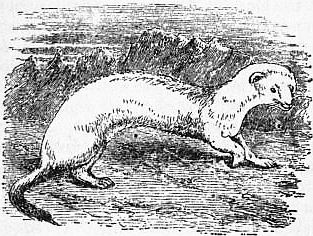
Ermine or Stoat (Putorius ermineus).
ERMINE, an alternative name for the stoat (Putorius ermineus), apparently applicable in its proper sense only when the animal is in its white winter coat. This animal measures 10 in. in length exclusive of the tail, which is about 4 in. long, and becomes bushy towards the point. The fur in summer is reddish brown above and white beneath, changing in the winter of northern latitudes to snowy whiteness, except at the tip of the tail, which at all seasons is black. In Scottish specimens this change in winter is complete, but in those found in the southern districts of England it is usually only partial, the ermine presenting during winter a piebald appearance. The white colour is evidently protective, enabling the animals to elude the observations of their enemies, and to steal unobserved on their prey. It also retains heat better than a dark covering, and may thus serve to maintain an equable temperature at all seasons within the body. The colour change seems to be due to phagocytes devouring the pigment-bodies of the hair, and not to a moult.
The species is a native of the temperate and subarctic zones of the Old World, and is represented in America by a form which can scarcely be regarded as specifically distinct. It inhabits thickets and stony places, and frequently makes use of the deserted burrows of moles and other underground mammals. Exceedingly sanguinary in disposition, and agile in its movements, it feeds principally on rats, water-rats and rabbits, which it pursues with pertinacity and boldness, hence the name stoat, signifying bold, by which it is commonly known. It takes readily to water, and will even climb trees in pursuit of prey. It is particularly destructive to poultry and game, and has often been known to attack hares, fixing itself to the throat of its victim, and defying all the efforts of the latter to disengage it. The female brings forth five young ones about the beginning of summer. The winter coat of the ermine forms one of the most valuable of commercial furs, and is imported in enormous quantities from Norway, Sweden, Russia and Siberia. It is largely used for muffs and tippets, and as a trimming for state robes, the jet black points of the tails being inserted at regular intervals as an ornament. In the reign of Edward III. the wearing of ermine was restricted to members of the royal family; but it now enters into almost all state robes, the rank and position of the wearer being in many cases indicated by the presence or absence, and the disposition, of the black spots. (See also Fur.)
ERMINE STREET. Documents and writers of the 11th and succeeding centuries occasionally mention four “royal roads” in Britain—Icknield Street, Erning or Ermine Street, Watling Street and Foss Way—as standing apart from all other existing roads and enjoying the special protection of the king. Unfortunately these authorities are not at all agreed as to their precise course; the roads themselves do not occur as specially privileged in actual legal or other practice, and it is likely that the category of Four Roads is the invention of a lawyer or an antiquary. The names are, however, attested to some extent by early charters which name them among other roads, as boundaries. From these charters we know that Icknield Street ran along the Berkshire downs and the Chilterns, that Ermine Street ran more or less due north through Huntingdonshire, that Watling Street ran north-west across the midlands from London to Shrewsbury, and Foss diagonally to it from Lincoln or Leicester to Bath and mid-Somerset. This evidence only proves the existence of these roads in Saxon and Norman days. But they all seem to be much older. Icknield Street is probably a prehistoric ridgeway along the downs, utilized perhaps by the Romans near its eastern end, but in general not Roman. Ermine Street coincides with part of a line of Roman roads leading north from London through Huntingdon to Lincoln. This line is followed by the Old North Road through Cheshunt, Buntingford, Royston, and Huntingdon to Castor near Peterborough; and thence it can be traced through lanes and byways past Ancaster to Lincoln. Watling Street is the Roman highway from London by St Alban’s (Verulamium) to Wroxeter near Shrewsbury (Viroconium). Foss is the Roman highway from Lincoln to Bath and Exeter. Hence it has been supposed, and is still frequently alleged, that the Four Roads were the principal highways of Roman Britain. This, however, is not the case. Icknield Street is not Roman and the three roads which follow Roman lines, Ermine Street, Watling Street, and Foss, held no peculiar position in the Romano-British road system (see Britain: Roman). In later times, the names Ermine Street, Icknield Street and Watling Street have been applied to other roads of Roman or supposed Roman origin. This, however, is wholly the work of Elizabethan or subsequent antiquaries and deserves no credence.
The derivations of the four names are unknown. Icknield, Ermine and Watling may be from English personal names; Foss, originally Fos, seems to be the Lat. fossa in its occasional medieval sense of a bank of upcast earth or stones, such as the agger of a road.
(F. J. H.)
ERMOLDUS NIGELLUS, or Ermold the Black, was a monk of Aquitaine, who accompanied King Pippin, son of the emperor Louis I., on a campaign into Brittany in 824. Subsequently he was banished from Pippin’s court on a charge of inciting the king against his father, and retired to Strassburg, where he sought to regain the emperor’s favour by writing a poem on his life and deeds. About 830 he obtained his recall, and has been identified with Hermoldus, who appears as Pippin’s chancellor in 838. Ermoldus was a cultured man with a knowledge of the Latin poets, and this poem, In honorem Hludovici imperatoris, has some historical value. It consists of four books and deals with the life and exploits of Louis from 781 to 826. He also wrote two poems in imitation of Ovid, which were addressed to Pippin.
His writings are published in the Monumenta Germaniae historica, Scriptores, Band 2 (Hanover, 1826 fol.); by J.P. Migne in the Patrologia Latina, tome 105 (Paris, 1844); and by E. Dümmler in the Poëtae Latini aevi Carolini, Band 2 (Berlin, 1881-1884). See W.O. Henkel, Über den historischen Werth der Gedichte des Ermoldus Nigellus (Eilenburg, 1876); W. Wattenbach, Deutschlands Geschichtsquellen, Band 1 (Berlin, 1904); and A. Potthast, Bibliotheca historica, pp. 430-431 (Berlin, 1896).
ERNE, the name of a river and two lakes in the north-west of Ireland. The river rises in Lough Gowna, county Longford, 214 ft. above sea-level, flows north through Lough Oughter with a serpentine course and a direction generally northward, and then broadens into the Upper Lough Erne, a shallow irregular sheet of water 13 m. long, so beset with islands as to present the appearance of a number of water-channels ramifying through the land. The river then winds past the town of Enniskillen on its island, and enters Lough Erne, a beautiful lake nearly 18 m. long and 5 m. in extreme width, containing many islands, but less closely covered with them than the upper lough. One of them, Devenish, is celebrated for its antiquarian remains (see Enniskillen). The river then runs westward to Donegal Bay, forming a fine fall at Ballyshannon (q.v.). Lough Erne contains trout and pike. These waters admit of navigation by small steamers, but little trade is carried on. The area of the Erne basin, which includes a vast number of small loughs, is about 1600 sq. m., and it covers part of the counties Cavan, Longford, Leitrim, Fermanagh and Donegal. The length of the Erne valley is about 70 m.
ERNEST I. [Ernst Anton Karl Ludwig], duke of Saxe-Coburg-Gotha (1784-1844), was the son of Francis, duke of Saxe-Coburg-Saalfeld, and was born on the 2nd of January 1784. At the time of his father’s death (9th of December 1806) the duchy of Coburg was occupied by Napoleon as conquered territory, and Ernest did not come into his inheritance till after the peace of Tilsit (July 1807). Owing to the part he had played in assisting the Prussians at the battle of Auerstädt he continued out of favour with Napoleon, and he threw himself with vigour into the war of liberation against the French. After the battle of Leipzig he was given the command of the V. army corps and reduced Mainz by blockade; he also commanded the Saxon troops during the campaign of 1815. By the congress of Vienna he was rewarded with the principality of Lichtenberg on the left bank of the Rhine, which received a slight augmentation after the second peace of Paris. These territories he sold to Prussia in 1834. In 1826, in the division of the territories of the duchy of Saxe-Gotha which followed the death of its last duke (February 1825), he received the duchy of Gotha, ceding that of Saalfeld to the duke of Meiningen; and he now exchanged his style of Ernest III. of Saxe-Coburg-Saalfeld for that of Ernest I. of Saxe-Coburg-Gotha. In 1821 he had given a constitution to Coburg, but he did not interfere with the traditional system of estates at Gotha. He died on the 29th of January 1844.
Duke Ernest, who was not only a good soldier and keen sportsman, but an enlightened patron of the arts and sciences, did much for the economic, educational and constitutional development of his territories; and his advice always carried great weight in the councils of the other German sovereigns. It was, however, for the splendid international position attained by the house of Coburg under him that his reign is chiefly distinguished. His younger brother Leopold (q.v.) became king of the Belgians; his brother Ferdinand (b. 1785) married the wealthy princess Antoinette von Kohary (1816) and was the father of the duchess of Nemours and of the future King Ferdinand of Portugal. Of his sisters, Antoinette (1779-1824) married Duke Alexander of Württemberg; Juliane [Alexandra Feodorovna] (1781-1860) married the Russian cesarevich Constantine, from whom she was, however, divorced in 1820; and Victoria (1786-1861), wife of Edward Augustus, duke of Kent, became the mother of Queen Victoria. Duke Ernest was twice married: (1) in 1817 to Louise, daughter of Duke Augustus of Saxe-Gotha, whom he finally divorced in 1826; (2) in 1831 to Maria, daughter of Duke Alexander of Württemberg. Of his sons, by his first wife, Ernest succeeded him in the duchy, and Albert married Queen Victoria.
ERNEST II., duke of Saxe-Coburg-Gotha (1818-1893), was born at Coburg on the 21st of June 1818, being the eldest son of Duke Ernest I. He enjoyed a varied education; he studied at the university of Bonn with his brother Albert; his military training he received in the Saxon army. The widespread connexions of his family opened to him many courts of Europe, and after he became of age he travelled much. The position of his uncle Leopold, who was king of the Belgians, and especially the marriage of his brother Albert to the queen of England, his cousin, gave him peculiar opportunities for becoming acquainted with the political problems of Europe. In 1840-1841 he undertook a journey to Spain and Portugal; in the latter country another cousin, Ferdinand, was king-consort. In 1844 he succeeded his father. His own character and the influence of the king of the Belgians made him one of the most Liberal princes in Germany. He was able to bring to a satisfactory conclusion disputes with the Coburg estates. He passed through the ordeal of the revolution of 1848 with little trouble, for he anticipated the demands of the people of Gotha for a reform, and in 1852 introduced a new constitution by which the administration of his two duchies was assimilated in many points. The government of his small dominions did not afford sufficient scope for his restless and versatile ambition; his desire to play a great part in German affairs was probably increased by the feeling that, though he was the head of his house, he was to some extent overshadowed by the younger branches of the family which ruled in Belgium, England and Portugal. He was one of the foremost supporters of every attempt made to reform the German constitution and bring about the unity of Germany. He took a warm interest in the proceedings of the Frankfort parliament, and it was often said, probably without reason, that he hoped to be chosen emperor himself. However that may be, he strongly urged the king of Prussia to accept that position when it was offered him in 1849; he took a very prominent part in the complicated negotiations of the following year, and it was at his suggestion that a congress of princes met at Berlin in 1850. He highly valued the opportunities which this and similar meetings gave him for exercising political influence, and he would have felt most at home as a member of a permanent council of the German princes.
Ambitious also of military distinction, and sympathizing with the rising of the people of Schleswig-Holstein against the Danes in 1849, Ernest accepted a command in the federal army. In the engagement of Eckernförde in April 1849 the troops under his orders succeeded in capturing two Danish frigates, a remarkable feat of which he was justly proud. His greatest services to Germany were performed during the years of reaction which followed; almost alone among the German princes he remained faithful to the Liberal and National ideals, and he allowed his dominions to be used as an asylum by the writers and politicians who had to leave Prussia and Saxony. The reactionary parties looked on him with great suspicion, and it was at this time that he formed a friendship with Gustav Freytag, the celebrated novelist, whom he protected when the Prussian government demanded his arrest. His connexion with the English court gave him a position of much influence, but no one was more purely German in his feelings and opinions. The marriage of his niece Victoria with Frederick, the heir to the Prussian throne, strengthened his connexion with Prussia, but caused the Conservative party to look with increased suspicion on the Coburg influence. He was the first German prince to visit Napoleon III., and was present when Orsini made his celebrated attempt on the emperor’s life. After 1860 he became the chief patron and protector of the National Verein; he encouraged the newly-formed rifle clubs, and notwithstanding the strong disapproval of his fellow-monarchs, allowed his court to become the centre of the rising national agitation. Still a warm adherent of Prussia, in 1862 he set an example to the other princes by voluntarily making an agreement by which his troops were placed in war under the command of the king of Prussia. Like all the other Nationalists, he was much embarrassed by the policy of Bismarck, and the democratic opinions of the Coburg court, which were shared by the crown prince Frederick, were a serious embarrassment to that minister. The opposition became more accentuated when the duke allowed his dominions to be used as the headquarters of the agitation in favour of Frederick, duke of Augustenburg, who claimed the duchies of Schleswig and Holstein, and it was at this time that Bismarck is reported to have said that if Frederick the Great had been alive the duke would have been in the fortress of Spandau. In 1863 he was present at the Fürstentag in Frankfort, and from this time was in more frequent communication with the Austrian court, where his cousin Alexander, Count Mensdorff, was minister. However, when war broke out in 1866, he at once placed his troops at the disposition of Prussia; Bismarck had in an important letter explained to him his policy and tactics. He was personally concerned in one of the most interesting events of the war; for the Hanoverian army, in its attempt to march south and join the Bavarians, had to pass through Thuringia, and the battle of Langensalza was fought in the immediate neighbourhood of Gotha. His troops took part in the battle, which ended in the rout of the Prussians, the duke, who was not present during the fight, in vain attempting to stop it. He bore an important share in the negotiations before and after the battle, and his action at this time has been the subject of much controversy, for it was suggested that while he offered to mediate he really acted as a partisan of Prussia. For his services to Prussia he received as a present the forest of Schmalkalden. He was with the Prussian headquarters in Bohemia during the latter part of the war.
With the year 1866 the political rôle which Ernest had played ended. The result was perhaps not quite equal to his expectations, but it must be remembered how difficult was the position of the minor German princes; and he quoted with great satisfaction the words used in 1871 by the emperor William at Versailles, that “to him in no small degree was due the establishment of the empire.” He was a man of varied tastes, a good musician—he composed several operas and songs—and a keen sportsman, a quality in which he differed from his brother. Notwithstanding his Liberalism, he had a great regard for the dignity of his rank and family, and in his support of constitutional government would never have sacrificed the essential prerogatives of sovereignty. He died at Reinhardsbrunn on the 22nd of August 1893. In 1842 the duke married Alexandrine, daughter of the grandduke of Baden; there were no children by this marriage and the succession to Saxe-Coburg-Gotha passed therefore to the children of his younger brother Albert. By Albert’s marriage contract the duchy could not be held together with the English crown; thus his eldest son, afterwards Edward VII., was passed over and it came to his second son, Alfred, duke of Edinburgh (1844-1900). When Alfred died without sons in July 1900 the succession to the duchy passed to a younger brother Arthur, duke of Connaught; but the duke and his son, Arthur, passed on their claim to Charles Edward, duke of Albany (b. 1884), who became duke of Saxe-Coburg-Gotha in succession to his uncle Alfred. In 1905 Charles Edward married Victoria Adelaide (b. 1885), princess of Schleswig-Holstein, by whom he has a son John Leopold (b. 1906).
Duke Ernest was something of a writer. He brought out an account of the travels in Egypt and Abyssinia which he undertook in 1862 as Reise des Herzogs Ernst von Sachsen-Koburg-Gotha nach Ägypten (Leipzig, 1864); and he published his memoirs, Aus meinem Leben und aus meiner Zeit (Berlin, 1887-1889). This work is in three volumes and contains much valuable information on a most critical period of German history; there is an English translation by P. Andreae (1888-1890).
See also Sir T. Martin, Life of H.R.H. the Prince Consort (1875-1880); Hon. C. Grey, Early Years of the Prince Consort (1867); A. Ohorn, Herzog Ernst II., ein Lebensbild (Leipzig, 1894); and E. Tempeltey, Herzog Ernst von Koburg und das Jahr 1866 (Berlin, 1898).
(J. W. He.)
ERNEST AUGUSTUS (1771-1851), king of Hanover and duke of Cumberland, fifth son of the English king George III., was born at Kew on the 5th of June 1771. Having studied at the university of Göttingen, he entered the Hanoverian army, serving as a leader of cavalry when war broke out between Great Britain and France in 1793, and winning a reputation for bravery. He lost the sight of one eye at the battle of Tournai in May 1794, and when Hanover withdrew from the war in 1795 he returned to England, being made lieutenant-general in the British army in 1799. In the same year he was created duke of Cumberland and Teviotdale and granted an allowance of £12,000 a year, after which he held several lucrative military positions in England, and began to attend the sittings of the House of Lords and to take part in political life. A stanch Tory, the duke objected to all proposals of reform, especially to the granting of any relief to the Roman Catholics, and had great influence with his brother the prince regent, afterwards King George IV., in addition to being often consulted by the Tory leaders. In 1810 he was severely injured by an assassin, probably his valet Sellis, who was found dead; and subsequently two men were imprisoned for asserting that the duke had murdered his valet. Recovering from his wounds, Cumberland again proceeded to the seat of war; and having been made a British field-marshal, was in command of the Hanoverian army during the campaigns of 1813 and 1814, being present, although not in action, at the battle of Leipzig. In May 1815 Ernest married his cousin, Frederica (1778-1841), daughter of Charles II. duke of Mecklenburg-Strelitz and widow of Frederick, prince of Solms-Braunfels, a union which was very repugnant to his mother Queen Charlotte, and was disliked in England, where the duke’s strong Toryism had made him unpopular. Parliament refused to increase his allowance from £18,000, to which it had been raised in 1804, to £24,000 a year, and indignant at the treatment he received the duke spent some years in Berlin. Returning to England after the accession of George IV. in 1820, his political power was again considerable, while deaths in the royal family made it likely that he would succeed to the throne. Although his personal influence with the sovereign ceased upon the death of George IV. in 1830, the duke continued to oppose all measures for the extension of civil and religious liberty, including the Reform Bill of 1832; and his unpopularity was augmented by suspicions that he had favoured the formation of Orange lodges in the army. When William IV. died in June 1837, the crowns of Great Britain and Hanover were separated; and Ernest, as the nearest male heir of the late king, became king of Hanover. At once cancelling the constitution which William had given to his kingdom in 1833, he acted as an absolute monarch, and the constitution which he sanctioned in 1840 was permeated with his own illiberal ideas. In German politics he was vigilant and active, and mindful of the material interests of his country. His reign, however, was a stormy one, and serious trouble between king and people had arisen when he died at Herrenhausen on the 18th of November 1851 (see Hanover: History). In spite of his arbitrary rule and his reactionary ideas the king was popular among his subjects, and his statue in Hanover bears the words “Dem Landes Vater sein treues Volk.” Ernest, who is generally regarded as the ablest of the sons of George III., left an only child, George, who succeeded him as king of Hanover.
See C.A. Wilkinson, Reminiscences of the Court and Times of King Ernest of Hanover (London, 1886); von Malortie, König Ernst August (Hanover, 1861); and the various histories of Great Britain and Hanover for the period.
ERNESTI, JOHANN AUGUST (1707-1781), German theologian and philologist, was born on the 4th of August 1707, at Tennstädt in Thuringia, of which place his father was pastor, besides being superintendent of the electoral dioceses of Thuringia, Salz and Sangerhausen. At the age of sixteen he was sent to the celebrated Saxon cloister school of Pforta (Schulpforta). At twenty he entered the university of Wittenberg, and studied afterwards at the university of Leipzig. In 1730 he was made master in the faculty of philosophy. In the following year he accepted the office of conrector in the Thomas school of Leipzig, of which J.M. Gesner was then rector, an office to which Ernesti succeeded in 1734. He was, in 1742, named professor extraordinarius of ancient literature in the university of Leipzig, and in 1756 professor ordinarius of rhetoric. In the same year he received the degree of doctor of theology, and in 1759 was appointed professor ordinarius in the faculty of theology. Through his learning and his manner of discussion, he co-operated with S.J. Baumgarten of Halle (1706-1757) in disengaging the current dogmatic theology from its many scholastic and mystical excrescences, and thus paved a way for a revolution in theology. He died, after a short illness, in his seventy-sixth year, on the 11th of September 1781.
It is perhaps as much from the impulse which Ernesti gave to sacred and profane criticism in Germany, as from the intrinsic excellence of his own works in either department, that he must derive his reputation as a philologist or theologian. With J.S. Semler he co-operated in the revolution of Lutheran theology, and in conjunction with Gesner he instituted a new school in ancient literature. He detected grammatical niceties in Latin, in regard to the consecution of tenses which had escaped preceding critics. His canons are, however, not without exceptions. As an editor of the Greek classics, Ernesti hardly deserves to be named beside his Dutch contemporaries, Tiberius Hemsterhuis (1685-1766), L.C. Valckenaer (1715-1785), David Ruhnken (1723-1798), or his colleague J.J. Reiske (1716-1774). The higher criticism was not even attempted by Ernesti. But to him and to Gesner is due the credit of having formed, by discipline and by example, philologists greater than themselves, and of having kindled the national enthusiasm for ancient learning. It is chiefly in hermeneutics that Ernesti has any claim to eminence as a theologian. But here his merits are distinguished, and, at the period when his Institutio Interpretis N. T. was published (1761), almost peculiar to himself. In it we find the principles of a general interpretation, formed without the assistance of any particular philosophy, but consisting of observations and rules which, though already enunciated, and applied in the criticism of the profane writers, had never rigorously been employed in biblical exegesis. He was, in fact, the founder of the grammatico-historical school. He admits in the sacred writings as in the classics only one acceptation, and that the grammatical, convertible into and the same with the logical and historical. Consequently he censures the opinion of those who in the illustration of the Scriptures refer everything to the illumination of the Holy Spirit, as well as that of others who, disregarding all knowledge of the languages, would explain words by things. The “analogy of faith,” as a rule of interpretation, he greatly limits, and teaches that it can never afford of itself the explanation of words, but only determine the choice among their possible meanings. At the same time he seems unconscious of any inconsistency between the doctrine of the inspiration of the Bible as usually received and his principles of hermeneutics.
Among his works the more important are:—I. In classical literature: Initia doctrinae Solidioris (1736), many subsequent editions; Initia rhetorica (1730); editions, mostly annotated, of Xenophon’s Memorabilia (1737), Cicero (1737-1739), Suetonius (1748), Tacitus (1752), the Clouds of Aristophanes (1754), Homer (1759-1764), Callimachus (1761), Polybius (1764), as well as of the Quaestura of Corradus, the Greek lexicon of Hedericus, and the Bibliotheca Latina of Fabricius (unfinished); Archaeologia litteraria (1768), new and improved edition by Martini (1790); Horatius Tursellinus De particulis (1769). II. In sacred literature: Antimuratorius sive confutatio disputationis Muratorianae de rebus liturgicis (1755-1758); Neue theologische Bibliothek, vols. i. to x. (1760-1769); Institutio interpretis Nov. Test. (3rd ed., 1775); Neueste theologische Bibliothek, vols. i. to x. (1771-1775). Besides these, he published more than a hundred smaller works, many of which have been collected in the three following publications:—Opuscula oratoria (1762, 2nd ed., 1767); Opuscula philologica et critica (1764, 2nd ed., 1776); Opuscula theologica (1773). See Herzog-Hauck, Realencyklopädie; J.E. Sandys, Hist. of Class. Schol. iii. (1908).
ERNESTI, JOHANN CHRISTIAN GOTTLIEB (1756-1802), German classical scholar, was born at Arnstadt, Thuringia, and studied under his uncle, J.A. Ernesti, at the university of Leipzig. On the 5th of June, 1782, he was made supplementary professor of philosophy at his own university; and on the death of his cousin August Wilhelm in 1801 he was for five months professor of rhetoric. He died on the 5th of June of the following year.
His principal works are:—Editions of Aesop’s Fabulae (1781); of the Glossae sacrae of Hesychius (1785) and Suidas and Phavorinus (1786); and of Silius Italicus Punica (1791-1792); Lexicon Technologiae Graecorum rhetoricae (1795); Lexicon technologiae Latinorum rhetoricae (1797), and Cicero’s Geist und Kunst (1799-1802).
ERNST, HEINRICH WILHELM (1814-1865), German violinist and composer, was born at Brünn, in Moravia, in 1814. He was educated at the Conservatorium of Vienna, studying the violin under Joseph Böhm and Joseph Mayseder, and composition under Ignaz von Seyfried. At the age of sixteen he made a concert tour in south Germany, which established his reputation as a violinist of the highest promise. In 1832 he went to Paris, where he lived for several years. During this period he formed an intimacy with Stephen Heller, which resulted in their charming joint compositions—the Pensées fugitives for piano and violin. In 1843 he paid his first visit to London. The impression which he then made as a violinist was more than confirmed in the following year, when his rare powers were recognized by the musical public. Thenceforward he visited England nearly every year, until his health broke down owing to long-continued neuralgia of a most severe kind. The last seven years of his life were spent in retirement, chiefly at Nice, where he died on the 8th of October 1865. As a violinist Ernst was distinguished by his almost unrivalled executive power, loftiness of conception, and intensely passionate expression. As a composer he wrote chiefly for his own instrument, and his Elegie and Otello Fantasia rank among the most treasured works for the violin.
ERODE, a town of British India, in the Coimbatore district of Madras, situated on the right bank of the river Cauvery, which is here crossed by an iron railway girder bridge of 22 spans. Pop. (1901) 15,529. Here the South Indian railway joins the South-Western line of the Madras railway, 243 m. from Madras. There are exports of cotton and saltpetre; and the town has a steam cotton press.
EROS, a minor planet discovered by Witt at Berlin on the 14th of August 1898, and, so far as yet known, unique in that its perihelion lies far within the orbit of Mars.
EROS, in Greek mythology, the god of love. He is not mentioned in Homer; in Hesiod (Theog. 120) he is one of the oldest and the most beautiful of the gods, whose power neither gods nor men can resist. He also evolves order and harmony out of Chaos by uniting the separated elements. This cosmic Eros, who in Orphic cosmogony sprang from the world-egg which Chronos, or Time, laid in the bosom of Chaos, and which is the origin of all created beings, degenerated in later mythology into the capricious god of sexual passion, the son of Aphrodite and Zeus, Ares or Hermes. He is commonly represented as a mischievous boy, the tormentor of gods and men, even his own mother not being proof against his attacks. His brother is Anteros, the god of mutual love, who punishes those who do not return the love of others, without which Eros could not thrive; he is sometimes described as the opponent of Eros. The chief associates of Eros are Pothos and Himeros (Longing and Desire), Peitho (Persuasion), the Muses and the Graces; he himself is in constant attendance on Aphrodite. Later writers (Euripides being the first) assumed the existence of a number of Erotes (like the Roman Amores and Cupidines) with similar attributes. According to the philosophers, Eros was not only the god of sexual love, but also of the loyal and devoted friendship of men; hence the Theban “Sacred Band” was devoted to him, and the Cretans and Spartans offered sacrifice to him before going into battle (Athenaeus xiii. p. 561). In Alexandrian poetry Eros is at one time the powerful god who conquers all, at another the elfish god of love. For the Roman adaptation of Eros see Cupid, and for the later legend of Cupid and Psyche see Psyche.
In art Eros is represented as a beautiful youth or a winged child. His attributes are the bow and arrows and a burning torch. The rose, the hare, the cock and the goat are frequently associated with him. The most celebrated statue of him was at Thespiae, the work of Praxiteles. Other famous representations are the Vatican torso and Eros trying his bow (in the Capitoline museum).
See J.E. Harrison, Prolegomena to the Study of Greek Religion (1903); G.F. Schömann, De Cupidine Cosmogonico (1852); E. Gerhard, Über den Gott Eros (1850); articles in Roscher’s Lexikon der Mythologie, Daremberg and Saglio’s Dictionnaire des antiquités, and Pauly-Wissowa’s Realencyclopädie.
ERPENIUS (original name van Erpe), THOMAS (1584-1624), Dutch Orientalist, was born at Gorcum, in Holland, on the 11th of September 1584. After completing his early education at Leiden, he entered the university of that city, and in 1608 took the degree of master of arts. By the advice of Scaliger he studied Oriental languages whilst taking his course of theology. He afterwards travelled in England, France, Italy and Germany, forming connexions with learned men, and availing himself of the information which they communicated. During his stay at Paris he contracted a friendship with Casaubon, which lasted during his life, and also took lessons in Arabic from an Egyptian, Joseph Barbatus, otherwise called Abu-dakni. At Venice he perfected himself in the Turkish, Persic and Ethiopic languages. After a long absence, Erpenius returned to his own country in 1612, and on the 10th of February 1613 he was appointed professor of Arabic and other Oriental languages, Hebrew excepted, in the university of Leiden. Soon after his settlement at Leiden, animated by the example of Savary de Brèves, who had established an Arabic press at Paris at his own charge, he caused new Arabic characters to be cut at a great expense, and erected a press in his own house. In 1619 the curators of the university of Leiden instituted a second chair of Hebrew in his favour. In 1620 he was sent by the States of Holland to induce Pierre Dumoulin or André Rivet to settle in that country; and after a second journey he was successful in inducing Rivet to comply with their request. Some time after the return of Erpenius, the states appointed him their interpreter; and in this capacity he had the duty imposed upon him of translating and replying to the different letters of the Moslem princes of Asia and Africa. His reputation had now spread throughout all Europe, and several princes, the kings of England and Spain, and the archbishop of Seville made him the most flattering offers; but he constantly refused to leave his native country. He was preparing an edition of the Koran with a Latin translation and notes, and was projecting an Oriental library, when he died prematurely on the 13th of November 1624.
Among his works may be mentioned his Grammatica Arabica, published originally in 1613 and often reprinted; Rudimenta linguae Arabicae (1620); Grammatica Ebraea generalis (1621); Grammatica Chaldaica et Syria (1628); and an edition of Elmacin’s History of the Saracens.
ERROLL (or Errol), FRANCIS HAY, 9th Earl of (d. 1631), Scottish nobleman, was the son of Andrew, 8th earl, and of Lady Jean Hay, daughter of William, 6th earl. The date of his birth is unrecorded, but he succeeded to the earldom (cr. 1453) in 1585, was early converted to Roman Catholicism, and as the associate of Huntly joined in the Spanish conspiracies against the throne of Elizabeth. A letter written by him, declaring his allegiance to the king of Spain, having been intercepted and sent by Elizabeth to James in February 1589, he was declared a rebel by the council. He engaged with Huntly and Crawford in a rebellion in the north of Scotland, but their forces surrendered at Aberdeen on the arrival of the king in April; and in July Erroll gave himself up to James, who leniently refrained from exacting any penalty. In September of the same year he entered into a personal bond with Huntly for mutual assistance; and in 1590 displeased the king by marrying, in spite of his prohibition, Lady Elizabeth Douglas, daughter of the earl of Morton. He was imprisoned on suspicion of complicity in the attempt made by Gray and Bothwell to surprise the king at Falkland in June 1592; and though he obtained his release, he was again proclaimed a rebel on account of the discovery of his signature to two of the “Spanish Blanks,” unwritten sheets subscribed with the names of the chief conspirators in a plot for a Spanish invasion of Scotland, to be filled up later with the terms of the projected treaty. After a failure to apprehend him in March 1593, Erroll and his companions were sentenced to abjure Romanism or leave the kingdom; and on their non-compliance were in 1594 declared traitors. On the 3rd of October they defeated at Glenlivet a force sent against them under Argyll; though Erroll himself was severely wounded, and Slains Castle, his seat, razed to the ground. The rebel lords left Scotland in 1595, and Erroll, on report of his further conspiracies abroad, was arrested by the states of Zealand, but was afterwards allowed to escape. He returned to Scotland secretly in 1596, and on the 20th of June 1597 abjured Romanism and made his peace with the Kirk. He enjoyed the favour of the king, and in 1602 was appointed a commissioner to negotiate the union with England. His relations with the Kirk, however, were not so amicable. The reality of his conversion was disputed, and on the 21st of May 1608 he was confined to the city of Perth “for the better resolution of his doubts,” being subsequently declared an obstinate “papist,” excommunicated, deprived of his estate, and imprisoned at Dumbarton; and after some further vacillation was finally released in May 1611. Lord Erroll died on the 16th of July 1631, and was buried in the church of Slains. He married (1) Anne, daughter of John, 4th earl of Atholl; (2) Margaret, daughter of the regent Murray; and (3) Elizabeth, daughter of William, 6th earl of Morton. By his third wife he had several children, of whom his eldest son, William, succeeded him. The dispute which began in his lifetime concerning the hereditary office of lord high constable between the families of Erroll and of the Earl Marischal was settled finally in favour of the former; thus establishing the precedence enjoyed by the earls of Erroll next after the royal family over all other subjects in Scotland.
See The Erroll Papers (Spalding Club Miscellany, vol. ii. 211); Andrew Lang, Hist. of Scotland, vol. ii.; Hist. MSS. Comm. MSS. of Earl of Mar and Kellie; D. Calderwood’s Hist. of the Church of Scotland; John Spalding’s Memorials (Spalding Club, 1850); Collected Essays of T.G. Law, ed. by P.H. Brown (1904); Treason and Plot, by M.A.S. Hume (1901).
ERROR (Lat. error, from errare, to wander, to err), a mistake, a departure or deviation from what is true, exact or right. For the legal process by which a judgment could be reversed on the ground of error, known as a “writ of error,” see Writ and Appeal. The words “error excepted” or “errors and omissions excepted” (contracted to “E.E.” “E. & O.E.”), are frequently placed at the end of a statement of account or an invoice, so that the accounting party may reserve the right to correct any errors or omissions which may be subsequently discovered, or make further claims in respect of them. In mathematics, “error” is the deviation of an observed or calculated quantity from its true value. The calculus of errors leads to the formulation of the “law of error,” which is an analytical expression of the most probably true value of a series of discordant values (see Probability).
ERSCH, JOHANN SAMUEL (1766-1828), the founder of German bibliography, was born at Grossglogau, in Silesia, on the 23rd of June 1766. In 1785 he entered the university of Halle with the view of studying theology; but soon his whole attention became engrossed by history, bibliography and geography. At Halle he made the acquaintance of J.E. Fabri, professor of geography; and when the latter was made professor of history and statistics at Jena, Ersch accompanied him thither, and aided him in the preparation of several works. In 1788 he published the Verzeichnis aller anonymischen Schriften, as a supplement to the 4th edition of Meusel’s Gelehrtes Deutschland. The researches required for this work suggested to him the preparation of a Repertorium über die allgemeinen deutschen Journale und andere periodische Sammlungen für Erdbeschreibung, Geschichte, und die damit verwandten Wissenschaften (Lemgo, 1790-1792). The fame which this publication acquired him led to his being engaged by Schütz and Hufeland to prepare an Allgemeines Repertorium der Literatur, published in 8 vols. (Jena and Weimar, 1793-1809), which condensed the literary productions of 15 years (1785-1800), and included an account not merely of the books published during that period, but also of articles in periodicals and magazines, and even of the criticisms to which each book had been subjected. While engaged in this great work he also projected La France littéraire, which was published at Hamburg in 5 vols., from 1797 to 1806. In 1795 he went to Hamburg to edit the Neue Hamburger Zeitung, founded by Victor Klopstock, brother of the poet, but returned in 1800 to Jena to take active part in the Allgemeine Literaturzeitung. He also obtained in the same year the office of librarian in the university, and in 1802 was made professor of philosophy. In 1803 he accepted the chair of geography and statistics at Halle, and in 1808 was made principal librarian. He here projected a Handbuch der deutschen Literatur seit der Mitte des 18. Jahrh. bis auf die neueste Zeit (Leipzig, 1812-1814) and, along with Johann Gottfried Gruber (q.v.), the Allgemeine Encyklopädie der Wissenschaften und Künste (Leipzig, 1818 ffg.) which he continued as far as the 21st volume. The accuracy and thoroughness of this monumental encyclopaedia make it still an indispensable book of reference. Ersch died at Halle on the 16th of January 1828.
ERSKINE, EBENEZER (1680-1754), Scottish divine, the chief founder of the Secession Church (formed of dissenters from the Church of Scotland), was born on the 22nd of June 1680, most probably at Dryburgh, Berwickshire. His father, Henry Erskine, who was at one time minister at Cornhill, Durham, was ejected in 1662 by the Act of Uniformity, and, after suffering some years’ imprisonment, was after the Revolution appointed to the parish of Chirnside, Berwickshire. After studying at the university of Edinburgh, Ebenezer became minister of Portmoak, Kinross-shire. There he remained for twenty-eight years, after which, in the autumn of 1731, he was translated to the West Church, Stirling. Some time before this, he, along with some other ministers, was “rebuked and admonished,” by the general assembly, for defending the doctrines contained in the Marrow of Modern Divinity (see Boston, Thomas). A sermon which he preached on lay patronage before the synod of Perth in 1733 furnished new grounds of accusation, and he was compelled to shield himself from rebuke by appealing to the general assembly. Here, however, the sentence of the synod was confirmed, and after many fruitless attempts to obtain a hearing, he, along with William Wilson of Perth, Alexander Moncrieff of Abernethy and James Fisher of Kinclaven, was suspended from the ministry by the commission in November of that year. Against this sentence they protested, and constituted themselves into a separate church court, under the name of the associate presbytery. In 1739 they were again summoned before the assembly, and in their corporate capacity declined to acknowledge the authority of the church, and were deposed in the following year. They received numerous accessions to their communion, and remained in harmony with each other till 1747, when a division took place in regard to the nature of the oath administered to burgesses. Erskine joined with the “burgher” section, and became their professor of theology. He continued also to preach to a numerous congregation in Stirling till his death, which took place on the 2nd of June 1754. Erskine was a very popular preacher, and a man of considerable force of character; he acted throughout on principle with honesty and courage. The burgher and anti-burgher sections of the Secession Church were reunited in 1820, and in 1847 they united with the relief synod in forming the United Presbyterian Church.
Erskine’s published works consist chiefly of sermons. His Life and Diary, edited by the Rev. Donald Fraser, was published in 1840. His Works were published in 1785.
ERSKINE, HENRY (1746-1817), lord advocate of Scotland, the second son of Henry David, 10th earl of Buchan and brother of the lord chancellor Erskine, was born in Edinburgh on the 1st of November 1746. He was educated at the universities of St Andrews, Glasgow and Edinburgh, and was admitted a member of the faculty of advocates in 1768. His reputation as a clever and fluent speaker was first made in the debates of the general assembly, of which he had been early elected an elder. In 1783 he was appointed to the office of lord advocate, which he held during the brief coalition ministry of Fox and North. In 1785 he was elected dean of the faculty of advocates, and was re-elected annually till 1796, when his conduct in moving a series of resolutions at a public meeting, condemning the government’s sedition and treason bills, brought on him the opposition of the ministerial party, and he was deposed in favour of Robert Dundas. On the formation of the Grenville ministry in 1806 he again became lord advocate and was returned to parliament for the Haddington burghs, which he exchanged at the general election of the same year for the Dumfries burghs. His tenure of the lord advocateship ended in March 1807 on the downfall of the ministry. In 1811 he gave up his practice at the bar and retired to his country residence of Almondel, in Linlithgowshire, where he died on the 8th of October 1817.
His eldest son, Henry David (1783-1857), succeeded as 12th earl of Buchan on his uncle’s death in 1829.
Erskine’s reputation will survive as the finest and most eloquent orator of his day at the Scottish bar; added to a charming forensic style was a most captivating wit, which, as Lord Jeffrey said, was “all argument, and each of his delightful illustrations a material step in his reasoning.” Erskine was also the author of some poems, of which the best known is “The Emigrant” (1783).
See Lieut.-Col. A. Fergusson’s Henry Erskine (1882).
ERSKINE, JOHN (1721-1803), Scottish divine, son of John Erskine of Carnock, was born on the 2nd of June 1721. He studied law for a time after completing his course in arts at the university of Edinburgh, but was eventually licensed to preach in 1743; and was successively parish minister of Kirkintilloch, near Glasgow, Culross, in Fifeshire (1753), New Greyfriars church in Edinburgh (1758), and Old Greyfriars church in 1768, where he became the colleague of Principal Robertson, the historian. Here he remained until his death, which took place on the 19th of January 1803. Dr Erskine’s writings consist chiefly of controversial pamphlets on theological subjects. His sermons are clear, vigorous expositions of a moderate Calvinism, in which metaphysical argument and practical morality are happily blended. In church politics he was the leader of the evangelical party; and was much beloved for his high character and amiability.
For his life and works see Sir H. Moncreiff Wellwood, Life and Writings of J. Erskine, D.D. (Edinburgh, 1818).
ERSKINE, JOHN, of Carnock (1695-1768), Scottish jurist, son of Lieut.-Colonel John Erskine, was born in 1695. He was admitted a member of the faculty of advocates in 1719. Although he never enjoyed much practice at the bar, he acquired a high reputation as a sound and learned lawyer, and in 1737 was appointed professor of Scots law in the university of Edinburgh. In 1754 he published his Principles of the Law of Scotland. He retired from his chair in 1765; and during the remainder of his uneventful life he occupied himself with the preparation of his great work, the Institutes of the Law of Scotland, which he did not live to publish. He died at Cardross, Perthshire, on the 1st of March 1768.
Erskine’s Institutes, although not exhibiting the grasp of principle which distinguished his great predecessor Lord Stair, is so conspicuous for learning, accuracy and sound good sense, that it has always been esteemed of the highest authority on the law of Scotland. The first edition appeared in 1773 and it has been many times reprinted. The Principles, although published first, is substantially an abridgment of the larger work, and is in some respects superior to it, being more concise and direct. It retains its place as the text-book on Scots law, and is frequently being re-edited.
ERSKINE, JOHN, of Dun (1509-1591), Scottish reformer, the son of Sir John Erskine, laird of Dun, was born in 1509, and was educated at King’s College, Aberdeen. At the age of twenty-one Erskine was the cause—probably by accident—of a priest’s death, and was forced to go abroad, where he came under the influence of the new learning. It was through his agency that Greek was first taught in Scotland by Petrus de Marsiliers at Montrose. This fact counted for much in the progress of the Reformation. Erskine was also drawn towards the new faith, being a close friend of George Wishart, the reformer, from whose fate he was saved by his wealth and influence, and of John Knox, whose advice openly to discountenance the mass was given in the lodgings of the laird of Dun. In the stormy controversies of the time of Mary Stuart and James VI. Erskine was a conspicuous figure and a moderating influence. He was able to soothe the queen when her feelings had been outraged by Knox’s denunciations—being a man “most gentill of nature”—and frequently acted as mediator both between the catholic and reforming parties, and among the reformers themselves. In 1560 he was appointed—though a layman—superintendent of the reformed church of Scotland for Angus and Mearns, and in 1572 he gave his assent to the modified episcopacy proposed by Morton at the Leith convention. Though never himself ordained, he was held in such high esteem by the leaders of the church as to be more than once elected moderator of the general assembly (first in 1564), and he was amongst those who in 1578 drew up the Second Book of Discipline. From 1579 he was a member of the king’s council. He died in 1591. Erskine owed his peculiar influence among the Scottish reformers to the union—rare in those days—of steadfast convictions with a conciliatory manner; Queen Mary described him as “a mild and sweet-natured man, with true honesty and uprightness.”
See the “Dun Papers” in the Spalding Club Miscellany, vol. iv. (1849), and the article by T.F. Henderson in the Dict. Nat. Biog.
ERSKINE, RALPH (1685-1752), Scottish divine, brother of Ebenezer Erskine (q.v.), was born on the 18th of March 1685. After studying at the university of Edinburgh, he was in 1711 ordained assistant minister at Dunfermline. He homologated the protests which his brother laid on the table of the assembly after being rebuked for his synod sermon, but he did not formally withdraw from the establishment till 1737. He was also present, though not as a member, at the first meeting of the associate presbytery. When the severance took place on account of the oath administered to burgesses, he adhered, along with his brother, to the burgher section. He died after a short illness on the 6th of November 1752.
His works consist of sermons, poetical paraphrases and gospel sonnets. The Gospel Sonnets have frequently appeared separately. His Life and Diary, edited by the Rev. D. Fraser, was published in 1842.
ERSKINE, THOMAS, of Linlathen (1788-1870), Scottish theologian, youngest son of David Erskine, writer to the signet in Edinburgh, and of Anne Graham, of the Grahams of Airth, was born on the 13th of October 1788. He was a descendant of John, 1st or 6th earl of Mar, regent of Scotland in the reign of James VI., a grandson of Colonel John Erskine of Carnock. After being educated at the high school of Edinburgh and at Durham, he attended the literary and law classes at the university of Edinburgh, and becoming in 1810 a member of the Edinburgh faculty of advocates, he for some time enjoyed the intimate acquaintance of Cockburn, Jeffrey, Scott and other distinguished men whose talent then lent lustre to the Scottish bar. In 1816 he succeeded to the family estate of Linlathen, near Dundee, and devoted himself to theology. The writings of Erskine, especially his published letters, are distinguished by a graceful style, and possess originality and interest. His theological views have a considerable similarity to those of Frederick Denison Maurice, who acknowledges having been indebted to him for his first true conception of the meaning of Christ’s sacrifice. Erskine had little interest in the “historical criticism” of Christianity, and regarded as the only proper criterion of its truth its conformity or nonconformity with man’s spiritual nature, and its adaptability or non-adaptability to man’s spiritual needs. He considered the incarnation of Christ as the necessary manifestation to man of an eternal sonship in the divine nature, apart from which those filial qualities which God demands from man could have no sanction; by faith as used in Scripture he understood to be meant a certain moral or spiritual activity or energy which virtually implied salvation, because it implied the existence of a principle of spiritual life possessed of an immortal power. This faith, he believed, could be properly awakened only by the manifestation, through Christ, of love as the law of life, and as identical with an eternal righteousness which it was God’s purpose to bestow on every individual soul. As an interpreter of the mystical side of Calvinism and of the psychological conditions which correspond with the doctrines of grace Erskine is unrivalled. During the last thirty-three years of his life Erskine ceased from literary work. Among his friends were Madame Vernet, the duchess de Broglie, the younger Mdme de Stael, M. Vinet of Lausanne, Edward Irving, Frederick D. Maurice, Dean Stanley, Bishop Ewing, Dr John Brown and Thomas Carlyle. His wide influence was due to his high character and unassuming earnestness. He died at Edinburgh on the 20th of March 1870.
His principal works are Remarks on the Internal Evidence for the Truth of Revealed Religion (1820), an Essay on Faith (1822), and the Unconditional Freeness of the Gospel (1828). These have all passed through several editions, and have also been translated into French. He is also the author of the Brazen Serpent (1831), the Doctrine of Election (1839), several “Introductory Essays” to editions of Christian Authors, and a posthumous work entitled Spiritual Order and Other Papers (1871). Two vols. of his letters, edited by William Hanna, D.D., with reminiscences by Dean Stanley and Principal Shairp, appeared in 1877.
ERSKINE, THOMAS ERSKINE, 1st Baron (1750-1823), lord chancellor of England, was the third and youngest son of Henry David, 10th earl of Buchan, and was born in Edinburgh on the 10th of January 1750. From an early age he showed a strong desire to enter one of the learned professions; but his father, owing to his straitened circumstances, was unable to do more than give him a good school education at the high school of Edinburgh and the grammar school of St Andrews. In 1764 he was sent as a midshipman on board the “Tartar,” but on finding, when he returned to this country after four years’ absence in North America and the West Indies, that there was little immediate chance of his rank of acting lieutenant being confirmed, he quitted the service and entered the army, purchasing a commission in the 1st Royals with the meagre patrimony which had been left to him. But promotion here was as slow as in the navy; while in 1770 he had added greatly to his difficulties by marrying the daughter of Daniel Moore, M.P. for Marlow, an excellent wife, but as poor as himself. However, an accidental visit to an assize court in the town in which he was quartered, and an interview with Lord Mansfield, the presiding judge, confirmed his resolve to quit the army for the law. Accordingly on the 26th of April 1775 he was admitted a student of Lincoln’s Inn. He also on the 13th of January following entered himself as a gentleman commoner on the books of Trinity College, Cambridge, but merely that by graduating he might be called two years earlier.
He read in the chambers of Francis Buller (afterwards Mr Justice Buller) and George (afterwards Baron) Wood, and was called to the bar on the 3rd of July 1778. His success was immediate and brilliant. An accident was the means of giving him his first case, Rex v. Baillie, in which he appeared for Captain Thomas Baillie, the lieutenant-governor of Greenwich hospital, who had published a pamphlet animadverting in severe terms upon the abuses which Lord Sandwich, the first lord of the admiralty, had introduced into the management of the hospital, and against whom a rule had been obtained from the court of king’s bench to show cause why a criminal information for libel should not be filed. Erskine was the junior of five counsel; and it was his good fortune that the prolixity of his leaders consumed the whole of the first day, thereby giving the advantage of starting afresh next morning. He made use of this opportunity to deliver a speech of wonderful eloquence, skill and courage, which captivated both the audience and the court. The rule was discharged, and Erskine’s fortune was made. He received, it is said, thirty retainers before he left the court. In 1781 he delivered another remarkable speech, in defence of Lord George Gordon—a speech which gave the death-blow to the doctrine of constructive treason. In 1783, when the Coalition ministry came into power, he was returned to parliament as member for Portsmouth. His first speech in the House of Commons was a failure; and he never in parliamentary debate possessed anything like the influence he had at the bar. He lost his seat at the dissolution in the following year, and remained out of parliament until 1790, when he was again returned for Portsmouth. But his success at the bar continued unimpaired. In 1783 he received a patent of precedence. His first special retainer was in defence of Dr W.D. Shipley, dean of St Asaph, who was tried in 1784 at Shrewsbury for seditious libel—a defence to which was due the passing of the Libel Act 1792, laying down the principle that it is for the jury, and not for the judge to decide the question whether or no a publication is a libel. In 1789 he was counsel for John Stockdale, a bookseller, who was charged with seditious libel in publishing a pamphlet in favour of Warren Hastings, whose trial was then proceeding; and his speech on this occasion, probably his greatest effort, is a consummate specimen of the art of addressing a jury. Three years afterwards he brought down the opposition alike of friends and foes by defending Thomas Paine, author of The Rights of Man—holding that an advocate has no right, by refusing a brief, to convert himself into a judge. As a consequence he lost the office of attorney-general to the prince of Wales, to which he had been appointed in 1786; the prince, however, subsequently made amends by making him his chancellor. Among Erskine’s later speeches may be mentioned those for Horne Tooke and the other advocates of parliamentary reform, and that for James Hadfield, who was accused of shooting at the king. On the accession of the Grenville ministry in 1806 he was made lord chancellor, an office for which his training had in no way prepared him, but which he fortunately held only during the short period his party was in power. Of the remainder of his life it would be well if nothing could be said. Occasionally speaking in parliament, and hoping that he might return to office should the prince become regent, he gradually degenerated into a state of useless idleness. Never conspicuous for prudence, he aggravated his increasing poverty by an unfortunate second marriage.
His first wife had died in 1805, and he married at Gretna Green a Miss Mary Buck. The date of this marriage is not definitely known. Once only—in his conduct in the case of Queen Caroline—does he recall his former self. He died at Almondell, Linlithgowshire, on the 17th of November 1823, of pneumonia, caught on the voyage to Scotland.
Erskine’s great forensic reputation was, to a certain extent, a concomitant of the numerous political trials of the day, but it was also due to his impassioned eloquence and undaunted courage, which so often carried audience and jury and even the court along with him. As a judge he did not succeed; and it has been questioned whether under any circumstances he could have succeeded. For the office of chancellor he was plainly unfit. As a lawyer he was well read, but by no means profound. His strength lay in the keenness of his reasoning faculty, in his dexterity and the ability with which he disentangled complicated masses of evidence, and above all in his unrivalled power of fixing and commanding the attention of juries. To no department of knowledge but law had he applied himself systematically, with the single exception of English literature, of which he acquired a thorough mastery in early life, at intervals of leisure in college, on board ship, or in the army. Vanity is said to have been his ruling personal characteristic; but those who knew him, while they admit the fault, say that in him it never took an offensive form, even in old age, while the singular grace and attractiveness of his manner endeared him to all with whom he came in contact.
By his first wife he had four sons and four daughters. His eldest son, David Montagu (1776-1855), was a well-known diplomatist; his second son, Henry David (1786-1859), was dean of Ripon; and his third son, Thomas (1788-1864), became a judge of the court of common pleas. By his second wife he had one son, born in 1821.
In 1772 Erskine published Observations on the Prevailing Abuses in the British Army, a pamphlet which had a large circulation, and in later life, Armata, an imitation of Gulliver’s Travels. His most noted speeches have repeatedly appeared in a collected form. See Campbell’s Lives of the Chancellors; Moore’s Diaries; Fergusson’s Henry Erskine (1882); Dumerit’s Henry Erskine, a Study (Paris, 1883); Lord Brougham’s Memoir, prefixed to Erskine’s Speeches (1847); Romilly’s Memoirs; the Croker Papers; Lord Holland’s Memoirs.
ERUBESCITE, a native copper-iron sulphide, Cu5FeS4, of importance as an ore of copper. It crystallizes in the cubic system, the usual form being that of interpenetrating cubes twinned on an octahedral plane. The faces are usually curved and rough, and the crystals confusedly aggregated together. Compact and granular masses are of more frequent occurrence. The colour on a freshly fractured surface is bronzy or coppery, but in moist air this rapidly tarnishes with iridescent blue and red colours; hence the names purple copper ore, variegated copper ore (Ger. Buntkupfererz), horse-flesh ore, and erubescite (from the Lat. erubescere, “to grow red”). The lustre is metallic, and the streak greyish-black; hardness 3; sp. gr. 5.0. Bornite (after Baron Ignaz von Born, b. 1742, d. 1791) is a name in common use for this mineral, and it predates erubescite, the name given by J.D. Dana in 1850, but afterwards rejected by him; French authors use the name phillipsite, after the English mineralogist, R. Phillips, who analysed the mineral; both these earlier names had, however, been previously used for other minerals.
Owing to the frequent presence of mechanically admixed chalcopyrite and chalcocite, the published analyses of erubescite show wide variations, the copper, for example, varying from 50 to 70%. Even the best Cornish crystals enclose a nucleus of chalcopyrite (CuFeS2), and an analysis of these made in 1839 led to the long-accepted formula Cu3FeS3. Recently, B.J. Harrington has analysed carefully selected material and obtained the formula Cu5FeS4.
Erubescite occurs in copper-bearing veins, and has been mined as an ore of copper at Redruth in Cornwall, Montecatini in the province of Pisa, Tuscany, Bristol in Connecticut, Acton in Canada, and other localities in North America. The best crystallized specimens are from the Carn Brea mine and other copper mines in the neighbourhood of Redruth, and from Bristol in Connecticut. Recently a few large isolated crystals with the form of icositetrahedra have been found with calcite and albite in a gold-vein on Frossnitz-Alpe in the Gross-Venediger, Tirol.
(L. J. S.)
ERYSIPELAS (a Greek word, probably derived from ἐρυθρός, red, and πέλλα, skin)—synonyms, the Rose, St Anthony’s Fire—an acute contagious disease, characterized by a special inflammation of the skin, caused by a streptococcus. Erysipelas is endemic in most countries, and epidemic at certain seasons, particularly the spring of the year. The poison is not very virulent, but it certainly can be conveyed by bedding and the clothes of a third person. Two varieties are occasionally described, a traumatic and an idiopathic, but the disease seems to depend in all cases upon the existence of a wound or abrasion. In the so-called idiopathic variety, of which facial erysipelas is the best known, the point of entry is probably an abrasion by the lachrymal duct.
When the erysipelas is of moderate character there is simply a redness of the integument, which feels somewhat hard and thickened, and upon which there often appear small vesications. This redness, though at first circumscribed, tends to spread and affect the neighbouring sound skin, until an entire limb or a large area of the body may become involved in the inflammatory process. There is usually considerable pain, with heat and tingling in the affected part. As the disease advances the portions of skin first attacked become less inflamed, and exhibit a yellowish appearance, which is followed by slight desquamation of the cuticle. The inflammation in general gradually disappears. Sometimes, however, it breaks out again, and passes over the area originally affected the second time. But besides the skin, the subjacent tissues may become involved in the inflammation, and give rise to the formation of pus. This is termed phlegmonous erysipelas, and is much more apt to occur in connexion with the traumatic variety of the disease. Occasionally the affected parts become gangrenous. Certain complications are apt to arise in erysipelas affecting the surface of the body, particularly inflammation of serous membranes, such as the pericardium or pleura.
Erysipelas of the face usually begins with symptoms of general illness, the patient feeling languid, drowsy and sick, while frequently there is a distinct rigor followed with fever. Sore throat is sometimes felt, but in general the first indication of the local affection is a red and painful spot at the side of the nose or on one of the cheeks or ears. Occasionally it would appear that the inflammation begins in the throat, and reaches the face through the nasal fossae. The redness gradually spreads over the whole surface of the face, and is accompanied with swelling, which in the lax tissues of the cheeks and eyelids is so great that the features soon become obliterated and the countenance wears a hideous expression. Advancing over the scalp, the disease may invade the neck and pass on to the trunk, but in general the inflammation remains confined to the face and head. While the disease progresses, besides the pain, tenderness and heat of the affected parts, the constitutional symptoms are very severe. The temperature rises often to 105° or higher, remains high for four or five days, and then falls by crisis. Delirium is a frequent accompaniment. The attack in general lasts for a week or ten days, during which the inflammation subsides in the parts of the skin first attacked, while it spreads onwards in other directions, and after it has passed away there is, as already observed, some slight desquamation of the cuticle.
Although in general the termination is favourable, serious and occasionally fatal results follow from inflammation of the membranes of the brain, and in some rare instances sudden death has occurred from suffocation arising from oedema glottidis, the inflammatory action having spread into and extensively involved the throat. One attack of this disease, so far from protecting from, appears rather to predispose to others. It is sometimes a complication in certain forms of exhausting disease, such as phthisis or typhoid fever, and is then to be regarded as of serious import. A very fatal form occasionally attacks new-born infants, particularly in the first four weeks of their lives. In epidemics of puerperal fever this form of erysipelas has been specially found to prevail.
The treatment of erysipelas is best conducted on the expectant system. The disease in most instances tends to a favourable termination; and beyond attention to the condition of the stomach and bowels, which may require the use of some gentle laxative, little is necessary in the way of medicine. The employment of preparations of iron in large doses is strongly recommended by many physicians. But the chief point is the administration of abundant nourishment in a light and digestible form. Of the many local applications which may be employed, hot fomentations will be found among the most soothing. Dusting the affected part with powdered starch, and wrapping it in cotton wadding, is also of use.
In the case of phlegmonous erysipelas complicating wounds, free incisions into the part are necessary.
ERYTHRAE [mod. Litri], one of the Ionian cities of Asia Minor, situated on a small peninsula stretching into the Bay of Erythrae, at an equal distance from the mountains Mimas and Corycus, and directly opposite the island of Chios. In the peninsula excellent wine was produced. The town was said to have been founded by Ionians under Knopos, son of Codrus. Never a large city, it sent only eight ships to the battle of Lade. The Erythraeans owned for a considerable time the supremacy of Athens, but towards the close of the Peloponnesian war they threw off their allegiance to that city. After the battle of Cnidus, however, they received Conon, and paid him honours in an inscription, still extant. Erythrae was the birthplace of two prophetesses—one of whom, Sibylla, is mentioned by Strabo as living in the early period of the city; the other, Athenais, lived in the time of Alexander the Great. The ruins include well-preserved Hellenistic walls with towers, of which five are still visible. The acropolis (280 ft.) has the theatre on its N. slope, and eastwards lie many remains of Byzantine buildings. Modern Litri is a considerable place and port, extending from the ancient harbour to the acropolis. The smaller coasting steamers call, and there is an active trade with Chios and Smyrna.
ERYTHRITE, the name given to (1) a mineral composed of a hydrated cobalt arsenate, and (2) in chemistry, a tetrahydric alcohol. (1) The mineral erythrite has the formula Co3(AsO4)2·8H2O, and crystallizes in the monoclinic system and is isomorphous with vivianite. It sometimes occurs as beautiful radially-arranged groups of blade-shaped crystals with a bright crimson colour and brilliant lustre. On exposure to light the colour and lustre deteriorate. There is a perfect cleavage parallel to the plane of symmetry, on which the lustre is pearly. Cleavage flakes are soft (H = 2), sectile and flexible; specific gravity 2.95. The mineral is, however, more often found as an earthy encrustation with a peach-blossom colour, and in this form was early (1727) known as cobalt-bloom (Ger. Kobaltblüthe). The name erythrite, from ἐρυθρός, “red,” was given by F.S. Beudant in 1382. Erythrite occurs as a product of alteration of smaltite (CoAs2) and other cobaltiferous arsenides. The finest crystallized specimens are from Schneeberg in Saxony. The earthy variety has been found in Thuringia and Cornwall and some other places. (2) The alcohol erythrite has the constitutional formula HO·H2C·CH(OH)·CH(OH)·CH2OH; it is also known as erythrol, erythroglucin and phycite. It corresponds to tartaric acid, and, like this substance, it occurs in four stereo-isomeric forms. The internally compensated modification, i-erythrite, corresponding to mesotartaric acid, occurs free in the algae Protococcus vulgaris, and as the orsellinate, erythrin, C4H6(OH)2(O·C8H7O3)2, in many lichens and algae, especially Roccella montagnei. It has a sweet taste, melts at 126°, and boils at 330°. Careful oxidation with dilute nitric acid gives erythrose or tetrose, which is probably a mixture of a trioxyaldehyde and trioxyketone. Energetic oxidation gives erythritic acid and mesotartaric acid. i-Erythrite and the racemic mixture of the dextro and laevo varieties were synthesized by Griner in 1893 from divinyl.
ERZERUM, or Arzrum (Arm. Garin), the chief town of an important vilayet of the same name in Asiatic Turkey. It is a military station and a fortress of considerable strategical value, closing the roads from Kars, Olti and other parts of the frontier. Several important routes from Trebizond and various parts of Anatolia converge towards it from the west. It is situated at the eastern end of an open bare plain, 30 m. long and about 12 wide, bordered by steep, rounded mountains and traversed by the Kara Su, or western Euphrates, which has its source in the Dumlu Dagh a few miles north of that town, which lies at an elevation of 6250 ft. above sea-level, while the near hills rise to 10,000 ft. The scenery in the neighbourhood is striking, lofty bare mountains being varied by open plains and long valleys dotted with villages. Just east of the town is the broad ridge of the Deveboyun (“Camel’s Neck”), across which the road passes to Kars. To the south is the Palanduken range, from which emerge numerous streams, supplying the town with excellent water. In the plain to the north the Kara Su traverses extensive marshes which afford good wildfowl-shooting in the spring.
The town is surrounded by an earthen enceinte or rampart with some forts on the hills just above it, and others on the Deveboyun ridge facing east, the whole forming a position of considerable strength. The old walls and the citadel have disappeared. Inside the ramparts the town lies rather cramped, with narrow, crooked streets, badly drained and dirty; the houses are generally built of dark grey volcanic stone with flat roofs, the general aspect, owing to the absence of trees, being somewhat gloomy. The water-supply from Palanduken is distributed by wooden pipes to numerous public fountains. The town has a population of about 43,000, including about 10,000 Armenians, 2000 Persians and a few Jews. It has a garrison in peace of about 5000 men. It is the seat of the British consulate for Kurdistan, and there are other European consulates besides an American mission with schools. The great altitude accounts for very severe winter cold, occasionally 10° to 25° below zero F., accompanied by blizzards (tipi) sometimes fatal to travellers overtaken by them. The summer heat is moderate (59° to 77°).
There are several well-built mosques (none older than the 16th century), public baths, and several good khans. There are Armenian and Catholic churches, but the most beautiful building is a medresse erected in the 12th century by the Seljuks, with ornamental doorway and two graceful minarets known as the Chifte Minare.
Situated on the main road from Trebizond into north-west Persia, the town has always a large caravan traffic, principally of camels, but since the improvement of communications in Russia this has declined. A good carriage-road leads to the coast at Trebizond, the journey being made in five or six days. There are also roads to Kars, Bayazid, Erzingan and Kharput. Blacksmiths’ and coppersmiths’ work is better here than in most Turkish towns; horse-shoes and brasswork are also famous. There are several tanneries, and Turkish boots and saddles are largely made. Jerked beef (pasdirma) is also prepared in large quantities for winter use. The plain produces wheat, barley, millet and vegetables. Wood fuel is scarce, the present supply being from the Tortum district, whence surface coal and lignite are also brought; but the usual fuel is tezek or dried cow-dung. The bazaars are of no great interest. Good Persian carpets and similar goods can be obtained.
Erzerum is a town of great antiquity, and has been identified with the Armenian Garin Kalakh, the Arabic Kalikale, and the Byzantine Theodosiopolis of the 5th century, when it was a frontier fortress of the empire—hence its name Erzen-er-Rum. It was captured by the Seljuks in 1201, when it was an important city, and it fell into Turkish possession in 1517. In July 1829 it was captured by the Russian general Paskevich, and the occupation continued until the peace of Adrianople (September 1829). The town was unsuccessfully attacked by the Russians on the 9th of November 1877 after a victory gained by them a short time previously on the Deveboyun heights; it was occupied by them during the armistice (7th of February 1878) and restored to Turkey after the treaty of Berlin. In 1859 a severe earthquake destroyed much of the town, and another in November 1901 caused much damage.
The Erzerum vilayet extends from the Persian frontier at Bayazid, all along the Russian frontier and westward into Anatolia at Baiburt and Erzingan. It is divided into the three sanjaks of Bayazid, Erzerum, and Erzingan. It includes the highest portion of the Armenian plateau, and consists of bare undulating uplands varied by lofty ranges. The deep gorges of the Chorokh and Tortum streams north of the town alone have a different appearance, being well wooded in places. Both arms of the Euphrates have their rise in this country as well as the Aras (Araxes) and the Chorokh (Acampsis). It is an agricultural country with few industries. Besides forests, iron, salt, sulphur and other mineral springs are found. Some of the coal and lignite mines in Tortum have been recently worked to supply fuel for Erzerum. The population is largely Armenian and Kurd with some Turks (Moslems 500,000, Christians 140,000).
(C. W. W.; F. R. M.)
ERZGEBIRGE, a mountain chain of Germany, extending in a W.S.W. direction from the Elbe to the Elstergebirge along the frontier between Saxony and Bohemia. Its length from E.N.E. to W.S.W. is about 80 m., and its average breadth about 25 m. The southern declivity is generally steep and rugged, forming in some places an almost perpendicular wall of the height of from 2000 to 2500 ft.; while the northern, divided at intervals into valleys, sometimes of great fertility and sometimes wildly romantic, slopes gradually towards the great plain of northern Germany. The central part of the chain forms a plateau of an average height of more than 3000 ft. At the extremities of this plateau are situated the highest summits of the range:—in the south-east the Keilberg (4080 ft.); in the north-east the Fichtelberg (3980 ft.); and in the south-west the Spitzberg (3650 ft.). Between the Keilberg and the Fichtelberg, at the height of about 3300 ft., is situated Gottesgab, the highest town in Bohemia. Geologically, the Erzgebirge range consists mainly of gneiss, mica and phyllite. As its name (Ore Mountains) indicates, it is famous for its mineral ores. These are chiefly silver and lead, the layers of both of which are very extensive, tin, nickel, copper and iron. Gold is found in several places, and some arsenic, antimony, bismuth, manganese, mercury and sulphur. The Erzgebirge is celebrated for its lace manufactures, introduced by Barbara Uttmann in 1541, embroideries, silk-weaving and toys. The climate is in winter inclement in the higher elevations, and, as the snow lies deep until the spring, the range is largely frequented by devotees of winter sport, ski, toboganning, &c. In summer the air is bracing, and many climatic health resorts have sprung into existence, among which may be mentioned Kipsdorf, Bärenfels and Oberwiesenthal. Communication with the Erzgebirge is provided by numerous lines of railway, some, such as that from Freiberg to Brüx, that from Chemnitz to Komotau, and that from Zwickau to Carlsbad, crossing the range, while various local lines serve the higher valleys.
The Elstergebirge, a range some 16 m. in length, in which the Weisse Elster has its source, runs S.W. from the Erzgebirge to the Fichtelgebirge and attains a height of 2630 ft.
See Grohmann, Das Obererzgebirge und seine Städte (1903), and Schurtz, Die Pässe des Erzgebirges (1891); also Daniel, Deutschland, vol. ii., and Gebauer, Länder und Völkerkunde, vol. i.
ERZINGAN, or Erzinjan (Arsinga of the middle ages), the chief town of a sanjak in the Erzerum vilayet of Asiatic Turkey. It is the headquarters of the IV. army corps, being a place of some military importance, with large barracks and military factories. It is situated at an altitude of 3900 ft., near the western end of a rich well-watered plain through which runs the Kara Su or western Euphrates. It is surrounded by orchards and gardens, and is about a mile from the right bank of the river, which here runs in two wide channels crossed by bridges. One wide street traverses the town from east to west, but the others are narrow, unpaved and dirty, except near the new government buildings and the large modern mosque of Hajji Izzet Pasha to the north, which are the only buildings of note. The principal barracks, military hospital and clothing factory are at Karateluk on the plain and along the foot-hills to the north 3 m. off, one recent addition to the business buildings having electric power and modern British machinery; some older barracks and a military tannery and boot factory being in the town. The population numbers about 15,000, of whom about half are Armenians living in a separate quarter. The principal industries are the manufacture of silk and cotton and of copper dishes and utensils. The climate is hot in summer but moderate in winter. A carriage-road leads to Trebizond, and other roads to Sivas, Karahissar, Erzerum and Kharput. The plain, almost surrounded by lofty mountains, is highly productive with many villages on it and the border hills. Wheat, fruit, vines and cotton are largely grown, and cattle and sheep are bred. Water is everywhere abundant, and there are iron and hot sulphur springs. The battle in which the sultan of Rum (1243) was defeated by the Mongols took place on the plain, and the celebrated Armenian monastery of St Gregory, “the Illuminator,” lies on the hills 11 m. S.W. of the town.
Erzingan occupies the site of an early town in which was a temple of Anaitis. It was an important place in the 4th century when St Gregory lived in it. The district passed from the Byzantines to the Seljuks after the defeat of Romanus, 1071, and from the latter to the Mongols in 1243. After having been held by Mongols, Tatars and Turkomans, it was added to the Osmanli empire by Mahommed II. in 1473. In 1784 the town was almost destroyed by an earthquake.
(C. W. W.; F. R. M.)
ESAR-HADDON [Assur-akhi-iddina, “Assur has given a brother”], Assyrian king, son of Sennacherib; before his accession to the throne he had also borne another name, Assur-etil-ilani-yukin-abla. At the time of his father’s murder (the 20th of Tebet, 681 B.C.) he was commanding the Assyrian army in a war against Ararat. The conspirators, after holding Nineveh for 42 days, had been compelled to fly northward and invoke the aid of the king of Ararat. On the 12th of Iyyar (680 B.C.) a decisive battle was fought near Malatia, in which the veterans of Assyria won the day, and at the close of it saluted Esar-haddon as king. He returned to Nineveh, and on the 8th of Sivan was crowned king. A good general, Esar-haddon was also an able and conciliatory administrator. His first act was to crush a rebellion among the Chaldaeans in the south of Babylonia and then to restore Babylon, the sacred city of the West, which had been destroyed by his father. The walls and temple of Bel were rebuilt, its gods brought back, and after his right to rule had been solemnly acknowledged by the Babylonian priesthood Esar-haddon made Babylon his second capital. A year or two later Media was invaded and Median chiefs came to Nineveh to offer homage to their conqueror. He now turned to Palestine, where the rebellion of Abdi-milkutti of Zidon was suppressed, its leader beheaded, and a new Zidon built out of the ruins of the older city (676-675 B.C.). All Palestine now submitted to Assyria, and 12 Syrian and 10 Cyprian princes (including Manasseh of Judah) came to pay him homage and supply him with materials for his palace at Nineveh. But a more formidable enemy had appeared on the Assyrian frontier (676 B.C.). The Cimmerii (see Scythia) under Teuspa poured into Asia Minor; they were, however, overthrown in Cilicia, and the Cilician mountaineers who had joined them were severely punished. It was next necessary to secure the southern frontier of the empire. Esar-haddon accordingly marched into the heart of Arabia, to a distance of about 900 m., across a burning and waterless desert, and struck terror into the Arabian tribes. At last he was free to complete the policy of his predecessors by conquering Egypt, which alone remained to threaten Assyrian dominion in the West. Baal of Tyre had transferred his allegiance from Esar-haddon to the Egyptian king Tirhaka and opened to the latter the coast road of Palestine; leaving a force, therefore, to invest Tyre, Esar-haddon led the main body of the Assyrian troops into Egypt on the 5th of Adar, 673 B.C. The desert was crossed with the help of the Arabian sheikh. Egypt seems to have submitted to the invader and was divided into twenty satrapies. Another campaign, however, was needed before it could be finally subdued. In 670 B.C. Esar-haddon drove the Egyptian forces before him in 15 days (from the 3rd to the 18th of Tammuz) all the way from the frontier to Memphis, thrice defeating them with heavy loss and wounding Tirhaka himself. Three days after Memphis fell, and this was soon afterwards followed by the surrender of Tyre and its king. In 668 B.C. Egypt again revolted, and while on the march to reduce it Esar-haddon fell ill and died on the 10th of Marchesvan. His empire was divided between his two sons Assur-bani-pal and Samas-sum-yukin, Assur-bani-pal receiving Assyria and his brother Babylonia, an arrangement, however, which did not prove to be a success. Esar-haddon was the builder of a palace at Nineveh as well as of one which he erected at Calah for Assur-bani-pal.
Authorities.—E.A.W. Budge, History of Esarhaddon (1880); E. Schrader, Keilinschriftliche Bibliothek, ii. (1889) (Abel and Winckler in ii. pp. 120-153); G. Maspero, Passing of the Empires, pp. 345 sqq.; F. von Luschan, “Ausgrabungen in Sendschirli,” i. (Mitteilungen aus den orientalischen Sammlungen, 1893).
(A. H. S.)
ESAU, the son of Isaac and Rebecca, in the Bible, and the elder twin brother of Jacob. He was so called because he was red (admōnī) and hairy when he was born, and the name Edom (red) was given to him when he sold his birthright to Jacob for a meal of red lentil pottage (Gen. xxv. 21-34). Another story of the manner in which Jacob obtained the superiority is related in Gen. xxvii. Here the younger brother impersonated the elder, and succeeded in deceiving his blind father by imitating the hairiness of his brother. He thus gained the blessing intended for the first-born, and Esau, on hearing how he had been forestalled, vowed to kill him. Jacob accordingly fled to his mother’s relatives, and on his return, many years later, peace was restored between them (xxxii. sq.). These primitive stories of the relations between the eponymous heads of the Edomites and Israelites are due to the older (Judaean) sources; the late notices of the Priestly school (see Genesis) preserve a different account of the parting of the two (Gen. xxxvi. 6-8), and lay great stress upon Esau’s marriages with the Canaanites of the land, unions which were viewed (from the writer’s standpoint) with great aversion (Gen. xxvi. 34 sq., xxvii. 46). For “Esau” as a designation of the Edomites, cf. Jer. xlix. 8, Obad. vv. 6, 8, and on their history, see Edom.
Esau’s characteristic hairiness (Gen. xxv. 25, xxvii. 11) has given rise to the suggestion that his name is properly ‘ēshav, from a root corresponding to the Arab. ‘athiya, to have thick or matted hair. Mt Seir, too, where he resided, etymologically suggests a “shaggy” mountain-land. According to Hommel (Sud-arab. Chrestom. p. 39 sq.) the name Esau has S. Arabian analogies. On the possible identity of the name with Usoos, the Phoenician demi-god (Philo of Byblus, ap. Eusebius, Praep. Evang. i. 10), see Cheyne, Encyc. Bib. col. 1333; Lagrange, Études sur les religions sémitiques, p. 416 (Paris, 1905); Ed. Meyer, Israeliten, 278 sq. (and, on general questions, ib. 128 sq., 329 sqq.).
(S. A. C.)
ESBJERG, a seaport of Denmark in the amt (county) of Ribe, 18 m. from the German frontier on the west coast of Jutland. It has railway communication with the east and north of Jutland, and with Germany. It was granted municipal rights in 1900, having grown with astonishing rapidity from 13 inhabitants in 1868 to 13,355 in 1901. This growth it owes to the construction of a large harbour in 1868-1888. It is the principal outlet westward for S. Jutland; exports pork and meat, butter, eggs, fish, cattle and sheep, skins, lard and agricultural seeds, and has regular communication with Harwich and Grimsby in England. Three miles S.E. is Nordby on the island of Fanö, the northernmost of the North Frisian chain. It is an arid bank of heathland and dunes, but both Nordby and Sönderho in the south are frequented as seaside resorts. The former has a school of navigation. The fisheries are valuable.
ESCANABA, a city and the county-seat of Delta county, Michigan, U.S.A., on Little Bay de Noquette, an inlet of Green Bay, about 60 m. S. of Marquette. Pop. (1890) 6808; (1900) 9549, of whom 3214 were foreign-born; (1910 census) 13,194. It is served by the Chicago & North-Western and the Escanaba & Lake Superior railways. It is built on a picturesque promontory which separates the waters of Green Bay from Little Bay de Noquette, and its delightful summer climate, wild landscape scenery and facilities for boating and trout fishing make it a popular summer resort. Escanaba has a water front of 8 m., and is an important centre for the shipment of iron-ore, for which eight large and well-equipped docks are provided—there is an ore-crushing plant here; considerable quantities of lumber and fish are also shipped, and furniture, flooring (especially of maple) and wooden ware (butter-dishes and clothes-pins) are manufactured. There is a large tie-preserving plant here. Good water power is supplied by the Escanaba river. Escanaba was settled in 1863, was incorporated as a village in 1883, and was first chartered as a city in the same year.
ESCAPE (in mid. Eng. eschape or escape, from the O. Fr. eschapper, modern échapper, and escaper, low Lat. escapium, from ex, out of, and cappa, cape, cloak; cf. for the sense development the Gr. ἐκδύεσθαι, literally to put off one’s clothes, hence to slip out of, get away), a verb meaning to get away from, especially from impending danger or harm, to avoid capture, to regain one’s liberty after capture. As a substantive, “escape,” in law, is the regaining of liberty by one in custody contrary to due process of law. Such escape may be by force, if out of prison it is generally known as “prison-breach” or “prison-breaking,” or by the voluntary or negligent act of the custodian. Where the escape is caused by the force or fraud of others it is termed “rescue” (q.v.). “Escape” is used in botany of a cultivated plant found growing wild. The word is also used of a means of escape, e.g. “fire-escape,” and of a loss or leakage of gas, current of electricity or water.
ESCHATOLOGY (Gr. ἔσχατος, last, and λόγος, science; the “doctrine of last things”), a theological term derived from the New Testament phrases “the last day” (ἐν τῇ ἐσχάτῃ ἡμέρᾳ, John vi. 39), “the last times” (ἐπ᾽ ἐσχάτων τῶν χρόνων, 1 Peter i. 20), “the last-state” (τὰ ἔσχατα, Matt. xii. 45), a conception taken over from ancient prophecy (Is. ii. 2; Mal. iv. 1). It was the common belief in the apostolic age that the second advent of Christ was near, and would give the divine completion to the world’s history. The use of the term, however, has been extended so as to include all that is taught in the Scriptures about the future life of the individual as well as the final destiny of the world. The reasons for the belief in a life after death are discussed in the article Immortality. The present article, after a brief glance at the conceptions of the future of the individual or the world found in other religions, will deal with the teaching of the Old and New Testaments, the Jewish and the Christian Church regarding the hereafter.