VOLUME IX SLICE III Electrostatics to Engis (continued 9)
Reading edition
In 1864 it was suggested by V. Hensen (Virchow’s Archiv, 31) that the rudiments of nerve-fibres are present from the beginning of development as persistent remains of connexions between the incompletely separated cells of the segmented ovum. This suggestion fell to the ground because it was held by embryologists that the cleavage of the ovum resulted in the formation of completely separate cells, and that the connexions between the adult cells were secondary. In 1886 it was shown (Quarterly Journ. Mic. Sci., 26, p. 182) that in Peripatus Capensis the cells of the segmenting ovum do not separate from one another, but remain connected by a loose protoplasmic network. This discovery has since been extended to other ova, even to the small so-called holoblastic ova, and a basis of fact was found for Hensen’s suggestion as to the embryonic origin of nerves (Quart. Journ. Mic. Sci., 33, 1892, pp. 581-584). An extension and further application of the new views as to the cell-theory and the embryonic origin of nerves thus necessitated was made in 1894 (Quart. Journ. Mic. Sci., 37, p. 87), and in 1904 J. Graham Kerr showed that the motor nerves in the dipnoan fish Lepidosiren arise in an essentially similar manner (Trans. Roy. Society of Edinburgh, 41, p. 119).
In 1883 Elie Metschnikoff published his researches on the intracellular digestion of invertebrates (Arbeiten a. d. zoologischen Inst. Wien, 5; and Biologisches Centralblatt, 3, p. 560); these formed the basis of his theory of inflammation and phagocytosis, which has had such an important influence on pathology. As he himself has told us, he was led to make these investigations by his precedent researches on the development of sponges and other invertebrates. To quote his own words: “Having long studied the problem of the germinal layers in the animal series, I sought to give some idea of their origin and significance. The part played by the ectoderm and endoderm appeared quite clear, and the former might reasonably be regarded as the cutaneous investment of primitive multicellular animals, while the latter might be regarded as their organ of digestion. The discovery of intracellular digestion in many of the lower animals led me to regard this phenomenon as characteristic of those ancestral animals from which might be derived all the known types of the animal kingdom (excepting, of course, the Protozoa). The origin and part played by the mesoderm appeared the most obscure. Thus certain embryologists supposed that this layer corresponded to the reproductive organs of primitive animals: others regarded it as the prototype of the organs of locomotion. My embryological and physiological studies on sponges led me to the conclusion that the mesoderm must function in the hypothetically primitive animals as a mass of digestive cells, in all points similar to those of the endoderm. This hypothesis necessarily attracted my attention to the power of seizing foreign corpuscles possessed by the mesodermic cells” (Immunity in Infective Diseases, English translation, Cambridge, 1905).
The branch of embryology which concerns itself with the study of the origin, history and conjugation of the individuals (gametes) which are concerned in the reproduction of the species has made great advances. These began in 1875 and following years with a careful examination of the behaviour of the germinal vesicle in the maturation and fertilization of the ovum. The history of the polar bodies, the origin of the female pronucleus, the presence in the ovum of a second nucleus, the male pronucleus, which gave rise to the first segmentation nucleus by fusion with the female pronucleus, were discovered (E. van Beneden, O. Bütschli, O. Hertwig, H. Fol), and in 1876 O. Hertwig (Morphologisches Jahrbuch, 3, 1876) for the first time observed the entrance of a spermatozoon into the egg and the formation of the male pronucleus from it. The centrosome was discovered by W. Flemming in 1875 in the egg of the fresh-water mussel, and independently in 1876 by E. van Beneden in Dicyemids. In 1883 came E. van Beneden’s celebrated discovery (Arch. Biologie, 4) of the reduction of the number of chromosomes in the nucleus of both male and female gametes, and of the fact that the male and female pronuclei contribute the same number of chromosomes to the zygote-nucleus. He also showed that the gametogenesis in the male is a similar process to that in the female, and paved the way for the acceptation of the view (due to Bütschli) that polar bodies are aborted female gametes. These discoveries were extended and completed by subsequent workers, among whom may be mentioned E. van Beneden, J.B. Carnoy, G. Platner, T. Boveri, O. Hertwig, A. Brauer. The subject is still being actively pursued, and hopes are entertained that some relation may be found between the behaviour of the chromosomes and the facts of heredity.
Since 1874 (W. His, Unsere Körperform und das physiologische Problem ihrer Entstehung) a new branch of embryology, which concerns itself with the physiology of development, has arisen (experimental embryology). The principal workers in this field have been W. Roux, who in 1894 founded the Archiv für Entwickelungsmechanik der Organismen, T. Boveri and Y. Delage who discovered and elucidated the phenomenon of merogony, J. Loeb who discovered artificial parthenogenesis, O. and R. Hertwig, H. Driesch, C. Herbst, E. Maupas, A. Weismann, T.H. Morgan, C.B. Davenport (Experimental Morphology, 2 vols., 1899) and many others.
In the elucidation of remarkable life-histories we may point in the first place to the work of A. Kowalewsky on the development of the Tunicata (“Entwickelungsgeschichte d. einfachen Ascidien,” Mém. Acad. Pétersbourg (7), 10, 1866, and Arch. f. Mic. Anatomie, 7, 1871), in which was demonstrated for the first time the vertebrate relationship of the Tunicata (possession of a notochord, method of development of the central nervous system) and which led to the establishment of the group Chordata. We may also mention the work of Y. Delage in the metamorphosis of Sacculina (Arch. zool. exp. (2) 2, 1884), A. Giard (Comptes rendus, 123, 1896, p. 836) and of A. Malaquin on Monstrilla (Arch. zool. exp. (3), 9, p. 81, 1901), of Delage (Comptes rendus, 103, 1886, p. 698) and Grassi and Calandruccio (Rend. Acc. Lincei (5), 6, 1897, p. 43), on the development of the eels, and of P. Pergande on the life-history of the Aphidae (Bull. U.S. Dep. Agric. Ent., technical series, 9, 1901). The work of C. Grobben (Arbeiten zool. Inst. Wien, 4, 1882) and of B. Uljanin (“Die Arten der Gattung Doliolum,” Fauna u. Flora des Golfes von Neapel, 1884) on the extraordinary life-history and migration of the buds in Doliolum must also be mentioned. In pure embryological morphology we have had Heymons’ elucidation of the Arthropod head, the work of Hatschek on Annelid and other larvae, the works of H. Bury and of E.W. MacBride which have marked a distinct advance in our knowledge of the development of Echinodermata, of K. Mitsukuri, who has founded since 1882 an important school of embryology in Japan, on the early development of Chelonia and Aves, of A. Brauer and G.C. Price on the development of vertebrate excretory organs, of Th. W. Bischoff, E. van Beneden, E. Selenka, A.A.W. Hubrecht, R. Bonnet, F. Keibel and R. Assheton on the development of mammals, of A.A.W. Hubrecht and E. Selenka on the early development and placentation of the Primates, of J. Graham Kerr and of J.S. Budgett on the development of Dipnoan and Ganoid fishes, of A. Kowalewsky, B. Hatschek, A. Willey and E.W. MacBride on the development of Amphioxus, of B. Dean on the development of Bdellostoma, of A. Götte on the development of Amphibia, of H. Strahl and L. Will on the early development of reptiles, of T.H. Huxley, C. Gegenbaur and W.K. Parker on the development of the vertebrate skeleton, of van Wijhe on the segmentation of the vertebrate head, by which the modern theory of head-segmentation, previously adumbrated by Balfour, was first established, of Leche and Röse on the development of mammalian dentitions. We may also specially notice W. Bateson’s work on the development of Balanoglossus and his inclusion of this genus among the Chordata (1884), the discovery by J.P. Hill of a placenta in the marsupial genus Perameles (1895), the work of P. Marchal (1904) on the asexual increase by fission of the early embryos of certain parasitic Hymenoptera (so called germinogony), a phenomenon which had been long ago shown to occur in Lumbricus trapezoides by N. Kleinenberg (1879) and by S.F. Harmer in Polyzoa (1893). The work on cell-lineage which has been so actively pursued in America may be mentioned here. It has consisted mainly of an extension of the early work of A. Kowalewsky and B. Hatschek on the formation of the layers, being a more minute and detailed examination of the origin of the embryonic tissues.
The most important text-books and summaries which have appeared in this period have been Korschelt and Heider’s Lehrbuch der vergleichenden Entwickelungsgeschichte der wirbellosen Tiere (1890-1902), C.S. Minot’s Human Embryology (1892), and the Handbuch der vergleichenden und experimentellen Entwickelungslehre der Wirbeltiere, edited by O. Hertwig (1901, et seq.). See also K.E. von Baer, Über Entwicklungsgeschichte der Tiere (Königsberg, 1828, 1837); F.M. Balfour, A Monograph on the Development of Elasmobranch Fishes (London, 1878); A Treatise on Comparative Embryology, vols. i. and ii. (London, 1885) (still the most important work on Vertebrate Embryology); M. Duval, Atlas d’Embryologie (Paris, 1889); M. Foster and F.M. Balfour, Elements of Embryology (London, 1883); O. Hertwig, Lehrbuch der Entwicklungsgeschichte des Menschen u. der Wirbeltiere (6th ed., Jena, 1898); A. Kölliker, Entwicklungsgeschichte des Menschen u. der höheren Tiere (Leipzig, 1879); A.M. Marshall, Vertebrate Embryology (London, 1893).
(A. Se.*)
Physiology of Development
Physiology of Development [in German, Entwicklungsmechanik (W. Roux), Entwicklungsphysiologie (H. Driesch), physiologische Morphologie (J. Loeb)] is, in the broadest meaning of the word, the experimental science of morphogenesis, i.e. of the laws that govern morphological differentiation. In this sense it embraces the study of regeneration and variation, and would, as a whole, best be called rational morphology. Here we shall treat of the Physiology of Development in a narrower sense, as the study of the laws that govern the development of the adult organism from the egg, Regeneration and Variation and Selection forming the subjects of special articles.
After the work done by W. His, A. Goette and E.F.W. Pflüger, who gave a sort of general outline and orientation of the subject, the first to study developmental problems properly in a systematical way, and with full conviction of their great importance, was Wilhelm Roux. This observer, having found by a full analysis of the facts of “development” that the first special problem to be worked out was the question when and where the first differentiation appeared, got as his main result that, when one of the two first blastomeres (cleavage cells) of the frog’s egg was killed, the living one developed into a typical half-embryo, i.e. an embryo that was either the right or the left part of a whole one. From that Roux concluded that the first cleavage plane determined already the median plane of the adult; and that the basis of all differentiation was given by an unequal division of the nuclear substances during karyokinesis, a result that was also attained on a purely theoretical basis by A. Weismann. Hans Driesch repeated Roux’s fundamental experiment with a different method on the sea-urchin’s egg, with a result that was absolutely contrary to that of Roux: the isolated blastomere cleaved like half the egg, but it resulted in a whole blastula and a whole embryo, which differed from a normal one only in its small size. Driesch’s result was obtained in somewhat the same manner by E.B. Wilson with the egg of Amphioxus, by Zoja with the egg of Medusae, &c. It thus became very probable that an inequality of nuclear division could not be the basis of differentiation. The following experiments were still more fatal to the theories of Roux and of Weismann. Driesch found that even when the first eight or sixteen cells of the cleaving egg of the sea-urchin were brought into quite abnormal positions with regard to one another, still a quite normal embryo was developed; Driesch and T.H. Morgan discovered jointly that in the Ctenophore egg one isolated blastomere developed into a half-embryo, but that the same was the case if a portion of protoplasm was cut off from the fertilized egg not yet in cleavage; last, but not of least importance, in the case of the frog’s egg which had been Roux’s actual subject of experiment, conditions were discovered by O. Schultze and O. Hertwig under which one of the two first blastomeres of this egg developed into a whole embryo of half size. This result was made still more decisive by Morgan, who showed that it was quite in the power of the experimenter to get either a half-embryo or a whole one of half size, the latter dependent only upon giving to the blastomere the opportunity for a rearrangement of its matter by turning it over.
Thus we may say that the general result of the introductory series of experiments in the physiology of development is the following:—In many forms, e.g. Echinoderms, Amphioxus, Ascidians, Fishes and Medusae, the potentiality (prospective Potenz—Driesch) of all the blastomeres of the segmented egg is the same, i.e. each of them may play any or every part in the future development; the prospective value (prosp. Bedeutung—D.) of each blastomere depends upon, or is a function of, its position in the whole of the segmented egg; we can term the “whole” of the egg after cleavage an “aequipotential system” (Driesch). But though aequipotential, the whole of the segmented egg is nevertheless not devoid of orientation or direction; the general law of causality compels us to assume a general orientation of the smallest parts of the egg, even in cases where we are not able to see it. It has been experimentally proved that external stimuli (light, heat, pressure, &c.) are not responsible for the first differentiation of organs in the embryo; thus, should the segmented egg be absolutely equal in itself, it would be incomprehensible that the first organs should be formed at one special point of it and not at another. Besides this general argument, we see a sort of orientation in the typical forms of the polar or bilateral cleavage stages.
Differentiation, therefore, depends on a primary, i.e. innate, orientation of the egg’s plasma in those forms, the segmented eggs of which represent aequipotential systems; this orientation is capable of a sort of regulation or restoration after disturbances of any sort; in the egg of the Ctenophora such a regulation is not possible, and in the frog’s egg it is facultative, i.e. possible under certain conditions, but impossible under others. Should this interpretation be right, the difference between the eggs of different animals would not be so great as it seemed at first: differences with regard to the potentialities of the blastomeres would only be differences with regard to the capability of regulation or restoration of the egg’s protoplasm.
The foundation of physiological embryology being laid, we now can shortly deal with the whole series of special problems offered to us by a general analysis of that science, but at present worked out only to a very small extent.
We may ask the following questions:—What are the general conditions of development? On what general factors does it depend? How do the different organs of the partly developed embryo stand with regard to their future fate? What are the stimuli (Reize) effecting differentiation? What is to be said about the specific character of the different formative effects? And as the most important question of all: Are all the problems offered to us in the physiology of development to be solved with the aid of the laws known hitherto in science, or do we want specifically new “vitalistic” factors?
Energy in different forms is required for development, and is provided by the surrounding medium. Light, though of no influence on the cleavage (Driesch), has a great effect on later stages of development, and is also necessary Conditions of differentiation. for the formation of polyps in Eudendrium (J. Loeb). That a certain temperature is necessary for ontogeny has long been known; this was carefully studied by O. Hertwig, as was also the influence of heat on the rate of development. Oxygen is also wanted, either from a certain stage of development or from the very beginning of it, though very nearly related forms differ in this respect (Loeb). The great influence of osmotic pressure on growth was studied by J. Loeb, C. Herbst and C.H. Davenport. In all these cases energy may be necessary for development in general, or a specific form of energy may be necessary for the formation of a specific organ; it is clear that, especially in the latter case, energy is shown to be a proper factor for morphogenesis. Besides energy, a certain chemical condition of the medium, whether offered by the water in which the egg lives or (especially in later stages) by the food, is of great importance for normal ontogeny; the only careful study in this respect was carried out by Herbst for the development of the egg of Echinids. This investigator has shown that all salts of the sea water are of great importance for development, and most of them specifically and typically; for instance, calcium is absolutely necessary for holding together the embryonic cells, and without calcium all cells will fall apart, though they do not die, but live to develop further.
What we have dealt with may be called external factors of development; as to their complement, the internal factors, it is clear that every elementary factor of general physiology may be regarded as one of them. Chemical metamorphosis plays, of course, a great part in differentiation, especially in the form of secretions; but very little has been carefully studied in this respect. Movement of living matter, whether of cells or of intracellular substance, is another important factor (O. Bütschli, F. Dreyer, L. Rhumbler.) Cell-division is another, its differences in direction, rate and quantity being of great importance for differentiation. We know very little about it; a so-called law of O. Hertwig, that a cell would divide at right angles to its longest diameter, though experimentally stated in some cases, does not hold for all, and the only thing we can say is, that the unknown primary organization of the egg is here responsible. (Compare the papers on “cell-lineage” of E.B. Wilson, F.R. Lillie, H.S. Jennings, O. Zurstrassen and others.) Of the inner factors of ontogeny there is another category that may be called physical, that already spoken of being physiological. The most important of these is the capillarity of the cell surfaces. Berthold was the first to call attention to its role in the arrangement of cell composites, and afterwards the matter was more carefully studied by Dreyer, Driesch, and especially W. Roux, with the result that the arrangement of cells follows the principle of surfaces minimae areae (Plateau) as much as is reconcilable with the conditions of the system.
It has already been shown that in many cases the embryo after cleavage, i.e. the blastula, is an “aequipotential system.” It was shown that in the egg of Echinids there existed such an absolute lack of determination of the cleavage Potentialities of embryonic cells. cells that (a) the cells may be put in quite abnormal positions with reference to one another without disturbing development; (b) a quarter blastomere gives a quite normal little pluteus, even a sixteenth yields a gastrula; (c) two eggs may fuse in the early blastula stage, giving one single normal embryo of double size. Our next question concerns the distribution of potentiality, when the embryo is developed further than the blastula stage. In this case it has been shown that the potentialities of the different embryonic organs are different: that, for instance, in Echinoderms or Amphibians the ectoderm, when isolated, is not able to form endoderm, and so on (Driesch, D. Barfurth); but it has been shown at the same time that the ectoderm in itself, the intestine in itself of Echinoderms (Driesch), the medullary plate in itself of Triton (H. Spemann), is as aequipotential as was the blastula: that any part whatever of these organs may be taken away without disturbing the development of the rest into a normal and proportional embryonic part, except for its smaller size.
If the single phases of differentiation are to be regarded as effects, we must ask for the causes, or stimuli, of these effects. For a full account of the subject we refer to Herbst, by whom also the whole botanical literature, much more Formative stimuli. important than the zoological, is critically reviewed. We have already seen that when the blastula represents an aequipotential system, there must be some sort of primary organization of the egg, recoverable after disturbances, that directs and localizes the formation of the first embryonic organs; we do not know much about this organization. Directive stimuli (Richtungsreize) play a great role in ontogeny; Herbst has analysed many cases where their existence is probable. They have been experimentally proved in two cases. The chromatic cells of the yolk sac of Fundulus are attracted by the oxygen of the arteriae (Loeb); the mesenchyme cells of Echinus are attracted by some specific parts of the ectoderm, for they move towards them also when removed from their original positions to any point of the blastocoel by shaking (Driesch). Many directive stimuli might be discovered by a careful study of grafting experiments, such as have been made by Born, Joest, Harrison and others, but at present these experiments have not been carried out far enough to get exact results.
Formative stimuli in a narrower meaning of the word, i.e. stimuli affecting the origin of embryonic organs, have long been known in botany; in zoology we know (especially from Loeb) a good deal about the influence of light, gravitation, contact, &c., on the formation of organs in hydroids, but these forms are very plant-like in many respects; as to free-living animals, Herbst proved that the formation of the arms of the pluteus larva depends on the existence of the calcareous tetrahedra, and made in other cases (lens of vertebrate eye, nerves and muscles, &c.) the existence of formative stimuli very probable. Many of the facts generally known as functional adaptation (functionelle Anpassung—Roux) in botany and zoology may also belong to this category, i.e. be the effects of some external stimulus, but they are far from having been analysed in a satisfactory manner. That the structure of parts of the vertebrate skeleton is always in relation to their function, even under abnormal conditions, is well known; what is the real “cause” of differentiation in this case is difficult to say.
It is obvious that we cannot answer the question why the different ontogenetic effects are just what they are. Developmental physiology takes the specific nature of form for granted, and it may be left for a really rational theory Specific characters. of the evolution of species in the future to answer the problem of species, as far as it is answerable at all. What we intend to do here is only to say in a few words wherein consists the specific character of embryonic organs. That embryonic parts are specific or typical in regard to their protoplasm is obvious, and is well proved by the fact that the different parts of the embryo react differently to the same chemical or other reagents (Herbst, Loeb). That they may be typical also in regard to their nuclei was shown by Boveri for the generative cells of Ascaris; we are not able at present to say anything definite about the importance of this fact. The specific nature of an embryonic organ consists to a high degree in the number of cells composing it; it was shown for many cases that this number, and also the size of cells, is constant under constant conditions, and that under inconstant conditions the number is variable, the size constant; for instance, embryos which have developed from one of the two first blastomeres show only half the normal number of cells in their organs (Morgan, Driesch).
We have learnt that the successive steps of embryonic development are to be regarded as effects, caused by stimuli, which partly exist in the embryo itself. But it must be noted that not every part of the embryo is dependent on every Self-differentiation. other one, but that there exists a great independence of the parts, to a varying degree in every case. This partial independence has been called self-differentiation (Selbstdifferenzierung) by Roux, and is certainly a characteristic feature of ontogeny. At the same time it must not be forgotten that the word is only relative, and that it only expresses our recognition of a negation.
For instance, we know that the ectoderm of Echinus may develop further if the endoderm is taken away; in other words, that it develops by self-differentiation in regard to the endoderm, that its differentiation is not dependent on the endoderm; but it would be obviously more important to know the factors on which this differentiation is actually dependent than to know one factor on which it is not. The same is true for all other experiments on “self-differentiation,” whether analytical (Loeb, Schaper, Driesch) or not (grafting experiments, Born, Joest, &c.).
Can we understand differentiation by means of the laws of natural phenomena offered to us by physics and chemistry? Most people would say yes, though not yet. Driesch has tried to show that we are absolutely not able to Vitalism. understand development, at any rate one part of it, i.e. the localization of the various successive steps of differentiation. But it is impossible to give any idea of this argument in a few words, and we can only say here that it is based on the experiments upon isolated blastomeres, &c., and on an analysis of the character of aequipotential systems. In this way physiology of development would lead us straight on into vitalism.
References.—An account of the subject, with full literature, is given by H. Driesch, Resultate und Probleme der Entwicklungsphysiologie der Tiere in Ergebnissen der Anat. u. Entw.-Gesch. (1899). Other works are: C.H. Davenport, Experimental Morphology (New York, 1897-1899); Y. Delage, La Structure du protoplasma, &c. (1895); Driesch, Mathem. mech. Betrachtung morpholog. Probleme (Jena, 1891); Entwicklungsmechan. Studien (1891-1893); Analytische Theorie d. organ. Entw. (Leipzig, 1894); Studien über d. Regulationsvermögen (1897-1900), &c.; C. Herbst, “Über die Bedeutung d. Reizphysiologie für die kausale Auffassung von Vorgängen i. d. tier. Ontogenese,” Biolog. Centralblatt, vols. xiv. u. xv. (Leipzig, 1894). Many papers on influence of salts on development in Arch. f. Entw.-Mech.; O. Hertwig, Papers in Arch. f. mikr. Anat., “Die Zelle und die Gewebe,” ii. (Jena, 1897); W. His, Unsere Körperform (Leipzig, 1875); J. Loeb, Untersuch. z. physiol. Morph. (Würzburg, 1891-1892). Papers in Arch. f. Entw.-Mech. and Pflüger’s Archiv; T.H. Morgan, The Development of the Frog’s Egg (New York, 1897); Papers in Arch. f. Entw.-Mech.; Roux, Gesammelte Abhandlungen (Leipzig, 1895); Papers in Arch. f. Entw.-Mech.; A. Weismann, Das Keimplasma (Jena, 1892); E.B. Wilson, papers in Journ. Morph., “The Cell in Development and Inheritance” (New York, 1896).
(H. A. E. D.)
1 In the mammalia the word foetus is often employed in the same signification as embryo; it is especially applied to the embryo in the later stages of uterine development.
2 It may be proper to mention, as authors of this period who made special researches on the development of the embryo—(1) Volcher Coiter of Groningen, who, along with Aldrovandus of Bologna, made a series of observations on the formation of the chick, day by day, in the incubated egg, which were described in a work published in 1573, and (2) Hieronymus Fabricius (ab Aquapendente), who, in his work De formato foetu, first published at Padua in 1600, gave an interesting account, illustrated by many fine engravings, of uterogestation and the foetus of a number of quadrupeds and other animals, and in a posthumous work entitled De formatione ovi et pulli, edited by J. Prevost and published at Padua in 1621, described and illustrated by engravings the daily changes of the egg in incubation. It is enough, however, to say that Fabricius was entirely ignorant of the earlier phenomena of development which occur in the first two or three days, and even of the source of the embryonic rudiments, which he conceived to spring, not from the yolk or true ovum, but from the chalazae or twisted, deepest part of the white. The cicatricula he looked upon as merely the vestige of the pedicle by which the yolk had previously been attached to the ovary.
3 Along with the work of W. Hunter must be mentioned a large collection of unpublished observations by Dr James Douglas, which are preserved in the Hunterian Museum of Glasgow University.
EMDEN, a maritime town of Germany, in the Prussian province of Hanover, near the mouth of the Ems, 49 m. N.W. from Oldenburg by rail. Pop. (1885) 14,019; (1905) 20,754. The Ems once flowed beneath its walls, but is now 2 m. distant, and connected with the town by a broad and deep canal, divided into the inner (or dock) harbour and the outer (or “free port”) harbour. The latter is ¾ m. in length, has a breadth of nearly 400 ft., and since the construction of the Ems-Jade and Dortmund-Ems canals, has been deepened to 38 ft., thus allowing the largest sea-going vessels to approach its wharves. The town is intersected by canals (crossed by numerous bridges), which bring it into communication with most of the towns in East Friesland, of which it is the commercial capital. The waterways which traverse and surround it and the character of its numerous gabled medieval houses give it the appearance of an old Dutch, rather than of a German, town. Of its churches the most noteworthy are the Reformed “Great Church” (Grosse Kirche), a large Gothic building completed in 1455, containing the tomb of Enno II. (d. 1540), count of East Friesland; the Gasthauskirche, formerly the church of a Franciscan friary founded in 1317; and the Neue Kirche (1643-1647). Of its secular buildings, the Rathaus (town-hall), built in 1574-1576, on the model of that of Antwerp, with a lofty tower, and containing an interesting collection of arms and armour, is particularly remarkable. There are numerous educational institutions, including classical and modern schools, and schools of commerce, navigation and telegraphy. The town has two interesting museums. Emden is the seat of an active trade in agricultural produce and live-stock, horses, timber, coal, tea and wine. The deep-sea fishing industry of the town is important, the fishing fleet in 1902 numbering 67 vessels. Machinery, cement, cordage, wire ropes, tobacco, leather, &c. are manufactured. Emden is also of importance as the station of the submarine cables connecting Germany with England, North America and Spain. It has a regular steamboat service with Borkum and Norderney.
Emden (Emuden, Emetha) is first mentioned in the 12th century, when it was the capital of the Eemsgo (Emsgau, or county of the Ems), one of the three hereditary countships into which East Friesland had been divided by the emperor. In 1252 the countship was sold to the bishops of Münster; but their rule soon became little more than nominal, and in Emden itself the family of Abdena, the episcopal provosts and castellans, established their practical independence. Towards the end of the 14th century the town gained a considerable trade owing to the permission given by the provost to the pirates known as “Viktualienbrüder” to make it their market, after they had been driven out of Gothland by the Teutonic Order. In 1402, after the defeat of the pirates off Heligoland by the fleet of Hamburg, Emden was besieged, but it was not reduced by Hamburg, with the aid of Edzard Cirksena of Greetsyl, until 1431. The town was held jointly by its captors till 1453, when Hamburg sold its rights to Ulrich Cirksena, created count of East Friesland by the emperor Frederick III. in 1454. In 1544 the Reformation was introduced, and in the following years numerous Protestant refugees from the Low Countries found their way to the town. In 1595 Emden became a free imperial city under the protection of Holland, and was occupied by a Dutch garrison until 1744 when, with East Friesland, it was transferred to Prussia. In 1810 Emden became the chief town of the French department of Ems Oriental; in 1815 it was assigned to Hanover, and in 1866 was annexed with that kingdom by Prussia.
See Fürbringer, Die Stadt Emden in Gegenwart und Vergangenheit (Emden, 1892).
EMERALD, a bright green variety of beryl, much valued as a gem-stone. The word comes indirectly from the Gr. σμάραγδος (Arabic zumurrud), but this seems to have been a name vaguely given to a number of stones having little in common except a green colour. Pliny’s “smaragdus” undoubtedly included several distinct species. Much confusion has arisen with respect to the “emerald” of the Scriptures. The Hebrew word nōphek, rendered emerald in the Authorized Version, probably meant the carbuncle: it is indeed translated ἄνθραξ in the Septuagint, and a marginal reading in the Revised Version gives carbuncle. On the other hand, the word bāreqath, rendered σμάραγδος in the LXX., appears in the A.V. as carbuncle, with the alternative reading of emerald in the R.V. It may have referred to the true emerald, but Flinders Petrie suggests that it meant rock-crystal.
The properties of emerald are mostly the same as those described under Beryl. The crystals often show simply the hexagonal prism and basal plane. The prisms cleave, though imperfectly, at right angles to the geometrical axis; and hexagonal slices were formerly worn in the East. Compared with most gems, the emerald is rather soft, its hardness (7.5) being but slightly above that of quartz. The specific gravity is low, varying slightly in stones from different localities, but being for the Muzo emerald about 2.67. The refractive and dispersive powers are not high, so that the cut stones display little brilliancy or “fire.” The emerald is dichroic, giving in the dichroscope a bluish-green and a yellowish-green image. The magnificent colour which gives extraordinary value to this gem, is probably due to chromium. F. Wöhler found 0.186% of Cr2O3 in the emerald of Muzo,—a proportion which, though small, is sufficient to impart an emerald-green colour to glass. The stone loses colour when strongly heated, and M. Lewy suggested that the colour was due to an organic pigment. Greville Williams showed that emeralds lost about 9% of their weight on fusion, the specific gravity being reduced to about 2.4.
The ancients appear to have obtained the emerald from Upper Egypt, where it is said to have been worked as early as 1650 B.C. It is known that Greek miners were at work in the time of Alexander the Great, and in later times the mines yielded their gems to Cleopatra. Remains of extensive workings were discovered in the northern Etbai by the French traveller, F. Cailliaud, in 1817, and the mines were re-opened for a short time under Mehemet Ali. “Cleopatra’s Mines” are situated in Jebel Sikait and Jebel Zabara near the Red Sea coast east of Assuan. They were visited in 1891 by E.A. Floyer, and the Sikait workings were explored in 1900 by D.A. MacAlister and others. The Egyptian emeralds occur in mica-schist and talc-schist.
On the Spanish conquest of South America vast quantities of emeralds were taken from the Peruvians, but the exact locality which yielded the stones was never discovered. The only South American emeralds now known occur near Bogotà, the capital of Colombia. The most famous mine is at Muzo, but workings are known also at Coscuez and Somondoco. The emerald occurs in nests of calcite in a black bituminous limestone containing ammonites of Lower Cretaceous age. The mineral is associated with quartz, dolomite, pyrites, and the rare mineral called “parisite”—a fluo-carbonate of the cerium metals, occurring in brownish-yellow hexagonal crystals, and named after J.J. Paris, who worked the emeralds. It has been suggested that the Colombian emerald is not in its original matrix. The fine stones are called cañutillos and the inferior ones morallion.
In 1830 emeralds were accidentally discovered in the Ural Mountains. At the present time they are worked on the river Takovaya, about 60 m. N.E. of Ekaterinburg, where they occur in mica-schist, associated with aquamarine, alexandrite, phenacite, &c. Emerald is found also in mica-schist in the Habachthal, in the Salzburg Alps, and in granite at Eidsvold in Norway. Emerald has been worked in a vein of pegmatite, piercing slaty rocks, near Emmaville, in New South Wales. The crystals occurred in association with topaz, fluorspar and cassiterite; but they were mostly of rather pale colour. In the United States, emerald has occasionally been found, and fine crystals have been obtained from the workings for hiddenite at Stonypoint, Alexander county, N.C.
Many virtues were formerly ascribed to the emerald. When worn, it was held to be a preservative against epilepsy, it cured dysentery, it assisted women in childbirth, it drove away evil spirits, and preserved the chastity of the wearer. Administered internally it was reputed to have great medicinal value. In consequence of its refreshing green colour it was naturally said to be good for the eyesight.
The stone known as “Oriental emerald” is a green corundum. Lithia emerald is the mineral called hiddenite; Uralian emerald is a name given to demantoid; Brazilian emerald is merely green tourmaline; evening emerald is the peridot; pyro-emerald is fluorspar which phosphoresces with a green glow when heated; and “mother of emerald” is generally a green quartz or perhaps in some cases a green felspar.
See Aquamarine, Beryl.
(F. W. R.*)
ÉMERIC-DAVID, TOUSSAINT-BERNARD (1755-1839), French archaeologist and writer on art, was born at Aix, in Provence, on the 20th of August 1755. He was destined for the legal profession, and having gone in 1775 to Paris to complete his legal education, he acquired there a taste for art which influenced his whole future career, and he went to Italy, where he continued his art studies. He soon returned, however, to his native village, and followed for some time the profession of an advocate; but in 1787 he succeeded his uncle Antoine David as printer to the parlement. He was elected mayor of Aix in 1791; and although he speedily resigned his office, he was in 1793 threatened with arrest, and had for some time to adopt a vagrant life. When danger was past he returned to Aix, sold his printing business, and engaged in general commercial pursuits; but he was not long in renouncing these also, in order to devote himself exclusively to literature and art. From 1809 to 1814, under the Empire, he represented his department in the Lower House (Corps législatif); in 1814 he voted for the downfall of Napoleon; in 1815 he retired into private life, and in 1816 he was elected a member of the Institute. He died in Paris on the 2nd of April 1839. Émeric-David was placed in 1825 on the commission appointed to continue L’Histoire littéraire de la France. His principal works are Recherches sur l’art statuaire, considéré chez les anciens et les modernes (Paris, 1805), a work which obtained the prize of the Institute; Suite d’études calquées et dessinées d’après cinq tableaux de Raphaël (Paris, 1818-1821), in 6 vols. fol.; Jupiter, ou recherches sur ce dieu, sur son culte, &c. (Paris, 1833), 2 vols. 8vo, illustrated; and Vulcain (Paris, 1837).
EMERITUS (Lat. from emereri, to serve out one’s time, to earn thoroughly), a term used of Roman soldiers and public officials who had earned their discharge from the service, a veteran, and hence applied, in modern times, to a university professor (professor emeritus) who has vacated his chair, on account of long service, age or infirmity, and, in the Presbyterian church, to a minister who has for like reason given up his charge.
EMERSON, RALPH WALDO (1803-1882), American poet and essayist, was born in Boston, Massachusetts, on the 25th of May 1803. Seven of his ancestors were ministers of New England churches. Among them were some of those men of mark who made the backbone of the American character: the sturdy Puritan, Peter Bulkeley, sometime rector of Odell in Bedfordshire, and afterward pastor of the church in the wilderness at Concord, New Hampshire; the zealous evangelist, Father Samuel Moody of Agamenticus in Maine, who pursued graceless sinners even into the alehouse; Joseph Emerson of Malden, “a heroic scholar,” who prayed every night that no descendant of his might ever be rich; and William Emerson of Concord, Mass., the patriot preacher, who died while serving in the army of the Revolution. Sprung from such stock, Emerson inherited qualities of self-reliance, love of liberty, strenuous virtue, sincerity, sobriety and fearless loyalty to ideals. The form of his ideals was modified by the metamorphic glow of Transcendentalism which passed through the region of Boston in the second quarter of the 19th century. But the spirit in which Emerson conceived the laws of life, reverenced them and lived them out, was the Puritan spirit, elevated, enlarged and beautified by the poetic temperament.
His father was the Rev. William Emerson, minister of the First Church (Unitarian) in Boston. Ralph Waldo was the fourth child in a family of eight, of whom at least three gave evidence of extraordinary mental powers. He was brought up in an atmosphere of hard work, of moral discipline, and (after his father’s death in 1811) of that wholesome self-sacrifice which is a condition of life for those who are poor in money and rich in spirit. His aunt, Miss Mary Moody Emerson, a brilliant old maid, an eccentric saint, was a potent factor in his education. Loving him, believing in his powers, passionately desiring for him a successful career, but clinging with both hands to the old forms of faith from which he floated away, this solitary, intense woman did as much as any one to form, by action and reaction, the mind and character of the young Emerson. In 1817 he entered Harvard College, and graduated in 1821. In scholarship he ranked about the middle of his class. In literature and oratory he was more distinguished, receiving a Boylston prize for declamation, and two Bowdoin prizes for dissertations, the first essay being on “The Character of Socrates” and the second on “The Present State of Ethical Philosophy”—both rather dull, formal, didactic productions. He was fond of reading and of writing verse, and was chosen as the poet for class-day. His cheerful serenity of manner, his tranquil mirthfulness, and the steady charm of his personality made him a favourite with his fellows, in spite of a certain reserve. His literary taste was conventional, including the standard British writers, with a preference for Shakespeare among the poets, Berkeley among the philosophers, and Montaigne (in Cotton’s translation) among the essayists. His particular admiration among the college professors was the stately rhetorician, Edward Everett; and this predilection had much to do with his early ambition to be a professor of rhetoric and elocution.
Immediately after graduation he became an assistant in his brother William’s school for young ladies in Boston, and continued teaching, with much inward reluctance and discomfort, for three years. The routine was distasteful; he despised the superficial details which claimed so much of his time. The bonds of conventionalism were silently dissolving in the rising glow of his poetic nature. Independence, sincerity, reality, grew more and more necessary to him. His aunt urged him to seek retirement, self-reliance, friendship with nature; to be no longer “the nursling of surrounding circumstances,” but to prepare a celestial abode for the muse. The passion for spiritual leadership stirred within him. The ministry seemed to offer the fairest field for its satisfaction. In 1825 he entered the divinity school at Cambridge, to prepare himself for the Unitarian pulpit. His course was much interrupted by ill-health. His studies were irregular, and far more philosophical and literary than theological.
In October 1826 he was “approbated to preach” by the Middlesex Association of Ministers. The same year a threatened consumption compelled him to take a long journey in the south. Returning in 1827, he continued his studies, preached as a candidate in various churches, and improved in health. In 1829 he married a beautiful but delicate young woman, Miss Ellen Tucker of Concord, and was installed as associate minister of the Second Church (Unitarian) in Boston. The retirement of his senior colleague soon left him the sole pastor. Emerson’s early sermons were simple, direct, unconventional. He dealt freely with the things of the spirit. There was a homely elevation in his discourses, a natural freshness in his piety, a quiet enthusiasm in his manner, that charmed thoughtful hearers. Early in 1832 he lost his wife, a sorrow that deeply depressed him in health and spirits. Following his passion for independence and sincerity, he arrived at the conviction that the Lord’s Supper was not intended by Christ to be a permanent sacrament. To him, at least, it had become an outgrown form. He was willing to continue the service only if the use of the elements should be dropped and the rite made simply an act of spiritual remembrance. Setting forth these views, candidly and calmly, in a sermon, he found his congregation, not unnaturally, reluctant to agree with him, and therefore retired, not without some disappointment, from the pastoral office. He never again took charge of a parish; but he continued to preach, as opportunity offered, until 1847. In fact, he was always a preacher, though of a singular order. His supreme task was to befriend and guide the inner life of man.
The strongest influences in his development about this time were the liberating philosophy of Coleridge, the mystical visions of Swedenborg, the intimate poetry of Wordsworth, and the stimulating essays of Carlyle. On Christmas Day 1832 he took passage in a sailing vessel for the Mediterranean. He travelled through Italy, visited Paris, spent two months in Scotland and England, and saw the four men whom he most desired to see—Landor, Coleridge, Carlyle and Wordsworth. “The comfort of meeting such men of genius as these,” he wrote, “is that they talk sincerely.” But he adds that he found all four of them, in different degrees, deficient in insight into religious truth. His visit to Carlyle, in the lonely farm-house at Craigenputtock, was the memorable beginning of a lifelong friendship. Emerson published Carlyle’s first books in America. Carlyle introduced Emerson’s Essays into England. The two men were bound together by a mutual respect deeper than a sympathy of tastes, and a community of spirit stronger than a similarity of opinions. Emerson was a sweet-tempered Carlyle, living in the sunshine. Carlyle was a militant Emerson, moving amid thunderclouds. The things that each most admired in the other were self-reliance, directness, moral courage. A passage in Emerson’s Diary, written on his homeward voyage, strikes the keynote of his remaining life. “A man contains all that is needful to his government within himself.... All real good or evil that can befall him must be from himself.... There is a correspondence between the human soul and everything that exists in the world; more properly, everything that is known to man. Instead of studying things without, the principles of them all may be penetrated into within him.... The purpose of life seems to be to acquaint man with himself.... The highest revelation is that God is in every man.” Here is the essence of that intuitional philosophy, commonly called Transcendentalism. Emerson disclaimed allegiance to that philosophy. He called it “the saturnalia, or excess of faith.” His practical common sense recoiled from the amazing conclusions which were drawn from it by many of its more eccentric advocates. His independence revolted against being bound to any scheme or system of doctrine, however nebulous. He said: “I wish to say what I feel and think to-day, with the proviso that to-morrow perhaps I shall contradict it all.” But this very wish commits him to the doctrine of the inner light. All through his life he navigated the Transcendental sea, piloted by a clear moral sense, warned off the rocks by the saving grace of humour, and kept from capsizing by a good ballast of New England prudence.
After his return from England in 1833 he went to live with his mother at the old manse in Concord, Mass., and began his career as a lecturer in Boston. His first discourses were delivered before the Society of Natural History and the Mechanics’ Institute. They were chiefly on scientific subjects, approached in a poetic spirit. In the autumn of 1835 he married Miss Lydia Jackson of Plymouth, having previously purchased a spacious old house and garden at Concord. There he spent the remainder of his life, a devoted husband, a wise and tender father, a careful house-holder, a virtuous villager, a friendly neighbour, and, spite of all his disclaimers, the central and luminous figure among the Transcendentalists. The doctrine which in others seemed to produce all sorts of extravagances—communistic experiments at Brook Farm and Fruitlands, weird schemes of political reform, long hair on men and short hair on women—in his sane, well-balanced nature served only to lend an ideal charm to the familiar outline of a plain, orderly New England life. Some mild departures from established routine he tranquilly tested and as tranquilly abandoned. He tried vegetarianism for a while, but gave it up when he found that it did him no particular good. An attempt to illustrate household equality by having the servants sit at table with the rest of the family was frustrated by the dislike of his two sensible domestics for such an inconvenient arrangement. His theory that manual labour should form part of the scholar’s life was checked by the personal discovery that hard labour in the fields meant poor work in the study. “The writer shall not dig,” was his practical conclusion. Intellectual independence was what he chiefly desired; and this, he found, could be attained in a manner of living not outwardly different from that of the average college professor or country minister. And yet it was to this property-holding, debt-paying, law-abiding, well-dressed, courteous-mannered citizen of Concord that the ardent and enthusiastic turned as the prophet of the new idealism. The influence of other Transcendental teachers, Dr Hedge, Dr Ripley, Bronson Alcott, Orestes Brownson, Theodore Parker, Margaret Fuller, Henry Thoreau, Jones Very, was narrow and parochial compared with that of Emerson. Something in his imperturbable, kindly presence, his angelic look, his musical voice, his commanding style of thought and speech, announced him as the possessor of the great secret which many were seeking—the secret of a freer, deeper, more harmonious life. More and more, as his fame spread, those who “would live in the spirit” came to listen to the voice, and to sit at the feet, of the Sage of Concord.
It was on the lecture-platform that he found his power and won his fame. The courses of lectures that he delivered at the Masonic Temple in Boston, during the winters of 1835 and 1836, on “Great Men,” “English Literature,” and “The Philosophy of History,” were well attended and admired. They were followed by two discourses which commanded for him immediate recognition, part friendly and part hostile, as a new and potent personality. His Phi Beta Kappa oration at Harvard College in August 1837, on “The American Scholar,” was an eloquent appeal for independence, sincerity, realism, in the intellectual life of America. His address before the graduating class of the divinity school at Cambridge, in 1838, was an impassioned protest against what he called “the defects of historical Christianity” (its undue reliance upon the personal authority of Jesus, and its failure to explore the moral nature of man as the fountain of established teaching), and a daring plea for absolute self-reliance and a new inspiration of religion. “In the soul,” he said, “let redemption be sought. Wherever a man comes, there comes revolution. The old is for slaves. Go alone. Refuse the good models, even those which are sacred in the imagination of men. Cast conformity behind you, and acquaint men at first hand with Deity.” In this address Emerson laid his hand on the sensitive point of Unitarianism, which rejected the divinity of Jesus, but held fast to his supreme authority. A blaze of controversy sprang up at once. Conservatives attacked him; Radicals defended him. Emerson made no reply. But amid this somewhat fierce illumination he went forward steadily as a public lecturer. It was not his negations that made him popular; it was the eloquence with which he presented the positive side of his doctrine. Whatever the titles of his discourses, “Literary Ethics,” “Man the Reformer,” “The Present Age,” “The Method of Nature,” “Representative Men,” “The Conduct of Life,” their theme was always the same, namely, “the infinitude of the private man.” Those who thought him astray on the subject of religion listened to him with delight when he poetized the commonplaces of art, politics, literature or the household. His utterance was Delphic, inspirational. There was magic in his elocution. The simplicity and symmetry of his sentences, the modulations of his thrilling voice, the radiance of his fine face, even his slight hesitations and pauses over his manuscript, lent a strange charm to his speech. For more than a generation he went about the country lecturing in cities, towns and villages, before learned societies, rustic lyceums and colleges; and there was no man on the platform in America who excelled him in distinction, in authority, or in stimulating eloquence.
In 1847 Emerson visited Great Britain for the second time, was welcomed by Carlyle, lectured to appreciative audiences in Manchester, Liverpool, Edinburgh and London, made many new friends among the best English people, paid a brief visit to Paris, and returned home in July 1848. “I leave England,” he wrote, “with increased respect for the Englishman. His stuff or substance seems to be the best in the world. I forgive him all his pride. My respect is the more generous that I have no sympathy with him, only an admiration.” The impressions of this journey were embodied in a book called English Traits, published in 1856. It might be called “English Traits and American Confessions,” for nowhere does Emerson’s Americanism come out more strongly. But the America that he loved and admired was the ideal, the potential America. For the actual conditions of social and political life in his own time he had a fine scorn. He was an intellectual Brahmin. His principles were democratic, his tastes aristocratic. He did not like crowds, streets, hotels—“the people who fill them oppress me with their excessive civility.” Humanity was his hero. He loved man, but be was not fond of men. He had grave doubts about universal suffrage. He took a sincere interest in social and political reform, but towards specific “reforms” his attitude was somewhat remote and visionary. On the subject of temperance he held aloof from the intemperate methods of the violent prohibitionists. He was a believer in woman’s rights, but he was lukewarm towards conventions in favour of woman suffrage. Even in regard to slavery he had serious hesitations about the ways of the abolitionists, and for a long time refused to be identified with them. But as the irrepressible conflict drew to a head Emerson’s hesitation vanished. He said in 1856, “I think we must get rid of slavery, or we must get rid of freedom.” With the outbreak of the Civil War he became an ardent and powerful advocate of the cause of the Union. James Russell Lowell said, “To him more than to all other causes did the young martyrs of our Civil War owe the sustaining strength of thoughtful heroism that is so touching in every record of their lives.”
Emerson the essayist was a condensation of Emerson the lecturer. His prose works, with the exception of the slender volume entitled Nature (1836), were collected and arranged from the manuscripts of his lectures. His method of writing was characteristic. He planted a subject in his mind, and waited for thoughts and illustrations to come to it, as birds or insects to a plant or flower. When an idea appeared, he followed it, “as a boy might hunt a butterfly”; when it was captured he pinned it in his “Thought-book”. The writings of other men he used more for stimulus than for guidance. He said that books were for the scholar’s idle times. “I value them,” he said, “to make my top spin.” His favourite reading was poetry and mystical philosophy: Shakespeare, Dante, George Herbert, Goethe, Berkeley, Coleridge, Swedenborg, Jakob Boehme, Plato, the new Platonists, and the religious books of the East (in translation). Next to these he valued books of biography and anecdote: Plutarch, Grimm, St Simon, Varnhagen von Ense. He had some odd dislikes, and could find nothing in Aristophanes, Cervantes, Shelley, Scott, Miss Austen, Dickens. Novels he seldom read. He was a follower of none, an original borrower from all. His illustrations were drawn from near and far. The zodiac of Denderah; the Savoyards who carved their pine-forests into toys; the naked Derar, horsed on an idea, charging a troop of Roman cavalry; the long, austere Pythagorean lustrum of silence; Napoleon on the deck of the “Bellerophon,” observing the drill of the English soldiers; the Egyptian doctrine that every man has two pairs of eyes; Empedocles and his shoe; the horizontal stratification of the earth; a soft mushroom pushing its way through the hard ground,—all these allusions and a thousand more are found in the same volume. On his pages, close beside the Parthenon, the Sphinx, St Paul’s, Etna and Vesuvius, you will find the White Mountains, Monadnock, Agiocochook, Katahdin, the pickerel-weed in bloom, the wild geese honking through the sky, the chick-a-dee braving the snow, Wall Street and State Street, cotton-mills, railroads and Quincy granite. For an abstract thinker he was strangely in love with the concrete facts of life. Idealism in him assumed the form of a vivid illumination of the real. From the pages of his teeming note-books he took the material for his lectures, arranging and rearranging it under such titles as Nature, School, Home, Genius, Beauty and Manners, Self-Possession, Duty, The Superlative, Truth, The Anglo-Saxon, The Young American. When the lectures had served their purpose he rearranged the material in essays and published them. Thus appeared in succession the following volumes: Essays (First Series) (1841); Essays (Second Series) (1844); Representative Men (1850); English Traits (1856); The Conduct of Life (1860); Society and Solitude (1870); Letters and Social Aims (1876). Besides these, many other lectures were printed in separate form and in various combinations.
Emerson’s style is brilliant, epigrammatic, gem-like; clear in sentences, obscure in paragraphs. He was a sporadic observer. He saw by flashes. He said, “I do not know what arguments mean in reference to any expression of a thought.” The coherence of his writing lies in his personality. His work is fused by a steady glow of optimism. Yet he states this optimism moderately. “The genius which preserves and guides the human race indicates itself by a small excess of good, a small balance in brute facts always favourable to the side of reason.”
His verse, though in form inferior to his prose, was perhaps a truer expression of his genius. He said, “I am born a poet”; and again, writing to Carlyle, he called himself “half a bard.” He had “the vision,” but not “the faculty divine” which translates the vision into music. In his two volumes of verse (Poems, 1846; May Day and other Pieces, 1867) there are many passages of beautiful insight and profound feeling, some lines of surprising splendour, and a few poems, like “The Rhodora,” “The Snowstorm,” “Ode to Beauty,” “Terminus,” “The Concord Ode,” and the marvellous “Threnody” on the death of his first-born boy, of beauty unmarred and penetrating truth. But the total value of his poetical work is discounted by the imperfection of metrical form, the presence of incongruous images, the predominance of the intellectual over the emotional element, and the lack of flow. It is the material of poetry not thoroughly worked out. But the genius from which it came—the swift faculty of perception, the lofty imagination, the idealizing spirit enamoured of reality—was the secret source of all Emerson’s greatness as a speaker and as a writer. Whatever verdict time may pass upon the bulk of his poetry, Emerson himself must be recognized as an original and true poet of a high order.
His latter years were passed in peaceful honour at Concord. In 1866 Harvard College conferred upon him the degree of LL.D., and in 1867 he was elected an overseer. In 1870 he delivered a course of lectures before the university on “The Natural History of the Intellect.” In 1872 his house was burned down, and was rebuilt by popular subscription. In the same year he went on his third foreign journey, going as far as Egypt. About this time began a failure in his powers, especially in his memory. But his character remained serene and unshaken in dignity. Steadily, tranquilly, cheerfully, he finished the voyage of life.
“I trim myself to the storm of time, I man the rudder, reef the sail, Obey the voice at eve obeyed at prime: ‘Lowly faithful, banish fear, Right onward drive unharmed; The port, well worth the cruise, is near. And every wave is charmed.’”
Emerson died on the 27th of April 1882, and his body was laid to rest in the peaceful cemetery of Sleepy Hollow, in a grove on the edge of the village of Concord.
Authorities.—Emerson’s Complete Works, Riverside edition, edited by J.E. Cabot (11 vols., Boston, 1883-1884); another edition (London, 5 vols., 1906), by G. Sampson, in Bohn’s “Libraries”; The Correspondence of Thomas Carlyle and Ralph Waldo Emerson, edited by Charles Eliot Norton (Boston, 1883); George Willis Cooke, Ralph Waldo Emerson: His Life, Writings and Philosophy (Boston, 1881); Alexander Ireland, Ralph Waldo Emerson: His Life, Genius and Writings (London, 1882); A. Bronson Alcott, Ralph Waldo Emerson, Philosopher and Seer (Boston, 1882); Moncure Daniel Conway, Emerson at Home and Abroad (Boston, 1882); Joel Benton, Emerson as a Poet (New York, 1883); F.B. Sanborn (editor), The Genius and Character of Emerson: Lectures at the Concord School of Philosophy (Boston, 1885); Oliver Wendell Holmes, Ralph Waldo Emerson (“American Men of Letters” series) (Boston, 1885); James Elliott Cabot, A Memoir of Ralph Waldo Emerson, 2 vols. (the authorized biography) (Boston, 1887); Edward Waldo Emerson, Emerson in Concord (Boston, 1889); Richard Garnett, Life of Ralph Waldo Emerson (London, 1888); G.E. Woodberry, Ralph Waldo Emerson (1907). Critical estimates are also to be found in Matthew Arnold’s Discourses in America, John Morley’s Critical Miscellanies, Henry James’s Partial Portraits, Lowell’s My Study Windows, Birrell’s Obiter Dicta (2nd series), Stedman’s Poets of America, Whipple’s American Literature, &c. There is a Bibliography of Ralph Waldo Emerson, by G.W. Cooke (Boston, 1908).
(H. van D.)
EMERSON, WILLIAM (1701-1782), English mathematician, was born on the 14th of May 1701 at Hurworth, near Darlington, where his father, Dudley Emerson, also a mathematician, taught a school. Unsuccessful as a teacher he devoted himself entirely to studious retirement, and published many works which are singularly free from errata. In mechanics he never advanced a proposition which he had not previously tested in practice, nor published an invention without first proving its effects by a model. He was skilled in the science of music, the theory of sounds, and the ancient and modern scales; but he never attained any excellence as a performer. He died on the 20th of May 1782 at his native village. Emerson was eccentric and indeed clownish, but he possessed remarkable independence of character and intellectual energy. The boldness with which he expressed his opinions on religious subjects led to his being charged with scepticism, but for this there was no foundation.
Emerson’s works include The Doctrine of Fluxions (1748); The Projection of the Sphere, Orthographic, Stereographic and Gnomical (1749); The Elements of Trigonometry (1749); The Principles of Mechanics (1754); A Treatise of Navigation (1755); A Treatise of Algebra, in two books (1765); The Arithmetic of Infinites, and the Differential Method, illustrated by Examples (1767); Mechanics, or the Doctrine of Motion (1769); The Elements of Optics, in four books (1768); A System of Astronomy (1769); The Laws of Centripetal and Centrifugal Force (1769); The Mathematical Principles of Geography (1770); Tracts (1770); Cyclomathesis, or an Easy Introduction to the several branches of the Mathematics (1770), in ten vols.; A Short Comment on Sir Isaac Newton’s Principia; to which is added, A Defence of Sir Isaac against the objections that have been made to several parts of his works (1770); A Miscellaneous Treatise containing several Mathematical Subjects (1776).
EMERY (Ger. Smirgel), an impure variety of corundum, much used as an abrasive agent. It was known to the Greeks under the name of σμύρις or σμίρις, which is defined by Dioscorides as a stone used in gem-engraving. The Hebrew word shamir (related to the Egyptian asmir), where translated in our versions of the Old Testament “adamant” and “diamond,” probably signified the emery-stone or corundum.
Emery occurs as a granular or massive, dark-coloured, dense substance, having much the appearance of an iron-ore. Its specific gravity varies with its composition from 3.7 to 4.3. Under the microscope, it is seen to be a mechanical aggregate of corundum, usually in grains or minute crystals of a bluish colour, with magnetite, which also is granular and crystalline. Other iron oxides, like haematite and limonite, may be present as alteration-products of the magnetite. Some of the alumina and iron oxide may occasionally be chemically combined, so as to form an iron spinel, or hercynite. In addition to these minerals emery sometimes contains quartz, mica, tourmaline, cassiterite, &c. Indeed emery may be regarded as a rock rather than a definite mineral species.
The hardness of emery is about 8, whereas that of pure corundum is 9. The “abrasive power,” or “effective hardness,” of emery is by no means proportional to the amount of alumina which it contains, but seems rather to depend on its physical condition. Thus, taking the effective hardness of sapphire as 100, Dr J. Lawrence Smith found that the emery of Samos with 70.10% of alumina had a corresponding hardness of 56; that of Naxos, with 68.53 of Al2O3, a hardness of 46; and that of Gumach with 77.82 of Al2O3, a hardness of 47.
Emery has been worked from a very remote period in the Isle of Naxos, one of the Cyclades, whence the stone was called naxium by Pliny and other Roman writers. The mineral occurs as loose blocks and as lenticular masses or irregular beds in granular limestone, associated with crystalline schists. The Naxos emery has been described by Professor G. Tschermak. From a chemical analysis of a sample it has been calculated that the emery contained 52.4% of corundum, 32.1 of magnetite, 11.5 of tourmaline, 2 of muscovite and 2 of margarite.
Important deposits of corundum were discovered in Asia Minor by J. Lawrence Smith, when investigating Turkish mineral resources about 1847. The chief sources of emery there are Gumach Dagh, a mountain about 12 m. E. of Ephesus; Kula, near Ala-shehr; and the mines in the hills between Thyra and Cosbonnar, south of Smyrna. The occurrence is similar to that in Naxos. The emery is found as detached blocks in a reddish soil, and as rounded masses embedded in a crystalline limestone associated with mica-schist, gneiss and granite. The proportion of corundum in this emery is said to vary from 37 to 57%. Emery is worked at several localities in the United States, especially near Chester, in Hampden county, Mass., where it is associated with peridotites. The corundum and magnetite are regarded by Dr J.H. Pratt as basic segregations from an igneous magma. The deposits were discovered by H.S. Lucas in 1864.
The hardness and toughness of emery render it difficult to work, but it may be extracted from the rock by blasting in holes bored with diamond drills. In the East fire-setting is employed. The emery after being broken up is carefully picked by hand, and then ground or stamped, and separated into grades by wire sieves. The higher grades are prepared by washing and eleutriation, the finest being known as “flour of emery.” A very fine emery dust is collected in the stamping room, where it is deposited after floating in the air. The fine powder is used by lapidaries and plate-glass manufacturers. Emery-wheels are made by consolidating the powdered mineral with an agglutinating medium like shellac or silicate of soda or vulcanized india-rubber. Such wheels are not only used by dentists and lapidaries but are employed on a large scale in mechanical workshops for grinding, shaping and polishing steel. Emery-sticks, emery-cloth and emery-paper are made by coating the several materials with powdered emery mixed with glue, or other adhesive media. (See Corundum.)
(F. W. R.*)
EMETICS (from Gr. ἐμετικός, causing vomit), the term given to substances which are administered for the purpose of producing vomiting. It is customary to divide emetics into two classes, those which produce their effect by acting on the vomiting centre in the medulla, and those which act directly on the stomach itself. There is considerable confusion in the nomenclature of these two divisions, but all are agreed in calling the former class central emetics, and the latter gastric. The gastric emetics in common use are alum, ammonium carbonate, zinc sulphate, sodium chloride (common salt), mustard and warm water. Copper sulphate has been purposely omitted from this list, since unless it produces vomiting very shortly after administration, being itself a violent gastro-intestinal irritant, some other emetic must promptly be administered. The central emetics are apomorphine, tartar emetic, ipecacuanha, senega and squill. Of these tartar emetic and ipecacuanha come under both heads: when taken by the mouth they act as gastric emetics before absorption into the blood, and later produce a further and more vigorous effect by stimulation of the medullary centre. It must be remembered, however, that, valuable though these drugs are, their action is accompanied by so much depression, they should never be administered except under medical advice.
Emetics have two main uses: that of emptying the stomach, especially in cases of poisoning, and that of expelling the contents of the air passages, more especially in children before they have learnt or have the strength to expectorate. Where a physician is in attendance, the first of these uses is nearly always replaced by lavage of the stomach, whereby any subsequent depression is avoided. Emetics still have their place, however, in the treatment of bronchitis, laryngitis and diphtheria in children, as they aid in the expulsion of the morbid products. Occasionally also they are administered when a foreign body has got into the larynx. Their use is contra-indicated in the case of anyone suffering from aneurism, hernia or arterio-sclerosis, or where there is any tendency to haemorrhage.
EMEU, evidently from the Port. Ema,1 a name which has in turn been applied to each of the earlier-known forms of Ratite birds, but has finally settled upon that which inhabits Australia, though, up to the close of the 18th century, it was given by most authors to the bird now commonly called cassowary—this last word being a corrupted form of the Malayan Suwari (see Crawfurd, Gramm. and Dict. Malay Language, ii. pp. 178 and 25), apparently first printed as Casoaris by Bontius in 1658 (Hist. nat. et med. Ind. Orient. p. 71).
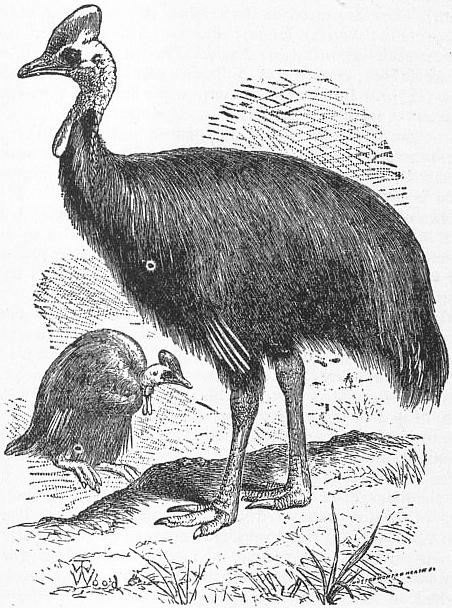
Fig. 1.—Ceram Cassowary.2
The cassowaries (Casuariidae) and emeus (Dromaeidae)—as the latter name is now used—have much structural resemblance, and form the order Megistanes,3 which is peculiar to the Australian Region. Huxley showed (Proc. Zool. Soc., 1867, pp. 422, 423,) that they agree in differing from the other Ratitae in many important characters; one of the most obvious of them is that each contour-feather appears to be double, its hyporachis, or aftershaft, being as long as the main shaft—a feature noticed in the case of either form so soon as examples were brought to Europe. The external distinctions of the two families are, however, equally plain. The cassowaries, when adult, bear a horny helmet on their head; they have some part of the neck bare, generally more or less ornamented with caruncles, and the claw of the inner toe is remarkably elongated. The emeus have no helmet, their head is feathered, their neck has no caruncles, and their inner toes bear a claw of no singular character.
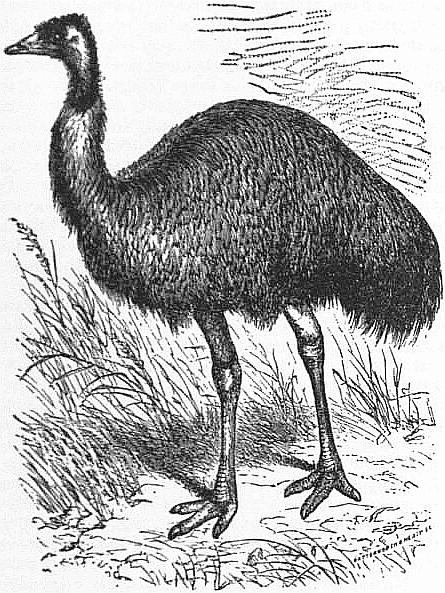
Fig. 2.—Emeu.
The type of the Casuariidae is the species named by Linnaeus Struthio casuarius and by John Latham Casuarius emeu. Vieillot subsequently called it C. galeatus, and his epithet has been very commonly adopted by writers, to the exclusion of the older specific appellation. It seems to be peculiar to the island of Ceram, and was made known to naturalists, as we learn from Clusius, in 1597, by the first Dutch expedition to the East Indies, when an example was brought from Banda, whither it had doubtless been conveyed from its native island. It was said to have been called by the inhabitants “Emeu,” or “Ema,” but this name they must have had from the earlier Portuguese navigators.4 Since that time examples have been continually imported into Europe, so that it has become one of the best-known members of the subclass Ratitae. For a long time its glossy, but coarse and hair-like, black plumage, its lofty helmet, the gaudily-coloured caruncles of its neck, and the four or five barbless quills which represent its wing-feathers, made it appear unique among birds. But in 1857 Dr George Bennett certified the existence of a second and perfectly distinct species of cassowary, an inhabitant of New Britain, where it was known to the natives as the Mooruk, and in his honour it was named by John Gould C. bennetti. Several examples were soon after received in England, and these confirmed the view of it already taken. A considerable number of other species of the genus have since been described from various localities in the same subregion. Conspicuous among them from its large size and lofty helmet is the C. australis, from the northern parts of Australia. Its existence indeed had been ascertained, by T.S. Wall, in 1854, but the specimen obtained by that unfortunate explorer was lost, and it was not until 1867 that an example was submitted to competent naturalists.
Not much seems to be known of the habits of any of the cassowaries in a state of nature. Though the old species occurs rather plentifully over the whole of the interior of Ceram, A.R. Wallace was unable to obtain or even to see an example. They all appear to bear captivity well, and the hens in confinement frequently lay their dark-green and rough-shelled eggs, which, according to the custom of the Ratitae, are incubated by the cocks. The nestling plumage is mottled (Proc. Zool. Soc., 1863, pl. xlii.), and when about half-grown they are clothed in dishevelled feathers of a deep tawny colour.
Of the emeus (as the word is now restricted) the best known is the Casuarius novae-hollandiae of John Latham, made by Vieillot the type of his genus Dromaeus,5 whence the name of the family (Dromaeidae) is taken. This bird immediately after the colonization of New South Wales (in 1788) was found to inhabit the south-eastern portion of Australia, where, according to John Hunter (Hist. Journ., &c., pp. 409, 413), the natives call it Maracry, Marryang or Maroang; but it has now been so hunted down that not an example remains at large in the districts that have been fully settled. It is said to have existed also on the islands of Bass Straits and in Tasmania, but it has been exterminated in both, without, so far as is known, any ornithologist having had the opportunity of determining whether the race inhabiting those localities was specifically identical with that of the mainland or distinct. Next to the ostrich the largest of existing birds, the common emeu is an inhabitant of the more open country, feeding on fruits, roots and herbage, and generally keeping in small companies. The nest is a shallow pit scraped in the ground, and from nine to thirteen eggs, in colour varying from a bluish-green to a dark bottle-green, are laid therein. These are hatched by the cock-bird, the period of incubation lasting from 70 to 80 days. The young at birth are striped longitudinally with dark markings on a light ground. A remarkable structure in Dromaeus is a singular opening in the front of the windpipe, communicating with a tracheal pouch. This has attracted the attention of several anatomists, and has been well described by Dr Murie (Proc. Zool. Soc., 1867, pp. 405-415). Various conjectures have been made as to its function, the most probable of which seems to be that it is an organ of sound in the breeding-season, at which time the hen-bird has long been known to utter a remarkably loud booming note. Due convenience being afforded to it, the emeu thrives well, and readily propagates its kind in Europe. Like other Ratite birds it will take to the water, and examples have been seen voluntarily swimming a wide river.
(A. N.)
1 By Moraes (1796) and Sousa (1830) the word is said to be from the Arabic Na’āma or Na’ēma, an ostrich (Struthio camelus); but no additional evidence in support of the assertion is given by Dozy in 1869 (Glossaire des mots espagnols et portugais dérivés de l’arabe, 2nd ed., p. 260). According to Gesner in 1555 (lib. iii. p. 709), it was the Portuguese name of the crane (Grus communis), and had been transferred with the qualifying addition of “di Gei” (i.e. ground-crane) to the ostrich. This statement is confirmed by Aldrovandus (lib. ix. cap. 2). Subsequently, but in what order can scarcely now be determined, the name was naturally enough used for the ostrich-like birds inhabiting the lands discovered by the Portuguese, both in the Old and in the New World. The last of these are now known as rheas, and the preceding as cassowaries.
2 The figures are taken, by permission, from Messrs Mosenthal and Harting’s Ostriches and Ostrich Farming (Trübner & Co., 1877).
3 Ann. and Mag. Nat. Hist. ser. 4, xx. p. 500.
4 It is known that the Portuguese preceded the Dutch in their voyages to the East, and it is almost certain that the latter were assisted by pilots of the former nation, whose names for places and various natural objects would be imparted to their employers (see Dodo).
5 The obvious misprint of Dromeicus in this author’s work (Analyse, &c., p. 54) was foolishly followed by many naturalists, forgetful that he corrected it a few pages farther on (p. 70) to Dromaius—the properly latinized form of which is Dromaeus.
EMIGRATION (from Lat. emigrare; e, ex, out of, and migrare, to depart), the movement of population out of one country into another (see Migration).
EMILIA, a territorial division (compartimento) of Italy, bounded by Venetia and Lombardy on the N., Liguria on the W., Tuscany on the S., the Marches on the S.E., and the Adriatic Sea on the E. It has an area of 7967 sq. m., and a population of 2,477,690 (1901), embracing eight provinces, as follows:—(1) Bologna (pop. 529,612; 61 communes); (2) Ferrara (270,558; 16 communes); (3) Forlì (283,996; 41 communes); (4) Modena (323,598; 45 communes); (5) Parma (303,694; 50 communes); (6) Piacenza (250,491; 47 communes); (7) Ravenna (234,656; 18 communes); (8) Reggio nell’ Emilia (281,085; 43 communes). In these provinces the chief towns, with communal populations, are as follows:—
(1) Bologna (147,898), Imola (33,144), Budrio (17,077), S. Giovanni in Persiceto (15,978), Castelfranco (13,484), Castel S. Pietro (13,426), Medicina (12,575), Molinella (12,081), Crevalcore (11,408).
(2) Ferrara (86,675), Copparo (39,222), Argenta (20,474), Portomaggiore (20,141), Cento (19,078), Bondeno (15,682), Comacchio (10,745).
(3) Forlì (43,321), Rimini (43,595). Cesena (42,509).
(4) Modena (63,012), Carpi (22,876), Mirandola (13,721), Finale nell’ Emilia (12,896), Pavullo nel Frignano (12,034).
(5) Parma (48,523), Borgo S. Donnino (12,019).
(6) Piacenza (35,647).·
(7) Ravenna (63,364), Faenza (39,757), Lugo (27,244), Bagnacavallo (15,176), Brisighella (13,815), Alfonsine (10,369).
(8) Reggio nell’ Emilia (58,993), Correggio (14,445), Guastalla (11,091).
The northern portion of Emilia is entirely formed by a great plain stretching from the Via Aemilia to the Po; its highest point is not more than 200 ft. above sea-level, while along the E. coast are the lagoons at the mouth of the Po and those called the Valli di Comacchio to the S. of them, and to the S. again the plain round Ravenna (10 ft.), which continues as far as Rimini, where the mountains come down to the coast.
Immediately to the S.E. of the Via Aemilia the mountains begin to rise, culminating in the central chain of the Ligurian and Tuscan Apennines. The boundary of Emilia follows the highest summits of the chain in the provinces of Parma, Reggio and Modena, passing over the Monte Bue (5915 ft.) and the Monte Cimone (7103 ft.), while in the provinces of Bologna and Forlì it keeps somewhat lower along the N.E. slopes of the chain. With the exception of the Po, the main rivers of Emilia descend from this portion of the Apennines, the majority of them being tributaries of the Po; the Trebbia (which rises in the province of Genoa), Taro, Secchia and Panaro are the most important. Even the Reno, Ronco and Montone, which now flow directly into the Adriatic, were, in Roman times, tributaries of the Po, and the Savio and Rubicone seem to be the only streams of any importance from these slopes of the Tuscan Apennines which ran directly into the sea in Roman times (see Apennines).
Railway communication in the plain of Emilia is unattended by engineering difficulties (except for the bridging of rivers) and is mainly afforded by the line from Piacenza to Rimini. This, as far as Bologna, forms part of the main route from Milan to Florence and Rome, while beyond Rimini it follows the S.E. coast of Italy past Ancona as far as Brindisi and Lecce. The description follows this main line in a S.E. direction. Piacenza, being immediately S. of a bridge over the Po, is an important centre; a line runs to the W. to Voghera, through which it communicates with the lines of W. Lombardy and Piedmont, and immediately N. of the Po a line goes off to Cremona. A new bridge over the Po carries a direct line from Cremona to Borgo S. Donnino. From Parma starts a main line, followed by expresses from Milan to Rome, which crosses the Apennines to Spezia (and Sarzana, for Pisa and Rome), tunnelling under the pass of La Cisa, while in a N. and N.E. direction lines run to Brescia and Suzzara. From Reggio branch lines run to Guastalla, Carpi and Sassuolo, there being also a line from Sassuolo to Modena. At Modena the main line to Verona through Suzzara and Mantua diverges to the N.; there is also a branch N.N.E. to Mirandola, and another S. to Vignola. Bologna is, however, the most important railway centre; besides the line S. to Pistoia and Florence over the Apennines and the line S.E. to Rimini, Ancona and Brindisi, there is the main line N.N.E. to Ferrara, Padua and Venice, and there are branches to Budrio and Portomaggiore to the N.E., and to S. Felice sul Panaro and Poggio Rusco to the N., which connect the main lines of the district.
At Castel Bolognese, 5 m. N.W. of Faenza, a branch goes off to Lugo, whence there are connexions with Budrio, Lavezzola (on the line between Ravenna and Ferrara) and Ravenna, and at Faenza a line, not traversed by express trains, goes across the Apennines to Florence. Rimini is connected by a direct line with Ravenna and Ferrara; and Ferrara, besides the main line S.S.W. to Bologna and N. by E. to Padua, has a branch to Poggio Rusco, which goes on to Suzzara, a station on the main line between Modena and Verona. There are also many steam tramways in the flatter part of the province, the fertility and agricultural activity of which are considerable. The main products of the plain are cereals, wine, and, in the marshy districts near the Po, rice; the system prevailing is that of the mezzadria—half the produce to the owner and half to the cultivator. The ancient Roman divisions of the fields are still preserved in some places. There are also considerable pastures, and cheese is produced, especially Parmesan. Flax, hemp and silkworms are also cultivated, and a considerable quantity of poultry kept. The hill districts produce cereals, vines, olives and fruit; while on the mountains are considerable chestnut and other forests, and extensive summer pastures, the flocks going in part to the Maremma in summer, and in part to the pastures of the plain of the Emilia.
The name Emilia comes from the Via Aemilia (q.v.), the Roman road from Ariminum to Placentia, which traversed the entire district from S.E. to N.W., its line being closely followed by the modern railway. The name was transferred to the district (which formed the eighth Augustan region of Italy) as early as the time of Martial, in popular usage (Epigr. vi. 85. 5), and in the 2nd and 3rd centuries it is frequently named as a district under imperial judges (iuridici), generally in combination with Flaminia or Liguria and Tuscia. The district of Ravenna was, as a rule, from the 3rd to the 5th century, not treated as part of Aemilia, the chief town of the latter being Placentia. In the 4th century Aemilia and Liguria were joined to form a consular province; after that Aemilia stood alone, Ravenna being sometimes temporarily added to it. The boundaries of the ancient district correspond approximately with those of the modern.
In the Byzantine period Ravenna became the seat of an exarch; and after the Lombards had for two centuries attempted to subdue the Pentapolis (Ravenna, Bologna, Forlì, Faenza, Rimini), Pippin took these cities from Aistulf and gave them, with the March of Ancona, to the papacy in 755, to which, under the name of Romagna, they continued to belong. At first, however, the archbishop of Ravenna was in reality supreme. The other chief cities of Emilia—Ferrara, Modena, Reggio, Parma, Piacenza—were, on the other hand, independent, and in the period of the communal independence of the individual towns of Italy each of the chief cities of Emilia, whether belonging to Romagna or not, had a history of its own; and, notwithstanding the feuds of Guelphs and Ghibellines, prospered considerably. The study of Roman law, especially at Bologna, acquired great importance. The imperial influence kept the papal power in check. Nicholas III. obtained control of the Romagna in 1278, but the papal dominion almost fell during the Avignon period, and was only maintained by the efforts of Cardinal Albornoz, a Spaniard sent to Italy by Innocent VI. in 1353. Even so, however, the papal supremacy was little more than a name; and this state of things only ceased when Caesar Borgia, the natural son of Alexander VI., crushed most of the petty princes of Romagna, intending to found there a dynasty of his own; but on the death of Alexander VI. it was his successors in the papacy who carried on and profited by what Caesar Borgia had begun. The towns were thenceforth subject to the church and administered by cardinal legates. Ferrara and Comacchio remained under the house of Este until the death of Alphonso II. in 1597, when they were claimed by Pope Clement VIII. as vacant fiefs. Modena and Reggio, which had formed part of the Ferrara duchy, were thenceforth a separate duchy under a branch of the house of Este, which was descended from a natural son of Alphonso I. Carpi and Mirandola were small principalities, the former of which passed to the house of Este in 1525, in which year Charles V. expelled the Pio family, while the last of the Pico dynasty of Mirandola, Francesco Maria, having sided with the French in the war of Spanish Succession, was deprived of his duchy in 1709 by the emperor Joseph I., who sold it to the house of Este in 1710. Parma and Piacenza were at first under the Farnese, Pope Paul III. having placed his natural son Pier Luigi therein 1545, and then, after the extinction of the family in 1731, under a secondary branch of the Bourbons of Spain. In 1796-1814, Emilia was first incorporated in the Italian republic and then in the Napoleonic Italian kingdom; after 1815 there was a return to the status quo ante, Romagna returning to the papacy and its ecclesiastical government, the duchy of Parma being given to Marie Louise, wife of the deposed Napoleon, and Modena to the archduke Francis of Austria, the heir of the last Este. In Romagna and Modena the government was oppressive, arbitrary, corrupt and unprogressive, while in Parma things were better. In 1821 and 1831 there were unsuccessful attempts at revolt in Emilia, which were sternly and cruelly repressed; chronic discontent continued and the people joined again in the movement of 1848-1849, which was crushed by Austrian troops. In 1859 the struggle for independence was finally successful, Emilia passing to the Italian kingdom almost without resistance.
EMINENCE (Lat. eminentia), a title of honour now confined to the cardinals of the Church of Rome. It was originally given as a complimentary title to emperors, kings, and then to less conspicuous persons. The Roman empire of the 4th century adopted from the “vanity of the East the forms and ceremonies of ostentatious greatness.” Gibbon includes in the “profusion of epithets” by which “the purity of the Latin language was debased,” and which were lavished on “the principal officers of the empire,” “your Sincerity, your Gravity, your Excellency, your Eminence, your sublime and wonderful Magnitude, your illustrious and magnificent Highness.” From the notitia dignitatum it passed into the Latin of the middle ages as a flattering epithet, and was applied in the church and by the popes to the dignified clergy at large, and sometimes as a pure form of civility to churchmen of modest rank. On the 10th of June 1630, Urban VIII. confined the use of the titles Eminentiae and Eminentissimi to the cardinals, to imperial electors, and to the master of the Hospital of St John of Jerusalem (order of the Knights of Malta). Since the dissolution of the Holy Roman Empire, and the entire change, if not actual destruction, of the order of St John, the title “eminence” has become strictly confined to the cardinals. Before 1630 the members of the Sacred College were “Illustrissimi” and “Reverendissimi.” It is, therefore, not correct to speak of a cardinal who lived before that time as “his Eminence.”
See du Cange, Glossarium mediae et infimae latinitatis (Niort and London, 1884), s.v. “Eminentia.”
EMINENT DOMAIN (Lat. eminens, rising high above surrounding objects: and dominium, domain), a term applied in law to the sovereign right of a state to appropriate private property to public uses, whether the owner consents or not. It is repeatedly employed by Grotius (e.g. De jure belli, bk. iii. c. 20, s. 7), Bynkershoek (Quaest. jur. pub. bk. 2, c. 15), and Puffendorf (De jure naturae et gentium, bk. i. c. 1, s. 19),—the two latter, however, preferring the word imperium to dominium; and by other Dutch jurists. But in modern times it is chiefly in the United States of America that the doctrine of eminent domain has received its application, and it is chiefly to American law that the following remarks refer (see also the article Compensation). Eminent domain is distinguishable alike from the police power, by which restrictions are imposed on private property in the public interest, e.g. in connexion with the liquor traffic or public health (see re Haff (1904), 197 U.S. 488); from the power of taxation, by which the owner of private property is compelled to contribute a portion of it for public purposes; and from the war-power, involving the destruction of private property in the course of military operations. The police power fetters rights of property; eminent domain takes them away. The power of taxation is analogous to eminent domain as regards the purposes to which the contribution of the tax-payer is to be applied. But, unlike eminent domain, it does not necessarily involve a taking of specific property for those purposes. The destruction of property in military operations—or in the discharge by Government of other duties in cases of necessity, e.g. in order to check the progress of a fire in a city—clearly cannot be said to be an exercise of the power of eminent domain. The question whether the element of compensation is necessarily involved in the idea of eminent domain has in modern times aroused much controversy. According to one school of thought (see Lewis, Eminent Domain, s. 10), this question must be answered in the negative. According to a second, whose view has the support of the civilians (see Randolph, Eminent Domain, s. 227; Mills, Eminent Domain, s. 1) compensation is an inherent attribute of the power. An intermediate view is advocated by Professor Thayer (Cases on Constitutional Law, vol. 1, 953), according to which eminent domain springs from the necessities of government, while the obligation to reimburse rests upon the natural right of individuals. The right to compensation is thus not a component part of the power to take, but arises at the same time and the latter cannot exist without it. The relation between the two is that of substance and shadow. The matter is not, however, of great practical importance, for the Federal Constitution prohibits the exercise of the power “without just compensation” (5th Amendment), while in most of the states the State constitution or other legislation has imposed upon it a similar limitation: and the tendency of modern judicial decisions is in favour of the view that the absence of such a limitation will make an enactment so far unconstitutional and invalid.
In order to justify the exercise of the power of eminent domain, the purposes to which the property taken is to be applied must be “public,” i.e. primarily public, and not primarily of private interest and merely incidentally beneficial to the public (Madisonville Traction Co. v. Mining Co., 1904, 196 U.S. 239). Subject to this definition, the term “public” receives a wide interpretation. All kinds of property may be taken; and the procedure indicated by the different legislatures must be followed. Any contravention of this rule would involve a breach of the 5th Amendment of the Federal Constitution, which provides that “no person ... shall be ... deprived of ... property, without due process of law.” It may be added that if the performance of a covenant is rendered impossible by an act of eminent domain the covenantor is excused.
In English law, the only exact analogue to the doctrine of eminent domain is to be found in the prerogative right of the crown to enter upon the lands of subjects or to interfere with their enjoyment for the defence of the realm (see A.G. v. Tomline; 1879; 12 Ch. D. 214). No attempt is made to exercise this prerogative, and lands are acquired for state purposes by statute usually framed on or incorporating the Lands Clauses Acts (see Compensation). The French Code Civil secures compensation to the owner of property in cases of expropriation pour cause d’utilité publique (art. 545), and there is similar provision in Belgium (Const. Law, art. II.), Holland (Fundamental Law, art. 147), Spain (Civil Code, art. 349, and Law of 3rd May, 1841), and most other European states. It has been held in France that the right to compensation does not arise under art. 545 of the Code Civil where only a servitude d’utilité publique is created on a private individual’s land.