VOLUME IX SLICE III Electrostatics to Engis (continued 14)
Reading edition
ENDOEUS, an early sculptor, who worked at Athens in the middle of the 6th century B.C. We are told that he made an image of Athena dedicated by Callias the contemporary of Pisistratus at Athens about 564 B.C. An inscription bearing his name has been found at Athens, written in Ionian dialect. The tradition which made him a pupil of Daedalus is apparently misleading, since Daedalus had no connexion with Ionic art.
ENDOGAMY (Gr. ἔνδον, within, and γάμος, marriage), marriage within the tribe or community, the term adopted to express the custom compelling those of a tribe to marry among themselves. Endogamy was probably characteristic of the very early stages of social organization (see Family), and is to-day found only among races low in the scale of civilization. As a custom it is believed to have been preceded in most lands by the far more general rule of Exogamy (q.v.). Lord Avebury (Origin of Civilisation, p. 154) points out that “there is not the opposition between exogamy and endogamy which Mr McLennan supposed.” Some races which are endogamous as regards the tribe are exogamous as regards the gens. Thus the Abors, Kochs, Hos and other peoples of India, are forbidden to marry out of the tribe; but the tribe itself is divided into “keelis” or clans, and no man is allowed to take as wife a girl of his own “keeli”. Endogamy must have in most cases arisen from racial pride, and a contempt, either well or ill founded, for the surrounding peoples.
Among the Ahtena of Alaska, though the tribes are extremely militant and constantly at war, the captured women are never made wives, but are used as slaves. Endogamy also prevails among tribes of Central America. With the Yerkalas of southern India a custom prevails by which the first two daughters of a family may be claimed by the maternal uncle as wives for his sons. The value of a wife is fixed at twenty pagodas (a 16th-century Indian coin equivalent to about five shillings), and should the uncle forgo his claim he is entitled to share in the price paid for his nieces. Among some of the Karen tribes marriages between near relatives are usual. The Douignaks, a branch of the Chukmas, seem to have practised endogamy; and they “abandoned the parent stem during the chiefship of Janubrix Khan about 1782. The reason of this split was a disagreement on the subject of marriages. The chief passed an order that the Douignaks should intermarry with the tribe in general. This was contrary to an ancient custom and caused discontent and eventually a break in the tribe” (Lewin’s Hill Tracts of Chittagong, p. 65). This is interesting as being one of the few cases in which evidence of a change in this respect is available. The Kalangs of Java are endogamous, and every man must first prove his common descent before he can enter a family. The Manchu Tatars prohibit those who have the same family names from marrying. Among the Bedouins “a man has an exclusive right to the hand of his cousin.” Hottentots seldom marry out of their own kraal, and David Livingstone quotes other examples. Endogamy seems to have existed in the Sandwich Islands and in New Zealand. A community of Javans near Surabaya, on the Teugger Hills, numbering about 1200 persons, distributed in about forty villages, and still following the ancient Hindu religion, is endogamous. Good examples of what biologists call “in-and-in breeding” are to be found in various fishing villages in Great Britain, such as Itchinferry, near Southampton, Portland Island, Bentham in Yorkshire, Mousehole and Newlyn in Mountsbay, Cornwall, Boulmer near Alnwick (where almost all the inhabitants are called Stephenson, Stanton or Stewart), Burnmouth, Ross and (to some extent) Eyemouth in Berwickshire, Boyndie in Banffshire, Rathen in Aberdeenshire, Buckhaven in Fifeshire, Portmahomack and Balnabruach in Eastern Ross. In France may be mentioned the commune of Batz, near Le Broisic in Loire-Inférieur, many of the central cantons of Brétagne, and the singular society called Foréatines—supposed to be of Irish descent—living between St Arnaud and Bourges. Many other European examples might be mentioned, such as the Marans of Auvergne, a race of Spanish converted Jews accused of introducing syphilis into France; the Burins and Sermoyers, chiefly cattle-breeders, scattered over the department of Ain and especially in the arrondissement of Bourg-en-Bresse; the Vaquéros, shepherds in the Asturias Mountains; and the Jewish Chuetas of Majorca.
See Gilbert Malcolm Sproat’s Scenes and Studies of Savage Life; Westermarck’s History of Human Marriage (1894); Lord Avebury’s Origin of Civilisation (1902); J.F. McLennan’s Primitive Marriage (1865).
ENDOR, an ancient town of Palestine, chiefly memorable as the abode of the sorceress whom Saul consulted on the eve of the battle of Gilboa, in which he perished (1 Sam. xxviii. 5-25). According to a psalmist (Ps. lxxxiii. 9) it was the scene of the rout of Jabin and Sisera. Although situated in the territory of the tribe of Issachar, it was assigned to Manasseh. In the time of Eusebius and Jerome Endor existed as a large village 5 m. south of Mount Tabor; there is still a poor village of the same name on the slope of Jebel Daḥi, near which are numerous caves.
For a description of the locality see Stanley, Sinai and Palestine, p. 337.
ENDOSPORA, a natural group or class of the Sporozoa, consisting of the orders Myxosporidia, Actinomyxidia, Sarcosporidia and Haplosporidia, together with various insufficiently-known forms (Sero- and Exosporidia), regarded at present as Sporozoa incertae sedis. The distinguishing feature of the group is that the spore-mother-cells (pansporoblasts) arise in the interior of the body of the parent-individual; in other words, sporulation is endogenous. Another very general character—though not so universal—is that the adult trophozoite possesses more than one nucleus, usually many (i.e. it is multinucleate). In the majority of forms, though apparently not in all (e.g. certain Microsporidia), sporulation goes on coincidently with growth and trophic life. With regard to the origin of the group, the probability is greatly in favour of a Rhizopod ancestry. The entire absence, at any known period, of a flagellate or even gregariniform phase; on the other hand, the amoeboid nature of the trophozoites in very many cases together with the formation of pseudopodia; and, lastly, the simple endogenous spore-formation characteristic of the primitive forms,—are all points which support this view, and exclude any hypothesis of a Flagellate origin, such as, on the contrary, is probably the case in the Ectospora (q.v.).
1. Order Myxosporidia. The Myxosporidia, or, more correctly, the dense masses formed by their spores, were well known to the earlier zoological observers. The parasites in fishes were called by Müller “fish-psorosperms,” a name which has stuck to them ever since, although, as is evident from the meaning of the term (“mange-seed”), Müller had little idea of the true nature of the bodies. Other examples, infesting silkworms, have also long been known as “Pèbrine-corpuscles,” from the ravaging disease which they produce in those caterpillars in France, in connexion with which Pasteur did such valuable work. The foundation of our present morphological and biological knowledge of the order was well laid by the admirable researches of Thèlohan in 1895. In spite, however, of the contributions of numerous workers since then (e.g. Doflein, Cohn, Stempell and others), there are still one or two very important points, such as the occurrence of sexual conjugation, upon which light is required.
Although pre-eminently parasites of fishes, Myxosporidia also occur, in a few cases, in other Vertebrates (frogs and reptiles); no instance of their presence in a warm-blooded Vertebrate has, however, yet been described. One Occurrence and habitat. suborder (the Microsporidia or Cryptocystes) is pretty equally distributed between fishes on the one hand and Invertebrates—chiefly, but not exclusively, Arthropods—on the other. The parasites are frequently the cause of severe and fatal illness in their hosts, and devastating epidemics of myxosporidiosis have often been reported (e.g. among carp and barbel in continental rivers, due to a Myxobolus, and among crayfish in France, to Thelohania).
The seat of the invasion and the mode of parasitism are extremely varied. Practically any organ or tissue may be attacked, excepting, apparently, the testis and cartilage and bone. In one instance at least (that of Nosema bombycis of the silkworm) the parasites penetrate into the ova, so that true hereditary infection occurs, the progeny being born with the disease. The parasites may be either free in some lumen, such as that of the gall bladder or urinary bladder (not of the alimentary canal, or the body-cavity itself), when they are known as coelozoic forms; or in intimate relation with some tissue, intracellular while young but becoming intercellular in the adult phase (histozoic forms); or entirely intracellular (cytozoic forms). Among the histozoic and cytozoic types, moreover, two well-defined conditions, concentration and diffuse infiltration, occur. In the former, the parasitic zone is strictly limited, and well-marked cysts are formed; in the latter, the infection spreads throughout the neighbouring tissue, and the parasitic development becomes inextricably commingled with the host’s cells. Sometimes, as shown by Woodcock (45), there may be an attempt on the part of the host’s tissue to circumscribe and check the growth of these parasitic areas, which results in the formation of pseudocysts, quite different in character from true cysts.
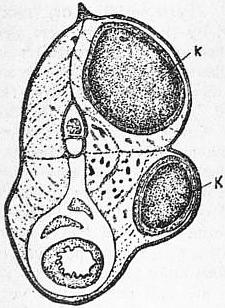
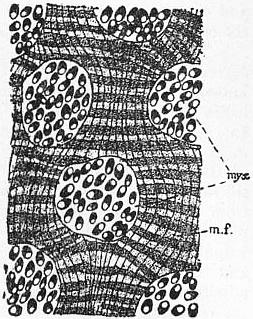
From Lankester’s Treatise on Zoology, vol. Protozoa, from Wasielewski, after Thélohan. From Lankester’s Treatise on Zoology, vol. Protozoa.
Fig. 1.—Transverse section of a stickle-back (Gasterosteus aculeatus), showing two cysts of Glugea anomala, Moniez (kk), in the body musculature on the right side. Fig. 2.—Portion of a section through a muscle fibre of Cottus scorpius invaded by Pleistophora typicalis, Gurley. m, f, Muscle fibrils, retaining their striation. myx, Cysts of the parasite, lying between the fibrils.
The most noticeable feature about the Myxosporidian trophozoite is its amoeboid and Rhizopod-like character. Pseudopodia of various kinds, from long slender ones (fig. 3, B) to short blunt lobose ones, are of general occurrence, being most easily observed, of Morphology. course, in the free-living forms. The pseudopodia serve chiefly for movement and attachment, and never, it should be noted, for the injection of solid food-particles, as in the case of Amoebae. The general protoplasm is divisible into ectoplasm and endoplasm. The former is a clear, finely-granular layer, of which the pseudopodia are mainly constituted (fig. 3, A). In one or two instances (e.g. Myxidium lieberkühnii) the ectoplasm shows a vertical striation, and in the older trophozoites breaks down partially, appearing like a fur of delicate, non-motile filaments. A somewhat similar modification is found in Myxocystis. The endoplasm is more fluid, and contains numerous inclusions of a granular nature, as well as vacuoles of varying size. In the endoplasm are lodged the nuclei, of which in an adult trophozoite there may be very many; they are all derived by multiplication from the single nucleus with which the young individuals begin life, the number increasing as growth proceeds.
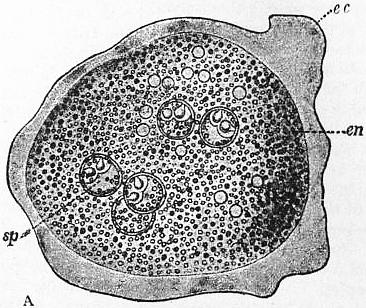
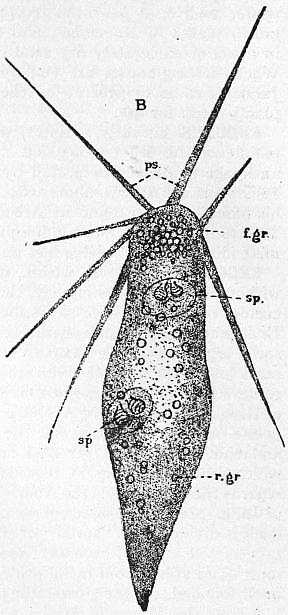
From Wasielewski, Sporozoenkunde. Fig. 3.—A. Trophozoite of Sphaerospora divergens, Thél. (par. Blennius and Crenilabrus), × 750. ec, Ectoplasm; en, endoplasm; sp, spores, each with four pole capsules. From Lankester’s Treatise on Zoology, vol. Protozoa. B. Spore-bearing trophozoite of Leptotheca agilis, Thél. (par. Trygon and Scorpaena), × 750. ps, Pseudopodia localized at the anterior end; f.gr, fatty granules similarly localized; r.gr, refringent granules; sp, spores, two in number.
Spore-formation goes on entirely in the endoplasm. The number of spores formed is very variable. It may be as low as two (as in free-living forms, e.g. Leptotheca), in which case a large amount of trophic protoplasm is unconverted Spore-formation; multiplicative processes. into spores; or, on the other hand, the number of spores may be very great (as in tissue-parasites), practically the whole of the parent-body being thus used up. The sporont may or may not encyst at the commencement of sporulation. In the free-living forms there is no cyst-membrane secreted; but in certain Glugeidae, on the other hand, the ectoplasm becomes altered into a firm, enclosing layer, the ectorind, which forms a thick cyst-wall (fig. 5). The process of sporulation begins by the segregation of small quantities of endoplasm around certain of the nuclei, to form little, rounded bodies, the pansporoblasts. There may be either very many or only few pansporoblasts developed; in some cases, indeed, there is only one, the sporont either itself becoming a pansporoblast (certain Microsporidia), or giving rise to a solitary one (Ceratomyxidae). The pansporoblast constituted, nuclear multiplication goes on preparatory to the formation of sporoblasts, which in their turn become spores (see figs. 4 and 5). Not all the nuclei thus formed, however, are made use of. In the Phaenocystes there are always two sporoblasts developed in each pansporoblast; in the Cryptocystes there may be from one to several. Around each sporoblast a spore-membrane is secreted, which usually has the form of two valves. It has recently been shown by Léger and Hesse (29b) that, in many Phaenocystes at any rate, each of these valves is formed by a definite nucleated portion of the sporoblast.
The spores themselves vary greatly in size and shape (figs. 7 and 8). They may be as small as 1.5 μ by 1 μ (as in a species of Nosema), or as large as 100 μ by 12 μ (as in Ceratomyxa). A conspicuous feature in the structure of a fully-developed spore is the polar-capsules, of which there may be either 1, 2, or 4 to each. In the Phaenocystes the polar-capsules are visible in the fresh condition, but not in the Cryptocystes. The polar-capsule is an organella which recalls the nematocyst of a Hydrozoan, containing a spirally-coiled filament, often of great length, which is shot out on the application of a suitable stimulus. Normally, as was ingeniously shown by Thélohan (43), the digestive juices of the fresh host serve this purpose, but various artificial means may suffice. The function of the everted filament is probably to secure the attachment of the spore to the epithelium of the new host. In the Phaenocystes, in connexion with each polar-capsule, a small nuclear body can be generally made out; these two little nuclei are those of the two “capsulogenous” areas of the protoplasm of the pansporoblast, which formed the capsules. The sporoplasm, representing the sporozoite, is always single. Nevertheless, in the Phaenocystes it is invariably binuclear; and, in the Microsporidia, the nucleus, at first single, gives rise later to four nuclei, two of which are regarded by Stempell (42) as corresponding to those of two polar-capsules (of which only one is developed in the spore), the remaining two representing germ-nuclei. Hence it is possible that the Myxosporidian sporoplasm really consists of two, incompletely-divided (sister) germs. Moreover, it is supposed by some that these two nuclei fuse together later, this act representing a sexual conjugation; since the earliest known phases of young trophozoites (amoebulae) have been described as uninuclear.
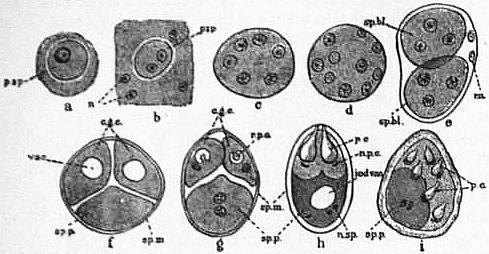
From Lankester’s Treatise on Zoology, vol. Protozoa, after Thélohan.
Fig. 4.—Stages in spore-formation. All the figures are from Myxobolus ellipsoides, except a and f, which are from M. pfeifferi.
a, Differentiation of the pansporoblast (p.sp). b, Pansporoblast with two nuclei. c and d, Pansporoblasts with six and ten nuclei respectively; in d, four of the nuclei are degenerating. e, Pansporoblast segmented into two definitive sporoblasts, each with three nuclei. In the next four figures the definitive sporoblast, or the spore produced from it, is alone figured. f, Definitive sporoblast segmented into three masses, the capsulogenous cells (c.g.c) and the sporoplasm (sp.p), within an envelope, the spore membrane (sp.m). g, More advanced stage. h, Spore completely developed, with two polar capsules and sporoplasm containing an iodinophilous vacuole. i, Abnormal spore containing six polar capsules. n, Nuclei. sp.bl, Definitive sporoblast. r.n, Residuary nuclei. vac, Vacuole. r.p.c, Rudiment of p.c, polar capsule. n.p.c, Nuclei of polar capsules. iod.vac, Iodinophilous vacuole. n.sp, Nuclei of sporoplasm.
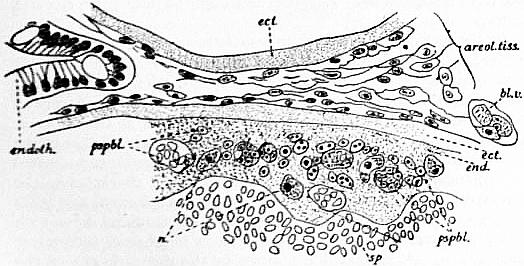
From Woodcock, Proc. and Trans. of the Liverpool Biological Society, 1904.
Fig. 5.—Part of the periphery of a cyst of Glugea stephani, in the intestinal wall of the plaice, showing sporoblast and spore-formation.
ect, Ectorind. end, Endoplasm. endoth, Fold of the mucous membrane, normal in character. p.sp.bl, Various stages in the development of the pansporoblasts. sp, Ripe spores, filling the greater part of the cyst. n, Large (vegetative) nuclei.
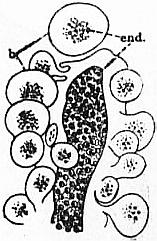
From Lankester’s Treatise on Zoology, vol. Protozoa.
Fig. 6.—Formation of buds by multiple plasmotomy in Myxidium lieberkühnii, Bütschli (par. Esox and Lota) after Cohn.
b, Buds. end, Endoplasm; the clear outer portion represents the ectoplasm.
In addition to spore-formation, two or three modes of endogenous reproduction, serving for auto-infection, have been made known. One, termed by Doflein plasmotomy, consists either in the division of the (multinucleate) trophozoite into two, by more or less equal fission (simple plasmotomy), or in the budding-off, from the parent trophozoite, of several portions (example: Myxidium lieberkühnii, fig. 6). A variety of this method has been described by Stempell (40) in the case of the young trophozoites (meronts) of Thelohania mülleri, which may divide into two while still uninuclear; and by rapid successive divisions chains of meronts may be formed, the different individuals being incompletely separated. Another method, which is probably chiefly responsible for the rapid spread of tissue-parasites and cell-parasites (such as Myxobolidae and Glugeidae) through their host’s tissue in the condition of diffuse infiltration, consists in multiple nuclear division, and the liberation of amoebulae while the parasite is yet quite young and possesses only few nuclei. As Woodcock has pointed out in considering the case of Glugea stephani, it is very probable that this “multiplicative reproduction,” in diffuse infiltration, is to be looked upon as a separation of the pansporoblast-rudiments as daughter-individuals; i.e. that the pansporoblasts are, in certain circumstances, capable of independent existence as little sporonts. A further stage in this direction of evolution is seen, according to Stempell, in Thelohania, Pleistophora and other types where the whole individual becomes one reproductive organella; such forms are to be considered as examples of a phylogenetic individualization of the pansporoblasts, which now exist as solitary sporonts. An extreme case of this “reduction of the individual” is found, apparently in the genus Nosema, as lately characterized by Perez (34), where vast numbers of minute entirely independent sporonts (pansporoblasts) are produced, each of which gives rise to only a single spore.
The Myxosporidia are divided into two suborders, the Phaenocystes and the Cryptocystes. Some authors have of late years separated these two divisions and raised each to the rank of a distinct order, considering that they are not more closely related to each other than to other Endosporan orders. We think this is a mistake; and it is very interesting to find that Léger and Hesse (1908) have described (29a) a new genus of Phaenocystes, Coccomyxa, which represents a type intermediate between these two suborders, and shows that they are closely connected.
Suborder 1: Phaenocystes, Gurley. Spores relatively large, with generally two or four polar-capsules, visible in the fresh Classification. condition. There are nearly always two spores formed in each pansporoblast.
Section (a): Disporea. Only two spores (i.e. one pansporoblast) produced in each individual trophozoite. The greatest length of the spore is at right angles to the plane of the suture.
One family, Ceratomyxidae, including two genera, Ceratomyxa (fig. 3, B) and Leptotheca, typically “free” parasites, mostly from the gall bladders of fishes. The valves of the spore in the former genus are prolonged into hollow cones. The type-species of this genus is C. sphaerulosa, from Mustelus and Galeus; that of Leptotheca is L. agilis, from Trygon.
Section (b): Polysporea. More than two spores, generally very many, are produced typically by each individual trophozoite. The greatest length of the spore is usually in the sutural plane.
Family, Myxidiidae. Spores with two polar-capsules, and without an iodinophilous vacuole in the sporoplasm. Mostly “free” parasites. Gen. Sphaerospora. Four or five species are known, from the kidneys or gall bladder of fishes (fig. 3, A). One, S. elegans, is interesting in that it affords a transition between the two sections, being disporous. Gen. Myxidium; spores elongated and fusiform, with a polar capsule at each extremity. The best-known species is M. lieberkühnii, from the urinary bladder of the pike. One or two species occur in reptiles. Other genera are Sphaeromyxa, Cystodiscus, Myxosoma and Myxoproteus.
Family, Chloromyxidae. Spores with four polar capsules and no iodinophilous vacuole. One genus, Chloromyxum, of which several species are known; the type being C. leydigi, from the gall bladder of various Elasmobranchs (fig. 7, B).
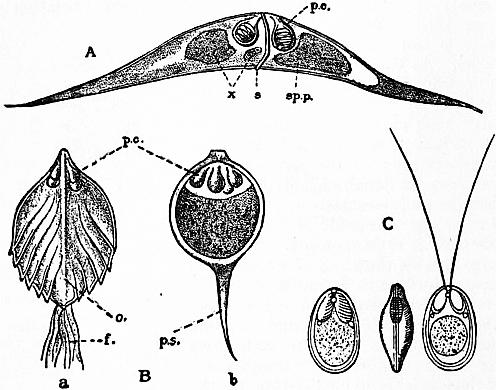
Fig. 7.—A. Spore of Ceratomyxa sphaerulosa, Thél. (par. Mustelus and Galeus), × 750, after Thélohan. sp.p, Sporoplasm; p.c, polar capsules; s, suture; x, “irregular, pale masses, of undetermined origin.”
From Lankester’s Treatise on Zoology, vol. Protozoa.
B. Spores of Chloromyxidae, after Thélohan. a, Chloromyxum leydigi, Ming., seen from the sutural aspect, × 2250; b, C. caudatum, Thél., × 1900. p.c, Polar capsules; s, suture; f, filaments; p.s, tail-like process of the spore envelope.
From Wasielewski’s Sporozoenkunde.
C. Spores of Myxobolus ellipsoides, Thél. The spores on the left and right are lying with the sutural plane horizontal, that in the middle with the sutural plane vertical.
Family, Myxobolidae. Spores with two polar-capsules (exceptionally one), and with a characteristic iodinophilous vacuole in the sporoplasm. Typically tissue parasites of Teleosteans, often very dangerous. Genus Myxobolus. Spores oval or rounded, without a tail-like process. Very many species are known, which are grouped into three subsections: (a) forms with only one polar-capsule, such as M. piriformis, of the tench; (b) forms with two unequal capsules, e.g. M. dispar from Cyprinus and Leuciscus; and (c) the great majority of species with two equal polar-capsules, including M. mülleri, the type-species, from different fish, M. cyprini and M. pfeifferi, the cause of deadly disease in carp and barbel respectively and others. Other genera are Henneguya and Hoferellus, differing from Myxobolus in having, respectively, one or two tail-like processes to the spore. Lentospora, according to Plehn (37), lacks an iodinophilous vacuole.
Family Coccomyxidae. The pansporoblasts produce (probably) only one spore. Spore oval, large (14 μ by 5.5 μ), with a single very large polar-capsule. Sporoplasm with no vacuole. Single genus Coccomyxa, with the characters of the family. One species, C. morovi, Léger and Hesse, from the gall bladder of the sardine. The spore greatly resembles a Cryptocystid spore.
Suborder 2: Cryptocystes, Gurley (= Microsporidia, Balbiani). Spores minute, usually pear-shaped, with only one polar-capsule, which is visible only after treatment with reagents. The number of spores formed in each pansporoblast varies greatly in different forms.
Section (a): Polysporogenea. The trophozoite produces numerous pansporoblasts, each of which gives rise to many spores. Genus Glugea, with numerous species, of which the best-known is G. anomala, from the stickleback (fig. 1). The genus Myxocystis, which has been shown by Hesse (24) to be a true Microsporidian, is placed by Perez in this section, but this is a little premature, as Hesse does not describe the exact character of the sporulation, i.e. with regard to the number of pansporoblasts and the spores they produce.
Section (b): Oligosporogenea. The trophozoite becomes itself the (single) pansporoblast. In Pleistophora, the pansporoblast produces many spores; P. typicalis, from the muscles of various fishes (fig. 2), is the type-species. In Thelohania, eight spores are formed; the different species are parasitic in Crustacea. In Gurleya, parasitic in Daphnia, only four are formed; and, lastly, in Nosema (exs. N. pulvis, from Carcinus, and, most likely, N. bombycis, of the silkworm), each pansporoblast produces only a single spore.
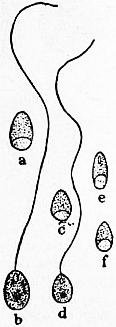
From Lankester’s Treatise on Zoology, vol. Protozoa.
Fig. 8.—Spores of various Glugeidae, × 1500 (after Thélohan).
a and b, Pleistophora typicalis, Gurley; a in the fresh condition, b after treatment with iodine water, causing extrusion of the filament. c and d, Thelohania octospora, Henneguy; c fresh, d treated with ether. e, Glugea depressa, Thél., fresh. f, G. acuta, Thél.
2. Order—Actinomyxidia. This order comprises a peculiar group of parasites, first described by A. Stolc in 1899, which are restricted to Oligochaete worms of the family Tubificidae. Most forms attack the intestinal wall, often destroying its epithelium over considerable areas; but one genus, Sphaeractinomyxon, inhabits the body-cavity of its host. The researches of Caullery and Mesnil (10-12) and of Léger (28 and 29) have shown that the parasites exhibit the typical features of the Endospora, and the spores possess the characteristic polar-capsules of the Myxosporidian spore, but differ therefrom by their more complicated structure.
The growth and development of an Actinomyxidian have been recently worked out by Caullery and Mesnil in the case of Sphaeractinomyxon stolci. A noteworthy point is the differentiation of an external (covering) cellular layer, which affords, perhaps, the nearest approach to distinct tissue-formation known among Protozoa. This envelope is formed soon after nuclear multiplication of the young trophozoite has begun, and is constituted by two nuclei and a thin, peripheral layer of cytoplasm. It remains binuclear throughout the entire period of development, and serves as a delicate cyst-membrane. The multiplication of the internal nuclei is accompanied by a corresponding division of the cytoplasm; so that instead of a multinucleate or plasmodial condition, distinct uninucleate cellules are formed, up to sixteen in number. These cellules, as a matter of fact, are sexual elements or gametes; and eight of them can be distinguished from the other eight by slight differences in the nuclei. The gametes unite in couples, each couple being most probably composed of dissimilar members: in other words, conjugation is slightly anisogamous. Each of these eight copulae gives rise to a spore.
As the name of the order implies, there are always eight spores formed. These differ from other Endosporan spores in having invariably a ternary symmetry and constitution (fig. 9). The wall of the spore is composed of three valves, each formed from an enveloping cell, and three capsular cells, placed at the upper or anterior pole, and containing each a polar-capsule, visible in the fresh condition. The valves are usually prolonged into processes or appendages, whose form and arrangement characterize the genus; but in Sphaeractinomyxon the spore is spherical and lacks processes. The sporoplasm may be either a plasmodial mass, with numerous nuclei, or may form a certain number of uninuclear sporozoites. A remarkable feature in the development of the spore is that the germinal tissue (sporoplasm) arises separate from and outside the cellules which give rise to the spore-wall; later, when the envelopes are nearly developed, the sporoplasm penetrates into the spore.
Four genera have been made known. (1) Hexactinomyxon, Stolc. Spores having the form of an anchor with six arms; sporoplasm plasmodial, situate near the anterior pole of the spore. One sp. H. psammoryctis, from Psammoryctes. (2) Triactinomyxon, St. Spores having the form of an anchor with three arms; distinct sporozoites, disposed near the anterior pole. T. ignotum, with eight spores, from Tubifex tubifex, and also from an unspecified Tubificid; another sp., unnamed, with 32 sporozoites, also from T. t. (3) Synactinomyxon, St. Spores united to one another, each having two aliform appendages; sporoplasm plasmodial. One sp., S. tubificis, from T. rivulorum. (4) Sphaeractinomyxon, C. and M. Spores spherical, without aliform prolongations; sporoplasm gives rise to very many sporozoites, occupying the whole spore. One sp., S. stolci, from Clitellio and Hemitubifex.
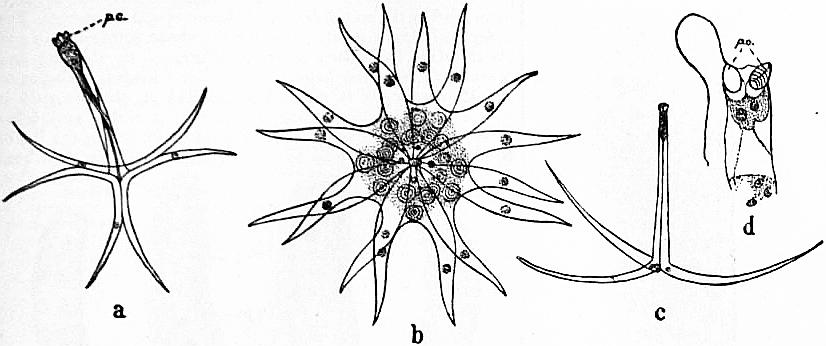
From Lankester’s Treatise on Zoology, vol. Protozoa.
Fig. 9.—Spores of Actinomyxidia (after Stolc).
a, Hexactinomyxon psammoryctis (par. Psammoryctes barbatus). b, Synactinomyxon tubificis (par. Tubifex rivulorum); the mass of united spores. c, Triactinomyxon ignotum (par. Clitellio, sp.). d, Upper portion of Hexactinomyxon, showing two of the three polar capsules, one with filament discharged.
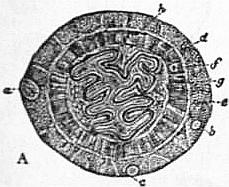
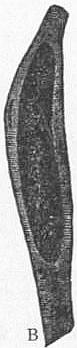
From Wasielewski’s Sporozoenkunde.
Fig. 10.—A. Sarcosporidia in the ox; a transverse section of the oesophagus, natural size, showing the parasites in the outer (a, b, c, d, e) and inner (f, g, h) muscular coats.
B. Longitudinal section of a muscle-fibre containing a Sarcosporidian parasite, × 60.
3. Order—Sarcosporidia. With the exception of one or two forms occurring in reptiles, these parasites are always found in warm-blooded Vertebrates, usually Mammals. They are of common occurrence in domestic animals, such as pigs, sheep, horses and (sometimes) cattle. A Sarcosporidian has also been described from man. The characteristic habitat is the striped muscle, generally of the oesophagus (fig. 10, A) and heart, but in acute cases the parasites overrun the general musculature. When this occurs, as often happens in mice, the result is usually fatal. Unless, however, the organisms thus spread throughout the body, the host does not appear to suffer any serious consequences. In addition to the effects produced by the general disturbance to the tissues, the attacked animals have apparently to contend—at any rate in the case of Sarcocystis tenella in the sheep—with a poison secreted by the parasite. For Laveran and Mesnil (27) have isolated a toxine from this form, which they have termed sarcocystin.
In the early stages of growth, a Sarcosporidian appears as an elongated whitish body lodged in the substance of a muscle-fibre; this phase has long been known as a “Miescher’s tube,” or Miescheria. The youngest trophozoites that have been yet observed (by Bertram, 1) were multinucleate (fig. 11, A), but there is no reason to doubt that they begin life in a uninuclear condition. The protoplasm is limited by a delicate cuticle. With growth, organellae corresponding to the Myxosporidian pansporoblasts are formed by the segregation internally of little uninuclear spheres of protoplasm. At the same time, a thick striated envelope is developed around the parasite, which later comes to look like a fur of fine filaments. The probable explanation of this feature (given by Vuillemin, 44) is that it is due to the partial breaking down of a stiff, vertically (or radially) striated external layer (fig. 12, A), such as is seen in Myxidium lieberkühnii. Immediately internal to this is a thin, homogeneous membrane, which sends numerous partitions or septa inwards; these divide up the endoplasm into somewhat angular chambers or alveoli (fig. 12). In each chamber is a pansporoblast, which divides up to produce many spores; hence the spores formed from different pansporoblasts are kept more or less separate. The pansporoblasts originate, in a growing Sarcosporidian, at the two poles of the body, where the peripheral endoplasm with its nuclei is chiefly aggregated. More internally, spore-formation is in progress; and in the centre, pansporoblasts full of ripe spores are found.
By this time the parasite has greatly distended the muscle-fibre in which it has hitherto lain, absorbing, with its growth, practically all the contractile-substance, until it is surrounded only by the sarcolemma and sarcoplasm. It next passes into the adjacent connective-tissue, and in this phase has been distinguished from Miescheria as Balbiania, under the impression that the two forms were quite distinct. In the later stages, the parasite may become more rounded, and a cyst may be secreted around it by the host’s tissue. In these older forms, the most centrally placed spores degenerate and die, having become over-ripe and stale.
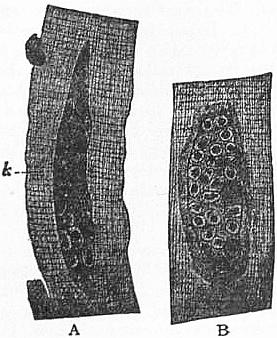
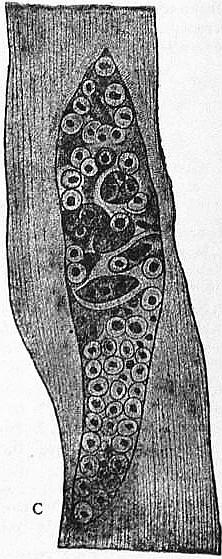
After Bertram, from Wasielewski’s Sporozoenkunde.
Fig. 11.—Stages in the growth of Sarcocystis tenella of the sheep. A, Youngest observed stage in which the radially striated outer coat has not appeared; the body of the trophozoite is already divided into a number of cells or pansporoblasts (k). B and C, Older stages with numerous pansporoblasts and two envelopes, an inner membrane and an outer radially striated layer.
With regard to the spores themselves and what becomes of them, our knowledge is defective. Two kinds of reproductive germ have been described, termed respectively gymnospores (so-called sporozoites, “Rainey’s corpuscles”) and chlamydospores, or simply spores. It seems probable that the former serve for endogenous or auto-infection, and the latter for infecting fresh hosts. Unfortunately, however, both kinds of germ are not yet known in the case of any one species. The gymnospores, which are the more commonly found (e.g. in S. muris, S. miescheriana of the pig, and other forms), are small sickle-shaped or reniform bodies which are more or less amoeboid, and capable of active movement at certain temperatures. They appear to be naked, and consist of finely granular protoplasm, containing a single nucleus and one or two vacuoles. The chlamydospores, or true spores, occur in S. tenella of sheep (fig. 13), and have been described by Laveran and Mesnil (26). They also are falciform, but one extremity is rounded, the other pointed. There is a very thin, delicate membrane, most unlike a typical, resistant spore-wall; and the spores themselves are extremely fragile and easily acted upon and deformed by reagents, even by distilled water. The rounded end of the spore contains a large nucleus, while at the other end is an oval, clear space, which, in the fresh condition, shows a distinct spiral striation. The exact significance of this structure has been much debated. In position and appearance it recalls the polar-capsule of a Myxosporidian spore. The proof of this interpretation would be the expulsion of a filament on suitably stimulating the spore; while, however, some investigators have asserted that such a filament is extruded, this cannot be regarded as at all certain. Hence it is still doubtful whether this striated body really corresponds to a polar-capsule.
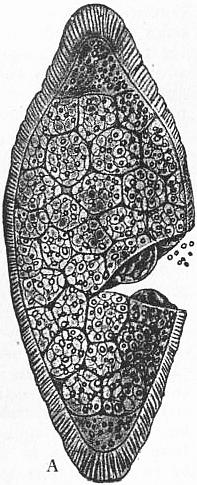
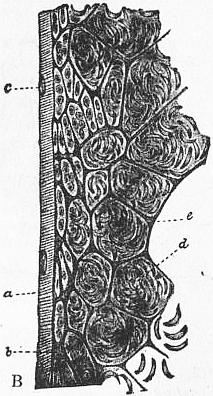
From Wasielewski’s Sporozoenkunde.
Fig. 12.—A, Sarcocystis miescheriana (Kühn) from the pig: late stage in which the body has become divided up into numerous chambers or alveoli, each containing a number of germs.
B, Sarcocystis of the ox: section of a stage similar to fig. 12. a, Substance of muscle-fibre; b, envelope of parasite; c, nuclei of the muscle; d, parasitic germs (gymnospores); e, walls of the alveoli. In the peripheral alveoli are seen immature germs.
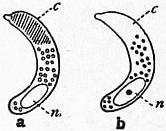
(After Laveran and Mesnil, from Lankester’s Treatise on Zoology, vol. Protozoa.)
Fig. 13.—Spores of Sarcocystis tenella, Raill., from the sheep.
a, Spore in the fresh condition, showing a clear nucleus (n) and a striated body or capsule (c). b, Stained spore; the nucleus (n) shows a central karyosome; the striations of the polar capsule (c) are not visible.
Nothing whatever is known as to the natural means by which infection with Sarcosporidia is brought about. Smith (39) showed that mice can be infected with Sarcocystis muris by simply feeding them on the flesh of infected mice. It is not very likely, however, that this represents the natural mode, even in the case of mice; and it certainly cannot do so in the case of Herbivora. The difficulty in the way is the delicacy of the spores, which seem totally unfitted to withstand external conditions. It may be that some alternative (intermediate) host is concerned in dispersal; but this has yet to be ascertained.
All known Sarcosporidia are included in a single genus Sarcocystis, Lank. (= Miescheria + Balbiania, Blanchard.) Some of the principal species are: S. miescheriana, from pigs; S. tenella, from sheep; S. bertrami, from horses; S. blanchardi, from Bovines; S. muris, from mice; S. platydactyli, from the gecko; and lastly, S. lindemanni, described from man.
4. Order—Haplosporidia. The Sporozoa included in this order are characterized by the general simplicity of their development, and by the undifferentiated character of their spores. The order includes a good many forms, whose arrangement and classification have been recently undertaken by Caullery and Mesnil (15), to whom, indeed, most of our knowledge relating to the Haplosporidia is due. The habitat of the parasites is sufficiently varied; Rotifers, Crustacea, Annelids and fishes furnishing most of the hosts. A recent addition to the list of Protozoa causing injury to man, a Haplosporidian, has been described by Minchin and Fantham (29d), who have termed the parasite Rhinosporidium, from its habitat in the nasal septum, where it produces pedunculate tumours.
From Minchin, in Lankester’s Treatise on Zoology, vol. Protozoa.
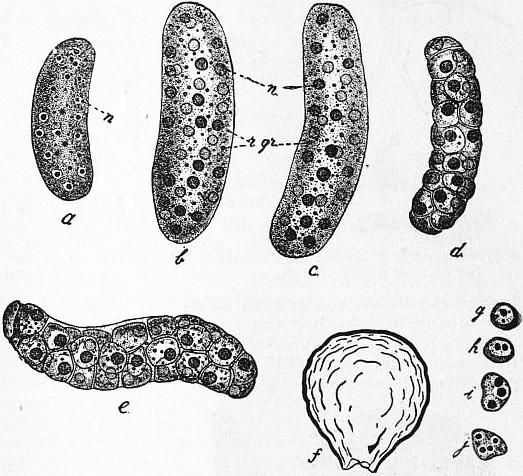
Fig. 14.—Bertramia Asperospora (Fritsch) from the body-cavity of Brachionus. × 1040.
a, Young form with opaque, evenly-granulated protoplasm and few refringent granules; the nuclei (n) are small, and appear to be surrounded each by a clear space. b and c, Full-grown specimens with large nuclei and clearer protoplasm, containing numerous refringent granules (r. gr.). d and e, Morula stages, derived from b and c by division of the body into segments centred round the nuclei, each cell so formed being a spore. Between the spores a certain amount of intercellular substance or residual protoplasm is left, in which the refringent granules seem to be embedded. The morula may break up forthwith and scatter the spores, or may first round itself off and form a spherical cyst with a tough, fairly thick wall. f, Empty, slightly shrunken cyst, from which the spores have escaped. g, Free spore or youngest unicellular trophozoite. h, i, j, Commencing growth of the trophozoite, with multiplication of the nuclei, which results ultimately in forms such as a and b.
Bertramia, a well-known parasite of the body-cavity of Rotifers, will serve very well to give a general idea of the life-cycle so far as it has yet been made out (fig. 14). The trophozoite begins life as a small, rounded uninucleate corpuscle, which as it grows, becomes multinucleate. The multinuclear body generally assumes a definite shape, often that of a sausage. Later, the protoplasm becomes segregated around each of the nuclei, giving the parasite a mulberry-like aspect; hence this stage is frequently known as a morula. The uninuclear cellules thus formed are the spores, which are ultimately liberated by the break-up of the parent body. Each is of quite simple, undifferentiated structure, possesses a large, easily-visible nucleus, and gives rise in due course to another young trophozoite. In some instances, as described by Minchin, the sporulating parasite becomes rounded off and forms a protective cyst, doubtless for the protection of the spores during dissemination.
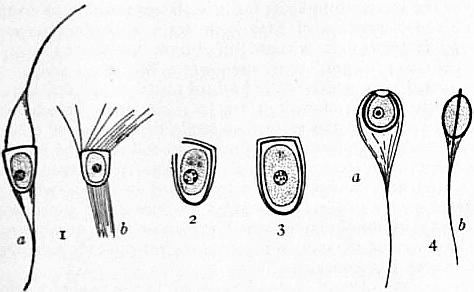
In some forms (e.g. Haplosporidium and Rhinosporidium) the spore-mother-cells, instead of becoming each a single spore, as in Bertramia, give rise to several, four in the first case, many in the latter. Sometimes, again, the spore, while preserving the essentially simple character of the sporoplasm, may be enclosed in a spore-case; this may have the form of a little box with a lid or operculum, as in some species of Haplosporidium, or may possess a long process or tail, as in Urosporidium (fig. 15).
The Haplosporidia are divided by Caullery and Mesnil into three families, Haplosporidiidae, Bertramiidae and Coelosporidiidae; one or two genera are also included whose exact position is doubtful.
(a) Haplosporidiidae: 3 genera, Haplosporidium, type-species H. heterocirri; Urosporidium, with one sp., U. fuliginosum; all parasitic in various Annelids; and Anurosporidium, with the species A. pelseneeri, from the sporocysts of a Trematode, parasitic on Donax.
From Caullery and Mesnil, Archives de zoologie expérimentale, vol. 4, 1905, by permission of Schleicher Frères et Cie, Paris.
Fig. 15.—Spores of various Haplosporidia.
1. Haplosporidium heterocirri: a, on liberation; b, after being in sea-water. 2, H. scolopli. 3, H. vejdovskii. 4, Urosporidium fuliginosum: a, surface-view; b, side-view. × 1000.
(b) Bertramiidae: 2 genera, Bertramia, with B. capitellae from an Annelid and B. asperospora, the Rotiferan parasite above described; and Ichthyosporidium, with I. gasterophilum and I. phymogenes, parasitic in various fish.
(c) Coelosporidiiae: genera Coelosporidium, type-species C. chydoriclola; and Polycaryum, type-species P. branchiopodianum. These forms are parasitic in small Crustacea. The genus Blastulidium is referred, doubtfully, by Caullery and Mesnil to this family; but certain phases of this organism seem to indicate rather a vegetable nature.
The genus Rhinosporidium should probably be placed in a distinct family. The only species so far described is R. kinealyi from the nasal septum of man, to which reference has above been made. Another form, Neurosporidium cephalodisci, agreeing in some respects with Rhinosporidium, has been described by Ridewood and Fantham (37a) from the nervous system of Cephalodiscus.
A parasite whose affinities are doubtful, but which is regarded by Caullery and Mesnil as allied to the Haplosporidia, is the curious parasite originally described by Schewiakoff as “endoparasitic tubes” of Cyclops; it has been named by Caullery and Mesnil, Scheviakovella. This organism is remarkable in one or two ways: it possesses a contractile vacuole; the amoeboid trophozoites tend to form plasmodia; and the spores, of the usual simple type, may apparently divide by binary fission.
5. There remain, lastly, certain forms, which are conveniently grouped together as “Sporozoa incertae sedis,” either for the reason that it is impossible to place them in any of the well-defined orders, or because their life-cycle is at present too insufficiently known. Serosporidia is the name given by Pfeiffer to certain minute parasites of the body-cavity of Crustacea; they include Serosporidium, Blanchardina and Botellus. Lymphosporidium, a form with distributed nucleus, causing virulent epidemics among brook-trout, is considered by Calkins(3) to be suitably placed here. Another parasite of lymphatic spaces and channels is the remarkable Lymphocystis, described by Woodcock (46), from plaice and flounders, which in some respects rather recalls a Gregarine. The group Exosporidia was founded by Perrier to include a peculiar organism, ectoparasitic on Arthropods, to which the name of Amoebidium had been given by Cienkowsky. It has recently been shown, however, that this organism is most probably an Alga. Another genus, Exosporidium, described by Sand (38), is placed at present in this group. For details of the structure of these forms and others like Siedleckia, Toxosporidium, Chitonicium Joyeuxella and Metschnikovella, a comprehensive treatise on the Sporozoa, such as that of Minchin, should be consulted.
To complete this article, it will be sufficient to mention various enigmatical bodies, associated with different diseases, which are regarded by their describers as Protozoa. Among such is the “Histosporidium carcinomatosum” of Feinberg, which he finds in cancerous growths. Cytoryctes, the name given to “Guarnieri’s bodies” in small-pox and vaccinia, has been recently investigated by Calkins (3a), who has described a complex life-cycle for the alleged parasite. Other workers, however, such as Siegel, give a quite different account of these bodies, and, moreover, find similar ones in scarlet-fever, syphilis, &c.; while yet others (e.g. Prowazek) deny that they are parasitic organisms at all.
Bibliography.—(For general works see under Sporozoa.) (1) Bertram, “Beiträge zur Kenntnis der Sarcosporidien,” Zool. Jahrb. Anat. 5, 1902; (2) L. Brasil, “Joyeuxella toxoides,” (n.g., n.sp.), Arch. zool. exp. N. et R. (3) 10, p. 5, 7 figs., 1902; (3) G.N. Calkins, “Lymphosporidium truttae,” (n.g., n.sp.), Zool. Anz. 23, p. 513, 6 figs., 1903; (3a) ib. The Life-History of Cytoryctes Variolae; Guarnieri, “Studies path. etiol. variola,” J. Med. Research (Boston, 1904), p. 136, 4 pls.; (3b) M. Caullery and A. Chappellier, “Anurosporidium pelseneeri, (n.g., n.sp.), Haplosporidie,” &c., C. R. soc. biol. 60, p. 325, 1906; (4) M. Caullery and F. Mesnil, “Sur un type nouveau” (Metchnikovella, n.g.), C. R. ac. sci. 125, p. 787, 10 figs., 1897; (5) ib. “Sur trois Sporozoaires parasites de la Capitella,” C. R. soc. biol. 49, p. 1005, 1877; (6) ib. “Sur un Sporozoaire aberrant” (Siedleckia, n.g.), op. cit. 50, p. 1093, 7 figs., 1898; (7) ib. “Sur le genre Aplosporidium” (nov.), op. cit. 51, p. 789, 1899; (8) ib. “Sur les Aplosporidies,” C. R. ac. sci. 129, p. 616, 1899; (9) ib. “Sur les parasites intimes des Annélides” (Siedleckia, Toxosporidium), C. R. ass. franç., 1899, p. 491, 1900; (10) ib. “Sur un type nouveau (Sphaeractinomyxon, n.g.) d’Actinomyxidies,” C. R. soc. biol. 56, p. 408, 1904; (11) ib. “Phénomènes de sexualité dans le développement des Actinomyxidies,” op. cit. 58, p. 889, 1905; (12) ib. “Recherches sur les Actinomyxidies,” Arch. Protistenk. 6, p. 272, pl. 15, 1905; (13) ib. “Sur quelques nouvelles Haplosporidies d’Annélides,” C. R. soc. biol. 58, p. 580, 6 figs., 1905; (14) ib. “Sur des Haplosporidies parasites de poissons marins,” ib. p. 640, 1905; (15) ib. “Recherches sur les Haplosporidies,” Arch. zool. exp. (4) 4, p. 101, pls. 11-13, 1905; (16) L. Cohn, “Über die Myxosporidien von Esox lucius,” Zool. Jahr. Anat. 9, p. 227, 2 pls., 1896; (17) ib. “Zur Kenntniss der Myxosporidien,” Centrbl. Bakt. 1, Orig. 32, p. 628, 3 figs., 1902; (18) ib. “Protozoen als Parasiten in Rotatorien,” Zool. Anz. 25, p. 497, 1902; (19) F. Doflein, “Über Myxosporidien,” Zool. Jahr. Anat. 11, p. 281, 6 pls., 1898; (20) ib. “Fortschritte auf dem Gebiete der Myxosporidienkunde,” Zool. Centrbl. 7, p. 361, 1899; (21) R. Gurley, “The Myxosporidia,” Bull. U.S. Fish. Comm., 1892, p. 65, 47 pls., 1894; (22) E. Hesse, “Sur une nouvelle Microsporidie tétrasporée du genre Gurleya,” C. R. soc. biol. 55, p. 495, 1903; (23) ib. “Thelohania légeri” (n.sp.), op. cit. 57, pp. 570-572, 10 figs., 1904; (24) ib. “Sur Myxocystis Mrazeki Hesse,” &c., op. cit. 58, p. 12, 9 figs., 1905; (25) A. Laveran and F. Mesnil, “Sur la multiplication endogène des Myxosporidies,” op. cit. 54, p. 469, 5 figs., 1902; (26) ib. “Sur la morphologie des Sarcosporidies,” op. cit. 51, p. 245, 1899; (27) ib. “De la Sarcocystin,” op. cit. p. 311, 1899; (28) L. Léger, “Sur la sporulation du Triactinomyxon,” op. cit. 56, p. 844, 4 figs., 1904; (29) ib. “Considérations sur ... les Actinomyxidies,” op. cit. p. 846, 1904; (29a) L. Léger and E. Hesse, “Sur une nouvelle Myxosporidie, Coccomyxa, n.g.,” C. R. ac. sci., 1st July 1907; (29b) ib. “Sur la structure de la paroisporale des Myxosporidies,” op. cit. 142, p. 720, 1906; (29c) A. Lutz and A. Splendore, “Über ‘Pébrine’ and verwandte Mikrosporidien,” Centrbl. Bakt. 1, 33, Orig. p. 150, 1903, and 36, Orig. p. 645, 2 pls., 1904; (29d) E.A. Minchin and H.B. Fantham, “Rhinosporidium kinealyi” (n.g., n.sp.), Q. J. Micr. Sci. 49, p. 521, 2 pls., 1905; (30) A. Mrazek, “Über eine neue Sporozoenform” (Myxocystis), S. B. Böhm. Ges. 8, 5 pp., 9 figs., 1897; (31) ib. “Glugea lophii,” Doflein, op. cit. 10, 8 pp., 1 pl., 1899; (32) C. Perez, “Sur un organisme nouveau, Blastulidium,” C. R. soc. biol. 55, p. 715, 5 figs., 1903; (33) ib. “Sur nouvelles Glugéidées,” op. cit. 58, pp. 146-151, 1905; (34) ib. “Microsporidies parasites des crabes,” Bull. sta. biol. d’Arcachon, 8, 22 pp., 14 figs., 1905; (35) W.S. Perrin, “Pleistophora periplanetae,” Q. J. Micr. Sci. 49, p. 615, 2 pls., 1906; (36) L. Plate, “Über einen einzelligen Zellparasiten” (Chitonicium), Fauna Chilensis, 2, pp. 601, pls., 1901; (37) M. Plehn, “Über die Drehkrankheit der Salmoniden” (Lentospora, n.g.), Arch. Protistenk. 5, p. 145, pl. 5, 1904; (37a) W.J. Ridewood and H.B. Fantham, “Neurosporidium cephalodisci, n.g., n.sp.,” Q. J. Micr. Sci. 51, p. 81, pl. 7, 1907; (38) R. Sand, “Exosporidium marinum” (n.g., n.sp.), Bull. soc. micr. belge, 24, p. 116, 1898; (39) T. Smith, “The production of sarcosporidiosis in the mouse,” &c., J. Exp. Med. 6, p. 1, 4 pls., 1901; (40) W. Stempell, “Über Thelohania mülleri,” Zool. Jahr. Anat. 16, p. 235, pl. 25, 1902; (41) ib. “Über Polycaryum branchiopodianum” (n.g., n.sp.), Zool. Jahrb. Syst. 15, p. 591, pl. 31, 1902; (42) ib. “Über Nosema anomalum,” Arch. Protistenk, 4, p. 1, pls. 1-3, 1904; (43) P. Thélohan, “Recherches sur les Myxosporidies,” Bull. sci. France belg. 26, p. 100, 3 pls., 1895; (44) P. Vuillemin, “Le Sarcocystis tenella, parasite de l’homme,” C. R. ac. sci. 134, p. 1152, 1902; (45) H.M. Woodcock, “On Myxosporidia in flat fish,” Proc. Liverp. Biol. Soc. 18, p. 126, pl. 2, 1904; (46) ib. “On a remarkable parasite” (Lymphocystis), op. cit. p. 143, pl. 3, 1904.
(H. M. Wo.)
ENDYMION, in Greek mythology, son of Aëthlius and king of Elis. He was loved by Selene, goddess of the moon, by whom he had fifty daughters, supposed to represent the fifty moons of the Olympian festal cycle. In other versions, Endymion was a beautiful youth, a shepherd or hunter whom Selene visited every night while he lay asleep in a cave on Mount Latmus in Caria (Pausanias v. 1; Ovid, Ars am. iii. 83). Zeus left him free to choose anything he might desire, and he chose an everlasting sleep, in which he might remain youthful for ever (Apollodorus i. 7). According to others, Endymion’s eternal sleep was a punishment inflicted by Zeus upon him because he ventured to fall in love with Hera, when he was admitted to the society of the Olympian gods (Schol. Theocritus iii. 49). The usual form of the legend, however, represents Endymion as having been put to sleep by Selene herself in order that she might enjoy his society undisturbed (Cicero, Tusc. disp. i. 38). Some see in Endymion the sun, setting opposite to the rising moon, the Latmian cave being the cave of forgetfulness, into which the sun plunges beneath the sea; others regard him as the personification of sleep or death (see Mayor on Juvenal x. 318).
ENERGETICS. The most fundamental result attained by the progress of physical science in the 19th century was the definite enunciation and development of the doctrine of energy, which is now paramount both in mechanics and in thermodynamics. For a discussion of the elementary ideas underlying this conception see the separate heading Energy.
Ever since physical speculation began in the atomic theories of the Greeks, its main problem has been that of unravelling the nature of the underlying correlation which binds together the various natural agencies. But it is only in recent times that scientific investigation has definitely established that there is a quantitative relation of simple equivalence between them, whereby each is expressible in terms of heat or mechanical power; that there is a certain measurable quantity associated with each type of physical activity which is always numerically identical with a corresponding quantity belonging to the new type into which it is transformed, so that the energy, as it is called, is conserved in unaltered amount. The main obstacle in the way of an earlier recognition and development of this principle had been the doctrine of caloric, which was suggested by the principles and practice of calorimetry, and taught that heat is a substance that can be transferred from one body to another, but cannot be created or destroyed, though it may become latent. So long as this idea maintained itself, there was no possible compensation for the destruction of mechanical power by friction; it appeared that mechanical effect had there definitely been lost. The idea that heat is itself convertible into power, and is in fact energy of motion of the minute invisible parts of bodies, had been held by Newton and in a vaguer sense by Bacon, and indeed long before their time; but it dropped out of the ordinary creed of science in the following century. It held a place, like many other anticipations of subsequent discovery, in the system of Natural Philosophy of Thomas Young (1804); and the discrepancies attending current explanations on the caloric theory were insisted on, about the same time, by Count Rumford and Sir H. Davy. But it was not till the actual experiments of Joule verified the same exact equivalence between heat produced and mechanical energy destroyed, by whatever process that was accomplished, that the idea of caloric had to be definitely abandoned. Some time previously R. Mayer, physician, of Heilbronn, had founded a weighty theoretical argument on the production of mechanical power in the animal system from the food consumed; he had, moreover, even calculated the value of a unit of heat, in terms of its equivalent in power, from the data afforded by Regnault’s determinations of the specific heats of air at constant pressure and at constant volume, the former being the greater on Mayer’s hypothesis (of which his calculation in fact constituted the verification) solely on account of the power required for the work of expansion of the gas against the surrounding constant pressure. About the same time Helmholtz, in his early memoir on the Conservation of Energy, constructed a cumulative argument by tracing the ramifications of the principle of conservation of energy throughout the whole range of physical science.
Mechanical and Thermal Energy.—The amount of energy, defined in this sense by convertibility with mechanical work, which is contained in a material system, must be a function of its physical state and chemical constitution and of its temperature. The change in this amount, arising from a given transformation in the system, is usually measured by degrading the energy that leaves the system into heat; for it is always possible to do this, while the conversion of heat back again into other forms of energy is impossible without assistance, taking the form of compensating degradation elsewhere. We may adopt the provisional view which is the basis of abstract physics, that all these other forms of energy are in their essence mechanical, that is, arise from the motion or strain of material or ethereal media; then their distinction from heat will lie in the fact that these motions or strains are simply co-ordinated, so that they can be traced and controlled or manipulated in detail, while the thermal energy subsists in irregular motions of the molecules or smallest portions of matter, which we cannot trace on account of the bluntness of our sensual perceptions, but can only measure as regards total amount.
Historical: Abstract Dynamics.—Even in the case of a purely mechanical system, capable only of a finite number of definite types of disturbance, the principle of the conservation of energy is very far from giving a complete account of its motions; it forms only one among the equations that are required to determine their course. In its application to the kinetics of invariable systems, after the time of Newton, the principle was emphasized as fundamental by Leibnitz, was then improved and generalized by the Bernoullis and by Euler, and was ultimately expressed in its widest form by Lagrange. It is recorded by Helmholtz that it was largely his acquaintance in early years with the works of those mathematical physicists of the previous century, who had formulated and generalized the principle as a help towards the theoretical dynamics of complex systems of masses, that started him on the track of extending the principle throughout the whole range of natural phenomena. On the other hand, the ascertained validity of this extension to new types of phenomena, such as those of electrodynamics, now forms a main foundation of our belief in a mechanical basis for these sciences.
In the hands of Lagrange the mathematical expression for the manner in which the energy is connected with the geometrical constitution of the material system became a sufficient basis for a complete knowledge of its dynamical phenomena. So far as statics was concerned, this doctrine took its rise as far back as Galileo, who recognized in the simpler cases that the work expended in the steady driving of a frictionless mechanical system is equal to its output. The expression of this fact was generalized in a brief statement by Newton in the Principia, and more in detail by the Bernoullis, until, in the analytical guise of the so-called principle of “virtual velocities” or virtual work, it finally became the basis of Lagrange’s general formulation of dynamics. In its application to kinetics a purely physical principle, also indicated by Newton, but developed long after with masterly applications by d’Alembert, that the reactions of the infinitesimal parts of the system against the accelerations of their motions statically equilibrate the forces applied to the system as a whole, was required in order to form a sufficient basis, and one which Lagrange soon afterwards condensed into the single relation of Least Action. As a matter of history, however, the complete formulation of the subject of abstract dynamics actually arose (in 1758) from Lagrange’s precise demonstration of the principle of Least Action for a particle, and its immediate extension, on the basis of his new Calculus of Variations, to a system of connected particles such as might be taken as a representation of any material system; but here too the same physical as distinct from mechanical considerations come into play as in d’Alembert’s principle. (See Dynamics: Analytical.)
It is in the cases of systems whose state is changing so slowly that reactions arising from changing motions can be neglected, that the conditions are by far the simplest. In such systems, whether stationary or in a state of steady motion, the energy depends on the configuration alone, and its mathematical expression can be determined from measurement of the work required for a sufficient number of simple transformations; once it is thus found, all the statical relations of the system are implicitly determined along with it, and the results of all other transformations can be predicted. The general development of such relations is conveniently classed as a separate branch of physics under the name Energetics, first invented by W.J.M. Rankine; but the essential limitations of this method have not always been observed. As regards statical change, the complete specification of a mechanical system is involved in its geometrical configuration and the function expressing its mechanical energy in terms thereof. Systems which have statical energy-functions of the same analytical form behave in corresponding ways, and can serve as models or representations of one another.
Extension to Thermal and Chemical Systems.—This dominant position of the principle of energy, in ordinary statical problems, has in recent times been extended to transformations involving change of physical state or chemical constitution as well as change of geometrical configuration. In this wider field we cannot assert that mechanical (or available) energy is never lost, for it may be degraded into thermal energy; but we can use the principle that on the other hand it can never spontaneously increase. If this were not so, cyclic processes might theoretically be arranged which would continue to supply mechanical power so long as energy of any kind remained in the system; whereas the irregular and uncontrollable character of the molecular motions and strains which constitute thermal energy, in combination with the vast number of the molecules, must place an effectual bar on their unlimited co-ordination. To establish a doctrine of energetics that shall form a sufficient foundation for a theory of the trend of chemical and physical change, we have, therefore, to impart precision to this motion of available energy.
Carnot’s Principle: Entropy.—The whole subject is involved in the new principle contributed to theoretical physics by Sadi Carnot in 1824, in which the far-reaching modern conception of cyclic processes was first scientifically developed. It was shown by Carnot, on the basis of certain axioms, whose theoretical foundations were subsequently corrected and strengthened by Clausius and Lord Kelvin, that a reversible mechanical process, working in a cycle by means of thermal transfers, which takes heat, say H1, into the material system at a given temperature T1, and delivers the part of it not utilized, say H2, at a lower given temperature T2, is more efficient, considered as a working engine, than any other such process, operating between the same two temperatures but not reversible, could be. This relation of inequality involves a definite law of equality, that the mechanical efficiencies of all reversible cyclic processes are the same, whatever be the nature of their operation or the material substances involved in them; that in fact the efficiency is a function solely of the two temperatures at which the cyclically working system takes in and gives out heat. These considerations constitute a fundamental general principle to which all possible slow reversible processes, so far as they concern matter in bulk, must conform in all their stages; its application is almost coextensive with the scope of general physics, the special kinetic theories in which inertia is involved, being excepted. (See Thermodynamics.) If the working system is an ideal gas-engine, in which a perfect gas (known from experience to be a possible state of matter) is passed through the cycle, and if temperature is measured from the absolute zero by the expansion of this gas, then simple direct calculation on the basis of the laws of ideal gases shows that H1/T1 = H2/T2; and as by the conservation of energy the work done is H1 − H2, it follows that the efficiency, measured as the ratio of the work done to the supply of heat, is 1 − T2/T1. If we change the sign of H1 and thus consider heat as positive when it is restored to the system as is H2, the fundamental equation becomes H1/T1 + H2/T2 = 0; and as any complex reversible working system may be considered as compounded in various ways of chains of elementary systems of this type, whose effects are additive, the general proposition follows, that in any reversible complete cyclic change which involves the taking in of heat by the system of which the amount is δH, when its temperature ranges between Tr and Tr + δT, the equation ΣδHr/Tr-0 holds good. Moreover, if the changes are not reversible, the proportion of the heat supply that is utilized for mechanical work will be smaller, so that more heat will be restored to the system, and ΣδHr/Tr or, as it may be expressed, ∫dH/T, must have a larger value, and must thus be positive. The first statement involves further, that for all reversible paths of change of the system from one state C to another state D, the value of ∫dH/T must be the same, because any one of these paths and any other one reversed would form a cycle; whereas for any irreversible path of change between the same states this integral must have a greater value (and so exceed the difference of entropies at the ends of the path). The definite quantity represented by this integral for a reversible path was introduced by Clausius in 1854 (also adumbrated by Kelvin’s investigations about the same time), and was named afterwards by him the increase of the entropy of the system in passing from the state C to the state D. This increase, being thus the same for the unlimited number of possible reversible paths involving independent variation of all its finite co-ordinates, along which the system can pass, can depend only on the terminal states. The entropy belonging to a given state is therefore a function of that state alone, irrespective of the manner in which it has been reached; and this is the justification of the assignment to it of a special name, connoting a property of the system depending on its actual condition and not on its previous history. Every reversible change in an isolated system thus maintains the entropy of that system unaltered; no possible spontaneous change can involve decrease of the entropy; while any defect of reversibility, arising from diffusion of matter or motion in the system, necessarily leads to increase of entropy. For a physical or chemical system only those changes are spontaneously possible which would lead to increase of the entropy; if the entropy is already a maximum for the given total energy, and so incapable of further continuous increase under the conditions imposed upon the system, there must be stable equilibrium.
This definite quantity belonging to a material system, its entropy φ, is thus concomitant with its energy E, which is also a definite function of its actual state by the law of conservation of energy; these, along with its temperature T, and the various co-ordinates expressing its geometrical configuration and its physical and chemical constitution, are the quantities with which the thermodynamics of the system deals. That branch of science develops the consequences involved in just two principles: (i.) that the energy of every isolated system is constant, and (ii.) that its entropy can never diminish; any complication that may be involved arises from complexity in the systems to which these two laws have to be applied.
The General Thermodynamic Equation.—When any physical or chemical system undergoes an infinitesimal change of state, we have δE = δH + δU, where δH is the energy that has been acquired as heat from sources extraneous to the system during the change, and δU is the energy that has been imparted by reversible agencies such as mechanical or electric work. It is, however, not usually possible to discriminate permanently between heat acquired and work imparted, for (unless for isothermal transformations) neither δH nor δU is the exact differential of a function of the constitution of the system and so independent of its previous history, although their sum δE is such; but we can utilize the fact that δH is equal to Tδφ where δφ is such, as has just been seen. Thus E and φ represent properties of the system which, along with temperature, pressure and other independent data specifying its constitution, must form the variables of an analytical exposition. We have, therefore, to substitute Tδφ for δH; also the change of internal energy is determined by the change of constitution, involving a differential relation of type
δU = −pδv + δW + μ1δm1 + μ2δm2 + ... + μnδmn,
when the system consists of an intimate mixture (solution) of masses m1, m2, ... mn of given constituents, which differ physically or chemically but may be partially transformable into each other by chemical or physical action during the changes under consideration, the whole being of volume v and under extraneous pressure p, while W is potential energy arising from physical forces such as those of gravity, capillarity, &c. The variables m1, m2, ... mn may not be all independent; for example, if the system were chloride of ammonium gas existing along with its gaseous products of dissociation, hydrochloric acid and ammonia, only one of the three masses would be independently variable. The sufficient number of these variables (independent components) together with two other variables, which may be v and T, or v and φ, specifies and determines the state of the system, considered as matter in bulk, at each instant. It is usual to include δW in μ1δm1 + ...; in all cases where this is possible the single equation
δE = Tδφ − pδv + μ1δm1 + μ2δm2 + ... + μnδmn
(1)
thus expresses the complete variation of the energy-function E arising from change of state; and when the part involving the n constitutive differentials has been expressed in terms of the number of them that are really independent, this equation by itself becomes the unique expression of all the thermodynamic relations of the system. These are in fact the various relations ensuring that the right-hand side is an exact differential, and are of the type of reciprocal relations such as dμr/dφ = dT/dmr.
The condition that the state of the system be one of stable equilibrium is that δφ, the variation of entropy, be negative for all formally imaginable infinitesimal transformations which make δE vanish; for as δφ cannot actually be negative for any spontaneous variation, none of these transformations can then occur. From the form of the equation, this condition is the same as that δE − Tδφ must be positive for all possible variations of state of the system as above defined in terms of co-ordinates representing its constitution in bulk, without restriction.
We can change one of the independent variables expressing the state of the system from φ to T by subtracting δ(φT) from both sides of the equation of variation: then
δ(E − Tφ) = −φδT − pδv + μ1δm1 + ... + μnδmn.
It follows that for isothermal changes, i.e. those for which δT is maintained null by an environment at constant temperature, the condition of stable equilibrium is that the function E − Tφ shall be a minimum. If the system is subject to an external pressure p, which as well as the temperature is imposed constant from without and thus incapable of variation through internal changes, the condition of stable equilibrium is similarly that E − Tφ + pv shall be a minimum.
A chemical system maintained at constant temperature by communication of heat from its environment may thus have several states of stable equilibrium corresponding to different minima of the function here considered, just as there may be several minima of elevation on a landscape, one at the bottom of each depression; in fact, this analogy, when extended to space of n dimensions, exactly fits the case. If the system is sufficiently disturbed, for example, by electric shock, it may pass over (explosively) from a higher to a lower minimum, but never (without compensation from outside) in the opposite direction. The former passage, moreover, is often effected by introducing a new substance into the system; sometimes that substance is recovered unaltered at the end of the process, and then its action is said to be purely catalytic; its presence modifies the form of the function E − Tφ so as to obliterate the ridge between the two equilibrium states in the graphical representation.
There are systems in which the equilibrium states are but very slightly dependent on temperature and pressure within wide limits, outside which reaction takes place. Thus while there are cases in which a state of mobile dissociation exists in the system which changes continuously as a function of these variables, there are others in which change does not sensibly occur at all until a certain temperature of reaction is attained, after which it proceeds very rapidly owing to the heat developed, and the system soon becomes sensibly permanent in a transformed phase by completion of the reaction. In some cases of this latter type the cause of the delay in starting lies possibly in passive resistance to change, of the nature of viscosity or friction, which is competent to convert an unstable mechanical equilibrium into a moderately stable one; but in most such reactions there seems to be no exact equilibrium at any temperature, short of the ultimate state of dissipated energy in which the reaction is completed, although the velocity of reaction is found to diminish exponentially with change of temperature, and thus becomes insignificant at a small interval from the temperature of pronounced activity.
Free Energy.—The quantity E − Tφ thus plays the same fundamental part in the thermal statics of general chemical systems at uniform temperature that the potential energy plays in the statics of mechanical systems of unchanging constitution. It is a function of the geometrical co-ordinates, the physical and chemical constitution, and the temperature of the system, which determines the conditions of stable equilibrium at each temperature; it is, in fact, the potential energy generalized so as to include temperature, and thus be a single function relating to each temperature but at the same time affording a basis of connexion between the properties of the system at different temperatures. It has been called the free energy of the system by Helmholtz, for it is the part of the energy whose variation is connected with changes in the bodily structure of the system represented by the variables m1, m2, ... mn, and not with the irregular molecular motions represented by heat, so that it can take part freely in physical transformations. Yet this holds good only subject to the condition that the temperature is not varied; it has been seen above that for the more general variation neither δH nor δU is an exact differential, and no line of separation can be drawn between thermal and mechanical energies.
The study of the evolution of ideas in this, the most abstract branch of modern mathematical physics, is rendered difficult in the manner of most purely philosophical subjects by the variety of terminology, much of it only partially appropriate, that has been employed to express the fundamental principles by different investigators and at different stages of the development. Attentive examination will show, what is indeed hardly surprising, that the principles of the theory of free energy of Gibbs and Helmholtz had been already grasped and exemplified by Lord Kelvin in the very early days of the subject (see the paper “On the Thermoelastic and Thermomagnetic Properties of Matter, Part I.” Quarterly Journal of Mathematics, No. 1, April 1855; reprinted in Phil. Mag., January 1878, and in Math. and Phys. Papers, vol. i. pp. 291, seq.). Thus the striking new advance contained in the more modern work of J. Willard Gibbs (1875-1877) and of Helmholtz (1882) was rather the sustained general application of these ideas to chemical systems, such as the galvanic cell and dissociating gaseous systems, and in general fashion to heterogeneous concomitant phases. The fundamental paper of Kelvin connecting the electromotive force of the cell with the energy of chemical transformation is of date 1851, some years before the distinction between free energy and total energy had definitely crystallized out; and, possibly satisfied with the approximate exactness of his imperfect formula when applied to a Daniell’s cell (infra), and deterred by absence of experimental data, he did not return to the subject. In 1852 he briefly announced (Proc. Roy. Soc. Edin.) the principle of the dissipation of mechanical (or available) energy, including the necessity of compensation elsewhere when restoration occurs, in the form that “any restoration of mechanical energy, without more than an equivalent of dissipation, is impossible”—probably even in vital activity; but a sufficient specification of available energy (cf. infra) was not then developed. In the paper above referred to, where this was done, and illustrated by full application to solid elastic systems, the total energy is represented by c and is named “the intrinsic energy,” the energy taken in during an isothermal transformation is represented by e, of which H is taken in as heat, while the remainder, the change of free (or mechanical or available) energy of the system is the unnamed quantity denoted by the symbol w, which is “the work done by the applied forces” at uniform temperature. It is pointed out that it is w and not e that is the potential energy-function for isothermal change, of which the form can be determined directly by dynamical and physical experiment, and from which alone the criteria of equilibrium and stress are to be derived—simply for the reason that for all reversible paths at constant temperature between the same terminal configurations, there must, by Carnot’s principle, be the same gain or loss of heat. And a system of formulae are given (5) to (11)—Ex. gr. e = w − t dw/dt + J ∫ sdt for finding the total energy e for any temperature t when w and the thermal capacity s of the system, in a standard state, have thus been ascertained, and another for establishing connexion between the form of w for one temperature and its form for adjacent temperatures—which are identical with those developed by Helmholtz long afterwards, in 1882, except that the entropy appears only as an unnamed integral. The progress of physical science is formally identified with the exploration of this function w for physical systems, with continually increasing exactness and range—except where pure kinetic considerations prevail, in which cases the wider Hamiltonian dynamical formulation is fundamental. Another aspect of the matter will be developed below.
A somewhat different procedure, in terms of entropy as fundamental, has been adopted and developed by Planck. In an isolated system the trend of change must be in the direction which increases the entropy φ, by Clausius’ form of the principle. But in experiment it is a system at constant temperature rather than an adiabatic one that usually is involved; this can be attained formally by including in the isolated system (cf. infra) a source of heat at that temperature and of unlimited capacity, when the energy of the original system increases by δE this source must give up heat of amount δE, and its entropy therefore diminishes δE/T. Thus for the original system maintained at constant temperature T it is δφ − δE/T that must always be positive in spontaneous change, which is the same criterion as was reached above. Reference may also be made to H.A. Lorentz’s Collected Scientific Papers, part i.
A striking anticipation, almost contemporaneous, of Gibbs’s thermodynamic potential theory (infra) was made by Clerk Maxwell in connexion with the discussion of Andrews’s experiments on the critical temperature of mixed gases, in a letter published in Sir G.G. Stokes’s Scientific Correspondence (vol. ii. p. 34).
Available Energy.—The same quantity φ, which Clausius named the entropy, arose in various ways in the early development of the subject, in the train of ideas of Rankine and Kelvin relating to the expression of the available energy A of the material system. Suppose there were accessible an auxiliary system containing an unlimited quantity of heat at absolute temperature T0, forming a condenser into which heat can be discharged from the working system, or from which it may be recovered at that temperature: we proceed to find how much of the heat of our system is available for transformation into mechanical work, in a process which reduces the whole system to the temperature of this condenser. Provided the process of reduction is performed reversibly, it is immaterial, by Carnot’s principle, in what manner it is effected: thus in following it out in detail we can consider each elementary quantity of heat δH removed from the system as set aside at its actual temperature between T and T + δT for the production of mechanical work δW and the residue of it δH0 as directly discharged into the condenser at T0. The principle of Carnot gives δH/T = δH0/T0, so that the portion of the heat δH that is not available for work is δH0, equal to T0δH/T. In the whole process the part not available in connexion with the condenser at T0 is therefore T0 ∫ δH/T. This quantity must be the same whatever reversible process is employed: thus, for example, we may first transform the system reversibly from the state C to the state D, and then from the state D to the final state of uniform temperature T0. It follows that the value of T0 ∫ dH/T, representing the heat degraded, is the same along all reversible paths of transformation from the state C to the state D; so that the function ∫ dH/T is the excess of a definite quantity φ connected with the system in the former state as compared with the latter.
It is usual to change the law of sign of δH so that gain of heat by the system is reckoned positive; then, relative to a condenser of unlimited capacity at T0, the state C contains more mechanically available energy than the state D by the amount EC − ED + T0 ∫ dH/T, that is, by EC − ED − T0(φC − φD). In this way the existence of an entropy function with a definite value for each state of the system is again seen to be the direct analytical equivalent of Carnot’s axiom that no process can be more efficient than a reversible process between the same initial and final states. The name motivity of a system was proposed by Lord Kelvin in 1879 for this conception of available energy. It is here specified as relative to a condenser of unlimited capacity at an assigned temperature T0: some such specification is necessary to the definition; in fact, if T0 were the absolute zero, all the energy would be mechanically available.
But we can obtain an intrinsically different and self-contained comparison of the available energies in a system in two different states at different temperatures, by ascertaining how much energy would be dissipated in each in a reduction to the same standard state of the system itself, at a standard temperature T0. We have only to reverse the operation, and change back this standard state to each of the others in turn. This will involve abstractions of heat δH0 from the various portions of the system in the standard state, and returns of δH to the state at T0; if this return were δH0T/T0 instead of δH, there would be no loss of availability in the direct process; hence there is actual dissipation δH − δH0T/T0, that is T(δφ − δφ0). On passing from state 1 to state 2 through this standard state 0 the difference of these dissipations will represent the energy of the system that has become unavailable. Thus in this sense E − Tφ + Tφ0 + const. represents for each state the amount of energy that is available; but instead of implying an unlimited source of heat at the standard temperature T0, it implies that there is no extraneous source. The available energy thus defined differs from E − Tφ, the free energy of Helmholtz, or the work function of the applied forces of Kelvin, which involves no reference to any standard state, by a simple linear function of the temperature alone which is immaterial as regards its applications.
The determination of the available mechanical energy arising from differences of temperature between the parts of the same system is a more complex problem, because it involves a determination of the common temperature to which reversible processes will ultimately reduce them; for the simple case in which no changes of state occur the solution was given by Lord Kelvin in 1853, in connexion with the above train of ideas (cf. Tait’s Thermodynamics, §179). In the present exposition the system is sensibly in equilibrium at each stage, so that its temperature T is always uniform throughout; isolated portions at different temperatures would be treated as different systems.
Thermodynamic Potentials.—We have now to develop the relations involved in the general equation (1) of thermodynamics. Suppose the material system includes two coexistent states or phases, with opportunity for free interchange of constituents—for example, a salt solution and the aqueous vapour in equilibrium with it. Then in equilibrium a slight transfer δm of the water-substance of mass mr constituting the vapour, into the water-substance of mass ms, existing in the solution, should not produce any alteration of the first order in δE − Tδφ; therefore μr must be equal to μs. The quantity μr is called by Willard Gibbs the potential of the corresponding substance of mass mr; it may be defined as its marginal available energy per unit mass at the given temperature. If then a system involves in this way coexistent phases which remain permanently separate, the potentials of any constituent must be the same in all of them in which that constituent exists, for otherwise it would tend to pass from the phases in which its potential is higher to those in which it is lower. If the constituent is non-existent in any phase, its potential when in that phase would have to be higher than in the others in which it is actually present; but as the potential increases logarithmically when the density of the constituent is indefinitely diminished, this condition is automatically satisfied—or, more strictly, the constitutent cannot be entirely absent, but the presence of the merest trace will suffice to satisfy the condition of equality of potential. When the action of the force of gravity is taken into account, the potential of each constituent must include the gravitational potential gh; in the equilibrium state the total potential of each constituent, including this part, must be the same throughout all parts of the system into which it is freely mobile. An example is Dalton’s law of the independent distributions of the gases in the atmosphere, if it were in a state of rest. A similar statement applies to other forms of mechanical potential energy arising from actions at a distance.
When a slight constitutive change occurs in a galvanic element at given temperature, producing available energy of electric current, in a reversible manner and isothermally, at the expense of chemical energy, it is the free energy of the system E − Tφ, not its total intrinsic energy, whose value must be conserved during the process. Thus the electromotive force is equal to the change of this free energy per electrochemical equivalent of reaction in the cell. This proposition, developed by Gibbs and later by Helmholtz, modifies the earlier one of Kelvin—which tacitly assumed all the energy of reaction to be available—except in the cases such as that of a Daniell’s cell, in which the magnitude of the electromotive force does not depend sensibly on the temperature.
The effects produced on electromotive forces by difference of concentrations in dilute solutions can thus be accounted for and traced out, from the knowledge of the form of the free energy for such cases; as also the effects of pressure in the case of gas batteries. The free energy does not sensibly depend on whether the substance is solid or fused—for the two states are in equilibrium at the temperature of fusion—though the total energy differs in these two cases by the heat of fusion; for this reason, as Gibbs pointed out, voltaic potential-differences are the same for the fused as for the solid state of the substances concerned.
Relations involving Constitution only.—The potential of a component in a given solution can depend only on the temperature and pressure of the solution, and the densities of the various components, including itself; as no distance-actions are usually involved in chemical physics, it will not depend on the aggregate masses present. The example above mentioned, of two coexistent phases liquid and vapour, indicates that there may thus be relations between the constitutions of the phases present in a chemical system which do not involve their total masses. These are developed in a very direct manner in Willard Gibbs’s original procedure. In so far as attractions at a distance (a uniform force such as gravity being excepted) and capillary actions at the interfaces between the phases are inoperative, the fundamental equation (1) can be integrated. Increasing the volume k times, and all the masses to the same extent—in fact, placing alongside each other k identical systems at the same temperature and pressure—will increase φ and E in the same ratio k; thus E must be a homogeneous function of the first degree of the independent variables φ, v, m1, ..., mn, and therefore by Euler’s theorem relating to such functions
E = Tφ − pv + μ1m1 + ... + μnmn.
This integral equation merely expresses the additive character of the energies and entropies of adjacent portions of the system at uniform temperature, and thus depends only on the absence of sensible physical action directly across finite distances. If we form from it the expression for the complete differential δE, and subtract (1), there remains the relation
0 = φδT − vδp + m1δμ1 + ... + mnδμn.
(2)
This implies that in each phase the change of pressure depends on and is determined by the changes in T, μ1, ... μn alone; as we know beforehand that a physical property like pressure is an analytical function of the state of the system, it is therefore a function of these n + 1 quantities. When they are all independently variable, the densities of the various constituents and of the entropy in the phase are expressed by the partial fluxions of p with respect to them: thus
φ = dp , mr = dp .
v dT v dμr
But when, as in the case above referred to of chloride of ammonium gas existing partially dissociated along with its constituents, the masses are not independent, necessary linear relations, furnished by the laws of definite combining proportions, subsist between the partial fluxions, and the form of the function which expresses p is thus restricted, in a manner which is easily expressible in each special case.
This proposition that the pressure in any phase is a function of the temperature and of the potentials of the independent constituents, thus appears as a consequence of Carnot’s axiom combined with the energy principle and the absence of effective actions at a distance. It shows that at a given temperature and pressure the potentials are not all independent, that there is a necessary relation connecting them. This is the equation of state or constitution of the phase, whose existence forms one mode of expression of Carnot’s principle, and in which all the properties of the phase are involved and can thence be derived by simple differentiation.
The Phase Rule.—When the material system contains only a single phase, the number of independent variations, in addition to change of temperature and pressure, that can spontaneously occur in its constitution is thus one less than the number of its independent constituents. But where several phases coexist in contact in the same system, the number of possible independent variations may be much smaller. The present independent variables μ1, ..., μn are specially appropriate in this problem, because each of them has the same value in all the phases. Now each phase has its own characteristic equation, giving a relation between δp, δT, and δμ1, ... δμn, or such of the latter as are independent; if r phases coexist, there are r such relations; hence the number of possible independent variations, including those of v and T, is reduced to m − r + 2, where m is the number of independently variable chemical constituents which the system contains. This number of degrees of constitutive freedom cannot be negative; therefore the number of possible phases that can coexist alongside each other cannot exceed m + 2. If m + 2 phases actually coexist, there is no variable quantity in the system, thus the temperature and pressure and constitutions of the phases are all determined; such is the triple point at which ice, water and vapour exist in presence of each other. If there are m + 1 coexistent phases, the system can vary in one respect only; for example, at any temperature of water-substance different from the triple point two phases only, say liquid and vapour, or liquid and solid, coexist, and the pressure is definite, as also are the densities and potentials of the components. Finally, when but one phase, say water, is present, both pressure and temperature can vary independently. The first example illustrates the case of systems, physical or chemical, in which there is only one possible state of equilibrium, forming a point of transition between different constitutions; in the second type each temperature has its own completely determined state of equilibrium; in other cases the constitution in the equilibrium state is indeterminate as regards the corresponding number of degrees of freedom. By aid of this phase rule of Gibbs the number of different chemical substances actually interacting in a given complex system can be determined from observation of the degree of spontaneous variation which it exhibits; the rule thus lies at the foundation of the modern subject of chemical equilibrium and continuous chemical change in mixtures or alloys, and in this connexion it has been widely applied and developed in the experimental investigations of Roozeboom and van ’t Hoff and other physical chemists, mainly of the Dutch school.
Extent to which the Theory can be practically developed.—It is only in systems in which the number of independent variables is small that the forms of the various potentials,—or the form of the fundamental characteristic equation expressing the energy of the system in terms of its entropy and constitution, or the pressure in terms of the temperature and the potentials, which includes them all,—can be readily approximated to by experimental determinations. Even in the case of the simple system water-vapour, which is fundamental for the theory of the steam-engine, this has not yet been completely accomplished. The general theory is thus largely confined, as above, to defining the restrictions on the degree of variability of a complex chemical system which the principle of Carnot imposes. The tracing out of these general relations of continuity of state is much facilitated by geometrical diagrams, such as James Thomson first introduced in order to exhibit and explain Andrews’ results as to the range of coexistent phases in carbonic acid. Gibbs’s earliest thermodynamic surface had for its co-ordinates volume, entropy and energy; it was constructed to scale by Maxwell for water-substance, and is fully explained in later editions of the Theory of Heat (1875); it forms a relief map which, by simple inspection, reveals the course of the transformations of water, with the corresponding mechanical and thermal changes, in its three coexistent states of solid, liquid and gas. In the general case, when the substance has more than one independently variable constituent, there are more than three variables to be represented; but Gibbs has shown the utility of surfaces representing, for instance, the entropy in terms of the constitutive variables when temperature and pressure are maintained constant. Such graphical methods are now of fundamental importance in connexion with the phase rule, for the experimental exploration of the trend of the changes of constitution of complex mixtures with interacting components, which arise as the physical conditions are altered, as, for example in modern metallurgy, in the theory of alloys. The study of the phenomena of condensation in a mixture of two gases or vapours, initiated by Andrews and developed in this manner by van der Waals and his pupils, forms a case in point (see Condensation of Gases).
Dilute Components: Perfect Gases and Dilute Solutions.—There are, however, two simple limiting cases, in which the theory can be completed by a determination of the functions involved in it, which throw much light on the phenomena of actual systems not far removed from these ideal limits. They are the cases of mixtures of perfect gases, and of very dilute solutions.
If, following Gibbs, we apply his equation (2) expressing the pressure in terms of the temperature and the potentials, to a very dilute solution of substances m2, m3, ... mn in a solvent substance m1, and vary the co-ordinate mr alone, p and T remaining unvaried, we have in the equilibrium state
mr dμr + m1 dμ1 + ... + mn dμn = 0,
dmr dmr dmr
in which every m except m1 is very small, while dμ1/dmr is presumably finite. As the second term is thus finite, this requires that the total potential of each component mr, which is mrdμr/dmr, shall be finite, say kr, in the limit when mr is null. Thus for very small concentrations the potential μr of a dilute component must be of the form krlog mr/v, being proportional to the logarithm of the density of that component; it thus tends logarithmically to an infinite value at evanescent concentrations, showing that removal of the last traces of any impurity would demand infinite proportionate expenditure of available energy, and is therefore practically impossible with finite intensities of force. It should be noted, however, that this argument applies only to fluid phases, for in the case of deposition of a solid mr is not uniformly distributed throughout the phase; thus it remains possible for the growth of a crystal at its surface in aqueous solution to extrude all the water except such as is in some form of chemical combination.
The precise value of this logarithmic expression for the potential can be readily determined for the case of a perfect gas from its characteristic properties, and can be thence extended to other dilute forms of matter. We have pv = R/m·T for unit mass of the gas, where m is the molecular weight, being 2 for hydrogen, and R is a constant equal to 82 × 106 in C.G.S. dynamical units, or 2 calories approximately in thermal energy units, which is the same for all gases because they have all the same number of molecules per unit volume. The increment of heat received by the unit mass of the gas is δH = pδv + κδT, κ being thus the specific heat at constant volume, which can be a function only of the temperature. Thus
φ = ∫ dH/T = R/m · log v + ∫ κT−1dT;
and the available energy A per unit mass is E − Tφ + Tφ0 where E = ε + ∫ κdT, the integral being for a standard state, and ε being intrinsic energy of chemical constitution; so that
A = ε + φ0T + ∫ κdT − T ∫ κT−1dT − R/m · T log v.
If there are ν molecules in the unit mass, and N per unit volume, we have mν = Nmv, each being 2 ν′, where ν′ is the number of molecules per unit mass in hydrogen; thus the free energy per molecule is a′ + R′T log bN, where b = m/2ν′, R′ = R/2ν′, and a′ is a function of T alone. It is customary to avoid introducing the unknown molecular constant ν′ by working with the available energy per “gramme-molecule,” that is, for a number of grammes expressed by the molecular weight of the substance; this is a constant multiple of the available energy per molecule, and is a + RT logρ, ρ being the density equal to bN where b = m/2ν′. This formula may now be extended by simple summation to a mixture of gases, on the ground of Dalton’s experimental principle that each of the components behaves in presence of the others as it would do in a vacuum. The components are, in fact, actually separable wholly or partially in reversible ways which may be combined into cycles, for example, either (i.) by diffusion through a porous partition, taking account of the work of the pressures, or (ii.) by utilizing the modified constitution towards the top of a long column of the mixture arising from the action of gravity, or (iii.) by reversible absorption of a single component.