VOLUME IX SLICE III Electrostatics to Engis (continued 3)
Reading edition
Treatment for this condition is unsatisfactory. Occasionally the dilated lymph trunks can be found, and an operation performed to implant them in some vein (lymphangeioplasty). And in some few other cases artificial lymphatics have been made by introducing sterilized silk thread in the subcutaneous tissues of the affected part, and prolonging it into the normal tissues. This operation has been most successful when performed on elephantoid arms dependent on a late stage of cancerous breast. Elevation of the limb and elastic pressure should always be tried, but often amputation has to be resorted to in the end. The disease is totally different from the so-called elephantiasis graecorum or true leprosy, for which see Leprosy.
ELEPHANT’S-FOOT, the popular name for the plant Testudinaria elephantipes, a native of the Cape of Good Hope. It takes its name from the large tuberous stem, which grows very slowly but often reaches a considerable size, e.g. more than 3 yds. in circumference with a height of nearly 3 ft. above ground. It is rich in starch, whence the name Hottentot bread, and is covered on the outside with thick, hard, corky plates. It develops slender, leafy, climbing shoots which die down each season. It is a member of the monocotyledonous order Dioscoreaceae, climbing plants with slender herbaceous or shrubby shoots, to which belong the yam and the British black bryony, Tamus communis.
ELETS, a town of Russia, in the government of Orel, 122 m. by rail E.S.E. of Orel, on the railway which connects Riga with Tsaritsyn on the lower Volga. Pop. (1883) 36,680; (1900) 38,239. Owing to its advantageous position Elets has grown rapidly. Its merchants buy large quantities of grain, and numerous flour-mills, many of them driven by steam, prepare flour, which is forwarded to Moscow and Riga. The trade in cattle is very important. Elets has the first grain elevator erected in Russia (1887), a railway school, and important tanneries, foundries for cast iron and copper, tallow-melting works, limekilns and brickworks. The cathedral and two monasteries contain venerated historic relics.
Elets is first mentioned in 1147, when it was a fort of Ryazan. The Turkish Polovtsi or Kumans attacked it in the 12th century, and the Mongols destroyed it during their first invasion (1239) and again in 1305. The Tatars plundered it in 1415 and 1450; and it seems to have been completely abandoned in the latter half of the 15th century. Its development dates from the second half of the 17th century, when it became a centre for the trade with south Russia.
ELEUSIS, an ancient Greek city in Attica about 14 m. N.W. of Athens, occupying the eastern part of a rocky ridge close to the shore opposite the island of Salamis. Its fame is due chiefly to its Mysteries, for which see Mystery. Tradition carries back the origin of Eleusis to the highest antiquity. In the earlier period of its history it seems to have been an independent rival of Athens, and it was afterwards reckoned one of the twelve Old Attic cities. A considerable portion of its small territory was occupied by the plains of Thria, noticeable for their fertility, though the hopes of the husbandmen were not unfrequently disappointed by the blight of the south wind. To the west was the Πεδίον Ῥάριον or Rharian Plain, where Demeter is said to have sown the first seeds of corn; and on its confines was the field called Orgas, planted with trees consecrated to Demeter and Persephone. The sacred buildings were destroyed by Alaric in A.D. 396, and it is not certain whether they were restored before the extinction of all pagan rites by Theodosius. The present village on the site is of Albanian origin; it is called Lefsina or Lepsina, officially Ἐλευσίς.
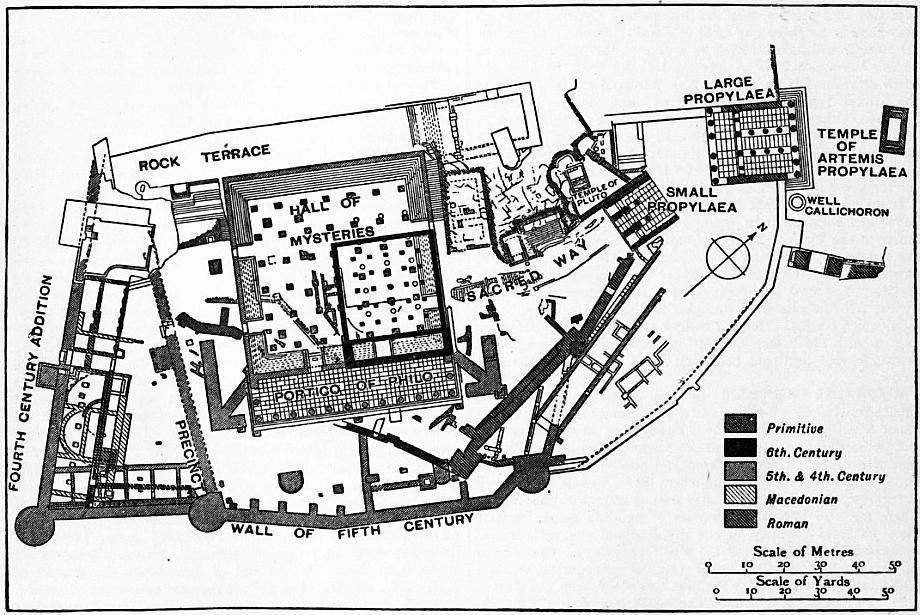
The Site.—Systematic excavations, begun in 1882 by D. Philios for the Greek Archaeological Society, have laid bare the whole of the sacred precinct. It is now possible to trace its boundaries as extended at various periods, and also many successive stages in the history of the Telesterion, or Hall of Initiation. These complete excavations have shown the earlier and partial excavations to have been in some respects deceptive.
In front of the main entrance of the precinct is a large paved area, with the foundations of a temple in it, usually identified as that of Artemis Propylaea; in their present form both area and temple date from Roman times; and on each side of the Great Propylaea are the foundations of a Roman triumphal arch. Just below the steps of the Propylaea, on the left as one enters, there has been discovered, at a lower level than the Roman pavement, the curb surrounding an early well. This is almost certainly the λλίχορον φρέαρ mentioned by Pausanias. The Great Propylaea is a structure of Roman imperial date, in close imitation of the Propylaea on the Athenian Acropolis. It is, however, set in a wall of 6th-century work, though repaired in later times. This wall encloses a sort of outer court, of irregular triangular shape. The Small Propylaea is not set exactly opposite to the Great Propylaea, but at an angle to it; an inscription on the architrave records that it was built by Appius Claudius Pulcher, the contemporary of Cicero. It is also set in a later wall that occupies approximately the same position as two earlier ones, which date from the 6th and 5th centuries respectively, and must have indicated the boundary of the inner precinct. From the Small Propylaea a paved road of Roman date leads to one of the doors of the Telesterion. Above the Small Propylaea, partly set beneath the overhanging rock, is the precinct of Pluto; it has a curious natural cleft approached by rock-cut steps. Several inscriptions and other antiquities were found here, including the famous head, now in Athens, usually called Eubouleus, though the evidence for its identification is far from satisfactory. A little farther on is a rock-cut platform, with a well, approached by a broad flight of steps, which probably served for spectators of the sacred procession. Beyond this, close to the side of the Telesterion, are the foundations of a temple on higher ground; it has been conjectured that this was the temple of Demeter, but there is no evidence that such a building existed in historic times, apart from the Telesterion.
The Telesterion, or Hall of Initiation, was a large covered building, about 170 ft. square. It was surrounded on all sides by steps, which must have served as seats for the mystae, while the sacred dramas and processions took place on the floor of the hall: these seats were partly built up, partly cut in the solid rock; in later times they appear to have been cased with marble. There were two doors on each side of the hall, except the north-west, where it is cut out of the solid rock, and a rock terrace at a higher level adjoins it; this terrace may have been the station of those who were not yet admitted to the full initiation. The roof of the hall was carried by rows of columns, which were more than once renewed.
The architectural history of the hall has been traced by Professor W. Dörpfeld with the help of the various foundations that have been brought to light. The earliest building on the site is a small rectangular structure, with walls of polygonal masonry, built of the rock quarried on the spot. This was succeeded by a square hall, almost of the same plan as the later Telesterion, but about a quarter of the size; its eastern corner coincides with that of the later building, and it appears to have had a portico in front like that which, in the later hall, was a later addition. Its roof was carried by columns, of which the bases can still be seen. This building has with great probability been assigned to the time of Peisistratus; it was destroyed by the Persians. Between this event and the erection of the present hall, which must be substantially the one designed by Ictinus in the time of Pericles, there must have been a restoration, of which we may see the remains in a set of round sinkings to carry columns, which occur only in the north-east part of the hall; a set of bases arranged on a different system occur in the south-west part, and it is difficult to see how these two systems could be reconciled unless there were some sort of partition between the two parts of the hall. Both sets were removed to make way for the later columns, of which the bases and some of the drums still remain. These later columns are shown, by inscriptions and other fragments built into their bases, to belong to later Roman times. At the eastern and southern corners of the hall of Ictinus are projecting masses of masonry, which may be the foundation for a portico that was to be added; but perhaps they were only buttresses, intended to resist the thrust of the roof of this huge structure, which rested at its northern and western corners against the solid rock of the hill. On the south-east side the hall is faced with a portico, extending its whole width; the marble pavement of this portico is a most conspicuous feature of Eleusis at the present day. The portico was added to the hall by the architect Philo, under Demetrius of Phalerum, about the end of the 4th century B.C. It was never completed, for the fluting of its columns still remains unfinished.
The Telesterion took up the greater part of the sacred precinct, which seems merely to have served to keep the profane away from the temple. The massive walls and towers of the time of Pericles, which resemble those of a fortress, are quite close in on the south and east; later, probably in the 4th century B.C., the precinct was extended farther to the south, and at its end was erected a building of considerable extent, including a curious apsidal chamber, for which a similar but larger curved structure was substituted in Roman times. This was probably the Bouleuterion. The precinct was full of altars, dedications and inscriptions; and many fragments of sculptures, pottery and other antiquities, from the earliest to the latest days of Greece, have been discovered. It is to be noted that the subterranean passages which some earlier explorers imagined to be connected with the celebration of the mysteries, have proved to be nothing but cisterns or watercourses.
The excavations of Eleusis, and the antiquities found in them, have been published from time to time in the Ἐφημερὶς Ἀρχαιολογική and in the Πρακτικά of the Greek Archaeological Society, especially for 1887 and 1895. See also D. Philios, Éleusis, ses mystères, ses ruines, et son musée. Inscriptions have also been published in the Bulletin de correspondance hellénique.
(E. Gr.)
ELEUTHERIUS, pope from about 175 to 189. Allusions to him are found in the letters of the martyrs of Lyons, cited by Eusebius, and in other documents of the time. The Liber Pontificalis, at the beginning of the 6th century, says that he had relations with a British king, Lucius, who was desirous of being converted to Christianity. This tradition—Roman, not British—is an enigma to critics, and, apparently, has no historical foundation.
(L. D.*)
ELEUTHEROPOLIS (Gr. Ἐλευθέρα πόλις, “free city”), an ancient city of Palestine, 25 m. from Jerusalem on the road to Gaza, identified by E. Robinson with the modern Beit Jibrīn. This identification is confirmed by Roman milestones in the neighbourhood. It represents the Biblical Mareshah, the ruins of which exist at Tell Sandahannah close by. As Betogabra it is mentioned by Ptolemy; the name Eleutheropolis dates from the Syrian visit of Septimius Severus (A.D. 202). Eusebius in his Onomasticon uses it as a central point from which the distances of other towns are measured. It was destroyed in 796, rebuilt by the crusaders in 1134 (their fortress and chapel remain, much ruined). It was finally captured by Bibars, 1244. Beit Jibrīn is in the centre of a district of great archaeological interest. Besides the crusader and other remains in the village itself, the surrounding country possesses many tells (mounds) covering the sites of ancient cities. The famous caves of Beit Jibrīn honeycomb the hills all round. These are immense artificial excavations of unknown date. Roman milestones and aqueducts also are found, and close by the now famous tomb of Apollophanes, with wall-paintings of animals and other ornamentation, was discovered in 1902; a description of it will be found in Thiersch and Peters, The Marissa Tombs, published by the Palestine Exploration Fund.
(R. A. S. M.)
ELEVATORS, Lifts or Hoists, machines for raising or lowering loads, whether of people or material, from one level to another. They are operated by steam, hydraulic or electric power, or, when small and light, by hand. Their construction varies with the magnitude of the work to be performed and the character of the motive power. In private houses, where only small weights, as coal, food, &c., have to be transferred from one floor to another, they usually consist simply of a small counter-balanced platform suspended from the roof or an upper floor by a tackle, the running part of which hangs from top to bottom and can be reached and operated at any level. In buildings where great weights and numbers of people have to be lifted, or a high speed of elevation is demanded, some form of motor is necessary. This is usually, directly or indirectly, a steam-engine or occasionally a gas-engine; sometimes a water-pressure engine is adopted, and it is becoming more and more common to employ an electric motor deriving its energy from the general distribution of the city. Large establishments, hotels or business houses, commonly have their own source of energy, an electric or other power “plant,” on the premises.
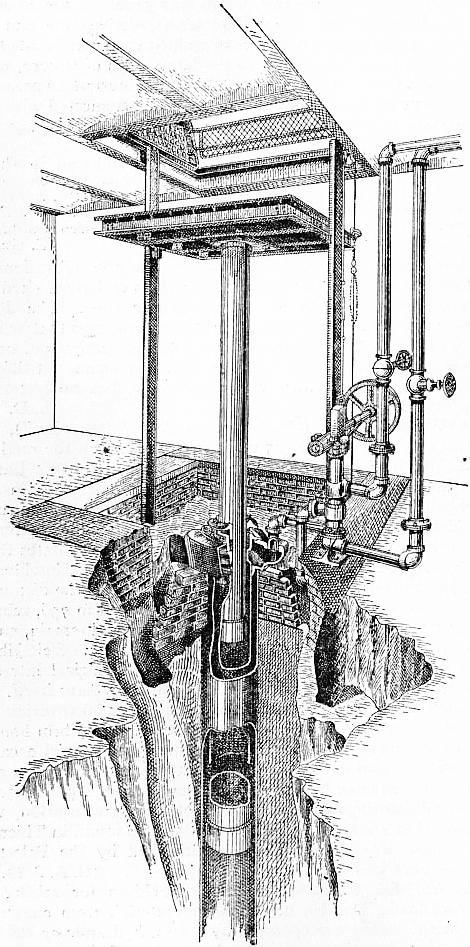
Fig. 1.—The Plunger, or Direct Lift Hydraulic Engine.
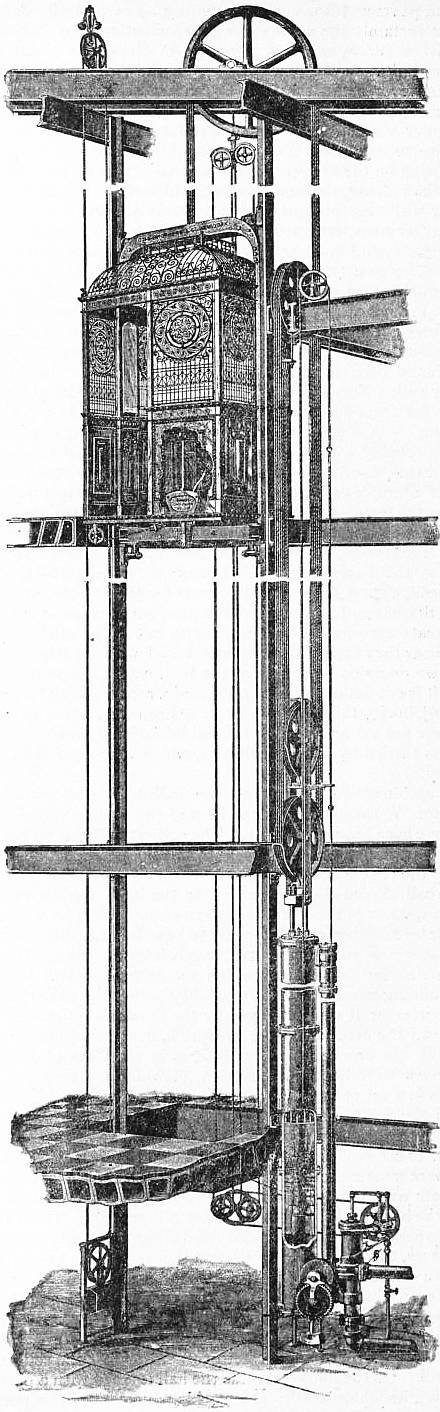
Fig. 2.—The Otis Standard Hydraulic Passenger Lift, with Pilot Valve and Lever-operating Device.
The hydraulic elevator is the simplest in construction of elevators proper, sometimes consisting merely of a long pipe set deeply in the ground under the cage and containing a correspondingly long plunger, which rises and falls Construction of elevators. as required and carries the elevator-cage on its upper end (fig. 1). The “stroke” is thus necessarily equal to the height traversed by the cage, with some surplus to keep the plunger steady within its guiding-pipe. The pipe or pump chamber has a length exceeding the maximum rise and fall of the plunger, and must be strong enough to sustain safely the heavy hydraulic pressures needed to raise plunger and cage with load. The power is usually supplied by a steam pump (occasionally by a hydraulic motor), which forces water into the chamber of the great pipe as the elevator rises, a waste-cock drawing off the liquid in the process of lowering the cage. A single handle within the cage generally serves to apply the pressure when raising, and to reduce it when lowering the load. The most common form of hydraulic elevator, for important work and under usual conditions of operation, as in cities, consists of a suspended cage, carried by a tackle, the running part of which is connected with a set of pulleys at each end of a frame (fig. 2). The rope is made fast at one end, and its intermediate part is carried round first one pulley at the farther end of the frame and then round another at the nearer end, and so on as often as is found advisable in the particular case. The two pulley shafts carrying these two sets of pulleys are made to traverse the frame in such a way as, by their separation, to haul in on the running part, or, by their approximation, to permit the weight of the cage to haul out the rope. By this alternate hauling and “rendering” of the rope the cage is raised and lowered. The use of a number of parallel and independent sets of pulleys and tackles assures safety in case of the breakage of any one, each being strong enough alone to hold the load. The movement of the pair of pulley shafts is effected by a water-pressure engine, actuating the plunger of a pump which is similar to that used in the preceding apparatus, but being relatively of short stroke and large diameter, is more satisfactory in design and construction as well as in operation. Electricity may be applied to elevators of this type by attaching the travelling sheaves to a nut in which works a screwed shaft driven by an electric motor. In other electric lifts the cables which support the cage are wound on a drum which is turned by a motor, the drum being connected to the motor-shaft either by a series of pinions or by a worm-gear. The drum may also be worked by a steam or gas engine. Where the traffic is not very heavy, a form of elevator that requires no attendant is convenient. In this any one wishing to use the lift has merely to press a button placed by the side of the lift-gate on the floor on which he happens to be standing, when the car will come to him; and having entered it he can cause it to travel to any floor he desires by pressing another button inside the car. The motive power in such cases may be either electric or hydraulic, but the control of the switches or valves that govern the action of the apparatus is electric.
The history of the elevator is chronologically extensive, but only since 1850 has rapid or important progress been effected. In that year George H. Fox & Co. built an elevator operated by the motion of a vertical screw, the nut on which carried the cage. This device was used in a number of instances, especially in hotels in the large cities, during the succeeding twenty years, and was then generally supplanted by the hydraulic lift of the kind already described as the plunger-lift. With the increased demand for power, speed, safety, convenience of manipulation, and comfort in operation, the inventive ability of the engineer developed the various systems more and more perfectly, and experience gradually showed to what service each type was best adapted and the best construction of each for its peculiar work. Whatever the class, the following are the essentials of design, Essentials of design, &c. construction and operation: the elevator must be safe, comfortable, speedy and convenient, must not be too expensive in either first cost or maintenance, and must be absolutely trustworthy. It must not be liable to fracture of any element of the hoisting gear that will permit either the fall of the cage or its projection by an overweighted balance upwards against the top of its shaft. It must be possible to stop it, whether in regular working or in emergency, or when accident occurs, with sufficient promptness, yet without endangering life or property, or even very seriously inconveniencing the passengers. Acceleration and retardation in starting and stopping must be smooth and easy, the stop must be capable of being made precisely where and when intended, and no danger must be incurred by the passengers from contact with running parts of the mechanism or with the walls and doors of the elevator shaft.
These requirements have been fully met in the later forms of elevator commonly employed for passenger service. Usual sizes range from loads of 1000 to 5000 ℔ with speeds of from 80 to 250 ft. a minute unloaded, and 75 to 200 ft. loaded, and a height of travel of from 50 to 200 ft. In some very tall buildings, as the Singer and Metropolitan buildings in New York, elevators have been installed having a maximum speed of 600 ft. a minute, with a rise of over 500 ft. Where electric motors are employed, their speed ranges from 600 and 700 revolutions per minute in the larger to 1000 and 1200 in the smaller sizes, corresponding to from 20 down to 4 or 5 h.p. Two or more counter-weights are employed, and from four to six suspension cables ensure as nearly as possible absolute safety. The electric elevators of the Central London railway are guaranteed to raise 17,000 ℔ 65 ft. in some of its shafts, in 30 secs. from start to stop. Over 100,000 ft. of 7⁄8 in. and 17,000 ft. of ¾ in. steel rope are required for its 24 shafts, and each rope can carry from 16 to 22 tons without breaking. The steel used in the cables, of which there are four to six for each car and counter-weight, has a tenacity of 85 to 90 tons per sq. in. of section of wire. The maximum pull on each set of rope is assumed to be not over 9500 ℔, the remainder of the load being taken by the counterbalance. Oil “dash-pots” or buffers, into which enter plungers attached to the bottom of the cage, prevent too sudden a stop in case of accident, and safety-clutches with friction adjustments of ample power and fully tested before use give ample insurance against a fall even if all the cables should yield at once—an almost inconceivable contingency. The efficiency, i.e. the ratio of work performed to power expended in the same time, was in these elevators found by test to be between 70 and 75%.
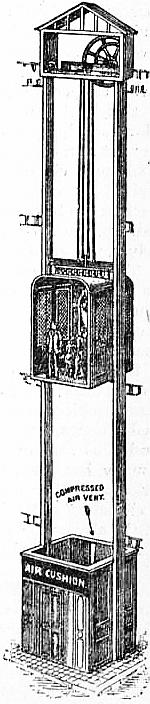
Fig. 3. Safety Air-Cushion.
Safety devices constitute perhaps the most important of the later improvements in elevator construction where passengers are carried. The simplest and, where practicable, most certain of them is the “air-cushion”, a chamber Safety devices. into which the cage drops if detached or from any cause allowed to fall too rapidly to the bottom, compression of the air bringing it to rest without shock (fig. 3). This chamber must be perfectly air-tight, except in so far as a purposely arranged clearance around the sides, diminishing downwards and in well-established proportion, is adjusted to permit a “dash-pot” action and to prevent rebound. The air-cushion should be about one-tenth the depth of the elevator shaft; in high buildings it may be a well 20 or 30 ft. deep. The Empire building, in New York, is twenty storeys in height, the total travel of the cage is 287 ft., and the air-cushion is 50 ft. deep, extending from the floor of the third storey to the bottom of the shaft. Sliding doors of great strength, and automatic in action, at the first and second floors, are the only openings. The shaft is tapered for some distance below the third floor, and then carried straight to the bottom. An inlet valve admits air freely as the cage rises, and an adjusted safety-valve provides against excess pressure. A “car,” falling freely from the twentieth storey, was checked by this arrangement without injury to a basket of eggs placed on its floor. Other safety devices consist of catches under the floor of the cage, so arranged that they are held out of engagement by the pull on the cables. But if the strain is suddenly relieved, as by breakage of a cable or accident to the engine or motor, they instantly fly into place and, engaging strong side-struts in the shaft, hold the car until it can be once more lifted by its cables. These operate well when the cables part at or near the car, but they are apt to fail if the break occurs on the opposite side of the carrying sheaves at the top of the shaft, since the friction and inertia of the mass of the cables may in that case be sufficient to hold the pawls out of gear either entirely or until the headway is so great as to cause the smashing of all resistances when they do engage.
Another principle employed in safety arrangements is the action of inertia of parts properly formed and attached. Any dangerous acceleration of the cage causes the inertia of these parts to produce a retardation relative to the car which throws into action a brake or a catch, and thus controls the motion within safe limits or breaks the fall. The hydraulic brake has been used in this apparatus, as have mechanical and pneumatic apparatus. This control of the speed of fall is most commonly secured by the employment of a centrifugal or other governor or regulator. The governor may be on the top of the cage and driven by a stationary rope fixed between the top and bottom of the shafts, or it may be placed at the top of the shaft and driven by a rope travelling with the car. Its action is usually to trip into service a set of spring grips or friction clutches, which, as a rule, grasp the guides of the cage and by their immense pressure and great resultant friction bring the cage to rest within a safe limit of speed, time and distance. A coefficient of friction of about 15% is assumed in their design, and this estimate is confirmed by their operation. Pressures of 10 tons or more are sometimes provided in these grips to ensure the friction required. There are many different forms of safety device of these various classes, each maker having his own. The importance of absolute safety against a fall is so great that the best builders are not satisfied with any one form or principle, but combine provisions against every known danger, and often duplicate such precautions against the most common accidents.
The “travelling staircase,” which may be classed among the passenger elevators, usually consists of a staircase so constructed that while the passenger is ascending it the whole structure is also ascending at a predetermined rate, so that the progress made is the sum of the two rates of motion. The system of “treads and risers” is carried on a long endless band of chain sustained by guides holding it in its desired line, and rendering at either end over cylinders or sprockets. The junctions between the stairway and the upper or lower floors are ingeniously arranged so as to avoid danger of injury to the passengers.
Freight elevators have the same general forms as the passenger elevators, but are often vastly larger and more powerful, and are not as a rule fitted up for such heights of lift, or constructed with such elaborate provision for safety or with any special finish. Elevators raising grain, coal, earth and similar materials, such as can be taken up by scooping into a bucket, or can be run into and out of the bucket by gravity, constitute a class by themselves, and are described in the article Conveyors.
The term “grain elevator” is often used to include buildings as well as machinery, and it is not unusual in Europe to hear a flour-mill, with its system of motor machinery, mills, elevator and storage departments, spoken of as an “American elevator” (see Granaries).
ELF (O. Eng. aelf; cf. Ger. Alp, nightmare), a diminutive supernatural being of Teutonic mythology, usually of a more or less mischievous and malignant character, causing diseases and evil dreams, stealing children and substituting changelings, and thus somewhat different from the Romanic fairy, which usually has less sinister associations. The prehistoric arrow-heads and other flint implements were in England early known as “elf-bolts” or “elf-arrows,” and were looked on as the weapons of the elves, with which they injured cattle. So too a tangle in the hair was called an “elf-lock,” as being caused by the mischief of the elves.
ELGAR, SIR EDWARD (1857- ), English musical composer, son of W.H. Elgar, who was for many years organist in the Roman Catholic church of St George at Worcester, was born there on the 2nd of June 1857. His father’s connexion with music at Worcester, with the Glee Club and with the Three Choirs Festivals, supplied him with varied opportunities for a musical education, and he learnt to play several instruments. In 1879 he became bandmaster at the county lunatic asylum, and held that post till 1884. He was also a member of an orchestra at Birmingham, and in 1883 an intermezzo by him was played there at a concert. In 1882 he became conductor of the Worcester Amateur Instrumental Society; and in 1885 he succeeded his father as organist at St George’s, Worcester. There he wrote a certain amount of church music. In 1889 he moved to London, but finding no encouragement retired to Malvern in 1891; in 1904 he went to live at Hereford, and in 1905 was made professor of music at Birmingham University. To the public generally he was hardly known till his oratorio The Dream of Gerontius was performed at Birmingham in 1900, but this was at once received as a new revelation in English music, both at home and by Richard Strauss in Germany, and the composer was made a Mus. Doc. at Cambridge. His experience in writing church music for a Roman Catholic service cannot be overlooked in regard to this and other works by Elgar, who came to be regarded as the representative of a Catholic or neo-Catholic style of religious music, for which an appreciative public was ready in England at the moment, owing to the recent developments in the more artistic and sensuous side of the religious movement. And the same interest attached to his later oratorios, The Apostles (1903) and The Kingdom (1906). But Elgar’s sudden rise into popularity, confirmed by his being knighted in 1904, drew attention to his other productions. In 1896 his Scenes from the Saga of King Olaf was recognized by musicians as a fine work, and in the same year his Scenes from the Bavarian Highlands and Lux Christi were performed; and apart from other important compositions, his song-cycle Sea-Pictures was sung at Norwich in 1899 by Clara Butt, and his orchestral Variations on an original theme were given at a Richter concert in the same year. In 1901 his popular march “Pomp and Circumstance” was played at a promenade concert, the stirring melody of his song “Land of Hope and Glory” being effectually utilized. It is impossible here to enumerate all Sir Edward Elgar’s works, which have excited a good deal of criticism in musical circles without impairing his general recognition as one of the few front-rank English composers of his day; but his most important later production, his first orchestral symphony, produced in 1908 with immediate success, raised his reputation as a composer to an even higher place, as a work of marked power and beauty, developing the symphonic form with the originality of a real master of his art. In 1908 he resigned his professorship at Birmingham University.
ELGIN, a city of Kane county, Illinois, U.S.A., in the N. part of the state, 36 m. N.W. of Chicago. Pop. (1880) 8787; (1890) 17,823; (1900) 22,433, of whom 5419 were foreign-born; (1910 census) 25,976. Elgin is served by the Chicago & North-Western and the Chicago, Milwaukee & St Paul railways, and by interurban electric railways to Chicago, Aurora and Belvidere. The city is the seat of the Northern Illinois hospital for the insane, of the Elgin Academy (chartered 1839; opened 1856), and of St Mary’s Academy (Roman Catholic); and has the Gail Borden public library, with 35,000 volumes in 1908. The city has six public parks, Lord’s Park containing 112, and Wing Park 121 acres. The city is in a fine dairying region and is an important market for butter. Among Elgin’s manufactures are watches and watch-cases, butter and other dairy products, cooperage (especially butter tubs), canned corn, shirts, foundry and machine-shop products, pipe-organs, and caskets and casket trimmings; in 1905 Elgin’s total factory product was valued at $9,349,274. The Elgin National Watch factory, and the Borden milk-condensing works, are famous throughout the United States and beyond. The publishing office of the Dunkers, or German Brethren, is at Elgin; and several popular weeklies with large circulations are published here. A permanent settlement was made as early as 1835, and Elgin was chartered as a city in 1854 and was rechartered in 1880.
ELGIN, a royal, municipal and police burgh, and county town of Elginshire, Scotland, situated on the Lossie, 5 m. S. of Lossiemouth its port, on the Moray Firth, and 71¼ m. N.W. of Aberdeen, with stations on the Great North of Scotland and Highland railways. Pop. (1901) 8460. It is a place of very considerable antiquity, was created a royal burgh by Alexander I., and received its charter from Alexander II. in 1234. Edward I. stayed at the castle in 1296 and 1303, and it was to blot out the memory of his visit that the building was destroyed immediately after national independence had been reasserted. The hill on which it stood was renamed the Ladyhill, and on the scanty ruins of the castle now stands a monument to the 5th duke of Gordon, consisting of a column surmounted by a statue.
The burgh has suffered periodically from fire, notably in 1452, when half of it was burnt by the earl of Huntly. Montrose plundered it twice in 1645. In 1746 Prince Charles Edward spent a few days in Thunderton House. His hostess, Mrs Anderson, an ardent Jacobite, kept the sheets in which he slept, and was buried in them on her death, twenty-five years afterwards. For fifty years after this date the place retained the character and traditions of a sleepy cathedral city, but with the approach of the 19th century it was touched by a more modern spirit. As the result much that was picturesque disappeared, but the prosperity of Elgin was increased, so that now, owing to its pleasant situation in “the Garden of Scotland,” its healthy climate, cheap living, and excellent educational facilities, it has become a flourishing community. The centre of interest is the cathedral of Moray, which was founded in 1224, when the church of the Holy Trinity was converted to this use. It was partially burned in 1270 and almost destroyed in 1390 by Alexander Stewart, the Wolf of Badenoch, natural son of Robert II., who had incurred the censure of the Church. In 1402 Alexander, lord of the Isles, set fire to the town, but spared the cathedral for a consideration, in memory of which mercy the Little Cross (so named to distinguish it from the Muckle or Market Cross, restored in 1888) was erected. After these outrages it was practically rebuilt on a scale of grandeur that made it the most magnificent example of church architecture in the north. Its design was that of a Jerusalem cross, with two flanking towers at the east end, two at the west end, and one in the centre, at the intersection of the roofs of the nave and transepts. It measured 282 ft. long from east to west by 120 ft. across the transepts, and consisted of the choir, the gable of which was pierced by two tiers of five lancet windows and the Omega rose window; the north transept, in which the Dunbars were buried, and the south transept, the doorway of which is interesting for its dog’s-tooth ornamentation; and the nave of five aisles. The grand entrance was by the richly carved west door, above which was the Alpha window. The central steeple fell in 1506, but was rebuilt, the new tower with its spire reaching a height of 198 ft. By 1538 the edifice was complete in every part. Though the Reformation left it unscathed, it suffered wanton violence from time to time. By order of the privy council the lead was stripped off the roofs in 1567 and sold to Holland to pay the troops; but the ship conveying the spoils foundered in the North Sea. In 1637 the roof-tree of the choir perished during a gale, and three years later the rich timber screen was demolished. The central tower again collapsed in 1711, after which the edifice was allowed to go to ruin. Its stones were carted away, and the churchyard, overgrown with weeds, became the dumping-ground for rubbish. It lay thus scandalously neglected until 1824, when John Shanks, a “drouthy” cobbler, was appointed keeper. By a species of inspiration this man, hitherto a ne’er-do-well, conceived the notion of restoring the place to order. Undismayed, he attacked the mass of litter and with his own hands removed 3000 barrow-loads. When he died in 1841 he had cleared away all the rubbish, disclosed the original plan, and collected a quantity of fragments. A tablet, let into the wall, contains an epitaph by Lord Cockburn, recording Shanks’s services to the venerable pile, which has since been entrusted to the custody of the commissioners of woods and forests. The chapter-house, to the north-east of the main structure, suffered least of all the buildings, and contains a ’Prentice pillar, of which a similar story is told to that of the ornate column in Roslin chapel. In the lavatory, or vestibule connecting the chapter-house with the choir, Marjory Anderson, a poor half-crazy creature, a soldier’s widow, took up her quarters in 1748. She cradled her son in the piscina and lived on charity. In the course of time the lad joined the army and went to India, where he rose to the rank of major-general and amassed a fortune of £70,000 with which he endowed the Elgin Institution (commonly known as the Anderson Institution) at the east end of High Street, for the education of youth and the support of old age. Within the precincts of the cathedral grounds stood the bishop’s palace (now in ruins), the houses of the dean and archdeacon (now North and South Colleges), and the manses of the canons. Other ecclesiastical buildings were the monasteries of Blackfriars (1230) and Greyfriars (1410) and the preceptory of Maisondieu (1240). They also were permitted to fall into decay, but the 3rd marquess of Bute undertook the restoration of the Greyfriars’ chapel. The parish church, in the Greek style, was built in 1828. Gray’s hospital, at the west end of High Street, was endowed by Dr Alexander Gray (1751-1808), and at the east end stands the Institution, already mentioned, founded by General Andrew Anderson (1746-1822). Other public buildings include the assembly rooms, the town-hall, the museum (in which the antiquities and natural history of the shire are abundantly illustrated), the district asylum, the academy, the county buildings and the court house, the market buildings, the Victoria school of science and art, and Lady Gordon-Cumming’s children’s home. In 1903 Mr G.A. Cooper presented his native town with a public park of 42 acres, containing lakes representing on a miniature scale the British Isles. Grant Lodge, an old mansion of the Grant family, occupying the south-west corner of the park, was converted into the public library. From the top of Ladyhill the view commands the links of the Lossie and the surrounding country, and a recreation ground is laid out on Lossie Green.
The industries include distilling and brewing, nursery gardening, tanning, saw and flour mills, iron-foundries and manufactures of woollens, tweeds and plaiding, and the quarrying of sandstone. Elgin combines with Banff, Cullen, Inverurie, Kintore and Peterhead to return one member to parliament, and the town is controlled by a council with provost and bailies.
Two miles and a half S. by W. of Elgin stands the church of Birnie, with the exception of the church at Mortlach in Banffshire probably the oldest place of public worship in Scotland still in use. It is not later than 1150 and, with its predecessor, was the cathedral of Moray during the rule of the first four bishops; the fourth bishop, Simon de Toeny, an Englishman, was buried in its precincts in 1184. In the church is preserved an old Celtic altar-bell of hammered iron, known as the “Ronnell bell.” Such is the odour of sanctity of this venerable church that there is an old local saying that “to be thrice prayed for in the kirk of Birnie will either mend or end ye.” Six miles to the S.W. of Elgin, charmingly situated in a secluded valley encircled by fir-clad heights, lie the picturesque remains of Pluscarden Priory, a Cistercian house founded by Alexander II. in 1230. The ruins, consisting of tower, choir, chapter-house, refectory and other apartments, are nearly hidden from view by their dense coating of ivy and the fine old trees, including many beautiful examples of copper beech, by which they are surrounded. Its last prior, Alexander Dunbar, died in 1560. The Liber Pluscardensis, a valuable authority on early Scots history, was compiled in the priory by Maurice Buchanan in 1461. The chronicle comes down to the death of James I. The 3rd marquess of Bute acquired the ruins in 1897.
ELGIN AND KINCARDINE, EARLS OF. Thomas Bruce, 7th earl of Elgin (1766-1841), British diplomatist and art collector, was born on the 20th of July 1766, and in 1771 succeeded his brother in the Scottish peerage as the 7th earl of Elgin (cr. 1633), and 11th of Kincardine (cr. 1647). He was educated at Harrow and Westminster, and, after studying for some time at the university of St Andrews, proceeded to the continent, where he studied international law at Paris, and military science in Germany. When his education was completed he entered the army, in which he rose to the rank of general. His chief attention was, however, devoted to diplomacy. In 1792 he was appointed envoy at Brussels, and in 1795 envoy extraordinary at Berlin; and from 1799 to 1802 he was envoy extraordinary at the Porte. It was during his stay at Constantinople that he formed the purpose of removing from Athens the celebrated sculptures now known as the Elgin Marbles. His doing so was censured by some as vandalism, and doubts were also expressed as to the artistic value of many of the marbles; but he vindicated himself in a pamphlet published in 1810, and entitled Memorandum on the Subject of the Earl of Elgin’s Pursuits in Greece. In 1816 the collection was purchased by the nation for £36,000, and placed in the British Museum, the outlay incurred by Lord Elgin having been more than £50,000. Lord Elgin was a Scottish representative peer for fifty years. He died at Paris on the 14th of November 1841.
James Bruce, 8th earl of Elgin (1811-1863), British statesman, eldest son of the 7th earl by his second marriage, was born in 1811, and succeeded to the peerage as 8th earl of Elgin and 12th of Kincardine in 1841. He was educated at Eton and at Christ Church, Oxford, where he had as companions and rivals his younger predecessors in the office of governor-general of India, Dalhousie and Canning. He began his official career in 1842 at the age of thirty, as governor of Jamaica. During an administration of four years he succeeded in winning the respect of all classes. He improved the condition of the negroes and conciliated the planters by working through them. In 1846 Lord Grey appointed him governor-general of Canada. Son-in-law of the popular earl of Durham, he was well received by the colonists, and he set himself deliberately to carry out the Durham policy. In this his frank and genial manners aided him powerfully. His assent to the local measure for indemnifying those who had suffered in the troubles of 1837 led the mob of Montreal to pelt his carriage for the rewarding of rebels for rebellion, as Mr Gladstone described it. But long before his eight years’ term of service expired he was the most popular man in Canada. His relations with the United States, his hearty support of the self-government and defence of the colony, and his settlement of the free-trade and fishery questions, led to his being raised in 1849 to the British peerage as Baron Elgin.
Soon after his return to England in 1854, Lord Palmerston offered him a seat in the cabinet as chancellor of the duchy of Lancaster, which he declined. But when, in 1856 the seizure of the “Arrow” by Commissioner Yeh plunged England into war with China, he at once accepted the appointment of special envoy with the expedition. On reaching Point de Galle he was met by a force summoned from Bombay to Calcutta by the news of the sepoy mutiny at Meerut on the 11th of May. His first idea, that the somewhat meagre intelligence would justify most energetic action in China, was at once changed when urgent letters from Lord Canning reached him at Singapore, the next port, on the 3rd of June. H.M.S. “Shannon” was at once sent on to Calcutta with the troops destined for China, and Lord Elgin himself followed it, when gloomier letters from India reached him. The arrival of the “Shannon” gave new life to the handful of white men fighting for civilization against fearful odds, and before the reinforcements from England arrived the back of the mutiny had been broken. Nor was the position in China seriously affected by the want of the troops. Lord Elgin sent in his ultimatum to Commissioner Yeh at Canton on the same day, the 12th of December, that he learned the relief of Lucknow, and he soon after sent Yeh a prisoner to Calcutta. By July 1858, after months of Chinese deception, he was able to leave the Gulf of Pechili with the emperor’s assent to the Treaty of Tientsin. Subsequently he visited Japan, and obtained less considerable concessions from its government in the Treaty of Yeddo. It is true that the negotiations were confined to the really subordinate Tycoon or Shogun, but that visit proved the beginning of British influence in the most progressive country of Asia. Unfortunately, the Chinese difficulty was not yet at an end. After tedious disputes with the tariff commissioners as to the opium duty, and a visit to the upper waters of the Yang-tzse, Lord Elgin had reached England in May 1859. But when his brother and the allied forces attempted to proceed to Peking with the ratified treaty, they were fired on from the Taku forts at the mouth of the Peiho. The Chinese had resolved to try the fortune of war once more, and Lord Russell again sent out Lord Elgin as ambassador extraordinary to demand an apology for the attack, the execution of the treaty, and an indemnity for the military and naval expenditure. Sir Robert Napier (afterwards Lord Napier of Magdala) and Sir Hope Grant, with the French, so effectually routed the Tatar troops and sacked the Summer Palace that by the 24th of October 1860 a convention was concluded which was “entirely satisfactory to Her Majesty’s government.” Lord Elgin had not been a month at home when Lord Palmerston selected him to be viceroy and governor-general of India. He had now attained the object of his honourable ambition, after the office had been filled in most critical times by his juniors and old college companions, the marquis of Dalhousie and Earl Canning. He succeeded a statesman who had done much to reorganize the whole administration of India, shattered as it had been by the mutiny. But, as the first viceroy directly appointed by the Crown, and as subject to the secretary of state for India, Lord Elgin at once gave up all Lord Canning had fought for, in the co-ordinate independence, or rather the stimulating responsibility, of the governor-general, which had prevailed from the days of Clive and Warren Hastings. On the other hand, he loyally carried out the wise and equitable policy of his predecessor towards our feudatories with a firmness and a dignity that in the case of Holkar and Udaipur had a good effect. He did his best to check the aggression of the Dutch in Sumatra, which was contrary to treaty, and he supported Dost Mahommed in Kabul until that aged warrior entered the then neutral and disputed territory of Herat. Determined to maintain inviolate the integrity of our own north-west frontier, Lord Elgin assembled a camp of exercise at Lahore, and marched a force to the Peshawar border to punish those branches of the Yusufzai tribe who had violated the engagements of 1858.
It was in the midst of this “little war” that he died. Soon after his arrival at Calcutta, he had projected the usual tour to Simla, to be followed by an inspection of the Punjab and its warlike ring-fence of Pathans. He even contemplated the summoning of the central legislative council at Lahore. After passing the summer of 1863 in the cool retreat of Peterhoff, Simla, Lord Elgin began a march across the hills from Simla to Sialkot by the upper valleys of the Beas, the Ravi and the Chenab, chiefly to decide the two allied questions of tea cultivation and trade routes to Kashgar and Tibet. The climbing up to the Rotung Pass (13,000 ft.) which separates the Beas valley from that of the Chenab, and the crossing of the frail twig bridge across the Chundra torrent, prostrated him by the time he had descended into the smiling English-like Kangra valley. Thence he wrote his last letter to Sir Charles Wood, still full of hope and not free from anxiety as to the Sittana expedition. At the lovely hill station of Dharmsala, “the place of piety,” he died of fatty degeneration of heart on the 20th of November 1863.
For his whole career see Letters and Journals of James, Eighth Earl of Elgin, edited by Walrond, but corrected by his brother-in-law, Dean Stanley; for the China missions see Narrative of the Earl of Elgin’s Mission to China and Japan, by Laurence Oliphant, his private secretary; for the brief Indian administration see the Friend of India for 1862-1863.
Victor Alexander Bruce, 9th earl of Elgin (1849- ), British statesman, was born on the 16th of May 1849, the son of the 8th earl, and was educated at Eton and Balliol College, Oxford. In 1863 he succeeded as 9th earl of Elgin and 13th of Kincardine. A Liberal in politics, he became first commissioner of works (1886), and subsequently viceroy of India (1894-1899). His administration in India was chiefly notable for the frontier risings of 1897-1898. The Afridis broke out into a fanatical revolt and through hesitation on the part of the government were allowed to seize the Khyber Pass, necessitating the Tirah Expedition. After his return to England he was nominated chairman of the royal commission to investigate the conduct of the South African War; and on the formation of Sir Henry Campbell-Bannerman’s ministry in December 1905, he became a member of the cabinet as secretary of state for the colonies. In this capacity, though he showed many statesmanlike qualities, he was somewhat overshadowed by his brilliant under-secretary in the Commons, Mr Winston Churchill, whose speeches on colonial affairs were as aggressive as Lord Elgin’s were cautious; and when in April 1908, Mr Asquith became prime minister, Lord Elgin retired from the cabinet.
ELGINSHIRE, or Moray (Gaelic “among the seaboard men”), a northern county of Scotland, bounded N. by the Moray Firth, E. and S.E. by Banffshire, S. and S.W. by Inverness and W. by Nairnshire. It comprises only the eastern portion of the ancient province of Moray, which extended from the Spey to the Beauly and from the Grampians to the sea, embracing an area of about 3900 sq. m. The area of the county is 305,119 acres, or 477 sq. m.
Elginshire is naturally divided into two sections, the level and fertile coast and its hinterland—“the Laigh o’ Moray,” a tract 30 m. long by from 5 to 12 m. broad—and the hilly country in the south. There are, however, no high mountains. Carn Ruigh (1784 ft.), Larig Hill (1783) and Carn Kitty (1711) are the chief eminences in the south-central district until the ridge of the Cromdale Hills is reached on the Banffshire border, where the highest point is 2329 ft. above the sea. The two most important rivers, the Spey (q.v.) and the Findhorn, both have their sources in Inverness-shire. About 50 m. of the course of the Spey are in Elginshire, to which it may be roughly said to serve as the boundary line on the south-east and east. The Findhorn rises in the Monadliadh Mountains which form the watershed for several miles between it and the Spey. Of its total course of nearly 70 m. only the last 12 are in the county, where it separates the woods of Altyre from the Forest of Darnaway, before entering the Moray Firth in a bay on the north-eastern shore to which it has given its name. During the first 7 m. of its flow in Elginshire the stream passes through some of the finest scenery in Scotland. It is liable to sudden risings, and in the memorable Moray floods of August 1829 wrought the greatest havoc. Of other rivers the Lossie rises in the small lakes on the flanks of Carn Kitty and pursues a very winding course of 34 m. till it reaches the Moray Firth; Ballintomb Burn, Rothes Burn and Tulchan Burn are left-hand affluents of the Spey; the Dorbock and Divie, uniting their forces near Dunphail House, join the Findhorn at Relugas; and Muckle Water, a left-hand tributary of the Findhorn, comes from Nairnshire. The Spey and Findhorn are famous for salmon, but some of the smaller streams, too, afford good sport. The lochs are few and unimportant, among them being Loch Spynie, 2½ m. N., and Loch-na-Bo, 4 m. S.E. of Elgin; Loch of Blairs, 2½ m. S. of Forres; Loch Romach, 3 m. S. of Rafford; Loch Dallas, about 4 m. S.W. of Dallas, and Lochindorb in the S.W., 6 m. N.N.W. of Grantown. Loch Spynie was once a lake extending from the Firth to within 2½ m. of Elgin and covering an area of over 2000 acres. Its shores were the haunt of a great variety of birds, and its waters were full of salmon, sea-trout and pike. But early in the 19th century it was resolved to reclaim the land, and the drainage works then undertaken reduced the beautiful loch to a swamp of some 120 acres.
Lochindorb is now the largest lake, being 2 m. in length and fully ½ m. wide. In the upper end, on an island believed to be artificial, stand the ruins of Lochindorb Castle, in the 14th century the stronghold of the Wolf of Badenoch, and afterwards successively the property of the earl of Moray, the Campbells of Cawdor and the earl of Seafield. Sir Thomas Dick Lauder saw at Cawdor Castle a massive iron gate which, according to tradition, Sir Donald Campbell of Cawdor carried on his back from Lochindorb to Cawdor, a distance of 13 m. In the southern half of the county, amongst the hills, are several glens, among them the Glen of Rothes, Glen Lossie, Glen Gheallaidh, Glen Tulchan and Glen Beag. Strathspey, though more of a valley than a glen, is remarkable for its extent and beauty.
Geology.—This county may be divided geologically into two areas, the hilly region to the south being composed of the crystalline schists of the Central Highlands and the fertile plain of Moray being made up of Old Red Sandstone and Triassic strata. In the Cromdale Hills in the south-east of the county the metamorphic series comprises schistose quartzite, quartz-schists, micaceous flagstones and mica-schists, which are granulitic and holocrystalline, the dark laminae in some cases containing heavy residues such as ilmenite and zircon. The greater portion of the metamorphic area west of the Spey consists of granulitic quartz-biotite-granulites and bands of muscovite-biotite-schist belonging to the Moine series of the Geological Survey (see Scotland: Geology). In certain areas these are permeated by granitic material in the form of thin strings, knots and veins. Excellent sections of these rocks are exposed in the Findhorn, the Divie and the tributaries of the Spey. Near Grantown there is a group locally developed, comprising crystalline limestone with tremolite, kyanite gneiss, muscovite-biotite-schist and quartzite, the age and relations of which are still uncertain. The general strike of the crystalline schists, save where there are local deflections, is north-east and south-west, and the general dip is to the south-east. Between Lochindorb and Grantown there is a mass of granite belonging to the later intrusions of the Highlands represented by the Cairngorm granite. Within the county there are representatives of the middle and upper divisions of the Old Red Sandstone resting unconformably on the crystalline schists. The strata of the middle or Orcadian series consist of conglomerates, sandstones, shales and clays, with limestone nodules containing fish remains. This sequence is well displayed in the banks of the Spey north of Boat of Bridge and in the Tynet Burn east of Fochabers, the latter being one of the well-known localities for ichthyolites in the middle or Orcadian division. In the Tynet and Gollachie Burn sections, the fish bed is overlaid by conglomerates and red pebbly sandstones, passing upwards into a thin zone of andesite lavas, indicating contemporaneous volcanic action. West of the Tynet Burn and Spey sections there is no trace of the members of the Orcadian division till we reach the Muckle Burn and Lethen Bar in Nairnshire, save the coarse conglomerate filling the ancient hollow of the valley of Rothes which may belong to the middle series. In that direction they are overlapped by the Upper Old Red Sandstone, which in the river Lossie, in the Lochty Burn and the Findhorn rest directly on the metamorphic rocks. Even to the south of the main boundary of the upper division there are small outliers of that series resting on the crystalline schists. Hence there must be a discordance between the Middle and Upper Old Red Sandstone in this county. The strata of the upper division consist of red, grey and yellow false-bedded sandstones with conglomeratic bands, which are well seen in the Findhorn between Sluie and Cothall, where they are associated with a bed of cornstone, all dipping to the N.N.W. at gentle angles. South of Elgin they are exposed in the Lossie and at Scaat Craig, while to the north of that town they extend along the ridge from Bishopmill to Alves. By means of the fish remains, which occur at Scaat Craig, in the Bishopmill quarries, at Alves, in the Findhorn cliffs and in the Whitemyre quarry on the Muckle Burn, the Upper Old Red Sandstone in this county is arranged in two groups, the Alves and Rosebrae. In the area lying to the north of the Upper Old Red Sandstone ridge at Bishopmill and Quarrywood, the strata of Triassic age occur, where they consist of pale grey and yellow sandstones and a peculiar cherty and calcareous band, known as the cherty rock of Stotfield. The sandstones are visible in quarries on the north slope of Quarry Wood, at Findrassie, at Spynie and along the ridge and sea-shore between Burghead and Lossiemouth. They are invested with special interest on account of the remarkable series of reptilian remains obtained from them, comprising Stagonolepis, a crocodile allied to the modern caiman in form; Telerpeton and Hyperodapedon, species of lizards; Dicynodonts (Gordonia and Geikia) and a horned reptile, Elginia mirabilis (see Scotland: Geology). The palaeontological evidence points to the conclusion that these reptiliferous sandstones must belong in part to the Trias, indeed it is possible that the lower portion may be of Permian age. In the Cutties Hillock quarry west of Elgin these reptiliferous beds rest directly on the sandstones containing Holoptychius of Upper Old Red Sandstone age, so that the apparent conformability must be entirely deceptive. Within the area occupied by the Trias west of Stotfield, flagstones appear, charged with fish scales of Upper Old Red age, where they form a low ridge protruding through the younger strata. Both the Upper Old Red and Triassic sandstones have been largely quarried for building purposes. On the shore at Lossiemouth there is a patch of greenish white sandstones yielding fossils characteristic of the Lower Oolite.
The glacial deposits distributed over the fertile plain of Moray and in the upland valleys are of interest. The low grounds were crossed by the ice descending the Moray Firth in an easterly and south-easterly direction, which carried boulders of granite from Strath Nairn and augen gneiss from Easter Ross. In the Elgin district, boulders belonging to the horizons of the Lower and Middle Lias, the Oxford Clay and the Upper Chalk are found both in the glacial deposits and on the surface of the ground. The largest transported mass occurs at Linksfield, where a succession of limestones and shales rests on boulder clay and is covered by it, which from the fossils may be of Rhaetic or Lower Lias age.
Climate and Agriculture.—The climate of the coast is equable and mild, even exotic fruits ripening readily in the open. The uplands are colder and damp. The average temperature in January is 38° F. and in July 58.5°, while for the year the mean is 47° F. The rainfall for the year averages 26 in. Considering its latitude and the extent of its arable land the standard of farming in Elginshire is high. The rich soil of the lowlands is well adapted for wheat, barley and oats. The acreage confined to the glens and straths under barley approximates that under oats. In the uplands, oats is the principal cereal. The breeding of live-stock is profitable, and some of the finest specimens of shorthorned and polled cattle and of crosses between the two are bred. On the larger farms in the Laigh Leicester sheep are kept all the year round, but in the uplands the Blackfaced take their place. Large numbers of horses and pigs are also raised.
Other Industries.—Whisky is the chief product, and the numerous distilleries are usually busy. There are woollen mills at Elgin and elsewhere and chemical works at Forres and Burghead. Owing to the absence of coal what little mineral wealth there is (iron and lead) cannot be remuneratively worked. The sandstone quarries, yielding a building-stone of superior quality, are practically inexhaustible. The plantations mainly consist of larch and fir and, to a smaller extent, of oak. Much timber was once floated down the Spey and other rivers, but, since the increased facilities of carriage afforded by the railways, trees have been felled on a wider scale. Boat-building is carried on at Burghead, Lossiemouth and Kingston—so-called from the fact that a firm from Kingston-on-Hull laid down a yard there in 1784—while at Garmouth the fishing fleet lies up during the winter and is also repaired there. The Firth fisheries are of considerable value. The boats go out from Findhorn, Burghead, Hopeman and Lossiemouth, which are all furnished with safe harbours. Findhorn has been twice visited by calamities. The first village was overwhelmed by the drifting sands of Culbin, and the second was buried beneath the waves in 1701. Kingston harbour is tidal, exposed, and liable to interruption from a shifting bar. The deep sea fisheries comprise haddock, cod, ling and herring, and the Spey, Findhorn and Lossie yield large quantities of salmon.
The Great North of Scotland railway enters the shire in the S.E. from Craigellachie, whence a branch runs up the Spey to Boat of Garten in Inverness-shire, and in the N.E. from Port Gordon, running in both cases to Elgin, from which a branch line extends to Lossiemouth. The Highland railway traverses the western limits of the shire running almost due north to Forres, whence it turns westward to Nairn and eastward to Elgin. From the county town it runs to Aberdeen via Orbliston and Keith, with a branch to Fochabers from Orbliston.
Population and Government.—The population was 43,471 in 1891 and 44,800 in 1901, when 1865 persons spoke both Gaelic and English, and 2 spoke Gaelic only. The chief towns are Elgin (pop. in 1901, 8460), Forres (4313) and Lossiemouth (3904), to which may be added Rothes (1621), Grantown (1568) and Burghead (1531). In conjunction with Nairnshire the county returns one member to parliament. Elgin and Forres are royal burghs; the municipal and police burghs include Burghead, Elgin, Forres, Grantown, Lossiemouth, and Rothes. Elginshire is included in one sheriffdom with Inverness and Nairn, and there is a resident sheriff-substitute at Elgin. The county is under school-board jurisdiction, several of the schools earning grants for higher education. There are academies at Elgin and Fochabers and science and art and technical schools at Elgin and Grantown. The bulk of the “residue” grant is spent in subsidizing the agricultural department of Aberdeen University and the science schools and art and technical classes in the county.
History.—Moray, in the wider sense, was first peopled by Picts of the Gaelic branch of Celts, of whom relics are found in the stone circle at Viewfield and at many places in Nairnshire. Christianity, introduced under the auspices of Columba (from whose time the site of Burghead church has probably been so occupied), flourished for a period until the Columban church was expelled in 717 by King Nectan. Thereafter the district was given over to internecine strife between the northern and southern Picts, which was ended by the crushing victory of Kenneth MacAlpine in 831, as one result of which the kingdom of Pictavia was superseded by the principality of Moravia. Still, settled order had not yet been secured, for the Norsemen raided the country first under Thorstein and then under two Sigurds. It was in the time of the second Sigurd that the Firth was fixed as the northern boundary of Moray. In spite of such interruptions as the battle of Torfness (Burghead) on the 14th of August 1040, in which Thorfinn, earl of Orkney and Shetland, overthrew a strong force of Scots under King Duncan, the consolidation of the kingdom was being gradually accomplished. After Macbeth ascended the throne the Scandinavians held their hands. Though Macbeth and his fainéant successor, “daft” Lulach, were the only kings whom Moray gave to Scotland, the province never lacked for able, if headstrong, men, and it continued to enjoy home rule under its own marmaer, or great steward (the equivalent of earl, the title that replaced it), until the dawn of the 12th century, when as an entity it ceased to exist. With a view to breaking up the power of the marmaers David I. and his successors colonized the seaboard with settlers from other parts of the kingdom. Nevertheless, from time to time the clansmen and their chiefs descended from their fastnesses and plundered the Laigh, keeping the people for generations in a state of panic. Meanwhile, the Church had become a civilizing force. In 1107 Alexander had founded the see of Moray and the churches of Birnie, Kinneddar and Spynie were in turn the cathedral of the early bishops, until in 1224 under the episcopate of Andrew of Moray (de Moravia), the church of the Holy Trinity in Elgin was chosen for the cathedral. Another factor that drew men together was the struggle for independence. In his effort to stamp out Scottish nationality Edward I. came as far north as Elgin, where he stayed for four days in July 1296, and whence he issued his writ for the parliament at Berwick. Wallace, however, had no doughtier supporter than Sir Andrew Moray of Bothwell, and Bruce recognized the assistance he had received from the men of the north by erecting Moray into an earldom on the morrow of Bannockburn and bestowing it upon Thomas Randolph (see Moray, Thomas Randolph, earl of). Henceforward the history of the county resolved itself in the main into matters affecting the power of the Church and the ambitions of the Moray dynasties. The Church accepted the Reformation peacefully if not with gratitude. But there was strife between Covenanters and the adherents of Episcopacy until, prelacy itself being abolished in 1689, the bishopric of Moray came to an end after an existence of 581 years. (For the subsequent history of the earldom, which was successively held by the Randolphs, the Dunbars, the Douglases, the royal Stewarts and an illegitimate branch of the Stewarts, see Murray or Moray, earls of.) Other celebrated Moray families who played a more or less strenuous part in local politics were the Gordons, the Grants and the Duffs. Still, national affairs occasionally evoked interest in Moray. In the civil war Montrose ravaged the villages which stood for the Covenanters, but most of the great lairds shifted in their allegiance, and the mass of the people were quite indifferent to the declining fortunes of the Stewarts. Charles II. landed at Garmouth on the 3rd of July 1650 on his return from his first exile in Holland, but hurried southwards to try the yoke of Presbytery. The fight at Cromdale (May day, 1690) shattered the Jacobite cause, for the efforts in 1715 and 1745 were too spasmodic and half-hearted to affect the loyalty of the district to Hanoverian rule. A few weeks before Culloden Prince Charles Edward stayed in Elgin for some days, and a month afterwards the duke of Cumberland passed through the town at the top of his speed and administered the coup de grâce to the Young Pretender on Drummossie Moor.
Twice Elginshire has been the scene of catastrophes without parallel in Scotland. In 1694 the barony of Culbin—a fine estate, with a rent roll in money and kind of £6000 a year, belonging to the Kinnairds, comprising 3600 acres of land, so fertile that it was called the Granary of Moray, a handsome mansion, a church and several houses—was buried under a mass of sand in a storm of extraordinary severity. The sandy waste measures 3 m. in length and 2 in breadth, and the sand, exceedingly fine and light, is constantly shifting and, at rare intervals, exposing traces of the vanished demesne. This wilderness of dome-shaped dunes divided by a loftier ridge lies to the north-west of Forres. The other calamity was the Moray floods of the 2nd and 3rd of August 1829. The Findhorn rose 50 ft. above the ordinary level, inundating an area of 20 sq. m.; the Divie rose 40 ft., and the Lossie flooded all the low ground around Elgin. The floods tore down bridges and buildings, and obliterated farms and homesteads.
Authorities.—Lachlan Shaw, History of the Province of Moray (Gordon’s edition, Glasgow, 1882); A Survey of the Province of Moray (Elgin, 1798); W. Rhind, Sketches of the Past and Present State of Moray (Edinburgh, 1839); E. Dunbar Dunbar, Documents relating to the Province of Moray (Edinburgh, 1895); C.A. Gordon, History of the House of Gordon (Aberdeen, 1890); C. Rampini, History of Moray and Nairn (Edinburgh, 1897); C. Innes, Elgin, Past and Present (Elgin, 1860); J. Macdonald, “Burghead” (Proceedings of Glasgow Archaeological Soc.), (1891); Sir T. Dick Lauder, The Wolf of Badenoch (Glasgow, 1886); An Account of the Great Floods of August 1829 in the Province of Moray and Adjoining Districts (Elgin, 1873).
ELGON, also known as Masawa, an extinct volcano in British East Africa, cut by 1° N. and 34½° E., forming a vast isolated mass over 40 m. in diameter. The outer slopes are in great measure precipitous on the north, west and south, but fall more gradually to the east. The southern cliffs are remarkable for extensive caves, which have the appearance of water-worn caves on a coast line and have for ages served as habitations for the natives. The higher parts slope gradually upwards to the rim of an old crater, lying somewhat north of the centre of the mass, and measuring some 8 m. in diameter. The highest point of the rim is about 14,100 ft. above the sea. Steep spurs separated by narrow ravines run out from the mountain, affording the most picturesque scenery. The ravines are traversed by a great number of streams, which flow north-west and west to the Nile (through Lake Choga), south and south-east to Victoria Nyanza, and north-east to Lake Rudolf by the Turkwell, the head-stream of which rises within the crater, breaking through a deep cleft in its rim. To the north-west of the mountain a grassy plain, swampy in the rains, falls towards the chain of lakes ending in Choga; towards the north-east the country becomes more arid, while towards the south it is well wooded. The outer slopes are clothed in their upper regions with dense forest formed in part of bamboos, especially towards the south and west, in which directions the rainfall is greater than elsewhere. The lower slopes are exceptionally fertile on the west, and produce bananas in abundance. On the north-west and north the region between 6000 and 7000 ft. possesses a delightful climate, and is well watered by streams of ice-cold water. The district of Save on the north is a halting-place for Arab and Swahili caravans going north. On the west the slopes are densely inhabited by small Bantu-Negro tribes, who style their country Masawa (whence the alternative name for the mountain); but on the south and north there are tribes which seem akin to the Gallas. Of these, the best known are the El-gonyi, from whom the name Elgon has been derived. They formerly lived almost entirely in the caves, but many of them have descended to villages at the foot of the mountain. Elgon was first visited in 1883 by Joseph Thomson, who brought to light the cave-dwellings on the southern face. It was crossed from north to south, and its crater reached, in 1890 by F.J. Jackson and Ernest Gedge, while the first journey round it was made by C.W. Hobley in 1896.
(E. He.)
ELI (Hebrew for “high”? 1 Sam. chaps, i.-iv.), a member of the ancient priesthood founded in Egypt (1 Sam. ii. 27), priest of the temple of Shiloh, the sanctuary of the ark, and also “judge” over Israel. This was an unusual combination of offices, when it is considered that in the history preserved to us he appears in the weakness of extreme old age, unable to control the petulance and rapacity of his sons, Hophni and Phinehas, who disgraced the sanctuary and disgusted the people. While the central authority was thus weakened, the Philistines advanced against Israel, and gained a complete victory in the great battle of Ebenezer, where the ark was taken, and Hophni and Phinehas slain. On hearing the news Eli fell from his seat and died. In a passage not unlike the account of the birth of Benjamin (Gen. xxxv. 16 sqq.), it is added that the wife of Phinehas, overwhelmed at the loss of the ark and of her husband, died in child-birth, naming the babe Ichabod (1 Sam. iv. 19 sqq.). This name, which popular etymology explained by the words “the glory is removed (or, stronger, ‘banished’) from Israel” (cf. Hos. x. 5), should perhaps be altered from I-kābōd (as though “not glory”) to Jōchebed (Yōkebed, a slight change in the original), the name which tradition also gave to the mother of Moses (q.v.). After these events the sanctuary of Shiloh appears to have been destroyed (cf. Jer. vii. 12, xxvi. 6, 9), and the descendants of Eli with the whole of their clan or “father’s house” subsequently appear as settled at Nob (1 Sam. xxi. 1, xxii. 11 sqq., cp. xiv. 3), perhaps in the immediate neighbourhood of Jerusalem (Is. x. 32). In the massacre of the clan by Saul, and the subsequent substitution of the survivor Abiathar by Zadok (1 Kings ii. 27, 35), later writers saw the fulfilment of the prophecies of judgment which was said to have been uttered in the days of Eli against his corrupt house (1 Sam. ii. 27 sqq., iii. 11 sqq.).1
See further, Samuel, Books of; and on Eli as a descendant of a Levite clan (1 Sam. ii 27 sq.), see Levites (§ 3).
(W. R. S.; S. A. C.)
1 On the old views relating to the succession of the priests, according to which the high-priesthood was diverted from the line of Eleazar and Phinehas into that of Ithamar, see Robertson Smith, Old Test. in Jewish Church, 2nd ed., p. 266.
ELIAS, of Cortona (c. 1180-1253), disciple of St Francis of Assisi, was born near Assisi, about 1180, of the working class, but became schoolmaster at Assisi and then notary at Bologna. In 1217 he was the head of the Franciscan mission to the Holy Land, and in 1219 St Francis made him first provincial minister of Syria. When St Francis was recalled from the East in 1220 he brought Elias with him. Elias played a leading part in the early history of the Franciscan order (see Franciscans); Francis made him his vicar general in 1221; and he was the practical acting superior of the order till Francis’ death in 1226, and the real superior till the general chapter of 1227. This chapter did not elect him minister general, but that of 1232 did; at the chapter of 1239 he was deposed. During these years he erected the basilica and monastery at Assisi which were entirely his creation—he collected the funds and carried the work through, being himself the builder and even the architect. Elias was a man of extraordinary ability, the friend both of Gregory IX. and of his opponent Frederick II. After his deposition Elias joined the party of the emperor and so incurred excommunication. Frederick sent him as ambassador to Constantinople. He dressed and lived as a Franciscan throughout and a small number of friars adhered to him; for these he built a church and monastery at Cortona. Unavailing efforts were made to bring about his reconciliation with the order and the Church; at last on his death-bed he made his submission to the pope and died in 1253, having received the Sacraments.
The best account of Elias is that by Ed. Lempp, Frère Élie de Cortone (1901), who points out the conflict of view, as to the relations between Elias and Francis, between the Speculum perfectionis and the First Life, by Thomas of Celano; Lempp and Sabatier accept the hostile picture given by the Speculum perfectionis. But see further Francis of Assisi, Saint, “Note on Sources,” and especially the articles by Goetz, there referred to, in the Hist. Vierteljahrsschrift. There is a good article on Elias, but written before the new materials had been produced, in Wetzer und Welte, Kirchenlexicon (ed. 2).
(E. C. B.)
ELIAS, JOHN (1774-1841), Welsh Nonconformist preacher and reformer, was born on the 2nd of May 1774, in the parish of Abererch, Carnarvonshire. In his youth he came under the influence of the Calvinistic Methodist revival and became a preacher at nineteen. In 1799 he married and settled at Llanfechell in Anglesey, giving up his trade as a weaver to become a small shopkeeper. His fame as a preacher increased, and under the direction of Thomas Charles of Bala he established numerous Sunday schools, and gave and secured considerable Welsh support to the founding of the London Missionary Society, the British and Foreign Bible Society and the Religious Tract Society. On Charles’s death in 1814 he became the recognized leader of the Calvinistic Methodist Church, and the story of his life is simply a record of marvellously successful preaching tours. He died on the 8th of June 1841; ten thousand people attended his funeral.
His eloquence was so remarkable that he was known as “the Welsh Demosthenes.” His strength lay in his intense conviction of an intimate connexion between sin and punishment and in his power of dramatic presentation. As an ecclesiastic he was not so successful; he helped to compile his church’s Confession of Faith in 1823, and laid great stress on a clause which limited the scope of the atonement to the elect. He was a stout Tory in politics and had many friends among the Anglican clergy; he opposed the movement for Roman Catholic emancipation. Several of his sermons were published in Welsh.
ELIAS LEVITA (1469-1549), Jewish grammarian, was born at Neustadt on the Aisch, a place in Bavaria lying between Nuremberg and Würzburg. He preferred to call himself “Ashkenazi,” the German, and bore also the nickname of “Bachur,” the youth or student, which latter he gave as title to his Hebrew grammar. Before the end of the 15th century he went to Italy, which thenceforth remained his home. He lived first at Padua, went in 1509, after the capture of this town by the army of the League of Cambrai, to Venice, and finally in 1513 to Rome, where he found a patron in the learned general of the Augustinian Order, the future cardinal Egidio di Viterbo, whom he helped in his study of the Kabbalah, while he himself was inspired by him to literary work. The storming of Rome by the army of the Constable de Bourbon in 1527 compelled Elias to go to Venice, where he was employed as corrector in the printing-house of Daniel Bomberg. In the years 1541 and 1542 he lived at Isny, in Southern Württemberg, where he published several of his writings in the printing-house of the learned pastor Paul Fagius. The last years of his life he spent at Venice, continuously active in spite of ill-health and the weakness of old age. His monument in the graveyard of the Jewish community at Venice boasts of him that “he illuminated the darkness of grammar and turned it into light.” The importance of Levita rests both in his numerous writings and in his personal activity. In the remarkable period which saw the rise of the Reformation and gave to the study of the Hebrew Bible and to its language an importance in the history of the world, it was Levita who furthered in an extraordinary manner the study of Hebrew in Christian circles by his activity as a teacher and by his writings. To his pupils especially belong Sebastian Minoter, who translated Levita’s grammatical works into Latin, also George de Selve, bishop of Lavaur, the French ambassador in Venice (1536), who was instrumental in obtaining for Levita an invitation from Francis I. to come to Paris, which invitation, however, Levita did not accept. Levita’s writings on Hebrew grammar (Bachur, a text-book, 1518; Harkaba, an explanation, alphabetically arranged, of irregular word-forms; a Table of Paradigms; Pirke Elijahu, a description—partly metrical—of phonetics, and other chapters of the grammar, 1520; his earliest work, a Commentary on Moses Kimḥi’s Hebrew Grammar, 1508) were by reason of their methodical exposition, their clear articulation, their avoidance of prolixity, especially suited as an introduction to the study of the Hebrew language. Amongst Levita’s other writings is the first dictionary of the Targumim (Meturgeman, 1541) and the first attempt at a lexicon in which much of the treasure of late Hebrew language was explained (Tishbi, explanation of 712 new Hebrew vocables, as a supplement to the dictionaries of David Kimḥi and Nathan b. Yeḥiel, 1542). Scientifically most valuable, and of original importance, are the works of Levita on the Massora; his Concordance to the Massora (Sefer Zikhronot completed in the second revision 1536), of which hitherto only a small part has been published, and especially his most celebrated book Massoreth Hamasoreth (1538), published with English translation by Chr. D. Ginsburg, London, 1867. This was the first attempt to give a systematic account of the contents and history of the Massora. By his criticism of the Massora, and especially by proving that the punctuation of the books of the Hebrew Bible is of late origin, Levita exercised an epoch-making influence. Of his other writings may be mentioned his running commentary on David Kimḥi’s Grammar and Dictionary (in the Bomberg editions 1545, 1546), his German translation of the Psalms (1545) and the Baba-Buch (more properly Buovobuch, a German recension of the Italian novel Historia di Buovo d’ Antona, 1508).
Of the literature on Levita may be mentioned: Y. Levi, Elia Levita und seine Leistungen als Grammatiker (Breslau, 1888); W. Bacher, “E. Levita’s wissenschaftliche Leistungen” in Z. d. D. M. G. xliii. (1889), p. 206-272.
(W. Ba.)
ELIE, a village and watering-place of Fifeshire, Scotland, on the shore of the Firth of Forth. Pop. 687. It is 10 m. due S. of St Andrews, but 20 m. distant by the North British railway, which makes a great bend by following the coast. Though it retains some old houses, and the parish church dates from 1639, Elie is, as a whole, quite modern and is one of the most popular resorts in the county on account of its fine golf links and excellent bathing. The royal burgh of Earlsferry (pop. 317) is situated in the parish of Elie, which it adjoins on the west. Its charter, granted by Malcolm Canmore, having been burned, it was renewed by James VI. The chief structure is the town hall, which is modern but has an ancient steeple. The place derived its name from its use by the earls of Fife as a ferry to the opposite shore of Haddington, 8 m. distant. Macduff’s cave near Kincraig Point is believed traditionally to have been that in which the thane took refuge from Macbeth. Two and a half miles north is Balcarres House, belonging to the earl of Crawford, where Lady Anne Barnard (1750-1825) was born.
ÉLIE DE BEAUMONT, JEAN BAPTISTE ARMAND LOUIS LÉONCE (1798-1874), French geologist, was born at Canon, in Calvados, on the 25th of September 1798. He was educated at the Lycée Henri IV. where he took the first prize in mathematics and physics; at the École Polytechnique, where he stood first at the exit examination in 1819; and at the École des Mines (1819-1822), where he began to show a decided preference for the science with which his name is associated. In 1823 he was selected along with Dufrénoy by Brochant de Villiers, the professor of geology in the École des Mines, to accompany him on a scientific tour to England and Scotland, in order to inspect the mining and metallurgical establishments of the country, and to study the principles on which Greenough’s geological map of England (1820) had been prepared, with a view to the construction of a similar map of France. In 1835 he was appointed professor of geology at the École des Mines, in succession to Brochant de Villiers, whose assistant he had been in the duties of the chair since 1827. He held the office of engineer-in-chief of mines in France from 1833 until 1847, when he was appointed inspector-general; and in 1861 he became vice-president of the Conseil-Général des Mines and a grand officer of the Legion of Honour. His growing scientific reputation secured his election to the membership of the Academy of Berlin, of the Academy of Sciences of France and of the Royal Society of London. By a decree of the president he was made a senator of France in 1852, and on the death of Arago (1853) he was chosen perpetual secretary of the Academy of Sciences. Élie de Beaumont’s name is widely known to geologists in connexion with his theory of the origin of mountain ranges, first propounded in a paper read to the Academy of Sciences in 1829, and afterwards elaborated in his Notice sur le système des montagnes (3 vols., 1852). According to his view, all mountain ranges parallel to the same great circle of the earth are of strictly contemporaneous origin, and between the great circles a relation of symmetry exists in the form of a pentagonal réseau. An elaborate statement and criticism of the theory was given in his anniversary address to the Geological Society of London in 1853 by William Hopkins (Quart. Journ. Geol. Soc.). The theory has not found general acceptance, but it proved of great value to geological science, owing to the extensive additions to the knowledge of the structure of mountain ranges which its author made in endeavouring to find facts to support it. Probably, however, the best service Élie de Beaumont rendered to science was in connexion with the geological map of France, in the preparation of which he had the leading share. During this period Élie de Beaumont published many important memoirs on the geology of the country. After his superannuation at the École des Mines he continued to superintend the issue of the detailed maps almost until his death, which occurred at Canon on the 21st of September 1874. His academic lectures for 1843-1844 were published in 2 vols., 1845-1849, under the title Leçons de géologie pratique.
A list of his works was published in the Ann. des Mines, vol. vii. 1875. P. 259.
ELIJAH (a Hebrew name meaning “Yah[weh] is God”), in the Bible, the greatest and sternest of the Hebrew prophets, makes his appearance in the narrative of the Old Testament with an abruptness not out of keeping with his character and work (1 Kings xvii. 1).1 The first and most important part of his career lay in the reign of Ahab, i.e. during the first half of the 9th century B.C. He is introduced as predicting the drought2 God was to send upon Israel as a punishment for the apostasy into which Ahab had been led by his heathen wife Jezebel. During the first portion of this period Elijah found a refuge by the brook Cherith, “before the Jordan.” This description leaves it uncertain whether the brook was to the east of Jordan in Elijah’s native Gilead, or—less probably—to the west in Samaria. Here he drank of the brook and was fed by ravens, who night and morning brought him bread and flesh.3 When this had dried up, the prophet betook himself to Zarephath, a Phoenician town near Sidon. At the gate of the town he met the widow to whom he had been sent, gathering sticks for the preparation of what she believed was to be her last meal. She received the prophet with hospitality, sharing with him her all but exhausted store, in faith of his promise in the name of the God of Israel that the supply would not fail so long as the drought lasted. During this period her son died and was miraculously restored to life in answer to the prayers of the prophet (1 Kings xvii. 8-24).
Elijah emerged from his retirement in the third year, when, the famine having reached its worst, Ahab and his minister Obadiah had themselves to search the land for provender for the royal stables. To the latter Elijah suddenly appeared, and announced his intention of showing himself to Ahab. The king met Elijah with the reproach that he was “the troubler of Israel,” which the prophet boldly flung back upon him who had forsaken the commandments of the Lord and followed the Baalim.4 The retort was accompanied by a challenge—or rather a command—to the king to assemble on Mount Carmel “all Israel” and the four hundred and fifty prophets of Baal. (The four hundred prophets of Asherah have been added later.) From the allusion to an “altar of Jehovah that was broken down” (1 Kings xviii. 30) it has been inferred that Carmel was an ancient sacred place. (On Mount Carmel and Elijah’s connexion with it in history and tradition see Carmel.)
The scene on Carmel is perhaps the grandest in the life of Elijah, or indeed in the whole of the Old Testament. As a typical embodiment for all time of the conflict between superstition and true religion, it is lifted out of the range of mere individual biography into that of spiritual symbolism, and it has accordingly furnished at once a fruitful theme for the religious teacher and a lofty inspiration for the artist. The false prophets were allowed to invoke their god in whatever manner they pleased. The only interruption came in the mocking encouragement of Elijah (1 Kings xviii. 27), a rare instance of grim sarcastic humour occurring in the Bible. Its effect upon the false prophets was to increase their frenzy. The evening came,5 and the god had made no sign. Elijah now stepped forward with the quiet confidence and dignity that became the prophet and representative of the true God. All Israel is represented symbolically in the twelve stones with which he built the altar; and the water which he poured upon the sacrifice and into the surrounding trench was apparently designed to prevent the suspicion of fraud! In striking contrast to the “vain repetitions” of the false prophets are the simple words with which Elijah makes his prayer to Yahweh. Once only, with the calm assurance of one who knew that his prayer would be answered, he invokes the God of his fathers. The answer comes at once: “The fire of the Lord (Gen. xix. 24, Lev. x. 2) fell and consumed the burnt offering, and the wood, and the stones, and the dust, and licked up the water that was in the trench.” So convincing a sign was irresistible; all the people fell on their faces and acknowledged Yahweh as the true God. This was immediately followed by the destruction of the false prophets, slain by Elijah beside the brook Kishon (xviii. 40). The deed, though not without parallel in the Old Testament history, stamps the peculiarly vindictive character of Elijah’s prophetic mission.6
On the evening of the day that had witnessed the decisive contest, Elijah proceeded once more to the top of Carmel, and there, with “his face between his knees” (possibly engaged in the prayer referred to in James v. 17 sq.), waited for the long-looked-for blessing. His servant, sent repeatedly to search the sky for signs, returned the seventh time reporting a little cloud arising out of the sea “like a man’s hand.” The sky was speedily full of clouds and a great rain was falling when Ahab, to escape the storm, set out in his chariot for Jezreel. As a proof of Elijah’s supernatural power, it is stated that the prophet, for some unknown object, ran before the chariot to the entrance of Jezreel, a distance of at least 16 m. On being told what had taken place, Jezebel sent a messenger to Elijah with a vow that ere another day had passed his life would be even as the lives of the prophets of Baal, and the threat was enough to cause him to take to instant flight (xix. 1-3; cp. LXX. in v. 2). The first stage of the journey was to Beersheba, on the southern limits of Judah. Here he left his servant (according to old Jewish tradition, the widow’s son of Zarephath, afterwards the prophet Jonah), and proceeded a day’s journey into the wilderness. Resting under a solitary broom bush (a kind of genista), he gave vent to his disappointment in a prayer for death. By another of those many miraculous interpositions which occur in his history he was twice supplied with food and drink, in the strength of which he journeyed forty days and forty nights until he came to Horeb, where he lodged in a cave.7 A hole “just large enough for a man’s body” (Stanley), immediately below the summit of Jebel Mūsa, is still pointed out by tradition as the cave of Elijah.
If the scene on Carmel is the grandest, that on Horeb is spiritually the most profound in the story of Elijah (xix. 9 sqq.). Not in the strong wind that brake the rocks in pieces, not in the earthquake, not in the fire, but in the still small voice that followed the Lord made himself known. A threefold commission was laid upon him: he was to return to Damascus and anoint Hazael king of Syria; he was to anoint Jehu, the son of Nimshi, as king of Israel in place of Ahab; and as his own successor in the prophetic office he was to anoint Elisha (xix. 15-18).8
Leaving Horeb and proceeding northwards along the desert route to Damascus, Elijah met Elisha engaged at the plough probably near his native place, Abel-meholah, in the valley of the Jordan, and by the symbolical act of casting his mantle upon him, consecrated him to the prophetic office. This was the only command of the three which he fulfilled in person; the other two were carried out by his successor.9 After the call of Elisha the narrative contains no notice of Elijah for several years, although the LXX., by placing 1 Kings xxi. before ch. xx., proceeds at once to the tragic story of Naboth’s vineyard (see Jezebel). He is now the champion of freedom and purity of life, like Nathan when he confronted David for the murder of Uriah. Without any indication of whence or how he came, he again appeared, as usual with startling abruptness, in the vineyard when Ahab entered to take possession of it, and pronounced upon the king and his house that awful doom (1 Kings xxi. 17-24) which, though deferred for a time, was ultimately fulfilled to the letter (see Jehu).