VOLUME IX SLICE III Electrostatics to Engis (continued 7)
Reading edition
EMBARGO (a Spanish word meaning “stoppage”), in international law, the detention by a state of vessels within its ports as a measure of public, as distinguished from private, utility. In practice it serves as a mode of coercing a weaker state. In the middle ages war, being regarded as a complete rupture between belligerent states, operated as a suspension of all respect for the person and property of private citizens; an article of Magna Carta (1215) provided that “... if there shall be found any such merchants in our land in the beginning of a war, they shall be attached, without damage to their bodies or goods, until it may be known unto us, or our Chief Justiciary, how our merchants are treated who happen to be in the country which is at war with us; and if ours be safe there, theirs shall be safe in our lands” (art. 48).
Embargoes in anticipation of war have long since fallen into disuse, and it is now customary on the outbreak of war for the belligerents even to grant a respite to the enemy’s trading vessels to leave their ports at the outbreak of war, so that neither ship nor cargo is any longer exposed to embargo. This has been confirmed in one of the Hague Conventions of 1907 (convention relative to the status of enemy merchant ships at the outbreak of hostilities, Oct. 18, 1907), which provides that “when a merchant ship belonging to one of the belligerent powers is at the commencement of hostilities in an enemy port, it is desirable that it should be allowed to depart freely, either immediately, or after a reasonable number of days of grace, and to proceed, after being furnished with a pass, direct to its port of destination, or any other port indicated” (art. 1). The next article of the same convention limits the option apparently granted by the use of the word “desirable,” providing that “a merchant ship unable, owing to circumstances of force majeure, to leave the enemy port within the period contemplated (in the previous article), or which was not allowed to leave, cannot be confiscated. The belligerent may only detain it, without compensation, but subject to the obligation of restoring it after the war, or requisition it on payment of compensation” (art. 2).
(T. Ba.)
EMBASSY, the office of an ambassador, or, more generally, the mission on which an ambassador of one power is sent to another, or the body of official personages attached to such a mission, whether temporary or permanent. Hence “embassy” is often quite loosely used of any mission, diplomatic or otherwise. The word is also used of the official residence of an ambassador. “Embassy” was originally “ambassy,” the form used in the 17th century, but by the time of Johnson considered quite obsolete. “Ambassy” is from the O. Fr. ambassée, derived through such forms as the Port. ambassada, Ital. ambasciata from a lost Med. Lat. ambactiata, ambactiare, to go on a mission. (See further Ambassador, Exterritoriality and Diplomacy.)
EMBER DAYS and EMBER WEEKS, the four seasons set apart by the Western Church for special prayer and fasting, and the ordination of clergy, known in the medieval Church as quatuor tempora, or jejunia quatuor temporum. The Ember weeks are the complete weeks next following Holy Cross day (September 14), St Lucy’s day (December 13), the first Sunday in Lent and Whitsun day. The Wednesdays, Fridays and Saturdays of these weeks are the Ember days distinctively, the following Sundays being the days of ordination. These dates are given in the following memorial distich with a frank indifference to quantity and metre—
“Vult Crux, Lucia, Cinis, Charismata dia Quod det vota pia quarta sequens feria.”
The word has been derived from the A.S. ymb-ren, a circuit or revolution (from ymb, around, and rennen, to run); or by process of agglutination and phonetic decay, exemplified by the Ger. quatember, Dutch quatertemper and Dan. kvatember, from the Lat. quatuor tempora. The occurrence of the Anglo-Saxon compounds ymbren-tid, ymbren-wucan, ymbren-fæstan, ymbren-dagas for Ember tide, weeks, fasts, days, favours the former derivation, which is also confirmed by the use of the word imbren in the acts of the council of Ænham, A.D. 1009 (“jejunia quatuor tempora quae imbren vocant”). It corresponds also with Pope Leo the Great’s definition, “jejunia ecclesiastica per totius anni circulum distributa.”
The observance of the Ember days is confined to the Western Church, and had its origin as an ecclesiastical ordinance in Rome. They were probably at first merely the fasts preparatory to the three great festivals of Christmas, Easter and Pentecost. A fourth was subsequently added, for the sake of symmetry, to make them correspond with the four seasons, and they became known as the jejunium vernum, aestivum, autumnale and hiemale, so that, to quote Pope Leo’s words, “the law of abstinence might apply to every season of the year.” An earlier mention of these fasts, as four in number—the first known—is in the writings of Philastrius, bishop of Brescia, in the middle of the 4th century. He also connects them with the great Christian festivals (De haeres. 119). In Leo’s time, A.D. 440-461, Wednesday, Friday and Saturday were already the days of special observance. From Rome the Ember days gradually spread through the whole of Western Christendom. Uniformity of practice, however, was of somewhat slow growth. Neither in Gaul nor Spain do they seem to have been generally recognized much before the 8th century. Their introduction into Britain appears to have been earlier, dating from Augustine, A.D. 597, acting under the authority of Gregory the Great. The general period of the four fasts being roughly fixed, the precise date appears to have varied considerably, and in some cases to have lost its connexion with the festivals altogether. The Ordo Romanus fixes the spring fast in the first week of March (then the first month); the summer fast in the second week of June; the autumnal fast in the third week of September; and the winter fast in the complete week next before Christmas eve. Other regulations prevailed in different countries, until the inconveniences arising from the want of uniformity led to the rule now observed being laid down under Pope Urban II. as the law of the church, in the councils of Piacenza and Clermont, A.D. 1095.
The present rule which fixes the ordination of clergy in the Ember weeks cannot be traced farther back than the time of Pope Gelasius, A.D. 492-496. In the early ages of the church ordinations took place at any season of the year whenever necessity required. Gelasius is stated by ritual writers to have been the first who limited them to these particular times, the special solemnity of the season being in all probability the cause of the selection. The rule once introduced commended itself to the mind of the church, and its observance spread. We find it laid down in the pontificate of Archbishop Ecgbert of York, A.D. 732-766, and referred to as a canonical rule in a capitulary of Charlemagne, and it was finally established as a law of the church in the pontificate of Gregory VII., c. 1085.
Authorities.—Muratori, Dissert. de jejun. quat. temp., c. vii., anecdot. tom. ii. p. 262; Bingham, Antiq. of the Christ. Church, bk. iv. ch. vi. § 6, bk. xxi. ch. ii. §§ 1-7; Binterin, Denkwürdigkeiten, vol. v. part 2, pp. 133 ff.; Augusti, Handbuch der christlich. Archäol. vol. i. p. 465, iii. p. 486.
(E. V.)
EMBEZZLEMENT (A.-Fr. embesilement, from beseler or besillier, to destroy), in English law, a peculiar form of theft, which is distinguished from the ordinary crime in two points:—(1) It is committed by a person who is in the position of clerk or servant to the owner of the property stolen; and (2) the property when stolen is in the possession of such clerk or servant. The definition of embezzlement as a special form of theft arose out of the difficulties caused by the legal doctrine that to constitute larceny the property must be taken out of the possession of the owner. Servants and others were thus able to steal with impunity goods entrusted to them by their masters. A statute of Henry VIII. (1529) was passed to meet this case; and it enacted that it should be felony in servants to convert to their own use caskets, jewels, money, goods or chattels delivered to them by their masters. “This act,” says Sir J.F. Stephen (General View of the Criminal Law of England), “assisted by certain subtleties according to which the possession of the servant was taken under particular circumstances to be the possession of the master, so that the servant by converting the goods to his own use took them out of his own possession qua servant (which was his master’s possession) and put them into his own possession qua thief (which was a felony), was considered sufficient for practical purposes for more than 200 years.” In 1799 a clerk who had converted to his own use a cheque paid across the counter to him by a customer of his master was held to be not guilty of felony; and in the same year an act was passed, which, meeting the difficulty in such cases, enacted that if any clerk or servant, or any person employed as clerk or servant, should, by virtue of such employment, receive or take into his possession any money, bonds, bills, &c., for or in the name or on account of his employers, and should fraudulently embezzle the same, every such offender should be deemed to have stolen the same. The same definition is substantially repeated in a Consolidation Act passed in 1827. Numberless difficulties of interpretation arose under these acts, e.g. as to the meaning of “clerk or servant,” as to the difference between theft and embezzlement, &c.
The law now in force, or the Larceny Act 1861, defines the offence thus (section 68):—“Whosoever, being a clerk or servant, or being employed for the purpose or in the capacity of a clerk or servant, shall fraudulently embezzle any chattel, money or valuable security which shall be delivered to or received or taken into possession by him for or in the name or on the account of his master or employer, or any part thereof, shall be deemed to have feloniously stolen the same from his master or employer, although such chattel, money or security was not received into the possession of such master or employer otherwise than by the actual possession of his clerk, servant or other person so employed, and being convicted thereof shall be liable, at the discretion of the court, to be kept in penal servitude for any time not exceeding fourteen years, and not less than three years,” or imprisonment with or without hard labour for not more than two years. To constitute the offence thus described three things must concur:—(1) The offender must be a clerk or servant; (2) he must receive into his possession some chattel on behalf of his master; and (3) he must fraudulently embezzle the same. A clerk or servant has been defined to be a person bound either by an express contract of service or by conduct implying such a contract to obey the orders and submit to the control of his master in the transaction of the business which it is his duty as such clerk or servant to transact. (Stephen’s Digest of the Criminal Law, Art. 309.)
The Larceny Act 1901, amending sections 75 and 76 of the Larceny Act 1861, also describes similar offences on the part of persons, not being clerks or servants, to which the name embezzlement is not uncommonly applied. The act makes the offence of fraudulently misappropriating property entrusted to a person by another, or received by him on behalf of another a misdemeanour punishable by penal servitude for a term not exceeding seven years, or to imprisonment, with or without hard labour, for a term not exceeding two years. So also trustees fraudulently disposing of trust property, and directors of companies fraudulently appropriating the company’s property or keeping fraudulent accounts, or wilfully destroying books or publishing fraudulent statements, are misdemeanants punishable in the same way.
In the United States the law of embezzlement is founded mainly on the English statute passed in 1799, but the statutes of most states are so framed that larceny includes embezzlement. The latter is sometimes denominated statutory larceny. The punishment varies in the different states, otherwise there is little substantive difference in the laws of the two countries.
Statutes have been passed in some states providing that one indicted for larceny may be convicted of embezzlement. But it is doubtful whether such statutes are valid where the constitution of the state provides that the accused must be informed of the nature and cause of the accusation against him. (See also Larceny.)
EMBLEM (Gr. ἔμβλημα, something put in or inserted, from ἐμβάλλειν, to throw in), a word originally applied in Greek and Latin (emblema) to a raised or inlaid ornament on vases and other vessels, &c., and also to mosaic or tessellated work. It is in English confined to a symbolical representation of some object, particularly when used as a badge or heraldic device.
EMBLEMENTS (from O. Fr. emblavence de bled, i.e. corn sprung up above ground), a term applied in English law to the corn and other crops of the earth which are produced annually, not spontaneously, but by labour and industry. Emblements belong therefore to the class of fructus industriales, or “industrial growing crops” (Sale of Goods Act 1893, § 62). They include not only corn and grain of all kinds, but everything of an artificial and annual profit that is produced by labour and manuring, e.g. hemp, flax, hops, potatoes, artificial grasses like clover, but not fruit growing on trees, which come under the general rule quicquid plantatur solo, solo cedit. Emblements are included within the definition of goods in s. 62 of the Sale of Goods Act 1893. Where an estate of uncertain duration terminates unexpectedly by the death of the tenant, or some other event due to no fault of his own, the law gives to the personal representative the profits of crops of this nature as compensation for the tilling, manuring and sowing of the land. If the estate, although of uncertain duration, is determined by the tenant’s own acts, the right to emblements does not arise. The right to emblements has become of no importance in England since 1851, when it was provided by the Landlord and Tenant Act 1851 (s. 1) that any tenant at rack-rent, whose lease was determined by the death or cesser of the estate, of a landlord entitled only for his life, or for any other uncertain interest, shall, instead of emblements, be entitled to hold the lands until the expiration of the current year of his tenancy. The right to emblements still exists, however, in favour of (a) a tenant not within the Landlord and Tenant Act 1851, whose estate determines by an event which could not be foreseen, (b) the executor, as against the heir of the owner in fee of land in his own occupation, (c) an execution creditor under a writ directing seizure of goods and chattels. A person entitled to emblements may enter upon the lands after the determination of the tenancy for the purpose of cutting and carrying away the crops. Emblements are liable to distress by the landlord for arrears of rent, or rent during the period of holding on under the act of 1851 (the Distress for Rent Act 1737; see Bullen on Distress, 4th ed., 1893).
The term “emblements” is unknown in Scots law, but the heir or representative of a life-rent tenant, a liferenter of lands, has an analogous right to reap the crop (on paying a proportion of the rent) and a right to recompense for labour in tilling the ground. The Landlord and Tenant Act 1851 (s. 1) was in force in Ireland till 1860, when it was replaced by the Land Act 1860, which gave to the tenant an almost identical right to emblements (s. 34).
In the United States the English common law of emblements has been generally preserved. In North Carolina there has been legislation on the lines of the English Landlord and Tenant Act 1851. In some states the tenant is entitled to compensation also from the person succeeding to the possession.
Under the French Code Civil, the outgoing tenant is entitled to convenient housing for the consumption of his fodder and for the harvests remaining to be got in (art. 1777). The same rule is in force in Belgium (Code Civil, art. 1777); and in Holland (Civil Code, art. 1635) and Spain (art. 1578). Similar rights are secured to the tenant under the German Civil Code (arts. 592 et seq.). French law is in force in Mauritius. The common law of England and the Landlord and Tenant Act 1851 (14 & 15 Vict., c. 25, s. 1) are in force in many of the British colonies acquired by settlement. In other colonies they have been recognized by statute (e.g. Victoria, Landlord and Tenant Act 1890, No. 1108, ss. 45-48: Tasmania, Landlord and Tenant Act 1874, 38 Vict. No. 12).
Authorities.—English Law: Fawcett on the Law of Landlord and Tenant (3rd ed., London, 1905); Foà, Landlord and Tenant (4th ed., London, 1907). Scots Law: Bell’s Principles (10th ed., Edinburgh, 1899). Irish Law: Noland and Kanes, Statutes relating to the Law of Landlord and Tenant in Ireland (10th ed.), by Kelly (Dublin, 1898). American Law: Stimson, American Statute Law (Boston, 1886); Bouvier, Law Dictionary, ed. by Rawle (Boston and London, 1897); Ruling Cases (London and Boston, 1894-1901), tit. “Emblements” (American Notes).
(A. W. R.)
EMBOSSING, the art of producing raised portions or patterns on the surface of metal, leather, textile fabrics, cardboard, paper and similar substances. Strictly speaking, the term is applicable only to raised impressions produced by means of engraved dies or plates brought forcibly to bear on the material to be embossed, by various means, according to the nature of the substance acted on. Thus raised patterns produced by carving, chiselling, casting and chasing or hammering are excluded from the range of embossed work. Embossing supplies a convenient and expeditious medium for producing elegant ornamental effects in many distinct industries; and especially in its relations to paper and cardboard its applications are varied and important. Crests, monograms, addresses, &c., are embossed on paper and envelopes from dies set in small handscrew presses, a force or counter-die being prepared in leather faced with a coating of gutta-percha. The dies to be used for plain embossing are generally cut deeper than those intended to be used with colours. Colour embossing is done in two ways—the first and ordinary kind that in which the ink is applied to the raised portion of the design. The colour in this case is spread on the die with a brush and the whole surface is carefully cleaned, leaving only ink in the depressed parts of the engraving. In the second variety—called cameo embossing—the colour is applied to the flat parts of the design by means of a small printing roller, and the letters or design in relief is left uncoloured. In embossing large ornamental designs, engraved plates or electrotypes therefrom are employed, the force or counterpart being composed of mill-board faced with gutta-percha. In working these, powerful screw-presses, in principle like coining or medal-striking presses, are employed. Embossing is also most extensively practised for ornamental purposes in the art of bookbinding. The blocked ornaments on cloth covers for books, and the blocking or imitation tooling on the cheaper kinds of leather work, are effected by means of powerful embossing or arming presses. (See Book-binding.) For impressing embossed patterns on wall-papers, textiles of various kinds, and felt, cylinders of copper, engraved with the patterns to be raised, are employed, and these are mounted in calender frames, in which they press against rollers having a yielding surface, or so constructed that depressions in the engraved cylinders fit into corresponding elevations in those against which they press. The operations of embossing and colour printing are also sometimes effected together in a modification of the ordinary cylinder printing machine used in calico-printing, in which it is only necessary to introduce suitably engraved cylinders. For many purposes the embossing rollers must be maintained at a high temperature while in operation; and they are heated either by steam, by gas jets, or by the introduction of red-hot irons within them. The stamped or struck ornaments in sheet metal, used especially in connexion with the brass and Britannia-metal trades, are obtained by a process of embossing—hard steel dies with forces or counterparts of soft metal being used in their production. A kind of embossed ornament is formed on the surface of soft wood by first compressing and consequently sinking the parts intended to be embossed, then planing the whole surface level, after which, when the wood is placed in water, the previously depressed portion swells up and rises to its original level. Thus an embossed pattern is produced which may be subsequently sharpened and finished by the ordinary process of carving (see Chasing and Repoussé).
EMBRACERY (from the O. Fr. embraseour, an embracer, i.e. one who excites or instigates, literally one who sets on fire, from embraser, to kindle a fire; “embrace,” i.e. to hold or clasp in the arms, is from O. Fr. embracer, Lat. in and bracchia, arms), in law, the attempting to influence a juryman corruptly to give his verdict in favour of one side or the other in a trial, by promise, persuasions, entreaties, money, entertainments and the like. It is an offence both at common law and by statute, and punishable by fine and imprisonment. As a statutory offence it dates back to 1360. The offence is complete, whether any verdict has been given or not, and whether the verdict is in accordance with the weight of evidence or otherwise. The person making the attempt, and any juryman who consents, are equally punishable. The false verdict of a jury, whether occasioned by embracery or otherwise, was formerly considered criminal, and jurors were severely punished, being proceeded against by writ of attaint (q.v.). The Juries Act of 1825, in abolishing writs of attaint, made a special exemption as regards jurors guilty of embracery (§ 61). Prosecution for the offence has been so extremely rare that when a case occurred in 1891 (R. v. Baker, 113, Cent. Crim. Ct. Sess. Pap. 374) it was stated that no precedent could be found for the indictment. The defendant was fined £200, afterwards reduced to £100.
EMBRASURE, in architecture, the opening in a battlement between the two raised solid portions or merlons, sometimes called a crenelle (see Battlement, Crenelle); also the splay of a window.
EMBROIDERY (M.E. embrouderie, from O. Fr. embroder, Mod. Fr. broder), the ornamentation of textile fabrics and other materials with needlework. The beginnings of the art of embroidery probably date back to a very primitive stage in the history of all peoples, since plain stitching must have been one of the earliest attainments of mankind, and from that it is but a short step to decorative needlework of some kind. The discovery of needles among the relics of Swiss lake-dwellings shows that their primitive inhabitants were at least acquainted with the art of stitching.
Plate I.
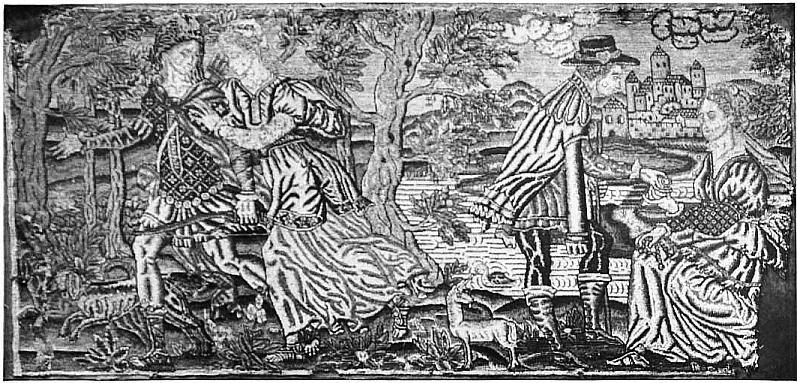
Fig. 6.—PANEL OF PETIT-POINT EMBROIDERY, WITH A REPRESENTATION OF COURTLY FIGURES IN A LANDSCAPE. English work of the end of the reign of Queen Elizabeth. Scale: 1⁄6th.
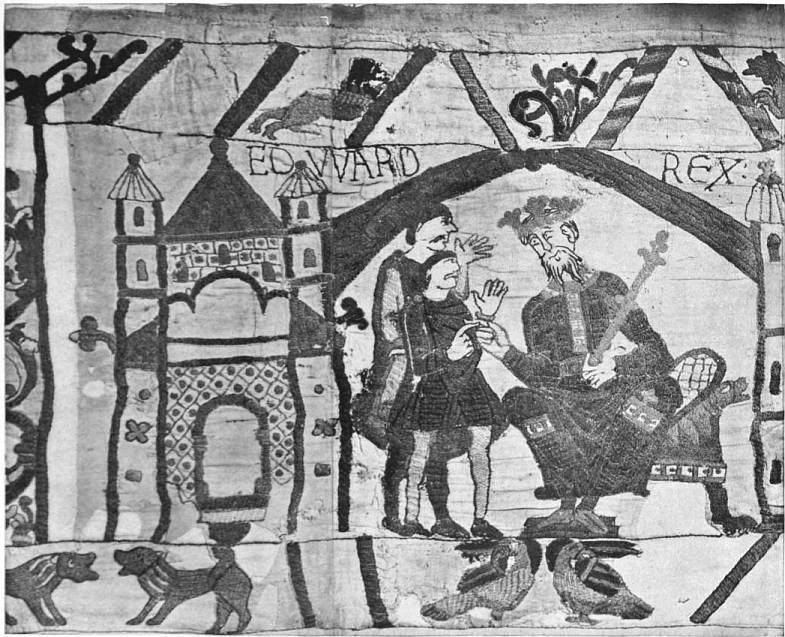
Fig. 7.—PORTION OF THE “BAYEUX TAPESTRY,” A BAND OF EMBROIDERY WITH THE STORY OF THE NORMAN CONQUEST OF ENGLAND. In the museum at Bayeux, 11th century work. Scale: ¼th.
Plate II.
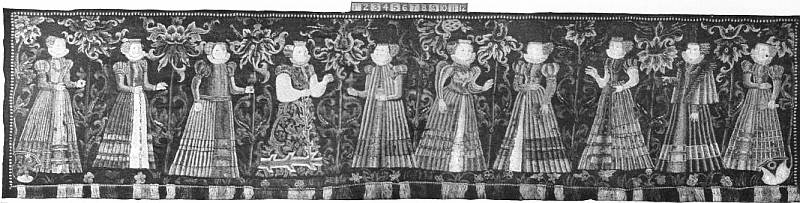
Fig. 8.—HANGING OF WOOLLEN CLOTH, EMBROIDERED WITH THE FIVE WISE AND THE FIVE FOOLISH VIRGINS. German work, dated 1598. Scale: 1⁄10th.
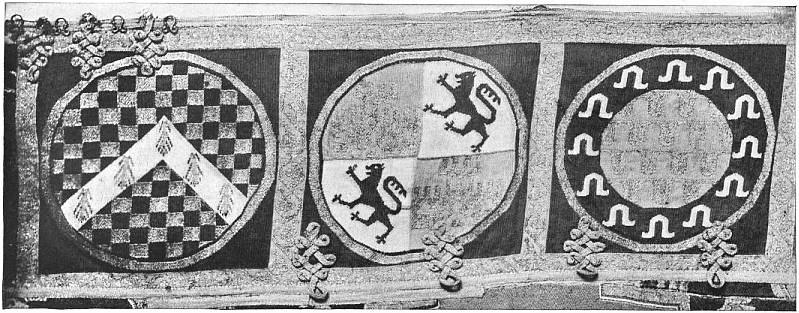
Fig. 9.—PORTION OF THE ORPHREY OF THE “SYON COPE,” EMBROIDERED WITH SHIELDS OF ARMS. The cope, formerly in the monastery of Syon near Isleworth, is now in the Victoria and Albert Museum. English work of the 13th century. Scale: 5⁄16ths.
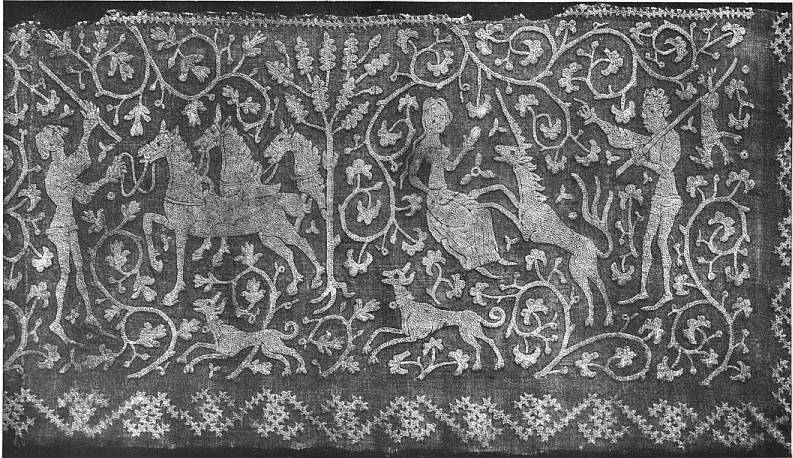
Fig. 10.—PORTION OF A BAND OF LOOSE LINEN, EMBROIDERED IN WHITE THREAD WITH FIGURES AND ANIMALS. German work of the later part of the 14th century. Scale: 2⁄7ths.
In concerning ourselves solely with those periods of which examples survive, we must pass over a wide gap and begin with the anciently-civilized land of Egypt. The sandy soil and dry climate of that country have led to the preservation of woven stuffs and embroideries of unique historic interest. The principal, and by far the earliest, known pieces which have a bearing on the present subject, found in 1903 in the tomb of Tethmosis (Thoutmôsis, or Thothmes) IV. at Thebes, are now in the Cairo Museum. There are three fragments, entirely of linen, inwrought with patterns in blue, red, green and black (fig. 1). A kind of tapestry method is used, the patterns being wrought upon the warp threads of the ground, instead of upon the finished web or woven material. Such a process, generally supplemented, as in this case, by a few stitches of fine needlework, was still in common use at a far later time. The largest of the three fragments at Cairo bears, in addition to rows of lotus flowers and papyrus inflorescences, a cartouche containing the name of Amenophis (Amenhotep) II. (c. 15th century B.C.); another is inwrought with the name of Tethmosis III. (c. 16th century B.C.).1
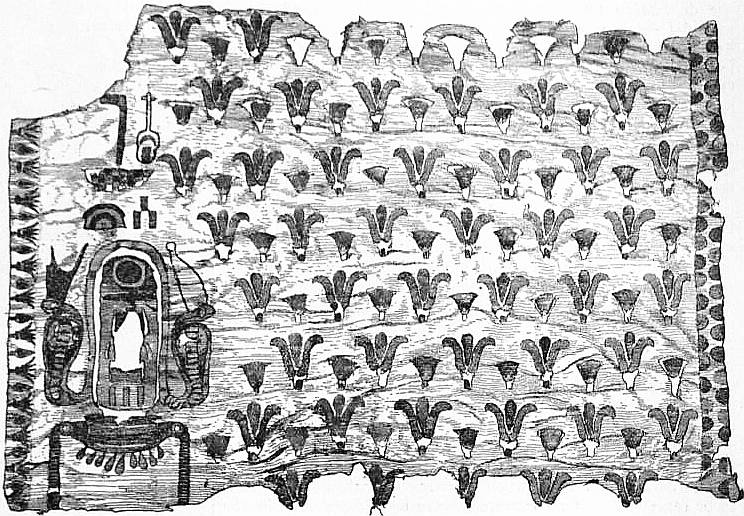
Fig. 1.—Fragment of a linen robe, found in the tomb of Tethmosis (Thothmes) IV. at Thebes, and now in the Cairo Museum. The cartouche has the name of Amenophis (Amenhotep) II. (c. 15th century B.C.).
No other embroidered stuffs which can be assigned to so early a date have hitherto come to light in the Nile valley (nor indeed elsewhere), and the student who wishes to gain a fuller knowledge of the textile patterns of the ancient Egyptians must be referred to the wall-paintings and sculptured reliefs which have been preserved in considerable numbers.
From the ancient civilizations of Babylon and Assyria no fragments of embroidery, nor even of woven stuffs, have come down to us. The fine series of wall-reliefs from Nineveh in the British Museum give some idea of the geometrical and floral patterns and diapers which adorned the robes of the ancient Assyrians. The discovery of the ruins of the palace of Darius I. (521-485 B.C.) at Susa in 1885 has thrown some light upon the textile art of the ancient Persians. They evidently owed much to the nations whom they had supplanted. The famous relief from this palace (now in the Louvre) represents a procession of archers, wearing long robes covered with small diaper patterns, perhaps of embroidery.
The exact significance of the words used in the book of Exodus in describing the robes of Aaron (ch. xxviii.) and the hangings and ornaments of the Tabernacle (ch. xxvi.) cannot be determined, and the “broidered work” of the prophecy of Ezekiel (ch. xxvii.) at a later time is also of uncertain meaning. It seems likely that much of this ancient work was of the tapestry class, such as we have found in the early fragments from Thebes.
The methods of the ancient Greek embroiderer, or “variegator” (ποικιλτής) to whom woven garments were submitted for enrichment, can only be conjectured. The peplos or woven cloth made every fifth year to cover or shade the statue of Athena in the Parthenon at Athens, and carried at the Panathenaic festival,2 was ornamented with the battles of the gods and giants. The late Dr J.H. Middleton thought that very possibly most of the elaborate work upon these peploi was done by the needle. That true embroidery, in the modern sense—the decoration by means of the needle of a finished woven material—was practised among the ancient Greeks, has been demonstrated by the finding of some textile fragments in graves in the Crimea; these are now in the Hermitage at St Petersburg. One of them, of purple woollen material, from a tomb assigned to the 4th century B.C., is embroidered in wools of different colours with a man on horseback, honeysuckle ornament and tendrils. Another woollen piece, attributed to the following century, has a stem and arrow-head leaves worked in gold thread.3
In turning to ancient Rome, it is well first briefly to notice Pliny’s account of the craft (Nat. Hist. viii.), as recording the views current in Rome at his time (1st century A.D.). After relating that Homer mentions embroidered garments (pictas vestes), he states that the Phrygians first used the needle for embroidered robes, which were thence called Phrygionian (Phrygioniae), and that Attalic garments were named from Attalus II., king of Pergamum (159-138 B.C.), the inventor of the art of embroidering in gold. He further relates that Babylon gave the name to embroideries of divers colours, for the production of which that city was famous. By the Romans the art was designated as “painting with the needle” (acu pingere), a term used by Virgil in speaking of the decoration of robes, by Ovid (who describes it as an art taught by Minerva), and by Roman writers generally when referring to embroidery.4 It is to be regretted that no examples have been discovered in the neighbourhood of the Roman capital. For embroideries made under Roman influence we must again look to Egypt. They formed the decoration of garments5 and mummy-wrappings from the cemeteries in Upper and Middle Egypt, which have been so extensively rifled of late years. Those of Roman type date approximately from the first five centuries of the Christian era. The earliest represent human figures, animals, birds, geometrical and interlacing ornaments, vases, fruit, flowers and foliage (especially the vine). They are generally done in purple wool and undyed linen thread by the tapestry process employed in Egypt at least fifteen centuries earlier, as we have seen; most of the patterns have had the lines more clearly marked out by the ordinary method of needlework. Towards the end of this period a greater choice of colours is seen, and Christian symbols appear. At this time examples worked entirely upon the finished web are found (fig. 2). The transition is easy from such work to the veritable “needle-paintings,” representing scenes from the gospels, produced in Egypt shortly after (fig. 3). Such embroideries are evidently akin to those mentioned by Bishop Asterius (330-410), who describes the garments worn by effeminate Christians as painted like the walls of their houses.6
From the time of Justinian (527-565) onwards for some centuries, the art of Europe, embroidery with the rest, was dominated by that of the Byzantine empire. To trace the progress of the highly conventionalized Byzantine style, becoming more rigid and stereotyped as time passes, belongs to the general history of art, and such a task cannot be attempted here. Perhaps the most remarkable example of all which have survived to illustrate the work of the Byzantine embroiderers is the blue silk robe known as the dalmatic of Charlemagne or of Leo III., in the sacristy of St Peter’s at Rome (fig. 4). According to the present consensus of opinion it belongs to a later time than either of those dignitaries, dating most probably from the 12th century.7 In front is represented Christ enthroned as Judge of the world, a youthful but majestic figure; on the back is the Transfiguration. These, as well as the minor subjects, are explained by Greek inscriptions. The wide influence of Byzantine art gradually died out after the Latin sack of Constantinople in the year 1204, although the style lingered, and lingers still, in certain localities, notably at Mount Athos.
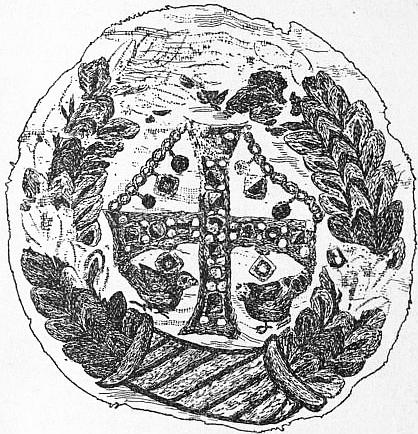
Fig. 2.—Embroidered panel from a linen garment, with a jewelled cross and two birds within a wreath. Found in a cemetery at Akhmīm, Upper Egypt. Egypto-Roman work of the 4th or 5th century A.D.
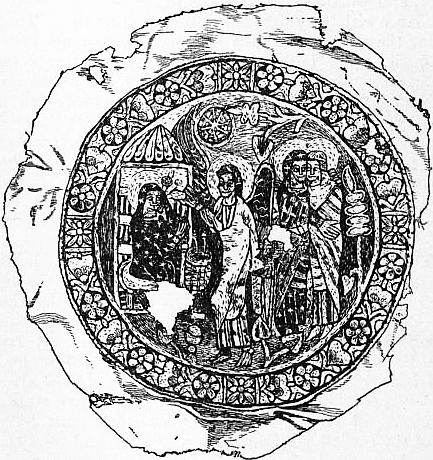
Fig. 3.—Embroidered panel from a linen garment, with a representation of the Annunciation and the Salutation. Found in a cemetery in Egypt. Coptic work of the 6th or 7th century A.D.
Palermo in Sicily succeeded Byzantium as the capital of the arts in Europe, although its ascendancy was of brief duration. Under the Norman kings of Sicily the style was strongly oriental, consequent upon the earlier occupation of the island by the Saracens, and upon the employment of Saracenic craftsmen by the Normans. The magnificent red silk mantle at Vienna, embroidered in gold thread with a date-palm and two lions springing upon camels, and enriched with pearls and enamel plaques, bears round the edge an Arabic inscription, recording that it was made in the royal factory of the capital of Sicily (Palermo) in the year 528 (= A.D. 1134). At that time Roger, the first Norman king, was on the throne. Another of the imperial coronation-robes—a linen alb with gold embroidery—is also at Vienna.8 An inscription in Latin and Arabic states that it was made in the year 1181, under the reign of William II. (Norman king of Sicily, 1166-1189).
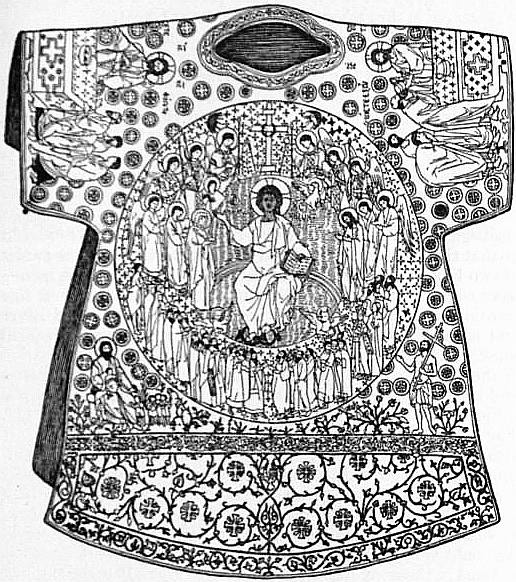
Fig. 4.—Embroidered robe known as the “Dalmatic of Charlemagne,” or of Leo III., preserved in the sacristy of St Peter’s at Rome. Byzantine work, probably of the 12th century.
From about that time distinct national styles began to develop in different places. In tracing the progress of the embroiderer’s art during the middle ages we must rely mainly upon the many fine examples of ecclesiastical work which have been preserved. The costumes of men and women, as well as curtains and hangings and such articles of domestic use, were often richly adorned with embroidery. These have mostly perished; while the careful preservation and comparatively infrequent use of the vestments and other objects devoted to the service of the church have given us tangible evidence of the attainments of the medieval embroiderer. Much of this work was produced in convents, but old documents show that in monasteries also were to be found men known for their skill in needlework. Other names, both of men and women, are recorded, showing that the craft was by no means exclusively confined to monastic foundations. Gilds of embroiderers existed far back in medieval times.
In England the craft has been a favourite employment for many centuries, and persons of all ranks have occupied their spare hours at needlework. Some embroidered fragments, found in 1826-1827 in the tomb of St Cuthbert at Durham, and now kept in the cathedral library, were worked, chiefly in gold thread, by order of Ælfflæda, queen of Edward the Elder, for Fridestan, bishop of Winchester, early in the 10th century. In the later part of the following century the “Bayeux tapestry” was produced—a work of unique importance (Plate I. fig. 7). It is a band of linen, more than 230 ft. long, embroidered in coloured wools with the story of the Norman conquest of England. (See Bayeux Tapestry.)
Some fragments of metallic embroidery on silk, of the 12th and 13th centuries, may be seen in the library of Worcester cathedral. They were removed from the coffins of two bishops, William de Blois (1218-1236) and Walter de Cantelupe (1236-1266). A fragment of gold embroidery from the tomb of the latter bishop is preserved in the Victoria and Albert Museum at South Kensington, and others are in the British Museum. In the 13th century English embroidery was famous throughout western Europe, and many embroidered objects are described in inventories of that time as being de opere anglicano. During that century, and the early part of the next, English work was at its best. The most famous example is the “Syon cope” at South Kensington, belonging to the latter half of the 13th century (see Cope, Plate I. fig. 2). It represents the coronation of the Virgin, the Crucifixion, the archangel Michael transfixing the dragon, the death and burial of the Virgin, our Lord meeting Mary Magdalene in the garden, the Apostles and the hierarchies of angels. The broad orphrey is embroidered with a series of heraldic shields (Plate II. fig. 9). Other embroideries of the period are at Steeple Aston, Chesterfield (Col. Butler-Bowden), Victoria and Albert and British museums, Rome (St John Lateran), Bologna, Pienza, Anagni, Ascoli, St Bertrand de Comminges, Lyons museum, Madrid (archaeological museum), Toledo and Vich.
During the course of the 14th and 15th centuries embroideries produced in England were not equal to the earlier work. Towards the end of the latter century, and until the dissolution of the monasteries in the next, much ecclesiastical embroidery of effective design was done, and many examples are still to be seen in churches throughout the country. In the Tudor period the costumes of the wealthy were often richly adorned with needlework. The portraits of King Henry VIII., Queen Elizabeth and their courtiers show how magnificent was the embroidery used for such purposes. Many examples, especially of the latter reign, worked with very effective and beautiful floral patterns, have come down to these times. A kind of embroidery known as “black work”, done in black silk on linen, was popular during the same reign. A tunic embroidered for Queen Elizabeth, with devices copied from contemporary woodcuts, is an excellent example of this work. It now belongs to the Viscount Falkland. Another class of work, popular at the same time, was closely worked in wools and silks on open-mesh material like canvas, which was entirely covered by the embroidery. Figures in rich costume were often introduced (Plate I. fig. 6). This method was much practised in France, and the term applied to it in that country, “au petit point,” has become generally used. Throughout the 17th and 18th centuries embroidery in England, though sometimes lacking in good taste, maintained generally a high standard, and that done to-day, based on the study of old examples, need not fear comparison with any modern work. During these three centuries bold floral patterns for hangings, curtains and coverlets have been usual (Plate III. fig. 13), but smaller works, such as samplers, covers of work-boxes, and pictorial and landscape subjects (fig. 5), have been produced in large numbers. In the 18th century gentlemen’s coats and waistcoats and ladies’ dresses were extensively embroidered.
In France, embroidery, like all the arts practised by that nation, has been characterized by much grace and beauty, and many good specimens belonging to different periods are known. The vestments associated with the name of St Thomas of Canterbury at Sens may be either of French or English work (12th century). To the later part of the following century belongs a band of embroidery, representing the coronation of the Virgin, the Adoration of the Magi, the presentation in the Temple, and other subjects beneath Gothic arches, preserved in the Hôtel-Dieu at Château Thierry. The mitre of Jean de Marigny, archbishop of Rouen (1347-1351), in the museum at Évreux, embroidered with figures of St Peter and St Eloy, may be regarded as representative of 14th-century work. An altar-frontal with the Annunciation embroidered in silks and gold and silver upon a blue silk damask ground, now in the museum at Lille, is a very beautiful example of Franco-Flemish art in the second half of the 15th century. It was originally in the church at Noyelles-lez-Seclin. An embroidery more characteristically French, and belonging to the same century, is in the museum at Chartres. It is a triptych, having in the middle a pietà, on the left wing St John the Evangelist, and on the right St Catherine of Alexandria. Each leaf has a canopy of architecture represented in perspective. In the 16th century an effective style of embroidery was practised in France; the pattern is generally a graceful combination of floral and scroll forms, cut out of velvet, satin or silk, and applied to a thick woollen cloth. Later work, chiefly of a floral character, has served for the decoration of costumes, ecclesiastical vestments, curtains and hangings, and the seats and backs of chairs.
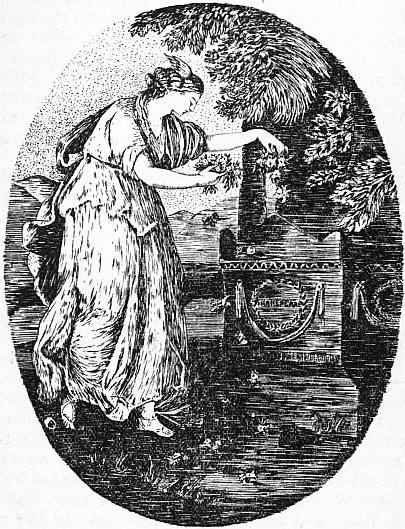
Fig. 5.—Oval picture in silk embroidery: Fame scattering Flowers over Shakespeare’s Tomb. English work of the 18th century.
Under the rule of the dukes of Burgundy in the 15th century art in the southern provinces of the Netherlands prospered greatly, and able artists were found to meet the wishes of those munificent rulers. The local schools of painting, which flourished under their patronage, appear to have very considerably influenced the embroiderers’ art. Great care and pains were given to reproduce as accurately as possible the painted cartoon or picture which served as the model. The heads are individualized, and the folds of the draperies are laboriously worked out in detail. The masonry of buildings, the veinings of marble, and the architectural enrichments are often represented with careful fidelity, and landscape backgrounds are shown in every detail. As in the case of the tapestries of the Netherlands—the finest which the world has seen—there can be no doubt that patrons of art and donors, when requiring embroideries to be made, secured the services of eminent painters for the designs. There are many examples of such careful work. A set of vestments known as the ornement de la Toison d’Or, now in the Hof-museum at Vienna, is embroidered in the most minute manner with sacred subjects and figures of saints and angels. The stiff disposal of many of these figures, within flattened hexagons arranged in zones, is not pleasing, but the needlework is most remarkable for skill and carefulness. They are of 15th-century work. A cope belonging to the second half of that century was given to the cathedral of Tournay by Guillaume Fillatre, abbot of St Bertin at St Omer, and bishop of Tournay (d. 1473). It is now in the museum there. Upon the orphreys and hood are represented the seven Works of Mercy. The body of the cope, of plain red velvet, is powdered with stags’ heads and martlets (the heraldic bearings of the bishop); between the antlers of the stags is worked in each case the initial letter of the bishop’s name, and the morse is embroidered with his arms. Some panels of embroidery, once decorating an altar in the abbey of Grimbergen, and now at Brussels, illustrate the best class of Flemish needlework in the 16th century. The scenes are taken from the Gospel: the marriage at Cana, Christ in the house of the Pharisee, Christ in the house of Zacchaeus, the Last Supper, and the supper at Emmaus. In the museum at Bern there are some embroideries of great historic and artistic interest, found in the tent of Charles the Bold, duke of Burgundy, after his defeat at Granson in 1476. They include some armorial panels and two tabards or heralds’ coats. A tabard of the following century, with the royal arms of Spain in applied work, and most probably of Flemish origin, is preserved in the archaeological museum at Ghent.
The later art of Holland was largely influenced by the Dutch conquests in the East Indies at the end of the 16th century, and the subsequent founding of the Dutch East India Company. Embroideries were among the articles produced in the East under Dutch influence for exportation to Holland.
Much embroidery for ecclesiastical purposes has been executed in Belgium of late years. It follows medieval models, but is lacking in the qualities which make those of so much importance in the history of the art.
There is perhaps little worthy of special notice in Italy before the beginning of the 14th century, but the embroideries produced at that time show great skill and are very beautiful. The names of two Florentine embroiderers of the 14th century—both men—have come down to us, inscribed upon their handiwork. A fine frontal for an altar, very delicately worked in gold and silver and silks of many colours, is preserved in the archaeological museum at Florence. The subject in the middle is the coronation of the Virgin; on either side is an arcade with figures of apostles and saints. The embroiderer’s name is worked under the central subject: Jacobus Cambi de Florētia me fecit MCCCXXXVIII. The other example is in the basilica at Manresa in Spain. It also is an altar-frontal, worked in silk and gold upon an embroidered gold ground. There is a large central panel representing the Crucifixion, with nine scenes from the Gospel on each side. The embroidered inscription is as follows: Geri Lapi rachamatore me fecit in Florentia. It is of 14th-century work. An embroidered orphrey in the Victoria and Albert Museum belongs to the early part of the same century. It represents the Annunciation, the coronation of the Virgin and figures of apostles and saints beneath arches. In the spandrels are the orders of angels with their names in Italian. In the best period of Italian art successful painters did not disdain to design for embroidery. Francesco Squarcione (1394-1474), the founder of the Paduan school of painting, and master of Mantegna, is called in a document of the year 1423 a tailor and embroiderer (sartor et recamator). It is recorded that Antonio del Pollaiuolo painted cartoons which were carried out in embroidery,9 and Pierino del Vaga, according to Vasari, did likewise. In the 16th and 17th centuries large numbers of towels and linen covers were embroidered in red, green or brown silk with borders of floral patterns, sometimes (especially in the southern provinces) combined with figure subjects and bird and animal forms (Plate IV. fig. 15). Another type of embroidery popular at the same time, both in Italy and Spain, is known as appliqué (or applied) work. The pattern is cut out and applied to a bright-coloured ground, frequently of velvet, as in the example illustrated (Plate III. fig. 14). The later embroidery of Sicily follows that of the mainland. A remarkable coverlet, quilted and padded with wool so as to throw the design into relief, is shown to be of Sicilian origin by the inscriptions which it bears (Plate VI. fig. 18). It represents scenes from the story of Tristan, agreeing in the main part with the novella entitled “La Tavola Rotonda o l’istoria di Tristano.” The quilt dates from the end of the 14th century. Many pattern-books for embroidery and lace were published in Italy in the 16th and 17th centuries.10
Plate III.
Fig. 11.—SILK PANEL, EMBROIDERED WITH A HANGING LANTERN. Chinese work of the 17th or 18th century. Scale: ¼th. Fig. 12.—PORTION OF A LARGE HANGING, EMBROIDERED WITH FIGURES WITHIN MEDALLIONS, AND INSCRIPTIONS. From a church in Iceland, probably 17th century. Scale: 1⁄8th. Fig. 13.—PORTION OF A BED-HANGING, EMBROIDERED WITH FLOWERING TREES GROWING FROM MOUNDS. English work of the later part of the 17th century. Scale: 1⁄12th. Fig. 14.—APPAREL FOR A DALMATIC OF GREEN VELVET, EMBROIDERED WITH AN APPLIQUÉ PATTERN. Italian work of the 16th century. Scale: ¼th.
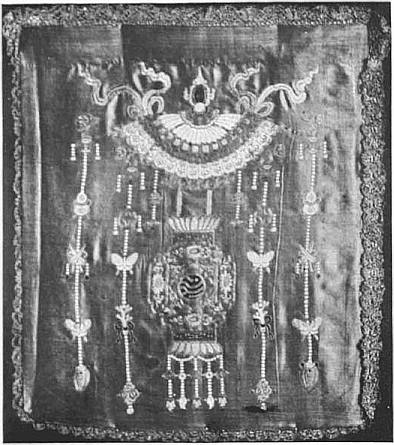
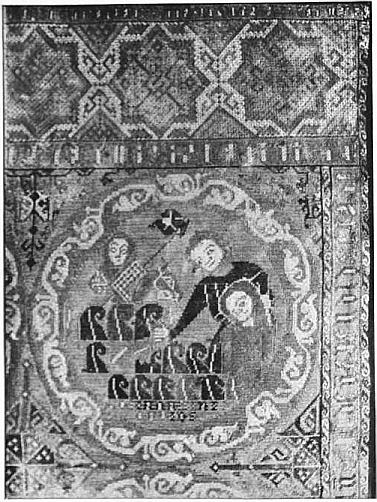
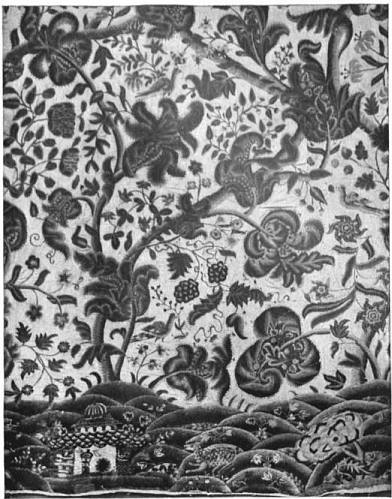
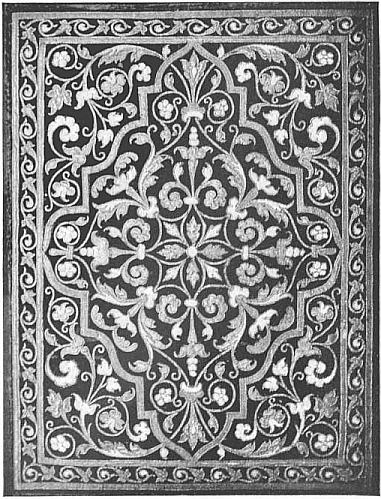
Plate IV.
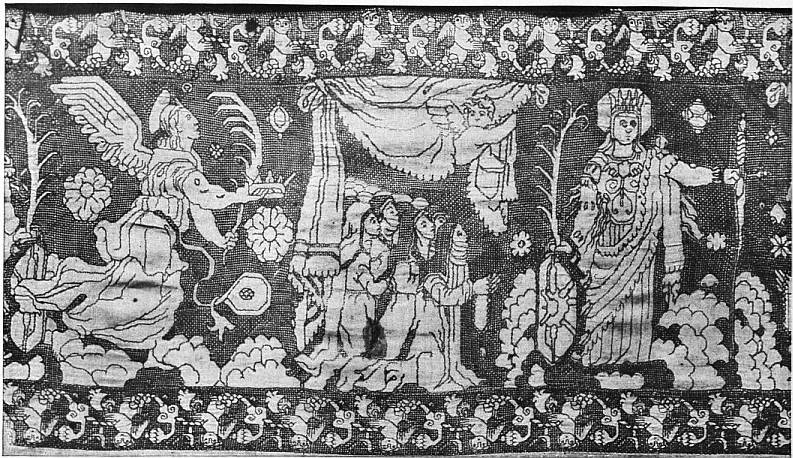
Fig. 15.—PORTION OF THE BORDER OF A LINEN COVER, EMBROIDERED WITH A FIGURE OF ST CATHERINE OF ALEXANDRIA AND KNEELING VOTARIES. Italian work of the 16th century. Scale: 2⁄5ths.
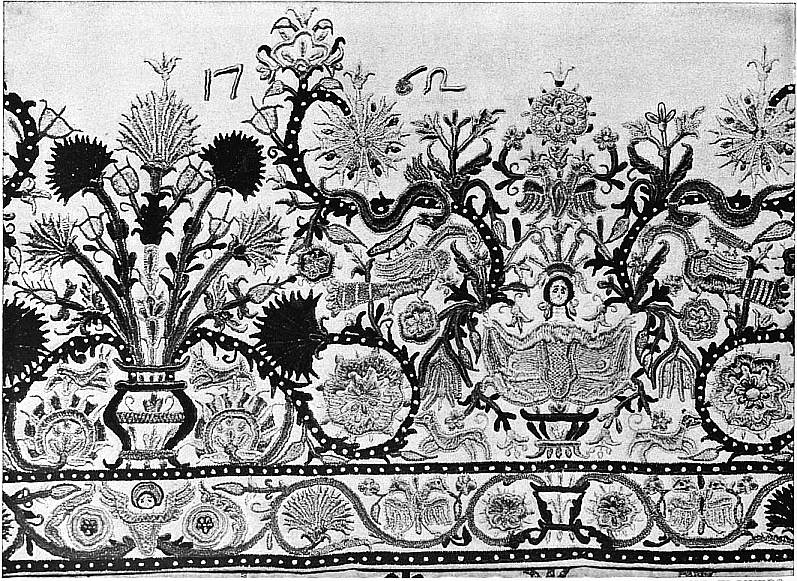
Fig. 16.—LINEN BORDER, EMBROIDERED WITH DEBASED FIGURES, BIRDS AND ANIMALS AMID FLOWERS. Cretan work, dated 1762. Scale: 4⁄9ths.
In the greater part of the Spanish peninsula art was for many centuries dominated by the Arabs, who overran the country in the 8th century, and were not finally subdued until the end of the 15th. Hispano-Moorish embroideries of the medieval period usually have interlacing patterns combined with Arabic inscriptions. In the 15th and 16th centuries Italian influence becomes evident. Later the effects of the Spanish conquests in Asia are seen. Eastern influence is, however, stronger in the case of the Portuguese, who seized Goa, on the west coast of the Indian peninsula, early in the 16th century, and during the whole of that century held the monopoly of the eastern trade. Many large embroideries were produced in the Indies, showing eastern floral patterns mingled with representations of Europeans, ships and coats of arms. Embroideries done in Portugal in the 16th and 17th centuries strongly reflect the influence of oriental patterns.
German embroidery of the 12th and 13th centuries adheres closely to the traditions of Byzantine art. A peculiarity of much medieval German work is a tendency to treat the draperies of the figures as flat surfaces to be covered with diaper patterns, showing no folds. A cope from Hildesheim cathedral, now in the Victoria and Albert Museum, is a typical illustration of such work, dating from the end of the 13th century. It is embroidered in silk upon linen with the martyrdom of apostles and saints. Other specimens of embroidery in this manner may be seen at Halberstadt. An altar-frontal from Rupertsburg (Bingen), belonging to the earlier years of the 13th century, is now in the Brussels museum. It is of purple silk, embroidered with Christ in majesty and figures of saints. It was no doubt made in the time of Siegfried, archbishop of Mainz (1201-1230), who is represented upon it. A type of medieval German embroidery is done in white linen thread on a loose linen ground—a sort of darning-work (Plate II. fig. 10). Earlier specimens of this work are often diversified by using a variety of stitches tending to form diaper patterns. The use of long scrolling bands with inscriptions explaining the subjects represented is more usual in German work than in that of any other country. In the 15th century much fine embroidery was produced in the neighbourhood of Cologne. Later German work shows a preference for bold floral patterns, sometimes mingled with heraldry; the larger examples are often worked in wool on a woollen cloth ground (Plate II. fig. 8). The embroidery of the northern nations (Denmark, Scandinavia, Iceland) was later in development than that of the southern peoples. Figure subjects evidently belonging to as late a period as the 17th century are still disposed in formal rows of circles, and accompanied by primitive ornamental forms (Plate III. fig. 12). A remarkable early embroidered fabric covers the relics of St Knud (Canute, king of Denmark, 1080-1086) in his shrine in the church dedicated to him at Odense. It is apparently contemporary work. The pattern consists of displayed eagles within oval compartments, in blue on a red ground.
In Greece and the islands of the eastern Mediterranean embroidery has been much employed for the decoration of costumes, portières and bed-curtains. Large numbers have been acquired in Crete (Plate IV. fig. 16), and patterns of a distinctive character are also found in Rhodes, Cos, Patmos and other islands. Some examples show traces of the influence of the Venetian trading settlements in the archipelago in the 16th and 17th centuries. Among the Turks a great development of the arts followed upon the conquest of Asia Minor and the Byzantine territory in Europe. Their embroideries show a preference for floral forms—chiefly roses, tulips, carnations and hyacinths—which are treated with great decorative skill.
The use of embroidery in Asia—especially in India, China, Turkestan and Persia—dates back to very early times. The conservatism of all these peoples renders the date of surviving examples often difficult to establish, but the greater number of such embroideries now to be seen in Europe are certainly of no great age.
India has produced vast quantities of embroideries of varying excellence. The fine woollen shawls of Kashmir are widely famed; their first production is supposed to date back to a remote period. The somewhat gaudy effect of many Indian embroideries is at times intensified by the addition of beetles’ wings, tinsel or fragments of looking-glass. China is the original home of the silkworm, and the textile arts there reached an advanced stage at a date long before that of any equally skilful work in Europe. Embroideries worked there are generally in silk threads on a ground of the same material. Such work is largely used for various articles of costume, and for coverlets, screens, banners, chair-covers and table-hangings. The ornaments upon the robes especially are prescribed according to the rank of the wearer. The designs include elaborate landscapes with buildings and figures, dragons, birds, animals, symbolic devices, and especially flowers (Plate III. fig. 11). Dr Bushell states that the stuff to be embroidered is first stretched upon a frame, on pivots, and that pattern-books with woodcuts have been published for the workers’ guidance. A kind of embroidery exported in large quantities from Canton to Europe rivals painting in the variety and gradation of its colours, and in the smoothness and regularity of its surface.
Embroidery in Japan resembles in many ways that of China, the country which probably supplied its first models. As a general rule, Japanese work is more pictorial and fanciful than that of China, and the stitching is looser. It frequently happens that the brush has been used to add to the variety of the embroidered work, and in other cases the needle has been an accessory upon a fabric already ornamented with printing or painting. Japanese work is characterized generally by bold and broad treatment, and especial skill is shown in the representation of landscapes—figures, rocks, waterfalls, animals, birds, trees, flowers and clouds being each rendered by a few lines. More elaborate are the large temple hangings, the pattern being frequently thrown into relief, and completely covering the ground material.
Embroidery in Persia has been used to a great extent for the decoration of carpets, for prayer or for use at the bath (Plate V. fig. 17). Robes, hangings, curtains, tablecovers and portières are also embroidered. A preference is shown for floral patterns, but the Mahommedans of Persia had no scruples about introducing the forms of men and animals—the former engaged in hawking or hunting, or feasting in gardens. Panels embroidered with close diagonal bands of flowers were made into loose trousers for women, now obsolete. The embroidered shawls of Kerman are widely celebrated. Hangings and covers of cloth patchwork have been embroidered in many parts of Persia, more particularly at Resht and Ispahan.
In Turkestan, and especially at Bokhara, excellent embroideries have been, and are, produced, some patterns being of a bold floral type, and others conventionalized into hooked and serrated outlines. The work is most usually in bright-coloured silks, red predominating, on a linen material.
In North Africa the embroidery of Morocco and Algeria deserves notice; the former inclines more to geometrical forms and the latter to patterns of a floral character.
Plate V.
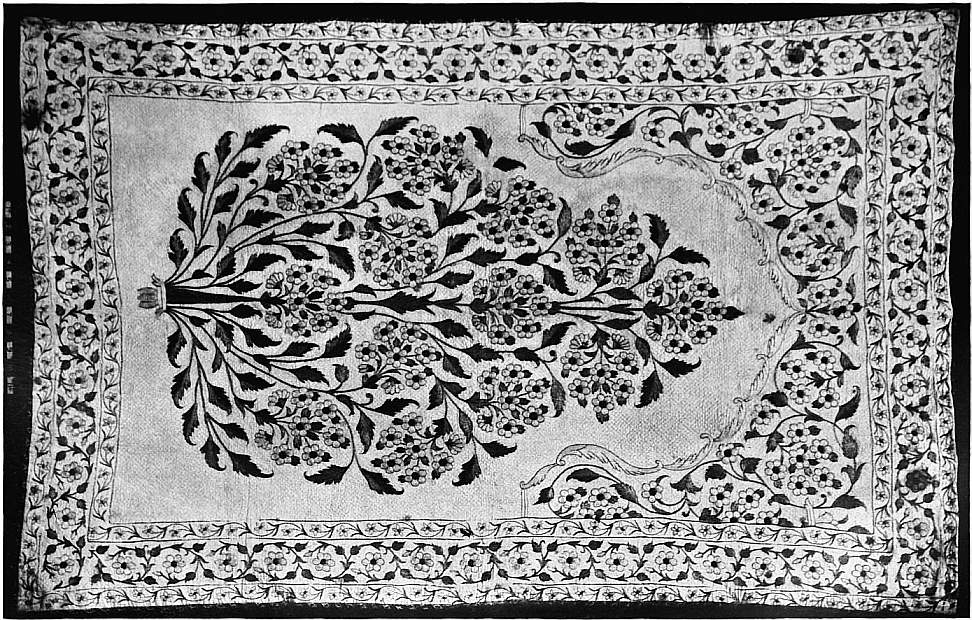
Fig. 17.—LINEN PRAYER CARPET, QUILTED AND EMBROIDERED IN CHAIN STITCH WITH COLOURED SILKS, CHIEFLY WHITE, YELLOW, GREEN AND RED.
The border consists of a wide band set between two narrow ones, each with a waved continuous stem with blossoms in the wavings. Similar floral scrolling and leafy stem ornament fills the space beyond the pointed shape at the upper end, which is edged with acanthus leaf devices. The main ground below the niche or pointed shape is a blossoming plant, with balanced bunches of flowers between which are leaves, formally arranged in a pointed oval shape. Persian work, 18th century, 4 ft. 6 in. × 2 ft. 11 in. (Victoria and Albert Museum.)
Plate VI.
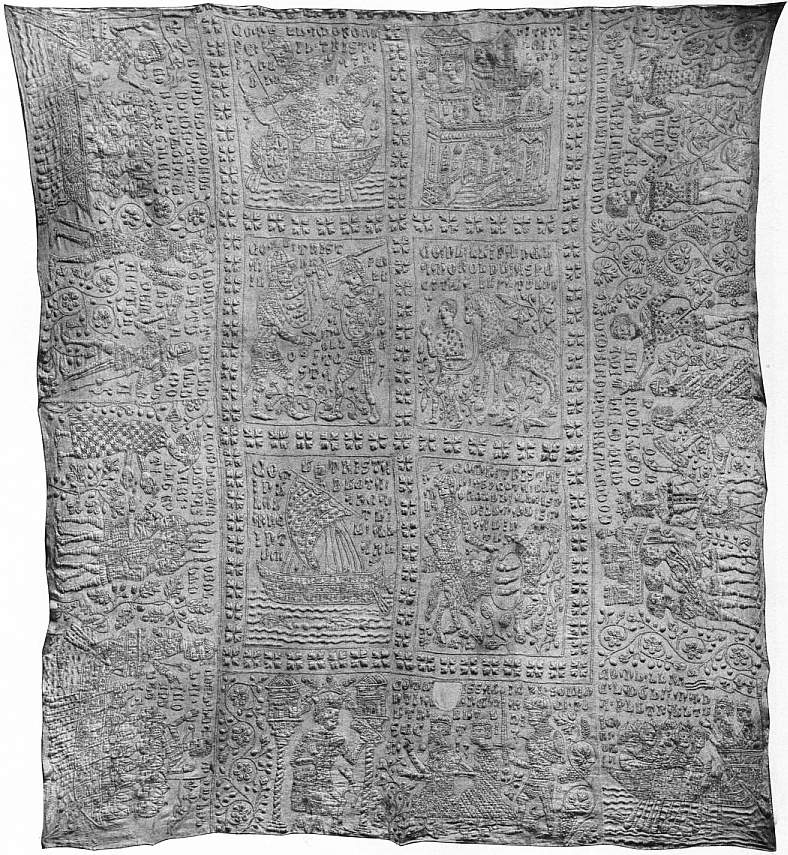
Fig. 18.—PART OF A SICILIAN COVERLET, OF THE END OF THE 14TH CENTURY.
It is of white linen, quilted and padded in wool so as to throw the design into relief. The scenes represented, taken from the Story of Tristan, with inscriptions in the Sicilian dialect, are as follows:—(1) Comu: Lu Amoroldu Fa Bandiri: Lu Osti: In Cornuualgia (How the Morold made the host to go to Cornwall); (2) Comu: Lu Rre: Languis: Cumanda: Chi Uaia: Lo Osti. Cornuaglia (How King Languis ordered that the host should go to Cornwall); (3) Comu: Lu Rre: Languis: Manda: Per Lu Trabutu in Cornualia (How King Languis sent to Cornwall for the tribute); (4) Comu: (li m) Issagieri: so Uinnti: Al Rre: Marcu: Per Lu Tributu Di Secti Anni (How the ambassadors are come to King Mark for the tribute of seven years); (5) Comu: Lu Amoroldu Uai: in Cornuualgia (How the Morold comes to Cornwall); (6) Comu: Lu Amoroldu: Fa Suldari: La Genti (How the Morold made the people pay); (7) Comu: T(ristainu): Dai: Lu Guantu Allu Amoroldu Dela Bactaglia (How Tristan gives the glove of battle to the Morold); (8) Comu: Lu Amoroldu: E Uinutu: in Cornuualgia: Cum XXXX Galei: (How the Morold is come to Cornwall with forty galleys); (9) Comu Tristainu Bucta: La Uarca: Arretu: Intu: Allu Maru (How Tristan struck his boat behind him into the sea); (10) Comu: Tristainu: Aspecta: Lu Amoroldu: Alla Isola Di Lu Maru: Sansa Uintura (How Tristan awaits the Morold on the isle Sanza Ventura in the sea); (11) Comu: Tristainu Feriu Lu Amorolldu in Testa (How Tristan wounded the Morold in the head); (12) Comu: Lu Inna (?) Delu Amoroldu: Aspecttaua Lu Patrunu (How the Morold’s page (?) awaited his master); (13) Comu Lu Amorodu Feriu: Tristainu A Tradimantu (How the Morold wounded Tristan by treachery); (14) ... Sita: In Airlandia ( ... in Ireland).
Bibliography.—Lady Alford, Needlework as Art (London, 1886); Mrs M. Barber, Some Drawings of Ancient Embroidery (ib., 1880); P. Blanchet, Tissus antiques et du haut moyen-âge (Paris, 1897); F. Bock, Die Kleinodien des Heiligen Römischen Reiches Deutscher Nation (Vienna, 1864); M. Charles, Les Broderies et les dentelles (Paris, 1905); Mrs Christie, Embroidery and Tapestry Weaving (London, 1906); A.S. Cole, C.B., “Some Aspects of Ancient and Modern Embroidery” (Soc. of Arts Journal, liii., 1905, pp. 956-973); R. Cox, L’Art de décorer les tissus (Paris, Lyons, 1900); L.F. Day, Art in Needlework (London, 1900); A. Dolby, Church Embroidery (ib., 1867), and Church Vestments (ib., 1868); M. Dreger, Künstlerische Entwicklung der Weberei und Stickerei (Vienna, 1904); Madame I. Errera, Collection de broderies anciennes (Brussels, 1905); L. de Farcy, La Broderie (Paris, 1890); R. Forrer, Die Gräber und Textilfunde von Achmim-Panopolis (Strassburg, 1891); F.R. Fowke, The Bayeux Tapestry (London, 1898); Rev. C.H. Hartshorne, On English Medieval Embroidery (ib., 1848); M.B. Huish, Samplers and Tapestry Embroideries (ib., 1900); A.F. Kendrick, English Embroidery (ib., 1905); English Embroidery executed prior to the Middle of the 16th Century (Burlington Fine Arts Club Exhibition, 1905, introduction by A.F. Kendrick); E. Lefebure, Embroideries and Lace, translated by A.S. Cole, C.B. (London, 1888); F. Marshall, Old English Embroidery (ib., 1894); E.M. Rogge, Moderne Kunst-Nadelarbeiten (Amsterdam, 1905); South Kensington Museum, Catalogue of Special Loan Exhibition of Decorative Art Needlework (1874); W.G.P. Townshend, Embroidery (London, 1899). For further examples of ecclesiastical embroidery see the articles Chasuble, Cope, Dalmatic and Mitre.
(A. F. K.; A. S. C.)
1 See H. Carter and P.E. Newberry, Cat. gén. des ant. égypt. du musée du Caire (1904), pl. i. and xxviii. A remarkable piece of Egyptian needlework, the funeral tent of Queen Isi em Kheb (XXIst Dynasty), was discovered at Deir el Bahri some years ago. It is described as a mosaic of leatherwork—pieces of gazelle hide of several colours, stitched together (see Villiers Stuart, The Funeral Tent of an Egyptian Queen, 1882).
2 The procession at this festival is represented upon the frieze of the Parthenon.
3 See Compte rendu de la Comm. Imp. Arch., 1878-1879 (St Petersburg), pl. iii. and v.
4 For an account of the conditions under which Greek and Roman embroiderers worked, see Alan S. Cole, “Some Aspects of Ancient and Modern Embroidery,” Journal of the Society of Arts, vol. liii., 1905, pp. 958, 959.
5 Chiefly tunics with vertical bands (clavi) and medallions (orbiculae), and an ample outer robe or cloak.
6 The Adoration of the Magi is represented upon the lower border of the long robe worn by the empress Theodora (wife of Justinian) in the mosaic in the church of S. Vitale at Ravenna.
7 Writers have assigned different dates to this vestment: Lady Alford, Needlework as Art (earlier than the 13th century); F. Bock, Die Kleinodien (12th century); S. Boisserée, Über die Kaiser-Dalmatica in der St Peterskirche zu Rom (12th or first half of 13th century); A.S. Cole, Cantor Lectures at Society of Arts, 1905 (possibly of 9th century); Lord Lindsay, Christian Art (12th or early 13th century); A. Venturi, Storia dell’ arte (10th or 11th century); T. Braun, Liturg. Gewandung, p. 305 and note (late 14th or early 15th century).
8 Both are illustrated in F. Bock, Die Kleinodien.
9 Some embroideries from vestments, designed by Pollaiuolo, are still preserved in the Museo dell’ Opera del Duomo, Florence.
10 Others, sometimes with the same illustrations, appeared in France and Germany, and no doubt forwarded the general tendency towards Italian models at the time. A few pattern-books were also published in England.
EMBRUN, a town in the department of the Hautes Alpes in S.E. France. It is built at a height of 2854 ft. on a plateau that rises above the right bank of the Durance. It is 27½ m. by rail from Briançon and 24 m. from Gap. Its ramparts were demolished in 1884. In 1906 the communal pop. (including the garrison) was 3752. Besides the Tour Brune (11th century) and the old archiepiscopal palace, now occupied by government offices, barracks, &c., the chief object of interest in Embrun is its splendid cathedral church, which dates from the second half of the 12th century. Above its side door, called the Réal, there existed till 1585 (when it was destroyed by the Huguenots) a fresco, probably painted in the 13th century, representing the Madonna: this was the object of a celebrated pilgrimage for many centuries. Louis XI. habitually wore on his hat a leaden image of this Madonna, for which he had a very great veneration, since between 1440 and 1461, during the lifetime of his father, he had been the dauphin, and as such ruler of this province.
Embrun was the Eburodunum or Ebredunum of the Romans, and the chief town of the province of the Maritime Alps. The episcopal see was founded in the 4th century, and became an archbishopric about 800. In 1147 the archbishops obtained from the emperor Conrad III. very extensive temporal rights, and the rank of princes of the Holy Roman Empire. In 1232 the county of the Embrunais passed by marriage to the dauphins of Viennois. In 1791 the archiepiscopal see was suppressed, the region being then transferred to the diocese of Gap, so that the once metropolitan cathedral church is now simply a parish church. The town was sacked in 1585 by the Huguenots and in 1692 by the duke of Savoy. Henri Arnaud (1641-1721), the Waldensian pastor and general, was born at Embrun.
See A. Albert, Histoire du diocèse d’Embrun (2 vols., Embrun, 1783); M. Fornier, Histoire générale des Alpes Maritimes ou Cottiennes et particulière de leur métropolitaine Embrun (written 1626-1643), published by the Abbé Paul Guillaume (3 vols., Paris and Gap, 1890-1891); A. Fabre, Recherches historiques sur le pèlerinage des rois de France à N.D. d’Embrun (Grenoble, 1859); A. Sauret, Essai historique sur la ville d’Embrun (Gap, 1860).
(W. A. B. C.)
EMBRYOLOGY. The word embryo is derived from the Gr. ἔμβρυον, which signified the fruit of the womb before birth. In its strict sense, therefore, embryology is the study of the intrauterine young or embryo, and can only be pursued in those animals in which the offspring are retained in the uterus of the mother until they have acquired, or nearly acquired, the form of the parent. As a matter of fact, however, the word has a much wider application than would be gathered from its derivation. All animals above the Protozoa undergo at the beginning of their existence rapid growth and considerable changes of form and structure. During these changes, which constitute the development of the animal, the young organism may be incapable of leading a free life and obtaining its own food. In such cases it is either contained in the body of the parent or it is protruded and lies quiescent within the egg membranes; or it may be capable of leading an independent life, possessing in a functional condition all the organs necessary for the maintenance of its existence. In the former case the young organism is called an embryo,1 in the latter a larva. It might thus be concluded that embryology would exclude the study of larvae, in which the whole or the greater part of the development takes place outside the parent and outside the egg. But this is not the case; embryology includes not only a study of embryos as just defined, but also a study of larvae. In this way the scope of the subject is still further widened. As long as embryology confines its attention to embryos, it is easy to fix its limits, at any rate in the higher animals. The domain of embryology ceases in the case of viviparous animals at birth, in the case of oviparous animals at hatching; it ceases as soon as the young form acquires the power of existing when separated from the parent, or when removed from the protection of the egg membranes. But as soon as post-embryonic developmental changes are admitted within the scope of the subject, it becomes on close consideration difficult to limit its range. It must include all the developmental processes which take place as a result of sexual reproduction. A man at birth, when he ceases to be an embryo, has still many changes besides those of simple growth to pass through. The same remark applies to a young frog at the metamorphosis. A chick even, which can run about and feed almost immediately after hatching, possesses a plumage very different from that of the full-grown bird; a starfish at the metamorphosis is in many of its features quite different from the form with which we are familiar. It might be attempted to meet this difficulty by limiting embryology to a study of all those changes which occur in the organism before the attainment of the adult state. But this merely shifts the difficulty to another quarter, and makes it necessary to define what is meant by the adult state. At first sight this may seem easy, and no doubt it is not difficult when man and the higher animals alone are in question, for in these the adult state may be defined comparatively sharply as the stage of sexual maturity. After that period, though changes in the organism still continue, they are retrogressive changes, and as such might fairly be excluded from any account of development, which clearly implies progression, not retrogression. But, as so often happens in the study of organisms, formulae which apply quite satisfactorily to one group require modifications when others are considered. Does sexual maturity always mark the attainment of the adult state? Is the Axolotl adult when it acquires its reproductive organs? Can a larval Ctenophore, which acquires functional reproductive glands and still possesses the power of passing into the form ordinarily described as adult in that group, be considered to have reached the end of its development? Or—to take the case of those animals, such as Amphioxus, Balanoglossus, and many segmented worms in which important developmental processes occur, e.g. formation of new gill slits, of gonadial sacs, or even of whole segments of the body, long after the power of reproduction has been acquired—how is the attainment of the adult state to be defined, for it is clear that in them the attainment of sexual maturity does not correspond with the end of growth and development? If, then, embryology is to be regarded as including not only the study of embryos, but also that of larvae, i.e. if it includes the study of the whole developmental history of the individual—and it is impossible to treat the subject rationally unless it is so regarded—it becomes exceeding difficult to fix any definite limit to the period of life with which embryology concerns itself. The beginning of this period can be fixed, but not the end, unless it be the end of life itself, i.e. death. The science of embryology, then, is the science of individual development, and includes within its purview all those changes of form and structure, whether embryonic, larval or post-larval, which characterize the life of the individual. The beginning of this period is precise and definite—it is the completion of the fertilization of the ovum, in which the life of the individual has its start. The end, on the other hand, is vague and cannot be precisely defined, unless it be death, in which case the period of life with which embryology concerns itself is coincident with the life of the individual. To use the words of Huxley (“Cell Theory,” Collected Works, vol. i. p. 267): “Development, therefore, and life are, strictly speaking, one thing, though we are accustomed to limit the former to the progressive half of life merely, and to speak of the retrogressive half as decay, considering an imaginary resting-point between the two as the adult or perfect state.”
There are two kinds of reproduction, the sexual and the asexual. The sexual method has for its results an increase of the number of kinds of individual or organism, whereas the asexual affords an increase in the number of Reproduction. individuals of the same kind. If the asexual method of reproduction alone existed, there would, so far as our knowledge at present extends, be no increase in the number of kinds of organism: no new individuality could arise. The first establishment of a new kind of individual by the sexual process is effected in a very similar manner in all Metazoa. The parent produces by a process of unequal fission, which takes place at a part of the body called the reproductive gland, a small living organism called the reproductive cell. There are always two kinds of reproductive cells, and these are generally produced by different animals called the male and female respectively (when they are produced by the same animal it is said to be hermaphrodite). The reproductive cell produced by the male is called the spermatozoon, and that produced by the female, the ovum. These two organisms agree in being small uninucleated masses of protoplasm, but differ considerably in form. They are without the organs of nutrition, &c., which characterize their parents, but the ovum nearly always possesses, stored up within its protoplasm, a greater or less quantity of vitelline matter or food-yolk, while the spermatozoon possesses in almost all cases the power of locomotion. The object with which these two minute and simple organisms are produced is to fuse with one another and give rise to one resultant uninucleated (for the nuclei fuse) organism or cell, which is called the zygote. This process of fusion between the two kinds of reproductive cells, which are termed gametes, is called conjugation: it is the process which is sometimes spoken of as the fertilization of the ovum, and its result is the establishment of a new individual. This new individual at first is simply a uninucleated mass of living matter, which always contains a certain amount of food-yolk, and is generally bounded by a delicate cuticular membrane called the vitelline membrane. In form the newly established zygote resembles the female gamete or ovum—so much so, indeed, that it is frequently called the ovum; but it must be clearly understood that although the bulk of its matter has been derived from the ovum, it consists of ovum and spermatozoon, and, as shown by its subsequent behaviour, the spermatozoon has quite as much to do with determining its vital properties as the ovum.
To the unaided eye the main difference between the newly formed zygotes of different species of animals is that of bulk, and this is due to the amount of food-yolk held in suspension in the protoplasm. The ovum of the fowl is 30 mm. in diameter, that of the frog 1·75 mm., while the ova of the rabbit and Amphioxus have a diameter of ·l mm. The food-yolk is deposited in the ovum as a result of the vital activity of its protoplasm, while the ovum is still a part of the ovary of the parent. It is an inert substance which is used as food later on by the developing embryo, and it acts as a dilutant of the living matter of the ovum. It has a profound influence on the subsequent developmental process. The newly formed zygotes of different species of animals have undoubtedly, as staved above, a certain family resemblance to one another; but however great this superficial resemblance may be, the differences must be most profound, and this fact becomes at once obvious when the properties of these remarkable masses of matter are closely investigated.
As in the case of so many other forms of matter, the more important properties of the zygote do not become apparent until it is submitted to the action of external forces. These forces constitute the external conditions of Causes of development. existence, and the properties which are called forth by their action are called the acquired characters of the organism. The investigation of these properties, particularly of those which are called forth in the early stages of the process, constitutes the science of Embryology. With regard to the manifestation of these properties, certain points must be clearly understood at the outset:—(1) If the zygote is withheld from the appropriate external influences, e.g. if a plant-seed be kept in a box free from moisture or at a low temperature, no properties are evolved, and the zygote remains apparently unchanged; (2) the acquisition of the properties which constitutes the growth and development of the organism proceeds in a perfectly definite sequence, which, so far as is known, cannot be altered; (3) just as the features of the growing organism change under the continued action of the external conditions, so the external conditions themselves must change as the organism is progressively evolved. With regard to this last change, it may be said generally that it is usually, if not always, effected by the organism itself, making use of the properties which it has acquired at earlier stages of its growth, and acting in response to the external conditions. There is, to use a phrase of Mr Herbert Spencer, a continuous adjustment between the external and internal relations. For every organism a certain succession of conditions is necessary if the complete and normal evolution of properties is to take place. Within certain limits, these conditions may vary without interfering with the normal evolution of the properties, though such variations are generally responded to by slight but unimportant variation of the properties (variation of acquired characters). But if the variation of the conditions is too great, the evolved properties become abnormal, and are of such a nature as to preclude the normal evolution of the organism; in other words, the action of the conditions upon the organism is injurious, causing abortions and, ultimately, death. For many organisms the conditions of existence are well known for all stages of life, and can be easily imitated, so that they can be reared artificially and kept alive and made to breed in confinement—e.g. the common fowl. But in a large number of cases it is not possible, through ignorance of the proper conditions, or on account of the difficulty of imitating them, to make the organism evolve all its properties. For instance, there are many marine larvae which have never been reared beyond a certain point, and there are some organisms which, even when nearly full-grown—a stage of life at which it is generally most easy to ascertain and imitate the natural conditions—will not live, or at any rate will not breed, in captivity. Of late years some naturalists have largely occupied themselves with experimental observation of the effects on certain organisms of marked and definite changes of the conditions, and the name of Developmental Mechanics (or Physiology of Development) has been applied to this branch of study (see below).
In normal fertilization, as a rule, only one spermatozoon fuses with the ovum. It has been observed in some eggs that a membrane, formed round the ovum immediately after the entrance of the spermatozoon, prevents the entrance of others. If Gametogeny. than one spermatozoon enters, a corresponding number of male pronuclei are formed, and the subsequent development, if it takes place at all, is abnormal and soon ceases. An egg by ill-treatment (influence of chloroform, carbonic acid, &c.) can be made to take more than one spermatozoon. In some animals it appears that several spermatozoa may normally enter the ovum (some Arthropoda, Selachians, Amphibians and Mammals), but of these only one forms a male pronucleus (see below), the rest being absorbed. Gametogeny is the name applied to the formation of the gametes, i.e. of the ova and spermatozoa. The cells of the reproductive glands are the germ cells (oögonia, spermatogonia). They undergo division and give rise to the progametes, which in the case of the female are sometimes called oöcytes, in the case of the male spermatocytes. The oöcytes are more familiarly called the ovarian ova. The nucleus of the oöcyte is called the germinal vesicle. The oöcyte (progamete) gives rise by division to the ovum or true gamete, the nucleus of which is called the female pronucleus. As a general rule the oöcyte divides unequally twice, giving rise to two small cells called polar bodies, and to the ovum. The first formed polar body frequently divides when the oöcyte undergoes its second and final division, so that there are three polar bodies as well as the ovum resulting from the division of the oöcyte or progamete. Sometimes the ovum arises from the oöcyte by one division only, and there is only one polar body (e.g. mouse, Sobotta, Arch. f. mikr. Anat., 1895, p. 15). The polar bodies are oval, but as a rule they are so small as to be incapable of fertilization. They may therefore be regarded as abortive ova. In one case, however (see Francotte, Bull. Acad. Belg. (3), xxxiii., 1897, p. 278), the first formed polar body is nearly as large as the ovum, and is sometimes fertilized and develops. The spermatogonia are the cells of the testis; these produce by division the spermatocytes (progametes), which divide and give rise to the spermatids. In most cases which have been investigated the divisions by which the spermatids arise from the spermatocytes are two in number, so that each spermatocyte gives origin to four spermatids. Each spermatid becomes a functional spermatozoon or male gamete. The gametogeny of the male therefore closely resembles that of the female, differing from it only in the fact that all the four products of the progamete become functional gametes, whereas in the female only one, the ovum, becomes functional, the other three (polar bodies) being abortive. In the spermatogenesis of the bee, however, the spermatocyte only divides once, giving rise to a small polar-body-like structure and one spermatid (Meves, Anat. Anzeiger, 24, 1904, pp. 29-32). The nucleus of the male gamete is not called the male pronucleus, as would be expected, that term being reserved for the second nucleus which appears in the ovum after fertilization. As this is in all probability derived entirely from the nucleus of the spermatozoon, we should be almost justified in calling the nucleus of the spermatozoon the male pronucleus. In most forms in which the formation of the gametes from the progamete has been accurately followed, and in which the progamete of both sexes divides twice in forming the gametes, the division of the nucleus presents certain peculiarities. In the first place, between the first division and the second it does not enter into the resting state, but immediately proceeds to the second division. In the second place, the number of chromosomes which appear in the final divisions of the progametes and assist in constituting the nuclei of the gametes is half the number which go to constitute the new nuclei in the ordinary nuclear divisions of the animal. The number of chromosomes of the nucleus of the gamete is therefore reduced, and the divisions by which the gametes arise from the progametes are called reducing (maiotic) divisions. It is not certain, however, that this phenomenon is of universal occurrence, or has the significance which is ordinarily attributed to it. In the parthenogenetic ova of certain insects, e.g. Rhodites rosae (Henking), Nematus lacteus (Doncaster, Quart. Journal Mic. Science, 49, 1906, pp. 561-589), reduction does not occur, though two polar bodies are formed.
As soon as the spermatozoon has conjugated with the ovum, a second nucleus appears in the ovum. This is undoubtedly derived from the spermatozoon, possibly from its nucleus only, and is called the male pronucleus. It possesses in the Fertilization. adjacent protoplasm a well-marked centrosome. The general rule appears to be that the female pronucleus is without a centrosome, and that no centrosome appears in the female in the divisions by which the gamete arises from the progamete. If this is true, the centrosome of the zygote nucleus must be entirely derived from that of the male pronucleus. This accounts for the fact, which has been often observed, that the female pronucleus is not surrounded by protoplasmic radiations, whereas such radiations are present round the male pronucleus in its approach to the female. In the mouse the subsequent events are as follow:—Both pronuclei assume the resting form, the chromatin being distributed over the nuclear network, and the nuclei come to lie side by side in the centre of the egg. A long loop of chromatin then appears in each nucleus and divides up into twelve pieces, the chromosomes. The centrosome now divides, the membranes of both nuclei disappear, and a spindle is formed. The twenty-four chromosomes arrange themselves at the centre of this spindle and split longitudinally, so that forty-eight chromosomes are formed. Twenty-four of these, twelve male and twelve female, as it is supposed, travel to each pole of the spindle and assist in giving rise to the two nuclei. At the next nuclear division twenty-four chromosomes appear in each nucleus, each of which divides longitudinally; and so in all subsequent divisions. The fusion of the two pronuclei is sometimes effected in a manner slightly different from that described for the mouse. In Echinus, for instance, the two pronuclei fuse, and the spindle and chromosomes are formed from the zygote nucleus, whereas in the mouse the two pronuclei retain their distinctness during the formation of the chromosomes. There appears, however, to be some variation in this respect: cases have been observed in the mouse in which fusion of the pronuclei occurs before the separation of the chromosomes.
Parthenogenesis, or development of the female gamete without fertilization, is known to occur in many groups of the animal kingdom. Attempts have been made to connect this phenomenon with peculiarities in the gametogeny. For Parthenogenesis. instance, it has been said that parthenogenetic ova form only one polar body. But, as we have seen, this is sometimes the case in eggs which are fertilized, and parthenogenetic ova are known which form two polar bodies, e.g. ova of the honey-bee which produce drones (Morph. Jahrb. xv., 1889, p. 85). ova of Rotifera which produce males (Zool. Anzeiger, xx., 1897, p. 455), ova of some saw-flies and gall flies which produce females (L. Doncaster, Quart. Journ. Mic. Sc., 49, 1906, pp. 561-589). Again it has been asserted that in parthenogenetic eggs the polar bodies are not extruded from the ovum; in such cases, though the nucleus divides, those of its products which would in other cases be extruded in polar bodies remain in the protoplasm of the ovum. But this is not a universal rule, for in some cases of parthenogenesis polar bodies are extruded in the usual way (Aphis, some Lepidoptera), and in some fertilized eggs the polar bodies are retained in the ovum.
It is quite probable that parthenogenesis is more common than has been supposed, and it appears that there is some evidence to show that ova, which in normal conditions are incapable of developing without fertilization, may yet develop if subjected to an altered environment. For instance, it has been asserted that the addition of a certain quantity of chloride of magnesium and other substances to sea-water will cause the unfertilized ova of certain marine animals (Arbacia, Chaetopterus) to develop (J. Loeb, American Journal of Physiology, ix., 1901, p. 423); and according to M.Y. Delage (Comptes rendus, 135, 1902. Nos. 15 and 16) such development may occur after the formation of polar bodies, the chromosomes undergoing reduction and the full number being regained in the segmenting stage. These experiments, if authenticated, suggest that ova have the power of development, but are not able to exercise it in their normal surroundings. There is reason to believe that the same assertion may be made of spermatozoa. Phenomena of the nature of parthenogenesis have never been observed in the male gamete, but it has been suggested by A. Giard (Cinquantenaire de la Soc. de Biol., 1900) that the phenomenon of the so-called fertilization of an enucleated ovum which has been described by T. Boveri and Delage in various eggs, and which results in development up to the larval form (merogony), is in reality a case in which the male gamete, unable to undergo development in ordinary circumstances on account of its small size and specialization of structure has obtained a nutritive environment which enables it to display its latent power of development. Moreover, A.M. Giard suggests that in some cases of apparently normal fertilization one of the pronuclei may degenerate, the resultant embryo being the product of one pronucleus only. In this way he explains certain cases of hybridization in which the paternal (rarely the maternal) type is exclusively reproduced. For instance, in the batrachiate Amphibia, Héron Royer succeeded in 1883 in rearing, out of a vast number of attempts, a few hybrids between a female Pelobates fuscus and a male Rana fusca; the product was a Rana fusca. He also crossed a female Bufo vulgaris with a male Bufo calamita; in the few cases which reached maturity the product was obviously a Bufo calamita. Finally, H.E. Ziegler (Arch. f. Ent.-Mech., 1898, p. 249) divided the just-fertilized ovum of a sea-urchin in such a way that each half had one pronucleus; the half with the male pronucleus segmented and formed a blastula, the other degenerated. It is said that in a few species of animals males do not occur, and that parthenogenesis is the sole means of reproduction (a species of Ostracoda among Crustacea; species of Tenthredinidae, Cynipidae and Coccidae among Insecta); this is the thelytoky of K.T.E. von Siebold. The number of species in which males are unknown is constantly decreasing, and it is quite possible that the phenomenon does not exist. Parthenogenesis, however, is undoubtedly of frequent occurrence, and is of four kinds, namely, (1) that in which males alone are produced, e.g. honey-bees (arrhenotoky); (2) that in which females only are produced (thelytoky), as in some saw-flies; (3) that in which both sexes are produced (deuterotoky), as in some saw-flies; (4) that in which there is an alternation of sexual and parthenogenetic generations, as in Aphidae, many Cynipidae, &c. It would appear that “parthenogenesis does not favour the production of one sex more than another, but it is clear that it decidedly favours the production of a brood that is entirely of one sex, but which sex that is differs according to circumstances” (D. Sharp, Cambridge Natural History, “Insects,” pt. i. p. 498). In some Insecta and Crustacea exceptional parthenogenesis occurs: a certain proportion of the eggs laid are capable of undergoing either the whole or a part of development parthenogenetically, e.g. Bombyx mori, &c. (A. Brauer, Arch. f. mikr. Anat., 1893; consult also E. Maupas on parthenogenesis of Rotifera, Comp. rend., 1889-1891, and R. Lauterborn, Biol. Centralblatt, xviii., 1898, p. 173).
The question of the determination of sex may be alluded to here. Is sex determined at the act of conjugation of the two gametes? Is it, in other words, an unalterable property of the zygote, a genetic character? Or does it depend Determination of sex. upon the conditions to which the zygote is subjected in its development? In other words, is it an acquired character? It is impossible in the present state of knowledge to answer these questions satisfactorily, but the balance of evidence appears to favour the view that sex is an unalterable, inborn character. Thus those twins which are believed to come from a split zygote are always of the same sex, members of the same litter which have been submitted to exactly similar conditions are of different sexes, and all attempts to determine the sex of offspring in the higher animals by treatment have failed. On the other hand, the male bee is a portion of a female zygote—the queen-bee. The same remark applies to the male Rotifer, in which the zygote always gives rise to a female, from which the male arises parthenogenetically, but in these cases it does not appear that the production of males is in any way affected by external conditions (see R.C. Punnett, Proc. Royal Soc., 78 B, 1906, p. 223). It is said that in human societies the number of males born increases after wars and famines, but this, if true, is probably due to an affection of the gametes and not of the young zygote. For a review of the whole subject see L. Cuénot, Bull. sci. France et Belgique, xxxii., 1899, pp. 462-535.
The first change the zygote undergoes in all animals is what is generally called the segmentation or cleavage of the ovum. This consists essentially of the division of the nucleus into a number of nuclei, around which the protoplasm sooner or later Cleavage. becomes arranged in the manner ordinarily spoken of as cellular. This division of the nucleus is effected by the process called binary fission; that is to say, it first divides into two, then each of these divides simultaneously again into two, giving four nuclei; each of these after a pause again simultaneously divides into two. So the process continues for some time until the ovum becomes possessed of a large number of nuclei, all of which have proceeded from the original nucleus by a series of binary fissions. This division of the nucleus, which constitutes the essential part of the cleavage of the ovum, continues through the whole of life, but it is only in the earliest period that it is distinguished by a distinct name and used to characterize a stage of development. The nuclear division of cleavage is usually at first a rhythmical process; all the nuclei divide simultaneously, and periods of nuclear activity alternate with periods of rest. Nuclear divisions may be said to be of three kinds, according to the accompanying changes in the surrounding protoplasm: (1) accompanied by no visible change, e.g. the multinucleated Protozoon Actinosphaerium; (2) accompanied by a rearrangement of the protoplasm around each nucleus, but not by its division into two separate masses, e.g. the division which results in the formation of a colony of Protozoa; (3) accompanied by the division of the protoplasm into two parts, so that two distinct cells result, e.g. the divisions by which the free wandering leucocytes are produced, the reproduction of uninuclear Protozoa, &c. In the cleavage of the ovum the first two of these methods of division are found, but probably not the third. At one time it was thought that the nuclear divisions of cleavage were always of the third kind, and the result of cleavage was supposed to be a mass of isolated cells, which became reunited in the subsequent development to give rise to the later connexion between the tissues which were known to exist. But in 1885 it was noticed that in the ovum of Peripatus capensis (A. Sedgwick, Quart. Journ. Mic. Science, xxv., 1885, p. 449) the extra-nuclear protoplasm did not divide in the cleavage of the ovum, but merely became rearranged round the increasing nuclei; the continuity of the protoplasm was not broken, but persisted into the later stages of growth, and gave rise to the tissue-connexions which undoubtedly exist in the adult. This discovery was of some importance, because it rendered intelligible the unity of the embryo so far as its developmental processes are concerned, the maintenance of this unity being somewhat surprising on the previous view. On further inquiry and examination it was found that the ova of many other animals presented a cleavage essentially similar to that of Peripatus. Indeed, it was found that the nuclear divisions of cleavage were of the first two kinds just described. In some eggs, e.g. the Alcyonaria, the first nuclear divisions are effected on the first plan, i.e. they take place without at first producing any visible effect upon the protoplasm of the egg. But in the later stages of cleavage the protoplasm becomes arranged around each nucleus and related to it as to a centre. In the majority of eggs, however, the protoplasm, though not undergoing complete cleavage, becomes rearranged round each nucleus as these are formed. The best and clearest instance of this is afforded by many Arthropodan eggs, in which the nucleus of the just-formed zygote takes up a central position, where it undergoes its first division, subsequent divisions taking place entirely within the egg and not in any way affecting its exterior. The result is to give rise to a nucleated network or foam-work of protoplasm, ramifying through the yolk-particles and containing these in its meshes.
In other Arthropodan eggs the cleavage is on the so-called centrolecithal type, in which the dividing nuclei pass to the cortex of the ovum, and the surface of the ovum becomes indented with grooves corresponding to each nucleus. In this kind of cleavage all the so-called segments are continuous with the central undivided yolk-mass. It sometimes happens that in Arthropods the egg breaks up into masses, which cannot be said to have the value of cells, as they are frequently without nuclei. In other eggs, characterized by a considerable amount of yolk, e.g. the ova of Cephalopoda, and of the Vertebrata with much yolk, the first nucleus takes up an eccentric position in a small patch of protoplasm which is comparatively free from yolk-particles. This patch is the germinal disc, and the nuclear divisions are confined to it and to the transitional region, where it merges into the denser yolk which makes up the bulk of the egg. At the close of segmentation the germinal disc consists of a number of nuclei, each surrounded by its own mass of protoplasm, which is, however, not separated from the protoplasm round the neighbouring nuclei, as was formerly supposed, but is continuous at the points of contact. In this manner the germinal disc has become converted into the blastoderm, which consists of a small watch-glass-shaped mass of so-called cells resting on, but continuous with, the large yolk-mass. It is characteristic of this kind of ovum that there is always a row of nuclei, called the yolk-nuclei, placed in the denser yolk immediately adjacent to the blastoderm. These nuclei are continually undergoing division, one of the products of division, together with a little of the sparse yolk protoplasm, passing into the blastoderm to reinforce it (so-called formative cells). The other product of the dividing yolk-nuclei remains in the yolk, in readiness for the next division. In this manner nucleated masses of protoplasm are continually being added to the periphery of the blastoderm and assisting in its growth. But it must be borne in mind that all the nucleated masses of which the blastoderm consists are in continuity with each other and with the sparse protoplasmic reticulum of the subjacent yolk.
In the great majority of eggs, then, the nuclear division of cleavage is not accompanied by a complete division of the ovum into separate cells, but only by a rearrangement of the protoplasm, which produces, indeed, the so-called cellular arrangement, and an appearance only of separate cells. But there still remain to be mentioned those small eggs in which the amount of yolk is inconsiderable, and in which division of the nuclei does appear to be accompanied by a complete division of the surrounding protoplasm into separate unconnected cells—ova of many Annelida, Mollusca, Echinoderma, &c., and of Mammalia amongst Vertebrata. In the case of these also (G.F. Andrews, Zool. Bulletin, ii., 1898) it has been shown that the apparently separate spheres are connected by a number of fine anastomosing threads of a hyaline protoplasm, which are not easy to detect and are readily destroyed by the action of reagents. It is therefore probable that the divisions of the nuclei in cleavage are in no case accompanied by complete division of the surrounding protoplasm, and the organism in the cleavage stage is a continuous whole, as it is in all the other stages of its existence.