VOLUME IX SLICE III Electrostatics to Engis (continued 12)
Reading edition
Most of the British colonial states have adopted the principle of the English Workmen’s Compensation Act of 1897, and the British Colonies. various colonial acts are closely modelled on the English act, with more or less important variations in detail. The New Zealand Act was passed in 1900, and amended in 1901, 1902, 1903 and 1905. The act of 1905 (No. 50) fixes the minimum compensation for total or partial disablement at £1 a week when the worker’s previous remuneration was not less than 30s. a week. South Australia passed a Workmen’s Compensation Act in 1900 and Western Australia one in 1902. New South Wales passed one in 1905, and British Columbia in 1902.
1 “Employ” comes through Fr. from Lat. implicare, to enfold, Late Lat. to direct upon something.
EMPOLI, a town of Tuscany, Italy, in the province of Florence, from which it is 20 m. W. by S. by rail. Pop. (1901) 7005 (town); 20,301 (commune). It is situated 89 ft. above sea-level, to the S. of the Arno. The principal church, the Collegiata, or Pieve di S. Andrea, founded in 1093, still preserves the lower part of the original arcaded façade in black, white and coloured marble. The works of art which it once contained are most of them preserved in a gallery close by. Some of the other churches contain interesting works of art. The principal square is surrounded by old houses with arcades. The painter Jacopo Chimenti (Jacopo da Empoli), 1554-1640, was born here. Empoli is on the main railway line from Florence to Pisa, and is the point of divergence of a line to Siena.
EMPORIA, a city and the county-seat of Lyon county, Kansas, U.S.A., on the Neosho river, about 60 m. S.W. of Topeka. Pop. (1890) 7551; (1900) 8223, of whom 686 were foreign-born and 663 were negroes; (1910 U.S. census) 9058. It is served by the Atchison, Topeka & Santa Fé, and the Missouri, Kansas & Texas railways. The city has a Carnegie library, and is the seat of the state normal school and of the College of Emporia (Presbyterian; 1883). Emporia’s industrial interests are mainly centred in commerce with the surrounding farming region; but there are small flour mills, machine shops, foundries and other manufacturing establishments,—in 1905 the value of the factory product was $571,601. The municipality owns and operates the water-works and the electric-lighting plant. Emporia was settled in 1856 and was chartered as a city in 1870. The Emporia Gazette, established in 1890, was purchased in 1894 by William Allen White (b. 1868), a native of Emporia, who took over the editorship and made a great stir in 1896 by his editorial entitled “What’s the matter with Kansas?”; he also wrote several volumes of excellent short stories, particularly The Court of Boyville (1889), Stratagems and Spoils (1901) and In Our Town (1906).
EMPORIUM (a Latin adaptation of the Gr. ἐμπόριον, from ἐν, in, and stem of πορεύεσθαι, to travel for purpose of trade) a trade-centre such as a commercial city, to which buyers and dealers resort for transaction of business from all parts of the world. The word is often applied to a large shop.
EMPSON, SIR RICHARD (d. 1510), minister of Henry VII., king of England, was a son of Peter Empson, an influential inhabitant of Towcester. Educated as a lawyer he soon attained considerable success in his profession, and in 1491 was one of the members of parliament for Northamptonshire and speaker of the House of Commons. Early in the reign of Henry VII. he became associated with Edmund Dudley (q.v.) in carrying out the king’s rigorous and arbitrary system of taxation, and in consequence he became very unpopular. Retaining the royal favour, however, he was made a knight in 1504, and was soon high steward of the university of Cambridge, and chancellor of the duchy of Lancaster; but his official career ended with Henry’s death in April 1509. Thrown into prison by order of the new king, Henry VIII., he was charged, like Dudley, with the crime of constructive treason, and was convicted at Northampton in October 1509. His attainder by the parliament followed, and he was beheaded on the 17th or 18th of August 1510. Empson left, so far as is known, a family of two sons and four daughters, and about 1513 his estates were restored to his elder son, Thomas.
See Francis Bacon, History of Henry VII., edited by J.R. Lumby (Cambridge, 1881); and J.S. Brewer, The Reign of Henry VIII., edited by J. Gairdner (London, 1884).
EMPYEMA (from Gr. ἐν, within, and πῦον, pus), a term in medicine applied to an accumulation of purulent fluid within the cavity of the pleura (see Lung: Surgery).
EMPYREAN (from the Med. Lat. empyreus, an adaptation of the Gr. ἔρπνρος, in or on the fire, πῦρ), the place in the highest heaven, which in ancient cosmologies was supposed to be occupied by the element of fire. It was thus used as a name for the firmament, and in Christian literature for the dwelling-place of God and the blessed, and as the source of light. The word is used both as a substantive and as an adjective. Having the same Greek origin are the scientific words “empyreuma” and “empyreumatic,” applied to the characteristic smell of burning or charring vegetable or animal matter.
EMS, a river of Germany, rising on the south slope of the Teutoburger Wald, at an altitude of 358 ft., and flowing generally north-west and north through Westphalia and Hanover to the east side of the Dollart, immediately south of Emden. After passing through the Dollart the navigable stream bifurcates, the eastern Ems going to the east, and the western Ems to the west, of the island of Borkum to the North Sea. Length, 200 m.
Between 1892 and 1899 the river was canalized along its right bank for a distance of 43 m. At the same time, and as part of the same general plan, a canal, the Dortmund-Ems Canal, was dug to connect the river (from Münster) with Herne in the Westphalian coal-field. At Henrichenburg a branch from Herne (5 m. long) connects with another branch from Dortmund (10½ m. long). Another branch, from Olfen (north of Dortmund), connects with Duisburg, and so with the Rhine. There is, however, a difference in elevation of 46 ft. between the two branches first named, and vessels are transferred from the one to the other by means of a huge lift. The canal, which was constructed to carry small steamers and boats up to 220 ft. in length and 750 tons burden, measures 169 m. in length, of which 108½ m. were actually dug, and cost altogether £3,728,750. The surface width throughout is 98½ ft., the bottom width 59 ft., and the depth 81⁄6 ft.
See Victor Kurs, “Die künstlichen Wasserstrassen des deutschen Reichs,” in Geog. Zeitschrift (1898), pp. 601-617 and 665-694; and Deutsche Rundschau f. Geog. und Stat. (1898), pp. 130-131.
EMS, a town and watering-place of Germany, in the Prussian province of Hesse-Nassau, romantically situated on both banks of the Lahn, in a valley surrounded by wooded mountains and vine-clad hills, 11 m. E. from Coblenz on the railway to Cassel and Berlin. Pop. 6500. It has two Evangelical, a Roman Catholic, an English and a Russian church. There is some mining industry (silver and lead). Ems is one of the most delightful and fashionable watering-places of Europe. Its waters—hot alkaline springs about twenty in number—are used both for drinking and bathing, and are efficacious in chronic nervous disorders, feminine complaints and affections of the liver and respiratory organs. On the right bank of the river lies the Kursaal with pretty gardens. A stone let into the promenade close by marks the spot where, on the 13th of July 1870, King William of Prussia had the famous interview with the French ambassador Count Benedetti (q.v.) which resulted in the war of 1870-1871. A funicular railway runs up to the Malberg (1000 ft.), where is a sanatorium and whence extensive views are obtained over the Rhine valley. Ems is largely frequented in the summer months by visitors from all parts of the world—the numbers amounting to about 11,000 annually—and many handsome villas have been erected for their accommodation. In August 1786 Ems was the scene of the conference of the delegates of the four German archbishops, known as the congress of Ems, which issued (August 25) in the famous joint pronouncement, known as the Punctation of Ems, against the interference of the papacy in the affairs of the Catholic Church in Germany (see Febronianism).
See Vogler, Ems, seine Heilquellen, Kureinrichtungen, &c. (Ems, 1888); and Hess, Zur Geschichte der Stadt Ems (Ems, 1895).
EMSER, JEROME, or Hieronymus (1477-1527), antagonist of Luther, was born of a good family at Ulm on the 20th of March 1477. He studied Greek at Tübingen and jurisprudence at Basel, and after acting for three years as chaplain and secretary to Raymond Peraudi, cardinal of Gurk, he began lecturing on classics in 1504 at Erfurt, where Luther may have been among his audience. In the same year he became secretary to Duke George of Albertine Saxony, who, unlike his cousin Frederick the Wise, the elector of Ernestine Saxony, remained the stanchest defender of Roman Catholicism among the princes of northern Germany. Duke George at this time was bent on securing the canonization of Bishop Benno of Meissen, and at his instance Emser travelled through Saxony and Bohemia in search of materials for a life of Benno, which he subsequently published in German and Latin. In pursuit of the same object he made an unsuccessful visit to Rome in 1510. Meanwhile he had also been lecturing on classics at Leipzig, but gradually turned his attention to theology and canon law. A prebend at Dresden (1509) and another at Meissen, which he obtained through Duke George’s influence, gave him means and leisure to pursue his studies.
At first Emser was on the side of the reformers, but like his patron he desired a practical reformation of the clergy without any doctrinal breach with the past or the church; and his liberal sympathies were mainly humanistic, like those of Erasmus and others who parted company with Luther after 1519. As late as that year Luther referred to him as “Emser noster,” but the disputation at Leipzig in that year completed the breach between them. Emser warned his Bohemian friends against Luther, and Luther retorted with an attack on Emser which outdid in scurrility all his polemical writings. Emser, who was further embittered by an attack of the Leipzig students, imitated Luther’s violence, and asserted that Luther’s whole crusade originated in nothing more than enmity to the Dominicans, Luther’s reply was to burn Emser’s books along with Leo X.’s bull of excommunication.
Emser next, in 1521, published an attack on Luther’s “Appeal to the German Nobility,” and eight works followed from his pen in the controversy, in which he defended the Roman doctrine of the Mass and the primacy of the pope. At Duke George’s instance he prepared, in 1523, a German translation of Henry VIII.’s “Assertio Septem Sacramentorum contra Lutherum,” and criticized Luther’s “New Testament.” He also entered into a controversy with Zwingli. He took an active part in organizing a reformed Roman Catholic Church in Germany, and in 1527 published a German version of the New Testament as a counterblast to Luther’s. He died on the 8th of November in that year and was buried at Dresden.
Emser was a vigorous controversialist, and next to Eck the most eminent of the German divines who stood by the old church. But he was hardly a great scholar; the errors he detected in Luther’s New Testament were for the most part legitimate variations from the Vulgate, and his own version is merely Luther’s adapted to Vulgate requirements.
Bibliography.—Waldau, Nachricht von Hieronymus Emsers Leben und Schriften (Anspach, 1783); Kawerau, Hieronymus Emser (Halle, 1898); Akten und Briefe zur Kirchenpolitik Herzog Georgs von Sachsen (Leipzig, 1905); Allgemeine deutsche Biographie, vi. 96-98 (1877). All histories of the Reformation in Germany contain notices of Emser; see especially Friedensburg, Beiträge zum Briefwechsel der katholischen Gelehrten Deutschlands im Reformationszeitalter.
(A. F. P.)
ENAMEL (formerly “amel,” derived through the Fr. amail, esmal, esmail, from a Latin word smaltum, first found in a 9th-century life of Leo IV.), a term, strictly speaking, given to the hard vitreous compound, which is “fused” upon the surface of metallic objects either for the purpose of decoration or utility. This compound is a form of glass made of silica, minium and potash, which is stained by the chemical combination of various metallic oxides whilst in a melted condition in the crucible. This strict application of the term was widened to signify the metal object coated with enamel, so that to-day the term “an enamel” generally implies a work of art in enamel upon metal. The composition of the substance enamel which is used upon metal does not vary to any great extent from the enamels employed upon pottery and faience. But they differ in this respect, that the pottery enamel is usually applied to the “biscuit” surface of the ware in a raw state; that is, the compound has not been previously “run down” or vitrified in the crucible by heat, as is the case with enamelling upon metal, although, in most of the enamelled iron advertisement tablets, the enamel is in the raw state and is treated in a similar manner to that employed upon pottery.
Examination of the enamels upon brick of the Assyrians shows that they were applied unvitrified. It was upon pottery and brick that the ancient Egyptians and Assyrians achieved their greatest work in enamelling. For as yet no work of such magnificence as the great enamelled walls of the palace of Rameses III. at Tell el-Yehudia in the Delta of the Nile, or the palace of Nimrod in Babylon, has been discovered upon metal of any kind. But there were gold ornaments and jewelry enamelled of noble design in opaque turquoise, cobalt, emerald green and purple, some of which can be seen at the British Museum and the Louvre. An example is shown in Plate I. fig. 3.
In the subsequent Greek and Roman civilizations enamel was also applied to articles of personal adornment. Many pieces of jewelry, exquisite in workmanship, have been found. But a greater application was made of it by the Greek sculptors in the 4th and 5th centuries B.C. For we find, in many instances, that not only were the eyes made of enamel—which (artistically speaking) is a somewhat doubtful manner of employing it,—as in the fine bronze head found at Anticythera (Cerigotto) in 1902, but in the colossal figure of Zeus for the temple at Olympia made by Pheidias the gold drapery was gorgeously enamelled with figures and flowers. This wonderful work by the greatest sculptor the world has ever seen was destroyed, as so many priceless works of art in enamel have been: doubtless on account of the precious metal upon which they were made. It was in all probability the crowning triumph of a long series of essays in this material. The art of ancient Rome lacked the inspiration of Greece, being mainly confined to copying Greek forms and style, and in the case of enamelling it did not depart from this attitude. But the Roman and Etruscan glass has many beautiful qualities of form and colour that do not seem entirely borrowed, and the enamel work upon them so far as we can discern is of graceful design and rich colour. No doubt, were it not, as has been remarked, for the fact that enamelling was generally done upon gold and silver, there would still be many works to testify to the art of that period. Such as there are, however, show a rare appreciation of enamel as a beautiful material. With the decline of this civilization the art of enamelling probably died out. For it has ever been one of those exquisite arts which exist only under the sunshine of an opulent luxurious time or sheltered from the rude winds of a poorer age by the affluence of patrons. The next time we hear of it is in an oft-quoted passage (c. A.D. 240) from the writings of the great sophist Philostratus, who says (Icones, i. 28):—“It is said that the barbarians in the ocean pour these colours into bronze moulds, that the colours become as hard as stone, preserving the designs,”—a more or less inaccurate description of the process of champlevé. This has been understood (from an interpretation given to a passage in the commentary on it by Olearius) to refer to the Celts of the British Islands. It also goes to prove that enamelling was not practised at this day in Greece. We have no British enamels to show so early as this, but belonging to a later period, from the 6th to the 9th century, a number of the finest gold and bronze ornaments, horse trappings, shields, fibulae and ciboria have been discovered of Celtic and Saxon make. The Saxon work has nothing to show so exquisitely wrought as that found in Ireland, where one or two pieces are to be seen now in the Dublin Museum, notably the Ardagh chalice and some gold brooches. In the chalice the enamel is of a minute inlaid character, and appears to have been made first in the form of a multi-colour bead, which was fused to the surface of its setting, and then polished down. Many of the pieces seem to have been made after this fashion, which does not speak very highly of the technical knowledge of enamelling, but it is none the less true enamelling of an elementary character. The shield at the British Museum has an inlay of red enamel which is remarkable in its quality. For centuries such a fine opaque red has not been discovered. An example of Irish work is shown in Plate II. fig. 10.
From Ireland the art was transferred to Byzantium, which is to be seen by the close resemblance of method, style, design and colour. The style and design changed in course of time, but the craft remained. It was at Byzantium that it flourished for several centuries.
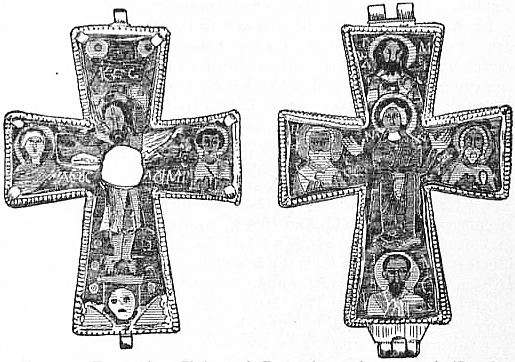
Fig. 1.—Byzantine Cloisonné Cross (c. 11th century) (South Kensington Museum).
The finest work we know of belonging to this period is the Pala d’Oro at St Mark’s, Venice, believed to have been brought from Constantinople to Venice about 1105. This magnificent altar-piece is in cloisonné enamel. A typical example is the ciborium and chalice belonging to the South Kensington loan collection. The design entirely covers the whole of the surface in one rich mass composed of circular or vesica-shaped medallions filled with sacred subjects and foliated scrolls. These are engraved and enamelled, and the metal bands of the scrolls and figures are engraved and gilt. The characteristic quality of the colour scheme is that it is composed almost wholly of primaries. Red, blue and yellow predominate, with a little white and black. Occasionally the secondaries, green and purple, are used, but through the whole period of Byzantine enamelling there is a total absence of what to-day is termed “subtle colouring.” The arrangement of the enamels is also distinct, in that the divisions of the colours are not always made by the cloison, but are frequently laid in side by side without the adjoining colours mingling or running together whilst being melted. For instance, in a leaf pattern or in the drapery, the dress may be cobalt, heightened with turquoise or green. Thus it is interesting to observe that the artist employed the metal dividing lines frequently for the sake of aesthetic result, and was not much hampered by technical difficulties. This was the rule when opaque enamels were used. It is also worthy of remark that these opaque enamels differ from those in common use to-day, in that they are not nearly so opaque. This quality, together with a dull, instead of a highly polished surface, gives a much softer appearance to the enamels. Again, the whole tone of the enamels is darker and richer. Many examples of Byzantine work (see fig. 1.) are to be seen in the public and private art collections throughout Europe. They are principally upon ecclesiastical objects, missal covers, croziers, chalices, ciboria, pyx, candlesticks, crosses and tabernacles. In most instances the enamels are made in separate little plates rudely fastened with nails, screws or rivets to a metal or wooden foundation. Theophilus, a monk of the 13th century, describes the process of enamelling as it was understood by the Byzantines of his time, which probably differed but little from earlier methods. The design and drawing of the figures in Byzantine enamels is similar to the mosaic and carving. The figures are treated entirely as decorations, with scarcely ever the least semblance of expression, although here and there an intention of piety or sorrow is to be descried through the awkward postures in which they are placed. In spite of this, the sense of decorative design, the simplicity of conception, the strength of the general character, and the richness of the colour, places this period as one of the finest which the art of enamelling has seen, and it leads us to lay stress upon the principle that the simplest methods in design and manipulation attain a higher end than those which are elaborate and intricate. It might be asserted with truth that this style never arrived at the degree of delicacy and refinement of later styles. But the refinement was often at the expense of higher qualities.
The next great application of these kinds of enamelling was at Cologne, for there we find not only the renowned work of Nicolas of Verdun, the altar front at Klosterneuberg, which consists of fifty plates in champlevé enamel, but in that Rhenish province there are many shrines of magnificent conception. From here the secrets of the craft were taken to Limoges, where the greatest activity was displayed, as numerous examples are found throughout England, France and Spain, which no doubt were made there (see Plate I. fig. 6.) But no new method or distinct advance is to be noticed, during these successive revivals at Byzantium, Cologne or Limoges, and it is to early 14th-century Italy that we owe one of the most beautiful developments, that of the process subsequently called basse-taille, which signifies a low-cut relief upon which transparent enamel is fused.
In this process enamelling passed from a decorative to a fine art. For it demanded the highest knowledge of an artist with the consummate skill of both sculptor and enameller. Witness the superb gold cup, called the King’s Cup, now in the British Museum, and the silver cup at King’s Lynn. The first is in an excellent state of preservation, as it is upon gold, but the latter, like most of the ancient enamelling upon silver, has lost most of its enamel. This was due—as the present writer believes after much experiment—to the impurity of the silver employed. The King’s Cup is one of the finest works in enamelling extant. It consists of a gold cup and cover, hammered out of pure gold; and around the bowl, base and cover there are bands of figures, illustrating the scenes from the life of St Agnes. The hands and faces are of pale jasper, which over the carved gold gives a beautiful flesh tone. The draperies are in most resplendent ruby, sapphire, emerald, ivory, black and orange. The stem was subsequently altered by an additional piece inserted and enamelled with Tudor roses. It is a work of the 13th century, and belonged to Jean, duc de Berry, who gave it to his nephew, Charles VI. of France, in 1391. It afterwards came into the possession of the kings of England, from Henry VI. to James I., who gave it to Don Juan Velasco, constable of Castile. It was purchased by subscription with the aid of the treasury for the British Museum.
Other well-known pieces are the silver horn in the possession of the marquess of Aylesbury, and the crozier of William of Wykeham at New College, Oxford. The discovery about the same time of the process called plique-à-jour forms another most interesting and beautiful development. Owing to the difficulty of its manufacture and its extreme fragility there are very few examples left. One of the finest specimens is now at the Victoria and Albert Museum, South Kensington. It is in the form of two bands of emerald green enamel which decorate a silver beaker. They are in the form of little stained glass windows, the cloisons forming (as it were) the leads. These fine cloisons and shapes are most correct in form, and the whole piece shows a perfection of craftsmanship rarely equalled.
The end of the 15th century saw a development in enamelling which was not only remarkable, but revolutionary in its method. For until then the whole theory of enamelling had been that it relied upon the enclosing edges of the metal or the cloison to hold it to the metal ground and in part to preserve it in the shape of the pattern, much in the same way as a setting holds a stone or a jewel. All the enamel before this date had been sunk into cells or cloisons. Two discoveries were made; first, that enamels could be made which require no enclosing ribbon of metal, but that merely the enamel should be fused on both sides of the metal object; secondly, that after an enamel had been fused to a surface of metal, another could be superimposed and fused to the first layer without any danger of separation from each or from the metal ground. It is true that such processes had been employed upon glass on which enamel had been applied, as well as upon pottery; and it is probably due to the influence of a knowledge of both enamelling upon metal and upon glass or pottery that the discovery was made.
In most of these enamel paintings the subject was laid on with a white enamel upon a dark ground. The white was modulated; so that possessing a slight degree of translucency, it was grey in the thin parts and white in the thick. Thus was obtained a certain amount of light and shade. This gave the process called grisaille. But strange to say, it was not until a later period that this was practised alone, and then the modelling of the figures and draperies became very elaborate. At first it was only done in a slight degree, just sufficiently to give expression and to add to the richness of the form. For the enamellers were thinking of a plate upon which to put their wonderful colours, and not only of form. The painting in white was therefore invariably coloured with enamels. Probably the earliest painter in enamel was Nardon Pénicaud, many of whose works (one of them, dated 1503, is in the Cluny Museum) have been preserved with great care. He had many followers, the most distinguished of whom was Léonard Limosin (i.e. of Limoges). He excelled in portraiture. Examples of his work (between 1532 and 1574) are to be found in most of the larger public and private collections. Léonard Limosin and his Limoges contemporaries were very largely addicted to the employment of foil, which became too largely used, thus spoiling their otherwise fine serious work.
The family of Jean Pénicaud, Jean Court de Vigier, Pierre Raymond and Pierre Courteys were all great names of artists who excelled in the grisaille process. Grisaille is similar to pâte-sur-pâte in pottery, and depends for its attractive quality entirely upon form and composition. No comparison should be made with enamels in colour, for they occupy a different category—similar to cameo.
The casket shown in Plate II. fig. 9 is by Jean Pénicaud. It is a fine example of the enamelling in this style, very beautiful in colour. The hands and faces are in opaque white enamel; the draperies, garlands and flowers are in transparent green, turquoise blue, purple and cobalt over foil. The background is in transparent violet over white enamel ground, which is semé with gold stars. The draperies are also heightened with gold.
One of the most marvellous pieces of brilliant craft is the missal cover (Plate I. fig. 5) at the South Kensington Museum, said to have belonged to Henrietta Maria, queen of Charles I. The subjects are the “Creation of Adam and Eve” and the “Fountain of Youth.” It is about 4 in. by 7 when opened out. The enamel is encrusted upon the figures, ornament and flowers which are beaten up in pure gold into high relief. The extraordinary minuteness and skill of handling, and the extreme brilliancy of the enamels, which are as brilliant to-day as on the day they were made, together form one of the unique specimens of art craftsmanship of the world. To the subdued taste of to-day, however, the effect is tawdry. The conception and design are also alike unworthy of the execution.
Since the Assyrian and Egyptian civilizations, there has been a succession of luxurious developments followed by lapses into the decline and death of the art of enamelling upon metals. In each revival there has been something added to that which was known and practised before. The last revival took place five hundred years ago, accompanying the rebirth of learning and the arts; but after flourishing for over a century, the art gradually fell into disuse, and remained so until the recent revival and further development. The development consists, first, in the more complete knowledge of the technical processes, following upon the great advances which science has made; and secondly, in a finer and more subtly artistic treatment of them. The advance in technical knowledge comprises greater facility and perfection in the production of the substance enamel, and its subsequent application to metal surfaces; more intimate knowledge of metals and their alloys to which it is applied, and greater ease in obtaining them from the metalliferous ores and reducing them to suitable dimensions and surfaces. For instance, it is now a simple matter to obtain perfectly pure copper by means of electricity. Again, formerly a flat sheet of metal was obtained by hammering, which involved an infinite amount of hard labour, whereas it is accomplished to-day with ease by means of flatting and rolling mills: i.e. after the metal has been obtained from the ore in the form of an ingot, it is stretched equally to any degree of thinness by steel rollers. Further, the furnaces have been greatly improved by the introduction of gas and electricity as the heating power, instead of the wood or charcoal employed.
Plate I.
Fig. 3.—GRAECO-BACTRIAN GOLD AMULET, SHOWING THE GOLD STRIP FOR SETTING STONES, WHICH EXEMPLIFIES THE MANNER IN WHICH THE CLOISONS ARE SOLDERED FOR CLOISONNÉ. Fig. 6.—BOX IN COPPER PARTLY ENAMELLED IN OPAQUE ENAMELS CHAMPLEVÉ WITH COATS OF ARMS. (13th century, English or German. South Kensington Museum.) Fig. 4.—CHINESE CLOISONNÉ BOWL. Fig. 5.—MISSAL COVER, ENCRUSTED ENAMEL. (French, 17th century. Debased style.) Fig. 7.—PRAYER-BOOK COVER IN ENAMEL AND SILVER GILT, SET WITH RUBIES AND EMERALDS, BY ALEXANDER FISHER. (Size, closed, 4 × 3 in.)
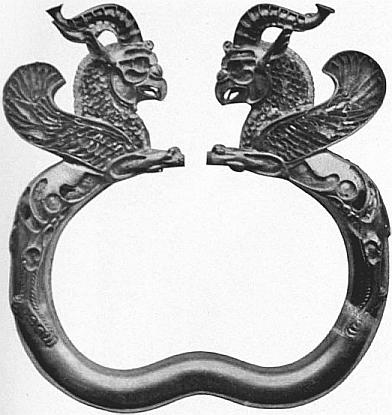
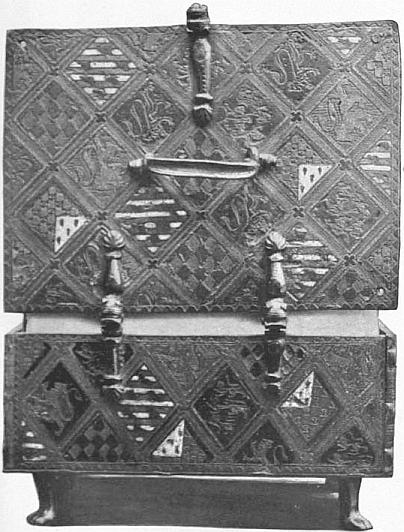
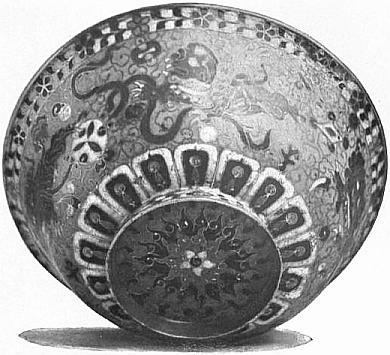
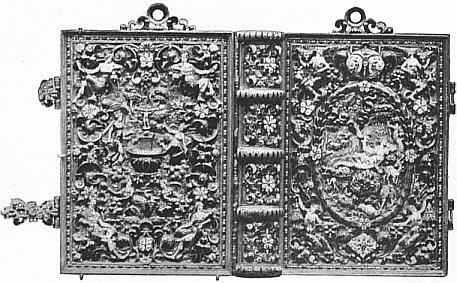
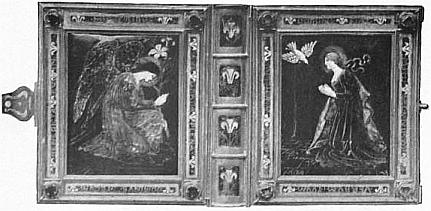
Plate II.
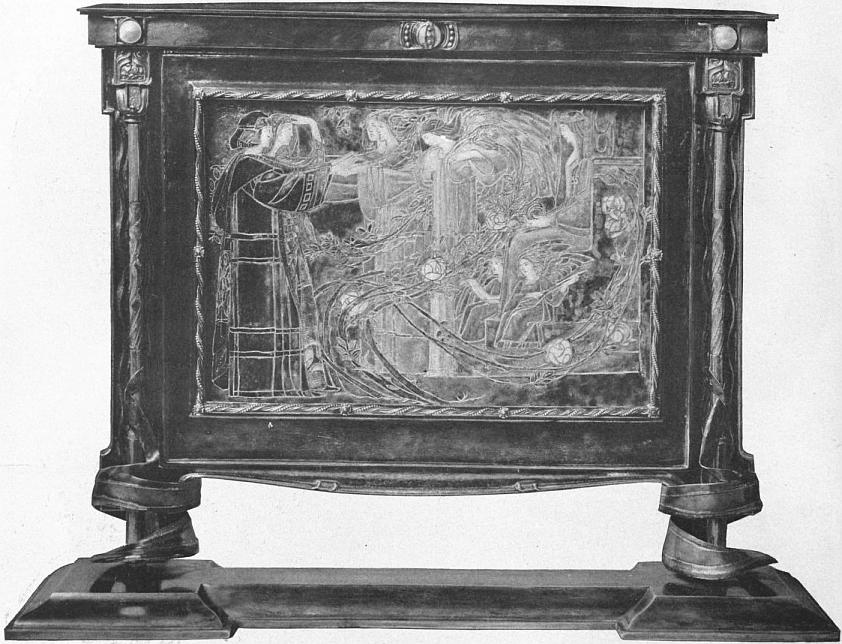
Fig. 8.—OVERMANTEL (24 × 18½ in.) IN CHAMPLEVÉ ENAMEL ON SILVER. SUBJECT: THE GARDEN OF THE SOUL. BY ALEXANDER FISHER.
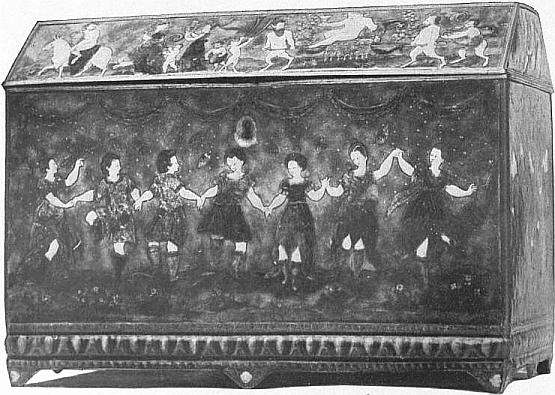
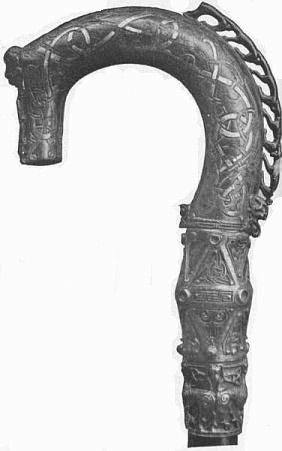
Fig. 9.—PAINTED ENAMEL CASKET BY JEAN PÉNICAUD. (16th century.) Fig. 10.—CELTIC CHAMPLEVÉ ENAMELLED CROZIER. (Irish, 9th century.)
In the manufacture of the substance enamel a much greater advance has been made, for whereas the colours, and consequently the schemes of colour, were extremely limited, we now possess an infinite gradation in the colours, as well as the transparency and opacity, the hardness and softness of enamels. There are only two colours which cannot yet be obtained; these are opaque vermilion and lemon yellow in a vitrified state. Many of the colours we now employ were not known by enamellers such as Léonard Limosin. Our enamels are also perfect in purity, brilliancy and durability, qualities which are largely due to the perfect knowledge of the proportion of parts composing an enamel and their complete combination. It is this complete combination, together with the absence of any destructible matter, which gives the enamel its lasting quality.
The base of enamel is a clear, colourless, transparent vitreous compound called flux, which is composed of silica, minium and potash. This flux or base—termed fondant in France—is coloured by the addition of oxides of metals while in a state of fusion, which stain the flux throughout its mass. Enamels are either hard or soft, according to the proportion of the silica to the other parts in its composition. They are termed hard when the temperature required to fuse them is very high. The harder the enamel the less liable is it to be affected by atmospheric agencies, which in soft enamels produce a decomposition of the surface first and ultimately of the whole enamel. It is therefore advisable to use hard enamels in all cases. This involves the employment of pure—or almost pure—metals for the plates, which are in most respects the best to receive and retain the enamel. For if there is an excess of alloy, either the metal will possibly melt before the enamel is fused or afterwards they will part company. To the inferior quality of old silver may be attributed the fact that in all cases the enamel has flown off it; if it has not yet wholly disappeared it will scale off in time. It is therefore essential that metals should be pure and the enamels hard. It is also noteworthy that enamels composed of a great amount of soda or potash, as compared with those wherein red lead is in greater proportion, are more liable to crack and have less cohesion to the metals. It is better not to use silver as a base, although it is capable of reflecting a higher and more brilliant white light than any other metal. Fine gold and pure copper as thin as possible are the best metals upon which to enamel. If silver is to be used, it should be fine silver, treated in the methods called champlevé and cloisonné.
The brilliancy of the substance enamel depends upon the perfect combination and proportion of its component parts. The intimacy of the combination depends upon an equal temperature being maintained throughout its fusion in the crucible. For this purpose it is better to obtain a flux which has been already fused and most carefully prepared, and afterwards to add the colouring oxides, which stain it dark or light according to the amount of oxide introduced. Many of the enamels are changed in colour by the difference of the proportion of the parts composing the flux, rather than by the change of the oxides. For instance, turquoise blue is obtained from the black oxide of copper by using a comparatively large proportion of carbonate of soda, and a yellow green from the same oxide by increasing the proportionate amount of the red lead. All transparent enamels are made opaque by the addition of calx, which is a mixture of tin and lead calcined. White enamel is made by the addition of stannic and arsenious acids to the flux. The amount of acid regulates the density or opacity of the enamel.
To elucidate the development which has occurred, it will be necessary to describe some of the processes. After the enamel has been procured in the lump, the next stage in the process, common to all methods of enamelling, is to pulverize it. To do this properly the enamel must first be placed in an agate mortar and covered with water; next, with a wooden mallet a number of sharp blows must be given to a pestle held vertically over the enamel, to break it; then holding the mortar firmly in the left hand, the pestle must be rotated with the right, with as much pressure as possible on the enamel, grinding it until the particles are reduced to a fine grain. The powder is then subjected to a series of washings in distilled water, until all the floury particles are removed. After this the metal is cleaned by immersion in acid and water. For copper, nitric acid is used; for silver, sulphuric, and for gold hydrochloric acid. All trace of acid is then removed, first by scratching with a brush and water, and finally by drying in warm oak sawdust. After this the pulverized enamel is carefully and evenly spread over those parts of the metal designed to receive it, in sufficient thickness just to cover them and no more. The piece is then dried in front of the furnace, and when dry is placed gently on a fire-clay or iron planche, and introduced carefully into the muffle of the furnace, which is heated to a bright pale red. It is now attentively watched until the enamel shines all over, when it is withdrawn from the furnace. The firing of enamel, unlike that of glass or pottery, takes only a few minutes, and in nearly all processes no annealing is required.
The following are the different modes of enamelling: champlevé, cloisonné, basse-taille, plique-à-jour, painted enamel, encrusted, and miniature-painted. These processes were known at successive periods of ancient art in the order in which they are named. To-day they are known in their entirety. Each has been largely developed and improved. No new method has been discovered, although variations have been introduced into all. The most important are those connected with painted enamels, encrusted enamels and plique-à-jour.
Champlevé enamelling is done by cutting away troughs or cells in the plate, leaving a metal line raised between them, which forms the outline of the design. In these cells the pulverized enamel is laid and then fused; afterwards it is filed with a corundum file, then smoothed with a pumice stone and polished by means of crocus powder and rouge. An example is shown in Plate II. fig. 8.
In cloisonné enamel, upon a metal plate or shape, thin metal strips are bent to the outline of the pattern, then fixed by silver solder or by the enamel itself. These strips form a raised outline, giving cells as in the case of champlevé. The rest of the process is identical with that of champlevé enamelling. An example is shown in Plate I. fig. 4.
The basse-taille process is also a combination of metal work in the form of engraving, carving and enamelling. The metal, either silver or gold, is engraved with a design, and then carved into a bas-relief (below the general surface of the metal like an Egyptian bas-relief) so that when the enamel is fused it is level with the uncarved parts of the design enamel, and the design shows through the transparent enamel.
Painted enamels are different from any of these processes both in method and in result. The metal in this case is either copper, silver or gold, but usually copper. It is cut with shears into a plate of the size required, and slightly domed with a burnisher or hammer, after which it is cleaned by acid and water. Then the enamel is laid equally over the whole surface both back and front, and afterwards “fired.” The first coat of enamel being fixed, the design is carried out, first by laying it in white enamel or any other which is opaque and most advantageous for subsequent coloration.
In the case of a grisaille painted enamel the white is mixed with water or turpentine, or spike oil of lavender, or essential oil of petroleum (according to the taste of the artist) and the white is painted thickly in the light parts and thinly in the grey ones, whereby a slight sense of relief is obtained and a great degree of light and shade.
In coloured painted enamels the white is coloured by transparent enamels spread over the grisaille treatment, parts of which when fired are heightened by touches of gold, usually painted in lines. Other parts can be made more brilliant by the use of foil, over which the transparent enamels are placed and then fired. An example is shown in Plate I. fig. 7.
Enamels by the plique-à-jour method might be best described as translucent cloisonné enamels; for they are similar to cloisonné, except that the ground upon which they are fired is removed, thus making them transparent like stained glass.
Two new processes have been the subject of the present writer’s study and experiment for several years, which he has lately brought to fruition. The first is an inlay of transparent enamels similar to plique-à-jour without cloisons to divide the colours. For if enamels do not run together whilst in a melted state, as is seen in the case of painted and basse-taille enamels, there should be no necessity for it in this process. The result is a clear transparent subject in colour. The other process consists of a coloured enamel relief. It resembles the della Robbia relief, with this important difference, that the colour of the enamel by its nature permeates the whole depth of the relief, whereas in the della Robbia ware it is only on the surface. It also has a fresco surface, instead of one highly glazed. The quality of the enamel is as rare and unlike anything else as it is beautiful. It is in point of fact the only coloured sculpture in which the whole of its parts are one solid homogeneous mass, and through which the colour is one with the substance and is not applied. The process consists of the shapes of the various parts of the relief being selected for the different enamels, and these enamels melted together, in the mould of the relief, which is finished with lapidary’s tools.
Miniature enamel painting is not true enamelling, for after the white enamel is fired upon the gold plate, the colours used are not vitreous compounds—not enamels in fact—as is the case in any other form of metal enamelling; but they are either raw oxides or other forms of metal, with a little flux added, not combined. These colours are painted on the white enamel, and afterwards made to adhere to the surface by partially fusing the enamel, which when in a state of partial fusion becomes viscous.
There are many of these so-called enamels to-day, which are much easier of accomplishment than the true enamel, but they possess none of the beautiful quality of the latter. It is most apparent when parts of a work are true enamels and parts are done in the manner described above. These enamel paintings on enamel are afterwards coated over with a transparent flux, which gives them a surface of enamel. Many are done in this way for the market.
All these methods were used formerly, before the present revival; but they were not so completely understood or carried so far as they are to-day. Nor were the whole methods practised by any artist as they are now. The greatest advance has been in painted enamels. This process requires that both sides of the metal plate shall be covered with enamel; for this reason the plate is made convex on the top, so that the concave side does not touch the planche on which it is supported for firing, but rests on its edges throughout. There are several reasons why these plates are bombé, the principal one being that in the firing they resist the tendency to warp and curl up at the edges as a flat thin plate would do. Further, the enamel having been fused to both sides is not so liable to crack or to splint in subsequent firings. This is most important, for otherwise the white which is placed on afterwards would be a network of cracks. The manner of firing has also to do with this, but not nearly so much as the preliminary care and mechanical perfection with which a plate is prepared. Nearly all the old enamels are seen to be cracked in the white if minutely examined. To obviate this the following points must be observed: The plate must be of an excellent quality of metal, equal in thickness throughout, and perfectly regular in shape. It must be arched equally from end to end. The first coat of enamel must be of a perfectly regular equal thickness on both sides, entirely covering the plate. Whatever the medium employed in painting the white on to the enamel, it must be completely evaporated before the plate is placed in the furnace. The furnace must be heated to a bright red heat, and the planche must be red-hot before being taken out for the enamel to be placed upon it, and then quickly returned to the furnace and the muffle door shut tight so as to allow no draught of cool air to enter it. Then as soon as it has begun to fuse, which if a small piece, it would do in a minute or so, the muffle door is slightly opened to afford a view of it. As soon as it shines all over its surface, it is withdrawn from the muffle.
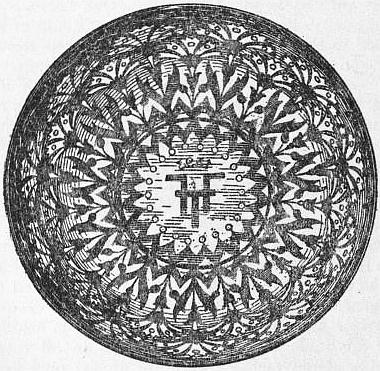
Fig. 2.—Modern French plique-à-jour bowl, by Fernand Thesmar.
The method of laying a white upon the enamel ground is a matter of individual taste, so far as the medium is concerned. By some, pure distilled water is preferred to any other liquid for mixing the enamel. Otherwise, turpentine and the fat oil of turpentine, as well as spike oil of lavender. The oil mixture takes longer to dry, and thus gives a greater chance for modelling into fine shades than the water. But it has several drawbacks. Firstly, there is the difficulty of drying the oil out—a process which takes some time and increases the risk of cracking in the drying process; and secondly, the enamel is not so fresh and clear after it is fired as when pure water has been employed. Besides there is a great difference in the result; the water involves a quick, decided, direct touch and method, which carries with it its own charm. The oil medium, besides giving an effect of laborious rounded stippled surfaces, is apt partly to reduce the enamel, thus giving it a dull surface. The coloration of the white is comparatively simple and is done by transparent enamels finely ground and evenly spread over the white after the latter has been fused. The only danger to be avoided is that of over-firing, which is produced by too great heat of a prolonged duration of firing, which causes the stannic and arsenious acids in the white to volatilize.
Plique-à-jour enamelling is done in the same way as cloisonné enamelling, except that the wires or strips of metal which enclose the enamel are not soldered to the metal base, but are soldered to each other only. Then these are simply placed upon a sheet of platinum, copper, silver, gold or hard brass, which, after the enamel is fused and sufficiently annealed and cooled, is easily removed. For small pieces of plique-à-jour there is no necessity to apply any metallic base, as the particles of enamel quickly fuse, become viscous, and when drawn out set quite hard. Neither is there any need for annealing, as would be the case in larger work. For an example, see fig. 2.
Commercially there has lately been an activity in enamels such as has never before occurred. This has been the case throughout Europe, Japan and the United States of America. In London there has been a demand for a cheap form of gaudy coloured enamel, fused into sunk spaces of metal obtained by stamping with a steel die; this has been applied to small objects of cheap jewelry, in the form of brooches, bracelets and the like. There has also been a great demand for enamel watch-cases and small pendants, done mainly by hand, of a better class of work. Many of these have been produced in Birmingham, Berlin, Paris and London. In Paris copies of pictures in black and white enamel, with a little gold paint in the draperies and background, have been manufactured in very large quantities and sometimes of great dimensions. Another curious demand, followed by as astonishing a production, is that of the imitations (a harder name for which is “forgeries”) of old enamels, made with much skill, giving all the technical excellence of the originals, even to the cracks and scratches incidental to age. These are duly signed, and will deceive the most expert. They are copies of enamels by Nardon and Jean Pénicaud, Léonard Limosin, Pierre Raymond, Courtois and others. The same artificers also produce copies of old Chinese cloisonné and champlevé enamels, as well as old Battersea enamel snuff-boxes, patch-boxes, and indeed every kind of enamelling formerly practised. It is advisable for the collector never to purchase any piece of enamelling as the work of an old master without having a pedigree extending at least over forty years. From Japan there has been a continuous flow of cloisonné enamelled vases, boxes and plates, either entirely covered with enamel or applied in parts. Compared with this enormous output, only a few small pieces of jewelry have come from Jaipur and other towns in India. There has also been a great quantity of plique-à-jour enamelling manufactured in Russia, Norway and Sweden. And finally, it has been used in an unprecedented manner in large pieces upon iron and copper for purposes of advertisement.
Amongst the chief workers in the modern revival of this art are Claudius Popelin, Alfred Meyer, Paul Grandhomme, Fernand Thesmar, Hubert von Herkomer and Alexander Fisher. The work of Claudius Popelin is characterized by good technical skill, correctness, and a careful copying of the work of the old masters. Consequently it suffers from a lack of invention and individuality. His work was devoted to the rendering of mythological subjects and fanciful portraits of historical people. Alfred Meyer and Grandhomme are both accomplished and careful enamellers; the former is a painter enameller and the author of a book dealing technically with enamelling. Grandhomme paints mythological subjects and portraits in a very tender manner, with considerably more artistic feeling than either Meyer or Popelin. There is a specimen of his work in the Luxemburg Museum. Fernand Thesmar is the great reviver of plique-à-jour enamelling in France. Specimens of his work are possessed by the art museums throughout Europe, and one is to be seen in the Victoria and Albert Museum, London. They are principally valued on account of their perfect technical achievement. Lucien Falize was an employer of artists and craftsmen, and to him we are indebted for the production of specimens of basse-taille enamel upon silver and gold, as well as for a book reviewing the revival of the art in France, bearing particularly on the work of Claudius Popelin. Until within recent years there was a clear division between the art and the crafts in the system of producing art objects. The artist was one person and the workman another. It is now acknowledged that the artist must also be the craftsman, especially in the higher branches of enamelling. M. Falize initiated the production of a gold cup which was enamelled in the basse-taille manner. The band of figures was designed by Olivier Merson, the painter, and carved by a metal carver and enamelled by an enameller, both able craftsmen employed by M. Falize. Other pieces of enamelling in champlevé and cloisonné were also produced under his supervision and on this system; therefore lacking the one quality which would make them complete as an expression of artistic emotion by the artist’s own hands. M. René Lalique is among the jewellers who have applied enamelling to their work in a peculiarly technically perfect manner. In England, Professor Hubert von Herkomer has produced painted enamels of considerable dimensions, aiming at the execution of pictures in enamel, such as have been generally regarded as peculiar to the province of oil or water-colour painting. Among numerous works is a large shield, into which plaques of enamel are inserted, as well as several portraits, one of which, made in several pieces, is 6 ft. high—a portrait of the emperor William II. of Germany. The present writer rediscovered the making of many enamels, the secrets of which had been jealously guarded. He has worked in all these processes, developing them from the art side, and helping to make enamelling not only a decorative adjunct to metal-work, but raising it to a fine art. His work may be seen in the Victoria and Albert Museum, and Brussels Museum. Others who have been enamelling with success in various branches, and who have shown individuality in their work, are Mr John Eyre, Mrs Nelson Dawson, Miss Hart.
Literature.—Among older books on enamelling, apart from the works of Neri and Benvenuto Cellini, are J.-P. Ferrand, L’Art du feu, ou de peindre en émail (1721); Labarte, Recherches sur la peinture en émail (Paris, 1856); Marquis de Laborde, Notice des émaux du Louvre (Paris, 1852); Reboulleau, Nouveau manuel complet de la peinture en verre, sur porcelaine et sur émail (ed. by Magnier, Paris, 1866); Claudius Popelin, L’Émail des peintres (Paris, 1866); Emil Molinier, Dictionnaire des émailleurs (1885). Among useful recent books are H. Cunynghame’s Art of Enamelling on Metals (1906); L. Falize, Claudius Popelin et la renaissance des émaux peints; L. Dalpayrat, Limoges Enamels; Alexander Fisher, The Art of Enamelling upon Metal (1906, “The Studio,” London).
(A. Fi.*)
ENCAENIA, a festival commemorating a dedication, in Greek τὰ ἐγκαίνια (καινός, new), particularly used of the anniversary of the dedication of a church (see Dedication). The term is also used at the university of Oxford of the annual Commemoration, held in June, of founders and benefactors (see Oxford).
ENCAUSTIC PAINTING. The name encaustic (from the Greek for “burnt in”) is applied to paintings executed with vehicles in which wax is the chief ingredient. The term was appropriately applied to the ancient methods of painting in wax, because these required heat to effect them. Wax may be used as a vehicle for painting without heat being requisite; nevertheless the ancient term encaustic has been retained, and is indiscriminately applied to all methods of painting in wax. The durability of wax, and its power of resisting the effects of the atmosphere, were well known to the Greeks, who used it for the protection of their sculptures. As a vehicle for painting it was commonly employed by them and by the Romans and Egyptians; but in recent times it has met with only a limited application. Of modern encaustic paintings those by Schnorr in the Residenz at Munich are the most important. Modern paintings in wax, in their chromatic range and in their general effect, occupy a middle place between those executed in oil and in fresco. Wax painting is not so easy as oil, but presents fewer technical difficulties than fresco.
Ancient authors often make mention of encaustic, which, if it had been described by the word inurere, to burn in, one might have supposed to have been a species of enamel painting. But the expressions “incausto pingere,” “pictura encaustica,” “ceris pingere,” “pictura inurere,” used by Pliny and other ancient writers, make it clear that some other species of painting is meant. Pliny distinguishes three species of encaustic painting. In the first they used a stylus, and painted either on ivory or on polished wood, previously saturated with some certain colour; the point of the stylus or stigma served for this operation, and its broad or blade end cleared off the small filaments which arose from the outlines made by the stylus in the wax preparation. In the second method it appears that the wax colours, being prepared beforehand, and formed into small cylinders for use, were smoothly spread by the spatula after the outlines were determined, and thus the picture was proceeded with and finished. By the side of the painter stood a brazier which was used to heat the spatula and probably the prepared colours. This is the method which was probably used by the painters who decorated the houses of Herculaneum and of Pompeii, as artists practising this method of painting are depicted in the decorations. The third method was by painting by a brush dipped into wax liquefied by heat; the colours so applied attained considerable hardness, and could not be damaged either by the heat of the sun or by the effects of sea-water. It was thus that ships were decorated; and this kind of encaustic was therefore styled “ship-painting.”
About the year 1749 Count Caylus and J.J. Bachelier, a painter, made some experiments in encaustic painting, and the count undertook to explain an obscure passage in Pliny, supposed to be the following (xxxv. 39):—“Ceris pingere ac picturam inurere quis primus excogitaverit non constat. Quidam Aristidis inventum putant, postea consummatum a Praxitele; sed aliquanto vetustiores encausticae picturae exstitere, ut Polygnoti et Nicanoris et Arcesilai Pariorum. Lysippus quoque Aeginae picturae suae inscripsit ἐνέκαυσεν, quod profecto non fecisset nisi encaustica inventa.” There are other passages in Pliny bearing upon this subject, in one of which (xxi. 49) he gives an account of the preparation of “Punica cera.” The nature of this Punic wax, which was the essential ingredient of the ancient painting in encaustic, has not been definitely ascertained. The chevalier Lorgna, who investigated the subject in a small but valuable tract, asserts that the nitron which Pliny mentions is not the nitre of the moderns, but the natron of the ancients, viz. the native salt which is found crystallized in Egypt and other hot countries in sands surrounding lakes of salt water. This substance the Carthaginians, according to Pliny, used in preparing their wax, and hence the name Punic seems to be derived. Lorgna made a number of experiments with this salt, using from three to twenty parts of white melted wax with one of natron. He held the mixture in an iron vessel over a slow fire, stirring it gently with a wooden spatula, till the mass assumed the consistency of butter and the colour of milk. He then removed it from the fire, and put it in the shade in the open air to harden. The wax being cooled liquefied in water, and a milky emulsion resulted from it like that which could be made with the best Venetian soap.
Experiments, it is said, were made with this wax in painting in encaustic in the apartments of the Count Giovanni Battista Gasola by the Italian painter Antonio Paccheri, who dissolved the Punic wax when it was not so much hardened as to require to be “igni resoluta,” as expressed by Pliny, with pure water slightly infused with gum-arabic, instead of sarcocolla, mentioned by Pliny. He afterwards mixed the colours with this wax so liquefied as he would have done with oil, and proceeded to paint in the same manner; nor were the colours seen to run or alter in the least; and the mixture was so flexible that the pencil ran smoother than it would have done with oil. The painting being dry, he treated it with caustic, and rubbed it with linen cloths, by which the colours acquired peculiar vivacity and brightness.
About the year 1755 further experiments were made by Count Caylus and several French artists. One method was to melt wax with oil of turpentine as a vehicle for the colours. It is well known that wax may be dissolved in spirit and used as a medium, but it dries too quickly to allow of perfect blending, and would by the evaporation of the spirit be prejudicial to the artist’s health. Another method suggested about this time, and one which seems to tally very well with Pliny’s description, is the following. Melt the wax with strong solution of salt of tartar, and let the colours be ground up in it. Place the picture when finished before the fire till by degrees the wax melts, swells, and is bloated up upon the picture; the picture is then gradually removed from the fire, and the colours, without being injuriously affected by the operation of the fire, become unalterable, spirits of wine having been burnt upon them without doing the least harm. Count Caylus’s method was different, and much simpler: (1) the cloth or wood designed for the picture is waxed over, by rubbing it simply with a piece of beeswax; (2) the colours are mixed up with pure water; but as these colours will not adhere to the wax, the whole ground must be rubbed over with chalk or whiting before the colour is applied; and (3) when the picture is dry it is put near the fire, whereby the wax is melted and absorbs the colours. It must be allowed that nothing could well be simpler than this process, and it was thought that this kind of painting would be capable of withstanding the weather and of lasting longer than oil painting. This kind of painting has not the gloss of oil painting, so that the picture may be seen in any light, a quality of the very first importance in all methods of mural painting. The colours too, when so secured, are firm, and will bear washing, and have a property which is perhaps more important still, viz. that exposure to smoke and foul vapours merely leaves a deposit on the surface without injuring the work. The “encausto pingendi” of the ancients could not have been enamelling, as the word “inurere,” taken in its rigorous sense, might at first lead one to suppose, nor could it have been painting produced in the same manner as encaustic tiles or encaustic tesserae; but that it must have been something akin to the count’s process would appear from the words of Pliny already quoted, “Ceris pingere ac picturam inurere.”
Werner of Neustadt found the following process very effectual in making wax soluble in water. For each pound of white wax he took twenty-four ounces of potash, which he dissolved in two pints of water, warming it gently. In this ley he boiled the wax, cut into little bits, for half an hour, after which he removed it from the fire and allowed it to cool. The wax floated on the surface of the liquor in the form of a white saponaceous matter; and this being triturated with water produced a sort of emulsion, which he called wax milk, or encaustic wax. This preparation may be mixed with all kinds of colours, and consequently can be applied in a single operation.
Mrs Hooker of Rottingdean, at the end of the 18th century, made many experiments to establish a method of painting in wax, and received a gold palette from the Society of Arts for her investigations in this branch of art. Her account is printed in the tenth volume of the Society’s Transactions (1792), under the name of Miss Emma Jane Greenland.
See also Lorgna, Un Discorso sulla cera punica; Pittore Vicenzo Requeno, Saggi sul ristabilimento dell’ antica arte de’ Greci e Romani (Parma, 1787); Phil. Trans. vol. xlix. part 2; Muntz on Encaustic Painting; W. Cave Thomas, Methods of Mural Decoration (London, 1869); Cros and Henry, L’Encaustique, &c. (1884); Donner von Richter, Über Technisches in der Malerei der Alten (1885).
(W. C. T.)
ENCEINTE (Lat. in, within, cinctus, girdled; to be distinguished from the word meaning “pregnant,” from in, not, and cinctus, i.e. with girdle loosened), a French term used technically in fortification for the inner ring of fortifications surrounding a town. Strictly the term was applied to the continuous line of bastions and curtains forming the “body of the place,” this last expression being often used as synonymous with enceinte. The outworks, however, close to the enceinte were not considered as forming part of it. In modern fortification the enceinte is usually simply the innermost continuous line of fortifications. In architecture generally an enceinte is the close or precinct of a cathedral, abbey, castle, &c.
ENCINA, JUAN DEL (1469-c. 1533), often called the founder of the Spanish drama, was born in 1469 near Salamanca probably at Encinas. On leaving the university of Salamanca he became a member of the household of the second duke of Alva. In 1492 the poet entertained his patron with a dramatic piece, the Triunfo de la fama, written to commemorate the fall of Granada. In 1496 he published his Cancionero, a collection of dramatic and lyrical poems. Some years afterwards he visited Rome, attracted the attention of Alexander VI. by his skill in music, and was appointed choirmaster. About 1518 Encina took orders, and made a pilgrimage to Jerusalem, where he said his first mass. Since 1509 he had held a lay canonry at Malaga; in 1519 he was appointed prior of Leon and is said to have died at Salamanca about 1533. His Cancionero is preceded by a prose treatise (Arte de trobar) on the condition of the poetic art in Spain. His fourteen dramatic pieces mark the transition from the purely ecclesiastical to the secular stage. The Aucto del Repelón and the Égloga de Fileno dramatize the adventures of shepherds; the latter, like Plácida y Vitoriano, is strongly influenced by the Celestina. The intrinsic interest of Encina’s plays is slight, but they are important from the historical point of view, for the lay pieces form a new departure, and the devout eclogues prepare the way for the autos of the 17th century. Moreover, Encina’s lyrical poems are remarkable for their intense sincerity and devout grace.
Bibliography.—Teatro completo de Juan del Encina (Madrid, 1893), edited by F. Asenjo Barbieri; Cancionero musical de los siglos XV y XVI (Madrid, 1894), edited by F. Asenjo Barbieri; R. Mitjana, Sobre Juan del Encina, músico y poeta (Málaga, 1895); M. Menendez y Pelayo, Antologia depoetas liricos castellanos (Madrid, 1890-1903), vol. vii.
ENCKE, JOHANN FRANZ (1791-1865), German astronomer, was born at Hamburg on the 23rd of September 1791. Matriculating at the university of Göttingen in 1811, he began by devoting himself to astronomy under Carl Friedrich Gauss; but he enlisted in the Hanseatic Legion for the campaign of 1813-14, and became lieutenant of artillery in the Prussian service in 1815. Having returned to Göttingen in 1816, he was at once appointed by Benhardt von Lindenau his assistant in the observatory of Seeberg near Gotha. There he completed his investigation of the comet of 1680, for which the Cotta prize was awarded to him in 1817; he correctly assigned a period of 71 years to the comet of 1812; and discovered the swift circulation of the remarkable comet which bears his name (see Comet). Eight masterly treatises on its movements were published by him in the Berlin Abhandlungen (1829-1859). From a fresh discussion of the transits of Venus in 1761 and 1769 he deduced (1822-1824) a solar parallax of 8″.57, long accepted as authoritative. In 1822 he became director of the Seeberg observatory, and in 1825 was promoted to a corresponding position at Berlin, where a new observatory, built under his superintendence, was inaugurated in 1835. He directed the preparation of the star-maps of the Berlin academy 1830-1859, edited from 1830 and greatly improved the Astronomisches Jahrbuch, and issued four volumes of the Astronomische Beobachtungen of the Berlin observatory (1840-1857). Much labour was bestowed by him upon facilitating the computation of the movements of the asteroids. With this end in view he expounded to the Berlin academy in 1849 a mode of determining an elliptic orbit from three observations, and communicated to that body in 1851 a new method of calculating planetary perturbations by means of rectangular co-ordinates (republished in W. Ostwald’s Klassiker der exacten Wissenschaften, No. 141, 1903). Encke visited England in 1840. Incipient brain-disease compelled him to withdraw from official life in November 1863, and he died at Spandau on the 26th of August 1865. He contributed extensively to the periodical literature of astronomy, and was twice, in 1823 and 1830, the recipient of the Royal Astronomical Society’s gold medal.
See Johann Franz Encke, sein Leben und Wirken, von Dr C. Bruhns (Leipzig, 1869), to which a list of his writings is appended. Also, Month. Notices Roy. Astr. Society, xxvi. 129; V.J.S. Astr. Gesellschaft, iv. 227; Berlin. Abhandlungen (1866), i., G. Hagen; Sitzungsberichte, Munich Acad. (1866), i. p. 395, &c.
(A. M. C.)
ENCLAVE (a French word from enclaver, to enclose), a term signifying a country or, more commonly, an outlying portion of a country, entirely surrounded by the territories of a foreign or other power, such as the detached portions of Prussia, Saxony, &c, enclosed in the Thuringian States. (From the point of view of the states possessing such detached portions of territory these become “exclaves.”) “Enclave” is, however, generally used in a looser sense to describe a colony or other territory of a state, which, while possessing a seaboard, is entirely surrounded landward by the possession of some other power; or, if inland territory, nearly though not entirely so enclosed, e.g. the Lado Enclave in equatorial Africa.
ENCOIGNURE, in furniture, literally the angle, or return, formed by the junction of two walls. The word is now chiefly used to designate a small armoire, commode, cabinet or cupboard made to fit a corner; a chaise encoignure is called in English a three-cornered chair. In its origin the thing, like the word, is French, and the delightful Louis Quinze or Louis Seize encoignure in lacquer or in mahogany elaborately mounted in gilded bronze is not the least alluring piece of the great period of French furniture. It was made in a vast variety of forms so far as the front was concerned; in other respects it was strictly limited by its destination. As a rule these delicate and dainty receptacles were in pairs and placed in opposite angles; more often than not the top was formed of a slab of coloured marble.
ENCYCLICAL (from Late Lat. encyclicus, for encyclius = Gr. ἐγκύκλιος, from ἐν and κύκλος, “a circle”), an ecclesiastical epistle intended for general circulation, now almost exclusively used of such letters issued by the pope. The forms encyclica and encyclic are sometimes, but more rarely, used. The old adjectival use of the word in the sense of “general” (encircling) is now obsolete, though it survives in the term “encyclopaedia.”
ENCYCLOPAEDIA. The Greeks seem to have understood by encyclopaedia (ἐγκυκλοπαιδεία, or ἐγκύκλιος παιδεία) instruction in the whole circle (ἐν κυκλῷ) or complete system of learning—education in arts and sciences. Thus Pliny, in the preface to his Natural History, says that his book treated of all the subjects of the encyclopaedia of the Greeks, “Jam omnia attingenda quae Graeci τῆς ἐγκυκλοπαιδείας vocant.” Quintilian (Inst. Orat. i. 10) directs that before boys are placed under the rhetorician they should be instructed in the other arts, “ut efficiatur orbis ille doctrinae quam Graeci ἐγκυκλοπαιδείαν vocant.” Galen (De victus ratione in morbis acutis, c. 11) speaks of those who are not educated ἐν τῇ ἐγκυκλοπαιδείᾳ. In these passages of Pliny and Quintilian, however, from one or both of which the modern use of the word seems to have been taken, ἐγκύκλιος παιδεία is now read, and this seems to have been the usual expression. Vitruvius (lib. vi. praef.) calls the encyclios or ἐγκύκλιος παιδεία of the Greeks “doctrinarum omnium disciplina,” instruction in all branches of learning. Strabo (lib. iv. cap. 10) speaks of philosophy καὶ τὴν ἄλλην παιδείαν ἐγκύκλιον. Tzetzes (Chiliades, xi. 527), quoting from Porphyry’s Lives of the Philosophers, says that ἐγκύκλια μαθήματα was the circle of grammar, rhetoric, philosophy and the four arts under it, arithmetic, music, geometry and astronomy. Zonaras explains it as grammar, poetry, rhetoric, philosophy, mathematics and simply every art and science (ἁπλῶς πᾶσα τέχνη καὶ ἐπιστήμη), because sophists go through them as through a circle. The idea seems to be a complete course of instruction in all parts of knowledge. An epic poem was called cyclic when it contained the whole mythology; and among physicians κύκλῳ θεραπεύειν, cyclo curare (Vegetius, De arte veterinaria, ii. 5, 6), meant a cure effected by a regular and prescribed course of diet and medicine (see Wower, De polymathia, c. 24, § 14).
The word encyclopaedia was probably first used in English by Sir Thomas Elyot. “In an oratour is required to be a heape of all maner of lernyng: whiche of some is called the worlde of science, of other the circle of doctrine, whiche is in one worde of greke Encyclopedia” (The Governour, bk. i. chap. xiii.). In his Latin dictionary, 1538, he explains “Encyclios et Encyclia, the cykle or course of all doctrines,” and “Encyclopedia, that lernynge whiche comprehendeth all lyberall science and studies.” The term does not seem to have been used as the title of a book by the ancients or in the middle ages. The edition of the works of Joachimus Fortius Ringelbergius, printed at Basel in 1541, is called on the title-page Lucubrationes vel potius absolutissima κυκλοπαιδεια. Paulus Scalichius de Lika, an Hungarian count, wrote Encyclopaediae seu orbis disciplinarum epistemon (Basileae, 1599, 4to). Alsted published in 1608 Encyclopaedia cursus philosophici, and afterwards expanded this into his great work, noticed below, calling it without any limitation Encyclopaedia, because it treats of everything that can be learned by man in this life. This is now the most usual sense in which the word encyclopaedia is used—a book treating of all the various kinds of knowledge. The form “cyclopaedia” is not merely without any appearance of classical authority, but is etymologically less definite, complete and correct. For as Cyropaedia means “the instruction of Cyrus,” so cyclopaedia may mean “instruction of a circle.” Vossius says, “Cyclopaedia is sometimes found, but the best writers say encyclopaedia” (De vitiis sermonis, 1645, p. 402). Gesner says, “κύκλος est circulus, quae figura est simplicissima et perfectissima simul: nam incipi potest ubicunque in illa et ubicunque cohaeret. Cyclopaedia itaque significat omnem doctrinarum scientiam inter se cohaerere; Encyclopaedia est institutio in illo circulo.” (Isagoge, 1774, i. 40).
In a more restricted sense, encyclopaedia means a system or classification of the various branches of knowledge, a subject on which many books have been published, especially in Germany, as Schmid’s Allgemeine Encyklopädie und Methodologie der Wissenschaften (Jena, 1810, 4to, 241 pages). In this sense the Novum Organum of Bacon has often been called an encyclopaedia. But it is “a grammar only of the sciences: a cyclopaedia is not a grammar, but a dictionary; and to confuse the meanings of grammar and dictionary is to lose the benefit of a distinction which it is fortunate that terms have been coined to convey” (Quarterly Review, cxiii. 354). Fortunius Licetus, an Italian physician, entitled several of his dissertations on Roman altars and other antiquities encyclopaedias (as, for instance, Encyclopaedia ad. Aram mysticam Nonarii, Pataviae, 1631, 4to), because in composing them he borrowed the aid of all the sciences. The Encyclopaedia moralis of Marcellinus de Pise (Paris, 1646, fol., 4 vols.) is a series of sermons. Encyclopaedia is often used to mean a book which is, or professes to be, a complete or very full collection or treatise relating to some particular subject, as Blaine’s work, The Encyclopaedia of Rural Sports (London, 1852); The Encyclopaedia of Wit (London, 1803); The Vocal Encyclopaedia (London, 1807, 16mo), a collection of songs, catches, &c. The word is frequently used for an alphabetical dictionary treating fully of some science or subject, as Murray, Encyclopaedia of Geography (London, 1834); Lefebvre Laboulaye, Encyclopédie technologique: Dictionnaire des arts et manufactures (Paris, 1845-1847). Whether under the name of “dictionary” or “encyclopaedia” large numbers of this class of reference-work have been published. These are essentially encyclopaedic, being subject books and not word-books. The important books of this character are referred to in the articles dealing with the respective subjects, but the following may be mentioned here: the Jewish Encyclopedia, in 12 vols. (1901), a descriptive record of the history, religion, literature and customs of the Jewish people from the earliest times; the Encyclopaedia of Sport, 2 vols. (1897-1898); Holtzendorff’s Encyklopädie der Rechtswissenschaft (1870; an edition in 2 vols., 1904); the Dictionary of Political Economy, edited by R.H. Inglis Palgrave, 3 vols. (1894; reprinted 1901); the Encyclopaedia Biblica, edited by T.K. Cheyne and J. Sutherland Black, 4 vols. (1899-1903); the Dictionary of the Bible, edited by James Hastings, 4 vols., with a supplementary volume (1904); an interesting series is the Répertoire général du commerce, dealing with the foreign trade of France, of which one part, the Encyclopaedia of Trade between the United States of America and France, with a preface by M. Gabriel Hanotaux, appeared, in French and English, in 1904.
The great Chinese encyclopaedias are referred to in the article on Chinese Literature. It will be sufficient to mention here the Wên hien t’ung k’ao, compiled by Ma Twa-lin in the 14th century, the encyclopaedia ordered to be compiled by the Emperor Yung-loh in the 15th century, and the Ku Kin t‘u shu thi ch‘êng prepared for the Emperor K‘ang-hi (d. 1721), in 5020 volumes. A copy of this enormous work, bound in some 700 volumes, is in the British Museum.
The most ancient encyclopaedia extant is Pliny’s Natural History in 37 books (including the preface) and 2493 chapters, which may be thus described generally:—book 1, preface; book 2, cosmography, astronomy and meteorology; books 3 to 6, geography; books 7 to 11, zoology, including man, and the invention of the arts; books 12 to 19, botany; books 20 to 32, medicines, vegetable and animal remedies, medical authors and magic; books 33 to 37, metals, fine arts, mineralogy and mineral remedies. Pliny, who died A.D. 79, was not a naturalist, a physician or an artist, and collected his work in his leisure intervals while engaged in public affairs. He says it contains 20,000 facts (too small a number by half, says Lemaire), collected from 2000 books by 100 authors. Hardouin has given a list of 464 authors quoted by him. His work was a very high authority in the middle ages, and 43 editions of it were printed before 1536.
Martianus Minneus Felix Capella, an African, wrote (early in the 5th cent.), in verse and prose, a sort of encyclopaedia, which is important from having been regarded in the middle ages as a model storehouse of learning, and used in the schools, where the scholars had to learn the verses by heart, as a text-book of high-class education in the arts. It is sometimes entitled Satyra, or Satyricon, but is usually known as De nuptiis Philologiae et Mercurii, though this title is sometimes confined to the first two books, a rather confused allegory ending with the apotheosis of Philologia and the celebration of her marriage in the milky way, where Apollo presents to her the seven liberal arts, who, in the succeeding seven books, describe their respective branches of knowledge, namely, grammar, dialectics (divided into metaphysics and logic), rhetoric, geometry (geography, with some single geometrical propositions), arithmetic (chiefly the properties of numbers), astronomy and music (including poetry). The style is that of an African of the 5th century, full of grandiloquence, metaphors and strange words. He seldom mentions his authorities, and sometimes quotes authors whom he does not even seem to have read. His work was frequently copied in the middle ages by ignorant transcribers, and was eight times printed from 1499 to 1599. The best annotated edition is by Kopp (Frankfort, 1836, 4to), and the most convenient and the best text is that of Eysserhardt (Lipsiae, 1866, 8vo).
Isidore, bishop of Seville from 600 to 630, wrote Etymologiarum libri XX. (often also entitled his Origines) at the request of his friend Braulio, bishop of Saragossa, who after Isidore’s death divided the work into books, as it was left unfinished, and divided only into titles.
The tenth book is an alphabet of 625 Latin words, not belonging to his other subjects, with their explanations as known to him, and often with their etymologies, frequently very absurd. The other books contain 448 chapters, and are:—1, grammar (Latin); 2, rhetoric and dialectics; 3, the four mathematical disciplines—arithmetic, geometry, music and astronomy; 4, medicine; 5, laws and times (chronology), with a short chronicle ending in 627; 6, ecclesiastical books and offices; 7, God, angels and the orders of the faithful; 8, the church and sects; 9, languages, society and relationships; 11, man and portents; 12, animals, in eight classes, namely, pecora et jumenta, beasts, small animals (including spiders, crickets and ants), serpents, worms, fishes, birds and small winged creatures, chiefly insects; 13, the world and its parts; 14, the earth and its parts, containing chapters on Asia, Europe and Libya, that is, Africa; 15, buildings, fields and their measures; 16, stones (of which one is echo) and metals; 17, de rebus rusticis; 18, war and games; 19, ships, buildings and garments; 20, provisions, domestic and rustic instruments.
Isidore appears to have known Hebrew and Greek, and to have been familiar with the Latin classical poets, but he is a mere collector, and his derivations given all through the work are not unfrequently absurd, and, unless when very obvious, will not bear criticism. He seldom mentions his authorities except when he quotes the poets or historians. Yet his work was a great one for the time, and for many centuries was a much valued authority and a rich source of material for other works, and he had a high reputation for learning both in his own time and in subsequent ages. His Etymologies were often imitated, quoted and copied. MSS. are very numerous: Antonio (whose editor, Bayer, saw nearly 40) says, “plures passimque reperiuntur in bibliothecarum angulis.” This work was printed nine times before 1529.
Hrabanus Maurus, whose family name was Magnentius, was educated in the abbey of Fulda, ordained deacon in 802 (“Annales Francorum” in Bouquet, Historiens de la France, v. 66), sent to the school of St Martin of Tours, then directed by Alcuin, where he seems to have learned Greek, and is said by Trithemius to have been taught Hebrew, Syriac and Chaldee by Theophilus an Ephesian. In his Commentaries on Joshua (lib. ii. c. 5) he speaks of having resided at Sidon. He returned to Fulda and taught the school there. He became abbot of Fulda in 822, resigned in April 842, was ordained archbishop of Mainz on the 26th of July 847, and died on the 4th of February 856. He compiled an encyclopaedia De universo (also called in some MSS. De universali natura, De natura rerum, and De origine rerum) in 22 books and 325 chapters. It is chiefly a rearrangement of Isidore’s Etymologies, omitting the first four books, half of the fifth and the tenth (the seven liberal arts, law, medicine and the alphabet of words), and copying the rest, beginning with the seventh book, verbally, though with great omissions, and adding (according to Ritter, Geschichte der Philosophie, vii. 193, from Alcuin, Augustine or some other accessible source) the meanings given in the Bible to the subject matter of the chapter; while things not mentioned in Scripture, especially such as belong to classical antiquity, are omitted, so that his work seems to be formed of two alternating parts. His arrangement of beginning with God and the angels long prevailed in methodical encyclopaedias. His last six books follow very closely the order of the last five of Isidore, from which they are taken. His omissions are characteristic of the diminished literary activity and more contracted knowledge of his time. His work was presented to Louis the German, king of Bavaria, at Hersfeld in October 847, and was printed in 1473, fol., probably at Venice, and again at Strassburg by Mentelin about 1472-1475, fol., 334 pages.
Michael Constantine Psellus, the younger, wrote Διδασκαλία παντοδαπή, dedicated to the emperor Michael Ducas, who reigned 1071-1078. It was printed by Fabricius in his Bibliotheca Graeca (1712), vol. v., in 186 pages 4to and 193 chapters, each containing a question and answer. Beginning with divinity, it goes on through natural history and astronomy, and ends with chapters on excessive hunger, and why flesh hung from a fig-tree becomes tender. As collation with a Turin MS. showed that 35 chapters were wanting, Harles has omitted the text in his edition of Fabricius, and gives only the titles of the chapters (x. 84-88).
The author of the most famous encyclopaedia of the middle ages was Vincent (q.v.) of Beauvais (c. 1190-c. 1264), whose work Bibliotheca mundi or Speculum majus—divided, as we have it, into four parts, Speculum naturale, Speculum doctrinale, Speculum morale (this part should be ascribed to a later hand), and Speculum historiale—was the great compendium of mid-13th century knowledge. Vincent of Beauvais preserved several works of the middle ages and gives extracts from many lost classics and valuable readings of others, and did more than any other medieval writer to awaken a taste for classical literature. Fabricius (Bibl. Graeca, 1728, xiv. pp. 107-125) has given a list of 328 authors, Hebrew, Arabic, Greek and Latin, quoted in the Speculum naturale. To these should be added about 100 more for the doctrinale and historiale. As Vincent did not know Greek or Arabic, he used Latin translations. This work is dealt with separately in the article on Vincent of Beauvais.
Brunetto Latini of Florence (born 1230, died 1294), the master of Dante and Guido Cavalcanti, while an exile in France between 1260 and 1267, wrote in French Li Livres dou Tresor, in 3 books and 413 chapters. Book i. contains the origin of the world, the history of the Bible and of the foundation of governments, astronomy, geography, and lastly natural history, taken from Aristotle, Pliny, and the old French Bestiaries. The first part of Book ii., on morality, is from the Ethics of Aristotle, which Brunetto had translated into Italian. The second part is little more than a copy of the well-known collection of extracts from ancient and modern moralists, called the Moralities of the Philosophers, of which there are many MSS. in prose and verse. Book iii., on politics, begins with a treatise on rhetoric, chiefly from Cicero De inventione, with many extracts from other writers and Brunetto’s remarks. The last part, the most original and interesting of all, treats of the government of the Italian republics of the time. Like many of his contemporaries, Brunetto revised his work, so that there are two editions, the second made after his return from exile. MSS. are singularly numerous, and exist in all the dialects then used in France. Others were written in Italy. It was translated into Italian in the latter part of the 13th century by Bono Giamboni, and was printed at Trevigi, 1474, fol., Venice, 1528 and 1533. The Tesoro of Brunetto must not be confounded with his Tesoretto, an Italian poem of 2937 short lines. Napoleon I. had intended to have the French text of the Tesoro printed with commentaries, and appointed a commission for the purpose. It was at last published in the Collection des documents inédits (Paris, 1863, 4to, 772 pages), edited by Chabaille from 42 MSS.
Bartholomew de Glanville, an English Franciscan friar, wrote about 1360 a most popular work, De proprietatibus rerum, in 19 books and 1230 chapters.
Book 1 relates to God; 2, angels; 3, the soul; 4, the substance of the body; 5, anatomy; 6, ages; 7, diseases; 8, the heavens (astronomy and astrology); 9, time; 10, matter and form; 11, air; 12, birds (including insects, 38 names, Aquila to Vespertilio); 13, water (with fishes); 14, the earth (42 mountains, Ararath to Ziph); 15, provinces (171 countries, Asia to Zeugia); 16, precious stones (including coral, pearl, salt, 104 names, Arena to Zinguttes); 17, trees and herbs (197, Arbor to Zucarum); 18, animals (114, Aries to Vipera); 19, colours, scents, flavours and liquors, with a list of 36 eggs (Aspis to Vultur). Some editions add book 20, accidents of things, that is, numbers, measures, weights and sounds. The Paris edition of 1574 has a book on bees.
There were 15 editions before 1500. An English translation was completed 11th February 1398 by John Trevisa, and printed by Wynkyn de Worde, Westminster, 1495? fol.; London, 1533, fol.; and with considerable additions by Stephen Batman, a physician, London, 1582, fol. It was translated into French by Jehan Corbichon at the command of Charles V. of France, and printed 14 times from 1482 to 1556. A Dutch translation was printed in 1479, and again at Haarlem, 1485, fol.; and a Spanish translation by Padre Vincente de Burgos, Tholosa, 1494, fol.
Pierre Bersuire (Berchorius), a Benedictine, prior of the abbey of St Eloi in Paris, where he died in 1362, wrote a kind of encyclopaedia, chiefly relating to divinity, in three parts:—Reductorium morale super totam Bibliam, 428 moralitates in 34 books on the Bible from Genesis to Apocalypse; Reductorium morale de proprietatibus rerum, in 14 books and 958 chapters, a methodical encyclopaedia or system of nature on the plan of Bartholomew de Glanville, and chiefly taken from him (Berchorius places animals next after fishes in books 9 and 10, and adopts as natural classes volatilia, natatilia and gressibilia); Dictionarius, an alphabetical dictionary of 3514 words used in the Bible with moral expositions, occupying in the last edition 1558 folio pages. The first part was printed 11 times from 1474 to 1515, and the third 4 times. The three parts were printed together as Petri Berchorii opera omnia (an incorrect title, for he wrote much besides), Moguntiae, 1609, fol., 3 vols., 2719 pages; Coloniae Agrippinae, 1631, fol., 3 vols.; ib. 1730-1731, fol., 6 vols., 2570 pages.
A very popular small encyclopaedia, Margarita philosophica, in 12 books, divided into 26 tractates and 573 chapters, was written by Georg Reisch, a German, prior of the Carthusians of Freiburg, and confessor of the emperor Maximilian I. Books 1-7 treat of the seven liberal arts; 8, 9, principles and origin of natural things; 10, 11, the soul, vegetative, sensitive and intellectual; 12, moral philosophy. The first edition, Heidelberg, 1496, 4to, was followed by 8 others to 1535. An Italian translation by the astronomer Giovanno Paolo Gallucci was published at Venice in 1594, 1138 small quarto pages, of which 343 consist of additional tracts appended by the translator.
Raphael Maffei, called Volaterranus, being a native of Volterra, where he was born in 1451 and died 5th January 1522, wrote Commentarii Urbani (Rome, 1506, fol., in 38 books), so called because written at Rome. This encyclopaedia, printed eight times up to 1603, is remarkable for the great importance given to geography, and also to biography, a subject not included in previous encyclopaedias. Indeed, the book is formed of three nearly equal parts,—geographia, 11 books; anthropologia (biography), 11 books; and philologia, 15 books. The books are not divided into short chapters in the ancient manner, like those of its predecessors. The edition of 1603 contains 814 folio pages. The first book consists of the table of contents and a classed index; books 2-12, geography; 13-23, lives of illustrious men, the popes occupying book 22, and the emperors book 23; 24-27, animals and plants; 28, metals, gems, stones, houses and other inanimate things; 34, de scientiis cyclicis (grammar and rhetoric); 35, de scientiis mathematicis, arithmetic, geometry, optica, catoptrica, astronomy and astrology; 36-38, Aristotelica (on the works of Aristotle).
Giorgio Valla, born about 1430 at Placentia, and therefore called Placentinus, died at Venice in 1499 while lecturing on the immortality of the soul. Aldus published his work, edited by his son Giovanni Pietro Valla, De expetendis et fugiendis rebus, Venetiis, 1501, fol. 2 vols.
It contains 49 books and 2119 chapters. Book 1 is introductory, on knowledge, philosophy and mathematics, considered generally (he divides everything to be sought or avoided into three kinds—those which are in the mind, in the body by nature or habit, and thirdly, external, coming from without); books 2-4, arithmetic; 5-9, music; 10-15, geometry, including Euclid and mechanics—book 15 being in three long chapters—de spiritualibus, that is, pneumatics and hydraulics, de catoptricis, and de optice; 16-19, astrology (with the structure and use of the astrolabe); 20-23, physics (including metaphysics); 24-30, medicine; 31-34, grammar; 35-37, dialectics; 38, poetry; 39, 40, rhetoric; 41, moral philosophy; 42-44, economics; 45, politics; 46-48, de corporis commodis et incommodis, on the good and evil of the body (and soul); 49, de rebus externis, as glory, grandeur, &c.
Antonio Zara, born 1574, made bishop of Petina in Istria 1600, finished on the 17th of January 1614 a work published as Anatomia ingeniorum et scientiarum, Venetiis, 1615, 4to, 664 pages, in four sections and 54 membra. The first section, on the dignity and excellence of man, in 16 membra, considers him in all his bodily and mental aspects. The first membrum describes his structure and his soul, and in the latter part contains the author’s preface, the deeds of his ancestors, an account of himself, and the dedication of his book to Ferdinand, archduke of Austria. Four membra treat of the discovery of character by chiromancy, physiognomy, dreams and astrology. The second section treats of 16 sciences of the imagination—writing, magic, poetry, oratory, courtiership (aulicitas), theoretical and mystic arithmetic, geometry, architecture, optics, cosmography, astrology, practical medicine, war, government. The third section treats of 8 sciences of intellect—logic, physics, metaphysics, theoretical medicine, ethics, practical jurisprudence, judicature, theoretical theology. The fourth section treats of 12 sciences of memory—grammar, practical arithmetic, human history, sacred canons, practical theology, sacred history, and lastly the creation and the final catastrophe. The book, now very rare, is well arranged, with a copious index, and is full of curious learning.
Johann Heinrich Alsted, born 1588, died 1638, published Encyclopaedia septem tomis distincta, Herbornae Nassoviorum, 1630, fol. 7 vols., 2543 pages of very small type. It is in 35 books, divided into 7 classes, preceded by 48 synoptical tables of the whole, and followed by an index of 119 pages.
I. Praecognita disciplinarum, 4 books, hexilogia, technologia, archelogia, didactica, that is, on intellectual habits and on the classification, origin and study of the arts. II. Philology, 6 books, lexica, grammar, rhetoric, logic, oratory and poetry; book 5, lexica, contains dictionaries explained in Latin of 1076 Hebrew, 842 Syriac, 1934 Arabic, 1923 Greek and 2092 Latin words, and also nomenclator technologiae, &c., a classified vocabulary of terms used in the arts and sciences, in Latin, Greek and Hebrew, filling 34 pages; book 6 contains Hebrew, Aramaic, Greek, Latin and German grammars; book 10, poetica, contains a list of 61 Rotwelsch words. III. Theoretic philosophy, 10 books:—book 11, metaphysics; 12, pneumatics (on spirits); 13, physics; 14, arithmetic; 15, geometry; 16, cosmography; 17, uranometria (astronomy and astrology); 18, geography (with maps of the Old World, eastern Mediterranean, and Palestine under the Old and New Testaments, and a plate of Noah’s ark); 19, optics; 20, music. IV. Practical philosophy, 4 books:—21, ethics; 22, economics (on relationships); 23, politics, with florilegium politicum, 119 pages of extracts from historians, philosophers and orators; 24, scholastics (on education, with a florilegium of 25 pages). V. The three superior faculties:—25, theology; 26, jurisprudence; 27, medicine (ending with the rules of the Salernian school). VI. Mechanical arts in general:—book 28, mathematical mechanical arts; book 29, agriculture, gardening, care of animals, baking, brewing, preparing medicines, metallurgy (with mining); book 30, physical mechanical arts—printing, dialling, &c. Under paedutica (games) is Vida’s Latin poem on chess, and one by Leuschner on the ludus Lorzius. VII. Farragines disciplinarum, 5 books:—31, mnemonics; 32, history; 33, chronology; 34, architecture; 35, quodlibetica, miscellaneous arts, as magic, cabbala, alchemy, magnetism, &c., with others apparently distinguished and named by himself, as, paradoxologia, the art of explaining paradoxes; dipnosophistica, the art of philosophizing while feasting; cyclognomica, the art of conversing well de quovis scibili; tabacologia, the nature, use and abuse of tobacco, &c.—in all 35 articles in this book.
Alsted’s encyclopaedia was received with very great applause, and was highly valued. Lami (Entretiens, 1684, p. 188) thought it almost the only encyclopaedia which did not deserve to be despised. Alsted’s learning was very various, and his reading was very extensive and diversified. He gives few references, and Thomasius charges him with plagiarism, as he often copies literally without any acknowledgment. He wrote not long before the appearance of encyclopaedias in modern languages superseded his own and other Latin books, and but a short time before the alphabetical arrangement began to prevail over the methodical. His book was reprinted, Lugduni, 1649, fol. 4 vols., 2608 pages.