VOLUME VIII SLICE VII Drama to Dublin (continued 9)
Reading edition
The use of glass cups was not common in England until the 16th century, Venice having practically the monopoly of the supply. A silver-mounted glass goblet which belonged to the great Lord Burghley is, however, in the British Glass cups. Museum, where there is also a very large series of Venetian drinking glasses of various kinds, clear and lace glass as well as some of the 15th-century goblets with enamelled designs, now of the greatest rarity. The relations of Venice with the East were of so intimate a character that the earlier forms of Venetian glasses were nearly identical with those of the Mahommedan East.
A common type of Arab drinking glass resembled our modern tumbler (a beaker), but gradually expanding in a curve towards the mouth, and often enamelled. The enamelled designs were at times related to the purpose of the vessel, figures drinking and the like, but more commonly bore either a mark of ownership, such as the armorial device of an emir, or some simple decorative design. This simple form probably has its origin in the horn cup made from the base of a cow’s horn and closed at the smaller end. The later forms in the late 15th century and after, followed the fashion in other materials, and were raised on a tall foot, so that from the 16th century onwards the type of wine glass has hardly changed, except in details. An interesting variety in one detail is seen in the German fashion of providing an elaborate silver stand into which the foot of such an ordinary-shaped glass was made to fit. Frequently, as might be expected, such stands are found without glasses, and their use then seems difficult to explain.
Another characteristic German type is the “wiederkom,” a vessel more conspicuous for capacity than for its artistic qualities. It is usually a cylindrical vessel of green glass often holding as much as a quart, elaborately enamelled with coats of arms and views of well-known places; and at times when the cup was a wedding gift the figures of the bride and bridegroom are seen upon it.
A very fanciful kind of cup was known in England as a “yard of ale,” a long tube of glass generally shaped like a coach horn, but ending sometimes in three prongs as a trident, the opening in the latter being at the end of the handle, which was about a yard in length.
Small silver cups were often made in dozens with various devices, differing in each, such as the signs of the zodiac, the occupations of the months, or figures of the classical gods and goddesses, engraved upon them.
The tankard came into fashion in the 16th century, a practical, but seldom graceful object. At first some attempt was made, by shaping the sides, to attain to some artistic quality, but usually the tankard from the late 16th century to the present time is found with straight sides, either vertical or contracting towards the top, which is of course always furnished with a hinged lid.
A material that has one obvious merit, that of being practically unbreakable, is leather, and drinking cups were often made of it. The flagon called a “black jack” is the best-known, and examples are very common, mostly of the 17th 17th and 18th century types. and 18th centuries. A quaint fashion was to have a leather cup made in the form of a lady’s shoe; this, however, was confined to Germany and might be thought in somewhat questionable taste.
In the 17th and 18th centuries a great impetus was given to the production of curious drinking vessels in pottery. In England at various potting centres a great number of cups called “tygs” were made: capacious mugs with several handles, three or four, round the sides, so that the cup could be readily passed from one to the other. Many of these have quaint devices and inscriptions upon them. Another favourite plan is to make a jug with open-work round the neck and a variety of spouts, one only communicating with the liquid. These “puzzle jugs” no doubt caused a good deal of amusement when attempted by a novice, who would inevitably spill some of the contents.
The horn of the rhinoceros is much favoured by the Chinese as a material for drinking cups often of a somewhat archaic form. The dense structure of the horn is well adapted for the purpose, and its beautiful amber hue makes the vessel a very agreeable object to the eye. The usual form is of a boat shape on a square foot, and the carved decoration is often copied from that of the bronze vessels of the earlier dynasties. Others are treated in a freer and more naturalistic manner, the bowl being formed as the flower of the magnolia, and the entire horn, at times more than 2 ft. in length, is utilized in carrying out the design. One of this kind is in the Victoria and Albert Museum. Cups of the former type are commonly found imitated in ivory-white porcelain, and are known as “libation cups.” Rhinoceros horn is held by the Chinese to be an antidote against poison, a belief shared by other nations.
There is but little to be said about the vessels used in the drinking of tea and coffee. In Europe the type has practically remained unchanged since the introduction of tea and coffee drinking, except that in the 18th century the tea-cups imported from China had no handles, and were generally thinner than the Tea and coffee cups. coffee cups. In Japan there is a ceremonious way of drinking tea, known as Cha no yu. Here powdered green tea is used; the party assembles in a small pavilion in a garden, and the tea is made in accordance with a rigid etiquette. The infusion is stirred with a whisk in a rudely fashioned bowl, holding about a pint, and passed from one guest to another. The bowls are of very thick pottery, never of porcelain, and the most valued kind is that made in Korea. In the drinking of rice spirit (saké) in Japan small wide shallow cups are used, made generally of porcelain, but sometimes of finely lacquered wood. Both kinds are usually ornamented with elaborate and sometimes allusive designs.
Among savage races the most peculiar drinking ceremony is that of kava drinking in Polynesia, principally in the Fijian, Tongan and Samoan groups. The best description of the process is given in Mariner’s Tonga. The Savage utensils. principal vessel is usually a large bowl, sometimes measuring 2 or 3 ft. in diameter, cut from a solid block of wood. It has four short legs and an ear at one side to which a rope of coco-nut fibre is generally attached. The liquid is prepared in this bowl and ladled out in small cups often made of coco-nut shells, and these are handed round with great ceremony. Both the bowl and the cups become coated in the inside with a highly polished layer, pale blue in colour; but this beautiful tint fades when the vessel is out of use, and it is therefore very rarely seen in specimens in Europe. The kava itself is prepared from the root of a tree of the pepper family (Piper methysticum); the root is cut into pieces of a convenient size, and these are given to young men and women of the company, who masticate them, and the lumps thus shredded are placed in the large bowl, water is poured over them, and the mass is strained with great care by wringing it in strips of the inner bark of the hibiscus. The liquor is slightly intoxicating.
If the Polynesian method of preparing kava as a drink is distasteful to our ideas, the favourite drinking bowl of the old Tibetans is even more so. Friar Odoric (14th century), quoted by Yule, describes how the Tibetan youth “takes his father’s head and straightway cooks and eats it, and of the skull he makes a goblet from which he and all his family always drink devoutly to the memory of the deceased father.” This recalls Livy’s account of the Boii in Upper Italy, who made a drinking vessel of the head of the Roman consul Postumus. Among the Tibetans skulls are still used, but generally for libations only; for this purpose great care is exercised in the selection of the skull, and the “points” of a good skull are well understood by the Lamas.
(C. H. Rd.)
1 The verb “to drink” is Common Teut.; cf. Ger. trinken, &c.
2 See Plate, Plate I.
3 See Plate, Plate I.
4 For two illustrations see Plate, Plate II.
DRIPSTONE, in architecture, a projecting moulding weathered on the upper surface and throated underneath so as to form a drip. The term is more correctly applied to a string course. When carried round an arch its more correct description would be a hood (q.v.). When employed inside a building it serves a decorative purpose only.
DRISLER, HENRY (1818-1897), American classical scholar, was born on the 27th of December 1818, on Staten Island, New York. He graduated at Columbia College in 1839, taught classics in the Columbia grammar school for four years, and was then appointed tutor in classics in the college. In 1845 he became adjunct professor of Latin and Greek there, in 1857 was appointed to the new separate chair of Latin language and literature, and ten years later succeeded Dr Charles Anthon as Jay professor of Greek language and literature. He was acting president in 1867 and in 1888-1889, and from 1890 to his retirement as professor emeritus in 1894 was dean of the school of arts. He died in New York City on the 30th of November 1897. Dr Drisler completed and supplemented Dr Anthon’s labours as an editor of classical texts. His criticisms and corrections of Liddell and Scott’s Greek-English Lexicon, of which he brought out a revised American edition in 1846, won his name a place on the title-page of the British edition in 1879, and in 1870 he published a revised and enlarged edition of Yonge’s English-Greek Lexicon. He was ardently opposed to slavery, and brilliantly refuted The Bible View of Slavery, written by Bishop J. H. Hopkins of Vermont, in a Reply (1863), which meets the bishop on purely Biblical ground and displays the wide range of Dr Drisler’s scholarship.
DRIVER, SAMUEL ROLLES (1846- ), English divine and Hebrew scholar, was born at Southampton on the 2nd of October 1846. He was educated at Winchester and New College, Oxford, where he had a distinguished career, taking a first class in Literae Humaniores in 1869. He was awarded the Pusey and Ellerton scholarship in 1866, the Kennicott scholarship in 1870 (both Hebrew), and the Houghton Syriac prize in 1872. From 1870 he was a fellow, and from 1875 also a tutor, of New College, and in 1883 succeeded Pusey as regius professor of Hebrew and canon of Christ Church. He was a member of the Old Testament Revision Committee (1876-1884) and examining chaplain to the bishop of Southwell (1884-1904); received the honorary degrees of doctor of literature of Dublin (1892), doctor of divinity of Glasgow (1901), doctor of literature of Cambridge (1905); and was elected a fellow of the British Academy in 1902. Dr Driver devoted his life to the study, both textual and critical, of the Old Testament. Among his numerous works are commentaries on Joel and Amos (1897); Deuteronomy (1902); Daniel (1901); Genesis (1909); the Minor Prophets, Nahum to Malachi (1905); Job (1905); Jeremiah (1906); Leviticus (1894 Hebrew text, 1898 trans. and notes); Samuel (Hebrew text, 1890). Among his more general works are: Treatise on the Use of the Tenses in Hebrew (1892); Isaiah, his Life and Times (1893); Introd. to the Literature of the Old Test. (1897, ed. 1909); Sermons on Subjects connected with the Old Testament (1892); The Parallel Psalter (1904); Heb. and Eng. Lexicon of the O.T. (in collaboration, 1906); Modern Research as illustrating the Bible (1909); articles in the Ency. Brit., Ency. Bibl. and Hastings’ Dict. of the Bible.
DRIVING (from “to drive,” i.e. generally to propel, force along or in, a word common in various forms to the Teutonic languages), a word used in a restricted sense for the art of controlling and directing draught animals from a coach or other conveyance or movable machine to which they are harnessed for the purpose of traction. This has been an occupation practised since domesticated animals were first put to this use. In various parts of the world a number of different animals have been, and still are, so employed; of these the horse, ox, mule and ass are the most common, though their place is taken by the reindeer in northern latitudes, and by the Eskimo dog in arctic and antarctic regions. The driving of each of these requires special skill, only to be acquired by practice combined with knowledge of the characteristics peculiar to the several animals employed. The most accomplished driver of spirited horses would probably be in difficulties if called upon to drive sixteen or twenty dogs in an arctic sledge, or a team of oxen or mules drawing the guns of a mountain battery; and the adept in either of these branches of the art might provoke the compassion of a farmer from Lincolnshire or Texas by his attempts to manage a pair of Clydesdale horses in the plough or the reaping machine.
Under all these different conditions driving is a work of utility, of economic value to civilized society. But from very early times driving, especially of horses, has also been regarded as a sport or pastime. This probably arose in the first instance from its association with battle. In the earliest historical records, such as the Old Testament and the Homeric poems, the driver of the chariot fills a place of importance in the economy of war; and on his skill and efficiency the fate of kings, and even of kingdoms, must often have depended. The statement in the Book of Kings that Jehu the son of Nimshi was recognized from a distance by his style of driving appears to indicate that the warrior himself on occasion took the place of the professional charioteer; and although it would be unsafe to infer from the story that the pleasure derived from the occupation was his motive for doing so, the name of this king of Israel has become the eponym of drivers. Among the Greeks at an equally early period driving was a recognized form of sport, to the popularity of which Horace afterwards made allusion. Racing between teams of horses harnessed to war-chariots took the place occupied by saddle-horse racing and American trotting races (see Horse-Racing) in the sport of modern times. The element of danger doubtless gave pleasurable excitement to chariot racing and kept alive its association with incidents familiar in war; just as at a later period, when the institution of chivalry had given the armed knight on horseback a conspicuous place in medieval warfare, the tournament became the most popular sport of the aristocracy throughout Europe.
This element of danger cannot be said to enter usually into the enjoyment of driving at the present day. Though accidents occasionally happen, the pastime is practically unattended by serious risk; and the source of the pleasure it affords the driver must be sought in the skill it requires, combined with the love of the horse which is common to sportsmen, and of exercise of power. The art of driving as practised to-day for pleasure without profit, and without the excitement of racing, is of quite modern development. Oliver Cromwell, indeed, met with a mishap in Hyde Park while driving a team of four horses presented to him by the count of Oldenburg, which was the subject of more than one satirical allusion by contemporary royalist writers; but two things were needed before much enjoyment could be found in driving apart from utility. These were the invention of carriages on springs, and the construction of roads with smooth and solid surface. The former did not come into general use till near the end of the 18th century, and it was about the same period that the engineering skill of Thomas Telford and the invention of John London Macadam combined to provide the latter. The influence on driving of these two developments was soon apparent. Throughout the 18th century stage-coaches, ponderous unwieldy vehicles without springs, had toiled slowly over rough and deeply rutted tracks as a means of communication between different parts of Great Britain; but those who made use of them did so as a matter of necessity and not for enjoyment. But by the beginning of the 19th century the improvement in carriage-building and road-construction alike had greatly diminished the discomfort of travel; and interest in driving for its own sake grew so rapidly that in 1807 the first association of amateur coachmen was formed. This was the Bensington Driving Club, the forerunner of many aristocratic clubs for gentlemen interested in driving as a pastime.
In modern driving one, two or four horses are usually employed. When a greater number than four is put in harness, as in the case of the state equipages of royal personages on occasions of ceremony, the horses are not driven but are controlled by “postillions” mounted on the near-side horse of each pair. When two horses are used they may either be placed side by side, in “double harness,” which is the commoner mode of driving a pair of horses, or one following the other, in a “tandem.” Four horses, or “four-in-hand,” are harnessed in two pairs, one following the other, and called respectively the “leaders” and the “wheelers”—the same terms being used for the two horses of a tandem.
Though it is a less difficult accomplishment to drive a single horse than a tandem or four-in-hand, or even a pair, it nevertheless requires both knowledge and the skill that practice alone confers. The driver should have some knowledge of equine character, and complete familiarity with every part of the harness he uses, and with the purpose which each buckle or strap is intended to serve. The indefinable quality known in horsemanship as “good hands” is scarcely less desirable on the box-seat than in the saddle. It is often said to be unattainable by those who do not possess it by nature; but though this may be true to some extent, “good hands” are partly at least the result of learning the correct position for the arm and hand that holds the reins. The reins are held in the left hand, which should be kept at about the level of the lowest button of the driver’s waistcoat, and near the body though not pressed against it. The driving hand should never be reached forward more than a few inches, nor raised as high as the breast. The upper arm should lie loosely against the side, the forearm horizontal across the front of the body, forming a right angle or thereabouts at the elbow-joint, the wrist very slightly bent inwards, and the back of the hand and knuckles facing outwards towards the horses. In this position the three joints of the arm form a kind of automatic spring that secures the “give” to the movement of the horse’s mouth which, in conjunction with firmness, is a large part of what is meant by “good hands.” But this result is only obtained if the reins be also held with the proper degree of bearing on the bit. What the proper degree may be depends greatly on the character of the horses and the severity of the bit. Pulling horses must be restrained by a strong draw on their bits, such as would bring other animals to a standstill. But under no circumstances, no matter how sluggish the horses may be, should the reins be allowed to lie slack; for if this is done the horse receives no support in the event of a sudden stumble, and no control if he shies unexpectedly. The driver should therefore always just “feel his horse’s mouth” as lightly as possible; he then has the animal well under control in readiness for every emergency, while avoiding such a pull on the mouth as would cause a high-spirited horse to chafe and fret. Well-broken carriage horses should always be willing to run into their bits, and those that draw back when lightly held in hand should be kept up to the bit with the whip.
These principles are common to all branches of the art of driving, whether of one, two or four horses. When they are observed no great difficulty confronts the coachman who is content with single or double harness, provided he has acquired the eye for pace and distance, and the instinctive realization of the length of the carriage behind him, without which he may suffer collision with other vehicles, or allow insufficient room in turning a corner or entering a gateway. For before he can have had the practice by which alone this knowledge is to be gained, the beginner will have learnt such elementary facts as that his horses must be held well in hand going down hill and given their heads on an ascent, and that on no account should the horse’s mouth be “jobbed” by the driver jerking the reins; he will also have learnt a good deal about the character and temperament of the horse, on which so much of the art of driving depends, and which can best be studied on the box-seat and not at all in the library. If he has pursued this study with any degree of insight, he will have learnt further to be sparing in the use of the hand-brake with which most modern carriages are provided. This apparatus is most useful in case of emergency, or for taking weight off the carriage on a really steep descent; but the habit which too many coachmen fall into of using the brake on every trifling decline should be avoided. Its effect is that the horses are continually doing collar-work, and are thus deprived of the relief which ought to be given them by occasional light pole or shaft work instead.
When the ambition of the amateur coachman leads him to attempt a tandem or four-in-hand he enters on a much more complex department of the art of driving. In the first place he has now four reins instead of two to Tandem and four-in-hand. manipulate, and the increase of weight on his hand, especially when four horses are being driven, requires considerable strength of wrist to support it without tiring. It is of the first importance, moreover, that he should know instinctively the position in his hand of each of the reins, and be able automatically and instantaneously to lay a finger on any one of them. The driver who has to look at his reins to find the off-side leader’s rein, or who touches the near-side wheeler’s in mistake for it, is in peril of a catastrophe. It is therefore essential that the reins should be correctly disposed between the fingers of the left hand, and that the driver should as quickly as possible accustom himself to handle them automatically. This is somewhat more difficult in driving tandem than in driving four-in-hand, because in the latter case there is greater spread of the reins in front of the hand than with tandem, where the reins lie much more nearly parallel one above the other. The actual holding of the reins is the same in both cases. The coachman should be careful to take the reins in his hand before mounting to the box-seat, as otherwise his team may make a start without his having the means to control them. It is customary to hitch the reins, ready for him to take them, on the outside terret (the ring on the pad through which the rein runs) of the wheeler—the off-side wheeler in four-in-hand. Standing on the ground beside the off-side wheel of his carriage, ready to mount to the box-seat, the coachman, after drawing up his reins till he almost feels the horses’ mouths, must then let out about a foot of slack in his off-side reins, in order that when on his seat he may find all the reins as nearly as possible equal in length in his hand. He mounts with them disposed in his right hand precisely as they will be in his left when ready to start. The leaders’ reins should be separated by the forefinger, and the wheelers’ by the middle finger. The near-leader’s rein will then be uppermost of the four, between the forefinger and thumb; then between the forefinger and middle finger are two reins together—the off-leader’s and the near-wheeler’s in the order named; while at the bottom, between the middle and third fingers, is the off-wheeler’s rein. It will be found that held thus the reins spread immediately in front of the hand in such a way that each several rein, and each pair of reins—two near-side, two off-side, two wheelers’ or two leaders’—can be conveniently manipulated; and the proficient driver can instinctively and instantaneously grasp any of them he chooses with his right hand without having to turn his eyes from the road before him to the reins in his hand. Having seated himself on the box and transferred the reins, thus disposed, from the right to the left hand, the coachman should shorten them till he just feels his wheelers’ mouths and holds back his leaders sufficiently to prevent them quite tightening their traces; then, when he has taken the whip from its socket in his right hand, he is ready to start. This is an operation requiring careful management, to secure that leaders and wheelers start simultaneously; for if the leaders start first they will be drawn up sharp by their bits, or, what is worse, if their reins have not been sufficiently shortened they will jump into their collars and possibly break a swinging bar, and in either case they will be fretted and disconcerted and will possibly in consequence either kick or rear; if the wheelers start before the leaders they will ram the swinging bars under the tails of the latter, with results equally unfortunate. The worst possible method of starting is suddenly to give the horses their heads and use the whip. But no positive rule can be laid down, for it is just one of those points which depend largely on familiarity with the horses forming the team. Horses even moderately accustomed to the work will generally start best in obedience to the voice, and their attention may simultaneously be aroused by gently feeling their mouths. When once started the driver should at once see that his team is going straight. If the leaders and wheelers are not exactly on the same line, this or that rein must be shortened or lengthened as the case may require; and it is to be noticed that as the near-wheeler’s and off-leader’s reins lie together between the same fingers, a simultaneous shortening or lengthening of these two reins will usually produce the desired result. With rare exceptions, reins should be shortened or lengthened by pushing them back or drawing them forward with the right hand from in front of the driving hand, and not from behind it. As soon as the team is in motion the leaders may be let out till they draw their traces taut; but draught should be taken off them on falling ground or while rounding a corner. Good drivers touch the reins as little as possible with the whip-hand, and nothing is less workmanlike than for a coachman to act as if he were an angler continually letting out or reeling in his line. In rounding a corner a loop of an inch or two of the leaders’ rein on the side to which the turn is to be made is taken up by the right hand and placed under the left thumb. This “points the leaders,” who accordingly make the required turn, while at the same time the right hand bears lightly on the wheelers’ rein of the opposite side, to prevent them making the turn too sharply for safety to the coach behind them. As soon as the turn is made—and all this applies equally to the passing of other vehicles or obstacles on the road—the driver’s left thumb releases the loop, which runs out of itself, and the team returns to the straight formation. A circumstance useful to bear in mind is that the swinging bars are wider than the maximum width of the coach; consequently the driver knows that wherever the swinging bars can pass through with safety—and as they are before his eyes the calculation is easy—the coach will safely follow.
A necessary part of driving four horses or tandem is the proper use of the whip. The novice, before beginning to drive, should acquire the knack—which can only be learnt by practical instruction and experiment—of catching The use of the whip. up the thong of the whip on to the stick by a flick of the wrist. With practice this is done almost automatically and without looking at the whip. It is not merely an ornamental accomplishment, but a necessary one; for in no other way can the whip be kept in constant readiness for use either on wheelers or leaders as the need of the moment may dictate. The point of the thong is confined in the whip-hand when striking the wheelers (which should be done in front of the pad), and is released for reaching the leaders. Considerable dexterity is required in using the whip on the leaders without at the same time touching, or at all events alarming or fretting, the wheelers. The thong of the whip should reach the leaders from beneath the swinging bar; and proficient “whips” can unerringly strike even the near leader from under the off-side bar without disturbing the equanimity of any other member of the team. This demands great skill and accuracy; but no coachman is competent to drive four horses until he is able to touch with the whip any particular horse that may require it, and no other.
Essential as is proficiency in the use of the whip when driving four horses, it is even more imperative for the driver of tandem. For in four-in-hand the leaders act in some measure as a restraint upon each other’s freedom of action, whereas the leader in tandem is entirely independent and therefore more difficult to control. If he takes it into his head to turn completely round and face the driver, there is no effectual means of preventing him. It is here that a prompt and accurate use of the whip is important. A sharp cut with the thong of the whip on the side to which he is turning will often drive the leader back into his place. But it must be done instantaneously, and the driver who has got his thong coiled round the stick of his whip, or who cannot make certain of striking the horse on precisely the desired spot, will miss the opportunity and may find his team in a sad mess, possibly with disastrous results. If the leader, in spite of a stroke from the whip at the right moment and on the right spot, still persists in turning, the only thing to be done is to turn the wheeler also; and then when the tandem has been straightened, to turn the horses back once more to their original direction. For this reason it is never safe to harness a tandem to a four-wheeled vehicle; because if it should be necessary to turn the wheeler sharply round, the fore-carriage would probably lock and the trap be overturned. Of comparatively recent years a great improvement has been effected in the harnessing of a tandem by the introduction of swinging bars similar to those used in four-in-hand. Formerly the leading traces in tandem drew direct from tugs on the wheeler’s hames, or less frequently from the stops on the shafts. This left a considerable length of trace which, when draught was taken off the leader, hung slack between the two horses; with the result that either of them might get a leg over the leading trace, with dangerous consequences. In the more modern arrangement short traces attached to the wheeler’s tugs hold a bar, which is kept in place by a few inches of chain from the kidney-link on the wheeler’s collar. This bar is connected by short traces or chains with a second bar to which the leader’s true traces are hooked in the usual way, allowing him a comfortable distance clear of the bar precisely as in four-in-hand. The leader thus draws as before from the wheeler’s tugs; but the length of trace is broken up by the two swinging bars, and as these are prevented from falling low by their attachment to the wheeler’s collar, the danger from a too slack leading trace is reduced to a minimum; though care is needed when the leader is not pulling to prevent the bar falling on his hocks.
Expert tandem driving, owing to the greater freedom of the leader from control, is a more difficult art than the driving of four horses, in spite of the fact that the weight on the hand is much less severe; but the general principles of the two are the same. In Great Britain, however, the coach-and-four is the more popular. It is more showy than tandem; it keeps alive the romantic associations of the days when the stagecoach was the ordinary means of locomotion; and a coach, or “drag,” accommodates a larger party of passengers to a race-meeting or other expedition for pleasure than a dogcart. But for those whose means do not permit the more costly luxury of a four-horse team, a tandem will be found to make all the demand on skill and nerve which, in combination with the taste for horses, makes the art of driving a source of enjoyment.
See Donald Walker, British Manly Exercises: in which Riding, Driving, Racing are now first described (London, 1834); Fuller, Essay on Wheel Carriages (London, 1828); William Bridges Adams, English Pleasure Carriages: their Origin, History, Materials, Construction (London, 1837); The Equestrian: A Handbook of Horsemanship, containing Plain Rules for Riding, Driving and the Management of the Horse (London, 1854); a Cavalry Officer, The Handy Horse Book; or Practical Instruction in Driving and the Management of the Horse (London, 1865-1867, 1871-1881); H. J. Helm, American Roadsters and Trotting Horses (Chicago, 1878); E. M. Stratton, The World on Wheels (New York, 1878); J. H. Walsh (“Stonehenge”), Riding and Driving (London, 1863); James A. Garland, The Private Stable (2nd ed., Boston, 1902); the Duke of Beaufort, Driving (The Badminton Library, London, 1889), containing a bibliography; F. H. Huth, Works on Horses and Equitation: A Bibliographical Record of Hippology (London, 1887).
(R. J. M.)
DROGHEDA, a municipal borough, seaport and market town, on the southern border of Co. Louth, Ireland, in the south parliamentary division, on the river Boyne, about 4 m. from its mouth in Drogheda Bay, and 31½ m. N. by W. from Dublin on the Great Northern main line. Pop. (1901) 12,760. It occupies both banks of the river; but the northern division is the larger of the two, and has received greater attention in modern times. The ancient fortifications, still extant in the beginning of the 19th century, have disappeared almost entirely, but of the four gateways one named after St Lawrence remains nearly perfect, consisting of two loopholed circular towers; and there are considerable ruins of another, the West or Butler Gate. Among the public buildings are a mansion-house or mayoralty, with a suite of assembly rooms attached; and the Tholsel, a square building with a cupola. St Peter’s chapel formerly served as the cathedral of the Roman Catholic archbishopric of Armagh; and in the abbey of the Dominican nuns there is still preserved the head of Oliver Plunkett, the archbishop who was executed at Tyburn in 1681 on an unfounded charge of treason. There was formerly an archiepiscopal palace in the town, built by Archbishop Hampton about 1620; and the Dominicans, the Franciscans, the Augustinians, the Carmelites and the knights of St John have monastic establishments. Of the Dominican monastery (1224) there still exists the stately Magdalen tower; while of the Augustinian abbey of St Mary d’Urso (1206) there are the tower and a fine pointed arch. At the head of the educational institutions there is a classical school endowed by Erasmus Smith. There is also a blue-coat school, founded about 1727 for the education of freemen’s sons. The present building was erected in 1870. Benjamin Whitworth, M.P., was a generous benefactor to the town, who built the Whitworth Hall, furnished half the funds for the construction of waterworks, established a cotton factory, and is commemorated by a statue in the Mall. The industrial establishments comprise cotton, flax and flour mills, sawmills, tanneries, salt and soap works, breweries, chemical manure and engineering works. The town is the headquarters of the valuable Boyne salmon-fishery. A brisk trade is carried on mainly in agricultural produce, especially with Liverpool (which is distant 135 m. due E.) and with Glasgow. Many works of improvement have been effected from time to time in the harbour, the quays of which occupy both sides of the river, the principal, 1000 yds. in length, being on the north side. Here is a depth of 21 ft. at the highest and 14 ft. at the lowest tides. The tide reaches 2½ m. above the town to Oldbridge; and barges of 50 tons burden can proceed 19 m. inland to Navan. The river is crossed by a bridge for ordinary traffic, and by a fine railway viaduct. The town is governed by a mayor, 6 aldermen and 18 councillors.
In the earliest notices the town of Drogheda is called Inver-Colpa or the Port of Colpa; the present name signifies “The Bridge over the Ford.” In 1152 the place is mentioned as the seat of a synod convened by the papal legate, Cardinal Paparo; in 1224 it was chosen by Lucas de Netterville, archbishop of Armagh, for the foundation of the Dominican friary of which there are still remains; and in 1228 the two divisions of the town received separate incorporation from Henry III. But there grew up a strong feeling of hostility between Drogheda versus Uriel and Drogheda versus Midiam, in consequence of trading vessels lading their cargoes in the latter or southern town, to avoid the pontage duty levied in the former or northern town. At length, after much blood had been shed in the dispute, Philip Bennett, a monk residing in the town, succeeded by his eloquence, on the festival of Corpus Christi, 1412, in persuading the authorities of the two corporations to send to Henry IV. for a new charter sanctioning their combination, and this was granted on the 1st of November. Drogheda was always considered by the English a place of much importance. In the reign of Edward III. it was classed along with Dublin, Waterford and Kilkenny as one of the four staple towns of Ireland. Richard II. received in its Dominican monastery the submissions of O’Neal, O’Donnell and other chieftains of Ulster and Leinster. The right of coining money was bestowed on the town, and parliaments were several times held within its walls. In the reign of Edward IV. the mayor received a sword of state and an annuity of £20, in recognition of the services rendered by the inhabitants at Malpus Bridge against O’Reilly; the still greater honour of having a university with the same privileges as that of Oxford remained a mere paper distinction, owing to the poverty of the town and the unsettled state of the country; and an attempt made by the corporation in modern times to resuscitate their rights proved unsuccessful. In 1495 Poyning’s laws were enacted by a parliament held in the town. In the civil wars of 1641 the place was besieged by O’Neal and the Northern Irish forces; but it was gallantly defended by Sir Henry Tichbourne, and after a long blockade was relieved by the Marquess of Ormond. The same nobleman relieved it a second time, when it was invested by the Parliamentary army under Colonel Jones. In 1649 it was captured by Cromwell, after a short though spirited defence; and nearly every individual within its walls, without distinction of age or sex, was put to the sword. Thirty only escaped, who were afterwards transported as slaves to Barbados. In 1690 it was garrisoned by King James’s army; but after the decisive battle of the Boyne (q.v.) it surrendered to the conqueror without a struggle, in consequence of a threat that quarter would not be granted if the town were taken by storm.
Drogheda ceased to be a parliamentary borough in 1885, and a county of a town in 1898. Before 1885 it returned one member, and before the Union in 1800 it returned four members to the Irish parliament.
From the close of the 12th century, certainly long before the Reformation and for some time after it, the primates of Ireland lived in Drogheda. Being mostly Englishmen, they preferred to reside in the portion of their diocese within the gate, and Drogheda, being a walled town, was less liable to attack from the natives. From 1417 onwards Drogheda was their chief place of residence and of burial. Its proximity to Dublin, the seat of government and of the Irish parliament, in which the primates were such prominent figures, induced them to prefer it to Ardmacha inter Hibernicos. Archbishop O’Scanlain, who did much in the building of the cathedral at Armagh, preferred to live at Drogheda, and there he was buried in 1270. Near Drogheda in later times was the primates’ castle and summer palace at Termonfeckin, some ruins of which remain. In Drogheda itself there is now not a vestige of the palace, except the name “Palace Street.” It stood at the corner of the main street near St Lawrence’s gate, and its grounds extended back to St Peter’s church. The primates of the 15th century were buried in or near Drogheda. After the Reformation five in succession lived in Drogheda and there were buried, though there is now nothing to fix the spot where any of them lies. The last of these—Christopher Hampton—who was consecrated to the primacy in 1613, repaired the ruined cathedral of Armagh. He built a new and handsome palace at Drogheda, and he repaired the old disused palace at Armagh and bestowed on it a demesne of 300 acres.
DROIT (Fr. for “right,” from Lat. directus, straight), a legal title, claim or due; a term used in English law in the phrase droits of admiralty, certain customary rights or perquisites formerly belonging to the lord high admiral, but now to the crown for public purposes and paid into the exchequer. These droits (see also Wreck) consisted of flotsam, jetsam, ligan, treasure, deodand, derelict, within the admiral’s jurisdiction; all fines, forfeitures, ransoms, recognizances and pecuniary punishments; all sturgeons, whales, porpoises, dolphins, grampuses and such large fishes; all ships and goods of the enemy coming into any creek, road or port, by durance or mistake; all ships seized at sea, salvage, &c., with the share of prizes—such shares being afterwards called “tenths,” in imitation of the French, who gave their admiral a droit de dixième. The droits of admiralty were definitely surrendered for the benefit of the public by Prince George of Denmark, when lord high admiral of England in 1702. American law does not recognize any such droits, and the disposition of captured property is regulated by various acts of Congress.
The term droit is also used in various legal connexions (for French law, see France: Law), such as the droit of angary (q.v.), the droit d’achat (right of pre-emption) in the case of contraband (q.v.), the feudal droit de bris (see Wreck), the droit de régale or ancient royal privilege of claiming the revenues and patronage of a vacant bishopric, and the feudal droits of seignory generally.
DROITWICH, a market town and municipal borough in the Droitwich parliamentary division of Worcestershire, England, 5½ m. N.N.E. of Worcester, and 126 m. N.W. by W. from London by the Great Western railway. Pop. (1901) 4201. It is served by the Bristol-Birmingham line of the Midland railway, and by the Worcester-Shrewsbury line of the Great Western. It stands on the river Salwarpe, an eastern tributary of the Severn. There is connexion with the Severn by canal. There are three parish churches, St Andrew, St Peter and St Michael, of which the two first are fine old buildings in mixed styles, while St Michael’s is modern. The principal occupation is the manufacture of the salt obtained from the brine springs or wyches, to which the town probably owes both its name and its origin. The springs also give Droitwich a considerable reputation as a health resort. There are Royal Brine baths, supplied with water of extreme saltness, St Andrew’s baths, and a private bath hospital. The water is used in cases of gout, rheumatism and kindred diseases. Owing to the pumping of the brine for the salt-works there is a continual subsidence of the ground, detrimental to the buildings, and new houses are mostly built in the suburbs. In the pleasant well-wooded district surrounding Droitwich the most noteworthy points are Hindlip Hall, 3 m. S., where (in a former mansion) some of the conspirators in the Gunpowder Plot defied search for eight days (1605); and Westwood, a fine hall of Elizabethan and Carolean date on the site of a Benedictine nunnery, a mile west of Droitwich, which offered a retreat to many Royalist cavaliers and churchmen during the Commonwealth. Droitwich is governed by a mayor, 4 aldermen and 12 councillors. Area, 1856 acres.
A Roman villa, with various relics, has been discovered here, but it is doubtful how far the Romans made use of the brine springs. Droitwich (Wic, Salturic, Wich) probably owed its origin to the springs, which are mentioned in several charters before the Conquest. At the time of the Domesday Survey all the salt springs belonged to the king, who received from them a yearly farm of £65, but the manor was divided between several churches and tenants-in-chief. The burgesses of Droitwich are mentioned in the Domesday Survey, but they probably only had certain franchises in connexion with the salt trade. The town is first called a borough in the pipe roll of 2 Henry II., when an aid of 20s. was paid, but the burgesses did not receive their first charter until 1215, when King John granted them freedom from toll throughout the kingdom and the privilege of holding the town at a fee-farm of £100. The burgesses appear to have had much difficulty in paying this large farm; in 1227 the king pardoned twenty-eight marks of the thirty-two due as tallage, while in 1237 they were £23 in arrears for the farm. They continued, however, to pay the farm until the payment gradually lapsed in the 18th century. In medieval times Droitwich was governed by two bailiffs and twelve jurats, the former being elected every year by the burgesses; Queen Mary granted the incorporation charter in 1554 under the name of the bailiffs and burgesses. James I. in 1625 granted another and fuller charter, which remained the governing charter until the Municipal Reform Act. King John’s charter granted the burgesses a fair on the feast of SS. Andrew and Nicholas lasting for eight days, but Edward III. in 1330 granted instead two fairs on the vigil and day of St Thomas the Martyr and the vigil and day of SS. Simon and Jude. Queen Mary granted three new fairs, and James I. changed the market day from Monday to Friday.
DRÔME, a department in the south-east of France, formed of parts of Dauphiné and Provence, and bounded W. by the Rhone, which separates it from Ardèche, N. and N.E. by Isère, E. by Hautes-Alpes, S.E. by Basses-Alpes, and S. by Vaucluse; area 2533 sq. m.; pop. (1906) 297,270. Drôme is traversed from east to west by numerous rivers of the Rhone basin, chief among which are the Isère in the north, the Drôme in the centre and the Aygues in the south. The left bank of the Rhone is bordered by alluvial plains and low hills, but to the east of this zone the department is covered to the extent of two-thirds of its surface by spurs of the Alps, sloping down towards the west. To the north of the Drôme lie the Vercors and the Royans, a region of forest-clad ridges running uniformly north and south. South of that river the mountain system is broken, irregular and intersected everywhere by torrents. The most easterly portion of the department, where it touches the mountains of the Dévoluy, contains its culminating summit (7890 ft.). North of the Isère stretches a district of low hills terminating on the limits of the department in the Valloire, its most productive portion. The climate, except in the valleys bordering the Rhone, is cold, and winds blow incessantly. Snow is visible on the mountain-tops during the greater part of the year.
The agriculture of the department is moderately prosperous. The main crops are wheat, which is grown chiefly on the banks of the Isère and Rhone, oats and potatoes. Large flocks of sheep feed on the pastures in the south; cattle-raising is carried on principally in the north-east. Good wines, among which the famous Hermitage growth ranks first, are grown on the hills and plains near the Rhone and Drôme. Fruit culture is much practised. Olives and figs are grown in the south; the cultivation of mulberries and walnuts is more widely spread. In the rearing of silkworms Drôme ranks high in importance among French departments. The Montélimar district is noted for its truffles, which are also found elsewhere in the department. The mineral products of Drôme include lignite, blende, galena, calamine, freestone, lime, cement, potter’s clay and kaolin. Brick and tile works, potteries and porcelain manufactories exist in several localities. The industries comprise flour-milling, distilling, wood-sawing, turnery and dyeing. The chief textile industry is the preparation and weaving of silk, which is carried on in a number of towns. Woollen and cotton goods are also manufactured. Leather working and boot-making, which are carried on on a large scale at Romans, are important, and the manufacture of machinery, hats, confectionery and paper employs much labour. Drôme exports fruit, oil, cheese, wine, wool, live stock and its manufactured articles; the chief import is coal. It is served by the Paris-Lyon railway, and the Rhone and Isère furnish over 100 m. of navigable waterway. The canal de la Bourne, the only one in the department, is used for purposes of irrigation only. Drôme is divided into the arrondissements of Valence, Die, Montélimar and Nyons, comprising 29 cantons and 379 communes. The capital is Valence, which is the seat of a bishopric of the province of Avignon. The department forms part of the académie (educational division) of Grenoble, where its court of appeal is also located, and of the region of the XIV. army corps.
Besides Valence, the chief towns of the department are Die, Montélimar, Crest and Romans (qq.v.). Nyons is a small industrial town with a medieval bridge and remains of ramparts. Suze-la-Rousse is dominated by a fine château with fortifications of the 12th and 14th centuries; in the interior the buildings are in the Renaissance style. At St Donat there are remains of the palace of the kings of Cisjuran Burgundy; though but little of the building is of an earlier date than the 12th century, it is the oldest example of civil architecture in France. The churches of Léoncel, St Restitut and La Garde-Adhémar, all of Romanesque architecture, are also of antiquarian interest. St Paul-Trois-Châteaux, an old Roman town, once the seat of a bishopric, has a Romanesque cathedral. At Grignan there are remains of the Renaissance château where Madame de Sévigné died. At Tain there is a sacrificial altar of a.d. 184.
DROMEDARY (from the Gr. δρομάς, δρομάδος, running, δραμεῖν, to run), a word applied to swift riding camels of either the Arabian or the Bactrian species. (See Camel.)
DROMORE, a market town of Co. Down, Ireland, in the west parliamentary division, on the upper Lagan, 17½ m. S.W. of Belfast by a branch of the Great Northern railway. Pop. of urban district (1901) 2307. It is in the linen manufacturing district. The town is of high antiquity, and was the seat of a bishopric, which grew out of an abbey of Canons Regular attributed to St Colman in the 6th century, and was united in 1842 to Down and Connor. The town and cathedral were wholly destroyed during the insurrection of 1641, and the present church was built by Bishop Jeremy Taylor in 1661, who is buried here, as also is Thomas Percy, another famous bishop of the diocese, who laid out the fine grounds of the palace. Remains of a castle and earthworks are to be seen, together with a large rath or encampment known as the Great Fort. The town gives its name to a Roman Catholic diocese.
DROMOS (Gr. for running-place), in architecture, the name of the entrance passage leading down to the beehive tombs in Greece, open to the air and enclosed between stone walls.
DRONE, in music1 (corresponding to Fr. bourdon; Ger. Summer, Stimmer, Hummel; Ital. bordone), the bass pipe or pipes of the bagpipe, having no lateral holes and therefore giving out the same note without intermission as long as there is wind in the bag, thus forming a continuous pedal, or drone bass. The drone consists of a jointed pipe having a cylindrical bore and usually terminating in a bell. During the middle ages bagpipes are represented in miniatures with conical drones,2 and M. Praetorius3 gives a drawing of a bagpipe, which he calls Grosser Bock, having two drones ending in a curved ram’s horn. The drone pipe has, instead of a mouthpiece, a socket fitted with a reed, and inserted into a stock or short pipe immovably fixed in an aperture of the bag. The reed is of the kind known as beating reed or squeaker, prepared by making a cut in the direction of the circumference of the pipe and splitting back the reed from the cut towards a joint or knot, thus leaving a flap or tongue which vibrates or beats, alternately opening and closing the aperture. The sound is produced by the stream of air forced from the bag by the pressure of the performer’s arm causing the reed tongue to vibrate over the aperture, thus setting the whole column of air in vibration. Like all cylindrical pipes with reed mouthpiece, the drone pipe has the acoustic properties of the closed pipe and produces a note of the same pitch as that of an open pipe twice its length. The conical drones mentioned above would, therefore, speak an octave higher than a cylindrical drone of the same length. The drones are tuned by means of sliding tubes at the joints.
The drones of the old French cornemuse played in concert with the hautbois de Poitou (see Bagpipe), and differing from the shepherd’s cornemuse or chalémie, formed an exception to this method of construction, being furnished with double reeds like that of the oboe. The drones of the musette and of the union pipes of Ireland are also constructed on an altogether different plan. Instead of having long cumbersome pipes, pointing over the shoulder, the musette drones consist of a short barrel containing lengths of tubing necessary for four or five drones, reduced to the most compact form and resembling the rackett (q.v.). The narrow bores are pierced longitudinally through the thickness of the barrel in parallel channels communicating with each other in twos or threes, and so arranged as to provide the requisite length for each drone. The reeds are double reeds all set in the wooden stock within the bag. By means of regulating slides (called in English regulators and in French layettes), which may be pushed up and down in longitudinal grooves round the circumference of the barrel, the length of each drone tube can be so regulated that a simple harmonic bass consisting of the common chord is obtainable. In the union pipes the drones are separate pipes having keys played by the elbow, which correspond to the sliders in the musette drone and produce the same kind of harmonic bass. The modern Egyptian arghool consists of a kind of clarinet with a drone attached to it by means of waxed thread; in this case the beating reed of the drone is set in vibration directly by the breath of the performer, who takes both mouthpieces into his mouth, without the medium of a wind reservoir. Mersenne gave very clear descriptions of the construction of cornemuse and musette, with clear illustrations of the reeds and stock.4 There are allusions in the Greek classics which point to the existence of a pipe with a drone, either of the arghool or the bagpipe type.5
(K. S.)
1 For the “drone,” the male of the honey bee, see Bee. The musical sense, both for the noise made and for the instrument, comes from the buzzing of the bee.
2 British Museum, Add. MS. 12,228 (Italian work), Roman du Roy Meliadus, 14th century, fol. 221 b., and Add. MS. 18,851, end 15th century (Spanish work illustrated by Flemish artists), fol. 13.
3 Syntagma musicum. Theatrum instrumentorum, pl. xi. No. 6.
4 L’Harmonie universelle (Paris, 1636-1637), t. ii. bk. 5, pp. 282-287 and p. 305.
5 Plato, Crito, 54; Aristophanes, Acharnians, 865, where some musicians are in derision dubbed “bumblebee pipers.” See Bagpipe; also Kathleen Schlesinger, “Researches into the Origin of the Organs of the Ancients,” Intern. mus. Ges. vol. ii. (1901), Sammelband ii. pp. 188-202.
DRONFIELD, an urban district in the north-eastern parliamentary division of Derbyshire, England, 6 m. S. of Sheffield, on the Midland railway. Pop. (1901) 3809. It lies on the small river Drone, a tributary of the Rother, in a busy industrial district in which are numerous coal-mines, and there are iron foundries and manufactures of tools and other iron and steel goods. The church of St John the Baptist, with a lofty spire, is a good example of Decorated work, with Perpendicular additions.
DROPSY (contracted from the old word hydropisy, derived from the Gr. ὕδρωψ; ὕδωρ, water, and ὤψ, appearance), the name given to a collection of simple serous fluid in all or any of the cavities of the body, or in the meshes of its tissues. Dropsy of the subcutaneous connective tissue is termed oedema when it is localized and limited in extent; when more diffuse it is termed anasarca; the term oedema is also applied to dropsies of some of the internal organs, notably to that of the lungs. Hydrocephalus signifies an accumulation of fluid within the ventricles of the brain or in the arachnoid cavity; hydrothorax, a collection of fluid in one or both pleural cavities; hydropericardium, in the pericardium; ascites, in the peritoneum; and, when anasarca is conjoined with the accumulation of fluid in one or more of the serous cavities, the dropsy is said to be general (see also Pathology).
Dropsy (excluding “epidemic dropsy,” for which see below) is essentially a symptom and not a specific disease, and is merely an exaggeration of a certain state of health. Fluid, known as lymph, is continually passing through the capillary walls into the tissues, and in health this is removed as fast as it is exuded, in one or more of three ways: part of it is used in the nutrition of the tissues, part is returned to the general circulation by the veins, and part by the lymphatics. Any accumulation constitutes dropsy and is a sign of disease, though not a disease in itself. The serous effusions due to inflammation are not included under the term dropsy. A dropsical fluid varies considerably in composition according to its position in the body, but varies only slightly according to the disease which has given rise to it. Its specific gravity ranges between 1008 and 1018; the mineral salts present are the same and in about the same proportion as those of blood, nor do they vary with the position of the exudation. The quantity of albumin, however, depends much on the position of the fluid, and slightly on the underlying disease. In oedema the fluid contains only traces, whereas a pleural or peritoneal effusion is always highly albuminous. Also an effusion due to heart disease contains more albumin than one due to kidney disease. In appearance it may be colourless, greenish or reddish from the presence of blood pigment, or yellowish from the presence of bile pigment; transparent or opalescent or milky from the presence of fatty matter derived from the chyle. The membrane from which the dropsical fluid escapes is healthy, or at least not inflamed, and only somewhat sodden by long contact with the fluid—the morbid condition on which the transudation depends lying elsewhere.
The simplest cause of dropsy is purely mechanical, blood pressure being raised beyond a certain point owing to venous obstruction. This may be due to thrombosis of a vein as in phlegmasia dolens (white leg), retardation of venous circulation as in varicose veins, or obstruction of a vein due to the pressure of an aneurism or tumour. Cardiac and renal dropsy are more complicated in origin, but cardiac dropsy is probably due to diminished absorption, and renal dropsy, when unassociated with heart failure, to increased exudation. But the starting point of acute renal dropsy, of the dropsy sometimes occurring in diabetes, and that of chlorosis is the toxic condition of the blood. For accounts of the various local dropsies see Hydrocephalus; Ascites; Liver, &c.; general dropsy, or dropsy which depends on causes acting on the system at large, is due chiefly to diseases of the heart, kidneys or lungs, occasionally on lardaceous disease, more rarely still on diabetes or one of the anaemias.
Broadly speaking, 50% of cases of general dropsy are due to disease of the heart or aorta, and 25% to renal troubles. The natural tendency of all diseases of the heart is to transfer the blood pressure from the arteries to the veins, and, so soon as this has reached a sufficient degree, dropsy in the form of local oedema commences to appear at whatever may be the most depending part of the body—the instep and ankle in the upright position, the lower part of the back or the lungs if the patient be in bed—and this tends gradually to increase till all the cavities of the body are invaded by the serous accumulation. The diseases of the lungs which produce dropsy are those which obstruct the passage of the blood through them, such as emphysema and fibrosis, and thus act precisely like disease of the heart in transferring the blood pressure from the arteries to the veins, inducing dropsy in exactly a similar manner. The dropsy of renal disease is dependent for the most part on an excess of exudation, due largely to an increase of arterial and cardiac tension. This in its turn produces arterial thickening and cardiac hypertrophy, which, if the case be sufficiently prolonged, brings about a natural removal of the fluid. In kidney cases, in the absence of cardiac disease, the dropsy will be found to appear first about the loose cellular tissue surrounding the eyes, where the vessels, turgid with watery blood, have less efficient support. The dropsy of chlorosis is very similar to renal dropsy, a toxic condition of blood being present in both; also other forms of anaemia, as also hydraemia, tend to produce or assist in the production of dropsical effusions.
For the treatment of dropsy the reader is referred to the articles on the several diseases of which it is a symptom. Briefly, however, tapping of the abdomen or puncture of the legs are constantly resorted to in severe cases. Dehydration by diet is very valuable under certain circumstances when the dropsy is other than renal. And there is the routine treatment by drugs, purgative, diaphoretic and diuretic as the symptoms of the case may demand.
It may be well to mention that there are certain affections which may be termed spurious dropsies, such as ovarian dropsy, which is only a cystic disease of the ovary; hydrometria, dropsy of the uterus, due to inflammatory occlusion of the os uteri; hydronephrosis, dropsy of the kidney, due to obstruction of the ureter, and subsequent distension of these organs by serous accumulations; other hollow organs may also be similarly affected.
Having no known relation to the preceding is epidemic dropsy, the first recorded outbreak of which occurred in Calcutta in the year 1877. It disappeared during the hot weather of the following year, only to recur over a wider area in the cold months of 1878 to 1879, and once again in the cold of 1879 to 1880. Since then only isolated cases have been recorded in the immediate neighbourhood of Calcutta, though epidemics have broken out in other places both by land and sea. At the end of 1902 an outbreak occurred in the Barisal gaol, Bengal, in which nearly one-third of the cases ended fatally. Dropsy was an invariable feature of the disease, and was either the first symptom or occurred early. The lower limbs were first affected, trunk and upper limbs later in severe cases, the face very rarely. It was accompanied by pyrexia, gastro-enteritis, deep-seated pains in limbs and body, and burning and pricking of the skin. Various rashes appeared early in the attack, while eczema, desquamation and even ulceration supervened later. Anaemia was very marked, giving rise in Mauritius to the name of acute anaemic dropsy. The duration of the disease was very variable, the limits being three weeks and three months. Death was often sudden, resulting chiefly from cardiac and respiratory complications. The cause of the disease has remained obscure, but there is reason to suppose that it was originally imported from the Madras famine tracts.
DROPWORT, in botany, the common name for a species of Spiraea, S. filipendula (nat. ord. Rosaceae), found in dry pastures. It is a perennial herb, with much divided radical leaves and an erect stem 2 to 3 ft. high bearing a loose terminal inflorescence of small white flowers, closely resembling those of the nearly allied species S. Ulmaria, or meadowsweet.
Water Dropwort, Oenanthe crocata (nat. ord. Umbelliferae), is a tall herbaceous plant growing in marshes and ditches. The stem, which springs from a cluster of thickened roots, is stout, branched, hollow and 2 to 5 ft. high; the leaves are large and pinnately divided, and the flowers are borne in a compound umbel, the long rays bearing dense partial umbels of small white flowers. The plant, which is very poisonous, is often mistaken for celery.
DROSHKY (Russ. drozhki, diminutive of drogi, a wagon), a light four-wheeled uncovered carriage used in Russia. Properly it consists of two pairs of wheels joined by a board. This forms a seat for the passengers who sit sideways, while the driver sits astride in front. The word Droschke, however, is applied especially in Germany to light carriages generally which ply for hire.
DROSTE-HÜLSHOFF, ANNETTE ELISABETH, Freiin von (1797-1848), German poet, was born at the family seat of Hülshoff near Münster in Westphalia on the 10th of January 1797. Her early mental training was largely influenced by her cousin, Clemens August, Freiherr von Droste zu Vischering, who, as archbishop of Cologne, became notorious for his extreme ultramontane views (see below); and she received a more liberal education than in those days ordinarily fell to a woman’s lot. After prolonged visits among the intellectual circles at Coblenz, Bonn and Cologne, she retired to the estate of Ruschhaus near Münster, belonging to her mother’s family. In 1841, owing to delicate health, she went to reside in the house of her brother-in-law, the well-known scholar, Joseph, Freiherr von Lassberg (1770-1855), at Schloss Meersburg on the Lake of Constance, where she met Levin Schücking (q.v.); and there she died on the 24th of May 1848. Annette von Droste-Hülshoff is, beyond doubt, the most gifted and original of German women poets. Her verse is strong and vigorous, but often unmusical even to harshness; one looks in vain for a touch of sentimentality or melting sweetness in it. As a lyric poet, she is at her best when she is able to attune her thoughts to the sober landscape of the Westphalian moorlands of her home. Her narrative poetry, and especially Das Hospiz auf dem Grossen St Bernard and Die Schlacht im Loener Bruch (both 1838), belongs to the best German poetry of its kind. She was a strict Roman Catholic, and her religious poems, published in 1852, after her death, under the title Das geistliche Jahr, nebst einem Anhang religiöser Gedichte, enjoyed great popularity.
Annette von Droste-Hülshoff’s Gedichte were first published in 1844 during her lifetime, and a number of her poems were translated into English by Thomas Medwin. The most complete edition of her works is that in 4 vols. edited by E. von Droste-Hülshoff (Münster, 1886). The Ausgewählte Gedichte were edited by W. von Scholz (Leipzig, 1901). See Levin Schücking, Annette von Droste-Hülshoff, ein Lebensbild (2nd ed., Hanover, 1871)—her letters to L. Schücking were published at Leipzig in 1893; also H. Hueffer, Annette von Droste-Hülshoff und ihre Werke (Gotha, 1887), and W. Kreiten, Annette von Droste-Hülshoff (2nd ed., Paderborn, 1900).
DROSTE-VISCHERING, CLEMENS AUGUST, Baron von (1773-1845), German Roman Catholic divine, was born at Münster on the 21st of January 1773. He was educated in his native town and entered the priesthood in 1798; in 1807 the local chapter elected him vicar-general. This office he resigned in 1813 through his opposition to Napoleon, but assumed it again after the battle of Waterloo (1815) until a disagreement with the Prussian government in 1820 led to his abdication. He remained in private life until 1835, when he was appointed archbishop of Cologne. Here again his zeal for the supremacy of the church led him to break the agreement between the state and the Catholic bishops which he had signed at his installation, and he was arrested by the Prussian government in November 1837. A battle of pamphlets raged for some time; Droste was not re-installed but was obliged to accept a coadjutor. His chief works were: Über die Religionsfreiheit der Katholiken (1817), and Über den Frieden unter der Kirche und den Staaten (1843).
See Carl Mirbt’s article in Herzog-Hauck, Realencyk. für prot. Theol. v. 23.
DROUAIS, JEAN GERMAIN (1763-1788), French historical painter, was born at Paris on the 25th of November 1763. His father, François Hubert Drouais, and his grandfather, Hubert Drouais, were well-known portrait painters; and it was from his father that he received his first artistic instruction. He was afterwards entrusted to the care of Brenet, an excellent teacher, though his own pictures did not take high rank. In 1780 David, who had just returned from Rome, opened a school of painting in Paris, and Drouais was one of his earliest and most promising pupils. He adopted the classical style of his master, and gave his whole time to study—painting during the day, and spending a great part of every night in designing. For weeks together it is said that he never left his studio. In 1783 he was admitted to compete for the great prize of painting offered by the Academy, the subject being the “Widow of Nain.” After inspecting the works of his fellow-competitors, however, he lost hope and destroyed his own canvas, but was consoled by the assurance of his master David that had he not done so he would have won the prize. Next year he was triumphantly successful, the “Woman of Canaan at the Feet of Christ,” with which he gained the prize, being compared by competent critics with the works of Poussin. He was carried shoulder high by his fellow-students through the streets to his mother’s house, and a place was afterwards found for his picture in the Louvre. His success making him only the more eager to perfect himself in his art, he accompanied David to Rome, where he worked even more assiduously than in Paris. He was most strongly influenced by the remains of ancient art and by the works of Raphael. Goethe, who was at Rome at the time it was finished, has recorded the deep impression made by his “Marius at Minturno,” which he characterizes as in some respects superior to the work of David, his master. The last picture which he completed was his “Philoctetus on the Island of Lemnos.” He died on the 15th of July 1788. A monument to his memory was erected by his fellow-students in the church of Santa Maria in the Via Lata.
DROUET, JEAN BAPTISTE (1763-1824), French Revolutionist, chiefly noted for the part he played in the arrest of Louis XVI. at Varennes, was born at Sainte-Menehould. He served for seven years in the army, and afterwards assisted his father, who was post-master of his native town. The carriages conveying the royal family on their flight to the frontier stopped at his door on the evening of the 21st of June 1791; and the passengers, travelling under assumed names, were recognized by Drouet, who immediately took steps which led to their arrest and detection on reaching Varennes. For this service the Assembly awarded him 30,000 francs, but he appears to have declined the reward. In September 1792 he was elected deputy to the Convention, and took his place with the most violent party. He voted the death of the king without appeal, showed implacable hostility to the Girondins, and proposed the slaughter of all English residents in France. Sent as commissioner to the army of the north, he was captured at the siege of Maubeuge and imprisoned at Spielberg till the close of 1795. He then became a member of the Council of Five Hundred, and was named secretary. Drouet was implicated in the conspiracy of Babeuf, and was imprisoned; but he made his escape into Switzerland, and thence to Teneriffe. There he took part in the successful resistance to the attempt of Nelson on the island, in 1797, and later visited India. The first empire found in him a docile sub-prefect of Sainte-Menehould. After the second Restoration he was compelled to quit France. Returning secretly he settled at Macon, under the name of Merger and a guise of piety, and preserved his incognito till his death on the 11th of April 1824.
See G. Lenotre, Le Drame de Varennes (Paris, 1905).
DROWNING AND LIFE SAVING. To “drown” (a verb used both transitively and intransitively, of which the origin, though traced to earlier forms, is unknown) is to suffer or inflict death by submersion in water, or figuratively to submerge entirely in water or some other liquid. As a form of ancient capital punishment, the method of drowning is referred to at the end of this article, but the interest of the subject is mainly associated with rescue-work in cases of accident.
Death from drowning is the result of asphyxia, due to the stoppage of a supply of fresh air to the lungs. There is a certain amount of stationary air in the lungs, and into this is diffused oxygen from the fresh air taken in, while the carbonic acid which it has taken from the blood through the walls of the capillaries is driven out. This process of exchange is ever proceeding, the whole of it being regulated from the nervous centre at the base of the brain. When a person gets under water and cannot swim, there is a natural tendency to struggle, and in the efforts to respire water is drawn into the windpipe and cough is brought on. This expels the air from the lungs with the water which threatened to suffocate him, and as further efforts are made to respire more water is taken in and has to be swallowed. Meanwhile, the oxygen in the lungs is gradually diminishing, the quantity of carbonic acid is increasing, and at length the air in the lungs becomes too impure to effect an exchange with the blood. Then the blood passing into the heart becomes venous and the heart begins to send out venous instead of arterial blood to all parts of the body. Immediately a dull, sickening pain becomes apparent at the base of the neck, and insensibility rapidly ensues. This arises from the affection of the respiratory nerve centre. In a short space of time the face becomes dark and congested through the veins being gorged with blood, and the heart ultimately ceases to beat.
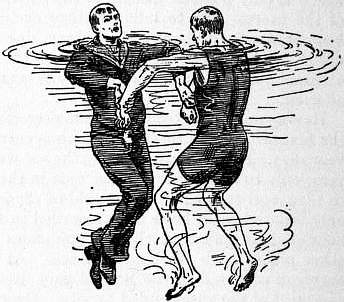
Fig. 1.—1st Release Method.
When a person unable to swim falls into the water, he usually rises to the surface, throws up his arms and calls for help. This, with the water swallowed, will make him sink, and if the arms are moved above the head when under water, he will, as a natural consequence, sink still lower. The struggle will be prolonged a few seconds, and then probably cease for a time, allowing him to rise again, though perhaps not sufficiently high to enable him to get another breath of air. If still conscious, he will renew his struggle, more feebly perhaps, but with the same result. As soon as insensibility occurs, the body sinks altogether, owing to the loss of air and the filling of the stomach with water. There is a general belief that a drowning person must rise three times before he finally sinks, but this is a fallacy. The question whether he rises at all, or how often he does so, entirely depends upon circumstances. A man may get entangled among weeds, which prevent his coming to the surface, or he may die through heart failure from the shock or fright of entering the water.
On seeing a person struggling in the water in danger of drowning, no time should be lost in going to his assistance, for he may sink at once, and then there is danger of missing the body when searching under water for it, or it may get entangled among weeds and then the rescuer’s task is rendered doubly dangerous. Before diving in to the rescue the boots and heavy clothing should be discarded if possible, and in cases where a leap has to be made from a height, such as a bridge, high embankment, vessel or pier, or where the depth of the water is not known, it is best to drop in feet first. Where weeds abound there is always danger of entanglement, and therefore progress should be made in the direction of the stream. When approaching a drowning man there is always the danger of being clutched, but a swimmer who knows the right way to deal with a man in the water can easily avoid this; but if through some mistake he finds himself seized by the drowning person, a necessary thing for the swimmer to do is to take advantage of his knowledge of the water and keep uppermost, as this weakens the drowning person and makes the effort of effecting a release much easier than would otherwise be the case. To the Royal Life Saving Society in England is due the credit of disseminating, throughout the entire world, the ideas of swimmers, based on practical experience, as to the safest methods which should be adopted for release and rescue, and their methods, as well as the approved ones for resuscitation, are now taught in almost every school and college.
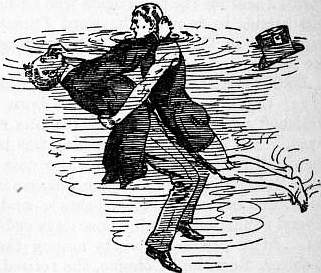
Fig. 2.—2nd Release Method.
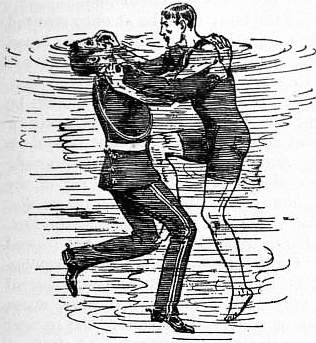
Fig. 3.—3rd Release Method.
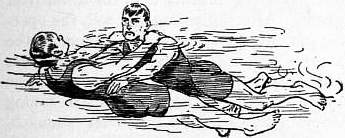
Fig. 4.—Easiest method of carrying a person not struggling.
If the rescuer be held by the wrists, he must turn both arms simultaneously against the drowning person’s thumbs, and bring his arms at right angles to the body, thus dislocating the thumbs of the drowning person if he does not leave go (fig. 1). If he be clutched round the neck he must take a deep breath and lean well over the drowning person, at the same time placing one hand in the small of his back, then raise the other arm in line with the shoulder, and pass it over the drowning person’s arm, then pinch the nostrils close with the fingers, and at the same time place the palm of the hand on the chin and push away with all possible force. By the firm holding of the nose the drowning person is made to open his mouth for breathing, and as he will then be under water, choking ensues and he gives way to the rescuer, who then gains complete control (fig. 2). One of the most dangerous clutches is that round the body and arms or round the body only. When so tackled the rescuer should lean well over the drowning person, take a breath as before, and either withdraw both arms in an upward direction in front of his body, or else act in the same way as when releasing oneself when clutched round the neck. In any case one hand must be placed on the drowning man’s shoulder, and the palm of the other hand against his chin, and at the same time one knee should be brought up against the lower part of his chest. Then, with a strong and sudden push, the arms and legs should be stretched out straight and the whole weight of the body thrown backwards. This sudden and totally unexpected action will break the clutch and leave the rescuer free to get hold of the drowning person in such a manner as to be able to bring him to land (fig. 3).
There are several practical methods of carrying a person through the water, the easiest assistance to render being that to a swimmer attacked by cramp or exhaustion, or a drowning person who may be obedient and remain quiet when approached and assured of safety. Then the person assisted should place his arms on the rescuer’s shoulders, close to the neck, with the arms at full stretch, lie on his back perfectly still, with the head well back. The rescuer will then be uppermost, and having his arms and legs free can, with the breast stroke, make rapid progress to the shore; indeed a good pace can easily be made (fig. 4). In
this, as in the other methods afterwards described, every care should be taken to keep the face of the drowning person above the water. All jerking, struggling or tugging should be avoided, and the stroke of the legs be regular and well timed, thus husbanding strength for further effort. The drowning person being able to breathe with freedom is reassured, and is likely to cease struggling, feeling that he is in safe hands.
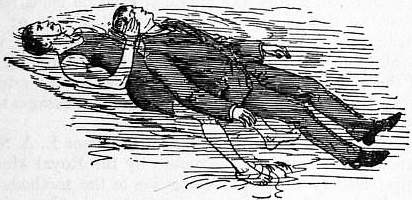
Fig. 5.—1st Rescue Method.
When a drowning person is not struggling, but yet seems likely to do so when approached, the best method of rescue is to swim straight up, turn him on his back, and then place the hands on either side of his face. Then the rescuer should lie on his back, holding the drowning man in front of him, and swim with the back stroke, always taking care to keep the man’s face above water (fig. 5). If the man be struggling and in a condition difficult to manage, he should be turned on his back as before, and a firm hold taken of his arms just above his elbows. Then the man’s arms should be drawn up at right angles to his body and the rescuer should start swimming with the back stroke (fig. 6). He should take particular care not to go against the current or stream, and thereby avoid exhaustion. If the arms be difficult to grasp, or the struggling so violent as to prevent a firm hold, the rescuer should slip his hands under the armpits of the drowning person, and place them on his chest or round his arms, then raise them at right angles to his body, thus placing the drowning person completely in his power. The journey to land can then be made by swimming on the back as in the other methods (fig. 7). In carrying a person through the water, it will be of much advantage to keep his elbows well out from the sides, as this expands the chest, inflates the lungs and adds to his buoyancy. The legs should be kept well up to the surface and the whole body as horizontal as possible. This avoids a drag through the water, and will considerably help the rescuer. In some cases it may happen that the drowning person has sunk to the bottom and does not rise again. In that event the rescuer should look for bubbles rising to the surface before diving in. In still water the bubbles rise perpendicularly; in running water they rise obliquely, so that the rescuer must look for his object higher up the stream than where the bubbles rise. It is also well to remember that in running water a body may be carried along by the current and must be looked for in the direction in which it flows. When a drowning person is recovered on the bottom, the rescuer should seize him by the head or shoulders, place the left foot on the ground and the right knee in the small of his back, and then, with a vigorous push, come to the surface.
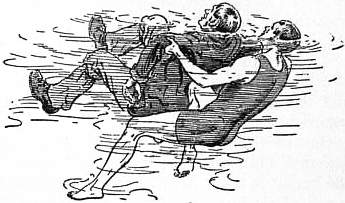
Fig. 6.—2nd Rescue Method.
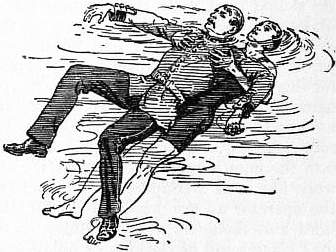
Fig. 7.—3rd Rescue Method.
When the rescuer reaches land with an insensible person, no time should be lost in sending for a medical man, but in the meantime an attempt to induce artificial respiration may be made. The first recorded cases of resuscitating the apparently drowned are mentioned in the notes to William Derham’s Physico-Theology, as having occurred at Troningholm and Oxford, about 1650. In 1745 Dr J. Fothergill read a paper on the subject before the Royal Society. It dealt with the recovery of a man dead in appearance by distending the lungs by Mr William Tossack, surgeon in Alloa, in 1744. In 1767 several cases of resuscitation were reported in Switzerland, and shortly after a society was formed at Amsterdam for recovery of the apparently drowned, and to instruct the common people as to the best manner of treating them when rescued, and to reward the people for their services. In 1773 Dr A. Johnson suggested the formation of a similar society in England, and Dr Thomas Cogan translated the memoirs of the Amsterdam society. Dr William Hawes secured a copy and tried to form a society. There was, however, a strong prejudice against the idea, but he publicly offered rewards to persons who, between Westminster and London Bridges, should rescue drowning persons and bring them to certain places on shore in order that resuscitation might be attempted. In this way he was instrumental in the saving of several lives, and paid the rewards out of his own pocket, until his zeal brought him sympathy and the Royal Humane Society was founded. This was in 1774. The system then in vogue was a means of inducing artificial respiration by inserting the pipe of a pair of bellows into one nostril and closing the other. Air was forced into the lungs and then expelled by pressing the chest, thus imitating respiration. Dr Hawes used for his resuscitation work a kind of cradle, in which the subject was placed, and then raised over a furnace. Bleeding, holding up by the heels, rolling on casks, &c. were at various times resorted to. Simple means are often as effective as the official ones. In 1891 a subject was restored in Australia by being held over a smoky fire, which is the native method of restoring life; while a few years back, at an English riverside town, a patient was saved by the placing of a handkerchief over his mouth and the alternate blowing into and drawing air out of the lungs until natural breathing was restored.
One of the oldest methods of resuscitation was that of Dr Marshall Hall (1790-1857), introduced in 1856. In this method the operator takes his place at the patient’s left side, and places a roll of clothing or pillow (which must be the same length as that used in the previous methods), so that it may be in position under the chest when the patient is turned over. The assistant at the head pays particular attention to the patient’s arms, that they may not be laid upon or twisted at the wrists, elbows, hands or shoulders. The patient is then turned face downwards, with the body reclining over the pillow, the operator makes a firm pressure with the hand upon the back, between and on the shoulder blades, he then pulls the patient slowly up on to the side towards himself. Once in position, the operator pushes the patient back again until the face is downward, when the pressure on the back is to be repeated. These three movements must be continued at the rate of about fifteen times a minute, until natural breathing has been restored.
Then came the methods of Dr H. R. Silvester and Dr Benjamin Howard, of New York.
When using the Silvester method, or, for the matter of that, any other method, the first thing to do is to send for medical assistance. Dr Silvester recommended that the patient should not be carried face downwards or held up by his feet. All rough usage should be avoided, especially twisting or bending of limbs, and the patient must not be allowed to remain on the back unless the tongue is pulled forward. In the event of respiration not being entirely suspended when a person is lifted out of the water, it may not be necessary to imitate breathing, but natural respiration may be assisted by the application of an irritant substance to the nostrils and tickling the nose. Smelling-salts, pepper and snuff may be used, or hot and cold water alternately dashed on the face or chest. Provided no sign of life can be seen or felt or the heart’s action heard, promotion of breathing, not circulation must be the first aim and effort. Lay the patient flat on his back, with the head at a slightly higher level than the feet. Remove all tight clothing about the neck, chest and abdomen, and loosen the braces, belts or corsets. The operator taking his place at the head, with an assistant on one side, will turn the patient over until he is lying face downwards, his head resting upon one arm. He should then, after the assistant has given one or two sharp blows with the open hand between the shoulder blades, wipe and clear the mouth, throat and nostrils of all matter that may prevent the air from entering the lungs, using a handkerchief for this purpose. This being done, the patient should be turned upon his back, the tongue pulled forward and kept in position by means of a dry cloth, handkerchief or piece of string tied round the jaw. Every care must be taken not to let it fall back into the mouth and thus obstruct the air passages. When this work has been accomplished (it should only last a few seconds) the operator at the head should lift the patient, handling the head and shoulders very carefully, in order that the assistant may place a roll of clothing or pillow under the shoulder blades. The roll being placed in position, the operator will lean forward and grasp the arms below the elbows. He will then draw the patient’s arms steadily upwards and outwards, above the head, until fully extended in line with the body. Having held the arms in this position for about one second, the operator will carry them back again and press them firmly against the side and front of the chest for another second. By these means an exchange of air is produced in the lungs similar to that effected by natural respiration. These movements must be repeated carefully and deliberately about fifteen times a minute, and persevered in. When natural respiration is once established, the operator should cease to imitate the movements of breathing, and proceed with the treatment for the promotion of warmth and circulation.
Friction over the surface of the body must be at once resorted to, using handkerchiefs, flannels, &c., so as to propel the blood along the veins towards the heart, while the operator attends to the mouth, nose and throat. The friction along the legs, arms and body should all be towards the heart and should be continued after the patient has been wrapped in blankets or some dry clothing. As soon as possible, the patient should be removed to the nearest house and further efforts made to promote warmth by the application of hot flannels to the pit of the stomach, and bottles or bladders of hot water, heated bricks, &c. to the armpits, between the thighs and to the soles of the feet. If there be pain or difficulty in breathing, apply a hot linseed meal poultice to the chest. On the restoration of life, a teaspoonful of warm water should be given; and then, if the power of swallowing has returned, very small quantities of wine, warm brandy and water, beef tea or coffee administered, the patient kept in bed, and a disposition to sleep encouraged. The patient should be carefully watched for some time to see that breathing does not fail, and, should any signs of failure appear, artificial respiration should at once be resumed. While the patient is in the house, care should be taken to let the air circulate freely about the room and all overcrowding should be prevented.
In the Howard method there are only two movements; its knowledge is said to be necessary in case the patient’s arm be in any way injured, or a more vigorous method than the “Silvester” deemed necessary, but care should be exercised not to injure the patient by too forcible pressure. The patient is laid on his back, the roll is larger than that used in the Silvester method, and is placed farther under the back in order that the lower part of the chest may be highest. After adjusting the roll, the operator kneels astride of the patient, while his assistant goes to the head, lifts the patient’s arms beyond the head, and holds them to the ground, cleans the mouth and nose, and attends to the tongue. The operator, with his fingers spread well apart, taking care that the thumbs do not press into the pit of the stomach, grasps the most compressible part of the lower ribs, and with both hands applies pressure firmly by leaning over the patient; then he springs back, lifting his hands off the patient. Artificial respiration is thus effected, and continued at the rate of about fifteen times a minute. When natural breathing has been restored, the treatment is the same as in the Silvester method.
These methods have now been superseded by the Schäfer method, which has been taken up by the Royal Life Saving Society, a body instituted in 1891 for the promotion of technical education in life saving and resuscitation of the apparently drowned. The Schäfer method has much to recommend it, owing to its extreme simplicity and the ease with which the physical operations necessary to carry on artificial respiration may be performed, hardly any muscular exertion being required. It involves no risk of injury to the congested liver or to any other organ, and as the patient is laid face downwards, there is no possibility of the air passages being blocked by the falling back of the tongue into the pharynx. The water and mucus can also be expelled much more readily from the air passages through the mouth and nostrils.