VOLUME VIII SLICE VII Drama to Dublin (continued 8)
Reading edition
Its weight and the small length of edge in contact with the ground cause this dredge to dig well, and enable the user to obtain many objects which though quite common are of rare occurrence in an ordinary dredge. Thus on the Brown Ridges, a fishing-ground west of Holland, although Donax vittalus is known from examination of fish stomachs to be abundant, it is rarely taken except in the conical dredge: the same is true of Echinocyamus pusillus, which is in many parts of the North Sea abundant in bottom samples and in no ordinary dredgings. With the sail-cloth lining the conical dredge fills in about 10 minutes on most ground, and no material washing out of fine sediment occurs on hauling. In shallow seas such as the North Sea commercial beam and other trawls are now used as quantitative instruments in the estimation of the fish population, especially of the Pleuronectidae.
Use of Small Trawls for Dredging.—Although these trawls do not here concern us, certain adaptations of small beam trawls for biological exploration are of such identical use with the dredge, and differ from it so little in structure and size, that they may be here described.
A small beam trawl was first used from the “Challenger” (fig. 17). It was sent down in 600 fathoms off Cape St Vincent, the reason for its use being the frequency with which the dredge sank into the sea-bottom and there remained until hauling. The experiment was entirely successful. The sinking of the net was avoided, the net had a much greater spread than the dredge, and in addition to invertebrates it captured several fish. After this the trawl was frequently used instead of the dredge. Indeed tangle bar, dredge and trawl form a series which are fitted for use on the roughest, moderately rough and fairly firm, and the softest ground respectively, although the dredge can be used almost anywhere.
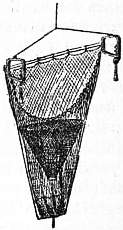
From Sir Charles Wyville Thomson’s Voyage of the “Challenger.” By permission of Macmillan & Co., Ltd. Fig. 17.—Trawl of the “Challenger.”
The frame of the “Challenger” trawl consisted of a 15 ft. wooden beam which in use was drawn over the sea-bed on two runners resembling those of a sledge, by means of two ropes or bridles attached to eyes in the front of the runners or “trawl heads.” A net 30 ft. long was suspended by one side to the beam by half-a-dozen stops. The remainder of the net’s mouth was of much greater length than the beam, and was weighted with close-set rolls of sheet lead; it thus dragged along the bottom in a curve approximately to a semicircle, behind the beam. The net tapers towards the hinder end, and contains a second net with open bottom, which, reaching about three-quarters of the way down the main net, acts as a valve or pocket. Both heels (or hinder ends) of the trawl heads and the tail of the net were weighted to assist the net in digging sufficiently and to maintain its balance—an important point, since if the trawl lands on its beam the net’s mouth remains closed, and nothing is caught.
The main differences of this trawl from the dredge are the replacement of scraping lip by ground rope, the position of this ground rope and the greater size of the mouth. The absence of a lip makes it less effective for burrowing and sessile creatures, but the weighted ground rope nevertheless secures them to a very surprising extent. The position of the ground rope is an important feature, as any free swimming creature not disturbed until the arrival of the ground rope cannot escape by simply rising or “striking” up. This and the greater spread make the trawl especially suitable for the collection of fishes and other swiftly moving animals. The first haul of the “Challenger” trawl brought up fishes, and most of our knowledge of fish of the greatest depths is due to it.
A tendency to return to the use of the small beam trawl for deep-sea work has lately shown itself. That used by Tanner on the “Albatross” has runners more heart-shaped than the “Challenger’s” instrument; the net is fastened to the downward and backward sloping edge of the runner as well as to the beam, being thus fixed on three sides instead of one; and a Norwegian glass float is fastened in a network cover to that part of the net which is above and in front of the ground rope in use, to assist in keeping the opening clear. These floats can stand the pressure at great depths, and do not become waterlogged as do cork floats. The largest “Albatross” trawl has a beam 11 ft. long, runners 2 ft. 5 in. high, and its frame weighs 275 ℔.
Agassiz or Blake Trawl.—This is generally considered to possess advantages over the preceding, and is decidedly better for those not experts in trawling. Its frame (fig. 18) consists of two iron runners each the shape of a capital letter D, joined by iron rods or pipes which connect the middle of each stroke with the corresponding point on the other letter. The net is a tapering one, its mouth being a strong rope bound with finer rope for protection till the whole reaches a thickness of some 2 in. It is fastened to the frame at four points only, the ends of the curved rods, and thus has a rectangular opening.
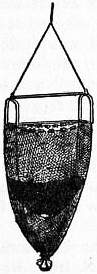
From Alexander E. Agassiz’s Three Cruises of the “Blake.” By permission of Houghton, Mifflin & Co. Fig. 18.—Agassiz or Blake Trawl.
The chief advantage of this frame is that it does not matter in the least which side lands first on the bottom; it is to the other trawls what Ball’s dredge is to an oyster dredge. The course can also be altered during shooting or towing the Blake trawl with far greater ease than is the case with others. An Agassiz trawl very successful in the North Sea has the following dimensions: length of the connecting rods and therefore of the mouth 8 ft., height of runners and of mouth 1 ft. 9 in., extreme length of runners 2 ft., length of net 11 ft. 3 in., weight of whole trawl 94 ℔, 63 of which are due to the frame.
It is instructive to note how closely our knowledge of bottom-living forms has been associated with the instruments of capture in use. As long as small vessels were used in dredging, the belief that life was limited to the regions accessible to them was widely spread. The first known denizens of great depths were the foraminifera and few echinoderms brought up by various sounding apparatus. Next with the dredge and tangles the number of groups obtained was much greater. As soon as trawls were adopted fish began to make their appearance. The greatest gaps in our knowledge still probably occur in the large and swiftly moving forms, such as fish and cephalopods. As we can hardly hope to move apparatus swiftly over the bottom in great depths, the way in which improvement is possible probably is that of increasing the spread of the nets; and a start in this direction appears to have been made by Dr Petersen, who has devised a modified otter sieve which catches fish at all events very well, and has been operated already at considerable depths.
Of the economy of quite shallow seas, however, we are still largely ignorant. Much as has been learnt of the bionomics of the sea, it is but a commencement; and this is of course especially true of deep seas. The dredge and its kindred have, however, in less than a century enabled naturalists to compile an immense mass of knowledge of the structure, development, affinities and distribution of the animals of the sea-bed, and in the most accessible seas to produce enumerations and morphological accounts of them of some approach to completeness.
(J. O. B.)
DRELINCOURT, CHARLES (1595-1669), French Protestant divine, was born at Sedan on the 10th of July 1595. In 1618 he undertook the charge of the French Protestant church at Langres, but failed to receive the necessary royal sanction, and early in 1620 he removed to Paris, where he was nominated minister of the Reformed Church at Charenton. He was the author of a large number of works in devotional and polemical theology, several of which had great influence. His Catechism (Catéchisme ou instruction familière, 1652) and his Christian’s Defense against the Fears of Death (Consolations de l’âme fidèle contre les frayeurs de la mort, 1651) became well known in England by means of translations, which were very frequently reprinted. It has been said that Daniel Defoe wrote his fiction of Mrs Veal (A True Relation of the Apparition of Mrs Veal), who came from the other world to recommend the perusal of Drelincourt on Death, for the express purpose of promoting the sale of an English translation of the Consolations; Defoe’s contribution is added to the fourth edition of the translation (1706). Another popular work of his was Les Visites charitables pour toutes sortes de personnes affligées (1669). Drelincourt’s controversial works were numerous. Directed entirely against Roman Catholicism, they did much to strengthen and consolidate the Protestant party in France. He died on the 3rd of November 1669.
Several of his sons were distinguished as theologians or physicians. Laurent (1626-1681) became a pastor, and was the author of Sonnets chrétiens sur divers sujets (1677); Charles (1633-1697) was professor of physic at the university of Leiden, and physician to the prince of Orange; Peter (1644-1722) was ordained a priest in the Church of England, and became dean of Armagh.
DRENTE, a province of Holland, bounded N. and N.E. by Groningen, S.E. by the Prussian province of Hanover, S. and S.W. by Overysel, and N.W. by Friesland; area, 1128 sq. m.; pop. (1900) 149,551. The province of Drente is a sandy plateau forming the kernel of the surrounding provinces. The soil consists almost entirely of sand and gravel, and is covered with bleak moorland, patches of wood, and fen. This is only varied by the strip of fertile clay and grass-land which is found along the banks of the rivers, and by the areas of high fen in the south-eastern corner and on the western borders near Assen. The surface of the province is a gentle slope from the south-west towards the north-east, where it terminates in the long ridge of hills known as the Hondsrug (Dog’s Back) extending along the eastern border into Groningen. The watershed of the province runs from east to west across the middle of the province, along the line of the Orange canal. The southern streams are all collected at two points on the southern borders, namely, at Meppel and Koevorden, whence they communicate with the Zwarte Water and the Vecht respectively by means of the Meppeler Diep and the Koevorden canal. The Steenwyker Aa, however, enters the Zuider Zee independently. The northern rivers all flow into Groningen. The piles of granite rocks somewhat in the shape of cromlechs which are found scattered about this province, and especially along the western edge of the Hondsrug, have long been named Hunebedden, from a popular superstition that they were “Huns’ beds.” Possibly the word originally meant “beds of the dead,” or tombs.
Two industries have for centuries been associated with the barren heaths and sodden fens so usually found together on the sand-grounds, namely, the cultivation of buckwheat and peat-digging. The work is conducted on a regular system of fen colonization, the first operation being directed towards the drainage of the country. This is effected by means of drainage canals cut at regular intervals and connected by means of cross ditches. These draining ditches all have their issue in a main drainage canal, along which the transport of the peat and peat-litter takes place and the houses of the colonists are built. The heathlands when sufficiently drained are prepared for cultivation by being cut into sods and burnt. This system appears to have been practised already at the end of the 17th century. After eight years, however, the soil becomes exhausted, and twenty to thirty years are required for its refertilization. The cultivation of buckwheat on these grounds has decreased, and large areas which were formerly thus treated now lie waste. Potatoes, rye, oats, beans and peas are also largely cultivated. In connexion with the cultivation of potatoes, factories are established for making spirits, treacle, potato-meal, and straw-paper. Furthermore, agriculture is everywhere accompanied on the sand-grounds by the rearing of sheep and cattle, which assist in fertilizing the soil. Owing to the meagreness of their food these animals are usually thin and small, but are quickly restored when placed on richer grounds. The breeding of pigs is also widely practised on the sand-grounds, as well as forest culture. Of the fen-colonies in Drente the best known are those of Frederiksoord and Veenhuizen.
Owing to the general condition of poverty which prevailed after the French evacuation in the second decade of the 19th century, attention was turned to the means of industry offered by the unreclaimed heath-lands in the eastern provinces, and in 1818 the Society of Charity (Maatschappij van Weldadigheid) was formed with Count van den Bosch at its head. This society began by establishing the free agricultural colony of Frederiksoord, about 10 m. N. of Meppel, named after Prince Frederick, son of William I., king of the Netherlands. An industrious colonist could purchase a small farm on the estate and make himself independent in two years. In addition to this, various industries were set on foot for the benefit of those who were not capable of field work, such as mat and rope making, and jute and cotton weaving. In later times forest culture was added, and the Gerard Adriaan van Swieten schools of forestry, agriculture and horticulture were established by Major van Swieten in memory of his son. A Reformed and a Roman Catholic church are also attached to the colony. To this colony the Society of Charity later added the adjoining colonies of Willemsoord and Kolonie VII. in Overysel, and Wilhelminasoord partly in Friesland. The colony of Veenhuizen lies about 7 m. N.W. of Assen, and was founded by the same society in 1823. In 1859, however, the Veenhuizen estates were sold to the government for the purpose of a penal establishment for drunkards and beggars.
Owing to its geographical isolation, the development of Drente has remained behind that of every other province in the Netherlands, and there are few centres of any importance, either agricultural or industrial. Hence the character and customs of the people have remained peculiarly conservative. Assen is the chief town. In the south Meppel and Koevorden absorb the largest amount of trade. Hoogeveen, situated between these two, owes its origin to the fen reclamation which was begun here in 1625 by Baron van Echten. In the following year it was erected into a barony which lasted till 1795. The original industry has long since moved onwards to other parts, but the town remains a prosperous market centre, and has a considerable industrial activity. Extensive fir woods have been laid out in the neighbourhood. Zuidlaren is a picturesque village at the northern end of the Hondsrug, with an important market. The railway from Amsterdam to Groningen traverses Drente; branch lines connect Meppel with Leeuwarden and Assen with Delfzÿl.
History.—The early history of Drente is obscure. That it was inhabited at a remote date is proved by the prehistoric sepulchral mounds, the Hunebedden already mentioned. In the 5th and 6th centuries the country was overrun by Saxon tribes, and later on was governed by counts under the Frankish and German kings. Of these only three are recorded, Eberhard (943-944), Balderic (1006) and Temmo (1025). In 1046 the emperor Henry III. gave the countship to the bishop and chapter of Utrecht, who governed it through the burgrave, or châtelain, of Koevorden, a dignity which became hereditary after 1143 in the family of Ludolf or Roelof, brother of Heribert of Bierum, bishop of Utrecht (1138-1150). This family became extinct in the male line about 1232, and was succeeded by Henry I. of Borculo (1232-1261), who had married the heiress of Roelof III. of Koevorden. In 1395 Reinald IV. (d. 1410) of Borculo-Koevorden was deposed by Bishop Frederick of Utrecht, and the country was henceforth administered by an episcopal official (amptman), who was, however, generally a native. With its popularly elected assembly of twenty-four Etten (jurati) Drente remained practically independent. This state of things continued till 1522, when it was conquered by Duke Charles of Gelderland, from whom it was taken by the emperor Charles V. in 1536, and became part of the Habsburg dominions.
Drente took part in the revolt of the Netherlands, and being a district covered by waste heath and moor was, on account of its poverty and sparse population, not admitted into the union as a separate province, and it had no voice in the assembly of the states-general. It was subdued by the Spaniards in 1580, but reconquered by Maurice of Nassau in 1594. During the years that followed, Drente, though unrepresented in the states-general, retained its local independence and had its own stadtholder. William Louis of Nassau-Siegen (d. 1620) held that office, and it was held later by Maurice, Frederick Henry, William II. and William III., princes of Orange. At the general assembly of 1651 Drente put forward its claim to admission as a province, but was not admitted. After the deaths of William II. (1650) and of William III. (1702) Drente remained for a term of years without a stadtholder, but in 1722 William Charles Henry of the house of Nassau-Siegen, who, through the extinction of the elder line, had become prince of Orange, was elected stadtholder. His descendants held that office, which was declared hereditary, until the French conquest in 1795. In the following year Drente at length obtained the privilege, which it had long sought, of being reckoned as an eighth province with representation in the states-general. Between 1806 and 1813 Drente, with the rest of the Netherlands, was incorporated in the French empire, and, with part of Groningen, formed the department of Ems Occidental. With the accession of William I. as king of the Netherlands it was restored to its old position as a province of the new kingdom.
DRESDEN, a city of Germany, capital of the kingdom of Saxony, 71 m. E.S.E. from Leipzig and 111 m. S. from Berlin by railway. It lies at an altitude of 402 ft. above the Baltic, in a broad and pleasant valley on both banks of the Elbe. The prospect of the city with its cupolas, towers, spires and the copper green roofs of its palaces, as seen from the distance, is one of striking beauty. On the left bank of the river are the Altstadt (old town) with four old suburbs and numerous new suburbs, and the Friedrichstadt (separated from the Altstadt by a long railway viaduct); on the right, the Neustadt (new town), Antonstadt, and the modern military suburb Alberstadt. Five fine bridges connect the Altstadt and Neustadt. The beautiful central bridge—the Alte or Augustusbrücke—with 16 arches, built in 1727-1731, and 1420 ft. long, has been demolished (1906) and replaced by a wider structure. Up-stream are the two modern Albert and Königin Carola bridges, and, down-stream, the Marien and the Eisenbahn (railway) bridges. The streets of the Alstadt are mostly narrow and somewhat gloomy, those of the Neustadt more spacious and regular.
On account of its delightful situation and the many objects of interest it contains, Dresden is often called “German Florence,” a name first applied to it by the poet Herder. The richness of its art treasures, the educational advantages it offers, and its attractive surroundings render it a favourite resort of people with private means. There are a large number of foreign residents, notably Austro-Hungarians and Russians, and also a considerable colony of English and Americans, the latter amounting to about 1500. The population of the city on the 1st of December 1905 was 516,996, of whom 358,776 lived on the left bank (Altstadt) and 158,220 on the right (Neustadt). The royal house belongs to the Roman Catholic confession, but the bulk of the inhabitants are Lutheran Protestants.
Dresden is the residence of the king, the seat of government for the kingdom of Saxony, and the headquarters of the XII. (Saxon) Army Corps. Within two decades (1880-1900) the capital almost at a single bound advanced into the front rank of German commercial and industrial towns; but while gaining in prosperity it has lost much of its medieval aspect. Old buildings in the heart of the Altstadt have been swept away, and their place occupied by modern business houses and new streets. Among the public squares in the Altstadt must be mentioned the magnificent Theaterplatz, with a fine equestrian statue of King John, by Schilling; the Altmarkt, with a monument commemorative of the war of 1870-71; the Neumarkt, with a bronze statue of King Frederick Augustus II., by E. J. Hähnel; the Postplatz, adorned by a Gothic fountain, by Semper; and the Bismarckplatz in the Anglo-American quarter. In the Neustadt are the market square, with a bronze equestrian statue of Augustus the Strong; the Kaiser Wilhelmplatz; and the Albertplatz. The continuous Schloss-, See- and Prager-Strasse, and the Wilsdruffer- and König Johann-Strasse are the main streets in the Altstadt, and the Hauptstrasse in the Neustadt.
The most imposing churches include the Roman Catholic Hofkirche, built (1739-1751) by C. Chiaveri, in rococo style, with a tower 300 ft. high. It contains a fine organ by Silbermann and pictures by Raphael Mengs and other artists, the outside being adorned with 59 statues by Mattielli. On the Neumarkt is the Frauenkirche, with a stone cupola rising to the height of 311 ft.; close to the Altmarkt, the Kreuzkirche, rebuilt after destruction by fire in 1897, also with a lofty tower surmounted by a cupola; and near the Postplatz the Sophienkirche, with twin spires. In the Neustadt is the Dreikönigskirche (dating from the 18th century) with a high pinnacled tower. Among more modern churches may be mentioned: in the Altstadt, the Johanneskirche, with a richly decorated interior; the Lukaskirche; and the Trinitatiskirche; and in the Neustadt, the Martin Luther-Kirche and the new garrison church. Apart from the chapels in the royal palaces, Dresden contains in all 32 churches, viz. 21 Evangelical, 6 Roman Catholic, a Reformed, a Russian, an English (erected by Gilbert Scott) with a graceful spire, a Scottish (Presbyterian), and an American (Episcopal) church, the last a handsome building, with a pretty parsonage attached.
Of secular buildings, the most noteworthy are grouped in the Altstadt near the river. The royal palace, built in 1530-1535 by Duke George (and thus called Georgenschloss), was thoroughly restored, and in some measure rebuilt between 1890 and 1902, in German Renaissance style, and is now an exceedingly handsome structure. The Georgentor has been widened, and through it, and beneath the royal apartments, vehicular traffic from the centre of the town is directed to the Augustusbrücke. The whole is surmounted by a lofty tower—387 ft.—the highest in Dresden. The interior is splendidly decorated. In the palace chapel are pictures by Rembrandt, Nicolas Poussin, Guido Reni and Annibale Caracci. The adjoining Prinzen-Palais on the Taschenberg, built in 1715, has a fine chapel, in which are various works of S. Torelli; it has also a library of 20,000 volumes. The Zwinger, begun in 1711, and built in the rococo style, forms an enclosure, within which is a statue of King Frederick Augustus I. It was intended to be the vestibule to a palace, but now contains a number of collections of great value. Until 1846 it was open at the north side; but this space has since been occupied by the museum, a beautiful Renaissance building, the exterior of which is adorned by statues of Michelangelo, Raphael, Giotto, Dante, Goethe and other artists and poets by Rietschel and Hähnel, and it contains the famous picture gallery. The Brühl palace, built in 1737 by Count Brühl, the minister of Augustus II., has been in some measure demolished to make room for the new Ständehaus (diet house), with its main façade facing the Hofkirche; before the main entrance there is an equestrian statue (1906) of King Albert. Close by is the Brühl Terrace, approached by a fine flight of steps, on which are groups, by Schilling, representing Morning, Evening, Day and Night. The terrace commands a view of the Elbe and the distant heights of Loschwitz and the Weisser Hirsch, but the prospect has of late years become somewhat marred, owing to the extension of the town up the river and to the two new up-stream bridges. The Japanese palace in the Neustadt, built in 1715 as a summer residence for Augustus II., receives its name from certain oriental figures with which it is decorated; it is sometimes called the Augusteum and contains the royal library. Among other buildings of note is the Hoftheatre, a magnificent edifice in the Renaissance style, built after the designs of Semper, to replace the theatre burnt in 1869, and completed in 1878. A new town hall of huge dimensions, also in German Renaissance, with an octagon tower 400 ft. in height, stands on the former southern ramparts of the inner town, close to the Kreuzkirche. In the Altstadt the most striking of the newer edifices is the Kunstakademie, constructed from designs by K. Lipsius in the Italian Renaissance style, 1890-1894. The Albertinum, formerly the arsenal, built in 1559-1563, was rebuilt 1884-1889, and fitted up as a museum of oriental and classical antiquities, and as the depository of the state archives. On the right bank of the Elbe in Neustadt stand the fine buildings of the ministries of war, of finance, justice, the interior and education. The public monuments of Dresden also include the Moritz Monument, a relief dedicated by the elector Augustus to his brother Maurice, a statue of Weber the composer by Rietschel, a bronze statue of Theodor Körner by Hähnel, the Rietschel monument on the Brühl Terrace by Schilling, a bust of Gutzkow, and a statue of Bismarck on the promenade. In the suburbs which encircle the old town are to be noted the vast central Hauptbahnhof (1893-1898) occupying the site of the old Böhmischer railway station, the new premises of the municipal hospital and the Ausstellungs-Halle (exhibition buildings).
The chief pleasure-ground of Dresden is the Grosser Garten, in which there are a summer theatre, the Reitschel museum, and a château containing a museum of antiquities. The latter is composed chiefly of objects removed from the churches in consequence of the Reformation. Near the château is the zoological garden, formed in 1860, and excellently arranged. A little to the south of Dresden, on the left bank of the Elbe, is the village Räcknitz, in which is Moreau’s monument, erected on the spot where he was mortally wounded in 1813. The mountains of Saxon Switzerland are seen from this neighbourhood.
Art.—Dresden owes a large part of its fame to its extensive artistic, literary and scientific collections. Of these the most valuable is its splendid picture gallery, founded by Augustus I. and increased by his successors at great cost. It is in the museum, and contains about 2500 pictures, being especially rich in specimens of the Italian, Dutch and Flemish schools. The gem of the collection is Raphael’s “Madonna di San Sisto,” for which a room is set apart. There is also a special room for the “Madonna” of the younger Holbein. Other paintings with which the name of the gallery is generally associated are Correggio’s “La Notte” and “Mary Magdalene”; Titian’s “Tribute Money” and “Venus”; “The Adoration” and “The Marriage in Cana,” by Paul Veronese; Andrea del Sarto’s “Abraham’s Sacrifice”; Rembrandt’s “Portrait of Himself with his Wife sitting on his Knee”; “The Judgment of Paris” and “The Boar Hunt,” by Rubens; Van Dyck’s “Charles I., his Queen, and their Children.”
Of modern painters, this magnificent collection contains masterpieces by Defregger, Vautier, Makart, Munkacsy, Fritz von Uhde, Böcklin, Hans Thoma; portraits by Leon Pohle, Delaroche and Sargent; landscapes by Andreas and Oswald Achenbach and allegorical works by Sascha Schneider. In separate compartments there are a number of crayon portraits, most of them by Rosalba Carriera, and views of Dresden by Canaletto and other artists. Besides the picture gallery the museum includes a magnificent collection of engravings and drawings. There are upwards of 400,000 specimens, arranged in twelve classes, so as to mark the great epochs in the history of art. A collection of casts, likewise in the museum, is designed to display the progress of plastic art from the time of the Egyptians and Assyrians to modern ages. This collection was begun by Raphael Mengs, who secured casts of the most valuable antiques in Italy, some of which no longer exist.
The Japanese palace contains a public library of more than 400,000 volumes, with about 3000 MSS. and 20,000 maps. It is especially rich in the ancient classics, and in works bearing on literary history and the history of Germany, Poland and France. There are also a valuable cabinet of coins and a collection of ancient works of art. A collection of porcelain in the “Museum Johanneum” (which once contained the picture gallery) is made up of specimens of Chinese, Japanese, East Indian, Sèvres and Meissen manufacture, carefully arranged in chronological order. There is in the same building an excellent Historical Museum. In the Grüne Gewölbe (Green Vault) of the Royal Palace, so called from the character of its original decorations, there is an unequalled collection of precious stones, pearls and works of art in gold, silver, amber and ivory. The objects, which are about 3000 in number, are arranged in eight rooms. They include the regalia of Augustus II. as king of Poland; the electoral sword of Saxony; a group by Dinglinger, in gold and enamel, representing the court of the grand mogul Aurungzebe, and consisting of 132 figures upon a plate of silver 4 ft. 4 in. square; the largest onyx known, 62⁄3 in. by 2¼ in.; a pearl representing the dwarf of Charles II. of Spain; and a green brilliant weighing 40 carats. The royal palace also has a gallery of arms consisting of more than 2000 weapons of artistic or historical value. In the Zwinger are the zoological and mineralogical museums and a collection of instruments used in mathematical and physical science. Among other collections is that of the Körner museum with numerous reminiscences of the Goethe-Schiller epoch, and of the wars of liberation (1813-15), and containing valuable manuscripts and relics. Founded by Hofrath Dr Emil Peschel, it has passed into the possession of the city.
Education.—Dresden is the seat of a number of well-known scientific associations. The educational institutions are numerous and of a high order, including a technical high school (with about 1100 students), which enjoys the privilege of conferring the degrees of doctor of engineering, doctor of technical sciences, &c., a veterinary college, a political-economic institution (Gehestiftung), with library, a school of architects, a royal and four municipal gymnasia, numerous lower grade and popular schools, the royal conservatorium for music and drama, and a celebrated academy of painting. Dresden has several important hospitals, asylums and other charitable institutions.
Music and the Theatres.—Besides the two royal theatres, Dresden possesses several minor theatres and music halls. The pride of place in the world of music is held by the orchestra attached to the court theatre. Founded by Augustus II., it has become famous throughout the world, owing to the masters who have from time to time been associated with it—such as Paër, Weber, Reissiger and Wagner. Symphony and popular concerts are held throughout the year in various public halls, and, during the winter, concerts of church music are frequently given in the Protestant Kreuz- and Frauen-Kirchen, and on Sundays in the Roman Catholic church.
Communications and Industries.—Dresden lies at the centre of an extensive railway system, which places it in communication with the chief cities of northern and central Germany as well as with Austria and the East. Here cross the grand trunk lines Berlin-Vienna, Chemnitz-Görlitz-Breslau. It is connected by two lines of railway with Leipzig and by local lines with neighbouring smaller towns. The navigation on the Elbe has of recent years largely developed, and, in addition to trade by river with Bohemia and Magdeburg-Hamburg, there is a considerable pleasure-boat traffic during the summer months. The communications within the city are maintained by an excellent system of electric trams, which bring the more distant suburbs into easy connexion with the business centre. A considerable business is done on the exchange, chiefly in local industrial shares, and the financial institutions number some fifty banks, among them branches of the Reichs Bank and of the Deutsche Bank. Among the more notable industries may be mentioned the manufacture of china (see Ceramics), of gold and silver ornaments, cigarettes, chocolate, coloured postcards, perfumery, straw-plaiting, artificial flowers, agricultural machinery, paper, photographic and other scientific instruments. There are several great breweries; corn trade is carried on, and an extensive business is done in books and objects of art.
Surroundings.—The environs of the city are delightful. To the north are the vine-clad hills of the Lössnitz commanding views of the valley of the Elbe from Dresden to Meissen; behind them, on an island in a lake, is the castle of Moritzburg, the hunting box of the king of Saxony. On the right bank of the Elbe, 3 m. above the city, lies the village of Loschwitz, where Schiller, in the summer of 1786, wrote the greater part of his Don Carlos: above it on the fringe of the Dresdner Heide, the climatic health resort Weisser-Hirsch; farther up the river towards Pirna the royal summer palace Pillnitz; to the south the Plauensche Grund, and still farther the Rabenauer Grund.
History.—Dresden (Old Slav Drezga, forest, Drezgajan, forest-dwellers), which is known to have existed in 1206, is of Slavonic origin, and was originally founded on the right bank of the Elbe, on the site of the present Neustadt, which is thus actually the old town. It became the capital of Henry the Illustrious, margrave of Meissen, in 1270, but belonged for some time after his death, first to Wenceslaus of Bohemia, and next to the margrave of Brandenburg. Early in the 14th century it was restored to the margrave of Meissen. On the division of Saxony in 1485 it fell to the Albertine line, which has since held it. Having been burned almost to the ground in 1491, it was rebuilt; and in the 16th century the fortifications were begun and gradually extended. John George II., in the 17th century, formed the Grosser Garten, and otherwise greatly improved the town; but it was in the first half of the 18th century, under Augustus I. and Augustus II., who were kings of Poland as well as electors of Saxony, that Dresden assumed something like its present appearance. The Neustadt, which had been burned down in the 17th century, was founded anew by Augustus I.; he also founded Friedrichstadt. The town suffered severely during the Seven Years’ War, being bombarded in 1760. Some damage was also inflicted on it in 1813, when Napoleon made it the centre of his operations; one of the buttresses and two arches of the old bridge were then blown up. The dismantling of the fortifications had been begun by the French in 1810, and was gradually completed after 1817, the space occupied by them being appropriated to gardens and promenades. Many buildings were completed or founded by King Anthony, from whom Antonstadt derives its name. Dresden again suffered severely during the revolution of 1849, but all traces of the disturbances which then took place were soon effaced. In 1866 it was occupied by the Prussians, who did not finally evacuate it until the spring of the following year. Since that time numerous improvements have been carried out.
See Lindau, Geschichte der Haupt- und Residenzstadt Dresden (2 vols., Dresden, 1884-1885); Prölss, Geschichte des Hoftheaters in Dresden (Dresden, 1877); Schumann, Führer durch die königl. Sammlungen zu Dresden (1903); Woerl, Führer durch Dresden; Daniel, Deutschland (1894).
Battle of Dresden. The battle of Dresden, the last of the great victories of Napoleon, was fought on the 26th and 27th of August 1813. The intervention of Austria in the War of Liberation, and the consequent advance of the Allies under the Austrian field-marshal Prince Schwarzenberg from Prague upon Dresden, recalled Napoleon from Silesia, where he was engaged against the Prussians and Russians under Blücher. Only by a narrow margin of time, indeed, was he able to bring back sufficient troops for the first day’s battle. He detached a column under Vandamme to the mountains to interpose between Schwarzenberg and Prague (see Napoleonic Campaigns); the rest of the army pressed on by forced marches for Dresden, around which a position for the whole army had been chosen and fortified, though at the moment this was held by less than 20,000 men under Gouvion St Cyr, who retired thither from the mountains, leaving a garrison in Königstein, and had repeatedly sent reports to the emperor as to the allied masses gathering to the southward. The battle of the first day began late in the afternoon, for Schwarzenberg waited as long as possible for the corps of Klenau, which formed his extreme left wing on the Freiberg road. At last, about 6 p.m. he decided to wait no longer, and six heavy columns of attack advanced against the suburbs defended by St Cyr and now also by the leading troops of the main army. Three hundred guns covered the assault, and Dresden was set on fire in places by the cannonade, while the French columns marched unceasingly over the bridges and through the Altstadt. On the right the Russians under Wittgenstein advanced from Striesen, the Prussians under Kleist through the Grosser Garten, whilst Prussians under Prince Augustus and Austrians under Colloredo moved upon the Moczinski redoubt, which was the scene of the most desperate fighting, and was repeatedly taken and retaken. The attack to the westward was carried out by the other Austrian corps; Klenau, however, was still far distant. In the end, the French defences remained unshaken. Ney led a counter-attack against the Allies’ left, the Moczinski redoubt was definitely recaptured from Colloredo, and the Prussians were driven out of the Grosser Garten. The coup of the Allies had failed, for every hour saw the arrival of fresh forces on the side of Napoleon, and at length the Austrian leader drew off his men to the heights again. He was prepared to fight another battle on the morrow—indeed he could scarcely have avoided it had he wished to do so, for behind him lay the mountain defiles, towards which Vandamme was marching with all speed.
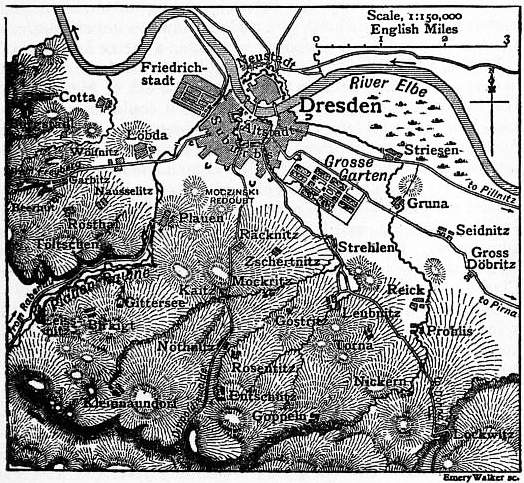
Napoleon’s plan for the 27th was, as usual, simple in its outline. As at Friedland, a ravine separated a part of the hostile line of battle from the rest. The villages west of the Plauen ravine and even Löbda were occupied in the early morning by General Metzko with the leading division of Klenau’s corps from Freiberg, and upon Metzko Napoleon intended first to throw the weight of his attack, giving to Victor’s infantry and the cavalry of Murat, king of Naples, the task of overwhelming the isolated Austrians. The centre, aided by the defences of the Dresden suburbs, could hold its own, as the events of the 26th had shown, the left, now under Ney, with whom served Kellermann’s cavalry and the Young Guard, was to attack Wittgenstein’s Russians on the Pirna road. Thus, for once, Napoleon decided to attack both flanks of the enemy. His motives in so doing have been much discussed by the critics; Vandamme’s movements, it may be suggested, contributed to the French emperor’s plan, which if carried out would open the Pirna road. Still, the left attack may have had a purely tactical object, for in that quarter was the main body of the Prussians and Russians, and Napoleon’s method was always to concentrate the fury of the attack on the heaviest masses of the enemy, i.e. the best target for his own artillery. A very heavy rainstorm during the night seriously affected the movements of troops on the following day, but all to Napoleon’s advantage, for his more mobile artillery, reinforced by every horse available in and about Dresden, was still able to move where the Allied guns sank in mud. Further, if the cavalry had to walk, or at most trot, through the fields the opposing infantry was almost always unable to fire their muskets. “You cannot fire; surrender,” said Murat to an Austrian battalion in the battle. “Never,” they replied; “you cannot charge us.” On the appearance of Murat’s horse artillery, however, they had to surrender at once. Under such conditions, Metzko, unsupported either by Klenau or the main army beyond the ravine, was an easy victim. Victor from Löbda drove in the advanced posts and assaulted the line of villages Wolfnitz-Töltschen; Metzko had to retire to the higher ground S.W. of the first line, and Murat, with an overwhelming cavalry force from Cotta and Burgstädl, outflanked his left, broke up whole battalions, and finally, with the assistance of the renewed frontal attack of Victor’s infantry, annihilated the division. The Austrian corps of Gyulai arrived too late to save it. A few formed bodies escaped across the ravine, but Metzko and three-fourths of his men were killed or taken prisoners.
Meanwhile Ney on the other flank, with his left on the Pillnitz road and his right on the Grosser Garten, had opened his attack. The Russians offered a strenuous resistance, defending Seidnitz, Gross Döbritz and Reick with their usual steadiness, and Ney was so far advanced that several generals at the Allied headquarters suggested a counter-attack of the centre by way of Strehlen, so as to cut off the French left from Dresden. This plan was adopted, but, owing to various misunderstandings, failed of execution. Thus the Allied centre remained inactive all day, cannonaded by the Dresden redoubts. One incident only, but that of great importance, took place here. The tsar, the king of Prussia, Schwarzenberg and a very large headquarter staff watched the fighting from a hill near Räcknitz and offered an easy mark to the French guns. In default of formed bodies to fire at, the latter had for a moment ceased fire; Napoleon, riding by, half carelessly told them to reopen, and one of their first shots, directed at 2000 yards range against the mass of officers on the sky-line, mortally wounded General Moreau, who was standing by the emperor Alexander. A council of war followed. The Allied sovereigns were for continuing the fight; Schwarzenberg, however, knowing the exhaustion of his troops decided to retreat. As at Bautzen, the French cavalry was unable to make any effective pursuit.
The forces engaged were 96,000 French, Saxons, &c., and 200,000 Austrians, Russians and Prussians. The French losses were about 10,000, or a little over 10%, those of the Allies 38,000 killed, wounded and prisoners (the latter 23,000) or 19%. They lost also 15 colours and 26 guns.
DRESS (from the Fr. dresser, to set out, arrange, formed from Lat. directus, arranged, dirigere, to direct, arrange), a substantive of which the current meaning is that of clothing or costume in general, or, specifically, the principal outer garment worn by a woman (see Costume). The verb “to dress” has various applications which can be deduced from its original meaning. It is thus used not only of the putting on of clothing, but of the preparing and finishing of leather, the preparation of food for eating, the application of cleansing and healing substances or of bandages, &c., to a wound, the drawing up in a correct line of a body of troops, and, generally, adorning or decking out, as of a ship with flags. In the language of the theatre the “dresser” is the person who looks after the actor’s wardrobe and assists him in the changing of his costumes. For the printer’s use of “dresser” see Typography.
DRESSER, in furniture, a form of sideboard. The name is derived from the Fr. dressoir, a piece of furniture used to range or dresser the more costly appointments of the table. The appliance is the direct descendant of the credence and the buffet, and is, indeed, a much more legitimate inheritor of their functions than the modern sideboard, which, as we know it, is practically an 18th-century invention. It developed into its present shape about the second quarter of the 17th century, and has since then changed but little. As a piece of movable furniture it was made rarely, if at all, after the beginning of the 19th century until the revival of interest in what is called “farmhouse furniture” at the very beginning of the 20th century led in the first place to the construction of many imitation antique dressers from derelict pieces of old oak, and especially from panels of chests, and in the second to the making of avowed imitations. The dresser conformed to a model which varied only in detail and in ornament. Its simple and agreeable form consisted of a long and rather narrow table or slab, with drawers or cupboards beneath and a tall upright closed-in back arranged with a varying number of shallow shelves for the reception of plates; hooks for mugs were often fixed upon the face of these shelves. Towards the end of the 17th century small cupboards were often added to the superstructure. The majority of these dressers were made of oak, but when, early in the Georgian period mahogany came into general use, they were frequently inlaid with that wood; holly and box were also used for inlaying, most frequently in the shape of plain bands or lines. A peculiarly effective combination of oak and mahogany is found in the dressers, as in other “farmhouse furniture,” made on the borders of Staffordshire and Shropshire. The excellence of the work of this kind in that district and in the country lying west of it may perhaps explain the expression “Welsh dresser,” which is now no more than a trade term, not necessarily suggestive of the place of origin, and applied to all dressers of this type. They are most frequently found in the houses of small yeomen and substantial farmers, into which fashion penetrated slowly. The dresser is now most familiar as necessary plenishing of the kitchen, in which it is invariably a fixture. In form it is essentially identical with the movable variety, but it is usually much larger, is made of deal or other soft wood, and the superstructure has no back.
DREUX, a town of north-western France, capital of an arrondissement in the department of Eure-et-Loir, 27 m. N.N.W. of Chartres by rail. Pop. (1906) 8209. It is situated on the Blaise, which at this point divides into several arms. It is overlooked from the north by an eminence on which stands a ruined medieval castle; within the enclosure of this building is a gorgeous chapel, begun in 1816 by the dowager duchess of Orleans, and completed and adorned at great cost by Louis Philippe. It contains the tombs of the Orleans family, chief among them that of Louis Philippe, whose remains were removed from England to Dreux in 1876. The sculptures on the tombs and the stained glass of the chapel windows are masterpieces of modern art. The older of the two hôtels-de-ville of Dreux was built in the early 16th century, chiefly by Clément Métezau, the founder of a famous family of architects, natives of the town. It is notable both for the graceful carvings of the façade and for the fine staircase and architectural details of the interior. The church of St Pierre, which is Gothic in style, contains good stained glass and other works of art. The town has a statue of the poet Jean de Rotrou, born there in 1609. Dreux is the seat of a subprefect. Among the public institutions are tribunals of first instance and of commerce, and a communal college. The manufacture of boots and shoes, metal-founding and tanning, are carried on, and there is trade in wheat and other agricultural products and poultry.
Dreux was the capital of the Gallic tribe of the Durocasses. In 1188 it was taken and burnt by the English; and in 1562 Gaspard de Coligny, and Louis I., prince of Condé, were defeated in its vicinity by Anne de Montmorency and Francis, duke of Guise. In 1593 Henry IV. captured the town after a fortnight’s siege. It was occupied by the Germans on the 9th of October 1870, was subsequently evacuated, and was again taken, on the 17th of November, by General Von Tresckow. In the 10th century Dreux was the chief town of a countship, which Odo, count of Chartres, ceded to king Robert, and Louis VI. gave to his son Robert, whose grandson Peter of Dreux, younger brother of Count Robert III., became duke of Brittany by his marriage with Alix, daughter of Constance of Brittany by her second husband Guy of Thouars. By the marriage of the countess Jeanne II. with Louis, viscount of Thouars (d. 1370), the Capetian countship of Dreux passed into the Thouars family. In 1377 and 1378, however, two of the three co-heiresses of Jeanne, Perronelle and Marguerite, sold their shares of the countship to King Charles V. Charles VI. gave it to Arnaud Amanien d’Albret, but took it back in order to give it to his brother Louis of Orleans (1407); later he gave it back to the lords of Albret. Francis of Cleves laid claim to it in the 16th century as heir of the d’Albrets of Orval, but the parlement of Paris declared the countship to be crown property. It was given to Catherine de’ Medici (1539), then to Francis, duke of Alençon (1569); it was pledged to Charles de Bourbon, count of Soissons, and through him passed to the houses of Orleans, Vendôme and Condé.
DREW, the name of a family of American actors. John Drew (1827-1862) was born in Dublin and made his first New York appearance in 1846. He played Irish and light comedy parts with success in all the American cities, and was manager of the Arch Street theatre in Philadelphia. He visited England in 1855, and Australia in 1859, and died in Philadelphia. His wife, Louise Lane Drew (1820-1897), was the daughter of a London actor, and in 1827 went to America, appearing as the Duke of York to the elder Booth’s Richard III., and as Albert to Edwin Forrest’s William Tell. After this she starred as a child actress, and then as leading lady. She had been twice married before she became Mrs Drew in 1850. From 1861 to 1892 she had the management of the Arch Street theatre in Philadelphia. In 1880 she toured with Joseph Jefferson in his elaborate revival of The Rivals, playing Mrs Malaprop to perfection. She had three children, John, Sidney and Georgiana, wife of Maurice Barrymore (1847-1905), and mother of Lionel and Ethel Barrymore, all actors. The eldest son, John Drew (b. 1853), began his stage career under his mother’s management in Philadelphia as Plumper in Cool as a Cucumber, on the 22nd of March 1873; and after playing with Edwin Booth and others, became leading man in Augustin Daly’s company in 1879. His association with this company, and with Ada Rehan as the leading lady, constituted a brilliant period in recent stage history, his Petruchio being only one, though perhaps the most striking, of a series of famous impersonations. In 1892 he left Daly’s company, and began a career as a “star.”
DREW, SAMUEL (1765-1833), English theologian, was born in the parish of St Austell, in Cornwall, on the 6th of March 1765. His father was a poor farm labourer, and could not afford to send him to school long enough even to learn to read and write. At ten he was apprenticed to a shoemaker, and at twenty he settled in the town of St Austell, first as manager for a shoemaker, and in 1787 began business on his own account. He had already gained a reputation in his narrow circle as a keen debater and a jovial companion, and it is said that he had several smuggling adventures. He was first aroused to serious thought in 1785 by a funeral sermon preached over his elder brother by Adam Clarke. He joined the Methodists, was soon employed as a class leader and local preacher, and continued to preach till a few months before his death. His opportunities of gaining knowledge were very scanty, but he strenuously set himself to make the most of them. It is stated that an accidental introduction to Locke’s great essay determined the ultimate direction of his studies. In 1798 the first part of Thomas Paine’s Age of Reason was put into his hands; and in the following year he made his first appearance as an author by publishing his Remarks on that work. The book was favourably received, and was republished in 1820. Drew had begun to meditate a greater attempt before he wrote his Remarks on Paine; and, encouraged by the antiquary John Whitaker, he published his Essay on the Immateriality and Immortality of the Soul in 1802. This work made the “Cornish metaphysician,” as he was called, widely known, and for some time it held a high place in the judgment of the religious world as a conclusive argument on its subject. A fifth edition appeared in 1831. Drew continued to work at his trade till 1805, when he entered into an engagement with Dr Thomas Coke, a prominent Wesleyan official, which enabled him to devote himself entirely to literature. In 1809 he published his Essay on the Identity and General Resurrection of the Human Body, perhaps the most original of his works, which reached a second edition in 1822. In 1814 he completed a history of Cornwall begun by F. Hitchins. In 1819 he removed to Liverpool, being appointed editor of the Imperial Magazine, then newly established, and in 1821 to London, the business being then transferred to the capital. Here he filled the post of editor till his death, and had also the supervision of all works issued from the Caxton Press. He was an unsuccessful competitor for the Burnett prize offered in 1811 for an essay on the existence and attributes of God. The work which he then wrote, and which in his own judgment was his best, was published in 1820, under the title of An Attempt to demonstrate from Reason and Revelation the Necessary Existence, Essential Perfections, and Superintending Providence of an Eternal Being, who is the Creator, the Supporter, and the Governor of all Things (2 vols. 8 vo). This procured him the degree of M.A. from the university of Aberdeen. Among Drew’s lesser writings are a Life of Dr Thomas Coke (1817), and a work on the deity of Christ (1813). He died at Helston in Cornwall on the 29th of March 1833. He was a man of strong mind, honourable spirit and affectionate disposition, energetic both in speech and in writing.
A memoir of his life by his eldest son appeared in 1834.
DREWENZ, a river of Germany, a right-bank tributary of the Vistula. It rises on the plateau of Hohenstein in East Prussia, 5 m. S.W. of the town of Hohenstein. After passing through the lake of Drewenz (7 m. long), it flows S.W. through flat marshy country, and forms, from just below the town of Strassburg to that of Leibitsch, a distance of 30 m., the frontier between Prussia and Russian Poland. After a course of 148 m. it enters the Vistula from the right, a little above the fortress of Thorn. It is navigable only for rafts. Lake Drewenz is connected with Elbing (and so with the Baltic) by the navigable Elbing-Oberland Canal.
DREXEL, ANTHONY JOSEPH (1826-1893), American banker, was born in Philadelphia, Pennsylvania, on the 13th of September 1826. He was the son of Francis M. Drexel (1792-1863), a native of Austrian Tirol, who emigrated to America in 1817, and, after some years spent as a portrait-painter, became a banker and the founder of the house of Drexel & Company. Anthony, who entered his father’s counting-house in 1839, eventually, with his brothers Francis and Joseph, succeeded to the control of the business, and organized the banking houses of Drexel, Morgan & Company, New York, of which his brother Joseph W. (1833-1888) was long the resident head, and of Drexel, Harjes & Company, Paris. In 1864 he joined his friend George W. Childs in the purchase of the Philadelphia Public Ledger, and with him in 1892 founded the Printers’ Home for union men at Colorado Springs. In 1891 he founded, and endowed with $2,000,000, the Drexel Institute of Art, Science and Industry in Philadelphia, the buildings for which he constructed at a cost of $750,000. This institution provides technical instruction for both night and day classes and public lecture courses, and has a good museum and a library of 35,000 volumes. Drexel died at Carlsbad, Germany, on the 30th of June 1893.
DREYFUS, ALFRED (1859- ), French soldier, of Jewish parentage, the scandal of whose condemnation for treason and subsequent rehabilitation convulsed French political life between 1894 and 1899, and only ended in 1906, was born in Mülhausen, Upper Alsace, removing to Paris in 1874. After going through the usual course of military instruction with credit, he became a sous-lieutenant in the artillery in 1882, and was promoted captain in 1889; and, after passing through the École de Guerre with distinction, he was appointed to the general staff. His name was, however, unknown to the general public till he was arrested on the 15th of October 1894 on a charge of selling military secrets to Germany, condemned, publicly degraded (January 4, 1895), and transported (March 10) to the Ile du Diable, French Guiana. The story of the subsequent proceedings in this celebrated case is told in the article Anti-Semitism, and need not here be repeated. It was not till 1899 that the unfortunate prisoner was brought back to France for retrial by court-martial, and even then, so strong was the anti-Semitic and military prejudice, he was again found guilty “with extenuating circumstances” at Rennes (September 9), though ten days later he was “pardoned” by President Loubet. It was not till the Cour de Cassation ordered a further investigation, and on the 12th of July 1906 decided that his conviction had been based on a forgery and that Dreyfus was innocent, that the agitation came to a final conclusion. He was then restored to his rank in the army and promoted major. But the anti-Semitic and anti-Dreyfusard spirit in certain French circles could not easily be quelled even then; and on the occasion of the translation of the remains of Emile Zola (Dreyfus’s determined champion) to the Pantheon on the 4th of June 1908, Major Dreyfus was shot at and wounded by a fanatical journalist named Gregori, who was subsequently acquitted by a Paris jury of the charge of attempted murder, his own plea being that he had merely intended a “demonstration.”
See Dreyfus’s own Five Years of my Life (1901), and literature cited under Anti-Semitism.
DRIBURG, a town and spa of Germany, in Prussian Westphalia, pleasantly situated on the Aa and the railway Soest-Höxter-Berlin. Pop. 2600. It has an Evangelical and a Roman Catholic church and some glass manufactures. It is celebrated for its saline-ferruginous springs, discovered in 766, and since 1779 largely frequented in summer. In the vicinity are the ruins of Iburg, a castle destroyed by Charlemagne in 775, and bestowed by him upon the bishopric of Paderborn.
DRIFFIELD (officially Great Driffield), a market town in the Buckrose parliamentary division of the East Riding of Yorkshire, England, 19½ m. N. by W. from Hull, the junction of several branch lines of the North Eastern railway. Pop. of urban district (1901) 5766. It is pleasantly situated at the foot of the Wolds, and is connected with Hull by a navigable canal. The church of All Saints is of various dates from Norman onwards. The town is the centre of a rich agricultural district, and large markets and fairs are held. There are works for the manufacture of oil-cake. Driffield is of high antiquity, and numerous tumuli are seen in the vicinity, while there is an excellent private antiquarian museum in the town.
DRIFT (from “drive”), a verb or noun used in various connexions with the sense of propelled motion, especially (but not necessarily) of an aimless sort, undirected. Thus it is possible to speak of a snow-drift, an accumulation driven by the wind; of a ship drifting out of its course; of the drift of a speech, i.e. its general tendency. The word is also used in some technical senses, more immediately resulting from the action of driving something in. But the most important technical use of the word is in geology, as introduced by C. Lyell in 1840 in place of “Diluvium.” The earlier geologists had been in the habit of dividing the Quaternary deposits into an older Diluvium and a younger Alluvium; the latter is still employed in England, but the former has dropped out of use, though it is still retained by some continental writers. The Alluvium was distinguished from Diluvium by the fact that its mammalian fossils were representatives of still living forms, but it is a matter of great difficulty to separate these two divisions in practice. “The term drift is now applied generally to the Quaternary deposits, which consist for the most part of gravel, sand, loam or brickearth and clay; it naturally refers to strata laid down at some distance from the rocks to whose destruction they are largely due; but, although applied to river deposits, the word drift is more appropriately used in reference to the accumulations of the Glacial period.
“The occurrence of stones and boulders far removed from their parent source early attracted the attention of geologists, but for a long period the phenomena, now known as of glacial origin, were unexplained, and the drifts were looked upon as little more than ‘extraneous rubbish,’ the product of geological agents, quite distinct from those which helped to form the more ’solid’ rocks that underlie them.” (See H. B. Woodward, The Geology of England and Wales, 2nd ed., 1887.) The conception of an underlying “solid” geological structure covered by a superficial mantle of “drift” is still retained for certain practical purposes; thus, the Geological Survey of Great Britain issues many of the maps in two forms, the “Solid Edition,” showing the “solid geology,” which embraces all igneous rocks and the stratified rocks older than Pleistocene, and the “Drift Edition,” which shows only such older strata as are unobscured by drift.
In writing and in conversation the geological expression “drift” is now usually understood to mean Glacial drift, including boulder clay and all the varieties of sand, gravel and clay deposits formed by the agency of ice sheets, glaciers and icebergs. But in the “Drift” maps many other types of deposit are indicated, such, for instance, as the ordinary modern alluvium of rivers, and the older river terraces (River-drift of various ages), including gravels, brickearth and loam; old raised sea beaches and blown-sand (Aeolian-drift); the “Head” of Cornwall and Devon, an angular detritus consisting of stones with clay or loam; clay-with-flints, rainwash (landwash), scree and talus; the “Warp,” a marine and estuarine silt and clay of the Humber; and also beds of peat and diatomite.
See Glacial Period; Pleistocene; Boulder Clay.
(J. A. H.)
DRILL. (1) A tool for boring or making holes in hard substances, such as stone, metal, &c. (an adaptation in the 17th century from the Dutch dril or drille, from drillen, to turn, bore a hole; according to the New English Dictionary the word is not to be connected with the English “thrill”). The word drillen was used in Dutch, German and Danish, from the 17th century for training in military exercises and was adopted into English in the same sense. The origin of the application seems to be in the primary sense of “to turn round,” from the turning of the troops in their evolutions and from the turning of the weapons in the soldiers’ hands. Drill is, formally, the preparation of soldiers for their duties in war by the practice or rehearsal of movements in military order and the handling of arms, and, psychologically, the method of producing in the individual soldier habits of self-control and of mechanically precise actions under disturbing conditions, and of rendering the common instinctive will of a body of men, large or small, amenable to the control of, and susceptible to a stimulus imparted by its commander’s will.
(2) A furrow made in the soil in which seed may be sown, and a machine used for sowing seed in such furrows (see Sowing). The word is somewhat doubtful in origin. It may be the same as an obsolete word “drill,” to trickle, flow in drops, also a small stream or flow of water, a rill, and is possibly an altered form of “trill.”
(3) In zoology, the native name of a large short-tailed west African baboon, Papio leucophaeus, closely allied to the mandrill (q.v.), but distinguished by the absence of brilliant blue and scarlet on the jaws of the fully adult males.
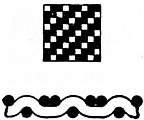
(4) The name of a fabric made in both linen and cotton, and commonly bleached and finished stiff. The word is a shortened form of “drilling,” from the German drillich, or “three-threaded,” and is so named because the weave originally used in its construction is what is termed the three-leaf twill, nine repeats of which appear in the accompanying figure, while immediately below the design is an intersection of all the nine threads with the first pick. It is essentially a warp-faced fabric; that is, the upper surface is composed mostly of warp threads. In the figure it will be seen that two out of every three threads appear on the surface, and, by introducing a greater number of threads per inch than picks per inch, the weft is made to occupy a still more subordinate position so far as the upper surface of the cloth is concerned. Although the weave shown is still extensively used in this branch, there are others, e.g. the 4-thread and the 5-thread weaves, which are employed for the production of this cloth. Large quantities of drill are shipped to the Eastern markets and to other sub-tropical centres, from which it is sold for clothing. In temperate climates it forms a satisfactory material for ladies’ and children’s summer clothing, and it is used by chefs, hairdressers, provision merchants, grocers, buttermen, painters and decorators, &c., while many of the long jackets or overalls, such as those worn by many mill and factory managers, are made from the same material.
DRINKING VESSELS. 1 The use of special vessels for drinking purposes may fairly be assumed to have had a natural origin and development. From a practical point of view it would soon be found desirable to provide vessels for liquids in addition to those serving to hold food. As in many other commonplace details of modern life, we must turn to the primitive races to understand how our present conditions were reached. In almost all parts of the world many of the products of nature are capable of serving such purposes, with little or no change at the hands of man; in tropical and sub-tropical climates the coco-nut and the gourd or calabash require but little change to adapt them as the most convenient of drinking utensils; the eggs of the larger birds, such as the ostrich or the emu, shells, like the nautilus and other univalves, as well as the deeper bivalves, are equally convenient. Such natural objects are in fact used by the uncivilized tribes of Africa, America and Polynesia, as well as, in some cases, by the white races who have intruded into those parts of the world, and adopted some of the native habits. In Paraguay, for example, the so-called “Paraguay tea,” an infusion of the yerba maté (Ilex paraguayensis), is drunk through a tube from a small gourd held in the hand, and often handsomely mounted in silver or even gold. In the same way, as we shall see, civilized man has adopted nearly all the natural forms that were found convenient by the savage, altering and adorning them in accordance with the taste of the time or country where they were used.
Another line of development, however, has been found to be the natural outcome of the human mind. Nothing could form a more practical drinking cup than the half of a coco-nut shell or part of a gourd. Such cups, however, in the countries where the plants producing them are common, would be easily obtained, and every one, rich or poor, could possess one or more. In order, therefore, to distinguish the chief’s possessions from those of his inferiors, his cup is often made with great labour, from some more intractable material, wood or stone, though in practically the same form as that of the natural object.
Among European races in medieval times the same lines have been followed, though for different reasons. Human ingenuity, though perhaps originally inspired by natural forms, is apt to turn aside into more artificial channels. Early drinking cups. The invention of the potter’s art (see Ceramics), where the plastic nature of the raw material renders it capable of infinite changes of form, gave rise to types of vessels having no obvious or necessary relation to the productions of nature. In Britain and in northern Europe generally, the interments of the races of the Neolithic and Bronze Ages have furnished vessels of pottery of a beaker-like form, to which the name of “drinking-cups” has been given. It must be confessed that the evidence for attributing such a use to them is slender, and mainly consists of the fact that their thin lips would render them better adapted for the purpose than the other pottery vessels found with them, some of which, on equally slight grounds, have been called food vessels. The general use and acceptance of the term by two generations of archaeologists is, however, an adequate reason for a passing mention in this place. In the later prehistoric times of Europe vessels of gold, bronze and other materials, including amber, were made, sometimes of elegant forms, and would seem to have been used as drinking vessels; still, this is again an assumption, though a fairly probable one. A small gold cup with handle was found in a barrow at Rillaton, Cornwall; one of amber of a similar form was found at Hove, and a third of shale near Honiton. All of these doubtless may be referred to the Bronze Age.
Schliemann found many drinking vessels in his exploration of the superimposed cities of Troy. A pretty form is that found in the first city. It is of clay, and closely resembles an early Victorian tea cup on a high foot. This form New forms found by Schliemann. is of interest, as Schliemann discovered the same both at Tiryns and Mycenae, five from the latter site being of gold, while the type also occurs from Ialysus in Rhodes in association with bronze swords. This Trojan cup was found at a depth of 50 ft. below the present surface and about 18 ft. below the stratum of what Schliemann claimed to be the Homeric Troy. In his second city appears a different type of ware, somewhat fantastic in form, one vessel being in the form of a sow, while others foreshadow the crater and amphora of later and more familiar Greek wares.
But the drinking vessel to which Schliemann draws most attention is the tall cup of a trumpet form furnished with two earlike loop handles. This curious and original type occurs also in the Third (or Homeric), Fourth and Sixth Cities, with little if any change. Schliemann devotes some pages to the discussion of the form, in which he sees the δέπας ἀμφικύπελλον2 of Homer, which has been more usually understood to mean an hour-glass shaped cup, in which the distinguishing feature was two cups, not two handles. He applies the same term to a drinking vessel of a very different form, found with several others in the Third City. This is a sauce-boat shaped vessel3 of gold, made with a lip for pouring or drinking at either end, and with two loop handles. This equals those previously mentioned in originality of form; with it were found others of gold, silver and electrum (i.e. 4 parts of gold to 1 of silver). Of these three were shaped like 18th-century coffee cups but wanting handles. In the Sixth City appear forms more nearly approaching those of later times, particularly prototypes of the cantharus and scyphus.
These discoveries in the various strata of Troy may be taken as the analogues in the Mediterranean and hither Asia of the later Stone and Bronze Ages of northern Europe, with an allowance of some centuries of greater antiquity for the former.
It is not proposed in this article to deal with the ceramic and metallic drinking vessels of the Greeks and Romans, of what is generally known as the classical period (see Ceramics and Plate). It may be mentioned, however, that both on the Rhine and in various places in Britain, notably at Castor in Northamptonshire and in the New Forest, were factories where large numbers of pocula or drinking cups were made; those made on the Rhine and at Castor bearing legends to indicate their use. Many of these are to be seen in the British Museum and in the Wallraf-Richartz Museum in Cologne.
After the decline of Roman power, the Gothic and Scandinavian races who replaced the Romans in central and northern Europe brought with them their own forms and types of drinking vessels. These, from about the 4th century, replaced Gothic and Scandinavian types. the well-known Roman vessels. The northern barbarians were as great drinkers as fighters, and their literature recites with equal zest the richness of their drinking cups as the power and deadly qualities of their arms. Fortunately the practice of burying with the dead warrior all his property, or at least as much of it as he would be supposed to need, has preserved to our day the actual vessels in use by the pagan northmen who pervaded northern Europe from the 4th century onward. Saxon graves in Britain have furnished great numbers of drinking cups and horns, in many cases quite unbroken. From the remains, of which the chief series are in the British and Liverpool Museums, we can learn a great deal to amplify the references in literature. The richest single interment that has yet been found was within the present churchyard at Taplow. Here under a huge mound lay buried a Saxon chieftain surrounded by his belongings; arms defensive and offensive, his drinking cups, and even his game of draughts. The drinking vessels consisted of five cows’ horns and four glass cups. The former were of great size, 2 ft. long, richly mounted at the mouth and at the point with silver bands embossed and gilt. The glasses also were of great size and of a type familiar in Saxon interments. Each was of a trumpet shape, with a small foot, while the sides were ornamented with hollow pointed tubes bent downwards, and open on the inner side, so that the liquid would fill them. Such a plan is most unpractical, and it must have been very difficult to keep the vessels clean. Glasses of this uncommon form have not been found elsewhere than in Saxon graves, either in England or in the north of the continent. Other types are perhaps nearly as characteristic, though of simpler construction. One of these is a simple cone of glass, sometimes quite plain, at others ornamented with an applied spiral glass thread, or more rarely with festoons of white glass embedded in the body of the vessel. A third form is a plain cup or bowl widely expanded at the mouth and with a rounded base, so that it could only be set down when empty, in fact a true “tumbler.” This feature is in fact a very common one in the drinking vessels of the Saxon race. There are many other varieties, plain cylindrical goblets, generally with ornamental glass threads on the outside, and a more usual type has a rounded body somewhat of the shape of an orange with a wide plain mouth. Many of all these classes were found in the famous cemetery known as the King’s Field at Faversham in Kent (the relics from which are now in the British Museum), at Chessel Down in the Isle of Wight, and in the cemetery within the ancient camp on High Down, near Worthing. In Belgium, France and Germany the same types occur, and even as far north as Scandinavia, where they are found in association with Roman coins of the 4th century. On the continent, however, additional types are found that do not occur in Britain—one of these is a drinking glass in the form of a hunting horn with glass threads forming an ornamental design on the outside. From the wide distribution of these types, it seems certain that they sprang originally from a common centre, and the slender evidence available on the subject seems to point to that centre having been somewhere on the lower Rhine. Although glass seems to have been popular and by no means rare as a material for drinking vessels, other materials also were used. A large number of the smaller pottery vessels would serve such a purpose, and in one grave at Broomfield in Essex two small wooden cups were found which, from their small size and thinness, were no doubt used for liquid.
Of the later Saxon domestic utensils nothing remains, the habit of burying such objects with the dead having ceased on the gradual introduction of Christianity through the country. Manuscripts are our only resource, and they are not only of great rarity, but in the main rudely and conventionally drawn in their details. In those of the 9th to the 11th century various simple forms are seen, some resembling our modern tumbler in shape, others like a dice box. Horns as drinking vessels certainly retained their popularity at all times, surviving especially among the northern nations, and many of the vessels of this form were no doubt actual horns, though horn-shaped vessels were often made of other materials. Until we come to the 13th and 14th centuries there is an absolute dearth of the actual objects used in domestic life. And here we begin with plate used in the service of the church.
The drinking vessel possessing the most unbroken history is doubtless the chalice of the Christian Church.4 Like other ceremonial objects it was no doubt differentiated from the drinking cups in ordinary use by a gradual transition, Church vessels. and in the early centuries it is unlikely that it differed either in form or material from the ordinary domestic vessel of the time. Figures of such vessels, apparently with a symbolic intention, are found upon early Christian tombstones, and it has been contended that the vessel indicated the grave of a priest. While this may be the case, the similarity of the vessel represented to the ordinary non-liturgical form renders the conclusion somewhat weak. Among objects found under conditions which lend colour to their specific use as chalices are the bottoms of glass vessels found inserted in plaster in the Catacombs at Rome; but here again the Jesuit Padre Garrucci was unable to find any evidence to support such a conclusion. It is not in fact until the 6th century that the sacred vessel would appear to have assumed a definite form. From about that time date the lost golden chalices of Monza, representations of which still exist in that city; and the famous chalice of Gourdon in the Bibliothèque Nationale in Paris is probably of about the same time. All of these are two-handled with a vase-shaped body and supported on a high foot; and thus quite unlike the more recent medieval types. Two glass vases of exactly this two-handled form are in the Slade collection at the British Museum, and may well have been chalices. Another chalice, in the same collection, of the 6th or 7th century, was found with a silver treasure at Lampsacus on the Hellespont. It is of silver, with a cylindrical body and small expanding foot; with it were found a number of silver spoons and dishes, the former inscribed with the names of Apostles, Greek hexameters and lines from Virgil’s Eclogues. No doubt the whole was the treasure of a monastery, buried and never reclaimed. So far as evidence exists for the form of the chalice, the vase-shape with two handles seems to have been mainly succeeded by a goblet with straight sides and without handles; these latter in great part disappeared. Then came the rounded cup-shaped bowl as seen in the well-known Kremsmünster chalice. An interesting silver vessel, probably a chalice, found at Trewhiddle in Cornwall, is in the British Museum. It is of plain semi-oviform shape, and dates from the 9th century. The 13th century chalice was usually a broad somewhat shallow cup, on a conical base, and squat in its general lines as compared with those of later date. These gradually became taller, and with a bowl smaller in proportion, following the tendency of the civil vessels towards more elegant lines. Both civil and religious vessels eventually carried this tendency to an extreme point, so that in the 17th century the continental chalices and standing cups had lost all sense of true artistic proportions; the bowl of the chalice had greatly shrunk in size while the foot had become huge and highly elaborate, both in general form and in ornamental details. In Britain chalices ceased to be used in the English church in the reign of Edward VI., and were replaced by communion cups. These were much plainer in make, recalling in their outlines the goblet form of about a thousand years earlier, the sides of the bowl being concave, or nearly straight, as opposed to the convexity of the chalice, while the paten was reversed over the mouth and so arranged as to form a closely fitting cover. With the beginning of the 17th century English communion cups again followed the civil fashion in adapting the outline of the Venetian drinking glass, a shape which has survived to our own days.
The materials of which chalices were made in the early centuries seem to have been as various as those of ordinary vessels. Glass was undoubtedly a favourite substance, perhaps from its lending itself readily to scrupulous cleanliness; but wood, horn, ivory and similar materials were undoubtedly in use, and were from time to time condemned as improper by the Fathers of the Church. Pewter was in common use, and it was not an unusual practice in the 12th and 13th centuries to place sacramental vessels, of this or more precious metal, in the grave of an ecclesiastic. Bronze was also used, and the Kremsmünster chalice is of that metal, which was a favourite one in the Celtic church. But gold or silver chalices were no doubt always preferred when they could be obtained.
It may be mentioned here that it was a common practice in the 16th century and later in England for laymen to make gifts to the church of vessels of an entirely domestic character for use in the service. Many of these from their associations, and in the character of the designs upon them, were entirely unsuited for such purposes, and in our own time, when a healthy desire has sprung up for the proper investigation of such matters, many such unsuitable vessels have been withdrawn from use. Domestic plate, however, being much more highly appreciated by collectors, there has been a regrettable tendency on the part of the holders of such pieces to sell them to the highest bidders; the tendency is to be deplored, for while they remain the property of the church, they are a national asset; if sold by auction, there is a great probability of their going abroad.
It would seem fairly certain that the ordinary drinking vessel of medieval times was, like the trenchers of wood, turned on the lathe. Of these the commoner varieties have entirely disappeared, having become useless from distortion Medieval vessels for common uses. or other damage. Such as have come down to our own time owe their preservation to the added refinement of a silver mount. Vessels of this kind are known as mazer bowls, a word of uncertain origin, but undoubtedly, in the medieval sense, indicating wood of some more Mazers. or less valuable kind, and not improbably, in the 16th century, maple or a wood of that appearance. Spenser in the “Shepherd’s Kalendar” speaks of “a mazer ywrought of the maple warre.” Although such vessels are mentioned in the inventories and other contemporary records as far back as the 12th century, no example is known to exist of an earlier date than the 14th century, of which date there are two in the possession of Harbledown hospital. This type of drinking vessel was in common use in well-to-do households until the 16th century, when a change of fashion and the greater luxury and refinement dictated the adoption of more elegant and complex forms. The ordinary mazer was a shallow bowl (see Plate, Plate II.) about 6 in. in diameter, with a broad expanding rim of silver gilt often engraved with a motto in black letter or Lombardic capitals, at times referring to the function of the cup, such as:—
“In the name of the Trinity Fille the Kup and drinke to me.”
or,
“Potum et nos benedicat Agios.”
Within the bowl, in the centre is often found a circular medallion called a “print” with some device upon it, engraved and filled with enamel. The reason of this addition may conceivably be found in the fact that such bowls were sometimes made from the lower half of a gourd or calabash, in the centre of which would be a rough projection whence the fibres of the fruit had diverged. A rarer form of mazer has the characters just mentioned and in addition is mounted upon a high foot, bringing it nearer to the category of standing cups or “hanaps.” The famous Scrope mazer belonging to York Minster (early 15th century) stands upon three small feet. Of the hanap type examples are in the possession of Pembroke College, Cambridge (the Foundress’ Cup), and All Souls’ College, Oxford, the former an exceedingly fine specimen, of the third quarter of the 15th century. The form dictated originally by the simple wooden cup was at times carried out entirely in silver, or even in stone, mazer-like cups being found either entirely in metal or with the main portion made of serpentine or some other ornamental stone. An example of the former from the Hamilton Palace collection, as well as several ordinary mazers, are to be seen in the British Museum. The types above described are of English origin, with the exception of that made entirely of silver, which is thought to be French. Most of the continental forms differed from the English, and were more elaborately finished. One of the finest is that which belonged to Louis de Male, last count of Flanders. It is an exceedingly thin, shallow bowl of fine-grained wood, with a cover of the same make. The latter is surmounted by a silver figure of a falcon holding a shield in its mouth with the arms of the count. The foot is of silver with lozenge-shaped panels inserted, bearing in enamel the arms of the count. A German form of the 16th century consisted of a depressed sphere of wood for the bowl, with a silver rim, and a cover formed of a similarly shaped sphere, called in France a “creusequin.” Such mazers were furnished in addition with a short metal handle turned up at the end, a feature unknown in the English types. All of these again are to be seen in the British Museum series.
Although the use of wooden vessels more or less elaborately mounted was continued well into the 16th century as a fashion, many other materials of far greater value were in use among the wealthy long before that time. Crystal, Hanaps. agate and other hard stones, ivory, Chinese porcelain, as well as more ordinary wares, were all in use, as well as the precious metals. The inventories of the 14th and 15th centuries are full of entries showing that such precious cups were fairly common. Of gold cups of any antiquity naturally but few remain; the intrinsic value of the metal probably is a sufficient explanation. One of the most important in existence is however preserved in the British Museum, viz. the royal gold cup of the kings of England and France. It is of nearly pure gold with a broad bowl and a high foot, the cover pyramidal. The whole is ornamented with translucent enamels of the most perfect quality, and with a little damage in one part, absolutely well preserved. The subjects represented on it are scenes from the life of St Agnes, in two rows, one on the cover and one outside the bowl; on the foot are the symbols of the four Evangelists, and around the base a coronal of leaves alternating with pearls; the cover originally had a similar adjunct, but it has unfortunately been cut away. This is the only piece of royal plate of the treasures of the kings of England and France that now remains, and its history has been traced from the time it was made, about the year 1380, to the present time. It was made by one of the goldsmiths of the luxurious Duc de Berri, the brother of Charles V. of France, no doubt to offer as a gift to the king, whose birthday was St Agnes’ day. It was, however, never presented, probably owing to the death of Charles V. in 1380. The duc de Berri was not on friendly terms with his nephew Charles VI., but on their being reconciled he presented the young king with this cup. The troubles of his reign led to the invasion of France by Henry V. of England, and the ultimate appointment of his brother, John, duke of Bedford, as regent. The necessities of the half-insane Charles doubtless caused this cup and other valuables to pass into the possession of the regent in exchange for ready money, for it appears in the duke of Bedford’s will, under which it passed into the treasury of Henry VI. There it remained and appears in all subsequent royal inventories up to the time of James I. This monarch, whose motto was “Beati pacifici,” received with joy the embassy sent from Spain in the year 1610 to conclude the first treaty of peace with England since the Armada, and showered upon the envoy, Don Juan de Velasco, constable of Castile, the most lavish and extravagant gifts. The constable, in fact, was so impressed by the warmth of his reception that he printed an account of his embassy, and from this work the main story of the cup has eventually been traced. On his return to Spain the constable, a piously disposed man, presented this cup, with many other valuable gifts, to the convent of Santa Clara Medina de Pomar at Burgos, of which his sister was Superior. Although it was a domestic vessel, a “hanap” in fact, the constable elected that it should be consecrated and made use of as a chalice at great festivals. And so it continued to be used from the early years of the 17th century until about the year 1882, when the convent having fallen upon evil times, it was decided to sell this precious relic. A priest from the Argentine being at the time in Burgos, it was confided to him to sell in Paris, and he deposited the sum of £100 by way of security. This was all that the unfortunate nuns at Burgos ever received in return for their chalice, for they never saw the priest again. He took the cup to Paris, arriving in the month of September, when the majority of the well-to-do are away from town. After many failures to dispose of it, he ultimately succeeded in selling it to Baron Jerome Pichon for the sum of about £400, practically its weight in gold. The baron, after vainly trying to resell it at various sums from £20,000 downwards, eventually parted with it to Messrs Wertheimer of Bond Street for £8000, and that firm very liberally ceded it to Sir Wollaston Franks for the same sum, and it was finally secured by a subscription for the British Museum.
Plate I.
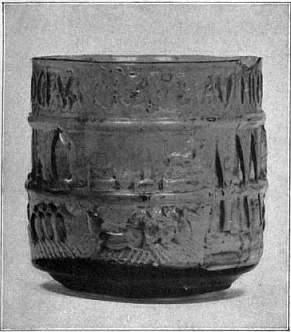
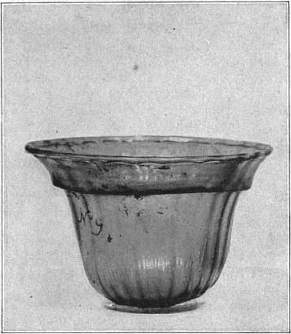
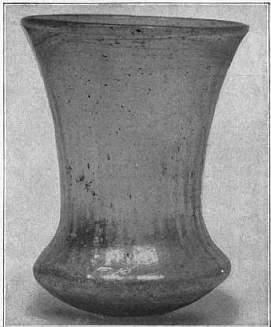
Fig. 1.—ROMAN GLASS CUP. With representation of a chariot race. Found at Colchester. Fig. 2.—TEUTONIC GLASS CUP. From a grave at Selzen, Rhenish Hesse. Fig. 3.—SAXON GLASS “TUMBLER.”
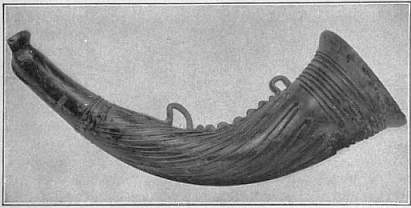
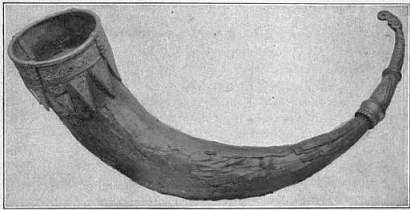
Fig. 4.—FRANKISH GLASS DRINKING HORN. Bingerbrück. Fig. 5.—SAXON COW’S HORN. Mounted in silver. Taplow.
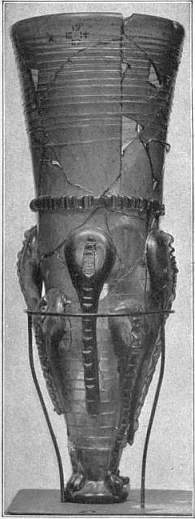
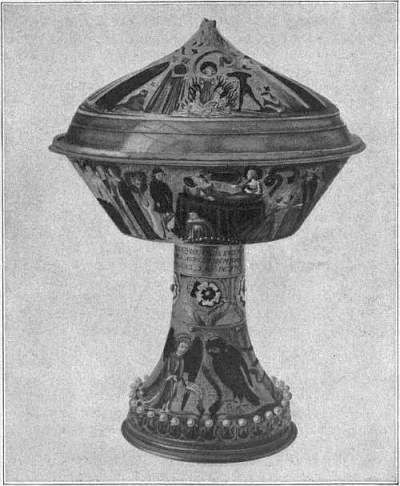
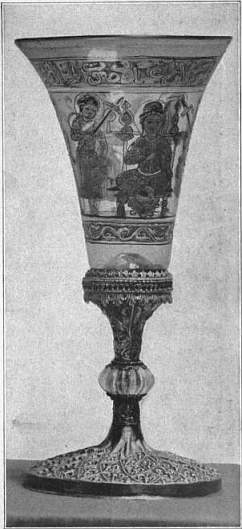
Fig. 6.—SAXON TRUMPET-SHAPED DRINKING VESSEL. With hollow tubular ornamentation. Fig. 7.—THE ROYAL GOLD ENAMELLED HANAP. Made about 1380. Fig. 8.—SARACENIC ENAMELLED GOBLET. With French silver mountings. Fourteenth century.
Plate II. All the objects represented on these two plates are in the British Museum.
Fig. 8.—A GLASS “YARD OF ALE” (English). Eighteenth century. Fig. 1.—VENETIAN GLASS GOBLET. With enamelled decoration. Fifteenth century. Fig. 2.—ENGLISH “BLACKJACK.” With initials of Charles I. and date 1646. Fig. 3.—THE ROCHESTER MAZER. Presented by Brother Robert Peacham. Sixteenth century. Fig. 4.—CHINESE CUP. Carved from rhinoceros horn. Eighteenth century. Fig. 5.—ENGLISH GLASS TANKARD. Bearing the Arms of Lord Burleigh. Fig. 6.—COCO-NUT CUP. German, about 1600. Fig. 7.—SWISS “TANZENMANN.” Seventeenth century.

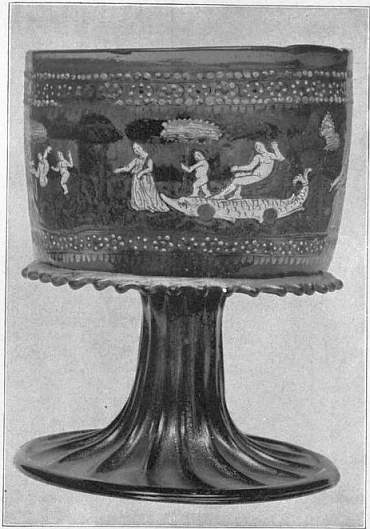
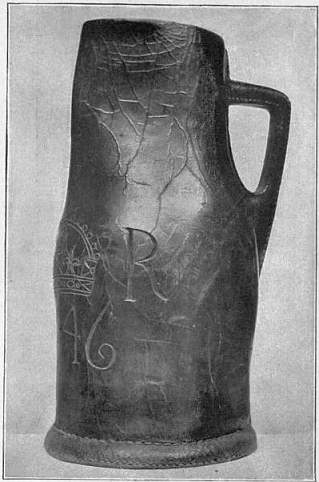
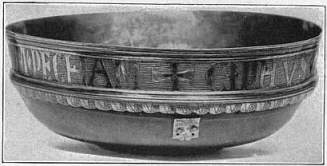
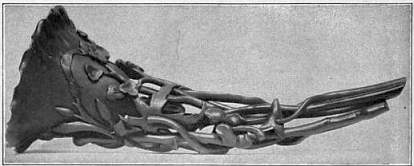
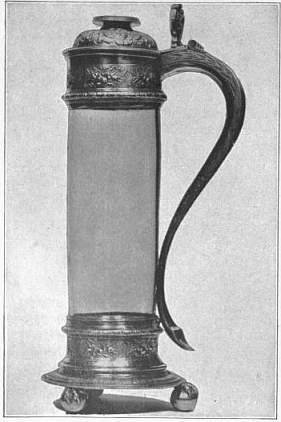
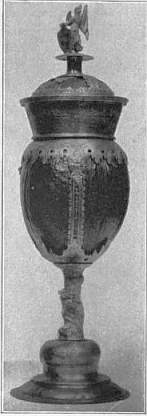
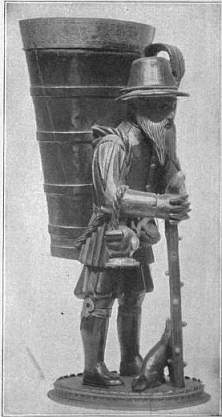
Such is the story of one of the most remarkable “hanaps” in existence. The word “hanap” is translated by Cotgrave in his French dictionary of 1660 as “a drinking cup or goblet,” and probably was intended to mean what would be called a standing cup, that is, raised on a foot, to distinguish it from a bowl of the mazer class. Such vessels were chiefly used to ornament the dinner table or sideboard, in the way that loving-cups are now used at civic banquets, where, almost alone in fact, the ancient ceremonial of the table is still observed to some extent; and the loving-cup is the direct descendant of the hanap of the middle ages.
Of all the ornaments of the table in medieval times the most conspicuous was probably the “nef.” This was in the form of a ship (navis), as its name implies, and originally was designed to hold the table utensils of the host—knives, napkins, Nefs. and at times even the wine. Some of the later examples which alone survive are carried out with the greatest elaboration, the sails and rigging being carefully finished and with a number of figures on the deck. The reason for the existence of such an article of table furniture was doubtless the fear of poison. As in course of time this became less, the nef changed its character, and became either a mere ornament, or sometimes was capable of being used as a drinking vessel. The former, however, was much more common, and the number of nefs that can be practically used as drinking cups is small.
In the 15th and 16th centuries the shapes, decoration and materials of drinking vessels were almost endless. A favourite object to be so adapted was an ostrich egg, and many can be seen in museums in elaborate silver mounts; coco-nuts were also used in the same way, and Chinese and other Oriental wares then of great variety, were often turned into cups and vases by 16th-century types. ingeniously devised silver mounting. The use of drinking vessels either formed of actual horns or of other materials was common in the 15th and 16th centuries, especially in the north. They were usually provided with feet so as to serve as standing cups, and some of them were mounted with great richness. An excellent example is the famous drinking-horn in the possession of Queen’s College, Oxford, dating from the 14th century. The medieval beliefs about “griffins’ claws” still survived to this late date, and a horn cup in the British Museum bears the inscription “Ein Greifen Klau bin ich genannt, In Asia, Africa wohl bekannt.” Another horn, probably that of an ibex, is in the same institution, and has a silver mount inscribed “Gryphi unguis divo Cuthberto dunelmensi sacer.” The elegant natural curve of the horn adds greatly to the charm of the vessel. In Germany the ingenuity of the silversmith was turned in the direction of making vessels in the forms of animals, at times in allusion to the coat of arms of the patron. Stags, lions, bears and various birds are often found; the head generally removable so as to form a small cup Switzerland and south Germany had a special type, in the form of the figure of a peasant, generally in wood, carrying on his back a large basket, which edged with silver formed the drinking cup. This type is only found in wine-growing districts, the basket being used for carrying grapes. In Germany such cups are called “Buttenmann,” in Switzerland “Tanzenmann.” The royal and princely museums of Germany contain great numbers of such vessels, the Green Vault in Dresden in particular, while a good number are to be seen in our own great museums. A curious fancy, combining instruction with conviviality, was to make cups in the form of a globe, terrestrial or celestial, which are still useful as showing the state of geographical or astronomical knowledge at the time. Several of those made in the 16th century are still in existence, one in the British Museum, a second at Nancy, and others are in Copenhagen and Zurich and in private collections. The upper half of the globe is removable, leaving the lower as the drinking cup. Ivory both from the beauty of its colour and the evenness of its structure has been a favourite material for drinking vessels at all times, and would seem to have been continuously used from the earliest period, whether derived from Asia or Africa, while the semi-fossil mammoth ivory of Siberia has not been neglected. In general, however, the vessels made from this material presented no essential differences of form from those in wood, until the art of lathe-turning attained great perfection, when a wide field was opened for ingenuity and even extravagance of form. The most remarkable examples of the possibilities of this kind of mechanical skill are seen in the productions of the Nuremberg turners of the 17th century, whose elaborate and entirely useless tours de force comprise among many other things standing cups of ivory sometimes 2 ft. high, exemplifying every eccentricity of which the lathe is capable. Peter Zick (d. 1632) and his three sons were celebrated for such work. Several pieces, doubtless from their hands, are in the British Museum.