VOLUME VIII SLICE VII Drama to Dublin (continued 6)
Reading edition
At the outset a distinction must be made between drawing as a means of symbolic or literary expression and drawing as the direct and only means of expressing the beauty of form. If Pharaoh wants to have it known that a hundred ducks were consumed at one meal in his court, he employs a draughtsman to register the fact on a frieze by picturing a row of cooks occupied in preparing the hundred ducks. The artist in this case does not represent the scene as he must have known it in the kitchen, with all its variety of movement and composition (as an early Greek vase painter conceived the interior of a vase factory), but all he does and is required to do is to give the sufficient number of figures and ducks. The more uniform the figures the greater will be the effect of number. Drawing has been employed here to tell a story, and it succeeds in so far as it tells the spectator plainly what could be told, perhaps less conveniently, in words. It matters not whether the figures and objects be feelingly rendered and harmoniously composed. So, to-day, a child, or any one who has a simple trick of symbolizing figures and objects in nature, can describe any event or moral by this process, provided the plot be not too elaborate to be expressed by a scene, or series of scenes, enacted by dumb symbolic figures. It is plain that the amusing pictures in Punch or Fliegende Blätter would be none the more amusing if they were done by the hand of Michelangelo, nor would the mystic designs of Blake be more full of meaning if drawn by Rembrandt, for in neither case do these works depend upon any subtle rendering of the forms of nature for their success, but upon the dramatic or intellectual imagination of the man who conceived them. When the witty or ethical man is at the same time a master draughtsman his work has two values, the “literary” content and the beauty of his drawing of natural objects. But it must be borne in mind that these values are fundamentally distinct; so much so that the spectator who has no appreciation of the forms of nature enjoys the story told and remains blind to the qualities of draughtsmanship, whilst the lover of nature’s forms may or may not trouble to unravel the literary plot but finds perfect satisfaction in the drawing. By far the greater part of illustration, and of artistic production generally, must be classed as symbolic art. Magazine stories to-day are sometimes illustrated even by photography, for the hand of the artist is not required. Symbolic art describes indirectly and in a necessarily limited scope what literature can do directly and with unlimited powers. The only content of symbolic drawing is its literary meaning; as drawing it may be quite worthless.
Pure drawing, however, whether it represent a dramatic event or a knee-joint, has a content that cannot be expressed by words, and is not necessarily directed towards literary expression. Just as a fragment of good sculpture pleases the connoisseur without any reference either to the whole original or to its spiritual significance, fine drawing can appeal to the lover of nature independently of indirect considerations.
What is the content of pure drawing? It is held by some that drawing or monochrome can suggest colour, and many people, some consciously, others unconsciously, attempt to represent in drawings the colours of figures and landscape. It seems a strange aberration to argue that by different intensities of the one colour various other colours can be suggested: it would not be more unreasonable to maintain that E flat and F could be suggested by striking the note G with varying strength. Now the draughtsman employs various intensities of his monochrome as light and shade by which to give roundness to his forms. But if on the same drawing he uses the same means in his attempt to express colour, a conflict would be at once set up between that which makes for form and that which would make for colour, and the result would generally be a confusion. Again, let one attempt to give red hair to a monochrome drawing of a man, and if the red be plain and unmistakable to all who are not the artist’s accomplices, then the artist has succeeded; otherwise it is bootless to treat of colour and colour values (which of course must depend upon the existence of colour) in monochrome. Apart from theory, if we examine the drawings, etchings and monochromes of great artists, where do we find them attempting to give colour or colour values? The hundreds of costume studies by Rembrandt might have been done from white plaster models, and there are only a few exceptions where a man has, for instance, a black hat or cloak. But in these few instances the “colour” tone is applied with such discretion that the true representation of the form is scarcely, perhaps only theoretically, impaired: they certainly have gained nothing in colour value because no specific colour is manifest in them. In Rembrandt’s, Claude’s or Turner’s drawings of landscapes the formation of the country, the architecture, &c., is expressed by line, light and shade, and enhanced by shadows cast from clouds and trees. If, in the drawings of masters, we should find objects darker or lighter than their position in the light would warrant, they have value (perhaps not quite a legitimate one) for balancing the composition as a flat pattern. They were never intended to suggest colour, nor do they. Yet, in spite of the failure to succeed, and contrary to logical argument and the practice of great draughtsmen, the student of most of the schools of Europe and America still persists in doing the hair dark, and, by attempting to give colour values to the clothes, breaks up the consistency of the whole. For the same reason that the sculptor uses uniformly coloured material in order that the natural light and shade may have full opportunity of making his forms manifest to the spectator, the draughtsman confines himself to giving light and shade only. If a monochrome has “colour tones,” the effect is similar to that produced by a draped statue made out of variously coloured marbles—an inartistic jumble.
As the immediate purpose and content of drawing there remains the representation of form only. Drawing is, therefore, essentially the same activity as sculpture, and has no additional scope. “Pupils,” says Donatello, “I give you the whole art of sculpture when I tell you to draw” (cited by Holroyd, Michel Angelo, p. 2 95), and the only practical teaching of drawing might be summed up by the inversion of the above.
Now if everything in nature—men, mountains or clouds—were as flat targets, i.e. two-dimensional, drawing could be legitimately reduced to a mechanical process,—to trace their contours upon a glass screen or even photograph them would be all that would be required. Indeed, provided the size of the drawing, the local colour and the texture be the same as those of the original, a complete illusion would be the result, in fact the proper end of one’s labours. But the presence of the third dimension in all objects causes light and shade, which in their turn bring about radical changes of the local colour, even in uniformly coloured objects. Now since drawing cannot suggest colour, local or atmospherical, any attempt to effect an illusion by a monochrome is at once defeated. If the end of drawing were to approach imitation or illusion as nearly as possible, how is it that a mere “sketch” by a master draughtsman can be for itself as valuable as his highly finished drawing? And surely a masterly outline drawing of a figure or landscape does not pretend to be an illusion. If then the draughtsman does not, and cannot hope to imitate nature, he is compelled to state only his ideas of it, ideas of three-dimensional form. For this reason only drawing must be treated as an art, and not as a mechanical act of getting an illusion.
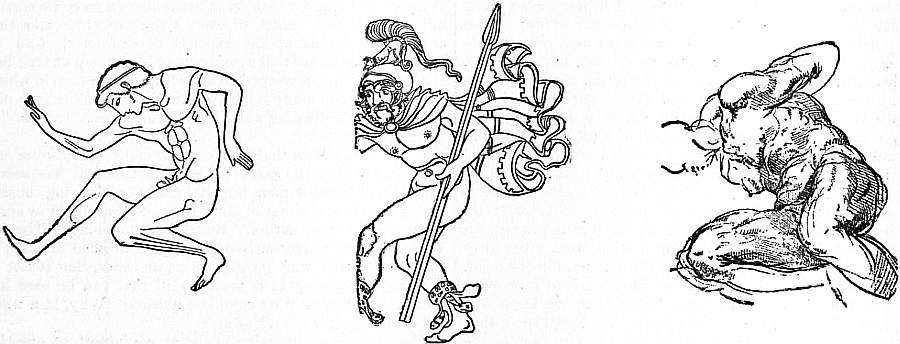
(From a Greek vase in the British Museum (E. 46). Fig. 1. (From Bulletino arch. Napol. (1843, tom. 1, tav. 7). Fig. 2. (From a drawing by Michelangelo (1854, 5, 13, i.), Print Room, British Museum). Fig. 3.
It is interesting to trace in the history of an indigenous art the development of drawing that shall ultimately express ideas of three-dimensional form. Prof. Emanuel Loewy, in his Rendering of Nature in Early Greek Art, demonstrates how the early Greek sculpture (and that of all primitive peoples, children and ungifted artists) shows an aversion from depth. Their reliefs are of the flattest description, almost raised contours, and their figures in the round have at first only one aspect, or flat façade, so to speak, then three and four aspects, and finally at the date of Lysippus the figures are fully rounded out, and the members project at liberty in all directions. Then for the first time Greek sculpture showed a complete conception of the body’s corporeity (Körperlichkeit). The primitive artist, however well he may be intellectually aware of the three dimensions of an object, does not fully apprehend its true aspect as offered to the eye from one point of view. Following this conclusion, it is easy to see also in the drawing of the early Greeks, children and so on, the same lack of idea of the third dimension. The figures on the vases of the “finest period” (about 475 b.c.), despite occasional foreshortenings, have, when considered as representations of solid forms, a papery appearance. They have not half the draughtsmanship shown by the latter period of the vase industry, where the figures, though careless, stereotyped and ill-composed, come forwards (to use Prof. Loewy’s description of later sculpture), go backwards, twist and turn in space in a manner which cannot be excelled. The reproductions in figs. 1, 2, 3 will illustrate the development. The primitive draughtsman is at first bound by the silhouette. Later, he desires to fill out the interior, but this cannot be done without in great part modifying his contour lines, because they are generally merely indications of the disappearing and reappearing inner modelling, i.e. of the figure’s third dimension. Finally, the draughtsman in full possession of a feeling for the corporeity of the object will determine his contour entirely from within, a procedure which is the exact opposite to that of his first beginnings. He conceives the length, breadth and depth of an object and all its parts as solid wholes. To him a body in violent foreshortening is as easy as a simple profile, and, though it may not be as attractive, it is perhaps more interesting because its contours are more bound up with, and dependent upon, the inner modelling; in other words, it has more depth. The draughtsman’s idea of a form in nature is not a “flat idea,” but one containing three dimensions. This idea he seeks to express either by line alone or by light and shade. If an artist has not a three-dimensional “grasp” of forms, and, like a child, confines himself to the primitive tracing of the silhouette, his compositions may be of excellent flat pattern, and equal to any of the designs of ancient carpets or early Greek vases; but in the light of the above argument, and when compared with the productions of mature draughtsmen of all ages and countries, they cannot be said to be complete drawings, any more than the early unifacial statues of the Greeks can be called true plastic, simply because in neither case has the artist yet reached the highest possible development of corporeous conception, by which truly to interpret the solid objects of nature as we know them, and as master draughtsmen see them.
An attempt should be made to explain the psycho-physiological process that must take place in the mind of the real draughtsman. When we look at an object in nature we know its length and breadth by the flat image on the retina; we see also the light and shade, which at once gives us a correct idea of the object’s depth or relief. But we do not, nor could we, have this idea from the flat image on the retina alone, i.e. from the mere perception of the light and shade: our knowledge of its depth is the result of experience, i.e. of our having from infancy remarked a certain dispensation of light and shade on, and peculiar to, every form we have touched or traversed, and so, by association and inference, being early enabled to have ideas of the depth of things by their various arrangements of lights and darks without having to touch or traverse them. Nevertheless the act (generally, but by no means always, an unconscious one) of visually touching a form must necessarily take place before we can apprehend the third dimension of a form. It is, then, by the combination of the ideas derived from pure vision and the ideas derived from touch that we know the length, breadth and depth of a solid form. We have shown that the art of drawing is not an imitation, but an expression of the artist’s ideas of form; therefore all drawing of forms that merely reproduces the image on the retina, and leaves unconsulted the ideas of touch, is incomplete and primitive, because it does not express a conception of form which is the result of an association of the two senses; in other words, it does not contain an idea of the object’s relief or solidity. And all teaching of drawing that does not impress upon the student the necessity of combining the sense of vision with that of touch is erroneous, for it is thereby limiting him to a mechanical task, viz. the tracing of the flat image on the retina, which could be equally well done by mechanical means, or by photography alone.
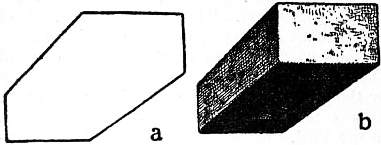
Fig. 4.
In most of the schools of Europe and America it is true that great stress is laid upon the importance of giving life-like relief to drawings, but the method by which the students are allowed to get the relief is by employing the sense of vision only. Tracing the silhouette of the figure as minutely as possible, they then fill it out with inner-modelling, which also is done by vision alone, for the lights and darks of the original are copied down as so many flat patterns fitted together and gradated like a child’s puzzle, and are not used merely as indication by which to “feel” the depth of the object. Such a procedure is as if in drawing a brick of which three sides were visible, one were first to draw the entire contour (fig. 4, a), the subtle perspective of which he might get correct with some mechanical apparatus or by infinite mechanical pains, and then fill up the interior with its “shading” (fig. 4, b). The method would be plainly laborious, unintelligent and unedifying, and in drawing the most complicated foreshortened forms of the human body it would seem still more illogical. That this principle of instruction does not help the student to grasp the three-dimensional character properly can be proved by the twenty-minute studies of the average student who in his fourth year has won a gold medal for an astounding piece of life-like stippling. They are still unintelligent contour tracings, as if of cardboard figures, with a few irrelevant patches of dark here and there within the silhouette.
But high modelling that would make for illusion of reality is not the first aim of draughtsmanship, nor have the best draughtsmen employed it save by exception. Michelangelo, Ingres, Holbein and Rembrandt have shown us that it is possible to give sufficient relief with a mere outline drawing. Again, the desire for salience often blunts the student’s sense of the real character of the forms he is rounding out. So his elaborately modelled portrait may look very “life-like,” but when compared with the original it will generally be seen that the whole and each of the individual forms of the drawing lack the peculiar character of those of the original. It is by carefully watching for the character of each fresh variety in figure and feature that great draughtsmen have excelled, and not by “life-like” relief, or even a sophisticated exposition of anatomical details at the expense of character. Can it be seriously maintained that a masterly sudden grasp of true formal character can be developed in a student by a system in which he patiently spends many days and weeks in stippling into plastic appearance one drawing which has originally been “laid in” by a mechanical process?
It has been shown that to attempt to make an illusion of nature is neither within the power of monochrome nor has been the chief aim of draughtsmen, but that the art of drawing consists in giving a plain statement of one’s ideas, be they slight or studied, of the solid forms of nature. But the question may still be asked: Why is it that a rigorously accurate and finished drawing by a student or artist with no such ideas or conception is not good drawing, containing as it must do all that can be seen in the original, missing only its complete illusion? Why, in a word, is not a photograph a work of art?
The common explanation of the above important question is that the artist “selects and eliminates from the forms of nature.” But surely this is the principle of the caricaturist and virtuoso? A beautiful drawing, however slight, is but the precipitate of the whole in the artist’s mind. And a highly finished drawing by a master does not show even any apparent selection or elimination. The adoption of the principle of selection to differentiate art from mechanical reproduction is fundamentally vicious, and could be shown to be wholly inapplicable to the so-called formative arts. Nor could the theory of “selection” be used as a principle of teaching, for if to the first question the pupil would make, “What am I to select?” it were answered, “Only the important things,” then the next question, “What are the important things?” could be answered only by saying, “That alone the real artist knows, but cannot teach.” Certainly there are important things that can be taught the student in the initial stage of “laying-in” a figure, but when to begin selecting or eliminating no teacher could tell him, simply because he must be aware that a true draughtsman can afford to eliminate nothing when the truth of the whole is at stake. The artist’s conception and its expression may be slight or elaborate, but in neither case can selection or elimination take place, for a true conception must be founded upon the character of the whole, which is determined by the entire complex of all the parts.
To explain the essential difference between art and mechanical drawing or mechanical reproduction, a more applicable theory must be found. Compare the art of telling a story. If, to describe an incident in the street you had the entire affair reenacted on the same spot, you would have but made a mechanical reproduction of it, leaving the spectator to simplify the affair, and construct his own conception of it. You have not given your ideas of the event, and so you have not made a work of art. So, if a man draws an object detail for detail by any mechanical process, or traces over its photograph, he has but reduplicated the real aspect of the object, and has failed to give the spectator a simple and intelligible idea of it. Starting out with the generous notion of giving all, that there may be “something for everyone,” he has given nothing. He did not originally form an intelligible and simplified idea of the figure, so how can his drawing be expected to give one to others?
But how can forms be made more simple and intelligible than by reproducing their aspect with absolute accuracy? Our combined sense of vision and touch comprehends very easily certain elementary solid forms, the sphere, the cube, the pyramid and the cylinder. No forms but these, and their modifications, can be apprehended by the mind in one and the same act of vision. Every complex form, even so simple as that of a kidney, for instance, must be first broken up into its component parts before it can be fully apprehended or remembered. Analogously with the above, Prof. Wundt has shown how the mind can apprehend as separate units any number, of marbles for instance, up to five, after which every number must be split up into lots of twos, threes, fours and fives, or twenties, thirties and so on, before it can realize the full content of that number in one and the same mental picture. So the only way to receive an intelligible idea of a complex form, such as a human figure, is first to discover in the figure itself, and then in all its parts, only modifications of the above elementary solid forms, and the drawing of a conception thus informed must needs be a very clear and intelligible one. The more the artist is capable and practised, the more clearly will he conceive and distinguish in nature each subtle modification of these elementary forms, their direction, their relation to, and their dependence upon one another. The only difference between a good draughtsman and a bad one is the degree of subtlety of his apprehension. Unless the draughtsman has seen some such clear forms in his original, his labour to produce a work of art will be grievous and fruitless. All good drawing is stamped with this kind of structural insight. The more the artist adheres to nature, and the more finished his drawing, the more will the lines and forms that he makes be, so to speak, in excess of those of nature, or dull imitation or photography. It is not to be supposed that able draughtsmen work, or need ever have worked, consciously in this manner. It is, indeed, the virtue peculiar to the artist, as interpreter of form, that he instinctively comprehends the real elemental character of complex forms, whilst the majority of people (on the showing of their own drawings) entertain but confused or no ideas of them. It is because a good drawing reduces the chaos of ideas supplied by the raw material of nature, to one intelligible manner of seeing it, that all lovers of nature welcome it with joy. It is this process of discovery and interpretation that marks the essential difference between art and mechanical drawing or reproduction. Art gives intelligible ideas of the forms of nature, mechanism attempts to reduplicate their aspects.
There are some who hold that drawing is not exclusively a matter of interpreting form, but that great artists have their own “personalities” which they infuse into their work. They will ask, How is it otherwise to be explained that two equally good draughtsmen will invariably make different drawings of the same figure? Is it not for the same reason that one man will divide up a row of eight marbles into groups of four, and another into five and three? The subjectivity of experience governs the different conceptions that good draughtsmen will form of the same object. Accordingly as a draughtsman feels form so will he draw it, and it is only because our sense apparatuses are more or less similarly constituted that we can understand and appreciate one another’s conceptions.
But if the master draughtsman gives the true character of his model’s form, why is it that his drawings are not pleasing to all alike? Whence the doubts and criticism that have been called forth by all original artists? If we first examine the attitude of the average man, artist or layman, towards nature, we can better explain his attitude towards works of art. The average man or artist has not a highly developed appreciation of form per se, whether it be the form of natural or manufactured objects. And it would seem that he is still less a disinterested spectator of the forms and features of his fellow beings and animals, their movements, their colour, their value in a room or landscape. He has sentimental, moral or intellectual preferences. In other words, he likes or dislikes only those faces or figures which hundreds of personal associations have taught him to like or dislike. The riding man’s admiration for the look of a particular horse is based upon the fact that it looks like “a horse to go,” and hence it is what he calls beautiful, while the artist, in the capacity of artist and not of sportsman, is not particular in his choice of horse-flesh, but finds each animal equally interesting for itself alone. Consequently in art any face, figure or object that does not come into the category of what the average man cares for is condemned by him even as it would be in real life, since he is no lover of form for form’s sake, but provided the subject or moral be pleasing the quality of the draughtsmanship is of small account. The picture of a dwarf, or of an anatomy lesson, or of a group of ordinary bourgeois folk would not really please him, even though he were told that the work was by Velazquez, Rembrandt or Manet. We have only to listen to the common criticism of works of art to know that it is founded upon personal predilection only. We do not hear such personal criticism upon drawings of landscape, not because artists do them better, but because natural landscape has no interest for any one other than for its form, or, at least, people do not hold such definite personal likes or dislikes with regard to its various manifestations. But the artist, though his own personal predilections may, and generally do, lead him to work within that agreeable milieu, has, in the capacity of artist, no subjective prejudices; indeed, if he had them, he could not represent them by line, light and shade. He seeks always new varieties of form; hence his subjects, and his manner of posing them, are often unpleasing to the man who is busy with other affairs, and has no great experience of nature’s forms. Let a good draughtsman make a successful likeness of the mother of some average man, and the latter will be delighted, but it by no means follows that he will delight in a drawing of the wife of the artist, though done by the same hand and with equal skill.
If drawing is the art of giving one’s ideas of the forms of nature, then all criticism of drawing must be based upon the question, “How far does such and such a work show an intimate knowledge of or intelligent visualization of the forms we know in nature?” and no other principle of judgment can be applicable to all drawing alike. Hence only those who have by natural endowment a clear sense of the forms of things, and who have made more than ordinary study of them, are in a position to apply to drawings the above criterion with any approach to infallibility. It is a fact that there are, and always have been, a certain number of people who agree perfectly in their appreciation of the works of certain draughtsmen of different times and countries, and who can state reasons for their appreciation in definite and almost identical terms, for it is based upon knowledge and experience. To such people all fine draughtsmanship owes its public fame, and its immortality lies in their safe keeping.
It may be argued that each has a right to his own opinion about form and its representation, on the supposed ground that we all see form in different ways. But there is a fallacy in this argument. If we take the average man’s drawing of any form more complex than a loaf of bread as a fair and only testimony of his power of visualization of forms, we must conclude that most of us see not differently, but wrongly, or rather confusedly and disconnectedly, and that some can visualize form scarcely at all. If this be true, the average person’s sight and ability to judge drawing is seriously diminished. If, then, drawing can be judged and appreciated only by knowledge and experience of the forms of nature, no critical formula could be made out so as to enable a child or savage or ordinary civilized adult to estimate or enjoy it. If it be argued that drawings are to be judged from some abstract or symbolic point of view, independently of its subtle representation of form, then incompetent drawing might be as beautiful as the competent, which would be absurd. However, if the competent characterization of form were admitted as at least the first condition of beautiful drawing, it would follow that any abstract value it might have must be wholly dependent upon the manner in which form is represented, and so it would be superfluous to judge it by any standard other than the direct, definite and concrete one of form. Abstract beauty, since no one has yet defined it agreeably to all, is, apparently, with those who affect a feeling for it, a matter of individual taste, and therefore cannot be questioned. But the clear visualization of the forms of nature is based upon a special endowment and knowledge, and can be criticized by demonstration. People may differ in their tastes, but they may not, nor do they, differ upon questions of real knowledge. Drawing, as the activity of giving one’s ideas of form, must therefore be judged not by taste but by knowledge.
In view of the purpose and content of drawing as here demonstrated, there is no other principle of judgment that is relevant. Yet we often hear drawing judged by criteria which are founded upon no such concrete base but upon certain vague abstractions; or, again, upon a literary or moral base which could be applicable only to symbolic art.
It is said that this or that draughtsman excels in “beauty of line.” Now in spite of the labours of many painters and theorists, it cannot reasonably be held that one purely abstract line or curve is more beautiful than another, for the simple reason that people have no common ground upon which to establish the nature of abstract beauty. It may be, however, that even as certain simple forms are more easily apprehended than complex ones, there is the same distinction with regard to lines. If then an artist of clean vision sees in an object of reality such clear characteristic lines, he draws them not for their abstract beauty, but merely because by them alone can he express his idea of the form before him. The early Greek vase painters, and all great artists of primitive periods, being attracted only by the silhouette, became very subtle to observe nature’s outlines in their most intelligible character, and to this capacity is due their “beauty of line,” and not to any preconceived notion of an abstract line of perfect beauty, and nowhere will “beauty of line” be found on Greek vases, or elsewhere, that is not informed by, and does not express, a fine conception of nature’s contours. So too in later three-dimensional drawing there is no beauty of line which does not intelligibly express not only the directions and angles of the main contour, but the inner modelling, i.e. the relief of the figure. It is only a superficial judgment that would prefer one drawing to another, even if both may be equally good, because the line of one is neat and the other “tormented.” Contour being in nature an ideal line between one form and another, it is illogical to treat it or criticize it in a drawing as an actual and specific thing, apart from the forms that make it and are made by it. If an artist drew a dragon with deliberate disregard for animal construction, his drawing would be silly, and only by a profound knowledge of the forms of nature could it be made to have beautiful lines. Truth to nature is always originality, and it is the only originality worth the name.
Again, some people judge one drawing as better than another in that it shows more “individuality” or “temperament.” Now a man’s individuality is, presumably, a vague feeling in our minds produced by the net result of the ways in which he sees, hears, loves, thinks and so on, so that we could not tell a man’s individuality from any single one of his manifestations. With his entire work as an artist before us, i.e. his manner of seeing, we could do no more than infer, with the help of outside data, from the subjects he chooses, and the neatness or boldness of his line, something about his general character, and that with small degree of certainty. To regard a man’s works of art, or indeed any of his manifestations, from this point of view, is, after all, nothing but a kind of inquisitive cheiromancy. Those who pretend to like the drawings of Watteau or Michelangelo “because they show more individuality” than the incompetent work of a beginner or poor artist cannot be skilled in their own business, because the lady who tells your character by your handwriting finds as much individuality in bad writing as in good,—sometimes even more. It may be entertaining to some to guess at the artist’s character from his works by this process of inference and comparison, but it is unreasonable to imagine that “individuality,” as such, can be made a serious criterion of aesthetic judgment. The only individuality a draughtsman can show directly by his drawing is his individual way of conceiving the forms of nature, and even this is immaterial provided the conception and drawing be good.
A word or two are necessary upon “style,” which unfortunate word has made much mystery in criticism. The great draughtsmen of every time and country are known by their own words, as well as their works, to have been infinitely respectful to the form of every detail in nature. Their drawings always recall to our minds reality as we ourselves have seen it (provided we have studied from nature and not from pictures). The drawing of a hand, for instance, by Hokusai, Ingres or Dürer, revives in us our own impressions of the forms and aspects of real hands. In short there is manifest in all good drawings, whatever their difference of medium or superficial appearance, an entire dependence upon the forms of nature. Hence we cannot imagine that they were conceived and executed with the conscious effort to obtain some abstract style independent of the material treated. The style they plainly have can spring from this common quality, their truthful and well understood representation of forms. Style, then, is the expression of a clear understanding of the material from which the artist works. Unless a drawing shows this understanding it would be as impossible as it would be gratuitous to argue that it could have style. But it would seem that some people mean by style nothing more than the mere superficial appearance of the work. They would have a draughtsman draw “in the style of Holbein,” but not “in the style” of Rembrandt. This kind of preference, as remarked above, is superficial, for it overlooks the main issue and purpose of drawing, viz. the representation, by any means whatever, of the artist’s ideas of form. It is as though one should prefer a letter from Holbein to one from Rembrandt, though both were equally expressive, simply because Holbein’s handwriting was prettier than Rembrandt’s. Each draughtsman manifests a kind of handwriting peculiar to himself even in his most faithful rendering of form; and by this we can immediately recognize the artist; many, for instance Hogarth and some Japanese, seem to have let their quirks, full stops and so on, get the upper hand at the expense of serious, sensitive draughtsmanship.
It is fair to suppose that all abstract principles of aesthetic judgment, such as beauty of line, personality, style, nobility of thought, romanticism, are merely pretexts set up by people who would still affect to admire the drawings of recognized masters when they have neither the knowledge of, nor the care for, the forms of nature by virtue of which alone these drawings are what they are, and by which alone they can be immediately appreciated.
(J. R. Fo.)
Drawing-Office Work.—In modern engineering, few pieces of mechanism are ever produced in the shops until their design has been settled in the “drawing office,” and embodied in suitable drawings showing general and detailed views. This is a broad statement to which there are exceptions, to be noted presently.
Drawing-office work is divisible into four principal groups. First, there is the actual designing, by far the most difficult work, which is confined to relatively few well-paid men. The qualifications necessary for it are a good scientific, mathematical and engineering training, and a specialized experience gathered in the particular class of mechanism to which the designing relates. Second, there is the work of the rank and file who take instructions from the chiefs, and elaborate the smaller details and complete the drawings. Third, there are the tracers, either youths or girls, who copy drawings on tracing paper without necessarily understanding them. Fourth, there is a printing department in which phototypes are produced on sensitized paper from tracings.
The character of the drawings used includes the general drawings, or those which show a mechanism complete; and the detailed drawings, which illustrate portions isolated from their connexions and relationships. The first are retained in the office for reference, and copies are only sent out to the men who have to assemble or erect and complete mechanisms. The second are distributed to the several shops and departments where sectional portions are being prepared, as pattern shop, smithy, turnery, machine shop, &c. General drawings are, as a rule, drawn to a small scale, ranging say from 1⁄8 in. to 1 in. to the foot; but details are either to actual size, or to a large scale, as from 1½ in. to the foot or 3 in. or 6 in. to the foot.
A large number of minutiae are omitted from general drawings, but in the detailed ones that are sent into the shops nothing is apparently too trivial for insertion. In this respect, however, there is much difference observable in the practice of different firms, and in the best practice of the present compared with that of former years. In the detailed drawings issued by many firms now, every tiny element and section is not only drawn to actual size, but also fully dimensioned, and the material to be used is specified in every case. This practice largely adds to the work of the drawing-office staff, but it pays.
The present tendency therefore is to throw more responsibility than of old on the drawing-office staff, in harmony with the tendency towards greater centralization of authority. Much of detail that was formerly left to the decision of foremen and skilled hands is now determined by the drawing-office staff. Heterogeneity in details is thus avoided, and the drawings reflect accurately and fully the past as well as the present practice of the firm. To so great an extent is this the case that the preparation of the tools, appliances, templets, jigs and fixtures used in the shops is often now not permitted to be undertaken until proper drawings have been prepared for them, though formerly the foreman’s own hand sketches generally sufficed. The practice of turret work has been contributory to this result. In many establishments now the designing of shop tools and fixtures is done in a department of the office specially set apart for that kind of work.
The growing specialization of the engineer’s work is reflected in the drawing office. Specialists are sought after, and receive the highest rates of pay. A man is required to be an expert in some one branch, as electric cranes or hydraulic machines, steel works plant, lathes, or heavy or light machine tools. The days are past in which all-round men were in request. In those firms which manufacture a large range of machinery, the drawing-office staff is separated into departments, each under its own chief, and there is seldom any transference of men from one to another.
Although in the majority of instances designs and drawings are completed before the manufacture is undertaken, exceptions to this rule occur in connexion with the work of standardizing machines and motors, for repetitive and interchangeable manufacture on a large scale. Here it is so essential to secure the most minute economies in manufacture that the first articles made are of a more or less experimental character. Only after no further improvement seems for the time being possible are the drawings made or completed for standard use and reference. In some modern shops even standardized drawings are scarcely used, but their place is taken by the templets, jigs and fixtures which are employed by the workmen as their sole guides in machining and assembling parts. By the employment of these aids locations and dimensions are embodied and fixed absolutely for any number of similar parts; reference to drawings thus becomes unnecessary, and they therefore fall into disuse.
The mechanical work of the drawing office is confined strictly to orthographic projections and sections of objects. Perspective views are of no value, though occasionally an object is sketched roughly in perspective as an aid to the rapid grasp of an idea. Drawings involve plans, elevations, and sectional views, in vertical and angular relations.
There are a good many conventionalities adopted which have no correspondences in fact, with the object of saving the draughtsman’s time; or else, as in the case of superposition of plans and sections, to show in one view what would otherwise require two drawings. Among the convenient conventionalities are the indications of toothed wheels by their pitch lines only, of screws by parallel lines and by diagonal shade lines; and of rivets, bolts and studs by their centres only. The adoption of this practice never leads to error.
In the preliminary preparation of drawings in pencil no distinction is made between full or unbroken lines, and dotted or centre lines, and the actual outlines of the objects. These differences are made when the inking-in is being done. Indian or Chinese ink is used, because it does not run when colours are applied. There are conventional colours used to indicate different materials. But colouring is not adopted so much as formerly, because of the practice of making sun prints instead of the more expensive tracings for the multiplication of drawings. When tracings are coloured the colour is applied on the back instead of on the side where the ink lines are drawn.
The economical importance of the printing department of the drawing office cannot be overestimated. Before its introduction drawings could only be reproduced by laborious tracing on paper or cloth, the first being flimsy, the second especially liable to absorb grease from the hands of the workmen. By the sun copying processes (see Sun Copying) any number of prints can be taken from a single tracing. But even the fickle sun is being displaced by electricity, so that prints can be made by night as well as day, on cloudy days as well as on bright ones. Twenty minutes of bright sunshine is required for a print, but the electric light produces the same result within five minutes. Prints are blue, white or brown. The advantage of white is that they can be coloured. But the majority are blue (white lines on blue ground). All can be had on stout, thin or medium paper.
An innovation in drawing-office equipment is that of vertical boards, displacing horizontal or sloping ones. They have the advantage that the draughtsman is able to avoid a bending posture at his work. The objection on the ground that the tee-square must be held up constantly with one hand is overcome by supporting and balancing it with cords and weights.
(J. G. H.)
DRAWING AND QUARTERING, part of the penalty anciently ordained in England for treason. Until 1870 the full punishment for the crime was that the culprit be dragged on a hurdle to the place of execution; that he be hanged by the neck but not till he was dead; that he should be disembowelled or drawn and his entrails burned before his eyes; that his head be cut off and his body divided into four parts or quartered. This brutal penalty was first inflicted in 1284 on the Welsh prince David, and on Sir William Wallace a few years later. In Richard III.’s reign one Collingbourne, for writing the famous couplet “The Cat, the Rat and Lovel the Dog, Rule all England under the Hog,” was executed on Tower Hill. Stow says, “After having been hanged, he was cut down immediately and his entrails were then extracted and thrown into the fire, and all this was so speedily done that when the executioners pulled out his heart he spoke and said ’Jesus, Jesus.’” Edward Marcus Despard and his six accomplices were in 1803 hanged, drawn and quartered for conspiring to assassinate George III. The sentence was last passed (though not carried out) upon the Fenians Burke and O’Brien in 1867. There is a tradition that Harrison the regicide, after being disembowelled, rose and boxed the ears of the executioner.
DRAWING-ROOM (a shortened form of “with-drawing room,” the longer form being usual in the 16th and 17th centuries), the English name generally employed for a room used in a dwelling-house for the reception of company. It originated in the setting apart of such a room, as the more private and exclusive preserve of the ladies of the household, to which they withdrew from the dining-room. The term “drawing-room” is also used in a special sense of the formal receptions or “courts” held by the British sovereign or his representative, at which ladies are presented, as distinguished from a “levee,” at which men are presented.
DRAYTON, MICHAEL (1563-1631), English poet, was born at Hartshill, near Atherstone, in Warwickshire in 1563. Even in childhood it was his great ambition to excel in writing verses. At the age of ten he was sent as page into some great family, and a little later he is supposed to have studied for some time at Oxford. Sir Henry Goodere of Powlesworth became his patron, and introduced him to the countess of Bedford, and for several years he was esquire to Sir Walter Aston. How the early part of his life was spent, however, we possess no means of ascertaining. It has been surmised that he served in the army abroad. In 1590 he seems to have come up to London, and to have settled there.
In 1591 he produced his first book, The Harmony of the Church, a volume of spiritual poems, dedicated to Lady Devereux. The best piece in this is a version of the Song of Solomon, executed with considerable richness of expression. A singular and now incomprehensible fate befell the book; with the exception of forty copies, seized by the archbishop of Canterbury, the whole edition was destroyed by public order. It is probable that he had come up to town laden with poetic writings, for he published a vast amount within the next few years. In 1593 appeared Idea: The Shepherd’s Garland, a collection of nine pastorals, in which he celebrated his own love-sorrows under the poetic name of Rowland. The circumstances of this passion appear more distinctly in the cycle of 64 sonnets, published in 1594, under the title of Idea’s Mirror, by which we learn that the lady lived by the river Ankor in Warwickshire. It appears that he failed to win his “Idea,” and lived and died a bachelor. In 1593 appeared the first of Drayton’s historical poems, The Legend of Piers Gaveston, and the next year saw the publication of Matilda, an epical poem in rhyme royal. It was about this time, too, that he brought out Endimion and Phoebe, a volume which he never republished, but which contains some interesting autobiographical matter, and acknowledgments of literary help from Lodge, if not from Spenser and Daniel also. In his Fig for Momus, Lodge has reciprocated these friendly courtesies. In 1596 Drayton published his long and important poem of Mortimerades, which deals with the Wars of the Roses, and is a very serious production in ottava rima. He afterwards enlarged and modified this poem, and republished it in 1603 under the title of The Barons’ Wars. In 1596 also appeared another historical poem, The Legend of Robert, Duke of Normandy, with which Piers Gaveston was reprinted. In 1597 appeared England’s Heroical Epistles, a series of historical studies, in imitation of those of Ovid. These last poems, written in the heroic couplet, contain some of the finest passages in Drayton’s writings.
With the year 1597 the first half of the poet’s literary life closes. He had become famous by this rapid production of volumes, and he rested on his oars. It would seem that he was much favoured at the court of Elizabeth, and he hoped that it would be the same with her successor. But when, in 1603, he addressed a poem of compliment to James I., on his accession, it was ridiculed, and his services rudely rejected. His bitterness of spirit found expression in a satire, The Owl, which he printed in 1604, although he had no talent in this kind of composition. Not much more entertaining was his scriptural narrative of Moses in a Map of his Miracles, a sort of epic in heroics printed the same year. In 1605 Drayton reprinted his most important works, that is to say, his historical poems and the Idea, in a single volume which ran through eight editions during his lifetime. He also collected his smaller pieces, hitherto unedited, in a volume undated, but probably published in 1605, under the title of Poems Lyric and Pastoral; these consisted of odes, eclogues, and a fantastic satire called The Man in the Moon. Some of the odes are extremely spirited. In this volume he printed for the first time the famous Ballad of Agincourt.
He had adopted as early as 1598 the extraordinary resolution of celebrating all the points of topographical or antiquarian interest in the island of Great Britain, and on this laborious work he was engaged for many years. At last, in 1613, the first part of this vast work was published under the title of Poly-Olbion, eighteen books being produced, to which the learned Selden supplied notes. The success of this great work, which has since become so famous, was very small at first, and not until 1622 did Drayton succeed in finding a publisher willing to undertake the risk of bringing out twelve more books in a second part. This completed the survey of England, and the poet, who had hoped “to crown Scotland with flowers,” and arrive at last at the Orcades, never crossed the Tweed. In 1627 he published another of his miscellaneous volumes, and this contains some of his most characteristic and exquisite writing. It consists of the following pieces: The Battle of Agincourt, an historical poem in ottava rima (not to be confused with his ballad on the same subject), and The Miseries of Queen Margaret, written in the same verse and manner; Nimphidia, the Court of Faery, a most joyous and graceful little epic of fairyland; The Quest of Cinthia and The Shepherd’s Sirena, two lyrical pastorals; and finally The Moon Calf, a sort of satire. Of these Nimphidia is perhaps the best thing Drayton ever wrote, except his famous ballad on the battle of Agincourt; it is quite unique of its kind and full of rare fantastic fancy.
The last of Drayton’s voluminous publications was The Muses’ Elizium in 1630. He died in London on the 23rd of December 1631, was buried in Westminster Abbey, and had a monument placed over him by the countess of Dorset, with memorial lines attributed to Ben Jonson. Of the particulars of Drayton’s life we know almost nothing but what he himself tells us; he enjoyed the friendship of some of the best men of the age. He corresponded familiarly with Drummond; Ben Jonson, William Browne, George Wither and others were among his friends. There is a tradition that he was a friend of Shakespeare, supported by a statement of John Ward, once vicar of Stratford-on-Avon, that “Shakespear, Drayton and Ben Jonson had a merry meeting, and it seems, drank too hard, for Shakespear died of a feavour there contracted.” In one of his poems, an “elegy” or epistle to Mr Henry Reynolds, he has left some valuable criticisms on poets whom he had known. He was even engaged in the labour of the dramatists; at least he had a share, with Munday, Chettle and Wilson, in writing Sir John Oldcastle, which was printed in 1600. That he was a restless and discontented, as well as a worthy, man may be gathered from his own admissions.
The works of Drayton are bulky, and, in spite of the high place that he holds in critical esteem, it cannot be pretended that he is much read. For this his ponderous style is much to blame. The Poly-Olbion, the most famous but far from the most successful of his writings, is tedious and barren in the extreme. It was, he tells us, a “Herculean toil” to him to compose it, and we are conscious of the effort. The metre in which it is composed, a couplet of alexandrines, like the French classical measure, is wholly unsuited to the English language, and becomes excessively wearisome to the reader, who forgets the learning and ingenuity of the poet in labouring through the harsh and overgrown lines. His historical poems, which he was constantly rewriting and improving, are much more interesting, and often rise to a true poetic eloquence. His pastorals are brilliant, but overladen with colour and sweet to insipidity. He is, with the one magnificent exception of “Since there’s no help, come let us kiss and part,” which was first printed in 1619, an indifferent sonneteer. The poet with whom it is most natural to compare him is Daniel; he is more rough and vigorous, more varied and more daring than the latter, but Daniel surpasses him in grace, delicacy and judgment. In their elegies and epistles, however, the two writers frequently resemble each other. Drayton, however, approaches the very first poets of the Elizabethan era in his charming Nimphidia, a poem which inspired Herrick with his sweet fairy fancies and stands alone of its kind in English literature; while some of his odes and lyrics are inspired by noble feeling and virile imagination.
In 1748 a folio edition of Drayton’s complete works was published under the editorial supervision of William Oldys, and again in 1753 there appeared an issue in four volumes. But these were very unintelligently and inaccurately prepared. A complete edition of Drayton’s works with variant readings was projected by Richard Hooper in 1876, but was never carried to a conclusion; a volume of selections, edited by A. H. Bullen, appeared in 1883. See especially Oliver Elton, Michael Drayton (1906).
(E. G.)
DREAM (from a root dreug, connected with Germ. trügen, to deceive), the state of consciousness during sleep; it may also be defined as a hallucination or illusion peculiarly associated with the condition of sleep, but not necessarily confined to that state. In sleep the withdrawal of the mind from the external world is more complete and the objectivity of the dream images is usually unquestioned, whereas in the waking state the hallucination is usually recognized as such; we may, however, be conscious that we are dreaming, and thus in a measure be aware of the hallucinatory character of our percepts. The physiological nature of sleep (q.v.; see also Muscle and Nerve) and of dreaming is obscure. As a rule the control over the voluntary muscles in dreams is slight; the sleep-walker is the exception and not the rule, and the motor activity represented in the dream is seldom realized in practice, largely, no doubt, because we are ignorant, under these circumstances, of the spatial relations of our bodies. Among the psychological problems raised by dreams are the condition of attention, which is variously regarded as altogether absent or as fixed, the extent of mental control, and the relation of ideas and motor impulses. There is present in all dreams a certain amount of dissociation of consciousness, or of obstructed association, which may manifest itself in the preliminary stage of drowsiness by such phenomena as the apparent transformation or inversion of the words of a book. We may distinguish two types of dreams, (a) representative or centrally initiated, (b) presentative or due to the stimulation of the end organs of sense. In both cases, the dream having once been initiated, we are concerned with a process of reasoning, i.e. the combination of ideas suggested by resemblances or other associative elements. The false reasoning of dreams is due in the first place to the absence, to a large extent, of the memory elements on which our ordinary reasoning depends, and, secondly, to the absence of sensory elements.
Objectivity of Dreams.—In waking life we distinguish ideas or mental images from real objects by the fact that we are able under normal circumstances to dismiss the former at will. In sleep, on the other hand, we have, in the first place, no real objects with which to compare the images, which therefore take on a character of reality comparable to the hallucination of waking life; moreover, powers of visualization and other faculties are enhanced in sleep, so that the strength of dream images considerably exceeds those of the mental images of the ordinary man; changes in powers of attention, volition and memory help to increase the hallucinatory force of the dream. In the second place, the ideas of our dreams are presented in the form of images, which we are unable to dismiss; we therefore mistake them for realities, exactly as the sufferer from delirium tremens in waking life is apt to regard his phantoms as real.
Relations of Dreaming and Sleep.—It has been maintained by Hamilton and others (see below, Modern Views) that dreams invariably accompany sleep, and that we always find ourselves dreaming when we are awakened. But even if it were true that dreams were invariably experienced at the moment of waking, this would not by any means establish the invariable concomitance of dreams and sleep of all sorts; at most it would show that imperfect sleep is a condition of dreaming; in the same way, dreams before wakening, known to have taken place either from the recollection of the dreamer or from the observation of another person, may clearly be due to imperfect wakening, followed by a deepening of sleep. It is, however, by no means true that awakening from sleep is invariably accompanied by a dream; in considering the question it must be recollected that it is complicated by the common experience of very rapid forgetfulness of even a vivid and complicated dream, only the fact of having dreamt remaining in the memory; it is clear that amnesia may go so far that even the fact of dreaming may be forgotten. On the whole, however, there appear to be no good grounds for the assertion that we always dream when we are asleep. On the other hand, there is no proof that partial awakening is a necessary condition of dreaming.
Representative Dreams.—Centrally initiated dreams may be due to a kind of automatic excitation of the cerebral regions, especially in the case of those clearly arising from the occupations or sensations of the day or the hours immediately preceding the dream. To the same cause we may attribute the recalling of images apparently long since forgotten. Some of these revivals of memory may be due to the fact that links of association which are insufficient to restore an idea to consciousness in the waking state may suffice to do so in sleep. Just as a good visualizer in his waking moments may call up an object never clearly seen and yet distinguish the parts, so in sleep, as L. F. A. Maury (1817-1892) and others have shown, an image may be more distinct in a dream than it was when originally presented (see also below, Memory).
Presentative Dreams.—The dreams due to real sensations, more or less metamorphosed, may arise (a) from the states of the internal organs, (b) from muscular states, (c) from subjective sensations due to the circulation, &c., or (d) from the ordinary cause of the action of external stimuli on the organs of sense.
(a) The state of the stomach, heart, &c., has long been recognized as important in the causation of dreams (see below, Classical Views). The common sensation of flying seems to be due in many cases to the disturbance of these organs setting up sensations resembling those felt in rapidly ascending or descending, as in a swing or a lift. Indigestion is a frequent cause of nightmare—the term given to oppressive and horrible dreams—and bodily discomfort is sometimes translated into the moral region, giving rise to the dream that a murder has been committed. (b) Dreams of flying, &c., have also been attributed to the condition of the muscles during sleep; W. Wundt remarks that the movements of the body, such as breathing, extensions of the limbs and so on, must give rise to dream fancies; the awkward position of the limbs may also excite images. (c) Especially important, probably, for the dreams of the early part of the night are the retinal conditions to which are due the illusions hypnagogiques of the preliminary drowsy stage; but probably Ladd goes too far in maintaining that entoptic stimuli, either intra- or extra-organic in origin, condition all dreams. Illusions hypnagogiques, termed popularly “faces in the dark,” of which Maury has given a full account, are the not uncommon sensations experienced, usually visual and seen with both open and closed eyes, in the interval between retiring to rest and actually falling asleep; they are comparable to the crystal-gazing visions of waking moments; though mainly visual they may also affect other senses. Besides the eye the ear may supply material for dreams, when the circulation of the blood suggests rushing waters or similar ideas. (d) It is a matter of common observation that the temperature of the surface of the body determines in many cases the character of the dreams, the real circumstances, as might be expected from the general character of the dream state, being exaggerated. In the same way the pressure of bed-clothes, obstruction of the supply of air, &c., may serve as the starting-point of dreams. The common dream of being unclothed may perhaps be due to this cause, the sensations associated with clothing being absent or so far modified as to be unrecognizable. In the same way the absence of foot-gear may account for some dreams of flying. It is possible to test the influence of external stimuli by direct experiment; Maury made a number of trials with the aid of an assistant.
Rapidity of Dreams.—It has often been asserted that we dream with extreme rapidity; but this statement is by no means borne out by experiment. In a trial recorded by J. Clavière the beginning of the dream was accurately fixed by the sounding of an alarm clock, which rang, then was silent for 22 seconds, and then began to ring continuously; the dream scene was in a theatre, and he found by actual trial that the time required in ordinary life for the performance of the scenes during the interval of silence was about the same as in ordinary life. Spontaneous dreams seem to show a different state of things; it must be remembered that (1) dreams are commonly a succession of images, the number of which cannot be legitimately compared with the number of extra-organic stimuli which would correspond to them in ordinary life; the real comparison is with mental images; and (2) the rapidity of association varies enormously in ordinary waking life. No proof, therefore, that some dreams are slow can show that this mentation in others is not extremely rapid. The most commonly quoted case is one of Maury’s; a bed-pole fell on his neck, and (so it is stated) he dreamt of the French Revolution, the scenes culminating in the fall of the guillotine on his neck; this has been held to show that (1) dreams are extremely rapid; and (2) we construct a dream story leading up to the external stimulus which is assumed to have originated the dream. But Maury’s dream was not recorded till many years after it had occurred; there is nothing to show that the dream, in this as in other similar cases, was not in progress when the bed-pole fell, which thus by mere coincidence would have intervened at the psychological moment; Maury’s memory on waking may have been to some extent hallucinatory. But there are records of waking states, not necessarily abnormal, in which time-perception is disturbed and brief incidents seem interminably long; on the other hand, it appears from the experiences of persons recovered from drowning that there is great rapidity of ideation before the extinction of consciousness; the same rapidity of thought has been observed in a fall from a bicycle.
Reason in Dreams.—Studies of dreams of normal individuals based on large collections of instances are singularly few in number; such as there are indicate great variations in the source of dream thoughts and images, in the coherence of the dream, and in the powers of memory. In ordinary life attention dominates the images presented; in dreams heterogeneous and disconnected elements are often combined; a resemblance need not even have been consciously recognized for the mind to combine two impressions in a dream; for example, an aching tooth may (according to the dream) be extracted, and found to resemble rocks on the sea-shore, which had not struck the waking mind as in any way like teeth. Incongruence and incoherence are not, however, a necessary characteristic of dreams, and individuals are found whose dream ideas and scenes show a power of reasoning and orderliness equal to that of a scene imagined or experienced in ordinary life. In some cases the reasoning power may attain a higher level than that of the ordinary conscious life. In a well-authenticated case Professor Hilprecht was able in a dream to solve a difficulty connected with two Babylonian inscriptions, which had not previously been recognized as complementary to each other; a point of peculiar interest is the dramatic form in which the information came to him—an old Babylonian priest appeared in his dream and gave him the clue to the problem (see also below, Personality).
Memory in Dreams.—Although prima facie the dream memory is fragmentary and far less complete than the waking memory, it is by no means uncommon to find a revival in sleep of early, apparently quite forgotten, experiences: more striking is the recollection in dreams of matters never supraliminally (see Subliminal Self) apperceived at all.
The relation between the memory in dreams and in the hypnotic trance is curious: suggestions given in the trance may be accepted and then forgotten or never remembered in ordinary life; this does not prevent them from reappearing occasionally in dreams; conversely dreams forgotten in ordinary life may be remembered in the hypnotic trance. These dream memories of other states of consciousness suggest that dreams are sometimes the product of a deeper stratum of the personality than comes into play in ordinary waking life. It must be remembered in this connexion that we judge of our dream consciousness by our waking recollections, not directly, and our recollection of our dreams is extraordinarily fragmentary; we do not know how far our dream memory really extends. Connected with memory of other states is the question of memory in dreams of previous dream states; occasionally a separate chain of memory, analogous to a secondary personality, seems to be formed. We may be also conscious that we have been dreaming, and subsequently, without intermediate waking, relate as a dream the dream previously experienced. In spite of the irrationality of dreams in general, it by no means follows that the earlier and later portions of a dream do not cohere; we may interpolate an episode and again take up the first motive, exactly as happens in real life. The strength of the dream memory is shown by the recurrence of images in dreams; a picture, the page of a book, or other image may be reproduced before our eyes several times in the course of a dream without the slightest alteration, although the waking consciousness would be quite incapable of such a feat of visualizing. In this connexion may be mentioned the phenomenon of redreaming; the same dream may recur either on the same or on different nights; this seems to be in many cases pathological or due to drugs, but may also occur under normal conditions.
Personality.—As a rule the personality of the dreamer is unchanged; but it also happens that the confusion of identity observed with regard to other objects embraces the dreamer himself; he imagines himself to be some one else; he is alternately actor and observer; he may see himself playing a part or may divest himself of his body and wander incorporeally. Ordinary dreams, however, do not go beyond a splitting of personality; we hold conversations, and are intensely surprised at the utterances of a dream figure, which, however, is merely an alter ego. As in the case of Hilprecht (see above) the information given by another part of the personality may not only appear but actually be novel.
Supernormal Dreams.—In addition to dreams in which there is a revival of memory or a rise into consciousness of facts previously only subliminally cognized, a certain number of dreams are on record in which telepathy (q.v.) seems to play a part; much of the evidence is, however, discounted by the possibility of hallucinatory memory. Another class of dreams (prodromic) is that in which the abnormal bodily states of the dreamer are brought to his knowledge in sleep, sometimes in a symbolical form; thus a dream of battle or sanguinary conflict may presage a haemorrhage. The increased power of suggestion which is the normal accompaniment of the hypnotic trance may make its appearance in dreams, and exercise either a curative influence or act capriciously in producing hysteria and the tropic changes known as “stigmata.” We may meet with various forms of hyperaesthesia in dreams; quite apart from the recovery of sight by those who have lost it wholly or in part (see below, Dreams of the Blind), we find that the powers of the senses may undergo an intensification, and, e.g., the power of appreciating music be enormously enhanced in persons usually indifferent to it. Mention must also be made of the experience of R. L. Stevenson, who tells in Across the Plains how by self-suggestion he was able to secure from his dreams the motives of some of his best romances.
Voluntary Action in Dreams.—Connected with dreams voluntarily influenced is the question of how far dreams once initiated are modifiable at the will of the dreamer. Some few observers, like F. W. H. Myers and Dr F. van Eeden, record that they can at longer or shorter intervals control their actions in their dreams, though usually to a less extent than their imagined actions in waking life. Dr van Eeden, for example, tells us that he has what he calls a “clear dream” once a month and is able to predetermine what he will do when he becomes aware that he is dreaming.
Dreams of Children.—Opinions differ widely as to the age at which children begin to dream; G. Compayré maintains that dreaming has been observed in the fourth month, but reflex action is always a possible explanation of the observed facts. S. de Sanctis found that in boys of eleven only one out of eight said that he dreamt seldom, as against four out of seven at the age of six; but we cannot exclude the possibility that dreams were frequent but forgotten. If correct, the observation suggests that dreams appear comparatively late. Individual cases of dreaming, or possibly of waking hallucination, are known as early as the age of two and a half years; according to de Sanctis dreams occur before the fifth year, but are seldom remembered; as a rule the conscious dream age begins with the fourth year; speech or movement, however, in earlier years, though they may be attributed to reflex action, are more probably due to dreams.
Dreams of the Old.—In normal individuals above the age of sixty-five de Sanctis found dreams were rare; atmospheric influences seem to be important elements in causing them; memory of them is weak; they are emotionally poor, and deal with long past scenes.
Dreams of Adults.—Any attempt to record or influence our dreams may be complicated by (a) direct suggestion, leading to the production of the phenomena for which we are looking, and (b) indirect suggestion leading to the more lively recollection of dreams in general and of certain dreams in particular. Consequently it cannot be assumed that the facts thus ascertained represent the normal conditions. According to F. Heerwagen’s statistics women sleep more lightly and dream more than men; the frequency of dreams is proportional to their vividness; women who dream sleep longer than those who do not; dreams tend to become less frequent with advancing age. The total number of remembered dreams varies considerably with different observers, some attaining an average of ten per night. The senses mainly active in dreams are, according to one set of experiments, vision in 60%, hearing in 5%, taste in 3%, and smell in 1.5%, where the dreamers had looked at coloured papers before falling asleep; when taste or smell had been stimulated, the visual dreams fell to about 50%, and the sense stimulated was active twice as often as it would otherwise be; dreams in which motion was a prominent feature were 10% of the former class, 14% and 18% of the two latter. Experiments by J. Mourly Vold show even more distinctly the influence of suggestion both as to the form, visual or otherwise, and the content (colours and forms of objects) of dreams. According to most observers dreams are most vivid and frequent between the ages of 20 and 25, but H. Maudsley puts the maximum between 30 and 35. De Sanctis got replies from 165 men and 55 women: the proportion between the sexes closely agrees with the results attained by Heerwagen and M. W. Calkins; 13% of men and 33% of women said they always dreamt, 27% and 45% often, 50% and 13% rarely, and the remainder (precisely the same percentage for men and women—9.09) either did not dream or did not remember that they dreamt. Nearly twice as many women as men had vivid dreams; in the matter of complication of the dream experiences the sexes are about equal; daily life supplies more material in the dreams of men; nearly twice as many women as men remember their dreams clearly, a fact which hangs together to some extent with the vividness of the dreams, though it by no means follows that a vivid dream is well remembered. There are great variations in the emotional character of dreams; some observers report twice as many unpleasant dreams as the reverse; in other cases the emotions seem to be absent; others again have none but pleasing dreams. Individual experience also varies very largely as to the time when most dreams are experienced; in some cases the great majority are subsequent to 6.30 A.M.; others find that quite half occur before 4.0 A.M.
Dreams of the Neuropathic, Insane, Idiots, &c.—Much attention has been given to the dreams of hysterical subjects. It appears that their dreams are specially liable to exercise an influence over their waking life, perhaps because they do not distinguish them, any more than their waking hallucinations, from reality. P. Janet maintains that the cause of hysteria may be sought in a dream. The dreams of the hysterical have a tendency to recur. Epileptic subjects dream less than the hysterical, and their dreams are seldom of a terrifying nature; certain dreams seem to take the place of an epileptic attack. Dreaming seems to be rare in idiots. De Sanctis divides paranoiacs into three classes: (a) those with systematized delusions, (b) those with frequent hallucinations, and (c) degenerates;—the dreams of the first class resemble their delusions; the second class is distinguished by the complexity of its dreams; the third by their vividness, by their delusions of megalomania, and by their influence on daily life. Alcoholic subjects have vivid and terrifying dreams, characterized by the frequent appearance of animals in them, and delirium tremens may originate during sleep.
Dreams of the Blind, Deaf, &c.—As regards visual dreams the blind fall into three classes—(1) those who are blind from birth or become blind before the age of five; (2) those who become blind at the “critical age” from five to seven; (3) those who become blind after the age of seven. The dreams of the first class are non-visual; but in the dreams of Helen Keller there are traces of a visual content; the second class sometimes has visual dreams; the third class does not differ from normal persons, though visual dreams may fade away after many years of blindness. In the case of the partially blind the clearness of vision in a dream exceeds that of normal life when the partial loss of sight occurred in the sixth or later years. The education of Helen Keller is interesting from another point of view; after losing the senses of sight and hearing in infancy she began her education at seven years and was able to articulate at eleven; it is recorded that she “talked” in her dreams soon after. This accords with the experience of normal individuals who acquire a foreign language. Her extraordinary memory enables her to recall faintly some traces of the sunlit period of her life, but they hardly affect her dreams, so far as can be judged. The dreams of the blind, according to the records of F. Hitschmann, present some peculiarities; animals as well as man speak; toothache and bodily pains are perceived as such; impersonal dreaming, taking the form of a drama or reading aloud, is found; and he had a strong tendency to reproduce or create verse.
Dreams of Animals.—We are naturally reduced to inference in dealing with animals as with very young children; but various observations seem to show that dreams are common in older dogs, especially after hunting expeditions; in young dogs sleep seems to be quieter; dogs accustomed to the chase seem to dream more than other kinds.
Dreams among the Non-European Peoples.—In the lower stages of culture the dream is regarded as no less real and its personages as no less objective than those of the ordinary waking life; this is due in the main to the habit of mind of such peoples (see Animism), but possibly in some measure also to the occurrence of veridical dreams (see Telepathy). In either case the savage explanation is animistic, and animism is commonly assumed to have been developed very largely as a result of theorising dreams. Two explanations of a dream are found among the lower races: (1) that the soul of the dreamer goes out, and visits his friends, living or dead, his old haunts or unfamiliar scenes and so on; or (2) that the souls of the dead and others come to visit him, either of their own motion or at divine command. In either of the latter cases or at a higher stage of culture when the dream is regarded as god-sent, though no longer explained in terms of animism, it is often regarded as oracular (see Oracle), the explanation being sometimes symbolical, sometimes simple.
There are two classes of dreams which have a special importance in the lower cultures: (1) the dream or vision of the initiation fast; and (2) the dream caused by the process known as incubation, which is often analogous to the initiation fast. In many parts of North America the individual Indian acquires a tutelary spirit, known as manito or nagual, by his initiation dream or vision; the idea being perhaps that the spirit by the act of appearing shows its subjection to the will of the man. Similarly, the magician acquires his familiar in North America, Australia and elsewhere by dreaming of an animal. Incubation consists in retiring to sleep in a temple, sometimes on the top of a mountain or other unusual spot, in order to obtain a revelation through a dream. Fasting, continence and other observances are frequently prescribed as preliminaries. Certain classes of dreams have, especially in the middle ages, been attributed to the influence of evil spirits (see Demonology).
Classical and Medieval Views of Dreams.—Side by side with the prevalent animistic view of dreams we find in antiquity and among the semi-civilized attempts at philosophical or physiological explanations of dreams. Democritus, from whom the Epicureans derived their theory, held the cause of them to be the simulacra or phantasms of corporeal objects which are constantly floating about the atmosphere and attack the soul in sleep—a view hardly distinguishable from animism. Aristotle, however, refers them to the impressions left by objects seen with the eyes of the body; he further remarks on the exaggeration of slight stimuli when they are incorporated into a dream; a small sound becomes a noise like thunder. Plato, too, connects dreaming with the normal waking operations of the mind; Pliny, on the other hand, admits this only for dreams which take place after meals, the remainder being supernatural. Cicero, however, takes the view that they are simply natural occurrences no more and no less than the mental operations and sensations of the waking state. The pathological side of dreams attracted the notice of physicians. Hippocrates was disposed to admit that some dreams might be divine, but held that others were premonitory of diseased states of the body. Galen took the same view in some of his speculations.
Symbolical interpretations are combined with pathological no less than animistic interpretations of dreams; they are also extremely common among the lower classes in Europe at the present day, but in this case no consistent explanation of their importance for the divination of future events is usually discoverable. Among the Greeks Plato in the Timaeus (ch. xlvi, xlvii) explains dreams as prophetic visions received by the lower appetitive soul through the liver; their interpretation requires intelligence. The Stoics seem to have held that dreams may be a divine revelation and more than one volume on the interpretation of dreams has come down to us, the most important being perhaps the Όνειροκριτικά of Daldianus Artemidorus. We find parallels to this in a Mussulman work by Gabdorrachaman, translated by Pierre Vattier under the name of Onirocrite mussulman, and in the numerous books on the interpretation of dreams which circulate at the present day. In Siam dream books are found (Intern. Archiv für Anthr. viii 150); one of the functions of the Australian medicine man is to decide how a dream is to be interpreted.
Modern Views.—The doctrine of Descartes that existence depended upon thought naturally led his followers to maintain that the mind is always thinking and consequently that dreaming is continuous. Locke replied to this that men are not always conscious of dreaming, and it is hard to be conceived that the soul of the sleeping man should this moment be thinking, while the soul of the waking man cannot recollect in the next moment a jot of all those thoughts. That we always dream was maintained by Leibnitz, Kant, Sir W. Hamilton and others; the latter refutes the argument of Locke by the just observation that the somnambulist has certainly been conscious, but fails to recall the fact when he returns to the normal state.
It has been commonly held by metaphysicians that the nature of dreams is explained by the suspension of volition during sleep; Dugald Stewart asserts that it is not wholly dormant but loses its hold on the faculties, and he thus accounts for the incoherence of dreams and the apparent reality of dream images.
Cudworth, from the orderly sequence of dream combinations and their novelty, argues that the state arises, not from any “fortuitous dancings of the spirits,” but from the “phantastical power of the soul.” According to K. A. Scherner, dreaming is a decentralization of the movement of life; the ego becomes purely receptive and is merely the point around which the peripheral life plays in perfect freedom. Hobbes held that dreams all proceed from the agitation of the inward parts of a man’s body, which, owing to their connexion with the brain, serve to keep the latter in motion. For Schopenhauer the cause of dreams is the stimulation of the brain by the internal regions of the organism through the sympathetic nervous system. These impressions the mind afterwards works up into quasi-realities by means of its forms of space, time, causality, &c.
Bibliography.—For full lists of books and articles see J. M. Baldwin’s Dictionary of Philosophy, bibliography volume (1906), and S. de Sanctis, I Sogni, also translated in German with additions as Die Träume. Important works are—Binz, Über den Traum, Giessler Aus den Tiefen des Traumlebens, Maury, Le Sommeil et les rêves, Radestock, Schlaf und Traum, Tessié, Les Rêves, Spitta, Schlaf und Traumzustande. For super-normal dreams see F. W. H. Myers, Human Personality, vol i, and Proc S P R viii 362. For voluntary dreams see Proc. S P R iv 241, xvii. 112. On prophetic dreams see Monist, xi 161, Bull. Soc. Anth. (Paris, 1901), 196, (1902), 228, Rev. de synthèse historique (1901), 151, &c. On incubation see Deubner, De incubatione, Maury, La Magie. On the dreams of American Indians see Handbook of American Indians (Washington, 1907), s v “Dreams” and “Manito.” On the interpretation of dreams see Freud, Die Traumdeutung. Other works are F. Greenwood, Imagination in Dreams, Hutchinson, Dreams and their Meanings.
(N. W. T.)
DREDGE and DREDGING. The word “dredge” is used in two senses. (1) From Mid. Eng. dragie, through Fr. dragée, from Gr. τραγήματα, sweetmeats, it means a confection of sugar formed with seeds, bits of spice or medicinal agents. The word in this sense is obsolete, but survives in “dredger,” a box with a perforated top used for sprinkling such a sugar-mixture, flour or other powdered substance. “Dredge” is also a local term for a mixed crop of oats and barley sown together (“maslin” or “meslin,” cf. Fr. dragée), and in mining is applied to ore of a mixed value. (2) Connected with “drag,” or at least derived from the same root, dredge or dredger is a mechanical appliance for collecting together and drawing to the surface (“dredging”) objects and material from the beds of rivers or the bottom of the sea. In the following account the operations of dredging in this sense are discussed (1) as involved in hydraulic engineering, (2) in connexion with the work of the naturalist in marine biology.
1. Hydraulic Engineering
Dredging is the name given by engineers to the process of excavating materials under water, raising them to the surface and depositing them in barges, or delivering them through a shoot, a longitudinal conveyor, or pipes, to the place where it is desired to deposit them. It has long been useful in works of marine and hydraulic engineering, and has been brought in modern times to a state of high perfection.
The employment of dredging plant and the selection of special appliances to be used in different localities and in varying circumstances require the exercise of sound judgment on the part of the engineer. In rivers and estuaries where the bottom is composed of light soils, and where the scour of the tide can be governed by training walls and other works constructed at reasonable expense, so as to keep the channel clear without dredging, it is manifest that dredging machinery with its large cost for working expenses and for annual upkeep should be as far as possible avoided. On the other hand, where the bottom consists of clay, rock or other hard substances, dredging must, in the first instance at any rate, be employed to deepen and widen the channel which it is sought to improve. In some instances, such as the river Mississippi, a deep channel has for many years been maintained by jetties, with occasional resort to dredging to preserve the required channel section and to hasten its enlargement. The bar of the river Mersey is 11 m. from land, and the cost of training works would be so great as to forbid their construction; but, by a capital expenditure of £120,000 and an annual expense of £20,000 for three years, the depth of water over the bar at low tide has been increased by dredging from 11 ft. to 27 ft., the channel being 1500 ft. wide.
”Bag and Spoon” Dredger.—The first employment of machinery for dredging is, like the discovery of the canal lock, claimed by Holland and Italy, in both of which countries it is believed to have been in use before it was introduced into Britain. The Dutch, at an early period, used what is termed the “bag and spoon” dredger for cleansing their canals. The “spoon” consisted of a ring of iron about 2 ft. in diameter flattened and steeled for about a third of its circumference and having a bag of strong leather attached to it by leathern thongs. The ring and bag were fixed to a pole which was lowered to the bottom from the side of a barge moored in the canal or river. The “spoon” was then dragged along the bottom by a rope made fast to the iron ring actuated by a windlass placed at the other end of the barge, the pole being prevented from rising by a hitched rope which caused the “spoon” to penetrate the bottom and fill the bag. When the “spoon” reached the end of the barge where the windlass was placed, the winding was still continued, and the suspended rope being nearly perpendicular the “bag” was raised to the gunwale of the barge and the excavated material emptied into the barge. The “bag” was then hauled back to the opposite end to be lowered for another supply. This system is still in use, but is only adaptable to a limited depth of water and a soft bottom; it has been largely used in canals and frequently in the Thames. At the Fosdyke Canal in Lincolnshire 135,000 tons were raised in the manner described. According to J. J. Webster (Proc. Inst. C. E. vol. 89), the first application of steam power for dredging operations was to a “spoon & bag” dredger for cleansing Sunderland harbour, the engine being made by Messrs Boulton & Watt of Soho, Birmingham.
Dredging by Bucket between Two Lighters.—Another plan of dredging, practised at an early period in rivers of considerable breadth, was to moor two barges, one on each side of the river. Between them was slung an iron dredging bucket, which was attached to both barges by chains wound on the barrels of a crab winch worked by six men in one barge and round a simple windlass worked by two men in the other barge. The bucket, being lowered at the side of the barge carrying the windlass, was drawn across the bottom of the river by the crab winch on the other barge; and having been raised and emptied, it was hauled across by the opposite windlass for repetition of the process. This process was in use in the River Tay until 1833.
Bucket Ladder Dredgers.—The earliest record of a bucket ladder dredger is contained in the first paper of the first volume (1836) of the Transactions of the Institution of Civil Engineers. This machine was brought into use at the Hull Docks about 1782. The bucket chain was driven by two horses working a horse-gear on the deck of the vessel. The buckets were constructed of 5⁄8 in. bars of iron spaced 1⁄8 in. apart, and were 4 ft. long, 13 in. deep, 12 in. wide at the mouth and about 6 in. wide at the bottom. This dredger raised about 30 tons per hour at the cost of 2½d. per ton, which covered the wages of three men working the dredger, eight men working the lighters and the keep of three horses. A dredger of this kind and power would only work in ballast, mud or other soft material, but the machine was gradually improved and increased in capacity and power by different manufacturers until it became a very efficient machine in skilful hands, excavating and raising material from depths of 5 ft. to 60 ft. of water at a cost not very different from, and in many cases less than, that at which the same work could be performed on land. With the powerful dredgers now constructed, almost all materials, except solid rock or very large boulders, can be dredged with ease. Loose gravel is perhaps the most favourable material to work in, but a powerful dredger will readily break up and raise indurated beds of gravel, clay and boulders, and has even found its way through the surface of soft rock, though it will not penetrate very far into it. In some cases steel diggers alternating with the buckets on the bucket frame have been successfully employed. The construction of large steam dredgers is now carried on by many engineering firms. The main feature of the machine is the bucket ladder which is hung at the top end by eye straps to the frame of the vessel, and at the lower end by a chain reived in purchase blocks and connected to the hoisting gear, so that the ladder may be raised and lowered to suit the varying depths of water in which the dredger works. The upper tumbler for working the bucket chain is generally square or pentagonal in form and made of steel with loose steel wearing pieces securely bolted to it. The tumbler is securely keyed to the steel shaft which is connected by gearing and shafting to the steam engine, a friction block being inserted at a convenient point to prevent breakage should any hidden obstacle causing unusual strain be met with in the path of the buckets. The lower tumbler is similar in construction to the upper tumbler, but is usually pentagonal or hexagonal in shape. The buckets are generally made with steel backs to which the plating of the buckets is riveted; the cutting edge of the buckets consists of a strong steel bar suitably shaped and riveted to the body. The intermediate links are made of hammered iron or steel with removable steel bushes to take the wear of the connecting pins, which are also of steel. The hoisting gear may be driven either from the main engine by frictional gearing or by an independent set of engines. Six anchors and chains worked by powerful steam crabs are provided for regulating the position of the dredger in regard to its work.