VOLUME VIII SLICE VII Drama to Dublin (continued 5)
Reading edition
The fullest general history of the drama extant is J. L. Klein’s Geschichte des Dramas, 13 vols. and index (Leipzig, 1865-1886). See also, for encyclopaedic information, W. Davenport Adams, A Dictionary of the Drama, vol. i. (London, 1904); C. M. E. Béquet, Encyclopédie de l’art dramatique (Paris, 1886); A. Pougin, Dictionnaire historique et pittoresque du théâtre et des arts qui s’y rattachent (Paris, 1885).
The drama of the Eastern nations is generally treated in:—A. P. Brozzi, Teatri e spettacoli dei popoli orientali Ebrei, Arabi, Persani, Indiani, Cinesi, Giapponesi e Giavanesi (Milan, 1887); Comte J. A. de Gobineau, Les Religions et les philosophies dans l’Asie centrale (2nd ed., Paris, 1866).
The following works deal with the Indian drama:—M. Schuyler, Bibliography of the Sanskrit Drama (Columbia Univ., Indo-Iranian, ser. iii., New York, 1906); H. H. Wilson, Select Specimens of the Theatre of the Hindus, transl. from the original Sanskrit (with introduction on the dramatic system of the Hindus), 3rd ed., 2 vols. (London, 1871); S. Levi, Le Théâtre indien (supplements Wilson) (Paris, 1891).
For Chinese:—Tscheng-Ki-Tong, Le Théâtre des Chinois (Paris, 1886); see also H. A. Giles, History of Chinese Literature (London, 1901).
For Japanese:—C. Florenz, Gesch. d. japan. Litteratur, vol. i. 1 (Leipzig, 1905); see also F. Brinkley, Japan, its History, Arts and Literature, vol. iii. (Boston and Tokyo, 1901).
For Persian:—A. Chodzko, Théâtre persan. Choix de téaziés ou drames, traduits pour la première fois du persan par A. Chodzko (Paris, 1878); E. Montet, Le Théâtre en Perse (Geneva, 1888); Sir L. Pelly, The Miracle Play of Hasan and Husain, collected from oral tradition; revised with explanatory notes by A. N. Wollaston (2 vols., London, 1879).
Of works treating of the ancient Greek and Roman drama only a small selection can be given here. In the case of the Greek drama, the chief histories of literature—such as G. Bernhardy’s, K. O. Muller’s (Eng. tr. by Sir G. C. Lewis, with continuation by J. W. Donaldson) and G. Murray’s—and general histories—such as Grote’s, Thirlwall’s, Curtius’s, &c.—should also be consulted; and for the administration and finance of the Attic theatre, Boeckh’s Public Economy of Athens, Eng. tr. (London, 1842). Much useful information will be found in A Companion to Greek Studies, ed. by L. Whibley (Cambridge, 1905). The standard collective edition of the ancient Greek dramatic poets is the Poetae scenici Graeci, ed. C. W. Dindorf (5th ed., Leipzig, 1869), and that of the Comic poets A. Meineke’s Historia critica comicorum Graecorum. Cum fragmentis (5 vols., Berlin, 1839-1857). Aristotle’s Poetics, cited above, will of course be consulted for the theory of the Greek drama in particular; and much valuable critical matter will be found in passages of Bentley’s Phalaris (1699), which are reprinted in Donaldson’s Theatre of the Greeks. The following later works, some of which treat of the ancient classical drama in general, may be noted:—E. A. Chaignet, La Tragédie grecque (Paris, 1877); J. Denys, Histoire de la comédie grecque (2 vols., Paris, 1886); J. W. Donaldson, The Theatre of the Greeks (7th ed., London, 1860); Du Méril, Histoire de la comédie. Période primitive (Paris, 1864); Histoire de la comédie ancienne (Paris, 1869); A. E. Haigh, The Tragic Drama of the Greeks (Oxford, 1896); The Attic Theatre (Oxford, 1898); G. Korting, Gesch. des Theaters in seinen Beziehungen zur Kunstentwickelung der dramatischen Dichtkunst, Bd. i. Gesch. des griechischen u. romischen Theaters (Paderborn, 1897); R. G. Moulton, The Ancient Classical Drama (Oxford, 1898); M. Patin, Étude sur les tragiques grecs (3 vols., Paris, 1861); C. M. Rapp, Gesch. des griechischen Schauspiels vom Standpunkt der dramatischen Kunst (Tubingen, 1862); H. Weil, Études sur le drame antique (Paris, 1897); F. G. Welcker, “Die griechischen Tragodien, mit Rucksicht auf den epischen Cyklus” (Rhein. Mus. Suppl. ii.) 3 pts. (Bonn, 1839-1841).
In addition to the works of individual Roman dramatists, and critical writings concerning them, see Scaenicae Romanorum poesis fragmenta, 2 vols. (I. Tragic, II. Comic) ed. by O. Ribbeck (3rd ed. Leipzig, 1897-1898). W. S. Teuffel’s History of Roman Literature, Eng. tr. (2 vols., London, 1891-1892), and M. Schanz’ Gesch. der romischen Litteratur bis Justinian (2 vols., Munich, 1890-1892), may be consulted for a complete view of the course of the Roman drama. For its later developments consult Dean Merivale’s History of the Romans under the Empire, and S. Dill’s Roman Society in the Last Days of the Western Empire (London, 1898). See also L. Friedländer, Darstellungen aus der Sittengeschichte Roms, 6th ed., vol. ii. (Leipzig, 1889); M. Meyer, Étude sur le théâtre latin (Paris, 1847); O. Ribbeck, Die römische Tragödie im Zeitalter der Republik (Leipzig, 1875).
The following works treat of the medieval drama, religious or secular, of its origins and of usages connected with it:—H. Anz, Die lateinischen Magierspiele (Leipzig, 1905); E. K. Chambers, The Medieval Stage (2 vols., Oxford, 1903), with full bibliography; E. de Coussemaker, Drames liturgiques du moyen âge (Paris, 1861); du Méril, Theatri liturgici quae Latina supersunt monumenta (Caen and Paris, 1849); C. A. Hase, Miracle Plays and Sacred Dramas (Eng. tr.), (London, 1880); Hilarius, Versus et ludi, ed. Champollion-Figeac (Paris, 1838); R. Froning, Das Drama des Mittelalters (3 vols., Stuttgart, 1891, &c.); Edwin Norris, Ancient Cornish Drama (ed. and tr. 2 vols., 1859); W. Hone, Ancient Mysteries Described (London, 1823); A. von Keller, Fastnachtsspiele aus dem 15. Jahrhundert (Stuttgart, 1858); C. Magnin, Les Origines du théâtre moderne, vol. i. only (Paris, 1838); F. J. Mone, Schauspiele des Mittelalters (2 vols., Karlsruhe, 1846); A. Reiners, Die Tropen-, Prosen-, u. Präfations-Gesänge (Luxemburg, 1884); J. de Rothschild, Le Mistère du Viel Testament, ed. J. de Rothschild (6 vols., Paris, 1878-1891); M. Sepet, Le Drame chrétien au moyen âge (Paris, 1878); Origines catholiques du théâtre moderne. Les drames liturgiques (Paris, 1901); T. Wright, Early Mysteries and other Latin Poems of the 12th and 13th Centuries (London, 1838); C. A. G. von Zezschwitz, Das mittelalterliche Drama (Leipzig, 1881).
For French medieval drama in particular:—L. Clédat, Le Théâtre en France au moyen âge (Paris, 1896); E. Fournier, Le Théâtre français avant la Renaissance (Paris, 1872); Miracles de Notre Dame par personnages, ed. G. Paris and U. Robert (8 vols., Paris, 1876-1893); L. J. N. Monmerqué and F. Michel, Théâtre français au moyen âge (Paris, 1839); L. Petit de Julleville, Histoire du théâtre en France au moyen âge (5 vols., Paris, 1880-1886); E. L. N. Viollet-le-Duc, Ancien Théâtre français (10 vols., Paris, 1854-1857).
For the medieval Italian in particular:—A. d’Ancona, Sacre rappresentazioni dei secoli XIV., XV. e XVI. (Florence, 1872).
For medieval English in particular:—Ahn, English Mysteries and Miracle Plays (Trèves, 1867); S. W. Clarke, The Miracle Play in England (London, 1897); F. W. Fairholt, Lord Mayors’ Pageants, 2 vols. (Percy Soc.) (London, 1843-1844); A. W. Pollard, English Miracle Plays, Moralities and Interludes (3rd ed., Oxford 1898); Chester Plays ed. T. Wright, 2 vols. (Shakespeare Soc.) (London, 1843), re-ed. by H. Deimling (part only) (E.E.T.S.) (London, 1893); Coventry Plays, Ludus Coventriae, ed. J. O. Halliwell (-Phillipps) (Shakespeare Soc.) (London, 1841); Coventry Plays. Dissertation on the pageants or mysteries at Coventry, by T. Sharp (Coventry, 1825); Digby Plays, ed. F. J. Furnivall (E.E.T.S.) (London, 1896); Towneley Mysteries, ed. G. England and A. W. Pollard (E.E.T.S.) (London, 1897); York Plays, ed. L. T. Smith (Oxford, 1885).
For the German in particular:—F. J. Mone, Altteutsche Schauspiele (Quedlinburg, 1841); H. Reidt, Das geistliche Schauspiel des Mittelalters in Deutschland (Frankfort, 1868); E. Wilken, Gesch. der geistlichen Spiele in Deutschland (Göttingen, 1872).
The revival of the classical drama in the Renaissance age is treated in P. Bahlmann’s Die Erneuerer des antiken Dramas und ihre ersten dramatischen Versuche, 1314-1478 (Münster, 1896); A. Chassang’s Des essais dramatiques imités de l’antiquité au XIV^e et XV^e siècle (Paris, 1852); and in V. de Amitis’ L’Imitazione latina nella commedia del XVI. secolo (Pisa, 1871).
Both the medieval and portions of the later drama are treated in W. Cloetta, Beiträge zur Litteraturgeschichte des Mittelalters und der Renaissance (2 vols., Halle, 1890-1892); W. Creizenach, Geschichte des neueren Dramas, vols. i.-iii. (Halle, 1893-1903); R. Prölss, Geschichte des neueren Dramas (3 vols., Leipzig, 1881-1883). See also L.-V. Gofflot, Le Théâtre au collège, du moyen âge à nos jours, Préface par Jules Claretie (Paris, 1907).
The history of the modern Italian drama, in its various stages, is treated by A. d’Ancona, Origini del teatro italiano (2nd ed., 2 vols., Turin, 1891); J. Dornis, Le Théâtre italien contemporain (Paris, 1904); H. Lyonnet, Le Théâtre en Italie (Paris, 1900); L. Riccoboni, Histoire du théâtre italien (2 vols., Rome, 1728-1731); J. C. Walker, Historical Memoir on Italian Tragedy (London, 1799). See also A. Gaspary, History of Early Italian Literature, transl. by H. Oelsner (London, 1901).
Some information as to the modern Greek drama is given in R. Nicolai, Geschichte der neugriechischen Literatur (Leipzig, 1876).
Modern Spanish drama:—M. A. Fée, Études sur l’ancien théâtre espagnol (Paris 1873); A. Gassier, Le Théâtre espagnol (Paris, 1898); G. H. Lewes, The Spanish Drama (London, 1846); H. Lyonnet, Le Théâtre en Espagne (Paris, 1897); A. Schäffer, Gesch. des spanischen Nationaldramas (2 vols., Leipzig, 1890); L. de Viel-Castel, Essai sur le théâtre espagnol (2 vols., Paris, 1882). See also G. Ticknor, History of Spanish Literature (3 vols., London, 1863).
Modern Portuguese:—H. Lyonnet, Le Théâtre au Portugal (Paris, 1898); see also K. von Reinhardstoettner’s Portugiesische Literaturgeschichte (Sammlung Göschen) (Leipzig, 1904), which contains a useful bibliography.
Regular French drama (tragedy and comedy):—F. Brunetière, Les Epoques du théâtre français, 1636-1850 (Paris, 1892); E. Chasles, La Comédie en France au XVI^{e} siècle (Paris, 1862); E. Faguet, La Tragédie française au XVI^{e} siècle (Paris, 1883); A. Filon, The Modern French Drama (London, 1898); V. Fournel, Le Théâtre au XVII^{e} siècle (Paris, 1892); E. Fournier, Le Théâtre français au XVI^{e} et au XVII^{e} siècle (2 vols., Paris, s.d.); F. Hawkins, Annals of the French Stage (London, 1884); H. Lucas, Hist. philosophique et littéraire du théâtre français depuis son origine (3 vols., Paris); Parfait, Hist. du théâtre français (15 vols., Paris, 1745-1749); L. Petit de Julleville, Le théâtre en France depuis ses origines jusqu’à nos jours (Paris, 1899); E. Rigal, Le théâtre français avant la période classique (Paris, 1901); E. Roy, Études sur le théâtre français du XV^{e} et du XVI^{e} siècle (Dijon, 1901).
The connexion between the Italian and French theatre in the 17th century is traced in L. Moland, Molière et la comédie italienne (2nd ed., Paris, 1867). See also J. C. Démogeot’s, H. von Laun’s and Saintsbury’s histories of French Literature.
Of the ample literature concerned with the modern English drama the following works may be specially mentioned, as dealing with the entire range of the English drama, or with more than one of its periods:—D. E. Baker, Biographia dramatica (continued to 1811 by J. Reed and S. Jones) (3 vols., London, 1812); J. P. Collier, History of English Dramatic Poetry, new ed. (3 vols., London, 1879); C. Dibdin, A complete History of the English Stage (5 vols., London, 1800); J. J. Jusserand, Le Théâtre en Angleterre (2nd ed., Paris, 1881); G. Langbaine, Lives and Characters of the English Dramatic Poets (London, 1699); The Poetical Register: or lives and characters of the English dramatick poets (London, 1719); C. M. Rapp, Studien über das englische Theater, 2 parts (Tübingen, 1862); “G. S. B.”, Study of the Prologue and Epilogue in English Literature (London, 1884); The Thespian Dictionary: or dramatic biography of the 18th century (London, 1802); A. W. Ward, History of English Dramatic Literature to the Death of Queen Anne (2nd ed., 3 vols., London, 1899); see also the histories of English Literature or Poetry, by Warton, Taine, ten Brinck, Courthope, Saintsbury, &c.
The following works contain the most complete lists of English plays:—W. W. Greg, A List of English Plays written before 1643 and published before 1700 (Bibliogr. Soc.) (London, 1900); J. O. Halliwell (-Phillipps), Dictionary of Old English Plays (London, 1860); W. C. Hazlitt, A Manual for the Collector and Amateur of Old English Plays (London, 1892); R. W. Lowe, Bibliographical Account of English Dramatic Literature (London, 1888) is a valuable handbook for the whole of English theatrical literature and matters connected with it. The unique work of Genest, Some Account of the English Stage from 1660-1830 (10 vols., Bath, 1832), includes, with a chronological series of plays acted on the English stage, notices of unacted plays, and critical remarks on plays and actors. “A Compleat List” of English dramatic poets and plays to 1747 was published with T. Whincop’s Scanderbeg in that year.
The following are the principal collections of English plays—Ancient British Drama, ed. Sir W. Scott (3 vols., London, 1810); Modern British Drama, ed. Sir W. Scott (5 vols., London, 1811); W. Bang, Materialien zur Kunde des älteren englischen Dramas (Louvain, 1902, &c.); A. H. Bullen, Collection of Old English Plays (4 vols., London, 1882); R. Dodsley, A Select Collection of Old Plays, 4th ed. by W. C. Hazlitt (15 vols., London, 1874-1876); Dramatists of the Restoration (14 vols., Edinburgh, 1872-1879); Early English Dramatists, ed. J. S. Farmer (London, 1905, &c.); C. M. Gayley, Representative English Comedies (vol. i., New York, 1903); T. Hawkins, Origin of the English Drama (3 vols., Oxford, 1773); Mrs Inchbald, British Theatre, new ed. (20 vols., London, 1824), Modern Theatre (10 vols., London, 1811), Collection of Farces and Afterpieces (7 vols., London, 1815); Malone Society publications (London, 1907, &c.); J. M. Manly, Specimens of the Pre-Shakespearean Drama (3 vols., London, 1897); Mermaid Series of Old Dramatists, ed. Havelock Ellis (London, 1887. &c.); Old English Drama (2 vols., London, 1825); Pearson’s Reprints of Elizabethan and Jacobean Plays (London, 1871, &c.).
The following deal with the Elizabethan and Jacobean drama in especial:—W. Creizenach, Die Schauspiele der englischen Komödianten (Berlin, 1895); J. W. Cunliffe, The Influence of Seneca on Elizabethan Tragedy (London, 1893); F. G. Fleay, A Chronicle History of the London Stage, 1559-1642 (London, 1890), A Biographical Chronicle of the English Drama, 1559-1642 (London, 1891); W. C. Hazlitt, The English Drama and Stage under the Tudor and Stuart Princes, 1543-1664 (London, 1869); W. Hazlitt, Dramatic Literature of the Age of Elizabeth (Works, ed. A. R. Waller, vol. v.) (London, 1902); A. F. von Schack, Die englischen Dramatiker vor, neben, und nach Shakespeare (Stuttgart, 1893); J. A. Symonds, Shakspere’s Predecessors in the English Drama (London, 1884).
As to the Latin academical drama of the Elizabethan age see G. B. Churchill and W. Keller, “Die latein. Universitäts-Dramen Englands in der Zeit d. Königin Elizabeth” in Jahrbuch der deutschen Shakespeare-Gesellschaft. For a short bibliography of the Oxford academical drama, 1547-1663, see the introduction to Miss M. L. Lee’s edition of Narcissus (London, 1893). A list of Oxford plays will also be found in Notes and Queries, ser. vii., vol. ii. For a list of Cambridge plays from 1534 to 1671, the writer of this article is indebted to Prof. G. C. Moore-Smith of the university of Sheffield.
For an account of the Mask see R. Brotanek, Die englischen Maskenspiele (Vienna and Leipzig, 1902); H. A. Evans, English Masques (London, 1897); W. W. Greg, A List of Masques, Pageants, &c. (Bibliogr. Soc.) (London, 1902).
As to early London theatres see T. F. Ordish, Early London Theatres (London, 1894).
Some information as to puppet-plays, &c., will be found in Henry Morley’s Memoirs of Bartholomew Fair (London, 1859).
Among earlier critical essays on the Elizabethan and Stuart drama should be mentioned those of Sir Philip Sidney, G. Puttenham and W. Webbe, T. Rymer and Dryden. For recent essays and notes on the Elizabethan drama in general, see, besides the essays of Coleridge, Lamb (including the introductory remarks in the Specimens), Hazlitt, &c., and the remarkable series of articles in the Retrospective Review (1820-1828), the Publications and Transactions of the Old and New Shakespeare Societies (1841, &c.; 1874, &c.), which also contain reprints of early works of great importance for the history of the Elizabethan drama and stage, such as Henslowe’s Diary, &c., the Jahrbuch der deutschen Shakespeare-Gesellschaft (1865, &c.), as well as the German journals Anglia, Englische Studien, &c., and the Modern Language Review (Cambridge).
The later English drama from the reopening of the theatres (1660) is treated in L. N. Chase, The English Heroic Play (New York, 1903); C. Cibber, Apology for the Life of C. Cibber, written by himself, new ed. by R. W. Lowe (2 vols., London, 1889), who has also edited Churchill’s Rosciad and Apology (London, 1891); J. Doran, Their Majesties’ Servants: annals of the English Stage (3 vols., London, 1888); A. Filon, Le Théâtre anglais: hier, aujourd’hui, demain (Paris, 1896); W. Hazlitt, A View of the English Stage (Works, ed. A. R. Waller, vol. viii.) (London, 1903); W. Nicholson, The Struggle for a Free Stage in London (Westminster, 1907).
The following treat of the modern German drama in particular periods:—R. Prölss, Gesch. der deutschen Schauspielkunst von den Anfangen bis 1850 (Leipzig, 1900); R. E. Prutz, Vorlesungen über die Geschichte des deutschen Theaters (Berlin, 1847); R. Froning, Das Drama der Reformationszeit (Stuttgart, 1900); C. Heine, Das Schauspiel der deutschen Wanderbuhne vor Gottsched (Halle, 1889); J. Minor, Die Schicksalstragodie in ihren Hauptvertretern (Frankfort, 1883); M. Martersteig, Das deutsche Theater im XIX^{ten} Jahrh. (Leipzig, 1904). See also G. G. Gervinus, Geschichte der deutschen Dichtung (5th ed., 5 vols., Leipzig, 1871-1874); and the literary histories of K. Goedeke (Grundriss), A. Koberstein, &c. A special aspect of the drama in modern Germany is dealt with in P. Bahlmann, Die lateinischen Dramen von Wimpheling’s Stylpho bis zur Mitte des XVI^{ten} Jahrhunderts, 1480-1550 (Münster, 1893), and the same author’s Jesuiten-Dramen der niederrheinischen Ordensprovinz (Leipzig, 1896).
The standard history of the modern German stage is Eduard Devrient, Gesch. der deutschen Schauspielkunst (2 vols., Leipzig, 1848-1861); see also R. Prölss, Gesch. der deutschen Schauspielkunst von den Anfangen bis 1850 (Leipzig, 1900); O. G. Flüggen, Biographisches Buhnen-Lexikon der deutschen Theater (Munich, 1892).
A good account of the history of the Dutch drama is F. von Hellwald’s Geschichte des hollandischen Theaters (Rotterdam, 1874). See also the authorities under J. van den Vondel.
Information concerning the Danish drama will be found in the autobiographies of Holberg, Öhlenschläger and Andersen; see also vol. i. of G. Brandes’s Main Currents in Nineteenth Century Literature (Eng. tr., London, 1901). As to the modern Norwegian drama see the same writer’s Ibsen-Bjornson Studies (Eng. tr., London, 1899); also E. Tissot, Le Drame norvégien (Paris, 1893).
The Russian drama is treated in P. O. Morozov’s Istoria Russkago Teatra (History of the Russian Theatre), vol. i. (St Petersburg, 1889); see also P. de Corvin, Le Théâtre en Russie (Paris, 1890). A. Brückner, Geschichte der russischen Literatur (Leipzig, 1905), may be consulted with advantage. Information as to the dramatic portions of other Slav literatures will be found in A. Pipin and V. Spasovich’s Istoria Slavianskikh Literatur (History of Slavonic Literatures), German translation by T. Pech (2 vols., Leipzig, 1880-1884).
(A. W. W.)
1 Gallicanus, part ii.; Sapientia.
2 Gallicanus, part i.; Callimachus; Abraham; Paphnutius.
3 The passion-play of Oberammergau, familiar in its present artistic form to so many visitors, was instituted under special circumstances in the days of the Thirty Years’ War (1634). Various reasons account for its having been allowed to survive.
4 To the earliest group belong The Castle of Perseverance; Wisdom who is Christ; Mankind; to the second, or early Tudor group, Medwell, Nature; The World and the Child; Hycke-Scorner, &c.
5 Magnyfycence.
6 New Custome; N. Woodes, The Conflict of Conscience, &c.
7 Albyon Knight.
8 Rastell, Nature of the Four Elements; Redford, Wit and Science; The Trial of Treasure; The Marriage of Wit and Science.
9 The Marriage of Wit and Wisdom; The Contention between Liberality and Prodigality.
10 Jack Juggler; Tom Tiler and his Wife, &c.
11 The Four P’s, &c.
12 The Disobedient Child (c. 1560).
13 The Χριστὀς πάσχων, an artificial Byzantine product, probably of the 11th century, glorifying the Virgin in Euripidean verse, was not known to the Western world till 1542.
14 Of G. Manzini della Motta’s Latin tragedy on the fall of Antonio della Scala only a chorus remains. He died after 1389. Probably to the earlier half of the century belongs the Latin prose drama Columpnarium, the story of which, though it ends happily, resembles that of The Cenci. Later plays in Latin of the historic type are the extant Landivio de’ Nobili’s De captivitate Ducis Jacobi (the condottiere Jacopo Piccinino, d. 1464); C. Verardi’s Historia Baetica (the expulsion of the Moors from Granada) (1492), and the game author’s Ferdinandus (of Aragon) Servatus, which is called a tragi-comedy because it is neither tragic nor comic. The Florentine L. Dali’s Hiempsal (1441-1442) remains in MS. A few tragedies on sacred subjects were produced in Italy during the last quarter of the 15th century, and a little later. Such were the religious dramas written for his pupils by P. Domizio, on which Politian cast contempt; and the tragedies, following ancient models, of T. da Prato of Treviso, B. Campagna of Verona, De passione Redemptoris; and G. F. Conti, author of Theandrothanatos and numerous vanished plays.
15 Imber aureus (Danae), &c.
16 L. Bruni’s Poliscena (c. 1395); Sicco Polentone’s (1370-1463) jovial Lusus ebriorum s. De lege bibia; the papal secretary P. Candido Decembrio’s (1399-1477) non-extant Aphrodisia; L. B. Alberti’s Philodoxios (1424); Ugolino Pisani of Parma’s (d. before 1462) Philogenia and Confutatio coquinaria (a merry students’ play); the Fraudiphila of A. Tridentino, also of Parma, who died after 1470 and perhaps served Pius II.; Eneo Silvio de’ Piccolomini’s own verse comedy, Chrisis, likewise in MS., written in 1444; P. Domizio’s Lucinia, acted in the palace of Lorenzo de’ Medici in 1478, &c.
17 Mondella, Isifile (1582); Fuligni, Bragadino (1589).
18 Home, Douglas.
19 Lazzaroni, Ulisse il giovane (1719).
20 Didone abbandonata, Siroe, Semiramide, Artaserse, Demetris, &c.
21 Cleopatra, Antigone, Octavia, Mirope, &c.
22 e.g. Bruto I. and II.
23 Filippo; Maria Stuarda.
24 Pellico, Francesca da Rimini; Niccolini, Giovanni da Procida; Beatrice Cenci; Giacometti, Cola di Rienzi (Giacometti’s masterpiece was La Marte civile).
25 Pyrogopolinices in the Miles Gloriosus.
26 The masked characters, each of which spoke the dialect of the place he represented, were (according to Baretti) Pantalone, a Venetian merchant; Dottore, a Bolognese physician; Spaviento, a Neapolitan braggadocio; Pullicinella, a wag of Apulia; Giangurgulo and Coviello, clowns of Calabria; Gelfomino, a Roman beau; Brighella, a Ferrarese pimp; and Arlecchino, a blundering servant of Bergamo. Besides these and a few other such personages (of whom four at least appeared in each play), there were the Amorosos or Innamoratos, men or women (the latter not before 1560, up to which time actresses were unknown in Italy) with serious parts, and Smeraldina, Colombina, Spilletta, and other servettas or waiting-maids. All these spoke Tuscan or Roman, and wore no masks.
27 Pasitea.
28 Amicizia.
29 Milesia.
30 La Lena; Il Negromante.
31 La Cassaria; I Suppositi.
32 Of Machiavelli’s other comedies, two are prose adaptations from Plautus and Terence, La Clizia (Casina) and Andria; of the two others, simply called Commedie, and in verse, his authorship seems doubtful.
33 La Cortigiana, La Talanta, Il Ipocrito, Il Filosofo.
34 Momolo Cortesan (Jerome the Accomplished Man); La Bottega del caffé, &c.
35 La Vedova scaltra (The Cunning Widow); La Putta onorata (The Respectable Girl); La Buona Figlia; La B. Sposa; La B. Famiglia; La B. Madre (the last of which was unsuccessful; “goodness,” says Goldoni, “never displeases, but the public weary of every thing”), &c.; and Il Burbero benefico, called in its original French version Le Bourru bienfaisant.
36 Molière; Terenzio; Tasso.
37 Pamela; Pamela Maritata; Il Filosofo Inglese (Mr Spectator).
38 L’ Amore delle tre melarancie (The Three Lemons); Il Corvo.
39 Turandot; Zobeïde.
40 L’ Amore delle tre m. (against Goldoni); L’ Angellino Belverde (The Small Green Bird), (against Helvetius, Rousseau and Voltaire).
41 Aspasia; Polyxena.
42 Ephemeridophobos.
43 Timoleon; Konstantinos Palaeologos; Rhigas of Pherae.
44 The Three Hundred, or The Character of the Ancient Hellene (Leonidas); The Death of the Orator (Demosthenes); A Scion of Timoleon, &c.
45 The term is the same as that used in the old French collective mysteries (journées).
46 In some of his plays (Comedia Serafina; C. Tinelaria) there is a mixture of languages even stranger than that of dialects in the Italian masked comedy.
47 Necromanticus, Lena, Decepti, Suppositi.
48 Los Engaños (Gli Ingannati).
49 Cornelia (Il Negromante).
50 Lope, Armelina (Medea and Neptune as deus ex machina—si modo machina adfuisset).
51 Menennos.
52 El Azero de Madrid (The Steel Water of Madrid); Dineros son Calidad (= The Dog in the Manger), &c.
53 La Estrella de Sevilla (The Star of Seville, i.e. Sancho the Brave); El Nuevo Mundo (Columbus), &c.
54 Roma Abrasada (R. in Ashes—Nero).
55 Arauco domado (The Conquest of Arauco, 1560).
56 La Moza de cantaro (The Water-maid).
57 Las Mocedades (The Youthful Adventures) del Cid.
58 Don Gil de las calzas verdes (D. G. in the Green Breeches).
59 El Burlador de Sevilla y Convivado de piedra (The Deceiver of Seville, i.e. Don Juan, and the Stone Guest).
60 El Divino Orfeo, &c.
61 El Magico prodigioso; El Purgatorio de San Patricio; La Devocion de la Cruz.
62 El Principe constante (Don Ferdinand of Portugal).
63 La Dama duende (The Fairy Lady).
64 Vida es sueño (Life is a Dream).
65 El Lindo Don Diego (Pretty Don Diego).
66 Desden con el desden (Disdain against Disdain).
67 Luzan, La Razon contra la mode (La Chaussée, Le Préjugé à la mode).
68 El Delinquente honrado (The Honoured Culprit).
69 El Sí de las niñas (The Young Maidens’ Consent).
70 O cioso (The Jealous Man), &c. His Inez de Castro is a tragedy with choruses, partly founded on the Spanish play of J. Bermudez.
71 Don Duardos, Amadis, &c.
72 Auto das Regateiras (The Market-women), Pratica de compadres (The Gossips), &c.
73 Emphatriŏes, Filodemo, Seleuco.
74 Os Estrangeiros, Os Vilhalpandos (The Impostors).
75 Eufrosina, Ulyssipo (Lisbon), Aulegrafia.
76 Astarte, Hermione, Megara.
77 These assumptions of names remind us that we are in the period of the “Arcadias.”
78 Catāo.
79 Manoel de Sousa, &c.
80 Antigone and Electra; Hecuba; and Iphigenia in Aulis. The Andria was also translated, and in 1540 Ronsard translated the Plutus of Aristophanes.
81 Trissino, Sofonisba, by de Saint-Gelais.
82 La Soltane (1561).
83 Daïre (Darius).
84 La Mort de César.
85 Achille (1563).
86 Les Lacènes; Marie Stuart or L’Écossaise.
87 La Juive, &c.
88 Les Corivaux (1573).
89 La Reconnue (Le Capitaine Rodomont).
90 Les Esbahis.
91 Les Contens (S. Parabosco, I Contenti).
92 Les Néapolitaines; Les Désespérades de l’amour.
93 Le Laquais (Il Ragazzo).
94 Les Tromperies (Gli Inganni).
95 “L. du Peschier” (de Barry), La Comédie des comédies.
96 L’Amour tyrannique.
97 Agrippine, Le Pédant joué.
98 Marianne.
99 Sophonisbe.
100 Les Bergeries.
101 Mélite; Clitandre, &c.
102 Le Véritable Saint Genest; Venceslas.
103 Steele, The Lying Lover; Foote, The Liar; Goldoni, Il Bugiardo.
104 Ruiz de Alarcon, La Verdad sospechosa.
105 L’Illusion comique is antithetically mixed.
106 Andromaque; Phèdre; Bérénice, &c.
107 Esther; Athalie.
108 Le Cid; Polyeucte.
109 Esther; Athalie.
110 Corneille, Rodogune; Racine, Phèdre.
111 Brutus; La Mort de César; Sémiramis.
112 Œdipe; Le Fanatisme (Mahomet).
113 Adélaïde du Guesclin.
114 L’Orphelin de la Chine.
115 Tanis et Zélide.
116 Les Guèbres.
117 Olimpie.
118 Tancrède.
119 La Mort de César; Zaïre (Othello).
120 Hamlet; Le Roi Léar, &c.
121 The lectures delivered by the late Professor A. Beljame at Trinity College, Cambridge, in 1905-1906 may be mentioned as valuable contributions to our knowledge of the growth of Shakespeare’s influence in France.
122 Quinault, L’Amour indiscret (Newcastle and Dryden’s Sir Martin Mar-all).
123 Le Mercure galant; Ésope à la ville; Ésope à la cour (Vanbrugh, Aesop).
124 Le Bal (M. de Pourceaugnac); Geronte in Le Légataire universel (Argan in Le Malade imaginaire); La Critique du L. (La C. de l’école des femmes).
125 Le Joueur; Le Légataire universel.
126 Crispin rival de son maître; Turcaret.
127 Le Méchant.
128 La Métromanie.
129 Le Jeu de l’amour et du hasard; Le Legs; La Surprise de l’amour; Les Fausses Confidences; L’Épreuve.
130 Le Philosophe marié; Le Glorieux; Le Dissipateur.
131 La Fausse Antipathie; Le Préjugé à la mode; L’École des amis; Méluside; Paméla. L’École des mères was the play which Frederick the Great described as turning the stage into a bureau général de la fadeur.
132 See especially Nanine, founded on the original Paméla.
133 Le Philosophe sans le savoir; La Gageure imprévue.
134 e.g. Eugénie (the original of Goethe’s Clavigo) and Les Deux Amis, or Le Négociant de Lyon.
135 Richard Cœur de Lion, &c.
136 Zémire et Azor; Jeannot et Jeannette.
137 Les Muses galantes; Le Devin du village.
138 Pygmalion.
139 Charles IX, ou l’école des rois.
140 Hernani (1839); Le Roi s’amuse; Ruy Blas; Les Burgraves, &c. Even in Torquemada, the fruit of its author’s old age, and full of bombast, the original power has not altogether gone out.
141 Chatterton.
142 François le champi; Claudie.
143 Le Gendre de M. Poirier.
144 On ne badine pas avec l’amour, as interpreted by Delaunay, must always remain the most exquisite type of this inimitable genre.
145 Théâtre de Clara Gazul. La Famille Carvajal, one of these pieces, treats the same story as that of The Cenci.
146 Lucrèce (1843); L’Honneur et l’argent; Charlotte Corday.
147 La Ciguë; L’Aventurière; Gabrielle; Le Fils de Giboyer, &c.
148 Valérie; Bertrand et Raton; Le Verre d’eau, &c.
149 Louis XI.
150 Adrienne Lecouvreur.
151 La Dame aux camélias; Le Demi-monde; Le Supplice d’une femme; Les Idées de Mme Aubray; L’Étrangère; Francillon.
152 Les Pattes de mouche; Nos bons villageois; Patrie.
153 Le Monde où l’on s’ennuie.
154 Frou-frou.
155 As has been already seen, Sir David Lyndsay’s celebrated Satyre of the Three Estaits, a dramatic manifesto in favour of the Reformation, is in form a morality pure and simple.
156 Tom Tiler and his Wife (1578); A Knack to know a Knave (c. 1594); Sir Clyomon and Sir Clamydes (misattributed to G. Peele), (printed 1599).
157 An earlier drama by him, Christus redivivus, is said to have been printed at Cologne.
158 Oedipus; Dido; Ulysses redux.
159 By A. Guarna.
160 Pax; Troas; Menaechmi; Oedipus; Mostellaria; Hecuba; Amphytruo; Medea. These fall between 1546 and 1560. The date and place of the production of William Goldingham of Trinity Hall’s Herodes, some time after 1567, are unknown.
161 The date and place of performance of the Latin Fatum Vortigerni are unknown; but it was not improbably produced at a later time than Shakespeare’s Richard II., which it seems in certain points to resemble.
162 Latin “academical” plays directly imitated from Seneca, but of unknown date, are Solymannidae (or the story of Solyman II. and his son Mustapha), and Tomumbeius (Tuman Bey, sultan of Egypt, 1516); yet others exhibit his influence.
163 ”Supposes” and “Jocasta,” ed. J. W. Cunliffe.
164 His Palamon and Arcyte (produced in Christ Church hall, Oxford, in 1566) is not preserved; or we should be able to compare with The Two Noble Kinsmen this early dramatic treatment of a singularly fine theme.
165 The History of the Collier.
166 A Historie of Error (1577), one of the many imitations of the Menaechmi, may have been the foundation of the Comedy of Errors. In the previous year was printed the old Taming of a Shrew, founded on a novel of G. F. Straparola. Part of the plot of Shakespeare’s Taming of the Shrew may have been suggested by The Supposes.
167 Treatise wherein Dicing, Dauncing, Vaine Playes or Enterluds ... are reproved, &c. (1577).
168 The School of Abuse.
169 The Anatomy of Abuses.
170 H. Denham, G. Whetstone (the author of Promos and Cassandra), W. Rankine.
171 It may be mentioned that the practice of companies of players, of one kind or another, being taken into the service of members of the royal family, or of great nobles, dates from much earlier times than the reign of Elizabeth. So far back as 1400/1 the corporation of Shrewsbury paid rewards to the histriones of Prince Henry and of the earl of Stafford, and in 1408/9 reference is made to the players of the earl and countess of Arundel, of Lord Powys, of Lord Talbot and of Lord Furnival.
172 The Woman in the Moone; Sapho and Phao.
173 Alexander and Campaspe.
174 Endimion; Mydas.
175 Gallathea.
176 Friar Bacon and Friar Bungay.
177 The Wounds of Civil War. With Greene he wrote A Looking-Glass for London.
178 Summer’s Last Will and Testament is his sole entire extant play. Dido, Queen of Carthage, is by him and Marlowe.
179 Patient Grissil (with Dekker and Haughton).
180 Hoffman, or A Revenge for a Father.
181 Henry VIII.
182 Ford, Perkin Warbeck.
183 Edward IV.; If You Know Not Me, &c.
184 Henry VIII.
185 The Merry Wives of Windsor.
186 Massinger, The Virgin Martyr; Shirley, St Patrick for Ireland.
187 Cleopatra; Philotas.
188 Darius; Croesus; Julius Caesar; The Alexandraean Tragedy.
189 The Sad Shepherd.
190 The Faithful Shepherdess.
191 The Queen’s Arcadia.
192 Sejanus his Fall; Catiline his Conspiracy.
193 Bussy d’Ambois; The Revenge of B. d’A.; The Conspiracy of Byron; The Tragedy of B.; Chabot, Admiral of France (with Shirley).
194 Arden of Faversham; A Yorkshire Tragedy.
195 A Woman killed with Kindness; The English Traveller.
196 Vittoria Coromboni; The Duchess of Malfi.
197 ’Tis Pity She’s a Whore; The Broken Heart.
198 Every Man in his Humour; Every Man out of his Humour.
199 Shadwell, The Humorists.
200 It is impossible in a summary survey to seek to discriminate by any kind of evidence the respective shares in many Elizabethan plays, and the respective credit due to them, of the joint writers. Yet some such inquiry is necessary before judging the claims to remembrance of highly-gifted dramatists such as William Rowley, his namesake Samuel, John Day, and not a few others.
201 The Latin comedy Victoria by Abraham Fraunce of St John’s was written some time before 1583, and dedicated to Sir Philip Sidney; but there is no evidence to show that it was ever acted.
202 (Bishop) Hacket’s Loyola was acted at Trinity in 1623.
203 Naufragium joculare—The Guardian (rewritten later as The Cutter of Coleman Street).
204 Chapman, Marston (and Jonson), Eastward Hoe (1605); Middleton, A Game at Chess (1624); Shirley and Chapman, The Ball (1632); Massinger(?), The Spanish Viceroy (1634).
205 Twelfth Night.
206 The Puritan, or the Widow of Watling Street, by “W. S.” (Wentworth Smith?).
207 The Alchemist; Bartholomew Fair.
208 Chapman, An Humorous Day’s Mirth; Marston, The Dutch Courtesan; Middleton, The Family of Love.
209 Among these was Sir Richard Fanshawe’s English version of the Pastor fido (1646); after his death were published his translations of two plays by A. de Mendoza.
210 A Short View of Tragedy (1693).
211 The Black Prince; Tryphon; Herod the Great; Altemira.
212 The Indian Queen.
213 The Indian Emperor; Tyrannic Love; The Conquest of Granada.
214 Essay of Dramatic Poesy.
215 Essay of Heroic Plays.
216 A direct satirical invective against rhymed tragedy of the “heroic” type is to be found in Arrowsmith’s comedy Reformation (1673).
217 The Grounds of Criticism in Tragedy.
218 All for Love (Antony and Cleopatra).
219 Don Sebastian.
220 The Rival Queens; Lucius Junius Brutus; The Massacre of Paris.
221 Don Carlos; The Orphan; Venice Preserved.
222 Oroonoko; The Fatal Marriage.
223 The Mourning Bride.
224 The Fair Penitent; Jane Shore.
225 A notable influence was exercised upon English comedy as well as upon other branches of literature by C. de Saint-Evremond, a soldier and man of fashion who was possessed of great intellectual ability and of a charming style. Though during his long exile in England—from 1670 to his death—he never learned English, his critical works included Remarks on English Comedy (1677), and one of his own comedies, the celebrated Sir Politick Would-be, professed to be composed “à la manière angloise.”
226 Epsom Wells; The Squire of Alsatia; The Volunteers.
227 A dramatic curiosity of a rare kind would be The Female Rebellion (1682), which has been, on evidence rather striking at first sight, attributed to Sir Thomas Browne. It is more likely to have been by his son.
228 The Country Wife; The Plain-Dealer.
229 The Double Dealer.
230 The Recruiting Officer; The Beaux’ Stratagem.
231 A Short View of the Immorality and Profaneness of the English Stage.
232 Sir Novelty Fashion (Lord Foppington), &c.
233 The Lying Lover; The Tender Husband.
234 The Conscious Lovers.
235 The Absolute Unlawfulness of Stage Entertainments fully Demonstrated; The Stage defended, &c. (1726).
236 The Siege of Damascus.
237 Mariamne.
238 The Double Falsehood.
239 The Revenge (Othello).
240 Fatal Curiosity.
241 Irene (1749); The Patriot attributed to Johnson, is by Joseph Simpson.
242 Elfrida; Caractacus.
243 Rosamunda.
244 Love in a Village, &c.
245 The Waterman, &c.
246 Pasquin; The Historical Register for 1736.
247 The Golden Rump.
248 The first dramatic performance licensed by the lord chamberlain after the passing of the act was appropriately entitled The Nest of Plays, and consisted of three comedies named respectively The Prodigal Reformed, In Happy Constancy and The Trial of Conjugal Love. It is a curious fact that in the first decade of the reign of George III. a severe control of the theatre was very actively exerted after a positive as well as a negative fashion—objectionable passages being ruthlessly suppressed and plays actually written and licensed for the purpose of upholding the existing régime.
249 J. Townley, High Life Below Stairs (1759).
250 The Minor; Taste; The Author, &c.
251 This celebrated play was at first persistently attributed to Miss Elizabeth Carter.
252 The School for Lovers.
253 False Delicacy.
254 The Jealous Wife; The Clandestine Marriage.
255 The Heiress.
256 The West Indian; The Jew.
257 The Belle’s Stratagem; A Bold Stroke for a Husband, &c.
258 The Road to Ruin, &c.
259 John Bull; The Heir at Law, &c.
260 Midas; The Golden Pippin.
261 Bertram.
262 Ion.
263 Fazio.
264 Philip van Artevelde.
265 The Death of Marlowe.
266 Becket; The Cup.
267 Merope.
268 The Golden Legend.
269 Love is Enough.
270 Strafford; The Blot on the Scutcheon.
271 Atalanta in Calydon; Bothwell; Chastelard; Mary Stuart.
272 Virginius; The Hunchback.
273 A drama entitled Speculum vitae humanae is mentioned as produced by Archduke Ferdinand of the Tirol in 1584.
274 Susanna (Geistliches Spiel) (1536), &c. Sixt Birk also brought out a play on the story of Susanna, which he had previously treated in a Latin form, in the vernacular (1552).
275 Siegfried; Eulenspiegel, &c.
276 Susanna; Vincentius Ladislaus, &c.
277 Mahomet; Edward III.; Hamlet; Romeo and Juliet, &c.
278 The Tempest (Ayrer, Comedia v. d. schonen Sidea).
279 Herr Peter Squenz (Pyramus and Thisbe); Horribilicribrifax (Pistol?).
280 His son, Christian Gryphius, was author of a curious dramatic summary (or revue) of German history, both literary and political; but the title of this school-drama is far too long for quotation.
281 One of his aliases was Pickelharnig. In 1702 the electress Sophia is found requesting Leibniz to see whether a more satisfactory specimen of this class cannot be procured from Berlin than is at present to be found at Hanover.
282 Deschamps and Addison.
283 Richard III.; Romeo and Juliet.
284 Die Zwillinge (The Twins); Die Soldaten, &c.
285 Julius von Tarent.
286 Der Hofmeister (The Governor), &c.
287 Genoveva, &c.
288 Iffland’s best play is Die Jager (1785), which recently still held the stage. From Mannheim he in 1796 passed to Berlin by desire of King Frederick William II., who thus atoned for the hardships which he had allowed the pietistic tyranny of his minister Wollner to inflict upon the Prussian stage as a whole.
289 Die deutschen Kleinstadter is his most celebrated comedy and Menschenhass und Reue one of the most successful of his sentimental dramas. According to one classification he wrote 163 plays with a moral tendency, 5 with an immoral, and 48 doubtful.
290 Der Groosskophta (Cagliostro); Der Burgergeneral.
291 A. W. von Schlegel and Tieck’s (1797-1833).
292 A. W. von Schlegel, Lectures on Dramatic Art and Literature, &c.
293 Zriny, &c.
294 Ion.
295 Alarcos.
296 Kaiser Octavianus; Der gestiefelte Kater (Puss in Boots), &c.
297 Der 24. Februar (produced on the Weimar stage with Goethe’s sanction).
298 Der 29. Februar; Die Schuld (Guilt).
299 Das Bild (The Picture); Der Leuchtthurm (The Lighthouse).
300 Die Ahnfrau (The Ancestress).
301 Das Kathchen (Kate) von Heilbronn.
302 Der zerbrochene Krug (The Broken Pitcher).
303 Prinz Friedrich von Homburg.
304 Sappho, Medea, &c.
305 Konig Ottokar’s Glück und Ende (Fortune and Fall); Der Bruderzwist (Fraternal Feud) in Habsburg.
306 Die verhangnissvolle Gabel (The Fatal Fork); Der romantische Oedipus.
307 Die Nibelungen; Judith, &c.
308 Der Erbforster.
309 Uriel Acosta; Der Königslieutenant.
310 Die Valentine.
311 Die Karlsschüler.
312 Der Pfarrer von Kirchfeld; Der Meineidbauer; Die Kreuzelschreiber; Das vierte Gebot.
313 The Robbers (Franz Moor). His next most famous part was Lear.
314 In connexion with the production in 1855 of “F. Halm’s” Fechter von Ravenna, of which the authorship was claimed by a half-demented schoolmaster.
315 As to more recent developments of German theatrical literature see the article German Literature, and the remarks on the influence of foreign works in the section on Recent English Drama above.
316 Aluta; Asotus; Hecastus, &c.
317 Gysbrecht van Aemstel; Lucifer.
318 Ulysses of Ithaca.
319 The Politician-Tinman; Jean de France or Hans Franzen; The Lying-In, &c.
320 Aladdin; Corregio.
321 Maria Stuart; A Bankruptcy; Leonarda.
322 Brand; Peer Gynt.
323 Samfundets Stöttere; Et Dukkehjem; Gengangere.
324 Pan Jowialski; Oludki i Poeta (The Misanthrope and the Poet).
DRAMBURG, a town of Germany in the kingdom of Prussia, on the Drage, a tributary of the Oder, 50 m. E. of Stettin, on the railway Ruhnow-Neustettin. Pop. 5800. It contains an Evangelical church, a gymnasium, a hospital and various administrative offices, and carries on cotton and woollen weaving, tanning, brewing and distilling.
DRAMMEN, a seaport of Norway, in Buskerud and Jarlsberg-Laurvik amter (counties), at the head of Drammen Fjord, a western arm of Christiania Fjord, 33 m. by rail S. W. from Christiania. Pop. (1900) 23,093. Its situation, at the mouth of the broad Drammen river, between lofty hills, is very beautiful. It is the junction of railways from Christiania to Haugsund, Kongsberg and Hönefos, and to Laurvik and Skien. The town is modern, having suffered from fires in 1866, 1870 and 1880. It consists of three parts: Bragernaes on the north, divided by the river from Strömsö and the port, Tangen, on the south. The prosperity of Drammen depends mainly on the timber trade; and saw-milling is an active industry, the logs being floated down the river from the upland forests. Timber and wood-pulp are exported (over half of each to Great Britain), with paper, ice and some cobalt and nickel ore. The chief imports are British coal and German machinery. Salmon are taken in the upper reaches of the Drammen.
DRANE, AUGUSTA THEODOSIA (1823-1894), English writer, was born at Bromley, near Bow, on the 29th of December 1823. Brought up in the Anglican creed, she fell under the influence of Tractarian teaching at Torquay, and joined the Roman Catholic Church in 1850. She wrote, and published anonymously, an essay questioning the Morality of Tractarianism, which was attributed to John Henry Newman. In 1852, after a prolonged stay in Rome, she joined the third order of St Dominic, to which she belonged for over forty years. She was prioress (1872-1881) of the Stone convent in Staffordshire, where she died on the 29th of April 1894. Her chief works in prose and verse are: The History of Saint Dominic (1857; enlarged edition, 1891); The Life of St Catherine of Siena (1880; 2nd ed., 1899); Christian Schools and Scholars (1867); The Knights of St John (1858); Songs in the Night (1876); and the Three Chancellors (1859), a sketch of the lives of William of Wykeham, William of Waynflete and Sir Thomas More.
A complete list of her writings is given in the Memoir of Mother Francis Raphael, O.S.D., Augusta Theodosia Drane, edited by B. Wilberforce, O.P. (London, 1895).
DRAPER, JOHN WILLIAM (1811-1882), American scientist, was born at St Helen’s, near Liverpool, on the 5th of May 1811. He studied at Woodhouse Grove, at the University of London, and, after removing to America in 1832, at the medical school of the University of Pennsylvania in 1835-1836. In 1837 he was elected professor of chemistry in the University of the City of New York, and was a professor in its school of medicine in 1840-1850, president of that school in 1850-1873, and professor of chemistry until 1881. He died at Hastings, New York, on the 4th of January 1882. He made important researches in photo-chemistry, made portrait photography possible by his improvements (1839) on Daguerre’s process, and published a Text-book on Chemistry (1846), Text-book on Natural Philosophy (1847), Text-book on Physiology (1866), and Scientific Memoirs (1878) on radiant energy. He is well known also as the author of The History of the Intellectual Development of Europe (1862), applying the methods of physical science to history, a History of the American Civil War (3 vols., 1867-1870), and a History of the Conflict between Religion and Science (1874).
His son, Henry Draper (1837-1882), graduated at the University of New York in 1858, became professor of natural science there in 1860, and was professor of physiology (in the medical school) and dean of the faculty in 1866-1873. He succeeded his father as professor of chemistry, but only for a year, dying in New York on the 20th of November 1882. Henry Draper’s most important contributions to science were made in spectroscopy; he ruled metal gratings in 1869-1870, made valuable spectrum photographs after 1871, and proved the presence of oxygen in the sun in a monograph of 1877. Edward C. Pickering carried on his study of stellar spectra with the funds of the Henry Draper Memorial at Harvard, endowed by his widow (née Mary Anna Palmer).
See accounts by George F. Barker in Biographical Memoirs of the National Academy of Science, vols. 2 and 3 (Washington, 1886, 1888).
DRAPER, one who deals in cloth or textiles generally. The Fr. drap, cloth, from which drapier and Eng. “draper” are derived, is of obscure origin. It is possible that the Low Lat. drappus or trappus (the last form giving the Eng. “trappings”) may be connected with words such as “drub,” Ger. treffen, beat; the original sense would be fulled cloth. “Drab,” dull, pale, brown, is also connected, its first meaning being a cloth of a natural undyed colour. The Drapers’ Company is one of the great livery companies of the city of London. The fraternity is of very early origin. Henry Fitz-Alwyn (d. 1212?), the first mayor of London, is said to have been a draper. The first charter was granted in 1364. The Drapers’ Gild was one of the numerous subdivisions of the clothing trade, and appeared to have been confined to the retailing of woollen cloths, the linen-drapers forming in the 15th century a separate fraternity, which disappeared or was merged in the greater company. It is usual for drapers to combine the sale of “drapery,” i.e. of textiles generally, with that of millinery, hosiery, &c. In Wills v. Adams (reported in The Times, London, Nov. 20, 1908), the term “drapery” in a restrictive covenant was held not to include all goods that a draper might sell, such as furs or fur-lined goods.
DRAUGHT (from the common Teutonic word “to draw”; cf. Ger. Tracht, load; the pronunciation led to the variant form “draft,” now confined to certain specific meanings), the act or action of drawing, extending, pulling, &c. It is thus applied to animals used for drawing vehicles or loads, “draught oxen,” &c., to the quantity of fish taken by one “drag” of a net, to a quantity of liquid taken or “drawn in” to the mouth, and to a current of air in a chimney, a room or other confined space. In furnaces the “draught” is “natural” when not increased artificially, or “forced” when increased by mechanical methods (see Boiler). The water a ship “draws,” or her “draught,” is the depth to which she sinks in the water as measured from her keel. The word was formerly used of a “move” in chess or similar games, and is thus, in the plural, the general English name of the game known also as “checkers” (see Draughts). The spelling “draft” is generally employed in the following usages. It is a common term for a written order “drawn on” a banker or other holder of funds for the payment of money to a third person; thus a cheque (q.v.) is a draft. A special form of draft is a “banker’s draft,” an instruction by one bank to another bank, or to a branch of the bank making the instruction, to pay a sum of money to the order of a certain specified person. Other meanings of “draft” are an outline, plan or sketch, or a preliminary drawing up of an instrument, measure, document, &c., which, after alteration and amendment, will be embodied in a final or formal shape; an allowance made by merchants or importers to those who sell by retail, to make up a loss incurred in weighing or measuring; and a detachment or body of troops “drawn off” for a specific purpose, usually a reinforcement from the depot or reserve units to those abroad or in the field. For the use of the term “draft” or “draught” in masonry and architecture see Drafted Masonry.
DRAUGHTS (from A.S. dragan, to draw), a game played with pieces (or “men”) called draughtsmen on a board marked in squares of two alternate colours. The game is called Checkers in America, and is known to the French as Les Dames and to the Germans as Damenspiel. Though the game is not mentioned in the Complete Gamester, nor the Académie de jeux, and is styled a “modern invention” by Strutt, yet a somewhat similar game was known to the Egyptians, some of the pieces used having been found in tombs at least as old as 1600 b.c., and part of Anect Hat-Shepsa’s board and some of her men are to be seen in the Egyptian gallery of the British Museum. An Egyptian vase also shows a lion and an antelope playing at draughts, with five men each, the lion making the winning move and seizing the bag or purse that contains the stakes. Plato ascribes the invention of the game of πεσσοί, or draughts, to Thoth, the Egyptian Hermes Trismegistus, and Homer represents Penelope’s suitors as playing it (Odyss. i. 107). In one form of the game as played by the Greeks there were 25 squares, and each player had 5 men which were probably moved along the lines. In another there were 4 men and 16 squares with a “sacred enclosure,” a square of the same size as the others, marked in the exact centre and bisected by one of the horizontal lines, which was known as the “sacred line.” From the incident in the game of a piece hemmed in on this line by a rival piece having to be pushed forward as a last resort, arose the phrase “to move the man from the sacred line” as synonymous with being hard pressed. This and other phrases based on incidents in the game testify to the vogue the game enjoyed in ancient Greece. The Roman game of Latrunculi was similar, but there were officers (kings in modern draughts) as well as men. When a player’s pieces were all hemmed in he was stale-mated, to use a chess phrase (ad incitas redactus est), and lost the game. Other explanations of this phrase are, however, given (see Les Jeux des anciens, by Becq de Fouquières). The fullest account of the Roman game is to be found in the De laude Pisonis, written by an anonymous contemporary of Nero (see Calpurnius, Titus). Unfortunately the texts are full of obscurities, so that it is difficult to make any definite statements as to how the game was played.
As early as the 11th century some form of the game was practised by the Norsemen, for in the Icelandic saga of Grettir the Strong the board and men are mentioned more than once.
The history of the modern forms of the game starts with El Ingenio o juego de marro, de punto o damas, published by Torquemada at Valencia in 1547. Another Spaniard, Juan Garcia Canalejas, is said to have published in 1610 the first edition of his work, a better-known edition of which appeared in 1650. The third Spanish classic, that of Joseph Carlos Garcez, was printed in Madrid in 1684. It is noteworthy that in an illustration in Garcez’s book the pieces depicted resemble somewhat some of those used by the Egyptians, and are not unlike the pawns used in chess.
In 1668 Pierre Mallet had published the first French work on the game, and elementary though his knowledge of the game seems to have been, even in comparison with that of Canalejas or Garcez, the historical notes, rules and instructions which he gave, served as a basis for many later works. Mallet wrote on Le Jeu de dames à la française, which was almost identical with the modern English game. The old French game is, however, no longer practised in France, having been superseded by Le Jeu de dames à la polonaise. Manoury gives reasons for believing that the latter game originated in Paris about 1727.
About 1736 a famous player named Laclef published the first book on Polish draughts, but the first important book on the game is Manoury’s Jeu de dames à la polonaise, in the production of which it is said that the author had the assistance of Diderot and other encyclopédistes. This book, which appeared in 1787, was to the new game all that Mallet’s was to the old French game, and until the appearance of Poirson Prugneaux’s Encyclopédie du jeu de dames in 1855 it remained the standard authority on so-called Polish draughts. The Polish game early attained popularity in Holland, and in 1785 the standard Dutch work, Ephraim van Embden’s Verhandeling over het Damspel, was produced. In German-speaking countries the progress of the new game was slower, and the works produced in the first half of the 19th century generally treat of the older game as well as the Polish game. This is also the case with Petroff’s book published in St Petersburg in 1827; and similarly Zongono’s, which dates from 1832, deals with the new game and with the older Italian game.
In 1694 Hyde wrote Historia dami ludi seu latrinculorum, in which he tried to prove the identity of draughts with ludus latrinculorum. This work is historical and descriptive, but contains nothing concerning the game as played in Great Britain. The authentic history of draughts in England commences with William Payne’s Introduction to the Game of Draughts, the dedication of which was written by Samuel Johnson. Payne’s games and problems were incorporated in a much more important work, namely Sturges’s Guide to the Game of Draughts, which appeared in 1800 and has gone through a score of editions. About this time the game was much practised in both England and Scotland, but the first important production of the Scottish school was Drummond’s Scottish Draught Player, the first part of which dates from 1838, additional volumes appearing in 1851-1853 and 1861. In 1852 Andrew Anderson published his Game of Draughts Simplified. A first edition had appeared in 1848, but the later print is the important one, as it standardized the laws of the game, fixed the nomenclature of the openings, introduced a better arrangement of the play, and, since Anderson was one of the finest players of the game, excelled in accuracy. In Anderson’s time little was known about the openings commencing with any move other than 11-15, and it was not until more than thirty years later that the other openings received more adequate recognition. This was done in Robertson’s Guide to the Game of Draughts, and perhaps better in Lees’ Guide (1892).
Andrew Anderson was the first recognized British champion player of the game. He and Wyllie, better known as “the herd laddie,” contested five matches for the honour, Anderson winning four to Wyllie’s one. After his victory in 1847 Anderson retired from match play and the title fell to Wyllie, who made the game his profession and travelled all over the English-speaking world to play it. In 1872 he successfully defended his position against Martins, the English champion, and in 1874 against W. R. Barker, the American champion, but two years later he was beaten by Yates, a young American. On the latter’s retirement from the game, the championship lapsed to Wyllie, who held it successfully until his defeat by Ferrie, the Scottish champion, in 1894. Two years later Ferrie was beaten in his turn by Richard Jordan of Edinburgh, who had just gained the Scottish championship; and the new holder defeated Stewart, who challenged him in 1897, and successfully defended his title against C. F. Barker, the American champion, to meet whom he visited Boston in 1900 and played a drawn match.
In 1884 the first international match between England and Scotland took place, and resulted in so decisive a victory for the northerners that the contest was not renewed for ten years. The matches played in 1894 and 1899 also went strongly in favour of the Scots, but in 1903 the Englishmen gained their first victory.
In 1905 a British team visited America and defeated a side representing the United States.
The tournament for the Scottish championship has been held annually in Glasgow since 1893. The number and skill of the Scottish players have given this tournament its pre-eminence; but if the levelling up of the standards of play in Scotland and England continues, the competition which is held biennially by the English Draughts Association is likely to rank as a serious rival to the Glasgow tourney.
BLACK.
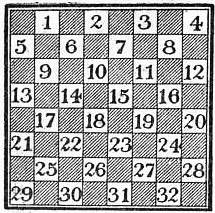
WHITE.
The English Game.—Draughts as played now in English-speaking countries is a game for two persons with a board and twenty-four men—twelve white and twelve black—which at starting are placed as follows: the black men on the squares numbered 1 to 12, and the white men on the squares numbered 21 to 32 on the diagram below. In printed diagrams the men are usually shown on the white squares for the sake of clearness, but in actual play the black squares are generally used now. In playing on the black squares the board must be placed with a black square in the left-hand corner. The game is played by moving a man forward, one square at a time except when making a capture, along the diagonals to the right or left. Thus a white man placed on square 18 in the diagram can move to 15 or 14. Each player moves alternately, black always moving first. If a player touch a piece he must move that piece and no other. If the piece cannot be moved, or if it is not the player’s turn to move, he forfeits the game. As soon as a man reaches one of the squares farthest from his side of the board, he is “crowned” by having one of the unused or captured men of his own colour placed on him, and becomes a “king.” A king has the power of moving and taking backwards as well as forwards.
If a man is on the square adjacent to an opponent’s man, and there is an unoccupied square beyond, the unprotected man must be captured and removed from the board. Thus, if there is a white man on square 18, and a black man on square 14, square 9 being vacant, and white having to move, he jumps over 14 and remains on square 9, and the man on 14 is taken up.
If two or more men are so placed that one square intervenes between each they may all be taken at one move. Thus if white having to move has a man on 28, and black men on 24, 16 and 8, the intermediate squares and square 3 being vacant, white could move from 28 to 3, touching 19 and 12 en route, and take the men on 24, 16, and 8; but if there is a piece on 7 and square 10 is vacant, the piece on 7 cannot be captured, for becoming a king ends the move.
It is compulsory to take if possible. If a player can take a man (or a series of men) but makes a move that does not capture (or does not capture all that is possible), his adversary may allow the move to stand, or he may have the move retracted and compel the player to take, or he may allow the move to stand and remove the piece, that neglected to capture from the board (called “huffing”). “Huff and move” go together, i.e. the player who huffs then makes his move. When one player has lost all his pieces, or has all those left on the board blocked, he loses the game.
The game is drawn when neither of the players has sufficient advantage in force or position to enable him to win.
The losing game, or “first off the board,” is a form of draughts not much practised now by expert draught players. The player wins who gets all his pieces taken first. There is no “huffing”; a player who can take must do so.
Draughts Openings.—As there are seven possible first moves, with seven possible replies to each, or forty-nine in all, there is an abundant variety of openings; but as two of these (9-14, 21-17 and 10-14, 21-17) are obviously unsound, the number is really reduced to forty-seven. Much difference of opinion exists regarding the relative strength of the various openings. It was at one time generally held that for the black side 11-15 was the best opening move.
Towards the end of the 19th century this view became much modified, and though 11-15 still remained the favourite, it was recognized that 10-15, 9-14 and 11-16 were little, if at all, inferior; 10-14 and 12-16 were rightly rated as weaker than the four moves named above, whilst 9-13, the favourite of the “unscientific” player, was found to be weakest of all.
The white replies to 11-15 have gone through many vicissitudes. The seven possible moves have each at different times figured as the general favourite. Thus 24-19, which analysis proved to be the weakest of the seven, was at one period described by the title of “Wyllie’s Invincible.” In course of time it came to be regarded as decidedly weak, and its name was altered to the less pretentious title of “Second Double Corner.” In the Scottish Tournament of 1894 this opening was played between Ferrie and Stewart, and the latter won the game with white, introducing new play which has stood the test of analysis, and so rehabilitating the opening in public favour. The 21-17 reply to 11-15 was introduced by Wyllie, who was so successful with it that it became known as the “Switcher.” This opening perhaps lacks the solid strength of some of the others, but it so abounds in traps as to be well worthy of its name. The other five replies to 11-15, namely 24-20, 23-19, 23-18, 22-18 and 22-17, are productive of games which give equal chances to both sides.
The favourite replies to 10-15 are 23-18, 22-18 and 21-17, but they do not appear to be appreciably stronger than the others, with the possible exception of 24-20.
In response to 11-16, 23-18 is held to give white a trifling advantage, but it is more apparent than real. With the exception of 23-19, which is weak, the other replies are of equal strength, and are only slightly, if at all, inferior to the more popular 23-18. 9-14 is most frequently encountered by 22-18, but all white’s replies are good, except of course 21-17 which loses a man, and 23-18 which weakens the centre of white’s position.
Against 10-14 the most popular move is 22-17, which gives white an advantage. Next in strength come 22-18 and 24-19. 23-18 is weak.
The strongest reply to 12-16 is 24-20. The others, except 23-19, which is weak, give no initial advantage to either side.
As already mentioned, 9-13 is black’s weakest opening move, both 22-18 and 24-19 giving white a distinct advantage. Nevertheless 9-13 is a favourite début with certain expert players, especially when playing with inferior opponents.
The term “opening” is frequently applied in a more restricted sense than that used above. When practically all games started with 11-15 it was convenient to assign names to the more popular lines of play. Thus 11-15, 23-19, 8-11, 22-17, if followed by 11-16, was called the “Glasgow”; if followed by 9-13, 17-14, the “Laird and Lady”; if by 3-8, the “Alma.”
The variety possible in the opening is a fair reply to the objection sometimes heard that the game does not afford sufficient scope for variation. As a matter of fact a practically unlimited number of different games might be played on any one opening.
The three following games are typical examples of the play arising from three of the most frequently played openings:—
Game No. 1.—“Ayrshire Lassie” Opening.
a 11-15 25-18 10-15 22-17 b 15-18 24-6
a 24-20 3-8 23-19 13-22 24-20 2-9
8-11 26-22 6-10 26-17 18-27 17-10
28-24 5-9 {c & d} 27-23 11-16 31-24 8-11
9-13 30-26 9-14 20-11 16-23 Drawn.
22-18 1-5 18-9 7-16 20-16 R. Jordan.
15-22 32-28 5-14 29-25 12-19
a. 11-15, 24-20 forms the “Ayrshire Lassie” opening, so named by Wyllie. It is generally held to admit of unusual scope for the display of critical and brilliant combinations.
b. 16-20, 25-22, 20-27, 31-24, 8-11, 17-13, 2-6, 21-17, 14-21, 22-17, 21-25, 17-14, 10-17, 19-1. Drawn. R. Jordan.
(c)
26-23 28-19 20-16 7-11 14-10 15-10
9-14 2-6 6-10 19-24 26-23 23-18
18-9 20-11 16-11 11-18 10-7 10-15
5-14 8-24 10-15 24-27 4-8 20-16
29-25 27-20 11-7 18-15 7-3 15-22
11-16 10-15 14-18 27-31 8-12 16-7
20-11 31-26 7-3 22-18 3-7 Drawn.
7-16 15-19 18-23 31-27 27-24 A. B. Scott.
24-20 23-16 3-7 18-14 7-11 v.
15-24 12-19 23-30 30-26 24-20 R. Jordan.
(d)
19-16 7-10 23-19 11-15 16-11 25-30
12-19 6-1 15-24 27-24 18-25 20-16
22-17 9-14 28-19 22-25 17-14 Drawn.
15-22 26-23 8-11 29-22 10-17 R. Jordan.
24-6 11-15 19-16 14-18 21-14
Game No. 2.—“Kelso-Cross” Opening.
a 10-15 8-12 13-22 5-9 14-18 22-25
a 23-18 25-21 26-17 20-16 17-14 29-22
12-16 1-6 d 19-26 2-7 10-17 17-26
21-17 32-27 30-23 24-19 21-14 5-1
9-13 12-16 15-22 15-24 6-10 26-30
17-14 27-23 24-19 23-19 14-9 1-5
16-19 7-10 9-14 24-27 10-14 30-26
24-20 14-7 19-12 31-24 19-15 5-9
6-9 3-10 11-15 9-13 14-17 26-23
b 27-24 c 22-17 28-24 24-20 9-5 Drawn.
R. Jordan.
a. These two moves form the “Kelso-Cross” opening.
b. 27-23 is also a strong line for white to adopt.
c. 30-25, 4-8, 18-14, 9-27, 22-18, 15-22, 24-15, 11-18, 20-4, 27-32, 26-17, 13-22, 4-8, 22-26, and black appears to have a winning advantage. R. Jordan.
d. Taking the piece on 18 first seems to lose, thus:—
15-22 e 9-13 13-17 6-9 5-14
24-8 17-14 23-18 14-10 10-7 White
4-11 10-17 17-21 9-14 2-6 wins.
31-27 21-14 28-24 18-9 7-2 Dallas.
e. 2-7, 27-24, 22-26, 23-18, 26-31, 18-15, 11-18, 20-2, 9-13, 2-9, 5-14, 24-19, 13-22, 30-26. White wins.
Game No. 3.—“Dundee” Opening.
12-16 11-15 c 8-12 4-8 9-14 1-26
24-20 20-11 17-13 18-15 26-22 31-22
8-12 7-16 5-9 2-7 14-17 19-23
28-24 24-20 22-18 30-26 21-14 13-9
9-14 b 16-19 15-22 10-14 18-23 12-19
22-17 23-16 25-18 29-25 27-18 9-6
3-8 12-19 14-23 14-18 6-10 7-11
a 26-22 20-16 27-18 32-27 15-6 Drawn.
R. Jordan.
a. This move is the favourite at this point on account of its “trappiness,” but 25-22 is probably stronger, thus: 25-22, 16-19, 24-15, 11-25, 29-22, 8-11, 17-13, 11-16, 20-11, 7-16, and white can with advantage continue by 27-24, 22-17, 23-19 or 22-18.
b. 15-19, 20-11, 8-15, 23-16, 12-19, 17-13, 5-9, 30-26, 4-8, 27-23, 8-12, 23-16, 12-19, 31-27, 1-5, 27-23, 19-24, 32-27, 24-31, 22-17. White wins. C. F. Barker.
c 8-11 27-18 15-18 14-10 24-27 7-10
16-7 15-22 14-10 19-24 31-24 27-31
2-11 25-18 6-15 10-7 16-20 10-26
22-18 10-15 17-14 18-23 3-7 31-22
14-23 18-14 11-16 7-3 20-27 30-25
Drawn. R. Stewart v. R. Jordan.
Problem No. 1 is the simplest form of that known to draughts-players as the “First Position.” It is of more frequent occurrence in actual play than any other end-game, and is, besides, typical of a class of draughts problems which may be described as analytical, in contradistinction to “strokes.”
Problem No. 1, by Wm. Payne. BLACK.
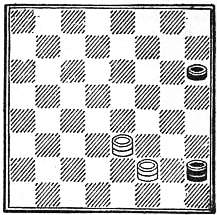
WHITE. White to move and win.
Solution:—
27-32 18-15 15-11 11-15 28-32 19-24
28-24 2-28-24 12-16 19-24 27-31 White
23-18 32-28 28-32 32-28 15-19 wins.
3-a-24-28 1-24-20 16-19 24-27 31-26
a. 12-16 same as Var. I. at 5th move.
Var. I.
24-27 18-15 19-16 28-32 8-12 15-11
15-18 b 16-20 18-23 8-12 23-18 White
12-16 15-18 16-11 32-27 12-8 wins.
28-32 24-19 23-19 12-8 18-15
27-24 32-28 11-8 27-23 8-12
b. 24-28 same as Var. II. at 1st move.
Var. II. 12-16, 15-11, 16-19, 32-27, 28-32, 27-31, 32-28, 11-16, 19-23, 16-19. White wins.
Var. III. 24-19, 32-28, c 19-16, 28-24, 16-11, 24-20, 11-8, 18-15. White wins.
c. 12-16, 28-32, 19-24 or 16-20, same as Var. II. at 5th and 9th moves respectively. White wins.
Problem No. 2. BLACK.
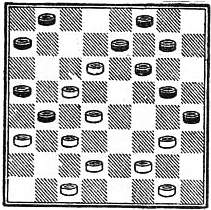
WHITE. White to move and win.
Problem No. 2 is a fine example of another class of problems, namely, “strokes.” It is formed from the “Paisley” opening, thus:—
11-16 22-17 11-16 26-19 9-13 15-10
24-19 9-13 25-21 4-8 25-22 a 2-7
8-11 17-14 6-9 29-25 7-11
28-24 10-17 23-18 13-17 19-15
16-20 21-14 16-23 31-26 12-16
a. This forms the position on the diagram. The solution is as follows:—
27-23 7-14 18-9 14-23 26-3
20-27 9-6 5-14 21-7 27-31
14-9 1-10 23-18 3-10 3-7
White wins. Jacques and Campbell.
Other Varieties.—The forms of draughts practised on the European continent differ in some respects from the English variety, chiefly in respect of the power assigned to a man after “crowning.” The game of Polish Draughts is played in France, Holland, Belgium and Poland, where it has entirely superseded Le Jeu de dames à la française. It is played on a board of 100 squares with 20 men a side. The men move and capture as in English draughts, except that in capturing they move either forward or backward. A crowned man becomes a queen, and can move any number of squares along the diagonal. In her capture she takes any unguarded man or queen in any diagonal she commands, leaping over the captured man or queen and remaining on any unoccupied square she chooses of the same diagonal, beyond the piece taken. But if there is another unguarded man she is bound to choose the diagonal on which it can be taken. For example (using an English draught-board) place a queen on square 29 and adverse men at squares 22, 16, 24, 14. The queen is bound to move from 29 to 11, 20, 27, and having made the captures to remain at 9 or 5, whichever she prefers. The capturing queen or man must take all the adverse pieces that are en prise, or that become so by the uncovering of any square from which a piece has been removed during the capture, e.g. white queen at square 7, black at squares 10, 18, 19, 22 and 27, the queen captures at 10, 22, 27 and 19, and the piece at 22 being now removed, she must go to 15, take the man at 18, and stay at 22, 25 or 29. In consequence of the intricacy of some of these moves, it is customary to remove every captured piece as it is taken. If a man arrives at a crowning square when taking, and he can still continue to take, he must do so, and not stay on the crowning square as at draughts. Passing a crowning square in taking does not entitle him to be made a queen. In capturing, the player must choose the direction by which he can take the greatest number of men or queens, or he may be huffed. Numerical power is the criterion, e.g. three men must be taken in preference to two queens. If the numbers are equal and one force comprises more queens than the other, the player may take whichever lot he chooses. This form of draughts, played on a board of 144 squares with 30 men a side, is extensively practised by British soldiers in India.
The German Damenspiel is Polish draughts played on a board of the same size and with the same number of men as in the English game. It is sometimes called Minor Polish draughts, and is practised in Germany and Russia.
The Italian game differs from the English in two important particulars—a man may not take a king, and when a player has the option of capturing pieces in more than one way he must take in the manner which captures most pieces. There is a difference too in the placing of the board, the black square in the corner of the board being at the player’s right hand, but until a king is obtained the differences from the English system are unimportant in practice.
In Spanish draughts the board is set as for the Italian game. The men move as in English draughts, but, in capturing, the largest possible number of pieces must be taken, and the king has the same powers as in the Polish game. The game does not differ essentially from the English game until a king is obtained, and many games from Spanish works will be found incorporated in English books. Sometimes the game is played with 11 men and a king, or 10 men and 2 kings a side, instead of the regulation 12 men.
Turkish draughts differs widely from all other modern varieties of the game. It is played on a board of 64 squares, all of which are used in play. Each player has 16 pieces, which are not placed on the two back rows of squares, as in chess, but on the second and third back rows. The pieces do not move diagonally as in other forms of the game, but straight forward or to the right or left horizontally. The king has the same command of a horizontal or vertical row of squares that the queen in Polish draughts has over a diagonal. Capturing is compulsory, and the greatest possible number of pieces must be taken, captured pieces being removed one at a time as taken.
Authorities.—Falkener’s Games Ancient and Oriental; Lees’ Guide to the Game of Draughts; Drummond’s Scottish Draught Players (Kear’s reprint); Gould’s Memorable Matches and Book of Problems, &c. The Draughts World is the principal magazine devoted to the game. In Dunne’s Draught Players’ Guide and Companion a section is devoted to the non-English varieties.
(J. M. M. D.; R. J.)
DRAUPADI, in Hindu legend, the daughter of Drupada, king of Panchala, and wife of the five Pandava princes. She is an important character in the Mahabharata.
DRAVE, or Drava (Ger. Drau, Hung. Dráva, Lat. Dravus), one of the principal right-bank affluents of the Danube, flowing through Austria and Hungary. It rises below the Innichner Eck, near the Toblacher Feld in Tirol, at an altitude of a little over 4000 ft., runs eastward, and forms the longest longitudinal valley of the Alps. The Drave has a total length of 450 m., while the length of its Alpine valley to Marburg is 150 m., and to its junction with the Mur 250 m. Owing to its great extent and easy accessibility the valley of the Drave was the principal road through which the invading peoples of the East, as the Huns, the Slavs and the Turks, penetrated the Alpine countries. The Drave flows through Carinthia and Styria, and enters Hungary near Friedau, where up to its confluence with the Danube, at Almas, 14 m. E. of Esseg, it forms the boundary between that country and Croatia-Slavonia. At its mouth the Drave attains a breadth of 1055 ft. and a depth of 20 ft. The Drave is navigable for rafts only from Villach, and for steamers from Bárcs, a distance of 95 m. The principal affluents of the Drave are: on the left the Isel, the Gurk, the Lavant, and the largest of all, the Mur; and on the right the Gail and the Drann.
DRAVIDIAN (Sanskrit Draviḍa), the name given to a collection of Indian peoples, and their family of languages1 comprising all the principal forms of speech of Southern India. Their territory, which also includes the northern half of Ceylon, extends northwards up to an irregular line drawn from a point on the Arabian Sea about 100 m. below Goa along the Western Ghats as far as Kolhapur, thence north-east through Hyderabad, and farther eastwards to the Bay of Bengal. Farther to the north we find Dravidian dialects spoken by small tribes in the Central Provinces and Chota Nagpur, and even up to the banks of the Ganges in the Rajmahal hills. A Dravidian dialect is, finally, spoken by the Brāhūīs of Baluchistan in the far north-west. The various Dravidian languages, with the number of speakers returned at the census of 1901, are as follows:—
Tamil 17,494,901
Malayālam 6,022,131
Kanarese 10,368,515
Tulu 535,210
Kodagu 39,191
Toda 805
Kōta 1,300
Kuruχ 609,721
Malto 60,777
Gōndī 1,125,479
Kui 494,099
Telugu 20,697,264
Brāhūī 48,589
—————
Total 57,497,982
Of these Tamil and Malayālam can be considered as two dialects of one and the same language, which is, in its turn, closely related to Kanarese. Tulu, Kodagu, Toda and Kōta can be described as lying between Tamil-Malayālam and Kanarese, though they are more nearly related to the latter than to the former. The same is the case with Kuruχ and Malto, while Kui and Gōndī gradually approach Telugu, which latter language seems to have branched off from the common stock at an early date. Finally, the Brāhūī dialect of Baluchistan has been so much influenced by other languages that it is no longer a pure Dravidian form of speech.
The Dravidian languages have for ages been restricted to the territory they occupy at the present day. Moreover, they are gradually losing ground in the north, where they meet with Aryan forms of speech. If we compare the caste tables and the language tables in the Indian census of 1901 we find that only 1,125,479 out of the 2,286,913 Gōnds returned were stated to speak the Dravidian Gōndī. Similarly only 1505 out of 17,187 Kōlāms entered their language as Kōlāmī. Such tribes are gradually becoming Hinduized. Their language adopts an ever-increasing Aryan element till it is quite superseded by Aryan speech. In the north-eastern part of the Dravidian territory, to the east of Chanda and Bhandara, the usual state of affairs is that Dravidian dialects are spoken in the hills while Aryan forms of speech prevail in the plains. The Dravidian Kui thus stands out as an isolated island in the sea of Aryan speech.
This process has been going on from time immemorial. The Dravidians were already settled in India when the Aryans arrived from the north-west. The fair Aryans were at once struck by their dark hue, and named them accordingly kṛiṣṇa tvac, the black skin. In the course of time, however, the two races began to mix, and it is still possible to trace a Dravidian element in the Aryan languages of North India.
The teaching of anthropology is to the same effect. Most speakers of Dravidian languages belong to a distinct anthropological type which is known as the Dravidian. “The Dravidian race,” says Sir H. Risley, “the most primitive of the Indian types, occupies the oldest geological formation in India, the medley of forest-clad ranges, terraced plateaus, and undulating plains which stretches, roughly speaking, from the Vindhyas to Cape Comorin. On the east and west of the peninsular area the domain of the Dravidian is conterminous with the Ghats, while farther north it reaches on one side to the Aravallis and on the other to the Rajmahal hills.”
This territory is the proper home of the race. A strong Dravidian element can, however, also be traced in the population of northern India. In Kashmir and Punjab, where the Aryans had already settled in those prehistoric times when the Vedic hymns were composed, the prevailing type is the Aryan one. The same is the case in Rajputana. From the eastern frontier of the Punjab, on the other hand, and eastwards, a Dravidian element can be traced. This is the case in the valleys of the Ganges and the Jumna, where the Aryans only settled at a later period. Anthropologists also state that there is a Dravidian element in the population of western India, from Gujarat to Coorg.
It is thus probable that Dravidian languages have once been spoken in many tracts which are now occupied by Aryan forms of speech. The existence of a Dravidian dialect in Baluchistan seems to show that Dravidian settlers have once lived in those parts. The tribe in question, the Brāhūīs, are, however, now Eranians and not Dravidians by race, and it is not probable that there has ever been a numerous Dravidian population in Baluchistan. The Brāhūīs are most likely the descendants of settlers from the south.
There is no indication that the Dravidians have entered India from outside or superseded an older population. For all practical purposes they can accordingly be considered as the aborigines of the Deccan, whence they appear to have spread over part of northern India. Their languages form an isolated group, and it has not been possible to prove a connexion with any other family of languages. Such attempts have been made with reference to the Munda family, the Tibeto-Burman languages, and the dialects spoken by the aborigines of the Australian continent. The arguments adduced have not, however, proved to be sufficient, and only the Australian hypothesis can still lay claim to some probability. Till it has been more closely tested we must therefore consider the Dravidian family as an isolated group of languages, with several characteristic features of its own.
The pronunciation is described as soft and mellifluous. Abruptness and hard combinations of sounds are avoided. There is, for example, a distinct tendency to avoid pronouncing a short consonant at the end of a word, a very short vowel being often added after it. Thus the pronoun of the third person singular, which is avan, “he,” in Tamil, is pronounced avanu in Kanarese; the Sanskrit word vāk, “speech,” is borrowed in the form vāku in Tamil; the word gurram, “horse,” is commonly pronounced gurramu in Telugu, and so on. Combinations of consonants are further avoided in many cases where speakers of other languages do not experience any difficulty in pronouncing them. This tendency is well illustrated by the changes undergone by some borrowed words. Thus the Sanskrit word brāhmaṇa, “a Brahmin,” becomes barāmaṇa in Kanarese and pirāmaṇa in Tamil; the Sanskrit Dramiḍa, “Dravidian,” is borrowed by Tamil under the form Tirāmiḍa. Dramiḍa, which also occurs as Draviḍa, is in its turn developed from an older Damiḷa, which is identical with the word Tamiṛ, Tamil.
The forms pirāmaṇa and Tirāmiḍa in Tamil illustrate another feature of Dravidian enunciation. There is a tendency in all of them, and in Tamil and Malayālam it has become a law, against any word being permitted to begin with a stopped voiced consonant (g, j, ḍ, d, b), the corresponding voiceless sounds (k, c, ṭ, t, p, respectively) being substituted. In the middle of a word or compound, on the other hand, every consonant must be voiced. Thus the Sanskrit word danta, “tooth,” has been borrowed by Tamil in the form tandam, and the Telugu anna, “elder brother,” tammulu, “younger brother,” become when compounded annadammulu, “elder and younger brothers.”
There is no strongly marked accent on any one syllable, though there is a slight stress upon the first one. In some dialects this equilibrium between the different parts of a word is accompanied by a tendency to approach to each other the sound of vowels in consecutive syllables. This tendency, which has been called the “law of harmonic sequence,” is most apparent in Telugu, where the short u of certain suffixes is replaced by i when the preceding syllable contains one of the vowels i (short and long) and ei. Compare the dative suffix ku, ki, in gurramu-ku, “to a horse”; but tammuni-ki, “to a younger brother.” This tendency does not, however, play a prominent rôle in the Dravidian languages.
Words are formed from roots and bases by means of suffixed formative additions. The root itself generally remains unchanged throughout. Thus from the Tamil base per, “great,” we can form adjectives such as per-iya and per-um, “great”; verbs such as per-u-gu, “to become increased”; per-u-kku, “to cause to increase,” and so on.
Many bases can be used at will as nouns, as adjectives, and as verbs. Thus the Tamil kaḍu can mean “sharpness,” “sharp,” and “to be sharp.” Other bases are of course more restricted in their respective spheres.
The inflection of words is effected by agglutination, i.e. various additions are suffixed to the base in order to form what we would call cases and tenses. Such additions have probably once been separate words. Most of them are, however, now only used as suffixes. Thus from the Tamil base kōn, “king,” we can form an accusative kōn-ei, a verb kōn-en, “I am king,” and so on.
Dravidian nouns are divided into two classes, which Tamil grammarians called high-caste and casteless respectively. The former includes those nouns which denote beings endowed with reason, the latter all others. Gender is only distinguished in the former class, while all casteless nouns are neuter. The gender of animals (which are irrational) must accordingly be distinguished by using different words for the male and the female, or else by adding words meaning male, female, respectively, to the name of the animal—processes which do not, strictly speaking, fall under the head of grammar.
There are two numbers, the singular and the plural. The latter is formed by adding suffixes. It, however, often remains unmarked in the case of casteless nouns.
Cases are formed by adding postpositions and suffixes, usually to a modified form of the noun which is commonly called the oblique base. Thus we have the Tamil maram, “tree”; maratt-āl, “from a tree”; maratt-u-kku, “to a tree”; vīḍu, “a house”; vīṭṭ-āl, “from a house.” The case terminations are the same in the singular and in the plural. The genitive, which precedes the governing noun, is often identical with the oblique base, or else it is formed by adding suffixes.
The numeral system is decimal and higher numbers are counted in tens; thus Tamil pattu, “ten”; iru-badu, “two tens,” “twenty.”
The personal pronoun of the first person in most dialects has a double form in the plural, one including and the other excluding the person addressed. Thus, Tamil nām, “we,” i.e. I and you; nāṅgal, “we,” i.e. I and they.
There is no relative pronoun. Relative clauses are effected by using relative participles. Thus in Telugu the sentence “the book which you gave to me” must be translated mīru nāku iccina pus-takamu, i.e. “you me-to given book.” There are several such participles in use. Thus from the Telugu verb koṭṭa, “to strike,” are formed koṭṭ-ut-unna, “that strikes,” koṭṭ-i-na, “that struck,” koṭṭē, “that would strike,” “that usually strikes.” By adding pronouns, or the terminations of pronouns, to such forms, nouns are derived which denote the person who performs the action. Thus from Telugu koṭṭē and vāḍu, “he,” is formed koṭṭē-vāḍu, “one who usually strikes.” Such forms are used as ordinary verbs, and the usual verbal forms of Dravidian languages can broadly be described as such nouns of agency. Thus, the Telugu, koṭṭināḍu, “he struck,” can be translated literally “a striker in the past.”
Verbal tenses distinguish the person and number of the subject by adding abbreviated forms of the personal pronouns. Thus in Kanarese we have māḍid-enu, “I did”; māḍid-i, “thou didst”; māḍid-evu, “we did”; māḍid-aru, “they did.”
One of the most characteristic features of the Dravidian verb is the existence of a separate negative conjugation. It usually has only one tense and is formed by adding the personal terminations to a negative base. Thus, Kanarese māḍ-enu, “I did not”; māḍ-evu, “we did not”; māḍ-aru, “they did not.”
The vocabulary has adopted numerous Aryan loan-words. This was a necessary consequence of the early connexion with the superior Aryan civilization.
The oldest Dravidian literature is largely indebted to the Aryans though it goes back to a very early date. Tamil, Malayālam, Kanarese and Telugu are the principal literary languages. The language of literature in all of them differs considerably from the colloquial. The oldest known specimen of a Dravidian language occurs in a Greek play which is preserved in a papyrus of the 2nd century a.d. The exact period to which the indigenous literature can be traced back, on the other hand, has not been fixed with certainty.
Bibliography.—Bishop R. Caldwell, A Comparative Grammar of the Dravidian or South-Indian Family of Languages (London, 1856; 2nd edition, 1875); Dr Friedrich Müller, Reise der österreichischen Fregatte Novara um die Erde in den Jahren 1857, 1858, 1859, unter den Befehlen des Commodore B. von Wüllerstorff-Urbair: Linguistischer Theil. (Wien, 1867, pp. 73 and ff.); Dr Friedrich Müller, Grundriss der Sprachwissenschaft, vol. iii. (Wien, 1884), pp. 106 and ff.; G. A. Grierson, Linguistic Survey of India, vol. iv. “Munda and Dravidian Languages” (Calcutta, 1906), pp. 277 and ff. by Sten Konow.
(S. K.)
1 In Dravidian words a line above a vowel shows that it is long. The dotted consonants ṭ, ḍ, and ṇ are pronounced by striking the tip of the tongue against the centre of the hard palate. The dotted ḷ is distinguished from l in a similar way. Its sound, however, differs in the different districts. A Greek χ marks the sound of ch in “loch”; ṣ is the English sh; c the ch in “church”; and ṛi is an r which is used as a vowel. In the list of Dravidian languages the names are spelt fully, with all the necessary diacritical marks. In the rest of the article dots under consonants have been omitted in these words.
DRAWBACK, in commerce, the paying back of a duty previously paid upon the exportation of excisable articles or upon the re-exportation of foreign goods. The object of a drawback is to enable commodities which are subject to taxation to be exported and sold in a foreign country on the same terms as goods from countries where they are untaxed. It differs from a bounty in that the latter enables commodities to be sold abroad at less than their cost price; it may occur, however, under certain conditions that the giving of a drawback has an effect equivalent to that of a bounty, as in the case of the so-called sugar bounties in Germany (see Sugar). The earlier tariffs contained elaborate tables of the drawbacks allowed on the exportation or re-exportation of commodities, but so far as the United Kingdom is concerned the system of “bonded warehouses” practically abolished drawbacks, as commodities can be warehoused (placed “in bond”) until required for subsequent exportation.
DRAWING, in art. Although the verb “to draw” has various meanings, the substantive drawing is confined by usage to its artistic sense, delineation or design. The word “draw,” from a root common to the Teutonic languages (Goth, dragan, O.H.G. drahan, Mod. Ger. tragen, which all have the sense of “carry,” O. Norse draga, A.S. drazan, drazen, “draw,” cf. Lat. trahere), means to pull or “drag” (a word of the same origin) as distinct from the action of pushing. It is thus used of traction generally, whether by men, animals or machines. The same idea is preserved in “drawing” as applied to the fine arts. We do not usually say, or think, that a sculptor is drawing when he is using his chisel, although he may be expressing or defining forms, nor that an engraver is drawing when he is pushing the burin with the palm of the hand, although the result may be the rendering of a design. But we do say that an artist is drawing when he uses the lead pencil, and here we have a motion bearing some resemblance to that of traction generally. The action of the artist in drawing the pencil point with his fingers along the paper is analogous, e.g., to that of a horse or man drawing a pole over soft ground and leaving a mark behind. The same analogy may be observed between two of the senses in which the French verb tirer is frequently employed. This word, the origin of which is quite uncertain, was formerly used by good writers in the two senses of the verb to draw. Thus Lafontaine says, “Six forts chevaux tiraient un coche”; and Caillières wrote, “Il n’y a pas longtemps que je me suis fait tirer par Rigaud,” meaning that Rigaud had drawn or painted his portrait. At the present day the verb tirer has fallen into disuse amongst cultivated Frenchmen with regard to drawing and painting, but it is still universally used for all kinds of design and even for photography by the common people. The cultivated use it still for printing, as for example “cette gravure sera tirée à cent exemplaires,” in the sense of pulling. A verb much more nearly related to the English verb to draw is the French traire (Lat. trahere), which has trait for its past participle. Traire is now used exclusively for milking cows and other animals, and though the analogy between this and artistic drawing is not obvious at first, nevertheless there is a certain analogy of motion, since the hand passing down the teat draws the milk downwards. The word trait is much more familiar in connexion with art as “les traits du visage,” the natural markings of the face, and it is very often used in a figurative sense, as we say “traits of character.” It is familiar in the English portrait, derived from protrahere. The ancient Romans used words which expressed more clearly the conception that drawing was done in line (delineare) or in shade (adumbrare), though there are reasons for believing that the words were often indiscriminately applied. Although the modern Italians have both traire and trarre, they use delineare still in the sense of artistic drawing, and also adombrare. The Greek verb γράφειν appears in English in “graphic” and in many compounds, such as photograph, &c. It is worth observing that the Greeks seem to have considered drawing and writing (q.v.) as essentially the same process, since they used the same word for both. This points to the early identity of the two arts when drawing was a kind of writing, and when such writing as men had learned to practise was essentially what we should call drawing, though of a rude and simple kind. Even in the present day picture writing is not unfrequently resorted to by travellers as a means of making themselves intelligible. There is also a kind of art which is writing in the modern sense and drawing at the same time, such as the work of the medieval illuminators in their manuscripts.
(X.)
The Art of Drawing.—Rather than attempt here a historical survey of the various so-called “styles” of drawing, or write a personal appreciation of them, it seems of greater use to give a logical account of drawing as an art, applicable to all times and countries. Reference to the teaching of drawing will be occasionally given rather to illustrate the argument than with a view to its being of practical use.