VOLUME VIII SLICE V Dinard to Dodsworth
Reading edition
Articles in This Slice
DINARD DISSECTION
DINDIGUL DISSENTER
KARL WILHELM DINDORF DISSOCIATION
D’INDY, PAUL-MARIE-THÉODORE-VINCENT DISSOLUTION
DINEIR DISTAFF
DINGELSTEDT, FRANZ VON DISTILLATION
DINGHY DISTRACTION
DINGLE DISTRESS
DINGO DISTRIBUTION
DINGWALL DISTRICT
DINKA DISTYLE
DINKELSBÜHL DITHMARSCHEN
DINNER DITHYRAMBIC POETRY
DINOCRATES DITTERSBACH
DINOFLAGELLATA DITTERSDORF, KARL DITTERS VON
DINOTHERIUM DITTO
DINWIDDIE, ROBERT DITTON, HUMPHRY
DIO CASSIUS DIU
DIOCESE DIURETICS
DIO CHRYSOSTOM DIURNAL MOTION
DIOCLETIAN DIVAN
DIOCLETIAN, EDICT OF DIVER
DIODATI, GIOVANNI DIVERS and DIVING APPARATUS
DIODORUS CRONUS DIVES-SUR-MER
DIODORUS SICULUS DIVIDE
DIODOTUS DIVIDEND
DIOGENES DIVIDIVI
DIOGENES APOLLONIATES DIVINATION
DIOGENES LAËRTIUS DIVINING-ROD
DIOGENIANUS DIVISION
DIOGNETUS, EPISTLE TO DIVORCE
DIOMEDES (Greek legend) DIWANIEH
DIOMEDES (Latin grammarian) DIX, DOROTHEA LYNDE
DION DIX, JOHN ADAMS
DIONE DIXON, GEORGE
DIONYSIA DIXON, HENRY HALL
DIONYSIUS (pope) DIXON, RICHARD WATSON
DIONYSIUS (tyrant of Syracuse) DIXON, WILLIAM HEPWORTH
DIONYSIUS AREOPAGITICUS DIXON
DIONYSIUS EXIGUUS DIZFUL
DIONYSIUS HALICARNASSENSIS DJAKOVO
DIONYSIUS PERIEGETES DLUGOSZ, JAN
DIONYSIUS TELMAHARENSIS DMITRIEV, IVAN IVANOVICH
DIONYSIUS THRAX DNIEPER
DIONYSUS DNIESTER
DIOPHANTUS DOAB
DIOPSIDE DOANE, GEORGE WASHINGTON
DIOPTASE DOBBS FERRY
DIORITE DOBELL, SYDNEY THOMPSON
DIP DÖBELN
DIPHENYL DOBERAN
DIPHILUS DÖBEREINER, JOHANN WOLFGANG
DIPHTHERIA DOBREE, PETER PAUL
DIPLODOCUS DÖBRENTEI, GABOR
DIPLOMACY DOBRITCH
DIPLOMATIC DOBRIZHOFFER, MARTIN
DIPOENUS and SCYLLIS DOBROWSKY, JOSEPH
DIPPEL, JOHANN KONRAD DOBRUDJA
DIPSOMANIA DOBSINA
DIPTERA DOBSON, HENRY AUSTIN
DIPTERAL DOBSON, WILLIAM
DIPTYCH DOCETAE
DIR DOCHMIAC
DIRCE DOCK
DIRECT MOTION DOCK (botany)
DIRECTORS DOCK (marine and river engineering)
DIRECTORY DOCKET
DIRGE DOCK WARRANT
DIRK DOCKYARDS
DIRSCHAU DOCTOR
DISABILITY DOCTORS’ COMMONS
DISCHARGE DOCTRINAIRES
DISCHARGING ARCH DOCUMENT
DISCIPLE DODD, WILLIAM
DISCIPLES OF CHRIST DODDER
DISCLAIMER DODDRIDGE, PHILIP
DISCOUNT DODDS, ALFRED AMÉDÉE
DISCOVERY DODECAHEDRON
DISCUS DODECASTYLE
DISINFECTANTS DÖDERLEIN, JOHANN WILHELM LUDWIG
DISMAL DODGE, THEODORE AYRAULT
DISORDERLY HOUSE DODGSON, CHARLES LUTWIDGE
DISPATCH DODO
DISPENSATION DODONA
DISPERSION DODS, MARCUS
D’ISRAELI, ISAAC DODSLEY, ROBERT
DISS DODSWORTH, ROGER
DINARD, a seaside town of north-western France, in the department of Ille-et-Vilaine. The town, which is the chief watering-place of Brittany, is situated on a rocky promontory at the mouth of the Rance opposite St Malo, which is about 1 m. distant. It is a favourite resort of English and Americans as well as of the French, its attractions being the beauty of its situation, the mildness of the climate and the good bathing. It has two casinos and numerous luxurious hotels and elegant villas. Together with the adjoining watering-place of St Enogat, Dinard has a population of 4882 (1906).
DINDIGUL, a town of British India, in the Madura district of Madras, 880 ft. above the sea, 40 m. from Madura by rail. Pop. (1901) 25,182. Dindigul has risen into importance as the centre of a trade in tobacco and manufacture of cigars, which are exported to England. There are two large European cigar factories here. The town has manufactures oe silk, muslim#and blankets, and an export trade in hides and cardamoms; and there is a large native Christian population, with two churches. The ancient fort, well preserved, stands on a rock rising 350 ft. above the town; this was formerly a position of great strategic importance, commanding passes into Madura from Coimbatore, and figured prominently in the military operations of the Mahrattas in the 17th and 18th centuries, and of Hyder Ali in 1755 seq., being thrice captured by the British (1767, 1783, 1790). After the two first captures it was restored to Hyder Ali under treaty; after the third it was ceded to the East India Company.
KARL WILHELM DINDORF (1802-1883), German classical scholar, was born at Leipzig on the 2nd of January 1802. From his earliest years he showed a strong taste for classical studies, and after completing F. Invernizi’s edition of Aristophanes at an early age, and editing several grammarians and rhetoricians, was in 1828 appointed extraordinary professor of literary history in his native city. Disappointed at not obtaining the ordinary professorship when it became vacant in 1833, he resigned his post in the same year, and devoted himself entirely to study and literary work. His attention had at first been chiefly given to Athenaeus, whom he edited in 1827, and to the Greek dramatists, all of whom he edited separately and combined in his Poetae scenici Graeci (1830 and later editions). He also wrote a work on the metres of the Greek dramatic poets, and compiled special lexicons to Aeschylus and Sophocles. He edited Procopius for Niebuhr’s Corpus of the Byzantine writers, and between 1846 and 1851 brought out at Oxford an important edition of Demosthenes; he also edited Lucian and Josephus for the Didot classics. His last important editorial labour was his Eusebius of Caesarea (1867-1871). Much of his attention was occupied by the republication of Stephanus’s Thesaurus (Paris, 1831-1865), chiefly executed by him and his brother Ludwig, a work of prodigious labour and utility. His reputation suffered somewhat through the imposture practised upon him by the Greek Constantine Simonides, who succeeded in deceiving him by a fabricated fragment of the Greek historian Uranius. The book was printed, and a few copies had been circulated, when the forgery was discovered, just in time to prevent its being given to the world under the auspices of the university of Oxford. Shortly after the death of his brother, he lost all his property and his library by rash speculations. He died on the 1st of August 1883.
His brother Ludwig (1805-1871) was born at Leipzig on the 3rd of January 1805, and died there on the 6th of September 1871. He never held any academical position, and led so secluded a life that many doubted his existence, and declared that he was a mere pseudonym. The important share which he took in the edition of the Thesaurus is nevertheless authenticated by his own signature to his contributions. He also published valuable editions of Polybius, Dio Cassius and other Greek historians.
D’INDY, PAUL-MARIE-THÉODORE-VINCENT (1851- ), French musical composer, was born in Paris, on the 27th of March 1851. He studied composition and the organ at the Paris Conservatoire under César Franck, and obtained the grand prize offered by the city of Paris in 1885 with Le Chant de la Cloche, a dramatic legend after Schiller. His principal works, beside the above, are the symphonic trilogy Wallenstein, the symphonic works entitled Saugefleurie, La Forêt enchantée, Istar, Symphonie sur un air montagnard français; overture to Anthony and Cleopatra; Ste Marie Magdeleine, a cantata; Attendez-moi sous l’orme, a one-act opera; Fervaal, a musical drama in three acts. Vincent d’Indy is perhaps the most prominent among the disciples of César Franck. Imbued with very high aims, he was always guided by a lofty ideal, and few musicians have attained so complete a mastery over the art of instrumentation. His music, however, lacks simplicity, and can never become popular in the widest sense. His opera Fervaal, which is styled “action musicale”, is constructed upon the system of Leit-motifs. Its legendary subject recalls both Parsifal and Tristan, and the music is also suggestive of Wagnerian influence. D’Indy can scarcely be considered so typical a representative of modern French music as his juniors Alfred Bruneau, the composer of Le Rêve, L’Attaque du moulin, Messidor, or Gustave Charpentier, the author of Louise, who chose subjects of modern life for their operatic works.
DINEIR, a small town in Asia Minor, built amidst the ruins of Celaenae-Apamea, near the sources of the Maeander (Menderes). It is the terminus of the Smyrna-Aidin-Dineir railway. Pop. 1400. (See Apamea.)
DINGELSTEDT, FRANZ VON (1814-1881), German poet and dramatist, was born at Halsdorf, in Hesse Cassel, on the 30th of June 1814. Having studied at the university of Marburg, he became in 1836 a master at the Lyceum in Cassel, from which he was transferred to Fulda in 1838. In 1839 he produced a novel, Unter der Erde, which obtained considerable success, and in 1841 published the book by which he is best remembered, the Lieder eines kosmopolitischen Nachtwächters. These poems, animated as they are by a spirit of bitter opposition to everything that savours of despotism, were an effective contribution to the political poetry of the day. The popularity of this book determined Dingelstedt to take up a literary career, and in 1841 he obtained an appointment on the staff of the Augsburger allgemeine Zeitung. In 1843, however, the satirist of German princes accepted, to the general surprise, the appointment of private librarian to the king of Württemberg, and in the same year he married the celebrated Bohemian opera singer, Jenny Lutzer. In 1845 he published a volume of poems, some of which, treating of modern life, possessed great literary rather than strictly poetical merit. A subsequent collection, published in 1852, attracted little attention. The success of his tragedy Das Haus der Barneveldt (1850) obtained for him the position of intendant at the court theatre at Munich, where he soon became the centre of literary society. He incurred, however, the animosity of the Jesuit clique at the court, and in 1856 was suddenly dismissed on the most frivolous charges. A similar position was offered to him at Weimar through the influence of Liszt, and he remained there until 1867. His administration was most successful, and he especially distinguished himself by presenting all Shakespeare’s historical plays upon the stage in an unbroken cycle. In 1867 he became director of the court opera house in Vienna, and in 1872 of the Hofburgtheater, a position he held until his death on the 15th of May 1881. Among his other works may be noticed an autobiographical sketch of his Munich career, entitled Münchener Bilderbogen (1879), Die Amazone, an art novel of considerable merit (1869), translations of several of Shakespeare’s comedies, and several writings dealing with questions of practical dramaturgy. He was ennobled in 1867 by the king of Bavaria and in 1876 was created Freiherr by the emperor of Austria.
Dingelstedt’s Sämtliche Werke appeared in 12 vols. (1877-1878), but this edition is far from complete. On his life see, besides the autobiography mentioned above, J. Rodenberg, Heimaterinnerungen an F. Dingelstedt (Berlin, 1882), and by the same author, F. Dingelstedt, Blätter aus seinem Nachlass (2 vols., 1891). Also an essay by A. Stern in Zur Literatur der Gegenwart (Leipzig, 1880).
DINGHY, or Dingey (from the Hindu dēngī a small boat, the diminutive of denga, a sloop or coasting vessel), a boat of greatly varying size and shape, used on the rivers of India; the term is applied also, in certain districts, to a larger boat used for coasting purposes. The name was adopted by the merchantmen trading with India, and is now generally used to designate the small extra boat kept for general purposes on a man-of-war or merchant vessel, and also, on the Thames, for small pleasure boats built for one or two pairs of sculls.
DINGLE, a seaport and market town of county Kerry, Ireland, in the west parliamentary division, the terminus of the Tralee and Dingle railway. Pop. (1901) 1786. This may be considered the most westerly town in the United Kingdom unless Knightstown at Valencia Island be excepted; it lies on the south side of the northernmost of the great promontories which protrude into the Atlantic on the south-western coast of Ireland, on the fine natural harbour of Dingle Bay, in a wild hilly district abundant in relics of antiquity. The town, which is the centre of a considerable fishing industry, especially in mackerel, was in the 16th century of no little importance as a seaport; it had also a noted manufacture of linen. It was incorporated by Queen Elizabeth, and returned two members to the Irish parliament until the Union.
DINGO, a name applied apparently by Europeans to the warrigal, or native Australian dog, the Canis dingo of J. F. Blumenbach. The dingo is a stoutly-built, rather short-legged, sandy-coloured dog, intermediate in size between a jackal and a wolf, and measuring about 51 in. in total length, of which the tail takes up about eleven. In general appearance it is very like some of the pariah dogs of India and Egypt; and, except on distributional grounds, there is no reason for regarding it as specifically distinct from such breeds. Dingos, which are found both wild and tame, interbreed freely with European dogs introduced into the country, and it may be that the large amount of black on the back of many specimens may be the result of crossing of this nature.
The main point of interest connected with the dingo relates to its origin; that is to say, whether it is a member of the indigenous Australian fauna (among which it is the only large placental mammal), or whether it has been introduced into the country by man. There seems to be no doubt that fossilized remains of the dingo occur intermingled with those of the extinct Australian mammals, such as giant kangaroos, giant wombats and the still more gigantic Diprotodon. And since remains of man have apparently not yet been detected in these deposits, it has been thought by some naturalists that the dingo must be an indigenous species. This was the opinion of Sir Frederick McCoy, by whom the deposits in question were regarded as probably of Pliocene age. A similar view is adopted by D. Ogilvy in a Catalogue of Australian Mammals, published at Sydney in 1892; the writer going however one step further and expressing the belief that the dingo is the ancestor of all domesticated dogs. The latter contention cannot for a moment be sustained; and there are also strong arguments against the indigenous origin of the dingo. That the animal now occurs in a wild state is no argument whatever as to its being indigenous, seeing that a domesticated breed introduced by man into a new country abounding in game would almost certainly revert to the wild state. The apparent absence of human remains in the beds yielding dingo teeth and bones (which are almost certainly not older than the Pleistocene) is of only negative value, and liable to be upset by new discoveries. Then, again (as has been pointed out by R. I. Pocock in the first part of the Kennel Encyclopaedia, 1907), the absence of any really wild species of the typical group of the genus Canis between Burma and Siam on the one hand and Australia on the other is a very strong argument against the dingo being indigenous, seeing that, whether brought by man or having travelled thither of its own accord, the dingo must have reached its present habitat by way of the Austro-Malay archipelago. If it had followed that route in the course of nature, it is inconceivable that it would not still be found on some portions of the route. On the supposition that the dingo was introduced by man, we have now fairly decisive evidence that the native Australian, in place of being (as formerly supposed) a member of the negro stock, is a low type of Caucasian allied to the Veddahs of Ceylon and the Toalas of Celebes. Consequently the Australian natives must be presumed to have reached the island-continent by way of Malaya; and if this be admitted, nothing is more likely than that they should have been accompanied by pariah dogs of the Indian type. Confirmation of this is afforded by the occurrence in the mountains of Java of a pariah-like dog which has reverted to an almost completely wild condition; and likewise by the fact that the old voyagers met with dogs more or less similar to the dingo in New Guinea, New Zealand and the Solomon and certain other of the smaller Pacific islands. On the whole, then, the most probable explanation of the case is that the dingo is an introduced species closely allied to the Indian pariah dog. Whether the latter represents a truly wild type now extinct, cannot be determined. If so, all pariahs should be classed with the Australian warrigal under the name of Canis dingo. If, on the other hand, pariahs, and consequently the dingo, cannot be separated specifically from the domesticated dogs of western Europe, then the dingo should be designated Canis familiaris dingo.
(R. L.*)
DINGWALL, a royal and police burgh and county town of the shire of Ross and Cromarty, Scotland. Pop. (1901) 2519. It is situated near the head of Cromarty Firth where the valley of the Peffery unites with the alluvial lands at the mouth of the Conon, 18½ m. N.W. of Inverness by the Highland railway. Its name, derived from the Scandinavian Thingvöllr, “field or meeting-place of the thing,” or local assembly, preserves the Norse origin of the town; its Gaelic designation is Inverpefferon, “the mouth of the Peffery.” The 18th-century town house, and some remains of the ancient mansion of the once powerful earls of Ross still exist. There is also a public park. An obelisk, 57 ft. high, was erected over the grave of the 1st earl of Cromarty. The town belongs to the Wick district group of parliamentary burghs. It is a flourishing distributing centre and has an important corn market and auction marts. Some shipping is carried on at the harbour at the mouth of the Peffery, about a mile below the burgh. Branch lines of the Highland railway run to Strathpeffer and to Strome Ferry and Kyle of Lochalsh (for Skye). Alexander II. created Dingwall a royal borough in 1226, and its charter was renewed by James IV. On the top of Knockfarrel (Gaelic, cnoc, hill; faire, watch, or guard), a hill about 3 m. to the west, is a large and very complete vitrified fort with ramparts.
DINKA (called by the Arabs Jange), a widely spread negro people dwelling on the right bank of the White Nile to about 12° N., around the mouth of the Babr-el-Ghazal, along the right bank of that river and on the banks of the lower Sobat. Like the Shilluk, they were greatly harried from the north by Nuba-Arabic tribes, but remained comparatively free owing to the vast extent of their country, estimated to cover 40,000 sq. m., and their energy in defending themselves. They are a tall race with skins of almost blue black. The men wear practically no clothes, married women having a short apron, and unmarried girls a fringe of iron cones round the waist. They tattoo themselves with tribal marks, and extract the lower incisors; they also pierce the ears and lip for the attachment of ornaments, and wear a variety of feather, iron, ivory and brass ornaments. Nearly all shave the head, but some give the hair a reddish colour by moistening it with animal matter. Polygamy is general; some headmen have as many as thirty or more wives; but six is the average number. They are great cattle and sheep breeders; the men tend their beasts with great devotion, despising agriculture, which is left to the women; the cattle are called by means of drums. Save under stress of famine cattle are never killed for food, the people subsisting largely on durra. The Dinkas reverence the cow, and snakes, which they call “brothers.” Their folklore recognizes a good and evil deity; one of the two wives of the good deity created man, and the dead go to live with him in a great park filled with animals of enormous size. The evil deity created cripples. The Dinka came, in 1899, under the control of the Sudan government, justice being administered as far as possible in accord with tribal custom. A compendium of Dinka laws was compiled by Captain H. D. E. O’Sullivan.
See G. A. Schweinfurth, The Heart of Africa (1874); W. Junker, Travels in Africa, Eng. edit. (London, 1890-1892); The Anglo-Egyptian Sudan, edited by Count Gleichen (London, 1905).
DINKELSBÜHL, a town of Germany, in the kingdom of Bavaria, on the Wörnitz, 16 m. N. from Nördlingen, on the railway to Dombühl. Pop. 5000. It is an interesting medieval town, still surrounded by old walls and towers, and has an Evangelical and two Roman Catholic churches. Notable is the so-called Deutsches Haus, the ancestral home of the counts of Drechsel-Deufstetten, a fine specimen of the German renaissance style of wooden architecture. There are a Latin and industrial school, several benevolent institutions, and a monument to Christoph von Schmid (1768-1854), a writer of stories for the young. The inhabitants carry on the manufacture of brushes, gloves, stockings and gingerbread, and deal largely in cattle.
Fortified by the emperor Henry I., Dinkelsbühl received in 1305 the same municipal rights as Ulm, and obtained in 1351 the position of a free imperial city, which it retained till 1802, when it passed to Bavaria. Its municipal code, the Dinkelsbuhler Recht, published in 1536, and revised in 1738, contained a very extensive collection of public and private laws.
DINNER, the chief meal of the day, eaten either in the middle of the day, as was formerly the universal custom, or in the evening. The word “dine” comes through Fr. from Med. Lat. disnare, for disjejunare, to break one’s fast (jejunium); it is, therefore, the same word as Fr. déjeuner, to breakfast, in modern France, to take the midday meal, dîner being used for the later repast. The term “dinner-wagon,” originally a movable table to hold dishes, is now used of a two-tier sideboard.
DINOCRATES, a great and original Greek architect, of the age of Alexander the Great. He tried to captivate the ambitious fancy of that king with a design for carving Mount Athos into a gigantic seated statue. This plan was not carried out, but Dinocrates designed for Alexander the plan of the new city of Alexandria, and constructed the vast funeral pyre of Hephaestion. Alexandria was, like Peiraeus and Rhodes (see Hippodamus), built on a regular plan; the streets of most earlier towns being narrow and confused.
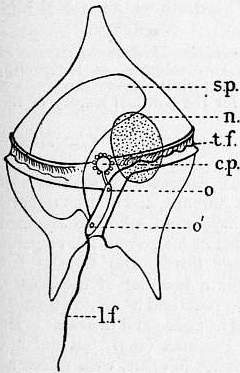
After F. Schutt in Engler and Prantl’s Pflanzenfamilien, by permission of Wm Engelmann. Fig. 1.—Peridinium divergens showing longitudinal and transverse grooves in which lie the respective flagella l.f., t.f.; s.p., large “sack pusule” discharging through a tube by pore o’; c.p., “collective pusule discharging at o, and surrounded by a ring of formative” or “daughter pusules”; n, nucleus.
DINOFLAGELLATA, so called by O. Bütschli (= the Cilioflagellata of E. Claparide and H. Lachmann), a group of Protozoa, characterized as Mastigophora, provided with two flagella, the one anterior extended in locomotion, the other coiled round its base, or lying in a transverse groove. The body is bounded by a firm pellicle, often supplemented by an armour (“lorica”) of cuticular cellulose plates, with usually a marked longitudinal groove from which the anterior flagellum springs, and an oblique or spiral transverse groove for the second flagellum. In Polykrikos (fig. 2, 9) there are eight transverse grooves each with its flagellum. The armour-plates are often exquisitely sculptured, and may be produced into spines or perpendicular plates to give greater surface extension, as we find in other plankton organisms. The cortical plasma may protrude pseudopodia in the longitudinal groove; it contains trichocysts in several species, true nematocysts in Polykrikos. It contains chromatophores in many species, coloured by a mixed lipochrome pigment which appears to be distinct from diatomin. The endoplasm is ramified between alveoli; it contains a large nucleus (in Polykrikos there are eight nuclei, accompanied by smaller, more numerous bodies regarded by O. Butschli as micro-nuclei). Besides the other spaces are definite rounded or oval vacuoles with a permanent pellicular wall termed by Schutt “pusules”; these open by a duct or ducts into the longitudinal groove. They enlarge and diminish, and are possibly excretory like the “contractile vacuoles” of other Protista; though it has been suggested that by their communication with the medium they subserve nutrition. Nutrition is of course holozoic or saprophytic in the colourless forms, holophytic in the coloured; but these divergent methods are exhibited by different species of the same genus, or even by individuals of one and the same species under different conditions. Binary fission has been widely observed, both in the active condition or after loss of the flagella: it differs from that of true Flagellates in not being longitudinal, but transverse or oblique (fig, 2, 2). Repeated fission (brood-formation) within a cyst has also been observed, as in Pyrocystis and Ceratium; and possibly the chains of Ceratium and other (fig. 2, 5 and 6) genera are due to the non-separation of the brood-cells. Conjugation of adults has been observed in several species, the most complete account being that of Zederbauer on Ceratium hirundinella (marine): either mate puts forth a tube which meets and opens into that of the other (as in some species of Chlamydomonas and Desmids); the two cell-bodies fuse in this tube, and encyst to form a resting zygospore. The Dinoflagellates are relatively large for Mastigophora, many attaining 50 µ (1/500”) in length. The majority are marine; but some genera (Ceratium, Peridinium) include fresh-water species. Many are highly phosphorescent and some by their abundance colour the water of the sea or pool which they dwell in. Like so many coloured Protista, they frequently possess a pigmented “eye-spot” in which may be sunk a spheroidal refractive body (“lens”).
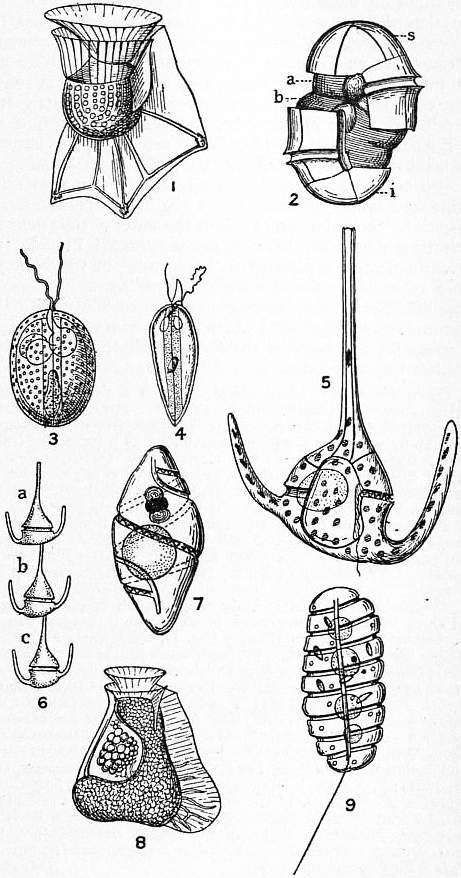
Fig. 2.
From Delage and Hérouard’s Traité de zoologie concrete, by permission of Schleicher Frères.
1. Modified from Schütt, Ornithoceras. 2. Diagram of transverse fission of a Dinoflagellate. 3. After Schutt, Exuviaeella. 4. After Stein, Prorocentrum. 5, 6. Ceratium, single and series. 7. Pouchetia fusus (Schutt). 8. Citharistes. 9. After Butschli, Polykrikos.
The affinities of the Dinoflagellata are certainly with those Cryptomonadine Flagellates which possess two unequal flagella; the zoospores or young of the Cystoflagellates are practically colourless Dinoflagellates.
1. Gymnodiniaceae: body naked, or with a simple cellulose or gelatinous envelope; both grooves present. Pyrocystis (Murray), often encysted, spherical or crescentic, becoming free within cyst wall, and escaping whole or after brood-divisions as a form like Gymnodinium; Gymnodinium (Stein); Hemidinium (Stein); Pouchetia (Schütt) (fig. 2, 7) with complex eye-spot; to this group we may refer Polykrikos (Bütschli) (fig. 2, 9), with its metameric transverse grooves and flagella.
2. Prorocentraceae (Schütt) ( = the Adinida of Bergh); body surrounded by a firm shell of two valves without a girdle band; transverse groove absent; transverse flagellum coiled round base of longitudinal. Exuviaeella (Cienk.) (fig. 2, 3); Prorocentrum (Ehrb.) (fig. 2, 4).
3. Peridiniaceae (Schütt); body with a shell of plates, a girdle band along the transverse groove, in which the transverse flagellum lies. Genera, Peridinium (Ehrb.) (fig. 1), fresh-water and marine; Ceratium (Schrank) (fig. 2, 5, 6), fresh-water and marine; Citharistes (Stein); Ornithoceras (Claparède and Lachmann) (fig. 2, 1).
Literature.—R. S. Bergh, “Der Organismusder Cilioflagellaten,” Morphol. Jahrbuch, vii. (1881); F. von Stein, Organismus der Infusionsthiere, Abth. 3, 2. Hälfte; Die Naturgeschichte der arthrodelen Flagellaten (1883); Bütschli, “Mastigophora” (in Bronn’s Thierreich, i. Abth. 2), 1881-1887; G. Pouchet, various observations on Dinoflagellates, Journal de l’anatomie et de la physiologie (1885, 1887, 1891); F. Schütt, “Die Peridineen der Plankton Expedition” (Ergebnisse d. Pl. Exed. i. Th. vol. iv. 1895); and “Peridiniales” in Engler and Prantl’s Pflanzenfamilien, vol. i. Abt. 2 b. (1896); Zederbauer, Berichte d. deutschen botanischen Gesellschaft, vol. xx. (1900); Delage and Hérouard, Traité de zoologie concrète, vol. i. La Cellule et les protozoaires (1896).
(M. Ha.)
DINOTHERIUM, an extinct mammal, fossil remains of which occur in the Miocene beds of France, Germany, Greece and Northern India. These consist chiefly of teeth and the bones of the head. An entire skull, obtained from the Lower Pliocene beds of Eppelsheim, Hesse-Darmstadt, in 1836, measured 4½ ft. in length and 3 ft. in breadth, and indicates an animal exceeding the elephant in size. The upper jaw is apparently destitute of incisor and canine teeth, but possesses five molars on each side, with a corresponding number in the jaw beneath. The most remarkable feature, however, consists in the front part of the lower jaw being bent downwards and bearing two tusk-like incisors also directed downwards and backwards. Dinotherium is a member of the group Proboscidea, of the line of descent of the elephants.
DINWIDDIE, ROBERT (1693-1770), English colonial governor of Virginia, was born near Glasgow, Scotland, in 1693. From the position of customs clerk in Bermuda, which he held in 1727-1738, he was promoted to be surveyor-general of the customs “of the southern ports of the continent of America,” as a reward for having exposed the corruption in the West Indian customs service. In 1743 he was commissioned to examine into the customs service in the Barbadoes and exposed similar corruption there. In 1751-1758 he was lieutenant-governor of Virginia, first as the deputy of Lord Albemarle and then, from July 1756 to January 1758, as deputy for Lord Loudon. He was energetic in the discharge of his duties, but aroused much animosity among the colonists by his zeal in looking after the royal quit-rents, and by exacting heavy fees for the issue of land-patents. It was his chief concern to prevent the French from building in the Ohio Valley a chain of forts connecting their settlements in the north with those on the Gulf of Mexico; and in the autumn of 1753 he sent George Washington to Fort Le Bœuf, a newly established French post at what is now Waterford, Pennsylvania, with a message demanding the withdrawal of the French from English territory. As the French refused to comply, Dinwiddie secured from the reluctant Virginia assembly a grant of £10,000 and in the spring of 1754 he sent Washington with an armed force toward the forks of the Ohio river “to prevent the intentions of the French in settling those lands.” In the latter part of May Washington encountered a French force at a spot called Great Meadows, near the Youghiogheny river, in what is now south-western Pennsylvania, and a skirmish followed which precipitated the French and Indian War. Dinwiddie was especially active at this time in urging the co-operation of the colonies against the French in the Ohio Valley; but none of the other governors, except William Shirley of Massachusetts, was then much concerned about the western frontier, and he could accomplish very little. His appeals to the home government, however, resulted in the sending of General Edward Braddock to Virginia with two regiments of regular troops; and at Braddock’s call Dinwiddie and the governors of Massachusetts, New York, Pennsylvania and Maryland met at Alexandria, Virginia, in April 1755, and planned the initial operations of the war. Dinwiddie’s administration was marked by a constant wrangle with the assembly over money matters; and its obstinate resistance to military appropriations caused him in 1754 and 1755 to urge the home government to secure an act of parliament compelling the colonies to raise money for their protection. In January 1758 he left Virginia and lived in England until his death on the 27th of July 1770 at Clifton, Bristol.
The Official Records of Robert Dinwiddie, Lieutenant-Governor of Virginia (1751-1758), published in two volumes, at Richmond, Va., in 1883-1884, by the Virginia Historical Society, and edited by R. A. Brock, are of great value for the political history of the colonies in this period.
DIO CASSIUS (more correctly Cassius Dio), Cocceianus (c. a.d. 150-235), Roman historian, was born at Nicaea in Bithynia. His father was Cassius Apronianus, governor of Dalmatia and Cilicia under Marcus Aurelius, and on his mother’s side he was the grandson of Dio Chrysostom, who had assumed the surname of Cocceianus in honour of his patron the emperor Cocceius Nerva. After his father’s death, Dio Cassius left Cilicia for Rome (180) and became a member of the senate. During the reign of Commodus, Dio practised as an advocate at the Roman bar, and held the offices of aedile and quaestor. He was raised to the praetorship by Pertinax (193), but did not assume office till the reign of Septimius Severus, with whom he was for a long time on the most intimate footing. By Macrinus he was entrusted with the administration of Pergamum and Smyrna; and on his return to Rome he was raised to the consulship about 220. After this he obtained the proconsulship of Africa, and again on his return was sent as legate successively to Dalmatia and Pannonia. He was raised a second time to the consulship by Alexander Severus, in 229; but on the plea of ill health soon afterwards retired to Nicaea, where he died. Before writing his history of Rome (῾Ρωμαικά or ῾Ρωμαικὴ Ίστορία), Dio Cassius had dedicated to the emperor Severus an account of various dreams and prodigies which had presaged his elevation to the throne (perhaps the Ένόδια attributed to Dio by Suidas), and had also written a biography of his fellow-countryman Arrian. The history of Rome, which consisted of eighty books,—and, after the example of Livy, was divided into decades,—began with the landing of Aeneas in Italy, and was continued as far as the reign of Alexander Severus (222-235). Of this great work we possess books 36-60, containing the history of events from 68 b.c.-a.d. 47; books 36 and 55-60 are imperfect. We also have part of 35 and 36-80 in the epitome of John Xiphilinus, an 11th-century Byzantine monk. For the earlier period the loss of Dio’s work is partly supplied by the history of Zonaras, who followed him closely. Numerous fragments are also contained in the excerpts of Constantine Porphyrogenitus. Dio’s work is a most important authority for the history of the last years of the republic and the early empire. His industry was great and the various important offices he held afforded him ample opportunities for historical investigation. His style, though marred by Latinisms, is clearer than that of his model Thucydides, and his narrative shows the hand of the practised soldier and politician; the language is correct and free from affectation. But he displays a superstitious regard for miracles and prophecies; he has nothing to say against the arbitrary acts of the emperors, which he seems to take as a matter of course; and his work, although far more than a mere compilation, is not remarkable for impartiality, vigour of judgment or critical historical faculty.
The best edition with notes is that of H. S. Reimar (1750-1752), new ed. by F. G. Sturz (1824-1836); text by I. Melber (1890 foll.), with account of previous editions, and U. P. Boissevain (1895-1901); translation by H. B. Foster (Troy, New York, 1905 foll.), with full bibliography; see also W. Christ, Geschichte der griechischen Litteratur (1898), p. 675; E. Schwartz in Pauly-Wissowa’s Realencyclopadie, iii. pt. 2 (1899); C. Wachsmuth, Einleitung in das Studium der alten Geschichte (1895).
DIOCESE (formed on Fr. diocèse, in place of the Eng. form diocess—current until the 19th century—from Lat. dioecesis, med. Lat. variant diocesis, from Gr. διοίκησις, “housekeeping,” “administration,” διοικεῖν, “to keep house,” “to govern”), the sphere of a bishop’s jurisdiction. In this, its sole modern sense, the word diocese (dioecesis) has only been regularly used since the 9th century, though isolated instances of such use occur so early as the 3rd, what is now known as a diocese having been till then usually called a parochia (parish). The Greek word διοίκησις, from meaning “administration,” came to be applied to the territorial circumscription in which administration was exercised. It was thus first applied e.g. to the three districts of Cibyra, Apamea and Synnada, which were added to Cilicia in Cicero’s time (between 56 and 50 b.c.). The word is here equivalent to “assize-districts” (Tyrrell and Purser’s edition of Cicero Epist. ad fam. iii. 8. 4; xiii. 67; cf. Strabo xiii. 628-629). But in the reorganization of the empire, begun by Diocletian and completed by Constantine, the word “diocese” acquired a more important meaning, the empire being divided into twelve dioceses, of which the largest—Oriens—embraced sixteen provinces, and the smallest—Britain—four (see Rome: Ancient History; and W. T. Arnold, Roman Provincial Administration, pp. 187, 194-196, which gives a list of the dioceses and their subdivisions). The organization of the Christian church in the Roman empire following very closely the lines of the civil administration (see Church History), the word diocese, in its ecclesiastical sense, was at first applied to the sphere of jurisdiction, not of a bishop, but of a metropolitan.1 Thus Anastasius Bibliothecarius (d. c. 886), in his life of Pope Dionysius, says that he assigned churches to the presbyters, and established dioceses (parochiae) and provinces (dioeceses). The word, however, survived in its general sense of “office” or “administration,” and it was even used during the middle ages for “parish” (see Du Cange, Glossarium, s. “Dioecesis” 2).
The practice, under the Roman empire, of making the areas of ecclesiastical administration very exactly coincide with those of the civil administration, was continued in the organization of the church beyond the borders of the empire, and many dioceses to this day preserve the limits of long vanished political divisions. The process is well illustrated in the case of English bishoprics. But this practice was based on convenience, not principle; and the limits of the dioceses, once fixed, did not usually change with the changing political boundaries. Thus Hincmar, archbishop of Reims, complains that not only his metropolitanate (dioecesis) but his bishopric (parochia) is divided between two realms under two kings; and this inconvenient overlapping of jurisdictions remained, in fact, very common in Europe until the readjustments of national boundaries by the territorial settlements of the 19th century. In principle, however, the subdivision of a diocese, in the event of the work becoming too heavy for one bishop, was very early admitted, e.g. by the first council at Lugo in Spain (569), which erected Lugo into a metropolitanate, the consequent division of diocese being confirmed by the king of the second council, held in 572. Another reason for dividing a diocese, and establishing a new see, has been recognized by the church as duly existing “if the sovereign should think fit to endow some principal village or town with the rank and privileges of a city” (Bingham, lib. xvii. c. 5). But there are canons for the punishment of such as might induce the sovereign so to erect any town into a city, solely with the view of becoming bishop thereof. Nor could any diocese be divided without the consent of the primate.
In England an act of parliament is necessary for the creation of new dioceses. In the reign of Henry VIII. six new dioceses were thus created (under an act of 1539); but from that time onward until the 19th century they remained practically unchanged. The Ecclesiastical Commissioners Act 1836, which created two new dioceses (Ripon and Manchester), remodelled the state of the old dioceses by an entirely new adjustment of the revenues and patronage of each see, and also extended or curtailed the parishes and counties in the various jurisdictions.
By the ancient custom of the church the bishop takes his title, not from his diocese, but from his see, i.e. the place where his cathedral is established. Thus the old episcopal titles are all derived from cities. This tradition has been broken, however, by the modern practice of bishops in the United States and the British colonies, e.g. archbishop of the West Indies, bishop of Pennsylvania, Wyoming, &c. (see Bishop).
See Hinschius, Kirchenrecht, ii. 38, &c.; Joseph Bingham, Origines ecclesiasticae, 9 vols. (1840); Du Cange, Glossarium, s. “Dioecesis”; New English Dictionary (Oxford, 1897), s. “Diocese.”
1 For exceptions see Hinschius ii. p. 39, note 1.
DIO CHRYSOSTOM (c. a.d. 40-115), Greek sophist and rhetorician, was born at Piusa (mod. Brusa), a town at the foot of Mount Olympus in Bithynia. He was called Chrysostom (“golden-mouthed”) from his eloquence, and also to distinguish him from his grandson, the historian Dio Cassius; his surname Cocceianus was derived from his patron, the emperor Cocceius Nerva. Although he did much to promote the welfare of his native place, he became so unpopular there that he migrated to Rome, but, having incurred the suspicion of Domitian, he was banished from Italy. With nothing in his pocket but Plato’s Phaedo and Demosthenes’ De falsa legatione, he wandered about in Thrace, Mysia, Scythia and the land of the Getae. He returned to Rome on the accession of Nerva, with whom and his successor Trajan he was on intimate terms. During this period he paid a visit to Prusa, but, disgusted at his reception, he went back to Rome. The place and date of his death are unknown; it is certain, however, that he was alive in 112, when the younger Pliny was governor of Bithynia.
Eighty orations, or rather essays on political, moral and philosophical subjects, have come down to us under his name; the Corinthiaca, however, is generally regarded as spurious, and is probably the work of Favorinus of Arelate. Of the extant orations the following are the most important:—Borysthenitica (xxxvi.), on the advantages of monarchy, addressed to the inhabitants of Olbia, and containing interesting information on the history of the Greek colonies on the shores of the Black Sea; Olympica (xii.), in which Pheidias is represented as setting forth the principles which he had followed in his statue of Zeus, one passage being supposed by some to have suggested Lessing’s Laocoon; Rhodiaca (xxxi.), an attack on the Rhodians for altering the names on their statues, and thus converting them into memorials of famous men of the day (an imitation of Demosthenes’ Leptines); De regno (i.-iv.), addressed to Trajan, a eulogy of the monarchical form of government, under which the emperor is the representative of Zeus upon earth; De Aeschylo et Sophocle et Euripide (lii.), a comparison of the treatment of the story of Philoctetes by the three great Greek tragedians; and Philoctetes (lix.), a summary of the prologue to the lost play by Euripides. In his later life, Dio, who had originally attacked the philosophers, himself became a convert to Stoicism. To this period belong the essays on moral subjects, such as the denunciation of various cities (Tarsus, Alexandria) for their immorality. Most pleasing of all is the Euboica (vii.), a description of the simple life of the herdsmen and huntsmen of Euboea as contrasted with that of the inhabitants of the towns. Troica (xi.), an attempt to prove to the inhabitants of Ilium that Homer was a liar and that Troy was never taken, is a good example of a sophistical rhetorical exercise. Amongst his lost works were attacks on philosophers and Domitian, and Getica (wrongly attributed to Dio Cassius by Suïdas), an account of the manners and customs of the Getae, for which he had collected material on the spot during his banishment. The style of Dio, who took Plato and Xenophon especially as his models, is pure and refined, and on the whole free from rhetorical exaggeration. With Plutarch he played an important part in the revival of Greek literature at the end of the 1st century of the Christian era.
Editions: J. J. Reiske (Leipzig, 1784); A. Emperius (Brunswick, 1844); L. Dindorf (Leipzig, 1857), H. von Arnim (Berlin, 1893-1896). The ancient authorities for his life are Philostratus, Vit. Soph. i. 7; Photius, Bibliotheca, cod. 209; Suidas, s.v.; Synesius, Δίων. On Dio generally see H. von Arnim, Leben und Werke des Dion von Prusa (Berlin, 1898); C. Martha, Les Moralistes sous l’empire romain (1865); W. Christ, Geschichte der griechischen Litteratur (1898), § 520; J. E. Sandys, History of Classical Scholarship (2nd ed., 1906); W. Schmid in Pauly-Wissowa’s Realencyclopädie, v. pt. 1 (1905). The Euboica has been abridged by J. P. Mahaffy in The Greek World under Roman Sway (1890), and there is a translation of Select Essays by Gilbert Wakefield (1800).
DIOCLETIAN (Gaius Aurelius Valerius Diocletianus) (a.d. 245-313), Roman emperor 284-305, is said to have been born at Dioclea, near Salona, in Dalmatia. His original name was Diocles. Of humble origin, he served with high distinction and held important military commands under the emperors Probus and Aurelian, and accompanied Carus to the Persian War. After the death of Numerianus he was chosen emperor by the troops at Chalcedon, on the 17th of September 284, and slew with his own hands Arrius Aper, the praefect of the praetorians. He thus fulfilled the prediction of a druidess of Gaul, that he would mount a throne as soon as he had slain a wild boar (aper). Having been installed at Nicomedia, he received general acknowledgment after the murder of Carinus. In consequence of the rising of the Bagaudae in Gaul, and the threatening attitude of the German peoples on the Rhine, he appointed Maximian Augustus in 286; and, in view of further dangers and disturbances in the empire, proclaimed Constantius Chlorus and Galerius Caesars in 293. Each of the four rulers was placed at a separate capital—Nicomedia, Mediolanum (Milan), Augusta Trevirorum (Trier), Sirmium. This amounted to an entirely new organization of the empire, on a plan commensurate with the work of government which it now had to carry on. At the age of fifty-nine, exhausted with labour, Diocletian abdicated his sovereignty on the 1st of May 305, and retired to Salona, where he died eight years afterwards (others give 316 as the year of his death). The end of his reign was memorable for the persecution of the Christians. In defence of this it may be urged that he hoped to strengthen the empire by reviving the old religion, and that the church as an independent state over whose inner life at least he possessed no influence, appeared to be a standing menace to his authority. Under Diocletian the senate became a political nonentity, the last traces of republican institutions disappeared, and were replaced by an absolute monarchy approaching to despotism. He wore the royal diadem, assumed the title of lord, and introduced a complicated system of ceremonial and etiquette, borrowed from the East, in order to surround the monarchy and its representative with mysterious sanctity. But at the same time he devoted his energies to the improvement of the administration of the empire; he reformed the standard of coinage, fixed the price of provisions and other necessaries of daily life, remitted the tax upon inheritances and manumissions, abolished various monopolies, repressed corruption and encouraged trade. In addition, he adorned the city with numerous buildings, such as the thermae, of which extensive remains are still standing (Aurelius Victor, De Caesaribus, 39; Eutropius ix. 13; Zonaras xii. 31).
See A. Vogel, Der Kaiser Diocletian (Gotha, 1857), a short sketch, with notes on the authorities; T. Preuss, Kaiser Diocletian und seine Zeit (Leipzig, 1869); V. Casagrandi, Diocleziano (Faenza, 1876); H. Schiller, Gesch. der römischen Kaiserzeit, ii. (1887); T. Bernhardt, Geschichte Roms von Valerian bis zu Diocletians Tod (1867); A. J. Mason, The Persecution of Diocletian (1876); P. Allard, La Persécution de Dioclétien (1890); V. Schultze in Herzog-Hauck’s Realencyklopädie für protestantische Theologie, iv. (1898); Gibbon. Decline and Fall, chaps. 13 and 16; A. W. Hunzinger, Die Diocletianische Staatsreform (1899); O. Seeck, “Die Schatzungsordnung Diocletians” in Zeitschrift für Social- und Wirthschaftsgeschichte (1896), a valuable paper with notes containing references to sources; and O. Seeck, Geschichte des Untergangs der antiken Welt, vol. i. cap. 1. On his military reforms see T. Mommsen in Hermes, xxiv., and on his tariff system, Diocletian, Edict of.
DIOCLETIAN, EDICT OF (De pretiis rerum venalium), an imperial edict promulgated in a.d. 301, fixing a maximum price for provisions and other articles of commerce, and a maximum rate of wages. Incomplete copies of it have been discovered at various times in various places, the first (in Greek and Latin) in 1709, at Stratonicea in Caria, by W. Sherard, British consul at Smyrna, containing the preamble and the beginning of the tables down to No. 403. This partial copy was completed by W. Bankes in 1817. A second fragment (now in the museum at Aix in Provence) was brought from Egypt in 1809; it supplements the preamble by specifying the titles of the emperors and Caesars and the number of times they had held them, whereby the date of publication can be accurately determined. For other fragments and their localities see Corpus Inscriptionum Latinarum (iii., 1873, pp. 801 and 1055; and supplement i, 1893, p. 1909); special mention may be made of those of Elatea, Plataea and Megalopolis. Latin being the official language all over the empire, there was no official Greek translation (except for Greece proper), as is shown by the variations in those portions of the text of which more than one Greek version is extant. Further, all the fragments come from the provinces which were under the jurisdiction of Diocletian, from which it is argued that the edict was only published in the eastern portion of the empire; certainly the phrase universo orbi in the preamble is against this, but the words may merely be an exaggerated description of Diocletian’s special provinces, and if it had been published in the western portion as well, it is curious that no traces have been found of it. The articles mentioned in the edict, which is chiefly interesting as giving their relative values at the time, include cereals, wine, oil, meat, vegetables, fruits, skins, leather, furs, foot-gear, timber, carpets, articles of dress, and the wages range from the ordinary labourer to the professional advocate. The unit of money was the denarius, not the silver, but a copper coin introduced by Diocletian, of which the value has been fixed approximately at 1⁄5th of a penny. The punishment for exceeding the prices fixed was death or deportation. The edict was a well-intended but abortive attempt, in great measure in the interests of the soldiers, to meet the distress caused by several bad harvests and commercial speculation. The actual effect was disastrous: the restrictions thus placed upon commercial freedom brought about a disturbance of the food supply in non-productive countries, many traders were ruined, and the edict soon fell into abeyance.
See Lactantius, De mortibus persecutorum, vii., a contemporary who, as a Christian, writes with natural bias against Diocletian; T. Mommsen, Das Edict Diocletians (1851); W. M. Leake, An Edict of Diocletian (1826); W. H. Waddington, L’Édit de Dioclétien (1864), and E. Lépaulle, L’Édit de maximum (1886), both containing introductions and ample notes; J. C. Rolfe and F. B. Tarbell in Papers of the American School of Classical Studies at Athens, v. (1892) (Plataea); W. Loring in Journal of Hellenic Studies, xi. (1890) (Megalopolis); P. Paris in Bulletin de correspondance hellénique, ix. (1885) (Elatea). There is an edition of the whole by Mommsen, with notes by H. Blümner (1893).
DIODATI, GIOVANNI (1576-1649), Swiss Protestant divine, was born at Geneva on the 6th of June 1576, of a noble family originally belonging to Lucca, which had been expatriated on account of its Protestantism. At the age of twenty-one he was nominated professor of Hebrew at Geneva on the recommendation of Theodor Beza. In 1606 he became professor of theology, in 1608 pastor, or parish minister, at Geneva, and in the following year he succeeded Beza as professor of theology. As a preacher he was eloquent, bold and fearless. He held a high place among the reformers of Geneva, by whom he was sent on a mission to France in 1614. He had previously visited Italy, and made the acquaintance of Paolo Sarpi, whom he endeavoured unsuccessfully to engage in a reformation movement. In 1618-1619 he attended the synod of Dort, and took a prominent part in its deliberations, being one of the six divines appointed to draw up the account of its proceedings. He was a thorough Calvinist, and entirely sympathized with the condemnation of the Arminians. In 1645 he resigned his professorship, and died at Geneva on the 3rd of October 1649. Diodati is chiefly famous as the author of the translation of the Bible into Italian (1603, edited with notes, 1607). He also undertook a translation of the Bible into French, which appeared with notes in 1644. Among his other works are his Annotationes in Biblia (1607), of which an English translation (Pious and Learned Annotations upon the Holy Bible) was published in London in 1648, and various polemical treatises, such as De fictitio Pontificiorum Purgatorio (1619); De justa secessione Reformatorum ab Ecclesia Romana (1628); De Antichristo, &c. He also published French translations of Sarpi’s History of the Council of Trent, and of Edwin Sandys’s Account of the State of Religion in the West.
DIODORUS CRONUS (4th century b.c.), Greek philosopher of the Megarian school. Practically nothing is known of his life. Diogenes Laërtius (ii. 111) tells a story that, while staying at the court of Ptolemy Soter, Diodorus was asked to solve a dialectical subtlety by Stilpo. Not being able to answer on the spur of the moment, he was nicknamed Κρόνος (the God, equivalent to “slowcoach”) by Ptolemy. The story goes that he died of shame at his failure. Strabo, however, says (xiv. 658; xvii. 838) that he took the name from Apollonius, his master. Like the rest of the Megarian school he revelled in verbal quibbles, proving that motion and existence are impossible. His was the famous sophism known as the Κυριεύων. The impossible cannot result from the possible; a past event cannot become other than it is; but if an event, at a given moment, had been possible, from this possible would result something impossible; therefore the original event was impossible. This problem was taken up by Chrysippus, who admitted that he could not solve it. Apart from these verbal gymnastics, Diodorus did not differ from the Megarian school. From his great dialectical skill he earned the title ὁ διαλεκτικός, or διαλεκτικώτατος, a title which was borne by his five daughters, who inherited his ability.
See Cicero, De Fato, 6, 7, 9; Aristotle, Metaphysica, θ 3; Sext. Empiric., adv. Math. x. 85; Ritter and Preller, Hist. philos. Gr. et Rom. chap. v. §§ 234-236 (ed. 1869); and bibliography appended to article Megarian School.
DIODORUS SICULUS, Greek historian, born at Agyrium in Sicily, lived in the times of Julius Caesar and Augustus. From his own statements we learn that he travelled in Egypt between 60-57 b.c. and that he spent several years in Rome. The latest event mentioned by him belongs to the year 21 b.c. He asserts that he devoted thirty years to the composition of his history, and that he undertook frequent and dangerous journeys in prosecution of his historical researches. These assertions, however, find little credit with recent critics. The history, to which Diodorus gave the name βιβλιοθήκη ἱστορική (Bibliotheca historica, “Historical Library”), consisted of forty books, and was divided into three parts. The first treats of the mythic history of the non-Hellenic, and afterwards of the Hellenic tribes, to the destruction of Troy; the second section ends with Alexander’s death; and the third continues the history as far as the beginning of Caesar’s Gallic War. Of this extensive work there are still extant only the first five books, treating of the mythic history of the Egyptians, Assyrians, Ethiopians and Greeks; and also the 11th to the 20th books inclusive, beginning with the second Persian War, and ending with the history of the successors of Alexander, previous to the partition of the Macedonian empire (302). The rest exists only in fragments preserved in Photius and the excerpts of Constantine Porphyrogenitus. The faults of Diodorus arise partly from the nature of the undertaking, and the awkward form of annals into which he has thrown the historical portion of his narrative. He shows none of the critical faculties of the historian, merely setting down a number of unconnected details. His narrative contains frequent repetitions and contradictions, is without colouring, and monotonous; and his simple diction, which stands intermediate between pure Attic and the colloquial Greek of his time, enables us to detect in the narrative the undigested fragments of the materials which he employed. In spite of its defects, however, the Bibliotheca is of considerable value as to some extent supplying the loss of the works of older authors, from which it is compiled. Unfortunately, Diodorus does not always quote his authorities, but his general sources of information were—in history and chronology, Castor, Ephorus and Apollodorus; in geography, Agatharchides and Artemidorus. In special sections he followed special authorities—e.g. in the history of his native Sicily, Philistus and Timaeus.
Editio princeps, by H. Stephanus (1559); of other editions the best are: P. Wesseling (1746), not yet superseded; L. Dindorf (1828-1831); (text) L. Dindorf (1866-1868, revised by F. Vogel, 1888-1893 and C. T. Fischer, 1905-1906). The standard works on the sources of Diodorus are C. G. Heyne, De fontibus et auctoribus historiarum Diodori, printed in Dindorf’s edition, and C. A. Volquardsen, Die Quellen der griechischen und sicilischen Geschichten bei Diodor (1868); A. von Mess, Rheinisches Museum (1906); see also L. O. Bröcker, Untersuchungen über Diodor (1879), short, but containing much information; O. Maass, Kleitarch und Diodor (1894- ); G. J. Schneider, De Diodori fontibus, i.-iv. (1880); C. Wachsmuth, Einleitung in das Studium der alten Geschichte (1895); Greece; Ancient History, “Authorities.”
DIODOTUS, Seleucid satrap of Bactria, who rebelled against Antiochus II. (about 255) and became the founder of the Graeco-Bactrian kingdom (Trogus, Prol. 41; Justin xli. 4, 5, where he is wrongly called Theodotus; Strabo xi. 515). His power seems to have extended over the neighbouring provinces. Arsaces, the chieftain of the nomadic (Dahan) tribe of the Parni, fled before him into Parthia and here became the founder of the Parthian kingdom (Strabo l.c.). When Seleucus II. in 239 attempted to subjugate the rebels in the east he seems to have united with him against the Parthians (Justin xli. 4, 9). Soon afterwards he died and was succeeded by his son Diodotus II., who concluded a peace with the Parthians (Justin l.c.). Diodotus II. was killed by another usurper, Euthydemus (Polyb. xi. 34, 2). Of Diodotus I. we possess gold and silver coins, which imitate the coins of Antiochus II.; on these he sometimes calls himself Soter, “the saviour.” As the power of the Seleucids was weak and continually attacked by Ptolemy II., the eastern provinces and their Greek cities were exposed to the invasion of the nomadic barbarians and threatened with destruction (Polyb. xi. 34, 5); thus the erection of an independent kingdom may have been a necessity and indeed an advantage to the Greeks, and this epithet well deserved. Diodotus Soter appears also on coins struck in his memory by the later Graeco-Bactrian kings Agathocles and Antimachus. Cf. A. v. Sallet, Die Nachfolger Alexanders d. Gr. in Baktrien und Indien; Percy Gardner, Catal. of the Coins of the Greek and Scythian Kings of Bactria and India (Brit. Mus.); see also Bactria.
(Ed. M.)
DIOGENES, “the Cynic,” Greek philosopher, was born at Sinope about 412 b.c., and died in 323 at Corinth, according to Diogenes Laërtius, on the day on which Alexander the Great died at Babylon. His father, Icesias, a money-changer, was imprisoned or exiled on the charge of adulterating the coinage. Diogenes was included in the charge, and went to Athens with one attendant, whom he dismissed, saying, “If Manes can live without Diogenes, why not Diogenes without Manes?” Attracted by the ascetic teaching of Antisthenes, he became his pupil, despite the brutality with which he was received, and rapidly excelled his master both in reputation and in the austerity of his life. The stories which are told of him are probably true; in any case, they serve to illustrate the logical consistency of his character. He inured himself to the vicissitudes of weather by living in a tub belonging to the temple of Cybele. The single wooden bowl he possessed he destroyed on seeing a peasant boy drink from the hollow of his hands. On a voyage to Aegina he was captured by pirates and sold as a slave in Crete to a Corinthian named Xeniades. Being asked his trade, he replied that he knew no trade but that of governing men, and that he wished to be sold to a man who needed a master. As tutor to the two sons of Xeniades, he lived in Corinth for the rest of his life, which he devoted entirely to preaching the doctrines of virtuous self-control. At the Isthmian games he lectured to large audiences who turned to him from Antisthenes. It was, probably, at one of these festivals that he craved from Alexander the single boon that he would not stand between him and the sun, to which Alexander replied “If I were not Alexander, I would be Diogenes.” On his death, about which there exist several accounts, the Corinthians erected to his memory a pillar on which there rested a dog of Parian marble. His ethical teaching will be found in the article Cynics (q.v.). It may suffice to say here that virtue, for him, consisted in the avoidance of all physical pleasure; that pain and hunger were positively helpful in the pursuit of goodness; that all the artificial growths of society appeared to him incompatible with truth and goodness; that moralization implies a return to nature and simplicity. He has been credited with going to extremes of impropriety in pursuance of these ideas; probably, however, his reputation has suffered from the undoubted immorality of some of his successors. Both in ancient and in modern times, his personality has appealed strongly to sculptors and to painters. Ancient busts exist in the museums of the Vatican, the Louvre and the Capitol. The interview between Diogenes and Alexander is represented in an ancient marble bas-relief found in the Villa Albani. Rubens, Jordaens, Steen, Van der Werff, Jeaurat, Salvator Rosa and Karel Dujardin have painted various episodes in his life.
The chief ancient authority for his life is Diogenes Laërtius vi. 20; see also Mayor’s notes on Juvenal, Satires, xiv. 305-314; and article Cynics.
DIOGENES APOLLONIATES (c. 460 b.c.), Greek natural philosopher, was a native of Apollonia in Crete. Although of Dorian stock, he wrote in the Ionic dialect, like all the physiologi (physical philosophers). There seems no doubt that he lived some time at Athens, where it is said that he became so unpopular (probably owing to his supposed atheistical opinions) that his life was in danger. The views of Diogenes are transferred in the Clouds (264 ff.) of Aristophanes to Socrates. Like Anaximenes, he believed air to be the one source of all being, and all other substances to be derived from it by condensation and rarefaction. His chief advance upon the doctrines of Anaximenes is that he asserted air, the primal force, to be possessed of intelligence—“the air which stirred within him not only prompted, but instructed. The air as the origin of all things is necessarily an eternal, imperishable substance, but as soul it is also necessarily endowed with consciousness.” In fact, he belonged to the old Ionian school, whose doctrines he modified by the theories of his contemporary Anaxagoras, although he avoided his dualism. His most important work was Περὶ φύσεως (De natura), of which considerable fragments are extant (chiefly in Simplicius); it is possible that he wrote also Against the Sophists and On the Nature of Man, to which the well-known fragment about the veins would belong; possibly these discussions were subdivisions of his great work.
Fragments in F. Mullach, Fragmenta philosophorum Graecorum, i. (1860); F. Panzerbieter, Diogenes Apolloniates (1830), with philosophical dissertation; J. Burnet, Early Greek Philosophy (1892); H. Ritter and L. Preller, Historia philosophiae (4th ed., 1869), §§ 59-68; E. Krause, Diogenes von Apollonia (1909). See Ionian School.
DIOGENES LAËRTIUS (or Laërtius Diogenes), the biographer of the Greek philosophers, is supposed by some to have received his surname from the town of Laërte in Cilicia, and by others from the Roman family of the Laërtii. Of the circumstances of his life we know nothing. He must have lived after Sextus Empiricus (c. a.d. 200), whom he mentions, and before Stephanus of Byzantium (c. a.d. 500), who quotes him. It is probable that he flourished during the reign of Alexander Severus (a.d. 222-235) and his successors. His own opinions are equally uncertain. By some he was regarded as a Christian; but it seems more probable that he was an Epicurean. The work by which he is known professes to give an account of the lives and sayings of the Greek philosophers. Although it is at best an uncritical and unphilosophical compilation, its value, as giving us an insight into the private life of the Greek sages, justly led Montaigne to exclaim that he wished that instead of one Laërtius there had been a dozen. He treats his subject in two divisions which he describes as the Ionian and the Italian schools; the division is quite unscientific. The biographies of the former begin with Anaximander, and end with Clitomachus, Theophrastus and Chrysippus; the latter begins with Pythagoras, and ends with Epicurus. The Socratic school, with its various branches, is classed with the Ionic; while the Eleatics and sceptics are treated under the Italic. The whole of the last book is devoted to Epicurus, and contains three most interesting letters addressed to Herodotus, Pythocles and Menoeceus. His chief authorities were Diocles of Magnesia’s Cursory Notice (Έπιδρομή) of Philosophers and Favorinus’s Miscellaneous History and Memoirs. From the statements of Burlaeus (Walter Burley, a 14th-century monk) in his De vita et moribus philosophorum the text of Diogenes seems to have been much fuller than that which we now possess. In addition to the Lives, Diogenes was the author of a work in verse on famous men, in various metres.
Bibliography.—Editio princeps (1533); H. Hübner and C. Jacobitz with commentary (1828-1833); C. G. Cobet (1850), text only. See F. Nietzsche, “De Diogenis Laërtii fontibus” in Rheinisches Museum, xxiii., xxiv. (1868-1869); J. Freudenthal, “Zu Quellenkunde Diog. Laërt.,” in Hellenistische Studien, iii. (1879); O. Maass, De biographis Graecis (1880); V. Egger, De fontibus Diog. Laërt. (1881). There is an English translation by C. D. Yonge in Bohn’s Classical Library.
DIOGENIANUS, of Heraclea on the Pontus (or in Caria), Greek grammarian, flourished during the reign of Hadrian. He was the author of an alphabetical lexicon, chiefly of poetical words, abridged from the great lexicon (Περὶ γλωσσῶν) of Pamphilus of Alexandria (fl. a.d. 50) and other similar works. It was also known by the title Περιεργοπένητες (for the use of “industrious poor students”). It formed the basis of the lexicon, or rather glossary, of Hesychius of Alexandria, which is described in the preface as a new edition of the work of Diogenianus. We still possess a collection of proverbs under his name, probably an abridgment of the collection made by himself from his lexicon (ed. by E. Leutsch and F. W. Schneidewin in Paroemiographi Graeci, i. 1839). Diogenianus was also the author of an Anthology of epigrams, of treatises on rivers, lakes, fountains and promontories; and of a list (with map) of all the towns in the world.
DIOGNETUS, EPISTLE TO, one of the early Christian apologies. Diognetus, of whom nothing is really known, has expressed a desire to know what Christianity really means—“What is this new race” of men who are neither pagans nor Jews? “What is this new interest which has entered into men’s lives now and not before?” The anonymous answer begins with a refutation of the folly of worshipping idols, fashioned by human hands and needing to be guarded if of precious material. The repulsive smell of animal sacrifices is enough to show their monstrous absurdity. Next Judaism is attacked. Jews abstain from idolatry and worship one God, but they fall into the same error of repulsive sacrifice, and have absurd superstitions about meats and sabbaths, circumcision and new moons. So far the task is easy; but the mystery of the Christian religion “think not to learn from man.” A passage of great eloquence follows, showing that Christians have no obvious peculiarities that mark them off as a separate race. In spite of blameless lives they are hated. Their home is in heaven, while they live on earth. “In a word, what the soul is in a body, this the Christians are in the world.... The soul is enclosed in the body, and yet itself holdeth the body together: so Christians are kept in the world as in a prison-house, and yet they themselves hold the world together.” This strange life is inspired in them by the almighty and invisible God, who sent no angel or subordinate messenger to teach them, but His own Son by whom He created the universe. No man could have known God, had He not thus declared Himself. “If thou too wouldst have this faith, learn first the knowledge of the Father. For God loved men, for whose sake He made the world.... Knowing Him, thou wilt love Him and imitate His goodness; and marvel not if a man can imitate God; he can, if God will.” By kindness to the needy, by giving them what God has given to him, a man can become “a god of them that receive, an imitator of God.” “Then shalt thou on earth behold God’s life in heaven; then shalt thou begin to speak the mysteries of God.” A few lines after this the letter suddenly breaks off.
Even this rapid summary may show that the writer was a man of no ordinary power, and there is no other early Christian writing outside the New Testament which appeals so strongly to modern readers. The letter has been often classed with the writings of the Apostolic Fathers, and in some ways it seems to mark the transition from the sub-apostolic age to that of the Apologists. Bishop Lightfoot, who speaks of the letter as “one of the noblest and most impressive of early Christian apologies,” places it c. a.d. 150, and inclines to identify Diognetus with the tutor of Marcus Aurelius. Harnack and others would place it later, perhaps in the 3rd century. There are some striking parallels in method and language to the Apology of Aristides (q.v.), and also to the early “Preaching of Peter.”
The one manuscript which contained this letter perished by fire at Strassburg in 1870, but happily it had been accurately collated by Reuss nine years before. It formed part of a collection of works supposed to be by Justin Martyr, and to this mistaken attribution its preservation is no doubt due. Both thought and language mark the author off entirely from Justin. The end of the letter is lost, but there followed in the codex the end of a homily,1 which was attached without a break to the epistle: this points to the loss in some earlier codex of pages containing the end of the letter and the beginning of the homily.
The Epistle may be read in J. B. Lightfoot’s Apostolic Fathers (ed. min.), where there is also a translation into English.
(J. A. R.)
1 Chapters xi. and xii., which Lightfoot suggested might be the work of Pantaenus.
DIOMEDES, in Greek legend, son of Tydeus, one of the bravest of the heroes of the Trojan War. In the Iliad he is the favourite of Athena, by whose aid he not only overcomes all mortals who venture to oppose him, but is even enabled to attack the gods. In the post-Homeric story, he made his way with Odysseus by an underground passage into the citadel of Troy and carried off the Palladium, the presence of which within the walls secured Troy against capture (Virgil, Aeneid, ii. 164). On his return to Argos, finding that his wife had been unfaithful, he removed to Aetolia, and thence to Daunia (Apulia), where he married the daughter of King Daunus. He was buried or mysteriously disappeared on one of the islands in the Adriatic called after him Diomedeae, his sorrowing companions being changed into birds by the gods out of compassion (Ovid, Metam. xiv. 457 ff.). He was the reputed founder of Argyrippa (Arpi) and other Italian cities (Aeneid, xi. 243 ff.). He was worshipped as a hero not only in Greece, but on the coast of the Adriatic, as at Thurii and Metapontum. At Argos, his native place, during the festival of Athena, his shield was carried through the streets as a relic, together with the Palladium, and his statue was washed in the river Inachus.
DIOMEDES, Latin grammarian, flourished at the end of the 4th century a.d. He was the author of an extant Ars grammatica in three books, dedicated to a certain Athanasius. The third book is the most important, as containing extracts from Suetonius’s De poëtis. Diomedes wrote about the same time as Charisius (q.v.) and used the same sources independently. The works of both grammarians are valuable, but whereas much of Charisius has been lost, the Ars of Diomedes has come down to us complete. In book i. he treats of the eight parts of speech; in ii. of the elementary ideas of grammar and of style; in iii. of quantity and metres.
The best edition is in H. Keil’s Grammatici Latini, i.; see also C. von Paucker, Kleinere Studien, i. (1883), on the Latinity of Diomedes.
DION, tyrant of Syracuse (408-353 b.c.), the son of Hipparinus, and brother-in-law of Dionysius the Elder. In his youth he was an admirer and pupil of Plato, whom Dionysius had invited to Syracuse; and he used every effort to inculcate the maxims of his master in the mind of the tyrant. The stern morality of Dion was distasteful to the younger Dionysius, and the historian Philistus, a faithful supporter of despotic power, succeeded in procuring his banishment on account of alleged intrigues with the Carthaginians. The exiled philosopher retired to Athens, where he was at first permitted to enjoy his revenues in peace; but the intercession of Plato (who had again visited Syracuse to procure Dion’s recall) only served to exasperate the tyrant, and at length provoked him to confiscate the property of Dion, and give his wife to another. This last outrage roused Dion. Assembling a small force at Zacynthus, he sailed to Sicily (357) and was received with demonstrations of joy. Dionysius, who was in Italy, returned to Sicily, but was defeated and obliged to flee. Dion himself was soon after supplanted by the intrigues of Heracleides, and again banished. The incompetency of the new leader and the cruelties of Apollocrates, the son of Dionysius, soon led to his recall. He had, however, scarcely made himself master of Sicily when the people began to express their discontent with his tyrannical conduct, and he was assassinated by Callippus, an Athenian who had accompanied him in his expedition.
See Lives by Plutarch and Cornelius Nepos (cf. Diod. Sic. xvi. 6-20) and in modern times by T. Lau (1860); see also Syracuse and Sicily : History.
DIONE, in the earliest Greek mythology, the wife of Zeus. As such she is associated with Zeus Naïus (the god of fertilizing moisture) at Dodona (Strabo vii. p. 329), by whose side she sits, adorned with a bridal veil and garland and holding a sceptre. As the oracle declined in importance, her place as the wife of Zeus was taken by Hera. It is probable that in very early times the cult of Dione existed in Athens, where she had an altar before the Erechtheum. After her admission to the general religious system of the Greeks, Dione was variously described. In the Iliad (v. 370) she is the mother by Zeus of Aphrodite, who is herself in later times called Dione (the epithet Dionaeus was given to Julius Caesar as claiming descent from Venus). In Hesiod (Theog. 353) she is one of the daughters of Oceanus; in Pherecydes (ap. schol. Iliad, xviii. 486), one of the nymphs of Dodona, the nurses of Dionysus; in Euripides (frag. 177), the mother of Dionysus; in Hyginus (fab. 9. 82), the daughter of Atlas, wife of Tantalus and mother of Pelops and Niobe. Others make her a Titanid, the daughter of Uranus and Gaea (Apollodorus i. 1). Speaking generally, Dione may be regarded as the female embodiment of the attributes of Zeus, to whose name her own is related as Juno (= Jovino) to Jupiter.
DIONYSIA, festivals in honour of the god Dionysus generally, but in particular the festivals celebrated in Attica and by the branches of the Attic-Ionic race in the islands and in Asia Minor. In Attica there were two festivals annually. (1) The lesser Dionysia, or τὰ κατ᾽ ἀγρούς, was held in the country places for four days (about the 19th to the 22nd of December) at the first tasting of the new wine. It was accompanied by songs, dance, phallic processions and the impromptu performances of itinerant players, who with others from the city thronged to take part in the excitement of the rustic sports. A favourite amusement was the Ascoliasmus, or dancing on one leg upon a leathern bag (ἀσκός), which had been smeared with oil. (2) The greater Dionysia, or τὰ ἐν ἄστει, was held in the city of Athens for six days (about the 28th of March to the 2nd of April). This was a festival of joy at the departure of winter and the promise of summer, Dionysus being regarded as having delivered the people from the wants and troubles of winter. The religious act of the festival was the conveying of the ancient image of the god, which had been brought from Eleutherae to Athens, from the ancient sanctuary of the Lenaeum to a small temple near the Acropolis and back again, with a chorus of boys and a procession carrying masks and singing the dithyrambus. The festival culminated in the production of tragedies, comedies and satyric dramas in the great theatre of Dionysus. Other festivals in honour of Dionysus were the Anthesteria (q.v.); the Lenaea (about the 28th to the 31st of January), or festival of vats, at which, after a great public banquet, the citizens went through the city in procession to attend the dramatic representations; the Oschophoria (October-November), a vintage festival, so called from the branches of vine with grapes carried by twenty youths from the ephebi, two from each tribe, in a race from the temple of Dionysus in Athens to the temple of Athena Sciras in Phalerum.
See A. Mommsen, Feste der Stadt Athen (1898); L. Preller, Griechische Mythologie; L. C. Purser in Smith’s Dictionary of Antiquities (3rd ed., 1890); article Dionysos in W. H. Roscher’s Lexikon der Mythologie; and the exhaustive account with bibliography by J. Girard in Daremberg and Saglio’s Dictionnaire des antiquités.
DIONYSIUS, pope from 259 to 268. To Dionysius, who was elected pope in 259 after the persecution of Valerian, fell the task of reorganizing the Roman church, which had fallen into great disorder. At the protest of some of the faithful at Alexandria, he demanded from the bishop of Alexandria, also called Dionysius, explanations touching his doctrine. He died on the 26th of December 268.
DIONYSIUS (c. 432-367 b.c.), tyrant of Syracuse, began life as a clerk in a public office, but by courage and diplomacy succeeded in making himself supreme (see Syracuse). He carried on war with Carthage with varying success; his attempts to drive the Carthaginians entirely out of the island failed, and at his death they were masters of at least a third of it. He also carried on an expedition against Rhegium and its allied cities in Magna Graecia. In one campaign, in which he was joined by the Lucanians, he devastated the territories of Thurii, Croton and Locri. After a protracted siege he took Rhegium (386), and sold the inhabitants as slaves. He joined the Illyrians in an attempt to plunder the temple of Delphi, pillaged the temple of Caere on the Etruscan coast, and founded several military colonies on the Adriatic. In the Peloponnesian War he espoused the side of the Spartans, and assisted them with mercenaries. He also posed as an author and patron of literature; his poems, severely criticized by Philoxenus, were hissed at the Olympic games; but having gained a prize for a tragedy on the Ransom of Hector at the Lenaea at Athens, he was so elated that he engaged in a debauch which proved fatal. According to others, he was poisoned by his physicians at the instigation of his son. His life was written by Philistus, but the work is not extant. Dionysius was regarded by the ancients as a type of the worst kind of despot—cruel, suspicious and vindictive. Like Peisistratus, he was fond of having distinguished literary men about him, such as the historian Philistus, the poet Philoxenus, and the philosopher Plato, but treated them in a most arbitrary manner.
See Diod. Sic. xiii., xiv., xv.; J. Bass, Dionysius I. von Syrakus (Vienna, 1881), with full references to authorities in footnotes; articles Sicily and Syracuse.
His son Dionysius, known as “the Younger,” succeeded in 367 b.c. He was driven from the kingdom by Dion (356) and fled to Locri; but during the commotions which followed Dion’s assassination, he managed to make himself master of Syracuse. On the arrival of Timoleon he was compelled to surrender and retire to Corinth (343), where he spent the rest of his days in poverty (Diodorus Siculus xvi.; Plutarch, Timoleon).
See Syracuse and Timoleon; and, on both the Dionysii, articles by B. Niese in Pauly-Wissowa’s Realencyclopädie, v. pt. 1 (1905).
DIONYSIUS AREOPAGITICUS (or “the Areopagite”), named in Acts xvii. 34 as one of those Athenians who believed when they had heard Paul preach on Mars Hill. Beyond this mention our only knowledge of him is the statement of Dionysius, bishop of Corinth (fl. a.d. 171), recorded by Eusebius (Church Hist. iii. 4; iv. 23), that this same Dionysius the Areopagite was the first “bishop” of Athens. Some hundreds of years after the Areopagite’s death, his name was attached by the Pseudo-Areopagite to certain theological writings composed by the latter. These were destined to exert enormous influence upon medieval thought, and their fame led to the extension of the personal legend of the real Dionysius. Hilduin, abbot of St Denys (814-840), identified him with St Denys, martyr and patron-saint of France. In Hilduin’s Areopagitica, the Life and Passion of the most holy Dionysius (Migne, Patrol. Lat. tome 106), the Areopagite is sent to France by Clement of Rome, and suffers martyrdom upon the hill where the monastery called St Denys was to rise in his honour. There is no earlier trace of this identification, and Gregory of Tours (d. 594) says (Hist. Francorum, i. 18) that St Denys came to France in the reign of Decius (a.d. 250), which falls about midway between the presumptive death of the real Areopagite and the probable date of the writings to which he owed his adventitious fame.
Traces of the influence of these writings appear in the works of Eastern theologians in the early part of the 6th century. They also were cited at the council held in Constantinople in 533, which is the first certain dated reference to them. In the West, Gregory the Great (d. 604) refers to them in his thirty-fourth sermon on the gospels (Migne, Pat. Lat. tome 76, col. 1254). They did not, however, become generally known in the Western church till after the year 827, when the Byzantine emperor Michael the Stammerer sent a copy to Louis the Pious. It was given over to the care of the above-mentioned abbot Hilduin. In the next generation the scholar and philosopher Joannes Scotus Erigena (q.v.) translated the Dionysian writings into Latin. This appears to have been the only Latin translation until the 12th century when another was made, followed by several others.
Thus, the author, date and place of composition of these writings are unknown. External evidence precludes a date later than the year 500, and the internal evidence from the writings themselves precludes any date prior to 4th-century phases of Neo-platonism. The extant writings of the Pseudo-Areopagite are: (a) Περὶ τῆς οὐρανίας ἱεραρχίας, Concerning the Celestial Hierarchy, in fifteen chapters. (b) Περὶ τῆς ἐκκλησιαστικῆς ἱεραρχίας , Concerning the Ecclesiastical Hierarchy, in seven chapters. (c) Περὶ θείων ὀνομάτων, Concerning Divine Names, in thirteen chapters. (d) Περὶ μυστικῆς θεολογίας, Concerning Mystic Theology, in five chapters. (e) Ten letters addressed to various worthies of the apostolic period.
Although these writings seem complete, they contain references to others of the same author. But of the latter nothing is known, and they may never have existed.
The writings of the Pseudo-Areopagite are of great interest, first as a striking presentation of the heterogeneous elements that might unite in the mind of a gifted man in the 5th century, and secondly, because of their enormous influence upon subsequent Christian theology and art. Their ingredients—Christian, Greek, Oriental and Jewish—are not crudely mingled, but are united into an organic system. Perhaps theological philosophic fantasy has never constructed anything more remarkable. The system of Dionysius was a proper product of its time,—lofty, apparently complete, comparable to the Enneads of Plotinus which formed part of its materials. But its materials abounded everywhere, and offered themselves temptingly to the hand strong enough to build with them. There was what had entered into Neo-platonism, both in its dialectic form as established by Plotinus, and in its magic-mystic modes devised by Iamblichus (d. c. 333). There was Jewish angel lore and Eastern mood and fancy; and there was Christianity so variously understood and heterogeneously constituted among Syro-Judaic Hellenic communities. Such Christianity held materials for formula and creed; also principles of liturgic and sacramental doctrine and priestly function; also a mass of popular beliefs as to intermediate superhuman beings who seemed nearer to men than any member of the Trinity.
Out of this vast spiritual conglomerate, Pseudo-Dionysius formed his system. It was not juristic,—not Roman, Pauline or Augustinian. Rather he borrowed his constructive principles from Hellenism in its last great creation, Neo-platonism. That had been able to gather and arrange within itself the various elements of latter-day paganism. The Neo-platonic categories might be altered in name and import, and yet the scheme remain a scheme; since the general principle of the transmission of life from the ultimate Source downward through orders of mediating beings unto men, might readily be adapted to the Christian God and his ministering angels. Pseudo-Dionysius had lofty thoughts of the sublime transcendence of the ultimate divine Source. That source was not remote or inert; but a veritable Source from which life streamed to all lower orders of existence,—in part directly, and in part indirectly as power and guidance through the higher orders to the lower. Life, creation, every good gift, is from God directly; but his flaming ministers also intervene to guide and aid the life of man; and the life which through love floods forth from God has its counterflow whereby it draws its own creations to itself. God is at once absolutely transcendent and universally immanent. To live is to be united with God; evil is the nonexistent, that is, severance from God. Whatever is, is part of the forth-flowing divine life which ever purifies, enlightens and perfects, and so draws all back to the Source.
The transcendent Source, as well as the universal immanence, is the Triune God. Between that and men are ranged the three triads of the Celestial Hierarchy: Seraphim, Cherubim and Thrones; Dominations, Virtues, Powers; Principalities, Archangels, Angels. Collectively their general office is to raise mankind to God through purification, illumination and perfection; and to all may be applied the term angel. The highest triad, which is nearest God, contemplates the divine effulgence, and reflects it onward to the second; the third, and more specifically angelic triad, immediately ministers to men. The sources of these names are evident: seraphim and cherubim are from the Old Testament; later Jewish writings gave names to archangels and angels, who also fill important functions in the New Testament. The other names are from Paul (Eph. i. 21; Col. i. 16).
Such is the system of Pseudo-Dionysius, as presented mainly in The Celestial Hierarchy. That work is followed by The Ecclesiastical Hierarchy, its counterpart on earth. What the primal triune Godhead is to the former, Jesus is to the latter. The Ecclesiastical Hierarchy likewise is composed of Triads. The first includes the symbolic sacraments: Baptism, Communion, Consecration of the Holy Chrism. Baptism signifies purification; Communion signifies enlightening; the Holy Chrism signifies perfecting. The second triad is made up of the three orders of Bishops, Presbyters and Deacons, or rather, as the Areopagite names them: Hierarchs, Light-bearers, Servitors. The third triad consists of monks, who are in a state of perfection, the initiated laity, who are in a state of illumination, and the catechumens, in a state of purification. All worship, in this treatise, is a celebration of mysteries, and the pagan mysteries are continually suggested by the terms employed.
The work Concerning the Divine Names is a noble discussion of the qualities which may be predicated of God, according to the warrant of the terms applied to him in Scripture. The work Concerning Mystic Theology explains the function of symbols, and shows that he who would know God truly must rise above them and above the conceptions of God drawn from sensible things.
The works of Pseudo-Dionysius began to influence theological thought in the West from the time of their translation into Latin by Erigena. Their use may be followed through the writings of scholastic philosophers, e.g. Peter Lombard, Albertus Magnus, Thomas Aquinas and many others. In poetry we find their influence in Dante, Spenser, Milton. The fifteenth chapter of The Celestial Hierarchy constituted the canon of symbolical angelic lore for the literature and art of the middle ages. Therein the author explains in what respect theology ascribes to angels the qualities of fire, why the thrones are said to be fiery (πυρίνους); why the seraphim are burning (ἐμπρηστάς) as their name indicates. The fiery form signifies, with Celestial Intelligences, likeness to God. Dionysius explains the significance of the parts of the human body when given to celestial beings: feet are ascribed to angels to denote their unceasing movement on the divine business, and their feet are winged to denote their celerity. He likewise explains the symbolism of wands and axes, of brass and precious stones, when joined to celestial beings; and what wheels and a chariot denote when furnished to them,—and much more besides.
Bibliography.—There is an enormous literature on Pseudo-Dionysius. The reader may be first referred to the articles in Smith’s Dictionary of Christian Biography and Hauck’s Realencyklopadie fur protestantische Theologie (Leipzig, 1898). The bibliography in the latter is very full. Some other references, especially upon the later influence of these works, are given in H. O. Taylor’s Classical Heritage of the Middle Ages (Macmillan, 1903). The works themselves are in Migne’s Patrologia Graeca, tomes 3 and 4, with a Latin version. Erigena’s version is in Migne, Patrol. Lat. t. 122. Vita Dionysii by Hilduin is in Migne, Pat. Lat. 106. There is an English version by Parker (London, 1894 and 1897).
(H. O. T.)
DIONYSIUS EXIGUUS, one of the most learned men of the 6th century, and especially distinguished as a chronologist, was, according to the statement of his friend Cassiodorus, a Scythian by birth, “Scytha natione.” This may mean only that he was a native of the region bordering on the Black Sea, and does not necessarily imply that he was not of Greek origin. Such origin is indicated by his name and by his thorough familiarity with the Greek language. His surname “Exiguus” is usually translated “the Little,” but he probably assumed it out of humility. He was living at Rome in the first half of the 6th century, and is usually spoken of as abbot of a Roman monastery. Cassiodorus, however, calls him simply “monk,” while Bede calls him “abbot.” But as it was not unusual to apply the latter term to distinguished monks who were not heads of their houses, it is uncertain whether Dionysius was abbot in fact or only by courtesy. He was in high repute as a learned theologian, was profoundly versed in the Holy Scriptures and in canon law, and was also an accomplished mathematician and astronomer. We owe to him a collection of 401 ecclesiastical canons, including the apostolical canons and the decrees of the councils of Nicaea, Constantinople, Chalcedon and Sardis, and also a collection of the decretals of the popes from Siricius (385) to Anastasius II. (498). These collections, which had great authority in the West (see Canon Law), were published by Justel in 1628. Dionysius did good service to his contemporaries by his translations of many Greek works into Latin; and by these translations some works, the originals of which have perished, have been handed down to us. His name, however, is now perhaps chiefly remembered for his chronological labours. It was Dionysius who introduced the method of reckoning the Christian era which we now use (see Chronology). His friend Cassiodorus depicts in glowing terms the character of Dionysius as a saintly ascetic, and praises his wisdom and simplicity, his accomplishments and his lowly-mindedness, his power of eloquent speech and his capacity of silence. He died at Rome, some time before a.d. 550.
His works have been published in Migne, Patrologia Latina, tome 67; see especially A. Tardif, Histoire des sources du droit canonique (Paris, 1887), and D. Pitra, Analecta novissima, Spicilegii Solesmensis continuatio, vol. i. p. 36 (Paris, 1885).
DIONYSIUS HALICARNASSENSIS (“of Halicarnassus”), Greek historian and teacher of rhetoric, flourished during the reign of Augustus. He went to Rome after the termination of the civil wars, and spent twenty-two years in studying the Latin language and literature and preparing materials for his history. During this period he gave lessons in rhetoric, and enjoyed the society of many distinguished men. The date of his death is unknown. His great work, entitled ῾Ρωμαῗκὴ ἀρχαιολογία (Roman Antiquities), embraced the history of Rome from the mythical period to the beginning of the first Punic War. It was divided into twenty books,—of which the first nine remain entire, the tenth and eleventh are nearly complete, and the remaining books exist in fragments in the excerpts of Constantine Porphyrogenitus and an epitome discovered by Angelo Mai in a Milan MS. The first three books of Appian, and Plutarch’s Life of Camillus also embody much of Dionysius. His chief object was to reconcile the Greeks to the rule of Rome, by dilating upon the good qualities of their conquerors. According to him, history is philosophy teaching by examples, and this idea he has carried out from the point of view of the Greek rhetorician. But he has carefully consulted the best authorities, and his work and that of Livy are the only connected and detailed extant accounts of early Roman history.
Dionysius was also the author of several rhetorical treatises, in which he shows that he has thoroughly studied the best Attic models:—The Art of Rhetoric (which is rather a collection of essays on the theory of rhetoric), incomplete, and certainly not all his work; The Arrangement of Words (Περὶ συνθέσεως ὀνομάτων), treating of the combination of words according to the different styles of oratory; On Imitation (Περὶ μιμήσεως), on the best models in the different kinds of literature and the way in which they are to be imitated—a fragmentary work; Commentaries on the Attic Orators (Περὶ τῶν ἀρχαίων ῥητόρων ὑπομνηματισμοί), which, however, only deal with Lysias, Isaeus, Isocrates and (by way of supplement) Dinarchus; On the admirable Style of Demosthenes (Περὶ τῆς λεκτικῆς Δημοσθένους δεινότητος); and On the Character of Thucydides (Περὶ τοῦ Θουκυδίδου χαρακτῆρος), a detailed but on the whole an unfair estimate. These two treatises are supplemented by letters to Cn. Pompeius and Ammaeus (two).
Complete edition by J. J. Reiske (1774-1777); of the Archaeologia by A. Kiessling and V. Prou (1886) and C. Jacoby (1885-1891); Opuscula by Usener and Radermacher (1899); Eng. translation by E. Spelman (1758). A full bibliography of the rhetorical works is given in W. Rhys Roberts’s edition of the Three Literary Letters (1901); the same author published an edition of the De compositione verborum (1910, with trans.); see also M. Egger, Denys d’Halicarnasse (1902), a very useful treatise. On the sources of Dionysius see O. Bocksch, “De fontibus Dion. Halicarnassensis” in Leipziger Studien, xvii. (1895). Cf. also J. E. Sandys, Hist. of Class. Schol. i. (1906).
DIONYSIUS PERIEGETES, author of a Περιήγησις τῆς οἰκουμένης, a description of the habitable world in Greek hexameter verse, written in a terse and elegant style. Nothing certain is known of the date or nationality of the writer, but there is some reason for believing that he was an Alexandrian, who wrote in the time of Hadrian (some put him as late as the end of the 3rd century). The work enjoyed a high degree of popularity in ancient times as a school-book; it was translated into Latin by Rufus Festus Avienus, and by the grammarian Priscian. The commentary of Eustathius is valuable.