VOLUME VIII SLICE V Dinard to Dodsworth (continued 2)
Reading edition
The best editions are by G. Bernhardy (1828) and C. Müller (1861) in their Geographici Graeci minores; see also E. H. Bunbury, Ancient Geography (ii. p. 480), who regards the author as flourishing from the reign of Nero to that of Trajan, and U. Bernays, Studien zu Dion. Perieg. (1905). There are two old English translations: T. Twine (1572, black letter), J. Free (1789, blank verse).
DIONYSIUS TELMAHARENSIS (“of Tell-Maḥrē”), patriarch or supreme head of the Syrian Jacobite Church during the years 818-848, was born at Tell-Maḥrē near Raḳḳa (ar-Raḳḳah) on the Balīkh. He was the author of an important historical work, which has seemingly perished except for some passages quoted by Barhebraeus and an extract found by Assemani in Cod. Vat. 144 and published by him in the Bibliotheca orientalis (ii. 72-77). He spent his earlier years as a monk at the convent of Ḳen-neshrē on the upper Euphrates; and when this monastery was destroyed by fire in 815, he migrated northwards to that of Kaisūm in the district of Samosāta. At the death of the Jacobite patriarch Cyriacus in 817, the church was agitated by a dispute about the use of the phrase “heavenly bread” in connexion with the Eucharist. An anti-patriarch had been appointed in the person of Abraham of Ḳartamīn, who insisted on the use of the phrase in opposition to the recognized authorities of the church. The council of bishops who met at Raḳḳa in the summer of 818 to choose a successor to Cyriacus had great difficulty in finding a worthy occupant of the patriarchal chair, but finally agreed on the election of Dionysius, hitherto known only as an honest monk who devoted himself to historical studies. Sorely against his will he was brought to Raḳḳa, ordained deacon and priest on two successive days, and raised to the supreme ecclesiastical dignity on the 1st of August. From this time he showed the utmost zeal in fulfilling the duties of his office, and undertook many journeys both within and without his province. The ecclesiastical schism continued unhealed during the thirty years of his patriarchate. The details of this contest, of his relations with the caliph Ma’mūn, and of his many travels—including a journey to Egypt, on which he viewed with admiration the great Egyptian monuments,—are to be found in the Ecclesiastical Chronicle of Barhebraeus.1 He died in 848, his last days having been especially embittered by Mahommedan oppression. We learn from Michael the Syrian that his Annals consisted of two parts each divided into eight chapters, and covered a period of 260 years, viz. from the accession of the emperor Maurice (582-583) to the death of Theophilus (842-843).
In addition to the lost Annals, Dionysius was from the time of Assemani until 1896 credited with the authorship of another important historical work—a Chronicle, which in four parts narrates the history of the world from the creation to the year a.d. 774-775 and is preserved entire in Cod. Vat. 162. The first part (edited by Tullberg, Upsala, 1850) reaches to the epoch of Constantine the Great, and is in the main an epitome of the Eusebian Chronicle.2 The second part reaches to Theodosius II. and follows closely the Ecclesiastical History of Socrates; while the third, extending to Justin II., reproduces the second part of the History of John of Asia or Ephesus, and also contains the well-known chronicle attributed to Joshua the Stylite. The fourth part3 is not like the others a compilation, but the original work of the author, and reaches to the year 774-775—apparently the date when he was writing. On the publication of this fourth part by M. Chabot, it was discovered and clearly proved by Nöldeke (Vienna Oriental Journal, x. 160-170), and Nau (Bulletin critique, xvii. 321-327), who independently reached the same conclusion, that Assemani’s opinion was a mistake, and that the chronicle in question was the work not of Dionysius of Tell-Maḥrē but of an earlier writer, a monk of the convent of Zuḳnīn near Āmid (Diarbekr) on the upper Tigris. Though the author was a man of limited intelligence and destitute of historical skill, yet the last part of his work at least has considerable value as a contemporary account of events during the middle period of the 8th century.
(N. M.)
1 Ed. Abbeloos and Lamy, i. 343-386; cf. Wright, Syriac Literature, 196-200, and Chabot’s introduction to his translation of the fourth part of the Chronicle of (pseudo) Dionysius.
2 See the studies by Siegfried and Gelzer, Eusebii canonum epitome ex Dionysii Telmaharensis chronico petita (Leipzig, 1884), and von Gutschmid, Untersuchungen über die syrische Epitome der Eusebischen Canones (Stuttgart, 1886).
3 Text and translation by J.-B. Chabot (Paris, 1895).
DIONYSIUS THRAX (so called because his father was a Thracian), the author of the first Greek grammar, flourished about 100 b.c. He was a native of Alexandria, where he attended the lectures of Aristarchus, and afterwards taught rhetoric in Rhodes and Rome. His Τέχνη γραμματική, which we possess (though probably not in its original form), begins with the definition of grammar and its functions. Dealing next with accent, punctuation marks, sounds and syllables, it goes on to the different parts of speech (eight in number) and their inflections. No rules of syntax are given, and nothing is said about style. The authorship of Dionysius was doubted by many of the early middle-age commentators and grammarians, and in modern times its origin has been attributed to the oecumenical college founded by Constantine the Great, which continued in existence till 730. But there seems no reason for doubt; the great grammarians of imperial times (Apollonius Dyscolus and Herodian) were acquainted with the work in its present form, although, as was natural considering its popularity, additions and alterations may have been made later. The τέχνη was first edited by J. A. Fabricius from a Hamburg MS. and published in his Bibliotheca Graeca, vi. (ed. Harles). An Armenian translation, belonging to the 4th or 5th century, containing five additional chapters, was published with the Greek text and a French version, by M. Cirbied (1830). Dionysius also contributed much to the criticism and elucidation of Homer, and was the author of various other works—amongst them an account of Rhodes, and a collection of Μελέται (literary studies), to which the considerable fragment in the Stromata (v. 8) of Clement of Alexandria probably belongs.
Editions, with scholia, by I. Bekker in Anecdota Graeca, ii. and G. Uhlig (1884), reviewed exhaustively by P. Egenolff in Bursian’s Jahresbericht, vol. xlvi. (1888); Scholia, ed. A. Hilgard (1901); see also W. Hörschelmann, De Dionysii Thracis interpretibus veteribus (1874); J. E. Sandys, Hist. of Classical Scholarship, i. (1906).
DIONYSUS (probably = “son of Zeus,” from Διός and νῦσος, a Thracian word for “son”), in Greek mythology, originally a nature god of fruitfulness and vegetation, especially of the vine; hence, distinctively, the god of wine. The names Bacchus (Βάκχος, in use among the Greeks from the 5th century), Sabazius, and Bassareus, are also Thracian names of the god. The two first (like Iacchus, Bromius and Euios) have been connected with the loud “shout” (σαβάζειν = βάζειν = εὐάζειν) of his worshippers, Bassareus with βασσάραι, the fox-skin garments of the Thracian Bacchanals. It has been suggested (J. E. Harrison Prolegomena to Greek Religion) that Sabazius and Bromius = “beer-god,” “god of a cereal intoxicant” (cf. Illyrian sabaia and modern Greek βρῶμι, “oats”), while W. Ridgeway (Classical Review, January 1896), comparing Apollo Smintheus, interprets Bassareus as “he who keeps away the foxes from the vineyards” (for various interpretations of these and other cult-titles, see O. Gruppe, Griechische Mythologie, ii. pp. 1408, 1532, especially the notes).
In Homer, notwithstanding the frequent mention of the use of wine, Dionysus is never mentioned as its inventor or introducer, nor does he appear in Olympus; Hesiod is the first who calls wine the gift of Dionysus. On the other hand, he is spoken of in the Iliad (vi. 130 foll., a passage belonging to the latest period of epic), as “raging,” an epithet that indicates that in those comparatively early times the orgiastic character of his worship was recognized. In fact, Dionysus may be regarded under two distinct aspects: that of a popular national Greek god of wine and cheerfulness, and that of a foreign deity, worshipped with ecstatic and mysterious rites introduced from Thrace. According to the usual tradition, he was born at Thebes—originally the local centre of his worship in Greece—and was the son of Zeus, the fertilizing rain god, and Semele, the daughter of Cadmus, a personification of earth. Before the child was mature, Zeus appeared to Semele at her request in his majesty as god of lightning, by which she was killed, but the infant was saved from the flames by Zeus (or Hermes). The epithet περικιόνιος, originally referring to an ivy-crowned, pillar-shaped fetish of the god, afterwards gave rise to the legend of a miraculous growth of ivy “round the pillars” of the royal palace, whereby the infant Dionysus was preserved from the flames. Zeus took him up, enclosed him within his own thigh till he came to maturity, and then brought him to the light, so that he was twice born; it was to celebrate this double birth that the dithyrambus (also used as an epithet of the god) was sung (see Etym. Mag. s.v.). It has been suggested that this is an allusion to the couvade of certain barbarous tribes, amongst whom it is customary, when a child is born, for the husband to take to his bed and receive medical treatment, as if he shared the pains of maternity (see Couvade, and references there). Dionysus was then conveyed by Hermes to be brought up by the nymphs of Nysa, a purely imaginary spot, afterwards localized in different parts of the world, which claimed the honour of having been the birthplace of the god. As soon as Dionysus was grown up, he started on a journey through the world, to teach the cultivation of the vine and spread his worship among men. While so engaged he met with opposition, even in his own country, as in the case of Pentheus, king of Thebes, who opposed the orgiastic rites introduced by Dionysus among the women of Thebes, and, having been discovered watching one of these ceremonies, was mistaken for some animal of the chase, and slain by his own mother (see A. G. Bather, Journ. Hell. Studies, xiv. 1894). A similar instance is that of Lycurgus, a Thracian king, from whose attack Dionysus saved himself by leaping into the sea, where he was kindly received by Thetis. Lycurgus was blinded by Zeus and soon died, or became frantic and hewed down his own son, mistaking him for a vine. At Orchomenus, the three daughters of Minyas refused to join the other women in their nocturnal orgies, and for this were transformed into birds (see Agrionia). These and similar stories point to the vigorous resistance offered to the introduction of the mystic rites of Dionysus, in places where an established religion already existed. On the other hand, when the god was received hospitably he repaid the kindness by the gift of the vine, as in the case of Icarius of Attica (see Erigone).
The worship of Dionysus was actively conducted in Asia Minor, particularly in Phrygia and Lydia. Here, as Sabazius, he was associated with the Phrygian goddess Cybele, and was followed in his expeditions by a thiasos (retinue) of centaurs, and satyrs, with Pan and Silenus. In Lydia his triumphant return from India was celebrated by an annual festival on Mount Tmolus; in Lydia he assumed the long beard and long robe which were afterwards given him in his character of the “Indian Bacchus,” the conqueror of the East, who, after the campaigns of Alexander, was reported to have advanced as far as the Ganges. The other incidents in which he appears in a purely triumphal character are his transforming into dolphins the Tyrrhene pirates who attacked him, as told in the Homeric hymn to Dionysus and represented on the monument of Lysicrates at Athens, and his part in the war of the gods against the giants. The former story has been connected with the sailors’ custom of hanging vine leaves, ivy and bunches of grapes round the masts of vessels in honour of vintage festivals. The adventure with the pirates occurred on his voyage to Naxos, where he found Ariadne abandoned by Theseus. At Naxos Ariadne (probably a Cretan goddess akin to Aphrodite) was associated with Dionysus as his wife, by whom he was the father of Oenopion (wine-drinker), Staphylus (grape), and Euanthes (blooming), and their marriage was annually celebrated by a festival. Having compelled all the world to recognize his divinity, he descended to the underworld to bring up his mother, who was afterwards worshipped with him under the name of Thyone (“the raging”), he himself being called after her Thyoneus.
Another phase in the myth of Dionysus originated in observing the decay of vegetation in winter, to suit which he was supposed to be slain and to join the deities of the lower world. This phase of his character was developed by the Orphic poets, he having here the name of Zagreus (“torn in pieces”), and being no longer the Theban god, but a son of Zeus and Persephone. The child was brought up secretly, watched over by Curetes; but the jealous Hera discovered where he was, and sent Titans to the spot, who, finding him at play, tore him to pieces, and cooked and ate his limbs, while Hera gave his heart to Zeus. The tearing in pieces is referred by some to the torture experienced by the grape (Naturschmerz) when crushed for making into wine (cf. Burns’s John Barleycorn); but it is better to refer it to the tearing of the flesh of the victim at sacrifices at which the deity or the sacred animal was slain, and sacramentally eaten raw (cf. the title ὠμηστής given to Dionysus in certain places, probably pointing to human sacrifice.) To connect this with the myth of the Theban birth of Dionysus, it is said that Zeus gave the child’s heart to Semele, or himself swallowed it and gave birth to the new Dionysus (called Iacchus from his worshippers’ cry of rejoicing), who was cradled and swung in a winnowing fan (λίκνος; see J. E. Harrison, Journ. Hellenic Studies, xxiii.), the swinging being supposed to act as a charm in awakening vegetation from its winter sleep. The conception of Zagreus, or the winter Dionysus, appears to have originated in Crete, but it was accepted also in Delphi, where his grave was shown, and sacrifice was secretly offered at it annually on the shortest day. The story is in many respects similar to that of Osiris. According to others, Zagreus was originally a god of the chase, who became a hunter of men and a god of the underworld, more akin to Hades than to Dionysus (see also Titans).
Dionysus further possessed the prophetic gift, and his oracle at Delphi was as important as that of Apollo. Like Hermes, Dionysus was a god of the productiveness of nature, and hence Priapus was one of his regular companions, while not only in the mysteries but in the rural festivals his symbol, the phallus, was carried about ostentatiously. His symbols from the animal kingdom were the bull (perhaps a totemistic attribute and identified with him), the panther, the lion, the tiger, the ass, the goat, and sometimes also the dolphin and the snake. His personal attributes are an ivy wreath, the thyrsus (a staff with pine cone at the end), the laurel, the pine, a drinking cup, and sometimes the horn of a bull on his forehead. Artistically he was represented mostly either as a youth of soft, nearly feminine form, or as a bearded and draped man, but frequently also as an infant, with reference to his birth or to his bringing up in “Nysa.” His earliest images were of wood with the branches still attached in parts, whence he was called Dionysus Dendrites, an allusion to his protection of trees generally (according to Pherecydes in C. W. Müller, Frag. Hist. Graec. iv. p. 637, the word νῦσα signified “tree”). It is suggested that the cult of Dionysus absorbed that of an old tree-spirit. He was figured also, like Hermes, in the form of a pillar or term surmounted by his head. For the connexion of Dionysus with Greek tragedy see Drama.
See Farnell, Cults of the Greek States, v. (1910); also O. Rapp, Beziehungen des Dionysuskultus zu Thrakien (1882); O. Ribbeck, Anfange und Entwickelung des Dionysuskultes in Attica (1869); A. Lang, Myth, Ritual and Religion, ii. p. 241; L. Dyer, The Gods in Greece (1891); J. E. Harrison, Prolegomena to the Study of Greek Religion (1903); J. G. Frazer, The Golden Bough, ii (1900), pp. 160, 291, who regards the bull and goat form of Dionysus as expressions of his proper character as a deity of vegetation; F. A. Voigt in Roscher’s Lexikon der Mythologie; L. Preller, Griechische Mythologie (4th ed. by C. Robert); F. Lenormant (s.v. “Bacchus”) in Daremberg and Saglio’s Dictionnaire des antiquités; O. Kern in Pauly-Wissowa’s Realencyclopadie (with list of cult titles); W. Pater, Greek Studies (1895); E. Rohde, Psyche, ii., who finds the origin of the Hellenic belief in the immortality of the soul in the “enthusiastic” rites of the Thracian Dionysus, which lifted persons out of themselves, and exalted them to a fancied equality with the gods; O. Gruppe, Griechische Mythologie und Religionsgeschichte, ii. (1907), who considers Boeotia, not Thrace, to have been the original home of Dionysus; P. Foucart, “Le Culte de Dionysos en Attique” in Mémoires de l’Institut national de France, xxxvii. (1906), who finds the prototype of Dionysus in Egypt. The Great Dionysiak Myth (1877-1878) by R. Brown contains a wealth of material, but is weak in scholarship. For a striking survival of Dionysiac rites in Thrace (Bizye), see Dawkins, in J.H.S. (1906), p. 191.
DIOPHANTUS, of Alexandria, Greek algebraist, probably flourished about the middle of the 3rd century. Not that this date rests on positive evidence. But it seems a fair inference from a passage of Michael Psellus (Diophantus, ed. P. Tannery, ii. p. 38) that he was not later than Anatolius, bishop of Laodicea from a.d. 270, while he is not quoted by Nicomachus (fl. c. a.d. 100), nor by Theon of Smyrna (c. a.d. 130), nor does Greek arithmetic as represented by these authors and by Iamblichus (end of 3rd century) show any trace of his influence, facts which can only be accounted for by his being later than those arithmeticians at least who would have been capable of understanding him fully. On the other hand he is quoted by Theon of Alexandria (who observed an eclipse at Alexandria in a.d. 365); and his work was the subject of a commentary by Theon’s daughter Hypatia (d. 415). The Arithmetica, the greatest treatise on which the fame of Diophantus rests, purports to be in thirteen Books, but none of the Greek MSS. which have survived contain more than six (though one has the same text in seven Books). They contain, however, a fragment of a separate tract on Polygonal Numbers. The missing books were apparently lost early, for there is no reason to suppose that the Arabs who translated or commented on Diophantus ever had access to more of the work than we now have. The difference in form and content suggests that the Polygonal Numbers was not part of the larger work. On the other hand the Porisms, to which Diophantus makes three references (“we have it in the Porisms that ...”), were probably not a separate book but were embodied in the Arithmetica itself, whether placed all together or, as Tannery thinks, spread over the work in appropriate places. The “Porisms” quoted are interesting propositions in the theory of numbers, one of which was clearly that the difference between two cubes can be resolved into the sum of two cubes. Tannery thinks that the solution of a complete quadratic promised by Diophantus himself (I. def. 11), and really assumed later, was one of the Porisms.
Among the great variety of problems solved are problems leading to determinate equations of the first degree in one, two, three or four variables, to determinate quadratic equations, and to indeterminate equations of the first degree in one or more variables, which are, however, transformed into determinate equations by arbitrarily assuming a value for one of the required numbers, Diophantus being always satisfied with a rational, even if fractional, result and not requiring a solution in integers. But the bulk of the work consists of problems leading to indeterminate equations of the second degree, and these universally take the form that one or two (and never more) linear or quadratic functions of one variable x are to be made rational square numbers by finding a suitable value for x. A few problems lead to indeterminate equations of the third and fourth degrees, an easy indeterminate equation of the sixth degree being also found. The general type of problem is to find two, three or four numbers such that different expressions involving them in the first and second, and sometimes the third, degree are squares, cubes, partly squares and partly cubes, &c. E.g. To find three numbers such that the product of any two added to the sum of those two gives a square (III. 15, ed. Tannery); To find four numbers such that, if we take the square of their sum ± any one of them singly, all the resulting numbers are squares (III. 22); To find two numbers such that their product ± their sum gives a cube (IV. 29); To find three squares such that their continued product added to any one of them gives a square (V. 21). Book VI. contains problems of finding rational right-angled triangles such that different functions of their parts (the sides and the area) are squares. A word is necessary on Diophantus’ notation. He has only one symbol (written somewhat like a final sigma) for an unknown quantity, which he calls ἀριθμός (defined as “an undefined number of units”); the symbol may be a contraction of the initial letters αρ, as ΔΥ, ΚΥ, ΔΥΔ, &c., are for the powers of the unknown (δύναμις, square; κύβος, cube; δυναμοδύναμις, fourth power, &c.). The only other algebraical symbol is for minus; plus being expressed by merely writing terms one after another. With one symbol for an unknown, it will easily be understood what scope there is for adroit assumptions, for the required numbers, of expressions in the one unknown which are at once seen to satisfy some of the conditions, leaving only one or two to be satisfied by the particular value of x to be determined. Often assumptions are made which lead to equations in x which cannot be solved “rationally,” i.e. would give negative, surd or imaginary values; Diophantus then traces how each element of the equation has arisen, and formulates the auxiliary problem of determining how the assumptions must be corrected so as to lead to an equation (in place of the “impossible” one) which can be solved rationally. Sometimes his x has to do duty twice, for different unknowns, in one problem. In general his object is to reduce the final equation to a simple one by making such an assumption for the side of the square or cube to which the expression in x is to be equal as will make the necessary number of coefficients vanish. The book is valuable also for the propositions in the theory of numbers, other than the “porisms,” stated or assumed in it. Thus Diophantus knew that no number of the form 8n + 7 can be the sum of three squares. He also says that, if 2n + 1 is to be the sum of two squares, “n must not be odd” (i.e. no number of the form 4n + 3, or 4n − 1, can be the sum of two squares), and goes on to add, practically, the condition stated by Fermat, “and the double of it [n] increased by one, when divided by the greatest square which measures it, must not be divisible by a prime number of the form 4n − 1,” except for the omission of the words “when divided ... measures it.”

Authorities.—The first to publish anything on Diophantus in Europe was Rafael Bombelli, who embodied in his Algebra (1572) all the problems of Books I.-IV. and some of Book V. interspersing them with his own problems. Next Xylander (Wilhelm Holzmann) published a Latin translation (Basel, 1575), an altogether meritorious work, especially having regard to the difficulties he had with the text of his MS. The Greek text was first edited by C. G. Bachet (Diophanti Alexandrini arithmeticorum libri sex, et de numeris multangulis liber unus, nunc primum graece et latine editi atque absolutissimis commentariis illustrati ... Lutetiae Parisiorum ... MDCXXI.). A reprint of 1670 is only valuable because it contains P. de Fermat’s notes; as far as the Greek text is concerned it is much inferior to the other. There are two German translations, one by Otto Schulz (1822) and the other by G. Wertheim (Leipzig, 1890), and an English edition in modern notation (T. L. Heath, Diophantos of Alexandria: A Study in the History of Greek Algebra (Cambridge, 1885)). The Greek text has now been definitively edited (with Latin translation, Scholia, &c.) by P. Tannery (Teubner, vol. i., 1893; vol. ii., 1895). General accounts of Diophantus’ work are to be found in H. Hankel and M. Cantor’s histories of mathematics, and more elaborate analyses are those of Nesselmann (Die Algebra der Griechen, Berlin, 1842) and G. Loria (Le Scienze esatte nell’ antica Grecia, libro v., Modena, 1902, pp. 95-158).
(T. L. H.)
DIOPSIDE, an important member of the pyroxene group of rock-forming minerals. It is a calcium-magnesium metasilicate, CaMg(SiO3)2, and crystallizes in the monoclinic system. Usually some iron is present replacing magnesium, and when this predominates there is a passage to hedenbergite, CaFe(SiO3)2, a closely allied variety of monoclinic pyroxene. These are distinguished from augite by containing little or no aluminium. Diopside is colourless, white, pale green to dark green or nearly black in colour, the depth of the colour depending on the amount of iron present. The specific gravity and optical constants also vary with the chemical composition; the sp. gr. of diopside is 3.2, increasing to 3.6 in hedenbergite, and the angle of optical extinction in the plane of symmetry varies between 38° and 47° in the two extremes of the series. Crystals are usually prismatic in habit with a rectangular cross-section as shown in the figure: the angle between the prism faces m, parallel to which there are perfect cleavages, is 92° 50′.
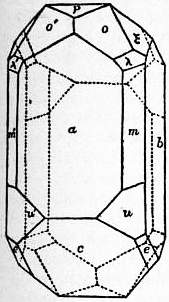
Several varieties, depending on differences in structure and chemical composition, have been distinguished, viz. coccolite (from κόκκος, a grain), a granular variety; salite or sahlite, from Sala in Sweden; malacolite; diallage; violane, a lamellar variety of a dark violet-blue colour; chrome-diopside, a bright green variety containing a small amount of chromium; and many others. Belonging to the same series with diopside and hedenbergite is a manganese pyroxene, known as schefierite, which has the composition (Ca, Mg) (Fe, Mn) (Si03)2.
Diopside is the characteristic pyroxene of metamorphic rocks, occurring especially in crystalline limestones, and often in association with garnet and epidote. It is also an essential constituent of some pyroxene-granites, diorites and a few other igneous rocks, but the characteristic pyroxene of this class of rocks is augite. Fine transparent crystals of a pale green colour occur, with crystals of yellowish-red garnet (hessonite) and chlorite, in veins traversing serpentine in the Ala valley near Turin in Piedmont: a crystal of this variety (“alalite”) is represented in the accompanying figure. These, as well as the long, transparent, bottle-green crystals from the Zillerthal in the Tyrol, have occasionally been cut as gem-stones. Good crystals have been found also at Achmatovsk near Zlatoust in the Urals, Traversella near Ivrea in Piedmont (“traversellite”), Nordmark in Sweden, Monroe in New York, Burgess in Lanark county, Ontario, and several other places: at Nordmark the large, rectangular black crystals occur with magnetite in the iron mines.
(L. J. S.)
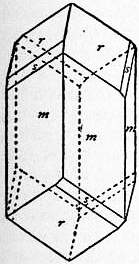
DIOPTASE, a rare mineral species consisting of acid copper orthosilicate, H2CuSiO4, crystallizing in the parallel-faced hemihedral class of the rhombohedral system. The degree of symmetry is the same as in the mineral phenacite, there being only an axis of triad symmetry and a centre of symmetry. The crystals have the form of a hexagonal prism m terminated by a rhombohedron r, the alternate edges between these being sometimes replaced by the faces of a rhombohedron s. The faces are striated parallel to the edges between r, s and m. There are perfect cleavages parallel to the faces of a rhombohedron which truncate the polar edges of r: from the cleavage cracks internal reflections are often to be seen in the crystal, and it was on account of this that the mineral was named dioptase, by R. J. Haüy in 1797, from διοπτεύειν, “to see into.” The crystals vary from transparent to translucent with a vitreous lustre, and are bright emerald-green in colour; they thus have a certain resemblance to emerald, hence the early name emerald-copper (German, Kupfer-Smaragd). Hardness 5; sp. gr. 3.3. The mineral is decomposed by hydrochloric acid with separation of gelatinous silica. At a red heat it blackens and gives off water. The fine crystals from Mount Altyn-Tübe on the western slopes of the Altai Mountains in the Kirghiz Steppes, Asiatic Russia, line cavities in a compact limestone; they were first sent to Europe in 1785 by Achir Mahmed, a Bucharian merchant, after whom the mineral has been named archirite. More recently, in 1890, good crystals of similar habit, but rather darker in colour, have been found with quartz and malachite near Komba in the French Congo. As drusy crystalline crusts it has been found at Copiapo in Chile and in Arizona.
Dioptase has occasionally been used as a gem-stone, especially in Russia and Persia; it has a fine colour, but a low degree of hardness and the transparency is imperfect.
(L. J. S.)
DIORITE (from the Gr. διορίζειν to distinguish, from διά through, ὅρος, a boundary), in petrology, the name given by Haüy to a family of rocks of granitic texture, composed of plagioclase felspar and hornblende. As they are richer in the dark coloured ferromagnesian minerals they are usually grey or dark grey, and have a higher specific gravity than granite. They also rarely show visible quartz. But there are diorites of many kinds, as the name applies rather to a family of rocks than to a single species. Some contain biotite, others augite or hypersthene; many have a small amount of quartz. Orthoclase is rarely entirely absent, and when it is fairly common the rock becomes a tonalite; in this way a transition is furnished between diorites and granites. It is rare to find the pure types of “hornblende-diorite,” “augite-diorite,” &c., but in most cases the rocks contain two or more ferromagnesian silicates, and such combinations as “hornblende-biotite-diorite” are commonest in nature.
The felspar of the diorites ranges in composition from oligoclase to labradorite, and is often remarkably zonal, the external layers being more alkaline than the internal. Small fluid enclosures and black grains, probably iron oxides, often occur in it in great numbers. Weathering produces epidote, calcite, sericite and kaolin. The biotite is always brown or yellow; the hornblende usually green, but sometimes brown or yellowish brown in those diorites which have affinities to lamprophyres. The augite is nearly always green but sometimes has a reddish tinge; bronzite and hypersthene have their usual green and brown shades. Apatite, iron oxides and zircon are almost invariably present; sphene, garnet and orthite are occasionally observed; calcite, chlorite, muscovite, kaolin, epidote and bastite are secondary. The structure is not essentially different from that of granite. The ferromagnesian minerals crystallize comparatively early and have some idiomorphism; the felspar usually follows and only in part shows good crystalline outlines. Orthoclase and quartz, if present, are last to separate out, and fill the spaces between the other minerals; often they interpenetrate to form micropegmatite. In many diorites the plagioclase felspar has crystallized before the hornblende, which consequently has less perfect outlines and forms irregular plates which enclose sharply formed individuals of felspar. This produces the ophitic structure (very common also in the dolerites). More rarely biotite and augite exhibit the same relations to the plagioclase. Orbicular structure also occasionally appears in these rocks; in fact the orbicular diorite of Corsica (also called “Napoleonite” or “Corsite”) was for a long time the best-known example of this structure. The rock seems composed of spheroids, about an inch in diameter, surrounded by a smaller amount of dark-coloured dioritic matrix. The spheroids have a radiate structure and often show concentric dark and pale shells. These consist of hornblende (dark green) and basic plagioclase felspar, labradorite and bytownite (grey or nearly white). Occasionally diorites have a parallel banded or foliated structure, but these must not be confounded with the epidiorites, which are metamorphic rocks and also have a conspicuous foliation.
Diorites must also be distinguished from hornblendic gabbros, which contain more basic felspars, rarely quartz and occasionally olivine; but the boundary lines between diorites and gabbros are admittedly somewhat vague, e.g. some authors would call rocks gabbro which others would regard as augite-diorite. The hornblendites differ from the diorites in containing little felspar, and consist principally of hornblende. Among varietal designations given to rocks of the diorite family are “banatite” for an augite-diorite with or without quartz (from the Schemnitz district), “granodiorite” for a quartz-hornblende-diorite (essentially the same as tonalite) from California, &c., “adamellite” for the quartz-mica-diorite or tonalite of Monte Adamello (Alps), “ornite” for a hornblende-diorite rich in felspar, from Sweden.
(J. S. F.)
DIP (Old Eng. dyppan, connected with the common Teutonic root seen in “deep”), the angle which the magnetic needle makes with the horizon. A freely suspended magnetic needle will not maintain a horizontal position except at the magnetic equator. Over the N. magnetic pole the north-seeking end of the needle points directly downwards and dips at an intermediate angle at intermediate distances between the magnetic poles and equator. There are secular progressive variations of dip as well as of declination and the maxima are independent of each other. In 1576 the dip at London was 71° 50′, in 1720 (max.) 74° 42′, in 1900 67° 9′. (For Dip Circle see Inclinometer.)
DIPHENYL (phenyl benzene), C6H5·C6H5, a hydrocarbon found in that fraction of the coal-tar distillate boiling between 240-300° C., from which it may be obtained by warming with sulphuric acid, separating the acid layer and strongly cooling the undissolved oil. It may be artificially prepared by passing benzene vapour through a red-hot tube; by the action of sodium on brombenzene dissolved in ether; by the action of stannous chloride on phenyldiazonium chloride; or by the addition of solid phenyldiazonium sulphate to warm benzene (R. Möhlau, Berichte, 1893, 26, 1997) C6H5N2·HSO4 + C6H6 = H2SO4 + N2 + C6H5·C6H5. L. Gattermann (Berichte, 1890, 23, 1226) has also prepared it by the decomposition of a solution of phenyldiazonium sulphate with alcohol and copper powder. It crystallizes in plates (from alcohol) melting at 70-71° C. and boiling at 254° C. It is oxidized by chromic acid in glacial acetic acid solution to benzoic acid, dilute nitric acid and chromic acid mixture being without effect. It is not reduced by hydriodic acid and phosphorus, but sodium in the presence of amyl alcohol reduces it to tetrahydrodiphenyl C12H14.
Many substitution derivatives are known: the monosubstitution derivatives being capable of existing in three isomeric forms. Of the disubstitution derivatives the most important are those derived from diparadiaminodiphenyl or benzidine (q.v.).
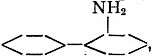
Orthoaminodiphenyl, is prepared by the action of bromine and caustic soda on orthophenylbenzamide (R. Hirsch, Berichte, 1892, 25, 1974); when its vapour is passed over heated lime, carbazol (q.v.) is formed.
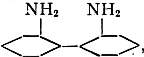
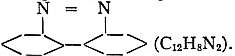
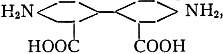
Diorthodiaminodiphenyl, is obtained by the reduction of the corresponding nitro compound (obtained by the action of ethyl nitrite at 0° C. on metadinitrobenzidine hydrochloride). Its tetrazo compound on reduction gives a hydrazine which, on warming with hydrochloric acid at 150° C., decomposes into ammonium chloride and phenazone, One of the most important derivatives of diphenyl, from the theoretical point of view, is diphenic acid or diorthodiphenyl carboxylic acid, which can be obtained from diparadiaminodiphenyldiorthocarboxylic acid, or from phenanthrene (q.v.), the constitution of which it determines. See Benzidine for diparadiaminodiphenyl.
DIPHILUS, of Sinope, poet of the new Attic comedy and contemporary of Menander (342-291 b.c.). Most of his plays were written and acted at Athens, but he led a wandering life, and died at Smyrna. He was on intimate terms with the famous courtesan Gnathaena (Athenaeus xiii. pp. 579, 583). He is said to have written 100 comedies, the titles of fifty of which are preserved. He sometimes acted himself. To judge from the imitations of Plautus. (Casina from the Κληρούμενοι, Asinaria from the Όναγός, Rudens from some other play), he was very skilful in the construction of his plots. Terence also tells us that he introduced into the Adelphi (ii. 1) a scene from the Συναποθνήσκοντες, which had been omitted by Plautus in his adaptation (Commorientes) of the same play. The style of Diphilus was simple and natural, and his language on the whole good Attic; he paid great attention to versification, and was supposed to have invented a peculiar kind of metre. The ancients were undecided whether to class him among the writers of the New or Middle comedy. In his fondness for mythological subjects (Hercules, Theseus) and his introduction on the stage (by a bold anachronism) of the poets Archilochus and Hipponax as rivals of Sappho, he approximates to the spirit of the latter.
Fragments in H. Koch, Comicorum Atticorum fragmenta, ii.; see J. Denis, La Comédie grecque (1886), ii. p. 414; R. W. Bond in Classical Review (Feb. 1910, with trans. of Emporos fragm.).
DIPHTHERIA (from διφθέρα, a skin or membrane), the term applied to an acute infectious disease, which is accompanied by a membranous exudation on a mucous surface, generally on the tonsils and back of the throat or pharynx.
In general the symptoms at the commencement of an attack of diphtheria are comparatively slight, being those commonly accompanying a cold, viz. chilliness and depression. Sometimes more severe phenomena usher in the attack, such as vomiting and diarrhoea. A slight feeling of uneasiness in the throat is experienced along with some stiffness of the back of the neck. When looked at the throat appears reddened and somewhat swollen, particularly in the neighbourhood of the tonsils, the soft palate and upper part of pharynx, while along with this there is tenderness and swelling of the glands at the angles of the jaws. The affection of the throat spreads rapidly, and soon the characteristic exudation appears on the inflamed surface in the form of greyish-white specks or patches, increasing in extent and thickness until a yellowish-looking false membrane is formed. This deposit is firmly adherent to the mucous membrane beneath or incorporated with it, and if removed leaves a raw, bleeding, ulcerated surface, upon which it is reproduced in a short period. The appearance of the exudation has been compared to wet parchment or washed leather, and it is more or less dense in texture. It may cover the whole of the back of the throat, the cavity of the mouth, and the posterior nares, and spread downwards into the air-passages on the one hand and into the alimentary canal on the other, while any wound on the surface of the body is liable to become covered with it. This membrane is apt to be detached spontaneously, and as it loosens it becomes decomposed, giving a most offensive and characteristic odour to the breath. There is pain and difficulty in swallowing, but unless the disease has affected the larynx no affection of the breathing. The voice acquires a snuffling character. When the disease invades the posterior nares an acrid, fetid discharge, and sometimes also copious bleeding, takes place from the nostrils. Along with these local phenomena there is evidence of constitutional disturbance of the most severe character. There may be no great amount of fever, but there is marked depression and loss of strength. The pulse becomes small and frequent, the countenance pale, the swelling of the glands of the neck increases, which, along with the presence of albumen in the urine, testifies to a condition of blood poisoning. Unless favourable symptoms emerge death takes place within three or four days or sooner, either from the rapid extension of the false membrane into the air-passage, giving rise to asphyxia, or from a condition of general collapse, which is sometimes remarkably sudden. In cases of recovery the change for the better is marked by an arrest in the extension of the false membrane, the detachment and expectoration of that already formed, and the healing of the ulcerated mucous membrane beneath. Along with this there is a general improvement in the symptoms, the power of swallowing returns, and the strength gradually increases, while the glandular enlargement of the neck diminishes, and the albumen disappears from the urine. Recovery, however, is generally slow, and it is many weeks before full convalescence is established. Even, however, where diphtheria ends thus favourably, the peculiar sequelae already mentioned are apt to follow, generally within a period of two or three weeks after all the local evidence of the disease has disappeared. These secondary affections may occur after mild as well as after severe attacks, and they are principally in the form of paralysis affecting the soft palate and pharynx, causing difficulty in swallowing with regurgitation of food through the nose, and giving a peculiar nasal character to the voice. There are, however, other forms of paralysis occurring after diphtheria, especially that affecting the muscles of the eye, which produces a loss of the power of accommodation and consequent impairment of vision. There may be, besides, paralysis of both legs, and occasionally also of one side of the body (hemiplegia). These symptoms, however, after continuing for a variable length of time, almost always ultimately disappear.
Under the name of the Malum Egyptiacum, Aretaeus in the 2nd century gives a minute description of a disease which in all its essential characteristics corresponds to diphtheria. In the 16th, 17th and 18th centuries epidemics of diphtheria appear to have frequently prevailed in many parts of Europe, particularly in Holland, Spain, Italy, France, as well as in England, and were described by physicians belonging to those countries under various titles; but it is probable that other diseases of a similar nature were included in their descriptions, and no accurate account of this affection had been published till M. Bretonneau of Tours in 1821 laid his celebrated treatise on the subject before the French Academy of Medicine. By him the term La Diphthérite was first given to the disease.
Great attention has been paid to diphtheria in recent years, with some striking results. Its cause and nature have been definitely ascertained, the conditions which influence its prevalence have been elucidated, and a specific “cure” has been found. In the last respect it occupies a unique position at the present time. In the case of several other zymotic diseases much has been done by way of prevention, little or nothing for treatment; in the case of diphtheria prevention has failed, but treatment has been revolutionized by the introduction of antitoxin, which constitutes the most important contribution to practical medicine as yet made by bacteriology.
The exciting cause of diphtheria is a micro-organism, identified by Klebs and Loffler in 1883 (see Parasitic Diseases). It has been shown by experiment that the symptoms of diphtheria, including the after-effects, are produced by Causation. a toxin derived from the micro-organisms which lodge in the air-passages and multiply in a susceptible subject. The natural history of the organism outside the body is not well understood, but there is some reason to believe that it lives in a dormant condition in suitable soils. Recent research does not favour the theory that it is derived from defective drains or “sewer gas,” but these things, like damp and want of sunlight, probably promote its spread, by lowering the health of persons exposed to them, and particularly by causing an unhealthy condition of the throat, rendering it susceptible to the contagion. Defective drainage, or want of drainage, may also act, by polluting the ground, and so providing a favourable soil for the germ, though it is to be noted that “the steady increase in the diphtheria mortality has coincided, in point of time, with steady improvement in regard of such sanitary circumstances as water supply, sewerage, and drainage” (Thorne Thorne). Cats and cows are susceptible to the diphtheritic bacillus, and fowls, turkeys and other birds have been known to suffer from a disease like diphtheria, but other domestic animals appear to be more or less resistant or immune. In human beings the mere presence of the germ is not sufficient to cause disease; there must also be susceptibility, but it is not known in what that consists. Individuals exhibit all degrees of resistance up to complete immunity. Children are far more susceptible than adults, but even children may have the Klebs-Loffler bacillus in their throats without showing any symptoms of illness. Altogether there are many obscure points about this micro-organism, which is apt to assume a puzzling variety of forms. Nevertheless its identification has greatly facilitated the diagnosis of the disease, which was previously a very difficult matter, often determined in an arbitrary fashion on no particular principles.
Diphtheria, as at present understood, may be defined as sore throat in which the bacillus is found; if it cannot be found, the illness is regarded as something else, unless the clinical symptoms are quite unmistakable. One result of this is a large transference of registered mortality from other throat affections, and particularly from croup, to diphtheria. Croup, which never had a well-defined application, and is not recognized by the College of Physicians as a synonym for diphtheria, appears to be dying out from the medical vocabulary in Great Britain. In France the distinction has never been recognized.
Diphtheria is endemic in all European and American countries, and is apparently increasing, but the incidence varies greatly. It is far more prevalent on the continent than in England, and still more so in the United States and Prevalence. Canada. The following table, compiled from figures collected by Dr Newsholme, shows how London compares with some foreign cities. The figures give the mean death-rate from diphtheria and croup for the term of years during which records have been kept. The period varies in different cases, and therefore the comparison is only a rough one.
Mean Death-Rates from Diphtheria and Croup per Million living.
New York 1610 Munich 990
Chicago 1400 Milan 990
Buenos Aires 1360 Florence 830
Trieste 1300 Vienna 770
Dresden 1290 Stockholm 720
Berlin 1190 St Petersburg 650
Boston 1160 Moscow 640
Marseilles 1130 Paris 630
Christiania 1090 Hamburg 490
Budapest 1880 London 386
There is comparatively little diphtheria in India and Japan, but in Egypt, the Cape and Australasia it prevails very extensively among the urban populations. The mortality varies greatly from year to year in all countries and cities. In Berlin, for instance, it has oscillated between a maximum of 2420 in 1883 and a minimum of 340 in 1896; in New York between 2760 in 1877 and 680 in 1868; in Christiania between 3290 in 1887 and 170 in 1871. In some American cities still higher maxima have been recorded. In other words, diphtheria, though always endemic, exhibits at times a great increase of activity, and becomes epidemic or even pandemic. The following table for 1859-99 shows fairly well the periodical rise and fall in England and Wales. Diphtheria and croup are given both separately and together, showing the increasing transference from one to the other of late years. Diphtheria was first entered separately in the year 1859.
Deaths from Diphtheria and Croup per Million living in England and Wales.
Years. Diphtheria. Croup. Diphtheria and Croup.
1859 517 286 803
1860 261 220 481
1861-70 185 246 431
1871-80 121 168 289
1881-90 163 144 307
1891-95 254 70 324
1896-97 269 43 312
1898 244 27 271
1899 293 32 325
The combined figures for diphtheria and croup in later years are:— (1900) 316; (1901) 296; (1902) 255; (1903) 195; (1904) 184; (1905) 174; (1906) 190; (1907) 175; (1908) 166.
Several facts are roughly indicated by the table. It begins with an extremely severe epidemic, which has not been approached since. Then follows a fall extending over twenty years. On the whole this diminution was progressive, though not in reality so steady as the decennial grouping makes it appear, being interrupted by smaller oscillations in single years and groups of years. Still the main fact holds good. After 1880 an opposite movement began, likewise interrupted by minor oscillations, but on the whole progressive, and culminating in the year 1893 with a death-rate of 389, the highest recorded since 1865. After 1896 a marked fall again took place. This is partly accounted for by the use of antitoxin, which only began on a considerable scale in 1895, and did not become general until a year or two later at least. Its effects were only then fully felt. The registrar-general’s returns record mortality, not prevalence—that is to say, the number of deaths, not of cases.
On the whole, we get clear evidence of an epidemic rise and fall, which may serve to dispose of some erroneous conceptions. The belief, held until recently, that diphtheria is steadily increasing in Great Britain was obviously premature; it did rise over a series of years, but has now ebbed again. Moreover, the general prevalence during the last thirty years has been notably less than in the previous twelve years. Yet it is during years since 1870 that compulsory education has been in existence and main drainage chiefly carried out. It follows that neither school attendance nor sewer gas exercises such an important influence over the epidemicity of diphtheria as some other conditions. What are those conditions? Dr Newsholme has advanced the theory, based on an elaborate examination of statistics in various countries, that the activity of diphtheria is connected with the rainfall, and he lays down the following general induction from the facts: “Diphtheria only becomes epidemic in years in which the rainfall is deficient, and the epidemics are on the largest scale when three or more years of deficient rainfall follow each other.” He points out that the comparative rarity of diphtheria in tropical climates, which are characterized by excessive rainfall, and its greater prevalence in continental than in insular countries, confirm his theory. His observations seem quite contrary to the view laid down by various authorities, and hitherto accepted, that wet weather favours diphtheria. The two, however, are not irreconcilable. The key to the problem—and possibly to many other epidemiological problems—may perhaps be found in the movements of the subsoil water. It has been suggested by different observers, and particularly by Mr M. A. Adams, who has for some years made a study of the subsoil water at Maidstone, that there is a definite connexion between it and diphtheria. In England the underground water normally reaches its lowest level at the end of the summer; then it gradually rises, fed by percolation from the winter rains, reaching a maximum level about the end of March, after which it gradually sinks. This maximum level Mr Adams calls the annual spring cleaning of the soil, and his observations go to show that when the normal movement is arrested or disturbed, diphtheria becomes active. Now that is what happens in periods of drought. The underground water does not rise to its usual level, and there is no spring cleaning. The hypothesis, then, is this: The diphtheria bacillus lives in the soil, but is “drowned out” in wet periods by the subsoil water. In droughty ones it lives and flourishes in the warm, dry soil; then when rain comes, it is driven out with the ground air into the houses. This process will continue for some time, so that epidemic outbreaks may well seem to be associated with wet. But they begin in drought, and are stopped by long-continued periods of copious rainfall. This is quite in keeping with the observed fact that diphtheria is a seasonal disease, always most prevalent in the last quarter of the year. The summer develops the poison in the soil, the autumnal rains bring it out. The fact that the same cause does not produce the same effect in tropical countries may perhaps be explained by the extreme violence of the alternations, which are too great to suit this particular micro-organism, or possibly the regularity of the rainfall prevents its development.
The foregoing hypothesis is supported by a good deal of evidence, and notably by the concurrence of the great epidemic or pandemic prevalence in Great Britain, culminating in 1859, with a prolonged period of exceptionally deficient rainfall. Again, the highest death-rate registered since 1865 was in 1893, a year of similarly exceptional drought. But it is no more than an hypothesis, and the fate of former theories is a warning against drawing conclusions from statistics and records extending over too short a period of time. The warning is particularly necessary in connexion with meteorological conditions, which are apt to upset all calculations. As it happens, a period of deficient rainfall even greater than that of 1854-1858 has recently been experienced. It began in 1893 and culminated in the extraordinary season of 1899. The dry years were 1893, 1895, 1896, 1898 and 1899, and the deficiency of rainfall was not made good by any considerable excess in 1894 and 1897. It surpassed all records at Greenwich; streams and wells ran dry all over the country, and the flow of the Thames and Lea was reduced to the lowest point ever recorded. There should be, according to the theory, at least a very large increase in the prevalence of diphtheria. To a certain extent it has held good. There was a marked rise in 1893-1896 over the preceding period, though not so large as might have been expected, but it was followed by a decided fall in 1897-1898. The experience of 1898 contradicts, that of 1899 supports, the theory. Further light is therefore required; but perhaps the failure of the recent drought to produce results at all comparable with the epidemic of the ’fifties may be due to variations in the resistance of the disease, which differs widely in different years. It may also be due in part to improved sanitation, to the notification of infectious diseases, the use of isolation hospitals, which have greatly developed in quite recent years, and, lastly, to the beneficial effects of antitoxin. If these be the real explanations, then scientific and administrative work has not been thrown away after all in combating this very painful and fatal enemy of the young.
The conditions governing the general prevalence of diphtheria, and its epidemic rise and fall, which have just been discussed, do not touch the question of actual dissemination. The contagion is spread by means which are in constant Dissemination. operation, whether the general amount of disease is great or small. Water, so important in some epidemic diseases, is believed not to be one of them, though a negative proof based on absence of evidence cannot be accepted as conclusive. On the other hand, milk is undoubtedly a means of dissemination. Several outbreaks of an almost explosive character, besides minor extensions of disease from one place to another, have been traced to this cause. Milk may be contaminated in various ways—at the dairy, for instance, or on the way to customers,—but several cases, investigated by the officers of the Local Government Board and others, have been thought to point to infection from cows suffering from a diphtheritic affection of the udder. The part played by aërial convection is undetermined, but there is no reason to suppose that the infecting material is conveyed any distance by wind or air currents. Instances which seem to point to the contrary may be explained in other ways, and particularly by the fact, now fully demonstrated, that persons suffering from minor sore throats, not recognized as diphtheria, may carry the disease about and introduce it into other localities. Human intercourse is the most important means of dissemination, the contagion passing from person to person either by actual contact, as in kissing, or by the use of the same utensils and articles, or by mere proximity. In the last case the germs must be supposed to be air-borne for short distances, and to enter with the breath. Rooms appear liable to become infected by the presence of diphtheritic cases, and so spread the disease among other persons using them. At a small outbreak which occurred at Darenth Asylum in 1898 the infection clung obstinately to a particular ward, in spite of the prompt removal of all cases, and fresh ones continued to occur until it had been thoroughly disinfected, after which there were no more. The part played by human intercourse in fostering the spread of the disease suggests that it would naturally be more prevalent in urban communities, where people congregate together more, than in rural ones. This is at variance with the conclusion laid down by some authorities, that in this country diphtheria used to affect chiefly the sparsely populated districts, and though tending to become more urban, is still rather a rural disease. That view is based upon an analysis of the distribution by counties in England and Wales from 1855 to 1880, and it has been generally accepted and repeated until it has become a sort of axiom. Of course the facts of distribution are facts, but the general inference drawn from them, that diphtheria peculiarly affects the country and is changing its habitat, may be erroneous. Dr Newsholme, by taking a wider basis of experience, has arrived at the opposite conclusion, and finds that diphtheria does not, in fact, flourish more in sparsely-peopled districts. “When a sufficiently long series of years is taken,” he says, “it appears clear that there is more diphtheria in urban than in rural communities.” The rate for London has always been in excess of that for the whole of England and Wales. Its distribution at any given time is determined by a number of circumstances, and by their incidental co-operation, not by any property or predilection for town or country inherent in the disease. There are the epidemic conditions of soil and rainfall, previously discussed, which vary widely in different localities at different times; there is the steady influence of regular intercourse, and the accidental element of special distribution by various means. These things may combine to alter the incidence. In short, accident plays too great a part to permit any general conclusion to be drawn from distribution, except from a very wide basis of experience. The variations are very great and sometimes very sudden. For instance, the county of London for some years headed the list, having a far higher death-rate than any other. In 1898 it dropped to the fifth place, and was surpassed by Rutland, a purely rural county, which had the lowest mortality of all in the previous year and very nearly the lowest for the previous ten years. Again, South Wales, which had had a low mortality for some years, suddenly came into prominence as a diphtheria district, and in 1898 had the highest death-rate in the country. Staffordshire and Bedfordshire show a similar rise, the one an urban, the other a rural, county. All the northern counties, both rural and urban,—namely, Northumberland, Durham, Cumberland, Westmorland, Lancashire, Yorkshire, Cheshire and Lincolnshire,—had a very high rate in 1861-1870, and a low one in 1896-1898. It is obviously unsafe to draw general conclusions from distribution data on a small scale. Diphtheria appears to creep about very slowly, as a rule, from place to place, and from one part of a large town to another; it forsakes one district and appears in another; occasionally it attacks a fresh locality with great energy, presumably because the local conditions are exceptionally favourable, which may be due to the soil or, possibly, to the susceptibility of the inhabitants, who are, so to speak, virgin ground. But through it all personal infection is the chief means of spread.
The acceptance of this doctrine has directed great attention to the practical question of school influence. There is no doubt whatever that it plays a very considerable part in spreading diphtheria. The incidence of the disease is chiefly on children, and nothing so often and regularly brings large numbers together in close contact under the same roof as school attendance. Nothing, in fact, furnishes such constant and extensive opportunities for personal infection. Many outbreaks have definitely been traced to schools. In London the subject has been very fully investigated by Sir Shirley Murphy, the medical officer of health to the London County Council, and by Dr W. R. Smith, formerly medical officer of health to the London School Board. Sir Shirley Murphy has shown that a special incidence on children of school age began to manifest itself after the adoption of compulsory education, and that the summer holidays are marked by a distinct diminution of cases, which is succeeded by an increase on the return to school. Dr W. R. Smith’s observations are directed rather to minimizing the effect of school influence, and to showing that it is less important than other factors; which is doubtless true, as has been already remarked. It appears that the heaviest incidence falls upon infants under school age, and that liability diminishes progressively after school age is reached. But this by no means disposes of the importance of school influence, as the younger children at home may be infected by older ones, who have picked up the contagion at school, but, being less susceptible, are less severely affected and exhibit no worse symptoms than a sore throat. From a practical point of view the problem is a difficult one to deal with, as it is virtually impossible to ensure the exclusion of all infection, on account of the deceptively mild forms it may assume; but considering how very often outbreaks of diphtheria necessitate the closing of schools, it would probably be to the advantage of the authorities to discourage, rather than to compel, the attendance of children with sore throats. A fact of some interest revealed by statistics is that in the earliest years of life the incidence of diphtheria is greater upon male than upon female children, but from three years onwards the position is reversed, and with every succeeding year the relative female liability becomes greater. This is probably due to the habit of kissing maintained among females, but more and more abandoned by boys from babyhood onwards.
All these considerations suggest the importance of segregating the sick in isolation hospitals. Of late years this preventive measure has been carried out with increasing efficiency, owing to the better provision of such hospitals and the greater willingness of the public to make use of them; and probably the improvement so effected has had some share in keeping down the prevalence of the disease to comparatively moderate proportions. Unfortunately, the complete segregation of infected persons is hardly possible, because of the mild symptoms, and even absence of symptoms, exhibited by some individuals. A further difficulty arises with reference to the discharge of patients. It has been proved that the bacillus may persist almost indefinitely in the air-passages in certain cases, and in a considerable proportion it does persist for several weeks after convalescence. On returning home such cases may, and often do, infect others.
Since the antitoxin treatment was introduced in 1894 it has overshadowed all other methods. We owe this drug originally to the Berlin school of bacteriologists, and particularly to Dr Behring. The idea of making use of serum arose Treatment. about 1890, out of researches made in connexion with Mechnikov’s theory of phagocytosis, by which is meant the action of the phagocytes or white corpuscles of the blood in destroying the bacteria of disease. It was shown by the German bacteriologists that the serum or liquid part of the blood plays an equally or more important part in resisting disease, and the idea of combating the toxins produced by pathogenic bacteria with resistant serum injected into the blood presented itself to several workers. The idea was followed up and worked out independently in France and Germany, so successfully that by the year 1894 the serum treatment had been tried on a considerable scale with most encouraging results. Some of these were published in Germany in the earlier part of that year, and at the International Hygienic Congress, held in Budapest a little later, Dr Roux, of the Institut Pasteur, whose experience was somewhat more extensive than that of his German colleagues, read a paper giving the result of several hundred cases treated in Paris. When all allowance for errors had been made, they showed a remarkable and even astonishing reduction of mortality, fully confirming the conclusions drawn from the German experiments. This consensus of independent opinion proved a great stimulus to further trial, and before long one clinique after another told the same tale. The evidence was so favourable that Professor Virchow—the last man to be carried away by a novelty—declared it “the imperative duty of medical men to use the new remedy” (The Times, 19th October 1894). Since then an enormous mass of facts has accumulated from all quarters of the globe, all testifying to the value of antitoxin in the treatment of diphtheria. The experience of the hospitals of the London Metropolitan Asylums Board for five years before and after antitoxin may be given as a particularly instructive illustration; but the subsequent reduction in the rate of mortality (12 in 1900, 11.3 in 1901, 10.8 in 1902, 9.3 in 1903, and an average of 9 in 1904-1908) added further confirmation.
Annual Case Mortality in Metropolitan Asylums Board’s Hospitals.
Before Antitoxin. After Antitoxin.
Year. Mortality per cent. Year. Mortality per cent.
1890 33.55 1895 22.85
1891 30.61 1896 21.20
1892 29.51 1897 17.79
1893 30.42 1898 15.37
1894 29.29 1899 13.95
The number of cases dealt with in these five antitoxin years was 32,835, or an average of 6567 a year, and the broad result is a reduction of mortality by more than one-half. It is a fair inference that the treatment saves the lives of about 1000 children every year in London alone. This refers to all cases. Those which occur in the hospitals as a sequel to scarlet fever, and consequently come under treatment from the commencement, show very much more striking results. The case mortality, which was 46.8% in 1892 and 58.8% in 1893, has been reduced to 3.6% since the introduction of antitoxin. But the evidence is not from statistics alone. The beneficial effect of the treatment is equally attested by clinical observation. Dr Roux’s original account has been confirmed by a cloud of witnesses year after year. “One may say,” he wrote, “that the appearance of most of the patients is totally different from what it used to be. The pale and leaden faces are scarcely seen in the wards; the expression of the children is brighter and more lively.” Adult patients have described the relief afforded by inoculation; it acts like a charm, and lifts the deadly feeling of oppression off like a cloud in the course of a few hours. Finally, the counteracting effect of antitoxin in preventing the disintegrating action of the diphtheritic toxin on the nervous tissues has been demonstrated pathologically. There are some who still affect scepticism as to the value of this drug. They cannot be acquainted with the evidence, for if the efficacy of antitoxin in the treatment of diphtheria has not been proved, then neither can the efficacy of any treatment for anything be said to be proved. Prophylactic properties are also claimed for the serum; but protection is necessarily more difficult to demonstrate than cure, and though there is some evidence to support the claim, it has not been fully made out.
Authorities.—Adams, Public Health, vol. vii.; Thorne Thorne, Milroy Lectures (1891); Newsholme, Epidemic Diphtheria; W. R. Smith, Harben Lectures (1899); Murphy, Report to London County Council (1894); Sims Woodhead, Report to Metropolitan Asylums Board (1901).
DIPLODOCUS, a gigantic extinct land reptile discovered in rocks of Upper Jurassic age in western North America, the best-known example of a Sauropodous Dinosaur. The first scattered remains of a skeleton were found in 1877 by Prof. S.W. Williston near Cañon City, Colorado; and the tail and hind-limb of this specimen were described in the following year by Prof. O.C. Marsh. He noticed that in the part of the tail which dragged on the ground, each chevron bone below the vertebral column consisted of a pair of bars; and as so peculiar an arrangement for the protection of the artery and vein beneath the tail had not previously been observed in any animal, he proposed the name Diplodocus (“double beam” or “double bar”) for the new reptile, adding the specific name longus in allusion to the elongated shape of the tail vertebrae. In 1884 Prof. Marsh described the head, vertebrae and pelvis of the same skeleton, which is now in the National Museum, Washington. In 1897 the next important specimen, a tail associated with other fragments, apparently of Diplodocus longus, was obtained by the American Museum of Natural History, New York, from Como Bluffs, Wyoming. In 1899-1900 large parts of two skeletons of another species, in a remarkable state of preservation, were disinterred by Messrs J. L. Wortman, O. A. Peterson and J. B. Hatcher in Sheep Creek, Albany county, Wyo., and these are now exhibited with minor discoveries in the Carnegie Museum, Pittsburg. There are also other specimens in New York, Chicago and the University of Wyoming. In 1901 Mr J. B. Hatcher studied the new species at Pittsburg, named it Diplodocus carnegii, and published the first restored sketch of a complete skeleton. Shortly afterwards plaster casts of the finest specimens were prepared under the direction of Mr J. B. Hatcher and Dr W. J. Holland, and these were skilfully combined to form the cast of a completely reconstructed skeleton, which was presented to the British Museum by Andrew Carnegie in 1905. This reconstruction is based primarily on a well-preserved chain of vertebrae, extending from the second cervical to the twelfth caudal, associated with the ribs, pelvis and several limb-bones. The tail is completed from two other specimens in the Carnegie Museum, having caudals 13 to 36 and 37 to 73 respectively in apparently unbroken series. Prof. Marsh’s specimen in Washington supplied the greater part of the skull; and the fore-foot is copied from a specimen in New York.

Reconstructed Skeleton of Diplodocus carnegii, Hatcher, about one-hundredth natural size. A and B, Caudal Vertebrae Nos. 36 and 70 of the same are about one-quarter natural size.
The cast of the reconstructed skeleton of Diplodocus carnegii measures 84 ft. in length and 12 ft. 9 in. in maximum height at the hind-limbs. It displays the elongated neck and tail and the relatively small head so characteristic of the Sauropodous Dinosaurs. The skull is inclined to the axis of the neck, denoting a browsing animal; while the feeble blunt teeth and flat expanded snout suggest feeding among succulent water-weeds. The large narial opening at the highest point of the head probably indicates an aquatic mode of life, and there seems to have been a soft valve to close the nostrils when under water. The diminutive brain-cavity, scarcely large enough to contain a walnut, is noteworthy. There are 104 vertebrae, namely, 15 in the neck, 11 in the back, 5 in the sacrum and 73 in the tail. The presacral vertebrae are of remarkably light construction, the plates and struts of bone being arranged to give the greatest strength with the least weight. The end of the tail is a flexible lash, which would probably be used as a weapon, like the tail of some existing lizards. The feet, notwithstanding the weight they had to support, are as unsymmetrical as those of a crocodile, with claws only on the three inner toes. There is no external armour.
See O. C. Marsh, Amer. Journ. Sci. ser. 3, vol. xvi. (1878), p. 414, pl. viii., and loc. cit. vol. xxvii. (1884), p. 161, pls. iii., iv.; H. F. Osborn, Mem. Amer. Mus. Nat. Hist. vol. i. pt. v. (1899); J. B. Hatcher, Mem. Carnegie Mus. vol. i. No. 1 (1901), and vol. ii. No. 1 (1903); W. J. Holland, Mem. Carnegie Mus. vol. ii. No. 6 (1906).
(A. S. Wo.)
DIPLOMACY (Fr. diplomatie), the art of conducting international negotiations. The word, borrowed from the French, has the same derivation as Diplomatic (q.v.), and, according to the New English Dictionary, was first used in England so late as 1796 by Burke. Yet there is no other word in the English language that could supply its exact sense. The need for such a term was indeed not felt; for what we know as diplomacy was long regarded, partly as falling under the Jus gentium or international law, partly as a kind of activity morally somewhat suspect and incapable of being brought under any system. Moreover, though in a certain sense it is as old as history, diplomacy as a uniform system, based upon generally recognized rules and directed by a diplomatic hierarchy having a fixed international status, is of quite modern growth even in Europe. It was finally established only at the congresses of Vienna (1815) and Aix-la-Chapelle (1818), while its effective extension to the great monarchies of the East, beyond the bounds of European civilization, was comparatively an affair of yesterday. So late as 1876 it was possible for the writer on this subject in the 9th edition of the Encyclopaedia Britannica to say that “it would be an historical absurdity to suppose diplomatic relations connecting together China, Burma and Japan, as they connect the great European powers.”
Principles.—Though diplomacy has been usually treated under the head of international law, it would perhaps be more consonant with the facts to place international law under diplomacy. The principles and rules governing the intercourse of states, defined by a long succession of international lawyers, have no sanction save the consensus of the powers, established and maintained by diplomacy (see Balance of Power); in so far as they have become, by international agreement, more than mere pious opinions of theorists, they are working rules established for mutual convenience, which it is the function of diplomacy to safeguard or to use for its own ends. In any case they by no means cover the whole field of diplomatic activity; and, were they swept away, the art of diplomacy, developed through long ages of experience, would survive.
This experience may perhaps be called the science, as distinct from the art, of diplomacy. It covers not only the province of international law, but the vast field of recorded experience which we know as history, of which indeed international law is but a part; for, as Bielfeld in his Institutions politiques (La Haye, 1760, t. I. ch. ii. § 13) points out, “public law is founded on facts. To know it we must know history, which is the soul of this science as of politics in general.” The broad outlook on human affairs implied in “historical sense” is more necessary to the diplomatist under modern conditions than in the 18th century, when international policy was still wholly under the control of princes and their immediate advisers. Diplomacy was then a game of wits played in a narrow circle. Its objects too were narrower; for states were practically regarded as the property of their sovereigns, which it was the main function of their “agents” to enlarge or to protect, while scarcely less important than the preservation or rearrangement of territorial boundaries was that of precedence and etiquette generally, over which an incredible amount of time was wasted. The haute diplomatie thus resolved itself into a process of exalted haggling, conducted with an utter disregard of the ordinary standards of morality, but with the most exquisite politeness and in accordance with ever more and more elaborate rules. Much of the outcome of these dead debates has become stereotyped in the conventions of the diplomatic service; but the character of diplomacy itself has undergone a great change. This change is threefold: firstly, as the result of the greater sense of the community of interests among nations, which was one of the outcomes of the French Revolution; secondly, owing to the rise of democracy, with its expression in parliamentary assemblies and in the press; thirdly, through the alteration in the position of the diplomatic agent, due to modern means of communication.
The first of these changes may be dated to the circular of Count Kaunitz of the 17th of July 1791, in which, in face of the Revolution, he impressed upon the powers the duty of making common cause for the purpose of preserving “public peace, the tranquillity of states, the inviolability of possessions, and the faith of treaties.” The duty of watching over the common interests of Europe, or of the world, was thus for the first time officially recognized as a function of diplomacy, since common action could only be taken as the result of diplomatic negotiations. It would be easy to exaggerate the effective results of this idea, even when it had crystallized in the Grand Alliance of 1814 and been proclaimed to the world in the Holy Alliance of the 26th of September 1815 and the declaration of Aix-la-Chapelle. The cynical picture given by La Bruyère of the diplomatist of the 18th century still remained largely true: “His talk is only of peace, of alliances, of the public tranquillity, and of the public interests; in reality he is thinking only of his own, that is to say, of those of his master or of his republic.”1 The proceedings of the congress of Vienna proved how little the common good weighed unless reinforced by particular interests; but the conception of “Europe” as a political entity none the less survived. The congresses, notably the congress of Aix-la-Chapelle (q.v.) in 1818, were in a certain sense European parliaments, and their ostensible object was the furtherance of common interests. Had the imperial dreamer Alexander I. of Russia had his way, they would have been permanently established on the broad basis of the Holy Alliance, and would have included, not the great powers only, but representatives of every state (see Alexander I. and Europe : History). Whatever the effective value of that “Concert of Europe” which was the outcome of the period of the congresses, it certainly produced a great effect on the spirit and the practice of diplomacy. In the congresses and conferences diplomacy assumes international functions both legislative and administrative. The diplomat is responsible, not only to his own government, but to “Europe.” Thus Castlereagh was accused of subordinating the interests of Great Britain to those of Europe; and the same charge was brought, perhaps with greater justice, against Metternich in respect of Austria. Canning’s principle of “Every nation for itself and God for us all!” prevailed, it is true, over that of Alexander’s “Confederation of Europe”; yet, as one outcome of the congresses, every diplomatic agent, though he represents the interests of his own state, has behind him the whole body of the treaties which constitute the public law of the world, of which he is in some sort the interpreter and the guardian.
Parallel with this development runs the second process making for change: the increasing responsibility of diplomacy to public opinion. To discuss all the momentous issues involved in this is impossible; but the subject is too important to be altogether passed over, since it is one of the main problems of modern international intercourse, and concerns every one who by his vote may influence the policy of the state to which he belongs. The question, broadly speaking, is: how far has the public discussion of international affairs affected the legitimate functions of diplomacy for better or for worse? To the diplomatist of the old school the answer seems clear. For him diplomacy was too delicate and too personal an art to survive the glare and confusion of publicity. Metternich, the last representative of the old haute diplomatie, lived to moralize over the ruin caused by the first manifestations of the “new diplomacy,” the outcome of the rise of the power of public opinion. He had early, from his own point of view, unfavourably contrasted the “limited” constitutional monarchies of the west with the “free” autocracies of the east of Europe, free because they were under no obligation to give a public account of their actions. He himself was a master of the old diplomatic art, of intrigue, of veiling his purpose under a cloud of magniloquence, above all, of the art of personal fascination. But public opinion was for him only a dangerous force to be kept under control; and, even had he realized the necessity for appealing to it, he had none of the qualities that would have made the appeal successful. In direct antagonism to him was George Canning, who may be called the great prototype of the “new diplomacy,” and to Metternich was a “malevolent meteor hurled by divine providence upon Europe.” Canning saw clearly the immense force that would be added to his diplomatic action if he had behind him the force of public opinion. In answer to Metternich’s complaint of the tone of speeches in parliament and of the popular support given in England to revolutionary movements, he wrote, “Our influence, if it is to be maintained abroad, must be secure in its sources of strength at home: and the sources of that strength are in the sympathy between the people and the government; in the union of the public sentiment with the public counsels; in the reciprocal confidence of the House of Commons and the crown.”2
It would be a mistake to jump to the conclusion that Canning was wholly right and Metternich wholly wrong. The conditions of the Habsburg monarchy were not those of Great Britain,3 and even if it had been possible to speak of a public opinion in the Austrian empire at all, it certainly possessed no such organ as the British parliament. But the argument may be carried yet further. In the abstract the success of the policy of a minister in a democratic state must ultimately rest upon the support of public opinion; yet the necessity for this support has in the conduct of foreign affairs its peculiar dangers. In the difficult game of diplomacy a certain reticence is always necessary. Secret sources of information would be dried up were they to be lightly revealed; a plain exposition of policy would often give an undue advantage to the other party to a negotiation. Thus, even in Great Britain, the diplomatic correspondence laid before parliament is carefully edited, and all governments are jealous of granting access to their modern archives. Yet a representative assembly is apt to be resentful of such reservations. Its members know little or nothing of the conditions under which foreign affairs are conducted, and they are not unnaturally irritated by explanations which seem to lack candour or completeness. Canning himself had experience of this in the affair of the capture of the Danish fleet at Copenhagen; and Castlereagh’s diplomacy was hampered by the bitter attacks of an opposition which accused him, with little justice, of pursuing a policy which he dared not reveal in its full scope to parliament. Moreover, the appeal to public opinion may be used as a diplomatic weapon for ends no less “selfish” than any aimed at by the old diplomacy. Bismarck, whose statesmanship was at least as cynical as that of Metternich, was a master of the art of taking the world into his confidence—when it suited him to do so; and the “reptile press,” hired to give a seemingly independent support to his policy, was one of his most potent weapons. So far the only necessary consequence of the growth of the power of public opinion on the art of diplomacy has been to extend the sphere of its application; it is but one more factor to be dealt with; and experience has proved that it is subject to the wiles of a skilful diplomatist no less than were the princes and statesmen with whom the old diplomacy was solely concerned.
The third factor making for change—the revolution in the means of communication which has brought all the world into closer touch—remains to be discussed. It is obvious that before the invention of the telegraph, the diplomatic agent was in a far more responsible position than he is now, when he can, in most cases, receive immediate instructions from his government on difficult questions as they arise. When communication was still slow there was often no time to await instructions, or the instructions when they arrived were not seldom already out of date and had to be set aside on the minister’s own responsibility. It would, however, be easy to exaggerate the importance of this change as affecting the character and status of diplomatic agents. It is true that the tendency has been for ministers of foreign affairs to hold the threads of diplomacy in their own hands to a far greater extent than was formerly the case; but they must still depend for information and advice on the “man on the spot,” and the success of their policy largely depends upon his qualities of discretion and judgment. The growth of democracy, moreover, has given to the ambassador a new and peculiar importance; for he represents not only the sovereign to the sovereign, but the nation to the nation; and, as a succession of notable American ambassadors to Great Britain has proved, he may by his personal qualities do a large amount to remove the prejudices and ignorances which stand as a barrier between the nations. It marks an immense advance in the comity of international intercourse when the representatives of friendly powers are no longer regarded as “spies rather than ambassadors,” to be “quickly heard and dismissed,” as Philippe de Commines would have them, but as agreeable guests to be parted from with regret.
As to the qualifications for an ambassador, it is clearly impossible to lay down a general rule, for the same qualities are obviously not required in Washington as in Vienna, nor in Paris as in Pekin. Yet the effort to depict the ideal ambassador bulks largely in the works of the earlier theorists, and the demands they make are sufficiently alarming. Ottaviano Maggi, himself a diplomatist of the brilliant age of the Renaissance, has left us in his De legato (Hanoviae, 1596) his idea of what an ambassador should be. He must not only be a good Christian but a learned theologian; he must be a philosopher, well versed in Aristotle and Plato, and able at a moment’s notice to solve in correct dialectical form the most abstruse problems; he must be well read in the classics, and an expert in mathematics, architecture, music, physics and civil and canon law. He must not only know how to write and speak Latin with classical refinement, but he must be a master of Greek, Spanish, French, German and Turkish. He must have a sound knowledge of history, geography and the science of war; but at the same time is not to neglect the poets, and never to be without his Homer. Add to this that he must be well born, rich and of a handsome presence, and we have a portrait of a diplomatist whose original can hardly have existed even in that age of brilliant versatility. The Dutchman Frederikus de Marselaer, in his κηρυκεῖον sive legationum insigne (Antwerp, 1618), is scarcely less exacting than the Venetian. His ideal ambassador is a nobleman of fine presence and in the prime of life, famous, rich, munificent, abstemious, not violent, nor quarrelsome, nor morose, no flatterer, learned, eloquent, witty without being talkative, a good linguist, widely read, prudent and cautious, but brave and—as he adds somewhat superfluously—many-sided.
With these theoretical perfections one or two instances of the qualifications demanded by the exigencies of practical politics may be cited by way of illuminating contrast. At the court of the empress Elizabeth of Russia good looks were a surer means of diplomatic success than all the talents and virtues, and the princess of Zerbst (mother of the empress Catherine II.) wrote to Frederick of Prussia advising him to replace his elderly ambassador by a handsome young man with a good complexion; and the essential qualification for an ambassador to Switzerland, Germany, Poland, Denmark and Russia used to be that he should be able to drink the native diplomatists, seasoned from babyhood to strong liquors, under the table.
History.—In its widest sense the history of diplomacy is that of the intercourse between nations, in so far as this has not been a mere brute struggle for the mastery;4 in a narrower sense, with which the present article is alone concerned, it is that of the methods and spirit of diplomatic intercourse and of the character and status of diplomatic agents. Earlier writers on the office and functions of ambassadors, such as Gentilis or Archbishop Germonius, conscientiously trace their origin to God himself, who created the angels to be his legates; and they fortify their arguments by copious examples drawn from ancient history, sacred and profane. But, whatever the influence upon it of earlier practice, modern diplomacy really dates from the rise of permanent missions, and the consequent development of the diplomatic hierarchy as an international institution. Of this the first beginnings are traceable to the 15th century and to Italy. There had, of course, during the middle ages been embassies and negotiations; but the embassies had been no more than temporary missions directed to a particular end and conducted by ecclesiastics or nobles of a dignity appropriate to each occasion; there were neither permanent diplomatic agents nor a professional diplomatic class. To the evolution of such a class the Italy of the Renaissance, the nursing-ground of modern statecraft, gave the first impetus. This was but natural; for Italy, with its numerous independent states, between which there existed a lively intercourse and a yet livelier rivalry, anticipated in miniature the modern states’ system of Europe. In feudal Europe there had been little room for diplomacy; but in northern and central Italy feudalism had never taken root, and in the struggles of the peninsula diplomacy had early played a part as great as, or greater than, war. Where all were struggling for the mastery, the existence of each depended upon alliances and counter-alliances, of which the object was the maintenance of the balance of power. In this school there was trained a notable succession of men of affairs. Thus, in the 13th and 14th centuries Florence counted among her envoys Dante, Petrarch and Boccaccio, and later on could boast of agents such as Capponi, Vettori, Guicciardini and Machiavelli. Papal Rome, too, as was to be expected, had always been a fruitful nursing-mother of diplomatists; and some authorities have traced the beginnings of modern diplomacy to a conscious imitation of her legatine system.5
It is, however, in Venice, that the origins of modern diplomacy are to be sought.6 So early as the 13th century the republic, with a view to safeguarding the public interests, began to lay down a series of rules for the conduct of its ambassadors. Thus, in 1236, envoys to the court of Rome are forbidden to procure a benefice for anyone without leave of the doge and little council; in 1268 ambassadors are commanded to surrender on their return any gifts they may have received, and by another decree they are compelled to take an oath to conduct affairs to the honour and advantage of the republic. About the same time it was decided that diplomatic agents were to hand in, on their return, a written account of their mission; in 1288 this was somewhat expanded by a law decreeing that ambassadors were to deposit, within fifteen days of their return, a written account of the replies made to them during their mission, together with anything they might have seen or heard to the honour or in the interests of the republic. These provisions, which were several times renewed, notably in 1296, 1425 and 1533, are the origin of the famous reports of the Venetian ambassadors to the senate, which are at once a monument to the political genius of Venetian statesmen and a mine of invaluable historical material.7
These are but a few examples of a long series of regulations, many others also dating to the 13th century, by which the Venetian government sought to systematize its diplomatic service. That permanent diplomatic agencies were not established by it earlier than was the case is probably due to the distrust of its agents by which most of this legislation of the republic is inspired. In the 13th century two or three months was considered over-long a period for an ambassador to reside at a foreign court; in the 15th century the period of residence was extended to two years, and in the 16th century to three. This latter rule continued till the end of the republic; the embassy had become permanent, but the ambassador was changed every three years.
The origin of the change from temporary to permanent missions has been the subject of much debate and controversy. The theory that it was due, in the first instance, to the evolution of the Venetian consulates (bajulats) in the Levant into permanent diplomatic posts, and that the idea was thence transferred to the West, is disproved by the fact that Venice had established other permanent embassies before the baylo (q.v.) at Constantinople was transformed into a diplomatic agent of the first rank. Nor is the first known instance of the appointment of a permanent ambassador Venetian. The earliest record8 is contained in the announcement by Francesco Sforza, duke of Milan, in 1455, of his intention to maintain a permanent embassy at Genoa9; and in 1460 the duke of Savoy sent Eusebio Margaria, archdeacon of Vercelli, as his permanent representative to the Curia.10 Though, however, the early records of such appointments are rare, the practice was probably common among the Italian states. Its extension to countries outside Italy was a somewhat later development. In 1494 Milan is already represented in France by a permanent ambassador. In 1495 Zacharia Contarini, Venetian ambassador to the emperor Maximilian, is described by Sanuto (Diarii, i. 294) as stato ambasciatore; and from the time of Charles V. onwards the succession of ambassadors of the republic at the imperial court is fairly traceable. In 1496 “as the way to the British Isles is very long and very dangerous,” two merchants resident in London, Pietro Contarini and Luca Valaressa, were appointed by the republic subambasciatores; and in June of the same year Andrea Trevisano arrived in London as permanent ambassador at the court of Henry VII.11 Florence, too, from 1498 onwards, was represented at the courts of Charles V. and of France by permanent ambassadors.
During the same period the practice had been growing up among the other European powers. Spain led the way in 1487 by the appointment of Dr Roderigo Gondesalvi de Puebla as ambassador in England. As he was still there in 1500, the Spanish embassy in London may be regarded as the oldest still surviving post of the new permanent diplomacy. Other states followed suit, but only fitfully; it was not till late in the 16th century that permanent embassies were regarded as the norm. The precarious relations between the European powers during the 16th century, indeed, naturally retarded the development of the system. Thus it was not till after good relations had been established with France by the treaty of London that, in 1519, Sir Thomas Boleyn and Dr West were sent to Paris as resident English ambassadors, and, after the renewed breach between the two countries, no others were appointed till the reign of Elizabeth. Nine years before, Sir Robert Wingfield, whose simplicity earned him the nickname of “Summer-shall-be-green,” had been sent as ambassador to the court of Charles V., where he remained from 1510 to 1517; and in 1520 the mutual appointment of resident ambassadors was made a condition of the treaty between Henry VIII. and Charles V. In 1517 Thomas Spinelly, who had for some years represented England at the court of the Netherlands, was appointed “resident ambassador to the court of Spain,” where he remained till his death on the 22nd of August 1522. These are the most important early instances of the new system. Alone of the great powers, the emperor remained permanently unrepresented at foreign courts. In theory this was the result of his unique dignity, which made him superior to all other potentates; actually it was because, as emperor, he could not speak for the practically independent princes nominally his vassals. It served all practical purposes if he were represented abroad by his agents as king of Spain or archduke of Austria.