VOLUME VIII SLICE V Dinard to Dodsworth (continued 4)
Reading edition
Little light on the relationship and evolution of the various families of Diptera is afforded by fossil forms, since as a rule the latter are readily referable to existing families. With the exception of a few species from the Solenhofen lithographic Oolite, fossil Diptera belong to the Tertiary Period, during which the members of this order attained a high degree of development. In amber, as proved by the deposits on the shores of the Baltic, the proverbial “fly” is more numerous than any other creatures, and with very few exceptions representatives of all the existing families have been found. The famous Tertiary beds at Florissant, Colorado, have yielded a considerable number of remarkably well-preserved Tipulidae (in which family are included the most primitive of existing Diptera), as also species belonging to other families, such as Mycetophilidae and even Oestridae.
Diptera as an order are probably more widely distributed over the earth’s surface than are the representatives of any similar division of the animal kingdom. Flies seem capable of adapting themselves to extremes of cold equally as well as to those of heat, and species belonging to the order are almost invariably included in the collections brought back by members of Arctic expeditions. Others are met with in the most isolated localities; thus the Rev. A. E. Eaton discovered on the desolate shores of Kerguelen’s Island apterous and semi-apterous Diptera (Tipulidae and Ephydridae) of a degraded type adapted to the climatic peculiarities of the locality. Many bird parasites belonging to the Hippoboscidae have naturally been carried about the world by their hosts, while other species, such as the house-fly, blow-fly and drone-fly, have in like manner been disseminated by human agency. Most families and a large proportion of genera are represented throughout the world, but in some cases (e.g. Glossina—see Tsetse-Fly) the distribution of a genus is limited to a continent. As a rule the general facies as well as dimensions are remarkably uniform throughout a family, so that tropical species often differ little in appearance from those inhabiting temperate regions. Many instances of exaggerated and apparently unnatural structure nevertheless occur, as in the case of the genera Pangonia, Nemestrina, Achias, Diopsis and the family Celyphidae, and, as might be expected, it is chiefly in tropical species that these peculiarities are found. To a geographical distribution of the widest extent, Diptera add a range of habits of the most diversified nature; they are both animal and vegetable feeders, an enormous number of species acting, especially in the larval state, as scavengers in consuming putrescent or decomposing matter of both kinds. The phytophagous species are attached to various parts of plants, dead or alive; and the carnivorous in like manner feed on dead or living flesh, or its products, many larvae being parasitic on living animals of various classes (in Australia the larva of a species of Muscidae is even a parasite of frogs), especially the caterpillars of Lepidoptera, which are destroyed in great numbers by Tachininae. The recent discovery of a bloodsucking maggot, which is found in native huts throughout the greater part of tropical and subtropical Africa, and attacks the inmates when asleep, is of great interest.
It may confidently be asserted that, of insects which directly or indirectly affect the welfare of man, Diptera form the vast majority, and it is a moot point whether the good effected by many species in the rapid clearing away of animal and vegetable impurities, and in keeping other insect enemies in check, counterbalances the evil and annoyance wrought by a large section of the Order. The part played by certain blood-sucking Diptera in the dissemination of disease is now well known (see Mosquito and Tsetse-Fly), and under the term myiasis medical literature includes a lengthy recital of instances of the presence of Dipterous larvae in various parts of the living human body, and the injuries caused thereby. That Diptera of the type of the common house-fly are often in large measure responsible for the spread of such diseases as cholera and enteric fever is undeniable, and as regards blood-sucking forms, in addition to those to which reference has already been made, it is sufficient to mention the vast army of pests constituted by the midges, sand-flies, horse-flies, &c., from the attacks of which domestic animals suffer equally with man, in addition to being frequently infested with the larvae of the bot and warble flies (Gastrophilus, Oestrus and Hypoderma). Lastly, as regards the phytophagous forms, there can be no doubt that the destruction of grass-lands by “leather-jackets” (the larvae of crane-flies, or daddy-long-legs,—Tipula oleracea and T. paludosa), of divers fruits by Ceratitis capitata and species of Dacus, and of wheat and other crops by the Hessian-fly (Mayetiola destructor) and species of Oscinis, Chlorops, &c., is of very serious consequence.
With many writers it is customary to treat the fleas as a sub-order of Diptera, under the title Aphaniptera or Siphonaptera. Since, however, although undoubtedly allied to the Diptera, they must have diverged from the ancestral stem at an early period, before the existing forms of Diptera became so extremely specialized, it seems better to regard the fleas as constituting an independent order (see Flea).
(E. E. A.)
DIPTERAL (Gr. for “double-winged”), the architectural term applied to those temples which have a double range of columns in the peristyle, as in the temple of Diana at Ephesus.
DIPTYCH (Gr. διπτυχος, two-folding), (1) A tablet made with a hinge to open and shut, used in the Roman empire for letters (especially love-letters), and official tokens of the commencement of a consul’s, praetor’s or aedile’s term of office. The latter variety of diptych was inscribed with the magistrate’s name and bore his portrait, and was issued to his friends and the public generally. They were made of boxwood or maple. More costly examples were in cedar, ivory (q.v.), silver or sometimes gold. They were often sent as New Year gifts.
(2)In the primitive church when the worshippers brought their own offerings of bread and wine, from which were taken the Communion elements, the names of the contributors were recorded on diptychs and read aloud. To these names were early added those of deceased members of the community whom it was desired to commemorate. This custom rapidly developed into a kind of commemoration of saints and benefactors, living and dead; especially, in each church, were the names of those who had been its bishops recorded. The custom was maintained until the lists became so long that it was impossible to read them through, and the observance in this form had to be abandoned. The insertion of a name on the diptych, thereby securing the prayers of the church, was a privilege from which a person could be excluded on account of suspicion of heresy or by the intrigues of enemies. His name could, if written, be expunged under similar circumstances. The names thus written were read from the ambo, in which the diptych was kept. The reading of these names during the canon of the mass gave rise to the term canonization. By various councils it was ordained that the name of the pope should always be inserted in the diptych list.
The addition of dates resulted from the custom of recording baptisms and deaths; and thus the diptych developed into a calendar and formed the germ of the elaborate system of festologies, martyrologies and calendars which developed in the church.
The diptych went by various names in the early church—mystical tablets, anniversary books, ecclesiastical matriculation registers or books of the living. According to the names inscribed, bishops, the dead or the living, a diptych might be a diptycha episcoporum, diptycha mortuorum or diptycha vivorum.
In course of time the list of the names swelled to such proportions that the space afforded by the diptych was insufficient. A third fold was consequently provided, and the tablet became a triptych (though the name diptych was retained as a general term for the object). Further room was afforded by the insertion of leaves of parchment or wood between the folds. The custom of reading names from the diptychs died out about the 8th century. The diptychs, however, were retained as altar ornaments. From the original consular documents onwards, the outsides of the folds had always been richly ornamented, and when they ceased to be of immediate practical use they became merely decorative. Instead of the list of names the inside was ornamented like the outer, and in the middle ages the best painters of the day would often paint them. When folded, the portraits of the donor and his wife might be shown; when open there would be three paintings, one on each fold, of a religious character.
(R. A. S. M.)
DIR, an independent state in the North-West Frontier Province of India, lying to the north-east of Swat. Its importance chiefly arises from the fact that it commands the greater part of the route between Chitral and the Peshawar frontier. The quarrels and intrigues between the khan of Dir and Umra Khan of Jandol were among the chief events that led up to the Chitral Campaign of 1895. During that expedition the khan made an agreement with the British Government to keep the road to Chitral open in return for a subsidy. Including the Bashkars, an aboriginal tribe allied to the Torwals and Garhuis, who inhabit Panjkora Kohistan, the population is estimated at about 100,000.
DIRCE, in Greek legend, daughter of Helios the sun-god, the second wife of Lycus, king of Thebes. She sorely persecuted Antiope, his first wife, who escaped to Mount Cithaeron, where her twin sons Amphion and Zethus were being brought up by a herdsman who was ignorant of their parentage. Having recognized their mother, the sons avenged her by tying Dirce to the horns of a wild bull, which dragged her about till she died. Her body was cast into a spring near Thebes, which was ever afterwards called by her name. Her punishment is the subject of the famous group called “The Farnese Bull,” by Apollonius and Tauriscus of Tralles, in the Naples museum (see Greek Art, Plate I. fig. 51).
DIRECT MOTION, in astronomy, the apparent motion of a body of the solar system on the celestial sphere in the direction from west to east; so called because this is the usual direction of revolution and rotation of the heavenly bodies.
DIRECTORS, in company law, the agents by whom a trading or public company acts, the company itself being a legal abstraction and unable to do anything. As joint-stock companies have multiplied and their enterprise has extended, the position of directors has become one of increasing influence and importance. It is they who control the colossal funds now invested in trading companies, and who direct their policy (for shareholders are seldom more than dividend-drawers). Upon their uprightness, vigilance and sound judgment depends the welfare of the greatest part of the trade of the country concerned. It is not to be wondered at that in view of this influence and independence of action the law courts have held directors to a strict standard of duty, and that the parliament of the United Kingdom has singled out directors from other agents for special legislation in the Directors Liability Act 1890, the Larceny Act 1861, the Companies Act 1867 and the Winding-up Act 1890.
The first directors of a company are generally appointed by the articles of association. Their consent to act must now, under the Companies Act 1908, be filed with the registrar of joint-stock companies. Directors other than the first are elected at the annual general meeting, a certain proportion of the acting directors—usually one-third—retiring under the articles by rotation each year, and their places being filled up by election. A share qualification is nearly always required, on the well-recognized principle that a substantial stake in the undertaking is the best guarantee of fidelity to the company’s interests. A director once appointed cannot be removed during his term of office by the shareholders, unless there is a special provision for that purpose in the articles of association; but a company may dismiss a director if the articles—as is usually the case—authorize dismissal. The authority and powers of directors are prima facie those necessary for carrying on the ordinary business of the company, but it is usual to define the more important of such powers in the articles of association. For instance, it is commonly prescribed how and when the directors may make calls, to what amount they may borrow, how they may invest the funds of the company, in what circumstances they may forfeit shares, or veto transfers, in what manner they shall conduct their proceedings, and what shall constitute a quorum of the board. Whenever, indeed, specific directions are desirable they may properly be given by the articles. But superadded to and supplementing these specific powers there is usually inserted in the articles a general power of management in terms similar to those of clause 55 of the model regulations for a company, known as Table A (clause 71 of the revised Table). The powers, whether general or specific, thus confided to directors are in the nature of a trust, and the directors must exercise them with a single eye to the benefit of the company. For instance, in allotting shares they must consult the interests of the company, not favour their friends. So in forfeiting shares they must not use the power collusively for the purpose of relieving the shareholder from liability. To do so is an abuse of the power and a fraud on the other shareholders.
It would give a very erroneous idea of the position and functions of directors to speak of them—as is sometimes done—as trustees. They are only trustees in the sense that every agent is. They are “commercial men managing a trading concern for the benefit of themselves and the other shareholders.” They have to carry on the company’s business, to extend and consolidate it, and to do this they must have a free hand and a large discretion to deal with the exigencies of the commercial situation. This large discretion the law allows them so long as they keep within the limits set by the company’s memorandum and articles. They are not to be held liable for mere errors of judgment, still less for being defrauded. That would make their position intolerable. All that the law requires of them is that they should be faithful to their duties as agents—“diligent and honest,” to use the words of Sir George Jessel, formerly master of the rolls. Thus in the matter of diligence it is a director’s duty to attend as far as possible all meetings of the board; at the same time non-attendance, unless gross, will not amount to negligence such as to render a director liable for irregularities committed by his co-directors in his absence. A director again must not sign cheques without informing himself of the purpose for which they are given. A director, on the same principle, must not delegate his duties to others unless expressly authorized to do so, as where the company’s articles empower the directors to appoint a committee. Directors may, it is true, employ skilled persons, such as engineers, valuers or accountants, to assist them, but they must still exercise their judgment as business men on the materials before them. Then in the matter of honesty, a director must not accept a present in cash or shares or in any other form whatever from the company’s vendor, because such a present is neither more nor less than a bribe to betray the interests of the company, nor must he make any profit in the matter of his agency without the knowledge and consent of his principal, the company. He must not, in other words, put himself in a position in which his duty to the company and his own interest conflict or even may conflict. This rule often comes into play in the case of contracts between a company and a director. There is nothing in itself invalid in such a contract, but the onus is on the director if he would keep such a contract to show that the company assented to his making a profit out of the contract, and for that purpose he must show that he made full and fair disclosure to the company of the nature and extent of his interest under the contract. It is for this reason that when a company’s vendor is also a director he does not join the board until his co-directors have exercised an independent judgment on the propriety of the purchase.
A director must also bear in mind—what is a fundamental principle of company management—that the funds of the company are entrusted to the directors for the objects of the company as defined by the company’s memorandum of association and authorized by the general law, and that they must not be diverted from those objects or applied to purposes which are outside the objects of the company, ultra vires, as it is commonly called, or outside the powers of management given by the shareholders to the directors. This does not abridge the large discretion allowed to directors in carrying on the business of the company. The funds embarked in a trading company are intended to be employed for the acquisition of gain, and risk, greater or less according to circumstances, is necessarily incidental to such employment; but it is quite another matter when directors pay dividends out of capital, or return capital to the shareholders, or spend money of the company in “rigging” the market, or in buying the company’s shares or paying commission for underwriting the shares of the company except where such commission is authorized under acts of 1900 and 1907, incorporated in the Companies Act 1908. Directors who in these or any other ways misapply the funds of the company are guilty of what is technically known as “misfeasance” or breach of trust, and all who join in the misapplication are jointly and severally liable to replace the sums so misapplied. The remedy of the company for misfeasance, if the company is a going concern, is by action against the delinquent directors; but where a company is being wound up, the legislature has, under the Winding-up Act 1890, provided a summary mode of proceeding, by which the official receiver or liquidator, or any creditor or contributory of the company, may take out what is known as a misfeasance summons, to compel the delinquent director or officer to repay the misapplied moneys or make compensation. The departmental committee of the Board of Trade in its report (July 1906) recommended that the court should be given a discretionary power, analogous to that it already possesses in the case of trustees under the Judicial Trustees Act 1896, s. 3, to relieve a director (or a promoter) in certain cases from liability. This recommendation has been given effect to by s. 279 of the Companies Act 1908, which provides that, “If in any proceeding against a director of a company for negligence or breach of trust it appears to a court that the director is or may be liable in respect of the negligence or breach of trust, but has acted honestly and reasonably and ought fairly to be excused for the negligence or breach of trust, the court may relieve him either wholly or partly from his liability on such terms as the court may think proper.”
Directors who circulate a prospectus containing statements which they know to be false, with intent to induce any person to become a shareholder, may be prosecuted under § 84 of the Larceny Act 1861. They are also liable criminally for falsification of the company’s books, and for this or any other criminal offence the court in winding up may, on the application of the liquidator, direct a prosecution. As to the liability of directors for statements or omissions in a prospectus see Company.
In managing the affairs of the company directors must meet together and act as a body, for the company is entitled to their collective wisdom in council assembled. Board meetings are held at such intervals as the directors think expedient. Notice of the meeting must be given to all directors who are within reach, but the notice need not specify the particular business to be transacted. The articles usually fix, or give the directors power to fix, what number shall constitute a quorum for a board meeting. They also empower the directors to elect a chairman of the board. The directors exercise their powers by a resolution of the board which is recorded in the directors’ minute-book.
The court will not as a rule interfere with the discretion of directors honestly exercised in the management of the affairs of the company. The directors have prima facie the confidence of the shareholders, and it is not for the court to say that such confidence is misplaced. If the stockholders are dissatisfied with the management the remedy is in their own hands—they can call a meeting and elect a new board.
A company’s articles usually provide for the payment of a certain sum to each director for his services during the year. When this is the case it is an authority to the directors to pay themselves the amount of such remuneration. The remuneration, unless otherwise expressly provided, covers all expenses incidental to the directors’ duties. A director, for instance, cannot claim to be paid in addition to his fixed remuneration his travelling expenses for attending board meetings.
When a company winds up, the directors’ powers of management come to an end. Their agency is superseded in favour of that of the liquidator.
(E. Ma.)
DIRECTORY, a term meaning literally that which guides or directs, and so applied to a book or set of rules giving directions for public worship. The directorium or ordo of the Roman Church contains regulations as to the Mass and office to be used on each day throughout the year, and the word is found in the Directory for the Publick Worship of God drawn up in 1644 at the Westminster Assembly. The term now usually signifies a book containing the names, addresses and occupations, &c. of the inhabitants of a town or district, or of a similar list of the users of a telephone supply, or of the members of a particular profession or trade. The name Directoire or Directory was given to the body which held the executive power in France from October 1795 until November 1799 (see French Revolution).
DIRGE, a song or hymn of mourning, particularly one sung at funerals or at a Service in commemoration of the dead. It is derived from the first word of the antiphon ”Dirige, Domine, Deus meus, in conspectu tuo viam meam” (Guide, O Lord, my God, my way in Thy sight), of the opening psalm in the office for the dead in the Roman Church. The antiphon is adapted from verse 8 of Psalm v.
DIRK, a dagger, particularly the heavy dagger carried by the Highlanders of Scotland. The dirk as worn in full Highland costume is an elaborately ornamented weapon, with cairngorms or other stones set in the head of the handle, which has no guard. Inserted in the sheath there may be two small knives. The dirk, in the shape of a straight blade, with a small guard, some 18 in. long, is worn by midshipmen in the British navy. The origin of the word is doubtful. The earlier forms were dork and durk, and the spelling dirk, adopted by Johnson, represents the pronunciation of the second form. The name seems to have been early applied to the daggers of the Highlanders, but the Gaelic word is biodag, and the Irish duirc, often stated to be the origin, is only an adaptation of the English word. It may be a corruption of the German Dolch, a dagger. The suggestion that it is an application of the Christian name “Dirk,” the short form of “Dieterich,” is not borne out, according to the New English Dictionary, by any use of this name for a dagger, and is further disproved by the earlier English spelling.
DIRSCHAU, a town of Germany, in the kingdom of Prussia, province of West Prussia, on the left bank of the Vistula, 20 m. S. from Danzig and at the junction of the important lines of railway Berlin-Königsberg and Danzig-Bromberg. Pop. (1905) 14,185. It has a Roman Catholic and a Protestant church and several schools. The river is here crossed by two fine iron bridges. The older structure dating from the year 1857, originally used for the railway, is now given up to road traffic, and the railway carried by a new bridge completed in 1891. Dirschau has railway workshops and manufactories of sugar, agricultural implements and cement. During the war with Poland, Gustavus Adolphus made it his headquarters for many months after its capture in 1626.
DISABILITY, a term meaning, in general, want of ability, and used in law to denote an incapacity in certain persons or classes of persons for the full enjoyment of duties or privileges, which, but for their disqualification, would be open to them; hence, legal disqualification. Thus, married women, persons under age, insane persons, convicted felons are under disability to do certain legal acts. This disability may be absolute, wholly disabling the person so long as it continues, or partial, ceasing on discontinuation of the disabling state, as attainment of full age.
DISCHARGE (adapted from the O. Fr. descharge, modern décharge, from a med. Lat. discargare, to unload, dis- and carricare, to load, cf. “charge”), a word meaning relief from a load or burden, hence applied to the unloading of a ship, the firing of a weapon, the passage of electricity from an electrified body, the issue from a wound, &c. From the sense of relief from an obligation, “discharge” is also applied to the release of a soldier or sailor from military or naval service, or of the crew of a merchant vessel, or to the dismissal from an office or situation. In law, it is used of a document or other evidence that can be accepted as proof of the release from an obligation, as of a receipt, on payment of money due. Similarly it is applied to the release in accordance with law of a person in custody on a criminal charge, and to the legal release of a bankrupt from further liability for debts provable in the bankruptcy except those incurred by fraud or debts to the crown. It is also applied to the reversal of an order of a court. In the case of divorce, where the rule nisi is not made absolute, the rule is said to be discharged.
DISCHARGING ARCH, in architecture, an arch built over a lintel or architrave to take off the superincumbent weight. The earliest example is found in the Great Pyramid, over the lintels of the entrance passage to the tomb: it consisted of two stones only, resting one against the other. The same object was attained in the Lion Gate and the tomb of Agamemnon, both in Mycenae, and in other examples in Greece, where the stones laid in horizontal courses, one projecting over the other, left a triangular hollow space above the lintel of the door, which was subsequently filled in by vertical sculptured stone panels. The Romans frequently employed the discharging arch, and inside the portico of the Pantheon the architraves have such arches over them. In the Golden Gateway of the palace of Diocletian at Spalato the discharging arches, semicircular in form, were adopted as architectural features and decorated with mouldings. The same is found in the synagogues in Palestine of the 2nd century; and later, in Byzantine architecture, these moulded archivolts above an architrave constitute one of the characteristics of the style. In the early Christian churches in Rome, where a colonnade divided off the nave and aisles, discharging arches are turned in the frieze just above the architraves.
DISCIPLE, properly a pupil, scholar (Lat. discipulus, from discere, to learn, and root seen in pupillus), but chiefly used of the personal followers of Jesus Christ, including the inner circle of the Apostles (q.v.).
DISCIPLES OF CHRIST, or Christians, an American Protestant denomination, founded by Thomas Campbell, his son Alexander Campbell (q.v.) and Barton Warren Stone (1772-1844). Stone had been a Presbyterian minister prominent in the Kentucky revival of 1801, but had been turned against sectarianism and ecclesiastical authority because the synod had condemned Richard McNemar, one of his colleagues in the revival, for preaching (as Stone himself had done) counter to the Westminster Confession, on faith and the work of the Holy Spirit in conversion. He had organized the Springfield Presbytery, but in 1804 with his five fellow ministers signed “The Last Will and Testament of the Springfield Presbytery,” giving up that name and calling themselves “Christians.” Like Stone, Alexander Campbell had adopted (in 1812) immersion, and, like him, his two great desires were for Christian unity and the restoration of the ancient order of things. But the Campbellite doctrines differed widely from the hyper-Calvinism of the Baptists whom they had joined in 1813, especially on the points on which Stone had quarrelled with the Presbyterians; and after various local breaks in 1825-1830, when there were large additions to the Restorationists from the Baptist ranks, especially under the apostolic fervour and simplicity of the preaching of Walter Scott (1796-1861), in 1832 the Reformers were practically all ruled out of the Baptist communion. The Campbells gradually lost sight of Christian unity, owing to the unfortunate experience with the Baptists and to the tone taken by those clergymen who had met them in debates; and for the sake of Christian union it was peculiarly fortunate that in January 1832 at Lexington, Kentucky, the followers of the Campbells and those of Stone (who had stressed union more than primitive Christianity) united. Campbell objected to the name “Christians” as sectarianized by Stone, but “Disciples” never drove out of use the name “Christians.”
During the Civil War the denomination escaped an actual scission by following the neutral views of Campbell, who opposed slavery, war and abolition. In 1849 the American Christian Missionary Society was formed; it was immediately attacked as a “human innovation,” unwarranted by the New Testament, by literalists led in later years by Benjamin Franklin (secretary of the missionary society in 1857), who opposed all church music also. Isaac Errett (1820-1888) was the most prominent leader of the progressive party, which was considered corrupt and worldly by the literalists, many of whom, in spite of his efforts, broke off from the main body, especially in Indiana, Kentucky, Tennessee, Arkansas and Texas.
The main body appointed in 1890 a standing committee on Christian union; their aim in this respect is not for absorption, as was clearly shown by their answer in 1887 to overtures from the Protestant Episcopal Church regarding Christian unity. The credal position of the Disciples is simple: great stress is put upon the phrase “the Christ, the Son of the living God,” and upon the recognition by Jesus of this confession as the foundation of His church; as to baptism, agreement with Baptists is only as to the mode, immersion; this is considered “the primitive confession of Christ and a gracious token of salvation,” and as being “for the remission of sins”; the Disciples generally deny the authority over Christians of the Old Covenant, and Alexander Campbell in particular held this view so forcibly that he was accused by Baptists of “throwing away the Old Testament.” The Lord’s Supper is celebrated every Sunday, the bread being broken by the communicants. The Disciples are not Unitarian in fact or tendency, but they urge the use of simple New Testament phraseology as to the Godhead. Their church government is congregational.
The growth of the denomination has been greatest in the states along the Ohio river, whence they have spread throughout the Union. In 1908 there were 6673 ministers and 1,285,123 communicants in the United States. There are churches in Canada, in Great Britain and in Australia. Bethany College, at Bethany, West Virginia, was chartered in 1840, and Alexander Campbell, who had founded it as Buffalo Seminary, was its president until his death in 1866; other colleges founded by the sect are: Kentucky University, Lexington, Ky.; Hiram College, Hiram, Ohio (1850, until 1867 known as Western Reserve Eclectic Institute); Butler College, Indianapolis, Indiana (1855); Christian University, Canton, Missouri (1851; coeducational); Eureka College, in Woodford county, Illinois (1855; coeducational); Union Christian College, Merom, Ind. (1859); Texas Christian University, Waco, Texas (1873, founded as Add Ran College at Thorpe’s Springs, removing to Waco in 1895); Drake University, Des Moines, Iowa (1881); Milligan College, Milligan, Tennessee (1882); Defiance College, Defiance, O. (1885); Cotner University, Lincoln, Nebraska (1889); Elon College, Elon, North Carolina (1890); American University, Harriman, Tenn. (1893); the Virginia Christian College, Lynchburg, Virginia (1903), and for negroes, the Southern Christian Institute, Edwards, Mississippi (1877), and the Christian Bible College, Newcastle, Henry County, Ky. Theological seminaries are the Berkeley Bible Seminary, Berkeley, California (1896); the Disciples’ Divinity House, Chicago, Ill. (1894); and the Eugene Divinity School, Eugene, Oregon (1895). “Bible chairs” were established in state universities and elsewhere by the Disciples,—at the University of Michigan (1893), at the University of Virginia (1899), at the University of Calcutta (1900) and at the University of Kansas (1901). The denomination has publishing houses in Cincinnati, St Louis, Louisville and Nashville.
See Errett Gates’s History of the Disciples of Christ (New York, 1905), in “The Story of the Churches” series, and his Early Relation and Separation of Baptists and Disciples (Chicago, 1904), a University of Chicago doctoral thesis; and B. B. Tyler’s History of the Disciples of Christ in vol. xii. of “The American Church History Series” (New York, 1894).
DISCLAIMER, a renunciation, denial or refusal; a disavowal of claims. In law the term is used more particularly in the following senses:—(1) In the law of landlord and tenant, the direct repudiation of that relation by some act on the part of the tenant. A disclaimer may be verbal or written, but in such case it must be something more than a mere renunciation of the tenant’s title, or it may be an act which is wholly inconsistent with the existence of such relation, as the setting up by the tenant of a distinct title either in himself or some third party. (2) In the law of bankruptcy, where any part of the property of a bankrupt consists of land of any tenure burdened with onerous covenants, of stocks or shares in companies, of unprofitable contracts, or of any property that is unsaleable, or not readily saleable, by reason of its binding the possessor to the performance of any onerous act, the trustee, notwithstanding that he has endeavoured to sell or has taken possession of the property, or exercised any act of ownership in relation to it, may, subject to certain provisions, by writing signed by him, at any time within twelve months after the first appointment of a trustee, “disclaim” the property (see Bankruptcy). (3) In the law of trusts, disclaimer is the refusal or renunciation of the office or duties of a trustee. It is an undisputed rule that no one is compellable to undertake a trust, so that as soon as a person knows he has been appointed a trustee under some instrument, he should determine whether he will accept the office or not. Disclaimer of trust should be by deed, as admitting of no ambiguity, but it may be by conveyance to other accepting trustees, or orally, or by written declaration, or even by conduct. (4) In the law of patents, disclaimer is the renunciation, by amendment of specifications, of the portion of an inventor’s claim to protection.
DISCOUNT. (1) A money-market term for the price paid in order to obtain immediate realization of a bill not yet due. If a bill for £100 due six months hence is discounted at the rate of 3% per annum, its holder will obtain £98, 10s. in cash for it. (2) A Stock-Exchange term applied to a security, not fully paid, which has fallen below its issue price, and so is said to stand at so much discount. See Premium.
DISCOVERY, in law, the revealing or disclosing of any matter. The English common law courts were originally unable to compel a litigant before a trial to disclose the facts and documents on which he relied. In equity, however, a different rule prevailed, there being an absolute right to discovery of all material facts on which a case was founded. Now the practice is regulated by the Rules of the Supreme Court, 1883, Order 31. Discovery is of two kinds, namely, by interrogatories and by affidavit of documents, provision being also made for the production and inspection of documents. Where a party to a suit can make an affidavit stating that in his belief certain specified documents are or have been in the possession of some other party, the court may make an order that such party state on affidavit whether he has or ever had any of those documents in his possession, or if he has parted with them or what has become of them. A further application may then be made by notice to the party who has admitted possession of the documents for production and inspection. Copies also may be taken of the more important documents. There is also discovery of facts obtained by means of interrogatories, i.e. written questions addressed on behalf of one party, before trial, to the other party, who is bound to answer them in writing upon oath. In order to prevent needless expense the party seeking discovery must first secure the cost of it by paying into court a sum of money, generally not less than five pounds. See also Evidence.
DISCUS (Gr. δίσκος, disk), a circular plate of stone, later of metal, which was used by the ancient Greeks for throwing to a distance as a gymnastic exercise. Judging from specimens found by excavators, the ancient discus was about 8 or 9 in. in diameter and weighed from 4 to 5 ℔, although one of bronze, preserved in the British Museum, weighs over 8 ℔. Sometimes a kind of quoit, spherical in form, was used, through a hole in which a thong was passed to assist the athlete in throwing it. The sport of throwing the discus was common in the time of Homer, who mentions it repeatedly. It formed a part of the pentathlon, or quintuple games, in the ancient Olympic Games. Statius, in Thebais, 646-721, fully describes the use of the discus. In the British Museum there is a restored copy of a statue by Myron (see Greek Art, Plate IV. fig. 68) of a discus-thrower (discobolus) in the act of hurling the missile; but the investigations of N. E. Norman Gardiner show that a wrong attitude has been adopted by the restorer.
Throwing the discus was introduced as an event in modern athletics at the revived Olympic Games, first held at Athens in 1896, and since that time it has become a recognized event in the athletic championship meetings of several European nations, as well as in the United States, where it has become very popular. According to the American rules the discus must be of a smooth, hard-wood body without finger-holes, weighted in the centre with lead disks and capped with polished brass disks, with a steel ring on the outside. Its weight must be 4½ ℔, its outside diameter 8 in. and its thickness at the centre 2 in. It must be thrown from a 7-ft. circle, which may not be overstepped in throwing, and the throw is measured from the spot where the discus first strikes the ground to the point in the circumference of the circle on a line between the centre and the point of striking.
DISINFECTANTS, substances employed to neutralize the action of pathogenic organisms, and prevent the spread of contagious or infectious disease. The efficiency of any disinfectant is due to its power of destroying, or of rendering inert, specific poisons or disease germs. Therefore antiseptic substances generally are to this extent disinfectants. So also the deodorizers, which act by oxidizing or otherwise changing the chemical constitution of volatile substances disseminated in the air, or which prevent noxious exhalations from organic substances, are in virtue of these properties effective disinfectants in certain diseases. A knowledge of the value of disinfectants, and the use of some of the most valuable agents, can be traced to very remote times; and much of the Levitical law of cleansing, as well as the origin of numerous heathen ceremonial practices, are clearly based on a perception of the value of disinfection. The means of disinfection, and the substances employed, are very numerous, as are the classes and conditions of disease and contagion they are designed to meet. Nature, in the oxidizing influence of freely circulating atmospheric air, in the purifying effect of water, and in the powerful deodorizing properties of common earth, has provided the most potent ever-present and acting disinfecting media. Of the artificial disinfectants employed or available three classes may be recognized:—1st, volatile or vaporizable substances, which attack impurities in the air; 2nd, chemical agents, for acting on the diseased body or on the infectious discharges therefrom; and 3rd, the physical agencies of heat and cold. In some of these cases the destruction of the contagium is effected by the formation of new chemical compounds, by oxidation, deoxidation or other reaction, and in others the conditions favourable to life are removed or life is destroyed by high temperature. Among the first class, aerial or gaseous disinfectants, formic aldehyde has of late years taken foremost place. The vapour is a powerful disinfectant and deodorant, and for the surface disinfection of rooms, fulfils all requirements when used in sufficient amount. It acts more rapidly than equal quantities of sulphurous acid, and it does not affect colours. It is non-poisonous, though irritating to the eyes and throat. With the exception of iron and steel it does not attack metals. It can be obtained in paraform tabloids, and with a specially constructed spirit lamp disinfection can be carried out by any one. Twenty tabloids must be employed for every 1000 cubic ft. of space. Disinfection by sulphurous acid fumes is of great antiquity, and is still in very general use; for the purpose of destroying vermin it is more powerful than formic aldehyde. Camphor and some volatile oils have also been employed as air disinfectants, but their virtues lie chiefly in masking, not destroying, noxious effluvia. In the 2nd class—non-gaseous disinfecting compounds—all the numerous antiseptic substances may be reckoned; but the substances principally employed in practice are oxidizing agents, as potassium manganates and permanganates, “Condy’s fluid,” and solutions of the so-called “chlorides of lime,” soda and potash, with the chlorides of aluminium and zinc, soluble sulphates and sulphites, solutions of sulphurous acid, and the tar products—carbolic, cresylic and salicylic acids. Of the physical agents heat and cold, the latter, though a powerful natural disinfectant, is not practically available by artificial means; heat is a power chiefly relied on for purifying and disinfecting clothes, bedding and textile substances generally. Different degrees of temperature are required for the destruction of the virus of various diseases; but as clothing, &c., can be exposed to a heat of about 250° Fahr. without injury, provision is made for submitting articles to nearly that temperature. For the thorough disinfection of a sick-room the employment of all three classes of disinfectants, for purifying the air, for destroying the virus at its point of origin, and for cleansing clothing, &c., may be required.
DISMAL, an adjective meaning dreary, gloomy, and so a name given to stretches of swampy land on the east coast of the United States, as the Dismal Swamp in Virginia and North Carolina. The derivation has been much discussed. In the early examples of the use the word is a substantive, especially in the expression “in the dismal,” i.e. in the dismal time or days. Later it became adjectival, especially in combination with “days.” It has been connected with “decimal,” med. Latin decimalis, belonging to a tithe or tenth, and thus the “dismal days” are the unpleasant days connected with the extortion and oppression of exacting payment of tithes. According to the New English Dictionary, quoting Professor W. W. Skeat, “dismal” is derived, through an Anglo-Fr. dis mal, from the Lat. dies mali, evil or unpropitious days. This Anglo-French expression, explained as les mal jours, is found in a MS. of Rauf de Linham’s Art de Kalender, 1256. These days of evil omen were known as Dies Aegyptiaci (Du Cange, Glossarium, s.v.) or Egyptian days, either as having been instituted by Egyptian astrologers or with reference to the “ten plagues”; so Chaucer, “I trowe hit was in the dismal, That were the ten woundes of Egipte” (Book of the Duchesse, 1206). There were two such days in each month.
See Skeat, Trans. Philol. Soc. (1888), p. 2, and note on the line in the “Book of the Duchesse,” The Complete Works of Geoffrey Chaucer, vol. i. (1894).
DISORDERLY HOUSE, in law, a house in which the conduct of its inmates is such as to become a public nuisance, or a house where persons congregate to the probable disturbance of the public peace or other commission of crime. In England, by the Disorderly Houses Act 1751, the term includes common bawdy houses or brothels,1 common gaming houses, common betting houses and disorderly places of entertainment. The keeping of such is a misdemeanour punishable by fine or imprisonment, and in the case of a brothel also punishable on summary conviction by the Criminal Law Amendment Act 1885; the letting out for gain for indiscriminate prostitution of a room or rooms in a house will make it as much a brothel in law as if the whole house were let out for the purpose. Where, however, a woman occupies a house or room which is frequented by men for the purpose of committing fornication with her, she cannot be convicted of keeping a disorderly house. See also Prostitution.
1 The etymology of this word has been confused by the early adoption into English usage of the O. Fr. bordel. The two words are in origin quite distinct. Brothel is an O. Eng. word for a person, not a place. It meant an abandoned vagabond, one who had gone to ruin (abréothan). Bordel, on the contrary, is a place, literally a small hut or shelter, especially for fornication, Med. Lat. bordellum, diminutive of the Late Lat. borda, board. The words were early confused, and brothel-house, bordel-house, bordel or brothel, are all used for a disorderly house, while bordel was similarly misused, and, like brothel in its proper meaning, was applied to a disorderly person.
DISPATCH, or Despatch, to send off immediately, or by express; particularly in the case of the sending of official messages, or of the immediate sending of troops to their destination, or the like. The word is thus used as a substantive of written official reports of events, battles and the like, sent by ambassadors, generals, &c., by means of a special messenger, or of express correspondence generally. From the primary meaning of the prompt sending of a message, &c., the word is used of the quick disposal of business, or of the disposal of a person by violence; hence the word means to execute or murder. The etymology of the word has been obscured by the connexion with the Fr. dépêcher, and dépêche, which are in meaning the equivalents of the Eng. verb and substantive. The Fr. word is made up of the prefix de-, Lat. dis-, and the root which appears in empêcher, to embarrass, and means literally to disentangle. The Lat. origin of dépêcher and empêcher is a Low Lat. pedicare, pedica, a fetter. The Fr. word came into Eng. as depeach, which was in use from the 15th century until “despatch” was introduced. This word is certainly direct from the Ital. dispacciare, or Span, despachar, which must be derived from the Lat. root appearing in pactus, fixed, fastened, from pangere. The New English Dictionary finds the earliest instance of “dispatch” in a letter to Henry VIII. from Bishop Tunstall, commissioner to Spain in 1516-1517.
DISPENSATION, a term with two main applications, (1) to the action of administering, arranging or dealing out, and (2) to the action of allowing certain things, rules, &c., to be done away with, relaxed. Of these two meanings the first is to be derived from the classical Latin use of dispensare, literally, to weigh out, hence to distribute, especially of the orderly arrangement of a household by a steward; thus dispensatio was, in theology, the word chosen to translate the Greek οἰκονομία, economy, i.e. divine or religious systems, as in the Jewish, Mosaic, Christian dispensations. Dispensation in law is, strictly speaking, the suspension by competent authority of general rules of law in particular cases. Its object is to modify the hardships often arising from the rigorous application of general laws to particular cases, and its essence is to preserve the law by suspending its operation, i.e. making it non-existent, in such cases. It follows, then, that dispensation, in its strict sense, is anticipative, i.e. it does not absolve from the consequences of a legal obligation already contracted, but avoids a breach of the law by suspending the obligation to conform to it, e.g. a dispensation or licence to marry within the prohibited degrees, or to hold benefices in plurality. The term is, however, frequently used of the power claimed and exercised by the supreme legislative authority of altering or abrogating in particular cases conditions established under the existing law and of releasing individuals from obligations incurred under it, e.g. dispensations granted by the pope ex plenitudine potestatis from the obligation of celibacy, from religious and other vows, from matrimonium ratum, non consummatum, &c.
1. Ecclesiastical Law.—In the theory of the canon law the dispensing power is the corollary of the legislative, the authority that makes laws, and no other, having power to suspend them. It follows that the law of nature (jus naturae) and a fortiori the law of God (jus divinum) are not subject to dispensation of any earthly authority, and that it is only the disciplinary laws made by the Church that the Church is empowered to suspend or to abrogate. Thus, not even the pope could grant a dispensation for a marriage between persons related in the direct line of ascent or descent, e.g. father and daughter, or between brother and sister, while dispensations are granted for marriages within other prohibited degrees, e.g. uncle and niece.
The dispensing power, like the legislative authority, was formerly invested in general councils and even in provincial synods; but in the West, with the gradual centralization of authority at Rome, it became ultimately vested in the pope as the supreme lawgiver of the Church. Subject, however, to the supreme jurisdiction of the pope, the power of dispensation continued to reside in the other organs of the Church in exact proportion to their legislative capacities, i.e. in provincial synods in respect of regional rules laid down by them, and in bishops in respect of rules laid down by them for their dioceses. According to Du Cange, the earliest record of the use of the word dispensatio in this connexion is in the letter of Pope Gelasius I. of the 11th of March 494, to the bishops of Lucania (in Jaffé, Reg. Pont. Rom., ed. 2, tom. i. no. 636): necessaria rerum Dispensatione constringimur, ... sic canonum paternorum decreta librare, ... ut quae praesentium necessitas temporum restaurandis Ecclesiis relaxanda deposcit, adhibita consideratione diligenti, quantum fieri potest temperemus.1 Dispensations from the observance of traditional rules were, however, during the early centuries exceedingly rare, and there are more instances of the popes repudiating than of their exercising the power to grant them. Thus Celestine I. (d. 432) wrote: “The rules govern us, not we the rules: we are subject to the canons, since we are the servants of the precepts of the canons” (Epist. 3 ad Episcopos Illyrici); and Pope Zozimus wrote even more strongly: “This see possesses no authority to make any concession or change; for with us abides antiquity firmly rooted (inconvulsis radicibus), reverence for which the decrees of the Fathers enjoined.” As time went on, however, and the Church expanded, this rigidly conservative attitude proved impossible to maintain, and the principle of “tempering” the law when forced to do so “by the exigencies of affairs or of the times” (rerum vel temporum angustia), as laid down by Gelasius, was adopted into the canon law itself. The principle was, of course, singularly open to abuse. In theory it was laid down from the first that dispensations were only to be granted in cases of urgent necessity and in the highest interests of the Church; in practice, from the 11th century onwards, the power of dispensation was used by the popes as one of the most potent instruments for extending their influence. Dispensations to hold benefices in plurality formed, with provisions and the papal claim to the right of direct appointment, a powerful means for extending the patronage of the Holy See and therefore its hold over the clergy, and from the 13th century onwards this abuse assumed vast proportions (Hinschius iii. p. 250). Even more scandalous was the almost unrestrained traffic in licences and dispensations at Rome, which grew up, at least as early as the 14th century, owing to the fees charged for such dispensations having come to be regarded by the Curia as a regular source of revenue (Woker, Das kirchliche Finanzwesen der Päpste, Nördlingen, 1878, pp. 75, 160). Loud complaints of these abuses were raised in the reforming councils of Constance and Basel in the 15th century, but nothing was done effectually to check them.
The actual practice of the Roman Catholic Church is based upon the decisions of the council of Trent, which left the medieval theory intact while endeavouring to guard against its abuses. The proposal put forward by the Gallican and Spanish bishops to subordinate the papal power of dispensation to the consent of the Church in general council was rejected, and even the canons of the council of Trent itself, in so far as they affected reformation of morals or ecclesiastical discipline, were decreed “saving the authority of the Holy See” (Sess. xxv. cap. 21, de ref.). At the same time it was laid down in respect of all dispensations, whether papal or other, that they were to be granted only for just and urgent causes, or in view of some decided benefit to the Church (urgens justaque causa et major quandoque utilitas), and in all cases gratis. The payment of money for a dispensation was ipso facto to make the dispensation void (Sess. xxv. cap. 18, de ref.).
Though verbal dispensations are valid, papal dispensations are given in writing. Before the constitution Sapienti of Pius X. (1908) all dispensations in foro externo, especially in matrimonial causes, were dealt with by the Dataria Apostolica, those in foro interno by the Penitentiary, which latter also possessed in foro externo the right to grant dispensations in matrimonial causes to poor people. Since 1908 the Dataria only deals with dispensations in matters concerning benefices, dispensations in matrimonial matters having been transferred to the new Congregation on the discipline of the sacraments (see Curia Romana).
The regular form of dispensation is the forma commissaria (Trid. Sess. xxii. cap. 5, de ref.), i.e. a mandate to the bishop to grant the dispensation, after due inquiry, in the pope’s name. In exceptional cases, e.g. sovereigns or bishops, the dispensation is sent direct to the petitioner (forma gratiosa). Dispensations are nominally gratuitous; but the officials are entitled to fees for drawing them up, and there are customary “compositions” (compositiones) which are destined for charitable objects in Rome. These fees were and are regulated according to the capacity of the petitioners to pay, the result being that the abuses which the council of Trent had sought to abolish continued to flourish. In the 17th century a specially privileged class of bankers (banquiers expéditionnaires) existed at Rome whose sole business was obtaining dispensations on commission, and one of these, named Pelletier, published at Paris in 1677, under the royal imprimatur, a regular tariff of the sums for which in any given case a dispensation might be obtained. That the “urgent and just cause” was, in the circumstances, a very minor consideration was to be expected, and the enlightened pope Benedict XIV., himself a canon lawyer of eminence, complained “Dispensationem non raro concedi in Dataria, sine causa, nempe ob eleemosynam quae praestatur” (Inst. 87, No. 26). It may be added that the worst abuses of this system have long since disappeared. The bishops have their own correspondents at Rome, and one of the duties of the diplomatic representatives of foreign states at the Curia is to see that their nationals receive their dispensations without overcharge.
Bishops are by right (jure ordinario) competent to dispense in all cases expressly reserved to them by the canon law, e.g. in the matter of publication of banns of marriage. They possess besides special powers delegated to them by the pope and renewed every five years (facultates quinquennales), or by virtue of faculties granted to them personally (facultates extraordinariae), e.g. to dispense from rules of abstinence, from simple vows, and with some exceptions from the prohibition of marriage within prohibited degrees.
Church of England.—By 25 Henry VIII. cap. 21. sec 2 (1534), it was enacted that neither the king, his successors, nor any of his subjects should henceforth sue for licences, dispensations, &c., to the see of Rome, and that the power to issue such licences, dispensations, &c., “for causes not being contrary or repugnant to the Holy Scriptures and laws of God,” should be vested in the archbishop of Canterbury for the time being, who at his own discretion was to issue such dispensations, &c., under his seal, to the king and his subjects. The power of dispensation thus vested in the archbishops partly fell obsolete, partly has been curtailed by subsequent statutes, e.g. the Pluralities Act of 1838. It is now confined to granting dispensations for holding two benefices at once, to issuing licences for non-residence, and in matrimonial cases to the issuing of special licences. The dispensing power of bishops in the Church of England survives only in the right to grant marriage licences, i.e. dispensations from the obligation to publish the banns. Though, however, these licences and dispensations are given under the archiepiscopal and episcopal seals, they are actually issued by the commissaries of faculties and vicars-general (chancellors), independently, in virtue of the powers conferred on them by their patents. This has led, since the passing of the Divorce Acts and the Marriage with a Deceased Wife’s Sister Act, to a curiously anomalous position, licences for the remarriage of divorced persons having been issued under the bishop’s seal, while the bishop himself publicly protested that such marriages were contrary to “the law of God,” but that he himself had no power to prevent his chancellor licensing them.
See Hinschius, Kirchenrecht (Berlin, 1883), iii. 250, &c.; article “Dispensation” by Hinschius in Herzog-Hauck, Realencyklopadie (Leipzig, 1898); article “Dispensation” in Wetzer and Welte’s Kirchenlexikon (2nd ed. Freiburg im Breisgau, 1882-1901); F. Lichtenberger, Encyclopédie des sciences religieuses (Paris, 1878), s.v. “Dispense”; Phillimore, Eccl. Law.
2. Constitutional Law.—The power of dispensation from the operation of the ordinary law in particular cases is, of course, everywhere inherent in the supreme legislative authority, however rarely it may be exercised. Divorce (in Ireland) by act of parliament may be taken as an example which still actually occurs. On the other hand, the dispensing power once vested in the crown in England is now merely of historical interest, though of great importance in the constitutional struggles of the past. This power possessed by the crown of dispensing with the statute law is said to have been copied from the dispensations or non obstante clauses granted by the popes in matters of canon law; the parallel between them is certainly very striking, and there can be no doubt that the principles of the canon law influenced the decisions of the courts in the matter. It was, for instance, very generally laid down that the king could by dispensation make it lawful to do what was malum prohibitum but not to do what was malum in se, a principle of the canon law, but one difficult to reconcile with English legal principles, since no act is legally malum unless forbidden by law. This was pointed out by Chief Justice Vaughan in the celebrated judgment in the case of Thomas v. Sorrell, when he rejected the distinction between mala in se and mala prohibita as confusing, and attempted to define the dispensing power of the crown by limiting it to cases of individual breaches of penal statutes where no third party loses a right of action, and where the breach is not continuous, at the same time denying the power of the crown to dispense with any general penal law. This judgment, as Sir William Anson points out, only showed the extreme difficulty of limiting the power ascribed to the crown, a standing grievance from the time that parliament had risen to be a constituent part of the state. So long as the legal principle by which the law was “the king’s law” survived there was in fact no theoretical basis for such limitation, and the matter resolved itself into one of the great constitutional questions between crown and parliament which issued in the Revolution of 1688. The supreme crisis came owing to the use made by James II. of the dispensing power. His action in dispensing with the Test Act, in order to enable Roman Catholics to hold office under the crown, was supported by the courts in the test case of Godden v. Hales, but it made the Revolution inevitable. By the Bill of Rights the exercise of the dispensing power was forbidden, except as might be permitted by statute. At the same time the legality of its exercise in the past was admitted by the clause maintaining the validity of dispensations granted in a certain form before the 23rd of October 1689.
See Anson, Law and Custom of the Constitution, part i. “Parliament,” 3rd ed. pp. 311-319; F. W. Maitland, Const. Hist. of England (Cambridge, 1908), pp. 302, &c.; Stubbs, Const. Hist. ss. 290, 291.
(W. A. P.)
1 In this quotation the word dispensatio still has its meaning of “economy”: “we are bound by the necessary economy of things.” Possibly its use by the pope in this connexion may have led to the technical meaning of the word dispensatio in the medieval canon law.
DISPERSION (from Lat. dispergere, to scatter), the act or process of separation and distribution. Apart from the technical use of the term, especially in optics (see below), the expression particularly applied to the settlements of Jews in foreign countries outside Palestine. These were either voluntary, for purposes of trade and commerce, or the results of conquest, such as the captivities of Assyria and Babylonia. The word diaspora (Gr. διασπορά) is also used of these scattered communities, but is usually confined to the dispersion among the Hellenic and Roman peoples, or to the body of Christian Jews outside Palestine (see Jews).
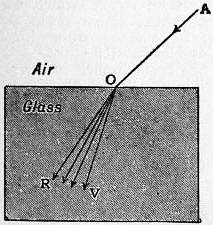
Fig. 1.
Dispersion, in Optics. When a beam of light which is not homogeneous in character, i.e. which does not consist of simple vibrations of a definite wave-length, undergoes refraction at the surface of any transparent medium, the different colours corresponding to the different wave-lengths become separated or dispersed. Thus, if a ray of white light AO (fig. 1) enters obliquely into the surface of a block of glass at O, it gives rise to the divergent system of rays ORV, varying continuously in colour from red to violet, the red ray OR being least refracted and the violet ray OV most so. The order of the successive colours in all colourless transparent media is red, orange, yellow, green, blue, indigo and violet. Dispersion is therefore due to the fact that rays of different colours possess different refrangibilities.
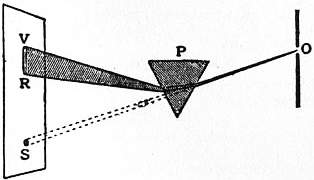
Fig. 2.
The simplest way of showing dispersion is to refract a narrow beam of sunlight through a prism of glass or prismatic vessel containing water or other clear liquid. As the light is twice refracted, the dispersion is increased, and the rays, after transmission through the prism, form a divergent system, which may be allowed to fall on a sheet of white paper, forming the well-known solar spectrum. This method was employed by Sir Isaac Newton, whose experiments constitute the earliest systematic investigation of the phenomenon. Let O (fig. 2) represent a small hole in the shutter of a darkened room, and OS a narrow beam of sunlight which is allowed to fall on a white screen so as to form an image of the sun at S. If now the prism P be interposed as in the figure, the whole beam is not only refracted upward, but also spread out into the spectrum RV, the horizontal breadth of the band of colours being the same as that of the original image S. In an experiment similar to that here represented, Newton made a small hole in the screen and another small hole in a second screen placed behind the first. By slightly turning the prism P, the position of the spectrum on the first screen could be shifted sufficiently to cause light of any desired colour to pass through. Some of this light also passed through the second hole, and thus he obtained a narrow beam of practically homogeneous light in a fixed direction (the line joining the apertures in the two screens). Operating on this beam with a second prism, he found that the homogeneous light was not dispersed, and also that it was more refracted the nearer the point from which it was taken approached to the violet end of the spectrum RV. This confirmed his previous conclusion that the rays increase in refrangibility from red to violet.
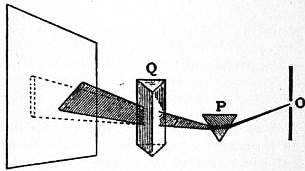
Fig. 3.—Method of Crossed Prisms.
Newton also made use of the method of crossed prisms, which has been found of great use in studying dispersion. The prism P (fig. 3) refracts upwards, while the prism Q, which has its refracting edge perpendicular to that of P, refracts towards the right. The combined effect of the two is to produce a spectrum sloping up from left to right. The spectrum will be straight if the two prisms are similar in dispersive property, but if one of them is constructed of a material which possesses any peculiarity in this respect it will be revealed by the curvature of the spectrum.
The coloured borders seen in the images produced by simple lenses are due to dispersion. The explanation of the colours of the rainbow, which are also due to dispersion, was given by Newton, although it was known previously to be due to refraction in the drops of rain (see Rainbow).
According to the wave-theory of light, refraction (q.v.) is due to a change of velocity when light passes from one medium to another. The phenomenon of dispersion shows that in dispersive media the velocity is different for lights of different wave-lengths. In free space, light of all wave-lengths is propagated with the same velocity, as is shown by the fact that stars, when occulted by the moon or planets, preserve their white colour up to the last moment of disappearance, which would not be the case if one colour reached the eye later than another. The absence of colour changes in variable stars or in the appearance of new stars is further evidence of the same fact. All material media, however, are more or less dispersive. In air and other gases, at ordinary pressures, the dispersion is very small, because the refractivity is small. The dispersive powers of gases are, however, generally comparable with those of liquids and solids.
Dispersive Power.—In order to find the amount of dispersion caused by any given prism, the deviations produced by it on two rays of any definite pure colours may be measured. The angle of difference between these deviations is called the dispersion for those rays. For this purpose the C and F lines in the spark-spectrum of hydrogen, situated in the red and blue respectively, are usually employed. If δF and δC are the angular deviations of these rays, then δF − δC is called the mean dispersion of the prism. If the refracting angle of the prism is small, then the ratio of the dispersion to the mean deviation of the two rays is the dispersive power of the material of the prism. Instead of the mean deviation, ½ (δF + δC), it is more usual to take the deviation of some intermediate ray. The exact position of the selected ray does not matter much, but the yellow D line of sodium is the most convenient. If we denote its deviation by δD, then we may put
Dispersive power = (δF - δC)/δD (1).
This quantity may readily be expressed in terms of the refractive indices for the three colours, for if A is the angle of the prism (supposedly small)
δC = (μC − 1)A, δD = (μD − 1)A, δF = (μF − 1)A,
where μC, μD, μF are the respective indices of refraction. This gives at once
Dispersive power = (μF − μC)/(μD − 1) (2).
The second of these two expressions is generally given as the definition of dispersive power. It is more useful than (1), as the refractive indices may be measured with a prism of any convenient angle.
By studying the dispersion of colours in water, turpentine and crown glass Newton was led to suppose that dispersion is proportional to refraction. He concluded that there could be no refraction without dispersion, and hence that achromatism was impossible of attainment (see Aberration). This conclusion was proved to be erroneous when Chester M. Hall in 1733 constructed achromatic lenses. Glasses can now be made differing considerably both in refractivity and dispersive power.
Irrationality of Dispersion.—If we compare the spectrum produced by refraction in a glass prism with that of a diffraction grating, we find not only that the order of colours is reversed, but also that the same colours do not occupy corresponding lengths on the two spectra, the blue and violet being much more extended in the refraction spectrum. The refraction spectra for different media also differ amongst themselves. This shows that the connexion between the refrangibility of light and its wave-length does not obey any simple law, but depends on the nature of the refracting medium. This property is referred to as the “irrationality of dispersion.” In a diffraction spectrum the diffraction is proportional to the wave_length, and the spectrum is said to be “normal.” If the increase of the angle of refraction were proportional to the diminution of wave-length for a prism of any material, the resulting spectrum would also be normal. This, however, is not the case with ordinary refracting media, the refrangibility generally increasing more and more rapidly as the wave-length diminishes.
The irrationality of dispersion is well illustrated by C. Christiansen’s experiments on the dispersive properties of white powders. If the powder of a transparent substance is immersed in a liquid of the same refractive index, the mixture becomes transparent and a measurement of the refractive index of the liquid gives the refractivity of the powder. Christiansen found, in an investigation of this kind, that the refractivity of the liquid could only be got to match that of the powder for mono-chromatic light, and that, if white light were used, brilliant colour effects were obtained, which varied in a remarkable manner when small changes occurred in the refractive index of the liquid. These effects are due to the difference in dispersive power of the powder and the liquid. If the refractive index is, for instance, the same for both in the case of green light, and a source of white light is viewed through the mixture, the green component will be completely transmitted, while the other colours are more or less scattered by multiple reflections and refractions at the surfaces of the powdered substance. Very striking colour changes are observed, according to R. W. Wood, when white light is transmitted through a paste made of powdered quartz and a mixture of carbon bisulphide with benzol having the same refractive index as the quartz for yellow light. In this case small temperature changes alter the refractivity of the liquid without appreciably affecting the quartz. R. W. Wood has studied the iridescent colours seen when a precipitate of potassium silicofluoride is produced by adding silicofluoric acid to a solution of potassium chloride, and found that they are due to the same cause, the refractive index of the minute crystals precipitated being about the same as that of the solution, which latter can be varied by dilution.
Anomalous Dispersion.—In some media the usual order of the colours is changed. This curious phenomenon was noticed by W. H. Fox Talbot about 1840, but does not seem to have become generally known. In 1860 F. P. Leroux discovered that iodine vapour refracted the red rays more than the violet, the intermediate colours not being transmitted; and in 1870 Christiansen found that an alcoholic solution of fuchsine refracted the violet less than the red, the order of the successive colours being violet, red, orange, yellow; the green being absorbed and a dark interval occurring between the violet and red. A. Kundt found that similar effects occur with a large number of substances, in particular with all those which possess the property of “surface colour,” i.e., which strongly reflect light of a definite colour, as do many of the aniline dyes. Such bodies show strong absorption bands in those colours which they reflect, while of the transmitted light that which is of a slightly greater wave-length than the absorbed light has an abnormally great refrangibility, and that of a slightly shorter wave-length an abnormally small refrangibility. The name given to this phenomenon,—“anomalous dispersion”—is an unfortunate one, as it has been found to obey a regular law.
In studying the dispersion of the aniline dyes, a prism with a very small refracting angle is made of two glass plates slightly inclined to each other and enclosing a very thin wedge of the dye, which is either melted between the plates, or is in the form of a solution retained in position by surface-tension. Only very thin layers are sufficiently transparent to show the dispersion near or within an absorption band, and a large refracting angle is not required, the dispersion usually being very considerable. Another method, which has been used by R. W. Wood and C. E. Magnusson, is to introduce a thin film of the dye into one of the optical paths of a Michelson interferometer, and to determine the consequent displacement of the fringes. E. Mach and J. Arbes have used a method depending on total reflection (Drude’s Theory of Optics, p. 394).
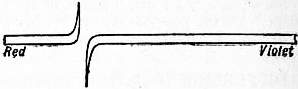
Fig. 4.—Anomalous Dispersion of Sodium Vapour.
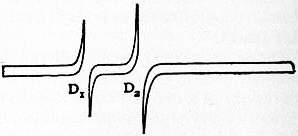
Fig. 5.
A very remarkable example of anomalous dispersion, which was first observed by A. Kundt, is that exhibited by the vapour of sodium. It has not been found practicable to make a prism of this vapour in the ordinary way by enclosing it in a glass vessel of the required shape, as sodium vapour attacks glass, quickly rendering it opaque. A. E. Becquerel, however, investigated the character of the dispersion by using prism-shaped flames strongly coloured with sodium. But the best way of exhibiting the effect is by making use of a remarkable property of sodium vapour discovered by R. W. Wood and employed for this purpose in a very ingenious manner. He found that when sodium is heated in a hard glass tube, the vapour which is formed is extraordinarily cohesive, only slowly spreading out in a cloud with well-defined borders, which can be rendered visible by placing the tube in front of a sodium flame, against which the cloud appears black. If a long glass tube with plane ends, and containing some pellets of sodium is heated in the middle by a row of burners, the cool ends remain practically vacuous and do not become obscured. The sodium vapour in the middle is very dense on the heated side, the density diminishing rapidly towards the upper part of the tube, so that, although not prismatic in form, it refracts like a prism owing to the variation in density. Thus if a horizontal slit is illuminated by an arc lamp, and the light-rendered parallel by a collimating lens—is transmitted through the sodium tube and focused on the vertical slit of a spectroscope, the effect of the sodium vapour is to produce its refraction spectrum vertically on the slit. The image of this seen through the glass prism of the spectroscope will appear as in fig. 4. The whole of the light, with the exception of a small part in the neighbourhood of the D lines, is practically undeviated, so that it illuminates only a very short piece of the slit and is spread out into the ordinary spectrum. But the light of slightly greater wave-length than the D lines, being refracted strongly downward by the sodium vapour, illuminates the bottom of the slit; while that of slightly shorter wave-length is refracted upward and illuminates the top of the slit. Fig. 4 represents the inverted image seen in the telescope. The light corresponding to the D lines and the space between them is absorbed, as evidenced by the dark interval. If the sodium is only gently heated, so as to produce a comparatively rarefied vapour, and a grating spectroscope employed, the spectrum obtained is like that shown in fig. 5, which was the effect noticed by Becquerel with the sodium flame. Here the light corresponding to the space between the D lines is transmitted, being strongly refracted upward near D1, and downward near D2.
The theory of anomalous dispersion has been applied in a very interesting way by W. H. Julius to explain the “flash spectrum” seen during a solar eclipse at the moment at which totality occurs. The conditions of this phenomenon have been imitated in the laboratory by Wood, and the corresponding effect obtained.
Theories of Dispersion.—The first attempt at a mathematical theory of dispersion was made by A. Cauchy and published in 1835. This was based on the assumption that the medium in which the light is propagated is discontinuous and molecular in character, the molecules being subject to a mutual attraction. Thus, if one molecule is disturbed from its mean position, it communicates the disturbance to its neighbours, and so a wave is propagated. The formula arrived at by Cauchy was
n = A + B + C + ....
λ2 λ4
n being the refractive index, λ the wave-length, and A, B, C, &c., constants depending on the material, which diminish so rapidly that only the first three as here written need be taken into account. If suitable values are chosen for these constants, the formula can be made to represent the dispersion of ordinary transparent media within the visible spectrum very well, but when extended to the infra-red region it often departs considerably from the truth, and it fails altogether in cases of anomalous dispersion. There are also grave theoretical objections to Cauchy’s formula.
The modern theory of dispersion, the foundation of which was laid by W. Sellmeier, is based upon the assumption that an interaction takes place between ether and matter. Sellmeier adopted the elastic-solid theory of the ether, and imagined the molecules to be attached to the ether surrounding them, but free to vibrate about their mean positions within a limited range. Thus the ether within the dispersive medium is loaded with molecules which are forced to perform oscillations of the same period as that of the transmitted wave. It can be shown mathematically that the velocity of propagation will be greatly increased if the frequency of the light-wave is slightly greater, and greatly diminished if it is slightly less than the natural frequency of the molecules; also that these effects become less and less marked as the difference in the two frequencies increases. This is exactly in accordance with the observed facts in the case of substances showing anomalous dispersion. Sellmeier’s theory did not take account of absorption, and cannot be applied to calculate the dispersion within a broad absorption band. H. von Helmholtz, working on a similar hypothesis, but with a frictional term introduced into his equations, obtained formulae which are applicable to cases of absorption. A modified form of Helmholtz’s equation, due to E. Ketteler and known as the Ketteler-Helmholtz formula, has been much used in calculating dispersion, and expresses the facts with remarkable accuracy. P. Drude has obtained a similar formula based on the electromagnetic theory, thus placing the theory of dispersion on a much more satisfactory basis. The fundamental assumption is that the medium contains positively and negatively charged ions or electrons which are acted on by the periodic electric forces which occur in wave propagation on Maxwell’s theory. The equations finally arrived at are
n²(1 − κ²) = 1 + Σ Dλ²(λ² − λm²) ,
(λ² − λm²)² + g²λ²
2n²κ² = Σ Dgλ³ ,
(λ² − λm²)² + g²λ²
where λ is the wave-length in free ether of light whose refractive index is n, and λm the wave-length of light of the same period as the electron, κ is a coefficient of absorption, and D and g are constants. The sign of summation Σ is used in cases where there are several absorption bands, and consequently several similar terms on the right-hand side, each with a different value of λm. This would occur if there were several kinds of ions, each with its own natural period.
In a region where there is no absorption, we have κ = 0 and therefore g = 0, and we have only one equation, namely,
n² = 1 + Σ Dλ² ,
(λ² − λm²)
which is identical with Sellmeier’s result. As λm, is a wave-length corresponding to an absorption band, this formula can be used to find values of λm which satisfy the observed values of n within the region of transparency, and so to determine where the absorption bands are situated. In this way the existence of bands in the infrared part of the spectrum has been predicted in the case of quartz and detected by experiments on the selective reflection of the material.
References.—For the theory of dispersion see P. Drude, Theory of Optics (Eng. trans.); R. W. Wood, Physical Optics; and A. Schuster, Theory of Optics. For descriptive accounts, see Wood’s Physical Optics, T. Preston’s Theory of Light, E. Edser’s Light. The last work contains an elementary treatment of Sellmeier’s theory.
(J. R. C.)
D’ISRAELI (or Disraeli), ISAAC (1766-1848), English man of letters, father of the earl of Beaconsfield (q.v.), was born at Enfield in May 1766. He belonged to a Jewish family which, having been driven by the Inquisition from Spain, towards the end of the 15th century, settled as merchants at Venice, and assumed the name which has become famous; it was generally spelt D’Israeli until the middle of the 19th century. In 1748 his father, Benjamin D’Israeli, then only about eighteen years of age, removed to England, where, before passing the prime of life, he amassed a competent fortune, and retired from business. He belonged to the London congregation of Spanish and Portuguese Jews, of which his son also remained a nominal member until after Benjamin D’Israeli died at the end of 1816.
The strongly marked characteristics which determined Isaac D’Israeli’s career were displayed to a singular degree even in his boyhood. He spent his time over books and in long day-dreams, and evinced the strongest distaste for business and all the more bustling pursuits of life. These idiosyncrasies met with no sympathy from either of his parents, whose ambitious plans for his future career they threatened to disappoint. When he was about fourteen, in the hope of changing the bent of his mind, his father sent him to live with his agent at Amsterdam, where he worked under a tutor for four or five years. Here he studied Bayle and Voltaire, and became an ardent disciple of Rousseau. Here also he wrote a long poem against commerce, which he produced as an exposition of his opinions when, on his return to England, his father announced his intention of placing him in a commercial house at Bordeaux. Against such a destiny D’Israeli’s mind strongly revolted; and he carried his poem, with a letter earnestly appealing for advice and assistance, to Samuel Johnson; but when he called again a week after to receive an answer, the packet was returned unopened—the great Doctor was on his death-bed. He also addressed a letter to Dr Vicesimus Knox, master of Tonbridge Grammar School, begging to be received into his family, that he might enjoy the benefit of his learning and experience. How this application was answered we do not know. The evident firmness of his resolve, however, was not without effect. His parents gave up their purpose for a time. He was sent to travel in France, and allowed to occupy himself as he wished; and he had the happiness of spending some months in Paris, in the society of literary men, and devoted to the literary pursuits in which he delighted.
In the beginning of 1788 he returned home, and in the next year he attacked Peter Pindar (John Wolcot) in The Gentleman’s Magazine in a poem in the manner of Pope, “On the Abuse of Satire.” The authorship of the poem was much debated, and it was attributed by some to William Hayley, upon whom it was actually avenged, with characteristic savageness, by its victim. It is greatly to Wolcot’s credit that, on learning his mistake, he sought the acquaintance of his young opponent, whose friend he remained to the end of his life. Through the success of this satire D’Israeli made the acquaintance of Henry James Pye, who helped to persuade his father that it would be a mistake to force him into a business career, and introduced him into literary circles. D’Israeli dedicated his first book, A Defence of Poetry, to Pye in 1790. Henceforth his life was passed in the way he best liked—in quiet and almost uninterrupted study. In 1802 he married Maria Basevi, by whom he had five children, of whom Benjamin (afterwards Lord Beaconsfield and Prime Minister of England) was the second. He was able to maintain his strenuous habits of study till he reached the advanced age of seventy-two, when he was forced, by paralysis of the optic nerve, to give up work almost entirely. He lived ten years longer, and died at his seat at Bradenham House, Buckinghamshire, on the 19th of January 1848.
Isaac D’Israeli is most celebrated as the author of the Curiosities of Literature (1791, subsequent volumes in 1793, 1817, 1823 and 1834). It is a miscellany of literary and historical anecdotes, of original critical remarks, and of interesting and curious information of all kinds, animated by genuine literary feeling, taste and enthusiasm. With the Curiosities of Literature may be classed D’Israeli’s Miscellanies, or Literary Recreations (1796), the Calamities of Authors (1812-1813), and the Quarrels of Authors (1814). Towards the close of his life D’Israeli projected a continuous history of English literature, three volumes of which appeared in 1841 under the title of the Amenities of Literature. But of all his works the most delightful is his Essay on the Literary Character (1795), which, like most of his writings, abounds in illustrative anecdotes. In the famous “Pope controversy” he supported Byron and Campbell against Bowles and Hazlitt by a defence of Pope in the form of a criticism of Joseph Spence’s Anecdotes contributed to the Quarterly Review (July 1820). In 1797 D’Israeli published three novels; one of these, Mejnoun and Leila, the Arabian Petrarch and Laura, was said to be the first oriental romance in English. His last novel, Despotism, or the Fall of the Jesuits, appeared in 1811, but none of his romances was popular. He also published a slight sketch of Jewish history, and especially of the growth of the Talmud, entitled the Genius of Judaism (1833).
He was the author of two historical works—a brief defence of the literary merit and personal and political character of James I. (1816), and a learned Commentary on the Life and Reign of King Charles I. (1828-1831). This was recognized by the University of Oxford, which conferred upon the author the honorary degree of D.C.L. As an historian D’Israeli is distinguished by two characteristics. In the first place, he had small interest in politics, and no sympathy with the passionate fervour, or adequate appreciation of the importance, of political struggles. And, secondly, with a laborious zeal then less common than now among historians, he sought to bring to light fresh historical material by patient search for letters, diaries and other manuscripts of value which had escaped the notice of previous students. Indeed, the honour has been claimed for him of being one of the founders of the modern school of historical research.
Of the amiable personal character and the placid life of Isaac D’Israeli a charming picture is to be found in the brief memoir prefixed to the 1849 edition of Curiosities of Literature, by his son Lord Beaconsfield.
DISS, a market town in the southern parliamentary division of Norfolk, England; near the river Waveney (the boundary with Suffolk), 95 m. N.E. by N. from London by the Great Eastern railway. Pop. of urban district (1901) 3745. The town lies pleasantly upon a hill rising above a mere, which drains to the Waveney, having its banks laid out as public gardens. The church of St Mary exhibits Decorated and Perpendicular stone and flint work. There is a corn exchange and the agricultural trade is considerable; brushes and matting are manufactured. The poet and satirist, John Skelton (d. 1529), was rector here in the later part of his life, and is doubtfully considered a native.
DISSECTION (from Lat. dissecare, to cut apart), the separation into parts by cutting, particularly the cutting of an animal or plant into parts for the purpose of examination or display of its structure.
DISSENTER (Lat. dis-sentire, to disagree), one who dissents or disagrees in matters of opinion, belief, &c. The term “dissenter” is, however, practically restricted to the special sense of a member of a religious body in England which has, for one reason or another, separated from the Established Church. Strictly, the term includes the English Roman Catholics, who in the original draft of the Relief Act of 1791 were styled “Protesting Catholic Dissenters.” It is in practice, however, restricted to the “Protestant Dissenters” referred to in sec. ii. of the Toleration Act of 1688. The term is not applied to those bodies who dissent from the Established Church of Scotland; and in speaking of members of religious bodies which have seceded from established churches abroad it is usual to employ the term “dissidents” (Lat. dissidere, to dissent). In this connotation the terms “dissenter” and “dissenting,” which had acquired a somewhat contemptuous flavour, have tended since the middle of the 19th century to be replaced by “nonconformist,” a term which did not originally imply secession, but only refusal to conform in certain particulars (e.g. the wearing of the surplice) with the authorized usages of the Established Church. Still more recently the term “nonconformist” has in its turn, as the political attack on the principle of a state establishment of religion developed, tended to give place to the style of “Free Churches” and “Free Churchman.” All three terms are now in use, “nonconformist” being the most usual, as it is the most colourless. (See Congregationalism, &c.)
DISSOCIATION, a separation or dispersal, the opposite of association. In chemistry the term is given to chemical reactions in which a substance decomposes into two or more substances, and particularly to cases in which associated molecules break down into simpler molecules. Thus the reactions NH4Cl ⇔ NH3 + HCl, and PCl5 ⇔ PCl3 + Cl2 are instances of the first type; N2O4 ⇔ 2NO2, of the second (see Chemical Action). Electrolytic or ionic dissociation is the separation of a substance in solution into ions (see Electrolysis; Solution).
DISSOLUTION (from Lat. dissolvere, to break up into parts), the act of dissolving or reducing to constituent parts, especially of the bringing to an end an association such as a partnership or building society, and particularly of the termination of an assembly. A dissolution of parliament in England is thus the end of its existence, brought about by the efflux of time in accordance with the Septennial Act 1716, or by an exercise of the royal prerogative. This is done either in person, or by commission, if parliament is sitting; if prorogued, then by proclamation. The word is used as a synonym for end or death.
DISTAFF, in the early forms of spinning, the “rock” or short stick round one end of which the flax, cotton or wool is loosely wound, and from which it is spun off by the spindle. The word is derived from the Old English distaef, the first part of which is connected with dizen, in modern English seen in “bedizen,” to deck out or embellish, originally “to equip the distaff with flax, &c.,” cf. the German dialectal word Diesse, flax. The last part of the word is “staff.” “Distaff” from early times has been used to symbolize woman’s work (cf. the use of “spinster” for an unmarried woman); thus the “distaff” or “spindle” side of a family refers to the female branch, as opposed to the “spear” or male branch. The 7th of January, the day after Epiphany, was formerly known as St Distaff’s day, as women then began work again after the Christmas holiday.
DISTILLATION (from the Lat. distillare, more correctly destillare, to drop or trickle down), an operation consisting in the conversion of a substance or mixture of substances into vapours which are afterwards condensed to the liquid form; it has for its object the separation or purification of substances by taking advantage of differences in volatility. The apparatus consists of three parts:—the “retort” or “still,” in which the substance is heated; the “condenser,” in which the vapours are condensed; and the “receiver,” in which the condensed vapours are collected. Generally the components of a mixture will be vaporized in the order of their boiling-points; consequently if the condensates or “fractions” corresponding to definite ranges of temperature be separately collected, it is obvious that a more or less partial separation of the components will be effected. If the substance operated upon be practically pure to start with, or the product of distillation be nearly of constant composition, the operation is termed “purification by distillation” or “rectification”; the latter term is particularly used in the spirit industry. If a complex mixture be operated upon, and a separation effected by collecting the distillates in several portions, the operation is termed “fractional distillation.” Since many substances decompose either at, or below, their boiling-points under ordinary atmospheric pressure, it is necessary to lower the boiling-point by reducing the pressure if it be desired to distil them. This variation is termed “distillation under reduced pressure or in a vacuum.” The vaporization of a substance below its normal boiling-point can also be effected by blowing in steam or some other vapour; this operation is termed “distillation with steam.” “Dry distillation” is the term used when solid substances which do not liquefy on heating are operated upon; “sublimation” is the term used when a solid distils without the intervention of a liquid phase.