VOLUME VIII SLICE V Dinard to Dodsworth (continued 6)
Reading edition
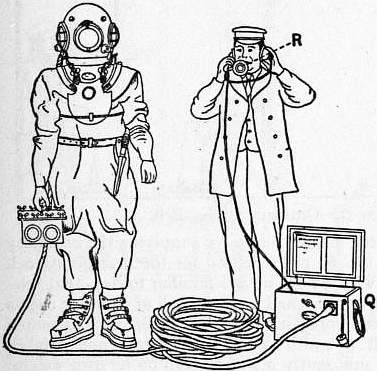
Fig. 4.—Diver’s Telephone Communication with the Surface. Q, Battery, with switch and bell in case. R, Attendant’s receiver and transmitter.
The telephone instruments in the helmet consist of one or more loud-sounding receivers placed either in the crown of the helmet, or one on each side in close proximity to the diver’s ears. A transmitter of a special watertight pattern is placed between the front glass and one of the side glasses, and a contact piece, which, when the diver presses his chin against it, rings a bell at the surface, is fitted immediately below the front glass. A buzzer is sometimes fixed in the helmet to call the diver’s attention when the attendant wishes to speak, but as a rule the voice is transmitted so loudly that this device is unnecessary. A connexion, through which the insulated wires connecting the instruments pass, terminates in contact pieces, and the telephone cable, embedded in the diver’s signal line, is connected with it. The other end of the signal line is connected to a battery box at the surface. This box contains, besides the cells, a receiver and transmitter for the attendant, an electric bell, a terminal box, and a special switch, by means of which various communications between diver, or divers, and attendant are made. If, as is sometimes the case, the diver happens to be somewhat deaf, he can, whilst he is taking a message, stop the vibration of the outlet valve and the noise made by the escaping air, by merely pressing his finger on a spindle which passes through the disk of the valve, and thus momentarily ensure absolute silence.
Speaking Tube.—The rubber speaking tube which was the forerunner of the telephonic apparatus is now practically obsolete, though it is still used in isolated cases.
Submarine Electric Lamps.—Various forms of submarine lamps are used, from a powerful arc light to a self-contained hand lamp, the former giving about 2000 or 3000 candle-power, and requiring a steam-driven dynamo to supply the necessary current, the latter (fig. 5) giving a light of about 10 candle-power and having its own batteries, so that the diver carries both the light and its source in his hand. These submarine lamps are all constructed on the same principle, having the incandescent lamps, or carbons as the case may be, enclosed in a strong glass globe, the mechanism and connexions being fitted in a metal case above the globe, which is flanged and secured watertightly to the case.
Self-contained Diving Dress.—The object of the self-contained diving dress is to make the diver independent of air supply from the surface. The dress, helmet, boots and weights are of the ordinary pattern already described, but instead of obtaining his air supply by means of pumps and pipes, the diver is equipped with a knapsack consisting of a steel cylinder containing oxygen compressed to a pressure of 120 atmospheres (= about 1800 ℔) to the square inch, and chambers containing caustic soda or caustic potash. The helmet is connected to the chambers by tubes, and the oxygen cylinder is similarly connected to the chambers. The breath exhaled by the diver passes through a valve into the caustic soda, which absorbs the carbonic acid, and it is then again inhaled through another valve. This process of regeneration goes on automatically, the requisite amount of oxygen being restored to the breathed air in its passage through the chambers. This type of apparatus has been used for shallow water work, but the great majority of divers prefer the apparatus using pumps as the source of the air supply.
An emergency dress, using this self-contained system for breathing, has been designed by Messrs Fleuss and Davis, of the firm of Siebe, Gorman & Co., primarily as a life-saving apparatus, for enabling men to escape from disabled submarine boats.
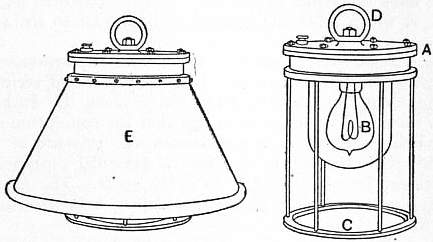
Fig. 5.—Submarine Electric Lamp, with and without Reflector.
A, Metal case containing electrical fittings. B, Glass globe and incandescent lamp. C, Stand, which also protects the globe. D, Ring for suspending lamp. E, Reflector.
The helmet diver is indispensable in connexion with harbour and dock construction, bridge-building, pearl and sponge fishing, wreck raising and the recovery of sunken cargo and treasure. Every ship in the British navy carries one set or more of diving apparatus, for use in ease of emergency, for clearing fouled propellers, cleaning valves or ship’s hull below the water line, repairing hulls if necessary, and recovering lost anchors, chains, torpedoes, &c.
Greatest Depths attained.—The greatest depth at which useful work has been performed by a diver is 182 ft. From this depth a Spanish diver, Angel Erostarbe, recovered £9000 in silver bars from the wreck of the steamer “Skyro,” sunk off Cape Finisterre; Alexander Lambert succeeded in salving £70,000 from the Spanish mail steamer “Alphonso XII,” sunk in 162 ft. of water off Las Palmas, Grand Canary; W. Ridyard recovered £50,000 in silver dollars from the “Hamilton Mitchell,” sunk off Leuconna Reef, China, in 150 ft. There are individual cases where much larger sums have been recovered, but those mentioned are particularly notable by reason of the great depth involved and stand out as the greatest depths at which good work has been done. The sponge fishers of the Mediterranean work at a maximum depth of about 150 ft., and the pearl divers of Australia at 120 ft. But submarine operations on the great majority of the harbour and dock works of the world are conducted at a depth of from 30 to 60 ft.
The weighted tools employed by divers differ very little from those used by the workmen on terra firma. Pneumatic tools, worked by compressed air conveyed from the surface through flexible tubes, are great aids, particularly in rock removal work. With the rock drill the diver bores a number of holes to a given depth, inserts in these the charges of dynamite or other explosive used, attaches one end of a wire to a detonator which is inserted in the charge, and then comes to the surface. The boat from which he works is then moved away from the scene of operations, paying out the wire attached to the detonators, and when at a safe distance the free end of the wire is connected to a magneto exploding machine, which is then set in motion.
A complete set of diving apparatus costs from £75 to £200, varying with the depth of water for which it is required.
The pay of a diver depends upon the nature of the work upon which he is engaged, and also upon the depth of the water. On harbour and dock work the average wage is 2s. to 2s. 6d. per hour; on wreck work from 3s. to 5s. an hour, according to depth; on treasure and cargo recovery so much per day, with a percentage on the value recovered, generally about 5%. The pearl fishers of Australia get so much per ton of shell, and the sponge fishers are also paid by results.
A problem which has been exercising the minds of those engaged in submarine work is the greatest depth at which it is possible to work, for, as is well known, many a fine vessel with valuable cargo and treasure is lying out of reach of the diver owing to the pressure which he would have to sustain were he to attempt to reach her. Mr Leonard Hill, and Drs Greenwood and J. J. R. Macleod conducted experiments in conjunction with Messrs Siebe, Gorman & Co., with a view to solving this problem, and their efforts have been attended with some considerable success. Dr J. S. Haldane has also carried out practical experiments for the British Admiralty, and under his supervision two naval officers have succeeded in reaching the unprecedented depth of 210 ft., at which depth the pressure is about 90 ℔ to the square inch.
Diving Bells.—Every one is familiar with the experiment of placing an inverted tumbler in a bowl of water, and seeing the water excluded from the tumbler by the air inside it. Perhaps it was to some such experiment as this that the conception of the diving bell was due. As is well known, the pressure of water increases with the depth, and for all practical purposes this pressure can be taken at 4¼ ℔ to every 10 ft. The following table shows the pressure at different depths below the surface of the water:—
Depth. Pressure.
20 ft. 8½ lb to the sq. in.
40 ” 17¼ ” ”
80 ” 34¾ ” ”
120 ” 52½ ” ”
160 ” 69¾ ” ”
200 ” 87 ” ”
If a diving bell be sunk to a depth of, say, 33 ft., the air inside it will be compressed to about half its original volume, and the bell itself will be about half filled with water. But if a supply of air be maintained at a pressure equal to the depth of water at which the bell is submerged, not only will the water be kept down to the cutting edge, but the bell will be ventilated and it will be possible for its occupants to work for hours at a stretch.
Tradition gives Roger Bacon, in 1250, the credit for being the originator of the diving bell, but actual records are lost in antiquity. Of the records preserved to us, probably one of the most trustworthy is an account given in Kaspar Schott’s work, Technica curiosa, published in the year 1664, which quoted from one John Taisnier, who was in the service of Charles V. This account describes an experiment which took place at Toledo, Spain, in the year 1538, before the emperor and some thousands of spectators, when two Greeks descended into the water in a large “kettle,” suspended by ropes, with its mouth downwards. The “kettle” was equipoised by lead fixed round its mouth. The men came up dry, and a lighted candle, which they had taken down with them, was still burning.
Francis Bacon, in the Novum Organum, lib. ii., makes the following reference to a machine, or reservoir, of air to which labourers upon wrecks might resort whenever they required to take breath:—
“A hollow vessel, made of metal, was let down equally to the surface of the water, and thus carried with it to the bottom of the sea the whole of the air which it contained. It stood upon three feet—like a tripod—which were in length something less than the height of a man, so that the diver, when he was no longer able to contain his breath, could put his head into the vessel, and having filled his lungs again, return to his work.”
But it was to Dr Edmund Halley, secretary of the Royal Society, that undoubtedly the honour is due of having invented the first really practical diving bell. This is described in the Philosophical Transactions, 1717, in a paper on “The Art of Living Under Water by means of furnishing air at the bottom of the sea in any ordinary depth.” Halley’s bell was constructed of wood, and was covered with lead, which gave it the necessary sinking weight, and was so distributed as to ensure that it kept a perpendicular position when in the water. It was in the form of a truncated cone, 3 ft. in diameter at the top, 5 ft. at the bottom and 8 ft. high. In the roof a lens was introduced for admitting light, and also a tap to let out the vitiated air. Fresh air was supplied to the bell by means of two lead-lined barrels, each having a bung-hole in the top and bottom. To the hole in the top was fixed a leathern tube, weighted in such a manner that it always fell below the level of the bottom of the barrel so that no air could escape. When, however, the tube was turned up by the attendant in the bell, the pressure of the water rising through the hole in the bottom of the barrel, forced the air through the tube at the top and into the diving bell. These barrels were raised and lowered alternately, with such success that Halley says that he, with four others, remained at the bottom of the sea, at a depth of 9 to 10 fathoms, for an hour and a half at a time without inconvenience of any sort.
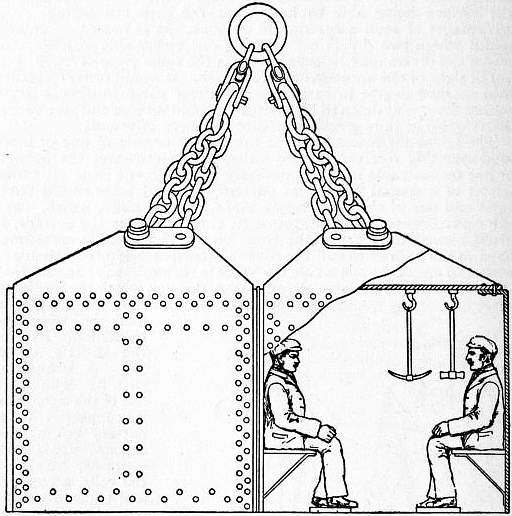
Fig. 6.—Ordinary Diving Bell.
This type of bell was used by John Smeaton in repairing the foundations of Hexham Bridge in 1778, but instead of weighted barrels, he introduced a force pump for supplying the necessary air. To Smeaton too we are indebted for the first diving bell plant in the form with which we are familiar to-day, that celebrated engineer having designed a square bell of iron, for use on the Ramsgate harbour works, in 1788. This bell, which measured 4½ ft. in length, 3 ft. in width and 4½ ft. in height, and weighed 2½ tons, was made sufficiently heavy to sink by its own weight. It afforded room enough for two men to work, and was supplied with air by a force pump worked from a boat at the surface.
Though the diving bell has been largely superseded by the modern diving apparatus, it is still used on certain classes of work the magnitude of which justifies the expense entailed, for it is not only a question of the cost of the bell, but of the powerful steam-driven crane which is needed to lower and raise it, and also of the gantry on which the crane travels. Sometimes a barge or other vessel is used for working the bell.
At the present day, two types of diving bell are employed—the ordinary bell, and the air-lock bell, which, however, is not so largely used.
On the new national harbour works at Dover, four large diving bells of the ordinary type (fig. 6) were employed. These bells, in each of which from four to six men descended at a time, consisted of steel chambers, open at the bottom, measuring 17 ft. long by 10½ ft. wide by 7 ft. high, and each weighed 35 tons. The ballast, which at once gives the necessary sinking weight to the bell and maintains its equilibrium, consisted of slabs of cast iron bolted to the walls of the bell, inside. Each bell was fitted with loud-sounding telephonic apparatus, by means of which the occupants could communicate either with the men attending the crane or the men looking after the air compressors at the surface. Electric lamps, supplied with current by a dynamo in the compressor room, gave the necessary light inside the bell. Seats and foot rails were provided for the men, and there were racks and hooks for the various tools. Suspended from the roof was an iron skip into which the men threw the excavated material, which was emptied out when the bell was brought to the surface. Air was supplied to the bells by means of steam-driven compressors worked in a house erected on the gantry. The air was delivered into a steel air receiver, and thence it passed through a flexible tube connected to a gun-metal inlet valve in the roof of the diving bell; the pressure of air was regulated according to the depth at which the bell happened to be working. The maximum depth on the Dover works was between 60 and 70 ft., = about 25-30 ℔ to the square inch. A bell was lowered by means of powerful steam-driven cranes, travelling on a gantry, to within a few feet of the water, and the men entered it from a boat. The bell then continued its descent to the bottom, where the men, with pick and shovel, levelled the sea bed ready to receive the large concrete blocks, weighing from 30 to 42 tons apiece. Having completed one section, the bell was moved along to another. The concrete blocks were then lowered and placed in position by helmet divers. The bell divers, clad in thick woollen suits and watertight thigh boots, worked in shifts of about three hours each, and were paid at the rate of from 1s. to 15d. per hour.
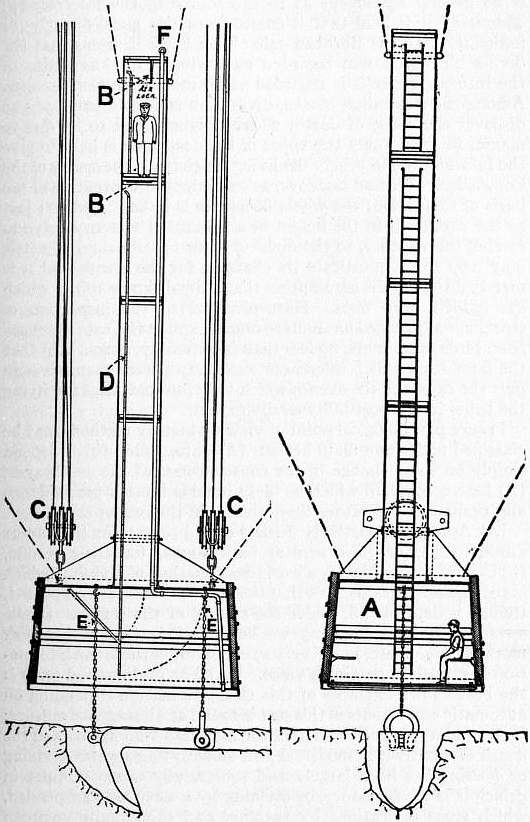
Fig. 7.—Air-lock Diving Bell.
A, Working chamber. B, Air-lock. C, Pulleys and wire ropes for lowering and raising bell. D, Iron ladder. E, Tackles suspended from roof for raising and lowering objects. F, Air supply pipe.
The cost of an ordinary diving bell, including air compressor, telephonic apparatus and electric light, is from £600 to £1500, according to size.
The Air-lock Diving Bell (fig. 7) comprises an iron or steel working chamber similar to the ordinary diving bell, but with the addition of a shaft attached to its roof. At the upper end of the shaft is an airtight door, and about 8 ft. below this is another similar door. When the bell divers wish to enter the bell, they pass through the first door and close it after them, and then open a cock or valve and gradually let into the space between the two doors compressed air from the working chamber in order to equalize the pressure; they then open the second door and pass down into the working chamber, closing the door after them. When returning to the surface they reverse the operation. It can readily be imagined that, owing to its unwieldy character, the employment of the air-lock bell is resorted to only in those cases where the nature of the sea bed necessitates its remaining on a given spot for some considerable time, as for instance in the excavation of hard rock to a given depth.
An air-lock bell supplied to the British Admiralty, for use in connexion with the laying of moorings at Gibraltar, has a working chamber measuring 15 ft. long by 10½ ft. wide, by 7½ ft. high, and a shaft 37½ ft. high by 3 ft. in diameter. It is built of steel plates, with cast-iron ballast, and its total weight is about 46 tons. The bell is electrically lighted, and is fitted with telephonic apparatus communicating with the air-compressor room and lifting-winch room. It is worked through a well in the centre of a specially constructed steel barge 85 ft. long by 40 ft. beam, having a draught of 7 ft. 6 in. The wire ropes, for lowering and raising the bell, work over pulleys which are carried on a superstructure erected over the well. Two sets of air compressors are fitted on the barge—one set for supplying air to the bell, the other set for working a pneumatic rock drill inside the bell. The greatest depth at which this particular bell will work is 40 ft. The cost of the whole plant, including barge, was about £14,000.
The diving dress has, however, to a great extent supplanted the diving bell. This is due not only to the heavier cost of the latter, but more particularly to the greater mobility of the helmet diver. Bell divers are naturally limited to the area which their bell for the time being covers, whereas helmet divers can be distributed over different parts of a contract and work entirely independently of one another. The use of the diving bell is, therefore, practically limited to the work of levelling the sea bed, and the removal of rock.
See also the article Caisson Disease as regards the physiological effects of compressed air.
(R. H. D.*)
DIVES-SUR-MER, a small port and seaside resort of north-western France on the coast of the department of Calvados, on the Dives, 15 m. N.E. of Caen by road. Pop. (1906) 3286. Dives is celebrated as the harbour whence William the Conqueror sailed to England in 1066. In the porch of its church (14th and 15th centuries) a tablet records the names of some of his companions. The town has a picturesque inn, adapted from a building dating partly from the 16th century, and market buildings dating from the 14th to the 16th centuries. The coast in the vicinity of Dives is fringed with small watering-places, those of Cabourg (to the west) and of Beuzeval and Houlgate (to the east) being practically united with it. There are large metallurgical works with electric motive power close to the town.
DIVIDE, a word used technically as a noun in America and the British colonies for any high ridge between two valleys, forming a water-parting; a dividing range. For special senses of the verb “to divide” (Lat. di-videre, the latter part of the word coming from a root seen in Lat. vidua, Eng. “widow”), meaning generally to split up in two or more parts, see Division. In a parliamentary sense, to divide (involving a separation into two sides, Aye and No) is to take the sense of the House by voting on the subject before it.
DIVIDEND (Lat. dividendum, a thing to be divided), the net profit periodically divisible among the proprietors of a joint-stock company in proportion to their respective holdings of its capital. Dividend is not interest, although the word dividend is frequently applied to payments of interest; and a failure to pay dividends to shareholders does not, like a failure to pay interest on borrowed money, lay a company open to being declared bankrupt. In bankruptcy a dividend is the proportionate share of the proceeds of the debtor’s estate received by a creditor. In England, the Companies Act 1862 provided that no dividend should be payable except out of the profits arising from the business of the company, but, in the case of companies incorporated by special act of parliament for the construction of railways and other public works which cannot be completed for a considerable time, it is sometimes provided that interest may during construction be paid to the subscribers for shares out of capital. Dividends (excluding occasional distributions in the form of shares) are ordinarily payable in cash. Most companies divide their capital into at least two classes, called “preference” shares and “ordinary” shares, of which the former are entitled out of the profits of the company to a preferential dividend at a fixed rate, and the latter to whatever remains after payment of the preferential dividend and any fixed charges. Before, however, a dividend is paid, a part of the profits is often carried to a “reserve fund.” The dividend on preference shares is either “cumulative” or contingent on the profits of each separate year or half year. When cumulative, if the profits of any one year are insufficient to pay it in full, the deficiency has to be made good out of subsequent profits. A cumulative preferential dividend is sometimes said to be “guaranteed,” and preferential dividends payable by all English companies registered under the Companies Acts 1862 to 1908 are cumulative unless stipulated to be otherwise. Certain public companies are forbidden by parliament to pay dividends in excess of a prescribed maximum rate, but this restriction has been happily modified in some instances, notably in the case of gas companies, by the institution of a sliding scale, under which a gas company may so regulate the price of gas to be charged to consumers that any reduction of an authorized standard price entitles the company to make a proportionate increase of the authorized dividend, and any increase above the standard price involves a proportionate decrease of dividend. Dividends are usually declared yearly or half-yearly; and before any dividend can be paid it is, as a rule, necessary for the directors to submit to the shareholders, at a general meeting called for the purpose, the accounts of the company, with a report by the directors on its position and their recommendation as to the rate of the proposed dividend. The articles of association of a company usually provide that the shareholders may accept the director’s recommendation as to dividend or may declare a lower one, but may not declare a higher one than the directors recommend. Directors frequently have power to pay on account of the dividend for the year, without consulting the shareholders, an “interim dividend,” which on ordinary shares is generally at a much lower rate than the final or regular dividend. An exceptionally high dividend is often distributed in the shape of a dividend at the usual rate supplemented by an additional dividend or “bonus.” Payment of dividends is made by means of cheques sent by post, called “dividend warrants.” All dividends are subject to income-tax, and by most companies dividends are paid “less income-tax,” in which case the tax is deducted from the amount of dividend payable to each proprietor. When paid without such deduction a dividend is said to be “free of income-tax.” In the latter case, however, the company has to make provision for payment of the tax before declaring the dividend, and the amount of its divisible profits and the rate of dividend which it is able to declare are consequently to that extent reduced. In respect of consols and certain other securities, holders of amounts of less than £1000 may instruct the Bank of England or Bank of Ireland to receive and invest their dividends. With few exceptions, the prices of securities dealt in on the London Stock Exchange include any accruing dividend not paid up to the date of purchase. At a certain day, after the dividend is declared, the stock or share is dealt in on the Stock Exchange, as ex dividend (or “x. d.”), which means that the current dividend is paid not to the buyer but to the previous holder, and the price of the stock is lower to that extent. The expression “cum dividend” is used to signify that the price of the security dealt in includes a dividend which, in the absence of any stipulation, might be supposed to belong to the seller of the security. On the New York Stock Exchange the invariable practice is to sell stock with the “dividend on” until the company’s books are closed, after which it is usually sold “ex dividend.”
(S. D. H.)
DIVIDIVI, the native and commercial name for the astringent pods of Caesalpinia coriaria, a leguminous shrub of the suborder Caesalpinieae, which grows in low marshy tracts in the West Indies and the north of South America. The plant is between 20 and 30 ft. in height, and bears white flowers. The pods are flattened, and curl up in drying; they are about ¾ in. broad, from 2 to 3 in. long and of a rich brown colour. Dividivi was first brought to Europe from Caracas in 1768. It contains about 30% of ellagitannic acid, whence its value in leather manufacture.
DIVINATION, the process of obtaining knowledge of secret or future things by means of oracles, omens or astrology. The root of the word, deus (god) or divus, indicates the supposed source of the soothsayer’s information, just as the equivalent Greek term, μαντική, indicates the spiritual source of the utterances of the seer, μάντις. In classical times the view was, in fact, general, as may be seen by Cicero’s De divinatione, that not only oracles but also omens were signs sent by the gods; even the astrologer held that he gained his information, in the last resort, from the same source. On the side of the Stoics it was argued that if divination was a real art, there must be gods who gave it to mankind; against this it was argued that signs of future events may be given without any god.
Divination is practised in all grades of culture; its votaries range from the Australian black to the American medium. There is no general agreement as to the source of the information; commonly it is held that it comes from the gods directly or indirectly. In the Bornean cult of the hawk it seems that the divine bird itself was regarded as having a foreknowledge of the future. Later it is regarded as no more than a messenger. Among the Australian blacks, divination is largely employed to discover the cause of death, where it is assumed to be due to magic; in some cases the spirit of the dead man is held to give the information, in others the living magician is the source of the knowledge. We find moreover a semi-scientific conception of the basis of divination; the whole of nature is linked together; just as the variations in the height of a column of mercury serve to foretell the weather, so the flight of birds or behaviour of cattle may help to prognosticate its changes; for the uncultured it is merely a step to the assumption that animals know things which are hidden from man. Haruspication, or the inspection of entrails, was justified on similar grounds, and in the case of omens from birds or animals, no less than in astrology, it was held that the facts from which inferences were drawn were themselves in part the causes of the events which they foretold, thus fortifying the belief in the possibility of divination.
From a psychological point of view divinatory methods may be classified under two main heads: (A) autoscopic, which depend simply on some change in the consciousness of the soothsayer; (B) heteroscopic, in which he looks outside himself for guidance and perhaps infers rather than divines in the proper sense.
(A) Autoscopic methods depend on (i.) sensory or (ii.) motor automatisms, or (iii.) mental impressions, for their results. (i.) Crystal-gazing (q.v.) is a world-wide method of divining, which is analogous to dreams, save that the vision is voluntarily initiated, though little, if at all, under the control of the scryer. Corresponding to crystal-gazing we have shell-hearing and similar methods, which are, however, less common; in these the information is gained by hearing a voice. (ii.) The divining rod (q.v.) is the best-known example of this class; divination depending on automatic movements of this sort is found at all stages of culture; in Australia it is used to detect the magician who has caused the death of a native; in medieval and modern times water-divining or dowsing has been largely and successfully used. Similar in principle is coscinomancy, or divining by a sieve held suspended, which gives indications by turning; and the equally common divination by a suspended ring, both of which are found from Europe in the west to China and Japan in the east. The ordeal by the Bible and key is equally popular; the book is suspended by a key tied in with its wards between the leaves and supported on two persons’ fingers, and the whole turns round when the name of the guilty person is mentioned. Confined to higher cultures on the other hand, for obvious reasons, is divination by automatic writing, which is practised in China more especially. The sand divination so widely spread in Africa seems to be of a different nature. Trance speaking, on the other hand, may be found in any stage of culture and there is no doubt that in many cases the procedure of the magician or shaman induces a state of auto-hypnotism; at a higher stage these utterances are termed oracles and are believed to be the result of inspiration (q.v.). (iii.) Another method of divination is by the aid of mental impressions; observation seems to show that by some process of this sort, akin to clairvoyance (q.v.), fortunes are told successfully by means of palmistry or by laying the cards; for the same “lie” of the cards may be diversely interpreted to meet different cases. In other cases the impression is involuntary or less consciously sought, as in dreams (q.v.), which, however, are sometimes induced, for purposes of divination, by the process known as incubation or temple sleep. Dreams are sometimes regarded as visits to or from gods or the souls of the dead, sometimes as signs to be interpreted symbolically by means of dream-books, which are found not only in Europe but in less cultured countries like Siam.
(B) In heteroscopic divination the process is rather one of inference from external facts. The methods are very various. (i.) The casting of lots, sortilege, was common in classical antiquity; the Homeric heroes prayed to the gods when they cast lots in Agamemnon’s leather cap, and Mopsus divined with sacred lots when the Argonauts embarked. Similarly dice are thrown for purposes of sortilege; the astragali or knucklebones, used in children’s games at the present day, were implements of divination in the first instance. In Polynesia the coco-nut is spun like a teetotum to discover a thief. Somewhat different are the omens drawn from books; in ancient times the poets were often consulted, more especially Virgil, whence the name sortes virgilianae, just as the Bible is used for drawing texts in our own day, especially in Germany. (ii.) In haruspication, or the inspection of entrails, in scapulomancy or divination by the speal-bone or shoulder-blade, in divination by footprints in ashes, found in Australia, Peru and Scotland, the voluntary element is prominent, for the diviner must take active steps to secure the conditions necessary to divination. (iii.) In the case of augury and omens, on the other hand, that is not necessary. The behaviour and cries of birds, and angang or meeting with ominous animals, &c., may be voluntarily observed, and opportunities for observation made; but this is not necessary for success. (iv.) In astrology we have a method which still finds believers among people of good education. The stars are held, not only to prognosticate the future but also to influence it; the child born when Mars is in the ascendant will be war-like; Venus has to do with love; the sign of the Lion presides over places where wild beasts are found. (v.) In other cases the tie that binds the subject of divination with the omen-giving object is sympathy. The name of the life-index is given to a tree, animal or other object believed to be so closely united by sympathetic ties to a human being that the fate of the latter is reflected in the condition of the former. The Polynesians set up sticks to see if the warriors they stood for were to fall in battle; on Hallowe’en in our own country the behaviour of nuts and other objects thrown into the fire is held to prognosticate the lot of the person to whom they have been assigned. Where, as in the last two cases, the sympathetic bond is less strong, we find symbolical interpretation playing an important part.
Sympathy and symbolism, association of ideas and analogy, together with a certain amount of observation, are the explanation of the great mass of heteroscopic divinatory formulae. But where autoscopic phenomena play the chief part the question of the origin of divination is less simple. The investigations of the Society for Psychical Research show that premonitions, though rare in our own day, are not absolutely unknown. Pseudo-premonitions, due to hallucinatory memory, are not unknown; there is also some ground for holding that crystal-gazers are able to perceive incidents which are happening at a distance from them. Divination of this sort, therefore, may be due to observation and experiment of a rude sort, rather than to the unchecked play of fancy which resulted in heteroscopic divination.
See also the articles Augurs, Oracle, Astrology, Omen, &c.
Authorities.—Bouché Leclercq, Histoire de la divination dans l’antiquité; Tylor, Primitive Culture, passim; Maury, “La Magie et l’astrologie,” Journ. Anth. Inst. i. 163, v. 436; Folklore, iii. 193; Ellis, Tshi-speaking Peoples, p. 202; Dictionnaire encyclopédique des sciences médicales, xxx. 24-96; Journ. of Philology, xiii. 273, xiv. 113; Deubner, De incubatione; Lenormant, La Divination, et la science de présages chez les Chaldéens; Skeat, Malay Magic; J. Johnson, Yoruba Heathenism (1899).
(N. W. T.)
DIVINING-ROD. As indicated in the article Magic, Rhabdomancy, or the art of using a divining-rod for discovering something hidden, is apparently of immemorial antiquity, and the Roman virgula divina, as used in taking auguries by means of casting bits of stick, is described by Cicero and Tacitus (see also Divination); but the special form of virgula furcata, or forked twig of hazel or willow (see also Hazel), described by G. Agricola (De re metallica, 1546), and in Sebastian Munster’s Cosmography in the early part of the 16th century, used specially for discovering metallic lodes or water beneath the earth, must be distinguished from the general superstition. The “dowsing” or divining-rod, in this sense, has a modern interest, dating from its use by prospectors for minerals in the German (Harz Mountains) mining districts; the French chemist M.E. Chevreul1 assigns its first mention to Basil Valentine, the alchemist of the late 15th century. On account of its supposed magical powers, it may be taken perhaps as an historical analogue to such fairy wands as the caduceus of Mercury, the golden arrow of Herodotus’s “Abaris the Hyperborean,” or the medieval witch’s broomstick. But the existence of the modern water-finder or dowser makes the divining-rod a matter of more than mythological or superstitious interest. The Schlagruthe (striking-rod), or forked twig of the German miners, was brought to England by those engaged in the Cornish mines by the merchant venturers of Queen Elizabeth’s day. Professor W. F. Barrett, F.R.S., the chief modern investigator of this subject, regards its employment, dating as it does from the revival of learning, as based on the medieval doctrine of “sympathy,” the drooping of trees and character of the vegetation being considered to give indications of mineral lodes beneath the earth’s surface, by means of a sort of attraction; and such critical works as Robert Boyle’s (1663), or the Mineralogia Cornubiensis of Pryce (1778), admitted its value in discovering metals. But as mining declined in Cornwall, the use of the dowser for searching for lodes almost disappeared, and was transferred to water-finding. The divining-rod has, however, also been used for searching for any buried objects. In the south of France, in the 17th century, it was employed in tracking criminals and heretics. Its abuse led to a decree of the Inquisition in 1701, forbidding its employment for purposes of justice.
In modern times the professional dowser is a “water-finder,” and there has been a good deal of investigation into the possibility of a scientific explanation of his claims to be able to locate underground water, where it is not known to exist, by the use of a forked hazel-twig which, twisting in his hands, leads him by its directing-power to the place where a boring should be made. Whether justified or not, a widespread faith exists, based no doubt on frequent success, in the dowser’s power; and Professor Barrett (The Times, January 21, 1905) states that “making a liberal allowance for failures of which I have not heard, I have no hesitation in saying that where fissure water exists and the discovery of underground water sufficient for a domestic supply is a matter of the utmost difficulty, the chances of success with a good dowser far exceed mere lucky hits, or the success obtained by the most skilful observer, even with full knowledge of the local geology.” Is this due to any special faculty in the dowser, or has the twig itself anything to do with it? Held in balanced equilibrium, the forked twig, in the dowser’s hands, moves with a sudden and often violent motion, and the appearance of actual life in the twig itself, though regarded as mere stage-play by some, is popularly associated with the cause of the water-finder’s success. The theory that there is any direct connexion (“sympathy” or electrical influence) between the divining-rod and the water or metal, is however repudiated by modern science. Professor Barrett, who with Professor Janet and others is satisfied that the rod twists without any intention or voluntary deception on the part of the dowser, ascribes the phenomenon to “motor-automatism” on the part of the dowser (see Automatism), a reflex action excited by some stimulus upon his mind, which may be either a subconscious suggestion or an actual impression (obscure in its nature) from an external object or an external mind; both sorts of stimulus are possible, so that the dowser himself may make false inferences (and fail) by supposing that the stimulus is an external object (like water). The divining-rod being thus “an indicator of any sub-conscious suggestion or impression,” its indications, no doubt, may be fallacious; but Professor Barrett, basing his conclusions upon observed successes and their greater proportion to failures than anything that chance could produce, advances the hypothesis that some persons (like the professional dowsers) possess “a genuine super-normal perceptive faculty,” and that the mind of a good dowser, possessing the idiosyncrasy of motor-automatism, becomes a blank or tabula rasa, so that “the faintest impression made by the object searched for creates an involuntary or automatic motion of the indicator, whatever it may be.” Like the “homing instinct” of certain birds and animals, the dowser’s power lies beneath the level of any conscious perception; and the function of the forked twig is to act as an index of some material or other mental disturbance within him, which otherwise he could not interpret.
It should be added that dowsers do not always use any rod. Some again use a willow rod, or withy, others a hazel-twig (the traditional material), others a beech or holly twig, or one from any other tree; others even a piece of wire or watch-spring. The best dowsers are said to have been generally more or less illiterate men, usually engaged in some humble vocation.
Sir W. H. Preece (The Times, January 16, 1905), repudiating as an electrician the theory that any electric force is involved, has recorded his opinion that water-finding by a dowser is due to “mechanical vibration, set up by the friction of moving water, acting upon the sensitive ventral diaphragm of certain exceptionally delicately framed persons.” Another theory is that water-finders are “exceptionally sensitive to hygrometric influences.” In any case, modern science approaches the problem as one concerning which the facts have to be accepted, and explained by some natural, though obscure, cause.
See for further details Professor Barrett’s longer discussion in parts 32 (1897) and 38 (1900) of the Proceedings of the Society for Psychical Research.
1 La Baguette divinatoire (Paris, 1845).
DIVISION (from Lat. dividere, to break up into parts, separate), a general term for the action of breaking up a whole into parts. Thus, in political economy, the phrase “division of labour” implies the assignment to particular workmen of the various portions of a whole piece of work; in mathematics division is the process of finding how many times one number or quantity, the “divisor,” is contained in another, the “dividend” (see Arithmetic and Algebra); in the musical terminology of the 17th and 18th centuries, the term was used for rapid passages consisting of a few slow notes amplified into a florid passage, i.e. into a larger number of quick ones. The word is used also in concrete senses for the parts into which a thing is divided, e.g. a division of an army, an administrative or electoral division; similarly, a “division” is taken in a legislative body when votes are recorded for and against a proposed measure.
In logic, division is a technical term for the process by which a genus is broken up into its species. Thus the genus “animal” may be divided, according to the habitat of the various kinds, into animals which live on land, those which live in water, those which live in the air. Each of these may be subdivided according to whether their constituent members do or do not possess certain other qualities. The basis of each of these divisions is called the fundamentum divisionis. It is clear that there can be no division in respect of those qualities which make the genus what it is. The various species are all alike in the possession of the generic attributes, but differ in other respects; they are “variations on the same theme” (Joseph, Introduction to Logic, 1906); each one has the generic, and also certain peculiar, qualities (differentiae), which latter distinguish them from other species of the same genus. The process of division is thus the obverse of classification (q.v.); it proceeds from genus to species, whereas classification begins with the particulars and rises through species to genus. In the exact sciences, and indeed in all argument both practical and theoretical, accurate division is of great importance. It is governed by the following rules. (1) Division must be exhaustive; all the members of the genus must find a place in one or other of the species; a captain who selects for his team skilful batsmen and bowlers only is guilty of an incomplete division of the whole function of a cricket team by omitting to provide himself with good fielders. Rectilinear figures cannot be divided into triangles and quadrilaterals because there are rectilinear figures which have more than four sides. On the other hand, triangles can be divided into equilateral, isosceles and scalene, since no other kind of triangle can exist. (2) Division must be exclusive, that is, each species must be complete in itself and not contain members of another species. No member of a genus must be included in more than one of the species. (3) In every division there must be but one principle (fundamentum divisionis). The members of a genus may differ from one another in many respects, e.g. books may be divided according to external form into quarto, octavo, &c., or according to binding into calf, cloth, paper-backed and so on. They cannot, however, be divided logically into quarto, paper-backed, novels and remainders. When more than one principle is used in a division it is called “cross division.” (4) Division must proceed gradually (“Divisio non facit saltum”), i.e. the genus must be resolved into the next highest (“proximate”) species. To go straight from a summum genus to very small species is of no scientific value.
It is to be observed that logical division is concerned exclusively with universals or concepts; division is of genus and species, not of particulars. Two other kinds of division are recognized:—metaphysical division, the separation in thought of the various qualities possessed by an individual thing (a piece of lead has weight, colour, &c), and physical division or partition, the breaking up of an object into its parts (a watch is thought of as being composed of case, dial, works, &c.). Logical division is closely allied with logical definition (q.v.).
DIVORCE (Lat. divortium, derived from dis-, apart, and vertere, to turn), the dissolution, in whole or in part, of the tie of marriage. It includes both the complete abrogation of the marriage relation known as a divorce a vinculo matrimonii, which carries with it a power on the part of both parties to the marriage to remarry other persons or each other, and also that incomplete severance not involving powers to remarry, which was formerly known as divorce a mensa et thoro, and has in England been termed “judicial separation.” Less strictly, divorce is commonly understood to include judicial declarations of nullity of marriage, which, while practically terminating the marriage relation, proceed in law on the basis of the marriage never having been legally established.
The conditions under which, in different communities, divorce has at different times been permitted, vary with the aspects in which the relation of marriage (q.v.) has been regarded. When marriage has been deemed to be the acquisition by the husband of property in the wife, or when it has been regarded as a mere agreement between persons capable both to form and to dissolve that contract, we find that marriage has been dissoluble at the will of the husband, or by agreement of the husband and wife. Yet even in these cases the interest of the whole community in the purity of marriage relations, in the pecuniary bearings of this particular contract, and the condition of children, has led to the imposition of restrictions on, and the attachment of conditions to, the termination of the obligations consequent on a marriage legally contracted. But the main restrictions on liberty of divorce have arisen from the conception of marriage entertained by religions, and especially by one religion. Christianity has had no greater practical effect on the life of mankind than in its belief that marriage is no mere civil contract, but a vow in the sight of God binding the parties by obligations of conscience above and beyond those of civil law. Translating this conception into practice, Christianity not only profoundly modified the legal conditions of divorce as formulated in the Roman civil law, but in its own canon law defined its own rule of divorce, going so far as in the Western (at least in its unreformed condition), though not the Eastern, branch of Christendom to forbid all complete divorces, that is to say, all dissolutions of marriage carrying with them the right to remarry.
History
The Roman Law of Divorce before Justinian.—The history of divorce, therefore, practically begins with the law of Rome. It took its earliest colour from that conception of the patria potestas, or the power of the head of the family over its members, which enters so deeply into the jurisprudence of ancient Rome. The wife was transferred at marriage to the authority of her husband, in manus, and consequently became so far subject to him that he could, at his will, renounce his rule over her, and terminate his companionship, subject at least to an adjustment of the pecuniary rights which were disturbed by such action. So clearly was the power of the husband derived from that of the father, that for a long period a father, in the exercise of his potestas, could take his daughter from her husband against the wishes of both. It may be presumed that this power, anomalous as it appears, was not unexercised, as we find that a constitution of Antoninus Pius prohibited a father from disturbing a harmonious union, and Marcus Aurelius afterwards limited this prohibition by allowing the interference of a father for strong and just cause—magna et justa causa interveniente. Except in so far as it was restrained by special legislation, the authority of a husband in the matter of divorce was absolute. As early indeed, however, as the time of Romulus, it is said that the state asserted its interest in the permanence of marriage by forbidding the repudiation of wives unless they were guilty of adultery or of drinking wine, on pain of forfeiture of the whole of an offender’s property, one-half of which went to the wife, the other to Ceres. But the law of the XII. Tables, in turn, allowed freedom of divorce. It would appear, however, that the sense of the community was so far shocked by the inhumanity of treating a wife as mere property, or the risk of regarding marriage as a mere terminable contract, that, without crystallizing into positive enactment, it operated to prevent the exercise of so harsh and dangerous a power. It is said that for 500 years no husband took advantage of his power, and it was then only by an order of a censor, however obtained, that Spurius Carvilius Ruga repudiated his wife for barrenness. We may, however, be permitted to doubt the genuineness of this censorial order, or at least to conjecture the influence under which the censor was induced to intervene, when we find that in another instance, that of L. Antonius, a censor punished an unjust divorce by expulsion from the senate, and that the exercise of their power by husbands increased to a great and alarming extent. Probably few of the admirers of the greatest of Roman orators have not regretted his summary and wholly informal repudiation of Terentia. At last the lex Julia de adulteriis, while recognizing a power of divorce both in the husband and in the wife, imposed on it, in the public interest, serious restrictions and consequences. It required a written bill of divorce (libellus repudii) to be given in the presence of seven witnesses, who must be Roman citizens of age, and the divorce must be publicly registered. The act was, however, purely an act of the party performing it, and no idea of judicial interference or contract seems to have been entertained. It was not necessary for either husband or wife giving the bill to acquaint the other with it before its execution, though it was considered proper to deliver the bill, when made, to the other party. In this way a wife could divorce a lunatic husband, or the paterfamilias of a lunatic wife could divorce her from her husband. But the lex Julia was also the first of a series of enactments by which pecuniary consequences were imposed on divorce both by husbands and wives, whether the intention was to restrain divorce by penalties of this nature, or to readjust pecuniary relations settled on the basis of marriage and disturbed by its rupture. It was provided that if the wife was guilty of adultery, her husband in divorcing her could retain one-sixth of her dos, but if she had committed a less serious offence, one-eighth. If the husband was guilty of adultery, he had to make immediate restitution of her dowry, or if it consisted of land, the annual proceeds for three years; if he was guilty of a less serious offence, he had six months within which to restore the dos. If both parties were in fault, no penalty fell on either. The lex Julia was followed by a series of acts of legislation extending and modifying its provisions. The legislation of Constantine, a.d. 331, specified certain causes for which alone a divorce could take place without the imposition of pecuniary penalties. There were three causes for which a wife could divorce her husband with impunity: (1) murder, (2) preparation of poisons, (3) violation of tombs; but if she divorced him for any other cause, such as drunkenness, or gambling or immoral society, she forfeited her dowry and incurred the further penalty of deportation. There were also three causes for which a husband could divorce his wife without incurring any penalty: (1) adultery, (2) preparation of poisons, (3) acting as a procuress. If he divorced her for any other cause, he forfeited all interest in her dowry; and if he married again, the first wife could take the dowry of the second.
In a.d. 421 the emperors Honorius and Theodosius enacted a law of divorce which introduced limitations on the power of remarriage as an additional penalty in certain cases. As regards a wife: (1) if she divorced her husband for grave reasons or crime, she retained her dowry and could remarry after five years; (2) if she divorced him for criminal conduct or moderate faults, she forfeited her dowry, became incapable of remarriage, and liable to deportation, nor could the emperor’s prerogative of pardon be exerted in her favour. As regards a husband: if he divorced his wife (1) for serious crime, he retained the dowry and could remarry immediately; (2) for criminal conduct, he did not retain the dowry, but could remarry; (3) for mere dislike, he forfeited the property brought into the marriage and could not remarry.
In a.d. 449 the law of divorce was rendered simpler and certainly more facile by Theodosius and Valentinian. It was provided that a wife could divorce her husband without incurring any penalty if he was convicted of any one of twelve offences: (1) treason, (2) adultery, (3) homicide, (4) poisoning, (5) forgery, (6) violating tombs, (7) stealing from a church, (8) robbery, (9) cattle-stealing, (10) attempting his wife’s life, (11) beating his wife, (12) introducing immoral women to his house. If the wife divorced her husband for any other cause, she forfeited her dowry, and could not marry again for five years. A husband could divorce his wife without incurring a penalty for any of these reasons except the last, and also for the following reasons: (1) going to dine with men other than her relations without the knowledge or against the wish of her husband; (2) going from home at night against his wish without reasonable cause; (3) frequenting the circus, theatre or amphitheatre after being forbidden by her husband. If a husband divorced his wife for any other reason, he forfeited all interest in his wife’s dowry, and also any property he brought into the marriage.
The above sketch of the legislation prior to the time of Justinian, while it indicates a desire to place the husband and wife on something like terms of equality as regards divorce, indicates also, by its forbidding remarriage and by its pecuniary provisions in certain cases, a sense in the community of the importance in the public interest of restraining the violation of the contract of marriage. But to the Roman marriage was primarily a contract, and therefore side by side with this legislation there always existed a power of divorce by mutual consent. We must now turn to those principles of the Christian religion which, in combination with the legislation above described, produced the law formulated by Justinian.
The Christian View of Divorce.—The Christian law of divorce as enunciated by its Founder was expressed in a few words, but these, unfortunately, by no means of agreed interpretation. To appreciate them it is necessary to consider the enactment of the Mosaic law, which also was expressed in few words, but of a meaning involved in much doubt. The phrase in Deut. xxiv. 1-4, which is translated in the Authorized Version “some uncleanness,” but in the Revised Version, “some unseemly thing,” and which is the only cause stated to justify the giving of a “bill of divorcement,” was limited by the school of Shanmai to moral delinquency, but was extended by the rival school of Hillel to causes of trifling importance or even to motives of caprice. The wider interpretation would seem to be supported by the words of Christ (Matt. v. 31), who, in indicating His own doctrine in contradistinction to the law of Moses, said, “Whosoever shall put away his wife, saving for the cause of fornication (πορνείας), causeth her to commit adultery; and whosoever shall marry her that is divorced committeth adultery.” The meaning of these words of Christ Himself has been involved in controversy, which perhaps was nowhere carried on with greater acuteness or under more critical conditions than within the walls of the British parliament during the passage of the Divorce Act of 1857. That they justify divorce of a complete kind for moral delinquency of some nature is supported by the opinion probably of every competent scholar. But scholars of eminence have sought to restrict the meaning of the λόγος πορνείας to antenuptial incontinence concealed from the husband, and to exclude adultery. The effect of this view commends itself to the adherents of the Church of Rome, because it places the right to separation between husband and wife, not on a cause supervening after a marriage, which that Church seeks to regard as absolutely indissoluble, but on invalidity in the contract of marriage itself, and which may therefore render the marriage liable to be declared void without impugning its indissoluble character when rightly contracted. The narrower view of the meaning of πορνείας has been maintained by, among others, Dr Döllinger (First Ages of the Church, ii. 226); but those who will consider the arguments of Professor Conington in reply to Dr Döllinger (Contemp. Review, May 1869) will probably assign the palm to the English scholar. A more general view points in the same direction. It is quite true that under the Mosaic law antenuptial incontinence was, as was also adultery, punishable with death. But when we consider the effect of adultery not only as a moral fault, but as violating the solemn contract of marriage and vitiating its objects, it is inconceivable that Christ, in employing a term of general import, intended to limit it to one kind, and that the less serious, of incontinence.
Effect of Christianity on the Law of Rome.—The modification in the civil law of Rome effected by Justinian under the joint influence of the previous law of Rome and that of Christianity was remarkable. Gibbon has summed up the change effected in the law of Rome with characteristic accuracy: “The Christian princes were the first who specified the just causes of a private divorce; their institutions from Constantine to Justinian appear to fluctuate between the customs of the empire and the wishes of the Church; and the author of the Novels too frequently reforms the jurisprudence of the Code and Pandects.” Divorce by mutual consent, hitherto, as we have seen, absolutely free, was prohibited (Nov. 117) except in three cases: (1) when the husband was impotent; (2) when either husband or wife desired to enter a monastery; and (3) when either of them was in captivity for a certain length of time. It is obvious that the two first of these exceptions might well commend themselves to the mind of the Church, the former as being rather a matter of nullity of marriage than of divorce, the latter as admitting the paramount claims of the Church on its adherents, and not inconsistent with the spirit of the words of St Paul himself, who clearly contemplated a separation between husband and wife as allowable in case either of them did not hold the Christian faith (1 Cor. vii. 12). At a later period Justinian placed a further restriction or even prohibition on divorce by consent by enacting that spouses dissolving a marriage by mutual consent should forfeit all their property, and be confined for life in a monastery, which was to receive one-third of the forfeited property, the remaining two-thirds going to the children of the marriage. The cause stated for this remarkable alteration of the law, and the abandonment of the conception of marriage as a civil contract ut non Dei judicium contemnatur (Nov. 134), indicates the influence of the Christian idea of marriage. That influence, however, did not long continue in its full force. The prohibitions of Justinian on divorce by consent were repealed by Justin (Nov. 140), his successor. “He yielded,” says Gibbon, “to the prayers of his unhappy subjects, and restored the liberty of divorce by mutual consent; the civilians were unanimous, the theologians were divided, and the ambiguous word which contains the precept of Christ is flexible to any interpretation that the wisdom of a legislature can demand.” It was difficult, the enactment stated, “to reconcile those who once came to hate each other, and who, if compelled to live together, frequently attempted each other’s lives.”
Justinian further re-enacted, with some modifications, the power of divorce by a husband or wife against the will of the other. Divorce by a wife was allowed in five cases (Nov. 117): (1) the husband being party or privy to conspiracy against the state; (2) attempting his wife’s life, or failing to disclose to her plots against it; (3) attempting to induce his wife to commit adultery; (4) accusing his wife falsely of adultery; (5) taking a woman to live in the house with his wife, or, after warning, frequenting a house in the same town with any woman other than his wife. If a wife divorced her husband for one of these reasons, she recovered her dowry and any property brought into the marriage by her husband for life with reversion to her children, or if there were no children, absolutely. But if she divorced him for any other reason, the provisions of the enactment of Theodosius and Valentinian were to apply. A husband was allowed to divorce his wife for any one of seven reasons: (1) failure to disclose to her husband plots against the state; (2) adultery; (3) attempting or failing to disclose plots against her husband’s life; (4) frequenting dinners or balls with other men against her husband’s wishes; (5) remaining from home against the wishes of her husband except with her parents; (6) going to the circus, theatre or amphitheatre without the knowledge or contrary to the prohibition of her husband; (7) procuring abortion. If the husband divorced his wife for any one of these reasons he retained the dowry absolutely, or if there were children, with reversion to them. If he divorced her for any other reason, the enactments of Theodosius and Valentinian applied. In any case of a divorce, if the father or mother of either spouse had advanced the dowry and it would be forfeited by an unreasonable divorce, the consent of the father or mother was necessary to render the divorce valid.
Effect of Divorce on Children in the Law of Rome.—The custody of the children of divorced parents was dealt with by the Roman law in a liberal manner. A constitution of Diocletian and Maximian left it to the judge to determine in his discretion to which of the parents the children should go. Justinian enacted that divorce should not impair the rights of children either as to inheritance or maintenance. If a wife divorced her husband for good cause, and she remained unmarried, the children were to be in her custody, but to be maintained by the father; but if the mother was in fault, the father obtained the custody. If he was unable, from want of means, to support them, but she was able to do so, she was obliged to take them and support them. It is interesting to compare these provisions as to children with the practice at present under English law, which in this respect reflects so closely the spirit of the law of Rome.
The Canon Law of Divorce.—The canon law of Rome was based on two main principles: (1) That there could be no divorce a vinculo matrimonii, but only a mensa et thoro. The rule was stated in the most absolute terms: ”Quamdiu vivit vir licet adulter sit, licet sodomita, licet flagitiis omnibus coopertus, et ab uxore propter haec scelera derelictus, maritus ejus reputatur, cui alterum vivum accipere non licet” (Caus. 32, Quaest. 7, c. 7). (2) That no divorce could be had at the will of the parties, but only by the sentence of a competent, that is to say, an ecclesiastical, court. In this negation of a right to divorce a vinculo matrimonii lies the broad difference between the doctrines of the Eastern and Western Churches of Christendom. The Greek Church, understanding the words of Christ in the broader sense above mentioned, has always allowed complete divorce with a right to remarry for the cause of adultery. And it is said that the form at least of an anathema of the council of Trent was modified out of respect to difference on the part of the Greek Church (see Pothier 5. 6. 21). The papal canon law allowed a divorce a mensa et thoro for six causes: (1) adultery or unnatural offences; (2) impotency; (3) cruelty; (4) infidelity; (5) entering into religion; (6) consanguinity. The Church, however, always assumed to itself the right to grant licences for an absolute divorce; and further, by claiming the power to declare marriages null and void, though professedly this could be done only in cases where the original contract could be said to be void, it was, and is to this day, undoubtedly extended in practice to cases in which it is impossible to suppose the original contract really void, but in which a complete divorce is on other grounds desirable.
Divorce in England
In England the law of divorce, originally based on the canon law of Rome, underwent some, though little, permanent change at the Reformation, but was profoundly modified by the exercise of the power of the state through legislation. From the canon law was derived the principle that divorce could legally take place only by sentence of the court, and never at the will of the parties. Complete divorce has never been governed by any other principle than this; and in so far as an incomplete divorce has become practicable at the will of the parties, it has been by the intervention of civil tribunals and contrary to the law of the ecclesiastical courts. Those courts adopted as ground for divorce a mensa et thoro the main grounds allowed by Roman canon law, adultery and cruelty (Ayliffe, 22; Co. Lit. 102; 1 Salk. 162; Godolphin Abridg. 495). The causes of heresy and of entering into religion, if ever they were recognized in England, ceased to exist at the Reformation.
The principles upon which the English ecclesiastical courts proceeded in divorce a mensa et thoro are those which are still in force, and which (with some modification by statutory enactment) have been administered by judicial tribunals down to the present day. The courts by which the ecclesiastical law, and therefore the law of divorce, was administered were, until 1857, the courts of the various dioceses, including that of the archbishop of Canterbury, known as the Court of Arches, and that of the archbishop of York, known as the Consistory Court of York; but by statute a suitor was prevented from taking proceedings in any court except that determined by the residence of the person against whom proceedings were taken (23 Hen. VIII. c. 9). From these courts an appeal lay to delegates appointed in each case by the crown, until the establishment of the judicial committee of the privy council in 1836, when the appeal was given to the crown as advised by that body.
The proof of adultery (to which Isidore in his Book of Etymologies gives the fanciful derivation of “ad alterius thorum”) was not by the canon law as received in England restricted by the operation of arbitrary rules. It was never, for example, required, as by the law of Mahomet, that the act should have been actually seen by competent witnesses, nor even that the case should be based on any particular kind of proof. It was recognized that the nature of the offence almost inevitably precluded direct evidence. One rule, however, appears to have commended itself to the framers of the canon law as too general in its application not to be regarded as a principle. The mere confession of the parties was not regarded as a safe ground of conviction; and this rule was formulated by a decretal epistle of Pope Celestine III., and, following it, by the 105th of the Canons of 1604. This rule has now been abrogated; and no doubt it is wiser not to fetter the discretion of the tribunal charged with the responsibility of deciding particular cases, but experience of divorce proceedings tends to confirm the belief that this rule of the canon law was founded on an accurate appreciation of human nature.
Although, therefore, with the above exception, no strict rules of the evidence necessary to establish adultery have ever been established in the English courts, experience has indicated, and in former days judges of the ecclesiastical courts often expressed, the lines upon which such proof may be expected to proceed. It is necessary and sufficient, in general, to prove two things—first the guilty affection towards each other of the persons accused, and, secondly, an opportunity or opportunities of which, if so minded, their passion may have been gratified. It is obvious that any strong proof on either of these points renders strict proof on the other less needful; but when proof on both is afforded, the common sense of a tribunal, acting with a knowledge of human nature, may be trusted to draw the inevitable conclusion.
The definition of cruelty accepted by the ecclesiastical courts as that of the canon law is the same as that which prevails at the present time; and the view of the law taken by the House of Lords in Russell v. Russell (1897 App. Cas. 395) was expressly based on the view of cruelty taken by the authorities of the ecclesiastical law. The best definition by older English writers is probably to be found in Clarke’s Praxis (p. 144): “Si maritus fuerit erga uxorem crudelis et ferax ac mortem comminatus et machinatus fuerit, vel eam inhumaniter verbis et verberibus tractaverit, et aliquando venenum loco potus paraverit vel aliquod simile commiserit, propter quod sine periculo vitae cum marito cohabitare aut obsequia conjugalia impendere non audeat ... consimili etiam causa competit viro contra mulierem.” Lord Stowell, probably the greatest master of the civil and canon law who ever sat in an English court of justice, has in one of his most famous judgments (Evans v. Evans, 1790, 1 Hagg. Consist. 35) echoed the above language in words often quoted, which have constituted the standard exposition of the law to the present day. “In the older cases,” he said, “of this sort which I have had the opportunity of looking into, I have observed that the danger of life, limb or health is usually insisted as the ground upon which the court has proceeded to a separation. This doctrine has been repeatedly applied by the court in the cases which have been cited. The court has never been driven off this ground. It has always been jealous of the inconvenience of departing from it, and I have heard no one case cited in which the court has granted a divorce without proof given of a reasonable apprehension of bodily hurt. I say an apprehension, because assuredly the court is not to wait till the hurt is actually done; but the apprehension must be reasonable: it must not be an apprehension arising from an exquisite and diseased sensibility of mind. Petty vexations applied to such a constitution of mind may certainly in time wear out the animal machine, but still they are not cases of legal relief; people must relieve themselves as well as they can by prudent resistance, by calling in the succours of religion and the consolation of friends; but the aid of courts is not to be resorted to in such cases with any effect.” The risk of personal danger in cohabitation constituted, therefore, the foundation of legal cruelty. But this does not exclude such conduct as a course of persistent ill-treatment, though not amounting to personal violence, especially if such ill-treatment has in fact caused injury to health. But the person complaining must not be the author of his or her own wrong. If, accordingly, one of the spouses by his or her conduct is really the cause of the conduct complained of, recourse to the court would be had in vain, the true remedy lying in a reformation of the real cause of the disagreement.
In addition to a denial of the charge or charges, the canon law allowed three grounds of answer: (1) Compensatio criminis, a setoff of equal guilt or recrimination. This principle is no doubt derived from the Roman law and it had the effect of refusing to one guilty spouse the remedy of divorce against the other although equally guilty. It was always accepted in England, although not in other countries, such as France and Scotland, which also followed the canon or civil law. In strictness, recrimination applied to a similar offence having been committed by the party charging that offence. But a decision (1888) of the English courts shows that a wife who had committed adultery could not bring a suit against her husband for cruelty (Otway v. Otway 13 P. D. 141). (2) Condonation. If the complaining spouse has, in fact, forgiven the offence complained of, that constitutes a conditional bar to any proceedings. The main and usual evidence of such forgiveness is constituted by a renewal of marital intercourse, and it is difficult-perhaps impossible-to imagine any case in which such intercourse would not be held to establish condonation. But condonation may be proved by other acts, or by words, having regard to the circumstances of each case. Condonation is, however, always presumed to be conditional on future good behaviour, and misconduct even of a different kind revives the former offence. (3) Connivance constitutes a complete answer to any charge. Nor need the husband be the active agent of the misconduct of the wife. Indifference or neglect imputable to a corrupt intention are sufficient. It will be seen presently that modern statute law has gone further in this direction. It is to be added that the connivance need not be of the very act complained of, but may be of an act of a similar kind. A learned judge, recalling the classical anecdote of Maecenas and Galba, said, “A husband is not permitted to say non omnibus dormio.” The ecclesiastical courts also considered themselves bound to refuse relief if there was shown to be collusion between the parties. In its primary and most general sense collusion was understood to be an agreement between the parties for the purpose of deceiving the court by false or fictitious evidence; for example, an agreement to commit, or appear to commit, an act of adultery. Collusion, however, is not limited to the imposing of other than genuine evidence on the court. It extends to an agreement to withhold any material evidence; and indeed is carried further, and held to extend to any agreement which may have the effect of concealing the real and complete truth from the court (see Churchward v. Churchward, 1894, p. 161). This doctrine was of considerable importance even in the days when only divorces a mensa et thoro were granted, because at that time the parties were not permitted to separate by consent. At the present day it has become, with regard to divorce a vinculo matrimonii, a rule of greater and of more far-reaching importance.
The canon law as accepted in England, while allowing divorces of the nature and for the causes above mentioned, actively interfered to prevent separation between husband and wife in any other manner. A suit known as a suit for restitution of conjugal rights could be brought to compel cohabitation; and on evidence of the desertion of either spouse, the court ordered a return to the matrimonial home, though it carried no further its authority as to the matrimonial relations within the home. To this suit an agreement between the parties constituted no answer. But an answer was afforded by any conduct which would have supported a decree of divorce a mensa et thoro. It is a question whether, indeed, the ecclesiastical courts would not have gone further, and refused a decree of restitution of conjugal rights on grounds which might appear adequate to justify such refusal, though not sufficient on which to ground a decree of divorce. The view of the court of appeal and the House of Lords has given some colour to this opinion, and certainly the court of appeal has held, although perhaps somewhat hastily, that the effect of a modern statute has been to allow the court to refuse restitution of conjugal rights for causes falling short of what would constitute ground for divorce (Russell v. Russell, 1895, p. 315).
The ecclesiastical courts provided for the pecuniary rights of the wife by granting to her alimony during the progress of the suit, and a proper allowance after its termination in cases in which she was successful. Such payments were dependent on the pecuniary means, or faculties, as they were termed, of the husband, and were subject to subsequent increase or diminution in proper cases. But the ecclesiastical courts did not deal with the custody of the children of the marriage, it being probably considered that that matter could be determined by the common law rights of the father, or by the intervention of the court of chancery.
The canon law fixed no period of limitation, either in respect of a suit for divorce or for restitution of conjugal rights; but, as regards at least suits for divorce, any substantial delay might lead to the imputation of acquiescence or even condonation. To that extent, at least, the maxim vigilantibus non dormientibus jura subveniunt applied.
It is remarkable that desertion by either party to a marriage, except as giving rise to a suit for restitution, was not treated as an offence by canon law in England. It formed no ground for a suit for divorce, and constituted no answer to such a suit by way of recrimination. It might indeed deprive a husband of his remedy if it amounted to connivance, or perhaps even if it amounted only to culpable neglect.
The canon law, as administered in England, has kept clear the logical distinction which exists between dissolving a marriage and declaring it null and void. The result has been that, in England at least, the two proceedings have never been allowed to pass into one another, and a complete divorce has not been granted on pretence of a cause really one for declaring the marriage void ab initio. But for certain causes the courts were prepared to declare a marriage null and void on the suit of either party. There is, indeed, a distinction to be drawn between a marriage void or only voidable, though in both cases it became the subject of a similar declaration. It was void in the cases of incapacity of the parties to contract it, arising from want of proper age, or consanguinity, or from a previous marriage, or from absence of consent, a state of things which would arise if the marriage were compelled by force or induced by fraud as to the nature of the contract entered into or the personality of the parties. It is to be remarked that, in England at least, the idea of fraud as connected with the solemnization of marriage has been kept within these narrow limits. Fraud of a different kind, such as deception as to the property or position of the husband or wife, or antecedent impurity of the wife, even if resulting in a concealed pregnancy, has not in England (though the last-mentioned cause has in other countries) been held a ground for the vitiation of a marriage contract. A marriage was voidable, and could be declared void, on the ground of physical incapacity of either spouse, the absence of intercourse between the parties after a sufficient period of opportunity being almost, if not quite, conclusive on this subject.
With regard to one cause of nullity the legislation interfered from consideration, it is said, of a case of special hardship. Before the Marriage Act of 1835 marriages within the prohibited degrees of consanguinity and affinity were only voidable by a decree of the court, and remained valid unless challenged during the lifetime of both the parties. But this act, while providing that no previous marriage between persons within the prohibited degrees should be annulled by a decree of the ecclesiastical court pronounced in a suit depending at the time of the passing of the act, went on to render all such marriages thereafter contracted in England “absolutely null and void to all intents and purposes whatever.”
Another suit was allowed by the ecclesiastical courts which should be mentioned, although its bearing on divorce is indirect. This was the suit for jactitation of marriage, which in the case of any person falsely asserting his or her marriage to another, allowed such person to be put to perpetual silence by an order of the court. This suit, which has been of rare occurrence (though there was an instance, Thompson v. Rourke, in 1892), does not appear to have been used for the purpose of determining the validity of a marriage. The legislature, has, however, in the Legitimacy Declaration Act of 1858, provided a ready means by which the validity of marriages and the legitimacy of children can be determined, and the procedure provided has repeatedly been utilised.
It should be added, as a matter closely akin to the proceedings in the ecclesiastical courts, that the common law took cognizance of one phase of matrimonial relations by allowing an action by the husband against a paramour, known as an action for criminal conversation. In such an action a husband could recover damages estimated according to the loss he was supposed to have sustained by the seduction and loss of his wife, the punishment of the seducer not being altogether excluded from consideration. Although this action was not unfrequently (and indeed, for the purposes of a divorce, necessarily) brought, it was one which naturally was regarded with disfavour.
Effect of the Reformation.—Great as was the indirect effect of the Reformation upon the law of divorce in England, the direct effect was small. It might, indeed, have been supposed that the disappearance of the sacramental idea of marriage entertained by the Roman Church would have ushered in the greater freedom of divorce which had been associated with marriage regarded as a civil contract. And to some extent this was the case. It was for some time supposed that the sentences of divorce pronounced by the ecclesiastical courts acquired the effect of allowing remarriage, and such divorces were in some cases granted. In Lord Northampton’s case in the reign of Edward VI. the delegates pronounced in favour of a second marriage after a divorce a mensa et thoro. It was, however, finally decided in Foljambe’s case, in the 44th year of Elizabeth, that a marriage validly contracted could not be dissolved for any cause. But the growing sense of the right to a complete divorce for adequate cause, when no longer any religious law to the contrary could be validly asserted, in time compelled the discovery of a remedy. The commission appointed by Henry VIII. and Edward VI. to reform the ecclesiastical law drew up the elaborate report known as the Reformatio Legum, and in this they recommended that divorces a mensa et thoro should be abolished, and in their place complete divorce allowed for the causes of adultery, desertion and cruelty. These proposals, however, never became law. In 1669 a private act of parliament was granted in the case of Lord de Roos, and this was followed by another in the case of the duke of Norfolk in 1692. Such acts were, however, rare until the accession of the House of Hanover, only five acts passing before that period. Afterwards their number considerably increased. Between 1715 and 1775 there were sixty such acts, in the next twenty-five years there were seventy-four, and between 1800 and 1850 there were ninety. In 1829 alone there were seven, and in 1830 nine.
The jurisdiction thus assumed by parliament to grant absolute divorces was exercised with great care. The case was fully investigated before a committee of the House of Lords, and not only was the substance of justice so secured, but the House of Lords further required that application to parliament should be preceded by a successful suit in the ecclesiastical courts resulting in a decree of divorce a mensa et thoro, and in the case of a husband being the applicant, a successful action at common law and the recovery of damages against the paramour. In this way, and also, if needful, on its own initiative, the House of Lords provided that there should be no connivance or collusion. Care was also taken that a proper allowance was secured to the wife in cases in which she was not the offending party. This procedure is still pursued in the case of Irish divorces.
It is obvious, however, that the necessity for costly proceedings before the Houses of Parliament imposed great hardship on the mass of the population, and there can be little doubt that this hardship was deeply felt. Repeated proposals were made to parliament with a view to reform of the law, and more than one commission reported on the subject. It is said that the final impetus was given by an address to a prisoner by Mr Justice Maule. The prisoner’s wife had deserted him with her paramour, and he married again during her lifetime. He was indicted for bigamy, and convicted, and Mr Justice Maule sentenced him in the following words:—“Prisoner at the bar: You have been convicted of the offence of bigamy, that is to say, of marrying a woman while you had a wife still alive, though it is true she has deserted you and is living in adultery with another man. You have, therefore, committed a crime against the laws of your country, and you have also acted under a very serious misapprehension of the course which you ought to have pursued. You should have gone to the ecclesiastical court and there obtained against your wife a decree a mensa et thoro. You should then have brought an action in the courts of common law and recovered, as no doubt you would have recovered, damages against your wife’s paramour. Armed with these decrees, you should have approached the legislature and obtained an act of parliament which would have rendered you free and legally competent to marry the person whom you have taken on yourself to marry with no such sanction. It is quite true that these proceedings would have cost you many hundreds of pounds, whereas you probably have not as many pence. But the law knows no distinction between rich and poor. The sentence of the court upon you, therefore, is that you be imprisoned for one day, which period has already been exceeded, as you have been in custody since the commencement of the assizes.” The grave irony of the learned judge was felt to represent truly a state of things well-nigh intolerable, and a reform in the law of divorce was felt to be inevitable. The hour and the man came in 1857, the man in the person of Sir Richard Bethell (afterwards Lord Westbury), then attorney-general.
The Act of 1857.—Probably few measures have been conceived with such consummate skill and knowledge, and few conducted through parliament with such dexterity and determination. The leading opponent of the measure was Mr Gladstone, backed by the zeal of the High Church party and inspired by his own matchless subtlety and resource. But the contest proved to be unequal, and after debates in which every line, almost every word, of the measure was hotly contested, especially in the House of Commons, the measure emerged substantially as it had been introduced. Not the least part of the merit and success of the act of 1857 is due to the skill which, while effecting a great social change, did so with the smallest possible amount of innovation. The act (which came into operation on the 1st of January 1858) embodied two main principles: 1. The constitution of a lay court for the administration of all matters connected with divorce. 2. The transfer to that court, with as little change as possible, of the powers exercised in matrimonial matters by (a) the House of Lords, (b) the ecclesiastical courts, (c) the courts of common law.
The Constitution of the Court.—The new court, termed “The Court for Divorce and Matrimonial Causes,” was constituted by the lord chancellor, the chiefs and the senior puisne judges of the three courts of common law, and the judge of the court of probate (which was also established in 1857), but the functions of the court were practically entrusted to the judge of the court of probate, termed the “Judge Ordinary,” who thus in matters of probate and divorce became the representative of the former ecclesiastical jurisdiction. The judge ordinary was empowered either to sit alone or with one or more of the other judges to constitute a full court. The parties to a suit obtained the right of trial by jury of all disputed questions of fact; and the rules of evidence of the common law courts were made to apply. An appeal to the full court was given in all matters, which the judge ordinary was enabled to hear sitting alone.
1. To this court were transferred all the powers of the ecclesiastical courts with regard to suits for divorce a mensa et thoro, to which the name was given of suits for “judicial separation,” nullity, restitution of conjugal rights, and jactitation of marriage, and in all such proceedings it was expressly enacted (sec. 22) that the court should act on principles and rules as nearly as possible conformable to the principles and rules of the ecclesiastical courts. Judicial separation could be obtained by either husband or wife for adultery, or cruelty, or desertion continued for two or more years.
2. There were also transferred to the court powers equivalent to those exercised by the legislature in granting absolute divorce. The husband could obtain a divorce for adultery, the wife could obtain a divorce for adultery coupled with cruelty or desertion for two or more years, and also for incestuous or bigamous adultery, or rape, or unnatural offences. The same conditions as had been required by the legislature were insisted on. A petition for dissolution (sec. 30) was to be dismissed in case of connivance, condonation or collusion; and further, the court had power, though it was not compelled, to dismiss such petition if the petitioner had been guilty of adultery, or if there had been unreasonable delay in presenting or prosecuting the petition, or if the petitioner had been guilty of cruelty or desertion without reasonable excuse, or of wilful neglect or misconduct conducing to the adultery. The exercise of these discretionary powers of the court, just and valuable as they undoubtedly are, has been attended with some difficulty. But the view of the legislature has on the whole been understood to be that the adultery of a petitioner should not constitute a bar to his or her proceeding, if it has been caused by the misconduct of the respondent, and that cruelty should not constitute such a bar unless it has caused or contributed to the misconduct of the respondent. But the court, while regarding its powers as those of a judicial and not an arbitrary discretion, has declined to fetter itself by any fixed rule of interpretation or practice.
It is to be observed that this act assigned a new force to desertion. The ecclesiastical law regarded it only as suggestive of connivance or culpable neglect. But the act of 1857 made it (1) a ground of judicial separation if continued for two years, (2) a ground in part of dissolution of marriage if continued for the same period, (3) a bar, in the discretion of the court, to a petition for dissolution, though it was not made in a similar way any bar to a suit for judicial separation. It is also to be observed that the act was confined to causes of divorce recognized by the ecclesiastical law as administered in England. It did not either extend the causes of a suit for nullity by adding such grounds as antenuptial incontinence, even if accompanied with pregnancy, nor did it borrow from the civil law of Rome either lunacy or crime as grounds for divorce.
Much comment has been made on the different grounds on which divorce is allowed to a husband and to a wife,—it being necessary to prove infidelity in both cases, but a wife being compelled to show either an aggravation of that offence or an addition to it. Opinions probably will always differ whether the two sexes should be placed on an equality in this respect, abstract justice being invoked, and the idea of marriage as a mere contract pointing in one direction, and social considerations in the other. But the reason of the legislature for making the distinction is clear. It is that the wife is entitled to an absolute divorce only if her reconciliation with her husband is neither to be expected nor desired. This was no doubt the view taken by the House of Lords. In 1801 a Mrs Addison claimed an absolute divorce on the ground of her husband’s incest with her sister. The matter was long debated, but Lord Thurlow, who appeared in the House of Lords for the last time in order to support the bill, turned the scale by arguing that it was improper that the wife should under such circumstances return to her husband (see Campbell, Lives of the Chancellors, vii. 145). “Why do you,” he said, “grant to the husband a divorce for the adultery of the wife? Because he ought not to forgive her, and separation is inevitable. Where the wife cannot forgive, and separation is inevitable by reason of the crime of the husband, the wife is entitled to the like remedy.”