VOLUME VIII SLICE V Dinard to Dodsworth (continued 9)
Reading edition
A sliding or rolling caisson is occasionally placed across each end of a lock in place of a pair of dock gates, being Caissons drawn back into a recess at the side for opening docks. the lock. As a caisson chamber has to be covered for over to provide a continuous quay or roadway on the Caissons for docks. top, a lowering platform is supplied to enable the caisson to pass under the small girders spanning the top of the chamber, or the caisson is sunk down sufficiently (fig. 24). The caisson is furnished with an air chamber to give it flotation, which is adjusted by ballast according to the depth of water. The advantages of a caisson, as compared with a pair of gates, are that the gate recesses, gate floor, hollow quoins and arrangements for working in the side walls are dispensed with, so that the lock can be made shorter, and the work at each head is rendered less complicated. The caisson itself also serves as a very strong movable bridge, and therefore is often preferred at dockyards to dock gates. By improvements in the hauling machinery, a caisson can open or close a lock as quickly as dock gates; the caissons at Zeebrugge lock, at the entrance to the Bruges ship canal, are drawn across the lock or into their chamber by electricity in two minutes. A caisson is specially useful in cases where there may be a head of water on either side, as then it takes the place of two pairs of gates pointing in opposite directions, or for closing an entrance against a current. A caisson, however, requires a much larger amount of material than a pair of dock gates, and a considerable width on one side for its chamber, so that under ordinary conditions gates are generally used at docks.
A ship caisson, so called from its presenting some resemblance in section to the hull of a vessel, occupies too much time in being towed, floated into position, and sunk into grooves at the bottom and sides of an entrance for closing it, and then refloated and towed away for opening the entrance again, to be used at entrances and locks to docks (fig. 25). Being, however, simple in construction, taking up little space, and requiring no chamber or machinery for moving it, this form of caisson is generally used for closing the entrance to a graving dock, where it remains for several days in place during the execution of repairs to a vessel in the dock. A ship caisson only requires the admission of sufficient water to sink it when in position across the entrance to a graving dock; and this water has to be pumped out before it can be floated, and removed to some vacant position in the neighbouring dock till it is again required. Like a sliding or rolling caisson, it provides a bridge for crossing over the entrance of the graving dock when in position.
Graving Docks. - Provision has to be made at ports for the repairs of vessels frequenting them. The simplest arrangement is a timber gridiron, on which a vessel settles with a falling tide, and can then be inspected and slightly cleaned and repaired till the tide floats it again. Inclined slipways are sometimes provided, up which a vessel resting in a cradle on wheels can be drawn out of the water; and they are also used for shipbuilding, the vessel when ready for launching being allowed to slide down them into the water. Graving or dry docks, however, opening out of a dock, are the usual means provided for enabling the cleaning and repairs of vessels to be carried out.
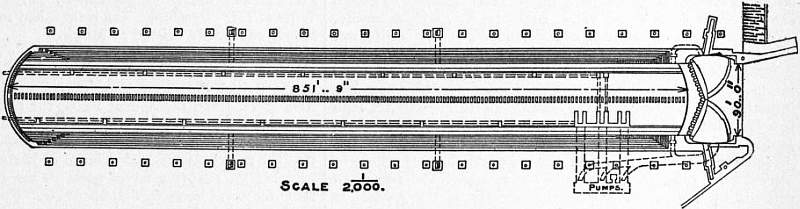
Fig. 26.—Plan of Southampton Graving Dock.
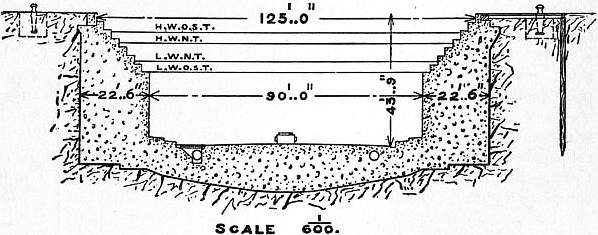
Fig. 27.—Cross Section of Southampton Graving Dock.
A graving dock consists of an enclosure, surrounded by side walls stepped on the face, and paved at the bottom with a thick floor sloping slightly down from the centre to drains along the sides, long enough to receive the longest vessel likely to come to the port. Its entrance, at the end adjoining the dock, is just wide enough to admit the vessel of greatest beam, and deep enough over the sill to receive the vessel of greatest draught, when light, at the lowest water-level of the dock (figs. 26 and 27). Graving docks are constructed of masonry, brickwork or concrete, or formerly in America of timber; they should be founded on a solid impervious stratum, or, where that is impracticable, they should be built upon bearing piles and enclosed within sheet piling, to prevent settlement and the infiltration of water under pressure below the dock. Keel blocks are laid along the centre line of the dock, for the keel of the vessel to rest on when the water is pumped out; and the vessel is further supported on each side by timber shores supported on the steps or “altars” of the side walls, which are lined with granite or other hard stone, or blue bricks, or, when constructed of concrete, with a facing of stronger concrete, to enable these altars to withstand the wear and shocks to which they are subjected. Steps and slides are provided at convenient places at the sides to give access for men and materials to the bottom of the dock; and culverts and drains lead the water to pumps for removing the water from the dock when the entrance has been closed, and to keep it dry whilst a vessel is under repair. Culverts in the side walls of the entrance enable water to be admitted for filling the dock to let the vessel out. Graving docks are generally closed by ship caissons; but where they open direct on to a tidal river, and there is some exposure, gates are adopted, or sometimes sliding caissons.
The dimensions of graving docks vary considerably with the nature of the trade and the date of construction; and sometimes an intermediate entrance is provided to accommodate two smaller vessels. The sizes of some of the largest graving docks are as follows: Liverpool, Canada dock, 925½ ft. long, 94 ft. width of entrance, and 29 ft. depth at the ordinary water-level in the dock; Southampton, 851¾ ft. by 90 ft., and 29½ ft. depth at high-water neaps (figs. 26 and 27); Tilbury, 875 ft. by 70 ft. by 31½ ft.; and Glasgow, 880 ft. by 80 ft. by 26½ ft.
Floating Dry Docks.—Where there is no site available for a graving dock, or the ground is very treacherous, floating dry docks, built originally of wood, but more recently of iron or steel, have occasionally been resorted to. The first Bermuda dock towed across the Atlantic in 1869, and the new dock launched in 1902, 545 ft. by 100 ft., are notable examples. Water is admitted into the pontoon at the bottom to sink the dock sufficiently to admit a vessel at its open end; and then the water is pumped out of compartments in the pontoon till the vessel is raised out of water. It is only necessary to find a sheltered site, with a sufficient depth of water, for conducting the operations.
(L. F. V.-H.)
DOCKET (perhaps from “dock,” to curtail or cut short, with the diminutive suffix et, but the origin of the word is obscure; it has come into use since the 15th century), in law, a brief summary or digest of a case, or a memorandum of legal decisions; also the alphabetical list of cases down for trial, or of suits pending. Such cases are said to be “on the docket.” In commercial use, a docket is a warrant from the custom-house, stating that the duty on goods entered has been paid, or the label fastened to goods, showing their destination, value, contents, &c., and, generally, any indorsement on the back of a document, briefly setting out its contents.
DOCK WARRANT, in law, a document by which the owner of a marine or river dock certifies that the holder is entitled to goods imported and warehoused in the docks. In the Factors Act 1889 it is included in the phrase “document of title” and is defined as any document or writing, being evidence of the title of any person therein named ... to the property in any goods or merchandise lying in any warehouse or wharf and signed or certified by the person having the custody of the goods. It passes by indorsement and delivery and transfers the absolute right to the goods described in it. A dock warrant is liable to a stamp duty of threepence, which may be denoted by an adhesive stamp, to be cancelled by the person by whom the instrument is executed or issued.
DOCKYARDS. In the fullest meaning of the word, a “dock-yard” (or “navy yard” in America) is a government establishment where warships of every kind are built and repaired, and supplied with the men and stores required to maintain them in a state of efficiency for war. Thus a dockyard in this extended sense would include slips for building ships, workshops for manufacturing their machinery, dry docks for repairing them, stores of arms, ammunition, coal, provisions, &c., with basins in which they may lie while being supplied with such things, and an establishment for providing the personnel necessary for manning them. But in practice few, if any, existing dockyards are of so complete a nature; many of them, for instance, do not undertake the building of ships at all, while others are little more than harbours where a ship may replenish her stores of coal, water and provisions and carry out minor repairs. Private firms are relied upon for the construction of many ships down to an advanced stage, the government dockyards completing and equipping them for commission.
Great Britain.—Previous to the reign of Henry VIII., the kings of England had neither naval arsenals nor dockyards, nor any regular establishment of civil or naval officers to provide ships of war, or to man them. There are, however, strong evidences of the existence of dockyards, or of something answering thereto, at very early dates, at Rye, Shoreham and Winchelsea. In November 1243 the sheriff of Sussex was ordered to enlarge the house at Rye in which the king’s galleys were kept, so that it might contain seven galleys. In 1238 the keepers of some of the king’s galleys were directed to cause those vessels to be breamed, and a house to be built at Winchelsea for their safe custody. In 1254 the bailiffs of Winchelsea and Rye were ordered to repair the buildings in which the king’s galleys were kept at Rye. At Portsmouth and at Southampton there seem to have been at all times depôts for both ships and stores, though there was no regular dockyard at Portsmouth till the middle of the 16th century. It would appear, from a curious poem in Hakluyt’s Collection called “The Policie of Keeping the Sea,” that Littlehampton, unfit as it now is, was the port at which Henry VIII. built
“his great Dromions Which passed other great shippes of the commons.”
The “dromion,” “dromon,” or “dromedary” was a large warship, the prototype of which was furnished by the Saracens. Roger de Hoveden, Richard of Devizes and Peter de Longtoft celebrate the struggle which Richard I., in the “Trench the Mer,” on his way to Palestine, had with a huge dromon,—“a marvellous ship! a ship than which, except Noah’s ship, none greater was ever read of.” This vessel had three masts, was very high out of the water, and is said to have had 1500 men on board. It required the united force of the king’s galleys, and an obstinate fight, to capture the dromon.
The foundation of a regular British navy, by the establishment of dockyards, and the formation of a board, consisting of certain commissioners for the management of its affairs, was first laid by Henry VIII., and the first dockyard erected during his reign was that of Woolwich. Those of Portsmouth, Deptford, Chatham and Sheerness followed in succession. Plymouth was founded by William III. Pembroke was established in 1814, a small yard having previously existed at Milford.
The most important additions yet made at any one period to the dockyard and harbour works required to meet the necessities of the British fleet were those sanctioned by the Naval Works Acts of 1895 and subsequent years, the total estimated cost, as stated in the act of 1899, being over 23½ millions sterling. The works proposed under these acts were classified under three heads, viz. (a) the enclosure and defence of harbours against torpedo attacks; (b) adapting naval ports to the present needs of the fleet; (c) naval barracks and hospitals. Under the first heading were included the defensive harbours at Portland, Dover and Gibraltar. Under heading (b) were included the deepening of harbours and approaches, the dockyard extensions at Gibraltar, Keyham (Devonport), Simons Bay, and Hong-Kong, with sundry other items. Under heading (c) were included the naval barracks at Chatham, Portsmouth and Keyham; the naval hospitals at Chatham, Haslar and Haulbowline; the colleges at Keyham and Dartmouth; and other items.
Great Britain possesses dockyards at Portsmouth, Devonport, Chatham, Malta and Gibraltar, each in charge of an admiral-superintendent, and at Sheerness and Pembroke in charge of a captain-superintendent, together with establishments at Ascension, Bermuda, Simons Town (Cape of Good Hope), Queenstown (Haulbowline); Hong-Kong, Portland, Sydney and Weihaiwei. The Indian Government has dockyards at Bombay and Calcutta. The medical establishments include Ascension, Bermuda, Cape of Good Hope, Chatham, Dartmouth, Deal, Gibraltar, Haslar, Haulbowline, Hong-Kong, Malta, Osborne, Plymouth, Portland, Portsmouth, Sheerness, Sydney, Yarmouth, Yokohama and Weihaiwei.
The arrangements for the administrative control of the dockyards have varied with those adopted for the regulation of the navy as a whole. (See Admiralty Administration; and Navy: History.) At the present time, whether at home or abroad, they lie within the province of the controller of the navy (the third lord of the board of admiralty); and the director of dockyards, whose office, replacing that of surveyor of dockyards was created in December 1885, is responsible to the controller for the building of ships, boats, &c., in dockyards, and for the maintenance and repair of ships and boats, and of all steam machinery in ships, boats, dockyards and factories. The director of naval construction, who is also deputy-controller, is responsible, not only for the design of ships, but for their construction, in the sense that he approves great numbers of working drawings of structural parts prepared at the dockyards. But the director of dockyards is the admiralty official under whose instructions the work goes on, involving the employment and supervision of an army of artisans and labourers. Instructions, therefore, emanate from the admiralty, but the details lie with the dockyard officials, and in practice there is a considerable decentralization of duties.
The chief function of a dockyard is the building and maintaining of ships in efficiency. The constructive work is carried out under the care of the chief constructor of the yard, in accordance with plans sent down from the admiralty. The calculations for displacement, involving the draught of water forward and aft, have already been made, and, in order to ensure accuracy in the carrying out of the design, an admirable system has been devised for weighing everything that is built into the new ships or that goes on board; and it is astonishing how very closely the actual displacement approximates to that which was intended, particularly when the tendency of weights to increase, in perfecting a ship for commission, is considered.
The ship having been built to her launching weight, the duty of putting her into the water devolves upon the chief constructor of the yard, and failures in this matter are so extremely rare that it may almost be said they do not occur. As soon as the ship is water-borne the responsibility falls upon the king’s harbour master, who has charge of her afloat and of moving her into the fitting basins. When the ship has been brought alongside the wharf, the responsibility of the chief constructor of the yard is resumed, and the ship is carried forward to completion by the affixing of armour plating (if that has not been done before launching), the mounting of guns, the instalment of engines, boilers, and electrical and hydraulic gear, and the fitting of cabins for officers, mess places for men, and storerooms, and a vast volume of other work unnecessary to be specified. In regard to the complicated details of guns and torpedoes, the captains of the gunnery and torpedo schools have a function of supervision. The captain of the fleet reserve also closely watches the work, because, when the heads of all departments have reported the ship to be ready, she has to be inspected by the commander-in-chief at the port, and then passed into the fleet reserve as ready for sea, and there the captain of the fleet reserve is responsible for her efficiency. Other important officers of a dockyard are the chief engineer; the superintendent civil engineer, who has charge of the work involved in keeping all buildings, docks, basins, caissons, roads, &c., in repair; the naval store officer, who has charge of most of the stores in the dockyard; and the cashier of the yard, whose name sufficiently expresses his duties.
The system of conducting business at the dockyards is analogous to that which prevails at the admiralty. There is personal communication between the officers responsible for the work, and facilities are afforded for coming to rapid decisions upon matters that are in hand, and the operations are conducted with an ease which contributes much to efficiency. In 1844 the custom was introduced of all the principal officers of the dockyard meeting at the superintendent’s office at 9.30 A.M. every day, to hear the orders from the admiralty and discuss the work of the day. But this system of “readings” was abolished at the beginning of 1906, the naval establishments inquiry committee considering that the assembling of the officials was unnecessary since the communications after reception are copied and sent to the departments concerned.
The police force necessary in a dockyard is in some cases supplied from the London metropolitan police, and is under the orders of the superintendent of the yard for duties connected with it, and under the commissioner of police for the discipline and disposition of the force. The charges are, of course, paid by the admiralty, and the system answers well.
United States.—The shore stations under control of the Navy Department (see also Admiralty Administration), and collectively known as naval stations, are under different names according to their nature. Of those called Navy Yards, and intended for the general purpose of sources of supply and for repairs of ships, there are within the United States eight in number. Two of them are on the Pacific coast, situated on Puget Sound, at Bremerton, Washington; and at Mare Island, near San Francisco. The other six are on the Atlantic coast, and are situated at Portsmouth, N.H.; Boston, Mass.; Brooklyn, N.Y.; Philadelphia, Pa.; Washington, D.C.; and Norfolk, Va. There are also naval stations at Port Royal and Charleston, S.C.; Key West and Pensacola, Fla.; New Orleans, La.; Guantanamo, Cuba; Culebra and San Juan, Porto Rico; Honolulu, H.I.; Cavite, P.I.; Tutuila, Samoa; and Island of Guam, in the Ladrones Islands. The floating dock Dewey, having a lifting capacity of 18,500 gross tons with a free-board of 2 ft., was stationed in the Philippine Islands in 1906.
Besides these, there are important naval stations established for special purposes, which in some cases are also available for ports of supply and for repairs. These are: the U.S. Naval Academy, Annapolis, Md., for the instruction of naval cadets; the training stations at Newport, R.I., and Yerba Buena Island, Cal., for the instruction of apprentices; the proving ground at Indian Head, Md., on the Potomac river, where all government-built ordnance is tested; the War College at Newport, R.I., for the instruction of officers; the torpedo station at Newport, for the instruction of officers and men in torpedoes, electricity and submarine diving; the naval observatory at Washington; and the marine post at Sitka, Alaska. Coaling depôts have been established at Honolulu, Pago Pago, Samoan Islands, and at Manila, P.I. Naval hospitals are located at the Portsmouth, Boston, New York, Philadelphia, Washington, Norfolk and Mare Island yards; at Las Animas, Colo.; at Newport, R.I.; Cañacao, P.I.; Sitka, Alaska; and Yokohama, Japan.
The commandant of a navy yard and station, who is usually a rear-admiral, is its commander-in-chief. His official assistants are called heads of departments. The captain of the yard, who is next in succession to command, has general charge of the water front and the ships moored there, and of the police of the navy yard; it is his duty to keep the commandant informed as to the nature and efficiency of all work in progress. The equipment officer has charge of anchors, chains, rigging, sails and the electric generating plant. The other heads of departments are the ordnance officer, the naval constructor, the engineering officer, the general storekeeper, the paymaster of the yard, the surgeon and the civil engineer. The clerks and draughtsmen employed by these officers are appointed under civil service rules, and their employment is continuous so long as funds are available. The foremen are selected by competitive examination, and their number is fixed. In the employment of mechanics and labourers, veterans are given preference, after which follow persons previously employed who have displayed especial efficiency and good conduct. The rates of wages are determined semi-annually by a board of officers, who ascertain the wages paid by private establishments in the vicinity of the navy yard. Eight hours constitute the legal work day. When emergencies necessitate longer hours the workmen are paid at the ordinary rate plus 50%.
The nature and extent of work to be performed upon naval vessels is determined by the secretary of the navy; the commandant then issues the necessary orders. The material required is obtained by a system of requisitions, which provide for the purchase from the lowest bidder after open competition. Heads of departments initiate the purchase of materials which are peculiar to their own work; ordinary commercial articles, however, are usually carried in a special stock called the “Naval Supply Fund,” which may be drawn upon by any head of department. All materials are inspected, both as to quantity and quality, by a board of inspectors consisting of three officers.
France.—The French coast is divided into five naval arrondissements, which have their headquarters at the five naval ports of which Cherbourg, Brest and Toulon are the most important, Lorient and Rochefort being of lesser degree. All are building and fitting-out yards. Corsica, which has naval stations at Ajaccio, Porto Vecchio, Bonifacio and other places, is a dependency of the arsenal at Toulon. On the African coast there are docking facilities in Algeria. Bizerta, the Tunisian port, has been made a naval base by the deepening and fortifying of the canal which is the approach to the inner lake. There are arsenals also at Saïgon and Hai-phong, and an establishment at Diego Suarez.
The subsidiary establishments in France are the gun foundry at Ruelle; the steel and iron works at Guérigny, where anchors, chains and armour-plate are made; and the works at Indret, on an island in the lower Loire, where machinery is constructed. There are many private shipbuilding establishments in the country, the most important being the Forges et Chantiers de la Méditerranée at La Seyne, on the lesser roadstead at Toulon where many French and foreign warships of the largest classes have been built. The same company has a building yard at Havre. Other establishments are the Ateliers et Chantiers de la Loire, at Saint Nazaire; the Normand Yard, at Havre; and the Chantiers de la Gironde, near Bordeaux.
Each of the arrondissements above mentioned is divided into sous-arrondissements, having their centres in the great commercial ports, but this arrangement is purely for the embodiment of the men of the Inscription Maritime, and has nothing to do with the dockyards as naval arsenals. In each arrondissement the vice-admiral, who is naval prefect, is the immediate representative of the minister of marine, and has full direction and command of the arsenal, which is his headquarters. He is thus commander-in-chief, as also governor-designate for time of war, but his authority does not extend to ships belonging to organized squadrons or divisions. The naval prefect is assisted by a rear-admiral as chief of the staff (except at Lorient and Rochefort, where the office is filled by a captain), and a certain number of officers, the special functions of the chief of the staff having relation principally to the efficiency and personnel of the fleet, while the “major-general,” who is usually a rear-admiral, is concerned chiefly with the matériel. There are also directors of stores, of naval construction, of the medical service and of the submarine defences (which are concerned with torpedoes, mines and torpedo-boats), as well as of naval ordnance and works. The prefect directs the operations of the arsenal, and is responsible for its efficiency and for that of the ships which are there in reserve. In regard to the constitution and maintenance of the naval forces, the administration of the arsenals is divided into three principal departments, the first concerned with naval construction, the second with ordnance, including gun-mountings and small-arms, and the third with the so-called submarine defences, dealing with all torpedo matériel.
Germany.—With the expansion of the German navy considerable additions have been made to the two principal dockyards. These are Wilhelmshaven, the naval headquarters on the North Sea, and Kiel, the headquarters on the Baltic, Danzig being an establishment of lesser importance, and Kiao-chau an undeveloped base in the Shantung peninsula, China. The chief official at each home dockyard is the superintendent (Oberwerftdirektor), who is a rear-admiral or senior captain directly responsible to the naval secretary of state. Under the superintendent’s orders are the chief of the Ausrüstung department, or captain of the fleet reserve, the directors of ordnance, torpedoes, navigation, naval construction, engineering and harbour works, with some other officers. The chiefs of the constructive and engineering departments are responsible for the building of ships and machinery, and for the maintenance of the hulls and machinery of existing vessels; while the works department has charge of all work on the quays, docks, &c., in the dockyard and port. A great advance has been made in increasing the efficiency and capabilities of the imperial dockyards by introducing a system of continuous work in the building of new ships and effecting alterations in others, and German material is exclusively used. The Schichau Works at Elbing and Danzig, the Vulkan Yard at Bredow, near Stettin, the Weser Company at Bremen, and the establishment of Blohm and Voss at Hamburg, are important establishments which have built many vessels for the German navy, as well as for foreign states.
Italy.—The principal Italian state dockyards are Spezia, Naples and Venice, the first named being by far the most important. It covers an area, including the water spaces, of 629 acres, and there are five dry docks, three being 433 ft. long and 105 ft. wide, and two 361 ft. long and 98 ft. 6 in. wide. The dockyard is very completely equipped with machinery of the best British, German and Italian makes, and it has built several of the finest Italian ships. The number of hands employed in the yard averages 4000. There are two building slips, and for smaller vessels there are two in the neighbouring establishment of San Bartolommeo (which is the headquarters for submarine mining), and one at San Vito, where is a Government gun factory. Castellammare di Stabia is subsidiary to Naples. A large dry dock has been built at Taranto. There is a small naval establishment at Maddalena Island on the Strait of Bonifacio. The Italian Government has no gun or torpedo factories, nearly all the ordnance coming from the Armstrong factory at Pozzuoli near Naples, and the torpedoes from the Schwarzkopf factory at Venice, while armour-plates are produced at the important works at Terni. Machinery is supplied by the firms of Ansaldo, Odero, Orlando, Guppy & Hawthorn and Pattison. The three establishments first named have important shipbuilding yards, and have constructed vessels for the Italian and foreign navies. The Orlando Yard at Leghorn is Government property, but is leased by the firm, and possesses five building slips.
Austria-Hungary.—The naval arsenal is on the well-protected harbour of Pola, in Istria, which is the headquarters of the national navy, and includes establishments of all kinds for the maintenance of the fleet. There are large building and docking facilities, and a number of warships have been built there. There is a construction yard also at Trieste. A new coaling and torpedo station is at Teodo, large magazines and stores are at Vallelunga, and the mining establishment is at Ficella. The shipbuilding branch of the navy is under the direction of a chief constructor (Oberster-Ingenieur), assisted by seven constructors, of whom two are of the first class. The engineering and ordnance branches are similarly organized.
Spain.—The Spanish dockyards are of considerable antiquity, but of diminishing importance. There is an establishment at Ferrol, another at Cartagena, and a third at Cadiz. They are well equipped in all necessary respects, but are not provided with continuous work. A recent arrangement is the specialization of the yards, Ferrol being designed for larger, and Carthagena for smaller, building work. The ordnance establishment is at Carraca.
Russia.—In Russia the naval ports are of two classes. The most important are Kronstadt, St Petersburg and Nikolayev. Of lesser importance are Reval, Sveaborg, Sevastopol, Batum, Baku and Vladivostok. The administration of the larger ports, except St Petersburg, which is under special regulations, is in the hands of vice-admirals, who are commanders-in-chief, while the smaller ports are under the direction of rear-admirals. All are directly under the minister of marine, except that the Black Sea ports and Astrabad, on the Caspian, are subordinate to the commander-in-chief at Nikolayev. Sevastopol has grown in importance, and become mainly a naval harbour, the commercial harbour being removed to Theodosia. The Russian government has also proposed to remodel the harbour works at St Petersburg and Kronstadt. The Emperor Alexander III. Port at Libau, on the Baltic, is in a region less liable to be icebound in the winter. There are no strictly private yards for the building of large vessels in Russia, except that of the Black Sea Company at Nikolayev. Messrs Creighton build torpedo-boats at Åbo in Finland, and the admiralty has steel works at Ijora, where some torpedo-boats have been built. Other ordnance and steel works are at Obukhov and Putilov.
Japan.—The principal Japanese dockyard, which was established by the Shogunate in 1866, is Yokosuka. French naval constructors and engineers were employed, and several wooden ships were built. The Japanese took the administration into their own hands in 1875, and built a number of vessels of small displacement in the yard. The limit of size was about 5000 tons, but the establishment has been enlarged so that vessels of the first class may be built there. There is a first-class modern dry dock which will take the largest battleship. Shipbuilding would be undertaken to a larger extent but for the fact that nearly all material has to come from abroad. Down to 1905 all the important vessels of the Japanese navy were built in Great Britain, France, Germany and the United States, but at the end of that year a first-class cruiser of 13,500 tons (the “Tsukuba”) was launched from the important yard at Kure. There are other yards at Sassebo and Maisuru.
DOCTOR (Lat. for “teacher”), the title conferred by the highest university degree. Originally there were only two degrees, those of bachelor and master, and the title doctor was given to certain masters as a merely honorary appellation. The process by which it became established as a degree superior to that of master cannot be clearly traced. At Bologna it seems to have been conferred in the faculty of law as early as the 12th century. Paris conferred the degree in the faculty of divinity, according to Antony Wood, some time after 1150. In England it was introduced in the 13th century; and both in England and on the continent it was long confined to the faculties of law and divinity. Though the word is so commonly used as synonymous with “physician,” it was not until the 14th century that the doctor’s degree began to be conferred in medicine. The tendency since has been to extend it to all faculties; thus in Germany, in the faculty of arts, it has replaced the old title of magister. The doctorate of music was first conferred at Oxford and Cambridge.
Doctors of the Church are certain saints whose doctrinal writings have obtained, by the universal consent of the Church or by papal decree, a special authority. In the case of the great schoolmen a characteristic qualification was added to the title doctor, e.g. “angelicus” (Aquinas), “mellifluus” (Bernard). The doctors of the Church are: for the East, SS. Athanasius, Gregory of Nazianzus, Basil the Great, John Chrysostom; for the West, SS. Hilary, Ambrose, Jerome, Augustine, Gregory the Great, Anselm, Bernard, Bonaventura and Thomas Aquinas. To these St Alphonso dei Liguori was added by Pope Pius IX.
DOCTORS’ COMMONS, the name formerly applied to a society of ecclesiastical lawyers in London, forming a distinct profession for the practice of the civil and canon laws. Some members of the profession purchased in 1567 a site near St Paul’s, on which at their own expense they erected houses (destroyed in the great fire, but rebuilt in 1672) for the residence of the judges and advocates, and proper buildings for holding the ecclesiastical and admiralty courts. In 1768 a royal charter was obtained by virtue of which the then members of the society and their successors were incorporated under the name and title of “The College of Doctors of Law exercent in the Ecclesiastical and Admiralty Courts.” The college consisted of a president (the dean of Arches for the time being) and of those doctors of law who, having regularly taken that degree in either of the universities of Oxford or Cambridge, and having been admitted advocates in pursuance of the rescript of the archbishop of Canterbury, were elected fellows in the manner prescribed by the charter. There were also attached to the college thirty-four proctors, whose duties were analogous to those of solicitors. The judges of the archiepiscopal courts were always selected from this college. By the Court of Probate Act 1857 the college was empowered to sell its real and personal estate and to surrender its charter, and it was enacted that on such surrender the college should be dissolved and the property thereof belong to the then existing members as tenants in common for their own use and benefit. The college was accordingly dissolved, and the various ecclesiastical courts which sat at Doctors’ Commons (the Court of Arches, the Prerogative Court, the Faculty Court and the Court of Delegates) are now open to the whole bar.
DOCTRINAIRES, the name given to the leaders of the moderate and constitutional Royalists in France after the second restoration of Louis XVIII. in 1815. The name, as has often been the case with party designations, was at first given in derision, and by an enemy. In 1816 the Nain jaune réfugié, a French paper published at Brussels by Bonapartist and Liberal exiles, began to speak of M. Royer-Collard as the “doctrinaire” and also as le père Royer-Collard de la doctrine chrétienne. The pères de la doctrine chrétienne, popularly known as the “doctrinaires,” were a French religious order founded in 1592 by César de Bus. The choice of a nickname for M. Royer-Collard does credit to the journalistic insight of the contributors to the Nain jaune réfugié, for he was emphatically a man who made it his business to preach a doctrine and an orthodoxy. The popularity of the name and its rapid extension to M. Royer-Collard’s colleagues is the sufficient proof that it was well chosen and had more than a personal application. These colleagues came, it is true, from various quarters. The duc de Richelieu and M. de Serre had been Royalist émigrés during the revolutionary and imperial epoch. MM. Royer-Collard himself, Lainé, and Maine de Biran had sat in the revolutionary Assemblies. MM. Pasquier, Beugnot, de Barante, Cuvier, Mounier, Guizot and Decazes had been imperial officials. But they were closely united by political principle, and also by a certain similarity of method. Some of them, notably Guizot and Maine de Biran, were theorists and commentators on the principles of government. M. de Barante was an eminent man of letters. All were noted for the doctrinal coherence of their principles and the dialectical rigidity of their arguments. The object of the party as defined by M. (afterwards the duc) Decazes was to “nationalize the monarchy and to royalize France.” The means by which they hoped to attain this end were a loyal application of the charter granted by Louis XVIII., and the steady co-operation of the king with the moderate Royalists to defeat the extreme party known as the Ultras, who aimed at the complete undoing of the political and social work of the Revolution. The Doctrinaires were ready to allow the king a large discretion in the choice of his ministers and the direction of national policy. They refused to allow that ministers should be removed in obedience to a hostile vote in the chamber. Their ideal in fact was a combination of a king who frankly accepted the results of the Revolution, and who governed in a liberal spirit, with the advice of a chamber elected by a very limited constituency, in which men of property and education formed, if not the whole, at least the very great majority of the voters. Their views were set forth by Guizot in 1816 in his treatise Du gouvernement représentatif et de l’état actuel de la France. The chief organs of the party in the press were the Indépendent, renamed the Constitutionnel in 1817, and the Journal des débats. The supporters of the Doctrinaires in the country were chiefly ex-officials of the empire,—who believed in the necessity for monarchical government but had a lively memory of Napoleon’s tyranny and a no less lively hatred of the ancien régime—merchants, manufacturers and members of the liberal professions, particularly the lawyers. The history of the Doctrinaires as a separate political party began in 1816 and ended in 1830. In 1816 they obtained the co-operation of Louis XVIII., who had been frightened by the violence of the Ultras in the Chambre introuvable of 1815. In 1830 they were destroyed by Charles X. when he took the Ultra prince de Polignac as his minister and entered on the conflict with Liberalism in France which ended in his overthrow. During the revolution of 1830 the Doctrinaires became absorbed in the Orleanists, from whom they had never been separated on any ground of principle (see France: History).
The word “doctrinaire” has become naturalized in English terminology, as applied, in a slightly contemptuous sense, to a theorist, as distinguished from a practical man of affairs.
See Duvergier de Hauranne, Histoire du gouvernement parlementaire en France (Paris, 1857-1871), vol. iii.
DOCUMENT, strictly, in law, that which can serve as evidence or proof, and is written or printed, or has an inscription or any significance that can be “read”; thus a picture, authenticated photograph, seal or the like would furnish “documentary evidence.” More generally the word is used for written or printed papers that provide information or evidence on a subject. The Latin documentum, from which the word is derived, meant, in classical times, a lesson, example or proof (docere, to teach), and only in medieval Latin came to be applied to an instrumentum, or record in writing. The classical Latin use is found in English; thus Jeremy Taylor (Works, ed. 1835, i. 815) speaks of punishment being a “single and sudden document if instantly inflicted” (see Diplomatic; and Evidence).
DODD, WILLIAM (1729-1777), English divine, was born at Bourne in Lincolnshire in May 1729. He was admitted a sizar of Clare Hall, Cambridge, in 1745, and took the degree of B.A. in 1750, being fifteenth wrangler. On leaving the university he married a young woman of a more than questionable reputation, whose extravagant habits helped to ruin him. In 1751 he was ordained deacon, and in 1753 priest, and he soon became a popular and celebrated preacher. His first preferment was the lectureship of West-Ham and Bow. In 1754 he was also chosen lecturer of St Olave’s, Hart Street; and in 1757 he took the degree of M.A. at Cambridge, subsequently becoming LL.D. He was a strenuous supporter of the Magdalen hospital, founded in 1758, and soon afterwards became preacher at the chapel of that charity. In 1763 he obtained a prebend at Brecon, and in the same year he was appointed one of the king’s chaplains,—soon after which the education of Philip Stanhope, afterwards earl of Chesterfield, was committed to his care. In 1768 he had a fashionable congregation and was held in high esteem, but indiscreet ambition led to his ruin. On the living of St George’s, Hanover Square, becoming vacant in 1774, Mrs Dodd wrote an anonymous letter to the wife of the lord chancellor, offering three thousand guineas if, by her assistance, Dodd were promoted to the benefice. This letter having been traced, a complaint was immediately made to the king, and Dodd was dismissed from his office as chaplain. After residing for some time at Geneva and Paris, he returned to England in 1776. He still continued to exercise his clerical functions, but his extravagant habits soon involved him in difficulties. To meet his creditors he forged a bond on his former pupil Lord Chesterfield for £4200, and actually received the money. He was detected, committed to prison, tried at the Old Bailey, found guilty, and sentenced to death; and, in spite of numerous applications for mercy, he was executed at Tyburn on the 27th of June 1777. Samuel Johnson was very zealous in pleading for a pardon, and a petition from the city of London received 23,000 signatures. Dr Dodd was a voluminous writer and possessed considerable abilities, with but little judgment and much vanity. He wrote one or two comedies, and his Beauties of Shakespeare, published in 1752, was long a well-known work; while his Thoughts in Prison, a poem in blank verse, written between his conviction and execution, naturally attracted much attention. He published a large number of sermons and other theological works, including a Commentary on the Bible (1765-1770). A list of his fifty-five writings and an account of the writer is included in the Thoughts in Prison.
See also P. Fitzgerald, A Famous Forgery (1865).
DODDER (Frisian dodd, a bunch; Dutch dot, ravelled thread), the popular name of the annual, leafless, twining, parasitic plants forming the genus Cuscuta, formerly regarded as representing a distinct natural order Cuscutaceae, but now generally ranked as a tribe of the natural order Convolvulaceae. The genus contains nearly 100 species and is widely distributed in the temperate and warmer parts of the earth. The slender thread-like stem is white, yellow, or red in colour, bears no leaves, and attaches itself by suckers to the stem or leaves of some other plant round which it twines and from which it derives its nourishment. It bears clusters of small flowers with a four- or five-toothed calyx, a cup-shaped corolla with four or five stamens inserted on its tube, and sometimes a ring of scales below the stamens; the two-celled ovary becomes when ripe a capsule splitting by a ring just above the base. The seeds are angular and contain a thread-like spirally coiled embryo which bears no cotyledons. On coming in contact with the living stem of some other plant the seedling dodder throws out a sucker, by which it attaches itself and begins to absorb the sap of its foster-parent; it then soon ceases to have any connexion with the ground. As it grows, it throws out fresh suckers, establishing itself firmly on the host-plant (fig. 2). After making a few turns round one stem the dodder finds its way to another, and thus it continues twining and branching till it resembles “fine, closely-tangled, wet catgut.” The injury done to flax, clover, hop and bean crops by species of dodder is often very great. C. europaea, the greater dodder (fig. 1) is found parasitic on nettles, thistles, vetches and the hop; C. Epilinum, on flax; C. Epithymum, on furze, ling and thyme. C. Trifolii, the Clover Dodder, is perhaps a subspecies of the last mentioned.
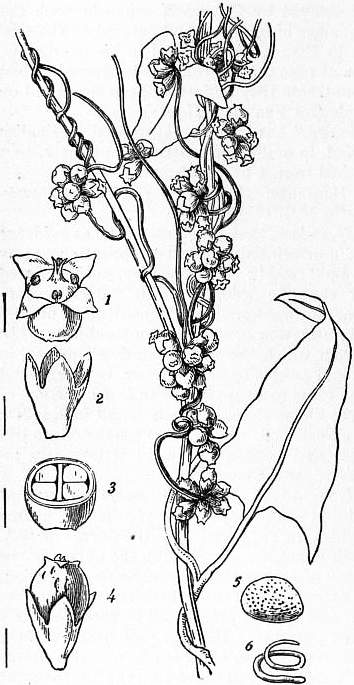
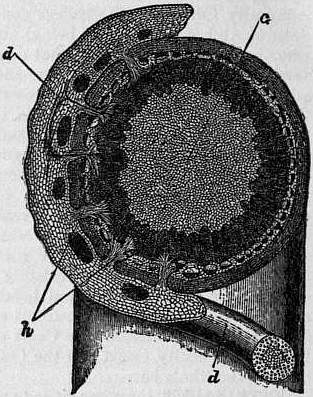
Fig. 1.—Cuscuta europaea, Dodder. Fig. 2.—Cuscuta glomerata. Section through union between parasite and host.
1. Flower removed from 2, Calyx. 3. Ovary cut across. 4. Fruit enveloped by a persistent corolla. 5. Seed. 6. Embryo. 1-6 enlarged. c, stem of host. d, stem of Cuscuta. h, haustoria. (After Dodel-Port.)
DODDRIDGE, PHILIP (1702-1751), English Nonconformist divine, was born in London on the 26th of June 1702. His father, Daniel Doddridge, was a London merchant, and his mother the orphan daughter of the Rev. John Bauman, a Lutheran clergyman who had fled from Prague to escape religious persecution, and had held for some time the mastership of the grammar school at Kingston-upon-Thames. Before he could read, his mother taught him the history of the Old and New Testament by the assistance of some blue Dutch chimney-tiles. He afterwards went to a private school in London, and in 1712 to the grammar school at Kingston-upon-Thames. About 1715 he was removed to a private school at St Albans, where he was much influenced by the Presbyterian minister, Samuel Clarke. He declined offers which would have led him into the Anglican ministry or the bar, and in 1719 entered the very liberal academy for dissenters at Kibworth in Leicestershire, taught at that time by the Rev. John Jennings, whom Doddridge succeeded in the ministry at that place in 1723, declining overtures from Coventry, Pershore and London (Haberdashers’ Hall). In 1729, at a general meeting of Nonconformist ministers, he was chosen to conduct the academy established in that year at Market Harborough. In the same year he received an invitation from the independent congregation at Northampton, which he accepted. Here he continued his multifarious labours; but the church seems to have decreased, and his many engagements and bulky correspondence interfered seriously with his pulpit work, and with the discipline of his academy, where he had some 200 students to whom he lectured on philosophy and theology in the mathematical or Spinozistic style. In 1751 his health, which had never been good, broke down, and he sailed for Lisbon on the 30th of September of that year; but the change was unavailing, and he died there on the 26th of October. His popularity as a preacher is said to have been chiefly due to his “high susceptibility, joined with physical advantages and perfect sincerity.” His sermons were mostly practical in character, and his great aim was to cultivate in his hearers a spiritual and devotional frame of mind. He laboured for the attainment of a united Nonconformist body, which should retain the cultured element without alienating the uneducated. His principal works are, The Rise and Progress of Religion in the Soul (1745), which best illustrates his religious genius, and has been widely translated; The Family Expositor (6 vols., 1739-1756), Life of Colonel Gardiner (1747); and a Course of Lectures on Pneumatology, Ethics and Divinity (1763). He also published several courses of sermons on particular topics, and is the author of many well-known and justly admired hymns, e.g. “O God of Bethel, by whose hand.” In 1736 both the universities at Aberdeen gave him the degree of D.D.
See Memoirs, by Rev. Job Orton (1766); Letters to and from Dr Doddridge, by Rev. Thomas Stedman (1790); and Correspondence and Diary, in 5 vols., by his grandson, John Doddridge Humphreys (1829). The best life is Stanford’s Philip Doddridge (1880). Doddridge’s academy is now represented by New College, Hampstead, in the library of which there is a large collection of his manuscripts.
DODDS, ALFRED AMÉDÉE (1842- ), French general, was born at St Louis, Senegal, on the 6th of February 1842; his father’s family was of Anglo-French origin. He was educated at Carcassonne and at St Cyr, and in 1864 joined the marine infantry as a sub-lieutenant. He was promoted captain for his services during the disturbances in Réunion in 1868-69, in the course of which he was wounded. He served as a company commander in the Franco-German War, was taken prisoner at Sedan but escaped, and took part in the campaigns of the Loire and of the East. In 1872 he was sent to West Africa, and, except when on active service in Cochin China (1878) and Tong-King (1883), he remained on duty in Senegal for the next twenty years, taking a prominent part in the operations which brought the countries of the Upper Senegal and Upper Niger under French rule. He led the expeditions against the Boal and Kayor (1889), the Serreres (1890) and the Futa (1891), and from 1888 to 1891 was colonel commanding the troops in Senegal. At the close of 1891 he returned to France to command the eighth marine infantry at Toulon. In April 1892 Dodds was selected to command the expeditionary force in Dahomey; he occupied Abomey, the hostile capital, in November, and in a second campaign (1894) he completed the subjugation of the country. He was then appointed inspector-general of the marine infantry, and after a tour of the French colonies was given the command of the XX. (Colonial) Army Corps, subsequently becoming inspector-general of colonial troops and a member of the Conseil supérieur de guerre.
DODECAHEDRON (Gr. δώδεκα, twelve, and ἕδρα, a face or base), in geometry, a solid enclosed by twelve plane faces. The “ordinary dodecahedron” is one of the Platonic solids (see Polyhedron). The Greeks discovered that if a line be divided in extreme and mean proportion, then the whole line and the greater segment are the lengths of the edge of a cube and dodecahedron inscriptible in the same sphere. The “small stellated dodecahedron,” the “great dodecahedron” and the “great stellated dodecahedron” are Kepler-Poinsot solids; and the “truncated” and “snub dodecahedra” are Archimedean solids (see Polyhedron). In crystallography, the regular or ordinary dodecahedron is an impossible form since the faces cut the axes in irrational ratios; the “pentagonal dodecahedron” of crystallographers has irregular pentagons for faces, while the geometrical solid, on the other hand, has regular ones. The “rhombic dodecahedron,” one of the geometrical semiregular solids, is an important crystal form. Many other dodecahedra exist as crystal forms, for which see Crystallography.
DODECASTYLE (Gr. δώδεκα, twelve, and στῦλος, column), the architectural term given to a temple where the portico has twelve columns in front, as in the portico added to the temple of Demeter at Eleusis, designed by Philo, the architect of the arsenal at the Peiraeus.
DÖDERLEIN, JOHANN CHRISTOPH WILHELM LUDWIG (1791-1863), German philologist, was born at Jena on the 19th of December 1791. His father, Johann Christoph Döderlein, professor of theology at Jena, was celebrated for his varied learning, for his eloquence as a preacher, and for the important influence he exerted in guiding the transition movement from strict orthodoxy to a freer theology. Ludwig Döderlein, after receiving his preliminary education at Windsheim and Schulpforta (Pforta), studied at Munich, Heidelberg, Erlangen and Berlin. He devoted his chief attention to philology under the instruction of such men as F. Thiersch, G. F. Creuzer, J. H. Voss, F. A. Wolf, August Böckh and P. K. Buttmann. In 1815, soon after completing his studies at Berlin, he accepted the appointment of ordinary professor of philology in the academy of Bern. In 1819 he was transferred to Erlangen, where he became second professor of philology in the university and rector of the gymnasium. In 1827 he became first professor of philology and rhetoric and director of the philological seminary. He died on the 9th of November 1863. Döderlein’s most elaborate work as a philologist was marred by over-subtlety, and lacked method and clearness. He is best known by his Lateinische Synonymen und Etymologien (1826-1838), and his Homerisches Glossarium (1850-1858). To the same class belong his Lateinische Wortbildung (1838), Handbuch der lateinischen Synonymik (1839), and the Handbuch der lateinischen Etymologie (1841), besides various works of a more elementary kind intended for the use of schools and gymnasia. Most of the works named have been translated into English. To critical philology Döderlein contributed valuable editions of Tacitus (Opera, 1847; Germania, with a German translation) and Horace (Epistolae, with a German translation, 1856-1858; Satirae, 1860). His Reden und Aufsätze (Erlangen, 1843-1847) and Offentliche Reden (1860) consist chiefly of academic addresses dealing with various subjects in paedagogy and philology.
DODGE, THEODORE AYRAULT (1842-1909), American soldier and military writer, was born at Pittsfield, Massachusetts, on the 28th of May 1842. He received a military education in Germany and subsequently studied at Heidelberg and London University, returning to the United States in 1861. At the outbreak of the Civil War he at once enlisted in the federal army, and he soon rose to commissioned rank. He served in the Army of the Potomac until Gettysburg, where he lost a leg. Incapacitated for further active service, he continued to be employed in administrative posts to the end of the war, and for several years thereafter he served at army headquarters, becoming captain in 1866 and brevet lieutenant-colonel in 1867. He retired in 1870. His works include The Campaign of Chancellorsville (1881), A Bird’s Eye View of our Civil War (1882, later edition 1897), a complete, accurate and remarkably concise account of the whole war, Patroclus and Penelope, a Chat in the Saddle (1883), Great Captains (1886), a series of lectures, Riders of Many Lands (1893), and a series of large illustrated volumes entitled A History of the Art of War, being lives of “Great Captains,” including Alexander (2 vols., 1888), Hannibal (2 vols., 1889), Caesar (2 vols., 1892), Gustavus Adolphus (2 vols., 1896) and Napoleon (4 vols., 1904-1907). He died in France, at Versailles, on the 26th of October 1909.
DODGSON, CHARLES LUTWIDGE [”Lewis Carroll”] (1832-1898), English mathematician and author, son of the Rev. Charles Dodgson, vicar of Daresbury, Cheshire, was born in that village on the 27th of January 1832. The literary life of “Lewis Carroll” became familiar to a wide circle of readers, but the private life of Charles Lutwidge Dodgson was retired and practically uneventful. After four years’ schooling at Rugby, Dodgson matriculated at Christ Church, Oxford, in May 1850; and from 1852 till 1870 held a studentship there. He took a first class in the final mathematical school in 1854, and the following year was appointed mathematical lecturer at Christ Church, a post he continued to fill till 1881. In 1861 he was ordained deacon, but he never took priest’s orders, possibly because of a stammer which prevented reading aloud. His earliest publications, beginning with A Syllabus of Plane Algebraical Geometry (1860) and The Formulae of Plane Trigonometry (1861), were exclusively mathematical; but late in the year 1865 he published, under the pseudonym of “Lewis Carroll,” Alice’s Adventures in Wonderland, a work that was the outcome of his keen sympathy with the imagination of children and their sense of fun. Its success was immediate, and the name of “Lewis Carroll” has ever since been a household word. A dramatic version of the “Alice” books by Mr Savile Clarke was produced at Christmas, 1886, and has since enjoyed many revivals. Mr Dodgson was always very fond of children, and it was an open secret that the original of “Alice” was a daughter of Dean Liddell. Alice was followed (in the “Lewis Carroll” series) by Phantasmagoria, in 1869; Through the Looking-Glass, in 1871; The Hunting of the Snark (1876); Rhyme and Reason (1883); A Tangled Tale (1885); and Sylvie and Bruno (in two parts, 1889 and 1893). He wrote skits on Oxford subjects from time to time. The Dynamics of a Particle was written on the occasion of the contest between Gladstone and Mr Gathorne Hardy (afterwards earl of Cranbrook); and The New Belfry in ridicule of the erection put up at Christ Church for the bells that were removed from the Cathedral tower. While “Lewis Carroll” was delighting children of all ages, C. L. Dodgson periodically published mathematical works—An Elementary Treatise on Determinants (1867); Euclid, Book V., proved Algebraically (1874); Euclid and his Modern Rivals (1879), the work on which his reputation as a mathematician largely rests; and Curiosa Mathematica (1888). Throughout this dual existence Mr Dodgson pertinaciously refused to acquiesce in being publicly identified with “Lewis Carroll.” Though the fact of his authorship of the “Alice” books was well known, he invariably stated, when occasion called for such a pronouncement, that “Mr Dodgson neither claimed nor acknowledged any connexion with the books not published under his name.” He died at Guildford, on the 14th of January 1898. His memory is appropriately kept green by a cot in the Children’s Hospital, Great Ormond Street, London, which was endowed perpetually by a public subscription.
See S. D. Collingwood, Life and Letters of Lewis Carroll (1898).
DODO (from the Portuguese Dóudo, a simpleton), a large bird formerly inhabiting the island of Mauritius, but now extinct—the Didus ineptus of Linnaeus. When, in 1507, the Portuguese discovered the island which we now know as Mauritius they named it Ilha do Cerné, from a notion that it must be the island of that name mentioned by Pliny; but most authors have insisted that it was known to the seamen of that nation as Ilha do Cisne—perhaps but a corruption of Cerne, and brought about by their finding it stocked with large fowls, which, though not aquatic, they likened to swans, the most familiar to them of bulky birds. In 1598 the Dutch, under Van Neck, took possession of the island and renamed it Mauritius. A narrative of this voyage was published, in 1601, if not earlier, and has been often reprinted. Here we have birds spoken of as big as swans or bigger, with large heads, no wings, and a tail consisting of a few curly feathers. The Dutch called them Walgvögels (the word is variously spelled), i.e. nauseous birds, either because no cooking made them palatable, or because this island-paradise afforded an abundance of fare so much superior. De Bry gives two admirably quaint prints of the doings of the Hollanders, and in one of them the Walgvögel appears, being the earliest published representation of its unwieldy form, with a footnote stating that the voyagers brought an example alive to Holland. Among the company there was a draughtsman, and from a sketch of his, Clusius, a few years after, gave a figure of the bird, which he vaguely called “Gallinaceus Gallus peregrinus,” but described rather fully. Meanwhile two other Dutch fleets had visited Mauritius. One of them had rather an accomplished artist on board, and his drawings fortunately still exist (see article Bird). Of the other a journal kept by one of the skippers was subsequently published. This in the main corroborates what has been before said of the birds, but adds the curious fact that they were now called by some Dodaarsen and by others Dronten.1
Henceforth Dutch narrators, though several times mentioning the bird, fail to supply any important fact in its history. Their navigators, however, were not idle, and found work for their naturalists and painters. Clusius says that in 1605 he saw at Pauw’s House in Leyden a dodo’s foot,2 which he minutely describes. In a copy of Clusius’s work in the high school of Utrecht is pasted an original drawing by Van de Venne superscribed “Vera effigies huius avis Walghvögel (quae & a nautis Dodaers propter foedam posterioris partis crassitiem nuncupatur), qualis viua Amsterodamum perlata est ex insula Mauritii. Anno M.DC.XXVI.” Now a good many paintings of the dodo drawn from life by Roelandt Savery (1576-1639) exist; and the paintings by him at Berlin and Vienna—dated 1626 and 1628—as well as the picture by Goiemare, belonging to the duke of Northumberland, dated 1627, may be with greater plausibility than ever considered portraits of a captive bird. It is even probable that this was not the first example painted in Europe. In the private library of the emperor Francis I. of Austria was a series of pictures of various animals, supposed to be by the Dutch artist Hoefnagel, who was born about 1545. One of these represents a dodo, and, if there be no mistake in Von Frauenfeld’s ascription, it must almost certainly have been painted before 1626, while there is reason to think that the original may have been kept in the vivarium of the emperor Rudolf II., and that the portion of a dodo’s head, which was found in the museum at Prague about 1850, belonged to this example. The other pictures by Roelandt Savery, like those in the possession of the Zoological Society of London and others, are undated, but were probably all painted about the same time—1626-1628. The large picture in the British Museum, once belonging to Sir Hans Sloane, by an unknown artist, but supposed to be by Roelandt Savery, is also undated; while the still larger one at Oxford (considered to be by the younger Savery) bears a much later date, 1651. Undated also is a picture in Holland said to be by Pieter Holsteyn.
In 1628 we have the evidence of the first English observer of the bird—one Emanuel Altham, who mentions it in two letters written on the same day from Mauritius to his brother at home (Proc. Zool. Soc. 1874, pp. 447-449). In one he says: “You shall receue ... a strange fowle: which I had at the Iland Mauritius called by ye portingalls a Do Do: which for the rareness thereof I hope wilbe welcome to you.” The passage in the other letter is to the same effect, with the addition of the words “if it liue.” In the same fleet with Altham sailed Sir Thomas Herbert, whose Travels ran through several editions. It is plain that he could not have reached Mauritius till 1629, though 1627 has been usually assigned as the date of his visit. The fullest account he gives of the bird is in his edition of 1638: “The Dodo comes first to a description: here, and in Dygarrois3 (and no where else, that ever I could see or heare of) is generated the Dodo (a Portuguize name it is, and has reference to her simpleness,) a Bird which for shape and rareness might be call’d a Phoenix (wer’t in Arabia:)” &c. Herbert was weak as an etymologist, but his positive statement, corroborated as it is by Altham, cannot be set aside, and hence we do not hesitate to assign a Portuguese derivation for the word.4 Herbert also gave a figure of the bird.
Proceeding chronologically we next come upon a curious bit of evidence. This is contained in a MS. diary kept between 1626 and 1640, by Thomas Crossfield of Queen’s College, Oxford, where, under the year 1634, mention is casually made of one Mr Gosling “who bestowed the Dodar (a blacke Indian bird) vpon ye Anatomy school.” Nothing more is known of it. About 1638, Sir Hamon Lestrange tells us, as he walked London streets he saw the picture of a strange fowl hung out on a cloth canvas, and going in to see it found a great bird kept in a chamber “somewhat bigger than the largest Turky cock, and so legged and footed, but shorter and thicker.” The keeper called it a dodo and showed the visitors how his captive would swallow “large peble stones ... as bigge as nutmegs.”
In 1651 Morisot published an account of a voyage made by François Cauche, who professed to have passed fifteen days in Mauritius, or “l’isle de Saincte Apollonie,” as he called it, in 1638. According to De Flacourt the narrative is not very trustworthy, and indeed certain statements are obviously inaccurate. Cauche says he saw there birds bigger than swans, which he describes so as to leave no doubt of his meaning dodos; but perhaps the most important facts (if they be facts) that he relates are that they had a cry like a gosling (“il a un cry comme l’oison”), and that they laid a single white egg (“gros comme un pain d’un sol”) on a mass of grass in the forests. He calls them “oiseaux de Nazaret,” perhaps, as a marginal note informs us, from an island of that name which was then supposed to lie more to the northward, but is now known to have no existence.
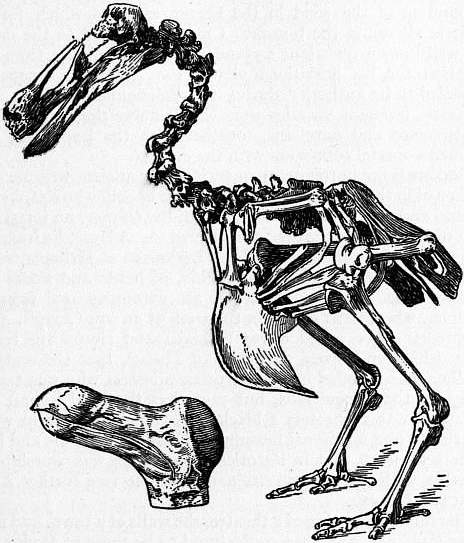
Fig. 1.—Skeleton of a Dodo, Didus ineptus, Museum of Zoology, Cambridge, and cast of a Head in Oxford.
In the catalogue of Tradescant’s Collection of Rarities, preserved at South Lambeth, published in 1656, we have entered among the “Whole Birds,” a “Dodar from the island Mauritius; it is not able to flie being so big.” This specimen may well have been the skin of the bird seen by Lestrange some eighteen years before, but anyhow we are able to trace the specimen through Willughby, Edward Llwyd and Thomas Hyde, till it passed in or before 1684 to the Ashmolean collection at Oxford. In 1755 it was ordered to be destroyed, but, in accordance with the original orders of Ashmole, its head and right foot were preserved, and still ornament the museum of that university. In the second edition of a Catalogue of many Natural Rarities, &c., “to be seen at the place formerly called the Music House, near the West End of St Paul’s Church,” collected by one Hubert alias Forbes, and published in 1665, mention is made of a “legge of a Dodo, a great heavy bird that cannot fly; it is a Bird of the Mauricius Island.” This is supposed to have subsequently passed into the possession of the Royal Society. At all events such a specimen is included in Grew’s list of their treasures which was published in 1681. This was afterwards transferred to the British Museum. It is a left foot, without the integuments, but it differs sufficiently in size from the Oxford specimen to forbid its having been part of the same individual. In 1666 Olearius brought out the Gottorffische Kunst Kammer, wherein he describes the head of a Walghvögel which some sixty years later was removed to the museum at Copenhagen, and is now preserved there, having been the means of first leading zoologists, under the guidance of Prof. J. Th. Reinhardt, to recognize the true affinities of the bird.
We have passed over all but the principal narratives of voyagers or other notices of the bird. A compendious bibliography, up to the year 1848, will be found in Strickland’s classical work,5 and the list was continued by Von Frauenfeld6 for twenty years later. The last evidence we have of the dodo’s existence is furnished by a journal kept by Benj. Harry, and now in the British Museum (MSS. Addit. 3668. II. D). This shows its survival till 1681, but the writer’s sole remark upon it is that its “fflesh is very hard.” The successive occupation of the island by different masters seems to have destroyed every tradition relating to the bird, and doubts began to arise whether such a creature had ever existed. Dr Henry Duncan, Scottish minister and journalist, in 1828, showed how ill-founded these doubts were, and some ten years later William John Broderip with much diligence collected all the available evidence into an admirable essay, which in its turn was succeeded by Strickland’s monograph just mentioned. But in the meanwhile little was done towards obtaining any material advance in our knowledge, Prof. Reinhardt’s determination of its affinity to the pigeons (Columbae) excepted; and it was hardly until George Clark’s discovery in 1865 of a large number of dodos’ remains in the mud of a pool (the Mare aux Songes) that zoologists generally were prepared to accept that affinity without question. The examination of bone after bone by Sir R. Owen (Trans. Zool. Soc. vi. p. 49) confirmed the judgment of the Danish naturalist.
In 1889 Th. Sauzier, acting for the government of Mauritius, sent a great number of bones from the same swamp to Sir Edward Newton.7 From these the first correctly restored and properly mounted skeleton was prepared and sent to Paris, to be forwarded to the museum of Mauritius. Good specimens are in the British Museum, at Paris and at Cambridge, England.
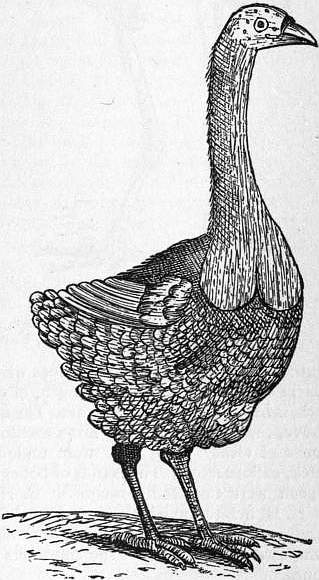
Fig. 2.—The Solitaire of Rodriguez (Pezophaps solitarius). From Leguat’s figure.
The huge blackish bill of the dodo terminated in a large, horny hook; the cheeks were partly bare, the stout, short legs yellow. The plumage was dark ash-coloured, with whitish breast and tail, yellowish white wings (incapable of flight). The short tail formed a curly tuft.
The dodo is said to have inhabited forests and to have laid one large white egg on a mass of grass. Besides man, hogs and other imported animals seem to have exterminated it. But the dodo is not the only member of its family that has vanished. The little island which has successively borne the name of Mascaregnas, England’s Forest, Bourbon and Réunion, and lies to the southward of Mauritius, had also an allied bird, now dead and gone. Of this not a relic has been handled by any naturalist. The latest description of it, by Du Bois in 1674, is very meagre, while Bontekoe (1646) gave a figure, apparently intended to represent it. It was originally called the “solitaire,” but this name was also applied to Pezophaps solitarius of Rodriguez by the Huguenot exile Leguat, who described and figured it about 1691.
The solitaire, Didus solitarius of Gmelin, referred by Strickland to a district genus Pezophaps, is supposed to have lingered in the island of Rodriguez until about 1761. Leguat8 has given a delightful description of its quaint habits. The male stood about 2 ft. 9 in. high; its colour was brownish grey, that of its mate more inclined to brown, with a whitish breast. The wings were rudimentary, the tail very small, almost hidden, and the thigh feathers were thick and curled “like shells.” A round mass of bone, “as big as a musket ball,” was developed on the wings of the males, and they used it as a weapon of offence while they whirled themselves about twenty or thirty times in four or five minutes, making a noise with their pinions like a rattle. The mien was fierce and the walk stately, the birds living singly or in pairs. The nest was a heap of palm leaves a foot high, and contained a single large egg which was incubated by both parents. The food consisted of seeds and leaves, and the birds aided digestion by swallowing large stones; these were used by the Dutch sailors to sharpen their knives with. One of these stones, nearly an inch and a half in length, of extremely hard volcanic rock, is in the Cambridge museum. The fighting knobs mentioned above, are very interesting, large exostoses on one of the wrist-bones of either wing; they were undoubtedly covered with a thick, callous skin. Thousands of bones of this curious flightless pigeon were collected through Sir E. Newton’s9 exertions, and by H. H. Sclater on behalf of the Royal Society of London. The results are several almost complete skeletons of both sexes, composed however out of the enormous mass of the dissociated bones.
(A. N.; H. F. G.)
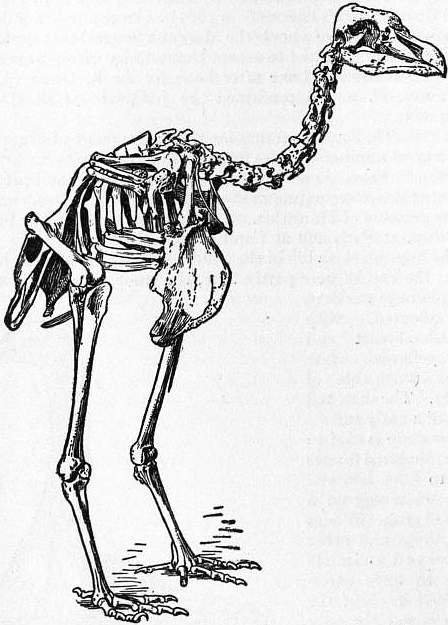
Fig. 3.—Skeleton of a male Solitaire, Pezophaps solitarius, Museum of Zoology, Cambridge.
1 The etymology of these names has been much discussed. That of the latter, which has generally been adopted by German and French authorities, seems to defy investigation, but the former has been shown by Prof. Schlegel (Versl. en Mededeel. K. Akad. Wetensch. ii. pp. 255 et seq.) to be the homely name of the dabchick or little grebe (Podiceps minor), of which the Dutchmen were reminded by the round stern and tail diminished to a tuft that characterized the dodo. The same learned authority suggests that dodo is a corruption of Dodaars, but, as will presently be seen, we herein think him mistaken.
2 What has become of the specimen (which may have been a relic of the bird brought home by Van Neck’s squadron) is not known. Broderip and Dr Gray have suggested its identity with that now in the British Museum, but on what grounds is not apparent.
3 i.e. Rodriguez; an error.
4 Hence we venture to dispute Prof. Schlegel’s supposed origin of “Dodo.” The Portuguese must have been the prior nomenclators, and if, as is most likely, some of their nation, or men acquainted with their language, were employed to pilot the Hollanders, we see at once how the first Dutch name Walghvögel would give way. The meaning of Doudo not being plain to the Dutch, they would, as is the habit of sailors, convert it into something they did understand. Then Dodaers would easily suggest itself.
5 The Dodo and its Kindred, by H. E. Strickland and A. G. Melville (London, 1848, 4to).
6 Neu aufgefundene Abbildung des Dronte, by Georg Ritter von Frauenfeld (Wien, 1868, fol.).
7 E. Newton and H. Gadow, Trans. Zool. Soc. xiii. (1893) pp. 281-302, pls.
8 Voyage et aventures de François Leguat, &c. (2 vols., London, 1708). An English translation, edited with many additional illustrations by Captain Oliver, has been published by the Hakluyt Society (2 vols., 1891).
9 E. Newton and J. W. Clark, Phil. Trans. clix. (1869), pp. 327-362; clxviii. (1879), pp. 448-451.
DODONA, in Epirus, the seat of the most ancient and venerable of all Hellenic sanctuaries. Its ruins are at Dramisos, near Tsacharovista. In later times the Greeks of the south looked on the inhabitants of Epirus as barbarians; nevertheless for Dodona they always preserved a certain reverence, and the temple there was the object of frequent missions from them. This temple was dedicated to Zeus, and connected with the temple was an oracle which enjoyed more reputation in Greece than any other save that at Delphi, and which would seem to date from earlier times than the worship of Zeus; for the normal method of gathering the responses of the oracle was by listening to the rustling of an old oak tree, which was supposed to be the seat of the deity. We seem here to have a remnant of the very ancient and widely diffused tree-worship. Sometimes, however, auguries were taken in other manners, being drawn from the moaning of doves in the branches, the murmur of a fountain which rose close by, or the resounding of the wind in the brazen caldrons which formed a circle all round the temple. Croesus proposed to the oracle his well-known question; Lysander sought to obtain from it a sanction for his ambitious views; the Athenians frequently appealed to its authority during the Peloponnesian War. But the most frequent votaries were the neighbouring tribes of the Acarnanians and Aetolians, together with the Boeotians, who claimed a special connexion with the district.
Dodona is not unfrequently mentioned by ancient writers. It is spoken of in the Iliad as the stormy abode of Selli who sleep on the ground and wash not their feet, and in the Odyssey an imaginary visit of Odysseus to the oracle is referred to. A Hesiodic fragment gives a complete description of the Dodonaea or Hellopia, which is called a district full of corn-fields, of herds and flocks and of shepherds, where is built on an extremity (ἐπ᾽ ἐσχατίῃ) Dodona, where Zeus dwells in the stem of an oak (φηγός). The priestesses were called doves (πέλειαι) and Herodotus tells a story which he learned at Egyptian Thebes, that the oracle of Dodona was founded by an Egyptian priestess who was carried away by the Phoenicians, but says that the local legend substitutes for this priestess a black dove, a substitution in which he tries to find a rational meaning. From inscriptions and later writers we learn that in historical times there was worshipped, together with Zeus, a consort named Dione (see further Zeus; Oracle; Dione).
The ruins, consisting of a theatre, the walls of a town, and some other buildings, had been conjectured to be those of Dodona by Wordsworth in 1832, but the conjecture was changed into ascertained fact by the excavations of Constantin Carapanos. In 1875 he made some preliminary investigations; soon after, an extensive discovery of antiquities was made by peasants, digging without authority; and after this M. Carapanos made a systematic excavation of the whole site to a considerable depth. The topographical and architectural results are disappointing, and show either that the site always retained its primitive simplicity, or else that whatever buildings once existed have been very completely destroyed.
To the south of the hill, on which are the walls of the town, and to the east of the theatre, is a plateau about 200 yds. long and 50 yds. wide. Towards the eastern end of this terrace are the scanty remains of a building which can hardly be anything but the temple of Zeus; it appears to have consisted of pronaos, naos or cella, and opisthodomus, and some of the lower drums of the internal columns of the cella were still resting on their foundations. No trace of any external colonnade was found. The temple was about 130 ft. by 80 ft. It had been converted into a Christian church, and hardly anything of its architecture seems to have survived. In it and around it were found the most interesting products of excavation—statuettes and decorative bronzes, many of them bearing dedications to Zeus Naïus and Dione, and inscriptions, including many small tablets of lead which contained the questions put to the oracle. Farther to the west, on the same terrace, were two rectangular buildings, which M. Carapanos conjectures to have been connected with the oracle, but which show no distinguishing features.
Below the terrace was a precinct, surrounded by walls and flanked with porticoes and other buildings; it is over 100 yds. in length and breadth, and of irregular shape. One of the buildings on the south-western side contained a pedestal or altar, and is identified by M. Carapanos as a temple of Aphrodite, on the insufficient evidence of a single dedicated object; it does not seem to have any of the characteristics of a temple. In front of the porticoes are rows of pedestals, which once bore statues and other dedications. At the southern corner of the precinct is a kind of gate or propylaeum, flanked with two towers, between which are placed two coarse limestone drums. If these are in situ and belong to the original gateway, it must have been of a very rough character; it does not seem probable that they carried, as M. Carapanos suggests, the statuette and bronze bowl by which divinations were carried on.
The chief interest of the excavation centres in the smaller antiquities discovered, which have now been transferred from M. Carapanos’s collection to the National Museum in Athens. Among the dedications, the most interesting historically are a set of weapons dedicated by King Pyrrhus from the spoils of the Romans, including characteristic specimens of the pilum. The leaden tablets of the oracle contain no certain example of a response, though there are many questions, varying from matters of public policy or private enterprise to inquiries after stolen goods.
The temple of Dodona was destroyed by the Aetolians in 219 b.c., but the oracle survived to the times of Pausanias and even of the emperor Julian.
See C. Wordsworth, Greece (1839), p. 247; Constantin Carapanos, Dodone et ses ruines (Paris, 1878). For the oracle inscriptions, see E. S. Roberts in Journal of Hellenic Studies, vol. i. p. 228. (E. GR.)
DODS, MARCUS (1834-1909), Scottish divine and biblical scholar, was born at Belford, Northumberland, the youngest son of Rev. Marcus Dods, minister of the Scottish church of that town. He was trained at Edinburgh Academy and Edinburgh University, graduating in 1854. Having studied theology for five years he was licensed in 1858, and in 1864 became minister of Renfield Free Church, Glasgow, where he worked for twenty-five years. In 1889 he was appointed professor of New Testament Exegesis in the New College, Edinburgh, of which he became principal on the death of Dr Rainy in 1907. He died in Edinburgh on the 26th of April 1909. Throughout his life, both ministerial and professorial, he devoted much time to the publication of theological books. Several of his writings, especially a sermon on Inspiration delivered in 1878, incurred the charge of unorthodoxy, and shortly before his election to the Edinburgh professorship he was summoned before the General Assembly, but the charge was dropped by a large majority, and in 1891 he received the honorary degree of D.D. from Edinburgh University. He edited Lange’s Life of Christ in English (Edinburgh, 1864, 6 vols.), Augustine’s works (1872-1876), and, with Dr Alexander Whyte, Clark’s “Handbooks for Bible Classes” series. In the Expositor’s Bible series he edited Genesis and 1 Corinthians, and he was also a contributor to the 9th edition of the Encyclopaedia Britannica and Hastings’ Dictionary of the Bible. Among other important works are: The Epistle to the Seven Churches (1865); Israel’s Iron Age (1874); Mohammed, Buddha and Christ (1877); Handbook on Haggai, Zechariah and Malachi (1879); The Gospel according to St John (1897), in the Expositor’s Greek Testament; The Bible, its Origin and Nature (1904), the Bross Lectures, in which he gave an able sketch of the use of Old Testament criticism, and finally set forth his Theory of Inspiration. Apart from his great services to Biblical scholarship he takes high rank among those who have sought to bring the results of technical criticism within the reach of the ordinary reader.
DODSLEY, ROBERT (1703-1764), English bookseller and miscellaneous writer, was born in 1703 near Mansfield, Nottinghamshire, where his father was master of the free school. He is said to have been apprenticed to a stocking-weaver in Mansfield, from whom he ran away, taking service as a footman. In 1729 Dodsley published his first work, Servitude; a Poem ... written by a Footman, with a preface and postscript ascribed to Daniel Defoe; and a collection of short poems, A Muse in Livery, or the Footman’s Miscellany, was published by subscription in 1732, Dodsley’s patrons comprising many persons of high rank. This was followed by a satirical farce called The Toyshop (Covent Garden, 1735), in which the toyman indulges in moral observations on his wares, a hint which was probably taken from Thomas Randolph’s Conceited Pedlar. The profits accruing from the sale of his works enabled Dodsley to establish himself with the help of his friends—Pope lent him £100—as a bookseller at the “Tully’s Head” in Pall Mall in 1735. His enterprise soon made him one of the foremost publishers of the day. One of his first publications was Dr Johnson’s London, for which he gave ten guineas in 1738. He published many of Johnson’s works, and he suggested and helped to finance the English Dictionary. Pope also made over to Dodsley his interest in his letters. In 1738 the publication of Paul Whitehead’s Manners, voted scandalous by the Lords, led to a short imprisonment. Dodsley published for Edward Young and Mark Akenside, and in 1751 brought out Thomas Gray’s Elegy. He also founded several literary periodicals: The Museum (1746-1767, 3 vols.); The Preceptor containing a general course of education (1748, 2 vols.), with an introduction by Dr Johnson; The World (1753-1756, 4 vols.); and The Annual Register, founded in 1758 with Edmund Burke as editor. To these various works, Horace Walpole, Akenside, Soame Jenyns, Lord Lyttelton, Lord Chesterfield, Burke and others were contributors. Dodsley is, however, best known as the editor of two collections: Select Collection of Old Plays (12 vols., 1744; 2nd edition with notes by Isaac Reed, 12 vols., 1780; 4th edition, by W. C. Hazlitt, 1874-1876, 15 vols.); and A collection of Poems by Several Hands (1748, 3 vols.), which passed through many editions. In 1737 his King and the Miller of Mansfield, a “dramatic tale” of King Henry II., was produced at Drury Lane, and received with much applause; the sequel, Sir John Cockle at Court, a farce, appeared in 1738. In 1745 he published a collection of his dramatic works, and some poems which had been issued separately, in one volume under the modest title of Trifles. This was followed by The Triumph of Peace, a Masque occasioned by the Treaty of Aix-la-Chapelle (1749); a fragment, entitled Agriculture, of a long tedious poem in blank verse on Public Virtue (1753); The Blind Beggar of Bethnal Green (acted at Drury Lane 1739, printed 1741); and an ode, Melpomene (1757). His tragedy of Cleone (1758) had a long run at Covent Garden, 2000 copies being sold on the day of publication, and it passed through four editions within the year. Lord Chesterfield is, however, almost certainly the author of the series of mock chronicles of which The Chronicle of the Kings of England by “Nathan ben Saddi” (1740) is the first, although they were included in the Trifles and “ben Saddi” was received as Dodsley’s pseudonym. The Economy of Human Life (1750), a collection of moral precepts frequently reprinted, is also by Lord Chesterfield. In 1759 Dodsley retired, leaving the conduct of the business to his brother James (1724-1797), with whom he had been many years in partnership. He published two more works, The Select Fables of Aesop translated by R. D. (1764) and the Works of William Shenstone (3 vols., 1764-1769). He died at Durham while on a visit to his friend the Rev. Joseph Spence, on the 23rd of September 1764.
See also Shadows of the Old Booksellers, by Charles Knight (1865), pp. 189-216; “At Tully’s Head” in Eighteenth Century Vignettes, 2nd series, by Austin Dobson (1894); E. Solly in The Bibliographer, v. (1884) pp. 57-61. Dodsley’s poems are reprinted with a memoir in A. Chalmers’s Works of English Poets, vol. xv. (1810).
DODSWORTH, ROGER (1585-1654), English antiquary, was born near Oswaldkirk, Yorkshire. He devoted himself early to antiquarian research, in which he was greatly assisted by the fact that his father, Matthew Dodsworth, was registrar of York cathedral, and could give him access to the records preserved there. He married the widow of Laurence Rawsthorne of Hutton Grange, where he subsequently resided till his death in August 1654. At various times in his life he was enabled to study the records in the library of Sir Robert Cotton, in Skipton Castle, and in the Tower of London. He collected a vast store of materials for a history of Yorkshire, a Monasticon Anglicanum, and an English baronage. The second of these was published with considerable additions by Sir William Dugdale (2 vols., 1655 and 1661). The MSS. were left to Thomas, third Lord Fairfax, who by his will bequeathed them (160 volumes in all) to the Bodleian Library at Oxford. Portions have been printed by the Yorkshire Archaeological Society (Dodsworth’s Yorkshire Notes, 1884) and the Chetham Society (copies of Lancashire postmortem inquisitions, 1875-1876).