VOLUME VIII SLICE V Dinard to Dodsworth (continued 5)
Reading edition
Distillation appears to have been practised at very remote times. The Alexandrians prepared oil of turpentine by distilling pine-resin; Zosimus of Panopolis, a voluminous writer of the 5th century a.d., speaks of the distillation of a “divine water” or “panacea” (probably from the complex mixture of calcium polysulphides, thiosulphate, &c., and free sulphur, which is obtained by boiling sulphur with lime and water) and advises “the efficient luting of the apparatus, for otherwise the valuable properties would be lost.” The Arabians greatly improved the earlier apparatus, naming one form the alembic (q.v.); they discovered many ethereal oils by distilling plants and plant juices, alcohol by the distillation of wine, and also distilled water. The alchemists gave great attention to the method, as is shown by the many discoveries made. Nitric, hydrochloric and sulphuric acids, all more or less impure, were better studied; and many ethereal oils were discovered. Prior to about the 18th century three forms of distillation were practised: (1) destillatio per ascensum, in which the retort was heated from the bottom, and the vapours escaped from the top; (2) destillatio per latus, in which the vapours escaped from the side; (3) destillatio per descensum, in which the retort was heated at the top, and the vapours led off by a pipe passing through the bottom. According to K. B. Hoffmann the earliest mention of destillatio per descensum occurs in the writings of Aetius, a Greek physician who flourished at about the end of the 5th century.
In modern times the laboratory practice of distillation was greatly facilitated by the introduction of the condenser named after Justus von Liebig; A. Kolbe and E. Frankland introduced the “reflux condenser,” i.e. a condenser so placed that the condensed vapours return to the distilling flask, a device permitting the continued boiling of a substance with little loss; W. Dittmar and R. Anschütz, independently of one another, introduced “distillation under reduced pressure”; and “fractional distillation” was greatly aided by the columns of Wurtz (1855), E. Linnemann (1871), and of J. A. Le Bel and A. Henninger (1874). In chemical technology enormous strides have been made, as is apparent from the coal-gas, coal-tar, mineral oil, spirits and mineral acids industries.
The subject is here treated under the following subdivisions: (1) ordinary distillation, (2) distillation under reduced pressure, (3) fractional distillation, (4) distillation with steam, (5) theory of distillation, (6) dry distillation, (7) distillation in chemical technology and (8) commercial distillation of water.
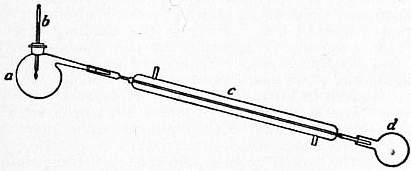
Fig. 1.
1. Ordinary Distillation.—The apparatus generally used is shown in fig. 1. The substance is heated in a retort a, which consists of a large bulb drawn out at the top to form a long neck; it may also be provided with a tubulure, or opening, which permits the charging of the retort, and also the insertion of a thermometer b. The retort may be replaced by a distilling flask, which is a round-bottomed flask (generally with a lengthened neck) provided with an inclined side tube. The neck of the retort, or side tube of the flask, is connected to the condenser c by an ordinary or rubber cork, according to the nature of the substance distilled; ordinary corks soaked in paraffin wax are very effective when ordinary or rubber corks cannot be used. Sometimes an “adapter” is used; this is simply a tapering tube, the side tube being corked into the wider end, and the condenser on to the narrower end. The thermometer is placed so that the bulb is near the neck of the retort or the side tube of the distilling flask. It generally happens that much of the mercury column is outside the flask and consequently at a lower temperature than the bulb, hence a correction of the observed temperature is necessary. If N be the length of the unheated mercury column in degrees, t the temperature of this column (generally determined by a small thermometer placed with its bulb at the middle of the column), and T the temperature recorded by the thermometer, then the corrected temperature of the vapour is T + 0.000143 (T − t) N (T. E. Thorpe, Journ. Chem. Soc., 1880, p. 159).
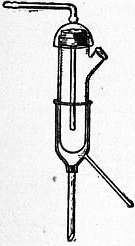
Fig. 2.
The mode of heating varies with the substance to be distilled. For highly volatile liquids, e.g. ether, ligroin, &c., immersion of the flask in warm water suffices; for less volatile liquids a directly heated water or sand bath is used; for other liquids the flask is heated through wire gauze or asbestos board, or directly by a Bunsen. The condensing apparatus must also be conditioned by the volatility. With difficulty volatile substances, e.g. nitrobenzene, air cooling of the retort neck or of a straight tube connected with the distilling flask will suffice; or wet blotting-paper placed on the tube and the receiver immersed in water may be used. For less volatile liquids the Liebig condenser is most frequently used. In its original form, this consists of a long tube surrounded by an outer tube so arranged that cold water circulates in the annular space between the two. The vapours pass through the inner tube, and the cold water enters at the end farthest from the distilling flask. For more efficient condensation—and also for shortening the apparatus—the central tube may be flattened, bent into a succession of V’s, or twisted into a spiral form, the object in each case being to increase the condensing surface. Of other common types of condenser, we may notice the “spiral” or “worm” type, which consists of a glass, copper or tin worm enclosed in a vessel in which water circulates; and the ball condenser, which consists of two concentric spheres, the vapour passing through the inner sphere and water circulating in the space between this and the outer (in another form the vapour circulates in a shell, on the outside and inside of which water circulates). A very effective type is shown in fig. 2. The condensing water enters at the top and is conducted to the bottom of the inner tube, which it fills and then flows over the outside of the outer tube; it collects in the bottom funnel and is then led off. The vapours pass between the inner and outer tubes.
Practically any vessel may serve as a receiver—test tube, flask, beaker, &c. If noxious vapours come over, it is necessary to have an air-tight connexion between the condenser and receiver, and to provide the latter with an outlet tube leading to an absorption column or other contrivance in which the vapours are taken up. If the substances operated upon decompose when heated in air, as, for example, the zinc alkyls which inflame, the air within the apparatus is replaced by some inert gas, e.g. nitrogen, carbon dioxide, &c., which is led in at the distilling flask before the process is started, and a slow current maintained during the operation.
2. Distillation under Reduced Pressure.—This method is adopted for substances which decompose at their boiling-points under ordinary pressure, and, generally, when it is desirable to work at a lower temperature. The apparatus differs very slightly from that employed in ordinary distillation. The “receiver” must be connected on the one side to the condenser, and on the other to the exhaust pump. A safety vessel and a manometer are generally interposed between the pump and receiver. For the purpose of collecting the distillates in fractions, many forms of receivers have been devised. Brühl’s is one of the simplest. It consists of a number of tubes mounted vertically on a horizontal circular disk which rotates about a vertical axis in a cylindrical vessel. This vessel has two tubulures: through one the end of the condenser projects so as to be over one of the receiving tubes; the other leads to the pump. By rotating the disk the tubes may be successively brought under the end of the condenser. Boiling under reduced pressure has one very serious drawback, viz. the liquid boils irregularly or “bumps.” W. Dittmar showed that this may be avoided by leading a fine, steady stream of dry gas-air, carbon dioxide, hydrogen, &c., according to the substance operated upon—through the liquid by means of a fine capillary tube, the lower end of which reaches to nearly the bottom of the flask. “Bumping” is common in open boiling when the liquid is free from air bubbles and the interior of the vessel is very smooth. It may be diminished by introducing clippings of platinum foil, pieces of porcelain, glass beads or garnets into the liquid. “Frothing” is another objectionable feature with many liquids. When cold, froth can be immediately dissipated by adding a few drops of ether. In boiling liquids its formation may be prevented by adding paraffin wax; the wax melts and forms a ring on the surface of the liquid, which boils tranquilly in the centre.
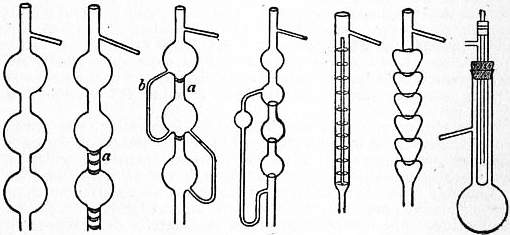
Wurtz. Linnemann. Le Bel-Henninger. Glynsky. Young. Kreusler.
Fig. 3.
3. Fractional Distillation.—By fractional distillation is meant the separation of a mixture having components which boil at neighbouring temperatures. The distilling flask has an elongated neck so that the less volatile vapours are condensed and return to the flask, while the more volatile component passes over. The success of the operation depends upon two factors: (1) that the heating be careful, slow and steady, and (2) that the column attached to the flask be efficient to sort out, as it were, the most volatile vapour. Three types of columns are employed: (1) the elongation is simply a straight or bulb tube; (2) the column, properly termed a “dephlegmator,” is so constructed that the vapours have to traverse a column of previously condensed vapour; (3) the column is encircled by a jacket through which a liquid circulates at the same temperature as the boiling-point of the most volatile component. To the first type belongs the simple straight tube, and the Wurtz tube (see fig. 3), which is simply a series of bulbs blown on a tube. These forms are not of much value. Several forms of the second type are in use. In the Linnemann column the condensed vapours temporarily collect on platinum gauzes (a) placed at the constrictions of a bulbed tube. In the Le Bel-Henninger form a series of bulbs are connected consecutively by means of syphon tubes (b) and having platinum gauzes (a) at the constrictions, so that when a certain amount of liquid collects in any one bulb it syphons over into the next lower bulb. The Glynsky form is simpler, having only one syphon tube; at the constrictions it is usual to have a glass bead. The “rod-and-disk” form of Sidney Young is a series of disks mounted on a central spindle and surrounded by a slightly wider tube. The “pear-shaped” form of the same author consists of a series of pear-shaped bulbs, the narrow end of one adjoining the wider end of the next lower one. In this class may also be placed the Hempel tube, which is simply a straight tube filled with glass beads. Of the third type is the Warren column consisting of a spiral kept at a constant temperature by a liquid bath. Improved forms were devised by F. D. Brown. Kreusler’s form is easily made and manipulated. A tube closed at the bottom is traversed by an open narrower tube, and the arrangement is fitted in the neck of the distilling flask. Water is led in by the inner tube, and leaves by a side tube fused on the wider tube. Many comparisons of the effectiveness of dephlegmating columns have been made (see Sidney Young, Fractional Distillation, 1903). The pear-shaped form is the most effective, second in order is the Le Bel-Henninger, which, in turn, is better than the Glynsky. The main objection to the Hempel is the retention of liquid in the beads, and the consequent inapplicability to the distillation of small quantities.
4. Distillation with Steam.—In this process a current of steam, which is generated in a separate boiler and superheated, if necessary, by circulation through a heated copper worm, is led into the distilling vessel, and the mixed vapours condensed as in the ordinary processes. This method is particularly successful in the case of substances which cannot be distilled at their ordinary boiling-points (it will be seen in the following section that distilling with steam implies a lowering of boiling-point), and which can be readily separated from water. Instances of its application are found in the separation of ortho- and para-nitrophenol, the o-compound distilling and the p- remaining behind; in the separation of aniline from the mixture obtained by reducing nitrobenzene; of the naphthols from the melts produced by fusing the naphthalene monosulphonic acids with potash; and of quinoline from the reaction between aniline, nitrobenzene, glycerin, and sulphuric acid (the product being first steam distilled to remove any aniline, nitrobenzene, or glycerin, then treated with alkali, and again steam distilled when quinoline comes over). With substances prone to discolorization, as, for example, certain amino compounds, the operation may be conducted in an atmosphere of carbon dioxide, or the water may be saturated with sulphuretted hydrogen. Liquids other than water may be used: thus alcohol separates α-pipecoline and ether nitropropylene.
5. Theory of Distillation.—The general observation that under a constant pressure a pure substance boils at a constant temperature leads to the conclusion that the distillate which comes over while the thermometer records only a small variation is of practically constant composition. On this fact depends “rectification or purification by distillation.” A liquid boils when its vapour pressure equals the superincumbent pressure (see Vaporization); consequently any process which diminishes the external pressure must also lower the boiling-point. In this we have the theory of “distillation under reduced pressure.” The theory of fractional distillation, or the behaviour of liquid mixtures when heated to their boiling-points, is more complex. For simplicity we confine ourselves to mixtures of two components, in which experience shows that three cases are to be recognized according as the components are (1) completely immiscible, (2) partially miscible, (3) miscible in all proportions.
When the components are completely immiscible, the vapour pressure of the one is not influenced by the presence of the other. The mixture consequently distils at the temperature at which the sum of the partial pressures equals that of the atmosphere. Both components come over in a constant proportion until one disappears; it is then necessary to raise the temperature in order to distil the residue. The composition of the distillate is determinate (by Avogadro’s law) if the molecular weights and vapour pressure of the components at the temperature of distillation be known. If M1, M2, and P1, P2 be the molecular weights and vapour pressures of the components A and B, then the ratio of A to B in the distillate is M1P1/M2P2. Although, as is generally the case, one liquid (say A) is more volatile than the other (say B), i.e. P1 greater than P2, if the molecular weight of A be much less than that of B, then it is obvious that the ratio M1P1/M2P2 need not be very great, and hence the less volatile liquid B would come over in fair amount. These conditions pertain in cases where distillation with steam is successfully practised, the relatively high volatility of water being counterbalanced by the relatively high molecular weight of the other component; for example, in the case of nitrobenzene and water the ratio is 1 to 5. In general, when the substance to be distilled has a vapour pressure of only 10 mm. at 100° C., distillation with steam can be adopted, if the product can be subsequently separated from the water.
When distilling a mixture of partially miscible components a distillate of constant composition is obtained so long as two layers are present, i.e. A dissolved in B and B dissolved in A, since both of these solutions emit vapours of the same composition (this follows since the same vapour must be in equilibrium with both solutions, for if it were not so a cyclic system contradicting the second law of thermodynamics would be realizable). The composition of the vapour, however, would not be the same as that of either layer. As the distillation proceeded one layer would diminish more rapidly than the other until only the latter would remain; this would then distil as a completely miscible mixture.
The distillation of completely miscible mixtures is the most common practically and the most complex theoretically. A coordination of the results obtained on the distillation of mixtures of this nature with the introduction of certain theoretical considerations led to the formation of three groups distinguished by the relative solubilities of the vapours in the liquid components.
(i.) If the vapour of A be readily soluble in the liquid B, and the vapour of B readily soluble in the liquid A, there will exist a mixture of A and B which will have a lower vapour pressure than any other mixture. The vapour pressure composition curve will be convex to the axis of compositions, the maximum vapour pressures corresponding to pure A and pure B, and the minimum to some mixture of A and B. On distilling such a mixture under constant pressure, a mixture of the two components (of variable composition) will come over until there remains in the distilling flask the mixture of minimum vapour pressure. This will then distil at a constant temperature. Thus nitric acid, boiling-point 68°, forms a mixture with water, boiling point 100°, which boils at a constant temperature of 126°, and contains 68% of acid. Hydrochloric acid forms a similar mixture which boils at 110° and contains 20.2% of acid. Another mixture of this type is formic acid and water.
(ii.) If the vapours be sparingly soluble in the liquids there will exist a mixture having a greater vapour pressure than that of any other mixture. The vapour pressure-composition curve will now be concave to the axis of composition, the minima corresponding to the pure components. On distilling such a mixture, a mixture of constant composition will distil first, leaving in the distilling flask one or other of the components according to the composition of the mixture. An example is propyl alcohol and water. At one time it was thought that these mixtures of constant boiling-point (an extended list is given in Young’s Fractional Distillation) were definite compounds. The above theory, coupled with such facts as the variation of the composition of the constant boiling-point fraction with the pressure under which the mixture is distilled, the proportionality of the density of all mixtures to their composition, &c., shows this to be erroneous.
(iii.) If the vapour of A be readily soluble in liquid B, and the vapour of B sparingly soluble in liquid A, and if the vapour pressure of A be greater than that of B, then the vapour pressures of mixtures of A and B will continually diminish as one passes from 100% A to 100% B. The vapour tension may approximate to a linear function of the composition, and the curve will then be practically a straight line. On distilling such a mixture pure A will come over first, followed by mixtures in which the quantity of B continually increases; consequently by a sufficient number of distillations A and B can be completely separated. Examples are water and methyl or ethyl alcohol.
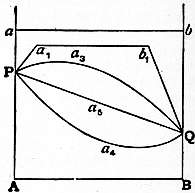
Fig. 4.
Van’t Hoff (Theoretical and Physical Chemistry, vol. i. p. 51) illustrates the five cases on one diagram. In fig. 4 let AB be the axis of composition, AP be the vapour pressure of pure A, BQ the vapour pressure of pure B. For immiscible liquids the vapour pressure curve is the horizontal line ab, described so that aP = QB and bQ = AP. For partially miscible liquids the curve is Pa1b1Q. The horizontal line a1b1 corresponds to the two layers of liquid, and the inclined lines Pa1Qb1 to solutions of B in A and of A in B. The curves Pa4Q, having a minimum at a4, Pa3Q, having a maximum at a3, and Pa5Q, with neither a maximum nor minimum, correspond to the types i., ii., iii. of completely miscible mixtures.
6. Dry Distillation.—In this process the substance operated upon is invariably a solid, the vapours being condensed and collected as in the other methods. When the substance operated upon is of uncertain composition, as, for example, coal, wood, coal-tar, &c., the term destructive distillation is employed. A more general designation is “pyrogenic processes,” which also includes such operations as leading vapours through red-hot tubes and condensing the products. We may also consider here cases of sublimation wherein a solid vaporizes and the vapour condenses without the occurrence of the liquid phase.
Dry distillation is extremely wasteful even when definite substances or mixtures, such as calcium acetate which yields acetone, are dealt with, valueless by-products being obtained and the condensate usually requiring much purification. Prior to 1830, little was known of the process other than that organic compounds generally yielded tarry and solid matters, but the discoveries of Liebig and Dumas (of acetone from acetates), of Mitscherlich (of benzene from benzoates) and of Persoz (of methane from acetates and lime) brought the operation into common laboratory practice. For efficiency the operation must be conducted with small quantities; caking may be prevented by mixing the substance with sand or powdered pumice, or, better, with iron filings, which also renders the decomposition more regular by increasing the conductivity of the mass. The most favourable retort is a shallow iron pan heated in a sand bath, and provided with a screwed-down lid bearing the delivery tube. Sidney Young has suggested conducting the operation in a current of carbon dioxide which sweeps out the vapours as they are evolved, and also heating in a vapour bath, e.g. of sulphur.
One of the earliest red-hot tube syntheses of importance was the formation of naphthalene from a mixture of alcohol and ether vapours. Such condensations were especially studied by M. P. E. Berthelot, and shown to be very fruitful in forming hydrocarbons. Sometimes reagents are placed in the combustion tube, for example lead oxide (litharge), which takes up bromine and sulphur. In its simplest form the apparatus consists of a straight tube, made of glass, porcelain or iron according to the temperature required and the nature of the reacting substances, heated in an ordinary combustion furnace, the mixture entering at one end and the vapours being condensed at the other. Apparatus can also be constructed in which the unchanged vapours are continually circulated through the tube. Operating in a current of carbon dioxide facilitates the process by preventing overheating.
7. Distillation in Chemical Technology.—In laboratory practice use is made of a fairly constant type of apparatus, only trifling modifications being generally necessary to adapt the apparatus for any distillation or fractionation; in technology, on the other hand, many questions have to be considered which generally demand the adoption of special constructions for the economic distillation of different substances. The modes of distillation enumerated above all occur in manufacturing practice. Distillation in a vacuum is practised in two forms:—if the pump draws off steam as well as air it is termed a “wet” air-pump; if it only draws off air, it is a “dry” air-pump. In the glycerin industry the lyes obtained by saponifying the fats are first evaporated with “wet vacuum” and finally distilled with closed and live steam and a “dry vacuum.” Two forms of steam distillation may be distinguished:—in one the still is simply heated by a steam coil wound inside or outside the still—this is termed heating by dry steam; in the other steam is injected into the mass within the still—this is the distillation with live steam of laboratory practice. The details of the plant—the material and fittings of the still, the manner of heating, the form of the condensing plant, receivers, &c.—have to be determined for each substance to be distilled in order to work with the maximum economy.
For the distillation of liquids the retort is usually a cylindrical pot placed vertically; cast iron is generally employed, in which case the bottom is frequently incurved and thicker than the sides in order to take up the additional wear and tear. Sometimes linings of enamelled iron or other material are employed, which when worn can be replaced at a far lower cost than that of a new still. Glass stills heated by a sand bath are sometimes employed in the final distillation of sulphuric acid; platinum, and an alloy of platinum and iridium with a lining of gold rolled on (a discovery due to Heraeus), are used for the same purpose. Cast iron stills are provided with a hemispherical head or dome, generally attached to the body of the still by bolts, and of sufficient size to allow for any frothing. It is invariably provided with an opening to carry off the vapours produced. In its more complete form a still has in addition the following fittings:—The dome is provided with openings to admit (1) the axis of the stirring gear (in some stills the stirring gear rotates on a horizontal axis which traverses the side and not the head of the still), (2) the inlet and outlet tubes of a closed steam coil, (3) a tube reaching to nearly the bottom of the still to carry live steam, (4) a tube to carry a thermometer, (5) one or more manholes for charging purposes, (6) sight-holes through which the operation can be watched, and (7) a safety valve. The body of the still is provided with one or more openings at different heights to serve for the discharge of the residue in the still, and sometimes with a glass gauge to record the quantity of matter in the still. For dry distillations the retorts are generally horizontal cylinders, the bottom or lower surface being sometimes flattened. Iron and fireclay are the materials commonly employed; wrought iron is used in the manufacture of wood-spirit, fireclay for coal-gas (see Gas: Manufacture), phosphorus, zinc, &c. The vertical type, however, is employed in the manufacture of acetone and of iodine.
Several modes of heating are adopted. In some cases, especially in dry distillations, the furnace flames play directly on the retorts, in others, such as in the case of nitric acid, the whole still comes under the action of the furnace gases to prevent condensation on the upper part of the still, while in others the furnace gases do not play directly on the base or upper portion of the still but are conducted around it by a system of flues (see Coal-Tar). Steam heating, dry or live, is employed alone and also as an auxiliary to direct firing.
The condensing plant varies with the volatility of the distillate. Air cooling is adopted whenever possible. For example, in the less modern methods for manufacturing nitric acid the vapours were conducted directly into double-necked bottles (bombonnes) immersed in water. A more efficient arrangement consists of a stack of vertical pipes standing up from a main or collecting trough and connected at the top in consecutive pairs by a cross tube. By an arrangement of diaphragms in the lower trough the vapours are circulated through the system. As an auxiliary to air cooling the stack may be cooled by a slow stream of water trickling down the outside of the pipes, or, in certain cases, cold water may be injected into the condenser in the form of a spray, where it meets the ascending vapours. Horizontal air-cooling arrangements are also employed. A common type of condenser consists of a copper worm placed in a water bath; but more generally straight tubes of copper or cast iron which cross and recross a rectangular tank are employed, since this form is more readily repaired and cleansed. Wood-spirit, petroleum and coal-tar distillates are condensed in plant of the latter type. In cases where the condenser is likely to become plugged there is a pipe by means of which live steam can be injected into the condenser. The supply of water to the condenser is regulated according to the volatility of the condensate. When the vapours readily condense to a solid form the condensing plant may take the form of large chambers; such conditions prevail in the manufacture of arsenic, sulphur and lampblack: in the latter case (which, however, is not properly one of distillation) the chamber is hung with sheets on which the pigment collects. Large chambers are also used in the condensation of mercury.
Dephlegmation of the vapours arising from such mixtures as coal-tar fractions, petroleum and the “wash” of the spirit industry, is very important, and many types of apparatus are employed in order to effect a separation of the vapours. The earliest form, invented by C. B. Mansfield to facilitate the fractionation of paraffin and coal-tar distillates, consisted in having a pipe leading from the inclined delivery tube of the still to the still again, so that any vapour which condensed in the delivery tube was returned to the still. Of really effective columns Coupier’s was one of the earliest. The vapours rising from the still traverse a tall vertical column, and are then conveyed through a series of bulbs placed in a bath kept at the boiling-point of the most volatile constituent. The more volatile vapours pass over to the condensing plant, while the less volatile ones condense in the bulbs and are returned to the column at varying heights by means of connecting tubes. The French column is similar in action. The Coffey still is one of the most effective and is employed in the spirit, ammonia, coal-tar and other industries. It consists of a vertical column divided into a number of sections by horizontal plates, which are perforated so that the ascending vapours have to traverse a layer of liquid. Above this “separator” is a reflux condenser, termed the “cooler,” maintained at the correct temperature so that only the more volatile component passes to the receiver. The success of the operation chiefly depends upon the proper management of the cooler.
8. Commercial Distillation of Water.—Distilled water, i.e. water free from salts and to some extent of the dissolved gases which are always present in natural waters, is of indispensable value in many operations both of scientific and industrial chemistry. The apparatus and process for distilling ordinary water are very simple. The body of the still is made of copper, with a head and worm, or condensing apparatus, either of copper or tin. The still is usually fed continuously by the heated water from the condenser. The first portion of the distillate brings over the gases dissolved in the water, ammonia and other volatile impurities, and is consequently rejected; scarcely two-fifths of the entire quantity of water can be safely used as pure distilled water.
Apparatus for the economic production of a potable water from sea-water is of vital importance in the equipment of ships. The simple distillation of sea-water, and the production thereby of a certain proportion of chemically fresh water, is a very simple problem; but it is found that water which is merely evaporated and recondensed has a very disagreeable flat taste, and it is only after long exposure to pure atmospheric air, with continued agitation, or repeated pouring from one vessel to another, that it becomes sufficiently aerated to lose its unpleasant taste and smell and become drinkable. The water, moreover, till it is saturated with gases, readily absorbs noxious vapours to which it may be exposed. For the successful preparation of potable water from sea-water, the following conditions are essential:—1st, aeration of the distilled product so that it may be immediately available for drinking purposes; 2nd, economy of coal to obtain the maximum of water with the minimum expenditure of fuel; and 3rd, simplicity of working parts, to secure the apparatus from breaking down, and enable unskilled attendants to work it with safety. The problem is a comparatively old one, for we find that R. Fitzgerald patented a process in 1683 having for its purpose the “sweetening of sea-water.” A history of early attempts is given in S. Hales’s Philosophical Experiments, published in 1739. Among the earlier of the modern forms of apparatus which came into practical adoption are the inventions of Dr Normandy and of Chaplin of Glasgow, the apparatus of Rocher of Nantes, and that patented by Gallé and Mazeline of Havre. Normandy’s apparatus, although economical and producing water of good quality, is very complex in its structure, consisting of very numerous working parts, with elaborate arrangements of pipes, cocks and other fittings. It is consequently expensive and requires careful attention for its working. It was extensively adopted in the British navy, the Cunard line and many other important emigrant and mercantile lines. Chaplin’s apparatus, which was invented and patented later, has also since 1865 been sanctioned for use on emigrant, troop and passenger vessels. The apparatus possesses the great merit of simplicity and compactness, in consequence of which it is comparatively cheap and not liable to derangement. It was adopted by many important British and continental shipping companies, among others by the Peninsular & Oriental, the Inman, the North German Lloyd and the Hamburg American companies.
The modern distilling plant consists of two main parts termed the evaporator and condenser; in addition there must be a boiler (sometimes steam is run off the main boilers, but this practice has several disadvantages), pumps for circulating cold water in the condenser and for supplying salt water to the evaporator, and a filter through which the aerated water passes. The evaporator consists of a cylindrical vessel having in its lower half a horizontal copper coil connected to the steam supply. The cylindrical vessel is filled to a certain level with salt water and the steam turned on. The water vaporizes and is led from the dome of the evaporator to the head of the condenser. The water level is maintained in the evaporator until it contains a certain amount of salt. It is then run off, and replaced by fresh sea-water. The condenser consists of a vertical cylinder having manifolds at the head and foot and through which a number of tubes pass. In some types, e.g. the Weir, the condensing water circulates upwards through the tubes; in others, e.g. the Quiggins, the water circulates around the tubes. Various forms of the tubes have been adopted. In the Pape-Henneberg condenser, which has been adopted in the German navy, they are oval in section and tend to become circular under the pressure of the steam; this alteration in shape makes the tubes self-scaling. In the Quiggins condenser, which has been widely adopted, e.g. in the “Lusitania,” the steam traverses vertical copper coils tinned inside and outside; the coils are crescent-shaped, a form which gives a greater condensing surface and makes the coils self-scaling. The aeration of the water is effected by blowing air into the steam before it is condensed; as an auxiliary, the storage tanks have a false bottom perforated by fine holes so that if air be injected below it, the water is efficiently aerated by the air which traverses it in fine streams. After condensation the water is filtered through charcoal. The filter is either a separate piece of plant, or, as in the Quiggins form, it may be placed below the coils in the same outer vessel. In this plant the aeration is conducted by blowing in air at the base of the condenser. After filtration the water is pumped to the storage tanks. Many types of distilling plant are in use in addition to those mentioned above, for example the Rayner, Kirkaldy, Merlees, Normand; the United States navy has adopted a form designed by the Bureau of Engineering.
Bibliography.—The general practice of laboratory distillation is discussed in all treatises on practical organic chemistry; reference may be made to Lassar-Cohn, Manual of Organic Chemistry (1896), and Arbeitsmethoden für organisch-chemische Laboratorien (1901); Hans Meyer, Analyse und Konstitutionermittlung organischer Verbindungen (1909). The theory of distillation finds a place in all treatises on physical chemistry. Of especial importance is Sidney Young, Fractional Distillation (1903). The history of distillation is to be studied in E. Gildemeister and F. Hoffmann, Die ätherischen Öle (Berlin, 1899; Eng. tr. by E. Kremers, Milwaukee Press, 1900). The technology of distillation is best studied in relation to the several industries in which it is employed; reference should be made to the articles Coal-Tar, Gas, Petroleum, Spirits, Nitric Acid, &c.
(C. E.*)
DISTRACTION (from Lat. distrahere, to pull asunder), a drawing away or apart; a word now used generally of a state of mind, to mean a diversion of attention, or a violent emotion amounting almost to madness.
DISTRESS (from the O. Fr. destrece, destresse, from the past participle of the Lat. distringere, to pull apart, used in Late Lat. in the sense of to punish, hence to distrain), pressure, especially of sorrow, pain or ill-fortune. As a legal term, the action of distraining or distraint, the right which a landlord has of seizing the personal chattels of his tenant for non-payment of rent. Cattle damage feasant (doing damage or trespassing upon a neighbour’s land) may also be distrained, i.e. may be detained until satisfaction be rendered for injury they have done. The cattle or other animals thus distrained are a mere pledge in the hands of the injured person, who has only power to retain them until the owner appear to make satisfaction for the mischief they have done. “Distress damage feasant” is also applicable to inanimate things on the land if doing damage thereto or to its produce; things in actual use, however, are exempt. Such distress must be made during the actual trespass, and by whoever is aggrieved by the damage. Distress for rent was also at one time regarded as a mere pledge or security; but the remedy, having been found to be speedy and efficacious, was rendered more perfect by enactments allowing the thing taken to be sold. Blackstone notes that the law of distresses in this respect “has been greatly altered within a few years last past.” The legislature, in fact, converted an ancient right of personal redress into a powerful remedy for the exclusive benefit of a single class of creditors, viz. landlords. Now that the relation of landlord and tenant in England has come to be regarded as purely a matter of contract, the language of the law-books seems to be singularly inappropriate. The defaulting tenant is a “wrong-doer,” the landlord is the “injured party,”; any attempt to defeat the landlord’s remedy by carrying off distrainable goods is denounced as “fraudulent and knavish.” The operation of the law has, as we shall point out, been mitigated in some important respects, but it still remains an almost unique specimen of one-sided legislation.
At common law distress was said to be incident to rent service, and by particular reservation to rent charges; but by 4 Geo. II. c. 28 it was extended to rent seck, rents of assize and chief rents (see Rent). It is therefore a general remedy for rent certain in arrear. All personal chattels are distrainable with the following exceptions:—(1) things in which there can be no property, as animals ferae naturae; (2) ledgers, daybooks, title-deeds, &c.; (3) things delivered to a person following a public trade, as a horse sent to be shod, &c.; (4) things already in the custody of the law; (5) things which cannot be restored in as good a plight as when distrained, that is, perishable articles; (6) fixtures; (7) beasts of the plough and instruments of husbandry while there is other sufficient distress to be found; (8) instruments of a man’s trade or profession in actual use at the time the distress is made. If not in actual use they are only privileged in case there is other sufficient distress upon the premises. These exceptions, it will be seen, imply that the thing distrained is to be held as a pledge merely—not to be sold. They also imply that in general any chattels found on the land in question are to be available for the benefit of the landlord, whether they belong to the tenant or not. This principle worked with peculiar harshness in the case of lodgers, whose goods might be seized and sold for the payment of the rent due by their landlord to his superior landlord. By the Lodgers’ Goods Protection Act 1871, however, where a lodger’s goods have been seized by the superior landlord the lodger may serve him with a notice stating that the intermediate landlord has no interest in the property seized, but that it is the property or in the lawful possession of the lodger, and setting forth the amount of the rent due by the lodger to his immediate landlord. On payment or tender of such rent the landlord cannot proceed with the distress against the goods in question. By the Law of Distress Amendment Act 1908 this protection was extended to under tenants liable to pay rent by equal quarterly instalments, as well as to any person whatsoever who is not a tenant of the premises or any part thereof nor has any beneficial interest therein. The act, however, excludes certain goods, particularly goods belonging to the husband or wife of the tenant whose rent is in arrear, goods comprised in any bill of sale, hire purchase agreement or settlement made by the tenant, goods in the possession or disposition of a tenant by the consent and permission of the true owner under such circumstances as to make the tenant reputed owner, goods of the partner of an immediate tenant, and goods (not being goods of a lodger) upon premises where any trade or business is carried on in which both the immediate tenant and the under tenant have an interest. The act does not apply where an under tenancy has been created in breach of a covenant or agreement between the landlord and his immediate tenant. The Law of Distress Amendment Act 1888 also absolutely exempted from distress the tools and implements of trade and wearing apparel and bedding of a tenant and his family to the value of five pounds, and the Law of Distress Amendment Act 1895 gave power to a court of summary jurisdiction to direct that such goods, when distrained upon, should be restored if not sold, or, if sold, to order their value to be paid by the persons who levied the distress or directed it to be levied. Originally the landlord could only seize things actually on the premises, so that the remedy might be defeated by the things being taken away. But by an act of 1710, and by the Distress for Rent Act 1737, he may follow things fraudulently or clandestinely removed off the premises within thirty days after their removal, unless they have been in the meantime bona fide sold for a valuable consideration. The sixth exception mentioned above was held to extend to sheaves of corn; but by an act of 1690 corn, when reaped, as well as hay, was made subject to distress. That act was modified by the Landlord and Tenant Act 1851, under which growing crops seized by the sheriff and sold under an execution are liable to distress for rent which becomes due after the seizure and sale, if there is no other sufficient distress on the premises.
Excessive or disproportionate distress exposes the distrainer to an action, and any irregularity formerly made the proceedings void ab initio, so that the remedy was attended with considerable risk. The Distress for Rent Act 1737, before alluded to, in the interests of landlords, protected distresses for rent from the consequences of irregularity. In all cases of distress for rent, if the owner do not within five days (by the Law of Distress Amendment Act 1888, fifteen days, if the tenant make a request in writing to the person levying the distress and also give security for any additional cost that may be occasioned by such extension of time) replevy the same with sufficient security, the thing distrained may be sold towards satisfaction of the rent and charges, and the surplus, if any, must be returned to the owner. To “replevy” is when the person distrained upon applies to the proper authority (the registrar of the county court) to have the thing returned to his own possession, on giving security to try the right of taking it in an action of replevin.
Duties and penalties imposed by act of parliament (e.g. payment of rates and taxes) are sometimes enforced by distress.
DISTRIBUTION (Lat, distribuere, to deal out), a term used in various connexions with the general meaning of spreading out. In law, the word is used for the division of the personal estate of an intestate among the next-of-kin (see Intestacy). The important scientific question as to the distribution of plants and animals on the earth is treated under Plants: Distribution, and Zoological Distribution. In economics the word is used generally for the transference of commodities from person to person or from place to place, or the dividing up of large quantities of commodities into smaller quantities; and in a more technical sense, for the division of the product of industry amongst the various members or classes of the community. The theory of economic distribution, i.e. the causes which determine rent, wages, profits and interest, forms an important subject-matter in all text-books. Among recent works, see E. Cannan’s History of Theories of Production and Distribution, 1776-1848 (1893), J. R. Common’s Distribution of Wealth (1893), and H. J. Davenport’s Value and Distribution (Chicago, 1908).
DISTRICT, a word denoting in its more general sense, a tract or extent of a country, town, &c., marked off for administrative or other purposes, or having some special and distinguishing characteristics. The medieval Latin districtus (from distringere, to distrain) is defined by Du Cange as Territorium feudi, seu tractus, in quo Dominus vassallos et tenentes suos distringere potest; and as justitiae exercendae in eo tractu facultas. It was also used of the territory over which the feudal lord exercised his jurisdiction generally. It may be noted that distringere had a wider significance than “to distrain” in the English legal sense (see Distress). It is defined by Du Cange as compellere ad aliquid faciendum per mulctam, poenam, vel capto pignore. In English usage, apart from its general application in such forms as postal district, registration district and the like, “district” has specific usages for ecclesiastical and local government purposes. It is thus applied to a division of a parish under the Church Building Acts, originally called a “perpetual curacy,” and the church serving such a division is properly a “district chapel.” Under the Local Government Act of 1894 counties are divided for the purposes of the act into urban and rural districts. In British India the word is used to represent the zillah, an administrative subdivision of a province or presidency. In the United States of America the word has many administrative, judicial and other applications. In South Carolina it was used instead of “county” for the chief division of the state other than in the coast region. In the Virginias, Tennessee, Georgia, Kentucky and Maryland it answers to “township” or precinct, elsewhere the principal subdivision of a county. It is used for an electoral “division,” each state being divided into Congressional and senatorial districts; and also for a political subdivision ranking between an unorganized and an organized Territory—e.g., the District of Columbia and Alaska.
DISTYLE (from Gr. δι, two, and στῦλος, column), the architectural term given to a portico which has two columns between antae, known as distyle-in-antis (see Temple).
DITHMARSCHEN, or Ditmarsh (in the oldest form of the name Thiatmaresgaho, Dietmar’s Gau), a territory between the Eider, the Elbe and the North Sea, forming the western part of the old duchy of Holstein, and now included in the Prussian province of Schleswig-Holstein. It contains about 550 sq. m. with 90,000 inhabitants. The territory consists to the extent of one half of good pasture land, which is preserved from inroads of the sea by banks and dams, the other half being mostly waste. It was originally colonized mainly from Friesland and Saxony. The district was subjugated and Christianized by Charlemagne in 804, and ranked as a separate Gau, included perhaps in the countship of Stade, or Comitalus utriusque ripae. From the same century, according to one opinion, or from the year 1182, when the countship was incorporated with their see, according to another, the archbishops of Bremen claimed supremacy over the land; but the inhabitants, who had developed and consolidated a systematic organism for self-government, made obstinate resistance, and rather attached themselves to the bishop of Schleswig. Ditmarsken, to use the Scandinavian form of the name, continued part of the Danish dominions till the disastrous battle of Bornhöved in 1227, when its former independence was regained. The claims of the archbishop of Bremen were now so far recognized that he exercised the royal rights of Heerbann and Blutbann,1 enjoyed the consequent emoluments, and was represented first by a single advocatus, or Vogt, and afterwards by one for each of the five Döffts, or marks, into which the land was divided after the establishment of Meldorf. The community was governed by a Landrath of forty-eight elective consuls, or twelve from each of the four marks; and even in the 14th century the power of the episcopal advocati was so slight that a chronicler quoted by Conrad von Maurer says, De Ditmarschen leven sunder Heren und Hovedt unde dohn wadt se willen, “the Ditmarschen live without lord and head, and do what they will.” In 1319 and in 1404 they succeeded in defeating the invasions of the Holstein nobles; and though in 1474 the land was nominally incorporated with the duchy by the emperor Frederick III., the attempt of the Danish king Hans and the duke of Gottorp to enforce the decree in 1500 resulted only in their complete rout in the marshes of the Dussend-Düwels-Warf. During the early part of the century which began with such prestige for Ditmarsh, it was the scene of violent internal conflict in regard to the religious questions of the time; and, thus weakened, it was obliged in 1559 to submit to partition among its three conquerors—King Frederick II. of Denmark and Dukes John and Adolphus. A new division took place on Duke John’s death in 1581, by which Frederick obtained South Ditmarsh, with its chief town of Meldorf, and Adolphus obtained North Ditmarsh, with its chief town of Heide; and this arrangement continued till 1773, when all the Gottorp possessions were incorporated with the Danish crown.
See Dahlmann’s edition of Neocorus, Chronik von Dithmarschen (Kiel, 1827), and Geschichte Dänemarks (1840-1844); Michelsen, Urkundenbuch zur Geschichte des Landes Dithmarschen (1834), Sammlung altdithmarscher Rechtsquellen (1842), and Dithmarschen im Verhältniss zum bremischen Erzstift; Kolster, Geschichte Dithmarschens, nach F. R. Dahlmanns Vorlesungen (1873).
1 That is, the right of claiming military service, and the right of bringing capital offenders to justice.
DITHYRAMBIC POETRY, the description of poetry in which the character of the dithyramb is preserved. It remains quite uncertain what the derivation or even the primitive meaning of the Greek word διθύραμβος is, although many conjectures have been attempted. It was, however, connected from earliest times with the choral worship of Dionysus. A dithyramb is defined by Grote as a round choric dance and song in honour of the wine-god. The earliest dithyrambic poetry was probably improvised by priests of Bacchus at solemn feasts, and expressed, in disordered numbers, the excitement and frenzy felt by the worshippers. This element of unrestrained and intoxicated vehemence is prominent in all poetry of this class. The dithyramb was traditionally first practised in Naxos; it spread to other islands, to Boeotia and finally to Athens. Arion is said to have introduced it at Corinth, and to have allied it to the worship of Pan. It was thus “merged,” as Professor G. G. Murray says, “into the Satyr-choir of wild mountain-goats” out of which sprang the earliest form of tragedy. But when tragic drama had so far developed as to be quite independent, the dithyramb did not, on that account, disappear. It flourished in Athens until after the age of Aristotle. So far as we can distinguish the form of the ancient Greek dithyramb, it must have been a kind of irregular wild poetry, not divided into strophes or constructed with any evolution of the theme, but imitative of the enthusiasm created by the use of wine, by what passed as the Dionysiac delirium. It was accompanied on some occasions by flutes, on others by the lyre, but we do not know enough to conjecture the reasons of the choice of instrument. Pindar, in whose hands the ode took such magnificent completeness, is said to have been trained in the elements of dithyrambic poetry by a certain Lasus of Hermione. Ion, having carried off the prize in a dithyrambic contest, distributed to every Athenian citizen a cup of Chian wine. In the opinion of antiquity, pure dithyrambic poetry reached its climax in a lost poem. The Cyclops, by Philoxenus of Cythera, a poet of the 4th century b.c. After this time, the composition of dithyrambs, although not abandoned, rapidly declined in merit. It was essentially a Greek form, and was little cultivated, and always without success, by the Latins. The dithyramb had a spectacular character, combining verse with music. In modern literature, although the adjective “dithyrambic” is often used to describe an enthusiastic movement in lyric language, and particularly in the ode, pure dithyrambs have been extremely rare. There are, however, some very notable examples. The Baccho in Toscana of Francesco Redi (1626-1698), which was translated from the Italian, with admirable skill, by Leigh Hunt, is a piece of genuine dithyrambic poetry. Alexander’s Feast (1698), by Dryden, is the best example in English. But perhaps more remarkable, and more genuinely dithyrambic than either, are the astonishing improvisations of Karl Mikael Bellman (1740-1795), whose Bacchic songs were collected in 1791 and form one of the most remarkable bodies of lyrical poetry in the literature of Sweden.
(E. G.)
DITTERSBACH, a town of Germany, in the Prussian province of Silesia, 3 m. by rail S.E. from Waldenburg and 50 m. S. W. from Breslau. It has coal-mines, bleach-fields and match factories. Population (1905) 9371.
DITTERSDORF, KARL DITTERS VON (1739-1799), Austrian composer and violinist, was born in Vienna on the 2nd of November 1739, his father’s name being Ditters. Having shown as a child marked talent for the violin, he was allowed to play in the orchestras of St Stephen’s and the Schottenkirche, where he attracted the attention of a notable patron of music, Prince Joseph Frederick of Hildburghausen (1702-1787), who is also remembered as a soldier for his disastrous leading of the forces of the Empire at Rossbach. The prince gave the boy, now eleven years old, a place in his private orchestra—the first of the kind established in Vienna,—and also saw to it that he received an excellent general education. The Seven Years’ War proved disastrous to both music and morals; and young Ditters, who had fallen into evil ways, fled from Hildburghausen, whither he had gone with the prince, to avoid the payment of his gambling debts. His patron generously forgave and recalled him, but soon afterwards gave up his orchestra at Vienna. Ditters now obtained a place in the Vienna opera; but he was not satisfied, and in 1761 eagerly accepted an invitation to accompany Gluck, whose acquaintance, as well as that of Haydn, he had made while in the service of the prince, on a professional journey to Italy. His success as a violinist on this occasion was equal to that of Gluck as composer; and on his return to Vienna he was recognized as the superior of Antonio Lolli, who as virtuoso had hitherto held the palm. In 1764 he was again associated with Gluck in the musical part of the ceremonies at Frankfort, attending the coronation of the archduke Joseph as King of the Romans. His next appointment was that of conductor of the orchestra of the bishop of Grosswardein, a Hungarian magnate, at Pressburg. He set up a private stage in the episcopal palace, and wrote for it his first “opera buffa,” Amore in musica. His first oratorio, Isacco figura del Redentore, was also written during this time; but the scandal of performances of light opera by the bishop’s company, even on fast days and during Advent, outweighed this pious effort; the empress Maria Theresa sharply called the worldly prelate to order; and he, in a huff, dismissed his orchestra (1769). After a short interlude, Ditters was again in the service of an ecclesiastical patron, count von Schafgotsch, prince bishop of Breslau, at his estate of Johannesberg in Silesia. Here he displayed so much skill as a sportsman, that the bishop procured for him the office of forester (Forstmeister) of the principality of Neisse. He had already, by the same influence, been made knight of the Golden Spur (1770). At Johannesberg Ditters also produced a comic opera, Il Viaggiatore americano, and an oratorio, Davide. The title rôle of the latter was taken by a pretty Italian singer, Signora Nicolini, whom Ditters married. In 1773 he was ennobled as Karl von Dittersdorf, and at the same time was appointed administrator (Amtshauptmann) of Freyenwaldau, an office which he performed by deputy. In the same year his oratorio Ester was produced in Vienna. During the War of Bavarian Succession the prince bishop’s orchestra was dissolved, and Dittersdorf employed himself in his office at Freyenwaldau; but after the peace of Tetschen (1779) he again became conductor of the reconstituted orchestra. From this time forward his output was enormous. In 1780 ten months sufficed for the production of his Giobbe (Job) and four operas, three of which were successful; and besides these he wrote a large number of “characterized symphonies,” founded on the Metamorphoses of Ovid. He was now at the height of his fame, and spent the fortune which it brought him in much luxury. But after a time his patron fell on evil days, the famous orchestra had to be reduced, and when the bishop died in 1795 his successor dismissed the composer with a small money gift. Poor and broken in health, he accepted the asylum offered to him by Ignaz Freiherr von Stillfried, on his estate near Neuhaus in Bohemia, where he spent what strength was left him in a feverish effort to make money by the composition of operas, symphonies and pianoforte pieces. He died on the 1st of October 1799, praying “God’s reward” for whoever should save his family from starvation. On his death-bed he dictated to his son his Lebensbeschreibung (autobiography).
Dittersdorf’s chief talent was for comic opera and instrumental music in the sonata forms. In both of these branches his work still shows signs of life, and it is of great historical interest, since he was not only an excellent musician and a friend of Haydn but also a thoroughly popular writer, with a lively enough musical wit and sense of effect to embody in an amusing and fairly artistic form exactly what the best popular intelligence of the times saw in the new artistic developments of Haydn. Thus, while in the amiable monotony and diffuseness of Boccherini we may trace Haydn as a force tending to disintegrate the polyphonic suite-forms of instrumental music, in Dittersdorf on the other hand we see the popular conception of the modern sonata and dramatic style. Yet, with all his popularity, the reality of his progressive outlook may be gauged from the fact that, though he was at least as famous a violinist as Boccherini was a violoncellist, there is in his string quartets no trace of that tendency to sacrifice the ensemble to an exhibition of his own playing which in Boccherini’s chamber music puts the violoncello into the same position as the first violin in the chamber music of Spohr. In Dittersdorf’s quartets (at least six of which are worthy of their survival at the present day) the first violin leads indeed, but not more than is inevitable in such unsophisticated music where the normal place for melody is at the top. The appearance of greater vitality in the texture of Boccherini’s quintets is produced merely by the fact that, his special instrument being the violoncello, his displays of brilliance inevitably occur in the inner parts. Six of Dittersdorf’s symphonies on the Metamorphoses of Ovid were republished in 1899, the centenary of his death. In them we have an amusing and sometimes charming illustration of the way in which at transitional periods music, as at the present day, is ready to make crutches of literature. The end of the representation of the conversion of the Lycian peasants into frogs is prophetically and ridiculously Wagnerian in its ingenious expansion of rhythm and eminently expert orchestration. Every external feature of Dittersdorf’s style seems admirably apt for success in German comic opera on a small scale; and an occasional experimental performance at the present day of his Doktor und Apotheker is not less his due than the survival of his best quartets.
See his Lebensbeschreibung, published at Leipzig, 1801 (English translation by A. D. Coleridge, 1896); an article in the Rivista musicale, vi. 727; and the article “Dittersdorf” in Grove’s Dictionary of Music and Musicians.
DITTO (from the Lat. dictum, something said, Ital. detto, aforesaid), that which has been said before, the same thing. The word is frequently abbreviated into “do.” In accounts, “ditto” is indicated by two dots or a dash under the word or figure that would otherwise be repeated. A “suit of dittos,” a trade or slang phrase, is a suit in which coat, trousers and waistcoat are all of the same material.
DITTON, HUMPHRY (1675-1715), English mathematician, was born at Salisbury on the 29th of May 1675. He studied theology, and was for some years a dissenting minister at Tonbridge, but on the death of his father he devoted himself to the congenial study of mathematics. Through the influence of Sir Isaac Newton he was elected mathematical master in Christ’s hospital. He was author of the following memoirs and treatises:—“Of the Tangents of Curves, &c.,” Phil. Trans. vol. xxiii.; “A Treatise on Spherical Catoptrics,” published in the Phil. Trans. vol. xxiv., from which it was copied and reprinted in the Acta Eruditorum (1707), and also in the Memoirs of the Academy of Sciences at Paris; General Laws of Nature and Motion (1705), a work which is commended by Wolfius as illustrating and rendering easy the writings of Galileo and Huygens, and the Principia of Newton; An Institution of Fluxions, containing the First Principles, Operations, and Applications of that admirable Method, as invented by Sir Isaac Newton (1706). In 1709 he published the Synopsis Algebraica of John Alexander, with many additions and corrections. In his Treatise on Perspective (1712) he explained the mathematical principles of that art; and anticipated the method afterwards elaborated by Brook Taylor. In 1714 Ditton published his Discourse on the Resurrection of Jesus Christ; and The New Law of Fluids, or a Discourse concerning the Ascent of Liquids in exact Geometrical Figures, between two nearly contiguous Surfaces. To this was annexed a tract (“Matter not a Cogitative Substance”) to demonstrate the impossibility of thinking or perception being the result of any combination of the parts of matter and motion. There was also added an advertisement from him and William Whiston concerning a method for discovering the longitude, which it seems they had published about half a year before. Although the method had been approved by Sir Isaac Newton before being presented to the Board of Longitude, and successfully practised in finding the longitude between Paris and Vienna, the board determined against it. This disappointment, aggravated as it was by certain lines written by Dean Swift, affected Ditton’s health to such a degree that he died in the following year, on the 15th of October 1715.
DIU, an island and town of India, belonging to Portugal, and situated at the southern extremity of the peninsula of Kathiawar. Area of district, 20 sq. m. Pop. (1900) 14,614. The anchorage is fairly protected from the sea, but the depth of water is only 3 to 4 fathoms. The channel between the island on Diu and the mainland is navigable only by fishing boats and small craft. The town is well fortified on the old system, being surrounded by a wall with towers at regular intervals. Many of the inhabitants are the well-known Banyan merchants of the east coast of Africa and Arabia. Native spirits are distilled from the palm, salt is made and fish caught. The trade of the town, however, is decayed. There are remains of several fine ancient buildings. The cathedral or Sé Matriz, dating from 1601, was formerly a Jesuit college. The mint, the arsenal and several convents (now ruined or converted to other uses) are also noteworthy. The Portuguese, under treaty with Bahadur Shah of Gujarat, built a fort here in 1535, but soon quarrelled with the natives and were besieged in 1538 and 1545. The second siege is one of the most famous in Indo-Portuguese history, and is the subject of an epic by Jeronymo Corte Real (q.v.).
See R. S. Whiteway, Rise of the Portuguese Power in India (1898).
DIURETICS (from Gr. διά, through, and οὐρεῖν, pass urine), the name given to remedies which, under certain conditions, stimulate an increased flow of urine. Their mode of action is various. Some are absorbed into the blood, carried to the secretory organs (the kidneys), and stimulate them directly, causing an increased flow of blood; others act as stimulants through the nervous system. A second class act in congested conditions of the kidneys by diminishing the congestion. Another class, such as the saline diuretics, are effectual by virtue of their osmotic action. A fourth class are diuretic by increasing the blood pressure within the vessels in general, and the Malpighian tufts in particular,—some, as digitalis, by increasing the strength of the heart’s contractions, and others, as water, by increasing the amount of fluid circulating in the vessels. Some remedies, as mercury, although not diuretic themselves, when prescribed along with those which have this action, increase their effect. The same remedy may act in more than one way, e.g. alcohol, besides stimulating the secretory organs directly, is a stimulant to the circulation, and thus increases the pressure within the vessels. Diuretics are prescribed when the quantity of urine is much diminished, or when, although the quantity may be normal, it is wished to relieve some other organ or set of organs of part of their ordinary work, or to aid in carrying off some morbid product circulating in the blood, or to hasten the removal of inflammatory serous exudations, or of dropsical collections of fluid. Caffeine, which is far the best true diuretic, acts in nearly every way mentioned above. Together with digitalis it is the most efficient remedy for cardiac dropsy. A famous diuretic pill, known as Guy’s pill, consists of a grain each of mercurial pill, digitalis leaves and squill, made up with extract of henbane. Digitalis, producing its diuretic effect by its combined action on heart, vessels and kidneys, is much used in the oedema of mitral disease, but must be avoided in chronic Bright’s disease, as it increases the tension of the pulse, already often dangerously high. Turpentine and cantharides are not now recommended as diuretics, as they are too irritating to the kidneys.
DIURNAL MOTION, the relative motion of the earth and the heavens, which results from the rotation of our globe on its axis in a direction from west toward east. The actual motion consists in this rotation. But the term is commonly applied to the resultant apparent revolution of the heavens from east to west, the axis of which passes through the celestial poles, and is coincident in direction with the axis of the earth.
DIVAN (Arabic dīwān), a Persian word, derived probably from Aramaic, meaning a “counting-house, office, bureau, tribunal”; thence, on one side, the “account-books and registers” of such an office, and, on another, the “room where the office or tribunal sits”; thence, again, from “account-book, register,” a “book containing the poems of an author,” arranged in a definite order (alphabetical according to the rhyme-words), perhaps because of the saying, “Poetry is the register (dīwān) of the Arabs,” and from “bureau, tribunal,” “a long seat, formed of a mattress laid against the side of the room, upon the floor or upon a raised structure or frame, with cushions to lean against” (Lane, Lexicon, 930 f.). All these meanings existed and exist, especially “bureau, tribunal,” “book of poems” and “seat”1; but the order of derivation may have been slightly different. The word first appears under the caliphate of Omar (a.d. 634-644). Great wealth, gained from the Moslem conquests, was pouring into Medina, and a system of business management and administration became necessary. This was copied from the Persians and given the Persian name, “divan.” Later, as the state became more complicated, the term was extended over all the government bureaus. The divan of the Sublime Porte was for long the council of the empire, presided over by the grand vizier.
See Von Kremer, Culturgeschichte des Orients, i. 64, 198.
(D. B. Ma.)
1 The divan in this sense has been known in Europe certainly since about the middle of the 18th century. It was fashionable, roughly speaking, from 1820 to 1850, wherever the romantic movement in literature penetrated. All the boudoirs of that generation were garnished with divans; they even spread to coffee-houses, which were sometimes known as “divans” or “Turkish divans”; and a “cigar divan” remains a familiar expression.
DIVER, a name that when applied to a bird is commonly used in a sense even more vague than that of loom, several of the sea ducks or Fuligulinae and mergansers being frequently so called, to say nothing of certain of the auks or Alcidae and grebes; but in English ornithological works the term diver is generally restricted to the Family known as Colymbidae, a very well-marked group of aquatic birds, possessing great, though not exceptional, powers of submergence, and consisting of a single genus Colymbus which is composed of three, or at most four, species, all confined to the northern hemisphere. This Family belongs to the Cecomorphae of T. H. Huxley, and is usually supposed to occupy a place between the Alcidae and Podicipedidae; but to which of these groups it is most closely related is undecided. Professor Brandt in 1837 (Beitr. Naturgesch. Vögel, pp. 124-132) pointed out the osteological differences of the grebes and the divers, urging the affinity of the latter to the auks; while, thirty years later, Professor Alph. Milne-Edwards (Ois. foss. France, i. pp. 279-283) inclined to the opposite view, chiefly relying on the similarity of a peculiar formation of the tibia in the grebes and divers,1 which indeed is very remarkable, and, in the latter group, attracted the attention of Willughby more than 230 years ago. On the other hand Professor Brandt, and Rudolph Wagner shortly after (Naumann’s Vögel Deutschlands, ix. p. 683, xii. p. 395), had already shown that the structure of the knee-joint in the grebes and divers differs in that the former have a distinct and singularly formed patella (which is undeveloped in the latter) in addition to the prolonged, pyramidally formed, procnemial process—which last may, from its exaggeration, be regarded as a character almost peculiar to these two groups.2 The evidence furnished by oology and the newly-hatched young seems to favour Brandt’s views. The abortion of the rectrices in the gerbes, while these feathers are fairly developed in the divers, is another point that helps to separate the two Families.
The commonest species of Colymbus is C. septentrionalis, known as the red-throated diver from an elongated patch of dark bay which distinguishes the throat of the adult in summer dress. Immature birds want the bay patch, and have the back so much more spotted that they are commonly known as “speckled divers.” Next in size is the black-throated diver, C. arcticus, having a light grey head and a gular patch of purplish-black, above which is a semicollar of white striped vertically with black. Still bigger is the great northern diver, C. glacialis or torquatus, with a glossy black head and neck, two semicollars of white and black vertical stripes, and nearly the whole of the black back and upper surface of the wings beautifully marked with white spots, varying in size and arranged in belts.3 Closely resembling this bird, so as to be most easily distinguished from it by its yellow bill, is C. adamsi. The divers live chiefly on fish, and are of eminently marine habit, though invariably resorting for the purpose of breeding to freshwater lakes, where they lay two dark brown eggs on the very brink; but they are not unfrequently found far from the sea, being either driven inland by stress of weather, or exhausted in their migrations. Like most birds of their build, they chiefly trust to swimming, whether submerged or on the surface, as a means of progress, but once on the wing their flight is strong and they can mount to a great height. In winter their range is too extensive and varied to be here defined, though it is believed never to pass, and in few directions to approach, the northern tropic; but the geographical distribution of the several forms in summer requires mention. While C. septentrionalis inhabits the north temperate zone of both hemispheres, C. arcticus breeds in suitable places from the Hebrides to Scandinavia, and across the Russian empire, it would seem, to Japan, reappearing in the north-west of North America,4 though its eastern limit on that continent cannot be definitely laid down; but it is not found in Greenland, Iceland, Shetland or Orkney. C. glacialis, on the contrary, breeds throughout the north-eastern part of Canada, in Greenland and in Iceland. It has been said to do so in Scotland as well as in Norway, but the assertion seems to lack positive proof, and it may be doubted whether, with the exception of Iceland, it is indigenous to the Old World,5 since the form observed in North-eastern Asia is evidently that which has been called C. adamsi, and is also found in North-western America; but it may be remarked that one example of this form has been taken in England (Proc. Zool. Society, 1859, p. 206) and at least one in Norway (Nyt Mag. for Naturvidenskaberne, 1877, p. 134).
(A. N.)
1 The remains of Colymboides minutus, from the Miocene of Langy, described by this naturalist in the work just cited, seem to show it to have been a generalized form. Unfortunately its tibia is unknown.
2 A. H. Garrod, in his tentative and chiefly myological arrangement of Birds (Proc Zool. Society, 1874, p. 117), placed the Colymbidae and Podicipedidae in one order (Anseriformes) and the Alcidae in another (Charadriiformes); but the artificial nature of this assignment may be realized by the fact of his considering the other families of the former order to be Anatidae and Spheniscidae.
3 The osteology and myology of this species are described by Dr Coues (Mem. Boston Soc. Nat. History, i. pp. 131-172, pl. 5).
4 Lawrence’s C. pacificus seems hardly to deserve specific recognition.
5 In this connexion should be mentioned the remarkable occurrence in Europe of two birds of this species which had been previously wounded by a weapon presumably of transatlantic origin. One had “an arrow headed with copper sticking through its neck,” and was shot on the Irish coast, as recorded by J. Vaughan Thompson (Nat. Hist. Ireland, iii. p. 201); the other, says Herr H. C. Müller (Vid. Medd. nat. Forening, 1862, p. 35), was found dead in Kalbaksfjord in the Faeroes with an iron-tipped bone dart fast under its wing.
DIVERS and DIVING APPARATUS. To “dive” (Old Eng. dúfan, dŷfan; cf. “dip”) is to plunge under water, and in the ordinary procedure of swimmers is distinguished from simple plunging in that it involves remaining under the water for an interval of more or less duration before coming to the surface. In the article Swimming the sport of diving in this sense is considered. Here we are only concerned with diving as the function of a “diver,” whose business it is to go under water (in modern times, assisted by specially devised apparatus) in order to work.
Unassisted or Natural Diving.—The earliest reference to the practice of the art of diving for a purpose of utility occurs in the Iliad, 16, 745-750, where Patroclus compares the fall of Hector’s charioteer to the action of a diver diving for oysters. Thus it would seem that the art was known about 1000 years before the Christian era. Thucydides is the first to mention the employment of divers for mechanical work under water. He relates that divers were employed during the siege of Syracuse to saw down the barriers which had been constructed below the surface of the water with the object of obstructing and damaging any Grecian war vessels which might attempt to enter the harbour. At the siege of Tyre, divers were ordered by Alexander the Great to impede or destroy the submarine defences of the besieged as they were erected. The purpose of these obstructions was analogous to that of the submarine mine of to-day.
The employment of divers for the salvage of sunken property is first mentioned by Livy, who records that in the reign of Perseus considerable treasure was recovered from the sea. By a law of the Rhodians, their divers were allowed a proportion of the value recovered, varying with the risk incurred, or the depth from which the treasure was salved. For instance, if the diver raised it from a depth of eight cubits (12 ft.) he received one-third for himself; if from sixteen cubits (24 ft.) one half; but upon goods lost near the shore, and recovered from a depth of two cubits (36 in.), his share was only one tenth.
These are examples of unassisted diving as practised by the Ancients. Their primitive method, however, is still in vogue in some parts of the world—notably in the Ceylon pearl fisheries and in the Mediterranean sponge fisheries, and it may, therefore, be as well to mention the system adopted by the natural, or naked, diver of to-day.
The volume and power of respiration of the lungs vary in different individuals, some persons being able to hold their breath longer than others, so that it naturally follows that one man may be able to stay longer under water than another. The longest time that a natural diver has been known to remain beneath the surface is about two minutes. Some pearl and sponge divers rub their bodies with oil, and put wool, saturated with oil, in their ears. Others hold in their mouth a piece of sponge soaked in oil, which they renew every time they descend. It is doubtful, however, whether these expedients are beneficial. The men who dive in this primitive fashion take with them a flat stone with a hole in the centre; to this is attached a rope, which is secured to the diving boat and serves to guide them to particular spots below. When the diver reaches the sea bottom he tears off as much sponge within reach as possible, or picks up pearl shells, as the case may be, and then pulls the rope to indicate to the man in the boat that he wishes to be hauled up. But so exhausting is the work, and so severe the strain on the system, that, after a number of dives in deep water, the men often become insensible, and blood sometimes bursts from nose, ears and mouth.
Early Diving Appliances.—The earliest mention of any appliance for assisting divers is by Aristotle, who says that divers are sometimes provided with instruments for respiration through which they can draw air from above the water and which thus enable them to remain a long time under the sea (De Part. Anim. 2, 16), and also that divers breathe by letting down a metallic vessel which does not get filled with water but retains the air within it (Problem. 32, 5). It is also recorded that Alexander the Great made a descent into the sea in a machine called a colimpha, which had the power of keeping a man dry, and at the same time of admitting light. Pliny also speaks of divers engaged in the strategy of ancient warfare, who drew air through a tube, one end of which they carried in their mouths, whilst the other end was made to float on the surface of the water. Roger Bacon in 1240, too, is supposed to have invented a contrivance for enabling men to work under water; and in Vegetius’s De Re Militari (editions of 1511 and 1532, the latter in the British Museum) is an engraving representing a diver wearing a tight-fitting helmet to which is attached a long leathern pipe leading to the surface, where its open end is kept afloat by means of a bladder. This method of obtaining air during subaqueous operations was probably suggested by the action of the elephant when swimming; the animal instinctively elevates its trunk so that the end is above the surface of the water, and thus is enabled to take in fresh air at every inspiration.
A certain Repton invented “water armour” in the year 1617, but when tried it was found to be useless. G. A. Borelli in the year 1679 invented an apparatus which enabled persons to go to a certain depth under water, and he is credited with being the first to introduce means of forcing air down to the diver. For this purpose he used a large pair of bellows. John Lethbridge, a Devonshire man, in the year 1715 contrived “a watertight leather case for enclosing the person.” This leather case held about half a hogshead of air, and was so adapted as to give free play to arms and legs, so that the wearer could walk on the sea bottom, examine a sunken vessel and salve her cargo, returning to the surface when his supply of air was getting exhausted. It is said that Lethbridge made a considerable fortune by his invention. The next contrivance worthy of mention, and most nearly resembling the modern diving-dress, was an apparatus invented by Kleingert, of Breslau, in 1798. This consisted of an egg-ended metallic cylinder enveloping the head and the body to the hips. The diver was encased first of all in a leather jacket having tight-fitting arms, and in leather drawers with tight-fitting legs. To these the cylinder was fastened in such a way as to render the whole equipment airtight. The air supply was drawn through a pipe which was connected with the mouth of the diver by an ivory mouthpiece, the surface end being held above water after the manner mentioned in Vegetius, viz. by means of a floating bladder attached to it. The foul air escaped through another pipe held in a similar manner above the surface of the water, inhalation being performed by the mouth and exhalation by the nose, the act of inhalation causing the chest to expand and so to expel the vitiated air through the escape pipe. The diver was weighted when going under water, and when he wished to ascend he released one of his weights, and attached it to a rope which he held, and it was afterwards hauled up.
Modern Apparatus.—This, or equally cumbersome apparatus, was the only diving gear in use up till 1819, in which year Augustus Siebe (the founder of the firm of Siebe, Gorman & Co.), invented his “open” dress, worked in conjunction with an air force pump. This dress consisted of a metal helmet and shoulder-plate attached to a watertight jacket, under which, fitting more closely to the body, were worn trousers, or rather a combination suit reaching to the armpits. The helmet was fitted with an air inlet valve, to which one end of a flexible tube was attached, the other end being connected at the surface with a pump which supplied the diver with a constant stream of fresh air. The air, which kept the water well down, forced its way between the jacket and the under-garment, and escaped to the surface on exactly the same principle as that of the diving bell; hence the term “open” as applied to this dress.
Although most excellent work was accomplished with this dress—work which could not be attempted before its introduction—it was still far from perfect. It was absolutely necessary for the diver to maintain an upright, or but very slightly stooping, position whilst under water; if he stumbled and fell, the water filled his dress, and, unless quickly brought to the surface, he was in danger of being drowned. To overcome this and other defects, Siebe carried out a large number of experiments extending over several years, which culminated, in the year 1830, in the introduction of his “close” dress in combination with a helmet fitted with air inlet and regulating outlet valves.
Though, of course, vast improvements have been introduced since Siebe’s death, in 1872, the fact remains that his principle is in universal use to this day. The submarine work which it has been instrumental in accomplishing is incalculable. But some idea of the importance of the invention may be gathered from the fact that diving apparatus on Siebe’s principle is universally used to-day in harbour, dock, pier and breakwater construction, in the pearl and sponge fisheries, in recovering sunken ships, cargo and treasure, and that every ship in the British navy and in most foreign navies carries one set or more of diving apparatus.
A modern set of diving apparatus consists essentially of six parts:—(1) an air pump, (2) a helmet with breastplate, (3) a diving dress, (4) a pair of heavily weighted boots, (5) a pair of back and chest weights, (6) a flexible non-collapsible air tube.
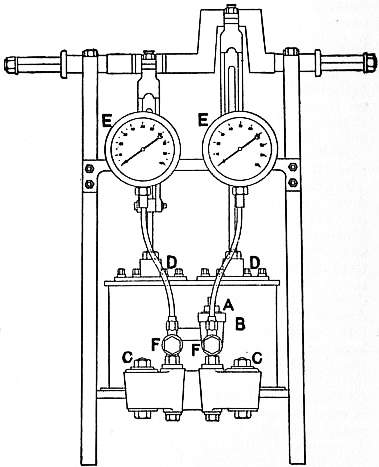
Fig. 1.—Pump out of chest. Two-cylinder, Double-action Air Pump for Two Divers.
A, Air-distributing arrangement, for one diver or two divers. B, Water jacket. C, Suction and discharge valves. D, Cylinders. E, Pressure gauges. F, Nozzles to which divers’ air pipes are attached.
Air Pumps.—The type of air pump varies with the depth of water to which the diver has to descend; it will be readily understood that the greater the depth the greater the quantity of air required by the diver. The pattern most generally in favour amongst divers of all classes is a three-cylinder single-acting pump, which is suitable for almost every description of work which the diver may be called upon to perform, either in deep or shallow water. Another most useful type is a two-cylinder double-acting pump (figs. 1 and 2), which is designed to supply two divers working simultaneously in moderate depths of water, or one diver only in deep water. An air-distributing arrangement is fitted, whereby, when it is desired to send two men down together, each cylinder supplies air independently of the other; and when it is required to send one diver into deep water, the two cylinders are connected and the full volume of air from both is delivered to the one man. The same duty is also performed by a four-cylinder single-acting pump. Smaller pumps, having one double-acting or two single-acting cylinders, are also used for shallow water work.
In most cases these air pumps are worked by manual power; this method of working is rendered necessary by the fact that the machines are usually placed in small boats from which the divers work and on which other motive power is not available. In cases, however, where steam or electric power is available the pumps are sometimes worked by their means—more particularly on harbour and dock works. In such instances the air is not delivered direct from the pump to the diver, but is delivered into an intermediate steel receiver to which the diver’s air pipe is connected, the object being to ensure a reserve supply of air in case of a breakdown of the pump. Some of these combinations of pumps and motors are so arranged that, in the event of an accident to the motor, the pump can be thrown out of gear with it, and be immediately worked by hand power. Each pump is fitted with a gauge (or gauges), indicating not only the pressure of air which the pump is supplying, but also the depth of water at which the diver is working. The cylinders are water-jacketed to ensure the air delivered to the diver being cool, the water being drawn in and circulated round the cylinders by means of a small metal pump worked from an eccentric on the main crank-shaft. Filters are sometimes attached to the suction and delivery sides of the pumps to ensure the inlet of air being free from dirt, and the discharge of air free from dirt and oil.
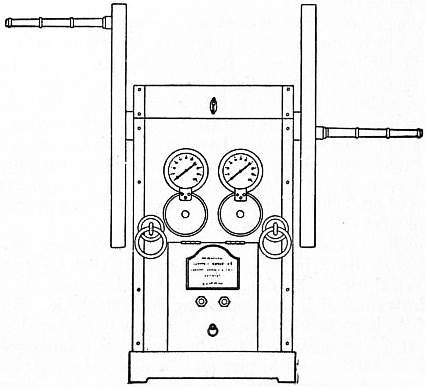
Fig. 2.—Pump in chest, ready for work.
Helmet.—The helmet and breastplate (fig. 3) are made from highly planished tinned copper, with gun-metal valves and other fittings. The helmet is provided with a non-return air inlet valve to which the diver’s air pipe is connected; the air when it lifts the inlet valve passes through three conduits—one having its outlet over the front glass, the others their outlets over the side glasses. In this way the diver gets the air fresh as it enters the helmet, and at the same time it prevents condensation of his breath on the glasses and keeps them clear. There is a regulating air outlet valve by which the diver adjusts his supply of air according to his requirements in different depths of water; the valve is usually made to be adjusted by hand, but sometimes it is so constructed as to be operated by the diver knocking his head against it, the spindle being extended through to the inside of the helmet and fitted at its inner extremity with a button or disk. By unscrewing the valve, the diver allows air to escape, and thus the dress is deflated; by screwing it up the air is retained and the dress inflated. Thus the diver can control his specific gravity and rise or sink at will. In case by any chance the diver should inflate the dress inadvertently, and wish to get rid of the superfluous air quickly, he can do so by opening an emergency cock, which is fitted on the helmet. Plate glasses in gun-metal frames are also fitted to the helmet, two, one on each side, being permanently fixed, while one in front is made either to screw in and out, or to work on a hinged joint like a ship’s scuttle; the side glasses are usually protected by metal cross-bars, as is also sometimes the front glass. Some divers prefer unprotected glasses at the side of the helmet, instead of protected oval ones.
The breastplate is fitted on its outer edge with metal screws and bands. The disposition of the screws corresponds with that of the holes in the india-rubber collar of the diving dress described below. There are other methods of making a watertight joint between the diver’s breastplate and the diving dress, but, as these are only mechanical differences, it will suffice to describe the Siebe-Gorman apparatus, as exclusively adopted by the British government. Whatever the shape or design of the helmet or dress, Siebe’s principle is the one in universal use to-day.
The metal tabs are for carrying the diver’s lead weights, which are fitted with suitable clips; the hooks—one on each side of the helmet—are for keeping the ropes attached to the back weight in position. The helmet and breastplate are fitted at their lower and upper parts respectively with gun-metal segmental neck rings, which make it possible to connect these two main parts together by one-eighth of a turn, a catch at the back of the helmet preventing any chance of unscrewing. The small eyes at the top of the helmet are for securing the diver’s air pipe and life line in position and preventing them from swaying.
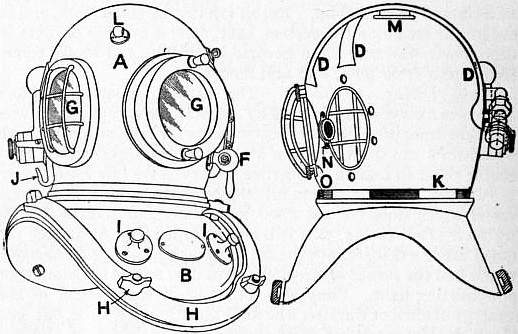
Front view of Helmet. Side sectional view of Helmet.
A, Helmet. B, Breastplate. F, Emergency cock. G, Glasses in frames. H, Metal screws and bands. I, Metal tabs. J, Hooks for keeping weight ropes in position. L, Eyes to which air pipe and life line are secured. K, Segmental neck rings. D, Air conduits. M, Telephone receiver. N, Transmitter. O, Contact piece to ring bell.
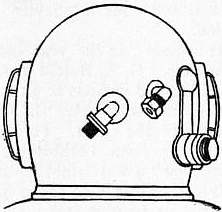
Back view of Helmet. Plan of Helmet.
C, Air inlet valve. E, Regulating outlet valve. G, Glasses in frames. L, Eyes to which air pipe and life line are secured. P, Connexion for telephone cable.
Fig. 3.
The Diving Dress is a combination suit which envelops the whole body from feet to neck. It is made of two layers of tanned twill with pure rubber between, and is fitted at the neck with a vulcanized india-rubber collar, or band, with holes punched in it corresponding to the screws in the breastplate. This collar, when clamped tightly between the bands and the breastplate by means of the nuts, ensures a watertight joint. The sleeves of the dress are fitted with vulcanized india-rubber cuffs, which, fitting tightly round the diver’s wrists, prevent the ingress of water at these parts also.
Boots.—These are generally made with leather uppers, beechwood inner soles and leaden outer soles, the latter being secured to the others by copper rivets. Heavy leather straps with brass buckles secure the boot to the foot. Each boot weighs about 16 ℔. Sometimes the main part of the boot-golosh, toe and heel, are in one brass casting, with leather upper part, heavy straps and brass buckles.
Lead Weights.—These weigh 40 ℔ each, and the diver wears one on his back, another on his chest. These weights and the heavy boots ensure the diver’s equilibrium when under water.
Belt and Knife and Small Tools.—Every diver wears a heavy waist-belt in which he carries a strong knife in metal case, and sometimes other small tools.
Air Pipe.—The diver’s air pipe is of a flexible, non-collapsible description, being made of alternate layers of strong canvas and vulcanized india-rubber, with steel or hard drawn metal wire embedded. At the ends are fitted gun-metal couplings, for connecting the pipe with the diver’s pump and helmet.
Signal Line.—The diver’s signal line (sometimes called life line) consists of a length of reverse laid Manila rope. In cases where the telephone apparatus is not used, the diver gives his signals by means of a series of pulls on the signal line in accordance with a prearranged code.
Telephonic Apparatus.—Without doubt one of the most useful adjuncts to the modern diving apparatus is the loud-sounding telephone (fig. 4), introduced by Siebe, Gorman & Co., which enables the diver to communicate viva voce with his attendant, and vice versa. In the British navy the type of submarine telephonic apparatus used is the Graham-Davis system. This is made on two plans, (1) a single set of instruments, for communication between one diver and his attendant direct, (2) an intercommunication set which is used where two divers are employed. With this type the attendant can speak to No. 1 or No. 2 diver separately, or with both at the same time, and vice versa; and No. 1 can be put in communication with No. 2 whilst they are under water, the attendant at the surface being able to hear what the men are saying. The advantages of such a system are obvious. It is more particularly useful where two divers are working one either side of a ship, or where the divers may be engaged upon the same piece of work, but out of sight of one another, or out of touch. It would prove its utility in a marked degree in cases where a diver got into difficulties; a second diver sent down to his assistance could receive and give verbal directions and thus greatly expedite the work of rescue.