VOLUME VII SLICE VIII Cube to Daguerre, Louis
Reading edition
Articles in This Slice
CUBE CURWEN, JOHN
CUBEBS CURZOLA
CUBICLE CURZON OF KEDLESTON, GEORGE NATHANIEL
CUBITT, THOMAS CUSANUS, NICOLAUS
CUBITT, SIR WILLIAM CUSH
CUCHULINN CUSHING, CALEB
CUCKOO CUSHING, WILLIAM BARKER
CUCKOO-SPIT CUSHION
CUCUMBER CUSHMAN, CHARLOTTE SAUNDERS
CUCURBITACEAE CUSP
CUDDALORE CUSTARD APPLE
CUDDAPAH CUSTER, GEORGE ARMSTRONG
CUDWORTH, RALPH CUSTINE, ADAM PHILIPPE
CUENCA (city of Ecuador) CUSTOM
CUENCA (province of Spain) CUSTOMARY FREEHOLD
CUENCA (city of Spain) CUSTOM-HOUSE
CUESTA CUSTOM DUTIES
CUEVAS DE VERA CUSTOS ROTULORUM
CUFF CUSTOZZA
CUIRASS CÜSTRIN
CUIRASSIERS CUTCH
CUJAS, JACQUES CUTCH, GULF OF
CULDEES CUTCH, RUNN OF
CULEBRA CUTHBERT, SAINT
CULLEN, PAUL CUTLASS
CULLEN, WILLIAM CUTLER, MANASSEH
CULLEN CUTLERY
CULLERA CUTTACK
CULLINAN CUTTLE-FISH
CULLODEN CUTTS OF GOWRAN, JOHN CUTTS
CULM CUVIER, GEORGES LÉOPOLD DAGOBERT
CULMINATION CUVILLES, FRANÇOIS DE
CULPRIT CUXHAVEN
CULROSS CUYABÁ
CULTIVATOR CUYAPO
CUMAE CUYP
CUMANÁ CUZA, ALEXANDER JOHN
CUMBERLAND, DUKES AND EARLS OF CUZCO
CUMBERLAND, RICHARD (English philosopher) CYANAMIDE
CUMBERLAND, RICHARD (English dramatist) CYANIC ACID AND CYANATES
CUMBERLAND, WILLIAM AUGUSTUS CYANIDE
CUMBERLAND (county of England) CYANITE
CUMBERLAND (Maryland, U.S.A.) CYANOGEN
CUMBERLAND (Rhode Island, U.S.A.) CYAXARES
CUMBERLAND MOUNTAINS CYBELE
CUMBERLAND RIVER CYCLADES
CUMBRAES, THE CYCLAMEN
CUMIN CYCLE
CUMMERBUND CYCLING
CUMMING, JOSEPH GEORGE CYCLOID
CUMNOCK AND HOLMHEAD CYCLOMETER
CUNARD, SIR SAMUEL CYCLONE
CUNAS CYCLOPEAN MASONRY
CUNDINAMARCA CYCLOPES
CUNEIFORM CYCLOSTOMATA
CUNEO CYCLOSTYLE
CUNEUS CYGNUS
CUNITZ, MARIA CYLINDER
CUNNINGHAM, ALEXANDER CYLLENE
CUNNINGHAM, ALLAN CYMA
CUNNINGHAM, WILLIAM (Scottish theologian) CYMBALS
CUNNINGHAM, WILLIAM (English economist) CYNEGILS
CUP CYNEWULF (king of Wessex)
CUPAR CYNEWULF (Old-English poet)
CUPBOARD CYNICS
CUPID CYNOSURE
CUPOLA CYPERACEAE
CUPPING CY-PRÈS
CUPRA CYPRESS
CUPRITE CYPRIAN, SAINT
CUPULIFERAE CYPRINODONTS
CURAÇAO CYPRUS
CURAÇOA CYPRUS, CHURCH OF
CURASSOW CYPSELUS
CURATE CYRANO DE BERGERAC, SAVINIEN
CURATOR CYRENAICA
CURCI, CARLO MARIA CYRENAICS
CUREL, FRANÇOIS CYRENE
CURÉLY, JEAN NICOLAS CYRIL (bishop of Jerusalem)
CURES CYRIL (bishop of Alexandria)
CURETES CYRIL (apostle of the Slavs)
CURETON, WILLIAM CYRILLIC
CURETUS CYRILLUS
CURFEW CYRTO-STYLE
CURIA CYRUS
CURIA REGIS CYSTOFLAGELLATA
CURIA ROMANA CYSTOLITH
CURICÓ CYTHERA
CURIE, PIERRE CYTISINE
CURIO, GAIUS SCRIBONIUS CYTOLOGY
CURITYBA CYZICENUS
CURLEW CYZICUS
CURLING, THOMAS BLIZARD CZARNIECKI, STEPHEN
CURLING CZARTORYSKI, ADAM GEORGE
CURLL, EDMUND CZARTORYSKI, FRYDERYK MICHAL
CURRAGH CZECH
CURRAN, JOHN PHILPOT CZENSTOCHOWA
CURRANT CZERNOWITZ
CURRICLE CZERNY, KARL
CURRIE, SIR DONALD D
CURRIE, JAMES DACCA
CURRY DACE
CURSOR, LUCIUS PAPIRIUS DACH, SIMON
CURSOR MUNDI DACIA
CURTAIN DACIER, ANDRÉ
CURTANA DACITE
CURTEA DE ARGESH DACOIT
CURTESY DA COSTA, ISAAK
CURTILAGE DACTYL
CURTIN ANDREW GREGG DAEDALUS
CURTIS, GEORGE TICKNOR DAFFODIL
CURTIS, GEORGE WILLIAM DAFYDD AB GWILYM
CURTIUS, ERNST DAGGER
CURTIUS, MARCUS DAGHESTAN
CURTIUS RUFUS, QUINTUS DAGO
CURULE DAGOBERT I.
CURVE DAGON
CURVILINEAR DAGUERRE, LOUIS JACQUES MANDÉ
CURWEN, HUGH
CUBE (Gr. κύβος, a cube), in geometry, a solid bounded by six equal squares, so placed that the angle between any pair of adjacent faces is a right angle. This solid played an all-important part in the geometry and cosmology of the Greeks. Plato (Timaeus) described the figure in the following terms:—“The isosceles triangle which has its vertical angle a right angle ... combined in sets of four, with the right angles meeting at the centre, form a single square. Six of these squares joined together formed eight solid angles, each produced by three plane right angles: and the shape of the body thus formed was cubical, having six square planes for its surfaces.” In his cosmology Plato assigned this solid to “earth,” for “‘earth’ is the least mobile of the four (elements—‘fire,’ ‘water,’ ‘air’ and ‘earth’) and most plastic of bodies: and that substance must possess this nature in the highest degree which has its bases most stable.” The mensuration of the cube, and its relations to other geometrical solids are treated in the article Polyhedron; in the same article are treated the Archimedean solids, the truncated and snub-cube; reference should be made to the article Crystallography for its significance as a crystal form.
A famous problem concerning the cube, namely, to construct a cube of twice the volume of a given cube, was attacked with great vigour by the Pythagoreans, Sophists and Platonists. It became known as the “Delian problem” or the “problem of the duplication of the cube,” and ranks in historical importance with the problems of “trisecting an angle” and “squaring the circle.” The origin of the problem is open to conjecture. The Pythagorean discovery of “squaring a square,” i.e. constructing a square of twice the area of a given square (which follows as a corollary to the Pythagorean property of a right-angled triangle, viz. the square of the hypotenuse equals the sum of the squares on the sides), may have suggested the strictly analogous problem of doubling a cube. Eratosthenes (c. 200 B.C.), however, gives a picturesque origin to the problem. In a letter to Ptolemy Euergetes he narrates the history of the problem. The Delians, suffering a dire pestilence, consulted their oracles, and were ordered to double the volume of the altar to their tutelary god, Apollo. An altar was built having an edge double the length of the original; but the plague was unabated, the oracles not having been obeyed. The error was discovered, and the Delians applied to Plato for his advice, and Plato referred them to Eudoxus. This story is mere fable, for the problem is far older than Plato.
Hippocrates of Chios (c. 430 B.C.), the discoverer of the square of a lune, showed that the problem reduced to the determination of two mean proportionals between two given lines, one of them being twice the length of the other. Algebraically expressed, if x and y be the required mean proportionals and a, 2a, the lines, we have a : x :: x : y :: y : 2a, from which it follows that x³ = 2a³. Although Hippocrates could not determine the proportionals, his statement of the problem in this form was a great advance, for it was perceived that the problem of trisecting an angle was reducible to a similar form which, in the language of algebraic geometry, is to solve geometrically a cubic equation. According to Proclus, a man named Hippias, probably Hippias of Elis (c. 460 B.C.), trisected an angle with a mechanical curve, named the quadratrix (q.v.). Archytas of Tarentum (c. 430 B.C.) solved the problems by means of sections of a half cylinder; according to Eutocius, Menaechmus solved them by means of the intersections of conic sections; and Eudoxus also gave a solution.
All these solutions were condemned by Plato on the ground that they were mechanical and not geometrical, i.e. they were not effected by means of circles and lines. However, no proper geometrical solution, in Plato’s sense, was obtained; in fact it is now generally agreed that, with such a restriction, the problem is insoluble. The pursuit of mechanical methods furnished a stimulus to the study of mechanical loci, for example, the locus of a point carried on a rod which is caused to move according to a definite rule. Thus Nicomedes invented the conchoid (q.v.); Diocles the cissoid (q.v.); Dinostratus studied the quadratrix invented by Hippias; all these curves furnished solutions, as is also the case with the trisectrix, a special form of Pascal’s limaçon (q.v.). These problems were also attacked by the Arabian mathematicians; Tobit ben Korra (836-901) is credited with a solution, while Abul Gud solved it by means of a parabola and an equilateral hyperbola.
In algebra, the “cube” of a quantity is the quantity multiplied by itself twice, i.e. if a be the quantity a × a × a (= a³) is its cube. Similarly the “cube root” of a quantity is another quantity which when multiplied by itself twice gives the original quantity; thus a1/3 is the cube root of a (see Arithmetic and Algebra). A “cubic equation” is one in which the highest power of the unknown is the cube (see Equation); similarly, a “cubic curve” has an equation containing no term of a power higher than the third, the powers of a compound term being added together.
In mensuration, “cubature” is sometimes used to denote the volume of a solid; the word is parallel with “quadrature,” to determine the area of a surface (see Mensuration; Infinitesimal Calculus).
CUBEBS (Arab. kabábah), the fruit of several species of pepper (Piper), belonging to the natural order Piperaceae. The cubebs of pharmacy are produced by Piper Cubeba, a climbing woody shrub indigenous to south Borneo, Sumatra, Prince of Wales Island and Java. It has round, ash-coloured, smooth branches; lanceolate, or ovate-oblong, somewhat leathery, shining leaves, 4 to 6½ in. long and 1½ to 2 in. broad. Male and female flowers are borne on distinct plants. The fruits are small, globose, about 1⁄5 in. in diameter, and not so large as white pepper; their contracted stalk-like bases are between 1⁄3 and ½ in. in length; and from forty to fifty of them are borne upon a common stem. The cubeb is cultivated in Java and Sumatra, the fruits are gathered before they are ripe, and carefully dried. Commercial cubebs consist of the dried berries, usually with their stalks attached; the pericarp is greyish-brown, or blackish and wrinkled; and the seed, when present, is hard, white and oily. The odour of cubebs is agreeable and aromatic; the taste, pungent, acrid, slightly bitter and persistent. About 15% of a volatile oil is obtained by distilling cubebs with water; after rectification with water, or on keeping, this deposits rhombic crystals of camphor of cubebs, C15H26O; cubebene, the liquid portion, has the formula C15H24. Cubebin, CH2[O]2C6H3·CH:CH·CH2OH, is a crystalline substance existing in cubebs, discovered by Eugène Soubeiran and Capitaine in 1839; it may be prepared from cubebene, or from the pulp left after the distillation of the oil. The drug, along with gum, fatty oils, and malates of magnesium and calcium, contains also about 1% of cubebic acid, and about 6% of a resin.
The dose of the fruit is 30 to 60 grains, and the British Pharmacopoeia contains a tincture with a dose of ½ to 1 drachm. The volatile oil—oleum cubebae—is also official, and is the form in which this drug is most commonly used, the dose being 5 to 20 minims, which may be suspended in mucilage or given after meals in a cachet. The drug has the typical actions of a volatile oil, but exerts some of them in an exceptional degree. Thus it is liable to cause a cutaneous erythema in the course of its excretion by the skin; it has a marked diuretic action; and it is a fairly efficient disinfectant of the urinary passages. Its administration causes the appearance in the urine of a salt of cubebic acid which is precipitated by heat or nitric acid, and is therefore liable to be mistaken for albumin, when these two most common tests for the occurrence of albuminuria are applied. Cubebs is frequently used in the form of cigarettes for asthma, chronic pharyngitis and hay-fever. A small percentage of cubebs is also commonly included in lozenges designed for use in bronchitis, in which the antiseptic and expectoral properties of the drug are useful. But the most important therapeutic application of this drug is in gonorrhoea, where its antiseptic action is of much value. As compared with copaiba in this connexion cubebs has the advantages of being less disagreeable to take and somewhat less likely to disturb the digestive apparatus in prolonged administration. The introduction of the drug into medicine is supposed to have been due to the Arabian physicians in the middle ages. Cubebs were formerly candied and eaten whole, or used ground as a seasoning for meat. Their modern employment in England as a drug dates from 1815. “Cubebae” were purchased in 1284 and 1285 by Lord Clare at 2s. 3d. and 2s. 9d. per ℔ respectively; and in 1307 1 ℔ for the king’s wardrobe cost 9s., a sum representing about £3, 12s. in present value (Rogers, Hist. of Agriculture and Prices, i. 627-628, ii. 544).
A closely allied species, Piper Clusii, produces the African cubebs or West African black-pepper, the berry of which is smoother than that of common cubebs and usually has a curved pedicel. In the 14th century it was imported into Europe from the Grain Coast, under the name of pepper, by merchants of Rouen and Lippe.
CUBICLE (Lat. cubiculum), a small chamber containing a couch or a bed. The small rooms opening into the atrium of a Pompeian house are known as cubicula. In modern English schools “cubicle” is the term given to the separate small bedrooms into which the dormitories are divided, as opposed to the system of large open dormitories.
CUBITT, THOMAS (1788-1855), English builder, was born at Buxton, near Norwich, on the 25th of February 1788. Few men have exhibited greater self-reliance in early life in the pursuit of a successful career. In his nineteenth year, when he was working as a journeyman carpenter, his father died, and he tried to better his position by going on a voyage to India, as captain’s joiner. He returned to London, two years after, in the possession of a small capital, and began business as a carpenter. The growth of his establishment was steady and rapid. He was one of the first to combine several trades in a “builder’s” business; and this very much increased his success. One of the earlier works which gave him reputation was the London Institution in Finsbury Circus; but it is from 1824 that the vast building operations date which identify his name with many splendid ranges of London houses, such as Tavistock, Gordon, Belgrave and Lowndes Squares, and the district of South Belgravia. While these and similar extensive operations were in progress, a financial panic, which proved ruinous to many, was surmounted in his case by a determined spirit and his integrity of character. He took great interest in sanitary measures, and published, for private circulation, a pamphlet on the general drainage of London, the substance of which was afterwards embodied in a letter to The Times; the plan he advocated was subsequently adopted by the conveyance of the sewage matter some distance below London. He advocated the provision of open spaces in the environs of London as places of public recreation, and was one of the originators of Battersea Park, the first of the people’s parks. At a late period he received professionally the recognition of royalty, the palace at Osborne being erected after his designs, and under his superintendence; and in the Life of the Prince Consort he is described by Queen Victoria as one “than whom a better and kinder man did not exist.” In 1851, although he was not identified with the management of the Great Exhibition, he showed the warmest sympathy with its objects, and aided its projectors in many ways, especially in the profitable investment of their surplus funds. Cubitt, when he rose to be a capitalist, never forgot the interests and well-being of his workpeople. He was elected president of the Builders’ Society some time before his death, which took place at his seat Denbies, near Dorking, on the 20th of December 1855.
His son, George Cubitt (1828- ), who had a long and useful parliamentary career, as Conservative member for West Surrey (1860-1865) and Mid-Surrey (1885-1892), was in 1892 raised to the peerage as Baron Ashcombe.
CUBITT, SIR WILLIAM (1785-1861), English engineer, was born in 1785 at Dilham in Norfolk, where his father was a miller. After serving an apprenticeship of four years (1800-1804) as a joiner and cabinetmaker at Stalham, he became associated with an agricultural-machine maker, named Cook, who resided at Swanton. In 1807 he patented self-regulating sails for windmills, and in 1812 he entered the works of Messrs Ransome of Ipswich, where he soon became chief engineer, and ultimately a partner. Meanwhile, the subject of the employment of criminals had been much in his thoughts; and the result was his introduction of the treadmill about 1818. In 1826 he removed to London, where he gained a very large practice as a civil engineer. Among his works were the Oxford canal, the Birmingham & Liverpool Junction Canal, the improvement of the river Severn, the Bute docks at Cardiff, the Black Sluice drainage and its outfall sluice at Boston harbour, the Middlesborough docks and coal drops in the Tees, and the South-Eastern railway, of which he was chief engineer. The Hanoverian government consulted him about the harbour and docks at Harburg; the water-works of the city of Berlin were constructed under his immediate superintendence; he was asked to report on the construction of the Paris & Lyons railway; and he was consulting engineer for the line from Boulogne to Amiens. Among his later works were two floating landing stages at Liverpool, and the bridge for carrying the London turnpike across the Medway at Rochester. In 1851, when he was president of the Institution of Civil Engineers, he was knighted for his services in connexion with the buildings erected in Hyde Park for the exhibition of that year. He retired from active work in 1858, and died on the 13th of October 1861 at his house on Clapham Common, London. His son, Joseph Cubitt (1811-1872), was trained under him, and was engineer of various railways, including the Great Northern, London, Chatham & Dover, and part of the London & South-Western.
CUCHULINN (Cūchúlinn; pronounced “Coohoollin”), the chief warrior in the Conchobar-Cuchulinn or older heroic (Ulster) cycle of Ireland. The story of his origin is very obscure. The god Lug is represented as having been swallowed in a draught of wine by his mother Dechtire, sister of Conchobar, who was king of Ulster. But it is not unlikely that this story was invented to supersede the account of the incestuous union of Conchobar with his sister, which seems to be hinted at on various occasions. Usually, however, he is styled son of Sualdam, an Ulster warrior who plays a very inferior part in the cycle. His earliest name was Setanta, and he was brought up at Dun Imbrith (Louth). When he was six years of age he announced his intention of going to Conchobar’s court at Emain Macha (Navan Rath near Armagh) to play with the boys there. He defeats all the boys in marvellous fashion and is received as one of their number. Shortly after he kills Culann, the smith’s hound, a huge watch-dog. The smith laments that all his property is of no value now that his watchman is slain, whereupon the young hero offers to guard his domains until a whelp of the hound’s has grown. From this the boy received the name of Cū Chulinn or Culann’s Hound. The next year Cuchulinn receives arms, makes his first foray, and slays the three sons of Necht, redoubtable hereditary foes of the Ulstermen, in the plain of Meath. The men of Ulster decide that Cuchulinn must marry, as all the women of Ireland are in love with him. Chosen envoys fail to find a bride worthy of him after a year’s search, but the hero goes straight to Emer, the daughter of Forgall the Wily, at Lusk (county Dublin). The lady is promised to him if he will go to learn chivalry of Domnall the Soldierly and the amazon Scathach in Alba. After enduring great hardships he goes through the course and leaves a son Connlaech behind in Scotland by another amazon, Aife. On his return he carries off and weds Emer. He is represented as living at Dun Delgan (Dundalk). The greatest of all the hero’s achievements was the defence of the frontier of Ulster against the forces of Medb, queen of Connaught, who had come to carry off the famous Brown Bull of Cualnge (Cooley). The men of Ulster were all suffering from a strange debility, and Cuchulinn had to undertake the defence single-handed from November to February. This was when he was seventeen years of age. The cycle contains a large number of episodes, such as the gaining of the champion’s portion and the tragical death by the warrior’s hand of his own son Connlaech. When he was twenty-seven he met with his end at the hands of Lugaid, son of Cūrōi MacDaire, the famous Munster warrior, and the children of Calatīn Dāna, in revenge for their father’s death (see Celt: Irish Literature).
Medieval Christian synchronists make Cuchulinn’s death take place about the beginning of the Christian era. It is not necessary to regard Cuchulinn as a form of the solar hero, as some writers have done. Most, if not all, of his wonderful attributes may be ascribed to the Irish predilection for the grotesque. It is true that Cuchulinn seems to stand in a special relation to the Tuatha De Danann leader, the god Lug, but in primitive societies there is always a tendency to ascribe a divine parentage to men who stand out pre-eminently in prowess beyond their fellows.
See A. Nutt, Cuchulainn, the Irish Achilles (London, 1900); E. Hull, The Cuchullin Saga (London, 1898).
(E. C. Q.)
CUCKOO, or Cuckow, as the word was formerly spelt, the common name of a well-known and often-heard bird, the Cuculus canorus of Linnaeus. In some parts of the United Kingdom it is more frequently called gowk, and it is the Gr. κόκκυξ, the Ital. cuculo or cucco, the Fr. coucou, the Ger. Kuckuk, the Dutch koekkoek, the Dan. kukker or gjög, and the Swed. gök. The oldest English spelling of the name seems to have been cuccu.
No single bird has perhaps so much occupied the attention both of naturalists and of those who are not naturalists, or has had so much written about it, as the common cuckoo, and of no bird perhaps have more idle tales been told. Its strange and, according to the experience of most people, its singular habit of entrusting its offspring to foster-parents is enough to account for much of the interest which has been so long felt in its history; but this habit is shared probably by many of its Old World relatives, as well as in the New World by birds which are not in any degree related to it. The cuckoo is a summer visitant to the whole of Europe, reaching even far within the Arctic circle, and crossing the Mediterranean from its winter quarters in Africa at the end of March or beginning of April. Its arrival is at once proclaimed by the peculiar and in nearly all languages onomatopoeic cry of the cock—a true song in the technical sense of the word, since it is confined to the male sex and to the season of love. In a few days the cock is followed by the hen, and amorous contests between keen and loud-voiced suitors are to be commonly noticed, until the respective pretensions of the rivals are decided. Even by night they are not silent; but as the season advances the song is less frequently heard, and the cuckoo seems rather to avoid observation as much as possible, the more so since whenever it shows itself it is a signal for all the small birds of the neighbourhood to be up in its pursuit, just as though it were a hawk, to which indeed its mode of flight and general appearance give it an undoubted resemblance—a resemblance that misleads some into confounding it with the birds of prey, instead of recognizing it as a harmless if not a beneficial destroyer of hairy caterpillars. Thus pass away some weeks. Towards the middle or end of June its “plain-song” cry alters; it becomes rather hoarser in tone, and its first syllable or note is doubled. Soon after it is no longer heard at all, and by the middle of July an old cuckoo is seldom to be found in the British Islands, though a stray example, or even, but very rarely, two or three in company, may occasionally be seen for a month longer. Of its breeding comparatively few have any personal experience. Yet a diligent search for and peering into the nests of several of the commonest little birds—more especially the pied wagtail (Motacilla lugubris), the titlark (Anthus pratensis), the reed-wren (Acrocephalus streperus), and the hedge-sparrow (Accentor modularis)—will be rewarded by the discovery of the egg of the mysterious stranger which has been surreptitiously introduced, and those who wait till this egg is hatched may be witnesses (as was Edward Jenner in the 18th century) of the murderous eviction of the rightful tenants of the nest by the intruder, who, hoisting them one after another on his broad back, heaves them over to die neglected by their own parents, of whose solicitous care he thus becomes the only object. In this manner he thrives, and, so long as he remains in the country of his birth his wants are anxiously supplied by the victims of his mother’s dupery. The actions of his foster-parents become, when he is full grown, almost ludicrous, for they often have to perch between his shoulders to place in his gaping mouth the delicate morsels he is too indolent or too stupid to take from their bills. Early in September he begins to shift for himself, and then follows the seniors of his kin to more southern climes.
So much caution is used by the hen cuckoo in choosing a nest in which to deposit her egg that the act of insertion has been but seldom witnessed. The nest selected is moreover often so situated, or so built, that it would be an absolute impossibility for a bird of her size to lay her egg therein by sitting upon the fabric as birds commonly do; and there have been a few fortunate observers who have actually seen the deposition of the egg upon the ground by the cuckoo, who, then taking it in her bill, introduces it into the nest. Of these, the earliest in Great Britain seem to have been two Scottish lads, sons of Mr Tripeny, a farmer in Coxmuir, who, as recorded by Macgillivray (Brit. Birds, iii. 130, 131) from information communicated to him by Mr Durham Weir, saw most part of the operation performed, June 24, 1838. But perhaps the most satisfactory evidence on the point is that of Adolf Müller, a forester at Gladenbach in Darmstadt, who says (Zoolog. Garten, 1866, pp. 374, 375) that through a telescope he watched a cuckoo as she laid her egg on a bank, and then conveyed the egg in her bill to a wagtail’s nest. Cuckoos, too, have been not unfrequently shot as they were carrying a cuckoo’s egg, presumably their own, in their bill, and this has probably given rise to the vulgar, but seemingly groundless, belief that they suck the eggs of other kinds of birds. More than this, Mr G. D. Rowley, who had much experience of cuckoos, declares (Ibis, 1865, p. 186) his opinion to be that traces of violence and of a scuffle between the intruder and the owners of the nest at the time of introducing the egg often appear, whence we are led to suppose that the cuckoo ordinarily, when inserting her egg, excites the fury (already stimulated by her hawk-like appearance) of the owners of the nest by turning out one or more of the eggs that may be already laid therein, and thus induces the dupe to brood all the more readily and more strongly what is left to her. Of the assertion that the cuckoo herself takes any interest in the future welfare of the egg she has foisted on her victim, or of its product, there is no good evidence.
But a much more curious assertion has also been made, and one that at first sight appears so incomprehensible as to cause little surprise at the neglect it long encountered. To this currency was first given by Salerne (L’Hist. nat. &c., Paris, 1767, p. 42), who was, however, hardly a believer in it, and it is to the effect, as he was told by an inhabitant of Sologne, that the egg of a cuckoo resembles in colour that of the eggs normally laid by the kind of bird in whose nest it is placed. In 1853 the same notion was prominently and independently brought forward by Dr A. C. E. Baldamus (Naumannia, 1853, pp. 307-325), and in time became known to English ornithologists, most of whom were naturally sceptical as to its truth, since no likeness whatever is ordinarily apparent in the very familiar case of the blue-green egg of the hedge-sparrow and that of the cuckoo, which is so often found beside it.1 Dr Baldamus based his notion on a series of eggs in his cabinet,2 a selection from which he figured in illustration of his paper, and, however the thing may be accounted for, it seems impossible to resist, save on one supposition, the force of the testimony these specimens afford. This one supposition is that the eggs have been wrongly ascribed to the cuckoo, and that they are only exceptionally large examples of the eggs of the birds in the nests of which they were found, for it cannot be gainsaid that some such abnormal examples are occasionally to be met with. But it is well known that abnormally large eggs are not only often deficient in depth of colour, but still more often in stoutness of shell. Applying these rough criteria to Dr Baldamus’s series, most of the specimens stood the test very well.
There are some other considerations to be urged. For instance, Herr Braune, a forester at Greiz in the principality of Reuss (Naumannia, tom. cit. pp. 307, 313), shot a hen cuckoo as she was leaving the nest of an icterine warbler (Hypolais icterina). In the oviduct of this cuckoo he found an egg coloured very like that of the warbler, and on looking into the nest he found there an exactly similar egg, which there can be no reasonable doubt had just been laid by that very cuckoo. Moreover, Herr Grunack (Journ. für Orn., 1873, p. 454) afterwards found one of the most abnormally coloured specimens, quite unlike the ordinary egg of the cuckoo, to contain an embryo so fully formed as to show the characteristic zygodactyl feet of the bird, thus proving unquestionably its parentage.
On the other hand, we must bear in mind the numerous instances in which not the least similarity can be traced—as in the not uncommon case of the hedge-sparrow already mentioned, and if we attempt any explanatory hypothesis it must be one that will fit all round. Such an explanation seems to be this. We know that certain kinds of birds resent interference with their nests much less than others, and among them it may be asserted that the hedge-sparrow will patiently submit to various experiments. She will brood with complacency the egg of a redbreast (Erithacus rubecula), so unlike her own, and for aught we know to the contrary may even be colour-blind. In the case of such a species there would be no need of anything further to ensure success—the terror of the nest-owner at seeing her home invaded by a hawk-like giant, and some of her treasures tossed out, would be enough to stir her motherly feelings so deeply that she would without misgiving, if not with joy that something had been spared to her, resume the duty of incubation so soon as the danger was past. But with other species it may be, and doubtless is, different. Here assimilation of the introduced egg to those of the rightful owner may be necessary, for there can hardly be a doubt as to the truth of Dr Baldamus’s theory as to the object of the assimilation being to render the cuckoo’s egg “less easily recognized by the foster-parents as a substituted one.” It is especially desirable to point out that there is not the slightest ground for imagining that the cuckoo, or any other bird, can voluntarily influence the colour of the egg she is about to lay. Over that she can have no control, but its destination she can determine. It would seem also impossible that a cuckoo, having laid an egg, should look at it, and then decide from its appearance in what bird’s nest she should put it. That the colour of an egg-shell can be in some mysterious way affected by the action of external objects on the perceptive faculties of the mother is a notion too wild to be seriously entertained. Consequently, only one explanation of the facts can here be suggested. Every one who has sufficiently studied the habits of animals will admit the influence of heredity. That there is a reasonable probability of each cuckoo most commonly putting her eggs in the nest of the same species of bird, and of this habit being transmitted to her posterity, does not seem to be a very violent supposition. Without attributing any wonderful sagacity to her, it does not seem unlikely that the cuckoo which had once successfully foisted her egg on a reed-wren or a titlark should again seek for another reed-wren’s or another titlark’s nest (as the case may be), when she had another egg to dispose of, and that she should continue her practice from one season to another. It stands on record (Zoologist, 1873, p. 3648) that a pair of wagtails built their nest for eight or nine years running in almost exactly the same spot, and that in each of those years they fostered a young cuckoo, while many other cases of like kind, though not perhaps established on so good authority, are believed to have happened. Such a habit could hardly fail to become hereditary, so that the daughter of a cuckoo which always put her egg into a reed-wren’s, titlark’s or wagtail’s nest would do as did her mother. Furthermore it is unquestionable that, whatever variation there may be among the eggs laid by different individuals of the same species, there is a strong family likeness between the eggs laid by the same individual, even at the interval of many years, and it can hardly be questioned that the eggs of the daughter would more or less resemble those of her mother. Hence the supposition may be fairly credited that the habit of laying a particular style of egg is also likely to become hereditary. Combining this supposition with that as to the cuckoo’s habit of using the nest of the same species becoming hereditary, it will be seen that it requires only an application of the principle of natural selection to show the probability of this principle operating in the course of time to produce the facts asserted by the anonymous Solognot of the 18th century, and by Dr Baldamus and others since. The particular gens of cuckoo which inherited and transmitted the habit of depositing in the nest of any particular species of bird eggs having more or less resemblance to the eggs of that species would prosper most in those members of the gens where the likeness was strongest, and the other members would (ceteris paribus) in time be eliminated. As already shown, it is not to be supposed that all species, or even all individuals of a species, are duped with equal ease. The operation of this kind of natural selection would be most needed in those cases where the species are not easily duped—that is, in those cases which occur the least frequently. Here it is we find it, for observation shows that eggs of the cuckoo deposited in nests of the red-backed shrike (Lanius collurio), of the bunting (Emberiza miliaria), and of the icterine warbler approximate in their colouring to eggs of those species—species in whose nests the cuckoo rarely (in comparison with others) deposits eggs. Of species which are more easily duped, such as the hedge-sparrow, mention has already been made.
More or less nearly allied to the British cuckoo are many other forms of the genus from various parts of Africa, Asia and their islands, while one even reaches Australia. In some cases the chief difference is said to lie in the diversity of voice—a character only to be appreciated by those acquainted with the living birds, and though of course some regard should be paid to this distinction, the possibility of birds using different “dialects” according to the locality they inhabit must make it a slender specific diagnostic. All these forms are believed to have essentially the same habits as the British cuckoo, and, as regards parasitism the same is to be said of the large cuckoo of southern Europe and North Africa (Coccystes glandarius), which victimizes pies (Pica mauritanica and Cyanopica cooki) and crows (Corvus cornix). True it is that an instance of this species, commonly known as the great spotted cuckoo, having built a nest and hatched its young, is on record, but the later observations of others tend to cast doubt on the credibility of the ancient report. It is worthy of remark that the eggs of this bird so closely resemble those of one of the pies in whose nest they have been found, that even expert zoologists have been deceived by them, only to discover the truth when the cuckoo’s embryo had been extracted from the supposed pie’s egg. This species of cuckoo, easily distinguishable by its large size and long crest, has more than once made its appearance as a straggler in the British Isles. Equally parasitic are many other cuckoos, belonging chiefly to genera which have been more or less clearly defined as Cacomantis, Chrysococcyx, Eudynamis, Oxylophus, Polyphasia and Surniculus, and inhabiting parts of the Ethiopian, Indian and Australian regions;3 but there are certain aberrant forms of Old World cuckoos which unquestionably do not shirk parental responsibilities. Among these especially are the birds placed in or allied to the genera Centropus and Coua—the former having a wide distribution from Egypt to New South Wales, living much on the ground and commonly called lark-heeled cuckoos; the latter bearing no English name, and limited to the island of Madagascar. These build a nest, not perhaps in a highly finished style of architecture, but one that serves its end.
Respecting the cuckoos of America, the evidence, though it has been impugned, is certainly enough to clear them from the charge which attaches to so many of their brethren of the Old World. There are two species very well known in parts of the United States and some of the West Indian Islands (Coccyzus Americanus and C. erythrophthalmus), and each of them has occasionally visited Europe. They both build nests—remarkably small structures when compared with those of other birds of their size—and faithfully incubate their delicate sea-green eggs. In the south-western states of the Union and thence into Central America is found another curious form of cuckoo (Geococcyx)—the chaparral-cock of northern and paisano of southern settlers. The first of these names it takes from the low brushwood (chaparral) in which it chiefly dwells, and the second is said to be due to its pheasant-like (faisan corrupted into paisano, properly a countryman) appearance as it runs on the ground. Indeed, one of the two species of the genus was formerly described as a Phasianus. They both have short wings, and seem never to fly, but run with great rapidity. Returning to arboreal forms, the genera Neomorphus, Diplopterus, Saurothera and Piaya (the last two commonly called rain-birds, from the belief that their cry portends rain) may be noticed—all of them belonging to the Neotropical region; but perhaps the most curious form of American cuckoos is the ani (Crotophaga), of which three species inhabit the same region. The best-known species (C. ani) is found throughout the Antilles and on the opposite continent. In most of the British colonies it is known as the black witch, and is accused of various malpractices—it being, in truth, a perfectly harmless if not a beneficial bird. As regards its propagation this aberrant form of cuckoo departs in one direction from the normal habit of birds, for several females, unite to lay their eggs in one nest. It is evident that incubation is carried on socially, since an intruder on approaching the rude nest will disturb perhaps half a dozen of its sable proprietors, who, loudly complaining, seek safety either in the leafy branches of the tree that holds it, or in the nearest available covert, with all the speed that their feeble powers of flight permit.
(A. N.)
1 An instance to the contrary has been recorded by Mr A. C. Smith (Zoologist, 1873, p. 3516) on Mr Brine’s authority.
2 This series was seen in 1861 by the writer.
3 Evidence tends to show that the same is to be said of the curious channel-bill (Scythrops novae-hollandiae), though absolute proof seems to be wanting.
CUCKOO-SPIT, a frothy secretion found upon plants, and produced by the immature nymphal stage of various plant-lice of the familiar Cercopidae and Jassidae, belonging to the homopterous division of the Hemiptera, which in the adult condition are sometimes called frog-hoppers.
CUCUMBER (Cucumis sativus, Fr. concombre, O. Fr. coucombre, whence the older English spelling and pronunciation “cowcumber,” the standard in England up to the beginning of the 18th century), a creeping plant of the natural order Cucurbitaceae. It is widely cultivated, and originated probably in northern India, where Alphonse de Candolle affirms (Origin of Cultivated Plants) that it has been cultivated for at least three thousand years. It spread westward to Europe and was cultivated by the ancient Greeks under the name σίκυος; it did not reach China until two hundred years before the Christian era. It is an annual with a rough succulent trailing stem and stalked hairy leaves with three to five pointed lobes; the stem bears branched tendrils by means of which the plant can be trained to supports. The short-stalked, bell-shaped flowers are unisexual, but staminate and pistillate are borne on the same plant; the latter are recognized by the swollen warty green ovary below the rest of the flower. The ovary develops into the “cucumber” without fertilization, and unless seeds are wanted, it is advisable to pinch off the male flowers.
There are a great many varieties of cucumber in cultivation, which may be grouped under the two headings (1) forcing, (2) field varieties.
1. The former are large-leaved strong-growing plants, not suited to outdoor culture, with long smooth-rinded fruit; there are many excellent varieties such as Telegraph, Sion House, duke of Edinburgh, &c. The plants are grown in a hot-bed which is prepared towards the end of February from rich stable manure, leaves, &c. A rich turfy loam with a little well-decomposed stable manure forms a good soil. The seeds are sown singly in rich, sandy soil in small pots early in February and plunged in a bottom heat. After they have made one or two foliage-leaves the seedlings are transferred to larger pots, and ultimately about the middle of March to the hot-bed. Each plant is placed in the centre of a mound of soil about a foot deep and well watered with tepid water. The plants should be well watered during their growing period, and the foliage sprinkled or syringed two or three times a day. In bright sunshine the plants are lightly shaded. When grown in frames the tops of the main stems are pinched off when the stems are about 2 ft. long; this causes the development of side shoots on which fruits are borne. When these have produced one or two fruits, they are also stopped at the joint beyond the fruit. When grown in greenhouses the vines may be allowed to reach the full length of the house before they are stopped. To keep the fruits straight they may be grown in cylindrical glass tubes about a foot long, or along narrow wooden troughs. If seeds are required one or more female flowers should be selected and pollen from male flower placed on their stigmas.
2. The outdoor varieties are known as hill or ridge cucumbers. They may be grown in any good soil. A warm, sheltered spot with a south aspect and a mound of rich, sandy loam with a little leaf-mould placed over a hot-bed of dung and leaves is recommended. The mounds or ridges should be 4 to 5 ft. apart, and one plant is placed in the centre of each. The seeds are sown in March in light, rich soil in small pots with gentle heat. The seedlings are repotted and well hardened for planting out in June. The plants must be well watered in and, until established, shaded by a hand-light from bright sunshine. When the leading shoots are from 1½ to 2 ft. long the tips are pinched off to induce the formation of fruit-bearing side-shoots. If seed is required a pistillate flower is selected and pollinated. There are numerous varieties distinguished by size and the smooth or prickly rind. King of the Ridge has smooth fruits a foot or more long; gherkin, a short, prickly form, is much used for pickling.
Cucumber is subject to the attacks of green fly, red spider and thrips; for the two latter, infected leaves should be sponged with soapy water; for green fly careful fumigating is necessary.
The Sikkim cucumber, C. sativus var. sikkimensis, is a large fruited form, reaching 15 in. long by 6 in. thick, grown in the Himalayas of Sikkim and Nepal. It was discovered by Sir Joseph Hooker in the eastern Himalayas in 1848. He says “so abundant were the fruits, that for days together I saw gnawed fruits lying by the natives’ paths by thousands, and every man, woman and child seemed engaged throughout the day in devouring them.” The fruit is reddish-brown, marked with yellow, and is eaten both raw and cooked.
The West India gherkin is Cucumis Anguria, a plant with small, slender vines, and very abundant small ellipsoid green fruit covered with warts and spines. It is used for pickling.
Cucumbers were much esteemed by the ancients. According to Pliny, the emperor Tiberius was supplied with them daily, both in summer and winter. The kishuim or cucumbers of the scriptures (Num. xi. 5; Isa. i. 8) were probably a wild form of C. Melo, the melon, a plant common in Egypt, where a drink is prepared from the ripe fruit. Peter Forskäl, one of the early botanical writers on the country, describes its preparation. The pulp is broken and stirred by means of a stick thrust through a hole cut at the umbilicus of the fruit; the hole is then closed with wax, and the fruit, without removing it from its stem, is buried in a little pit; after some days the pulp is found to be converted into an agreeable liquor (see Flora aegyptiaco-arabica, p. 168, 1775). The squirting cucumber, Ecballium Elaterium, the Σίκυος ἄγριος of Theophrastus, furnishes the drug elaterium (q.v.).
See Naudin in Annal. des sci. nat. ser. 4 (Botany), t. xi. (1859); G. Nicholson, Dictionary of Gardening (1885); L. H. Bailey, Cyclopaedia of American Horticulture (1900).
CUCURBITACEAE, a botanical order of dicotyledons, containing 87 genera and about 650 species, found in the temperate and warmer parts of the earth but especially developed in the tropics. The plants are generally annual herbs, climbing by means of tendrils and having a rapid growth. The long-stalked leaves are arranged alternately, and are generally palmately lobed and veined. The flowers or inflorescences are borne in the leaf-axils, in which a vegetative bud is also found, and at the side of the leaf-stalk is a simple or branched tendril. There has been much difference of opinion as to what member or members the tendril represents; the one which seems most in accordance with facts regards the tendril as a shoot, the lower portion representing the stem, the upper twining portion a leaf. The flowers are unisexual, and strikingly epigynous, the perianth and stamens being attached to a bell-shaped prolongation of the receptacle above the ovary. The five narrow pointed sepals are followed by five petals which are generally united to form a more or less bell-shaped corolla. There are five stamens in the male flowers; the anthers open towards the outside, are one-celled, with the pollen-sacs generally curved and variously united. The carpels, normally three in number, form an ovary with three thick, fleshy, bifid placentas bearing a large number of ovules on each side, and generally filling the interior of the ovary with a juicy mass. The short thick style has generally three branches each bearing a fleshy, usually forked stigma. The fruit is a fleshy many-seeded berry with a tough rind (known as a pepo), and often attains considerable size. The embryo completely fills the seed.
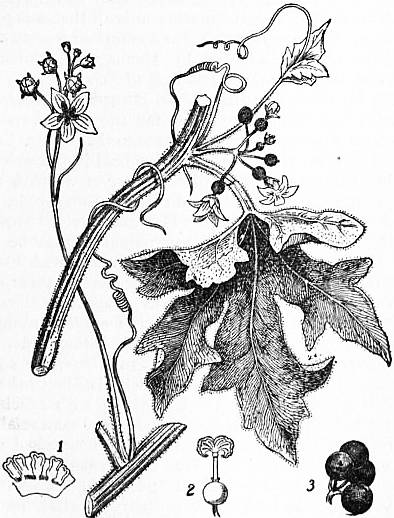
Fig. 1.—Bryonia dioica, Bryony. 1, part of corolla of male flower with attached stamens; 2, female flower after removal of calyx and corolla; 3, berries; 1, 2, 3 about nat. size.
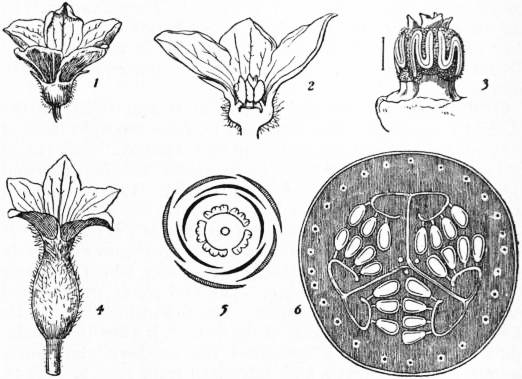
Fig. 2.
1, Male flower of cucumber (Cucumis). 2, Same, in vertical section, slightly enlarged. 3, Stamens, after removal of calyx and corolla. 4, Female flower. 5, Horizontal plan of male flower. 6, Transverse section of fruit. 1 and 4 nat. size.
The order is represented in Britain by bryony (Bryonia dioica), (fig. 1) a hedge-climber, perennial by means of large fleshy tubers which send up each year a number of slender angular stems. The leaves are heart-shaped with wavy margined lobes. The flowers are greenish, ½ to ¾ in. in diameter; the fruit, a red several-seeded berry, is about ¼ in. in diameter.
Many genera are of economic importance; Cucumis (fig. 2) affords cucumber (q.v.) and melon (q.v.) Cucurbita, pumpkin and marrow; Citrullus vulgaris is water-melon, and C. Colocynthis, colocynth; Ecballium Elaterium (squirting cucumber) is medicinal; Sechium edule (chocho), a tropical American species, is largely cultivated for its edible fruit; it contains one large seed which germinates in situ. Lagenaria is the gourd (q.v.). The fruits of Luffa aegyptiaca have a number of closely netted vascular bundles in the pericarp, forming a kind of loose felt which supplies the well-known loofah or bath-sponge.
CUDDALORE, a town of British India, in the South Arcot district of Madras, on the coast 125 m. S. of Madras by rail. Pop. (1901) 52,216, showing an increase of 10% in the decade. It lies low, but is regarded as exceptionally healthy, and serves as a kind of sanatorium for the surrounding district. The principal exports are sugar, oil-seeds and indigo. There are two colleges and two high schools. In the neighbourhood are the ruins of Fort St David situated on the river Gadilam, which has as stirring a history as any spot in the Presidency. As a small fort built by a Hindu merchant it fell into the hands of the Mahrattas after the capture of Gingi by Sivaji in 1677. From them it was purchased by the English in 1690, the purchase including not only the fort but the adjacent towns and villages “within ye randome shott of a piece of ordnance.” A great gun was fired to different points of the compass and all the country within its range, including the town of Cuddalore, passed into the possession of the English. The villages thus obtained are still spoken of as “cannon ball villages.” From 1725 onwards the fortifications were greatly strengthened. In 1746 Fort St David became the British headquarters for the south of India, and Dupleix’ attack was successfully repulsed. Clive was appointed its governor in 1756; in 1758 the French captured it, but abandoned it two years later to Sir Eyre Coote. In 1782 they again took it and restored it sufficiently to withstand a British attack in 1783. In 1785 it finally passed into British possession.
CUDDAPAH, a town and district of British India, in the Madras Presidency. The town is 6 m. from the right bank of the river Pennar, and 161 m. by rail from Madras. Pop. (1901) 16,432. It is now a poor place, but has some trade in cotton and indigo, and manufactures of cotton cloth. Hills surround it on three sides, and it has a bad reputation for unhealthiness.
The District of Cuddapah has an area of 8723 sq. m. It is in shape an irregular parallelogram, divided into two nearly equal parts by the range of the Eastern Ghats, which intersects it throughout its entire length. The two tracts thus formed possess totally different features. The first, which constitutes the north, east and south-east of the district, is a low-lying plain; while the other, which comprises the southern and south-western portion, forms a high table-land from 1500 to 2500 ft. above sea-level. The chief river is the Pennar, which enters the district from Bellary on the west, and flows eastwards into Nellore. Though a large and broad river, and in the rains containing a great volume of water, in the hot weather months it dwindles down to an inconsiderable stream. Its principal tributaries are the Kundaur, Saglair, Cheyair, and Papagni rivers. One of the most interesting antiquities in the district is the ancient fort of Gurramkonda. The fort is supposed to have been built by the Golconda sultans; it stands on a hill 500 ft. high, three sides of which consist of almost perpendicular precipices. According to a local legend the name Gurramkonda, meaning “horse hill,” was derived from the fact that a horse was supposed to be guardian of the fort and that the place was impregnable so long as the horse remained there. The story goes that a Mahratta chief at length succeeded in scaling the precipice and in carrying off the horse, and although the thief was captured before reaching the base of the hill, the spell was broken and the fort, when next attacked, fell. The population of the district in 1901 was 1,291,267. The principal crops are millet, rice, other food grains, pulse, oil-seeds, cotton and indigo. The two last are largely exported. There are several steam factories for pressing cotton, and indigo vats. The district is served by lines of the Madras and the South Indian railways.
CUDWORTH, RALPH (1617-1688), English philosopher, was born at Aller, Somersetshire, the son of Dr Ralph Cudworth (d. 1624), rector of Aller, formerly fellow of Emmanuel College, Cambridge. His father died in 1624, and his mother then married the Rev. Dr Stoughton, who gave the boy a good home education. Cudworth was sent to his father’s college, was elected fellow in 1639, and became a successful tutor. In 1642 he published A Discourse concerning the true Notion of the Lord’s Supper, and a tract entitled The Union of Christ and the Church. In 1645 he was appointed master of Clare Hall and the same year was elected Regius professor of Hebrew. He was now recognized as a leader among the remarkable group known as the Cambridge Platonists (q.v.). The whole party were more or less in sympathy with the Commonwealth, and Cudworth was consulted by John Thurloe, Cromwell’s secretary of state, in regard to university and government appointments. His sermons, such as that preached before the House of Commons, on the 31st of March 1647, advocate principles of religious toleration and charity. In 1650 he was presented to the college living of North Cadbury, Somerset. From the diary of his friend John Worthington we learn that Cudworth was nearly compelled, through poverty, to leave the university, but in 1654 he was elected master of Christ’s College, whereupon he married. On the Restoration he contributed some Hebrew verses to the Academiae Cantabrigiensis Σῶστρα, a congratulatory volume addressed to the king. In 1662 he was presented to the rectory of Ashwell, Herts. In 1665 he almost quarrelled with his fellow-Platonist, Henry More, because the latter had written an ethical work which Cudworth feared would interfere with his own long-contemplated treatise on the same subject. To avoid clashing, More brought out his book, the Enchiridion ethicum, in Latin; Cudworth’s never appeared. In 1678 he published The True Intellectual System of the Universe: the first part, wherein all the reason and philosophy of atheism is confuted and its impossibility demonstrated (imprimatur dated 1671). No more was published, perhaps because of the theological clamour raised against this first part. Cudworth was installed prebendary of Gloucester in 1678. He died on the 26th of June 1688, and was buried in the chapel of Christ’s. His only surviving child, Damaris, a devout and talented woman, became the second wife of Sir Francis Masham, and was distinguished as the friend of John Locke. Much of Cudworth’s work still remains in manuscript; A Treatise concerning eternal and immutable Morality was published in 1731; and A Treatise of Freewill, edited by John Allen, in 1838; both are connected with the design of his magnum opus, the Intellectual System.
The Intellectual System arose, so its author tells us, out of a discourse refuting “fatal necessity,” or determinism. Enlarging his plan, he proposed to prove three matters: (a) the existence of God; (b) the naturalness of moral distinctions; and (c) the reality of human freedom. These three together make up the intellectual (as opposed to the physical) system of the universe; and they are opposed respectively by three false principles, atheism, religious fatalism which refers all moral distinctions to the will of God, and thirdly the fatalism of the ancient Stoics, who recognized God and yet identified Him with nature. The immense fragment dealing with atheism is all that was published by its author. Cudworth criticizes two main forms of materialistic atheism, the atomic, adopted by Democritus, Epicurus and Hobbes; and the hylozoic, attributed to Strato, which explains everything by the supposition of an inward self-organizing life in matter. Atomic atheism is by far the more important, if only because Hobbes, the great antagonist whom Cudworth always has in view, is supposed to have held it. It arises out of the combination of two principles, neither of which is atheistic taken separately, i.e. atomism and corporealism, or the doctrine that nothing exists but body. The example of Stoicism, as Cudworth points out, shows that corporealism may be theistic. Into the history of atomism Cudworth plunges with vast erudition. It is, in its purely physical application, a theory that he fully accepts; he holds that it was taught by Pythagoras, Empedocles, and in fact, nearly all the ancient philosophers, and was only perverted to atheism by Democritus. It was first invented, he believes, before the Trojan war, by a Sidonian thinker named Moschus or Mochus, who is identical with the Moses of the Old Testament. In dealing with atheism Cudworth’s method is to marshal the atheistic arguments elaborately, so elaborately that Dryden remarked “he has raised such objections against the being of a God and Providence that many think he has not answered them”; then in his last chapter, which by itself is as long as an ordinary treatise, he confutes them with all the reasons that his reading could supply. A subordinate matter in the book that attracted much attention at the time is the conception of the “Plastic Medium,” which is a mere revival of Plato’s “World-Soul,” and is meant to explain the existence and laws of nature without referring all to the direct operation of God. It occasioned a long-drawn controversy between Pierre Bayle and Le Clerc, the former maintaining, the latter denying, that the Plastic Medium is really favourable to atheism.
No modern reader can endure to toil through the Intellectual System; its only interest is the light it throws upon the state of religious thought after the Restoration, when, as Birch puts it, “irreligion began to lift up its head.” It is immensely diffuse and pretentious, loaded with digressions, its argument buried under masses of fantastic, uncritical learning, the work of a vigorous but quite unoriginal mind. As Bolingbroke said, Cudworth “read too much to think enough, and admired too much to think freely.” It is no calamity that natural procrastination, or the clamour caused by his candid treatment of atheism and by certain heretical tendencies detected by orthodox criticism in his view of the Trinity, made Cudworth leave the work unfinished.
A much more favourable judgment must be given upon the short Treatise on eternal and immutable Morality, which deserves to be read by those who are interested in the historical development of British moral philosophy. It is an answer to Hobbes’s famous doctrine that moral distinctions are created by the state, an answer from the standpoint of Platonism. Just as knowledge contains a permanent intelligible element over and above the flux of sense-impressions, so there exist eternal and immutable ideas of morality. Cudworth’s ideas, like Plato’s, have “a constant and never-failing entity of their own,” such as we see in geometrical figures; but, unlike Plato’s, they exist in the mind of God, whence they are communicated to finite understandings. Hence “it is evident that wisdom, knowledge and understanding are eternal and self-subsistent things, superior to matter and all sensible beings, and independent upon them”; and so also are moral good and evil. At this point Cudworth stops; he does not attempt to give any list of Moral Ideas. It is, indeed, the cardinal weakness of this form of intuitionism that no satisfactory list can be given and that no moral principles have the “constant and never-failing entity,” or the definiteness, of the concepts of geometry. Henry More, in his Enchiridion ethicum, attempts to enumerate the “noemata moralia”; but, so far from being self-evident, most of his moral axioms are open to serious controversy.
The Intellectual System was translated into Latin by J. L. Mosheim and furnished with notes and dissertations which were translated into English in J. Harrison’s edition (1845). Our chief biographical authority is T. Birch’s “Account,” which appears in editions of the Works. There is a good chapter on Cudworth in J. Tulloch’s Rational Theology, vol. ii. Consult also P. Janet’s Essai sur le médiateur plastique (1860), W. R. Scott’s Introduction to Cudworth’s “Treatise,” and J. Martineau’s Types of Ethical Theory, vol. ii.
(H. St.)
CUENCA, a city and the capital of the province of Azuay, Ecuador, about 190 m. S. of Quito and 70 m. S.E. of Guayaquil. Pop. (1908 estimate) 30,000 (largely Indians), including the suburb of Ejido. Cuenca stands at the northern end of a broad valley, or basin, of the Andes, lying between the transverse ridges of Azuay and Loja, and is about 8640 ft. above sea-level. Near by is the hill of Tarqui which the French astronomers chose for their meridian in 1742. Communication with the coast is difficult. Cuenca is the third most important city of Ecuador, being the seat of a bishopric, and having a college, a university faculty, a cathedral, and several churches, and a considerable industrial and commercial development. It manufactures sugar, woollen goods and pottery, and exports Peruvian bark (cinchona), hats, cereals, cheese, hides, &c. It was founded in 1557 on the site of a native town called Tumibamba, and was made an episcopal see in 1786.
CUENCA, a province of central Spain bounded on the N. by Guadalajara, N.E. by Teruel, E. by Valencia, S. by Albacete, S.W. by Ciudad Real, W. by Toledo and N.W. by Madrid. Pop. (1900) 249,696; area, 6636 sq. m. Cuenca occupies the eastern part of the ancient kingdom of New Castile, and slopes from the Serrania de Cuenca (highest point the Cerro de San Felipe, on the north-eastern border of the province, 5905 ft.), down into the great southern Castilian plain watered by the upper streams of the Guadiana. The lowlands bordering on Ciudad Real belong to the wide plain of La Mancha (q.v.). The rocky and bare highland of Cuenca on the north and east includes the upper valley of the Jucar and its tributary streams, but in the north-west the province is watered by tributaries of the Tagus. The forests are proverbial for their pine timber, and rival those of Soria; considerable quantities of timber are floated down the Tagus to Aranjuez and thence taken to Madrid for building purposes. Excessive droughts prevail; the climate of the hills and of the high plateaus is harsh and cold, but the valleys are excessively hot in summer. The soil, where well watered, is fertile, but little attention is paid to agriculture, and three-fourths of the area is left under pasture. The rearing of cattle, asses, mules and sheep is the principal employment of the people; olive oil, nuts, wine, wheat, silk, wax and honey are the chief products. Iron, copper, alum, saltpetre, jasper and agates are found, but in 1903 all the workings had been abandoned except three salt mines; and there are few manufactures except the weaving of coarse cloth. The roads are in such a backward condition that they cripple not only the mining interests but also the exports of timber, and at the beginning of the 20th century there was no railway except a branch line which passed westwards from Aranjuez through Tarancon to Cuenca, the capital (pop. 1900, 10,756). No other town has as many as 6000 inhabitants, and no other Spanish province is so thinly populated as Cuenca. In 1900 there were only 37.6 inhabitants per sq. m. Education is backward, and extreme poverty almost universal among the peasantry. See also Castile.
CUENCA, the capital of the Spanish province of Cuenca; 125 m. by rail E. by S. of Madrid. Pop. (1900) 10,756. Cuenca occupies a height of the well-wooded Serrania de Cuenca, at an elevation of 2960 ft., overlooking the confluence of the rivers Jucar and Huecar. A fine bridge, built in 1523, crosses the Jucar to the convent of San Pablo. Among several interesting churches in the city, the most noteworthy is the 13th-century Gothic cathedral, celebrated for the beautiful carved woodwork of its 16th-century doorway, and containing some admirable examples of Spanish sculpture. The city has a considerable trade in timber, and was long the headquarters of the provincial wool industry; the loss of which, in modern times, has partly been compensated by the development of soap, paper, chocolate, match and leather manufactures. Cuenca was captured from the Moors by Alphonso VIII. of Castile in 1177, and shortly afterwards became an episcopal see. In 1874 it offered a prolonged and gallant resistance to the Carlist rebels.
CUESTA, a name of Spanish origin used in New Mexico for low ridges of steep descent on one side and gentle slope on the other. It has been proposed as a term for the land form which consists of the two elements of a steep scarp or “strike” face, and an inclined plain or gentle “dip” slope.
CUEVAS DE VERA, a town of south-eastern Spain, in the province of Almería; on the right bank of the river Almanzora, 8 m. W. of the Mediterranean Sea. Pop. (1900) 20,562. Cuevas de Vera is built at the eastern extremity of the Sierra de los Filabres (6823 ft.), which isolate it from the railway system of Almería. It is, however, the chief market for the rich agricultural districts towards the south and for the argentiferous lead and other mines among the mountains. In appearance it is modern, with wide streets, two fine squares, and a parish church in Doric style, dating from 1758. But in reality the town is of considerable antiquity. One of the towers in the Moorish palace owned by the marquesses of Villafranca is probably of Roman origin.
CUFF. (1) (Of uncertain origin), the lower edge of a sleeve turned back to show an ornamental border, or with an addition of lace or trimming; now used chiefly of the stiff bands of linen worn under the coat-sleeve either loose or attached to the shirt. (2) Also uncertain in origin, but with no connexion, probably, with (1), a blow with the hand either open or closed, as opposed to the use of weapons.
CUIRASS (Fr. cuirasse, Lat. coriaceus, made of leather, from corium, the original breastplate being of leather), the plate armour, whether formed of a single piece of metal or other rigid material or composed of two or more pieces, which covers the front of the wearer’s person. In a suit of armour, however, since this important piece was generally worn in connexion with a corresponding defence for the back, the term cuirass commonly is understood to imply the complete body-armour, including both the breast and the back plates. Thus this complete body-armour appears in the middle ages frequently to have been described as a “pair of plates.” The corslet (Fr. corselet, diminutive of the O. Fr. cors, body), a comparatively light cuirass, is more strictly a breast-plate only. As parts of the military equipment of classic antiquity, cuirasses and corslets of bronze, and at later periods also of iron or some other rigid substance, were habitually in use; but while some special kind of secondary protection for the breast had been worn in earlier times by the men-at-arms in addition to their mail hauberks and their “cotes” armed with splints and studs, it was not till the 14th century that a regular body-defence of plate can be said to have become an established component of medieval armour. As this century continued to advance, the cuirass is found gradually to have come into general use, in connexion with plate defences for the limbs, until, at the close of the century, the long familiar interlinked chain-mail is no longer visible in knightly figures, except in the camail of the bassinet and at the edge of the hauberk. The prevailing, and indeed almost the universal, usage throughout this century was that the cuirass was worn covered. Thus, the globose form of the breast-armour of the Black Prince, in his effigy in Canterbury cathedral, 1376, intimates that a cuirass as well as a hauberk is to be considered to have been covered by the royalty-emblazoned jupon of the prince. The cuirass, thus worn in the 14th century, was always made of sufficient length to rest on the hips; otherwise, if not thus supported, it must have been suspended from the shoulders, in which case it would have effectually interfered with the free and vigorous action of the wearer. Early in the 15th century, the entire panoply of plate, including the cuirass, began to be worn without any surcoat; but in the concluding quarter of the century the short surcoat, with full short sleeves, known as the tabard, was in general use over the armour. At the same time that the disuse of the surcoat became general, small plates of various forms and sizes (and not always made in pairs, the plate for the right or sword-arm often being smaller and lighter than its companion), were attached to the armour in front of the shoulders, to defend the otherwise vulnerable points where the plate defences of the upper-arms and the cuirass left a gap on each side. About the middle of the century, instead of being formed of a single plate, the breast-plate of the cuirass was made in two parts, the lower adjusted to overlap the upper, and contrived by means of a strap or sliding rivet to give flexibility to this defence. In the second half of the 15th century the cuirass occasionally was superseded by the “brigandine jacket,” a defence formed of some textile fabric, generally of rich material, lined throughout with overlapping scales (resembling the earlier “imbricated” form) of metal, which were attached to the jacket by rivets, having their heads, like studs, visible on the outside. In the 16th century, when occasionally, and by personages of exalted rank, splendid surcoats were worn over the armour, the cuirass—its breast-piece during the first half of the century, globular in form—was constantly reinforced by strong additional plates attached to it by rivets or screws. About 1550 the breast-piece of the cuirass was characterized by a vertical central ridge, called the “tapul” having near its centre a projecting point; this projection, somewhat later, was brought lower down, and eventually the profile of the plate, the projection having been carried to its base, assumed the singular form which led to this fashion of the cuirass being distinguished as the “peascod cuirass.”
Corslets provided with both breast and back pieces were worn by foot-soldiers in the 17th century, while their mounted comrades were equipped in heavier and stronger cuirasses; and these defences continued in use after the other pieces of armour, one by one, had gradually been laid aside. Their use, however, never altogether ceased, and in modern armies mounted cuirassiers, armed as in earlier days with breast and back plates, have in some degree emulated the martial splendour of the body-armour of the era of medieval chivalry. Some years after Waterloo certain historical cuirasses were taken from their repose in the Tower of London, and adapted for service by the Life Guards and the Horse Guards. For parade purposes, the Prussian Gardes du Corps and other corps wear cuirasses of richly decorated leather.
CUIRASSIERS, a kind of heavy cavalry, originally developed out of the men-at-arms or gendarmerie forming the heavy cavalry of feudal armies. Their special characteristic was the wearing of full armour, which they retained long after other troops had abandoned it. Hence they became distinguished as cuirassiers. The first Austrian corps of kyrissers was formed in 1484 by the emperor Maximilian and was 100 strong. In 1705 Austria possessed twenty regiments of cuirassiers. After the war of 1866, however, the existing regiments were converted into dragoons. Russia has likewise in modern times abolished all but a few guard regiments of cuirassiers. The Prussian cuirassiers were first so called under Frederick William I., and in the wars of his successor Frederick the Great they bore a conspicuous part. After the Seven Years’ War they ceased to wear the cuirass on service, but after 1814 these were reintroduced, the spoils taken from the French cuirassiers being used to equip the troops. The cuirass is now worn only on ceremonial parades. In France the cuirassiers date from 1666, when a regiment, subsequently numbered 8th of the line, was formed. During the first Empire many regiments were created, until in 1812 there were fourteen. The number was reduced after the fall of Napoleon, but in modern times it has been again increased. The French regiments alone in Europe wear the cuirass on all parades and at manœuvres.
CUJAS (or Cujacius), JACQUES (or as he called himself, Jacques de Cujas) (1520-1590), French jurisconsult, was born at Toulouse, where his father, whose name was Cujaus, was a fuller. Having taught himself Latin and Greek, he studied law under Arnoul Ferrier, then professor at Toulouse, and rapidly gained a great reputation as a lecturer on Justinian. In 1554 he was appointed professor of law at Cahors, and about a year after L’Hôpital called him to Bourges. Duaren, however, who also held a professorship at Bourges, stirred up the students against the new professor, and such was the disorder produced in consequence that Cujas was glad to yield to the storm, and accept an invitation he had received to the university of Valence. Recalled to Bourges at the death of Duaren in 1559, he remained there till 1567, when he returned to Valence. There he gained a European reputation, and collected students from all parts of the continent, among whom were Joseph Scaliger and de Thou. In 1573 Charles IX. appointed Cujas counsellor to the parlement of Grenoble, and in the following year a pension was bestowed on him by Henry III. Margaret of Savoy induced him to remove to Turin; but after a few months (1575) he once more took his old place at Bourges. But the religious wars drove him thence. He was called by the king to Paris, and permission was granted him by the parlement to lecture on civil law in the university of the capital. A year after, however, he finally took up his residence at Bourges, where he remained till his death in 1590, in spite of a handsome offer made him by Gregory XIII. in 1584 to attract him to Bologna.
The life of Cujas was altogether that of a scholar and teacher. In the religious wars which filled all the thoughts of his contemporaries he steadily refused to take any part. Nihil hoc ad edictum praetoris, “this has nothing to do with the edict of the praetor,” was his usual answer to those who spoke to him on the subject. His surpassing merit as a jurisconsult consisted in the fact that he turned from the ignorant commentators on Roman law to the Roman law itself. He consulted a very large number of manuscripts, of which he had collected more than 500 in his own library; but, unfortunately, he left orders in his will that his library should be divided among a number of purchasers, and his collection was thus scattered, and in great part lost. His emendations, of which a large number were published under the title of Animadversiones et observationes, were not confined to lawbooks, but extended to many of the Latin and Greek classical authors. In jurisprudence his study was far from being devoted solely to Justinian; he recovered and gave to the world a part of the Theodosian Code, with explanations; and he procured the manuscript of the Basilica, a Greek abridgment of Justinian, afterwards published by Fabrot (see Basilica). He also composed a commentary on the Consueludines Feudorum, and on some books of the Decretals. In the Paratitla, or summaries which he made of the Digest, and particularly of the Code of Justinian, he condensed into short axioms the elementary principles of law, and gave definitions remarkable for their admirable clearness and precision. His lessons, which he never dictated, were continuous discourses, for which he made no other preparation than that of profound meditation on the subjects to be discussed. He was impatient of interruption, and upon the least noise he would instantly quit the chair and retire. He was strongly attached to his pupils, and Scaliger affirms that he lost more than 4000 livres by lending money to such of them as were in want.
In his lifetime Cujas published an edition of his works (Neville, 1577). It is beautiful and exact, but incomplete; it is now very scarce. The edition of Colombet (1634) is also incomplete. Fabrot, however, collected the whole in the edition which he published at Paris (1658), in 10 vols. folio, and which was reprinted at Naples (1722, 1727), in 11 vols. folio, and at Naples and at Venice (1758), in 10 vols. folio, with an index forming an eleventh volume. In the editions of Naples and Venice there are some additions not to be found in that of Fabrot, particularly a general table, which will be found very useful, and interpretations of all the Greek words used by Cujas.
See Papire-Masson, Vie de Cujas (Paris, 1590); Terrasson, Histoire de la jurisprudence romaine, and Mélanges d’histoire, de littérature, et de jurisprudence; Bernardi, Éloge de Cujas (Lyons, 1775); Hugo, Civilistisches Magazin; Berriat Saint Prix, Mémoires de Cujas, appended to his Histoire du droit romain; Biographie universelle; Gravina, De ortu et progressu juris civilis; Spangenberg, Cujacius und seine Zeitgenossen (Leipzig, 1882).
CULDEES, an ancient monastic order with settlements in Ireland and Scotland. It was long fondly imagined by Protestant and especially by Presbyterian writers that they had preserved primitive Christianity free from Roman corruptions in one remote corner of western Europe, a view enshrined in Thomas Campbell’s Reullura:
“Peace to their shades. The pure Culdees Were Albyn’s earliest priests of God, Ere yet an island of her seas By foot of Saxon monk was trod.”
Another view, promulgated like the above by Hector Boece in his Latin history of Scotland (1516), makes them the direct successors in the 9th to the 12th century of the organized Irish and Iona monasticism of the 6th to the 8th century. Both these views were disproved by William Reeves (1815-1892), bishop of Down, Connor and Dromore.
As found in the Irish MSS. the name is Céle Dé, i.e. God’s comrade or sworn ally. It was latinized as Coli dei, whence Boece’s culdei. The term seems, like the Latin vir dei, to have been applied generally to monks and hermits. There are very few trustworthy ancient sources of information, but it seems probable that the Rule of Chrodegang,1 archbishop of Metz (d. 766), was brought by Irish monks to their native land from the monasteries of north-eastern Gaul, and that Irish anchorites originally unfettered by the rules of the cloister bound themselves by it. In the course of the 9th century we find mention of nine places in Ireland (including Armagh, Clonmacnoise, Clones, Devenish and Sligo) where communities of these Culdees were established as a kind of annexe to the regular monastic institutions. They seem especially to have had the care of the poor and the sick, and were interested in the musical part of worship. Meanwhile in Scotland the Iona monks had been expelled by the Pictish king Nechtan in 717, and the vacancies thus caused were by no means filled by the Roman monks who thronged into the north from Northumbria. Into the gap, towards the end of the 8th century, came the Culdees from Ireland. The features of their life in Scotland, which is the most important epoch in the history of the order, seem to resemble closely those of the secular canons of England and the continent. From the outset they were more or less isolated, and, having no fixed forms or common head, tended to decay. In the 12th century the Celtic Church was completely metamorphosed on the Roman pattern, and in the process the Culdees also lost any distinctiveness they may formerly have had, being brought, like the secular clergy, under canonical rule. The pictures that we have of Culdee life in the 12th century vary considerably. The chief houses in Scotland were at St Andrews, Dunkeld, Lochleven, Monymusk in Aberdeenshire, Abernethy and Brechin. Each was an independent establishment controlled entirely by its own abbot and apparently divided into two sections, one priestly and the other lay and even married. At St Andrews about the year 1100 there were thirteen Culdees holding office by hereditary tenure and paying more regard to their own prosperity and aggrandizement than to the services of the church or the needs of the populace. A much-needed measure of reform, inaugurated by Queen Margaret, was carried through by her sons Alexander I. and David I.; gradually the whole position passed into the hands of Turgot and his successors in the bishopric. Canons Regular were instituted and some of the Culdees joined the new order. Those who declined were allowed a life-rent of their revenues and lingered on as a separate but ever-dwindling body till the beginning of the 14th century, when, excluded from voting at the election of the bishop, they disappear from history. At Dunkeld, Crinan, the grandfather of Malcolm Canmore, was a lay abbot, and tradition says that even the clerical members were married, though like the priests of the Eastern Church, they lived apart from their wives during their term of sacerdotal service. The Culdees of Lochleven lived on St Serf’s Inch, which had been given them by a Pictish prince, Brude, about 850. In 1093 they surrendered their island to the bishop of St Andrews in return for perpetual food and clothing, but Robert, who was bishop in 1144, handed over all their vestments, books,2 and other property, with the island, to the newly founded Canons Regular, in which probably the Culdees were incorporated. There is no trace of such partial independence as was experienced at St Andrews itself, possibly because the bishop’s grant was backed up by a royal charter. In the same fashion the Culdees of Monymusk, originally perhaps a colony from St Andrews, became Canons Regular of the Augustinian order early in the 13th century, and those of Abernethy in 1273. At Brechin, famous like Abernethy for its round tower, the Culdee prior and his monks helped to form the chapter of the diocese founded by David I. in 1145, though the name persisted for a generation or two. Similar absorptions no doubt account for the disappearance of the Culdees of York, a name borne by the canons of St Peter’s about 925, and of Snowdon and Bardsey Island in north Wales mentioned by Giraldus Cambrensis (c. 1190) in his Speculum Ecclesiae and Itinerarium respectively. The former community was, he says, sorely oppressed by the covetous Cistercians. These seem to be the only cases where the Culdees are found in England and Wales. In Ireland the Culdees of Armagh endured until the dissolution in 1541, and enjoyed a fleeting resurrection in 1627, soon after which their ancient property passed to the vicars choral of the cathedral.
See W. Reeves, The Culdees of the British Islands (Dublin, 1864); W. F. Skene, Celtic Scotland (1876-1880), especially vol. ii.; W. Beveridge, Makers of the Scottish Church (1908). The older view will be found in J. Jamieson’s Historical Account of the Ancient Culdees (1811).
1 Devised originally for the clergy of Chrodegang’s cathedral, it was largely an adaptation of St Benedict’s rule to secular clergy living in common. In 816 it was confirmed, with certain modifications, by the synod of Aix-la-Chapelle, and became the law for collegiate and cathedral churches in the Frankish empire. See Canon.
2 The list of these in the deed of transfer is the oldest Scottish library catalogue.
CULEBRA, the smaller of two islands lying in the Virgin Passage immediately E. of Porto Rico and known as the Islas de Passaje. It is about 18 m. distant from Cape San Juan and rises from the same submerged plateau with the larger islands of the Antilles. Its extreme dimensions are 3 by 6 m., and its surface is low and comparatively uniform, which gives the prevailing winds an unbroken sweep across it. For this reason the rainfall is limited to a short season, and the population is compelled to store rainwater in cisterns for drinking purposes. Its soil is fertile, and cattle, poultry, vegetables and small fruits are produced. The island has been a dependency of Porto Rico since 1879, when its colonization was formally undertaken, and it is now described as a ward of the Vieques district of the department of Humacao. In 1902 the American naval authorities selected the Playa Sardinas harbour on the S. side of Culebra as a rendezvous of the fleet and marine encampments were located on shore. The strategic position of the island, its healthiness and its continued use as a naval station have given it considerable importance. Its population was 704 in 1899, which had increased to nearly 1200 in 1903.
CULLEN, PAUL (1803-1878), cardinal and archbishop of Dublin, was born near Ballytore, Co. Kildare, and educated first at the Quaker school at Carlow and afterwards at Rome, where he joined the Urban College of the Propaganda and, after passing a brilliant course, was ordained in 1829. He then became vice-rector, and afterwards rector, of the Irish National College in Rome; and during the Mazzini revolution of 1848 he was rector of the Urban College, saving the property under the protection of the American flag. In 1849, on the strong recommendation of Archbishop John MacHale of Tuam, Cullen was nominated as successor to the primatial see of Armagh; and, on his return to Ireland, presided as papal delegate at the national council of Thurles in the August of 1850. Taking a strong line on the educational question which was then agitating Ireland, he took a leading part in the national movement of 1850-1852, and at first supported the Tenant Rights League. In May 1852 he was translated to Dublin, and soon a divergence of opinion broke out between him and the more ardent Nationalists under Archbishop MacHale. When the Irish university was started, with Newman, appointed by Cullen, at its head, the scheme was wrecked by the personal opposition to the archbishop of Dublin. As time went on, his distrust of the national movement grew deeper; and in 1853 he sternly forbade his clergy to take part publicly in politics, and for this he was denounced by the Tablet newspaper. His own political opinion had best be told in his own words. “For thirty years I have studied the revolution on the continent, and for nearly thirty years I have watched the Nationalist movement in Ireland. It is tainted at its sources with the revolutionary spirit. If any attempt is made to abridge the rights and liberties of the Catholic Church in Ireland, it will not be by the English government nor by a ‘No Popery’ cry in England, but by the revolutionary and irreligious Nationalists of Ireland” (Purcell’s Life of Manning, ii. 610). Cullen, therefore, while an ardent patriot, was consistently an opponent of Fenianism. He was made cardinal in 1866, being the first Irish cardinal. Energetic as an administrator, churches and schools rose throughout his diocese; and the excellent Mater Misericordiae Hospital and the seminary at Clonlife are lasting memorials of his zeal. He took part in the Vatican Council as an ardent infallibilist. In 1873 he was defendant in a libel action brought against him by the Rev. R. O’Keeffe, parish priest of Callan, on account of two sentences of ecclesiastical censure pronounced by the cardinal as papal delegate. The damages were laid at £10,000. Three of the four judges allowed the defence of the cardinal to be valid; but it was held that the papal rescript upon which he relied for his extraordinary powers as delegate was illegal under statute; and the lord chief justice decided that the plaintiff could not renounce his natural and civil liberty. After several days’ trial, during which Cullen was submitted to a very close examination, the verdict was given for the plaintiff with ¼d. damages. The cardinal died in Dublin on the 24th of October 1878.
(E. Tn.)
CULLEN, WILLIAM (1710-1790), Scottish physician and medical teacher, was born at Hamilton, Lanarkshire, on the 15th of April 1710. He received his early education at the grammar-school of Hamilton, and he appears to have subsequently attended some classes at the university of Glasgow. He began his medical career as apprentice to John Paisley, a Glasgow surgeon, and after completing his apprenticeship he became surgeon to a merchant vessel trading between London and the West Indies. On his return to Scotland in 1732 he settled as a practitioner in the parish of Shotts, Lanarkshire, and in 1734-1736 studied medicine at Edinburgh, where he was one of the founders of the Royal Medical Society. In 1736 he began to practise in Hamilton, where he rapidly acquired a high reputation. From 1737 to 1740 William Hunter was his resident pupil, and at one time they proposed to enter into partnership. In 1740 Cullen took the degree of M.D. at Glasgow, whither he removed in 1744. During his residence at Hamilton, besides the arduous duties of medical practice, he found time to devote to the study of the natural sciences, and especially of chemistry. On coming to Glasgow he appears to have begun to lecture in connexion with the university, the medical school of which was as yet imperfectly organized. Besides the subjects of theory and practice of medicine, he lectured systematically on botany, materia medica and chemistry. His great abilities, enthusiasm and power of conveying instruction made him a successful and highly popular teacher, and his classes increased largely in numbers. At the same time he diligently pursued the practice of his profession. Chemistry was the subject which at this time seems to have engaged the greatest share of his attention. He was himself a diligent investigator and experimenter, and he did much to encourage original research among his pupils, one of whom was Dr Joseph Black. In 1751 he was appointed professor of medicine, but continued to lecture on chemistry, and in 1756 he was elected joint professor of chemistry at Edinburgh along with Andrew Plummer, on whose death in the following year the sole appointment was conferred on Cullen. This chair he held for ten years—his classes always increasing in numbers. He also practised his profession as a physician with eminent success. From 1757 he delivered lectures on clinical medicine in the Royal Infirmary. This was a work for which his experience, habits of observation, and scientific training peculiarly fitted him, and in which his popularity as a teacher, no less than his power as a practical physician, became more than ever conspicuous. On the death of Charles Alston in 1760, Cullen at the request of the students undertook to finish his course of lectures on materia medica; he delivered an entirely new course, which were published in an unauthorized edition in 1771, but which he re-wrote and issued as A Treatise on Materia Medica in 1789.
On the death of Robert Whytt (1714-1766), the professor of the institutes of medicine, Cullen accepted the chair, at the same time resigning that of chemistry. In the same year he had been an unsuccessful candidate for the professorship of the practice of physic, but subsequently an arrangement was made between him and John Gregory, who had gained the appointment, by which they agreed to deliver alternate courses on the theory and practice of physic. This arrangement proved eminently satisfactory, but it was brought to a close by the sudden death of Gregory in 1773. Cullen was then appointed sole professor of the practice of physic, and he continued in this office till a few months before his death, which took place on the 5th of February 1790.
As a lecturer Cullen appears to have stood unrivalled in his day. His clearness of statement and power of imparting interest to the most abstruse topics were the conspicuous features of his teaching, and in his various capacities as a scientific lecturer, a physiologist, and a practical physician, he was ever surrounded with large and increasing classes of intelligent pupils, to whom his eminently suggestive mode of instruction was specially attractive. Living at the time he did, when the doctrines of the humoral pathologists were carried to an extreme extent, and witnessing the ravages which disease made on the solid structures of the body, it was not surprising that he should oppose a doctrine which appeared to him to lead to a false practice and to fatal results, and adopt one which attributed more to the agency of the solids and very little to that of the fluids of the body. His chief works were First Lines of the Practice of Physic (1774); Institutions of Medicine (1770); and Synopsis Nosologicae Medicae (1785), which contained his classification of diseases into four great classes—(1) Pyrexiae, or febrile diseases, as typhus fever; (2) Neuroses, or nervous diseases, as epilepsy; (3) Cachexiae, or diseases resulting from bad habit of body, as scurvy; and (4) Locales, or local diseases, as cancer.
Cullen’s eldest son Robert became a Scottish judge in 1796 under the title of Lord Cullen, and was known for his powers of mimicry.
The first volume of an account of Cullen’s Life, Lectures and Writings was published by Dr John Thomson in 1832, and was reissued with the second volume (completing the work) by Drs W. Thomson and D. Craigie in 1859.
CULLEN, a royal, municipal and police burgh of Banffshire, Scotland. Pop. (1901) 1936. It is situated on Cullen Bay, 11½ m. W. by N. of Banff and 66½ m. N.W. of Aberdeen by the Great North of Scotland railway. Deskford Burn, after a course of 7½ m., enters the sea at Cullen, which it divides into two parts, Seatown, the older, and Newtown, dating only from 1822. St Mary’s, the parish church, a cruciform structure, was founded by Robert Bruce, whose second wife died at Cullen. The industries include rope and sail making, boat-building, brewing and fishing. The harbour, constructed between 1817 and 1834, though artificial, is one of the best on this coast. About 1 m. to the S. is Cullen House, a seat of the earl of Seafield, which contains some fine works of art. A mile and a half to the W. is the picturesque fishing village of Port Knockie with a deep-sea harbour, built in 1891. On the cliffs, 2 m. to the E., stand the ruins of Findlater Castle, fortified in 1455. From 1638 to 1811, when the title expired, it gave the title of earl to the Ogilvies, whose name was adopted in addition to his own by Sir Lewis Alexander Grant, when he succeeded, as 5th earl of Seafield, to the surviving dignities. Five miles to the E. of Cullen is the thriving fishing town of Portsoy, with a small, safe harbour and a station on the Great North of Scotland railway. Besides the fisheries there is fish-curing and a distillery; and the quarrying of a pink-coloured variety of granite and of Portsoy marble is carried on. Good limestone is also found in the district. Pop. (1901) 2061.