VOLUME VII SLICE VIII Cube to Daguerre, Louis (continued 8)
Reading edition
By the end of the month they will be ready for the final shift into 7-in. pots. Much care must be used in handling them, the leaves being large, tender and numerous. The soil is as for the last potting. The frames should be kept close and heavily shaded for a few days after potting; then gradually reduce shade and increase ventilation. By the end of July the elegance of the foliage alone should well repay the care bestowed on them. From this time onwards very little shading will be needed, the object of the cultivator being to harden the growth already made. With the advent of cool weather in September, remove to flowering quarters in a warm greenhouse. Flowering will begin in November and will continue through the winter and spring. The damping off of the flower-buds may occasionally prove troublesome during winter. This may generally be traced to checks, such as sudden changes in temperature, too low a temperature, careless watering, &c. During spring plants that are flowering freely will require weak manure water about twice a week.
Plants selected to bear seed should be set aside for that purpose, and as soon as the capsules are found to be developing properly they should be reduced to six or seven per plant, and all flower-buds picked off as soon as they are large enough to handle. The production of strong seeds is of the utmost importance.
Plants grown for market purposes, either for decoration or for seed, are sown later than the above, are kept cooler, and during summer receive more ventilation and less shade. This results in the production of plants with much smaller and more erect leaves, which travel well. They are flowered in spring and early summer. The species grown for this purpose is C. persicum.
A few species are hardy in dry sheltered positions, such as rockeries, under walls and old trees, provided the positions are well drained. Such are C. europaeum, with reddish-purple flowers in summer; C. hederifolium in autumn; and C. neapolitanum, with large leaves marbled with silver and rosy-pink flowers.
CYCLE (Gr. κύκλος, a circle), in astronomy, a period of time at the end of which some aspect or relation of the heavenly bodies recurs. The more important cycles are discussed in the articles Calendar and Eclipse. In physics, the term is applied to a series of operations which, performed upon a system, brings it back to its original state; “Carnot’s Cycle” is an example (see Thermodynamics). From the use of the word for any period at the end of which the same events recur in the same order or for any complete series of phenomena, it is used loosely of any long period of time. The name ὁ ἐπικὸς κύκλος, the epic cycle, was given to the poems which complete the Homeric account of the Trojan War (see below). It is this use which has given rise to the application of the term “cycle” to a series of prose or poetical romances which have for a centre one subject, whether a person, as in the Alexander, Arthurian or Charlemagne cycles, or an object, such as the ring of the Nibelungenlied. In music “Song-cycle” (Ger. Liederkreis) is similarly used of a series of songs written round one subject or set to poems by the same author. Beethoven’s An die ferne Geliebte (Op. 98), published in 1816, is the earliest instance. Schubert’s Die schöne Müllerin, Schumann’s Dichterliebe and Brahms’s Magelone-Lieder are well-known instances.
Epic Cycle.—This is a collection or corpus of lays written about 776-580 B.C. by poets of the Ionian School, introductory or complementary to the Homeric poems, dealing with the legends of the Trojan and Theban wars. At a later date they were arranged so as to form a continuous narrative (the Iliad and the Odyssey included), perhaps after certain alterations had been made, to fill up gaps and remove inconsistencies and repetitions. By whom, and when, they were so arranged, cannot be decided; it is possible that it was the work of Zenodotus of Ephesus, who had the care of the epic section of the Alexandrian library. In order to furnish the general reader with a comprehensive sketch of mythological history, Proclus—according to Welcker and Valesius (Valois), not the neo-Platonist, but an unknown 2nd or 3rd century grammarian, perhaps Eutychius Proclus of Sicca1 in Africa, one of the tutors of Marcus Aurelius (see Proclus)—compiled a prose summary (Γραμματικὴ Χρηστομάθεια) of the contents of the poems, to serve as a sort of primer to Greek literature. Extracts from this are preserved in the Codex Venetus of Homer and Photius (cod. 239), according to which the epic cycle began with the union of Uranus and Ge and ended with the death of Odysseus on his return to Ithaca at the hands of his son Telegonus. The cycle was in existence in his (Proclus’s) time, and was in request not so much for its artistic merit, as for the “sequence of the events described in it.” Further light is thrown on the subject by pictorial representations, intended for school use during the Roman imperial period, the most famous of which is the Tabula Iliaca in the Capitoline museum.
The expression “epic cycle” in the sense of a poetical collection does not occur before the Christian era; the word κύκλος (“cycle,” “circle”) is used of a special kind of short poem and also of a prose abstract of mythological history; the adjective has the general sense of “hackneyed,” “conventional,” and is applied contemptuously (by Callimachus and Horace) to a particular Alexandrian school of poetry.
The most important poems of the Trojan legendary cycle are the Cypria of Stasinus (q.v.); the Aethiopis and Iliou Persis (Sack of Troy) of Arctinus (q.v.); the Little Iliad of Lesches (q.v.); the Nosti of Hagias or Agias; the Telegonia of Eugammon. To the Theban cycle belong: the Thebais or Expedition of Amphiaraus and the Epigoni of Antimachus. The Oechalias Halosis (capture of Oechalia) of Creophylus (q.v.); the Phocais (or Minyas) of Prodicus; and the Danais of Cercops, although belonging to the old Homeric epos, cannot with certainty be included in the epic cycle. The names of the authors are in several cases exceedingly doubtful.
Bibliography.—The standard work on the subject is F. G. Welcker, Der epische Cyclus (1865-1882); see also T. W. Allen, “The Epic Cycle,” in Classical Quarterly, Jan. and April 1908 (summary of sources and authorities); Wilamowitz-Möllendorff, Homerische Untersuchungen (1884), who regards the traditional names and personalities of the poets of the cycle with great scepticism; D. B. Monro, Journal of Hellenic Studies, iv. (1883), appendix to his edition of the Odyssey, xiii.-xxiv. (1900), and on the Codex Venetus fragment of Proclus; J. E. Sandys, Hist. of Class. Schol. (2nd ed., 1906), vol. i. ch. 2; J. B. Bury, Ancient Greek Historians (1909), pp. 2-8 on the epics as history; articles by H. Flach in Ersch and Gruber, Allgemeine Encyklopädie, and by E. Schwartz and others in Pauly-Wissowa, Realencyclopädie.
1 An objection to this view is that according to the Augustan historian Capitolinus (Antoninus, 2) Eutychius of Sicca was a Latin not a Greek grammarian.
CYCLING, the clipped term now given comprehensively to the sport or exercise of riding a bicycle (q.v.) or tricycle (q.v.).
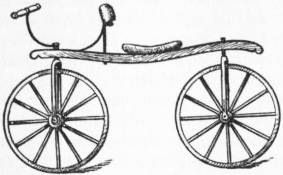
Fig. 1.—Gentleman’s Hobby Horse.
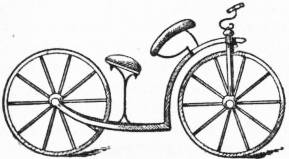
Fig. 2.—Lady’s Hobby Horse.
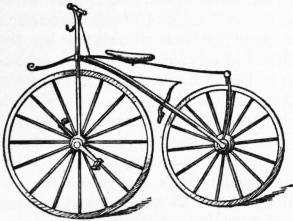
Fig. 3.—The Boneshaker, 1868.
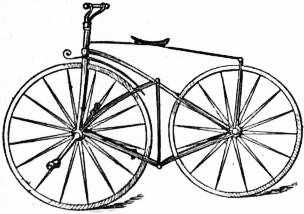
Fig. 4.—The “Phantom,” 1869.
Suggestions of vehicles having two or more wheels and propelled by the muscular effort of the rider or riders are to be found in very early times, even on the bas-reliefs of Egypt and Babylon and the frescoes of Pompeii; but though History. sporadic examples of such contrivances are recorded in the 17th and 18th centuries, it was apparently not till the beginning of the 19th century that they were used to any considerable extent. A “velocipede” invented by Blanchard and Magurier, and described in the Journal de Paris on the 27th of July 1779, differed little from the célérifère proposed by another Frenchman, de Sivrac, in 1690; it consisted of a wooden bar rigidly connecting two wheels placed one in front of the other, and was propelled by the rider, seated astride the bar, pushing against the ground with his feet. The next advance was made in the draisine of Freiherr Karl Drais von Sauerbronn (1785-1851), described in his Abbildung und Beschreibung seiner neu erfundenen Laufmaschine (Nuremberg, 1817). In this the front wheel was pivoted on the frame so that it could be turned sideways by a handle, thus serving to steer the machine (figs. 1 and 2). A similar machine, the “celeripede,” also with a movable front wheel, is said to have been ridden by J. N. Niepce in Paris some years before. In England the draisine achieved a great, though temporary, vogue under various names, such as velocipede, patent accelerator, bivector, bicipedes, pedestrian curricle (patented by Dennis Johnson in 1818), dandy horse, hobby horse, &c., and for a time it was popular in America also. The propulsion of the draisine by pushing with the feet being alleged to give rise to diseases of the legs, arrangements were soon suggested, as by Louis Gompertz in England in 1821, by which the front wheel could be rotated by the hands with the aid of a system of gearing, but the idea of providing mechanical connexions between the feet and the wheels was apparently not thought of till later. Pedals with connecting rods working on the rear axle are said to have been applied to a tricycle in 1834 by Kirkpatrick McMillan, a Scottish blacksmith of Keir, Dumfriesshire, and to a draisine by him in 1840, and by a Scottish cooper, Gavin Dalzell, of Lesmahagow, Lanarkshire, about 1845. The draisine thus fitted had wooden wheels, with iron tires, the leading one about 30 in. in diameter and the driving one about 40 in., and thus it formed the prototype, though not the ancestor, of the modern rear-driven safety bicycle.
For the next 20 years little was done, and then began the evolution of the high “ordinary” bicycle with a large driving wheel in front and a small trailing one behind. About 1865 Pierre Lallement in Paris constructed a bicycle in which the front wheel was driven by pedals and cranks attached directly to its axle, but it is doubtful whether the origin of this idea must be attributed to him or to Ernest Michaux, the son of his employer, who was a carriage repairer. Lallement took his machine to the United States, and in 1866 was granted a patent which had an important influence on the subsequent course of the cycle industry in that country. This machine, consisting of a wooden frame supported on two wooden wheels (fig. 3), soon became popular in England, as well as in France and America, and came to be called bicycle (or bysicle) by those who took it seriously and “boneshaker” by those who did not. Improvements quickly followed, chiefly in England, for in America the popularity of the machine was short-lived, and in France the industry was checked by the Franco-German war. Rubber tires, in place of iron ones, appeared in 1868, and in two or three years were made very large, 2 in. or more in width. Suspension wheels, with wire spokes in tension, were seen at the Crystal Palace, London, on the “Phantom” (fig. 4) of W. F. Reynolds and J. A. Mays in 1869, and early in the same year the manufacture of bicycles, at first for export to France, was begun in England by the Coventry Sewing Machine Company, till then makers of sewing machines. There was a rapid growth in the size of the front wheel, which in the boneshaker normally measured 36 or 38 in. in diameter, with a corresponding shrinkage in the rear wheel (fig. 5), until by 1874, the date of the invention of the tangent wheel by J. K. Starley 54-in. wheels were being made. The high bicycle was now fairly established in form, and the changes made in the subsequent 10 or 15 years during which it retained its supremacy were chiefly in the details of construction, such as the adoption of steel tubing for the frames, the use of hollow rims in the wheels and the application first of cone and then of ball bearings to points of friction. The weight of a 54-in. bicycle, which in 1874-1875 exceeded 50 or even 60 ℔, was thus reduced to well under 40 ℔ in machines intended for use on ordinary roads, and to not much over 20 ℔ in the case of racers.
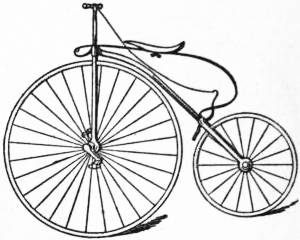
Fig. 5.—Humber’s “Spider,” 1872.
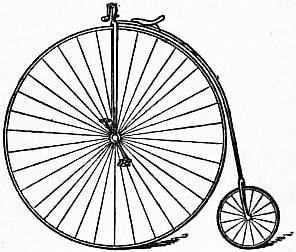
Fig. 6.—Rudge Racing Ordinary, 1887.
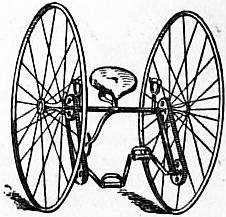
Fig. 7.—Otto Dicycle, 1879.
The high “ordinary” bicycle (fig. 6) gave unquestionable pleasure to many riders, and very fast times were made with it both on the road and on the racing path. In 1882 H. L. Cortis rode 20 m. 300 yds. in one hour, and in April 1884 Thomas Stevens started from San Francisco to ride round the world, a feat which he accomplished in December 1886. But it had various disadvantages. The vibration set up by the small back wheel was very trying, and in spite of the size of the front one the rider had to move his pedals at an uncomfortably rapid rate if he wished to maintain a good speed. Moreover his seat was placed in such a position that he was liable to be pitched over the handlebar if his wheel encountered a comparatively small obstacle. Attempts were made to remedy these inconveniences in various ways. From the early ’eighties much attention was devoted to tricycles, and these were produced in innumerable designs, whether for a single rider, or for two in the form of “sociables,” in which the riders sat side by side, or of “tandems,” in which one sat behind the other. But their weight, and consequently the exertion of propelling them, was necessarily greater than in the case of the bicycle, and by the end of the decade, the demand for them had fallen off, though they are still made to a certain extent, chiefly for carrying purposes. The two-track dicycle (fig. 7), invented by E. C. F. Otto about 1879, in which the rider balanced himself between two equal wheels placed abreast, also failed to secure lasting success.
The improvement of the high bicycle was attempted in two directions. On the one hand it was modified by placing the rider farther back, his position “over his work” being ensured by arranging the pedals immediately below him and connecting them to the front wheel, which was usually reduced in size, by levers and cranks or by chain-gearing, often with a multiplying action. On the other, the rear wheel was enlarged and made the driving wheel. The “’Xtraordinary” (fig. 8), “Facile” (fig. 9) and “Kangaroo” were examples of the former kind, which were often spoken of as “dwarf-safeties”; but though a good many of them were used about 1880 and following years, both they and the “ordinary” bicycle ultimately disappeared before machines of the second kind, which developed into the modern rear-driven safety. There are numerous claimants for the invention—or rather the reinvention—of this type, but it appears that the credit for its practical and commercial introduction in substantially its present form is due to J. K. Starley in England. His “Rover” (fig. 10), brought out late in 1885, had two nearly equal wheels, the driving wheel 30 in. in diameter and the steering 32 in., and the rider sat so far back that he could not be thrown forward over the handles. The motion imparted by the pedals to a sprocket wheel mounted between the wheels was transmitted by an endless chain to the rear wheel, and by sufficiently increasing the size of this sprocket wheel the machine could be made to travel as far or farther than the “ordinary” for each complete revolution of the pedals. From about 1890 the “safety” monopolized the field. At first it was fitted with the narrow rubber tires customary at the time, but these gave way to pneumatic tires, invented in 1888 by J. B. Dunlop, a veterinary surgeon of Belfast, whose idea, however, had been anticipated in the English patent taken out by R. W. Thomson in 1845. The result was a great gain in comfort, due to reduction of vibration, and a remarkable increase of speed or, alternatively, decrease of exertion. Subsequent progress was mainly in the details of design and manufacture, tending to secure lightness combined with adequate strength, and such was the success attained, by the application of scientific principles and of improved methods and materials to the construction of the frames and other parts, that while the weight of the original “Rover” was about 50 ℔ that of its successors 20 years later with 28-in. wheels was reduced by 35 or 45%, or even 60% in the case of racing machines. The beginning of the 20th century saw the introduction of two innovations: one was the “free-wheel,” a device which allows the driving wheel to rotate independently of the chain and pedals, so that the rider, controlling his speed with powerful brakes, can “coast” down a hill using the stationary pedals as foot-rests; and the other was the motor-cycle, in which a petrol-engine relieves him, except at starting, from all personal exertion, though at the cost of considerable vibration. A third contrivance, which, however, was an idea of considerably older date, also began to find favour about the same period in the shape of two-speed and three-speed gears, enabling the rider at will to alter the ratio between the speed of revolution of his pedals and of his driving wheel, and thereby accommodate himself to the varying gradients of the road he is traversing (see also Bicycle, Tricycle and Tire).
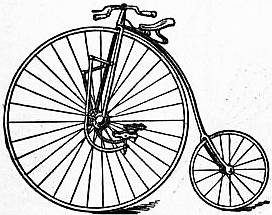
Fig. 8.—Singers’ “’Xtraordinary,” 1879.
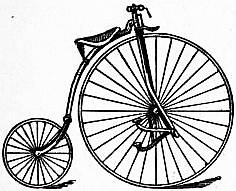
Fig. 9.—The “Facile,” 1879.
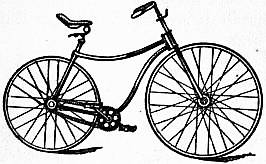
Fig. 10.—Starley’s “Rover,” 1885.
The safety bicycle, with pneumatic tires, rendered cycling universally popular, not merely as a pastime but as a convenient means of locomotion for everyday use. Made with a drop-frame, it also enabled women to cycle without being confined to a heavy tricycle or compelled to assume “rational dress.” In consequence there was an enormous expansion in the cycle industry. In England the demand for machines had become so great by 1895 that the makers were unable to cope with it. Numbers of new factories were started, small shops grew into large companies, and the capital invested advanced by millions of pounds. The makers who had devoted their mechanical skill to perfecting the methods of cycle-construction were swallowed up by company promoters and adventurers, bent simply upon filling their own pockets. The march of mechanical invention and improvement was arrested, and machines, instead of being built by mechanics proud of their work, in many cases were merely put together in the shortest possible time and in a few standard patterns. For these the world clamoured, and for a year they could not be produced fast enough. Then the demand fell off, the British market became over-stocked, and as the British makers declined to consider the wants of foreign customers, their store-rooms remained crowded with machines that could not be sold. Speculative finance, such as was exemplified in 1896 by the flotation for £5,000,000 of the Dunlop tire company, which had been started in 1889 with a capital of £25,000, had its natural effects. There ensued widespread and continuing disorganization of the trade, which had to be met by extensive reconstructions of over-capitalized companies. English makers too had lost the commanding international position they once enjoyed, when they supplied almost the entire demand for bicycles in many parts of the world, including the United States. In America the manufacture of bicycles was not begun until about 1878, when it was introduced by A. A. Pope (1843-1909), and even by 1890 the value of the products barely exceeded 2½ million dollars, while for several years later much of the steel tubing required for bicycle manufacture continued to be imported from Great Britain. The industry, however, thanks to automatic machinery and perfect organization, grew rapidly, and in 1900 the value of its products was nearly 32 million dollars. In the two years 1897 and 1898 the exports of cycles and cycle parts alone were worth nearly 14 million dollars, though they fell off in subsequent years, and English makers had to contend with an American invasion in addition to their domestic troubles. But the competition was short-lived. The American makers sent over machines with single tube tires and wooden rims which did not secure the approval of the British purchaser, and so they too lost their hold. In the opening years of the 20th century the industry in Great Britain gradually recovered itself. More attention was paid to the production of cheap machines which were sound and trustworthy, and sales were further stimulated by the introduction of systems of deferred payments. In 1905 about 600,000 machines were made in Great Britain, and 47,604 were exported, the total value of the home-market for cycles and their parts being about 3½ millions sterling, and of the export trade about one million. In the same year the number of machines imported was only 2345.
Cycle tours were taken and cycle clubs established almost as soon as the cycle appeared, the Pickwick Bicycle Club in London, founded in 1870, being the oldest in the world. The organization of these clubs is chiefly of Touring clubs. a social character, and a few possess well-appointed club-houses. To a great extent they have been superseded by the large touring organizations. The Cyclists’ Touring Club, organized in 1878 as the Bicycle Touring Club, has members scattered through Europe, America and even the East. Many other countries possess national clubs, as for instance the League of American Wheelmen, founded in 1880, and the Touring Club de France, founded in 1895, of whose objects cycling is only one, though the chief. The aim of these national associations, which have formed an international touring league, is the promotion of cycle touring. To this end they publish roadbooks, maps and journals; they recommend hotels, with fixed tariffs, in their own and other countries; they appoint representatives to aid their members when touring; and they have succeeded in inducing most governments to allow their members to travel freely across frontiers without paying duty on their machines. In all countries they have erected warning-boards at dangerous places; in France the best route is suggested by a sign-post, and cyclists who meet with accidents in lonely places find repair outfits provided for their free use. Another important part of the work of these clubs, either directly or indirectly, is the improvement of the roads. France has done more for the cyclist than any other country, owing to the fact that she possesses the best roads, kept up to a certain extent by the cycle tax, whereby the cyclist acquires a certain official position and right; moreover cycles accompanied by their owners are conveyed without extra charge on the railways, and aid is given to the sport and pastime from public funds. In Belgium the cycle has worked a veritable revolution in the national life. The surface of the greater part of the country being loose and sandy, the roads have been paved, and this paving is so bad as to be impossible for light traffic. The cycle tax has consequently been devoted, first, to the construction of paths on which cyclists have equal rights with pedestrians, and secondly to the replacing of the paving by macadam. In this way alone cycling has proved of inestimable benefit to Belgium and Luxembourg. In the United States measures for securing good roads and side paths have been introduced in various states, mainly at the instigation first of cyclists and then of motorists, and in Great Britain the Roads Improvement Association has worked for the same end.
Each country also possesses an organization for the government of cycle racing; and although these unions, one object of which—usually the main one—is the encouragement of cycle racing and cycle legislation, boast an enormous Racing. membership, their membership is often composed of clubs and not individuals. Among the most important are the National Cyclists’ Union of England and the Union Vélocipédique of France. These bodies are also bound together by the International Cyclists’ Association, which is devoted mainly to the promotion of racing and legislation connected with it all over the world. The National Cyclists’ Union, originally the Bicycle Union, which was the parent body of all, formed in February 1878, was the first to put up danger-boards, and also was early instrumental, alone and with the C.T.C., in framing or suggesting laws for the proper government and regulation of cycle traffic, notably in establishing its position as a vehicle in securing universal rights, in endeavouring, again in conjunction with the C.T.C., to increase facilities for the carriage of cycles on the railways, in securing the opening of parks, and in promoting many other equally praiseworthy objects. For a number of years, however, it has been more prominent as the ruling race-governing body. But cycle racing has fallen upon evil days. At one time cycle racing attracted a large number of spectators, but gradually it lost the public favour, or rather was ignored by the public because it became mainly an advertisement for cycle makers. The presence of the man, directly or indirectly, in the employ of, or aided by a maker, and the consequent mixing up of trade and sport, lowered racing not only in the public estimation, but in that of all genuine amateurs. There have always been a few amateurs who have raced for the love of the sport, but the greater number of prominent racing men have raced for the benefit of a firm, so much so that, at one time, an entire section of racing men were classed as “makers’ amateurs.” They did not confine themselves to the race track, but appropriated the public roads until they became a danger and a nuisance, and road-racing finally was abolished, though record rides, as they are called, are still indulged in, being winked at by the police and by the cycling authorities. The makers’ amateurs at least rode to win and to make the best time possible. But the scandal was so great that a system of licensing riders was adopted by the N.C.U., and if this did not effectively kill the sport, the introduction of waiting races did. There probably is considerable skill in riding two-thirds of a race as slowly as possible, and only hurrying the last part of the last lap, but it does not amuse the public, who want to see a fast race as well as a close finish. The introduction of pacing by multicycles and motors next took from cycle racing what interest was left. A motor race, in which the machines are run at top speed, is more exciting than the spectacle of a motor being driven at a rate which the cyclist can follow with the protection of a wind-shield. In America this system of proving what cyclists can do with racing machines was carried so far that in 1899 a board track was laid down on the Long Island railway for about 2 m. between the metals, and a cyclist named Murphy, followed a train, and protected by enormous wind-shields, succeeded in covering a mile in less than a minute in the autumn of 1900. Other cyclists have devoted themselves, at the instigation of makers, to the riding of 100 m. a day every day for a year. It would be difficult to say what advantage there is in these trials and contests. They are not convincing records, and only prove that some people are willing to take great personal risks for the benefit of their employers. E. Hale, during 1899-1900, covered 32,496 m. in 313 days. For many years also long-distance races, mostly of six days’ duration, have been promoted on covered tracks, and though condemned by all cycling organizations, they find a great deal of pecuniary support.
The cycle has also been taken up for military purposes. For this idea the British army is indebted to Colonel A. R. Savile, who Military. in 1887 organized the first series of cycle manœvres in England. Since then military cycling has undergone a great development, not only in the country of its origin but in most others.
Cycling has produced a literature of its own, both of the pastime and of the trade. Owing to the enormous profits which, for several years, were obtained by cycle makers, a trade press Literature. appeared which simply lived by, and out of, its advertisers; and though each country has one or more genuine trade journals, the large proportion of these sheets have been worth, in a business aspect, as little practically as from a literary standpoint. On the other hand a vast mass of practical and unpractical, scientific and medical, historical and touring treatises and records have appeared, but mostly of a rather ephemeral character.
CYCLOID (from Gr. κύκλος, circle, and εἶδος, form), in geometry, the curve traced out by a point carried on a circle which rolls along a straight line. The name cycloid is now restricted to the curve described when the tracing-point is on the circumference of the circle; if the point is either within or without the circle the curves are generally termed trochoids, but they are also known as the prolate and curtate cycloids respectively. The cycloid is the simplest member of the class of curves known as roulettes.
No mention of the cycloid has been found in writings prior to the 15th century. Francis Schooten (Commentary on Descartes) assigns the invention of the curve to René Descartes and the first publication on this subject after Descartes to Marin Mersenne. Evangelista Torricelli, in the first regular dissertation on the cycloid (De dimensione cycloidis, an appendix to his De dimensione parabolae, 1644), states that his friend and tutor Galileo discovered the curve about 1599. John Wallis discussed both the history and properties of the curve in a tract De cycloide published at Oxford in 1659. He there shows that the cycloid was investigated by Carolus Bovillus about 1500, and by Cardinal Cusanus (Nicolaus de Cusa) as early as 1451. Honoré Fabri (Synopsis geometrica, 1669) treated of the curve and enumerated many theorems concerning it. Many other mathematicians have written on the cycloid—Blaise Pascal, W. G. Leibnitz, the Bernoullis, Roger Cotes and others—and so assiduously was it studied that it was sometimes named the “Helen of Geometers.” The determination of the area was the subject of many investigations and much controversy. Galileo attempted the evaluation by weighing the curve against the generating circle; this rough method gave only an approximate value, viz., a little less than thrice the generating circle. Torricelli, by employing the “method of indivisibles,” deduced that the area was exactly three times that of the generating circle; this result had been previously established in 1640 in France by G. P. de Roberval, but his investigation was unknown in Italy. Blaise Pascal determined the area of the section made by any line parallel to the base and the volumes and centres of gravity of the solids generated by revolving the curve about its axis and base. Before publishing his results he proposed these problems for public competition in 1658 under the assumed name of Amos Dettonville. John Wallis in England, and A. la Louère in France, accepted the challenge, but the former could only submit incorrect solutions, while the latter failed completely. Having established his priority, Pascal published his investigations, which occasioned a great sensation among his contemporaries, and Wallis was enabled to correct his methods. Sir Christopher Wren, the famous architect, determined the length of the arc and its centre of gravity, and Pierre Fermat deduced the surface of the spindle generated by its revolution. A famous period in the history of the cycloid is marked by a bitter controversy which sprang up between Descartes and Roberval. The evaluation of the area of the curve had made Roberval famous in France, but Descartes considered that the value of his investigation had been grossly exaggerated; he declared the problem to be of an elementary nature and submitted a short and simple solution. At the same time he challenged Roberval and Fermat to construct the tangent; Roberval failed but Fermat succeeded. This problem was solved independently by Vicenzo Viviani in Italy. The cartesian equation was first given by Wilhelm Gottfried Leibnitz (Acta eruditorum, 1686) in the form y = (2x − x²)½ + ∫(2x − x²)½dx. Among other early writers on the cycloid were Phillippe de Lahire (1640-1718) and François Nicole (1683-1758).
The mechanical properties of the cycloid were investigated by Christiaan Huygens, who proved the curve to be tautochronous. His enquiries into evolutes enabled him to prove that the evolute of a cycloid was an equal cycloid, and by utilizing this property he constructed the isochronal pendulum generally known as the cycloidal pendulum. In 1697 John Bernoulli proposed the famous problem of the brachistochrone (see Mechanics), and it was proved by Leibnitz, Newton and several others that the cycloid was the required curve.
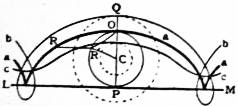
Fig. 1.
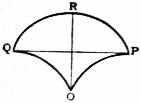
Fig. 2.
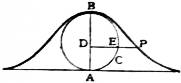
Fig. 3.
The method by which the cycloid is generated shows that it consists of an infinite number of cusps placed along the fixed line and separated by a constant distance equal to the circumference of the rolling circle. The name cycloid is usually restricted to the portion between two consecutive cusps (fig. 1, curve a); the fixed line LM is termed the base, and the line PQ which divides the curve symmetrically is the axis. The co-ordinates of any point R on the cycloid are expressible in the form x = a(θ + sin θ); y = a(1 − cos θ), where the co-ordinate axes are the tangent at the vertex O and the axis of the curve, a is the radius of the generating circle, and θ the angle R′CO, where RR′ is parallel to LM and C is the centre of the circle in its symmetric position. Eliminating θ between these two relations the equation is obtained in the form x = (2ay − y²)½ + a vers-¹ y/a. The clumsiness of the relation renders it practically useless, and the two separate relations in terms of a single parameter θ suffice for the deduction of most of the properties of the curve. The length of any arc may be determined by geometrical considerations or by the methods of the integral calculus. When measured from the vertex the results may be expressed in the forms s = 4a sin ½θ and s = √(8ay); the total length of the curve is 8a. The intrinsic equation is s = 4a sin ψ, and the equation to the evolute is s = 4a cos ψ, which proves the evolute to be a similar cycloid placed as in fig. 2, in which the curve QOP is the evolute and QPR the original cycloid. The radius of curvature at any point is readily deduced from the intrinsic equation and has the value ρ = 4 cos ½θ, and is equal to twice the normal which is 2a cos ½θ.
The trochoids were studied by Torricelli and F. van Schooten, and more completely by John Wallis, who showed that they possessed properties similar to those of the common cycloid. The cartesian equation in terms similar to those used above is x = aθ + b sin θ; y = a − b cos θ, where a is the radius of the generating circle and b the distance of the carried point from the centre of the circle. If the point is without the circle, i.e. if a < b, then the curve exhibits a succession of nodes or loops (fig. 1, curve b); if within the circle, i.e. if a > b, the curve has the form shown in fig. 1, curve c.
The companion to the cycloid is a curve so named on account of its similarity of construction, form and equation to the common cycloid. It is generated as follows: Let ABC be a circle having AB for a diameter. Draw any line DE perpendicular to AB and meeting the circle in E, and take a point P on DE such that the line DP = arc BE; then the locus of P is the companion to the cycloid. The curve is shown in fig. 3. The cartesian equation, referred to the fixed diameter and the tangent at B as axes may be expressed in the forms x = aθ, y = a(1 − cos θ) and y − a = a sin (x/a − ½π); the latter form shows that the locus is the harmonic curve.
For epi- and hypo-cycloids and epi- and hypo-trochoids see Epicycloid.
References.—Geometrical constructions relating to the curves above described are to be found in T. H. Eagles, Constructive Geometry of Plane Curves. For the mechanical and analytical investigation, reference may be made to articles Mechanics and Infinitesimal Calculus. A historical bibliography of these curves is given in Brocard, Notes de bibliographie des courbes géométriques (1897). See also Moritz Cantor, Geschichte der Mathematik (1894-1901).
CYCLOMETER (Gr. κύκλος, circle, and μέτρον, measure), an instrument used especially by cyclists to determine the distance they have traversed. In a common form a stud attached to one spoke of the wheel engages with a toothed pinion and moves it on one tooth at each revolution. The pinion is connected with a train of clockwork, the gearing of which bears such a ratio to the circumference of the wheel that the distance corresponding to the number of times it has revolved is shown on a dial in miles or other units.
CYCLONE (Gr. κυκλῶν, whirling, from κύκλος, a circle), an atmospheric system where the pressure is lowest at the centre. The winds in consequence tend to blow towards the centre, but being diverted according to Ferrel’s law they rotate spirally inwards at the surface of the earth in a direction contrary to the movement of the hands of a watch in the northern hemisphere, and the reverse in the southern hemisphere. The whole system has a motion of translation, being usually carried forward with the great wind-drifts like eddies upon a swift stream. Thus their direction of movement over the British Islands is usually from S.W. to N.E., though they may remain stationary or move in other directions. The strength of the winds depends upon the atmospheric gradients. (See Meteorology.)
CYCLOPEAN MASONRY (from the Cyclopes, the supposed builders of the walls of Mycenae), a term in architecture, used, in conjunction with Pelasgic, to define the rude polygonal construction employed by the Greeks and the Etruscans in the walls of their cities. In the earliest examples they consist only of huge masses of rock, of irregular shape, piled one on the other and trusting to their great size and weight for cohesion; sometimes smaller pieces of rock filled up the interstices. The walls and gates of Tiryns and Mycenae were thus constructed. Later, these blocks were rudely shaped to fit one another. It is not always possible to decide the period by the type of construction, as this depended on the material; where stratified rocks could be obtained, horizontal coursing might be adopted; in fact, there are instances in Greece, where a later wall of cyclopean construction has been built over one with horizontal courses.
CYCLOPES (Κύκλωπες, the round-eyed, plural of Cyclops), a type of beings variously described in Greek mythology. In Homer they are gigantic cave-dwellers, cannibals having only one eye, living a pastoral life in the far west (Sicily), ignorant of law and order, fearing neither gods nor men. The most prominent among them was Polyphemus. In Hesiod (Theogony, 264) they are the three sons of Uranus and Gaea—Brontes, Steropes and Arges,—storm-gods belonging to the family of the Titans, who furnished Zeus with thunder and lightning out of gratitude for his having released them from Tartarus. They were slain by Apollo for having forged the thunderbolt with which Zeus slew Asclepius. Later legend transferred their abode to Mt Aetna, the Lipari islands or Lemnos, where they assisted Hephaestus at his forge. A third class of Cyclopes are the builders of the so-called “Cyclopean” walls of Mycenae and Tiryns, giants with arms in their belly, who were said to have been brought by Proetus from Lycia to Argos, his original home (Pausanias ii. 16. 5; 25. 8). Like the Curetes and Telchines they are mythical types of prehistoric workmen and architects, and as such the objects of worship.
The standard work on these and similar mythological characters is M. Mayer, Die Giganten und Titanen (1887); see also A. Boltz, Die Kyklopen (1885), who endeavours to show that they were an historical people; W. Mannhardt, Wald- und Feldkulte (1904); J. E. Harrison, Myths of the Odyssey (1882); and article in Roscher’s Lexikon der Mythologie (bibliography).
CYCLOSTOMATA, or Marsipobranchii, a group of fishes including the ordinary lampreys and hagfish, and so called from the wide permanently gaping mouth which is without the hinged jaws characteristic of other vertebrates (Gnathostomata). The class Cyclostomata consists of two orders, the Myxinoids (or Hyperotreti) and the Petromyzontes (or Hyperoartii), which, while showing sufficient resemblance in structure to warrant their inclusion in the same class, are yet marked off by such deep-seated differences as to indicate that they commenced to diverge from one another far back in evolutionary time. The order Myxinoids includes the hagfish (Myxine), common off the eastern, and occurring also, though less commonly, off the western coasts of the north Atlantic, and the genus Bdellostoma (also known as Homea, Eptatretus, in part—Polistotrema), including the “borers” of the western American coast, New Zealand and the Cape of Good Hope. The order Petromyzontes includes the widely distributed lampreys. The original genus Petromyzon (which it is now customary to subdivide into a number of genera) includes the large sea lamprey (P. marinus) of the north Atlantic coasts and the two fresh-water lampreys of European streams (P. fluviatilis and P. planeri, the latter of which is possibly only a small-sized variety of the former species). In North America nine or ten species of lampreys are known to occur, descriptions of which are given by Jordan and Evermann (1). In the southern hemisphere occur the two genera Mordacia (Chile, Tasmania) and Geotria (Chile, Australia, New Zealand) (2).
The Cyclostomes are remarkable among vertebrates in that they are semiparasitic in habit. The lampreys—except some of the small fresh-water forms—attach themselves to other fishes by their suctorial mouth and proceed to rasp off the flesh by means of the horny teeth carried by the highly-developed tongue. The Myxinoids have gone a step further and actually bore their way right into the body of their prey, devouring all the soft parts and leaving the skin behind as a mere shell, empty but for the bones. Where the hagfish or borers are abundant, as in certain localities off the east coast of Scotland and off the west coast of California, they may do great damage to fisheries from their habit of attacking fishes which are in difficulties through being caught by a hook or in a net; the fish when drawn up being frequently completely deprived of their flesh.
The Myxinoids retain the ancestral marine habitat, but the lampreys have sought refuge from the struggle for existence by taking to fresh water to a less or greater extent. Such a form as Petromyzon marinus or Entosphenus tridentatus of the west coast of America is what is known as anadromous in habit, i.e. it takes refuge in fresh water during the breeding season, ascending rivers like the salmon for the purpose of spawning. Certain species of lampreys, on the other hand, have completely deserted the sea and spend their whole lives in fresh-water streams or lakes. The lake lampreys show a reminiscence of their ancestral migratory habits in leaving lakes and ascending streams in order to deposit their spawn.
Anatomy.—In structural features, the Cyclostomes show a curious mixture of features which must be looked on as primitive with others which are indicative of high specialization for their peculiar mode of life. In general appearance they are “eel-like”: they are elongated in shape and adapted for swimming in eel fashion, i.e. the body is propelled forward by the backward passage along it of waves of lateral flexure. There are, however, certain conspicuous differences which at once serve to distinguish a Cyclostome from any other fishes of eel-like shape:—(1) the circular permanently open mouth, (2) the absence of all trace of paired limbs, (3) the absence of paired external nasal openings, and (4) the presence on the roof or at the tip of the head of a conspicuous median opening—the pituitary opening.
It will be convenient, in describing the structural features of the group, to take as a basis for the description the marine lamprey, Petromyzon marinus. A marine lamprey is an eel-like creature 70 to 75 cm. in length. At the anterior end and situated somewhat ventrally is the circular widely gaping mouth or buccal cavity, its lining studded with sharply pointed thorn-like “teeth” and its edge fringed with numerous sensory papillae. On the dorsal side of the head is the conspicuous circular pituitary opening with prominent lips, while on the sides are seen the eyes, and behind these a row of somewhat rounded branchial openings or gill-clefts. At about the beginning of the posterior fourth of the body, and in the midventral line, is the anal opening, and immediately behind it is the prominent papilla carrying the opening of the urogenital sinus. The hinder portion of the body, in accordance with its function in locomotion, is flattened from side to side, while its surface is increased by the development of a median fin fold, divided, except in early stages of development, into three portions, known as the first and second dorsal fins and the caudal fin. The last mentioned is of the primitive protocercal type. The whole surface of the body—which shows a conspicuous dark marbling, especially dorsally, on a light ground—is covered with highly glandular epidermis. An important feature is the complete absence of all trace of the calcified placoid plates which are so characteristic of the Elasmobranchii.
The Myxinoids differ from the lampreys in regard to several of the above-mentioned characters. The edges of the mouth carry tentacle-like barbels. The pituitary opening is close to the anterior edge of the mouth opening instead of being right up on the dorsal side of the head. The eyes are invisible, being greatly reduced and sunk far below the surface, and in Myxine, though not in Bdellostoma, the row of gill openings is represented by a single opening on each side nearly in the midventral line and situated at about the end of the first quarter of the body length. Ventrally the Myxinoid possesses on each side of the body a row of remarkable epidermal glands which can produce at will enormous quantities of glutinous slime. This secretion, which, no doubt, is of much value as a protection from attack, is composed of very fine threads, formed by the conversion of the protoplasm of certain cells of the epidermal glands (“thread cells”) into an extremely fine, tightly coiled filament, which becomes unwound when discharged to the exterior.
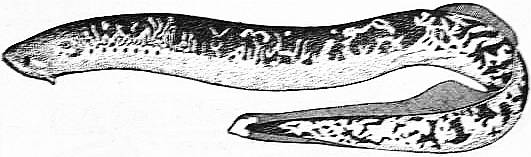
From D. Starr Jordan, A Guide to the Study of Fishes, by permission of A. Constable & Co., Ltd.
Fig. 1.—The Marine Lamprey (Petromyzon marinus, L.).
Pituitary Tube.—A remarkable peculiarity of the Cyclostomes lies in the fact that the pituitary ingrowth of ectoderm does not, as in other forms, become involved in the inpushing of ectoderm which forms the buccal cavity. On the contrary, it lies outside the edge of the stomodaeum, and in the case of the lampreys active growth takes place in the tissue between the pituitary and stomodaeal ingrowths, so that the two openings come to be widely separated, the pituitary opening being pushed back on to the dorsal side of the head. The pituitary opening remains patent throughout life, as is the case with Crossopterygians alone amongst Gnathostomata. In Myxine a further remarkable peculiarity in regard to the hypophysis, probably adaptive in nature, occurs, inasmuch as the pituitary invagination develops an opening at its posterior end into the pharynx.
Nervous System.—The anterior end of the nervous tube is enlarged and differentiated to form a brain as in other Vertebrates, but this brain in the lampreys at least shows remarkably primitive features. The enlargement as compared with the spinal cord is seen to be comparatively slight: the brain is much elongated, and its various regions lie in a straight line one behind the other: the roof of the brain retains to a great extent the primitive epithelial condition. On each side anteriorly there is present a comparatively large olfactory lobe, and this is continued posteriorly into a small cerebral hemisphere.
The lampreys are amongst those vertebrates in which there is an eye-like apparatus (3) connected with the roof of the thalamencephalon. There grow out from the roof of the thalamencephalon two processes, a posterior (the pineal process), and an anterior (the parapineal process). The pineal process grows forwards so as to overlie the parapineal process. Each of these projections from the roof of the thalamencephalon dilates to form a vesicle, and each vesicle shows certain eye-like characteristics, its deep wall forming a “retina” and its superficial wall being clear and translucent (“pellucida”). The retinal cells are packed in the case of the pineal organ with opaque white pigment: similar pigment occurs in smaller quantity in the parapineal organ. Definite sensory cells are also present with rod-like structures projecting into the lumen of the vesicle. Nerve fibres have been traced—from the pineal organ into the posterior commissure and possibly into the right habenular ganglion. As regards other parts of the brain, the chief point to note is that the cerebellum is in a most rudimentary condition, forming merely a slight transverse thickening of the hind-brain roof at its anterior end. In Myxinoids the brain is much larger as compared with the spinal cord, and it differs from that of the lampreys by being relatively much shorter in an anteroposterior direction. A remarkable negative feature lies in the complete absence of the pineal and parapineal organs so conspicuous in the lampreys. The olfactory organ of Cyclostomes is remarkable for two special characteristics, firstly, that the two olfactory organs of other vertebrates are here represented by a single median structure, and secondly, that the olfactory organ becomes sunk down beneath the surface through becoming involved in the ectodermal ingrowth which forms the pituitary tube. As a further consequence in the case of the lampreys the olfactory organ becomes transported to the roof of the head along with the pituitary opening, which latter functions as an external nostril. That the unpaired olfactory organ of existing Cyclostomes has passed through, in their ancestors, a paired condition such as exists in other vertebrates, is indicated by the fact that it retains a pair of olfactory nerves.
The eyes in adult lampreys are of moderate size, while in the Myxinoids they are greatly reduced—sunk beneath the skin (Bdellostoma) or even in amongst the muscles of the head (Myxine). The lens is completely absent, also the ocular muscles. The otocyst or auditory organ is unique amongst craniate vertebrates in regard to the semicircular canals. In the lampreys there are only two instead of the normal three, while the Myxinoids have only one.
Alimentary Canal.—The widely gaping buccal funnel is morphologically an inpushing of the outer skin, i.e. it is stomodaeal in nature. The thorn-like teeth which stud its lining are formed simply by cornification of the epidermal cells (4) like the provisional horny teeth of a tadpole, and are not homologous with the true teeth of ordinary vertebrates. As to whether they represent the remnant of a once present system of epidermal scales, which may have preceded the coating of placoid elements in the evolution of the vertebrate, there is no evidence.
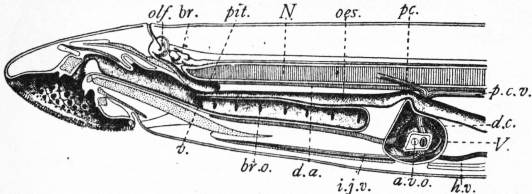
Modified from T. J. Parker, Zootomy, fig. 4, by permission of Macmillan & Co., Ltd.
Fig. 2.—Median longitudinal section through anterior end of Petromyzon.
a.v.o, Atrio-ventricular opening. br, Brain. br.o, Internal opening of gill sac. d.a, Dorsal aorta. d.c, Ductus cuvieri. h.v, Hepatic vein. i.j.v, Inferior jugular vein. N, Notochord. oes, Oesophagus. olf, Olfactory organ. pc, Pericardium. p.c.v, Left posterior cardinal vein. pit, Pituitary tube. V, Ventricle. v, Velum.
The pharyngeal region, closely associated with the respiratory function, possesses, on each side, a series of gill-sacs (six in Myxine: seven in Petromyzon, besides an anterior one which is laid down in the embryo but disappears later: up to as many as fourteen in Bdellostoma) opening on the one hand to the pharynx and on the other to the exterior. In Bdellostoma and in the larva of Petromyzon the gill-sacs open directly from the pharynx to the exterior, but in the adult lamprey and in Myxine the original relations are modified. In Myxine, the external openings of the gill-sacs have migrated backwards along the side of the body and become coincident at a point slightly posterior to the last sac. It follows from this that each sac is connected with the common aperture by a tube, longest in the case of the first sac, shortest in the case of the last. In the adult lamprey a different modification is found. Here the dorsal portion of the pharynx has become nipped off as a narrow tube which functions as an oesophagus from the larger ventral portion, which forms an elongated saccular structure ending blindly at its hinder end and having in its lateral wall the internal openings of the gill-sacs.
Breathing.—The inspiratory current passes inwards by the mouth opening in the larval lamprey, by the pituitary tube in Myxine, while in the adult lamprey both expiration and inspiration takes place through the external gill-openings. In the case of the lampreys the elastic skeleton of the branchial region (see below) plays an important part in respiration. The branchial region shows rhythmic contraction through the agency of the transverse muscles—and expansion, through the elasticity of the branchial skeleton—in the adult lamprey. These rhythmic movements of the branchial region cause successive inflow and outflow through the branchial openings. In the larva, on the other hand, the respiratory current always passes in one direction—backwards. This is helped by the presence of a velar fold at the front end of the pharynx, which acts as a valve opening only backwards, and to the presence of membranous flaps projecting back from the anterior border of each gill-opening and acting as valves which open only outwards.
Behind the pharynx comes the truly digestive part of the alimentary canal in the form of a straight tube showing little differentiation into special regions. The lining of the intestine is increased in area by an inwardly projecting fold, which is compared by some morphologists with the spiral valve of certain other groups. In the mature river lamprey the digestive tract becomes in great part degenerate.
Coelomic Organs.—The chief point of interest about the splanchnocoele or perivisceral cavity is that in the Myxinoids the adult shows a persistent embryonic condition in that the pericardiac portion never becomes isolated from the main body cavity.
The renal organs are of special interest in the Myxinoids from their very simple character. The kidney duct is seen running along the roof of the coelom on either side. Into the duct open short segmentally arranged tubes, each possessing at its closed rounded extremity a Malpighian body. Each of these short tubes is morphologically a nephric tubule, which, however, in correlation with its shortness, is without the turns and twists so characteristic of such tubules generally. A further consequence of the short simple character of the tubules is that they are quite separate from one another, instead of being massed together to form a compact gland such as the kidney is elsewhere. In Petromyzon the kidney has the ordinary compact form, and here also the Malpighian bodies are shut off from the splanchnocoele.
The ovary or testis is a large unpaired structure hanging from the dorsal wall of the splanchnocoele and shedding its products into it; from the coelomic space the genital products pass into the urogenital sinus—formed by the fusion of the kidney ducts at their hinder ends—through a small opening, one at each side. This opening, which leads directly from coelom into urogenital sinus, is known as the genital pore. Its morphological significance is doubtful.
Skeleton.—The vertebral column of the lamprey is represented by a persistent notochord surrounded by a thick sheath, which shows no signs of invasion by cartilage cells or of segmentation. Resting on the sheath are paired dorsal arch elements, more numerous than the neuromuscular segments. In the tail region these are united into a continuous band of cartilage on each side: similar cartilaginous bands represent the ventral arch elements of the tail region. The skeleton of the head region consists of a cartilaginous cranium, into the formation of which enter typical parachordal and trabecular elements, together with olfactory and auditory capsules. In addition to these, there are a number of other cartilaginous pieces present in the head region, the homologies of which are doubtful.
Branchial Basket.—One of the most characteristic features of the skeleton of the lamprey is the remarkable cartilaginous “branchial basket,” which supports the gill region. In an adult river lamprey the basketwork consists on each side of a series of eight vertical half-hoops of cartilage. The hoops of each side are connected together dorsally by a pair of longitudinal bars, lying ventral to the notochord, and ventrally by a similar pair of rods which are fused in the middle line. Slender cartilaginous projections arise from the anterior and posterior sides of the hoops, and certain of these meeting at their ends form additional longitudinal bars connecting together successive hoops. Connected with the basketwork posteriorly is a remarkable cup-shaped cartilage, which supports the hind wall of the pericardium. The series of cartilaginous half-hoops naturally suggest the half-hoops of cartilage which form the skeleton of the visceral arches in the Gnathostomata. They are, however, more superficial in position, and this has led many to doubt their actual homology with the cartilaginous visceral arches. Taking into account, however, our present knowledge of the development of the two sets of structures, it seems on the whole probable that a true homology exists and that the branchial basket of the lamprey represents merely a set of visceral arches modified in accordance with the peculiar breathing methods of the creature. In the Myxinoids the branchial basket is reduced to a few vestigial masses of cartilage.
Vascular System.—The heart (5) of the lamprey consists of an atrium and a single ventricle, the atrium on the left, the ventricle on the right. Into the atrium, on its right side, and behind the atrio-ventricular opening, there opens a nearly vertical chamber usually termed the sinus venosus (see below), the opening guarded by a pair of vertically placed valves. The ventricle passes anteriorly into what is clearly the homologue of the conus arteriosus of other forms. In its interior are present a pair of laterally placed longitudinal ridges similar to the ridges which occur in other forms in the conus. The opening from ventricle into conus is guarded by a pair of laterally placed pocket valves situated just within the boundary of the ventricle.
The arterial system is of the ordinary piscine type. From the heart there passes forwards a ventral aorta, split into two separate vessels in its anterior half, and giving off on each side a series of efferent vessels to the gill-sacs, one passing between each two gill-sacs and an additional one to the front wall of the front sac and to the posterior wall of the last. The blood is collected from the walls of the gill-sacs by a series of efferent vessels which open into the dorsal aorta. It is to be noted that the dorsal aorta retains the probably primitive unpaired condition, except for a very short extent at its anterior end, where it is split so as to form two short aortic roots.
Venous System.—The main venous channels are like those in other fishes, though their connexion with the heart becomes modified in the adult. The two posterior cardinals—with their continuations forwards, the anterior cardinals—approach the median plane and undergo fusion in the region of their opening into the two ductus Cuvieri. The left ductus Cuvieri then atrophies so that all the blood from the cardinals reaches the heart by way of the originally right ductus Cuvieri. It is this right ductus Cuvieri which forms the dorsal part of what is usually termed the sinus venosus. The inferior jugular veins which return the blood from the ventral side of the head also become replaced in the adult by a median unpaired vein which opens posteriorly into the sinus venosus by what probably represents the hinder end of the original right inferior jugular. It is interesting to note that in Polypterus, one of the Crossopterygian ganoids, there is a somewhat similar asymmetrical condition of inferior jugulars and ductus Cuvieri.
Oviposition of Lamprey (6).—The lamprey chooses as spawning ground a part of the stream with fairly rapid current and where the bottom is composed of sand with scattered stones. By means of the suctorial mouth, stones are removed from more or less circular area so as to form a shallow excavation. The male and female frequently work together at the task of preparing the nest. When oviposition is about to take place, the male may be seen to suddenly attach himself to the dorsal surface of the head of the female which holds on to one of the stones at the upper margin of the nest. The urogenital opening of the male, with its specially prominent papilla, is approximated to that of the female, and with a peculiar quivering movement the eggs and sperms are emitted synchronously amidst clouds of sand stirred up by the movements of the tail. The eggs fertilized thus at the moment of exit are very sticky from their coating of albumen, and become weighted down by adherent grains of sand.
Development.—The development of the lamprey is of much morphological importance from the archaic nature of the creature and from the fact that the egg is comparatively small (about 1 mm. in diameter), so that development is not greatly modified by a large mass of yolk. It has been worked out so far only in the river lamprey (7). Segmentation is complete and unequal. It, as well as the process of gastrulation, agrees in its main features with the same phenomenon in Amia, Dipnoans and Urodele amphibians. The blastopore persists as the anal opening of the adult. The mesoderm arises in a manner closely comparable with that which occurs in Amphioxus, the chief difference being that the mesoderm segments are solid instead of hollow, except in the anterior head region, where they are true hollow enterocoelic pouches. The rudiment of the central nervous system has the form of a solid keel-like ingrowth of ectoderm along the mid-dorsal line, which only secondarily becomes hollowed out—just as happens in Teleostean fishes. The young lamprey, after completing its embryonic development, passes three or four years, in fact its whole life up to the time of sexual maturity, in a prolonged larval condition in which its structure shows important differences from that of the adult. This larval stage of the fresh-water lamprey of Europe was long supposed to be a separate genus of Cyclostomes and was called Ammocoetes. The Ammocoetes lives in the mud and breathes and feeds by means of a current of water produced by ciliary action, which carries Flagellates and other microscopic organisms in through the mouth opening. Correlated with this mode of feeding the buccal cavity is without the teeth so characteristic of the adult. A number of complicated branched sensory processes grow into and nearly occlude the cavity, forming a kind of sieve with only narrow chinks through which the ingoing current passes. The water passes out by the gill openings, which in Ammocoetes open direct from pharynx to exterior. Certain arrangements of the pharyngeal wall of Ammocoetes show a remarkable resemblance to what is found in Amphioxus. The thyroid, which in the adult is a complicated ductless gland, has in the young Ammocoetes the form of a longitudinal groove of the ventral wall of the pharynx. This groove is lined by columnar cells, some carrying cilia, others being glandular and secreting sticky slime. These gland cells are arranged in four longitudinal bands. The thyroid is, in fact, in this stage in a condition corresponding exactly with the endostyle of Amphioxus. The agreement extends to function the secretion, forming sticky threads which entangle food particles. Anteriorly a pair of peripharyngeal bands pass dorsalwards, one on each side, to bend back suprapharyngeal bands which are continued to the hinder end of the pharynx. Here again the resemblance to what occurs in Amphioxus is very close.
The Ammocoetes possesses a functional liver with bileduct, while in the adult river lamprey the alimentary canal is degenerate. It has no arch elements on its notochord. Its eyes are sunk beneath the surface and nonfunctional, and they retain to a great extent an embryonic character (8). There is a rapid process of metamorphosis from the larval to the adult condition, the details of which are by no means sufficiently known. After the metamorphosis the now mature lamprey accomplishes the act of reproduction and then apparently dies almost immediately. The development of the Myxinoids is much less well known than that of the lampreys. As regards the common hagfish (Myxine glutinosa), we are indeed still in complete ignorance in regard to its developmental history in spite of persistent efforts to obtain embryological material. It seems probable that during the breeding period the hagfishes retire into some particularly inaccessible habitat. Within the last few years, however, abundant material illustrating the developmental history of Bdellostoma (9) has been obtained on the Californian coast, and this when fully worked out will give us a good idea of the general lines of Myxinoid development. The egg differs greatly from that of the lampreys. It is—as is that of Myxine—of large size, richly yolked and of a shortened-up sausage shape. It measures about 22 mm. by 8 mm. Surrounding the egg is a protective capsule of a yellow horny appearance. At one end a cap-like portion of this forms a detachable operculum, in the middle of which is a minute opening, the micropyle. Each end of the capsule is prolonged into a group of stiff processes with anchor-like expansions at their tips. Segmentation is, as in other richly yolked eggs, incomplete, confined to the germinal disk at the opercular pole. The central nervous system in Bdellostoma develops by the overarching of medullary folds, not out of a solid keel as is the case with the lampreys.
History in Time.—The softness of the skeletal tissues and the absence of scales in Cyclostomata provide little opportunity for the preservation of fossil remains of this group, and no known fossils can be referred with certainty to the Cyclostomata. The Devonian Palaeospondylus gunni has been regarded as a Cyclostome by some authors, but this relationship is at the least doubtful. Other authors have associated the Ostracoderms, the oldest known vertebrates, with this group.
References.—1. D. S. Jordan and B. W. Evermann, Fishes of North and Middle America (Washington, 1896), part i. p. 8; 2. L. Plate, SB. Ges. Naturf. (Berlin, Jg. 1897), p. 137; 3. F. Studnicka in Oppel’s Lehrbuch der vergleichenden mikroskopischen Anatomie der Wirbeltiere (Jena, 1905), Teil v. s. i.; 4. E. Warren, Q. J. Micr. Sci. xlv. (1902) p. 631; 5. L. Vialleton, Arch. d’anat. micr. T. vi. (1903) p. 283; 6. H. A. Surface in D. S. Jordan’s Fishes (1905), vol. i. p. 494; 7. A. E. Shipley, Q. J. Micr. Sci. xxvii. (1887), W. B. Scott, Journ. Morphol. i. (1887), C. Kupffer, Arch. mikr. Anat. xxxv. (1890), A. Goette, Entwick. des Flussneunauges (Hamburg and Leipzig, 1890); 8. C. Kohl, in Bibliotheca zoologica, Heft 13 (Cassel, 1892); 9. Bashford Dean in Kupffer’s Festschrift (Jena, 1899).
(J. G. K.)
CYCLOSTYLE (Gr. κύκλος, a circle, and στῦλος, a column), a term used in architecture. A structure composed of a circular range of columns without a core is cyclostylar; with a core the range would be peristyle. This is the species of edifice called by Vitruvius monopteral.
CYGNUS (“The Swan”), in astronomy, a constellation of the northern hemisphere, mentioned by Eudoxus (4th century B.C.) and Aratus (3rd century B.C.), and fabled by the Greeks to be the swan in the form of which Zeus seduced Leda. Ptolemy catalogued 19 stars, Tycho Brahe 18, and Hevelius 47. In this constellation β Cygni is a fine coloured double star, consisting of a yellow star, magnitude 3, and a blue star, magnitude 5½. The fine double star, μ Cygni, separated by Sir William Herschel in 1779, has magnitudes 4 and 5; it has a companion, of magnitude 7½, which, however, does not form part of the system. A double star, 61 Cygni, of magnitudes 5.3 and 5.9, was the first star whose distance was determined; its parallax is 0″.39, and it is therefore the nearest star in the northern hemisphere with the exception of σ Centauri. A regular variable, χ Cygni, has extreme magnitudes of 5 to 13.5, and its period is 406 days. Nova Cygni is a “new” star discovered by Johann Schmidt in 1876. There is also an extended nebula in the constellation.
CYLINDER (Gr. κύλινδρος, from κυλίνδειν, to roll). A cylindrical surface, or briefly a cylinder, is the surface traced out by a line, named the generatrix, which moves parallel to itself and always passes through the circumference of a curve, named the directrix; the name cylinder is also given to the solid contained between such a surface and two parallel planes which intersect a generatrix. A “right cylinder” is the solid traced out by a rectangle which revolves about one of its sides, or the curved surface of this solid; the surface may also be defined as the locus of a line which passes through the circumference of a circle, and is always perpendicular to the plane of the circle. If the moving line be not perpendicular to the plane of the circle, but moves parallel to itself, and always passes through the circumference, it traces an “oblique cylinder.” The “axis” of a circular cylinder is the line joining the centres of two circular sections; it is the line through the centre of the directrix parallel to the generators. The characteristic property of all cylindrical surfaces is that the tangent planes are parallel to the axis. They are “developable” surfaces, i.e. they can be applied to a plane surface without crinkling or tearing (see Surface).
Any section of a cylinder which contains the axis is termed a “principal section”; in the case of the solids this section is a rectangle; in the case of the surfaces, two parallel straight lines. A section of the right cylinder parallel to the base is obviously a circle; any other section, excepting those limited by two generators, is an ellipse. This last proposition may be stated in the form:—“The orthogonal projection of a circle is an ellipse”; and it permits the ready deduction of many properties of the ellipse from the circle. The section of an oblique cylinder by a plane perpendicular to the principal section, and inclined to the axis at the same angle as the base, is named the “subcontrary section,” and is always a circle; any other section is an ellipse.
The mensuration of the cylinder was worked out by Archimedes, who showed that the volume of any cylinder was equal to the product of the area of the base into the height of the solid, and that the area of the curved surface was equal to that of a rectangle having its sides equal to the circumference of the base, and to the height of the solid. If the base be a circle of radius r, and the height h, the volume is πr²h and the area of the curved surface 2πrh. Archimedes also deduced relations between the sphere (q.v.) and cone (q.v.) and the circumscribing cylinder.
The name “cylindroid” has been given to two different surfaces. Thus it is a cylinder having equal and parallel elliptical bases; i.e. the surface traced out by an ellipse moving parallel to itself so that every point passes along a straight line, or by a line moving parallel to itself and always passing through the circumference of a fixed ellipse. The name was also given by Arthur Cayley to the conoidal cubic surface which has for its equation z(x² + y²) = 2mxy; every point on this surface lies on the line given by the intersection of the planes y = x tan θ, z = m sin 2θ, for by eliminating θ we obtain the equation to the surface.
CYLLENE (mod. Ziria), a mountain in Greece, in the N.E. of Arcadia (7789 ft.). It was specially sacred to Hermes, who was born in a cave on the mountain, and had a temple and an ancient statue on its summit. The name Cyllene belongs also to an ancient port town in Elis, and, owing to doubtful identification with this, to a modern port at Glarentza, and also to some mineral baths a little to the south of it.
CYMA (Gr. κῦμα, wave), in architecture, a moulding of double curvature, concave at one end, convex at the other. When the concave part is uppermost, it is called a cyma recta; but if the convex portion is at the top, it is called a cyma reversa. When the crowning moulding of an entablature is of the cyma form, it is called a “cymatium.”
CYMBALS (Fr. cymbales; Ger. Becken; Ital. piatti or cinelli), a modern instrument of percussion of indefinite musical pitch, whereas the small ancient cup-shaped cymbals sounded a definite note. Cymbals consist of two thin round plates of an alloy containing 8 parts of copper to two of tin, each having a handle-strap set in the little knob surmounting the centre of the plate. The sound is obtained not by clashing them against each other, but by rubbing their edges together by a sliding movement. Sometimes a weird effect is obtained by suspending one of the cymbals by the strap and letting a drummer execute a roll upon it as it swings; or by holding a cymbal in the left hand and striking it with the soft stick of the bass drum, which produces a sound akin to that of the tam-tam. All gradations of piano and forte can be obtained on the cymbals. The composer indicates his intention of letting the cymbals vibrate by “Let them vibrate,” and the contrary effect by “Damp the sound.” To stop the vibrations the performer presses the cymbals against his chest, as soon as he has played a note. The duration of the vibration is indicated by the value of the note placed upon the staff; the name signifies nothing, since the pitch of the cymbals is indefinite. The instrument is played from the same part of the score as the bass drum, unless otherwise indicated by senza piatti, or piatti soli if the bass drum is to remain silent. Although cymbals are not often required they form part of every orchestra; their chief use is for marking the rhythm and for producing weird, fantastic effects or adding military colour, and their shrill notes hold their own against a full orchestra playing fortissimo. Cymbals are specially suited for suggesting frenzy, fury or bacchanalian revels, as in the Venus music in Wagner’s Tannhäuser and Grieg’s Peer Gynt suite. Damping gives a suggestion of impending evil or tragedy. The timbre of the ancient cymbals is entirely different, more like that of small hand-bells or of the notes of the keyed harmonica. They are not struck full against each other, but by one of their edges, and the note given out by them is higher in proportion as they are thicker and smaller. Berlioz in Romeo and Juliet scored for two pairs of cymbals, modelled on some ancient Pompeian instruments no larger than the hand (some are no larger than a crown piece), and tuned to and


The origin of the cymbals must be referred to prehistoric times. The ancient Egyptian cymbals closely resembled our own. The British Museum possesses two pairs, 51⁄3 in. in diameter, one of which was found in the coffin of the mummy of Ankhhapē, a sacred musician; they are shown in the same case as the mummy, and have been reproduced by Carl Engel.1 Those used by the Assyrians were both plate- and cup-shaped. The Greek cymbals were cup- or bell-shaped, and are to be seen in the hands of fauns and satyrs innumerable in sculptures and on painted vases. The word cymbal is derived from κύμβη (Lat. cymba), a hollow vessel, and κύμβαλα = small cymbals. During the middle ages the word cymbal was applied to the Glockenspiel, or peal of small bells, and later to the dulcimer, perhaps on account of the clear bell-like tone produced by the hammers striking the wire strings. After the introduction or invention of the keyed dulcimer or clavichord, and of the spinet, the word clavicymbal was used in the Romance languages to denote the varieties of spinet and harpsichord. Ancient cymbals are among the instruments played by King David and his musicians in the 9th-century illuminated MS. known as the Bible of Charles the Bald in the Bibliothèque Nationale, Paris.
(K. S.)
1 The Music of the Most Ancient Nations, fig. 75, p. 227.
CYNEGILS (d. 643), king of the West Saxons, succeeded his uncle King Ceolwulf in 611. With his son Cwichelm (d. 636), he defeated the advancing Britons at Bampton in Oxfordshire in 614, and Cwichelm sought to arrest the growing power of the Northumbrian king Eadwine by procuring his assassination; the attempt, however, failed, and in 626 the West Saxons were defeated in battle and forced to own Eadwine’s supremacy. Cynegils’ next struggle was with Penda of Mercia, and here again he was worsted, the battle being fought in 628 at Cirencester, and was probably compelled to surrender part of his kingdom to Mercia. Cynegils was converted to Christianity through the preaching of Birinus, and was baptized in 635 at Dorchester in Oxfordshire, where he founded a bishopric. He was succeeded as king by his son Cenwalh.
CYNEWULF (d. 785), king of Wessex, succeeded to the throne in 757 on the deposition of Sigeberht. He was constantly at war with the Welsh. In 779 Offa of Mercia defeated him and took Bensington. In 785 he was surprised and killed, with all his thegns present, at Marten, Wilts (Merantune), by Cyneheard, brother of the deposed Sigeberht.
See Earle and Plummer’s edition of the Anglo-Saxon Chronicle, 755, 779 (Oxford, 1892).
CYNEWULF, the only Old-English vernacular poet, known by name, of whom any undisputed writings are extant. He is the author of four poems preserved in two MSS., the Exeter Book and the Vercelli Book, both of the early 11th century. An epilogue to each poem contains the runic characters answering to the letters c, y, n (e), w, u, l, f. The runes are to be read as the words that served as their names; these words enter into the metre of the verse, and (except in one poem) are significant in their context. The poems thus signed are the following. (1) A meditation on The Ascension, which stands in the Exeter Book between two similar poems on the Incarnation and the Last Judgment. The three are commonly known as Cynewulf’s Christ, but the runic signature attests only the second. (2) A version of the legend of the martyr St Juliana, also in the Exeter Book. (3) Elene, in the Vercelli Book, on the story of the empress Helena and the “Invention of the Cross.” (4) A short poem on The Fates of the Apostles, in the same MS. The page containing the signature to this poem was first discovered by Professor A. S. Napier in 1888, so that the piece is not included in earlier enumerations of the poet’s signed works.
In Juliana and Elene the name is spelt Cynewulf; in The Ascension the form is Cynwulf. In The Fates of the Apostles the page is defaced, but the spelling Cynwulf is almost certain. The absence of the E in The Ascension can hardly be due to a scribal omission, for the name of this letter (meaning “horse”) would not suit the context; this, was perhaps the motive for the choice of the shorter form. The orthography (authenticated as the poet’s own by the nature of his device) has chronological significance. If the poems had been written before 740, the spelling would almost certainly have been Cyniwulf. If it were safe to judge from the scanty extant evidence, we should conclude that the form Cynwulf came in about 800; and presumably the poet would not vary his accustomed signature until the new form had become common. In Elene Cynewulf speaks of himself as an old man; and the presence of the runic signature in the four works suggests that they are not far apart in date. They may therefore be referred provisionally to the beginning of the 9th century, any lower date being for linguistic and metrical reasons improbable.
The MSS. of the poems are in the West-Saxon dialect, with occasional peculiarities that indicate transcription from Northumbrian or Mercian. Professor E. Sievers’s arguments for a Northumbrian original have considerable weight; for the Mercian theory no linguistic arguments have been adduced, but it has been advocated on grounds of historical probability which seem to be of little value.
Cynewulf’s unquestioned poems show that he was a scholar, familiar with Latin and with religious literature, and they display much metrical skill and felicity in the use of traditional poetic language; but of the higher qualities of poetry they give little evidence. There are pleasing passages in Elene, but the clumsy and tasteless narration of the Latin original is faithfully reproduced, and the added descriptions of battles and voyages are strings of conventional phrases, with no real imagination. In The Ascension the genuine religious fervour imparts a higher tone to the poetry; the piece has real but not extraordinary merit. Of the other two poems no critic has much to say in praise. If Cynewulf is to be allowed high poetic rank, it must be on the ground of his authorship of other works than those which he has signed. At one time or other nearly the whole body of extant Old English poetry (including Beowulf) has been conjecturally assigned to him. Some of the attributed works show many striking resemblances in style and diction to his authentic writings. But it is impossible to determine with certainty how far the similarities may be due to imitation or to the following of a common tradition.
Until recently, it was commonly thought that Cynewulf’s authorship of the Riddles (q.v.) in the Exeter Book was beyond dispute. The monodramatic lyric Wulf and Eadwacer, imagined to be the first of these Riddles, was in 1857 interpreted by Heinrich Leo as a charade on the name Cynewulf. This absurd fancy was for about thirty years generally accepted as a fact, but is now abandoned. Some of the Riddles have been shown by Professor E. Sievers to be older than Cynewulf’s time; that he may have written some of the rest remains a bare possibility.
The similarity of tone in the three poems known as the Christ affords some presumption of common authorship, which the counter arguments that have been urged seem insufficient to set aside. Both The Incarnation and The Last Judgment contain many passages of remarkable power and beauty. It is unlikely that the author regarded the three as forming one work. The Christ is followed in the MS. by two poems on Saint Guthlac, the second of which is generally, and with much probability, assigned to Cynewulf. The first Guthlac poem is almost universally believed to be by another hand. Cynewulf’s celebration of a midland saint is the strongest of the arguments that have been urged against his Northumbrian origin; but this consideration is insufficient to outweigh the probability derived from the linguistic evidence.
Cynewulf’s reputation can gain little by the attribution to him of Guthlac, which is far inferior even to Juliana. Very different would be the effect of the establishment of his much disputed claim to Andreas, a picturesque version of the legend of the Apostle Andrew. The poem abounds to an astonishing extent in “Cynewulfian” phrases, but it is contended that these are due to imitation. If the author of Andreas imitated Elene and Juliana, he bettered his model. The question whether Cynewulf may not have been the imitator has apparently never been discussed. The poem (so far agreeing with The Fates of the Apostles) copies the style of the old heroic poetry.
Cynewulf’s authorship has been asserted by some scholars for The Dream of the Rood, the noblest example of Old English religious poetry. But an extract from this poem is carved on the Ruthwell Cross; and, notwithstanding the arguments of Prof. A. S. Cook, the language of the inscription seems too early for Cynewulf’s date. The similarities between the Dream and Elene are therefore probably due to Cynewulf’s acquaintance with the older poem.
The only remaining attribution that deserves notice is that of the Phoenix. The author of this fine poem was, like Cynewulf, a scholar, and uses many of his turns of expression, but he was a man of greater genius than is shown in Cynewulf’s signed compositions.
Professor M. Trautmann, following J. Grimm and F. Dietrich, would identify the poet with Cynewulf, bishop of Lindisfarne, who died in 783. This speculation conflicts with the chronology suggested in this article, and is destitute of evidence. Cynewulf was indeed probably a Northumbrian churchman, but it is unlikely that there were not many Northumbrian churchmen bearing this common name; and as the bishop is not recorded to have written anything, the identification is at best an unsupported possibility. Professor A. S. Cook has suggested that our Cynewulf may have been the “Cynulf,” priest of Dunwich, whose name is among those appended to a decree of the council of Clofesho in 803, and of whom nothing else is known. This conjecture suits the probable date of Cynewulf, but otherwise there is nothing in its favour.
For the older literature relating to Cynewulf, see R. Wülker, Grundriss der angelsächsischen Litteratur (1885). References to the most important later discussions will be found in M. Trautmann, Kynewulf, der Bischof und Dichter (1898), and the introductions and notes to the editions of Cynewulf’s Christ, by I. Gollancz (1892) and A. S. Cook (1900). For the arguments for Cynewulf’s authorship of Andreas, see F. Ramhorst, Andreas und Cynewulf (1885).
(H. Br.)
CYNICS, a small but influential school of ancient philosophers. Their name is variously derived from the building in Athens called Cynosarges, the earliest home of the school, and from the Greek word for a dog (κύων), in contemptuous allusion to the uncouth and aggressive manners adopted by the members of the school. Whichever of these explanations is correct, it is noticeable that the Cynics agreed in taking a dog as their common badge or symbol (see Diogenes). From a popular conception of the intellectual characteristics of the school comes the modern sense of “cynic,” implying a sneering disposition to disbelieve in the goodness of human motives and a contemptuous feeling of superiority.
As regards the members of the school, the separate articles on Antisthenes, Crates, Diogenes and Demetrius contain all biographical information. We are here concerned only to examine the general principles of the school in its internal and external relations as forming a definite philosophic unit. The importance of these principles lies not only in their intrinsic value as an ethical system, but also in the fact that they form the link between Socrates and the Stoics, between the essentially Greek philosophy of the 4th century B.C. and a system of thought which has exercised a profound and far-reaching influence on medieval and modern ethics. From the time of Socrates in unbroken succession up to the reign of Hadrian, the school was represented by men of strong individuality. The leading earlier Cynics were Antisthenes, Diogenes of Sinope, Crates of Thebes, and Zeno; in the later Roman period, the chief names are Demetrius (the friend of Seneca), Oenomaus and Demonax. All these men adhered steadfastly to the principles laid down by Antisthenes.
Antisthenes was a pupil of Socrates, from whom he imbibed the fundamental ethical precept that virtue, not pleasure, is the end of existence. He was, therefore, in the forefront of that intellectual revolution in the course of which speculation ceased to move in the realms of the physical1 and focused itself upon human reason in its application to the practical conduct of life. “Virtue,” says Socrates, “is knowledge”: in the ultimate harmony of morality with reason is to be found the only true existence of man. Antisthenes adopted this principle in its most literal sense, and proceeded to explain “knowledge” in the narrowest terms of practical action and decision, excluding from the conception everything except the problem of individual will realizing itself in the sphere of ordinary existence. Just as in logic the inevitable result was the purest nominalism, so in ethics he was driven to individualism, to the denial of social and national relations, to the exclusion of scientific study and of almost all that the Greeks understood by education. This individualism he and his followers carried to its logical conclusion. The ordinary pleasures of life were for them not merely negligible but positively harmful inasmuch as they interrupted the operation of the will. Wealth, popularity and power tend to dethrone the authority of reason and to pervert the soul from the natural to the artificial. Man exists for and in himself alone; his highest end is self-knowledge and self-realization in conformity with the dictates of his reason, apart altogether from the state and society. For this end, disrepute and poverty are advantageous, in so far as they drive back the man upon himself, increasing his self-control and purifying his intellect from the dross of the external. The good man (i.e. the wise man) wants nothing: like the gods, he is αὐταρκής (self-sufficing); “let men gain wisdom—or buy a rope”; he is a citizen of the world, not of a particular country (cf. Diogenes Laërtius vi. 11 μόνην τε ὀρθὴν πολιτείαν εἶναι τὴν, ἐν κόσμῳ).
It is not surprising that the pioneers of such a system were criticized and ridiculed by their fellows, and this by no means unjustly. We learn that Diogenes and Crates sought to force their principles upon their fellows in an obtrusive, tactless manner. The very essence of their philosophy was the negation of the graces of social courtesy; it was impossible to “return to nature” in the midst of a society clothed in the accumulated artificiality of evolved convention without shocking the ingrained sensibilities of its members. Nor is it unjust to infer that the sense of opposition provoked some of the Cynics to an overweening display of superiority. At the same time, it is absurd to regard the eccentricities of a few as the characteristics of the school, still more as a condemnation of the views which they held.
In logic Antisthenes was troubled by the problem of the One and the Many. A nominalist to the core, he held that definition and predication are either false or tautological. Ideas do not exist save for the consciousness which thinks them. “A horse,” said Antisthenes, “I can see, but horsehood I cannot see.” Definition is merely a circuitous method of stating an identity: “a tree is a vegetable growth” is logically no more than “a tree is a tree.”
Cynicism appears to have had a considerable vogue in Rome in the 1st and 2nd centuries A.D. Demetrius (q.v.) and Demonax are highly eulogized by Seneca and Lucian respectively. It is probable that these later Cynics adapted themselves somewhat to the times in which they lived and avoided the crude extravagance of Diogenes and others. But they undoubtedly maintained the spirit of Antisthenes unimpaired and held an honourable place in Roman thought. This very popularity had the effect of attracting into their ranks charlatans of the worst type. So that in Rome also Cynicism was partly the butt of the satirist and partly the ideal of the thinker.
Disregarding all the accidental excrescences of the doctrine, Cynicism must be regarded as a most valuable development and as a real asset in the sum of ethical speculation. With all its defective psychology, its barren logic, its immature technique, it emphasized two great and necessary truths, firstly, the absolute responsibility of the individual as the moral unit, and, secondly, the autocracy of the will. These two principles are sufficient ground for our gratitude to these “athletes of righteousness” (as Epictetus calls them). Furthermore they are profoundly important as the precursors of Stoicism. The closeness of the connexion is illustrated by Juvenal’s epigram that a Cynic differed from a Stoic only by his cloak. Zeno was a pupil of Crates, from whom he learned the moral worth of self-control and indifference to sensual indulgence (see Stoics).
Finally it is necessary to point out two flaws in the Cynic philosophy. In the first place, the content of the word “knowledge” is never properly developed. “Virtue is knowledge”; knowledge of what? and how is that knowledge related to the will? These questions were never properly answered by them. Secondly they fell into the natural error of emphasizing the purely animal side of the “nature,” which was their ethical criterion. Avoiding the artificial restraints of civilization, they were prone to fall back into animalism pure and simple. Many of them upheld the principle of community of wives (see Diogenes Laërtius vi. 11); some of them are said to have outraged the dictates of public decency. It was left to the Stoics to separate the wheat from the chaff, and to assign to the words “knowledge” and “nature” a saner and more comprehensive meaning.
For relation of Cynicism to contemporary thought, compare Cyrenaics, Megarian School. See also Asceticism.
See F. W. Mullach, Fragmenta philosophorum Graecorum (Paris, 1867), ii. 261-438; H. Ritter and L. Preller, Hist. phil. Graec. et Rom. ch. v.; histories of ancient philosophy, and specially Ed. Zeller, Socrates and the Socratic Schools, Eng. trans., O. J. Reichel (1868, 2nd ed. 1877); Th. Gomperz, Greek Thinkers, Eng. trans., vol. ii., G. G. Berry (1905); E. Caird, Evolution of Theology in the Greek Philosophers (1904), ii. 44 seq., 55 seq., 62 seq.; arts. Stoics and Socrates.
1 See Ionian School of Philosophy.
CYNOSURE (Lat. cynosura, Gr. κυνόσουρα, from κυνός, genitive of κύων, a dog, and οὐρά, tail), the name given by the Greeks and Romans to the constellation of the Little Bear, Ursa Minor; the word is applied in English to the pole-star which appears in that constellation, and hence to something bright which, like a “guiding-star,” draws all attention to it, as in Milton’s “cynosure of neighbouring eyes.”
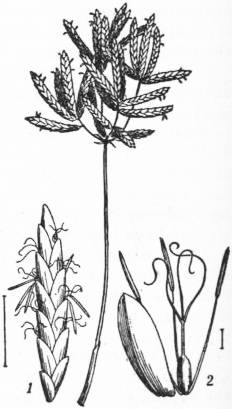
Fig. 1.—Partial inflorescence of Cyperus longus (Galingale), slightly reduced. 1, Spikelet of same; 2, flower.
CYPERACEAE, in botany, a natural order of the monocotyledonous group of seed-bearing plants. They are grass-like herbs, sometimes annual, but more often persist by means of an underground stem from which spring erect solitary or clustered, generally three-sided aerial stems, with leaves in three rows. The minute flowers are arranged in spikelets somewhat as in grasses, and these again in larger spike-like or panicled inflorescences. The flower has in rare cases a perianth of six scale-like leaves arranged in two whorls, and thus conforming to the common monocotyledonous type of flower. Generally the perianth is represented by hairs, bristles or similar developments, often indefinite in number; in the two largest genera, Cyperus, (fig. 1) and Carex (fig. 2), the flowers are naked. In a few cases two whorls of stamens are present, with three members in each, but generally only three are present; the pistil consists of three or two carpels, united to form an ovary bearing a corresponding number of styles and containing one ovule. The flowers, which are often unisexual, are wind-pollinated. The fruit is one-seeded, with a tough, leathery or hard wall. There are nearly 70 genera containing about 3000 species and widely distributed throughout the earth, chiefly as marsh-plants. In the arctic zone they form 10% of the flora; they will flourish in soils rich in humus which are too acid to support grasses. The large genus Cyperus contains about 400 species, chiefly in the warmer parts of the earth; C. Papyrus is the Egyptian Papyrus. Carex, the largest genus of the order, the sedges, is widely distributed in the temperate, alpine and arctic regions of both hemispheres, and is represented by 60 species in Britain. Carex arenaria, the sea-bent, grows on sand-dunes and helps to bind the sand with its long cord-like underground stem which branches widely. Scirpus lacustris (fig. 3, 1) the true bulrush, occurs in lakes, ditches and marshes; it has a spongy, green, cylindrical stem, reaching nearly an inch in thickness and 1 to 8 ft. high, which is usually leafless with a terminal branched inflorescence. Eriophorum (fig. 3), cotton grass, is represented in Britain by several species in boggy land; they are small tufted herbs with cottony heads due to the numerous hair-like bristles which take the place of the perianth and become much elongated in the fruiting stage.