VOLUME VII SLICE VIII Cube to Daguerre, Louis (continued 11)
Reading edition
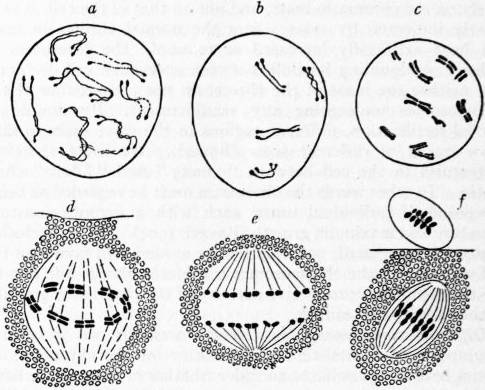
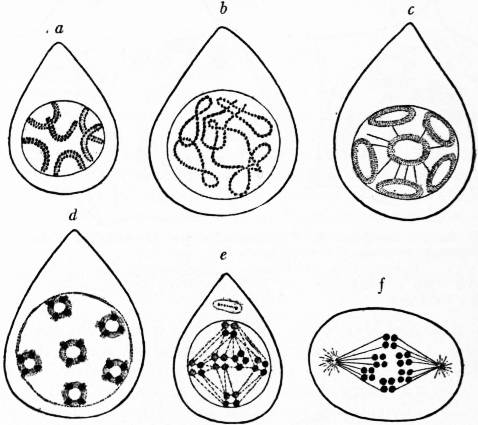
Assuming the persistent individuality of the chromosomes, then there are only three conceivable methods by which this numerical reduction can be brought about (Boveri, 1904, p. 60). (1) One-half the chromosomes degenerate. (2) The chromosomes are distributed entire, half to one daughter cell, half to the other (reducing division of Weismann, 1887). (3) The chromosomes fuse in pairs (Conjugation of the Chromosomes, Boveri, 1892). The first possibility—that of an actual degeneration of a part of the chromatin originally suggested by van Beneden and adopted by August Weismann, Boveri and others, has been long abandoned, and a steadily increasing bulk of evidence is tending to prove the general, if not universal, occurrence of the second method—the distribution between the daughter cells of undivided chromosomes. The occurrence of such a “reducing division” was postulated on theoretical grounds by Weismann (1887)47 and by Boveri (1888); by the former as a result of his adoption of de Vries’s hypothesis of self-propagating and qualitatively varying units for the chromatin; by the latter in relation to his theory of chromosome individuality. The actual occurrence of this reducing division was first demonstrated by Henking (1891) for Pyrrhocoris, and afterwards by Häcker, vom Rath and many others, but especially by Rückert (1894) for Cyclops (fig. 10). In this latter type the chromatin of the oocyte, as this prepares for the first maturation division, resolves itself into 12 (instead of 24) longitudinally split chromosomes (fig. 10, a). As these continue to thicken and contract a transverse fission appears (fig. 10, c). This is to be regarded as a belated segmentation of the spireme thread, and shows that the reduction so far is only a “pseudo-reduction” (Rückert), the chromosomes being really all present but temporally united in pairs, i.e. “bivalent” (Häcker). A striking confirmation of this interpretation is provided by Korschelt’s description of reduction in the annelid Ophryotrocha. In this type the full somatic number of split chromosomes (here only four) appears, and these secondarily associate end to end in pairs, thus forming split “diads” (i.e. tetrads), in every way similar to those described by Rückert for Cyclops. In the latter type, at the first maturation division, the sister diads are separated from one another, an “equating” division thus taking place. At the second division the diads are resolved into their constituent parts, and the “univalent” chromosomes are distributed to the daughter cells (reducing division). A similar process has since been described for numerous other types (e.g. various arthropods, Häcker, 1895-1898; vom Rath, 1895; and by Sutton for Brachystola, 1902-1903). In Ophryotrocha, as in Pyrrhocoris (Henking), Anasa (Paulmeir), Peripatus (Montgomery), &c., reduction occurs at the first maturation division (“pre-reduction” of Korschelt and Heider, 1900), instead of at the second division (post-reduction) as in most Copepods and Orthoptera. In many cases the tetrads (i.e. split chromosomes associated in pairs) have the form of rings, the genesis of which was first clearly determined by vom Rath (1892) in the mole cricket Gryllotalpa (fig. 11). In this form the sister diads remain united by their ends but widely separate in the middle (fig. 11, b). As in Cyclops, the belated transverse segmentation appears as the condensation of the chromatin proceeds (fig. 11, d), but the symmetrical tetrads which this process here produces make it impossible to determine at which of the two divisions reduction is effected. An essentially similar ring formation occurs in Enchaeta and Calanus (vom Rath), and in the Copepods Heterocope and Diaptomus (Rückert), and in other types.48
From Korschelt and Heider’s Lehrbuch d. vergl. Entwicklungsgeschichte d. wirbellosen Tiere, by permission of Gustav Fischer.
Fig. 10.—Maturation Divisions. a-d, Formation of the tetrads in Cyclops. (After Rückert.) e, 1st maturation division; separation of the bivalent sister chromosomes. f, 2nd maturation division; distribution of the univalent chromosomes.
From Prof. E. B. Wilson’s The Cell in Development and Inheritance, by permission of the author and of the Macmillan Co., N. Y.
Fig. 11.—Maturation Divisions. Origin of the tetrads by ring formation in the spermatogenesis of the mole-cricket (Gryllotalpa) (vom Rath). a, Primary spermatocyte with six split, bivalent chromosomes. b and c, Split has opened out. d, Concentration of the chromatin has made visible the belated transverse division. e and f, Grouping of the completed tetrads in the equatorial plate of the first maturation division.
From O. Hertwig, Allgemeine Biologie, by permission of Gustav Fischer.
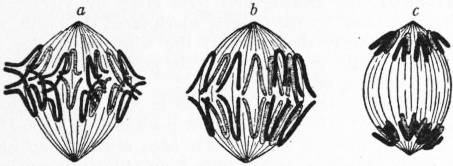
Fig. 12.—Heterotypical Mitosis. (Schematic, after Flemming.)
All the above cases, in which the reduction is effected by the distribution of entire chromosomes at one or other of the maturation divisions, may be grouped together as “pseudomitotic” (Häcker, and Korschelt & Heider). In sharp contrast to the pseudomitotic method is the “Eumitotic” method, in which the chromosomes are longitudinally divided at both divisions. Such a method not only robs the process of any “reducing” value in Weismann’s sense, but is in serious conflict with the chromosome-individuality hypothesis. Nevertheless it is in this sense that Boveri (1881) and van Beneden (1883-1887) described the maturation of the egg, and at a later period Brauer (1893) that of the spermatozoon, in Ascaris. In each case the tetrads are formed by the double longitudinal splitting of the chromosomes, the latter appearing in the prophase in the reduced number. Not only was the eumitotic method of Ascaris the first method to be described, but the descriptions are fully equal in point of clearness to that of Hertwig for the pseudomitotic maturation of Cyclops.49 A similar eumitotic maturation has been described for other types also, e.g. Sagitta and the Heteropods, but nowhere more frequently than in the Vertebrates among animals and the Phanerogams among plants. In these two latter groups the chromosomes of the reducing division only rarely have a ring form comparable to that seen in Gryllotalpa, &c. When such rings do occur their genesis is very obscure, and at no time do they present the appearance of “tetrads.” It is the characteristic appearance these looped chromosomes give to the first maturation division in many Vertebrates, and especially in the Amphibia (fig. 12), that originally led Flemming (1887) to term this type of mitosis “heterotypical”; the second division, lacking this peculiar appearance, being distinguished as “homotypical.” Until quite recently these looped chromosomes of the heterotypical mitosis of Vertebrates (and plants) were described as arising by the opening out of longitudinally split chromosomes, exactly as this occurs in the early prophase of the maturation divisions in such types as Gryllotalpa, Diaptomus, &c. In the heterotype mitosis, however, no transverse segmentation appears, and the halves of the rings, as they separate in the first division, show an obvious longitudinal split in preparation for the second division.50 Both divisions were thus interpreted as equating divisions.51 The more recent works of Farmer and Moore (1903-1905), Montgomery (1903, Amphibia), and (for plants) Strasburger (1903-1904) have shown, however, that even for the higher plants and animals, a reducing division in Weismann’s sense occurs in an essentially similar manner to that so convincingly described by Rückert, vom Rath and others, for Invertebrate types. For the chromosomes of the heterotype mitosis arise by the looping round, not opening out, of the bivalent chromosomes. The first division is thus a reducing division, while the split appearing in the anaphase of the heterotype and presumably reappearing in the prophase of the homotype is the original split of the spireme thread.
The widespread, if not universal, formation of tetrads, i.e. the temporary union in pairs of split chromosomes, in reduction, and the relation this latter process always bears to two rapidly succeeding maturation divisions—those completing the gametogenic cycle in animals and terminating the sporophytic generation in plants,—has received a suggestive explanation at the hands of Boveri (1904). The growth of the chromatin is an indispensable prelude to its reproduction (Boveri’s Law of Proportional Growth). The chromatin is therefore incapable of undergoing reproductive fission in two successive mitotic divisions when these are not separated by a resting (i.e. growth) period. In addition to this, the “bipolar” condition of the adult chromosomes, which determines its mode of attachment to mantle fibres from both poles of the spindle, is not possessed by the unripe chromatin. The undivided, i.e. unripe, chromosomes are therefore incapable of utilizing the mitotic mechanism for such a transverse fission as Weismann originally postulated. The difficulty is, however, at once overcome if the unripe chromosomes are associated in pairs in the equatorial plate, for the bivalent chromosomes so produced are bipolar just as are the adult (i.e. split) chromosomes in the ordinary and homotype mitosis.52
Synopsis (συνάπτειν, to fuse together).—During the prophase of the reducing or heterotype divisions the whole of the chromatin becomes temporarily massed together at one pole of the nucleus (Moore, 1896, for Elasmobranchs). Montgomery (1901) has suggested that this is to facilitate the temporary union in pairs, or “conjugation” of homologous paternal and maternal chromosomes. In Ascaris megalocephala var. univalens, where the somatic number is only two, the association must necessarily be between homologous chromosomes. The assumption that this “selective pairing” of equivalent chromosomes is universal is supported by the behaviour of the “Heterochromosomes” (Montgomery) of the Hemiptera. These chromosomes, distinguished by their size, are paired before, and single after, the “pseudo-reduction” has taken place. Even more convincing is Sutton’s account of reduction in Brachystola already referred to.53 Boveri (1904) has suggested that this temporary association of the chromosomes—presumably facilitated by the synapsis—has a much deeper meaning than to ensure their correct distribution between the daughter nuclei in the heterotype mitosis; the associated chromosomes exchanging material in a manner analogous to conjugation in Paramoecium.54
Present Position of the Cell-theory.—Since the time of Schleiden and Schwann a wealth of evidence has accumulated in support of the “cell-theory”—the theory which regards the cell as the unit of organic structure. “The organism consists morphologically, of cells, and subsists, physiologically, by means of the ‘reciprocal action’ of the cells,”—this was the cell standpoint of Schleiden and Schwann, and it is no exaggeration to say that this same conception has dominated the cell-theory almost to the present day.55 The frequently striking correlation between cell-division and cell-differentiation in development has caused this process to be regarded as dependent on cell-division, while a wholly exaggerated importance has been attached to the distinction between “unicellular” and “multicellular” organisms—between “intercellular” and “intracellular” organs. The influence of the “cells” upon one another, the subordination of the cell’s growth, division and differentiation, to the requirements of the whole organism—seen in normal growth, but nowhere more strikingly than in development and regeneration,—is, however, very difficult of explanation in terms of the cell-theory as this was, until quite recently, generally understood. The very elaborate regional differentiation of the protoplasm often seen in the Protozoa sufficiently indicate that multicellular structure is no essential condition for complex regional differentiation. That the regional differentiation of the protoplasm in the Metazoa should usually correspond with cell-limits is scarcely surprising. Nor is it to be wondered at that, with so convenient a mechanism for segregation to hand as cell-division, the progressive differentiation seen during development should often appear to go hand in hand with this process. In recent years, however, evidence has been steadily accumulating to show that this association between cell-division and regional differentiation of the protoplasm in development is a casual one—as casual, and as natural, as the correspondence between cell limits and regional differentiation in the formed tissues. The fact that the regional differentiation may be foreshadowed in the egg before cleavage begins,56—that as Driesch has shown, the mode of cleavage may be artificially altered without affecting the ultimate organization of the embryo,—and many other similar observations, tend to emphasize the importance of the “organism” standpoint (C. O. Whitman, 1903, p. 642) in contradistinction to the widely prevalent “cell” standpoint. The occurrence of syncytial organs and organisms, and the increasing frequency with which protoplasmic continuity is being demonstrated between all kinds of cells, are facts tending in the same direction. In the plant kingdom the growth of the mass has been recognized as the primary factor in development;57 die Pflanze bildet Zellen, nicht die Zelle bildet Pflanzen (de Bary). For the animal kingdom this “Inadequacy of the Cell-Theory of Development” has been maintained amongst others by Whitman,58 and by Adam Sedgwick.59 The latter author, mainly as the result of work on the development of Peripatus and of Elasmobranch embryos, regards the developing embryo as a continuous protoplasmic reticulum, for the nuclei of which the limiting epithelial layers constitute as it were a breeding ground. Differentiation is a regional specialization of this nucleated meshwork, and is not to be regarded as the result of the proliferation and subsequent specialization of cells predestined by cleavage for this end.
It is possible to suggest a mechanico-physical explanation of multicellular structure which will deprive the cell of much of its assumed significance as a unit of organization. The fact that surface area becomes relatively less extensive as bulk increases would alone set a limit to the size of “unicellular” organisms; for not only is there a constant reaction between nucleus and cytoplasm through the nuclear membrane, but the surface of the cell serves both for the intake of food and the elimination of waste material. In addition to the limit thus imposed upon the cytoplasmic area which can be effectually controlled by the nucleus, and the necessity for a minimum surface area to the protoplasmic mass, the advantages of the more or less complete subdivision of the living substance into—as far as their metabolism is concerned—semi-autonomous units, is indicated by the mechanical support derived from the specialized cell walls and turgescent cells of the plant, and the intercellular secretions of the animal tissues. It is more than possible that these two conditions—i.e. surface area for diffusion, and mechanical support—are alone responsible for the origin of multicellular structure, and that the sharply defined character this now so generally possesses has been secondarily acquired as a result of the facilities it undoubtedly offers for regional specialization in the protoplasmic mass.
Bibliography.—The special literature of cytology has grown to large dimensions. The following are the more important text-books and papers of general interest: E. B. Wilson, The Cell in Development and Inheritance (2nd ed., 1900); A. Gurwitsch, Morphologie und Biologie der Zelle (Jena, 1904); O. Hertwig, Allgemeine Biologie (Jena, 1906); Korschelt and Heider, Lehrbuch der vergl. Entwicklungsgeschichte der wirbellosen Tiere, Allgem. Teil, “The Germ Cells and Experimental Embryology” (Jena, 1903); Whitman, “The Inadequacy of the Cell Theory of Development,” Journ. Morph. viii., 1893; Adam Sedgwick, “On the Inadequacy of the Cellular Theory of Development,” Quart. Journ. Micro. Science, xxxvii.; G. C. Bourne, “A Criticism of the Cell Theory” (an answer to Sedgwick’s paper), Quart. Journ. Micro. Science, xxxviii.; Th. Boveri, “Befruchtung,” Merkel-Bonnets Ergebnisse der Anat. u. Entwicklungsgesch. Bd. i. (1892), Das Problem der Befruchtung (Jena, 1902), Ergebnisse über die Konstitution der chromatischen Substanz des Zellkerns (Jena, 1904); J. Rückert, “Die Chromatinreduktion bei der Reifung der Sexualzellen,” Merkel-Bonnets Ergebnisse, Bd. iii. (1894); V. Häcker, “Die Reifungserscheinungen,” Ergebn. Anat. u. Entwicklungsgesch. Bd. viii. (1898); F. Meves, “Zellteilung,” Merkel-Bonnets Ergebnisse, Bd. viii. (1898, 1899); W. Waldeyer, “Die Geschlechtszellen,” in O. Hertwig’s Handbuch der vergleich. u. experiment. Entwicklungslehre d. Wirbeltiere (1901, 1903).
(G. C. C.)
1 Allgemeine Physiologie, p. 53 (1895).
2 Vom inwendigen Bau der Gewachse (1806).
3 The Chromoplastids of the vegetable cell come under a different category of cell-inclusions; see Plants: Cytology.
4 Cf. Pfeffer’s classical experiments on the physiological significance of cell-continuity in plant tissues (Über den Einfluss des Zellkerns auf die Bildung der Zellhaut, 1896). The recent work in physiology on the influence substances secreted by certain tissues and circulating in the blood-stream exert upon other and widely different tissues, should not be lost sight of in this connexion.
5 The influence this protoplasmic continuity may have upon our conception of the cell as a unit of organization is referred to below (Present Position of the Cell-theory).
6 A term (from κάρυον, kernel) suggested by Flemming to replace Strasburger’s hybrid term “nucleoplasm” (1882). The earlier workers, e.g. Leydig, Schultze, Brücke, de Bary, &c., restricted the term protoplasm to the cell-body—the “Cytoplasm” of Strasburger, an example still followed by O. Hertwig.
7 From linum, a thread, Schwarz, 1887.
8 From χρῶμα, colour, Flemming, 1879.
9 The formation of pseudopodia and accompanying changes in form of Amoeba were observed as early as 1755 by Raesel von Rosenhof, who named it on this account the “little Proteus.”
10 “Sur les rapports des cils vibratiles avec les centrosomes,” Archives d’anatomie microscopique (1898).
11 “Über Zentralkörper in männlichen Geschlechtszellen von Schmetterlingen” (Anat. Anz. Bd. xiv., 1897). Cf. also the papers of Lenhossek (Über Flimmerzellen, 1898), Karl Peter (Das Zentrum für die Flimm- und Giesselbewegung, 1899) and Verworn (Studien zur Physiologie der Flimmerbewegung, 1899).
12 Cf., however, the present writer’s interpretation of this structure in the oocyte of Antedon. Phil. Trans. Royal Soc. (1906), B. 249.
13 Claude Bernard expressed the same conclusion in 1885. Rejecting both the view that vital phenomena were identical with chemico-physical phenomena, and that which regarded them as totally distinct, he suggested a third point of view: “l’élément ultime du phénomène est physique; l’arrangement est vital.”
14 Many forms of response to stimulus involve no visible specialization, e.g. positive and negative heliotropism, chemiotropism, geotropism, &c., seen more especially in plants, but occurring also in the animal kingdom.
15 Prominent among these are: Schleiden (1873), Fol (1873-1877), Auerbach (1874), Bütschli (1876), Strasburger (1875-1888), O. Hertwig (1875-1890), R. Hertwig (1875-1877); Flemming (1879-1891), van Beneden (1883-1887), Rabl (1889), Boveri (1887-1903).
16 This distinction between the chromatic and achromatic portions of the mitotic figure is due to Flemming.
17 The genesis of the spireme thread was first described by E. G. Balbiani in 1876.
18 “Recherches sur la maturation de l’œuf, la fécondation et la division cellulaire” (Archives de biologie, vol. iv.).
19 First discovered by Flemming in 1879 and confirmed by Retzius in 1881.
20 The discovery by Hermann of the central spindle first clearly showed that two kinds of fibres must be recognized in the mitotic figure. Those of the central spindle correspond to the continuous spindle fibres of Flemming (1891) and Strasburger (1884), and the mantle fibres, i.e. half-spindle or Polstrahlen, of van Beneden (1887) and Boveri (1889-1890).
21 Planter, Watasé, Griffen and others.
22 e.g. Euglypha (Schewiakoff, 1888), Infusoria (R. Hertwig, 1898). So also Korschelt for Ophryotrocha, and many other cases.
23 e.g. Bauer, spermatogenic cells of Ascaris univalens.
24 Cf. also Watasé, Solger and Zimmermann.
25 This term is due to Boveri (Zellenstudien, ii., 1888, p. 68; Jen. Zeit. xxii.), but it was intended by him to include the region of modified cytoplasm or “centrosphere” often enclosing the centrosome proper, i.e. “centriole” of Boveri.
26 For outline of fertilization see article Reproduction.
27 e.g. lymph and various epithelial and connective tissue cells of salamander larva (Flemming, 1891; Heidenhain, 1892); pigment cells of fishes (Solger, 1891); red blood corpuscles (Heidenhain, Eisen, 1897); and numerous other cases.
28 For an interesting development of this subject see Watasé (1894). This author not only identifies the centrosome with the structures seen in lymph cells, &c., but compares it to the basal granules of ciliated cells and to the varicose swellings on the sarcostyles of striped muscle cells!
29 The force of this evidence is admitted by Boveri himself. Meves, however, maintains the possibility that the numerous centrosomes appearing in the egg arise by the rapid fragmentation of a centrosome already present.
30 Cf. especially the behaviour of the centrosomes in the fertilization of the egg of Pleurophyllidia (MacFarland, 1897) and that of Cerebratulus (Coe, 1901). Not only may the sperm centrosomes totally disappear before reaching the egg-nucleus, but in the latter type the definitive centrosomes appear while the last traces of the sperm asters are still visible.
31 e.g. Meves; Spermatagonia of Salamandra.
32 Cf. especially the artificial production of amitosis in Spirogyra; W. Pfeffer, 1899.
33 Cf. Boveri, 1904, p. 13. (For Boveri’s criticism of Delage’s views, cf. Boveri, 1901 and 1902.)
34 It should, however, be noted that the assumption that a particular group of characters remains always associated in a particular chromosome is one that is very difficult to reconcile with the mode of inheritance of Mendelian pairs of characters in the case of organisms with a relatively small chromosome number.
35 Boveri (1902), “Fertilization of enucleated Echinus-egg fragments,” and M. Boveri (1903); by shaking the egg shortly after fertilization the sperm centrosome is prevented from dividing, and a monaster instead of a diaster results, the divided chromosomes remaining in the one nucleus.
36 Cf. especially in this connexion Häcker’s paper Über die Schicksale der elterlichen und grosselterlichen Kernanteile (1902).
37 Each nucleus contains a duplicate set of chromosomes, the one of maternal, the other of paternal origin, and either of these sets alone suffices for development. This is clearly shown by the experiments of Loeb (1899) and Wilson (1901) on the artificial parthenogenesis of the sea-urchin egg; and those of O. Hertwig (1889 and 1895), Delage (1899) and Winkler (1901), on the fertilization of enucleated Echinoderm eggs (Merogony, Delage). The fact that in some forms, e.g. Ascaris megalocephala var. univalens, only one chromosome is derived from each parent, originally led Boveri to conclude that all chromosomes must necessarily be physiologically equivalent.
38 Über mehrpolige Mitosen als Mittel zur Analyse des Zellkerns (1902).
39 Über das Auseinandergehen von Furchungs- und Gewebezellen in kalkfreien Medium (1900).
40 “Entwicklungsmechanische Studien V.” (Zeit. für wiss. Zool., Bd. lv., 1892).
41 See Geddes and Thomson, Sex, esp. pp. 127, 137 and 139.
42 The equivalence of the germ nuclei in development is shown by the experiments on the fertilization of enucleated eggs and artificial parthenogenesis already referred to.
43 O. Hertwig, 1873; but esp. van Beneden, 1883.
44 Häcker, “Über die Selbstständigkeit der väterlichen und mütterlichen Kernbestandteile,” Arch. f. mikr. Anat. Bd. xlvi. (1896).
45 First discovered by van Beneden (1883, 1887) for the egg of Ascaris.
46 In the case of the egg the whole of the yolk stored by the “oocyte” (cell-generation immediately preceding the maturation divisions) is handed on to only one of the four resulting cells—an obvious economy. The three yolkless cells are necessarily functionless—abortive ova—and are known as the “polar bodies” (Hertwig). In spermatogenesis the maturation divisions, though bearing the same relation to reduction as in oogenesis (Platner, 1889; O. Hertwig, 1890), give rise to four functional germ-cells. The explanation of sexual differentiation given above, and that of polar body formation given here, render it needless to do more than mention the theories of Mimot (1877), van Beneden (1883) and others, by which “maturation” was regarded as removing the “male” element from the otherwise “hermaphrodite” egg.
47 Weismann postulated a transverse division of the chromosomes, not a distribution of entire chromosomes; but the result as far as the reduction in the number of hereditary qualities goes is the same. The inability of the mitotic mechanism to effect the transverse division of unsplit chromosomes is pointed out by Boveri (1904).
48 For an exhaustive account of reduction in Invertebrates see Korschelt and Heider, Entwicklungsgeschichte, Allgem. Teil ii. (Jena, 1903).
49 Nevertheless the possibility of a pseudomitotic interpretation of maturation in Ascaris also has been maintained by O. Hertwig (1890), p. 277, Carnoy and Boveri (1904).
50 The partial or even complete reconstruction of the nucleus between the heterotype and homotype division in Vertebrates makes it difficult to determine the identity of the split seen in the anaphase of the heterotype with that reappearing in the prophase of the homotype.
51 e.g. Moore, 1895 (Scyllium); Flemming, 1897; Carnoy and Lebrun, 1899 (Amphibia); McGregor, 1899; Lenhossek, 1898 (mammals), and many others. So also for plants: Strasburger and Mottier, 1897; Dixon, 1896; Sargant, 1896-1897; Farmer and Moore, 1895; Gregoire, 1899; Guignard, 1899, &c.
52 H. Henking (1899), T. Montgomery (1898) and F. C. Paulmeir (1899) describe the diverging bivalent halves of the tetrad as being united each by two fibres with the corresponding spindle pole. At the next division, at which the diad is resolved into its constituent univalent chromosomes, the daughter chromosomes are attached to the spindle pole each by only one fibre; the two fibres now passing to opposite poles of the spindle being the same fibres which, in the preceding mitosis, were attached to one and the same pole.
53 Reference may be here made to Rosenberg’s description (1904) of the heterotype mitosis in Drosera hybrids. In the one parent (D. rotundifolia) the somatic number is 20, in the other (D. longifolia) 10; while the hybrid itself has a somatic number of 30. The reduced number in the hybrid, however, is not 15 but 20. Of these 10 are large and 10 small, the latter presumably representing the supernumerary, and hence unpaired, chromosomes of the D. rotundifolia parent.
54 In their 1905 paper J. B. Farmer and J. E. S. Moore describe two successive synaptic stages (e.g. Elasmobranchs), the first during the contraction of the spireme thread, the second during the looping up of the bivalent segments. (In this paper the authors suggest the term “Meiosis” or “Meiotic phase” for the nuclear changes accompanying the two maturation divisions in plants and animals (μείωσις, reduction).
55 Whitman, Jour. Morph., 1903.
56 This “Precocious segregation” (Lankester, 1877) is well seen in the eggs of many Ctenophorae, Annelids, Gastropods and Nematodes. See the papers by Lillie (1901), Conklin (1902), &c., and especially Wilson on “Dentalium,” Journ. of Exp. Zool., No. 1, 1904.
57 Hofmeister, de Bary, Sachs, &c.
58 Loc. cit.
59 Quart. Journ. Micro. Science, 1894, vol. xxxvii.
CYZICENUS, the architectural term given by Vitruvius to the large hall, used by the Greeks, which faced the north, with a prospect towards the gardens; the windows of this hall opened down to the ground, so that the green verdure could be seen by those lying on the couches.
CYZICUS, an ancient town of Mysia in Asia Minor, situated on the shoreward side of the present peninsula of Kapu-Dagh (Arctonnesus), which is said to have been originally an island in the Sea of Marmora, and to have been artificially connected with the mainland in historic times. It was, according to tradition, occupied by Thessalian settlers at the coming of the Argonauts, and in 756 B.C. the town was founded by Greeks from Miletus. Owing to its advantageous position it speedily acquired commercial importance, and the gold staters of Cyzicus were a staple currency in the ancient world till they were superseded by those of Philip of Macedon. During the Peloponnesian War (431-404 B.C.) Cyzicus was subject to the Athenians and Lacedaemonians alternately, and at the peace of Antalcidas (387 B.C.), like the other Greek cities in Asia, it was made over to Persia. The history of the town in Hellenistic times is closely connected with that of the dynasts of Pergamum, with whose extinction it came into direct relations with Rome. Cyzicus was held for the Romans against Mithradates in 74 B.C. till the siege was raised by Lucullus: the loyalty of the city was rewarded by an extension of territory and other privileges. Still a nourishing centre in Imperial times, the place appears to have been ruined by a series of earthquakes—the last in A.D. 1063—and the population was transferred to Artaki at least as early as the 13th century, when the peninsula was occupied by the Crusaders. The site is now known as Bal-Kiz (Παλαία Κύζικος?) and entirely uninhabited, though under cultivation. The principal extant ruins are:—the walls, which are traceable for nearly their whole extent, a picturesque amphitheatre intersected by a stream, and the substructures of the temple of Hadrian. Of this magnificent building, sometimes ranked among the seven wonders of the ancient world, thirty-one immense columns still stood erect in 1444. These have since been carried away piecemeal for building purposes by the Turks.
See J. Marquardt, Cyzicus (Berlin, 1830); G. Perrot, Exploration de la Galatie (Paris, 1862); F. W. Hasluck and A. E. Henderson in Journal of Hellenic Studies (1904), 135-143.
(F. W. Ha.)
CZARNIECKI, STEPHEN (1590-1665), Polish general, learnt the science of war under Stanislaw Koniecpolski in the Prussian campaigns against Gustavus Adolphus (1626-1629), and under Wladislaus IV. in the Muscovite campaign of 1633. On the 15th of April 1648 he was one of the many noble Polish prisoners who fell into the hands of Chmielnicki at the battle of “Yellow Waters,” and was sent in chains to the Crimea, whence he was ransomed in 1649. He took an active part in all the subsequent wars with the Cossacks and received more disfiguring wounds than any other commander. When Charles X. of Sweden invaded Poland in 1655, Czarniecki distinguished himself by his heroic defence of Cracow, which he only surrendered under the most honourable conditions. His energy and ability as a leader of guerillas hampered Charles X. at every step, and though frequently worsted he from time to time inflicted serious defeats upon the Swedes, notably at Jaroslaw and at Kozienice in 1656. Under his direction the popular rising against the invader ultimately proved triumphant. It was he who brought King John Casimir back from exile and enabled him to regain his lost kingdom. It was against his advice that the great battle of Warsaw was fought, and his subsequent strategy neutralized the ill effects of that national disaster. On the retirement of the Swedes from Cracow and Warsaw, and the conclusion of the treaty of Copenhagen with the Danes, he commanded the army corps sent to drive the troops of Charles X. out of Jutland and greatly contributed to the ultimate success of the Allies. On the conclusion of the Peace of Oliva, which adjusted the long outstanding differences between Poland and Sweden, Czarniecki was transferred to the eastern frontier where the war with Muscovy was still raging. In the campaign of 1660 he won the victories of Polonka and Lachowicza and penetrated to the heart of the enemy’s country. The diet of 1661 publicly thanked him for his services; the king heaped honours and riches upon him, and in 1665 he was appointed acting commander-in-chief of Poland, but died a few days after receiving this supreme distinction. By his wife Sophia Kobierzycka he left two daughters. Czarniecki is rightly regarded as one of the most famous of heroic Poland’s great captains, and to him belongs the chief merit of extricating her from the difficulties which threatened to overwhelm her during the disastrous reign of John Casimir. Czarniecki raised partisan-warfare to the dignity of a science, and by his ubiquity and tenacity demoralized and exhausted the regular armies to which he was generally opposed.
See Ludwik Jenike, Stephen Czarniecki (Pol.) (Warsaw, 1891); Michal Dymitr Krajewski, History of Stephen Czarniecki (Pol.), (Cracow, 1859).
CZARTORYSKI, ADAM GEORGE, Prince (1770-1861), Polish statesman, was the son of Prince Adam Casimir Czartoryski and Isabella Fleming. After a careful education at home by eminent specialists, mostly Frenchmen,1 he first went abroad in 1786. At Gotha he heard Goethe read his Iphigenie auf Tauris, and made the acquaintance of the dignified Herder and “fat little Wieland.” In 1789 he visited England with his mother, and was present at the trial of Warren Hastings. On a second visit in 1793 he made many acquaintances among the English aristocracy and studied the English constitution. In the interval between these visits he fought for his country during the war of the second partition, and would subsequently have served under Kosciuszko also had he not been arrested on his way to Poland at Brussels by the Austrian government. After the third partition the estates of the Czartoryskis were confiscated, and in May 1795 Adam and his younger brother Constantine were summoned to St Petersburg; later in the year they were commanded to enter the Russian service, Adam becoming an officer in the horse, and Constantine in the foot guards. Catherine was so favourably impressed by the youths that she restored them part of their estates, and in the beginning of 1796 made them gentlemen in waiting. Adam had already met the grand duke Alexander at a ball at the princess Golitsuin’s, and the youths at once conceived a strong “intellectual friendship” for each other. On the accession of the emperor Paul, Czartoryski was appointed adjutant to Alexander, now Cesarevich, and was permitted to revisit his Polish estates for three months. At this time the tone of the Russian court was extremely liberal, humanitarian enthusiasts like Peter Volkonsky and Nikolai Novosiltsov possessing great influence.
Throughout the reign of Paul, Czartoryski was in high favour and on terms of the closest intimacy with the emperor, who in December 1798 appointed him ambassador to the court of Sardinia. On reaching Italy Czartoryski found that the monarch to whom he was accredited was a king without a kingdom, so that the outcome of his first diplomatic mission was a pleasant tour through Italy to Naples, the acquisition of the Italian language, and a careful exploration of the antiquities of Rome. In the spring of 1801 the new emperor Alexander summoned his friend back to St Petersburg. Czartoryski found the tsar still suffering from remorse at his father’s assassination, and incapable of doing anything but talk religion and politics to a small circle of private friends. To all remonstrances he only replied “There’s plenty of time.” The senate did most of the current business; Peter Vasilevich Zavadovsky, a pupil of the Jesuits, was minister of education. Alexander appointed Czartoryski curator of the academy of Vilna (April 3, 1803) that he might give full play to his advanced ideas. He was unable, however, to give much attention to education, for from the beginning of 1804, as adjunct of foreign affairs, he had the practical control of Russian diplomacy. His first act was to protest energetically against the murder of the due d’Enghien (March 20, 1804), and insist on an immediate rupture with France. On the 7th of June the French minister Hédouville quitted St Petersburg; and on the 11th of August a note dictated by Czartoryski to Alexander was sent to the Russian minister in London, urging the formation of an anti-French coalition. It was Czartoryski also who framed the Convention of the 6th of November 1804, whereby Russia agreed to put 115,000 and Austria 235,000 men in the field against Napoleon. Finally, on the 11th of April 1805 he signed an offensive-defensive alliance with England. But his most striking ministerial act was a memorial written in 1805, but otherwise undated, which aimed at transforming the whole map of Europe. In brief it amounted to this. Austria and Prussia were to divide Germany between them. Russia was to acquire the Dardanelles, the Sea of Marmora, the Bosphorus with Constantinople, and Corfu. Austria was to have Bosnia, Wallachia and Ragusa. Montenegro, enlarged by Mostar and the Ionian Islands, was to form a separate state. England and Russia together were to maintain the equilibrium of the world. In return for their acquisitions in Germany, Austria and Prussia were to consent to the erection of an autonomous Polish state extending from Danzig to the sources of the Vistula, under the protection of Russia. Fantastic as it was in some particulars, this project was partly realized2 in more recent times, and it presented the best guarantee for the independent existence of Poland which had never been able to govern itself. But in the meantime Austria had come to an understanding with England as to subsidies, and war had begun.
In 1805 Czartoryski accompanied Alexander both to Berlin and Olmütz as chief minister. He regarded the Berlin visit as a blunder, chiefly owing to his profound distrust of Prussia; but Alexander ignored his representations, and in February 1807 he lost favour and was superseded by Andrei Eberhard Budberg. But though no longer a minister Czartoryski continued to enjoy Alexander’s confidence in private, and in 1810 the emperor candidly admitted to Czartoryski that his policy in 1805 had been erroneous and he had not made a proper use of his opportunities. The same year Czartoryski quitted St Petersburg for ever; but the personal relations between him and Alexander were never better. The friends met again at Kalisch shortly before the signature of the Russo-Prussian alliance of the 20th of February 1813, and Czartoryski was in the emperor’s suite at Paris in 1814, and rendered his sovereign material services at the congress of Vienna.
On the erection of the congressional kingdom of Poland every one thought that Czartoryski, who more than any other man had prepared the way for it, would be its first governor-general, but he was content with the title of senator-palatine and a share in the administration. In 1817 the prince married Anna Sapiezanko, the wedding leading to a duel with his rival Pac. On the death of his father in 1823 he retired to his ancestral castle at Pulawy; but the Revolution of 1830 brought him back to public life. As president of the provisional government he summoned (Dec. 18th, 1830) the Diet of 1831, and after the termination of Chlopicki’s dictatorship was elected chief of the supreme council by 121 out of 138 votes (January 30th). On the 16th of September his disapproval of the popular excesses at Warsaw caused him to quit the government after sacrificing half his fortune to the national cause; but it must be admitted that throughout the insurrection he did not act up to his great reputation. Yet the energy of the sexagenarian statesman was wonderful. On the 23rd of August he joined Girolano Ramorino’s army-corps as a volunteer, and subsequently formed a confederation of the three southern provinces of Kalisch, Sandomir and Cracow. At the end of the war he emigrated to France, where he resided during the last thirty years of his life. He died at his country residence at Montfermeil, near Meaux, on the 15th of July 1861. He left two sons, Witold (1824-1865), and Wladyslaus (1828-1894), and a daughter Isabella, who married Jan Dzialynski in 1857. The principal works of Czartoryski are Essai sur la diplomatie (Marseilles, 1830); Life of J. U. Niemcewiez (Pol). (Paris, 1860); Alexander I. et Czartoryski: correspondance ... et conversations (1801-1823) (Paris, 1865); Mémoires et correspondance avec Alex. I., with preface by C. de Mazade, 2 vols. (Paris, 1887); an English translation Memoirs of Czartoryski, &c., edited by A. Gielguch, with documents relating to his negotiations with Pitt, and conversations with Palmerston in 1832 (2 vols., London, 1888).
See Bronislaw Zaleski, Life of Adam Czartoryski (Pol.) (Paris, 1881); Lubomir Gadon, Prince Adam Czartoryski (Pol.) (Cracow, 1892); Ludovik Debicki, Pulawy, vol. iv.; Lubomir Gadon, Prince Adam Czartoryski during the Insurrection of November (Pol.) (Cracow, 1900).
(R. N. B.)
1 Among them was the famous democrat Dupont de Nemours.
2 e.g. Austria obtained Bosnia, and Montenegro has been enlarged.
CZARTORYSKI, FRYDERYK MICHAL, Prince (1696-1775), Polish statesman, was born in 1696. Of small means and no position, he owed his elevation in the world to extraordinary ability, directed by an energetic but patriotic ambition. After a careful education on the best French models, which he completed at Paris, Florence and Rome, he attached himself to the court of Dresden, and through the influence of Count Fleming, the leading minister there, obtained the vice-chancellorship of Lithuania and many other dignities. Czartoryski was one of the many Polish nobles who, when Augustus II. was seriously ill at Bialyvostok in 1727, signed the secret declaration guaranteeing the Polish succession to his son; but this did not prevent him from repudiating his obligations when Stanislaus Leszczynski was placed upon the throne by the influence of France in 1733. When Stanislaus abdicated in 1735 Czartoryski voted for Augustus III. (of Saxony), who gladly employed him and his family to counteract the influence of the irreconcilable Potokis. For the next forty years Czartoryski was certainly the leading Polish statesman. In foreign affairs he was the first to favour an alliance with Russia, Austria and England, as opposed to France and Prussia—a system difficult to sustain and not always beneficial to Poland or Saxony. In Poland Czartoryski was at the head of the party of reform. His palace was the place where the most promising young gentlemen of the day were educated and sent abroad that they might return as his coadjutors in the great work. His plan aimed at the restoration of the royal prerogative and the abolition of the liberum veto, an abuse that made any durable improvement impossible. These patriotic endeavours made the Czartoryskis very unpopular with the ignorant szlachta, but for many years they had the firm and constant support of the Saxon court, especially after Brühl succeeded Fleming.
Czartoryski reached the height of his power in 1752 when he was entrusted with the great seal of Lithuania; but after that date the influence of his rival Mniszek began to prevail at Dresden, whereupon Czartoryski sought a reconciliation with his political opponents at home and foreign support both in England and Russia. In 1755 he sent his nephew Stanislaus Poniatowski to St Petersburg as Saxon minister, a mission which failed completely. Czartoryski’s philo-Russian policy had by this time estranged Brühl, but he frustrated all the plans of the Saxon court by dissolving the diets of 1760, 1761 and 1762. In 1763 he went a step farther and proposed the dethronement of Augustus III., who died the same year. During the ensuing interregnum the prince chancellor laboured night and day at the convocation diet of 1764 to reform the constitution, and it was with displeasure that he saw his incompetent nephew Stanislaus finally elected king in 1765. But though disgusted with the weakness of the king and obliged to abandon at last all hope of the amelioration of his country, Czartoryski continued to hold office till the last; and as chancellor of Lithuania he sealed all the partition treaties. He died in the full possession of his faculties and was considered by the Russian minister Repnin “the soundest head in the kingdom.” It is a mistake, however, to regard Czartoryski as the sole reforming statesman of his day, and despite his great services there were occasions when the partisan in him got the better of the statesman. His foreign policy, moreover, was very vacillating, and he changed his “system” more frequently perhaps than any contemporary diplomatist. But when all is said he must remain one of the noblest names in Polish history.
See the Correspondence of Czartoryski in the Collections of the Russian Historical Society, vols. 7, 10, 13, 48, 51, 67 (St Petersburg, 1890, &c.); Wladyslaw Tadeusz Kisielewski, Reforms of the Czartorysccy (Pol.) (Sambor, 1880); Adalbert Roepell, Polen um die Mitte des XVIII. Jahrhunderts (Gotha, 1876); Jacques Victor Albert de Broglie, Le Secret du roi (Paris, 1878); Antoni Waliszewki, The Potoccy and the Czartorysccy (Pol.); Carl Heinrich Heyking, Aus Polens und Kurlands letzten Tagen (Berlin, 1897); Ludwik Denbicki, Pulawy (Pol.) (Lemberg, 1887-1888).
(R. N. B.)
CZECH (in Bohemian, Čech), a name which signifies an inhabitant of Čechy, the native designation of Bohemia. The Czechs belong to the Slavic race, and according to the usually accepted division they form, together with the Poles and the almost extinct Lusatians, the group of the Western Slavs. Speaking generally, it can be said that the Czechs inhabit a large part of Bohemia, a yet larger part of Moravia, parts of Silesia—both Austrian and Prussian—and extensive districts in northern Hungary. In the 19th century the Czechs of Hungary—much to their own detriment—developed a written language that differs slightly from that used in Bohemia, but as regards their race they are identical with the Bohemians and Moravians. Beyond the borders of this continuous territory there are many Czechs in Lower Austria. Vienna in particular has a large and increasing Czech population. There are also numerous Czechs in Russia, particularly Volhynia, in the United States—where a large number of newspapers and periodicals are published in the Czech language—and in London. Though the statistics are very uncertain and untrustworthy, it can be stated that the Czechs number about eight millions.
The period at which the Czechs settled in Bohemia is very uncertain; all theories, indeed, with regard to the advent of the Slavs in northern and eastern Europe are merely conjectural. It was formerly generally accepted as a fact that all Bohemia was originally inhabited by Celtic tribes, who were succeeded by the Germanic Marcomanni, and later by the Slavic Czechs. According to a very ancient tradition reproduced in the book of Cosmas, the earliest Bohemian chronicler, the Czechs arrived in Bohemia led by their eponymous chief Čechus, and first settled on the Řip Hill (Georgberg) near Roudnice. It is a strange proof of the intense obscurity of the earliest Bohemian history that Cosmas, writing at the beginning of the 12th century, is already unaware of the existence of pre-Slavic inhabitants of Bohemia. It is historically certain that the Czechs inhabited parts of Bohemia as early as the 6th century. In the absence of all historical evidence, modern Czech scholars have endeavoured by other means to throw some light on the earliest period of the Czechs. By craniological studies and a thorough examination of the fields where the dead were burnt (in Czech žárove pole), still found in some parts of Bohemia, they have arrived at the conclusion that parts of the country were inhabited by Czechs, or at least by Slavs, long before the Christian era, perhaps about the year 500 B.C.
It is certain that the Slavs at the time when they first appeared in history had a common language, known as the ancient Slavic (praslovanský) language. When in the course of time the Slavs occupied various countries, which were often widely apart, different dialects arose among them, many of which were influenced by the language of the neighbouring non-Slavic populations. Thus the Czech language from an early period absorbed many German words. It is probable that the development of the Czech language as an independent one, was very gradual. Existent documents, such as the hymn to St Wenceslas, which belongs to the second half of the 10th century, are written partly in old-Slavic, partly in Czech. When the Slavs first occupied Bohemia, they were probably divided into several tribes, of which the Czechs, who inhabited Prague and the country surrounding it, were the most powerful. It is probable that these smaller tribes were only gradually subdued by the Czechs and that some of them had previously to their absorption adopted special dialects. The Netolice, Lučane, Pšovane, Sedlčane appear to have been among the more important tribes who were forced to acknowledge the supremacy of the Czechs, and it may be conjectured that their language for a time differed slightly from that of their conquerors. The Czech language has, like all Slavic ones, a strong tendency to develop dialects; this was the case at the time of its first appearance as an independent language, and has to a certain extent continued up to the present day. The dialects of Moravia and the northern districts of Hungary still show variations from the generally accepted forms of the Czech language, though since the foundation of the Czech university of Prague this—at least among the educated classes—is no longer true to the same extent as it formerly was. The Czech language at the time of its formation naturally remained closest to those other Slav-speaking countries which were geographically its neighbours, the Poles and the Lusatians, and it may be said that this is still the case. The Czech language at the time when in the 12th and 13th centuries it first appears as a separate and distinct one, differed considerably from that of the present day. Ancient Czech had several diphthongs, such as: ia, ie, iu, uo and au, that are unknown to the present language. The letter “l” had a threefold sound, and besides the letters b, p, m, v, the softer forms b′, p′, m′, v′, were also in existence. The letter g (as in other Slavic languages) was often used where modern Czechs employ the letter h. Ancient Bohemian had three numbers, the singular, plural and dual; of the dual only scant vestiges remain in modern Czech.
Once it had obtained its independence, the Czech language developed rapidly, and the philosophical and theological writings of Thomas of Štitný (1331-1401) proved that it could already be used even for dealing with the most abstract subjects, though Štitný was blamed by the monks for not writing in Latin, as was then customary. The Czech language is greatly indebted also to John Hus, whose best and most original works were written in the language of his country. Hus showed great interest in the orthography and grammar of his language, and has devoted an interesting treatise entitled “Orthographia bohemica” to it. As already mentioned, the Czech language had sprung from diverse dialects, and Hus endeavoured to establish uniformity. To the Bohemian reformer is also due the system of so-called diacritic marks—such as č, ů, ý—which with some modifications are still in use.1 The Latin characters which were in the earliest times, as again at the present day, used when writing Czech, are quite unable to reproduce some sounds peculiar to Slavic languages. This was remedied by the introduction of these marks, and Hus’s system of orthography became known as the diacritic one. The Bohemian reformer, zealous for the purity of the language of his country, often in his sermons inveighed quaintly and vehemently against those who defiled the Czech language by introducing numerous “Germanisms.” A century later the Czech language was largely indebted to the then recently founded community of the Bohemian (or as they were also often called, Moravian) brethren. A member of the community, Brother John Blakoslav, wrote in 1571 a Grammatika Česká, that still has considerable philological interest. It contains a full account of the construction of the Czech language, based on Latin grammar, with which the writer was thoroughly acquainted. Divines belonging to the same community also at the end of the 16th century published at Kralice in Moravia a complete Czech version of the Old and New Testaments. Together with the Labyrint Světa (Labyrinth of the World) of Komensky (Comenius), who was also a member of the brotherhood, it can be considered a model of the Czech language in the period immediately preceding its downfall.
The Czechs have always enthusiastically upheld the language of their country. In ancient Czech, indeed, the same word jazyk denotes both “nation” and “language.” As late as in 1608 a decree of the estates of Bohemia declared that Czech was the only official and recognized state-language, and that all who wished to acquire citizenship in the country should be obliged to acquire the knowledge of it. While all patriots thus supported the national language, it was greatly disliked by the absolutists who were opposed to the ancient free constitution of Bohemia, as well as by all who favoured the Church of Rome. The overthrow of Bohemian independence at the battle of the White Mountain (1620) was therefore shortly followed by the decline of the Czech language. All Czech writings which could be found were destroyed by the Austrian authorities as being tainted with heresy, while no new books written in Czech appeared, except occasional prayer-books and almanacs. For these scanty writings the German so-called “Schwabach” characters were used, and this custom only ceased in the middle of the 19th century. The Czech language, for some time entirely excluded from the schools, all but ceased to be written, and its revival at the beginning of the 19th century was almost a resurrection.
The first originator of the movement, Joseph Dobrovský or Doubravský (1753-1829) seems himself, at least at the beginning of his life, to have considered it impossible that Czech should again become a widely-spoken language, and one whose literature could successfully compete with that of larger countries. Yet it was the works of this “patriarch of Slavic philology” which first drew the public attention to the half-forgotten Czech language. Dobrovský’s work was afterwards continued by Kolar, Jungmann, Palacký, Šafařek, and many others, and Czech literature has, both as regards its value and its extension, reached a height that in the middle of the 19th century would have appeared incredible.
Though met by constant opposition on the part of the Austrian authorities, the Czechs have succeeded in re-establishing the use of their language in many of the lower and middle schools of Bohemia and Moravia, and the foundation of a Czech university at Prague (1882-1884) has of course contributed very largely to the ever-increasing expansion of the Czech language. The national language has at all times appeared to the Bohemians as the palladium of their nationality and independence, and the movement in favour of the revival of the Czech language necessarily became a political one, as soon as circumstances permitted. The friends of the national language at the beginning of the 19th century were generally known as the vlastenci (patriots), but when in 1848 representatives of many parts of Austria met at Vienna, the deputies of Bohemia—with the exception of the Germans—formed what was called the national or Czech party. Parliamentary government did not at that period long survive, and at the end of the year 1851 absolutism had been re-established. In 1860 a new attempt to establish constitutional government in Austria was made, and representatives of the Czech party appeared at the provincial diet of Prague and the central parliament at Vienna. The Czech party endeavoured to obtain the re-establishment of the ancient Bohemian constitution, but, allied as they were with a large part of the Bohemian nobility, it was their policy to maintain a somewhat conservative attitude. After having absented themselves for a considerable time from the parliament of Vienna, the legality of which they denied, the Czech deputies reappeared in Vienna in 1879, and, together with the representatives of the Bohemian nobility, formed there what was known as the Česky Klub.
While the Czechs for a time continued united at Vienna, a schism among them had some time previously occurred at Prague. Dissatisfied with the policy of the Czechs, a new party had been formed in Bohemia which affected more advanced views and became known as the “Young Czech” party. The more conservative Czechs were henceforth known as the “Old Czechs.” The “Young Czechs,” when the party first became independent in 1872, had thirty-five representatives in the diet of Prague, but at the elections of 1874 their number was reduced to seven. They continued, however, to gain in strength, and obtained for a long time a large majority in the diet, while the Old Czech party for a considerable period almost disappeared. In Vienna also the Old Czech party gradually lost ground. Its leader Dr Rieger, indeed, obtained for the Czechs certain concessions which, underrated at the time, have since proved by no means valueless. The decision of the Old Czech party to take part at a conference in Vienna under the presidency of Count Taafe—then Austrian prime-minister—which was to settle the national differences in Bohemia, caused its complete downfall. The proposals of the Vienna conference were rejected with indignation, and the Old Czechs, having become very unpopular, for a time ceased to contest the elections for the legislative assemblies of Prague and Vienna. The victorious Young Czechs, however, soon proved themselves very unskilful politicians. After very unsuccessfully assuming for a short time an attitude of intransigeant opposition, they soon became subservient to the government of Vienna to an extent which the Old Czechs had never ventured. Dr Kramář, in particular, as leader of the Young Czech party, supported the foreign policy of Austria even when its tendency was most hostile to the interests of Bohemia. The Vienna government has, in recent years, as regards internal affairs, also adopted a policy very unfavourable to the Czech race. Even the continuance of some of the concessions formerly obtained by the Old Czechs has become doubtful. At the elections to the diet of Prague which took place in March 1908, the Young Czechs lost many seats to the Old Czechs, while the Agrarians, Clericals and Radicals were also successful.
See J. Dobrovský, Geschichte der böhmischen Sprache (1818), and Lehrgebäude der böhmischen Sprache (1819); J. Blahoslav, Grammatika Česká, printed from MS. (1867); Lippert, Social-Geschichte Böhmens (1896); Gebauer, Slovník Staročesky (Dictionary of the ancient Czech language, 1903); I. Herzer, Böhmisch-deutsches Wörterbuch (Prague, 1901, &c.); Coufal and Zába, Slovník Česko-latinský a Latinsko-český (Prague, 1904, &c.), and Historicka Uluonice Jazyka českéha (Historical grammar of the Czech language, 1904); Morfill, Grammar of the Bohemian or Čech Language (1899); Bourlier, Les Tchèques (1897).
(L.)
1 For the pronunciation of these see the footnote at the beginning of the article Bohemia.
CZENSTOCHOWA, or Chenstokhov, a town of Russian Poland, in the government of Piotrkow, on the left bank of the Warta (Warthe), 143 m. S.W. of Warsaw, on the railway between that city and Cracow. Pop. (1900) 53,650. Here is a celebrated monastery crowning the steep eminence called Yaznagora or Klarenberg. It was founded by King Vladislaus of the house of Jagiello and was at one time fabulously wealthy. In 1430 it was attacked and plundered by the Hussites; in 1655, and again in 1705, it bravely resisted the Swedes; but in 1772 it was forced to capitulate to the Russians, and in 1793 to the Prussians. The fortifications, which had been built from 1500 onwards, were razed in 1813. This monastery, which is occupied by monks of the order of Paul the Hermit, contains over the altar in its church a painted image of the Virgin, traditionally believed to have been painted by St Luke, and visited annually by throngs (400,000) of pilgrims from all over Russia, eastern Prussia and other neighbouring regions. The inhabitants of the town manufacture cotton, cloth and paper, and do a lively business in rosaries, images, scapularies and so forth.
CZERNOWITZ (Rum. Cernautzi), the capital of the Austrian duchy of Bukovina, 420 m. E. of Vienna and 164 m. S.E. of Lemberg by rail. Pop. (1900) 69,619. It is picturesquely situated on a height above the right bank of the river Pruth, which is crossed here by two bridges, of which one is a railway bridge. Czernowitz is a clean, pleasant town of recent date, and is the seat of the Greek Orthodox archbishop or metropolitan of Bukovina. The principal buildings include the Greek Orthodox cathedral, finished in 1864 after the model of the church of St Isaac at St Petersburg; the Armenian church, in a mixed Gothic and Renaissance style, consecrated in 1875; a handsome new Jesuit church, and a new synagogue in Moorish style, built in 1877. The most conspicuous building of the town is the Episcopal palace, in Byzantine style, built in 1864-1875, which is adorned with a high tower and possesses a magnificent reception hall. In one of the public squares stands the Austrian monument, executed by Pekary and erected in 1875 to commemorate the centenary of Austria’s possession of Bukovina. It consists of a marble statue of Austria erected on a pedestal of green Carpathian sandstone. The Francis Joseph University, also opened in 1875, had 50 lecturers and over 500 students in 1901. The language of instruction is German, and it possesses three faculties: theology, law and philosophy. The industry is not very developed and consists chiefly in corn-milling and brewing. An active trade is carried on in agricultural produce, wood, wool, cattle and spirits. Czernowitz has a mixed population, which consists of Germans, Ruthenians, Rumanians, Poles, Jews, Armenians and Gypsies. The town presents, therefore, a cosmopolitan and on market days a very varied appearance, when side by side with people turned out in the latest fashions from Paris or Vienna, we meet peasants of various nationalities, attired in their national costume, intermingled with very scantily-clad Gypsies.
On the opposite bank of the Pruth, at a very little distance to the N., is situated the town of Sadagora (pop. 4512, mostly Jews), where a famous cattle fair takes place every year.
Czernowitz was at the time of the Austrian occupation (1775) an unimportant village. It was created a town in 1786, and at the beginning of the 19th century it numbered only 5000 inhabitants.
CZERNY, KARL (1791-1857), Austrian pianist and composer, was born at Vienna on the 21st of February 1791. His father, who was a teacher of the piano, trained him for that instrument from an early age with such success that he performed in public at the age of nine, and commenced his own career as a teacher at fourteen. He was brought under the notice of Beethoven, and was his pupil in the sense in which the great master had pupils. It is perhaps his greatest claim to distinction as a performer that he was selected to be the first to play Beethoven’s celebrated Emperor concerto in public. He soon became the most popular teacher of his instrument in a capital which abounded in pianists of the first rank. Among his pupils he numbered Liszt, Theodor Döhler (1814-1843) and many others who afterwards became famous. As a composer he was prolific to an astonishing degree, considering the other demands on his time. His works, which included every class of composition, numbered 849 at the time of his death. Comparatively few of them possess high merit, and none is the production of genius. He had considerable skill in devising variations for the piano of the display type, and in this and other ways helped to develop the executive power which in the modern school of pianoforte playing seems to have reached the limits of the possible. His various books of exercises, elementary and advanced, of which the best known are the Études de la vélocité, have probably had a wider circulation than any other works of their class. To the theory of music he contributed a translation of Reicha’s Traité de composition, and a work entitled Umriss der ganzen Musikgeschichte. Czerny died on the 15th of July 1857 at Vienna. Having no family, he left his fortune, which was considerable, to the Vienna Conservatorium and various benevolent institutions.
D The fourth letter in the English alphabet occupies the same position in the Latin, Greek and Phoenician alphabets, which represent the preceding stages in its history. The Phoenician name Daleth is represented by the Greek Delta. In form D has varied throughout its career comparatively little. In the earliest Phoenician it is with slight variations; in most Greek dialects which has been adopted as the Greek literary form, but in others as e.g. the earliest Attic or . The form with the rounded back, which has passed from Latin into the languages of western Europe, was borrowed from the Greeks of S.W. Italy, but is widely spread also amongst the peoples of the Peloponnese and of northern Greece. It arises from a form like when the sides which meet to the right are written or engraved at one stroke. From a very early period one side of the triangle was often prolonged, thus producing a form which is characteristic of Aramaic from 800 B.C. In Greek this was avoided because of the likelihood of its confusion with , the oldest form of the symbol for r, but in the alphabets of Italy—which were borrowed from Etruscan—this confusion actually takes place. Etruscan had no sound corresponding to the symbol D (in inscriptions written from right to left, ), and hence used it as a by-form for , the symbol for r. The Oscans and Umbrians took it over in this value, but having the sound d they used for it the symbol for r ( in Umbrian, in Oscan).


The sound which D represents is the voiced dental corresponding to the unvoiced t. The English d, however, is not a true dental, but is really pronounced by placing the tongue against the sockets of the teeth, not the teeth themselves. It thus differs from the d of French and German, and in phonetic terminology is called an alveolar. In the languages of India where both true dentals and alveolars are found, the English d is represented by the alveolar symbol (transliterated ḍ). Etymologically in genuine English words d represents in most cases dh of the original Indo-European language, but in some cases an original t. In many languages d develops an aspirate after it, and this dh becomes then a voiced spirant (ð), the initial sound of there and that. This has occurred widely in Semitic, and is found also in languages like modern Greek, where δ, except after ν, is always spirant, δέν (= not) being pronounced like English then. As the mouth position for l differs from that for d only by the breath being allowed to escape past one or both sides of the tongue, confusion has arisen in many languages between d and l, the best-known being cases like the Latin lacrima as compared with the Greek δάκ-ρυ. The English tear and the forms of other languages show that d and not l is the more original sound. Between vowels in the ancient Umbrian d passed into a sound which was transliterated in the Latin alphabet by rs; this was probably a sibilant r, like the Bohemian ř. In many languages it is unvoiced at the end of words, thus becoming almost or altogether identical with t. As an abbreviation it is used in Latin for the praenomen Decimus, and under the empire for the title Divus of certain deceased emperors. As a Roman numeral (= 500) it is only the half of the old symbol (= 1000); this was itself the old form of the Greek φ, which was useless in Latin as that language had no sound identical with the Greek φ.

(P. Gi.)
DACCA, a city of British India, giving its name to a district and division of Eastern Bengal and Assam. It was made the capital of that province on its creation in October 1905. The city is 254 m. N.E. by E. of Calcutta, on an old channel of the Ganges. Railway station, 10 m. from the terminus of the river steamers at Narayanganj. The area is about 8 sq. m. The population in 1901 was 90,542. The ruins of the English factory, St Thomas’s church, and the houses of the European residents lie along the river banks. Of the old fort erected by Islam Khan, who in 1608 was appointed nawab of Bengal, and removed his capital from Rajmahal to Dacca, no vestige remains; but the jail is built on a portion of its site. The principal Mahommedan public buildings, erected by subsequent governors and now in ruins, are the Katra and the Lal-bagh palace—the former built by Sultan Mahommed Shuja in 1645, in front of the chauk or market place. Its extensive front faced the river, and had a lofty central gateway, flanked by smaller entrances, and by two octagonal towers rising to some height above the body of the building. The Lal-bagh palace was commenced by Azam Shah, the third son of the emperor Aurangzeb. It originally stood close to the Buriganga river; but the channel has shifted its course, and there is now an intervening space covered with trees between it and the river. The walls on the western side, and the terrace and battlement towards the river, are of a considerable height, and present a commanding aspect from the water. These outworks, with a few gateways, the audience hall and the baths, were the only parts of the building that survived in 1840. Since then their dilapidation has rapidly advanced; but even in ruin they show the extensive and magnificent scale on which this princely residence was originally designed. It appears never to have been completed; and when Jean Baptiste Tavernier visited Dacca (c. 1666), the nawab was residing in a temporary wooden building in its court. The English factory was built about that year. The central part of the old factory continued to be used as a court-house till the 19th century, but owing to its ruinous state it was pulled down in 1829 or 1830; in 1840 the only portion that remained was the outward wall. The French and Dutch factories were taken possession of by the English in the years 1778 and 1781 respectively. In the mutiny of 1857 two companies of the 73rd Native Infantry which were stationed in the town joined in the revolt, but were overpowered by a small European force and dispersed. The city still shows some signs of its former magnificence. The famous manufacture of fine muslins is almost extinct, but the carving of shells, carried on from ancient times, is an important industry in the city. There are a Government college, a collegiate school and an unaided Hindu college. There is a large settlement of mixed Portuguese descent, known as Feringhis. Many of the public buildings, including the college, suffered severely from the earthquake of the 12th of June 1897; and great damage was done by tornadoes in April of 1888 and 1902.
The district of Dacca comprises an area of 2782 sq. m. In 1901 the population was 2,649,522, showing an increase of 11% in the decade. The district consists of a vast level plain, divided into two sections by the Dhaleswari river. The northern part, again intersected by the Lakshmia river, contains the city of Dacca, and as a rule lies well above flood-level.
Dacca is watered by a network of rivers and streams, ten of which are navigable throughout the year by native cargo boats of four tons burthen. Among them are the Meghna, the Ganges or Padma, the Lakshmia, a branch of the Brahmaputra, the Jamuna, or main stream of the Brahmaputra, the Mendi-Khali, a large branch of the Meghna, the Dhaleswari, an offshoot of the Jamuna, the Ghazi-khali and the Buriganga. The soil is composed of red ferruginous kankar, with a stratum of clay in the more elevated parts, covered by a thin layer of vegetable mould, or by recent alluvial deposits. The scenery along the Lakshmia is very beautiful, the banks being high and wooded. About 20 m. north of Dacca city, small ridges are met with in the Madhupur jungle, stretching into Mymensingh district. These hills, however, are mere mounds of from 20 to 40 ft. high, composed of red soil containing a considerable quantity of iron ore; and the whole tract is for the most part unproductive. Towards the city the red soil is intersected by creeks and morasses, whose margins yield crops of rice, mustard and til seed; while to the east of the town, a broad, alluvial, well-cultivated plain reaches as far as the junction of the Dhaleswari and Lakshmia rivers. The country lying to the south of the Dhaleswari is the most fertile part of the district. It consists entirely of rich alluvial soil, annually inundated to a depth varying from 2 to 14 ft. of water. The villages are built on artificial mounds of earth, so as to raise them above the flood-level.
The wild animals found in the district comprise a few tigers, leopards and wild elephants, deer, wild pig, porcupines, jackals, foxes, hares, otters, &c. The green monkey is very common; porpoises abound in the large rivers. The manufactures consist of weaving, embroidery, gold and silver work, shell-carving and pottery. The weaving industry and the manufacture of fine Dacca muslins have greatly fallen off, owing to the competition of European piece goods. Forty different kinds of cloth were formerly manufactured in this district, the bulk of which during many years was made from English twist, country thread being used only for the finest muslins. It is said that, in the time of the emperor Jahangir, a piece of muslin, 15 ft. by 3, could be manufactured, weighing only 900 grains, its value being £40. In 1840 the finest cloth that could be made of the above dimensions weighed about 1600 grains, and was worth £10. Since then the manufacture has still further decayed, and the finer kinds are not now made at all except to order. The district is traversed by a line of the Eastern Bengal railway, but most of the traffic is still conducted by water. It is a centre of the jute trade.
The division of Dacca occupies the delta of the Brahmaputra, where it joins the main stream of the Ganges. It consists of the four districts of Dacca, Mymensingh, Faridpur and Backergunge. Its area is 15,837 sq. m. Its population in 1901 was 10,793,988.
DACE, Dare, or Dart (Leuciscus vulgaris, or L. dobula), a fresh-water fish belonging to the family Cyprinidae. It is an inhabitant of the rivers and streams of Europe north of the Alps, but it is most abundant in those of France and Germany. It prefers clear streams flowing over a gravelly bottom, and deep, still water, keeping close to the bottom in winter but disporting itself near the surface in the sunshine of summer. It is preyed upon by the larger predaceous fishes of fresh waters, and owing to its silvery appearance is a favourite bait in pike-fishing. The dace is a lively, active fish, of gregarious habits, and exceedingly prolific, depositing its eggs in May and June at the roots of aquatic plants or in the gravelly beds of the streams it frequents. Its flesh is wholesome, but is not held in much estimation. In appearance it closely resembles the roach, usually attaining a length of 8 or 9 in., with the head and back of a dusky blue colour and the sides of a shining silvery aspect, with numerous dark lines running along the course of the scales. The ventral and anal fins are white, tinged with pale red; and the dorsal, pectoral and caudal tipped with black. The dace feeds on worms, insects, insect-larvae, and also on vegetable matter. It is abundant in many of the streams of the south of England, but is unknown in Scotland and Ireland. In America the name of dace is also applied to members of other genera of the family; the “horned dace” (Semnotilus atromaculatus) is a well-known variety.
DACH, SIMON (1605-1659), German lyrical poet, was born at Memel in East Prussia on the 29th of July 1605. Although brought up in humble circumstances, he received a careful education in the classical schools of Königsberg, Wittenberg and Magdeburg, and entered the university of Königsberg in 1626 as a student of theology and philosophy. After taking his degree, he was appointed in 1633 Kollaborator (teacher) and in 1636 co-rector of the Domschule (cathedral school) in that city. In 1639 he received the chair of poetry at the university of Königsberg, which he occupied until his death on the 15th of April 1659. In Königsberg he entered into close relations with Heinrich Albert (1604-1651), Robert Roberthin (1600-1648) and Sibylla Schwarz (1621-1638), and with them formed the so-called Königsberger Dictergruppe. He sang the praises of the house of the electors of Brandenburg in a collection of poems entitled Kurbrandenburgische Rose, Adler, Löwe und Scepter (1661), and also produced many occasional poems, several of which became popular; the most famous of them is Anke von Tharaw öss, de my geföllt (rendered by Herder into modern German as Ännchen von Tharau), composed in 1637 in honour of the marriage of a friend. Among his hymns, many of which are of great beauty, are the following: Ich bin ja, Herr, in deiner Macht, Ich bin bei Gott in Gnaden durch Christi Blut und Tod, and O, wie selig seid ihr boch, ihr Frommen.
Editions of Dach’s poems have been published by W. Müller (1823), by H. Österley (for the Stuttgart Literarischer Verein, 1876); also selections by the same editor (1876), and in Kürschner’s Deutsche Nationalliteratur (1883). See especially the introductions to Österley’s editions; also H. Stiehler, Simon Dach, sein Leben und seine ausgewählte Dichtungen (1896).
DACIA, in ancient geography, the land of the Daci, a large district of central Europe, bounded on the N. by the Carpathians, on the S. by the Danube, on the W. by the Pathissus (Theiss), on the E. by the Tyras (Dniester), thus corresponding in the main to the modern Rumania and Transylvania. Towards the west it may originally have extended as far as the Danube where it runs from north to south at Waitzen (Vacz), while on the other hand Ptolemy puts its eastern boundary as far back as the Hierasus (Sereth). The inhabitants of this district were a Thracian stock, originally called Δᾶοι, a name which after the 4th century B.C. gave place to Δακοί. Of the other Thracian tribes the Getae (q.v.) were most akin to them in language and manners; by the Greeks the Dacians were usually called Getae, by the Romans Daci. Δᾶος and Γέτα (Davus, Geta) were common as names of slaves in Attic comedy and in the adaptations of Plautus and Terence.
The Dacians had attained a considerable degree of civilization when they first became known to the Romans. They believed in the immortality of the soul, and regarded death as merely a change of country (μετοικίζεσθαι). Their chief priest held a prominent position as the representative of the deity upon earth; he was the king’s chief adviser and his decisions were accepted as final. They were divided into two classes—an aristocracy and a proletariate. The first alone had the right to cover their heads and wore a felt hat (hence tarabostesei = πιλοφόροι, pileati); they formed a privileged class, and were the predecessors of the Rumanian boyars. The second class, who comprised the rank and file of the army, the peasants and artisans, wore their hair long (κομηταί, capillati). They dwelt in wooden huts surrounded by palisades, but in later times, aided by Roman architects, built walled strongholds and conical stone towers. Their chief occupations were agriculture and cattle breeding; horses were mainly used as draught animals. They also worked the gold and silver mines of Transylvania, and carried on a considerable outside trade, as is shown by the number of foreign coins found in the country.
A kingdom of Dacia was in existence at least as early as the beginning of the 2nd century B.C. under a king Oroles. Conflicts with the Bastarnae and the Romans (112-109, 74), against whom they had assisted the Scordisci and Dardani, had greatly weakened the resources of the Dacians. Under Burbista (Boerebista), a contemporary of Caesar, who thoroughly reorganized the army and raised the moral standard of the people, the limits of the kingdom were extended; the Bastarnae and Boii were conquered, and even Greek towns (Olbia, Apollonia) on the Euxine fell into his hands. Indeed the Dacians appeared so formidable that Caesar contemplated an expedition against them, which was prevented by his death. About the same time Burbista was murdered, and the kingdom was divided into four (or five) parts under separate rulers. One of these was Cotiso, whose daughter Augustus is said to have desired to marry and to whom he betrothed his own five-year-old daughter Julia. He is well known from the line in Horace (“Occidit Daci Cotisonis agmen,” Odes, iii. 8. 18), which, as the ode was written on the 1st of March 29, probably refers to the campaign of Marcus Crassus (30-28), not to that of Cornelius Lentulus, who was not consul till 18. The Dacians are often mentioned under Augustus, according to whom they were compelled to recognize the Roman supremacy. But they were by no means subdued, and in later times seized every opportunity of crossing the frozen Danube and ravaging the province of Moesia. From A.D. 85 to 89 the Dacians were engaged in two wars with the Romans, under Duras or Diurpaneus, and the great Decebalus, who ruled from 86-87 to 107. After two severe reverses, the Romans, under Tettius Julianus, gained a signal advantage, but were obliged to make peace owing to the defeat of Domitian by the Marcomanni. Decebalus restored the arms he had taken and some of the prisoners and received the crown from Domitian’s hands, an apparent acknowledgment of Roman suzerainty. But the Dacians were really left independent, as is shown by the fact that Domitian agreed to purchase immunity from further Dacian inroads by the payment of an annual tribute.
To put an end to this disgraceful arrangement, Trajan resolved to crush the Dacians once and for all. The result of his first campaign (101-102) was the occupation of the Dacian capital Sarmizegethusa (Várhely) and the surrounding country; of the second (105-107), the suicide of Decebalus, the conquest of the whole kingdom and its conversion into a Roman province. The history of the war is given in Dio Cassius, but the best commentary upon it is the famous column of Trajan. According to Marquardt, the boundaries of the province were the Tibiscus (Temes) on the W., the Carpathians on the N., the Tyras on the E., and the Danube on the S., but Brandis (in Pauly-Wissowa’s Realencyclopädie) maintains that it did not extend farther eastwards than the river Olt (Aluta)—the country beyond belonging to lower Moesia—and not so far as the Theiss westwards, being thus limited to Transylvania and Little Walachia. It was under a governor of praetorian rank, and the legio xiii. gemina with numerous auxiliaries had their fixed quarters in the province. To make up for the ravages caused by the recent wars colonists were imported to cultivate the land and work the mines, and the old inhabitants gradually returned. Forts were built as a protection against the incursions of the surrounding barbarians, and three great military roads were constructed to unite the chief towns, while a fourth, named after Trajan, traversed the Carpathians and entered Transylvania by the Roteturm pass. The two chief towns were Sarmizegethusa (afterwards Ulpia Trajana) and Apulum (Karlsburg). With the religion the Dacians also adopted the language of the conquerors, and modern Rumanian is full of Latin words easily recognizable.
In 129, under Hadrian, Dacia was divided into Dacia Superior and Inferior, the former comprising Transylvania, the latter Little Walachia, with procurators, probably both under the same praetorian legate (according to Brandis, the procurator of Dacia inferior was independent, but see A. Domaszewski in Rheinisches Museum, xlviii., 1893). Marcus Aurelius redivided it into three (tres Daciae): Porolissensis, from the chief town Porolissum (near Mojrad), Apulensis from Apulum and Maluensis (site unknown). The tres Daciae formed a commune in so far that they had a common capital, Sarmizegethusa, and a common diet, which discussed provincial affairs, formulated complaints and adjusted the incidence of taxation; but in other respects they were practically independent provinces, each under an ordinary procurator, subordinate to a governor of consular rank.
The Roman hold on the country was, however, still precarious. Indeed it is said that Hadrian, conscious of the difficulty of retaining it, had contemplated its abandonment and was only deterred by consideration for the safety of the numerous Roman settlers. Under Gallienus (256), the Goths crossed the Carpathians and drove the Romans from Dacia, with the exception of a few fortified places between the Temes and the Danube. No details of the event are recorded, and the chief argument in support of the statement in Ruf(i)us Festus that “under the Emperor Gallienus Dacia was lost” is the sudden cessation of Roman inscriptions and coins in the country after 256. Aurelian (270-275) withdrew the troops altogether and settled the Roman colonists on the south of the Danube, in Moesia, where he created the province Dacia Aureliani. This was subsequently divided into Dacia Ripensis on the Danube, with capital Ratiaria (Arcar in Bosnia), and Dacia Mediterranea, with capital Sardica (Sofia, the capital of Bulgaria), the latter again being subdivided into Dardania and Dacia Mediterranea.
See J. D. F. Neigebaur, Dacien aus den Überresten des klassischen Alterthums. (Kronstadt, 1851); C. Gooss, Studien zur Geographie und Geschichte des trajanischen Daciens (Hermannstadt, 1874); E. R. Rösler, Dacier und Romanen (Vienna, 1866), and Romänische Studien (Leipzig, 1871); J. Jung, Römer und Romanen in den Donauländern (Innsbruck, 1877), Die römanischen Landschaften des römischen Reiches (1881), and Fasten der Provinz Dacien (1894); W. Tomaschek, “Die alten Thraker,” in Sitzungsberichte der k. Akad. der Wissenschaften, cxxviii. (Vienna, 1893); J. Marquardt, Römische Staatsverwaltung, i. (1881), p. 308; T. Mommsen in Corpus Inscriptionum Latinarum, iii. 160, and Provinces of Roman Empire (Eng. trans., 1886); C. G. Brandis in Pauly-Wissowa’s Realencyclopädie, iv. pt. 2 (1901); W. Miller, The Balkans in “The Story of the Nations,” vol. 44; on the boundaries of the Roman province of Dacia, see T. Hodgkin and F. Haverfield in English Historical Review, ii. 100, 734. (See also Vlachs.)
DACIER, ANDRÉ (1651-1722), French classical scholar, was born at Castres in upper Languedoc, on the 6th of April 1651. His father, a Protestant advocate, sent him first to the academy of Puy Laurens, and afterwards to Saumur to study under Tanneguy Lefèvre. On the death of Lefèvre in 1672, Dacier removed to Paris, and was appointed one of the editors of the Delphin series of the classics. In 1683 he married Anne Lefèvre, the daughter of his old tutor (see below). In 1695 he was elected member of the Academy of Inscriptions, and also of the French Academy; not long after, as payment for his share in the “medallic” history of the king’s reign, he was appointed keeper of the library of the Louvre. He died two years after his wife, on the 18th of September 1722. The most important of his works were his editions of Pompeius Festus and Verrius Flaccus, and his translations of Horace (with notes), Aristotle’s Poetics, the Electra and Oedipus Coloneus of Sophocles, Epictetus, Hippocrates and Plutarch’s Lives.
His wife, Anne Lefèvre (1654-1720), French scholar and translator from the classics, was born at Saumur, probably in March 1654. On her father’s death in 1672 she removed to Paris, carrying with her part of an edition of Callimachus, which she afterwards published. This was so well received that she was engaged as one of the editors of the Delphin series of classical authors, in which she edited Florus, Dictys Cretensis, Aurelius Victor and Eutropius. In 1681 appeared her prose version of Anacreon and Sappho, and in the next few years she published prose versions of Terence and some of the plays of Plautus and Aristophanes. In 1684 she and her husband retired to Castres, with the object of devoting themselves to theological studies. In 1685 the result was announced in the conversion to Roman Catholicism of both M. and Mme Dacier, who were rewarded with a pension by the king. In 1699 appeared the prose translation of the Iliad (followed nine years later by a similar translation of the Odyssey), which gained for her the position she occupies in French literature. The appearance of this version, which made Homer known for the first time to many French men of letters, and among others to A. Houdart de la Motte, gave rise to a famous literary controversy. In 1714 la Motte published a poetical version of the Iliad, abridged and altered to suit his own taste, together with a Discours sur Homère, stating the reasons why Homer failed to satisfy his critical taste. Mme Dacier replied in the same year in her work, Des causes de la corruption du goût. La Motte carried on the discussion with light gaiety and badinage, and had the happiness of seeing his views supported by the abbé Jean Terrasson, who in 1715 produced two volumes entitled Dissertation critique sur l’Iliade, in which he maintained that science and philosophy, and especially the science and philosophy of Descartes, had so developed the human mind that the poets of the 18th century were immeasurably superior to those of ancient Greece. In the same year Père C. Buffier published Homère en arbitrage, in which he concluded that both parties were really agreed on the essential point—that Homer was one of the greatest geniuses the world had seen, and that, as a whole, no other poem could be preferred to his; and, soon after (on the 5th of April 1716), in the house of M. de Valincourt, Mme Dacier and la Motte met at supper, and drank together to the health of Homer. Nothing of importance marks the rest of Mme Dacier’s life. She died at the Louvre, on the 17th of August 1720.
See C. A. Sainte-Beuve, Causeries du lundi, vol ix.; J. F. Bodin, Recherches historiques sur la ville de Saumur (1812-1814); P. J. Burette, Éloge de Mme Dacier (1721); Mémoires de Mme de Staël (1755); E. Egger, L’Hellénisme en France, ii. (1869); Mémoires de Saint-Simon, iii.; R. Rigault, Histoire de la querelle des anciens et des modernes (1856).
DACITE (from Dacia, mod. Transylvania), in petrology, volcanic rocks which may be considered a quartz-bearing variety of andesite. Like the latter they consist for the most part of plagioclase felspar with biotite, hornblende, augite or enstatite, and have generally a porphyritic structure, but they contain also quartz as rounded, corroded phenocrysts, or as an element of the ground-mass. Their felspar ranges from oligoclase to andesite and labradorite, and is often very zonal; sanidine occurs also in some dacites, and when abundant gives rise to rocks which form transitions to the rhyolites. The biotite is brown; the hornblende brown or greenish brown; the augite usually green. The ground-mass of these rocks is often micro-crystalline, with a web of minute felspars mixed with interstitial grains of quartz; but in many dacites it is largely vitreous, while in others it is felsitic or cryptocrystalline. In the hand specimen many of the hornblende and biotite dacites are grey or pale brown and yellow rocks with white felspars, and black crystals of biotite and hornblende. Other dacites, especially augite- and enstatite-dacites, are darker coloured. The rocks of this group occur in Hungary, Almería (Spain), Argyllshire and other parts of Scotland, New Zealand, the Andes, Martinique, Nevada and other districts of western North America, Greece, &c. They are mostly associated with andesites and trachytes, and form lava flows, dikes, and in some cases massive intrusions in the centres of old volcanoes. Among continental petrographers the older dacites (Carboniferous, &c.) are often known as “porphyrites.”
(J. S. F.)
DACOIT, a term used in India for a robber belonging to an armed gang. The word is derived from the Hindustani dakait, and being current in Bengal got into the Indian penal code. By law, to constitute dacoity, there must be five or more in the gang committing the crime. In the time of the Thugs (q.v.) a special police department was created in India to deal with thuggy and dacoity (thagi and dakaiti), which exists down to the present day. In Burma also the word dacoit came to be applied in a special sense to the armed gangs, which maintained a state of guerilla warfare for several years after the defeat of the king and his army. (See Burmese Wars.)
DA COSTA, ISAAK (1798-1860), Dutch poet and theologian, was born at Amsterdam on the 14th of January 1798. His father was a Jew of Portuguese descent, and claimed kindred with the celebrated Uriel D’Acosta. An early acquaintance with Bilderdijk had a strong influence over the boy both in poetry and in theology. He studied at Amsterdam, and afterwards at Leiden, where he took his doctor’s degree in law in 1818, and in literature in 1821. In 1814 he wrote De Verlossing van Nederland, a patriotic poem, which placed him in line with the contemporary national romantic poets in Germany and in France. His Poëzy (2 vols., 1821-1822) revealed his emancipation from the Bilderdijk tradition, and the oriental colouring of his poems, his hymn to Lamartine, and his translation of part of Byron’s Cain, establish his claim to be considered as the earliest of the Dutch romantic poets. In 1822 he became a convert to Christianity, and immediately afterwards asserted himself as a champion of orthodoxy and an assailant of latitudinarianism in his Bezwaren tegen den Geest der Eeuw (1823). He took a lively interest in missions to the Jews, and towards the close of his life was a director of the seminary established in Amsterdam in connexion with the mission of the Free Church of Scotland. He died at Amsterdam on the 28th of April 1860. Da Costa ranked first among the poets of Holland after the death of Bilderdijk. His principal poetical works were: Alphonsus I. (1818), a tragedy; Poëzy (Leiden, 1821); God metons (1826); Festliedern (1828); Vijf-en-twintig jaren (1840); Hagar (1852); De Slag bij Nieupoort (1857). He also translated The Persians (1816) and the Prometheus (1818) of Aeschylus, and edited the poetical works of Bilderdijk in sixteen volumes, the last volume being an account of the poet. He was the author of a number of theological works, chiefly in connexion with the criticism of the gospels.
His complete poetical works were edited by J. P. Hasebroek (3 vols., Haarlem, 1861-1862). See G. Groen van Prinsterer, Brieven van, Mr I. da Costa, 1830-1849 (1872), and J. ten Brink, Geschiedenis der Noord-Nederlandsche Letteren in de XIXe Eeuw (vol. i., 1888), which contains a complete bibliography of his works.
DACTYL (from Gr. δάκτυλος, a finger), in prosody, a long syllable followed by two short (see Verse).
DAEDALUS, a mythical Greek architect and sculptor, who figures largely in the early legends of Crete and of Athens. He was said to have built the labyrinth for Minos, to have made a wooden cow for Pasiphaë and to have fashioned a bronze man who repelled the Argonauts. Falling under the displeasure of Minos, he fashioned wings for himself and his son Icarus, and escaped to Sicily. These legends seem primarily to belong to Crete; and the Athenian element in them which connected Daedalus with the royal house of Erechtheus is a later fabrication. To Daedalus the Greeks of the historic age were in the habit of attributing buildings, and statues the origin of which was lost in the past, and which had no inscription belonging to them. In a later verse in the Iliad (date, 7th or 6th century), Daedalus is mentioned as the maker of a dancing-place for Ariadne in Crete; and such a dancing-place has been discovered by A. J. Evans, in the Minoan palace of Cnossus. Diodorus Siculus says that he executed various works in Sicily for King Cocalus. In many cities of Greece there were rude wooden statues, said to be by him. Later critics, judging from their own notions of the natural course of development in art, ascribed to Daedalus such improvements as separating the legs of statues and opening their eyes. In fact the name Daedalus is a mere symbol, standing for a particular phase of early Greek art, when wood was the chief material, and other substances were let into it for variety.
This Daedalus must not be confused with Daedalus of Sicyon, a great sculptor of the early part of the 4th century B.C., none of whose works is extant.
(P. G.)
DAFFODIL, the common name of a group of plants of the genus Narcissus, and natural order Amaryllidaceae. (See generally under Narcissus.) The common daffodil, N. Pseudo-narcissus, is common in woods and thickets in most parts of the N. of Europe, but is rare in Scotland. Its leaves are five or six in number, are about a foot in length and an inch in breadth, and have a blunt keel and flat edges. The stem is about 18 in. long, and the spathe single-flowered. The flowers are large, yellow, scented and a little drooping, with a corolla deeply cleft into six lobes, and a central bell-shaped nectary, which is crisped at the margin. They appear early in the year, or, as Shakespeare says, “come before the swallow dares, and take the winds of March with beauty.” The stamens are shorter than the cup, the anthers oblong and converging; the ovary is globose, and has three furrows; the seeds are roundish and black. Many new varieties of the flower have recently been cultivated in gardens. The bulbs are large and orbicular, and have a blackish coat; they, as well as the flowers, are reputed to be emetic in properties. The Peruvian daffodil and the sea daffodil are species of the genus Ismene. (For derivation see Asphodel.)