VOLUME VII SLICE VIII Cube to Daguerre, Louis (continued 7)
Reading edition
The administration of affairs was nominally in the hands of Husain Miyan and his brother Ibrahim Miyan. Many sanguinary broils now ensued, in the course of which Jugjevan was murdered, and the executive authority was much weakened by the usurpations of the Arabs and other chiefs. In the meantime Ibrahim Miyan was assassinated; and after various other scenes of anarchy, the rao Bharmulji, son of Rao Rayadan, by general consent, assumed the chief power. But his reign was one continued series of the grossest enormities; his hostility to the British became evident, and accordingly a force of 10,500 men crossed the Runn in November 1815, and were within five miles of Bhuj, the capital of the country, when a treaty was concluded, by which the rao Bharmulji was confirmed in his title to the throne, on agreeing, among other stipulations, to cede Anjar and its dependencies in perpetuity to the British. He was, however, so far from fulfilling the terms of this treaty that it was determined to depose him; and an army being sent against him, he surrendered to the British, who made a provision for his maintenance, and elevated his infant son Desalji II. to the throne (1819).
In 1822 the relations subsisting between the ruler of Cutch and the British were modified by a new treaty, under which the territorial cessions made by the rao in 1816 were restored in consideration of an annual payment. The sum fixed was subsequently thought too large, and in 1832 the arrears, amounting to a considerable sum, were remitted, and all future payments on this account relinquished. From that time the rao has paid a subsidy of £13,000 per annum to the British for the maintenance of the military force stationed within his dominions.
Rao Desalji II. did much to suppress infanticide, suttee and the slave trade in his state. His successor Maharao Pragmalji in recognition of his excellent administration was in 1871 honoured with the title of knight grand commander of the Star of India. During his rule harbour works were built at Mandvi, an immense reservoir for rain water in the Chadwa hills was constructed, and many schools and colleges were endowed. In 1876 he was succeeded by Maharaja Rao Khengarji III., who was also a keen advocate for education and especially the education of women. He founded museums, libraries and schools, and inaugurated scholarships and a fund from which deserving scholars desirous of studying in England and America could obtain their expenses.
CUTCH, GULF OF, an inlet of the sea on the coast of western India. It lies between the peninsula of Kathiawar and that of Cutch, leading into the Runn of Cutch.
CUTCH, RUNN OF, or Rann of Kach, a salt morass on the western coast of India in the native state of Cutch. From May to October it is flooded with salt water and communicates, at its greatest extent, with the Gulf of Cutch on the west and the Gulf of Cambay on the east, these two gulfs being united during the monsoon. It varies in breadth from five to eighty miles across, and during the rains is nearly impassable for horsemen. The total area of this immense morass is estimated at about 8000 sq. m., without including any portion of the Gulf of Cutch, which is in parts so shallow as to resemble a marshy fen rather than an arm of the sea. The Runn is said to be formed by the overflow of the rivers Pharan, Luni, Banas and others, during the monsoon; but in December it is quite dry, and in most places hard, but in some moist and muddy. The soil is impregnated with salt, and the Runn is an important source for the supply of salt. The present condition of the Runn is probably the result of some natural convulsion, but the exact method of its formation is disputed. The wild ass is very common on the borders of this lake, being seen in herds of 60 or 70 together.
CUTHBERT, SAINT (d. 687), bishop of Lindisfarne, was probably a Northumbrian by birth. According to the extant Lives he was led to take the monastic vows by a vision at the death of bishop Aidan, and the date of his entry at Melrose would be 651. At this time Eata was abbot there, and Boisel, who is mentioned as his instructor, prior, in which office Cuthbert succeeded him about 661, having previously spent some time at the monastery of Ripon with Eata. Bede gives a glowing picture of his missionary zeal at Melrose, but in 664 he was transferred to act as prior at Lindisfarne. In 676 he became an anchorite on the island of Farne, and it is said that he performed miracles there. In 684 at the council of Twyford in Northumberland, Ecgfrith, king of Northumbria, prevailed upon him to give up his solitary life and become a bishop. He was consecrated at York in the following year as bishop of Hexham, but afterwards he exchanged his see with Eata for that of Lindisfarne. In 687 he retired to Farne, and died on the island on the 20th of March 687, the same day as his friend Hereberht, the anchorite of Derwentwater. He was buried in the island of Lindisfarne, but his remains were afterwards deposited at Chester-le-Street, and then at Durham.
Another Cuthbert was bishop of Hereford from 736 to about 740, and archbishop of Canterbury from the latter date until his death in October 758.
There are several lives of St Cuthbert, the best of which is the prose life by Bede, which is published in Bede’s Opera, edited by J. Stevenson (1841). See also C. Eyre, The History of St Cuthbert (1887); and J. Raine, St Cuthbert (1828).
CUTLASS, the naval side-arm, a short cutting sword with a slightly curved blade, and a solid basket-shaped guard (see Sword). The word is derived from the Fr. coutelas, or coutelace, a form of coutel, modern couteau, a knife, from Lat. cultellus, diminutive of culter, a ploughshare, or cutting instrument. Two variations appear in English: “curtelace,” where the r represents probably the l of the original Latin word, or is a further variant of the second variation; and “curtelaxe,” often spelled as two words, “curtal axe,” where the prefix curtal is confused with various English words such as “curtan,” “curtal” and “curtail,” which all mean “shortened,” and are derived from the Lat. curtus; the word thus wrongly derived has been supposed to refer to some non-existent form of battle-axe. In every case the weapon to which these various forms apply is a broad cutting or slashing sword.
CUTLER, MANASSEH (1742-1823), American clergyman, was born in Killingly, Connecticut, on the 13th of May 1742. He graduated at Yale College in 1765, and after being a school teacher and a merchant, and occasionally appearing in the courts as a lawyer, he decided to enter the ministry, and from 1771 until his death was pastor of the Congregational church at what is now Hamilton, but until 1793 was a parish of Ipswich, Massachusetts. During the War of Independence he was for several months in 1776 chaplain to the regiment of Colonel Ebenezer Francis, raised for the defence of Boston; and in 1778, as chaplain to the brigade of General Jonathan Titcomb (1728-1817), he took part in General John Sullivan’s expedition to Rhode Island. Soon after his return from this expedition he fitted himself for the practice of medicine, in order to supplement the scanty income of a minister, and in 1782 he established a private boarding school, which he conducted for about a quarter of a century. In 1786 he became interested in the settlement of western lands, and in the following year, as agent of the Ohio Company (q.v.), which he had taken a prominent part in organizing, he made a contract with Congress, whereby his associates, former soldiers in the War of Independence, might purchase, with the certificates of indebtedness issued to them by the government for their services, 1,500,000 acres of land in the region north of the Ohio at the mouth of the Muskingum river. He also took a leading part in drafting the famous Ordinance of 1787 for the government of the Northwest Territory, the instrument as it was finally presented to Congress by Nathan Dane (1752-1835), a Massachusetts delegate, probably being largely Cutler’s work. From 1801 to 1805 he was a Federalist representative in Congress. He died at Hamilton, Massachusetts, on the 28th of July 1823. A versatile man, Cutler was one of the early members of the American Academy of Arts and Sciences, and besides being proficient in the theology, law and medicine of his day, conducted painstaking astronomical and meteorological investigations, and was one of the first Americans to make researches of a real scientific value in botany. In 1789 the degree of doctor of laws was conferred upon him by Yale.
See William P. and Julia P. Cutler, The Life, Journals, and Correspondence of Manasseh Cutler (2 vols., Cincinnati, 1888); and an article, “The Ordinance of 1787 and Dr Manasseh Cutler,” by W. F. Poole, in vol. 122 of the North American Review.
CUTLERY (Fr. coutellerie, from the Lat. cultellus, a little knife), a branch of industry which originally embraced the manufacture of all cutting instruments of whatever form or material. The progress of manufacturing industry has, however, detached from it the fabrication of several kinds of edge-tools, saws and similar implements, the manufacture of which is now regarded as forming distinct branches of trade. On the other hand modern cutlery includes a great number of articles which are not strictly cutting instruments, but which, owing to their more or less intimate relation to table or pocket cutlery, are classed with such articles for convenience’ sake. A steel table or carving fork, for example, is an important article of cutlery, although it is not a cutting tool.
The original cutting instruments used by the human race consisted of fragments of flint, obsidian, or similar stones, rudely flaked or chipped to a cutting edge; and of these tools numerous remains yet exist. Stone knives and other tools must have been employed for a long period by the prehistoric races of mankind, as their later productions show great perfection of form and finish. In the Bronze period, which succeeded the Stone Age, the cutlery of our ancestors was fabricated of that alloy. The use of iron was introduced at a later but still remote period; and it now, in the form of steel, is the staple article from which cutlery is manufactured.
From the earliest period in English history the manufacture of cutlery has been peculiarly associated with the town of Sheffield, the prominence of which in this manufacture in his own age is attested by Chaucer, who says of the miller of Trumpington—
“A Sheffeld thwitel baar he in his hose.”
That town still retains a practical monopoly of the ordinary cutlery trade of Great Britain, and remains the chief centre of the industry for the whole world. Its influence on methods of production has also been widely extended; for instance, many Sheffield workmen emigrated to the United States of America to take part in the manufacture of pocket-knives when it was started in Connecticut towards the middle of the 19th century.
The thwitel or whittle of Chaucer’s time was a very poor rude implement, consisting of a blade of bar steel fastened into a wooden or horn handle. It was used for cutting food as well as for the numerous miscellaneous duties which now fall to the pocket-knife. To the whittle succeeded the Jack knife,—the Jacques-de-Liége, or Jock-te-leg of the Scottish James VI.,—which formed the prototype of the modern clasp-knife, inasmuch as the blade closed into a groove in the handle. About the beginning of the 17th century, the pocket-knife with spring back was introduced, and no marked improvement thereafter took place till the early part of the 19th century. In 1624, two centuries after the incorporation of the Cutlers’ Company of London, the cutlers of Hallamshire—the name of the district of which Sheffield is the centre—were formed into a body corporate for the protection of the “industry, labour, and reputation” of the trade, which was being disgraced by the “deceitful and unworkmanlike wares of various persons.” The act of incorporation specifies the manufacture of “knives, scissors, shears, sickles and other cutlery,” and provides that all persons engaged in the business shall “make the edge of all steel implements manufactured by them of steel, and steel only, and shall strike on their wares such mark, and such only, as should be assigned to them by the officers of the said company.” Notwithstanding these regulations, and the pains and penalties attached to their infringement, the corporation was not very successful in maintaining the high character of Sheffield wares. Most manufacturers made cutlery to the order of their customers, on which the name of the retailer was stamped, and very inferior malleable or cast iron blades went forth to the public with “London made,” “best steel,” and other falsehoods stamped on them to order. The corporate mark and name of a few firms, among which Joseph Rodgers & Sons stand foremost, are a guarantee of the very highest excellence of material and finish; and such firms decline to stamp any name or mark other than their own on their manufactures. In foreign markets, however, the reputation of such firms is much injured by impudent forgeries; and so far was this system of fraud carried that inferior foreign work was forwarded to London to be transhipped and sent abroad ostensibly as English cutlery. To protect the trade against frauds of this class the Trades Mark Act of 1862 was passed chiefly at the instigation of the Sheffield chamber of commerce.
The variety of materials which go to complete any single article of cutlery is very considerable; and as the stock list of a cutler embraces a vast number of articles different in form, properties and uses, the cutlery manufacturer must have a practical knowledge of a wide range of substances. The leading articles of the trade include carving and table knives and forks, pocket or clasp knives, razors, scissors, daggers, hunting knives and similar articles, surgical knives and lancets, butchers’ and shoemakers’ knives, gardeners’ pruning-knives, &c. The blades or cutting portions of a certain number of these articles are made of shear steel, and for others crucible cast steel is employed. Sometimes the cutting edge alone is of steel, backed or strengthened with iron, to which it is welded. The tang, or part of the blade by which it is fastened to the handles, and other non-cutting portions, are also very often of iron. Brass, German silver, silver, horn, tortoise-shell, ivory, bone, mother-of-pearl, and numerous fancy woods are all brought into requisition for handles and other parts of cutlery, each demanding special treatment according to its nature. The essential processes in making a piece of steel cutlery are (1) forging, (2) hardening and tempering, (3) grinding, (4) polishing, and (5) putting together the various pieces and finishing the knife, the workmen who perform these last operations being the only ones known in the trade as “cutlers.”
The following outline of the stages in the manufacture of a razor will serve to indicate the sequence of operations in making an article which, though simple in form, demands the highest care and skill. The first essential of a good razor is that it be made of the finest quality of cast steel. The steel for razors is obtained in bars the thickness of the back of the instrument. Taking such a bar, the forger heats one end of it to the proper forging temperature, and then dexterously fashions it upon his anvil, giving it roughly the required form, edge and concavity. It is then separated from the remainder of the bar, leaving only sufficient metal to form the tang, if that is to be made of steel. The tang of the “mould,” as the blade in this condition is termed, is next drawn out, and the whole “smithed” or beaten on the anvil to compact the metal and improve the form and edge of the razor. At this stage the razor is said to be “forged in the rough,” and so neatly can some workmen finish off this operation that a shaving edge may be given to the blade by simple whetting. The forged blade is next “shaped” by grinding on the dry stone; this operation considerably reduces its weight, and removes the oxidized scale, thereby allowing the hardening and tempering to be done with certainty and proper effect. The shaped razor is now returned to the forge, where the tang is file-cut and pierced with the joint-hole, and into the blade is stamped either the name and corporate mark of the maker, or any mark and name ordered by the tradesman for whom the goods are being manufactured. The hardening is accomplished by heating the blade to a cherry-red heat and suddenly quenching it in cold water, which leaves the metal excessively hard and brittle. To bring it to the proper temper for a razor, it is again heated till the metallic surface assumes a straw colour, and after being plunged into water, it is ready for the process of wet grinding. The wet grinding is done on stones which vary in diameter from 1½ to 12 in. according to the concavity of surface desired (“hollow-ground,” “half hollow-ground,” &c.). “Lapping,” which is the first stage in polishing, is performed on a wheel of the same diameter as the wet-grinding stone. The lap is built up of segments of wood having the fibres towards the periphery, and covered with a metallic alloy of tin and lead. The lap is fed with a mixture of emery powder and oil. “Glazing” and “polishing,” which follow, are for perfecting the polish on the surface of the razor, leather-covered wheels with fine emery being used; and the work is finished off with crocus. The finished blade is then riveted into the scales or handle, which may be of ivory, bone, horn or other material; and when thereafter the razor is set on a hone it is ready for use.
The processes employed in making a table-knife do not differ essentially from those required for a razor. Table-knife blades are forged from shear and other steels, and, if they are not in one piece, a bit of malleable iron sufficient for the bolster or shoulder and tang is welded to each, often by machinery, especially in the case of the cheaper qualities. The bolster is formed with the aid of a die and swage called “prints,” and the tang is drawn out. The tang is variously formed, according to the method by which it is to be secured in the haft, and the various processes of tempering, wet grinding and polishing are pursued as described above. Steel forks of an inferior quality are cast and subsequently cleaned and polished; but the best quality are forged from bar steel, and the prongs are cut or stamped out of an extended flattened extremity called the mould or “mood.” In the United States of America machinery has been extensively adopted for performing the various mechanical operations in forging and fitting table cutlery, and in Sheffield it is employed to a great extent in the manufacture of table and pocket knife blades, scissors and razors. The cutler of the 18th century was an artisan who forged and ground the blades and fitted them in the hafts ready for sale; to-day the division of labour is carried to an extreme degree. In the making of a common pocket-knife with three blades not fewer than one hundred separate operations are involved, and these may be performed by as many workmen composed of five distinct classes—the scale and spring makers (the scale being the metal lining which is covered by the handle proper), the blade forgers, the grinders, the cutters of the coverings of ivory, horn, &c., that form the handles, and the hafters or cutlers proper. Grinders are divided into three classes—dry, wet and mixed grinders, according as they work at dry or wet stones. This branch of trade is, in Sheffield, conducted in distinct establishments called “wheels,” which are divided up into separate apartments or “hulls,” the dry grinding being as much as possible separated from the wet grinding. Dry grinding, such as is practised in the shaping of razors described above, the “humping” or rounding of scissors, and other operations, used to be a process especially dangerous to health, lung diseases being induced by the fine dust of silica and steel with which the atmosphere was loaded; but a great improvement has been effected by resorting to wet grinding as much as possible, by arranging fans to remove the dust by suction, and by general attention to sanitary conditions.
CUTTACK, a city and district of British India in the Orissa division of Bengal. The city is situated at the head of the delta of the Mahanadi. Pop. (1901) 51,364. It is the centre of the Orissa canal system, and an important station on the East Coast railway from Madras to Calcutta. It contains the government college, named after Mr Ravenshaw, a former commissioner; a high school, a training school, a survey school, a medical school and a law school. The city formed one of the five royal strongholds of ancient Orissa and was founded by a warlike Hindu prince, Makar Kesari, who reigned from 953 to 961. Native kings protected it from the rivers by a masonry embankment several miles long, built of enormous blocks of hewn stone, and in some places 25 ft. high. A fortress defended the north-west corner of the town, and was captured by the English from the Mahrattas in October 1803. It is now abandoned as a place of defence.
The District of Cuttack lies in the centre of Orissa, occupying the deltas of the Mahanadi and Brahmani, together with a hilly tract inland. Its area is 3654 sq. m. It consists of three physical divisions: first, a marshy woodland strip along the coast, from 3 to 30 m. in breadth; second, an intermediate stretch of rice plains; third, a broken hilly region, which forms the western boundary of the district. The marshy strip along the coast is covered with swamps and malaria-breeding jungles. Towards the sea the solid land gives place to a vast network of streams and creeks, whose sluggish waters are constantly depositing silt, and forming morasses or quicksands. Cultivation does not begin till the limits of this dismal region are passed. The intermediate rice plains stretch inland for about 40 m. and occupy the older part of the delta between the sea-coast strip and the hilly frontier. They are intersected by three large rivers, the Baitarani, Brahmani and Mahanadi. These issue in magnificent streams through three gorges in the frontier hills. The Cuttack delta is divided into two great valleys, one of them lying between the Baitarani and the Brahmani, the other between the Brahmani and the Mahanadi. The rivers having, by the silt of ages, gradually raised their beds, now run along high levels. During floods they pour over their banks upon the surrounding valleys, by a thousand channels which interlace and establish communication between the main streams. After numerous bifurcations they find their way into the sea by three principal mouths. Silt-banks and surf-washed bars render the entrance to these rivers perilous. The best harbour in Cuttack district is at False Point, on the north of the Mahanadi estuary. It consists of an anchorage, land-locked by islands or sand-banks, and with two fair channels navigable towards the land. The famine commissioners in 1867 reported it to be the best harbour on the coast of India from the Hugli to Bombay.
The intermediate tract is a region of rich cultivation, dotted with great banyan trees, thickets of bamboos, exquisite palm foliage and mango groves. The hilly frontier separates the delta of British Orissa from the semi-independent tributary states. It consists of a series of ranges, 10 to 15 m. in length, running nearly due east and west, with densely-wooded slopes and lovely valleys between. The timber, however, is small, and is of little value except as fuel. The political character of these three tracts is as distinct as are their natural features. The first and third are still occupied by feudal chiefs, and have never been subjected to a regular land-settlement, by either the Mussulman or the British government. They pay a light fixed tribute. The intermediate rice plains, known as the Mogholbandi, from their having been regularly settled by the Mahommedans, have yielded to the successive dynasties and conquerors of Orissa almost the whole of the revenues derived from the province. The deltaic portions are of course a dead level; and the highest hills within the district in the western or frontier tract do not exceed 2500 ft. They are steep, and covered with jungle, but can be climbed by men. The most interesting of them are the Assa range, with its sandal trees and Buddhist remains; Udayagiri (Sunrise-hill), with its colossal image of Buddha, sacred reservoir, and ruins; and Assagiri, with its mosque of 1719. The Mahavinayaka peak, visible from Cuttack, has been consecrated for ages to Siva-worship by ascetics and pilgrims.
The population of the district in 1901 was 2,062,758, showing an increase of 6% in the preceding decade. The aboriginal tribes here, as elsewhere, cling to their mountains and jungles. They chiefly consist of the Bhumij, Tala, Kol and Savara peoples, the Savaras being by far the most numerous, numbering 14,775. They are regarded by the orthodox Hindus as little better than the beasts of the wildernesses which they inhabit. Miserably poor, they subsist for the most part by selling firewood or other products of their jungle; but a few of them have patches of cultivated land, and many earn wages as day labourers to the Hindus. They occupy, in fact, an intermediate stage of degradation between the comparatively well-to-do tribes in the tributary states (the stronghold and home of the race), and the Pans, Bauris, Kandras and other semi-aboriginal peoples on the lowlands, who rank as the basest castes of the Hindu community. The great bulk of the Indo-Aryan or Hindu population consists of Uriyas, with a residue of immigrant Bengalis, Lala Kayets from Behar and northern India, Telingas from the Madras coast, Mahrattas from central and western India, a few Sikhs from the Punjab and Marwaris from Rajputana. The Mahommedans are chiefly the descendants of the Pathans who took refuge in Orissa after the subversion of their kingdom in Bengal by the Moguls in the 16th century.
Rice forms the staple product of the district; its three chief varieties are biali or early rice, sarad or winter rice, and dalua or spring rice. The other cereal crops consist of mandua (a grass-like plant producing a coarse grain resembling rice), wheat, barley, and china, a rice-like cereal. Suan, another rice-like cereal, not cultivated, grows spontaneously in the paddy fields. Pulses of different sorts, oilseeds, fibres, sugar-cane, tobacco, spices and vegetables also form crops of the district. The cultivators consist of two classes—the resident husbandmen (thani) and the non-resident or migratory husbandmen (pahe).
The Orissa canal system, which lies mainly within Cuttack district, is used both for irrigation and transport purposes. The railway across the district towards Calcutta, a branch of the Bengal-Nagpur system, was opened in 1899. Considerable trade is carried on at the mouth of the rivers along the coast.
CUTTLE-FISH. The more familiar and conspicuous types of the molluscan class Cephalopoda (q.v.) are popularly known in English as cuttle-fish, squid, octopus and nautilus. The first of these names (from the A.S. cudele) is applied more particularly to the common Sepia (fig. 1), characterized by its internal calcareous shell, sometimes known as cuttle-bone, and its ink-sac, the contents of which have been long in use as a pigment (sepia). The term squid is employed among fishermen for the ten-armed Cephalopods in which the shell is represented by an uncalcified flexible structure somewhat resembling a pen. Hence in Italian a squid is called calamaio, from calamus a reed or pen, and in English the similar term calamary is sometimes used. Like the Sepia, squids also possess the ink-sac, whence they have sometimes been called pen and ink fish, and in German both Sepia and squid and their allies are known as Tinten-fische. The squids have generally softer and more watery tissues than the Sepia, but the former term is not in general use, and the distinction not generally understood. The term cuttle-fishes is sometimes extended to include all the Cephalopoda, but as the peculiarities of the remarkable shell of the true nautilus, and those of the shell-less Octopoda are widely known, we shall consider the name here as applying only to those forms which have ten arms, an ink-sac, an internal shell-rudiment, and only one pair of gills in the mantle cavity. Technically these form the sub-order Decapoda, of the order Dibranchia.
The cuttle-fishes are characteristically swimming animals, in contrast with the octopods, which creep about by means of their suckers among the rocks, and lurk in holes. In Sepia the integument is produced laterally into two muscular fins, rather narrow and of uniform breadth running the whole length of the body, but separated by a notch behind. There are four pairs of short non-retractile arms surrounding the mouth, and furnished with suckers on their oral surface, and between the third and fourth of these arms on each side is a much longer tentacular arm, which is usually kept entirely withdrawn into a pocket of the skin. The mantle cavity is on the posterior side of the body, which is the lower side in the swimming position, and the funnel is a tube open at both ends and connected with the body within the mouth of the mantle cavity. The mantle during life performs regular respiratory movements by which water is drawn into the cavity, passing between mantle and funnel, and is expelled through the funnel. In swimming the short arms are directed forwards, the fins undulate, and the motion is slow and deliberate; but if the animal is threatened or alarmed it swims suddenly and rapidly backwards by expelling water forcibly from the mantle cavity through the funnel, at the same time expelling a cloud of ink from its ink-sac.
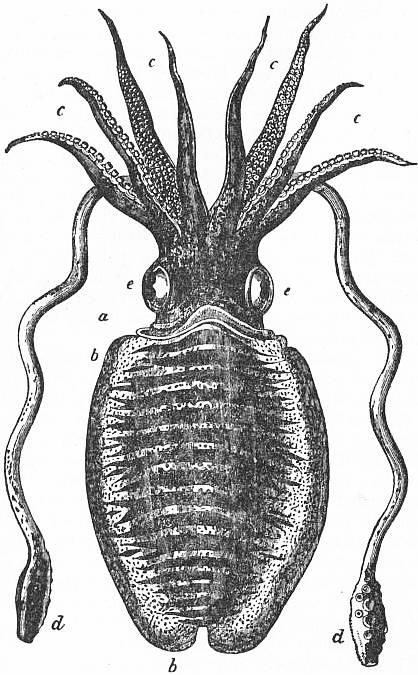
Fig. 1.—Sepia officinalis, L., about ½ natural size, as seen when dead, the long prehensile arms being withdrawn from the pouches at the side of the head, in which they are carried during life when not actually in use. a, Neck; b, lateral fin of the mantle-sac; c, the eight shorter arms of the fore-foot; d, the two long prehensile arms; e, the eyes.
The Sepia feeds principally on Crustacea, and in aquaria has been observed to pursue and capture prawns. The method in which it secures its prey has been carefully observed and described by the present writer, who studied the living animal in the aquarium of the biological laboratory at Plymouth. The prawns support themselves on their long slender legs on convenient points of the rockwork, and the Sepia stalks them with great caution and determination, the rapid play of its chromatophores giving evidence of its excitement. When it has arrived within striking distance, the two tentacular arms are shot out with great rapidity, and the prawn is seized between the two expanded ends, drawn within the circle of short arms, and devoured; unless, as sometimes happens, the prawn springs away and the Sepia misses its aim.
Two species of Sepia occur in British and European waters, including the Mediterranean, namely, S. elegans and S. officinalis. The usual length of the body is about 9 or 10 in. They live mostly between ten and forty fathoms, coming into shallower water in July and August to deposit their eggs, which are about as large as black currants and of somewhat similar colour, and are connected by elongated stalks into a cluster attached to the sea-bottom. Other species occur in various parts of the world, e.g. S. cultrata, which is common on the coasts of Australia. The Sepiidae form the only family of cuttle-fishes in which the shell is calcified. They belong to the tribe Myopsida, characterized by the complete closure of the external corneal covering of the eye outside the iris and the lens.
Sepiola and Rossia belong to another family of the Myopsida. Both are British genera living in shallow water, and entering estuaries. The animals of both genera are small, not more than 2 or 3 in. in length, with the body rounded at the aboral end, and the fins short and rounded, inserted in the middle of the body length, instead of extending from end to end. Sepiola, although it swims by means of its fins and funnel when active, spends much of its time buried in the sand for concealment. Rossia has similar habits. The shell is chitinous and shorter than the body. In other genera of the Sepiolidae the shell is entirely absent. Idiosepius is the smallest of the Cephalopoda, only 1.5 in. in length. It inhabits the Indian Ocean. The body is elongated and the fins rudimentary. In the Sepiadariidae also the shell is absent. The body is short and the mantle united with the head dorsally. The two genera Sepiadarium and Sepioloidea occur in the Pacific Ocean. The common squid Loligo is the type of the only remaining family of the Myopsida. In this species the shell is a well-developed chitinous pen or gladius with a thickened axis narrowing to a point behind, but bearing posteriorly a wide thin plate on each side. The shape closely resembles that of a quill pen with the quill in front. The fins are large and triangular, extending over rather more than half of the length of the body aborally. The tentacular arms are only partly retractile. The body is elongated and conical, and reaches about a foot in length. The squid is gregarious, and forms a favourite food of the larger fishes, especially of conger. All the Myopsida are more or less littoral in habit, and the British forms are familiar in consequence of their frequent capture in the nets of fishermen. The shell, or “bone” as it is commonly called, of the common Sepia frequently occurs in abundance on the shore among the sea-weed and other refuse left by the tide.
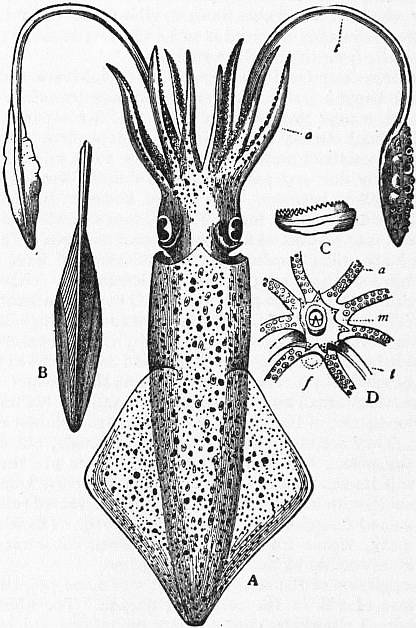
Fig. 2.—A, Loligo vulgaris; a, arms; t, tentacles. B, Pen of the same reduced in size. C, Side-view of one of the suckers, showing the horny hooks surrounding the margin. D, View of the head from in front, showing the arms (a), the tentacles (t), the mouth (m), and the funnel (f).
The Oigopsida, or cuttle-fishes in which the corneal covering of the eye is perforated, are on the whole more oceanic than littoral, and many of the species are abyssal. Ommatostrephes sagittatus is one of the forms that occurs off the British coasts, especially the more northern, e.g. in the Firth of Forth. In general appearance it resembles the common squid, but the fins are broader and shorter, not extending to the middle of the body. The shell is similar to that of Loligo, but ends aborally in a little hollow cone. The suckers bear chitinous rings which are toothed along the outer edge. The tentacular arms are rather short and thick. Two specimens of allied species have been taken on British coasts, one of which, captured off Salcombe in Devonshire in 1892, had a body 66 cm. (22 in.) long, and tentacular arms 64 cm. long, or nearly the same length as the body. Most of the species of Ommatostrephes are naturally gregarious and oceanic, and occur in the open seas in all latitudes, swimming near the surface and often leaping out of the water. They are largely devoured by albatrosses and other marine birds, and by Cetacea. They are used as bait in the Newfoundland cod fishery.
Some of the oceanic cuttle-fishes reach a very large size, and the stories of these ocean monsters which are narrated by the older writers, though to some extent exaggerated, are now known to be founded on fact. The figure given by one author of a gigantic Cephalopod rising from the surface of the ocean and embracing with its arms a full-rigged ship does not accurately represent an actual occurrence, but on the other hand there are authentic instances on record of fishermen in small boats on the banks of Newfoundland being in great peril in consequence of large squids throwing their arms across their boats. In November 1874 a specimen was brought ashore at St John’s, Newfoundland, which had been caught in herring nets. Its body was 7 ft. long, its fins 22 in. broad, and its tentacular arms 24 ft. long. Several others have been recorded, taken in the same region, which were as large or larger, the total length of the body and tentacles together varying from 30 to 52 ft., and the estimated weight of one of them being 1000 ℔.
In April 1875 one of these large squids occurred off Boffin’s Island on the Irish coast. The crew of a curragh rowed out to it and attacked it, cutting off two of its arms and its head. The shorter arms measured 8 ft. in length and 15 in. in circumference; the tentacular arms are said to have been 30 ft. long. In the Natural History Museum in London there is one of the shorter arms of a specimen; this arm is 9 ft. in length and 11 in. in circumference, and the total length of the specimen, including body and tentacles, is stated to have been 40 ft. The maximum known length of these giant squids is stated to be 18 metres or about 58½ ft. All these gigantic specimens belong, so far as at present known, to one genus called Architeuthis, referred to the same family as Ommatostrephes. They are the largest known invertebrates.
These huge cuttle-fishes as well as those of various other oceanic species form the food of the cachalot or sperm whale, and F. T. Bullen, in his Cruise of the Cachalot and other writings, has graphically described contests which came under his own observation between the cachalot and its prey. The prince of Monaco in his yacht the “Princess Alice” was fortunate enough to be able to make a very complete scientific investigation in the case of one specimen of the cachalot, which not only confirmed the most important of Mr Bullen’s statements, but added considerably to our knowledge of oceanic cuttle-fishes. Off the Azores in July 1895 the prince in his yacht witnessed the killing of a cachalot 13.70 metres long (about 45 ft. 8 in.) by the crew of a whaler. The animal in its death-agony vomited the contents of its stomach, most of which were carefully collected and preserved, and afterwards examined by Professor Joubin. On the lips of the whale were found impressions several centimetres wide which corresponded exactly to the toothed suckers of the largest cuttle-fish arms obtained from its stomach. The contents of the stomach consisted entirely of cuttle-fish or parts of cuttle-fish, including the giant Architeuthis, and among them was the body, without the head, of a form new to science, distinguished by a condition of the external surface which occurs in no other species of the group. The surface of the skin was divided into small angular flat projections like scales, arranged in a regular spiral like the scales of a pine cone. From this character the new genus was called Lepidoteuthis. The body, without the head, of the specimen obtained was 86 cm. (nearly 3 ft.) in length.
The family Onychoteuthidae is remarkable for the formidable chitinous hooks borne on the arms. These hooks are special modifications of the toothed chitinous ring which covers the sucker-rim in the Decapoda generally. The teeth of the ring are often unequal in size, and in the Onychoteuthidae one tooth is enormously developed. The maximum development occurs in Veranya, found in the Mediterranean, where the suckers have lost their function and are merely fleshy projections bearing the hooks at their extremities. Onychoteuthis reaches a large size, the length of the body without the arms being in one specimen from the Pacific coast of America 8 ft. Figures of this and several of the following genera are given in the article Cephalopoda.
In the family Cheiroteuthidae many of the species occur at abyssal depths of the ocean, and exhibit curious modifications of structure. In Cheiroteuthis itself the tentacular arms are very long and slender, and are not capable of retraction into pockets. In several species of this genus the suckers are no longer organs of adhesion, but are simple cups containing a network of filaments resembling a fishing net. In Histioteuthis and Histiopsis, as in some Octopods, the six dorsal arms are more or less completely united by a web, which also probably serves for capturing fish. In these two genera and in Calliteuthis the skin bears luminous organs. Cheiroteuthis has been taken at 2600 fms., Calliteuthis at 2200, Histiopsis at nearly 2000. Bathyteuthis, placed in the same family as Ommatostrephes, has been taken at 1700 fms.
The Cranchiidae are remarkable for their small size, the shortness of the ordinary arms, and the protuberance of the eyes, which in Taonius are actually on the ends of stalk-like outgrowths of the body. Cranchia is a deep-sea form taken at 1700 fms. Its body is pear-shaped, swollen posteriorly and quite narrow at the neck.
Spirula is distinguished from all other existing Cephalopods by the structure of its coiled shell, which in many respects resembles those of the extinct Ammonites, and is not completely internal. In the structure of the body the animal is a true cuttle-fish in the sense in which the term is here used, having ten arms and a perforated cornea. Three species are distinguished, and their empty shells occur abundantly on the shores of the tropical regions of the Atlantic, Pacific and Indian Oceans. In German the shells are known from their shape as Posthörnchen. They are common on the shores of the Azores. But the animal has very rarely been obtained; only a few specimens occur in museum collections. One specimen was taken by the “Challenger” in a deep-sea trawl, at a depth between 300 and 400 fathoms off Banda Neira in the Molluccas. Dr Willemoes Suhm, in describing the capture, stated that the specimen seemed to have been in the stomach of a fish, as its surface was slightly digested, and he thought it must have habits of concealment which usually prevent its capture, and that it was secured on this occasion only by the capture of the fish which had swallowed it. The fact that the shells are washed ashore in such large numbers is not fully explained. Possibly when freed from the animal the air in the chambers of the shell causes it to float, and in that case it would naturally be sooner or later washed ashore.
(J. T. C.)
CUTTS OF GOWRAN, JOHN CUTTS, Baron (1661-1707), British soldier and author, came of an Essex family. After a short university career at Catherine Hall, Cambridge, he came into the enjoyment of the family estates, but evinced a decided preference for the life of court and camp. The double ambition for military and literary fame inspired his first work, which appeared in 1685 under the name La Muse de cavalier, or An Apology for such Gentlemen as make Poetry their Diversion not their Business. The next year saw Cutts serving as a volunteer under Charles of Lorraine in Hungary, and it is said that he was the first to plant the imperialist standard on the walls at the storm of Buda (July 1686). In 1687 he published a book of verse entitled Poetical Exercises, and the following year we find him serving as lieutenant-colonel in Holland. General Hugh Mackay describes Cutts about this time as “pretty tall, lusty and well shaped, an agreeable companion with abundance of wit, affable and familiar, but too much seized with vanity and self-conceit.”
Lieutenant-Colonel Cutts was one of William’s companions in the English revolution of 1688, and in 1690 he went in command of a regiment of foot to the Irish war. He served with distinction at the battle of the Boyne, and at the siege of Limerick (where he was wounded), and King William created him Baron Cutts of Gowran in the kingdom of Ireland. In 1691 he succeeded to the command of the brigade of the prince of Hesse (wounded at Aughrim), and on the surrender of Limerick was appointed commandant of the town. Next year he served again in Flanders as a brigadier, his brigade of Mackay’s division being one of those almost destroyed at Steinkirk. At this battle Cutts himself was wounded. For some time after this, Lord Cutts was lieutenant-governor of the Isle of Wight, but he returned to active service in 1694, holding a command in the disastrous Brest expedition. He was one of Carmarthen’s companions in the daring reconnaissance of Camaret Bay, and was soon afterwards again wounded. He succeeded Talmash, the commander of the expedition (who died of his wounds), as colonel of the Coldstream Guards. Next year, after serving as a commissioner for settling the bank of Antwerp, he distinguished himself once more at the famous siege of Namur, winning for himself the name of “Salamander” by his indifference to the heaviest fire. Henceforward court service and war service alternated. He was deep in the confidence of William III., and acted as a diplomatic agent in the negotiations which ended in the peace of Ryswick. On the occasion of the great fire in Whitehall (1698) Cutts, at the head of the Coldstreams, earned afresh the honourable nickname of “the Salamander.” A little later we find Captain Richard Steele acting as his private secretary. In 1702, now a major-general, Cutts was serving under Marlborough in the opening campaign of the War of the Spanish Succession, and at the siege of Venloo, conspicuous as usual for romantic bravery, he led the stormers at Fort Saint Michael. His enemies, and even the survivors of the assault, were amazed at the success of a seemingly hare-brained enterprise. Probably, however, Cutts, who was now a veteran of great and varied experience, measured the factors of success and failure better than his critics. It was on this occasion that Swift lampooned the lieutenant-general in his Ode to a Salamander. He made the campaign of 1703 in Flanders, and in 1704, after a visit to England, he rejoined Marlborough on the banks of the Danube. At Blenheim he was third in command, and it was his division that bore the brunt of the desperate fighting at the village which gave its name to the battle.
Blenheim was Cutts’s last battle. His remaining years were spent at home, and, at the time of his death, he was the holder of eight distinct political and military offices. He sat in five parliaments for the county of Cambridge, and in Queen Anne’s first Parliament he was returned for Newport in the Isle of Wight, for which he sat until the time of his death. He was twice married, but left no issue.
CUVIER, GEORGES LÉOPOLD CHRÉTIEN FRÉDÉRIC DAGOBERT, Baron (1769-1832), French naturalist, was born on the 23rd of August 1769 at Montbéliard, and was the son of a retired officer on half-pay belonging to a Protestant family which had emigrated from the Jura in consequence of religious persecution. He early showed a bent towards the investigation of natural phenomena, and was noted for his studious habits and marvellous memory. After spending four years at the Academy of Stuttgart, he accepted the position of tutor in the family of the Comte d’Héricy, who was in the habit of spending the summer near Fécamp. It thus came about that he made the acquaintance of the agriculturist, A. H. Tessier, who was then living at Fécamp, and who wrote strongly in favour of his protégé to his friends in Paris—with the result that Cuvier, after corresponding with the well-known naturalist E. Geoffroy Saint-Hilaire, was appointed in 1795 assistant to the professor of comparative anatomy at the Muséum d’Histoire Naturelle. The National Institute was founded in the same year and he was elected a member. In 1796 he began to lecture at the École Centrale du Panthéon, and at the opening of the National Institute in April, he read his first palaeontological paper, which was subsequently published in 1800 under the title Mémoires sur les espèces d’éléphants vivants et fossiles. In 1798 was published his first separate work, the Tableau élémentaire de l’histoire naturelle des animaux, which was an abridgment of his course of lectures at the École du Panthéon, and may be regarded as the foundation and first and general statement of his natural classification of the animal kingdom.
In 1799 he succeeded L. J. M. Daubenton as professor of natural history in the Collège de France, and in the following year he published the Leçons d’anatomie comparée, a classical work, in the production of which he was assisted by A. M. C. Dumeril in the first two volumes, and by G. L. Duvernoy in three later ones. In 1802 Cuvier became titular professor at the Jardin des Plantes; and in the same year he was appointed commissary of the Institute to accompany the inspectors-general of public instruction. In this latter capacity he visited the south of France; but he was in the early part of 1803 chosen perpetual secretary of the National Institute in the department of the physical and natural sciences, and he consequently abandoned the appointment just mentioned and returned to Paris.
He now devoted himself more especially to three lines of inquiry—one dealing with the structure and classification of the mollusca, the second with the comparative anatomy and systematic arrangement of the fishes, and the third with fossil mammals and reptiles primarily, and secondarily with the osteology of living forms belonging to the same groups. His papers on the mollusca began as early as 1792, but most of his memoirs on this branch were published in the Annales du muséum between 1802 and 1815; they were subsequently collected as Mémoires pour servir à l’histoire et à l’anatomie des mollusques, published in one volume at Paris in 1817. In the department of fishes, Cuvier’s researches, begun in 1801, finally culminated in the publication of the Histoire naturelle des poissons, which contained descriptions of 5000 species of fishes, and was the joint production of Cuvier and A. Valenciennes, its publication (so far as the former was concerned) extending over the years 1828-1831. The department of palaeontology dealing with the Mammalia may be said to have been essentially created and established by Cuvier. In this region of investigation he published a long list of memoirs, partly relating to the bones of extinct animals, and partly detailing the results of observations on the skeletons of living animals specially examined with a view of throwing light upon the structure and affinities of the fossil forms. In the second category must be placed a number of papers relating to the osteology of the Rhinoceros Indicus, the tapir, Hyrax Capensis, the hippopotamus, the sloths, the manatee, &c. In the former category must be classed an even greater number of memoirs, dealing with the extinct mammals of the Eocene beds of Montmartre, the fossil species of hippopotamus, the Didelphys gypsorum, the Megalonyx, the Megatherium, the cave-hyaena, the extinct species of rhinoceros, the cave-bear, the mastodon, the extinct species of elephant, fossil species of manatee and seals, fossil forms of crocodilians, chelonians, fishes, birds, &c. The results of Cuvier’s principal palaeontological and geological investigations were ultimately given to the world in the form of two separate works. One of these is the celebrated Recherches sur les ossements fossiles de quadrupèdes, published in Paris in 1812, with subsequent editions in 1821 and 1825; and the other is his Discours sur les révolutions de la surface du globe, published in Paris in 1825.
But none of his works attained a higher reputation than his Règne animal distribué d’après son organisation, the first edition of which appeared in four octavo volumes in 1817, and the second in five volumes in 1829-1830. In this classical work Cuvier embodied the results of the whole of his previous researches on the structure of living and fossil animals. The whole of the work was his own, with the exception of the Insecta, in which he was assisted by his friend P. A. Latreille.
Apart from his own original investigations in zoology and palaeontology Cuvier carried out a vast amount of work as perpetual secretary of the National Institute, and as an official connected with public education generally; and much of this work appeared ultimately in a published form. Thus, in 1808 he was placed by Napoleon upon the council of the Imperial University, and in this capacity he presided (in the years 1809, 1811 and 1813) over commissions charged to examine the state of the higher educational establishments in the districts beyond the Alps and the Rhine which had been annexed to France, and to report upon the means by which these could be affiliated with the central university. Three separate reports on this subject were published by him. In his capacity, again, of perpetual secretary of the Institute, he not only prepared a number of éloges historiques on deceased members of the Academy of Sciences, but he was the author of a number of reports on the history of the physical and natural sciences, the most important of these being the Rapport historique sur le progrès des sciences physiques depuis 1789, published in 1810. Prior to the fall of Napoleon (1814) he had been admitted to the council of state, and his position remained unaffected by the restoration of the Bourbons. He was elected chancellor of the university, in which capacity he acted as interim president of the council of public instruction, whilst he also, as a Lutheran, superintended the faculty of Protestant theology. In 1819 he was appointed president of the committee of the interior, and retained the office until his death. In 1826 he was made grand officer of the Legion of Honour; and in 1831 he was raised by Louis Philippe to the rank of peer of France, and was subsequently appointed president of the council of state. In the beginning of 1832 he was nominated to the ministry of the interior, but on the 13th of May he died in Paris after a brief illness.
See P. J. M. Flourens, Éloge historique de G. Cuvier, published as an introduction to the Éloges historiques of Cuvier; Histoire des travaux de Georges Cuvier (3rd ed., Paris, 1858); A. P. de Candolle, “Mort de G. Cuvier,” Bibliothèque universelle (1832, 59, p. 442); C. L. Laurillard, “Cuvier,” Biographie universelle, supp. vol. 61 (1836); Sarah Lee, Memoirs of Cuvier, translated into French by T. Lacordaire (1833).
CUVILLES, FRANÇOIS DE (1698-c. 1767), French architect and engraver. He helped to carry the French rococo taste to Germany—he was summoned about 1720 to Cologne by the elector James Clement; in 1738 he became architect to the elector of Bavaria, and afterwards occupied the same position towards the emperor Charles VII. His style, while essentially thin, is often painfully elaborate and bizarre. He designed mirrors and consoles, balustrades for staircases, ceilings and fireplaces, and in furniture, beds and commodes especially. He also laid out parks and gardens. He wrote several treatises on artistic and decorative subjects, which were edited by his son, François de Cuvilles the younger, who succeeded his father at the court of Munich.
CUXHAVEN, or Kuxhaven, a seaport town of Germany, belonging to the state of Hamburg, and situated at the extremity of the west side of the mouth of the Elbe, 71 m. by rail N.W. from Hamburg. Pop. (1900) 6898. The harbour is good and secure, and is much frequented by vessels delayed in the Elbe by unfavourable weather. A new harbour was made in 1891-1896, having a depth of 26¼ ft., with a fore port 1000 ft. long by 800 ft. wide; and it is now the place of departure and arrival of the mail steamers of the Hamburg-American Steamship Company, who in 1901 transferred here a part of their permanent staff. The port is free, i.e. outside the customs union (Zollverein), the imports being principally coals, bricks and timber, and the exports fish. There is a fishing fleet, for which a new harbour was opened in 1892. Though lying on a bare strand, the town is much frequented as a bathing place by Hamburgers. It is strongly fortified, and there are a lighthouse, and lifeboat and pilot stations. The town only dates from 1873, having been formed by uniting the villages of Ritzebüttel and Cuxhaven, which had belonged to Hamburg since 1394.
CUYABÁ, or Cuiabá, capital of the inland state of Matto Grosso, Brazil, about 972 m. N.W. of Rio de Janeiro, on the Cuyabá river near its discharge into the São Lourenço, the principal Brazilian tributary of the Paraguay. Pop. (1890) 14,507; of the municipality, 17,815. The surrounding country is thickly populated. Cuyabá has uninterrupted steamer communication with Montevideo, about 2500 m. distant, but has no land communication with the national capital, except by telegraph. The climate is hot and malaria is prevalent. Cuyabá was founded in 1719 by Paulista gold hunters, and its gold-washings, now apparently exhausted, yielded rich results in the 18th century. It is the see of a bishopric and headquarters of an important military district, having an arsenal and military barracks.
CUYAPO, a town of the province of Nueva Ecija, Luzon, Philippine Islands, 28 m. N.N.W. of San Isidro, the capital. Pop. (1903) 16,292. Rice is grown here. In 1907 the town of Nampicuan was formed from part of Cuyapo.
CUYP, the name of a Dutch family which produced two generations of painters. The Cuyps were long settled at Dordrecht, in the neighbourhood of which they had a country house, where Albert Cuyp (the most famous) was born and bred.
The eldest member of the family who acquired fame was Jacob Gerritsz Cuyp, born it is said at Dordrecht in 1575, and taught by Abraham Bloemaert of Utrecht. He is known to have been alive in 1649, and the date of his death is obscure. J. G. Cuyp’s pictures are little known. But he produced portraits in various forms, as busts and half-lengths thrown upon plain backgrounds, or groups in rooms, landscapes and gardens. Solid and clever as an imitator of nature in its ordinary garb, he is always spirited, sometimes rough, but generally plain, and quite as unconscious of the sparkle conspicuous in Frans Hals as incapable of the concentrated light-effects peculiar to Rembrandt. In portrait busts, of which there are signed examples dated 1624, 1644, 1646 and 1649, in the museums of Berlin, Rotterdam, Marseilles, Vienna and Metz, his treatment is honest, homely and true; his touch and tone firm and natural. In portraying children he is fond of introducing playthings and pets—a lamb, a goat or a roedeer; and he reproduces animal life with realistic care. In a family scene at the Amsterdam Museum we have likenesses of men, women, boys and girls with a cottage and park. In the background is a coach with a pair of horses. These examples alone give us a clue to the influences under which Albert Cuyp grew up, and explain to some extent the direction which his art took as he rose to manhood.
Albert Cuyp (1620-1691), the son of Jacob Gerritsz by Grietche Dierichsdochter (Dierich’s daughter), was born at Dordrecht. He married in 1658 Cornelia Bosman, a rich widow, by whom he had an only daughter. By right of his possessions at Dordwyck, Cuyp was a vassal of the county of Holland, and privileged to sit in the high court of the province. As a citizen he was sufficiently well known to be placed on the list of those from whom William III., stadtholder of the Netherlands, chose the regency of Dordrecht in 1672. His death, and his burial on the 7th of November 1691 in the church of the Augustines of Dordrecht, are historically proved. But otherwise the known facts concerning his life are few. He seldom dates his pictures, but it appears probable that he ceased to paint about 1675. It has been said that Albert was the pupil of his father. The scanty evidence of Dutch annalists to this effect seems confirmed by a certain coincidence in the style and treatment of father and son. That he was a pupil of van Goyen has been surmised on the strength of the style of his early works. It has been likewise stated that Albert was skilled, not only in the production of portraits, landscapes and herds, but in the representation of still life. His works are supposed to be divisible into such as bear the distinctive marks C. or A. C. in cursive characters, the letters A. C. in Roman capitals, and the name “A. Cuyp” in full. A man of Cuyp’s acknowledged talent may have been versatile enough to paint in many different styles. But whether he was as versatile as some critics have thought is a question not quite easy to answer. It is to be observed that pieces assigned to Cuyp representing game, shell-fish and fruit, and inscribed A. C. in Roman capitals (Rotterdam, Amsterdam and Berlin museums), though cleverly executed, are not in touch or treatment like other pictures of less dubious authenticity, signed either with C. or A. C. or “A. Cuyp” in cursive letters. The panels marked C. and A. C. in cursive are portraits or landscapes, with herds, and interiors of stables or sheds, in which there are cows, horses and poultry. The subjects and their handling are akin to those which strike us in panels bearing the master’s full signature, though characterized, as productions of an artist in the first phase of his progress would naturally be, by tones more uniform, touch more flat, and colour more deep than we find in the delicate and subtle compositions of the painter’s later time. Generally speaking, the finished examples of Cuyp’s middle and final period all bear his full signature. They are all remarkable for harmonies attained by certain combinations of shade in gradations with colours in contraposition.
Albert Cuyp, a true child of the Netherlands, does not seem to have wandered much beyond Rotterdam on the one hand or Nijmwegen on the other. His scenery is that of the Meuse or Rhine exclusively; and there is little variety to notice in his views of water and meadows at Dordrecht, or the bolder undulations of the Rhine banks east of it, except such as results from diversity of effect due to change of weather or season or hour. Cuyp is to the river and its banks what Willem Vandevelde is to calm seas and Hobbema to woods. There is a poetry of effect, an eternity of distance in his pictures, which no Dutchman ever expressed in a similar way. His landscapes sparkle with silvery sheen at early morning, they are bathed in warm or sultry haze at noon, or glow with heat at eventide. Under all circumstances they have a peculiar tinge of auburn which is Cuyp’s and Cuyp’s alone. Bürger truly says van Goyen is gray, Ruysdael is brown, Hobbema olive, but Cuyp “is blond.” The utmost delicacy may be observed in Cuyp’s manner of defining reflections of objects in water, or of sight from water on ship’s sides. He shows great cleverness in throwing pale-yellow clouds against clear blue skies, and merging yellow mists into olive-green vegetation. He is also very artful in varying light and shade according to distance, either by interchange of cloud-shadow and sun-gleam or by gradation of tints. His horses and cattle are admirably drawn, and they relieve each other quite as well if contrasted in black and white and black and red, or varied in subtler shades of red and brown. Rich weed-growth is expressed by light but marrowy touch, suggestive of detail as well as of general form. The human figure is given with homely realism in most cases, but frequently with a charming elevation, when, as often occurs, the persons represented are meant to be portraits. Whatever the theme may be it remains impressed with the character and individuality of Cuyp. Familiar subjects of the master’s earlier period are stables with cattle and horses (Rotterdam, Amsterdam, Petersburg and Brussels museums). Occasionally he painted portraits in the bust form familiar to his father, one of which is dated 1649, and exhibited in the National Gallery, London. More frequently he produced likenesses of ladies and gentlemen on horseback, in which the life and dress of the period and the forms of horses are most vividly represented (Buckingham Palace, Bridgewater Gallery, Louvre and Dresden Museum). Later on we find him fondest of expansive scenery with meadows and cattle and flocks, or rivers and barges in the foreground and distances showing the towers and steeples of Dordrecht. Cuyp was more partial to summer than to winter, to noon than to night, to calm than to storm. But some of his best groups are occasionally relieved on dark and gusty cloud (Louvre and Robarts’s collection). A few capital pieces show us people sledging and skating or netting ice-holes (Yarborough, Neeld and Bedford collections). A lovely “Night on the Banks of a River,” in the Grosvenor collection, reminds us that Cuyp’s friend and contemporary was the painter of moonlights, Aart van der Neer, to whom he was equal in the production of these peculiar effects and superior in the throw of figures. Sometimes Cuyp composed fancy subjects. His “Orpheus charming the Beasts,” in the Bute collection, is judiciously arranged with the familiar domestic animals in the foreground, and the wild ones, to which he is a comparative stranger, thrown back into the distance. One of his rare gospel subjects is “Philip baptizing the Eunuch” (Marchmont House, Berwickshire), described as a fine work by Waagen. The best and most attractive of Cuyp’s pieces are his Meuse and Rhine landscapes, with meadows, cattle, flocks and horsemen, and occasionally with boats and barges. In these he brought together and displayed—during his middle and final period—all the skill of one who is at once a poet and a finished artist; grouping, tinting, touch, harmony of light and shade, and true chords of colours are all combined. Masterpieces of acknowledged beauty are the “Riders with the Boy and Herdsman” in the National Gallery; the Meuse, with Dordrecht in the distance, in three or four varieties, in the Bridgewater, Grosvenor, Holford and Brownlow collections; the “Huntsman” (Ashburton); “Herdsmen with Cattle,” belonging to the marquess of Bute; and the “Piper with Cows,” in the Louvre. The prices paid for Cuyp’s pictures in his own time were comparatively low. In 1750, 30 florins was considered to be the highest sum to which any one of his panels was entitled. But in more recent times the value of the pictures has naturally risen very largely. At the sale of the Clewer collection at Christie’s in 1876 a small “Hilly Landscape in Morning Light” was sold for £5040, and a view on the Rhine, with cows on a bank, for £3150.
(J. A. C.)
John Smith’s Catalogue raisonné of the Dutch and Flemish painters, in 9 vols. (1840), enumerated 335 of Albert Cuyp’s works, of which in 1877 Sir J. A. Crowe wrote in this encyclopaedia that “it would be difficult now to find more than a third of them.” In C. Hofstede de Groot’s Catalogue raisonné, vol. ii. (1909), revising Smith’s, the number is extended to nearly 850, but he accepts too readily the attributions of sale catalogues; the work is, however, the best modern authority on the painter.
CUZA (or Couza), ALEXANDER JOHN [Alexandru Joan] (1820-1873), first prince of Rumania, was born on the 20th of March 1820, at Galatz in Moldavia, and belonged to an ancient boiar, or noble, family. He was educated at Jassy, Pavia, Bologna and Athens; and, after a brief period of military service, visited Paris from 1837 to 1840 for a further course of study. In 1845 he married the daughter of another boiar, Elena Rosetti, who in 1862 founded the Princess Elena refuge for orphans, at Bucharest. Cuza was imprisoned by the Russian authorities for taking part in the Rumanian revolution of 1848, but escaped to Vienna. On his return, in 1850, he was appointed prefect of Galatz. In 1857 he rejoined the army, and within a few months rose to the rank of colonel. He became minister of war in 1858, and represented Galatz in the Assembly which was elected in the same year to nominate a prince for Moldavia. Cuza was a prominent speaker in the critical debates which ensued when the assembly met at Jassy, and strongly advocated the union of the two Danubian principalities, Moldavia and Walachia. In default of a foreign prince, he was himself elected prince of Moldavia by the assembly at Jassy (17th Jan. 1859), and prince of Walachia by the assembly at Bucharest (5th Feb.). He thus became ruler of the united principalities, with the title Prince Alexander John I.; but as this union was forbidden by the congress of Paris (18th Oct. 1858), his authority was not recognized by his suzerain, the sultan of Turkey, until the 23rd of December 1861, when the union of the principalities under the name of Rumania was formally proclaimed. For a full account of Cuza’s reign see Rumania. The personal vices of the prince, and the drastic and unconstitutional reforms which he imposed on all classes, alienated his subjects, although many of these reforms proved to be of lasting excellence. Financial distress supervened, and the popular discontent culminated in revolution. At four o’clock on the morning of the 22nd of February 1866, a band of military conspirators broke into the palace, and compelled the prince to sign his abdication. On the following day they conducted him safely across the frontier. Prince Alexander spent the remainder of his life chiefly in Paris, Vienna and Wiesbaden. He died at Heidelberg on the 15th of May 1873.
CUZCO, an inland city of southern Peru, capital of an Andean department of the same name, about 360 m. E.S.E. of Lima, in lat. 13° 31′ S., long. 73° 03′ W. The population, largely composed of Indians and mestizos, was estimated at 30,000 in 1896, but according to the official estimate of 1906, it was then about 25% less. The city stands at the head of a small valley, 11,380 ft. above sea-level, and is nearly enclosed by mountains of considerable elevation. The valley itself is 9 m. in length and extends S.E. to the valley of Vilcamayu. Overlooking the city from the N. is the famous hill of Sacsahuaman, crowned by ruins of the cyclopean fortress of the Incas and their predecessors, and separated from adjacent heights by the deep ravines of two streams, called the Huatenay and Rodadero. The principal part of the city lies between these two streams, with its great plaza in the centre. On the W. side of the Huatenay are two more fine squares, called the Cabildo and San Francisco. The houses of the city are built of stone, their walls commonly showing the massive masonry of the Incas at the bottom, crowned with a light modern superstructure roofed with red tiles. The streets cross each other at right angles and afford fine vistas on every side. The principal public buildings are the cathedral, which is classed among the best in South America, the convent of San Domingo, which partly occupies the site of the great Temple of the Sun of the Incas, the cabildo or government-house, a university founded in 1598, a college of science and arts, a public library, hospital, mint and museum of Incarial antiquities. Cuzco was made the see of a bishopric soon after it was occupied by the Spaniards. The Church has always exercised a dominating influence in this region, and the city has many churches and religious establishments. There are a number of small manufacturing industries in Cuzco, including the manufacture of cotton and woollen fabrics, leather, beer, embroidery and articles of gold and silver. Its trade is not large, however, owing to the costs of transportation. The climate is cool and bracing, and the products of the vicinity include many of the temperate zone. A railway from Juliaca (a station on the line from Mollendo to Puno) to Cuzco was virtually completed early in 1908. This railway gives Cuzco an outlet to the coast, and also direct connexion with La Paz, the Bolivian capital. A branch of the Callao & Oroya railway is also projected southward to Cuzco, and reached Huancayo in 1908. Cuzco was the capital of a remarkable empire ruled by the Incas previous to the discovery of Peru, and it was one of the largest and most civilized of the native cities of the New World. It was captured by Pizarro in 1533, and it is said that its size and the magnificence of its principal edifices filled the Spaniards with surprise. It was for many years an object of contention among the Spanish factions, but ultimately the greater attractions of Lima and its own isolation diminished its importance.
The department of Cuzco is the second largest in Peru, having an area of 156,317 sq. m., and a population, according to a reduced official estimate of 1906, of only 328,980. It occupies an extremely mountainous region on the frontier of Bolivia, E. of the departments of Junin, Ayacucho and Apurimac, and extends from Loreto on the N. to Puno and Arequipa on the S. Its area, however, includes a large district E. of the Andes which is claimed by Bolivia, and the settlement of the dispute may materially diminish its size. The elevation of a large part of the department gives it a temperate climate and permits the cultivation of cereals and other products of the temperate zone. Cattle and sheep are produced in large numbers in some of the provinces, while in others mining forms the chief industry. On the eastern forested slopes and in the lower valleys tropical conditions prevail. The population is chiefly composed of Indians who form a sturdy, docile labouring class, but are in great part strongly disinclined to accept the civilization of the dominant white race.
CYANAMIDE, NC·NH2, the amide of normal cyanic acid, obtained by the action of ammonia on cyanogen chloride, bromide or iodide, or by the desulphurization of thio-urea with mercuric oxide; it is generally prepared by the latter process. It forms white crystals, which melt at 40° C., and are readily soluble in water, alcohol and ether. Heated above its melting point it polymerizes to di-cyandiamide (CN2H2)2, which at 150° C. is transformed into the polymer n-tri-cyantriamide or melamine (CN2H2)3, the mass solidifying. Nascent hydrogen reduces cyanamide to ammonia and methylamine. It gives mono-metallic salts of the type NC·NHM when treated with aqueous or alcoholic solutions of alkalis. Di-metallic salts are obtained by heating cyanates alone, e.g. calcium, or cyanides in a current of nitrogen, e.g. barium.
Calcium cyanamide has assumed importance in agriculture since the discovery of its economic production in the electric furnace, wherein calcium carbide takes up nitrogen from the atmosphere to form the cyanamide with the simultaneous liberation of carbon. It may also be produced by heating lime or chalk with charcoal to 2000° in a current of air. The commercial product (which is known in Germany as “Kalkstickstoff”) contains from 14 to 22% of nitrogen, which is liberated as ammonia when the substance is treated with water; to this decomposition it owes its agricultural value. It appears that with soils which are not rich in humus or not deficient in lime, calcium cyanamide is almost as good, nitrogen for nitrogen, as ammonium sulphate or sodium nitrate; but it is of doubtful value with peaty soils or soils containing little lime, nor is it usefully available as a top-dressing or for storing.
CYANIC ACID AND CYANATES. Cyanic acid, CN·OH, was discovered by F. Wöhler in 1824, and may be obtained by distilling its polymeride, cyanuric acid, in a current of carbon dioxide (F. Wöhler and J. v. Liebig, Berzelius Jahresberichte, 1827, 11, p. 84), the vapours which distil over being condensed in a freezing mixture. It is a very volatile liquid of strong acid reaction, and is only stable below 0° C. It has a smell resembling that of acetic acid. At 0° C. it is rapidly converted into a mixture of cyanuric acid, C3N3O3H3, and another polymer, cyamelide (CNOH)x; this latter substance is a white amorphous powder, insoluble in water. An aqueous solution of cyanic acid is rapidly hydrolysed (above 0° C.) into a mixture of carbon dioxide and ammonia. Cyanogen chloride, CNCl, may be regarded as the chloride of cyanic acid. It may be prepared by the action of chlorine on hydrocyanic acid or on mercury cyanide. It is a very poisonous volatile liquid, which boils at 15.5° C. It polymerizes readily to cyanuric chloride, C3N3Cl3. Caustic alkalis hydrolyse it readily to the alkaline chloride and cyanate.
The salts of cyanic acid are known as the cyanates, the two most important being potassium cyanate (KOCN) and ammonium cyanate (NH4OCN). Potassium cyanate may be prepared by heating potassium cyanide with an oxidizing agent, or by heating potassium ferrocyanide with manganese dioxide, potassium carbonate or potassium dichromate (J. v. Liebig, Ann., 1841, 38, p. 108; C. Lea, Jahresb., 1861, p. 789; L. Gattermann, Ber., 1890, 23, p. 1224), the fused mass being extracted with boiling alcohol. It crystallizes in flat plates and is readily soluble in cold water. It is a somewhat important reagent, and has been used by Emil Fischer in various syntheses in the uric acid group (see Purin). Ammonium cyanate possesses considerable theoretical importance since the first synthetical production of an organic from inorganic compounds was accomplished by warming its aqueous solution for some time, urea being formed (F. Wöhler, Berzelius Jahresberichte, 1828, 12, p. 266). J. Walker and J. K. Wood (Jour. Chem. Soc., 1900, 77, p. 24) prepared pure ammonium cyanate by the union of gaseous ammonia and cyanic acid, special precautions being taken to keep the temperature below the point at which the salt is transformed into urea. It crystallizes in fine needles, which melt suddenly at about 80° C., then resolidify, and melt again at about 128° to 130° C. (this temperature being that of the melting point of urea). Substituted ammonias were also made to combine with cyanic acid, and it was found that the substituted ammonium cyanates produced pass much more readily into the corresponding ureas than ammonium cyanate itself. (On the constitution of cyanic acid see F. D. Chattaway and J. M. Wadmore, Jour. Chem. Soc., 1902, 81, p. 191.)
Esters of normal cyanic acid are not known, but those of isocyanic acid (HN·CO) may be prepared by the action of alkyl halides on silver cyanate, or by oxidizing the isonitriles with mercuric oxide. They are volatile liquids which boil without decomposition, and possess a nauseating smell. When hydrolysed with caustic alkalis, they yield primary amines (this reaction determines their constitution). C2H5NCO + H2O = C2H5NH2 + CO2. When heated with water they yield carbon dioxide and symmetrical dialkyl ureas; with ammonia and amines they form alkyl ureas; and with acid anhydrides they yield tertiary amides.
Ethyl isocyanate, C2H5NCO, was first prepared by A. Wurtz (Ann. chim., 1854 (3), 42, p. 43) by distilling a mixture of potassium ethyl sulphate and potassium cyanate. It is a colourless liquid which boils at 60° C.
Cyanuric acid, H3C3N3O3, was obtained by Wöhler and Liebig by heating urea, and by A. Wurtz by passing chlorine into melting urea. It forms white efflorescent crystals. Treatment with phosphorus pentachloride gives cyanuric chloride, C3N3Cl3, which is also formed by the combination of anhydrous chlorine and prussic acid in the presence of sunlight. These substances contain a ring of three carbon and three nitrogen atoms, i.e. they are symmetrical triazines.
CYANIDE, in chemistry, a salt of prussic of hydrocyanic acid, the name being more usually restricted to inorganic salts, i.e. the salts of the metals, the organic salts (or esters) being termed nitriles. The preparation, properties, &c., of cyanides are treated in the article Prussic Acid; reference should also be made to the articles on the particular metals. The most important cyanide commercially is potassium cyanide, which receives application in the “cyanide process” of gold extraction (see Gold).
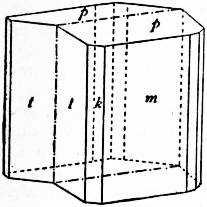
CYANITE, a native aluminium silicate, Al2SiO5, crystallizing in the anorthic system. It has the same percentage chemical composition as andalusite and sillimanite, but differs from these in its crystallographic and physical characters. P. Groth writes the formula as a metasilicate (AlO)2SiO3. The name cyanite was given by A. G. Werner in 1789, from κύανος, blue, in allusion to the characteristic colour of the mineral; the form kyanite is also in common use, and the name disthène, proposed by R. J. Haüy in 1801, is used by French writers.
Distinctly developed crystals with terminal planes are rare, the mineral being commonly found as lamellar cleavage masses or long blade-shaped crystals embedded in crystalline rocks. The colour is usually a pale sky-blue, but may be white, greenish or yellowish; it varies in intensity in different bands, so that the crystals usually present a more or less striped appearance. There is a perfect cleavage parallel to the broad face m (100), and a less perfect one parallel to t (010): the basal plane p (001), oblique to the prism zone, is a gliding plane on which secondary twinning is produced by pressure, giving rise to characteristic horizontal striations on the cleavage face m. The accompanying figure represents a crystal twinned on the plane m (100). A negative biaxial optic figure is seen in convergent polarized light through the cleavage plane m, the axial plane being inclined at about 30° to the edge between m and t. A remarkable feature of cyanite is the great difference in hardness on different faces of the same crystal and in different directions on the same face: on the face m in a direction parallel to the edge between m and p the hardness is 7, whilst in a direction parallel to the edge between m and t it is 4½. The name disthène, from δίς, two, and σθένος, strong, has reference to these differences in hardness.
Analyses of cyanite often show the presence of a small amount (usually less than 1%) of ferric oxide and sometimes traces of copper, and to these constituents the blue or green colour of the mineral is doubtless due. The mineral is infusible before the blowpipe, and is not decomposed by acids. At a high temperature, about 1350° C., it becomes transformed into sillimanite, changing in specific gravity from 3.6 to 3.2.
Cyanite is a characteristic mineral of the metamorphic crystalline rocks—gneiss, schist, granulite and eclogite—and is often associated with garnet and staurolite. A typical occurrence is in the white, fine-scaled paragonite-schist of Monte Campione, near St Gotthard in Switzerland, where long transparent crystals of a fine blue colour are abundant. In the gneiss of the Pfitscher Tal near Sterzing in Tirol a white variety known as rhaetizite is found. It occurs at several places in Scotland, for instance, at Botriphnie in Banffshire, with muscovite in a quartz-vein. Fine specimens are found in mica-schist at Chesterfield in Massachusetts, and at several other localities in the United States. It is found in the gold-washings of the southern Urals and in the diamond-washings of Brazil. As minute crystal fragments it is met with in many sands and sandstones.
When of sufficient transparency and depth of colour (deep cornflower-blue) the mineral has a limited application as a gem-stone; it is usually cut en cabochon.
(L. J. S.)
CYANOGEN (Gr. κύανος, blue γεννᾶν, to produce), C2N2, in chemistry, a gas composed of carbon and nitrogen. The name was suggested by Prussian blue, the earliest known compound of cyanogen. It was first isolated in 1815 by J. Gay-Lussac, who obtained it by heating mercury or silver cyanide; this discovery is of considerable historical importance, since it recorded the isolation of a “compound radical.” It may also be prepared by heating ammonium oxalate; by passing induction sparks between carbon points in an atmosphere of nitrogen (see H. von Wartenburg, Abs. J.C.S., 1907, i. p. 299), or by the addition of a concentrated solution of potassium cyanide to one of copper sulphate, the mixed solutions being then heated. It also occurs in blast-furnace gases. When cyanogen is prepared by heating mercuric cyanide, a residue known as para-cyanogen, (CN)x, is left; this is to be regarded as a polymer of cyanogen. It is a brownish amorphous solid, which is insoluble in water. Cyanogen is a colourless gas, possessing a peculiar characteristic smell, and is very poisonous. It burns with a purple flame, forming carbon dioxide and nitrogen; and may be condensed (by cooling to −25° C.) to a colourless liquid, and further to a solid, which melts at −34.4° C. (M. Faraday, Ann., 1845, 56, p. 158). It dissolves readily in water and the aqueous solution decomposes on standing; a dark-brown flocculent precipitate of azulmic acid, C4H5N5O, separating whilst ammonium oxalate, urea and hydrocyanic acid are found in the solution. In many respects it resembles chlorine in its chemical behaviour, a circumstance noted by Gay-Lussac; it combines directly with hydrogen (at 500° to 550° C.) to form hydrocyanic acid, and with chlorine, bromine, iodine and sulphur, to form cyanogen chloride, &c.; it also combines directly with zinc, cadmium and iron to form cyanides of these metals. It combines with sulphuretted hydrogen, in the presence of water, to form the compound C2N2·H2S, and in the presence of alcohol, to form the compound C2N2·2H2S. Concentrated hydrochloric acid converts it into oxamide. Potash solution converts it into a mixture of potassium cyanide and cyanate. When heated with hydriodic acid (specific gravity 1.96) it forms amino-acetic acid, and with tin and hydrochloric acid it yields ethylene diamine.
CYAXARES (Pers. Uvakhshatra), king of Media, reigned according to Herodotus (i. 107) forty years, about 624-584 B.C. That he was the real founder of the Median empire is proved by the fact that in Darius’s time a Median usurper, Fravartish, pretended to be his offspring (Behistun inscr. 2. 43); but about his history we know very little. Herodotus narrates (i. 103 ff.) that he renewed the war against the Assyrians, in which his father Phraortes had perished, but was, while he besieged Nineveh, attacked by a great Scythian army under Madyas, son of Protothyes, which had come from the northern shores of the Black Sea in pursuit of the Cimmerians. After their victory over Cyaxares, the Scythians conquered and wasted the whole of western Asia, and ruled twenty-eight years, till at last they were made drunk and slain by Cyaxares at a banquet (cf. another story about Cyaxares and a Scythian host in Herod, i. 73). As we possess scarcely any contemporary documents it is impossible to find out the real facts. But we know from the prophecies of Jeremiah and Zephaniah that Syria and Palestine were really invaded by northern barbarians in 626 B.C., and it is probable that this invasion was the principal cause of the downfall of the Assyrian empire (see Media and Persia: Ancient History).
After the destruction of the Scythians Cyaxares regained the supremacy, renewed his attack on Assyria, and in 606 B.C. destroyed Nineveh and the other capitals of the empire (Herod. i. 106; Berossus ap. Euseb. Chron. i. 29, 37, confirmed by a stele of Nabonidus found in Babylon: Scheil in Recueil de travaux, xviii.; Messerschmidt, “Die Inschrift der Stele Nabonaids,” in Mitteilungen der vorderasiatischen Gesellschaft, i., 1896). According to Berossus he was allied with Nabopolassar of Babylon, whose son Nebuchadrezzar married Amyitis, the daughter of the Median king (who is wrongly called Astyages). The countries north and east of the Tigris and the northern part of Mesopotamia with the city of Harran (Carrhae) became subject to the Medes. Armenia and Cappadocia were likewise subdued; the attempt to advance farther into Asia Minor led to a war with Alyattes of Lydia. The decisive battle, in the sixth year, was interrupted by the famous solar eclipse on the 28th of May 585 predicted by Thales. Syennesis of Cilicia and Nebuchadrezzar (in Herodotus named Labynetus) of Babylon interceded and effected a peace, by which the Halys was fixed as frontier between the two empires, and Alyattes’s daughter married to Cyaxares’s son Astyages (Herod. i. 74). If Herodotus’s dates are correct, Cyaxares died shortly afterwards.
In a fragmentary letter from an Assyrian governor to King Sargon (about 715 B.C.) about rebellions of Median chieftains, a dynast Uvakshatar (i.e. Cyaxares) is mentioned as attacking an Assyrian fortress (Kharkhar, in the chains of the Zagros). Possibly he was an ancestor of the Median king.
(Ed. M.)
CYBELE, or Cybebe (Gr. Κυβέλη, Κυβήβη), a goddess native to Asia Minor and worshipped by most of the peoples of the peninsula, was known to the Romans most commonly as the Great Mother or the Gods (q.v.), or the Great Idaean Mother of the Gods—Magna Deum Mater, Mater Deum Magna Idaea. She was known by many other names, such as Mater Idaea, Dindymene, Sipylene, derived from famous seats of worship, and Mountain Mother, &c., in token of her character, but Cybele is the name by which she is most frequently known in literature. Her cult became centralized in Phrygia, had found its way into Greece, where it never flourished greatly, as early as the latter 6th century B.C., and was introduced at Rome in 204 B.C. Under the Empire it attained to great importance, and was one of the last pagan cults to die. Cybele was usually worshipped in connexion with Attis (q.v.), as Aphrodite with Adonis, the two being a duality interpreted by the philosophers as symbolic of Mother Earth and her vegetation.
(G. Sn.)
CYCLADES, a compact group of islands in the Greek Archipelago, forming a cluster around the island of Syra (Syros), the principal town of which, now officially known as Hermoupolis, is the capital of a department. Population of the group (1907) 130,378. The islands, though seldom visited by foreigners, are for the most part highly interesting and picturesque, notwithstanding their somewhat barren appearance when viewed from the sea; many of them bear traces of the feudal rule of Venetian families in the middle ages, and their inhabitants in general may be regarded as presenting the best type of the Greek race. To the student of antiquity the most interesting are: Delos (q.v.), one of the greatest centres of ancient religious, political and commercial life, where an important series of researches has been carried out by French archaeologists; Melos (q.v.), where, in addition to various buildings of the Hellenic and Roman periods, the large prehistoric stronghold of Phylakopi has been excavated by members of the British school at Athens; and Thera (see Santorin), the ancient capital of which has been explored by Baron Hiller von Gaertringen. Thera is also of special interest to geologists owing to its remarkable volcanic phenomena. Naxos, the largest and most fertile island of the group, contains the highest mountain in the Cyclades (Zia, 3290 ft.); the island annually exports upwards of 2000 tons of emery, a state monopoly the proceeds of which are now hypothecated to the foreign debt. The oak woods of Ceos (Zeá) and Ios furnish considerable supplies of valonia. Kimolos, which is absolutely treeless, produces fuller’s-earth. The famous marble quarries of Paros have been practically abandoned in modern times; the marble of Tenos is now worked by a British syndicate. The mineral wealth of the Cyclades has hitherto been much neglected; iron ore is exported from Seriphos, manganese and sulphur from Melos, and volcanic cement (pozzolana) from Santorin. Other articles of export are wine, brandy, hides and tobacco. Cythnos, Melos and other islands possess hot springs with therapeutic qualities. The prosperity of Syra, formerly an important distributing centre for the whole Levant, has been declining for several years.
Population (1907):—Syra 31,939 (communes, Hermoupolis 18,132, Mykonos 4589, Syra 9218); Andros 18,035 (Andros 8536, Arni 2166, Gaurio 2897, Corthion 4436); Thera 19,597 (Thera 4226, Egiale 1513, Amorgos 2627, Anaphe 579, Emporium 2172, Therasia 679, Ios 2090, Kalliste 3519, Oea 2192); Ceos 11,032 (Ceos 3817, Dryopis 1628, Cythnos 1563, Seriphos 4024); Melos, 12,774 (Melos 4864, Adamas 529, Siphnos 3777, Kimolos 2015, Pholegandros 962, Sikinos 627); Naxos 25,185 (Naxos 2064, Apiranthe 2421, Vivlos 4343, Coronis 3205, Marpessa 1313, Naoussa 1670, Paros 3586, Tragea 4661, Hyrie 1922); Tenos 11,816 (Tenos 4697, Panorme 2658, Peree 2801, Sosthenion 1660).
CYCLAMEN, in botany, a genus belonging to the natural order Primulaceae, containing about ten species native in the mountains of central Europe and the Mediterranean region. C. europaeum (Sow-bread) is found as an introduced plant in copses in Kent and Sussex. The plants are low-growing herbs with large tuberous rootstocks, from the surface of which spring a number of broad, generally heart-shaped or kidney-shaped, long-stalked leaves, which in cultivated forms are often beautifully marbled, ribbed or splashed. The flowers are nodding, and white, pink, lilac or crimson in colour. The corolla has a short tube and five large reflexed lobes. After flowering the stalk becomes spirally coiled, drawing the fruit down to the soil. Cyclamen is a favourite winter and spring flowering plant. C. persicum is probably the best known. It is a small-growing kind bearing medium-sized leaves and numerous flowers. C. giganteum is a large, strong-growing species; not quite so free flowering as C. persicum, but in all other respects superior to it when well grown. C. papilio differs in the fringed character of the petals. It has been obtained by selection from C. persicum. There is also a very beautiful crested race, probably derived from C. giganteum.
The plants are raised from seed, and, with good cultivation, flower in fifteen to eighteen months from date of sowing. Seed should be sown as soon as ripe, in July or August, in pots or pans, filled up to 2½ in. of the rim with broken crocks for drainage. The soil should consist of fibrous yellow loam, leaf-mould in flakes, and coarse silver-sand, in equal parts. Sow the seed thinly—¼ in. to ½ in. apart—and cover with a very thin sprinkling of the soil. Protect with a square of glass covered with a piece of brown paper for shade, and place on a shelf in a warm greenhouse. The soil should never be allowed to get dry.
When the seedlings appear, remove the covering, care being taken that they do not suffer for want of shade, water or a moist atmosphere. As soon as the third leaf appears, repot singly into thumb-pots in slightly coarser soil, so that the crowns of the little plants are just above the level of the soil. In December transfer into a little richer soil, consisting of two parts fibrous loam broken into small bits by hand and the fine particles rejected, one part flaked leaf-mould, passed through a half-inch sieve, half a part of plant ash from the burnt refuse heap and half a part of coarse silver-sand. Keep through the winter in a moist atmosphere at a temperature not below 50° Fahr., and as near the glass as possible. In March they should be ready for their next shift into 5-in. pots. The potting compost should be the same as for the last shift, with the addition of half a part of well-sweetened manure, such as a spent mushroom bed. Keep in a warm moist atmosphere and shade from strong sunlight. In June remove to cold frames and stand them on inverted pots well clear of one another. Slugs show a marked partiality for the succulent young leaves and should be excluded by dusting round the frames occasionally with newly slaked lime. The inverted pots serve as traps. The frames may thus be frequently syringed without keeping the plants unduly wet. Shade heavily from direct sunlight, but afford as much diffused light as practicable. Ventilate on all favourable occasions, and close the frames early after copious syringing.