VOLUME VII SLICE VIII Cube to Daguerre, Louis (continued 5)
Reading edition
Livy viii., ix.; Aurelius Victor, De viris illustribus, 31; Eutropius ii. 8. 9.
His son of the same name, also a distinguished general, completed the subjection of Samnium (272). He set up a sun-dial, the first of its kind in Rome, in the temple of Quirinus.
Livy x. 39-47; Pliny, Nat. Hist., vii. 60.
CURSOR MUNDI, an English poem in the Northern dialect dating from the 13th century. It is a religious epic of 24,000 lines “over-running” the history of the world as related in the Old and New Testaments. “Cursur o werld man aght it call, For almast it over-rennes all.” The author explains in his prologue his reasons for undertaking the work. Men desire to read old romances of Alexander, Julius Caesar, Greece, Troy, Brut, Arthur, of Tristram, Sweet Ysoude and others. But better than tales of love is the story of the Virgin who is man’s best lover, therefore in her honour he will write this book, founded on the steadfast ground of the Holy Trinity. He writes in English for the love of English people of merry England, so that those who know no French may understand. The history is treated under seven ages. The first four include the period from the creation of the world to the successors of Solomon, the fifth deals with Mary and the birth and childhood of Jesus, the sixth with the lives of Christ and the chief apostles, and with the finding of the holy cross, and the seventh with Doomsday. Four short poems follow, more in some MSS. The bulk of the poem is written in rhyming couplets of short lines of four accents, and maintains a fair level throughout. The narrative is enlivened by many legends and much entertaining matter drawn from various sources; and the numerous transcripts of it prove that it was able to hold its own against profane romance.
The chief sources of the compilation have been identified by Dr Haenisch. For the Old Testament history the author draws largely from the Historia scholastica of Peter Comestor; for the history of the Virgin he often translates literally from Wace’s Établissement de la fête de la conception Notre Dame; the parables of the king and four daughters, and of the castle of Love and Grace, are taken from “Sent Robert bok” (1.9516), that is, from the Chasteau d’Amour of Robert Grosseteste, bishop of Lincoln; other sources are the apocryphal gospels of Matthew and Nicodemus, a southern English poem on the Assumption of Our Lady, attributed by the writer of Cursor mundi to Edmund Rich of Pontigny, the Vulgate, the Legenda aurea of Jacobus de Voragine, and the De vita et morte sanctorum of Isidore of Seville. The original of the section on the invention of the holy cross is still to seek. In its general plan the work is similar to the Livre de sapience of Herman de Valenciennes.
Of the author nothing is known. In the Cotton MS. Vespasian (A III.) the name of the owner William Cosyn is given (for particulars of this family, which is mentioned in Lincolnshire records as early as 1276, see Dr H. Hupe in the E.E.T.S. ed. of Cursor mundi, vol. i. p. 124 *). The date of the book was placed by Dr J. A. H. Murray (The Dialect of the Southern Counties of Scotland, 1873, p. 30) in the last quarter of the 13th century, and the place of writing near Durham. Dr Hupe (loc. cit. p. 186 *) gives good reasons for believing that the author was a Lincolnshire man, who wrote between 1260 and 1290, although the Cotton MS. probably belongs to the late 14th century. In the Göttingen MS. there are lines (17099-17110) desiring the reader to pray for John of Lindbergh, “that this bock gart dight,” and cursing anybody who shall steal it. Lindberg is probably Limber Magna, near Ulceby, in north Lincolnshire. Dr Hupe hazards an identification of the author with this John of Lindberg, who may have been a member of the Cistercian Abbey of Lindberg; but this is improbable.
Cursor mundi was edited for the Early English Text Society in 1874-1893 by Dr Richard Morris in parallel columns from four MSS.:—Cotton Vespasian A III., British Museum; Fairfax MS. 14, in the Bodleian library, Oxford; MS. theol. 107 at Göttingen; and MS. R. 3.8 in Trinity College, Cambridge. The edition includes a “Preface” by the editor, “An Inquiry into the Sources of the Cursor mundi” (1885), by Dr Haenisch, an essay “On the Filiation and the Text of the MSS. of Cursor mundi” (1885), by Dr H. Hupe, “Cursor Studies and Criticisms on the Dialects of its MSS.” (1888), by Dr Hupe and a glossary by Dr Max Kaluza.
CURTAIN, a screen of any textile material, running by means of rings fixed to a rod or pole. Curtains are now used chiefly to cover windows and doors, but for many centuries every bed of importance was surrounded by them, and sometimes, as in France, the space thus screened off was much larger than the actual bed and was called the ruelle. The curtain is very ancient—indeed the absence of glass and ill-fitting windows long made it a necessity. Originally single curtains were used; it would appear that it was not until the 17th century that they were employed in pairs. Curtains are made in an infinite variety of materials and styles; when placed over a door they are usually called portières. In fortification the “curtain” is that part of the enceinte which lies between two bastions, towers, gates, &c.
The word comes into English through the O. Fr. cortine or courtine from the Late Lat. cortina. According to Du Cange (Glossarium, s.v. “Cortis”) this is a diminutive of cortis, an enclosed space, a court. It is used in the various senses of the English “curtain.” Classical Latin had also a word cortina, meaning a caldron or round kettle. It was very rarely applied to round objects generally. In the Vulgate cortina is used of the curtains of the tabernacle (Exodus xxvi). There is some difficulty in connecting the classical and the Late Latin words. The earliest use in English is, according to the New English Dictionary, for the hangings of a bed.
CURTANA (a latinized form of the A.-Fr. curtein, from Lat. curtus, shortened), the pointless sword of mercy, known also as Edward the Confessor’s sword, borne at the coronation of the kings of England between the two pointed swords of temporal and spiritual justice (see Regalia).
CURTEA DE ARGESH (Rumanian, Curtea de Arges; also written Curtea d’Argesh, Curtea d’Ardges, Argish and Ardjish), the capital of the department of Argesh, Rumania; situated on the right bank of the river Argesh, where it flows through a valley of the lower Carpathians; and on the railway from Pitesci to the Rothenthurm Pass. Pop. (1900) 4210. The city is one of the oldest in Rumania. According to tradition it was founded early in the 14th century by Prince Radu Negru, succeeding Câmpulung as capital of Walachia. Hence its name Curtea, “the court.” It contains a few antique churches, and was created a bishopric at the close of the 18th century.
The cathedral of Curtea de Argesh, by far the most famous building in Rumania, stands in the grounds of a monastery, 1½ m. N. of the city. It resembles a very large and elaborate mausoleum, built in Byzantine style, with Moorish arabesques. In shape it is oblong, with a many-sided annexe at the back. In the centre rises a dome, fronted by two smaller cupolas; while a secondary dome, broader and loftier than the central one, springs from the annexe. Each summit is crowned by an inverted pear-shaped stone, bearing a triple cross, emblematic of the Trinity. The windows are mere slits; those of the tambours, or cylinders, on which the cupolas rest, are curved, and slant at an angle of 70°, as though the tambours were leaning to one side. Between the pediment and the cornice a thick corded moulding is carried round the main building. Above this comes a row of circular shields, adorned with intricate arabesques, while bands and wreaths of lilies are everywhere sculptured on the windows, balconies, tambours and cornices, adding lightness to the fabric. The whole is raised on a platform 7 ft. high, and encircled by a stone balustrade. Facing the main entrance is a small open shrine, consisting of a cornice and dome upheld by four pillars. The cathedral is faced with pale grey limestone, easily chiselled, but hardening on exposure. The interior is of brick, plastered and decorated with frescoes. Close by stands a large royal palace, Moorish in style. The archives of the cathedral were plundered by Magyars and Moslems, but several inscriptions, Greek, Slav and Ruman, are left. One tablet records that the founder was Prince Neagoe Bassarab (1512-1521); another that Prince John Radu completed the work in 1526. A third describes the repairs executed in 1681 by Prince Sherban Cantacuzino; a fourth, the restoration, in 1804, by Joseph, the first bishop. Between 1875 and 1885 the cathedral was reconstructed; and in 1886 it was reconsecrated. Its legends have inspired many Rumanian poets, among them the celebrated V. Alexandri (1821-1890). One tradition describes how Neagoe Bassarab, while a hostage in Constantinople, designed a splendid mosque for the sultan, returning to build the cathedral out of the surplus materials. Another version makes him employ one Manole or Manoli as architect. Manole, being unable to finish the walls, the prince threatened him and his assistant with death. At last Manole suggested that they should follow the ancient custom of building a living woman into the foundations; and that she who first appeared on the following morning should be the victim. The other masons warned their families, and Manole was forced to sacrifice his own wife. Thus the cathedral was built except the roof. So arrogant, however, did the masons become, that the prince bade remove the scaffolding, and all, save Manole, perished of hunger. He fell to the ground, and a spring of clear water, which issued from the spot, is still called after him.
CURTESY (a variant of “courtesy,” q.v.), in law, the life interest which a husband has in certain events in the lands of which his wife was in her lifetime actually seised for an estate of inheritance. As to the historical origin of the custom and the meaning of the word there is considerable doubt. It has been said to be an interest peculiar to England and to Scotland, hence called the “curtesy of England” and the “curtesy of Scotland”; but this is erroneous, for it is found also in Germany and France. The Mirroir des Justices ascribes it to Henry I. K. E. Digby (Hist. Real Prop. chap. iii.) says that it is connected with curia, and has reference either to the attendance of the husband as tenant of the lands at the lord’s court, or to mean simply that the husband is acknowledged tenant by the courts of England (tenens per legem Angliae). The requisites necessary to make tenancy by the curtesy are: (1) a legal marriage; (2) an estate in possession of which the wife must have been actually seised; (3) issue born alive and during the mother’s existence, though it is immaterial whether the issue live or die, or whether it is born before or after the wife’s seisin; in the case of gavelkind lands the husband has a right to curtesy, whether there is issue born or not; but the curtesy extends only to a moiety of the wife’s lands and ceases if the husband marries again. The issue must have been capable of inheriting as heir to the wife, e.g. if a wife were seised of lands in tail male the birth of a daughter would not entitle the husband to a tenancy by curtesy; (4) the title to the tenancy vests only on the death of the wife. The Married Women’s Property Act 1882 has not affected the right of curtesy so far as relates to the wife’s undisposed-of realty (Hope v. Hope, 1892, 2 Ch. 336), and the Settled Land Act 1884, s. 8, provides that for the purposes of the Settled Land Act 1882 the estate of a tenant by curtesy is to be deemed an estate arising under a settlement made by the wife.
See Pollock and Maitland, Hist. Eng. Law; K. E. Digby, Hist. Real Prop.; Goodeve, Real Property.
CURTILAGE (Med. Lat. curtilagium, from curtile or cortile, a court or yard, cf. “court”), the area of land which immediately surrounds a dwelling-house and its yard and outbuildings. In feudal times every castle with its dependent buildings was protected by a surrounding wall, and all the land within the wall was termed the curtilage; but the modern legal interpretation of the word, i.e. what area is enclosed by the curtilage, depends upon the circumstances of each individual case, such as the terms of the grant or deed which passes the property, or upon what is held to be a convenient amount of land for the occupation of the house, &c. The importance of the word in modern law depends on the fact that the curtilage marks the limit of the premises in which housebreaking can be committed.
CURTIN ANDREW GREGG (1817-1894), American political leader, was born at Bellefonte, Centre county, Pennsylvania, on the 22nd of April 1817, the son of a native of Ireland who was a pioneer iron manufacturer in Pennsylvania. He graduated from the law department of Dickinson College in 1837, was admitted to the bar in 1839, and successfully practised his profession. Entering politics as a Whig, he was chairman of the Whig state central committee in 1854, and from 1855 to 1858 was secretary of the commonwealth. In this capacity he was also ex officio the superintendent of common schools, and rendered valuable services to his state in perfecting and expanding the free public school system, and in establishing state normal schools. Upon the organization of the Republican party he became one of its leaders in Pennsylvania, and in October 1860 was chosen governor of the state on its ticket, defeating Henry D. Foster, the candidate upon whom the Douglas and Breckinridge Democrats and the Constitutional Unionists had united, by 32,000 votes, after a spirited campaign which was watched with intense interest by the entire country as an index of the result of the ensuing presidential election. During the Civil War he was one of the closest and most constant advisers of President Lincoln, and one of the most efficient, most energetic and most patriotic of the “war governors” of the North. Pennsylvania troops were the first to reach Washington after the president’s call, and from first to last the state, under Governor Curtin’s guidance, furnished 387,284 officers and men to the Northern armies. One of his wisest and most praiseworthy acts Was the organization of the famous “Pennsylvania Reserves,” by means of which the state was always able to fill at once its required quota after each successive call. In raising funds and equipping and supplying troops the governor showed great energy and resourcefulness, and his plans and organizations for caring for the needy widows and children of Pennsylvania soldiers killed in battle, and for aiding and removing to their homes the sick and wounded were widely copied throughout the North. He was re-elected governor in 1863 and served until January 1867. He was United States minister to Russia from 1869 until 1872, when he returned to America and took part in the Liberal Republican revolt against President U. S. Grant. In 1872-1873 he was a member of the state constitutional convention. Subsequently he joined the Democratic party and was a representative in Congress from 1881 to 1887. He died at his birthplace, Bellefonte, Pennsylvania, on the 7th of October 1894.
See William H. Egle’s Life and Times of Andrew Gregg Curtin (Philadelphia, 1896), which contains chapters written by A. K. McClure, Jno. Russell Young, Wayne McVeagh, Fitz John Porter and others.
CURTIS, GEORGE TICKNOR (1812-1894), American lawyer, legal writer and constitutional historian, was born in Watertown, Massachusetts, on the 28th of November 1812. He graduated at Harvard in 1832, was admitted to the bar in 1836, and practised in Worcester, Boston, New York and Washington, appearing before the United States Supreme Court in many important cases, including the Dred Scott case, in which he argued the constitutional question for Scott, and the “legal tender” cases. In Boston he was for many years the United States commissioner, and in this capacity, despite the vigorous protests of the abolitionists and his own opposition to slavery, ordered the return to his owner of the famous fugitive slave, Themas Sims, in 1852. He was the nephew and close friend of George Ticknor, the historian of Spanish literature, and his association with his uncle was influential in developing his scholarly tastes; while his other personal friendships with eminent Bostonians during the period of conservative Whig ascendancy in Massachusetts politics were of direct influence upon his political opinions and published estimates. He is best known as the author of A History of the Origin, Formation and Adoption of the Constitution of the United States, with Notices of its principal Framers (1854), republished, with many additions, as The Constitutional History of the United States from their Declaration of Independence to the Close of their Civil War (2 vols., 1889-1896). This history, which had been watched in its earlier progress by Daniel Webster, may be said to present the old Federalist or “Webster-Whig” view of the formation and powers of the Constitution; and it was natural that Curtis should follow it with a voluminous Life of Daniel Webster (2 vols., 1870), the most valuable biography of that statesman. Both these works are characterized by solidity and comprehensiveness rather than by rhetorical attractiveness or literary perspective. In his later years Mr Curtis, like so many of the followers of Webster, turned towards the Democratic party; and he wrote, among other works of minor importance, an exculpatory life of President James Buchanan (2 vols., 1883) and two vindications of General George B. McClellan’s career (1886 and 1887). He died in New York on the 28th of March 1894.
In addition to the works above mentioned he published: Digest of the English and American Admiralty Decisions (1839); Rights and Duties of Merchant Seamen (1841), which elicited the hearty praise of Justice Joseph Story; Law of Patents (1849); Equity Precedents (1850); Commentaries on the Jurisprudence, Practice and Peculiar Jurisdiction of the Courts of the United States (1854-1858); Creation or Evolution: A Philosophical Inquiry (1887); and a novel, John Chambers: A Tale of the Civil War in America (1889).
His brother, Benjamin Robbins Curtis (1809-1874), also an eminent jurist, was born on the 4th of November 1809, in Watertown, Massachusetts, graduated at Harvard in 1829, studied law at Cambridge and at Northfield, Mass., where, after his admission to the bar in 1832, he practised law for two years, and then in Boston in 1834-1851. In 1851, being then a member of the lower house of the Massachusetts legislature, he was on the 22nd of September appointed to the Supreme Court of the United States, where he gained his greatest fame in 1857 by his dissenting opinion in the Dred Scott case, in which he argued that the Missouri Compromise was constitutional, and that negroes could become citizens. His argument was immediately published as an anti-slavery document. On the 1st of September 1857 he resigned from the Supreme Court and resumed his private practice. In 1868 he was one of the counsel for President Andrew Johnson in his impeachment trial, and opened for the defence in a remarkable two-days’ speech. He died at Newport, Rhode Island, on the 15th of September 1874. He prepared Decisions of the Supreme Court (22 vols.) and a Digest of its decisions down to 1854.
A Memoir of Benjamin Robbins Curtis, with Some of his Professional and Miscellaneous Papers, edited by his son Benjamin R. Curtis, was published at Boston in 1879, the Memoir being by George Ticknor Curtis.
CURTIS, GEORGE WILLIAM (1824-1892), American man of letters, was born in Providence, Rhode Island, on the 24th of February 1824, of old New England stock. His mother died when he was two years old. At six he was sent with his elder brother to school in Jamaica Plain, Massachusetts, where he remained for five years. Then, his father having again married happily, the boys were brought home to Providence, where they stayed till, in 1839, their father removed to New York. Three years later, Curtis, being allowed to determine for himself his course of life, and being in sympathy with the spirit of the so-called Transcendental movement, became a boarder at the community of Brook Farm. He was accompanied by his brother, James Burrill Curtis, whose influence upon him was strong and helpful. He remained there for two years, brought into stimulating and serviceable relations with many interesting men and women. Then came two years, passed partly in New York, partly in Concord in order mainly to be in the friendly neighbourhood of Emerson, and then followed four years spent in Europe, Egypt and Syria.
Curtis returned from Europe in 1850, handsome, attractive, accomplished, ambitious of literary distinction. He instantly plunged into the whirl of life in New York, obtained a place on the staff of the Tribune, entered the field as a popular lecturer, set himself to work on a volume published in the spring of 1851, under the title of Nile Notes of a Howadji, and became a favourite in society. He wrote much for Putnam’s Magazine, of which he was associate editor; and a number of volumes, composed of essays written for that publication and for Harper’s Monthly, came in rapid succession from his pen. The chief of these were the Potiphar Papers (1853), a satire on the fashionable society of the day; and Prue and I (1856), a pleasantly sentimental, fancifully tender and humorous study of life. In 1855 he married Miss Anna Shaw. Not long after his marriage he became, through no fault of his own, deeply involved in debt owing to the failure of Putnam’s Magazine; and his high sense of honour compelled him to devote the greater part of his earnings for many years to the discharge of obligations for which he had become only by accident responsible, and from which he might have freed himself by legal process. In the period just preceding the Civil War other interests became subordinate to those of national concern. Curtis made his first important speech on the questions of the day at Wesleyan University in 1856; he engaged actively in the presidential campaign of that year, and was soon recognized not only as an effective public speaker, but also as one of the ablest, most high-minded, and most trustworthy leaders of public opinion. In 1863 he became the political editor of Harper’s Weekly, and no other journal exercised during the war and after it a more important part in shaping public opinion. His writing was always clear, direct, forcible; his fairness of mind and sweetness of temper were invincible. He never became a mere partisan, and never failed to apply the test of moral principle to political measures. From month to month he contributed to Harper’s Monthly, under the title of “The Easy Chair,” brief essays on topics of social and literary interest, charming in style, touched with delicate humour and instinct with generous spirit. His service to the Republican party was such, that more than once he was offered nominations to office of high distinction, and might have been sent as minister to England; but he refused all offers of the kind, feeling that he could render more essential service to the country as editor and public speaker.
In 1871 he was appointed by President Grant chairman of the commission to report on the reform of the civil service. The report which he wrote was the foundation of every effort since made for the purification and regulation of the service and for the destruction of political patronage. From that time till his death Curtis was the leader in this reform, and to his sound judgment, his vigorous presentation of the evils of the corrupt prevailing system, and his untiring efforts, the progress of the reform is mainly due. He was president of the National Civil Service Reform League and of the New York Civil Service Reform Association. In 1884 he refused to support the nomination of James G. Blaine as candidate for the presidency, and thus broke with the Republican party, of which he had been one of the founders and leaders. From that time he stood as the typical independent in politics. In April 1892 he delivered at Baltimore his eleventh annual address as president of the National Civil Service Reform League, and in May he appeared for the last time in public, to repeat in New York an admirable address on James Russell Lowell, which he had first delivered in Brooklyn on the 22nd of the preceding February, the anniversary of Lowell’s birth. On the 31st of the following August he died. He was a man of consistent virtue, whose face and figure corresponded with the traits and stature of his soul. The grace and charm of his manner were the expression of his nature. Of the Americans of his time few were more widely beloved, and the respect in which he was held was universal.
See George William Curtis, by Edward Cary, in the “American Men of Letters” series (Boston, 1894), an excellent biography; “An Epistle to George William Curtis,” by James Russell Lowell (1874-1887), in Lowell’s Poems; George William Curtis, a Commemorative Address delivered before The Century Association, 17th December 1892, by Parke Godwin (New York, 1893); Orations and Addresses by George William Curtis, edited by Charles Eliot Norton (3 vols. New York, 1894).
(C. E. N.)
CURTIUS, ERNST (1814-1896), German archaeologist and historian, was born at Lübeck on the 2nd of September 1814. On completing his university studies he was chosen by C. A. Brandis to accompany him on a journey to Greece for the prosecution of archaeological researches. Curtius then became Otfried Müller’s companion in his exploration of the Peloponnese, and on Müller’s death in 1840 returned to Germany. In 1844 he became an extraordinary professor at the university of Berlin, and in the same year was appointed tutor to Prince Frederick William (afterwards the Emperor Frederick III.)—a post which he held till 1850. After holding a professorship at Göttingen and undertaking a further journey to Greece in 1862, Curtius was appointed (in 1863) ordinary professor at Berlin. In 1874 he was sent to Athens by the German government, and concluded an agreement by which the excavations at Olympia (q.v.) were entrusted exclusively to Germany. Curtius died at Berlin on the 11th of July 1896. His best-known work is his History of Greece (1857-1867, 6th ed. 1887-1888; Eng. trans. by A. W. Ward, 1868-1873). It presented in an attractive style what were then the latest results of scholarly research, but was criticized as wanting in erudition. It is now superseded (see Greece: History, Ancient, § Bibliography). His other writings are chiefly archaeological. The most important are: Die Akropolis von Athen (1844); Naxos (1846); Peloponnesos, eine historisch-geographische Beschreibung der Halbinsel (1851); Olympia (1852); Die Ionier vor der ionischen Wanderung (1855); Attische Studien (1862-1865); Ephesos (1874); Die Ausgrabungen zu Olympia (1877, &c.); Olympia und Umgegend (edited by Curtius and F. Adler, 1882); Olympia; Die Ergebnisse der von dem deutschen Reich veranstalteten Ausgrabung (with F. Adler, 1890-1898); Die Stadtgeschichte von Athen (1891); Gesammelte Abhandlungen (1894). His collected speeches and lectures were published under the title of Altertum und Gegenwart (5th ed., 1903 foll.), to which a third volume was added under the title of Unter drei Kaisern (2nd ed., 1895).
A full list of his writings will be found in L. Gurlitt, Erinnerungen an Ernst Curtius (Berlin, 1902); see also article by O. Kern in Allgemeine deutsche Biographie, xlvii. (1903), to which may be added Ernst Curtius. Ein Lebensbild in Briefen, by F. Curtius (1903); T. Hodgkin, Ernest Curtius (1905).
His brother, Georg Curtius (1820-1885), philologist, was born at Lübeck on the 16th of April 1820. After an education at Bonn and Berlin he was for three years a schoolmaster in Dresden, until (in 1845) he returned to Berlin University as privat-docent. In 1849 he was placed in charge of the Philological Seminary at Prague, and two years later was appointed professor of classical philology in Prague University. In 1854 he removed from Prague to a similar appointment at Kiel, and again in 1862 from Kiel to Leipzig. He died at Hermsdorf on the 12th of August 1885. His philological theories exercised a widespread influence. The more important of his publications are: Die Sprachvergleichung in ihrem Verhältniss zur classischen Philologie (1845; Eng. trans. by F. H. Trithen, 1851); Sprachvergleichende Beiträge zur griechischen und lateinischen Grammatik (1846); Grundzüge der griechischen Etymologie (1858-1862, 5th ed. 1879); Das Verbum der griechischen Sprache (1873). The last two works have been translated into English by A. S. Wilkins and E. B. England. From 1878 till his death Curtius was general editor of the Leipziger Studien zur classischen Philologie. His Griechische Schulgrammatik, first published in 1852, has passed through more than twenty editions, and has been edited in English. In his last work, Zur Kritik der neuesten Sprachforschung (1885), he attacks the views of the “new” school of philology.
Opuscula of Georg Curtius were edited after his death by E. Windisch (Kleine Schriften von E. C., 1886-1887). For further information consult articles by R. Meister in Allgemeine deutsche Biographie, xlvii. (1903), and by E. Windisch in C. Bursian’s Biographisches Jahrbuch für Alterthumskunde (1886).
CURTIUS, MARCUS, a legendary hero of ancient Rome. It is said that in 362 B.C. a deep gulf opened in the forum, which the seers declared would never close until Rome’s most valuable possession was thrown into it. Then Curtius, a youth of noble family, recognizing that nothing was more precious than a brave citizen, leaped, fully armed and on horseback, into the chasm, which immediately closed again. The spot was afterwards covered by a marsh called the Lacus Curtius. Two other explanations of the name Lacus Curtius are given: (1) a Sabine general, Mettius (or Mettus) Curtius, hard pressed by the Romans under Romulus, leaped into a swamp which covered the valley afterwards occupied by the forum, and barely escaped with his life; (2) in 445 B.C. the spot was struck by lightning, and enclosed as sacred by the consul, Gaius Curtius. It was marked by an altar which was removed to make room for the games in celebration of Caesar’s funeral (Pliny, Nat. Hist. xv. 77), but restored by Augustus (cf. Ovid, Fasti, vi. 403), in whose time there was apparently nothing but a dry well. The altar seems to have been restored early in the 4th century A.D. In April 1904, on the N. side of the Via Sacra and 20 ft. N.W. of the Equus Domitiani, remains of the buildings were discovered.
See Livy i. 12, vii. 6; Dion Halic. ii. 42; Varro, De lingua Latina, v. 148; Ch. Hülsen, The Roman Forum (Eng. trans. of 2nd ed., J. B. Carter, 1906); O. Gilbert, Geschichte und Topographie der Stadt Rom im Altertum, i. (1883), 334-338.
CURTIUS RUFUS, QUINTUS, biographer of Alexander the Great. Of his personal history nothing is known, nor can his date be fixed with certainty. Modern authorities regard him as a rhetorician who flourished during the reign of Claudius (A.D. 41-54). His work (De Rebus gestis Alexandri Magni) originally consisted of ten books, of which the first two are entirely lost, and the remaining eight are incomplete. Although the work is uncritical, and shows the author’s ignorance of geography, chronology and military matters, it is written in a picturesque style.
There are numerous editions: (text) T. Vogel (1889), P. H. Damste (1897), E. Hedicke (1908); (with notes), T. Vogel (1885 and later), M. Croiset (1885), H. W. Reich (1895), C. Lebaigue (1900), T. Stangl (1902). There is an English translation by P. Pratt (1821). See S. Dosson, Étude sur Quinte-Curce, sa vie, et ses œuvres (1887) a valuable work; F. von Schwarz, Alexander des Grossen Feldzüge in Turkestan (1893), a commentary on Arrian and Curtius based upon the author’s personal knowledge of the topography; C. Wachsmuth, Einleitung in das Studium der alten Geschichte (1895), p. 574, cf. p. 567, note 2; Schwarz, “Curtius Rufus” No. 31 in Pauly-Wissowa (1901).
CURULE (Lat. currus, “chariot”), in Roman antiquities, the epithet applied to the chair of office, sella curulis, used by the “curule” or highest magistrates and also by the emperors. This chair seems to have been originally placed in the magistrate’s chariot (hence the name). It was inlaid with ivory or in some cases made of it, had curved legs but no back, and could be folded up like a camp-stool. In English the word is used in the general sense of “official.” (See Consul, Praetor and Aedile.)
CURVE (Lat. curvus, bent), a word commonly meaning a shape represented by a line bending continuously out of the straight without making an angle, but only properly to be defined in its geometrical sense in the terms set out below. This subject is treated here from an historical point of view, for the purpose of showing how the different leading ideas were successively arrived at and developed.
1. A curve is a line, or continuous singly infinite system of points. We consider in the first instance, and chiefly, a plane curve described according to a law. Such a curve may be regarded geometrically as actually described, or kinematically as in the course of description by the motion of a point; in the former point of view, it is the locus of all the points which satisfy a given condition; in the latter, it is the locus of a point moving subject to a given condition. Thus the most simple and earliest known curve, the circle, is the locus of all the points at a given distance from a fixed centre, or else the locus of a point moving so as to be always at a given distance from a fixed centre. (The straight line and the point are not for the moment regarded as curves.)
Next to the circle we have the conic sections, the invention of them attributed to Plato (who lived 430-347 B.C.); the original definition of them as the sections of a cone was by the Greek geometers who studied them soon replaced by a proper definition in plano like that for the circle, viz. a conic section (or as we now say a “conic”) is the locus of a point such that its distance from a given point, the focus, is in a given ratio to its (perpendicular) distance from a given line, the directrix; or it is the locus of a point which moves so as always to satisfy the foregoing condition. Similarly any other property might be used as a definition; an ellipse is the locus of a point such that the sum of its distances from two fixed points (the foci) is constant, &c., &c.
The Greek geometers invented other curves; in particular, the conchoid (q.v.), which is the locus of a point such that its distance from a given line, measured along the line drawn through it to a fixed point, is constant; and the cissoid (q.v.), which is the locus of a point such that its distance from a fixed point is always equal to the intercept (on the line through the fixed point) between a circle passing through the fixed point and the tangent to the circle at the point opposite to the fixed point. Obviously the number of such geometrical or kinematical definitions is infinite. In a machine of any kind, each point describes a curve; a simple but important instance is the “three-bar curve,” or locus of a point in or rigidly connected with a bar pivoted on to two other bars which rotate about fixed centres respectively. Every curve thus arbitrarily defined has its own properties; and there was not any principle of classification.
2. Cartesian Co-ordinates.—The principle of classification first presented itself in the Géometrie of Descartes (1637). The idea was to represent any curve whatever by means of a relation between the co-ordinates (x, y) of a point of the curve, or say to represent the curve by means of its equation. (See Geometry: Analytical.)
Any relation whatever between (x, y) determines a curve, and conversely every curve whatever is determined by a relation between (x, y).
Observe that the distinctive feature is in the exclusive use of such determination of a curve by means of its equation. The Greek geometers were perfectly familiar with the property of an ellipse which in the Cartesian notation is x²/a² + y²/b² = 1, the equation of the curve; but it was as one of a number of properties, and in no wise selected out of the others for the characteristic property of the curve.
3. Order of a Curve.—We obtain from the equation the notion of an algebraical as opposed to a transcendental curve, viz. an algebraical curve is a curve having an equation F(x, y) = 0 where F(x, y) is a rational and integral function of the co-ordinates (x, y); and in what follows we attend throughout (unless the contrary is stated) only to such curves. The equation is sometimes given, and may conveniently be used, in an irrational form, but we always imagine it reduced to the foregoing rational and integral form, and regard this as the equation of the curve. And we have hence the notion of a curve of a given order, viz. the order of the curve is equal to that of the term or terms of highest order in the co-ordinates (x, y) conjointly in the equation of the curve; for instance, xy − 1 = 0 is a curve of the second order.
It is to be noticed here that the axes of co-ordinates may be any two lines at right angles to each other whatever; and that the equation of a curve will be different according to the selection of the axes of co-ordinates; but the order is independent of the axes, and has a determinate value for any given curve.
We hence divide curves according to their order, viz. a curve is of the first order, second order, third order, &c., according as it is represented by an equation of the first order, ax + by + c = 0, or say (* x, y, 1) = 0; or by an equation of the second order, ax² + 2hxy + by² + 2fy + 2gx + c = 0, say (* x, y, 1)² = 0; or by an equation of the third order, &c.; or what is the same thing, according as the equation is linear, quadric, cubic, &c.

A curve of the first order is a right line; and conversely every right line is a curve of the first order. A curve of the second order is a conic, and is also called a quadric curve; and conversely every conic is a curve of the second order or quadric curve. A curve of the third order is called a cubic; one of the fourth order a quartic; and so on.
A curve of the order m has for its equation (* x, y, 1)m = 0; and when the coefficients of the function are arbitrary, the curve is said to be the general curve of the order m. The number of coefficients is ½(m + 1)(m + 2); but there is no loss of generality if the equation be divided by one coefficient so as to reduce the coefficient of the corresponding term to unity, hence the number of coefficients may be reckoned as ½(m + 1)(m + 2) − 1, that is, ½m(m + 3); and a curve of the order m may be made to satisfy this number of conditions; for example, to pass through ½m(m + 3) points.
It is to be remarked that an equation may break up; thus a quadric equation may be (ax + by + c)(a′x + b′y + c′) = 0, breaking up into the two equations ax + by + c = 0, a′x + b′y + c′ = 0, viz. the original equation is satisfied if either of these is satisfied. Each of these last equations represents a curve of the first order, or right line; and the original equation represents this pair of lines, viz. the pair of lines is considered as a quadric curve. But it is an improper quadric curve; and in speaking of curves of the second or any other given order, we frequently imply that the curve is a proper curve represented by an equation which does not break up.
4. Intersections of Curves.—The intersections of two curves are obtained by combining their equations; viz. the elimination from the two equations of y (or x) gives for x (or y) an equation of a certain order, say the resultant equation; and then to each value of x (or y) satisfying this equation there corresponds in general a single value of y (or x), and consequently a single point of intersection; the number of intersections is thus equal to the order of the resultant equation in x (or y).
Supposing that the two curves are of the orders m, n, respectively, then the order of the resultant equation is in general and at most = mn; in particular, if the curve of the order n is an arbitrary line (n = 1), then the order of the resultant equation is = m; and the curve of the order m meets therefore the line in m points. But the resultant equation may have all or any of its roots imaginary, and it is thus not always that there are m real intersections.
The notion of imaginary intersections, thus presenting itself, through algebra, in geometry, must be accepted in geometry—and it in fact plays an all-important part in modern geometry. As in algebra we say that an equation of the mth order has m roots, viz. we state this generally without in the first instance, or it may be without ever, distinguishing whether these are real or imaginary; so in geometry we say that a curve of the mth order is met by an arbitrary line in m points, or rather we thus, through algebra, obtain the proper geometrical definition of a curve of the mth order, as a curve which is met by an arbitrary line in m points (that is, of course, in m, and not more than m, points).
The theorem of the m intersections has been stated in regard to an arbitrary line; in fact, for particular lines the resultant equation may be or appear to be of an order less than m; for instance, taking m = 2, if the hyperbola xy − 1 = 0 be cut by the line y = β, the resultant equation in x is βx − 1 = 0, and there is apparently only the intersection (x = 1/β, y = β); but the theorem is, in fact, true for every line whatever: a curve of the order m meets every line whatever in precisely m points. We have, in the case just referred to, to take account of a point at infinity on the line y = β; the two intersections are the point (x = 1/β, y = β), and the point at infinity on the line y = β.
It is, moreover, to be noticed that the points at infinity may be all or any of them imaginary, and that the points of intersection, whether finite or at infinity, real or imaginary, may coincide two or more of them together, and have to be counted accordingly; to support the theorem in its universality, it is necessary to take account of these various circumstances.
5. Line at Infinity.—The foregoing notion of a point at infinity is a very important one in modern geometry; and we have also to consider the paradoxical statement that in plane geometry, or say as regards the plane, infinity is a right line. This admits of an easy illustration in solid geometry. If with a given centre of projection, by drawing from it lines to every point of a given line, we project the given line on a given plane, the projection is a line, i.e. this projection is the intersection of the given plane with the plane through the centre and the given line. Say the projection is always a line, then if the figure is such that the two planes are parallel, the projection is the intersection of the given plane by a parallel plane, or it is the system of points at infinity on the given plane, that is, these points at infinity are regarded as situate on a given line, the line infinity of the given plane.1
Reverting to the purely plane theory, infinity is a line, related like any other right line to the curve, and thus intersecting it in m points, real or imaginary, distinct or coincident.
Descartes in the Géométrie defined and considered the remarkable curves called after him the ovals of Descartes, or simply Cartesians, which will be again referred to. The next important work, founded on the Géométrie, was Sir Isaac Newton’s Enumeratio linearum tertii ordinis (1706), establishing a classification of cubic curves founded chiefly on the nature of their infinite branches, which was in some details completed by James Stirling (1692-1770), Patrick Murdoch (d. 1774) and Gabriel Cramer; the work also contains the remarkable theorem (to be again referred to), that there are five kinds of cubic curves giving by their projections every cubic curve whatever. Various properties of curves in general, and of cubic curves, are established in Colin Maclaurin’s memoir, “De linearum geometricarum proprietatibus generalibus Tractatus” (posthumous, say 1746, published in the 6th edition of his Algebra). We have in it a particular kind of correspondence of two points on a cubic curve, viz. two points correspond to each other when the tangents at the two points again meet the cubic in the same point.
6. Reciprocal Polars. Intersections of Circles. Duality. Trilinear and Tangential Co-ordinates.—The Géométrie descriptive, by Gaspard Monge, was written in the year 1794 or 1795 (7th edition, Paris, 1847), and in it we have stated, in plano with regard to the circle, and in three dimensions with regard to a surface of the second order, the fundamental theorem of reciprocal polars, viz. “Given a surface of the second order and a circumscribed conic surface which touches it ... then if the conic surface moves so that its summit is always in the same plane, the plane of the curve of contact passes always through the same point.” The theorem is here referred to partly on account of its bearing on the theory of imaginaries in geometry. It is in Charles Julian Brianchon’s memoir “Sur les surfaces du second degré” (Jour. Polyt. t. vi. 1806) shown how for any given position of the summit the plane of contact is determined, or reciprocally; say the plane XY is determined when the point P is given, or reciprocally; and it is noticed that when P is situate in the interior of the surface the plane XY does not cut the surface; that is, we have a real plane XY intersecting the surface in the imaginary curve of contact of the imaginary circumscribed cone having for its summit a given real point P inside the surface.
Stating the theorem in regard to a conic, we have a real point P (called the pole) and a real line XY (called the polar), the line joining the two (real or imaginary) points of contact of the (real or imaginary) tangents drawn from the point to the conic; and the theorem is that when the point describes a line the line passes through a point, this line and point being polar and pole to each other. The term “pole” was first used by François Joseph Servois, and “polar” by Joseph Diez Gergonne (Gerg. t. i. and iii., 1810-1813); and from the theorem we have the method of reciprocal polars for the transformation of geometrical theorems, used already by Brianchon (in the memoir above referred to) for the demonstration of the theorem called by his name, and in a similar manner by various writers in the earlier volumes of Gergonne. We are here concerned with the method less in itself than as leading to the general notion of duality.
Bearing in a somewhat similar manner also on the theory of imaginaries in geometry (but the notion presents itself in a more explicit form), there is the memoir by L. Gaultier, on the graphical construction of circles and spheres (Jour. Polyt. t. ix., 1813). The well-known theorem as to radical axes may be stated as follows. Consider two circles partially drawn so that it does not appear whether the circles, if completed, would or would not intersect in real points, say two arcs of circles; then we can, by means of a third circle drawn so as to intersect in two real points each of the two arcs, determine a right line, which, if the complete circles intersect in two real points, passes through the points, and which is on this account regarded as a line passing through two (real or imaginary) points of intersection of the two circles. The construction in fact is, join the two points in which the third circle meets the first arc, and join also the two points in which the third circle meets the second arc, and from the point of intersection of the two joining lines, let fall a perpendicular on the line joining the centre of the two circles; this perpendicular (considered as an indefinite line) is what Gaultier terms the “radical axis of the two circles”; it is a line determined by a real construction and itself always real; and by what precedes it is the line joining two (real or imaginary, as the case may be) intersections of the given circles.
The intersections which lie on the radical axis are two out of the four intersections of the two circles. The question as to the remaining two intersections did not present itself to Gaultier, but it is answered in Jean Victor Poncelet’s Traité des propriétés projectives (1822), where we find (p. 49) the statement, “deux circles placés arbitrairement sur un plan ... ont idéalement deux points imaginaires communs à l’infini”; that is, a circle qua curve of the second order is met by the line infinity in two points; but, more than this, they are the same two points for any circle whatever. The points in question have since been called (it is believed first by Dr George Salmon) the circular points at infinity, or they may be called the circular points; these are also frequently spoken of as the points I, J; and we have thus the circle characterized as a conic which passes through the two circular points at infinity; the number of conditions thus imposed upon the conic is = 2, and there remain three arbitrary constants, which is the right number for the circle. Poncelet throughout his work makes continual use of the foregoing theories of imaginaries and infinity, and also of the before-mentioned theory of reciprocal polars.
Poncelet’s two memoirs Sur les centres des moyennes harmoniques and Sur la théorie générale des polaires réciproques, although presented to the Paris Academy in 1824, were only published (Crelle, t. iii. and iv., 1828, 1829) subsequent to the memoir by Gergonne, Considérations philosophiques sur les élémens de la science de l’étendue (Gerg. t. xvi., 1825-1826). In this memoir by Gergonne, the theory of duality is very clearly and explicitly stated; for instance, we find “dans la géométrie plane, à chaque théorème il en répond nécessairement un autre qui s’en déduit en échangeant simplement entre eux les deux mots points et droites; tandis que dans la géométrie de l’espace ce sont les mots points et plans qu’il faut échanger entre eux pour passer d’un théorème à son corrélatif”; and the plan is introduced of printing correlative theorems, opposite to each other, in two columns. There was a reclamation as to priority by Poncelet in the Bulletin universel reprinted with remarks by Gergonne (Gerg. t. xix., 1827), and followed by a short paper by Gergonne, Rectifications de quelques théorèmes, &c., which is important as first introducing the word class. We find in it explicitly the two correlative definitions: “a plane curve is said to be of the mth degree (order) when it has with a line m real or ideal intersections,” and “a plane curve is said to be of the mth class when from any point of its plane there can be drawn to it m real or ideal tangents.”
It may be remarked that in Poncelet’s memoir on reciprocal polars, above referred to, we have the theorem that the number of tangents from a point to a curve of the order m, or say the class of the curve, is in general and at most = m(m − 1), and that he mentions that this number is subject to reduction when the curve has double points or cusps.
The theorem of duality as regards plane figures may be thus stated: two figures may correspond to each other in such manner that to each point and line in either figure there correspond in the other figure a line and point respectively. It is to be understood that the theorem extends to all points or lines, drawn or not drawn; thus if in the first figure there are any number of points on a line drawn or not drawn, the corresponding lines in the second figure, produced if necessary, must meet in a point. And we thus see how the theorem extends to curves, their points and tangents; if there is in the first figure a curve of the order m, any line meets it in m points; and hence from the corresponding point in the second figure there must be to the corresponding curve m tangents; that is, the corresponding curve must be of the class m.
Trilinear co-ordinates (see Geometry: Analytical) were first used by E. E. Bobillier in the memoir Essai sur un nouveau mode de recherche des propriétés de l’étendue (Gerg. t. xviii., 1827-1828). It is convenient to use these rather than Cartesian co-ordinates. We represent a curve of the order m by an equation (* x, y, z)m = 0, the function on the left hand being a homogeneous rational and integral function of the order m of the three co-ordinates (x, y, z); clearly the number of constants is the same as for the equation (* x, y, 1)m = 0 in Cartesian co-ordinates.
The theorem of duality is considered and developed, but chiefly in regard to its metrical applications, by Michel Chasles in the Mémoire de géométrie sur deux principes généraux de la science, la dualité et l’homographie, which forms a sequel to the Aperçu historique sur l’origine et le développement des méthodes en géométrie (Mém. de Brux. t. xi., 1837).
We now come to Julius Plücker; his “six equations” were given in a short memoir in Crelle (1842) preceding his great work, the Theorie der algebraischen Curven (1844). Plücker first gave a scientific dual definition of a curve, viz.; “A curve is a locus generated by a point, and enveloped by a line—the point moving continuously along the line, while the line rotates continuously about the point”; the point is a point (ineunt.) of the curve, the line is a tangent of the curve. And, assuming the above theory of geometrical imaginaries, a curve such that m of its points are situate in an arbitrary line is said to be of the order m; a curve such that n of its tangents pass through an arbitrary point is said to be of the class n; as already appearing, this notion of the order and class of a curve is, however, due to Gergonne. Thus the line is a curve of the order 1 and class 0; and corresponding dually thereto, we have the point as a curve of the order 0 and class 1.
Plücker, moreover, imagined a system of line-co-ordinates (tangential co-ordinates). (See Geometry: Analytical.) The Cartesian co-ordinates (x, y) and trilinear co-ordinates (x, y, z) are point-co-ordinates for determining the position of a point; the new co-ordinates, say (ξ, η, ζ) are line-co-ordinates for determining the position of a line. It is possible, and (not so much for any application thereof as in order to more fully establish the analogy between the two kinds of co-ordinates) important, to give independent quantitative definitions of the two kinds of co-ordinates; but we may also derive the notion of line-co-ordinates from that of point-co-ordinates; viz. taking ξx + ηy + ζz = 0 to be the equation of a line, we say that (ξ, η, ζ) are the line-co-ordinates of this line. A linear relation aξ + bη + cζ = 0 between these co-ordinate determines a point, viz. the point whose point-co-ordinates are (a, b, c); in fact, the equation in question aξ + bη + cζ = 0 expresses that the equation ξx + ηy + ζz = 0, where (x, y, z) are current point-co-ordinates, is satisfied on writing therein x, y, z = a, b, c; or that the line in question passes through the point (a, b, c). Thus (ξ, η, ζ) are the line-co-ordinates of any line whatever; but when these, instead of being absolutely arbitrary, are subject to the restriction aξ + bη + cζ = 0, this obliges the line to pass through a point (a, b, c); and the last-mentioned equation aξ + bη + cζ = 0 is considered as the line-equation of this point.
A line has only a point-equation, and a point has only a line-equation; but any other curve has a point-equation and also a line-equation; the point-equation (* x, y, z)m = 0 is the relation which is satisfied by the point-co-ordinates (x, y, z) of each point of the curve; and similarly the line-equation (* ξ, η, ζ)n = 0 is the relation which is satisfied by the line-co-ordinates (ξ, η, ζ) of each line (tangent) of the curve.
There is in analytical geometry little occasion for any explicit use of line-co-ordinates; but the theory is very important; it serves to show that in demonstrating by point-co-ordinates any purely descriptive theorem whatever, we demonstrate the correlative theorem; that is, we do not demonstrate the one theorem, and then (as by the method of reciprocal polars) deduce from it the other, but we do at one and the same time demonstrate the two theorems; our (x, y, z.) instead of meaning point-co-ordinates may mean line-co-ordinates, and the demonstration is then in every step of it a demonstration of the correlative theorem.
7. Singularities of a Curve. Plücker’s Equations.—The above dual generation explains the nature of the singularities of a plane curve. The ordinary singularities, arranged according to a cross division, are
Proper. Improper.
Point-singularities— 1. The stationary point, cusp or spinode; 2. The double point or node;
Line-singularities— 3. The stationary tangent or inflection; 4. The double tangent;
arising as follows:—
1. The cusp: the point as it travels along the line may come to rest, and then reverse the direction of its motion.
3. The stationary tangent: the line may in the course of its rotation come to rest, and then reverse the direction of its rotation.
2. The node: the point may in the course of its motion come to coincide with a former position of the point, the two positions of the line not in general coinciding.
4. The double tangent: the line may in the course of its motion come to coincide with a former position of the line, the two positions of the point not in general coinciding.
It may be remarked that we cannot with a real point and line obtain the node with two imaginary tangents (conjugate or isolated point or acnode), nor again the real double tangent with two imaginary points of contact; but this is of little consequence, since in the general theory the distinction between real and imaginary is not attended to.
The singularities (1) and (3) have been termed proper singularities, and (2) and (4) improper; in each of the first-mentioned cases there is a real singularity, or peculiarity in the motion; in the other two cases there is not; in (2) there is not when the point is first at the node, or when it is secondly at the node, any peculiarity in the motion; the singularity consists in the point coming twice into the same position; and so in (4) the singularity is in the line coming twice into the same position. Moreover (1) and (2) are, the former a proper singularity, and the latter an improper singularity, as regards the motion of the point; and similarly (3) and (4) are, the former a proper singularity, and the latter an improper singularity, as regards the motion of the line.
But as regards the representation of a curve by an equation, the case is very different.
First, if the equation be in point-co-ordinates, (3) and (4) are in a sense not singularities at all. The curve (* x, y, z)m = 0, or general curve of the order m, has double tangents and inflections; (2) presents itself as a singularity, for the equations dx(* x, y, z)m = 0, dy(* x, y, z)m = 0, dz(* x, y, z)m = 0, implying (* x, y, z)m = 0, are not in general satisfied by any values (a, b, c) whatever of (x, y, z), but if such values exist, then the point (a, b, c) is a node or double point; and (1) presents itself as a further singularity or sub-case of (2), a cusp being a double point for which the two tangents becomes coincident.
In line-co-ordinates all is reversed:—(1) and (2) are not singularities; (3) presents itself as a sub-case of (4).
The theory of compound singularities will be referred to farther on.
In regard to the ordinary singularities, we have
m, the order,
n ” class,
δ ” number of double points,
κ ” ” cusps,
τ ” ” double tangents,
ι ” ” inflections;
and this being so, Plücker’s “six equations” are
(1) n = m (m − 1) − 2 δ − 3κ,
(2) ι = 3m (m − 2) − 6δ − 8κ,
(3) τ = ½m (m − 2) (m² − 9) − (m² − m − 6) (2δ + 3κ) + 2δ (δ − 1) + 6δκ + 9⁄2κ (κ − 1),
(4) m = n (n − 1) − 2τ − 3ι,
(5) κ = 3n (n − 2) − 6τ − 8ι,
(6) δ = ½n (n − 2) (n² − 9) − (n² − n − 6) (2τ + 3ι) + 2τ (τ − 1) + 6τι + 9⁄2ι (ι − i).
It is easy to derive the further forms—
(7) ι − κ = 3 (n − m),
(8) 2 (τ − δ) = (n − m) (n + m − 9),
(9) ½m (m + 3) − δ − 2κ = ½n (n + 3) − τ − 2ι,
(10) ½ (m − 1) (m − 2) − δ − κ = ½ (n − 1) (n − 2) − τ − ι,
(11, 12) m² − 2δ − 3κ = n² − 2τ − 3ι, = m + n,—
the whole system being equivalent to three equations only; and it may be added that using a to denote the equal quantities 3m + ι and 3n + κ everything may be expressed in terms of m, n, a. We have
κ = a − 3n, ι = a − 3m, 2δ = m² − m + 8n − 3a. 2τ = n² − n + 8m − 3a.
It is implied in Plücker’s theorem that, m, n, δ, κ, τ, ι signifying as above in regard to any curve, then in regard to the reciprocal curve, n, m, τ, ι, δ, κ will have the same significations, viz. for the reciprocal curve these letters denote respectively the order, class, number of nodes, cusps, double tangent and inflections.
The expression ½m(m + 3) − δ − 2κ is that of the number of the disposable constants in a curve of the order m with δ nodes and κ cusps (in fact that there shall be a node is 1 condition, a cusp 2 conditions) and the equation (9) thus expresses that the curve and its reciprocal contain each of them the same number of disposable constants.
For a curve of the order m, the expression ½m(m − 1) − δ − κ is termed the “deficiency” (as to this more hereafter); the equation (10) expresses therefore that the curve and its reciprocal have each of them the same deficiency.
The relations m² − 2δ − 3κ = n² − 2τ − 3ι = m + n, present themselves in the theory of envelopes, as will appear farther on.
With regard to the demonstration of Plücker’s equations it is to be remarked that we are not able to write down the equation in point-co-ordinates of a curve of the order m, having the given numbers δ and κ of nodes and cusps. We can only use the general equation (* x, y, z)m = 0, say for shortness u = 0, of a curve of the mth order, which equation, so long as the coefficients remain arbitrary, represents a curve without nodes or cusps. Seeking then, for this curve, the values, n, ι, τ of the class, number of inflections, and number of double tangents,—first, as regards the class, this is equal to the number of tangents which can be drawn to the curve from an arbitrary point, or what is the same thing, it is equal to the number of the points of contact of these tangents. The points of contact are found as the intersections of the curve u = 0 by a curve depending on the position of the arbitrary point, and called the “first polar” of this point; the order of the first polar is = m − 1, and the number of intersections is thus = m(m − 1). But it can be shown, analytically or geometrically, that if the given curve has a node, the first polar passes through this node, which therefore counts as two intersections, and that if the curve has a cusp, the first polar passes through the cusp, touching the curve there, and hence the cusp counts as three intersections. But, as is evident, the node or cusp is not a point of contact of a proper tangent from the arbitrary point; we have, therefore, for a node a diminution 2, and for a cusp a diminution 3, in the number of the intersections; and thus, for a curve with δ nodes and κ cusps, there is a diminution 2δ + 3κ, and the value of n is n = m(m − 1) − 2δ − 3κ.
Secondly, as to the inflections, the process is a similar one; it can be shown that the inflections are the intersections of the curve by a derivative curve called (after Ludwig Otto Hesse who first considered it) the Hessian, defined geometrically as the locus of a point such that its conic polar (§8 below) in regard to the curve breaks up into a pair of lines, and which has an equation H = 0, where H is the determinant formed with the second differential coefficients of u in regard to the variables (x, y, z); H = 0 is thus a curve of the order 3(m − 2), and the number of inflections is = 3m(m − 2). But if the given curve has a node, then not only the Hessian passes through the node, but it has there a node the two branches at which touch respectively the two branches of the curve; and the node thus counts as six intersections; so if the curve has a cusp, then the Hessian not only passes through the cusp, but it has there a cusp through which it again passes, that is, there is a cuspidal branch touching the cuspidal branch of the curve, and besides a simple branch passing through the cusp, and hence the cusp counts as eight intersections. The node or cusp is not an inflection, and we have thus for a node a diminution 6, and for a cusp a diminution 8, in the number of the intersections; hence for a curve with δ nodes and κ cusps, the diminution is = 6δ + 8κ, and the number of inflections is ι = 3m(m − 2) − 6δ − 8κ.
Thirdly, for the double tangents; the points of contact of these are obtained as the intersections of the curve by a curve Π = 0, which has not as yet been geometrically defined, but which is found analytically to be of the order (m − 2)(m² − 9); the number of intersections is thus = m(m − 2)(m² − 9); but if the given curve has a node then there is a diminution = 4(m² − m − 6), and if it has a cusp then there is a diminution = 6(m² − m − 6), where, however, it is to be noticed that the factor (m² − m − 6) is in the case of a curve having only a node or only a cusp the number of the tangents which can be drawn from the node or cusp to the curve, and is used as denoting the number of these tangents, and ceases to be the correct expression if the number of nodes and cusps is greater than unity. Hence, in the case of a curve which has δ nodes and κ cusps, the apparent diminution 2(m² − m − 6)(2δ + 3κ) is too great, and it has in fact to be diminished by 2{2δ(δ − 1) + 6δκ + 9⁄2κ(κ − 1)}, or the half thereof is 4 for each pair of nodes, 6 for each combination of a node and cusp, and 9 for each pair of cusps. We have thus finally an expression for 2τ, = m(m − 2)(m² − 9) − &c.; or dividing the whole by 2, we have the expression for τ given by the third of Plücker’s equations.
It is obvious that we cannot by consideration of the equation u = 0 in point-co-ordinates obtain the remaining three of Plücker’s equations; they might be obtained in a precisely analogous manner by means of the equation v = 0 in line-co-ordinates, but they follow at once from the principle of duality, viz. they are obtained by the mere interchange of m, δ, κ, with n, τ, ι respectively.
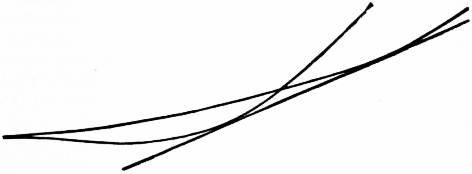
To complete Plücker’s theory it is necessary to take account of compound singularities; it might be possible, but it is at any rate difficult, to effect this by considering the curve as in course of description by the point moving along the rotating line; and it seems easier to consider the compound singularity as arising from the variation of an actually described curve with ordinary singularities. The most simple case is when three double points come into coincidence, thereby giving rise to a triple point; and a somewhat more complicated one is when we have a cusp of the second kind, or node-cusp arising from the coincidence of a node, a cusp, an inflection, and a double tangent, as shown in the annexed figure, which represents the singularities as on the point of coalescing. The general conclusion (see Cayley, Quart. Math. Jour. t. vii., 1866, “On the higher singularities of plane curves”; Collected Works, v. 520) is that every singularity whatever may be considered as compounded of ordinary singularities, say we have a singularity = δ′ nodes, κ′ cusps, τ′ double tangents and ι′ inflections. So that, in fact, Plücker’s equations properly understood apply to a curve with any singularities whatever.
By means of Plücker’s equations we may form a table—
m n δ κ τ ι
0 1 − − 0 0
1 0 0 0 − −
2 2 0 0 0 0
3 6 0 0 0 9
” 4 1 0 0 3
” 3 0 1 0 1
4 12 0 0 28 24
” 10 1 0 16 18
” 9 0 1 10 16
” 8 2 0 8 12
” 7 1 1 4 10
” 6 0 2 1 8
” 6 3 0 4 6
” 5 2 1 2 4
” 4 1 2 1 2
” 3 0 3 1 0
The table is arranged according to the value of m; and we have m = 0, n = 1, the point; m = 1, n = 0, the line; m = 2, n = 2, the conic; of m = 3, the cubic, there are three cases, the class being 6, 4 or 3, according as the curve is without singularities, or as it has 1 node or 1 cusp; and so of m = 4, the quartic, there are ten cases, where observe that in two of them the class is = 6,—the reduction of class arising from two cusps or else from three nodes. The ten cases may be also grouped together into four, according as the number of nodes and cusps (δ + κ) is = 0, 1, 2 or 3.
The cases may be divided into sub-cases, by the consideration of compound singularities; thus when m = 4, n = 6, δ = 3, the three nodes may be all distinct, which is the general case, or two of them may unite together into the singularity called a tacnode, or all three may unite together into a triple point or else into an oscnode.
We may further consider the inflections and double tangents, as well in general as in regard to cubic and quartic curves.
The expression for the number of inflections 3m(m − 2) for a curve of the order m was obtained analytically by Plücker, but the theory was first given in a complete form by Hesse in the two papers “Über die Elimination, u.s.w.,” and “Über die Wendepuncte der Curven dritter Ordnung” (Crelle, t. xxviii., 1844); in the latter of these the points of inflection are obtained as the intersections of the curve u = 0 with the Hessian, or curve Δ = 0, where Δ is the determinant formed with the second derived functions of u. We have in the Hessian the first instance of a covariant of a ternary form. The whole theory of the inflections of a cubic curve is discussed in a very interesting manner by means of the canonical form of the equation x³ + y³ + z³ + 6lxyz = 0; and in particular a proof is given of Plücker’s theorem that the nine points of inflection of a cubic curve lie by threes in twelve lines.
It may be noticed that the nine inflections of a cubic curve represented by an equation with real coefficients are three real, six imaginary; the three real inflections lie in a line, as was known to Newton and Maclaurin. For an acnodal cubic the six imaginary inflections disappear, and there remain three real inflections lying in a line. For a crunodal cubic the six inflections which disappear are two of them real, the other four imaginary, and there remain two imaginary inflections and one real inflection. For a cuspidal cubic the six imaginary inflections and two of the real inflections disappear, and there remains one real inflection.
A quartic curve has 24 inflections; it was conjectured by George Salmon, and has been verified by H. G. Zeuthen that at most eight of these are real.
The expression ½m(m − 2)(m² − 9) for the number of double tangents of a curve of the order m was obtained by Plücker only as a consequence of his first, second, fourth and fifth equations. An investigation by means of the curve Π = 0, which by its intersections with the given curve determines the points of contact of the double tangents, is indicated by Cayley, “Recherches sur l’élimination et la théorie des courbes” (Crelle, t. xxxiv., 1847; Collected Works, vol. i. p. 337), and in part carried out by Hesse in the memoir “Über Curven dritter Ordnung” (Crelle, t. xxxvi., 1848). A better process was indicated by Salmon in the “Note on the Double Tangents to Plane Curves,” Phil. Mag., 1858; considering the m − 2 points in which any tangent to the curve again meets the curve, he showed how to form the equation of a curve of the order (m − 2), giving by its intersection with the tangent the points in question; making the tangent touch this curve of the order (m − 2), it will be a double tangent of the original curve. See Cayley, “On the Double Tangents of a Plane Curve” (Phil. Trans. t. cxlviii., 1859; Collected Works, iv. 186), and O. Dersch (Math. Ann. t. vii., 1874). The solution is still in so far incomplete that we have no properties of the curve Π = 0, to distinguish one such curve from the several other curves which pass through the points of contact of the double tangents.
A quartic curve has 28 double tangents, their points of contact determined as the intersections of the curve by a curve Π = 0 of the order 14, the equation of which in a very elegant form was first obtained by Hesse (1849). Investigations in regard to them are given by Plücker in the Theorie der algebraischen Curven, and in two memoirs by Hesse and Jacob Steiner (Crelle, t. xlv., 1855), in respect to the triads of double tangents which have their points of contact on a conic and other like relations. It was assumed by Plücker that the number of real double tangents might be 28, 16, 8, 4 or 0, but Zeuthen has found that the last case does not exist.
8. Invariants and Covariants. Polar Curves.—The Hessian Δ has just been spoken of as a covariant of the form u; the notion of invariants and covariants belongs rather to the form u than to the curve u = 0 represented by means of this form; and the theory may be very briefly referred to. A curve u = 0 may have some invariantive property, viz. a property independent of the particular axes of co-ordinates used in the representation of the curve by its equation; for instance, the curve may have a node, and in order to this, a relation, say A = 0, must exist between the coefficients of the equation; supposing the axes of co-ordinates altered, so that the equation becomes u′ = 0, and writing A′ = 0 for the relation between the new coefficients, then the relations A = 0, A′ = 0, as two different expressions of the same geometrical property, must each of them imply the other; this can only be the case when A, A′ are functions differing only by a constant factor, or say, when A is an invariant of u. If, however, the geometrical property requires two or more relations between the coefficients, say A = 0, B = 0, &c., then we must have between the new coefficients the like relations, A′ = 0, B′ = 0, &c., and the two systems of equations must each of them imply the other; when this is so, the system of equations, A = 0, B = 0, &c., is said to be invariantive, but it does not follow that A, B, &c., are of necessity invariants of u. Similarly, if we have a curve U = 0 derived from the curve u = 0 in a manner independent of the particular axes of co-ordinates, then from the transformed equation u’ = 0 deriving in like manner the curve U′ = 0, the two equations U = 0, U′ = 0 must each of them imply the other; and when this is so, U will be a covariant of u. The case is less frequent, but it may arise, that there are covariant systems U = 0, V = 0, &c., and U′ = 0, V′ = 0, &c., each implying the other, but where the functions U, V, &c., are not of necessity covariants of u.
If we take a fixed point (x′, y′, z′) and a curve u = 0 of order m, and suppose the axes of reference altered, so that x′, y′, z′ are linearly transformed in the same way as the current x, y, z, the curves [x′(∂/∂x) + y′(∂/∂y) + z′(∂/∂z)]ru = 0, (r = 1, 2, ... m − 1) have the covariant property. They are the polar curves of the point with regard to u = 0.
The theory of the invariants and covariants of a ternary cubic function u has been studied in detail, and brought into connexion with the cubic curve u = 0; but the theory of the invariants and covariants for the next succeeding case, the ternary quartic function, is still very incomplete.
9. Envelope of a Curve.—In further illustration of the Plückerian dual generation of a curve, we may consider the question of the envelope of a variable curve. The notion is very probably older, but it is at any rate to be found in Lagrange’s Théorie des fonctions analytiques (1798); it is there remarked that the equation obtained by the elimination of the parameter a from an equation ƒ(x, y, a) = 0 and the derived equation in respect to a is a curve, the envelope of the series of curves represented by the equation ƒ(x, y, a) = 0 in question. To develop the theory, consider the curve corresponding to any particular value of the parameter; this has with the consecutive curve (or curve belonging to the consecutive value of the parameter) a certain number of intersections and of common tangents, which may be considered as the tangents at the intersections; and the so-called envelope is the curve which is at the same time generated by the points of intersection and enveloped by the common tangents; we have thus a dual generation. But the question needs to be further examined. Suppose that in general the variable curve is of the order m with δ nodes and κ cusps, and therefore of the class n with τ double tangents and ι inflections, m, n, δ, κ, τ, ι being connected by the Plückerian equations,—the number of nodes or cusps may be greater for particular values of the parameter, but this is a speciality which may be here disregarded. Considering the variable curve corresponding to a given value of the parameter, or say simply the variable curve, the consecutive curve has then also δ and κ nodes and cusps, consecutive to those of the variable curve; and it is easy to see that among the intersections of the two curves we have the nodes each counting twice, and the cusps each counting three times; the number of the remaining intersections is = m² − 2δ − 3κ. Similarly among the common tangents of the two curves we have the double tangents each counting twice, and the stationary tangents each counting three times, and the number of the remaining common tangents is = n² − 2τ − 3ι (= m² − 2δ − 3κ, inasmuch as each of these numbers is as was seen = m + n). At any one of the m² − 2δ − 3κ points the variable curve and the consecutive curve have tangents distinct from yet infinitesimally near to each other, and each of these two tangents is also infinitesimally near to one of the n² − 2τ − 3ι common tangents of the two curves; whence, attending only to the variable curve, and considering the consecutive curve as coming into actual coincidence with it, the n² − 2τ − 3ι common tangents are the tangents to the variable curve at the m² − 2δ − 3κ points respectively, and the envelope is at the same time generated by the m² − 2δ − 3κ points, and enveloped by the n² − 2τ − 3ι tangents; we have thus a dual generation of the envelope, which only differs from Plücker’s dual generation, in that in place of a single point and tangent we have the group of m² − 2δ − 3κ points and n² − 2τ − 3ι tangents.
The parameter which determines the variable curve may be given as a point upon a given curve, or say as a parametric point; that is, to the different positions of the parametric point on the given curve correspond the different variable curves, and the nature of the envelope will thus depend on that of the given curve; we have thus the envelope as a derivative curve of the given curve. Many well-known derivative curves present themselves in this manner; thus the variable curve may be the normal (or line at right angles to the tangent) at any point of the given curve; the intersection of the consecutive normals is the centre of curvature; and we have the evolute as at once the locus of the centre of curvature and the envelope of the normal. It may be added that the given curve is one of a series of curves, each cutting the several normals at right angles. Any one of these is a “parallel” of the given curve; and it can be obtained as the envelope of a circle of constant radius having its centre on the given curve. We have in like manner, as derivatives of a given curve, the caustic, catacaustic or diacaustic as the case may be, and the secondary caustic, or curve cutting at right angles the reflected or refracted rays.
10. Forms of Real Curves.—We have in much that precedes disregarded, or at least been indifferent to, reality; it is only thus that the conception of a curve of the m-th order, as one which is met by every right line in m points, is arrived at; and the curve itself, and the line which cuts it, although both are tacitly assumed to be real, may perfectly well be imaginary. For real figures we have the general theorem that imaginary intersections, &c., present themselves in conjugate pairs; hence, in particular, that a curve of an even order is met by a line in an even number (which may be = 0) of points; a curve of an odd order in an odd number of points, hence in one point at least; it will be seen further on that the theorem may be generalized in a remarkable manner. Again, when there is in question only one pair of points or lines, these, if coincident, must be real; thus, a line meets a cubic curve in three points, one of them real, and other two real or imaginary; but if two of the intersections coincide they must be real, and we have a line cutting a cubic in one real point and touching it in another real point. It may be remarked that this is a limit separating the two cases where the intersections are all real, and where they are one real, two imaginary.
Considering always real curves, we obtain the notion of a branch; any portion capable of description by the continuous motion of a point is a branch; and a curve consists of one or more branches. Thus the curve of the first order or right line consists of one branch; but in curves of the second order, or conics, the ellipse and the parabola consist each of one branch, the hyperbola of two branches. A branch is either re-entrant, or it extends both ways to infinity, and in this case, we may regard it as consisting of two legs (crura, Newton), each extending one way to infinity, but without any definite separation. The branch, whether re-entrant or infinite, may have a cusp or cusps, or it may cut itself or another branch, thus having or giving rise to crunodes or double points with distinct real tangents; an acnode, or double point with imaginary tangents, is a branch by itself,—it may be considered as an indefinitely small re-entrant branch. a branch may have inflections and double tangents, or there may be double tangents which touch two distinct branches; there are also double tangents with imaginary points of contact, which are thus lines having no visible connexion with the curve. A re-entrant branch not cutting itself may be everywhere convex, and it is then properly said to be an oval; but the term oval may be used more generally for any re-entrant branch not cutting itself; and we may thus speak of a once indented, twice indented oval, &c., or even of a cuspidate oval. Other descriptive names for ovals and re-entrant branches cutting themselves may be used when required; thus, in the last-mentioned case a simple form is that of a figure of eight; such a form may break up into two ovals or into a doubly indented oval or hour-glass. A form which presents itself is when two ovals, one inside the other, unite, so as to give rise to a crunode—in default of a better name this may be called, after the curve of that name, a limaçon (q.v.). Names may also be used for the different forms of infinite branches, but we have first to consider the distinction of hyperbolic and parabolic. The leg of an infinite branch may have at the extremity a tangent; this is an asymptote of the curve, and the leg is then hyperbolic; or the leg may tend to a fixed direction, but so that the tangent goes further and further off to infinity, and the leg is then parabolic; a branch may thus be hyperbolic or parabolic as to its two legs; or it may be hyperbolic as to one leg and parabolic as to the other. The epithets hyperbolic and parabolic are of course derived from the conic hyperbola and parabola respectively. The nature of the two kinds of branches is best understood by considering them as projections, in the same way as we in effect consider the hyperbola and the parabola as projections of the ellipse. If a line Ω cut an arc aa′ at b, so that the two segments ab, ba′ lie on opposite sides of the line, then projecting the figure so that the line Ω goes off to infinity, the tangent at b is projected into the asymptote, and the arc ab is projected into a hyperbolic leg touching the asymptote at one extremity; the arc ba′ will at the same time be projected into a hyperbolic leg touching the same asymptote at the other extremity (and on the opposite side), but so that the two hyperbolic legs may or may not belong to one and the same branch. And we thus see that the two hyperbolic legs belong to a simple intersection of the curve by the line infinity. Next, if the line Ω touch at b the arc aa’ so that the two portions ab, ba’ lie on the same side of the line Ω, then projecting the figure as before, the tangent at b, that is, the line Ω itself, is projected to infinity; the arc ab is projected into a parabolic leg, and at the same time the arc ba′ is projected into a parabolic leg, having at infinity the same direction as the other leg, but so that the two legs may or may not belong to the same branch. And we thus see that the two parabolic legs represent a contact of the line infinity with the curve,—the point of contact being of course the point at infinity determined by the common direction of the two legs. It will readily be understood how the like considerations apply to other cases,—for instance, if the line Ω is a tangent at an inflection, passes through a crunode, or touches one of the branches of a crunode, &c.; thus, if the line Ω passes through a crunode we have pairs of hyperbolic legs belonging to two parallel asymptotes. The foregoing considerations also show (what is very important) how different branches are connected together at infinity, and lead to the notion of a complete branch or circuit.
The two legs of a hyperbolic branch may belong to different asymptotes, and in this case we have the forms which Newton calls inscribed, circumscribed, ambigene, &c.; or they may belong to the same asymptote, and in this case we have the serpentine form, where the branch cuts the asymptote, so as to touch it at its two extremities on opposite sides, or the conchoidal form, where it touches the asymptote on the same side. The two legs of a parabolic branch may converge to ultimate parallelism, as in the conic parabola, or diverge to ultimate parallelism, as in the semi-cubical parabola y² = x³, and the branch is said to be convergent, or divergent, accordingly; or they may tend to parallelism in opposite senses, as in the cubical parabola y = x³. As mentioned with regard to a branch generally, an infinite branch of any kind may have cusps, or, by cutting itself or another branch, may have or give rise to a crunode, &c.
11. Classification of Cubic Curves.—We may now consider the various forms of cubic curves as appearing by Newton’s Enumeratio, and by the figures belonging thereto. The species are reckoned as 72, which are numbered accordingly 1 to 72; but to these should be added 10a, 13a, 22a and 22b. It is not intended here to consider the division into species, nor even completely that into genera, but only to explain the principle of classification. It may be remarked generally that there are at most three infinite branches, and that there may besides be a re-entrant branch or oval.
The genera may be arranged as follows:—
1,2,3,4 redundant hyperbolas
5,6 defective hyperbolas
7,8 parabolic hyperbolas
9 hyperbolisms of hyperbola
10 hyperbolisms of ellipse
11 hyperbolisms of parabola
12 trident curve
13 divergent parabolas
14 cubic parabola;
and thus arranged they correspond to the different relations of the line infinity to the curve. First, if the three intersections by the line infinity are all distinct, we have the hyperbolas; if the points are real, the redundant hyperbolas, with three hyperbolic branches; but if only one of them is real, the defective hyperbolas, with one hyperbolic branch. Secondly, if two of the intersections coincide, say if the line infinity meets the curve in a onefold point and a twofold point, both of them real, then there is always one asymptote: the line infinity may at the twofold point touch the curve, and we have the parabolic hyperbolas; or the twofold point may be a singular point,—viz., a crunode giving the hyperbolisms of the hyperbola; an acnode, giving the hyperbolisms of the ellipse; or a cusp, giving the hyperbolisms of the parabola. As regards the so-called hyperbolisms, observe that (besides the single asymptote) we have in the case of those of the hyperbola two parallel asymptotes; in the case of those of the ellipse the two parallel asymptotes become imaginary, that is, they disappear; and in the case of those of the parabola they become coincident, that is, there is here an ordinary asymptote, and a special asymptote answering to a cusp at infinity. Thirdly, the three intersections by the line infinity may be coincident and real; or say we have a threefold point: this may be an inflection, a crunode or a cusp, that is, the line infinity may be a tangent at an inflection, and we have the divergent parabolas; a tangent at a crunode to one branch, and we have the trident curve; or lastly, a tangent at a cusp, and we have the cubical parabola.