VOLUME II SLICE VII Arundel, Thomas to Athens (continued 9)
Reading edition
The China aster (Callistephus chinensis) is also a member of the order Compositae. It is a hardy annual, a native of China, which by cultivation has yielded a great variety of forms. Some of the best for ornamental gardening are the chrysanthemum-flowered, the paeony-flowered, the crown or cockade, the comet, and the globe-quilled. Crown asters have a white centre, and dark crimson or purple circumference, and are very beautiful. The colours range from white and blush through pink and rose to crimson, and from lilac through blue to purple, in various shades. They should be sown early in March in pans, in a gentle heat, the young plants being quickly transferred to a cool pit, and there pricked out in rich soil as soon as large enough, and eventually planted out in the garden in May or June, in soil which has been well worked and copiously manured, where they grow from 8 to 18 in. high, and flower towards the end of summer. They also make handsome pot plants for the conservatory.
ASTERIA, or Star-stone (from Gr. ἀστήρ, star), a name applied to such ornamental stones as exhibit when cut en cabochon a luminous star. The typical asteria is the star-sapphire, generally a bluish-grey corundum, milky or opalescent, with a star of six rays. (See Sapphire.) In red corundum the stellate reflexion is less common, and hence the star-ruby occasionally found with the star-sapphire in Ceylon is among the most valued of “fancy stones.” When the radiation is shown by yellow corundum, the stone is called star-topaz. Cymophane, or chatoyant chrysoberyl, may also be asteriated. In all these cases the asterism is due to the reflexion of light from twin-lamellae or from fine tubular cavities or thin enclosures definitely arranged in the stone. The astrion of Pliny is believed to have been our moonstone, since it is described as a colourless stone from India having within it the appearance of a star shining with the light of the moon. All star-stones were formerly regarded with much superstition.
ASTERID, a group of starfish. They are the starfish proper, and have the typical genus Asterias (see Starfish).
ASTERISK (from Gr. ἀστερίσκος, a little star), the sign * used in typography. The word is also used in its literal meaning in old writers, and as a description of an ornamental form (star-shaped) in one of the utensils in the Greek Church.
ASTERIUS, of Cappadocia, sophist and teacher of rhetoric in Galatia, was converted to Christianity about the year 300, and became the disciple of Lucian, the founder of the school of Antioch. During the persecution under Maximian (304) he relapsed into paganism, and thus, though received again into the church by Lucian and supported by the Eusebian party, never attained to ecclesiastical office. He is best known as an able defender of the semi-Arian position, and was styled by Athanasius the “advocate” of the Arians. His chief work was the Syntagmation, but he wrote many others, including commentaries on the Gospels, the Psalms, and Romans. He attended many synods, and we last hear of him at the synod of Antioch in 341.
ASTERIUS, bishop of Amasia, in Pontus, c. 400. He was partly contemporary with the emperor Julian (d. 363) and lived to a great age. His fame rests chiefly on his Homilies, which were much esteemed in the Eastern Church. Most of these have been lost, but twenty-one are given in full by Migne (Patrol. Ser. Gr. xl. 164-477), and there are fragments of others in Photius (Cod. 271). Asterius was a man of much culture, and his works are a valuable contribution to our knowledge of the history of preaching.
ASTHMA (Gr. ἆσθμα, gasping, whence ἀσθμαίνω, I gasp for breath), a disorder of respiration characterized by severe paroxysms of difficult breathing (dyspnoea) usually followed by a period of complete relief, with recurrence of the attacks at more or less frequent intervals. The term is often loosely employed in reference to states of embarrassed respiration, which are plainly due to permanent organic disease of the respiratory organs (see Respiratory System: Pathology).
The attacks occur quite suddenly, and in some patients at regular, in others at irregular intervals. They are characterized by extreme difficulty both in inspiration and expiration, but especially in the latter, the chest becoming distended and the diaphragm immobile. In the case of “pure,” “idiopathic” or “nervous” asthma, there is no fever or other sign of inflammation. But where the asthma is secondary to disease of some organ of the body, the symptoms will depend largely on that organ and the disease present. Such secondary forms may be bronchitic, cardiac, renal, peptic or thymic.
The mode of onset differs very markedly in different cases. In some the attack begins quite suddenly and without warning, but in others various sensations well known to the patient announce that an attack is imminent. According to the late Dr Hyde Salter the commonest warning is that of an intense desire for sleep, so overpowering that though the patient knows his only chance of warding off the attack is to keep awake, he is yet utterly unable to fight against his drowsiness. Among other patients, however, a condition of unwonted mental excitement presages the attack. Again the secondary forms of the disease may be ushered in by flatulence, constipation and loss of appetite, and a symptom which often attends the onset, though it is not strictly premonitory, is a profuse diuresis, the urine being watery and nearly colourless, as in the condition of hysterical diuresis. In the majority of instances the attack begins during the night, sometimes abruptly but often by degrees. The patient may or may not be aware that his asthma is threatening. A few hours after midnight he is aroused from sleep by a sense of difficult breathing. In some cases this is a slowly increasing condition, not becoming acute for some hour or more. But in others the attack is so sudden, so severe, that the patient springs from his bed and makes his way at once to an open window, apparently struggling for breath. Most asthmatics have some favourite attitude which best enables them to use all the auxiliary muscles of respiration in their struggle for breath, and this attitude they immediately assume, and guard fixedly until the attack begins to subside. The picture is characteristic and a very painful one to watch. The face is pale, anxious, and it may be livid. The veins of the forehead stand out, the eyes bulge, and perspiration bedews the face. The head is fixed in position, and likewise the powerful muscles of the back to aid the attempt at respiration. The breath is whistling and wheezing, and if it becomes necessary for the patient to speak, the words are uttered with great difficulty. If the chest be watched it is seen to be almost motionless, and the respirations may become extraordinarily slowed. Inspiration is difficult as the chest is already over-distended, but expiration is an even far greater struggle. The attack may last any time from an hour to several days, and between the attacks the patient is usually quite at ease. But notwithstanding the intensely distressing character of the attacks, asthma is not one of the diseases that shorten life.
In the child, asthma is usually periodic in its recurrence, but as he ages it tends to become more erratic in both its manifestations and time of appearance. Also, though at first it may be strictly “pure” asthma, later in life it becomes attended by chronic bronchitis, which in its turn gives rise to emphysema.
As to the underlying cause of the disease, one has only to read the many utterly different theories put forward to account for it, to see how little is really known. But it has now been clearly shown that in the asthmatic state the respiratory centre is in an unstable and excitable condition, and that there is a morbid connexion between this and some part of the nasal apparatus. Dr Alexander Francis has shown, however, that the disease is not directly due to any mechanical obstruction of the nasal passages, and that the nose comparatively rarely supplies the immediate exciting cause of the asthmatic attack. Paroxysmal sneezing is another form in which asthma may show itself, and, curiously enough, this form occurs more frequently in women, asthma of the more recognized type in men. In infants and young children paroxysmal bronchitis is another form of the same disease. Dr James Goodhart notes the connexion between asthma and certain skin troubles, giving cases of the alternation of asthma and psoriasis, and also of asthma and eczema. The disease occurs in families with a well-marked neurotic inheritance, and twice as frequently in men as in women. The immediate cause of an attack may be anything or nothing. Dr Hyde Salter notes that 80% of cases in the young date from an attack of whooping cough, bronchitis or measles.
In the general treatment of asthma there are two methods of dealing with the patient, either that of hardening the individual, widening his range of accommodation, and thus making him less susceptible, or that of modifying and adapting the environment to the patient. These two methods correspond to the two methods of drug treatment, tonic or sedative. During the last few years the method of treatment first used by Dr Alexander Francis has come into prominence. His plan is to restore the stability of the respiratory centre, by cauterizing the septal mucous membrane, and combining with this general hygienic measures. In his own words the operation, which is entirely painless and insignificant, is performed as follows:—“After painting one side of the septum nasi with a few drops of cocaine and resorcin, I draw a line with a galvano-cautery point from a spot opposite the middle turbinated body, forwards and slightly downwards for a distance of rather less than half an inch. In about one week’s time I repeat the operation on the other side.” In his monograph on the subject, he classifies a large number of cases treated in this manner, most of which resulted in complete relief, some in very great improvement, and a very few in slight or no relief.
ASTI (anc. Hasta), a town and episcopal see of Piedmont, Italy, in the province of Alessandria, situated on the Tanaro; it is 22 m. W. by rail from Alessandria. Pop. (1901) town, 19,787; commune, 41,047. Asti has still numerous medieval towers, a fine Gothic cathedral of the 14th century, the remains of a Christian basilica of the 6th century, and the octagonal baptistery of S. Pietro (11th century). It was the birthplace of the poet Vittorio Alfieri. In ancient times it manufactured pottery. It is now famous for its sparkling wine (Asti spumante), and is a considerable centre of trade.
ASTLEY, JACOB ASTLEY, Baron (1570-1652), royalist commander in the English Civil War, came of a Norfolk family. In 1598 he joined Counts Maurice and Henry of Orange in the Netherlands, where he served with distinction, and afterwards fought under the elector palatine Frederick V. and Gustavus Adolphus in the Thirty Years’ War. He was evidently thought highly of by the states-general, for when he was absent, serving under the king of Denmark, his company in the Dutch army was kept open for him. Returning to England with a well-deserved reputation, he was in the employment of Charles I. in various military capacities. As “sergeant-major,” or general of the infantry, he went north in 1639 to organize the defence against the expected Scottish invasion. Here his duties were as much diplomatic as military, as the discontent which ended in the Civil War was now coming to a head. In the ill-starred “Bishops’ War,” Astley did good service to the cause of the king, and he was involved in the so-called “Army Plot.” At the outbreak of the Great Rebellion (1642) he at once joined Charles, and was made major-general of the foot. His characteristic battle-prayer at Edgebill has become famous: “O Lord, Thou knowest how busy I must be this day. If I forget Thee, do not forget me. March on, boys!” At Gloucester he commanded a division, and at the first battle of Newbury he led the infantry of the royal army. With Hopton, in 1644, he served at Arundel and Cheriton. At the second battle of Newbury he made a gallant and memorable defence of Shaw House. He was made a baron by the king, and at Naseby he once more commanded the main body of the foot. He afterwards served in the west, and with 1500 men fought stubbornly but vainly the last battle for the king at Stow-on-the-Wold (March 1646). His remark to his captors has become as famous as his words at Edgehill, “You have now done your work and may go play, unless you will fall out amongst yourselves.” His scrupulous honour forbade him to take any part in the Second Civil War, as he had given his parole at Stow-on-the-Wold; but he had to undergo his share of the discomforts that were the lot of the vanquished royalists. He died in February 1651/2. The barony became extinct in 1668.
ASTLEY, SIR JOHN DUGDALE, Bart. (1828-1894), English soldier and sportsman, was a descendant of Lord Astley, and son of the 2nd baronet (cr. 1821). From 1848 to 1859 he was in the army, serving in the Crimean War and retiring as lieutenant-colonel. He married an heiress in 1858, and thenceforth devoted himself to horse-racing, pugilism and sport in general. He succeeded to the baronetcy in 1873, and from 1874 to 1880 was Conservative M.P. for North Lincolnshire. He was a popular figure on the turf, being familiarly known as “the Mate,” and won and lost large sums of money. Just before his death, on the 10th of October 1894, he published some entertaining reminiscences, under the title of Fifty Years of my Life.
ASTON, ANTHONY (fl. 1712-1731), English actor and dramatist, began to be known on the London stage in the early years of the 18th century. He had tried the law and other professions, which he finally abandoned for the theatre. He had some success as a dramatic author, writing Love in a Hurry, performed in Dublin about 1709, and Pastora, or the Coy Shepherdess, an opera (1712). For many years he toured the English provinces with his wife and son, producing pieces which he himself wrote, or medleys from various plays fitted together with songs and dialogues of his own.
ASTON MANOR, a municipal and parliamentary borough of Warwickshire, England, adjoining Birmingham on the north-east. Pop. (1901) 77,326. There are extensive manufactures, including those of motors and cycles with their accessories, also paper-mills, breweries, &c., and the population is largely industrial. Aston Hall, erected by Sir Thomas Holte in 1618-1635, is an admirable architectural example of its period, built of red brick. It stands in a large park, the whole property being acquired by the corporation of Birmingham in 1864, when the mansion became a museum and art gallery. It contains the panelling of a room from the house of Edmund Hector, which formerly stood in Old Square, Birmingham, where Dr Samuel Johnson was a frequent visitor. Aston Lower Grounds, adjoining the park, contain an assembly hall, and the playing field of the Aston Villa Football Club, where the more important games are witnessed by many thousands of spectators. Aston Manor was incorporated in 1903. The parliamentary borough returns one member. The corporation consists of a mayor, 6 aldermen and 18 councillors. Area, 960 acres.
ASTOR, JOHN JACOB (1763-1848), American merchant, was born at the village of Walldorf, near Heidelberg, Germany, on the 17th of July 1763. Until he was sixteen he worked in the shop of his father, a butcher; he then joined an elder brother in London, and there for four years was employed in the piano and flute factory of an uncle, of the firm of Astor & Broadwood. In 1783 he emigrated to America, and settled in New York, whither one of his brothers had previously gone. On the voyage he became acquainted with a fur-trader, by whose advice he devoted himself to the same business, buying furs directly from the Indians, preparing them at first with his own hands for the market, and selling them in London and elsewhere at a great profit. He was also the agent in New York of the firm of Astor & Broadwood. By his energy, industry and sound judgment he gradually enlarged his operations, did business in all the fur markets of the world, and amassed an enormous fortune,—the largest up to that time made by any American. He devoted many years to carrying out a project for organizing the fur trade from the Great Lakes to the Pacific Ocean, and thence by way of the Hawaiian Islands to China and India. In 1811 he founded at the mouth of the Columbia river a settlement named after him Astoria, which was intended to serve as the central depot; but two years later the settlement was seized and occupied by the English. The incidents of this undertaking are the theme of Washington Irving’s Astoria. A series of disasters frustrated the gigantic scheme. Astor made vast additions to his wealth by investments in real estate in New York City, and erected many buildings there, including the hotel known as the Astor House. The last twenty-five years of his life were spent in retirement in New York City, where he died on the 29th of March 1848, his fortune then being estimated at about $30,000,000. He made various charitable bequests by his will, and among them a gift of $50,000 to found an institution, opened as the “Astor House” in 1854, for the education of poor children and the relief of the aged and the destitute in his native village in Germany. His chief benefaction, however, was a bequest of $400,000 for the foundation and endowment of a public library in New York City, since known as the Astor library, and since 1895 part of the New York public library.
See Parton’s Life of John Jacob Astor (New York, 1865).
His eldest son, William Backhouse Astor (1792-1875), inherited the greater part of his father’s fortune, and chiefly by judicious investments in real estate greatly increased it. He was sometimes known as the “Landlord of New York.” Under his direction the building for the Astor library was erected, and to the library he gave about $550,000, including a bequest of $200,000. His son, John Jacob Astor (1822-1890), was also well known as a capitalist and philanthropist, giving liberally to the Astor library.
The son of the last named, William Waldorf Astor (1848- ), served in the New York assembly in 1877, and in the state senate in 1880-81. He was United States minister to Italy from 1882 to 1885. He published two romances, Valentine (1885) and Sforza (1889). His wealth, arising from property in New York, where also he built the New Netherland hotel and the Waldorf hotel, was enormous. In 1890 he removed to England, and in 1899 was naturalized. In 1893 he became proprietor of the Pall Mall Gazette, and afterwards started the Pall Mall Magazine.
ASTORGA, EMANUELE D’ (1681-1736), Italian musical composer, was born at Naples on the 11th of December 1681. No authentic account of Astorga’s life can be successfully constructed from the obscure and confusing evidence that has been until now handed down, although historians have not failed to indulge many pleasant conjectures. According to some of these, his father, a baron of Sicily, took an active part in the attempt to throw off the Spanish yoke, but was betrayed by his own soldiers and publicly executed. His wife and son were compelled to be spectators of his fate; and such was the effect upon them that his mother died on the spot, and Emanuele fell into a state of gloomy despondency, which threatened to deprive him of reason. By the kindness of the princess Ursini, the unfortunate young man was placed in a convent at Astorga, in Leon, where he completed a musical education which is said to have been begun in Palermo under Francesco Scarlatti. Here he recovered his health, and his admirable musical talents were cultivated under the best masters. On the details of this account no reliance can safely be placed, nor is there any certainty that in 1703 he entered the service of the duke of Parma. Equally untrustworthy is the story that the duke, suspecting an attachment between hi? niece Elizabeth Farnese and Astorga, dismissed the musician. The established facts concerning Astorga are indeed few enough. They are: that the opera Dafne was written and conducted by the composer in Barcelona in 1709; that he visited London, where he wrote his Stabat Mater, possibly for the society of “Antient Musick”; that it was performed in Oxford in 1713; that in 1712 he was in Vienna, and that he retired at an uncertain date to Bohemia, where he died on the 21st of August 1736, in a castle which had been given to him in the domains of Prince Lobkowitz, in Raudnitz. Astorga deserves remembrance for his dignified and pathetic Stabat Mater, and for his numerous chamber-cantatas for one or two voices. He was probably the last composer to carry on the traditions of this form of chamber-music as perfected by Alessandro Scarlatti.
ASTORGA, a city of N.W. Spain, in the province of Leon; situated near the right bank of the river Tuerto, and at the junction of the Salamanca-Corunna and Leon-Astorga railways. Pop. (1900) 5573. Astorga was the Roman Asturica Augusta, a provincial capital, and the meeting-place of four military roads. Though sacked by the Goths in the 5th century, and later by the Moors, it is still surrounded by massive walls of Roman origin. A ruined castle, near the city, recalls its strategic importance in the 8th century, when Asturias, Galicia and Leon were the headquarters of resistance to the Moors. Astorga has been the see of a bishop since the 3rd century, and was formerly known as the City of Priests, from the number of ecclesiastics resident within its walls. Its Gothic cathedral dates from the 15th century. The city confers the title of marquis on the Osorio family, the ruins of whose palace, sacked in 1810 by the French, are still an object of interest.
For the history, especially the ecclesiastical history, of Astorga, see the anonymous Historia de la ciudad de Astorga (Valladolid, 1840); with Fundación de la ... iglesia ... de Astorga, by P.A. Ezpeleta (Madrid, 1634); and Fundación, nombre y armas de ... Astorga, by P. Junco (Pamplona, 1635).
ASTORIA, a city, port of entry, and the county-seat of Clatsop county, Oregon, U.S.A., on the Columbia river, 8 m. from its mouth. Pop. (1890) 6184; (1900) 8381, of whom 3779 were foreign-born (many being Finns,—a Finnish weekly was established here in 1905), and 601 were Chinese; (1910, census) 9599. It is served by the Astoria & Columbia River railroad (Northern Pacific System), and by several coastwise and foreign steamship lines (including that of the Oregon Railway & Navigation Co.). The river here is about 6 m. wide, and the city has a water-front of about 5 m. and a deep, spacious and placid harbour. By dredging and the construction of jetties the Federal government has since 1885 greatly improved the channel at the mouth of the river. The business portion of the city occupies the low ground of the river bottom; the residence portion is on the hillsides overlooking the harbour. Astoria is the port of entry for the Oregon Customs District, Oregon; in 1907 its imports were valued at $21,262, and its exports at $329,103. The city is especially important as a salmon fishing and packing centre (cod, halibut and smaller fish also being abundant); it has also an extensive lumber trade, important lumber manufactories, pressed brick and terra-cotta factories, and dairy interests. In 1905 the value of the factory product was $3,092,628 (of which $1,759,871 was the value of preserved and canned fish), being an increase of 41.8% in five years. Astoria is the oldest American settlement in the Columbia Valley. It was founded in 1811, as a depot for the fur trade, by John Jacob Astor, in whose honour it was named. It was seized by the British in 1813, but was restored in 1818. In 1821, while occupied by the North-West Fur Company, it was burned and practically abandoned, only a few settlers remaining. It was chartered as a city in 1876.
See Washington Irving’s Astoria; or Anecdotes of an Enterprise beyond the Rocky Mountains (Philadelphia, 1836).
ASTRAEA, in Greek legend, the “star maiden,” daughter of Zeus and Themis, or of Astraeus the Titan and Eos, in which case she is identified with Dikē. During the golden age she remained among men distributing blessings, but when the iron (or bronze) age came on, she was forced to withdraw, being the last of the goddesses to quit the earth. In the heavens she is amongst the signs of the zodiac as the constellation Virgo. She is usually represented with a pair of scales and a crown of stars.
Ov. Met. i. 150; Juv. vi. 19; Aratus, Phaenomena, 96.
ASTRAGAL (from the Gr. ἀστράγαλος, the ankle-joint), an architectural term for a convex moulding. This term is generally applied to small mouldings, “torus” (q.v.) to large ones of the same form. The Lesbian astragal referred to by Vitruvius, bk. iv. ch. vi., was in all probability an astragal carved with a bead and reel enrichment.
ASTRAKHAN, a government of S.E. Russia, on the lower Volga, bounded N. by the governments of Samara and Saratov, W. by Saratov and the government of the Don Cossacks, S. by Stavropol and Terek, and E. by the Caspian Sea and the government of the Urals. Area, 91,327 sq. m., of which 6730 sq. m. belong to the delta of the Volga and its brackish lagoons, and 62,290 sq. m. are covered by the Kalmuck and Kirghiz Steppes. The surface is a low-lying plain, except that in the west the Ergeni Hills (500-575 ft.) form the water-parting between the Volga basin and that of the Don. The climate is very hot and dry, the average temperature for the year being 50° Fahr., for January 21°, and for July 78°, rainfall 7.3 in., but often there is no rain at all in the summer. Pop. (1897) 1,005,460, of whom 132,383 were urban. The Kalmucks (138,580 in 1897) and Kirghiz (260,000) are semi-nomads. In addition to them the population includes nearly 44,000 Tatars, 4270 Armenians, with Poles and Jews. Fishing off the mouth of the Volga gives occupation to 50,000 persons; the fish, chiefly herrings and sturgeon, together with the caviare prepared from the latter, are sold for the most part at Nizhniy-Novgorod. Over 300,000 tons of salt are extracted annually from the lakes, principally those of Baskunchak and Elton. Cattle-breeding is an important industry. Market-gardening (mustard, water-melons, fruit) is on the increase; but pure agriculture is relatively not much developed. The government is divided into five districts, the chief towns of which are Astrakhan, Enotayevsk (pop. 2810 in 1897), Krasnyi-yar (4680), Chernyi-yar (5140), and Tsarev (8900). The Kalmucks and Kirghiz have their own local administrations, and so have the Astrakhan Cossacks (25,600).
ASTRAKHAN, a town of E. Russia, capital of the government of Astrakhan, on the left bank of the main channel of the Volga, 50 m. from the Caspian Sea, in 46° 21′ N. lat. and 48° 5′ E. long. Since the growth of the petroleum industry of Baku and the construction of the Transcaspian railway, Astrakhan has become an important commercial centre, exporting fish, caviare, sugar, metals, naphtha, cottons and woollens, and importing grain, cotton, fruit and timber, to the aggregate value of £8,250,000 with foreign countries and of £14,500,000 with the interior of Russia. The town gives its name to the “fur” called “astrakhan,” the skin of the new-born Persian lamb, and so to an imitation in rough woollen cloth. There is some tanning, shipbuilding and brewing, and making of soap, tar and machinery. Astrakhan is the chief port on the Caspian Sea and the headquarters of the Russian Caspian fleet. The city consists of (1) the kreml or citadel (1550), crowning a hill, on which stand also the spacious brick cathedral containing the tombs of two Georgian princes, the archbishop’s palace and the monastery of the Trinity; (2) the Byelogorod or White Town, containing the administrative offices and the bazaars; and (3) the suburbs, where most of the population resides. The buildings in the first two quarters are of stone, in the third of wood, irregularly arranged along unpaved, dirty streets. The city is the see of a Greek Catholic archbishop and of an Armenian archbishop, and contains a Lamaist monastery, as well as technical schools, an ichthyological museum, the Peter museum, with ethnographical, archaeological and natural history collections, a botanical garden, an ecclesiastical seminary, and good squares and public gardens, one of which is adorned with a statue (1884) of Alexander II. Vineyards surround the city. Astrakhan was anciently the capital of a Tatar state, and stood some 7 m. farther north. After this was destroyed by the Mongol prince Timur the Great in 1395, the existing city was built. The Tatars were expelled about 1554 by Ivan IV. of Russia. In 1569 the city was besieged by the Turks, but they were defeated with great slaughter by the Russians. In 1670 it was seized by the rebel Stenka Razin; early in the following century Peter the Great constructed here a shipbuilding yard and made Astrakhan the base for his hostilities against Persia, and later in the same century Catherine II. accorded the city important industrial privileges. In 1702, 1718 and 1767, it suffered severely from fires; in 1719 was plundered by the Persians; and in 1830 the cholera swept away a large number of its people. In the middle ages the city was known also as Jitarkhan and Ginterkhan. Pop. (1867) 47,839; (1900) 121,580. Eight miles above Astrakhan, on the right bank of the Volga, are the ruins of two ancient cities superimposed one upon the other. In the upper, which may represent the city of Balanjar (Balansar, Belenjer), have been found gold and silver coins struck by Mongol rulers, as well as ornaments in the same metals. The older and scantier underlying ruins are supposed to be those of the once large and prosperous city of Itil or Atel (Etel, Idl) of the Arab geographers, a residence of the khan of the Khazars, destroyed by the Russians in 969.
(P. A. K.)
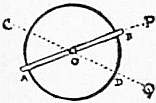
ASTROLABE (from Gr. ἄστρον, star, and λαβῖν, to take), an instrument used not only for stellar, but for solar and lunar altitude-taking. The principle of the astrolabe is explained in fig. 2. There were two kinds,—spherical and planispheric. The earliest forms were “armillae” and spherical. Gradually, from Eratosthenes to Tycho, Hipparchus playing the most important part among ancient astronomers, the complex astrolabe was evolved, large specimens being among the chief observatory instruments of the 15th, 16th and even 17th centuries; while small ones were in use among travellers and learned men, not only for astronomical, but for astrological and topographical purposes. Nearly every one of the modern instruments used for the observations of physical astronomy is a part of the perfected astrolabe. A collection of circles such as is the armillary sphere, if each circle were fitted with a view-tube, might be considered a complete astrolabe. Tycho’s armillae were astrolabes. In fact the modern equatorial, and the altitude and azimuth circle are astrolabes in the strictest and oldest meaning of the term; and Tycho in one of his astrolabes came so near the modern equatorial that it may be taken as the first of the kind.
Plate.
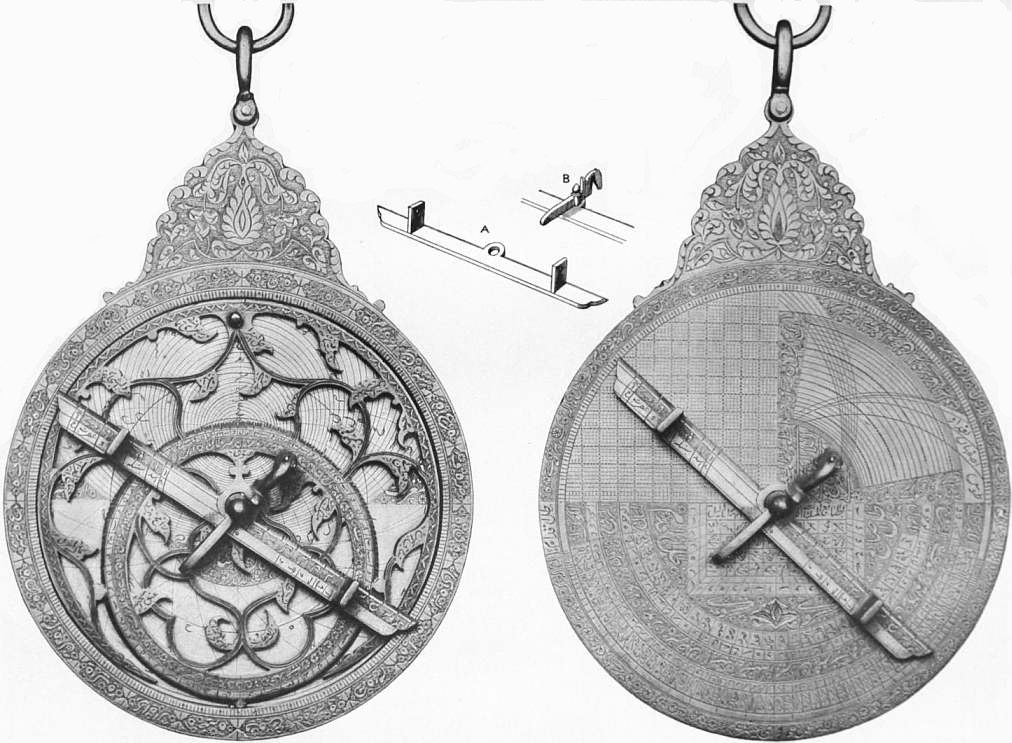
Fig. 1.—PERSIAN ASTROLABE (c. 1712) INSCRIBED IN ARABIC.
Front, showing the Rete or Spider, a network of star pointers. Beneath the Rete, in a hollow, are four thin brass discs, called Tables or Climates, engraved with projections of the sphere for different latitudes. Back, showing graduations, parallelogram for measuring heights; and other tables, together with the Rule with sights (A) held by a moveable pin (B), known as the Horse or Wedge.
Fig. 2.—Principle of the Astrolabe. If a solid circle be fixed in any one position and a tube be pivoted on its centre so as to move; and if the line C D be drawn upon the circle pointing towards any object Q in the heavens which lies in the plane of the circle, by turning the tube A B towards any other object P in the plane of the circle, the angle BOD will be the angle subtended by the two objects P and Q at the eye.
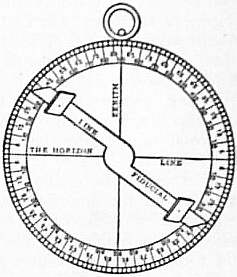
From Exercises, by T. Blundeville.
Fig. 3.—Mariner’s Astrolabe, A.D. 1594. Made of brass, or of heavy wood: it varied in size from a few inches to 1 ft. in diameter.
The two forms of the planispheric astrolabe most widely known and used in the 15th, 16th and even 17th centuries were: (1) the portable astrolabe shown in fig. 1 (Plate). This originated in the East, and was in early use in India, Persia and Arabia, and was introduced into Europe by the Arabs, who had perfected it—perhaps as early as A.D. 700. It combines the planisphere and armillae of Hipparchus and others, and the theodolite of Theon, and was usually of brass, varying in diameter from a couple of inches to a foot or more. It was used for taking the altitudes of sun, moon and stars; for calculating latitude; for determining the points of the compass, and time; for ascertaining heights of mountains, &c.; and for construction of horoscopes. The instrument was a marvel of convenience and ingenuity, and was called “the mathematical jewel.” Nevertheless it passed out of use, because incapable of any great precision.
(2) The mariner’s astrolabe, fig. 3, was adapted from that of astronomers by Martin Behaim, c. 1480. This was the instrument used by Columbus. With the tables of the sun’s declination then available, he could calculate his latitude by meridian altitudes of the sun taken with his astrolabe. The mariner’s astrolabe was superseded by John Hadley’s quadrant of 1731.
Authorities.—Chaucer, Treatise on the Astrolabe (Skeat’s edition of Chaucer); J.J. Stöffler, Elucidatio Fabrice ususque Astrolabii, &c.; Thomas Blundeville, His Exercises (1594); F. Ritter, Astrolabium; W.H. Morley, Description of Astrolabe of Shah Husain; M.L. Huggins, “The Astrolabe” (Astrophysical Journal, 1894); Penny Cyclopaedia, article “Astrolabe;” R. Grant, History of Physical Astronomy.
(M. L. H.)
ASTROLOGY, the ancient art or science of divining the fate and future of human beings from indications given by the positions of the stars (sun, moon and planets). The belief in a connexion between the heavenly bodies and the life of man has played an important part in human history. For long ages astronomy and astrology (which might be called astromancy, on the same principle as “chiromancy”) were identified; and a distinction is made between “natural astrology,” which predicts the motions of the heavenly bodies, eclipses, &c., and “judicial astrology,” which studies the influence of the stars on human destiny. Isidore of Seville (d. 636) is one of the first to distinguish between astronomy and astrology; nor did astronomy begin to rid itself of astrology till the 16th century, when, with the system of Copernicus, the conviction that the earth itself is one of the heavenly bodies was finally established. The study of astromancy and the belief in it, as part of astronomy, is found in a developed form among the ancient Babylonians, and directly or indirectly through the Babylonians spread to other nations. It came to Greece about the middle of the 4th century B.C., and reached Rome before the opening of the Christian era. In India and China astronomy and astrology are largely reflections of Greek theories and speculations; and similarly with the introduction of Greek culture into Egypt, both astronomy and astrology were actively cultivated in the region of the Nile during the Hellenistic and Roman periods. Astrology was further developed by the Arabs from the 7th to the 13th century, and in the Europe of the 14th and 15th centuries astrologers were dominating influences at court.
Even up to the present day men of intellectual eminence like Dr Richard Garnett have convinced themselves that astromancy has a foundation of truth, just as there are still believers in chiromancy or other forms of divination. Dr Garnett (“A.G. Trent”) insisted indeed that it was a mistake to confuse astrology with fortune-telling, and maintained that it was a “physical science just as much as geology,” depending like them on ascertained facts, and grossly misrepresented by being connected with magic. Dr Garnett himself looked upon the study of biography in relation to the casting of horoscopes as an empirical investigation, but it is difficult in practice to keep the distinction clear, to judge by present-day text-books such as those of Dr Wilde (Primer of Astrology, &c.). Dr Wilde insists on there being “nothing incongruous with the laws of nature in the theory that the sun, moon and stars influence men’s physical bodies and conditions, seeing that man is made up of a physical part of the earth.” There is an obvious tendency, however, for astromancy to be employed, like palmistry, as a means of imposing on the ignorant and credulous. How far the more serious claim is likely to be revived in connexion with the renewal of research into the “occult” sciences generally, it is still too early to speculate; and it has to be recognized that such a point of view is opposed to the generally established belief that astrology is either mere superstition or absolute imposture, and that its former vogue was due either to deception or to the tyranny of an unscientific environment. But if the progress of physical science has not prevented the rehabilitation of much of ancient alchemy by the later researches into chemical change, and if psychology now finds a place for explanations of spiritualism and witchcraft which involve the admission of the empirical facts under a new theory (as in the case of the divining-rod, &c.), it is at least conceivable that some new synthesis might once more justify part at all events of ancient and medieval astromancy, to the extent of admitting the empirical facts where provable, and substituting for the supposed influence of the stars as such, some deeper theory which would be consistent with an application to other forms of prophecy, and thus might reconcile the possibility of dipping into futurity with certain interrelations of the universe, different indeed from those assumed by astrological theory, but underlying and explaining it. If this is ever accomplished it will need the patient investigation of a number of empirical observations by competent students unbiassed by any parti pris—a difficult set of conditions to obtain; and even then no definite results may be achieved.
The history of astrology can now be traced back to ancient Babylonia, and indeed to the earliest phases of Babylonian history, i.e. to about 3000 B.C. In Babylonia as well as in Assyria as a direct offshoot of Babylonian culture (or as we might also term it “Euphratean” culture), astrology takes its place in the official cult as one of the two chief means at the disposal of the priests (who were called bārē or “inspectors”) for ascertaining the will and intention of the gods, the other being through the inspection of the liver of the sacrificial animal (see Omen). Just as this latter method of divination rested on a well-defined theory, to wit, that the liver was the seat of the soul of the animal and that the deity in accepting the sacrifice identified himself with the animal, whose “soul” was thus placed in complete accord with that of the god and therefore reflected the mind and will of the god, so astrology is based on a theory of divine government of the world, which in contrast to “liver” divination assumes at the start a more scientific or pseudo-scientific aspect. This theory must be taken into consideration as a factor in accounting for the persistent hold which even at the present day astrology still maintains on many minds. Starting with the indisputable fact that man’s life and happiness are largely dependent upon phenomena in the heavens, that the fertility of the soil is dependent upon the sun shining in the heavens as well as upon the rains that come from heaven, that on the other hand the mischief and damage done by storms and inundations, to both of which the Euphratean Valley was almost regularly subject, were to be traced likewise to the heavens, the conclusion was drawn that all the great gods had their seats in the heavens. In that early age of culture known as the “nomadic” stage, which under normal conditions precedes the “agricultural” stage, the moon cult is even more prominent than sun worship, and with the moon and sun cults thus furnished by the “popular” faith it was a natural step for the priests, who correspond to the “scientists” of a later day, to perfect a theory of a complete accord between phenomena observed in the heavens and occurrences on earth.
If moon and sun, whose regular movements conveyed to the more intelligent minds the conception of the reign of law and order in the universe as against the more popular notion of chance and caprice, were divine powers, the same held good of the planets, whose movements, though more difficult to follow, yet in the course of time came to be at least partially understood. Of the planets five were recognized—Jupiter, Venus, Saturn, Mercury and Mars—to name them in the order in which they appear in the older cuneiform literature; in later texts Mercury and Saturn change places. These five planets were identified with the great gods of the pantheon as follows:—Jupiter with Marduk (q.v.), Venus with the goddess Ishtar (q.v.), Saturn with Ninib (q.v.), Mercury with Nebo (q.v.), and Mars with Nergal (q.v.). The movements of the sun, moon and five planets were regarded as representing the activity of the five gods in question, together with the moon-god Sin (q.v.) and the sun-god Shamash (q.v.), in preparing the occurrences on earth. If, therefore, one could correctly read and interpret the activity of these powers, one knew what the gods were aiming to bring about. The Babylonian priests accordingly applied themselves to the task of perfecting a system of interpretation of the phenomena to be observed in the heavens, and it was natural that the system was extended from the moon, sun and five planets to the more prominent and recognizable fixed stars. That system involved not merely the movements of the moon, sun and planets, but the observation of their relative position to one another and to all kinds of peculiarities noted at any point in the course of their movements: in the case of the moon, for instance, the exact appearance of the new crescent, its position in the heavens, the conditions at conjunction and opposition, the appearance of the horns, the halo frequently seen with the new moon, which was compared to a “cap,” the ring round the full moon, which was called a “stall” (i.e. “enclosure”), and more of the like. To all these phenomena some significance was attached, and this significance was naturally intensified in the case of such a striking phenomenon as an eclipse of the moon. Applying the same method of careful observation to the sun and planets, and later to some of the constellations and to many of the fixed stars, it will be apparent that the body of observations noted must have grown in the course of time to large and indeed to enormous proportions, and correspondingly the interpretations assigned to the nearly endless variations in the phenomena thus observed. The interpretations themselves were based (as in the case of divination through the liver) chiefly on two factors:—(1) on the recollection or on written records of what in the past had taken place when the phenomenon or phenomena in question had been observed, and (2) association of ideas—involving sometimes merely a play upon words—in connexion with the phenomenon or phenomena observed. Thus if on a certain occasion the rise of the new moon in a cloudy sky was followed by victory over an enemy or by abundant rain, the sign in question was thus proved to be a favourable one and its recurrence would be regarded as a good omen, though the prognostication would not necessarily be limited to the one or the other of those occurrences, but might be extended to apply to other circumstances. On the other hand, the appearance of the new moon earlier than was expected was regarded as an unfavourable omen—prognosticating in one case defeat, in another death among cattle, in a third bad crops—not necessarily because these events actually took place after such a phenomenon, but by an application of the general principle resting upon association of ideas whereby anything premature would suggest an unfavourable occurrence. A thin halo seen above the new moon was pictured as a cap, and the association between this and the symbol of royalty, which was a conical-shaped cap, led to interpreting the phenomenon as an indication that the ruler would have a successful reign. In this way a mass of traditional interpretation of all kinds of observed phenomena was gathered, and once gathered became a guide to the priests for all times.
Astrology in this its earliest stage is, however, marked by two characteristic limitations. In the first place, the movements and position of the heavenly bodies point to such occurrences as are of public import and affect the general welfare. The individual’s interests are not in any way involved, and we must descend many centuries and pass beyond the confines of Babylonia and Assyria before we reach that phase which in medieval and modern astrology is almost exclusively dwelt upon—genethliology or the individual horoscope. In Babylonia and Assyria the cult centred largely and indeed almost exclusively in the public welfare and the person of the king, because upon his well-being and favour with the gods the fortunes of the country were dependent in accordance with the ancient conception of kingship (see J.G. Frazer, The Early History of Kingship). To some extent, the individual came in for his share in the incantations and in the purification ritual through which one might hope to rid oneself of the power of the demons and of other evil spirits, but outside of this the important aim of the priests was to secure for the general benefit the favour of the gods, or, as a means of preparing oneself for what the future had in store, to ascertain in time whether that favour would be granted in any particular instance or would be continued in the future. Hence in “liver” divination, as in astrology, the interpretations of the signs noted all have reference to public affairs and events and not to the individual’s needs or desires. In the second place, the astronomical knowledge presupposed and accompanying early Babylonian astrology is essentially of an empirical character. While in a general way the reign of law and order in the movements of the heavenly bodies was recognized, and indeed must have exercised an influence at an early period in leading to the rise of a methodical divination that was certainly of a much higher order than the examination of an animal’s liver, yet the importance that was laid upon the endless variations in the form of the phenomena and the equally numerous apparent deviations from what were regarded as normal conditions, prevented for a long time the rise of any serious study of astronomy beyond what was needed for the purely practical purposes that the priests as “inspectors” of the heavens (as they were also the “inspectors” of the sacrificial livers) had in mind. True, we have, probably as early as the days of Khammurabi, i.e. c. 2000 B.C., the combinations of prominent groups of stars with outlines of pictures fantastically put together, but there is no evidence that prior to 700 B.C. more than a number of the constellations of our zodiac had become part of the current astronomy. The theory of the ecliptic as representing the course of the sun through the year, divided among twelve constellations with a measurement of 30° to each division, is also of Babylonian origin, as has now been definitely proved; but it does not appear to have been perfected until after the fall of the Babylonian empire in 539 B.C. Similarly, the other accomplishments of Babylonian astronomers, such as their system or rather systems of moon calculations and the drawing up of planetary tablets, belong to this late period, so that the golden age of Babylonian astronomy belongs not to the remote past, as was until recently supposed, but to the Seleucid period, i.e. after the advent of the Greeks in the Euphrates Valley. From certain expressions used in astrological texts that are earlier than the 7th century B.C. it would appear, indeed, that the beginnings at least of the calculation of sun and moon eclipses belong to the earlier period, but here, too, the chief work accomplished was after 400 B.C., and the defectiveness of early Babylonian astronomy may be gathered from the fact that as late as the 6th century B.C. an error of almost an entire month was made by the Babylonian astronomers in the attempt to determine through calculation the beginning of a certain year.
The researches of Bouché-Leclercq, Cumont and Boll have enabled us to fix with a considerable degree of definiteness the middle of the 4th century B.C. as the period when Babylonian astrology began its triumphal march to the west, invading the domain of Greek and Roman culture and destined to exercise a strong hold on all nations and groups—more particularly in Egypt—that came within the sphere of Greek and Roman influence. It is rather significant that this spread of astrology should have been concomitant with the intellectual impulse that led to the rise of a genuine scientific phase of astronomy in Babylonia itself, which must have weakened to some extent the hold that astrology had on the priests and the people. The advent of the Persians, bringing with them a conception of religion of a far higher order than Babylonian-Assyrian polytheism (see Zoroaster), must also have acted as a disintegrating factor in leading to the decline of the old faith in the Euphrates Valley, and we thus have the interesting though not entirely exceptional phenomenon of a great civilization bequeathing as a legacy to posterity a superstition instead of a real achievement. “Chaldaean wisdom” became among Greeks and Romans the synonym of divination through the planets and stars, and it is not surprising that in the course of time to be known as a “Chaldaean” carried with it frequently the suspicion of charlatanry and of more or less wilful deception. The spread of astrology beyond Babylonia is thus concomitant with the rise of a truly scientific astronomy in Babylonia itself, which in turn is due to the intellectual impulse afforded by the contact with new forms of culture from both the East and the West.
In the hands of the Greeks and of the later Egyptians both astrology and astronomy were carried far beyond the limits attained by the Babylonians, and it is indeed a matter of surprise to observe the harmonious combination of the two fields—a harmony that seems to grow more complete with each age, and that is not broken until we reach the threshold of modern science in the 16th century. To the Greek astronomer Hipparchus belongs the credit of the discovery (c. 130 B.C.) of the theory of the precession of the equinoxes, for a knowledge of which among the Babylonians we find no definite proof; but such a signal advance in pure science did not prevent the Greeks from developing in a most elaborate manner the theory of the influence of the planets upon the fate of the individual. The endeavour to trace the horoscope of the individual from the position of the planets and stars at the time of birth (or, as was attempted by other astrologers, at the time of conception) represents the most significant contribution of the Greeks to astrology. The system was carried to such a degree of perfection that later ages made but few additions of an essential character to the genethliology or drawing up of the individual horoscope by the Greek astrologers. The system was taken up almost bodily by the Arab astronomers, it was embodied in the Kabbalistic lore of Jews and Christians, and through these and other channels came to be the substance of the astrology of the middle ages, forming, as already pointed out, under the designation of “judicial astrology,” a pseudo-science which was placed on a perfect footing of equality with “natural astrology” or the more genuine science of the study of the motions and phenomena of the heavenly bodies.
Partly in further development of views unfolded in Babylonia, but chiefly under Greek influences, the scope of astrology was enlarged until it was brought into connexion with practically all of the known sciences, botany, chemistry, zoology, mineralogy, anatomy and medicine. Colours, metals, stones, plants, drugs and animal life of all kinds were associated with the planets and placed under their tutelage. In the system that passes under the name of Ptolemy, Saturn is associated with grey, Jupiter with white, Mars with red, Venus with yellow, while Mercury, occupying a peculiar place in Greek as it did in Babylonian astrology (where it was at one time designated as the planet par excellence), was supposed to vary its colour according to changing circumstances. The sun was associated with gold, the moon with silver, Jupiter with electrum, Saturn with lead, Venus with copper, and so on, while the continued influence of astrological motives is to be seen in the association of quicksilver, upon its discovery at a comparatively late period, with Mercury, because of its changeable character as a solid and a liquid. In the same way stones were connected with both the planets and the months; plants, by diverse association of ideas, were connected with the planets, and animals likewise were placed under the guidance and protection of one or other of the heavenly bodies. By this curious process of combination the entire realm of the natural sciences was translated into the language of astrology with the single avowed purpose of seeing in all phenomena signs indicative of what the future had in store. The fate of the individual, as that feature of the future which had a supreme interest, led to the association of the planets with parts of the body. Here, too, we find various systems devised, in part representing the views of different schools, in part reflecting advancing conceptions regarding the functions of the organs in man and animals. In one system the seat of Mercury, representing divine intelligence as the source of all knowledge—a view that reverts to Babylonia where Nebo (corresponding to Mercury) was regarded as the divine power to whom all wisdom is due—was placed in the liver as the primeval seat of the soul (see Omen), whereas in other systems this distinction was assigned to Jupiter or to Venus. Saturn, taking in Greek astrology the place at the head of the planets which among the Babylonians was accorded to Jupiter-Marduk, was given a place in the brain, which in later times was looked upon as the centre of soul-life; Venus, as the planet of the passion of love, was supposed to reign supreme over the genital organs, the belly and the lower limbs; Mars, as the violent planet, is associated with the bile, as well as with the blood and kidneys. Again, the right ear is associated with Saturn, the left ear with Mars, the right eye in the case of the male with the sun and the left eye with the moon, while in the case of the female it was just the reverse. From the planets the same association of ideas was applied to the constellations of the zodiac, which in later phases of astrology are placed on a par with the planets themselves, so far as their importance for the individual horoscope is concerned. The fate of the individual in this combination of planets with the zodiac was made dependent not merely upon the planet which happened to be rising at the time of birth or of conception, but also upon its local relationship to a special sign or to certain signs of the zodiac. The zodiac was regarded as the prototype of the human body, the different parts of which all had their corresponding section in the zodiac itself. The head was placed in the first sign of the zodiac—the Ram; and the feet in the last sign—the Fishes. Between these two extremes the other parts and organs of the body were distributed among the remaining signs of the zodiac, the neck being assigned to the Bull, the shoulders and arms to the Gemini (or twins), the breast to Cancer, the flanks to Leo, the bladder to Virgo, the buttocks to the Balance, the pubis to the Scorpion, the thighs to Sagittarius, the knees to Capricorn, and the limbs to Aquarius. Not content with this, we find the late Egyptian astrologers setting up a correspondence between the thirty-six decani recognized by them and the human body, which is thus divided into thirty-six parts; to each part a god was assigned as a controlling force. With human anatomy thus connected with the planets, with constellations, and with single stars, medicine became an integral part of astrology, or, as we might also put it, astrology became the handmaid of medicine. Diseases and disturbances of the ordinary functions of the organs were attributed to the influence of planets or explained as due to conditions observed in a constellation or in the position of a star; and an interesting survival of this bond between astrology and medicine is to be seen in the use up to the present time of the sign of Jupiter ♃, which still heads medicinal prescriptions, while, on the other hand, the influence of planetary lore appears in the assignment of the days of the week to the planets, beginning with Sunday, assigned to the sun, and ending with Saturday, the day of Saturn. Passing on into still later periods, Saturn’s day was associated with the Jewish sabbath, Sunday with the Lord’s Day, Tuesday with Tiw, the god of war, corresponding to Mars of the Romans and to the Nergal of the Babylonians. Wednesday was assigned to the planet Mercury, the equivalent of the Germanic god Woden; Thursday to Jupiter, the equivalent of Thor; and Friday to Friga, the goddess of love, who is represented by Venus among the Romans and among the Babylonians by Ishtar. Astrological considerations likewise already regulated in ancient Babylonia the distinction of lucky and unlucky days, which passing down to the Greeks and Romans (dies fasti and nefasti) found a striking expression in Hesiod’s Works and Days. Among the Arabs similar associations of lucky and unlucky days directly connected with the influence of the planets prevailed through all times, Tuesday and Wednesday, for instance, being regarded as the days for blood-letting, because Tuesday was connected with Mars, the lord of war and blood, and Wednesday with Mercury, the planet of humours. Even in modern times travellers relate how, when an auspicious day has been proclaimed by the astrologers, the streets of Bagdad may be seen running with blood from the barbers’ shops.
It is unnecessary here to give a detailed analysis of the methods of judicial astrology as an art, or directions for the casting of a horoscope, or “nativity,” i.e. a map of the heavens at the hour of birth, showing, according to the Ephemeris, the position of the heavenly bodies, from which their influence may be deduced. Each of the twelve signs of the zodiac (q.v.) is credited with its own characteristics and influence, and is the controlling sign of its “house of life.” The sign exactly rising at the moment of birth is called the ascendant. The benevolent or malignant influence of each planet, together with the sun and moon, is modified by the sign it inhabits at the nativity; thus Jupiter in one house may indicate riches, fame in another, beauty in another, and Saturn similarly poverty, obscurity or deformity. The calculation is affected by the “aspects,” i.e. according as the planets are near or far as regards one another (in conjunction, in semi-sextile, semi-square, sextile, quintile, square, trine, sesqui-quadrate, bi-quintile, opposition or parallel acclination). Disastrous signs predominate over auspicious, and the various effects are combined in a very elaborate and complicated manner.
Judicial astrology, as a form of divination, is a concomitant of natural astrology, in its purer astronomical aspect, but mingled with what is now considered an unscientific and superstitious view of world-forces. In the Janua aurea reserata quatuor linguarum (1643) of J.A. Comenius we find the following definition:—“Astronomus siderum meatus seu motus considerat: Astrologus eorundem efficaciam, influxum, et effectum.” Kepler was more cautious in his opinion; he spoke of astronomy as the wise mother, and astrology as the foolish daughter, but he added that the existence of the daughter was necessary to the life of the mother. Tycho Brahe and Gassendi both began with astrology, and it was only after pursuing the false science, and finding it wanting, that Gassendi devoted himself to astronomy. In their numerous allusions to the subtle mercury, which the one makes when treating of a means of measuring time by the efflux of the metal, and the other in a treatise on the transit of the planet, we see traces of the school in which they served their first apprenticeship. Huygens, moreover, in his great posthumous work, Cosmotheoros, seu de terris coelestibus, shows himself a more exact observer of astrological symbols than Kircher himself in his Iter exstaticum. Huygens contends that between the inhabitants of different planets there need not be any greater difference than exists between men of different types on the earth. “There are on the earth,” continues this rational interpreter of the astrologers and chiromancers, “men of cold temperament who would thrive in Saturn, which is the farthest planet from the sun, and there are other spirits warm and ardent enough to live in Venus.”
Those were indeed strange times, according to modern ideas, when astrologers were dominant by the terror they inspired, and sometimes by the martydom they endured when their predictions were either too true or too false. Faith, to borrow their own language, was banished to Virgo, and rarely shed her influence on men. Cardan (1501-1576), for instance, hated Luther, and so changed his birthday in order to give him an unfavourable horoscope. In Cardan’s times, as in those of Augustus, it was a common practice for men to conceal the day and hour of their birth, till, like Augustus, they found a complaisant astrologer. But, as a general rule, medieval and Renaissance astrologers did not give themselves the trouble of reading the stars, but contented themselves with telling fortunes by faces. They practised chiromancy (see Palmistry), and relied on afterwards drawing a horoscope to suit. As physiognomists (see Physiognomy) their talent was undoubted, and according to Vanini there was no need to mount to the house-top to cast a nativity. “Yes,” he says, “I can read his face; by his hair and his forehead it is easy to guess that the sun at his birth was in the sign of Libra and near Venus. Nay, his complexion shows that Venus touches Libra. By the rules of astrology he could not lie.”
A few salient facts may be added concerning the astrologers and their predictions, remarkable either for their fulfilment or for the ruin and confusion they brought upon their authors. We may begin with one taken from Bacon’s Essay of Prophecies:—“When I was in France, I heard from one Dr Pena, that the queen mother, who was given to curious arts, caused the king her husband’s nativitie to be calculated, under a false name; and the astrologer gave a judgment, that he should be killed in a duell; at which the queene laughed, thinking her husband to be above challenges and duels; but he was slaine, upon a course at tilt, the splinters of the staffe of Mongomery going in at his bever.” A favourite topic of the astrologers of all countries has been the immediate end of the world. As early as 1186 the earth had escaped one threatened cataclysm of the astrologers. This did not prevent Stöffler from predicting a universal deluge for the year 1524—a year, as it turned out, distinguished for drought. His aspect of the heavens told him that in that year three planets would meet in the aqueous sign of Pisces. The prediction was believed far and wide, and President Aurial, at Toulouse, built himself a Noah’s ark—a curious realization, in fact, of Chaucer’s merry invention in the Miller’s Tale.
Tycho Brahe was from his fifteenth year devoted to astrology, and adjoining his observatory at Uranienburg the astronomer-royal of Denmark had a laboratory built in order to study alchemy, and it was only a few years before his death that he finally abandoned astrology. We may here notice one very remarkable prediction of the master of Kepler. That he had carefully studied the comet of 1577 as an astronomer, we may gather from his adducing the very small parallax of this comet as disproving the assertion of the Aristotelians that a solid sphere enveloped the heavens. But besides this, we find him in his character of astrologer drawing a singular prediction from the appearance of this comet. It announced, he tells us, that in the north, in Finland, there should be born a prince who should lay waste Germany and vanish in 1632. Gustavus Adolphus, it is well known, was born in Finland, overran Germany, and died in 1632. The fulfilment of the details of this prophecy suggests that Tycho Brahe had some basis of reason for his prediction. Born in Denmark of a noble Swedish family, a politician, as were all his contemporaries of distinction, Tycho, though no conjuror, could foresee the advent of some great northern hero. Moreover, he was doubtless well acquainted with a very ancient tradition, that heroes generally came from the northern frontiers of their native land, where they are hardened and tempered by the threefold struggle they wage with soil, climate and barbarian neighbours.
Kepler explained the double movement of the earth by the rotation of the sun. At one time the sun presented its friendly side, which attracted one planet, sometimes its adverse side, which repelled it. He also peopled the planets with souls and genii. He was led to his three great laws by musical analogies, just as William Herschel afterwards passed from music to astronomy. Kepler, who in his youth made almanacs, and once prophesied a hard winter, which came to pass, could not help putting an astrological interpretation on the disappearance of the brilliant star of 1572, which Tycho had observed. Theodore Beza thought that this star, which in December 1573 equalled Jupiter in brilliancy, predicted the second coming of Christ. Astronomers were only then beginning to study variable and periodic stars, and disturbances in that part of the heavens, which had till then, on the authority of Aristotle, been regarded as incorruptible, combined with the troubles of the times, must have given a new stimulus to belief in the signs in heaven. Montaigne (Essais, lib. i. chap, x.) relates a singular episode in the history of astrology. Charles V. and Francis I., who both bid for the friendship of the infamous Aretino, surnamed the divine, both likewise engaged astrologers to fight their battles. In Italy those who prophesied the ruin of France were sure to be listened to. These prophecies affected the public funds much as telegrams do nowadays. “At Rome,” Montaigne tells us, “a large sum of money was lost on the Change by this prognostication of our ruin.” The marquis of Saluces, notwithstanding his gratitude to Francis I. for the many favours he had received, including his marquisate, of which the brother was despoiled for his benefit, was led in 1536 to betray his country, being scared by the glorious prophecies of the ultimate success of Charles V. which were then rife. The influence of the Medici made astrologers popular in France. Richelieu, on whose council was Jacques Gaffarel (1601-1681), the last of the Kabbalists, did not despise astrology as an engine of government. At the birth of Louis XIV. a certain Morin de Villefranche was placed behind a curtain to cast the nativity of the future autocrat. A generation back the astrologer would not have been hidden behind a curtain, but have taken precedence of the doctor. La Bruyère dares not pronounce against such beliefs, “for there are perplexing facts affirmed by grave men who were eye-witnesses.” In England William Lilly and Robert Fludd were both dressed in a little brief authority. The latter gives us elaborate rules for the detection of a thief, and tells us that he has had personal experience of their efficacy. “If the lord of the sixth house is found in the second house, or in company with the lord of the second house, the thief is one of the family. If Mercury is in the sign of the Scorpion he will be bald, &c.” Francis Bacon abuses the astrologers of his day no less than the alchemists, but he does so because he has visions of a reformed astrology and a reformed alchemy. Sir Thomas Browne, too, while he denies the capacity of the astrologers of his day, does not venture to dispute the reality of the science. The idea of the souls of men passing at death to the stars, the blessedness of their particular sphere being assigned them according to their deserts (the metempsychosis of J. Reynaud), may be regarded as a survival of religious astrology, which, even as late as Descartes’s day, assigned to the angels the task of moving the planets and the stars. Joseph de Maistre believed in comets as messengers of divine justice, and in animated planets, and declared that divination by astrology is not an absolutely chimerical science. Lastly, we may mention a few distinguished men who ran counter to their age in denying stellar influences. Aristarchus of Samos, Martianus Capella (the precursor of Copernicus), Cicero, Favorinus, Sextus Empiricus, Juvenal, and in a later age Savonarola and Pico della Mirandola, and La Fontaine, a contemporary of the neutral La Bruyère, were all pronounced opponents of astrology.
In England Swift may fairly claim the credit of having given the death-blow to astrology by his famous squib, entitled Prediction for the Year 1708, by Isaac Bickerstaff, Esq. He begins, by professing profound belief in the art, and next points out the vagueness and the absurdities of the philomaths. He then, in the happiest vein of parody, proceeds to show them a more excellent way:—“My first prediction is but a trifle, yet I mention it to show how ignorant these sottish pretenders to astrology are in their own concerns: it refers to Partridge the almanac-maker. I have consulted the star of his nativity by my own rules, and find he will infallibly die upon the 29th of March next about eleven at night of a raging fever. Therefore I advise him to consider of it and settle his affairs in time.” Then followed a letter to a person of quality giving a full and particular account of the death of Partridge on the very day and nearly at the hour mentioned. In vain the wretched astrologer protested that he was alive, got a literary friend to write a pamphlet to prove it, and published his almanac for 1709. Swift, in his reply, abused him for his want of manners in giving a gentleman the lie, answered his arguments seriatim, and declared that the evidence of the publication of another almanac was wholly irrelevant, “for Gadbury, Poor Robin, Dove and Way do yearly publish their almanacs, though several of them have been dead since before the Revolution.” Nevertheless a field is found even to this day for almanacs of a similar type, and for popular belief in them.
To astrological politics we owe the theory of heaven-sent rulers, instruments in the hands of Providence, and saviours of society. Napoleon, as well as Wallenstein, believed in his star. Many passages in the older English poets are unintelligible without some knowledge of astrology. Chaucer wrote a treatise on the astrolabe; Milton constantly refers to planetary influences; in Shakespeare’s King Lear, Gloucester and Edmund represent respectively the old and the new faith. We still contemplate and consider; we still speak of men as jovial, saturnine or mercurial; we still talk of the ascendancy of genius, or a disastrous defeat. In French heur, malheur, heureux, malheureux, are all derived from the Latin augurium; the expression né sous une mauvaise étoile, born under an evil star, corresponds (with the change of étoile into astre) to the word malôtru, in Provençal malastrue; and son étoile pâlit, his star grows pale, belongs to the same class of illusions. The Latia ex augurio appears in the Italian sciagura, sciagurato, softened into sciaura, sciaurato, wretchedness, wretched. The influence of a particular planet has also left traces in various languages; but the French and English jovial and the English saturnine correspond rather to the gods who served as types in chiromancy than to the planets which bear the same names. In the case of the expressions bien or mal luné, well or ill mooned, avoir un quartier de lune dans la tetê, to have the quarter of the moon in one’s head, the German mondsüchtig and the English moonstruck or lunatic, the fundamental idea lies in the strange opinions formerly held about the moon.
Bibliography.—For the history of astrology with its affinities to astronomy on the one hand, and to other forms of popular belief on the other, the following works out of a large number that might be mentioned are specially recommended:—A. Bouché-Leclercq, L’Astrologie grecque (Paris, 1899), with a full bibliography; Franz Boll, Sphaera (Leipzig, 1903); Franz Cumont, Catalogus Codicum Astrologorum Graecorum (Brussels, 1898; 7 parts published up to 1909); Franz Boll, “Die Erforschung der antiken Astrologie” (in Neue Jahrbucher fur das klassische Altertum, Band xxi. Heft 2, pp. 103-126); Franz Cumont, Les Religions orientates dans le paganisme romain (Paris, 1907) (ch. vii. “L’Astrologie et la magie”); Alfred Maury, La Magie et l’astrologie à l’antiquité et au moyen âge (4th ed., Paris, 1877); R.C. Thompson, Reports of the Magicians and Astrologers of Nineveh and Babylon (2 vols., London, 1900); F.X. Kugler, Sternkunde und Sterndienst in Babel (Freiburg, 1907;—to be completed in 4 vols.); Ch. Virolleaud, L’Astrologie chaldéenne (Paris, 1905—to be completed in 8 parts—transliteration and translations of cuneiform texts); Jastrow, Religion Babyloniens und Assyriens (Parts 13 and 14); also certain sections in Bouché-Leclercq, Histoire de la divination dans l’antiquité (Paris, 1879), vol. i. pp. 205-257; in Marcellin Berthelot, Les Origines de l’alchimie (Paris, 1885), pp. 1-56; Ferd. Höfer, Histoire de l’astronomie (Paris, 1846), pp. 1-90; in Rudolf Wolf, Geschichte der Astronomie (Munich, 1877), ch. i. See also the article by Ernst Riess on Astrology in Pauly-Wissowa, Realencyclopädie der klassischen Altertumswissenschaft, vol. ii. (Stuttgart, 1896). For modern and practical astrology the following works may be found useful in different ways: E.M. Bennett, Astrology (New York, 1894); J.M. Pfaff, Astrologie (Bamberg, 1816); G. Wilde, Chaldaean Astrology up to date (1901); R. Garnett (“A.G. Trent”), “The Soul and the Stars,” in the University Magazine, 1880 (reprinted in Dobson and Wilde, Natal Astrology, 1893); Abel Haatan, Traité d’astrologie judiciaire (Paris, 1825); Fomalhaut, Manuel d’astrologie sphérique el judiciaire (Paris, 1897).
(M. Ja.)
ASTRONOMY (from Gr. ἄστρον, a star, and νέμειν, to classify or arrange). The subject matter of astronomical science, considered in its widest range, comprehends all the matter of the universe which lies outside the limit of the earth’s atmosphere. The seeming anomaly of classifying as a single branch of science all that we know in a field so wide, while subdividing our knowledge of things on our own planet into an indefinite number of separate sciences, finds its explanation in the impossibility of subjecting the matter of the heavens to that experimental scrutiny which yields such rich results when applied to matter which we can handle at will. Astronomy is of necessity a science of observation in the pursuit of which experiment can directly play no part. It is the most ancient of the sciences because, before the era of experiment, it was the branch of knowledge which could be most easily systematized, while the relations of its phenomena to day and night, times and seasons, made some knowledge of the subject a necessity of social life. In recent times it is among the more progressive of the sciences, because the new and improved methods of research now at command have found in its cultivation a field of practically unlimited extent, in which the lines of research may ultimately lead to a comprehension of the universe impossible of attainment before our time.
The field we have defined is divisible into at least two parts, that of Astronomy proper, or “Astrometry,” which treats of the motions, mutual relations and dimensions of the heavenly bodies; and that of Astrophysics (q.v.), which treats of their physical constitution. While it is true that the instruments and methods of research in these two branches are quite different in their details, there is so much in common in the fundamental principles which underlie their application, that it is unprofitable to consider them as completely distinct sciences.
Speaking in the most comprehensive way, and making an exception of the ethereal medium (see Aether), which, being capable of experimental study, is not included in the subject of astronomy, we may say that the great masses of matter which make up the universe are of two kinds:—(1) incandescent bodies, made visible to us by their own light; (2) dark bodies, revolving round them or round each other. These dark bodies are known to us in two ways: (a) by becoming visible through reflecting the light from incandescent bodies in their neighbourhood, (b) by their attraction upon such bodies.
The incandescent bodies are of two classes: stars and nebulae. Among the stars our sun is to be included, as it has no properties which distinguish it from the great mass of stars except our proximity to it. The stars are supposed to be generally spherical, like the sun, in form, and to have fairly well-defined boundaries; while the nebulae are generally irregular in outline and have no well-defined limits. It is, however, probable that the one class runs into the other by imperceptible gradations. In the relation of the universe to us there is yet another separation of its bodies into two classes, one comprising the solar system, the other the remainder of the universe. The former consists of the sun and the bodies which move round it. Considered as a part of the universe, our solar system is insignificant in extent, though, for obvious reasons, great in practical importance to us, and in the facility with which we may gain knowledge relating to it.
Referring to special articles, Solar System, Star, Sun, Moon, &c. for a description of the various parts of the universe, we confine ourselves, at present, to setting forth a few of the most general modern conceptions of the universe. As to extent, it may be said, in a general way, that while no definite limits can be set to the possible extent of the universe, or the distance of its farthest bodies, it seems probable, for reasons which will be given under Star, that the system to which the stars that we see belong, is of finite extent.
As the incandescent bodies of the universe are visible by their own light, the problem of ascertaining their existence and position is mainly one of seeing, and our facilities for attacking it have constantly increased with the improvement of our optical appliances. But such is not the case with the dark bodies. Such a body can be made known to us only when in the neighbourhood of an incandescent body; and even then, unless its mass or its dimensions are considerable, it will evade all the scrutiny of our science. The question of the possible number and magnitude of such bodies is therefore one that does not admit of accurate investigation. We can do no more than balance vague estimates of probability. What we do know is that these bodies vary widely in size. Those known to be revolving round certain of the stars are far larger in proportion to their central bodies than our planets are in respect to the sun; for were it otherwise we should never be able to detect their existence. At the other extreme we know that innumerable swarms of minute bodies, probably little more than particles, move round the sun in orbits of every degree of eccentricity, making themselves known to us only in the exceptional cases when they strike the earth’s atmosphere. They then appear to us as “shooting stars” (see Meteor).
A general idea of the relation of the solar system to the universe may be gained by reflecting that the average distance between any two neighbouring stars is several thousand times the extent of the solar system. Between the orbit of Neptune and the nearest star known to us is an immense void in which no bodies are yet known to exist, except comets. But although these sometimes wander to distances considerably beyond the orbit of Neptune, it is probable that the extent of the void which separates our system from the nearest star is hundreds of times the distance of the farthest point to which a comet ever recedes.
We may conclude this brief characterization of astronomy with a statement and classification of the principal lines on which astronomical researches are now pursued. The most comprehensive problem before the investigator is that of the constitution of the universe. It is known that, while infinite diversity is found among the bodies of the universe, there are also common characteristics throughout its whole extent. In a certain sense we may say that the universe now presents itself to the thinking astronomer, not as a heterogeneous collection of bodies, but as a unified whole. The number of stars is so vast that statistical methods can be applied to many of the characters which they exhibit—their spectra, their apparent and absolute luminosity, and their arrangement in space. Thus has arisen in recent times what we may regard as a third branch of astronomical science, known as Stellar Statistics. The development of this branch has infused life and interest into what might a few years ago have been regarded as the most lifeless mass of figures possible, expressing merely the positions and motions of innumerable individual stars, as determined by generations of astronomical observers. The development of this new branch requires great additions to this mass, the product of perhaps centuries of work on the older lines of the science. To the statistician of the stars, catalogues of spectra, magnitude, position and proper motions are of the same importance that census tables are to the student of humanity. The measurement of the speed with which the individual stars are moving towards or from our system is a work of such magnitude that what has yet been done is scarcely more than a beginning. The discovery by improved optical means, and especially by photography, of new bodies of our system so small that they evaded all scrutiny in former times, is still going on, but does not at present promise any important generalization, unless we regard as such the conclusion that our solar system is a more complex organism than was formerly supposed.
One characteristic of astronomy which tends to make its progress slow and continuous arises out of the general fact that, except in the case of motions to or from us, which can be determined by a single observation with the spectroscope, the motion of a heavenly body can be determined only by comparing its position at two different epochs. The interval required between these two epochs depends upon the speed of the motion. In the case of the greater number of the fixed stars this is so slow that centuries may have to elapse before motion can be deduced. Even in the case of the planets, the variations in the form and position of the orbits are so slow that long periods of observation are required for their correct determination.
The process of development is also made slow and difficult by the great amount of labour involved in deriving the results of astronomical observations. When an astronomer has made an observation, it still has to be “reduced,” and this commonly requires more labour than that involved in making it. But even this labour may be small compared with that of the theoretical astronomer, who, in the future, is to use the result as the raw material of his work. The computations required in such work are of extreme complexity, and the labour required is still further increased by the fact that cases are rather exceptional in which the results reached by one generation will not have to be revised and reconstructed by another; processes which may involve the repetition of the entire work. We may, in fact, regard the fabric of astronomical science as a building in the construction of which no stone can be added without a readjustment of some of the stones on which it has to rest. Thus it comes about that the observer, the computer, and the mathematician have in astronomical science a practically unlimited field for the exercise of their powers.
In treating so comprehensive a subject we may naturally distinguish between what we know of the universe and the methods and processes by which that knowledge is acquired. The former may be termed general, and the latter practical, astronomy. When we descend more minutely into details we find these two branches of the subject to be connected by certain principles, the application of which relates to both subjects. Considering as general or descriptive astronomy a description of the universe as we now understand it, the other branches of the subject generally recognized are as follows:—
Geometrical or Spherical Astronomy, by the principles of which the positions and the motions of the heavenly bodies are defined.
Theoretical Astronomy, which may be considered as an extension of geometrical astronomy and includes the determination of the positions and motions of the heavenly bodies by combining mathematical theory with observation. Modern theoretical astronomy, taken in the most limited sense, is based upon Celestial Mechanics, the science by which, using purely deductive mechanical methods, the laws of motion of the heavenly bodies are derived by deductive methods from their mutual gravitation towards each other.
Practical Astronomy, which comprises a description of the instruments used in astronomical observation, and of the principles and methods underlying their application.
Spherical or Geometrical Astronomy.
In astronomy, as in analytical geometry, the position of a point is defined by stating its distance and its direction from a point of reference taken as known. The numerical quantities by which the distance and direction, and therefore the position, are defined, are termed co-ordinates of the point. The latter are measured or defined with regard to a fixed system of lines and planes, which form the basis of the system.
The following are the fundamental concepts of such a system.
(a) An origin or point of reference. The points most generally taken for this purpose in astronomical practice are the following:—
(1) The position of a point of observation on the earth’s surface. We conceive its position to be that occupied by an observer. The position of a heavenly body is then defined by its direction and distance from the supposed observer.
(2) The centre of the earth. This point, though it can never be occupied by an observer, is used because the positions of the heavenly bodies in relation to it are more readily computed than they can be from a point on the earth’s surface.
(3) The centre of the sun.
(4) In addition to these three most usual points, we may, of course, take the centre of a planet or that of a star in order to define the position of bodies in their respective neighbourhoods.
Co-ordinates referred to a point of observation as the origin are termed “apparent,” those referred to the centre of the earth are “geocentric,” those referred to the centre of the sun, “heliocentric.”
(b) The next concept of the system is a fundamental plane, regarded as fixed, passing through the origin. In connexion with it is an axis perpendicular to it, also passing through the origin. We may consider the axis and the plane as a single concept, the axis determining the plane, or the plane the axis. The fundamental concepts of this class most in use are:—
(1) When a point on the earth’s surface is taken as the origin, the fundamental axis may be the direction of gravity at that point. This direction defines the vertical line. The fundamental plane which it determines is horizontal and is termed the plane of the horizon. Such a plane is realized in the surface of a liquid, a basin of quicksilver, for example.
(2) When the centre of the earth is taken as origin, the most natural fundamental axis is that of the earth’s rotation. This axis cuts the earth’s surface at the North and South Poles. The fundamental plane perpendicular to it is the plane of the equator. This plane intersects the earth’s surface in the terrestrial equator. Co-ordinates referred to this system are termed equatorial. A system of equatorial co-ordinates may also be used when the origin is on the earth’s surface. The fundamental axis, instead of being the earth’s axis itself, is then a line parallel to it, and the fundamental plane is the plane passing through the point, and parallel to the plane of the equator.
(3) In the system of heliocentric co-ordinates, the plane in which the earth moves round the sun, which is the plane of the ecliptic, is taken as the fundamental one. The axis of the ecliptic is a line perpendicular to this plane.
(c) The third concept necessary to complete the system is a fixed line passing through the origin, and lying in the fundamental plane. This line defines an initial direction from which other directions are counted.
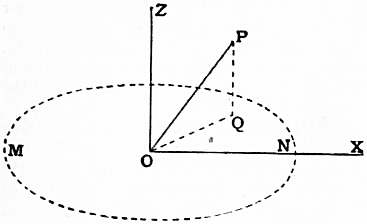
Fig. 1.
The geometrical concepts just defined are shown in fig. 1. Here O is the origin, whatever point it may be; OZ is the fundamental axis passing through it. In order to represent in the figure the position of the fundamental plane, we conceive a circle to be drawn round O, lying in that plane. This circle, projected in perspective as an ellipse, is shown in the figure. OX is the fixed initial line by which directions are to be defined.
Now let P be any point in space, say the centre of a heavenly body. Conceive a perpendicular PQ to be dropped from this point on the fundamental plane, meeting the latter in the point Q; PQ will then be parallel to OZ. The co-ordinates of P will then be the following three quantities:—
(1) The length of the line OP, or the distance of the body from the origin, which distance is called the radius vector of the body.
(2) The angle XOQ which the projection of the radius vector upon the fundamental plane makes with the initial line OX. This angle is called the Longitude, Right Ascension or Azimuth of the body, in the various systems of co-ordinates. We may term it in a general way the longitudinal co-ordinate.
(3) The angle QOP, which the radius vector makes with the fundamental plane. This we may call the latitudinal co-ordinate. Instead of it is frequently used the complementary angle ZOP, known as the polar distance of the body. Since ZOQ is a right angle, it follows that the sum of the polar distance and the latitudinal co-ordinates is always 90°. Either may be used for astronomical purposes.
It is readily seen that the position of a heavenly body is completely defined when these co-ordinates are given.
One of the systems of co-ordinates is familiar to every one, and may be used as a general illustration of the method. It is our system of defining the position of a point on the earth’s surface by its latitude and longitude. Regarding O (fig. 1) as the centre of the earth, and P as a point on the earth’s surface, a city for example, it will be seen that OZ being the earth’s axis, the circle MN will be the equator. The initial line OX then passes through the foot of the perpendicular dropped from Greenwich upon the plane of the equator, and meets the surface at N. The angle QOP is the latitude of the place and the angle NOQ its longitude. The longitudes and latitudes thus defined are geocentric, and the latitude is slightly different from that in ordinary use for geographic purposes. The difference arises from the oblateness of the earth, and need not be considered here.
The conception of the co-ordinates we have defined is facilitated by introducing that of the celestial sphere. This conception is embodied in our idea of the vault of heaven, or of the sky. Taking as origin the position of an observer, the direction of a heavenly body is defined by the point in which he sees it in the sky; that is to say, on the celestial sphere. Imagining, as we may well do, that the radius of this sphere is infinite—then every direction, whatever the origin, may be represented by a point on its surface. Take for example the vertical line which is embodied in the direction of the plumb line. This line, extended upwards, meets the celestial sphere in the zenith. The earth’s axis, continued indefinitely upwards, meets the sphere in a point called the Celestial Pole. This point in our middle latitudes is between the zenith and the north horizon, near a certain star of the second magnitude familiarly known as the Pole Star. As the earth revolves from west to east the celestial sphere appears to us to revolve in the opposite direction, turning on the line joining the Celestial Poles as on a pivot.
As we conceive of the sky, it does not consist of an entire sphere but only as a hemisphere bounded by the horizon. But we have no difficulty in extending the conception below the horizon, so that the earth with everything upon it is in the centre of a complete sphere. The two parts of this sphere are the visible hemisphere, which is above the horizon, and the invisible, which is below it. Then the plumb line not only defines the zenith as already shown, but in a downward direction it defines the nadir, which is the point of the sphere directly below our feet. On the side of this sphere opposite to the North Celestial is the South Pole, invisible in the Northern Terrestrial Hemisphere but visible in the Southern one.
The relation of geocentric to apparent co-ordinates depends upon the latitude of the observer. The changes which the aspect of the heaven undergoes, as we travel North and South, are so well known that they need not be described in detail here; but a general statement of them will give a luminous idea of the geometrical co-ordinates we have described. Imagine an observer starting from the North Pole to travel towards the equator, carrying his zenith with him. When at the pole his zenith coincides with the celestial pole, and as the earth revolves on its axis, the heavenly bodies perform their apparent diurnal revolutions in horizontal circles round the zenith. As he travels South, his zenith moves along the celestial sphere, and the circles of diurnal rotation become oblique to the horizon. The obliquity continually increases until the observer reaches the equator. His zenith is then in the equator and the celestial poles are in the North and South horizon respectively. The circles in which the heavenly bodies appear to revolve are then vertical. Continuing his journey towards the south, the north celestial pole sinks below the horizon; the south celestial pole rises above it; or to speak more exactly, the zenith of the observer approaches that pole. The circles of diurnal revolution again become oblique. Finally, at the south pole the circles of diurnal revolution are again apparently horizontal, but are described in a direction apparently (but not really) the reverse of that near the north pole. The reader who will trace out these successive concepts and study the results of his changing positions will readily acquire the notions which it is our subject to define.