VOLUME II SLICE VII Arundel, Thomas to Athens (continued 6)
Reading edition
The wars which followed the death of Alexander eventually gave Asia Minor to Seleucus, but none of the Seleucid kings was able to establish his rule over the whole peninsula. Rhodes became a great maritime republic, and much of the south and west coast belonged at one time or another to the Ptolemies of Egypt. An independent kingdom was founded at Pergamum, 283 B.C., which lasted until Attalus III., 133 B.C., made the Romans his heirs. Bithynia became an independent monarchy, and Cappadocia and Paphlagonia tributary provinces under native princes. In southern Asia Minor the Seleucids founded Antioch, Apamea, Attalia, the Laodiceas and Seleuceias, and other cities as centres of commerce, some of which afterwards played an important part in the Hellenization (see Hellenism) of the country, and in the spread of Christianity. During the 3rd century, 278-277 B.C., certain Gallic tribes crossed the Bosporus and Hellespont, and established a Celtic power in central Asia Minor. They were confined by the victories of Attalus I. of Pergamum, c. 232 B.C., to a district on the Sangarius and Halys to which the name Galatia was applied; and after their defeat by Manlius, 189 B.C., they were subjected to the suzerainty of Pergamum (see Galatia).
The defeat of Antiochus the Great at Magnesia, 190 B.C., placed Asia Minor at the mercy of Rome; but it was not until 133 that the first Roman province, Asia, was formed to include only western Anatolia, without Bithynia. Errors in policy and in government facilitated the rise of Pontus into a formidable power under Mithradates, who was finally driven out of the country by Pompey, and died 63 B.C. Under the settlement of Asia Minor by Pompey, Bithynia-Pontus and Cilicia became provinces, whilst Galatia and Cappadocia were allowed to retain nominal independence for over half a century more under native kings, and Lycia continued an autonomous League. A long period of tranquillity followed, during which the Roman dominion grew, and all Asia Minor was divided into two provinces. The boundaries were often changed; and about A.D. 297, in Diocletian’s reorganization of the empire, the power of the great military commands was broken, and the provinces were made smaller and united in groups called dioceses. A great change followed the introduction of Christianity, which spread first along the main roads that ran north and west from the Cilician Gates, and especially along the great trade route to Ephesus. In some districts it spread rapidly, in others slowly. With its advance the native languages and old religions gradually disappeared, and at last the whole country was thoroughly Hellenized, and the people united by identity of language and religion.
At the close of the 6th century Asia Minor had become wealthy and prosperous; but centuries of peace and over-centralization had affected the moral of the people and weakened the central government. During the 7th century the provincial system broke down, and the country was divided into themes or military districts. From 616 to 626 Persian armies swept unimpeded over the land, and Chosroes (Khosrau) II. pitched his camp on the shore of the Bosporus. The victories of Heraclius forced Chosroes to retire; but the Persians were followed by the Arabs, who, advancing with equal ease, laid siege to Constantinople, A.D. 668. It almost appeared as if Asia Minor would be annexed to the dominion of the Caliph. But the tide of conquest was stemmed by the iconoclast emperors, and the Arab expeditions, excepting those of Harun al-Rashid, 781 and 806, and of el-Motasim, 838, became simply predatory raids. In the 10th century the Arabs were expelled. They never held more than the districts along the main roads, and in the intervals of peace the country rapidly recovered itself. But a more dangerous enemy was soon to appear on the eastern border.
In 1067 the Seljuk Turks ravaged Cappadocia and Cilicia; in 1071 they defeated and captured the emperor Romanus Diogenes, and in 1080 they took Nicaea. One branch of the Seljuks founded the empire of Rum, with its capital first at Nicaea and then at Iconium. The empire, which at one time included nearly the whole of Asia Minor, with portions of Armenia and Syria, passed to the Mongols when they defeated the sultan of Rum in 1243, and the sultans became vassals of the Great Khan. The Seljuk sultans were liberal patrons of art, literature and science, and the remains of their public buildings and tombs are amongst the most beautiful and most interesting in the country. The marches of the Crusaders across Asia Minor left no permanent impression. But the support given by the Latin princes to the Armenians in Cilicia facilitated the growth of the small warlike state of Lesser Armenia, which fell in 1375 with the defeat and capture of Leo VI. by the Mameluke sultan of Egypt. The Mongols were too weak to govern the country they had conquered, and the vassalage of the last sultan of Rum, who died in 1307, was only nominal. On his death the Turkoman governors of his western provinces drove out the Mongols and asserted their independence. A contest for supremacy followed, which eventually ended in favour of the Osmanli Turks of Brusa. In 1400 Sultan Bayezid I. held all Asia Minor west of the Euphrates; but in 1402 he was defeated and made prisoner by Timur, who swept through the country to the shores of the Aegean. On the death of Timur Osmanli supremacy was re-established after a prolonged straggle, which ended with the annexation by Mahommed II. (1451-1481) of Karamania and Trebizond, and the abandonment of the last of the Italian trading settlements which had studded the coast during the 13th and 14th centuries. The later history of Asia Minor is that of the Turkish empire. The most important event was the advance (1832-1833) of an Egyptian army, under Ibrahim Pasha, through the Cilician Gates to Konia and Kutaiah.
The defeat of the emperor Romanus (1071) initiated a change in the condition of Asia Minor which was to be complete and lasting. A long succession of nomad Turkish tribes, pressing forward from central Asia, wandered over the rich country in search of fresh pastures for their flocks and herds. They did not plunder or ill-treat the people, but they cared nothing for town life or for agricultural pursuits, and as they passed onward they left the country bare. Large districts passed out of cultivation and were abandoned to the nomads, who replaced wheeled traffic by the pack horse and the camel. The peasants either became nomads themselves or took refuge in the towns or the mountains. The Mongols, as they advanced, sacked towns and laid waste the agricultural lands. Timur conducted his campaigns with a ruthless disregard of life and property. Entire Christian communities were massacred, flourishing towns were completely destroyed, and all Asia Minor was ravaged. From these disasters the country never recovered, and the last traces of Western civilization disappeared with the enforced use of the Turkish language and the wholesale conversions to Islam under the earliest Osmanli sultans. The recent large increase of the Greek population in the western districts, the construction of railways, and the growing interests of Germany and Russia on the plateau seem, however, to indicate that the tide is again turning in favour of the West.
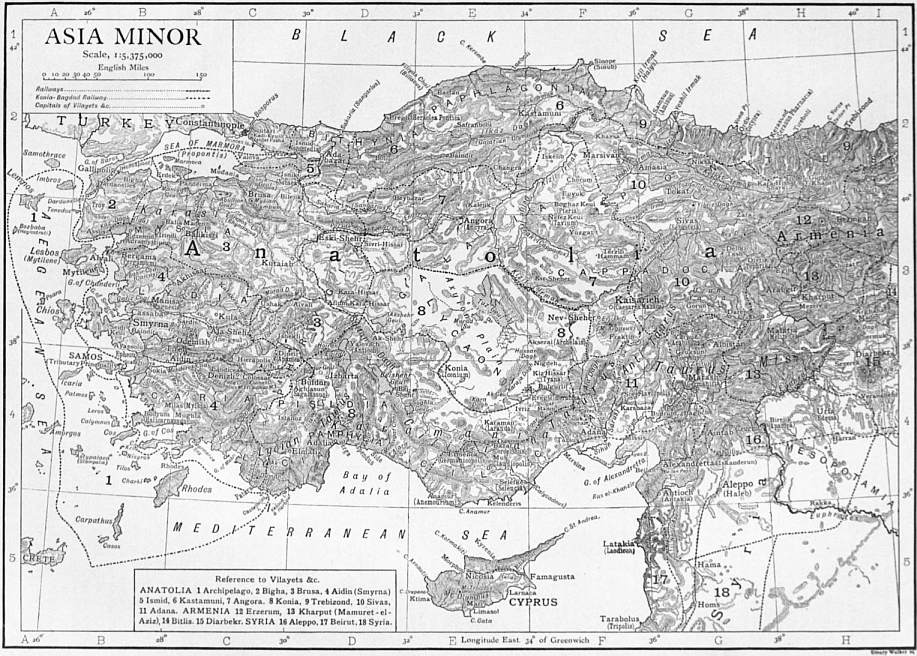
(Click to enlarge.)
Bibliography.—1. General Authorities:—C. Texier, Asie Mineure (1843); P. Tchihatcheff, Asie Mineure (1853-1860); C. Ritter, Erdkunde, vols. xviii. xix. (1858-1859); W.J. Hamilton, Researches in Asia Minor (1843); E. Reclus. Nouv. Géog. Univ. vol. ix. (1884); V. Cuinet, La Turquie d’Asie (1890); W.M. Ramsay, Hist. Geog. of A. M. (1890); Murray’s Handbook for A. M. &c., ed. by Sir C. Wilson (1895). For Geology see Tchihatcheff, Asie Mineure, Géologie (Paris, 1867-1869); Schaffer, Cilicia, Peterm. Mitt. Ergänzungsheft, 141 (1903); Philippson, Sitz. k. preuss. Akad. Wiss. (1903), pp. 112-124; English, Quart. Journ. Geol. Soc. (London, 1904), pp. 243-295; see also Suess, Das Antlitz der Erde, vol. iii. pp. 402-412, and the accompanying references.
2. A. Western Asia Minor.—J. Spon and G. Wheler, Voyage du Levant (1679); P. de Tournefort, Voyage du Levant (1718); F. Beaufort, Ionian Antiquities (1811); R. Chandler, Travels (1817); W.M. Leake, Journal of a Tour in A. M. (1820); F.V.J. Arundell, Visit to the Seven Churches (1828), and Discoveries, &c. (1834); C. Fellows, Excursion in A. M. (1839); C.T. Newton, Travels (1867), and Discoveries at Halicarnassus, &c. (1863); Dilettanti Society, Ionian Antiquities (1769-1840); J.R.S. Sterrett, Epigr. Journey and Wolfe Exped. (Papers, Amer. Arch. Inst. ii. iii.) (1888); J.H. Skene, Anadol (1853); G. Radet, Lydie (1893); O. Rayet and A. Thomas, Milet et le Golfe Latmique (1872); K. Buresch, Aus Lydien (1898); W.M. Ramsay, Cities and Bishoprics of Phrygia (1895), and Impressions of Turkey (1898).
B. Eastern Asia Minor.—W.F. Ainsworth, Travels in A. M. (1842); G. Perrot and E. Guillaume, Expl. arch, de la Galatie (1862-1872); E.J. Davis, Anatolica (1874); H.F. Tozer, Turkish Armenia (1881); H.J. v. Lennep, Travels (1870); D.G. Hogarth, Wandering Scholar (1896); Lord Warkworth, Notes of a Diary, &c. (1898); E. Sarre, Reise (1896); D.G. Hogarth and J.A.R. Munro, Mod. and Anc. Roads (R.G.S. Supp. Papers iii.) (1893); H.C. Barkley, A Ride through A. M. and Armenia (1891); M. Sykes, Dar ul-Islam (1904); E. Chantre, Mission en Cappadocie (1898).
C. Southern Asia Minor.—F. Beaufort, Karamania (1817); C. Fellows, Discoveries in Lycia (1841); T.A.B. Spratt and E. Forbes, Travels in Lycia (1847); V. Langlois, Voy. dans la Cilicie (1861); E.J. Davis, Life in Asiatic Turkey (1879); O. Benndorf and E. Niemann, Lykien (1884); C. Lanckoronski, Villes de la Pamphylie et de la Pisidie (1890); F. v. Luschan, Reisen in S.W. Kleinasien (1888); E. Petersen and F. v. Luschan, Lykien (1889); K. Humann and O. Puchstein, Reisen in Kleinasien und Nordsyrien (1890).
D. Northern Asia Minor.—J.M. Kinneir, Journey through A. M. (1818); J.G.C. Anderson and F. Cumont, Studia Pontica (1903); E. Naumann, Vom Goldenen Horn, &c. (1893).
See also G. Perrot and C. Chipiez, Hist. de l’art dans l’antiquité, vols. iv. v. (1886-1890); J. Strzygowski, Kleinasien, &c. (1903). Also numerous articles in all leading archaeological periodicals, the Geographical Journal, Deutsche Rundschau, Petermann’s Geog. Mitteilungen, &c. &c.
3. Maps.—H. Kiepert, Nouv. carte gén. des prov. asiat. de l’Emp. ottoman (1894), and Spezialkarte v. Westkleinasien (1890); W. von Diest, Karte des Nordwestkleinasien (1901); R. Kiepert, Karte von Kleinasien (1901); E. Friederich, Handels- und Produktenkarte von Kleinasien (1898); J.G.C. Anderson, Asia Minor (Murray’s Handy Class. Maps) (1903).
(C. W. W.; D. G. H.)
1 The people, Moslem and Christian, are physically one and appear to be closely related to the modern Armenians. This relationship is noticeable in other districts, and the whole original population of Asia Minor has been characterized as Proto-Armenian or Armenoid.
ASIENTO, or Assiento (from the verb asentar, to place, or establish), a Spanish word meaning a farm of the taxes, or contract. The farmer or contractor is called an asentista. The word acquired a considerable notoriety in English and American history, on account of the “Asiento Treaty” of 1713. Until 1702 the Spanish government had given the contract for the supply of negroes to its colonies in America to the Genoese. But after the establishment of the Bourbon dynasty in 1700, a French company was formed which received the exclusive privilege of the Spanish-American slave trade for ten years—from September 1702 to 1712. When the peace of Utrecht was signed the British government insisted that the monopoly should be given to its own subjects. By the terms of the Asiento treaty signed on the 16th of March 1713, it was provided that British subjects should be authorized to introduce 144,000 slaves in the course of thirty years, at the rate of 4800 per annum. The privilege was to expire on the 1st of May 1743. British subjects were also authorized to send one ship of 500 tons per annum, laden with manufactured goods, to the fairs of Porto Bello and La Vera Cruz. Import duties were to be paid for the slaves and goods. This privilege was conveyed by the British government to the South Sea Company, formed to work it. The privilege, to which an exaggerated value was attached, formed the solid basis of the notorious fit of speculative fever called the South Sea Bubble. Until 1739 the trade in blacks went on without interruption, but amid increasingly angry disputes between the Spanish and the British governments. The right to send a single trading ship to the fairs of Porto Bello or La Vera Cruz was abused. Under pretence of renewing her provisions she was followed by tenders which in fact carried goods. Thus there arose what was in fact a vast contraband trade. The Spanish government established a service of revenue boats (guarda costas) which insisted on searching all English vessels approaching the shores of the Spanish colonies. There can be no doubt that the smugglers were guilty of many piratical excesses, and that the guarda costas often acted with violence on mere suspicion. After many disputes, in which the claims of the British government were met by Spanish counterclaims, war ensued in 1739. When peace was made at Aix-la-Chapelle in 1748 Spain undertook to allow the asiento to be renewed for the four years which were to run when war broke out in 1739. But the renewal for so short a period was not considered advantageous, and by the treaty of El Retiro of 1750, the British government agreed to the recession of the Asiento treaty altogether on the payment by Spain of £100,000.
A very convenient account of the Asiento Treaty, and of the trade which arose under it, will be found in Malachy Postlethwayt’s Universal Dictionary of Trade and Commerce (London, 1751), s.v.
ASIR, a district in western Arabia, lying between 17° 30′ and 21° N., and 40° 30′ and 45° E.; bounded N. by Hejaz, E. by Nejd, S. by Yemen and W. by the Red Sea. Like Yemen, it consists of a lowland zone some 20 or 30 m. in width along the coast, and of a mountainous tract, falling steeply on the west and merging into a highland plateau which slopes gradually to the N.E. towards the Nejd steppes. Its length along the coast is about 230 m., and its breadth from the coast to El Besha about 180. The lowland, or Tehama, is hot and barren; the principal places in it are Kanfuda, the chief port of the district, Marsa Hali and El Itwad, smaller ports farther south. The mountainous tract has probably an average altitude of between 6000 and 7000 ft., with a temperate climate and regular rainfall, and is fertile and populous. The valleys are well watered and produce excellent crops of cereals and dates. The best-known are the Wadi Taraba and the W. Besha, both running north-east towards the W. Dawasir in Nejd. Taraba, according to John Lewis Burckhardt, is a considerable town, surrounded by palm groves and gardens, and watered by numerous rivulets, and tamous for its long resistance to Mehemet Ali’s forces in 1815. Five or six days’ journey to the south-east is the district of Besha, the most important position between Sana and Taif. Here Mehemet Ali’s army, amounting to 12,000 men, found sufficient provisions to supply it during a fortnight’s halt. The Wadi Besha is a broad valley abounding with streams containing numerous hamlets scattered over a tract some six or eight hours’ journey in length. Its principal affluent, the W. Shahran, rises 120 m. to the south and runs through the fertile district of Khamis Mishet, the highest in Asir. The Zahran district lies four days west of Besha on the crest of the main range: the principal place is Makhwa, a large town and market, from which grain is exported in considerable quantities to Mecca. Farther south is the district of Shamran. Throughout the mountainous country the valleys are well watered and cultivated, with fortified villages perched on the surrounding heights. Juniper forests are said to exist on the higher mountains. Three or four days’ journey east and south-east of Besha are the encampments of the Bani Kahtan, one of the most ancient tribes of Arabia; their pastures extend into the adjoining district of Nejd, where they breed camels in large numbers, as well as a few horses.
The inhabitants are a brave and warlike race of mountaineers, and aided by the natural strength of their country they have hitherto preserved their independence. Since the beginning of the 19th century they have been bigoted Wahhabis, though previously regarded by their neighbours as very lax Mahommedans; during Mehemet Ali’s occupation of Nejd their constant raids on the Egyptian communications compelled him to send several punitive expeditions into the district, which, however, met with little success. Since the reconquest of Yemen by the Turks, they have made repeated attempts to subjugate Asir, but beyond occupying Kanfuda, and holding one or two isolated points in the interior, of which Ibha and Manadir are the principal, they have effected nothing.
The chief sources of information regarding Asir are the notes made by J.L. Burckhardt at Taif in 1814 and those of the French officers with the Egyptian expeditions into the country from 1814 to 1837. No part of Arabia would better repay exploration.
Authorities.—J.L. Burckhardt, Travels in Arabia (London, 1829); F. Mengin, Histoire de l’Égypte, &c. (Paris, 1823); M.O. Tamisier, Voyage en Arabie (Paris, 1840).
(R. A. W.)
ASISIUM (mod. Assisi), an ancient town of Umbria, in a lofty situation about 15 m. E.S.E. of Perusia. As an independent community it had already begun to use Latin as well as Umbrian in its inscriptions (for one of these recording the chief magistrates—marones—see C.I.L. xi. 5390). It became a municipium in 90 B.C., but, though numerous inscriptions (C.I.L. xi. 5371-5606) testify to its importance in the Imperial period, it is hardly mentioned by our classical authorities. Scanty traces of the ancient city walls may be seen; within the town the best-preserved building is the so-called temple of Minerva, with six Corinthian columns of travertine, now converted into a church, erected by Gaius and Titus Caesius in the Augustan era. It fronted on to the ancient forum, part of the pavement of which, with a base for the equestrian statues of Castor and Pollux (as the inscription upon it records) has been laid bare beneath the present Piazza Vittorio Emanuele. The remains of the amphitheatre, in opus reticulatum, may be seen in the north-east corner of the town; and other ancient buildings have been discovered. Asisium was probably the birthplace of Propertius.
(T. As.)
ASKABAD, or Askhabad, a town of Russian central Asia, capital of the Transcaspian province, 345 m. by rail S.E. of Krasnovodsk and 594 from Samarkand, situated in a small oasis at the N. foot of the Kopet-dagh range. It has a public library and a technical railway school; also cotton-cleaning works, tanneries, brick-works, and a mineral-water factory. The trade is valued at £250,000 a year. The population, 2500 in 1881, when the Russians seized it, was 19,428 in 1897, one-third Persians, many of them belonging to the Babi sect.
ASKAULES (Gr. ἀσκαύλης [?] from ἀσκός, bag, αὐλός, pipe), probably the Greek word for bag-piper, although there is no documentary authority for its use. Neither it nor ἄσκαυλος (which would naturally mean the bag-pipe) has been found in Greek classical authors, though J.J. Reiske—in a note on Dio Chrysostom, Orat. lxxi. ad fin., where an unmistakable description of the bag-pipe occurs (“and they say that he is skilled to write, to work as an artist, and to play the pipe with his mouth, on the bag placed under his arm-pits”)—says that ἀσκαύλης was the Greek word for bag-piper. The only actual corroboration of this is the use of ascaules for the pure Latin utricularius in Martial x. 3. 8. Dio Chrysostom flourished about A.D. 100; it is therefore only an assumption that the bag-pipe was known to the classical Greeks by the name of ἄσκαυλος. It need not, however, be a matter of surprise that among the highly cultured Greeks such an instrument as the bag-pipe should exist without finding a place in literature. It is significant that it is not mentioned by Pollux (Onomast. iv. 74) and Athenaeus (Deipnos. iv. 76) in their lists of the various kinds of pipes.
See articles Aulos and Bag-pipe; art. “Askaules” in Pauly-Wissowa, Realencyclopadie.
ASKE, ROBERT (d. 1537), English rebel, was a country gentleman who belonged to an ancient family long settled in Yorkshire, his mother being a daughter of John, Lord Clifford. When in 1536 the insurrection called the “Pilgrimage of Grace” broke out in Yorkshire, Aske was made leader; and marching with the banner of St Cuthbert and with the badge of the “five wounds,” he occupied York on the 16th of October and on the 20th captured Pontefract Castle, with Lord Darcy and the archbishop of York, who took the oath of the rebels. He caused the monks and nuns to be reinstated, and refused to allow the king’s herald to read the royal proclamation, announcing his intention of marching to London to declare the grievances of the commons to the sovereign himself, secure the expulsion of counsellors of low birth, and obtain restitution for the church. The whole country was soon in the hands of the rebels, a military organization with posts from Newcastle to Hull was established, and Hull was provided with cannon. Subsequently Aske, followed by 30,000 or 40,000 men, proceeded towards Doncaster, where lay the duke of Norfolk with the royal forces, which, inferior in numbers, would probably have been overwhelmed had not Aske persuaded his followers to accept the king’s pardon, and the promise of a parliament at York and to disband. Soon afterwards he received a letter from the king desiring him to come secretly to London to inform him of the causes of the rebellion. Aske went under the guarantee of a safe-conduct and was well received by Henry. He put in writing a full account of the rising and of his own share in it; and, fully persuaded of the king’s good intentions, returned home on the 8th of January 1537, bringing with him promises of a visit from the king to Yorkshire, of the holding of a parliament at York, and of free elections. Shortly afterwards he wrote to the king warning him of the still unquiet state not only of the north but of the midlands, and stating his fear that more bloodshed was impending. The same month he received the king’s thanks for his action in pacifying Sir Francis Bigod’s rising. But his position was now a difficult and a perilous one, and a few weeks later the attitude of the government towards him was suddenly changed. The new rising had given the court an excuse for breaking off the treaty and sending another army under Norfolk into Yorkshire. Possibly in these fresh circumstances Aske may have given cause for further suspicions of his loyalty, and in his last confession he acknowledged that communications to obtain aid had been opened with the imperial ambassador and were contemplated with Flanders. But it is more probable that the government had from the first treacherously affected to treat him with confidence to secure the secrets of the rebels and to effect his destruction. In March Norfolk congratulated Cromwell on the successful accomplishment of his task, having persuaded Aske to go to London on false assurances of security. He was arrested in April, tried before a commission at Westminster, and sentenced to death for high treason on the 17th of May; and on the 28th of June he was taken back to Yorkshire, being paraded in the towns and country through which he passed. He was hanged at York in July, expressing repentance for breaking the king’s laws, but declaring that he had promise of pardon both from Cromwell and from Henry. It is related that his servant, Robert Wall, died of grief at the thought of his master’s approaching execution. Aske was a real leader, who gained the affection and confidence of his followers; and his sudden rise to greatness and his choice by the people point to abilities that have not been recorded.
See Henry VIII. and the English Monasteries, by F.A. Gasquet (1906); Letters and Papers of the Reign of Henry VIII., vols. xi. and xii.; English Histor. Review, v. 330, 550 (account of the rebellion, examination and answers to interrogations); Chronicle of Henry VIII., tr. by M.A.S. Hume (1889); Whitaker’s Richmondshire, i. 116 (pedigree of the Askes).
ASKEW, or Ascue, ANNE (1521?-1546), English Protestant martyr, born at Stallingborough about 1521, was the second daughter of Sir William Askew (d. 1540) of South Kelsey, Lincoln, by his first wife Elizabeth, daughter of Thomas Wrottesley. Her elder sister, Martha, was betrothed by her parents to Thomas Kyme, a Lincolnshire justice of the peace, but she died before marriage, and Anne was induced or compelled to take her place. She is said to have had two children by Kyme, but religious differences and incompatibility of temperament soon estranged the couple. Kyme was apparently an unimaginative man of the world, while Anne took to Bible-reading with zeal, became convinced of the falsity of the doctrine of transubstantiation, and created some stir in Lincoln by her disputations. According to Bale and Foxe her husband turned her out of doors, but in the privy council register she is said to have “refused Kyme to be her husband without any honest allegation.” She had as good a reason for repudiating her husband as Henry VIII. for repudiating Anne of Cleves. In any case, she came to London and made friends with Joan Bocher, who was already known for heterodoxy, and other Protestants. She was examined for heresy in March 1545 by the lord mayor, and was committed to the Counter prison. Then she was examined by Bonner, the bishop of London, who drew up a form of recantation which he entered in his register. This fact led Parsons and other Catholic historians to state that she actually recanted but she refused to sign Bonner’s form without qualification. Two months later, on the 24th of May, the privy council ordered her arrest. On the 13th of June 1545, she was arraigned as a sacramentarian under the Six Articles at the Guildhall; but no witness appeared against her; she was declared not guilty by the jury and discharged after paying her fees.
The reactionary party, which, owing to the absence of Hertford and Lisle and to the presence of Gardiner, gained the upper hand in the council in the summer of 1546, were not satisfied with this repulse; they probably aimed at the leaders of the reforming party, such as Hertford and possibly Queen Catherine Parr, who were suspected of favouring Anne, and on the 18th of June 1546 Anne was again arraigned before a commission including the lord mayor, the duke of Norfolk, St John, Bonner and Heath. No jury was empanelled and no witnesses were called; she was condemned, simply on her confession, to be burnt. On the same day she was called before the privy council with her husband. Kyme was sent home into Lincolnshire, but Anne was committed to Newgate, “for that she was very obstinate and heady in reasoning of matters of religion.” On the following day she was taken to the Tower and racked; according to Anne’s own statement, as recorded by Bale, the lord chancellor, Wriothesley, and the solicitor-general, Rich, worked the rack themselves; but she “would not convert for all the pain” (Wriothesley, Chronicle i. 168). Her torture, disputed by Jardine, Lingard and others, is substantiated not only by her own narrative, but by two contemporary chronicles, and by a contemporary letter (ibid.; Narratives of the Reformation, p. 305; Ellis, Original Letters, 2nd Ser. ii. 177). For four weeks she was left in prison, and at length on the 16th of July, she was burnt at Smithfield in the presence of the same persecuting dignitaries who had condemned her to death.
Authorities.—Bale’s two tracts, printed at Marburg in November 1546 and January 1547, are the basis of Foxe’s account. See also Acts of the Privy Council (1542-1547), pp. 424-462; Wriothesley’s Chron. i. 155, 167-169; Narratives of the Reformation, passim; Gough’s Index to Parker Soc. Publications; Burnet’s Hist. of the Reformation; Dixon’s Hist. of the Church of England; Dict. Nat. Biogr.
(A. F. P.)
AṢMA‘Ī [Abū Sa‘īd ‘Abd ul-Malik ibn Quraib] (c. 739-831), Arabian scholar, was born of pure Arab stock in Basra and was a pupil there of Abū ‘Amr ibn ul-‘Alā. He seems to have been a poor man until by the influence of the governor of Basra he was brought to the notice of Harūn al-Rashīd, who enjoyed his conversation at court and made him tutor of his son. He became wealthy and acquired property in Basra, where he again settled for a time; but returned later to Bagdad, where he died in 831. Aṣma‘ī was one of the greatest scholars of his age. From his youth he stored up in his memory the sacred words of the Koran, the traditions of the Prophet, the verses of the old poets and the stories of the ancient wars of the Arabs. He was also a student of language and a critic. It was as a critic that he was the great rival of Abū ‘Ubaida (q.v.). While the latter followed (or led) the Shu‘ūbite movement and declared for the excellence of all things not Arabian, Aṣma‘ī was the pious Moslem and avowed supporter of the superiority of the Arabs over all peoples, and of the freedom of their language and literature from all foreign influence. Some of his scholars attained high rank as literary men. Of Aṣma‘ī’s many works mentioned in the catalogue known as the Fihrist, only about half a dozen are extant. Of these the Book of Distinction has been edited by D.H. Müller (Vienna, 1876); the Book of the Wild Animals by R. Geyer (Vienna, 1887); the Book of the Horse, by A. Haffner (Vienna, 1895); the Book of the Sheep, by A. Haffner (Vienna, 1896).
For life of Aṣma‘ī, see Ibn Khallikān, Biographical Dictionary, translated from the Arabic by McG. de Slane (Paris and London, 1842), vol. ii. pp. 123-127. For his work as a grammarian, G. Flügel, Die grammatischen Schulen der Araber (Leipzig, 1862), pp. 72-80.
(G. W. T.)
ASMARA, the capital of the Italian colony of Eritrea, N.E. Africa. It is built on the Hamasen plateau, near its eastern edge, at an elevation of 7800 ft., and is some 40 m. W.S.W. in a direct line of the seaport of Massawa. Pop. (1904) about 9000, including the garrison of 300 Italian soldiers, and some 1000 native troops. The European civil population numbers over 500; the rest of the inhabitants are chiefly Abyssinians. There is a small Mahommedan colony. The town is strongly fortified. The European quarter contains several fine public buildings, including the residence of the governor, club house, barracks and hospital. Fort Baldissera is built on a hill to the south-west of the town and is considered impregnable.
Asmara, an Amharic word signifying “good pasture place,” is a town of considerable antiquity. It was included in the maritime province of northern Abyssinia, which was governed by a viceroy who bore the title of Bahar-nagash (ruler of the sea). By the Abyssinians the Hamasen plateau was known as the plain of the thousand villages. Asmara appears to have been one of the most prosperous of these villages, and to have attained commercial importance through being on the high road from Axum to Massawa. When Werner Munzinger (q.v.) became French consul at Massawa, he entered into a scheme for annexing the Hamasen (of which Asmara was then the capital) to France, but the outbreak of the war with Germany in 1870 brought the project to nought (cf. A.B. Wylde, Modern Abyssinia, 1901). In 1872 Munzinger, now in Egyptian service, annexed Asmara to the khedivial dominions, but in 1884, owing to the rise of the mahdi, Egypt evacuated her Abyssinian provinces and Asmara was chosen by Ras Alula, the representative of the negus Johannes (King John), as his headquarters. Shortly afterwards the Italians occupied Massawa, and in 1889 Asmara (see Abyssinia: History). In 1900 the seat of government was transferred from Massawa to Asmara, which in its modern form is the creation of the Italians. It is surrounded by rich agricultural lands, cultivated in part by Italian immigrants, and is a busy trading centre. A railway from Massawa to Asmara was completed as far as Ghinda, at the foot of the plateau, in 1904. At Medrizien, 6 m. north of Asmara, are gold-mines which have been partially worked.
See G. Dainelli, In Africa. Lettere dall’ Eritrea (Bergamo, 1908); R. Perini, Di qua dal Mareb (Florence, 1905).
ASMODEUS, or Ashmedai, an evil demon who appears in later Jewish tradition as “king of demons.” He is sometimes identified with Beelzebub or Apollyon (Rev. ix. 11). In the Talmud he plays a great part in the legends concerning Solomon. In the apocryphal book of Tobit (iii. 8) occurs the well-known story of his love for Sara, the beautiful daughter of Raguel, whose seven husbands were slain in succession by him on their respective bridal nights. At last Tobias, by burning the heart and liver of a fish, drove off the demon, who fled to Egypt. From the part played by Asmodeus in this story, he has been often familiarly called the genius of matrimonial unhappiness or jealousy, and as such may be compared with Lilith. Le Sage makes him the principal character in his novel Le Diable boiteux. Both the word and the conception seem to have been derived originally from the Persian. The name has been taken to mean “covetous.” It is in any case no doubt identical with the demon Aeshma of the Zend-Avesta and the Pahlavi texts. But the meaning is not certain. It is generally agreed that the second part of the name Asmodeus is the same as the Zend daēwa, dēw, “demon.” The first part may be equivalent to Aeshma, the impersonation of anger. But W. Baudissin (Herzog-Hauck, Realencyklopädie) prefers to derive it from ish, to drive, set in motion; whence ish-mīn, driving, impetuous.
The legend of Asmodeus is given fully in the Jewish Encyclopaedia, s.v. See also the articles in the Encyclopaedia Biblica, Hastings’ Dictionary of the Bible, and Herzog-Hauck, Realencyklopädie.
ASMONEUS, or Asamonaeus (so Josephus), great-grandfather of Mattathias, the father of Judas Maccabaeus. Nothing more is known of him, and the name is only given by Josephus (not in 1 Macc. ii. 1). But the dynasty was known to Josephus and the Mishna (once) as “the sons (race) of the Asamonaeans (of A.)”; and the Targum of 1 Sam. ii. 4 has “the house of the Hashmoneans who were weak, signs were wrought for them and strength.” If not the founder, Asmoneus was probably the home of the family (cf. Heshmon, Jos. xv. 27).
See Schurer, Geschichte des jüdischen Volkes, i. 248 N; art. “Maccabees,” § 2, in Ency. Biblica.
(J. H. A. H.)
ASNIÈRES, a town of northern France, in the department of Seine, on the left bank of the Seine, about 1½ m. N.N.W. of the fortifications of Paris. Pop. (1906) 35,883. The town, which has grown rapidly in recent years, is a favourite boating centre for the Parisians. The industries include boat-building and the manufacture of colours and perfumery.
ASOKA, a famous Buddhist emperor of India who reigned from 264 to 228 or 227 B.C. Thirty-five of his inscriptions on rocks or pillars or in caves still exist (see Inscriptions: Indian), and they are among the most remarkable and interesting of Buddhist monuments (see Buddhism). Asoka was the grandson of Chandragupta, the founder of the Maurya (Peacock) dynasty, who had wrested the Indian provinces of Alexander the Great from the hands of Seleucus, and he was the son of Bindusāra, who succeeded his father Chandragupta, by a lady from Champā. The Greeks do not mention him and the Brahmin books ignore him, but the Buddhist chronicles and legends tell us much about him. The inscriptions, which contain altogether about five thousand words, are entirely of religious import, and their references to worldly affairs are incidental. They begin in the thirteenth year of his reign, and tell us that in the ninth year he had invaded Kalinga, and had been so deeply impressed by the horrors involved in warfare that he had then given up the desire for conquest, and devoted himself to conquest by “religion.” What the religion was is explained in the edicts. It is purely ethical, independent alike of theology and ritual, and is the code of morals as laid down in the Buddhist sacred books for laymen. He further tells us that in the ninth year of his reign he formally joined the Buddhist community as a layman, in the eleventh year he became a member of the order, and in the thirteenth he “set out for the Great Wisdom” (the Sambodhi), which is the Buddhist technical term for entering upon the well-known, eightfold path to Nirvana. One of the edicts is addressed to the order, and urges upon its members and the laity alike the learning and rehearsal of passages from the Buddhist scriptures. Two others are proclamations commemorating visits paid by the king, one to the dome erected over the ashes of Konāgamana, the Buddha, another to the birthplace of Gotama, the Buddha (q.v.). Three very short ones are dedications of caves to the use of an order of recluses. The rest either enunciate the religion as explained above, or describe the means adopted by the king for propagating it, or acting in accordance with it. These means are such as the digging of wells, planting medicinal herbs, and trees for shade, sending out of missionaries, appointment of special officers to supervise charities, and so on. The missionaries were sent to Kashmir, to the Himalayas, to the border lands on the Indus, to the coast of Burma, to south India and to Ceylon. And the king claims that missions sent by him to certain Greek kingdoms that he names had resulted in the folk there conforming themselves to his religion. The extent of Asoka’s dominion included all India from the thirteenth degree of latitude up to the Himalayas, Nepal, Kashmir, the Swat valley, Afghanistan as far as the Hindu Kush, Sind and Baluchistan. It was thus as large as, or perhaps somewhat larger than, British India before the conquest of Burma. He was undoubtedly the most powerful sovereign of his time and the most remarkable and imposing of the native rulers of India. “If a man’s fame,” says Köppen, “can be measured by the number of hearts who revere his memory, by the number of lips who have mentioned, and still mention him with honour, Asoka is more famous than Charlemagne or Caesar.” At the same time it is probable that, like Constantine’s patronage of Christianity, his patronage of Buddhism, then the most rising and influential faith in India, was not unalloyed with political motives, and it is certain that his vast benefactions to the Buddhist cause were at least one of the causes that led to its decline.
See also Asoka, by Vincent Smith (Oxford, 1901); Inscriptions de Piyadasi, by E. Senart (Paris, 1891); chapters on Asoka in T.W. Rhys Davids’s Buddhism (20th ed., London, 1903), and Buddhist India (London, 1903); V.A. Smith, Edicts of Asoka (1909).
(T. W. R. D.)
ASOLO (anc. Acelum), a town of Venetia, Italy, in the province of Treviso, about 19 m. N.W. direct from the town of Treviso, and some 10 m. E. of Bassanoby road. Pop. (1901) 5847. It is well situated on a hill, 690 ft. above sea-level. Remains of Roman baths and of a theatre have been discovered in the course of excavation (Notizie degli scavi, 1877, 235; 1881, 205; 1882, 289), and the town was probably a municipium. It became an episcopal see in the 6th century. It was to Asolo that Catherine Cornaro, queen of Cyprus, retired on her abdication. Here she was visited by Pietro Bembo, who conceived here his Dialoghi degli Asolani, and by Andrea Navagero (Naugerius). Paulus Manutius was born here. The village of Maser is 4½ m. to the E., and near it is the Villa Giacomelli, erected by Palladio, containing frescoes by Paolo Veronese, executed in 1566-1568 for Marcantonio Barbaro of Venice, and ranking among his best works.
ASOR (Hebr. for “ten”), an instrument “of ten strings” mentioned in the Bible, about which authors are not agreed. The word occurs only three times in the Bible, and has not been traced elsewhere. In Psalm xxxiii. 2 the reference is to “kinnor, nebel and asor”; in Psalm xcii. 3, to “nebel and asor”; in Psalm cxliv. to “nebel-asor.” In the English version asor is translated “an instrument of ten strings,” with a marginal note “omit” applied to “instrument.” In the Septuagint, the word being derived from a root signifying “ten,” the Greek is ἐν δεκαχορδῷ or ψαλτήριον δεκάχορδον, in the Vulgate in decachordo psalterio. Each time the word asor is used it follows the word nebel (see Psaltery), and probably merely indicates a variant of the nebel, having ten strings instead of the customary twelve assigned to it by Josephus (Antiquities, vii. 12. 3).
See also Mendel and Reissmann, Musikalisches Conversations-Lexikon, vol. i. (Berlin, 1881); Sir John Stainer, The Music of the Bible, pp. 35-37; Forkel, Allgemeine Geschichte der Musik, Bd. i. p. 133 (Leipzig, 1788).
(K. S.)
ASP (Vipera aspis), a species of venomous snake, closely allied to the common adder of Great Britain, which it represents throughout the southern parts of Europe, being specially abundant in the region of the Alps. It differs from the adder in having the head entirely covered with scales, shields being absent, and in having the snout somewhat turned up. The term “Asp” ἀσπίς seems to have been employed by Greek and Roman writers, and by writers generally down to comparatively recent times, to designate more than one species of serpent; thus the asp, by means of which Cleopatra is said to have ended her life, and so avoided the disgrace of entering Rome a captive, is now generally supposed to have been the cerastes, or horned viper (Cerastes cornutus), of northern Africa and Arabia, a snake about 15 in. long, exceedingly venomous, and provided with curious horn-like protuberances over each eye, which give it a decidedly sinister appearance. The snake, however, to which the word “asp” has been most commonly applied is undoubtedly the haje of Egypt, the spy-slange or spitting snake of the Boers (Naja haje), one of the very poisonous Elarinae, from 3 to 4 ft. long, with the skin of its neck loose, so as to render it dilatable at the will of the animal, as in the cobra of India, a species from which it differs only in the absence of the spectacle-like mark on the back of the neck. Like the cobra, also, the haje has its fangs extracted by the jugglers of the country, who afterwards train it to perform various tricks. The asp (Pethen, פתן) is mentioned in various parts of the Old Testament. This name is twice translated “adder,” but as nothing is told of it beyond its poisonous character and the intractability of its disposition, it is impossible accurately to determine the species.
ASPARAGINE, C4H3N2O3, a naturally occurring base, found in plants belonging to the natural orders Leguminosae and Cruciferae. It occurs in two optically active forms, namely, as laevo-asparagine and dextro-asparagine. Laevo-asparagine was isolated in 1805 by L.N. Vauquelin. A. Piutti (Gazz. chim. Ital., 1887, 17, p. 126; 1888, 18, p. 457) synthesized the asparagines from the monomethyl ester of inactive aspartic acid by heating it with alcoholic ammonia. In this way a mixture of the two asparagines was obtained, which were separated by picking out the hemihedral crystals.
HOOC·CH·NH2·CH2·COOC2H5 + NH3 = C2H5OH + HOOC·CH·NH2·CH2·CONH2.
Laevo-asparagine is slightly soluble in cold water and readily soluble in hot water. It crystallizes in prisms, containing one molecule of water of crystallization, the anhydrous form melting at 234-235° C. Nitrous acid converts it into malic acid, HOOC·CHOH·CH2·COOH. It is laevo-rotatory in aqueous or in alkaline solution, and dextro-rotatory in acid solution (L. Pasteur, Ann. Chim. Phys., 1851 [2], 31, p. 67). Dextro-asparagine was first found in 1886 in the shoots of the vetch (Piutti). It forms rhombic crystals possessing a sweet taste. It is dextro-rotatory in aqueous or alkaline solution, and laevo-rotatory in acid solution.
Hydrolysis by means of acids or alkalis converts the asparagines into aspartic acid; whilst on heating with water in a sealed tube they are converted into ammonium aspartate. The constitution of the asparagines has been determined by A. Piutti (Gazz. chim. Ital., 1888, 18, p. 457).
ASPARAGUS, a genus of plants (nat. ord. Liliaceae) containing more than 100 species, and widely distributed in the temperate and warmer parts of the Old World; it was introduced from Europe into America with the early settlers. The name is derived from the Greek ἀσπάραγος or ἀσφάραγος, the origin of which is obscure. Sperage or sparage was the form in use from the 16th to 18th centuries, cf. the modern Italian sparagio. The vulgar corruption sparrow-grass or sparagrass was in accepted popular use during the 18th century, “asparagus” being considered pedantic. The plants have a short, creeping, underground stem from which spring slender, branched, aerial shoots. The leaves are reduced to minute scales bearing in their axils tufts of green, needle-like branches (the so-called cladodes), which simulate, and perform the functions of, leaves. In one section of the genus, sometimes regarded as a distinct genus Myrsiphyllum, the cladodes are flattened. The plants often climb or scramble, in which they are helped by the development of the scale-leaves into persistent spines. The flowers are small, whitish and pendulous; the fruit is a berry.
Several of the climbing species are grown in greenhouses for their delicate, often feathery branches, which are also valuable for cutting; the South African Asparagus plumosus is an especially elegant species. The so-called smilax, much used for decoration, is a species of the Myrsiphyllum section, A. medeoloides, also known as Myrsiphyllum asparagoides. The young shoots of Asparagus officinalis have from very remote times been in high repute as a culinary vegetable, owing to their delicate flavour and diuretic virtues. The plant, which is a native of the north temperate zone of the Old World, grows wild on the south coast of England; and on the waste steppes of Russia it is so abundant that it is eaten by cattle like grass. In common with the marsh-mallow and some other plants, it contains asparagine or aspartic acidamide. The roots of asparagus were formerly used as an aperient medicine, and the fruits were likewise employed as a diuretic. Under the name of Prussian asparagus, the spikes of an allied plant, Ornithogalum pyrenaicum, are used in some places. The diuretic action is extremely feeble, and neither the plant nor asparagine is now used medicinally.
Asparagus is grown extensively in private gardens as well as for market. The asparagus prefers a loose, light, deep, sandy soil; the depth should be 3 ft., the soil being well trenched, and all surplus water got away. A considerable quantity of well-rotted dung or of recent seaweed should be laid in the bottom of the trench, and another top-dressing of manure should be dug in preparatory to planting or sowing. The beds should be 3 ft. or 5 ft. wide, with intervening alleys of 2 ft., the narrower beds taking two rows of plants, the wider ones three rows. The beds should run east and west, so that the sun’s rays may strike against the side of the bed. In some cases the plants are grown in equidistant rows 3 to 4 ft. apart. Where the beds are made with plants already prepared, either one-year-old or two-year-old plants may be used, for which a trench should be cut sufficient to afford room for spreading out the roots, the crowns being all kept at about 2 in. below the surface. Planting is best done in April, after the plants have started into growth. To prevent injury to the roots, it is, however, perhaps the better plan to sow the seeds in the beds where the plants are to remain. To experience the finest flavour of asparagus, it should be eaten immediately after having been gathered; if kept longer than one day, or set into water, its finer flavour is altogether lost. If properly treated, asparagus beds will continue to bear well for many years. The asparagus grown at Argenteuil, near Paris, has acquired much notoriety for its large size and excellent quality. The French growers plant in trenches instead of raised beds. The most common method of forcing asparagus is to prepare, early in the year, a moderate hot-bed of stable litter with a bottom heat of 70°, and to cover it with a common frame. After the heat of fermentation has somewhat subsided, the surface of the bed is covered with a layer of light earth or exhausted tan-bark, and in this the roots of strong mature plants are closely placed. The crowns of the roots are then covered with 3 to 6 in. of soil. A common three-light frame may hold 500 or 600 plants, and will afford a supply for several weeks. After planting, linings are applied when necessary to keep up the heat, but care must be taken not to scorch the roots; air must be occasionally admitted. Where there are pits heated by hot water or by the tank system, they may be advantageously applied to this purpose. A succession of crops must be maintained by annually sowing or planting new beds.
The “asparagus-beetle” is the popular name for two beetles, the “common asparagus beetle” (Crioceris asparagi) and the “twelve-spotted” (C. duodecimpunctata), which feed on the asparagus plant. C. asparagi has been known in Europe since early times, and was introduced into America about 1856; the rarer C. duodecimpunctata (sometimes called the “red” to distinguish it from the “blue” species) was detected in America in 1881. For an admirable account of these pests see F.H. Chittenden, Circular 102 of the U.S. Dep. of Agriculture, Bureau of Entomology, May 1908.
The “asparagus-stone” is a form of apatite, simulating asparagus in colour.
ASPASIA, an Athenian courtesan of the 5th century B.C., was born either at Miletus or at Megara, and settled in Athens, where her beauty and her accomplishments gained for her a great reputation. Pericles, who had divorced his wife (445), made her his mistress, and, after the death of his two legitimate sons, procured the passing of a law under which his son by her was recognized as legitimate. It was the fashion, especially among the comic poets, to regard her as the adviser of Pericles in all his political actions, and she is even charged with having caused the Samian and Peloponnesian wars (Aristoph. Acharn. 497). Shortly before the latter war, she was accused of impiety, and nothing but the tears and entreaties of Pericles procured her acquittal. On the death of Pericles she is said to have become the mistress of one Lysicles, whom, though of ignoble birth, she raised to a high position in the state; but, as Lysicles died a year after Pericles (428), the story is unconvincing. She was the chief figure in the dialogue Aspasia by Aeschines the Socratic, in which she was represented as criticizing the manners and training of the women of her time (for an attempted reconstruction of the dialogue see P. Natorp in Philologus, li. p. 489, 1892); in the Menexenus (generally ascribed to Plato) she is a teacher of rhetoric, the instructress of Socrates and Pericles, and a funeral oration in honour of those Athenians who had given their lives for their country (the authorship of which is attributed to Aspasia) is repeated by Socrates; Xenophon (Oecon. lii. 14) also speaks of her in favourable terms, but she is not mentioned by Thucydides. In opposition to this view, Wilamowitz-Möllendorff (Hermes, xxxv. 1900) regards her simply as a courtesan, whose personality would readily become the subject of rumour, favourable or unfavourable. There is a bust bearing her name in the Pio Clementino Museum in the Vatican.
See Le Conte de Bièvre, Les Deux Aspasies (1736); J.B. Capefigue, Aspasie et le siècle de Périclès (1862); L. Becq de Fouquières. Aspasie de Milet (1872); H. Houssaye, Aspasie, Cléopâtre, Théodora (1899); R. Hamerling, Aspasia (a romance; Eng. trans. by M.J. Safford, New York, 1882); J. Donaldson, Woman (1907). Also Pericles.
ASPASIUS, a Greek peripatetic philosopher, and a prolific commentator on Aristotle. He flourished probably towards the close of the 1st century A.D., or perhaps during the reign of Antoninus Pius. His commentaries on the Categories, De Interpretatione, De Sensu, and other works of Aristotle are frequently referred to by later writers, but have not come down to us. Commentaries on Plato, mentioned by Porphyry in his life of Plotinus, have also been lost. Commentaries on books 1-4, 7 (in part), and 8 of the Nicomachean Ethics are preserved; that on book 8 was printed with those of Eustratius and others by Aldus Manutius at Venice in 1536. They were partly (2-4) translated into Latin by Felicianus in 1541, and have frequently been republished, but their authenticity has been disputed. The most recent edition is by G. Heylbut in Commentaria in Aristotelem Graeca, xix. 1 (Berlin, 1889).
Another Aspasius, in the 3rd century A.D., was a Roman sophist and rhetorician, son or pupil of the rhetorician Demetrianus. He taught rhetoric in Rome, and filled the chair of rhetoric founded by Vespasian. He was secretary to the emperor Maximin. His orations, which are praised for their style, are lost.
ASPEN, an important section of the poplar genus (Populus) of which the common aspen of Europe, P. tremula, may be taken as the type,—a tall fast-growing tree with rather slender trunk, and grey bark becoming rugged when old. The roundish leaves, toothed on the margin, are slightly downy when young, but afterwards smooth, dark green on the upper and greyish green on the lower surface; the long slender petioles, much flattened towards the outer end, allow of free lateral motion by the lightest breeze, giving the foliage its well-known tremulous character. By their friction on each other the leaves give rise to a rustling sound. It is supposed that the mulberry trees (Becaim) mentioned in 1 Chronicles xiv. 14, 15 were really aspen trees. The flowers, which appear in March and April, are borne on pendulous hairy catkins, 2-3 in. long; male and female catkins are, as in the other species of the genus, on distinct trees.
The aspen is found in moist places, sometimes at a considerable elevation, 1600 ft. or more, in Scotland. It is an abundant tree in the northern parts of Britain, even as far as Sutherland, and is occasionally found in the coppices of the southern counties, but in these latter habitats seldom reaches any large size; throughout northern Europe it abounds in the forests,—in Lapland flourishing even in 70° N. lat., while in Siberia its range extends to the Arctic Circle; in Norway its upper limit is said to coincide with that of the pine; trees exist near the western coast having stems 15 ft. in circumference. The wood of the aspen is very light and soft, though tough; it is employed by coopers, chiefly for pails and herring-casks; it is also made into butchers’ trays, pack-saddles, and various articles for which its lightness recommends it; sabots are also made of it in France, and in medieval days it was valued for arrows, especially for those used in target practice; the bark is used for tanning in northern countries; cattle and deer browse greedily on the young shoots and abundant suckers. Aspen wood makes but indifferent fuel, but charcoal prepared from it is light and friable, and has been employed in gunpowder manufacture. The powdered bark is sometimes given to horses as a vermifuge; it possesses likewise tonic and febrifugal properties, containing a considerable amount of salicin. The aspen is readily propagated either by cuttings or suckers, but has been but little planted of late years in Britain. P. trepida, or tremuloides. is closely allied to the European aspen, being chiefly distinguished by its more pointed leaves; it is a native of most parts of Canada and the United States, extending northwards as far as Great Slave Lake. The wood is soft and neither strong nor durable; it burns better in the green state than that of most trees, and is often used by the hunters of the North-West as fuel; split into thin layers, it was formerly employed in the United States for bonnet and hat making. It is largely manufactured into wood-pulp for paper-making. The bark is of some value as a tonic and febrifuge. P. grandidentata, the large-leaved American aspen, has ovate or roundish leaves deeply and irregularly serrated on the margin. The wood is light, soft and close-grained, but not strong. In northern New England and Canada it is largely manufactured into wood-pulp; it is occasionally used in turnery and for wooden-ware.
ASPENDUS (mod. Balkis Kalé, or, more anciently in the native language, Estvedys (whence the adjective Estvedijys on coins), an ancient city of Pamphylia, very strongly situated on an isolated hill on the right bank of the Eurymedon at the point where the river issues from the Taurus. The sea is now about 7 m. distant, and the river is navigable only for about 2 m. from the mouth; but in the time of Thucydides ships could anchor off Aspendus. Really of pre-Hellenic date, the place claimed to be an Argive colony. It derived wealth from great salines and from a trade in oil and wool, to which the wide range of its admirable coinage bears witness from the 5th century B.C. onwards. There Alcibiades met the satrap Tissaphernes in 411 B.C., and thence succeeded in getting the Phoenician fleet, intended to co-operate with Sparta, sent back home. The Athenian, Thrasybulus, after obtaining contributions from Aspendus in 389, was murdered by the inhabitants. The city bought off Alexander in 333, but, not keeping faith, was forcibly occupied by the conqueror. In due course it passed from Pergamene to Roman dominion, and according to Cicero, was plundered of many artistic treasures by Verres. It was ranked by Philostratus the third city of Pamphylia, and in Byzantine times seems to have been known as Primopolis, under which name its bishop signed at Ephesus in A.D. 431. In medieval times it was evidently still a strong place, but it has now sunk, in the general decay of Pamphylia, to a wretched hamlet.
The ruins still extant are very remarkable, and, with the noble Roman theatre, the finest in the world, have earned for the place (as is the case with certain other great monuments) a legendary connexion with Solomon’s Sheban queen. On the summit of the hillock, surrounded by a wall with three gates, lie the remains of the city. The public buildings round the forum can all be traced, and parts of them are standing to a considerable height. They consist of a fine nympheum on the north with a covered theatre behind it, covered market halls on the west, and a peristyle hall and a basilica on the east. In the plain below are large thermae, and ruins of a splendid aqueduct. But all else seems insignificant beside the huge theatre, half hollowed out of the north-east flank of the hill. This was first published by C.F.M. Texier in 1849, and has now been completely planned, &c., by Count Lanckoronski’s expedition in 1884. It is built of local conglomerate and is in marvellous preservation. Erected to the honour of the emperors Marcus Aurelius and L. Verus by the architect Zeno, for the heirs of a local Roman citizen (as an inscription repeated over both portals attests), its auditorium has a circuit of 313.17 feet. There are forty tiers of seating, divided by one diazoma, and crowned by an arched gallery of rather later date, repaired in places with brick. This auditorium held 7500 spectators. The seats are not perfect, but so nearly so as to appear practically intact. The wooden stage has, of course, perished, but all its supporting structures are in place, and the great scena wall stands to its full height, and produces a magnificent impression whether from within or from without. Inwardly it was decorated with two orders of columns one above the other, with rich entablatures, much of which survives. In the tympanum is a relief of Bacchus (wrongly supposed to be of a female, and called the Bal-Kis, i.e. “Honey Girl”). The position of the sounding board above the stage is apparent. Under the forepart of the auditorium, built out from the hill, are immense vaults. The whole structure was enclosed within one great wall, pierced with numerous windows. This structure was probably put to some ecclesiastical Byzantine use, as certain mutilated heads of saints appear upon it; and later it became a fortress and received certain additions. It is now under the care of the local aghá and not allowed to be plundered for building stone.
See C. Lanckoronski, Villes de la Pamphylie et de la Pisidie, i. (1890).
(D. G. H.)
ASPER, AEMILIUS, Latin grammarian, possibly lived in the 2nd century A.D. He wrote commentaries on Terence, Sallust and Virgil. Numerous fragments of the last show that as both critic and commentator he possessed good judgment and taste. They are printed in Keil, Probi in Vergilii Bucolica Commentarius (1848); see also Suringar, Historia Critica Scholiastarum Latinorum (1834); Gräfenhan, Geschichte der klassischen Philologie im Alterthum. iv. (1843-1850). Two short grammatical treatises, extant under the name of Asper, and of very little value, have nothing to do with the commentator, but belong to a much later date—the time of Priscian (6th century). Both are printed in Keil, Grammatici Latini. See also Schanz, Geschichte der römischen Litteratur, § 598.
ASPER, HANS (1499-1571), Swiss painter, was born and died at Zürich. He wrought in a great variety of styles, but excelled chiefly in flower and fruit pieces, and in portrait-painting. Many of his pictures have perished, but his style may be judged from the illustrations to Gessner’s Historia Animalium, for which he is said to have furnished the designs, and from portraits of Zwingli and his daughter Regula Gwalter, which are preserved in the public library of Zürich. It has been usual to class Asper among the pupils and imitators of Holbein, but an inspection of his works is sufficient to show that this is a mistake. Though Asper was held in high reputation by his fellow-citizens, who elected him a member of the Great Council, and had a medal struck in his honour, he seems to have died in poverty.
ASPERGES (“thou wilt sprinkle,” from the Latin verb aspergere), the ceremony of sprinkling the people with holy water before High Mass in the Roman Catholic Church, so called from the first word of the verse (Ps. iv. 9) Asperges me, Domini, hyssopo et mundabor, with which the priest begins the ceremony. The brush used for sprinkling is an aspergill (aspergillum), or aspersoir, and the vessel for this water an aspersorium. The act of sprinkling the water is called aspersion.
ASPERN-ESSLING, Battle of (1809), a battle fought on the 21st and 22nd of May 1809 between the French and their allies under Napoleon and the Austrians commanded by the archduke Charles (see Napoleonic Campaigns). At the time of the battle Napoleon was in possession of Vienna, the bridges over the Danube had been broken, and the archduke’s army was on and about the Bisamberg, a mountain near Korneuburg, on the left bank of the river. The first task of the French was the crossing of the Danube. Lobau, one of the numerous islands which divide the river into minor channels, was selected as the point of crossing, careful preparations were made, and on the night of the 19th-20th of May the French bridged all the channels from the right bank to Lobau and occupied the island. By the evening of the 20th great masses of men had been collected there and the last arm of the Danube, between Lobau and the left bank, bridged. Massena’s corps at once crossed to the left bank and dislodged the Austrian outposts. Undeterred by the news of heavy attacks on his rear from Tirol and from Bohemia, Napoleon hurried all available troops to the bridges, and by daybreak on the 21st, 40,000 men were collected on the Marchfeld, the broad open plain of the left bank, which was also to be the scene of the battle of Wagram. The archduke did not resist the passage; it was his intention, as soon as a large enough force had crossed, to attack it before the rest of the French army could come to its assistance. Napoleon had, of course, accepted the risk of such an attack, but he sought at the same time to minimize it by summoning every available battalion to the scene. His forces on the Marchfeld were drawn up in front of the bridges facing north, with their left in the village of Aspern (Gross-Aspern) and their right in Essling (or Esslingen). Both places lay close to the Danube and could not therefore be turned; Aspern, indeed, is actually on the bank of one of the river channels. But the French had to fill the gap between the villages, and also to move forward to give room for the supports to form up. Whilst they were thus engaged the archduke moved to the attack with his whole army in five columns. Three under Hiller, Bellegarde and Hohenzollern were to converge upon Aspern, the other two, under Rosenberg, to attack Essling. The Austrian cavalry was in the centre, ready to move out against any French cavalry which should attack the heads of the columns. During the 21st the bridges became more and more unsafe, owing to the violence of the current, but the French crossed without intermission all day and during the night.
The battle began at Aspern; Hiller carried the village at the first rush, but Masséna recaptured it, and held his ground with the same tenacity as he had shown at Genoa in 1800. The French infantry, indeed, fought on this day with the old stubborn bravery which it had failed to show in the earlier battles of the year. The three Austrian columns fighting their hardest through the day were unable to capture more than half the village; the rest was still held by Masséna when night fell. In the meanwhile nearly all the French infantry posted between the two villages and in front of the bridges had been drawn into the fight on either flank. Napoleon therefore, to create a diversion, sent forward his centre, now consisting only of cavalry, to charge the enemy’s artillery, which was deployed in a long line and firing into Aspern. The first charge of the French was repulsed, but the second attempt, made by heavy masses of cuirassiers, was more serious. The French horsemen, gallantly led, drove off the guns, rode round Hohenzollern’s infantry squares, and routed the cavalry of Lichtenstein, but they were unable to do more, and in the end they retired to their old position. In the meanwhile Essling had been the scene of fighting almost as desperate as that of Aspern. The French cuirassiers made repeated charges on the flank of Rosenberg’s force, and for long delayed the assault, and in the villages Lannes with a single division made a heroic and successful resistance, till night ended the battle. The two armies bivouacked on their ground, and in Aspern the French and Austrians lay within pistol shot of each other. The latter had fought fully as hard as their opponents, and Napoleon realized that they were no longer the professional soldiers of former campaigns. The spirit of the nation was in them and they fought to kill, not for the honour of their arms. The emperor was not discouraged, but on the contrary renewed his efforts to bring up every available man. All through the night more and more French troops were put across.
At the earliest dawn of the 22nd the battle was resumed. Masséna swiftly cleared Aspern of the enemy, but at the same time Rosenberg stormed Essling at last. Lannes, however, resisted desperately, and reinforced by St Hilaire’s division, drove Rosenberg out. In Aspern Masséna had been less fortunate, the counter-attack of Hiller and Bellegarde being as completely successful as that of Lannes and St Hilaire. Meantime Napoleon had launched a great attack on the Austrian centre. The whole of the French centre, with Lannes on the right and the cavalry in reserve, moved forward. The Austrian line was broken through, between Rosenberg’s right and Hohenzollern’s left, and the French squadrons poured into the gap. Victory was almost won when the archduke brought up his last reserve, himself leading on his soldiers with a colour in his hand. Lannes was checked, and with his repulse the impetus of the attack died out all along the line. Aspern had been lost, and graver news reached Napoleon at the critical moment. The Danube bridges, which had broken down once already, had at last been cut by heavy barges, which had been set adrift down stream for the purpose by the Austrians. Napoleon at once suspended the attack. Essling now fell to another assault of Rosenberg, and though again the French, this time part of the Guard, drove him out, the Austrian general then directed his efforts on the flank of the French centre, slowly retiring on the bridges. The retirement was terribly costly, and but for the steadiness of Lannes the French must have been driven into the Danube, for the archduke’s last effort to break down their resistance was made with the utmost fury. Only the complete exhaustion of both sides put an end to the fighting. The French lost 44,000 out of 90,000 successively engaged, and amongst the killed were Lannes and St Hilaire. The Austrians, 75,000 strong, lost 23,360. Even this, the first great defeat of Napoleon, did not shake his resolution. The beaten forces were at last withdrawn safely into the island. On the night of the 22nd the great bridge was repaired, and the army awaited the arrival of reinforcements, not in Vienna, but in Lobau.
See sketch map in article Wagram.
ASPHALT, or Asphaltum. The solid or semi-solid kinds of bitumen (q.v.) were termed ἄσφαλτος by the Greeks; and by some ancient classical writers the name of pissasphaltum (πίσσα, pitch) was also sometimes employed. The asphalt of the Dead Sea (known as Lacus Asphaltites) received considerable notice from early travellers, and Diodorus the historian states that the inhabitants of the surrounding parts were accustomed to collect it for use in Egypt for embalming. In common with other forms of bitumen, asphalt is very widely distributed geographically and occurs in greater or less quantity in rocks of all ages. There is some divergence in the views expressed as to the precise manner of its production, but it may certainly be said that the principal asphalt deposits are merely the result of the evaporation and oxidation of liquid petroleum which has escaped from outcropping strata. The celebrated Pitch Lake of Trinidad was long regarded as the largest deposit of asphalt in existence, but it is said to be exceeded in area, if not in depth also, by one in Venezuela. The Trinidad “Lake” has an area of 99.3 acres, and is sufficiently firm in places to support a team of horses. The deposit is worked with picks to a depth of a foot or two, and the excavations soon become filled up by the plastic material flowing in from below and hardening. The depth of the deposit is not accurately known. The surface is not level but is composed of irregularly tumescent masses of various sizes, each said to be subject to independent motion, whereby the interior of each rises and flows centrifugally towards the edges. As the spaces between them are always filled with water, these masses are prevented from coalescing. The softer parts of the lake constantly evolve gas, which is stated to consist largely of carbon dioxide and sulphuretted hydrogen, and the pitch, which is honeycombed with gas-cavities, continues to exhibit this action for some time after its removal from the lake. The working of the deposit is in the hands of the New Trinidad Asphalt Company, who hold the concession up to the year 1930 on payment to the government of a minimum royalty of £10,000 a year. A circular line of tramway, supported on palm-leaves, has been laid on the lake to facilitate the removal of the asphalt. Very large quantities are exported for paving and other purposes, the annual shipments amounting to about 130,000 tons from the lake and about 30,000 tons from other properties. The amount of asphalt in the lake has been estimated at 158,400 tons for each foot of depth, and if the average depth be taken at 20 ft. this would give a total of 3,168,000 tons; but in 1908, though 1,885,600 tons had been removed in the previous thirty-five years, there was but little evidence of reduction in the quantity. The Venezuelan deposit already referred to is in the state of Bermudez, and the area of it is reported to be more than 1000 acres. The asphalt of Cuba is a well-known article of commerce, of which 7252 tons was exported to the United States in 1902. The principal deposits are near the harbour of Cardenas (70 ft. thick), in the Pinar del Rio, near Havana (18 ft. thick), at Canas Tomasita (105 ft. thick); and a specially pure variety near Vuelta.
The comparative composition of Trinidad and Cuba asphalt is given in the following table:—
Refined Trinidad, Melting point 185° F. Refined Cuba (soft), Melting point 115° F. Refined Cuba (hard), Melting point 160° F.
Water. 0.17 0.13 0.11
Volatile bitumen. 51.81 64.03 8.34
Sulphur. 10.00 8.35 8.92
Ash (earthy matter). 28.30 19.51 16.60
Fixed carbon. 9.72 7.98 66.03
100.00 100.00 100.00
The chemical composition of Trinidad asphalt has been given as:—
C. H. N. O. S.
80.32 6.30 0.50 1.40 11.48
The following is a comparison of Trinidad and Venezuela (Bermudez) asphalt:—
Refined Trinidad. Refined Bermudez.
Specific gravity at 60° F. 1.373 1.071
Bitumen soluble in carbon bisulphide 61.507% 92.22%
Mineral matter (ash) 34.51% 1.50%
Non-bituminous organic matter 3.983% 1.28%
Portion of total bitumen soluble in alcohol 8.24% 11.66%
Portion of total bitumen soluble in ether 80.01% 81.63%
Loss at 212° F. 0.65% 1.37%
Loss at 400° F. in ten hours 7.98% 17.80%
Loss at 400° on total bitumen 12.811% 18.308%
Evolution of sulphuretted hydrogen at 410° F. none at 437° F.
Softening-point 160° F. none at 113° F.
Flowing-point 192° F. none at 150° F.
Asphalt in its purest forms is generally black or blackish brown in colour, and is frequently brittle at ordinary temperatures. Apart from its principal use in the manufacture of paving materials, it is largely employed in building as a “damp-course” and as a water-excluding coating for concrete floors, as well as in the manufacture of roofing-felt. It also enters largely into the composition of black varnish. The material chiefly used in the construction of asphalt roadways is an asphaltic or bituminous limestone found in the Val de Travers, canton of Neuchâtel; in the neighbourhood of Seyssel, department of Ain; at Limmer, near the city of Hanover; and elsewhere. The proportion of bitumen present in asphalt rock usually ranges from 7 to 20%, but it is found that rock containing more than 11% cannot be satisfactorily used for street pavements, and it is accordingly customary to mix the richer and poorer varieties in fine powder in such respective quantities that the proportion of bitumen present is from 9 to 10%. The richer rock is utilized as a source of asphalt “mastic,” which is employed for footpaths, floors, roofs, &c. Excellent foundations for steam-hammers, dynamos and high-speed engines are made of asphaltic concrete.
(B. R.)
ASPHODEL (Asphodelus), a genus of the lily order (Liliaceae), containing seven species in the Mediterranean region. The plants are hardy herbaceous perennials with narrow tufted radical leaves and an elongated stem bearing a handsome spike of white or yellow flowers. Asphodelus albus and A. fistulosus have white flowers and grow from 1½ to 2 ft. high; A. ramosus is a larger plant, the large white flowers of which have a reddish-brown line in the middle of each segment. Bog-asphodel (Narthecium ossifragum), a member of the same family, is a small herb common in boggy places in Britain, with rigid narrow radical leaves and a stem bearing a raceme of small golden yellow flowers.
In Greek legend the asphodel is the most famous of the plants connected with the dead and the underworld. Homer describes it as covering the great meadow (ἀσφόδελος λειμών), the haunt of the dead (Od. xi. 539, 573; xxiv. 13). It was planted on graves, and is often connected with Persephone, who appears crowned with a garland of asphodels. Its general connexion with death is due no doubt to the greyish colour of its leaves and its yellowish flowers, which suggest the gloom of the underworld and the pallor of death. The roots were eaten by the poorer Greeks; hence such food was thought good enough for the shades (cf. Hesiod, Works and Days, 41; Pliny, Nat. Hist. xxi. 17 [68]; Lucian, De luctu, 19). The asphodel was also supposed to be a remedy for poisonous snake-bites and a specific against sorcery; it was fatal to mice, but preserved pigs from disease. The Libyan nomads made their huts of asphodel stalks (cf. Herod. iv. 190).
No satisfactory derivation of the word is suggested. The English word “daffodil” is a perversion of “asphodel,” formerly written “affodil.” The d may come from the French fleur d’affodille. It is no part of the word philologically.
See Pauly-Wissowa, Realencyclopädie, s.v.; H.O. Lenz, Botanik der alten Griechen und Römer (1859); J. Murr, Die Pflanzenwelt in der griechischen Mythologie (1890).
ASPHYXIA (Gr. ἀ- priv., σφύξις, a pulse), a term in medicine, literally signifying loss of pulsation, which is applied to describe the arrestment of the function of respiration from some hindrance to the entrance of air into the lungs. (See Respiratory System: Pathology.)
ASPIC (French, from Lat. aspis), an asp or viper found in Egypt whose bite is supposed to cause a swift and easy death, hence poetically a term for any venomous snake. From association, perhaps, with the coldness of the aspic (as in the French proverb, froid comme un aspic), the word is used for a savoury jelly containing meat, fish or eggs, &c. It is also the botanical name of the Lavandula spica, or spikenard, from which a white, aromatic and highly inflammable oil is distilled, called huile d’aspic.
ASPIDISTRA, a small genus of the lily order (Liliaceae), native of the Himalayas, China and Japan. Aspidistra lurida is a favourite pot-plant, bearing large green or white-striped leaves on an underground stem, and small dark purplish, cup-shaped flowers close to the ground.
ASPIROTRICHACEAE (O. Bütschli), an order of Ciliate Infusoria, characterized by an investment, general or partial, of nearly uniform cilia, without any distinct adoral wreath, and one or two adoral endoral undulating membranes. With the Gymnostomaceae it formed the Holotricha of Stein.
ASPIROZ, MANUEL DE (1836-1905), Mexican statesman and diplomatist, was born at Puebla, and educated at the university of Mexico, where he took his degree in 1855. He took part in the war against the emperor Maximilian, and in 1867, on the establishment of the republic, was appointed assistant secretary of state for foreign affairs. In 1873 he became Mexican consul at San Francisco, where he remained till his election to the Senate in 1875. He was professor of jurisprudence at the college of Puebla from 1883 to 1890, when he was again appointed assistant secretary of foreign affairs. From 1899 till he died in 1905 he was Mexican ambassador to the United States. Among his writings may be mentioned; Código de extranjeria de los Estados-Unidos Mexicanos (1876), and La liberdad civil como base del derecho internacional privado (1896).
ASPROMONTE, a mountain of Calabria, Italy, rising behind Reggio di Calabria, the west extremity of the Sila range. The highest point is 6420 ft. and the slopes are clad with forest. Here Garibaldi was wounded and taken prisoner by the Italian troops under Pallavicini in 1862.
ASQUITH, HERBERT HENRY (1852- ), English statesman, son of Joseph Dixon Asquith, was born at Morley, Yorkshire, on the 12th of September 1852. He came of a middle-class Yorkshire family of pronounced Liberal and Nonconformist views, and was educated under Dr Edwin Abbott at the City of London school, from which he went as a scholar to Balliol, Oxford; there he had a distinguished career, taking a first-class in classics, winning the Craven scholarship and being elected a fellow of his college. He was president of the Union, and impressed all his contemporaries with his intellectual ability, Dr Jowett himself confidently predicting his signal success in any career he adopted. On leaving Oxford he went to the bar, and as early as 1890 became a K.C. In 1887 he unsuccessfully defended Mr R.B. Cunninghame Graham and Mr John Burns for their share in the riot in Trafalgar Square; and in 1889 he was junior to Sir Charles (afterwards Lord) Russell as counsel for the Irish Nationalists before the Parnell Commission—an association afterwards bitterly commented upon by Mr T. Healy in the House of Commons (March 30, 1908). But though he attained a fair practice at the bar, and was recognized as a lawyer of unusual mental distinction and clarity, his forensic success was not nearly so conspicuous as that of some of his contemporaries. His ambitions lay rather in the direction of the House of Commons. He had taken a prominent part in politics as a Liberal since his university days, especially in work for the Eighty Club, and in 1886 was elected member of parliament for East Fife, a seat which he retained in subsequent elections. Mr Gladstone was attracted by his vigorous ability as a speaker, and his evidence of sound political judgment; and in August 1892, though comparatively unknown to the general public, he was selected to move the vote of want of confidence which overthrew Lord Salisbury’s government, and was made home secretary in the new Liberal ministry. At the Home Office he proved his capacity as an administrator; he was the first to appoint women as factory inspectors, and he was responsible for opening Trafalgar Square to Labour demonstrations; but he firmly refused to sanction the proposed amnesty for the dynamiters, and he was violently abused by extremists on account of the shooting of two men by the military at the strike riot at Featherstone in August 1893. It was he who coined the phrase (Birmingham, 1894) as to the government’s “ploughing the sands” in their endeavour to pass Liberal legislation with a hostile House of Lords. His Employers’ Liability Bill 1893 was lost because the government refused to accept the Lords’ amendment as to “contracting-out.” His suspensory bill, with a view to the disestablishment of the church in Wales, was abortive (1895), but it served to recommend him to the Welsh Nationalists as well as to the disestablishment party in England and Scotland. During his three years of office he more than confirmed the high opinion formed of his abilities.
The Liberal defeat in 1895 left him out of office for eleven years. He had married Miss Helen Melland in 1877, and was left with a family when she died in 1891; in 1894, however, he had married again, his second wife being the accomplished Miss Margaret (“Margot”) Tennant, daughter of the wealthy ironmaster, Sir Charles Tennant, Bart., a lady well known in London society as a member of the coterie known as “Souls,” and commonly identified as the original of Mr E.F. Benson’s Dodo (1893). On leaving the Home Office in 1895, Mr Asquith decided to return to his work at the bar, a course which excited much comment, since it was unprecedented that a minister who had exercised judicial functions in that capacity should take up again the position of an advocate; but it was obvious that to maintain the tradition was difficult in the case of a man who had no sufficient independent means. During the years of Unionist ascendancy Mr Asquith divided his energies between his legal work and politics; but his adhesion to Lord Rosebery (q.v.) as a Liberal Imperialist at the time of the Boer War, while it strengthened his position in the eyes of the public, put him in some difficulty with his own party, led as it was by Sir Henry Campbell-Bannerman (q.v.), who was identified with the “pro-Boer” policy. He was one of the founders of the Liberal League, and his courageous definiteness of view and intellectual vigour marked him out as Lord Rosebery’s chief lieutenant if that statesman should ever return to power. He thus became identified with the Roseberyite attitude towards Irish Home Rule; and, while he continued to uphold the Gladstonian policy in theory, in practice the Irish Nationalists felt that very little could be expected from his advocacy. In spite of his Imperialist views, however, he did much to smooth over the party difficulties, and when the tariff-reform movement began in 1903, he seized the opportunity for rallying the Liberals to the banner of free-trade and championing the “orthodox” English political economy, on which indeed he had been a lecturer in his younger days. During the critical years of Mr Chamberlain’s crusade (1903-1906) he made himself the chief spokesman of the Liberal party, delivering a series of speeches in answer to those of the tariff-reform leader; and his persistent following and answering of Mr Chamberlain had undoubted effect. He also made useful party capital out of the necessity for financial retrenchment, owing to the large increase in public expenditure, maintained by the Unionist government even after the Boer War was over; and his mastery of statistical detail and argument made his appointment as chancellor of the exchequer part of the natural order of things when in December 1905 Mr Balfour resigned and Sir Henry Campbell-Bannerman (q.v.) became prime minister.
During Sir Henry Campbell-Bannerman’s premiership, Mr Asquith gradually rose in political importance, and in 1907 the prime minister’s ill-health resulted in much of the leadership in the Commons devolving on the chancellor of the exchequer. At first the party as a whole had regarded him somewhat coldly. And his unbending common-sense, and sobriety of criticism in matters which deeply interested the less academic Radicals who were enthusiasts for extreme courses, would have made the parliamentary situation difficult but for the exceptional popularity of the prime minister. In the autumn of 1907, however, as the latter’s retention of office became more and more improbable, it became evident that no other possible successor had equal qualifications. The session of 1908 opened with Mr Asquith acting avowedly as the prime minister’s deputy, and the course of business was itself of a nature to emphasize his claims. After two rather humdrum budgets he was pledged to inaugurate a system of old-age pensions (forming the chief feature of the budget of 1908, personally introduced by him at the beginning of May), and his speech in April on the Licensing Bill was a triumph of clear exposition, though later in the year, after passing the Commons, it was thrown out by the Lords. On the 5th of April it was announced that Sir Henry Campbell-Bannerman had resigned and Mr Asquith been sent for by the king. As the latter was staying at Biarritz, the unprecedented course was followed of Mr Asquith journeying there for the purpose, and on the 8th he resigned the chancellorship of the exchequer and kissed hands as prime minister. The names of the new cabinet were announced on the 13th. The new appointments were: Lord Tweedmouth as lord president of the council (instead of the admiralty); Lord Crewe as colonial secretary (instead of lord president of the council); Mr D. Lloyd George, chancellor of the exchequer (transferred from the Board of Trade); Mr R. McKenna, first lord of the admiralty (instead of minister of education); Mr Winston Churchill, president of the Board of Trade; and Mr Walter Runciman, minister of education. Lord Elgin ceased to be colonial secretary, but Lord Loreburn (lord chancellor), Lord Ripon (lord privy seal), Mr H. Gladstone (Home Office), Sir E. Grey (foreign affairs), Mr Haldane (War Office), Mr Sinclair (secretary for Scotland; created in 1909 Lord Pentland), Mr Burns (Local Government Board), Lord Carrington (Board of Agriculture), Mr Birrell (Irish secretary), Mr S. Buxton (postmaster-general), Mr L. Harcourt (commissioner of works), Mr John Morley (India) and Sir Henry Fowler (duchy of Lancaster) retained their offices, the two latter being created peers. The Budget (see Lloyd George) was the sole feature of political interest in 1909, and its rejection in December by the Lords led to the general election of January 1910, which left the Liberals and Unionists practically equal, with the Labour and Irish parties dominating the situation (L. 275, U. 273, Lab. 40, I. 82). Mr Asquith was in a difficult position, but the ministry remained in office; and he had developed a concentration of forces with a view to attacking the veto of the House of Lords (see Parliament), when the death of the king in May caused a suspension of hostilities. A conference between the leaders on both sides was arranged, to discuss whether any compromise was possible, and controversy was postponed to an autumn session.
(H. Ch.)
ASS (O.E. assa; Lat. asinus), a common name (the synonym “donkey” is supposed to be derived either by analogy from “monkey,” or from the Christian name Duncan; cf. Neddy, Jack, Dicky, &c.) for different varieties of the sub-genus Asinus, belonging to the horse tribe, and especially for the domestic ass; it differs from the horse in its smaller size, long ears, the character of its tail, fur and markings, and its proverbial dulness and obstinacy. The ancient Egyptians symbolized an ignorant person by the head and ears of an ass, and the Romans thought it a bad omen to meet one. In the middle ages the Germans of Westphalia made the ass the symbol of St Thomas, the incredulous apostle; the boy who was last to enter school on St Thomas’ day was called the “Ass Thomas” (Gubernatis’s Zoological Mythology, i. 362). The foolishness and obstinacy of the ass has caused the name to be transferred metaphorically to human beings; and the fifth proposition of Book i. of Euclid is known as the Pons Asinorum, bridge of asses.
ASS, FEAST OF THE, formerly a festival in northern France, primarily in commemoration of the biblical flight into Egypt, and usually held on the 14th of January. A girl with a baby at her breast and seated on an ass splendidly caparisoned was led through the town to the church, and there placed at the gospel side of the altar while mass was said. The ceremony degenerated into a burlesque in which the ass of the flight became confused with Balaam’s ass. So scandalous became the popular revels associated with it, that the celebration was prohibited by the church in the 15th century. (See Fools, Feast of.)
ASSAB, a bay and port on the African shore of the Red Sea, 60 m. N. of the strait of Bab-el Mandeb. Assab Bay was the first territory acquired by Italy in Africa. Bought from the sultan of Raheita in 1870, it was not occupied until 1880. (See Eritrea, and Italy: History.)
ASSAM, a former province of British India, which was amalgamated in 1905 with “Eastern Bengal and Assam” (q.v.). Area 56,243 sq. m.; pop. (1901) 6,126,343. The province of Assam lies on the N.E. border of Bengal, on the extreme frontier of the Indian empire, with Bhutan and Tibet beyond it on the N., and Burma and Manipur on the E. It comprises the valleys of the Brahmaputra and Surma rivers, together with the mountainous watershed which intervenes between them. It is situated between 24° 0′ and 28° 17′ N. lat., and between 89° 46′ and 97° 5′ E. long. It is bounded on the N. by the eastern section of the great Himalayan range, the frontier tribes from west to east being successively Bhutias, Akas, Daphlas, Miris, Abors and Mishmis; on the N.E. by the Mishmi hills, which sweep round the head of the Brahmaputra valley; on the E. by the unexplored mountains that mark the frontier of Burma, by the hills occupied by the independent Naga tribes and by the state of Manipur; on the S. by the Lushai hills, the state of Hill Tippera, and the Bengal district of Tippera; and on the W. by the Bengal districts of Mymensingh and Rangpur, the state of Kuch Behar and Jalpaiguri district.
Natural Divisions.—Assam is naturally divided into three distinct tracts, the Brahmaputra valley, the Surma valley and the hill ranges between the two. The Brahmaputra valley is an alluvial plain, about 450 m. in length, with an average breadth of 50 m., lying almost east and west. To the north is the main chain of the Himalayas, the lower ranges of which rise abruptly from the plain; to the south is the great elevated plateau or succession of plateaus known as the Assam range. The various portions of this range are called by the names of the tribes who inhabit them—the Garo, the Khasi, the Jaintia, the North Cachar and the Naga hills. The range as a whole is joined at its eastern extremity by the Patkai to the Himalayan system, and by the mountains of Manipur to the Arakan Yoma. The highest points in the range are Nokrek peak (4600 ft.) in the Garo hills, Shillong peak (6450 ft.) in the Khasi-Jaintia hills, and Japva peak (nearly 10,000 ft.) in the Naga hills. South of the range comes the third division of the province, the Surma valley, comprising the two districts of Cachar and Sylhet. The Surma valley is much smaller than the Brahmaputra valley, covering only 7506 against 24,283 sq. m.; its mean elevation is much lower and its rivers are more sluggish.
Physical Aspects.—Assam is a fertile series of valleys, with the great channel of the Brahmaputra (literally, the Son of Brahma) flowing down its middle, and an infinite number of tributaries and watercourses pouring into it from the mountains on either side. The Brahmaputra spreads out in a sheet of water several miles broad during the rainy season, and in its course through Assam forms a number of islands in its bed. Rising in the Tibetan plateau, far to the north of the Himalayas, and skirting round their eastern passes not far from the Yang-tsze-kiang and the great river of Cambodia, it enters Assam by a series of waterfalls and rapids, amid vast boulders and accumulations of rocks. The gorge, situated in Lakhimpur district, through which the southernmost branch of the Brahmaputra enters, has from time immemorial been held in reverence by the Hindus. It is called the Brahmakunda or Parasuramkunda; and although the journey to it is both difficult and dangerous, it is annually visited by thousands of devotees. After a rapid course westwards down the whole length of the Assam valley, the Brahmaputra turns sharply to the south, spreading itself over the alluvial districts of the Bengal delta, and, after several changes of name, ends its course of 1800 m. in the Bay of Bengal. Its first tributaries in Assam, after crossing the frontier, are the Kundil and the Digaru, flowing from the Mishmi hills on the north, and the Tengapani and Dihing, which take their rise on the Singpho hills to the south-east. Shortly afterwards it receives the Dihang, flowing from the north-east; but its principal confluent is the Dihong, which, deriving its origin, under the name of the Tsangpo, from a spot in the vicinity of the source of the Sutlej, flows in a direction precisely opposite to that river, and traversing the table-land of Tibet, at the back of the great Himalaya range, falls into the Brahmaputra in 27° 48′ N. lat., 95° 26′ E. long., after a course of nearly 1000 m. Doubts were long entertained whether the Dihong could be justly regarded as the continuation of the Tsangpo, but these were practically set at rest by the voyage of F.J. Needham in 1886. Below the confluence, the united stream flows in a south-westerly direction, forming the boundary between the districts of Lakhimpur and Darrang, situated on its northern bank, and those of Sibsagar and Nowgong on the south; and finally bisecting Kamrup, it crosses over the frontier of the province and passes into Bengal. In its course it receives on the left side the Dihing, a river having its rise at the south-eastern angle of the province; and lower down, on the opposite side, it parts with a considerable offset termed the Buri Lohir, which, however, reunites with the Brahmaputra 60 m. below the point of divergence, bearing with it the additional waters of the Subansiri, flowing from Tibet. A second offset, under the name of the Kalang river, rejoins the parent stream a short distance above the town of Gauhati. The remaining rivers are too numerous to be particularized. The streams of the south are not rapid, and have no considerable current until May or June. Among the islands formed by the intersection and confluence of the rivers is Majuli, or the Great Island, as it is called by way of pre-eminence. This island extends 55 m. in length by about 10 in breadth, and is formed by the Brahmaputra on the south-east and the Buri Lohit river on the north-west. In the upper part of the valley, towards the gorge where the Brahmaputra enters, the country is varied and picturesque, walled in on the north and east by the Himalayas, and thickly wooded from the base to the snow-line. On either bank of the Brahmaputra a long narrow strip of plain rises almost imperceptibly to the foot of the hills. Gigantic reeds and grasses occupy the low lands near the banks of the great river; expanses of fertile rice-land come next; a little higher up, dotted with villages encircled by groves of bamboos and fruit trees of great size and beauty, the dark forests succeed, covering the interior table-land and mountains. The country in the vicinity of the large rivers is flat, and impenetrable from dense tangled jungle, with the exception of some very low-lying tracts which are either permanent marshes or are covered with water during the rains. Jungle will not grow on these depressions, and they are covered either with water, reeds, high grasses or rice cultivation. On or near such open spaces are collected all the villages. As the traveller proceeds farther down the valley, the country gradually opens out into wide plains. In the western district of Kamrup the country forms one great expanse, with a few elevated tracts here and there, varying from 200 to 800 ft. in height.